EP0213412B1 - Contact lenses - Google Patents
Contact lenses Download PDFInfo
- Publication number
- EP0213412B1 EP0213412B1 EP86110639A EP86110639A EP0213412B1 EP 0213412 B1 EP0213412 B1 EP 0213412B1 EP 86110639 A EP86110639 A EP 86110639A EP 86110639 A EP86110639 A EP 86110639A EP 0213412 B1 EP0213412 B1 EP 0213412B1
- Authority
- EP
- European Patent Office
- Prior art keywords
- copolymers
- monomers
- contact lenses
- examples
- weight
- Prior art date
- Legal status (The legal status is an assumption and is not a legal conclusion. Google has not performed a legal analysis and makes no representation as to the accuracy of the status listed.)
- Expired - Lifetime
Links
- 0 CCNC(C(O*)=O)=C Chemical compound CCNC(C(O*)=O)=C 0.000 description 1
Classifications
-
- C—CHEMISTRY; METALLURGY
- C08—ORGANIC MACROMOLECULAR COMPOUNDS; THEIR PREPARATION OR CHEMICAL WORKING-UP; COMPOSITIONS BASED THEREON
- C08F—MACROMOLECULAR COMPOUNDS OBTAINED BY REACTIONS ONLY INVOLVING CARBON-TO-CARBON UNSATURATED BONDS
- C08F220/00—Copolymers of compounds having one or more unsaturated aliphatic radicals, each having only one carbon-to-carbon double bond, and only one being terminated by only one carboxyl radical or a salt, anhydride ester, amide, imide or nitrile thereof
- C08F220/02—Monocarboxylic acids having less than ten carbon atoms; Derivatives thereof
- C08F220/10—Esters
- C08F220/22—Esters containing halogen
- C08F220/24—Esters containing halogen containing perhaloalkyl radicals
-
- G—PHYSICS
- G02—OPTICS
- G02B—OPTICAL ELEMENTS, SYSTEMS OR APPARATUS
- G02B1/00—Optical elements characterised by the material of which they are made; Optical coatings for optical elements
- G02B1/04—Optical elements characterised by the material of which they are made; Optical coatings for optical elements made of organic materials, e.g. plastics
- G02B1/041—Lenses
- G02B1/043—Contact lenses
-
- Y—GENERAL TAGGING OF NEW TECHNOLOGICAL DEVELOPMENTS; GENERAL TAGGING OF CROSS-SECTIONAL TECHNOLOGIES SPANNING OVER SEVERAL SECTIONS OF THE IPC; TECHNICAL SUBJECTS COVERED BY FORMER USPC CROSS-REFERENCE ART COLLECTIONS [XRACs] AND DIGESTS
- Y02—TECHNOLOGIES OR APPLICATIONS FOR MITIGATION OR ADAPTATION AGAINST CLIMATE CHANGE
- Y02P—CLIMATE CHANGE MITIGATION TECHNOLOGIES IN THE PRODUCTION OR PROCESSING OF GOODS
- Y02P20/00—Technologies relating to chemical industry
- Y02P20/141—Feedstock
Definitions
- the present invention relates to contact lenses. More particularly, it pertains to contact lenses made of fluorine containing copolymers with fluorinated acrylic or methacrylic esters having hydroxyl groups as their components. Said lenses have excellent oxygen permeability, wettability, hardness and transparency as well as contamination resistance.
- Conventional contact lenses having MMA as their main component have the grave disadvantage of low oxygen permeability and their continuous use is objectionable on account of corneal physiology.
- Conventional lenses having siloxanyl alkyl methacrylate as their main component excel those having MMA as their main component in oxygen permeability, but are inferior in hardness and wettability. Moreover they have the disadvantage of being liable to contamination by lipids.
- Contact lenses made of copolymers of a polyfluoroalkyl methacrylate of a particular structure with methacrylic esters are known from Japanese Patent Application Laid-Open No. 118408/1981.
- Contact lenses made of copolymers of fluorinated (meth)acrylic esters with (meth)acrylic esters are known from Japanese Patent Application Laid-Open No. 51705/1982 and contact lenses made of copolymers with organosilanes or organosiloxanes which contain particular groups and compounds containing fluoroalkyl groups as their main components are known from Japanese Patent Application Laid-Open No. 28127/1984.
- An object of this invention is to provide contact lenses which not only have high oxygen permeability, but also excellent wettability, hardness and transparency, thus not causing discomfort whilst being worn.
- Another object of this invention is to provide contact lenses which can be easily machined, and moreover, have high hardness.
- Still another object of this invention is to provide contact lenses which show good contamination resistance such that they do not require frequent cleaning.
- this invention relates to contact lenses made of copolymers which are substantially composed of 40-95 parts by weight of a structural unit represented by formula (1): (where R 1 stands for a hydrogen atom or a methyl group; R f is a polyfluoroalkyl group having 1-15 carbon atoms; and n is either 0 or 1) and 60-5 parts by weight of at least one member selected from a group of structural units represented by formulae 2, 3 and 4: (where R 1 has the above meaning and R 2 is an alkyl group having 1-20 carbon atoms or a polyfluoroalkyl group having 1-15 carbon atoms), (where R 1 and R 2 have the above meaning), (where R 1 has the above meaning and R 3 is a hydrogen atom, an alkyl group having 1-5 carbon atoms or a halogen atom).
- R 1 stands for a hydrogen atom or a methyl group
- R f is a polyfluoroalkyl group having 1-15 carbon atoms
- n is either 0 or
- copolymers to be used for the purposes of the present invention have all the aforementioned characteristics required of contact lenses.
- the polyfluoroalkyl group denotes an alkyl group either partly or fully substituted by fluorine atoms; normally, 2-31 fluorine atoms are contained in such a group.
- Said polyfluoroalkyl group should preferably contain 5-10 carbon atoms and 10-20 fluorine atoms.
- the copolymers to be used for the purposes of this invention may be obtained by copolymerizing 40-95 parts by weight of a monomer represented by formula: (where R 1 , R f and n have the above meaning) with 60-5 parts by weight of at least one member selected from a group of monomers consisting of a monomer represented by formula: (where R 1 and R 2 have the above meaning), another monomer represented by formula: (where R 1 and R 2 have the above meaning) and still another monomer represented by formula: (where R 1 and R 3 have the above meaning).
- Typical examples of the monomers of (1') are:
- Typical examples of the monomers of (2') are: methyl (meth)acrylate, isopropyl (meth)acrylate, n-butyl (meth)acrylate, isobutyl (meth)acrylate, tert-butyl (meth)acrylate, cyclohexyl (meth)acrylate, 2-ethyl hexyl (meth)acrylate, tridecyl (meth)acrylate, stearyl (meth)acrylate,
- Typical examples of the monomers of (3') are: vinyl acetate, vinyl butylate, vinyl caproate, vinyl caprylate, vinyl caprate, vinyl laurate, vinyl myristate, vinyl palmitate and vinyl stearate.
- Typical examples of the monomers of (4') are: styrene, para-methyl styrene, para-tert-butyl styrene and para-chlorostyrene.
- monomers having two or more groups which permit further crosslinking of the copolymers produced for example, ethylenically unsaturated groups
- monomers having two or more groups which permit further crosslinking of the copolymers produced for example, ethylenically unsaturated groups
- Up to 20 parts by weight of any ofthese comonomers may normally be used based on 100 parts by weight of the monomers represented by (1') and at least one member selected from a group of monomers consisting of those represented by (2') to (4').
- Typical examples of these comonomers are: ethylene glycol dimethacrylate, diethylene glycol dimethacrylate, trimethylolpropane trimethacrylate, allyl methacrylate, divinylbenzene and pentaerythritol tetramethacrylate. In practice trimethylol propane trimethacrylate or ethylene glycol dimethacrylate are preferred.
- copolymers to be used for the purposes of this invention already have high wettability, despite their large content of fluorine atoms, this property may be further improved by adding up to 15 parts by weight of hydrophilic monomers based on 100 parts by weight of all monomers. Too large an amount of such monomers will increase the water content of these copolymers and thus the lenses, making them undesirably susceptible to bacterial infection.
- hydrophilic monomers are: ethyleneglycol mono(meth)acrylate, diethyleneglycol mono(meth)acrylate, n-vinyl pyrrolidone, dimethyl acryl amide, methacrylic acid and acrylic acid.
- copolymers by adding hydrophobic monomers other than those of formulae (2') to (4'). Nevertheless their use in amounts in which they do not interfere with the realization of the characteristics of the lenses in this invention is permissible.
- siloxanyl alkyl (meth)acrylates with less than 16 Si atoms is undesirable. They cause opaque copolymers of reduced hardness, susceptibility to contamination and lowered wettability.
- copolymers to be used for the purposes of this invention may be prepared by any conventional methods for polymerizing acrylates or methacrylates, for example, bulk polymerization or solution polymerization. Bulk polymerization is preferred providing transparent copolymers.
- Peroxides or azo compounds may be used as polymerization initiators. Typical examples are: benzoyl peroxide, lauroyl peroxide, di-isopropyl peroxydicarbonate, di-sec-butyl peroxydicarbonate, azobisisobutyronitrile, azobis- dimethyl valeronitril and azobisdimethylisobutylate.
- the polymerization initiators should preferably decompose at low temperatures to yield free radicals in view of the operation of polymerization.
- the amount of the polymerization initiator to be used should normally be 0.01-1% by weight, preferably, 0.05 ⁇ 0.5% by weight, based on all monomers.
- a mixture of the monomers and the polymerization initiator is poured into a mould in the shape of a plate, bar or column, etc., which is, for instance, made of metal, glass or plastic.
- the reaction is performed by heating in stages, for example, at 30-120°C for approx. 24-50 hrs.
- the heating method is not critical.
- the use of a container in the shape of the contact lens in the bulk polymerization will facilitate the processing operation.
- copolymers obtained by the aforementioned operation may be machined in a conventional manner into contact lenses e.g. by cutting and polishing.
- Copolymers were prepared by a procedure similar to that of Example 1, but the monomers used and their proportions were altered to those shown in Table 1.
- Copolymers were prepared by a procedure similar to that of Example 1, but the monomers used and their proportions were altered to those shown in Table 2.
- Copolymers were prepared by a procedure similar to that of Example 1, but the monomers and their proportions shown in Table 3 were used in place of Example 1.
- Copolymers were prepared by a procedure similar to that of Example 1, but the monomers and their proportions shown in Table 4 were used in place of those of Example 1.
- test pieces 13 mm in diameter and 0.2 mm thick were prepared by cutting and polishing.
- Test pieces 13 mm in diameter and 1 mm thick were prepared from the following: (a) polymethyl methacrylate (Comp. Ex. 6; trade name: PARAGLAS @ , manufactured by Kyowa Gas Chemical Industries, Ltd.), (b) siloxanylalkyl methacrylate copolymers (Comp. Ex. 7), produced by copolymerizing 50 parts by weight of SiMA ⁇ tris(trimethylsiloxy)silylpropyl methacrylate ⁇ and 50 parts by weight of MMA according to Example 1; (c) 2-hydroxyethyl methacrylate copolymer (Comp. Ex. 8; manufactured by Hydron Europe Inc.) and (d) copolymer of Comparison Example 4 (Comp. Ex. 9).
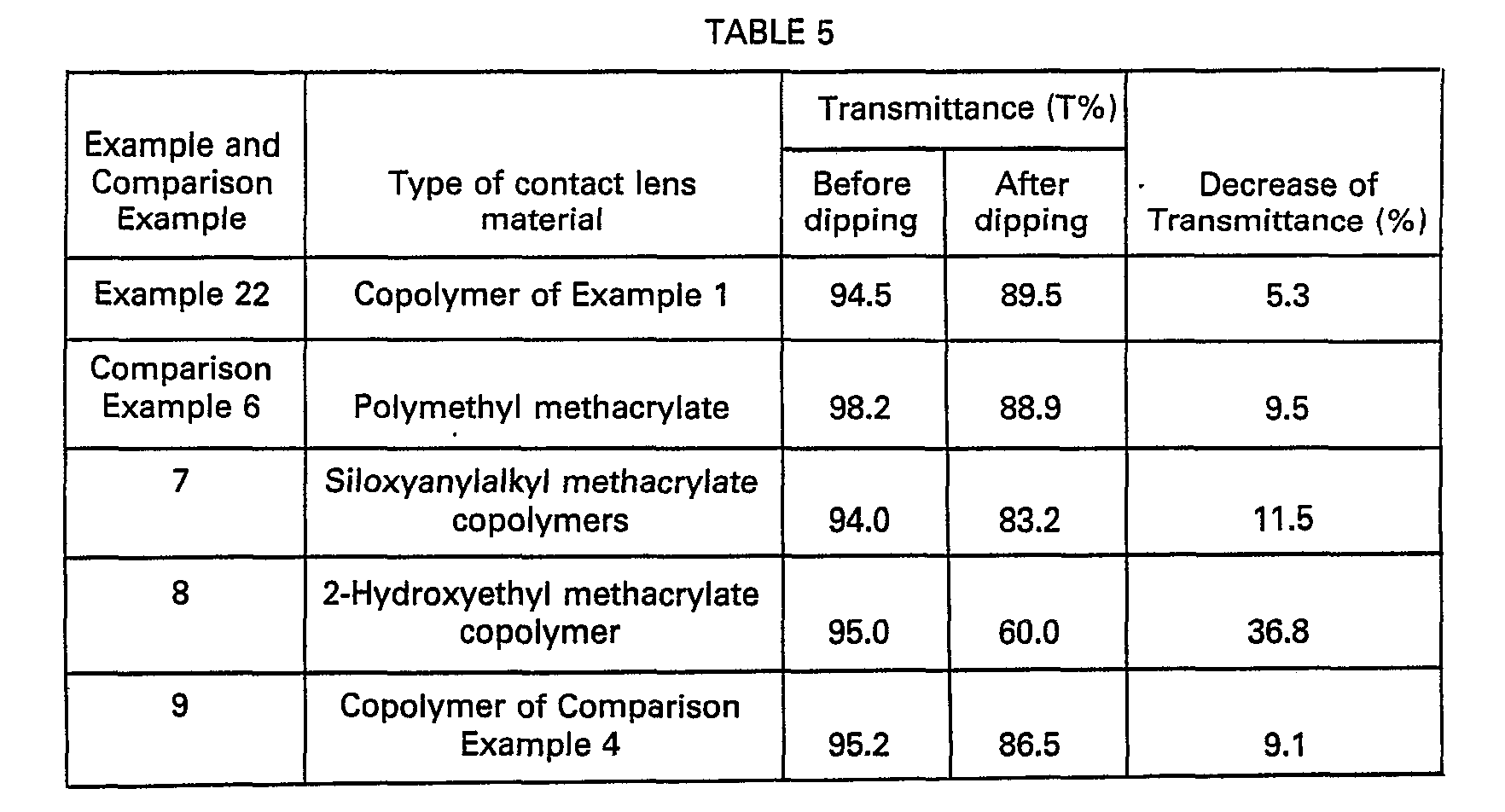
- test pieces were immersed into a physiological saline solution containing 0.1 % by weight of lysozyme at room temperature for 30 days and then removed from the solution and air-dried. Their contamination resistance was examined (respective Comparison Examples 6, 7, and 9) by measuring the transmittance of visible light (wavelength 400 nm) of said test pieces before and after their immersion (by a double-beam Hitachi spectrophotometer, type 228A). The results are summarized in Table 5. Stability in transmittance rate is an indication of low susceptibility to contamination.
- Test pieces 13 mm in diameter and 3 mm thick listed in Table 6 were immersed into 0.9% by weight of a physiological saline solution at 20°C for 24 hrs. Thereafter, their contact angles to air bubbles in the physiological saline solution were measured. The results are summarized in Table 6. Smaller contact angles indicate better wettability.
- MMA, TPTMA and EGDMA respectively represent methyl methacrylate, trimethylolpropane trimethacrylate and ethyleneglycol dimethacrylate.
- SiMA represents tris(trimethyl siloxy)silylpropyl methacrylate. Others are the same as the aforementioned.
Landscapes
- Chemical & Material Sciences (AREA)
- Physics & Mathematics (AREA)
- Health & Medical Sciences (AREA)
- Chemical Kinetics & Catalysis (AREA)
- Medicinal Chemistry (AREA)
- Polymers & Plastics (AREA)
- Organic Chemistry (AREA)
- General Physics & Mathematics (AREA)
- Optics & Photonics (AREA)
- Addition Polymer Or Copolymer, Post-Treatments, Or Chemical Modifications (AREA)
- Eyeglasses (AREA)
- Liquid Crystal (AREA)
Description
- The present invention relates to contact lenses. More particularly, it pertains to contact lenses made of fluorine containing copolymers with fluorinated acrylic or methacrylic esters having hydroxyl groups as their components. Said lenses have excellent oxygen permeability, wettability, hardness and transparency as well as contamination resistance.
- Contact lenses made of 2-hydroxyethyl methacrylate or vinyl pyrrolidone as their main component (which contains water) and those made of methyl methacrylate (MMA) or siloxanyl alkyl methacrylate as their main component (which does not contain water) are known.
- All the aforementioned water containing lenses are liable to contamination by bacteria, proteins and lipids and for their removal frequent boiling or the use of chemical solutions are indispensable. Such treatment also involves the risk of deterioration of the contact lens material or of injury to the eyes caused by residual chemicals.
- Conventional contact lenses having MMA as their main component (which contains no water) have the grave disadvantage of low oxygen permeability and their continuous use is objectionable on account of corneal physiology. Conventional lenses having siloxanyl alkyl methacrylate as their main component excel those having MMA as their main component in oxygen permeability, but are inferior in hardness and wettability. Moreover they have the disadvantage of being liable to contamination by lipids.
- Recently, attempts have been made to solve the abovementioned problems by using fluorine- containing-copolymers of acrylic or methacrylic esters as materials for contact lenses. For example, in Japanese Patent Publication No. 46614/1976 contact lenses have been disclosed made of copolymers of particular perfluoroalkyl alkylmethacrylates and/or telomer alcohol methacrylates with MMA. Contact lenses made of copolymers of particular perfluoroalkyl alkylmethacrylates with monomers such as hydroxyethyl methacryate, etc. which contain wettable polar groups are known from Japanese Patent Application Laid-Open No. 29660/1979. Contact lenses made of copolymers of a polyfluoroalkyl methacrylate of a particular structure with methacrylic esters are known from Japanese Patent Application Laid-Open No. 118408/1981. Contact lenses made of copolymers of fluorinated (meth)acrylic esters with (meth)acrylic esters are known from Japanese Patent Application Laid-Open No. 51705/1982 and contact lenses made of copolymers with organosilanes or organosiloxanes which contain particular groups and compounds containing fluoroalkyl groups as their main components are known from Japanese Patent Application Laid-Open No. 28127/1984.
- In the aforementioned copolymers with acrylic or methacrylic esters containing fluorine atoms as their main components, when the amount of fluorine atoms is increased, their oxygen permeability is improved, but their water repellency, which has a deleterious effect on contact lenses, increases and their hardness decreases. When water repellency is high, the lens repels eye liquid, so that it cannot play its role, and causes discomfort to the wearer. In addition, when the hardness decreases, machinability becomes more difficult, which results in a drop in the yield of products in manufacturing lenses, and makes lenses susceptible to damage. In order to impart wettability to contact lenses, it was attempted to copolymerize monomers containing hydrophilic hydroxyl groups with said acrylic or methacrylic esters. Because of the compatibility of said acrylic or methacrylic esters with monomers having groups of low hydrophilicity, the copolymers thus obtained were inferior in transparency to those which had acrylic or methacrylic esters as their main components.
- As described above, no contact lenses are presently known which do not only have excellent oxygen permeability and wettability, but also have all the other characteristics required of acceptable contact lenses including contamination resistance, high hardness and transparency.
- An object of this invention is to provide contact lenses which not only have high oxygen permeability, but also excellent wettability, hardness and transparency, thus not causing discomfort whilst being worn.
- Another object of this invention is to provide contact lenses which can be easily machined, and moreover, have high hardness.
- Still another object of this invention is to provide contact lenses which show good contamination resistance such that they do not require frequent cleaning.
- Thus this invention relates to contact lenses made of copolymers which are substantially composed of 40-95 parts by weight of a structural unit represented by formula (1):


- The copolymers to be used for the purposes of the present invention have all the aforementioned characteristics required of contact lenses.
- According to this invention, the polyfluoroalkyl group denotes an alkyl group either partly or fully substituted by fluorine atoms; normally, 2-31 fluorine atoms are contained in such a group. Said polyfluoroalkyl group should preferably contain 5-10 carbon atoms and 10-20 fluorine atoms.
- The copolymers to be used for the purposes of this invention may be obtained by copolymerizing 40-95 parts by weight of a monomer represented by formula:


- Typical examples of the monomers of (1') are:

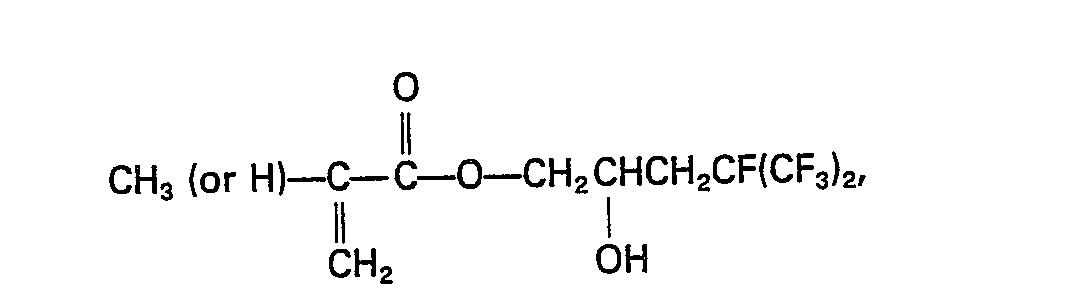


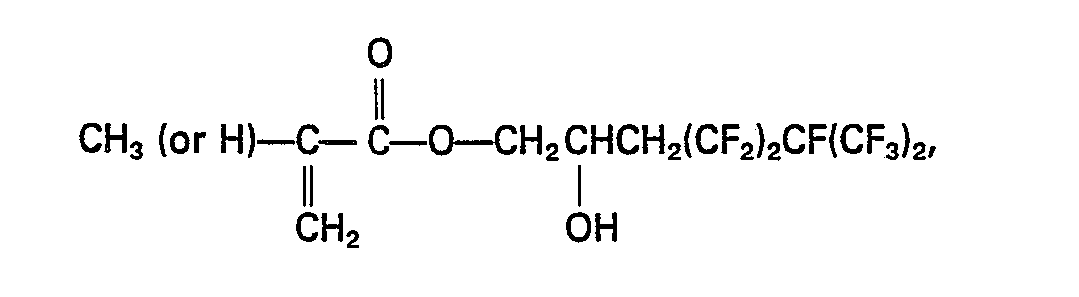


- These monomers can be readily synthesized from corresponding epoxides and acrylic or methacrylic acid in a conventional manner.
- Typical examples of the monomers of (2') are: methyl (meth)acrylate, isopropyl (meth)acrylate, n-butyl (meth)acrylate, isobutyl (meth)acrylate, tert-butyl (meth)acrylate, cyclohexyl (meth)acrylate, 2-ethyl hexyl (meth)acrylate, tridecyl (meth)acrylate, stearyl (meth)acrylate,


- Typical examples of the monomers of (3') are: vinyl acetate, vinyl butylate, vinyl caproate, vinyl caprylate, vinyl caprate, vinyl laurate, vinyl myristate, vinyl palmitate and vinyl stearate.
- Typical examples of the monomers of (4') are: styrene, para-methyl styrene, para-tert-butyl styrene and para-chlorostyrene.
- According to this invention, two or more members of each group of monomers covered by the aforementioned formulae may be used together.
- When the proportion of the monomers represented by the formula (1') is 60-90% by weight, copolymers with adequate oxygen permeability and hardness can be obtained. If the number of carbon atoms and that of fluorine atoms in the polyfluoroalkyl group contained in the monomers represented by the formula (1') are 5-10 and 10―20, respectively, when used within the range above-mentioned, then methyl, isopropyl, n-butyl, isobutyl, t-butyl and cyclohexyl esters of methacrylic acid are the preferred monomers to be copolymerized with these monomers in view of workability and configurational stability of the copolymers and the contact lenses.
- In order to achieve excellent workability and configurational stability at elevated temperatures in the lenses of this invention, apart from the aforementioned monomers, monomers having two or more groups which permit further crosslinking of the copolymers produced, for example, ethylenically unsaturated groups, may be used as comonomers. Up to 20 parts by weight of any ofthese comonomers may normally be used based on 100 parts by weight of the monomers represented by (1') and at least one member selected from a group of monomers consisting of those represented by (2') to (4'). Typical examples of these comonomers are: ethylene glycol dimethacrylate, diethylene glycol dimethacrylate, trimethylolpropane trimethacrylate, allyl methacrylate, divinylbenzene and pentaerythritol tetramethacrylate. In practice trimethylol propane trimethacrylate or ethylene glycol dimethacrylate are preferred.
- Although the copolymers to be used for the purposes of this invention already have high wettability, despite their large content of fluorine atoms, this property may be further improved by adding up to 15 parts by weight of hydrophilic monomers based on 100 parts by weight of all monomers. Too large an amount of such monomers will increase the water content of these copolymers and thus the lenses, making them undesirably susceptible to bacterial infection. Typical examples of hydrophilic monomers are: ethyleneglycol mono(meth)acrylate, diethyleneglycol mono(meth)acrylate, n-vinyl pyrrolidone, dimethyl acryl amide, methacrylic acid and acrylic acid.
- Further, according to this invention, there is no need to form copolymers by adding hydrophobic monomers other than those of formulae (2') to (4'). Nevertheless their use in amounts in which they do not interfere with the realization of the characteristics of the lenses in this invention is permissible. The use of siloxanyl alkyl (meth)acrylates with less than 16 Si atoms is undesirable. They cause opaque copolymers of reduced hardness, susceptibility to contamination and lowered wettability.
- The copolymers to be used for the purposes of this invention may be prepared by any conventional methods for polymerizing acrylates or methacrylates, for example, bulk polymerization or solution polymerization. Bulk polymerization is preferred providing transparent copolymers. Peroxides or azo compounds may be used as polymerization initiators. Typical examples are: benzoyl peroxide, lauroyl peroxide, di-isopropyl peroxydicarbonate, di-sec-butyl peroxydicarbonate, azobisisobutyronitrile, azobis- dimethyl valeronitril and azobisdimethylisobutylate. The polymerization initiators should preferably decompose at low temperatures to yield free radicals in view of the operation of polymerization. The amount of the polymerization initiator to be used should normally be 0.01-1% by weight, preferably, 0.05―0.5% by weight, based on all monomers. When preparing the copolymers by bulk polymerization, a mixture of the monomers and the polymerization initiator is poured into a mould in the shape of a plate, bar or column, etc., which is, for instance, made of metal, glass or plastic. The reaction is performed by heating in stages, for example, at 30-120°C for approx. 24-50 hrs. The heating method is not critical. The use of a container in the shape of the contact lens in the bulk polymerization will facilitate the processing operation.
- The copolymers obtained by the aforementioned operation may be machined in a conventional manner into contact lenses e.g. by cutting and polishing.
- Some preferred embodiments of this invention are now described, but they do not bind the scope of this invention. In the description of these embodiments, "parts" signifies parts by weight. Measurements of respective physical properties were taken using the following measuring instruments:
- Oxygen permeability coefficient: Oxygen gas permeater manufactured by Rikaseiki Kogyo Co., Ltd.
- Vickers hardness: Microhardness tester (type MVK-F) manufactured by Akashi Seisakusho Co., Ltd.
- Contact angle: Goniometer type contact-anglemeter (type G-I) manufactured by Erma Optical Works, Ltd.
- (when monomers having two or more ethylenically unsaturated groups are contained in the copolymers)
- Seventy parts of a monomer (19FM-OH) represented by a formula

- Copolymers were prepared by a procedure similar to that of Example 1, but the monomers used and their proportions were altered to those shown in Table 1.
- Copolymers were prepared by a procedure similar to that of Example 1, but the monomers used and their proportions were altered to those shown in Table 2.
- Copolymers were prepared by a procedure similar to that of Example 1, but the monomers and their proportions shown in Table 3 were used in place of Example 1.
- Copolymers were prepared by a procedure similar to that of Example 1, but the monomers and their proportions shown in Table 4 were used in place of those of Example 1.
- From each of the bar-shaped copolymers obtained in Examples 1-21 and Comparison Examples 1-5, test pieces 13 mm in diameter and 0.2 mm thick were prepared by cutting and polishing.
- The oxygen permeability at 35°C of each of the aforementioned test pieces was measured. The results of these tests are summarized in Table 1 (Examples 1-7 and Comparison Examples 1-2), Table 2 (Examples 8-10), Table 3 (Examples 11-21) and Table 4 (Comparison Examples 3-5).
- In addition, from each of the aforementioned bar-shaped copolymers a disc 13 mm in diameter and 3 mm thick was prepared by cutting and its Vickers hardness value was measured at 20°C. The test results are summarized in Table 1 (Examples 1-7 and Comparison Examples 1-2), Table 2 (Examples 8-10), Table 3 (Examples 11-21) and Table 4 (Comparison Examples 3-5).
- Test pieces 13 mm in diameter and 1 mm thick, were prepared from the following: (a) polymethyl methacrylate (Comp. Ex. 6; trade name: PARAGLAS@, manufactured by Kyowa Gas Chemical Industries, Ltd.), (b) siloxanylalkyl methacrylate copolymers (Comp. Ex. 7), produced by copolymerizing 50 parts by weight of SiMA {tris(trimethylsiloxy)silylpropyl methacrylate} and 50 parts by weight of MMA according to Example 1; (c) 2-hydroxyethyl methacrylate copolymer (Comp. Ex. 8; manufactured by Hydron Europe Inc.) and (d) copolymer of Comparison Example 4 (Comp. Ex. 9). The test pieces were immersed into a physiological saline solution containing 0.1 % by weight of lysozyme at room temperature for 30 days and then removed from the solution and air-dried. Their contamination resistance was examined (respective Comparison Examples 6, 7, and 9) by measuring the transmittance of visible light (wavelength 400 nm) of said test pieces before and after their immersion (by a double-beam Hitachi spectrophotometer, type 228A). The results are summarized in Table 5. Stability in transmittance rate is an indication of low susceptibility to contamination.
- Test pieces 13 mm in diameter and 3 mm thick listed in Table 6 were immersed into 0.9% by weight of a physiological saline solution at 20°C for 24 hrs. Thereafter, their contact angles to air bubbles in the physiological saline solution were measured. The results are summarized in Table 6. Smaller contact angles indicate better wettability.
- Contact lenses were manufactured from the copolymers prepared according to the above Examples. All of them could be easily machined and polished.
- These lenses underwent a wearing test for 3 months, 10-14 hours every day. They were comfortable to wear and did not cause damage to the cornea nor were they susceptible to contamination.

- In this table, MMA, TPTMA and EGDMA respectively represent methyl methacrylate, trimethylolpropane trimethacrylate and ethyleneglycol dimethacrylate.

- In this table 19FA-OH, 17FM-OH and 12FMO-OH respectively stand for


- In this table, SiMA represents tris(trimethyl siloxy)silylpropyl methacrylate. Others are the same as the aforementioned.

- 17FM: represents

- HEMA: 2-hydroxyethyl methacrylate
Claims (1)
- Contact lenses made of copolymers which are substantially composed of 40-95 parts by weight of a structural unit represented by formula (1):


Applications Claiming Priority (2)
| Application Number | Priority Date | Filing Date | Title |
|---|---|---|---|
| JP17158685 | 1985-08-02 | ||
| JP171586/85 | 1985-08-02 |
Publications (3)
| Publication Number | Publication Date |
|---|---|
| EP0213412A2 EP0213412A2 (en) | 1987-03-11 |
| EP0213412A3 EP0213412A3 (en) | 1987-09-23 |
| EP0213412B1 true EP0213412B1 (en) | 1990-01-10 |
Family
ID=15925902
Family Applications (1)
| Application Number | Title | Priority Date | Filing Date |
|---|---|---|---|
| EP86110639A Expired - Lifetime EP0213412B1 (en) | 1985-08-02 | 1986-08-01 | Contact lenses |
Country Status (4)
| Country | Link |
|---|---|
| US (1) | US4684705A (en) |
| EP (1) | EP0213412B1 (en) |
| JP (1) | JPS62123425A (en) |
| DE (1) | DE3668176D1 (en) |
Families Citing this family (13)
| Publication number | Priority date | Publication date | Assignee | Title |
|---|---|---|---|---|
| US4752627A (en) * | 1986-08-13 | 1988-06-21 | Michael Froix | Clouding-resistant contact lens compositions |
| FR2620452B1 (en) * | 1987-09-16 | 1991-11-08 | Elf Aquitaine | COPOLYMERS FOR USE IN PARTICULAR AS MULTIFUNCTIONAL LUBRICANT ADDITIVES AND COMPOSITIONS CONTAINING SAID COPOLYMERS |
| CA2005659A1 (en) * | 1988-12-19 | 1990-06-19 | Jurgen Volkheimer | Hydrogels based on fluorine-containing and saccharide monomers |
| DE69019942T2 (en) * | 1989-07-31 | 1995-11-23 | Hoya Corp | CONTACT LENS. |
| KR100191144B1 (en) * | 1990-11-27 | 1999-06-15 | 스티븐 에이 헬렁 | Surface-active macromonomer |
| JP3108550B2 (en) * | 1992-11-11 | 2000-11-13 | 株式会社メニコン | Soft ophthalmic lens material |
| CN1250988C (en) * | 1999-12-27 | 2006-04-12 | 三菱丽阳株式会社 | Plastic optical fibers, plastic optical fiber cables and optical fiber cables with plugs |
| US7253861B2 (en) | 2000-12-28 | 2007-08-07 | Asahi Glass Company | Liquid crystal optical element comprising a resin layer having a surface hardness of b or less |
| US6674494B2 (en) | 2000-12-28 | 2004-01-06 | Optrex Corporation | Liquid crystal optical element and test method for its boundary layer |
| EP1380628A4 (en) * | 2001-03-09 | 2006-09-13 | Daikin Ind Ltd | BETTER CALCULATED HYDROGEN AND OLEOPHOBIC AGENT |
| US6806026B2 (en) * | 2002-05-31 | 2004-10-19 | International Business Machines Corporation | Photoresist composition |
| CA2576263A1 (en) * | 2004-08-11 | 2006-02-16 | Kuraray Medical Inc. | Dental polymerizable composition |
| US20080293903A1 (en) * | 2004-09-14 | 2008-11-27 | Maria Petrucci-Samija | Optical Organic Polymer |
Family Cites Families (9)
| Publication number | Priority date | Publication date | Assignee | Title |
|---|---|---|---|---|
| US3409647A (en) * | 1965-06-24 | 1968-11-05 | Agriculture Usa | Certain fluorinated carboxylic acids and their derivatives |
| US3901864A (en) * | 1970-02-09 | 1975-08-26 | Ciba Geigy Ag | Polymerization products of perfluoroalkylalkylmonocarboxylic acid esters |
| US3950315A (en) * | 1971-06-11 | 1976-04-13 | E. I. Du Pont De Nemours And Company | Contact lens having an optimum combination of properties |
| US4130706A (en) * | 1977-08-08 | 1978-12-19 | E. I. Du Pont De Nemours And Company | Hydrophilic, oxygen permeable contact lens |
| JPS6025766B2 (en) * | 1980-09-13 | 1985-06-20 | ホ−ヤ株式会社 | oxygen permeable contact lens material |
| AU546039B2 (en) * | 1982-05-08 | 1985-08-08 | Menicon Co., Ltd | Oxygen permeable hard contact lens |
| JPS59204144A (en) * | 1983-04-12 | 1984-11-19 | Daikin Ind Ltd | Novel fluorine-containing compound and production and use thereof |
| JPS59197412A (en) * | 1983-04-25 | 1984-11-09 | Showa Denko Kk | Optical material |
| JPS60202107A (en) * | 1984-03-27 | 1985-10-12 | Kureha Chem Ind Co Ltd | Lens material |
-
1985
- 1985-11-22 JP JP60263097A patent/JPS62123425A/en active Pending
-
1986
- 1986-07-21 US US06/887,206 patent/US4684705A/en not_active Expired - Fee Related
- 1986-08-01 EP EP86110639A patent/EP0213412B1/en not_active Expired - Lifetime
- 1986-08-01 DE DE8686110639T patent/DE3668176D1/en not_active Expired - Lifetime
Also Published As
| Publication number | Publication date |
|---|---|
| US4684705A (en) | 1987-08-04 |
| EP0213412A3 (en) | 1987-09-23 |
| JPS62123425A (en) | 1987-06-04 |
| DE3668176D1 (en) | 1990-02-15 |
| EP0213412A2 (en) | 1987-03-11 |
Similar Documents
| Publication | Publication Date | Title |
|---|---|---|
| US5162469A (en) | Composition for rigid gas permeable contact lenses | |
| US4235985A (en) | Polymer for contact lens and contact lens made thereof | |
| US4433125A (en) | Oxygen permeable hard contact lens | |
| US4139692A (en) | Copolymer for contact lens, its preparation and contact lens made thereof | |
| US4436887A (en) | N-Vinyl lactam based biomedical devices | |
| US4661573A (en) | Lens composition articles and method of manufacture | |
| KR960010699B1 (en) | Highly Functional Soft Contact Lenses and Their Processing Solutions | |
| US5387632A (en) | Surface wettable silicone hydrogels | |
| EP0294515B1 (en) | Contact lens material | |
| EP0213412A2 (en) | Contact lenses | |
| US4769431A (en) | Polyacryloxyalkylsilanol lens composition, articles and method of manufacture | |
| US5416180A (en) | Soft ocular lens material | |
| JPS628769B2 (en) | ||
| US5264465A (en) | Contact lens material and contact lens | |
| JPH02196809A (en) | Lens material for eye | |
| WO1992018548A1 (en) | Novel composition for contact lenses | |
| EP0436727B1 (en) | Contact lens | |
| JPH0829741A (en) | Material for hard contact lens and hard contact lens | |
| JPS5928127A (en) | Oxygen permeable hard contact lens | |
| EP0446372B1 (en) | Contact lens | |
| US5391591A (en) | Oxygen permeable hard contact lens materials comprising a fluoroalkyl(silicon-containing alkyl) fumarate copolymer | |
| JP2804279B2 (en) | Ophthalmic lens materials | |
| JPH08334732A (en) | Soft contact lens | |
| JP3400510B2 (en) | Hydrous soft contact lens | |
| JPH0210405B2 (en) |
Legal Events
| Date | Code | Title | Description |
|---|---|---|---|
| PUAI | Public reference made under article 153(3) epc to a published international application that has entered the european phase |
Free format text: ORIGINAL CODE: 0009012 |
|
| AK | Designated contracting states |
Kind code of ref document: A2 Designated state(s): DE FR GB IT |
|
| PUAL | Search report despatched |
Free format text: ORIGINAL CODE: 0009013 |
|
| RHK1 | Main classification (correction) |
Ipc: C08F220/24 |
|
| AK | Designated contracting states |
Kind code of ref document: A3 Designated state(s): DE FR GB IT |
|
| 17P | Request for examination filed |
Effective date: 19871124 |
|
| 17Q | First examination report despatched |
Effective date: 19890223 |
|
| GRAA | (expected) grant |
Free format text: ORIGINAL CODE: 0009210 |
|
| AK | Designated contracting states |
Kind code of ref document: B1 Designated state(s): DE FR GB IT |
|
| REF | Corresponds to: |
Ref document number: 3668176 Country of ref document: DE Date of ref document: 19900215 |
|
| ITF | It: translation for a ep patent filed | ||
| ET | Fr: translation filed | ||
| PLBE | No opposition filed within time limit |
Free format text: ORIGINAL CODE: 0009261 |
|
| STAA | Information on the status of an ep patent application or granted ep patent |
Free format text: STATUS: NO OPPOSITION FILED WITHIN TIME LIMIT |
|
| 26N | No opposition filed | ||
| ITTA | It: last paid annual fee | ||
| PGFP | Annual fee paid to national office [announced via postgrant information from national office to epo] |
Ref country code: GB Payment date: 19940722 Year of fee payment: 9 |
|
| PGFP | Annual fee paid to national office [announced via postgrant information from national office to epo] |
Ref country code: FR Payment date: 19940809 Year of fee payment: 9 |
|
| PGFP | Annual fee paid to national office [announced via postgrant information from national office to epo] |
Ref country code: DE Payment date: 19940816 Year of fee payment: 9 |
|
| PG25 | Lapsed in a contracting state [announced via postgrant information from national office to epo] |
Ref country code: GB Effective date: 19950801 |
|
| GBPC | Gb: european patent ceased through non-payment of renewal fee |
Effective date: 19950801 |
|
| PG25 | Lapsed in a contracting state [announced via postgrant information from national office to epo] |
Ref country code: FR Effective date: 19960430 |
|
| PG25 | Lapsed in a contracting state [announced via postgrant information from national office to epo] |
Ref country code: DE Effective date: 19960501 |
|
| REG | Reference to a national code |
Ref country code: FR Ref legal event code: ST |
|
| PG25 | Lapsed in a contracting state [announced via postgrant information from national office to epo] |
Ref country code: IT Free format text: LAPSE BECAUSE OF NON-PAYMENT OF DUE FEES;WARNING: LAPSES OF ITALIAN PATENTS WITH EFFECTIVE DATE BEFORE 2007 MAY HAVE OCCURRED AT ANY TIME BEFORE 2007. THE CORRECT EFFECTIVE DATE MAY BE DIFFERENT FROM THE ONE RECORDED. Effective date: 20050801 |