EP0211578A2 - N-fluoro-N-perfluoromethyl sulfonamides - Google Patents
N-fluoro-N-perfluoromethyl sulfonamides Download PDFInfo
- Publication number
- EP0211578A2 EP0211578A2 EP86305714A EP86305714A EP0211578A2 EP 0211578 A2 EP0211578 A2 EP 0211578A2 EP 86305714 A EP86305714 A EP 86305714A EP 86305714 A EP86305714 A EP 86305714A EP 0211578 A2 EP0211578 A2 EP 0211578A2
- Authority
- EP
- European Patent Office
- Prior art keywords
- compound
- compounds
- formula
- fluorinating
- mmol
- Prior art date
- Legal status (The legal status is an assumption and is not a legal conclusion. Google has not performed a legal analysis and makes no representation as to the accuracy of the status listed.)
- Withdrawn
Links
Classifications
-
- C—CHEMISTRY; METALLURGY
- C07—ORGANIC CHEMISTRY
- C07D—HETEROCYCLIC COMPOUNDS
- C07D285/00—Heterocyclic compounds containing rings having nitrogen and sulfur atoms as the only ring hetero atoms, not provided for by groups C07D275/00 - C07D283/00
- C07D285/01—Five-membered rings
-
- C—CHEMISTRY; METALLURGY
- C07—ORGANIC CHEMISTRY
- C07B—GENERAL METHODS OF ORGANIC CHEMISTRY; APPARATUS THEREFOR
- C07B39/00—Halogenation
-
- C—CHEMISTRY; METALLURGY
- C07—ORGANIC CHEMISTRY
- C07C—ACYCLIC OR CARBOCYCLIC COMPOUNDS
- C07C17/00—Preparation of halogenated hydrocarbons
- C07C17/093—Preparation of halogenated hydrocarbons by replacement by halogens
- C07C17/10—Preparation of halogenated hydrocarbons by replacement by halogens of hydrogen atoms
- C07C17/12—Preparation of halogenated hydrocarbons by replacement by halogens of hydrogen atoms in the ring of aromatic compounds
-
- C—CHEMISTRY; METALLURGY
- C07—ORGANIC CHEMISTRY
- C07C—ACYCLIC OR CARBOCYCLIC COMPOUNDS
- C07C37/00—Preparation of compounds having hydroxy or O-metal groups bound to a carbon atom of a six-membered aromatic ring
- C07C37/62—Preparation of compounds having hydroxy or O-metal groups bound to a carbon atom of a six-membered aromatic ring by introduction of halogen; by substitution of halogen atoms by other halogen atoms
-
- C—CHEMISTRY; METALLURGY
- C07—ORGANIC CHEMISTRY
- C07C—ACYCLIC OR CARBOCYCLIC COMPOUNDS
- C07C41/00—Preparation of ethers; Preparation of compounds having groups, groups or groups
- C07C41/01—Preparation of ethers
- C07C41/18—Preparation of ethers by reactions not forming ether-oxygen bonds
- C07C41/22—Preparation of ethers by reactions not forming ether-oxygen bonds by introduction of halogens; by substitution of halogen atoms by other halogen atoms
-
- C—CHEMISTRY; METALLURGY
- C07—ORGANIC CHEMISTRY
- C07D—HETEROCYCLIC COMPOUNDS
- C07D285/00—Heterocyclic compounds containing rings having nitrogen and sulfur atoms as the only ring hetero atoms, not provided for by groups C07D275/00 - C07D283/00
- C07D285/15—Six-membered rings
-
- C—CHEMISTRY; METALLURGY
- C07—ORGANIC CHEMISTRY
- C07J—STEROIDS
- C07J1/00—Normal steroids containing carbon, hydrogen, halogen or oxygen, not substituted in position 17 beta by a carbon atom, e.g. estrane, androstane
- C07J1/0051—Estrane derivatives
- C07J1/0059—Estrane derivatives substituted in position 17 by a keto group
Definitions
- the invention relates to certain novel N-fluoro-N-perfluoromethylsulfonamide compounds and to their use as fluorinating agents for the fluorination of organic compounds, and to the preparation of such fluorinating agents.
- toluene and/or benzene for example, as solvents, in the fluorination reactions disclosed in these publications indicates that these N-fluoro-N-alkyl sulfonamides are not readily reactable, directly, with aromatic substrates such as toluene or benzene.
- An object of the present invention is to provide novel fluorinating agents and processes for the use thereof.
- a further object of the present invention is to provide fluorinating agents which may be used to directly fluorinate various organic compounds.
- a further object of the present invention is to provide fluorinating agents which may also be useful in the fluorination of organic carbanions:
- a still further object of the present invention is to provide fluorinating agents which may be used to fluorinate organic compounds in relatively high yields.
- a still further object of the present invention is to provide fluorinating agents which may be used in bulk fluorination reactions.
- a still further object of the present invention is to provide a fluorinating agent that is relatively safe to use, and under relatively mild conditions.
- a still further object of the present invention is to provide a process for preparing such novel fluorinating agents.
- R is a substituted or unsubstituted C 1-30 branched or straight chain alkyl, C 3-30 cycloalkyl, ar (C 1-10 alkyl) or aryl hydrocarbon group wherein ar and aryl are C 6-14 aryl,
- Such formula IV compounds include those having the formulae which is perfluoro-1,3-dithiazolidine-1,1,3,3-tetraoxide and which is 2,4,4,5,5,6,6,-heptafluoro-dihydro-1,3,2-dithiazine-1,1,3,3,-tetraoxide.
- cycloalkyl as used herein relative to the definition of the R groups, is intended to include bicycloalkyl groups, for example, 2-norbornyl.
- the R groups may be hydrocarbon groups, i.e., unsubstituted, or they may be substituted with one or more groups that are not subject to attack, either, by the fluorinating agent used to make the formulae I to IV compounds, under the conditions used to make such formulae I to IV compounds, or by the NF group of the formula I to IV compounds during the manufacture or use, as fluorinating agents, of the formula I to IV compounds.
- the substituents that may be employed in this regar would include F, Cl, alkoxy, cyano, nitro, ester, acyl (R"Cc-) alkyl sulfonyl (R"SO 2 -), sulfonyl fluoride (FS0 2 -), dialkyl amino (R" 2 N-), amido (R" 2 N-C-) groups, and other such groups, wherein R" is the same as R .
- the preferred of such R groups are the unsubstituted, or selectively halogenated (with F and/or Cl), alkyl groups.
- perfluoromethyl sulfonamide compounds are those formula IA compounds in which m is 2 and n is 0, i.e., N-fluoro-bis(trifluoromethane sulfonyl) imide which has the formula and those formula IA compounds in which m is 1, n is 1, and R is CH 3 , i.e., N-fluoro-N-methyl-trifluoromethane sulfonyl amide which has the formula
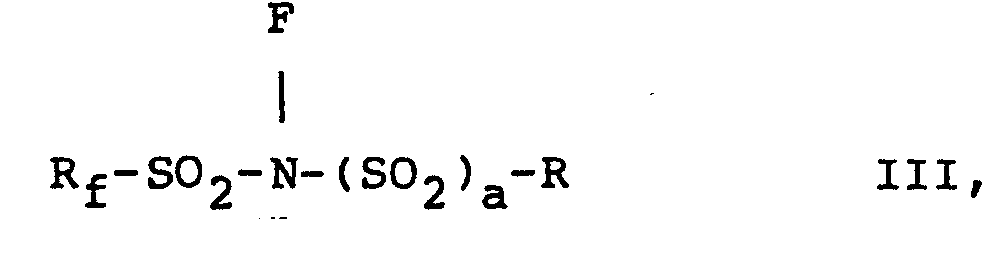
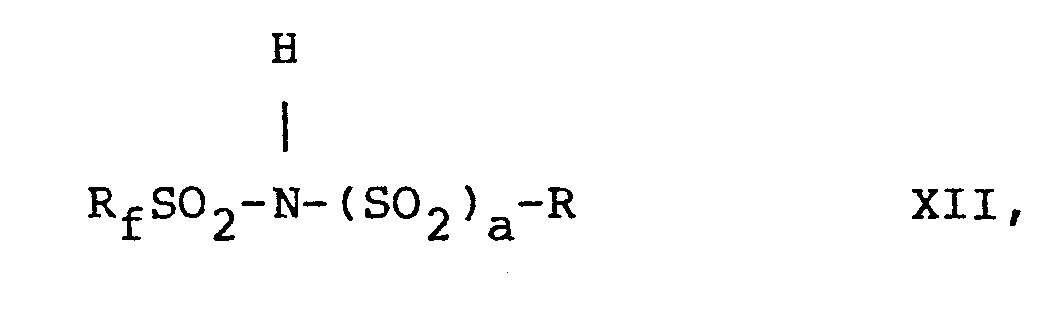
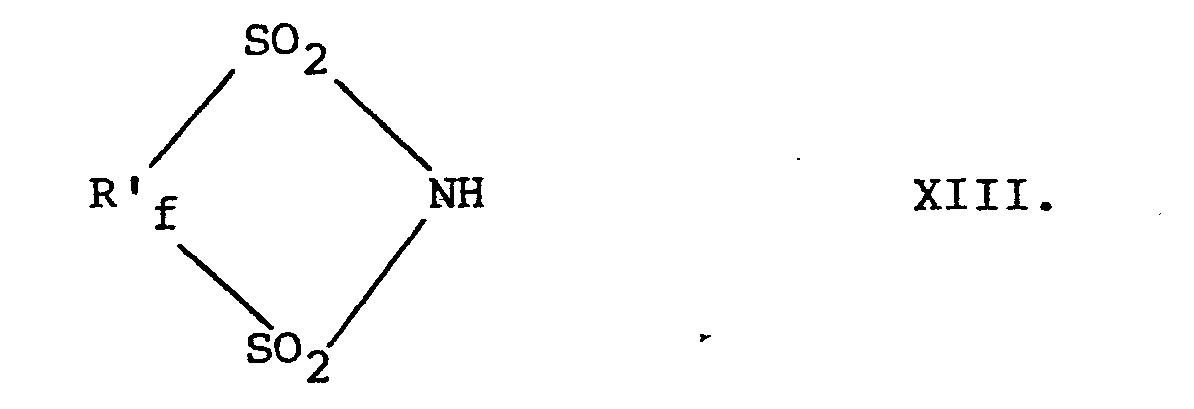
- N-fluoro-N-perfluoromethyl sulfonamide compounds of the present invention are prepared by fluorinating compounds having the formulae X, X I, XII, and XIII, respectively, i.e., wherein R, R f , R'f, m, n, p and a are as defined above.
- the preferred formula XIII compounds are those having the formula where n" is 2 or 3. Where n" is 2 the compound has formula XIIIB, and where n" is 3 the compound has formula XIIIC.
- X formula compounds wherein n and p are 0 may be analogously prepared by the procedures otherwise disclosed by J. Foropoulos and D.D. DesMarteau, Inorg. Chem. 1984, Vol. 23, page 3720.
- X formula compounds wherein n is 1 and p is 0 may be analogously prepared by the procedures otherwise disclosed by R.D. Trepka, J.K. Harrington and J.W. Belisle, J. Org. Chem., 1974, Vol. 39, page 1094 and by J.N. Meussdorffer and H. Niederprum, Chem. Ztg, 1972, Vol. 96, page 582.
- X formula compounds wherein n is 0 and p is 1 may be prepared by the procedures disclosed by J.N. Meussdorffer et al. supra.
- the XI and XII compounds can be made by methods, and with reagents, analogous to those employed by J. Foropoulos and D.D. DesMarteau, supra, and by J.N. Meussdorffer and H. Niederprum, supra.
- the XIII compounds can be made by reacting a compound of the structure:
- Compound XIIID is then reacted with NaOH to produce the sodium salt, stoichiometrically, in an aqueous system.
- the sodium salt is then reacted with concentrated sulfuric acid to produce compound XIII.
- Compound XIII is then removed from the excess sulfuric acid by vacuum distillation at 40°C. All of these reactions can be conducted at room temperature (20-25°C).
- the fluorinating reagents used in the fluorination of the X to XIII formulae compounds would include fluorine gas, alone, or in combination with a metal fluoride such as • sodium fluoride; fluoroxy compounds such as CF 3 0F, and other known fluorinating compounds.
- the fluorination of the X to XIII formulae compounds may be conducted at a temperature of about -80 to 22°C, in bulk or in an inert solvent, and under anhydrous conditions, and under autogeneous pressure.
- the fluorinating agent may be diluted with an inert gas such as helium, argon or nitrogen.
- an inert atmosphere is not required.
- An inert gas may be used to moderate the speed of the reaction, particularly under relatively large scale reaction conditions.
- the inert solvents would include monofluoro trichloro methane, dichloro difluoro methane, 1,1,2-trichloro trifluoro ethane, dichloro methane, difluoro monochloro methane, chloroform, chloroform-d, and mixtures of such solvents.
- the VII formula compounds may also be prepared, it is believed, by the electrochemical fluorination (ECF) of the corresponding acid, or N-H compound, in hydrofluoric acid, although in somewhat lower yields than may be possible by the other processes disclosed above.
- ECF electrochemical fluorination
- Such an ECF reaction is conducted at a temperature of about 0 to -20°C, under anhydrous conditions.
- the desired fluorination agents of the present invention may be recovered from the reaction system in which they are prepared by vacuum fractionation. For the preferred formula IA compounds this may be done at low temperatures, of -10 to -196 °C. (CF 3 SO 2 ) 2 NF and (CF 3 SO 2 )N(F) (CH 3 ) are preferably recovered in a fraction collectable at -75 ⁇ 5°C.
- the compounds of formula VII are preferably recovered in a fraction collectable at -40 ⁇ 20°C.
- the temperature to be employed in the fractionation of the formula VII compounds will vary over a relatively large range depending on the size of the R f group in such compounds. The larger is such group, the higher will be the minimum temperature needed to retain the desired compound in the trap.
- the compounds of formula IV are preferably recovered in a fraction collectable at -40 ⁇ 10°C.
- the fluorinating compounds of the present invention may be used in two basically different types of fluorination reactions. They may be used to fluorinate organic carbanions in the type of fluorination reactions disclosed in U.S. 4,479,901 and J . A mer. Chem. Soc. Vol. 106, No. 2, pages 452-454, 1984, and they may also be used to directly fluorinate aromatic and other aromatic-like organic compound protons.
- the fluorinating agents of the present invention can be thus used in to either directly fluorinate organic compound protons, or the reagent can be used to fluorinate an organic compound in carbanion form.
- direct fluorination reagents they are preferably used as so-called electrophilic fluorination reagents.
- electrophilic fluorination reagents When so used they are particularly useful in the direct fluorination of ring carbon atoms of aromatic compounds that have been activated, relative to the activity of benzene, for such electrophilic reactions. Unsubstituted aromatic compounds such as benzene, naphthalene and anthracene are active enough to be used in such reactions. The presence of activating groups on the aromatic ring will further activate the resulting compounds towards favoring reaction with these electrophilic fluorination reagents.
- Such activating groups on an aromatic ring, would thus include C 1 to C 6 alkyl groups such as methyl, ethyl, propyl, isopropyl, pentyl and hexyl groups; C 1 to C 6 alkoxy groups such as methoxy, ethoxy, propoxy, isopropoxy and pentoxy; cycloalkyl groups such as cyclopropyl; aryl groups such as phenyl, and other groups which contain an unshared pair of electrons on the atom connected to the aromatic ring, such as, NR' 2 , NHR', NH 2 , OH, NHC(O)R', OC(O)R', SR' and halogen (F, Cl, Br and I).
- R' in such cases, is typically a lower, C 1 to C 4 alkyl group such as methyl, ethyl, propyl and butyl.
- Aromatic ring substituents which have a deactivating effect, so to speak, on the resulting substituted compound, for electrophilic fluorination reaction purposes are groups which lack an unshared pair of electrons on the atom connected to the aromatic ring, such as nitro (NO 2 ), cyano (CN), sulfonate (SO 3 H) , acyl (C(O)R) , CCl 3 , NR' 3 + and other similarly related groups.
- reaction When used to directly fluorinate various organic compounds in electrophilic reactions excess amounts of the organic compound can be used as a solvent for the reaction, the reaction can thus be conducted in bulk. Such reactions can thus be conducted when fluorinating, with the fl.uorinating reagents of the present invention, aromatic compounds such as benzene, toluene, naphthalene, anisole, phenol, a cresol, i.e., m-cresol and p-cresol, and 1,3,5(10) estratrien-3ol-17one methyl ether.
- aromatic compounds such as benzene, toluene, naphthalene, anisole, phenol, a cresol, i.e., m-cresol and p-cresol, and 1,3,5(10) estratrien-3ol-17one methyl ether.
- the electrophilic fluorination type reactions are conducted with the fluorination reagents of the present invention at temperatures of about -80 to 22°C, and preferably of about -10 to 22°C, under anhydrous conditions.
- the electrophilic fluorination reaction is conducted in a solvent inert to the fluorinating agent and to the compound to be fluorinated and the desired resulting products.
- solvents would include carbon tetrachloride, trichloro-monofluoro-methane, dichloro methane, alkanes such as pentane and hexane, chloroform, chloroform-d and deactivated aromatic compounds such as nitrobenzene.
- the fluorinating agents of the present invention can provide relatively high yields, of the order of up to 80 to 95% or more, depending on the compound being fluorinated.
- the fluorinating agents of the present invention may also be used to fluorinate organic compound carbanions, and as otherwise disclosed in U.S. 4,479,901 and the JACS publication mentioned above and except as may be otherwise disclosed herein.
- the organic compound to be fluorinated must first be placed in carbanion form as disclosed in such prior art publications.
- the types of organic compounds to be so treated with the fluorinating agents of the present invention, in carbanion form include all those disclosed in such prior art publications.
- Such organic compounds, in carbanion form would include dialkyl-1-phenylmalonates and dialkyl-1-alkyl malonates wherein the alkyl groups are lower C 1 to C 4 alkyl groups.
- the fluorination of the organic compound carbanions with the fluorinating agents of the present invention can also be conducted as otherwise disclosed in such prior art publications, provided that the reaction is conducted in an inert solvent.
- Aromatic solvents for example, such as benzene and toluene, which are inert to the N-fluoro-N-alkylsulfonamide reagents of such prior art publications, and can be used as solvents in the processes of such publications, are not, as noted above, inert to the fluorinating reagents of the present invention at temperatures in the range of about 0 to 40°C and thus cannot be used as solvents when fluorinating other compounds in carbanion form under such temperature conditions.
- the contents of the bomb were then vacuum transferred to another stainless steel reactor containing sodium fluoride (25 g) and the mixture was allowed to stand at 22°C for 2 hours, followed by fractionation through a series of three cold traps operated at -10°, -75° and -196°,C, respectively.
- the -196°C trap collected a small amount of NF 3 and CF 3 S0 2 F
- the -10°C trap retained a very small amount of unreacted (CF 2 SO 2 ) 2 NH
- the -75°C trap retained pure FN (SO 2 CF 3 ) 2 (20.2 mmol, 94.6% yield).
- (CF 3 SO 2 ) 2 NF is a colorless liquid at 22°C, , which forms a crystalline solid on cooling with a melting point of 69.8°C.
- the compound is stable indefinitely at 22°C and it is not explosive when the liquid, sealed in a capillary tube, is impacted with a hammer.
- the vapor pressure of the compound at 25° C is about 40 torr.
- the infrared spectrum of the gas at 10 torr shows bonds at 1471(s), 1338(w), 1236(s), 1135(s), 862(s), 770(w), 685(vw), 658(w), 599(s) and 501(m) cm -1 .
- the 19 F NMR exhibits two singlets at -33.7 (N-F) and -74.4 (CF 3 ) ppm relative to internal CFC1 3 reference.
- the areas of the peaks are 1 to 6 as expected for FN(SO 2 CF 3 ) 2 .
- the mass spectrum shows an intense parent ion under CI with methane at 300 amu (MH + ).
- the EI spectrum shows intense peaks at 69 (CF 3 + ) and 133 (CF 3 SO 2 + ).
- the gas density molecular weight of the compound was 298 (calculated: 299.14).
- N-methyl-trifluoromethansulfonylamide, CF 3 SO 2 N(H)CH 3 , (6.0 g, 36.8 mmol) was added to 400 ml of CFC1 3 contained in a Teflon reactor.
- the reactor contained 10g of NaF, a magnetic stir bar, and a glass fritted inlet below the surface of-the solution and an outlet tube.
- the reactor was cooled with stirring to -75°C while bubbling N 2 through the solution.
- Fluorine gas was then added to the N 2 in a concentration of 1% at a total flow rate of about 440 sccm. This gas mixture was passed through the solution for about 5 hours until a 20% excess of fluorine had been added (about 44mmol).
- the fluorine flow was then stopped and N was bubbled through the cold solution for an additional 0.5 hour.
- the reactor was then allowed to warm in the air to about 20°C and the liquid contents were transferred to a round bottom flask fitted with a drying tube.
- the CFC1 3 was allowed to distill away until the volume reached about 20ml. This was then fractioned through a series of four cold traps operated at -20°, -40°, -76° and -196°, C, respectively.
- N -Fluoro-N-methyl-trifluoromethanesulfonylamide is a colorless liquid with a vapor pressure of 38 torr at 22°C.
- the infrared spectrum of the gas shows bands at 3011(vw), 2959 (vw) , 2918 (vw) , 1443 (s) , 1425 (s), 1230 (vs), 1132 (s) , 1067(w), 1025(m), 917(vw), 884(w), 846(m), 776(w), 683(s) and 602 ( m ) cm -1 .
- the 1 H NMR shows a resonance at ⁇ 4.35 (doublet, CH 3 ) .
- the sodium salt of diethyl- ⁇ -methyl malonate was prepared by standard methods. After drying, NaCCH 3 (O 2 CC 2 H 5 ) 2 (0.238 g, 1.2 mmol) was added to a 25 ml flask and 5 ml of CC1 4 was added. This mixture was stirred magnetically and (CF 3 SO 2 ) 2 NF (0.36 g, 1.2 mmol) in 5 ml of CCl 4 was added dropwise while holding the temperature of the flask at -10°C. After the addition was complete (about 5 minutes) the mixture was stirred for 2 hours. at -10°C. The mixture was then filtered at 22°C and the filtrate pumped under vacuum to remove solvent.
- the reaction was carried out in a 5 mm NMR tube for ease of monitoring the reaction products.
- a 0.4 ml sample of benzene was added to the N M R tube at -196°C by vacuum transfer, followed by 0.5 mmol of (CF 3 SO 2 ) 2 NF.
- the tube was sealed and warmed to 22°C. After 3 hours at 22°C, a color change was observed and 19 F NMR indicated a slow reaction was occuring. After 18 hours at 22°C, 19 F N MR utilizing an internal CFC1 3 standard indicated a 50% conversion to monofluorobenzene and HN(SO 2 CF 3 ) 2 , with an equal amount of unreacted FN(SO 2 CF 3 ) 2 . No other fluorine containing products could be detected by NMR.
- the fluorination reaction was carried out in a 10 mm NMR tube. To 0.28 mmol of the estratrien methyl ether were added 2.5 ml of CDC1 3 by vacuum transfer. The mixture was warmed to room temperature forming a colorless solution. This solution was cooled to -196°C-and 0.28 mmol each of FN(SO 2 CF 3 ) 2 and CFCl 3 were added by vacuum transfer. The tube was sealed and warmed to -74°C and then to 22°C over a 2 hour period. Near -65°C, the colorless solution began to turn to a pale yellow color. After reaching 22°C, 19 F NMR indicated a quantitative amount of (CF 3 SO 2 ) 2 NH was formed.
- the fluorination reaction was carried out in a 10 mm NMR tube.
- Anisole 1.0 mmol
- 2.5 ml of CDCl 3 were added to the tube at -196°C by vacuum transfer.
- the mixture was warmed to 22°C to form a solution and recooled to -196°C.
- (CF 3 SO 2 ) 2 NF 1.0 mmol
- the tube was then allowed to stand at 22°C for 7 hours.
- the remaining volatile materials in the bomb were then vacuum transferred to another stainless steel reactor containing sodium fluoride (25 g) and the mixture was allowed to stand for 2 hours at 22°C, followed by fractionation through a series of cold traps at -40°, -100° and -196°.
- the -196°C trap collected ⁇ 0.3 mmol of material consisting mainly of CF 3 S0 2 F and C 4 F 9 SO 2 F.
- the -100°C trap contained a trace of the desired N-F compound and the -40°C trap retained pure C 4 F 9 SO 2 N(F)SO 2 CF 3 (4.0 g, 8.9 mmol, 96% yield).
- C 4 F 9 SO 2 N(F)SO 2 CF 3 is a colorless liquid at 22°C which forms a crystalline solid on cooling with a melting point of -56°C.
- the vapor pressure of the liquid at 22°C is ⁇ 3 torr.
- the liquid compound showed no decomposition on standing for 3 days at 22°C.
- the infrared spectrum of the gas at ⁇ 3 torr shows bands at 1469(s), 1353(m), 1292(w), 1245(vs), 1207(sh), 1151(s), 1132(s), 1026(w), 1009(w), 865(m), 804(m), 771(w), 746(m), 702(w), 639(w), 582(m), 532(w), 497(m) cm -1 .
- the integrated areas of all NMR signals were as expected.
- the mass spectrum shows a weak parent ion under CI with methane at 450 amu (MH + ).
- the EI spectrum shows intense peaks at 69 (CF 3 + ), 131 ( C3F5 + ) and 219 (C 4 F 9 + ) with weak peaks 133 (CF 3 SO 2 + ) and 283 (C 4 F 9 SO 2 + ).
- the remaining volatile materials in the bomb were then vacuum transferred to another stainless steel reactor containing sodium fluoride (25 g) and the mixture was allowed to stand for 2 hours at 22°C, followed by fractionation through a series of cold traps at -40° and -196°C.
- the -196°C trap collected a small amount of material consisting mainly of CF 3 SO 2 F and C 6 F 13 SO 2 F.
- the -40°C trap retained pure C 6 F 13 SO 2 N(F)SO 2 CF 3 (2.3 g, 4.2 mmol, 93% yield).
- C 6 F 13 SO 2 N(F)SO 2 CF 3 is a colorless liquid at 22°C which forms a crystalline solid on cooling with a melting point of -28°C to -30°C.
- the vapor pressure of the liquid at 22°C is ⁇ 1 torr.
- the liquid compound showed no decomposition on standing for 3 days at 22°C.
- the infrared spectrum of the gas at ⁇ 1 torr shows bands at 1464 (s) , 1359 (w), 1232 (vs) , 1151(s), 1127(s), 1045(w), 1021(w), 987(m), 937(w), 889(m), 853(m), 772 (w) , 744 (w) , 728 (w) , 705 (w) , 683 (w) , 638 (w) , 583(m), 492(m) cm -1 .
- CF 3 A SO 2 N(F) X SO 2 CF 2 B CF 2 C CF 2 D CF 2 E CF 2 F CF 3 G is as follows (internal CFCl 3 standard, 84.25 MHz) X - 32.4 (broad-singlet); A - 72.2 (singlet); B - 105.8 (triplet); C - 119.7 (multiplet); D - 121.9 (multiplet); E - 122.0 (multiplet), F-126.6 (multiplet); G - 81.3 (triplet) with coupling constants not readily assigned. The integrated areas of all NMR signals were as expected.
- the mass spectrum shows a weak parent ion under CI with methane at 550 amu (MH + ) with additional intense ions at 485 (M + -SO 2 ), 383(C 6 -F 13 SO 2 + ), 319(C 6 F 13 + ), 297 (C 4 F 9 SO 2 N + ) , 269 (C 5 F 11 + ), 231 (C 5 F 9 + ) , 181 (C 4 F 7 + ) , 169 (C 3 F 7 + ) , 133(C 3 SO 2 + ), 131(C 3 F 5 + ), 119(C 2 F 5 + ) and 100(C 2 F 4 + ).
- the EI spectrum shows intense peaks at 69(CF 3 + ), 100(C 2 F 4 + ), 119 (C 2 F 5 + ) , 131 (C 3 F 5 + ), 169 (C 3 F 7 + ) , 181 (C 4 F 7 + ) , 231 (C 5 F 9 + ) , 319 (C 6 F 13 + ).
- Compound IVA is a white crystalline solid at 22°C, which sublimes readily under vacuum at 31-33°C.
- the vapor pressure of the solid at 22°C is 13 torr.
- the compound shows no decomposition on standing for 3 days at 22°C.
- the infrared spectrum of the gas at 10 torr shows bands at 1463 (s) , 1279 (s) , 1224(vs), 1163(m), 965 (m) , 927(s), 750(s), 712(s), 626 (m) , 559 (m) , 484 (m) , 314 (w) cm -1 .
- the 19F NMR (CDC1 3 solvent, CFCl 3 internal standard, 84.25 MHz) consists of singlets at -104.5 (CF 2 ) and -13.9(N-F) in the ratio of 4:1.
- the mass spectrum shows a moderately intense parent ion under CI with methane at 262 amu (MH).
- the EI spectrum shows a very intense peak at 1'00 (C 2 F 4 + ) with additional very intense peaks at 200(?) and 100(C 2 F 4 + ) with additional moderately intense peaks at 81 (C 2 F 3 + ) , 69 (CF 3 + ) , 64 (SO 2 + ) and 48(SO+).
- Compound IVB is a white crystalline solid at 22°C, which sublimes readily under vacuum at 42-45°C.
- the vapor pressure of the solid at 22°C is ⁇ 8 torr.
- the compound shows no decomposition on standing for 3 days at 22°C.
- the infrared spectrum of the gas at ⁇ 8 torr shows bands at 1475(vs), 1287(w,sh), 1263(w,sh), 1207(vs), 1165(m), 1063(w), 1026(s), 994(m), 922(s), 814(m), 698(w), 655(w), 630(m), 575 (w), 524(m), 466(w) cm -1 .
- the 19F NMR (CDC1 3 solvent, CFC1 3 internal standard, 84.25 MHz) consists of a singlet at -27.2 (N-F) and a second order multiplet consisting of 7 major lines at -101.6, -104.9, -114.4, -117.4, -128.4, -130.8 and -134.0 (-CF 2 -CF 2 -CF 2 -) with integrated intensities of N-F to C-F of 1:6.
- the mass spectrum shows a very intense parent ion under CI with methane at 312 amu(MH + ) with an additional intense ion at 100 (C 2 F 4 + ).
- the EI spectrum shows a very intense peak at 100 (C 2 F 4 + ) with additional intense peaks at 131 (C 3 F 5 + ) , 69 (CF 3 + ) , 64 (SO 2 + ) and 48 (SO + ) .
Landscapes
- Chemical & Material Sciences (AREA)
- Organic Chemistry (AREA)
- Chemical Kinetics & Catalysis (AREA)
- Health & Medical Sciences (AREA)
- General Health & Medical Sciences (AREA)
- Organic Low-Molecular-Weight Compounds And Preparation Thereof (AREA)
- Nitrogen- Or Sulfur-Containing Heterocyclic Ring Compounds With Rings Of Six Or More Members (AREA)
Abstract
Description
- The invention relates to certain novel N-fluoro-N-perfluoromethylsulfonamide compounds and to their use as fluorinating agents for the fluorination of organic compounds, and to the preparation of such fluorinating agents.
- U.S. 4,479,901 and J. Amer. Chem. Soc., Vol. 106, No. 2, pages 452-454, 1984, disclose the use of certain N-fluoro-N-alkyl sulfonamides as fluorinating agents for the fluorination of certain organic carbanions. These fluorinating agents are used by first generating the carbanion of certain organic compounds with a base, followed by the addition of the N-fluoro-N-alkyl sulfonamide. These fluorinating agents are thus not adapted to directly fluorinate organic substrates, such as aromatic compounds.
- The use of toluene and/or benzene, for example, as solvents, in the fluorination reactions disclosed in these publications indicates that these N-fluoro-N-alkyl sulfonamides are not readily reactable, directly, with aromatic substrates such as toluene or benzene.
- Prior to the present invention it has not been readily possible to directly fluorinate organic compounds in high yields with sulfonamide containing fluorinating agents.
- An object of the present invention is to provide novel fluorinating agents and processes for the use thereof.
- A further object of the present invention is to provide fluorinating agents which may be used to directly fluorinate various organic compounds.
- A further object of the present invention is to provide fluorinating agents which may also be useful in the fluorination of organic carbanions:
- A still further object of the present invention is to provide fluorinating agents which may be used to fluorinate organic compounds in relatively high yields.
- A still further object of the present invention is to provide fluorinating agents which may be used in bulk fluorination reactions.
- A still further object of the present invention is to provide a fluorinating agent that is relatively safe to use, and under relatively mild conditions.
- A still further object of the present invention is to provide a process for preparing such novel fluorinating agents.
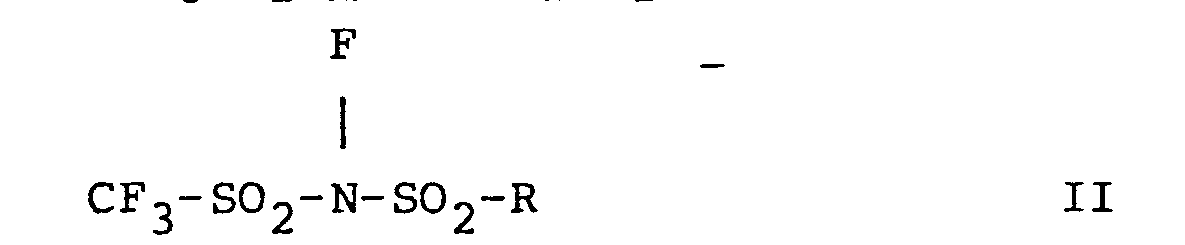
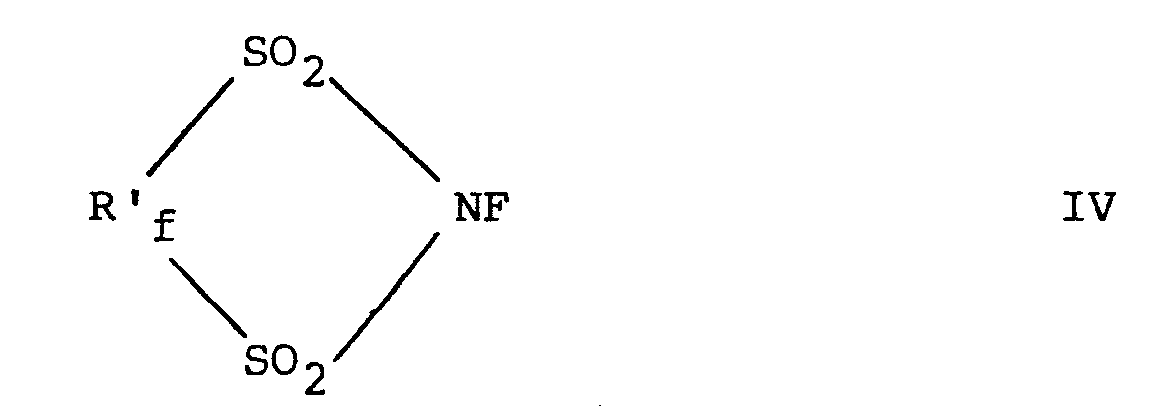
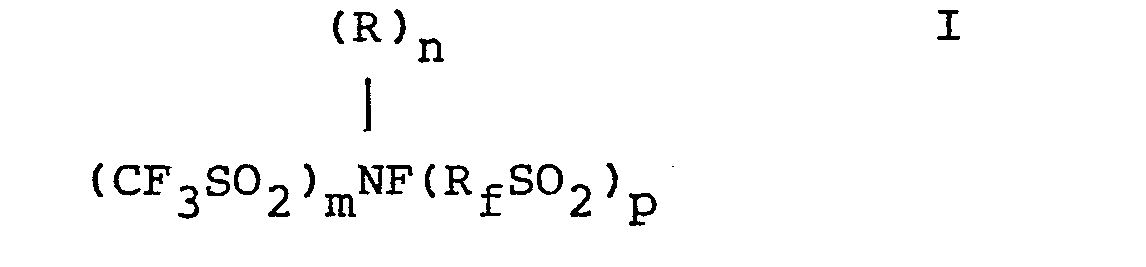
- It has now been found, according to the present invention that these and other objects of the present invention may be readily achieved by the use, as disclosed herein, for the fluorination of organic compounds of N-fluoro-N-perfluoromethyl sulfonamide compounds having the formulae I, II, III and IV as follows:

- wherein R is a substituted or unsubstituted C1-30 branched or straight chain alkyl, C3-30 cycloalkyl, ar (C1-10 alkyl) or aryl hydrocarbon group wherein ar and aryl are C6-14 aryl,
- Rf is a perfluorinated radical which is a C2-30 branched or straight chain alkyl, C3-30 cycloalkyl, or ar (C1-10 alkyl) or aryl group wherein ar and aryl are C6-14 aryl, m is 1 or 2, n is 0 or 1, p is 0 or 1 and m + n + p = 2


- Such formula I compounds include those having the following two formulae:


- Such formula IV compounds include those having the formulae


- The term "cycloalkyl" as used herein relative to the definition of the R groups, is intended to include bicycloalkyl groups, for example, 2-norbornyl.
- The R groups may be hydrocarbon groups, i.e., unsubstituted, or they may be substituted with one or more groups that are not subject to attack, either, by the fluorinating agent used to make the formulae I to IV compounds, under the conditions used to make such formulae I to IV compounds, or by the NF group of the formula I to IV compounds during the manufacture or use, as fluorinating agents, of the formula I to IV compounds. The substituents that may be employed in this regar would include F, Cl, alkoxy, cyano, nitro, ester, acyl (R"Cc-) alkyl sulfonyl (R"SO2-), sulfonyl fluoride (FS02-), dialkyl amino (R"2N-), amido (R"2N-C-) groups, and other such groups, wherein R" is the same as R. The preferred of such R groups are the unsubstituted, or selectively halogenated (with F and/or Cl), alkyl groups.
- The preferred of such perfluoromethyl sulfonamide compounds are those formula IA compounds in which m is 2 and n is 0, i.e., N-fluoro-bis(trifluoromethane sulfonyl) imide which has the formula


- The preferred of such perfluoromethyl sulfonamide compounds of formula IB are those having the formula:

- Specific compounds of the present invention having formula VII would include


- The N-fluoro-N-perfluoromethyl sulfonamide compounds of the present invention-i.e., those with formulae I to IV, are prepared by fluorinating compounds having the formulae X, XI, XII, and XIII, respectively, i.e.,




- The preferred formula XIII compounds are those having the formula

- The X formula compounds wherein n and p are 0 may be analogously prepared by the procedures otherwise disclosed by J. Foropoulos and D.D. DesMarteau, Inorg. Chem. 1984, Vol. 23, page 3720.
- The X formula compounds wherein n is 1 and p is 0 may be analogously prepared by the procedures otherwise disclosed by R.D. Trepka, J.K. Harrington and J.W. Belisle, J. Org. Chem., 1974, Vol. 39, page 1094 and by J.N. Meussdorffer and H. Niederprum, Chem. Ztg, 1972, Vol. 96, page 582.
- The X formula compounds wherein n is 0 and p is 1 may be prepared by the procedures disclosed by J.N. Meussdorffer et al. supra.
- The XI and XII compounds can be made by methods, and with reagents, analogous to those employed by J. Foropoulos and D.D. DesMarteau, supra, and by J.N. Meussdorffer and H. Niederprum, supra.
- The XIII compounds can be made by reacting a compound of the structure:
- FSO2R'fSO2F
- Compound XIIID is then reacted with NaOH to produce the sodium salt, stoichiometrically, in an aqueous system. The sodium salt is then reacted with concentrated sulfuric acid to produce compound XIII. Compound XIII is then removed from the excess sulfuric acid by vacuum distillation at 40°C. All of these reactions can be conducted at room temperature (20-25°C). These procedures are related to those used by J. Foropoulos and D.D. DesMarteau, supra, and by J.N. Meussdorffer and H. Niederprum supra.
- The fluorinating reagents used in the fluorination of the X to XIII formulae compounds would include fluorine gas, alone, or in combination with a metal fluoride such as • sodium fluoride; fluoroxy compounds such as CF30F, and other known fluorinating compounds.
- The fluorination of the X to XIII formulae compounds may be conducted at a temperature of about -80 to 22°C, in bulk or in an inert solvent, and under anhydrous conditions, and under autogeneous pressure. When the fluorinating reaction is conducted under flow reaction conditions the fluorinating agent may be diluted with an inert gas such as helium, argon or nitrogen. In a static reaction conducted under autogenous pressure, such as in the preparation of (CF3S02)2NF as disclosed below, an inert atmosphere is not required. An inert gas may be used to moderate the speed of the reaction, particularly under relatively large scale reaction conditions. The inert solvents would include monofluoro trichloro methane, dichloro difluoro methane, 1,1,2-trichloro trifluoro ethane, dichloro methane, difluoro monochloro methane, chloroform, chloroform-d, and mixtures of such solvents.
- The VII formula compounds may also be prepared, it is believed, by the electrochemical fluorination (ECF) of the corresponding acid, or N-H compound, in hydrofluoric acid, although in somewhat lower yields than may be possible by the other processes disclosed above. Such an ECF reaction is conducted at a temperature of about 0 to -20°C, under anhydrous conditions.
- The desired fluorination agents of the present invention may be recovered from the reaction system in which they are prepared by vacuum fractionation. For the preferred formula IA compounds this may be done at low temperatures, of -10 to -196 °C. (CF3SO2)2NF and (CF3SO2)N(F) (CH3) are preferably recovered in a fraction collectable at -75±5°C.
- The compounds of formula VII are preferably recovered in a fraction collectable at -40 ± 20°C. The temperature to be employed in the fractionation of the formula VII compounds will vary over a relatively large range depending on the size of the Rf group in such compounds. The larger is such group, the higher will be the minimum temperature needed to retain the desired compound in the trap.
- The compounds of formula IV are preferably recovered in a fraction collectable at -40±10°C.
- The fluorinating compounds of the present invention may be used in two basically different types of fluorination reactions. They may be used to fluorinate organic carbanions in the type of fluorination reactions disclosed in U.S. 4,479,901 and J. Amer. Chem. Soc. Vol. 106, No. 2, pages 452-454, 1984, and they may also be used to directly fluorinate aromatic and other aromatic-like organic compound protons.
- The fluorinating reagents used in U.S. 4,479,901 and in the JACS publication, supra, cannot readily be used to directly fluorinate organic compound protons. To be readily fluorinated with such reagents, the organic compound in question must first be changed to anion form.
- The fluorinating agents of the present invention can be thus used in to either directly fluorinate organic compound protons, or the reagent can be used to fluorinate an organic compound in carbanion form. When used as direct fluorination reagents they are preferably used as so-called electrophilic fluorination reagents. When so used they are particularly useful in the direct fluorination of ring carbon atoms of aromatic compounds that have been activated, relative to the activity of benzene, for such electrophilic reactions. Unsubstituted aromatic compounds such as benzene, naphthalene and anthracene are active enough to be used in such reactions. The presence of activating groups on the aromatic ring will further activate the resulting compounds towards favoring reaction with these electrophilic fluorination reagents.
- Such activating groups, on an aromatic ring, would thus include C1 to C6 alkyl groups such as methyl, ethyl, propyl, isopropyl, pentyl and hexyl groups; C1 to C6 alkoxy groups such as methoxy, ethoxy, propoxy, isopropoxy and pentoxy; cycloalkyl groups such as cyclopropyl; aryl groups such as phenyl, and other groups which contain an unshared pair of electrons on the atom connected to the aromatic ring, such as, NR'2, NHR', NH2, OH, NHC(O)R', OC(O)R', SR' and halogen (F, Cl, Br and I). R', in such cases, is typically a lower, C1 to C4 alkyl group such as methyl, ethyl, propyl and butyl.
- Aromatic ring substituents which have a deactivating effect, so to speak, on the resulting substituted compound, for electrophilic fluorination reaction purposes, are groups which lack an unshared pair of electrons on the atom connected to the aromatic ring, such as nitro (NO2), cyano (CN), sulfonate (SO3H) , acyl (C(O)R) , CCl3, NR'3 + and other similarly related groups.
- When used to directly fluorinate various organic compounds in electrophilic reactions excess amounts of the organic compound can be used as a solvent for the reaction, the reaction can thus be conducted in bulk. Such reactions can thus be conducted when fluorinating, with the fl.uorinating reagents of the present invention, aromatic compounds such as benzene, toluene, naphthalene, anisole, phenol, a cresol, i.e., m-cresol and p-cresol, and 1,3,5(10) estratrien-3ol-17one methyl ether.
- The electrophilic fluorination type reactions are conducted with the fluorination reagents of the present invention at temperatures of about -80 to 22°C, and preferably of about -10 to 22°C, under anhydrous conditions.
- When not conducted in bulk, the electrophilic fluorination reaction is conducted in a solvent inert to the fluorinating agent and to the compound to be fluorinated and the desired resulting products. Such solvents would include carbon tetrachloride, trichloro-monofluoro-methane, dichloro methane, alkanes such as pentane and hexane, chloroform, chloroform-d and deactivated aromatic compounds such as nitrobenzene.
- When used in the electrophilic type fluorination reactions the fluorinating agents of the present invention can provide relatively high yields, of the order of up to 80 to 95% or more, depending on the compound being fluorinated.
- The fluorinating agents of the present invention, as noted above, may also be used to fluorinate organic compound carbanions, and as otherwise disclosed in U.S. 4,479,901 and the JACS publication mentioned above and except as may be otherwise disclosed herein. Thus, when so used, the organic compound to be fluorinated must first be placed in carbanion form as disclosed in such prior art publications. The types of organic compounds to be so treated with the fluorinating agents of the present invention, in carbanion form, include all those disclosed in such prior art publications. Such organic compounds, in carbanion form, would include dialkyl-1-phenylmalonates and dialkyl-1-alkyl malonates wherein the alkyl groups are lower C1 to C4 alkyl groups. The fluorination of the organic compound carbanions with the fluorinating agents of the present invention can also be conducted as otherwise disclosed in such prior art publications, provided that the reaction is conducted in an inert solvent. Aromatic solvents, for example, such as benzene and toluene, which are inert to the N-fluoro-N-alkylsulfonamide reagents of such prior art publications, and can be used as solvents in the processes of such publications, are not, as noted above, inert to the fluorinating reagents of the present invention at temperatures in the range of about 0 to 40°C and thus cannot be used as solvents when fluorinating other compounds in carbanion form under such temperature conditions. However, at relatively low temperatures, preferably of the order of about -78 ± 10°C, such aromatic solvents, where liquid, might be useful, as solvents, in the fluorination of carbanions where an easily fluorinated carbanion can be generated in such solvent at such low temperatures and where the fluorinating reagent of the present invention would preferably react more rapidly with such carbanion, rather than with the solvent.
- The contents of U.S. 4,479,901 and the JACS publication are thus incorporated herein by reference with respect to the description therein of the types of organic carbanion compounds (and preparation thereof) that may be used with the fluorinating reagents of the present invention, and the reaction conditions that may be used therewith, subject to the use of inert solvents therewith. The following examples are merely illustrative of the present , invention and are not intended as a limitation upon the scope - thereof.
- Preparation of N-fluoro-bis(trifluoromethylsulfonyl) Imide, (CF3SO2)2NF
- Bis(trifluoromethyl sulfonyl) imide, (CF3SO2)2NH (6.0 g, 21.4 mmol) was added to a 300 ml stainless steel bomb in a glove box. The bomb was then cooled to -20°C and evacuated for 0.5 hour. It was then cooled to -196°C and fluorine (24.θ mmol) was added by vacuum transfer. The bomb was then allowed to warm in the room air to 22°C and let stand for 24 hours, at which point it was recooled to -196°C and evacuated to remove unreacted fluorine and any other materials volatile at -196°C. The contents of the bomb were then vacuum transferred to another stainless steel reactor containing sodium fluoride (25 g) and the mixture was allowed to stand at 22°C for 2 hours, followed by fractionation through a series of three cold traps operated at -10°, -75° and -196°,C, respectively. The -196°C trap collected a small amount of NF3 and CF3S02F, the -10°C trap retained a very small amount of unreacted (CF2SO2)2 NH, and the -75°C trap retained pure FN (SO2CF3)2 (20.2 mmol, 94.6% yield).
- (CF3SO2)2NF is a colorless liquid at 22°C, , which forms a crystalline solid on cooling with a melting point of 69.8°C. The compound is stable indefinitely at 22°C and it is not explosive when the liquid, sealed in a capillary tube, is impacted with a hammer. The vapor pressure of the compound at 25°C is about 40 torr. The infrared spectrum of the gas at 10 torr shows bonds at 1471(s), 1338(w), 1236(s), 1135(s), 862(s), 770(w), 685(vw), 658(w), 599(s) and 501(m) cm-1. The 19F NMR exhibits two singlets at -33.7 (N-F) and -74.4 (CF3) ppm relative to internal CFC13 reference. The areas of the peaks are 1 to 6 as expected for FN(SO2CF3)2. The mass spectrum shows an intense parent ion under CI with methane at 300 amu (MH+). The EI spectrum shows intense peaks at 69 (CF3 +) and 133 (CF3SO2 +). The gas density molecular weight of the compound was 298 (calculated: 299.14).
- N-methyl-trifluoromethansulfonylamide, CF3SO2N(H)CH3, (6.0 g, 36.8 mmol) was added to 400 ml of CFC13 contained in a Teflon reactor. The reactor contained 10g of NaF, a magnetic stir bar, and a glass fritted inlet below the surface of-the solution and an outlet tube. The reactor was cooled with stirring to -75°C while bubbling N2 through the solution. Fluorine gas was then added to the N2 in a concentration of 1% at a total flow rate of about 440 sccm. This gas mixture was passed through the solution for about 5 hours until a 20% excess of fluorine had been added (about 44mmol). The fluorine flow was then stopped and N was bubbled through the cold solution for an additional 0.5 hour. The reactor was then allowed to warm in the air to about 20°C and the liquid contents were transferred to a round bottom flask fitted with a drying tube. The CFC13 was allowed to distill away until the volume reached about 20ml. This was then fractioned through a series of four cold traps operated at -20°, -40°, -76° and -196°, C, respectively. The contents of the -20°C trap were unreacted CF3SO2N(H)CH3 (3mmol), the -40°C trap contained 0.2 mmol of an unidentified imine, probably CF3SO2N=CH2, the -196°C trap contained CFCl3 and the -76°C trap retained CF3SO2N(F)CH3 (4.0 mmol, 11% yield).
- N-Fluoro-N-methyl-trifluoromethanesulfonylamide is a colorless liquid with a vapor pressure of 38 torr at 22°C. The infrared spectrum of the gas shows bands at 3011(vw), 2959 (vw) , 2918 (vw) , 1443 (s) , 1425 (s), 1230 (vs), 1132 (s) , 1067(w), 1025(m), 917(vw), 884(w), 846(m), 776(w), 683(s) and 602(m) cm-1. The 19F NMR exhibits resonances at -40.5 (quartet, N-F) and -70.6 (S,CF3) ppm(CFC13) with 3JHF = 29Hz. The 1H NMR shows a resonance at δ 4.35 (doublet, CH3) .
- Preparation of diethyl-α-fluoro-α-methylmalonate, CH3CF(clo)OC2H5)2.
- The sodium salt of diethyl-α-methyl malonate was prepared by standard methods. After drying, NaCCH3(O2CC2H5)2 (0.238 g, 1.2 mmol) was added to a 25 ml flask and 5 ml of CC14 was added. This mixture was stirred magnetically and (CF3SO2)2NF (0.36 g, 1.2 mmol) in 5 ml of CCl4 was added dropwise while holding the temperature of the flask at -10°C. After the addition was complete (about 5 minutes) the mixture was stirred for 2 hours. at -10°C. The mixture was then filtered at 22°C and the filtrate pumped under vacuum to remove solvent. This gave a colorless liquid which by IR and NMR was shown to be pure CH3CF(O2CC2H5)2, (0.225 g, 96% yield). During the reaction, FN(SO2CF3)2 is converted to the Na salt NaN(S02CF3)2 which was identical with an authentic sample.
- Preparation of Monofluorotoluene.
- By vacuum transfer, FN(SO2CF3)2 (1.7 mmol) was added to 2.0 ml of toluene at -196°C. The mixture was warmed to room temperature and agitated by hand. A slow color change ensues near 22°C. After 10 hours, 19 F NMR shows the presence of 2-fluorotoluene (74%), 3-fluorotoluene (4%) and 4-fluorotoluene (21%). The ratio of unreacted FN(SO2CF3)2 to the HN(SO2CF3)2 formed in the reaction indicates an 80% conversion to the monofluorotoluene isomers. No other fluorine containing products are observed by NMR.
- The reaction was carried out in a 5 mm NMR tube for ease of monitoring the reaction products. A 0.4 ml sample of benzene was added to the NMR tube at -196°C by vacuum transfer, followed by 0.5 mmol of (CF3SO2)2NF. The tube was sealed and warmed to 22°C. After 3 hours at 22°C, a color change was observed and 19F NMR indicated a slow reaction was occuring. After 18 hours at 22°C, 19F NMR utilizing an internal CFC13 standard indicated a 50% conversion to monofluorobenzene and HN(SO2CF3)2, with an equal amount of unreacted FN(SO2CF3)2. No other fluorine containing products could be detected by NMR.
- The fluorination reaction was carried out in a 10 mm NMR tube. To 0.28 mmol of the estratrien methyl ether were added 2.5 ml of CDC13 by vacuum transfer. The mixture was warmed to room temperature forming a colorless solution. This solution was cooled to -196°C-and 0.28 mmol each of FN(SO2CF3)2 and CFCl3 were added by vacuum transfer. The tube was sealed and warmed to -74°C and then to 22°C over a 2 hour period. Near -65°C, the colorless solution began to turn to a pale yellow color. After reaching 22°C, 19F NMR indicated a quantitative amount of (CF3SO2)2NH was formed. Two other fluorine resonances are observed in the ratio of 1:1 with a total area equal to the internal CFCl3 standard. These resonances at -140.2(m) and -168.6(m) ppm relative to CFC13 are assignable to an equimolar mixture of the two monofluoro derivatives of the estratrien, 2-fluoro-1,3,5(10)estratrien-301-17one methyl ether and 4-fluoro-1,3,5(10)estratrien-301-17one methyl ether, respectively.
- The fluorination reaction was carried out in a 10 mm NMR tube. Anisole (1.0 mmol) and 2.5 ml of CDCl3 were added to the tube at -196°C by vacuum transfer. The mixture was warmed to 22°C to form a solution and recooled to -196°C. (CF3SO2)2NF (1.0 mmol) was then added by vacuum transfer, the tube was sealed, and allowed to warm to 22°C in a small Dewar flask, initially at -196°C (about 3hours). The tube was then allowed to stand at 22°C for 7 hours. 19F NMR using an internal CFC13 standard showed complete conversion of (CF3SO2)2NF to (CF3SO2)2NH and three additional somewhat broad singlets at -122.6 (24%), -135.4 (69%) and -162.2 (7%). These signals correspond to 4-fluoro-anisole, 2-fluoro-anisole and polyfluorinated anisole (probably tetra or pentafluoro), respectively. The total yield of monofluoro-anisole was at least 90% by NMR.
- Attempts to prepare N-fluoro-bis(perfluoro-n-butane sulfonyl amide, (C4F9SO2)2NF as otherwise conducted by the procedures of Examples 1 to 2 were unsuccessful.
- Attempts to fluorinate nitrobenzene, as otherwise conducted by the process of Example 4, were unsuccessful.
- Additional Examples of Fluorinations with (CF3SO2)2NF IV
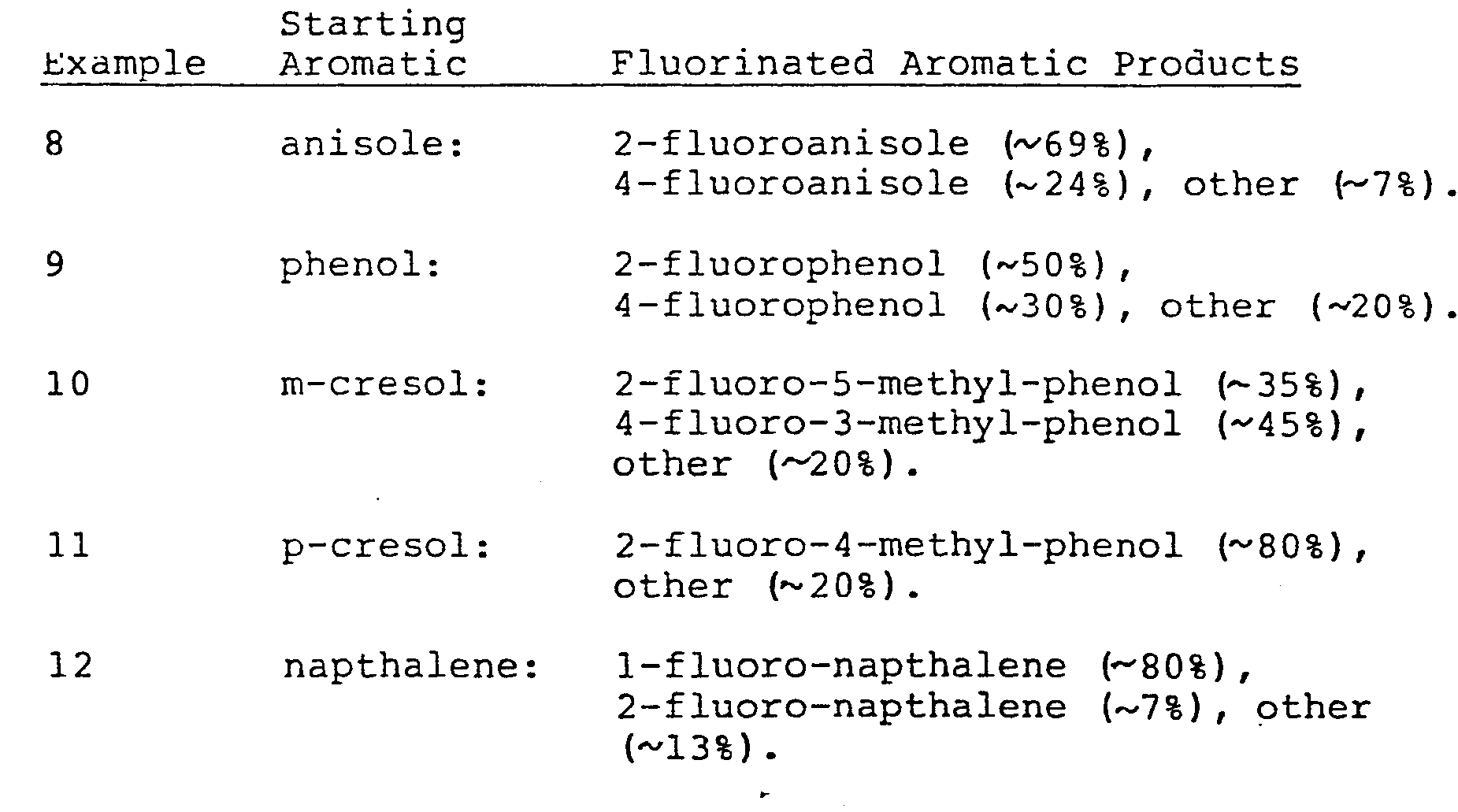
- A series of five fluorination reactions were carried out on five different aromatic compounds. Each reaction was carried out in a 10 mm NMR tube by adding 2 mmol of the aromatic and 2.5 ml of CDCl3. After degassing the solution, 1 mmol of (CF3S02)2NF was added to the tube at -196°C by vacuum transfer and after sealing, the tube was warmed to 22°C with stirring. After 10-12 hrs, 19F NMR showed complete conversion of the IV compound to its N-H derivative and the formation of fluoroaromatics. The aromatic compounds which were fluorinated in these examples and the fluorinated products thereby obtained (in mol %) were as follows:
- Preparation of C4F9SO2N(F)SO2CF3, N-fluoro-Nonafluoro-n-butylsulfonyl- trifluoromethylsulfonyl imide.
- C4F9SO2N(H)SO2CF3 (4.0 g, 9.3 mmol) was added to a 150 ml stainless steel bomb in a glove box. The bomb was then cooled to -20°C and evacuated for 0.5 hour. It was then cooled to -196°C and fluorine (11 mmol) was added by vacuum transfer. The bomb was then allowed to warm in the room air to 22°C and let stand for 24 hours, at which point it was recooled to -196°C and evacuated to remove unreacted fluorine and any other materials volatile at -196°C. The remaining volatile materials in the bomb were then vacuum transferred to another stainless steel reactor containing sodium fluoride (25 g) and the mixture was allowed to stand for 2 hours at 22°C, followed by fractionation through a series of cold traps at -40°, -100° and -196°. The -196°C trap collected ~0.3 mmol of material consisting mainly of CF3S02F and C4F9SO2F. The -100°C trap contained a trace of the desired N-F compound and the -40°C trap retained pure C4F9SO2N(F)SO2CF3 (4.0 g, 8.9 mmol, 96% yield).
- C4F9SO2N(F)SO2CF3 is a colorless liquid at 22°C which forms a crystalline solid on cooling with a melting point of -56°C. The vapor pressure of the liquid at 22°C is ~3 torr. The liquid compound showed no decomposition on standing for 3 days at 22°C. The infrared spectrum of the gas at~3 torr shows bands at 1469(s), 1353(m), 1292(w), 1245(vs), 1207(sh), 1151(s), 1132(s), 1026(w), 1009(w), 865(m), 804(m), 771(w), 746(m), 702(w), 639(w), 582(m), 532(w), 497(m) cm-1. The 19F NMR of D E CF3 ASO2N(F)XSO2CF2 BCF2 CCF2 DCF3 E is as follows (internal CFC13 standard, 188.3 MHz) X- 32.4 (broad-singlet); A - 72.2 (doublet); B- 106.0 (triplet of octets); C - 120.8 (complex multiplet); D - 126.1 (complex multiplet); E - 81.1 (ordered 27 line multiplet due to 3 different triplet splittings) with J AX = 5.0 Hz and the other coupling constants not readily assigned. The integrated areas of all NMR signals were as expected. The mass spectrum shows a weak parent ion under CI with methane at 450 amu (MH+). The EI spectrum shows intense peaks at 69 (CF3 +), 131 (C3F5 +) and 219 (C4F9 +) with weak peaks 133 (CF3SO2 +) and 283 (C4F9SO2 +).
- Preparation of C6F13SOZN(F)SO2CF3, N-fluoro-Tridecafluoro-n-hexylsulfonyl- trifluoromethylsulfonyl imide.
- C6F13SO2N(H)SO2CF3 (2.4 g, 4.5 mmol) was added to a 75 ml stainless steel bomb in a glove box. The bomb was then cooled to -20°C and evacuated for 1.0 hour. It was then cooled to -196°C and fluorine (5.5 mmol) was added by vacuum transfer. The bomb was then allowed to warm in the room air to 22°C and let stand for 4 days, at which point it was recooled to -196°C and evacuated to remove unreacted fluorine and any other materials volatile at -196°C. The remaining volatile materials in the bomb were then vacuum transferred to another stainless steel reactor containing sodium fluoride (25 g) and the mixture was allowed to stand for 2 hours at 22°C, followed by fractionation through a series of cold traps at -40° and -196°C. The -196°C trap collected a small amount of material consisting mainly of CF3SO2F and C6F13SO2F. The -40°C trap retained pure C6F13SO2N(F)SO2CF3 (2.3 g, 4.2 mmol, 93% yield).
- C6F13SO2N(F)SO2CF3 is a colorless liquid at 22°C which forms a crystalline solid on cooling with a melting point of -28°C to -30°C. The vapor pressure of the liquid at 22°C is~1 torr. The liquid compound showed no decomposition on standing for 3 days at 22°C. The infrared spectrum of the gas at~1 torr shows bands at 1464 (s) , 1359 (w), 1232 (vs) , 1151(s), 1127(s), 1045(w), 1021(w), 987(m), 937(w), 889(m), 853(m), 772 (w) , 744 (w) , 728 (w) , 705 (w) , 683 (w) , 638 (w) , 583(m), 492(m) cm-1. The 19NMR of
- CF3 ASO2N(F)XSO2CF2 BCF2 CCF2 DCF2 ECF2 FCF3 G is as follows (internal CFCl3 standard, 84.25 MHz) X - 32.4 (broad-singlet); A - 72.2 (singlet); B - 105.8 (triplet); C - 119.7 (multiplet); D - 121.9 (multiplet); E - 122.0 (multiplet), F-126.6 (multiplet); G - 81.3 (triplet) with coupling constants not readily assigned. The integrated areas of all NMR signals were as expected. The mass spectrum shows a weak parent ion under CI with methane at 550 amu (MH+) with additional intense ions at 485 (M+-SO2), 383(C6-F13SO2 +), 319(C6F13 +), 297 (C4F9SO2N+) , 269 (C5F11 +), 231 (C5F9 +) , 181 (C4F7 +) , 169 (C3F7 +) , 133(C3SO2 +), 131(C3F5 +), 119(C2F5 +) and 100(C2F4 +). The EI spectrum shows intense peaks at 69(CF3 +), 100(C2F4 +), 119 (C2F5 +) , 131 (C3F5 +), 169 (C3F7 +) , 181 (C4F7 +) , 231 (C5F9 +) , 319 (C6F13 +).
- Examples of Fluorinations with RfSO2N(F)SO2CF3 wherein R f = C4F9 and C 6 F 13
- The fluorination of toluene was carried out, separately, with each of compounds VII and IX in a similar manner to that employed in Example 4 above. 1 mmol of toluene, 0.8 mmol of CFC13 and 0.& mL of CDC13 were added to a 5 mm NMR tube. The mixture was cooled to -196°C and 0.5 mmol of the RfSO2N(F)SO2CF3 compound was then added by vacuum transfer and after sealing the tube, the mixture was warmed to 22°C with shaking. Progress of the reaction was monitored by 19F NMR. After 24 hours, the VIN and IX compounds were completely converted to the corresponding acids with the formation of 2-fluorotoluene ( 74%), 3-fluorotoluene (trace), 4-fluorotoluene ( 20%) and an unidentified compound ( 5%). The use of each of the VII(and IX compounds gave approximately the same results in this regard. Under identical conditions, (CF3SO2)2NF gave essentially the same results except that the reaction clearly proceeded at a faster rate.
- Examples of Fluorinations with RfSO2 (F) SO2CF3 where Rf = C 4F9 and C6F13.
- Preparation of diethyl-α-fluoro-α-methyl malonate, CH3CF (C(o) O C2H5)2.
- In an almost identical manner to Example 3 in which (CF3SO2)2NF was used as the fluorinating agent, the sodium salt of diethyl-1-methyl malonate was fluorinated with each of Compounds VII and IX in dichloromethane. The product was easier to isolate pure from dichloromethane than from carbon tetrachloride. After reaction and workup, the isolated yield of CH3CF(C(o)OC2H5)2 was 94% in each case.
- Compound XIIIB (1.91 g, 7.86 mmol) was added to a 75 ml stainless bomb in a glove box. The bomb was then cooled to -196°C, evacuated, and fluorine (8.6 mmol) was added by vacuum transfer. The bomb was then placed in a cold bath at -145°C and allowed to warm slowly to -20°C over 12 hours. It was then warmed to 22°C-and allowed to stand for 24 hours. The bomb was then recooled to -196°C and evacuated to remove unreacted fluorine and any other materials volatile at -196°C. The bomb was then warmed to -50°C and hydrogen fluoride produced in the reaction along with any other compounds volatile at this temperature were removed under vacuum. The remaining contents of the bomb were then fractionated through cold traps at -45 and -196°C. The compound IVA (1.58 g, 6.05 mmol, 77%) collected in the -45°C trap and only a trace of material was observed in the -196°C trap.
- Compound IVA is a white crystalline solid at 22°C, which sublimes readily under vacuum at 31-33°C. The vapor pressure of the solid at 22°C is 13 torr. The compound shows no decomposition on standing for 3 days at 22°C. The infrared spectrum of the gas at 10 torr shows bands at 1463 (s) , 1279 (s) , 1224(vs), 1163(m), 965 (m) , 927(s), 750(s), 712(s), 626 (m) , 559 (m) , 484 (m) , 314 (w) cm-1. The 19F NMR (CDC13 solvent, CFCl3 internal standard, 84.25 MHz) consists of singlets at -104.5 (CF2) and -13.9(N-F) in the ratio of 4:1. The mass spectrum shows a moderately intense parent ion under CI with methane at 262 amu (MH). The EI spectrum shows a very intense peak at 1'00 (C2F4 +) with additional very intense peaks at 200(?) and 100(C2F4 +) with additional moderately intense peaks at 81 (C2F3 +) , 69 (CF3 +) , 64 (SO2 +) and 48(SO+).
- Compound XIIIC (1.36 g, 4.6 mmol) was added to a 75 ml stainless bomb in a glove box. The bomb was then cooled to -196°C, evacuated, and fluorine (5.1 mmol) was added by vacuum transfer. The bomb was then placed in a cold bath at -145°C and allowed to warm slowly to -20°C over 12 hours. It was then warmed to 22°C and allowed to stand for 24 hours. The bomb was then recooled to -196°C and evacuated to remove unreacted fluorine and any other materials volatile at -196°C. The bomb was then warmed to -50°C and hydrogen fluoride produced in the reaction along with any other compounds volatile at this temperature were removed under vacuum. The remaining contents of the bomb were then fractionated through cold traps at -40 and -196°C. Compound IVB (0.87 g, 2.8 mmol, 61%) collected in the -40°C trap and only a trace of material was observed in the -196°C trap.
- Compound IVB is a white crystalline solid at 22°C, which sublimes readily under vacuum at 42-45°C. The vapor pressure of the solid at 22°C is ~ 8 torr. The compound shows no decomposition on standing for 3 days at 22°C. The infrared spectrum of the gas at ~ 8 torr shows bands at 1475(vs), 1287(w,sh), 1263(w,sh), 1207(vs), 1165(m), 1063(w), 1026(s), 994(m), 922(s), 814(m), 698(w), 655(w), 630(m), 575(w), 524(m), 466(w) cm-1. The 19F NMR (CDC13 solvent, CFC13 internal standard, 84.25 MHz) consists of a singlet at -27.2 (N-F) and a second order multiplet consisting of 7 major lines at -101.6, -104.9, -114.4, -117.4, -128.4, -130.8 and -134.0 (-CF2-CF2-CF2-) with integrated intensities of N-F to C-F of 1:6. The mass spectrum shows a very intense parent ion under CI with methane at 312 amu(MH+) with an additional intense ion at 100 (C2F4 +). The EI spectrum shows a very intense peak at 100 (C2F4 +) with additional intense peaks at 131 (C3F5 +) , 69 (CF3 +) , 64 (SO2 +) and 48 (SO+) .
- The fluorination of benzene was carried out in a manner similar to that employed in Examples 15 and 16. 0.2 mmoles of each of compounds IVA and IVB were separately combined with 1 mmol of benzene in CDCl3ICFCl3 solvent. After 12 hrs, 19 F NMR showed the formation of monofluorobenzene and the respective N-H compound along with unreacted N-F compound in each reaction. Based on the amount of unreacted N-F compound there was a 42% conversion to monofluorobenzene and the respective acids in each case.

Claims (20)
- Compounds of the formulae


 R is a hydrocarbon radical which is substituted or is unsubstituted and which is a C1-30 branched or straight chain alkyl, C3-30 cycloalkyl, or ar (C1-10 alkyl) or aryl group wherein ar and aryl are C6-14 aryl,Rf is a perfluorinated radical which is a C2-30 branched or straight chain alkyl, C3-30 cycloalkyl, or ar (C1-10 alkyl) or aryl group wherein ar and aryl are C6-14 aryl,R'f is a perfluorinated radical which is (CF2)n' wherein n' is 1 to 4,a is 0 or 1 andm is 1 or 2, n is 0 or 1, p is 0 or 1 and m + n + p = 2.
 - 2. Compounds according to claim 1 which have the formula (CF3SO2)m NF(R)n.
- 3. Compounds according to claim 2 which have the formula (CF3S02)2NF or (CF3SO2)N(F)R.
- 4. Compounds according to claim 3 in which R is a C1-30 alkyl group.
- 5. A compound according to claim 4 which has the formula (CF3SO2)N(F) (CH 3).
- 6. Compounds according to claim 1 which have the formula (CF3S02)NF(RfS02).
- 7. Compounds according to claim 6 in which Rf is a C1-30 alkyl group.
- 8. A compound according to claim 7 in which Rf is C4F9 or C6F13.
- 9. A compound according to claim I in which n' is 2 or 3.
- 10. A process for preparing a compound of one of the formulae



- 11. A process according to claim 10, which is conducted at about -80 to about 22°C.
- 12. A process according to claim 10 or claim 11, which is conducted in an inert solvent.
- 13. A process according to claim 10, which is an electrochemical fluorination process.
- 14. A process according to any one of claims 10 to 13, in which there is fluorinated a compound having the formula(CF 3S02)m NH (R)n,preferably a compound in which m is 2 and n is 0, or in which m is I and n is 1, and is, for example a compound in which R is CH3.
- 15. A process according to any one of claims 10 to 13, in which there is fluorinated a compound having the formula

- 16. A process according to claim 10 in which there is fluorinated a compound of formula (IV) in which n' is 2 or 3.
- 17. In a process for fluorinating an organic compound the improvement which comprises employing as a fluorinating agent in such process a compound according to any one of claims 1 to 9.
- 18. A process according to claim 17 which is conducted on an organic compound carbanion, such as a carbanion of diethyl 1-methylmalonate.
- 19. A process according to claim 17 which is conducted on an organic compound proton.
- 20. A process according to claim 19 in which an aromatic compound is fluorinated, for example benzene, toluene, naphthalene, anisole, phenol, a cresol, or 1, 3, 5 (10) estratrien-301-17one-methylether.
Applications Claiming Priority (2)
| Application Number | Priority Date | Filing Date | Title |
|---|---|---|---|
| US75860485A | 1985-07-24 | 1985-07-24 | |
| US758604 | 1985-07-24 |
Publications (2)
| Publication Number | Publication Date |
|---|---|
| EP0211578A2 true EP0211578A2 (en) | 1987-02-25 |
| EP0211578A3 EP0211578A3 (en) | 1987-11-11 |
Family
ID=25052372
Family Applications (1)
| Application Number | Title | Priority Date | Filing Date |
|---|---|---|---|
| EP86305714A Withdrawn EP0211578A3 (en) | 1985-07-24 | 1986-07-24 | N-fluoro-n-perfluoromethyl sulfonamides |
Country Status (2)
| Country | Link |
|---|---|
| EP (1) | EP0211578A3 (en) |
| JP (1) | JPS6226264A (en) |
Cited By (16)
| Publication number | Priority date | Publication date | Assignee | Title |
|---|---|---|---|---|
| EP0252431A3 (en) * | 1986-07-10 | 1988-09-21 | Kali-Chemie Aktiengesellschaft | Process for the preparation of n-fluorsulfon amides |
| EP0311086A1 (en) * | 1987-10-09 | 1989-04-12 | Ciba-Geigy Ag | N-fluorinated sulfon amides, process for their preparation and their use |
| DE4313664A1 (en) * | 1993-04-20 | 1994-10-27 | Schering Ag | N-fluoromethanesulfonimide, process for its preparation and its use as a fluorinating agent |
| US5403957A (en) * | 1992-10-20 | 1995-04-04 | Wagner; William J. | Method for preparing N-fluorosulfonimides |
| US5414120A (en) * | 1992-11-27 | 1995-05-09 | Bayer Ag | Polyether-substituted imide compounds and their use |
| EP0680956A1 (en) * | 1994-03-15 | 1995-11-08 | Hoechst Aktiengesellschaft | Benz-1,2,3-oxathiazin-4(3F)-on-2,2-dioxides, process for their preparation and their use as electrophilic fluorination agents |
| EP0692479A1 (en) * | 1994-07-13 | 1996-01-17 | Hoechst Aktiengesellschaft | 1,2,3-Oxathiazin-4(3F)-one-2,2-dioxides, process for their preparation and their use as electrophilic fluorination agents |
| US5587513A (en) * | 1992-11-27 | 1996-12-24 | Pohmer; Klaus | Polyether-substituted imide compounds and their use |
| DE102009007643A1 (en) | 2009-02-05 | 2010-08-12 | List Holding Ag | Continuous treatment of viscous paste-like product in mixing kneader having spinning mixing element and permeable product- and gas chamber, comprises determining filling grade of the product by using rotational moment of the mixing element |
| DE102009007642A1 (en) | 2009-02-05 | 2010-08-12 | List Holding Ag | Method for continuous treatment of viscous, pasty product in a mixing kneader with a common product area and a gas area, comprises regulating the temperature of the product over the number of revolutions of the mixing kneader |
| DE102009007641A1 (en) | 2009-02-05 | 2010-08-19 | List Holding Ag | Separating material mixtures, particularly solutions, suspensions and emulsion, involves dividing main vaporization and degasification, where main vaporization and degasification are performed in separate mixing kneader |
| DE102009007644A1 (en) | 2009-02-05 | 2010-09-16 | List Holding Ag | Separating material mixtures, particularly solutions, suspensions and emulsion, involves dividing main vaporization and degasification, where main vaporization and degasification are performed in separate mixing kneader |
| DE102009007640A1 (en) | 2009-02-05 | 2010-09-23 | List Holding Ag | Separating material mixtures, particularly solutions, suspensions and emulsion, involves dividing main vaporization and degasification, where main vaporization and degasification are performed in separate mixing kneader |
| US8067585B2 (en) | 2005-04-01 | 2011-11-29 | Asahi Glass Company, Limited | Method for producing disulfonyl fluoride compound |
| US8258341B2 (en) | 2009-07-10 | 2012-09-04 | E.I. Du Pont De Nemours And Company | Polyfluorosulfonamido amine and intermediate |
| EP2774666A1 (en) | 2009-02-05 | 2014-09-10 | LIST Holding AG | Controlling of a kneader |
Families Citing this family (1)
| Publication number | Priority date | Publication date | Assignee | Title |
|---|---|---|---|---|
| JP2686135B2 (en) * | 1989-03-28 | 1997-12-08 | 松下電工株式会社 | Constant current power supply circuit |
Family Cites Families (1)
| Publication number | Priority date | Publication date | Assignee | Title |
|---|---|---|---|---|
| US4479901A (en) * | 1983-08-15 | 1984-10-30 | E. I. Du Pont De Nemours And Company | Fluorination of carbanions with N-fluoro-N-alkylsulfonamides |
-
1986
- 1986-07-24 JP JP61175444A patent/JPS6226264A/en active Pending
- 1986-07-24 EP EP86305714A patent/EP0211578A3/en not_active Withdrawn
Cited By (21)
| Publication number | Priority date | Publication date | Assignee | Title |
|---|---|---|---|---|
| US4900867A (en) * | 1986-07-10 | 1990-02-13 | Kali-Chemie Aktiengesellschaft | Process for producing fluorosulfonamides |
| EP0252431A3 (en) * | 1986-07-10 | 1988-09-21 | Kali-Chemie Aktiengesellschaft | Process for the preparation of n-fluorsulfon amides |
| EP0311086A1 (en) * | 1987-10-09 | 1989-04-12 | Ciba-Geigy Ag | N-fluorinated sulfon amides, process for their preparation and their use |
| US5003074A (en) * | 1987-10-09 | 1991-03-26 | Ciba-Geigy Corporation | N-fluorinated sulfonamides |
| US5403957A (en) * | 1992-10-20 | 1995-04-04 | Wagner; William J. | Method for preparing N-fluorosulfonimides |
| US5587513A (en) * | 1992-11-27 | 1996-12-24 | Pohmer; Klaus | Polyether-substituted imide compounds and their use |
| US5414120A (en) * | 1992-11-27 | 1995-05-09 | Bayer Ag | Polyether-substituted imide compounds and their use |
| DE4313664A1 (en) * | 1993-04-20 | 1994-10-27 | Schering Ag | N-fluoromethanesulfonimide, process for its preparation and its use as a fluorinating agent |
| EP0680956A1 (en) * | 1994-03-15 | 1995-11-08 | Hoechst Aktiengesellschaft | Benz-1,2,3-oxathiazin-4(3F)-on-2,2-dioxides, process for their preparation and their use as electrophilic fluorination agents |
| US5525729A (en) * | 1994-03-15 | 1996-06-11 | Hoechst Aktiengesellschaft | Benz-1,2,3-oxathiazin-4(3F)-one-2,2-dioxides, a process for their preparation and their use as electrophilic fluorinating agents |
| EP0692479A1 (en) * | 1994-07-13 | 1996-01-17 | Hoechst Aktiengesellschaft | 1,2,3-Oxathiazin-4(3F)-one-2,2-dioxides, process for their preparation and their use as electrophilic fluorination agents |
| US5614626A (en) * | 1994-07-13 | 1997-03-25 | Hoechst Ag | 1,2,3-Oxathiazin-4(3F)-one 2,2-dioxides, a process for their preparation and their use as electrophilic fluorinating agents |
| US8067585B2 (en) | 2005-04-01 | 2011-11-29 | Asahi Glass Company, Limited | Method for producing disulfonyl fluoride compound |
| DE102009007643A1 (en) | 2009-02-05 | 2010-08-12 | List Holding Ag | Continuous treatment of viscous paste-like product in mixing kneader having spinning mixing element and permeable product- and gas chamber, comprises determining filling grade of the product by using rotational moment of the mixing element |
| DE102009007641A1 (en) | 2009-02-05 | 2010-08-19 | List Holding Ag | Separating material mixtures, particularly solutions, suspensions and emulsion, involves dividing main vaporization and degasification, where main vaporization and degasification are performed in separate mixing kneader |
| DE102009007644A1 (en) | 2009-02-05 | 2010-09-16 | List Holding Ag | Separating material mixtures, particularly solutions, suspensions and emulsion, involves dividing main vaporization and degasification, where main vaporization and degasification are performed in separate mixing kneader |
| DE102009007640A1 (en) | 2009-02-05 | 2010-09-23 | List Holding Ag | Separating material mixtures, particularly solutions, suspensions and emulsion, involves dividing main vaporization and degasification, where main vaporization and degasification are performed in separate mixing kneader |
| DE102009007642A1 (en) | 2009-02-05 | 2010-08-12 | List Holding Ag | Method for continuous treatment of viscous, pasty product in a mixing kneader with a common product area and a gas area, comprises regulating the temperature of the product over the number of revolutions of the mixing kneader |
| EP2774666A1 (en) | 2009-02-05 | 2014-09-10 | LIST Holding AG | Controlling of a kneader |
| EP2774665A1 (en) | 2009-02-05 | 2014-09-10 | LIST Holding AG | Process for continuous treatment of polymer solutions |
| US8258341B2 (en) | 2009-07-10 | 2012-09-04 | E.I. Du Pont De Nemours And Company | Polyfluorosulfonamido amine and intermediate |
Also Published As
| Publication number | Publication date |
|---|---|
| JPS6226264A (en) | 1987-02-04 |
| EP0211578A3 (en) | 1987-11-11 |
Similar Documents
| Publication | Publication Date | Title |
|---|---|---|
| US4828764A (en) | N-Fluoro-N-Perfluoromethyl sulfonamides | |
| EP1275631B1 (en) | Fluorination with aminosulfur trifluorides | |
| Frohn et al. | (Fluoroorgano) fluoroboranes and-fluoroborates I: synthesis and spectroscopic characterization of potassium fluoroaryltrifluoroborates and fluoroaryldifluoroboranes | |
| KR100642098B1 (en) | Process for the synthesis of aryl sulfurpentafluorides | |
| Janjetovic et al. | Solvent dependent reductive defluorination of aliphatic C–F bonds employing Sm (HMDS) 2 | |
| JPS6226264A (en) | N-fluoro-n-perfluoromethylsulfonamides | |
| US4697011A (en) | N-fluoro-N-perfluoromethyl sulfonamides | |
| CA2349325C (en) | Process for converting an alcohol to the corresponding fluoride | |
| JPH0788350B2 (en) | Method for producing N-fluorosulfonamide | |
| Singh et al. | The first application of SelectfluorTM in electrophilic fluorination of amines: a new route to–NF2,–NHF, and> NF compounds | |
| Roesky et al. | New phosphorus-sulfur chemistry | |
| US5504248A (en) | Preparation of halogenated compounds | |
| JP2021526140A (en) | How to prepare a polyfluorinated compound | |
| JP6246224B2 (en) | Fluorinating agent | |
| EP1730156B1 (en) | Process for producing tetrakis(fluoroaryl)borate salts | |
| Frohn et al. | (Fluoroorgano) fluoroboranes and-fluoroborates: Part 3. Polyfluoroalken-1-yldifluoroboranes | |
| Zollinger et al. | Organic fluoronitrogens. XI. Hydroxy addition compounds of fluorimines | |
| EP0908448B1 (en) | Thermally stable aminosulfur trifluorides | |
| EP0665831B1 (en) | An improved method for preparing n-fluorosulfonimides | |
| DesMarteau | N-fluoro-N-perfluoromethyl sulfonamides | |
| Bauknight Jr et al. | Fluoride-promoted competitive reactions of cyanogen fluoride, perfluoromethanimine, and pentafluoro-2-azapropene | |
| JP7505211B2 (en) | Ionic liquid and method for producing the same | |
| Abe et al. | N-Substituted (F-Tetramethylene) sulfoxyimides | |
| JP2002234877A (en) | N-fluorotriazinium fluorinating agent | |
| KR20020004868A (en) | Polyfluoroalkylsilanes |
Legal Events
| Date | Code | Title | Description |
|---|---|---|---|
| PUAI | Public reference made under article 153(3) epc to a published international application that has entered the european phase |
Free format text: ORIGINAL CODE: 0009012 |
|
| AK | Designated contracting states |
Kind code of ref document: A2 Designated state(s): BE CH DE FR GB IT LI NL SE |
|
| PUAL | Search report despatched |
Free format text: ORIGINAL CODE: 0009013 |
|
| AK | Designated contracting states |
Kind code of ref document: A3 Designated state(s): BE CH DE FR GB IT LI NL SE |
|
| 17P | Request for examination filed |
Effective date: 19880415 |
|
| 17Q | First examination report despatched |
Effective date: 19891228 |
|
| STAA | Information on the status of an ep patent application or granted ep patent |
Free format text: STATUS: THE APPLICATION IS DEEMED TO BE WITHDRAWN |
|
| 18D | Application deemed to be withdrawn |
Effective date: 19900828 |