EP0207514B1 - 1,4-dihydropyridine derivatives, process for preparing them, pharmaceutical composition and use - Google Patents
1,4-dihydropyridine derivatives, process for preparing them, pharmaceutical composition and use Download PDFInfo
- Publication number
- EP0207514B1 EP0207514B1 EP86109044A EP86109044A EP0207514B1 EP 0207514 B1 EP0207514 B1 EP 0207514B1 EP 86109044 A EP86109044 A EP 86109044A EP 86109044 A EP86109044 A EP 86109044A EP 0207514 B1 EP0207514 B1 EP 0207514B1
- Authority
- EP
- European Patent Office
- Prior art keywords
- group
- carbon atoms
- aryl
- integer
- alkyl
- Prior art date
- Legal status (The legal status is an assumption and is not a legal conclusion. Google has not performed a legal analysis and makes no representation as to the accuracy of the status listed.)
- Expired - Lifetime
Links
- YNGDWRXWKFWCJY-UHFFFAOYSA-N 1,4-Dihydropyridine Chemical class C1C=CNC=C1 YNGDWRXWKFWCJY-UHFFFAOYSA-N 0.000 title claims abstract description 27
- 239000008194 pharmaceutical composition Substances 0.000 title claims abstract 3
- 238000004519 manufacturing process Methods 0.000 title description 2
- 238000000034 method Methods 0.000 claims abstract description 15
- 150000003839 salts Chemical class 0.000 claims abstract description 11
- 239000002253 acid Substances 0.000 claims abstract description 8
- 230000008569 process Effects 0.000 claims abstract description 8
- 208000037265 diseases, disorders, signs and symptoms Diseases 0.000 claims abstract description 7
- 208000035475 disorder Diseases 0.000 claims abstract description 6
- 239000003814 drug Substances 0.000 claims abstract description 3
- 238000002360 preparation method Methods 0.000 claims abstract 2
- 150000001875 compounds Chemical class 0.000 claims description 58
- 125000003118 aryl group Chemical group 0.000 claims description 30
- 125000004432 carbon atom Chemical group C* 0.000 claims description 30
- 125000000217 alkyl group Chemical group 0.000 claims description 24
- 125000003710 aryl alkyl group Chemical group 0.000 claims description 12
- XHXFXVLFKHQFAL-UHFFFAOYSA-N phosphoryl trichloride Chemical group ClP(Cl)(Cl)=O XHXFXVLFKHQFAL-UHFFFAOYSA-N 0.000 claims description 12
- -1 pyrrolizidinyl group Chemical group 0.000 claims description 12
- 229910052736 halogen Inorganic materials 0.000 claims description 11
- 239000003795 chemical substances by application Substances 0.000 claims description 8
- 125000006165 cyclic alkyl group Chemical group 0.000 claims description 6
- 150000002367 halogens Chemical class 0.000 claims description 6
- 125000004435 hydrogen atom Chemical group [H]* 0.000 claims description 6
- 125000002757 morpholinyl group Chemical group 0.000 claims description 6
- 125000003884 phenylalkyl group Chemical group 0.000 claims description 6
- 125000004483 piperidin-3-yl group Chemical group N1CC(CCC1)* 0.000 claims description 6
- 125000004076 pyridyl group Chemical group 0.000 claims description 6
- 125000001544 thienyl group Chemical group 0.000 claims description 6
- 125000005843 halogen group Chemical group 0.000 claims description 5
- 125000005842 heteroatom Chemical group 0.000 claims description 5
- UHFMDUIMUVSXJC-UHFFFAOYSA-N 1-hydroxy-2h-pyridine Chemical class ON1CC=CC=C1 UHFMDUIMUVSXJC-UHFFFAOYSA-N 0.000 claims description 4
- 230000002140 halogenating effect Effects 0.000 claims description 4
- 238000010438 heat treatment Methods 0.000 claims description 3
- UHZYTMXLRWXGPK-UHFFFAOYSA-N phosphorus pentachloride Chemical compound ClP(Cl)(Cl)(Cl)Cl UHZYTMXLRWXGPK-UHFFFAOYSA-N 0.000 claims description 2
- 229910052801 chlorine Inorganic materials 0.000 claims 1
- 125000001309 chloro group Chemical group Cl* 0.000 claims 1
- 125000001511 cyclopentyl group Chemical group [H]C1([H])C([H])([H])C([H])([H])C([H])(*)C1([H])[H] 0.000 claims 1
- 125000001559 cyclopropyl group Chemical group [H]C1([H])C([H])([H])C1([H])* 0.000 claims 1
- 239000003937 drug carrier Substances 0.000 claims 1
- HEDRZPFGACZZDS-UHFFFAOYSA-N Chloroform Chemical compound ClC(Cl)Cl HEDRZPFGACZZDS-UHFFFAOYSA-N 0.000 description 26
- OKKJLVBELUTLKV-UHFFFAOYSA-N Methanol Chemical compound OC OKKJLVBELUTLKV-UHFFFAOYSA-N 0.000 description 24
- 239000000203 mixture Substances 0.000 description 13
- KFZMGEQAYNKOFK-UHFFFAOYSA-N Isopropanol Chemical compound CC(C)O KFZMGEQAYNKOFK-UHFFFAOYSA-N 0.000 description 9
- ZMANZCXQSJIPKH-UHFFFAOYSA-N Triethylamine Chemical compound CCN(CC)CC ZMANZCXQSJIPKH-UHFFFAOYSA-N 0.000 description 9
- 239000013078 crystal Substances 0.000 description 8
- 239000012156 elution solvent Substances 0.000 description 7
- RTZKZFJDLAIYFH-UHFFFAOYSA-N Diethyl ether Chemical compound CCOCC RTZKZFJDLAIYFH-UHFFFAOYSA-N 0.000 description 6
- 230000000694 effects Effects 0.000 description 6
- VLKZOEOYAKHREP-UHFFFAOYSA-N n-Hexane Chemical compound CCCCCC VLKZOEOYAKHREP-UHFFFAOYSA-N 0.000 description 6
- BWHMMNNQKKPAPP-UHFFFAOYSA-L potassium carbonate Chemical compound [K+].[K+].[O-]C([O-])=O BWHMMNNQKKPAPP-UHFFFAOYSA-L 0.000 description 6
- 238000010992 reflux Methods 0.000 description 6
- 238000010898 silica gel chromatography Methods 0.000 description 6
- 239000002904 solvent Substances 0.000 description 6
- 230000002490 cerebral effect Effects 0.000 description 5
- 239000000243 solution Substances 0.000 description 5
- 238000011699 spontaneously hypertensive rat Methods 0.000 description 5
- 230000002792 vascular Effects 0.000 description 5
- 230000000304 vasodilatating effect Effects 0.000 description 5
- 210000002385 vertebral artery Anatomy 0.000 description 5
- 241000282472 Canis lupus familiaris Species 0.000 description 4
- IAZDPXIOMUYVGZ-UHFFFAOYSA-N Dimethylsulphoxide Chemical compound CS(C)=O IAZDPXIOMUYVGZ-UHFFFAOYSA-N 0.000 description 4
- LFQSCWFLJHTTHZ-UHFFFAOYSA-N Ethanol Chemical compound CCO LFQSCWFLJHTTHZ-UHFFFAOYSA-N 0.000 description 4
- 230000036772 blood pressure Effects 0.000 description 4
- 230000004087 circulation Effects 0.000 description 4
- 238000000605 extraction Methods 0.000 description 4
- 230000001077 hypotensive effect Effects 0.000 description 4
- 230000000144 pharmacologic effect Effects 0.000 description 4
- 239000002504 physiological saline solution Substances 0.000 description 4
- 239000011541 reaction mixture Substances 0.000 description 4
- 238000012360 testing method Methods 0.000 description 4
- 230000024883 vasodilation Effects 0.000 description 4
- HNVFSDOPQBVHEU-UHFFFAOYSA-N 5-o-[2-(4-benzhydrylpiperazin-1-yl)ethyl] 3-o-methyl 2-chloro-6-methyl-4-(3-nitrophenyl)-1,4-dihydropyridine-3,5-dicarboxylate Chemical compound COC(=O)C1=C(Cl)NC(C)=C(C(=O)OCCN2CCN(CC2)C(C=2C=CC=CC=2)C=2C=CC=CC=2)C1C1=CC=CC([N+]([O-])=O)=C1 HNVFSDOPQBVHEU-UHFFFAOYSA-N 0.000 description 3
- 206010020772 Hypertension Diseases 0.000 description 3
- 208000001953 Hypotension Diseases 0.000 description 3
- ZMXDDKWLCZADIW-UHFFFAOYSA-N N,N-Dimethylformamide Chemical compound CN(C)C=O ZMXDDKWLCZADIW-UHFFFAOYSA-N 0.000 description 3
- MUBZPKHOEPUJKR-UHFFFAOYSA-N Oxalic acid Chemical compound OC(=O)C(O)=O MUBZPKHOEPUJKR-UHFFFAOYSA-N 0.000 description 3
- DNIAPMSPPWPWGF-UHFFFAOYSA-N Propylene glycol Chemical compound CC(O)CO DNIAPMSPPWPWGF-UHFFFAOYSA-N 0.000 description 3
- 239000003708 ampul Substances 0.000 description 3
- 239000005557 antagonist Substances 0.000 description 3
- 230000017531 blood circulation Effects 0.000 description 3
- 230000037396 body weight Effects 0.000 description 3
- 239000011575 calcium Substances 0.000 description 3
- 238000006243 chemical reaction Methods 0.000 description 3
- KGGZPRWQLRHPHV-UHFFFAOYSA-N dimethyl 2-[(3-nitrophenyl)methylidene]propanedioate Chemical compound COC(=O)C(C(=O)OC)=CC1=CC=CC([N+]([O-])=O)=C1 KGGZPRWQLRHPHV-UHFFFAOYSA-N 0.000 description 3
- 229960004592 isopropanol Drugs 0.000 description 3
- 238000010998 test method Methods 0.000 description 3
- XLYOFNOQVPJJNP-UHFFFAOYSA-N water Substances O XLYOFNOQVPJJNP-UHFFFAOYSA-N 0.000 description 3
- DRKFECVKLUAVGM-UHFFFAOYSA-N 1-hydroxy-4h-pyridine Chemical class ON1C=CCC=C1 DRKFECVKLUAVGM-UHFFFAOYSA-N 0.000 description 2
- MEKOFIRRDATTAG-UHFFFAOYSA-N 2,2,5,8-tetramethyl-3,4-dihydrochromen-6-ol Chemical class C1CC(C)(C)OC2=C1C(C)=C(O)C=C2C MEKOFIRRDATTAG-UHFFFAOYSA-N 0.000 description 2
- QYHCGQKQDPPAQY-UHFFFAOYSA-N 2-chloro-1,4-dihydropyridine Chemical class ClC1=CCC=CN1 QYHCGQKQDPPAQY-UHFFFAOYSA-N 0.000 description 2
- CSCPPACGZOOCGX-UHFFFAOYSA-N Acetone Chemical compound CC(C)=O CSCPPACGZOOCGX-UHFFFAOYSA-N 0.000 description 2
- 206010002383 Angina Pectoris Diseases 0.000 description 2
- 0 CC(NC(*)=C1*)=C(**)C1C(C=C1)=CC=C*1[N+]([O-])=O Chemical compound CC(NC(*)=C1*)=C(**)C1C(C=C1)=CC=C*1[N+]([O-])=O 0.000 description 2
- LEUOPMKYEKAJSZ-UHFFFAOYSA-N COC(=O)C1=C(C)NC(O)=C(C(=O)OC)C1C1=CC=CC([N+]([O-])=O)=C1 Chemical compound COC(=O)C1=C(C)NC(O)=C(C(=O)OC)C1C1=CC=CC([N+]([O-])=O)=C1 LEUOPMKYEKAJSZ-UHFFFAOYSA-N 0.000 description 2
- YMCFSROSPGWVJV-UHFFFAOYSA-N COC(=O)C1=C(O)NC(C)=C(C(=O)OCCN2CCN(CC2)C(C=2C=CC=CC=2)C=2C=CC=CC=2)C1C1=CC=CC([N+]([O-])=O)=C1 Chemical compound COC(=O)C1=C(O)NC(C)=C(C(=O)OCCN2CCN(CC2)C(C=2C=CC=CC=2)C=2C=CC=CC=2)C1C1=CC=CC([N+]([O-])=O)=C1 YMCFSROSPGWVJV-UHFFFAOYSA-N 0.000 description 2
- VTYYLEPIZMXCLO-UHFFFAOYSA-L Calcium carbonate Chemical compound [Ca+2].[O-]C([O-])=O VTYYLEPIZMXCLO-UHFFFAOYSA-L 0.000 description 2
- 229940127291 Calcium channel antagonist Drugs 0.000 description 2
- PEDCQBHIVMGVHV-UHFFFAOYSA-N Glycerine Chemical compound OCC(O)CO PEDCQBHIVMGVHV-UHFFFAOYSA-N 0.000 description 2
- VEXZGXHMUGYJMC-UHFFFAOYSA-N Hydrochloric acid Chemical compound Cl VEXZGXHMUGYJMC-UHFFFAOYSA-N 0.000 description 2
- OFOBLEOULBTSOW-UHFFFAOYSA-N Malonic acid Chemical compound OC(=O)CC(O)=O OFOBLEOULBTSOW-UHFFFAOYSA-N 0.000 description 2
- 241000699670 Mus sp. Species 0.000 description 2
- ZBBHBTPTTSWHBA-UHFFFAOYSA-N Nicardipine Chemical compound COC(=O)C1=C(C)NC(C)=C(C(=O)OCCN(C)CC=2C=CC=CC=2)C1C1=CC=CC([N+]([O-])=O)=C1 ZBBHBTPTTSWHBA-UHFFFAOYSA-N 0.000 description 2
- NBIIXXVUZAFLBC-UHFFFAOYSA-N Phosphoric acid Chemical compound OP(O)(O)=O NBIIXXVUZAFLBC-UHFFFAOYSA-N 0.000 description 2
- NQRYJNQNLNOLGT-UHFFFAOYSA-N Piperidine Chemical compound C1CCNCC1 NQRYJNQNLNOLGT-UHFFFAOYSA-N 0.000 description 2
- QAOWNCQODCNURD-UHFFFAOYSA-N Sulfuric acid Chemical compound OS(O)(=O)=O QAOWNCQODCNURD-UHFFFAOYSA-N 0.000 description 2
- 230000009471 action Effects 0.000 description 2
- 230000015572 biosynthetic process Effects 0.000 description 2
- 238000004440 column chromatography Methods 0.000 description 2
- 229940085304 dihydropyridine derivative selective calcium channel blockers with mainly vascular effects Drugs 0.000 description 2
- 230000010339 dilation Effects 0.000 description 2
- 150000002148 esters Chemical class 0.000 description 2
- 210000001105 femoral artery Anatomy 0.000 description 2
- BXWNKGSJHAJOGX-UHFFFAOYSA-N hexadecan-1-ol Chemical compound CCCCCCCCCCCCCCCCO BXWNKGSJHAJOGX-UHFFFAOYSA-N 0.000 description 2
- 230000036543 hypotension Effects 0.000 description 2
- 230000006872 improvement Effects 0.000 description 2
- 238000001990 intravenous administration Methods 0.000 description 2
- 238000010253 intravenous injection Methods 0.000 description 2
- 238000004255 ion exchange chromatography Methods 0.000 description 2
- 229960001783 nicardipine Drugs 0.000 description 2
- 229960001597 nifedipine Drugs 0.000 description 2
- HYIMSNHJOBLJNT-UHFFFAOYSA-N nifedipine Chemical compound COC(=O)C1=C(C)NC(C)=C(C(=O)OC)C1C1=CC=CC=C1[N+]([O-])=O HYIMSNHJOBLJNT-UHFFFAOYSA-N 0.000 description 2
- QIQXTHQIDYTFRH-UHFFFAOYSA-N octadecanoic acid Chemical class CCCCCCCCCCCCCCCCCC(O)=O QIQXTHQIDYTFRH-UHFFFAOYSA-N 0.000 description 2
- 239000000546 pharmaceutical excipient Substances 0.000 description 2
- 229910000027 potassium carbonate Inorganic materials 0.000 description 2
- 230000002035 prolonged effect Effects 0.000 description 2
- 238000001953 recrystallisation Methods 0.000 description 2
- 239000011734 sodium Substances 0.000 description 2
- KDYFGRWQOYBRFD-UHFFFAOYSA-N succinic acid Chemical compound OC(=O)CCC(O)=O KDYFGRWQOYBRFD-UHFFFAOYSA-N 0.000 description 2
- 230000009885 systemic effect Effects 0.000 description 2
- BJEPYKJPYRNKOW-REOHCLBHSA-N (S)-malic acid Chemical compound OC(=O)[C@@H](O)CC(O)=O BJEPYKJPYRNKOW-REOHCLBHSA-N 0.000 description 1
- PAMIQIKDUOTOBW-UHFFFAOYSA-N 1-methylpiperidine Chemical compound CN1CCCCC1 PAMIQIKDUOTOBW-UHFFFAOYSA-N 0.000 description 1
- SGTNSNPWRIOYBX-UHFFFAOYSA-N 2-(3,4-dimethoxyphenyl)-5-{[2-(3,4-dimethoxyphenyl)ethyl](methyl)amino}-2-(propan-2-yl)pentanenitrile Chemical compound C1=C(OC)C(OC)=CC=C1CCN(C)CCCC(C#N)(C(C)C)C1=CC=C(OC)C(OC)=C1 SGTNSNPWRIOYBX-UHFFFAOYSA-N 0.000 description 1
- CMWKITSNTDAEDT-UHFFFAOYSA-N 2-nitrobenzaldehyde Chemical compound [O-][N+](=O)C1=CC=CC=C1C=O CMWKITSNTDAEDT-UHFFFAOYSA-N 0.000 description 1
- ZKZPVGZMKNMFLC-UHFFFAOYSA-N 2-thiophen-2-ylethyl 3-aminobut-2-enoate Chemical compound CC(N)=CC(=O)OCCC1=CC=CS1 ZKZPVGZMKNMFLC-UHFFFAOYSA-N 0.000 description 1
- UKVYVZLTGQVOPX-UHFFFAOYSA-N 3-aminobut-2-enoic acid Chemical compound CC(N)=CC(O)=O UKVYVZLTGQVOPX-UHFFFAOYSA-N 0.000 description 1
- TYDPLYBDHIGBTR-UHFFFAOYSA-N 5-o-[1-[(4-fluorophenyl)methyl]piperidin-3-yl] 3-o-methyl 2-chloro-6-methyl-4-(3-nitrophenyl)-1,4-dihydropyridine-3,5-dicarboxylate Chemical compound COC(=O)C1=C(Cl)NC(C)=C(C(=O)OC2CN(CC=3C=CC(F)=CC=3)CCC2)C1C1=CC=CC([N+]([O-])=O)=C1 TYDPLYBDHIGBTR-UHFFFAOYSA-N 0.000 description 1
- 229920001817 Agar Polymers 0.000 description 1
- GUBGYTABKSRVRQ-XLOQQCSPSA-N Alpha-Lactose Chemical compound O[C@@H]1[C@@H](O)[C@@H](O)[C@@H](CO)O[C@H]1O[C@@H]1[C@@H](CO)O[C@H](O)[C@H](O)[C@H]1O GUBGYTABKSRVRQ-XLOQQCSPSA-N 0.000 description 1
- 239000005995 Aluminium silicate Substances 0.000 description 1
- NLXLAEXVIDQMFP-UHFFFAOYSA-N Ammonium chloride Substances [NH4+].[Cl-] NLXLAEXVIDQMFP-UHFFFAOYSA-N 0.000 description 1
- VHUUQVKOLVNVRT-UHFFFAOYSA-N Ammonium hydroxide Chemical compound [NH4+].[OH-] VHUUQVKOLVNVRT-UHFFFAOYSA-N 0.000 description 1
- 206010003210 Arteriosclerosis Diseases 0.000 description 1
- OAMJHRTYZGJROE-UHFFFAOYSA-N C(C)OC(=O)C1=C(NC(=C(C1C1=C(C=CC=C1)[N+](=O)[O-])C(=O)OCCN1CCOCC1)C)O Chemical compound C(C)OC(=O)C1=C(NC(=C(C1C1=C(C=CC=C1)[N+](=O)[O-])C(=O)OCCN1CCOCC1)C)O OAMJHRTYZGJROE-UHFFFAOYSA-N 0.000 description 1
- ZGWVXYFXKRULDH-UHFFFAOYSA-N C1(CC1)COC(=O)C=1C(C(=C(NC1C)O)C(=O)OC)C1=CC(=CC=C1)[N+](=O)[O-] Chemical compound C1(CC1)COC(=O)C=1C(C(=C(NC1C)O)C(=O)OC)C1=CC(=CC=C1)[N+](=O)[O-] ZGWVXYFXKRULDH-UHFFFAOYSA-N 0.000 description 1
- VIICMJKVOOUXSI-UHFFFAOYSA-N C1=CC=CC=2C3=CC=CC=C3C(C12)N1CCN(CC1)CCOC(=O)C=1C(C(=C(NC1C)O)C(=O)OC)C1=CC(=CC=C1)[N+](=O)[O-] Chemical compound C1=CC=CC=2C3=CC=CC=C3C(C12)N1CCN(CC1)CCOC(=O)C=1C(C(=C(NC1C)O)C(=O)OC)C1=CC(=CC=C1)[N+](=O)[O-] VIICMJKVOOUXSI-UHFFFAOYSA-N 0.000 description 1
- REXPVMUMBZXRAW-UHFFFAOYSA-N CC(C1C(CC=C2)=C=C2[N+]([O-])=O)=C(C)NC(O)=C1C(OC)=O Chemical compound CC(C1C(CC=C2)=C=C2[N+]([O-])=O)=C(C)NC(O)=C1C(OC)=O REXPVMUMBZXRAW-UHFFFAOYSA-N 0.000 description 1
- MNJFRMXCXBZPQH-UHFFFAOYSA-N CCCCCCCOC(=O)C1=C(C)NC(O)=C(C(=O)OC)C1C1=CC=CC([N+]([O-])=O)=C1 Chemical compound CCCCCCCOC(=O)C1=C(C)NC(O)=C(C(=O)OC)C1C1=CC=CC([N+]([O-])=O)=C1 MNJFRMXCXBZPQH-UHFFFAOYSA-N 0.000 description 1
- AKENZYDTQDOPMV-UHFFFAOYSA-N COC(=O)C1=C(C)NC(O)=C(C(=O)OC)C1C1=CC=CC=C1[N+]([O-])=O Chemical compound COC(=O)C1=C(C)NC(O)=C(C(=O)OC)C1C1=CC=CC=C1[N+]([O-])=O AKENZYDTQDOPMV-UHFFFAOYSA-N 0.000 description 1
- QXGVULQQKFKKMF-UHFFFAOYSA-N COC(=O)C1=C(O)NC(C)=C(C(=O)OC(C)C)C1C1=CC=CC([N+]([O-])=O)=C1 Chemical compound COC(=O)C1=C(O)NC(C)=C(C(=O)OC(C)C)C1C1=CC=CC([N+]([O-])=O)=C1 QXGVULQQKFKKMF-UHFFFAOYSA-N 0.000 description 1
- XHEZQXGTYVHPRE-UHFFFAOYSA-N COC(=O)C1=C(O)NC(C)=C(C(=O)OC2CN(CC=3C=CC(F)=CC=3)CCC2)C1C1=CC=CC([N+]([O-])=O)=C1 Chemical compound COC(=O)C1=C(O)NC(C)=C(C(=O)OC2CN(CC=3C=CC(F)=CC=3)CCC2)C1C1=CC=CC([N+]([O-])=O)=C1 XHEZQXGTYVHPRE-UHFFFAOYSA-N 0.000 description 1
- PRDBSMGIYZTFSR-UHFFFAOYSA-N COC(=O)C1=C(O)NC(C)=C(C(=O)OCCC=2N=CC=CC=2)C1C1=CC=CC([N+]([O-])=O)=C1 Chemical compound COC(=O)C1=C(O)NC(C)=C(C(=O)OCCC=2N=CC=CC=2)C1C1=CC=CC([N+]([O-])=O)=C1 PRDBSMGIYZTFSR-UHFFFAOYSA-N 0.000 description 1
- HLBCWQSZXIWBRI-UHFFFAOYSA-N COC(=O)C1=C(O)NC(C)=C(C(=O)OCCCCCC=2C=CC=CC=2)C1C1=CC=CC([N+]([O-])=O)=C1 Chemical compound COC(=O)C1=C(O)NC(C)=C(C(=O)OCCCCCC=2C=CC=CC=2)C1C1=CC=CC([N+]([O-])=O)=C1 HLBCWQSZXIWBRI-UHFFFAOYSA-N 0.000 description 1
- CVAVRITZGJGKQF-UHFFFAOYSA-N COC(=O)C1=C(O)NC(C)=C(C(=O)OCCN(C)CC=2C=CC=CC=2)C1C1=CC=CC([N+]([O-])=O)=C1 Chemical compound COC(=O)C1=C(O)NC(C)=C(C(=O)OCCN(C)CC=2C=CC=CC=2)C1C1=CC=CC([N+]([O-])=O)=C1 CVAVRITZGJGKQF-UHFFFAOYSA-N 0.000 description 1
- UAFMOKCOKUGJCK-UHFFFAOYSA-N COCCOC(=O)C1=C(C)NC(O)=C(C(=O)OC)C1C1=CC=CC([N+]([O-])=O)=C1 Chemical compound COCCOC(=O)C1=C(C)NC(O)=C(C(=O)OC)C1C1=CC=CC([N+]([O-])=O)=C1 UAFMOKCOKUGJCK-UHFFFAOYSA-N 0.000 description 1
- 229920002134 Carboxymethyl cellulose Polymers 0.000 description 1
- 241000700198 Cavia Species 0.000 description 1
- 241000700199 Cavia porcellus Species 0.000 description 1
- 239000004375 Dextrin Substances 0.000 description 1
- 229920001353 Dextrin Polymers 0.000 description 1
- ZAFNJMIOTHYJRJ-UHFFFAOYSA-N Diisopropyl ether Chemical compound CC(C)OC(C)C ZAFNJMIOTHYJRJ-UHFFFAOYSA-N 0.000 description 1
- JOYRKODLDBILNP-UHFFFAOYSA-N Ethyl urethane Chemical compound CCOC(N)=O JOYRKODLDBILNP-UHFFFAOYSA-N 0.000 description 1
- 108010010803 Gelatin Proteins 0.000 description 1
- GUBGYTABKSRVRQ-QKKXKWKRSA-N Lactose Natural products OC[C@H]1O[C@@H](O[C@H]2[C@H](O)[C@@H](O)C(O)O[C@@H]2CO)[C@H](O)[C@@H](O)[C@H]1O GUBGYTABKSRVRQ-QKKXKWKRSA-N 0.000 description 1
- 241001465754 Metazoa Species 0.000 description 1
- WRQNANDWMGAFTP-UHFFFAOYSA-N Methylacetoacetic acid Chemical compound COC(=O)CC(C)=O WRQNANDWMGAFTP-UHFFFAOYSA-N 0.000 description 1
- CXKHXADQMOIBCZ-UHFFFAOYSA-N OC=1NC(=C(C(C1C(=O)OC)C1=CC(=CC=C1)[N+](=O)[O-])C(=O)OCCC=1SC=CC1)C Chemical compound OC=1NC(=C(C(C1C(=O)OC)C1=CC(=CC=C1)[N+](=O)[O-])C(=O)OCCC=1SC=CC1)C CXKHXADQMOIBCZ-UHFFFAOYSA-N 0.000 description 1
- POCGYLVZWASFHU-UHFFFAOYSA-N OC=1NC(=C(C(C1C(=O)OC)C1=CC(=CC=C1)[N+](=O)[O-])C(=O)OCCOC1=CC=CC=C1)C Chemical compound OC=1NC(=C(C(C1C(=O)OC)C1=CC(=CC=C1)[N+](=O)[O-])C(=O)OCCOC1=CC=CC=C1)C POCGYLVZWASFHU-UHFFFAOYSA-N 0.000 description 1
- FDRMOQJBPYFQOZ-UHFFFAOYSA-N OC=1NC(=C(C(C=1C(=O)OC)C1=CC(=CC=C1)[N+](=O)[O-])C(=O)OC(CN(C)CC1=CC=CC=C1)C1=CC=CC=C1)C Chemical compound OC=1NC(=C(C(C=1C(=O)OC)C1=CC(=CC=C1)[N+](=O)[O-])C(=O)OC(CN(C)CC1=CC=CC=C1)C1=CC=CC=C1)C FDRMOQJBPYFQOZ-UHFFFAOYSA-N 0.000 description 1
- 239000002202 Polyethylene glycol Substances 0.000 description 1
- UIIMBOGNXHQVGW-DEQYMQKBSA-M Sodium bicarbonate-14C Chemical compound [Na+].O[14C]([O-])=O UIIMBOGNXHQVGW-DEQYMQKBSA-M 0.000 description 1
- 229920002472 Starch Polymers 0.000 description 1
- CZMRCDWAGMRECN-UGDNZRGBSA-N Sucrose Chemical compound O[C@H]1[C@H](O)[C@@H](CO)O[C@@]1(CO)O[C@@H]1[C@H](O)[C@@H](O)[C@H](O)[C@@H](CO)O1 CZMRCDWAGMRECN-UGDNZRGBSA-N 0.000 description 1
- 229930006000 Sucrose Natural products 0.000 description 1
- 230000007059 acute toxicity Effects 0.000 description 1
- 231100000403 acute toxicity Toxicity 0.000 description 1
- 238000005377 adsorption chromatography Methods 0.000 description 1
- 239000008272 agar Substances 0.000 description 1
- 235000010419 agar Nutrition 0.000 description 1
- BJEPYKJPYRNKOW-UHFFFAOYSA-N alpha-hydroxysuccinic acid Natural products OC(=O)C(O)CC(O)=O BJEPYKJPYRNKOW-UHFFFAOYSA-N 0.000 description 1
- PNEYBMLMFCGWSK-UHFFFAOYSA-N aluminium oxide Inorganic materials [O-2].[O-2].[O-2].[Al+3].[Al+3] PNEYBMLMFCGWSK-UHFFFAOYSA-N 0.000 description 1
- 229910000147 aluminium phosphate Inorganic materials 0.000 description 1
- 235000012211 aluminium silicate Nutrition 0.000 description 1
- 150000001408 amides Chemical class 0.000 description 1
- QGZKDVFQNNGYKY-UHFFFAOYSA-N ammonia Natural products N QGZKDVFQNNGYKY-UHFFFAOYSA-N 0.000 description 1
- 235000011114 ammonium hydroxide Nutrition 0.000 description 1
- 239000004004 anti-anginal agent Substances 0.000 description 1
- 229940124345 antianginal agent Drugs 0.000 description 1
- 210000000709 aorta Anatomy 0.000 description 1
- 206010003119 arrhythmia Diseases 0.000 description 1
- 230000006793 arrhythmia Effects 0.000 description 1
- 208000011775 arteriosclerosis disease Diseases 0.000 description 1
- 239000000440 bentonite Substances 0.000 description 1
- 229910000278 bentonite Inorganic materials 0.000 description 1
- 235000012216 bentonite Nutrition 0.000 description 1
- SVPXDRXYRYOSEX-UHFFFAOYSA-N bentoquatam Chemical compound O.O=[Si]=O.O=[Al]O[Al]=O SVPXDRXYRYOSEX-UHFFFAOYSA-N 0.000 description 1
- 239000006172 buffering agent Substances 0.000 description 1
- 229910000019 calcium carbonate Inorganic materials 0.000 description 1
- 235000010216 calcium carbonate Nutrition 0.000 description 1
- CJZGTCYPCWQAJB-UHFFFAOYSA-L calcium stearate Chemical compound [Ca+2].CCCCCCCCCCCCCCCCCC([O-])=O.CCCCCCCCCCCCCCCCCC([O-])=O CJZGTCYPCWQAJB-UHFFFAOYSA-L 0.000 description 1
- 235000013539 calcium stearate Nutrition 0.000 description 1
- 239000008116 calcium stearate Substances 0.000 description 1
- 230000003327 cancerostatic effect Effects 0.000 description 1
- 239000002775 capsule Substances 0.000 description 1
- 239000001768 carboxy methyl cellulose Substances 0.000 description 1
- 235000010948 carboxy methyl cellulose Nutrition 0.000 description 1
- 239000008112 carboxymethyl-cellulose Substances 0.000 description 1
- 210000000748 cardiovascular system Anatomy 0.000 description 1
- 239000001913 cellulose Substances 0.000 description 1
- 229920002678 cellulose Polymers 0.000 description 1
- 235000010980 cellulose Nutrition 0.000 description 1
- 229960000541 cetyl alcohol Drugs 0.000 description 1
- QSKWJTXWJJOJFP-UHFFFAOYSA-N chloroform;ethoxyethane Chemical compound ClC(Cl)Cl.CCOCC QSKWJTXWJJOJFP-UHFFFAOYSA-N 0.000 description 1
- 230000002153 concerted effect Effects 0.000 description 1
- 238000007796 conventional method Methods 0.000 description 1
- 210000004351 coronary vessel Anatomy 0.000 description 1
- 235000019425 dextrin Nutrition 0.000 description 1
- HSUGRBWQSSZJOP-RTWAWAEBSA-N diltiazem Chemical compound C1=CC(OC)=CC=C1[C@H]1[C@@H](OC(C)=O)C(=O)N(CCN(C)C)C2=CC=CC=C2S1 HSUGRBWQSSZJOP-RTWAWAEBSA-N 0.000 description 1
- 229960004166 diltiazem Drugs 0.000 description 1
- 238000007865 diluting Methods 0.000 description 1
- 201000010099 disease Diseases 0.000 description 1
- 239000012153 distilled water Substances 0.000 description 1
- 239000002552 dosage form Substances 0.000 description 1
- 229940079593 drug Drugs 0.000 description 1
- 229920001971 elastomer Polymers 0.000 description 1
- 230000001804 emulsifying effect Effects 0.000 description 1
- 229960004756 ethanol Drugs 0.000 description 1
- 125000001033 ether group Chemical group 0.000 description 1
- 238000002474 experimental method Methods 0.000 description 1
- 210000003191 femoral vein Anatomy 0.000 description 1
- 239000008273 gelatin Substances 0.000 description 1
- 229920000159 gelatin Polymers 0.000 description 1
- 235000019322 gelatine Nutrition 0.000 description 1
- 235000011852 gelatine desserts Nutrition 0.000 description 1
- 235000011187 glycerol Nutrition 0.000 description 1
- 239000008187 granular material Substances 0.000 description 1
- 238000011597 hartley guinea pig Methods 0.000 description 1
- 208000021822 hypotensive Diseases 0.000 description 1
- 239000005457 ice water Substances 0.000 description 1
- 239000004615 ingredient Substances 0.000 description 1
- 238000002347 injection Methods 0.000 description 1
- 239000007924 injection Substances 0.000 description 1
- 230000003601 intercostal effect Effects 0.000 description 1
- 238000007912 intraperitoneal administration Methods 0.000 description 1
- NLYAJNPCOHFWQQ-UHFFFAOYSA-N kaolin Chemical compound O.O.O=[Al]O[Si](=O)O[Si](=O)O[Al]=O NLYAJNPCOHFWQQ-UHFFFAOYSA-N 0.000 description 1
- 239000008101 lactose Substances 0.000 description 1
- 230000005923 long-lasting effect Effects 0.000 description 1
- 239000001630 malic acid Substances 0.000 description 1
- 235000011090 malic acid Nutrition 0.000 description 1
- 238000005259 measurement Methods 0.000 description 1
- 150000007522 mineralic acids Chemical class 0.000 description 1
- 208000010125 myocardial infarction Diseases 0.000 description 1
- 150000007524 organic acids Chemical class 0.000 description 1
- 235000006408 oxalic acid Nutrition 0.000 description 1
- 239000012188 paraffin wax Substances 0.000 description 1
- 238000007911 parenteral administration Methods 0.000 description 1
- 230000010412 perfusion Effects 0.000 description 1
- 230000002093 peripheral effect Effects 0.000 description 1
- 239000006187 pill Substances 0.000 description 1
- 229920001223 polyethylene glycol Polymers 0.000 description 1
- 239000001267 polyvinylpyrrolidone Substances 0.000 description 1
- 229920000036 polyvinylpyrrolidone Polymers 0.000 description 1
- 235000013855 polyvinylpyrrolidone Nutrition 0.000 description 1
- LPNYRYFBWFDTMA-UHFFFAOYSA-N potassium tert-butoxide Chemical compound [K+].CC(C)(C)[O-] LPNYRYFBWFDTMA-UHFFFAOYSA-N 0.000 description 1
- 230000003389 potentiating effect Effects 0.000 description 1
- 239000000843 powder Substances 0.000 description 1
- 229960004063 propylene glycol Drugs 0.000 description 1
- 235000013772 propylene glycol Nutrition 0.000 description 1
- 230000029058 respiratory gaseous exchange Effects 0.000 description 1
- 230000004044 response Effects 0.000 description 1
- 239000000523 sample Substances 0.000 description 1
- RMAQACBXLXPBSY-UHFFFAOYSA-N silicic acid Chemical compound O[Si](O)(O)O RMAQACBXLXPBSY-UHFFFAOYSA-N 0.000 description 1
- 235000012239 silicon dioxide Nutrition 0.000 description 1
- 238000001179 sorption measurement Methods 0.000 description 1
- 239000003381 stabilizer Substances 0.000 description 1
- 239000008107 starch Substances 0.000 description 1
- 235000019698 starch Nutrition 0.000 description 1
- 239000001384 succinic acid Substances 0.000 description 1
- 235000011044 succinic acid Nutrition 0.000 description 1
- 239000005720 sucrose Substances 0.000 description 1
- 239000000829 suppository Substances 0.000 description 1
- 239000000725 suspension Substances 0.000 description 1
- 238000003786 synthesis reaction Methods 0.000 description 1
- 230000002194 synthesizing effect Effects 0.000 description 1
- 239000000454 talc Substances 0.000 description 1
- 229910052623 talc Inorganic materials 0.000 description 1
- 235000012222 talc Nutrition 0.000 description 1
- 230000001225 therapeutic effect Effects 0.000 description 1
- AWLILQARPMWUHA-UHFFFAOYSA-M thiopental sodium Chemical compound [Na+].CCCC(C)C1(CC)C(=O)NC([S-])=NC1=O AWLILQARPMWUHA-UHFFFAOYSA-M 0.000 description 1
- 229960000340 thiopental sodium Drugs 0.000 description 1
- 125000005270 trialkylamine group Chemical group 0.000 description 1
- 230000001960 triggered effect Effects 0.000 description 1
- 229960001722 verapamil Drugs 0.000 description 1
Classifications
-
- C—CHEMISTRY; METALLURGY
- C07—ORGANIC CHEMISTRY
- C07D—HETEROCYCLIC COMPOUNDS
- C07D401/00—Heterocyclic compounds containing two or more hetero rings, having nitrogen atoms as the only ring hetero atoms, at least one ring being a six-membered ring with only one nitrogen atom
- C07D401/02—Heterocyclic compounds containing two or more hetero rings, having nitrogen atoms as the only ring hetero atoms, at least one ring being a six-membered ring with only one nitrogen atom containing two hetero rings
- C07D401/12—Heterocyclic compounds containing two or more hetero rings, having nitrogen atoms as the only ring hetero atoms, at least one ring being a six-membered ring with only one nitrogen atom containing two hetero rings linked by a chain containing hetero atoms as chain links
-
- A—HUMAN NECESSITIES
- A61—MEDICAL OR VETERINARY SCIENCE; HYGIENE
- A61P—SPECIFIC THERAPEUTIC ACTIVITY OF CHEMICAL COMPOUNDS OR MEDICINAL PREPARATIONS
- A61P9/00—Drugs for disorders of the cardiovascular system
- A61P9/08—Vasodilators for multiple indications
-
- A—HUMAN NECESSITIES
- A61—MEDICAL OR VETERINARY SCIENCE; HYGIENE
- A61P—SPECIFIC THERAPEUTIC ACTIVITY OF CHEMICAL COMPOUNDS OR MEDICINAL PREPARATIONS
- A61P9/00—Drugs for disorders of the cardiovascular system
- A61P9/10—Drugs for disorders of the cardiovascular system for treating ischaemic or atherosclerotic diseases, e.g. antianginal drugs, coronary vasodilators, drugs for myocardial infarction, retinopathy, cerebrovascula insufficiency, renal arteriosclerosis
-
- A—HUMAN NECESSITIES
- A61—MEDICAL OR VETERINARY SCIENCE; HYGIENE
- A61P—SPECIFIC THERAPEUTIC ACTIVITY OF CHEMICAL COMPOUNDS OR MEDICINAL PREPARATIONS
- A61P9/00—Drugs for disorders of the cardiovascular system
- A61P9/12—Antihypertensives
-
- C—CHEMISTRY; METALLURGY
- C07—ORGANIC CHEMISTRY
- C07D—HETEROCYCLIC COMPOUNDS
- C07D211/00—Heterocyclic compounds containing hydrogenated pyridine rings, not condensed with other rings
- C07D211/04—Heterocyclic compounds containing hydrogenated pyridine rings, not condensed with other rings with only hydrogen or carbon atoms directly attached to the ring nitrogen atom
- C07D211/80—Heterocyclic compounds containing hydrogenated pyridine rings, not condensed with other rings with only hydrogen or carbon atoms directly attached to the ring nitrogen atom having two double bonds between ring members or between ring members and non-ring members
- C07D211/84—Heterocyclic compounds containing hydrogenated pyridine rings, not condensed with other rings with only hydrogen or carbon atoms directly attached to the ring nitrogen atom having two double bonds between ring members or between ring members and non-ring members with hetero atoms or with carbon atoms having three bonds to hetero atoms, with at the most one bond to halogen directly attached to ring carbon atoms
- C07D211/90—Carbon atoms having three bonds to hetero atoms with at the most one bond to halogen
-
- C—CHEMISTRY; METALLURGY
- C07—ORGANIC CHEMISTRY
- C07D—HETEROCYCLIC COMPOUNDS
- C07D409/00—Heterocyclic compounds containing two or more hetero rings, at least one ring having sulfur atoms as the only ring hetero atoms
- C07D409/02—Heterocyclic compounds containing two or more hetero rings, at least one ring having sulfur atoms as the only ring hetero atoms containing two hetero rings
- C07D409/12—Heterocyclic compounds containing two or more hetero rings, at least one ring having sulfur atoms as the only ring hetero atoms containing two hetero rings linked by a chain containing hetero atoms as chain links
-
- C—CHEMISTRY; METALLURGY
- C07—ORGANIC CHEMISTRY
- C07D—HETEROCYCLIC COMPOUNDS
- C07D487/00—Heterocyclic compounds containing nitrogen atoms as the only ring hetero atoms in the condensed system, not provided for by groups C07D451/00 - C07D477/00
- C07D487/02—Heterocyclic compounds containing nitrogen atoms as the only ring hetero atoms in the condensed system, not provided for by groups C07D451/00 - C07D477/00 in which the condensed system contains two hetero rings
- C07D487/04—Ortho-condensed systems
Definitions
- the present invention relates to novel 1,4-dihydropyridine derivatives of the formula (1): wherein X is a halogen; R 1 is a straight or branched alkyl group having 1 to 10 carbon atoms, the group -(CH 2 ) n -Y[where n is an integer of 0 to 8, provided that when n is Zero or 1 -(CH 2 ) n - is not bonded to the heteroamot of Y;
- novel 1,4-dihydropyridine derivatives of the formula (1) exhibit superior pharmacological effects such as hypotension, peripheral vasodilation, coronary vasodilation, cerebral vasodilation, and renovascular dilation over prolonged duration while causing only low levels of side effects. Because of these advantages, the 1,4-dihydropyridine derivatives of the formula (1) are useful as hypotensives, cerebral circulation improvers and antianginal agents.
- Ca antagonists which had been spotlighted as new agents for treating disorders of the cardiovascular system, have a variety of pharmacological effects and are active not only against hypertension, angina pectoris, cerebral circulation disorder and arrhythmia but also in preventing arteriosclerosis and potentiating the effects of carcinostatic agents. Thus therapeutic uses of Ca antagonists continue to increase.
- Ca antagonists which have been known include Nifedipine, Nicardipine, Verapamil, Diltiazem and the like.
- Nifedipine and other dihydropyridine derivatives have been shown to exhibit interesting pharmacological actions such as vasodilation and hypotension. But there is room for improvement in the properties of these dihydropyridine derivatives such as duration of action, organ-selectivity, stability against light, heat, etc., and with respect to side effects.
- the present inventors made concerted efforts in order to develop calcium antagonists with improvements made in the characteristics listed above. As a result, the inventors have found that the 1,4-dihydropyridine derivatives having the formula (1) shown above exhibit strong vasodilative action over prolonged duration with the utmost level of safety being ensured. The present invention has been accomplished on the basis of this finding.
- novel 1,4-dihydropyridine derivatives of the formula (1) and acid addition salts thereof are provided:
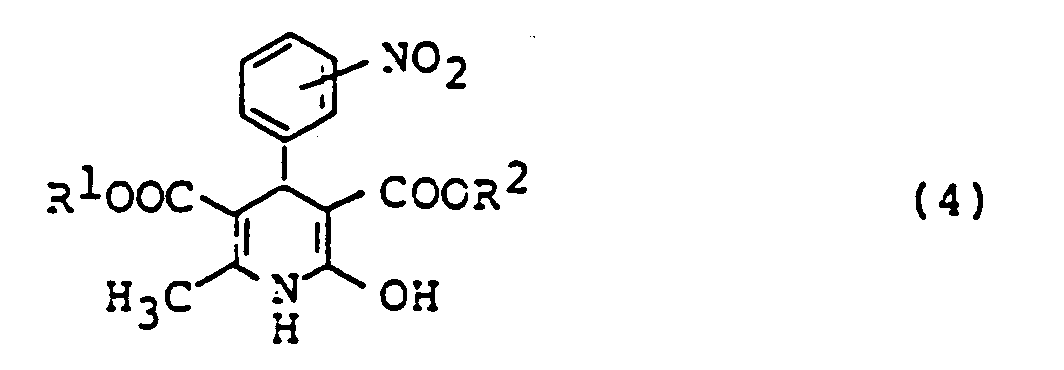
- the 1,4-dihydropyridine derivatives of the formula (1) are synthesized through a route involving the formation of hydroxy-1,4-dihydropyridine derivatives of the following formula (4):
- hydroxy-1,4-dihydropyridine derivatives of formula (4) which are used as intermediate compounds in the process of the present invention may be synthesized by an improved version of the method described in C.F.H. Allen et al., Org. Syn. Coll., vol. 3, 377 (1955).
- a dialkyl ester of malonic acid represented by formula (5): (where R 2 is the same as defined above) and one equivalent amount of nitrobenzaldehyde are heated in the presence of a base such as piperidine, methyl piperidine or trialkylamine to form a benzylidenemalonic acid ester derivative of the formula (2): (where R 2 is the same as defined above).
- This compound (6) is heated either in the presence of a base such as triethylamine, potassium carbonate or potassium t-butoxide or, if R 1 has a basic group, in the absence of any base, thereby forming a hydroxydihydropyridine derivative having the formula (4):
- a base such as triethylamine, potassium carbonate or potassium t-butoxide or, if R 1 has a basic group, in the absence of any base, thereby forming a hydroxydihydropyridine derivative having the formula (4):
- the compound of the present invention having the formula (1): (where X, R 1 and R 2 are the same as defined above) may be obtained by heating said hydroxydihydropyridine derivative (4) in the presence of a halogenating agent such as phosphorus oxychloride or phosphorus pentachloride.
- a halogenating agent such as phosphorus oxychloride or phosphorus pentachloride.
- an ether-, hydrocarbon- or amide-based solvent is desirably used, with the heating temperature being desirably selected at between 60 and 150°C.
- the ester substituent R 1 at position 5 of the thus synthesized novel 1,4-dihydropyridine derivative (1) may be a straight or branched alkyl group having 1 - 10 carbon atoms, the group -(CH 2 ) n -Y [where n is an integer of 0 to 8, provided that when n is Zero or 1 -(CH 2 ) n - is not bonded to the heteroatom of Y; Y is a cyclic alkyl group having 3 - 6 carbon atoms, an aryl group having 6 - 10 carbon atoms, a thienyl group, a pyridyl group, a morpholinyl group, or a pyrrolizidinyl group, the group (where D is an aryl or aralkyl group having 6 - 15 carbon atoms) or a 3-piperidinyl group substituted by a phenylalkyl group of 7 - 10 carbon atoms which may be substituted by one or two
- the products of the formula (1) of this invention can be purified by using conventional methods such as adsorption column chromatography, ion-exchange chromatography or recrystallization.
- the products can be treated with an inorganic acid such as hydrochloric acid, sulfuric acid or phosphoric acid, or an organic acid such as oxalic acid, succinic acid or malic acid to convert them to salts thereof, and then can be purified by recrystallization, adsorption chromatography or ion-exchange chromatography.
- the thus prepared compounds (1) of the present invention exhibit a strong vasodilative effect in isolated guinea pig hearts, strong vasodilative and hypotensive effects in anesthetized dogs, and a strong hypotensive effect in conscious spontaneously hypertensive rats (SHR), and all of these effects last longer than in the case where existing drugs such as Nicardipine are administered.
- the compounds of the present invention exhibit superior coronary vasodilative effects in guinea pigs and prove very effective in dogs for increasing the blood flow of vertebral artery, reducing the vascular resistance of vertebral artery and lowering the systemic blood pressure. Because of these effects, the compounds of the present invention will be useful in treating angina pectoris (myocardial infarction), disturbances of cerebral circulation, and hypertension.
- angina pectoris myocardial infarction
- disturbances of cerebral circulation and hypertension.
- the compounds (1) of the present invention can be administered alone or in combination with excipients in a variety of dosage forms such as tablets, troches, pills, granules, powders, capsules, ampules, suppositories and the like.
- the excipients include, for example, starch, dextrin, sucrose, lactose, silicic acid, carboxymethylcellulose, cellulose, gelatin, polyvinylpyrrolidone, glycerin, agar, calcium carbonate, sodium bicarbonate, paraffin, cetyl alcohol, stearic acid esters, kaolin, bentonite, talc, calcium stearate, magnecium stearate, polyethyleneglycol, water, ethanol, isopropylalcohol, propyleneglycol and the like.
- the compounds of this invention are converted into water soluble salts thereof and the salts are dissolved in sterile distilled water or sterile physiological saline and are filled in ampules to be used for injection. If necessary, stabilizing agents and/or buffering agents can be included in the ampules.
- the optimum dose range of the compound (1) of this invention is 5 - 500 mg per day for an adult.
- this dose range can be suitably changed depending upon the characteristics of the subjects including age, response, body weight, severity of disease etc.
- Methyl acetoacetate (5.0 g) was dissolved in methanol (20 ml) and after addition of a concentrated (28%) aqueous ammonia solution (5 ml), the mixture was heated under reflux for 16 hours. After completion of the reaction, the solvent was distilled off and the residue was subjected to extraction with chloroform, yielding 4.75 g (95.8%) of colorless needles.
- the needles (151 mg) and dimethyl 3-nitrobenzylidenemalonate (318 mg) were dissolved in anhydrous ethanol (13 ml) and the mixture was heated under reflux for 4.5 hours. The reaction mixture was cooled to room temperature to obtain 285 mg of crystals.
- Crystals (1.33 g) obtained during synthesis according to Referential Example A-a were dissolved in 20 ml of anhydrous dimethylformamide. The resulting solution was added to 2.42 g of anhydrous potassium carbonate and the mixture was stirred at 80 ° C for 2.5 hours. The reaction mixture was poured into ice water and subjected to extraction with ether. The extract was distilled off to obtain crude crystals. This crude crystals were recrystallized from chloroform-ether to obtain 1.10 g (91 %) of the desired compound.
- Hartley guinea pigs (weight 400 - 500 g) were killed by a blow on the head and their hearts were immediately isolated. The hearts were perfused with Krebs-Henseleit solution bubbled with a mixture of 95% 0 2 + 5% C0 2 and maintained at 37 ° C at a constant rate of 6 ml/minute according to Langendorff's method [J. Pharmacol. Methods 2, 143 (1979)]. The perfusion pressure was measured continuously by a pressure transducer. Samples were prepared by emulsifying 1 mg of a test compound in 1 ml of a mixture of dimethylsulfoxide and physiological saline solution (1:9) and diluting with physiological saline solution to the predetermined concentration.
- ED 50 ⁇ g/heart
- ED 30 The pharmacological effect (ED 30 ) of selected 2-chloro-1,4-dihydropyridine derivatives of the present invention with respect to the vascular resistance of the vertebral artery in anesthetized dogs was tested by the following procedures.
- systemic blood pressure mean pressure
- limb lead II ECG the heart rate with a tachometer triggered by the R wave of ECG
- vascular resistance determined by loading an electronic divider (EO-601 G, Nihon Kohden) with the mean values of blood pressure and vertebral artery blood flow. All of these parameters were recorded simultaneously on a polygraph (RM-600, Nihon Kohden).
- test compounds were injected through a cannula inserted into the femoral vein.
- the ED 30 (ug/kg) values obtained by intravenous injection and the values of T 1/2 (min) (the time to reach 50% of the resistance drop) are shown in Table 3, wherein the Compound Numbers are keyed to the Example Numbers.
- Selected compounds of the present invention were tested for their hypotensive action in conscious spontaneously hypertensive rats (SHR).
- test compounds as a clear suspension in 0.5% CMC-Na was administered orally at a dose of 10 mg/kg (body weight) to each animal which was starved overnight.
- mice The acute toxicity (LD so ) data of selected compounds of the present invention as administered to two groups of male mice were obtained and the results are shown in Table 5. One group of mice which received peroral administration had been starved overnight. Each of the test compounds was suspended in 0.5% CMC-Na for peroral administration, or dissolved in dimethyl sulfoxide and diluted with physiological saline solution for intravenous injection.
- the compounds of this invention have a strong and long-lasting vasodilative effect. Therefore, said compounds are considered to be useful as agents for causing coronary vascular dilation or treating hypertension or disturbances of cerebral circulation. Such disorders can be treated by administering the compound of the present invention, at a low dose level and at infrequent interval. This will make sure that the intended treatment can be done safely and easily.
Landscapes
- Chemical & Material Sciences (AREA)
- Organic Chemistry (AREA)
- Health & Medical Sciences (AREA)
- Engineering & Computer Science (AREA)
- Bioinformatics & Cheminformatics (AREA)
- Cardiology (AREA)
- Heart & Thoracic Surgery (AREA)
- Chemical Kinetics & Catalysis (AREA)
- General Chemical & Material Sciences (AREA)
- Medicinal Chemistry (AREA)
- Nuclear Medicine, Radiotherapy & Molecular Imaging (AREA)
- Pharmacology & Pharmacy (AREA)
- Life Sciences & Earth Sciences (AREA)
- Animal Behavior & Ethology (AREA)
- General Health & Medical Sciences (AREA)
- Public Health (AREA)
- Veterinary Medicine (AREA)
- Urology & Nephrology (AREA)
- Vascular Medicine (AREA)
- Hydrogenated Pyridines (AREA)
- Pharmaceuticals Containing Other Organic And Inorganic Compounds (AREA)
- Nitrogen Condensed Heterocyclic Rings (AREA)
- Plural Heterocyclic Compounds (AREA)
Abstract
Description
- The present invention relates to novel 1,4-dihydropyridine derivatives of the formula (1):

- Y is a cyclic alkyl group having 3 - 6 carbon atoms, an aryl group having 6 - 10 carbon atoms, a thienyl group, a pyridyl group, a morpholinyl group, or a pyrrolizidinyl group, the group


- The novel 1,4-dihydropyridine derivatives of the formula (1) exhibit superior pharmacological effects such as hypotension, peripheral vasodilation, coronary vasodilation, cerebral vasodilation, and renovascular dilation over prolonged duration while causing only low levels of side effects. Because of these advantages, the 1,4-dihydropyridine derivatives of the formula (1) are useful as hypotensives, cerebral circulation improvers and antianginal agents.
- Currently it is being found that calcium antagonists (Ca antagonists), which had been spotlighted as new agents for treating disorders of the cardiovascular system, have a variety of pharmacological effects and are active not only against hypertension, angina pectoris, cerebral circulation disorder and arrhythmia but also in preventing arteriosclerosis and potentiating the effects of carcinostatic agents. Thus therapeutic uses of Ca antagonists continue to increase.
- Ca antagonists which have been known include Nifedipine, Nicardipine, Verapamil, Diltiazem and the like.
- Many studies have so far been made on Nifedipine and other dihydropyridine derivatives and they have been shown to exhibit interesting pharmacological actions such as vasodilation and hypotension. But there is room for improvement in the properties of these dihydropyridine derivatives such as duration of action, organ-selectivity, stability against light, heat, etc., and with respect to side effects.
- The present inventors made concerted efforts in order to develop calcium antagonists with improvements made in the characteristics listed above. As a result, the inventors have found that the 1,4-dihydropyridine derivatives having the formula (1) shown above exhibit strong vasodilative action over prolonged duration with the utmost level of safety being ensured. The present invention has been accomplished on the basis of this finding.
- In accordance with the present invention, the novel 1,4-dihydropyridine derivatives of the formula (1) and acid addition salts thereof are provided:

- The 1,4-dihydropyridine derivatives of the formula (1) are synthesized through a route involving the formation of hydroxy-1,4-dihydropyridine derivatives of the following formula (4):

- The hydroxy-1,4-dihydropyridine derivatives of formula (4) which are used as intermediate compounds in the process of the present invention may be synthesized by an improved version of the method described in C.F.H. Allen et al., Org. Syn. Coll., vol. 3, 377 (1955). According to this modified method, a dialkyl ester of malonic acid represented by formula (5):


- This compound (6) is heated either in the presence of a base such as triethylamine, potassium carbonate or potassium t-butoxide or, if R1 has a basic group, in the absence of any base, thereby forming a hydroxydihydropyridine derivative having the formula (4):
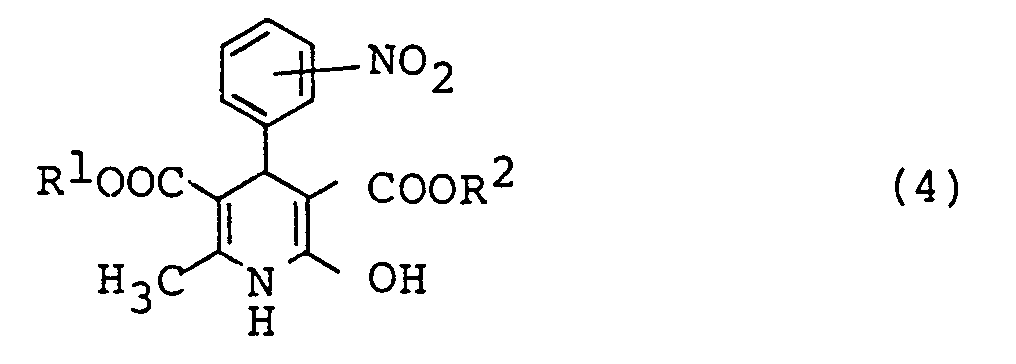
- The compound of the present invention having the formula (1):
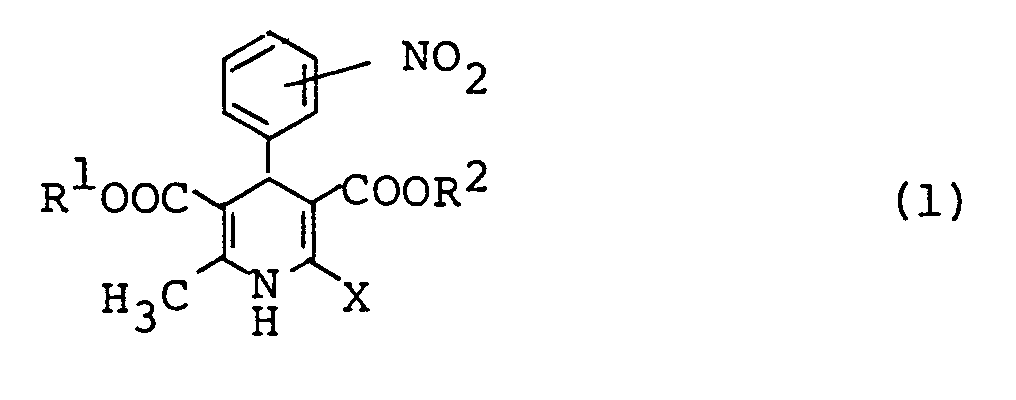
- The ester substituent R1 at position 5 of the thus synthesized novel 1,4-dihydropyridine derivative (1) may be a straight or branched alkyl group having 1 - 10 carbon atoms, the group -(CH2)n-Y [where n is an integer of 0 to 8, provided that when n is Zero or 1 -(CH2)n- is not bonded to the heteroatom of Y; Y is a cyclic alkyl group having 3 - 6 carbon atoms, an aryl group having 6 - 10 carbon atoms, a thienyl group, a pyridyl group, a morpholinyl group, or a pyrrolizidinyl group, the group


- After the above reaction the products of the formula (1) of this invention can be purified by using conventional methods such as adsorption column chromatography, ion-exchange chromatography or recrystallization. Alternatively, the products can be treated with an inorganic acid such as hydrochloric acid, sulfuric acid or phosphoric acid, or an organic acid such as oxalic acid, succinic acid or malic acid to convert them to salts thereof, and then can be purified by recrystallization, adsorption chromatography or ion-exchange chromatography.
- The thus prepared compounds (1) of the present invention exhibit a strong vasodilative effect in isolated guinea pig hearts, strong vasodilative and hypotensive effects in anesthetized dogs, and a strong hypotensive effect in conscious spontaneously hypertensive rats (SHR), and all of these effects last longer than in the case where existing drugs such as Nicardipine are administered.
- Thus, the compounds of the present invention exhibit superior coronary vasodilative effects in guinea pigs and prove very effective in dogs for increasing the blood flow of vertebral artery, reducing the vascular resistance of vertebral artery and lowering the systemic blood pressure. Because of these effects, the compounds of the present invention will be useful in treating angina pectoris (myocardial infarction), disturbances of cerebral circulation, and hypertension.
- The compounds (1) of the present invention can be administered alone or in combination with excipients in a variety of dosage forms such as tablets, troches, pills, granules, powders, capsules, ampules, suppositories and the like. The excipients include, for example, starch, dextrin, sucrose, lactose, silicic acid, carboxymethylcellulose, cellulose, gelatin, polyvinylpyrrolidone, glycerin, agar, calcium carbonate, sodium bicarbonate, paraffin, cetyl alcohol, stearic acid esters, kaolin, bentonite, talc, calcium stearate, magnecium stearate, polyethyleneglycol, water, ethanol, isopropylalcohol, propyleneglycol and the like.
- For parenteral administration, the compounds of this invention are converted into water soluble salts thereof and the salts are dissolved in sterile distilled water or sterile physiological saline and are filled in ampules to be used for injection. If necessary, stabilizing agents and/or buffering agents can be included in the ampules.
- For oral administration, the optimum dose range of the compound (1) of this invention is 5 - 500 mg per day for an adult. Of course, this dose range can be suitably changed depending upon the characteristics of the subjects including age, response, body weight, severity of disease etc.
- The present invention can be illustrated by the following working examples and referential examples but it should be understood that it is not limited to them.
-

- Methyl acetoacetate (5.0 g) was dissolved in methanol (20 ml) and after addition of a concentrated (28%) aqueous ammonia solution (5 ml), the mixture was heated under reflux for 16 hours. After completion of the reaction, the solvent was distilled off and the residue was subjected to extraction with chloroform, yielding 4.75 g (95.8%) of colorless needles. The needles (151 mg) and dimethyl 3-nitrobenzylidenemalonate (318 mg) were dissolved in anhydrous ethanol (13 ml) and the mixture was heated under reflux for 4.5 hours. The reaction mixture was cooled to room temperature to obtain 285 mg of crystals. A portion (175 mg) of the crystals was dissolved in 6 ml of anhydrous methanol and, after addition of triethylamine (1.5 ml), the mixture was heated under reflux for 16 hours. After the solvent was distilled off under reduced pressure, the residue was subjected to silica gel column chromatography (elution solvent: 2% chloroform/methanol) and the resulting crude crystals were recrystallized from a solution of chloroform/ether to obtain 152 mg (yield: 95.0%) of the desired compound (m.p. 150 - 152°C).
- The following compounds were synthesized in accordance with the method of Referential Example A-a:
- 5-[2-(4-benzhydrylpiperazin-1-yl)ethyl]oxycarbonyl-2-hydroxy-3-methoxycarbonyl-6-methyl-4-(3-nitrophenyl)-1,4-dihydropyridine [Compound (3)];
- 5-[2-(N-benzyl-N-methylamino)ethyl]oxycarbonyl-2-hydroxy-3-methoxycarbonyl-6-methyl-4-(3-nitrophenyl)-1,4-dihydropyridine [Compound (4)];
- 5-[2-{4-(9-fluorenyl)piperazin-1-yl}ethyl]oxycarbonyl-2-hydroxy-3-methoxycarbonyl-6-methyl-4-(3-nitrophenyl)-1,4-dihydropyridine [Compound (5)];
- 2-hydroxy-3-methoxycarbonyl-6-methyl-4-(3-nitrophenyl)-5-(5-phenylpentyloxycarbonyl)-1,4-dihydropyridine [Compound (6)];
- 2-hydroxy-5-isopropoxycarbonyl-3-methoxycarbonyl-6-methyl-4-(3-nitrophenyl)-1,4-dihydropyridine [Compound (7)];
- 5-[l-(4-fluorobenzyl)-3-piperidyl]oxycarbonyl-2-hydroxy-3-methoxycarbonyl-6-methyl-4-(3-nitrophenyl)-1,4-dihydropyridine [Compound (8)];
- 5-n-heptyloxycarbonyl-2-hydroxy-3-methoxycarbonyl-6-methyl-4-(3-nitrophenyl)-1,4-dihydropyridine [Compound (9)];
- 2-hydroxy-3-methoxycarbonyl-6-methyl-4-(3-nitrophenyl)-5-(2-phenoxy)ethyloxycarbonyl-1,4-dihydropyridine [Compound (10)];
- 5-cyclopropylmethyloxycarbonyl-2-hydroxy-3-methoxycarbonyl-6-methyl-4-(3-nitrophenyl)-1,4-dihydropyridine [Compound (12)];
- 2-hydroxy-3-methoxycarbonyl-6-methyl-5-[2-(N-benzyl-N-methylamino)-1-phenylethyl]oxycarbonyl-4-(3-nitrophenyl)-1,4-dihydropyridine [Compound (13)];
- 2-hydroxy-3-methoxycarbonyl-5-(2-methoxyethyl)-oxycarbonyl-6-methyl-4-(3-nitrophenyl)-1,4-dihydropyridine [Compound (14)]; and
- 2-hydroxy-3-methoxycarbonyl-6-methyl-4-(3-nitrophenyl)-5-[2-(2-pyridyl)ethyl]oxycarbonyl-1,4-dihydropyridine [Compound (17)].
- The physicochemical data of compound (1) and of the above-listed compounds are shown in Table A.
- Crystals (1.33 g) obtained during synthesis according to Referential Example A-a were dissolved in 20 ml of anhydrous dimethylformamide. The resulting solution was added to 2.42 g of anhydrous potassium carbonate and the mixture was stirred at 80 ° C for 2.5 hours. The reaction mixture was poured into ice water and subjected to extraction with ether. The extract was distilled off to obtain crude crystals. This crude crystals were recrystallized from chloroform-ether to obtain 1.10 g (91 %) of the desired compound.
- After reaction was performed in accordance with Referential Example A-b, the extract was distilled off and the residue was subjected to silica gel column chromatography (elution solvent: 1% chloroform/methanol) to thereby obtain 3-ethoxycarbonyl-2-hydroxy-6-methyl-5-[2-(morpholino)ethyl]-oxycarbonyl-4-(2-nitrophenyl)-1,4-dihydropyridine [Compound (15)].
- The physicochemical data of this compound are shown in Table A.

-

- A mixture of 2-(2-thienyl)ethyl 3-amino-2-butenoate (1.8 g) and dimethyl 3-nitrobenzylidenemalonate (2.25 g) was dissolved in anhydrous 2-propanol (80 ml) and, after addition of triethylamine (27 ml), the mixture was refluxed for 21 hours. After the solvent was distilled off under reduced pressure, the residue was purified by thin-layer silica gel chromatography (developing solvent: chloroform/methanol = 19/1; elution solvent: chloroform/acetone = 2/1) so as to obtain 1.0 g (26%) of the desired compound.
- The physicochemical data of this compound are shown in Table A.
-

- A mixture of 8-pyrrolizidinylmethyl 3-amino-2-butenoate (0.19 g) and dimethyl 3-nitrobenzylidenemalonate (0.23 g) was dissolved in 15 ml of anhydrous 2-propanol, and the mixture was heated under reflux for 22 hours. After the solvent was distilled off under reduced pressure, the residue was subjected to silica gel column chromatography (elution solvent: 5% chloroform/methanol), thereby obtaining 0.32 g (82.1%) of the desired compound.
- By repeating the method of Referential Example C, 3,5-dimethoxycarbonyl-2-hydroxy-6-methyl-4-(2-nitrophenyl)-1,4-dihydropyridine [Compound (2)] was obtained.
- The physicochemical data of the Compounds (16) and (2) are shown in Table A.


-

- 5-[2-(4-Benzhydrylpiperazin-1-yl)ethyl]oxycarbonyl-2-hydroxy-3-methoxycarbonyl-6-methyl-4-(3-nitrophenyl)-1,4-dihydropyridine (390 mg) was dissolved in phosphorus oxychloride (5 ml) and the mixture was heated under reflux for 3 hours and 10 minutes. After excess phosphorus oxychloride had been distilled off under reduced pressure, the reaction mixture was diluted with saturated potassium carbonate and subjected to extraction with chloroform. The extract was distilled off and the residue was subjected to silica gel column chromatography (elution solvent: 1% chloroform/methanol), thereby obtaining crude crystals. This crude crystals were recrystallized from a solution of chloroform/isopropylether/hexane to yield 210 mg (57.2%) of the desired compound.
-

- 5-[1-(4-fluorobenzyl)piperidin-3-yl]oxycarbonyl-2-hydroxy-3-methoxycarbonyl-6-methyl-4-(3-nitrophenyl)-1,4-dihydropyridine (1.85 g) was dissolved in phosphorus oxychloride (22 ml) and the mixture was heated under reflux for 3 hours. After excess phosphorus oxychloride had been distilled off under reduced pressure, the reaction mixture was diluted with saturated potassium carbonate and subjected to extraction with chloroform. The extract was distilled off and the residue was subjected to silica gel column chromatography (elution solvent: 0.7 - 2.5% chloroform/methanol) and to alumina column chromatography (elution solvent: chloroform/hexane = 3/2), so as to obtain 0.98 g (51.3%) of the desired compound.
- The physicochemical data of SUN 4752 and SUN 5142 are shown in Table 1.
- Additional compounds were synthesized by repeating Examples 1 and 2 and their physicochemical data are shown in Table 1 together with the respective compound numbers.

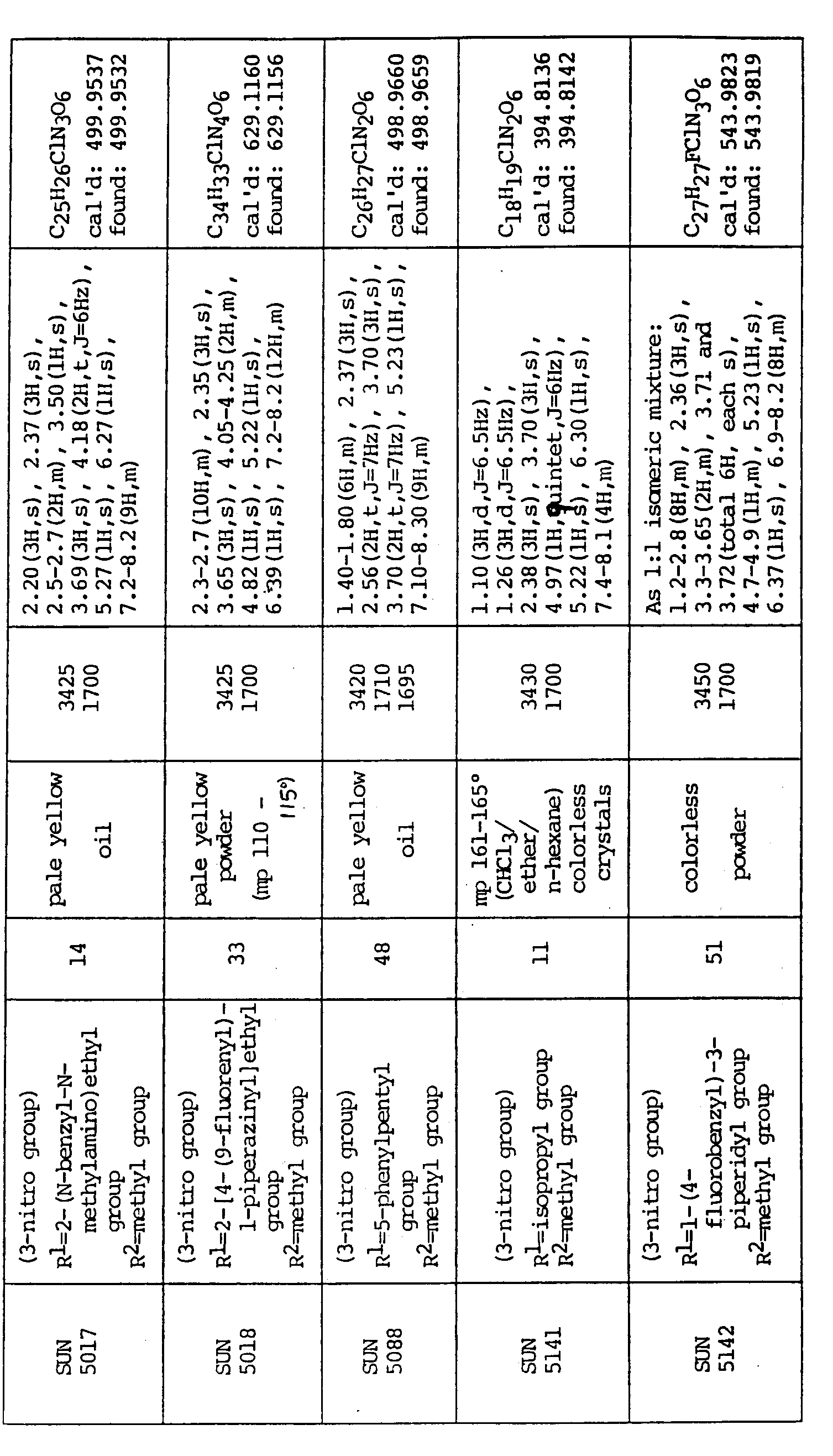


- The coronary vascular dilative effect of selected 2-chloro-1,4-dihydropyridine derivatives of the present invention was tested.
- Hartley guinea pigs (weight 400 - 500 g) were killed by a blow on the head and their hearts were immediately isolated. The hearts were perfused with Krebs-Henseleit solution bubbled with a mixture of 95% 02 + 5% C02 and maintained at 37 ° C at a constant rate of 6 ml/minute according to Langendorff's method [J. Pharmacol. Methods 2, 143 (1979)]. The perfusion pressure was measured continuously by a pressure transducer. Samples were prepared by emulsifying 1 mg of a test compound in 1 ml of a mixture of dimethylsulfoxide and physiological saline solution (1:9) and diluting with physiological saline solution to the predetermined concentration. 0.1 ml of the diluted solution was administered into the coronary artery via a rubber tube connected to an aorta cannula to obtain ED50 (µg/heart) data as shown in Table 2. The numbers of the compounds in the Table correspond respectively to those of the working examples described above.

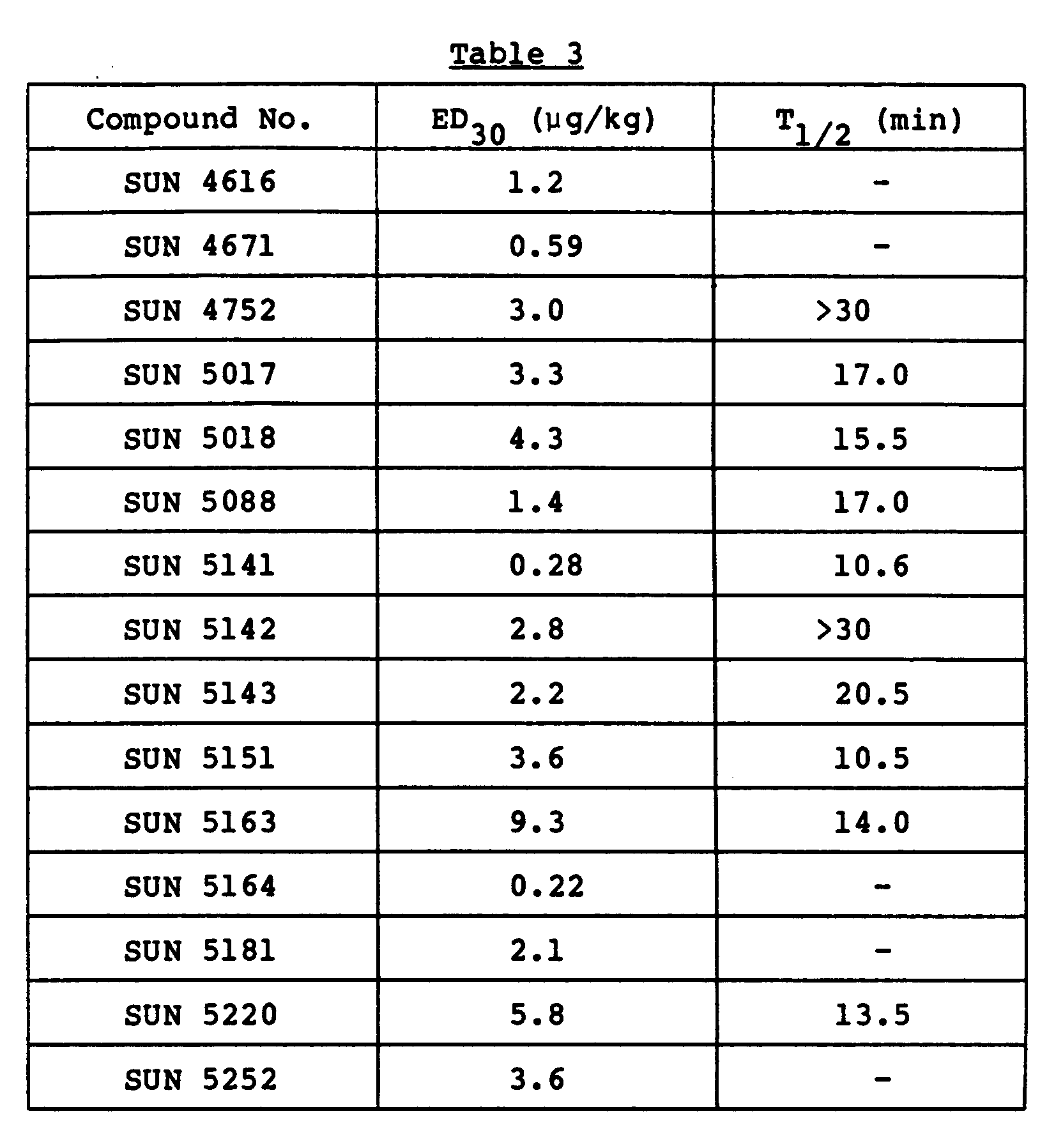
- The pharmacological effect (ED30) of selected 2-chloro-1,4-dihydropyridine derivatives of the present invention with respect to the vascular resistance of the vertebral artery in anesthetized dogs was tested by the following procedures.
- Adult dogs of either sex (7 - 14 kg in body weight) were anesthetized with at first thiopental sodium (35 mg/kg, intraperitoneal), anesthetized with urethane (400 mg/kg, intravenous) and a-chloalose (60 mg/kg, intravenous) and kept under artificial respiration throughout the experiment. After thoracotomy at the left first intercostal space, the vertebral artery was exposed and blood flow was measured with an intracorporeal flow probe connected to an electromagnetic flowmeter (MF-27, Nihon Kohden).
- At the same time, continuous measurement of the following parameters was made: systemic blood pressure (mean pressure) at the right femoral artery, the limb lead II ECG, the heart rate with a tachometer triggered by the R wave of ECG, and the vascular resistance determined by loading an electronic divider (EO-601 G, Nihon Kohden) with the mean values of blood pressure and vertebral artery blood flow. All of these parameters were recorded simultaneously on a polygraph (RM-600, Nihon Kohden).
- All the test compounds were injected through a cannula inserted into the femoral vein.
- The ED30 (ug/kg) values obtained by intravenous injection and the values of T1/2 (min) (the time to reach 50% of the resistance drop) are shown in Table 3, wherein the Compound Numbers are keyed to the Example Numbers.
- Selected compounds of the present invention were tested for their hypotensive action in conscious spontaneously hypertensive rats (SHR).
- A group of 17 to 20-week old male SHR were anesthetized with ether and a cannula was inserted into the left femoral artery. At least one day after the operation, the cannula was connected to a pressure transducer and the blood pressure was measured continuously under conscious and unrestrained condition, thereby obtaining the data shown in Table 4. Each of the test compounds as a clear suspension in 0.5% CMC-Na was administered orally at a dose of 10 mg/kg (body weight) to each animal which was starved overnight.

- The acute toxicity (LDso) data of selected compounds of the present invention as administered to two groups of male mice were obtained and the results are shown in Table 5. One group of mice which received peroral administration had been starved overnight. Each of the test compounds was suspended in 0.5% CMC-Na for peroral administration, or dissolved in dimethyl sulfoxide and diluted with physiological saline solution for intravenous injection.

- The compounds of this invention have a strong and long-lasting vasodilative effect. Therefore, said compounds are considered to be useful as agents for causing coronary vascular dilation or treating hypertension or disturbances of cerebral circulation. Such disorders can be treated by administering the compound of the present invention, at a low dose level and at infrequent interval. This will make sure that the intended treatment can be done safely and easily.
Claims (10)




Priority Applications (1)
| Application Number | Priority Date | Filing Date | Title |
|---|---|---|---|
| AT86109044T ATE95174T1 (en) | 1985-07-03 | 1986-07-03 | 1,4-DIHYDROPYRIDIN DERIVATIVES, PROCESS FOR THEIR PRODUCTION, PHARMACEUTICAL COMPOSITION AND ITS USE. |
Applications Claiming Priority (2)
| Application Number | Priority Date | Filing Date | Title |
|---|---|---|---|
| JP60146290A JPS625958A (en) | 1985-07-03 | 1985-07-03 | 1,4-dihydropyridine derivative, production thereof and remedy for circulatory disease |
| JP146290/85 | 1985-07-03 |
Publications (3)
| Publication Number | Publication Date |
|---|---|
| EP0207514A2 EP0207514A2 (en) | 1987-01-07 |
| EP0207514A3 EP0207514A3 (en) | 1987-06-16 |
| EP0207514B1 true EP0207514B1 (en) | 1993-09-29 |
Family
ID=15404337
Family Applications (1)
| Application Number | Title | Priority Date | Filing Date |
|---|---|---|---|
| EP86109044A Expired - Lifetime EP0207514B1 (en) | 1985-07-03 | 1986-07-03 | 1,4-dihydropyridine derivatives, process for preparing them, pharmaceutical composition and use |
Country Status (5)
| Country | Link |
|---|---|
| US (1) | US4824837A (en) |
| EP (1) | EP0207514B1 (en) |
| JP (1) | JPS625958A (en) |
| AT (1) | ATE95174T1 (en) |
| DE (1) | DE3689086T2 (en) |
Family Cites Families (4)
| Publication number | Priority date | Publication date | Assignee | Title |
|---|---|---|---|---|
| US3974275A (en) * | 1972-04-18 | 1976-08-10 | Bayer Aktiengesellschaft | 1,4-Dihydropyridine carboxylic acid esters useful as coronary vessel dilators and anti-hypertensives |
| GB1552911A (en) * | 1975-07-02 | 1979-09-19 | Fujisawa Pharmaceutical Co | 1,4 dihydropyridine derivatives and the preparation thereof |
| JPS5762257A (en) * | 1980-10-03 | 1982-04-15 | Yoshitomi Pharmaceut Ind Ltd | 1,4-dihydropyridine-3,5-dicarboxylic acid ester or its salt |
| DE3018259A1 (en) * | 1980-05-13 | 1981-11-19 | Bayer Ag, 5090 Leverkusen | 1,4-DIHYDROPYRIDINE WITH DIFFERENT SUBSTITUENTS IN 2- AND 6-POSITIONS, METHODS FOR THEIR PRODUCTION AND THEIR USE IN MEDICINAL PRODUCTS |
-
1985
- 1985-07-03 JP JP60146290A patent/JPS625958A/en active Pending
-
1986
- 1986-07-03 US US06/881,779 patent/US4824837A/en not_active Expired - Fee Related
- 1986-07-03 DE DE86109044T patent/DE3689086T2/en not_active Expired - Fee Related
- 1986-07-03 EP EP86109044A patent/EP0207514B1/en not_active Expired - Lifetime
- 1986-07-03 AT AT86109044T patent/ATE95174T1/en not_active IP Right Cessation
Also Published As
| Publication number | Publication date |
|---|---|
| EP0207514A3 (en) | 1987-06-16 |
| ATE95174T1 (en) | 1993-10-15 |
| DE3689086D1 (en) | 1993-11-04 |
| JPS625958A (en) | 1987-01-12 |
| US4824837A (en) | 1989-04-25 |
| DE3689086T2 (en) | 1994-03-03 |
| EP0207514A2 (en) | 1987-01-07 |
Similar Documents
| Publication | Publication Date | Title |
|---|---|---|
| JPH0613484B2 (en) | Novel dihydropyrimidines | |
| KR860001921B1 (en) | Prepavation process for 1,4-dihydro pyridine | |
| HU195195B (en) | Process for producing pyrimidine derivatives | |
| CA1329603C (en) | 2,2-dimethylchromene derivatives, process for their preparation and pharmaceutical compositions in which they are present | |
| JPS60214778A (en) | N-substituted 3,4-dihydropyrimidine derivative, its preparation and use | |
| JPH033669B2 (en) | ||
| HU184434B (en) | Process for preparing 1,4-dihydro-pyridine derivatives containing different substituents in position 2. and 6. and pharmaceutical compositions containing such compounds as active substances | |
| EP0257616B1 (en) | Dihydropyridine derivates and pharmaceutical composition thereof | |
| US5114941A (en) | Pyrimidinedione derivative compounds, method for preparing same, and antiarrythmic agents containing same | |
| EP0195374B1 (en) | N-substituted 3,4-dihydropyrimidine derivatives, process for the production thereof and composition containing same for treating disorders of cardiovascular system | |
| US4824837A (en) | Novel 1,4-dihydropyridine derivatives, process for preparing the same, and agents for treating disorders of circulatory system | |
| JPH0379359B2 (en) | ||
| HU207511B (en) | Process for producing pirimidinium derivatives, nonionic formes of them and pharmaceutical compositions containing them | |
| US5017577A (en) | Methods for treating viral infection | |
| HU195645B (en) | Process for preparing novel 3(2h)-pyridazinone derivatives and pharmaceutical compositions comprising the same | |
| JP2640245B2 (en) | 1,4-dihydropyridine derivative | |
| US4957913A (en) | Antihypertensive polycyclic imides | |
| JP2879918B2 (en) | Calcium antagonist | |
| JPH0699458B2 (en) | Dihydropyridine-5-phosphonic acid cyclic ester | |
| PT87790B (en) | METHOD FOR PREPARING ERGOLINE DERIVATIVES AND PHARMACEUTICAL COMPOSITIONS CONTAINING THEM | |
| JPS62106077A (en) | Dihydropyridines | |
| EP0216542B1 (en) | Dihydropyridine derivatives | |
| JP2614921B2 (en) | 2,4,6-Trisubstituted-S-triazine derivative and method for producing the same | |
| JPS617276A (en) | Dihydropyridine antiischemic and hypertensive | |
| US4956369A (en) | 2-dithioalkyl-dihydropyridines and pharmaceutical compositions containing them |
Legal Events
| Date | Code | Title | Description |
|---|---|---|---|
| PUAI | Public reference made under article 153(3) epc to a published international application that has entered the european phase |
Free format text: ORIGINAL CODE: 0009012 |
|
| AK | Designated contracting states |
Kind code of ref document: A2 Designated state(s): AT BE CH DE FR GB IT LI LU NL SE |
|
| PUAL | Search report despatched |
Free format text: ORIGINAL CODE: 0009013 |
|
| AK | Designated contracting states |
Kind code of ref document: A3 Designated state(s): AT BE CH DE FR GB IT LI LU NL SE |
|
| 17P | Request for examination filed |
Effective date: 19871105 |
|
| 17Q | First examination report despatched |
Effective date: 19880210 |
|
| ITF | It: translation for a ep patent filed | ||
| GRAA | (expected) grant |
Free format text: ORIGINAL CODE: 0009210 |
|
| AK | Designated contracting states |
Kind code of ref document: B1 Designated state(s): AT BE CH DE FR GB IT LI LU NL SE |
|
| REF | Corresponds to: |
Ref document number: 95174 Country of ref document: AT Date of ref document: 19931015 Kind code of ref document: T |
|
| REF | Corresponds to: |
Ref document number: 3689086 Country of ref document: DE Date of ref document: 19931104 |
|
| ET | Fr: translation filed | ||
| EPTA | Lu: last paid annual fee | ||
| PLBE | No opposition filed within time limit |
Free format text: ORIGINAL CODE: 0009261 |
|
| STAA | Information on the status of an ep patent application or granted ep patent |
Free format text: STATUS: NO OPPOSITION FILED WITHIN TIME LIMIT |
|
| 26N | No opposition filed | ||
| EAL | Se: european patent in force in sweden |
Ref document number: 86109044.7 |
|
| PGFP | Annual fee paid to national office [announced via postgrant information from national office to epo] |
Ref country code: SE Payment date: 19970529 Year of fee payment: 12 |
|
| PGFP | Annual fee paid to national office [announced via postgrant information from national office to epo] |
Ref country code: GB Payment date: 19970624 Year of fee payment: 12 |
|
| PGFP | Annual fee paid to national office [announced via postgrant information from national office to epo] |
Ref country code: CH Payment date: 19970703 Year of fee payment: 12 |
|
| PGFP | Annual fee paid to national office [announced via postgrant information from national office to epo] |
Ref country code: LU Payment date: 19970717 Year of fee payment: 12 |
|
| PGFP | Annual fee paid to national office [announced via postgrant information from national office to epo] |
Ref country code: AT Payment date: 19970718 Year of fee payment: 12 |
|
| PGFP | Annual fee paid to national office [announced via postgrant information from national office to epo] |
Ref country code: NL Payment date: 19970730 Year of fee payment: 12 Ref country code: FR Payment date: 19970730 Year of fee payment: 12 Ref country code: BE Payment date: 19970730 Year of fee payment: 12 |
|
| PGFP | Annual fee paid to national office [announced via postgrant information from national office to epo] |
Ref country code: DE Payment date: 19970827 Year of fee payment: 12 |
|
| PG25 | Lapsed in a contracting state [announced via postgrant information from national office to epo] |
Ref country code: LU Free format text: LAPSE BECAUSE OF NON-PAYMENT OF DUE FEES Effective date: 19980703 Ref country code: GB Free format text: LAPSE BECAUSE OF NON-PAYMENT OF DUE FEES Effective date: 19980703 Ref country code: AT Free format text: LAPSE BECAUSE OF NON-PAYMENT OF DUE FEES Effective date: 19980703 |
|
| PG25 | Lapsed in a contracting state [announced via postgrant information from national office to epo] |
Ref country code: SE Free format text: LAPSE BECAUSE OF NON-PAYMENT OF DUE FEES Effective date: 19980704 |
|
| PG25 | Lapsed in a contracting state [announced via postgrant information from national office to epo] |
Ref country code: LI Free format text: LAPSE BECAUSE OF NON-PAYMENT OF DUE FEES Effective date: 19980731 Ref country code: CH Free format text: LAPSE BECAUSE OF NON-PAYMENT OF DUE FEES Effective date: 19980731 Ref country code: BE Free format text: LAPSE BECAUSE OF NON-PAYMENT OF DUE FEES Effective date: 19980731 |
|
| BERE | Be: lapsed |
Owner name: SUNTORY LTD Effective date: 19980731 |
|
| PG25 | Lapsed in a contracting state [announced via postgrant information from national office to epo] |
Ref country code: NL Free format text: LAPSE BECAUSE OF NON-PAYMENT OF DUE FEES Effective date: 19990201 |
|
| GBPC | Gb: european patent ceased through non-payment of renewal fee |
Effective date: 19980703 |
|
| REG | Reference to a national code |
Ref country code: CH Ref legal event code: PL |
|
| EUG | Se: european patent has lapsed |
Ref document number: 86109044.7 |
|
| PG25 | Lapsed in a contracting state [announced via postgrant information from national office to epo] |
Ref country code: FR Free format text: LAPSE BECAUSE OF NON-PAYMENT OF DUE FEES Effective date: 19990331 |
|
| NLV4 | Nl: lapsed or anulled due to non-payment of the annual fee |
Effective date: 19990201 |
|
| PG25 | Lapsed in a contracting state [announced via postgrant information from national office to epo] |
Ref country code: DE Free format text: LAPSE BECAUSE OF NON-PAYMENT OF DUE FEES Effective date: 19990501 |
|
| REG | Reference to a national code |
Ref country code: FR Ref legal event code: ST |
|
| PG25 | Lapsed in a contracting state [announced via postgrant information from national office to epo] |
Ref country code: IT Free format text: LAPSE BECAUSE OF NON-PAYMENT OF DUE FEES;WARNING: LAPSES OF ITALIAN PATENTS WITH EFFECTIVE DATE BEFORE 2007 MAY HAVE OCCURRED AT ANY TIME BEFORE 2007. THE CORRECT EFFECTIVE DATE MAY BE DIFFERENT FROM THE ONE RECORDED. Effective date: 20050703 |