EP0204009B1 - Process for producing diol and furan and microorganism capable of same - Google Patents
Process for producing diol and furan and microorganism capable of same Download PDFInfo
- Publication number
- EP0204009B1 EP0204009B1 EP85106304A EP85106304A EP0204009B1 EP 0204009 B1 EP0204009 B1 EP 0204009B1 EP 85106304 A EP85106304 A EP 85106304A EP 85106304 A EP85106304 A EP 85106304A EP 0204009 B1 EP0204009 B1 EP 0204009B1
- Authority
- EP
- European Patent Office
- Prior art keywords
- compound
- diol
- furan
- compounds
- nutrient medium
- Prior art date
- Legal status (The legal status is an assumption and is not a legal conclusion. Google has not performed a legal analysis and makes no representation as to the accuracy of the status listed.)
- Expired - Lifetime
Links
- 0 CC(C(C1)C[C@](*)[C@]2(C)C1C(C)(C)CCC2)O Chemical compound CC(C(C1)C[C@](*)[C@]2(C)C1C(C)(C)CCC2)O 0.000 description 15
- LDZWGCSMXVZAGF-BBUWKRFDSA-N CC(C(C1)C2)OC(C)(C)CC[C@@H]1[C@]1(C)C2C(C)(C)CCC1 Chemical compound CC(C(C1)C2)OC(C)(C)CC[C@@H]1[C@]1(C)C2C(C)(C)CCC1 LDZWGCSMXVZAGF-BBUWKRFDSA-N 0.000 description 1
- QQDZTOUKKICIMP-QAIXIWKOSA-N CC(C)(CCC1)C(CC[C@](C)([C@@H]2CC/C(/C)=C\C=O)O)[C@]12O Chemical compound CC(C)(CCC1)C(CC[C@](C)([C@@H]2CC/C(/C)=C\C=O)O)[C@]12O QQDZTOUKKICIMP-QAIXIWKOSA-N 0.000 description 1
- UFXBZHGBXTVMJB-VMGKXQKESA-N C[C@](CC[C@@H]([C@@](C)(CCC1C(C)(C)CCC2)O)[C@]12[O-])(C=C)O Chemical compound C[C@](CC[C@@H]([C@@](C)(CCC1C(C)(C)CCC2)O)[C@]12[O-])(C=C)O UFXBZHGBXTVMJB-VMGKXQKESA-N 0.000 description 1
Classifications
-
- C—CHEMISTRY; METALLURGY
- C07—ORGANIC CHEMISTRY
- C07D—HETEROCYCLIC COMPOUNDS
- C07D307/00—Heterocyclic compounds containing five-membered rings having one oxygen atom as the only ring hetero atom
- C07D307/77—Heterocyclic compounds containing five-membered rings having one oxygen atom as the only ring hetero atom ortho- or peri-condensed with carbocyclic rings or ring systems
- C07D307/92—Naphthofurans; Hydrogenated naphthofurans
-
- C—CHEMISTRY; METALLURGY
- C12—BIOCHEMISTRY; BEER; SPIRITS; WINE; VINEGAR; MICROBIOLOGY; ENZYMOLOGY; MUTATION OR GENETIC ENGINEERING
- C12N—MICROORGANISMS OR ENZYMES; COMPOSITIONS THEREOF; PROPAGATING, PRESERVING, OR MAINTAINING MICROORGANISMS; MUTATION OR GENETIC ENGINEERING; CULTURE MEDIA
- C12N1/00—Microorganisms; Compositions thereof; Processes of propagating, maintaining or preserving microorganisms or compositions thereof; Processes of preparing or isolating a composition containing a microorganism; Culture media therefor
- C12N1/14—Fungi; Culture media therefor
- C12N1/145—Fungi isolates
-
- C—CHEMISTRY; METALLURGY
- C12—BIOCHEMISTRY; BEER; SPIRITS; WINE; VINEGAR; MICROBIOLOGY; ENZYMOLOGY; MUTATION OR GENETIC ENGINEERING
- C12P—FERMENTATION OR ENZYME-USING PROCESSES TO SYNTHESISE A DESIRED CHEMICAL COMPOUND OR COMPOSITION OR TO SEPARATE OPTICAL ISOMERS FROM A RACEMIC MIXTURE
- C12P7/00—Preparation of oxygen-containing organic compounds
- C12P7/02—Preparation of oxygen-containing organic compounds containing a hydroxy group
-
- C—CHEMISTRY; METALLURGY
- C12—BIOCHEMISTRY; BEER; SPIRITS; WINE; VINEGAR; MICROBIOLOGY; ENZYMOLOGY; MUTATION OR GENETIC ENGINEERING
- C12R—INDEXING SCHEME ASSOCIATED WITH SUBCLASSES C12C - C12Q, RELATING TO MICROORGANISMS
- C12R2001/00—Microorganisms ; Processes using microorganisms
- C12R2001/645—Fungi ; Processes using fungi
Definitions
- Dodecahydro-3a,6,6,9a-tetramethylnaphtho[2,1-b]furan ( 1 ) is an important fragrance chemical (see U.S. Patent 3,029,255). It has been used in high quality perfume compositions and in functional products, such as fragrances for toiletries and household products, where a persistent amber effect is desired. Compound 1 is also a component of tincture of ambergris [see B.D. Mookherjee and R.R. Patel, Proceedings of the 7th International Congress of Essential Oils, Kyoto, Japan, (1977), paper number 136], and synthetic 1 has been used in artificial ambergris formulations.
- Compound 1 may be manufactured from 2-ethenyldecahydro-2-hydroxy- ⁇ -2,5,5,8a-pentamethyl-1-naphthalenepropanol ( 4 ), commonly referred to as Sclareol, obtained from Clary Sage ( Salvia Sclarea ).
- U.S. Patent 3,050,532 discloses a method of converting Compound 4 into dodecahydro-3a,6,6,9a-tetramethylnaphth[2,1-b]furan-2(1H)-one ( 2 ) using a two-stage oxidation sequence.
- an aqueous dispersion of Sclareol is intimately contacted with an alkali metal permanganate oxidizing agent, under alkaline conditions, to partially oxidize the Sclareol.
- the resulting aqueous reaction mixture from the first step is acidified and intimately contacted with a permanaganate or chromic acid oxidizing agent under acid conditions, thereby completing the oxidation.
- Compound 2 may be readily converted to Compound 1 by known methods. For example, reducing Compound 2 with hydride reagents (see for example, Helv. Chim. Acta 1950, 33 , 1308) provides decahydro-2-hydroxy-2,5,5,8a-tetramethylnaphthaleneethanol ( 3 ) which is readily converted by cyclization to Compound 1 .
- U.S. Patent 3,029,255 discloses a method for making Compound 1 by dehydrating Compound 3 with Al2O3 at 200-225°C, followed by heating in vacuo in the presence of ⁇ -naphthalene sulfonic acid (130°C up to 160°C) to effect cyclization to Compound 1 .
- Compound 1 may be obtained by cyclization of Compound 3 using toluene- p -sulfonyl chloride in pyridine, as disclosed by Cambie et al . (see Aust. J. Chem., 1971, 24 , 591).
- the present invention concerns a biologically pure culture of the microorganism Hyphozyma roseoniger ATCC 20624.
- the present invention further concerns a biologically pure culture of a Hyphozyma roseoniger microorganism or of a mutant thereof, which has the identifying characteristic of Hyphozyma roseoniger ATCC 20624 of being capable of converting labdane compounds into recoverable quantities of a diol of the formula (3) or into recoverable quantities of a furan of the formula (1) wherein the labdane compound is wherein R is
- the culture may be lyophilized.
- the present invention concerns a mixture prepared by cultivating one of the above characterized biologically pure cultures under aerobic conditions in an aqueous nutrient medium.
- the cultivation of the microorganism may be performed at a pH of between about 2.5 and about 9.0 and at a temperature of about 12°C and about 30°C.
- the present invention concerns a process for preparing a diol having the structure which comprises cultivating one of the above characterized biologically pure cultures under aerobic conditions in an aqueous nutrient medium containing one or more of the compounds wherein R is
- the cultivation of the microorganism may be performed at a pH of between about 2.5 and about 9.0 and at a temperature of about 12°C and about 30°C.
- the present invention concerns a process for preparing a furan compound having the structure which comprises cultivating one of the above characterized biologically pure cultures under aerobic conditions in an aqueous nutrient medium containing one or more compounds from the group consisting of wherein R is to form a diol having the structure
- the diol obtained may be cyclized in the aqueous nutrient medium to form said furan compound which is then recovered.
- the diol may be separated from the aqueous nutrient medium and then cyclized to form said furan compound which is then recovered.
- Compounds 4 through 14 may be used as substrates in the transformation process for the present invention to produce the desired products.
- Compounds 6 , 11 , and 13 have been observed as intermediates during the transformation of Sclareol according to the process of this invention.
- the transformation process involves cultivation of the microorganism Hyphozyma roseoniger , CBS 214.83 and ATCC 20624 in an aqueous nutrient medium in the presence of the compounds 4 through 14 . These compounds may be used singularly or as a mixture containing any number of said compounds.
- microorganisms are used as the culture (suspension), i.e. including the cells and the corresponding nutrient solution, or in the form of cells suspended in a buffer solution.
- the cells, or an enzyme extract thereof, may be immobilized on a suitable solid support, which may then be used to effect transformations.
- the suspended culture mixture is prepared by inoculation of a suitable aqueous nutrient medium with the microorganism.
- a suitable nutrient medium is one which contains nitrogen sources, inorganic salts, growth factors, the desired substrate(s), and optionally other carbon sources.
- Some carbon sources suitable for use in the inventive process include, for example, glucose, galactose, L-sorbose, maltose, sucrose, cellobiose, trehalose, L-arabinose, L-rhamnose, ethanol, glycerol, L-erythrithol, D-mannitol, lactose, melibiose, raffinose, melezitose, starch, D-xylose, D-sorbitol, ⁇ -methyl-D-glucoside, lactic acid, citric acid and succinic acid.
- Suitable nitrogen sources include, for example, nitrogen-containing organic substances such as peptone, meat extract, yeast extract, corn steep liquor, casein, urea, amino acids, or nitrogen-containing inorganic compounds such as nitrates, nitrites and inorganic ammonium salts
- Suitable inorganic salts include, for example, phosphates of magnesium, potassium, calcium, or sodium.
- the above mentioned culture medium nutrients may be supplemented with, for example, one or more vitamins of the B group and/or one or more trace minerals such as Fe, Mo, Cu, Mn, and B, as desired.
- the Vitamins or trace minerals are not necessary when a small amount of yeast extract is added to the medium. Addition of an antibiotic, such as chloroamphinical or chlorotetracycline, may be desirable when bacterial contamination is a problem.
- the cultivation of the microorganism may be carried out as a stationary culture or as a submersed (e.g., shaking culture, fermentor culture) under aerobic conditions.
- One may suitably work in the pH range of from between about 2.5 and about 9.0, and preferably in the range of from between about 3.0 and about 7.5 and most preferably between about 3.0 and about 6.5
- the pH may be regulated by the addition of inorganic or organic acids, such as hydrochloric acid, acetic acid, and oxalic acid, or by the addition of bases, such as sodium hydroxide, and ammonium hydroxide, or by the addition of a buffer, such as phosphate or phthalate.
- the incubation temperature should suitably be maintained between about 12°C and about 33°C, with a range between about 15°C and about 30°C being more preferred, and a range between about 18°C and about 28°C being most preferred.
- the process in accordance with this invention may be conveniently carried out by adding one or more of the compounds 4 through 14 to the nutrient medium at the onset of cultivation, as the sole carbon source.
- the substrate may be added in combination with another carbon source, such as dextrose, either during cultivation, or when the carbon source is depleted.
- the only restriction on the concentration of substrate in the culture medium is that of being able to effectively aerate the culture.
- the substrate concentration is preferably in the range of between about 0.1 g/L and about 100g/L, more preferably in the range of between about 0.5 g/L and about 50 g/L, and most preferably in the range between about 1.5 g/L about 30 g/L.
- the transformation can be suitably carried under any of the above mentioned conditions.
- the total transformation time (after initial cultivation period) may vary depending on the composition of the nutrient medium and the substrate concentration. In general, shaking flask cultures require from between about 12 hours and about 264 hours. However, when a fermentor is used the cultivation time may be reduced to about 48 hours or less.
- the transformation may be carried out using the cells of the microorganism isolated from the culture solution, or with an enzyme extract isolated from the cells in a manner well known to the art.
- the transformation can be conveniently carried out in a variety of aqueous nutrient mediums including, for example, in a buffer solution, in a physiological salt solution, in a fresh nutrient solution, or in water.
- the isolated cells or enzyme extract may be immobilized on a solid support and the desired transformation effected.
- transformation of the substrate may be effected by mutants of this organism. Such mutants can be readily obtained by methods well known in the art, for example, by exposing the cells to UV or X-rays, or known mutagenic substances, such as for example, acridine orange.
- the substrate can be added to the medium as a powder, or a slurry in an emulsifier such as Tween-80 (polyoxyethylenesorbitan monostearate), or as a solution in an emulsifier, or as a solution in a hydrophilic solvent such as acetone, methanol, ethanol, ethylene glycol, or dioxan.
- an emulsifier such as Tween-80 (polyoxyethylenesorbitan monostearate)
- a hydrophilic solvent such as acetone, methanol, ethanol, ethylene glycol, or dioxan.
- a surface-active agent, or a dispersion agent can also be added to an aqueous suspension of the substrate, or the substrate can be emulsified using ultrasound.
- Conventional antifoam agents such as silicone oils (e.g., UCON), polyalkyleneglycol derivatives, maize oil, or soya oil, can be used to control foaming.
- the transformation of the substrate can be monitored using standard analytical techniques such as GLC, TLC, HPLC, IR, and NMR. If a rapid disappearance of the substrate is observed more substrate can then be added, in order to maximize the transformation capacity of the microorganism. The process is generally terminated when most of the substrate has disappeared from the culture medium.
- Compound 3 may be recovered from the aqueous nutrient medium, or may be cyclized to the furan Compound 2 ,either in the aqueous nutrient medium,or after recovery. Isolation and purification of Compounds 1 or 3 from the fermentation broth may be achieved by conventional techniques including, filtration or centrifugation, solvent extraction, distillation, crystallization, and the like.
- Compound 3 may be converted to the furan Compound 1 by conventional cyclization methods well known in the art. For example, reaction of diol 3 with toluene - p -sulfonyl chloride in pyridine at 0°C according to the procedure described by Cambie et al . (see Aust. J. Chem., 1971, 24 , 591), which is incorporated herein by reference. This procedure may optionally be employed either on the transformation mixture or on the recovered diol Compound 3 . Examples of other cyclization methods are described by R.B. Wagner and H.D. Zook in "Synthetic Organic Chemistry", John Wiley, 1965, pp 838-839, which is incorporated herein by reference.
- the microorganism employed in this invention was isolated from a soil sample obtained from central New Jersey, United States of America. This strain has been deposited with the Centraalbureau voor Schimmelculture and the American Type Culture Collection with the accession number CBS 214.83 and ATCC 20624, respectively.
- CBS Centralbureau voor Schimmel Cultures Due to the pink coloring of its colonies and its unique morphological and physiochemical properties, CBS has assigned the inventive microorganism the name Hyphozyma roseoniger .
- This organism has distinct yeast and filamentous forms. Both forms exhibit similar biological properties and perform the transformations described herein.
- the properties of the yeast phase of the said microorganism are described below: 1. Shape and Size Growth on YM Agar: Pink, glistening, smooth colonies present filamentous growth cells are budding, round or cylindrical ca. 2 x 7 ⁇ m or sometimes larger. Growth on Malt Extract Agar: Pink, occasionally brownish with formation of true hyphae after 2 to 3 weeks, with no clump connections, shiny. Growth on Corn Meal Agar: Light orange-pink glistening. Smooth colonies fringed with mycelia. Growth on Potato Dextrose Agar and Difco Malt Agar: Pink, smooth, glistening and occasionally turns black at room temperature after 2 to 3 weeks.
- the properties of the filamentous form of the said organism are similar to the yeast phase with the following exceptions:
- Liquid Medium such as YM Broth: Pink
- yeast-like growth and occasionally some mycellium presents yeast-like growth and occasionally some mycellium.
- This example demonstrates the fermentation process using 2-ethenyldecahydro-2-hydroxy- ⁇ ;2,5,5,8a-pentamethyl-1-naphthalene propanol ( 4 ) as substrate.
- This example demonstrates the efficacy of the fermentation process using different levels of Sclareol ( 4 ) as substrate.
- Example 2 A procedure similar to that described in Example 1 was used except that yeast extract (0.1 g) was substituted for the trace minerals and vitamins, and that the Sclareol ( 4 ) was recrystallized from hexanes, pulvarized, passed through a 50-mesh seive, and then mixed with an equal weight of Tween-80. After an initial incubation period of 4 days, the mixture of Sclareol ( 4 ) and Tween-80 was added to each flask incrementally over a period of 5 days and then incubated for an additional 4 days. Table 3 below shows the amount of Sclareol ( 4 ) added to each flask and the yield of isolated diol 3 . Each product exhibited spectral data identical with that reported in Example 1.
- This example demonstrates the fermentation process using each of Compounds 4 through 14 as substrates, to produce decahydro-2-hydroxy-2,5,5,8a-tetramethylnaphthaleneethanol ( 3 ).
- This example demonstrates a method for preparing Compounds 7 , 8 and 9 , which may be employed as substrates in the inventive process.
- This example demonstrates a method for preparing Compound 10 , which may be employed as a substrate in the invention process.
- the mixture was acidified with 6N hydrochloric acid, and extracted with hexane/ethyl acetate (4:1, 4 x 10 mL).
- the organic extracts were washed with water (2 x 10 mL), saturated sodium bicarbonate solution (2 x 15 mL), and dried (Na2SO4).
- This example demonstrates a method for preparing Compound 11 , which may be employed as a substrate in the inventive processs.
- This example demonstrates the conversion of ⁇ -ethenyldecahydro-2-hydroxy- ⁇ ,2,5,5,8a-pentamethyl-1-napthalenepropanol ( 4 ) to dodecahydro-3a,6,6,9a-tetramethylnaphtho[2,1-b]furan ( 1 ) using a two-step process.
- Example 2 A procedure similar to that described in Example 2 was used, except that seven flasks were used, and that the amount of Sclareol ( 4 ) added to each flask and the incubation period was varied (see Table 5). When incubation was complete the flasks were worked-up separately and seven samples of crude diol 3 obtained. Each sample was separately reacted with toluene- p -sulfonylchloride, in pyridine, according to the method of Cambie, et al ., (see Aust. J. Chem.,1971, 24 , 591) and each reaction product Kugelrohr distilled to provide furan 1 .
- This example demonstrates the direct cyclization of the transformation product decahydro-2-hydroxy-2,5,5,8a-tetramethylnaphthaleneethanol ( 3 ), without separation from the aqueous nutrient medium, to dodecahydro-3a,6,6,9a-tetramethylnaphtho[2,1-b]furan ( 1 ).
- Example 2 A procedure similar to that described in Example 2 using Sclareol (2.0 g) as substrate in 100 mL of fermentation broth was employed. After 14 days total incubation time, the contents of the flask were transferred to a reaction vessel equipped for stirring and heating under reflux. Toluene- p -sulfonylchloride (2.48 g), sodium hydroxide pellets (25 g) and tetrahydrofuran (200 mL) were added and the mixture stirred at 20°C. After 5 h,additional toluene- p -sulfonylchloride (1.50 g) was added and the reaction mixture was stirred overnight.
- This example demonstrates an alternative procedure for the direct cyclization of the transformation product decahydro-2-hydroxy-2,5,5,8a-tetramethylnaphthaleneethanol ( 3 ), without separation from the aqueous nutrient medium, to dodecahydro-3a,6,6,9a-tetramethylnaphtho[2,1-b]furan ( 1 ).
- Example 2 A procedure similar to that described in Example 2 using Sclareol (2.0 g) as substrate in 100 mL of fermentation broth was employed. After 14 days total incubation time, the contents of the flask were transferred to a reaction vessel equipped for stirring and heating under reflux. The fermentation broth was acidified with 6 N hydrochloric acid (to about pH 1), ethyl acetate (100 mL) added, and the stirred mixture heated at reflux for 6 h. After cooling, the ethyl acetate layer was separated, washed to neutrality, and dried.
- 6 N hydrochloric acid to about pH 1
- ethyl acetate 100 mL
- This example illustrates an alternative procedure for the direct cyclization of the transformation product decahydro-2-hydroxy-2,5,5,8a-tetramethylnaphthaleneethanol ( 3 ), without separation from the aqueous nutrient medium, to dodecahydro-3a,6,6,9a-tetramethylnaphtho[2,1-b]furan ( 1 ).
- Example 8 A procedure similar to that described in Example 8 was employed except that the ion exchange resin Dowex 50X2 400 (10 g) was added to the fermentation broth instead of 6N hydrochloric acid. Work-up, and Kugelrohr distillation gave 1.32 g of a solid, which by instrumental analysis contained 37% of Compound 1 .
Landscapes
- Chemical & Material Sciences (AREA)
- Organic Chemistry (AREA)
- Life Sciences & Earth Sciences (AREA)
- Engineering & Computer Science (AREA)
- Health & Medical Sciences (AREA)
- Wood Science & Technology (AREA)
- Zoology (AREA)
- Biotechnology (AREA)
- Genetics & Genomics (AREA)
- Bioinformatics & Cheminformatics (AREA)
- Microbiology (AREA)
- General Health & Medical Sciences (AREA)
- Biochemistry (AREA)
- General Engineering & Computer Science (AREA)
- Tropical Medicine & Parasitology (AREA)
- Chemical Kinetics & Catalysis (AREA)
- Botany (AREA)
- Mycology (AREA)
- Medicinal Chemistry (AREA)
- General Chemical & Material Sciences (AREA)
- Virology (AREA)
- Biomedical Technology (AREA)
- Preparation Of Compounds By Using Micro-Organisms (AREA)
- Micro-Organisms Or Cultivation Processes Thereof (AREA)
- Pharmaceuticals Containing Other Organic And Inorganic Compounds (AREA)
- Organic Low-Molecular-Weight Compounds And Preparation Thereof (AREA)
- Furan Compounds (AREA)
Abstract
Description
- Dodecahydro-3a,6,6,9a-tetramethylnaphtho[2,1-b]furan (1) is an important fragrance chemical (see U.S. Patent 3,029,255). It has been used in high quality perfume compositions and in functional products, such as fragrances for toiletries and household products, where a persistent amber effect is desired. Compound 1 is also a component of tincture of ambergris [see B.D. Mookherjee and R.R. Patel, Proceedings of the 7th International Congress of Essential Oils, Kyoto, Japan, (1977), paper number 136], and synthetic 1 has been used in artificial ambergris formulations. Compound 1 may be manufactured from 2-ethenyldecahydro-2-hydroxy-α-2,5,5,8a-pentamethyl-1-naphthalenepropanol (4), commonly referred to as Sclareol, obtained from Clary Sage (Salvia Sclarea).
- U.S. Patent 3,050,532 discloses a method of converting Compound 4 into dodecahydro-3a,6,6,9a-tetramethylnaphth[2,1-b]furan-2(1H)-one (2) using a two-stage oxidation sequence. In the first step an aqueous dispersion of Sclareol is intimately contacted with an alkali metal permanganate oxidizing agent, under alkaline conditions, to partially oxidize the Sclareol. During the second step the resulting aqueous reaction mixture from the first step is acidified and intimately contacted with a permanaganate or chromic acid oxidizing agent under acid conditions, thereby completing the oxidation.
- Compound 2 may be readily converted to Compound 1 by known methods. For example, reducing Compound 2 with hydride reagents (see for example, Helv. Chim. Acta 1950, 33, 1308) provides decahydro-2-hydroxy-2,5,5,8a-tetramethylnaphthaleneethanol (3) which is readily converted by cyclization to Compound 1.
- U.S. Patent 3,029,255 discloses a method for making Compound 1 by dehydrating Compound 3 with Al₂O₃ at 200-225°C, followed by heating in vacuo in the presence of β-naphthalene sulfonic acid (130°C up to 160°C) to effect cyclization to Compound 1.
- Alternatively, Compound 1 may be obtained by cyclization of Compound 3 using toluene-p-sulfonyl chloride in pyridine, as disclosed by Cambie et al. (see Aust. J. Chem., 1971, 24, 591).
- There is no teaching or suggestion in the prior art of converting labdane compounds via microbiological methods into decahydro-2-hydroxy-α,2,5,5,8a-tetramethylnaphthaleneethanol (3) or dodecahydro-3a,6,6,9a-tetramethylnaphtho[2,1-b]furan (1), according to the novel and commercially efficient process provided by this invention.
- The present invention concerns a biologically pure culture of the microorganism Hyphozyma roseoniger ATCC 20624.
- The present invention further concerns a biologically pure culture of a Hyphozyma roseoniger microorganism or of a mutant thereof, which has the identifying characteristic of Hyphozyma roseoniger ATCC 20624 of being capable of converting labdane compounds into recoverable quantities of a diol of the formula (3)

or into recoverable quantities of a furan of the formula (1)
wherein the labdane compound is
wherein R is
- The culture may be lyophilized.
- In another embodiment, the present invention concerns a mixture prepared by cultivating one of the above characterized biologically pure cultures under aerobic conditions in an aqueous nutrient medium.
- The cultivation of the microorganism may be performed at a pH of between about 2.5 and about 9.0 and at a temperature of about 12°C and about 30°C.
- In a further embodiment, the present invention concerns a process for preparing a diol having the structure

which comprises cultivating one of the above characterized biologically pure cultures under aerobic conditions in an aqueous nutrient medium containing one or more of the compounds
wherein R is
- The cultivation of the microorganism may be performed at a pH of between about 2.5 and about 9.0 and at a temperature of about 12°C and about 30°C.
- In a still further embodiment, the present invention concerns a process for preparing a furan compound having the structure

which comprises cultivating one of the above characterized biologically pure cultures under aerobic conditions in an aqueous nutrient medium containing one or more compounds from the group consisting of
wherein R is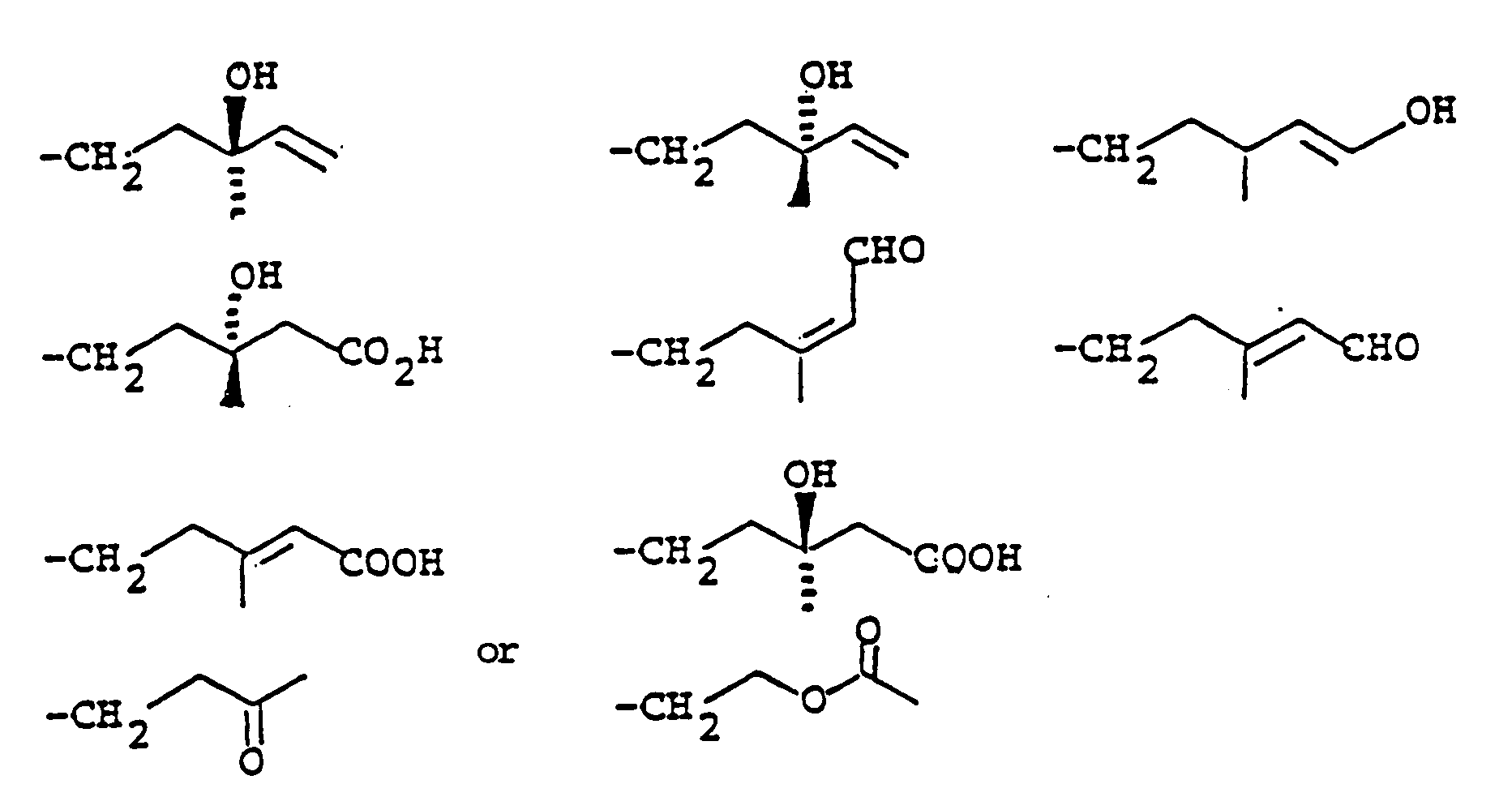
to form a diol having the structure
- The diol obtained may be cyclized in the aqueous nutrient medium to form said furan compound which is then recovered. In another embodiment the diol may be separated from the aqueous nutrient medium and then cyclized to form said furan compound which is then recovered.
- The structures of some of the compounds of interest in the present invention are given below.

- Compounds 4 through 14 may be used as substrates in the transformation process for the present invention to produce the desired products. Compounds 6, 11, and 13 have been observed as intermediates during the transformation of Sclareol according to the process of this invention. The transformation process involves cultivation of the microorganism Hyphozyma roseoniger, CBS 214.83 and ATCC 20624 in an aqueous nutrient medium in the presence of the compounds 4 through 14. These compounds may be used singularly or as a mixture containing any number of said compounds.
- The form in which the microorganisms are used is not critical. They can be used as the culture (suspension), i.e. including the cells and the corresponding nutrient solution, or in the form of cells suspended in a buffer solution. The cells, or an enzyme extract thereof, may be immobilized on a suitable solid support, which may then be used to effect transformations.
- The suspended culture mixture is prepared by inoculation of a suitable aqueous nutrient medium with the microorganism. A suitable nutrient medium is one which contains nitrogen sources, inorganic salts, growth factors, the desired substrate(s), and optionally other carbon sources. Some carbon sources suitable for use in the inventive process include, for example, glucose, galactose, L-sorbose, maltose, sucrose, cellobiose, trehalose, L-arabinose, L-rhamnose, ethanol, glycerol, L-erythrithol, D-mannitol, lactose, melibiose, raffinose, melezitose, starch, D-xylose, D-sorbitol, α-methyl-D-glucoside, lactic acid, citric acid and succinic acid. Suitable nitrogen sources include, for example, nitrogen-containing organic substances such as peptone, meat extract, yeast extract, corn steep liquor, casein, urea, amino acids, or nitrogen-containing inorganic compounds such as nitrates, nitrites and inorganic ammonium salts Suitable inorganic salts include, for example, phosphates of magnesium, potassium, calcium, or sodium. The above mentioned culture medium nutrients may be supplemented with, for example, one or more vitamins of the B group and/or one or more trace minerals such as Fe, Mo, Cu, Mn, and B, as desired. The Vitamins or trace minerals are not necessary when a small amount of yeast extract is added to the medium. Addition of an antibiotic, such as chloroamphinical or chlorotetracycline, may be desirable when bacterial contamination is a problem.
- The cultivation of the microorganism may be carried out as a stationary culture or as a submersed (e.g., shaking culture, fermentor culture) under aerobic conditions. One may suitably work in the pH range of from between about 2.5 and about 9.0, and preferably in the range of from between about 3.0 and about 7.5 and most preferably between about 3.0 and about 6.5 The pH may be regulated by the addition of inorganic or organic acids, such as hydrochloric acid, acetic acid, and oxalic acid, or by the addition of bases, such as sodium hydroxide, and ammonium hydroxide, or by the addition of a buffer, such as phosphate or phthalate. The incubation temperature should suitably be maintained between about 12°C and about 33°C, with a range between about 15°C and about 30°C being more preferred, and a range between about 18°C and about 28°C being most preferred.
- The process in accordance with this invention may be conveniently carried out by adding one or more of the compounds 4 through 14 to the nutrient medium at the onset of cultivation, as the sole carbon source. Alternatively, the substrate may be added in combination with another carbon source, such as dextrose, either during cultivation, or when the carbon source is depleted. The only restriction on the concentration of substrate in the culture medium is that of being able to effectively aerate the culture. However, the substrate concentration is preferably in the range of between about 0.1 g/L and about 100g/L, more preferably in the range of between about 0.5 g/L and about 50 g/L, and most preferably in the range between about 1.5 g/L about 30 g/L. The transformation can be suitably carried under any of the above mentioned conditions.
- The total transformation time (after initial cultivation period) may vary depending on the composition of the nutrient medium and the substrate concentration. In general, shaking flask cultures require from between about 12 hours and about 264 hours. However, when a fermentor is used the cultivation time may be reduced to about 48 hours or less.
- The transformation may be carried out using the cells of the microorganism isolated from the culture solution, or with an enzyme extract isolated from the cells in a manner well known to the art. In this case, the transformation can be conveniently carried out in a variety of aqueous nutrient mediums including, for example, in a buffer solution, in a physiological salt solution, in a fresh nutrient solution, or in water. The isolated cells or enzyme extract may be immobilized on a solid support and the desired transformation effected. Also, transformation of the substrate may be effected by mutants of this organism. Such mutants can be readily obtained by methods well known in the art, for example, by exposing the cells to UV or X-rays, or known mutagenic substances, such as for example, acridine orange.
- The substrate can be added to the medium as a powder, or a slurry in an emulsifier such as Tween-80 (polyoxyethylenesorbitan monostearate), or as a solution in an emulsifier, or as a solution in a hydrophilic solvent such as acetone, methanol, ethanol, ethylene glycol, or dioxan. A surface-active agent, or a dispersion agent can also be added to an aqueous suspension of the substrate, or the substrate can be emulsified using ultrasound.
- Conventional antifoam agents, such as silicone oils (e.g., UCON), polyalkyleneglycol derivatives, maize oil, or soya oil, can be used to control foaming.
- The transformation of the substrate can be monitored using standard analytical techniques such as GLC, TLC, HPLC, IR, and NMR. If a rapid disappearance of the substrate is observed more substrate can then be added, in order to maximize the transformation capacity of the microorganism. The process is generally terminated when most of the substrate has disappeared from the culture medium. Compound 3 may be recovered from the aqueous nutrient medium, or may be cyclized to the furan Compound 2,either in the aqueous nutrient medium,or after recovery. Isolation and purification of Compounds 1 or 3 from the fermentation broth may be achieved by conventional techniques including, filtration or centrifugation, solvent extraction, distillation, crystallization, and the like. Compound 3 may be converted to the furan Compound 1 by conventional cyclization methods well known in the art. For example, reaction of diol 3 with toluene -p-sulfonyl chloride in pyridine at 0°C according to the procedure described by Cambie et al. (see Aust. J. Chem., 1971, 24, 591), which is incorporated herein by reference. This procedure may optionally be employed either on the transformation mixture or on the recovered diol Compound 3. Examples of other cyclization methods are described by R.B. Wagner and H.D. Zook in "Synthetic Organic Chemistry", John Wiley, 1965, pp 838-839, which is incorporated herein by reference.
- The microorganism employed in this invention was isolated from a soil sample obtained from central New Jersey, United States of America. This strain has been deposited with the Centraalbureau voor Schimmelculture and the American Type Culture Collection with the accession number CBS 214.83 and ATCC 20624, respectively.
- The organism was studied and characterized by Centralbureau voor Schimmel Cultures (CBS). Due to the pink coloring of its colonies and its unique morphological and physiochemical properties, CBS has assigned the inventive microorganism the name Hyphozyma roseoniger.
- This organism has distinct yeast and filamentous forms. Both forms exhibit similar biological properties and perform the transformations described herein.
- The properties of the yeast phase of the said microorganism are described below:
1. Shape and Size
Growth on YM Agar: Pink, glistening, smooth colonies present filamentous growth cells are budding, round or cylindrical ca. 2 x 7 µm or sometimes larger.
Growth on Malt Extract Agar: Pink, occasionally brownish with formation of true hyphae after 2 to 3 weeks, with no clump connections, shiny.
Growth on Corn Meal Agar: Light orange-pink glistening. Smooth colonies fringed with mycelia.
Growth on Potato Dextrose Agar and Difco Malt Agar: Pink, smooth, glistening and occasionally turns black at room temperature after 2 to 3 weeks.
Growth on YPCA Agar: Attaining 8 mm diameter in 10 days, flat, slimy, pale orange (6A3; Kornerups Wanscher, 1978), with sharp, somewhat lobed margins.
Growth on ChA Agar: 4 mm diameter in 10 days. After 3 weeks centrally becoming olivaceous, with light brown (6D6) to dark brown (5F7), finally a submerged mycelium extending from the mucuous colony, leading to a dense, olive brown (4F4) colony locally with thin dirty,white central patches, later dense fascicles of aerial mycelium. The organism produces true hyphae with anastomoses observed on potato and rice slides. It seems to be a hyphomycets fungus with a distinct yeast phase in its life cycle.
2. Fermentation on Sugars (see Table 1)TABLE 1 Fermentation Compound Gas Acid Glucose - - Galactose - - Maltose - - Sucrose - - Lactose - - Raffinose - - Melibiose - - Inulin - -
3. Assimilation of Carbon Compounds (see Table 2)TABLE 2 Assimilation of Carbon Compounds Glucose + Lactose v Galactose + Melibiose + L-sorbose + Raffinose + Maltose + Melezitose + Sucrose + Inulin - Cellobiose + Soluble starch + Trehalose + D-xylose + L-arabinose + D-sorbitol + D-arabinose - α-Methyl-D-glucoside + D-ribose + Salicin - L-rhamnose + Inositol - D-glucosamine - Lactic acid + Ethanol + Citric acid + Glycerol + Succinic acid + L-erythrithol + Glucono-γ-lactone + Adonitol - Ducitol - D-mannitol + - 4. Splitting Arbutin: positive
- 5. Assimilaton of NH₄NO₃: positive
- 6. Assimilation of KNO₃: positive
- 7. Assimilation of KNO₂: positive
- 8. Growth on Ethylamine: positive
- 9. Growth on Vitamin- free Medium: positive
- 10. Growth at 12°C: positive
- 11. Growth at 26°C: positive
- 12. Growth at 30°C: positive
- 13. Growth at 37°C: negative
- 14. Growth at 45°C: negative
- The properties of the filamentous form of the said organism are similar to the yeast phase with the following exceptions:
- Growth on YM Agar: Pink, rough colonies, presents filamentous growth with true hyphae.
- Growth on Malt Agar or Potato Dextrose Agar: Pink, rough colonies, presents filamentous growth after 2 weeks at room temperature,colonies turn black.
- Growth on Potato and Rice Slides: Produces true hyphae with anastomoses.
- Growth in Liquid Medium such as YM Broth: Pink, presents yeast-like growth and occasionally some mycellium.
- Growth on Potato Sucrose Agar: Filamentous with evidence of a yeast phase.
- The following examples serve to illustrate embodiments of the invention as it is now preferred to practice it but in no way are meant to limit the scope thereof. Unless otherwise stated, weights are in grams, temperatures are in degrees centrigrade and pressure in mm Hg.
- This example demonstrates the fermentation process using 2-ethenyldecahydro-2-hydroxy-α;2,5,5,8a-pentamethyl-1-naphthalene propanol (4) as substrate.
- Four flasks, each containing an aqueous solution (100 mL) of 0.1% NH₄NO₃, 0.1% H₂KPO₄, 0.05% MgSO₄.7H₂O, trace minerals,and Vitamin B complex were sterilized at 120°C for 20 minutes. A 50% aqueous solution of dextrose (5 mL) and Tween-80 (0.1 mL), containing Sclareol (4) (10 mg) was added to each flask. Each flask was inoculated with 5% by volume of three days grown cells CBS 214.83 (ATCC 20624).The cultures were then incubated at 25 ± 1°C on a rotary shaker (200 rpm) for 3 to 4 days. After the initial incubation period a mixture of Sclareol dissolved in Tween-80 (8.0 g) was added in portions during the next 5 days, afterwhich the incubation was continued for a further 4 days. At the end of the incubation period the contents of the four flasks were combined, extracted with ethyl acetate (3 x 200 mL) and dried (Na₂SO₄). Evaporation of the solvent provided a crude extract (4.0 g) , which was crystallized from hexane/chloroform to provide decahydro-2-hydroxy-2,5,5, 8a-tetramethylnaphthaleneethanol (3) (2.4 g), mp 130.5-131.5°C, (lit. 132-133°C) GLC purity 100%, H-NMR (CDCl₃) δ 0.79 (6H, 2s), 0.87 (3H, 2), (3H, 2), 0.9-20 (16H, m), 3.41-3.49 (1H, m), 3.72-3.79 (1H, m). IR (CHCl₃) νmax, 3580, 3360, 2950, 1460, 1380 cm. MS m/e 236, 221, 117, 137, 109. [α]


[see M. Stoll and M. Hinder Helv.Chim. Acta (1953) 36 1955-2008.] - This example demonstrates the efficacy of the fermentation process using different levels of Sclareol (4) as substrate.
- A procedure similar to that described in Example 1 was used except that yeast extract (0.1 g) was substituted for the trace minerals and vitamins, and that the Sclareol (4) was recrystallized from hexanes, pulvarized, passed through a 50-mesh seive, and then mixed with an equal weight of Tween-80. After an initial incubation period of 4 days, the mixture of Sclareol (4) and Tween-80 was added to each flask incrementally over a period of 5 days and then incubated for an additional 4 days. Table 3 below shows the amount of Sclareol (4) added to each flask and the yield of isolated diol 3. Each product exhibited spectral data identical with that reported in Example 1.

- This example demonstrates the efficacy of the fermentation process using resting cells (washed).
- A procedure similar to that described in Example 1 was employed, except that after an initial incubation period of 3 days, the cells from 100 mL of culture broth were harvested and washed (3 x 25 mL) with 0.3 x 10⁻⁴ M phosphate buffer (pH = 7.2) and separated by centrifugation. The washed cells were dispersed in the above mentioned buffer (100 mL) and incubated at 25 ± 1°C on a rotary shaker (rpm 200) for 7 days. Sclareol (0.5 g) dissolved in Tween-80 (5 g) was added incrementally to the suspension of cells during the first 4 days of incubation. At the end of the incubation period TLC monitoring indicated that all of the Sclareol (4) had been converted to the diol 3. Work-up,in the usual manner,provided diol 3 in 98% yield, and 99% GLC purity. The spectral data for this product was identical with that reported in Example 1.
- This example demonstrates the fermentation process using each of Compounds 4 through 14 as substrates, to produce decahydro-2-hydroxy-2,5,5,8a-tetramethylnaphthaleneethanol (3).
- Eleven flasks, each containing an aqueous solution (100 mL) of medium described in Example 2 were sterilized at 120°C for 20 minutes. A 50% aqueous solution of dextrose (4 mL), and Tween-80 (0.1 mL) containing 10 mg of corresponding substrate, was added to each flask. Each flask was then inoculated with 5% by volume of three days grown cells of CBS 214.83 (ATCC 20624) and the cultures were then incubated at 24 ± 1°C on a rotary shaker (200 rpm) for 3 days. After the inital incubation period, a mixture of substrate dissolved in Tween-80 (ratio 1:7 w/w) was added to each corresponding flask, after which the incubation was continued for several days (see Table 4). The progress of the transformations was monitored by TLC. At the end of the incubation periods, the contents of each flask were extracted with ethyl acetate (3 x 75 mL), the extracts dried (Na₂SO₄), and the solvent evaporated. The residues were separately purified by column chromatography on silica gel using hexane/isopropane (95/5) as solvent, and the yields of diol 3 were determined. Data for the eleven experiments are summarized in Table 4.
Table 4 Production of Compound 3 by CBS 214.83 (ATCC 20624) Using Different Substrates Substrate (g/100 mL) Total Incubation Time (days) Yield of Diol 3 (%) Compound 4 0.3 7 96 Compound 5 0.3 11 89 Compound 6 0.3 7 91 Compound 7 0.2 10 51 Compound 8 0.2 10 13 Compound 9 0.2 10 7 Compound 10 0.3 7 98 Compound 11 0.3 6 100 Compound 12 0.3 11 91 Compound 13 0.24 8 98 Compound 14 0.5 4 100 - This example demonstrates a method for preparing Compounds 7, 8 and 9, which may be employed as substrates in the inventive process.
- A solution of Sclareol (9.24 g, 0.03 mol) in methylene chloride (40 mL) was added in one portion to a mixture of pyridinium chlorochromate (12.93 g, 0.06 mol), sodium acetate (2.46 g, 0.03 mol), and methylene chloride (100 mL). The mixture was stirred for 4 h at 25°C. Ether (200 mL) was added and the supernatant decanted from the gummy precipitate. The precipitate was washed with ether (3 x 50 mL). The ethereal solution was passed through silica gel 60 (40 g) and the solvents evaporated.
- The residue was dissolved in ethanol (2 mL) and ether (4 mL), and stirred at 25°C with a solution of sodium bisulfite (15 g) in water (60 mL) for 3 h. The mixture was extracted with ether (2 x 30 mL). The aqueous layer was made basic with 10% sodium hydroxide and extracted with ether (4 x 50 mL). The ether extracts were dried (Na₂SO₄) and the solvent evaporated to yield 2.72 g of residue. Chromatography on silica gel 60 (70 g; eluant, hexane: ethyl acetate; 4:1) gave 0.74 g of trans-aldehyde 7, 0.69 g of cis-aldehyde 8, and 0.64 g of cyclic aldehydes 9. [(E)-1R-(1α,2β,4aβ,-8aα)]-5-(decahydro-2-hydroxy-2,5,5,8a-tetramethyl-1-naphthalenyl)-3-methyl-2-pentenal (7) mp 83-85°C, [α]D + 14.2° (c,5.76, CHCl₃); ¹H-NMR (CDCl₃) δ 0.78 (6H,s), 0.86 (3H, s), 1.17 (3H, s), 2.15 (3H, broad s), 0.8 - 2.5 (17H, m), 5.82 (1H, d, J = 8 Hz), 9.98 (1H, d, J = 8 Hz); IR (CHCl₃) νmax 3570, 3440, 2940, 2850, 1670, 1630, 1460, 1440, 1390 cm⁻¹; MS, m/e 306, 291, 273, 109, 95, 84; UV λmax (95% ethanol) 241 nm (calcd 231 nm) (ε, 17,300). Anal. Calcd for C₂₀H₃₄O₂: C, 78.37; H, 11.18. Found: C, 77.92, H, 11.02. [(Z)-1R-(1α,2β,4aβ,8aα)]-5-(decahydro-2-hydroxy-2,5,5,8a-tetramethyl-1-naphthalenyl)-3-methyl-2-pentanal (8), mp 91-93.5°C [α]D + 8.9 (c, 3.13, CHCl₃); ¹H-NMR (CDCl₃) δ 0.78 (6H, s), 0.87 (3H, s), 1.14 (3H, s), 1.98 (3H, broad s), 0.9 - 2.8 (17H, m), 5.75 (1H, d, J = 8 Hz), 10.0 (1H, d, J = 8 Hz); IR (CHCl₃) 3570,450, 2940, 2840, 1670, 1630, 1460, 1440, 1390 cm⁻¹; MS m/e 306, 273, 109, 95, 84; UV λmax (95% ethanol) 242 nm (calcd 231 nm) (ε, 13,000). Anal. Calcd for C₂₀H₃₄O₂: C, 78.37; H, 11.18. Found : C, 78.34; H, 11.02. [4aR - (4aα,6aβ,10aα,10bβ)]-dodecahydro-3,4a,7,7,10a-pentamethyl-1H-naphtho[2,1-b]pyran-1-acetaldehyde (9), ¹H-NMR (CDCl₃) δ 0.78 (6H, s), 0.85 (3H, s), 1.25 (3H, s), 1.27 (3H, s). 0.9 - 2.6 (18H, m), 9.8 - 10.0 (1H, m); IR (film) νmax 2940, 2850, 1720, 1460, 1440, 1380, 1370 cm⁻¹; MS, m/e (two peaks of similar ms) 291, 273, 262, 245, 109, 43.

- This example demonstrates a method for preparing Compound 10, which may be employed as a substrate in the invention process.
- To a suspension of sodium hydride (0.72 g of 50% suspension, 0.015 mol; washed free of mineral oil with hexane) in dimethoxyethane (15 mL) was added a solution of ethyl diisopropylphosphononoacetate (3.78 g, 0.015 mol) in dimethoxyethane (30 mL) over a 10 min period. After hydrogen evolution has ceased [1R-(1α,2β,4aβ,8aα)]-4-(2-acetyloxy-decahydro-2,5,5,8a-tetramethyl-1-naphthalenyl)-2-butanone (3.22 g, 0.01 mol, which may be prepared as described by J.A. Barltrop et al., in J. Chem. Soc., 1960, 4613) was added all at once. The mixture was heated at reflux for 21 h, then cooled and poured onto ice water (100 mL). The mixture was acidified with 6N hydrochloric acid, and extracted with hexane/ethyl acetate (4:1, 4 x 10 mL). The organic extracts were washed with water (2 x 10 mL), saturated sodium bicarbonate solution (2 x 15 mL), and dried (Na₂SO₄). The solvents were evaporated and the residue chromatographed (silica gel 60; eluant, hexane : ethyl acetate, 9:1) to provide 3.02 g of ethyl [(E,Z)-1R-(1α,2β,4aβ,8aα)]-5-(2-acetyloxy-decahydro-2,5,5,8a-tetramethyl-1-naphthalenyl)-3-methyl-2-pentenoate as a colorless viscous oil.
- A mixture of ethyl [(E,Z)-1R-(1α,2β,4aβ,8aα)]-5-(2-acetyloxy-decahydro-2,5,5,8a-tetramethyl-1-naphthalenyl)-3-methyl-2-pentenoate (2.19 g, 0.00557 mol), isopropanol (65 mL), water (10 mL) and potassium hydroxide (1.47 g, 0.0223 mol) was heated at reflux for 24 h. The mixture was concentrated to 20 mL, water (50 mL) was added, and the mixture was extracted with ether. The aqueous phase was acidified with 6N HCl and extracted with ether (5 x 20 mL). The ether extracts were washed with brine, dried (Na₂SO₄), and the solvents evaporated to yield 1.781 g of crude product. Chromatography on silica gel 60 (eluant, hexane : isoproanol, 9:1) gave 0.455 g of the cis-isomer, and 1.223 g of the trans-isomer 10. Recrystallization from hexane/ethyl acetate yielded analytical samples [(Z)-1R-[1α,2β,4aβ,8aα)]-5-(decahydro-2-hydroxy-2,5,5,8a-tetramethyl-1-naphthalenyl)-3-methyl-2-pentenoic acid, mp 147-149°C; [α]D +62.96° (c, 4.66, CHCl₃); ¹H-NMR (CDCl₃) δ 0.81 (6H, s), 0.88 (3H, s), 1.21 (3H, s), 1.92 (3H, broad s), 0.9 - 2.4 (17H, m), 5.72 (1H, broad s), 6.8 - 7.3 (1H, v. broad s); IR (CHCl₃) νmax 3500, 3400, 2940, 2550, 1690, 1640, 1460, 1440 cm⁻¹; MS,m/e 322, 304, 289, 276, 109; UV λmax (95% EtOH) 228 nm (calcd 217 nm) (ε, 7300). Anal. Calcd for C₂₀H₃₄O₃: C, 74.49; H, 10.63. Found: C, 74.20; H, 10.40. [(E)-1R-(1α,2β,4aβ,8aα)]-5-(decahydro-2-hydroxy-2,5,5,8a-tetramethyl-1-naphthalenyl)-3-methyl-2-pentenoic acid, mp 151-153°C [α]D 9.44° (c, 4.83, CHCl₃); ¹H-NMR (CDCl₃) δ 0.79 (6H, s), 0.87 (3H, s), 1.15 (3H, s), 2.17 (3H, broad s) 0.9 - 2.4 (17H, m). 5.70 (1H, broad s), 5.8 - 6.1 (1H, broad s); IR (CHCl₃) νmax 3560, 3400, 2940, 2550, 1690, 1640, 1460, 1440 cm⁻¹; MS, m/e 322, 304, 289, 276, 109; UV λmax (95% EtOH) 230 nm (calcd 217 nm) (ε, 5700). Anal. Calcd for C₂₀H₃₄O₃: C 74.49; H, 10.63. Found: C, 74.12; H, 10.52.
- This example demonstrates a method for preparing Compound 11, which may be employed as a substrate in the inventive processs.
- To a solution of diisopropylamine (8.484 g, 0.084 mol) in tetrahydrofuran (90 mL) at 0°C was added n-butyllithium (38.2 mL of a 2.2. M hexane solution, 0.084 mol) dropwise, over a 20 minute period. A solution of acetic acid (2.52 g, 0.042 mol) in tetrahydrofuran (20 mL) was added over a 15 minute period. The mixture was then heated at 50°C for 45 minutes. The mixture was cooled to 25°C and [1R-(1α,2β,4aβ,8aα)-4-(2-acetyloxydecahydro-2,5,5,8a-tetramethyl-1-naphthalenyl)-2-butanone (4.508 g, 0.014 mol, which may be prepared as described by J.A. Barltrop et al., in J. Chem. Soc., 1960, 4613) in tetrahydrofuran (35 mL) was added over a 10 minute period. The mixture was stirred at 25°C for 17 h and then heated at reflux for 30 minutes. The mixture was cooled to 25°C, afterwhich water (40 mL) and potassium hydroxide (5 g) were added. The mixture was heated at reflux for 4h, then cooled, added to water (100 mL), and extracted with hexane/ethyl acetate (4:1) (3 x 30 mL). The aqueous layer was cooled to 0°C, acidified with 6N HCl, and extracted with hexane/ethyl acetate (4:1, 4 x 50 mL). The combined extracts were washed with brine, dried (Na₂SO₄), and then the solvent evaporated to yield 2.071 g of crude product. Chromatograph on silica gel 60 (eluant, hexane : ethyl acetate: acetic acid, (10:10:0.1) gave 1.434 g of acids 11. Crystallization from hexane/ethyl acetate gave an analytical sample, mp 136-137.5°C, ¹H-NMR (CDCl₃) δ 0.76 (6H, s), 0.85 (3H, s), 1.16 and 1.19 (3H, 2s), 1.28 (3H, s), 0.8 - 1.9 (16H, m), 2.4 - 2.8 (2H, m), 6.1 - 6.6 (2H, broad s); IR (CHCl₃) νmax 3550, 2930, 2700, 1710, 1455, 1385 cm⁻¹; MS m/e 340, 304, 289, 109, 95, 43. Anal. Calcd for C₂₀H₃₆O₄: C, 70.54; H, 10.66. Found C, 70.99, H, 10.63.
- This example demonstrates the conversion of α-ethenyldecahydro-2-hydroxy-α,2,5,5,8a-pentamethyl-1-napthalenepropanol (4) to dodecahydro-3a,6,6,9a-tetramethylnaphtho[2,1-b]furan (1) using a two-step process.
- A procedure similar to that described in Example 2 was used, except that seven flasks were used, and that the amount of Sclareol (4) added to each flask and the incubation period was varied (see Table 5). When incubation was complete the flasks were worked-up separately and seven samples of crude diol 3 obtained. Each sample was separately reacted with toluene-p-sulfonylchloride, in pyridine, according to the method of Cambie, et al., (see Aust. J. Chem.,1971, 24, 591) and each reaction product Kugelrohr distilled to provide furan 1. ¹H-NMR (CDCl₃) δ 0.83 (6H, 2s), 0.88 (3H, s), 0.9-1.8 (13H, m), 1.9-2.0 (1H, m), 3.77-3.92, (2H, m). IR (melt) νmax 2940, 1460, 1385, 1365 cm⁻¹, MS m/e 236, 221, 204, 177, 137, 97. Data for the seven experiments are summarized in Table 5.

- This example demonstrates the direct cyclization of the transformation product decahydro-2-hydroxy-2,5,5,8a-tetramethylnaphthaleneethanol (3), without separation from the aqueous nutrient medium, to dodecahydro-3a,6,6,9a-tetramethylnaphtho[2,1-b]furan (1).
- A procedure similar to that described in Example 2 using Sclareol (2.0 g) as substrate in 100 mL of fermentation broth was employed. After 14 days total incubation time, the contents of the flask were transferred to a reaction vessel equipped for stirring and heating under reflux. Toluene-p-sulfonylchloride (2.48 g), sodium hydroxide pellets (25 g) and tetrahydrofuran (200 mL) were added and the mixture stirred at 20°C. After 5 h,additional toluene-p-sulfonylchloride (1.50 g) was added and the reaction mixture was stirred overnight. Next day the mixture was heated at reflux for 30 min, cooled, and extracted with ethyl acetate (3 x 100 mL). The combined extracts were dried (Na₂SO₄). The solvents were evaporated, and the residue Kugelrohr distilled to give 1.38 g of a solid, which by instrumental analysis contained 85% of dodecahydro-3a,6,6,9a-tetramethylnaphtho[2,1-b]furan (1).
- This example demonstrates an alternative procedure for the direct cyclization of the transformation product decahydro-2-hydroxy-2,5,5,8a-tetramethylnaphthaleneethanol (3), without separation from the aqueous nutrient medium, to dodecahydro-3a,6,6,9a-tetramethylnaphtho[2,1-b]furan (1).
- A procedure similar to that described in Example 2 using Sclareol (2.0 g) as substrate in 100 mL of fermentation broth was employed. After 14 days total incubation time, the contents of the flask were transferred to a reaction vessel equipped for stirring and heating under reflux. The fermentation broth was acidified with 6 N hydrochloric acid (to about pH 1), ethyl acetate (100 mL) added, and the stirred mixture heated at reflux for 6 h. After cooling, the ethyl acetate layer was separated, washed to neutrality, and dried. The solvent was evaporated and the residue Kugelrohr distilled to give 1.4 g of a solid, which by instrumental analysis contained 38% of dodecahydro-3a,6,6,9a-tetramethylnaphtho(2,1-b]furan (1).
- This example illustrates an alternative procedure for the direct cyclization of the transformation product decahydro-2-hydroxy-2,5,5,8a-tetramethylnaphthaleneethanol (3), without separation from the aqueous nutrient medium, to dodecahydro-3a,6,6,9a-tetramethylnaphtho[2,1-b]furan (1).
- A procedure similar to that described in Example 8 was employed except that the ion exchange resin Dowex 50X2 400 (10 g) was added to the fermentation broth instead of 6N hydrochloric acid. Work-up, and Kugelrohr distillation gave 1.32 g of a solid, which by instrumental analysis contained 37% of Compound 1.
- The invention being thus described, it will be obvious that the same may be varied in many ways. Such variations are not to be regarded as a departure from the spirit and scope of the invention, and all such modifications are intended to be included within the scope of the following claims:
Claims (7)
- A biologically pure culture of Hyphozyma roseoniger ATCC 20624.
- A biologically pure culture of a Hyphozyma roseoniger microorganism or of a mutant thereof which has the identifying characteristic of Hyphozyma roseoniger ATCC 20624 of being capable of converting labdane compounds into recoverable quantities of a diol of the formula (3)


- The biologically pure culture according to claim 1 or 2, characterized in that it is lyophylized.
- A mixture obtained by cultivating a biologically pure culture according to any one of claims 1 to 3 under aerobic conditions in an aqueous medium.
- A process for preparing a diol of the formula (3)


- A process for preparing a furan compound of the formula (1)


- A process for preparing a furan compound of the formula (1)


Priority Applications (13)
| Application Number | Priority Date | Filing Date | Title |
|---|---|---|---|
| EP85106304A EP0204009B1 (en) | 1983-07-13 | 1985-05-22 | Process for producing diol and furan and microorganism capable of same |
| AT85106304T ATE72457T1 (en) | 1983-07-13 | 1985-05-22 | PROCESS FOR THE PRODUCTION OF A DIOLE AND A FURAN AND MICROORGANISM CAPABLE OF THESE. |
| DE8585106304T DE3585372D1 (en) | 1985-05-22 | 1985-05-22 | METHOD FOR PRODUCING A DIOL AND A FURAN AND COMPATIBLE MICROORGANISM. |
| AU42889/85A AU589562B2 (en) | 1983-07-13 | 1985-05-27 | Process for producing diol and furan and microorganism capable of same |
| NO852117A NO165032C (en) | 1983-07-13 | 1985-05-28 | PROCEDURE FOR THE PREPARATION OF D1OL AND FURAN COMPOUNDS BY THE FERMENTATION OF HYPHOZYMA ROSEONIGER CBS 214.83 OGATCC 20624. |
| DK237885A DK169560B1 (en) | 1983-07-13 | 1985-05-28 | Biologically pure culture of Hyphozyma roseoniger, a mixture which is prepared by culturing this organism, and a process for preparing a diol compound or a furan compound by culturing the microorganism |
| CA000482986A CA1258818A (en) | 1983-07-13 | 1985-05-31 | Process for producing diol and furan and microorganism capable of same |
| ZA854306A ZA854306B (en) | 1983-07-13 | 1985-06-06 | Process for producing diol and furan and microorganism capable of same |
| BR8503211A BR8503211A (en) | 1983-07-13 | 1985-07-04 | PROCESS TO PRODUCE DIOL AND FURANO AND MICROORGANISM CAPABLE OF THE SAME |
| ES545124A ES8609479A1 (en) | 1983-07-13 | 1985-07-12 | Process for producing diol and furan and microorganism capable of same. |
| JP60213605A JPH0634704B2 (en) | 1983-07-13 | 1985-09-26 | Microbes High Hosima Roseoniger |
| ES551945A ES8706206A1 (en) | 1983-07-13 | 1986-02-13 | Process for producing diol and furan and microorganism capable of same. |
| US06/903,858 US4798799A (en) | 1983-07-13 | 1986-08-29 | Process for producing diol and furan and microorganism capable of same |
Applications Claiming Priority (8)
| Application Number | Priority Date | Filing Date | Title |
|---|---|---|---|
| US51327083A | 1983-07-13 | 1983-07-13 | |
| EP85106304A EP0204009B1 (en) | 1983-07-13 | 1985-05-22 | Process for producing diol and furan and microorganism capable of same |
| NO852117A NO165032C (en) | 1983-07-13 | 1985-05-28 | PROCEDURE FOR THE PREPARATION OF D1OL AND FURAN COMPOUNDS BY THE FERMENTATION OF HYPHOZYMA ROSEONIGER CBS 214.83 OGATCC 20624. |
| DK237885A DK169560B1 (en) | 1983-07-13 | 1985-05-28 | Biologically pure culture of Hyphozyma roseoniger, a mixture which is prepared by culturing this organism, and a process for preparing a diol compound or a furan compound by culturing the microorganism |
| ZA854306A ZA854306B (en) | 1983-07-13 | 1985-06-06 | Process for producing diol and furan and microorganism capable of same |
| BR8503211A BR8503211A (en) | 1983-07-13 | 1985-07-04 | PROCESS TO PRODUCE DIOL AND FURANO AND MICROORGANISM CAPABLE OF THE SAME |
| ES545124A ES8609479A1 (en) | 1983-07-13 | 1985-07-12 | Process for producing diol and furan and microorganism capable of same. |
| ES551945A ES8706206A1 (en) | 1983-07-13 | 1986-02-13 | Process for producing diol and furan and microorganism capable of same. |
Publications (2)
| Publication Number | Publication Date |
|---|---|
| EP0204009A1 EP0204009A1 (en) | 1986-12-10 |
| EP0204009B1 true EP0204009B1 (en) | 1992-02-05 |
Family
ID=27570201
Family Applications (1)
| Application Number | Title | Priority Date | Filing Date |
|---|---|---|---|
| EP85106304A Expired - Lifetime EP0204009B1 (en) | 1983-07-13 | 1985-05-22 | Process for producing diol and furan and microorganism capable of same |
Country Status (10)
| Country | Link |
|---|---|
| EP (1) | EP0204009B1 (en) |
| JP (1) | JPH0634704B2 (en) |
| AT (1) | ATE72457T1 (en) |
| AU (1) | AU589562B2 (en) |
| BR (1) | BR8503211A (en) |
| CA (1) | CA1258818A (en) |
| DK (1) | DK169560B1 (en) |
| ES (2) | ES8609479A1 (en) |
| NO (1) | NO165032C (en) |
| ZA (1) | ZA854306B (en) |
Cited By (2)
| Publication number | Priority date | Publication date | Assignee | Title |
|---|---|---|---|---|
| US8252565B2 (en) | 2007-03-06 | 2012-08-28 | Kao Corporation | Method for production of microbial fermentation product |
| WO2023280677A1 (en) | 2021-07-06 | 2023-01-12 | Isobionics B.V. | Recombinant manufacture of c-20 terpenoid alcohols |
Families Citing this family (15)
| Publication number | Priority date | Publication date | Assignee | Title |
|---|---|---|---|---|
| DE3732954A1 (en) * | 1987-09-30 | 1989-04-13 | Basf Ag | METHOD FOR PRODUCING ALKYLATED DODECAHYDRONAPHTO (2,1-B) FURANES |
| DE19524584A1 (en) * | 1995-07-06 | 1997-01-09 | Basf Ag | Process for the stereoselective preparation of (-) 3a, 6,6,9a-tetramethyl-perhydronaphtho [2,1-b] furan |
| JP5113379B2 (en) * | 2006-02-24 | 2013-01-09 | 花王株式会社 | Novel microorganism and method for producing dodecahydro-3a, 6,6,9a-tetramethylnaphtho [2,1-b] furan intermediate using the novel microorganism |
| ES2546271T3 (en) | 2006-02-24 | 2015-09-22 | Kao Corporation | Microorganism and procedure for producing decahydro-2-hydroxy-2,5,5,8a-tetramethylnaphthalenetanol and / or slaveolide (decahydro-3a, 6,6,9a-tetramethylnaphto [2,1-b] furan-2 (1H) - ona) using the same |
| JP4854418B2 (en) * | 2006-07-28 | 2012-01-18 | 花王株式会社 | Method for producing dodecahydro-3a, 6,6,9a-tetramethylnaphtho [2,1-b] furan raw material |
| JP5294901B2 (en) * | 2008-04-09 | 2013-09-18 | 花王株式会社 | Method for producing microbial fermentation product |
| US20100248316A1 (en) * | 2009-03-25 | 2010-09-30 | Csir | Process for the Production of Ambrafuran |
| EP3404108A1 (en) | 2009-06-05 | 2018-11-21 | Basf Se | Biocatalytic preparation of ambroxane |
| JP5610728B2 (en) | 2009-08-25 | 2014-10-22 | 花王株式会社 | Method for producing microbial fermentation product |
| JP6013883B2 (en) * | 2012-11-08 | 2016-10-25 | 花王株式会社 | Method for producing microbial fermentation product |
| MX361536B (en) * | 2015-10-23 | 2018-12-10 | Univ Michoacana De San Nicolas De Hidalgo | Method for synthesising ambroxide from ageratina jocotepecana. |
| US10954538B2 (en) | 2016-02-19 | 2021-03-23 | Basf Se | Enzymatic cyclization of homofarnesylic acid |
| GB201800276D0 (en) | 2018-01-08 | 2018-02-21 | Univ Court Univ St Andrews | Maganese-catalysed hydrogenation of esters |
| ES3037793T3 (en) | 2020-09-02 | 2025-10-06 | Int Flavors & Fragrances Inc | Squalene hopene cyclase derivatives and use thereof for producing ambrox |
| CN119677847A (en) | 2022-06-15 | 2025-03-21 | 国际香料和香精公司 | Squalene-hopaene cyclase variants for producing sclareolide |
-
1985
- 1985-05-22 AT AT85106304T patent/ATE72457T1/en not_active IP Right Cessation
- 1985-05-22 EP EP85106304A patent/EP0204009B1/en not_active Expired - Lifetime
- 1985-05-27 AU AU42889/85A patent/AU589562B2/en not_active Ceased
- 1985-05-28 DK DK237885A patent/DK169560B1/en not_active IP Right Cessation
- 1985-05-28 NO NO852117A patent/NO165032C/en unknown
- 1985-05-31 CA CA000482986A patent/CA1258818A/en not_active Expired
- 1985-06-06 ZA ZA854306A patent/ZA854306B/en unknown
- 1985-07-04 BR BR8503211A patent/BR8503211A/en unknown
- 1985-07-12 ES ES545124A patent/ES8609479A1/en not_active Expired
- 1985-09-26 JP JP60213605A patent/JPH0634704B2/en not_active Expired - Lifetime
-
1986
- 1986-02-13 ES ES551945A patent/ES8706206A1/en not_active Expired
Non-Patent Citations (2)
| Title |
|---|
| Antonie van Leeurvenhoek, Vol. 47, 1981, pp. 339-352 * |
| Ceska Mykol, 38(1), 1984, pp. 11-20 * |
Cited By (2)
| Publication number | Priority date | Publication date | Assignee | Title |
|---|---|---|---|---|
| US8252565B2 (en) | 2007-03-06 | 2012-08-28 | Kao Corporation | Method for production of microbial fermentation product |
| WO2023280677A1 (en) | 2021-07-06 | 2023-01-12 | Isobionics B.V. | Recombinant manufacture of c-20 terpenoid alcohols |
Also Published As
| Publication number | Publication date |
|---|---|
| CA1258818A (en) | 1989-08-29 |
| ES8706206A1 (en) | 1987-06-01 |
| ES551945A0 (en) | 1987-06-01 |
| DK237885D0 (en) | 1985-05-28 |
| ES545124A0 (en) | 1986-09-01 |
| DK169560B1 (en) | 1994-11-28 |
| EP0204009A1 (en) | 1986-12-10 |
| AU4288985A (en) | 1986-12-04 |
| AU589562B2 (en) | 1989-10-19 |
| JPS6274281A (en) | 1987-04-06 |
| ZA854306B (en) | 1986-05-28 |
| ATE72457T1 (en) | 1992-02-15 |
| JPH0634704B2 (en) | 1994-05-11 |
| NO165032C (en) | 1990-12-12 |
| NO165032B (en) | 1990-09-03 |
| BR8503211A (en) | 1987-02-10 |
| DK237885A (en) | 1986-11-29 |
| ES8609479A1 (en) | 1986-09-01 |
| NO852117L (en) | 1986-12-01 |
Similar Documents
| Publication | Publication Date | Title |
|---|---|---|
| CA1258818A (en) | Process for producing diol and furan and microorganism capable of same | |
| US4970163A (en) | Process for producing diol and lactone and microorganisms capable of same | |
| US4798799A (en) | Process for producing diol and furan and microorganism capable of same | |
| US5212078A (en) | Process for producing a lactone | |
| EP0419026A1 (en) | Process and means for producing diol and lactone | |
| US5561060A (en) | Penicillium cultures capable of producing 10-membered ring lactones | |
| US4104282A (en) | Novel 3-(oxygenated alkyl)-1,9-dihydroxy and 1-hydroxy-9-keto dibenzo[b,d]py | |
| US5128261A (en) | Natural delta-lactones and process of the production thereof | |
| US5155029A (en) | Process for producing a cyclic ether | |
| JP2547713B2 (en) | Cultures and mixtures for producing diols | |
| JPS63112989A (en) | Production of 2-keto-gulonic acid | |
| DE69839248T2 (en) | PROCESS FOR THE PREPARATION OF INHIBITORS OF HMG-CoA REDUCTASE. | |
| JP2802588B2 (en) | Biologically pure culture of microorganism, and method for producing diol and cyclic ether using the same | |
| IE58090B1 (en) | Process for producing diol and furan and microorganism capable of same | |
| US5302522A (en) | Process for the production of sec-cedrenol and cedrenone from α-cedrene by rhodococcus | |
| JPH06339386A (en) | Preparation of diol and furan | |
| JP4261304B2 (en) | Method for producing α-homonojirimycin by microorganism | |
| US4992570A (en) | UCN-1028A and UCN-1028C and process for the production thereof | |
| JP3002654B2 (en) | Biologically pure culture of microorganism and method for producing diol using the same | |
| US4456558A (en) | Polyprenyl ketone derivatives | |
| US4057553A (en) | Certain pyrano-furo-azuleno-pyridines | |
| JPWO1999007872A1 (en) | Method for producing HMG-CoA reductase inhibitors | |
| JP3100785B2 (en) | Novel avermectin derivative, method for producing the same and microorganism producing the same | |
| PL156393B1 (en) | Microbial method of producing diol | |
| JP2599599B2 (en) | Physiologically active substance FA-4283, derivative thereof and production method |
Legal Events
| Date | Code | Title | Description |
|---|---|---|---|
| PUAI | Public reference made under article 153(3) epc to a published international application that has entered the european phase |
Free format text: ORIGINAL CODE: 0009012 |
|
| AK | Designated contracting states |
Kind code of ref document: A1 Designated state(s): AT BE CH DE FR GB IT LI NL SE |
|
| 17P | Request for examination filed |
Effective date: 19870609 |
|
| RAP1 | Party data changed (applicant data changed or rights of an application transferred) |
Owner name: BASF K & F CORPORATION |
|
| 17Q | First examination report despatched |
Effective date: 19890314 |
|
| RAP1 | Party data changed (applicant data changed or rights of an application transferred) |
Owner name: BASF K & F CORPORATION |
|
| GRAA | (expected) grant |
Free format text: ORIGINAL CODE: 0009210 |
|
| AK | Designated contracting states |
Kind code of ref document: B1 Designated state(s): AT BE CH DE FR GB IT LI NL SE |
|
| REF | Corresponds to: |
Ref document number: 72457 Country of ref document: AT Date of ref document: 19920215 Kind code of ref document: T |
|
| REF | Corresponds to: |
Ref document number: 3585372 Country of ref document: DE Date of ref document: 19920319 |
|
| ITF | It: translation for a ep patent filed | ||
| ET | Fr: translation filed | ||
| ITTA | It: last paid annual fee | ||
| PLBE | No opposition filed within time limit |
Free format text: ORIGINAL CODE: 0009261 |
|
| STAA | Information on the status of an ep patent application or granted ep patent |
Free format text: STATUS: NO OPPOSITION FILED WITHIN TIME LIMIT |
|
| 26N | No opposition filed | ||
| EAL | Se: european patent in force in sweden |
Ref document number: 85106304.0 |
|
| PGFP | Annual fee paid to national office [announced via postgrant information from national office to epo] |
Ref country code: FR Payment date: 19980424 Year of fee payment: 14 |
|
| PGFP | Annual fee paid to national office [announced via postgrant information from national office to epo] |
Ref country code: SE Payment date: 19980427 Year of fee payment: 14 |
|
| PGFP | Annual fee paid to national office [announced via postgrant information from national office to epo] |
Ref country code: CH Payment date: 19980505 Year of fee payment: 14 |
|
| PGFP | Annual fee paid to national office [announced via postgrant information from national office to epo] |
Ref country code: AT Payment date: 19980506 Year of fee payment: 14 |
|
| PGFP | Annual fee paid to national office [announced via postgrant information from national office to epo] |
Ref country code: BE Payment date: 19980512 Year of fee payment: 14 |
|
| PGFP | Annual fee paid to national office [announced via postgrant information from national office to epo] |
Ref country code: GB Payment date: 19980515 Year of fee payment: 14 |
|
| PGFP | Annual fee paid to national office [announced via postgrant information from national office to epo] |
Ref country code: NL Payment date: 19980518 Year of fee payment: 14 |
|
| PGFP | Annual fee paid to national office [announced via postgrant information from national office to epo] |
Ref country code: DE Payment date: 19980526 Year of fee payment: 14 |
|
| PG25 | Lapsed in a contracting state [announced via postgrant information from national office to epo] |
Ref country code: GB Free format text: LAPSE BECAUSE OF NON-PAYMENT OF DUE FEES Effective date: 19990522 Ref country code: AT Free format text: LAPSE BECAUSE OF NON-PAYMENT OF DUE FEES Effective date: 19990522 |
|
| PG25 | Lapsed in a contracting state [announced via postgrant information from national office to epo] |
Ref country code: SE Free format text: LAPSE BECAUSE OF NON-PAYMENT OF DUE FEES Effective date: 19990523 |
|
| PG25 | Lapsed in a contracting state [announced via postgrant information from national office to epo] |
Ref country code: DE Free format text: LAPSE BECAUSE OF THE APPLICANT RENOUNCES Effective date: 19990528 |
|
| PG25 | Lapsed in a contracting state [announced via postgrant information from national office to epo] |
Ref country code: LI Free format text: LAPSE BECAUSE OF NON-PAYMENT OF DUE FEES Effective date: 19990531 Ref country code: CH Free format text: LAPSE BECAUSE OF NON-PAYMENT OF DUE FEES Effective date: 19990531 Ref country code: BE Free format text: LAPSE BECAUSE OF NON-PAYMENT OF DUE FEES Effective date: 19990531 |
|
| BERE | Be: lapsed |
Owner name: BASF K & F CORP. Effective date: 19990531 |
|
| PG25 | Lapsed in a contracting state [announced via postgrant information from national office to epo] |
Ref country code: NL Free format text: LAPSE BECAUSE OF NON-PAYMENT OF DUE FEES Effective date: 19991201 |
|
| REG | Reference to a national code |
Ref country code: CH Ref legal event code: PL |
|
| GBPC | Gb: european patent ceased through non-payment of renewal fee |
Effective date: 19990522 |
|
| EUG | Se: european patent has lapsed |
Ref document number: 85106304.0 |
|
| PG25 | Lapsed in a contracting state [announced via postgrant information from national office to epo] |
Ref country code: FR Free format text: LAPSE BECAUSE OF NON-PAYMENT OF DUE FEES Effective date: 20000131 |
|
| NLV4 | Nl: lapsed or anulled due to non-payment of the annual fee |
Effective date: 19991201 |
|
| REG | Reference to a national code |
Ref country code: FR Ref legal event code: ST |