EP0203957B1 - 5-(3,5-disubstituted phenylazo)-2-hydroxybenzene acetic acids and salts and lactones thereof, and pharmaceutical compositions of said acids, salts, and lactones - Google Patents
5-(3,5-disubstituted phenylazo)-2-hydroxybenzene acetic acids and salts and lactones thereof, and pharmaceutical compositions of said acids, salts, and lactones Download PDFInfo
- Publication number
- EP0203957B1 EP0203957B1 EP85905923A EP85905923A EP0203957B1 EP 0203957 B1 EP0203957 B1 EP 0203957B1 EP 85905923 A EP85905923 A EP 85905923A EP 85905923 A EP85905923 A EP 85905923A EP 0203957 B1 EP0203957 B1 EP 0203957B1
- Authority
- EP
- European Patent Office
- Prior art keywords
- salts
- lactones
- solution
- acids
- lactone
- Prior art date
- Legal status (The legal status is an assumption and is not a legal conclusion. Google has not performed a legal analysis and makes no representation as to the accuracy of the status listed.)
- Expired
Links
- 150000003839 salts Chemical class 0.000 title claims abstract description 27
- 150000002596 lactones Chemical class 0.000 title claims abstract description 24
- -1 5-(3,5-disubstituted phenylazo)-2-hydroxybenzene acetic acids Chemical class 0.000 title claims description 11
- 239000008194 pharmaceutical composition Substances 0.000 title claims description 7
- 239000002253 acid Substances 0.000 title description 6
- 150000007513 acids Chemical class 0.000 title description 3
- 150000001875 compounds Chemical class 0.000 claims abstract description 32
- 125000003178 carboxy group Chemical group [H]OC(*)=O 0.000 claims abstract description 6
- 125000004453 alkoxycarbonyl group Chemical group 0.000 claims abstract description 4
- 229910052739 hydrogen Inorganic materials 0.000 claims abstract description 4
- 239000001257 hydrogen Substances 0.000 claims abstract description 4
- 125000004435 hydrogen atom Chemical group [H]* 0.000 claims description 2
- 230000001225 therapeutic effect Effects 0.000 claims description 2
- 125000003754 ethoxycarbonyl group Chemical group C(=O)(OCC)* 0.000 claims 1
- 125000001160 methoxycarbonyl group Chemical group [H]C([H])([H])OC(*)=O 0.000 claims 1
- 230000002401 inhibitory effect Effects 0.000 abstract description 5
- 108010051913 15-hydroxyprostaglandin dehydrogenase Proteins 0.000 abstract description 2
- 102100030489 15-hydroxyprostaglandin dehydrogenase [NAD(+)] Human genes 0.000 abstract description 2
- 102100028207 6-phosphogluconate dehydrogenase, decarboxylating Human genes 0.000 abstract 1
- 101710151348 D-3-phosphoglycerate dehydrogenase Proteins 0.000 abstract 1
- UFHFLCQGNIYNRP-UHFFFAOYSA-N Hydrogen Chemical compound [H][H] UFHFLCQGNIYNRP-UHFFFAOYSA-N 0.000 abstract 1
- 150000002431 hydrogen Chemical class 0.000 abstract 1
- 239000000243 solution Substances 0.000 description 25
- VEXZGXHMUGYJMC-UHFFFAOYSA-N Hydrochloric acid Chemical compound Cl VEXZGXHMUGYJMC-UHFFFAOYSA-N 0.000 description 22
- HEMHJVSKTPXQMS-UHFFFAOYSA-M Sodium hydroxide Chemical compound [OH-].[Na+] HEMHJVSKTPXQMS-UHFFFAOYSA-M 0.000 description 18
- XLYOFNOQVPJJNP-UHFFFAOYSA-N water Substances O XLYOFNOQVPJJNP-UHFFFAOYSA-N 0.000 description 18
- XEKOWRVHYACXOJ-UHFFFAOYSA-N Ethyl acetate Chemical compound CCOC(C)=O XEKOWRVHYACXOJ-UHFFFAOYSA-N 0.000 description 15
- QTBSBXVTEAMEQO-UHFFFAOYSA-N Acetic acid Chemical compound CC(O)=O QTBSBXVTEAMEQO-UHFFFAOYSA-N 0.000 description 12
- 150000003180 prostaglandins Chemical class 0.000 description 12
- CCVYRRGZDBSHFU-UHFFFAOYSA-N (2-hydroxyphenyl)acetic acid Chemical compound OC(=O)CC1=CC=CC=C1O CCVYRRGZDBSHFU-UHFFFAOYSA-N 0.000 description 8
- 230000005764 inhibitory process Effects 0.000 description 8
- 229940094443 oxytocics prostaglandins Drugs 0.000 description 8
- OKTJSMMVPCPJKN-UHFFFAOYSA-N Carbon Chemical compound [C] OKTJSMMVPCPJKN-UHFFFAOYSA-N 0.000 description 6
- HEDRZPFGACZZDS-UHFFFAOYSA-N Chloroform Chemical compound ClC(Cl)Cl HEDRZPFGACZZDS-UHFFFAOYSA-N 0.000 description 6
- LFQSCWFLJHTTHZ-UHFFFAOYSA-N Ethanol Chemical compound CCO LFQSCWFLJHTTHZ-UHFFFAOYSA-N 0.000 description 6
- 229910052799 carbon Inorganic materials 0.000 description 6
- 239000013078 crystal Substances 0.000 description 6
- 239000003112 inhibitor Substances 0.000 description 6
- 230000008018 melting Effects 0.000 description 6
- 238000002844 melting Methods 0.000 description 6
- LPXPTNMVRIOKMN-UHFFFAOYSA-M sodium nitrite Chemical compound [Na+].[O-]N=O LPXPTNMVRIOKMN-UHFFFAOYSA-M 0.000 description 6
- 239000000126 substance Substances 0.000 description 6
- 238000005481 NMR spectroscopy Methods 0.000 description 4
- KDLHZDBZIXYQEI-UHFFFAOYSA-N Palladium Chemical compound [Pd] KDLHZDBZIXYQEI-UHFFFAOYSA-N 0.000 description 4
- WFDIJRYMOXRFFG-UHFFFAOYSA-N Acetic anhydride Chemical compound CC(=O)OC(C)=O WFDIJRYMOXRFFG-UHFFFAOYSA-N 0.000 description 3
- KWYUFKZDYYNOTN-UHFFFAOYSA-M Potassium hydroxide Chemical compound [OH-].[K+] KWYUFKZDYYNOTN-UHFFFAOYSA-M 0.000 description 3
- 150000001412 amines Chemical class 0.000 description 3
- 230000015556 catabolic process Effects 0.000 description 3
- 238000006243 chemical reaction Methods 0.000 description 3
- 238000006731 degradation reaction Methods 0.000 description 3
- 239000012954 diazonium Substances 0.000 description 3
- 150000001989 diazonium salts Chemical class 0.000 description 3
- 239000003814 drug Substances 0.000 description 3
- 230000000694 effects Effects 0.000 description 3
- 238000000034 method Methods 0.000 description 3
- 235000010288 sodium nitrite Nutrition 0.000 description 3
- RTZKZFJDLAIYFH-UHFFFAOYSA-N Diethyl ether Chemical compound CCOCC RTZKZFJDLAIYFH-UHFFFAOYSA-N 0.000 description 2
- 108090000790 Enzymes Proteins 0.000 description 2
- 102000004190 Enzymes Human genes 0.000 description 2
- 101000739890 Homo sapiens D-3-phosphoglycerate dehydrogenase Proteins 0.000 description 2
- 102000004005 Prostaglandin-endoperoxide synthases Human genes 0.000 description 2
- 108090000459 Prostaglandin-endoperoxide synthases Proteins 0.000 description 2
- UIIMBOGNXHQVGW-UHFFFAOYSA-M Sodium bicarbonate Chemical compound [Na+].OC([O-])=O UIIMBOGNXHQVGW-UHFFFAOYSA-M 0.000 description 2
- WYURNTSHIVDZCO-UHFFFAOYSA-N Tetrahydrofuran Chemical compound C1CCOC1 WYURNTSHIVDZCO-UHFFFAOYSA-N 0.000 description 2
- 239000013543 active substance Substances 0.000 description 2
- 239000002671 adjuvant Substances 0.000 description 2
- 230000015572 biosynthetic process Effects 0.000 description 2
- 239000012876 carrier material Substances 0.000 description 2
- 229940079593 drug Drugs 0.000 description 2
- 210000001035 gastrointestinal tract Anatomy 0.000 description 2
- 238000004519 manufacturing process Methods 0.000 description 2
- 239000002207 metabolite Substances 0.000 description 2
- 230000010494 opalescence Effects 0.000 description 2
- 239000002244 precipitate Substances 0.000 description 2
- 239000000047 product Substances 0.000 description 2
- 239000007787 solid Substances 0.000 description 2
- 239000002904 solvent Substances 0.000 description 2
- 239000000725 suspension Substances 0.000 description 2
- 238000003786 synthesis reaction Methods 0.000 description 2
- FYSNRJHAOHDILO-UHFFFAOYSA-N thionyl chloride Chemical compound ClS(Cl)=O FYSNRJHAOHDILO-UHFFFAOYSA-N 0.000 description 2
- 238000011282 treatment Methods 0.000 description 2
- IKUIQJJNDFKMNJ-UHFFFAOYSA-N 2-[5-[[3,4-bis(ethoxycarbonyl)phenyl]diazenyl]-2-hydroxyphenyl]acetic acid Chemical compound C1=C(C(=O)OCC)C(C(=O)OCC)=CC=C1N=NC1=CC=C(O)C(CC(O)=O)=C1 IKUIQJJNDFKMNJ-UHFFFAOYSA-N 0.000 description 1
- MOOLKUMCGHYCIJ-UHFFFAOYSA-N 2-[5-[[3,4-bis(methoxycarbonyl)phenyl]diazenyl]-2-hydroxyphenyl]acetic acid Chemical compound C1=C(C(=O)OC)C(C(=O)OC)=CC=C1N=NC1=CC=C(O)C(CC(O)=O)=C1 MOOLKUMCGHYCIJ-UHFFFAOYSA-N 0.000 description 1
- LNEKRQNMORYHDX-UHFFFAOYSA-N 2-[5-[[3,5-bis(methoxycarbonyl)phenyl]diazenyl]-2-hydroxyphenyl]acetic acid Chemical compound COC(=O)C1=CC(C(=O)OC)=CC(N=NC=2C=C(CC(O)=O)C(O)=CC=2)=C1 LNEKRQNMORYHDX-UHFFFAOYSA-N 0.000 description 1
- JAHTXEYASYABST-UHFFFAOYSA-N 5-[[3-(carboxymethyl)-4-hydroxyphenyl]diazenyl]benzene-1,3-dicarboxylic acid Chemical compound C1=C(O)C(CC(=O)O)=CC(N=NC=2C=C(C=C(C=2)C(O)=O)C(O)=O)=C1 JAHTXEYASYABST-UHFFFAOYSA-N 0.000 description 1
- 101000692466 Bos taurus Prostaglandin F synthase 2 Proteins 0.000 description 1
- FKLJPTJMIBLJAV-UHFFFAOYSA-N Compound IV Chemical compound O1N=C(C)C=C1CCCCCCCOC1=CC=C(C=2OCCN=2)C=C1 FKLJPTJMIBLJAV-UHFFFAOYSA-N 0.000 description 1
- 208000011231 Crohn disease Diseases 0.000 description 1
- 208000018522 Gastrointestinal disease Diseases 0.000 description 1
- DGAQECJNVWCQMB-PUAWFVPOSA-M Ilexoside XXIX Chemical compound C[C@@H]1CC[C@@]2(CC[C@@]3(C(=CC[C@H]4[C@]3(CC[C@@H]5[C@@]4(CC[C@@H](C5(C)C)OS(=O)(=O)[O-])C)C)[C@@H]2[C@]1(C)O)C)C(=O)O[C@H]6[C@@H]([C@H]([C@@H]([C@H](O6)CO)O)O)O.[Na+] DGAQECJNVWCQMB-PUAWFVPOSA-M 0.000 description 1
- 241000124008 Mammalia Species 0.000 description 1
- MBBZMMPHUWSWHV-BDVNFPICSA-N N-methylglucamine Chemical compound CNC[C@H](O)[C@@H](O)[C@H](O)[C@H](O)CO MBBZMMPHUWSWHV-BDVNFPICSA-N 0.000 description 1
- 206010028980 Neoplasm Diseases 0.000 description 1
- ZLMJMSJWJFRBEC-UHFFFAOYSA-N Potassium Chemical compound [K] ZLMJMSJWJFRBEC-UHFFFAOYSA-N 0.000 description 1
- 208000007107 Stomach Ulcer Diseases 0.000 description 1
- GSEJCLTVZPLZKY-UHFFFAOYSA-N Triethanolamine Chemical compound OCCN(CCO)CCO GSEJCLTVZPLZKY-UHFFFAOYSA-N 0.000 description 1
- 208000025865 Ulcer Diseases 0.000 description 1
- WHCUDKRXQARACL-UHFFFAOYSA-N acetonitrile;1,2-dichloroethane Chemical compound CC#N.ClCCCl WHCUDKRXQARACL-UHFFFAOYSA-N 0.000 description 1
- 239000000443 aerosol Substances 0.000 description 1
- 238000005904 alkaline hydrolysis reaction Methods 0.000 description 1
- 125000003545 alkoxy group Chemical group 0.000 description 1
- 239000007864 aqueous solution Substances 0.000 description 1
- 150000004982 aromatic amines Chemical class 0.000 description 1
- 238000010533 azeotropic distillation Methods 0.000 description 1
- 230000004071 biological effect Effects 0.000 description 1
- 159000000007 calcium salts Chemical class 0.000 description 1
- 201000011510 cancer Diseases 0.000 description 1
- 125000004432 carbon atom Chemical group C* 0.000 description 1
- 230000009134 cell regulation Effects 0.000 description 1
- 239000003153 chemical reaction reagent Substances 0.000 description 1
- 239000003795 chemical substances by application Substances 0.000 description 1
- 206010009887 colitis Diseases 0.000 description 1
- 210000001072 colon Anatomy 0.000 description 1
- 239000012141 concentrate Substances 0.000 description 1
- 230000001276 controlling effect Effects 0.000 description 1
- 230000008878 coupling Effects 0.000 description 1
- 238000010168 coupling process Methods 0.000 description 1
- 238000005859 coupling reaction Methods 0.000 description 1
- 230000001120 cytoprotective effect Effects 0.000 description 1
- 230000001419 dependent effect Effects 0.000 description 1
- ZBCBWPMODOFKDW-UHFFFAOYSA-N diethanolamine Chemical compound OCCNCCO ZBCBWPMODOFKDW-UHFFFAOYSA-N 0.000 description 1
- PYBFOSCCWZPUSC-UHFFFAOYSA-N diethyl 5-nitrobenzene-1,3-dicarboxylate Chemical compound CCOC(=O)C1=CC(C(=O)OCC)=CC([N+]([O-])=O)=C1 PYBFOSCCWZPUSC-UHFFFAOYSA-N 0.000 description 1
- XWBDWELWBUWSNI-UHFFFAOYSA-N dimethyl 4-nitrobenzene-1,2-dicarboxylate Chemical compound COC(=O)C1=CC=C([N+]([O-])=O)C=C1C(=O)OC XWBDWELWBUWSNI-UHFFFAOYSA-N 0.000 description 1
- DEKPYXUDJRABNK-UHFFFAOYSA-N dimethyl 5-aminobenzene-1,3-dicarboxylate Chemical compound COC(=O)C1=CC(N)=CC(C(=O)OC)=C1 DEKPYXUDJRABNK-UHFFFAOYSA-N 0.000 description 1
- 208000037265 diseases, disorders, signs and symptoms Diseases 0.000 description 1
- 208000035475 disorder Diseases 0.000 description 1
- 238000001704 evaporation Methods 0.000 description 1
- 230000008020 evaporation Effects 0.000 description 1
- 238000002474 experimental method Methods 0.000 description 1
- 230000002349 favourable effect Effects 0.000 description 1
- 230000035558 fertility Effects 0.000 description 1
- 201000005917 gastric ulcer Diseases 0.000 description 1
- 150000004679 hydroxides Chemical class 0.000 description 1
- 239000005457 ice water Substances 0.000 description 1
- 238000001727 in vivo Methods 0.000 description 1
- 230000004054 inflammatory process Effects 0.000 description 1
- 230000002452 interceptive effect Effects 0.000 description 1
- 238000002955 isolation Methods 0.000 description 1
- 239000007788 liquid Substances 0.000 description 1
- 229910052751 metal Inorganic materials 0.000 description 1
- 239000002184 metal Substances 0.000 description 1
- GBMDVOWEEQVZKZ-UHFFFAOYSA-N methanol;hydrate Chemical compound O.OC GBMDVOWEEQVZKZ-UHFFFAOYSA-N 0.000 description 1
- 238000006386 neutralization reaction Methods 0.000 description 1
- 230000020477 pH reduction Effects 0.000 description 1
- 238000007911 parenteral administration Methods 0.000 description 1
- 239000003208 petroleum Substances 0.000 description 1
- 210000002826 placenta Anatomy 0.000 description 1
- 229910052700 potassium Inorganic materials 0.000 description 1
- 239000011591 potassium Substances 0.000 description 1
- 230000003389 potentiating effect Effects 0.000 description 1
- 230000001105 regulatory effect Effects 0.000 description 1
- 239000011369 resultant mixture Substances 0.000 description 1
- 206010039073 rheumatoid arthritis Diseases 0.000 description 1
- 229910052708 sodium Inorganic materials 0.000 description 1
- 239000011734 sodium Substances 0.000 description 1
- 229910000030 sodium bicarbonate Inorganic materials 0.000 description 1
- 235000017557 sodium bicarbonate Nutrition 0.000 description 1
- 238000003756 stirring Methods 0.000 description 1
- 238000002636 symptomatic treatment Methods 0.000 description 1
- 230000009885 systemic effect Effects 0.000 description 1
- YLQBMQCUIZJEEH-UHFFFAOYSA-N tetrahydrofuran Natural products C=1C=COC=1 YLQBMQCUIZJEEH-UHFFFAOYSA-N 0.000 description 1
- 238000002560 therapeutic procedure Methods 0.000 description 1
- 231100000331 toxic Toxicity 0.000 description 1
- 230000002588 toxic effect Effects 0.000 description 1
- LENZDBCJOHFCAS-UHFFFAOYSA-N tris Chemical compound OCC(N)(CO)CO LENZDBCJOHFCAS-UHFFFAOYSA-N 0.000 description 1
- 231100000397 ulcer Toxicity 0.000 description 1
- 238000005303 weighing Methods 0.000 description 1
Classifications
-
- C—CHEMISTRY; METALLURGY
- C07—ORGANIC CHEMISTRY
- C07D—HETEROCYCLIC COMPOUNDS
- C07D307/00—Heterocyclic compounds containing five-membered rings having one oxygen atom as the only ring hetero atom
- C07D307/77—Heterocyclic compounds containing five-membered rings having one oxygen atom as the only ring hetero atom ortho- or peri-condensed with carbocyclic rings or ring systems
- C07D307/78—Benzo [b] furans; Hydrogenated benzo [b] furans
- C07D307/82—Benzo [b] furans; Hydrogenated benzo [b] furans with hetero atoms or with carbon atoms having three bonds to hetero atoms with at the most one bond to halogen, e.g. ester or nitrile radicals, directly attached to carbon atoms of the hetero ring
- C07D307/83—Oxygen atoms
Definitions
- the present invention is concerned with novel compounds having a potentially inhibitory effect on 15-hydroxyprostaglandin dehydrogenase (PGDH).
- PGDH 15-hydroxyprostaglandin dehydrogenase
- the invention is also concerned with the production of these novel compounds and with pharmaceutical compositions containing them.
- prostaglandins play a very important role in the body's regulating system, and for this reason any drugs interfering with either the synthesis or the degradation of prostaglandins may be potentially valuable medical tools.
- the so-called cytoprotective effect of prostaglandins is relatively well known in the context of ulcer therapies; but nevertheless prostaglandin administration has not been utilized to any major extent for therapeutic purposes because the prostaglandins administered with survive in vivo for only a very short time.
- a drug inhibiting the degradation of endogenous prostaglandins might conceivably be much more successful than prostaglandin administration.
- Endogenous prostaglandins have a major role also in inflammatory processes.
- endogenous prostaglandins have a major role also in inflammatory processes.
- this is regarded as merely being a symptomatic treatment, and as a matter of fact some of the prostaglandins are now believed to possibly have a very favorable effect.
- the inhibition of PGDH dependent degradation may be potentially very valuable.
- Further potentially valuable medical fields of application for the present novel compounds are all those where prostaglandins may function as desirable controlling factors as e.g. in the case of circulatory disorders, cancer, fertility, cell regulation etc.
- Examples of previously known compounds having an inhibitory effect on PGDH are such azo compounds as are set forth in EP-A-21229 and novel arylacetic acid derivatives set forth in Swedish patent application EP-A-150166.
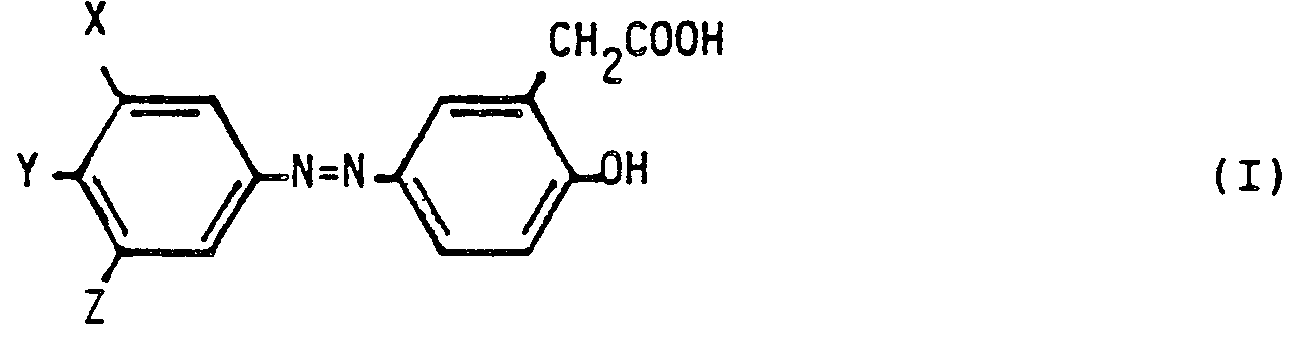
- novel compounds of the present invention have the following structure: in which Y is hydrogen and X and Z are carboxy or lower alkoxycarbonyl. X and Z can be identical or different groups.
- the invention comprises also lactones of compounds (I) and salts thereof.
- the preferred salts are pharmaceutically acceptable and therapeutically active.
- lower alkoxy groups are meant those having less than seven carbon atoms.
- Suitable salts are metal salts such as the sodium, potassium and calcium salts, or salts with organic amines such as e.g. diethanolamine, triethanolamine, N-methyl-glucamine, trishydroxymethyl- methylamine etc.
- a major advantage of the compounds according to the present invention resides in that they comprise groups greatly varying inter se in respect of their capacity of being absorbed from the gastrointestinal tract.
- This means that the invention comprises i.a. compounds which are rapidly and completely absorbed into the bloodstream ⁇ which is a valuable feature for obtaining a systemic effect.
- Other compound on the other hand, have a very low capacity for being absorbed and consequently will concentrate to the gastrointestinal tract; so this in turn means that some compounds of formula (I) may have a potential local activity against gastrointestinal disorders such as for instance gastric ulcer, Crohn's disease and ulcerous colitis.
- the novel compounds are extremely potent inhibitors of the enzyme PGDH. Moreover an important feature of these compounds is that they are highly selective in their effect: Their inhibition of cyclooxygenase is practically zero.
- the invention permits treatments with very low doses of the active substance, which in turn means that particular ways of administration may be resorted to that would otherwise be entirely out of the question - e.g. inhalation of the substance in the form of an aerosol.
- the extremely high potency of the novel compound moreover minimizes the risk of toxic side effects due to metabolites, especially metabolites of the aromatic amine type formed by splitting of the azo bridge.
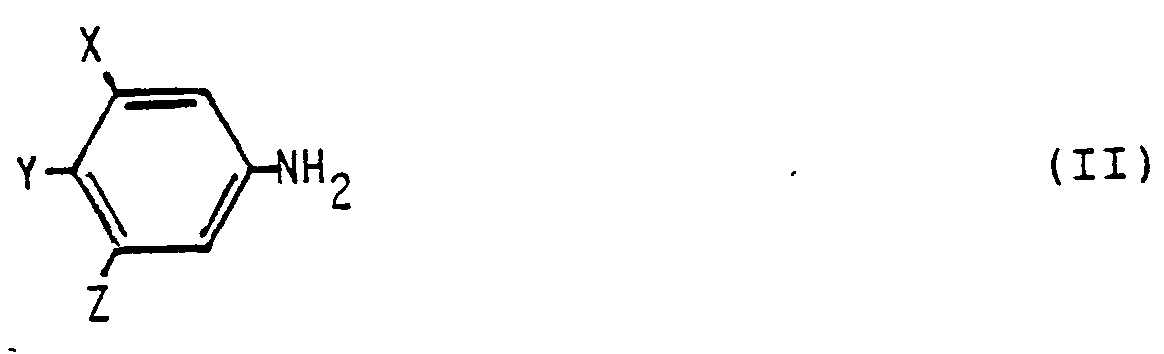
- the compounds of formula (I) are produced in a manner known per se by diazotation of amines of the general formula in which X, Y and Z have the same meanings as above, and coupling with 2-hydroxybenzeneacetic acid in an alkaline medium, followed by rapid neutralization and isolation of the product.
- a compound of formula (I) may be converted to the corresponding lactone of the general formula or a lactone of formula (III) may be converted to a compound of formula (I).
- Conversion to the lactone may be performed in a simple manner by reaction with acids, if desired in the presence of water-withdrawing agents such as e.g. acetic anhydride or thionyl chloride, or under other conditions that will remove water such as e.g. azeotropic distillation of water.
- water-withdrawing agents such as e.g. acetic anhydride or thionyl chloride, or under other conditions that will remove water such as e.g. azeotropic distillation of water.
- lactones according to the invention can readily be converted to corresponding acids by gentle alkaline hydrolysis and subsequent acidification.
- a compound of this invention containing at least one free carboxy group B readily convertible to corresponding salts by reaction with an equivalent amount of a suitable salt-forming reagent such as for example sodium hydroxide, potassium hydroxide or a suitable organic amine, at a pH suitable for the compound contemplated and in the presence of a solvent.
- a suitable salt-forming reagent such as for example sodium hydroxide, potassium hydroxide or a suitable organic amine, at a pH suitable for the compound contemplated and in the presence of a solvent.
- the salt may be prepared either in a solid state by means of solvent removal in a known per se manner, or if solubility permits directly in solution, preferably aqueous solution, for direct pharmaceutical use.
- novel pharmaceutical compositions of this invention contain a therapeutically active amount of a compound of formula (I) or a lactone thereof or a salt of those compounds that contain at least one carboxy group, if desired in combination with an inert, organic or inorganic carrier material which is suitable for oral, rectal, buccal or parenteral administration or for inhalation.
- the pharmaceutical compositions may be prepared in solid form or may be semisolid or liquid; optionally they may be sterilized and/or contain additional adjuvants. They may be produced in a manner well known to persons skilled in the art, the active substance being mixed with the carrier material and with further adjuvants (if any), and the resultant mixture being converted to a suitable galenic form.
- As a general guideline for suitable dosages may be mentioned doses of 0.01-100 mg/day for a person weighing 75 kg.
- a pharmaceutical composition containing a therapeutically active amount of a compound of formula (I) or a lactone thereof or a salt of those compounds that contain at least one carboxy group is administered to a mammal, including man.
- the compound of this invention may be for instance
- the suspension was hydrogenated, filtered and evaporated. To the residue were added 2 ml of hydrochloric acid and ethyl acetate so as to precipitate crystals which were then filtered off and washed with ethyl acetate and petroleum ether.
- the hydrochloride was dissolved in 100 ml of H 2 0 and 10 ml of hydrochloric acid. The solution was cooled with 50 g of ice and diazotized with 7 g of sodium nitrite dissolved in 30 ml of water. The diazonium salt solution was added to an ice-cooled solution of 30 g of 2-hydroxyphenyl acetic acid in 24 g of sodium hydroxide and 200 ml of water. After 15 seconds the solution was acidified with hydrochloric acid and extracted with ethyl acetate. The ethyl acetate solution was shaken against water, dried, treated with active carbon and evaporated. The residue was leached with chloroform.
- the precipitate was leached with an about 25% ethanol solution which was then diluted with water until a state of weak opalescence was reached.
- the solution was treated with active carbon and evaporated down to half its volume. Sodium hydrogen carbonate was added until the solution was clear, whereupon the solution was heated (80°C) and acidified with hydrochloric acid. The solution was cooled, the crystals were filtered off and dried.
- the diazonium salt solution was poured onto an ice-cooled solution of 30 g 2-hydroxy-phenylacetic acid and 24 g sodium hydroxide in 200 ml of water.
- the solution was acidified after 15 seconds with acetic acid and extracted with chloroform.
- the chloroformic phase was dried, treated with active carbon and evaporated.
- the evaporation residue was leached gently with chloroform, the residue then being dissolved in 300 ml of ethanol. 250 ml of hot water was added, and the solution was treated with active carbon.
- the solution was coaled to 30°C and the product was filtered off and dried for 4 hours in vacuo at 100°C.
- Example 2 The compound of Example 2 was studied in respect of its inhibitory effect on human PGDH isolated from placenta.
- Radioactively labelled prostaglandin PGF 2 was incubated with the enzyme as according to Berry, C.N. et al., Biochem. Pharmacol. 1983, Vol. 32, p. 2862.
- Example 2 The compound of Example 2 was added in various concentrations, and the inhibition was measured as stated above.
Landscapes
- Chemical & Material Sciences (AREA)
- Organic Chemistry (AREA)
- Organic Low-Molecular-Weight Compounds And Preparation Thereof (AREA)
- Pharmaceuticals Containing Other Organic And Inorganic Compounds (AREA)
- Furan Compounds (AREA)
Abstract
Description
- The present invention is concerned with novel compounds having a potentially inhibitory effect on 15-hydroxyprostaglandin dehydrogenase (PGDH). The invention is also concerned with the production of these novel compounds and with pharmaceutical compositions containing them.
- The future potentialities of PGDH inhibitors, in respect of their usefulness in medicine, have not yet been fully explored. But it is a known fact that prostaglandins play a very important role in the body's regulating system, and for this reason any drugs interfering with either the synthesis or the degradation of prostaglandins may be potentially valuable medical tools. The so-called cytoprotective effect of prostaglandins is relatively well known in the context of ulcer therapies; but nevertheless prostaglandin administration has not been utilized to any major extent for therapeutic purposes because the prostaglandins administered with survive in vivo for only a very short time. A drug inhibiting the degradation of endogenous prostaglandins might conceivably be much more successful than prostaglandin administration.
- Endogenous prostaglandins have a major role also in inflammatory processes. In the treatment of rheumatoid arthritis it is therefore at present quite a common practice to employ inhibitors of prostaglandin synthesis; but nowadays this is regarded as merely being a symptomatic treatment, and as a matter of fact some of the prostaglandins are now believed to possibly have a very favorable effect. Thus in this context, too, the inhibition of PGDH dependent degradation may be potentially very valuable. Further potentially valuable medical fields of application for the present novel compounds are all those where prostaglandins may function as desirable controlling factors as e.g. in the case of circulatory disorders, cancer, fertility, cell regulation etc.
- Examples of previously known compounds having an inhibitory effect on PGDH are such azo compounds as are set forth in EP-A-21229 and novel arylacetic acid derivatives set forth in Swedish patent application EP-A-150166.
- It is an object of the present invention to provide improved PGDH inhibitors and methods for their production. Further objects are to provide improved pharmaceutical compositions and treating methods involving such inhibitors.
- The novel compounds of the present invention have the following structure:

- The invention comprises also lactones of compounds (I) and salts thereof. The preferred salts are pharmaceutically acceptable and therapeutically active.
- By lower alkoxy groups are meant those having less than seven carbon atoms.
- Suitable salts are metal salts such as the sodium, potassium and calcium salts, or salts with organic amines such as e.g. diethanolamine, triethanolamine, N-methyl-glucamine, trishydroxymethyl- methylamine etc.
- A major advantage of the compounds according to the present invention resides in that they comprise groups greatly varying inter se in respect of their capacity of being absorbed from the gastrointestinal tract. This means that the invention comprises i.a. compounds which are rapidly and completely absorbed into the bloodstream ― which is a valuable feature for obtaining a systemic effect. Other compound, on the other hand, have a very low capacity for being absorbed and consequently will concentrate to the gastrointestinal tract; so this in turn means that some compounds of formula (I) may have a potential local activity against gastrointestinal disorders such as for instance gastric ulcer, Crohn's disease and ulcerous colitis.
- It has been found, surprisingly, that the novel compounds are extremely potent inhibitors of the enzyme PGDH. Moreover an important feature of these compounds is that they are highly selective in their effect: Their inhibition of cyclooxygenase is practically zero. The invention permits treatments with very low doses of the active substance, which in turn means that particular ways of administration may be resorted to that would otherwise be entirely out of the question - e.g. inhalation of the substance in the form of an aerosol. The extremely high potency of the novel compound moreover minimizes the risk of toxic side effects due to metabolites, especially metabolites of the aromatic amine type formed by splitting of the azo bridge.
- The compounds of formula (I) are produced in a manner known per se by diazotation of amines of the general formula
- A compound of formula (I) may be converted to the corresponding lactone of the general formula

- Conversion to the lactone may be performed in a simple manner by reaction with acids, if desired in the presence of water-withdrawing agents such as e.g. acetic anhydride or thionyl chloride, or under other conditions that will remove water such as e.g. azeotropic distillation of water.
- The lactones according to the invention can readily be converted to corresponding acids by gentle alkaline hydrolysis and subsequent acidification.
- A compound of this invention containing at least one free carboxy group B readily convertible to corresponding salts by reaction with an equivalent amount of a suitable salt-forming reagent such as for example sodium hydroxide, potassium hydroxide or a suitable organic amine, at a pH suitable for the compound contemplated and in the presence of a solvent. The salt may be prepared either in a solid state by means of solvent removal in a known per se manner, or if solubility permits directly in solution, preferably aqueous solution, for direct pharmaceutical use.
- The novel pharmaceutical compositions of this invention contain a therapeutically active amount of a compound of formula (I) or a lactone thereof or a salt of those compounds that contain at least one carboxy group, if desired in combination with an inert, organic or inorganic carrier material which is suitable for oral, rectal, buccal or parenteral administration or for inhalation. The pharmaceutical compositions may be prepared in solid form or may be semisolid or liquid; optionally they may be sterilized and/or contain additional adjuvants. They may be produced in a manner well known to persons skilled in the art, the active substance being mixed with the carrier material and with further adjuvants (if any), and the resultant mixture being converted to a suitable galenic form. As a general guideline for suitable dosages may be mentioned doses of 0.01-100 mg/day for a person weighing 75 kg.
- According to the novel treating method of this invention for the inhibition of PGDH, a pharmaceutical composition containing a therapeutically active amount of a compound of formula (I) or a lactone thereof or a salt of those compounds that contain at least one carboxy group is administered to a mammal, including man.
- The compound of this invention may be for instance
- - 5-(3,5-dicarboxy-phenylazo)-2-hydroxy-benzeneacetic acid, its lactone and salts thereof
- - the corresponding 3-monomethyl ester, its lactone and salts thereof
- - the corresponding 3,5-dimethyl ester, its lactone and salts thereof
- - the corresponding 3-monoethyl ester, its lactone and salts thereof
- - the corresponding 3,5-diethyl ester, its lactone and salts thereof
- - the corresponding 3-ethyl-5-methyl ester, its lactone and salts thereof
- - the corresponding 3-propyl ester, its lactone and salts thereof
- - the corresponding 3-isopropyl ester, its lactone and salts thereof
- - the corresponding 3,5-dipropyl ester, its lactone and salts thereof
- - the corresponding 3-butyl ester, its lactone and salts thereof
- - the corresponding 3-isobutyl ester, its lactone and salts thereof
- - the corresponding 3-pentyl ester, its lactone and salts thereof
- - the corresponding 3-hexyl ester, its lactone and salts thereof
- The below working examples illustrate various embodiments of the invention without limiting its scope.
- 24 g of dimethyl-4-nitro-benzene-1,2-dicarboxylate was dissolved in 500 ml of acetic acid, whereupon 2 g of 10% palladium on carbon, suspended in 10 ml of hydrochloric acid, was added.
- The suspension was hydrogenated, filtered and evaporated. To the residue were added 2 ml of hydrochloric acid and ethyl acetate so as to precipitate crystals which were then filtered off and washed with ethyl acetate and petroleum ether.
- The hydrochloride was dissolved in 100 ml of H20 and 10 ml of hydrochloric acid. The solution was cooled with 50 g of ice and diazotized with 7 g of sodium nitrite dissolved in 30 ml of water. The diazonium salt solution was added to an ice-cooled solution of 30 g of 2-hydroxyphenyl acetic acid in 24 g of sodium hydroxide and 200 ml of water. After 15 seconds the solution was acidified with hydrochloric acid and extracted with ethyl acetate. The ethyl acetate solution was shaken against water, dried, treated with active carbon and evaporated. The residue was leached with chloroform. The residue then obtained was dissolved in methanol-water (about 20%) and treated with active carbon while hot (about 80°C). More hot water was added until opalescence was obtained, and the solution was again treated with active carbon. It was then cooled, and the crystals were filtered off and recrystallized from acetonitrile-ethylene dichloride. The crystals were dried for 4 hours at 100°C.
- Yield 12 g.
- Melting point 196°C. (not stage).
- NMR analysis confirmed the structure of the substance.

- 20.9 g of dimethyl-5-amino-benzene-1,3-dicarboxylate was dissolved in 20 ml of concentrated hydrochloric acid in 200 ml of ice water. The solution was diazotized with 7 g of sodium nitrite dissolved in 30 ml of water. 30.4 g of 2-hydroxy-phenylacetic acid was dissolved in 200 ml of water and 24 g of sodium hydroxide. The solution was cooled with 100 g of ice. To this hydroxide solution was then added the diazonium salt solution, all at once, and with vigorous stirring. After 30 seconds the solution was acidified with acetic acid and the precipitate was filtered off. The precipitate was leached with an about 25% ethanol solution which was then diluted with water until a state of weak opalescence was reached. The solution was treated with active carbon and evaporated down to half its volume. Sodium hydrogen carbonate was added until the solution was clear, whereupon the solution was heated (80°C) and acidified with hydrochloric acid. The solution was cooled, the crystals were filtered off and dried.
- Yield 24 g.
- Melting point 232°C.
- NMR analysis confirmed the structure of the substance.

- 12 g of 5-(3,5-bis-(methoxycarbonyl)-phenylazo)-2-hydroxy-phenylacetic acid, 350 ml of water and 7 g of sodium hydroxide were boiled for 1 hour. 50 ml of ethanol was added, and the solution was diluted with water to 500 mi. The hot solution was acidified with hydrochloric acid to pH 2 and cooled. The crystals were filtered off, washed with water and dried.
- Yield 12 g.
- Melting point >260°C.
- NMR analysis confirmed the structure of the substance.

- 6 g of 5-(3,4-bis-(methoxycarbonyl)-phenylazo)-2-hydroxy-phenylacetic acid and 3.9 g of sodium hydroxide dissolved in 100 ml of water were boiled for 45 minutes. The solution was acidified with hydrochloric acid and cooled, the crystals were filtered off and washed with water. They were dried for 4 hours at 100°C.
- Yield 5.3 g.
- Melting point 208°C.

- 27 g of diethyl-5-nitro-benzene-1,3-dicarboxylate was dissolved in 400 ml of acetic acid, and 1 g of 10% palladium on carbon, suspended in 10 ml of hydrochloric acid, was added. The suspension was hydrogenated, filtered and evaporated. The residue was leached with ethyl acetate and dried. The hydrochloride was suspended in 150 ml of water, 50 ml of tetrahydrofuran. 10 ml of hydrochloric acid, and was cooled with 50 g of ice. It was diazotized with 7 g of sodium nitrite dissolved in 30 ml of water. The diazonium salt solution was poured onto an ice-cooled solution of 30 g 2-hydroxy-phenylacetic acid and 24 g sodium hydroxide in 200 ml of water. The solution was acidified after 15 seconds with acetic acid and extracted with chloroform. The chloroformic phase was dried, treated with active carbon and evaporated. The evaporation residue was leached gently with chloroform, the residue then being dissolved in 300 ml of ethanol. 250 ml of hot water was added, and the solution was treated with active carbon. The solution was coaled to 30°C and the product was filtered off and dried for 4 hours in vacuo at 100°C.
- Yield 19 g.
- Melting point 198°C (melting point bench).
- NMR analysis confirmed the structure of the substance.

- The biological effect of compounds according to the present invention is illustrated by the following experiments:
- The compound of Example 2 was studied in respect of its inhibitory effect on human PGDH isolated from placenta.
- Radioactively labelled prostaglandin PGF 2 was incubated with the enzyme as according to Berry, C.N. et al., Biochem. Pharmacol. 1983, Vol. 32, p. 2862.
- The compound of Example 2 was added in various concentrations, and the inhibition was measured as stated above.
- The compound showed a 50% PGDH inhibition at a concentration of 28 nM. When similarly tested against PGDH from rat colon the compound gave 50% PGDH inhibition at 56 nM. For comparison, it may be mentioned that the known substances IV and V

- No inhibition whatever of cyclooxygenase could be detected at concentrations of from 10 to 1000 nM.
Claims (6)
Priority Applications (1)
| Application Number | Priority Date | Filing Date | Title |
|---|---|---|---|
| AT85905923T ATE50984T1 (en) | 1984-11-23 | 1985-11-13 | 5-(3,5-DISUBSTITUTED PHENYLAZO)-2HYDROXYPHENYLESIGSURES, THEIR SALTS AND LACTONES, AND PHARMACEUTICAL COMPOSITIONS CONTAINING THEM. |
Applications Claiming Priority (2)
| Application Number | Priority Date | Filing Date | Title |
|---|---|---|---|
| SE8405924 | 1984-11-23 | ||
| SE8405924A SE8405924L (en) | 1984-11-23 | 1984-11-23 | NEW AZO ASSOCIATIONS |
Publications (2)
| Publication Number | Publication Date |
|---|---|
| EP0203957A1 EP0203957A1 (en) | 1986-12-10 |
| EP0203957B1 true EP0203957B1 (en) | 1990-03-14 |
Family
ID=20357885
Family Applications (1)
| Application Number | Title | Priority Date | Filing Date |
|---|---|---|---|
| EP85905923A Expired EP0203957B1 (en) | 1984-11-23 | 1985-11-13 | 5-(3,5-disubstituted phenylazo)-2-hydroxybenzene acetic acids and salts and lactones thereof, and pharmaceutical compositions of said acids, salts, and lactones |
Country Status (8)
| Country | Link |
|---|---|
| US (1) | US4725676A (en) |
| EP (1) | EP0203957B1 (en) |
| JP (1) | JPS62500872A (en) |
| CN (1) | CN1004352B (en) |
| CA (1) | CA1256102A (en) |
| DE (1) | DE3576495D1 (en) |
| SE (1) | SE8405924L (en) |
| WO (1) | WO1986003195A1 (en) |
Families Citing this family (19)
| Publication number | Priority date | Publication date | Assignee | Title |
|---|---|---|---|---|
| GB8709248D0 (en) * | 1987-04-16 | 1987-05-20 | Wyeth John & Brother Ltd | Azo compounds |
| EP1642885B1 (en) | 2000-08-29 | 2009-11-11 | Biocon Limited | Use of a pharmaceutical composition containing a para-aminophenyl acetic acid derivative for treating inflammatory conditions of the gastrointestinal tract |
| US8048924B2 (en) * | 2001-08-29 | 2011-11-01 | Biocon Limited | Methods and compositions employing 4-aminophenylacetic acid compounds |
| CA2515440A1 (en) | 2003-02-12 | 2004-09-02 | L'oreal | Use of an inhibitor of 15-hydroxyprostaglandin dehydrogenase in order to stimulate pigmentation of the skin or skin appendages |
| HUE029189T2 (en) | 2004-02-06 | 2017-02-28 | Pharmatel (R&D) Pty Ltd As Trustee For The Pharmatel (R & D) Trust | Use of aminosalicylates in diarrhoea-predominant irritable bowel syndrome |
| KR20130028807A (en) * | 2004-05-28 | 2013-03-19 | 샐릭스 파마슈티컬스 인코포레이티드 | Prevention, treatment, and amelioration of radiation induced enteritis |
| HUE028158T2 (en) | 2004-07-07 | 2016-12-28 | Biocon Ltd | Synthesis of azo bonded immunoregulatory compounds |
| US8921344B2 (en) * | 2006-11-03 | 2014-12-30 | Salix Pharmaceuticals, Inc. | Formulations and uses of 2-hydroxy-5-phenylazobenzoic acid derivatives |
| CN102670626A (en) * | 2005-08-24 | 2012-09-19 | 萨利克斯药品公司 | Balsalazide formulations and manufacture and use thereof |
| US7452872B2 (en) | 2005-08-24 | 2008-11-18 | Salix Pharmaceuticals, Inc. | Formulations and uses of 2-hydroxy-5-phenylazobenzoic acid derivatives |
| WO2015065716A1 (en) | 2013-10-15 | 2015-05-07 | Case Western Reserve University | Compositions and methods of modulating short-chain dehydrogenase activity |
| US9452578B2 (en) | 2013-07-26 | 2016-09-27 | Corning Incorporated | Fast firing method for high porosity ceramics |
| JP2018511581A (en) | 2015-03-08 | 2018-04-26 | ケース ウエスタン リザーブ ユニバーシティ | Inhibitors of short chain dehydrogenase activity for treating fibrosis |
| AU2017300377B2 (en) | 2016-07-18 | 2022-04-21 | Case Western Reserve University | Inhibitors of short-chain dehydrogenase activity for promoting neurogenesis and inhibiting nerve cell death |
| EP3548035A4 (en) | 2016-11-30 | 2020-07-22 | Case Western Reserve University | COMBINATIONS OF 15 PGDH INHIBITORS WITH CORTICOSTEROIDS AND / OR TNF INHIBITORS AND USES THEREOF |
| AU2018215678A1 (en) | 2017-02-06 | 2019-08-22 | Board Of Regents Of The University Of Texas System | Compositions and methods of modulating short-chain dehydrogenase activity |
| IL321451A (en) | 2018-11-21 | 2025-08-01 | Univ Case Western Reserve | Compositions and methods for modulating small-chain dehydrogenase activity |
| MX2022010258A (en) | 2020-02-21 | 2023-01-24 | Univ Case Western Reserve | Compositions and methods for treating renal injury. |
| CN119285601B (en) * | 2024-11-05 | 2025-05-09 | 九江德思光电材料有限公司 | A method for preparing electronic grade 1,3-propane sultone |
Family Cites Families (9)
| Publication number | Priority date | Publication date | Assignee | Title |
|---|---|---|---|---|
| BE631326A (en) * | 1962-04-23 | |||
| NL294471A (en) * | 1962-06-22 | |||
| SE7905051L (en) * | 1979-06-11 | 1980-12-12 | Pharmacia Ab | NEW SULPHONAMIDES |
| SE8002322L (en) * | 1980-03-26 | 1981-09-27 | Pharmacia Ab | Means for the treatment of inflammatory bowel diseases |
| DE3027013A1 (en) * | 1980-07-17 | 1982-02-18 | Henning Berlin Gmbh Chemie- Und Pharmawerk, 1000 Berlin | AGENTS FOR THE TREATMENT OF COLITIS ULCEROSA, ENTERITIS REGIONALIS CROHN (MORBUS CROHN), CHRONICALLY SPECIFIC COLITIS AND DIVERTICULITIS, AND USE OF SALICYLAZOBOZOIC ACID, FOR THE PRODUCTION OF SUCH A MEDIUM |
| US4412992A (en) * | 1980-07-21 | 1983-11-01 | Biorex Laboratories Limited | 2-Hydroxy-5-phenylazobenzoic acid derivatives and method of treating ulcerative colitis therewith |
| US4312806A (en) * | 1981-03-02 | 1982-01-26 | G. D. Searle & Co. | Method and compounds for treating inflammatory bowel disease |
| US4374932A (en) * | 1981-06-08 | 1983-02-22 | G. D. Searle & Co. | 5-ASA Drug delivery system |
| DE3408152A1 (en) * | 1984-03-06 | 1985-09-12 | Cassella Ag, 6000 Frankfurt | MONOAZO DYES, METHOD FOR THEIR PRODUCTION AND THEIR USE |
-
1984
- 1984-11-23 SE SE8405924A patent/SE8405924L/en not_active Application Discontinuation
-
1985
- 1985-11-13 EP EP85905923A patent/EP0203957B1/en not_active Expired
- 1985-11-13 US US06/882,896 patent/US4725676A/en not_active Expired - Fee Related
- 1985-11-13 JP JP60505174A patent/JPS62500872A/en active Pending
- 1985-11-13 WO PCT/SE1985/000453 patent/WO1986003195A1/en not_active Ceased
- 1985-11-13 DE DE8585905923T patent/DE3576495D1/en not_active Expired - Fee Related
- 1985-11-20 CN CN85109684.0A patent/CN1004352B/en not_active Expired
- 1985-11-22 CA CA000496020A patent/CA1256102A/en not_active Expired
Also Published As
| Publication number | Publication date |
|---|---|
| CN85109684A (en) | 1987-04-15 |
| JPS62500872A (en) | 1987-04-09 |
| SE8405924L (en) | 1986-05-24 |
| CN1004352B (en) | 1989-05-31 |
| CA1256102A (en) | 1989-06-20 |
| DE3576495D1 (en) | 1990-04-19 |
| US4725676A (en) | 1988-02-16 |
| WO1986003195A1 (en) | 1986-06-05 |
| SE8405924D0 (en) | 1984-11-23 |
| EP0203957A1 (en) | 1986-12-10 |
Similar Documents
| Publication | Publication Date | Title |
|---|---|---|
| US4725676A (en) | 5-(3,5-disubstituted phenylazo)-2-hydroxybenzene-acetic acids and salts and lactones thereof having a potentially inhibitory effect on 15-hydroxy-prostaglandin dehydrogenase | |
| US4582847A (en) | 4-chloro-2-phenylimidazole-5-acetic acid derivatives and use as diuretics and hypotensives | |
| FI62838C (en) | FRAMEWORK FOR THE FRAMEWORK OF THE PHARMACEUTICAL PROPERTIES OF THE CHARACTERISTICS OF THE ISOMER AND OF THE ASYMMETRICAL SPIRO HYDRAULIC INFORMATION | |
| US4356183A (en) | Antihypertensive 4-thiazolidinecarboxylic acids (pyridyl derivatives) | |
| US4714762A (en) | Antiarteriosclerotic substituted benzimidazol-2-yl-and 3H-imidazo[4,5-b]pyridin-2-yl-phenoxy-alkanoic acids and salts and esters thereof | |
| EP0506194A1 (en) | 4-aryl-thiazole or imidazole derivatives | |
| CZ458390A3 (en) | Diamides of pyrimidine-4,6-dicarboxylic acid, process of their preparation and medicaments based thereon | |
| EP0218027B1 (en) | Novel guanidinomethylbenzoic acid derivatives | |
| DE3035086C2 (en) | ||
| US4914099A (en) | Hydantoin derivatives as aldose reductase inhibitors | |
| EP0549366B1 (en) | Thiazolidine compounds containing a quinone group, their preparation and their therapeutic uses | |
| EP0286643B1 (en) | Pharmaceutically active derivatives of glutamic and aspartic acids | |
| US4036964A (en) | Isocarbostyril-3-carboxylic acid derivatives for the prophylaxis of asthma, hayfever and rhinitis | |
| JPS63216872A (en) | heterocyclic compound | |
| US4301159A (en) | N-(Diethylaminoethyl)-2-alkoxy-benzamide derivatives | |
| US4500731A (en) | Derivatives of 4-phenyl-4-oxobuten-2-oic acid, pharmaceutical compositions containing them, and therapeutic uses for them | |
| US5082943A (en) | Novel imidazole derivatives | |
| US5196567A (en) | Biphenylylpropionic acid derivative, process for preparing the same and pharmaceutical composition containing the same | |
| US4473583A (en) | Compositions containing certain derivatives of 4-phenyl-4-oxobuten-2-oic acid and methods of treatment using them | |
| HU191714B (en) | Process for the production of new 4-phenyl-4-oxo-2-butene carboxylic acid-derivatives | |
| EP0079639B1 (en) | A new anti-inflammatory drug | |
| DE3875820T2 (en) | AROMATIC HETEROCYCLIC CARBONIC ACID AMIDE COMBINATIONS, METHOD FOR THE PRODUCTION AND MEDICINAL PRODUCTS CONTAINING THE SAME. | |
| US4092322A (en) | 1-Benzoxepino[4,3-c]pyridines | |
| SU1491337A3 (en) | Method of producing heterocyclic compounds | |
| IE48957B1 (en) | Novel veratramides their preparation and pharmaceutical compositions containing them |
Legal Events
| Date | Code | Title | Description |
|---|---|---|---|
| PUAI | Public reference made under article 153(3) epc to a published international application that has entered the european phase |
Free format text: ORIGINAL CODE: 0009012 |
|
| 17P | Request for examination filed |
Effective date: 19860815 |
|
| AK | Designated contracting states |
Kind code of ref document: A1 Designated state(s): AT BE CH DE FR GB IT LI LU NL SE |
|
| 17Q | First examination report despatched |
Effective date: 19880613 |
|
| GRAA | (expected) grant |
Free format text: ORIGINAL CODE: 0009210 |
|
| AK | Designated contracting states |
Kind code of ref document: B1 Designated state(s): AT BE CH DE FR GB IT LI LU NL SE |
|
| REF | Corresponds to: |
Ref document number: 50984 Country of ref document: AT Date of ref document: 19900315 Kind code of ref document: T |
|
| REF | Corresponds to: |
Ref document number: 3576495 Country of ref document: DE Date of ref document: 19900419 |
|
| ET | Fr: translation filed | ||
| ITF | It: translation for a ep patent filed | ||
| PLBE | No opposition filed within time limit |
Free format text: ORIGINAL CODE: 0009261 |
|
| STAA | Information on the status of an ep patent application or granted ep patent |
Free format text: STATUS: NO OPPOSITION FILED WITHIN TIME LIMIT |
|
| 26N | No opposition filed | ||
| ITTA | It: last paid annual fee | ||
| PGFP | Annual fee paid to national office [announced via postgrant information from national office to epo] |
Ref country code: AT Payment date: 19921019 Year of fee payment: 8 |
|
| PGFP | Annual fee paid to national office [announced via postgrant information from national office to epo] |
Ref country code: GB Payment date: 19921102 Year of fee payment: 8 |
|
| PGFP | Annual fee paid to national office [announced via postgrant information from national office to epo] |
Ref country code: FR Payment date: 19921109 Year of fee payment: 8 |
|
| PGFP | Annual fee paid to national office [announced via postgrant information from national office to epo] |
Ref country code: CH Payment date: 19921113 Year of fee payment: 8 |
|
| PGFP | Annual fee paid to national office [announced via postgrant information from national office to epo] |
Ref country code: SE Payment date: 19921116 Year of fee payment: 8 |
|
| PGFP | Annual fee paid to national office [announced via postgrant information from national office to epo] |
Ref country code: DE Payment date: 19921123 Year of fee payment: 8 |
|
| PGFP | Annual fee paid to national office [announced via postgrant information from national office to epo] |
Ref country code: NL Payment date: 19921130 Year of fee payment: 8 |
|
| PGFP | Annual fee paid to national office [announced via postgrant information from national office to epo] |
Ref country code: LU Payment date: 19921210 Year of fee payment: 8 |
|
| PGFP | Annual fee paid to national office [announced via postgrant information from national office to epo] |
Ref country code: BE Payment date: 19921211 Year of fee payment: 8 |
|
| EPTA | Lu: last paid annual fee | ||
| PG25 | Lapsed in a contracting state [announced via postgrant information from national office to epo] |
Ref country code: LU Free format text: LAPSE BECAUSE OF NON-PAYMENT OF DUE FEES Effective date: 19931113 Ref country code: GB Effective date: 19931113 Ref country code: AT Effective date: 19931113 |
|
| PG25 | Lapsed in a contracting state [announced via postgrant information from national office to epo] |
Ref country code: SE Effective date: 19931114 |
|
| PG25 | Lapsed in a contracting state [announced via postgrant information from national office to epo] |
Ref country code: LI Effective date: 19931130 Ref country code: CH Effective date: 19931130 Ref country code: BE Effective date: 19931130 |
|
| BERE | Be: lapsed |
Owner name: PHARMACIA A.B. Effective date: 19931130 |
|
| PG25 | Lapsed in a contracting state [announced via postgrant information from national office to epo] |
Ref country code: NL Effective date: 19940601 |
|
| GBPC | Gb: european patent ceased through non-payment of renewal fee |
Effective date: 19931113 |
|
| NLV4 | Nl: lapsed or anulled due to non-payment of the annual fee | ||
| PG25 | Lapsed in a contracting state [announced via postgrant information from national office to epo] |
Ref country code: FR Effective date: 19940729 |
|
| REG | Reference to a national code |
Ref country code: CH Ref legal event code: PL |
|
| PG25 | Lapsed in a contracting state [announced via postgrant information from national office to epo] |
Ref country code: DE Effective date: 19940802 |
|
| REG | Reference to a national code |
Ref country code: FR Ref legal event code: ST |
|
| EUG | Se: european patent has lapsed |
Ref document number: 85905923.0 Effective date: 19940610 |