EP0203468B1 - Improved photographic material for tanning development and method for obtaining a relief image - Google Patents
Improved photographic material for tanning development and method for obtaining a relief image Download PDFInfo
- Publication number
- EP0203468B1 EP0203468B1 EP86106600A EP86106600A EP0203468B1 EP 0203468 B1 EP0203468 B1 EP 0203468B1 EP 86106600 A EP86106600 A EP 86106600A EP 86106600 A EP86106600 A EP 86106600A EP 0203468 B1 EP0203468 B1 EP 0203468B1
- Authority
- EP
- European Patent Office
- Prior art keywords
- group
- stdt
- photographic material
- chosen
- hydroquinone
- Prior art date
- Legal status (The legal status is an assumption and is not a legal conclusion. Google has not performed a legal analysis and makes no representation as to the accuracy of the status listed.)
- Expired
Links
- 239000000463 material Substances 0.000 title claims description 59
- 238000011161 development Methods 0.000 title claims description 46
- 238000000034 method Methods 0.000 title claims description 13
- QIGBRXMKCJKVMJ-UHFFFAOYSA-N Hydroquinone Chemical compound OC1=CC=C(O)C=C1 QIGBRXMKCJKVMJ-UHFFFAOYSA-N 0.000 claims description 66
- -1 silver halide Chemical class 0.000 claims description 35
- 150000005208 1,4-dihydroxybenzenes Chemical class 0.000 claims description 19
- 229910052709 silver Inorganic materials 0.000 claims description 19
- 239000004332 silver Substances 0.000 claims description 19
- WXTMDXOMEHJXQO-UHFFFAOYSA-N 2,5-dihydroxybenzoic acid Chemical compound OC(=O)C1=CC(O)=CC=C1O WXTMDXOMEHJXQO-UHFFFAOYSA-N 0.000 claims description 17
- 239000000839 emulsion Substances 0.000 claims description 16
- 239000000049 pigment Substances 0.000 claims description 14
- XGDPKUKRQHHZTH-UHFFFAOYSA-N Methyl 2,5-dihydroxybenzoate Chemical compound COC(=O)C1=CC(O)=CC=C1O XGDPKUKRQHHZTH-UHFFFAOYSA-N 0.000 claims description 12
- 125000000217 alkyl group Chemical group 0.000 claims description 11
- XLYOFNOQVPJJNP-UHFFFAOYSA-N water Substances O XLYOFNOQVPJJNP-UHFFFAOYSA-N 0.000 claims description 11
- 238000012545 processing Methods 0.000 claims description 10
- 125000001424 substituent group Chemical group 0.000 claims description 9
- 229960005219 gentisic acid Drugs 0.000 claims description 7
- FRXZIFVYTNMCHF-UHFFFAOYSA-N 2,5-dihydroxybenzamide Chemical compound NC(=O)C1=CC(O)=CC=C1O FRXZIFVYTNMCHF-UHFFFAOYSA-N 0.000 claims description 6
- 229910052736 halogen Inorganic materials 0.000 claims description 5
- REFDOIWRJDGBHY-UHFFFAOYSA-N 2-bromobenzene-1,4-diol Chemical compound OC1=CC=C(O)C(Br)=C1 REFDOIWRJDGBHY-UHFFFAOYSA-N 0.000 claims description 4
- 239000011230 binding agent Substances 0.000 claims description 4
- AJPXTSMULZANCB-UHFFFAOYSA-N chlorohydroquinone Chemical compound OC1=CC=C(O)C(Cl)=C1 AJPXTSMULZANCB-UHFFFAOYSA-N 0.000 claims description 4
- 150000001555 benzenes Chemical group 0.000 claims description 3
- DAOWRBBMQHQENB-UHFFFAOYSA-L disodium;2,5-dihydroxybenzene-1,4-disulfonate Chemical compound [Na+].[Na+].OC1=CC(S([O-])(=O)=O)=C(O)C=C1S([O-])(=O)=O DAOWRBBMQHQENB-UHFFFAOYSA-L 0.000 claims description 3
- 125000004435 hydrogen atom Chemical group [H]* 0.000 claims description 3
- KICVIQZBYBXLQD-UHFFFAOYSA-M sodium;2,5-dihydroxybenzenesulfonate Chemical compound [Na+].OC1=CC=C(O)C(S([O-])(=O)=O)=C1 KICVIQZBYBXLQD-UHFFFAOYSA-M 0.000 claims description 3
- STOSPPMGXZPHKP-UHFFFAOYSA-N tetrachlorohydroquinone Chemical compound OC1=C(Cl)C(Cl)=C(O)C(Cl)=C1Cl STOSPPMGXZPHKP-UHFFFAOYSA-N 0.000 claims description 3
- WLDWSGZHNBANIO-UHFFFAOYSA-N 2',5'-Dihydroxyacetophenone Chemical compound CC(=O)C1=CC(O)=CC=C1O WLDWSGZHNBANIO-UHFFFAOYSA-N 0.000 claims description 2
- CXGJVWDDQWRRHH-UHFFFAOYSA-N 2,5-dihydroxy-3-(2-hydroxyethyl)benzamide Chemical compound NC(=O)C1=CC(O)=CC(CCO)=C1O CXGJVWDDQWRRHH-UHFFFAOYSA-N 0.000 claims description 2
- IKQCSJBQLWJEPU-UHFFFAOYSA-N 2,5-dihydroxybenzenesulfonic acid Chemical class OC1=CC=C(O)C(S(O)(=O)=O)=C1 IKQCSJBQLWJEPU-UHFFFAOYSA-N 0.000 claims description 2
- 125000003178 carboxy group Chemical group [H]OC(*)=O 0.000 claims description 2
- 125000005843 halogen group Chemical group 0.000 claims description 2
- 125000002887 hydroxy group Chemical group [H]O* 0.000 claims description 2
- RWSOTUBLDIXVET-UHFFFAOYSA-O sulfonium group Chemical group [SH3+] RWSOTUBLDIXVET-UHFFFAOYSA-O 0.000 claims description 2
- 125000000472 sulfonyl group Chemical group *S(*)(=O)=O 0.000 claims description 2
- 125000002023 trifluoromethyl group Chemical group FC(F)(F)* 0.000 claims description 2
- 229910052783 alkali metal Inorganic materials 0.000 claims 1
- 239000002585 base Substances 0.000 claims 1
- FONOSWYYBCBQGN-UHFFFAOYSA-N ethylene dione Chemical compound O=C=C=O FONOSWYYBCBQGN-UHFFFAOYSA-N 0.000 claims 1
- 150000002825 nitriles Chemical class 0.000 claims 1
- 125000001453 quaternary ammonium group Chemical group 0.000 claims 1
- 239000010410 layer Substances 0.000 description 40
- 108010010803 Gelatin Proteins 0.000 description 26
- 239000008273 gelatin Substances 0.000 description 26
- 229920000159 gelatin Polymers 0.000 description 26
- 235000019322 gelatine Nutrition 0.000 description 26
- 235000011852 gelatine desserts Nutrition 0.000 description 26
- 150000001875 compounds Chemical class 0.000 description 14
- CMCWWLVWPDLCRM-UHFFFAOYSA-N phenidone Chemical compound N1C(=O)CCN1C1=CC=CC=C1 CMCWWLVWPDLCRM-UHFFFAOYSA-N 0.000 description 11
- BQCADISMDOOEFD-UHFFFAOYSA-N Silver Chemical compound [Ag] BQCADISMDOOEFD-UHFFFAOYSA-N 0.000 description 10
- 239000000243 solution Substances 0.000 description 8
- 230000003213 activating effect Effects 0.000 description 7
- 125000000687 hydroquinonyl group Chemical group C1(O)=C(C=C(O)C=C1)* 0.000 description 7
- 239000000203 mixture Substances 0.000 description 7
- 125000004432 carbon atom Chemical group C* 0.000 description 6
- 239000006185 dispersion Substances 0.000 description 6
- 239000007921 spray Substances 0.000 description 5
- 230000004913 activation Effects 0.000 description 4
- 230000015572 biosynthetic process Effects 0.000 description 4
- 150000002367 halogens Chemical group 0.000 description 4
- 125000001997 phenyl group Chemical group [H]C1=C([H])C([H])=C(*)C([H])=C1[H] 0.000 description 4
- 230000008569 process Effects 0.000 description 4
- NDGRWYRVNANFNB-UHFFFAOYSA-N pyrazolidin-3-one Chemical compound O=C1CCNN1 NDGRWYRVNANFNB-UHFFFAOYSA-N 0.000 description 4
- 230000035945 sensitivity Effects 0.000 description 4
- WKBOTKDWSSQWDR-UHFFFAOYSA-N Bromine atom Chemical compound [Br] WKBOTKDWSSQWDR-UHFFFAOYSA-N 0.000 description 3
- ZAMOUSCENKQFHK-UHFFFAOYSA-N Chlorine atom Chemical compound [Cl] ZAMOUSCENKQFHK-UHFFFAOYSA-N 0.000 description 3
- GDTBXPJZTBHREO-UHFFFAOYSA-N bromine Substances BrBr GDTBXPJZTBHREO-UHFFFAOYSA-N 0.000 description 3
- 229910052794 bromium Inorganic materials 0.000 description 3
- 239000003795 chemical substances by application Substances 0.000 description 3
- 229910052801 chlorine Inorganic materials 0.000 description 3
- 239000000460 chlorine Substances 0.000 description 3
- 125000006575 electron-withdrawing group Chemical group 0.000 description 3
- 238000011156 evaluation Methods 0.000 description 3
- 239000011241 protective layer Substances 0.000 description 3
- 150000003839 salts Chemical class 0.000 description 3
- NABFRHBCIHEYTA-UHFFFAOYSA-N 2,5-bis(6-methylheptyl)benzene-1,4-diol Chemical compound CC(C)CCCCCC1=CC(O)=C(CCCCCC(C)C)C=C1O NABFRHBCIHEYTA-UHFFFAOYSA-N 0.000 description 2
- NTKLFSYUWYPMCJ-UHFFFAOYSA-N 2-phenoxybenzene-1,4-diol Chemical compound OC1=CC=C(O)C(OC=2C=CC=CC=2)=C1 NTKLFSYUWYPMCJ-UHFFFAOYSA-N 0.000 description 2
- BVKZGUZCCUSVTD-UHFFFAOYSA-M Bicarbonate Chemical class OC([O-])=O BVKZGUZCCUSVTD-UHFFFAOYSA-M 0.000 description 2
- CPELXLSAUQHCOX-UHFFFAOYSA-M Bromide Chemical compound [Br-] CPELXLSAUQHCOX-UHFFFAOYSA-M 0.000 description 2
- CURLTUGMZLYLDI-UHFFFAOYSA-N Carbon dioxide Chemical compound O=C=O CURLTUGMZLYLDI-UHFFFAOYSA-N 0.000 description 2
- PXGOKWXKJXAPGV-UHFFFAOYSA-N Fluorine Chemical compound FF PXGOKWXKJXAPGV-UHFFFAOYSA-N 0.000 description 2
- CDBYLPFSWZWCQE-UHFFFAOYSA-L Sodium Carbonate Chemical compound [Na+].[Na+].[O-]C([O-])=O CDBYLPFSWZWCQE-UHFFFAOYSA-L 0.000 description 2
- 238000010521 absorption reaction Methods 0.000 description 2
- 125000003545 alkoxy group Chemical group 0.000 description 2
- 125000003118 aryl group Chemical group 0.000 description 2
- YCIMNLLNPGFGHC-UHFFFAOYSA-N catechol Chemical compound OC1=CC=CC=C1O YCIMNLLNPGFGHC-UHFFFAOYSA-N 0.000 description 2
- DOIRQSBPFJWKBE-UHFFFAOYSA-N dibutyl phthalate Chemical compound CCCCOC(=O)C1=CC=CC=C1C(=O)OCCCC DOIRQSBPFJWKBE-UHFFFAOYSA-N 0.000 description 2
- 230000000694 effects Effects 0.000 description 2
- 229910052731 fluorine Inorganic materials 0.000 description 2
- 239000011737 fluorine Substances 0.000 description 2
- LNTHITQWFMADLM-UHFFFAOYSA-N gallic acid Chemical compound OC(=O)C1=CC(O)=C(O)C(O)=C1 LNTHITQWFMADLM-UHFFFAOYSA-N 0.000 description 2
- 229940114119 gentisate Drugs 0.000 description 2
- 230000006872 improvement Effects 0.000 description 2
- 239000011229 interlayer Substances 0.000 description 2
- 238000012423 maintenance Methods 0.000 description 2
- 239000012860 organic pigment Substances 0.000 description 2
- 229920000728 polyester Polymers 0.000 description 2
- BWHMMNNQKKPAPP-UHFFFAOYSA-L potassium carbonate Chemical compound [K+].[K+].[O-]C([O-])=O BWHMMNNQKKPAPP-UHFFFAOYSA-L 0.000 description 2
- 239000002243 precursor Substances 0.000 description 2
- 239000002904 solvent Substances 0.000 description 2
- CNHDIAIOKMXOLK-UHFFFAOYSA-N toluquinol Chemical compound CC1=CC(O)=CC=C1O CNHDIAIOKMXOLK-UHFFFAOYSA-N 0.000 description 2
- 230000004304 visual acuity Effects 0.000 description 2
- PNKCDJAMDKYWQY-UHFFFAOYSA-N 2,3-bis(6-methylheptyl)benzene-1,4-diol Chemical compound CC(C)CCCCCC1=C(O)C=CC(O)=C1CCCCCC(C)C PNKCDJAMDKYWQY-UHFFFAOYSA-N 0.000 description 1
- GMEWXTUITOHSIL-UHFFFAOYSA-N 2,5-dihydroxy-4-octadecylbenzenesulfonic acid Chemical compound CCCCCCCCCCCCCCCCCCC1=CC(O)=C(S(O)(=O)=O)C=C1O GMEWXTUITOHSIL-UHFFFAOYSA-N 0.000 description 1
- CLFRCXCBWIQVRN-UHFFFAOYSA-N 2,5-dihydroxybenzaldehyde Chemical compound OC1=CC=C(O)C(C=O)=C1 CLFRCXCBWIQVRN-UHFFFAOYSA-N 0.000 description 1
- FHFKLXJOAWMMMH-UHFFFAOYSA-N 2-methyl-3-morpholin-4-ylbenzene-1,4-diol Chemical compound CC1=C(O)C=CC(O)=C1N1CCOCC1 FHFKLXJOAWMMMH-UHFFFAOYSA-N 0.000 description 1
- NUHVVWKHZJZNDB-UHFFFAOYSA-N 4-hydroxy-2,4-dimethyl-1-phenylpyrazolidin-3-one Chemical class C1C(C)(O)C(=O)N(C)N1C1=CC=CC=C1 NUHVVWKHZJZNDB-UHFFFAOYSA-N 0.000 description 1
- LSNNMFCWUKXFEE-UHFFFAOYSA-M Bisulfite Chemical compound OS([O-])=O LSNNMFCWUKXFEE-UHFFFAOYSA-M 0.000 description 1
- VEXZGXHMUGYJMC-UHFFFAOYSA-M Chloride anion Chemical compound [Cl-] VEXZGXHMUGYJMC-UHFFFAOYSA-M 0.000 description 1
- 239000007832 Na2SO4 Substances 0.000 description 1
- 229910019142 PO4 Inorganic materials 0.000 description 1
- 206010034960 Photophobia Diseases 0.000 description 1
- 229910021607 Silver chloride Inorganic materials 0.000 description 1
- PMZURENOXWZQFD-UHFFFAOYSA-L Sodium Sulfate Chemical compound [Na+].[Na+].[O-]S([O-])(=O)=O PMZURENOXWZQFD-UHFFFAOYSA-L 0.000 description 1
- YSMRWXYRXBRSND-UHFFFAOYSA-N TOTP Chemical compound CC1=CC=CC=C1OP(=O)(OC=1C(=CC=CC=1)C)OC1=CC=CC=C1C YSMRWXYRXBRSND-UHFFFAOYSA-N 0.000 description 1
- 239000006096 absorbing agent Substances 0.000 description 1
- 239000002253 acid Substances 0.000 description 1
- 150000007513 acids Chemical class 0.000 description 1
- 239000012670 alkaline solution Substances 0.000 description 1
- 150000001408 amides Chemical class 0.000 description 1
- 125000003277 amino group Chemical group 0.000 description 1
- 239000007864 aqueous solution Substances 0.000 description 1
- 239000012298 atmosphere Substances 0.000 description 1
- QVGXLLKOCUKJST-UHFFFAOYSA-N atomic oxygen Chemical compound [O] QVGXLLKOCUKJST-UHFFFAOYSA-N 0.000 description 1
- JITHVARWJCPGBS-UHFFFAOYSA-N benzene-1,4-diol;benzenesulfonylbenzene Chemical compound OC1=CC=C(O)C=C1.C=1C=CC=CC=1S(=O)(=O)C1=CC=CC=C1 JITHVARWJCPGBS-UHFFFAOYSA-N 0.000 description 1
- DBIJGSXWEMYQHU-UHFFFAOYSA-N benzene;benzene-1,4-diol Chemical class C1=CC=CC=C1.OC1=CC=C(O)C=C1 DBIJGSXWEMYQHU-UHFFFAOYSA-N 0.000 description 1
- 239000004305 biphenyl Substances 0.000 description 1
- 235000010290 biphenyl Nutrition 0.000 description 1
- 230000003139 buffering effect Effects 0.000 description 1
- 229910052799 carbon Inorganic materials 0.000 description 1
- 239000006229 carbon black Substances 0.000 description 1
- 235000019241 carbon black Nutrition 0.000 description 1
- 239000001569 carbon dioxide Substances 0.000 description 1
- 229910002092 carbon dioxide Inorganic materials 0.000 description 1
- HFNQLYDPNAZRCH-UHFFFAOYSA-N carbonic acid Chemical compound OC(O)=O.OC(O)=O HFNQLYDPNAZRCH-UHFFFAOYSA-N 0.000 description 1
- 150000004649 carbonic acid derivatives Chemical class 0.000 description 1
- JYYOBHFYCIDXHH-UHFFFAOYSA-N carbonic acid;hydrate Chemical compound O.OC(O)=O JYYOBHFYCIDXHH-UHFFFAOYSA-N 0.000 description 1
- 230000002860 competitive effect Effects 0.000 description 1
- 230000003247 decreasing effect Effects 0.000 description 1
- 229960002380 dibutyl phthalate Drugs 0.000 description 1
- SUNVJLYYDZCIIK-UHFFFAOYSA-N durohydroquinone Chemical compound CC1=C(C)C(O)=C(C)C(C)=C1O SUNVJLYYDZCIIK-UHFFFAOYSA-N 0.000 description 1
- 150000002148 esters Chemical class 0.000 description 1
- NLFBCYMMUAKCPC-KQQUZDAGSA-N ethyl (e)-3-[3-amino-2-cyano-1-[(e)-3-ethoxy-3-oxoprop-1-enyl]sulfanyl-3-oxoprop-1-enyl]sulfanylprop-2-enoate Chemical compound CCOC(=O)\C=C\SC(=C(C#N)C(N)=O)S\C=C\C(=O)OCC NLFBCYMMUAKCPC-KQQUZDAGSA-N 0.000 description 1
- 238000002474 experimental method Methods 0.000 description 1
- 239000012530 fluid Substances 0.000 description 1
- 239000006260 foam Substances 0.000 description 1
- 229940074391 gallic acid Drugs 0.000 description 1
- 235000004515 gallic acid Nutrition 0.000 description 1
- 239000000499 gel Substances 0.000 description 1
- 239000011521 glass Substances 0.000 description 1
- 150000004820 halides Chemical class 0.000 description 1
- 238000007602 hot air drying Methods 0.000 description 1
- XMBWDFGMSWQBCA-UHFFFAOYSA-N hydrogen iodide Chemical compound I XMBWDFGMSWQBCA-UHFFFAOYSA-N 0.000 description 1
- NWVVVBRKAWDGAB-UHFFFAOYSA-N hydroquinone methyl ether Natural products COC1=CC=C(O)C=C1 NWVVVBRKAWDGAB-UHFFFAOYSA-N 0.000 description 1
- XLYOFNOQVPJJNP-UHFFFAOYSA-M hydroxide Chemical compound [OH-] XLYOFNOQVPJJNP-UHFFFAOYSA-M 0.000 description 1
- 150000004679 hydroxides Chemical class 0.000 description 1
- 230000003993 interaction Effects 0.000 description 1
- 230000002427 irreversible effect Effects 0.000 description 1
- 208000013469 light sensitivity Diseases 0.000 description 1
- 229910052751 metal Inorganic materials 0.000 description 1
- 239000002184 metal Substances 0.000 description 1
- 238000013508 migration Methods 0.000 description 1
- 230000005012 migration Effects 0.000 description 1
- 229920005615 natural polymer Polymers 0.000 description 1
- 230000007935 neutral effect Effects 0.000 description 1
- 125000002560 nitrile group Chemical group 0.000 description 1
- 230000003287 optical effect Effects 0.000 description 1
- 238000005457 optimization Methods 0.000 description 1
- 230000003647 oxidation Effects 0.000 description 1
- 238000007254 oxidation reaction Methods 0.000 description 1
- 229910052760 oxygen Inorganic materials 0.000 description 1
- 239000001301 oxygen Substances 0.000 description 1
- 239000000123 paper Substances 0.000 description 1
- ZUOUZKKEUPVFJK-UHFFFAOYSA-N phenylbenzene Natural products C1=CC=CC=C1C1=CC=CC=C1 ZUOUZKKEUPVFJK-UHFFFAOYSA-N 0.000 description 1
- 235000021317 phosphate Nutrition 0.000 description 1
- 150000003013 phosphoric acid derivatives Chemical class 0.000 description 1
- 239000004848 polyfunctional curative Substances 0.000 description 1
- 229910000027 potassium carbonate Inorganic materials 0.000 description 1
- TYJJADVDDVDEDZ-UHFFFAOYSA-M potassium hydrogencarbonate Chemical compound [K+].OC([O-])=O TYJJADVDDVDEDZ-UHFFFAOYSA-M 0.000 description 1
- 230000000063 preceeding effect Effects 0.000 description 1
- 238000002360 preparation method Methods 0.000 description 1
- 150000004053 quinones Chemical class 0.000 description 1
- 125000004151 quinonyl group Chemical group 0.000 description 1
- 230000002829 reductive effect Effects 0.000 description 1
- HKZLPVFGJNLROG-UHFFFAOYSA-M silver monochloride Chemical compound [Cl-].[Ag+] HKZLPVFGJNLROG-UHFFFAOYSA-M 0.000 description 1
- 229910000030 sodium bicarbonate Inorganic materials 0.000 description 1
- 229910000029 sodium carbonate Inorganic materials 0.000 description 1
- 229910052938 sodium sulfate Inorganic materials 0.000 description 1
- 239000010421 standard material Substances 0.000 description 1
- 238000003756 stirring Methods 0.000 description 1
- 230000008022 sublimation Effects 0.000 description 1
- 238000000859 sublimation Methods 0.000 description 1
- 239000000126 substance Substances 0.000 description 1
- 238000006467 substitution reaction Methods 0.000 description 1
- 239000000758 substrate Substances 0.000 description 1
- 125000000020 sulfo group Chemical group O=S(=O)([*])O[H] 0.000 description 1
- 150000003457 sulfones Chemical class 0.000 description 1
- 239000000725 suspension Substances 0.000 description 1
- 230000008961 swelling Effects 0.000 description 1
- 230000002195 synergetic effect Effects 0.000 description 1
- 229920001059 synthetic polymer Polymers 0.000 description 1
- 238000012546 transfer Methods 0.000 description 1
- 229910052721 tungsten Inorganic materials 0.000 description 1
- 239000010937 tungsten Substances 0.000 description 1
- 238000002604 ultrasonography Methods 0.000 description 1
- 238000005406 washing Methods 0.000 description 1
Classifications
-
- G—PHYSICS
- G03—PHOTOGRAPHY; CINEMATOGRAPHY; ANALOGOUS TECHNIQUES USING WAVES OTHER THAN OPTICAL WAVES; ELECTROGRAPHY; HOLOGRAPHY
- G03C—PHOTOSENSITIVE MATERIALS FOR PHOTOGRAPHIC PURPOSES; PHOTOGRAPHIC PROCESSES, e.g. CINE, X-RAY, COLOUR, STEREO-PHOTOGRAPHIC PROCESSES; AUXILIARY PROCESSES IN PHOTOGRAPHY
- G03C5/00—Photographic processes or agents therefor; Regeneration of such processing agents
- G03C5/26—Processes using silver-salt-containing photosensitive materials or agents therefor
- G03C5/29—Development processes or agents therefor
- G03C5/30—Developers
- G03C5/3021—Developers with oxydisable hydroxyl or amine groups linked to an aromatic ring
-
- G—PHYSICS
- G03—PHOTOGRAPHY; CINEMATOGRAPHY; ANALOGOUS TECHNIQUES USING WAVES OTHER THAN OPTICAL WAVES; ELECTROGRAPHY; HOLOGRAPHY
- G03C—PHOTOSENSITIVE MATERIALS FOR PHOTOGRAPHIC PURPOSES; PHOTOGRAPHIC PROCESSES, e.g. CINE, X-RAY, COLOUR, STEREO-PHOTOGRAPHIC PROCESSES; AUXILIARY PROCESSES IN PHOTOGRAPHY
- G03C5/00—Photographic processes or agents therefor; Regeneration of such processing agents
- G03C5/26—Processes using silver-salt-containing photosensitive materials or agents therefor
- G03C5/29—Development processes or agents therefor
- G03C5/315—Tanning development
Definitions
- the present invention refers to an improved photographic material for tanning development and to a method to obtain relief images upon tanning development.
- the tanning development technique is based on the capability of some compounds (tanning developers) to be oxidized in the presence of exposed silver halide and an alkaline environment, to give compounds which react (during the development process) with a tannable material which is made water-insoluble.
- tanning developers some compounds
- an exposed silver halide photographic film including a tanning developer relief images are obtained by first developing the film and then using an aqueous solution to wash off the tannable material not made water-insoluble.
- This technique is used to obtain relief images characterized by a very sharp contrast, low silver content, and good light-sensitivity. These materials are used mainly in the fields of the reproduction and photocomposition of technical drawings or other line images, where the possibility of easily cancelling or correcting images is required.
- the material must be provided with all other characteristics necessary to impart a good reliability and quality, such as for instance stability (maintenance of the photographic properties of the films, particularly under damp heat conditions), resolving power, reproduction of the grey tones, quality of the image edges, sensitometry and development homogeneity.
- tanning developers In addition to hydroquinone, many other compounds have been described as tanning developers. In particular, bromohydroquinone, chlorohydroquinone, methylhydroquinone and morpholino - methylhydroquinone are described as tanning developers in US patent 3,364,024. Gentisic acid and its combination with a 3 - pyrazolidone auxiliary developing agent are described in US patent 3,300,307.
- Methyl gentisate, gentisamide, gentisaldehyde, P - hydroxyethylgentisamide, gentisaldoxyme, phenoxyhydroquinone, toluenehydroquinone, durohydroquinone, xilohydroquinones and pseudocumohydro- quinones are described as tanning developers in US patent 3,143,414.
- One of the main requirements of the tanning development material is that of allowing film processing with automatic processing machines which often have a high turbulence in the activation region.
- the developers contained in the films and/or the quinones formed thereby upon development of the silver halides can be lost in the external water solution before sufficient tanning development and formation of an irreversible and mechanically resistant gel can take place.
- French patent 1,463,899 describes several tanning developers wherein at least a hydrogen atom of the benzene nucleus of the hydroquinone is substituted with high molecular weight alkyl groups.
- examples of such developers are diisooctylhydroquinone and 2,5 - dihydroxy - 4 - octadecyl - benzenesulfonic acid.
- the developer usefulness is due to its poor capability of migrating which prevents its sublimation or migration while storing or processing the virgin films including it.
- an improved photographic material for tanning development comprising a support base, at least one tanning binder material, at least one silver halide emulsion and at least one pigment, is obtained when it includes a 3-pyrazolidone compound (auxiliary developer like phenidone) and at least two different 1,4 - dihydroxybenzene compounds, the first of which is chosen within the group of those having a standard tanning development time (STDT) of from one fourth to twice the hydroquinone STDT (STDTHy) and the second of which is chosen within the group of those having a STDT of one fourth to fifteen times the STDTHy, said STDT value being measured under gelatin/1,4 - dihydroxybenzene compound ratios like the gelatin/hydroquinone ratio.
- STDT standard tanning development time
- STDTHy hydroquinone STDT
- the photographic material described above comprises a first 1,4 - dihydroxybenzene compound chosen within the group of those having a STDT from one fourth to twice the STDTHy and a second 1,4 - dihydroxybenzene compound chosen within the group of those having a STDT of two times to fifteen times the STDTHy.
- said two different compounds are both preferably chosen in the group of those having a STDT of one fourth to twice the STDTHy, at least one of them being a hydroquinone compound substituted with a leaving group substituent.
- leaving group substituent is meant herein a substituent of the hydroquinone benzene nucleus which is capable of giving substitution reactions with the gelatin (particularly with amine groups thereof) when the hydroquinone compound is oxidized to its oxidized quinone form.
- substituents examples include halogen substituents (such as chlorine and/or bromine), sulfonic acid (S0 3 H) and alkyl (preferably low alkyl groups having 1 to 4 carbon atoms) or aryl (preferably phenyl or substituted phenyl groups wherein the substituents are halogen, such as chlorine, bromine or fluorine or alkyl or alkoxy groups having 1 to 4 carbon atoms) sulfo groups, preferably halogen substituents.
- halogen substituents such as chlorine and/or bromine
- S0 3 H sulfonic acid
- alkyl preferably low alkyl groups having 1 to 4 carbon atoms
- aryl preferably phenyl or substituted phenyl groups wherein the substituents are halogen, such as chlorine, bromine or fluorine or alkyl or alkoxy groups having 1 to 4 carbon atoms
- one of said two different compounds is chosen in the group of those having a STDT of one fourth to twice the STDTHy and the other is chosen within the group of those having a STDT of two to fifteen times the STDTHy.
- the photographic material described above comprises hydroquinone in addition to phenidone and two 1,4 - dihydroxybenzene compounds, wherein the first 1,4 - dihydroxybenzene compound, other than hydroquinone, is chosen within the group of those having a STDT of from one fourth to twice the STDTHy and the second 1,4 - dihydroxybenzene compound is chosen within the group of those having a STDT of from two to fifteen times the STDTHy.
- the use of the two 1,4 - dihydroxybenzene compounds in the presence of phenidone has been found to give a STDT lower than the STDT of an element including a hydroquinone compound of said first group, in most cases lower than half such STDT.
- results are in fact obtained with the tanning development combination of the present invention which in terms of tanning time and effectiveness are significantly better than those obtained with the known tanning development systems.
- the tanning system according to the present invention is compatible with the preparation of a photographic material for Graphic Arts and provided with all those characteristics required from this type of material, such as for instance stability to damp heat, and formation and reproduction of dot and lines.
- an improvement in image quality has been obtained by lowering the tanning development time according to the present invention.
- standard tanning development time means the minimum time necessary to develop, in an alkaline environment, the latent image formed upon exposure to light of the silver halides and cause the developer oxidation products, formed in the presence of developable Ag + , to make insoluble the tannable material present in the latent image regions.
- the value of fifteen times the STDTHy is considered herein a time limit value and includes the case in which no image or no acceptable image is obtained in spite of the long tested development time.
- the structure and composition of the photographic material, the light exposure and the method to evaluate the STDT are defined hereinafter.
- the structure and composition of the photographic material used to evaluate the STDT comprises a conventional polyester support base having coated in the order:
- the various tanning compounds are each tested at their optimum quantity to obtain a good image with no problems of gelatin coatability in this standard material. As already indicated, it is generally belived that quantities higher than 1 gram per square meter would not be practical to the purposes of the invention.
- the photographic materials are exposed upon contact through the emulsion in a PRTTYPE RB DIGIT 3 bromograph, having a 50W, 12V Osram Tungsten Halogen lamp, set in the 1-position, with an UGRA-GRETAGTM PLATE CONTROL WEDGE for 5 seconds (really these conditions are not critical; exposure time can be varied, for example, up to 8 seconds).
- the process to evaluate the STDT comprises processing the exposed photographic material with the following steps:
- the 1,4 - dihydroxybenzene compounds of the present invention include hydroquinones and those compounds wherein one or more hydrogen atoms of the benzene nucleus are substituted with halogen atoms or with electron-withdrawing groups (the term electron-withdrawing group relates to the capability of certain groups of withdrawing electrons from the carbon atoms or the organic substrate to which they are attached, as described for example in Organic Chemistry, S.H. Pine et al., Fourth Edition, McGraw Hill Book Co., pages 207ff).
- Suitable electron-withdrawing groups preferred as substitutents of the 1,4 - dihydroxy- benzene according to the present invention are the carboxyl group and its functional derivatives, such as esters and amides, the ketocarbonyl group, the sulfonyl group, the sulfonic group, the sulfonilamido group, the quaternary ammpnium and sulfonium groups, the nitrile group and the trifluoromethyl group.
- Examples of typical 1,4 - dihydroxybenzene compounds having a STDT which is 2 to 15 times the STDTHy are gentisic acid and the alkyl (preferably low alkyl groups having more preferably 1 to 4 carbon atoms) and aryl (preferably phenyl or substituted phenyl groups wherein the substituents are halogen such as chlorine, bromine or fluorine or alkyl or alkoxy groups having 1 to 4 carbon atoms) esters thereof, 2,5 - dihydroxybenzenketones, 2,5 - dihydroxybenzenesulfonic acids and the salts or functional deriviatives thereof, such as sulfones and poly - halogenhydroquinones.
- the alkyl preferably low alkyl groups having more preferably 1 to 4 carbon atoms
- aryl preferably phenyl or substituted phenyl groups wherein the substituents are halogen such as chlorine, bromine or fluorine or alkyl or alkoxy groups having 1 to 4 carbon
- preferred compounds are gentisic acid, methylgentisate, 2,5 - dihydroxyacetophenone, sodium 2,5 - dihydroxybenzensulfonate, sodium 1,4 - dihydroxybenzene - 2,5 - disulfonate, 2,5 - dihydroxybenzenephenylsulfone and tetrachlorohydroquinone.
- Examples of typical 1,4 - dihydroxybenzene compounds having a STDT which is one fourth to twice the STDTHy are gentisamide, N - alkylgentisamides wherein the alkyl group has preferably a low molecular weight (more preferably having 1 to 4 carbon atoms) and can be substituted with a hydroxy group, 2,5,2',5' - tetrahydroxydiphenylsulfone and mono - halogen - hydroquinones.
- preferred compounds are hydroquinone, gentisamide, a - hydroxyethylgentisamide, monochlorohydroquinone, 2,5,2',5' - tetrahydroxyphenylsulfone and mono - bromohydroquinone.
- the combination of the tanning developers according to the present invention can be used with different types of emulsion and layer arrangement.
- Any support base known in the art is suitable.
- bases without any subbing layer or with unhardened subbing layers are preferred.
- special bases are preferred which can be coated on both sides or have subbing layers which allow image-transfer onto a new and different base.
- Each coated side of the base can have also more than one layer.
- All layers must be removable, for instance with hot water, from the undeveloped regions and must differentially resist the above mentioned processings in the developed regions, where the layers must get insoluble and hardened. This is achieved for instance by using gelatin as tannable material and omitting the hardeners. Also those natural or synthetic polymers or other auxiliaries known in the art can be used at least in part as substituents of the gelatin.
- At least one layer will contain at least a silver halide emulsion.
- emulsions known in the art are suitable, such as the negative or the direct positive, high or low sensitivity emulsions having silver chloride and/or bromide and/or iodide.
- the most preferred emulsions are however the finest grain and most quickly developable emulsions or those having the largest specific surface, whatever may be the grain shape.
- At least one layer will contain at least one pigment or a precursor thereof capable of absorbing at least one part of the photons having a wavelength comprised between 350 and 800 nm.
- pigments used according to the present invention are those must have the highest specific absorption and yet cause the least possible interaction with the gelatin or the other components of the layer.
- Examples of preferred pigments are those which do not tend, with the time and/or oxygen and humidity, to make insoluble gelatin and/or to compromise the capability of the tannable material to be hardened in the developed regions and to be on the contrary removed from the undeveloped regions.
- the most untreated carbon-black compounds are preferred not to be used, since with the time they prevent the layers from being washed-off from the undeveloped regions.
- Organic pigment dispersions are also useful to the purposes of the present invention. They are preferred when layers having a color different from black are desired.
- the dispersions of pigments which absorb outside the visible region are also useful, such as the ultraviolet or infrared absorbers to be combined or not with the colored or black pigments which absorb in the visible region.
- the developers can be present in one or more light-sensitive layers or in the subbing layers, interlayers or protective layers, if any.
- the developers can be partially or totally present also in the processing solutions, but they are preferred to be put mainly or exclusively into the material.
- the photographic material for tanning development of the present invention is associated with one or more 3 - pyrazolidone compounds, such as for instance phenidone, known in the art as silver halide auxilary developing agents (see for example GB patents 542,502; 761,300; 1,093,281; IT patent 498,462; US patents 2,772,282; 3,300,307 and EP application 104,351).
- 3 - pyrazolidone compounds such as for instance phenidone, known in the art as silver halide auxilary developing agents
- Examples of such developing agents are 1 - phenyl - 4,4 - dimethyl-, 1 - phenyl - 5 - methyl-, 1 - chloro - phenyl - , 1 - phenyl - 5,5 - dimethyl - , 1,5 - diphenyl - , 1 - phenyl - 4 - ethyl - , 1 - phenyl - 4,4 - dihydroxymethyl - , 1 - p - tolyl - 4,4 - dihydroxymethyl - and 1 - phenyl - 4 - hydroxy - methyl - 4 - methyl - 3 - pyrazolidone compounds.
- the 3-pyrazolidone compounds are preferably placed into the photographic material according to the present invention in quantities not exceeding 0.2 g/ M 2 , more preferably not higher than 0.05 g/m 2 and most preferably than 0.03 g/m 2 .
- the present invention has been developed in particular with reference to a photographic material for tanning development the structure of which is the one described hereinbefore to evaluate the STDT values. It is understood however that the present invention is not limited to this particular structure.
- each structure can have advantages with respect to the other ones according to the desired results. For instance, when high sensitivity and the exposure from the support base are desired, as for some types of materials for photocomposition, the structure B/D/C can be used. When there is no need of high sensitivity but merely of a strong internal antihalation power, the structure B/D+C can be used.
- the total coverage of the tannable materials contained in the layers coated on a single side is preferably lower than 5 g/m 2 per side, more preferably lower than 3.5 g/m 2 per side and most preferably lower than 2.5 g/m 2 per coated side, whatever may be the material structure.
- the thickness of D is preferably lower than 1 g/m 2
- the thickness of C is lower than 4 g/m 2 , more preferably than 2.5 g/m 2 and most preferably than 1.5 g/m 2 .
- the thickness it is in fact advantageous in the present technology to take into consideration the grams of gelatin and/or of the other tannable materials coated per surface unit and not the geometrical thickness which depends also upon the content of other materials such as halides, pigments, auxiliaries or solvents.
- the present invention preferably employs simple carbonate-bicarbonate or carbonate-hydroxide compositions to adjust the pH-value, which can be added with neutral salts to adjust the film swelling independently upon the buffering power or from the solution pH.
- Examples of preferred solutions are those of potassium carbonate, with or without bicarbonate or hydroxide, at concentration comprised in the range from 6 to 26%, more preferably from 9 to 21% and most preferably from 12 to 18% and with a pH in the range from 9 to 13.6, preferably from 9.8 to 12.8 and most preferably from 10.3 to 12.3.
- the temperature of the activating bath is preferably in the range from 20 to 40°C, more preferably from 25 to 35°C and most preferably from 28 to 33°C. Stirring is maintained at the minimum, but can also be raised like that of some processing machines which can be found on the market. The man skilled in the art however prefers to have turbulence constant and under control, whatever it may be.
- the activating bath is usually followed by baths which have the purpose of decreasing the salt concentration of the layers and making the undeveloped regions more soluble to be then removed with water.
- a preferred method consists of using water sprays to remove the non-tanned portions of the layers.
- the temperature of the sprays can be in the range from 1 to 99°C or preferably from 10 to 40°C.
- the pressure of the sprays is preferably lower than 6 Bar.
- the activating bath can be added with known auxiliary substances to adjust the pH, pAg, fog, the silver development rate, etc.
- a particularly suitable activating bath consists of a simple base solution, such as a potassium carbonate solution; it is in fact very stable, provided that care is taken in compensating for the water evaporated into the atmosphere and the slow pH decrease due to the absorption of carbon dioxide and to the formation of halogenidric acids during the development.
- the activating bath pH, temperature and concentration are among the important parameters to be kept under control.
- One of the most important parameters according to the present invention is the ratio between the total weight of the tannable materials (gelatin) of the coated layers (C+D) and the weight of the tanning developer contained in the same coated layers. (Unless otherwise indicated ratio means here and wherever in this text weight-to-weight ratio).
- the above ratio is generally in the range from 3 to 1000, preferably from 5 to 500 and most preferably from 10 to 150.
- optimum quantities of the developers according to the present invention have been found to be slightly lower than the quantities of the same developers which would be necessary if used alone to optimize the photographic results. If hydroquinone alone is used, the optimization of the photographic results (in the presence of phenidone) requires gelatin/hydroquinone ratios in the range from 80 to 250, while good results are obtained even with a gelatin/hydroquinone ratio higher than 500 if methyl gentisate is added in a gelatin/gentisate ratio of about 40-60 according to the invention.
- the developer combination according to this invention comprises hydroquinone
- Such ratio has been found to be usefully in the range from 0.02 to 2, preferably in the range from 0.1 to 1 and more preferably in the range from 0.2 to 0.5.
- Table 1 shows the tanning developers and their quantity used in the photographic films.
- the first column reports the hydroquinone I (Hy)
- the second column the 1,4 - dihydroxybenzene compounds having a STDT of two times to fifteen times the STDT of Hy, when measured under a gelatin/1,4 - dihydroxybenzene compound ratio like the gelatin/hydroquinone ratio
- the third column reports the 1,4 - dihydroxybenzene compounds having a STDT of one fourth to twice the STDT of Hy, when measured under a gelatin/1,4 - dihydroxybenzene compound ratio like the gelatin/hydroquinone ratio.
- the table also reports the STDT values obtained for each film at the indicated amounts of tanning developers.
- Table I shows that developers I and II, used alone in Films 1 and 2, produce slower tanning processes than their combination I+II in Films 3.
- the synergism of the developer combinations of the present invention often regards also the image quality of the maintenance of the photographic properties under damp heat conditions.
- Films 1 to 7 were aged for 15 hours at 20°C and 55% R.H. and then closed in impermeable envelopes and submitted to an accelerated storage at 50°C for 1 day and 5 days.
- Films from 1 to 6 all have tanning development times higher than those of Films 7 to 11.
- Films 4, 10 and 11 were also aged for 15 hours at 20°C and 55% R.H. and then closed in an impermeable envelope and stored at 50°C for 3, 6 and 10 days, then exposed, processed and evaluated as described in Example 1. The following results were thus obtained:
- Example 1 Thirteen films were prepared as described in Example 1, with the exception of the developer quantities shown in Table III. They were then exposed, processed and evaluated as the materials of Example 1.
- Example 1 Five films were prepared as described in Example 1 with the exception of the developer type and quantity shown in Table IV. They were then exposed, processed and evaluated as described in Example 1.
- Table IV shows that all Films from 1 to 5 have tanning development times lower than those of Films 1, 4 and 6 of Example 1.
- Example 1 The films were exposed, processed and evaluated as those of Example 1. It is worth being pointed out that phenidone was not used in Film 3 (while it was present in all other films of this example and of the preceding examples in the position and coverage described in Example 1).
- Films 1, 2 and 4 have a good tanning development rate if compared with Films 1 and 4 of Example 1.
- Film 4 presents however a better tone reproduction.
- Film 3 did not give any image since, under the operative conditions of the examples, the presence of at least small quantities of 3 - pyrazolidone compounds were necessary.
- Table VI shows that the single developers VII, XI and VI gave nearly good tanning development rates only if used at very high quantities. Their development rates were however much lower than those obtainable with Film 14 which contained a combination of developer VI with other hydroquinone structures or than those obtainable with combinations of developer I in several films of the preceding examples.
- Halogen-hydroquinones IV and XII gave mean tanning development rates, yet lower than the binary combinations like those of Film 7 of Example 1 or of Films 7, 8, 9 and 11 of Example 2.
- Example 1 Seven films were prepared as described in Example 1, with the exception of the variations shown in Table VIII, then exposed, processed and evaluated like those of Example 1.
- This example illustrates the effectiveness of the combinations comprising developers I and VI with or without developer V, since they gave lower tanning development times than Film 1 of Example 1 and Film 4 of Example 6, although the quantity of developer VI in the present example was much lower than that of Film 4 of Example 6.
- Example 1 Seven films were prepared as described in Example 1 with the exception of the variations shown in Table IX, then exposed, processed and evaluated like those of Example 1.
- Example 1 Seven films were prepared as described in Example 1, with the exception of the variations described in Table XI, then exposed, processed and evaluated like those of Example 1.
- Example 1 Five films were prepared as described in Example 1, with the exception of the variations described in Table XI, then exposed, processed and evaluated as those described in Example 1.
- Film 1 like the films of the preceding examples, contained 0.75 g/m 2 of black colloidal silver as a pigment in layer C.
- Films 2, 3, 4 and 5 contained, in layer C, 4 g/m 2 of an organic pigment dispersion consisting of 1.5 g/m 2 of pure pigments and about 2.5 g/m 2 of solvents for the dispersion.
- layer C of Films 2, 3, 4 and 5 showed a lower tendency to be tanned than layer C of material 1 of the present example and of Film 1 of Example 1.
- Example 1 Nine films were prepared as described in Example 1, with the exception of the variations described in Table XII, then exposed, processed and evaluated like those of Example 1.
- Films 4 and 6 had 0.55 g/m 2 of silver ions in the D sensitive layer, Film 8 had 0.3 g/m 2 of silver ions and Film 9 had 0.25 g/m 2 of silver ions.
- All other films had a quantity of silver ions equal to 0.35 g/m 2 as the films of the preceding examples.
- Films 4 and 6 had furthermore a tanning development rate similar to that of Films 3 and 5 independently upon the sensitive silver coverage.
- Example 6 Six films were prepared as described in Example 1, with the exception of the variations described in Table XIII, then exposed, processed and evaluated as described in Example 1.
- Films 1, 2 and 3 gave a reproduction of a 3% dot, of very thin lines and of the tones substantially better than Films 4, 5 and 6, thus showing that the effect of further hydroquinone structures, such as III, may result useful to the purposes of both the tanning development rate and image improvement.
- STDT Standard Tanning Development Times
Landscapes
- Physics & Mathematics (AREA)
- General Physics & Mathematics (AREA)
- Silver Salt Photography Or Processing Solution Therefor (AREA)
Description
- The present invention refers to an improved photographic material for tanning development and to a method to obtain relief images upon tanning development.
- The tanning development technique is based on the capability of some compounds (tanning developers) to be oxidized in the presence of exposed silver halide and an alkaline environment, to give compounds which react (during the development process) with a tannable material which is made water-insoluble. In an exposed silver halide photographic film including a tanning developer, relief images are obtained by first developing the film and then using an aqueous solution to wash off the tannable material not made water-insoluble.
- This technique is used to obtain relief images characterized by a very sharp contrast, low silver content, and good light-sensitivity. These materials are used mainly in the fields of the reproduction and photocomposition of technical drawings or other line images, where the possibility of easily cancelling or correcting images is required.
- One of the main difficulties encountered by the tanning development technique in the Graphic Arts field derives from the tanning rate. Moreover, the material must be provided with all other characteristics necessary to impart a good reliability and quality, such as for instance stability (maintenance of the photographic properties of the films, particularly under damp heat conditions), resolving power, reproduction of the grey tones, quality of the image edges, sensitometry and development homogeneity.
- In addition to hydroquinone, many other compounds have been described as tanning developers. In particular, bromohydroquinone, chlorohydroquinone, methylhydroquinone and morpholino - methylhydroquinone are described as tanning developers in US patent 3,364,024. Gentisic acid and its combination with a 3 - pyrazolidone auxiliary developing agent are described in US patent 3,300,307. Methyl gentisate, gentisamide, gentisaldehyde, P - hydroxyethylgentisamide, gentisaldoxyme, phenoxyhydroquinone, toluenehydroquinone, durohydroquinone, xilohydroquinones and pseudocumohydro- quinones are described as tanning developers in US patent 3,143,414.
- One of the main requirements of the tanning development material is that of allowing film processing with automatic processing machines which often have a high turbulence in the activation region. In this region, where the film development is activated by alkaline solutions substantially free of developers, the developers contained in the films and/or the quinones formed thereby upon development of the silver halides, can be lost in the external water solution before sufficient tanning development and formation of an irreversible and mechanically resistant gel can take place.
- To overcome the problem (which is connected with the tanning rate referred to before), the use of poorly soluble and/or poorly migrating developers has been proposed (US patents 4,283,479; 4,299,909; 3,440,049; 3,453,109; 2,751,295 and GB patent 2,044,943). Examples of such compounds are alkyl gallates, alkylcatechols and phenyl- or phenoxy-hydroquinones.
- French patent 1,463,899 describes several tanning developers wherein at least a hydrogen atom of the benzene nucleus of the hydroquinone is substituted with high molecular weight alkyl groups. Examples of such developers are diisooctylhydroquinone and 2,5 - dihydroxy - 4 - octadecyl - benzenesulfonic acid.
- Even in this case, the developer usefulness is due to its poor capability of migrating which prevents its sublimation or migration while storing or processing the virgin films including it.
- Some of these developers give satisfying results in materials for the reproduction and photocomposition of technical drawings or other line images, but not for realizing competitive and reliable materials in the most sophisticated sector of the Graphic Arts such as that of dot formation, where high quality images are required.
- For example, in the materials containing spirobiscromanes combined or not with other co-developers deriving from catechol or gallic acid, there is still a certain difficulty in removing the non-tanned regions of the layer contained between two tanned lines particularly close to each other, which is necessary when very high resolving power, a good tone reproduction, and image edge quality are required.
- R. B. Pontius (PSA Journal, Section B, Sept. 1951, page 76, volume 17 (Phot. Sci. Tech.), divides the developers into tanning, poorly tanning and non tanning developers and mentions some cases of tanning synergism and even cases of anti-tanning synergism. Although this article points out in particular the tanning synergism, no example of synergism related to the use of at least two different hydroquinone structures is mentioned.
- It has been found that an improved photographic material for tanning development comprising a support base, at least one tanning binder material, at least one silver halide emulsion and at least one pigment, is obtained when it includes a 3-pyrazolidone compound (auxiliary developer like phenidone) and at least two different 1,4 - dihydroxybenzene compounds, the first of which is chosen within the group of those having a standard tanning development time (STDT) of from one fourth to twice the hydroquinone STDT (STDTHy) and the second of which is chosen within the group of those having a STDT of one fourth to fifteen times the STDTHy, said STDT value being measured under gelatin/1,4 - dihydroxybenzene compound ratios like the gelatin/hydroquinone ratio. Preferably the photographic material described above comprises a first 1,4 - dihydroxybenzene compound chosen within the group of those having a STDT from one fourth to twice the STDTHy and a second 1,4 - dihydroxybenzene compound chosen within the group of those having a STDT of two times to fifteen times the STDTHy.
- In one aspect, said two different compounds are both preferably chosen in the group of those having a STDT of one fourth to twice the STDTHy, at least one of them being a hydroquinone compound substituted with a leaving group substituent.
- By the expression leaving group substituent is meant herein a substituent of the hydroquinone benzene nucleus which is capable of giving substitution reactions with the gelatin (particularly with amine groups thereof) when the hydroquinone compound is oxidized to its oxidized quinone form. Examples of these substituents are halogen substituents (such as chlorine and/or bromine), sulfonic acid (S03H) and alkyl (preferably low alkyl groups having 1 to 4 carbon atoms) or aryl (preferably phenyl or substituted phenyl groups wherein the substituents are halogen, such as chlorine, bromine or fluorine or alkyl or alkoxy groups having 1 to 4 carbon atoms) sulfo groups, preferably halogen substituents.
- In another preferred aspect, one of said two different compounds is chosen in the group of those having a STDT of one fourth to twice the STDTHy and the other is chosen within the group of those having a STDT of two to fifteen times the STDTHy.
- Most preferably, the photographic material described above comprises hydroquinone in addition to phenidone and two 1,4 - dihydroxybenzene compounds, wherein the first 1,4 - dihydroxybenzene compound, other than hydroquinone, is chosen within the group of those having a STDT of from one fourth to twice the STDTHy and the second 1,4 - dihydroxybenzene compound is chosen within the group of those having a STDT of from two to fifteen times the STDTHy. In fact, the use of the two 1,4 - dihydroxybenzene compounds in the presence of phenidone has been found to give a STDT lower than the STDT of an element including a hydroquinone compound of said first group, in most cases lower than half such STDT. Results are in fact obtained with the tanning development combination of the present invention which in terms of tanning time and effectiveness are significantly better than those obtained with the known tanning development systems. Furthermore, the tanning system according to the present invention is compatible with the preparation of a photographic material for Graphic Arts and provided with all those characteristics required from this type of material, such as for instance stability to damp heat, and formation and reproduction of dot and lines. In fact, an improvement in image quality has been obtained by lowering the tanning development time according to the present invention.
- The expression "standard tanning development time" or "STDT", as used herein, means the minimum time necessary to develop, in an alkaline environment, the latent image formed upon exposure to light of the silver halides and cause the developer oxidation products, formed in the presence of developable Ag+, to make insoluble the tannable material present in the latent image regions. The value of fifteen times the STDTHy is considered herein a time limit value and includes the case in which no image or no acceptable image is obtained in spite of the long tested development time. The structure and composition of the photographic material, the light exposure and the method to evaluate the STDT are defined hereinafter.
- The structure and composition of the photographic material used to evaluate the STDT comprises a conventional polyester support base having coated in the order:
- 1) a layer containing 0.75 g/m2 of black colloidal silver dispersed in 2.2 g/m2 of non-hardened gelatin and 0.0175 g/m2 of phenidone and the 1,4 - dihydroxybenzene compounds of the present invention;
- 2) a light-sensitive non-hardened gelatin layer comprising 0.5 g/m2 of gelatin coated at pH 5,0.35 g/m2 of silver ions of a conventional lithographic silver halide emulsion containing 64% mole chloride and 36% mole bromide, sensitized to the green light, and 0.08 g/m2 of 2,5 - diisooctylhydroquinone dispersed in a dibutylphthalate and tricresylphosphate mixture;
- 3) a protective layer containing 0.5 g/m2 of non-hardened gelatin and 0.15 g/m2 and 2,5 - diisooctylhydroquinone dispersed as said hereinabove.
- To evaluate the STDT to the purposes of the present invention, the various tanning compounds are each tested at their optimum quantity to obtain a good image with no problems of gelatin coatability in this standard material. As already indicated, it is generally belived that quantities higher than 1 gram per square meter would not be practical to the purposes of the invention.
- To evaluate the STDT, the photographic materials are exposed upon contact through the emulsion in a PRTTYPE RB DIGIT 3 bromograph, having a 50W, 12V Osram Tungsten Halogen lamp, set in the 1-position, with an UGRA-GRETAGTM PLATE CONTROL WEDGE for 5 seconds (really these conditions are not critical; exposure time can be varied, for example, up to 8 seconds).
- The process to evaluate the STDT comprises processing the exposed photographic material with the following steps:
- 1) Development (by activat.):
- Na2CO3 1%
- Na2SO4 12%
- NaHC03 up to a pH of 10
- T= 32°C
- 2) Wash off:
- Water at 38―40°C, turbulence
- 3) Spray washing:
- Water at 15―30°C with a 1 atm pressure
- 4) Hot air drying.
- More samples of each "Standard" photographic material, including the developer(s) under evaluation, are exposed and processed in a "standard" way as per above at increasing times starting from 10 seconds of stay in the activation section. For each material the minimum tanning development time (STDT) was recorded corresponding to the best reproduction of both transparent lines on black background and black lines on transparent background.
- The 1,4 - dihydroxybenzene compounds of the present invention include hydroquinones and those compounds wherein one or more hydrogen atoms of the benzene nucleus are substituted with halogen atoms or with electron-withdrawing groups (the term electron-withdrawing group relates to the capability of certain groups of withdrawing electrons from the carbon atoms or the organic substrate to which they are attached, as described for example in Organic Chemistry, S.H. Pine et al., Fourth Edition, McGraw Hill Book Co., pages 207ff).
- Examples of suitable electron-withdrawing groups preferred as substitutents of the 1,4 - dihydroxy- benzene according to the present invention are the carboxyl group and its functional derivatives, such as esters and amides, the ketocarbonyl group, the sulfonyl group, the sulfonic group, the sulfonilamido group, the quaternary ammpnium and sulfonium groups, the nitrile group and the trifluoromethyl group.
- Examples of typical 1,4 - dihydroxybenzene compounds having a STDT which is 2 to 15 times the STDTHy, according to the present invention, are gentisic acid and the alkyl (preferably low alkyl groups having more preferably 1 to 4 carbon atoms) and aryl (preferably phenyl or substituted phenyl groups wherein the substituents are halogen such as chlorine, bromine or fluorine or alkyl or alkoxy groups having 1 to 4 carbon atoms) esters thereof, 2,5 - dihydroxybenzenketones, 2,5 - dihydroxybenzenesulfonic acids and the salts or functional deriviatives thereof, such as sulfones and poly - halogenhydroquinones. Specific examples of preferred compounds are gentisic acid, methylgentisate, 2,5 - dihydroxyacetophenone, sodium 2,5 - dihydroxybenzensulfonate, sodium 1,4 - dihydroxybenzene - 2,5 - disulfonate, 2,5 - dihydroxybenzenephenylsulfone and tetrachlorohydroquinone.
- Examples of typical 1,4 - dihydroxybenzene compounds having a STDT which is one fourth to twice the STDTHy are gentisamide, N - alkylgentisamides wherein the alkyl group has preferably a low molecular weight (more preferably having 1 to 4 carbon atoms) and can be substituted with a hydroxy group, 2,5,2',5' - tetrahydroxydiphenylsulfone and mono - halogen - hydroquinones. Specific examples of preferred compounds are hydroquinone, gentisamide, a - hydroxyethylgentisamide, monochlorohydroquinone, 2,5,2',5' - tetrahydroxyphenylsulfone and mono - bromohydroquinone.
- The combination of the tanning developers according to the present invention can be used with different types of emulsion and layer arrangement.
- Any support base known in the art is suitable. In some cases, bases without any subbing layer or with unhardened subbing layers are preferred. In other cases, special bases are preferred which can be coated on both sides or have subbing layers which allow image-transfer onto a new and different base. Each coated side of the base can have also more than one layer.
- All layers must be removable, for instance with hot water, from the undeveloped regions and must differentially resist the above mentioned processings in the developed regions, where the layers must get insoluble and hardened. This is achieved for instance by using gelatin as tannable material and omitting the hardeners. Also those natural or synthetic polymers or other auxiliaries known in the art can be used at least in part as substituents of the gelatin.
- At least one layer will contain at least a silver halide emulsion.
- All emulsions known in the art are suitable, such as the negative or the direct positive, high or low sensitivity emulsions having silver chloride and/or bromide and/or iodide.
- Under the same sensitivity, the most preferred emulsions are however the finest grain and most quickly developable emulsions or those having the largest specific surface, whatever may be the grain shape.
- At least one layer will contain at least one pigment or a precursor thereof capable of absorbing at least one part of the photons having a wavelength comprised between 350 and 800 nm.
- Another useful characteristic of the pigments used according to the present invention is that they must have the highest specific absorption and yet cause the least possible interaction with the gelatin or the other components of the layer.
- Examples of preferred pigments are those which do not tend, with the time and/or oxygen and humidity, to make insoluble gelatin and/or to compromise the capability of the tannable material to be hardened in the developed regions and to be on the contrary removed from the undeveloped regions. For instance, the most untreated carbon-black compounds are preferred not to be used, since with the time they prevent the layers from being washed-off from the undeveloped regions.
- Those dispersions of black colloidal silver or those different from black colloidal silver, which allow the highest optical density of the layers with the lowest silver and gelatin coverage, are therefore preferred.
- Organic pigment dispersions are also useful to the purposes of the present invention. They are preferred when layers having a color different from black are desired. To this purpose, the dispersions of pigments which absorb outside the visible region are also useful, such as the ultraviolet or infrared absorbers to be combined or not with the colored or black pigments which absorb in the visible region.
- The developers can be present in one or more light-sensitive layers or in the subbing layers, interlayers or protective layers, if any.
- The developers can be partially or totally present also in the processing solutions, but they are preferred to be put mainly or exclusively into the material.
- The photographic material for tanning development of the present invention is associated with one or more 3 - pyrazolidone compounds, such as for instance phenidone, known in the art as silver halide auxilary developing agents (see for example GB patents 542,502; 761,300; 1,093,281; IT patent 498,462; US patents 2,772,282; 3,300,307 and EP application 104,351). Examples of such developing agents are 1 - phenyl - 4,4 - dimethyl-, 1 - phenyl - 5 - methyl-, 1 - chloro - phenyl - , 1 - phenyl - 5,5 - dimethyl - , 1,5 - diphenyl - , 1 - phenyl - 4 - ethyl - , 1 - phenyl - 4,4 - dihydroxymethyl - , 1 - p - tolyl - 4,4 - dihydroxymethyl - and 1 - phenyl - 4 - hydroxy - methyl - 4 - methyl - 3 - pyrazolidone compounds.
- The 3-pyrazolidone compounds are preferably placed into the photographic material according to the present invention in quantities not exceeding 0.2 g/M 2, more preferably not higher than 0.05 g/m2 and most preferably than 0.03 g/m2.
- The present invention has been developed in particular with reference to a photographic material for tanning development the structure of which is the one described hereinbefore to evaluate the STDT values. It is understood however that the present invention is not limited to this particular structure.
- Examples of different structures possibly useful to the purposes of the present invention are given by the following schemes:



- B is a transparent or opaque photographic suppport base, such as for instance polyester, glass, paper or metal;
- C is a layer containing a finely dispersed pigment or a precursor thereof;
- D is a layer containing one or more photographic emulsions;
- D+C is a layer at the same time containing emulsions and pigments.
- Further .to the above mentioned five main structures, even different structures are possible and sometimes useful, such as:


- As already said, even structures coated on both sides are sometimes useful, such as:


- Each structure can have advantages with respect to the other ones according to the desired results. For instance, when high sensitivity and the exposure from the support base are desired, as for some types of materials for photocomposition, the structure B/D/C can be used. When there is no need of high sensitivity but merely of a strong internal antihalation power, the structure B/D+C can be used. The total coverage of the tannable materials contained in the layers coated on a single side is preferably lower than 5 g/m2 per side, more preferably lower than 3.5 g/m2 per side and most preferably lower than 2.5 g/m2 per coated side, whatever may be the material structure.
- For instance, in structure B/C/D, the thickness of D is preferably lower than 1 g/m2, while the thickness of C is lower than 4 g/m2, more preferably than 2.5 g/m2 and most preferably than 1.5 g/m2.
- In calculating the thickness, it is in fact advantageous in the present technology to take into consideration the grams of gelatin and/or of the other tannable materials coated per surface unit and not the geometrical thickness which depends also upon the content of other materials such as halides, pigments, auxiliaries or solvents.
- As already said, it is preferred totally or partially to incorporate the developers into the materials, so that the preferred photographic systems according to the present invention involve a mere activating bath instead of a developing bath. Such activating baths are water solutions of alkaline bases, such as carbonates, bicarbonates, hydroxides, phosphates, etc., alone or in combination.
- The present invention preferably employs simple carbonate-bicarbonate or carbonate-hydroxide compositions to adjust the pH-value, which can be added with neutral salts to adjust the film swelling independently upon the buffering power or from the solution pH.
- Examples of preferred solutions are those of potassium carbonate, with or without bicarbonate or hydroxide, at concentration comprised in the range from 6 to 26%, more preferably from 9 to 21% and most preferably from 12 to 18% and with a pH in the range from 9 to 13.6, preferably from 9.8 to 12.8 and most preferably from 10.3 to 12.3.
- The temperature of the activating bath is preferably in the range from 20 to 40°C, more preferably from 25 to 35°C and most preferably from 28 to 33°C. Stirring is maintained at the minimum, but can also be raised like that of some processing machines which can be found on the market. The man skilled in the art however prefers to have turbulence constant and under control, whatever it may be.
- The activating bath is usually followed by baths which have the purpose of decreasing the salt concentration of the layers and making the undeveloped regions more soluble to be then removed with water.
- A preferred method consists of using water sprays to remove the non-tanned portions of the layers.
- The temperature of the sprays can be in the range from 1 to 99°C or preferably from 10 to 40°C. The pressure of the sprays is preferably lower than 6 Bar.
- For energy reasons, it is preferred to use a limited quantity of warm solution to swell the material after the activation and to completely remove the undeveloped portions of the layers by means of cold water sprays. It is also possible however to wash with hot water or steam or with different fluids, such as solutions, emulsions, suspensions, dispersions, foams or fogs, with or without the aid of sponges or brushes under rotation or vibration or with ultrasounds.
- The activating bath can be added with known auxiliary substances to adjust the pH, pAg, fog, the silver development rate, etc. A particularly suitable activating bath consists of a simple base solution, such as a potassium carbonate solution; it is in fact very stable, provided that care is taken in compensating for the water evaporated into the atmosphere and the slow pH decrease due to the absorption of carbon dioxide and to the formation of halogenidric acids during the development.
- In fact, the activating bath pH, temperature and concentration are among the important parameters to be kept under control.
- Very important are also the type, the ratios and the quantities of the tanning developers used.
- One of the most important parameters according to the present invention is the ratio between the total weight of the tannable materials (gelatin) of the coated layers (C+D) and the weight of the tanning developer contained in the same coated layers. (Unless otherwise indicated ratio means here and wherever in this text weight-to-weight ratio).
- The above ratio is generally in the range from 3 to 1000, preferably from 5 to 500 and most preferably from 10 to 150.
- Moreover, optimum quantities of the developers according to the present invention have been found to be slightly lower than the quantities of the same developers which would be necessary if used alone to optimize the photographic results. If hydroquinone alone is used, the optimization of the photographic results (in the presence of phenidone) requires gelatin/hydroquinone ratios in the range from 80 to 250, while good results are obtained even with a gelatin/hydroquinone ratio higher than 500 if methyl gentisate is added in a gelatin/gentisate ratio of about 40-60 according to the invention.
- On the contrary, satisfying images are not obtained with methyl gentisate alone by using gelatin/gentisate ratios higher than 20.
- When the developer combination according to this invention comprises hydroquinone, it may be useful to take into consideration the ratio between the hydroquinone moles or the moles of 1,4 - dihydroxybenzene compounds having STDT values from one fourth to twice the hydroquinone STDT value and the sum of the moles of all other tanning developers. Such ratio has been found to be usefully in the range from 0.02 to 2, preferably in the range from 0.1 to 1 and more preferably in the range from 0.2 to 0.5.
- The following examples illustrate the present invention with experiments made on the following tanning developer compounds:
- I Hydroquinone
- II Sodium 2,5-dihydroxybenzene-sulfonate
- III Methyl gentisate
- IV Chloro-hydroquinone
- V Tetrachloro-hydroquinone
- VI 2,5,2',5'-tetrahydroxydiphenyl-sulfone
- VII (3-hydroxyethylgentisamide
- VIII 2,5-dihydroxy-benzene-phenylsulfone
- IX Gentisic acid
- X 2,5-hydroxyacetophenone
- XI Gentisamide
- XII Bromohydroquinone
- XIII Sodium 1,4-dihydroxybenzene-2,5-disulfonate.
- Seven photographic films were prepared, processed and evaluated according to the procedure described hereinbefore. Table 1 shows the tanning developers and their quantity used in the photographic films. For reasons of easier understanding, in such table and in all other tables, the first column reports the hydroquinone I (Hy), the second column the 1,4 - dihydroxybenzene compounds having a STDT of two times to fifteen times the STDT of Hy, when measured under a gelatin/1,4 - dihydroxybenzene compound ratio like the gelatin/hydroquinone ratio,. and the third column reports the 1,4 - dihydroxybenzene compounds having a STDT of one fourth to twice the STDT of Hy, when measured under a gelatin/1,4 - dihydroxybenzene compound ratio like the gelatin/hydroquinone ratio. The table also reports the STDT values obtained for each film at the indicated amounts of tanning developers.
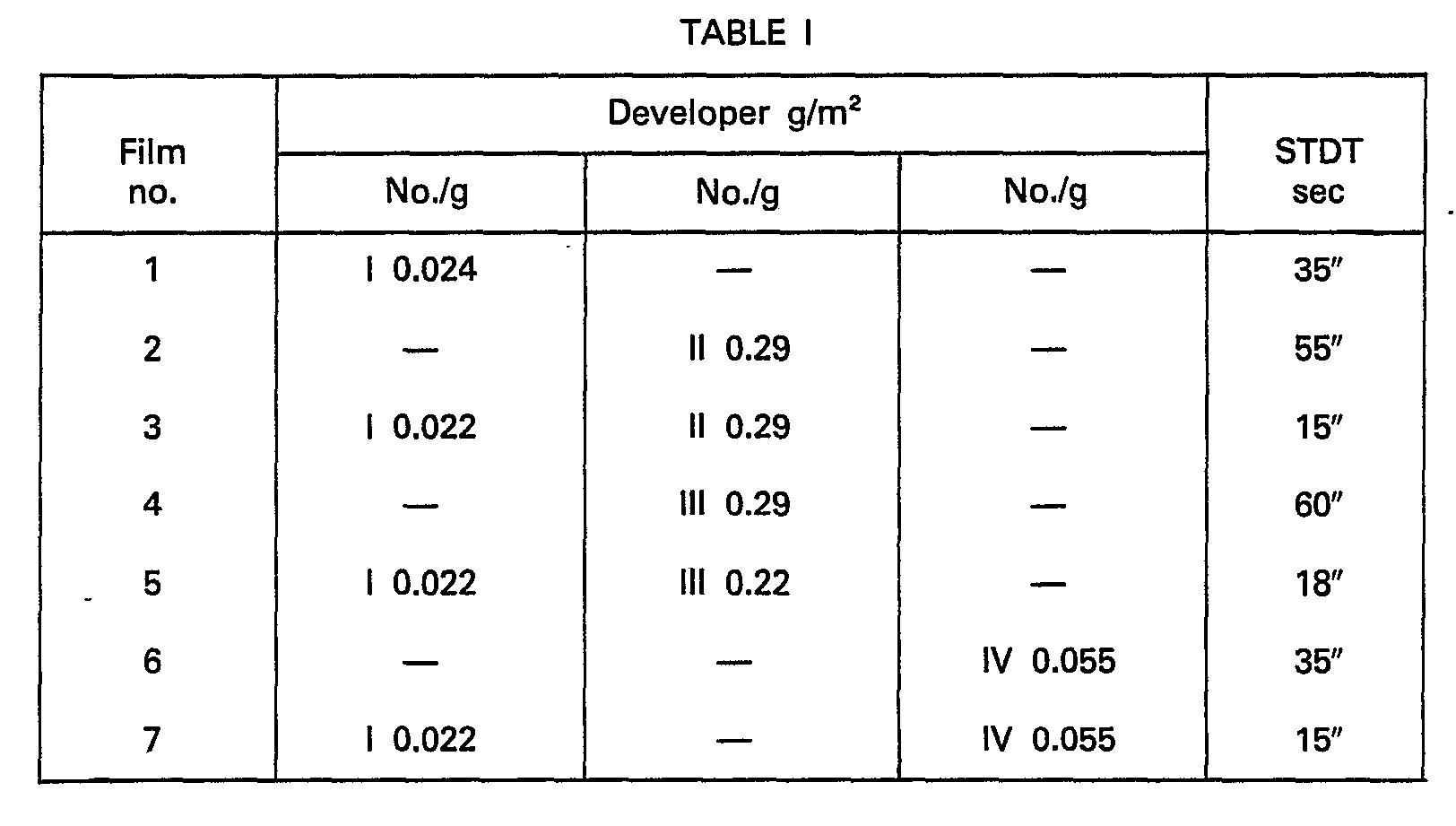
- Table I shows that developers I and II, used alone in Films 1 and 2, produce slower tanning processes than their combination I+II in Films 3.
- Similarly, a comparison among Films 1, 4 and 5 shows that the combination of developers 1+111 is much quicker (Film 5) than the single structures I and III (Films 1 and 4).
- A similar effect is evident also from a comparison between Films 1 and 6 with 7 respectively containing the single compounds I and IV and their combination I+IV.
- The synergism of the developer combinations of the present invention often regards also the image quality of the maintenance of the photographic properties under damp heat conditions.
- For example, Films 1 to 7 were aged for 15 hours at 20°C and 55% R.H. and then closed in impermeable envelopes and submitted to an accelerated storage at 50°C for 1 day and 5 days.
- After such a time, the samples were exposed, processed and evaluated as described above and the obtained images were compared with those previously obtained with fresh films.
- The following results were thus obtained:
- 1) all fresh films, with the exception of no. 4 (which gave a very bad quality with poor adhesion), at the development times described in Table I, gave very good qualitities.
- 2) the films stored for 1 day and for 5 days at 50°C gave the results reported in the following Table IB.

- Eleven films were prepared as described in Example 1 with the exception that they contained the developers reported in Table II.
- The films were exposed, processed and evaluated as those of Example 1 and gave the evaluations of the minimum activation times reported in Table II.
- The only structural differences with respect to the materials of Example 1 were that:
- a) D layers of Films 1, 3, 5 and 7 contained 0.87 g/m2 of gelatin (instead of 0.5 g/m2);
- b) D layers of Films 2, 4, 6 and 8 contained 0.64 g/m2 of gelatin.
- As shown in Table II, Films from 1 to 6 all have tanning development times higher than those of Films 7 to 11. Moreover, Films 4, 10 and 11 were also aged for 15 hours at 20°C and 55% R.H. and then closed in an impermeable envelope and stored at 50°C for 3, 6 and 10 days, then exposed, processed and evaluated as described in Example 1. The following results were thus obtained:
- a) after 3 days:
- Film 10 was sligthly worse.
- Films 4 and 11 were still good and with images like the fresh film.
- b) after 6 days:
- Film 10 gave no more image (which separates from the base during processing).
- Film 4 was worse, yet produced still acceptable images.
- Film 11 is still good almost like the fresh film.
- c) after 10 days:
- Even Film 4 did no more give acceptable images, while Film 11, even being significantly worse, produced still acceptable images.

- Even Film 4 did no more give acceptable images, while Film 11, even being significantly worse, produced still acceptable images.
- Thirteen films were prepared as described in Example 1, with the exception of the developer quantities shown in Table III. They were then exposed, processed and evaluated as the materials of Example 1.
- As shown in Table III, all Films from 1 to 13 had a tanning development time lower than that of Films 1, 4 and 6 of Example 1.

- Five films were prepared as described in Example 1 with the exception of the developer type and quantity shown in Table IV. They were then exposed, processed and evaluated as described in Example 1.
- Table IV shows that all Films from 1 to 5 have tanning development times lower than those of Films 1, 4 and 6 of Example 1.
- The stability of Films 2, 3, 4 and 5 was better than that of Film 1.

- Four films were prepared as described in Example 1, with the exception that hydroquinone was placed into sensitive layer (D), instead of the first layer (C).
- The developer type and quantity of the materials are shown in Table IV.
- The films were exposed, processed and evaluated as those of Example 1. It is worth being pointed out that phenidone was not used in Film 3 (while it was present in all other films of this example and of the preceding examples in the position and coverage described in Example 1).
- As shown in Table V, Films 1, 2 and 4 have a good tanning development rate if compared with Films 1 and 4 of Example 1. Film 4 presents however a better tone reproduction.
- Film 3 did not give any image since, under the operative conditions of the examples, the presence of at least small quantities of 3 - pyrazolidone compounds were necessary.

- Fifteen films were prepared as described in Example 1, with the exception of the variations shown in Table VI and then exposed, processed and evaluated as those of Example 1.
- Table VI shows that the single developers VII, XI and VI gave nearly good tanning development rates only if used at very high quantities. Their development rates were however much lower than those obtainable with Film 14 which contained a combination of developer VI with other hydroquinone structures or than those obtainable with combinations of developer I in several films of the preceding examples.
- The high coverages, on the contrary, were not effective in the case of the single developers IX, X, III, II, V and XIII which were anyhow very slow.
- Halogen-hydroquinones IV and XII gave mean tanning development rates, yet lower than the binary combinations like those of Film 7 of Example 1 or of Films 7, 8, 9 and 11 of Example 2.

- Seven films were prepared as described in Example 1, with the exception of the variations shown in Table VIII, then exposed, processed and evaluated like those of Example 1.
- Developer I in Films 1, 2, 3, 4, 5 and 6 however was placed into D layer, like developer VI in Film 7.
- All other developers were placed into layer C, as usual.
- This example illustrates the effectiveness of the combinations comprising developers I and VI with or without developer V, since they gave lower tanning development times than Film 1 of Example 1 and Film 4 of Example 6, although the quantity of developer VI in the present example was much lower than that of Film 4 of Example 6.

- Six films were prepared as described in Example 1, with the exception of the variations reported in Table VIII, then exposed, processed and evaluated like those of Example 1.
- As evidenced in Table VIII, the good tanning development rates of the developer I and VI mixture were confirmed, even if the quantities of both developers were so low that, if used alone, they would not give any satisfying image.

- Seven films were prepared as described in Example 1 with the exception of the variations shown in Table IX, then exposed, processed and evaluated like those of Example 1.
- While however the phenidone quantity in Films 1, 2, 5, 6 and 7 was like that of the films of Example 1, in Film 3 phenidone was coated at 0.0125 g/m2 and in Film 4 was not placed at all.
- As shown in Table IX, Films 1, 2, 3, 5, 6 and 7 gave a good tanning development rate, thus showing that under the present experimental conditions the phenidone quantity can also be reduced to the half.
- On the contrary, Film 4 did not give any image since phenidone was absent. The results of this example confirmed the effectiveness of the combinations of at least two hydroquinone structures and proved also the usefulness of the presence of at least one 3 - pyrazolidone compound, at least at a minimum quantity, to improve adhesion under the described experimental conditions.

- Seven films were prepared as described in Example 1, with the exception of the variations described in Table XI, then exposed, processed and evaluated like those of Example 1.
- A comparison of Film 1 with Films 2 and 3, as well as with Film 4 of Example 6 confirmed with necessity of very high coverages when hydroquinones substituted with electron-attracting groups were used alone.
- Films 4, 5, 6 and 7 on the contrary showed that the synergistic effect on the tanning development is strong when developer VI was combined with other hydroquinone structures.

- Five films were prepared as described in Example 1, with the exception of the variations described in Table XI, then exposed, processed and evaluated as those described in Example 1.
- While Film 1, like the films of the preceding examples, contained 0.75 g/m2 of black colloidal silver as a pigment in layer C. Films 2, 3, 4 and 5 contained, in layer C, 4 g/m2 of an organic pigment dispersion consisting of 1.5 g/m2 of pure pigments and about 2.5 g/m2 of solvents for the dispersion.
- Although the gelatin thickness per square meter of layer C was still 2.2 g/m2, layer C of Films 2, 3, 4 and 5 showed a lower tendency to be tanned than layer C of material 1 of the present example and of Film 1 of Example 1.
- In fact, a comparison of Films 2, 3 and 4 of the present example with Film 1 of Example 1 shows that substantially lower tanning development rates were obtained if similar quantities of developer I alone were used.
- A comparison of Films 2, 3, 4 of the present example with Film 5 and even with Film 1 does however clearly show that it is sufficient to put a given quantity of Compound III in combination with Compound I to obtain not only a much higher tanning development rate both for Film 5 and for Films 2, 3 and 4, but that it is nearly the same as that of Film 1 wherein the colloidal silver pigment tannability is higher.

- Nine films were prepared as described in Example 1, with the exception of the variations described in Table XII, then exposed, processed and evaluated like those of Example 1.
- Films 4 and 6 had 0.55 g/m2 of silver ions in the D sensitive layer, Film 8 had 0.3 g/m2 of silver ions and Film 9 had 0.25 g/m2 of silver ions.
- All other films had a quantity of silver ions equal to 0.35 g/m2 as the films of the preceding examples.
- Such differences in the covarage of the photographic emulsion (and therefore in the quantity of the exposed and developable silver) did not prove however to be so important to the purposes of the tanning development rate as on the contrary the combinations of at least two hydroquinone structures, such as 1+111 in Films 1, 2, 7, 8, 9 with respect to the single structures of Films 3, 4, 5, 6.
- In fact, Film 9, which had a very low emulsion coverage, was still faster than Films 4 and 6 which had twice a coverage.
- Films 4 and 6 had furthermore a tanning development rate similar to that of Films 3 and 5 independently upon the sensitive silver coverage.
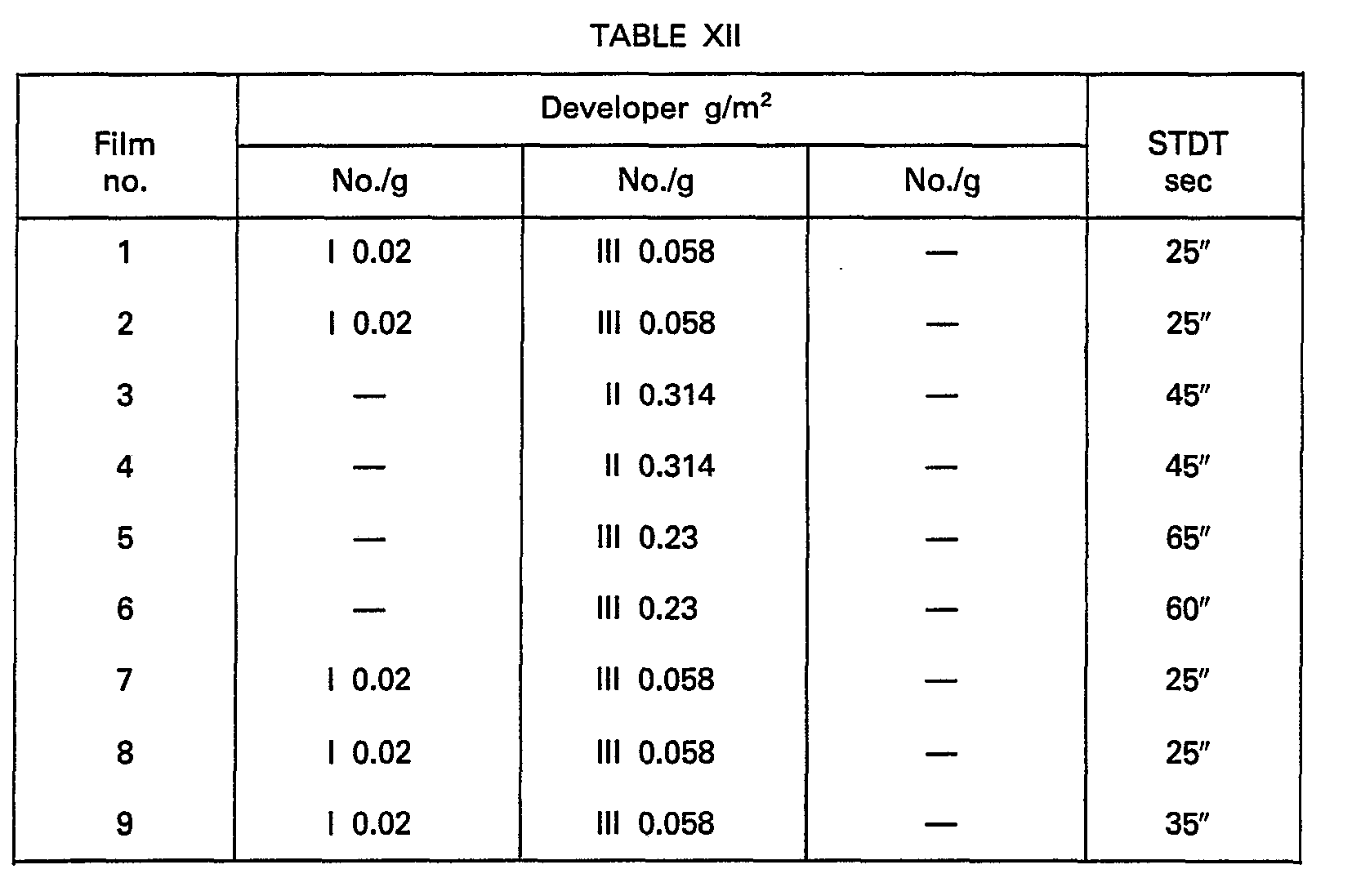
- Six films were prepared as described in Example 1, with the exception of the variations described in Table XIII, then exposed, processed and evaluated as described in Example 1.
- From the comparision with Films 1, 4 and 6 of Example 1 and taking into consideration the very low coverages of developers I, III and IV used in this example, the synergism of the binary I+IV mixtures in Films 4, 5 and 6 and of the ternary ones in Films 1, 2 and 3 to the purposes of tanning development was noticed.
- Moreover, Films 1, 2 and 3 gave a reproduction of a 3% dot, of very thin lines and of the tones substantially better than Films 4, 5 and 6, thus showing that the effect of further hydroquinone structures, such as III, may result useful to the purposes of both the tanning development rate and image improvement.
- All this is particularly surprising if the particularly bad images are considered which were obtained by using developer III alone, as done in Film 4 of Example 1 and in Films 2 and 9 of Example 6.

- The Standard Tanning Development Times (STDT) reported in the preceeding examples refer to the operative conditions chosen for comparison purposes.
- Such times can increase or decrease by varying some parameters of the film and processing in a way obvious to the man skilled in the art.
Claims (12)
Applications Claiming Priority (2)
| Application Number | Priority Date | Filing Date | Title |
|---|---|---|---|
| IT2097885 | 1985-05-30 | ||
| IT20978/85A IT1185619B (en) | 1985-05-30 | 1985-05-30 | IMPROVED PHOTOGRAPHIC MATERIAL FOR TANNING DEVELOPMENT AND METHOD FOR OBTAINING A RELEVANT IMAGE |
Publications (3)
| Publication Number | Publication Date |
|---|---|
| EP0203468A2 EP0203468A2 (en) | 1986-12-03 |
| EP0203468A3 EP0203468A3 (en) | 1987-10-14 |
| EP0203468B1 true EP0203468B1 (en) | 1989-03-08 |
Family
ID=11174907
Family Applications (1)
| Application Number | Title | Priority Date | Filing Date |
|---|---|---|---|
| EP86106600A Expired EP0203468B1 (en) | 1985-05-30 | 1986-05-15 | Improved photographic material for tanning development and method for obtaining a relief image |
Country Status (5)
| Country | Link |
|---|---|
| US (1) | US4737441A (en) |
| EP (1) | EP0203468B1 (en) |
| JP (1) | JPH0814686B2 (en) |
| DE (1) | DE3662316D1 (en) |
| IT (1) | IT1185619B (en) |
Families Citing this family (1)
| Publication number | Priority date | Publication date | Assignee | Title |
|---|---|---|---|---|
| US4988603A (en) * | 1988-01-11 | 1991-01-29 | Konica Corporation | Method for the formation of high-contrast images using a developer comprising a hydrazine derivative |
Family Cites Families (12)
| Publication number | Priority date | Publication date | Assignee | Title |
|---|---|---|---|---|
| BE614575A (en) * | 1961-03-02 | |||
| US3300307A (en) * | 1963-01-18 | 1967-01-24 | Eastman Kodak Co | Photographic developer composition |
| US3364024A (en) * | 1963-06-24 | 1968-01-16 | Eastman Kodak Co | Photographic process |
| FR1463899A (en) * | 1965-10-01 | 1966-07-22 | Kodak Pathe | Process for the preparation of a lithographic plate and photographic product for the implementation of this process |
| JPS6015262B2 (en) * | 1979-02-26 | 1985-04-18 | 富士写真フイルム株式会社 | Silver halide photographic material |
| JPS5625729A (en) * | 1979-08-07 | 1981-03-12 | Fuji Photo Film Co Ltd | Silver halide photographic material |
| US4269929A (en) * | 1980-01-14 | 1981-05-26 | Eastman Kodak Company | High contrast development of photographic elements |
| IT1144001B (en) * | 1980-07-28 | 1986-10-29 | Minnesota Mining & Mfg | PHOTOGRAPHIC ELEMENT FOR TANNING DEVELOPMENT AND PROCEDURE FOR OBTAINING A COLORFUL IMAGE IN RELIEF |
| IT1193025B (en) * | 1982-08-27 | 1988-06-02 | Minnesota Mining & Mfg | SILVER HALIDE PHOTOGRAPHIC ELEMENTS IN JELLY FOR TANNING DEVELOPMENT |
| IT1224105B (en) * | 1982-08-27 | 1990-09-26 | Minnesota Mining & Mfg | SILVER HALIDE PHOTOGRAPHIC ELEMENTS IN JELLY FOR TANNING DEVELOPMENT |
| JPS6026094A (en) * | 1983-07-21 | 1985-02-08 | Hitachi Zosen Corp | Gas circulation type drier for wet dust coal |
| DE3584128D1 (en) * | 1984-03-02 | 1991-10-24 | Minnesota Mining & Mfg | PHOTOGRAPHIC TANNING DEVELOPER COMPOSITION. |
-
1985
- 1985-05-30 IT IT20978/85A patent/IT1185619B/en active
-
1986
- 1986-05-15 EP EP86106600A patent/EP0203468B1/en not_active Expired
- 1986-05-15 DE DE8686106600T patent/DE3662316D1/en not_active Expired
- 1986-05-23 US US06/867,326 patent/US4737441A/en not_active Expired - Fee Related
- 1986-05-30 JP JP61123867A patent/JPH0814686B2/en not_active Expired - Lifetime
Also Published As
| Publication number | Publication date |
|---|---|
| EP0203468A2 (en) | 1986-12-03 |
| IT8520978A0 (en) | 1985-05-30 |
| EP0203468A3 (en) | 1987-10-14 |
| US4737441A (en) | 1988-04-12 |
| DE3662316D1 (en) | 1989-04-13 |
| IT1185619B (en) | 1987-11-12 |
| JPH0814686B2 (en) | 1996-02-14 |
| JPS61292633A (en) | 1986-12-23 |
Similar Documents
| Publication | Publication Date | Title |
|---|---|---|
| US2315966A (en) | Photographic emulsion | |
| US3392020A (en) | Photo-thermographic process and element | |
| US4632896A (en) | Processing solution for silver complex diffusion transfer process comprising amino alcohols | |
| US3957493A (en) | Thermodevelopable photographic material with N-haloacetamide | |
| EP0105109B1 (en) | Gelatin silver photographic elements for tanning development | |
| US4737441A (en) | Photographic material for tanning development and method for obtaining a relief image | |
| EP0194026B1 (en) | Photothermographic stabilizers for syringaldazine leuco dyes | |
| EP0339870A1 (en) | Novel antifoggant for polyalkylene glycol sensitizers | |
| JPS6221143A (en) | Photographic element | |
| JPS61182037A (en) | Manufacture of silver image including stabilized fixation processing | |
| EP0104351B1 (en) | Gelatin silver halide photographic elements for tanning development | |
| EP0068997A1 (en) | Photographic silver halide element containing an antistain agent or antistain agent precursor | |
| US3993490A (en) | Direct positive photographic elements containing developers | |
| US4310613A (en) | Liquid processing composition for silver complex diffusion transfer process | |
| JPH07107599B2 (en) | Dot etching method for halftone silver halide images. | |
| US5578411A (en) | Rapid-access medical X-ray film and process | |
| EP0064783B1 (en) | Photographic silver halide material for use in the silver complex diffusion transfer reversal process | |
| JPS5957234A (en) | Thermodevelopable photosensitive material | |
| US4450229A (en) | Stabilization of latent images in photothermographic elements | |
| US3645731A (en) | Silver salt diffusion alkaline bath of trisodium phosphate and a polyalcohol | |
| US3671242A (en) | Silver salt diffusion process | |
| US4798779A (en) | Process for forming an image by silver salt diffusion transfer | |
| US5589323A (en) | Chemically stable ascorbate-based photographic developer and imaging process | |
| JP2911639B2 (en) | Thermographic material | |
| EP0533704B1 (en) | Photographic donor material useful in a silver salt diffusion transfer process |
Legal Events
| Date | Code | Title | Description |
|---|---|---|---|
| PUAI | Public reference made under article 153(3) epc to a published international application that has entered the european phase |
Free format text: ORIGINAL CODE: 0009012 |
|
| AK | Designated contracting states |
Kind code of ref document: A2 Designated state(s): BE DE FR GB |
|
| PUAL | Search report despatched |
Free format text: ORIGINAL CODE: 0009013 |
|
| AK | Designated contracting states |
Kind code of ref document: A3 Designated state(s): BE DE FR GB |
|
| 17P | Request for examination filed |
Effective date: 19880325 |
|
| 17Q | First examination report despatched |
Effective date: 19880705 |
|
| GRAA | (expected) grant |
Free format text: ORIGINAL CODE: 0009210 |
|
| AK | Designated contracting states |
Kind code of ref document: B1 Designated state(s): BE DE FR GB |
|
| REF | Corresponds to: |
Ref document number: 3662316 Country of ref document: DE Date of ref document: 19890413 |
|
| ET | Fr: translation filed | ||
| PLBE | No opposition filed within time limit |
Free format text: ORIGINAL CODE: 0009261 |
|
| STAA | Information on the status of an ep patent application or granted ep patent |
Free format text: STATUS: NO OPPOSITION FILED WITHIN TIME LIMIT |
|
| 26N | No opposition filed | ||
| PGFP | Annual fee paid to national office [announced via postgrant information from national office to epo] |
Ref country code: FR Payment date: 19950411 Year of fee payment: 10 |
|
| PGFP | Annual fee paid to national office [announced via postgrant information from national office to epo] |
Ref country code: DE Payment date: 19950425 Year of fee payment: 10 Ref country code: BE Payment date: 19950425 Year of fee payment: 10 |
|
| PGFP | Annual fee paid to national office [announced via postgrant information from national office to epo] |
Ref country code: GB Payment date: 19950428 Year of fee payment: 10 |
|
| PG25 | Lapsed in a contracting state [announced via postgrant information from national office to epo] |
Ref country code: GB Effective date: 19960515 |
|
| PG25 | Lapsed in a contracting state [announced via postgrant information from national office to epo] |
Ref country code: BE Effective date: 19960531 |
|
| BERE | Be: lapsed |
Owner name: MINNESOTA MINING AND MFG CY Effective date: 19960531 |
|
| GBPC | Gb: european patent ceased through non-payment of renewal fee |
Effective date: 19960515 |
|
| PG25 | Lapsed in a contracting state [announced via postgrant information from national office to epo] |
Ref country code: FR Effective date: 19970131 |
|
| PG25 | Lapsed in a contracting state [announced via postgrant information from national office to epo] |
Ref country code: DE Effective date: 19970201 |
|
| REG | Reference to a national code |
Ref country code: FR Ref legal event code: ST |