EP0202350B1 - A soft starchy chewing gum - Google Patents
A soft starchy chewing gum Download PDFInfo
- Publication number
- EP0202350B1 EP0202350B1 EP19850106235 EP85106235A EP0202350B1 EP 0202350 B1 EP0202350 B1 EP 0202350B1 EP 19850106235 EP19850106235 EP 19850106235 EP 85106235 A EP85106235 A EP 85106235A EP 0202350 B1 EP0202350 B1 EP 0202350B1
- Authority
- EP
- European Patent Office
- Prior art keywords
- chewing gum
- soft
- starch
- starchy
- rice cake
- Prior art date
- Legal status (The legal status is an assumption and is not a legal conclusion. Google has not performed a legal analysis and makes no representation as to the accuracy of the status listed.)
- Expired
Links
- 235000015218 chewing gum Nutrition 0.000 title claims description 74
- 229940112822 chewing gum Drugs 0.000 title claims description 67
- 229920002472 Starch Polymers 0.000 claims description 29
- 239000008107 starch Substances 0.000 claims description 29
- 235000007164 Oryza sativa Nutrition 0.000 claims description 21
- 235000009566 rice Nutrition 0.000 claims description 21
- XLYOFNOQVPJJNP-UHFFFAOYSA-N water Substances O XLYOFNOQVPJJNP-UHFFFAOYSA-N 0.000 claims description 21
- 239000000499 gel Substances 0.000 claims description 17
- 235000012907 honey Nutrition 0.000 claims description 14
- GXCLVBGFBYZDAG-UHFFFAOYSA-N N-[2-(1H-indol-3-yl)ethyl]-N-methylprop-2-en-1-amine Chemical compound CN(CCC1=CNC2=C1C=CC=C2)CC=C GXCLVBGFBYZDAG-UHFFFAOYSA-N 0.000 claims description 13
- 235000003599 food sweetener Nutrition 0.000 claims description 10
- 239000003765 sweetening agent Substances 0.000 claims description 10
- 238000006467 substitution reaction Methods 0.000 claims description 9
- 229920000945 Amylopectin Polymers 0.000 claims description 7
- 229920001353 Dextrin Polymers 0.000 claims description 7
- 239000004375 Dextrin Substances 0.000 claims description 7
- 235000019425 dextrin Nutrition 0.000 claims description 7
- 235000019698 starch Nutrition 0.000 claims description 7
- 244000046052 Phaseolus vulgaris Species 0.000 claims description 4
- 235000010627 Phaseolus vulgaris Nutrition 0.000 claims description 4
- 229930006000 Sucrose Natural products 0.000 claims description 4
- CZMRCDWAGMRECN-UGDNZRGBSA-N Sucrose Chemical compound O[C@H]1[C@H](O)[C@@H](CO)O[C@@]1(CO)O[C@@H]1[C@H](O)[C@@H](O)[C@H](O)[C@@H](CO)O1 CZMRCDWAGMRECN-UGDNZRGBSA-N 0.000 claims description 4
- 239000000796 flavoring agent Substances 0.000 claims description 4
- 235000019634 flavors Nutrition 0.000 claims description 4
- 235000015110 jellies Nutrition 0.000 claims description 3
- 239000008274 jelly Substances 0.000 claims description 3
- 239000000203 mixture Substances 0.000 claims description 3
- 239000005720 sucrose Substances 0.000 claims description 3
- MIDXCONKKJTLDX-UHFFFAOYSA-N 3,5-dimethylcyclopentane-1,2-dione Chemical compound CC1CC(C)C(=O)C1=O MIDXCONKKJTLDX-UHFFFAOYSA-N 0.000 claims description 2
- 235000013736 caramel Nutrition 0.000 claims description 2
- 235000015243 ice cream Nutrition 0.000 claims description 2
- 239000000463 material Substances 0.000 claims description 2
- 240000007594 Oryza sativa Species 0.000 claims 2
- 239000002585 base Substances 0.000 claims 1
- 235000015145 nougat Nutrition 0.000 claims 1
- 241000209094 Oryza Species 0.000 description 19
- 230000000052 comparative effect Effects 0.000 description 12
- 235000000346 sugar Nutrition 0.000 description 11
- 239000004615 ingredient Substances 0.000 description 7
- PEDCQBHIVMGVHV-UHFFFAOYSA-N Glycerine Chemical compound OCC(O)CO PEDCQBHIVMGVHV-UHFFFAOYSA-N 0.000 description 6
- 150000008163 sugars Chemical class 0.000 description 6
- 238000000034 method Methods 0.000 description 5
- 229920000856 Amylose Polymers 0.000 description 3
- DNIAPMSPPWPWGF-UHFFFAOYSA-N Propylene glycol Chemical compound CC(O)CO DNIAPMSPPWPWGF-UHFFFAOYSA-N 0.000 description 3
- 239000003292 glue Substances 0.000 description 3
- 229960004793 sucrose Drugs 0.000 description 3
- 238000012360 testing method Methods 0.000 description 3
- OWEGMIWEEQEYGQ-UHFFFAOYSA-N 100676-05-9 Natural products OC1C(O)C(O)C(CO)OC1OCC1C(O)C(O)C(O)C(OC2C(OC(O)C(O)C2O)CO)O1 OWEGMIWEEQEYGQ-UHFFFAOYSA-N 0.000 description 2
- GUBGYTABKSRVRQ-XLOQQCSPSA-N Alpha-Lactose Chemical compound O[C@@H]1[C@@H](O)[C@@H](O)[C@@H](CO)O[C@H]1O[C@@H]1[C@@H](CO)O[C@H](O)[C@H](O)[C@H]1O GUBGYTABKSRVRQ-XLOQQCSPSA-N 0.000 description 2
- SRBFZHDQGSBBOR-IOVATXLUSA-N D-xylopyranose Chemical compound O[C@@H]1COC(O)[C@H](O)[C@H]1O SRBFZHDQGSBBOR-IOVATXLUSA-N 0.000 description 2
- WQZGKKKJIJFFOK-GASJEMHNSA-N Glucose Natural products OC[C@H]1OC(O)[C@H](O)[C@@H](O)[C@@H]1O WQZGKKKJIJFFOK-GASJEMHNSA-N 0.000 description 2
- GUBGYTABKSRVRQ-QKKXKWKRSA-N Lactose Natural products OC[C@H]1O[C@@H](O[C@H]2[C@H](O)[C@@H](O)C(O)O[C@@H]2CO)[C@H](O)[C@@H](O)[C@H]1O GUBGYTABKSRVRQ-QKKXKWKRSA-N 0.000 description 2
- GUBGYTABKSRVRQ-PICCSMPSSA-N Maltose Natural products O[C@@H]1[C@@H](O)[C@H](O)[C@@H](CO)O[C@@H]1O[C@@H]1[C@@H](CO)OC(O)[C@H](O)[C@H]1O GUBGYTABKSRVRQ-PICCSMPSSA-N 0.000 description 2
- XTXRWKRVRITETP-UHFFFAOYSA-N Vinyl acetate Chemical compound CC(=O)OC=C XTXRWKRVRITETP-UHFFFAOYSA-N 0.000 description 2
- 239000007864 aqueous solution Substances 0.000 description 2
- WQZGKKKJIJFFOK-VFUOTHLCSA-N beta-D-glucose Chemical compound OC[C@H]1O[C@@H](O)[C@H](O)[C@@H](O)[C@@H]1O WQZGKKKJIJFFOK-VFUOTHLCSA-N 0.000 description 2
- GUBGYTABKSRVRQ-QUYVBRFLSA-N beta-maltose Chemical compound OC[C@H]1O[C@H](O[C@H]2[C@H](O)[C@@H](O)[C@H](O)O[C@@H]2CO)[C@H](O)[C@@H](O)[C@@H]1O GUBGYTABKSRVRQ-QUYVBRFLSA-N 0.000 description 2
- 230000006866 deterioration Effects 0.000 description 2
- -1 dextrins) Chemical class 0.000 description 2
- 239000008103 glucose Substances 0.000 description 2
- 239000008101 lactose Substances 0.000 description 2
- 239000011347 resin Substances 0.000 description 2
- 229920005989 resin Polymers 0.000 description 2
- 150000005846 sugar alcohols Chemical class 0.000 description 2
- QCVGEOXPDFCNHA-UHFFFAOYSA-N 5,5-dimethyl-2,4-dioxo-1,3-oxazolidine-3-carboxamide Chemical compound CC1(C)OC(=O)N(C(N)=O)C1=O QCVGEOXPDFCNHA-UHFFFAOYSA-N 0.000 description 1
- 244000144725 Amygdalus communis Species 0.000 description 1
- FBPFZTCFMRRESA-FSIIMWSLSA-N D-Glucitol Natural products OC[C@H](O)[C@H](O)[C@@H](O)[C@H](O)CO FBPFZTCFMRRESA-FSIIMWSLSA-N 0.000 description 1
- 102000002322 Egg Proteins Human genes 0.000 description 1
- 108010000912 Egg Proteins Proteins 0.000 description 1
- 229930091371 Fructose Natural products 0.000 description 1
- 239000005715 Fructose Substances 0.000 description 1
- RFSUNEUAIZKAJO-ARQDHWQXSA-N Fructose Chemical compound OC[C@H]1O[C@](O)(CO)[C@@H](O)[C@@H]1O RFSUNEUAIZKAJO-ARQDHWQXSA-N 0.000 description 1
- 239000001828 Gelatine Substances 0.000 description 1
- 244000043261 Hevea brasiliensis Species 0.000 description 1
- 101000801619 Homo sapiens Long-chain-fatty-acid-CoA ligase ACSBG1 Proteins 0.000 description 1
- 240000005979 Hordeum vulgare Species 0.000 description 1
- 235000007340 Hordeum vulgare Nutrition 0.000 description 1
- 102100033564 Long-chain-fatty-acid-CoA ligase ACSBG1 Human genes 0.000 description 1
- 229920001938 Vegetable gum Polymers 0.000 description 1
- TVXBFESIOXBWNM-UHFFFAOYSA-N Xylitol Natural products OCCC(O)C(O)C(O)CCO TVXBFESIOXBWNM-UHFFFAOYSA-N 0.000 description 1
- 240000008042 Zea mays Species 0.000 description 1
- 235000005824 Zea mays ssp. parviglumis Nutrition 0.000 description 1
- 235000002017 Zea mays subsp mays Nutrition 0.000 description 1
- 230000004520 agglutination Effects 0.000 description 1
- 235000020224 almond Nutrition 0.000 description 1
- PYMYPHUHKUWMLA-UHFFFAOYSA-N arabinose Natural products OCC(O)C(O)C(O)C=O PYMYPHUHKUWMLA-UHFFFAOYSA-N 0.000 description 1
- 239000008122 artificial sweetener Substances 0.000 description 1
- 235000021311 artificial sweeteners Nutrition 0.000 description 1
- SRBFZHDQGSBBOR-UHFFFAOYSA-N beta-D-Pyranose-Lyxose Natural products OC1COC(O)C(O)C1O SRBFZHDQGSBBOR-UHFFFAOYSA-N 0.000 description 1
- 230000015572 biosynthetic process Effects 0.000 description 1
- 235000010634 bubble gum Nutrition 0.000 description 1
- 238000006243 chemical reaction Methods 0.000 description 1
- 230000001055 chewing effect Effects 0.000 description 1
- 235000019219 chocolate Nutrition 0.000 description 1
- 238000007796 conventional method Methods 0.000 description 1
- 238000001816 cooling Methods 0.000 description 1
- 235000005822 corn Nutrition 0.000 description 1
- 235000021438 curry Nutrition 0.000 description 1
- 235000013681 dietary sucrose Nutrition 0.000 description 1
- 150000002016 disaccharides Chemical class 0.000 description 1
- 230000000694 effects Effects 0.000 description 1
- 235000014103 egg white Nutrition 0.000 description 1
- 210000000969 egg white Anatomy 0.000 description 1
- 235000013601 eggs Nutrition 0.000 description 1
- 229920001971 elastomer Polymers 0.000 description 1
- 238000002474 experimental method Methods 0.000 description 1
- 239000000945 filler Substances 0.000 description 1
- 239000012530 fluid Substances 0.000 description 1
- 229920000159 gelatin Polymers 0.000 description 1
- 235000019322 gelatine Nutrition 0.000 description 1
- 150000004676 glycans Chemical class 0.000 description 1
- 235000010985 glycerol esters of wood rosin Nutrition 0.000 description 1
- 238000010438 heat treatment Methods 0.000 description 1
- 238000010348 incorporation Methods 0.000 description 1
- 235000015094 jam Nutrition 0.000 description 1
- HEBKCHPVOIAQTA-UHFFFAOYSA-N meso ribitol Natural products OCC(O)C(O)C(O)CO HEBKCHPVOIAQTA-UHFFFAOYSA-N 0.000 description 1
- 150000002772 monosaccharides Chemical class 0.000 description 1
- 229920003052 natural elastomer Polymers 0.000 description 1
- 239000000025 natural resin Substances 0.000 description 1
- 229920001194 natural rubber Polymers 0.000 description 1
- 235000014571 nuts Nutrition 0.000 description 1
- 230000035515 penetration Effects 0.000 description 1
- 229920001282 polysaccharide Polymers 0.000 description 1
- 239000005017 polysaccharide Substances 0.000 description 1
- 239000005060 rubber Substances 0.000 description 1
- 238000007493 shaping process Methods 0.000 description 1
- 239000000600 sorbitol Substances 0.000 description 1
- 229920003051 synthetic elastomer Polymers 0.000 description 1
- 239000005061 synthetic rubber Substances 0.000 description 1
- 235000020357 syrup Nutrition 0.000 description 1
- 239000006188 syrup Substances 0.000 description 1
- 239000000811 xylitol Substances 0.000 description 1
- 235000010447 xylitol Nutrition 0.000 description 1
- HEBKCHPVOIAQTA-SCDXWVJYSA-N xylitol Chemical compound OC[C@H](O)[C@@H](O)[C@H](O)CO HEBKCHPVOIAQTA-SCDXWVJYSA-N 0.000 description 1
- 229960002675 xylitol Drugs 0.000 description 1
Classifications
-
- A—HUMAN NECESSITIES
- A23—FOODS OR FOODSTUFFS; TREATMENT THEREOF, NOT COVERED BY OTHER CLASSES
- A23G—COCOA; COCOA PRODUCTS, e.g. CHOCOLATE; SUBSTITUTES FOR COCOA OR COCOA PRODUCTS; CONFECTIONERY; CHEWING GUM; ICE-CREAM; PREPARATION THEREOF
- A23G9/00—Frozen sweets, e.g. ice confectionery, ice-cream; Mixtures therefor
- A23G9/44—Frozen sweets, e.g. ice confectionery, ice-cream; Mixtures therefor characterised by shape, structure or physical form
- A23G9/48—Composite products, e.g. layered, laminated, coated, filled
-
- A—HUMAN NECESSITIES
- A23—FOODS OR FOODSTUFFS; TREATMENT THEREOF, NOT COVERED BY OTHER CLASSES
- A23G—COCOA; COCOA PRODUCTS, e.g. CHOCOLATE; SUBSTITUTES FOR COCOA OR COCOA PRODUCTS; CONFECTIONERY; CHEWING GUM; ICE-CREAM; PREPARATION THEREOF
- A23G4/00—Chewing gum
- A23G4/02—Apparatus specially adapted for manufacture or treatment of chewing gum
-
- A—HUMAN NECESSITIES
- A23—FOODS OR FOODSTUFFS; TREATMENT THEREOF, NOT COVERED BY OTHER CLASSES
- A23G—COCOA; COCOA PRODUCTS, e.g. CHOCOLATE; SUBSTITUTES FOR COCOA OR COCOA PRODUCTS; CONFECTIONERY; CHEWING GUM; ICE-CREAM; PREPARATION THEREOF
- A23G4/00—Chewing gum
- A23G4/02—Apparatus specially adapted for manufacture or treatment of chewing gum
- A23G4/04—Apparatus specially adapted for manufacture or treatment of chewing gum for moulding or shaping
- A23G4/043—Apparatus specially adapted for manufacture or treatment of chewing gum for moulding or shaping for composite chewing gum
-
- A—HUMAN NECESSITIES
- A23—FOODS OR FOODSTUFFS; TREATMENT THEREOF, NOT COVERED BY OTHER CLASSES
- A23G—COCOA; COCOA PRODUCTS, e.g. CHOCOLATE; SUBSTITUTES FOR COCOA OR COCOA PRODUCTS; CONFECTIONERY; CHEWING GUM; ICE-CREAM; PREPARATION THEREOF
- A23G4/00—Chewing gum
- A23G4/06—Chewing gum characterised by the composition containing organic or inorganic compounds
- A23G4/068—Chewing gum characterised by the composition containing organic or inorganic compounds containing plants or parts thereof, e.g. fruits, seeds, extracts
-
- A—HUMAN NECESSITIES
- A23—FOODS OR FOODSTUFFS; TREATMENT THEREOF, NOT COVERED BY OTHER CLASSES
- A23G—COCOA; COCOA PRODUCTS, e.g. CHOCOLATE; SUBSTITUTES FOR COCOA OR COCOA PRODUCTS; CONFECTIONERY; CHEWING GUM; ICE-CREAM; PREPARATION THEREOF
- A23G4/00—Chewing gum
- A23G4/06—Chewing gum characterised by the composition containing organic or inorganic compounds
- A23G4/10—Chewing gum characterised by the composition containing organic or inorganic compounds characterised by the carbohydrates used, e.g. polysaccharides
-
- A—HUMAN NECESSITIES
- A23—FOODS OR FOODSTUFFS; TREATMENT THEREOF, NOT COVERED BY OTHER CLASSES
- A23G—COCOA; COCOA PRODUCTS, e.g. CHOCOLATE; SUBSTITUTES FOR COCOA OR COCOA PRODUCTS; CONFECTIONERY; CHEWING GUM; ICE-CREAM; PREPARATION THEREOF
- A23G4/00—Chewing gum
- A23G4/18—Chewing gum characterised by shape, structure or physical form, e.g. aerated products
- A23G4/20—Composite products, e.g. centre-filled, multi-layer, laminated
-
- A—HUMAN NECESSITIES
- A23—FOODS OR FOODSTUFFS; TREATMENT THEREOF, NOT COVERED BY OTHER CLASSES
- A23V—INDEXING SCHEME RELATING TO FOODS, FOODSTUFFS OR NON-ALCOHOLIC BEVERAGES AND LACTIC OR PROPIONIC ACID BACTERIA USED IN FOODSTUFFS OR FOOD PREPARATION
- A23V2002/00—Food compositions, function of food ingredients or processes for food or foodstuffs
Definitions
- This invention relates to a soft starchy chewing gum, more particularly to a chewing gum having a consistency similar to a soft rice cake and containing in substitution for a portion or all of sweetener an a-starch glue of substantially amylopectin.
- the malt honey is added to the chewing gum not only as a sweetener but also for the purpose of imparting softness thereto, and that the latter effect may be enhanced by addition of an aqueous solution of sugars or sugar alcohols, an aqueous solution of vegetable gum, as well as softeners, such as glycerol and propylene glycol.
- softeners such as glycerol and propylene glycol.
- sugars of low sweetness such as glucose, lactose, maltose or dextrin may be utilized in substitution for saccharose in order to reduce the sweetness of the chewing gum.
- these ingredients have disadvantages of increasing a powdery feeling and of significantly hardening the chewing gum due to agglutination.
- an object of the invention is to provide a soft starchy chewing gum capable of maintaining softness at a low temperature below 5°C or even below 0°C.
- Another object of the invention is to provide a soft chewing gum of low sweetness containing dextrin of DE 2 to 50 as a main sweetener in combination with the a-starch glue.
- a further object of the invention is to provide a novel type of chewing gum having consistency similar to a soft rice cake by keeping characteristics of chewing gum.
- a still further object of the invention is to provide a soft starchy chewing gum of the rice cake consistency, which encloses or contains a center filling, such as bean jam, jelly or the like.
- the chewing gum having consistency similar to a soft rice cake may be obtained by incorporating the total water content of between 0.3, preferably 5.5, and 12% by weight and subjecting the chewing gum to a rice cake shaping machine.
- the chewing gum of the rice cake consistency may be fabricated into a stuffed chewing gum containing a center filling.
- the a-starch gel may be preferably incorporated into the chewing gum as a Turkish delight consisting of sugar, starch, syrup, honey, whipped whites of eggs, gelatine and preferably nuts or almonds which has been heat-treated together with a portion of sweetening sugar.
- the a-starch of substantially 100% amylopectin may be selected from glutinous rice, glutinous corn or, glutinous barley which is substantially free of amylose. Conveniently, rice-flour is used.
- the a-starch gel useful in the invention may be prepared in the following procedure, for example:
- the starch such as the rice-flour
- the steamed mass is then placed into water for cooling and thereafter is subjected to a pounding treatment by means of a rice cake machine or a dumpling mixer for providing glutinous consistency.
- a portion of sugar or other sweeteners may be incorporated, if desired, with heating to form a Turkish delight, to which may be further formulated a material previously prepared from an egg white and water.
- a ratio of the starch (consisting of substantially 100% amylopectin) to water is in the range of 1:0.5-3, preferably 1: 1-2.
- a ratio of the rice-flour to water is in such a range that the resulting Vietnamese delight contains 20 to 50% by weight of water.
- a water content below a ratio of 0.5 gives excessive elasticity which may deteriorate a texture of the chewing gum, while a water content above a ratio of 3 provides excessive softness which may cause deterioration with time.
- the a-starch gel thus prepared is incorporated into the chewing gum in substitution for a portion or all of the malt honey, in which case an aliquot of water derived from the malt honey may be replenished with a corresponding amount of water contained in the a-starch gel.
- An amount of the a-starch gel incorporated into the chewing gum is in such a range that the resulting chewing gum contains about 0.3 to about 12% by weight of water. In this case, the water content of about 5.5 to 12% by weight may provide the chewing gum of rice cake consistency.
- the a-starch containing amylose is known to be converted to a hard 0-form.
- the a-starch gel as defined herein consists of substantially 100% amylopectin and is free of amylose, so that the conversion to the (3-form (or hardening phenomenon) may be prevented.
- the sweetening sugars as used in the invention may be monosaccharides (such as glucose, fructose and xylose), disaccharides (such as sucrose, maltose and lactose), polysaccharides (such as dextrins), sugar alcohols (such as sorbitol, malthitol and xylitol), isomerized sugar and inverted sugar.
- monosaccharides such as glucose, fructose and xylose
- disaccharides such as sucrose, maltose and lactose
- polysaccharides such as dextrins
- sugar alcohols such as sorbitol, malthitol and xylitol
- ingredients such as gum base, flavors and softeners may be well-known in the art.
- the soft starchy chewing gum according to the invention may be prepared in any conventional procedure and apparatus which are well-known in the art.
- the chewing gum of rice cake consistency may be fabricated into any conventional form of rice cake or into a stuffed chewing gum containing a center filling, such as bean jam, jelly, ice cream, chocolate, caramel or the like.
- a center filling such as bean jam, jelly, ice cream, chocolate, caramel or the like.
- the gum base for the cold purpose is preferably used, as described in Japanese Patent Publications 46347/82 and 8819/83, both of which are assigned to the applicant.
- the former discloses the gum base comprising 5 to 15% of natural resins, 10 to 13% of vinyl acetate resins, 6 to 8% of ester gum and 15 to 25% of rubbers for the plate type chewing gum, while the latter patent discloses the gum base comprising 25 parts of natural rubbers, 19 parts of synthetic rubbers, 30 parts of vinyl acetate resins, 15 parts of wax, 16 parts of fillers for the bubble chewing gum.
- This Example illustrates the chewing gum retaining softness even below 0°C.
- the chewing gum according to the invention was prepared, using the a-starch gel A (water content of 36.5%) or the a-starch gel B (water content of 32.0%) and other ingredients as shown in Table below.
- a comparative chewing gum was also prepared by the same procedure and ingredients except for the a-starch gel.
- This Example illustrates the soft chewing gum of low sweetness with a curry flavor.
- the soft chewing gum of low sweetness was prepared, using the a-starch gel C (water content of 28.75%) or the a-starch gel D (water content of 22.3%) in combination with sugars and dextrin of DE 25, as well as other ingredients, as shown in Table below.
- a comparative chewing gum using the malt honey but excluding the a-starch gel was also prepared in the same procedure.
- the chewing gum thus prepared were evaluated in an organoleptic test by means of a panel consisting of 15 members. The results are shown in the following Table.
- the incorporation of the a-starch gel in substitution for a portion or all of the malt honey may provide the soft chewing gum retaining the softness at the low temperature.
- the combined use of the dextrin of DE 2 to 50 may provide the soft chewing gum of low sweetness.
- Examples 4 and 5 Two types of Turkish delight were prepared for use in the following Examples 4 and 5, using rice-flour of substantially amylopectin. Examples 4 and 5 including comparatives 3 and 4
- the chewing gums of rice cake consistency according to the invention were prepared, using the Turkish delight A and B as described in Example 3, and other ingredients as shown in Table below. Comparative chewing gums were also prepared in the same manner but using the malt honey in place of the Turkish delight.
- Example 4 The chewing gums of Example 4 and Comparative 3 were evaluated in an organoleptic test by a panel consisting of 30 members. The results are shown in the following table.
- Example 5 and Comparative 4 were fabricated into stuffed chewing gums containing jam as a center filling by means of an enveloping machine. These two stuffed chewing gums were evaluated in another organoleptic test by a panel consisting of 30 members. The results are shown in the following table.
- Comparison of Example 5 with Comparative 4 also shows that the substitution of the Turkish delight for a portion of the malt honey provide a significant property of rice cake.
- a soft chewing gum of low sweetness having a consistency of rice cake was prepared, using ingredients as shown in Table below.
- a comparative chewing gum also prepared by the same procedure but excluding the Turkish delight.
- Example 6 shows that the substitution of the Turkish delight A for all of the malt honey provides a very soft chewing gum of rice cake consistency, and that Comparative 5 provides a semi-fluid chewing gum which is deformed upon standing.
- the chewing gum of Example 6 was fabricated into a stuffed chewing gum enclosing a bean jam by means of an enveloping machine.
- a usual stuffed rice cake hardened within four days and was infected with molds, whereas the stuffed chewing gum of the invention neither hardened nor infected for two weeks.
- the stuffed chewing gum of the invention was converted from the rice cake consistency to a bubble gum texture of good expansion.
Landscapes
- Life Sciences & Earth Sciences (AREA)
- Chemical & Material Sciences (AREA)
- Engineering & Computer Science (AREA)
- Food Science & Technology (AREA)
- Polymers & Plastics (AREA)
- Inorganic Chemistry (AREA)
- Botany (AREA)
- Health & Medical Sciences (AREA)
- Molecular Biology (AREA)
- Confectionery (AREA)
Description
- This invention relates to a soft starchy chewing gum, more particularly to a chewing gum having a consistency similar to a soft rice cake and containing in substitution for a portion or all of sweetener an a-starch glue of substantially amylopectin.
- There have hitherto been proposed several types of chewing gum, which are soft or do not harden in an atmosphere of low temperature (for example, Japanese Patent Publication 46347/82, Japanese Application 78560/81 and Japanese Application 198051/82). These types of chewing gum, however, relate to gum base compositions, but not to chewing gum per se comprising a gum base, a malt honey, other sweeteners (such as sugars and artificial sweeteners), flavors and softeners. It is usually known that the malt honey or the softness (such as glycerol) should be added in an increased amount in order to maintain soft consistency of the chewing gum. It is also well-known that the malt honey is added to the chewing gum not only as a sweetener but also for the purpose of imparting softness thereto, and that the latter effect may be enhanced by addition of an aqueous solution of sugars or sugar alcohols, an aqueous solution of vegetable gum, as well as softeners, such as glycerol and propylene glycol. These prior arts may impart the softness to the chewing gum at a relatively low temperature, but cannot maintain the softness and harden at a low temperature below 0°C, such as -10°C, leading to its brittleness and deterioration of taste.
- On the other hand, it is also well-known that sugars of low sweetness, such as glucose, lactose, maltose or dextrin may be utilized in substitution for saccharose in order to reduce the sweetness of the chewing gum. However, these ingredients have disadvantages of increasing a powdery feeling and of significantly hardening the chewing gum due to agglutination.
- It has now been found, as a result of diligent study for producing a chewing gum capable of maintaining its softness throughout a year even at low temperature, that substitution of an a-starch gel consisting of substantially amylopectin for a portion or all of the malt honey may achieve an improved soft chewing gum. By selecting other sugars in combination with the a-starch gel, the chewing gum of low sweetness may be obtained, which is able to keep its softness at a low temperature even below 0°C.
- Further, it has now been found that in case of the chewing gum containing the a-starch glue an increased water content up to about 12%, which has hitherto been known to deteriorate quality of the chewing gum, may provide a novel type of chewing gum having consistency similar to a soft rice cake.
- Accordingly, an object of the invention is to provide a soft starchy chewing gum capable of maintaining softness at a low temperature below 5°C or even below 0°C.
- Another object of the invention is to provide a soft chewing gum of low sweetness containing dextrin of DE 2 to 50 as a main sweetener in combination with the a-starch glue.
- A further object of the invention is to provide a novel type of chewing gum having consistency similar to a soft rice cake by keeping characteristics of chewing gum.
- A still further object of the invention is to provide a soft starchy chewing gum of the rice cake consistency, which encloses or contains a center filling, such as bean jam, jelly or the like.
- The above objects may be achieved, in accordance with the invention, by the means and measures, resp, claimed in claim 1.
- In accordance with the invention, the chewing gum having consistency similar to a soft rice cake may be obtained by incorporating the total water content of between 0.3, preferably 5.5, and 12% by weight and subjecting the chewing gum to a rice cake shaping machine.
- Further, in accordance with the invention, the chewing gum of the rice cake consistency may be fabricated into a stuffed chewing gum containing a center filling.
- The a-starch gel may be preferably incorporated into the chewing gum as a Turkish delight consisting of sugar, starch, syrup, honey, whipped whites of eggs, gelatine and preferably nuts or almonds which has been heat-treated together with a portion of sweetening sugar.
- In accordance with the invention, the a-starch of substantially 100% amylopectin may be selected from glutinous rice, glutinous corn or, glutinous barley which is substantially free of amylose. Conveniently, rice-flour is used.
- The a-starch gel useful in the invention may be prepared in the following procedure, for example: The starch, such as the rice-flour, is kneaded with an adequate amount of water with preventing formation of lumps and then steamed over a powerful fire for 20 to 30 minutes. The steamed mass is then placed into water for cooling and thereafter is subjected to a pounding treatment by means of a rice cake machine or a dumpling mixer for providing glutinous consistency. Thereafter, a portion of sugar or other sweeteners may be incorporated, if desired, with heating to form a Turkish delight, to which may be further formulated a material previously prepared from an egg white and water. When subjecting to the heat teratment, a ratio of the starch (consisting of substantially 100% amylopectin) to water is in the range of 1:0.5-3, preferably 1: 1-2. In other words, a ratio of the rice-flour to water is in such a range that the resulting Turkish delight contains 20 to 50% by weight of water. A water content below a ratio of 0.5 gives excessive elasticity which may deteriorate a texture of the chewing gum, while a water content above a ratio of 3 provides excessive softness which may cause deterioration with time.
- The a-starch gel thus prepared is incorporated into the chewing gum in substitution for a portion or all of the malt honey, in which case an aliquot of water derived from the malt honey may be replenished with a corresponding amount of water contained in the a-starch gel. An amount of the a-starch gel incorporated into the chewing gum is in such a range that the resulting chewing gum contains about 0.3 to about 12% by weight of water. In this case, the water content of about 5.5 to 12% by weight may provide the chewing gum of rice cake consistency.
- In general, the a-starch containing amylose is known to be converted to a hard 0-form. On the contrary, the a-starch gel as defined herein consists of substantially 100% amylopectin and is free of amylose, so that the conversion to the (3-form (or hardening phenomenon) may be prevented.
- The sweetening sugars as used in the invention may be monosaccharides (such as glucose, fructose and xylose), disaccharides (such as sucrose, maltose and lactose), polysaccharides (such as dextrins), sugar alcohols (such as sorbitol, malthitol and xylitol), isomerized sugar and inverted sugar. The use of sucrose as the main sweetener may provide the chewing gum retaining softness at a low temperature even below -10°C, which the use of dextrin of DE 2 to 50 as the main sweetener may provide the soft chewing gum of low sweetness.
- Other ingredients, such as gum base, flavors and softeners may be well-known in the art. The soft starchy chewing gum according to the invention may be prepared in any conventional procedure and apparatus which are well-known in the art.
- The chewing gum of rice cake consistency may be fabricated into any conventional form of rice cake or into a stuffed chewing gum containing a center filling, such as bean jam, jelly, ice cream, chocolate, caramel or the like. In the case of the combination of the chewing gum according to the invention with the cold confectionary, the gum base for the cold purpose is preferably used, as described in Japanese Patent Publications 46347/82 and 8819/83, both of which are assigned to the applicant. The former discloses the gum base comprising 5 to 15% of natural resins, 10 to 13% of vinyl acetate resins, 6 to 8% of ester gum and 15 to 25% of rubbers for the plate type chewing gum, while the latter patent discloses the gum base comprising 25 parts of natural rubbers, 19 parts of synthetic rubbers, 30 parts of vinyl acetate resins, 15 parts of wax, 16 parts of fillers for the bubble chewing gum.
- The invention will be described with reference to the non-limiting Examples.
- This Example illustrates the chewing gum retaining softness even below 0°C.
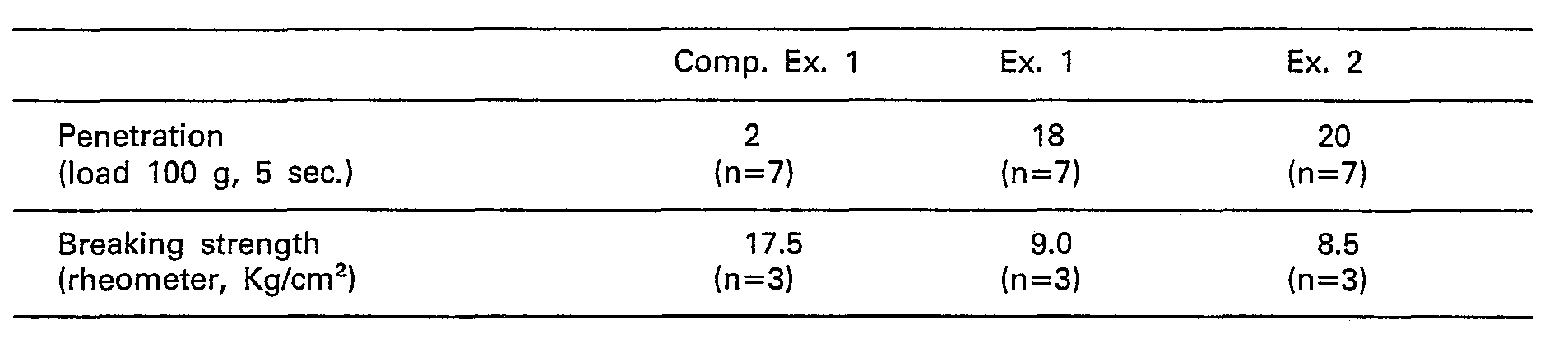
- The chewing gum according to the invention was prepared, using the a-starch gel A (water content of 36.5%) or the a-starch gel B (water content of 32.0%) and other ingredients as shown in Table below. A comparative chewing gum was also prepared by the same procedure and ingredients except for the a-starch gel.

- The chewing gums thus prepared were tested for penetration of a loaded needle and breaking strength according to conventional methods. The results are shown in the following table.
- This Example illustrates the soft chewing gum of low sweetness with a curry flavor.
- The soft chewing gum of low sweetness was prepared, using the a-starch gel C (water content of 28.75%) or the a-starch gel D (water content of 22.3%) in combination with sugars and dextrin of DE 25, as well as other ingredients, as shown in Table below. A comparative chewing gum using the malt honey but excluding the a-starch gel was also prepared in the same procedure.

- The chewing gum thus prepared were evaluated in an organoleptic test by means of a panel consisting of 15 members. The results are shown in the following Table.

- In the above experiments, the following composition of the a-starch gel A to D were used:

- As apparent from the above results, the incorporation of the a-starch gel in substitution for a portion or all of the malt honey may provide the soft chewing gum retaining the softness at the low temperature. Further, the combined use of the dextrin of DE 2 to 50 may provide the soft chewing gum of low sweetness.
- Two types of Turkish delight were prepared for use in the following Examples 4 and 5, using rice-flour of substantially amylopectin.

- The chewing gums of rice cake consistency according to the invention were prepared, using the Turkish delight A and B as described in Example 3, and other ingredients as shown in Table below. Comparative chewing gums were also prepared in the same manner but using the malt honey in place of the Turkish delight.

- The chewing gums of Example 4 and Comparative 3 were evaluated in an organoleptic test by a panel consisting of 30 members. The results are shown in the following table.

- The chewing gums of Example 5 and Comparative 4 were fabricated into stuffed chewing gums containing jam as a center filling by means of an enveloping machine. These two stuffed chewing gums were evaluated in another organoleptic test by a panel consisting of 30 members. The results are shown in the following table.

- Comparison of Example 4 with Comparative 3 shows that the substitution of the Turkish delight for all of the malt honey provides a significant property of rice cake.
- Comparison of Example 5 with Comparative 4 also shows that the substitution of the Turkish delight for a portion of the malt honey provide a significant property of rice cake.
- A soft chewing gum of low sweetness having a consistency of rice cake was prepared, using ingredients as shown in Table below. A comparative chewing gum also prepared by the same procedure but excluding the Turkish delight.

- Comparison of Example 6 with Comparative 5 shows that the substitution of the Turkish delight A for all of the malt honey provides a very soft chewing gum of rice cake consistency, and that Comparative 5 provides a semi-fluid chewing gum which is deformed upon standing.
- The chewing gum of Example 6 was fabricated into a stuffed chewing gum enclosing a bean jam by means of an enveloping machine. A usual stuffed rice cake hardened within four days and was infected with molds, whereas the stuffed chewing gum of the invention neither hardened nor infected for two weeks. Upon chewing, the stuffed chewing gum of the invention was converted from the rice cake consistency to a bubble gum texture of good expansion.
Claims (7)
Priority Applications (1)
| Application Number | Priority Date | Filing Date | Title |
|---|---|---|---|
| DE8585106235T DE3564368D1 (en) | 1985-05-21 | 1985-05-21 | A soft starchy chewing gum |
Applications Claiming Priority (2)
| Application Number | Priority Date | Filing Date | Title |
|---|---|---|---|
| JP58220758A JPS60114149A (en) | 1983-11-25 | 1983-11-25 | Chewing gum made of processed starch |
| JP59187272A JPS6167445A (en) | 1984-09-08 | 1984-09-08 | 'mochi' (rice cake)-like chewing gum |
Publications (2)
| Publication Number | Publication Date |
|---|---|
| EP0202350A1 EP0202350A1 (en) | 1986-11-26 |
| EP0202350B1 true EP0202350B1 (en) | 1988-08-17 |
Family
ID=26504249
Family Applications (1)
| Application Number | Title | Priority Date | Filing Date |
|---|---|---|---|
| EP19850106235 Expired EP0202350B1 (en) | 1983-11-25 | 1985-05-21 | A soft starchy chewing gum |
Country Status (1)
| Country | Link |
|---|---|
| EP (1) | EP0202350B1 (en) |
Families Citing this family (1)
| Publication number | Priority date | Publication date | Assignee | Title |
|---|---|---|---|---|
| AU2006251746B2 (en) * | 2005-05-23 | 2010-05-06 | Intercontinental Great Brands Llc | Center-filled chewing gum composition |
Family Cites Families (7)
| Publication number | Priority date | Publication date | Assignee | Title |
|---|---|---|---|---|
| FR703978A (en) * | 1930-08-09 | 1931-05-08 | Chewing gums | |
| US3862338A (en) * | 1971-08-10 | 1975-01-21 | Topps Chewing Gum Inc | Cast chewing gum product and method of making the same |
| JPS5561766A (en) * | 1978-10-31 | 1980-05-09 | Lotte Co Ltd | Cold-resistant chewing gum |
| DE3010836C2 (en) * | 1980-03-21 | 1982-10-28 | Barnängen Deutschland GmbH, 5020 Frechen | Chewing gum and its manufacture |
| US4465694A (en) * | 1980-12-10 | 1984-08-14 | Ajinomoto Company, Incorporated | Dipeptide sweetening composition |
| US4514423A (en) * | 1981-05-22 | 1985-04-30 | Lotte Co., Ltd. | Process of preparing an improved bubble chewing gum |
| US4557927A (en) * | 1983-03-10 | 1985-12-10 | Kabushiki Kaisha Hoyashibara | Food products and process for producing same |
-
1985
- 1985-05-21 EP EP19850106235 patent/EP0202350B1/en not_active Expired
Also Published As
| Publication number | Publication date |
|---|---|
| EP0202350A1 (en) | 1986-11-26 |
Similar Documents
| Publication | Publication Date | Title |
|---|---|---|
| US4707363A (en) | Soft starchy chewing gum | |
| EP0377278B1 (en) | Dietetic sweetening composition | |
| US4614654A (en) | Taffy-like chewing gum confection and method | |
| US5580601A (en) | Grainy confectionery product and process for manufacturing the said confectionery product | |
| US3205075A (en) | Multi-flavor slab chewing gum | |
| US4254148A (en) | Coldproof chewing gum | |
| JPS6219817B2 (en) | ||
| US5011704A (en) | Fudge sauce and frozen confection | |
| EP0541248B1 (en) | Non-sticky fat-containing confection | |
| US4415596A (en) | Coated confectionery with a high protein content and process for production thereof | |
| JP3630900B2 (en) | Gummy candy composition | |
| US3692542A (en) | Soft candy containing confectionery syrup | |
| EP0378614A4 (en) | Non-staling gum composition with improved wrappability | |
| JP2882903B2 (en) | Method for producing confectionery containing polydextrose | |
| EP0202350A1 (en) | A soft starchy chewing gum | |
| US3809756A (en) | Lower calorie candy | |
| US3163543A (en) | Process of producing gelatin products | |
| JP2793271B2 (en) | Low calorie low carious candy with improved palatability and method for producing the same | |
| JPH10215773A (en) | Chocolate containing spray-dried glucose | |
| JPH0376906B2 (en) | ||
| WO2021119273A1 (en) | Low water activity marshmallow | |
| KR880000980B1 (en) | Process for producing chewing gum shaped glutinous rice cake | |
| JPS6185149A (en) | Aspartame-containing ice cream | |
| KR880000981B1 (en) | Process for producing soft chewing gum | |
| JP3115249B2 (en) | Manufacturing method of baked sweets |
Legal Events
| Date | Code | Title | Description |
|---|---|---|---|
| PUAI | Public reference made under article 153(3) epc to a published international application that has entered the european phase |
Free format text: ORIGINAL CODE: 0009012 |
|
| 17P | Request for examination filed |
Effective date: 19860710 |
|
| AK | Designated contracting states |
Kind code of ref document: A1 Designated state(s): DE FR GB IT SE |
|
| 17Q | First examination report despatched |
Effective date: 19870422 |
|
| GRAA | (expected) grant |
Free format text: ORIGINAL CODE: 0009210 |
|
| ITF | It: translation for a ep patent filed | ||
| AK | Designated contracting states |
Kind code of ref document: B1 Designated state(s): DE FR GB IT SE |
|
| REF | Corresponds to: |
Ref document number: 3564368 Country of ref document: DE Date of ref document: 19880922 |
|
| ET | Fr: translation filed | ||
| PLBE | No opposition filed within time limit |
Free format text: ORIGINAL CODE: 0009261 |
|
| STAA | Information on the status of an ep patent application or granted ep patent |
Free format text: STATUS: NO OPPOSITION FILED WITHIN TIME LIMIT |
|
| 26N | No opposition filed | ||
| ITTA | It: last paid annual fee | ||
| EAL | Se: european patent in force in sweden |
Ref document number: 85106235.6 |
|
| PGFP | Annual fee paid to national office [announced via postgrant information from national office to epo] |
Ref country code: GB Payment date: 19960514 Year of fee payment: 12 |
|
| PGFP | Annual fee paid to national office [announced via postgrant information from national office to epo] |
Ref country code: FR Payment date: 19960515 Year of fee payment: 12 |
|
| PGFP | Annual fee paid to national office [announced via postgrant information from national office to epo] |
Ref country code: SE Payment date: 19960530 Year of fee payment: 12 Ref country code: DE Payment date: 19960530 Year of fee payment: 12 |
|
| PG25 | Lapsed in a contracting state [announced via postgrant information from national office to epo] |
Ref country code: GB Effective date: 19970521 |
|
| PG25 | Lapsed in a contracting state [announced via postgrant information from national office to epo] |
Ref country code: SE Effective date: 19970522 |
|
| GBPC | Gb: european patent ceased through non-payment of renewal fee |
Effective date: 19970521 |
|
| PG25 | Lapsed in a contracting state [announced via postgrant information from national office to epo] |
Ref country code: FR Free format text: LAPSE BECAUSE OF NON-PAYMENT OF DUE FEES Effective date: 19980130 |
|
| EUG | Se: european patent has lapsed |
Ref document number: 85106235.6 |
|
| PG25 | Lapsed in a contracting state [announced via postgrant information from national office to epo] |
Ref country code: DE Free format text: LAPSE BECAUSE OF NON-PAYMENT OF DUE FEES Effective date: 19980203 |
|
| REG | Reference to a national code |
Ref country code: FR Ref legal event code: ST |