EP0195413B1 - Substituted pyridine derivatives - Google Patents
Substituted pyridine derivatives Download PDFInfo
- Publication number
- EP0195413B1 EP0195413B1 EP86103662A EP86103662A EP0195413B1 EP 0195413 B1 EP0195413 B1 EP 0195413B1 EP 86103662 A EP86103662 A EP 86103662A EP 86103662 A EP86103662 A EP 86103662A EP 0195413 B1 EP0195413 B1 EP 0195413B1
- Authority
- EP
- European Patent Office
- Prior art keywords
- molecule
- group
- aryl
- fluorescently detectable
- hydrogen
- Prior art date
- Legal status (The legal status is an assumption and is not a legal conclusion. Google has not performed a legal analysis and makes no representation as to the accuracy of the status listed.)
- Expired - Lifetime
Links
- 150000003222 pyridines Chemical class 0.000 title description 14
- JUJWROOIHBZHMG-UHFFFAOYSA-N Pyridine Chemical group C1=CC=NC=C1 JUJWROOIHBZHMG-UHFFFAOYSA-N 0.000 claims description 37
- -1 rare earth metal ion Chemical class 0.000 claims description 33
- 238000000034 method Methods 0.000 claims description 31
- 125000003118 aryl group Chemical group 0.000 claims description 30
- 239000001257 hydrogen Substances 0.000 claims description 27
- 229910052739 hydrogen Inorganic materials 0.000 claims description 27
- 229910052761 rare earth metal Inorganic materials 0.000 claims description 25
- UFHFLCQGNIYNRP-UHFFFAOYSA-N Hydrogen Chemical compound [H][H] UFHFLCQGNIYNRP-UHFFFAOYSA-N 0.000 claims description 19
- 150000001875 compounds Chemical class 0.000 claims description 17
- 229910021645 metal ion Chemical group 0.000 claims description 15
- 150000002910 rare earth metals Chemical class 0.000 claims description 15
- 125000003277 amino group Chemical group 0.000 claims description 14
- 125000005647 linker group Chemical group 0.000 claims description 12
- UMJSCPRVCHMLSP-UHFFFAOYSA-N pyridine Natural products COC1=CC=CN=C1 UMJSCPRVCHMLSP-UHFFFAOYSA-N 0.000 claims description 12
- 125000004104 aryloxy group Chemical group 0.000 claims description 11
- 125000004435 hydrogen atom Chemical group [H]* 0.000 claims description 11
- 125000004178 (C1-C4) alkyl group Chemical group 0.000 claims description 10
- 125000001997 phenyl group Chemical group [H]C1=C([H])C([H])=C(*)C([H])=C1[H] 0.000 claims description 10
- 125000000229 (C1-C4)alkoxy group Chemical group 0.000 claims description 9
- 239000011149 active material Substances 0.000 claims description 9
- 125000004103 aminoalkyl group Chemical group 0.000 claims description 9
- 239000013522 chelant Substances 0.000 claims description 9
- 239000003153 chemical reaction reagent Substances 0.000 claims description 9
- 125000004663 dialkyl amino group Chemical group 0.000 claims description 9
- 230000005284 excitation Effects 0.000 claims description 9
- 125000002924 primary amino group Chemical group [H]N([H])* 0.000 claims description 9
- 125000003710 aryl alkyl group Chemical group 0.000 claims description 7
- 125000002102 aryl alkyloxo group Chemical group 0.000 claims description 7
- 125000003178 carboxy group Chemical group [H]OC(*)=O 0.000 claims description 7
- 239000000126 substance Substances 0.000 claims description 5
- 150000002431 hydrogen Chemical class 0.000 claims description 3
- 125000003107 substituted aryl group Chemical group 0.000 claims description 3
- 125000001810 isothiocyanato group Chemical group *N=C=S 0.000 claims description 2
- 230000005855 radiation Effects 0.000 claims description 2
- 230000009870 specific binding Effects 0.000 claims 2
- YMWUJEATGCHHMB-UHFFFAOYSA-N Dichloromethane Chemical compound ClCCl YMWUJEATGCHHMB-UHFFFAOYSA-N 0.000 description 73
- XLYOFNOQVPJJNP-UHFFFAOYSA-N water Substances O XLYOFNOQVPJJNP-UHFFFAOYSA-N 0.000 description 37
- 239000000463 material Substances 0.000 description 32
- LFQSCWFLJHTTHZ-UHFFFAOYSA-N Ethanol Chemical compound CCO LFQSCWFLJHTTHZ-UHFFFAOYSA-N 0.000 description 31
- OKKJLVBELUTLKV-UHFFFAOYSA-N Methanol Chemical group OC OKKJLVBELUTLKV-UHFFFAOYSA-N 0.000 description 31
- 239000000047 product Substances 0.000 description 25
- 239000000243 solution Substances 0.000 description 25
- 229910001868 water Inorganic materials 0.000 description 25
- XEKOWRVHYACXOJ-UHFFFAOYSA-N Ethyl acetate Chemical compound CCOC(C)=O XEKOWRVHYACXOJ-UHFFFAOYSA-N 0.000 description 22
- 239000000203 mixture Substances 0.000 description 21
- ZFXYFBGIUFBOJW-UHFFFAOYSA-N theophylline Chemical compound O=C1N(C)C(=O)N(C)C2=C1NC=N2 ZFXYFBGIUFBOJW-UHFFFAOYSA-N 0.000 description 21
- VYPSYNLAJGMNEJ-UHFFFAOYSA-N Silicium dioxide Chemical compound O=[Si]=O VYPSYNLAJGMNEJ-UHFFFAOYSA-N 0.000 description 19
- WEVYAHXRMPXWCK-UHFFFAOYSA-N Acetonitrile Chemical compound CC#N WEVYAHXRMPXWCK-UHFFFAOYSA-N 0.000 description 18
- 238000003756 stirring Methods 0.000 description 18
- XKRFYHLGVUSROY-UHFFFAOYSA-N Argon Chemical compound [Ar] XKRFYHLGVUSROY-UHFFFAOYSA-N 0.000 description 16
- KRKNYBCHXYNGOX-UHFFFAOYSA-N citric acid Chemical compound OC(=O)CC(O)(C(O)=O)CC(O)=O KRKNYBCHXYNGOX-UHFFFAOYSA-N 0.000 description 15
- 238000002360 preparation method Methods 0.000 description 15
- WYURNTSHIVDZCO-UHFFFAOYSA-N Tetrahydrofuran Chemical compound C1CCOC1 WYURNTSHIVDZCO-UHFFFAOYSA-N 0.000 description 14
- ZMXDDKWLCZADIW-UHFFFAOYSA-N N,N-Dimethylformamide Chemical compound CN(C)C=O ZMXDDKWLCZADIW-UHFFFAOYSA-N 0.000 description 13
- KWYUFKZDYYNOTN-UHFFFAOYSA-M Potassium hydroxide Chemical compound [OH-].[K+] KWYUFKZDYYNOTN-UHFFFAOYSA-M 0.000 description 12
- HEMHJVSKTPXQMS-UHFFFAOYSA-M Sodium hydroxide Chemical compound [OH-].[Na+] HEMHJVSKTPXQMS-UHFFFAOYSA-M 0.000 description 12
- 229960000278 theophylline Drugs 0.000 description 12
- LRHPLDYGYMQRHN-UHFFFAOYSA-N N-Butanol Chemical compound CCCCO LRHPLDYGYMQRHN-UHFFFAOYSA-N 0.000 description 11
- HUMNYLRZRPPJDN-UHFFFAOYSA-N benzenecarboxaldehyde Natural products O=CC1=CC=CC=C1 HUMNYLRZRPPJDN-UHFFFAOYSA-N 0.000 description 11
- DKGAVHZHDRPRBM-UHFFFAOYSA-N Tert-Butanol Chemical compound CC(C)(C)O DKGAVHZHDRPRBM-UHFFFAOYSA-N 0.000 description 10
- 150000001412 amines Chemical class 0.000 description 10
- UORVGPXVDQYIDP-UHFFFAOYSA-N borane Chemical compound B UORVGPXVDQYIDP-UHFFFAOYSA-N 0.000 description 10
- 235000019441 ethanol Nutrition 0.000 description 10
- CTSLXHKWHWQRSH-UHFFFAOYSA-N oxalyl chloride Chemical compound ClC(=O)C(Cl)=O CTSLXHKWHWQRSH-UHFFFAOYSA-N 0.000 description 10
- 239000007787 solid Substances 0.000 description 10
- UHOVQNZJYSORNB-UHFFFAOYSA-N Benzene Chemical compound C1=CC=CC=C1 UHOVQNZJYSORNB-UHFFFAOYSA-N 0.000 description 9
- PMZURENOXWZQFD-UHFFFAOYSA-L Sodium Sulfate Chemical compound [Na+].[Na+].[O-]S([O-])(=O)=O PMZURENOXWZQFD-UHFFFAOYSA-L 0.000 description 9
- YXFVVABEGXRONW-UHFFFAOYSA-N Toluene Chemical compound CC1=CC=CC=C1 YXFVVABEGXRONW-UHFFFAOYSA-N 0.000 description 9
- 235000019439 ethyl acetate Nutrition 0.000 description 9
- 229910052938 sodium sulfate Inorganic materials 0.000 description 9
- 235000011152 sodium sulphate Nutrition 0.000 description 9
- 125000001424 substituent group Chemical group 0.000 description 9
- 239000007832 Na2SO4 Substances 0.000 description 8
- 229910052786 argon Inorganic materials 0.000 description 8
- 238000006243 chemical reaction Methods 0.000 description 8
- 229910052771 Terbium Inorganic materials 0.000 description 7
- 238000007792 addition Methods 0.000 description 7
- 238000003556 assay Methods 0.000 description 7
- 239000013078 crystal Substances 0.000 description 7
- 239000000284 extract Substances 0.000 description 7
- 239000000543 intermediate Substances 0.000 description 7
- 239000003446 ligand Substances 0.000 description 7
- OLAPPGSPBNVTRF-UHFFFAOYSA-N naphthalene-1,4,5,8-tetracarboxylic acid Chemical compound C1=CC(C(O)=O)=C2C(C(=O)O)=CC=C(C(O)=O)C2=C1C(O)=O OLAPPGSPBNVTRF-UHFFFAOYSA-N 0.000 description 7
- 238000007127 saponification reaction Methods 0.000 description 7
- GZCRRIHWUXGPOV-UHFFFAOYSA-N terbium atom Chemical compound [Tb] GZCRRIHWUXGPOV-UHFFFAOYSA-N 0.000 description 7
- CSCPPACGZOOCGX-UHFFFAOYSA-N Acetone Chemical compound CC(C)=O CSCPPACGZOOCGX-UHFFFAOYSA-N 0.000 description 6
- VEXZGXHMUGYJMC-UHFFFAOYSA-N Hydrochloric acid Chemical compound Cl VEXZGXHMUGYJMC-UHFFFAOYSA-N 0.000 description 6
- KDLHZDBZIXYQEI-UHFFFAOYSA-N Palladium Chemical compound [Pd] KDLHZDBZIXYQEI-UHFFFAOYSA-N 0.000 description 6
- CDBYLPFSWZWCQE-UHFFFAOYSA-L Sodium Carbonate Chemical compound [Na+].[Na+].[O-]C([O-])=O CDBYLPFSWZWCQE-UHFFFAOYSA-L 0.000 description 6
- 239000003054 catalyst Substances 0.000 description 6
- 150000002009 diols Chemical class 0.000 description 6
- 239000003480 eluent Substances 0.000 description 6
- 150000002148 esters Chemical class 0.000 description 6
- VLKZOEOYAKHREP-UHFFFAOYSA-N n-Hexane Chemical class CCCCCC VLKZOEOYAKHREP-UHFFFAOYSA-N 0.000 description 6
- QNGNSVIICDLXHT-UHFFFAOYSA-N para-ethylbenzaldehyde Natural products CCC1=CC=C(C=O)C=C1 QNGNSVIICDLXHT-UHFFFAOYSA-N 0.000 description 6
- 239000012286 potassium permanganate Substances 0.000 description 6
- 239000000741 silica gel Substances 0.000 description 6
- 229910002027 silica gel Inorganic materials 0.000 description 6
- 239000000377 silicon dioxide Substances 0.000 description 6
- GJFNRSDCSTVPCJ-UHFFFAOYSA-N 1,8-bis(dimethylamino)naphthalene Chemical compound C1=CC(N(C)C)=C2C(N(C)C)=CC=CC2=C1 GJFNRSDCSTVPCJ-UHFFFAOYSA-N 0.000 description 5
- 0 CCCNC1(C*(C)C(C)NC(C)*(C)CC1)C1CCCCCCCCC1 Chemical compound CCCNC1(C*(C)C(C)NC(C)*(C)CC1)C1CCCCCCCCC1 0.000 description 5
- RTZKZFJDLAIYFH-UHFFFAOYSA-N Diethyl ether Chemical compound CCOCC RTZKZFJDLAIYFH-UHFFFAOYSA-N 0.000 description 5
- 125000000217 alkyl group Chemical group 0.000 description 5
- 239000002585 base Substances 0.000 description 5
- 230000027455 binding Effects 0.000 description 5
- 229910000085 borane Inorganic materials 0.000 description 5
- WJJMNDUMQPNECX-UHFFFAOYSA-N dipicolinic acid Chemical compound OC(=O)C1=CC=CC(C(O)=O)=N1 WJJMNDUMQPNECX-UHFFFAOYSA-N 0.000 description 5
- 238000001035 drying Methods 0.000 description 5
- 238000001914 filtration Methods 0.000 description 5
- 125000000449 nitro group Chemical group [O-][N+](*)=O 0.000 description 5
- 102000004169 proteins and genes Human genes 0.000 description 5
- 239000011541 reaction mixture Substances 0.000 description 5
- 241000894007 species Species 0.000 description 5
- IJGRMHOSHXDMSA-UHFFFAOYSA-N Atomic nitrogen Chemical compound N#N IJGRMHOSHXDMSA-UHFFFAOYSA-N 0.000 description 4
- HEDRZPFGACZZDS-UHFFFAOYSA-N Chloroform Chemical compound ClC(Cl)Cl HEDRZPFGACZZDS-UHFFFAOYSA-N 0.000 description 4
- 229910052693 Europium Inorganic materials 0.000 description 4
- WTDHULULXKLSOZ-UHFFFAOYSA-N Hydroxylamine hydrochloride Chemical compound Cl.ON WTDHULULXKLSOZ-UHFFFAOYSA-N 0.000 description 4
- 239000002253 acid Substances 0.000 description 4
- 125000004202 aminomethyl group Chemical group [H]N([H])C([H])([H])* 0.000 description 4
- 229910052799 carbon Inorganic materials 0.000 description 4
- 230000008859 change Effects 0.000 description 4
- 239000012043 crude product Substances 0.000 description 4
- 125000004185 ester group Chemical group 0.000 description 4
- OGPBJKLSAFTDLK-UHFFFAOYSA-N europium atom Chemical compound [Eu] OGPBJKLSAFTDLK-UHFFFAOYSA-N 0.000 description 4
- 239000000706 filtrate Substances 0.000 description 4
- 229910052751 metal Inorganic materials 0.000 description 4
- 239000002184 metal Substances 0.000 description 4
- 125000001624 naphthyl group Chemical group 0.000 description 4
- BWHMMNNQKKPAPP-UHFFFAOYSA-L potassium carbonate Chemical compound [K+].[K+].[O-]C([O-])=O BWHMMNNQKKPAPP-UHFFFAOYSA-L 0.000 description 4
- 108090000623 proteins and genes Proteins 0.000 description 4
- 239000002904 solvent Substances 0.000 description 4
- YLQBMQCUIZJEEH-UHFFFAOYSA-N tetrahydrofuran Natural products C=1C=COC=1 YLQBMQCUIZJEEH-UHFFFAOYSA-N 0.000 description 4
- QAEDZJGFFMLHHQ-UHFFFAOYSA-N trifluoroacetic anhydride Chemical compound FC(F)(F)C(=O)OC(=O)C(F)(F)F QAEDZJGFFMLHHQ-UHFFFAOYSA-N 0.000 description 4
- RYHBNJHYFVUHQT-UHFFFAOYSA-N 1,4-Dioxane Chemical compound C1COCCO1 RYHBNJHYFVUHQT-UHFFFAOYSA-N 0.000 description 3
- VHENPTPXTMAFOQ-UHFFFAOYSA-N 4-phenylpyridine-2,6-dicarboxylic acid Chemical compound OC(=O)C1=NC(C(=O)O)=CC(C=2C=CC=CC=2)=C1 VHENPTPXTMAFOQ-UHFFFAOYSA-N 0.000 description 3
- WFDIJRYMOXRFFG-UHFFFAOYSA-N Acetic anhydride Chemical compound CC(=O)OC(C)=O WFDIJRYMOXRFFG-UHFFFAOYSA-N 0.000 description 3
- VEXZGXHMUGYJMC-UHFFFAOYSA-M Chloride anion Chemical compound [Cl-] VEXZGXHMUGYJMC-UHFFFAOYSA-M 0.000 description 3
- IAZDPXIOMUYVGZ-UHFFFAOYSA-N Dimethylsulphoxide Chemical compound CS(C)=O IAZDPXIOMUYVGZ-UHFFFAOYSA-N 0.000 description 3
- ZMANZCXQSJIPKH-UHFFFAOYSA-N Triethylamine Chemical compound CCN(CC)CC ZMANZCXQSJIPKH-UHFFFAOYSA-N 0.000 description 3
- 239000000427 antigen Substances 0.000 description 3
- 102000036639 antigens Human genes 0.000 description 3
- 108091007433 antigens Proteins 0.000 description 3
- 150000003935 benzaldehydes Chemical class 0.000 description 3
- SBZXBUIDTXKZTM-UHFFFAOYSA-N diglyme Chemical compound COCCOCCOC SBZXBUIDTXKZTM-UHFFFAOYSA-N 0.000 description 3
- 125000002887 hydroxy group Chemical group [H]O* 0.000 description 3
- 239000007788 liquid Substances 0.000 description 3
- 238000005259 measurement Methods 0.000 description 3
- VLTRZXGMWDSKGL-UHFFFAOYSA-N perchloric acid Chemical compound OCl(=O)(=O)=O VLTRZXGMWDSKGL-UHFFFAOYSA-N 0.000 description 3
- 230000008569 process Effects 0.000 description 3
- 230000009467 reduction Effects 0.000 description 3
- 238000010992 reflux Methods 0.000 description 3
- 150000003839 salts Chemical class 0.000 description 3
- 229910000029 sodium carbonate Inorganic materials 0.000 description 3
- 235000017550 sodium carbonate Nutrition 0.000 description 3
- HFRXJVQOXRXOPP-UHFFFAOYSA-N thionyl bromide Chemical compound BrS(Br)=O HFRXJVQOXRXOPP-UHFFFAOYSA-N 0.000 description 3
- YBJHBAHKTGYVGT-ZKWXMUAHSA-N (+)-Biotin Chemical compound N1C(=O)N[C@@H]2[C@H](CCCCC(=O)O)SC[C@@H]21 YBJHBAHKTGYVGT-ZKWXMUAHSA-N 0.000 description 2
- LWRSYTXEQUUTKW-UHFFFAOYSA-N 2,4-dimethoxybenzaldehyde Chemical compound COC1=CC=C(C=O)C(OC)=C1 LWRSYTXEQUUTKW-UHFFFAOYSA-N 0.000 description 2
- NGNBDVOYPDDBFK-UHFFFAOYSA-N 2-[2,4-di(pentan-2-yl)phenoxy]acetyl chloride Chemical compound CCCC(C)C1=CC=C(OCC(Cl)=O)C(C(C)CCC)=C1 NGNBDVOYPDDBFK-UHFFFAOYSA-N 0.000 description 2
- IEMMBWWQXVXBEU-UHFFFAOYSA-N 2-acetylfuran Chemical compound CC(=O)C1=CC=CO1 IEMMBWWQXVXBEU-UHFFFAOYSA-N 0.000 description 2
- JSHLOPGSDZTEGQ-UHFFFAOYSA-N 3-methoxy-4-phenylmethoxybenzaldehyde Chemical compound COC1=CC(C=O)=CC=C1OCC1=CC=CC=C1 JSHLOPGSDZTEGQ-UHFFFAOYSA-N 0.000 description 2
- NGBYKZGOXFIONW-UHFFFAOYSA-N 4-(1,3-dimethyl-2,6-dioxo-7h-purin-8-yl)butanoic acid Chemical compound O=C1N(C)C(=O)N(C)C2=C1NC(CCCC(O)=O)=N2 NGBYKZGOXFIONW-UHFFFAOYSA-N 0.000 description 2
- OAYOQSZHLOLFEE-UHFFFAOYSA-N 4-phenylpyridine-2,6-dicarbonitrile Chemical compound N#CC1=NC(C#N)=CC(C=2C=CC=CC=2)=C1 OAYOQSZHLOLFEE-UHFFFAOYSA-N 0.000 description 2
- WLEBRPADMRCYCX-UHFFFAOYSA-N 4-phenylpyridine-2,6-dicarboxamide Chemical compound NC(=O)C1=NC(C(=O)N)=CC(C=2C=CC=CC=2)=C1 WLEBRPADMRCYCX-UHFFFAOYSA-N 0.000 description 2
- 108010088751 Albumins Proteins 0.000 description 2
- 102000009027 Albumins Human genes 0.000 description 2
- VHUUQVKOLVNVRT-UHFFFAOYSA-N Ammonium hydroxide Chemical compound [NH4+].[OH-] VHUUQVKOLVNVRT-UHFFFAOYSA-N 0.000 description 2
- OAKJQQAXSVQMHS-UHFFFAOYSA-N Hydrazine Chemical compound NN OAKJQQAXSVQMHS-UHFFFAOYSA-N 0.000 description 2
- CPELXLSAUQHCOX-UHFFFAOYSA-N Hydrogen bromide Chemical group Br CPELXLSAUQHCOX-UHFFFAOYSA-N 0.000 description 2
- AVXURJPOCDRRFD-UHFFFAOYSA-N Hydroxylamine Chemical compound ON AVXURJPOCDRRFD-UHFFFAOYSA-N 0.000 description 2
- VNYJDSJLCWDYJK-UHFFFAOYSA-N Methyl 2-[(2-methoxy-2-oxoethyl)amino]acetate Chemical compound COC(=O)CNCC(=O)OC VNYJDSJLCWDYJK-UHFFFAOYSA-N 0.000 description 2
- GRYLNZFGIOXLOG-UHFFFAOYSA-N Nitric acid Chemical compound O[N+]([O-])=O GRYLNZFGIOXLOG-UHFFFAOYSA-N 0.000 description 2
- OFBQJSOFQDEBGM-UHFFFAOYSA-N Pentane Chemical compound CCCCC OFBQJSOFQDEBGM-UHFFFAOYSA-N 0.000 description 2
- XYFCBTPGUUZFHI-UHFFFAOYSA-N Phosphine Chemical compound P XYFCBTPGUUZFHI-UHFFFAOYSA-N 0.000 description 2
- FAPWRFPIFSIZLT-UHFFFAOYSA-M Sodium chloride Chemical compound [Na+].[Cl-] FAPWRFPIFSIZLT-UHFFFAOYSA-M 0.000 description 2
- 150000007513 acids Chemical class 0.000 description 2
- 125000003545 alkoxy group Chemical group 0.000 description 2
- 150000001347 alkyl bromides Chemical class 0.000 description 2
- 150000001408 amides Chemical class 0.000 description 2
- 235000011114 ammonium hydroxide Nutrition 0.000 description 2
- 239000012298 atmosphere Substances 0.000 description 2
- DLGYNVMUCSTYDQ-UHFFFAOYSA-N azane;pyridine Chemical compound N.C1=CC=NC=C1 DLGYNVMUCSTYDQ-UHFFFAOYSA-N 0.000 description 2
- ZYGHJZDHTFUPRJ-UHFFFAOYSA-N benzo-alpha-pyrone Chemical class C1=CC=C2OC(=O)C=CC2=C1 ZYGHJZDHTFUPRJ-UHFFFAOYSA-N 0.000 description 2
- 229910021538 borax Inorganic materials 0.000 description 2
- GDTBXPJZTBHREO-UHFFFAOYSA-N bromine Substances BrBr GDTBXPJZTBHREO-UHFFFAOYSA-N 0.000 description 2
- 150000004697 chelate complex Chemical class 0.000 description 2
- ZPUCINDJVBIVPJ-LJISPDSOSA-N cocaine Chemical compound O([C@H]1C[C@@H]2CC[C@@H](N2C)[C@H]1C(=O)OC)C(=O)C1=CC=CC=C1 ZPUCINDJVBIVPJ-LJISPDSOSA-N 0.000 description 2
- 230000000295 complement effect Effects 0.000 description 2
- 235000001671 coumarin Nutrition 0.000 description 2
- 150000004775 coumarins Chemical class 0.000 description 2
- 230000008878 coupling Effects 0.000 description 2
- 238000010168 coupling process Methods 0.000 description 2
- 238000005859 coupling reaction Methods 0.000 description 2
- 125000000664 diazo group Chemical group [N-]=[N+]=[*] 0.000 description 2
- 229940079593 drug Drugs 0.000 description 2
- 239000003814 drug Substances 0.000 description 2
- 238000001704 evaporation Methods 0.000 description 2
- 230000008020 evaporation Effects 0.000 description 2
- 125000000524 functional group Chemical group 0.000 description 2
- 150000004676 glycans Chemical class 0.000 description 2
- 238000010438 heat treatment Methods 0.000 description 2
- 229940088597 hormone Drugs 0.000 description 2
- 239000005556 hormone Substances 0.000 description 2
- JYGXADMDTFJGBT-VWUMJDOOSA-N hydrocortisone Chemical compound O=C1CC[C@]2(C)[C@H]3[C@@H](O)C[C@](C)([C@@](CC4)(O)C(=O)CO)[C@@H]4[C@@H]3CCC2=C1 JYGXADMDTFJGBT-VWUMJDOOSA-N 0.000 description 2
- 208000015181 infectious disease Diseases 0.000 description 2
- NOESYZHRGYRDHS-UHFFFAOYSA-N insulin Chemical compound N1C(=O)C(NC(=O)C(CCC(N)=O)NC(=O)C(CCC(O)=O)NC(=O)C(C(C)C)NC(=O)C(NC(=O)CN)C(C)CC)CSSCC(C(NC(CO)C(=O)NC(CC(C)C)C(=O)NC(CC=2C=CC(O)=CC=2)C(=O)NC(CCC(N)=O)C(=O)NC(CC(C)C)C(=O)NC(CCC(O)=O)C(=O)NC(CC(N)=O)C(=O)NC(CC=2C=CC(O)=CC=2)C(=O)NC(CSSCC(NC(=O)C(C(C)C)NC(=O)C(CC(C)C)NC(=O)C(CC=2C=CC(O)=CC=2)NC(=O)C(CC(C)C)NC(=O)C(C)NC(=O)C(CCC(O)=O)NC(=O)C(C(C)C)NC(=O)C(CC(C)C)NC(=O)C(CC=2NC=NC=2)NC(=O)C(CO)NC(=O)CNC2=O)C(=O)NCC(=O)NC(CCC(O)=O)C(=O)NC(CCCNC(N)=N)C(=O)NCC(=O)NC(CC=3C=CC=CC=3)C(=O)NC(CC=3C=CC=CC=3)C(=O)NC(CC=3C=CC(O)=CC=3)C(=O)NC(C(C)O)C(=O)N3C(CCC3)C(=O)NC(CCCCN)C(=O)NC(C)C(O)=O)C(=O)NC(CC(N)=O)C(O)=O)=O)NC(=O)C(C(C)CC)NC(=O)C(CO)NC(=O)C(C(C)O)NC(=O)C1CSSCC2NC(=O)C(CC(C)C)NC(=O)C(NC(=O)C(CCC(N)=O)NC(=O)C(CC(N)=O)NC(=O)C(NC(=O)C(N)CC=1C=CC=CC=1)C(C)C)CC1=CN=CN1 NOESYZHRGYRDHS-UHFFFAOYSA-N 0.000 description 2
- 150000002540 isothiocyanates Chemical class 0.000 description 2
- 239000007791 liquid phase Substances 0.000 description 2
- 239000002207 metabolite Substances 0.000 description 2
- YDCHPLOFQATIDS-UHFFFAOYSA-N methyl 2-bromoacetate Chemical compound COC(=O)CBr YDCHPLOFQATIDS-UHFFFAOYSA-N 0.000 description 2
- BQJCRHHNABKAKU-KBQPJGBKSA-N morphine Chemical compound O([C@H]1[C@H](C=C[C@H]23)O)C4=C5[C@@]12CCN(C)[C@@H]3CC5=CC=C4O BQJCRHHNABKAKU-KBQPJGBKSA-N 0.000 description 2
- 150000004002 naphthaldehydes Chemical class 0.000 description 2
- 229910052757 nitrogen Inorganic materials 0.000 description 2
- 229910000510 noble metal Inorganic materials 0.000 description 2
- 239000000575 pesticide Substances 0.000 description 2
- 239000012071 phase Substances 0.000 description 2
- 150000005041 phenanthrolines Chemical class 0.000 description 2
- 150000003014 phosphoric acid esters Chemical class 0.000 description 2
- BASFCYQUMIYNBI-UHFFFAOYSA-N platinum Substances [Pt] BASFCYQUMIYNBI-UHFFFAOYSA-N 0.000 description 2
- 229920001282 polysaccharide Polymers 0.000 description 2
- 239000005017 polysaccharide Substances 0.000 description 2
- 229910000027 potassium carbonate Inorganic materials 0.000 description 2
- 239000002244 precipitate Substances 0.000 description 2
- 238000000746 purification Methods 0.000 description 2
- 238000006862 quantum yield reaction Methods 0.000 description 2
- 239000000700 radioactive tracer Substances 0.000 description 2
- 239000012279 sodium borohydride Substances 0.000 description 2
- 229910000033 sodium borohydride Inorganic materials 0.000 description 2
- 235000010339 sodium tetraborate Nutrition 0.000 description 2
- 150000003431 steroids Chemical class 0.000 description 2
- ZWZVWGITAAIFPS-UHFFFAOYSA-N thiophosgene Chemical compound ClC(Cl)=S ZWZVWGITAAIFPS-UHFFFAOYSA-N 0.000 description 2
- RIOQSEWOXXDEQQ-UHFFFAOYSA-N triphenylphosphine Chemical compound C1=CC=CC=C1P(C=1C=CC=CC=1)C1=CC=CC=C1 RIOQSEWOXXDEQQ-UHFFFAOYSA-N 0.000 description 2
- BSVBQGMMJUBVOD-UHFFFAOYSA-N trisodium borate Chemical compound [Na+].[Na+].[Na+].[O-]B([O-])[O-] BSVBQGMMJUBVOD-UHFFFAOYSA-N 0.000 description 2
- PROQIPRRNZUXQM-UHFFFAOYSA-N (16alpha,17betaOH)-Estra-1,3,5(10)-triene-3,16,17-triol Natural products OC1=CC=C2C3CCC(C)(C(C(O)C4)O)C4C3CCC2=C1 PROQIPRRNZUXQM-UHFFFAOYSA-N 0.000 description 1
- RHPUHWSDFUFRME-UHFFFAOYSA-N 1,5-bis(furan-2-yl)-3-phenylpentane-1,5-dione Chemical compound C=1C=COC=1C(=O)CC(C=1C=CC=CC=1)CC(=O)C1=CC=CO1 RHPUHWSDFUFRME-UHFFFAOYSA-N 0.000 description 1
- NBSMGLDFVIHMBU-UHFFFAOYSA-N 1,5-bis(furan-2-yl)pentane-1,5-dione Chemical compound C=1C=COC=1C(=O)CCCC(=O)C1=CC=CO1 NBSMGLDFVIHMBU-UHFFFAOYSA-N 0.000 description 1
- XEZNGIUYQVAUSS-UHFFFAOYSA-N 18-crown-6 Chemical compound C1COCCOCCOCCOCCOCCO1 XEZNGIUYQVAUSS-UHFFFAOYSA-N 0.000 description 1
- HGUFODBRKLSHSI-UHFFFAOYSA-N 2,3,7,8-tetrachloro-dibenzo-p-dioxin Chemical compound O1C2=CC(Cl)=C(Cl)C=C2OC2=C1C=C(Cl)C(Cl)=C2 HGUFODBRKLSHSI-UHFFFAOYSA-N 0.000 description 1
- PAYFUCQDKDWTMY-UHFFFAOYSA-N 2,3-bis(furan-2-yl)pyridine Chemical compound C1=COC(C=2C(=NC=CC=2)C=2OC=CC=2)=C1 PAYFUCQDKDWTMY-UHFFFAOYSA-N 0.000 description 1
- FHANLFYAQQISLI-UHFFFAOYSA-N 2,6-bis(bromomethyl)-4-(3-methoxy-4-phenylmethoxyphenyl)pyridine Chemical compound COC1=CC(C=2C=C(CBr)N=C(CBr)C=2)=CC=C1OCC1=CC=CC=C1 FHANLFYAQQISLI-UHFFFAOYSA-N 0.000 description 1
- WKEPWRSCJKIQHP-UHFFFAOYSA-N 2,6-bis(bromomethyl)-4-(3-nitrophenyl)pyridine Chemical compound [O-][N+](=O)C1=CC=CC(C=2C=C(CBr)N=C(CBr)C=2)=C1 WKEPWRSCJKIQHP-UHFFFAOYSA-N 0.000 description 1
- PFZUPZWMAKXYON-UHFFFAOYSA-N 2,6-bis(furan-2-yl)-4-(3-methoxy-4-phenylmethoxyphenyl)pyridine Chemical compound COC1=CC(C=2C=C(N=C(C=2)C=2OC=CC=2)C=2OC=CC=2)=CC=C1OCC1=CC=CC=C1 PFZUPZWMAKXYON-UHFFFAOYSA-N 0.000 description 1
- ZUMKQZPYGJPIHP-UHFFFAOYSA-N 2,6-bis(furan-2-yl)-4-phenylpyridine Chemical compound C1=COC(C=2N=C(C=C(C=2)C=2C=CC=CC=2)C=2OC=CC=2)=C1 ZUMKQZPYGJPIHP-UHFFFAOYSA-N 0.000 description 1
- CABMTIJINOIHOD-UHFFFAOYSA-N 2-[4-methyl-5-oxo-4-(propan-2-yl)-4,5-dihydro-1H-imidazol-2-yl]quinoline-3-carboxylic acid Chemical compound N1C(=O)C(C(C)C)(C)N=C1C1=NC2=CC=CC=C2C=C1C(O)=O CABMTIJINOIHOD-UHFFFAOYSA-N 0.000 description 1
- AKMGJCXVBQHCEH-UHFFFAOYSA-N 2-[[6-[[bis(carboxymethyl)amino]methyl]-4-(2,4-dimethoxyphenyl)pyridin-2-yl]methyl-(carboxymethyl)amino]acetic acid Chemical compound COC1=CC(OC)=CC=C1C1=CC(CN(CC(O)=O)CC(O)=O)=NC(CN(CC(O)=O)CC(O)=O)=C1 AKMGJCXVBQHCEH-UHFFFAOYSA-N 0.000 description 1
- FZZMTSNZRBFGGU-UHFFFAOYSA-N 2-chloro-7-fluoroquinazolin-4-amine Chemical compound FC1=CC=C2C(N)=NC(Cl)=NC2=C1 FZZMTSNZRBFGGU-UHFFFAOYSA-N 0.000 description 1
- YOETUEMZNOLGDB-UHFFFAOYSA-N 2-methylpropyl carbonochloridate Chemical compound CC(C)COC(Cl)=O YOETUEMZNOLGDB-UHFFFAOYSA-N 0.000 description 1
- LJGHYPLBDBRCRZ-UHFFFAOYSA-N 3-(3-aminophenyl)sulfonylaniline Chemical group NC1=CC=CC(S(=O)(=O)C=2C=C(N)C=CC=2)=C1 LJGHYPLBDBRCRZ-UHFFFAOYSA-N 0.000 description 1
- KGUDYVVDFSTRKX-UHFFFAOYSA-N 3-naphthalen-1-yl-4-nitropyridine-2,6-dicarboxylic acid Chemical compound OC(=O)C1=NC(C(=O)O)=CC([N+]([O-])=O)=C1C1=CC=CC2=CC=CC=C12 KGUDYVVDFSTRKX-UHFFFAOYSA-N 0.000 description 1
- ZETIVVHRRQLWFW-UHFFFAOYSA-N 3-nitrobenzaldehyde Chemical compound [O-][N+](=O)C1=CC=CC(C=O)=C1 ZETIVVHRRQLWFW-UHFFFAOYSA-N 0.000 description 1
- RCVIPNAYFKYEKD-UHFFFAOYSA-N 4-(2,4-dimethoxyphenyl)pyridine-2,6-dicarboxylic acid Chemical compound COC1=CC(OC)=CC=C1C1=CC(C(O)=O)=NC(C(O)=O)=C1 RCVIPNAYFKYEKD-UHFFFAOYSA-N 0.000 description 1
- BODRPYZBPBKVNI-UHFFFAOYSA-N 4-(3-methoxy-4-phenylmethoxyphenyl)pyridine-2,6-dicarbonyl chloride Chemical compound COC1=CC(C=2C=C(N=C(C=2)C(Cl)=O)C(Cl)=O)=CC=C1OCC1=CC=CC=C1 BODRPYZBPBKVNI-UHFFFAOYSA-N 0.000 description 1
- SUAOGHRTCOJPOM-UHFFFAOYSA-N 4-(3-methoxy-4-phenylmethoxyphenyl)pyridine-2,6-dicarboxylic acid Chemical compound COC1=CC(C=2C=C(N=C(C=2)C(O)=O)C(O)=O)=CC=C1OCC1=CC=CC=C1 SUAOGHRTCOJPOM-UHFFFAOYSA-N 0.000 description 1
- AXOSFAYOCBLBSX-UHFFFAOYSA-N 4-(3-nitrophenyl)pyridine-2,6-dicarboxylic acid Chemical compound OC(=O)C1=NC(C(=O)O)=CC(C=2C=C(C=CC=2)[N+]([O-])=O)=C1 AXOSFAYOCBLBSX-UHFFFAOYSA-N 0.000 description 1
- XVMSFILGAMDHEY-UHFFFAOYSA-N 6-(4-aminophenyl)sulfonylpyridin-3-amine Chemical group C1=CC(N)=CC=C1S(=O)(=O)C1=CC=C(N)C=N1 XVMSFILGAMDHEY-UHFFFAOYSA-N 0.000 description 1
- 108090001008 Avidin Proteins 0.000 description 1
- BVKZGUZCCUSVTD-UHFFFAOYSA-M Bicarbonate Chemical compound OC([O-])=O BVKZGUZCCUSVTD-UHFFFAOYSA-M 0.000 description 1
- BTBUEUYNUDRHOZ-UHFFFAOYSA-N Borate Chemical compound [O-]B([O-])[O-] BTBUEUYNUDRHOZ-UHFFFAOYSA-N 0.000 description 1
- WKBOTKDWSSQWDR-UHFFFAOYSA-N Bromine atom Chemical compound [Br] WKBOTKDWSSQWDR-UHFFFAOYSA-N 0.000 description 1
- OKTJSMMVPCPJKN-UHFFFAOYSA-N Carbon Chemical compound [C] OKTJSMMVPCPJKN-UHFFFAOYSA-N 0.000 description 1
- 235000014653 Carica parviflora Nutrition 0.000 description 1
- 241000243321 Cnidaria Species 0.000 description 1
- 208000035473 Communicable disease Diseases 0.000 description 1
- XUIIKFGFIJCVMT-GFCCVEGCSA-N D-thyroxine Chemical compound IC1=CC(C[C@@H](N)C(O)=O)=CC(I)=C1OC1=CC(I)=C(O)C(I)=C1 XUIIKFGFIJCVMT-GFCCVEGCSA-N 0.000 description 1
- WDJUZGPOPHTGOT-OAXVISGBSA-N Digitoxin Natural products O([C@H]1[C@@H](C)O[C@@H](O[C@@H]2C[C@@H]3[C@@](C)([C@@H]4[C@H]([C@]5(O)[C@@](C)([C@H](C6=CC(=O)OC6)CC5)CC4)CC3)CC2)C[C@H]1O)[C@H]1O[C@@H](C)[C@H](O[C@H]2O[C@@H](C)[C@@H](O)[C@@H](O)C2)[C@@H](O)C1 WDJUZGPOPHTGOT-OAXVISGBSA-N 0.000 description 1
- LTMHDMANZUZIPE-AMTYYWEZSA-N Digoxin Natural products O([C@H]1[C@H](C)O[C@H](O[C@@H]2C[C@@H]3[C@@](C)([C@@H]4[C@H]([C@]5(O)[C@](C)([C@H](O)C4)[C@H](C4=CC(=O)OC4)CC5)CC3)CC2)C[C@@H]1O)[C@H]1O[C@H](C)[C@@H](O[C@H]2O[C@@H](C)[C@H](O)[C@@H](O)C2)[C@@H](O)C1 LTMHDMANZUZIPE-AMTYYWEZSA-N 0.000 description 1
- 229910052692 Dysprosium Inorganic materials 0.000 description 1
- 102000008946 Fibrinogen Human genes 0.000 description 1
- 108010049003 Fibrinogen Proteins 0.000 description 1
- 102400000921 Gastrin Human genes 0.000 description 1
- 108010052343 Gastrins Proteins 0.000 description 1
- CEAZRRDELHUEMR-URQXQFDESA-N Gentamicin Chemical compound O1[C@H](C(C)NC)CC[C@@H](N)[C@H]1O[C@H]1[C@H](O)[C@@H](O[C@@H]2[C@@H]([C@@H](NC)[C@@](C)(O)CO2)O)[C@H](N)C[C@@H]1N CEAZRRDELHUEMR-URQXQFDESA-N 0.000 description 1
- 229930182566 Gentamicin Natural products 0.000 description 1
- 102000006395 Globulins Human genes 0.000 description 1
- 108010044091 Globulins Proteins 0.000 description 1
- 102000003886 Glycoproteins Human genes 0.000 description 1
- 108090000288 Glycoproteins Proteins 0.000 description 1
- 108010086677 Gonadotropins Proteins 0.000 description 1
- 102000006771 Gonadotropins Human genes 0.000 description 1
- GVGLGOZIDCSQPN-PVHGPHFFSA-N Heroin Chemical compound O([C@H]1[C@H](C=C[C@H]23)OC(C)=O)C4=C5[C@@]12CCN(C)[C@@H]3CC5=CC=C4OC(C)=O GVGLGOZIDCSQPN-PVHGPHFFSA-N 0.000 description 1
- 102000006947 Histones Human genes 0.000 description 1
- 108010033040 Histones Proteins 0.000 description 1
- 206010020751 Hypersensitivity Diseases 0.000 description 1
- 108060003951 Immunoglobulin Proteins 0.000 description 1
- 108090001061 Insulin Proteins 0.000 description 1
- 102000004877 Insulin Human genes 0.000 description 1
- 241000588748 Klebsiella Species 0.000 description 1
- 102000004895 Lipoproteins Human genes 0.000 description 1
- 108090001030 Lipoproteins Proteins 0.000 description 1
- OFOBLEOULBTSOW-UHFFFAOYSA-N Malonic acid Chemical compound OC(=O)CC(O)=O OFOBLEOULBTSOW-UHFFFAOYSA-N 0.000 description 1
- 229910052779 Neodymium Inorganic materials 0.000 description 1
- 206010028980 Neoplasm Diseases 0.000 description 1
- HGVNXEVNBBVJGZ-UHFFFAOYSA-N O1C2=C(N(C3=CC=CC=C13)C1=CC=C(C3=CC(C#N)=C(C#N)C=C3C3=CC=C(N4C5=CC=CC=C5OC5=C4C=CC=C5)C=C3)C=C1)C=CC=C2 Chemical compound O1C2=C(N(C3=CC=CC=C13)C1=CC=C(C3=CC(C#N)=C(C#N)C=C3C3=CC=C(N4C5=CC=CC=C5OC5=C4C=CC=C5)C=C3)C=C1)C=CC=C2 HGVNXEVNBBVJGZ-UHFFFAOYSA-N 0.000 description 1
- 102400000050 Oxytocin Human genes 0.000 description 1
- XNOPRXBHLZRZKH-UHFFFAOYSA-N Oxytocin Natural products N1C(=O)C(N)CSSCC(C(=O)N2C(CCC2)C(=O)NC(CC(C)C)C(=O)NCC(N)=O)NC(=O)C(CC(N)=O)NC(=O)C(CCC(N)=O)NC(=O)C(C(C)CC)NC(=O)C1CC1=CC=C(O)C=C1 XNOPRXBHLZRZKH-UHFFFAOYSA-N 0.000 description 1
- 101800000989 Oxytocin Proteins 0.000 description 1
- DIHZKHJDWYVEEE-UHFFFAOYSA-N P.[Br] Chemical compound P.[Br] DIHZKHJDWYVEEE-UHFFFAOYSA-N 0.000 description 1
- 101000882917 Penaeus paulensis Hemolymph clottable protein Proteins 0.000 description 1
- CXOFVDLJLONNDW-UHFFFAOYSA-N Phenytoin Chemical compound N1C(=O)NC(=O)C1(C=1C=CC=CC=1)C1=CC=CC=C1 CXOFVDLJLONNDW-UHFFFAOYSA-N 0.000 description 1
- 239000004793 Polystyrene Substances 0.000 description 1
- 102000003946 Prolactin Human genes 0.000 description 1
- 108010057464 Prolactin Proteins 0.000 description 1
- 241000607142 Salmonella Species 0.000 description 1
- 229910052772 Samarium Inorganic materials 0.000 description 1
- 241000287219 Serinus canaria Species 0.000 description 1
- UIIMBOGNXHQVGW-UHFFFAOYSA-M Sodium bicarbonate Chemical class [Na+].OC([O-])=O UIIMBOGNXHQVGW-UHFFFAOYSA-M 0.000 description 1
- DWAQJAXMDSEUJJ-UHFFFAOYSA-M Sodium bisulfite Chemical compound [Na+].OS([O-])=O DWAQJAXMDSEUJJ-UHFFFAOYSA-M 0.000 description 1
- 241000194017 Streptococcus Species 0.000 description 1
- AUYYCJSJGJYCDS-LBPRGKRZSA-N Thyrolar Chemical compound IC1=CC(C[C@H](N)C(O)=O)=CC(I)=C1OC1=CC=C(O)C(I)=C1 AUYYCJSJGJYCDS-LBPRGKRZSA-N 0.000 description 1
- 108010061174 Thyrotropin Proteins 0.000 description 1
- 102000011923 Thyrotropin Human genes 0.000 description 1
- 102000004338 Transferrin Human genes 0.000 description 1
- 108090000901 Transferrin Proteins 0.000 description 1
- KVANWUSOKNYOPH-UHFFFAOYSA-N [6-(aminomethyl)-4-phenylpyridin-2-yl]methanamine Chemical compound NCC1=NC(CN)=CC(C=2C=CC=CC=2)=C1 KVANWUSOKNYOPH-UHFFFAOYSA-N 0.000 description 1
- NFUAONVVYXVBON-UHFFFAOYSA-N [6-(hydroxymethyl)-4-(3-methoxy-4-phenylmethoxyphenyl)pyridin-2-yl]methanol Chemical compound COC1=CC(C=2C=C(CO)N=C(CO)C=2)=CC=C1OCC1=CC=CC=C1 NFUAONVVYXVBON-UHFFFAOYSA-N 0.000 description 1
- IXGKNYYGIHRLNV-UHFFFAOYSA-N [6-(hydroxymethyl)-4-(3-nitrophenyl)pyridin-2-yl]methanol Chemical compound OCC1=NC(CO)=CC(C=2C=C(C=CC=2)[N+]([O-])=O)=C1 IXGKNYYGIHRLNV-UHFFFAOYSA-N 0.000 description 1
- YRKCREAYFQTBPV-UHFFFAOYSA-N acetylacetone Chemical compound CC(=O)CC(C)=O YRKCREAYFQTBPV-UHFFFAOYSA-N 0.000 description 1
- 150000001299 aldehydes Chemical class 0.000 description 1
- 229910001854 alkali hydroxide Inorganic materials 0.000 description 1
- 229910000288 alkali metal carbonate Inorganic materials 0.000 description 1
- 150000008041 alkali metal carbonates Chemical class 0.000 description 1
- 229930013930 alkaloid Natural products 0.000 description 1
- 125000003282 alkyl amino group Chemical group 0.000 description 1
- 150000001350 alkyl halides Chemical class 0.000 description 1
- 150000001409 amidines Chemical class 0.000 description 1
- 150000001413 amino acids Chemical class 0.000 description 1
- 239000000908 ammonium hydroxide Substances 0.000 description 1
- 239000012491 analyte Substances 0.000 description 1
- 238000004458 analytical method Methods 0.000 description 1
- 239000003098 androgen Substances 0.000 description 1
- 229940030486 androgens Drugs 0.000 description 1
- 150000008064 anhydrides Chemical class 0.000 description 1
- 229910052925 anhydrite Inorganic materials 0.000 description 1
- 239000003242 anti bacterial agent Substances 0.000 description 1
- 230000003110 anti-inflammatory effect Effects 0.000 description 1
- 229940088710 antibiotic agent Drugs 0.000 description 1
- 239000007900 aqueous suspension Substances 0.000 description 1
- 239000012300 argon atmosphere Substances 0.000 description 1
- 150000004982 aromatic amines Chemical class 0.000 description 1
- 229940125717 barbiturate Drugs 0.000 description 1
- 230000008901 benefit Effects 0.000 description 1
- FFBHFFJDDLITSX-UHFFFAOYSA-N benzyl N-[2-hydroxy-4-(3-oxomorpholin-4-yl)phenyl]carbamate Chemical compound OC1=C(NC(=O)OCC2=CC=CC=C2)C=CC(=C1)N1CCOCC1=O FFBHFFJDDLITSX-UHFFFAOYSA-N 0.000 description 1
- KCXMKQUNVWSEMD-UHFFFAOYSA-N benzyl chloride Chemical compound ClCC1=CC=CC=C1 KCXMKQUNVWSEMD-UHFFFAOYSA-N 0.000 description 1
- 229940073608 benzyl chloride Drugs 0.000 description 1
- 125000001797 benzyl group Chemical group [H]C1=C([H])C([H])=C(C([H])=C1[H])C([H])([H])* 0.000 description 1
- 125000000051 benzyloxy group Chemical group [H]C1=C([H])C([H])=C(C([H])=C1[H])C([H])([H])O* 0.000 description 1
- 230000001588 bifunctional effect Effects 0.000 description 1
- 239000012472 biological sample Substances 0.000 description 1
- 230000015572 biosynthetic process Effects 0.000 description 1
- 229960002685 biotin Drugs 0.000 description 1
- 235000020958 biotin Nutrition 0.000 description 1
- 239000011616 biotin Substances 0.000 description 1
- 235000010290 biphenyl Nutrition 0.000 description 1
- 150000004074 biphenyls Chemical class 0.000 description 1
- 239000003114 blood coagulation factor Substances 0.000 description 1
- 239000012267 brine Substances 0.000 description 1
- 229910052794 bromium Inorganic materials 0.000 description 1
- 239000000872 buffer Substances 0.000 description 1
- OSGAYBCDTDRGGQ-UHFFFAOYSA-L calcium sulfate Chemical compound [Ca+2].[O-]S([O-])(=O)=O OSGAYBCDTDRGGQ-UHFFFAOYSA-L 0.000 description 1
- 150000004657 carbamic acid derivatives Chemical class 0.000 description 1
- 235000013877 carbamide Nutrition 0.000 description 1
- 125000002843 carboxylic acid group Chemical group 0.000 description 1
- 239000002738 chelating agent Substances 0.000 description 1
- AOXOCDRNSPFDPE-UKEONUMOSA-N chembl413654 Chemical compound C([C@H](C(=O)NCC(=O)N[C@H](CC=1C2=CC=CC=C2NC=1)C(=O)N[C@H](CCSC)C(=O)N[C@H](CC(O)=O)C(=O)N[C@H](CC=1C=CC=CC=1)C(N)=O)NC(=O)[C@@H](C)NC(=O)[C@@H](CCC(O)=O)NC(=O)[C@@H](CCC(O)=O)NC(=O)[C@@H](CCC(O)=O)NC(=O)[C@H](CCC(O)=O)NC(=O)[C@H](CCC(O)=O)NC(=O)[C@H](CC(C)C)NC(=O)[C@H](CC=1C2=CC=CC=C2NC=1)NC(=O)[C@H]1N(CCC1)C(=O)CNC(=O)[C@@H](N)CCC(O)=O)C1=CC=C(O)C=C1 AOXOCDRNSPFDPE-UKEONUMOSA-N 0.000 description 1
- 239000003638 chemical reducing agent Substances 0.000 description 1
- 239000003795 chemical substances by application Substances 0.000 description 1
- 229960003920 cocaine Drugs 0.000 description 1
- 238000004440 column chromatography Methods 0.000 description 1
- 238000012875 competitive assay Methods 0.000 description 1
- 238000003271 compound fluorescence assay Methods 0.000 description 1
- 230000021615 conjugation Effects 0.000 description 1
- 239000000356 contaminant Substances 0.000 description 1
- 238000001816 cooling Methods 0.000 description 1
- 230000007812 deficiency Effects 0.000 description 1
- 239000012024 dehydrating agents Substances 0.000 description 1
- 239000008367 deionised water Substances 0.000 description 1
- 229910021641 deionized water Inorganic materials 0.000 description 1
- 150000004985 diamines Chemical class 0.000 description 1
- 229960002069 diamorphine Drugs 0.000 description 1
- 150000005690 diesters Chemical class 0.000 description 1
- 229960000648 digitoxin Drugs 0.000 description 1
- WDJUZGPOPHTGOT-XUDUSOBPSA-N digitoxin Chemical compound C1[C@H](O)[C@H](O)[C@@H](C)O[C@H]1O[C@@H]1[C@@H](C)O[C@@H](O[C@@H]2[C@H](O[C@@H](O[C@@H]3C[C@@H]4[C@]([C@@H]5[C@H]([C@]6(CC[C@@H]([C@@]6(C)CC5)C=5COC(=O)C=5)O)CC4)(C)CC3)C[C@@H]2O)C)C[C@@H]1O WDJUZGPOPHTGOT-XUDUSOBPSA-N 0.000 description 1
- 229960005156 digoxin Drugs 0.000 description 1
- LTMHDMANZUZIPE-PUGKRICDSA-N digoxin Chemical compound C1[C@H](O)[C@H](O)[C@@H](C)O[C@H]1O[C@@H]1[C@@H](C)O[C@@H](O[C@@H]2[C@H](O[C@@H](O[C@@H]3C[C@@H]4[C@]([C@@H]5[C@H]([C@]6(CC[C@@H]([C@@]6(C)[C@H](O)C5)C=5COC(=O)C=5)O)CC4)(C)CC3)C[C@@H]2O)C)C[C@@H]1O LTMHDMANZUZIPE-PUGKRICDSA-N 0.000 description 1
- LTMHDMANZUZIPE-UHFFFAOYSA-N digoxine Natural products C1C(O)C(O)C(C)OC1OC1C(C)OC(OC2C(OC(OC3CC4C(C5C(C6(CCC(C6(C)C(O)C5)C=5COC(=O)C=5)O)CC4)(C)CC3)CC2O)C)CC1O LTMHDMANZUZIPE-UHFFFAOYSA-N 0.000 description 1
- 125000002147 dimethylamino group Chemical group [H]C([H])([H])N(*)C([H])([H])[H] 0.000 description 1
- KBQHZAAAGSGFKK-UHFFFAOYSA-N dysprosium atom Chemical compound [Dy] KBQHZAAAGSGFKK-UHFFFAOYSA-N 0.000 description 1
- 239000003344 environmental pollutant Substances 0.000 description 1
- 229960003133 ergot alkaloid Drugs 0.000 description 1
- PROQIPRRNZUXQM-ZXXIGWHRSA-N estriol Chemical compound OC1=CC=C2[C@H]3CC[C@](C)([C@H]([C@H](O)C4)O)[C@@H]4[C@@H]3CCC2=C1 PROQIPRRNZUXQM-ZXXIGWHRSA-N 0.000 description 1
- 229960001348 estriol Drugs 0.000 description 1
- 229940011871 estrogen Drugs 0.000 description 1
- 239000000262 estrogen Substances 0.000 description 1
- 125000001301 ethoxy group Chemical group [H]C([H])([H])C([H])([H])O* 0.000 description 1
- CEIPQQODRKXDSB-UHFFFAOYSA-N ethyl 3-(6-hydroxynaphthalen-2-yl)-1H-indazole-5-carboximidate dihydrochloride Chemical compound Cl.Cl.C1=C(O)C=CC2=CC(C3=NNC4=CC=C(C=C43)C(=N)OCC)=CC=C21 CEIPQQODRKXDSB-UHFFFAOYSA-N 0.000 description 1
- 125000001495 ethyl group Chemical group [H]C([H])([H])C([H])([H])* 0.000 description 1
- TZMFJUDUGYTVRY-UHFFFAOYSA-N ethyl methyl diketone Natural products CCC(=O)C(C)=O TZMFJUDUGYTVRY-UHFFFAOYSA-N 0.000 description 1
- 238000000605 extraction Methods 0.000 description 1
- 229940012952 fibrinogen Drugs 0.000 description 1
- 239000012467 final product Substances 0.000 description 1
- 229960002518 gentamicin Drugs 0.000 description 1
- 239000002622 gonadotropin Substances 0.000 description 1
- 150000002357 guanidines Chemical class 0.000 description 1
- 208000006454 hepatitis Diseases 0.000 description 1
- 231100000283 hepatitis Toxicity 0.000 description 1
- 125000005842 heteroatom Chemical group 0.000 description 1
- 229960000890 hydrocortisone Drugs 0.000 description 1
- XLYOFNOQVPJJNP-UHFFFAOYSA-M hydroxide Chemical compound [OH-] XLYOFNOQVPJJNP-UHFFFAOYSA-M 0.000 description 1
- NBZBKCUXIYYUSX-UHFFFAOYSA-N iminodiacetic acid Chemical group OC(=O)CNCC(O)=O NBZBKCUXIYYUSX-UHFFFAOYSA-N 0.000 description 1
- 230000001900 immune effect Effects 0.000 description 1
- 238000010166 immunofluorescence Methods 0.000 description 1
- 102000018358 immunoglobulin Human genes 0.000 description 1
- 229940072221 immunoglobulins Drugs 0.000 description 1
- 239000004615 ingredient Substances 0.000 description 1
- 150000007529 inorganic bases Chemical class 0.000 description 1
- 229940125396 insulin Drugs 0.000 description 1
- 230000003993 interaction Effects 0.000 description 1
- 150000002500 ions Chemical class 0.000 description 1
- LVPMIMZXDYBCDF-UHFFFAOYSA-N isocinchomeronic acid Chemical compound OC(=O)C1=CC=C(C(O)=O)N=C1 LVPMIMZXDYBCDF-UHFFFAOYSA-N 0.000 description 1
- 125000001449 isopropyl group Chemical group [H]C([H])([H])C([H])(*)C([H])([H])[H] 0.000 description 1
- 150000003951 lactams Chemical class 0.000 description 1
- 239000010410 layer Substances 0.000 description 1
- 238000003760 magnetic stirring Methods 0.000 description 1
- 238000000691 measurement method Methods 0.000 description 1
- 150000002739 metals Chemical class 0.000 description 1
- 125000000956 methoxy group Chemical group [H]C([H])([H])O* 0.000 description 1
- ADTIATOOWKTREU-UHFFFAOYSA-N methyl 2-[[6-[[bis(2-methoxy-2-oxoethyl)amino]methyl]-4-phenylpyridin-2-yl]methyl-(2-methoxy-2-oxoethyl)amino]acetate Chemical compound COC(=O)CN(CC(=O)OC)CC1=NC(CN(CC(=O)OC)CC(=O)OC)=CC(C=2C=CC=CC=2)=C1 ADTIATOOWKTREU-UHFFFAOYSA-N 0.000 description 1
- 125000002496 methyl group Chemical group [H]C([H])([H])* 0.000 description 1
- 244000005700 microbiome Species 0.000 description 1
- 230000003278 mimic effect Effects 0.000 description 1
- 230000004048 modification Effects 0.000 description 1
- 238000012986 modification Methods 0.000 description 1
- 229960005181 morphine Drugs 0.000 description 1
- 229930014626 natural product Natural products 0.000 description 1
- QEFYFXOXNSNQGX-UHFFFAOYSA-N neodymium atom Chemical compound [Nd] QEFYFXOXNSNQGX-UHFFFAOYSA-N 0.000 description 1
- 150000002825 nitriles Chemical class 0.000 description 1
- 150000002828 nitro derivatives Chemical class 0.000 description 1
- 125000006501 nitrophenyl group Chemical group 0.000 description 1
- 150000007523 nucleic acids Chemical group 0.000 description 1
- 239000012044 organic layer Substances 0.000 description 1
- 239000007800 oxidant agent Substances 0.000 description 1
- 230000003647 oxidation Effects 0.000 description 1
- 238000007254 oxidation reaction Methods 0.000 description 1
- 230000001590 oxidative effect Effects 0.000 description 1
- 229940094443 oxytocics prostaglandins Drugs 0.000 description 1
- XNOPRXBHLZRZKH-DSZYJQQASA-N oxytocin Chemical compound C([C@H]1C(=O)N[C@H](C(N[C@@H](CCC(N)=O)C(=O)N[C@@H](CC(N)=O)C(=O)N[C@@H](CSSC[C@H](N)C(=O)N1)C(=O)N1[C@@H](CCC1)C(=O)N[C@@H](CC(C)C)C(=O)NCC(N)=O)=O)[C@@H](C)CC)C1=CC=C(O)C=C1 XNOPRXBHLZRZKH-DSZYJQQASA-N 0.000 description 1
- 229960001723 oxytocin Drugs 0.000 description 1
- VLTRZXGMWDSKGL-UHFFFAOYSA-M perchlorate Inorganic materials [O-]Cl(=O)(=O)=O VLTRZXGMWDSKGL-UHFFFAOYSA-M 0.000 description 1
- DDBREPKUVSBGFI-UHFFFAOYSA-N phenobarbital Chemical compound C=1C=CC=CC=1C1(CC)C(=O)NC(=O)NC1=O DDBREPKUVSBGFI-UHFFFAOYSA-N 0.000 description 1
- 229960002695 phenobarbital Drugs 0.000 description 1
- 150000002989 phenols Chemical class 0.000 description 1
- 229960002036 phenytoin Drugs 0.000 description 1
- 229910000073 phosphorus hydride Inorganic materials 0.000 description 1
- 229910052697 platinum Inorganic materials 0.000 description 1
- 231100000719 pollutant Toxicity 0.000 description 1
- 229920001308 poly(aminoacid) Polymers 0.000 description 1
- 102000040430 polynucleotide Human genes 0.000 description 1
- 108091033319 polynucleotide Proteins 0.000 description 1
- 229920002223 polystyrene Polymers 0.000 description 1
- 235000015320 potassium carbonate Nutrition 0.000 description 1
- 235000011181 potassium carbonates Nutrition 0.000 description 1
- 239000002243 precursor Substances 0.000 description 1
- 150000003141 primary amines Chemical class 0.000 description 1
- 108090000765 processed proteins & peptides Proteins 0.000 description 1
- 229940097325 prolactin Drugs 0.000 description 1
- 150000003180 prostaglandins Chemical class 0.000 description 1
- GJAWHXHKYYXBSV-UHFFFAOYSA-N pyridinedicarboxylic acid Natural products OC(=O)C1=CC=CN=C1C(O)=O GJAWHXHKYYXBSV-UHFFFAOYSA-N 0.000 description 1
- 238000004366 reverse phase liquid chromatography Methods 0.000 description 1
- 238000002390 rotary evaporation Methods 0.000 description 1
- XMVJITFPVVRMHC-UHFFFAOYSA-N roxarsone Chemical group OC1=CC=C([As](O)(O)=O)C=C1[N+]([O-])=O XMVJITFPVVRMHC-UHFFFAOYSA-N 0.000 description 1
- 201000005404 rubella Diseases 0.000 description 1
- KZUNJOHGWZRPMI-UHFFFAOYSA-N samarium atom Chemical compound [Sm] KZUNJOHGWZRPMI-UHFFFAOYSA-N 0.000 description 1
- 239000000523 sample Substances 0.000 description 1
- 150000003335 secondary amines Chemical class 0.000 description 1
- 230000035945 sensitivity Effects 0.000 description 1
- 238000000926 separation method Methods 0.000 description 1
- 210000002966 serum Anatomy 0.000 description 1
- 238000010898 silica gel chromatography Methods 0.000 description 1
- 239000011780 sodium chloride Substances 0.000 description 1
- 235000010267 sodium hydrogen sulphite Nutrition 0.000 description 1
- HPALAKNZSZLMCH-UHFFFAOYSA-M sodium;chloride;hydrate Chemical compound O.[Na+].[Cl-] HPALAKNZSZLMCH-UHFFFAOYSA-M 0.000 description 1
- 239000011973 solid acid Substances 0.000 description 1
- 125000006850 spacer group Chemical group 0.000 description 1
- 238000010186 staining Methods 0.000 description 1
- 239000007858 starting material Substances 0.000 description 1
- 239000003270 steroid hormone Substances 0.000 description 1
- 239000000758 substrate Substances 0.000 description 1
- GFISHBQNVWAVFU-UHFFFAOYSA-K terbium(iii) chloride Chemical compound Cl[Tb](Cl)Cl GFISHBQNVWAVFU-UHFFFAOYSA-K 0.000 description 1
- 150000007970 thio esters Chemical class 0.000 description 1
- 150000003556 thioamides Chemical class 0.000 description 1
- 150000003568 thioethers Chemical class 0.000 description 1
- 150000003585 thioureas Chemical class 0.000 description 1
- 229960000874 thyrotropin Drugs 0.000 description 1
- 230000001748 thyrotropin Effects 0.000 description 1
- 229940034208 thyroxine Drugs 0.000 description 1
- XUIIKFGFIJCVMT-UHFFFAOYSA-N thyroxine-binding globulin Natural products IC1=CC(CC([NH3+])C([O-])=O)=CC(I)=C1OC1=CC(I)=C(O)C(I)=C1 XUIIKFGFIJCVMT-UHFFFAOYSA-N 0.000 description 1
- 229960000707 tobramycin Drugs 0.000 description 1
- NLVFBUXFDBBNBW-PBSUHMDJSA-N tobramycin Chemical compound N[C@@H]1C[C@H](O)[C@@H](CN)O[C@@H]1O[C@H]1[C@H](O)[C@@H](O[C@@H]2[C@@H]([C@@H](N)[C@H](O)[C@@H](CO)O2)O)[C@H](N)C[C@@H]1N NLVFBUXFDBBNBW-PBSUHMDJSA-N 0.000 description 1
- 239000012581 transferrin Substances 0.000 description 1
- ITMCEJHCFYSIIV-UHFFFAOYSA-N triflic acid Chemical compound OS(=O)(=O)C(F)(F)F ITMCEJHCFYSIIV-UHFFFAOYSA-N 0.000 description 1
- 229940035722 triiodothyronine Drugs 0.000 description 1
- FIQMHBFVRAXMOP-UHFFFAOYSA-N triphenylphosphane oxide Chemical compound C=1C=CC=CC=1P(C=1C=CC=CC=1)(=O)C1=CC=CC=C1 FIQMHBFVRAXMOP-UHFFFAOYSA-N 0.000 description 1
- 150000003672 ureas Chemical class 0.000 description 1
- MWOOGOJBHIARFG-UHFFFAOYSA-N vanillin Chemical compound COC1=CC(C=O)=CC=C1O MWOOGOJBHIARFG-UHFFFAOYSA-N 0.000 description 1
- FGQOOHJZONJGDT-UHFFFAOYSA-N vanillin Natural products COC1=CC(O)=CC(C=O)=C1 FGQOOHJZONJGDT-UHFFFAOYSA-N 0.000 description 1
- 235000012141 vanillin Nutrition 0.000 description 1
- 239000011782 vitamin Substances 0.000 description 1
- 229930003231 vitamin Natural products 0.000 description 1
- 229940088594 vitamin Drugs 0.000 description 1
- 235000013343 vitamin Nutrition 0.000 description 1
- 238000005406 washing Methods 0.000 description 1
Classifications
-
- C—CHEMISTRY; METALLURGY
- C07—ORGANIC CHEMISTRY
- C07D—HETEROCYCLIC COMPOUNDS
- C07D213/00—Heterocyclic compounds containing six-membered rings, not condensed with other rings, with one nitrogen atom as the only ring hetero atom and three or more double bonds between ring members or between ring members and non-ring members
- C07D213/02—Heterocyclic compounds containing six-membered rings, not condensed with other rings, with one nitrogen atom as the only ring hetero atom and three or more double bonds between ring members or between ring members and non-ring members having three double bonds between ring members or between ring members and non-ring members
- C07D213/04—Heterocyclic compounds containing six-membered rings, not condensed with other rings, with one nitrogen atom as the only ring hetero atom and three or more double bonds between ring members or between ring members and non-ring members having three double bonds between ring members or between ring members and non-ring members having no bond between the ring nitrogen atom and a non-ring member or having only hydrogen or carbon atoms directly attached to the ring nitrogen atom
- C07D213/60—Heterocyclic compounds containing six-membered rings, not condensed with other rings, with one nitrogen atom as the only ring hetero atom and three or more double bonds between ring members or between ring members and non-ring members having three double bonds between ring members or between ring members and non-ring members having no bond between the ring nitrogen atom and a non-ring member or having only hydrogen or carbon atoms directly attached to the ring nitrogen atom with hetero atoms or with carbon atoms having three bonds to hetero atoms with at the most one bond to halogen, e.g. ester or nitrile radicals, directly attached to ring carbon atoms
- C07D213/78—Carbon atoms having three bonds to hetero atoms, with at the most one bond to halogen, e.g. ester or nitrile radicals
- C07D213/79—Acids; Esters
-
- C—CHEMISTRY; METALLURGY
- C07—ORGANIC CHEMISTRY
- C07D—HETEROCYCLIC COMPOUNDS
- C07D213/00—Heterocyclic compounds containing six-membered rings, not condensed with other rings, with one nitrogen atom as the only ring hetero atom and three or more double bonds between ring members or between ring members and non-ring members
- C07D213/02—Heterocyclic compounds containing six-membered rings, not condensed with other rings, with one nitrogen atom as the only ring hetero atom and three or more double bonds between ring members or between ring members and non-ring members having three double bonds between ring members or between ring members and non-ring members
- C07D213/04—Heterocyclic compounds containing six-membered rings, not condensed with other rings, with one nitrogen atom as the only ring hetero atom and three or more double bonds between ring members or between ring members and non-ring members having three double bonds between ring members or between ring members and non-ring members having no bond between the ring nitrogen atom and a non-ring member or having only hydrogen or carbon atoms directly attached to the ring nitrogen atom
- C07D213/24—Heterocyclic compounds containing six-membered rings, not condensed with other rings, with one nitrogen atom as the only ring hetero atom and three or more double bonds between ring members or between ring members and non-ring members having three double bonds between ring members or between ring members and non-ring members having no bond between the ring nitrogen atom and a non-ring member or having only hydrogen or carbon atoms directly attached to the ring nitrogen atom with substituted hydrocarbon radicals attached to ring carbon atoms
- C07D213/36—Radicals substituted by singly-bound nitrogen atoms
- C07D213/38—Radicals substituted by singly-bound nitrogen atoms having only hydrogen or hydrocarbon radicals attached to the substituent nitrogen atom
-
- C—CHEMISTRY; METALLURGY
- C07—ORGANIC CHEMISTRY
- C07D—HETEROCYCLIC COMPOUNDS
- C07D405/00—Heterocyclic compounds containing both one or more hetero rings having oxygen atoms as the only ring hetero atoms, and one or more rings having nitrogen as the only ring hetero atom
- C07D405/14—Heterocyclic compounds containing both one or more hetero rings having oxygen atoms as the only ring hetero atoms, and one or more rings having nitrogen as the only ring hetero atom containing three or more hetero rings
-
- C—CHEMISTRY; METALLURGY
- C07—ORGANIC CHEMISTRY
- C07D—HETEROCYCLIC COMPOUNDS
- C07D473/00—Heterocyclic compounds containing purine ring systems
- C07D473/02—Heterocyclic compounds containing purine ring systems with oxygen, sulphur, or nitrogen atoms directly attached in positions 2 and 6
- C07D473/04—Heterocyclic compounds containing purine ring systems with oxygen, sulphur, or nitrogen atoms directly attached in positions 2 and 6 two oxygen atoms
- C07D473/06—Heterocyclic compounds containing purine ring systems with oxygen, sulphur, or nitrogen atoms directly attached in positions 2 and 6 two oxygen atoms with radicals containing only hydrogen and carbon atoms, attached in position 1 or 3
- C07D473/08—Heterocyclic compounds containing purine ring systems with oxygen, sulphur, or nitrogen atoms directly attached in positions 2 and 6 two oxygen atoms with radicals containing only hydrogen and carbon atoms, attached in position 1 or 3 with methyl radicals in positions 1 and 3, e.g. theophylline
-
- G—PHYSICS
- G01—MEASURING; TESTING
- G01N—INVESTIGATING OR ANALYSING MATERIALS BY DETERMINING THEIR CHEMICAL OR PHYSICAL PROPERTIES
- G01N33/00—Investigating or analysing materials by specific methods not covered by groups G01N1/00 - G01N31/00
- G01N33/48—Biological material, e.g. blood, urine; Haemocytometers
- G01N33/50—Chemical analysis of biological material, e.g. blood, urine; Testing involving biospecific ligand binding methods; Immunological testing
- G01N33/53—Immunoassay; Biospecific binding assay; Materials therefor
- G01N33/531—Production of immunochemical test materials
- G01N33/532—Production of labelled immunochemicals
- G01N33/533—Production of labelled immunochemicals with fluorescent label
-
- Y—GENERAL TAGGING OF NEW TECHNOLOGICAL DEVELOPMENTS; GENERAL TAGGING OF CROSS-SECTIONAL TECHNOLOGIES SPANNING OVER SEVERAL SECTIONS OF THE IPC; TECHNICAL SUBJECTS COVERED BY FORMER USPC CROSS-REFERENCE ART COLLECTIONS [XRACs] AND DIGESTS
- Y10—TECHNICAL SUBJECTS COVERED BY FORMER USPC
- Y10S—TECHNICAL SUBJECTS COVERED BY FORMER USPC CROSS-REFERENCE ART COLLECTIONS [XRACs] AND DIGESTS
- Y10S436/00—Chemistry: analytical and immunological testing
- Y10S436/80—Fluorescent dyes, e.g. rhodamine
Definitions
- This invention is in the fields of chemistry and biology and provides a fluoroassay method for use therein. More particularly, it concerns a group of aryl substituted pyridine compounds and their use as components of or as intermediates toward components of fluorescent chelate labels for fluoroassay techniques.
- Fluoroassay techniques are finding increasing application in chemical, biochemical and medical analyses. Fluorescence measurement methods are intrinsically extremely sensitive. However, the sensitivity of fluorescence assays, in practice, is limited by the presence of background fluorescence.
- Rare earth chelates have been identified by the art as materials having long-lived fluorescence. Such materials include a rare earth metal ion such as terbium or europium chelated by one or more ligands such as amine polyacids (see, US-A-4,352,751 of Wieder and Wollenberg), "heteroatom-containing groups” including iminodiacetate substituted phenols, coumarins and phenanthrolines (see, Eastman Kodak EP-A-68875) and aromatic diketones (see, DE-A-2,628,158), to point out a number of representative disclosures.
- ligands such as amine polyacids (see, US-A-4,352,751 of Wieder and Wollenberg), "heteroatom-containing groups” including iminodiacetate substituted phenols, coumarins and phenanthrolines (see, Eastman Kodak EP-A-68875) and aromatic diketones (see, DE-A-2,628,158), to
- the materials should have solubility, chemical stability and other properties that are compatible with the nature of the samples (usually aqueous samples) with which the materials are used.
- EP-A-68875 points out that the fluorescence of reagents such as aromatic diketones DE-A-2,628,158) is quenched in water because of an "aqueous stability" problem while the phenolic aromatic ketones, coumarins and phenanthrolines (which EP-A-68875 specifically discloses), have exhibited a lack of chemical stability and a low quantum yield. As a result of these deficiencies no one has yet produced a widely applicable reagent system for fluoroassay techniques.
- the present invention concerns a family of substituted pyridine derivatives as well as intermediates thereto which may be incorporated into long-lived fluorescent species with rare earth metals.
- References to the general class of substituted pyridine derivatives include US-A-4,008,239, 3,970,662 and 3,907,808 as well as Carbeteas and Williams, J. Heterocycl. Chem. , 11(5) , 819 (1974); Weller and Luellen, Tetrahedron Letters , Vol. 22, No. 44, pp 4381-84 (1981) and Weller, Luellen and Weller J. Org. Chem. , 47 , 4803-06 (1982).
- the above-noted EP-A-68875 is also of interest.
- the present invention provides compounds which are fluorescently detectable by reason of incorporating a substituted aryl-substituted 2,6-bis[N,N-di(carboxyalkyl)aminoalkyl]pyridine moiety.
- said compounds additionally comprise a biologically active material and/or the substituted aryl group is an aryl group substituted with one or more electron releasing groups, particularly those selected from C1-C4 alkoxy, C1-C4 alkyl, amino, dialkylamino, aryl (including aralkyl) and aryloxy (including aralkyloxy) groups.
- this invention provides compounds which are fluorescently detectable by reason of incorporating a substituted aryl-substituted 2,6-[N,N-bis(carboxyalkyl)aminoalkyl]pyridine moiety which has the formula (I): wherein n and n' are independently 1 or 2, Ar is an aryl, n'' is an integer equal to the number of available bonding sites on Ar, M is hydrogen or a metal ion, and each of the n'' Rs and R' and R'' are independently selected from hydrogen; electron-releasing groups including C1-C4 alkoxy, C1-C4 alkyl, amino, dialkylamino, aryl (including aralkyl) and aryloxy (including aralkyloxy); and a linking group including a covalent bond and a bridge group capable of providing a link to the remainder of the molecule, subject to the provisos that at least one of the n'' Rs is an electron-releasing group and that
- the remainder of the molecule may include a biologically active material, that is, one half of a biospecific (e.g., immunologic) pair so as to permit biospecific assays to be conducted.
- a biospecific e.g., immunologic
- the invention further provides,as intermediates, esters corresponding to the above tetraacids.
- this invention provides aryl substituted pyridine tetraacid compounds as opposed to the above-noted substituted pyridine moieties.
- These compounds have the following formula: and salts thereof which also form long-lived fluorescent chelates with rare earths as well as tetra ester precursors to the tetraacids.
- n and n' are integers selected from 1 and 2
- R, R' and R'' are the same or different groups selected from hydrogen and electron releasing groups such as C1-C4 alkoxy, C1-C4 alkyl, amino, (di)alkylamino, aryl (including aralkyl) and aryloxy(including aralkyloxy)groups
- Ar is an aryl group, in particular a phenyl or naphthyl group and n'' is an integer corresponding to the number of covalent bonding sites available on the Ar group.
- These pyridine tetraacid compounds form chelates with rare earth metals, preferably, europium and terbium.
- n and n' are each 1 and/or at least one (and particularly preferred one) of R', R'' and the n'' Rs is an amino group.
- the amino group may be converted to an isothiocyanato group.
- the materials of this invention offer the advantage of having excitation wavelengths that are at 280 nm or greater with excitation wavelengths of 310 nm to 325 nm or greater being possible so as to avoid background interference.
- Prior materials that attained shifts to these wavelengths employed structures in which aromatic rings were fused to pyridine rings.
- the present moieties have substantially improved quantum efficiencies.
- the materials of this invention are chemically stable, water soluble and form highly stable metal complexes.
- this invention provides an improved method for increasing the excitation wave length of fluorescent rare earth chelates which preserves high quantum efficiencies and improved methods for fluoroassay which methods involve the use of the present aromatic ring substituted pyridines as chelating ligands.
- the present invention also provides a method for detecting the presence of one or more of the compounds comprising a substituted aryl-substituted 2,6-bis[N,N-di(carboxyalkyl)aminoalkyl]pyridine moiety as described herein which method comprises photometrically exciting said molecule and detecting a fluorescent emission from said molecule.
- said excitation is carried out with a pulse of radiation, said pulse having a pulse duration which is short compared to the fluorescent decay lifetime of said molecule, detecting the fluorescence of said molecule after the fluorescence of ambient substances has substantially decayed.
- a rare earth metal chelate of said molecule is formed prior to said excitation.
- the substituted pyridine moieties in accord with this invention are incorporated into molecules so as to render the molecules fluorescently detectable aryl substituted 2,6-bis[N,N-di(carboxyalkyl)aminoalkyl]pyridines.
- the aryl substituents are themselves substituted, preferably with at least one electron-releasing group.
- These materials can be depicted in the following General Formula I.
- n and n' are integers, either 1 or 2 and preferably the same integer, and more preferably 1.
- the pyridine ring carries substituents R', R'' and -Ar-(R) n'' .
- the R' and R'' substituents may be hydrogens; electron-releasing groups such as lower alkoxies, that is 1 to 4 carbon alkoxies, especially methoxy or ethoxy; lower alkyls, that is 1 to 4 carbon alkyls such as methyl, ethyl, n and iso propyls and the like; aminos; alkyl, i.e., mono and di, and especially dialkylamino, for example, dialkylaminos wherein each of the alkyls is from 1 to 4 carbons such as dimethylamino; aryls of six carbons and aralkyls of up to 9 carbons such as phenyl or benzyl and the like, subject to the limitation that such aryls are pendant from and not fused to the pyridine ring and aryloxies or aralkyloxies of up to 9 carbons such as phenyloxy or benzyloxy structures; and a linking group including a covalent bond and a
- the Ar-(R) n'' substituent on the pyridine ring is an aryl itself containing n'' R substituents.
- the aryl preferably is either a phenyl or a naphthyl ring.
- the number n'' is an integer corresponding to the number of covalent bonding sites available on the Ar substituent, i.e, 5 in the case of a phenyl or 7 in the case of a naphthyl.
- the R substituents on the Ar group can be selected from the same groups as the R' and R'' substituents.
- the Ar-R n'' substituents can be represented structurally e.g. by the General Formulae (IIa) and (IIb). wherein is the covalent bond to the pyridine ring depending upon whether the Ar unit is a phenyl or naphthyl. Phenyl is the most preferred Ar unit.
- Preferred aryl-substituted pyridines can be represented in more detail by a combination structure incorporating General Formula I and one of Formulae (IIa) or (IIb).
- This provides General Formula (III) wherein R', R'', the R's, M and n and n' are as previously defined. Preferably, however, all M's are hydrogen and/or n and n' are both 1 and/or R' and R'' are both hydrogen.
- moieties of formula (III) wherein the M's comprise one or more metal ions including a rare earth metal ion in a complex combination with the four carboxyl groups.
- the remainder of the molecule comprises a biologically active material.
- this R group should present an active or bondable site such as an amine, a hydroxyl, a carboxyl, an ester or the like to facilitate coupling of the biospecific group.
- bondable R groups are the amino group (-NH2) primary and secondary amine-terminated alkyls such as -CH2-CH2-NH2 or primary and secondary amine terminated aryls and aryloxies such as and the isomers thereof; hydroxyl-containing alkyls such as -CH2-CH2-OH, and hydroxyl-containing aryls and aryloxies such as
- Suitable functionalities for forming a bond to the biospecific group include amides, amidines, thioamides, ureas, thioureas, guanidines, diazos, thioethers, carboxy and phosphate esters and thioesters and other covalent linkages such as are known in the art.
- a preferred linking group is the simple amino group.
- Such linking groups are representative and can alter and influence interactions between the fluorescent pyridine and the biospecific groups.
- biospecific group is linked to the substituted pyridine.
- biologically active group and “biologically active group” are used in a broad sense to encompass all molecular structures which will “specifically recognize” or “specifically react” or “specifically interact” with another molecular species.
- groups can include immunologically specific groups such as antibodies and their respective antigens or haptens, hormones and their receptors, binding pairs such as the biotin avidin pair. They can also include nucleic acid sequences which will specifically hybridize with their complementary sequences.
- the biospecific groups can be selected to bind with or otherwise associate with a target molecule or can be selected to mimic or to include the target molecule so as to compete with the target in the biospecific reaction.
- the biologically active material can be positioned at R' or at R'' in the formulae, but preferably is linked as one of the Rs such as to give fluorescent-tagged biospecific reagents of the formula wherein M B , M, n, n', n'' are as previously described and the Rs, R' and R'' are each independently selected from hydrogen; and electron-releasing groups.
- a preferred fluorescent-tagged biospecific reagent can have the formula wherein M is a metal ion or hydrogen, n* is an integer of from 1 to 4, Alk is a 1 to 4 carbon alkyl and M B is a biologically active material.
- M is a metal ion or hydrogen
- n* is an integer of from 1 to 4
- Alk is a 1 to 4 carbon alkyl
- M B is a biologically active material.
- each M is hydrogen or each M is a metal ion. It is also preferred for M to comprise one or more metal ions including a rare earth metal ion in complex combination with the four carboxyl groups.
- target molecule or analyte When a biospecific group is present its target molecule or analyte may be a monoepitopic or polyepitopic material. It may be selected without limitation from materials such as drugs, metabolites, natural products, pesticides and contaminants of air and water.
- drugs including digoxin, digitoxin, phenytoin, theophylline, gentamicin, and tobramycin; alkaloids such as morphine, heroin, cocaine, ergot alkaloids, and the like; steroids such as the steroid hormones including estrogens and androgens for example estriol and anti-inflammatory steroids for example cortisol; lactams such as the barbiturates including phenobarbital; aminoalkylbenzenes such as the amphetamines; vitamins, prostaglandins such as F2alpha and E, antibiotics and the like, short peptide sequences or amino acids such as thyroxine, triiodothyronine and oxytocin.
- Representative pollutants and pesticides include PCB, dioxin, halogenated biphenyls, carbamates, thiophosphites, phosphate esters and their metabolites. Such materials can range in molecular weight from about 50 to about 1000.
- the target molecule can also be a polymeric material such as a protein or other poly(amino acid), a polynucleic acid or a polysaccharide.
- protein material can be taken from any of the classes of proteins including without limitation globulins, albumins, lipoproteins, glycoproteins, histones and the like, hypersensitive proteins including albumin, the immunoglobulins such as IgE, fibrinogen, transferrin, the various complement factors, the tumor markers like CEA (carcinoembrionic antigen) and PAP, the various blood clotting factors and protein hormones including, beta-hCG, FSH, gastrin, LH and prolactin; insulin, thyrotropin, gonadotropin and the like.
- biospecific polysaccharides are those derived from microorganisms such as those associated with various species of Salmonella , Streptococcus , and Klebsiella .
- Other targets include without limitation materials responsive to infectious disease conditions such as infection with hepatitis or rubella.
- this invention also provides other materials of the same general structure of formulae I and III which do not contain a link to a biospecific material, that is where all of the R, R' and R''s are hydrogens or electron-releasing groups.
- Such materials especially of formulae I and III wherein M is hydrogen are useful as chelating agents for metals and when chelated to rare earth metals give a fluorescent species which can serve as an indicator for quantitative or qualitative fluorescent measurement of rare earth metal ions in solutions.
- the aryl-substituted pyridines of this invention form long-lived fluorescent complexes with rare earth metals including, terbium, dysprosium, europium, samarium, and neodymium, in the form of their ions.
- rare earth metals including, terbium, dysprosium, europium, samarium, and neodymium, in the form of their ions.
- Terbium and europium (Tb+++ and Eu+++) are preferred rare earth metal ions.
- the complexes formed between the metal ion (M) and the tetraacid ligands of this invention are generally considered to be 1:1 equimolar metal:ligand chelate complexes. They are represented structurally by the structure given as General Formula IV
- the substituted pyridines of this invention may be prepared by either of two methods.
- the first method is preferred if the final structure does not contain reactive amine functionalities or other functional groups incompatible with the reagents employed.
- the second permits such groups to be incorporated.
- the first method involves
- the first three steps are carried out essentially as in method 1 with the change that the aryl aldehyde, i.e. benzaldehyde or naphthaldehyde, carries a nitro group where an amine substituent is ultimately desired or carries another group incompatible with the subsequent reactions of method 1.
- the product of these three steps is a nitrophenyl or nitronaphthyl pyridine-2,6-dicarboxylic acid with various R, R' and R'' substituents as may be desired and thus present on the starting materials.
- Step D of the second process the two carboxylic acid groups are selectively reduced; that is they are reduced under conditions that do not reduce the nitro group.
- Borane is one reducing agent that will do this. This reduction can be carried out by using an excess of borane and moderate temperatures and dry conditions. This yields the dicarbinol that corresponds to the dicarboxylic acid.
- the dicarbinol is then reacted with a reagent that will convert the carbinol functionalities to alkyl halides.
- Thionyl bromide in molar excess will make this conversion at elevated temperatures such as 50°C to 125°C, to give a product which is the desired nitroaryl pyridine substituted in the 2 and 6 positions relative to the pyridine nitrogen with alkyl bromides.
- the alkyl bromide substituted pyridine is reacted with an iminodiacetic acid diester to replace the two bromide groups with iminodiacid functionalities.
- an iminodiacetic acid diester to replace the two bromide groups with iminodiacid functionalities.
- This may be carried out using a base like 1,8-bis(dimethylamino)naphthalene and a moderate temperature such as from about 25°C to about 55°C and an inert atmosphere. This gives the tetraester.
- the four ester groups can then be removed such as using the saponification conditions shown in step H of Method 1.
- the nitro group on the aryl substituent is reduced to an amine.
- This can be carried out catalytically using a noble metal catalyst and molecular hydrogen.
- Representative catalysts include platinum or palladium on alumina or carbon.
- Hydrogen pressures can range from about atmospheric to a few atmospheres, i.e. 1-10 atmospheres; and temperatures from about ambient to about 75°C are generally employed to achieve the desired selective reduction.
- This provides the desired amine substituted pyridine material.
- Other equivalent preparation processes can be employed if desired.
- an amine functionality can be introduced by a modification of process 1 wherein the product of step G is nitrated with fuming nitric acid and the nitro group so introduced is thereafter reduced as in process 2.
- the products of this invention have broad utility as ligands for chelating rare earth metals.
- the chelates so formed are fluorescent and thus provide a method for measuring rare earth ion content of materials.
- the substituted pyridines described herein are particularly useful as their rare earth metal chelates in a variety of assay procedures where their fluorescent properties allow them to serve as labels for biospecific molecules.
- a ligand or chelate of this invention is prepared having a reactive functional group such as an isothiocyanate, amine, imidate, diazo or other suitable group which is reacted with a suitable reactive group of a biospecific molecule such as an antibody, antigen, hapten or other target molecule.
- the thus labeled member of a binding pair of biospecific molecules may be used in any of a variety of assay methodologies known to those skilled in the art including competitive binding assays and immunometric, sandwich-type assays.
- the organic layer is washed with deionized water (1 x 200 ml), dried over Na2SO4, and concentrated on a rotary evaporator.
- the thick residue is taken up in CH2Cl2 (about 250 ml). Hexanes (about 250 ml) are added to the resulting solution which is filtered through silica gel and eluted with 1:1 CH2Cl2/hexanes (about 500 ml).
- the filtrate is concentrated, ethanol (about 200 ml) is added and the mixture is cooled in ice. Filtering the resulting crystals and washing with ice cold ethanol (about 200 ml) and drying in vacuo at ambient temperature, yields a first crop of crystals of about 65 grams.
- the filtrate is concentrated, purified and cooled to give a second crop of 13.6g of crystals.
- the difuryl pyridine product of step B. is oxidized with permanganate.
- Product of Step B 23 mmoles KMnO4 45.4 grams t-butanol 1500 ml water 300 ml
- the butanol (about 1 liter) is placed in a 3-neck flask fitted with a mechanical stirrer, mantle and condenser.
- the product of step B is added and rinsed into the flask with the remaining t-butanol.
- the mixture is heated and stirred until solution results; then the H2O is added and when the temperature reaches about 75°C the KMnO4 is added in portions over about 30 minutes.
- the mixture is refluxed for 90 minutes.
- Alcohol is distilled off with aspirator vacuum and the hot residue is filtered through Celite® and washed with hot 1:1 t-BuOH/H2O. Any residual KMnO4 is consumed with NaHSO3 and the solution is concentrated to about 150 ml on a rotary evaporator (about 65°C). After acidifying with 2N HCl (25 ml) the resulting crystals of the desired 4-phenyl-2,6-pyridinedicarboxylic acid are filtered, washed and dried.
- the resulting solution is concentrated on a rotary evaporator to give the solid acid chloride; benzene (150 ml) is added and removed by rotary evaporator and the residue is vacuum dried.
- the acid chloride is added to NH4OH, 28%, (50 ml) over 5-10 minutes with stirring, stirred for an hour, filtered and washed with water and dried to give the desired amide.
- Trifluoroacetic anhydride 11.0 ml
- the first three ingredients are combined in a 250 ml flask with a stir bar. The flask is closed under argon, cooled in ice until frozen dioxane is present (10°). The anhydride is added over about 10 minutes (temp about 15°C) and the mixture is stirred for two hours at room temperature. The resulting dark solution is poured into water and then extracted thrice with 150 ml portions of methylene chloride.
- the extracts are dried over Na2SO4 and concentrated on the rotary evaporator to a dark solid which is then taken up in methylene chloride and eluted through silica with additional methylene chloride. The eluent is concentrated to a solid and dried to give the desired dicarbonitrile.
- the tetraester of Step G is saponified by placing it in methanol/water, 1:1, and adding a molar excess of K2CO3 and stirring at room temperature for 2.5 hours. Then the solution is acidified to pH 7, and dried to give the desired tetraacid, the identity of which is confirmed by NMR.
- Example 1 The preparation of Example 1 is substantially repeated with the change that in Step A an equivalent amount of 2,4-dimethoxybenzaldehyde is substituted for the benzaldehyde such that the intermediate formed is 4-(2,4-dimethoxyphenyl)-2,6-pyridinedicarboxylic acid and the final product is the 2,4-dimethoxy analog of the product of Step H of Example 1.
- the yields obtained for several of the various steps are as follows Step A 95% Step B 72% Step E 84 % of the desired product, 4-(2,4-dimethoxyphenyl)-2,6-bis[N,N-di(carboxymethyl)aminomethyl]-pyridine
- Example 1 The preparation of Example 1 is substantially repeated fifteen times with the change that the benzaldehyde is replaced with an equivalent molar amount of the following substituted benzaldehydes:
- Example shows the introduction of amine substituents onto the phenyl ring. Steps A, B, and C of Example 1 are repeated with the change that in place of the benzaldehyde, an equimolar amount of 3-nitrobenzaldehyde is used. This provides 4-(3-nitrophenyl)-2,6-pyridinedicarboxylic acid.
- the diacid is placed in a dry 2 l flask with 1000 ml of THF and a stirring bar.
- a drying tube is set up and the flask is blanketed in argon.
- the borane/THF complex is then added gradually over 20-30 minutes with vigorous stirring at room temperature.
- the stirring is continued for four hours and then the excess borane is hydrolyzed with dilute HCl (20 ml of 6 N and 85 ml of H2O).
- 60 ml of 10% Na2CO3 is added and the solution is concentrated on a rotary evaporator.
- the residue is added to aqueous bicarbonate and extracted three times with ethyl acetate, the extracts are dried and stripped to obtain the desired diol as an orange solid.
- Diol of Step D 9.1 g (35 mmol) Thionyl bromide 7.0 ml (90 mmol)
- the diol of Step D is placed in a flask and about 20 ml of methylene chloride is added followed by the thionyl bromide.
- the flask is closed with an inlet adaptor and placed in an oil bath at 80°C.
- the methylene chloride and HBr are vented and a viscous residue remains. This is placed in aqueous Na2CO3 and extracted thrice with methylene chloride.
- the extracts are dried, concentrated, diluted with methylene chloride and filtered through silica. The filtrate is collected and evaporated to give the desired dibromide.
- ester groups of the aminotetramethyl ester of Step G are saponified using the method of Example 1. This yields the desired 3-aminotetraacid.
- Fuming nitric acid (0.03 ml, 0.4325 mmol) is added at room temperature to a solution of trifluoromethanesulfonic acid in methylene chloride (4 ml). After stirring for 5 minutes, a solution of 2,6-bis[N,N-di(carboxymethyl)aminomethyl]-4-phenyl-pyridine tetramethyl ester such as from step G of Example 1 (86 mg, 0.173 mmol) in a small amount of methylene chloride is slowly added at 0°C. The solution is allowed to warm to room temperature and stirring is continued for one hour. The reaction mixture is then poured onto ice and the mixture is neutralized with sodium carbonate. Extraction with methylene chloride followed by drying over sodium sulfate and evaporation gives 90 mg of crude product.
- these or similar aryl pyridines having amine substrates on their aryl rings can be reacted with thiophosgene under conditions known for the reaction of thiophosgene with aryl amines to convert the amine to an isothiocyanate which in turn can couple to amine-containing target molecules.
- Isobutylchloroformate (0.02 ml, 0.117 mmol) is added to a solution of theophylline-8-butyric acid (31.3 mg, 0.117 mmol) in dimethylformamide (1.5 ml) containing triethylamine (0.20 ml, 0.117 mmol) at 0°C under an argon atmosphere. After 0.5 hour at 0°C, a solution of the 4-amine (60 mg, 0.117 mmol) in chloroform is slowly added. The solution is stirred for 17 hours at 0-5°C and then the solvents are removed by evaporation to leave 103 mg of crude product.
- the material is chromatographed on silica gel with chloroform:methanol (9:1) and on reverse phase C-18 silica gel with methanol:water (7:3) to give 60 mg (67% yield) of the desired product.
- the corresponding 3-amino compound (51 mg, 0.01 mmol) is treated similarly to give 50 mg of material having the theophylline derivative conjugated at the 3-position.
- the tetramethyl ester (34 mg, 0.045 mmol) from the previous step is dissolved in methanol (2 ml) containing 0.2 ml of 1 N sodium hydroxide and heated at reflux for three hours. The solution is then cooled in an ice bath and acidified with 1 N HCl and evaporated to give the crude product. Purification via reverse phase column chromatography in methanol:water (6:4) gives 14 mg of the tetraacid. Saponification of 40 mg (0.05 mmol) of the analogous 3-substituted compound gives 14.6 mg of its tetraacid after reverse phase chromatography.
- the tetraacids of Part D are separately dissolved in 0.01 M sodium borate solution to a concentration of 10 ⁇ 5 M. Then an equivalent molar amount of aqueous terbium chloride is added to each and the mixtures are allowed to stand for a few minutes. Fluorescence measurements are carried out and demonstrate that 1:1 molar chelate complexes of the tetraacids and the terbium have been formed and that such complexes are fluorescent and stable.
- An assay for theophylline is carried out by allowing the terbium chelate of the fluorophore-labelled theophylline tracer above (i.e., 2,6-bis[N,N-di(carboxymethyl)aminomethyl]-4-[4-(theophylline-8-butyramido)-phenyl]-pyridine terbium chelate) to compete with theophylline standards for binding to anti-theophylline antibody.
- the labelled theophylline on binding to antibody undergoes an enhancement of its fluorescence and this enhancement is proportional to the amount of labelled theophylline bound and inversely proportional to the amount of theophylline present in the sample.
- the assay is carried out in polystyrene tubes (12 x 15 mm) to which 1 ml of pH 8.5 0.01 M sodium borate buffer was added. This is followed by the addition of 10 ⁇ l of 1 ⁇ M tracer (8.7 ng) and 10 ⁇ l of theophylline standard (0, 5.4, 16.2, 54, and 540 ng). Addition of 25 ⁇ l of about 0.3 ⁇ M anti-theophylline antibody in 0.01 M borate containing 0.1 M sodium chloride and 1% normal human serum (final concentration in assay tube about 7.5 nM) leads to increases in the observed fluorescence of 400%-50%, respectively, for the various standards. This corresponds to B/B o values of 80, 64, 53 and 14% for the 5.4, 16.2, 54 and 540 ng standards, respectively.
- Aldrich Benzyl chloride 84.0 gms (77 ml; 0.66 mols) Potassium carbonate 115 gms Acetone 2 l 18-Crown-6 3 gms The above materials are combined in a 3-liter 3-necked round bottomed flask fitted with a mantle, condenser and mechanical stirrer. The mixture is stirred at reflux for 70 hrs. It becomes light yellow during the first 24 hours and turns to light tan by the third day at reflux. About 1 liter of acetone is then distilled off and the residue is poured into crushed ice (about 2 liters), and water (about 500 ml) with stirring.
- O-Benzyl vanillin (From Part A) 31.5 g (0.13 mols) Acetyl furan 43 g (0.39 mols) Aldrich Methanol 300 ml
- the above materials are combined in a 500 ml flask and heated and stirred at about 55°C until homogeneous (about 20 mins). Then about 5 ml 20% KOH/MeOH is added and heating and stirring are continued for 45-60 min. Then another 15 ml of 20% KOH/MeOH is added, the flask mouth is lightly covered and the contents are heated and stirred for about 16 hrs.
- the product is acidified with 6N HCl (about 10 ml) and concentrated on a rotary evaporator at about 55°C.
- hydroxylamine hydrochloride 22 gms, and n-butyl alcohol 250 ml are added and the mixture is refluxed for 3 hrs using a mantle.
- the butanol is removed on a rotary evaporator at about 65°C and the residue is poured into water (about 200 ml), basified with 6N NaOH (60 ml) and extracted with toluene (2x200 ml).
- the extracts are washed with H2O (about 100 ml), dried over Na2SO4 and concentrated on the rotary evaporator at about 65°C to a black oil.
- Diacid from Part C
- Dimethylformamide 4 drops The diacid is weighed into a 100 ml 2-neck round bottom flask that is fitted with a drying tube and septum stopper.
- a stir bar is added along with the CH2Cl2 (about 60 ml) and 4 drops DMF.
- the mixture is stirred in ice while the oxalyl chloride (3.5 ml) is slowly added from a syringe (addition time about 5 min.). Then the reaction mixture is stirred at room temperature for 2 hours.
- the acid passes into solution in about 1 hour with evolution of HCl.
- the dark solution is transferred to a 250 ml flask and solvent is removed on a rotary evaporator. Benzene (about 100 ml) is added to the yellow residue and removed on the rotary evaporator to obtain 6.65 grams of dark green solid which is the desired chloride.
- Diacid chloride (From Part D) 6.65 g (0.016 moles) Diglyme® 300 ml Sodium borohydride 1.5 gms Tetrahydrofuran 20 ml
- the NaBH4 is weighed into a dry 500 ml 3-neck flask fitted with an argon inlet, thermometer and addition funnel. A stir bar and diglyme® (about 300 ml) are added and the flask is purged with argon and cooled to 0°C.
- the diacid chloride is dissolved in diglyme® (about 40 ml) and THF (about 20 ml), transferred to the addition funnel and added dropwise to the flask with stirring and cooling over about 15 minutes (temperature 0°C).
- the mixture is stirred at room temperature for 2 hours. Solution color changes from amber to coral during first hour then fades to a turbid tan over next hour.
- the product is poured into water (about 500 ml) and about 100 ml of 0.1 M aqueous citric acid and concentrated on a rotary evaporator (60°C).
- the residue about 500 ml is poured into water (about 1 liter) and extracted with Et2O (4 x 100 ml).
- the extracts are dried over Na2SO4 and concentrated on a rotary evaporator to give 4.0 gms of the desired diol as a tan solid that is soluble in DMSO.
- Diol (Of Part E plus a repeat) 5.1 g (21.1 mmoles) Triphenylphosphine 15.2 g Bromine 3.0 ml
- the phosphine is weighed into a dry 250 ml 3-neck round bottomed flask. CH3CN (about 50 ml) and a stir bar are added and the flask is closed with a septum and argon inlet. The solution is cooled to 0°C in ice/MeOH and Br2 is dripped in over about 20 minutes. The mixture is stirred at room temperature for 15 minutes.
- the diol is suspended in CH3CN (about 75 ml) , transferred to the phosphine-bromine complex, stirred for 2 hours at room temperature and poured into water (about 600 ml) followed by saturated NaHCO3 (about 150 ml). This aqueous suspension is then extracted with CH2Cl2 (2 x 200 ml). The extracts are dried over Na2SO4, filtered through silica gel eluting with CH2Cl2. The eluents are concentrated on a rotary evaporator to 2.2 grams of a white solid which is the desired dibromide and contains traces of triphenylphosphine oxide.
- the EtOAc layer is separated; washed with 0.1 M citric acid (about 100 ml), water (about 100 ml) and brine (about 100 ml); dried over Na2SO4; and concentrated to a thick purple oil.
- the oil is dissolved in CH2Cl2 and plug filtered through silica (35 gms). A purple band is eluted with 10% EtOAc in CH2Cl2 (about 200 ml). Then the desired tetraester is eluted with 50% EtOAc/CH2Cl2 (200 ml) and 80% EtOAc/CH2Cl2 (about 200ml). The eluent fractions containing the tetraester are concentrated to about 2.5 grams of oil.
- step G The tetraester of step G is saponified using the procedure of Example 1 to give the desired tetraacid.
- Example 19 the 4-[4 (or 3)-aminophenyl]-2,6-bis[N,N-di(carboxymethyl)aminomethyl]-pyridine tetraesters are coupled to digoxigeninone-3-0-carboxymethyloxime, phenytoin-3-(8-octanoic acid) and cortisol-3-0-carboxymethyloxime to give the conjugated materials. Saponification of the tetraesters gives the tetraacids which, with rare earth metals, formed fluorescently tagged, immunologically active analogs of the target analytes.
Landscapes
- Chemical & Material Sciences (AREA)
- Organic Chemistry (AREA)
- Health & Medical Sciences (AREA)
- Immunology (AREA)
- Life Sciences & Earth Sciences (AREA)
- Engineering & Computer Science (AREA)
- Urology & Nephrology (AREA)
- Molecular Biology (AREA)
- Biomedical Technology (AREA)
- Hematology (AREA)
- Physics & Mathematics (AREA)
- Biochemistry (AREA)
- Cell Biology (AREA)
- Food Science & Technology (AREA)
- Medicinal Chemistry (AREA)
- Biotechnology (AREA)
- Analytical Chemistry (AREA)
- Microbiology (AREA)
- General Health & Medical Sciences (AREA)
- General Physics & Mathematics (AREA)
- Pathology (AREA)
- Pyridine Compounds (AREA)
- Luminescent Compositions (AREA)
- Investigating Or Analysing Materials By The Use Of Chemical Reactions (AREA)
- Plural Heterocyclic Compounds (AREA)
Description
- This invention is in the fields of chemistry and biology and provides a fluoroassay method for use therein. More particularly, it concerns a group of aryl substituted pyridine compounds and their use as components of or as intermediates toward components of fluorescent chelate labels for fluoroassay techniques.
- Fluoroassay techniques are finding increasing application in chemical, biochemical and medical analyses. Fluorescence measurement methods are intrinsically extremely sensitive. However, the sensitivity of fluorescence assays, in practice, is limited by the presence of background fluorescence.
- US-A- 4,150,295 and 4,058,732 and a chapter appearing at pages 67-80 of Immunofluorescence and Related Staining Techniques, Knapp, et al eds. (1978, Elsevier/North Holland Biomedical Press) disclose the general concept that background fluorescence has a relatively short life and that one can advantageously employ as measured fluorescent species, materials having a longer lived fluorescence. This work further points out that by using an intermittent excitation source and a time-coupled measurement of fluorescence one could essentially avoid or reject the background fluorescence while measuring the desired fluorescence.
- Rare earth chelates have been identified by the art as materials having long-lived fluorescence. Such materials include a rare earth metal ion such as terbium or europium chelated by one or more ligands such as amine polyacids (see, US-A-4,352,751 of Wieder and Wollenberg), "heteroatom-containing groups" including iminodiacetate substituted phenols, coumarins and phenanthrolines (see, Eastman Kodak EP-A-68875) and aromatic diketones (see, DE-A-2,628,158), to point out a number of representative disclosures.
- The art recognizes that the following properties are desirable in a chelating group.
- 1. It should form a stable chelate complex with the rare earth - i.e., with a stability constant (log K) of 17 or greater.
- 2. The fluorescent chelate complex with rare earth should have a long-lived fluorescence, that is, a fluorescence that is not appreciably decayed when background interference has already decayed.
- 3. The fluorescence excitation should occur at as long a wavelength as possible - preferably at 300 nm or greater so as to avoid interference which commonly occurs in biological samples at wavelengths of about 270 nm.
- 4. The fluorescent complex should have an intense emission - i.e. it should have a high quantum yield.
- In addition, the materials should have solubility, chemical stability and other properties that are compatible with the nature of the samples (usually aqueous samples) with which the materials are used.
- Notwithstanding this recognition in the art, the materials described heretofore generally have been at least somewhat lacking in one or more of these properties. For example, EP-A-68875 points out that the fluorescence of reagents such as aromatic diketones DE-A-2,628,158) is quenched in water because of an "aqueous stability" problem while the phenolic aromatic ketones, coumarins and phenanthrolines (which EP-A-68875 specifically discloses), have exhibited a lack of chemical stability and a low quantum yield. As a result of these deficiencies no one has yet produced a widely applicable reagent system for fluoroassay techniques.
- What is needed is a fluorescent chelate system that better satisfies these properties.
- The present invention concerns a family of substituted pyridine derivatives as well as intermediates thereto which may be incorporated into long-lived fluorescent species with rare earth metals. References to the general class of substituted pyridine derivatives include US-A-4,008,239, 3,970,662 and 3,907,808 as well as Carbeteas and Williams, J. Heterocycl. Chem., 11(5), 819 (1974); Weller and Luellen, Tetrahedron Letters, Vol. 22, No. 44, pp 4381-84 (1981) and Weller, Luellen and Weller J. Org. Chem., 47, 4803-06 (1982). The above-noted EP-A-68875 is also of interest.
- It has now been discovered that a 2,6-bis[N,N-di(carboxyalkyl)aminoalkyl]pyridine that is ring-substituted with a substituted aryl is a moiety which is especially attractive for use as a ligand in the formation of fluorescent chelates.
- In one aspect, therefore, the present invention provides compounds which are fluorescently detectable by reason of incorporating a substituted aryl-substituted 2,6-bis[N,N-di(carboxyalkyl)aminoalkyl]pyridine moiety. Preferably, said compounds additionally comprise a biologically active material and/or the substituted aryl group is an aryl group substituted with one or more electron releasing groups, particularly those selected from C₁-C₄ alkoxy, C₁-C₄ alkyl, amino, dialkylamino, aryl (including aralkyl) and aryloxy (including aralkyloxy) groups.
- In a more particular aspect, this invention provides compounds which are fluorescently detectable by reason of incorporating a substituted aryl-substituted 2,6-[N,N-bis(carboxyalkyl)aminoalkyl]pyridine moiety which has the formula (I):

wherein n and n' are independently 1 or 2, Ar is an aryl, n'' is an integer equal to the number of available bonding sites on Ar, M is hydrogen or a metal ion, and each of the n'' Rs and R' and R'' are independently selected from hydrogen; electron-releasing groups including C₁-C₄ alkoxy, C₁-C₄ alkyl, amino, dialkylamino, aryl (including aralkyl) and aryloxy (including aralkyloxy); and a linking group including a covalent bond and a bridge group capable of providing a link to the remainder of the molecule, subject to the provisos that at least one of the n'' Rs is an electron-releasing group and that at least one of R', R'' and the n'' Rs is a linking group to the remainder of the molecule. - The remainder of the molecule may include a biologically active material, that is, one half of a biospecific (e.g., immunologic) pair so as to permit biospecific assays to be conducted.
- The invention provides compounds incorporating the above moiety which are tetraacids (i.e., M = hydrogen). It also provides compounds which are metal salts, in particular metal complex salts wherein the four M's include one or more metal ions including rare earth metal ion so as to form fluorescent rare earth chelates.
- The invention further provides,as intermediates, esters corresponding to the above tetraacids.
- In yet another aspect, this invention provides aryl substituted pyridine tetraacid compounds as opposed to the above-noted substituted pyridine moieties. These compounds have the following formula:
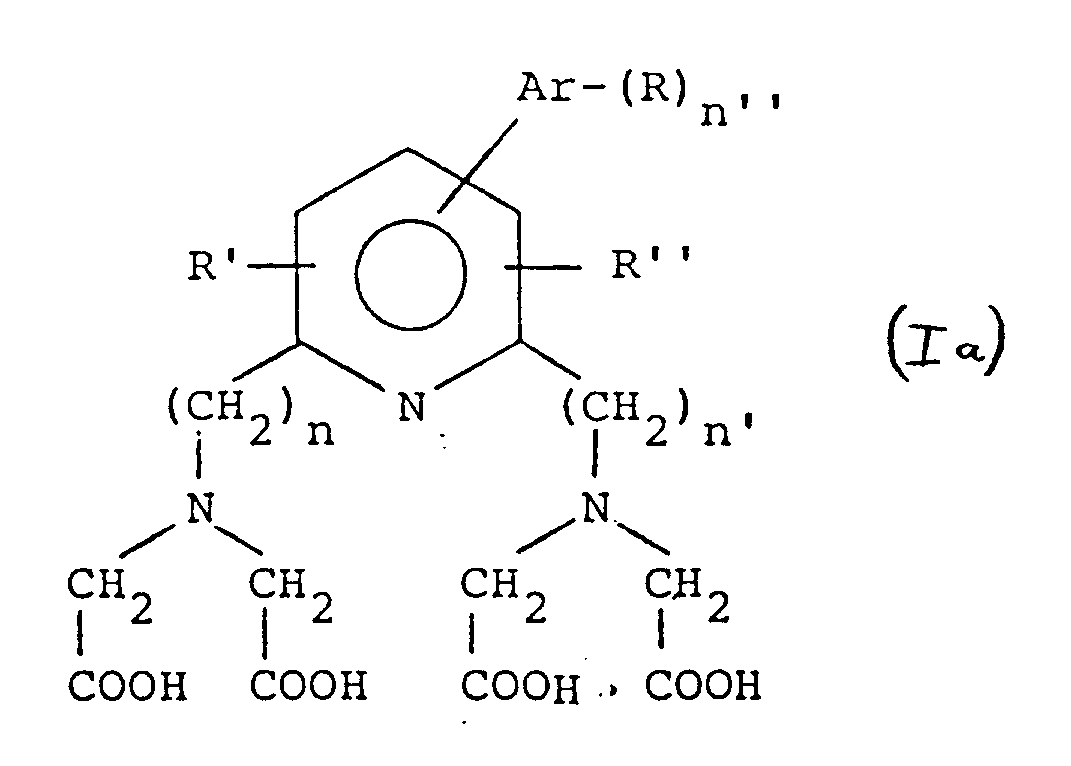
and salts thereof which also form long-lived fluorescent chelates with rare earths as well as tetra ester precursors to the tetraacids. In the formula, n and n' are integers selected from 1 and 2, R, R' and R'' are the same or different groups selected from hydrogen and electron releasing groups such as C₁-C₄ alkoxy, C₁-C₄ alkyl, amino, (di)alkylamino, aryl (including aralkyl) and aryloxy(including aralkyloxy)groups, Ar is an aryl group, in particular a phenyl or naphthyl group and n'' is an integer corresponding to the number of covalent bonding sites available on the Ar group. These pyridine tetraacid compounds form chelates with rare earth metals, preferably, europium and terbium. It is preferred that in the moieties of formula (Ia) n and n' are each 1 and/or at least one (and particularly preferred one) of R', R'' and the n'' Rs is an amino group. In the just mentioned particularly preferred case the amino group may be converted to an isothiocyanato group. - The materials of this invention offer the advantage of having excitation wavelengths that are at 280 nm or greater with excitation wavelengths of 310 nm to 325 nm or greater being possible so as to avoid background interference. Prior materials that attained shifts to these wavelengths employed structures in which aromatic rings were fused to pyridine rings. When compared to these fused ring materials, the present moieties have substantially improved quantum efficiencies. In additions the materials of this invention are chemically stable, water soluble and form highly stable metal complexes.
- In yet other aspects, this invention provides an improved method for increasing the excitation wave length of fluorescent rare earth chelates which preserves high quantum efficiencies and improved methods for fluoroassay which methods involve the use of the present aromatic ring substituted pyridines as chelating ligands.
- Particularly, the present invention also provides a method for detecting the presence of one or more of the compounds comprising a substituted aryl-substituted 2,6-bis[N,N-di(carboxyalkyl)aminoalkyl]pyridine moiety as described herein which method comprises photometrically exciting said molecule and detecting a fluorescent emission from said molecule.
- Preferably said excitation is carried out with a pulse of radiation, said pulse having a pulse duration which is short compared to the fluorescent decay lifetime of said molecule, detecting the fluorescence of said molecule after the fluorescence of ambient substances has substantially decayed.
- According to a particularly preferred embodiment of said method a rare earth metal chelate of said molecule is formed prior to said excitation.
- The substituted pyridine moieties in accord with this invention are incorporated into molecules so as to render the molecules fluorescently detectable aryl substituted 2,6-bis[N,N-di(carboxyalkyl)aminoalkyl]pyridines. The aryl substituents are themselves substituted, preferably with at least one electron-releasing group. These materials can be depicted in the following General Formula I.

In this formula n and n' are integers, either 1 or 2 and preferably the same integer, and more preferably 1. The pyridine ring carries substituents R', R'' and -Ar-(R)n''. The R' and R'' substituents may be hydrogens; electron-releasing groups such as lower alkoxies, that is 1 to 4 carbon alkoxies, especially methoxy or ethoxy; lower alkyls, that is 1 to 4 carbon alkyls such as methyl, ethyl, n and iso propyls and the like; aminos; alkyl, i.e., mono and di, and especially dialkylamino, for example, dialkylaminos wherein each of the alkyls is from 1 to 4 carbons such as dimethylamino; aryls of six carbons and aralkyls of up to 9 carbons such as phenyl or benzyl and the like, subject to the limitation that such aryls are pendant from and not fused to the pyridine ring and aryloxies or aralkyloxies of up to 9 carbons such as phenyloxy or benzyloxy structures; and a linking group including a covalent bond and a bridge group capable of providing a link to the remainder of the molecule as will be described. - The Ar-(R)n'' substituent on the pyridine ring is an aryl itself containing n'' R substituents. The aryl preferably is either a phenyl or a naphthyl ring. The number n'' is an integer corresponding to the number of covalent bonding sites available on the Ar substituent, i.e, 5 in the case of a phenyl or 7 in the case of a naphthyl. The R substituents on the Ar group can be selected from the same groups as the R' and R'' substituents.
- Thus, the Ar-Rn'' substituents can be represented structurally e.g. by the General Formulae (IIa) and (IIb).

wherein
is the covalent bond to the pyridine ring depending upon whether the Ar unit is a phenyl or naphthyl. Phenyl is the most preferred Ar unit. - Preferred aryl-substituted pyridines can be represented in more detail by a combination structure incorporating General Formula I and one of Formulae (IIa) or (IIb). This provides General Formula (III)

wherein R', R'', the R's, M and n and n' are as previously defined. Preferably, however, all M's are hydrogen and/or n and n' are both 1 and/or R' and R'' are both hydrogen. Also preferred are moieties of formula (III) wherein the M's comprise one or more metal ions including a rare earth metal ion in a complex combination with the four carboxyl groups. According to another preferred embodiment the remainder of the molecule comprises a biologically active material. While we believe that any of the aforesaid materials will work in accord with the present invention our greatest experience is with materials having the Ar-(R)n attached to the pyridine in the 4-position, i.e., para to the pyridine nitrogen, and on that basis this relationship is preferred. Also preferred are materials wherein the linking group is one of the Rs as opposed to R' or R'' and wherein one or both of R' and R'' are hydrogens and especially wherein from one to three of the Rs are C₁-C₄ alkoxies and the rest of the Rs are hydrogen. - When in the above formula (III) all R' and R'' groups are hydrogen and Ar is phenyl a particularly preferred compound of formula (IIIa) results:

The aryl substituted pyridine moieties can be linked to other groups. This linking can be accomplished by a covalent bond or through some other linking group either of which constitute one of the R', R'' or Rs, especially one of the Rs. This linking permits the fluorescent pyridine moieties to "tag" a biologically active biospecific group. - When the linking is accomplished through a linking group this R group should present an active or bondable site such as an amine, a hydroxyl, a carboxyl, an ester or the like to facilitate coupling of the biospecific group. Examples of such bondable R groups are the amino group (-NH₂) primary and secondary amine-terminated alkyls such as -CH₂-CH₂-NH₂ or

primary and secondary amine terminated aryls and aryloxies such as
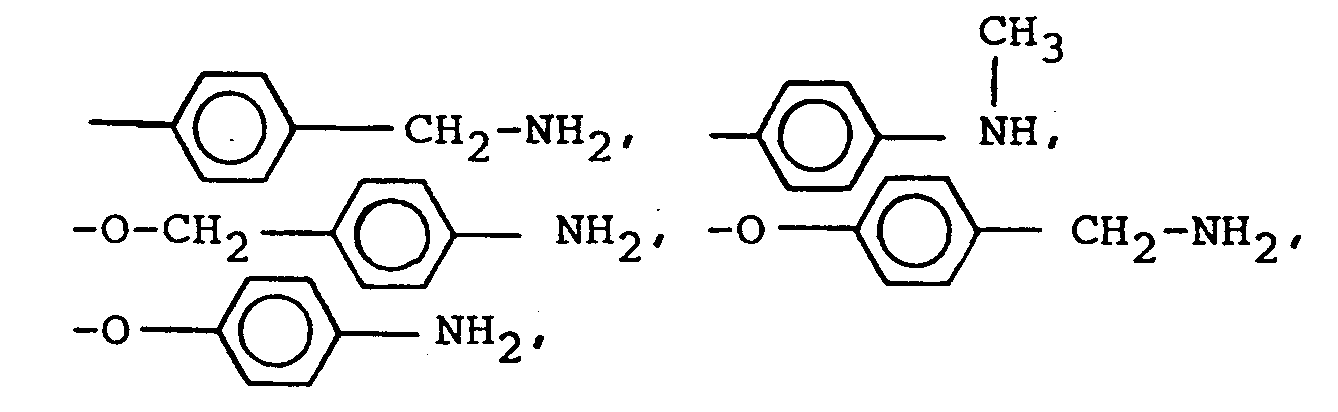
and the isomers thereof; hydroxyl-containing alkyls such as -CH₂-CH₂-OH,
and hydroxyl-containing aryls and aryloxies such as
- Other suitable functionalities for forming a bond to the biospecific group include amides, amidines, thioamides, ureas, thioureas, guanidines, diazos, thioethers, carboxy and phosphate esters and thioesters and other covalent linkages such as are known in the art. A preferred linking group is the simple amino group. The linking groups can couple directly to the biologically active group or can be linked through a bifunctional spacer agent such as a member of the group -CO(CH₂)₄-, -CS-, -CO(CH₂)₈NHCOCH₂ON=, -COCH₂ON=, -CO(CH₂)₅NHCO(CH₂)₆CO-, -CO(CH₂)₂SS(CH₂)₂CO-, -CSNH(CH₂)₃N(CH₂CH₂)₂N(CH₂)₃NHCO(CH₂)₆CO-, -CSNH(CH₂)₃N(CH₂CH₂)₂N(CH₂)₃NHCO(CHOH)₂CO- and -CSNH(CH₂)₃N(CH₂CH₂)₃NHCOCH₂ON=. Such linking groups are representative and can alter and influence interactions between the fluorescent pyridine and the biospecific groups.
- As noted above, in many advantageous applications a biologically active i.e., biospecific group is linked to the substituted pyridine. The terms "biospecific group" and "biologically active group" are used in a broad sense to encompass all molecular structures which will "specifically recognize" or "specifically react" or "specifically interact" with another molecular species. Such groups can include immunologically specific groups such as antibodies and their respective antigens or haptens, hormones and their receptors, binding pairs such as the biotin avidin pair. They can also include nucleic acid sequences which will specifically hybridize with their complementary sequences.
- The biospecific groups can be selected to bind with or otherwise associate with a target molecule or can be selected to mimic or to include the target molecule so as to compete with the target in the biospecific reaction.
- As noted previously, the biologically active material (MB) can be positioned at R' or at R'' in the formulae, but preferably is linked as one of the Rs such as to give fluorescent-tagged biospecific reagents of the formula

wherein MB, M, n, n', n'' are as previously described and the Rs, R' and R'' are each independently selected from hydrogen; and electron-releasing groups. - Similarly, a preferred fluorescent-tagged biospecific reagent can have the formula

wherein M is a metal ion or hydrogen, n* is an integer of from 1 to 4, Alk is a 1 to 4 carbon alkyl and MB is a biologically active material. Preferably, each M is hydrogen or each M is a metal ion. It is also preferred for M to comprise one or more metal ions including a rare earth metal ion in complex combination with the four carboxyl groups. - When a biospecific group is present its target molecule or analyte may be a monoepitopic or polyepitopic material. It may be selected without limitation from materials such as drugs, metabolites, natural products, pesticides and contaminants of air and water. For purposes of illustration, one can list drugs including digoxin, digitoxin, phenytoin, theophylline, gentamicin, and tobramycin; alkaloids such as morphine, heroin, cocaine, ergot alkaloids, and the like; steroids such as the steroid hormones including estrogens and androgens for example estriol and anti-inflammatory steroids for example cortisol; lactams such as the barbiturates including phenobarbital; aminoalkylbenzenes such as the amphetamines; vitamins, prostaglandins such as F₂alpha and E, antibiotics and the like, short peptide sequences or amino acids such as thyroxine, triiodothyronine and oxytocin. Representative pollutants and pesticides include PCB, dioxin, halogenated biphenyls, carbamates, thiophosphites, phosphate esters and their metabolites. Such materials can range in molecular weight from about 50 to about 1000.
- The target molecule can also be a polymeric material such as a protein or other poly(amino acid), a polynucleic acid or a polysaccharide. Such protein material can be taken from any of the classes of proteins including without limitation globulins, albumins, lipoproteins, glycoproteins, histones and the like, hypersensitive proteins including albumin, the immunoglobulins such as IgE, fibrinogen, transferrin, the various complement factors, the tumor markers like CEA (carcinoembrionic antigen) and PAP, the various blood clotting factors and protein hormones including, beta-hCG, FSH, gastrin, LH and prolactin; insulin, thyrotropin, gonadotropin and the like. Examples of biospecific polysaccharides are those derived from microorganisms such as those associated with various species of Salmonella, Streptococcus, and Klebsiella. Other targets include without limitation materials responsive to infectious disease conditions such as infection with hepatitis or rubella.
- The foregoing list is intended to be a brief outline. It is to be recognized that other equivalent materials such as are listed in more detail in the art (see US-A-4,193,983, columns 7-11) could be used in conjunction with the fluorophores provided by this invention.
- In addition to the compounds just described wherein one of the R, R' or R'' groups is a link to a biospecific biologically active group, this invention also provides other materials of the same general structure of formulae I and III which do not contain a link to a biospecific material, that is where all of the R, R' and R''s are hydrogens or electron-releasing groups. Such materials especially of formulae I and III wherein M is hydrogen are useful as chelating agents for metals and when chelated to rare earth metals give a fluorescent species which can serve as an indicator for quantitative or qualitative fluorescent measurement of rare earth metal ions in solutions.
- The aryl-substituted pyridines of this invention form long-lived fluorescent complexes with rare earth metals including, terbium, dysprosium, europium, samarium, and neodymium, in the form of their ions. Terbium and europium (Tb⁺⁺⁺ and Eu⁺⁺⁺) are preferred rare earth metal ions.
- The complexes formed between the metal ion (M) and the tetraacid ligands of this invention are generally considered to be 1:1 equimolar metal:ligand chelate complexes. They are represented structurally by the structure given as General Formula IV

- The substituted pyridines of this invention may be prepared by either of two methods. The first method is preferred if the final structure does not contain reactive amine functionalities or other functional groups incompatible with the reagents employed. The second permits such groups to be incorporated.
- The first method involves
- A. reacting a suitably substituted benzaldehyde or naphthaldehyde with at least two moles of 2-acyl furan to give a 1,5-di(2-furyl)-1,5-pentanedione;
- B. converting the product of A to the corresponding di(furyl)pyridine by reaction with hydroxylamine in liquid phase at elevated temperature such as from 40°C to 170°C especially from 80°C to 150°C;
- C. oxidizing the product of B into the corresponding pyridine-2,6-dicarboxylic acid by contact with an oxidizing agent in an organic liquid phase. An example of this oxidation is the use of an excess of potassium permanganate in an alkanol at from about 50°C to about 100°C for 30 to 120 minutes;
- D. converting the pyridine-2,6-dicarboxylic acid to the diamide which may be carried out using an excess of oxalyl chloride followed by ammonium hydroxide at low to ambient temperature;
- E. converting the diamide to the dinitrile by reaction with a dehydrating agent such as acetic anhydride or trifluoroacetic anhydride, at a temperature of from about -10° to +35°C;
- F. reducing the dinitrile to the diamine which may be carried out catalytically using a noble metal catalyst and molecular hydrogen in the presence of traces of acid;
- G. coupling ester groups to the amine groups which may be accomplished such as by reaction with an alkylhaloacetate, for example an alkyl bromoacetate, in the presence of 1,8-bis(dimethylamino)naphthalene or other suitable base; and
- H. converting the ester groups to acids by saponification with an inorganic base such as an alkali metal carbonate or hydroxide at moderate temperature such as from about 5°C to about 45°C. It will be appreciated that there are several separation and purification steps that are not recited but that in fact are to be carried out as well.
- In preparation method 2, the first three steps are carried out essentially as in method 1 with the change that the aryl aldehyde, i.e. benzaldehyde or naphthaldehyde, carries a nitro group where an amine substituent is ultimately desired or carries another group incompatible with the subsequent reactions of method 1. The product of these three steps is a nitrophenyl or nitronaphthyl pyridine-2,6-dicarboxylic acid with various R, R' and R'' substituents as may be desired and thus present on the starting materials.
- In Step D of the second process the two carboxylic acid groups are selectively reduced; that is they are reduced under conditions that do not reduce the nitro group. Borane is one reducing agent that will do this. This reduction can be carried out by using an excess of borane and moderate temperatures and dry conditions. This yields the dicarbinol that corresponds to the dicarboxylic acid.
- E. The dicarbinol is then reacted with a reagent that will convert the carbinol functionalities to alkyl halides. Thionyl bromide in molar excess will make this conversion at elevated temperatures such as 50°C to 125°C, to give a product which is the desired nitroaryl pyridine substituted in the 2 and 6 positions relative to the pyridine nitrogen with alkyl bromides.
- F. In this step the alkyl bromide substituted pyridine is reacted with an iminodiacetic acid diester to replace the two bromide groups with iminodiacid functionalities. This may be carried out using a base like 1,8-bis(dimethylamino)naphthalene and a moderate temperature such as from about 25°C to about 55°C and an inert atmosphere. This gives the tetraester.
- G. The four ester groups can then be removed such as using the saponification conditions shown in step H of Method 1.
- H. In the final step of this method the nitro group on the aryl substituent is reduced to an amine. This can be carried out catalytically using a noble metal catalyst and molecular hydrogen. Representative catalysts include platinum or palladium on alumina or carbon. Hydrogen pressures can range from about atmospheric to a few atmospheres, i.e. 1-10 atmospheres; and temperatures from about ambient to about 75°C are generally employed to achieve the desired selective reduction. This provides the desired amine substituted pyridine material. Other equivalent preparation processes can be employed if desired. For example, an amine functionality can be introduced by a modification of process 1 wherein the product of step G is nitrated with fuming nitric acid and the nitro group so introduced is thereafter reduced as in process 2.
- In these processes several key intermediates are produced. These include the 2,6-dicarboxylic acid-substituted pyridines which could exist as acids, salts or as mono or diesters with a formula

wherein Ar is an aryl, n'' is an integer equal to the number of available bonding sites on Ar; R, R' and R'' are independently selected from hydrogen, electron-releasing groups including C₁-C₄ alkoxy, C₁-C₄ alkyl, amino, dialkylamino, aryl and aryloxy; and linking groups; and R* and R** are independently selected from among metal ions, hydrogen and C₁-C₄ alkyls. Compounds of formula (VII) are disclosed e.g., in Chem. Abstr., vol. 62, no, 12, 1965, col. 14619; Beilsteins Handbuch der Organischen Chemie, 4th ed., E 3/4, vol. 22, part 3, 1979, p. 2626; and J. Org. Chem., vol. 47, 1982, p. 3761-3763. - The products of this invention have broad utility as ligands for chelating rare earth metals. The chelates so formed are fluorescent and thus provide a method for measuring rare earth ion content of materials. The substituted pyridines described herein are particularly useful as their rare earth metal chelates in a variety of assay procedures where their fluorescent properties allow them to serve as labels for biospecific molecules. Typically, a ligand or chelate of this invention is prepared having a reactive functional group such as an isothiocyanate, amine, imidate, diazo or other suitable group which is reacted with a suitable reactive group of a biospecific molecule such as an antibody, antigen, hapten or other target molecule. The thus labeled member of a binding pair of biospecific molecules may be used in any of a variety of assay methodologies known to those skilled in the art including competitive binding assays and immunometric, sandwich-type assays.
- This invention is further described by the following examples.
-

-
Benzaldehyde 62.6 g (60 ml) (0.59 mols) 2-Acetyl Furan, 85% 165 g (150 ml) (1.27 mols) Potassium Hydroxide, 85% 35 g (0.53 mols)
The KOH is dissolved in methanol (about 600 ml) with heating and stirring. The solution is cooled slightly and a mixture of the aldehyde and furan is added all at once. The mixture is heated to 60°C and stirred for 45-60 min. Initially a green tint develops which rapidly darkens to brown. The reaction mixture solidifies to a mass of orange-brown crystals. Ethanol is added (about 150 ml) and the solid is broken up. The mixture is chilled overnight and the product crystals are recovered by filtration and washed with ice cold ethanol (about 400 ml), followed by a pentane wash (about 200 ml). The crystals are dried in vacuo at 80°C. Yield of pentanedione, 103.5 gms or 57.3%. -
1,5-Di(2-furyl)-3-phenyl-1,5-pentanedione 143 g Hydroxylamine hydrochloride 129 g (Aldrich 102337) n-Butanol 1600 ml (Sigma 13F-5070)
The "dione", as produced in step A and a repeat thereof, the hydroxylamine and the butanol are combined in a 5-liter 3-neck flask fitted with mechanical stirrer and condenser and refluxed and stirred for 5 hrs, cooled and stirred for about 60 hours. The resulting black solution is poured into 2 l of 15% NaOH and extracted with toluene (l l). The organic layer is washed with deionized water (1 x 200 ml), dried over Na₂SO₄, and concentrated on a rotary evaporator. The thick residue is taken up in CH₂Cl₂ (about 250 ml). Hexanes (about 250 ml) are added to the resulting solution which is filtered through silica gel and eluted with 1:1 CH₂Cl₂/hexanes (about 500 ml). The filtrate is concentrated, ethanol (about 200 ml) is added and the mixture is cooled in ice. Filtering the resulting crystals and washing with ice cold ethanol (about 200 ml) and drying in vacuo at ambient temperature, yields a first crop of crystals of about 65 grams. The filtrate is concentrated, purified and cooled to give a second crop of 13.6g of crystals. - The difuryl pyridine product of step B. is oxidized with permanganate.
Product of Step B 23 mmoles KMnO₄ 45.4 grams t-butanol 1500 ml water 300 ml
The butanol (about 1 liter) is placed in a 3-neck flask fitted with a mechanical stirrer, mantle and condenser. The product of step B is added and rinsed into the flask with the remaining t-butanol. The mixture is heated and stirred until solution results; then the H₂O is added and when the temperature reaches about 75°C the KMnO₄ is added in portions over about 30 minutes. The mixture is refluxed for 90 minutes. Alcohol is distilled off with aspirator vacuum and the hot residue is filtered through Celite® and washed with hot 1:1 t-BuOH/H₂O. Any residual KMnO₄ is consumed with NaHSO₃ and the solution is concentrated to about 150 ml on a rotary evaporator (about 65°C). After acidifying with 2N HCl (25 ml) the resulting crystals of the desired 4-phenyl-2,6-pyridinedicarboxylic acid are filtered, washed and dried. -
4-Phenyl-2,6-pyridinedicarboxylic acid 21.5 mmoles Oxalyl chloride 4.8 ml Methylene chloride 80 ml Dimethylformamide 5 drops
The pyridinedicarboxylic acid is added to a 100 ml 2-neck flask with the CH₂Cl₂, DMF and a stir bar. The flask is closed with a CaSO₄ drying tube, and cooled in ice. Then the oxalyl chloride is added over about 5 minutes from a syringe and stirred for about 2 hours at room temperature. The resulting solution is concentrated on a rotary evaporator to give the solid acid chloride; benzene (150 ml) is added and removed by rotary evaporator and the residue is vacuum dried. The acid chloride is added to NH₄OH, 28%, (50 ml) over 5-10 minutes with stirring, stirred for an hour, filtered and washed with water and dried to give the desired amide. -
4-Phenyl-2,6-pyridinedicarboxamide 17.5 mmoles p-Dioxane 170 mls Pyridine 11.3 ml Trifluoroacetic anhydride 11.0 ml
The first three ingredients are combined in a 250 ml flask with a stir bar. The flask is closed under argon, cooled in ice until frozen dioxane is present (10°). The anhydride is added over about 10 minutes (temp about 15°C) and the mixture is stirred for two hours at room temperature. The resulting dark solution is poured into water and then extracted thrice with 150 ml portions of methylene chloride. The extracts are dried over Na₂SO₄ and concentrated on the rotary evaporator to a dark solid which is then taken up in methylene chloride and eluted through silica with additional methylene chloride. The eluent is concentrated to a solid and dried to give the desired dicarbonitrile. -
4-Phenyl-2,6-pyridinedicarbonitrile 13.5 mmoles Ethanol with 2% HClO₄ 370 ml 10% Palladium on carbon 3.7 g
The nitrile is suspended in the ethanol to which 10.5 ml of 70% HClO₄ has been added and the mixture transferred to a Parr bottle. The bottle is purged with nitrogen and the catalyst is added. The bottle is then pressured to 0.28 MPa (40 psi) with hydrogen. After 30 minutes, the bottle is opened and the liquid recovered and concentrated to a dark liquid. A yellow solid is recoved by adding the liquid to diethyl ether and filtering. The perchlorate salt solid is dried on a vacuum pump. This amine perchlorate is then dissolved in about 30 ml of water and added to 40% NaOH. The liberated amine that results is extracted with CH₂Cl₂, dried over Na₂SO₄ and concentrated to a dark oil on a vacuum pump. -
Amine of Step F 12.0 mmole 1,8-bis(dimethylamino)naphthalene 10.3 g Methyl Bromoacetate 7.35 g Acetonitrile 130 ml
The base is placed in a flask. The amine is taken up in acetonitrile and placed in the flask with it. A stir bar is added and the mixture is stirred at 45°C until it is homogeneous. Then the methyl bromoacetate is dripped in in 40 ml of acetonitrile with the system under argon. After about 16 hours, at about 45°C the product is poured into 150 ml of water and 1.5 ml of 0.1 M citric acid. This mixture is then extracted with methylene chloride. The extracts are washed, dried, concentrated, redissolved and filtered through silica. The product is purified by silica gel chromatography using ethyl acetate/methylene chloride as solvent. - The tetraester of Step G is saponified by placing it in methanol/water, 1:1, and adding a molar excess of K₂CO₃ and stirring at room temperature for 2.5 hours. Then the solution is acidified to pH 7, and dried to give the desired tetraacid, the identity of which is confirmed by NMR.
- The preparation of Example 1 is substantially repeated with the change that in Step A an equivalent amount of 2,4-dimethoxybenzaldehyde is substituted for the benzaldehyde such that the intermediate formed is 4-(2,4-dimethoxyphenyl)-2,6-pyridinedicarboxylic acid and the final product is the 2,4-dimethoxy analog of the product of Step H of Example 1. The yields obtained for several of the various steps are as follows
Step A 95%
Step B 72%
Step E 84 %
of the desired product, 4-(2,4-dimethoxyphenyl)-2,6-bis[N,N-di(carboxymethyl)aminomethyl]-pyridine - The preparation of Example 1 is substantially repeated fifteen times with the change that the benzaldehyde is replaced with an equivalent molar amount of the following substituted benzaldehydes:


- With these different benzaldehydes the corresponding 2,6-pyridinedicarboxylic acid intermediates and tetraacid final products are achieved.
- This Example shows the introduction of amine substituents onto the phenyl ring. Steps A, B, and C of Example 1 are repeated with the change that in place of the benzaldehyde, an equimolar amount of 3-nitrobenzaldehyde is used. This provides 4-(3-nitrophenyl)-2,6-pyridinedicarboxylic acid.
-
Diacid as above 28.8 g (0.1 moles) Borane/THF Complex 288 ml, 1 molar
The diacid is placed in a dry 2 l flask with 1000 ml of THF and a stirring bar. A drying tube is set up and the flask is blanketed in argon. The borane/THF complex is then added gradually over 20-30 minutes with vigorous stirring at room temperature. The stirring is continued for four hours and then the excess borane is hydrolyzed with dilute HCl (20 ml of 6 N and 85 ml of H₂O). Then 60 ml of 10% Na₂CO₃ is added and the solution is concentrated on a rotary evaporator. The residue is added to aqueous bicarbonate and extracted three times with ethyl acetate, the extracts are dried and stripped to obtain the desired diol as an orange solid. -
Diol of Step D 9.1 g (35 mmol) Thionyl bromide 7.0 ml (90 mmol)
The diol of Step D is placed in a flask and about 20 ml of methylene chloride is added followed by the thionyl bromide. The flask is closed with an inlet adaptor and placed in an oil bath at 80°C. The methylene chloride and HBr are vented and a viscous residue remains. This is placed in aqueous Na₂CO₃ and extracted thrice with methylene chloride. The extracts are dried, concentrated, diluted with methylene chloride and filtered through silica. The filtrate is collected and evaporated to give the desired dibromide. -
Dibromide of Step E 3.44 g (8.9 mmol) Iminodiacetic acid dimethyl ester 2.88 g 1,8-Bis(dimethylamino)naphthalene 3.76 g Acetonitrile 140 ml
The base is placed in a flask. The iminodiester is mixed with the acetonitrile and added. The flask is blanketed with argon and heated to 45°C. Then the dibromide, in solution in THF, is added over 60-90 minutes with magnetic stirring. After 18 hours the mixture is cooled and stirred at room temperature for about two days. The mixture is added to benzene, filtered, washed with 0.1 M citric acid and water and dried over Na₂SO₄. The solution is then concentrated to an oil, taken up in methylene chloride and passed through silica gel twice with ethyl acetate/methylene chloride followed by ethyl acetate as eluent. Fractions are taken and the desired material is isolated and concentrated to an amber oil. -
Nitrotetramethyl ester of Step F 2.7 g (4.94 mmoles) 5% Palladium on carbon 2.7 g Ethyl Alcohol 300 ml
The nitro compound is placed in a 1 liter flask with 300 ml ethanol. The flask is purged with nitrogen and the catalyst is added. The flask is then pressured to 0.1 MPa (1 atm) with hydrogen. After 1 hr the reaction mixture is filtered and the filtrate concentrated to a yellow oil via rotary evaporation. The oil is determined to be the aminotetramethyl ester corresponding to the product of Step F. - The ester groups of the aminotetramethyl ester of Step G are saponified using the method of Example 1. This yields the desired 3-aminotetraacid.
- Fuming nitric acid (0.03 ml, 0.4325 mmol) is added at room temperature to a solution of trifluoromethanesulfonic acid in methylene chloride (4 ml). After stirring for 5 minutes, a solution of 2,6-bis[N,N-di(carboxymethyl)aminomethyl]-4-phenyl-pyridine tetramethyl ester such as from step G of Example 1 (86 mg, 0.173 mmol) in a small amount of methylene chloride is slowly added at 0°C. The solution is allowed to warm to room temperature and stirring is continued for one hour. The reaction mixture is then poured onto ice and the mixture is neutralized with sodium carbonate. Extraction with methylene chloride followed by drying over sodium sulfate and evaporation gives 90 mg of crude product.
- The crude product from the above reaction (90 mg, 0.17 mmol) is dissolved in ethanol (13 ml), 50 mg of 10% Pd/C is added and the mixture is stirred at room temperature under 0.1 MPa (one atmosphere) of hydrogen for one hour. The catalyst is removed by filtration and the solvent evaporated to give 60 mg of the 4-amino compound. The 3-amino compound (51 mg) is prepared similarly from 70 mg (0.129 mmol) of the corresponding 3-nitro compound which had been prepared via preparation method 2. This preparation is substantially as shown in Example 18. If desired these or similar aryl pyridines having amine substrates on their aryl rings can be reacted with thiophosgene under conditions known for the reaction of thiophosgene with aryl amines to convert the amine to an isothiocyanate which in turn can couple to amine-containing target molecules.
- Isobutylchloroformate (0.02 ml, 0.117 mmol) is added to a solution of theophylline-8-butyric acid (31.3 mg, 0.117 mmol) in dimethylformamide (1.5 ml) containing triethylamine (0.20 ml, 0.117 mmol) at 0°C under an argon atmosphere. After 0.5 hour at 0°C, a solution of the 4-amine (60 mg, 0.117 mmol) in chloroform is slowly added. The solution is stirred for 17 hours at 0-5°C and then the solvents are removed by evaporation to leave 103 mg of crude product. The material is chromatographed on silica gel with chloroform:methanol (9:1) and on reverse phase C-18 silica gel with methanol:water (7:3) to give 60 mg (67% yield) of the desired product. The corresponding 3-amino compound (51 mg, 0.01 mmol) is treated similarly to give 50 mg of material having the theophylline derivative conjugated at the 3-position.
- The tetramethyl ester (34 mg, 0.045 mmol) from the previous step is dissolved in methanol (2 ml) containing 0.2 ml of 1 N sodium hydroxide and heated at reflux for three hours. The solution is then cooled in an ice bath and acidified with 1 N HCl and evaporated to give the crude product. Purification via reverse phase column chromatography in methanol:water (6:4) gives 14 mg of the tetraacid. Saponification of 40 mg (0.05 mmol) of the analogous 3-substituted compound gives 14.6 mg of its tetraacid after reverse phase chromatography.
- The tetraacids of Part D are separately dissolved in 0.01 M sodium borate solution to a concentration of 10⁻⁵ M. Then an equivalent molar amount of aqueous terbium chloride is added to each and the mixtures are allowed to stand for a few minutes. Fluorescence measurements are carried out and demonstrate that 1:1 molar chelate complexes of the tetraacids and the terbium have been formed and that such complexes are fluorescent and stable.
- An assay for theophylline is carried out by allowing the terbium chelate of the fluorophore-labelled theophylline tracer above (i.e., 2,6-bis[N,N-di(carboxymethyl)aminomethyl]-4-[4-(theophylline-8-butyramido)-phenyl]-pyridine terbium chelate) to compete with theophylline standards for binding to anti-theophylline antibody. The labelled theophylline on binding to antibody undergoes an enhancement of its fluorescence and this enhancement is proportional to the amount of labelled theophylline bound and inversely proportional to the amount of theophylline present in the sample. The assay is carried out in polystyrene tubes (12 x 15 mm) to which 1 ml of pH 8.5 0.01 M sodium borate buffer was added. This is followed by the addition of 10 µl of 1 µM tracer (8.7 ng) and 10 µl of theophylline standard (0, 5.4, 16.2, 54, and 540 ng). Addition of 25 µl of about 0.3 µM anti-theophylline antibody in 0.01 M borate containing 0.1 M sodium chloride and 1% normal human serum (final concentration in assay tube about 7.5 nM) leads to increases in the observed fluorescence of 400%-50%, respectively, for the various standards. This corresponds to B/Bo values of 80, 64, 53 and 14% for the 5.4, 16.2, 54 and 540 ng standards, respectively.
-
Vanillin 100.4 g (0.66 mols) Aldrich Benzyl chloride 84.0 gms (77 ml; 0.66 mols) Potassium carbonate 115 gms Acetone 2 l 18-Crown-6 3 gms
The above materials are combined in a 3-liter 3-necked round bottomed flask fitted with a mantle, condenser and mechanical stirrer. The mixture is stirred at reflux for 70 hrs. It becomes light yellow during the first 24 hours and turns to light tan by the third day at reflux. About 1 liter of acetone is then distilled off and the residue is poured into crushed ice (about 2 liters), and water (about 500 ml) with stirring. The solution is seeded to give a solid precipitate which is allowed to stand about 20 minutes then filtered, washed with EtOH (0°C, 400 ml) and dried in vacuo to give 120 g of the desired product which represents a yield of about 75%. -
O-Benzyl vanillin (From Part A) 31.5 g (0.13 mols) Acetyl furan 43 g (0.39 mols) Aldrich Methanol 300 ml
The above materials are combined in a 500 ml flask and heated and stirred at about 55°C until homogeneous (about 20 mins). Then about 5 ml 20% KOH/MeOH is added and heating and stirring are continued for 45-60 min. Then another 15 ml of 20% KOH/MeOH is added, the flask mouth is lightly covered and the contents are heated and stirred for about 16 hrs. The product is acidified with 6N HCl (about 10 ml) and concentrated on a rotary evaporator at about 55°C. - Then, hydroxylamine hydrochloride 22 gms, and n-butyl alcohol 250 ml are added and the mixture is refluxed for 3 hrs using a mantle. The butanol is removed on a rotary evaporator at about 65°C and the residue is poured into water (about 200 ml), basified with 6N NaOH (60 ml) and extracted with toluene (2x200 ml). The extracts are washed with H₂O (about 100 ml), dried over Na₂SO₄ and concentrated on the rotary evaporator at about 65°C to a black oil. This is filtered through silica gel (about 200 g) and eluted with 1:1-CH₂Cl₂/hexanes (about 1 liter). The eluent is concentrated to an oil. The oil is again subjected to silica filtration, concentrated again to an oil and yet again filtered through silica (about 200 gms) this time eluting with toluene/CH₂Cl₂ - 9:1 (about 1 liter). This eluent is concentrated to an amber oil which is dissolved in EtOH (about 50 ml) and again concentrated to an oil. Product yield is about 25 gms.
-
Difuryl pyridine (From Part B) 19 g (0.045 mols) t-Butyl alcohol 3 l DI water 0.6 l Potassium permanganate 93 gms
The procedure of Part C of Example 1 is followed with the following changes: After KMnO₄ addition, the mixture is heated and stirred for 1½ hrs. Then the t-BuOH is distilled off. After concentrating to about 200 ml, the product is acidified with 2N HCl (about 50 ml). A canary yellow precipitate forms which is thinned with a few ml of water, filtered and washed with cold water (about 50 ml) and dried in vacuo to give 15.2 gms of product which is about 90% yield. -
Diacid (from Part C) 6.07 g (0.016 mols) Methylene chloride 60 ml Oxalyl chloride 3.5 ml Dimethylformamide 4 drops
The diacid is weighed into a 100 ml 2-neck round bottom flask that is fitted with a drying tube and septum stopper. A stir bar is added along with the CH₂Cl₂ (about 60 ml) and 4 drops DMF. The mixture is stirred in ice while the oxalyl chloride (3.5 ml) is slowly added from a syringe (addition time about 5 min.). Then the reaction mixture is stirred at room temperature for 2 hours. The acid passes into solution in about 1 hour with evolution of HCl. The dark solution is transferred to a 250 ml flask and solvent is removed on a rotary evaporator. Benzene (about 100 ml) is added to the yellow residue and removed on the rotary evaporator to obtain 6.65 grams of dark green solid which is the desired chloride. -
Diacid chloride (From Part D) 6.65 g (0.016 moles) Diglyme® 300 ml Sodium borohydride 1.5 gms Tetrahydrofuran 20 ml
The NaBH₄ is weighed into a dry 500 ml 3-neck flask fitted with an argon inlet, thermometer and addition funnel. A stir bar and diglyme® (about 300 ml) are added and the flask is purged with argon and cooled to 0°C. The diacid chloride is dissolved in diglyme® (about 40 ml) and THF (about 20 ml), transferred to the addition funnel and added dropwise to the flask with stirring and cooling over about 15 minutes (temperature 0°C). The mixture is stirred at room temperature for 2 hours. Solution color changes from amber to coral during first hour then fades to a turbid tan over next hour. The product is poured into water (about 500 ml) and about 100 ml of 0.1 M aqueous citric acid and concentrated on a rotary evaporator (60°C). The residue (about 500 ml) is poured into water (about 1 liter) and extracted with Et₂O (4 x 100 ml). The extracts are dried over Na₂SO₄ and concentrated on a rotary evaporator to give 4.0 gms of the desired diol as a tan solid that is soluble in DMSO. -
Diol (Of Part E plus a repeat) 5.1 g (21.1 mmoles) Triphenylphosphine 15.2 g Bromine 3.0 ml
The phosphine is weighed into a dry 250 ml 3-neck round bottomed flask. CH₃CN (about 50 ml) and a stir bar are added and the flask is closed with a septum and argon inlet. The solution is cooled to 0°C in ice/MeOH and Br₂ is dripped in over about 20 minutes. The mixture is stirred at room temperature for 15 minutes. The diol is suspended in CH₃CN (about 75 ml) , transferred to the phosphine-bromine complex, stirred for 2 hours at room temperature and poured into water (about 600 ml) followed by saturated NaHCO₃ (about 150 ml). This aqueous suspension is then extracted with CH₂Cl₂ (2 x 200 ml). The extracts are dried over Na₂SO₄, filtered through silica gel eluting with CH₂Cl₂. The eluents are concentrated on a rotary evaporator to 2.2 grams of a white solid which is the desired dibromide and contains traces of triphenylphosphine oxide. -
Dibromide(From Part F) 2.15 g (4.5 mmol) Iminodiacetic acid dimethyl ester 1.45 g (9.0 mmol) 1,8-Bis(dimethylamino)naphthalene 1.94 g
The iminoester is weighed into a dry 100 ml 3-neck flask and the base and CH₃CN (about 50 ml) are added. The dibromide is dissolved in THF (about 35 ml) and added to the flask with stirring under argon at 45°C overnight. The reaction mixture is poured into water (about 150 ml) and 0.1 M citric acid (about 150 ml) and EtOAc (about 150 ml). The EtOAc layer is separated; washed with 0.1 M citric acid (about 100 ml), water (about 100 ml) and brine (about 100 ml); dried over Na₂SO₄; and concentrated to a thick purple oil. The oil is dissolved in CH₂Cl₂ and plug filtered through silica (35 gms). A purple band is eluted with 10% EtOAc in CH₂Cl₂ (about 200 ml). Then the desired tetraester is eluted with 50% EtOAc/CH₂Cl₂ (200 ml) and 80% EtOAc/CH₂Cl₂ (about 200ml). The eluent fractions containing the tetraester are concentrated to about 2.5 grams of oil. - The tetraester of step G is saponified using the procedure of Example 1 to give the desired tetraacid.
- Following the general procedures of Example 19, the 4-[4 (or 3)-aminophenyl]-2,6-bis[N,N-di(carboxymethyl)aminomethyl]-pyridine tetraesters are coupled to digoxigeninone-3-0-carboxymethyloxime, phenytoin-3-(8-octanoic acid) and cortisol-3-0-carboxymethyloxime to give the conjugated materials. Saponification of the tetraesters gives the tetraacids which, with rare earth metals, formed fluorescently tagged, immunologically active analogs of the target analytes.
Claims (25)
- A fluorescently detectable molecule characterized as comprising a substituted aryl-substituted 2,6-bis[N,N-di(carboxyalkyl)aminoalkyl]pyridine moiety.
- The fluorescently detectable molecule of claim 1 additionally comprising a biologically active material.
- The fluorescently detectable molecule of one or both of the claims 1-2 wherein the substituted aryl group is an aryl group substituted with one or more electron-releasing groups.
- The fluorescently detectable molecule of claim 3, wherein the electron-releasing groups are selected from C₁-C₄ alkoxy, C₁-C₄ alkyl, amino, dialkylamino, aryl (including aralkyl) and aryloxy (including aralkyloxy) groups.
- The fluorescently detectable molecule of one or more of the claims 1-4 wherein said substituted aryl-substituted 2,6-bis[N,N-di(carboxyalkyl)aminoalkyl]pyridine moiety has the general formula (I):

- The fluorescently detectable molecule of claim 5, wherein n and n' are each 1.
- The fluorescently detectable molecule of claim 5 or claim 6 wherein Ar is phenyl and at least one of the n'' Rs is a C₁-C₄ alkoxy.
- The fluorescently detectable molecule of one or more of the claims 5-7, wherein the M's comprise one or more metal ions including a rare earth metal ion in complex combination with the four carboxyl groups.
- The fluorescently detectable molecule of one or more of the claims 1-8 wherein the remainder of the molecule to which the pyridine moiety is linked is a biologically active material.
- A fluorescently detectable molecule of one or more of the claims 1-9, characterized as comprising a substituted aryl-substituted 2,6-bis[N,N-di(carboxyalkyl)aminoalkyl]-pyridine moiety of the general formula (III):

- The fluorescently detectable molecule of claim 10, wherein all M's are hydrogen and/or n and n' are both 1 and/or R' and R'' are both hydrogen.
- The fluorescently detectable molecule of claim 10 wherein the Ms comprise one or more metal ions including a rare earth metal ion in complex combination with the four carboxyl groups.
- The fluorescently detectable molecule of one or more of the claims 10-12 wherein the remainder of the molecule comprises a biologically active material.
- A fluorescently detectable specific binding reagent having the general formula (V):

- The fluorescently detectable specific binding reagent of claim 14, wherein each M is hydrogen or each M is a metal ion.
- The reagent of claim 14 or claim 15 wherein M comprises one or more metal ions including a rare earth metal ion in complex combination with the four carboxyl groups.
- A substituted aryl-substituted 2,6-bis[N,N-di(carboxyalkyl)aminoalkyl]pyridine compound of general formula (Ia):

- The compound of general formula (Ia) of claim 17, wherein n and n' are each 1.
- The compound of claim 17 or claim 18, wherein at least one of R', R'' and the n'' Rs is an amino group.
- The compound of one or more of the claims 17-19 wherein one of R', R'' and the n'' Rs is an amino group.
- The compound of claim 20 wherein said amino group has been converted to an isothiocyanato group.
- The compound of one or more of the claims 17-21 wherein R' and R'' are hydrogens and Ar is phenyl such that the compound has the general formula (IIIa):

- The method for detecting the presence of the molecule of one or more of the claims 1-16 which comprises photometrically exciting said molecule and detecting a fluorescent emission from said molecule.
- The method of claim 23 wherein said excitation is carried out with a pulse of radiation, said pulse having a pulse duration which is short compared to the fluorescent decay lifetime of said molecule, detecting the fluorescence of said molecule after the fluorescence of ambient substances has substantially decayed.
- The method of claim 23 or claim 24 wherein prior to said excitation a rare earth metal chelate of said molecule is formed.
Priority Applications (1)
| Application Number | Priority Date | Filing Date | Title |
|---|---|---|---|
| EP92116023A EP0525825B1 (en) | 1985-03-18 | 1986-03-18 | Substituted dicarboxy pyridine compounds |
Applications Claiming Priority (2)
| Application Number | Priority Date | Filing Date | Title |
|---|---|---|---|
| US712774 | 1985-03-18 | ||
| US06/712,774 US4761481A (en) | 1985-03-18 | 1985-03-18 | Substituted pyridine derivatives |
Related Child Applications (2)
| Application Number | Title | Priority Date | Filing Date |
|---|---|---|---|
| EP92116023.0 Division-Into | 1986-03-18 | ||
| EP92116023A Division EP0525825B1 (en) | 1985-03-18 | 1986-03-18 | Substituted dicarboxy pyridine compounds |
Publications (3)
| Publication Number | Publication Date |
|---|---|
| EP0195413A2 EP0195413A2 (en) | 1986-09-24 |
| EP0195413A3 EP0195413A3 (en) | 1990-04-25 |
| EP0195413B1 true EP0195413B1 (en) | 1993-11-18 |
Family
ID=24863508
Family Applications (2)
| Application Number | Title | Priority Date | Filing Date |
|---|---|---|---|
| EP86103662A Expired - Lifetime EP0195413B1 (en) | 1985-03-18 | 1986-03-18 | Substituted pyridine derivatives |
| EP92116023A Expired - Lifetime EP0525825B1 (en) | 1985-03-18 | 1986-03-18 | Substituted dicarboxy pyridine compounds |
Family Applications After (1)
| Application Number | Title | Priority Date | Filing Date |
|---|---|---|---|
| EP92116023A Expired - Lifetime EP0525825B1 (en) | 1985-03-18 | 1986-03-18 | Substituted dicarboxy pyridine compounds |
Country Status (5)
| Country | Link |
|---|---|
| US (1) | US4761481A (en) |
| EP (2) | EP0195413B1 (en) |
| JP (2) | JPH07116148B2 (en) |
| CA (1) | CA1276028C (en) |
| DE (2) | DE3650706T2 (en) |
Families Citing this family (71)
| Publication number | Priority date | Publication date | Assignee | Title |
|---|---|---|---|---|
| US4837169A (en) * | 1981-07-01 | 1989-06-06 | Eastman Kodak Company | Polypyridine Fluorescent labels for immunoassay |
| US5830769A (en) * | 1985-03-18 | 1998-11-03 | Wieder; Irwin | Homogeneous fluorassay methods employing fluorescent background rejection and water-soluble rare earth metal chelates |
| SE8502573D0 (en) * | 1985-05-23 | 1985-05-23 | Jouko Kanakre | FLUORESCENT LANTHANIDE CHELATES USEFUL AS LABELS OF PHYSIOLOGICALLY ACTIVE MATERIALS |
| GB8602304D0 (en) * | 1986-01-30 | 1986-03-05 | Dakubu S | Dihydropyridine condensation products |
| JP2802921B2 (en) | 1986-06-17 | 1998-09-24 | マイクロスキャン、インコーポレイテッド | Homogeneous fluorescence assay using fluorescence background cancellation and water-soluble rare earth metal chelate fluorophore |
| SE8702824L (en) * | 1987-07-10 | 1989-01-11 | Wallac Oy | METAL-CHELATING 2,6-DISUBSTITUTED PYRID INTRODUCTION AND THEIR USE |
| SE8703682L (en) * | 1987-09-24 | 1989-03-25 | Wallac Oy | HOMOGENIC DETERMINATION METHOD USING AFFINITY REACTIONS |
| US5032677A (en) * | 1987-11-06 | 1991-07-16 | Baxter International Inc. | Fluorescent poly(arylpyridine) rare earth chelates |
| US5106957A (en) * | 1987-11-06 | 1992-04-21 | Baxter Diagnostics Inc. | Fluorescent poly(arylpyridine) rare earth chelates |
| US5162508A (en) * | 1987-12-18 | 1992-11-10 | Compagnie Oris Industrie | Rare earth cryptates, processes for their preparation, synthesis intermediates and application as fluorescent tracers |
| US4962045A (en) * | 1988-05-02 | 1990-10-09 | The Perkin-Elmer Corporation | Time-resolved fluorimetric detection of lanthanide labeled nucleotides |
| US6127529A (en) * | 1988-06-29 | 2000-10-03 | Wallac Oy | Metal-chelating 2,6-disubstituted pyridine compounds and their use |
| US5202423A (en) * | 1988-07-08 | 1993-04-13 | Wallac Oy | Terpyridine derivatives |
| JPH0299549A (en) * | 1988-10-07 | 1990-04-11 | Mitsui Toatsu Chem Inc | Polypropylene resin composition having high withstand voltage property |
| US5026802A (en) * | 1989-03-17 | 1991-06-25 | The University Of Southern Mississippi | Polymers derived from 2,6-substituted-4-amino-pyridines |
| US4940796A (en) * | 1989-03-17 | 1990-07-10 | The University Of Southern Mississippi | 2,6-substituted-4-aminopyridines and their corresponding intermediates |
| US5094759A (en) * | 1989-03-17 | 1992-03-10 | The University Of Southern Mississippi | Method of water treatment using 2,6-substituted aminopyridines and polymer derived therefrom |
| GB8927503D0 (en) * | 1989-12-04 | 1990-02-07 | Kronem Systems Inc | Enzyme-amplified lanthanide chelate luminescence |
| US5190945A (en) * | 1990-01-18 | 1993-03-02 | Ciba-Geigy Corporation | Azinyliminodithietanes and their fungicidal and nematocidal methods of use |
| US5367080A (en) * | 1990-11-08 | 1994-11-22 | Sterling Winthrop Inc. | Complexing agents and targeting radioactive immunoreagents useful in therapeutic and diagnostic imaging compositions and methods |
| AU653012B2 (en) * | 1991-02-14 | 1994-09-15 | Microscan, Inc. | Novel lanthanide chelate-conjugated oligonucleotides |
| US5158703A (en) * | 1991-04-03 | 1992-10-27 | Mitsui Toatsu Chemicals Inc. | Resin composition for ultraviolet luminescent screen |
| FR2680787B1 (en) * | 1991-08-30 | 1994-11-04 | Cis Bio Int | MACROCYCLIC RARE EARTH COMPLEXES AND THEIR USE FOR REDUCING INTERFERENCE IN FLUORESCENCE ASSAY. |
| EP0626068B1 (en) * | 1991-12-05 | 1999-05-06 | Wallac Oy | Luminescent lanthanide chelates |
| AU704152B2 (en) * | 1995-01-06 | 1999-04-15 | Ciba Specialty Chemicals Holding Inc. | Triboluminescent lanthanide III complexes |
| US7632651B2 (en) | 1997-09-15 | 2009-12-15 | Mds Analytical Technologies (Us) Inc. | Molecular modification assays |
| US7070921B2 (en) | 2000-04-28 | 2006-07-04 | Molecular Devices Corporation | Molecular modification assays |
| US7745142B2 (en) | 1997-09-15 | 2010-06-29 | Molecular Devices Corporation | Molecular modification assays |
| US6455734B1 (en) | 2000-08-09 | 2002-09-24 | Magnesium Diagnostics, Inc. | Antagonists of the magnesium binding defect as therapeutic agents and methods for treatment of abnormal physiological states |
| AU2002367810A1 (en) * | 2002-03-28 | 2003-11-10 | Rutgers, The State Of University Of New Jersey | Bis-transition-metal-chelate-probes |
| US7018851B2 (en) * | 2003-02-13 | 2006-03-28 | Innotrac Diagnostics Oy | Biospecific binding reactants labeled with new luminescent lanthanide chelates and their use |
| US8071626B2 (en) * | 2003-12-18 | 2011-12-06 | Wallac Oy | Chelating agents and highly luminescent and stable chelates and their use |
| EP1694672B1 (en) * | 2003-12-18 | 2012-06-20 | Wallac Oy | Novel chelating agents and highly luminescent and stable chelates and their use |
| EP1771440A4 (en) * | 2004-07-23 | 2009-09-02 | Amgen Inc | Generic probes for the detection of phosphorylated sequences |
| CA2581639C (en) * | 2004-09-30 | 2016-07-26 | Molecular Devices Corporation | Luminescent lanthanide complexes |
| FR2890174B1 (en) | 2005-08-30 | 2009-04-24 | Cis Bio Internat Sa | METHOD FOR THE DEMONSTRATION OF A BIOLOGICAL PROCESS BY MEASURING FREIGHT |
| FR2890446B1 (en) * | 2005-09-05 | 2008-04-18 | Cis Bio Internat Sa | METHOD FOR DETECTING INTRACELLULAR INTERACTION BETWEEN BIO-MOLECULES |
| US7482444B2 (en) * | 2006-03-13 | 2009-01-27 | Wallac Oy | Terminating substrates for DNA polymerases |
| EP2052252B1 (en) | 2006-08-18 | 2010-11-10 | Abacus Diagnostica OY | Luminescent lanthanide labelling reagents and their use |
| FI7930U1 (en) | 2007-12-17 | 2008-07-01 | Wallac Oy | chelates |
| FI7928U1 (en) | 2007-12-17 | 2008-07-01 | Wallac Oy | Chelates and labeling reagents |
| FI7929U1 (en) | 2007-12-17 | 2008-07-01 | Wallac Oy | Chelates and labeling reagents |
| FI7931U1 (en) | 2007-12-17 | 2008-07-01 | Wallac Oy | chelates |
| CN102124346B (en) * | 2008-07-16 | 2014-01-15 | 雷迪奥米特医学公司 | Thrombin substrate and assay for determining the level of bioactive thrombin in a sample |
| FR2934684B1 (en) | 2008-07-31 | 2012-11-16 | Cis Bio Int | METHOD OF DETECTING INTERNALIZATION OF MEMBRANE PROTEINS. |
| FR2936245B1 (en) | 2008-09-23 | 2012-07-06 | Cis Bio Int | NOVEL O6-ALKYLGUANIN-DNA ALKYLTRANSFERASE SUBSTRATES AND MUTANTS THEREOF |
| EP2376477A4 (en) * | 2008-12-15 | 2012-08-08 | Taigen Biotechnology Co Ltd | Stereoselective synthesis of piperidine derivatives |
| FI20090100A0 (en) | 2009-03-16 | 2009-03-16 | Wallac Oy | Biotinidaasimääritys |
| US8697380B2 (en) | 2009-04-30 | 2014-04-15 | Cis Bio International | Method for detecting compounds modulating dimers of VFT domain membrane proteins |
| WO2010142004A2 (en) | 2009-06-10 | 2010-12-16 | Katholieke Universifeit Leuven | Controlled biosecure aquatic farming system in a confined environment |
| FR2949156B1 (en) | 2009-08-13 | 2016-04-15 | Cis-Bio Int | METHOD FOR DETERMINING THE BINDING OF A COMPOUND GIVEN TO A MEMBRANE RECEPTOR |
| CN102146284B (en) * | 2010-02-10 | 2014-01-01 | 中国科学院大连化学物理研究所 | A ratiometric fluorescent probe and its application |
| JP2014522808A (en) * | 2011-06-17 | 2014-09-08 | サントル ナショナル ドゥ ラ ルシェルシュ シアンティフィク | Bifunctional phosphonate chelator |
| FR2977674B1 (en) | 2011-07-06 | 2015-08-14 | Cisbio Bioassays | IMPROVED METHOD OF DETECTING AND / OR QUANTIFYING AN ANALYTE PRESENT AT THE SURFACE OF A CELL |
| FR2978149B1 (en) | 2011-07-18 | 2014-01-10 | Cisbio Bioassays | NOVEL COMPLEXING AGENTS AND COMPLEXES OF CORRESPONDING LANTHANIDE, AND THEIR USE AS LUMINESCENT MARKERS |
| FR2980271B1 (en) | 2011-09-16 | 2013-10-11 | Cisbio Bioassays | METHOD FOR DETERMINING GLYCOSYLATION OF ANTIBODY |
| EP2817614A1 (en) | 2012-02-22 | 2014-12-31 | Cisbio Bioassays | Method for normalising the luminescence emitted by a measuring medium |
| FR2988174B1 (en) | 2012-03-19 | 2014-04-25 | Cisbio Bioassays | METHOD FOR DETERMINING THE CAPACITY OF ANTIBODY TO MAINTAIN CELLS CLOSE TO EACH OTHER |
| WO2014044916A1 (en) | 2012-09-24 | 2014-03-27 | Qi Wang | Chelates, chelating agents, conjugates derived thereof and their use |
| FR3000960B1 (en) | 2013-01-16 | 2015-03-06 | Cisbio Bioassays | NOVEL WATER SOLUBLE COMPLEXING AGENTS AND CORRESPONDING LANTHANIDE COMPLEXES |
| FR3004189B1 (en) | 2013-04-04 | 2015-09-04 | Ecole Norm Superieure Lyon | LANTHANIDE COMPLEXES COMPRISING AT LEAST TWO BETA GROUPS, USEFUL AS LUMINESCENT MARKERS |
| JP6310575B2 (en) | 2014-05-02 | 2018-04-11 | ラジオメーター・トゥルク・オサケユキチュア | A novel chromophore structure for lanthanide chelates |
| FR3032797B1 (en) | 2015-02-13 | 2017-03-03 | Cisbio Bioassays | METHOD OF QUANTIFYING A PROTEIN OF INTEREST PRESENT IN A BIOLOGICAL SAMPLE |
| FR3045053B1 (en) | 2015-12-09 | 2018-01-05 | Cisbio Bioassays | TRIAZAPYRIDINOPHANE WATER-SOLUBLE COMPLEXING AGENTS AND CORRESPONDING FLUORESCENT LANTHANIDE COMPLEXES |
| CN105823777B (en) * | 2016-05-12 | 2018-03-23 | 江西理工大学 | A kind of detection means for being used to quickly determine ion adsorption type re content |
| WO2018114772A1 (en) | 2016-12-21 | 2018-06-28 | F. Hoffmann-La Roche Ag | Assay for determining antibody or ligand binding and function |
| FR3067349B1 (en) | 2017-06-12 | 2020-12-04 | Cisbio Bioassays | NEW MONO AND DI-ANTENNAS WATER-SOLUBLE COMPLEXANTS AND CORRESPONDING LANTHANIDE COMPLEXES |
| FR3067712B1 (en) | 2017-06-14 | 2019-08-02 | Cisbio Bioassays | NOVEL HYDROSOLUBLE TRIMETHOXYPHENYL PYRIDINE-LIKE COMPLEXANTS AND CORRESPONDING LANTHANIDE COMPLEXES |
| FR3069644B1 (en) | 2017-07-28 | 2024-07-12 | Cisbio Bioassays | METHOD FOR MEASURING THE MODULATION OF THE ACTIVATION OF A RECEPTOR COUPLED TO A G PROTEIN |
| FR3084365B1 (en) | 2018-07-27 | 2020-10-23 | Cisbio Bioassays | SINGLE DOMAIN ANTIBODIES BOUND WITH G ALPHA PROTEIN |
| FR3092172B1 (en) | 2019-01-30 | 2021-02-12 | Cisbio Bioassays | Method for measuring the modulation of activation of a G protein coupled receptor with GTP analogues |
Family Cites Families (11)
| Publication number | Priority date | Publication date | Assignee | Title |
|---|---|---|---|---|
| US3907808A (en) * | 1971-05-17 | 1975-09-23 | Sterling Drug Inc | 1,4-Dihydro-4-oxo-7-pyridyl-3-quinolinecarboxylic acid derivatives |
| US3753993A (en) * | 1971-05-17 | 1973-08-21 | Sterling Drug Inc | 1,4-dihydro-4-oxo-7-pyridyl-3-quinoline-carboxylic acid derivatives |
| US4008239A (en) * | 1975-06-19 | 1977-02-15 | Sterling Drug Inc. | Preparation of 4-(3-nitrophenyl)pyridine |
| US3970662A (en) * | 1975-06-19 | 1976-07-20 | Sterling Drug Inc. | 4-(3-Nitrophenyl)-2,3,5,6-pyridinetetracarboxylic acid and intermediates |
| US4150295A (en) * | 1978-01-05 | 1979-04-17 | Analytical Radiation Corporation | Method and apparatus for background correction in photoluminescent analysis |
| US4193983A (en) * | 1978-05-16 | 1980-03-18 | Syva Company | Labeled liposome particle compositions and immunoassays therewith |
| US4352751A (en) * | 1979-09-10 | 1982-10-05 | Analytical Radiation Corporation | Species-linked diamine triacetic acids and their chelates |
| SE425439B (en) * | 1981-04-30 | 1982-09-27 | Wallac Oy | IMMUNOLOGICAL ANALYSIS WITH LANTANIDE CHELAT COMPLEX AS MARKOR |
| CA1205028A (en) * | 1981-07-01 | 1986-05-27 | Jerald C. Hinshaw | Fluorescent chelates and labeled specific binding reagents prepared therefrom |
| FR2562540B1 (en) * | 1984-04-06 | 1986-08-22 | Hoechst France | NOVEL DIHYDROPYRIDINES, THEIR PREPARATION PROCESS AND THEIR APPLICATION, PARTICULARLY FOR OBTAINING PYRIDINES |
| US4603209A (en) * | 1984-09-07 | 1986-07-29 | The Regents Of The University Of California | Fluorescent indicator dyes for calcium ions |
-
1985
- 1985-03-18 US US06/712,774 patent/US4761481A/en not_active Expired - Lifetime
-
1986
- 1986-03-17 CA CA000504266A patent/CA1276028C/en not_active Expired - Lifetime
- 1986-03-18 DE DE3650706T patent/DE3650706T2/en not_active Expired - Lifetime
- 1986-03-18 DE DE86103662T patent/DE3689288T2/en not_active Expired - Lifetime
- 1986-03-18 EP EP86103662A patent/EP0195413B1/en not_active Expired - Lifetime
- 1986-03-18 EP EP92116023A patent/EP0525825B1/en not_active Expired - Lifetime
- 1986-03-18 JP JP61061974A patent/JPH07116148B2/en not_active Expired - Lifetime
-
1995
- 1995-01-27 JP JP7031447A patent/JP2623452B2/en not_active Expired - Lifetime
Non-Patent Citations (5)
| Title |
|---|
| BEILSTEINS HANDBUCH DER ORGANISCHEN CHEMIE, 4th edition, E3/4, vol. 22, part 3, 1979, Springer Verlag Berlin (DE); p. 2626# * |
| CHEMICAL ABSTRACTS, vol. 62, no. 12, 07 June 1965, Columbus, OH (US); E.D. VASIL'EVA et al., column 14619# * |
| CHEMISCHE BERICHTE, vol. 117, no. 3, 05 March 1984, Weinheim (DE); T. VÖGTLE et al., pp. 948-954# * |
| JOURNAL OF ORGANIC CHEMISTRY, vol. 47, 1982, Easton, PA (US); J.C. MARTIN, pp. 3761-3763# * |
| TETRAHEDRON LETTERS, vol. 22, no. 44, 1981; pp. 4381-4384# * |
Also Published As
| Publication number | Publication date |
|---|---|
| DE3650706D1 (en) | 1999-01-21 |
| DE3689288T2 (en) | 1994-03-03 |
| EP0195413A2 (en) | 1986-09-24 |
| JPH07116148B2 (en) | 1995-12-13 |
| EP0525825A2 (en) | 1993-02-03 |
| EP0525825B1 (en) | 1998-12-09 |
| DE3650706T2 (en) | 1999-08-19 |
| CA1276028C (en) | 1990-11-06 |
| US4761481A (en) | 1988-08-02 |
| EP0195413A3 (en) | 1990-04-25 |
| JPS62187454A (en) | 1987-08-15 |
| EP0525825A3 (en) | 1993-04-07 |
| JP2623452B2 (en) | 1997-06-25 |
| DE3689288D1 (en) | 1993-12-23 |
| JPH07267927A (en) | 1995-10-17 |
Similar Documents
| Publication | Publication Date | Title |
|---|---|---|
| EP0525825B1 (en) | Substituted dicarboxy pyridine compounds | |
| CA1292710C (en) | Fluorescent labels | |
| US5032677A (en) | Fluorescent poly(arylpyridine) rare earth chelates | |
| US5055578A (en) | Fluorescent poly(arylpyridine) rare earth chelates | |
| FI93997C (en) | Homogeneous fluorometric assay methods in which the fluorescent background is eliminated and water soluble rare earth chelates are used as fluorophores | |
| US5116989A (en) | Fluorescent poly(arylpyridine) rare earth chelates | |
| US5283334A (en) | Side-chain functional chemiluminescent labels and their conjugates, and assays therefrom | |
| US5830769A (en) | Homogeneous fluorassay methods employing fluorescent background rejection and water-soluble rare earth metal chelates | |
| US5106957A (en) | Fluorescent poly(arylpyridine) rare earth chelates | |
| US4334069A (en) | Chemiluminescent phthalhydrazide-labeled hapten conjugates | |
| US4925804A (en) | Interligand metal transfer assay | |
| EP0322926B1 (en) | Assays utilizing improved chemiluminescent esters, thioesters and amides | |
| US5252740A (en) | Fluorescent poly(arylpyridine) rare earth chelates | |
| US4226993A (en) | Amino-functionalized phthalhydrazides | |
| US4225485A (en) | Chemiluminescent naphthalene-1,2-dicarboxylic acid hydrazide-labeled polypeptides and proteins | |
| US5245038A (en) | Fluorescent poly(arylpyridine) rare earth chelates | |
| US5321136A (en) | Peri substituted fused ring chemiluminescent labels and their conjugates, and assays therefrom | |
| US4297273A (en) | Chemiluminescent phthalhydrazide-labeled protein and polypeptide conjugates | |
| US4212805A (en) | Bis-phthalimides | |
| US4226992A (en) | Amino-functionalized naphthalene-1,2-dicarboxylic acid hydrozides | |
| CA1147336A (en) | Chemiluminescent phthalhydrazide-labeled conjugates | |
| CA1147737A (en) | Chemiluminescent phthalhydrazide-labeled conjugates | |
| CA1150283A (en) | DIMETHYL 7-[.omega.-N-(PHTHALIMIDO)ALKYL]AMINO- NAPHTHALENE-1,2-CARBOXYLATE AND N-ALKYL DERIVATIVES THEREOF | |
| CA1148156A (en) | Naphthalene-1,2-dicarboxylic acid hydrazide derivatives |
Legal Events
| Date | Code | Title | Description |
|---|---|---|---|
| PUAI | Public reference made under article 153(3) epc to a published international application that has entered the european phase |
Free format text: ORIGINAL CODE: 0009012 |
|
| AK | Designated contracting states |
Kind code of ref document: A2 Designated state(s): DE FR GB SE |
|
| PUAL | Search report despatched |
Free format text: ORIGINAL CODE: 0009013 |
|
| AK | Designated contracting states |
Kind code of ref document: A3 Designated state(s): DE FR GB SE |
|
| RHK1 | Main classification (correction) |
Ipc: G01N 33/533 |
|
| 17P | Request for examination filed |
Effective date: 19901001 |
|
| 17Q | First examination report despatched |
Effective date: 19910624 |
|
| RAP1 | Party data changed (applicant data changed or rights of an application transferred) |
Owner name: BAXTER INTERNATIONAL INC. |
|
| RAP1 | Party data changed (applicant data changed or rights of an application transferred) |
Owner name: BAXTER DIAGNOSTICS INC. |
|
| GRAA | (expected) grant |
Free format text: ORIGINAL CODE: 0009210 |
|
| AK | Designated contracting states |
Kind code of ref document: B1 Designated state(s): DE FR GB SE |
|
| XX | Miscellaneous (additional remarks) |
Free format text: TEILANMELDUNG 92116023.0 EINGEREICHT AM 18/03/86. |
|
| REF | Corresponds to: |
Ref document number: 3689288 Country of ref document: DE Date of ref document: 19931223 |
|
| ET | Fr: translation filed | ||
| PLBE | No opposition filed within time limit |
Free format text: ORIGINAL CODE: 0009261 |
|
| STAA | Information on the status of an ep patent application or granted ep patent |
Free format text: STATUS: NO OPPOSITION FILED WITHIN TIME LIMIT |
|
| 26N | No opposition filed | ||
| EAL | Se: european patent in force in sweden |
Ref document number: 86103662.2 |
|
| REG | Reference to a national code |
Ref country code: GB Ref legal event code: 732E |
|
| REG | Reference to a national code |
Ref country code: GB Ref legal event code: IF02 |
|
| PGFP | Annual fee paid to national office [announced via postgrant information from national office to epo] |
Ref country code: SE Payment date: 20050304 Year of fee payment: 20 |
|
| PGFP | Annual fee paid to national office [announced via postgrant information from national office to epo] |
Ref country code: FR Payment date: 20050308 Year of fee payment: 20 |
|
| PGFP | Annual fee paid to national office [announced via postgrant information from national office to epo] |
Ref country code: DE Payment date: 20050310 Year of fee payment: 20 |
|
| PGFP | Annual fee paid to national office [announced via postgrant information from national office to epo] |
Ref country code: GB Payment date: 20050316 Year of fee payment: 20 |
|
| PG25 | Lapsed in a contracting state [announced via postgrant information from national office to epo] |
Ref country code: GB Free format text: LAPSE BECAUSE OF EXPIRATION OF PROTECTION Effective date: 20060317 |
|
| REG | Reference to a national code |
Ref country code: GB Ref legal event code: PE20 |
|
| EUG | Se: european patent has lapsed |