EP0192976B1 - Compounds having antihyperlipemic activity, processes for the preparation thereof and pharmaceutical compositions containing them - Google Patents
Compounds having antihyperlipemic activity, processes for the preparation thereof and pharmaceutical compositions containing them Download PDFInfo
- Publication number
- EP0192976B1 EP0192976B1 EP86101064A EP86101064A EP0192976B1 EP 0192976 B1 EP0192976 B1 EP 0192976B1 EP 86101064 A EP86101064 A EP 86101064A EP 86101064 A EP86101064 A EP 86101064A EP 0192976 B1 EP0192976 B1 EP 0192976B1
- Authority
- EP
- European Patent Office
- Prior art keywords
- bis
- compounds
- decane
- ethylthio
- methyl
- Prior art date
- Legal status (The legal status is an assumption and is not a legal conclusion. Google has not performed a legal analysis and makes no representation as to the accuracy of the status listed.)
- Expired
Links
- 150000001875 compounds Chemical class 0.000 title claims abstract description 98
- 238000000034 method Methods 0.000 title claims description 16
- 230000008569 process Effects 0.000 title claims description 7
- 238000002360 preparation method Methods 0.000 title claims description 5
- 230000000694 effects Effects 0.000 title abstract description 15
- 239000008194 pharmaceutical composition Substances 0.000 title description 5
- -1 aminocarbonylmethyl Chemical group 0.000 claims description 35
- YXFVVABEGXRONW-UHFFFAOYSA-N Toluene Chemical compound CC1=CC=CC=C1 YXFVVABEGXRONW-UHFFFAOYSA-N 0.000 claims description 18
- VHYFNPMBLIVWCW-UHFFFAOYSA-N 4-Dimethylaminopyridine Chemical compound CN(C)C1=CC=NC=C1 VHYFNPMBLIVWCW-UHFFFAOYSA-N 0.000 claims description 10
- 150000001204 N-oxides Chemical class 0.000 claims description 9
- 150000001718 carbodiimides Chemical class 0.000 claims description 5
- 229910052739 hydrogen Inorganic materials 0.000 claims description 5
- 239000001257 hydrogen Substances 0.000 claims description 5
- 150000003839 salts Chemical class 0.000 claims description 5
- 125000001797 benzyl group Chemical group [H]C1=C([H])C([H])=C(C([H])=C1[H])C([H])([H])* 0.000 claims description 4
- 125000001495 ethyl group Chemical group [H]C([H])([H])C([H])([H])* 0.000 claims description 4
- 125000001449 isopropyl group Chemical group [H]C([H])([H])C([H])(*)C([H])([H])[H] 0.000 claims description 4
- 125000002496 methyl group Chemical group [H]C([H])([H])* 0.000 claims description 4
- 125000003349 3-pyridyl group Chemical group N1=C([H])C([*])=C([H])C([H])=C1[H] 0.000 claims description 3
- 230000003197 catalytic effect Effects 0.000 claims description 3
- 125000000959 isobutyl group Chemical group [H]C([H])([H])C([H])(C([H])([H])[H])C([H])([H])* 0.000 claims description 3
- 125000004372 methylthioethyl group Chemical group [H]C([H])([H])SC([H])([H])C([H])([H])* 0.000 claims description 3
- 125000001997 phenyl group Chemical group [H]C1=C([H])C([H])=C(*)C([H])=C1[H] 0.000 claims description 3
- 125000003373 pyrazinyl group Chemical group 0.000 claims description 3
- 125000002914 sec-butyl group Chemical group [H]C([H])([H])C([H])([H])C([H])(*)C([H])([H])[H] 0.000 claims description 3
- 125000004066 1-hydroxyethyl group Chemical group [H]OC([H])([*])C([H])([H])[H] 0.000 claims description 2
- 125000000143 2-carboxyethyl group Chemical group [H]OC(=O)C([H])([H])C([H])([H])* 0.000 claims description 2
- 125000003974 3-carbamimidamidopropyl group Chemical group C(N)(=N)NCCC* 0.000 claims description 2
- 125000004042 4-aminobutyl group Chemical group [H]C([*])([H])C([H])([H])C([H])([H])C([H])([H])N([H])[H] 0.000 claims description 2
- 125000003143 4-hydroxybenzyl group Chemical group [H]C([*])([H])C1=C([H])C([H])=C(O[H])C([H])=C1[H] 0.000 claims description 2
- 125000000066 S-methyl group Chemical group [H]C([H])([H])S* 0.000 claims description 2
- 125000004432 carbon atom Chemical group C* 0.000 claims description 2
- 125000002057 carboxymethyl group Chemical group [H]OC(=O)C([H])([H])[*] 0.000 claims description 2
- 125000001072 heteroaryl group Chemical group 0.000 claims description 2
- 125000004029 hydroxymethyl group Chemical group [H]OC([H])([H])* 0.000 claims description 2
- 150000007530 organic bases Chemical group 0.000 claims description 2
- 125000004435 hydrogen atom Chemical group [H]* 0.000 claims 2
- GDPRWVOKVLQMSA-UHFFFAOYSA-N 1-[4-benzylperoxy-6-hydroxy-7-(4-nitrophenoxy)-2H-benzotriazol-5-yl]pyrrolidine-2,5-dione Chemical compound C(C1=CC=CC=C1)OOC1=C(C(=C(C=2NN=NC=21)OC1=CC=C(C=C1)[N+](=O)[O-])O)N1C(CCC1=O)=O GDPRWVOKVLQMSA-UHFFFAOYSA-N 0.000 claims 1
- 125000003545 alkoxy group Chemical group 0.000 claims 1
- 239000000010 aprotic solvent Substances 0.000 claims 1
- 230000003243 anti-lipolytic effect Effects 0.000 abstract description 7
- 235000001014 amino acid Nutrition 0.000 abstract description 4
- 150000001413 amino acids Chemical class 0.000 abstract description 4
- 238000001179 sorption measurement Methods 0.000 abstract description 2
- 230000000055 hyoplipidemic effect Effects 0.000 abstract 1
- 230000001739 rebound effect Effects 0.000 abstract 1
- 230000002459 sustained effect Effects 0.000 abstract 1
- HVYWMOMLDIMFJA-DPAQBDIFSA-N cholesterol Chemical compound C1C=C2C[C@@H](O)CC[C@]2(C)[C@@H]2[C@@H]1[C@@H]1CC[C@H]([C@H](C)CCCC(C)C)[C@@]1(C)CC2 HVYWMOMLDIMFJA-DPAQBDIFSA-N 0.000 description 42
- PVNIIMVLHYAWGP-UHFFFAOYSA-N Niacin Chemical compound OC(=O)C1=CC=CN=C1 PVNIIMVLHYAWGP-UHFFFAOYSA-N 0.000 description 40
- YMWUJEATGCHHMB-UHFFFAOYSA-N Dichloromethane Chemical compound ClCCl YMWUJEATGCHHMB-UHFFFAOYSA-N 0.000 description 35
- DIOQZVSQGTUSAI-UHFFFAOYSA-N decane Chemical compound CCCCCCCCCC DIOQZVSQGTUSAI-UHFFFAOYSA-N 0.000 description 31
- 235000012000 cholesterol Nutrition 0.000 description 20
- 235000001968 nicotinic acid Nutrition 0.000 description 19
- ZMXDDKWLCZADIW-UHFFFAOYSA-N N,N-Dimethylformamide Chemical compound CN(C)C=O ZMXDDKWLCZADIW-UHFFFAOYSA-N 0.000 description 18
- 239000011664 nicotinic acid Substances 0.000 description 18
- 229960003512 nicotinic acid Drugs 0.000 description 16
- XEKOWRVHYACXOJ-UHFFFAOYSA-N Ethyl acetate Chemical compound CCOC(C)=O XEKOWRVHYACXOJ-UHFFFAOYSA-N 0.000 description 15
- OKKJLVBELUTLKV-UHFFFAOYSA-N Methanol Chemical compound OC OKKJLVBELUTLKV-UHFFFAOYSA-N 0.000 description 15
- ZMANZCXQSJIPKH-UHFFFAOYSA-N Triethylamine Chemical compound CCN(CC)CC ZMANZCXQSJIPKH-UHFFFAOYSA-N 0.000 description 15
- GMANUVVUTRKPCH-UHFFFAOYSA-N n-[2-oxo-4-[10-[3-oxo-4-(pyridine-3-carbonylamino)butyl]sulfanyldecylsulfanyl]butyl]pyridine-3-carboxamide Chemical compound C=1C=CN=CC=1C(=O)NCC(=O)CCSCCCCCCCCCCSCCC(=O)CNC(=O)C1=CC=CN=C1 GMANUVVUTRKPCH-UHFFFAOYSA-N 0.000 description 14
- 239000000243 solution Substances 0.000 description 13
- CSCPPACGZOOCGX-UHFFFAOYSA-N Acetone Chemical compound CC(C)=O CSCPPACGZOOCGX-UHFFFAOYSA-N 0.000 description 12
- 150000003626 triacylglycerols Chemical class 0.000 description 12
- 238000006243 chemical reaction Methods 0.000 description 10
- 150000002148 esters Chemical class 0.000 description 10
- 125000000446 sulfanediyl group Chemical group *S* 0.000 description 10
- ZBSGKPYXQINNGF-UHFFFAOYSA-N N-nicotinoylglycine Chemical compound OC(=O)CNC(=O)C1=CC=CN=C1 ZBSGKPYXQINNGF-UHFFFAOYSA-N 0.000 description 9
- 201000005577 familial hyperlipidemia Diseases 0.000 description 9
- 229940079593 drug Drugs 0.000 description 8
- 239000003814 drug Substances 0.000 description 8
- 238000011282 treatment Methods 0.000 description 8
- XLYOFNOQVPJJNP-UHFFFAOYSA-N water Substances O XLYOFNOQVPJJNP-UHFFFAOYSA-N 0.000 description 8
- 241001465754 Metazoa Species 0.000 description 7
- 230000002440 hepatic effect Effects 0.000 description 7
- 230000001965 increasing effect Effects 0.000 description 7
- 239000002904 solvent Substances 0.000 description 7
- 238000003756 stirring Methods 0.000 description 7
- 239000000725 suspension Substances 0.000 description 7
- UCTWMZQNUQWSLP-VIFPVBQESA-N (R)-adrenaline Chemical compound CNC[C@H](O)C1=CC=C(O)C(O)=C1 UCTWMZQNUQWSLP-VIFPVBQESA-N 0.000 description 6
- PEDCQBHIVMGVHV-UHFFFAOYSA-N Glycerine Chemical compound OCC(O)CO PEDCQBHIVMGVHV-UHFFFAOYSA-N 0.000 description 6
- 239000004480 active ingredient Substances 0.000 description 6
- 238000002560 therapeutic procedure Methods 0.000 description 6
- QOSSAOTZNIDXMA-UHFFFAOYSA-N Dicylcohexylcarbodiimide Chemical compound C1CCCCC1N=C=NC1CCCCC1 QOSSAOTZNIDXMA-UHFFFAOYSA-N 0.000 description 5
- 241000700159 Rattus Species 0.000 description 5
- 125000004705 ethylthio group Chemical group C(C)S* 0.000 description 5
- 230000001225 therapeutic effect Effects 0.000 description 5
- WRCITXQNXAIKLR-UHFFFAOYSA-N tiadenol Chemical compound OCCSCCCCCCCCCCSCCO WRCITXQNXAIKLR-UHFFFAOYSA-N 0.000 description 5
- UFTFJSFQGQCHQW-UHFFFAOYSA-N triformin Chemical compound O=COCC(OC=O)COC=O UFTFJSFQGQCHQW-UHFFFAOYSA-N 0.000 description 5
- HCPNSVZHUXFDEU-UHFFFAOYSA-N 1-amino-4-[10-(4-amino-3-oxobutyl)sulfanyldecylsulfanyl]butan-2-one;dihydrochloride Chemical compound Cl.Cl.NCC(=O)CCSCCCCCCCCCCSCCC(=O)CN HCPNSVZHUXFDEU-UHFFFAOYSA-N 0.000 description 4
- IJGRMHOSHXDMSA-UHFFFAOYSA-N Atomic nitrogen Chemical compound N#N IJGRMHOSHXDMSA-UHFFFAOYSA-N 0.000 description 4
- HEDRZPFGACZZDS-UHFFFAOYSA-N Chloroform Chemical compound ClC(Cl)Cl HEDRZPFGACZZDS-UHFFFAOYSA-N 0.000 description 4
- IAZDPXIOMUYVGZ-UHFFFAOYSA-N Dimethylsulphoxide Chemical compound CS(C)=O IAZDPXIOMUYVGZ-UHFFFAOYSA-N 0.000 description 4
- VEXZGXHMUGYJMC-UHFFFAOYSA-N Hydrochloric acid Chemical compound Cl VEXZGXHMUGYJMC-UHFFFAOYSA-N 0.000 description 4
- UIIMBOGNXHQVGW-UHFFFAOYSA-M Sodium bicarbonate Chemical compound [Na+].OC([O-])=O UIIMBOGNXHQVGW-UHFFFAOYSA-M 0.000 description 4
- WYURNTSHIVDZCO-UHFFFAOYSA-N Tetrahydrofuran Chemical compound C1CCOC1 WYURNTSHIVDZCO-UHFFFAOYSA-N 0.000 description 4
- 108010062497 VLDL Lipoproteins Proteins 0.000 description 4
- 239000002253 acid Substances 0.000 description 4
- 229940024606 amino acid Drugs 0.000 description 4
- 229910052681 coesite Inorganic materials 0.000 description 4
- 229910052906 cristobalite Inorganic materials 0.000 description 4
- 235000005911 diet Nutrition 0.000 description 4
- 238000006911 enzymatic reaction Methods 0.000 description 4
- 238000009472 formulation Methods 0.000 description 4
- 210000004185 liver Anatomy 0.000 description 4
- 239000000203 mixture Substances 0.000 description 4
- 239000003960 organic solvent Substances 0.000 description 4
- VYPSYNLAJGMNEJ-UHFFFAOYSA-N silicon dioxide Inorganic materials O=[Si]=O VYPSYNLAJGMNEJ-UHFFFAOYSA-N 0.000 description 4
- 229910052682 stishovite Inorganic materials 0.000 description 4
- 238000004809 thin layer chromatography Methods 0.000 description 4
- 229910052905 tridymite Inorganic materials 0.000 description 4
- SCYULBFZEHDVBN-UHFFFAOYSA-N 1,1-Dichloroethane Chemical compound CC(Cl)Cl SCYULBFZEHDVBN-UHFFFAOYSA-N 0.000 description 3
- RBYJWCRKFLGNDB-UHFFFAOYSA-N 5-methylpyrazine-2-carboxylic acid Chemical class CC1=CN=C(C(O)=O)C=N1 RBYJWCRKFLGNDB-UHFFFAOYSA-N 0.000 description 3
- UCTWMZQNUQWSLP-UHFFFAOYSA-N Adrenaline Natural products CNCC(O)C1=CC=C(O)C(O)=C1 UCTWMZQNUQWSLP-UHFFFAOYSA-N 0.000 description 3
- 201000001320 Atherosclerosis Diseases 0.000 description 3
- UHOVQNZJYSORNB-UHFFFAOYSA-N Benzene Chemical compound C1=CC=CC=C1 UHOVQNZJYSORNB-UHFFFAOYSA-N 0.000 description 3
- 229930091371 Fructose Natural products 0.000 description 3
- RFSUNEUAIZKAJO-ARQDHWQXSA-N Fructose Chemical compound OC[C@H]1O[C@](O)(CO)[C@@H](O)[C@@H]1O RFSUNEUAIZKAJO-ARQDHWQXSA-N 0.000 description 3
- 239000005715 Fructose Substances 0.000 description 3
- 108090001030 Lipoproteins Proteins 0.000 description 3
- 102000004895 Lipoproteins Human genes 0.000 description 3
- PMZURENOXWZQFD-UHFFFAOYSA-L Sodium Sulfate Chemical compound [Na+].[Na+].[O-]S([O-])(=O)=O PMZURENOXWZQFD-UHFFFAOYSA-L 0.000 description 3
- HEMHJVSKTPXQMS-UHFFFAOYSA-M Sodium hydroxide Chemical compound [OH-].[Na+] HEMHJVSKTPXQMS-UHFFFAOYSA-M 0.000 description 3
- 229940102884 adrenalin Drugs 0.000 description 3
- 150000001408 amides Chemical class 0.000 description 3
- 230000037213 diet Effects 0.000 description 3
- SBZXBUIDTXKZTM-UHFFFAOYSA-N diglyme Chemical compound COCCOCCOC SBZXBUIDTXKZTM-UHFFFAOYSA-N 0.000 description 3
- 235000011167 hydrochloric acid Nutrition 0.000 description 3
- 150000002431 hydrogen Chemical group 0.000 description 3
- 150000002632 lipids Chemical class 0.000 description 3
- 239000003921 oil Substances 0.000 description 3
- 239000012074 organic phase Substances 0.000 description 3
- 239000007787 solid Substances 0.000 description 3
- 239000003826 tablet Substances 0.000 description 3
- BGQLPKNIRZRURQ-KYJUHHDHSA-N (2s)-2-amino-5-[10-[(4s)-4-amino-3-oxo-5-phenylpentyl]sulfanyldecylsulfanyl]-1-phenylpentan-3-one Chemical compound C([C@H](N)C(=O)CCSCCCCCCCCCCSCCC(=O)[C@@H](N)CC=1C=CC=CC=1)C1=CC=CC=C1 BGQLPKNIRZRURQ-KYJUHHDHSA-N 0.000 description 2
- WCKDQCNGEMBQIA-ZEQRLZLVSA-N (4s)-4-amino-1-[10-[(4s)-4-amino-6-methyl-3-oxoheptyl]sulfanyldecylsulfanyl]-6-methylheptan-3-one Chemical compound CC(C)C[C@H](N)C(=O)CCSCCCCCCCCCCSCCC(=O)[C@@H](N)CC(C)C WCKDQCNGEMBQIA-ZEQRLZLVSA-N 0.000 description 2
- IAWPEEJKMWZJPT-VXKWHMMOSA-N (4s)-4-amino-1-[10-[(4s)-4-amino-6-methylsulfanyl-3-oxohexyl]sulfanyldecylsulfanyl]-6-methylsulfanylhexan-3-one Chemical compound CSCC[C@H](N)C(=O)CCSCCCCCCCCCCSCCC(=O)[C@@H](N)CCSC IAWPEEJKMWZJPT-VXKWHMMOSA-N 0.000 description 2
- BYFBLACKRGSOKV-JPMIEVGJSA-N (4s,5s)-4-amino-1-[10-[(4s,5s)-4-amino-5-methyl-3-oxoheptyl]sulfanyldecylsulfanyl]-5-methylheptan-3-one Chemical compound CC[C@H](C)[C@H](N)C(=O)CCSCCCCCCCCCCSCCC(=O)[C@@H](N)[C@@H](C)CC BYFBLACKRGSOKV-JPMIEVGJSA-N 0.000 description 2
- RYHBNJHYFVUHQT-UHFFFAOYSA-N 1,4-Dioxane Chemical compound C1COCCO1 RYHBNJHYFVUHQT-UHFFFAOYSA-N 0.000 description 2
- 239000003315 2-(4-chlorophenoxy)-2-methylpropanoic acid Substances 0.000 description 2
- NPOAOTPXWNWTSH-UHFFFAOYSA-N 3-hydroxy-3-methylglutaric acid Chemical compound OC(=O)CC(O)(C)CC(O)=O NPOAOTPXWNWTSH-UHFFFAOYSA-N 0.000 description 2
- XTHFKEDIFFGKHM-UHFFFAOYSA-N Dimethoxyethane Chemical compound COCCOC XTHFKEDIFFGKHM-UHFFFAOYSA-N 0.000 description 2
- DHMQDGOQFOQNFH-UHFFFAOYSA-N Glycine Chemical compound NCC(O)=O DHMQDGOQFOQNFH-UHFFFAOYSA-N 0.000 description 2
- 206010019233 Headaches Diseases 0.000 description 2
- 241000699666 Mus <mouse, genus> Species 0.000 description 2
- JLTDJTHDQAWBAV-UHFFFAOYSA-N N,N-dimethylaniline Chemical compound CN(C)C1=CC=CC=C1 JLTDJTHDQAWBAV-UHFFFAOYSA-N 0.000 description 2
- 150000007513 acids Chemical class 0.000 description 2
- 150000001263 acyl chlorides Chemical class 0.000 description 2
- 235000010443 alginic acid Nutrition 0.000 description 2
- 229920000615 alginic acid Polymers 0.000 description 2
- 230000002785 anti-thrombosis Effects 0.000 description 2
- YZXBAPSDXZZRGB-DOFZRALJSA-N arachidonic acid Chemical compound CCCCC\C=C/C\C=C/C\C=C/C\C=C/CCCC(O)=O YZXBAPSDXZZRGB-DOFZRALJSA-N 0.000 description 2
- 230000015572 biosynthetic process Effects 0.000 description 2
- 239000008280 blood Substances 0.000 description 2
- 210000004369 blood Anatomy 0.000 description 2
- 239000002775 capsule Substances 0.000 description 2
- TXCGAZHTZHNUAI-UHFFFAOYSA-N clofibric acid Chemical compound OC(=O)C(C)(C)OC1=CC=C(Cl)C=C1 TXCGAZHTZHNUAI-UHFFFAOYSA-N 0.000 description 2
- 229950008441 clofibric acid Drugs 0.000 description 2
- 230000003247 decreasing effect Effects 0.000 description 2
- 239000003085 diluting agent Substances 0.000 description 2
- 201000010099 disease Diseases 0.000 description 2
- 208000037265 diseases, disorders, signs and symptoms Diseases 0.000 description 2
- 150000002170 ethers Chemical class 0.000 description 2
- 238000001704 evaporation Methods 0.000 description 2
- 230000008020 evaporation Effects 0.000 description 2
- 230000002349 favourable effect Effects 0.000 description 2
- 238000011010 flushing procedure Methods 0.000 description 2
- 235000021588 free fatty acids Nutrition 0.000 description 2
- 230000000260 hypercholesteremic effect Effects 0.000 description 2
- 230000000871 hypocholesterolemic effect Effects 0.000 description 2
- 230000000999 hypotriglyceridemic effect Effects 0.000 description 2
- 238000001727 in vivo Methods 0.000 description 2
- 230000000968 intestinal effect Effects 0.000 description 2
- 238000007918 intramuscular administration Methods 0.000 description 2
- 230000005923 long-lasting effect Effects 0.000 description 2
- HQKMJHAJHXVSDF-UHFFFAOYSA-L magnesium stearate Chemical compound [Mg+2].CCCCCCCCCCCCCCCCCC([O-])=O.CCCCCCCCCCCCCCCCCC([O-])=O HQKMJHAJHXVSDF-UHFFFAOYSA-L 0.000 description 2
- 150000007522 mineralic acids Chemical class 0.000 description 2
- LPBAKGAKUYAORJ-PMACEKPBSA-N n-[(2s)-5-[10-[(4s)-4-formamido-3-oxopentyl]sulfanyldecylsulfanyl]-3-oxopentan-2-yl]formamide Chemical compound O=CN[C@@H](C)C(=O)CCSCCCCCCCCCCSCCC(=O)[C@H](C)NC=O LPBAKGAKUYAORJ-PMACEKPBSA-N 0.000 description 2
- XKQTWTCOLDJASB-ZEQRLZLVSA-N n-[(3s)-6-[10-[(4s)-4-formamido-6-methylsulfanyl-3-oxohexyl]sulfanyldecylsulfanyl]-1-methylsulfanyl-4-oxohexan-3-yl]formamide Chemical compound CSCC[C@H](NC=O)C(=O)CCSCCCCCCCCCCSCCC(=O)[C@@H](NC=O)CCSC XKQTWTCOLDJASB-ZEQRLZLVSA-N 0.000 description 2
- MRJIATIFAZCFMF-UIOOFZCWSA-N n-[(4s)-1-[10-[(4s)-4-formamido-6-methyl-3-oxoheptyl]sulfanyldecylsulfanyl]-6-methyl-3-oxoheptan-4-yl]formamide Chemical compound CC(C)C[C@H](NC=O)C(=O)CCSCCCCCCCCCCSCCC(=O)[C@H](CC(C)C)NC=O MRJIATIFAZCFMF-UIOOFZCWSA-N 0.000 description 2
- OLUZZWLFRHXTIR-LSGCGUROSA-N n-[(4s,5s)-1-[10-[(4s,5s)-4-formamido-5-methyl-3-oxoheptyl]sulfanyldecylsulfanyl]-5-methyl-3-oxoheptan-4-yl]formamide Chemical compound CC[C@H](C)[C@H](NC=O)C(=O)CCSCCCCCCCCCCSCCC(=O)[C@@H](NC=O)[C@@H](C)CC OLUZZWLFRHXTIR-LSGCGUROSA-N 0.000 description 2
- 229910052757 nitrogen Inorganic materials 0.000 description 2
- 150000007524 organic acids Chemical class 0.000 description 2
- 239000000546 pharmaceutical excipient Substances 0.000 description 2
- 150000003904 phospholipids Chemical class 0.000 description 2
- 239000011541 reaction mixture Substances 0.000 description 2
- 229910000030 sodium bicarbonate Inorganic materials 0.000 description 2
- 235000017557 sodium bicarbonate Nutrition 0.000 description 2
- 229910052938 sodium sulfate Inorganic materials 0.000 description 2
- 235000011152 sodium sulphate Nutrition 0.000 description 2
- 238000007920 subcutaneous administration Methods 0.000 description 2
- 239000000829 suppository Substances 0.000 description 2
- 238000003786 synthesis reaction Methods 0.000 description 2
- YLQBMQCUIZJEEH-UHFFFAOYSA-N tetrahydrofuran Natural products C=1C=COC=1 YLQBMQCUIZJEEH-UHFFFAOYSA-N 0.000 description 2
- 231100001274 therapeutic index Toxicity 0.000 description 2
- 150000003568 thioethers Chemical class 0.000 description 2
- 229960000822 tiadenol Drugs 0.000 description 2
- ZYJPUMXJBDHSIF-NSHDSACASA-N (2s)-2-[(2-methylpropan-2-yl)oxycarbonylamino]-3-phenylpropanoic acid Chemical compound CC(C)(C)OC(=O)N[C@H](C(O)=O)CC1=CC=CC=C1 ZYJPUMXJBDHSIF-NSHDSACASA-N 0.000 description 1
- IMUSLIHRIYOHEV-ZETCQYMHSA-N (2s)-2-[(2-methylpropan-2-yl)oxycarbonylamino]-4-methylsulfanylbutanoic acid Chemical compound CSCC[C@@H](C(O)=O)NC(=O)OC(C)(C)C IMUSLIHRIYOHEV-ZETCQYMHSA-N 0.000 description 1
- RQNUAZCQWQSCPX-ARDORAJISA-N (2s)-2-amino-5-[10-[(4s)-4-amino-3-oxo-5-phenylpentyl]sulfanyldecylsulfanyl]-1-phenylpentan-3-one;dihydrochloride Chemical compound Cl.Cl.C([C@H](N)C(=O)CCSCCCCCCCCCCSCCC(=O)[C@@H](N)CC=1C=CC=CC=1)C1=CC=CC=C1 RQNUAZCQWQSCPX-ARDORAJISA-N 0.000 description 1
- HFBHOAHFRNLZGN-LURJTMIESA-N (2s)-2-formamido-4-methylpentanoic acid Chemical compound CC(C)C[C@@H](C(O)=O)NC=O HFBHOAHFRNLZGN-LURJTMIESA-N 0.000 description 1
- IONXXIKCTQHZNC-WDSKDSINSA-N (2s,3s)-2-formamido-3-methylpentanoic acid Chemical compound CC[C@H](C)[C@@H](C(O)=O)NC=O IONXXIKCTQHZNC-WDSKDSINSA-N 0.000 description 1
- QJCNLJWUIOIMMF-YUMQZZPRSA-N (2s,3s)-3-methyl-2-[(2-methylpropan-2-yl)oxycarbonylamino]pentanoic acid Chemical compound CC[C@H](C)[C@@H](C(O)=O)NC(=O)OC(C)(C)C QJCNLJWUIOIMMF-YUMQZZPRSA-N 0.000 description 1
- BHQCQFFYRZLCQQ-UHFFFAOYSA-N (3alpha,5alpha,7alpha,12alpha)-3,7,12-trihydroxy-cholan-24-oic acid Natural products OC1CC2CC(O)CCC2(C)C2C1C1CCC(C(CCC(O)=O)C)C1(C)C(O)C2 BHQCQFFYRZLCQQ-UHFFFAOYSA-N 0.000 description 1
- UYMSVRKPSLKHPE-ROUUACIJSA-N (4s)-4-amino-1-[10-[(4s)-4-amino-3-oxopentyl]sulfanyldecylsulfanyl]pentan-3-one Chemical compound C[C@H](N)C(=O)CCSCCCCCCCCCCSCCC(=O)[C@H](C)N UYMSVRKPSLKHPE-ROUUACIJSA-N 0.000 description 1
- ZRQXOQSUCJVFFY-MPGISEFESA-N (4s)-4-amino-1-[10-[(4s)-4-amino-3-oxopentyl]sulfanyldecylsulfanyl]pentan-3-one;dihydrochloride Chemical compound Cl.Cl.C[C@H](N)C(=O)CCSCCCCCCCCCCSCCC(=O)[C@H](C)N ZRQXOQSUCJVFFY-MPGISEFESA-N 0.000 description 1
- LBVFWKPFIBLECA-WLKYSPGFSA-N (4s)-4-amino-1-[10-[(4s)-4-amino-6-methyl-3-oxoheptyl]sulfanyldecylsulfanyl]-6-methylheptan-3-one;dihydrochloride Chemical compound Cl.Cl.CC(C)C[C@H](N)C(=O)CCSCCCCCCCCCCSCCC(=O)[C@@H](N)CC(C)C LBVFWKPFIBLECA-WLKYSPGFSA-N 0.000 description 1
- GCMMPAIMOCMBLN-IXOXMDGESA-N (4s)-4-amino-1-[10-[(4s)-4-amino-6-methylsulfanyl-3-oxohexyl]sulfanyldecylsulfanyl]-6-methylsulfanylhexan-3-one;dihydrochloride Chemical compound Cl.Cl.CSCC[C@H](N)C(=O)CCSCCCCCCCCCCSCCC(=O)[C@@H](N)CCSC GCMMPAIMOCMBLN-IXOXMDGESA-N 0.000 description 1
- ZHUUGEOIDJLOMB-AQZMJIGSSA-N (4s,5s)-4-amino-1-[10-[(4s,5s)-4-amino-5-methyl-3-oxoheptyl]sulfanyldecylsulfanyl]-5-methylheptan-3-one;dihydrochloride Chemical compound Cl.Cl.CC[C@H](C)[C@H](N)C(=O)CCSCCCCCCCCCCSCCC(=O)[C@@H](N)[C@@H](C)CC ZHUUGEOIDJLOMB-AQZMJIGSSA-N 0.000 description 1
- HTSGKJQDMSTCGS-UHFFFAOYSA-N 1,4-bis(4-chlorophenyl)-2-(4-methylphenyl)sulfonylbutane-1,4-dione Chemical compound C1=CC(C)=CC=C1S(=O)(=O)C(C(=O)C=1C=CC(Cl)=CC=1)CC(=O)C1=CC=C(Cl)C=C1 HTSGKJQDMSTCGS-UHFFFAOYSA-N 0.000 description 1
- UOTMYNBWXDUBNX-UHFFFAOYSA-N 1-[(3,4-dimethoxyphenyl)methyl]-6,7-dimethoxyisoquinolin-2-ium;chloride Chemical compound Cl.C1=C(OC)C(OC)=CC=C1CC1=NC=CC2=CC(OC)=C(OC)C=C12 UOTMYNBWXDUBNX-UHFFFAOYSA-N 0.000 description 1
- IIZPXYDJLKNOIY-JXPKJXOSSA-N 1-palmitoyl-2-arachidonoyl-sn-glycero-3-phosphocholine Chemical compound CCCCCCCCCCCCCCCC(=O)OC[C@H](COP([O-])(=O)OCC[N+](C)(C)C)OC(=O)CCC\C=C/C\C=C/C\C=C/C\C=C/CCCCC IIZPXYDJLKNOIY-JXPKJXOSSA-N 0.000 description 1
- XNWFRZJHXBZDAG-UHFFFAOYSA-N 2-METHOXYETHANOL Chemical compound COCCO XNWFRZJHXBZDAG-UHFFFAOYSA-N 0.000 description 1
- QVHJQCGUWFKTSE-UHFFFAOYSA-N 2-[(2-methylpropan-2-yl)oxycarbonylamino]propanoic acid Chemical compound OC(=O)C(C)NC(=O)OC(C)(C)C QVHJQCGUWFKTSE-UHFFFAOYSA-N 0.000 description 1
- SRBATDDRZARFDZ-UHFFFAOYSA-N 2-formamidopropanoic acid Chemical compound OC(=O)C(C)NC=O SRBATDDRZARFDZ-UHFFFAOYSA-N 0.000 description 1
- JMTMSDXUXJISAY-UHFFFAOYSA-N 2H-benzotriazol-4-ol Chemical compound OC1=CC=CC2=C1N=NN2 JMTMSDXUXJISAY-UHFFFAOYSA-N 0.000 description 1
- HLNROHLJRFDQAH-ZAQUEYBZSA-N 5-bromo-n-[(2s)-5-[10-[(4s)-4-[(5-bromopyridine-3-carbonyl)amino]-3-oxo-5-phenylpentyl]sulfanyldecylsulfanyl]-3-oxo-1-phenylpentan-2-yl]pyridine-3-carboxamide Chemical compound BrC1=CN=CC(C(=O)N[C@@H](CC=2C=CC=CC=2)C(=O)CCSCCCCCCCCCCSCCC(=O)[C@H](CC=2C=CC=CC=2)NC(=O)C=2C=C(Br)C=NC=2)=C1 HLNROHLJRFDQAH-ZAQUEYBZSA-N 0.000 description 1
- GCAJQCLWNPDKAZ-ZEQRLZLVSA-N 5-bromo-n-[(2s)-5-[10-[(4s)-4-[(5-bromopyridine-3-carbonyl)amino]-3-oxopentyl]sulfanyldecylsulfanyl]-3-oxopentan-2-yl]pyridine-3-carboxamide Chemical compound N([C@@H](C)C(=O)CCSCCCCCCCCCCSCCC(=O)[C@H](C)NC(=O)C=1C=C(Br)C=NC=1)C(=O)C1=CN=CC(Br)=C1 GCAJQCLWNPDKAZ-ZEQRLZLVSA-N 0.000 description 1
- JZHGWSMLUNYVKG-ACHIHNKUSA-N 5-bromo-n-[(3s)-6-[10-[(4s)-4-[(5-bromopyridine-3-carbonyl)amino]-6-methylsulfanyl-3-oxohexyl]sulfanyldecylsulfanyl]-1-methylsulfanyl-4-oxohexan-3-yl]pyridine-3-carboxamide Chemical compound N([C@@H](CCSC)C(=O)CCSCCCCCCCCCCSCCC(=O)[C@H](CCSC)NC(=O)C=1C=C(Br)C=NC=1)C(=O)C1=CN=CC(Br)=C1 JZHGWSMLUNYVKG-ACHIHNKUSA-N 0.000 description 1
- UCHQZYAOIFQWEG-HAGNYLGPSA-N 5-bromo-n-[(4s,5s)-1-[10-[(4s,5s)-4-[(5-bromopyridine-3-carbonyl)amino]-5-methyl-3-oxoheptyl]sulfanyldecylsulfanyl]-5-methyl-3-oxoheptan-4-yl]pyridine-3-carboxamide Chemical compound N([C@@H]([C@@H](C)CC)C(=O)CCSCCCCCCCCCCSCCC(=O)[C@@H](NC(=O)C=1C=C(Br)C=NC=1)[C@@H](C)CC)C(=O)C1=CN=CC(Br)=C1 UCHQZYAOIFQWEG-HAGNYLGPSA-N 0.000 description 1
- BZXYQEKCDCAELG-UHFFFAOYSA-N 5-bromo-n-[4-[10-[4-[(5-bromopyridine-3-carbonyl)amino]-3-oxobutyl]sulfanyldecylsulfanyl]-2-oxobutyl]pyridine-3-carboxamide Chemical compound BrC1=CN=CC(C(=O)NCC(=O)CCSCCCCCCCCCCSCCC(=O)CNC(=O)C=2C=C(Br)C=NC=2)=C1 BZXYQEKCDCAELG-UHFFFAOYSA-N 0.000 description 1
- FMDREJRIXNEGEG-UHFFFAOYSA-N 5-bromopyridine-3-carbonyl chloride Chemical compound ClC(=O)C1=CN=CC(Br)=C1 FMDREJRIXNEGEG-UHFFFAOYSA-N 0.000 description 1
- FPZIEZCGQOJHLH-UHFFFAOYSA-N 5-fluoro-n-[4-[10-[4-[(5-fluoropyridine-3-carbonyl)amino]-3-oxobutyl]sulfanyldecylsulfanyl]-2-oxobutyl]pyridine-3-carboxamide Chemical compound FC1=CN=CC(C(=O)NCC(=O)CCSCCCCCCCCCCSCCC(=O)CNC(=O)C=2C=C(F)C=NC=2)=C1 FPZIEZCGQOJHLH-UHFFFAOYSA-N 0.000 description 1
- BXZSBDDOYIWMGC-UHFFFAOYSA-N 5-fluoropyridine-3-carboxylic acid Chemical class OC(=O)C1=CN=CC(F)=C1 BXZSBDDOYIWMGC-UHFFFAOYSA-N 0.000 description 1
- BNMPIJWVMVNSRD-UHFFFAOYSA-N 5-methyl-1,2-oxazole-3-carboxylic acid Chemical compound CC1=CC(C(O)=O)=NO1 BNMPIJWVMVNSRD-UHFFFAOYSA-N 0.000 description 1
- BWTHGBCMMZLBQH-UHFFFAOYSA-N 5-methyl-n-[4-[10-[4-[(5-methyl-1,2-oxazole-3-carbonyl)amino]-3-oxobutyl]sulfanyldecylsulfanyl]-2-oxobutyl]-1,2-oxazole-3-carboxamide Chemical compound O1C(C)=CC(C(=O)NCC(=O)CCSCCCCCCCCCCSCCC(=O)CNC(=O)C2=NOC(C)=C2)=N1 BWTHGBCMMZLBQH-UHFFFAOYSA-N 0.000 description 1
- BQIZPZRBPJZHOU-UHFFFAOYSA-N 5-methyl-n-[4-[10-[4-[(5-methyl-1h-pyrazole-3-carbonyl)amino]-3-oxobutyl]sulfanyldecylsulfanyl]-2-oxobutyl]-1h-pyrazole-3-carboxamide Chemical compound N1C(C)=CC(C(=O)NCC(=O)CCSCCCCCCCCCCSCCC(=O)CNC(=O)C2=NNC(C)=C2)=N1 BQIZPZRBPJZHOU-UHFFFAOYSA-N 0.000 description 1
- MCIZHFLTWYTEEL-UHFFFAOYSA-N 5-methyl-n-[4-[10-[4-[(5-methylpyrazine-2-carbonyl)amino]-3-oxobutyl]sulfanyldecylsulfanyl]-2-oxobutyl]pyrazine-2-carboxamide Chemical compound C1=NC(C)=CN=C1C(=O)NCC(=O)CCSCCCCCCCCCCSCCC(=O)CNC(=O)C1=CN=C(C)C=N1 MCIZHFLTWYTEEL-UHFFFAOYSA-N 0.000 description 1
- WSMQKESQZFQMFW-UHFFFAOYSA-N 5-methyl-pyrazole-3-carboxylic acid Chemical compound CC1=CC(C(O)=O)=NN1 WSMQKESQZFQMFW-UHFFFAOYSA-N 0.000 description 1
- GUBGYTABKSRVRQ-XLOQQCSPSA-N Alpha-Lactose Chemical compound O[C@@H]1[C@@H](O)[C@@H](O)[C@@H](CO)O[C@H]1O[C@@H]1[C@@H](CO)O[C@H](O)[C@H](O)[C@H]1O GUBGYTABKSRVRQ-XLOQQCSPSA-N 0.000 description 1
- 206010003210 Arteriosclerosis Diseases 0.000 description 1
- 208000037260 Atherosclerotic Plaque Diseases 0.000 description 1
- OYPRJOBELJOOCE-UHFFFAOYSA-N Calcium Chemical compound [Ca] OYPRJOBELJOOCE-UHFFFAOYSA-N 0.000 description 1
- 241000700198 Cavia Species 0.000 description 1
- VEXZGXHMUGYJMC-UHFFFAOYSA-M Chloride anion Chemical compound [Cl-] VEXZGXHMUGYJMC-UHFFFAOYSA-M 0.000 description 1
- 229920001268 Cholestyramine Polymers 0.000 description 1
- 239000004380 Cholic acid Substances 0.000 description 1
- FBPFZTCFMRRESA-FSIIMWSLSA-N D-Glucitol Natural products OC[C@H](O)[C@H](O)[C@@H](O)[C@H](O)CO FBPFZTCFMRRESA-FSIIMWSLSA-N 0.000 description 1
- FBPFZTCFMRRESA-KVTDHHQDSA-N D-Mannitol Chemical compound OC[C@@H](O)[C@@H](O)[C@H](O)[C@H](O)CO FBPFZTCFMRRESA-KVTDHHQDSA-N 0.000 description 1
- FBPFZTCFMRRESA-JGWLITMVSA-N D-glucitol Chemical compound OC[C@H](O)[C@@H](O)[C@H](O)[C@H](O)CO FBPFZTCFMRRESA-JGWLITMVSA-N 0.000 description 1
- BWGNESOTFCXPMA-UHFFFAOYSA-N Dihydrogen disulfide Chemical compound SS BWGNESOTFCXPMA-UHFFFAOYSA-N 0.000 description 1
- 206010053155 Epigastric discomfort Diseases 0.000 description 1
- 108090000371 Esterases Proteins 0.000 description 1
- 108010010803 Gelatin Proteins 0.000 description 1
- WQZGKKKJIJFFOK-GASJEMHNSA-N Glucose Natural products OC[C@H]1OC(O)[C@H](O)[C@@H](O)[C@@H]1O WQZGKKKJIJFFOK-GASJEMHNSA-N 0.000 description 1
- 239000004471 Glycine Substances 0.000 description 1
- QNAYBMKLOCPYGJ-REOHCLBHSA-N L-alanine Chemical compound C[C@H](N)C(O)=O QNAYBMKLOCPYGJ-REOHCLBHSA-N 0.000 description 1
- ZGUNAGUHMKGQNY-ZETCQYMHSA-N L-alpha-phenylglycine zwitterion Chemical compound OC(=O)[C@@H](N)C1=CC=CC=C1 ZGUNAGUHMKGQNY-ZETCQYMHSA-N 0.000 description 1
- AGPKZVBTJJNPAG-WHFBIAKZSA-N L-isoleucine Chemical compound CC[C@H](C)[C@H](N)C(O)=O AGPKZVBTJJNPAG-WHFBIAKZSA-N 0.000 description 1
- ROHFNLRQFUQHCH-YFKPBYRVSA-N L-leucine Chemical compound CC(C)C[C@H](N)C(O)=O ROHFNLRQFUQHCH-YFKPBYRVSA-N 0.000 description 1
- FFEARJCKVFRZRR-BYPYZUCNSA-N L-methionine Chemical compound CSCC[C@H](N)C(O)=O FFEARJCKVFRZRR-BYPYZUCNSA-N 0.000 description 1
- COLNVLDHVKWLRT-QMMMGPOBSA-N L-phenylalanine Chemical compound OC(=O)[C@@H](N)CC1=CC=CC=C1 COLNVLDHVKWLRT-QMMMGPOBSA-N 0.000 description 1
- KZSNJWFQEVHDMF-BYPYZUCNSA-N L-valine Chemical compound CC(C)[C@H](N)C(O)=O KZSNJWFQEVHDMF-BYPYZUCNSA-N 0.000 description 1
- GUBGYTABKSRVRQ-QKKXKWKRSA-N Lactose Natural products OC[C@H]1O[C@@H](O[C@H]2[C@H](O)[C@@H](O)C(O)O[C@@H]2CO)[C@H](O)[C@@H](O)[C@H]1O GUBGYTABKSRVRQ-QKKXKWKRSA-N 0.000 description 1
- ROHFNLRQFUQHCH-UHFFFAOYSA-N Leucine Natural products CC(C)CC(N)C(O)=O ROHFNLRQFUQHCH-UHFFFAOYSA-N 0.000 description 1
- 229930195725 Mannitol Natural products 0.000 description 1
- 241000699670 Mus sp. Species 0.000 description 1
- MDXGYYOJGPFFJL-QMMMGPOBSA-N N(alpha)-t-butoxycarbonyl-L-leucine Chemical compound CC(C)C[C@@H](C(O)=O)NC(=O)OC(C)(C)C MDXGYYOJGPFFJL-QMMMGPOBSA-N 0.000 description 1
- KWYHDKDOAIKMQN-UHFFFAOYSA-N N,N,N',N'-tetramethylethylenediamine Chemical compound CN(C)CCN(C)C KWYHDKDOAIKMQN-UHFFFAOYSA-N 0.000 description 1
- NSTPXGARCQOSAU-UHFFFAOYSA-N N-Formyl-Phenylalanine Natural products O=CNC(C(=O)O)CC1=CC=CC=C1 NSTPXGARCQOSAU-UHFFFAOYSA-N 0.000 description 1
- NQTADLQHYWFPDB-UHFFFAOYSA-N N-Hydroxysuccinimide Chemical compound ON1C(=O)CCC1=O NQTADLQHYWFPDB-UHFFFAOYSA-N 0.000 description 1
- PYUSHNKNPOHWEZ-YFKPBYRVSA-N N-formyl-L-methionine Chemical compound CSCC[C@@H](C(O)=O)NC=O PYUSHNKNPOHWEZ-YFKPBYRVSA-N 0.000 description 1
- NSTPXGARCQOSAU-VIFPVBQESA-N N-formyl-L-phenylalanine Chemical compound O=CN[C@H](C(=O)O)CC1=CC=CC=C1 NSTPXGARCQOSAU-VIFPVBQESA-N 0.000 description 1
- UGJBHEZMOKVTIM-UHFFFAOYSA-N N-formylglycine Chemical compound OC(=O)CNC=O UGJBHEZMOKVTIM-UHFFFAOYSA-N 0.000 description 1
- 206010029164 Nephrotic syndrome Diseases 0.000 description 1
- 208000003251 Pruritus Diseases 0.000 description 1
- UIIMBOGNXHQVGW-DEQYMQKBSA-M Sodium bicarbonate-14C Chemical compound [Na+].O[14C]([O-])=O UIIMBOGNXHQVGW-DEQYMQKBSA-M 0.000 description 1
- 229920002472 Starch Polymers 0.000 description 1
- 235000021355 Stearic acid Nutrition 0.000 description 1
- 229930006000 Sucrose Natural products 0.000 description 1
- CZMRCDWAGMRECN-UGDNZRGBSA-N Sucrose Chemical compound O[C@H]1[C@H](O)[C@@H](CO)O[C@@]1(CO)O[C@@H]1[C@H](O)[C@@H](O)[C@H](O)[C@@H](CO)O1 CZMRCDWAGMRECN-UGDNZRGBSA-N 0.000 description 1
- QAOWNCQODCNURD-UHFFFAOYSA-L Sulfate Chemical compound [O-]S([O-])(=O)=O QAOWNCQODCNURD-UHFFFAOYSA-L 0.000 description 1
- FEWJPZIEWOKRBE-UHFFFAOYSA-N Tartaric Acid Chemical class [H+].[H+].[O-]C(=O)C(O)C(O)C([O-])=O FEWJPZIEWOKRBE-UHFFFAOYSA-N 0.000 description 1
- 241000906446 Theraps Species 0.000 description 1
- 208000007536 Thrombosis Diseases 0.000 description 1
- 229920001615 Tragacanth Polymers 0.000 description 1
- KZSNJWFQEVHDMF-UHFFFAOYSA-N Valine Natural products CC(C)C(N)C(O)=O KZSNJWFQEVHDMF-UHFFFAOYSA-N 0.000 description 1
- OFDUQLNDUJAQLJ-UHFFFAOYSA-N [2-oxo-2-[2-[10-[2-[2-(pyridine-3-carbonyloxy)acetyl]oxyethylsulfanyl]decylsulfanyl]ethoxy]ethyl] pyridine-3-carboxylate Chemical compound C=1C=CN=CC=1C(=O)OCC(=O)OCCSCCCCCCCCCCSCCOC(=O)COC(=O)C1=CC=CN=C1 OFDUQLNDUJAQLJ-UHFFFAOYSA-N 0.000 description 1
- UKZDVQQDQALXLK-UHFFFAOYSA-N [2-oxo-4-[10-[3-oxo-4-(pyridine-3-carbonyloxy)butyl]sulfanyldecylsulfanyl]butyl] pyridine-3-carboxylate Chemical compound C=1C=CN=CC=1C(=O)OCC(=O)CCSCCCCCCCCCCSCCC(=O)COC(=O)C1=CC=CN=C1 UKZDVQQDQALXLK-UHFFFAOYSA-N 0.000 description 1
- 238000010521 absorption reaction Methods 0.000 description 1
- 239000001785 acacia senegal l. willd gum Substances 0.000 description 1
- 230000009471 action Effects 0.000 description 1
- 230000007059 acute toxicity Effects 0.000 description 1
- 231100000403 acute toxicity Toxicity 0.000 description 1
- 235000004279 alanine Nutrition 0.000 description 1
- 150000001298 alcohols Chemical class 0.000 description 1
- 239000000783 alginic acid Substances 0.000 description 1
- 229960001126 alginic acid Drugs 0.000 description 1
- 150000004781 alginic acids Chemical class 0.000 description 1
- 125000000217 alkyl group Chemical group 0.000 description 1
- 125000003277 amino group Chemical group 0.000 description 1
- 239000003146 anticoagulant agent Substances 0.000 description 1
- 239000003524 antilipemic agent Substances 0.000 description 1
- 239000007864 aqueous solution Substances 0.000 description 1
- 229940114079 arachidonic acid Drugs 0.000 description 1
- 235000021342 arachidonic acid Nutrition 0.000 description 1
- 208000011775 arteriosclerosis disease Diseases 0.000 description 1
- 210000001367 artery Anatomy 0.000 description 1
- 238000003556 assay Methods 0.000 description 1
- 239000000305 astragalus gummifer gum Substances 0.000 description 1
- 230000003143 atherosclerotic effect Effects 0.000 description 1
- WQZGKKKJIJFFOK-VFUOTHLCSA-N beta-D-glucose Chemical compound OC[C@H]1O[C@@H](O)[C@H](O)[C@@H](O)[C@@H]1O WQZGKKKJIJFFOK-VFUOTHLCSA-N 0.000 description 1
- IIBYAHWJQTYFKB-UHFFFAOYSA-N bezafibrate Chemical compound C1=CC(OC(C)(C)C(O)=O)=CC=C1CCNC(=O)C1=CC=C(Cl)C=C1 IIBYAHWJQTYFKB-UHFFFAOYSA-N 0.000 description 1
- 229960000516 bezafibrate Drugs 0.000 description 1
- 210000000941 bile Anatomy 0.000 description 1
- 239000003613 bile acid Substances 0.000 description 1
- 230000003851 biochemical process Effects 0.000 description 1
- 230000036765 blood level Effects 0.000 description 1
- 230000037396 body weight Effects 0.000 description 1
- 229910052791 calcium Inorganic materials 0.000 description 1
- 235000013539 calcium stearate Nutrition 0.000 description 1
- 239000008116 calcium stearate Substances 0.000 description 1
- 125000003917 carbamoyl group Chemical group [H]N([H])C(*)=O 0.000 description 1
- PKGJWTSASVRART-UHFFFAOYSA-N carboxy pyridine-3-carboxylate Chemical class OC(=O)OC(=O)C1=CC=CN=C1 PKGJWTSASVRART-UHFFFAOYSA-N 0.000 description 1
- 230000001925 catabolic effect Effects 0.000 description 1
- 239000001913 cellulose Substances 0.000 description 1
- 235000010980 cellulose Nutrition 0.000 description 1
- 229920002678 cellulose Polymers 0.000 description 1
- 239000003795 chemical substances by application Substances 0.000 description 1
- 230000001906 cholesterol absorption Effects 0.000 description 1
- 235000019416 cholic acid Nutrition 0.000 description 1
- BHQCQFFYRZLCQQ-OELDTZBJSA-N cholic acid Chemical compound C([C@H]1C[C@H]2O)[C@H](O)CC[C@]1(C)[C@@H]1[C@@H]2[C@@H]2CC[C@H]([C@@H](CCC(O)=O)C)[C@@]2(C)[C@@H](O)C1 BHQCQFFYRZLCQQ-OELDTZBJSA-N 0.000 description 1
- 229960002471 cholic acid Drugs 0.000 description 1
- 229940110456 cocoa butter Drugs 0.000 description 1
- 235000019868 cocoa butter Nutrition 0.000 description 1
- 229940125898 compound 5 Drugs 0.000 description 1
- 239000000470 constituent Substances 0.000 description 1
- 238000001816 cooling Methods 0.000 description 1
- 238000002425 crystallisation Methods 0.000 description 1
- 230000008025 crystallization Effects 0.000 description 1
- SZDZEUWZYMEIGB-UHFFFAOYSA-N decane;dihydrochloride Chemical compound Cl.Cl.CCCCCCCCCC SZDZEUWZYMEIGB-UHFFFAOYSA-N 0.000 description 1
- KXGVEGMKQFWNSR-UHFFFAOYSA-N deoxycholic acid Natural products C1CC2CC(O)CCC2(C)C2C1C1CCC(C(CCC(O)=O)C)C1(C)C(O)C2 KXGVEGMKQFWNSR-UHFFFAOYSA-N 0.000 description 1
- 238000010511 deprotection reaction Methods 0.000 description 1
- 239000008121 dextrose Substances 0.000 description 1
- 206010012601 diabetes mellitus Diseases 0.000 description 1
- 230000000378 dietary effect Effects 0.000 description 1
- 235000014113 dietary fatty acids Nutrition 0.000 description 1
- 235000013681 dietary sucrose Nutrition 0.000 description 1
- 239000008298 dragée Substances 0.000 description 1
- 239000006196 drop Substances 0.000 description 1
- 238000001035 drying Methods 0.000 description 1
- 239000003480 eluent Substances 0.000 description 1
- 230000007071 enzymatic hydrolysis Effects 0.000 description 1
- 238000006047 enzymatic hydrolysis reaction Methods 0.000 description 1
- 230000032050 esterification Effects 0.000 description 1
- 238000005886 esterification reaction Methods 0.000 description 1
- 230000029142 excretion Effects 0.000 description 1
- 238000002474 experimental method Methods 0.000 description 1
- 239000000194 fatty acid Substances 0.000 description 1
- 229930195729 fatty acid Natural products 0.000 description 1
- 150000004665 fatty acids Chemical class 0.000 description 1
- 239000000706 filtrate Substances 0.000 description 1
- 125000002485 formyl group Chemical group [H]C(*)=O 0.000 description 1
- 235000011087 fumaric acid Nutrition 0.000 description 1
- 230000002496 gastric effect Effects 0.000 description 1
- 239000008273 gelatin Substances 0.000 description 1
- 229920000159 gelatin Polymers 0.000 description 1
- 235000019322 gelatine Nutrition 0.000 description 1
- 235000011852 gelatine desserts Nutrition 0.000 description 1
- 150000002334 glycols Chemical class 0.000 description 1
- NPZTUJOABDZTLV-UHFFFAOYSA-N hydroxybenzotriazole Substances O=C1C=CC=C2NNN=C12 NPZTUJOABDZTLV-UHFFFAOYSA-N 0.000 description 1
- 208000006575 hypertriglyceridemia Diseases 0.000 description 1
- 230000001227 hypertriglyceridemic effect Effects 0.000 description 1
- 208000003532 hypothyroidism Diseases 0.000 description 1
- 230000002989 hypothyroidism Effects 0.000 description 1
- 230000001771 impaired effect Effects 0.000 description 1
- 230000001939 inductive effect Effects 0.000 description 1
- 239000004615 ingredient Substances 0.000 description 1
- 229910052500 inorganic mineral Inorganic materials 0.000 description 1
- 238000001990 intravenous administration Methods 0.000 description 1
- AGPKZVBTJJNPAG-UHFFFAOYSA-N isoleucine Natural products CCC(C)C(N)C(O)=O AGPKZVBTJJNPAG-UHFFFAOYSA-N 0.000 description 1
- 229960000310 isoleucine Drugs 0.000 description 1
- 239000008101 lactose Substances 0.000 description 1
- 235000010445 lecithin Nutrition 0.000 description 1
- 239000000787 lecithin Substances 0.000 description 1
- 229940067606 lecithin Drugs 0.000 description 1
- 230000003902 lesion Effects 0.000 description 1
- 230000004130 lipolysis Effects 0.000 description 1
- 229940040511 liver extract Drugs 0.000 description 1
- 239000007937 lozenge Substances 0.000 description 1
- 235000019359 magnesium stearate Nutrition 0.000 description 1
- 235000011090 malic acid Nutrition 0.000 description 1
- 239000000594 mannitol Substances 0.000 description 1
- 235000010355 mannitol Nutrition 0.000 description 1
- 239000000463 material Substances 0.000 description 1
- 230000010534 mechanism of action Effects 0.000 description 1
- 230000004060 metabolic process Effects 0.000 description 1
- 229930182817 methionine Natural products 0.000 description 1
- YLGXILFCIXHCMC-JHGZEJCSSA-N methyl cellulose Chemical compound COC1C(OC)C(OC)C(COC)O[C@H]1O[C@H]1C(OC)C(OC)C(OC)OC1COC YLGXILFCIXHCMC-JHGZEJCSSA-N 0.000 description 1
- 239000011707 mineral Substances 0.000 description 1
- 235000010755 mineral Nutrition 0.000 description 1
- 125000000896 monocarboxylic acid group Chemical group 0.000 description 1
- 230000021332 multicellular organism growth Effects 0.000 description 1
- HXAJJDLMBVFKPM-UIOOFZCWSA-N n-[(2s)-3-oxo-5-[10-[(4s)-3-oxo-4-(pyridine-3-carbonylamino)pentyl]sulfanyldecylsulfanyl]pentan-2-yl]pyridine-3-carboxamide Chemical compound N([C@@H](C)C(=O)CCSCCCCCCCCCCSCCC(=O)[C@H](C)NC(=O)C=1C=NC=CC=1)C(=O)C1=CC=CN=C1 HXAJJDLMBVFKPM-UIOOFZCWSA-N 0.000 description 1
- DXGHRVOSXWKFSJ-ZAQUEYBZSA-N n-[(2s)-3-oxo-5-[10-[(4s)-3-oxo-5-phenyl-4-(pyridine-3-carbonylamino)pentyl]sulfanyldecylsulfanyl]-1-phenylpentan-2-yl]pyridine-3-carboxamide Chemical compound C([C@@H](C(=O)CCSCCCCCCCCCCSCCC(=O)[C@H](CC=1C=CC=CC=1)NC(=O)C=1C=NC=CC=1)NC(=O)C=1C=NC=CC=1)C1=CC=CC=C1 DXGHRVOSXWKFSJ-ZAQUEYBZSA-N 0.000 description 1
- OKLALCFWNFAXJF-ACHIHNKUSA-N n-[(2s)-5-[10-[(4s)-4-formamido-3-oxo-5-phenylpentyl]sulfanyldecylsulfanyl]-3-oxo-1-phenylpentan-2-yl]formamide Chemical compound C([C@H](NC=O)C(=O)CCSCCCCCCCCCCSCCC(=O)[C@H](CC=1C=CC=CC=1)NC=O)C1=CC=CC=C1 OKLALCFWNFAXJF-ACHIHNKUSA-N 0.000 description 1
- DJUMJFFUWSTPBE-ACHIHNKUSA-N n-[(3s)-1-methylsulfanyl-6-[10-[(4s)-6-methylsulfanyl-3-oxo-4-(pyridine-3-carbonylamino)hexyl]sulfanyldecylsulfanyl]-4-oxohexan-3-yl]pyridine-3-carboxamide Chemical compound N([C@@H](CCSC)C(=O)CCSCCCCCCCCCCSCCC(=O)[C@H](CCSC)NC(=O)C=1C=NC=CC=1)C(=O)C1=CC=CN=C1 DJUMJFFUWSTPBE-ACHIHNKUSA-N 0.000 description 1
- RPRVGAGYJHDEQT-HEVIKAOCSA-N n-[(4s)-6-methyl-1-[10-[(4s)-6-methyl-3-oxo-4-(pyridine-3-carbonylamino)heptyl]sulfanyldecylsulfanyl]-3-oxoheptan-4-yl]pyridine-3-carboxamide Chemical compound N([C@@H](CC(C)C)C(=O)CCSCCCCCCCCCCSCCC(=O)[C@H](CC(C)C)NC(=O)C=1C=NC=CC=1)C(=O)C1=CC=CN=C1 RPRVGAGYJHDEQT-HEVIKAOCSA-N 0.000 description 1
- LZIHOMKGMPWKKM-ACZARZSMSA-N n-[(4s,5s)-5-methyl-1-[10-[(4s,5s)-5-methyl-3-oxo-4-(pyridine-3-carbonylamino)heptyl]sulfanyldecylsulfanyl]-3-oxoheptan-4-yl]pyridine-3-carboxamide Chemical compound N([C@@H]([C@@H](C)CC)C(=O)CCSCCCCCCCCCCSCCC(=O)[C@@H](NC(=O)C=1C=NC=CC=1)[C@@H](C)CC)C(=O)C1=CC=CN=C1 LZIHOMKGMPWKKM-ACZARZSMSA-N 0.000 description 1
- JMYQLCIDNIVNGC-UHFFFAOYSA-N n-[2-oxo-4-[10-[3-oxo-4-(pyrazine-2-carbonylamino)butyl]sulfanyldecylsulfanyl]butyl]pyrazine-2-carboxamide Chemical compound C=1N=CC=NC=1C(=O)NCC(=O)CCSCCCCCCCCCCSCCC(=O)CNC(=O)C1=CN=CC=N1 JMYQLCIDNIVNGC-UHFFFAOYSA-N 0.000 description 1
- IGBHKJJCWLMAGX-UHFFFAOYSA-N n-[4-[10-(4-formamido-3-oxobutyl)sulfanyldecylsulfanyl]-2-oxobutyl]formamide Chemical compound O=CNCC(=O)CCSCCCCCCCCCCSCCC(=O)CNC=O IGBHKJJCWLMAGX-UHFFFAOYSA-N 0.000 description 1
- 208000009928 nephrosis Diseases 0.000 description 1
- 231100001027 nephrosis Toxicity 0.000 description 1
- 150000002814 niacins Chemical class 0.000 description 1
- 231100000957 no side effect Toxicity 0.000 description 1
- 231100000252 nontoxic Toxicity 0.000 description 1
- 230000003000 nontoxic effect Effects 0.000 description 1
- 238000010606 normalization Methods 0.000 description 1
- 230000000444 normolipidemic effect Effects 0.000 description 1
- QIQXTHQIDYTFRH-UHFFFAOYSA-N octadecanoic acid Chemical compound CCCCCCCCCCCCCCCCCC(O)=O QIQXTHQIDYTFRH-UHFFFAOYSA-N 0.000 description 1
- OQCDKBAXFALNLD-UHFFFAOYSA-N octadecanoic acid Natural products CCCCCCCC(C)CCCCCCCCC(O)=O OQCDKBAXFALNLD-UHFFFAOYSA-N 0.000 description 1
- 235000005985 organic acids Nutrition 0.000 description 1
- 239000012044 organic layer Substances 0.000 description 1
- FJCFFCXMEXZEIM-UHFFFAOYSA-N oxiniacic acid Chemical compound OC(=O)C1=CC=C[N+]([O-])=C1 FJCFFCXMEXZEIM-UHFFFAOYSA-N 0.000 description 1
- 125000000636 p-nitrophenyl group Chemical group [H]C1=C([H])C(=C([H])C([H])=C1*)[N+]([O-])=O 0.000 description 1
- 230000001575 pathological effect Effects 0.000 description 1
- 230000002093 peripheral effect Effects 0.000 description 1
- 230000000144 pharmacologic effect Effects 0.000 description 1
- COLNVLDHVKWLRT-UHFFFAOYSA-N phenylalanine Natural products OC(=O)C(N)CC1=CC=CC=C1 COLNVLDHVKWLRT-UHFFFAOYSA-N 0.000 description 1
- 235000011007 phosphoric acid Nutrition 0.000 description 1
- IYDGMDWEHDFVQI-UHFFFAOYSA-N phosphoric acid;trioxotungsten Chemical compound O=[W](=O)=O.O=[W](=O)=O.O=[W](=O)=O.O=[W](=O)=O.O=[W](=O)=O.O=[W](=O)=O.O=[W](=O)=O.O=[W](=O)=O.O=[W](=O)=O.O=[W](=O)=O.O=[W](=O)=O.O=[W](=O)=O.OP(O)(O)=O IYDGMDWEHDFVQI-UHFFFAOYSA-N 0.000 description 1
- 150000003016 phosphoric acids Chemical class 0.000 description 1
- 230000036470 plasma concentration Effects 0.000 description 1
- 229920000642 polymer Polymers 0.000 description 1
- 229950008882 polysorbate Drugs 0.000 description 1
- 229920000136 polysorbate Polymers 0.000 description 1
- 238000001556 precipitation Methods 0.000 description 1
- 125000002924 primary amino group Chemical group [H]N([H])* 0.000 description 1
- 230000000019 pro-fibrinolytic effect Effects 0.000 description 1
- FYPMFJGVHOHGLL-UHFFFAOYSA-N probucol Chemical compound C=1C(C(C)(C)C)=C(O)C(C(C)(C)C)=CC=1SC(C)(C)SC1=CC(C(C)(C)C)=C(O)C(C(C)(C)C)=C1 FYPMFJGVHOHGLL-UHFFFAOYSA-N 0.000 description 1
- 229960003912 probucol Drugs 0.000 description 1
- 230000000750 progressive effect Effects 0.000 description 1
- 238000011321 prophylaxis Methods 0.000 description 1
- 125000006239 protecting group Chemical group 0.000 description 1
- NIPZZXUFJPQHNH-UHFFFAOYSA-N pyrazine-2-carboxylic acid Chemical class OC(=O)C1=CN=CC=N1 NIPZZXUFJPQHNH-UHFFFAOYSA-N 0.000 description 1
- ATBIAJXSKNPHEI-UHFFFAOYSA-N pyridine-3-carbonyl chloride Chemical compound ClC(=O)C1=CC=CN=C1 ATBIAJXSKNPHEI-UHFFFAOYSA-N 0.000 description 1
- 238000001953 recrystallisation Methods 0.000 description 1
- 230000009467 reduction Effects 0.000 description 1
- 239000000523 sample Substances 0.000 description 1
- 239000012047 saturated solution Substances 0.000 description 1
- 230000028327 secretion Effects 0.000 description 1
- 210000002966 serum Anatomy 0.000 description 1
- 239000000377 silicon dioxide Substances 0.000 description 1
- 229910052709 silver Inorganic materials 0.000 description 1
- 239000004332 silver Substances 0.000 description 1
- 230000003381 solubilizing effect Effects 0.000 description 1
- 239000000600 sorbitol Substances 0.000 description 1
- 235000010356 sorbitol Nutrition 0.000 description 1
- 238000013222 sprague-dawley male rat Methods 0.000 description 1
- 239000008107 starch Substances 0.000 description 1
- 235000019698 starch Nutrition 0.000 description 1
- 239000008117 stearic acid Substances 0.000 description 1
- 229960004793 sucrose Drugs 0.000 description 1
- 235000011149 sulphuric acid Nutrition 0.000 description 1
- 239000006188 syrup Substances 0.000 description 1
- 235000020357 syrup Nutrition 0.000 description 1
- 239000000454 talc Substances 0.000 description 1
- 235000012222 talc Nutrition 0.000 description 1
- 229910052623 talc Inorganic materials 0.000 description 1
- 235000002906 tartaric acid Nutrition 0.000 description 1
- LMBFAGIMSUYTBN-MPZNNTNKSA-N teixobactin Chemical compound C([C@H](C(=O)N[C@@H]([C@@H](C)CC)C(=O)N[C@@H](CO)C(=O)N[C@H](CCC(N)=O)C(=O)N[C@H]([C@@H](C)CC)C(=O)N[C@@H]([C@@H](C)CC)C(=O)N[C@@H](CO)C(=O)N[C@H]1C(N[C@@H](C)C(=O)N[C@@H](C[C@@H]2NC(=N)NC2)C(=O)N[C@H](C(=O)O[C@H]1C)[C@@H](C)CC)=O)NC)C1=CC=CC=C1 LMBFAGIMSUYTBN-MPZNNTNKSA-N 0.000 description 1
- 125000000999 tert-butyl group Chemical group [H]C([H])([H])C(*)(C([H])([H])[H])C([H])([H])[H] 0.000 description 1
- GOCXNNSCLBERIH-ZPGRZCPFSA-N tert-butyl n-[(2s)-5-[10-[(4s)-4-[(2-methylpropan-2-yl)oxycarbonylamino]-3-oxo-5-phenylpentyl]sulfanyldecylsulfanyl]-3-oxo-1-phenylpentan-2-yl]carbamate Chemical compound C([C@H](NC(=O)OC(C)(C)C)C(=O)CCSCCCCCCCCCCSCCC(=O)[C@H](CC=1C=CC=CC=1)NC(=O)OC(C)(C)C)C1=CC=CC=C1 GOCXNNSCLBERIH-ZPGRZCPFSA-N 0.000 description 1
- OBFQCVGBUQNDDC-ZEQRLZLVSA-N tert-butyl n-[(2s)-5-[10-[(4s)-4-[(2-methylpropan-2-yl)oxycarbonylamino]-3-oxopentyl]sulfanyldecylsulfanyl]-3-oxopentan-2-yl]carbamate Chemical compound CC(C)(C)OC(=O)N[C@@H](C)C(=O)CCSCCCCCCCCCCSCCC(=O)[C@H](C)NC(=O)OC(C)(C)C OBFQCVGBUQNDDC-ZEQRLZLVSA-N 0.000 description 1
- KQLDISQZLORKLV-NSOVKSMOSA-N tert-butyl n-[(3s)-6-[10-[(4s)-4-[(2-methylpropan-2-yl)oxycarbonylamino]-6-methylsulfanyl-3-oxohexyl]sulfanyldecylsulfanyl]-1-methylsulfanyl-4-oxohexan-3-yl]carbamate Chemical compound CC(C)(C)OC(=O)N[C@@H](CCSC)C(=O)CCSCCCCCCCCCCSCCC(=O)[C@H](CCSC)NC(=O)OC(C)(C)C KQLDISQZLORKLV-NSOVKSMOSA-N 0.000 description 1
- HLHHUYNALIADMM-KYJUHHDHSA-N tert-butyl n-[(4s)-6-methyl-1-[10-[(4s)-6-methyl-4-[(2-methylpropan-2-yl)oxycarbonylamino]-3-oxoheptyl]sulfanyldecylsulfanyl]-3-oxoheptan-4-yl]carbamate Chemical compound CC(C)(C)OC(=O)N[C@@H](CC(C)C)C(=O)CCSCCCCCCCCCCSCCC(=O)[C@H](CC(C)C)NC(=O)OC(C)(C)C HLHHUYNALIADMM-KYJUHHDHSA-N 0.000 description 1
- PMMOLCHFMZYWMH-KOUWNTBJSA-N tert-butyl n-[(4s,5s)-5-methyl-1-[10-[(4s,5s)-5-methyl-4-[(2-methylpropan-2-yl)oxycarbonylamino]-3-oxoheptyl]sulfanyldecylsulfanyl]-3-oxoheptan-4-yl]carbamate Chemical compound CC(C)(C)OC(=O)N[C@@H]([C@@H](C)CC)C(=O)CCSCCCCCCCCCCSCCC(=O)[C@@H](NC(=O)OC(C)(C)C)[C@@H](C)CC PMMOLCHFMZYWMH-KOUWNTBJSA-N 0.000 description 1
- 125000005931 tert-butyloxycarbonyl group Chemical group [H]C([H])([H])C(OC(*)=O)(C([H])([H])[H])C([H])([H])[H] 0.000 description 1
- 230000008719 thickening Effects 0.000 description 1
- 230000001732 thrombotic effect Effects 0.000 description 1
- 231100000419 toxicity Toxicity 0.000 description 1
- 230000001988 toxicity Effects 0.000 description 1
- 230000002110 toxicologic effect Effects 0.000 description 1
- 231100000027 toxicology Toxicity 0.000 description 1
- IMFACGCPASFAPR-UHFFFAOYSA-N tributylamine Chemical compound CCCCN(CCCC)CCCC IMFACGCPASFAPR-UHFFFAOYSA-N 0.000 description 1
- GPRLSGONYQIRFK-MNYXATJNSA-N triton Chemical compound [3H+] GPRLSGONYQIRFK-MNYXATJNSA-N 0.000 description 1
- 230000002485 urinary effect Effects 0.000 description 1
- 239000004474 valine Substances 0.000 description 1
- 230000000304 vasodilatating effect Effects 0.000 description 1
- 230000024883 vasodilation Effects 0.000 description 1
- 210000003462 vein Anatomy 0.000 description 1
- 238000005303 weighing Methods 0.000 description 1
Classifications
-
- C—CHEMISTRY; METALLURGY
- C07—ORGANIC CHEMISTRY
- C07D—HETEROCYCLIC COMPOUNDS
- C07D213/00—Heterocyclic compounds containing six-membered rings, not condensed with other rings, with one nitrogen atom as the only ring hetero atom and three or more double bonds between ring members or between ring members and non-ring members
- C07D213/02—Heterocyclic compounds containing six-membered rings, not condensed with other rings, with one nitrogen atom as the only ring hetero atom and three or more double bonds between ring members or between ring members and non-ring members having three double bonds between ring members or between ring members and non-ring members
- C07D213/04—Heterocyclic compounds containing six-membered rings, not condensed with other rings, with one nitrogen atom as the only ring hetero atom and three or more double bonds between ring members or between ring members and non-ring members having three double bonds between ring members or between ring members and non-ring members having no bond between the ring nitrogen atom and a non-ring member or having only hydrogen or carbon atoms directly attached to the ring nitrogen atom
- C07D213/60—Heterocyclic compounds containing six-membered rings, not condensed with other rings, with one nitrogen atom as the only ring hetero atom and three or more double bonds between ring members or between ring members and non-ring members having three double bonds between ring members or between ring members and non-ring members having no bond between the ring nitrogen atom and a non-ring member or having only hydrogen or carbon atoms directly attached to the ring nitrogen atom with hetero atoms or with carbon atoms having three bonds to hetero atoms with at the most one bond to halogen, e.g. ester or nitrile radicals, directly attached to ring carbon atoms
- C07D213/78—Carbon atoms having three bonds to hetero atoms, with at the most one bond to halogen, e.g. ester or nitrile radicals
- C07D213/81—Amides; Imides
- C07D213/82—Amides; Imides in position 3
-
- C—CHEMISTRY; METALLURGY
- C07—ORGANIC CHEMISTRY
- C07D—HETEROCYCLIC COMPOUNDS
- C07D213/00—Heterocyclic compounds containing six-membered rings, not condensed with other rings, with one nitrogen atom as the only ring hetero atom and three or more double bonds between ring members or between ring members and non-ring members
- C07D213/02—Heterocyclic compounds containing six-membered rings, not condensed with other rings, with one nitrogen atom as the only ring hetero atom and three or more double bonds between ring members or between ring members and non-ring members having three double bonds between ring members or between ring members and non-ring members
- C07D213/89—Heterocyclic compounds containing six-membered rings, not condensed with other rings, with one nitrogen atom as the only ring hetero atom and three or more double bonds between ring members or between ring members and non-ring members having three double bonds between ring members or between ring members and non-ring members with hetero atoms directly attached to the ring nitrogen atom
-
- C—CHEMISTRY; METALLURGY
- C07—ORGANIC CHEMISTRY
- C07D—HETEROCYCLIC COMPOUNDS
- C07D231/00—Heterocyclic compounds containing 1,2-diazole or hydrogenated 1,2-diazole rings
- C07D231/02—Heterocyclic compounds containing 1,2-diazole or hydrogenated 1,2-diazole rings not condensed with other rings
- C07D231/10—Heterocyclic compounds containing 1,2-diazole or hydrogenated 1,2-diazole rings not condensed with other rings having two or three double bonds between ring members or between ring members and non-ring members
- C07D231/14—Heterocyclic compounds containing 1,2-diazole or hydrogenated 1,2-diazole rings not condensed with other rings having two or three double bonds between ring members or between ring members and non-ring members with hetero atoms or with carbon atoms having three bonds to hetero atoms with at the most one bond to halogen, e.g. ester or nitrile radicals, directly attached to ring carbon atoms
-
- C—CHEMISTRY; METALLURGY
- C07—ORGANIC CHEMISTRY
- C07D—HETEROCYCLIC COMPOUNDS
- C07D241/00—Heterocyclic compounds containing 1,4-diazine or hydrogenated 1,4-diazine rings
- C07D241/02—Heterocyclic compounds containing 1,4-diazine or hydrogenated 1,4-diazine rings not condensed with other rings
- C07D241/10—Heterocyclic compounds containing 1,4-diazine or hydrogenated 1,4-diazine rings not condensed with other rings having three double bonds between ring members or between ring members and non-ring members
- C07D241/14—Heterocyclic compounds containing 1,4-diazine or hydrogenated 1,4-diazine rings not condensed with other rings having three double bonds between ring members or between ring members and non-ring members with hetero atoms or with carbon atoms having three bonds to hetero atoms with at the most one bond to halogen, e.g. ester or nitrile radicals, directly attached to ring carbon atoms
- C07D241/24—Carbon atoms having three bonds to hetero atoms with at the most one bond to halogen, e.g. ester or nitrile radicals
-
- C—CHEMISTRY; METALLURGY
- C07—ORGANIC CHEMISTRY
- C07D—HETEROCYCLIC COMPOUNDS
- C07D261/00—Heterocyclic compounds containing 1,2-oxazole or hydrogenated 1,2-oxazole rings
- C07D261/02—Heterocyclic compounds containing 1,2-oxazole or hydrogenated 1,2-oxazole rings not condensed with other rings
- C07D261/06—Heterocyclic compounds containing 1,2-oxazole or hydrogenated 1,2-oxazole rings not condensed with other rings having two or more double bonds between ring members or between ring members and non-ring members
- C07D261/10—Heterocyclic compounds containing 1,2-oxazole or hydrogenated 1,2-oxazole rings not condensed with other rings having two or more double bonds between ring members or between ring members and non-ring members with hetero atoms or with carbon atoms having three bonds to hetero atoms with at the most one bond to halogen, e.g. ester or nitrile radicals, directly attached to ring carbon atoms
- C07D261/18—Carbon atoms having three bonds to hetero atoms, with at the most one bond to halogen
Definitions
- the present invention relates to therapeutically useful compounds as antihyperlipemic agents, a process for the preparation thereof and pharmaceutical compositions containing them as active ingredients.
- the present invention relates to 1,10-bis[2-(hydroxyethyl)thio]decane esters with N-heteroaryl-aminoacids (e.g. nicotinuric acid or nicotinoylglycine and analogues) having the following formula I: wherein R 1 is hydrogen, methyl, ethyl, isopropyl, isobutyl,' 2-butyl, hydroxymethyl, 1-hydroxy-ethyl, carboxymethyl, aminocarbonylmethyl, 2-carboxy-ethyl, 2-aminocarbonylethyl, 4-amino-butyl, 4-amino-3-hydroxy-butyl, 5-imidazolyl-methyl, 3-guanidino-propyl, phenyl, benzyl, 4-hydroxy-benzyl, 3-indolyl-methyl, (4-hydroxy-3,5-diiodophenoxy)-3,5-diiodobenzyl,
- B is an heteroaryl residue selected from the group comprising 3-pyridyl, 5-bromo-3-pyridyl, 5-fluoro-3-pyridyl, pyrazinyl, 5-methyl-pyrazinyl and N-oxides thereof, 5-methyl-pyrazol-3-yl and 5-methyl-isoxazol-3-yl.
- the present invention also relates to pharmaceutically and veterinarily acceptable inorganic and organic acid addition salts of compounds of formula I.
- Examples of therapeutically acceptable salts are the salts with inorganic acids, such as hydrochloric, sulphuric and phosphoric acids, and organic acids, such as methanesulphonic, malic, fumaric and tartaric acids.
- inorganic acids such as hydrochloric, sulphuric and phosphoric acids
- organic acids such as methanesulphonic, malic, fumaric and tartaric acids.
- Compounds I may be used in therapy, in the treatment of atherosclerosis, a multifactorial disease characterized by a decrease in arterial elasticity, thickening and stiffness of arterias and by lesions of great or median arteries with deposit of atheromatous plaques containing cholesterol and lipid materials (phospholipids, lipoproteins and cholesterol).
- atherosclerosis a multifactorial disease characterized by a decrease in arterial elasticity, thickening and stiffness of arterias and by lesions of great or median arteries with deposit of atheromatous plaques containing cholesterol and lipid materials (phospholipids, lipoproteins and cholesterol).
- the treatment consists in reducing plasma concentrations of cholesterol, lipoproteins (particularly LDL and VLDL) and triglycerides, by means of dietary measures, to be advised according to the single case, or, with the progress and aggravation of the disease, in a treatment with hypolipemizing drugs commonly used in therapy.
- clofibric acid and its similar compounds are effective against type-III, IV and V hyperlipemias, whilst bezafibrate, a compound of the same group of clofibric acid, seems to be useful also in type-II hyperlipemia.
- Bis-hydroxyethylthio-1,10-decane which is able to block endogenous synthesis of cholesterol at both hepatic and intestinal level, is particularly effective in type-II and IV hyperlipemia, but it shows a very low half-life time, which involves frequent administrations of the drug.
- Another thioether, probucol is particularly useful in the treatment of type-11 hyperlipemia and all the disturbances involving high cholesterol concentrations.
- Compounds such as pantetine disulfide or 3-hydroxy-3-methylglutaric acid, are useful in the treatament of type-Ila and -Ilb dyslipemias, by interference in the biochemical processes leading to cholesterol synthesis.
- Other drugs such as cholestyramine and glucurono-2-amino-2-deoxyglycane sulfate are used in therapy due to their ability to inhibit respectively cholesterol absorption at the intestinal level and VLDL lipoproteins uptake by the arterial walls, therefore contributing in lowering blood viscosity and platelets adhesivity.
- nicotinic acid and nitocinic-like activity compounds such as nicotinic acid N-oxide, 5-bromo- and 5-fluoro-nicotinic acids, alkyl-substituted nicotinic acids; pyrazinoic acid, 5-methyl-pyrazinoic acid and N-oxides thereof; 5-methyl-pyrazol- and 5-methylisoxazol-3-carboxylic acids and corresponding amides, alcohols, ethers and/or thioethers (wherein the COOH group is replaced by CONH 2 , CH 2 0H, CH 2 0AIkyl, CH 2 S Alkyl).
- nicotinic acid and nitocinic-like activity compounds such as nicotinic acid N-oxide, 5-bromo- and 5-fluoro-nicotinic acids, alkyl-substituted nicotinic acids; pyrazinoic acid, 5-methyl-pyrazin
- Nicotinic acid and similar compounds in fact, increase cholesterol bile secretion but not that of bile acids.
- nicotinic acid In therapy, nicotinic acid must be administered in high dosages (3 to 6 g a day), which frequently causes marked side-effects, such as gastric irritation, pruritus, intense cutaneous fluch on face and limbs, and cephalgia.
- nicotinic acid and similar compounds are rapidly excreted, they must be adminstered in high dosages, to obtain effective concentrations of the drug in the blood, warranting on therapeutic efficacy.
- nicotinic acid and/or similar compounds may be administered in form of amides, ethers or bonded with polymers releasing slowly the active ingredient, in order to decrease the absorption and excretion rates of the drug, thus improving the therapeutic index of said compounds and prolonging the plasmatic half-life, at the same time reducing the above described untoward effects.
- US Patent 4,021,436, FR-A-2,146,138, FR-A-2,324,303, EP ⁇ A ⁇ 0053681 and EP-A-0060994 describe nicotinic esters or nicotinoyl carbonates of bis-hydroxyethylthio-1,10-decane, in order to combine the proved effectiveness of bis-hydroxyethylthio-1,10-decane in normalizing the impaired lipidic metabolism of atherosclerotic patients, with the peculiar therapeutic characteristics of nicotinic acid, thus attaining a reduction in total lipids (particularly those bonded to LDL and VLDL), triglycerides and cholesterol.
- esters of nicotinic acid and bis-hydroxyethylthio-1,10-decane should release "in vivo" the single constituents, by the action of plasmatic esterases, thus increasing and enlarging the therapeutic action of each of them.
- nicotinic ester of bis-(hydroxyethylthio)-1,10-decane it is reported that the oral administration of the new molecule, in comparison with equal doses of the single compounds, nicotinic acid and bis-(hydroxyethylthio)-1,10-decane, allows to obtain better therapeutic indexes as for DL 50 values.
- nicotinuric acid (nicotinoylglycine), one of the main urinary metabolites of nicotinic acid, is able to lower plasmatic concentrations of cholesterol, when administered orally (T. A. Montgomeryirmen, Atherosclerosis, Proceed. Sec. lnt. Symp, R. J. Jones Ed., Springer N.Y., 1970, 508).
- nicotinuric acid though pharmaceutically effective per se, cannot be used in human therapy, due to its lower adsorption than that of nicotinic acid.
- R 1 is selected from the group consisting of hydrogen, methyl, benzyl, methylthioethyl, isopropyl, isobutyl, 2-butyl, phenyl, i.e. from compounds deriving from the amino acids glycine, alanine, phenylalanine, methionine, valine, leucine, isoleucine and phenylglycine, preferably in the L form.
- Particularly preferred compounds of the invention are:
- the compounds according to the present invention may be prepared by reacting 1,10-bis[2-(hydroxyethyl)thio]decane (II), with a compound of general formula (III): wherein B and R 1 have the above mentioned meanings, and X is OH or N,N-bis(2-oxo-3-oxazolidinyl)-phosphorodiamidyl.
- compounds of general formula I may be prepared by reaction of a compound of general formula (IV): wherein R 1 has the above mentioned meanings, with a compound of general formula (V): wherein B has the above mentioned meanings and T is a member selected from the group consisting of: OH, Cl, N 3 , N,N-bis(2-oxo-3-oxazolidinyl)phosphorodiamidyl Y being a member selected from the group consisting of (C 1 ⁇ C 5 )alkyl, benzyl, p-nitrophenyl,. hydroxysuccinimide, hydroxybenzotriazole.
- Compounds of general formula IV may be obtained from compounds of general formula (Vl): wherein R 1 has the above mentioned meanings and P is a protecting group for the amino residue, e.g. a formyl or tert-butoxycarbonyl (BOC) group.
- R 1 has the above mentioned meanings and P is a protecting group for the amino residue, e.g. a formyl or tert-butoxycarbonyl (BOC) group.
- the reaction may be carried out in aprotic organic solvents, such as methylene chloride, dichloroethane, diethylenedioxide, tetrahydrofuran, diglyme, dimethoxyethane, dimethylsulfoxide, dimethylformamide, the latter being particularly preferred.
- the reaction may be carried out at a temperature ranging from 0° to 50°C, preferably at room temperature, and it is complete within 3-48 hours; usually within 12 hours.
- the deprotection reaction of the amino group of compounds of general formula VI to obtain compounds of general formula IV is carried out by solubilizing compounds VI in an appropriate organic solvent, selected from the group consisting of methylcellosolve @ (methylglykol); isopropyl, ethyl, methyl alcohols; diglyme, or, preferably, anhydrous methanol, and dropping therein a mineral acid solution, preferably hydrochloric acid in the same solvent, at temperatures ranging from 0° to 25°C, preferably 10-15°C.
- an appropriate organic solvent selected from the group consisting of methylcellosolve @ (methylglykol); isopropyl, ethyl, methyl alcohols; diglyme, or, preferably, anhydrous methanol, and dropping therein a mineral acid solution, preferably hydrochloric acid in the same solvent, at temperatures ranging from 0° to 25°C, preferably 10-15°C.
- the reaction is complete at room temperature, within a period from 12 to 48 hours, preferably the reaction mixture is worked up after 12 hours.
- Compounds of general formula VI are prepared by reacting II with said compounds VII in the presence of carbodiimides, preferably dicyclohexylcarbodiimide, in stoichiometric amounts or in slight excess with respect to VII, preferably in 10% molar excess, and 4-dimethylaminopyridine in a catalytic amount, preferably in a 10% molar amount with respect to carbodiimide.
- carbodiimides preferably dicyclohexylcarbodiimide
- 4-dimethylaminopyridine in a catalytic amount, preferably in a 10% molar amount with respect to carbodiimide.
- the reaction may be carried out in aprotic organic solvents such as, for instance, methylene chloride, dichloroethane, diethylenedioxide, tetrahydrofuran, diglyme, dimethoxyethane, dimethylsulfoxide; dimethylformamide being preferred.
- aprotic organic solvents such as, for instance, methylene chloride, dichloroethane, diethylenedioxide, tetrahydrofuran, diglyme, dimethoxyethane, dimethylsulfoxide; dimethylformamide being preferred.
- the reaction may be carried out at a temperature ranging from 0° to 50°C, preferably at room temperature, and it is complete within 3-48 hours, preferably within 12 hours.
- Compound (1) 1,10-bis[2-(N-nicotinoylglycyl)ethylthio]decane, was selected as a typical representative example of the compounds of the invention. Pharmacological and toxicological characteristics of compound (1) were evaluated in comparison to nicotinic acid (2); a 1,10-bis[2-(hydroxyethyl)thiol- decane (3) and the esters 1,10-bis[2-nicotinoyl)ethylthio]decane (4) and 1,10-bis[2-(nicotinoyloxymethylcarbonyloxy)ethylthio]decane (5).
- the single compounds were administered orally at single equimolecular gradually increasing doses, in order to comparatively evaluate their hypocholesterolemic and hypotriglyceridemic activities.
- Normolipidemic, and hypercholesterolemic acid hypertriglyceridemic rats following to administration of diets respectively enriched in cholesterol and cholic acid (Nath diet) of 79.5% fructose, were used.
- normolipemic rats housed under normal conditions, were treated for 5 days with the compounds under test, at gradually increasing doses.
- the rats were fasted for 16 hours and administered with Triton@ 1.339, at a dose of 0.5 g/kg i.v. Two hours later, the rats were killed and the parameters in comparison with the animals treated respectively with the sole vehicle and Triton O were evaluated.
- mice Male Sprague-Dawley rats of 180-200 g body weight were used. The compounds under test were administered as 1% tylose suspension, by means of gastric probe, 10 animals per dose in comparison with controls, treated with the sole vehicle.
- the dosage of the liver triglycerides has been carried out by enzymatic method on the evaporated liver extract with chloroform:methanol 2:1.
- the triglyceride hematic concentration was always higher than that in the control animals, although a tendency to decrease with the increasing of the dose was noted; moreover, a gradual increase in the liver weight was observed.
- compound 1,10-bis[2-(nicotinoylglycyl)ethylthio]decane according to the invention at a dose of 4.10- 3 mol/kg, induced a decrease in total cholesterol, hematic and hepatic triglycerides respectively of 37, 4 and 48%, with contemporary 7% increase in HDL cholesterol. At the same time, no substantial changes in the liver weight were observed.
- hypotriglyceridemizing activity of the compounds of the invention was evaluated in fructose and Triton@ induced hypertriglyceridemias, in comparison with the following standards: 1,10-bis[2-(hydroxyethyl)thio]decane (3), its nicotinate (4) and nicotinoyloxymethylcarbonyloxy ester (5).
- compound 1,10-bis[2-(nicotinoylglycyl)ethylthio]decane (1), according to the invention, and its O-thioester (5) proved to reduce or keep almost unchanged the triglyceride hepatic concentration, with percent variations from -10 to +10%, with respect to 40-50% increases observed for 1,10-bis[2-(hydroxyethyl)thio]decane (3) and its nicotinate (4).
- said favorable effect combined with the contemporary decrease of triglyceride plasmatic concentration, is a sign of a catabolic event on triglycerides, said decrease at plasmatic level not resulting from a redistribution effect of the triglycerides, as it could appear from the increases of the parenchyma.
- the antilipolytic activity of the compounds of the invention was studied in comparison with 1,10-bis(2-hydroxyethylthio)decane (3), which showed no activity, its nicotinic ester (4), the ester (5), and nicotinic acid (2). All the standards 2, 4, 5 and the compounds of the invention proved to have antilipolytic activity both under normal feeding conditions and in the lipolysis process induced by fasting or adrenalin.
- the compounds were administered orally.
- the results are expressed as pEq/I of free fatty acids.
- nicotinic acid finds a limited therapeutic application, due to its peripheral vasodilating action, inducing undesired side-effects such as cephalgia and flushing of the face, which may be so marked and unpleasant as to result in poor patient compliance or even interruption of the treatment.
- Such a side-effect may be experimented on male albino Guinea pigs, weighing 300-400 g, normally fed and housed in silent room, by observing the vasodilation of ear marginal veins, after administration of the test compounds.
- Table 4 shows the results obtained comparing nicotinic acid and compounds 1,10-bis(2-hydrodyethylthio)decane nicotinic ester (4) and ester (5) at doses of 1 ⁇ 10 -3 mol/kg, with 1,10-bis[2-(nicotinoylglycyl)ethylthio]decane (1) ester at doses of 1 and 2 ⁇ 10 -3 mol/kg.
- the above reported data clearly show the marked antilipolytic activity of the compounds according to the invention, in comparison with other nicotinic esters of 1,10-bis[(2-hydroxyethyl)thio]decane having similar lipophily.
- the compounds of the invention exhibit the surprising advantages of a long-lasting antilipolytic effect and the absence of the "rebound” effects, characteristic of the other hypolipidemic drugs. Last, but not least, said compounds show no side-effects (flushing), the therapeutical activity being equal.
- the compounds of the present invention particularly 1,10-bis(2-hydroxyethylthio)decane nico- tinoylglycyl, 5-bromo-nicotinoyl-glycyl, 5-methyl-pyrazinoylglycyl, nicotinoylalanyl, nicotonoylisoleucyl and nicotinoylphenylalanyl esters, orally administered at doses from 100 to 250 mg/kg, protect the mouse from thrombosis induced by the administration of arachidonic acid, as well as collagene and adrenalin, according to the procedure by G. di Minno and M. J. Silver, Mouse antithrombotic assay, J. Pharm. Exper. Therap. 225, 57 (1983).
- the compounds of the invention show a markedly reduced acute toxicity, with very high DL 50 values, ranging from 3 and 6 g/kg in mice and rats.
- the compounds according to the invention are particularly useful in human therapy for the treatment and prophylaxis of hyperlipemias of different type and origin, as well as various pathological conditions such as atherosclerosis and arteriosclerosis, thrombotic conditions and vasal disturbances.
- the compounds of the invention may be formulated in form of pharmaceutical compositions to be administered by oral, intramuscular, subcutaneous and/or sublingual route, at doses from 2.5 to 75 mg/kg/ day, depending on the dose, number of administrations, age, weight and general conditions of the patient.
- the compounds of the invention may be administered orally in form of tablets, capsules, drops or syrups; rectally in form of suppositories; parenterally in form of solutions or suspensions to be administered by subcutaneous, intramuscular or intravenous route.
- compositions of the compounds of the present invention may be conventionally prepared using usual vehicles and diluents such as water, gelatin, lactose, dextrose, saccharose, mannitol, sorbitol, cellulose, talc, stearic acid, calcium and magnesium stearate, glycols, starch, arabic and tragacanth gum, alginic acid and alginates, lecithin, polysorbate (vegetal oils, etc.).
- vehicles and diluents such as water, gelatin, lactose, dextrose, saccharose, mannitol, sorbitol, cellulose, talc, stearic acid, calcium and magnesium stearate, glycols, starch, arabic and tragacanth gum, alginic acid and alginates, lecithin, polysorbate (vegetal oils, etc.).
- Said pharmaceutical formulations which are a further object of the invention, will contain at least one compound of formula I or the corresponding salts, together with pharmaceutically acceptable excipients or diluents, compatible with the other ingredients and non-toxic for the patients.
- the active ingredient concentration in monodose formulations such as tablets may vary from 0.05% to 95%.
- the oral formulations may be in form of single dose units, such as capsules, sugar coated pills, lozenges, tablets, containing a pre-established amount of the active ingredient of formula I.
- parenteral formulations comprise aqueous, preferably isotonic, preparations of the active ingredient.
- the rectal formulations are in form of monodose suppositories, prepared admixing the active ingredient with one or more conventional excipients, such as cocoa butter.
- Example 1 The procedure of Example 1 was repeated, using respectively:
- 1,10-Bis[2-(glycyl)ethylthio]decane dihydrochloride (4.78 g) was added to a cooled solution of triethylamine (8.3 ml) in anhydrous toluene (250 ml), under strong stirring and nitrogen stream. After cooling to 0-5°C, a solution of 5-bromonicotinoyl chloride (9.24 g) in toluene (200 ml) was dropped into the suspension, keeping the same temperature.
- 1,10-Bis-[2-(2-alanyl-ethyl)thio]decane dihydrochloride 25 g was added to a solution of nicotinic acid (12.3 g) in 150 ml of dimethylformamide containing triethylamine (41.5 ml), under stirring and inert atmosphere.
- N,N-Bis-(2-oxo-3-oxazolidinyl)phosphorodiamidyl chloride (22.9 g) was subsequently added to the resulting solution, and the reaction mixture was stirred for 12 hours. After concentration to a small volume, the residue was partitioned between a sodium bicarbonate aqueous solution (200 ml) and methylene chloride (250 ml).
- Example 7 The procedure of Example 7 was repeated, using respectively:
- Triethylamine (6.06 g) was added to a suspension of 1,10-bis[2-(glycyl)ethylthio]decane dihydrochloride (4.78 g) in anhydrous toluene (250 ml), under strong stirring, in inert atmosphere. After 30 min, a solution of toluene (200 ml) containing nicotinoyl chloride (4.23 g) was dropped therein, keeping a temperature between 10 and 20°. Stirring was continued for 1 hour at room temperature, then the solvent was removed under vacuum and the residue was partitioned between chloroform (200 ml) and water (100 ml). The organic layer was subsequently washed twice with 5% aqueous sodium bicarbonate (50 ml) and with water (50 ml) again.
Landscapes
- Chemical & Material Sciences (AREA)
- Organic Chemistry (AREA)
- Acyclic And Carbocyclic Compounds In Medicinal Compositions (AREA)
- Pharmaceuticals Containing Other Organic And Inorganic Compounds (AREA)
- Plural Heterocyclic Compounds (AREA)
- Organic Low-Molecular-Weight Compounds And Preparation Thereof (AREA)
- Medicinal Preparation (AREA)
Abstract
Description
- The present invention relates to therapeutically useful compounds as antihyperlipemic agents, a process for the preparation thereof and pharmaceutical compositions containing them as active ingredients.
- Particularly, the present invention relates to 1,10-bis[2-(hydroxyethyl)thio]decane esters with N-heteroaryl-aminoacids (e.g. nicotinuric acid or nicotinoylglycine and analogues) having the following formula I:


- B is an heteroaryl residue selected from the group comprising 3-pyridyl, 5-bromo-3-pyridyl, 5-fluoro-3-pyridyl, pyrazinyl, 5-methyl-pyrazinyl and N-oxides thereof, 5-methyl-pyrazol-3-yl and 5-methyl-isoxazol-3-yl.
- The present invention also relates to pharmaceutically and veterinarily acceptable inorganic and organic acid addition salts of compounds of formula I.
- Examples of therapeutically acceptable salts are the salts with inorganic acids, such as hydrochloric, sulphuric and phosphoric acids, and organic acids, such as methanesulphonic, malic, fumaric and tartaric acids.
- Compounds I may be used in therapy, in the treatment of atherosclerosis, a multifactorial disease characterized by a decrease in arterial elasticity, thickening and stiffness of arterias and by lesions of great or median arteries with deposit of atheromatous plaques containing cholesterol and lipid materials (phospholipids, lipoproteins and cholesterol).
- Therefore, in patients affected with primary hyperlipemia, i.e. hyperlipemia not resulting from other disturbances, such as lipid nephrosis, diabetes or hypothyroidism, the treatment consists in reducing plasma concentrations of cholesterol, lipoproteins (particularly LDL and VLDL) and triglycerides, by means of dietary measures, to be advised according to the single case, or, with the progress and aggravation of the disease, in a treatment with hypolipemizing drugs commonly used in therapy.
- On the other hand, at least five types of hyperlipemia are known, according to Friedrickson's classification, but no drug equally effective on all of the five types of hyperlipemia is hitherto known.
- Thus, for instance, clofibric acid and its similar compounds are effective against type-III, IV and V hyperlipemias, whilst bezafibrate, a compound of the same group of clofibric acid, seems to be useful also in type-II hyperlipemia.
- Bis-hydroxyethylthio-1,10-decane (thiadenol), which is able to block endogenous synthesis of cholesterol at both hepatic and intestinal level, is particularly effective in type-II and IV hyperlipemia, but it shows a very low half-life time, which involves frequent administrations of the drug.
- Another thioether, probucol, is particularly useful in the treatment of type-11 hyperlipemia and all the disturbances involving high cholesterol concentrations.
- Compounds, such as pantetine disulfide or 3-hydroxy-3-methylglutaric acid, are useful in the treatament of type-Ila and -Ilb dyslipemias, by interference in the biochemical processes leading to cholesterol synthesis. Other drugs such as cholestyramine and glucurono-2-amino-2-deoxyglycane sulfate are used in therapy due to their ability to inhibit respectively cholesterol absorption at the intestinal level and VLDL lipoproteins uptake by the arterial walls, therefore contributing in lowering blood viscosity and platelets adhesivity.
- Finally, a particularly therapeutically useful group of drugs is that of nicotinic acid and nitocinic-like activity compounds, such as nicotinic acid N-oxide, 5-bromo- and 5-fluoro-nicotinic acids, alkyl-substituted nicotinic acids; pyrazinoic acid, 5-methyl-pyrazinoic acid and N-oxides thereof; 5-methyl-pyrazol- and 5-methylisoxazol-3-carboxylic acids and corresponding amides, alcohols, ethers and/or thioethers (wherein the COOH group is replaced by CONH2, CH20H, CH20AIkyl, CH2S Alkyl).
- These compounds have a different mechanism of action from that of the above mentioned compounds, which mainly consists in an antilipolytic effect, reducing the concentrations of phospholipids (VLDL, LDL), free fatty acids, triglycerides and cholesterol in the circulation.
- Nicotinic acid and similar compounds, in fact, increase cholesterol bile secretion but not that of bile acids. In therapy, nicotinic acid must be administered in high dosages (3 to 6 g a day), which frequently causes marked side-effects, such as gastric irritation, pruritus, intense cutaneous fluch on face and limbs, and cephalgia.
- Since nicotinic acid and similar compounds are rapidly excreted, they must be adminstered in high dosages, to obtain effective concentrations of the drug in the blood, warranting on therapeutic efficacy.
- Alternatively, nicotinic acid and/or similar compounds may be administered in form of amides, ethers or bonded with polymers releasing slowly the active ingredient, in order to decrease the absorption and excretion rates of the drug, thus improving the therapeutic index of said compounds and prolonging the plasmatic half-life, at the same time reducing the above described untoward effects.
- That seems to be particularly important, because the nicotinic acid, at therapeutically effective blood levels, was shown to exert a profibrinolytic activity.
- With this respect, US Patent 4,021,436, FR-A-2,146,138, FR-A-2,324,303, EP―A―0053681 and EP-A-0060994 describe nicotinic esters or nicotinoyl carbonates of bis-hydroxyethylthio-1,10-decane, in order to combine the proved effectiveness of bis-hydroxyethylthio-1,10-decane in normalizing the impaired lipidic metabolism of atherosclerotic patients, with the peculiar therapeutic characteristics of nicotinic acid, thus attaining a reduction in total lipids (particularly those bonded to LDL and VLDL), triglycerides and cholesterol.
- The known esters of nicotinic acid and bis-hydroxyethylthio-1,10-decane should release "in vivo" the single constituents, by the action of plasmatic esterases, thus increasing and enlarging the therapeutic action of each of them.
- Particularly for the nicotinic ester of bis-(hydroxyethylthio)-1,10-decane, it is reported that the oral administration of the new molecule, in comparison with equal doses of the single compounds, nicotinic acid and bis-(hydroxyethylthio)-1,10-decane, allows to obtain better therapeutic indexes as for DL50 values.
- Moreover it is known that nicotinuric acid (nicotinoylglycine), one of the main urinary metabolites of nicotinic acid, is able to lower plasmatic concentrations of cholesterol, when administered orally (T. A. Mietirmen, Atherosclerosis, Proceed. Sec. lnt. Symp, R. J. Jones Ed., Springer N.Y., 1970, 508).
- Unfortunately nicotinuric acid, though pharmaceutically effective per se, cannot be used in human therapy, due to its lower adsorption than that of nicotinic acid.
- It has been now surprisingly found that compounds I, according to the invention, besides having a high hypolipemizing activity and negligible side-effects, are effectively adsorbed by the oral route, attaining long-lasting therapeutically effective hematic concentrations. Moreover the compounds of the present invention, contrarily to thiadenol and nicotinic acid known derivatives, show no "rebound" effect, which is a paradoxal increase in unesterified fatty acids and glycerol above the initial values, consequent to interruption of the drug treatment.
- Among the compounds of formula I, particularly preferred are those in which B is 3-pyridyl, 5-bromo- pyridyl, pyrazinyl or the corresponding N-oxides thereof; R1 is selected from the group consisting of hydrogen, methyl, benzyl, methylthioethyl, isopropyl, isobutyl, 2-butyl, phenyl, i.e. from compounds deriving from the amino acids glycine, alanine, phenylalanine, methionine, valine, leucine, isoleucine and phenylglycine, preferably in the L form.
- Particularly preferred compounds of the invention are:
- 1,10-bis[2-(nicotinoylglycyl)ethylthio]decane;
- 1,10-bis[2-(5'-bromo-nicotinoylglycyl)ethylthio]decane;
- 1,10-bis[2-(nicotinoylalanyl)ethylthio]decane.
- The compounds according to the present invention may be prepared by reacting 1,10-bis[2-(hydroxyethyl)thio]decane (II), with a compound of general formula (III):

- Alternatively, compounds of general formula I may be prepared by reaction of a compound of general formula (IV):
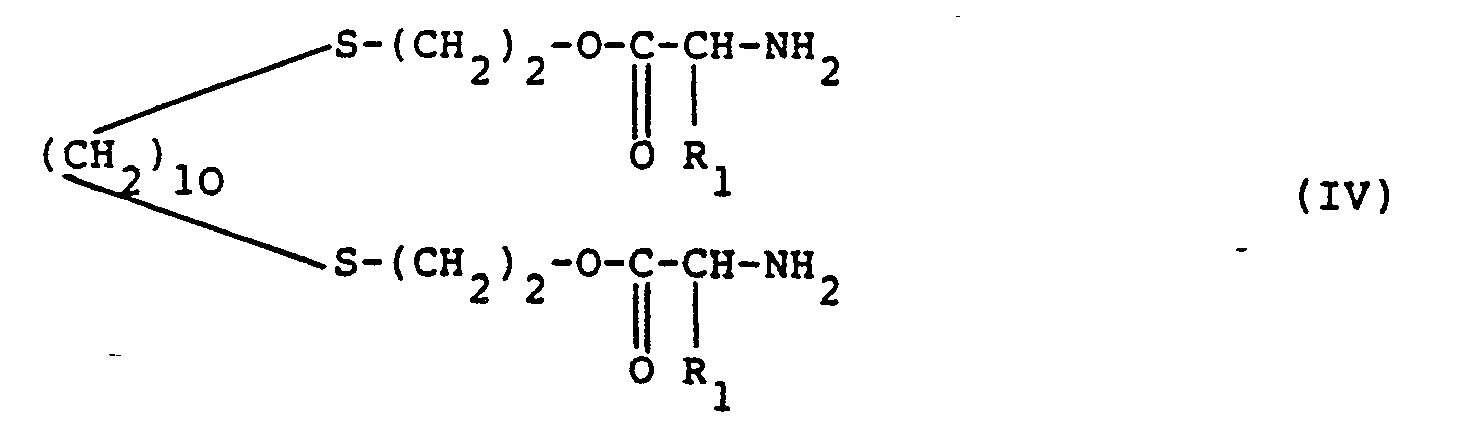


- Compounds of general formula IV may be obtained from compounds of general formula (Vl):

- Compounds of general formula VI may be prepared on their turn by reaction of 1,10-bis[2-(hydroxyethyl)thio]decane with compounds of general formula VII

- Compound of formula II, 1,10-bis[2-(hydroxyethyl)thio]decane, is disclosed in FR-A-2146138 (Chem. Abstr. 79, 41919f).
- Compounds of general formula III, wherein X = OH, are prepared from nicotinic, bromonicotinic, fluoronicotinic, pyrazinoic, 5-methyl-pyrazinoic acids and commercially available N-oxides thereof, by reaction with methyl, ethyl or t-butyl esters of the aminoacids according to the invention, substantially following the method described by M. T. Wu and R. E. Lyle in J. Pharm. Sci. 61,141-2 (1972); the resulting amides are then hydrolyzed to give the corresponding free acids.
- The esterification of a compound of general formula III, wherein X = OH, with compound II, is preferably carried out in the presence of carbodiimides, particularly dicyclohexylcarbodiimide (DCCD), in stoichiometric amounts or in a slight excess, preferably 10% molar excess, and 4-dimethylaminopyridine (DMAP) in catalytic amounts, preferably 10% molar with respect to carbodiimide. The reaction may be carried out in aprotic organic solvents, such as methylene chloride, dichloroethane, diethylenedioxide, tetrahydrofuran, diglyme, dimethoxyethane, dimethylsulfoxide, dimethylformamide, the latter being particularly preferred.
- The reaction may be carried out at a temperature ranging from 0° to 50°C, preferably at room temperature, and it is complete within 3-48 hours; usually within 12 hours.
- Alternatively, compounds of formula III wherein X is OH, are transformed into the corresponding derivatives in which X is a group of formula

- The reaction between compounds of general formula IV and compounds of general formula V may be carried out using acyl chlorides of compounds V (T = CI), prepared from the corresponding nicotinic, bromonicotinic, fluoronicotinic, pyrazinoic, 5-methyl-pyrazinoic acids or the N-oxides thereof, according to the method described by R. Wingfield et al. J. Am. Chem. Soc. 75, 4364 (1953).
- Compounds of formula V, wherein T is Cl, are then reacted with compounds of general formula IV, in an inert organic solvent such as dichloroethane, methylene chloride, benzene, or, preferably, toluene, in the presence of a tertiary organic base, such as triethylamine, tributylamine, N,N-dimethylaniline, N,N,N,N-tetramethylethylenediamine, preferably triethylamine, in inert atmosphere. The reaction is preferably carried out at a temperature of 0°C.
- Alternatively, compounds of general formula V, wherein T is N,N-bis(2-oxo-3-oxazolidinyl)phosphorodiamidyl, are reacted with compounds of formula IV, according to Ballester-Rodès et al. Synth. Comm. 515 (1984).
- The deprotection reaction of the amino group of compounds of general formula VI to obtain compounds of general formula IV, is carried out by solubilizing compounds VI in an appropriate organic solvent, selected from the group consisting of methylcellosolve@ (methylglykol); isopropyl, ethyl, methyl alcohols; diglyme, or, preferably, anhydrous methanol, and dropping therein a mineral acid solution, preferably hydrochloric acid in the same solvent, at temperatures ranging from 0° to 25°C, preferably 10-15°C.
- The reaction is complete at room temperature, within a period from 12 to 48 hours, preferably the reaction mixture is worked up after 12 hours.
- Compounds of general formula VII, wherein X is OH, are known in the literature (Chemistry of amino acids: pag. 922; Schnorremberg and Steglich: Angew. Chem. Int. Ed. Engl. 18, 307 (1979)).
- Compounds of general formula VI are prepared by reacting II with said compounds VII in the presence of carbodiimides, preferably dicyclohexylcarbodiimide, in stoichiometric amounts or in slight excess with respect to VII, preferably in 10% molar excess, and 4-dimethylaminopyridine in a catalytic amount, preferably in a 10% molar amount with respect to carbodiimide.
- The reaction may be carried out in aprotic organic solvents such as, for instance, methylene chloride, dichloroethane, diethylenedioxide, tetrahydrofuran, diglyme, dimethoxyethane, dimethylsulfoxide; dimethylformamide being preferred.
- The reaction may be carried out at a temperature ranging from 0° to 50°C, preferably at room temperature, and it is complete within 3-48 hours, preferably within 12 hours.
- Alternatively, compounds of formula VII, wherein X is OH, are transformed into the corresponding derivatives in which X is a group of formula
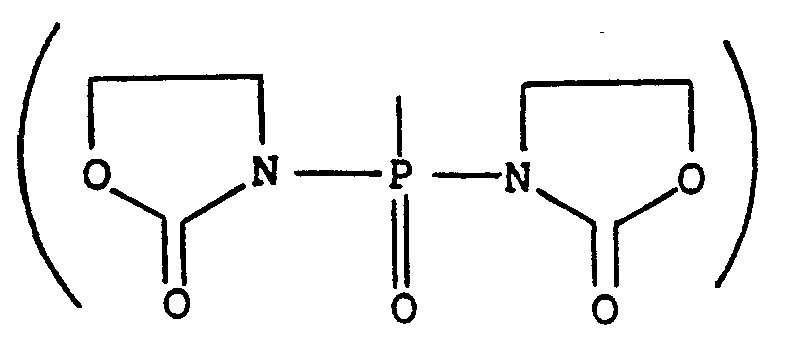
- Compound (1), 1,10-bis[2-(N-nicotinoylglycyl)ethylthio]decane, was selected as a typical representative example of the compounds of the invention. Pharmacological and toxicological characteristics of compound (1) were evaluated in comparison to nicotinic acid (2); a 1,10-bis[2-(hydroxyethyl)thiol- decane (3) and the esters 1,10-bis[2-nicotinoyl)ethylthio]decane (4) and 1,10-bis[2-(nicotinoyloxymethylcarbonyloxy)ethylthio]decane (5).
- Compound 4, described in the above mentioned patents U.S. 4,021,436, FR-A-2,146,138, FR-A-2,324,303, EP-A-0053681 and 0060994, and compound 5, which is structurally similar, may be considered as the closest prior art.
- The formulae of said compounds are reported hereinbelow
-

- The single compounds were administered orally at single equimolecular gradually increasing doses, in order to comparatively evaluate their hypocholesterolemic and hypotriglyceridemic activities. Normolipidemic, and hypercholesterolemic acid hypertriglyceridemic rats, following to administration of diets respectively enriched in cholesterol and cholic acid (Nath diet) of 79.5% fructose, were used.
- Finally, normolipemic rats, housed under normal conditions, were treated for 5 days with the compounds under test, at gradually increasing doses. At the end of said treatment, the rats were fasted for 16 hours and administered with Triton@ 1.339, at a dose of 0.5 g/kg i.v. Two hours later, the rats were killed and the parameters in comparison with the animals treated respectively with the sole vehicle and TritonO were evaluated.
- Male Sprague-Dawley rats of 180-200 g body weight were used. The compounds under test were administered as 1% tylose suspension, by means of gastric probe, 10 animals per dose in comparison with controls, treated with the sole vehicle.
- Four dose levels: 1, 2, 4, 8 -10-3 mol/kg were used for each compound under test. The body growth and liver weight were evaluated.
- In the serum the following values were determined:
- a) total cholesterol, by enzymatic method;
- b) HDL cholesterol, by enzymatic method, after precipitation of the other lipoproteins by addition of phosphotungstic acid;
- c) triglycerides by enzymatic method, i.e. by means of enzymatic hydrolysis and dosage of the formed glycerol.
- The dosage of the liver triglycerides has been carried out by enzymatic method on the evaporated liver extract with chloroform:methanol 2:1.
- The results were evaluated and expressed as % variation with respect to the control groups.
- In the hypercholesterolemic animals (Nath diet), the comparison compound 1,10-bis[2-(nicotinoyl)ethylthioldecane, in all the assayed doses, induced a marked decrease in the HDL concentration, which decreased with the progressive increasing of the administered dose. Moreover, a 10% preliminary increase of the total cholesterol at a 2·10-3 mol/kg dose, followed by a 50% decrease versus controls, which did not vary increasing the dose, was evidenced.
- At all the tested doses, the triglyceride hematic concentration was always higher than that in the control animals, although a tendency to decrease with the increasing of the dose was noted; moreover, a gradual increase in the liver weight was observed.
- A similar behaviour was evidenced after administration of 1,10-bis[2-(nicotinoyloxy- acetyl)ethylthio]decane.
- As an example, at the dose of 4.10-3 mol/kg, a 30% decrease of total plasmatic cholesterol was noted. Contemporary decrease in hematic HDL cholesterol and triglycerides, respectively of 6 and 34%, combined with an increase in the concentration of hepatic triglycerides.
- On the contrary, compound 1,10-bis[2-(nicotinoylglycyl)ethylthio]decane according to the invention, at a dose of 4.10-3 mol/kg, induced a decrease in total cholesterol, hematic and hepatic triglycerides respectively of 37, 4 and 48%, with contemporary 7% increase in HDL cholesterol. At the same time, no substantial changes in the liver weight were observed.
- All the induced changes were statistically significant and dose-related, in the considered dose range.
- The hypotriglyceridemizing activity of the compounds of the invention, as already mentioned, was evaluated in fructose and Triton@ induced hypertriglyceridemias, in comparison with the following standards: 1,10-bis[2-(hydroxyethyl)thio]decane (3), its nicotinate (4) and nicotinoyloxymethylcarbonyloxy ester (5).
- All the compounds were administered at equimolecular gradual dosages.
- No significant differences among the single compounds in decreasing triglyceride hematic level were evidenced. Said decrease, for instance in the fructose test, was about 50-60% with respect to the control values; for all the compounds at an equimolecular dosage corresponding to 100 mg/kg/day of 1,10-bis[2-(hydroxyethyl)thiodecane]. All the compounds caused a variable but not statistically significant decrease in total cholesterol and HDL cholesterol hematic levels. On the contrary, in the "Triton-test", HDL cholesterol level appeared to be increased, without significant differences among the compounds.
- Surprisingly, compound 1,10-bis[2-(nicotinoylglycyl)ethylthio]decane (1), according to the invention, and its O-thioester (5) proved to reduce or keep almost unchanged the triglyceride hepatic concentration, with percent variations from -10 to +10%, with respect to 40-50% increases observed for 1,10-bis[2-(hydroxyethyl)thio]decane (3) and its nicotinate (4).
- This surprising and unforeseeable effect on the triglyceride hepatic concentration, is a substantial and favorable feature of the compounds of the invention.
- In fact said favorable effect, combined with the contemporary decrease of triglyceride plasmatic concentration, is a sign of a catabolic event on triglycerides, said decrease at plasmatic level not resulting from a redistribution effect of the triglycerides, as it could appear from the increases of the parenchyma.
- The antilipolytic activity of the compounds of the invention was studied in comparison with 1,10-bis(2-hydroxyethylthio)decane (3), which showed no activity, its nicotinic ester (4), the ester (5), and nicotinic acid (2). All the standards 2, 4, 5 and the compounds of the invention proved to have antilipolytic activity both under normal feeding conditions and in the lipolysis process induced by fasting or adrenalin.
- The compounds were administered orally. The results from some experiments, after administration of compounds in amounts of 1·10-3 mol/kg, in a single dose, are reported in Tables 1, 2, 3. The results are expressed as pEq/I of free fatty acids.


- It is well known that nicotinic acid finds a limited therapeutic application, due to its peripheral vasodilating action, inducing undesired side-effects such as cephalgia and flushing of the face, which may be so marked and unpleasant as to result in poor patient compliance or even interruption of the treatment.
- Such a side-effect may be experimented on male albino Guinea pigs, weighing 300-400 g, normally fed and housed in silent room, by observing the vasodilation of ear marginal veins, after administration of the test compounds.
- Table 4 shows the results obtained comparing nicotinic acid and compounds 1,10-bis(2-hydrodyethylthio)decane nicotinic ester (4) and ester (5) at doses of 1·10-3 mol/kg, with 1,10-bis[2-(nicotinoylglycyl)ethylthio]decane (1) ester at doses of 1 and 2·10-3 mol/kg.
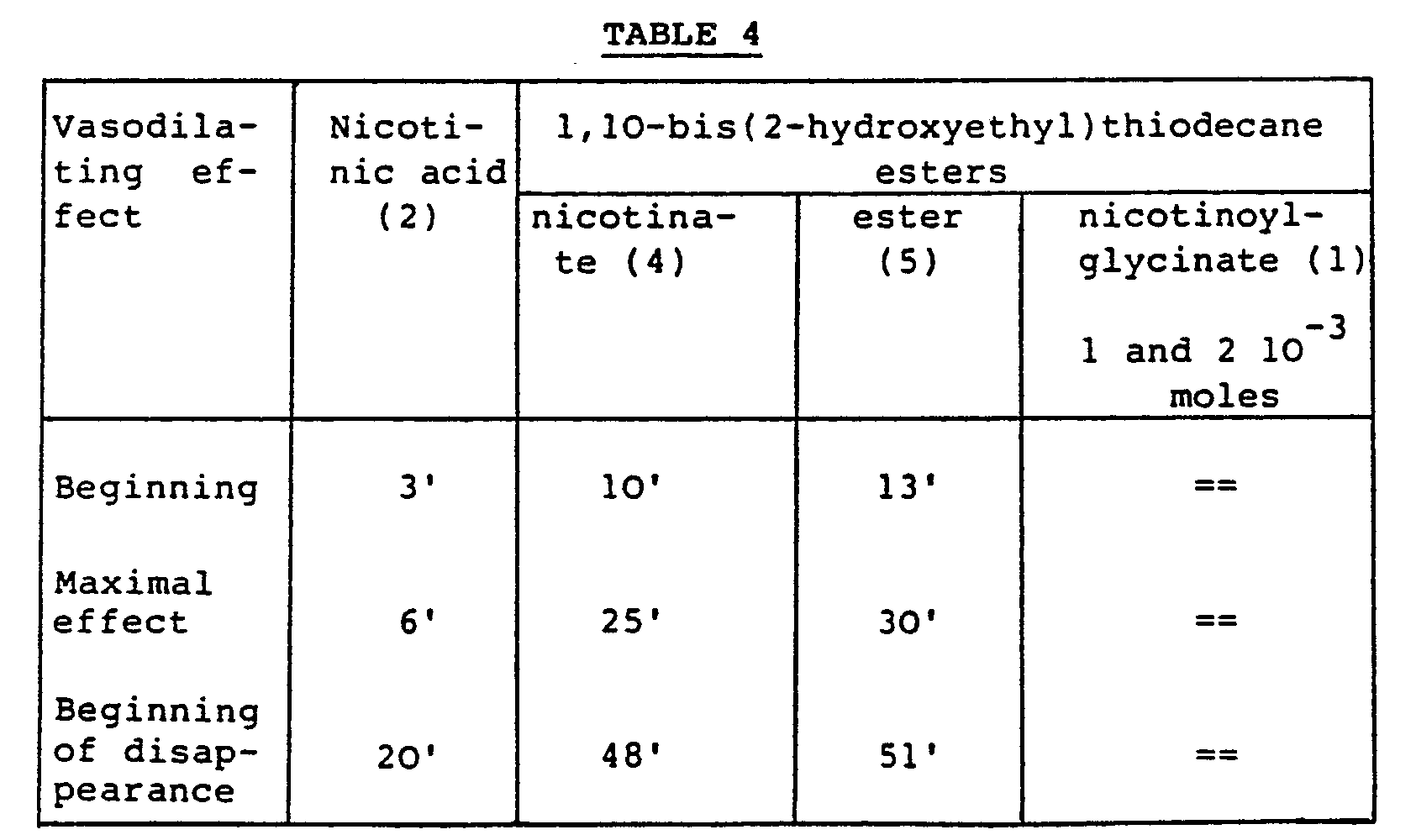
- However, the compounds of the invention exhibit the surprising advantages of a long-lasting antilipolytic effect and the absence of the "rebound" effects, characteristic of the other hypolipidemic drugs. Last, but not least, said compounds show no side-effects (flushing), the therapeutical activity being equal.
- The compounds of the present invention, particularly 1,10-bis(2-hydroxyethylthio)decane nico- tinoylglycyl, 5-bromo-nicotinoyl-glycyl, 5-methyl-pyrazinoylglycyl, nicotinoylalanyl, nicotonoylisoleucyl and nicotinoylphenylalanyl esters, orally administered at doses from 100 to 250 mg/kg, protect the mouse from thrombosis induced by the administration of arachidonic acid, as well as collagene and adrenalin, according to the procedure by G. di Minno and M. J. Silver, Mouse antithrombotic assay, J. Pharm. Exper. Therap. 225, 57 (1983).
- Moreover, the compounds of the invention show a markedly reduced acute toxicity, with very high DL50 values, ranging from 3 and 6 g/kg in mice and rats.
- The very high antilipolytic activity of the compounds of the invention, as well as the poor toxicity thereof, together, contribute to an evident antithrombotic activity "in vivo" and a clear hypocholesterolemic and hypotriglyceridemic effect. It is particularly significant that the hematic normalization of triglycerides does not induce an increase in their hepatic concentration, thus showing that said effect is not corresponding to a redistribution of the triglycerides from the plasma to the hepatic area. For these reasons, the compounds according to the invention are particularly useful in human therapy for the treatment and prophylaxis of hyperlipemias of different type and origin, as well as various pathological conditions such as atherosclerosis and arteriosclerosis, thrombotic conditions and vasal disturbances.
- The compounds of the invention may be formulated in form of pharmaceutical compositions to be administered by oral, intramuscular, subcutaneous and/or sublingual route, at doses from 2.5 to 75 mg/kg/ day, depending on the dose, number of administrations, age, weight and general conditions of the patient. The compounds of the invention may be administered orally in form of tablets, capsules, drops or syrups; rectally in form of suppositories; parenterally in form of solutions or suspensions to be administered by subcutaneous, intramuscular or intravenous route.
- The pharmaceutical compositions of the compounds of the present invention may be conventionally prepared using usual vehicles and diluents such as water, gelatin, lactose, dextrose, saccharose, mannitol, sorbitol, cellulose, talc, stearic acid, calcium and magnesium stearate, glycols, starch, arabic and tragacanth gum, alginic acid and alginates, lecithin, polysorbate (vegetal oils, etc.).
- Said pharmaceutical formulations, which are a further object of the invention, will contain at least one compound of formula I or the corresponding salts, together with pharmaceutically acceptable excipients or diluents, compatible with the other ingredients and non-toxic for the patients.
- The active ingredient concentration in monodose formulations such as tablets, may vary from 0.05% to 95%.
- The oral formulations may be in form of single dose units, such as capsules, sugar coated pills, lozenges, tablets, containing a pre-established amount of the active ingredient of formula I.
- The parenteral formulations comprise aqueous, preferably isotonic, preparations of the active ingredient.
- The rectal formulations are in form of monodose suppositories, prepared admixing the active ingredient with one or more conventional excipients, such as cocoa butter.
- The following examples further illustrate the invention without limiting it.
- 33.9 Grams of N-formylglycine and 2.5 g of 4-dimethylaminopyridine were added to a solution of 1,10- bis[2-(hydroxyethyl)thio]decane (47.4 g) in 250 ml of anhydrous dimethylformaide. The resulting solution was cooled to 0°-5°C, under stirring, then, keeping the temperature constant, a solution of dicyclohexylcarbodiimide (68 g) in dimethylformamide (75 ml) was dropped therein. After stirring overnight at room temperature, the resulting suspension was filtered, and the solid on the filter was washed with methylene chloride. The filtrate was concentrated to dryness under vacuum and treated with methylene chloride (250 ml): the organic phase was washed in turn with 10% aqueous HCI (50 ml), water (100 ml), 5% aqueous NaOH (50 ml), finally again with 100 ml of water. After drying over sodium sulfate, and evaporation of the solvent under vacuum, an oil was obtained which, after two crystallizations from ethyl acetate, yielded 60 g of 1,10-bis[2-(N-formyigiycyt)ethyithio]decane, m.p. 82-85°C (TLC: Si02, eluent acetone/methylene chloride 1:1, Rf: 0.5).
- The procedure of Example 1 was repeated, using respectively:
- N-formyl-alanine
- N-formyl-leucine
- N-formyl-isoleucine
- N-formyl-phenylalanine
- N-formyl-methionine
- 1,10-bis[2-(N-formyl-alanyl)-ethylthio]decane, m.p. 86-88°;
- 1,10-bis[2-(N-formyl-leucyl)-ethylthio]decane, m.p. 90-92°;
- 1,10-bis[2-(N-formyl-isoleucyl)-ethylthio]decane, m.p. 85-88°;
- 1,10-bis[2-(N-formyl-phenylalanyl)-ethylthio]decane, m.p. 102-110°;
- 1,10-bis[2-(N-formyl-methionyl)-ethylthio]decane, m.p. 90=92°;
- 1,10-bis[2-(N-t-butoxycarbonyl-alanyl)-ethylthio]decane, m.p. 100-102°;
- 1,10-bis[2-(N-t-butoxycarbonyl-leucyl)ethylthio]decane, m.p. 102-106°;
- 1,10-bis[2-(N-t-butoxycarbonyl-isoleucyl)-ethylthio]decane, m.p. 100-102.;
- 1,10-bis[2-(N-t-butoxycarbonyl-phenylalanyl)-ethylthio]decane, m.p. 110-115°;
- 1,10-bis[2-(N-t-butoxycarbonyl-methionyl)-ethylthio]decane, m.p. 102-104°.
- A saturated solution of methanolic hydrochloric acid (20 ml) was slowly dropped into a solution of 1,10-bis[2-(N-formyl-glycyl)-ethylthio]decane (10 g), in anhydrous methanol (400 ml), kept at 15°-20°C. After stirring overnight, the solvent was removed under vacuum at a temperature of 30-40° and the solid residue was taken up in methylene chloride (100 ml) and methanol (10 ml). The resulting suspension was left to solidify for some hours, then filtered under nitrogen. Upon recrystallization from methanol/ methylene chloride, 1,10-bis[2-(glycyl)ethylthio]decane dihydrochloride (6.8 g), m.p. 180-182° was obtained.
- The procedure of Example 3 was repeated, using the following compounds:
- 1,10-bis[2-(N-formyl-alanyl)ethylthio]decane
- 1,10-bis[2-(N-formyl-leucyl)ethylthio]decane
- 1,10-bis[2-(N-formyl-phenylaianyl)ethylthioldecane
- 1,10-bis[2-(N-formyl-isoleucyl)ethylthio]decane
- 1,10-bis[2-(N-formyl-methionyl)ethylthio]decane
- 1,10-bis[2-(alanyl)ethylthio]decane dihydrochloride, m.p. 190-195°;
- 1,10-bis[2-(leucyl)ethylthio]decane dihydrochloride, m.p. 185-190°;
- 1,10-bis[2-(phenylalanyl)ethylthio]decane dihydrochloride, m.p. 200-205°;
- 1,10-bis[2-(isoleucyl)ethylthio]decane dihydrochloride, m.p. 185-187°;
- 1,10-bis[2-(methionyl)ethylthio]decane dihydrochloride, m.p. 200-205°.
- 1,10-Bis[2-(glycyl)ethylthio]decane dihydrochloride (4.78 g) was added to a cooled solution of triethylamine (8.3 ml) in anhydrous toluene (250 ml), under strong stirring and nitrogen stream. After cooling to 0-5°C, a solution of 5-bromonicotinoyl chloride (9.24 g) in toluene (200 ml) was dropped into the suspension, keeping the same temperature.
- After 2 hours at room temperature, the solvent was removed under vacuum and the residue was partitioned between water and methylene chloride. The organic phase was washed with 5% aqueous sodium bicarbonate, with water again, dried over anhydrous sodium sulfate, then concentrated to dryness.
- The resulting residue was crystallized from ethyl acetate. 1,10-Bis[2-(5-bromo-nicotinoyl-glycyl)ethylthio]decane, 4.3 g, m.p. 102-104° was obtained, unitary spot in thin layer chromatography [Rf. 0.3, SiO2CH2Cl2/acetone 1:1].
- The procedure of Example 5 was repeated, using the following compounds:
- 1,10-bis[2-(alanyl)ethylthio]decane
- 1,10-bis[2-(phenylalanyl)ethylthio]decane
- 1,10-bis[2-(leucyl)ethylthio]decane
- 1,10-bis[2-(isoleucyl)ethylthio]decane
- 1,10-bis[2-(methionyl)ethylthio]decane.
- The following compounds were respectively obtained:
- 1,10-bis[2-(5-bromo-nicotinoylalanyl)ethylthio]decane, m.p. 95-98°;
- 1,10-bis[2-(5-bromo-nicotinoylphenylalanyl)ethylthio]decane, m.p. 105-106°;
- 1,10-bis[2-(5-bromo-nicotinoylleucyl)ethylthio]decane, m.p. 102-104°;
- 1,10-bis[2-(5-bromo-nicotinoylisoleucyl)ethylthio]decane, m.p. 100-102°;
- 1,10-bis[2-(5-bromo-nicotinoylmethionyl)ethylthio]decane, m.p. 110-115°.
- 1,10-Bis-[2-(2-alanyl-ethyl)thio]decane dihydrochloride (25 g) was added to a solution of nicotinic acid (12.3 g) in 150 ml of dimethylformamide containing triethylamine (41.5 ml), under stirring and inert atmosphere. N,N-Bis-(2-oxo-3-oxazolidinyl)phosphorodiamidyl chloride (22.9 g) was subsequently added to the resulting solution, and the reaction mixture was stirred for 12 hours. After concentration to a small volume, the residue was partitioned between a sodium bicarbonate aqueous solution (200 ml) and methylene chloride (250 ml). The organic phase was washed with water again and dried under vacuum: after evaporation of the solvent under vacuum, an oily residue was obtained which was crystallized from ethyl acetate. The resulting 1,10-bis[2-(nicotinoylalanylethyl)thio]decane (45.11 g), m.p. 88-90°C, showed a unitary spot in TLC [Rf. 0.4, Si02, CH2Cl2/acetone 1:1].
- The procedure of Example 7 was repeated, using respectively:
- 1,10-bis[2-(phenylalanyl)ethylthio]decane
- 1,10-bis[2-(leucyl)ethylthio]decane
- 1,10-bis[2-(isoleucyl)ethylthio]decane
- 1,10-bis[2-(methionyl)ethylthio]decane
- 1,10-bis[2-(nicotinoylphenylalanyl)ethylthio]decane, m.p. 95-98°;
- 1,10-bis[2-(nicotinoyl-leucyl)ethylthio]decane, m.p. 93-95°;
- 1,10-bis[2-(nicotinoylisoleucyl)ethylthio]decane, m.p. 93-94°;
- 1,10-bis[2-(nicotinoylmethionyl)ethylthio]decane, m.p. 94―96°.
- A solution of dicyclohexylcarbodiimide (4.53 g) in dimethylformamide (10 ml) was added to a solution of 1,10-bis[2-(hydroxyethyl)thio]decane (2.94 g) and nicotinoyl glycine (3.96 g) in dimethylformamide (30 ml), cooled at 0-5°C. The resulting suspension was stirred overnight at room temperature. After the usual working up, 1,10-bis[2-(nicotinoyl-glycyl)ethylthio]decane was obtained, in form of an oil which was crystallized from ethyl acetate, to obtain a white solid (4.32 g), m.p. 88-90°, which was pure in TLC [Rf. 0.4, Si02, CH2Cl2/acetone 1:1].
- Triethylamine (6.06 g) was added to a suspension of 1,10-bis[2-(glycyl)ethylthio]decane dihydrochloride (4.78 g) in anhydrous toluene (250 ml), under strong stirring, in inert atmosphere. After 30 min, a solution of toluene (200 ml) containing nicotinoyl chloride (4.23 g) was dropped therein, keeping a temperature between 10 and 20°. Stirring was continued for 1 hour at room temperature, then the solvent was removed under vacuum and the residue was partitioned between chloroform (200 ml) and water (100 ml). The organic layer was subsequently washed twice with 5% aqueous sodium bicarbonate (50 ml) and with water (50 ml) again.
- The solvent was dried over sodium sulfate and removed under vacuum. The residue was crystallized from ethyl acetate, to obtain 4 g of 1,10-bis[2-(N-nicotinoylglycyl)ethylthio]decane, m.p. 88-90°.
- The procedures of Examples 5 and 10 were repeated, using 1,10-bis[2-(glycyl)ethylthio]decane dihydrochloride and the following acids and/or acyl chlorides: pyrazinoic, 5-methyl-pyrazinoic, nicotinic N-oxide, pyrazinoic N-oxide, 5-methyl-pyrazinoic N-oxide, 5-methyl-pyrazol-3-carboxylic, 5-methyl- isoxazol-3-carboxylic, 5-fluoro-nicotinic, to obtain the following compounds:
- 1,10-bis[2-(pyrazinoylglycyl)ethylthio]decane
- 1,10-bis[2-(5-methylpyrazinoylglycyl)ethylthio]decane
- 1,10-bis[2-(N-oxy-nicotinoylglycyl)ethylthio]decane
- 1,10-bis[2-(N-oxy-pyrazinoylglycyl)ethylthio]decane
- 1,10-bis[2-(5-methylpyrazol-3-carbonylglycyl)ethylthio]decane
- 1,10-bis[2-(5-methyl-isoxazol-3-carbonylglycyl)ethylthio]decane
- 1,10-bis[2-(5-fluoro-nicotinoylglycyl)ethylthio]decane.
or, alternatively, the t-butoxy-carbonates (BOC) thereof, namely BOC-alanine, BOC-leucine, BOC- isoleucine, BOC-phenylalanine, BOC-methionine. The following compounds were obtained:
or, alternatively, the analogous tert-butoxycarbonyl derivatives thereof, to obtain, respectively:
to obtain the following compounds:
Claims (13)


Priority Applications (1)
| Application Number | Priority Date | Filing Date | Title |
|---|---|---|---|
| AT86101064T ATE44024T1 (en) | 1985-01-28 | 1986-01-27 | COMPOUNDS WITH ANTIHYPERLIPEMIC ACTIVITY, PROCESS FOR THEIR PREPARATION AND PHARMACEUTICAL COMPOSITIONS CONTAINING THEM. |
Applications Claiming Priority (2)
| Application Number | Priority Date | Filing Date | Title |
|---|---|---|---|
| IT1925185 | 1985-01-28 | ||
| IT19251/85A IT1199652B (en) | 1985-01-28 | 1985-01-28 | COMPOUNDS WITH ANTI-HYPERLIPIDEMIC ACTIVITY, THEIR PREPARATION AND PHARMACEUTICAL COMPOSITIONS THAT CONTAIN THEM |
Publications (2)
| Publication Number | Publication Date |
|---|---|
| EP0192976A1 EP0192976A1 (en) | 1986-09-03 |
| EP0192976B1 true EP0192976B1 (en) | 1989-06-14 |
Family
ID=11156130
Family Applications (1)
| Application Number | Title | Priority Date | Filing Date |
|---|---|---|---|
| EP86101064A Expired EP0192976B1 (en) | 1985-01-28 | 1986-01-27 | Compounds having antihyperlipemic activity, processes for the preparation thereof and pharmaceutical compositions containing them |
Country Status (4)
| Country | Link |
|---|---|
| EP (1) | EP0192976B1 (en) |
| AT (1) | ATE44024T1 (en) |
| DE (1) | DE3663943D1 (en) |
| IT (1) | IT1199652B (en) |
Citations (1)
| Publication number | Priority date | Publication date | Assignee | Title |
|---|---|---|---|---|
| FR2146138A1 (en) * | 1971-07-20 | 1973-03-02 | Lafon Labor | Alpha omega substd decanes and dodecanes - for lowering blood fat and cholesterol levels |
Family Cites Families (4)
| Publication number | Priority date | Publication date | Assignee | Title |
|---|---|---|---|---|
| US4021436A (en) * | 1974-03-15 | 1977-05-03 | Claudio Cavazza | Derivatives of nicotinic acid with amines variously substituted |
| DE2532420A1 (en) * | 1975-07-19 | 1977-02-03 | Boehringer Mannheim Gmbh | PHENYL ACID DERIVATIVES AND THE PROCESS FOR THEIR PRODUCTION |
| IT1209788B (en) * | 1980-10-21 | 1989-08-30 | Celesio Sonnino Tauro | HYPOLIPIDEMIZING SUBSTANCE (BIS-THIO-ETHYL-NICOTINATE) -1.10-DECAN |
| IT1168389B (en) * | 1981-05-06 | 1987-05-20 | Alfa Farmaceutici Spa | ALCANDIOL DERIVATIVES WITH HYPOLIPIDEMIZING ACTIVITY, METHODS FOR THEIR PREPARATION AND PHARMACEUTICAL COMPOSITIONS THAT CONTAIN THEM |
-
1985
- 1985-01-28 IT IT19251/85A patent/IT1199652B/en active
-
1986
- 1986-01-27 AT AT86101064T patent/ATE44024T1/en not_active IP Right Cessation
- 1986-01-27 EP EP86101064A patent/EP0192976B1/en not_active Expired
- 1986-01-27 DE DE8686101064T patent/DE3663943D1/en not_active Expired
Patent Citations (1)
| Publication number | Priority date | Publication date | Assignee | Title |
|---|---|---|---|---|
| FR2146138A1 (en) * | 1971-07-20 | 1973-03-02 | Lafon Labor | Alpha omega substd decanes and dodecanes - for lowering blood fat and cholesterol levels |
Also Published As
| Publication number | Publication date |
|---|---|
| DE3663943D1 (en) | 1989-07-20 |
| IT8519251A0 (en) | 1985-01-28 |
| EP0192976A1 (en) | 1986-09-03 |
| IT1199652B (en) | 1988-12-30 |
| ATE44024T1 (en) | 1989-06-15 |
Similar Documents
| Publication | Publication Date | Title |
|---|---|---|
| US5466683A (en) | Water-soluble analogs of carbamazepine | |
| EP0691852B1 (en) | Valproic acid covalently bonded to a lysophospholipid | |
| US4342776A (en) | 4-Substituted-3-hydroxy-3-pyrroline-2,5-dione inhibitors of glycolic acid oxidase | |
| US5073547A (en) | Dopamine pro-drug | |
| US4426391A (en) | [(Alkoxycarbonyl)oxy]alkyl esters of methyldopa | |
| EP0274453A2 (en) | Collagenase inhibitor derivatives, their preparation and pharmaceutical compositions containing them | |
| CA1089485A (en) | .omega.-AMINOCARBOXYLIC ACID AMIDES AND A PROCESS FOR THE PREPARATION THEREOF | |
| JPH02200691A (en) | Lysosphingolipid derivatives | |
| EP0618899A1 (en) | AROMATIC ESTERS OF PHENYLENDIAL CANOATES AS INHIBITORS OF HUMAN NEUTROPHILIC ELASTASE. | |
| US5350767A (en) | Derivatives of cysteine | |
| US4859698A (en) | Novel class of acyl-derivatives of carnitine, process for preparing same and therapeutic use thereof | |
| SK278710B6 (en) | 3,3 '-DITIOBIS (PROPIONAL) ACIDS AND THEIR ESTERS, | |
| US3985875A (en) | ω-(N-acylamino)alkylphosphoryl ethanolamines, pharmaceutical compositions containing them, and their uses | |
| US5155099A (en) | Alkylphosphonoserines and pharmaceutical compositions useful as cytostatic agents | |
| US4461775A (en) | Hydroxythioether fatty acid derivatives | |
| EP0192976A1 (en) | Compounds having antihyperlipemic activity, processes for the preparation thereof and pharmaceutical compositions containing them | |
| US4699901A (en) | Diacyl derivatives of glycerylphosphorylcholine, their preparation, and antihyperlipidemic compositions | |
| US4918095A (en) | Compositions with antibiotic activity and their use | |
| EP0131995B1 (en) | Compounds with hypolipemic activity | |
| US6180664B1 (en) | Pentaerythritol derivatives, their production and use and intermediates for their synthesis | |
| EP0317540B1 (en) | Cysteine derivatives, processes for their preparation and their use | |
| US3836656A (en) | Substituted purines as hypolipidemics | |
| US7166605B2 (en) | Probucol nitro-derivatives | |
| JP3444898B2 (en) | Hydroxamic acid derivative | |
| US4499303A (en) | Antihyperlipidemic N-benzoylsulfamates, N-benzylsulfamates and benzylsulfonamides |
Legal Events
| Date | Code | Title | Description |
|---|---|---|---|
| PUAI | Public reference made under article 153(3) epc to a published international application that has entered the european phase |
Free format text: ORIGINAL CODE: 0009012 |
|
| AK | Designated contracting states |
Kind code of ref document: A1 Designated state(s): AT BE CH DE FR GB IT LI LU NL SE |
|
| 17P | Request for examination filed |
Effective date: 19861017 |
|
| 17Q | First examination report despatched |
Effective date: 19880210 |
|
| GRAA | (expected) grant |
Free format text: ORIGINAL CODE: 0009210 |
|
| AK | Designated contracting states |
Kind code of ref document: B1 Designated state(s): AT BE CH DE FR GB IT LI LU NL SE |
|
| REF | Corresponds to: |
Ref document number: 44024 Country of ref document: AT Date of ref document: 19890615 Kind code of ref document: T |
|
| ITF | It: translation for a ep patent filed | ||
| REF | Corresponds to: |
Ref document number: 3663943 Country of ref document: DE Date of ref document: 19890720 |
|
| ET | Fr: translation filed | ||
| PGFP | Annual fee paid to national office [announced via postgrant information from national office to epo] |
Ref country code: LU Payment date: 19891115 Year of fee payment: 5 |
|
| PGFP | Annual fee paid to national office [announced via postgrant information from national office to epo] |
Ref country code: SE Payment date: 19891116 Year of fee payment: 5 |
|
| PGFP | Annual fee paid to national office [announced via postgrant information from national office to epo] |
Ref country code: FR Payment date: 19891124 Year of fee payment: 5 |
|
| ITTA | It: last paid annual fee | ||
| PG25 | Lapsed in a contracting state [announced via postgrant information from national office to epo] |
Ref country code: LU Free format text: LAPSE BECAUSE OF NON-PAYMENT OF DUE FEES Effective date: 19900131 |
|
| PGFP | Annual fee paid to national office [announced via postgrant information from national office to epo] |
Ref country code: NL Payment date: 19900131 Year of fee payment: 5 Ref country code: GB Payment date: 19900131 Year of fee payment: 5 Ref country code: AT Payment date: 19900131 Year of fee payment: 5 |
|
| PGFP | Annual fee paid to national office [announced via postgrant information from national office to epo] |
Ref country code: BE Payment date: 19900206 Year of fee payment: 5 |
|
| PGFP | Annual fee paid to national office [announced via postgrant information from national office to epo] |
Ref country code: CH Payment date: 19900208 Year of fee payment: 5 |
|
| PGFP | Annual fee paid to national office [announced via postgrant information from national office to epo] |
Ref country code: DE Payment date: 19900328 Year of fee payment: 5 |
|
| PLBE | No opposition filed within time limit |
Free format text: ORIGINAL CODE: 0009261 |
|
| STAA | Information on the status of an ep patent application or granted ep patent |
Free format text: STATUS: NO OPPOSITION FILED WITHIN TIME LIMIT |
|
| 26N | No opposition filed | ||
| PG25 | Lapsed in a contracting state [announced via postgrant information from national office to epo] |
Ref country code: GB Effective date: 19910127 Ref country code: AT Effective date: 19910127 |
|
| PG25 | Lapsed in a contracting state [announced via postgrant information from national office to epo] |
Ref country code: SE Effective date: 19910128 |
|
| PG25 | Lapsed in a contracting state [announced via postgrant information from national office to epo] |
Ref country code: LI Effective date: 19910131 Ref country code: CH Effective date: 19910131 Ref country code: BE Effective date: 19910131 |
|
| PG25 | Lapsed in a contracting state [announced via postgrant information from national office to epo] |
Ref country code: NL Effective date: 19910801 |
|
| NLV4 | Nl: lapsed or anulled due to non-payment of the annual fee | ||
| GBPC | Gb: european patent ceased through non-payment of renewal fee | ||
| PG25 | Lapsed in a contracting state [announced via postgrant information from national office to epo] |
Ref country code: FR Effective date: 19910930 |
|
| REG | Reference to a national code |
Ref country code: CH Ref legal event code: PL |
|
| PG25 | Lapsed in a contracting state [announced via postgrant information from national office to epo] |
Ref country code: DE Effective date: 19911001 |
|
| REG | Reference to a national code |
Ref country code: FR Ref legal event code: ST |
|
| EUG | Se: european patent has lapsed |
Ref document number: 86101064.3 Effective date: 19910910 |
|
| PG25 | Lapsed in a contracting state [announced via postgrant information from national office to epo] |
Ref country code: IT Free format text: LAPSE BECAUSE OF NON-PAYMENT OF DUE FEES;WARNING: LAPSES OF ITALIAN PATENTS WITH EFFECTIVE DATE BEFORE 2007 MAY HAVE OCCURRED AT ANY TIME BEFORE 2007. THE CORRECT EFFECTIVE DATE MAY BE DIFFERENT FROM THE ONE RECORDED. Effective date: 20050127 |