EP0192177B1 - Copolymer and process for producing the same - Google Patents
Copolymer and process for producing the same Download PDFInfo
- Publication number
- EP0192177B1 EP0192177B1 EP86101758A EP86101758A EP0192177B1 EP 0192177 B1 EP0192177 B1 EP 0192177B1 EP 86101758 A EP86101758 A EP 86101758A EP 86101758 A EP86101758 A EP 86101758A EP 0192177 B1 EP0192177 B1 EP 0192177B1
- Authority
- EP
- European Patent Office
- Prior art keywords
- copolymer
- group
- formula
- alkali metal
- represented
- Prior art date
- Legal status (The legal status is an assumption and is not a legal conclusion. Google has not performed a legal analysis and makes no representation as to the accuracy of the status listed.)
- Expired
Links
- 0 COc1ccc(*)cc1 Chemical compound COc1ccc(*)cc1 0.000 description 2
- XIAHSJTUQAWUAW-UHFFFAOYSA-N CC(C)(c1ccc(C)cc1)c1ccc(C)cc1 Chemical compound CC(C)(c1ccc(C)cc1)c1ccc(C)cc1 XIAHSJTUQAWUAW-UHFFFAOYSA-N 0.000 description 1
- WEAYCYAIVOIUMG-UHFFFAOYSA-N Cc(cc1)ccc1S(c1ccc(C)cc1)(=O)=O Chemical compound Cc(cc1)ccc1S(c1ccc(C)cc1)(=O)=O WEAYCYAIVOIUMG-UHFFFAOYSA-N 0.000 description 1
Classifications
-
- C—CHEMISTRY; METALLURGY
- C08—ORGANIC MACROMOLECULAR COMPOUNDS; THEIR PREPARATION OR CHEMICAL WORKING-UP; COMPOSITIONS BASED THEREON
- C08G—MACROMOLECULAR COMPOUNDS OBTAINED OTHERWISE THAN BY REACTIONS ONLY INVOLVING UNSATURATED CARBON-TO-CARBON BONDS
- C08G75/00—Macromolecular compounds obtained by reactions forming a linkage containing sulfur with or without nitrogen, oxygen, or carbon in the main chain of the macromolecule
- C08G75/20—Polysulfones
- C08G75/23—Polyethersulfones
-
- C—CHEMISTRY; METALLURGY
- C08—ORGANIC MACROMOLECULAR COMPOUNDS; THEIR PREPARATION OR CHEMICAL WORKING-UP; COMPOSITIONS BASED THEREON
- C08G—MACROMOLECULAR COMPOUNDS OBTAINED OTHERWISE THAN BY REACTIONS ONLY INVOLVING UNSATURATED CARBON-TO-CARBON BONDS
- C08G65/00—Macromolecular compounds obtained by reactions forming an ether link in the main chain of the macromolecule
- C08G65/34—Macromolecular compounds obtained by reactions forming an ether link in the main chain of the macromolecule from hydroxy compounds or their metallic derivatives
- C08G65/38—Macromolecular compounds obtained by reactions forming an ether link in the main chain of the macromolecule from hydroxy compounds or their metallic derivatives derived from phenols
- C08G65/40—Macromolecular compounds obtained by reactions forming an ether link in the main chain of the macromolecule from hydroxy compounds or their metallic derivatives derived from phenols from phenols (I) and other compounds (II), e.g. OH-Ar-OH + X-Ar-X, where X is halogen atom, i.e. leaving group
- C08G65/4006—(I) or (II) containing elements other than carbon, oxygen, hydrogen or halogen as leaving group (X)
-
- C—CHEMISTRY; METALLURGY
- C08—ORGANIC MACROMOLECULAR COMPOUNDS; THEIR PREPARATION OR CHEMICAL WORKING-UP; COMPOSITIONS BASED THEREON
- C08G—MACROMOLECULAR COMPOUNDS OBTAINED OTHERWISE THAN BY REACTIONS ONLY INVOLVING UNSATURATED CARBON-TO-CARBON BONDS
- C08G65/00—Macromolecular compounds obtained by reactions forming an ether link in the main chain of the macromolecule
- C08G65/34—Macromolecular compounds obtained by reactions forming an ether link in the main chain of the macromolecule from hydroxy compounds or their metallic derivatives
- C08G65/38—Macromolecular compounds obtained by reactions forming an ether link in the main chain of the macromolecule from hydroxy compounds or their metallic derivatives derived from phenols
- C08G65/40—Macromolecular compounds obtained by reactions forming an ether link in the main chain of the macromolecule from hydroxy compounds or their metallic derivatives derived from phenols from phenols (I) and other compounds (II), e.g. OH-Ar-OH + X-Ar-X, where X is halogen atom, i.e. leaving group
- C08G65/4012—Other compound (II) containing a ketone group, e.g. X-Ar-C(=O)-Ar-X for polyetherketones
- C08G65/4031—(I) or (II) containing nitrogen
-
- C—CHEMISTRY; METALLURGY
- C08—ORGANIC MACROMOLECULAR COMPOUNDS; THEIR PREPARATION OR CHEMICAL WORKING-UP; COMPOSITIONS BASED THEREON
- C08G—MACROMOLECULAR COMPOUNDS OBTAINED OTHERWISE THAN BY REACTIONS ONLY INVOLVING UNSATURATED CARBON-TO-CARBON BONDS
- C08G2650/00—Macromolecular compounds obtained by reactions forming an ether link in the main chain of the macromolecule
- C08G2650/62—Macromolecular compounds obtained by reactions forming an ether link in the main chain of the macromolecule characterised by the nature of monomer used
- C08G2650/64—Monomer containing functional groups not involved in polymerisation
Definitions
- This invention relates to a novel copolymer and a process for producing the same, and more particularly, to a novel copolymer which is excellent in heat resistance and capable of controlling its heat resistance, and good in mechanical strength, solvent resistance and flame resistance and also excellent in mechanical properties, particularly in elongation and impact strength than the conventional cyanoaryl ether polymer, and to a process for producing the same.
- FR-A-2 122 562 discloses a polymer composition which is characterized by a recurring unit of the following formula: wherein R' is a divalent group selected from the group consisting of the groups and -O-R'-O being in positions ortho or para respective to the neighbouring cyano groups, and m being an integer of 0 or 1. R' is not derived from 2,7-naphthylene. For some uses the glass transition temperatures of these prior art polymers are insufficiently high.
- Japanese Laid-Open Patent Publication No. 206433/1984 there is disclosed a cyanoaryl ether polymer obtained by dihalogenobenzonitrile and hydroquinone or biphenol as starting materials. While this polymer is excellent in mechanical strength and heat resistance, its heat resistance cannot be freely controlled and thus it has disadvantage that it cannot flexibly cope with various requests in the various field of use. Further, such a polymer is not necessarily sufficient in view of characteristics such as a mechanical characteristics required for raw materials of electronics and electric devices or mechanical parts. Accordingly, it has earnestly been desired to develop a cyanoaryl ether polymer having excellent mechanical characteristics than that of the conventional one.
- An object of this invention is to solve the problems as mentioned above and to provide a novel copolymer which is excellent in heat resistance and capable of controlling its heat resistance, and good in mechanical strength, solvent resistance and flame resistance and also excellent in mechanical properties, particularly in elongation and impact strength than the conventional cyanoaryl ether polymer, and to a process for producing the same.
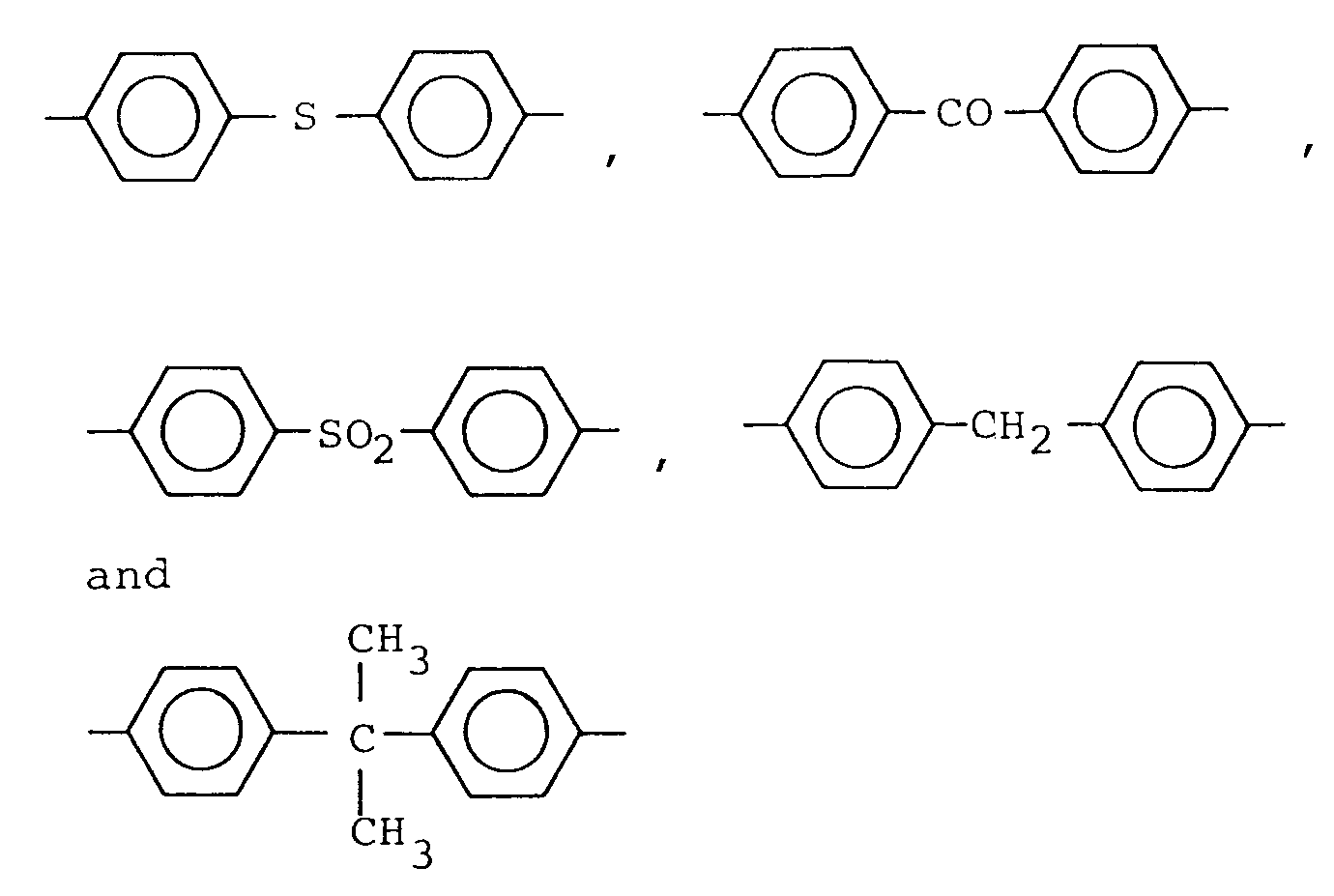
- novel copolymer of the present invention comprises having a recurring unit represented by the formula: wherein Y represents a 2,7-naphthylene group, selected from the group consisting of
- the process for producing the novel copolymer of the present invention comprises the steps of:
- the total numbers k and l of the respective recurring unit are required to be integers satisfying the relationship of 0.5 ⁇ k/(k + l) ⁇ 0.97 . If k/(k + l) is less than 0.5, the heat resistance will be lowered and thus it is unfavorable. On the other hand, if k/(k + l) exceeds 0.97, while the heat resistance is excellent, improvement in elongation and impact resistance could not be accomplished and moldability is lowered. Preferably, the relationship of 0.8 ⁇ k/(k + l) ⁇ 0.95 should be satisfied. In the present invention, the value of the above k/(k + l) affects to the heat resistance.
- the heat resistance of the copolymer particularly a glass transition temperature becomes high with increase of the value of k/(k + l) , and thus by setting the value of k/(k + l) to a desired value, the heat resistance of the copolymer can be controlled.
- the copolymer of the present invention is blocked at terminal ends thereof with a hydrogen atom, a halogen atom, wherein X represents a halogen atom, and R represents a hydrogen atom, an alkyl group having 1 to 10 carbon atoms, an aryl group, an aralkyl group or a cyano group.
- the copolymer of the present invention also has a molecular weight corresponding to the reduced viscosity [ ⁇ sp/c ] which is 0.3 dl/g or more as measured in parachlorophenol solution at a polymer concentration of 0.2 g/dl at 60 °C. If ⁇ sp/c is lower than 0.3 dl/g, the mechanical strength and heat resistance of the copolymer are lowered and it is poor for practical use.
- the copolymer of the present invention is prepared as described below.
- halogen of X F and Cl are particularly preferred, and specific compounds may include 2,6-dichlorobenzonitrile, 2,4-dichlorobenzonitrile, 2,6-difluorobenzonitrile, 2,4-difluorobenzonitrile, and the like.
- M may be any of alkali metals, and Na and K are particularly preferred.
- Ar is a divalent aryl group selected from the group consisting of
- Each of the compounds of the formulae (IV) and (V) are prepared by neutralization reaction of an alkali metal salt and 2,7-dihydroxynaphthalene or an alkali metal salt and a divalent phenol having the above Ar.
- alkali metal salts to be used at this time there may be mentioned potassium carbonate and, potassium hydroxide.
- the divalent phenol having the above Ar and the alkali metal salt may be added all together in the reaction system without using the compounds of the formulae (IV) and (V) at first.
- the compounds of the formulae (IV) and (V) are each produced in the reaction system in accordance with proceeding of the reaction.
- the above k' and l' should be required to satisfy the relationship of 0.5 ⁇ k'/(k' + l') ⁇ 0.97 in response to the relationship of the aforesaid 0.5 ⁇ k/(k + l) ⁇ 0.97 .
- the reaction is carried out in a solvent.
- the solvent employed may include neutral polar solvent such as dimethylsulfoxide, sulfolane, diphenylsulfone, dimethylacetamide and N-methylpyrrolidone, and it can be used in an amount sufficient to dissolve each of the compounds of the formulae (III), (IV) and (V).
- the reaction temperature is generally 100 to 350 °C, preferably 150 to 280 °C, more preferably 180 to 210 °C, and the reaction time may be 0.1 to 8 hours, preferably 1 to 6 hours, more preferably 1 to 3 hours.
- the reaction may be conducted either under ambient pressure or under slight pressurization.
- a monovalent phenol represented by the following formula as the molecular weight controller: wherein R represents a hydrogen atom, an alkyl group having 1 to 10 carbon atoms, an aryl group, an aralkyl group or a cyano group.
- R may preferably include a methyl group, (CH3)3C-, CH3(CH2)7-, and others.
- An amount of the molecular weight controller may be decided depending upon the molecular weight of the copolymer to be obtained.
- the reaction product obtained through the above step is treated with water or an alcohol to block the terminals of the copolymer through elimination of the alkali metal at the terminals thereof with H or OH.
- an alcohol to be used, methanol or ethanol is preferred.
- the above reaction product may be thrown into water or the alcohol.
- the reduced viscosity [ ⁇ sp/c ] was 1.25 dl/g which was measured in p-chlorophenol solution at a concentration of 0.2 g/dl at 60 °C (in the following Examples, the measurement was carried out in the same manner as the above) and the value of k/(k + l) was 0.9.
- a film was prepared by using this copolymer according to the pressing, and an infrared absorption spectrum (IR) analysis was carried out by using this film.
- IR infrared absorption spectrum
- a glass transition temperature (Tg) was 214 °C
- a melting point (Tm) was 308 °C
- a thermal decomposition initiating temperature (Td) was 507 °C (in the air).
- Copolymer was prepared in the same manner as in Example 1 except that the amount of 2,7-dihydroxynaphthalene to be used in Example 1 was replaced with 9.1 g (0.06 mole) and the amount of hydroquinone to be used was replaced with 4.40 g (0.04 mole).
- Tg was 204 °C and Td was 526 °C.
- a yield strength was 13,5 ⁇ 107Pa (1350 kg/cm2)
- a fracture strength was 14 ⁇ 107Pa (1400 kg/cm2)
- an elasticity was 25.108 Pa (25000 kg/cm2)
- an elongation was 90 %.
- Copolymer was prepared in the same manner as in Example 1 except that the hydroquinone was replaced with 2.257 g (0.01 mole) of 2,2-bis(4-hydroxyphenyl)propane as the divalent phenol.
- Tg was 212 °C
- Tm was 315 °C
- Td was 503 °C.
- a yield strength was 13 ⁇ 107 Pa (1300 kg/cm2)
- a fracture strength was 11 ⁇ 107 Pa (1100 kg/cm2)
- an elasticity was 26,7 ⁇ 108 Pa (26700 kg/cm2)
- an elongation was 25 %.
- Copolymer was prepared in the same manner as in Example 1 except that hydroquinone was replaced with 2.47 g (0.01 mole) of 4,4'-dihydroxydiphenylsulfone as the divalent phenol.
- Tg was 214 °C
- Tm was 511 °C
- Td was 519 °C.
- a yield strength was 10,4 ⁇ 107 Pa (1040 kg/cm2)
- a fracture strength was 11 ⁇ 107 Pa (1100 kg/cm2)
- an elasticity was 28 ⁇ 108 Pa (28000 kg/cm2)
- an elongation was 40 %.
- Copolymer was prepared in the same manner as in Comparative Example 1 except for using 10.461 g (0.095 mole) of hydroquinone and 0.801 g (0.005 mole) of 2,7-dihydroxynaphthalene and the measurements were carried out in the same manner. A yielded amount of the resulting copolymer was 21.3 g (Yield: 100 %). Properties of the resulting copolymer are shown in Table 1.
- Copolymer was prepared in the same manner as in Comparative Example 1 except for replacing 2,7-dihydroxynaphthalene with 1.602 g (0.01 mole) of 1,6-dihydroxynaphthalene and the measurements were carried out in the same manner. A yielded amount of the resulting copolymer was 21.4 g (Yield: 100 %). Properties of the resulting copolymer are shown in Table 1.
- Copolymer was prepared in the same manner as in Comparative Example 1 except for replacing 2,7-dihydroxynaphthalene with 0.551 g (0.005 mole) of resorcin and the measurements were carried out in the same manner. A yielded amount of the resulting copolymer was 20.9 g (Yield: 100 %). Properties of the resulting copolymer are shown in Table 1.
- Copolymer was prepared in the same manner as in Comparative Example 1 except for using 11.01 g (0.1 mole) of hydroquinone without using 2,7-dihydroxynaphthalene and the measurements were carried out in the same manner. A yielded amount of the resulting copolymer was 20.9 g (Yield: 100 %). Properties of the resulting copolymer are shown in Table 1.
- the copolymer of the present invention has an excellent heat resistance and is capable of controlling the heat resistance. Further, mechanical strength, solvent resistance and flame resistance of the copolymer are also good and particularly the copolymer of the present invention is superior to the conventional cyanoaryl ether polymers in the mechanical strength, particularly elongation and impact resistance and thus it is available for use of raw materials of electronics and electric devices or mechanical parts.
Landscapes
- Chemical & Material Sciences (AREA)
- Health & Medical Sciences (AREA)
- Chemical Kinetics & Catalysis (AREA)
- Medicinal Chemistry (AREA)
- Polymers & Plastics (AREA)
- Organic Chemistry (AREA)
- Polyethers (AREA)
- Polymers With Sulfur, Phosphorus Or Metals In The Main Chain (AREA)
Description
- This invention relates to a novel copolymer and a process for producing the same, and more particularly, to a novel copolymer which is excellent in heat resistance and capable of controlling its heat resistance, and good in mechanical strength, solvent resistance and flame resistance and also excellent in mechanical properties, particularly in elongation and impact strength than the conventional cyanoaryl ether polymer, and to a process for producing the same.
- FR-A-2 122 562 discloses a polymer composition which is characterized by a recurring unit of the following formula:

wherein R' is a divalent group selected from the group consisting of
the groups
and -O-R'-O being in positions ortho or para respective to the neighbouring cyano groups, and m being an integer of 0 or 1. R' is not derived from 2,7-naphthylene. For some uses the glass transition temperatures of these prior art polymers are insufficiently high. - There are disclosed a polycyanoaryl ether having various structures in Japanese Laid-Open Patent Publication No. 14270/1972. However, there is a disadvantage that these polycyanoaryl ethers are insufficient in heat resistance.
- Further, in Japanese Laid-Open Patent Publication No. 206433/1984, there is disclosed a cyanoaryl ether polymer obtained by dihalogenobenzonitrile and hydroquinone or biphenol as starting materials. While this polymer is excellent in mechanical strength and heat resistance, its heat resistance cannot be freely controlled and thus it has disadvantage that it cannot flexibly cope with various requests in the various field of use. Further, such a polymer is not necessarily sufficient in view of characteristics such as a mechanical characteristics required for raw materials of electronics and electric devices or mechanical parts. Accordingly, it has earnestly been desired to develop a cyanoaryl ether polymer having excellent mechanical characteristics than that of the conventional one.
- An object of this invention is to solve the problems as mentioned above and to provide a novel copolymer which is excellent in heat resistance and capable of controlling its heat resistance, and good in mechanical strength, solvent resistance and flame resistance and also excellent in mechanical properties, particularly in elongation and impact strength than the conventional cyanoaryl ether polymer, and to a process for producing the same.
- The novel copolymer of the present invention comprises having a recurring unit represented by the formula:

wherein Y represents a 2,7-naphthylene group, selected from the group consisting of
- Further, the process for producing the novel copolymer of the present invention comprises the steps of:
- (A) reacting dihalogenobenzonitrile represented by the following formula:

an alkali metal salt of 2,7-dihydroxynaphthalene represented by the following formula:
MO―Y―OM (IV)
wherein Y represents a 2,7-naphthylene group and M represents an alkali metal,
and an alkali metal salt of a divalent phenol represented by the formula:
MO―Ar―OM (V)
wherein Ar represents a divalent aryl group selected from the group consisting of
in the presence of a solvent, and - (B) treating the obtained reaction product with water or an alcohol.
- In the copolymer of the present invention besides (I'), the following

recurring unit represented by the formula (II') are preferred:
wherein Ar represents a divalent aryl group selected from the group consisting of
- The total numbers k and ℓ of the respective recurring unit are required to be integers satisfying the relationship of


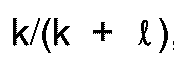

- The copolymer of the present invention is blocked at terminal ends thereof with a hydrogen atom, a halogen atom,

wherein X represents a halogen atom, and R represents a hydrogen atom, an alkyl group having 1 to 10 carbon atoms, an aryl group, an aralkyl group or a cyano group. - The copolymer of the present invention also has a molecular weight corresponding to the reduced viscosity [ηsp/c] which is 0.3 dℓ/g or more as measured in parachlorophenol solution at a polymer concentration of 0.2 g/dℓ at 60 °C. If ηsp/c is lower than 0.3 dℓ/g, the mechanical strength and heat resistance of the copolymer are lowered and it is poor for practical use.
- The copolymer of the present invention is prepared as described below.
- Namely, the first step of formulating a dihalogenobenzonitrile represented by the formula (III), an alkali metal salt of 2,7-dihydroxynaphthalene represented by the formula (IV) and an alkali metal salt of divalent phenol represented by the formula (V) at a proportion as mentioned below, dissolving them in a solvent as mentioned below, and then reacting them at conditions as mentioned below.
- In the compound of the formula (III), as a halogen of X, F and Cl are particularly preferred, and specific compounds may include 2,6-dichlorobenzonitrile, 2,4-dichlorobenzonitrile, 2,6-difluorobenzonitrile, 2,4-difluorobenzonitrile, and the like.
- In the each of compounds of the formulae (IV) and (V), M may be any of alkali metals, and Na and K are particularly preferred.
- Further, in the compound of the formula (V), Ar is a divalent aryl group selected from the group consisting of


- Each of the compounds of the formulae (IV) and (V) are prepared by neutralization reaction of an alkali metal salt and 2,7-dihydroxynaphthalene or an alkali metal salt and a divalent phenol having the above Ar. As the alkali metal salts to be used at this time, there may be mentioned potassium carbonate and, potassium hydroxide.
- For carrying out the reaction, for example, 2,7-dihydroxynaphthalene, the divalent phenol having the above Ar and the alkali metal salt may be added all together in the reaction system without using the compounds of the formulae (IV) and (V) at first. In this case, the compounds of the formulae (IV) and (V) are each produced in the reaction system in accordance with proceeding of the reaction.
- An amount of the each compounds to be formulated is, when the formulating amounts of the compounds of the formulae (III), (IV) and (V) are designated to as j' mole, k' mole and ℓ' mole, respectively, the relationship of


- Next, the above k' and ℓ' should be required to satisfy the relationship of


- The reaction is carried out in a solvent. The solvent employed may include neutral polar solvent such as dimethylsulfoxide, sulfolane, diphenylsulfone, dimethylacetamide and N-methylpyrrolidone, and it can be used in an amount sufficient to dissolve each of the compounds of the formulae (III), (IV) and (V).
- The reaction temperature is generally 100 to 350 °C, preferably 150 to 280 °C, more preferably 180 to 210 °C, and the reaction time may be 0.1 to 8 hours, preferably 1 to 6 hours, more preferably 1 to 3 hours. The reaction may be conducted either under ambient pressure or under slight pressurization.
- In the present invention, during this stage, it is preferred to add a monovalent phenol represented by the following formula as the molecular weight controller:

wherein R represents a hydrogen atom, an alkyl group having 1 to 10 carbon atoms, an aryl group, an aralkyl group or a cyano group. - In the above formula (VI), R may preferably include a methyl group, (CH₃)₃C-, CH₃(CH₂)₇-,

and others. - An amount of the molecular weight controller may be decided depending upon the molecular weight of the copolymer to be obtained.
- In the next step, the reaction product obtained through the above step is treated with water or an alcohol to block the terminals of the copolymer through elimination of the alkali metal at the terminals thereof with H or OH. As the alcohols to be used, methanol or ethanol is preferred. Further, as the treating method, the above reaction product may be thrown into water or the alcohol.
- Into a inner volume of 300-ml separable flask equipped with a fractionating equipment, a stirrer and an argon gas blowing pipe, 17.20 g (0.1 mole) of 2,6-dichlorobenzonitrile, 14.273 g (0.09 mole) of 2,7-dihydroxynaphthalene, 1.09 g (0.01 mole) of hydroquinone, 16.585 g (0.12 mole) of potassium carbonate, 100 ml of sulfolane and 50 ml of toluene were charged, the mixture was stirred while blowing argon gas and reacted at 160 °C for 1.5 hours and further by elevating the temperature to 190 °C for 2 hours. After completion of the polymerization reaction, the resulting product was thrown into methanol to precipitate and recover the copolymer. After the precipitates were crushed by using Blender produced by Warning Co., Ltd., followed by washing with 2 ℓ of boiled water and 2 ℓ of hot methanol, successively and finally dried under reduced pressure at 120 °C for 8 hours. A yielded amount of the resulting copolymer is 25.2 g and a yield is 100 %.
- Further, the reduced viscosity [ηsp/c] was 1.25 dl/g which was measured in p-chlorophenol solution at a concentration of 0.2 g/dℓ at 60 °C (in the following Examples, the measurement was carried out in the same manner as the above) and the value of

- A film was prepared by using this copolymer according to the pressing, and an infrared absorption spectrum (IR) analysis was carried out by using this film. As a result, each absorptions based on C-H bondings of a benzene ring at a portion of 3030 cm⁻¹ and 830 cm⁻¹, C-C bondings of a benzene ring at 1590 cm⁻¹, an aromatic ether bonding at 1240 cm⁻¹ and an absorption based on the presence of a nitrile group at 2220 cm⁻¹, respectively.
- As to the thermal properties of the copolymer, a glass transition temperature (Tg) was 214 °C, a melting point (Tm) was 308 °C, and a thermal decomposition initiating temperature (Td) was 507 °C (in the air).
- The following mechanical properties of the copolymer film was measured by using Autograph IS-5000 (trade name) produced by Shimazu Seisakusho K.K. as a tension tester.
- Yield strength (measured according to ASTM D 638) Fracture strength (measured according to ASTM D 638) Elasticity (measured according to ASTM D 638) Elongation (measured according to ASTM D 638)
- As results, when a tension speed was 1 mm/min., a yield strength was 13 · 10⁷ Pa (1300 kg/cm²), a fracture strength was 11 · 10⁷ Pa (1100 kg/cm²), an elasticity was 23 · 10⁸Pa (23000 kg/cm²) and an elongation was 50 %.
- Next, when the solvent resistances of the copolymer were measured, it was insoluble to each solvents of acetone, ethanol, toluene, methylene chloride and chloroform.
- Further, after the film of this copolymer was exposed to fire of a lighter for 10 seconds, the film was away from fire so that the fire went out at once and no melting away was observed, and thus the film has good flame resistance.
- Copolymer was prepared in the same manner as in Example 1 except that the amount of 2,7-dihydroxynaphthalene to be used in Example 1 was replaced with 9.1 g (0.06 mole) and the amount of hydroquinone to be used was replaced with 4.40 g (0.04 mole).
- As a result, a yielded amount of a copolymer was 23.9 g (Yield: 100 %) and a reduced viscosity [ηsp/c] was 1.08 dℓ/g and a value of

- As to thermal properties of the copolymer, Tg was 204 °C and Td was 526 °C.
- As to mechanical properties, a yield strength was 13,5 · 10⁷Pa (1350 kg/cm²), a fracture strength was 14 · 10⁷Pa (1400 kg/cm²), an elasticity was 25.10⁸ Pa (25000 kg/cm²) and an elongation was 90 %.
- As to the solvent resistance and flame resistance of this copolymer, the same results as in Example 1 were obtained.
- Copolymer was prepared in the same manner as in Example 1 except that the hydroquinone was replaced with 2.257 g (0.01 mole) of 2,2-bis(4-hydroxyphenyl)propane as the divalent phenol.
- As a result, a yielded amount of a copolymer was 26.4 g (Yield: 100 %) and a reduced viscosity [ηsp/c] was 1.34 dℓ/g and a value of

- As to thermal properties of the copolymer, Tg was 212 °C, Tm was 315 °C and Td was 503 °C.
- As to mechanical properties, a yield strength was 13 · 10⁷ Pa (1300 kg/cm²), a fracture strength was 11 · 10⁷ Pa (1100 kg/cm²), an elasticity was 26,7 · 10⁸ Pa (26700 kg/cm²) and an elongation was 25 %.
- As to the solvent resistance and flame resistance of this copolymer, the same results as in Example 1 were obtained.
- Copolymer was prepared in the same manner as in Example 1 except that hydroquinone was replaced with 2.47 g (0.01 mole) of 4,4'-dihydroxydiphenylsulfone as the divalent phenol.
- As a result, a yielded amount of a copolymer was 26.6 g (Yield: 100 %) and a reduced viscosity [ηsp/c] was 0.48 dℓ/g and a value of

- As to thermal properties of the copolymer, Tg was 214 °C, Tm was 511 °C and Td was 519 °C.
- As to mechanical properties, a yield strength was 10,4 · 10⁷ Pa (1040 kg/cm²), a fracture strength was 11 · 10⁷ Pa (1100 kg/cm²), an elasticity was 28 · 10⁸ Pa (28000 kg/cm²) and an elongation was 40 %.
- As to the solvent resistance and flame resistance of this copolymer, the same results as in Example 1 were obtained.
- Into a inner volume of 500-ml separable flask equipped with a fractionating equipment, a stirrer and an argon gas blowing pipe, 17.201 g (0.1 mole) of 2,6-dichlorobenzonitrile, 1.586 g (0.01 mole) of 2,7-dihydroxynaphthalene, 9.811 g (0.09 mole) of hydroquinone, 16.585 g (0.12 mole) of potassium carbonate, 200 ml of sulfolane and 100 ml of toluene were charged, the mixture was stirred while blowing argon gas and reacted at 160 °C for 1.5 hours and further by elevating the temperature to 200 °C for 5 hours. After completion of the polymerization reaction, the resulting product was thrown into water to precipitate and recover the copolymer. After the precipitates were crushed by using Blender produced by Warning Co., Ltd., followed by washing three times with 3.5 l of boiled water and finally dried under reduced pressure at 140 °C over night. A yielded amount of the resulting copolymer was 21.3 g (Yield: 100 %).
- In order to investigate the molecular weight of the resulting copolymer, the reduced viscosity [ηsp/c], and the value of

- Next, by using this copolymer, a molded product was prepared according to injection molding, and mechanical properties were measured by using this molding product.
- Namely, the properties at a tension speed of 1 mm/min. were measured and the results are shown in Table 1.
- Further, measurements of Izod impact resistance (measured according to ASTM D 256 and used a test piece with notch) were carried out, and the results are shown in Table 1. Thermal properties were also measured and the results are shown in Table 1.
- Copolymer was prepared in the same manner as in Comparative Example 1 except for using 10.461 g (0.095 mole) of hydroquinone and 0.801 g (0.005 mole) of 2,7-dihydroxynaphthalene and the measurements were carried out in the same manner. A yielded amount of the resulting copolymer was 21.3 g (Yield: 100 %). Properties of the resulting copolymer are shown in Table 1.
- Copolymer was prepared in the same manner as in Comparative Example 1 except for replacing 2,7-dihydroxynaphthalene with 1.602 g (0.01 mole) of 1,6-dihydroxynaphthalene and the measurements were carried out in the same manner. A yielded amount of the resulting copolymer was 21.4 g (Yield: 100 %). Properties of the resulting copolymer are shown in Table 1.
- Copolymer was prepared in the same manner as in Comparative Example 1 except for replacing 2,7-dihydroxynaphthalene with 0.551 g (0.005 mole) of resorcin and the measurements were carried out in the same manner. A yielded amount of the resulting copolymer was 20.9 g (Yield: 100 %). Properties of the resulting copolymer are shown in Table 1.
- Copolymer was prepared in the same manner as in Comparative Example 1 except for using 11.01 g (0.1 mole) of hydroquinone without using 2,7-dihydroxynaphthalene and the measurements were carried out in the same manner. A yielded amount of the resulting copolymer was 20.9 g (Yield: 100 %). Properties of the resulting copolymer are shown in Table 1.
- The results as mentioned above are summarized in Table 1.

- As apparently seen from the above explanation, the copolymer of the present invention has an excellent heat resistance and is capable of controlling the heat resistance. Further, mechanical strength, solvent resistance and flame resistance of the copolymer are also good and particularly the copolymer of the present invention is superior to the conventional cyanoaryl ether polymers in the mechanical strength, particularly elongation and impact resistance and thus it is available for use of raw materials of electronics and electric devices or mechanical parts.
Claims (3)
- A copolymer which comprises having a recurring unit represented by the formula:

with a recurring number of k and a recurring unit represented by the formula:


- A process for producing the copolymer according to claim 1 which comprises the steps of:(A) reacting dihalogenobenzonitrile represented by the following formula:

an alkali metal salt of 2,7-dihydroxynaphthalene represented by the following formula:
MO―Y―OM (IV)
wherein Y represents a 2,7-naphthylene group and M represents an alkali metal,
and an alkali metal salt of a divalent phenol represented by the formula:
MO―Ar―OM (V)
wherein in Ar represents a divalent aryl group selected from the group consisting of
in the presence of a solvent, and(B) treating the obtained reaction product with water or an alcohol. - A process for producing a copolymer according to Claim 2, wherein a monovalent phenol of the formula:

is further allowed to react as the molecular weight controller with the copolymer.
Applications Claiming Priority (4)
| Application Number | Priority Date | Filing Date | Title |
|---|---|---|---|
| JP32741/85 | 1985-02-22 | ||
| JP3274185A JPS61192732A (en) | 1985-02-22 | 1985-02-22 | Novel copolymer and its production |
| JP6393385A JPS61223026A (en) | 1985-03-29 | 1985-03-29 | Novel copolymer and production thereof |
| JP63933/85 | 1985-03-29 |
Publications (2)
| Publication Number | Publication Date |
|---|---|
| EP0192177A1 EP0192177A1 (en) | 1986-08-27 |
| EP0192177B1 true EP0192177B1 (en) | 1992-08-12 |
Family
ID=26371318
Family Applications (1)
| Application Number | Title | Priority Date | Filing Date |
|---|---|---|---|
| EP86101758A Expired EP0192177B1 (en) | 1985-02-22 | 1986-02-12 | Copolymer and process for producing the same |
Country Status (3)
| Country | Link |
|---|---|
| US (1) | US4703104A (en) |
| EP (1) | EP0192177B1 (en) |
| DE (1) | DE3686339T2 (en) |
Families Citing this family (15)
| Publication number | Priority date | Publication date | Assignee | Title |
|---|---|---|---|---|
| US4963643A (en) * | 1983-03-31 | 1990-10-16 | Amoco Corporation | Crystalline polyarylnitrile ether polymer |
| JPS633058A (en) * | 1986-06-23 | 1988-01-08 | Idemitsu Kosan Co Ltd | Thermoplastic resin composition |
| JPS633059A (en) * | 1986-06-24 | 1988-01-08 | Idemitsu Kosan Co Ltd | Thermoplastic resin composition |
| US4977234A (en) * | 1986-03-25 | 1990-12-11 | Idemitsu Kosan Company Limited | Polycyanoaryl ether composition method for preparing the same and uses thereof |
| JPS62223226A (en) * | 1986-03-25 | 1987-10-01 | Idemitsu Kosan Co Ltd | Novel polymer and its production |
| DE3810106A1 (en) * | 1988-03-25 | 1989-10-12 | Basf Ag | HIGH-TEMPERATURE-RESISTANT CYANOPHENYLENE UNITS CONTAINING POLYARYLENETHERSULPHONE BLOCK COPOLY CONDENSATES CONTAINING, PROCESS FOR THEIR PRODUCTION AND THEIR USE |
| US5256326A (en) * | 1988-07-12 | 1993-10-26 | Idemitsu Kosan Co. Ltd. | Methods for preparing magnetic powder material and magnet, process for prepartion of resin composition and process for producing a powder molded product |
| US5124430A (en) * | 1990-08-28 | 1992-06-23 | The Dow Chemical Company | Arylene carbonate cyanoaryl ether copolymer |
| US5034034A (en) * | 1990-08-28 | 1991-07-23 | The Dow Chemical Company | Novel aryl carbonate cyanoaryl ether gas separation membranes |
| US5080698A (en) * | 1991-04-25 | 1992-01-14 | E. I. Du Pont De Nemours And Company | Aromatic polyethers containing cyano groups for gas separation |
| US5369203A (en) * | 1993-04-21 | 1994-11-29 | Hay; Allan S. | Polymeric phthalocyanines and precursors therefor |
| CN102869448A (en) * | 2009-09-24 | 2013-01-09 | 乔治亚州技术研究公司 | Anion exchange polyelectrolytes |
| CN102558558A (en) * | 2011-12-20 | 2012-07-11 | 电子科技大学 | Polyether sulphone-nitrile resin and industrialization synthetic method thereof |
| JP7666323B2 (en) * | 2020-05-28 | 2025-04-22 | 東レ株式会社 | Crystalline Polyether Nitrile |
| WO2023188842A1 (en) * | 2022-03-29 | 2023-10-05 | 東レ株式会社 | Polyether nitrile film and method for producing polyether nitrile film |
Family Cites Families (1)
| Publication number | Priority date | Publication date | Assignee | Title |
|---|---|---|---|---|
| US3730946A (en) * | 1971-01-20 | 1973-05-01 | Gen Electric | Process for making cyanoaryloxy polymers and products derived therefrom |
-
1986
- 1986-02-10 US US06/828,215 patent/US4703104A/en not_active Expired - Fee Related
- 1986-02-12 EP EP86101758A patent/EP0192177B1/en not_active Expired
- 1986-02-12 DE DE8686101758T patent/DE3686339T2/en not_active Expired - Fee Related
Also Published As
| Publication number | Publication date |
|---|---|
| DE3686339T2 (en) | 1993-01-07 |
| EP0192177A1 (en) | 1986-08-27 |
| US4703104A (en) | 1987-10-27 |
| DE3686339D1 (en) | 1992-09-17 |
Similar Documents
| Publication | Publication Date | Title |
|---|---|---|
| US4703104A (en) | Preparation of cyanoaryl ether copolymer | |
| US4731429A (en) | Novel poly(aryl ether ketones) | |
| CA2012315A1 (en) | Polyarylene ethers | |
| AU600441B2 (en) | Block polymers containing a poly(aryl ether ketone) | |
| US4970284A (en) | Polyaryletherketones | |
| EP0187638B1 (en) | Polycyanoaryl ether and method of preparing the same | |
| EP0193187B1 (en) | Process for preparing crystalline aromatic polyetherketones | |
| US4703102A (en) | Aromatic polyether ketones | |
| US4997902A (en) | Polyaryl ethers which are stable at high temperatures and have improved processibility | |
| JPH0255729A (en) | Aromatic polymer | |
| WO1986007598A1 (en) | Chain-extended poly (aryl ether ketones) | |
| US4960851A (en) | Crystalline aromatic polyethersulphones having terphenylene linkages | |
| JP2551455B2 (en) | Novel aromatic polysulfone and method for producing the same | |
| JPH07116288B2 (en) | Novel aromatic polyether sulfone copolymer and method for producing the same | |
| JPH05163352A (en) | Method for producing polyether sulfone | |
| JPS62141024A (en) | Thermoplastic aromatic polyether anthraquinone and its production | |
| EP0225194B1 (en) | Thermoplastic linear aromatic polyetherdiketones and process for obtaining the same | |
| JP2552169B2 (en) | Novel aromatic polysulfone and method for producing the same | |
| JPH04234429A (en) | Manufacture of soluble or meltable benzothiazole-containing polyaryl ether, bisphenol and new polymer | |
| JPH0710913B2 (en) | Thermoplastic aromatic polyether ketone copolymer and method for producing the same | |
| JPH0475251B2 (en) | ||
| JP2520157B2 (en) | Aromatic polyether block copolymer and method for producing the same | |
| JPH0277426A (en) | Novel crystalline aromatic polysulfone and production thereof | |
| JPH0463897B2 (en) | ||
| US5191056A (en) | Arylene sulfide ketone copolymer and preparation process thereof |
Legal Events
| Date | Code | Title | Description |
|---|---|---|---|
| PUAI | Public reference made under article 153(3) epc to a published international application that has entered the european phase |
Free format text: ORIGINAL CODE: 0009012 |
|
| AK | Designated contracting states |
Kind code of ref document: A1 Designated state(s): BE CH DE FR GB IT LI NL SE |
|
| 17P | Request for examination filed |
Effective date: 19870102 |
|
| 17Q | First examination report despatched |
Effective date: 19890717 |
|
| GRAA | (expected) grant |
Free format text: ORIGINAL CODE: 0009210 |
|
| AK | Designated contracting states |
Kind code of ref document: B1 Designated state(s): BE CH DE FR GB IT LI NL SE |
|
| PG25 | Lapsed in a contracting state [announced via postgrant information from national office to epo] |
Ref country code: SE Free format text: THE PATENT HAS BEEN ANNULLED BY A DECISION OF A NATIONAL AUTHORITY Effective date: 19920812 |
|
| ITF | It: translation for a ep patent filed | ||
| REF | Corresponds to: |
Ref document number: 3686339 Country of ref document: DE Date of ref document: 19920917 |
|
| ET | Fr: translation filed | ||
| PLBE | No opposition filed within time limit |
Free format text: ORIGINAL CODE: 0009261 |
|
| STAA | Information on the status of an ep patent application or granted ep patent |
Free format text: STATUS: NO OPPOSITION FILED WITHIN TIME LIMIT |
|
| 26N | No opposition filed | ||
| PGFP | Annual fee paid to national office [announced via postgrant information from national office to epo] |
Ref country code: GB Payment date: 19940202 Year of fee payment: 9 |
|
| PGFP | Annual fee paid to national office [announced via postgrant information from national office to epo] |
Ref country code: DE Payment date: 19940209 Year of fee payment: 9 |
|
| PGFP | Annual fee paid to national office [announced via postgrant information from national office to epo] |
Ref country code: FR Payment date: 19940210 Year of fee payment: 9 |
|
| PGFP | Annual fee paid to national office [announced via postgrant information from national office to epo] |
Ref country code: CH Payment date: 19940215 Year of fee payment: 9 |
|
| PGFP | Annual fee paid to national office [announced via postgrant information from national office to epo] |
Ref country code: NL Payment date: 19940228 Year of fee payment: 9 |
|
| PGFP | Annual fee paid to national office [announced via postgrant information from national office to epo] |
Ref country code: BE Payment date: 19940408 Year of fee payment: 9 |
|
| PG25 | Lapsed in a contracting state [announced via postgrant information from national office to epo] |
Ref country code: GB Effective date: 19950212 |
|
| PG25 | Lapsed in a contracting state [announced via postgrant information from national office to epo] |
Ref country code: LI Effective date: 19950228 Ref country code: CH Effective date: 19950228 Ref country code: BE Effective date: 19950228 |
|
| BERE | Be: lapsed |
Owner name: IDEMITSU KOSAN CY LTD Effective date: 19950228 |
|
| PG25 | Lapsed in a contracting state [announced via postgrant information from national office to epo] |
Ref country code: NL Effective date: 19950901 |
|
| GBPC | Gb: european patent ceased through non-payment of renewal fee |
Effective date: 19950212 |
|
| PG25 | Lapsed in a contracting state [announced via postgrant information from national office to epo] |
Ref country code: FR Effective date: 19951031 |
|
| NLV4 | Nl: lapsed or anulled due to non-payment of the annual fee |
Effective date: 19950901 |
|
| PG25 | Lapsed in a contracting state [announced via postgrant information from national office to epo] |
Ref country code: DE Effective date: 19951101 |
|
| REG | Reference to a national code |
Ref country code: FR Ref legal event code: ST |
|
| PG25 | Lapsed in a contracting state [announced via postgrant information from national office to epo] |
Ref country code: IT Free format text: LAPSE BECAUSE OF NON-PAYMENT OF DUE FEES Effective date: 20050212 |