EP0188502B1 - Etherified 2-hydroxy-ethyl-phosphonic acid derivatives and plant growth regulating agents containing same as active ingredient - Google Patents
Etherified 2-hydroxy-ethyl-phosphonic acid derivatives and plant growth regulating agents containing same as active ingredient Download PDFInfo
- Publication number
- EP0188502B1 EP0188502B1 EP85903355A EP85903355A EP0188502B1 EP 0188502 B1 EP0188502 B1 EP 0188502B1 EP 85903355 A EP85903355 A EP 85903355A EP 85903355 A EP85903355 A EP 85903355A EP 0188502 B1 EP0188502 B1 EP 0188502B1
- Authority
- EP
- European Patent Office
- Prior art keywords
- phosphonic acid
- ethyl
- alkyl
- hydroxy
- oxy
- Prior art date
- Legal status (The legal status is an assumption and is not a legal conclusion. Google has not performed a legal analysis and makes no representation as to the accuracy of the status listed.)
- Expired
Links
Classifications
-
- A—HUMAN NECESSITIES
- A01—AGRICULTURE; FORESTRY; ANIMAL HUSBANDRY; HUNTING; TRAPPING; FISHING
- A01N—PRESERVATION OF BODIES OF HUMANS OR ANIMALS OR PLANTS OR PARTS THEREOF; BIOCIDES, e.g. AS DISINFECTANTS, AS PESTICIDES OR AS HERBICIDES; PEST REPELLANTS OR ATTRACTANTS; PLANT GROWTH REGULATORS
- A01N57/00—Biocides, pest repellants or attractants, or plant growth regulators containing organic phosphorus compounds
- A01N57/18—Biocides, pest repellants or attractants, or plant growth regulators containing organic phosphorus compounds having phosphorus-to-carbon bonds
- A01N57/24—Biocides, pest repellants or attractants, or plant growth regulators containing organic phosphorus compounds having phosphorus-to-carbon bonds containing heterocyclic radicals
-
- C—CHEMISTRY; METALLURGY
- C07—ORGANIC CHEMISTRY
- C07F—ACYCLIC, CARBOCYCLIC OR HETEROCYCLIC COMPOUNDS CONTAINING ELEMENTS OTHER THAN CARBON, HYDROGEN, HALOGEN, OXYGEN, NITROGEN, SULFUR, SELENIUM OR TELLURIUM
- C07F9/00—Compounds containing elements of Groups 5 or 15 of the Periodic Table
- C07F9/02—Phosphorus compounds
- C07F9/547—Heterocyclic compounds, e.g. containing phosphorus as a ring hetero atom
- C07F9/655—Heterocyclic compounds, e.g. containing phosphorus as a ring hetero atom having oxygen atoms, with or without sulfur, selenium, or tellurium atoms, as the only ring hetero atoms
- C07F9/65515—Heterocyclic compounds, e.g. containing phosphorus as a ring hetero atom having oxygen atoms, with or without sulfur, selenium, or tellurium atoms, as the only ring hetero atoms the oxygen atom being part of a five-membered ring
- C07F9/65517—Heterocyclic compounds, e.g. containing phosphorus as a ring hetero atom having oxygen atoms, with or without sulfur, selenium, or tellurium atoms, as the only ring hetero atoms the oxygen atom being part of a five-membered ring condensed with carbocyclic rings or carbocyclic ring systems
-
- C—CHEMISTRY; METALLURGY
- C07—ORGANIC CHEMISTRY
- C07F—ACYCLIC, CARBOCYCLIC OR HETEROCYCLIC COMPOUNDS CONTAINING ELEMENTS OTHER THAN CARBON, HYDROGEN, HALOGEN, OXYGEN, NITROGEN, SULFUR, SELENIUM OR TELLURIUM
- C07F9/00—Compounds containing elements of Groups 5 or 15 of the Periodic Table
- C07F9/02—Phosphorus compounds
- C07F9/547—Heterocyclic compounds, e.g. containing phosphorus as a ring hetero atom
- C07F9/655—Heterocyclic compounds, e.g. containing phosphorus as a ring hetero atom having oxygen atoms, with or without sulfur, selenium, or tellurium atoms, as the only ring hetero atoms
- C07F9/6552—Heterocyclic compounds, e.g. containing phosphorus as a ring hetero atom having oxygen atoms, with or without sulfur, selenium, or tellurium atoms, as the only ring hetero atoms the oxygen atom being part of a six-membered ring
- C07F9/65522—Heterocyclic compounds, e.g. containing phosphorus as a ring hetero atom having oxygen atoms, with or without sulfur, selenium, or tellurium atoms, as the only ring hetero atoms the oxygen atom being part of a six-membered ring condensed with carbocyclic rings or carbocyclic ring systems
Definitions
- the invention relates to etherified 2-hydroxy-ethyl-phosphonic acid derivatives and plant growth regulating agents containing same as active ingredient.
- the invention also provides processes for the preparation of the new compounds and the use thereof.
- HU-PS 160618 as plant growth regulator 2-methoxy-ethyl-phosphonic acid is disclosed.
- the present invention refers to new etherified hydroxy-alkyl-phosphonic acid derivatives of the general formula (I)
- R stands for 2,3-dihydro-2,2-dimethylbenzofuran-7-yl-, 4-methyl-coumarin-7-yl-, 2,2,4-trimethyl-(2H)-chromen-5-yl, or 2,2,4-trimethyl-(2H)-chromen-7-yl,
- R 1 and R 2 are the same or different and stand for hydrogen, C 1-8 alkyl, C 1-4 habgenalkyl, C ' - 4 alkoxy-C ' - 2 alkyl, or salts thereof in which Me stands for a monovalent cation.
- the new compounds exhibit plant growth regulating activity.
- the plant growth regulating activity according to the invention means that the new compounds act on the physiological process of the plant growth depending or the time of the use, on the development stage of the plant and on the used active ingredient concentration. Due to the properties of the compounds of the invention they can be utilized in agriculture.
- the process for the preparation of new compounds of the general formula (I) wherein R' and R stand for C 1 -C 8 alkyl comprises reacting 7-hydroxy-2,3-dihydro-2,2-dimethyl-benzofuran or 7-hydroxy-4-methyl-coumarin or 7-(5)-hydroxy-2,2,4-trimethyl-(2H)-chromene with dihaloethane at a temperature ranging from -10 to +60°C optionally in the presence of a phase transfer catalyst and reacting the obtained intermediate product, if desired after purification, with tri(C l -C B )alkyl-phosphite at a temperature ranging from +40 to +250°C.
- the temperature range is preferably 100 to 200°C.
- the reaction is illustrated by reaction scheme E-where
- From compounds of the general formula (I) in agriculture acceptable compositions can be prepared by the addition of carriers, optionally surfactants and water soluble concentrates, dusting agents, wettable powders, granules, emulsifiable concentrates or colloidal aqueous suspensions can be prepared.
- the active ingredients can be admixed with solid or liquid carriers and surfactants and the blend is optionally homogenized.
- compositions contain 0.1-95% by mass active ingredient and the active ingredients can be used in the form of compositions or solutions, emulsifiable concentrates, suspensions, wettable powders, dusting agents and granules ready to use by pouring, spraying or vapourization.
- the active ingredient concentration can be varied within a wide range depending on the used active ingredient, on the carriers an/or surfactants.
- the mixture is cooled to room temperature, the solid is removed by filtration and the solvent is distilled off in vacuo from the solvent layer on a rotatory film evaporator.
- the residual yellowish brown oily part is dissolved in 50 ml methylene chloride and washed with 5 x 30 ml 5% sodium-hydroxide solution and water.
- the solvent part is dried above anhydrous sodium sulphate and the solvent is distilled off on a rotatory film evaporator in vacuo. 5.8 yellowish brown liquid are obtained and purified by vacuo distillation.
- the product distilled at a pressure of 0.2 torr. at 120-125°C.
- the mixture is cooled to room temperature, the methylene-chloride layer is separated from the aqueous layer and washed with 2 x 50 ml 2 N sodium hydroxide solution, water and then with 2 x 50 ml saturated aqueous natriumchloride solution.
- the solvent part is dried above anhydrous sodium sulphate and the solvent is distilled off in vacuo on a rotatory film evaporator.
- the residual pale yellow oily substance weighing 46.1 g is purified by vacuo distillation and the product distilled at 121-125°C at 0.2 torr.
- the compounds of the general formula (I) can be converted to liquid or solid compositions by adding formulating excipients such as solid or liquid intert solvents, filling agents and carriers.
- composition of the formulated products is illustrated by the following examples:
- Etherified 2-hydroxy-ethyl-phosphonic acid derivatives according to the invention and salts thereof were tested for plant growth regulating activity in green house by using tomato, soybean and sunflower as indicating plants. The plants were seeded into pots filled with turf or the plants were grown as seedlings. The post-emergent treatment was carried out on tomatoes at a development stage of 20-30 cm on soybean and sunflower.
- 2-(2,3-dihydro-2,2-dimethylbenzofuran-7-yl-oxy)-ethyl-phosphonic acid-diethyl-ester significantly increased the growth of tomato related to the untreated control.
- the activity can be characterized depending on the dose by a curve of second order the peak of which is at the dose of 1 kg/ha.
- the composition already shows a growth reducing effect.
- the growth stimulating activity is higher than that of 2,2-dimethyl-2,3-dihydro-7-hydroxy-benzofuran and at higher doses the growth inhibiting activity of latter compound is lower than that of 2-chloro-ethyl-phosphonic acid.
- the plant growth regulating activity of the new compound is stronger than the activity of the combination of the two known compounds when used at a rate of 1 kg/ha + 0.5 kg/ha and 1 kg/ha + 1 kg/ha, respectively.
- the biological activity of the compound of the invention is even more significant if the comparison is performed with a combination of the starting compound at a dose of 0.5 kg/ha + 0.5 kg/ ha and 0.5 kg/ha + 1 kg/ha, respectively.
- the height of the tomato was increased by 2-(2,3-dihydro-2,2-dimethyl-benzofuran-7-yl-oxy)-ethyl-phosphonic acid-diethyl-ester and its activity can be characterized by a curve of second order in dependence on the dose.
- the compound shows a plant growth regulating activity and when used pre-emergence 2-(2,3-dihydro-2,2-dimethyl-benzofuran-7-yl-oxy)-ethyl-phosphonic acid-diethyl-ester is absorbed from the soil through the root and acts as plant growth regulator.
- test results show that 2-(4'-methyl-coumarin-7-yl-oxy)-ethyl-phosphonic acid-0,0-diethyl-ester highly increased the growth of tomato related to the untreated control.
- the most significant growth stimulation was measured at the test dose of 0.5 kg/ha.
- the growth of the plants was approximately similarly reduced in soybeans by 2-(4'-methyl- cou marin-7-yl-oxy)-ethyl-phosphonic acid-0,0-diethyl-ester independently on the used active ingredient rate.
- the compound shows a growth reducing activity in spite of the fact that 7-hydroxy-4-methyl-coumarin at a dose of 0.5-1.0kg/ha stimulated the growth of soybeans.
- the plant growth regulating activity of the compound is the same as when spraying on the plants together 7-hydroxy-4-methyl-coumarin at a rate of 1 kg/ha and 2-chloro-ethyl-phosphonic acid at a rate of 0.5 kg/ha.
- the growth of the indicating plants i.e. tomato, soybeans and sunflower was tested by treatment post-emergence and pre-emergence in green house tests using culture dishes and the test compound was the compound No. 6.
- the height of tomato was increased by spraying the plant with 2-(4'-methyl-coumarin-7-yl-oxy)-ethyl-phosphonic acid-diethyl-ester.
- the extent of plant growth was in inverse ratio to the dose. It can be further seen that the plant growth regulating activity of soybeans and sunflower under greenhouse conditions was almost similar to that of 2-chloro-ethyl-phosphonic acid.
- the active ingredients according to the invention were tested post-emergence in free land tests on soybeans, on maize, on winter wheat and green paprika. The results of the tests are shown in the following tables.
- the spraying was carried out at the beginning of the budding of the soybean.
- the concentration of the spray liquid was in the range of 1.13 to 4.54 g/I related to the active ingredient.
- the tests were carried out using compositions disclosed in Example 5 and 10.
- the table shows that both 2-(2,3-dihydro-2,2-dimethyl-benzofuran-7-yl-oxy)-ethyl-phosphonic acid-diethyl-ester and 2-(4'-methyl-coumarin-7-yl- oxy)-ethyl-phosphonic acid-0,0-diethyl-ester increase the crop by 14-17% at a rate of 250g/ha. By increasing the dose the crop increase decreased and at the rate of 1000g/ha there was already no difference.
- the compounds of the invention increase the corp by 15-19% independently on the dose.
- 2-Chloro-ethyl-phosphonic acid reduced the crop by 20% at a dose of 500g/ha as opposed to the compounds of the invention.
- Treatments No.2 to 10 were performed during growing thick and treatments No.11 to 19 were performed during earing.
- the spray liquid concentration changed in the range of 0.22 to 9.1 g/I related to the active ingredient.
- Compositions disclosed in Examples 6 and 11 were used.
- the compounds of the invention increase the crop by 9-16% during the treatments performed when growing thick.
- the spraying was performed at the beginning of the colourization of the pepper.
- the spray liquid concentration was 4.54g/l related to the active ingredient.
- Compositions disclosed in Examples 6 and 11 were used.
- the crop increased by 14-17% on red-pepper parcels treated with the compound of the invention.
- the reatio of the uncoloured peppers also decreased to 19-20% from the value of the untreated control 28% and the dye % of the coloured peppers increased.
- the ratio of the completely coloured peppers was higher and the amount of half ripe and worthless brown peppers significantly decreased.
Landscapes
- Chemical & Material Sciences (AREA)
- Life Sciences & Earth Sciences (AREA)
- Organic Chemistry (AREA)
- General Health & Medical Sciences (AREA)
- Health & Medical Sciences (AREA)
- Biochemistry (AREA)
- Molecular Biology (AREA)
- Dentistry (AREA)
- Engineering & Computer Science (AREA)
- Wood Science & Technology (AREA)
- Zoology (AREA)
- Environmental Sciences (AREA)
- Plant Pathology (AREA)
- Pest Control & Pesticides (AREA)
- Agronomy & Crop Science (AREA)
- Agricultural Chemicals And Associated Chemicals (AREA)
- Pharmaceuticals Containing Other Organic And Inorganic Compounds (AREA)
- Fertilizers (AREA)
Abstract
Description
- The invention relates to etherified 2-hydroxy-ethyl-phosphonic acid derivatives and plant growth regulating agents containing same as active ingredient. The invention also provides processes for the preparation of the new compounds and the use thereof.
- In HU-PS 160618 as plant growth regulator 2-methoxy-ethyl-phosphonic acid is disclosed.
- In Japanese Patent Publication No. 80111494 (EP-A-16310) hydroxy-alkyl phosphonic acids substituted by an aromatic group and esters thereof, e.g. 2-(4-chloro-phenyl-oxy)-ethyl-phosphonic acid dimethylester are disclosed and the compounds were mentioned as showing pharmaceutical activity.
- Papukova et al. disclosed various phenoxy-alkyl-phosphonic acids and esters thereof in Zsurn. Prikl. Him. (Leningrad) 1972 45 (8) 1808-1818. The activity of the compounds was, however, not mentioned.
- The present invention refers to new etherified hydroxy-alkyl-phosphonic acid derivatives of the general formula (I)

- wherein R stands for 2,3-dihydro-2,2-dimethylbenzofuran-7-yl-, 4-methyl-coumarin-7-yl-, 2,2,4-trimethyl-(2H)-chromen-5-yl, or 2,2,4-trimethyl-(2H)-chromen-7-yl,
- R1 and R2 are the same or different and stand for hydrogen, C1-8 alkyl, C1-4 habgenalkyl, C'-4 alkoxy-C'-2 alkyl, or salts thereof in which Me stands for a monovalent cation.
- The new compounds exhibit plant growth regulating activity.
- The plant growth regulating activity according to the invention means that the new compounds act on the physiological process of the plant growth depending or the time of the use, on the development stage of the plant and on the used active ingredient concentration. Due to the properties of the compounds of the invention they can be utilized in agriculture.
- The process for the preparation of new compounds of the general formula (I) wherein R' and R stand for C1-C8 alkyl comprises reacting 7-hydroxy-2,3-dihydro-2,2-dimethyl-benzofuran or 7-hydroxy-4-methyl-coumarin or 7-(5)-hydroxy-2,2,4-trimethyl-(2H)-chromene with dihaloethane at a temperature ranging from -10 to +60°C optionally in the presence of a phase transfer catalyst and reacting the obtained intermediate product, if desired after purification, with tri(Cl-CB)alkyl-phosphite at a temperature ranging from +40 to +250°C. The temperature range is preferably 100 to 200°C. The reaction is illustrated by reaction scheme E-where
- Hal stands for halogen, preferably bromine,
- R' and R2 represent C1-C8 alkyl, preferably ethyl.

- From compounds of the general formula (I) in agriculture acceptable compositions can be prepared by the addition of carriers, optionally surfactants and water soluble concentrates, dusting agents, wettable powders, granules, emulsifiable concentrates or colloidal aqueous suspensions can be prepared.
- When preparing these compositions the active ingredients can be admixed with solid or liquid carriers and surfactants and the blend is optionally homogenized.
- The compositions contain 0.1-95% by mass active ingredient and the active ingredients can be used in the form of compositions or solutions, emulsifiable concentrates, suspensions, wettable powders, dusting agents and granules ready to use by pouring, spraying or vapourization. The active ingredient concentration can be varied within a wide range depending on the used active ingredient, on the carriers an/or surfactants.
- The preparation of the new compounds and the compositions is illustrated in the following Examples.
- To 100 ml ethylacetate 8.23g (0.05 mole) 2,3-dihydro-2,2-dimethyl-7-hydroxy-benzofuran, 14.3 g (0.1 mole) 1-bromo-2-chloro-ethane, 6.9 g (0.05 mole) anhydrous sodium carbonate and 8.3 (0.05 mole) potassium iodide are added. The reaction mixture is heated for 30 hours and the reaction is monitored by gas chromatographic analysis.
- When the reaction is completed the mixture is cooled to room temperature, the solid is removed by filtration and the solvent is distilled off in vacuo from the solvent layer on a rotatory film evaporator.
- The residual yellowish brown oily part is dissolved in 50 ml methylene chloride and washed with 5 x 30 ml 5% sodium-hydroxide solution and water. The solvent part is dried above anhydrous sodium sulphate and the solvent is distilled off on a rotatory film evaporator in vacuo. 5.8 yellowish brown liquid are obtained and purified by vacuo distillation. The product distilled at a pressure of 0.2 torr. at 120-125°C.
- To 200 ml methylene-chloride 32.84g (0.2 mole) 2,3-dihydro-2,2-dimethyl-7-hydroxy-benzofuran, 57.37 g (0.4 mole) 1-bromo-2-chloro-ethane 200 ml 2N sodium hydroxide solution and 8g Adogen 464 phase transfer catalyst (tri-C8-10-alkyl-methyl - ammonium-chloride) are added. The reaction mixture is heated under vigorous stirring for 7 hours and the reaction is monitored by gas chromatographic analysis.
- When the reaction is completed the mixture is cooled to room temperature, the methylene-chloride layer is separated from the aqueous layer and washed with 2 x 50 ml 2 N sodium hydroxide solution, water and then with 2 x 50 ml saturated aqueous natriumchloride solution. The solvent part is dried above anhydrous sodium sulphate and the solvent is distilled off in vacuo on a rotatory film evaporator. The residual pale yellow oily substance weighing 46.1 g is purified by vacuo distillation and the product distilled at 121-125°C at 0.2 torr.
- The compounds according to Examples 1 and 2 are used for the further processes.
- 68.2 g (0.3 mole) 2,3-dihydro-2,2-dimethyl-7-(2'-chloro-ethoxy)-benzofuran (prepared according to Examples 1 or 2) and 49.86 g (0.3 mole) triethyl-phosphite are stirred at 140-146°C for 60 hours and heated. When the reaction is completed the obtained yellowish brown oily product is purified by vacuum distillation by distilling off the volatile contaminations at 0.5 torr. The cuts are collected until 148°C and the distillation residue is a pure product according to gas chromatographic analysis. The product is a pale yellow oily liquid, nD 24.5 = 1.5105 (compound No. 1).
- To a 8% aqueous solution of 0.1 mole (19.02 g) 2,2,4-trimethyl-7-hydroxy-(2H)-chromene and 0.2 mole (8g) sodium hydroxide 4g of benzene- tributyl-ammonium-chloride as phase transfer catalyst and a solution of 0.2 mole 1,2-dibromo-ethane in 200 ml methylene-chloride are added under stirring and the solution is heated for 12 hours. After cooling the organic layer is separated and dried above sodium sulphate and evaporated. The residue is dissolved in 50 ml diethyl-ether and the substance is precipitated by adding 300 ml of n-hexane. The solvent is decanted from the precipitated substance. Thus 19.38g (0.065 mole) product are obtained in the form of a white waxy oily substance.
- 0.1 mole (29.82 g) 2,2,4-trimethyl-7-(2'-bromoethyl-oxy)-(2H)-chromene and 0.2 mole (33.23g) triethyl-phosphite are heated under stirring for 1 hour. From the obtained reaction mixture the triethyl-phosphite excess and the obtained side product are removed by vacuum distillation and the residual product is a yellowish, thick gume-like substance of a weight of 23.29g (0.012 mol): nD 25.1 = 1.5962.
- 17.62 g (0.1 mole) 7-hydroxy-4-methyl-coumarin (4-methyl-umbelliferon) are dissolved in a 8% aqueous solution of 0.2 mole sodium hydroxide and a solution of 4g benzyl-tributyl-ammoniumchloride phase transfer catalyst and 37.5g (0.2 mole) 1,2-dibromo-ethane in 200 ml ethylene- chloride is added. The mixture is heated for 14 hours under stirring and allowed to cool. 60 mi dichloromethane are added, the mixture is filtered and the organic layer is separated from the filtrate and washed with distilled water, dried and evaporated. 19.82g g (0.07 mole) 7-(2'-bromo-ethyl-oxy)-4-methyl-coumarin are obtained, melting point: 94-97 °C.
- 28.32g (0.1 mole) 7-(2'-bromo-ethyl-oxy)-4-methyl-coumarin and 33.23g (0.2 mole) triethyl-phosphite are heated under stirring for 1 hour. The reaction mixture is then cooled. The end- product is separated from the contaminations by removing same by vacuum distillation. The bottom product is a yellow, thick, oily substance of weight 11.9 g (0.0035 mole), nD 31 = 1.5619.
- According to the process disclosed above the following compounds of the general formula (I) can be prepared.

- The compounds of the general formula (I) can be converted to liquid or solid compositions by adding formulating excipients such as solid or liquid intert solvents, filling agents and carriers.
- The composition of the formulated products is illustrated by the following examples:
-

-

- Etherified 2-hydroxy-ethyl-phosphonic acid derivatives according to the invention and salts thereof were tested for plant growth regulating activity in green house by using tomato, soybean and sunflower as indicating plants. The plants were seeded into pots filled with turf or the plants were grown as seedlings. The post-emergent treatment was carried out on tomatoes at a development stage of 20-30 cm on soybean and sunflower.
- In the course of the tests a control was used and as active ingredient the compound No.1 i.e. 2-(2,3-dihydro-2,2-dimethyl-benzofuran-7-yl-oxy)-ethyl-phosphonic acid-diethyl-ester and for comparison 2-chloro-ethyl-phosphonic acid ethyl-ester (F) and 2,2-dimethyl-2,3-dihydroxy-7-hydroxy- benzofuran (G) were used. Pre-emergent treatment was carried out with tomato indicating plant, the doses and the obtained results are summarized in tables.
- When evaluating the biological tests the change of the height of the plants was established. When carrying out post-emergent treatment in case of tomato the change of height was determined on the 4th, 7th and 10th day after the treatment, on soybean and sunflower and on the 7th day after the treatment and when using pre-emergent treatment the results were determined on the 7th day after the treatment. The data are given in the % of starting plant height.

- It can be seen that 2-(2,3-dihydro-2,2-dimethylbenzofuran-7-yl-oxy)-ethyl-phosphonic acid-diethyl-ester significantly increased the growth of tomato related to the untreated control. The activity can be characterized depending on the dose by a curve of second order the peak of which is at the dose of 1 kg/ha. By further increasing the dose the composition already shows a growth reducing effect. It can be further seen that the growth stimulating activity is higher than that of 2,2-dimethyl-2,3-dihydro-7-hydroxy-benzofuran and at higher doses the growth inhibiting activity of latter compound is lower than that of 2-chloro-ethyl-phosphonic acid.

- In soybean the growth reducing activity of 2-(2,3-dihydro-2,2-dimethyl-benzofuran-7-yl-oxy)-ethyl-phosphonic acid-diethyl-ester could be seen independently of the dose. In the effect of the tested doses there was no significant difference. By further increasing the dose no strong depressive effect could be observed which can be observed for 2-chloro-ethyl-phosphonic acid in case of using an overdosage.

- The rate of growth of sunflower upon the use of 2-(2,3-dihydro-2,2-dimethyi-benzofuran-7-yi-oxy)-ethyl-phosphonic acid-diethyl-ester at a rate of 1.0 and 2.0 kg/ha was reduced similarly like by 2-chloro-ethyl-phosphonic acid. When comparing the activity of the composition with the activity of the combination of 2,2-dimethyl-2,3-dihydro-7-hydroxy-benzofuran and 2-chloro-ethyl-phosphonic acid it can be seen that the plant growth regulating activity of the new compound is stronger than the activity of the combination of the two known compounds when used at a rate of 1 kg/ha + 0.5 kg/ha and 1 kg/ha + 1 kg/ha, respectively. The biological activity of the compound of the invention is even more significant if the comparison is performed with a combination of the starting compound at a dose of 0.5 kg/ha + 0.5 kg/ ha and 0.5 kg/ha + 1 kg/ha, respectively.

- When using 2-(2,3-dihydro-2,2-dimethyl-benzofuran-7-yl-oxy)-ethyl-phosphonic acid-diethyl-ester in a pre-emergent treatment the growth of tomato was significantly stimulated at a dose of 1 kg/ha. By increasing the dose the growth reducing activity of the composition could be mainly observed. At a rate of 2 kg/ha an equilibrium state can be observed when the stimulating activity is no longer significant but the growth reducing activity cannot yet be observed.
- By further increasing the dose at a rate of 4kg/ ha the growth of tomato decreased to about % and at a rate of 8 kg/ha to about 1/2.
- As a further result it can be seen that 2-chloro-ethyl-phosphonic acid does not regulate the growth of the plant through the soil. The growth regulating activity of 2,2-dimethyl-2,3-dihydro-7-hydroxy-benzofuran did not reach at the tested dose the activity of 2-(2,3-dihydro-2,2-dimethylbenzofuran-7-yl-oxy)-ethyl-phosphonic acid-diethyl-ester.
- The activity of 2-(2,3-dihydro-2,2-dimethyl-benzofuran-7-yl-oxy)-ethyl-phosphonic acid-diethyl-ester upon the growth of the plants was tested by a treatment post-emergence and pre-emergence in green house tests, in culture dishes by using tomato, soybeans and sunflower as indicating plants (said plants reacting more sensitively on compounds having auxin activity).
- The height of the tomato was increased by 2-(2,3-dihydro-2,2-dimethyl-benzofuran-7-yl-oxy)-ethyl-phosphonic acid-diethyl-ester and its activity can be characterized by a curve of second order in dependence on the dose.
- In soybeans and sunflower the compound shows a plant growth regulating activity and when used pre-emergence 2-(2,3-dihydro-2,2-dimethyl-benzofuran-7-yl-oxy)-ethyl-phosphonic acid-diethyl-ester is absorbed from the soil through the root and acts as plant growth regulator.
- Biological tests were carried out with the compound according to Example 5 i.e. 2-(4-methyl- coumarin-7-yl-oxy)-ethyl-phosphonic acid-0,0-diethyl-ester and its activity was compared with the control (K), with 2-chloro-ethyl-phosphonic acid (F) and with 7-hydroxy-4'-methyl-coumarin (M).
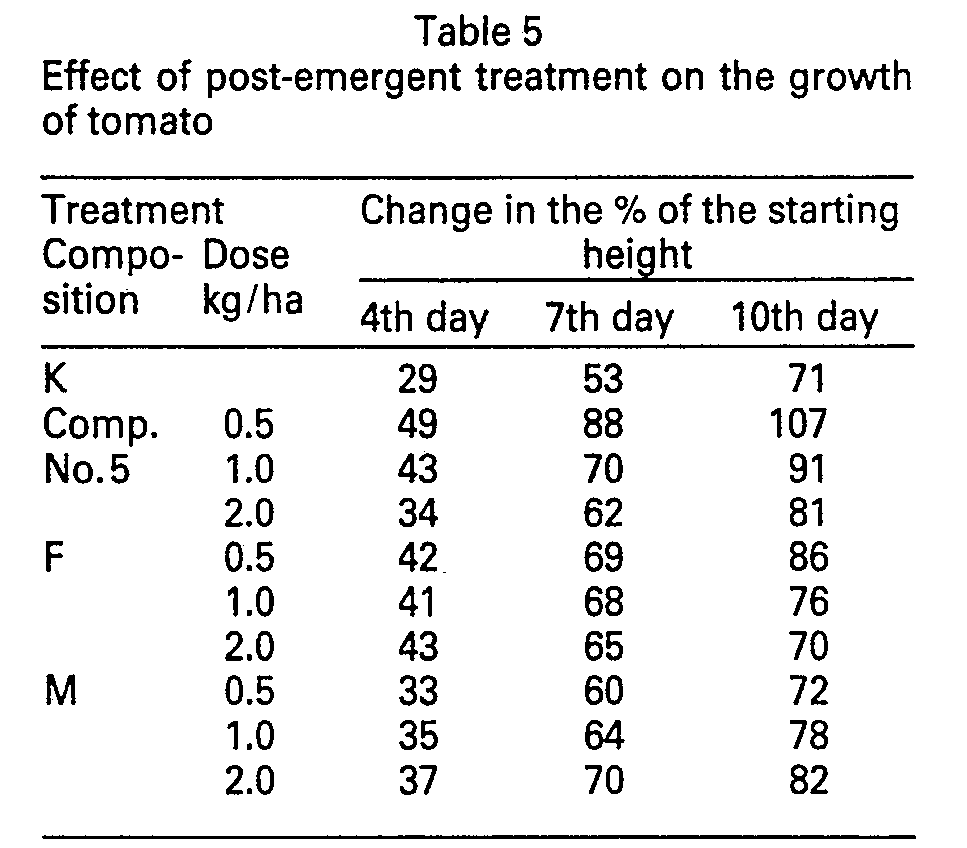
- The test results show that 2-(4'-methyl-coumarin-7-yl-oxy)-ethyl-phosphonic acid-0,0-diethyl-ester highly increased the growth of tomato related to the untreated control. The most significant growth stimulation was measured at the test dose of 0.5 kg/ha.

- The growth of the plants was approximately similarly reduced in soybeans by 2-(4'-methyl- cou marin-7-yl-oxy)-ethyl-phosphonic acid-0,0-diethyl-ester independently on the used active ingredient rate. The compound shows a growth reducing activity in spite of the fact that 7-hydroxy-4-methyl-coumarin at a dose of 0.5-1.0kg/ha stimulated the growth of soybeans.

- When compared with the untreated control 2-(4'-methyl-coumarin-7-yl-oxyl-ethyl-phosphonic acid-O,O-diethyl-ester reduced the growth of sunflower to about:4. The growth reduction observed as the effect of the compound almost achieved the value measured on plants which were treated by 2-chloro-ethyl-phosphonic acid. When compared the activity of the composition with the activity of the combination of 7-hydroxy-4-methyl-coumarin and 2-chloro-ethyl-phosphonic acid it can be seen that the plant growth regulating activity of the compound is the same as when spraying on the plants together 7-hydroxy-4-methyl-coumarin at a rate of 1 kg/ha and 2-chloro-ethyl-phosphonic acid at a rate of 0.5 kg/ha.

- Upon a treatment pre-emergence with 2-(4'-methyl-coumarin-7-yl-oxy)-ethyl-phosphonic acid-O,O-diethyl-ester, the compound intensively stimulated the growth of tomato at a dose of 1 kg/ ha whereas doses 4 and 8 kg/ha already reduced the growth of tomato.
- The results further show that no plant growth regulating activity can be observed when applying 2-chloro-ethyl-phosphonic acid to the soil and when applying 7-hydroxy-4-methyl-coumarin alone the compound stimulates the growth of the plant at a moderate extent through the soil.
- The growth of the indicating plants, i.e. tomato, soybeans and sunflower was tested by treatment post-emergence and pre-emergence in green house tests using culture dishes and the test compound was the compound No. 6.
- The height of tomato was increased by spraying the plant with 2-(4'-methyl-coumarin-7-yl-oxy)-ethyl-phosphonic acid-diethyl-ester. The extent of plant growth was in inverse ratio to the dose. It can be further seen that the plant growth regulating activity of soybeans and sunflower under greenhouse conditions was almost similar to that of 2-chloro-ethyl-phosphonic acid.
- When using 2-(4'-methyl-coumarin-7-yl-oxy)-ethyl-phosphonic acid-diethyl-ester pre-emergence the compound showed plant growth regulating activity when being absorbed through the roots from the soil.
- The active ingredients according to the invention were tested post-emergence in free land tests on soybeans, on maize, on winter wheat and green paprika. The results of the tests are shown in the following tables.
- Test conditions


- The spraying was carried out at the beginning of the budding of the soybean. The concentration of the spray liquid was in the range of 1.13 to 4.54 g/I related to the active ingredient. The tests were carried out using compositions disclosed in Example 5 and 10.

- The table shows that both 2-(2,3-dihydro-2,2-dimethyl-benzofuran-7-yl-oxy)-ethyl-phosphonic acid-diethyl-ester and 2-(4'-methyl-coumarin-7-yl- oxy)-ethyl-phosphonic acid-0,0-diethyl-ester increase the crop by 14-17% at a rate of 250g/ha. By increasing the dose the crop increase decreased and at the rate of 1000g/ha there was already no difference.
- Test conditions


- The treatments were carried out on maize at a development stage of 6-8 leaves, concentration of the spray liquid related to the active ingredient changed in the range of 1.13 to 4.54g/l. The tests were carried out by using compositions disclosed in Examples 5 and 10.

- In maize the compounds of the invention increase the corp by 15-19% independently on the dose. 2-Chloro-ethyl-phosphonic acid reduced the crop by 20% at a dose of 500g/ha as opposed to the compounds of the invention.
- Test conditions


- Treatments No.2 to 10 were performed during growing thick and treatments No.11 to 19 were performed during earing. The spray liquid concentration changed in the range of 0.22 to 9.1 g/I related to the active ingredient. Compositions disclosed in Examples 6 and 11 were used.

- In winter wheat the compounds of the invention increase the crop by 9-16% during the treatments performed when growing thick.
- Upon the effect of 2-(2,3-dihydro-2,2-dimethylbenzofuran-7-yl-oxy)-ethyl-phosphonic acid-diethyl-ester the crop was increased by 9-12% and upon the treatment with 2-(4'-methyl-coumarin-7-yl-oxy)-ethyl-phosphonic-acid-0,0-diethyl-ester the crop increased by 14-16%. When performing the test during earing the crop increase was somewhat lower at a rate of 100-200g/ha 6-9% crop increase was achieved.
- Test conditions


- The spraying was performed at the beginning of the colourization of the pepper. The spray liquid concentration was 4.54g/l related to the active ingredient. Compositions disclosed in Examples 6 and 11 were used.

- The crop increased by 14-17% on red-pepper parcels treated with the compound of the invention. The reatio of the uncoloured peppers also decreased to 19-20% from the value of the untreated control 28% and the dye % of the coloured peppers increased. The ratio of the completely coloured peppers was higher and the amount of half ripe and worthless brown peppers significantly decreased.
Claims (7)

Applications Claiming Priority (2)
| Application Number | Priority Date | Filing Date | Title |
|---|---|---|---|
| HU842800A HU190579B (en) | 1984-07-18 | 1984-07-18 | Plant growth regulating compositions comprising etherified hydroxy-alkyl-phosphonic acid-derivatives as active substance |
| HU280084 | 1984-07-18 |
Publications (2)
| Publication Number | Publication Date |
|---|---|
| EP0188502A1 EP0188502A1 (en) | 1986-07-30 |
| EP0188502B1 true EP0188502B1 (en) | 1989-03-01 |
Family
ID=10961156
Family Applications (1)
| Application Number | Title | Priority Date | Filing Date |
|---|---|---|---|
| EP85903355A Expired EP0188502B1 (en) | 1984-07-18 | 1985-07-12 | Etherified 2-hydroxy-ethyl-phosphonic acid derivatives and plant growth regulating agents containing same as active ingredient |
Country Status (14)
| Country | Link |
|---|---|
| US (1) | US4668274A (en) |
| EP (1) | EP0188502B1 (en) |
| JP (1) | JPS61502753A (en) |
| AT (1) | ATE41010T1 (en) |
| BG (1) | BG51235A3 (en) |
| CS (1) | CS256391B2 (en) |
| DD (1) | DD239328A5 (en) |
| DE (1) | DE3568439D1 (en) |
| DK (1) | DK124086A (en) |
| ES (1) | ES8700266A1 (en) |
| HU (1) | HU190579B (en) |
| RO (1) | RO94902B (en) |
| SU (1) | SU1486049A3 (en) |
| WO (1) | WO1986000904A1 (en) |
Families Citing this family (7)
| Publication number | Priority date | Publication date | Assignee | Title |
|---|---|---|---|---|
| HU190580B (en) * | 1984-07-18 | 1986-09-29 | Nitrokemia Ipartelepek,Hu | Plant growth regulating compositions comprising phosphonic acid-esters as active substance |
| DE4134158C2 (en) * | 1991-10-11 | 1997-02-13 | Max Delbrueck Centrum | Use of carboplatin in lyotrophic mesophases to overcome leukopenia caused by cytostatics |
| JP2008530221A (en) * | 2005-02-17 | 2008-08-07 | バイエル・クロツプサイエンス・アクチエンゲゼルシヤフト | Improved method for preparing (disubstituted propenyl) phenylalkyl substituted dihydrobenzofurans |
| EP1853577A4 (en) * | 2005-02-17 | 2009-02-18 | Bayer Cropscience Ag | Improved process for preparing (disubstitutedpropenyl) phenylalkyl substituted dihydrobenzofurans |
| WO2006102387A1 (en) * | 2005-03-23 | 2006-09-28 | Bayer Cropscience Ag | Improved process for preparing insecticidal (disubstitutedpropenyl) phenylalkyl substituted dihydrobenzofurans |
| EP2654433B1 (en) | 2010-12-21 | 2017-08-30 | Bayer Cropscience LP | Sandpaper mutants of bacillus and methods of their use to enhance plant growth, promote plant health and control diseases and pests |
| MX2014002890A (en) | 2011-09-12 | 2015-01-19 | Bayer Cropscience Lp | Methods of enhancing health and/or promoting growth of a plant and/or of improving fruit ripening. |
Family Cites Families (8)
| Publication number | Priority date | Publication date | Assignee | Title |
|---|---|---|---|---|
| US2159364A (en) * | 1939-05-23 | Ethers of i | ||
| US4042370A (en) * | 1974-09-18 | 1977-08-16 | Sandoz Ltd. | Di-(acyloxyalkyl)-β-haloethane-phosphonates and dithiophosphonates and use as plant growth regulators |
| DD132632A1 (en) * | 1977-08-12 | 1978-10-18 | Bernhard Hesse | MEANS OF INFLUENCING PLANT GROWTH |
| DE2853936A1 (en) * | 1978-12-14 | 1980-07-03 | Bayer Ag | PHOSPHONIC ACID ESTER |
| GB2043072B (en) * | 1979-02-13 | 1983-11-23 | Symphar Sa | Diphosphonate compounds |
| GB2043073B (en) * | 1979-02-13 | 1983-05-11 | Symphar Sa | Mono-and diphosphonate compounds |
| DE3120437A1 (en) * | 1981-05-22 | 1982-12-09 | Hoechst Ag, 6000 Frankfurt | METHOD FOR PRODUCING VINYLPHOSPHONIC ACID |
| IL71373A (en) * | 1983-04-07 | 1987-07-31 | Mitsubishi Chem Ind | O-(2,3-dihydro-2,2-dimethyl-7 benzofuranyl)thiophosphoric and phosphonic esters,process for their production and pesticidal compositions containing them |
-
1984
- 1984-07-18 HU HU842800A patent/HU190579B/en not_active IP Right Cessation
-
1985
- 1985-07-12 AT AT85903355T patent/ATE41010T1/en not_active IP Right Cessation
- 1985-07-12 DE DE8585903355T patent/DE3568439D1/en not_active Expired
- 1985-07-12 EP EP85903355A patent/EP0188502B1/en not_active Expired
- 1985-07-12 WO PCT/HU1985/000044 patent/WO1986000904A1/en not_active Ceased
- 1985-07-12 JP JP60503198A patent/JPS61502753A/en active Pending
- 1985-07-12 RO RO122624A patent/RO94902B/en unknown
- 1985-07-16 DD DD85278628A patent/DD239328A5/en not_active IP Right Cessation
- 1985-07-17 US US06/839,499 patent/US4668274A/en not_active Expired - Fee Related
- 1985-07-18 ES ES545631A patent/ES8700266A1/en not_active Expired
- 1985-07-18 CS CS855347A patent/CS256391B2/en unknown
-
1986
- 1986-03-17 SU SU864027203A patent/SU1486049A3/en active
- 1986-03-18 DK DK124086A patent/DK124086A/en not_active Application Discontinuation
- 1986-03-18 BG BG074117A patent/BG51235A3/en unknown
Also Published As
| Publication number | Publication date |
|---|---|
| ES8700266A1 (en) | 1986-10-01 |
| US4668274A (en) | 1987-05-26 |
| HU190579B (en) | 1986-09-29 |
| DK124086D0 (en) | 1986-03-18 |
| DK124086A (en) | 1986-03-18 |
| DE3568439D1 (en) | 1989-04-06 |
| ATE41010T1 (en) | 1989-03-15 |
| DD239328A5 (en) | 1986-09-24 |
| SU1486049A3 (en) | 1989-06-07 |
| JPS61502753A (en) | 1986-11-27 |
| RO94902B (en) | 1988-08-17 |
| WO1986000904A1 (en) | 1986-02-13 |
| BG51235A3 (en) | 1993-03-15 |
| CS256391B2 (en) | 1988-04-15 |
| RO94902A (en) | 1988-08-15 |
| EP0188502A1 (en) | 1986-07-30 |
| ES545631A0 (en) | 1986-10-01 |
Similar Documents
| Publication | Publication Date | Title |
|---|---|---|
| NL192263C (en) | Substituted 1,3-cyclohexanedione oxime derivatives with herbicidal activity, as well as herbicidal preparations containing these compounds. | |
| US4325966A (en) | Fungicidal compounds, compositions and processes | |
| US4668274A (en) | Etherified 2-hydroxy-ethyl-phosphonic acid derivatives and plant growth regulating agents containing same as active ingredient | |
| EP0382463B1 (en) | Maleimide compounds and fungicides containing them | |
| US4066435A (en) | Plant growth regulators | |
| US4199584A (en) | Pesticidal active furo[2,3-d] pyrimidine derivatives, compositions containing the same and use thereof | |
| CS219274B2 (en) | Fungicide means and method of making the active substance | |
| US3711493A (en) | Plant growth regulating composition | |
| US3385689A (en) | Method of controlling undesirable plant growth | |
| US4447450A (en) | 2,2-Bis(haloalkenyl)-1-cyano-1-alkoxycarbonylethylene fungicides | |
| SU938742A3 (en) | Process for producing derivatives of 2-phenyl-4-pyronin | |
| US4456467A (en) | 1-Methylene carbonyl derivatives of 3-aryloxy-4-phenyl-azet-2-one | |
| US4221582A (en) | Plant growth regulating compounds, compositions and methods | |
| US4776874A (en) | 2-chloro-ethyl phosphonic acid esters and plant growth regulating agents containing same as active ingredient | |
| US3927062A (en) | Plant growth regulators | |
| US4134752A (en) | Plant growth regulators | |
| US3930007A (en) | Pesticidal bis-pyridyl amine derivatives | |
| US3446613A (en) | N-alkanoyloxyphenoxyalkanamides as herbicides | |
| SU620193A3 (en) | Fungicide | |
| CA1212679A (en) | 1-methylene carbonyl derivatives of 3-aryloxy-4- phenyl-azet-2-one | |
| US2980579A (en) | Acylimino-2, 2, 4, 4, 5-pentachlorocyclopentanones as nematocides and fungicides | |
| EP0095880B1 (en) | Fluorenecarboxylic acid derivatives, their preparation and use as plant growth regulators | |
| US3508905A (en) | Herbicidal composition and method | |
| JPS59137494A (en) | Novel thiophosphoric acid ester | |
| GB2063855A (en) | Triazolidine derivatives and process for preparing the same |
Legal Events
| Date | Code | Title | Description |
|---|---|---|---|
| PUAI | Public reference made under article 153(3) epc to a published international application that has entered the european phase |
Free format text: ORIGINAL CODE: 0009012 |
|
| 17P | Request for examination filed |
Effective date: 19860428 |
|
| AK | Designated contracting states |
Kind code of ref document: A1 Designated state(s): AT DE FR GB IT NL |
|
| 17Q | First examination report despatched |
Effective date: 19870903 |
|
| GRAA | (expected) grant |
Free format text: ORIGINAL CODE: 0009210 |
|
| AK | Designated contracting states |
Kind code of ref document: B1 Designated state(s): AT DE FR GB IT NL |
|
| REF | Corresponds to: |
Ref document number: 41010 Country of ref document: AT Date of ref document: 19890315 Kind code of ref document: T |
|
| REF | Corresponds to: |
Ref document number: 3568439 Country of ref document: DE Date of ref document: 19890406 |
|
| ET | Fr: translation filed | ||
| ITF | It: translation for a ep patent filed | ||
| PGFP | Annual fee paid to national office [announced via postgrant information from national office to epo] |
Ref country code: FR Payment date: 19890621 Year of fee payment: 5 |
|
| PGFP | Annual fee paid to national office [announced via postgrant information from national office to epo] |
Ref country code: AT Payment date: 19890707 Year of fee payment: 5 |
|
| ITTA | It: last paid annual fee | ||
| PGFP | Annual fee paid to national office [announced via postgrant information from national office to epo] |
Ref country code: NL Payment date: 19890731 Year of fee payment: 5 Ref country code: GB Payment date: 19890731 Year of fee payment: 5 |
|
| PGFP | Annual fee paid to national office [announced via postgrant information from national office to epo] |
Ref country code: DE Payment date: 19890809 Year of fee payment: 5 |
|
| PLBE | No opposition filed within time limit |
Free format text: ORIGINAL CODE: 0009261 |
|
| 26N | No opposition filed | ||
| PG25 | Lapsed in a contracting state [announced via postgrant information from national office to epo] |
Ref country code: GB Effective date: 19900712 Ref country code: AT Effective date: 19900712 |
|
| PG25 | Lapsed in a contracting state [announced via postgrant information from national office to epo] |
Ref country code: NL Effective date: 19910201 |
|
| GBPC | Gb: european patent ceased through non-payment of renewal fee | ||
| NLV4 | Nl: lapsed or anulled due to non-payment of the annual fee | ||
| PG25 | Lapsed in a contracting state [announced via postgrant information from national office to epo] |
Ref country code: FR Effective date: 19910329 |
|
| PG25 | Lapsed in a contracting state [announced via postgrant information from national office to epo] |
Ref country code: DE Effective date: 19910403 |
|
| REG | Reference to a national code |
Ref country code: FR Ref legal event code: ST |