EP0185387A1 - Novel, N,N'bis(sulfonyl) hydrazines having antineoplastic activity - Google Patents
Novel, N,N'bis(sulfonyl) hydrazines having antineoplastic activity Download PDFInfo
- Publication number
- EP0185387A1 EP0185387A1 EP85116361A EP85116361A EP0185387A1 EP 0185387 A1 EP0185387 A1 EP 0185387A1 EP 85116361 A EP85116361 A EP 85116361A EP 85116361 A EP85116361 A EP 85116361A EP 0185387 A1 EP0185387 A1 EP 0185387A1
- Authority
- EP
- European Patent Office
- Prior art keywords
- compound
- compounds
- methyl
- tolyl
- effective amount
- Prior art date
- Legal status (The legal status is an assumption and is not a legal conclusion. Google has not performed a legal analysis and makes no representation as to the accuracy of the status listed.)
- Granted
Links
- 230000000118 anti-neoplastic effect Effects 0.000 title claims abstract description 17
- JUQRWCMITUNYSA-UHFFFAOYSA-N O=S(=O)=NN=S(=O)=O Chemical class O=S(=O)=NN=S(=O)=O JUQRWCMITUNYSA-UHFFFAOYSA-N 0.000 title description 4
- 150000001875 compounds Chemical class 0.000 claims abstract description 95
- 125000002496 methyl group Chemical group [H]C([H])([H])* 0.000 claims abstract description 8
- 125000000217 alkyl group Chemical group 0.000 claims abstract description 5
- 125000002029 aromatic hydrocarbon group Chemical group 0.000 claims abstract description 5
- 125000001340 2-chloroethyl group Chemical group [H]C([H])(Cl)C([H])([H])* 0.000 claims abstract description 4
- JUJWROOIHBZHMG-UHFFFAOYSA-N Pyridine Chemical compound C1=CC=NC=C1 JUJWROOIHBZHMG-UHFFFAOYSA-N 0.000 claims description 22
- 238000000034 method Methods 0.000 claims description 19
- 206010028980 Neoplasm Diseases 0.000 claims description 14
- -1 2-styryl p-methoxyphenyl Chemical group 0.000 claims description 11
- UMJSCPRVCHMLSP-UHFFFAOYSA-N pyridine Natural products COC1=CC=CN=C1 UMJSCPRVCHMLSP-UHFFFAOYSA-N 0.000 claims description 11
- 125000001037 p-tolyl group Chemical group [H]C1=C([H])C(=C([H])C([H])=C1*)C([H])([H])[H] 0.000 claims description 9
- 238000006243 chemical reaction Methods 0.000 claims description 8
- 239000000203 mixture Substances 0.000 claims description 7
- 239000002904 solvent Substances 0.000 claims description 7
- 125000003854 p-chlorophenyl group Chemical group [H]C1=C([H])C(*)=C([H])C([H])=C1Cl 0.000 claims description 5
- 239000000546 pharmaceutical excipient Substances 0.000 claims description 5
- 125000004172 4-methoxyphenyl group Chemical group [H]C1=C([H])C(OC([H])([H])[H])=C([H])C([H])=C1* 0.000 claims description 4
- 125000001797 benzyl group Chemical group [H]C1=C([H])C([H])=C(C([H])=C1[H])C([H])([H])* 0.000 claims description 4
- 125000001997 phenyl group Chemical group [H]C1=C([H])C([H])=C(*)C([H])=C1[H] 0.000 claims description 4
- 125000001622 2-naphthyl group Chemical group [H]C1=C([H])C([H])=C2C([H])=C(*)C([H])=C([H])C2=C1[H] 0.000 claims description 3
- 229910006080 SO2X Inorganic materials 0.000 claims description 3
- 239000000460 chlorine Substances 0.000 claims description 3
- 229910052801 chlorine Inorganic materials 0.000 claims description 3
- 125000001309 chloro group Chemical group Cl* 0.000 claims description 3
- 229910052736 halogen Inorganic materials 0.000 claims description 3
- 125000001255 4-fluorophenyl group Chemical group [H]C1=C([H])C(*)=C([H])C([H])=C1F 0.000 claims description 2
- 125000006306 4-iodophenyl group Chemical group [H]C1=C([H])C(*)=C([H])C([H])=C1I 0.000 claims description 2
- 230000002401 inhibitory effect Effects 0.000 claims description 2
- 125000000636 p-nitrophenyl group Chemical group [H]C1=C([H])C(=C([H])C([H])=C1*)[N+]([O-])=O 0.000 claims description 2
- 125000005843 halogen group Chemical group 0.000 claims 2
- 229940100198 alkylating agent Drugs 0.000 abstract description 8
- 239000002168 alkylating agent Substances 0.000 abstract description 8
- 150000004945 aromatic hydrocarbons Chemical class 0.000 abstract 1
- 208000032839 leukemia Diseases 0.000 description 22
- OAKJQQAXSVQMHS-UHFFFAOYSA-N hydrazine group Chemical group NN OAKJQQAXSVQMHS-UHFFFAOYSA-N 0.000 description 20
- 230000000694 effects Effects 0.000 description 14
- 241000699670 Mus sp. Species 0.000 description 13
- 230000002152 alkylating effect Effects 0.000 description 13
- 208000001382 Experimental Melanoma Diseases 0.000 description 12
- 229910052757 nitrogen Inorganic materials 0.000 description 12
- 241000894007 species Species 0.000 description 8
- 230000004083 survival effect Effects 0.000 description 8
- GHYOCDFICYLMRF-UTIIJYGPSA-N (2S,3R)-N-[(2S)-3-(cyclopenten-1-yl)-1-[(2R)-2-methyloxiran-2-yl]-1-oxopropan-2-yl]-3-hydroxy-3-(4-methoxyphenyl)-2-[[(2S)-2-[(2-morpholin-4-ylacetyl)amino]propanoyl]amino]propanamide Chemical compound C1(=CCCC1)C[C@@H](C(=O)[C@@]1(OC1)C)NC([C@H]([C@@H](C1=CC=C(C=C1)OC)O)NC([C@H](C)NC(CN1CCOCC1)=O)=O)=O GHYOCDFICYLMRF-UTIIJYGPSA-N 0.000 description 7
- 229940125797 compound 12 Drugs 0.000 description 7
- VEXZGXHMUGYJMC-UHFFFAOYSA-N Hydrochloric acid Chemical compound Cl VEXZGXHMUGYJMC-UHFFFAOYSA-N 0.000 description 6
- 239000003795 chemical substances by application Substances 0.000 description 6
- 238000002474 experimental method Methods 0.000 description 5
- 239000000825 pharmaceutical preparation Substances 0.000 description 5
- QTBSBXVTEAMEQO-UHFFFAOYSA-N Acetic acid Chemical compound CC(O)=O QTBSBXVTEAMEQO-UHFFFAOYSA-N 0.000 description 4
- IJGRMHOSHXDMSA-UHFFFAOYSA-N Atomic nitrogen Chemical compound N#N IJGRMHOSHXDMSA-UHFFFAOYSA-N 0.000 description 4
- 241001465754 Metazoa Species 0.000 description 4
- 208000006268 Sarcoma 180 Diseases 0.000 description 4
- 229940079593 drug Drugs 0.000 description 4
- 239000003814 drug Substances 0.000 description 4
- 230000007246 mechanism Effects 0.000 description 4
- 230000004048 modification Effects 0.000 description 4
- 238000012986 modification Methods 0.000 description 4
- 239000007787 solid Substances 0.000 description 4
- 239000000243 solution Substances 0.000 description 4
- 239000000725 suspension Substances 0.000 description 4
- XLYOFNOQVPJJNP-UHFFFAOYSA-N water Substances O XLYOFNOQVPJJNP-UHFFFAOYSA-N 0.000 description 4
- YMWUJEATGCHHMB-UHFFFAOYSA-N Dichloromethane Chemical compound ClCCl YMWUJEATGCHHMB-UHFFFAOYSA-N 0.000 description 3
- RTZKZFJDLAIYFH-UHFFFAOYSA-N Diethyl ether Chemical compound CCOCC RTZKZFJDLAIYFH-UHFFFAOYSA-N 0.000 description 3
- 238000002835 absorbance Methods 0.000 description 3
- 230000000259 anti-tumor effect Effects 0.000 description 3
- 239000002246 antineoplastic agent Substances 0.000 description 3
- 239000012038 nucleophile Substances 0.000 description 3
- 239000000047 product Substances 0.000 description 3
- 239000011541 reaction mixture Substances 0.000 description 3
- YBBRCQOCSYXUOC-UHFFFAOYSA-N sulfuryl dichloride Chemical compound ClS(Cl)(=O)=O YBBRCQOCSYXUOC-UHFFFAOYSA-N 0.000 description 3
- 238000012360 testing method Methods 0.000 description 3
- 230000001875 tumorinhibitory effect Effects 0.000 description 3
- UNILWMWFPHPYOR-KXEYIPSPSA-M 1-[6-[2-[3-[3-[3-[2-[2-[3-[[2-[2-[[(2r)-1-[[2-[[(2r)-1-[3-[2-[2-[3-[[2-(2-amino-2-oxoethoxy)acetyl]amino]propoxy]ethoxy]ethoxy]propylamino]-3-hydroxy-1-oxopropan-2-yl]amino]-2-oxoethyl]amino]-3-[(2r)-2,3-di(hexadecanoyloxy)propyl]sulfanyl-1-oxopropan-2-yl Chemical compound O=C1C(SCCC(=O)NCCCOCCOCCOCCCNC(=O)COCC(=O)N[C@@H](CSC[C@@H](COC(=O)CCCCCCCCCCCCCCC)OC(=O)CCCCCCCCCCCCCCC)C(=O)NCC(=O)N[C@H](CO)C(=O)NCCCOCCOCCOCCCNC(=O)COCC(N)=O)CC(=O)N1CCNC(=O)CCCCCN\1C2=CC=C(S([O-])(=O)=O)C=C2CC/1=C/C=C/C=C/C1=[N+](CC)C2=CC=C(S([O-])(=O)=O)C=C2C1 UNILWMWFPHPYOR-KXEYIPSPSA-M 0.000 description 2
- MNHKUCBXXMFQDM-UHFFFAOYSA-N 4-[(4-nitrophenyl)methyl]pyridine Chemical compound C1=CC([N+](=O)[O-])=CC=C1CC1=CC=NC=C1 MNHKUCBXXMFQDM-UHFFFAOYSA-N 0.000 description 2
- YYROPELSRYBVMQ-UHFFFAOYSA-N 4-toluenesulfonyl chloride Chemical compound CC1=CC=C(S(Cl)(=O)=O)C=C1 YYROPELSRYBVMQ-UHFFFAOYSA-N 0.000 description 2
- CSCPPACGZOOCGX-UHFFFAOYSA-N Acetone Chemical compound CC(C)=O CSCPPACGZOOCGX-UHFFFAOYSA-N 0.000 description 2
- HEDRZPFGACZZDS-UHFFFAOYSA-N Chloroform Chemical compound ClC(Cl)Cl HEDRZPFGACZZDS-UHFFFAOYSA-N 0.000 description 2
- 229960000583 acetic acid Drugs 0.000 description 2
- 239000002253 acid Substances 0.000 description 2
- 239000013543 active substance Substances 0.000 description 2
- 230000029936 alkylation Effects 0.000 description 2
- 238000005804 alkylation reaction Methods 0.000 description 2
- 229940034982 antineoplastic agent Drugs 0.000 description 2
- 125000003118 aryl group Chemical group 0.000 description 2
- 230000037396 body weight Effects 0.000 description 2
- 230000015556 catabolic process Effects 0.000 description 2
- 230000008859 change Effects 0.000 description 2
- 229940125773 compound 10 Drugs 0.000 description 2
- 231100000135 cytotoxicity Toxicity 0.000 description 2
- 230000003013 cytotoxicity Effects 0.000 description 2
- 238000000354 decomposition reaction Methods 0.000 description 2
- 238000003379 elimination reaction Methods 0.000 description 2
- 239000012362 glacial acetic acid Substances 0.000 description 2
- 150000002429 hydrazines Chemical class 0.000 description 2
- 239000000543 intermediate Substances 0.000 description 2
- ZLVXBBHTMQJRSX-VMGNSXQWSA-N jdtic Chemical compound C1([C@]2(C)CCN(C[C@@H]2C)C[C@H](C(C)C)NC(=O)[C@@H]2NCC3=CC(O)=CC=C3C2)=CC=CC(O)=C1 ZLVXBBHTMQJRSX-VMGNSXQWSA-N 0.000 description 2
- KWGKDLIKAYFUFQ-UHFFFAOYSA-M lithium chloride Chemical compound [Li+].[Cl-] KWGKDLIKAYFUFQ-UHFFFAOYSA-M 0.000 description 2
- HQKMJHAJHXVSDF-UHFFFAOYSA-L magnesium stearate Chemical compound [Mg+2].CCCCCCCCCCCCCCCCCC([O-])=O.CCCCCCCCCCCCCCCCCC([O-])=O HQKMJHAJHXVSDF-UHFFFAOYSA-L 0.000 description 2
- 238000005259 measurement Methods 0.000 description 2
- 239000002609 medium Substances 0.000 description 2
- 238000002844 melting Methods 0.000 description 2
- 230000008018 melting Effects 0.000 description 2
- 125000004170 methylsulfonyl group Chemical group [H]C([H])([H])S(*)(=O)=O 0.000 description 2
- HDZGCSFEDULWCS-UHFFFAOYSA-N monomethylhydrazine Chemical compound CNN HDZGCSFEDULWCS-UHFFFAOYSA-N 0.000 description 2
- QPHPEPMDRYADGQ-UHFFFAOYSA-N n'-benzoyl-n'-methylbenzohydrazide Chemical compound C=1C=CC=CC=1C(=O)N(C)NC(=O)C1=CC=CC=C1 QPHPEPMDRYADGQ-UHFFFAOYSA-N 0.000 description 2
- XSXHWVKGUXMUQE-UHFFFAOYSA-N osmium dioxide Inorganic materials O=[Os]=O XSXHWVKGUXMUQE-UHFFFAOYSA-N 0.000 description 2
- 125000003170 phenylsulfonyl group Chemical group C1(=CC=CC=C1)S(=O)(=O)* 0.000 description 2
- 238000002360 preparation method Methods 0.000 description 2
- 230000000644 propagated effect Effects 0.000 description 2
- 239000000376 reactant Substances 0.000 description 2
- 238000001953 recrystallisation Methods 0.000 description 2
- 230000035945 sensitivity Effects 0.000 description 2
- 239000000126 substance Substances 0.000 description 2
- 238000006467 substitution reaction Methods 0.000 description 2
- 125000000472 sulfonyl group Chemical group *S(*)(=O)=O 0.000 description 2
- 238000002560 therapeutic procedure Methods 0.000 description 2
- 231100000331 toxic Toxicity 0.000 description 2
- 230000002588 toxic effect Effects 0.000 description 2
- 231100000419 toxicity Toxicity 0.000 description 2
- 230000001988 toxicity Effects 0.000 description 2
- 238000002054 transplantation Methods 0.000 description 2
- 238000011282 treatment Methods 0.000 description 2
- 230000004614 tumor growth Effects 0.000 description 2
- FDKXTQMXEQVLRF-ZHACJKMWSA-N (E)-dacarbazine Chemical compound CN(C)\N=N\c1[nH]cnc1C(N)=O FDKXTQMXEQVLRF-ZHACJKMWSA-N 0.000 description 1
- JPCCVXHWXYENSM-UHFFFAOYSA-N 2-ethenylbenzenesulfonohydrazide Chemical compound NNS(=O)(=O)C1=CC=CC=C1C=C JPCCVXHWXYENSM-UHFFFAOYSA-N 0.000 description 1
- 125000004800 4-bromophenyl group Chemical group [H]C1=C([H])C(*)=C([H])C([H])=C1Br 0.000 description 1
- DYBKJQKRCWCODF-UHFFFAOYSA-N 4-chloro-n-(4-chlorophenyl)sulfonyl-n'-methylbenzenesulfonohydrazide Chemical compound C=1C=C(Cl)C=CC=1S(=O)(=O)N(NC)S(=O)(=O)C1=CC=C(Cl)C=C1 DYBKJQKRCWCODF-UHFFFAOYSA-N 0.000 description 1
- OOFHFZQUGFKNOG-UHFFFAOYSA-N 4-methoxy-n-(4-methoxyphenyl)sulfonyl-n'-methylbenzenesulfonohydrazide Chemical compound C=1C=C(OC)C=CC=1S(=O)(=O)N(NC)S(=O)(=O)C1=CC=C(OC)C=C1 OOFHFZQUGFKNOG-UHFFFAOYSA-N 0.000 description 1
- FXJVNINSOKCNJP-UHFFFAOYSA-M 4-methylbenzenesulfinate Chemical compound CC1=CC=C(S([O-])=O)C=C1 FXJVNINSOKCNJP-UHFFFAOYSA-M 0.000 description 1
- ICGLPKIVTVWCFT-UHFFFAOYSA-N 4-methylbenzenesulfonohydrazide Chemical compound CC1=CC=C(S(=O)(=O)NN)C=C1 ICGLPKIVTVWCFT-UHFFFAOYSA-N 0.000 description 1
- FCSKOFQQCWLGMV-UHFFFAOYSA-N 5-{5-[2-chloro-4-(4,5-dihydro-1,3-oxazol-2-yl)phenoxy]pentyl}-3-methylisoxazole Chemical compound O1N=C(C)C=C1CCCCCOC1=CC=C(C=2OCCN=2)C=C1Cl FCSKOFQQCWLGMV-UHFFFAOYSA-N 0.000 description 1
- 206010003445 Ascites Diseases 0.000 description 1
- 108091003079 Bovine Serum Albumin Proteins 0.000 description 1
- 0 CCCCCC(C)(C*C(*)(C1)CC2)[C@]1(C)CCC2S(*)(=O)=O Chemical compound CCCCCC(C)(C*C(*)(C1)CC2)[C@]1(C)CCC2S(*)(=O)=O 0.000 description 1
- 101100005766 Caenorhabditis elegans cdf-1 gene Proteins 0.000 description 1
- VEXZGXHMUGYJMC-UHFFFAOYSA-M Chloride anion Chemical compound [Cl-] VEXZGXHMUGYJMC-UHFFFAOYSA-M 0.000 description 1
- ZAMOUSCENKQFHK-UHFFFAOYSA-N Chlorine atom Chemical compound [Cl] ZAMOUSCENKQFHK-UHFFFAOYSA-N 0.000 description 1
- 208000030453 Drug-Related Side Effects and Adverse reaction Diseases 0.000 description 1
- KCXVZYZYPLLWCC-UHFFFAOYSA-N EDTA Chemical compound OC(=O)CN(CC(O)=O)CCN(CC(O)=O)CC(O)=O KCXVZYZYPLLWCC-UHFFFAOYSA-N 0.000 description 1
- 239000006145 Eagle's minimal essential medium Substances 0.000 description 1
- LFQSCWFLJHTTHZ-UHFFFAOYSA-N Ethanol Chemical compound CCO LFQSCWFLJHTTHZ-UHFFFAOYSA-N 0.000 description 1
- 108010010803 Gelatin Proteins 0.000 description 1
- GUBGYTABKSRVRQ-QKKXKWKRSA-N Lactose Natural products OC[C@H]1O[C@@H](O[C@H]2[C@H](O)[C@@H](O)C(O)O[C@@H]2CO)[C@H](O)[C@@H](O)[C@H]1O GUBGYTABKSRVRQ-QKKXKWKRSA-N 0.000 description 1
- 208000007093 Leukemia L1210 Diseases 0.000 description 1
- 208000008342 Leukemia P388 Diseases 0.000 description 1
- 241000124008 Mammalia Species 0.000 description 1
- 241000283984 Rodentia Species 0.000 description 1
- 229910005948 SO2Cl Inorganic materials 0.000 description 1
- FAPWRFPIFSIZLT-UHFFFAOYSA-M Sodium chloride Chemical compound [Na+].[Cl-] FAPWRFPIFSIZLT-UHFFFAOYSA-M 0.000 description 1
- 229920002472 Starch Polymers 0.000 description 1
- ZSJLQEPLLKMAKR-UHFFFAOYSA-N Streptozotocin Natural products O=NN(C)C(=O)NC1C(O)OC(CO)C(O)C1O ZSJLQEPLLKMAKR-UHFFFAOYSA-N 0.000 description 1
- 206010070863 Toxicity to various agents Diseases 0.000 description 1
- 230000002378 acidificating effect Effects 0.000 description 1
- 230000009471 action Effects 0.000 description 1
- 230000004913 activation Effects 0.000 description 1
- 239000011149 active material Substances 0.000 description 1
- 125000002252 acyl group Chemical group 0.000 description 1
- 238000004458 analytical method Methods 0.000 description 1
- 229940045719 antineoplastic alkylating agent nitrosoureas Drugs 0.000 description 1
- 229940045984 antineoplastic methylhydrazine Drugs 0.000 description 1
- 125000005140 aralkylsulfonyl group Chemical group 0.000 description 1
- 125000003710 aryl alkyl group Chemical group 0.000 description 1
- 125000004391 aryl sulfonyl group Chemical group 0.000 description 1
- 238000003556 assay Methods 0.000 description 1
- 230000015572 biosynthetic process Effects 0.000 description 1
- 239000000872 buffer Substances 0.000 description 1
- 239000002775 capsule Substances 0.000 description 1
- 125000004432 carbon atom Chemical group C* 0.000 description 1
- 239000000969 carrier Substances 0.000 description 1
- 239000013553 cell monolayer Substances 0.000 description 1
- 239000006285 cell suspension Substances 0.000 description 1
- 230000001413 cellular effect Effects 0.000 description 1
- 239000007806 chemical reaction intermediate Substances 0.000 description 1
- 238000002512 chemotherapy Methods 0.000 description 1
- 125000002603 chloroethyl group Chemical group [H]C([*])([H])C([H])([H])Cl 0.000 description 1
- MVGLBXWFOSHCCP-UHFFFAOYSA-N chloroform;tetrachloromethane Chemical compound ClC(Cl)Cl.ClC(Cl)(Cl)Cl MVGLBXWFOSHCCP-UHFFFAOYSA-N 0.000 description 1
- 238000010367 cloning Methods 0.000 description 1
- 230000001332 colony forming effect Effects 0.000 description 1
- 230000000052 comparative effect Effects 0.000 description 1
- 229940125782 compound 2 Drugs 0.000 description 1
- 239000013078 crystal Substances 0.000 description 1
- 229960003901 dacarbazine Drugs 0.000 description 1
- 231100000673 dose–response relationship Toxicity 0.000 description 1
- 239000008298 dragée Substances 0.000 description 1
- 230000008030 elimination Effects 0.000 description 1
- 239000003995 emulsifying agent Substances 0.000 description 1
- 239000000839 emulsion Substances 0.000 description 1
- 125000001495 ethyl group Chemical group [H]C([H])([H])C([H])([H])* 0.000 description 1
- 238000011156 evaluation Methods 0.000 description 1
- 239000012091 fetal bovine serum Substances 0.000 description 1
- 235000019256 formaldehyde Nutrition 0.000 description 1
- 239000008273 gelatin Substances 0.000 description 1
- 229920000159 gelatin Polymers 0.000 description 1
- 235000019322 gelatine Nutrition 0.000 description 1
- 235000011852 gelatine desserts Nutrition 0.000 description 1
- 150000002367 halogens Chemical group 0.000 description 1
- 238000000265 homogenisation Methods 0.000 description 1
- 229940042795 hydrazides for tuberculosis treatment Drugs 0.000 description 1
- DOUHZFSGSXMPIE-UHFFFAOYSA-N hydroxidooxidosulfur(.) Chemical compound [O]SO DOUHZFSGSXMPIE-UHFFFAOYSA-N 0.000 description 1
- 238000002513 implantation Methods 0.000 description 1
- 238000011534 incubation Methods 0.000 description 1
- 239000007924 injection Substances 0.000 description 1
- 238000002347 injection Methods 0.000 description 1
- 230000003834 intracellular effect Effects 0.000 description 1
- 239000007928 intraperitoneal injection Substances 0.000 description 1
- 238000011835 investigation Methods 0.000 description 1
- 239000008101 lactose Substances 0.000 description 1
- 239000010410 layer Substances 0.000 description 1
- 239000007788 liquid Substances 0.000 description 1
- 235000019359 magnesium stearate Nutrition 0.000 description 1
- 230000014759 maintenance of location Effects 0.000 description 1
- 231100001225 mammalian toxicity Toxicity 0.000 description 1
- 238000004519 manufacturing process Methods 0.000 description 1
- XNEFVTBPCXGIRX-UHFFFAOYSA-M methanesulfinate Chemical compound CS([O-])=O XNEFVTBPCXGIRX-UHFFFAOYSA-M 0.000 description 1
- 230000001035 methylating effect Effects 0.000 description 1
- 125000001570 methylene group Chemical group [H]C([H])([*:1])[*:2] 0.000 description 1
- RVTUCCNUDSTGFZ-UHFFFAOYSA-N n',4-dimethyl-n'-(4-methylphenyl)sulfonylbenzenesulfonohydrazide Chemical compound C=1C=C(C)C=CC=1S(=O)(=O)N(C)NS(=O)(=O)C1=CC=C(C)C=C1 RVTUCCNUDSTGFZ-UHFFFAOYSA-N 0.000 description 1
- AVRRYDKYLFJSAB-UHFFFAOYSA-N n'-(4-bromophenyl)sulfonyl-n,4-dimethylbenzenesulfonohydrazide Chemical compound C=1C=C(C)C=CC=1S(=O)(=O)N(C)NS(=O)(=O)C1=CC=C(Br)C=C1 AVRRYDKYLFJSAB-UHFFFAOYSA-N 0.000 description 1
- MEQMAAXBXBOHEC-UHFFFAOYSA-N n'-(4-chlorophenyl)sulfonyl-n,4-dimethylbenzenesulfonohydrazide Chemical compound C=1C=C(C)C=CC=1S(=O)(=O)N(C)NS(=O)(=O)C1=CC=C(Cl)C=C1 MEQMAAXBXBOHEC-UHFFFAOYSA-N 0.000 description 1
- FHLQQZWGNQOLEM-UHFFFAOYSA-N n'-(benzenesulfonyl)-n'-methylbenzenesulfonohydrazide Chemical compound C=1C=CC=CC=1S(=O)(=O)N(C)NS(=O)(=O)C1=CC=CC=C1 FHLQQZWGNQOLEM-UHFFFAOYSA-N 0.000 description 1
- QTQMIMFVHOOHEW-UHFFFAOYSA-N n'-(benzenesulfonyl)-n-methylnaphthalene-2-sulfonohydrazide Chemical compound C=1C=C2C=CC=CC2=CC=1S(=O)(=O)N(C)NS(=O)(=O)C1=CC=CC=C1 QTQMIMFVHOOHEW-UHFFFAOYSA-N 0.000 description 1
- VWSUQBGPNFFSLB-UHFFFAOYSA-N n'-(benzenesulfonyl)benzenesulfonohydrazide Chemical compound C=1C=CC=CC=1S(=O)(=O)NNS(=O)(=O)C1=CC=CC=C1 VWSUQBGPNFFSLB-UHFFFAOYSA-N 0.000 description 1
- HMQOZTOQPFORQS-UHFFFAOYSA-N n'-benzylsulfonyl-n,4-dimethylbenzenesulfonohydrazide Chemical compound C=1C=C(C)C=CC=1S(=O)(=O)N(C)NS(=O)(=O)CC1=CC=CC=C1 HMQOZTOQPFORQS-UHFFFAOYSA-N 0.000 description 1
- DOBIKJGBGIMKEG-UHFFFAOYSA-N n'-butylsulfonylbutane-1-sulfonohydrazide Chemical compound CCCCS(=O)(=O)NNS(=O)(=O)CCCC DOBIKJGBGIMKEG-UHFFFAOYSA-N 0.000 description 1
- OODDKXULXWMYDF-UHFFFAOYSA-N n'-methyl-n'-(4-methylphenyl)sulfonylnaphthalene-2-sulfonohydrazide Chemical compound C=1C=C2C=CC=CC2=CC=1S(=O)(=O)NN(C)S(=O)(=O)C1=CC=C(C)C=C1 OODDKXULXWMYDF-UHFFFAOYSA-N 0.000 description 1
- DPTPYNAQXSOKJR-UHFFFAOYSA-N n'-methyl-n'-naphthalen-2-ylsulfonylnaphthalene-2-sulfonohydrazide Chemical compound C1=CC=CC2=CC(S(=O)(=O)N(NS(=O)(=O)C=3C=C4C=CC=CC4=CC=3)C)=CC=C21 DPTPYNAQXSOKJR-UHFFFAOYSA-N 0.000 description 1
- RMLVRTXWWHZRQV-UHFFFAOYSA-N n'-methyl-n-naphthalen-2-ylsulfonylnaphthalene-2-sulfonohydrazide Chemical compound C1=CC=CC2=CC(S(=O)(=O)N(S(=O)(=O)C=3C=C4C=CC=CC4=CC=3)NC)=CC=C21 RMLVRTXWWHZRQV-UHFFFAOYSA-N 0.000 description 1
- OPTPEWSLEFFPTF-UHFFFAOYSA-N naphthalene-2-sulfonohydrazide Chemical compound C1=CC=CC2=CC(S(=O)(=O)NN)=CC=C21 OPTPEWSLEFFPTF-UHFFFAOYSA-N 0.000 description 1
- 238000000655 nuclear magnetic resonance spectrum Methods 0.000 description 1
- 125000001209 o-nitrophenyl group Chemical group [H]C1=C([H])C(*)=C(C([H])=C1[H])[N+]([O-])=O 0.000 description 1
- 230000003204 osmotic effect Effects 0.000 description 1
- 239000008010 parenteral excipient Substances 0.000 description 1
- 239000008188 pellet Substances 0.000 description 1
- 230000003285 pharmacodynamic effect Effects 0.000 description 1
- 230000000704 physical effect Effects 0.000 description 1
- 230000004962 physiological condition Effects 0.000 description 1
- 239000010773 plant oil Substances 0.000 description 1
- 235000010482 polyoxyethylene sorbitan monooleate Nutrition 0.000 description 1
- 229920000053 polysorbate 80 Polymers 0.000 description 1
- 239000002244 precipitate Substances 0.000 description 1
- 239000002243 precursor Substances 0.000 description 1
- 239000003755 preservative agent Substances 0.000 description 1
- CPTBDICYNRMXFX-UHFFFAOYSA-N procarbazine Chemical compound CNNCC1=CC=C(C(=O)NC(C)C)C=C1 CPTBDICYNRMXFX-UHFFFAOYSA-N 0.000 description 1
- 229960000624 procarbazine Drugs 0.000 description 1
- 239000000651 prodrug Substances 0.000 description 1
- 229940002612 prodrug Drugs 0.000 description 1
- 239000012048 reactive intermediate Substances 0.000 description 1
- 230000009257 reactivity Effects 0.000 description 1
- 150000003839 salts Chemical class 0.000 description 1
- 210000002966 serum Anatomy 0.000 description 1
- 230000003595 spectral effect Effects 0.000 description 1
- 239000003381 stabilizer Substances 0.000 description 1
- 235000019698 starch Nutrition 0.000 description 1
- 239000008107 starch Substances 0.000 description 1
- 229960001052 streptozocin Drugs 0.000 description 1
- ZSJLQEPLLKMAKR-GKHCUFPYSA-N streptozocin Chemical compound O=NN(C)C(=O)N[C@H]1[C@@H](O)O[C@H](CO)[C@@H](O)[C@@H]1O ZSJLQEPLLKMAKR-GKHCUFPYSA-N 0.000 description 1
- 125000005504 styryl group Chemical group 0.000 description 1
- 238000007920 subcutaneous administration Methods 0.000 description 1
- 125000001424 substituent group Chemical group 0.000 description 1
- 150000003461 sulfonyl halides Chemical class 0.000 description 1
- 239000000829 suppository Substances 0.000 description 1
- 238000003786 synthesis reaction Methods 0.000 description 1
- 239000003826 tablet Substances 0.000 description 1
- 239000000454 talc Substances 0.000 description 1
- 229910052623 talc Inorganic materials 0.000 description 1
- 235000012222 talc Nutrition 0.000 description 1
- CZDYPVPMEAXLPK-UHFFFAOYSA-N tetramethylsilane Chemical compound C[Si](C)(C)C CZDYPVPMEAXLPK-UHFFFAOYSA-N 0.000 description 1
- 229940099259 vaseline Drugs 0.000 description 1
- 239000000080 wetting agent Substances 0.000 description 1
Classifications
-
- A—HUMAN NECESSITIES
- A61—MEDICAL OR VETERINARY SCIENCE; HYGIENE
- A61K—PREPARATIONS FOR MEDICAL, DENTAL OR TOILETRY PURPOSES
- A61K31/00—Medicinal preparations containing organic active ingredients
- A61K31/13—Amines
- A61K31/15—Oximes (>C=N—O—); Hydrazines (>N—N<); Hydrazones (>N—N=) ; Imines (C—N=C)
-
- A—HUMAN NECESSITIES
- A61—MEDICAL OR VETERINARY SCIENCE; HYGIENE
- A61P—SPECIFIC THERAPEUTIC ACTIVITY OF CHEMICAL COMPOUNDS OR MEDICINAL PREPARATIONS
- A61P35/00—Antineoplastic agents
-
- A—HUMAN NECESSITIES
- A61—MEDICAL OR VETERINARY SCIENCE; HYGIENE
- A61P—SPECIFIC THERAPEUTIC ACTIVITY OF CHEMICAL COMPOUNDS OR MEDICINAL PREPARATIONS
- A61P35/00—Antineoplastic agents
- A61P35/02—Antineoplastic agents specific for leukemia
-
- C—CHEMISTRY; METALLURGY
- C07—ORGANIC CHEMISTRY
- C07C—ACYCLIC OR CARBOCYCLIC COMPOUNDS
- C07C311/00—Amides of sulfonic acids, i.e. compounds having singly-bound oxygen atoms of sulfo groups replaced by nitrogen atoms, not being part of nitro or nitroso groups
- C07C311/48—Amides of sulfonic acids, i.e. compounds having singly-bound oxygen atoms of sulfo groups replaced by nitrogen atoms, not being part of nitro or nitroso groups having nitrogen atoms of sulfonamide groups further bound to another hetero atom
- C07C311/49—Amides of sulfonic acids, i.e. compounds having singly-bound oxygen atoms of sulfo groups replaced by nitrogen atoms, not being part of nitro or nitroso groups having nitrogen atoms of sulfonamide groups further bound to another hetero atom to nitrogen atoms
Definitions
- This invention relates to novel compounds having antineoplastic activity. More specifically, it relates to compounds of the class of N, N'-bis(sulfonyl)-hydrazines and their use in inhibiting tumors. These novel compounds constitute a new class of alkylating agents.
- Alkylating agents capable of methylating biological molecules form a useful group of antineoplastic agents, with procarbazine, streptozotocin and dacarbazine being clinically active agents of this type.
- N, N'-bis(sulfonyl)hydrazines are known, although not as having antineoplastic activity.
- K los, A uslegeschrift 1,069,637 discloses N , N '-bis(methyl- sulfonyl)hydrazine-(CH 3 SO 2 NHNHSO 2 CH 3 ) --and N,N'-bis(n-butylsulfonyl)hydrazine -C 4 H 9 SO 2 NHNHSO 2 C 4 H 9 ⁇
- K los, A uslegeschrift 1,069,637 discloses N , N '-bis(methyl- sulfonyl)hydrazine-(CH 3 SO 2 NHNHSO 2 CH 3 ) --and N,N'-bis(n-butylsulfonyl)hydrazine -C 4 H 9 SO 2 NHNHSO 2 C 4 H 9 ⁇
- Munshi et al Journal of the Indian Chemical Society, Vol. 40, No. 11, 1963,
- An object of this invention is to provide a new class of alkylating agents having antineoplastic activity.
- a further object is to provide compositions containing such agents in a form suitable for administration to host organisms.
- a still further object is to provide a method for preparing the novel alkylating agents.
- R is methyl or 2-chloroethyl and R 1 and R 2 , which may be the same or different, are each an aromatic hydrocarbon moiety or a ring substituted aromatic hydrocarbon moiety, or an alkyl moiety.
- R 1 and/or R groups are preferably phenyl, p-tolyl, 2-naphthyl, benzyl, styryl, p-methoxyphenyl, p-chlorophenyl,
- p-fluorophenyl p-bromophenyl, p-iodophenyl, p-nitrophenyl, o-nitrophenyl and p-acetylaminophenyl; and alkyl groups of 1-10 carbon atoms such as methyl, ethyl and the like.
- the compounds described are useful as alkylating agents having antineoplastic properties and have exhibited pronounced antitumor activity. In addition, they should have low mammalian toxicity. They may suitably be administered to a host organism internally in the form of conventional pharmaceutical preparations, for example in conventional pharmaceutically acceptable enteral or parenteral excipients.
- R 1 and R 2 are different, and R is methyl
- R may be prepared by reacting a compound of the formula R 1 SO 2 X, where X is halogen, preferably chlorine, with a compound of the formula R 2 SO 2 N(CH 3 )NH 2 in substantially equivalent proportions, where R 1 and R 2 are as defined above.
- the sulfonyl halide reactant containing that group is used in a ratio of substantially 2:1 with respect to the reactant H 2 N-N-H.
- the compound described, where R l and R 2 are the same or different and R is 2-chloroethyl, may be prepared by reacting a compound of the formula R 2 SO 2 N(CH 2 CH 2 OSO 2 R 1 )NHSO 2 R 1 with lithium chloride in acetone.
- the former viz. R 2 SO 2 N(CH 2 CH 2 OSO 2 R 1 )NHSO 2 R 1
- R 2 SO 2 N(CH 2 CH 2 OSO 2 R 1 )NHSO 2 R 1 is prepared by reacting a compound of the formula R 1 SO 2 Cl with a compound of the formula R 2 SO 2 N(CH 2 CH 2 OH)NH 2 in a 2:1 molar ratio in a suitable solvent, e.g. pyridine.
- the compounds described above are a new class of antineoplastic agents. A number of them have been synthesized and tested with demonstrable effectiveness against the L1210 leukemia, P388 leukemia, sarcoma 180 and B16 melanoma transplanted rodent tumors. These compounds possess the capacity to generate an alkylating species under physiological conditions.
- Bis(sulfonyl)hydrazines (ccmpounds 7-11) were prepared by reacting the appropriate sulfonyl chloride with methylnydrazine in about a two to one molar ratio in pyridine.
- Other solvents may be used, e.g. methylene chloride, chloroform, diethyl ether.
- the solvent should contain at least two equivalents of base.
- the reaction is according to Scheme B:
- N-2 substituted N-methyl-N-(p-toluenesulfonyl) hydrazides was as follows: The appropriate alkanesulfonyl chloride (0.01 mol) was added in portions to a cold stirred suspension of l-methyl-l-(p-toluenesulfonyl)hydrazide (0.01 mol) in pyridine (2 ml) while maintaining the temperature between 5° and 15°C. The reaction mixture was allowed to stand in the refrigerator for an additional 24 hours and then was poured into a mixture of ice and concentrated hydrochloric acid (25 ml, 1:1, v/v). The solid that separated was filtered immediately, washed with water, pressed dry and recrystallized from an appropriate solvent.
- the tumor-inhibitory properties of compounds 1-12 were determined by measuring their effects on the survival time of mice bearing the L1210 leukemia and in some cases Sarcoma 180, and the P388 leukemia. The results of these tests are summarized in Table III.
- the ascites cell forms of the L1210 leukemia, Sarcoma 180 and P388 leukemia were propagated in CDF-1 mice. Transplantation was carried out using donor mice bearing 7-day tumor growths; experimental details are described in Agrawal et al., J. Med. C hem., 11, 700, 1968, incorporated herein by reference. Mice were weighed during the course of the experiments, and the percentage change in body weight from the onset to termination of therapy was used as an indication of host toxicity.
- the tumor inhibitory properties of compounds 1-13 were also evaluated against the B16 melanoma. This tumor was propagated in C57Bl mice. Transplantation was carried out by removing tumors from donor mice bearing 14-day subcutaneous tumor growths. The tissue was fragmented to make a well-dispersed cellular suspension and diluted with Fischer's medium without serum so that one gram of tissue was suspended in 5 ml of solution. A portion (0.2 ml) of the resulting cell suspension was injected intraperitoneally into each recipient animal. All Compounds were administered over a wide range of dosage levels by intraperitoneal injection, beginning 24 hours after tumor implantation, once daily for 6 consecutive days.
- test compounds were injected as fine suspensions following homogenization in 2 to 3 drops of 20% aqueous Tween 80 and then made up to volume with isotonic saline. All drugs were administered in a volume of 0.5 ml and for any one experiment animals were distributed into groups of five mice of comparable weight and maintained throughout the course of the experiment on Laboratory Chow pellets and water ad libitum. Control tumor bearing animals given injections of comparable volumes of vehicle were included in each experiment. Mice were weighed during the course of the experiments, and the percent change in body weight from onset to termination of therapy was used as an indication of drug toxicity. Determination of the sensitivity of neoplasms to these agents was based on the prolongation of survival time afforded by the drug treatments.
- compounds 12 and 13 were synthesized and evaluated for antitumor activity against both the L1210 leukemia and the B16 melanoma.
- the antineoplastic properties of compound 12 were determined by measuring its effects on the survival time of mice bearing the L1210 leukemia and the B16 melanoma. Compound 13 was tested against the B16 melanoma only. The results of these tests are shown in Tables III and IV. Both the N-alkanesulfonyl-N - arenesulfonyl-N-methylhydrazines examined displayed appreciable levels of activity against the B16 melanoma. Compound 12 also displayed a high level of activity against the L1210 leukemia.
- the cytotoxicity of compounds 8 and 12 was determined by measuring their effects on the colony-forming ability of B16 melanoma cells.
- the cells were maintained in Eagle's minimum essential medium supplemented with 10% fetal bovine serum.
- To obtain exponentially growing B16 melanoma cells a 25 cm 2 flask was inoculated with 10 5 cells for two days before addition of drug.
- the cell monolayer was exposed to various concentrations of compound for 1 hour. After exposure, the layer was washed twice with PBS to remove the compound.
- the cells were harvested with 2 mM EDTA in PBS, and 200 cells were plated on a 60 mm dish with 5 mL of medium. After incubation for 12 days, the colonies were stained with crystal violet and counted.
- the surviving fraction of drug- treated cells was calculated by normalizing the results to those of vehicle treated cells that had a cloning efficiency of 48 to 76 percent.
- the LD50 was determined from the individual dose-response curves.
- the LD50 for compound 12 was 6.2 x 10⁻⁴ mM (average of two determinations), and, the LD50 for compound 13 was 1.6 x 10 -4 mM (average of two determinations).
- the invention also extends to the chloroethyl analogues of the compounds disclosed herein. These analogues have the general fomula: Where R 1 and R 2 are as defined above. These compounds can be prepared by the methodology shown in Scheme D.
- N,N'-bis(benzenesul-fonyl) hydrazine and N,N'-dibenzoyl-N-methylhydrazine were tested as described above and found to have negligible alkylating activity (absorbances at 540 nm, 0 and 10, respectively) and to be inactive against the L1210 leukemia (maximum % T/C 101 and 97, respectively).
- Nu nucleophile N-Acyl-N'-(arylsulfonyl)hydrazines are decomposed by bases to form aldehydes in moderate yields (McFavden et al., J. Chem. Soc., 584, 1936 ); this reaction often proceeds at high temperatures (Mosettig, Org. React. 8, 234, 1954).
- Replacement of the acyl group in compound VII by an arenesulfonyl moiety, to form an N,N'-bis(arenesulfonyl)hydrazine enhances the acidity of the proton beta to the leaving group and a reaction analogous to the one depicted in Schemes E and F can occur with greater facility.
- reaction intermediate in this case is I X , and the product oln arenesulfinic acid.
- a compound or intermediate such as XI in Scheme F generated from the precursor molecule X in Scheme F would be less prone to such decomposition.
- compound X may function as an alkylating agent in a manner analogous to the N-alkyl-N-nitrosoureas, which generate as biological alkylating agents, alkanediazohydroxides.
- N,N'-bis(benzenesulfonyl)-hydrazine emphasizes the importance of the methyl group on the hydrazide nitrogen and is consistent with the mechanism of activation proposed in Scheme F.
- N,N'-dibenzoyl-N-methylhydrazine which also was inactive against the L1210 leukemia, should not be an effective generator of an alkylating species, since the hydrazide proton is not sufficiently acidic to be abstracted at physiological temperature and pH and, in addition, the benzoyl anion is a relatively poor leaving group.
- the compounds of this invention are especially useful in tumor chemotherapy, having been found active against sarcoma 180, leukemia L1210, leukemia P388 and B16 melanoma in mice.
- the compounds of this invention are preferably administered internally, e.g., intravenously, in the form of conventional pharmaceutical preparations, for example in conventional enteral or parenteral pharmaceutically acceptable excipients containing organic and/or inorganic inert carriers, such as watar, gelatin, lactose, starch, magnesium stearate, talc, plant oils, gums, alcohol, Vaseline, or the like.
- the pharmaceutical preparations can be in conventional solid forms, for example, tablets, dragees, suppositories, capsules, or the like, or conventional liquid forms, such as suspensions, emulsions, or the like.
- compositions can be sterilized and/or contain conventional pharmaceutical adjuvants, such as preservatives, stabilizing agents, wetting agents, emulsifying agents, buffers, or salts used for the adjustment of osmotic pressure.
- pharmaceutical adjuvants such as preservatives, stabilizing agents, wetting agents, emulsifying agents, buffers, or salts used for the adjustment of osmotic pressure.
- the pharmaceutical preparations may also contain other therapeutically active materials.
- the pharmaceutical preparation should include an amount of a compound of this invention effective for antineoplastic activity.
- the effective dosage will depend on the antineoplastic activity and toxicity of the particular compound employed and is thus within the ordinary skill of the art to determine for any particular host mammal or other host organism. Suitable dosages may be, for example, in the range of about 2-15 mg per kg for man.
- Typical compounds of the present invention include:
Landscapes
- Health & Medical Sciences (AREA)
- Chemical & Material Sciences (AREA)
- Organic Chemistry (AREA)
- Life Sciences & Earth Sciences (AREA)
- Veterinary Medicine (AREA)
- Public Health (AREA)
- General Health & Medical Sciences (AREA)
- Animal Behavior & Ethology (AREA)
- Medicinal Chemistry (AREA)
- Pharmacology & Pharmacy (AREA)
- Nuclear Medicine, Radiotherapy & Molecular Imaging (AREA)
- General Chemical & Material Sciences (AREA)
- Chemical Kinetics & Catalysis (AREA)
- Epidemiology (AREA)
- Oncology (AREA)
- Hematology (AREA)
- Organic Low-Molecular-Weight Compounds And Preparation Thereof (AREA)
- Pharmaceuticals Containing Other Organic And Inorganic Compounds (AREA)
- Acyclic And Carbocyclic Compounds In Medicinal Compositions (AREA)
Abstract

where R is methyl or 2-chloroethyl, and R' and R2 are each an aromatic hydrocarbon, ring substituted aromatic hydrocarbon moiety, or an alkyl moiety. The compounds have been found to be alkylating agents having antineoplastic activity.
Description
- This invention relates to novel compounds having antineoplastic activity. More specifically, it relates to compounds of the class of N, N'-bis(sulfonyl)-hydrazines and their use in inhibiting tumors. These novel compounds constitute a new class of alkylating agents.
- Alkylating agents capable of methylating biological molecules form a useful group of antineoplastic agents, with procarbazine, streptozotocin and dacarbazine being clinically active agents of this type.
- N, N'-bis(sulfonyl)hydrazines are known, although not as having antineoplastic activity. For example, Klos, Auslegeschrift 1,069,637 discloses N,N'-bis(methyl- sulfonyl)hydrazine-(CH3SO2NHNHSO2CH3) --and N,N'-bis(n-butylsulfonyl)hydrazine -C4H9SO2NHNHSO2C4H9· See also, Munshi et al, Journal of the Indian Chemical Society, Vol. 40, No. 11, 1963, pp. 966-968 and Auslegeschrift 1,023,969 to Muller-Bore (photographic developers). These compounds differ from those claimed herein in that they do not have an alkyl substituent on the hydrazine moiety. This alkyl substituent, as demonstrated herein, is essential for the generation of reactive species necessary for antineoplastic activity.
- An object of this invention is to provide a new class of alkylating agents having antineoplastic activity.
- A further object is to provide compositions containing such agents in a form suitable for administration to host organisms.
- A still further object is to provide a method for preparing the novel alkylating agents.
- This invention relates to compounds of the formula:

where R is methyl or 2-chloroethyl and R1 and R 2, which may be the same or different, are each an aromatic hydrocarbon moiety or a ring substituted aromatic hydrocarbon moiety, or an alkyl moiety. R1 and/or R groups are preferably phenyl, p-tolyl, 2-naphthyl, benzyl, styryl, p-methoxyphenyl, p-chlorophenyl, - p-fluorophenyl, p-bromophenyl, p-iodophenyl, p-nitrophenyl, o-nitrophenyl and p-acetylaminophenyl; and alkyl groups of 1-10 carbon atoms such as methyl, ethyl and the like.
- The compounds described are useful as alkylating agents having antineoplastic properties and have exhibited pronounced antitumor activity. In addition, they should have low mammalian toxicity. They may suitably be administered to a host organism internally in the form of conventional pharmaceutical preparations, for example in conventional pharmaceutically acceptable enteral or parenteral excipients.
- The compounds described, where R1 and R 2 are different, and R is methyl, may be prepared by reacting a compound of the formula R1SO2X, where X is halogen, preferably chlorine, with a compound of the formula R2SO2N(CH3)NH2 in substantially equivalent proportions, where R1 and R 2 are as defined above.
- Where R 1 and R are the same, the sulfonyl halide reactant containing that group is used in a ratio of substantially 2:1 with respect to the reactant H 2N-N-H.
- R The reaction in each case is carried out in a suitable solvent, e.g. pyridine.
- The compound described, where R l and R 2 are the same or different and R is 2-chloroethyl, may be prepared by reacting a compound of the formula R2SO2N(CH2CH2OSO2R1)NHSO2R1 with lithium chloride in acetone. The former, viz. R2SO2N(CH2CH2OSO2R1)NHSO2R1, in turn, is prepared by reacting a compound of the formula R1SO2Cl with a compound of the formula R2SO2N(CH2CH2OH)NH2 in a 2:1 molar ratio in a suitable solvent, e.g. pyridine.
- The compounds described above are a new class of antineoplastic agents. A number of them have been synthesized and tested with demonstrable effectiveness against the L1210 leukemia, P388 leukemia, sarcoma 180 and B16 melanoma transplanted rodent tumors. These compounds possess the capacity to generate an alkylating species under physiological conditions.
- From purely chemical considerations, two factors could potentially influence the rate of breakdown of these agents to generate the putative alkylating species (II): (a) the acidity of the hydrazide proton; and (b) the leaving group ability of the sulfinate, RlS02 as identified in the following formulas:
- R 1, R2 = aryl, benzyl,or, alkyl group

- In the synthesis and evaluation against the L1210 leukemia of compounds 1-6 and 8 described in Tables I and III, (a) the arenesulfonyl or aralkylsulfonyl group attached to N-2 was varied while keeping the leaving group constant, and (b) the leaving group was changed while keeping the arenesulfonyl moiety attached to N-2 constant. Evidence was found, using a modification of the method of Wheeler and Chumley (J. Med. Chem. 10, 259 1967), incorporated herein by reference, that these compounds decompose in solution to generate species capable of alkylating nucleophiles (see Table II).
- Compounds 1-6 (Table I, herein) were prepared by the methodology shown in Scneme A. Compounds 1, 2, 3 and 6 were synthesized by reacting tne appropriate arenesulfonyl chloride cr aralkylsulfonyl chloride with N-methyl-N-(p-toluenesulfonyl)hydrazide in pyridine. Similarly, the reaction of the appropriate N-methyl-N-arenesulfonylhydrazide with tosyl chloride in pyridine gave compounds 4 and 5. The N-methyl-N-arenesulfonylhydrazides were prepared using a modification of a literature procedure (Friedman et al., Org. Syn., Coll. Vol. 5, 1055, 1973, incorporated herein by reference) .

- Bis(sulfonyl)hydrazines (ccmpounds 7-11) were prepared by reacting the appropriate sulfonyl chloride with methylnydrazine in about a two to one molar ratio in pyridine. Other solvents may be used, e.g. methylene chloride, chloroform, diethyl ether. The solvent should contain at least two equivalents of base. The reaction is according to Scheme B:
-

- The procedure generally followed in the preparation of the N-methyl-N,N'-bis(sulfonyl)-hydrazines of the general structure

was as follows: - The appropriate sulfonyl chloride (0.02 mol) was added in portions to an ice-cold, stirred solution of methylhydrazine (0.01 mol) in pyridine (4 ml) over a period of 20 minutes. After an additional 30 minutes, the reaction mixture was poured into a mixture of 25 ml of ice and concentrated hydrochloric acid (1:1, v/v). The solid that separated was filtered immediately, washed with cold water and dried. Recrystallization from glacial acetic acid afforded the analytically pure product.
- Another procedure followed in preparing the N-methyl-N,N'-bis(sulfonyl)hydrazines was as follows: The appropriate sulfonyl chloride (0.02 mol) was added in portions to an ice-cold stirred solution of methylhydrazine (0.01 mol) in pyridine (4 ml) while maintaining the temperature between 0°C and 10°C. After an additional 3 hours, the reaction mixture was poured into a mixture of ice and concentrated hydrochloric acid (1:1 v/v). The solid that separated was filtered immediately, heated with glacial acetic acid (3 ml) at 60'C and cooled. The precipitate was filtered, washed with cold water and dried. Recrystallization from chloroform-carbon tetrachloride gave the pure compound.
- Compounds 12-13 were prepared by reacting the appropriate alkanesulfonyl chloride with N-methyl-N-(p-toluenesulfonyl)hydrazide in a.l:l molar ratio in pyridine as shown in Scheme C.

- A procedure followed for the preparation of N-2 substituted N-methyl-N-(p-toluenesulfonyl) hydrazides was as follows: The appropriate alkanesulfonyl chloride (0.01 mol) was added in portions to a cold stirred suspension of l-methyl-l-(p-toluenesulfonyl)hydrazide (0.01 mol) in pyridine (2 ml) while maintaining the temperature between 5° and 15°C. The reaction mixture was allowed to stand in the refrigerator for an additional 24 hours and then was poured into a mixture of ice and concentrated hydrochloric acid (25 ml, 1:1, v/v). The solid that separated was filtered immediately, washed with water, pressed dry and recrystallized from an appropriate solvent.
- Melting points were recorded on a Thomas-Hoover capillary melting point apparatus and are uncorrected. NMR spectra were determined with a Varian T-60A or EM-390 spectrometer with Me4Si as an internal standard. The spectral measurements were as expected; therefore, routine data are not included. Where analyses are indicated by the symbols of elements, the analytical results for those elements were within + 0.4% of the theoretical values. Pertinent physical data for the compounds synthesized are listed in Table I.
- Since compounds 1-13 were conceived as prodrugs of the alkylating species (II), representative compounds of this class, viz. 1-6, 8 and 10 were tested for alkylating ability using a modification of the method of Wheeler and Chumley. This method measured the absorbance at 540 nm of the alkylated product of 4-(4-nitrobenzyl)pyridine. The data for compounds 1-6, 8 and 10 are listed in Table II.
- The tumor-inhibitory properties of compounds 1-12 were determined by measuring their effects on the survival time of mice bearing the L1210 leukemia and in some cases Sarcoma 180, and the P388 leukemia. The results of these tests are summarized in Table III. The ascites cell forms of the L1210 leukemia, Sarcoma 180 and P388 leukemia were propagated in CDF-1 mice. Transplantation was carried out using donor mice bearing 7-day tumor growths; experimental details are described in Agrawal et al., J. Med. Chem., 11, 700, 1968, incorporated herein by reference. Mice were weighed during the course of the experiments, and the percentage change in body weight from the onset to termination of therapy was used as an indication of host toxicity.
- The tumor inhibitory properties of compounds 1-13, as shown in Table IV, were also evaluated against the B16 melanoma. This tumor was propagated in C57Bl mice. Transplantation was carried out by removing tumors from donor mice bearing 14-day subcutaneous tumor growths. The tissue was fragmented to make a well-dispersed cellular suspension and diluted with Fischer's medium without serum so that one gram of tissue was suspended in 5 ml of solution. A portion (0.2 ml) of the resulting cell suspension was injected intraperitoneally into each recipient animal. All Compounds were administered over a wide range of dosage levels by intraperitoneal injection, beginning 24 hours after tumor implantation, once daily for 6 consecutive days. The test compounds were injected as fine suspensions following homogenization in 2 to 3 drops of 20% aqueous Tween 80 and then made up to volume with isotonic saline. All drugs were administered in a volume of 0.5 ml and for any one experiment animals were distributed into groups of five mice of comparable weight and maintained throughout the course of the experiment on Laboratory Chow pellets and water ad libitum. Control tumor bearing animals given injections of comparable volumes of vehicle were included in each experiment. Mice were weighed during the course of the experiments, and the percent change in body weight from onset to termination of therapy was used as an indication of drug toxicity. Determination of the sensitivity of neoplasms to these agents was based on the prolongation of survival time afforded by the drug treatments.
-


-

- N-methyl-N,N'-bis(2-naphthalenesulfonyl)hydrazine

- N'-alkanesulfonyl-N-methyl-N-(p-toluenesulfonyl) hydrazine
- The foregoing formulas should be used in conjunction with Table I.


- Additional compounds were synthesized and their antineoplastic activities determined pursuant to the procedures previously described. The results are shown in Table V. Of the compounds tested, Compounds No. 29 and 64 gave the highest increases in survival time against the L1210 leukemia and the B16 melanoma, respectively.
-


- Determination of the sensitivity of ascitic neoplasms to these agents was based upon the prolongation of survival time afforded by the drug treatments. The compounds that gave the highest and lowest absorbance values in the alkylating activity assay, compounds 10 and 4, were virtually inactive against the L1210 leukemia. It is theorized that compound 10 is inactivated prior to reaching an intracellular site of action, due to its rapid decomposition to a reactive species. Compounds 3 and 5, two other chloro-containing compounds, decomposed less rapidly than compound 10 and were active against the L1210 leukemia. The reason for the relative inactivity of compound 4 is not easy to explain, especially in view of the fact that compound 2, which does not give an appreciably different degree of alkylation with the trapping agent, 4-(4-nitrobenzyl)pyridine, is an active anticancer agent (% T/C= 163 at 100 mg/kg). In general, however, there appears to be a correspondence between the capacity to generate a reactive intermediate and activity against the L1210 leukemia. The lack of an absolute correlation, however, implies that an optimal rate of breakdown to an alkylating species is not the only necessary condition for antineoplastic activity against the L1210 leukemia.
- Most of the compounds tested displayed at least some activity against the L1210 leukemia; the most active agents increased the survival time of tumor-bearing animals beween 41% and 89%. The an.ineop1astic activity of compounds 1-6 and 8 against the L1210 leukemia was evaluated mainly with a view to studying the effect of varying the acidity of the hydrazide proton on antineoplastic activity. No clear-cut correlation between the acidity of the hydrazide proton and antineoplastic activity could be discerned in this system. Thus, the level of activity displayed by compound 6, in which an aralkyl group is attached to -NH, is comparable to that of compounds 1-3 and 5. There was also no discernible correlation between the leaving group ability of the arenesulfonyl substitution and activity against the L1210 leukemia. Thus, it is likely that the alkylation mechanisms in the proposed involves complex kinetics, since the two arenesulfonyl substituents function as leaving groups in two different reactions (i.e., an elimination reaction whereby the putative alkylating species is generated, and a substitution reaction whereby the nucleophile is alkylated). Furthermore, one cannot rule out the importance of pharmacodynamic mechanism antitumor measurements.
- It has been found that replacement of the arylsulfonyl group attached to N-2 by benzenesulfonyl resulted in retention of activity against the L1210 leukemia in mice. Thus, compound 6 (Table III) increased the survival time of mice bearing the L1210 leukemia by 74% at its optimal daily dosage level. Since the interposition of a methylene group between the sulfonyl and aryl moieties would be expected to lower the acidity of the hydrazide proton compared to compounds of structure IV.


- To further understand the structural features that are essential for the antineoplastic activity of this class of agents, compounds 12 and 13 were synthesized and evaluated for antitumor activity against both the L1210 leukemia and the B16 melanoma.
- The antineoplastic properties of compound 12 were determined by measuring its effects on the survival time of mice bearing the L1210 leukemia and the B16 melanoma. Compound 13 was tested against the B16 melanoma only. The results of these tests are shown in Tables III and IV. Both the N-alkanesulfonyl-N - arenesulfonyl-N-methylhydrazines examined displayed appreciable levels of activity against the B16 melanoma. Compound 12 also displayed a high level of activity against the L1210 leukemia. Replacement of the p-toluenesulfonyl moiety attached to N-2 in compound 8 by methanesulfonyl to give compound 12 not only increased the survival time of tumor-bearing mice significantly, but also produced an increase in potency. Thus, while compound 8 was found to be active against the B16 melanoma in the 50-150 mg/kg dosage range, compound 12 displayed its effectiveness in the 10-30 mg/kg range and was toxic at higher dosage levels. Furthermore, the methanesulfonyl analogue was approximately four-times more toxic to the B16 melanoma cells in culture than compound 8. Since methanesulfinate would be expected to be a poorer leaving group than p-toluenesulfinate, the lower reactivity and hence, greater selectivity of the alkylating species (VI) generated from compound 12 compared to that generated from compound 8 could be a possible reason for the enhanced potency of compound 12.

- The cytotoxicity of compounds 8 and 12 was determined by measuring their effects on the colony-forming ability of B16 melanoma cells. The cells were maintained in Eagle's minimum essential medium supplemented with 10% fetal bovine serum. To obtain exponentially growing B16 melanoma cells, a 25 cm2 flask was inoculated with 105 cells for two days before addition of drug. The cell monolayer was exposed to various concentrations of compound for 1 hour. After exposure, the layer was washed twice with PBS to remove the compound. The cells were harvested with 2 mM EDTA in PBS, and 200 cells were plated on a 60 mm dish with 5 mL of medium. After incubation for 12 days, the colonies were stained with crystal violet and counted. The surviving fraction of drug- treated cells was calculated by normalizing the results to those of vehicle treated cells that had a cloning efficiency of 48 to 76 percent. The LD50 was determined from the individual dose-response curves. The LD50 for compound 12 was 6.2 x 10⁻⁴ mM (average of two determinations), and, the LD50 for compound 13 was 1.6 x 10⁻⁴ mM (average of two determinations).
- In addition to the compounds listed above, this invention also extends to the following compounds:


- The invention also extends to the chloroethyl analogues of the compounds disclosed herein. These analogues have the general fomula:

Where R1 and R2 are as defined above. These compounds can be prepared by the methodology shown in Scheme D.
- For comparative purposes, N,N'-bis(benzenesul-fonyl) hydrazine and N,N'-dibenzoyl-N-methylhydrazine were tested as described above and found to have negligible alkylating activity (absorbances at 540 nm, 0 and 10, respectively) and to be inactive against the L1210 leukemia (maximum % T/C 101 and 97, respectively).
- It is theorized that the mechanism for achieving activity in the claimed compounds is as follows:


- Nu nucleophile N-Acyl-N'-(arylsulfonyl)hydrazines (VII in Scheme E) are decomposed by bases to form aldehydes in moderate yields (McFavden et al., J. Chem. Soc., 584, 1936 ); this reaction often proceeds at high temperatures (Mosettig, Org. React. 8, 234, 1954). Replacement of the acyl group in compound VII by an arenesulfonyl moiety, to form an N,N'-bis(arenesulfonyl)hydrazine, enhances the acidity of the proton beta to the leaving group and a reaction analogous to the one depicted in Schemes E and F can occur with greater facility. The reaction intermediate in this case is IX, and the product oln arenesulfinic acid. Referring to Scheme E, while the compound IX would be expected to lose a molecule of nitrogen readily to give the corresponding arenesulfinic acid, a compound or intermediate such as XI in Scheme F, generated from the precursor molecule X in Scheme F would be less prone to such decomposition. Furthermore, since arenesulfinate is a good leaving group, compound X may function as an alkylating agent in a manner analogous to the N-alkyl-N-nitrosoureas, which generate as biological alkylating agents, alkanediazohydroxides.
- The inactivity of N,N'-bis(benzenesulfonyl)-hydrazine emphasizes the importance of the methyl group on the hydrazide nitrogen and is consistent with the mechanism of activation proposed in Scheme F. N,N'-dibenzoyl-N-methylhydrazine, which also was inactive against the L1210 leukemia, should not be an effective generator of an alkylating species, since the hydrazide proton is not sufficiently acidic to be abstracted at physiological temperature and pH and, in addition, the benzoyl anion is a relatively poor leaving group.
- The compounds of this invention are especially useful in tumor chemotherapy, having been found active against sarcoma 180, leukemia L1210, leukemia P388 and B16 melanoma in mice.
- The compounds of this invention are preferably administered internally, e.g., intravenously, in the form of conventional pharmaceutical preparations, for example in conventional enteral or parenteral pharmaceutically acceptable excipients containing organic and/or inorganic inert carriers, such as watar, gelatin, lactose, starch, magnesium stearate, talc, plant oils, gums, alcohol, Vaseline, or the like. The pharmaceutical preparations can be in conventional solid forms, for example, tablets, dragees, suppositories, capsules, or the like, or conventional liquid forms, such as suspensions, emulsions, or the like. If desired, they can be sterilized and/or contain conventional pharmaceutical adjuvants, such as preservatives, stabilizing agents, wetting agents, emulsifying agents, buffers, or salts used for the adjustment of osmotic pressure. The pharmaceutical preparations may also contain other therapeutically active materials.
- The pharmaceutical preparation should include an amount of a compound of this invention effective for antineoplastic activity. The effective dosage will depend on the antineoplastic activity and toxicity of the particular compound employed and is thus within the ordinary skill of the art to determine for any particular host mammal or other host organism. Suitable dosages may be, for example, in the range of about 2-15 mg per kg for man.
- Typical compounds of the present invention include:
- N-(p-chlorobenzenesulfonyl)-N-methanesulfonyl-N-mathyl- hydrazine;
- N -(p-chlorobenzenesulfonyl)-N-(p-mathoxybenzene-(sulfonyl)-l-methylhydrazine;
- N -(p-chlorobenzenesulfonyl)-N-methyl-N-(2-naphthalenesulfonyl)hydrazine;
- , N -benzenesulfonyl-N-benzylsulfonyl-N-methylhydrazine; N -benzenesulfonyl-N-(p-bromobenzenesulfonyl)-N-methylhydrazine;
- N,N -bis(p-bromoDenzenesulfonyl)-N-methylhydrazine;
- N-(p-bromobenzenesulfonyl)-N -(p-methoxybenzenesulfonyl)-N-methylhydrazine;
- N-(p-bromobenzenesulfonyl)-N-methyl-N -(2-naphthalenesulfonyl)hydrazine;
- N-(4-bromobenzenesulfonyl)-N -(p-chlorobenzenesulfonyl) -N-methylhydrazine;
- N-(p-bromobenzenesulfonyl)-N-methyl-N (2-styrene- sulfonyl)-hydrazine;
- N-(p-acetylaminobenzenesulfonyl)-N-(p-bromobenzenesulfonyl)-N-methylhydrazine;
- N,N' -bis(benzenesulfonyl)-N-methylhydrazine;
- N,N' bis-(4-toluenesulfonyl)-N-methylhydrazine;
- N,N bis-(p-methoxybenzenesulfonyl)-N-methylhydrazine;
- N,N bis-(p-chlorobenzenesulfonyl)-N-methylhydrazine;
- N,N bis-(2-naphthalenesulfonyl)-N-methylhydrazine;
- N -benzenesulfonyl-N-methyl-N-(p-toluenesulfonyl)-hydrazine;
- N-(p-methoxybenzenesulfonyl)-N-methyl-N-(p-toluenesulfonyl)hydrazine;
- N (p-chlorobenzenesulfonyl)-N-methyl-N-(p-toluenesulfonyl)hydrazine;
- N -benzylsulfonyl-N-methyl-N-(p-toluenesulfonyl)-hydrazine;
- N' -benzenesulfonyl-N-methyl-N-(2-naphthalenesulfonyl)-hydrazine;
- N,N -bis(benzylsulfonyl)-N-methylhydrazine;
- N -benzenesulfonyl-N-(p-chlorobenzenesulfonyl) -N-methylhydrazine;
- N-(p-chlorobenzenesulfonyl)-N -(p-methoxybenzenesulfonyl)-N-methylhydrazine;
- N-(p-chlorobenzenesulfonyl)-N-methyl-N (2-naphthalenesulfonyl)hydrazine;
- N-(p-chlorobenzenesulfonyl)-N-methyl-N (p-toluenesulfonyl)hydrazine;
- N-(p-bromobenzenesulfonyl)-l-methyl-N -(p-toluenesulfonyl)hydrazine;
- N'-(p-bromobenzenesulfonyl)-N-methyl-N-(p-toluenesulfonyl)hydrazine;
- N-(N -naphthalenesulfonyl)-Nl-methyl-N -(p-toluenesulfonyl)hydrazine;
- N' -(2-naphthalenesulfonyl)-N-methyl-N-(p-toluenesulfonyl)hydrazine;
- Although the invention has been specifically described with reference to particular embodiments, it is to be understood that the invention is not limited to the particulars disclosed and extends to all equivalents within the scope of the claims.
and the corresponding 1-(2-chloroethyl) analogues.
Claims (24)
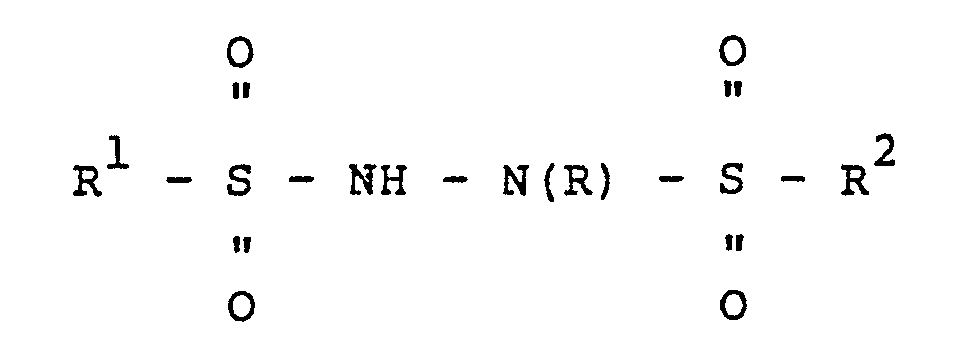
where R is selected from the group consisting of methyl and 2-chloroethyl, and R 1 and R 2, which may be the same or different, are each an alkyl moiety, an aromatic hydrocarbon moiety, or a ring substituted aromatic hydrocarbon moiety.
Priority Applications (1)
| Application Number | Priority Date | Filing Date | Title |
|---|---|---|---|
| AT85116361T ATE39247T1 (en) | 1984-12-20 | 1985-12-20 | N,N'-BIS(SULFONYL)HYDRAZINE WITH ANTINEOPLASTIC ACTIVITY. |
Applications Claiming Priority (4)
| Application Number | Priority Date | Filing Date | Title |
|---|---|---|---|
| US68385284A | 1984-12-20 | 1984-12-20 | |
| US683852 | 1984-12-20 | ||
| US810644 | 1985-12-18 | ||
| US06/810,644 US4684747A (en) | 1984-12-20 | 1985-12-18 | N,N'-bis(sulfonyl)hydrazines having antineoplastic activity |
Publications (2)
| Publication Number | Publication Date |
|---|---|
| EP0185387A1 true EP0185387A1 (en) | 1986-06-25 |
| EP0185387B1 EP0185387B1 (en) | 1988-12-14 |
Family
ID=27103205
Family Applications (1)
| Application Number | Title | Priority Date | Filing Date |
|---|---|---|---|
| EP85116361A Expired EP0185387B1 (en) | 1984-12-20 | 1985-12-20 | Novel, n,n'bis(sulfonyl) hydrazines having antineoplastic activity |
Country Status (5)
| Country | Link |
|---|---|
| US (1) | US4684747A (en) |
| EP (1) | EP0185387B1 (en) |
| JP (1) | JPH0637457B2 (en) |
| CA (1) | CA1257875A (en) |
| DE (1) | DE3566803D1 (en) |
Cited By (4)
| Publication number | Priority date | Publication date | Assignee | Title |
|---|---|---|---|---|
| EP0294238A1 (en) * | 1987-06-04 | 1988-12-07 | Yale University | Novel 1-alkyl-1-sulfonyl-2-alkoxycarbonylsulfenylhydrazines having antineoplastic activity |
| EP0416286A1 (en) * | 1989-09-06 | 1991-03-13 | Yale University | Sulfonylhydrazines and their use as antineoplastic agents and as antitrypanosomal agents |
| FR2901135A1 (en) * | 2006-05-22 | 2007-11-23 | Oreal | USE OF GLYCOLYSIS MODULATORS AS AGENTS REDUCING THE PROLIFERATION OF KERATINOCYTES |
| WO2016198507A1 (en) * | 2015-06-09 | 2016-12-15 | Monash University | Aryl sulfonohydrazides |
Families Citing this family (16)
| Publication number | Priority date | Publication date | Assignee | Title |
|---|---|---|---|---|
| US4849563A (en) * | 1986-01-21 | 1989-07-18 | Yale University | Novel 1-alkyl-1-arenesulfonyl-2-alkoxycarbonylsulfenylhydrazines having antineoplastic activity |
| US5256820A (en) * | 1991-11-08 | 1993-10-26 | Yale University | 1-alkyl-2-acyl-1,2-disulfonylhydrazines |
| US5637619A (en) * | 1995-07-05 | 1997-06-10 | Yale University | Antitumor 2-aminocarbonyl-1, 2-bis(methylsulfonyl)-1-(substituted)hydrazines |
| US6040338A (en) * | 1997-11-03 | 2000-03-21 | Yale University | N,n-bis(sulfonyl)hydrazines useful as antineoplastic agents |
| US5983822A (en) | 1998-09-03 | 1999-11-16 | Texaco Inc. | Polygon floating offshore structure |
| US6230645B1 (en) | 1998-09-03 | 2001-05-15 | Texaco Inc. | Floating offshore structure containing apertures |
| AU2002322720B2 (en) | 2001-07-25 | 2008-11-13 | Raptor Pharmaceutical Inc. | Compositions and methods for modulating blood-brain barrier transport |
| US6855695B2 (en) * | 2003-06-13 | 2005-02-15 | Vion Pharmaceuticals, Inc. | Water-soluble SHPs as novel alkylating agents |
| EP1804816B1 (en) * | 2004-03-26 | 2011-12-21 | Vion Pharmaceuticals, Inc. | Combination therapy comprising cloretazine(tm) |
| US7405317B2 (en) * | 2004-09-21 | 2008-07-29 | Vion Pharmaceuticals Inc. | Phosphate-bearing prodrugs of sulfonyl hydrazines as hypoxia-selective antineoplastic agents |
| CN102379684B (en) | 2005-04-28 | 2014-11-19 | 普罗透斯数字保健公司 | Pharma-informatics system |
| KR20090071598A (en) | 2006-09-18 | 2009-07-01 | 랩터 파마슈티컬 인코포레이티드 | Treatment of liver disease by administration of receptor binding protein (RAP) -conjugates |
| US8026395B1 (en) * | 2008-05-27 | 2011-09-27 | Nanotherapeutics, Inc. | Process for the synthesis of anti-neoplasia agent VNP40101M |
| EP2398500B1 (en) | 2009-02-20 | 2019-03-13 | 2-BBB Medicines B.V. | Glutathione-based drug delivery system |
| ES2942923T3 (en) | 2009-05-06 | 2023-06-07 | Laboratory Skin Care Inc | Dermal delivery compositions comprising complexes of active agent-calcium phosphate particles and methods of use thereof |
| US20120077778A1 (en) | 2010-09-29 | 2012-03-29 | Andrea Bourdelais | Ladder-Frame Polyether Conjugates |
Citations (3)
| Publication number | Priority date | Publication date | Assignee | Title |
|---|---|---|---|---|
| DE1132142B (en) * | 1958-12-31 | 1962-06-28 | Hoffmann La Roche | Process for the preparation of sulfonic acid hydrazides |
| FR2352796A1 (en) * | 1976-05-24 | 1977-12-23 | Uniroyal Inc | BIS (HYDROCARBYLSULFONYL) CARBOHYDRAZIDES AS BLOWING AGENTS |
| US4175200A (en) * | 1975-04-11 | 1979-11-20 | Uniroyal, Inc. | N,N-Disubstituted sulfonyl hydrazines |
Family Cites Families (2)
| Publication number | Priority date | Publication date | Assignee | Title |
|---|---|---|---|---|
| DE1069637B (en) * | 1960-04-28 | Farbenfabriken Bayer Aktiengesellschaft Leverkusen Bayerwerk | Process for the preparation of hydrazides of aliphatic sulfonic acids | |
| BE542151A (en) * | 1955-10-19 |
-
1985
- 1985-12-18 US US06/810,644 patent/US4684747A/en not_active Expired - Lifetime
- 1985-12-20 DE DE8585116361T patent/DE3566803D1/en not_active Expired
- 1985-12-20 JP JP60287614A patent/JPH0637457B2/en not_active Expired - Lifetime
- 1985-12-20 CA CA000498307A patent/CA1257875A/en not_active Expired
- 1985-12-20 EP EP85116361A patent/EP0185387B1/en not_active Expired
Patent Citations (3)
| Publication number | Priority date | Publication date | Assignee | Title |
|---|---|---|---|---|
| DE1132142B (en) * | 1958-12-31 | 1962-06-28 | Hoffmann La Roche | Process for the preparation of sulfonic acid hydrazides |
| US4175200A (en) * | 1975-04-11 | 1979-11-20 | Uniroyal, Inc. | N,N-Disubstituted sulfonyl hydrazines |
| FR2352796A1 (en) * | 1976-05-24 | 1977-12-23 | Uniroyal Inc | BIS (HYDROCARBYLSULFONYL) CARBOHYDRAZIDES AS BLOWING AGENTS |
Cited By (6)
| Publication number | Priority date | Publication date | Assignee | Title |
|---|---|---|---|---|
| US4962114A (en) * | 1986-01-21 | 1990-10-09 | Yale University | 1-alkyl-1-sulfonyl-2-alkoxycarbonylsulfenylhydrazines having antineoplastic activity |
| EP0294238A1 (en) * | 1987-06-04 | 1988-12-07 | Yale University | Novel 1-alkyl-1-sulfonyl-2-alkoxycarbonylsulfenylhydrazines having antineoplastic activity |
| EP0416286A1 (en) * | 1989-09-06 | 1991-03-13 | Yale University | Sulfonylhydrazines and their use as antineoplastic agents and as antitrypanosomal agents |
| FR2901135A1 (en) * | 2006-05-22 | 2007-11-23 | Oreal | USE OF GLYCOLYSIS MODULATORS AS AGENTS REDUCING THE PROLIFERATION OF KERATINOCYTES |
| WO2016198507A1 (en) * | 2015-06-09 | 2016-12-15 | Monash University | Aryl sulfonohydrazides |
| US10829446B2 (en) | 2015-06-09 | 2020-11-10 | Monash University | Aryl sulfonohydrazides |
Also Published As
| Publication number | Publication date |
|---|---|
| JPH0637457B2 (en) | 1994-05-18 |
| CA1257875A (en) | 1989-07-25 |
| JPS61191669A (en) | 1986-08-26 |
| DE3566803D1 (en) | 1989-01-19 |
| US4684747A (en) | 1987-08-04 |
| EP0185387B1 (en) | 1988-12-14 |
Similar Documents
| Publication | Publication Date | Title |
|---|---|---|
| EP0185387B1 (en) | Novel, n,n'bis(sulfonyl) hydrazines having antineoplastic activity | |
| US4849563A (en) | Novel 1-alkyl-1-arenesulfonyl-2-alkoxycarbonylsulfenylhydrazines having antineoplastic activity | |
| BRPI0708804B1 (en) | n-hydroxylsulfonamide-derived compounds as nitroxyl donors, pharmaceutical composition and kit | |
| US4892887A (en) | N,N'-bis(sulfonyl)hydrazines having antineoplastic activity | |
| US5637619A (en) | Antitumor 2-aminocarbonyl-1, 2-bis(methylsulfonyl)-1-(substituted)hydrazines | |
| US5101072A (en) | Sulfonylhydrazines and their use as antineoplastic agents and as antitrypanosomal agents | |
| LV11899B (en) | NEW ADENOSIN DERIVATIVES, THEIR METHODS | |
| US5214068A (en) | Sulfonylhydrazines and their use as antineoplastic agents and as antitrypanosomal agents | |
| EP0294238B1 (en) | Novel 1-alkyl-1-sulfonyl-2-alkoxycarbonylsulfenylhydrazines having antineoplastic activity | |
| Teotino et al. | Synthesis and pharmacological properties of some derivatives of p‐aminophenylethanolamine | |
| Poje et al. | Oxidation of uric acid. 4. Synthesis, structure, and diabetogenic action of 5-imino-2, 4, 6 (1H, 3H, 5H)-pyrimidinetrione salts and their alloxan-like covalent adducts | |
| PT91568A (en) | PROCESS FOR THE PREPARATION OF PLATINUM (IV) DIAMINE COMPLEXESAND ANTI-TUMOR PREPARATIONS CONTAINING SAME | |
| US3767815A (en) | Antihypertensive n-(3-chlorobenzenesulfonyl) acetamidines | |
| JP3229039B2 (en) | 1-alkyl-2-acyl-1,2-disulfonylhydrazines | |
| Shyam et al. | Relationship between structure and antineoplastic activity of (arylsulfonyl) hydrazones of 4-pyridinecarboxaldehyde | |
| WO1996000061A1 (en) | Glutathione n-hydroxycarbamoyl thioesters and method of inhibiting neoplastic growth | |
| JPH01165586A (en) | Antitumor prodrug | |
| US4707498A (en) | Fluorinated diaminoalkyne derivatives | |
| Rooney et al. | Synthesis of sulfonylhydrazine derivatives with monoamine oxidase inhibitory activity | |
| US4472573A (en) | Nitrosourea derivative and process for preparing same | |
| Ghosh et al. | Evaluation of 2-(methylaminosulfonyl)-1-(arylsulfonyl)-hydrazines as anticancer agents | |
| Sanyal et al. | Evaluation of 2-(methylaminosulfonyl)-1-(aryl-sulfonyl)-1-methylhydrazines as anticancer agents | |
| Peace | Synthesis of Substituted Hydroxyguanidines and Related Systems | |
| MXPA98000129A (en) | 2-aminocarbonil-1, 2-bis (metilsulfonil) -1- (substitute) hydrains antitumora | |
| MXPA01010311A (en) | Novel aryl-chloro-ethyl ureas. |
Legal Events
| Date | Code | Title | Description |
|---|---|---|---|
| PUAI | Public reference made under article 153(3) epc to a published international application that has entered the european phase |
Free format text: ORIGINAL CODE: 0009012 |
|
| AK | Designated contracting states |
Kind code of ref document: A1 Designated state(s): AT BE CH DE FR GB IT LI LU NL SE |
|
| 17P | Request for examination filed |
Effective date: 19860805 |
|
| 17Q | First examination report despatched |
Effective date: 19870715 |
|
| GRAA | (expected) grant |
Free format text: ORIGINAL CODE: 0009210 |
|
| AK | Designated contracting states |
Kind code of ref document: B1 Designated state(s): AT BE CH DE FR GB IT LI LU NL SE |
|
| REF | Corresponds to: |
Ref document number: 39247 Country of ref document: AT Date of ref document: 19881215 Kind code of ref document: T |
|
| ITF | It: translation for a ep patent filed | ||
| REF | Corresponds to: |
Ref document number: 3566803 Country of ref document: DE Date of ref document: 19890119 |
|
| ET | Fr: translation filed | ||
| PLBE | No opposition filed within time limit |
Free format text: ORIGINAL CODE: 0009261 |
|
| STAA | Information on the status of an ep patent application or granted ep patent |
Free format text: STATUS: NO OPPOSITION FILED WITHIN TIME LIMIT |
|
| 26N | No opposition filed | ||
| ITTA | It: last paid annual fee | ||
| EPTA | Lu: last paid annual fee | ||
| EAL | Se: european patent in force in sweden |
Ref document number: 85116361.8 |
|
| PGFP | Annual fee paid to national office [announced via postgrant information from national office to epo] |
Ref country code: FR Payment date: 20001115 Year of fee payment: 16 |
|
| PGFP | Annual fee paid to national office [announced via postgrant information from national office to epo] |
Ref country code: BE Payment date: 20001117 Year of fee payment: 16 |
|
| PGFP | Annual fee paid to national office [announced via postgrant information from national office to epo] |
Ref country code: LU Payment date: 20001201 Year of fee payment: 16 |
|
| PGFP | Annual fee paid to national office [announced via postgrant information from national office to epo] |
Ref country code: CH Payment date: 20001207 Year of fee payment: 16 |
|
| PGFP | Annual fee paid to national office [announced via postgrant information from national office to epo] |
Ref country code: GB Payment date: 20001220 Year of fee payment: 16 |
|
| PGFP | Annual fee paid to national office [announced via postgrant information from national office to epo] |
Ref country code: NL Payment date: 20001231 Year of fee payment: 16 |
|
| PGFP | Annual fee paid to national office [announced via postgrant information from national office to epo] |
Ref country code: SE Payment date: 20011126 Year of fee payment: 17 |
|
| PG25 | Lapsed in a contracting state [announced via postgrant information from national office to epo] |
Ref country code: LU Free format text: LAPSE BECAUSE OF NON-PAYMENT OF DUE FEES Effective date: 20011220 Ref country code: GB Free format text: LAPSE BECAUSE OF NON-PAYMENT OF DUE FEES Effective date: 20011220 |
|
| PGFP | Annual fee paid to national office [announced via postgrant information from national office to epo] |
Ref country code: AT Payment date: 20011228 Year of fee payment: 17 |
|
| PG25 | Lapsed in a contracting state [announced via postgrant information from national office to epo] |
Ref country code: LI Free format text: LAPSE BECAUSE OF NON-PAYMENT OF DUE FEES Effective date: 20011231 Ref country code: CH Free format text: LAPSE BECAUSE OF NON-PAYMENT OF DUE FEES Effective date: 20011231 Ref country code: BE Free format text: LAPSE BECAUSE OF NON-PAYMENT OF DUE FEES Effective date: 20011231 |
|
| REG | Reference to a national code |
Ref country code: GB Ref legal event code: IF02 |
|
| PGFP | Annual fee paid to national office [announced via postgrant information from national office to epo] |
Ref country code: DE Payment date: 20020122 Year of fee payment: 17 |
|
| BERE | Be: lapsed |
Owner name: YALE UNIVERSITY Effective date: 20011231 |
|
| PG25 | Lapsed in a contracting state [announced via postgrant information from national office to epo] |
Ref country code: NL Free format text: LAPSE BECAUSE OF NON-PAYMENT OF DUE FEES Effective date: 20020701 |
|
| GBPC | Gb: european patent ceased through non-payment of renewal fee |
Effective date: 20011220 |
|
| REG | Reference to a national code |
Ref country code: CH Ref legal event code: PL |
|
| PG25 | Lapsed in a contracting state [announced via postgrant information from national office to epo] |
Ref country code: FR Free format text: LAPSE BECAUSE OF NON-PAYMENT OF DUE FEES Effective date: 20020830 |
|
| NLV4 | Nl: lapsed or anulled due to non-payment of the annual fee |
Effective date: 20020701 |
|
| REG | Reference to a national code |
Ref country code: FR Ref legal event code: ST |
|
| PG25 | Lapsed in a contracting state [announced via postgrant information from national office to epo] |
Ref country code: AT Free format text: LAPSE BECAUSE OF NON-PAYMENT OF DUE FEES Effective date: 20021220 |
|
| PG25 | Lapsed in a contracting state [announced via postgrant information from national office to epo] |
Ref country code: SE Free format text: LAPSE BECAUSE OF NON-PAYMENT OF DUE FEES Effective date: 20021221 |
|
| PG25 | Lapsed in a contracting state [announced via postgrant information from national office to epo] |
Ref country code: DE Free format text: LAPSE BECAUSE OF NON-PAYMENT OF DUE FEES Effective date: 20030701 |
|
| EUG | Se: european patent has lapsed |