EP0182106B1 - Method and compositions for use in the treatment of fireblight - Google Patents
Method and compositions for use in the treatment of fireblight Download PDFInfo
- Publication number
- EP0182106B1 EP0182106B1 EP85113238A EP85113238A EP0182106B1 EP 0182106 B1 EP0182106 B1 EP 0182106B1 EP 85113238 A EP85113238 A EP 85113238A EP 85113238 A EP85113238 A EP 85113238A EP 0182106 B1 EP0182106 B1 EP 0182106B1
- Authority
- EP
- European Patent Office
- Prior art keywords
- enzyme
- phage
- composition
- erwinia amylovora
- depolymerase
- Prior art date
- Legal status (The legal status is an assumption and is not a legal conclusion. Google has not performed a legal analysis and makes no representation as to the accuracy of the status listed.)
- Expired
Links
Images

Classifications
-
- C—CHEMISTRY; METALLURGY
- C12—BIOCHEMISTRY; BEER; SPIRITS; WINE; VINEGAR; MICROBIOLOGY; ENZYMOLOGY; MUTATION OR GENETIC ENGINEERING
- C12N—MICROORGANISMS OR ENZYMES; COMPOSITIONS THEREOF; PROPAGATING, PRESERVING, OR MAINTAINING MICROORGANISMS; MUTATION OR GENETIC ENGINEERING; CULTURE MEDIA
- C12N9/00—Enzymes; Proenzymes; Compositions thereof; Processes for preparing, activating, inhibiting, separating or purifying enzymes
- C12N9/14—Hydrolases (3)
- C12N9/16—Hydrolases (3) acting on ester bonds (3.1)
- C12N9/18—Carboxylic ester hydrolases (3.1.1)
-
- A—HUMAN NECESSITIES
- A01—AGRICULTURE; FORESTRY; ANIMAL HUSBANDRY; HUNTING; TRAPPING; FISHING
- A01N—PRESERVATION OF BODIES OF HUMANS OR ANIMALS OR PLANTS OR PARTS THEREOF; BIOCIDES, e.g. AS DISINFECTANTS, AS PESTICIDES OR AS HERBICIDES; PEST REPELLANTS OR ATTRACTANTS; PLANT GROWTH REGULATORS
- A01N63/00—Biocides, pest repellants or attractants, or plant growth regulators containing microorganisms, viruses, microbial fungi, animals or substances produced by, or obtained from, microorganisms, viruses, microbial fungi or animals, e.g. enzymes or fermentates
- A01N63/40—Viruses, e.g. bacteriophages
-
- A—HUMAN NECESSITIES
- A01—AGRICULTURE; FORESTRY; ANIMAL HUSBANDRY; HUNTING; TRAPPING; FISHING
- A01N—PRESERVATION OF BODIES OF HUMANS OR ANIMALS OR PLANTS OR PARTS THEREOF; BIOCIDES, e.g. AS DISINFECTANTS, AS PESTICIDES OR AS HERBICIDES; PEST REPELLANTS OR ATTRACTANTS; PLANT GROWTH REGULATORS
- A01N63/00—Biocides, pest repellants or attractants, or plant growth regulators containing microorganisms, viruses, microbial fungi, animals or substances produced by, or obtained from, microorganisms, viruses, microbial fungi or animals, e.g. enzymes or fermentates
- A01N63/50—Isolated enzymes; Isolated proteins
-
- C—CHEMISTRY; METALLURGY
- C12—BIOCHEMISTRY; BEER; SPIRITS; WINE; VINEGAR; MICROBIOLOGY; ENZYMOLOGY; MUTATION OR GENETIC ENGINEERING
- C12Y—ENZYMES
- C12Y301/00—Hydrolases acting on ester bonds (3.1)
- C12Y301/01—Carboxylic ester hydrolases (3.1.1)
- C12Y301/01075—Poly(3-hydroxybutyrate) depolymerase (3.1.1.75)
Definitions
- the present invention relates to a method and compositions for the treatment of fireblight in plants which is caused by Erwinia amylovora.
- the present invention relates to the use of mixtures of a phage for the Erwinia amylovora and an enzyme produced by a phage for the Erwinia amylovora in the treatment of this plant disease.
- Fireblight disease in plants is caused by an extracellular polysaccharide produced by Erwinia amylovora. It is a large molecular weight polymeric anion which interferes with the transport of nutrients in the infected plant. The result is that the plant leaves and buds die from lack of nutrients.
- Polysaccharide depolymerases have been described for bacteriophage infected bacteria, particularly Erwinia amylovora by Hartung, J. S. et al in Phytopathology 72 945 (1982). Phage infection results in the induction of enzymes that degrade the capsular polysaccharide of the host. No use was described for the depolymerase enzyme which was in impure form.
- Figure 1 is a graph showing the basis for estimation of the molecular weight of the depolymerase enzyme from Erwinia amylovora described herein.
- the present invention relates to a composition for the treatment of fireblight in plants which is caused by an Erwinia amylovora having as the characteristic of producing a capsular polysaccharide responsible for the fireblight in the plants which comprises in admixture: a phage which lyses the Erwinia amylovora; and a polysaccharide depolymerase enzyme produced by a phage which lyses the Erwinia amylovora, wherein the composition contains at least about 10 6 PFU (Plaque Forming Units) of the phage per gram of the composition.
- PFU Plaque Forming Units
- the present invention relates to the method of treatment of fireblight in affected plants caused by an Erwinia amylovora having as the characteristic of producing a capsular polysaccharide responsible for the fireblight in the plants which comprises applying to the plants an effective amount of a phage which lyses an Erwinia amylovora; and a depolymerase enzyme for depolymerizing the polysaccharide produced by a phage which lyses the Erwinia amylovora.
- the preferred Erwinia phase depolymerase enzyme described herein was purified from crude bacterial lysates produced by the propagation of a specific bacteriophage ERA103 (ATCC 39824 B1) in cultures of Erwinia amylovora. Conventional methods using ammonium sulfate precipitation of the enzyme, ultracentrifugation and gel filtration chromatography were used for enzyme purification. The isolation of a bacteriophage from infected plant tissue, the purification and partial characterization of the polysaccharide depolymerase from phage-infected Erwinia amylovora NCPPB595 (ATCC 39824), and its application for the biological control of fireblight using Bartlett pear seedling is described.
- the supernatant was collected and 10 ml was added to 10 ml of Erwinia amylovora NCPPB595 at about 3x10 8 CFU/ml (Colony Forming Units) in NBY broth. After overnight incubation at 25°C on a rotary shaker (250 rpm), the cultures were centrifuged at low speed to pellet the bacteria: The supernatant was decanted into sterile tubes, chloroform (10% v/v) was added and after vortex mixing, the chloroform was allowed to settle out.
- phages were isolated from the different Erwinia amylovora strains. Of the four samples that yielded phages producing plaques with turbid halos, host range studies showed no differences among them. Differences in the size of turbid halos were taken as an indicator of differences in potential quantity of depolymerase activity of the enzyme produced by the phage. Therefore, the phage ERA103, with the largest halo, was chosen as typical. It produced a clear plaque of one-to-three mm, surrounded by a turbid halo of five-to-seven mm. E. herbicola M232A (ATCC 31225) was insensitive to all the phages.
- Phage ERA103 was purified by three successive plaque pickings, and after uniformity of plaque morphology was ascertained, small volume (10 ml) lysates were prepared by adding phage at a ratio of 1 PFU/10 4 CFU/ml of exponential phase cells (1 x2x10 8 CFU/ml). Incubation was for four to six hours at 25°C on a shaker (200 rpm). After increase, high titer lysates were obtained by adding phages at a ratio of 1:10 phage:CFU. After incubation for three to four hours at 25°C, the preparations were chloroform treated as above and stored at 4°C.
- the preparation then was concentrated by the polyethylene glycol (PEG) procedure of Yamamoto et al., (Yamamoto, K. R., et al., Virol. 40: 734-744 (1970)). Debris was sedimented at low speed (2,000xg) for 10 min, followed by the addition of 10% PEG to the supernatant, and NaCI to a final concentration of 0.5 M. The mixture was chilled one hour, and the phage pelleted at 10,000xg for 20 min. The pellet was resuspended and stored in chilled 0.0125 M phosphate buffer, pH 7.1.
- PEG polyethylene glycol
- Depolymerase activity in phage-infected bacteria was produced in the following manner: Erwinia amylovora NCPPB595 (ATCC 39824) cells were grown for 18 hours in 200 ml of N broth (Vidaver, A. K., J. Appl. Microbiol. 15: 1523-1524 (1967)), supplemented with 0.25% yeast extract at 25°C on a New Brunswick aerating shaker at 250 rpm. This culture was used to inoculate 2000 ml of N broth supplemented with 0.25% yeast extract at 25°C and shaken at 250 rpm. Early log phase cells, 4.Ox10 8 CFU/ml, of this culture were infected with phage at a multiplicity of infection of 2. Incubation was continued for 10 hours. The lysates were then stored at 4°C for 11 hours and then purified as follows:
- the enzyme was precipitated at 45% (NH 4 ) 2 S0 4 saturation. Ethanol precipitation was also attempted but resulted in a diminished yield. The ultracentrifugation procedure demonstrated that the activity was present in the supernatant and that no activity was associated with the pellet.
- the recovered enzyme was treated with CM-SephadexTM C-50 in a batchwise procedure followed by gel filtration using SephadexTM G-50 and SephacrylTM S-200 (Table 1). Several 280 nm absorbing protein peaks were observed in the Sephadex TM G-50 elution profile, depolymerase activity was associated with only one of them. Two protein peaks were observed in the elution profile of the Sephacryl TM S-200 column.
- Depolymerase activity was assayed by following the release of galactose from the polysaccharide substrate according to the method of Fairbridge (Fairbridge, R. A., et al. Biochem. J. 49: 423-427 (1951)).
- the reaction mixture consisted of the following: 100 microliters of the appropriate enzyme solution and 100 microliters of polysaccharide (10 mg/ml) suspended in 0.01 M citrate buffer, pH 6.0 containing 0.01 M 2-mercaptoethanol.
- One unit of enzyme was defined as the amount of enzyme required to produce 1 micromole of galactose per minute under standard assay conditions.
- Protein concentrations were determined using the microbiuret method of Koch (Koch, A. et al., Anal. Biochem. 44: 239-245 (1971)).
- Polysaccharide was prepared from uninfected cultures of Erwinia amylovora NCPPB595 cultivated on sheets of cellophane overlaying Tryptic Soy agar, as described by Liu (Liu, P. V., et al., J. Infect. Dis. 108: 218-228 (1961)). The polysaccharide was extracted from the slime layer according to the method of Liu.
- the molecular weight of the depolymerase was determined by ascending gel filtration on a 2.6 cmx75 cm column of Sephacryl TM S-200 equilibrated in 0.01 M citrate buffer, pH 6.0 containing 0.01 M 2-mercaptoethanol.
- a Pharmacia calibration kit containing various molecular weight protein markers was used as standards.
- Sodium dodecyl sulfate (SDS)-polyacrylamide gel electrophoresis was also used for determination of the molecular weight (Weber, K., et al., J. Biol. Chem. 244: 4406 ⁇ 4412 (1969)).
- Electrophoresis of the enzymatic preparations was performed utilizing the method of Brewer (Brewer, J. M., et al., Electrophoresis, pp. 128-160 (1974)).
- the gels were silver stained according to the method of Merril (Merril, C. R., et al., Science 211: 1437-1438 (1981)).
- the enzyme was insensitive to a variety of agents such as, sodium azide, potassium cyanide, ethylenediaminetetraacetate, ethylene - di - (o - hydroxyphenylacetate) and 8 - hydroxyquinoline.
- the thiol group alkylators such as N - ethylmaleimide and iodoacetate had no effect on enzymatic activity, however, p - chloromercuribenzoate inhibited the enzyme at all concentrations tested.
- the reducing agents 2 - mercaptoethanol and dithiothreitol (1,4 - dimercapto - 2,3 - butanediol) both enhanced depolymerase activity substantially for reasons not completely understood.
- the molecular weight of depolymerase was estimated by ascending gel filtration chromatography with Sephacryl TM S-200. By comparing the elution volume of the enzymatic activity with the elution volumes of standard proteins, (ribonuclease, a chymotrypsinogen a, ovalbumin and aldolase) a molecular weight of about 21,000 was estimated ( Figure 1).
- the enzymatic fraction 82,000xg supernatant with phage ERA103 was testing for ability to control Erwinia amylovora infections in Bartlett pear seedlings.
- the enzyme and phage combination provides very effective control of fireblight in plants.
- the enzyme and phage can be applied separately if this is desirable for any reason.
Landscapes
- Life Sciences & Earth Sciences (AREA)
- Health & Medical Sciences (AREA)
- Zoology (AREA)
- Engineering & Computer Science (AREA)
- General Health & Medical Sciences (AREA)
- Chemical & Material Sciences (AREA)
- Wood Science & Technology (AREA)
- Organic Chemistry (AREA)
- Biotechnology (AREA)
- Virology (AREA)
- Microbiology (AREA)
- Genetics & Genomics (AREA)
- Bioinformatics & Cheminformatics (AREA)
- Plant Pathology (AREA)
- Pest Control & Pesticides (AREA)
- Dentistry (AREA)
- Environmental Sciences (AREA)
- Agronomy & Crop Science (AREA)
- General Engineering & Computer Science (AREA)
- Biochemistry (AREA)
- Medicinal Chemistry (AREA)
- Biomedical Technology (AREA)
- Molecular Biology (AREA)
- Proteomics, Peptides & Aminoacids (AREA)
- Enzymes And Modification Thereof (AREA)
- Micro-Organisms Or Cultivation Processes Thereof (AREA)
- Chemical And Physical Treatments For Wood And The Like (AREA)
- Agricultural Chemicals And Associated Chemicals (AREA)
- Gasification And Melting Of Waste (AREA)
- Fire-Extinguishing Compositions (AREA)
- Preparation Of Compounds By Using Micro-Organisms (AREA)
- Fireproofing Substances (AREA)
Abstract
Description
- The present invention relates to a method and compositions for the treatment of fireblight in plants which is caused by Erwinia amylovora. In particular the present invention relates to the use of mixtures of a phage for the Erwinia amylovora and an enzyme produced by a phage for the Erwinia amylovora in the treatment of this plant disease.
- Fireblight disease in plants is caused by an extracellular polysaccharide produced by Erwinia amylovora. It is a large molecular weight polymeric anion which interferes with the transport of nutrients in the infected plant. The result is that the plant leaves and buds die from lack of nutrients.
- Various methods have been suggested by the prior art for the treatment of fireblight. Included is the use of various antibiotics which kill the Erwinia amylovora. The problem with this method is that mutant strains are produced over time which are resistant to the antibiotic. Other methods suggested include applying other strains or species of bacteria usually of the genus Erwinia to the plant in order to displace the Erwinia amylovora by population dominance. The problem with this method is that it involves the release of large numbers of bacteria into the environment and it is not particularly successful.
- Polysaccharide depolymerases have been described for bacteriophage infected bacteria, particularly Erwinia amylovora by Hartung, J. S. et al in Phytopathology 72 945 (1982). Phage infection results in the induction of enzymes that degrade the capsular polysaccharide of the host. No use was described for the depolymerase enzyme which was in impure form.
- It is therefore an object of the present invention to provide a novel method for the destruction of Erwinia amylovora on the plants as well as the polysaccharide. Further it is an object of the present invention to provide a method which is relatively economical and effective. These and other objects will become increasingly apparent by reference to the following description and the drawing.
- Figure 1 is a graph showing the basis for estimation of the molecular weight of the depolymerase enzyme from Erwinia amylovora described herein.
- The present invention relates to a composition for the treatment of fireblight in plants which is caused by an Erwinia amylovora having as the characteristic of producing a capsular polysaccharide responsible for the fireblight in the plants which comprises in admixture: a phage which lyses the Erwinia amylovora; and a polysaccharide depolymerase enzyme produced by a phage which lyses the Erwinia amylovora, wherein the composition contains at least about 106 PFU (Plaque Forming Units) of the phage per gram of the composition. Further the present invention relates to the method of treatment of fireblight in affected plants caused by an Erwinia amylovora having as the characteristic of producing a capsular polysaccharide responsible for the fireblight in the plants which comprises applying to the plants an effective amount of a phage which lyses an Erwinia amylovora; and a depolymerase enzyme for depolymerizing the polysaccharide produced by a phage which lyses the Erwinia amylovora.
- The preferred Erwinia phase depolymerase enzyme described herein was purified from crude bacterial lysates produced by the propagation of a specific bacteriophage ERA103 (ATCC 39824 B1) in cultures of Erwinia amylovora. Conventional methods using ammonium sulfate precipitation of the enzyme, ultracentrifugation and gel filtration chromatography were used for enzyme purification. The isolation of a bacteriophage from infected plant tissue, the purification and partial characterization of the polysaccharide depolymerase from phage-infected Erwinia amylovora NCPPB595 (ATCC 39824), and its application for the biological control of fireblight using Bartlett pear seedling is described.
- Twigs of fireblight infected tissue from apples and pears were obtained from Michigan, Montana, Colorado, Illinois and Washington, Enrichment for bacteriophages were essentially as described by Vidaver, A. K. et al in J. Viral. 4: 300-308 (1969). Two to five grams of infected twigs were washed with tap water, homogenized in 100 to 200 ml of sterile phosphate buffer (0.0125 M, pH 7.1) with a Waring blender, and the suspensions centrifuged at low speed. The supernatant was collected and 10 ml was added to 10 ml of Erwinia amylovora NCPPB595 at about 3x10⁸ CFU/ml (Colony Forming Units) in NBY broth. After overnight incubation at 25°C on a rotary shaker (250 rpm), the cultures were centrifuged at low speed to pellet the bacteria: The supernatant was decanted into sterile tubes, chloroform (10% v/v) was added and after vortex mixing, the chloroform was allowed to settle out. Aliquots were diluted in NBY broth, and 10 ul were plated in duplicate with 0.1 ml of the respective mid-exponential phase enriching host, and independently, with the other Erwinia amylovora strains, in a soft agar overlay (Vidaver, A. K. et al., J. Virol. 4: 300-308 (1969). Plates were examined for phages after incubation overnight at 25°C.
- Many phages were isolated from the different Erwinia amylovora strains. Of the four samples that yielded phages producing plaques with turbid halos, host range studies showed no differences among them. Differences in the size of turbid halos were taken as an indicator of differences in potential quantity of depolymerase activity of the enzyme produced by the phage. Therefore, the phage ERA103, with the largest halo, was chosen as typical. It produced a clear plaque of one-to-three mm, surrounded by a turbid halo of five-to-seven mm. E. herbicola M232A (ATCC 31225) was insensitive to all the phages.
- Phage ERA103 was purified by three successive plaque pickings, and after uniformity of plaque morphology was ascertained, small volume (10 ml) lysates were prepared by adding phage at a ratio of 1 PFU/104 CFU/ml of exponential phase cells (1 x2x108 CFU/ml). Incubation was for four to six hours at 25°C on a shaker (200 rpm). After increase, high titer lysates were obtained by adding phages at a ratio of 1:10 phage:CFU. After incubation for three to four hours at 25°C, the preparations were chloroform treated as above and stored at 4°C.
- The preparation then was concentrated by the polyethylene glycol (PEG) procedure of Yamamoto et al., (Yamamoto, K. R., et al., Virol. 40: 734-744 (1970)). Debris was sedimented at low speed (2,000xg) for 10 min, followed by the addition of 10% PEG to the supernatant, and NaCI to a final concentration of 0.5 M. The mixture was chilled one hour, and the phage pelleted at 10,000xg for 20 min. The pellet was resuspended and stored in chilled 0.0125 M phosphate buffer, pH 7.1.
- The partial purification of ERA103 by plaque picking, lysate production and PEG precipitation yielded 10 ml of high-titer (1011―1012) PFU/ml lysates from 100 ml cultures. Pellets from the PEG treatment contained more than 99% of the total PFU. Lysates did not clear during phage release, but turbidity decreases were always detected which indicates lysis of cells of E. amylovora ATCC 39824.
- Depolymerase activity in phage-infected bacteria was produced in the following manner: Erwinia amylovora NCPPB595 (ATCC 39824) cells were grown for 18 hours in 200 ml of N broth (Vidaver, A. K., J. Appl. Microbiol. 15: 1523-1524 (1967)), supplemented with 0.25% yeast extract at 25°C on a New Brunswick aerating shaker at 250 rpm. This culture was used to inoculate 2000 ml of N broth supplemented with 0.25% yeast extract at 25°C and shaken at 250 rpm. Early log phase cells, 4.Ox108 CFU/ml, of this culture were infected with phage at a multiplicity of infection of 2. Incubation was continued for 10 hours. The lysates were then stored at 4°C for 11 hours and then purified as follows:
- Step 1. Crude lysate. The active lysate from 21 of phage-infected cells was centrifuged in a Sorvall RC-3 centrifuge at 8,000xg for 30 minutes to pellet the bacterial cells.
-
Step 2. Ammonium sulfate precipitation. Solid ammonium sulfate was added slowly with stirring to the supernatant fluid to give a final concentration of 45% saturation; this solution was allowed to remain at 4°C overnight. This solution was then centrifuged at 18,000xg for 30 minutes. The pellet was collected and resuspended in 30 ml of 0.01 M ,citrate buffer pH 6, containing 0.01 M 2-mercaptoethanol. The dissolved precipitate was then subjected to dialysis against 3 liters of 0.01 M citrate buffer, pH 6.0 containing 0.01 M 2-mercaptoethanol for 18 hours. - Step 3. Ultracentrifugation. The resuspended ammonium sulfate precipitate was centrifuged in a Sorvall OTD-65B ultracentrifuge at 82,000xg for 2 hours. The supernatant was collected and frozen at -20°C.
- Step 4. CM-SephadexTM batchwise separation. The supernatant from the previous step was then subjected to further purification using CM-Sephadexrm C-50 (supplied by Sigma) in a batch procedure. The CM-Sephadex was swollen in 0.01 M citrate buffer, pH 6.0 containing 0.01 M 2-mercaptoethanol. The enzyme preparation, 20 ml, was added to 200 ml of the ion exchange material and slowly stirred for 1 hour. The slurry was then filtered through a Buchner funnel, washed with 200 ml of citrate buffer, collected, dialyzed against citrate buffer containing 2-mercaptoethanol, and concentrated using Carbowax 20, (Fisher Co.).
-
Step 5. Passage through a SephadexTM G-50 column. The concentrated enzyme preparation was then subjected to ascending gel filtration on a 2.6 cmx65 column of Sephadex G-50 equilibrated in 0.01 M citrate buffer, pH 6.0 containing 0.01 M 2-mercaptoethanol. The column was equilibrated and washed with buffer. The fractions were assayed and those with enzymatic activity were then dialyzed and concentrated. - Step 6. Passage through a SephacrylTM S-200 column. The concentrated enzyme fractions were subjected to ascending gel filtration on a 2.6 cmx75 cm column of SephacrylTM S-200 (supplied by Sigma) equilibrated in 0.01 M citrate buffer, pH 6.0 containing 0.01 M 2-mercaptoethanol. The column was washed with buffer and the enzymatic fractions were dialyzed and concentrated.
- The enzyme was precipitated at 45% (NH4)2S04 saturation. Ethanol precipitation was also attempted but resulted in a diminished yield. The ultracentrifugation procedure demonstrated that the activity was present in the supernatant and that no activity was associated with the pellet. The recovered enzyme was treated with CM-SephadexTM C-50 in a batchwise procedure followed by gel filtration using SephadexTM G-50 and SephacrylTM S-200 (Table 1).

- Depolymerase activity was assayed by following the release of galactose from the polysaccharide substrate according to the method of Fairbridge (Fairbridge, R. A., et al. Biochem. J. 49: 423-427 (1951)). The reaction mixture consisted of the following: 100 microliters of the appropriate enzyme solution and 100 microliters of polysaccharide (10 mg/ml) suspended in 0.01 M citrate buffer, pH 6.0 containing 0.01 M 2-mercaptoethanol. One unit of enzyme was defined as the amount of enzyme required to produce 1 micromole of galactose per minute under standard assay conditions.
- Protein concentrations were determined using the microbiuret method of Koch (Koch, A. et al., Anal. Biochem. 44: 239-245 (1971)).
- Polysaccharide was prepared from uninfected cultures of Erwinia amylovora NCPPB595 cultivated on sheets of cellophane overlaying Tryptic Soy agar, as described by Liu (Liu, P. V., et al., J. Infect. Dis. 108: 218-228 (1961)). The polysaccharide was extracted from the slime layer according to the method of Liu.
- The molecular weight of the depolymerase was determined by ascending gel filtration on a 2.6 cmx75 cm column of SephacrylTM S-200 equilibrated in 0.01 M citrate buffer, pH 6.0 containing 0.01 M 2-mercaptoethanol. A Pharmacia calibration kit containing various molecular weight protein markers was used as standards. Sodium dodecyl sulfate (SDS)-polyacrylamide gel electrophoresis was also used for determination of the molecular weight (Weber, K., et al., J. Biol. Chem. 244: 4406―4412 (1969)).
- Electrophoresis of the enzymatic preparations was performed utilizing the method of Brewer (Brewer, J. M., et al., Electrophoresis, pp. 128-160 (1974)). The gels were silver stained according to the method of Merril (Merril, C. R., et al., Science 211: 1437-1438 (1981)).
- The activity of purified depolymerase was tested under different conditions. Activity appeared stable after storage at -20°C for several weeks. After assaying depolymerase activity at several pH values from 3.0-8.0 in different buffers, optimal activity was achieved at pH 6.0. Temperature studies employing a 10 minute preincubation of the enzyme at various temperatures from 15―45°C, showed that 30°C was optimum for activity.
- The effect of various chemical agents on depolymerase activity can be seen in Table 2.
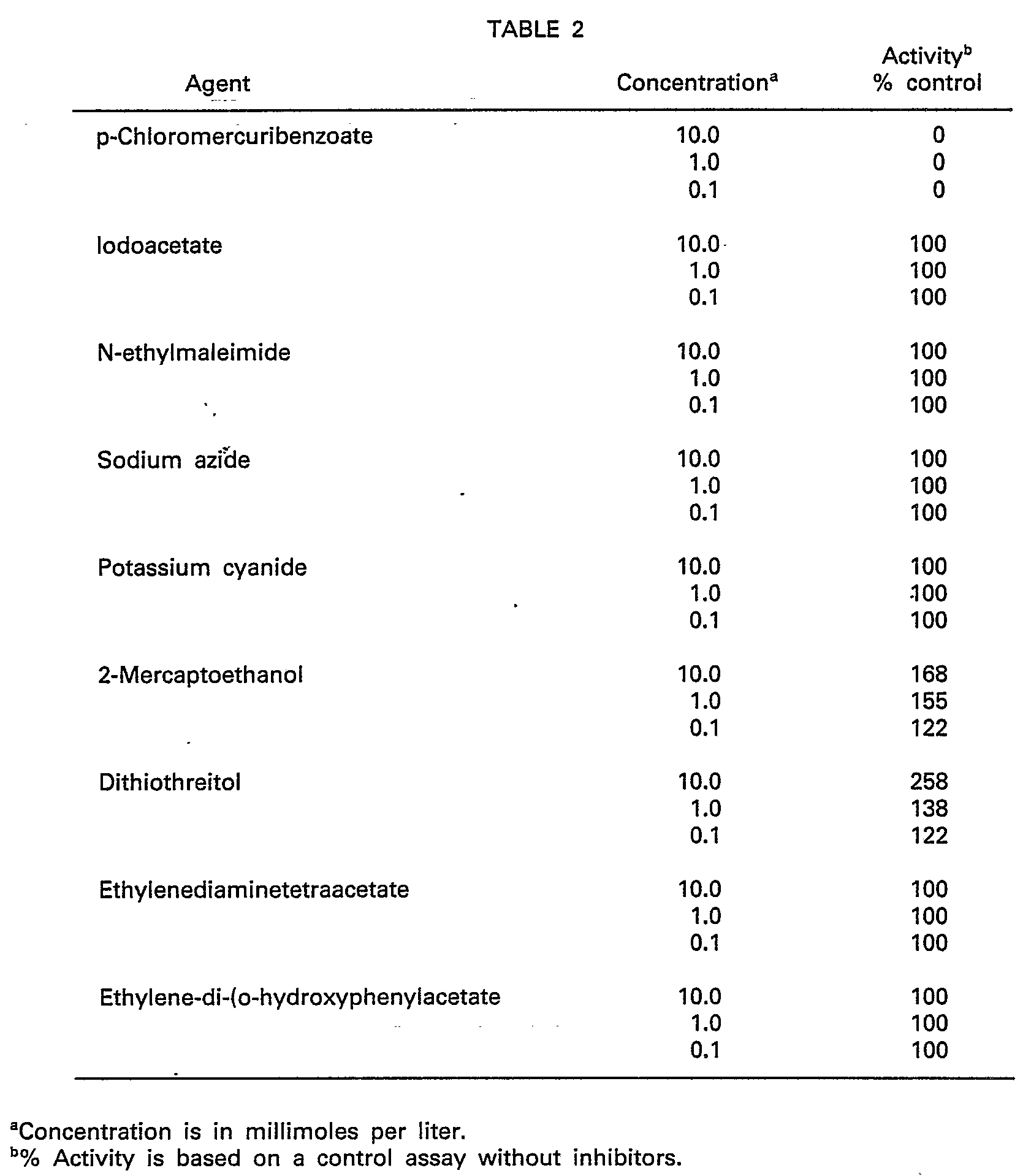
- The enzyme was insensitive to a variety of agents such as, sodium azide, potassium cyanide, ethylenediaminetetraacetate, ethylene - di - (o - hydroxyphenylacetate) and 8 - hydroxyquinoline. The thiol group alkylators such as N - ethylmaleimide and iodoacetate had no effect on enzymatic activity, however, p - chloromercuribenzoate inhibited the enzyme at all concentrations tested. The reducing agents 2 - mercaptoethanol and dithiothreitol (1,4 - dimercapto - 2,3 - butanediol) both enhanced depolymerase activity substantially for reasons not completely understood.
- The molecular weight of depolymerase was estimated by ascending gel filtration chromatography with SephacrylTM S-200. By comparing the elution volume of the enzymatic activity with the elution volumes of standard proteins, (ribonuclease, a chymotrypsinogen a, ovalbumin and aldolase) a molecular weight of about 21,000 was estimated (Figure 1).
- The enzymatic fraction 82,000xg supernatant with phage ERA103 was testing for ability to control Erwinia amylovora infections in Bartlett pear seedlings.
- Bartlett pear seedlings 3 weeks old, at the four leaf pair stage were utilized. The plants were wounded 1 cm below the apex using a 26 gauge needle, piercing the stem completely. The plants were then atomized with 0.5 ml of the enzyme preparation where appropriate, and allowed to air dry 15 minutes. The plants were then spray challenged with different concentrations of Erwinia amylovora followed by another application of the enzyme and phage, where appropriate. In infected plants it would be rare to have more than the number of bacteria per plant that are provided by 106 CFU per ml. The results are shown in Table 3.
-

- The results indicated that the enzyme preparation containing phage gave complete control of disease when applied at rate of 10%. When enzyme containing 1 x10⁷ PFU phage per ml was applied at a usage rate of 1 % enzyme only 20% protection was observed.
- As can be seen from the foregoing description and Example III the enzyme and phage combination provides very effective control of fireblight in plants. The enzyme and phage can be applied separately if this is desirable for any reason.
Claims (24)
Priority Applications (1)
| Application Number | Priority Date | Filing Date | Title |
|---|---|---|---|
| AT85113238T ATE41729T1 (en) | 1984-10-18 | 1985-10-18 | METHODS AND COMPOSITIONS FOR THE TREATMENT OF FIRE BLIGHT. |
Applications Claiming Priority (2)
| Application Number | Priority Date | Filing Date | Title |
|---|---|---|---|
| US06/662,065 US4678750A (en) | 1984-10-18 | 1984-10-18 | Method and compositions for use in the treatment of fireblight |
| US662065 | 1984-10-18 |
Publications (2)
| Publication Number | Publication Date |
|---|---|
| EP0182106A1 EP0182106A1 (en) | 1986-05-28 |
| EP0182106B1 true EP0182106B1 (en) | 1989-03-29 |
Family
ID=24656252
Family Applications (1)
| Application Number | Title | Priority Date | Filing Date |
|---|---|---|---|
| EP85113238A Expired EP0182106B1 (en) | 1984-10-18 | 1985-10-18 | Method and compositions for use in the treatment of fireblight |
Country Status (8)
| Country | Link |
|---|---|
| US (1) | US4678750A (en) |
| EP (1) | EP0182106B1 (en) |
| AT (1) | ATE41729T1 (en) |
| AU (1) | AU570574B2 (en) |
| CA (1) | CA1246477A (en) |
| DE (2) | DE182106T1 (en) |
| ES (2) | ES8609461A1 (en) |
| NZ (1) | NZ213871A (en) |
Families Citing this family (13)
| Publication number | Priority date | Publication date | Assignee | Title |
|---|---|---|---|---|
| US4822740A (en) * | 1985-10-07 | 1989-04-18 | Microlife Technics, Inc. | Bacteria for expressing a polysaccharide depolymerase containing a novel recombinant plasmid |
| NZ256788A (en) * | 1992-09-30 | 1996-11-26 | Cornell Res Foundation Inc | Conferring resistance to fire blight in pomaceous fruit scion or cultivars through transformation with genes encoding lytic proteins |
| WO1997039111A1 (en) * | 1996-04-15 | 1997-10-23 | Nymox Corporation | Compositions containing bacteriophages and methods of using bacteriophages to treat infections |
| EP1059355A1 (en) * | 1999-06-11 | 2000-12-13 | Agrostar | Bacteriocin, its preparation and use |
| DE10149557A1 (en) * | 2001-10-08 | 2003-04-10 | Jobeck Gmbh | Preparation and use of this preparation for combating and / or preventing the causative agent of the fire blight Erwinia amylovora |
| GB0300597D0 (en) * | 2003-01-10 | 2003-02-12 | Microbiological Res Authority | Phage biofilms |
| EP1663265B1 (en) * | 2003-07-23 | 2015-09-23 | Biocontrol Limited | Bacteriophage-containing therapeutic agents |
| GB0704553D0 (en) * | 2007-03-09 | 2007-04-18 | Harper David R | Beneficial effects of bacteriophage treatments |
| US9056899B2 (en) | 2008-01-10 | 2015-06-16 | Trustees Of Boston University | Engineered bacteriophages as adjuvants for antimicrobial agents and compositions and methods of use thereof |
| WO2010141135A2 (en) | 2009-03-05 | 2010-12-09 | Trustees Of Boston University | Bacteriophages expressing antimicrobial peptides and uses thereof |
| WO2021092362A1 (en) | 2019-11-07 | 2021-05-14 | University Of Pittsburgh - Of The Commonwealth System Of Higher Education | Use of specific phages for the treatment of nontuberculous mycobacteria (ntm) infections |
| KR102716814B1 (en) * | 2021-12-10 | 2024-10-16 | 대한민국 | Novel bacteriophage specific for fire blight and use thereof |
| US20250257349A1 (en) * | 2024-02-09 | 2025-08-14 | Exacta Bioscience, Inc. | Method of production of a combination of phages for bacterial phytopathogen control |
-
1984
- 1984-10-18 US US06/662,065 patent/US4678750A/en not_active Expired - Fee Related
-
1985
- 1985-08-13 CA CA000488613A patent/CA1246477A/en not_active Expired
- 1985-08-21 AU AU46489/85A patent/AU570574B2/en not_active Ceased
- 1985-10-17 NZ NZ213871A patent/NZ213871A/en unknown
- 1985-10-17 ES ES547967A patent/ES8609461A1/en not_active Expired
- 1985-10-18 DE DE198585113238T patent/DE182106T1/en active Pending
- 1985-10-18 EP EP85113238A patent/EP0182106B1/en not_active Expired
- 1985-10-18 DE DE8585113238T patent/DE3569075D1/en not_active Expired
- 1985-10-18 AT AT85113238T patent/ATE41729T1/en not_active IP Right Cessation
-
1986
- 1986-01-22 ES ES551118A patent/ES8802400A1/en not_active Expired
Also Published As
| Publication number | Publication date |
|---|---|
| AU570574B2 (en) | 1988-03-17 |
| US4678750A (en) | 1987-07-07 |
| ES8802400A1 (en) | 1988-05-16 |
| ES8609461A1 (en) | 1986-08-01 |
| CA1246477A (en) | 1988-12-13 |
| DE182106T1 (en) | 1986-09-25 |
| ES547967A0 (en) | 1986-08-01 |
| ES551118A0 (en) | 1988-05-16 |
| DE3569075D1 (en) | 1989-05-03 |
| NZ213871A (en) | 1991-07-26 |
| AU4648985A (en) | 1986-04-24 |
| EP0182106A1 (en) | 1986-05-28 |
| ATE41729T1 (en) | 1989-04-15 |
Similar Documents
| Publication | Publication Date | Title |
|---|---|---|
| US4678750A (en) | Method and compositions for use in the treatment of fireblight | |
| Chandrasekaran et al. | Exploring the in vitro thrombolytic activity of nattokinase from a new strain Pseudomonas aeruginosa CMSS | |
| Piñón et al. | Gluconacetobacter diazotrophicus, a sugar cane endosymbiont, produces a bacteriocin against Xanthomonas albilineans, a sugar cane pathogen | |
| Mulrooney et al. | Purification, characterization, and genetic organization of recombinant Providencia stuartii urease expressed by Escherichia coli | |
| Wadström et al. | Bacteriolytic enzymes from Staphylococcus aureus. Purification of an endo-β-N-acetylglucosaminidase | |
| ITOH et al. | Purification and characterization of a bacteriocin from Erwinia carotovora | |
| EP0468411A2 (en) | A mutant of bacterium Clostridium histolyticum, a process for the obtaining thereof, and its use in the production of clostripain-free collagenase | |
| Ngai et al. | Dienelactone hydrolase from Pseudomonas sp. strain B13 | |
| CA1230301A (en) | Process for obtaining sarcosine oxidase from micro- organisms | |
| US4783406A (en) | Method and compositions for use in the treatment of fireblight | |
| EP0053890B1 (en) | Production of aryl acylamidases | |
| JPS6279778A (en) | Novel superoxide dismutase and production thereof | |
| US4229539A (en) | β-Galactosidase and production thereof | |
| Jahn et al. | Characterization of two ornithine carbamoyltransferases from Pseudomonas syringae pv. phaseolicola, the producer of phaseolotoxin | |
| Morikawa et al. | Phosphoenolpyruvate carboxylase of E. coli: discrimination of regulatory sites for four kinds of allosteric effectors by the method of genetic desensitization | |
| Yorifuji et al. | Distribution of amidinohydrolases among Pseudomonas and comparative studies of some purified enzymes by one-dimensional peptide mapping | |
| JPWO2000050582A1 (en) | Novel enzyme with decolorizing activity and method for decolorizing dyes using the same | |
| EP0219009B1 (en) | Bacteria for expressing a polysaccharide depolymerase containing a novel recombinant plasmid | |
| Islam et al. | Purification and properties of an extracellular proteolytic enzyme from Bacillus cereus | |
| JPH0242980A (en) | Pyranose oxidase and production thereof | |
| Nord et al. | Formation of α-l-and β-d-fucosidase in cultures of Streptococcus mitis | |
| Rai | Purification and properties of urease from a cyanobacterium Anabaena doliolum | |
| JPS5840466B2 (en) | Production method of acyl-CoA oxidase | |
| Day et al. | Localization of l-asparaginase in Pseudomonas aeruginosa | |
| JPH0239237B2 (en) | SHUSANOKISHIDAAZENOSEIZOHO |
Legal Events
| Date | Code | Title | Description |
|---|---|---|---|
| PUAI | Public reference made under article 153(3) epc to a published international application that has entered the european phase |
Free format text: ORIGINAL CODE: 0009012 |
|
| AK | Designated contracting states |
Kind code of ref document: A1 Designated state(s): AT BE CH DE FR GB IT LI LU NL SE |
|
| 17P | Request for examination filed |
Effective date: 19860507 |
|
| ITCL | It: translation for ep claims filed |
Representative=s name: JACOBACCI CASETTA & PERANI S.P.A. |
|
| TCAT | At: translation of patent claims filed | ||
| EL | Fr: translation of claims filed | ||
| DET | De: translation of patent claims | ||
| EM | Fr: revised translation of claims filed | ||
| 17Q | First examination report despatched |
Effective date: 19880624 |
|
| GRAA | (expected) grant |
Free format text: ORIGINAL CODE: 0009210 |
|
| AK | Designated contracting states |
Kind code of ref document: B1 Designated state(s): AT BE CH DE FR GB IT LI LU NL SE |
|
| PG25 | Lapsed in a contracting state [announced via postgrant information from national office to epo] |
Ref country code: SE Effective date: 19890329 Ref country code: NL Effective date: 19890329 Ref country code: LI Effective date: 19890329 Ref country code: IT Free format text: LAPSE BECAUSE OF FAILURE TO SUBMIT A TRANSLATION OF THE DESCRIPTION OR TO PAY THE FEE WITHIN THE PRESCRIBED TIME-LIMIT;WARNING: LAPSES OF ITALIAN PATENTS WITH EFFECTIVE DATE BEFORE 2007 MAY HAVE OCCURRED AT ANY TIME BEFORE 2007. THE CORRECT EFFECTIVE DATE MAY BE DIFFERENT FROM THE ONE RECORDED. Effective date: 19890329 Ref country code: CH Effective date: 19890329 Ref country code: AT Effective date: 19890329 |
|
| REF | Corresponds to: |
Ref document number: 41729 Country of ref document: AT Date of ref document: 19890415 Kind code of ref document: T |
|
| REF | Corresponds to: |
Ref document number: 3569075 Country of ref document: DE Date of ref document: 19890503 |
|
| ET | Fr: translation filed | ||
| REG | Reference to a national code |
Ref country code: CH Ref legal event code: PL |
|
| NLV1 | Nl: lapsed or annulled due to failure to fulfill the requirements of art. 29p and 29m of the patents act | ||
| PG25 | Lapsed in a contracting state [announced via postgrant information from national office to epo] |
Ref country code: GB Effective date: 19891018 |
|
| PG25 | Lapsed in a contracting state [announced via postgrant information from national office to epo] |
Ref country code: LU Free format text: LAPSE BECAUSE OF NON-PAYMENT OF DUE FEES Effective date: 19891031 |
|
| PLBE | No opposition filed within time limit |
Free format text: ORIGINAL CODE: 0009261 |
|
| STAA | Information on the status of an ep patent application or granted ep patent |
Free format text: STATUS: NO OPPOSITION FILED WITHIN TIME LIMIT |
|
| 26N | No opposition filed | ||
| GBPC | Gb: european patent ceased through non-payment of renewal fee | ||
| PGFP | Annual fee paid to national office [announced via postgrant information from national office to epo] |
Ref country code: FR Payment date: 19910913 Year of fee payment: 7 |
|
| PGFP | Annual fee paid to national office [announced via postgrant information from national office to epo] |
Ref country code: DE Payment date: 19910917 Year of fee payment: 7 |
|
| PGFP | Annual fee paid to national office [announced via postgrant information from national office to epo] |
Ref country code: BE Payment date: 19910927 Year of fee payment: 7 |
|
| PG25 | Lapsed in a contracting state [announced via postgrant information from national office to epo] |
Ref country code: BE Effective date: 19921031 |
|
| BERE | Be: lapsed |
Owner name: MICROLIFE TECHNICS INC. Effective date: 19921031 |
|
| PG25 | Lapsed in a contracting state [announced via postgrant information from national office to epo] |
Ref country code: FR Effective date: 19930630 |
|
| PG25 | Lapsed in a contracting state [announced via postgrant information from national office to epo] |
Ref country code: DE Effective date: 19930701 |
|
| REG | Reference to a national code |
Ref country code: FR Ref legal event code: ST |