EP0179118B1 - Herbicidal compositions with prolonged action and improved selectivity - Google Patents
Herbicidal compositions with prolonged action and improved selectivity Download PDFInfo
- Publication number
- EP0179118B1 EP0179118B1 EP19850902103 EP85902103A EP0179118B1 EP 0179118 B1 EP0179118 B1 EP 0179118B1 EP 19850902103 EP19850902103 EP 19850902103 EP 85902103 A EP85902103 A EP 85902103A EP 0179118 B1 EP0179118 B1 EP 0179118B1
- Authority
- EP
- European Patent Office
- Prior art keywords
- thiolcarbamate
- chloro
- ethyl
- chloroacetanilide
- herbicidally active
- Prior art date
- Legal status (The legal status is an assumption and is not a legal conclusion. Google has not performed a legal analysis and makes no representation as to the accuracy of the status listed.)
- Expired
Links
- 239000000203 mixture Substances 0.000 title claims abstract description 48
- 230000002363 herbicidal effect Effects 0.000 title claims abstract description 21
- 230000009471 action Effects 0.000 title description 4
- 230000002035 prolonged effect Effects 0.000 title 1
- 230000000694 effects Effects 0.000 claims abstract description 49
- 239000004480 active ingredient Substances 0.000 claims abstract description 29
- 239000000729 antidote Substances 0.000 claims abstract description 29
- 229940075522 antidotes Drugs 0.000 claims abstract description 24
- VONWPEXRCLHKRJ-UHFFFAOYSA-N 2-chloro-n-phenylacetamide Chemical compound ClCC(=O)NC1=CC=CC=C1 VONWPEXRCLHKRJ-UHFFFAOYSA-N 0.000 claims abstract description 22
- -1 dithiophosphoric acid ester Chemical class 0.000 claims abstract description 15
- KJSVAEGLTPBKAA-UHFFFAOYSA-N 2,2-dichloro-n-phenylacetamide Chemical class ClC(Cl)C(=O)NC1=CC=CC=C1 KJSVAEGLTPBKAA-UHFFFAOYSA-N 0.000 claims abstract description 9
- KXDHJXZQYSOELW-UHFFFAOYSA-M Carbamate Chemical compound NC([O-])=O KXDHJXZQYSOELW-UHFFFAOYSA-M 0.000 claims abstract description 9
- RYYWUUFWQRZTIU-UHFFFAOYSA-N Thiophosphoric acid Chemical compound OP(O)(S)=O RYYWUUFWQRZTIU-UHFFFAOYSA-N 0.000 claims abstract description 9
- QVGXLLKOCUKJST-UHFFFAOYSA-N atomic oxygen Chemical group [O] QVGXLLKOCUKJST-UHFFFAOYSA-N 0.000 claims abstract description 9
- 229910052760 oxygen Inorganic materials 0.000 claims abstract description 9
- 239000001301 oxygen Substances 0.000 claims abstract description 9
- 125000003342 alkenyl group Chemical group 0.000 claims abstract description 8
- 125000000217 alkyl group Chemical group 0.000 claims abstract description 8
- NINIDFKCEFEMDL-UHFFFAOYSA-N Sulfur Chemical group [S] NINIDFKCEFEMDL-UHFFFAOYSA-N 0.000 claims abstract description 6
- 125000004432 carbon atom Chemical group C* 0.000 claims abstract description 6
- 125000000262 haloalkenyl group Chemical group 0.000 claims abstract description 6
- 125000001188 haloalkyl group Chemical group 0.000 claims abstract description 6
- 229910052717 sulfur Chemical group 0.000 claims abstract description 6
- 239000011593 sulfur Chemical group 0.000 claims abstract description 6
- 150000001875 compounds Chemical class 0.000 claims description 113
- 239000004009 herbicide Substances 0.000 claims description 46
- MFOUDYKPLGXPGO-UHFFFAOYSA-N propachlor Chemical compound ClCC(=O)N(C(C)C)C1=CC=CC=C1 MFOUDYKPLGXPGO-UHFFFAOYSA-N 0.000 claims description 10
- RKKMJLZFJSRZBE-UHFFFAOYSA-N CC[S+]1C(NC([O-])=O)=C(CC(C)C)C(CC(C)C)=C1 Chemical compound CC[S+]1C(NC([O-])=O)=C(CC(C)C)C(CC(C)C)=C1 RKKMJLZFJSRZBE-UHFFFAOYSA-N 0.000 claims description 7
- ISERORSDFSDMDV-UHFFFAOYSA-N 2-(n-(2-chloroacetyl)-2,6-diethylanilino)acetic acid Chemical compound CCC1=CC=CC(CC)=C1N(CC(O)=O)C(=O)CCl ISERORSDFSDMDV-UHFFFAOYSA-N 0.000 claims description 6
- HKPHPIREJKHECO-UHFFFAOYSA-N butachlor Chemical compound CCCCOCN(C(=O)CCl)C1=C(CC)C=CC=C1CC HKPHPIREJKHECO-UHFFFAOYSA-N 0.000 claims description 5
- SCCDDNKJYDZXMM-UHFFFAOYSA-N dimethachlor Chemical compound COCCN(C(=O)CCl)C1=C(C)C=CC=C1C SCCDDNKJYDZXMM-UHFFFAOYSA-N 0.000 claims description 5
- WVQBLGZPHOPPFO-UHFFFAOYSA-N 2-chloro-N-(2-ethyl-6-methylphenyl)-N-(1-methoxypropan-2-yl)acetamide Chemical compound CCC1=CC=CC(C)=C1N(C(C)COC)C(=O)CCl WVQBLGZPHOPPFO-UHFFFAOYSA-N 0.000 claims description 3
- YLPGTOIOYRQOHV-UHFFFAOYSA-N Pretilachlor Chemical compound CCCOCCN(C(=O)CCl)C1=C(CC)C=CC=C1CC YLPGTOIOYRQOHV-UHFFFAOYSA-N 0.000 claims description 3
- 150000003672 ureas Chemical class 0.000 claims description 3
- XXBNWSRSCPMELR-UHFFFAOYSA-N 2-chloro-n-(2-ethyl-6-methylphenyl)-n-(2-methoxyethyl)acetamide Chemical compound CCC1=CC=CC(C)=C1N(CCOC)C(=O)CCl XXBNWSRSCPMELR-UHFFFAOYSA-N 0.000 claims description 2
- RKECAJFMHWHHBI-UHFFFAOYSA-N CCCC1=C[S+](CCC)C(NC([O-])=O)=C1CCC Chemical compound CCCC1=C[S+](CCC)C(NC([O-])=O)=C1CCC RKECAJFMHWHHBI-UHFFFAOYSA-N 0.000 claims description 2
- DPFIJKALCSDHNA-UHFFFAOYSA-N CCCCC1=C[S+](CCC)C(NC([O-])=O)=C1CC Chemical compound CCCCC1=C[S+](CCC)C(NC([O-])=O)=C1CC DPFIJKALCSDHNA-UHFFFAOYSA-N 0.000 claims description 2
- STEPQTYSZVCJPV-UHFFFAOYSA-N metazachlor Chemical compound CC1=CC=CC(C)=C1N(C(=O)CCl)CN1N=CC=C1 STEPQTYSZVCJPV-UHFFFAOYSA-N 0.000 claims description 2
- JIHQDMXYYFUGFV-UHFFFAOYSA-N 1,3,5-triazine Chemical compound C1=NC=NC=N1 JIHQDMXYYFUGFV-UHFFFAOYSA-N 0.000 claims 2
- ISOBDVJYHUNBRN-UHFFFAOYSA-N 2-chloro-n-(2,6-diethylphenyl)-n-(methoxymethyl)acetamide;2-chloro-n-phenylacetamide Chemical compound ClCC(=O)NC1=CC=CC=C1.CCC1=CC=CC(CC)=C1N(COC)C(=O)CCl ISOBDVJYHUNBRN-UHFFFAOYSA-N 0.000 claims 1
- 241000196324 Embryophyta Species 0.000 description 40
- 238000012360 testing method Methods 0.000 description 32
- VTNQPKFIQCLBDU-UHFFFAOYSA-N Acetochlor Chemical compound CCOCN(C(=O)CCl)C1=C(C)C=CC=C1CC VTNQPKFIQCLBDU-UHFFFAOYSA-N 0.000 description 27
- 239000002689 soil Substances 0.000 description 23
- 238000011282 treatment Methods 0.000 description 21
- 240000008042 Zea mays Species 0.000 description 19
- 239000000047 product Substances 0.000 description 19
- 235000002017 Zea mays subsp mays Nutrition 0.000 description 18
- 235000016383 Zea mays subsp huehuetenangensis Nutrition 0.000 description 16
- 235000009973 maize Nutrition 0.000 description 16
- 238000011156 evaluation Methods 0.000 description 15
- 244000304962 green bristle grass Species 0.000 description 15
- 235000007199 Panicum miliaceum Nutrition 0.000 description 13
- XCSGPAVHZFQHGE-UHFFFAOYSA-N alachlor Chemical compound CCC1=CC=CC(CC)=C1N(COC)C(=O)CCl XCSGPAVHZFQHGE-UHFFFAOYSA-N 0.000 description 13
- GUVLYNGULCJVDO-UHFFFAOYSA-N EPTC Chemical compound CCCN(CCC)C(=O)SCC GUVLYNGULCJVDO-UHFFFAOYSA-N 0.000 description 9
- CWJSHJJYOPWUGX-UHFFFAOYSA-N chlorpropham Chemical compound CC(C)OC(=O)NC1=CC=CC(Cl)=C1 CWJSHJJYOPWUGX-UHFFFAOYSA-N 0.000 description 9
- BMTAFVWTTFSTOG-UHFFFAOYSA-N Butylate Chemical compound CCSC(=O)N(CC(C)C)CC(C)C BMTAFVWTTFSTOG-UHFFFAOYSA-N 0.000 description 8
- OKUGPJPKMAEJOE-UHFFFAOYSA-N S-propyl dipropylcarbamothioate Chemical compound CCCSC(=O)N(CCC)CCC OKUGPJPKMAEJOE-UHFFFAOYSA-N 0.000 description 8
- MXWJVTOOROXGIU-UHFFFAOYSA-N atrazine Chemical compound CCNC1=NC(Cl)=NC(NC(C)C)=N1 MXWJVTOOROXGIU-UHFFFAOYSA-N 0.000 description 8
- 230000002147 killing effect Effects 0.000 description 8
- YRMLFORXOOIJDR-UHFFFAOYSA-N Dichlormid Chemical compound ClC(Cl)C(=O)N(CC=C)CC=C YRMLFORXOOIJDR-UHFFFAOYSA-N 0.000 description 7
- MZZBPDKVEFVLFF-UHFFFAOYSA-N cyanazine Chemical compound CCNC1=NC(Cl)=NC(NC(C)(C)C#N)=N1 MZZBPDKVEFVLFF-UHFFFAOYSA-N 0.000 description 7
- 238000009472 formulation Methods 0.000 description 7
- 239000000243 solution Substances 0.000 description 7
- XLYOFNOQVPJJNP-UHFFFAOYSA-N water Substances O XLYOFNOQVPJJNP-UHFFFAOYSA-N 0.000 description 7
- UHOVQNZJYSORNB-UHFFFAOYSA-N Benzene Chemical compound C1=CC=CC=C1 UHOVQNZJYSORNB-UHFFFAOYSA-N 0.000 description 6
- YMWUJEATGCHHMB-UHFFFAOYSA-N Dichloromethane Chemical compound ClCCl YMWUJEATGCHHMB-UHFFFAOYSA-N 0.000 description 6
- 239000004606 Fillers/Extenders Substances 0.000 description 6
- 241000209117 Panicum Species 0.000 description 6
- 235000006443 Panicum miliaceum subsp. miliaceum Nutrition 0.000 description 6
- 235000009037 Panicum miliaceum subsp. ruderale Nutrition 0.000 description 6
- HEMHJVSKTPXQMS-UHFFFAOYSA-M Sodium hydroxide Chemical compound [OH-].[Na+] HEMHJVSKTPXQMS-UHFFFAOYSA-M 0.000 description 6
- XJCLWVXTCRQIDI-UHFFFAOYSA-N Sulfallate Chemical compound CCN(CC)C(=S)SCC(Cl)=C XJCLWVXTCRQIDI-UHFFFAOYSA-N 0.000 description 6
- 230000007423 decrease Effects 0.000 description 6
- 238000009331 sowing Methods 0.000 description 6
- 238000005507 spraying Methods 0.000 description 6
- 241000209764 Avena fatua Species 0.000 description 5
- 235000007320 Avena fatua Nutrition 0.000 description 5
- NLYNUTMZTCLNOO-UHFFFAOYSA-N Chlorbromuron Chemical compound CON(C)C(=O)NC1=CC=C(Br)C(Cl)=C1 NLYNUTMZTCLNOO-UHFFFAOYSA-N 0.000 description 5
- DFCAFRGABIXSDS-UHFFFAOYSA-N Cycloate Chemical compound CCSC(=O)N(CC)C1CCCCC1 DFCAFRGABIXSDS-UHFFFAOYSA-N 0.000 description 5
- SPANOECCGNXGNR-UITAMQMPSA-N Diallat Chemical compound CC(C)N(C(C)C)C(=O)SC\C(Cl)=C\Cl SPANOECCGNXGNR-UITAMQMPSA-N 0.000 description 5
- 231100000674 Phytotoxicity Toxicity 0.000 description 5
- 208000027418 Wounds and injury Diseases 0.000 description 5
- 230000006378 damage Effects 0.000 description 5
- 208000014674 injury Diseases 0.000 description 5
- 239000007787 solid Substances 0.000 description 5
- 150000003918 triazines Chemical class 0.000 description 5
- 240000001592 Amaranthus caudatus Species 0.000 description 4
- 235000009328 Amaranthus caudatus Nutrition 0.000 description 4
- 235000004535 Avena sterilis Nutrition 0.000 description 4
- JJMWKUJHFDFXAQ-UHFFFAOYSA-N CCCC1=C[S+](CC)C(NC([O-])=O)=C1CCC Chemical compound CCCC1=C[S+](CC)C(NC([O-])=O)=C1CCC JJMWKUJHFDFXAQ-UHFFFAOYSA-N 0.000 description 4
- SGEJQUSYQTVSIU-UHFFFAOYSA-N Pebulate Chemical compound CCCCN(CC)C(=O)SCCC SGEJQUSYQTVSIU-UHFFFAOYSA-N 0.000 description 4
- MWBPRDONLNQCFV-UHFFFAOYSA-N Tri-allate Chemical compound CC(C)N(C(C)C)C(=O)SCC(Cl)=C(Cl)Cl MWBPRDONLNQCFV-UHFFFAOYSA-N 0.000 description 4
- 239000005625 Tri-allate Substances 0.000 description 4
- 235000012735 amaranth Nutrition 0.000 description 4
- 239000004178 amaranth Substances 0.000 description 4
- 239000000969 carrier Substances 0.000 description 4
- NAGJZTKCGNOGPW-UHFFFAOYSA-N dithiophosphoric acid Chemical class OP(O)(S)=S NAGJZTKCGNOGPW-UHFFFAOYSA-N 0.000 description 4
- 239000007788 liquid Substances 0.000 description 4
- 230000002829 reductive effect Effects 0.000 description 4
- 239000002904 solvent Substances 0.000 description 4
- 239000004094 surface-active agent Substances 0.000 description 4
- HMUNWXXNJPVALC-UHFFFAOYSA-N 1-[4-[2-(2,3-dihydro-1H-inden-2-ylamino)pyrimidin-5-yl]piperazin-1-yl]-2-(2,4,6,7-tetrahydrotriazolo[4,5-c]pyridin-5-yl)ethanone Chemical compound C1C(CC2=CC=CC=C12)NC1=NC=C(C=N1)N1CCN(CC1)C(CN1CC2=C(CC1)NN=N2)=O HMUNWXXNJPVALC-UHFFFAOYSA-N 0.000 description 3
- WEVYAHXRMPXWCK-UHFFFAOYSA-N Acetonitrile Chemical compound CC#N WEVYAHXRMPXWCK-UHFFFAOYSA-N 0.000 description 3
- 241000219318 Amaranthus Species 0.000 description 3
- 239000005508 Dimethachlor Substances 0.000 description 3
- 244000068988 Glycine max Species 0.000 description 3
- 235000010469 Glycine max Nutrition 0.000 description 3
- ZMANZCXQSJIPKH-UHFFFAOYSA-N Triethylamine Chemical compound CCN(CC)CC ZMANZCXQSJIPKH-UHFFFAOYSA-N 0.000 description 3
- 239000002253 acid Substances 0.000 description 3
- RQVYBGPQFYCBGX-UHFFFAOYSA-N ametryn Chemical compound CCNC1=NC(NC(C)C)=NC(SC)=N1 RQVYBGPQFYCBGX-UHFFFAOYSA-N 0.000 description 3
- 238000006243 chemical reaction Methods 0.000 description 3
- 230000003247 decreasing effect Effects 0.000 description 3
- 238000000034 method Methods 0.000 description 3
- 230000000885 phytotoxic effect Effects 0.000 description 3
- 239000000843 powder Substances 0.000 description 3
- 230000008569 process Effects 0.000 description 3
- ISEUFVQQFVOBCY-UHFFFAOYSA-N prometon Chemical compound COC1=NC(NC(C)C)=NC(NC(C)C)=N1 ISEUFVQQFVOBCY-UHFFFAOYSA-N 0.000 description 3
- 230000009467 reduction Effects 0.000 description 3
- 150000003839 salts Chemical class 0.000 description 3
- 238000003756 stirring Methods 0.000 description 3
- 235000013311 vegetables Nutrition 0.000 description 3
- UENGBOCGGKLVJJ-UHFFFAOYSA-N 2-chloro-1-(2,4-difluorophenyl)ethanone Chemical compound FC1=CC=C(C(=O)CCl)C(F)=C1 UENGBOCGGKLVJJ-UHFFFAOYSA-N 0.000 description 2
- CSCPPACGZOOCGX-UHFFFAOYSA-N Acetone Chemical compound CC(C)=O CSCPPACGZOOCGX-UHFFFAOYSA-N 0.000 description 2
- MDBGGTQNNUOQRC-UHFFFAOYSA-N Allidochlor Chemical compound ClCC(=O)N(CC=C)CC=C MDBGGTQNNUOQRC-UHFFFAOYSA-N 0.000 description 2
- 208000003643 Callosities Diseases 0.000 description 2
- IAZDPXIOMUYVGZ-UHFFFAOYSA-N Dimethylsulphoxide Chemical compound CS(C)=O IAZDPXIOMUYVGZ-UHFFFAOYSA-N 0.000 description 2
- 206010020649 Hyperkeratosis Diseases 0.000 description 2
- 235000005824 Zea mays ssp. parviglumis Nutrition 0.000 description 2
- 239000000654 additive Substances 0.000 description 2
- 230000008859 change Effects 0.000 description 2
- 235000005822 corn Nutrition 0.000 description 2
- 238000000354 decomposition reaction Methods 0.000 description 2
- 235000014113 dietary fatty acids Nutrition 0.000 description 2
- 238000010410 dusting Methods 0.000 description 2
- 239000003995 emulsifying agent Substances 0.000 description 2
- 239000000839 emulsion Substances 0.000 description 2
- 238000002474 experimental method Methods 0.000 description 2
- 239000000194 fatty acid Substances 0.000 description 2
- 229930195729 fatty acid Natural products 0.000 description 2
- 150000004665 fatty acids Chemical class 0.000 description 2
- 230000002349 favourable effect Effects 0.000 description 2
- 231100001184 nonphytotoxic Toxicity 0.000 description 2
- BWHMMNNQKKPAPP-UHFFFAOYSA-L potassium carbonate Chemical compound [K+].[K+].[O-]C([O-])=O BWHMMNNQKKPAPP-UHFFFAOYSA-L 0.000 description 2
- 230000002633 protecting effect Effects 0.000 description 2
- 239000003223 protective agent Substances 0.000 description 2
- 239000000126 substance Substances 0.000 description 2
- 125000001424 substituent group Chemical group 0.000 description 2
- 231100000331 toxic Toxicity 0.000 description 2
- 230000002588 toxic effect Effects 0.000 description 2
- FOMHMPJALXOZGZ-UHFFFAOYSA-N 2,2-dichloro-1-(2,2-dimethyl-1,3-oxazolidin-3-yl)ethanone Chemical compound CC1(C)OCCN1C(=O)C(Cl)Cl FOMHMPJALXOZGZ-UHFFFAOYSA-N 0.000 description 1
- PMINEZXWIPDGNB-UHFFFAOYSA-N 2-(2,6-dimethylphenyl)-n-(pyrazol-1-ylmethyl)acetamide Chemical compound CC1=CC=CC(C)=C1CC(=O)NCN1N=CC=C1 PMINEZXWIPDGNB-UHFFFAOYSA-N 0.000 description 1
- AZOOMRDAGOXGNJ-UHFFFAOYSA-N 2-chloro-n-prop-2-enylacetamide Chemical compound ClCC(=O)NCC=C AZOOMRDAGOXGNJ-UHFFFAOYSA-N 0.000 description 1
- MJQKUGLOFOSXTE-UHFFFAOYSA-N 3-(5-bromo-5-chlorocyclohexa-1,3-dien-1-yl)-1-methoxy-1-methylurea Chemical compound CON(C)C(=O)NC1=CC=CC(Cl)(Br)C1 MJQKUGLOFOSXTE-UHFFFAOYSA-N 0.000 description 1
- QIUKMTNEZFBDKR-UHFFFAOYSA-N 3-chloro-1-n-ethyl-5-n-propan-2-yl-2h-1,2,4-triazine-1,5-diamine Chemical compound CCNN1NC(Cl)=NC(NC(C)C)=C1 QIUKMTNEZFBDKR-UHFFFAOYSA-N 0.000 description 1
- 244000237956 Amaranthus retroflexus Species 0.000 description 1
- 235000013479 Amaranthus retroflexus Nutrition 0.000 description 1
- 241000219310 Beta vulgaris subsp. vulgaris Species 0.000 description 1
- 0 C*N(C)C(C)=O Chemical compound C*N(C)C(C)=O 0.000 description 1
- SAXSNYVPZKBPAK-UHFFFAOYSA-N CCC[S+]=P([O-])([O-])OCC.[K+].[K+] Chemical compound CCC[S+]=P([O-])([O-])OCC.[K+].[K+] SAXSNYVPZKBPAK-UHFFFAOYSA-N 0.000 description 1
- OYPRJOBELJOOCE-UHFFFAOYSA-N Calcium Chemical compound [Ca] OYPRJOBELJOOCE-UHFFFAOYSA-N 0.000 description 1
- IBSXZISRQOGRCY-UHFFFAOYSA-N ClCC(=O)N(CCOC)C1(CC=CC=C1C)C Chemical compound ClCC(=O)N(CCOC)C1(CC=CC=C1C)C IBSXZISRQOGRCY-UHFFFAOYSA-N 0.000 description 1
- 240000004585 Dactylis glomerata Species 0.000 description 1
- IAYPIBMASNFSPL-UHFFFAOYSA-N Ethylene oxide Chemical compound C1CO1 IAYPIBMASNFSPL-UHFFFAOYSA-N 0.000 description 1
- MNFMIVVPXOGUMX-UHFFFAOYSA-N Fluchloralin Chemical compound CCCN(CCCl)C1=C([N+]([O-])=O)C=C(C(F)(F)F)C=C1[N+]([O-])=O MNFMIVVPXOGUMX-UHFFFAOYSA-N 0.000 description 1
- 244000020551 Helianthus annuus Species 0.000 description 1
- 235000003222 Helianthus annuus Nutrition 0.000 description 1
- VEXZGXHMUGYJMC-UHFFFAOYSA-N Hydrochloric acid Chemical compound Cl VEXZGXHMUGYJMC-UHFFFAOYSA-N 0.000 description 1
- 239000005909 Kieselgur Substances 0.000 description 1
- CTQNGGLPUBDAKN-UHFFFAOYSA-N O-Xylene Chemical compound CC1=CC=CC=C1C CTQNGGLPUBDAKN-UHFFFAOYSA-N 0.000 description 1
- VYPSYNLAJGMNEJ-UHFFFAOYSA-N Silicium dioxide Chemical compound O=[Si]=O VYPSYNLAJGMNEJ-UHFFFAOYSA-N 0.000 description 1
- PMZURENOXWZQFD-UHFFFAOYSA-L Sodium Sulfate Chemical compound [Na+].[Na+].[O-]S([O-])(=O)=O PMZURENOXWZQFD-UHFFFAOYSA-L 0.000 description 1
- 229920002472 Starch Polymers 0.000 description 1
- 235000021536 Sugar beet Nutrition 0.000 description 1
- AKZWRTCWNXHHFR-PDIZUQLASA-N [(3S)-oxolan-3-yl] N-[(2S,3S)-4-[(5S)-5-benzyl-3-[(2R)-2-carbamoyloxy-2,3-dihydro-1H-inden-1-yl]-4-oxo-3H-pyrrol-5-yl]-3-hydroxy-1-phenylbutan-2-yl]carbamate Chemical compound NC(=O)O[C@@H]1Cc2ccccc2C1C1C=N[C@](C[C@H](O)[C@H](Cc2ccccc2)NC(=O)O[C@H]2CCOC2)(Cc2ccccc2)C1=O AKZWRTCWNXHHFR-PDIZUQLASA-N 0.000 description 1
- 230000001133 acceleration Effects 0.000 description 1
- 150000007513 acids Chemical class 0.000 description 1
- 239000013543 active substance Substances 0.000 description 1
- 239000000853 adhesive Substances 0.000 description 1
- 230000001070 adhesive effect Effects 0.000 description 1
- 150000001298 alcohols Chemical class 0.000 description 1
- 125000001931 aliphatic group Chemical group 0.000 description 1
- 230000000844 anti-bacterial effect Effects 0.000 description 1
- 230000002605 anti-dotal effect Effects 0.000 description 1
- 239000008346 aqueous phase Substances 0.000 description 1
- 125000003118 aryl group Chemical group 0.000 description 1
- 239000003899 bactericide agent Substances 0.000 description 1
- 230000004071 biological effect Effects 0.000 description 1
- 239000011575 calcium Substances 0.000 description 1
- 229910052791 calcium Inorganic materials 0.000 description 1
- 150000004657 carbamic acid derivatives Chemical class 0.000 description 1
- 229910052799 carbon Inorganic materials 0.000 description 1
- 235000013339 cereals Nutrition 0.000 description 1
- 239000000084 colloidal system Substances 0.000 description 1
- 239000012141 concentrate Substances 0.000 description 1
- 238000007796 conventional method Methods 0.000 description 1
- 238000001816 cooling Methods 0.000 description 1
- 125000000753 cycloalkyl group Chemical group 0.000 description 1
- 238000010790 dilution Methods 0.000 description 1
- 239000012895 dilution Substances 0.000 description 1
- 239000002270 dispersing agent Substances 0.000 description 1
- 229910000514 dolomite Inorganic materials 0.000 description 1
- 239000010459 dolomite Substances 0.000 description 1
- 235000013399 edible fruits Nutrition 0.000 description 1
- 239000004495 emulsifiable concentrate Substances 0.000 description 1
- 230000001804 emulsifying effect Effects 0.000 description 1
- 150000002148 esters Chemical class 0.000 description 1
- 241001233957 eudicotyledons Species 0.000 description 1
- 230000003203 everyday effect Effects 0.000 description 1
- 150000002191 fatty alcohols Chemical class 0.000 description 1
- 239000000706 filtrate Substances 0.000 description 1
- 238000001914 filtration Methods 0.000 description 1
- 235000013312 flour Nutrition 0.000 description 1
- 239000011888 foil Substances 0.000 description 1
- 235000013305 food Nutrition 0.000 description 1
- 239000000417 fungicide Substances 0.000 description 1
- 239000008187 granular material Substances 0.000 description 1
- 230000012010 growth Effects 0.000 description 1
- 150000008282 halocarbons Chemical class 0.000 description 1
- 239000003864 humus Substances 0.000 description 1
- 230000000266 injurious effect Effects 0.000 description 1
- 239000011147 inorganic material Substances 0.000 description 1
- 230000000749 insecticidal effect Effects 0.000 description 1
- 230000009545 invasion Effects 0.000 description 1
- 150000002576 ketones Chemical class 0.000 description 1
- 230000000670 limiting effect Effects 0.000 description 1
- 239000012669 liquid formulation Substances 0.000 description 1
- 230000000813 microbial effect Effects 0.000 description 1
- 239000002480 mineral oil Substances 0.000 description 1
- 235000010446 mineral oil Nutrition 0.000 description 1
- DEDOPGXGGQYYMW-UHFFFAOYSA-N molinate Chemical compound CCSC(=O)N1CCCCCC1 DEDOPGXGGQYYMW-UHFFFAOYSA-N 0.000 description 1
- 239000011368 organic material Substances 0.000 description 1
- 239000006072 paste Substances 0.000 description 1
- 239000000575 pesticide Substances 0.000 description 1
- 150000002989 phenols Chemical class 0.000 description 1
- 230000000704 physical effect Effects 0.000 description 1
- 231100000208 phytotoxic Toxicity 0.000 description 1
- 239000005648 plant growth regulator Substances 0.000 description 1
- 238000006068 polycondensation reaction Methods 0.000 description 1
- 229920001522 polyglycol ester Polymers 0.000 description 1
- 229910000027 potassium carbonate Inorganic materials 0.000 description 1
- 238000001556 precipitation Methods 0.000 description 1
- 238000002360 preparation method Methods 0.000 description 1
- 239000011541 reaction mixture Substances 0.000 description 1
- 150000004760 silicates Chemical class 0.000 description 1
- RMAQACBXLXPBSY-UHFFFAOYSA-N silicic acid Chemical compound O[Si](O)(O)O RMAQACBXLXPBSY-UHFFFAOYSA-N 0.000 description 1
- 235000012239 silicon dioxide Nutrition 0.000 description 1
- 229910052938 sodium sulfate Inorganic materials 0.000 description 1
- 235000011152 sodium sulphate Nutrition 0.000 description 1
- 239000008247 solid mixture Substances 0.000 description 1
- 238000001179 sorption measurement Methods 0.000 description 1
- 238000001228 spectrum Methods 0.000 description 1
- 239000007921 spray Substances 0.000 description 1
- 239000008107 starch Substances 0.000 description 1
- 235000019698 starch Nutrition 0.000 description 1
- 239000007858 starting material Substances 0.000 description 1
- 239000000725 suspension Substances 0.000 description 1
- 239000002562 thickening agent Substances 0.000 description 1
- 231100000419 toxicity Toxicity 0.000 description 1
- 230000001988 toxicity Effects 0.000 description 1
- 229940086542 triethylamine Drugs 0.000 description 1
- 238000009834 vaporization Methods 0.000 description 1
- 230000008016 vaporization Effects 0.000 description 1
- 239000000080 wetting agent Substances 0.000 description 1
- 239000008096 xylene Substances 0.000 description 1
Definitions
- the invention relates to novel herbicidal compositions and to a process for employing these compositions. More particularly, the invention concerns novel herbicidal compositions comprising thio- or dithiophosphoric acid esters in association with herbicides of the carbamate, thiolcarbamate, chloroacetanilide or dichloroacetanilide type or any desired combination of two or more of such herbicidally active ingredients and optionally antidotes. The invention further provides a process for the application of these compositions or compositions containing the active ingredients separately.
- thio- or dithiophosphoric acid esters employed in the compositions according to the invention are encompassed by the following formula (1) in which
- the process is generally carried out under atmospheric pressure, at a temperature between 0°C and 80°C, in a medium inert under the reaction conditions.
- the starting compounds are known in the art or can be prepared in a known manner.
- the insecticidal activity of the compounds of formula (I) is known in the art. It has, however, not been disclosed in the prior art that these compounds increase and extend the activity of carbamate, thiolcarbamate, chloroacetanilide and dichloroacetanilide herbicides. Another newly discovered property of the compounds of formula (I) is that they increase and extend the activity of antidotes conventionally used in combination with thiolcarbamate and chloroacetanilide herbicides.
- Herbicides of the carbamate, thiolcarbamate, chloroacetanilide and dichloroacetanilide type are widely used in the everyday practice of agriculture. They are for example disclosed in the United States Patent Specifications Nos. 2,863,752; 2,864,683; 3,442,945; 2,913,327; 2,695,225; 2,906,614; 3,330,643; 3,330,821; 3,330,642; 3,198,786; 3,573,031 and 3,175,897.
- herbicides are widely used in the agriculture.
- the herbicidally active chloroacetanilide and thiolcarbamate derivatives injure the cultivated plants as well, they are therefore often combined with various antidotes.
- Certain antidotes which reduce the phytotoxic effect of thiolcarbamate herbicides on agricultural plants show a protecting effect in combination with chloroacetanilide herbicides, too, in various cultures, e.g. maize [J. Roberts, C. Levitt, D. Penner: J. Agr. Food. Chem. 27(3), 533-536 (1979)].
- Such antidotes are for example disclosed in the Belgian Patent Specifications Nos. 782,120 and 806,038, in the United States Patent Specifications Nos. 3,893,838 and 3,931,313 and in the Hungarian Patent Specifications Nos. 165,736, 176,784 and 168,977.
- the duration of herbicidal effect can be optimalized, the doses of the herbicides employed can be reduced, their selectivity can be increased, and similar favourale effects can be achieved also when the compounds according to the invention are employed in association with antidotes.
- the herbicidal compositions comprising carbamates, thiolcarbamates, chloroacetanilides and/or dichloroacetanilides as herbicidally active ingredient and optionally antitodes can be used more advantageously in maize, sunflower, cereals, soya, sugar beet, vegetables and fruits than the hitherto employed compositions containing the above-mentioned active ingredients and optionally antidotes.
- the extenders according to the invention are particularly effective in combination with S - ethyl bis - (2 - methylpropyl) - carbamothioate, S - ethyl cyclohexylethylcarbamothioate, S - (2,3 - dichloroallyl) - diisopropylthiocarbamate, S - ethyl dipropylcarbamothioate, S - ethyl - N,N - hexamethylene - thiocarbamate, S-propyl - dipropylthiocarbamate, 2 - chloroallyl - diethyl - dithiocarbamate, 1 - methylethyl - 3 - chlorophenylcarbamate, 4 - chloro - 2 - butinyl - 3 - chlorophenyl - carbamate, 2 - chloro - 2,6 - diethyl -
- compositions containing the. compounds of formula (I) as extenders in combination with the above-mentioned herbicides and optionally antidotes can be applied to the soil or the plants or incorporated into the soil prior to or after sowing, pre- or postemergently, depending on the properties of the herbicides present in the compositions.
- the herbicides, antidotes and the compounds according to the invention may be formulated separately and can be employed simultaneously or subsequently, but the time interval between the application of the individual components should be minimalized.
- the dose of the compounds according to the invention and the mutual proportions of the various components may be varied within a wide range.
- the actual dose is a function of the chemical and physical properties of the herbicides, the cultivated plants, weeds, type of the soil, climatic factors and further similar conditions which are well known for those skilled in the art.
- the ratio of the herbicidally active component to the thio- or dithiophosphoric acid esters of the formula (I) generally is between 30:1 and 1:1, preferably 10:1 and 3:1, most preferably 6:1 and 5:1.
- the quantity of the thio- or dithiophosphoric acid ester component in the first line depends on the microbial activity of the soil. Generally it is employed in an amount of 0.1 to 8.0 kg, preferably 0.2 to 3.0 kg, most preferably 0.5 to 3.0 kg pro hectare.
- the antidotes are generally used in the usual ratios related to the herbicides, but lower doses are also possible.
- the total active ingredient concentration in the compositions according to the invention is 0.1 to 95% by mass, preferably 1 to 90% by mass.
- the ready-to-use formulations are prepared by dilution.
- the formulations prepared by the admixture of the herbicides, the extenders according to the invention and optionally the antidotes directly prior to application e.g. tank mixtures
- the compositions containing the extender alone generally contain 0.1 to 95% by mass, preferably 1 to 90% by mass of active ingredient.
- compositions according to the invention may be formulated as solid or liquid preparations conventionally used in the agriculture, depending on the physical and chemical properties of the active ingredient(s).
- the compositions contain the active ingredient(s) in association with acceptable, non-phytotoxic solid or liquid carriers and optionally surfactants.
- compositions optionally contain further additives, which have a favourable influence on the activity, e.g. decrease the volatility of the active ingredients or facilitate the application.
- additives include protecting colloids, thickening agents, adhesives, stabilizators and solid carriers with high adsorption capacity.
- compositions according to the invention generally contain in addition to the above-defined amount of active ingredient(s) 1 to 99% by mass of solid or liquid carriers and optionally surfactants.
- any non-phytotoxic inorganic or organic material of natural or synthetic origin may be employed.
- Solid carriers include clays, natural or synthetic silicates, silicic acid, dolomite, caoline, diatomaceous earth, flour of vegetable products, starch, etc.
- a liquid carrier for example water, alcohols, esters, ketones, mineral oil fractions, aromatic, aliphatic or cyclic hydrocarbons, halogenated hydrocarbons, dimethyl sulfoxide, etc. can be employed.
- the surface active agents include emulsifying, dispersing and wetting agents, which are of ionic and/or non-ionic character.
- Typical representatives of surfactants are the salts of ligninesulfonic acid, salts of phenol- and naphthalinesulfonic acids, polycondensation product of ethylene oxide with fatty alcohols or fatty acids or fatty acid amides, arlalkylsulfonates, substituted phenols, e.g. alkyl- and arlphenols.
- the solid compositions according to the invention may be finished as powders, dusting powders, granulates, etc., while the liquid formulations include solutions, emulsifiable concentrates, emulsions, concentrated suspensions, wettable powders, sprays or pastes.
- the concentrated formulations may be diluted as desired, and are prepared in a conventional manner.
- compositions according to the invention may be employed simultaneously with other plant protecting agents, e.g. herbicides, pesticides, fungicides, bactericides, and plant growth regulators.
- plant protecting agents e.g. herbicides, pesticides, fungicides, bactericides, and plant growth regulators.
- any plant protecting agent which is compatible with the chloroacetanilide, dichloroacetanilide, carbamate and thiolcarbamate herbicides is suitable for simultaneous application.
- the formulations containing an effective amount of one or more herbicides of the carbamate, thiolcarbamate, chloroacetanilide and dichloroacetanilide type and optionally antidotes in association with the thio- and dithiophosphoric acid esters of the formula (I) are applied to the plants or the soil containing the seeds of the plants.
- the herbicidally active ingredients and/or the antidotes and/or the extenders according to the invention may be formulated separately, and applied to the plants or to the soil either simultaneously or subsequently.
- the active ingredients are employed in an effective amount.
- the formulations are applied to the plants or the soil for example by spraying, dusting, vaporization, etc., using conventional techniques.
- the mixture is stirred at 45 to 50°C for 4 to 5 hours, whereupon it is poured into 500 ml of water and the precipitated oily product is separated. The aqueous phase is extracted with benzene twice, dried over sodium sulfate, and the solvent is distilled off. The title compound is obtained with a good yield.
- Tests were carried out under foil preemergently, in pots of 12 cm diameter, on "chernosiom” brown forest soil containing 1.63% of humus.
- compositions were used as a tank mixture and applied to the pots in an amount of 220 lit/ha by spraying.
- a test plant maize was used. Into each pot 5 seeds were sown.
- a weed wild millet (Panicum ssp) was employed, since of the monocotyledonous weeds grown from seeds wild millet is the most resistant to herbicides. Therefore, this test weed is excellently suitable for evaluation of the efficiency of a herbicidal agent or combination. Of wild millet 20 seeds were sown into each pot.
- the coil was calibrated to a water capacity of 70 to 80% in order to increase the decomposition rate of herbicides. 15 and 30 days after sowing and spraying, the overground vegetable parts were removed and new seeds were sown without substantial admixture of the surface. In this way the activity increasing and herbicide action extending properties of the compounds according to the invention were tested under "provocative" conditions.
- test results show that when employed alone both 2-chloro-2',6'-N-(methoxymethyl)-acetanilide and the product according to Example 3 (representing the compounds according to the invention) are ineffective against wild millet. But their efficiency has surprisingly been increased, when the two compositions were employed together. While a 2 kg/ha dose of 2-chloro-2',6'-diethyl-N-(methoxymethyl)-acetanilide showed a slight effect against wild millet on the 15th day only, the test combinations resulted in a 67 to 100% killing of wild millet even according to the evaluation performed on the 45th day. The increase of herbicidal activity had no injurious effect on maize.
- the doses are expressed in the amount of active ingredient.
- the doses are expressed in the amount of active ingredient.
- test conditions were identical with those described in Example 5, except that in addition to monocotyledonous weeds also dicotyledons (Amaranthus retroflexus) were sown.
- Example 5 Under similar conditions to those described in Example 5 we examined the herbicidal activity of combinations of herbicidally active chloroacetanilides and triazines in association with the compound according to Example 1. As weeds wild millet (Panicum ssp) and amaranth (Amaranthus ssp) were employed.
- Example 1 increased the activity and extended the duration of activity of combinations containing chloroacetanilides (2'-methyl-6'-ethyl-N-ethoxymethyl-chloroacetanilide) and various triazines in the usual doses and mutual proportions.
- Tests were carried out as described in Example 5, except that, as usual in case of thiolcarbamate herbicides, the compositions were admixed with the soil prior to sowing.
- test compound of formula (I) extended the duration of activity of S-ethyl-dipropyl-thiolcarbamate to three-fold of the activity observed when the herbicide was used either alone or in combination with the given antidote in the usual doses.
- Example 2 selected as a representative of the compounds of formula (I), has no effect on the test weed when employed alone, in the given dose. It is highly surprising that the compound according to Example 2 substantially extends the active period of thiolcarbamate herbicides even under provocative conditions (acceleration of decomposition).
- the antidotal activity of the compounds according to the invention as well as their effect on the efficiency of a known antidote were tested by measuring the height of maize treated, and calculating the change related to the control.
- EPTC when used without any antitode decreased the height of maize by 31% according to the evaluation performed on the 15th day.
- the reduction in height was 18% only.
- later sowings evaluation carried out on the 30th and 45th days, respectively
- there was no change in height there was no change in height.
- the combination of EPTC with the compound according to Example 2 resulted in a further reduction of the decrease in height: the decrease was only 6% according to the evaluation performed on the 15th day.
- Example 6 unambiguously prove that the active ingredients according to the invention on the one hand increase the activity of herbicidally active thiolcarbamates and extend the duration of their activity, on the other hand, improve the selectivity of said herbicides and their combinations with antidotes and extend the period within which said formulations can be used safely.
- test conditions were identical with those described in Examples 5 and 6, except that the herbicidal activity and the duration of activity were examined.
- compositions were thoroughly admixed with the soil prior to sowing.
- test results show that the duration of the activity of herbicidally active thiolcarbamates can be expanded and their dose can be reduced, if they are combined with the active ingredients according to the invention.
- test conditions were the same as in Examples 5 and 6, except that in addition to wild millet (Panicum ssp) amaranth (Amaranthus ssp) was used as a test weed.
- Thiolcarbamate herbicides are often combined with herbicidally active triazine derivatives, to widen their activity spectrum.
- Example 6 The tests were carried out essentially as described in Example 6, except that as a cultivated plant 5 pieces of soya were cultivated in each pot.
- thiolcarbamates are to be incorporated into the soil while acetochlor should be sprayed on the surface
- acetochlor should be sprayed on the surface
- a common feature of thiolcarbamates and acetochlor is that both should be antidoted to avoid the undesired injury of cultivated plants (e.g. maize).
- Tests were carried out in pot having a diameter of 12 cm filled with meadow chernosiom soil, in 6 repetitions.
- the corns of maize (5 pieces into each pot) were placed in a depth of 8 cm measured from the top of the pots.
- Corns were then covered with a 5 to 6 cm thick soil layer admixed with the seeds of various weeds (cocksfoots weed, amaranth).
- Weeds were admixed with the soil in separate pots, each with 1 cm 3 of soil.
- the combinations tested were then sprayed on the pots as a tank mixture, in an amount of 220 lit./ha. After spraying, the soil was covered with a 2 to 3 cm thick fresh soil layer, and the water capacity of the soil was adjusted to 65 to 70%.
- Killing rate (%) green weight in %-age of the control.
Landscapes
- Agricultural Chemicals And Associated Chemicals (AREA)
Abstract
Description
- The invention relates to novel herbicidal compositions and to a process for employing these compositions. More particularly, the invention concerns novel herbicidal compositions comprising thio- or dithiophosphoric acid esters in association with herbicides of the carbamate, thiolcarbamate, chloroacetanilide or dichloroacetanilide type or any desired combination of two or more of such herbicidally active ingredients and optionally antidotes. The invention further provides a process for the application of these compositions or compositions containing the active ingredients separately.
- The thio- or dithiophosphoric acid esters employed in the compositions according to the invention are encompassed by the following formula (1)

- R stands for identical or different alkyl, alkenyl, isoalkyl, isoalkenyl, haloalkyl, haloalkenyl, isohaloalkyl or isohaloalkenyl groups each having up to 4 carbon atoms in the alkyl and alkenyl moieties, respectively;
- R' represents identical or different alkyl, alkenyl, isoalkyl, isoalkenyl, haloalkyl, haloalkenyl, isohaloalkyl or isohaloalkenyl groups each having up to 4 carbon atoms in the alkyl and alkenyl moieties, respectively;
- X is oxygen or sulfur;
- X1 is oxygen or sulfur with the proviso that at least one of the X1 substituents is other than oxygen.
- Compounds of the formula (I), wherein the substituents are as hereinabove defined, can be prepared in a known manner, for example following the reaction illustrated on Chart A.


- The process is generally carried out under atmospheric pressure, at a temperature between 0°C and 80°C, in a medium inert under the reaction conditions. The starting compounds are known in the art or can be prepared in a known manner.
- The insecticidal activity of the compounds of formula (I) is known in the art. It has, however, not been disclosed in the prior art that these compounds increase and extend the activity of carbamate, thiolcarbamate, chloroacetanilide and dichloroacetanilide herbicides. Another newly discovered property of the compounds of formula (I) is that they increase and extend the activity of antidotes conventionally used in combination with thiolcarbamate and chloroacetanilide herbicides.
- The increase in activity and its duration is achieved without any harmful side-effect on the cultivated plants.
- Herbicides of the carbamate, thiolcarbamate, chloroacetanilide and dichloroacetanilide type are widely used in the everyday practice of agriculture. They are for example disclosed in the United States Patent Specifications Nos. 2,863,752; 2,864,683; 3,442,945; 2,913,327; 2,695,225; 2,906,614; 3,330,643; 3,330,821; 3,330,642; 3,198,786; 3,573,031 and 3,175,897.
- As previously stated, herbicides are widely used in the agriculture. The herbicidally active chloroacetanilide and thiolcarbamate derivatives, however, injure the cultivated plants as well, they are therefore often combined with various antidotes. Certain antidotes, which reduce the phytotoxic effect of thiolcarbamate herbicides on agricultural plants show a protecting effect in combination with chloroacetanilide herbicides, too, in various cultures, e.g. maize [J. Roberts, C. Levitt, D. Penner: J. Agr. Food. Chem. 27(3), 533-536 (1979)]. Such antidotes are for example disclosed in the Belgian Patent Specifications Nos. 782,120 and 806,038, in the United States Patent Specifications Nos. 3,893,838 and 3,931,313 and in the Hungarian Patent Specifications Nos. 165,736, 176,784 and 168,977.
- In addition to their toxic effect on the cultivated plants, another problem in connection with these herbicidally active ingredients is that the duration of their effect is not satisfactory.
- As it is well known, immediately after spraying the concentration of the above-mentioned herbicides and antidotes is very high in the upper layer of the soil, but later on it decreases rapidly. This may lead to an invasion of weeds and, as a result, to the injury of cultivated plants. The reasons for this phenomena are discussed by Kaufman, D. D.-Kearney, P. C. (Appl. Microbiol. 13, 443―446 (1965)) and Fox, J. L. (Science, 225, 1029―1031 (1983)). It is concluded that especially the active ingredients containing mN-C=(O) groups are rapidly decomposed by the microbes present in the soil.
- In our experiments carried out with the aim of extending the duration of the effect of carbamate, thiolcarbamate, chloroacetanilide and dichloroacetanilide herbicides, optionally combined with antidotes we have surprisingly found that the thio- and dithiophosphoric acid ester derivatives according to the invention prolong the action of said herbicides, increase their activity and improve their selectivity. In addition, we have found, that the action of the simultaneously used antidotes is also extended and their activity is increased.
- By using the thio- and dithiophosphoric acid ester derivatives according to the invention the duration of herbicidal effect can be optimalized, the doses of the herbicides employed can be reduced, their selectivity can be increased, and similar favourale effects can be achieved also when the compounds according to the invention are employed in association with antidotes.
- By employing the extenders according to the invention, the herbicidal compositions comprising carbamates, thiolcarbamates, chloroacetanilides and/or dichloroacetanilides as herbicidally active ingredient and optionally antitodes can be used more advantageously in maize, sunflower, cereals, soya, sugar beet, vegetables and fruits than the hitherto employed compositions containing the above-mentioned active ingredients and optionally antidotes.
- The extenders according to the invention are particularly effective in combination with S - ethyl bis - (2 - methylpropyl) - carbamothioate, S - ethyl cyclohexylethylcarbamothioate, S - (2,3 - dichloroallyl) - diisopropylthiocarbamate, S - ethyl dipropylcarbamothioate, S - ethyl - N,N - hexamethylene - thiocarbamate, S-propyl - dipropylthiocarbamate, 2 - chloroallyl - diethyl - dithiocarbamate, 1 - methylethyl - 3 - chlorophenylcarbamate, 4 - chloro - 2 - butinyl - 3 - chlorophenyl - carbamate, 2 - chloro - 2,6 - diethyl - N - methoxymethyl - acetanilide, 2 - chloro - 2 - methyl - 6 - ethyl - N - methoxyethyl - acetanilide, N - butoxymethyl - 2 - chloro - 2,6 - diethylacetanilide, N - chloroacetyl - N - (2,6 - diethylphenyl)glycine, 2 - chloro - N - (1,6 - dimethylphenyl) - N - (methoxyethyl) - acetamide, N - (2 - chloroethyl) -2,6 - dinitro -N -propyl -4 (trifluoromethyl) aniline, -chloro -N (2,6 - dimethylphenyl) - N - -(1H - pyrazol - 1 - yl - methyl) - acetamide, 2 - chloro - N - (2 - ethyl - 6 - methylphenyl) - N - (2 - methoxy - 1 - methylethyl) - acetamide, 2 - chloro - N - (2,6 - diethylphenyl) - N - (2 - propoxyethyl) - acetamide, 2 - chloro - N - (1 - methylethyl) - N - phenylacetamide and N,N - diallylchloroacetanilide, and optionally antidotes.
- The compositions containing the. compounds of formula (I) as extenders in combination with the above-mentioned herbicides and optionally antidotes can be applied to the soil or the plants or incorporated into the soil prior to or after sowing, pre- or postemergently, depending on the properties of the herbicides present in the compositions. Alternatively, the herbicides, antidotes and the compounds according to the invention may be formulated separately and can be employed simultaneously or subsequently, but the time interval between the application of the individual components should be minimalized.
- The dose of the compounds according to the invention and the mutual proportions of the various components may be varied within a wide range. The actual dose is a function of the chemical and physical properties of the herbicides, the cultivated plants, weeds, type of the soil, climatic factors and further similar conditions which are well known for those skilled in the art.
- In the combinations according to the invention the ratio of the herbicidally active component to the thio- or dithiophosphoric acid esters of the formula (I) generally is between 30:1 and 1:1, preferably 10:1 and 3:1, most preferably 6:1 and 5:1.
- The quantity of the thio- or dithiophosphoric acid ester component in the first line depends on the microbial activity of the soil. Generally it is employed in an amount of 0.1 to 8.0 kg, preferably 0.2 to 3.0 kg, most preferably 0.5 to 3.0 kg pro hectare.
- In the combinations according to the invention the antidotes are generally used in the usual ratios related to the herbicides, but lower doses are also possible.
- The total active ingredient concentration in the compositions according to the invention is 0.1 to 95% by mass, preferably 1 to 90% by mass.
- From the concentrated compositions according to the invention the ready-to-use formulations are prepared by dilution. The formulations prepared by the admixture of the herbicides, the extenders according to the invention and optionally the antidotes directly prior to application (e.g. tank mixtures) which are, if desired, diluted, are also within the scope of the invention. The compositions containing the extender alone generally contain 0.1 to 95% by mass, preferably 1 to 90% by mass of active ingredient.
- The compositions according to the invention may be formulated as solid or liquid preparations conventionally used in the agriculture, depending on the physical and chemical properties of the active ingredient(s). The compositions contain the active ingredient(s) in association with acceptable, non-phytotoxic solid or liquid carriers and optionally surfactants.
- The compositions optionally contain further additives, which have a favourable influence on the activity, e.g. decrease the volatility of the active ingredients or facilitate the application. Such additives include protecting colloids, thickening agents, adhesives, stabilizators and solid carriers with high adsorption capacity.
- The compositions according to the invention generally contain in addition to the above-defined amount of active ingredient(s) 1 to 99% by mass of solid or liquid carriers and optionally surfactants.
- As a carrier any non-phytotoxic inorganic or organic material of natural or synthetic origin may be employed. Solid carriers include clays, natural or synthetic silicates, silicic acid, dolomite, caoline, diatomaceous earth, flour of vegetable products, starch, etc. As a liquid carrier for example water, alcohols, esters, ketones, mineral oil fractions, aromatic, aliphatic or cyclic hydrocarbons, halogenated hydrocarbons, dimethyl sulfoxide, etc. can be employed.
- The surface active agents include emulsifying, dispersing and wetting agents, which are of ionic and/or non-ionic character. Typical representatives of surfactants are the salts of ligninesulfonic acid, salts of phenol- and naphthalinesulfonic acids, polycondensation product of ethylene oxide with fatty alcohols or fatty acids or fatty acid amides, arlalkylsulfonates, substituted phenols, e.g. alkyl- and arlphenols.
- The solid compositions according to the invention may be finished as powders, dusting powders, granulates, etc., while the liquid formulations include solutions, emulsifiable concentrates, emulsions, concentrated suspensions, wettable powders, sprays or pastes. The concentrated formulations may be diluted as desired, and are prepared in a conventional manner.
- The compositions according to the invention may be employed simultaneously with other plant protecting agents, e.g. herbicides, pesticides, fungicides, bactericides, and plant growth regulators. Generally any plant protecting agent which is compatible with the chloroacetanilide, dichloroacetanilide, carbamate and thiolcarbamate herbicides is suitable for simultaneous application.
- According to the invention the formulations containing an effective amount of one or more herbicides of the carbamate, thiolcarbamate, chloroacetanilide and dichloroacetanilide type and optionally antidotes in association with the thio- and dithiophosphoric acid esters of the formula (I) are applied to the plants or the soil containing the seeds of the plants. Alternatively, the herbicidally active ingredients and/or the antidotes and/or the extenders according to the invention may be formulated separately, and applied to the plants or to the soil either simultaneously or subsequently. The active ingredients are employed in an effective amount.
- The formulations are applied to the plants or the soil for example by spraying, dusting, vaporization, etc., using conventional techniques.
- The invention is elucidated in more detail by the aid of the following non-limiting Examples.
- 30 g of chloroacetic acid-N-(2-propenyl)-amide in 200 ml of acetonitrile are stirred with 40 g of O-ethylS-n-propyl-thiophosphoric acid potassium salt at room temperature for 12 hours. After stirring, the reaction mixture is refluxed for 3 hours. The salts precipitated upon cooling are eliminated from the solution, and the solvent is distilled off under reduced pressure. The residue is taken up in 100 ml of methylene chloride and washed with 30 ml of 1 n sodium hydroxide and subsequently 30 ml of water. The solvent is then distilled off on a bath of 40 to 50°C to yield the title compound with a good yield.
- np3 = 1.5221.
- Into a flask equipped with a stirrer, thermometer and dropping funnel there are added 25.5 g (0.1 mole) of O,S-di-2-chloroethyl-dithiophosphoric acid, 17.3 g of diallyl-chloroacetamide and 100 ml of benzene. To the mixture 11 g of triethyl amine are slowly added, under vigorous stirring. A rapid reaction takes place, which results in the precipitation of the amine hydrochloride formed. When the addition is complete, the mixture is refluxed for 3 to 4 hours. The hydrochloride formed in the theoretical amount is eliminated by filtration. The filtrate is washed with 50 ml of a 20% sodium hydroxide solution and subsequently with water. The solvent is distilled off in vacuum, and the title compound is obtained with a good yield.
- n D's = 1.5440.
- 18.4 g of O,S-diethyl-dithiophosphoric acid are dissolved in 50 ml of water, and the solution is neutralized with 6.8 g of potassium carbonate. In a flask equipped with a stirrer, thermometer and dropping funnel 17.3 g of diallyl chloroacetamide in 50 ml of acetone are added to the above solution dropwise, at 20°C.
- When the addition is complete, the mixture is stirred at 45 to 50°C for 4 to 5 hours, whereupon it is poured into 500 ml of water and the precipitated oily product is separated. The aqueous phase is extracted with benzene twice, dried over sodium sulfate, and the solvent is distilled off. The title compound is obtained with a good yield.
- n6 5 = 1.5205.
- The following compounds are prepared in an analogeous manner.

- In the biological tests the active substances according to Examples 1, and 3 and the compound No. 10 were used in the following manner:
- 40 parts by weight of active ingredient are dissolved in a mixture of 32 parts by weight of xylene and 22 parts by weight of dichloromethane, and to the solution an emulsifying agent containing the mixture of 6 parts by weight of alkylarylsulfonic acid calcium and fatty acid-polyglycol ester is added. The solution is homogenized by stirring and is then filtered. An emulsion concentrate containing 40% by weight of active ingredient is obtained.
- Tests were carried out under foil preemergently, in pots of 12 cm diameter, on "chernosiom" brown forest soil containing 1.63% of humus.
- The following treatments were performed:
- 1) control
- 2) 2-chloro-2',6'-diethyl-N-(methoxymethyl)-acetanilide 1 kg/ha (Lasso)
- 3) 2-chloro-2',6'-diethyl-N-(methoxymethyl)-acetanilide 2 kg/ha (Lasso)
- 4) O,S-diethyl-S-(di-2-propenylamino)-dithiophosphoric acid ester (product according to Example 3) 200 g/ha
- 5) O,S-diethyl-S-(di-2-propenylamino)-dithiophosphoric acid ester (product according to Example 3) 500 g/ha
- 6) 2-chloro-2',6'-diethyl-N-(methoxymethyl)-acetanilide 1 kg/ha (Lasso) + O,S-diethyl-S-(di-2-propenyl- amino)-dithiophosphoric acid ester (product according to Example 3) 500 g/ha
- 7) 2-chloro-2',6'-diethyl-N-(methoxymethyl)-acetanilide 2 kg/ha (Lasso) + O,S-diethyl-S-(di-2-propenyl- amino)-dithiophosphoric acid ester (product according to Example 3) 200 g/ha
- The compositions were used as a tank mixture and applied to the pots in an amount of 220 lit/ha by spraying. As a test plant maize was used. Into each pot 5 seeds were sown. As a weed wild millet (Panicum ssp) was employed, since of the monocotyledonous weeds grown from seeds wild millet is the most resistant to herbicides. Therefore, this test weed is excellently suitable for evaluation of the efficiency of a herbicidal agent or combination. Of wild millet 20 seeds were sown into each pot.
- After spraying, the pots containing the cultivated plants and weeds, respectively were kept at 23 to 30°C, the coil was calibrated to a water capacity of 70 to 80% in order to increase the decomposition rate of herbicides. 15 and 30 days after sowing and spraying, the overground vegetable parts were removed and new seeds were sown without substantial admixture of the surface. In this way the activity increasing and herbicide action extending properties of the compounds according to the invention were tested under "provocative" conditions.
- Evaluation was carried out on the 15th day. In case of wild millet the killing ratio (%), in case of maize the phytotoxicity (EWRC scale) were calculated. On the EWRC scale the score 1 means that there is no phytotoxicity, while the score 9 represents total weed killing. Tests were carried out in four repetitions.


- The test results show that when employed alone both 2-chloro-2',6'-N-(methoxymethyl)-acetanilide and the product according to Example 3 (representing the compounds according to the invention) are ineffective against wild millet. But their efficiency has surprisingly been increased, when the two compositions were employed together. While a 2 kg/ha dose of 2-chloro-2',6'-diethyl-N-(methoxymethyl)-acetanilide showed a slight effect against wild millet on the 15th day only, the test combinations resulted in a 67 to 100% killing of wild millet even according to the evaluation performed on the 45th day. The increase of herbicidal activity had no injurious effect on maize. Accordingly, it can be established that the compounds according to the invention when employed alone in the given doses could not control the most resistant monocotyledonous weed, wild millet. Their combinations with chloroacetanilide herbicides (which are ineffective or have only a slight effect alone), however, are capable of an effective control of wild millet and show an increased duration of activity, i.e. a clear synergism is observed.
- Examination of the extension of activity, the extent of the reduction of dose, the possibility of combination of antidotes in case of combinations of chloroacetanilide herbicides with the compounds of formula (I)
- The test conditions were identical with those described in Example 5. The following treatments were carried out:
-
- 1) control
- 2) alachlor (2-chloro-2',6'-diethyl-N-methoxymethyl-acetanilide) 2.0 kg/ha
- 3) alachlor 1.0 kg/ha
- 4) acetochlor (2-chloro-2'-methyl-6'-ethyl-N-methoxyethyl-acetanilide) 2.0 kg/ha
- 5) acetochlor 1.0 kg/ha
- 6) butachlor (N-butoxymethyl-2-chloro-2',6'-diethyl-acetanilide) 4.0 kg/ha
- 7) butachlor 2.0 kg/ha
- 8) diethatyl (N-chloroacetyl-N-(2,6-diethylphenyl)-glycine 4.0 kg/ha
- 9) diethatyl 2.0 kg/ha
- 10) dimethachlor (2-chloro-N-(2,6-dimethylphenyl)-N-(2-methoxyethyl)-acetamide 2.0 kg/ha
- 11) dimethachlor 1.0 kg/ha
- 12) pretylachlor (2-chloro-2',6'-diethyl-N-(2-propoxyethyl)-acetanilide 3.0 kg/ha
- 13) pretylachlor 1.5 kg/ha
- 14) propachlor (2-chloro-N-isopropylacetanilide) 6.0 kg/ha
- 15) propachlor3.0 kg/ha
- 16) methazachlor (2-chloro-N-(2,6-dimethylphenyl)-N-(1 H-pyrazol-1-ylmethyl)-acetamide 3.0 kg/ha
- 17) methazachlor 1.5 kg/ha
- 18) metholachlor (2-chloro-N-(2-ethyl-6-methylphenyl)-N-(2-methoxy-1-methylethyl)-acetamide) 2.0 kg/ha
- 19) metholachlor 1.0 kg/ha
- 20) alachlor 1.0 kg/ha + the product according to Example 2 500 g/ha
- 21) acetochlor 1.0 kg/ha + the product according to Example 2 500 g/ha
- 22) butachlor 2.0 kg/ha + the product according to Example 2 500 g/ha
- 23) diethatyl 2.0 kg/ha + the product according to Example 2 500 g/ha
- 24) dimethachlor 1.0 kg/ha + the product according to Example 2 500 g/ha
- 25) pretylachlor 1.5 kg/ha + the product according to Example 2 500 g/ha
- 26) propachlor 3.0 kg/ha + the product according to Example 2 500 g/ha
- 27) methazachlor 1.5 kg/ha + the product according to Example 2 500 g/ha
- 28) metholachlor 1.0 kg/ha + the product according to Example 2 500 g/ha
- 29) The product according to Example 2 500 g/ha
- The doses are expressed in the amount of active ingredient.
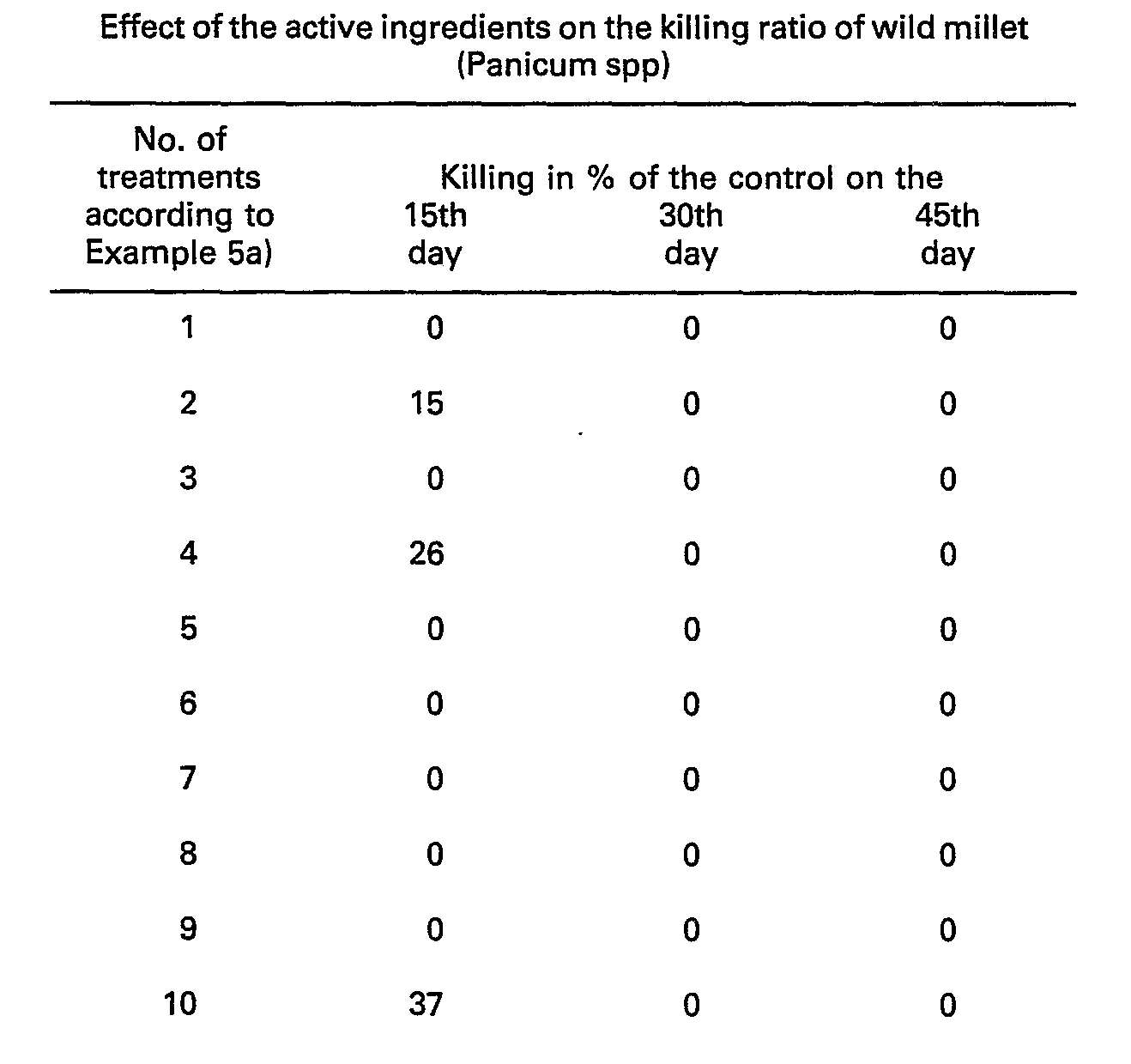

- The results set forth in the Table show that the test herbicides were practically ineffective against wild millet (Panicum ssp.) when employed in the test doses alone. By combining the test herbicides with the compound according to Example 2 of the instant invention their efficiency could considerably be improved. According to the evaluations carried out on the 15th day the herbicidal effect was 100% in case of each combination, while even the results observed on the 45th day show that in spite of the lower doses employed, the activity was increased to an unexpected extent, which could not be foreseen on the basis of the individual activities of the components combined.
- The biological activity of acetochlor was examined alone and in combination with the product according to Example 3 in maize. The test conditions were identical with those described in Example 5. The following treatments were carried out:
- 1) control
- 2) acetochlor 2.0 kg/ha
- 3) compound according to Example 3 400 g/ha
- 4) acetochlor 2.0 kg/ha + compound according to Example 3 400 g/ha
- 5) acetochlor 2.0 kg/ha + compound according to Example 3 400 g/ha + N-dichloroacetyl-1-oxy-4-aza- spiro-4,5-decane 200 g/ha
- 6) acetochlor 2.0 kg/ha + N-dichloroacetyl-1-oxy-4-azaspirodecane 200 g/ha
- The doses are expressed in the amount of active ingredient.
- During evaluation the height of maize was measured to determine whether the compound according to Example 3 reduced the toxic effect of acetochlor on maize or had any effect on the similar effect of antidote (N-dichloroacetyl-1-oxa-4-aza-spirodecane).

- The results show that the compounds according to the invention counterbalance the toxicity of acetochlor and increase the efficiency of the antitode tested.
- 2'-Methyl-6'-ethyl-N-ethoxymethyl-chloroacetanilide (acetochlor), 2-chloro-N-isopropylacetanilide (propachlor) and 2-chloro-2',6'-diethyl-N-(methoxymethyl)-acetanilide as typical representatives of chloroacetanilide herbicides were combined with the compound according to Example 3 and a herbicidally active urea derivative, chlorobromuron (3-(4-bromo-3-chlorophenyl)-1-methoxy-1-methyl-urea).
- The test conditions were identical with those described in Example 5, except that in addition to monocotyledonous weeds also dicotyledons (Amaranthus retroflexus) were sown.
- The following treatments were carried out:
- 1) control
- 2) 2'-methyl-6'-ethyl-N-ethoxymethyl-chloroacetanilide 2 kg/ha
- 3) 2-chloro-N-isopropylacetanilide 4 kg/ha
- 4) 2-chloro-2',6'-diethyl-N-(methoxymethyl)-acetanilide 2,5 kg/ha
- 5) 3-(4-bromo-3-chforophenyl)-1-methoxy-1-methyl-urea 1.5 kg/ha
- 6) compound according to Example 3 1.0 kg/ha
- 7) 2'-methyl-6'-ethyl-N-ethoxymethyl-chloroacetanilide 2.0 kg/ha + 3-{3-bromo-3-chlorophenyl)-1-methoxy-1-methyl-urea 1.5 kg/ha + compound according to Example 3 1.0 kg/ha
- 8) 2-chloro-N-isopropylacetanilide 4 kg/ha + 3-(4-bromo-3-chlorophenyl)-1-methoxy-1-methyl-urea 1.5 kg/ha + compound according to Example 3 1.0 kg/ha
- 9) 2-chloro-2',6'-diethyl-N-(methoxymethyl)acetanilide 2.5 kg/ha + compound according to Example 3 1.0 kg/ha
- 10) compound according to Example 3 0.4 kg/ha
- 11) 2'-methyl-6'-ethyl-N-ethoxymethyl-chloroacetanilide 2.0 kg/ha + 3-(4-bromo-3-chlorophenyl)-1-methoxy-1-methyl-urea 1.5 kg/ha + compound according to Example 3 0.4 kg/ha
- 12) 2-chloro-N-isopropylacetanilide 4.0 kg/ha + 3-{4-bromo-3-chlorophenyl)-1-methoxy-1-methyl-urea 1.5 kg/ha + compound according to Example 3 0.4 kg/ha
- 13) 2-chloro-2',6'-diethyl-N-(methoxymethyl)-acetanilide 2.5 kg/ha + compound according to Example 3 0.4 kg/ha
- The effect of the active ingredients on the killing rate of wild millet (Panicum ssp) and amaranth (Amaranthus ssp).

- From the results it can be concluded that the compounds according to the invention improve the duration and extent of activity of chloroacetanilide herbicides also in combination with herbicidally active urea derivatives.
- Under similar conditions to those described in Example 5 we examined the herbicidal activity of combinations of herbicidally active chloroacetanilides and triazines in association with the compound according to Example 1. As weeds wild millet (Panicum ssp) and amaranth (Amaranthus ssp) were employed.
- The following treatments were carried out:
- 1) control
- 2) 2'-methyl-6'-ethyl-N-ethoxymethyl-chloroacetanilide 2.0 kg/ha
- 3) 2-chloro-4-ethylamino-6-isopropylamino-1,3,4-triazine 1.0 kg/ha
- 4) 2-ethylamino-4-isopropylamino-6-methylthio-1,3,5-triazine 1.0 kg/ha
- 5) 2,4-bis(isopropylamino)-6-methoxy-1 ,3,5-triazine 1.0 kg/ha
- 6) 2-(4-chloro-6-ethylamino-1,3,5-triazine-2-yl-amino)-2-methyl-propionitrile 1.0 kg/ha
- 7) compound according to Example 1 1.0 kg/ha
- 8) compound according to Example 1 0.4 kg/ha
- 9) 2'-methyl-6'-ethyl-N-ethoxymethyl-chloroacetanilide 2.0 kg/ha + 2-chloro-4-ethylamino-6-isopropyl- amino-1,3,5-triazine 1.0 kg/ha + compound according to Example 1 1.0 kg/ha
- 10) 2'-methyl-6'-ethyl-N-ethoxymethyl-chloroacetanilide 2.0 kg/ha + 2-chloro-4-ethylamino-6-isopropylamino-1,3,5-triazine 1.0 kg/ha + compound according to Example 1 0.4 kg/ha
- 11) 2'-methyl-6'-ethyl-N-ethoxymethyl-chloroacetanilide 2.0 kg/ha + 2-ethylamino-4-isopropylamino-6-methylthio-1,3,5-triazine 1.0 kg/ha + compound according to Example 1 1.0 kg/ha
- 12) 2'-methyl-6'-ethyl-N-ethoxymethyl-chloroacetanilide 2.0 kg/ha + 2-ethylamino-4-isopropylamino-6-methylthio-1,3,5-triazine 1.0 kg/ha + compound according to Example 1 0.4 kg/ha
- 13) 2'-methyl-6'-ethyl-N-ethoxymethyl-chloroacetanilide 2.0 kg/ha + 2,4-bis(isopropylamino)-6-methoxy-1,3,5-triazine 1.0 kg/ha + compound according to Example 1 1.0 kg/ha
- 14) 2'-methyl-6'-ethyl-N-ethoxymethyl-chloroacetanilide 2.0 kg/ha + 2,4-bis(isopropylamino)-6-methoxy-1,3,5-triazine 1.0 kg/ha + compound according to Example 1 0.4 kg/ha
- 15) 2'-methyl-6'-ethyl-N-ethoxymethyl-chloroacetanilide 2.0 kg/ha + 2-(4-chloro-6-ethylamino-1,3,5-triazine-2-ylamino)-2-methyl-propionitrile 1.0 kg/ha + compound according to Example 1 1.0 kg/ha
- 16.2'-methyl-6'-ethyl-N-ethoxymethyl-chloroacetanilide 2.0 kg/ha + 2-(4-chloro-6-ethylamino-1,3,5-triazine-2-ylamino)-2-methyl-propionitrile 1.0 kg/ha + compound according to Example 1 0.4 kg/ha The effect of the active ingredients on killing rate (%) of wild millet
- As the results set forth in the Table above the compound according to Example 1 increased the activity and extended the duration of activity of combinations containing chloroacetanilides (2'-methyl-6'-ethyl-N-ethoxymethyl-chloroacetanilide) and various triazines in the usual doses and mutual proportions.
- In this experiment the effect of the compound according to the invention on the duration of activity of thiolcarbamate herbicides and on their combinations with antidotes was tested.
- Tests were carried out as described in Example 5, except that, as usual in case of thiolcarbamate herbicides, the compositions were admixed with the soil prior to sowing.
- The following treatments were carried out:
- 1) control
- 2) S-ethyl-dipropylthiolcarbamate (EPTC) 5 kg/ha
- 3) S-ethyl-dipropylthiolcarbamate (EPTC) 5 kg/ha + N-dichloroacetyl-1-oxa-4-azaspiro-4,5-decane 350 g/ha (AD-67)
- 4) S-ethyl-dipropylthiocarbamate (EPTC) 5 kg/ha + O,S-di-2-chloroethyl-S-(di-2-propenylamino)-dithiophosphoric acid ester 500 g/ha (compound according to Example 2)
- 5) S-ethyl-dipropylthiolcarbamate (EPTC) 5 kg/ha + N-dichloroacetyl-1-oxa-4-azaspiro-4,5-dicane 350 g/ha (AD-67) + O,S-di-2-chloroethyl-S-(di-2-propenylamino)-dithiophosphoric acid ester 600 g/ha (compound according to Example 2)
- 6) N-dichloroacetyl-1-oxa-4-azaspiro-4,5-decane 350 g/ha (AD-67) + O,S-2-chloroethyl-S-(di-2-propenylamino)-dithiophosphoric acid ester 500 g/ha (compound according to Example 2)
- 7) N-dichloroacetyl-1-oxa-4-azaspiro-4,5-decane 450 g/ha (AD-67)
- 8) 0,S-di-2-chloroethyl-S-(di-propenylamino)-dithiophosphoric acid ester 500 g/ha (compound according to Example 2)


- The results show that under the provocative conditions described in Example 5 the test compound of formula (I) extended the duration of activity of S-ethyl-dipropyl-thiolcarbamate to three-fold of the activity observed when the herbicide was used either alone or in combination with the given antidote in the usual doses.
- It can be concluded, too, that the compound according to Example 2, selected as a representative of the compounds of formula (I), has no effect on the test weed when employed alone, in the given dose. It is highly surprising that the compound according to Example 2 substantially extends the active period of thiolcarbamate herbicides even under provocative conditions (acceleration of decomposition).
- Evaluation of the phytotoxicity studies shows that the test compound according to the invention reduces the undesired effect of thiolcarbamate herbicides on the cultivated plant tested (maize). The same effect was observed when the combinations were antidoted. It can further be concluded that compounds of formula (1) are not phytotoxic themselves.
- The antidotal activity of the compounds according to the invention as well as their effect on the efficiency of a known antidote were tested by measuring the height of maize treated, and calculating the change related to the control.
- It can be seen that EPTC when used without any antitode decreased the height of maize by 31% according to the evaluation performed on the 15th day. In case of antidoted EPTC combinations the reduction in height was 18% only. In case of later sowings (evaluations carried out on the 30th and 45th days, respectively) there was no change in height. The combination of EPTC with the compound according to Example 2 resulted in a further reduction of the decrease in height: the decrease was only 6% according to the evaluation performed on the 15th day.
- When the antidoted EPTC formulation and the active ingredient according to the invention were sprayed together on maize (treatment No. 5), the height of the maize exceeded the height of the control. Combined application of the test antidote and the active ingredient according to the invention resulted in a further increase in the growth of maize. From the results it can be concluded that the compounds according to the invention increase the efficiency of antidotes of herbicidally active thiolcarbamates (N-dichloro- acetyi-1-oxa-azaspiro-4,5-decane; N,N-diallyl-2,2-dichloroacetamide; 3-(dichloroacetyl)-2,2-dimethyl-1,3-oxazolidine).
- The results discussed in Example 6 unambiguously prove that the active ingredients according to the invention on the one hand increase the activity of herbicidally active thiolcarbamates and extend the duration of their activity, on the other hand, improve the selectivity of said herbicides and their combinations with antidotes and extend the period within which said formulations can be used safely.
- In this example the herbicidal activity, and the effective doses of herbicidally active thiolcarbamates alone and in combination of compounds according to the invention were examined.
- The test conditions were identical with those described in Examples 5 and 6, except that the herbicidal activity and the duration of activity were examined.
- The following treatments were carried out:
- 1) control
- 2) butylate (S-ethyl-diisobutyl(thiolcarbamate)) 4.0 kg/ha
- 3) butylate 3 kg/ha
- 4) cycloate (S-ethyl-N-cyclohexyl-N-ethyl(thiolcarbamate)) 4 kg/ha
- 5) cycloate 2 kg/ha
- 6) vernolate (S-propyl-dipropyl(thiolcarbamate)) 4 kg/ha
- 7) vernolate 3 kg/ha
- 8) butylate 4 kg/ha + compound according to Example 3 1 kg/ha
- 9) butylate 3 kg/ha + compound according to Example 3 0.75 kg/ha
- 10) cycloate 4 kg/ha + compound according to Example 3 1 kg/ha
- 11) cycloate 3 kg/ha + compound according to Example 3 0.75 kg/ha
- 12) vernolate 4 kg/ha + compound according to Example 3 1 kg/ha
- 13) vernolate 3 kg/ha + compound according to Example 3 0.75 kg/ha
- 14) compound according to Example 31 kg/ha
- 15) compound according to Example 3 0.75 kg/ha
- The compositions were thoroughly admixed with the soil prior to sowing.
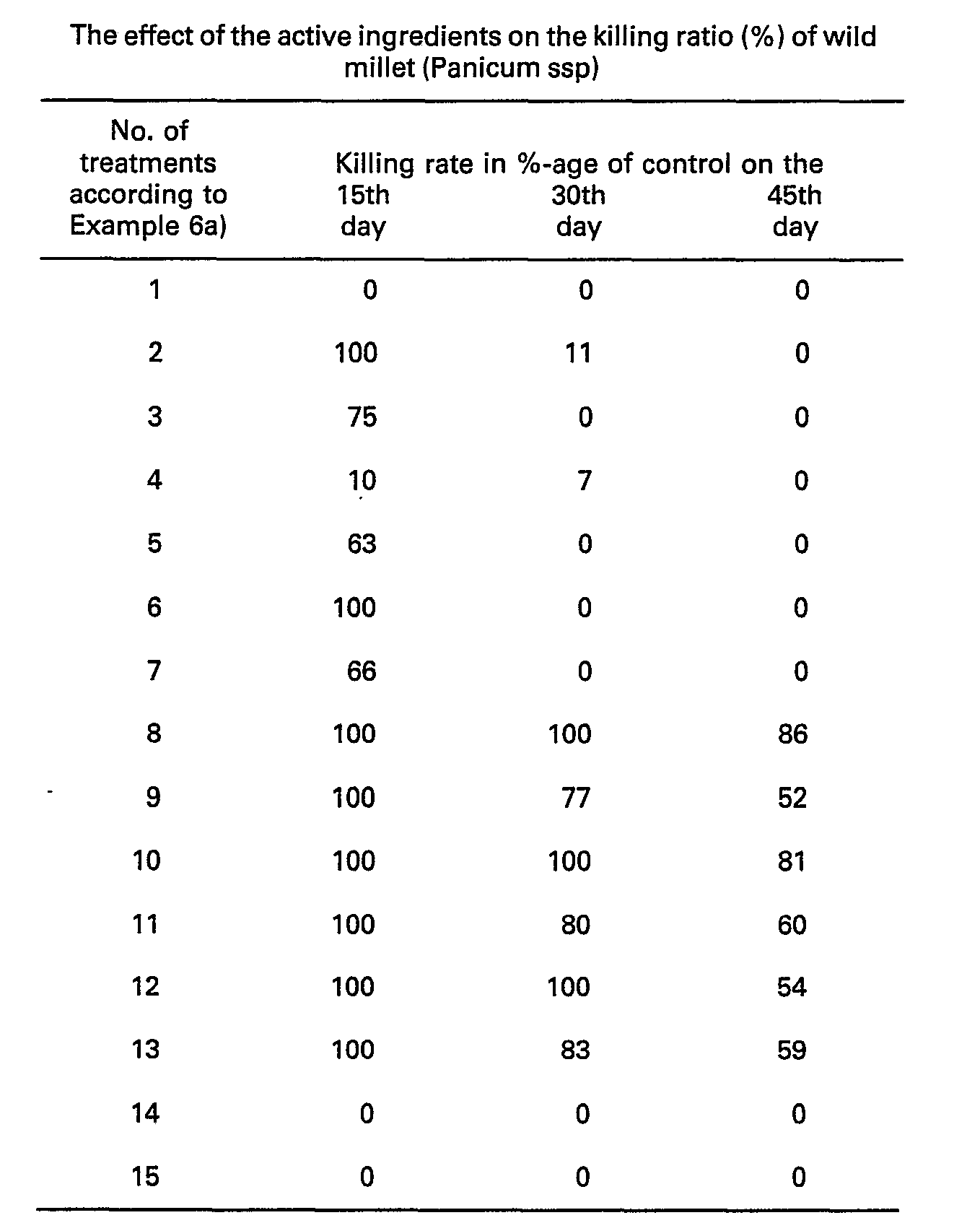
- The test results show that the duration of the activity of herbicidally active thiolcarbamates can be expanded and their dose can be reduced, if they are combined with the active ingredients according to the invention.
- The increase in the duration of herbicidal activity and the decrease of their effective dose were tested in case of thiolcarbamate herbicides, which need not be admixed with the soil prior to sowing in order to achieve the desired effect.
- The test conditions were as described in Example 6
- 1) control
- 2) diallate (S-2,3-dichloroallyl-diisopropyl(thiolcarbamate)) 1.2 kg/ha
- 3) diallate 0.6 kg/ha
- 4) triallate (S-2,3,3-trichloroallyl-diisopropyl(thiolcarbamate)) 2.0 kg/ha
- 5) triallate 1.0 kg/ha
- 6) pebulate (S-propyl-butyl(ethyl)thiolcarbamate) 3.0 kg/ha
- 7) pebulate 1.5 kg/ha
- 8) molynate (S-ethyl-N,N-hexamethylenethiolcarbamate) 3.0 kg/ha
- 9) molynate 1.5 kg/ha
- 10) sulfallate (2-chloroallyl-diethyl-dithiocarbamate) 4.0 kg/ha
- 11) sulfallate 2.0 kg/ha
- 12) diallate 1.2 kg/ha + compound No. 1 0.25 kg/ha
- 13) diallate 0.6 kg/ha + compound No. 10.125 kg/ha
- 14) triallate 2 kg/ha + compound No. 1 0.4 kg/ha
- 15) triallate 1 kg/ha + compound No. 1 0.2 kg/ha
- 16) pebulate 3 kg/ha + compound No. 1 0.5 kg/ha
- 17) pebulate 1.5 kg/ha + compound No. 1 0.25 kg/ha
- 18) molynate 3 kg/ha + compound No. 10.5 kg/ha
- 19) molynate 1.5 kg/ha + compound No. 1 0.25 kg/ha
- 20) sulfallate 4 kg/ha + compound No. 1 0.8 kg/ha
- 21) sulfallate 2kg/ha + compound No. 1 0.4 kg/ha
- Unlike in the previous tests instead of wild millet (Panicum ssp) wild oat (Avena fatua) was used as a test plant, since the above-mentioned herbicides are particularly effective against wild oat, though they are active also against other monocotyledonous weeds.

- Examination of the thiolcarbamate herbicides shows that they are ineffective two weeks after the treatment. If, however, they are combined with compound No. 1 according to the invention, their activity lasts more than two-times as long as originally. In addition, their activity is also increased. Decreasing the dose of the thiolcarbamate herbicides tested but combining them with the compound No. 1, the death of wild oat is 100% at the first evaluation even if the dose of the herbicide is decreased to half of its original amount.
- A more than 50% death is observed even during the third evaluation (45th day) when a combination was employed, while the herbicides alone, even in the complete original doses, were ineffective (0%) 45 days after treatment.
- The test conditions were the same as in Examples 5 and 6, except that in addition to wild millet (Panicum ssp) amaranth (Amaranthus ssp) was used as a test weed.
- The following treatments were carried out:
- 1) control
- 2) S-ethyl-dipropylcarbamothioate 5.0 kg/ha + N-dichloroacetyl-1-oxy-4-azaspiro-4,5-decane 0.5 kg/ha
- 3) S-ethyl-diisobutylthiocarbamate 5.0 kg/ha + N,N-diallyl-2,2-dichloroacetamide 0.5 kg/ha
- 4) 2-chloro-4-ethylamino-6-isopropylamino-1,3,5-triazine 1.5 kg/ha
- 5) 2-chloro-4-ethylamino-6-isopropylamino-1,3,5-triazine 0.75 kg/ha
- 6) 2-(4-chloro-6-ethylamino-1,3,5-triazine-2-ylamino)-2-methylpropyonitrile 1.5 kg/ha
- 7) 2-(4-chloro-6-ethylamino-1,3,5-triazine-2-ylamino)-2-methylpropionitrile 0.75 kg/ha
- 8) compound according to Example 3 1.0 kg/ha
- 9) S-ethyl-dipropylcarbamothioate 5.0 kg/ha + N-dichloroacetyl-1-oxa-4-azaspiro-4,5-decane 0.5 kg/ha + 2-chloro-4-ethylamino-6-isopropylamino-1,3,5-triazine 1.5 kg/ha + compound according to Example 3 1.0 kg/ha
- 10) S-ethyl-dipropylcarbamothioate 5.0 kg/ha + N-dichloroacetyl-1-oxa-4-azaspiro-4,5-decane 0.5 kg/ ha + 2-chloro-4-ethylamino-6-isopropylamino-1,3,5-triazine 0.75 kg/ha + compound according to Example 3 1.0 kg/ha
- 11) S-ethyl-dipropylcarbamothioate 5.0 kg/ha + N-dichloroacetyl-1-oxa-4-azaspiro-4,5-decane 0.5 kg/ ha + 2-(4-chloro-6-ethylamino-1 ,3,5-triazine-2-yl-amino)-2-methyl-propionitrile 1.5 kg/ha + compound according to Example 3 1.0 kg/ha
- 12) S-ethyl-dipropylcarbamothioate 5.0 kg/ha + N-dichloroacetyl-1-oxa-4-azaspiro-4,5-decane 0.5 kg/ha + 2-(4-chloro-6-ethylamino-1,3,5-triazine-2-ylamino)-2-methyl-propionitrile 0.75 kg/ha + compound according to Example 3 1.0 kg/ha
- 13) S-ethyl-diisobutyl-thiocarbamate 5.0 kg/ha + N,N-diallyl-1,2-dichloroacetamide 0.5 kg/ha + 2-chloro-4-ethylamino-6-isopropylamino-1,3,5-triazine 1.5 kg/ha + compound according to Example 3 1.0 kg/ha
- 14) S-ethyl-diisobutyl-thiolcarbamate 5.0 kg/ha + N,N-diallyl-2,2-dichloroacetamide 0.5 kg/ha + 2-chloro-4-ethylamino-6-isopropylamino-1,3,5-triazine 0.75 kg/ha + compound according to Example 3 1.0 kg/ha
- 15) S-ethyl-diisobutyl-thiolcarbamate 5.0 kg/ha + N,N-diallyl-2,2-dichloroacetamide 0.5 kg/ha + 2-(4-chloro-6-ethylamino-1,3,5-triazine-2-yl-amino)-2-methylpropionitrile 1.5 kg/ha + compound according to Example 3 1.0 kg/ha
- 16) S-ethyl-diisobutyl-thiolcarbamate 5.0 kg/ha + N,N-diallyl-2,2-dichloroacetamide 0.5 kg/ha + 2-(4-chloro-6-ethylamino-1,3,5-triazine-2-yl-amino)-2-methyIpropionitrile 0.75 kg/ha + compound according to Example 3 1.0 kg/ha
-

- Thiolcarbamate herbicides are often combined with herbicidally active triazine derivatives, to widen their activity spectrum.
- Examination of the activity of the combinations containing herbicidally active thiolcarbamates, triazines and compounds according to the invention shows that the compound according to the invention extend the duration of activity and increase the activity of the test combinations. Accordingly, compounds of the formula (I) exert their favourable effects not only in combination with thiolcarbamate herbicides alone but also if they are combined with various herbicidally active triazine derivatives.
- The effect of the compounds according to the invention on the duration and extent of herbicidal activity of various herbicidally active thiolcarbamates were examined.
- The tests were carried out essentially as described in Example 6, except that as a cultivated plant 5 pieces of soya were cultivated in each pot.
- The following treatments were performed:
- 1) control
- 2) 1-methylethyl-3-chlorophenyl-carbamate 2 kg/ha
- 3) 1-methylethyl-3-chlorophenyl-carbamate 1 kg/ha
- 4) 1-methylethyl-3-chlorophenyl-carbamate 2 kg/ha + compound according to Example 3 0.5 kg/ha
- 5) 1-methylethyl-3-chlorophenyl-carbamate 1 kg/ha + compound according to Example 3 0.5 kg/ha
- 6) 1-methylethyl-3-chlorophenyl-carbamate 2 kg/ha + compound according to Example 1 0.25 kg/ha
- 7) 1-methylethyl-3-chlorophenyl-carbamate 1 kg/ha + compound according to Example 1 0.25 kg/ha

- The results set forth in the above Table show that 1-methylethyl-3-chlorophenyl-carbamate alone is practically ineffective against wild oat in the test doses. The addition of the compound according to Example 1 has considerably increased the herbicidal activity in each combination tested, and the combinations which contained the compounds according to the invention were considerably more effective even on the 45th day after treatment than those containing the above-mentioned carbamate derivative as a sole active ingredient on the 15th day.
- The effect of the above combinations on cultivated plants was tested on soya. Injury rating was carried out on the basis of EWRC scale. 1 means that there was no injury observed, 9 stands for total killing.

- It can be seen that the combination of 1-methylethyl-3-chlorophenyl-carbamate with the compound according to the invention resulted in no increase in phytotoxicity.
- The effect of the combinations of thiolcarbamate and chloroacetanilides with compounds of formula (I) were examined.
- Though they are generally applied to the fields differently (thiolcarbamates are to be incorporated into the soil while acetochlor should be sprayed on the surface), a common feature of thiolcarbamates and acetochlor is that both should be antidoted to avoid the undesired injury of cultivated plants (e.g. maize).
- Tests were carried out in pot having a diameter of 12 cm filled with meadow chernosiom soil, in 6 repetitions. The corns of maize (5 pieces into each pot) were placed in a depth of 8 cm measured from the top of the pots. Corns were then covered with a 5 to 6 cm thick soil layer admixed with the seeds of various weeds (cocksfoots weed, amaranth). Weeds were admixed with the soil in separate pots, each with 1 cm3 of soil. The combinations tested were then sprayed on the pots as a tank mixture, in an amount of 220 lit./ha. After spraying, the soil was covered with a 2 to 3 cm thick fresh soil layer, and the water capacity of the soil was adjusted to 65 to 70%.
- On the 20th day after treatment the degree of weed control and the injury of cultivated plants were examined. On the 20th day the test plants were eliminated, and new weed seeds were admixed with the upper 3 to 5 thick layer of soil. The degree of weed control was examined and the efficiency of weed control was examined on the 40th day.
- The following treatments were carried out:
- 1) control
- 2) S-ethyldiisobutylthiolcarbamate 3 kg/ha + N,N-diallyl-2,2-dichloroacetamide 500 g/ha + 2-chloro-2-methyl-6-ethyl-N-methoxyethylacetanilide 1.0 kg/ha
- 3) S-ethyldiisobutylthiolcarbamate 2 kg/ha + N,N-diallyl-2,2-dichloroacetamide 500 g/ha + 2-chloro-2-methyl-6-ethyl-N-methoxyethylacetanilide 2.0 kg/ha
- 4) S-ethyl-dipropylcarbamothioate 4 kg/ha + N-dichloroacetyl-1-oxa-4-azaspiro-4,5-decane 800 g/ha + 2-chloro-2-methyl-6-ethyl-N-methoxyethylacetanilide 1.5 kg/ha
- 5) S-ethyl-dipropylcarbamothioate 3.5 kg/ha + N-dichloroacetyl-1-oxa-4-azaspiro-4,5-decane 800 g/ha + 2-chloro-2-methyl-6-ethyl-N-methoxyacetanilide 2.0 kg/ha
- 6) S-propyl-dipropylcarbamothioate 2.5 kg/ha + N-dichloroacetyl-1-oxa-spiro-4,5-decane 520 g/ha + 2-chloro-2-methyl-6-ethyl-N-methoxyethylacetanilide 1.00 kg/ha
- 7) S-propyl-dipropylcarbamothioate 1.5 kg/ha + N-dichloroacetyl-1-oxa-4-azaspiro-4,5-decane 520 g/ ha + 2-chloro-2-methyl-6-ethyl-N-methoxyethylacetanilide 2.0 kg/ha
- 8) treatment No. 2 + O,S-di-2-chloroethyl-S-(di-2-propenylamino)-dithiophosphoric acid ester (compound according to Example 2) 0.8 kg/ha
- 9) treatment No. 3 + 0,S-di-2-chloroethyl-S-(di-2-propenylamino)-dithiophosphoric acid ester (compound according to Example 2) 0.8 kg/ha
- 10) treatment No. 4 + O,S-di-2-chloroethyl-S-(di-2-propenylamino)-dithiophosphoric acid ester (compound according to Example 2) 1 kg/ha
- 11) treatment No. 5 + O,S-di.2-chloroethyl-S.(di-2-propenylamino)-dithiophosphoric acid ester (compound according to Example 2) 1 kg/ha
- 12) treatment No. 6 + O,S-di-2-chloroethyl-S-(di-2-propenylamino)-dithiophosphoric acid ester (compound according to Example 2) 0.7 kg/ha
- 13) treatment No. 7 + O,S-di-2-chloroethyl-S-(di-2-propenylamino)-dithiophosphoric acid ester (compound according to Example 2) 0.7 kg/ha

- The killing rate was examined on the basis of green weight. Killing rate (%) = green weight in %-age of the control.

- Evaluation of the activity of antidoted combinations of various thiolcarbamates (butylate, EPTC, vernolate) and acetochlor shows that they have no substantial phytotoxic effect on maize, if they are incorporated into the soil not too deeply. In addition, these combinations show an excellent herbicidal activity according to the evaluation carried out on the 20th day. The results of the second evaluation show, however, that their herbicidal activity considerably decreases as a function of time. On the 40th day they can control only 14 to 36% of the weeds tested. On the other hand, when O,S-di-2-chloroethyl-S-(di-2-propenylamino)-dithiophosphoric acid ester according to the invention was added to the test combinations, they killed 64 to 88% of the weeds at the time of second evaluation, too. Moreover, the compound according to the invention did not increase the phytotoxicity of the test combinations.

Claims (8)

Priority Applications (1)
| Application Number | Priority Date | Filing Date | Title |
|---|---|---|---|
| AT85902103T ATE41286T1 (en) | 1984-04-20 | 1985-04-19 | HERBICIDES WITH EXTENDED ACTION AND IMPROVED SELECTIVITY. |
Applications Claiming Priority (6)
| Application Number | Priority Date | Filing Date | Title |
|---|---|---|---|
| HU738484 | 1984-04-20 | ||
| HU738484 | 1984-04-20 | ||
| HU2384384 | 1984-12-21 | ||
| HU2384384 | 1984-12-21 | ||
| HU745285 | 1985-04-17 | ||
| HU745285 | 1985-04-17 |
Publications (2)
| Publication Number | Publication Date |
|---|---|
| EP0179118A1 EP0179118A1 (en) | 1986-04-30 |
| EP0179118B1 true EP0179118B1 (en) | 1989-03-15 |
Family
ID=27270063
Family Applications (1)
| Application Number | Title | Priority Date | Filing Date |
|---|---|---|---|
| EP19850902103 Expired EP0179118B1 (en) | 1984-04-20 | 1985-04-19 | Herbicidal compositions with prolonged action and improved selectivity |
Country Status (3)
| Country | Link |
|---|---|
| EP (1) | EP0179118B1 (en) |
| AT (1) | ATE41286T1 (en) |
| DE (1) | DE3568689D1 (en) |
-
1985
- 1985-04-19 AT AT85902103T patent/ATE41286T1/en not_active IP Right Cessation
- 1985-04-19 EP EP19850902103 patent/EP0179118B1/en not_active Expired
- 1985-04-19 DE DE8585902103T patent/DE3568689D1/en not_active Expired
Also Published As
| Publication number | Publication date |
|---|---|
| ATE41286T1 (en) | 1989-04-15 |
| DE3568689D1 (en) | 1989-04-20 |
| EP0179118A1 (en) | 1986-04-30 |
Similar Documents
| Publication | Publication Date | Title |
|---|---|---|
| US4070389A (en) | Phenylglyoxylonitrile-2-oxime-cyanomethylether | |
| US4152137A (en) | Phenylglyoxylonitrile-2-oxime-cyanomethyl ether as a crop safener | |
| PL145901B1 (en) | Herbicide | |
| JPH035454A (en) | Novel n-phenylpyrrolidines | |
| US4844726A (en) | Herbicidal compositions with prolonged action and improved selectivity | |
| US4406686A (en) | Haloalkylaminomethyldioxolane herbicide antidotes | |
| US4069036A (en) | N-haloacyl 4-spirocycloaliphatic oxazolidines | |
| EP0088066A1 (en) | 3,5-Bis (trifluoromethyl) phenoxy carboxylic acids and derivatives thereof | |
| US5055125A (en) | Antidoted herbicide compositions and antidote compositions | |
| US3277142A (en) | Aryloxyethyl and arylthioethyl esters of thiocarbamic acids | |
| US4336058A (en) | 2-Methyl-4-(chloroacetamido)methyl-4-(2-chlorophenyl)-1,3-dioxane herbicide antidote | |
| EP0061583B1 (en) | Herbicidal compositions containing alpha-alpha-dimethyl phenylacetanilides | |
| US4468246A (en) | Guanidinyl herbicide antidotes | |
| US4400529A (en) | Herbicide antidote compositions and method of use | |
| EP0179118A1 (en) | Herbicidal compositions with prolonged action and improved selectivity. | |
| EP0148795A2 (en) | Compounds exerting an antidotal activity for the defence of agrarian cultivations against the toxic action of non-selective herbicides | |
| EP0068709B1 (en) | Herbicide antidotes, production, use and compositions thereof | |
| EP0025345B1 (en) | N-cyanoalkyl haloacetamides, preparation thereof, use thereof as herbicide antidotes and compositions comprising same | |
| US4802912A (en) | Herbicide antidotes | |
| GB2023582A (en) | 1,4-oxaza-spirohydrocarbon derivatives, their preparation and plant protecting compositions containing them | |
| US4512796A (en) | Haloacetylaminomethyl dioxolane herbicide antidotes | |
| US4411686A (en) | Dihalopropyl ester antidotes for acetanilide herbicides | |
| US4470843A (en) | Dihalopropyl ester herbicide antidotes | |
| US4420323A (en) | Thiophosphoryl carbamate herbicide antidotes | |
| US4400203A (en) | Substituted amino carboxyethyl haloacetamide herbicide antidotes |
Legal Events
| Date | Code | Title | Description |
|---|---|---|---|
| PUAI | Public reference made under article 153(3) epc to a published international application that has entered the european phase |
Free format text: ORIGINAL CODE: 0009012 |
|
| AK | Designated contracting states |
Kind code of ref document: A1 Designated state(s): AT CH DE FR GB LI LU NL SE |
|
| 17P | Request for examination filed |
Effective date: 19860402 |
|
| RBV | Designated contracting states (corrected) |
Designated state(s): AT DE FR GB NL |
|
| 17Q | First examination report despatched |
Effective date: 19880301 |
|
| GRAA | (expected) grant |
Free format text: ORIGINAL CODE: 0009210 |
|
| AK | Designated contracting states |
Kind code of ref document: B1 Designated state(s): AT DE FR GB NL |
|
| REF | Corresponds to: |
Ref document number: 41286 Country of ref document: AT Date of ref document: 19890415 Kind code of ref document: T |
|
| REF | Corresponds to: |
Ref document number: 3568689 Country of ref document: DE Date of ref document: 19890420 |
|
| PGFP | Annual fee paid to national office [announced via postgrant information from national office to epo] |
Ref country code: AT Payment date: 19890425 Year of fee payment: 5 |
|
| PGFP | Annual fee paid to national office [announced via postgrant information from national office to epo] |
Ref country code: FR Payment date: 19890428 Year of fee payment: 5 |
|
| PGFP | Annual fee paid to national office [announced via postgrant information from national office to epo] |
Ref country code: NL Payment date: 19890430 Year of fee payment: 5 |
|
| PGFP | Annual fee paid to national office [announced via postgrant information from national office to epo] |
Ref country code: DE Payment date: 19890511 Year of fee payment: 5 |
|
| PGFP | Annual fee paid to national office [announced via postgrant information from national office to epo] |
Ref country code: GB Payment date: 19890531 Year of fee payment: 5 |
|
| ET | Fr: translation filed | ||
| PLBE | No opposition filed within time limit |
Free format text: ORIGINAL CODE: 0009261 |
|
| STAA | Information on the status of an ep patent application or granted ep patent |
Free format text: STATUS: NO OPPOSITION FILED WITHIN TIME LIMIT |
|
| 26N | No opposition filed | ||
| PG25 | Lapsed in a contracting state [announced via postgrant information from national office to epo] |
Ref country code: GB Effective date: 19900419 Ref country code: AT Effective date: 19900419 |
|
| PG25 | Lapsed in a contracting state [announced via postgrant information from national office to epo] |
Ref country code: NL Effective date: 19901101 |
|
| NLV4 | Nl: lapsed or anulled due to non-payment of the annual fee | ||
| GBPC | Gb: european patent ceased through non-payment of renewal fee | ||
| PG25 | Lapsed in a contracting state [announced via postgrant information from national office to epo] |
Ref country code: FR Effective date: 19901228 |
|
| PG25 | Lapsed in a contracting state [announced via postgrant information from national office to epo] |
Ref country code: DE Effective date: 19910101 |
|
| REG | Reference to a national code |
Ref country code: FR Ref legal event code: ST |