EP0179066B1 - Multiple threshold wheel slip control apparatus and method - Google Patents
Multiple threshold wheel slip control apparatus and method Download PDFInfo
- Publication number
- EP0179066B1 EP0179066B1 EP84902886A EP84902886A EP0179066B1 EP 0179066 B1 EP0179066 B1 EP 0179066B1 EP 84902886 A EP84902886 A EP 84902886A EP 84902886 A EP84902886 A EP 84902886A EP 0179066 B1 EP0179066 B1 EP 0179066B1
- Authority
- EP
- European Patent Office
- Prior art keywords
- signal
- slip
- value
- response
- reference value
- Prior art date
- Legal status (The legal status is an assumption and is not a legal conclusion. Google has not performed a legal analysis and makes no representation as to the accuracy of the status listed.)
- Expired
Links
- 238000000034 method Methods 0.000 title claims description 8
- 230000004044 response Effects 0.000 claims abstract description 54
- 238000012360 testing method Methods 0.000 claims abstract description 54
- 230000007246 mechanism Effects 0.000 claims abstract description 30
- 230000000694 effects Effects 0.000 abstract description 5
- 239000012530 fluid Substances 0.000 description 15
- 230000009467 reduction Effects 0.000 description 7
- 238000010586 diagram Methods 0.000 description 6
- 238000013459 approach Methods 0.000 description 5
- 230000001965 increasing effect Effects 0.000 description 5
- 230000009471 action Effects 0.000 description 2
- 230000004913 activation Effects 0.000 description 2
- 230000003750 conditioning effect Effects 0.000 description 2
- 230000003247 decreasing effect Effects 0.000 description 2
- 230000006870 function Effects 0.000 description 2
- 238000009987 spinning Methods 0.000 description 2
- 230000005355 Hall effect Effects 0.000 description 1
- 230000008901 benefit Effects 0.000 description 1
- 230000008859 change Effects 0.000 description 1
- 238000010276 construction Methods 0.000 description 1
- 238000013461 design Methods 0.000 description 1
- 230000002708 enhancing effect Effects 0.000 description 1
- 230000003287 optical effect Effects 0.000 description 1
- 238000012163 sequencing technique Methods 0.000 description 1
- 239000007787 solid Substances 0.000 description 1
- 238000012546 transfer Methods 0.000 description 1
- 230000007704 transition Effects 0.000 description 1
Images


Classifications
-
- B—PERFORMING OPERATIONS; TRANSPORTING
- B60—VEHICLES IN GENERAL
- B60T—VEHICLE BRAKE CONTROL SYSTEMS OR PARTS THEREOF; BRAKE CONTROL SYSTEMS OR PARTS THEREOF, IN GENERAL; ARRANGEMENT OF BRAKING ELEMENTS ON VEHICLES IN GENERAL; PORTABLE DEVICES FOR PREVENTING UNWANTED MOVEMENT OF VEHICLES; VEHICLE MODIFICATIONS TO FACILITATE COOLING OF BRAKES
- B60T8/00—Arrangements for adjusting wheel-braking force to meet varying vehicular or ground-surface conditions, e.g. limiting or varying distribution of braking force
- B60T8/17—Using electrical or electronic regulation means to control braking
- B60T8/175—Brake regulation specially adapted to prevent excessive wheel spin during vehicle acceleration, e.g. for traction control
-
- B—PERFORMING OPERATIONS; TRANSPORTING
- B60—VEHICLES IN GENERAL
- B60T—VEHICLE BRAKE CONTROL SYSTEMS OR PARTS THEREOF; BRAKE CONTROL SYSTEMS OR PARTS THEREOF, IN GENERAL; ARRANGEMENT OF BRAKING ELEMENTS ON VEHICLES IN GENERAL; PORTABLE DEVICES FOR PREVENTING UNWANTED MOVEMENT OF VEHICLES; VEHICLE MODIFICATIONS TO FACILITATE COOLING OF BRAKES
- B60T8/00—Arrangements for adjusting wheel-braking force to meet varying vehicular or ground-surface conditions, e.g. limiting or varying distribution of braking force
- B60T8/32—Arrangements for adjusting wheel-braking force to meet varying vehicular or ground-surface conditions, e.g. limiting or varying distribution of braking force responsive to a speed condition, e.g. acceleration or deceleration
- B60T8/34—Arrangements for adjusting wheel-braking force to meet varying vehicular or ground-surface conditions, e.g. limiting or varying distribution of braking force responsive to a speed condition, e.g. acceleration or deceleration having a fluid pressure regulator responsive to a speed condition
- B60T8/48—Arrangements for adjusting wheel-braking force to meet varying vehicular or ground-surface conditions, e.g. limiting or varying distribution of braking force responsive to a speed condition, e.g. acceleration or deceleration having a fluid pressure regulator responsive to a speed condition connecting the brake actuator to an alternative or additional source of fluid pressure, e.g. traction control systems
- B60T8/4809—Traction control, stability control, using both the wheel brakes and other automatic braking systems
Definitions
- This invention relates generally to wheel slip control systems for vehicles having differentially driven wheels in which slip is controlled by application of a braking force to the slipping wheel, and, more particularly, to an apparatus and method having multiple wheel slip threshold levels.
- An alternative approach involves the provision of separately actuatable drive wheel brakes.
- An operator selectively applies a braking force to the spinning or slipping wheel, and effects a balancing of power through the differential mechanism.
- the application of the braking force to the slipping wheel simulates increased traction and results in a more even distribution of power between the differentially driven wheels. This approach is commonly used on farm vehicles.
- a more sophisticated approach to the just described system utilizes electronics to supply the braking force to the slipping or spinning wheel.
- An effective example of this approach is described in our US-A-4,344,139 and US-A-4,361,871, which disclose apparatus for applying a proportionally varying braking force to the wheel which loses traction, during a slip control time period.
- a slip signal is produced corresponding to any difference between the rotational velocity of the differentially driven wheels, and the slip signal is compared with a predetermined reference signal.
- the system selectively applies a braking force to the faster turning wheel.
- the braking force is modulated proportionally according to the degree of slip represented by the slip signal.
- a vehicle having a steering mechanism and an anti-spin apparatus for controllably equalizing the power delivered through a differential mechanism to at least two wheels each having a respective braking mechanism the apparatus including means for receiving a brake control signal and controllably operating the braking mechanisms in response to a received brake control signal, (as disclosed in US-A-4,042,059), is characterized by means for producing a slip signal having a value responsive to the difference in rotational velocity between the wheels; means for producing a test signal; processor means for receiving the slip signal and the test signal, comparing the slip signal value with a first predetermined reference value in response to receiving the slip signal in the absence of the test signal, comparing the slip signal value with a second predetermined reference value in response to receiving the slip signal and the test signal, and producing the brake control signal in response to the slip signal value exceeding the compared reference value.
- Means may be provided for supplying a steer signal to the processor means.
- the steer signal value varies in response to the position of the steering mechanism.
- the processor means controllably negates the effect on the anti-spin apparatus of steering the vehicle, in response to receiving the steer signal in the absence of the test signal.
- the present invention also includes a method for controllably equalizing the power delivered through a differential mechanism to at least two wheels of a vehicle, each of the wheels having an associated braking mechanism and the vehicle including a steering mechanism, the method including controllably operating the braking mechanisms in response to a brake control signal; characterized by producing a slip signal in response to a difference in the rotational velocity between the wheels; producing a test signal in response to the position of a test switch; receiving the slip signal and the test signal; producing a first reference value in the absence of the test signal and a second reference value in response to receiving the test signal; comparing the slip signal value with the first predetermined reference value in response to receiving the
- slip signal and the test signal comparing the slip signal value with second predetermined reference value in response to receiving the slip signal and the test signal; and producing the brake control signal in response to the slip signal value exceeding the compared reference value.
- the present invention advantageously compares the slip signal with multiple reference signals, thus avoiding problems associated with prior control systems.
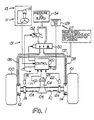
- Wheels 100, 101 are driven by an engine (not shown) through an input or drive shaft 104, a differential mechanism 106, and respective half-axles 108 and 110.
- a steering mechanism 111 is coupled to steerable wheels (not shown) of the vehicle.
- the drive system is conventional and no further details need be disclosed for an understanding of the present invention.
- the wheels 100, 101 are stopped by spring engaged parking brake pistons, or by hydraulically engaged service brake pistons, of brake mechanisms 112,114.
- the brakes are spring biased in the engaged position and are maintained in the disengaged position by application of fluid pressure, as disclosed in our US-A-3,927,737.
- the service brakes are normally actuated via a service brake line 137 connected to the service brake and retarder master cylinders (not shown).
- the service brake system is well-known and does not form a part of this invention.
- the brakes are also actuated through the parking brake lines 136, 138 as described in detail below.
- Means 115 produces a slip signal having a value responsive to the difference in rotational velocity between the wheels 100, 101.
- the slip signal producing means 115 includes a left wheel speed pick up in the form of an electromagnetic transducer 116 which provides pulses in cooperation with a gear-like device 118.
- the device 118 is mounted on and rotates with the axle portion 108. Signals from the transducer 116 are applied to one input of an electronic controller 120, the details of which are described below.
- right wheel signals are provided by a transducer 122 operated in conjunction with a gear-like device 124 which rotates with the axle portion 110. Signals from the transducer 122 are applied to another input of the electronic controller 120.
- Each of the transducers 116, 122 produce respective signals having values responsive to the rotational speed or velocity of the wheels 100, 102. Additionally, a drive shaft speed signal is produced by a transducer 126 in conjunction with a gear-like device 128 which rotates with the drive shaft 104. The drive shaft speed signals are applied to a third input of the electronic controller 120.
- Each of the transducers 116,122,126 is preferably an electromagnetic device which produces a pulse type, time variable output voltage. Such transducers are well-known in the art. However, other transducers, such as optical and Hall effect devices, may be employed as alternatives.
- Means 127 for producing a test signal is also connected to an input of the electronic controller 120. The test signal producing means 127 is preferably a manual switch 129.
- the electronic controller 120 is part of a processor means 121 for receiving the slip signal and producing a brake control signal in response to the slip signal value exceeding a compared reference value.
- a means 131 receives the brake control signal and controllably operates the braking mechanisms 112, 114 in response to the received brake control signal.
- a second embodiment of the present invention includes means 113 for producing a steer signal in response to the position of the steering mechanism 111.
- the steer signal is delivered to the controller 120.
- Means 113 preferably includes a potentiometer 115 controllably connected to the steering mechanism 111.
- the output of the potentiometer 115 is a signal having a value that varies over a negative to positive voltage range, in response to the position of the steering mechanism 111.
- Other suitable angular position transducers may be substituted for the potentiometer 115 in the means 113, as is well-known in the art.
- the controller 120 operates upon the signal inputs, determines the existence, magnitude, and location of wheel slip during a loss of traction situation, and distinguishes between true wheel slip and a transducer failure.
- the power transfer between the two differentially driven wheels 100, 102 is balanced by applying a proportional braking force to the wheel which loses traction. This is accomplished by means of Icoating selection valve 130 and proportioning valve 132, both of which are included in the means 131.
- the valves 130, 132 operate in combination with a supply 134 of oil or brake fluid under pressure, the fluid lines from supply 134 running both through and around the proportioning valve 132 to the solenoid operated selection valve 130 which directs full pressure to one of the brake mechanisms 112, 114, and modulated or proportionally controlled pressure to the other of the brakes 112, 114.
- brake pressure is the inverse of fluid pressure and is applied by relieving the fluid pressure in one of the two brake lines 136, 138, and could be straightforwardly implemented in the opposite fashion, increasing brake pressure in direct rather than inverse ratio to the applied fluid pressure.
- Fig. 2 is a block diagram of the preferred implementation of the anti-spin apparatus described above.
- a solid state digital microprocessor 142 performs system control functions.
- the microprocessor 142 is programmed to establish a plurality of slip value bands, each band having associated therewith an applied brake force value expressed in terms of fluid pressure.
- the microprocessor 142 is interconnected with a band value memory 144 and a timer 146.
- Transducers 116,122,126 are connected to the microprocesor 142 through an input conditioning circuit 140.
- the input circuit 140 provides appropriately digitized input signals to the microprocessor 142.
- Retard brake pressure and service brake pressure switches 148, 150 are likewise connected through an input conditioning circuit 152 to the microprocessor 142.
- the test signal producing means 127 is also connected to the microprocessor 142 through the input circuit 152.
- the steer signal producing means 113 is connected to the microprocessor 142 through the input circuit 152.
- a first output of the microprocessor 142 is connected through a pulse-width modulated servo valve driver 154 to the servo operated proportioning valve 132.
- a second output from the microprocessor 142 is connected to the solenoid driver 133 associated with a left direction selection valve 130a, and a third output from the microprocessor 142 is connected through the solenoid driver 136 to a right direction shuttle valve 230b.
- the pulse width modulated servo valve driver 154 proportionally controls the servo valve 132, in a manner well-known in the art. Therefore, adverting momentarily to Fig. 1, fluid pressure is modulated via the proportioning valve 132 to the brake line 136, 138 selected by the position of the valve 130.
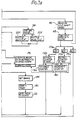
- a functional flowchart defining the internal programming for the microprocessor 142 is shown. From this flowchart, a programmer of ordinary skill can develop a specific set of program instructions for a general purpose microprocessor that defines the necessary slip signal value bands, timing cycles, and brake fluid pressure values necessary for implementation of the instant invention. It will be appreciated that, while the best mode of the invention is considered to comprise a properly programmed microprocessor 142, the result of which is the creation of novel hardware associations within the microprocessor 142 and its associated devices, it is possible to implement the instant invention utilizing traditional hard wired circuits.
- Data delivered by the transducers 116, 122 is sampled in block 164 of Fig. 3.
- control progresses along the right side of the flow diagram to block 166.
- the input shaft speed is determined in block 166, and is compared in block 168 with the non-zero wheel velocity. If the ratio of the non-zero wheel velocity to drive shaft speed is equal to or less than a constant, for example, 1.5, it is assumed that the wheel indicating zero speed is actually turning and that the zero indication is the result of a failed transducer. In this case, the program returns to the original starting point and, if desired, an indication of the apparent transducer failure can be presented to the operator.
- the value of the constant selected is determined according to the gear ratio of the differential mechanism 106. As a matter of convenience for purposes of this discussion, a differential ratio of 1:1 is assumed throughout.
- the program progresses to blocks 170a, b, c. 1f one of the wheel velocities is not zero, the program progresses to blocks 172a, b, which is an event counter requiring several successive cycles of the above conditions prior to activation of the anti-spin apparatus. This delay filters out short term wheel speed aberations and has been found to be advantageous for efficient system operation. If the event counter has not incremented or counted a sufficient number of cycles, the program progress to blocks 174, b which increment the counter. The program then returns to the original starting point.
- the program progresses to block 176.
- block 170c advances the program to blocks 178, 180, 182, 184, releasing the parking brake 112, 114 and resetting the timer 146. The same result occurs if automatic control is contra-indicated in block 176.
- Block 176 the program progresses to block 186 to determine whether the slip control system is activated. If so, the effect is the same as entering band 5, the most severe slip condition band, and control passes to block 194.
- Block 194 increases the wheel brake force by decreasing the wheel brake hold off pressure by an increment X, for each timed interval established by the microprocessor timer 146. If the slip control system is not operative in block 186, the program progresses to block 188 which activates the system, and then through blocks 190 and 192 to begin the timing cycle and reduce the brake hold off pressure to a value just sufficient to maintain the brakes in the released position.
- block 196 determines the location of the actual slip signal value within one of five slip bands represented by Table 1.
- the slip bands are contiguous, the upper limit of one band being the lower limit of the next, with the highest slip value being the first predetermined reference value referred to above.
- the first predetermined reference value must be exceeded by the slip control signal value before anti-slip control begins.
- the processor means 121 makes this determination by comparing the slip signal value with the first predetermined reference value, and with the other reference values shown in Table 1.
- the first reference value must be established higher than the maximum slip signal value produced by steering the vehicle in a hard cornering maneuver. This value varies according to the design of the vehicle. As shown in Table 1, for purposes of this discussion, a value of 1.7 is considered to be greater than the maximum slip signal value produced by steering the vehicle.
- program blocks 198, 200, 202 represent the determination of which of the wheels is rotating at a higher velocity, and the disposition of the valve 130 to direct modulated brake fluid pressure to the highest velocity wheel and unmodulated brake fluid pressure to the lower velocity wheel (remembering the inverse relationship between brake pressure and brake fluid pressure).
- the program then advances to block 204 and determines whether a sufficient slip time period has elapsed to begin operation of the control system. If insufficient time has elapsed, program block 206 increments a counter and the program advances to the starting point. If sufficient time has elapsed, the program advances to block 208 in which the various signal conditions which might contra-indicate operation of the slip control system are considered.
- the program advances to the appropriate one of the blocks 210, 212, 214, 216, 218, as determined in block 196.
- the vehicle can enter the slip control mode only via band 5. Therefore, the slip value must exceed the first predetermined reference value, for example, 1.7. This prevents unintentional activation of the control system while steering the vehicle.
- the control mode Once the control mode has been entered through band 5, control is excited by sequencing through the lower bands 4-1, producing a smooth transition back to the uncontrolled mode.
- the brake force is periodically incremented in block 194 by reducing the brake pressure by the increment X for every timing cycle, until the slip signal value causes entry into another slip band.
- the first step from the hold off pressure of 400 psi represents an abrupt reduction in pressure to 200 psi, followed by three additional incremental reductions of approximately 33 psi each, increasing the parking brake force through spring action with each incremental step.
- Blocks 220, 222 cause the brake force to be increased by a smaller increment Y for every timing cycle. Accordingly, the system approaches the full brake force condition in a gradual curve, with the. brake force increments becoming smaller toward the full brake force condition.
- band 3 is the mirror image of band 4, and causes incremental reductions in braking force through incremental increases in brake fluid pressure.
- Band 2 is the mirror image of band 5, and causes large incremental reductions in brake force.
- Band 1 has no counterpart, and causes still larger reductions in brake force as represented by the increment W in the diagram of Fig. 4.
- the anti-spin apparatus operates to detect a slipping wheel, to apply braking force to the slipping wheel, and to periodically and incrementally modulate the brake force either positively or negatively in accordance with the degree of slip which is detected by the system.
- Conditions giving rise to a slip signal value of 1.7 or less do not cause entry into the slip control mode, because the first predetermined reference value is not exceeded. This prevents unintentional operation of the anti-spin control owing to steering of the vehicle.
- actual slip that does not exceed the first predetermined reference value is likewise not corrected for by the control system.
- the test signal producing means 127 When the test switch 129 is moved from the "normal" to the "test” position, the first predetermined reference value is replaced by a second predetermined reference value. For example, as is shown in Table 1, the reference value required to enter slip band 5 is reduced from the first value of 1.7 to the second or modified value of 1.25. Band values 4-1 are likewise reduced. These are the values stored in the band value memory 144 and utilized in the calculation of block 196. Therefore, in response to selecting the "test" mode, the processor means 121 receives the slip signal and the test signal and compares the slip signal with the second predetermined reference value. Anti-slip control is thus initiated in response to a slip signal value less than the slip signal produced by steering the vehicle. This produces two important results.
- the operator can readily determine whether or not the anti-spin apparatus is functioning properly by merely steering the vehicle into a hard turn. If the slip control is operating properly, the operator can observe the application of the vehicle brake 112, 114 to the radially outer of the differentially driven wheels 100, 101, in response to the slip signal value produced by steering the vehicle exceeding the modified threshold value. Thus, it is relatively easy for the operator to determine the operability of the control system prior to encountering a low traction situation.
- the alternative embodiment of the anti-spin apparatus in which the steer signal producing means 113 is included, as shown within the dotted area of Fig. 3, is a further enhancement of the control system.
- the processor means 121 receives the steer signal and controllably modifies the slip signal values in response to the value of the steer signal, in the absence of the test signal. Assuming that the test switch 129 is in the "normal" position, and that neither wheel velocity is found to be zero in block 164, program control progresses to block 250, in which a slip value is calculated as S c .
- the sign of So is determined in the blocks 252, 254, 256. If the right wheel is the faster of the two wheels, the quantity So is positive, and if the right wheel is not the faster of the two wheels, the quantity So is negative. So is next delivered to block 262.
- the inverted steer signal value S s is delivered from the block 260, and also supplied to the block 262.
- the signals So and S s are summed and delivered to the block 196, in which the appropriate slip band is calculated and control progresses as described above.
- the slip band reference or threshold values utilized by the control system are much lower as applied to the instant embodiment of the invention, than the values utilized in the embodiment having no steer input signal.
- the steer signal producing means 113 supplies a positive signal to block 260 in response to steering the vehicle in a left turn, and a negative signal in response to steering the vehicle in a right turn.
- the left or radially outer wheels 100, 101 rotate at a higher velocity than do the right or radially inner wheels.
- So is calculated in block 250 and negative So is delivered from block 254 to block 262.
- the steer signal polarity is inverted in block 260 and the signal is delivered as a positive signal to block 262, effectively cancelling the false slip signal caused by turning the vehicle, thus preventing entry into the control mode.
- the processor means 121 accomplishes the same result as that just described, by continuously modifying the band threshold values in response to receiving the steer signal in the absence of the test signal.
- the first predetermined reference value is continuously maintained a predetermined amount greater than the actual slip signal value produced in response to steering the vehicle.
- Adding the steer signal producing means 113 to the anti-spin control system accounts for differences in wheel velocity caused solely by steering the vehicle, and prevents such wheel velocity differences from appearing to the control as an actual slip condition. By negating the effect of steering on operation of the control, the anti-spin system is made extremely sensitive to small slip conditions that prior systems are unable to automatically contend with. Keeping the above principles in mind, and having the flexibility of a programmable microprocessor, one skilled in the art can produce other related methods of accomplishing this same result.
- the anti-spin control system can be tested by steering the vehicle in a hard turn while the test signal producing means 127 is in the "test" mode.
- control mode will never be entered solely in response to steering the vehicle.
Landscapes
- Engineering & Computer Science (AREA)
- Transportation (AREA)
- Mechanical Engineering (AREA)
- Physics & Mathematics (AREA)
- Fluid Mechanics (AREA)
- Chemical & Material Sciences (AREA)
- Combustion & Propulsion (AREA)
- Regulating Braking Force (AREA)
Abstract
Description
- This invention relates generally to wheel slip control systems for vehicles having differentially driven wheels in which slip is controlled by application of a braking force to the slipping wheel, and, more particularly, to an apparatus and method having multiple wheel slip threshold levels.
- It is well-known that vehicles having spaced apart drive wheels or wheel-sets powered by a single engine through a differential mechanism, are problematic when one of the differentially driven wheels or wheel-sets loses traction. Conditions which give rise to a loss of traction commonly exist in construction sites and other off-road locations. A vehicle having one of two differentially driven wheels or wheel-sets on a slippery surface and the other on a surface providing good traction is often unable to move, owing to the fact that the differential directs full engine power to the wheel having no traction. The result is a slip condition in which the wheel having no traction rotates at higher than normal speed and the wheel having traction remains stationary.
- To alleviate such problems, various mechanical anti-spin devices have been developed and placed in commercial use. Such mechanical devices have been proven to have various problems, especially during cornering of a vehicle. Some devices fail to accommodate the normal wheel speed differential which arises during a turn, causing excessive tire wear owing to the dragging of the radial outer wheel or wheel-set.
- Other devices drive only the slower wheel in a turn, making the vehicle hard to steer and applying excessive torque to the wheel being driven, often causing failure of the final drive.
- An alternative approach involves the provision of separately actuatable drive wheel brakes. An operator selectively applies a braking force to the spinning or slipping wheel, and effects a balancing of power through the differential mechanism. The application of the braking force to the slipping wheel simulates increased traction and results in a more even distribution of power between the differentially driven wheels. This approach is commonly used on farm vehicles.
- A more sophisticated approach to the just described system, utilizes electronics to supply the braking force to the slipping or spinning wheel. An effective example of this approach is described in our US-A-4,344,139 and US-A-4,361,871, which disclose apparatus for applying a proportionally varying braking force to the wheel which loses traction, during a slip control time period. A slip signal is produced corresponding to any difference between the rotational velocity of the differentially driven wheels, and the slip signal is compared with a predetermined reference signal. In response to the slip signal exceeding the reference signal, the system selectively applies a braking force to the faster turning wheel. The braking force is modulated proportionally according to the degree of slip represented by the slip signal.
- One problem with the various prior control systems involves the normal difference in rotational velocities of the inner and outer vehicle wheels encountered while cornering. To avoid this problem, a fully automatic system, such as that described in US-A-4,344,139, must establish the reference signal at a level higher than the maximum slip that is produced solely in response to cornering the vehicle. Thus, the automatic control is inhibited for small values of wheel slip. Other prior systems have eliminated the problem completely by providing only manual operation. These controls rely on the operator to activate the anti-slip control when he senses the need to do so. Such manual systems necessarily eliminate much of the advantage of an anti-slip control. A further problem with the fully automatic systems is the inability of the operator to determine the operational status of the anti-spin control prior to encountering an actual slip condition.
- In accordance with the invention, a vehicle having a steering mechanism and an anti-spin apparatus for controllably equalizing the power delivered through a differential mechanism to at least two wheels each having a respective braking mechanism, the apparatus including means for receiving a brake control signal and controllably operating the braking mechanisms in response to a received brake control signal, (as disclosed in US-A-4,042,059), is characterized by means for producing a slip signal having a value responsive to the difference in rotational velocity between the wheels; means for producing a test signal; processor means for receiving the slip signal and the test signal, comparing the slip signal value with a first predetermined reference value in response to receiving the slip signal in the absence of the test signal, comparing the slip signal value with a second predetermined reference value in response to receiving the slip signal and the test signal, and producing the brake control signal in response to the slip signal value exceeding the compared reference value.
- Means may be provided for supplying a steer signal to the processor means. The steer signal value varies in response to the position of the steering mechanism. The processor means controllably negates the effect on the anti-spin apparatus of steering the vehicle, in response to receiving the steer signal in the absence of the test signal.
- The present invention also includes a method for controllably equalizing the power delivered through a differential mechanism to at least two wheels of a vehicle, each of the wheels having an associated braking mechanism and the vehicle including a steering mechanism, the method including controllably operating the braking mechanisms in response to a brake control signal; characterized by producing a slip signal in response to a difference in the rotational velocity between the wheels; producing a test signal in response to the position of a test switch; receiving the slip signal and the test signal; producing a first reference value in the absence of the test signal and a second reference value in response to receiving the test signal; comparing the slip signal value with the first predetermined reference value in response to receiving the
- slip signal and the test signal; comparing the slip signal value with second predetermined reference value in response to receiving the slip signal and the test signal; and producing the brake control signal in response to the slip signal value exceeding the compared reference value.
- The present invention advantageously compares the slip signal with multiple reference signals, thus avoiding problems associated with prior control systems.
- For a better understanding of the present invention, reference may be made to the accompanying drawings, in which:
- Fig. 1 is a diagram of a vehicle drive system including an anti-slip control in accordance with an embodiment of the present invention;
- Fig. 2 is a block diagram of an embodiment of the present invention;
- Fig. 3 is a functional flow diagram utilized with the embodiment of Fig. 2; and,
- Fig. 4 is a graphical representation utilized in describing the operation of the embodiment of Fig. 2.
-
Wheels drive shaft 104, adifferential mechanism 106, and respective half-axles - The
wheels service brake line 137 connected to the service brake and retarder master cylinders (not shown). The service brake system is well-known and does not form a part of this invention. The brakes are also actuated through theparking brake lines -
Means 115 produces a slip signal having a value responsive to the difference in rotational velocity between thewheels means 115 includes a left wheel speed pick up in the form of anelectromagnetic transducer 116 which provides pulses in cooperation with a gear-like device 118. Thedevice 118 is mounted on and rotates with theaxle portion 108. Signals from thetransducer 116 are applied to one input of anelectronic controller 120, the details of which are described below. In a similar manner, right wheel signals are provided by atransducer 122 operated in conjunction with a gear-like device 124 which rotates with theaxle portion 110. Signals from thetransducer 122 are applied to another input of theelectronic controller 120. Each of thetransducers wheels 100, 102. Additionally, a drive shaft speed signal is produced by atransducer 126 in conjunction with a gear-like device 128 which rotates with thedrive shaft 104. The drive shaft speed signals are applied to a third input of theelectronic controller 120. Each of the transducers 116,122,126 is preferably an electromagnetic device which produces a pulse type, time variable output voltage. Such transducers are well-known in the art. However, other transducers, such as optical and Hall effect devices, may be employed as alternatives. Means 127 for producing a test signal is also connected to an input of theelectronic controller 120. The test signal producingmeans 127 is preferably amanual switch 129. - The
electronic controller 120 is part of a processor means 121 for receiving the slip signal and producing a brake control signal in response to the slip signal value exceeding a compared reference value. Ameans 131 receives the brake control signal and controllably operates thebraking mechanisms - A second embodiment of the present invention includes means 113 for producing a steer signal in response to the position of the steering mechanism 111. The steer signal is delivered to the
controller 120.Means 113 preferably includes apotentiometer 115 controllably connected to the steering mechanism 111. The output of thepotentiometer 115 is a signal having a value that varies over a negative to positive voltage range, in response to the position of the steering mechanism 111. Other suitable angular position transducers may be substituted for thepotentiometer 115 in themeans 113, as is well-known in the art. - In both embodiments, the
controller 120 operates upon the signal inputs, determines the existence, magnitude, and location of wheel slip during a loss of traction situation, and distinguishes between true wheel slip and a transducer failure. In response to detecting a true slip condition, the power transfer between the two differentially drivenwheels 100, 102 is balanced by applying a proportional braking force to the wheel which loses traction. This is accomplished by means ofIcoating selection valve 130 andproportioning valve 132, both of which are included in themeans 131. - The
valves supply 134 of oil or brake fluid under pressure, the fluid lines fromsupply 134 running both through and around theproportioning valve 132 to the solenoid operatedselection valve 130 which directs full pressure to one of thebrake mechanisms brakes brakes brake lines - Fig. 2 is a block diagram of the preferred implementation of the anti-spin apparatus described above. A solid state
digital microprocessor 142 performs system control functions. Themicroprocessor 142 is programmed to establish a plurality of slip value bands, each band having associated therewith an applied brake force value expressed in terms of fluid pressure. Themicroprocessor 142 is interconnected with aband value memory 144 and atimer 146. Transducers 116,122,126 are connected to themicroprocesor 142 through aninput conditioning circuit 140. Theinput circuit 140 provides appropriately digitized input signals to themicroprocessor 142. Retard brake pressure and service brake pressure switches 148, 150 are likewise connected through aninput conditioning circuit 152 to themicroprocessor 142. The test signal producing means 127 is also connected to themicroprocessor 142 through theinput circuit 152. Finally, in the alternative embodiment, the steer signal producing means 113 is connected to themicroprocessor 142 through theinput circuit 152. - A first output of the
microprocessor 142 is connected through a pulse-width modulatedservo valve driver 154 to the servo operatedproportioning valve 132. A second output from themicroprocessor 142 is connected to thesolenoid driver 133 associated with a leftdirection selection valve 130a, and a third output from themicroprocessor 142 is connected through thesolenoid driver 136 to a right direction shuttle valve 230b. The pulse width modulatedservo valve driver 154 proportionally controls theservo valve 132, in a manner well-known in the art. Therefore, adverting momentarily to Fig. 1, fluid pressure is modulated via theproportioning valve 132 to thebrake line valve 130. - Referring now to Fig. 3, a functional flowchart defining the internal programming for the
microprocessor 142 is shown. From this flowchart, a programmer of ordinary skill can develop a specific set of program instructions for a general purpose microprocessor that defines the necessary slip signal value bands, timing cycles, and brake fluid pressure values necessary for implementation of the instant invention. It will be appreciated that, while the best mode of the invention is considered to comprise a properly programmedmicroprocessor 142, the result of which is the creation of novel hardware associations within themicroprocessor 142 and its associated devices, it is possible to implement the instant invention utilizing traditional hard wired circuits. - The following description refers to Figs. 1, 2, and 4, and to the flowchart depicted in Fig. 3. The operation of the anti-spin apparatus is first described according to the embodiment in which the steer signal producing means 113 is absent from the apparatus. The initial discussion further assumes that the test signal producing means 127 is in the "non-test" or "normal" position.
- Data delivered by the
transducers block 164 of Fig. 3. In response to one of the wheel velocity signals being equal to zero, control progresses along the right side of the flow diagram to block 166. The input shaft speed is determined inblock 166, and is compared inblock 168 with the non-zero wheel velocity. If the ratio of the non-zero wheel velocity to drive shaft speed is equal to or less than a constant, for example, 1.5, it is assumed that the wheel indicating zero speed is actually turning and that the zero indication is the result of a failed transducer. In this case, the program returns to the original starting point and, if desired, an indication of the apparent transducer failure can be presented to the operator. The value of the constant selected is determined according to the gear ratio of thedifferential mechanism 106. As a matter of convenience for purposes of this discussion, a differential ratio of 1:1 is assumed throughout. - If the rotating wheel velocity is greater than 1.5 times the drive shaft speed, the program progresses to blocks 170a, b, c. 1f one of the wheel velocities is not zero, the program progresses to blocks 172a, b, which is an event counter requiring several successive cycles of the above conditions prior to activation of the anti-spin apparatus. This delay filters out short term wheel speed aberations and has been found to be advantageous for efficient system operation. If the event counter has not incremented or counted a sufficient number of cycles, the program progress to blocks 174, b which increment the counter. The program then returns to the original starting point.
- Once the event counter 172a, b has incremented a sufficient number of cycles, the program progresses to block 176. In block 176 a determination is made of the input switch conditions controlling the service brake, the retarder, and/or the vehicle speed. It is additionally advisable to check the condition of brake fluid pressure at this point.
- If both wheel velocities are zero, block 170c advances the program to
blocks parking brake timer 146. The same result occurs if automatic control is contra-indicated inblock 176. - If
block 176 is satisfied, the program progresses to block 186 to determine whether the slip control system is activated. If so, the effect is the same as enteringband 5, the most severe slip condition band, and control passes to block 194.Block 194 increases the wheel brake force by decreasing the wheel brake hold off pressure by an increment X, for each timed interval established by themicroprocessor timer 146. If the slip control system is not operative inblock 186, the program progresses to block 188 which activates the system, and then throughblocks 190 and 192 to begin the timing cycle and reduce the brake hold off pressure to a value just sufficient to maintain the brakes in the released position. On the next pass through the above sequence, a positive result will be obtained atblock 186, and inblock 194 the brake hold off pressure will be decreased by X psi. The control repeats this sequence at timed intervals until either the zero speed wheel begins to turn or the brake hold off pressure is decremented to nearly zero psi. In the latter case, the brakes are then released completely. In the former case, the control follows the path fromblock 164 to block 196, and continues as described in the following paragraphs. - Assuming that, in
block 164, neither wheel velocity is found to equal zero, the program branches to block 196, representing a calculation sub-routine. Essentially, block 196 determines the location of the actual slip signal value within one of five slip bands represented by Table 1. The slip bands are contiguous, the upper limit of one band being the lower limit of the next, with the highest slip value being the first predetermined reference value referred to above. The first predetermined reference value must be exceeded by the slip control signal value before anti-slip control begins. The processor means 121 makes this determination by comparing the slip signal value with the first predetermined reference value, and with the other reference values shown in Table 1. - Since normal cornering of the vehicle produces an apparent slip condition, with the radially outer wheels of the vehicle rotating faster than the radially inner wheels, to prevent actuation of the anti-slip control in response to maneuvering the vehicle while operating in this mode, the first reference value must be established higher than the maximum slip signal value produced by steering the vehicle in a hard cornering maneuver. This value varies according to the design of the vehicle. As shown in Table 1, for purposes of this discussion, a value of 1.7 is considered to be greater than the maximum slip signal value produced by steering the vehicle.
- Continuing through the program of Fig. 3, program blocks 198, 200, 202 represent the determination of which of the wheels is rotating at a higher velocity, and the disposition of the
valve 130 to direct modulated brake fluid pressure to the highest velocity wheel and unmodulated brake fluid pressure to the lower velocity wheel (remembering the inverse relationship between brake pressure and brake fluid pressure). The program then advances to block 204 and determines whether a sufficient slip time period has elapsed to begin operation of the control system. If insufficient time has elapsed, program block 206 increments a counter and the program advances to the starting point. If sufficient time has elapsed, the program advances to block 208 in which the various signal conditions which might contra-indicate operation of the slip control system are considered. If the conditions are satisfied, the program advances to the appropriate one of theblocks block 196. Initially, the vehicle can enter the slip control mode only viaband 5. Therefore, the slip value must exceed the first predetermined reference value, for example, 1.7. This prevents unintentional activation of the control system while steering the vehicle. Once the control mode has been entered throughband 5, control is excited by sequencing through the lower bands 4-1, producing a smooth transition back to the uncontrolled mode. - Assuming that
band 5 is entered, and that a positive indication is reached inblock 186, the brake force is periodically incremented inblock 194 by reducing the brake pressure by the increment X for every timing cycle, until the slip signal value causes entry into another slip band. This is best seen in Fig. 4, where the first step from the hold off pressure of 400 psi represents an abrupt reduction in pressure to 200 psi, followed by three additional incremental reductions of approximately 33 psi each, increasing the parking brake force through spring action with each incremental step. - Next, the slip condition in the example represented in Fig. 4 enters
band 4, in which the slip has been reduced to the point where the slip signal value is within the range between 1.5 and 1.7. Blocks 220, 222 cause the brake force to be increased by a smaller increment Y for every timing cycle. Accordingly, the system approaches the full brake force condition in a gradual curve, with the. brake force increments becoming smaller toward the full brake force condition. - As is also represented in Fig. 4, reaching a lower slip band value and qualifying for successive entry into
slip bands band 3 is the mirror image ofband 4, and causes incremental reductions in braking force through incremental increases in brake fluid pressure.Band 2 is the mirror image ofband 5, and causes large incremental reductions in brake force. Band 1 has no counterpart, and causes still larger reductions in brake force as represented by the increment W in the diagram of Fig. 4. - From the foregoing it is apparent that, with the test signal producing means 127 in the "normal" mode, the anti-spin apparatus operates to detect a slipping wheel, to apply braking force to the slipping wheel, and to periodically and incrementally modulate the brake force either positively or negatively in accordance with the degree of slip which is detected by the system. Conditions giving rise to a slip signal value of 1.7 or less do not cause entry into the slip control mode, because the first predetermined reference value is not exceeded. This prevents unintentional operation of the anti-spin control owing to steering of the vehicle. However, actual slip that does not exceed the first predetermined reference value is likewise not corrected for by the control system.
- The utility of the test signal producing means 127 is now described. When the
test switch 129 is moved from the "normal" to the "test" position, the first predetermined reference value is replaced by a second predetermined reference value. For example, as is shown in Table 1, the reference value required to enterslip band 5 is reduced from the first value of 1.7 to the second or modified value of 1.25. Band values 4-1 are likewise reduced. These are the values stored in theband value memory 144 and utilized in the calculation ofblock 196. Therefore, in response to selecting the "test" mode, the processor means 121 receives the slip signal and the test signal and compares the slip signal with the second predetermined reference value. Anti-slip control is thus initiated in response to a slip signal value less than the slip signal produced by steering the vehicle. This produces two important results. - First, the operator can readily determine whether or not the anti-spin apparatus is functioning properly by merely steering the vehicle into a hard turn. If the slip control is operating properly, the operator can observe the application of the
vehicle brake wheels - Second, when the operator encounters slippery working conditions in which it is desirable that the anti-spin control system respond in a rapid fashion, he can select the "test" position with the
test switch 129. This causes the control system to enter the slip control mode with the lower slip signal value, making it more sensitive to low traction conditions, and enhancing controllability of the vehicle. Since this mode of operation is selected only under a particular set of extreme circumstances, the interference with normal steering functions is minimal and acceptable. - The alternative embodiment of the anti-spin apparatus, in which the steer signal producing means 113 is included, as shown within the dotted area of Fig. 3, is a further enhancement of the control system. In one implementation of this embodiment, the processor means 121 receives the steer signal and controllably modifies the slip signal values in response to the value of the steer signal, in the absence of the test signal. Assuming that the
test switch 129 is in the "normal" position, and that neither wheel velocity is found to be zero inblock 164, program control progresses to block 250, in which a slip value is calculated as Sc. - The sign of So is determined in the
blocks block 260, and also supplied to theblock 262. The signals So and Ss are summed and delivered to theblock 196, in which the appropriate slip band is calculated and control progresses as described above. As shown in Table 1, the slip band reference or threshold values utilized by the control system are much lower as applied to the instant embodiment of the invention, than the values utilized in the embodiment having no steer input signal. - For example, assume that the steer signal producing means 113 supplies a positive signal to block 260 in response to steering the vehicle in a left turn, and a negative signal in response to steering the vehicle in a right turn. In response to the vehicle executing a right turn, the left or radially
outer wheels block 250 and negative So is delivered fromblock 254 to block 262. The steer signal polarity is inverted inblock 260 and the signal is delivered as a positive signal to block 262, effectively cancelling the false slip signal caused by turning the vehicle, thus preventing entry into the control mode. - Now, given a similar hypothetical situation but under poor traction conditions, assume that the left wheel loses traction. The calculated slip signal So becomes larger, as does the absolute value of the negative signal delivered to block 262. Since the steer signal delivered to block 262 modifies but no longer cancels the slip signal, the true slip condition is detected and is delivered to block 196. In response to this signal exceeding the first predetermined reference signal, shown in Table 1,
band 5 of the control mode is entered and slip control commences. - Finally, under the same hypothetical conditions, assume that the left wheel maintains traction and the right wheel loses traction. The calculated slip signal So becomes smaller or passes through zero and becomes larger, as the relative wheel velocities change. Correspondingly, the negative signal delivered to block 262 becomes less negative or goes positive and is modified but no longer cancelled by the steer signal, and the control mode is entered once the first predetermined reference value is exceeded.
- The consequences of other combinations of wheel slip and steering angle can be readily determined by applying the above described logic.
- In a second implementation of this embodiment, the processor means 121 accomplishes the same result as that just described, by continuously modifying the band threshold values in response to receiving the steer signal in the absence of the test signal. The first predetermined reference value is continuously maintained a predetermined amount greater than the actual slip signal value produced in response to steering the vehicle.
- Adding the steer signal producing means 113 to the anti-spin control system accounts for differences in wheel velocity caused solely by steering the vehicle, and prevents such wheel velocity differences from appearing to the control as an actual slip condition. By negating the effect of steering on operation of the control, the anti-spin system is made extremely sensitive to small slip conditions that prior systems are unable to automatically contend with. Keeping the above principles in mind, and having the flexibility of a programmable microprocessor, one skilled in the art can produce other related methods of accomplishing this same result.
- In the steer signal embodiment, switching the test signal producing means 127 to the "test" mode inhibits the action of the steer signal producing means 113 and causes the control to operate on the second predetermined reference value, as fully described above. Thus, in each embodiment, the anti-spin control system can be tested by steering the vehicle in a hard turn while the test signal producing means 127 is in the "test" mode. Of course, if the test mode is not provided in the second embodiment, control mode will never be entered solely in response to steering the vehicle.
- It will be appreciated by those skilled in the art that it is not essential to incorporate all of the steps represented in the flowchart of Fig. 3 in a given system, nor is it necessary to incorporate the steps of Fig. 3 utilizing a microprocessor.
- However, such an implementation is deemed to be the best mode of practicing the invention owing to the broad and widespread availability of suitable microprocessor circuits, the widespread understanding of programming techniques for such microprocessors, the cost reduction in such circuitry which has been realized in recent years, and the flexibility which a programmable device affords.
-

Claims (10)
Applications Claiming Priority (2)
| Application Number | Priority Date | Filing Date | Title |
|---|---|---|---|
| US06/605,757 US4521856A (en) | 1984-05-01 | 1984-05-01 | Multiple threshold wheel slip control apparatus and method |
| US605757 | 1984-05-01 |
Publications (3)
| Publication Number | Publication Date |
|---|---|
| EP0179066A1 EP0179066A1 (en) | 1986-04-30 |
| EP0179066A4 EP0179066A4 (en) | 1987-01-20 |
| EP0179066B1 true EP0179066B1 (en) | 1989-05-03 |
Family
ID=24425093
Family Applications (1)
| Application Number | Title | Priority Date | Filing Date |
|---|---|---|---|
| EP84902886A Expired EP0179066B1 (en) | 1984-05-01 | 1984-07-12 | Multiple threshold wheel slip control apparatus and method |
Country Status (9)
| Country | Link |
|---|---|
| US (1) | US4521856A (en) |
| EP (1) | EP0179066B1 (en) |
| JP (1) | JPH0671879B2 (en) |
| AU (1) | AU560648B2 (en) |
| BR (1) | BR8407310A (en) |
| DE (1) | DE3478009D1 (en) |
| SG (1) | SG6592G (en) |
| WO (1) | WO1985005083A1 (en) |
| ZA (1) | ZA852956B (en) |
Cited By (1)
| Publication number | Priority date | Publication date | Assignee | Title |
|---|---|---|---|---|
| EP1527939A1 (en) | 1999-11-24 | 2005-05-04 | Bosch Rexroth AG | Hydrostatic drive and its control method |
Families Citing this family (37)
| Publication number | Priority date | Publication date | Assignee | Title |
|---|---|---|---|---|
| DE3508879A1 (en) * | 1985-03-13 | 1986-09-25 | Zahnräderfabrik Renk AG, 8900 Augsburg | CONTROL CIRCUIT FOR MOTOR VEHICLES |
| JPS61283736A (en) * | 1985-06-08 | 1986-12-13 | Toyota Motor Corp | Car slip controller |
| JPH0624908B2 (en) * | 1985-11-25 | 1994-04-06 | トヨタ自動車株式会社 | Vehicle brake system with squeal prevention function |
| CA1312129C (en) * | 1986-03-04 | 1992-12-29 | Honda Giken Kogyo Kabushiki Kaisha (Also Trading As Honda Motor Co., Ltd .) | Traction control system for controlling slip of a driving wheel of a vehicle |
| US4745552A (en) * | 1986-03-31 | 1988-05-17 | Caterpillar Inc. | Anti-spin control apparatus and method |
| US4840247A (en) * | 1986-05-06 | 1989-06-20 | Toyota Jidosha Kabushiki Kaisha | Device for controlling 4wd vehicle central differential restriction device according to front and rear wheels rotational speed difference, and method of operation thereof |
| EP0249335B1 (en) * | 1986-05-09 | 1991-02-06 | Honda Giken Kogyo Kabushiki Kaisha | Traction control system for controlling slip of a driving wheel of a vehicle |
| CA1306784C (en) * | 1986-06-09 | 1992-08-25 | Masakazu Sakaguchi | Method for controlling slip of a driving wheel of a vehicle |
| AT394685B (en) * | 1986-07-01 | 1992-05-25 | Steyr Daimler Puch Ag | DRIVE ARRANGEMENT FOR A MOTOR VEHICLE |
| US4718303A (en) * | 1986-10-06 | 1988-01-12 | Borg-Warner Automotive, Inc. | Four wheel drive transfer case with clutch mechanism |
| US4750125A (en) * | 1986-10-10 | 1988-06-07 | General Motors Corporation | Vehicle wheel slip control system |
| DE3718421A1 (en) * | 1987-06-02 | 1988-12-15 | Teves Gmbh Alfred | CIRCUIT ARRANGEMENT FOR BRAKE SYSTEMS WITH ANTI-BLOCKING PROTECTION AND / OR DRIVE SLIP CONTROL |
| DE3726998C2 (en) * | 1987-08-13 | 1995-07-06 | Teves Gmbh Alfred | Method and circuit arrangement for regulating wheel slip with an electronically controllable motor vehicle brake system |
| DE3816039A1 (en) * | 1988-05-10 | 1989-11-23 | Lucas Ind Plc | METHOD FOR MONITORING THE FUNCTIONALITY OF SPEED SENSORS |
| JP2832605B2 (en) * | 1988-06-27 | 1998-12-09 | 本田技研工業株式会社 | Method and apparatus for controlling driving wheel braking of vehicle |
| EP0363515B1 (en) * | 1988-10-13 | 1993-01-20 | Siemens Aktiengesellschaft | Method of distinguishing the slipping of wheels from drive chain vibrations |
| DE3837862C2 (en) * | 1988-11-08 | 1993-09-30 | Gkn Automotive Ag | Device for controlling limited slip differentials |
| US5079708A (en) * | 1989-03-24 | 1992-01-07 | Brown Jack L | Road vehicle cornering assistance mechanism |
| US5357444A (en) * | 1990-02-28 | 1994-10-18 | Aisin Seiki Kabushiki Kaisha | Retarding control apparatus which operates on the basis of signals such as a shift lever position signal |
| DE4018495C2 (en) * | 1990-06-09 | 2000-08-03 | Continental Teves Ag & Co Ohg | Circuit arrangement for improving the driving behavior of a motor vehicle that tends to oversteer |
| JP2623927B2 (en) * | 1990-07-05 | 1997-06-25 | 日産自動車株式会社 | Vehicle turning behavior control device |
| US5205622A (en) * | 1991-02-08 | 1993-04-27 | Eaton Corporation | Vehicular traction control system |
| JP3207462B2 (en) * | 1991-09-13 | 2001-09-10 | マツダ株式会社 | Anti-skid brake system for vehicles |
| USRE36152E (en) * | 1991-10-04 | 1999-03-16 | Caterpillar Inc. | Method and apparatus for controlling differentially driven wheel-slip for an articulated machine |
| BR9206675A (en) * | 1991-10-04 | 1995-10-24 | Caterpillar Inc | Anti-skid device for a vehicle and method for controllably matching the torque applied to a set of axles in a vehicle |
| US5535124A (en) * | 1991-10-04 | 1996-07-09 | Caterpillar Inc. | Method and apparatus for controlling differentially driven wheel-slip for an articulated machine |
| US5810095A (en) * | 1996-07-25 | 1998-09-22 | Case Corporation | System for controlling the position of an implement attached to a work vehicle |
| JP4120504B2 (en) * | 2003-07-30 | 2008-07-16 | トヨタ自動車株式会社 | Vehicle and vehicle control method |
| JP4239725B2 (en) * | 2003-07-30 | 2009-03-18 | トヨタ自動車株式会社 | Vehicle and vehicle control method |
| US7500687B2 (en) * | 2004-01-31 | 2009-03-10 | Lockheed Martin Corporation | Vehicle suspension systems |
| US7393065B2 (en) * | 2006-06-01 | 2008-07-01 | Lockheed Martin Corporation | Redundant braking system |
| US20080066613A1 (en) * | 2006-09-15 | 2008-03-20 | Lockheed Martin Corporation | Perforated hull for vehicle blast shield |
| US20080173167A1 (en) | 2006-09-15 | 2008-07-24 | Armor Holdings | Vehicular based mine blast energy mitigation structure |
| US7894958B2 (en) | 2008-02-11 | 2011-02-22 | Caterpillar Inc | Traction control system |
| US8626404B2 (en) | 2010-11-19 | 2014-01-07 | Caterpillar Inc. | Motor grader wheel slip control for cut to grade |
| US9849782B2 (en) | 2012-05-22 | 2017-12-26 | Caterpillar Inc. | Hydraulic motor having controlled output based on machine slippage model |
| US9214273B2 (en) * | 2013-06-11 | 2015-12-15 | Abb Technology Ag | Radial drop winding for open-wound medium voltage dry type transformers with improved support structure |
Family Cites Families (16)
| Publication number | Priority date | Publication date | Assignee | Title |
|---|---|---|---|---|
| US30763A (en) * | 1860-11-27 | Improvement in cotton-cultivators | ||
| US3825306A (en) * | 1970-10-07 | 1974-07-23 | Itt | Differential-lock type device for a motor vehicle |
| DE2063944C3 (en) * | 1970-12-28 | 1982-03-11 | Teldix Gmbh, 6900 Heidelberg | Circuit arrangement of an anti-lock vehicle brake system |
| DE2148302A1 (en) * | 1971-09-28 | 1973-04-05 | Daimler Benz Ag | DEVICE TO PREVENT THE SPINNING OF THE DRIVEN WHEELS OF A VEHICLE |
| JPS5241436B2 (en) * | 1972-11-10 | 1977-10-18 | ||
| US4042059A (en) * | 1973-05-21 | 1977-08-16 | Kelsey-Hayes Company | Anti-spin control system |
| DE2558712C2 (en) * | 1975-12-24 | 1987-04-16 | Robert Bosch Gmbh, 7000 Stuttgart | Anti-lock braking system |
| US4066300A (en) * | 1976-10-29 | 1978-01-03 | Aspro, Inc. | Digital traction control system |
| FR2415030B1 (en) * | 1978-01-18 | 1986-05-16 | Honda Motor Co Ltd | PROCESS TO PREVENT SKIDDING OF VEHICLE WHEELS DURING BRAKING |
| AT390416B (en) * | 1978-04-28 | 1990-05-10 | Wabco Fahrzeugbremsen Gmbh | ARRANGEMENT FOR PREVENTING THE SPIN OF ONE OR MORE DRIVED WHEELS, IN PARTICULAR WHEN STARTING UP |
| US4361871A (en) * | 1980-05-07 | 1982-11-30 | Caterpillar Tractor Co. | Failsafe wheel slip control system and method of operating same |
| BR8009060A (en) * | 1980-05-07 | 1982-04-13 | Caterpillar Tractor Co | PROCESS AND APPARATUS TO DIFFERENTIALLY CONTROL SKATING IN ACTION MODE |
| US4395761A (en) * | 1980-05-15 | 1983-07-26 | Honda Giken Kogyo Kabushiki Kaisha | Antiskid brake controlling method and apparatus for vehicles |
| DE3132663A1 (en) * | 1980-08-25 | 1982-04-15 | Honda Giken Kogyo K.K., Tokyo | METHOD AND DEVICE FOR CONTROLLING AN ANTI-BLOCKING BRAKING SYSTEM IN A VEHICLE |
| JPS5820051A (en) * | 1981-07-29 | 1983-02-05 | Toshiba Corp | Logical level deciding circuit |
| DE3234282A1 (en) * | 1982-09-16 | 1984-03-22 | Robert Bosch Gmbh, 7000 Stuttgart | Device for controlling the speeds of the driven wheels of a motor vehicle |
-
1984
- 1984-05-01 US US06/605,757 patent/US4521856A/en not_active Expired - Lifetime
- 1984-07-12 EP EP84902886A patent/EP0179066B1/en not_active Expired
- 1984-07-12 BR BR8407310A patent/BR8407310A/en not_active IP Right Cessation
- 1984-07-12 DE DE8484902886T patent/DE3478009D1/en not_active Expired
- 1984-07-12 JP JP59502786A patent/JPH0671879B2/en not_active Expired - Fee Related
- 1984-07-12 WO PCT/US1984/001120 patent/WO1985005083A1/en not_active Ceased
- 1984-07-12 AU AU31551/84A patent/AU560648B2/en not_active Ceased
-
1985
- 1985-04-19 ZA ZA852956A patent/ZA852956B/en unknown
-
1992
- 1992-01-24 SG SG65/92A patent/SG6592G/en unknown
Cited By (2)
| Publication number | Priority date | Publication date | Assignee | Title |
|---|---|---|---|---|
| EP1527939A1 (en) | 1999-11-24 | 2005-05-04 | Bosch Rexroth AG | Hydrostatic drive and its control method |
| EP1527939B2 (en) † | 1999-11-24 | 2009-07-29 | Bosch Rexroth AG | Hydrostatic drive and its control method |
Also Published As
| Publication number | Publication date |
|---|---|
| US4521856A (en) | 1985-06-04 |
| BR8407310A (en) | 1986-04-15 |
| EP0179066A1 (en) | 1986-04-30 |
| AU560648B2 (en) | 1987-04-09 |
| JPH0671879B2 (en) | 1994-09-14 |
| SG6592G (en) | 1992-03-20 |
| WO1985005083A1 (en) | 1985-11-21 |
| DE3478009D1 (en) | 1989-06-08 |
| AU3155184A (en) | 1985-11-28 |
| ZA852956B (en) | 1985-12-24 |
| EP0179066A4 (en) | 1987-01-20 |
| JPS61501974A (en) | 1986-09-11 |
Similar Documents
| Publication | Publication Date | Title |
|---|---|---|
| US4521856A (en) | Multiple threshold wheel slip control apparatus and method | |
| US5535124A (en) | Method and apparatus for controlling differentially driven wheel-slip for an articulated machine | |
| DE3913052C2 (en) | Drive slip control | |
| JP3095076B2 (en) | Vehicle traction control device | |
| US5822709A (en) | Vehicle attitude control system having vehicle decelerating device operated before operation of vehicle attitude control device | |
| JP2902055B2 (en) | Vehicle traction control device | |
| US5014202A (en) | Vehicle traction control system | |
| EP0488052A2 (en) | Running state control system for a vehicle | |
| US4511971A (en) | Antilocking brake system | |
| US4518053A (en) | Articulated vehicle drive and control system | |
| US4745552A (en) | Anti-spin control apparatus and method | |
| US5205622A (en) | Vehicular traction control system | |
| US5193888A (en) | Slip control system for motor vehicle | |
| USRE36152E (en) | Method and apparatus for controlling differentially driven wheel-slip for an articulated machine | |
| US5685619A (en) | Energy management method for a traction control system | |
| KR950014359B1 (en) | Anti-skid brake device of vehicle | |
| CA1217545A (en) | Multiple threshold wheel slip control apparatus and method | |
| EP0605559B1 (en) | Method and apparatus for controlling differentially driven wheel slip for an articulated vehicle | |
| US5542756A (en) | Reduced brake switch dependence control method and system for vehicle anti-lock brake system | |
| JP2629446B2 (en) | Vehicle traction control device | |
| JPH044925Y2 (en) | ||
| JPH0447015Y2 (en) | ||
| JP3758352B2 (en) | Vehicle behavior control device | |
| JPH04342665A (en) | Power steering control device | |
| JPH044924Y2 (en) |
Legal Events
| Date | Code | Title | Description |
|---|---|---|---|
| PUAI | Public reference made under article 153(3) epc to a published international application that has entered the european phase |
Free format text: ORIGINAL CODE: 0009012 |
|
| 17P | Request for examination filed |
Effective date: 19860117 |
|
| AK | Designated contracting states |
Kind code of ref document: A1 Designated state(s): DE FR GB SE |
|
| RAP1 | Party data changed (applicant data changed or rights of an application transferred) |
Owner name: CATERPILLAR INC. |
|
| A4 | Supplementary search report drawn up and despatched |
Effective date: 19870120 |
|
| 17Q | First examination report despatched |
Effective date: 19871202 |
|
| GRAA | (expected) grant |
Free format text: ORIGINAL CODE: 0009210 |
|
| AK | Designated contracting states |
Kind code of ref document: B1 Designated state(s): DE FR GB SE |
|
| REF | Corresponds to: |
Ref document number: 3478009 Country of ref document: DE Date of ref document: 19890608 |
|
| ET | Fr: translation filed | ||
| PLBE | No opposition filed within time limit |
Free format text: ORIGINAL CODE: 0009261 |
|
| STAA | Information on the status of an ep patent application or granted ep patent |
Free format text: STATUS: NO OPPOSITION FILED WITHIN TIME LIMIT |
|
| 26N | No opposition filed | ||
| EAL | Se: european patent in force in sweden |
Ref document number: 84902886.5 |
|
| PGFP | Annual fee paid to national office [announced via postgrant information from national office to epo] |
Ref country code: FR Payment date: 19950525 Year of fee payment: 12 |
|
| PG25 | Lapsed in a contracting state [announced via postgrant information from national office to epo] |
Ref country code: FR Effective date: 19970328 |
|
| REG | Reference to a national code |
Ref country code: FR Ref legal event code: ST |
|
| PGFP | Annual fee paid to national office [announced via postgrant information from national office to epo] |
Ref country code: SE Payment date: 19970617 Year of fee payment: 14 |
|
| PG25 | Lapsed in a contracting state [announced via postgrant information from national office to epo] |
Ref country code: SE Free format text: LAPSE BECAUSE OF NON-PAYMENT OF DUE FEES Effective date: 19980713 |
|
| EUG | Se: european patent has lapsed |
Ref document number: 84902886.5 |
|
| REG | Reference to a national code |
Ref country code: GB Ref legal event code: IF02 |
|
| PGFP | Annual fee paid to national office [announced via postgrant information from national office to epo] |
Ref country code: GB Payment date: 20020613 Year of fee payment: 19 |
|
| PGFP | Annual fee paid to national office [announced via postgrant information from national office to epo] |
Ref country code: DE Payment date: 20020731 Year of fee payment: 19 |
|
| PG25 | Lapsed in a contracting state [announced via postgrant information from national office to epo] |
Ref country code: GB Free format text: LAPSE BECAUSE OF NON-PAYMENT OF DUE FEES Effective date: 20030712 |
|
| PG25 | Lapsed in a contracting state [announced via postgrant information from national office to epo] |
Ref country code: DE Free format text: LAPSE BECAUSE OF NON-PAYMENT OF DUE FEES Effective date: 20040203 |
|
| GBPC | Gb: european patent ceased through non-payment of renewal fee |
Effective date: 20030712 |