EP0178909B1 - Guanidylfungin derivatives and their production - Google Patents
Guanidylfungin derivatives and their production Download PDFInfo
- Publication number
- EP0178909B1 EP0178909B1 EP85307424A EP85307424A EP0178909B1 EP 0178909 B1 EP0178909 B1 EP 0178909B1 EP 85307424 A EP85307424 A EP 85307424A EP 85307424 A EP85307424 A EP 85307424A EP 0178909 B1 EP0178909 B1 EP 0178909B1
- Authority
- EP
- European Patent Office
- Prior art keywords
- compound
- general formula
- methanol
- guanidylfungin
- product
- Prior art date
- Legal status (The legal status is an assumption and is not a legal conclusion. Google has not performed a legal analysis and makes no representation as to the accuracy of the status listed.)
- Expired - Lifetime
Links
- 238000004519 manufacturing process Methods 0.000 title claims description 4
- 229930186823 Guanidylfungin Natural products 0.000 title description 20
- 150000001875 compounds Chemical class 0.000 claims description 45
- OFOBLEOULBTSOW-UHFFFAOYSA-N Malonic acid Chemical compound OC(=O)CC(O)=O OFOBLEOULBTSOW-UHFFFAOYSA-N 0.000 claims description 16
- 238000000034 method Methods 0.000 claims description 10
- 239000002253 acid Substances 0.000 claims description 8
- 125000003342 alkenyl group Chemical group 0.000 claims description 8
- 125000000217 alkyl group Chemical group 0.000 claims description 8
- 125000004432 carbon atom Chemical group C* 0.000 claims description 8
- 150000003839 salts Chemical class 0.000 claims description 8
- LFQSCWFLJHTTHZ-UHFFFAOYSA-N Ethanol Chemical compound CCO LFQSCWFLJHTTHZ-UHFFFAOYSA-N 0.000 claims description 6
- 230000003301 hydrolyzing effect Effects 0.000 claims description 4
- 239000003377 acid catalyst Substances 0.000 claims description 3
- 239000003638 chemical reducing agent Substances 0.000 claims description 2
- 239000003814 drug Substances 0.000 claims description 2
- RTZKZFJDLAIYFH-UHFFFAOYSA-N ether Substances CCOCC RTZKZFJDLAIYFH-UHFFFAOYSA-N 0.000 claims description 2
- OKKJLVBELUTLKV-UHFFFAOYSA-N Methanol Chemical compound OC OKKJLVBELUTLKV-UHFFFAOYSA-N 0.000 description 48
- KWYUFKZDYYNOTN-UHFFFAOYSA-M Potassium hydroxide Chemical compound [OH-].[K+] KWYUFKZDYYNOTN-UHFFFAOYSA-M 0.000 description 43
- 239000000047 product Substances 0.000 description 28
- 238000002360 preparation method Methods 0.000 description 17
- VEXZGXHMUGYJMC-UHFFFAOYSA-N Hydrochloric acid Chemical compound Cl VEXZGXHMUGYJMC-UHFFFAOYSA-N 0.000 description 16
- 230000000845 anti-microbial effect Effects 0.000 description 13
- 239000000243 solution Substances 0.000 description 13
- VZRAWAPJMFPCNZ-CXCOFNEZSA-N copiamycin Chemical compound C1C(OC(=O)CC(O)=O)CC(O)CC(O)C(C)C(O)\C=C/C(C)C(C(C)CC(/C)=C/CC/C=C/CCCNC(=N)NC)OC(=O)\C=C\C(C)C(O)CC(O)C(C)C(O)CCC(C)C(O)CC2(O)C(O)C(O)CC1O2 VZRAWAPJMFPCNZ-CXCOFNEZSA-N 0.000 description 12
- RAXXELZNTBOGNW-UHFFFAOYSA-N imidazole Natural products C1=CNC=N1 RAXXELZNTBOGNW-UHFFFAOYSA-N 0.000 description 12
- 238000010898 silica gel chromatography Methods 0.000 description 12
- XLYOFNOQVPJJNP-UHFFFAOYSA-N water Substances O XLYOFNOQVPJJNP-UHFFFAOYSA-N 0.000 description 11
- RSODTZFJSFMTPQ-NBURPXERSA-N 3-[[(10e,12e,20e)-15-[(e)-12-[carbamimidoyl(methyl)amino]-4-methyldodec-8-en-2-yl]-5,7,9,19,23,25,27,31,33,34,35-undecahydroxy-8,14,18,22,24,26-hexamethyl-17-oxo-16,37-dioxabicyclo[31.3.1]heptatriaconta-10,12,20-trien-3-yl]oxy]-3-oxopropanoic acid Chemical compound C1C(OC(=O)CC(O)=O)CC(O)CC(O)C(C)C(O)\C=C\C=C\C(C)C(C(C)CC(CCC\C=C\CCCN(C)C(N)=N)C)OC(=O)C(C)C(O)\C=C\C(C)C(O)C(C)C(O)C(C)C(O)CCCC(O)CC2(O)C(O)C(O)CC1O2 RSODTZFJSFMTPQ-NBURPXERSA-N 0.000 description 10
- 239000007864 aqueous solution Substances 0.000 description 9
- 229930191236 azalomycin Natural products 0.000 description 9
- 239000012279 sodium borohydride Substances 0.000 description 9
- 229910000033 sodium borohydride Inorganic materials 0.000 description 9
- GZWCSBWYVZFWGF-QVYWFGRKSA-N 3-[[(10z,16e)-13-[(e)-12-(diaminomethylideneamino)-4-methyldodec-8-en-2-yl]-5,7,9,19,21,23,27,29,30,31-decahydroxy-8,12,18,22,26-pentamethyl-15-oxo-14,33-dioxabicyclo[27.3.1]tritriaconta-10,16-dien-3-yl]oxy]-3-oxopropanoic acid Chemical compound C1C(OC(=O)CC(O)=O)CC(O)CC(O)C(C)C(O)\C=C/C(C)C(C(C)CC(CCC\C=C\CCCN=C(N)N)C)OC(=O)\C=C\C(C)C(O)CC(O)C(C)C(O)CCC(C)C(O)CC2(O)C(O)C(O)CC1O2 GZWCSBWYVZFWGF-QVYWFGRKSA-N 0.000 description 8
- HEDRZPFGACZZDS-UHFFFAOYSA-N Chloroform Chemical compound ClC(Cl)Cl HEDRZPFGACZZDS-UHFFFAOYSA-N 0.000 description 8
- FNZCYSXFFUOIIL-UHFFFAOYSA-N Guanidylfungin A Natural products CNC(=N)NCCCCCC=C(C)/CC(C)C1OC(=O)C(C)C(O)C=CC(C)C(O)CC(O)C(C)C(O)CCC(C)C(O)CC2(O)OC(CC(O)CC(O)CC(O)C(C)C(O)C(=CCCC1C)C)CC(O)C2O FNZCYSXFFUOIIL-UHFFFAOYSA-N 0.000 description 8
- 230000001857 anti-mycotic effect Effects 0.000 description 8
- 239000002543 antimycotic Substances 0.000 description 8
- FUKUFMFMCZIRNT-UHFFFAOYSA-N hydron;methanol;chloride Chemical compound Cl.OC FUKUFMFMCZIRNT-UHFFFAOYSA-N 0.000 description 8
- 239000002994 raw material Substances 0.000 description 8
- 239000011541 reaction mixture Substances 0.000 description 8
- 241000187747 Streptomyces Species 0.000 description 7
- 239000003242 anti bacterial agent Substances 0.000 description 7
- 229940088710 antibiotic agent Drugs 0.000 description 7
- 238000006243 chemical reaction Methods 0.000 description 7
- 239000000203 mixture Substances 0.000 description 7
- VUSKAKFAMMEXDX-WBUYAQKGSA-N azalomycin Chemical compound O([C@@H]1C[C@@]([C@H]([C@H](C)[C@]23[C@H](C)CC[C@]1(C)[C@@H]2C(=O)CC3)O)(C)CC)C(=O)CSC1=NNC(N)=N1 VUSKAKFAMMEXDX-WBUYAQKGSA-N 0.000 description 6
- 229950009711 azalomycin Drugs 0.000 description 6
- BQEFTEXUBGKSRY-OQEYWIFFSA-N 3-[[(1r,3s,5r,7r,9s,10e,12e,14r,15s,18e,20e,22s,23s,25s,26s,27r,30s,31s,33r,34s,35r)-5,7,9,23,25,27,31,33,34,35-decahydroxy-10,14,18,22,26,30-hexamethyl-15-[(e,2s)-10-[(n'-methylcarbamimidoyl)amino]dec-6-en-2-yl]-17-oxo-16,37-dioxabicyclo[31.3.1]heptatria Chemical compound C1[C@@H](OC(=O)CC(O)=O)C[C@H](O)C[C@@H](O)C[C@H](O)\C(C)=C\C=C\[C@@H](C)[C@H]([C@@H](C)CCC/C=C/CCCNC(N)=NC)OC(=O)\C(C)=C\C=C\[C@H](C)[C@@H](O)C[C@H](O)[C@@H](C)[C@H](O)CC[C@H](C)[C@@H](O)C[C@]2(O)[C@@H](O)[C@H](O)C[C@H]1O2 BQEFTEXUBGKSRY-OQEYWIFFSA-N 0.000 description 5
- WRIZHSXYMRTNRD-UHFFFAOYSA-N Guanidylfungin B Natural products CC(CC(=C/CCCCCNC(=N)N)C)C1OC(=O)C(C)C(O)C=CC(C)C(O)CC(O)C(C)C(O)CCC(C)C(O)CC2(O)OC(CC(O)CC(O)CC(O)C(C)C(O)C(=CCCC1C)C)CC(O)C2O WRIZHSXYMRTNRD-UHFFFAOYSA-N 0.000 description 5
- 150000001298 alcohols Chemical class 0.000 description 5
- 238000001914 filtration Methods 0.000 description 5
- UVUPYXTUQSCQRV-DFIBHIQRSA-N 3-[[(1r,3s,5r,7r,9s,10e,12e,14r,15s,18e,20e,22s,23s,25s,26s,27r,30s,31s,33r,34s,35r)-15-[(e,2s)-10-(diaminomethylideneamino)dec-6-en-2-yl]-5,7,9,23,25,27,31,33,34,35-decahydroxy-10,14,18,22,26,30-hexamethyl-17-oxo-16,37-dioxabicyclo[31.3.1]heptatriaconta- Chemical compound C1[C@@H](OC(=O)CC(O)=O)C[C@H](O)C[C@@H](O)C[C@H](O)\C(C)=C\C=C\[C@@H](C)[C@H]([C@H](CCC\C=C\CCCN=C(N)N)C)OC(=O)\C(C)=C\C=C\[C@H](C)[C@@H](O)C[C@H](O)[C@@H](C)[C@H](O)CC[C@H](C)[C@@H](O)C[C@]2(O)[C@@H](O)[C@H](O)C[C@H]1O2 UVUPYXTUQSCQRV-DFIBHIQRSA-N 0.000 description 4
- 230000007062 hydrolysis Effects 0.000 description 4
- 238000006460 hydrolysis reaction Methods 0.000 description 4
- 238000003756 stirring Methods 0.000 description 4
- 239000000725 suspension Substances 0.000 description 4
- QFLWZFQWSBQYPS-AWRAUJHKSA-N (3S)-3-[[(2S)-2-[[(2S)-2-[5-[(3aS,6aR)-2-oxo-1,3,3a,4,6,6a-hexahydrothieno[3,4-d]imidazol-4-yl]pentanoylamino]-3-methylbutanoyl]amino]-3-(4-hydroxyphenyl)propanoyl]amino]-4-[1-bis(4-chlorophenoxy)phosphorylbutylamino]-4-oxobutanoic acid Chemical compound CCCC(NC(=O)[C@H](CC(O)=O)NC(=O)[C@H](Cc1ccc(O)cc1)NC(=O)[C@@H](NC(=O)CCCCC1SC[C@@H]2NC(=O)N[C@H]12)C(C)C)P(=O)(Oc1ccc(Cl)cc1)Oc1ccc(Cl)cc1 QFLWZFQWSBQYPS-AWRAUJHKSA-N 0.000 description 3
- HEMHJVSKTPXQMS-UHFFFAOYSA-M Sodium hydroxide Chemical compound [OH-].[Na+] HEMHJVSKTPXQMS-UHFFFAOYSA-M 0.000 description 3
- 239000004599 antimicrobial Substances 0.000 description 3
- 125000002496 methyl group Chemical group [H]C([H])([H])* 0.000 description 3
- VAYOSPAPALLOIO-WBWCZIISSA-N niphimycin Chemical compound C1C(OC(=O)CC(O)=O)CC(O)CC(O)C(C)C(O)\C=C\C=C\C(C)[C@@H]([C@@H](C)C[C@@H](C)CCC/C=C/CCCNC(N)=NC)OC(=O)C(C)C(O)\C=C\C(C)C(O)CC(O)C(C)C(O)CCC(C)C(O)CC2(O)C(O)C(O)CC1O2 VAYOSPAPALLOIO-WBWCZIISSA-N 0.000 description 3
- 239000000741 silica gel Substances 0.000 description 3
- 229910002027 silica gel Inorganic materials 0.000 description 3
- 229960001866 silicon dioxide Drugs 0.000 description 3
- 239000002904 solvent Substances 0.000 description 3
- 239000000126 substance Substances 0.000 description 3
- 238000005406 washing Methods 0.000 description 3
- SZUVGFMDDVSKSI-WIFOCOSTSA-N (1s,2s,3s,5r)-1-(carboxymethyl)-3,5-bis[(4-phenoxyphenyl)methyl-propylcarbamoyl]cyclopentane-1,2-dicarboxylic acid Chemical compound O=C([C@@H]1[C@@H]([C@](CC(O)=O)([C@H](C(=O)N(CCC)CC=2C=CC(OC=3C=CC=CC=3)=CC=2)C1)C(O)=O)C(O)=O)N(CCC)CC(C=C1)=CC=C1OC1=CC=CC=C1 SZUVGFMDDVSKSI-WIFOCOSTSA-N 0.000 description 2
- GHYOCDFICYLMRF-UTIIJYGPSA-N (2S,3R)-N-[(2S)-3-(cyclopenten-1-yl)-1-[(2R)-2-methyloxiran-2-yl]-1-oxopropan-2-yl]-3-hydroxy-3-(4-methoxyphenyl)-2-[[(2S)-2-[(2-morpholin-4-ylacetyl)amino]propanoyl]amino]propanamide Chemical compound C1(=CCCC1)C[C@@H](C(=O)[C@@]1(OC1)C)NC([C@H]([C@@H](C1=CC=C(C=C1)OC)O)NC([C@H](C)NC(CN1CCOCC1)=O)=O)=O GHYOCDFICYLMRF-UTIIJYGPSA-N 0.000 description 2
- ONBQEOIKXPHGMB-VBSBHUPXSA-N 1-[2-[(2s,3r,4s,5r)-3,4-dihydroxy-5-(hydroxymethyl)oxolan-2-yl]oxy-4,6-dihydroxyphenyl]-3-(4-hydroxyphenyl)propan-1-one Chemical compound O[C@@H]1[C@H](O)[C@@H](CO)O[C@H]1OC1=CC(O)=CC(O)=C1C(=O)CCC1=CC=C(O)C=C1 ONBQEOIKXPHGMB-VBSBHUPXSA-N 0.000 description 2
- UNILWMWFPHPYOR-KXEYIPSPSA-M 1-[6-[2-[3-[3-[3-[2-[2-[3-[[2-[2-[[(2r)-1-[[2-[[(2r)-1-[3-[2-[2-[3-[[2-(2-amino-2-oxoethoxy)acetyl]amino]propoxy]ethoxy]ethoxy]propylamino]-3-hydroxy-1-oxopropan-2-yl]amino]-2-oxoethyl]amino]-3-[(2r)-2,3-di(hexadecanoyloxy)propyl]sulfanyl-1-oxopropan-2-yl Chemical compound O=C1C(SCCC(=O)NCCCOCCOCCOCCCNC(=O)COCC(=O)N[C@@H](CSC[C@@H](COC(=O)CCCCCCCCCCCCCCC)OC(=O)CCCCCCCCCCCCCCC)C(=O)NCC(=O)N[C@H](CO)C(=O)NCCCOCCOCCOCCCNC(=O)COCC(N)=O)CC(=O)N1CCNC(=O)CCCCCN\1C2=CC=C(S([O-])(=O)=O)C=C2CC/1=C/C=C/C=C/C1=[N+](CC)C2=CC=C(S([O-])(=O)=O)C=C2C1 UNILWMWFPHPYOR-KXEYIPSPSA-M 0.000 description 2
- 229920001817 Agar Polymers 0.000 description 2
- OJRUSAPKCPIVBY-KQYNXXCUSA-N C1=NC2=C(N=C(N=C2N1[C@H]3[C@@H]([C@@H]([C@H](O3)COP(=O)(CP(=O)(O)O)O)O)O)I)N Chemical compound C1=NC2=C(N=C(N=C2N1[C@H]3[C@@H]([C@@H]([C@H](O3)COP(=O)(CP(=O)(O)O)O)O)O)I)N OJRUSAPKCPIVBY-KQYNXXCUSA-N 0.000 description 2
- 0 CC(*)C(CC(C(C)C(CCC(C)C(CC(C1O)(O)OC(CC(*)CC(*)CC(C(*)C(*CC(C)C(C(C)C*CCCCNC(N*)=N*)OC(*)=O)O)O)CC1O)O)O)O)O Chemical compound CC(*)C(CC(C(C)C(CCC(C)C(CC(C1O)(O)OC(CC(*)CC(*)CC(C(*)C(*CC(C)C(C(C)C*CCCCNC(N*)=N*)OC(*)=O)O)O)CC1O)O)O)O)O 0.000 description 2
- WQZGKKKJIJFFOK-GASJEMHNSA-N Glucose Natural products OC[C@H]1OC(O)[C@H](O)[C@@H](O)[C@@H]1O WQZGKKKJIJFFOK-GASJEMHNSA-N 0.000 description 2
- BYBLEWFAAKGYCD-UHFFFAOYSA-N Miconazole Chemical compound ClC1=CC(Cl)=CC=C1COC(C=1C(=CC(Cl)=CC=1)Cl)CN1C=NC=C1 BYBLEWFAAKGYCD-UHFFFAOYSA-N 0.000 description 2
- VYPSYNLAJGMNEJ-UHFFFAOYSA-N Silicium dioxide Chemical compound O=[Si]=O VYPSYNLAJGMNEJ-UHFFFAOYSA-N 0.000 description 2
- QAOWNCQODCNURD-UHFFFAOYSA-N Sulfuric acid Chemical compound OS(O)(=O)=O QAOWNCQODCNURD-UHFFFAOYSA-N 0.000 description 2
- 150000007513 acids Chemical class 0.000 description 2
- 239000008272 agar Substances 0.000 description 2
- 239000003513 alkali Substances 0.000 description 2
- XXROGKLTLUQVRX-UHFFFAOYSA-N allyl alcohol Chemical compound OCC=C XXROGKLTLUQVRX-UHFFFAOYSA-N 0.000 description 2
- 229940121375 antifungal agent Drugs 0.000 description 2
- 239000003429 antifungal agent Substances 0.000 description 2
- 230000003115 biocidal effect Effects 0.000 description 2
- 244000309464 bull Species 0.000 description 2
- SIHHLZPXQLFPMC-UHFFFAOYSA-N chloroform;methanol;hydrate Chemical compound O.OC.ClC(Cl)Cl SIHHLZPXQLFPMC-UHFFFAOYSA-N 0.000 description 2
- 229960004022 clotrimazole Drugs 0.000 description 2
- VNFPBHJOKIVQEB-UHFFFAOYSA-N clotrimazole Chemical compound ClC1=CC=CC=C1C(N1C=NC=C1)(C=1C=CC=CC=1)C1=CC=CC=C1 VNFPBHJOKIVQEB-UHFFFAOYSA-N 0.000 description 2
- 229940125773 compound 10 Drugs 0.000 description 2
- 229940125797 compound 12 Drugs 0.000 description 2
- 229940126543 compound 14 Drugs 0.000 description 2
- 229940125758 compound 15 Drugs 0.000 description 2
- 229940126142 compound 16 Drugs 0.000 description 2
- 229940125782 compound 2 Drugs 0.000 description 2
- 229940126214 compound 3 Drugs 0.000 description 2
- 229940125898 compound 5 Drugs 0.000 description 2
- 239000008121 dextrose Substances 0.000 description 2
- 230000000855 fungicidal effect Effects 0.000 description 2
- 150000003840 hydrochlorides Chemical class 0.000 description 2
- ZLVXBBHTMQJRSX-VMGNSXQWSA-N jdtic Chemical compound C1([C@]2(C)CCN(C[C@@H]2C)C[C@H](C(C)C)NC(=O)[C@@H]2NCC3=CC(O)=CC=C3C2)=CC=CC(O)=C1 ZLVXBBHTMQJRSX-VMGNSXQWSA-N 0.000 description 2
- 238000002844 melting Methods 0.000 description 2
- 230000008018 melting Effects 0.000 description 2
- 229960002509 miconazole Drugs 0.000 description 2
- 239000002244 precipitate Substances 0.000 description 2
- OVARTBFNCCXQKS-UHFFFAOYSA-N propan-2-one;hydrate Chemical compound O.CC(C)=O OVARTBFNCCXQKS-UHFFFAOYSA-N 0.000 description 2
- 238000009738 saturating Methods 0.000 description 2
- XMAYWYJOQHXEEK-OZXSUGGESA-N (2R,4S)-ketoconazole Chemical compound C1CN(C(=O)C)CCN1C(C=C1)=CC=C1OC[C@@H]1O[C@@](CN2C=NC=C2)(C=2C(=CC(Cl)=CC=2)Cl)OC1 XMAYWYJOQHXEEK-OZXSUGGESA-N 0.000 description 1
- NWUYHJFMYQTDRP-UHFFFAOYSA-N 1,2-bis(ethenyl)benzene;1-ethenyl-2-ethylbenzene;styrene Chemical compound C=CC1=CC=CC=C1.CCC1=CC=CC=C1C=C.C=CC1=CC=CC=C1C=C NWUYHJFMYQTDRP-UHFFFAOYSA-N 0.000 description 1
- SPNDCJQGKUZBHK-HQKIQJKYSA-N 3-[[(1r,3s,5r,7r,9s,10e,12e,14r,15s,18e,20e,22s,23s,25s,26s,27r,30s,31s,33r,34s,35r)-15-[(e,2s)-10-[(n,n'-dimethylcarbamimidoyl)amino]dec-6-en-2-yl]-5,7,9,23,25,27,31,33,34,35-decahydroxy-10,14,18,22,26,30-hexamethyl-17-oxo-16,37-dioxabicyclo[31.3.1]hepta Chemical compound C1[C@@H](OC(=O)CC(O)=O)C[C@H](O)C[C@@H](O)C[C@H](O)\C(C)=C\C=C\[C@@H](C)[C@H]([C@@H](C)CCC/C=C/CCCNC(NC)=NC)OC(=O)\C(C)=C\C=C\[C@H](C)[C@@H](O)C[C@H](O)[C@@H](C)[C@H](O)CC[C@H](C)[C@@H](O)C[C@]2(O)[C@@H](O)[C@H](O)C[C@H]1O2 SPNDCJQGKUZBHK-HQKIQJKYSA-N 0.000 description 1
- USFZMSVCRYTOJT-UHFFFAOYSA-N Ammonium acetate Chemical compound N.CC(O)=O USFZMSVCRYTOJT-UHFFFAOYSA-N 0.000 description 1
- 239000005695 Ammonium acetate Substances 0.000 description 1
- APKFDSVGJQXUKY-KKGHZKTASA-N Amphotericin-B Natural products O[C@H]1[C@@H](N)[C@H](O)[C@@H](C)O[C@H]1O[C@H]1C=CC=CC=CC=CC=CC=CC=C[C@H](C)[C@@H](O)[C@@H](C)[C@H](C)OC(=O)C[C@H](O)C[C@H](O)CC[C@@H](O)[C@H](O)C[C@H](O)C[C@](O)(C[C@H](O)[C@H]2C(O)=O)O[C@H]2C1 APKFDSVGJQXUKY-KKGHZKTASA-N 0.000 description 1
- 241001225321 Aspergillus fumigatus Species 0.000 description 1
- 241000894006 Bacteria Species 0.000 description 1
- 241000222122 Candida albicans Species 0.000 description 1
- 241000192125 Firmicutes Species 0.000 description 1
- 206010017533 Fungal infection Diseases 0.000 description 1
- 241000233866 Fungi Species 0.000 description 1
- 208000031888 Mycoses Diseases 0.000 description 1
- 241000191967 Staphylococcus aureus Species 0.000 description 1
- 241000187391 Streptomyces hygroscopicus Species 0.000 description 1
- 208000005448 Trichomonas Infections Diseases 0.000 description 1
- 206010044620 Trichomoniasis Diseases 0.000 description 1
- 238000000862 absorption spectrum Methods 0.000 description 1
- 238000005904 alkaline hydrolysis reaction Methods 0.000 description 1
- 230000029936 alkylation Effects 0.000 description 1
- 238000005804 alkylation reaction Methods 0.000 description 1
- 229940043376 ammonium acetate Drugs 0.000 description 1
- 235000019257 ammonium acetate Nutrition 0.000 description 1
- APKFDSVGJQXUKY-INPOYWNPSA-N amphotericin B Chemical compound O[C@H]1[C@@H](N)[C@H](O)[C@@H](C)O[C@H]1O[C@H]1/C=C/C=C/C=C/C=C/C=C/C=C/C=C/[C@H](C)[C@@H](O)[C@@H](C)[C@H](C)OC(=O)C[C@H](O)C[C@H](O)CC[C@@H](O)[C@H](O)C[C@H](O)C[C@](O)(C[C@H](O)[C@H]2C(O)=O)O[C@H]2C1 APKFDSVGJQXUKY-INPOYWNPSA-N 0.000 description 1
- 229960003942 amphotericin b Drugs 0.000 description 1
- 230000000843 anti-fungal effect Effects 0.000 description 1
- 239000002246 antineoplastic agent Substances 0.000 description 1
- 229940091771 aspergillus fumigatus Drugs 0.000 description 1
- 229940095731 candida albicans Drugs 0.000 description 1
- 239000003153 chemical reaction reagent Substances 0.000 description 1
- 229940125904 compound 1 Drugs 0.000 description 1
- 238000001816 cooling Methods 0.000 description 1
- 239000012531 culture fluid Substances 0.000 description 1
- 238000012258 culturing Methods 0.000 description 1
- 229940127089 cytotoxic agent Drugs 0.000 description 1
- 230000008021 deposition Effects 0.000 description 1
- 238000003113 dilution method Methods 0.000 description 1
- 238000004821 distillation Methods 0.000 description 1
- 229940079593 drug Drugs 0.000 description 1
- 230000000694 effects Effects 0.000 description 1
- 238000000921 elemental analysis Methods 0.000 description 1
- 238000005516 engineering process Methods 0.000 description 1
- 238000000855 fermentation Methods 0.000 description 1
- 230000004151 fermentation Effects 0.000 description 1
- 239000000706 filtrate Substances 0.000 description 1
- 230000001408 fungistatic effect Effects 0.000 description 1
- 125000002887 hydroxy group Chemical group [H]O* 0.000 description 1
- 238000000338 in vitro Methods 0.000 description 1
- 238000001727 in vivo Methods 0.000 description 1
- 238000001802 infusion Methods 0.000 description 1
- 230000002401 inhibitory effect Effects 0.000 description 1
- 238000011835 investigation Methods 0.000 description 1
- 239000003456 ion exchange resin Substances 0.000 description 1
- 229920003303 ion-exchange polymer Polymers 0.000 description 1
- 150000002500 ions Chemical group 0.000 description 1
- 229960004125 ketoconazole Drugs 0.000 description 1
- 150000002596 lactones Chemical group 0.000 description 1
- 239000007788 liquid Substances 0.000 description 1
- 238000001819 mass spectrum Methods 0.000 description 1
- GBMDVOWEEQVZKZ-UHFFFAOYSA-N methanol;hydrate Chemical compound O.OC GBMDVOWEEQVZKZ-UHFFFAOYSA-N 0.000 description 1
- 244000005700 microbiome Species 0.000 description 1
- 150000007522 mineralic acids Chemical class 0.000 description 1
- 150000007524 organic acids Chemical class 0.000 description 1
- AICOOMRHRUFYCM-ZRRPKQBOSA-N oxazine, 1 Chemical compound C([C@@H]1[C@H](C(C[C@]2(C)[C@@H]([C@H](C)N(C)C)[C@H](O)C[C@]21C)=O)CC1=CC2)C[C@H]1[C@@]1(C)[C@H]2N=C(C(C)C)OC1 AICOOMRHRUFYCM-ZRRPKQBOSA-N 0.000 description 1
- 230000035484 reaction time Effects 0.000 description 1
- 238000011160 research Methods 0.000 description 1
- 239000011347 resin Substances 0.000 description 1
- 229920005989 resin Polymers 0.000 description 1
- 239000011877 solvent mixture Substances 0.000 description 1
- 238000001228 spectrum Methods 0.000 description 1
- 230000002195 synergetic effect Effects 0.000 description 1
- 238000012360 testing method Methods 0.000 description 1
- 230000001988 toxicity Effects 0.000 description 1
- 231100000419 toxicity Toxicity 0.000 description 1
- 239000003643 water by type Substances 0.000 description 1
Classifications
-
- C—CHEMISTRY; METALLURGY
- C07—ORGANIC CHEMISTRY
- C07D—HETEROCYCLIC COMPOUNDS
- C07D315/00—Heterocyclic compounds containing rings having one oxygen atom as the only ring hetero atom according to more than one of groups C07D303/00 - C07D313/00
-
- A—HUMAN NECESSITIES
- A61—MEDICAL OR VETERINARY SCIENCE; HYGIENE
- A61P—SPECIFIC THERAPEUTIC ACTIVITY OF CHEMICAL COMPOUNDS OR MEDICINAL PREPARATIONS
- A61P31/00—Antiinfectives, i.e. antibiotics, antiseptics, chemotherapeutics
- A61P31/04—Antibacterial agents
-
- A—HUMAN NECESSITIES
- A61—MEDICAL OR VETERINARY SCIENCE; HYGIENE
- A61P—SPECIFIC THERAPEUTIC ACTIVITY OF CHEMICAL COMPOUNDS OR MEDICINAL PREPARATIONS
- A61P31/00—Antiinfectives, i.e. antibiotics, antiseptics, chemotherapeutics
- A61P31/10—Antimycotics
-
- C—CHEMISTRY; METALLURGY
- C07—ORGANIC CHEMISTRY
- C07H—SUGARS; DERIVATIVES THEREOF; NUCLEOSIDES; NUCLEOTIDES; NUCLEIC ACIDS
- C07H19/00—Compounds containing a hetero ring sharing one ring hetero atom with a saccharide radical; Nucleosides; Mononucleotides; Anhydro-derivatives thereof
- C07H19/01—Compounds containing a hetero ring sharing one ring hetero atom with a saccharide radical; Nucleosides; Mononucleotides; Anhydro-derivatives thereof sharing oxygen
Definitions
- the present invention relates to guanidylfungin derivatives which are useful as antimicrobial substances and to a process for producing them.
- Guanidylfungin A (662-A) is a compound from a culture broth of a microorganism, belonging to the genus Streptomyces, isolated by the present inventors (Japanese Patent Application No. 170482/83). It has the following structure:
- guanidylfungin A As compounds analogous to guanidylfungin A, there are methylguanidylfungin A (662-A', Japanese Patent Application No. 170482/83), guanidylfungin B (Japanese Patent Application No. 130020/84), azalomycin F 4 [Chem. Pharm. Bull., vol. 30, page 1669 (1982)], azalomycins F 3 and F 4 [Chem. Pharm. Bull., vol. 30, page 4006 (1982)], scopafungin [J. Am. Chem. soc., vol. 104, page 4129 (1982)], copiamycin [Journal of Antibiotics, vol. 35, page 1480 (1980)], niphimycin [Helv. Chim.
- guanidylfungins compounds having the above-mentioned structural characteristics are collectively referred to as the guanidylfungins.
- guanidylfungins azalomycin F has been used clinically for treatment of vaginal trichomoniasis.
- amphotericin B widely used as an antimycotic
- the antimicrobial activity of conventional guanidylfungins is weak, fungistatic, and insufficiently antimycotic.
- the known antibiotic the guanidylfungins are disadvantageous in that they have a low solubility in water and alcohol.
- the antimicrobial activity is potentiated by use in combination with the imidazole antimycotics such as ketoconazole, clotrimazole, miconazole, etc. (Japanese Patent Application No. 67221/84).
- the imidazole antimycotics have strong antimicrobial activity both in vitro and in vivo and have thus been expected to be useful in treating fungal infections against which a few chemotherapeutic agents are effective, but the toxicity of these antimycotics is not always low. Further investigation is needed of clinical use of such antimycotics.
- the guanidylfungins are antimycotis but the known antibiotic guanidylfungins are unsatisfactory in their antimicrobial activity and solubility.
- the present invention provides demalonyl derivatives of the guanidylfungins which are improved in these aspects, and also processes for preparing such derivatives.
- the present invention provides compounds represented by general formula (I) below and acid salts thereof: wherein
- the present invention also provides a process for preparing compounds represented by general formula (la) below or acid salts thereof: wherein
- the present invention also provides a second process, for preparing compounds represented by general formula (lb) below, or acid salts thereof: wherein
- the hydrochlorides of these compounds have greater solubility in water and alcohols compared to the raw materials.
- the hydrochloride of Compound 11 has a solubility of about 15 mg/ml in water and 40 mg/ml in ethanol but copiamycin, the raw material of 11 is sparingly soluble in water (less than 1 mg/ml), and has a solubility of only about 20 mg/ml in ethanol.
- the compounds of general formula (I) form salts with acids.
- acids used for forming the salts any inorganic acid or organic acid may be used, with no particular limitation.
- the antimicrobial activity of each of the compounds shown in Table 1 and the corresponding raw material (cf. Table 4) was examined by measuring the minimal inhibitory concentration (MIC) and the minimal fungicidal concentration (MCC) by a dilution method in liquid medium.
- MIC minimal inhibitory concentration
- MCC minimal fungicidal concentration
- 0.1-ml portions of a culture fluid of each compound cultured in a concentration as described above were taken and each was spread over fresh Sabraud dextrose agar and cultured again at 30°C. After cultivation for 48 hours, the concentration of the compound at which over 10 colonies did not form was designated as the MCC.
- the MIC for Staphylococcus aureus 209P was determined using heart infusion broth in the same way as finding MIC described above except that the culture temperature was at 37°C.
- the acid catalyst that may be used in the alkylation is not particularly limited; hydrochloric acid, sulfuric acid, etc., can be used. While there is no particular limitation for the reaction temperature, it is preferred that the temperature be lower than room temperature.
- the reaction time varies depending upon the reaction temperature and the amount and kind of reagent used; it ranges from several minutes to several hours. In the reaction, not only the hemiketal group but also the hydroxy group of the allyl alcohol type may be alkylated on some occasions.
- the hydrolysis of the malonic acid monoester can be carried out in conventional manner. Hydrolysis with an alkali is particularly preferred, and is attained by maintaining pH at 10 to 12, for example, at room temperature for several minutes to several hours.
- the reduction of the hemiketal can be carried out in conventional manner; sodium borohydride is preferred.
- the solvents that can be used but water and lower alcohols are advantageously used.
- the hydrolysis of the malonic acid monoester can be carried out in conventional manner; as described above, hydrolysis with an alkali is preferred.
- the compounds used as raw materials in the present invention may be any of the guanidylfungins represented by general formula (II).
- Representative examples of the compounds include guanidylfungins A and B, azalomycins F 3 , F 4 and F s , copiamycin, neocopiamycin A and scopafungin (niphimycin). These compounds may further be converted into derivatives included in the guanidylfungin group by utilizing known reactions, and these derivatives can be used as raw materials,
- Table 4 The structures of the aforesaid representatives of the guanidylfungins are shown in Table 4. Hereafter the preparation thereof will be briefly described.
- Guanidylfungins A and B can be produced from a culture broth of a guanidylfungin A-producing organism belonging to the genus Streptomyces, for example, Streptomyces hygroscopicus No. 662 (deposition No. FERM BP-86 in the Fermentation Research Institute of the Agency of Industrial Science and Technology) in the conventional manner (Japanese Patent Application no. 170482/83).
- Azalomycins F 3 , F 4 and F 5 can be produced from a culture broth of an azalomycin F-producing organism belonging to the genus Streptomyces, for example, Streptomyces hygroscopics var. azalomyceticus (ATCC 13810) in the conventional manner [Journal of Antibiotics, vol. 23, page 107 (1970)].
- Copiamycin and neocopiamycin A can be produced from a culture broth of a copiamycin-producing organism belonging to the genus Streptomyces, e.g. Streptomyces hygroscopics var. crystallogenes (IFM 1236, ATCC 19040) [with respect to copiamycin, see Jounrnal of Antibiotics, Ser, A, vol. 18, page 63 (1965) and, Journal of Antibiotics, vol. 37, page 103 (1984) with respect to neocopiamycin A].
- a copiamycin-producing organism belonging to the genus Streptomyces e.g. Streptomyces hygroscopics var. crystallogenes (IFM 1236, ATCC 19040) [with respect to copiamycin, see Jounrnal of Antibiotics, Ser, A, vol. 18, page 63 (1965) and, Journal of Antibiotics, vol. 37, page 103 (1984) with respect
- Scopafungin can be produced from a culture broth of a scopafungin-producing organism belonging to the genus Steptomyces, e.g., Streptomyces hygroscopics var. enhygrus (NRRL 3664) in a conventional manner [Journal of Antibiotics, vol. 25, page 39 (1972)].
- Steptomyces e.g., Streptomyces hygroscopics var. enhygrus (NRRL 3664) in a conventional manner [Journal of Antibiotics, vol. 25, page 39 (1972)].
- Azalomycin F 4 85 mg, was methylated with hydrochloric acid-methanol in a manner similar to Example 3. Then the methylated product was hydrolyzed with potassium hydroxide. The product was purified by silica gel column chromatography to obtain 63 mg of the hydrochloride of Compound 5.
- neocopiamycin A was methylated with hydrochloric acid-methanol and hydrolyzed with potassium hydroxide.
- the product was purified by silica gel column chromatography to obtain 21 mg of Compound 13.
- demalonyl derivatives of the guanidylfungins that are useful as antimicrobial agents, particularly as antifungal agents, and processes for preparing these derivatives are provided by the present invention.
- Enhanced antimicrobial activity was noted with the demalonyl derivatives .of the guanidylfungins of the present invention as compared to the parent compounds.
- the antimicrobial activity is fungicidal and these derivatives are useful as antimicrobial agents.
- the parent compounds are insoluble in water, whereas the compounds of the present invention have increased solubility in water and alcohols sufficient to suit them as antimicrobial agents.
- compounds of the present invention may exhibit a synergistic antifungal effect when used with the imidazole antifungal agents.
Landscapes
- Chemical & Material Sciences (AREA)
- Organic Chemistry (AREA)
- Health & Medical Sciences (AREA)
- General Health & Medical Sciences (AREA)
- Life Sciences & Earth Sciences (AREA)
- Chemical Kinetics & Catalysis (AREA)
- Medicinal Chemistry (AREA)
- Genetics & Genomics (AREA)
- Molecular Biology (AREA)
- Biochemistry (AREA)
- Communicable Diseases (AREA)
- Oncology (AREA)
- Engineering & Computer Science (AREA)
- General Chemical & Material Sciences (AREA)
- Biotechnology (AREA)
- Nuclear Medicine, Radiotherapy & Molecular Imaging (AREA)
- Pharmacology & Pharmacy (AREA)
- Animal Behavior & Ethology (AREA)
- Public Health (AREA)
- Veterinary Medicine (AREA)
- Pharmaceuticals Containing Other Organic And Inorganic Compounds (AREA)
- Heterocyclic Compounds That Contain Two Or More Ring Oxygen Atoms (AREA)
- Pyrane Compounds (AREA)
- Heterocyclic Carbon Compounds Containing A Hetero Ring Having Oxygen Or Sulfur (AREA)
Description
- The present invention relates to guanidylfungin derivatives which are useful as antimicrobial substances and to a process for producing them.
- Guanidylfungin A (662-A) is a compound from a culture broth of a microorganism, belonging to the genus Streptomyces, isolated by the present inventors (Japanese Patent Application No. 170482/83). It has the following structure:

- As compounds analogous to guanidylfungin A, there are methylguanidylfungin A (662-A', Japanese Patent Application No. 170482/83), guanidylfungin B (Japanese Patent Application No. 130020/84), azalomycin F4 [Chem. Pharm. Bull., vol. 30, page 1669 (1982)], azalomycins F3 and F4 [Chem. Pharm. Bull., vol. 30, page 4006 (1982)], scopafungin [J. Am. Chem. soc., vol. 104, page 4129 (1982)], copiamycin [Journal of Antibiotics, vol. 35, page 1480 (1980)], niphimycin [Helv. Chim. Acta, vol. 66, page 226 (1983)], and neocopiamycin A [Journal of Antibiotics, vol. 37, page 103 (1984)]. With respect to scopafungin, it has been recently found that the chemical structure published in the above-described publication was incorrect and that scopafungin has the same structure as that of niphimycin [Helv. Chim. Acta, vol. 67, page 696 (1984)]. These compounds are characterized by all containing a guanidyl group, a 6-membered hemiketal ring, a lactone ring, and a malonic acid monoester in their structures. In addition, their antimicrobial spectra are similar to one another and these compounds all have antimicrobial activity against Gram-positive bacteria and fungi.
- Herein, compounds having the above-mentioned structural characteristics are collectively referred to as the guanidylfungins.
- Among the guanidylfungins, azalomycin F has been used clinically for treatment of vaginal trichomoniasis. When compared with amphotericin B, widely used as an antimycotic, the antimicrobial activity of conventional guanidylfungins is weak, fungistatic, and insufficiently antimycotic. Further, the known antibiotic the guanidylfungins are disadvantageous in that they have a low solubility in water and alcohol.
- Recently, it has been noted that with regard to copiamycin and azalomycin F among the guanidylfungins, the antimicrobial activity is potentiated by use in combination with the imidazole antimycotics such as ketoconazole, clotrimazole, miconazole, etc. (Japanese Patent Application No. 67221/84). The imidazole antimycotics have strong antimicrobial activity both in vitro and in vivo and have thus been expected to be useful in treating fungal infections against which a few chemotherapeutic agents are effective, but the toxicity of these antimycotics is not always low. Further investigation is needed of clinical use of such antimycotics. However, by the use of copiamycin in combination with such antimycotics, it has become possible to overcome somewhat the disadvantage, and attention has been focused thereon. Among the imidazole antimycotics, clotrimazole and miconazole are commercially available as medicines for external application.
- As described above, the guanidylfungins are antimycotis but the known antibiotic guanidylfungins are unsatisfactory in their antimicrobial activity and solubility.
- The present invention provides demalonyl derivatives of the guanidylfungins which are improved in these aspects, and also processes for preparing such derivatives.
- The Journal of Antibiotics, vol. 37 (1984), describes at page 1185 the alkaline hydrolysis of guanidylfungin A.
- The present invention provides compounds represented by general formula (I) below and acid salts thereof:


- R1 represents H or CH3;
- R2 and R3 are the same or different and selected from H and CH3; and either
- R4 is an alkyl or alkenyl group of up to 3 carbon atoms,
- Rs and R6 are one ether bond and R7 is H or an alkyl or alkenyl group of up to 3 carbon atoms, or else R4, R5 and R7 are H and R6 is OH.
- The present invention also provides a process for preparing compounds represented by general formula (la) below or acid salts thereof:

- X1, X2, X3, R1, R2 and R3 are as defined in formula (I), R7 is H or an alkyl or alkenyl group of up to 3 carbon atoms and R10 represents an alkyl or alkenyl group of up to 3 carbon atoms, which process is characterised by using the guanidylfungins (II) as raw materials, reacting these guanidylfungins with alcohols (III) in the presence of acid catalyst, and then hydrolysing the malonic acid monoesters (IV), as shown in the following scheme:

- X1, X2, X3, R1, R2, R3, R7 and R10 are as defined above, and one of R8 and R9 is H and the other is COCH2COOH.
- The present invention also provides a second process, for preparing compounds represented by general formula (lb) below, or acid salts thereof:

- X1, X2, X3, R1, R2, R3 are as defined in formula (I), which process is characterized by using the guanidylfungins (II) as raw materials, reacting them with reducing agents to reduce the hemiketal group to compounds (V), and then hydrolyzing the malonic acid monoesters, as shown in the following scheme:

- X1, X2, X3, R1, R2, R3, R3 and R3 are as defined above.
- We have found that by removing the malonic acid monoester present in the guanidylfungins, antimicrobial activity is enhanced and at the same time, solubility in water and alcohols is increased.
- Typical examples of the compounds represented by general formula (I) are shown in Table 1 and physicochemical properties of the hydrochlorides thereof are shown in Table 2.
- The hydrochlorides of these compounds have greater solubility in water and alcohols compared to the raw materials. For example, the hydrochloride of Compound 11 has a solubility of about 15 mg/ml in water and 40 mg/ml in ethanol but copiamycin, the raw material of 11 is sparingly soluble in water (less than 1 mg/ml), and has a solubility of only about 20 mg/ml in ethanol.
- The compounds of general formula (I) form salts with acids. As the acids used for forming the salts, any inorganic acid or organic acid may be used, with no particular limitation.
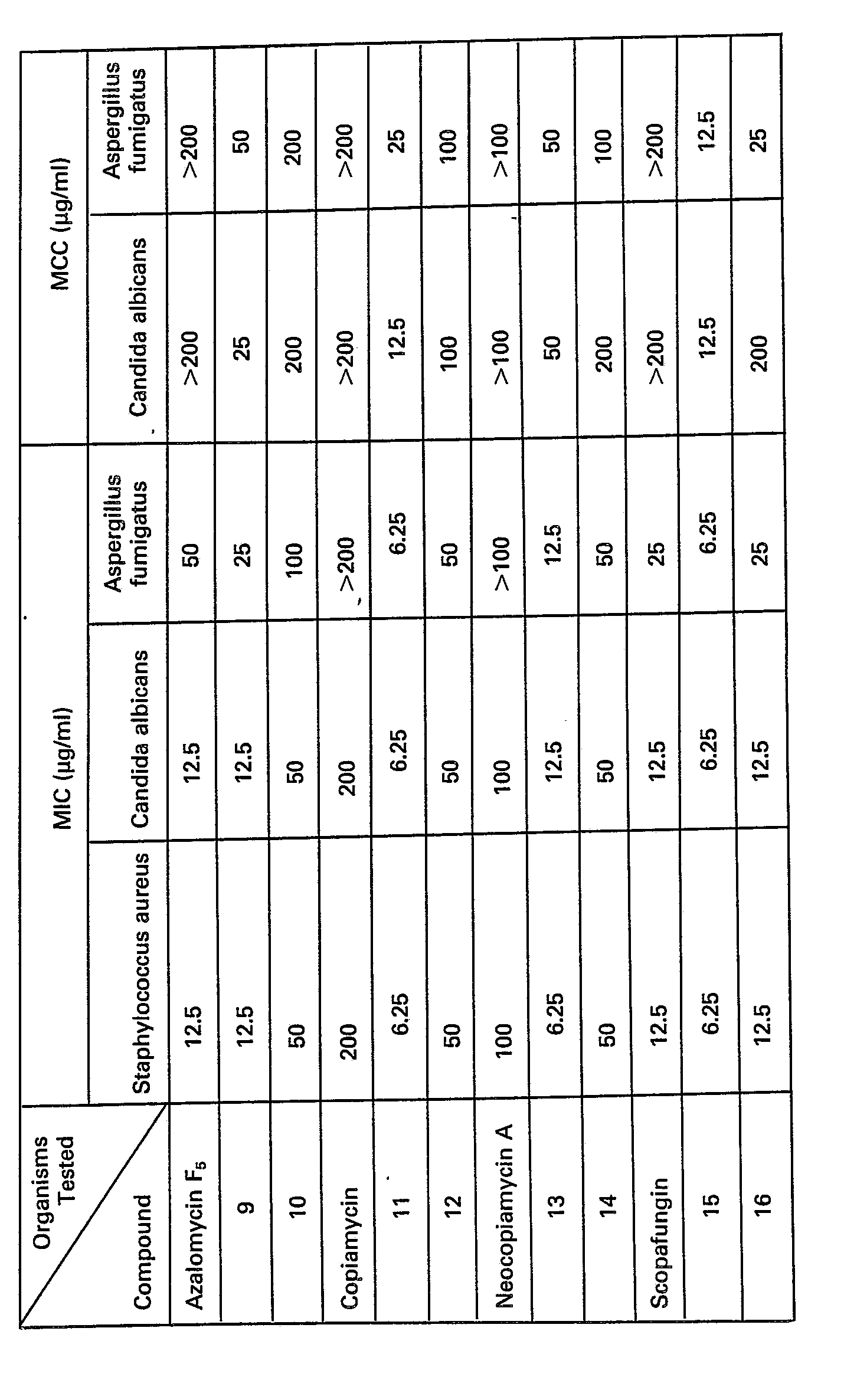
- The antimicrobial activity of each of the compounds shown in Table 1 and the corresponding raw material (cf. Table 4) was examined by measuring the minimal inhibitory concentration (MIC) and the minimal fungicidal concentration (MCC) by a dilution method in liquid medium.
- That is, 2 x 10⁶ cells/ml of Candida albicans or 5 x 10⁵ spores/ml of Aspergillus fumigatus IAM 2046 were inoculated on Sabraud dextrose agar medium containing a known concentration of a compound followed by culturing at 30°C for 24 hours. The concentration of the compound at which no turbidity due to the growth of bacteria was observed by the naked eye was designated as the MIC.
- Further, 0.1-ml portions of a culture fluid of each compound cultured in a concentration as described above were taken and each was spread over fresh Sabraud dextrose agar and cultured again at 30°C. After cultivation for 48 hours, the concentration of the compound at which over 10 colonies did not form was designated as the MCC.
- The MIC for Staphylococcus aureus 209P was determined using heart infusion broth in the same way as finding MIC described above except that the culture temperature was at 37°C.
- The test results are shown in Table 3.
- As is evident from Table 3, increased antimicrobial activity was noted with Compounds 1, 2, 3, 5, 7, 9, 11, 13 and 15 as compared to the raw materials. In particular, the increase was remarkable with Compounds 1, 3, 11, 13. Further in the case of Compounds 5, 7, 9 and 15, the enhancement of MCC was remarkable.
- Further in the case of Compounds 2, 4, 6, 8, 10, 12 and 14, enhancement of antimicrobial activity was obviously noted in the MCC.
-


- In the first process of the present invention, the acid catalyst that may be used in the alkylation is not particularly limited; hydrochloric acid, sulfuric acid, etc., can be used. While there is no particular limitation for the reaction temperature, it is preferred that the temperature be lower than room temperature. The reaction time varies depending upon the reaction temperature and the amount and kind of reagent used; it ranges from several minutes to several hours. In the reaction, not only the hemiketal group but also the hydroxy group of the allyl alcohol type may be alkylated on some occasions.
- The hydrolysis of the malonic acid monoester can be carried out in conventional manner. Hydrolysis with an alkali is particularly preferred, and is attained by maintaining pH at 10 to 12, for example, at room temperature for several minutes to several hours.
- In the second process of the present invention, the reduction of the hemiketal can be carried out in conventional manner; sodium borohydride is preferred. There is no particular limitation about the solvents that can be used, but water and lower alcohols are advantageously used.
- The hydrolysis of the malonic acid monoester can be carried out in conventional manner; as described above, hydrolysis with an alkali is preferred.
- The compounds used as raw materials in the present invention may be any of the guanidylfungins represented by general formula (II). Representative examples of the compounds include guanidylfungins A and B, azalomycins F3, F4 and Fs, copiamycin, neocopiamycin A and scopafungin (niphimycin). These compounds may further be converted into derivatives included in the guanidylfungin group by utilizing known reactions, and these derivatives can be used as raw materials, The structures of the aforesaid representatives of the guanidylfungins are shown in Table 4. Hereafter the preparation thereof will be briefly described.
- Guanidylfungins A and B can be produced from a culture broth of a guanidylfungin A-producing organism belonging to the genus Streptomyces, for example, Streptomyces hygroscopicus No. 662 (deposition No. FERM BP-86 in the Fermentation Research Institute of the Agency of Industrial Science and Technology) in the conventional manner (Japanese Patent Application no. 170482/83).
- Azalomycins F3, F4 and F5 can be produced from a culture broth of an azalomycin F-producing organism belonging to the genus Streptomyces, for example, Streptomyces hygroscopics var. azalomyceticus (ATCC 13810) in the conventional manner [Journal of Antibiotics, vol. 23, page 107 (1970)].
- Copiamycin and neocopiamycin A can be produced from a culture broth of a copiamycin-producing organism belonging to the genus Streptomyces, e.g. Streptomyces hygroscopics var. crystallogenes (IFM 1236, ATCC 19040) [with respect to copiamycin, see Jounrnal of Antibiotics, Ser, A, vol. 18, page 63 (1965) and, Journal of Antibiotics, vol. 37, page 103 (1984) with respect to neocopiamycin A].
- Scopafungin can be produced from a culture broth of a scopafungin-producing organism belonging to the genus Steptomyces, e.g., Streptomyces hygroscopics var. enhygrus (NRRL 3664) in a conventional manner [Journal of Antibiotics, vol. 25, page 39 (1972)].
-

- The present invention is illustrated by the following specific Examples, but is not limited thereto.
- In 10 ml of methanol was suspended 1 g of guanidylfungin A. To the suspension was added 5 ml of 1 N hydrochloric acid-methanol solution. After the mixture was stirred at room temperature for 20 minutes, the reaction mixture was applied to a PDS-silica gel column Prepak@ 500/C18 (manufactured by Waters Associates), developed, and eluted with a methanol-0.01 M ammonium acetate aqueous solution (76:24, vol/vol) to obtain fractions containing methylguanidylfungin A. After the fractions were distilled under reduced pressure to remove the solvent, the residue was dissolved in 30 ml of acetone-water (7:3) while being warmed. After the solution was allowed to stand at room temperature overnight, the white precipitate formed was taken by filtration to obtain 0.55 g of methyl guanidylfungin A.
- Melting point: 144-146°C (decomposed).
- Elemental analysis: as C59H105N3O18

- Secondary ion mass spectrum (hereafter merely referred to as SIMS): m/z 1144 (M + H).
- Infrared absorption spectrum (hereafter merely referred to as IR).
- (KBr) (cm-'): 3400, 2980, 2940, 1720, 1640, 1600, 1450, 1380, 1260, 1140, 1080, 1040, 980.
- In 60 ml of methanol was dissolved 0.5 g of methylguanidylfungin A. To the solution was added 20 ml of a solution of 2N potassium hydroxide in water-methanol (2:1). After stirring the mixture at room temperature overnight, the reaction mixture was neutralized with a 2N hydrochloric acid aqueous solution to discontinue the reaction. Thereafter, the reaction mixture was concentrated to dryness under reduced pressure. The residue was suspended in 5 ml of water and the water-insoluble fraction was taken by filtration. The water-insoluble fraction was dissolved in 10 ml of acetone-water (7:3). After the solution was allowed to stand at room temperature for 2 days, the white precipitate formed was taken by filtration to obtain 170 mg of compound 1.
- In 50 ml of methanol was suspended 0.5 g of guanidylfungin A. To the suspension was added a solution of 1 g of sodium borohydride in 10 ml of methanol. After stirring at room temperature overnight, the system was neutralized with a 1 N hydrochloric acid aqueous solution to stop the reaction. The reaction mixture was concentrated to dryness under reduced pressure and water was added to the residue. The water-insoluble fraction was collected by filtration to obtain 300 mg of reduced guanidylfungin A.
- Melting point: 118-122°C.
- SIMS m/z 1132 (M + H).
- IR (KBr) (cm-1): 3400, 2980, 2940, 1720, 1640, 1600, 1460, 1380, 1300, 1250, 1040, 980.
- In 20 ml of methanol was dissolved 130 mg of the reduced product, and 6 ml of a 2N sodium hydroxide aqueous solution was added to the solution. After stirring at room temperature overnight, the system was neutralized with a 1N hydrochloric acid aqueous solution to stop the reaction. The reaction mixture was concentrated under reduced pressure. After removing the solvent by distillation, the residue was applied to a column packed with 300 ml of Dia lon@ HP-20 (manufactured by Mitsubishi Chemical Industries, Ltd.). After washing with water, the column was eluted with methanol. The eluate was concentrated to dryness under reduced pressure to obtain 40 mg of the desired Compound 2.
- In 5 ml of methanol was suspended 50 mg of guanidylfungin B, and 1 ml of a 2N hydrochloric acid-methanol solution was added to the suspension under ice cooling. The mixture was allowed to stand at room temperature. Thereafter OH type ion exchange resin Ambrelite@ IRA-45 (manufactured by Organo Co., ltd.) was added to the mixture to neutralize. After the resin was removed by filtration, the filtrate was concentrated to dryness to obtain 45 mg [SIMS m/z 1130 (M + H)] of a crude, powdery, methylated product of guanidylfungin B.
- In 3 ml of methanol was dissolved 45 mg of the methylated product. To the solution was added 3 ml of a 1N potassium hydroxide solution. The mixture was stirred at room temperature for 3 hours. Then, the system was neutralized with a 1 N hydrochloric acid aqueous solution and the reaction mixture was concentrated to dryness under reduced pressure. The residue was extracted with 20 ml of methanol. After the extract was concentrated to dryness, the residue was dissolved in a small amount of methanol. The solution was applied to a silica gel column (No. 7734, manufactured by E. Merck) which had been prepared by previously saturating it with chloroform. After washing the column with chloroform, it was eluted with a solvent mixture of chloroform-methanol-water (65:25:4). The eluted active fraction was concentrated to dryness to obtain 25 mg of the hydrochloride of Compound 3.
- In 5 ml of methanol was suspended 50 mg of guanidylfungin B. To the suspension was added 1 ml of a solution of sodium borohydride in methanol (30 mg/ml). After stirring at room temperature overnight, the system was neutralized with a 1 N HCI aqueous solution. The reaction mixture was concentrated to dryness under reduced pressure and the residue was extracted with 10 ml of methanol. The extract was concentrated to dryness, and the residue was reduced guanidylfungin B [SIMS m/z 1118 (M + H)].
- After this residue was dissolved in 5 ml of methanol, 5 ml of a 2N potassium hydroxide aqueous solution was added to the resulting solution. The mixture was stirred at room temperature for 3 hours. Then, the system was neutralized with a 1N hydrochloric acid aqueous solution and the reaction mixture was concentrated to dryness under reduced pressure. The residue was extracted with 20 ml of methanol. After the extract was concentrated to dryness, the residue was dissolved in a small amount of methanol. 'The solution was applied to a silica gel column (No. 7734, manufactured by E. Merck) which had been prepared by previously saturating it with chloroform. After washing the column with chloroform, it was eluted with a mixture of chloroform-methanol-water (65:25:4). The eluted active fraction was concentrated to dryness to obtain 28 mg of the hydrochloride of Compound 4.
- Azalomycin F4, 85 mg, was methylated with hydrochloric acid-methanol in a manner similar to Example 3. Then the methylated product was hydrolyzed with potassium hydroxide. The product was purified by silica gel column chromatography to obtain 63 mg of the hydrochloride of Compound 5.
- The intermediate, a methylated product of azalomycin F4, was checked by SIMS [m/z 1110 (M + H)].
- In a manner similar to Example 4,120 mg of azalomycin F4 was reduced with sodium borohydride and hydrolyzed with potassium hydroxide. The product was purified by silica gel column chromatography to obtain 90 mg of Compound 6.
- The intermediate, a reduced product of azalomycin F4, was checked by SIMS [m/z 1084 (M + H)].
- In a manner similar to Example 3, 45 mg of azalomycin F3 was methylated with hydrochloric acid-methanol and hydrolyzed with potassium hydroxide. The product was purified by silica-gel column chromatography to obtain 28 mg of the desired Compound 7.
- The intermediate, a methylated product of azalomycin F3, was checked by SIMS [m/z 1096 (M + H)].
- In a manner similar to Example 4, 40 mg of azalomycin F3 was reduced with sodium borohydride and hydrolyzed with potassium hydroxide. The product was purified by silica gel column chromatography to obtain 25 mg of Compound 8.
- The intermediate, a reduced product of azalomycin F3 was checked by SIMS [m/z 1070 (M + H)].
- In a manner similar to Example 3, 40 mg of azalomycin F5 was methylated with hydrochloric acid-methanol and hydrolyzed with potassium hydroxide. The product was purified by silica gel column chromatography to obtain 18 mg of Compound 9.
- The intermediate, a methylated product of azalomycin Fs, was checked by SIMS [m/z 1124 (M + H)].
- In a manner similar to Example 4, 30 mg of azalomycin Fs was reduced with sodium borohydride and hydrolyzed with potassium hydroxide. The product was purified by silica gel column chromatography to obtain 21 mg of the desired Compound 10.
- The intermediate, a reduced product of azalomycin Fs, was checked by SIMS [m/z 1098 (M + H)].
- In a manner similar to Example 3, 280 mg of copiamycin was methylated with hydrochloric acid-methanol and hydrolyzed with potassium hydroxide. The product was purified by silica gel column chromatography to obtain 195 mg of Compound 11.
- The intermediate, a methylated product of copiamycin, was checked by SIMS [m/z 1072 (M + H)].
- In a manner similar to Example 4, 250 mg of copiamycin was reduced with sodium borohydride and hydrolyzed with potassium hydroxide. The product was purified by silica gel column chromatography to obtain 1640 mg of Compound 12.
- The intermediate, a reduced product of copiamycin, was checked by SIMS [m/z 1060 (M + H)].
- In a manner similar to Example 3, 30 mg of neocopiamycin A was methylated with hydrochloric acid-methanol and hydrolyzed with potassium hydroxide. The product was purified by silica gel column chromatography to obtain 21 mg of Compound 13.
- The intermediate, a methylated product of neocopiamycin A, was checked by SIMS [m/z 1058 (M + H)].
- In a manner similar to Example 4, 25 mg of neocopiamycin A was reduced with sodium borohydride and hydrolyzed with potassium hydroxide. The product was purified by silica gel column chromatography to obtain 17 mg of Compound 14.
- The intermediate, a reduced product of neocopiamycin A, was checked by SIMS [m/z 1046 (M + H)].
- In a manner similar to Example 3, 250 mg of scopafungin was methylated with hydrochloric acid-methanol and hydrolyzed with potassium hydroxide. The product was purified by silica gel column chromatography to obtain 122 mg of Compound 15.
- The intermediate, a methylated product of scopafungin, was checked by SIMS [m/z 1156 (M + H)].
- In a manner similar to Example 4, 250 mg of scopafungin was reduced with sodium borohydride and hydrolyzed with potassium hydroxide. The product was purified by silica gel column chromatography to obtain 144 mg of Compound 16.
- The intermediate, a reduced product of scopafungin, was checked by SIMS [m/z 1144 (M + H)].
- As described above, demalonyl derivatives of the guanidylfungins that are useful as antimicrobial agents, particularly as antifungal agents, and processes for preparing these derivatives are provided by the present invention.
- Enhanced antimicrobial activity was noted with the demalonyl derivatives .of the guanidylfungins of the present invention as compared to the parent compounds. In addition, the antimicrobial activity is fungicidal and these derivatives are useful as antimicrobial agents. Further, the parent compounds are insoluble in water, whereas the compounds of the present invention have increased solubility in water and alcohols sufficient to suit them as antimicrobial agents. Furthermore, compounds of the present invention may exhibit a synergistic antifungal effect when used with the imidazole antifungal agents.
Claims (4)


Applications Claiming Priority (2)
| Application Number | Priority Date | Filing Date | Title |
|---|---|---|---|
| JP59214289A JPS6193179A (en) | 1984-10-15 | 1984-10-15 | Derivative of guanidylfungin and its preparation |
| JP214289/84 | 1984-10-15 |
Publications (3)
| Publication Number | Publication Date |
|---|---|
| EP0178909A2 EP0178909A2 (en) | 1986-04-23 |
| EP0178909A3 EP0178909A3 (en) | 1986-12-03 |
| EP0178909B1 true EP0178909B1 (en) | 1990-02-21 |
Family
ID=16653259
Family Applications (1)
| Application Number | Title | Priority Date | Filing Date |
|---|---|---|---|
| EP85307424A Expired - Lifetime EP0178909B1 (en) | 1984-10-15 | 1985-10-15 | Guanidylfungin derivatives and their production |
Country Status (5)
| Country | Link |
|---|---|
| US (1) | US4703128A (en) |
| EP (1) | EP0178909B1 (en) |
| JP (1) | JPS6193179A (en) |
| CA (1) | CA1235694A (en) |
| DE (1) | DE3576078D1 (en) |
Families Citing this family (4)
| Publication number | Priority date | Publication date | Assignee | Title |
|---|---|---|---|---|
| DE3700331A1 (en) * | 1986-12-24 | 1988-07-07 | Hoechst Ag | METHOD FOR PRODUCING THE DESMALONYL COMPOUND OF MACROLID LACTONES |
| DE3779738D1 (en) * | 1986-12-24 | 1992-07-16 | Hoechst Ag | AMYCINE AND ITS DERIVATIVES, METHOD FOR THE PRODUCTION AND USE THEREOF. |
| HU202248B (en) * | 1988-06-14 | 1991-02-28 | Chinoin Gyogyszer Es Vegyeszet | Process for producing pseudo-primicin, it's components and pharmaceutical compositions containing them as active components |
| CN103044439B (en) * | 2012-12-21 | 2015-01-28 | 江西农业大学 | Demalonyl azamycin F and its preparation method and its application in the preparation of medicines for treating MRSA infection |
Family Cites Families (1)
| Publication number | Priority date | Publication date | Assignee | Title |
|---|---|---|---|---|
| FR2405941A1 (en) * | 1977-06-30 | 1979-05-11 | Otsuka Pharma Co Ltd | NEW SESQUITERPENIC DERIVATIVES USEFUL IN PARTICULAR AS INHIBITORS OF THE COMPLEMENTARY SYSTEM AND THEIR PREPARATION PROCESSES |
-
1984
- 1984-10-15 JP JP59214289A patent/JPS6193179A/en active Granted
-
1985
- 1985-10-11 CA CA000492822A patent/CA1235694A/en not_active Expired
- 1985-10-15 DE DE8585307424T patent/DE3576078D1/en not_active Expired - Fee Related
- 1985-10-15 EP EP85307424A patent/EP0178909B1/en not_active Expired - Lifetime
-
1986
- 1986-07-18 US US06/885,818 patent/US4703128A/en not_active Expired - Fee Related
Also Published As
| Publication number | Publication date |
|---|---|
| JPS6193179A (en) | 1986-05-12 |
| EP0178909A3 (en) | 1986-12-03 |
| DE3576078D1 (en) | 1990-03-29 |
| US4703128A (en) | 1987-10-27 |
| CA1235694A (en) | 1988-04-26 |
| EP0178909A2 (en) | 1986-04-23 |
| JPH0535149B2 (en) | 1993-05-25 |
Similar Documents
| Publication | Publication Date | Title |
|---|---|---|
| EP0368349B1 (en) | Serine analogs of bu-3608 antibiotics | |
| CA1339348C (en) | Novel glycopeptide antibiotics | |
| GB2041360A (en) | Antiobiotic | |
| OMURA et al. | Setamycin, a new antibiotic | |
| HU182267B (en) | Process for preparing the antibiotic c-15003 p-3 | |
| US4313935A (en) | Antibiotic FR-900129 substance, a process for the preparation thereof and pharmaceutical compositions containing the same | |
| EP0048585A1 (en) | Antibiotics TM-531 B and TM-531 C | |
| EP0345735A2 (en) | Glycoside antibiotics BU-3608D and BU-3608E | |
| EP0178909A2 (en) | Guanidylfungin derivatives and their production | |
| US4376778A (en) | Antibiotic substances and processes for production thereof | |
| URAMOTO et al. | A new antifungal antibiotic, phosphazomycin A | |
| US5521169A (en) | Ascosteroside and analogs thereof useful in antifungal compositions for methods of treating infections and inhibition of fungal growth | |
| US4138496A (en) | SY-1 substance | |
| EP0245012A1 (en) | Method for the preparation of 14-hydroxy-6-0-methyl-erythromycin A | |
| HU202284B (en) | Process for producing new azoxy derivatives and pharmaceutical compositions comprising same as active ingredient | |
| EP0002589B1 (en) | A-40104 antibiotics, their preparation, and formulations containing them | |
| US4588822A (en) | Physiologically active substances SS 12538, their preparation and a novel microorganism producing same | |
| CA1046965A (en) | Naphthyridinomycin antibiotics from streptomyces | |
| US4108724A (en) | Method for preparing antibiotic P-2563 using Pseudomonas fluorescens | |
| US4914216A (en) | Amycin and its derivatives, a process for their preparation, and their use | |
| JP2594167B2 (en) | Novel antibiotic SF2698 substance and its production method | |
| US5306496A (en) | Antibiotics NK374186A, NK374186B, NK374186B3 and NK374186C3, process for producing the same, and use of the same | |
| KR860000602B1 (en) | Improvement in or relating to macrolide antibiotics | |
| US4370266A (en) | Mycoplanecin derivatives and their preparation | |
| US3862315A (en) | Tetraamidino derivatives of antibiotic em-49 |
Legal Events
| Date | Code | Title | Description |
|---|---|---|---|
| PUAI | Public reference made under article 153(3) epc to a published international application that has entered the european phase |
Free format text: ORIGINAL CODE: 0009012 |
|
| AK | Designated contracting states |
Kind code of ref document: A2 Designated state(s): CH DE FR GB IT LI |
|
| 17P | Request for examination filed |
Effective date: 19860414 |
|
| PUAL | Search report despatched |
Free format text: ORIGINAL CODE: 0009013 |
|
| AK | Designated contracting states |
Kind code of ref document: A3 Designated state(s): CH DE FR GB IT LI |
|
| 17Q | First examination report despatched |
Effective date: 19871210 |
|
| GRAA | (expected) grant |
Free format text: ORIGINAL CODE: 0009210 |
|
| AK | Designated contracting states |
Kind code of ref document: B1 Designated state(s): DE FR GB |
|
| REF | Corresponds to: |
Ref document number: 3576078 Country of ref document: DE Date of ref document: 19900329 |
|
| ET | Fr: translation filed | ||
| PLBE | No opposition filed within time limit |
Free format text: ORIGINAL CODE: 0009261 |
|
| STAA | Information on the status of an ep patent application or granted ep patent |
Free format text: STATUS: NO OPPOSITION FILED WITHIN TIME LIMIT |
|
| 26N | No opposition filed | ||
| PGFP | Annual fee paid to national office [announced via postgrant information from national office to epo] |
Ref country code: FR Payment date: 19950928 Year of fee payment: 11 |
|
| PGFP | Annual fee paid to national office [announced via postgrant information from national office to epo] |
Ref country code: GB Payment date: 19951005 Year of fee payment: 11 |
|
| PGFP | Annual fee paid to national office [announced via postgrant information from national office to epo] |
Ref country code: DE Payment date: 19951221 Year of fee payment: 11 |
|
| PG25 | Lapsed in a contracting state [announced via postgrant information from national office to epo] |
Ref country code: GB Effective date: 19961015 |
|
| GBPC | Gb: european patent ceased through non-payment of renewal fee |
Effective date: 19961015 |
|
| PG25 | Lapsed in a contracting state [announced via postgrant information from national office to epo] |
Ref country code: FR Effective date: 19970630 |
|
| PG25 | Lapsed in a contracting state [announced via postgrant information from national office to epo] |
Ref country code: DE Effective date: 19970701 |
|
| REG | Reference to a national code |
Ref country code: FR Ref legal event code: ST |