EP0178189B1 - Pyridazinone derivatives, their preparation and use - Google Patents
Pyridazinone derivatives, their preparation and use Download PDFInfo
- Publication number
- EP0178189B1 EP0178189B1 EP85307364A EP85307364A EP0178189B1 EP 0178189 B1 EP0178189 B1 EP 0178189B1 EP 85307364 A EP85307364 A EP 85307364A EP 85307364 A EP85307364 A EP 85307364A EP 0178189 B1 EP0178189 B1 EP 0178189B1
- Authority
- EP
- European Patent Office
- Prior art keywords
- groups
- group
- alkyl
- phenyl
- substituent
- Prior art date
- Legal status (The legal status is an assumption and is not a legal conclusion. Google has not performed a legal analysis and makes no representation as to the accuracy of the status listed.)
- Expired - Lifetime
Links
- AAILEWXSEQLMNI-UHFFFAOYSA-N 1h-pyridazin-6-one Chemical class OC1=CC=CN=N1 AAILEWXSEQLMNI-UHFFFAOYSA-N 0.000 title claims description 8
- 238000002360 preparation method Methods 0.000 title description 8
- 150000001875 compounds Chemical class 0.000 claims abstract description 137
- QVGXLLKOCUKJST-UHFFFAOYSA-N atomic oxygen Chemical group [O] QVGXLLKOCUKJST-UHFFFAOYSA-N 0.000 claims abstract description 13
- 229910052760 oxygen Inorganic materials 0.000 claims abstract description 12
- 239000001301 oxygen Substances 0.000 claims abstract description 12
- 239000005864 Sulphur Chemical group 0.000 claims abstract description 11
- 125000002947 alkylene group Chemical group 0.000 claims abstract description 8
- NINIDFKCEFEMDL-UHFFFAOYSA-N Sulfur Chemical group [S] NINIDFKCEFEMDL-UHFFFAOYSA-N 0.000 claims abstract description 6
- 208000020446 Cardiac disease Diseases 0.000 claims abstract description 3
- 208000019622 heart disease Diseases 0.000 claims abstract description 3
- 238000006243 chemical reaction Methods 0.000 claims description 110
- -1 sulphamoyl groups Chemical group 0.000 claims description 99
- 125000001424 substituent group Chemical group 0.000 claims description 98
- 125000001997 phenyl group Chemical group [H]C1=C([H])C([H])=C(*)C([H])=C1[H] 0.000 claims description 68
- 125000000217 alkyl group Chemical group 0.000 claims description 62
- 125000004169 (C1-C6) alkyl group Chemical group 0.000 claims description 55
- 125000004178 (C1-C4) alkyl group Chemical group 0.000 claims description 46
- 150000002367 halogens Chemical class 0.000 claims description 45
- 125000003118 aryl group Chemical group 0.000 claims description 44
- 125000001931 aliphatic group Chemical group 0.000 claims description 39
- 229910052736 halogen Inorganic materials 0.000 claims description 39
- 125000000623 heterocyclic group Chemical group 0.000 claims description 37
- 125000004435 hydrogen atom Chemical group [H]* 0.000 claims description 36
- 150000003839 salts Chemical class 0.000 claims description 35
- 125000002252 acyl group Chemical group 0.000 claims description 31
- 125000005843 halogen group Chemical group 0.000 claims description 30
- 238000000034 method Methods 0.000 claims description 30
- 125000000229 (C1-C4)alkoxy group Chemical group 0.000 claims description 25
- 125000003277 amino group Chemical group 0.000 claims description 24
- 125000002023 trifluoromethyl group Chemical group FC(F)(F)* 0.000 claims description 23
- 125000004453 alkoxycarbonyl group Chemical group 0.000 claims description 21
- IJGRMHOSHXDMSA-UHFFFAOYSA-N Atomic nitrogen Chemical compound N#N IJGRMHOSHXDMSA-UHFFFAOYSA-N 0.000 claims description 20
- 125000003545 alkoxy group Chemical group 0.000 claims description 18
- 125000004432 carbon atom Chemical group C* 0.000 claims description 18
- 125000004430 oxygen atom Chemical group O* 0.000 claims description 18
- 125000004191 (C1-C6) alkoxy group Chemical group 0.000 claims description 17
- 239000002253 acid Substances 0.000 claims description 17
- 125000002496 methyl group Chemical group [H]C([H])([H])* 0.000 claims description 17
- 125000003917 carbamoyl group Chemical group [H]N([H])C(*)=O 0.000 claims description 15
- 125000003178 carboxy group Chemical group [H]OC(*)=O 0.000 claims description 15
- 125000005098 aryl alkoxy carbonyl group Chemical group 0.000 claims description 14
- 125000006413 ring segment Chemical group 0.000 claims description 14
- 125000004442 acylamino group Chemical group 0.000 claims description 13
- 125000000449 nitro group Chemical group [O-][N+](*)=O 0.000 claims description 13
- 125000000041 C6-C10 aryl group Chemical group 0.000 claims description 12
- 125000000753 cycloalkyl group Chemical group 0.000 claims description 12
- 229910052757 nitrogen Inorganic materials 0.000 claims description 12
- 125000003236 benzoyl group Chemical group [H]C1=C([H])C([H])=C(C([H])=C1[H])C(*)=O 0.000 claims description 10
- 125000001495 ethyl group Chemical group [H]C([H])([H])C([H])([H])* 0.000 claims description 10
- 125000002887 hydroxy group Chemical group [H]O* 0.000 claims description 10
- 125000004423 acyloxy group Chemical group 0.000 claims description 9
- 125000004391 aryl sulfonyl group Chemical group 0.000 claims description 9
- 125000004104 aryloxy group Chemical group 0.000 claims description 9
- 125000006828 (C2-C7) alkoxycarbonyl group Chemical group 0.000 claims description 8
- OAKJQQAXSVQMHS-UHFFFAOYSA-N Hydrazine Chemical compound NN OAKJQQAXSVQMHS-UHFFFAOYSA-N 0.000 claims description 8
- 229910052783 alkali metal Inorganic materials 0.000 claims description 8
- 125000004076 pyridyl group Chemical group 0.000 claims description 8
- 125000004390 alkyl sulfonyl group Chemical group 0.000 claims description 7
- 125000004429 atom Chemical group 0.000 claims description 7
- 125000002837 carbocyclic group Chemical group 0.000 claims description 7
- 125000002485 formyl group Chemical group [H]C(*)=O 0.000 claims description 7
- 125000000008 (C1-C10) alkyl group Chemical group 0.000 claims description 6
- 125000003161 (C1-C6) alkylene group Chemical group 0.000 claims description 6
- 125000002915 carbonyl group Chemical group [*:2]C([*:1])=O 0.000 claims description 6
- 125000005115 alkyl carbamoyl group Chemical group 0.000 claims description 5
- 125000005281 alkyl ureido group Chemical group 0.000 claims description 5
- 125000005161 aryl oxy carbonyl group Chemical group 0.000 claims description 5
- 125000001951 carbamoylamino group Chemical group C(N)(=O)N* 0.000 claims description 5
- 125000004093 cyano group Chemical group *C#N 0.000 claims description 5
- 238000004519 manufacturing process Methods 0.000 claims description 5
- 125000004573 morpholin-4-yl group Chemical group N1(CCOCC1)* 0.000 claims description 5
- 125000005505 thiomorpholino group Chemical group 0.000 claims description 5
- 238000005727 Friedel-Crafts reaction Methods 0.000 claims description 3
- 230000010933 acylation Effects 0.000 claims description 3
- 238000005917 acylation reaction Methods 0.000 claims description 3
- 125000001589 carboacyl group Chemical group 0.000 claims description 3
- 239000011203 carbon fibre reinforced carbon Substances 0.000 claims description 3
- 125000004663 dialkyl amino group Chemical group 0.000 claims description 3
- 230000008030 elimination Effects 0.000 claims description 3
- 238000003379 elimination reaction Methods 0.000 claims description 3
- 230000007062 hydrolysis Effects 0.000 claims description 3
- 238000006460 hydrolysis reaction Methods 0.000 claims description 3
- 125000004193 piperazinyl group Chemical group 0.000 claims description 3
- 125000006239 protecting group Chemical group 0.000 claims description 3
- 125000006273 (C1-C3) alkyl group Chemical group 0.000 claims description 2
- 125000002102 aryl alkyloxo group Chemical group 0.000 claims description 2
- 239000003085 diluting agent Substances 0.000 claims description 2
- 239000003814 drug Substances 0.000 claims description 2
- 125000004185 ester group Chemical group 0.000 claims description 2
- 125000001570 methylene group Chemical group [H]C([H])([*:1])[*:2] 0.000 claims description 2
- 239000008194 pharmaceutical composition Substances 0.000 claims description 2
- 238000011321 prophylaxis Methods 0.000 claims description 2
- 238000002560 therapeutic procedure Methods 0.000 claims description 2
- 238000011282 treatment Methods 0.000 claims description 2
- 239000003937 drug carrier Substances 0.000 claims 1
- 230000007717 exclusion Effects 0.000 claims 1
- 229910052717 sulfur Inorganic materials 0.000 claims 1
- 125000004434 sulfur atom Chemical group 0.000 claims 1
- 230000002107 myocardial effect Effects 0.000 abstract description 5
- 230000003389 potentiating effect Effects 0.000 abstract description 2
- 125000000962 organic group Chemical group 0.000 abstract 1
- LFQSCWFLJHTTHZ-UHFFFAOYSA-N Ethanol Chemical compound CCO LFQSCWFLJHTTHZ-UHFFFAOYSA-N 0.000 description 60
- ZMXDDKWLCZADIW-UHFFFAOYSA-N N,N-Dimethylformamide Chemical compound CN(C)C=O ZMXDDKWLCZADIW-UHFFFAOYSA-N 0.000 description 30
- 239000002904 solvent Substances 0.000 description 29
- QTBSBXVTEAMEQO-UHFFFAOYSA-N Acetic acid Chemical compound CC(O)=O QTBSBXVTEAMEQO-UHFFFAOYSA-N 0.000 description 27
- OKKJLVBELUTLKV-UHFFFAOYSA-N Methanol Chemical compound OC OKKJLVBELUTLKV-UHFFFAOYSA-N 0.000 description 24
- 239000000203 mixture Substances 0.000 description 22
- 235000002639 sodium chloride Nutrition 0.000 description 22
- YMWUJEATGCHHMB-UHFFFAOYSA-N Dichloromethane Chemical compound ClCCl YMWUJEATGCHHMB-UHFFFAOYSA-N 0.000 description 15
- RTZKZFJDLAIYFH-UHFFFAOYSA-N Diethyl ether Chemical compound CCOCC RTZKZFJDLAIYFH-UHFFFAOYSA-N 0.000 description 15
- 239000000243 solution Substances 0.000 description 15
- XLYOFNOQVPJJNP-UHFFFAOYSA-N water Substances O XLYOFNOQVPJJNP-UHFFFAOYSA-N 0.000 description 15
- 239000011541 reaction mixture Substances 0.000 description 14
- XEKOWRVHYACXOJ-UHFFFAOYSA-N Ethyl acetate Chemical compound CCOC(C)=O XEKOWRVHYACXOJ-UHFFFAOYSA-N 0.000 description 12
- VEXZGXHMUGYJMC-UHFFFAOYSA-N Hydrochloric acid Chemical compound Cl VEXZGXHMUGYJMC-UHFFFAOYSA-N 0.000 description 12
- 150000001732 carboxylic acid derivatives Chemical class 0.000 description 11
- 239000012442 inert solvent Substances 0.000 description 11
- XBDQKXXYIPTUBI-UHFFFAOYSA-N dimethylselenoniopropionate Natural products CCC(O)=O XBDQKXXYIPTUBI-UHFFFAOYSA-N 0.000 description 10
- 230000000694 effects Effects 0.000 description 10
- 238000002844 melting Methods 0.000 description 10
- 230000008018 melting Effects 0.000 description 10
- HEMHJVSKTPXQMS-UHFFFAOYSA-M Sodium hydroxide Chemical compound [OH-].[Na+] HEMHJVSKTPXQMS-UHFFFAOYSA-M 0.000 description 9
- 235000011054 acetic acid Nutrition 0.000 description 9
- GDTBXPJZTBHREO-UHFFFAOYSA-N bromine Chemical compound BrBr GDTBXPJZTBHREO-UHFFFAOYSA-N 0.000 description 9
- VLKZOEOYAKHREP-UHFFFAOYSA-N n-Hexane Chemical compound CCCCCC VLKZOEOYAKHREP-UHFFFAOYSA-N 0.000 description 9
- 231100000989 no adverse effect Toxicity 0.000 description 9
- 238000001953 recrystallisation Methods 0.000 description 9
- JUJWROOIHBZHMG-UHFFFAOYSA-N Pyridine Chemical compound C1=CC=NC=C1 JUJWROOIHBZHMG-UHFFFAOYSA-N 0.000 description 8
- WYURNTSHIVDZCO-UHFFFAOYSA-N Tetrahydrofuran Chemical compound C1CCOC1 WYURNTSHIVDZCO-UHFFFAOYSA-N 0.000 description 8
- 150000001298 alcohols Chemical class 0.000 description 8
- 239000003153 chemical reaction reagent Substances 0.000 description 8
- 239000005457 ice water Substances 0.000 description 8
- 239000003960 organic solvent Substances 0.000 description 8
- 125000006615 aromatic heterocyclic group Chemical group 0.000 description 7
- 239000002585 base Substances 0.000 description 7
- 239000013078 crystal Substances 0.000 description 7
- WFDIJRYMOXRFFG-UHFFFAOYSA-N Acetic anhydride Chemical compound CC(=O)OC(C)=O WFDIJRYMOXRFFG-UHFFFAOYSA-N 0.000 description 6
- UHOVQNZJYSORNB-UHFFFAOYSA-N Benzene Chemical compound C1=CC=CC=C1 UHOVQNZJYSORNB-UHFFFAOYSA-N 0.000 description 6
- KFZMGEQAYNKOFK-UHFFFAOYSA-N Isopropanol Chemical compound CC(C)O KFZMGEQAYNKOFK-UHFFFAOYSA-N 0.000 description 6
- ZMANZCXQSJIPKH-UHFFFAOYSA-N Triethylamine Chemical compound CCN(CC)CC ZMANZCXQSJIPKH-UHFFFAOYSA-N 0.000 description 6
- 150000007513 acids Chemical class 0.000 description 6
- VSCWAEJMTAWNJL-UHFFFAOYSA-K aluminium trichloride Chemical compound Cl[Al](Cl)Cl VSCWAEJMTAWNJL-UHFFFAOYSA-K 0.000 description 6
- 229910052794 bromium Inorganic materials 0.000 description 6
- 229910052801 chlorine Inorganic materials 0.000 description 6
- 150000002170 ethers Chemical class 0.000 description 6
- 238000001914 filtration Methods 0.000 description 6
- 238000011084 recovery Methods 0.000 description 6
- 150000001412 amines Chemical class 0.000 description 5
- 239000000460 chlorine Substances 0.000 description 5
- 229910052731 fluorine Inorganic materials 0.000 description 5
- 239000011737 fluorine Substances 0.000 description 5
- 239000000047 product Substances 0.000 description 5
- 235000019260 propionic acid Nutrition 0.000 description 5
- IUVKMZGDUIUOCP-BTNSXGMBSA-N quinbolone Chemical compound O([C@H]1CC[C@H]2[C@H]3[C@@H]([C@]4(C=CC(=O)C=C4CC3)C)CC[C@@]21C)C1=CCCC1 IUVKMZGDUIUOCP-BTNSXGMBSA-N 0.000 description 5
- ZCYVEMRRCGMTRW-UHFFFAOYSA-N 7553-56-2 Chemical group [I] ZCYVEMRRCGMTRW-UHFFFAOYSA-N 0.000 description 4
- OKTJSMMVPCPJKN-UHFFFAOYSA-N Carbon Chemical compound [C] OKTJSMMVPCPJKN-UHFFFAOYSA-N 0.000 description 4
- HEDRZPFGACZZDS-UHFFFAOYSA-N Chloroform Chemical compound ClC(Cl)Cl HEDRZPFGACZZDS-UHFFFAOYSA-N 0.000 description 4
- PXGOKWXKJXAPGV-UHFFFAOYSA-N Fluorine Chemical compound FF PXGOKWXKJXAPGV-UHFFFAOYSA-N 0.000 description 4
- CDBYLPFSWZWCQE-UHFFFAOYSA-L Sodium Carbonate Chemical compound [Na+].[Na+].[O-]C([O-])=O CDBYLPFSWZWCQE-UHFFFAOYSA-L 0.000 description 4
- QAOWNCQODCNURD-UHFFFAOYSA-N Sulfuric acid Chemical compound OS(O)(=O)=O QAOWNCQODCNURD-UHFFFAOYSA-N 0.000 description 4
- 125000002777 acetyl group Chemical group [H]C([H])([H])C(*)=O 0.000 description 4
- 239000003377 acid catalyst Substances 0.000 description 4
- 150000001408 amides Chemical class 0.000 description 4
- 230000003276 anti-hypertensive effect Effects 0.000 description 4
- 125000000484 butyl group Chemical group [H]C([*])([H])C([H])([H])C([H])([H])C([H])([H])[H] 0.000 description 4
- 150000001735 carboxylic acids Chemical class 0.000 description 4
- 238000009903 catalytic hydrogenation reaction Methods 0.000 description 4
- 239000003638 chemical reducing agent Substances 0.000 description 4
- 238000004587 chromatography analysis Methods 0.000 description 4
- 238000004440 column chromatography Methods 0.000 description 4
- 230000008602 contraction Effects 0.000 description 4
- 238000007796 conventional method Methods 0.000 description 4
- 238000001035 drying Methods 0.000 description 4
- XQKWZPJMZQVYTQ-UHFFFAOYSA-N ethyl 2-[2-chloro-4-(6-oxo-4,5-dihydro-1h-pyridazin-3-yl)phenoxy]acetate Chemical compound C1=C(Cl)C(OCC(=O)OCC)=CC=C1C1=NNC(=O)CC1 XQKWZPJMZQVYTQ-UHFFFAOYSA-N 0.000 description 4
- 125000001449 isopropyl group Chemical group [H]C([H])([H])C([H])(*)C([H])([H])[H] 0.000 description 4
- 239000003921 oil Substances 0.000 description 4
- BWHMMNNQKKPAPP-UHFFFAOYSA-L potassium carbonate Chemical compound [K+].[K+].[O-]C([O-])=O BWHMMNNQKKPAPP-UHFFFAOYSA-L 0.000 description 4
- 239000002244 precipitate Substances 0.000 description 4
- 125000001436 propyl group Chemical group [H]C([*])([H])C([H])([H])C([H])([H])[H] 0.000 description 4
- UMJSCPRVCHMLSP-UHFFFAOYSA-N pyridine Natural products COC1=CC=CN=C1 UMJSCPRVCHMLSP-UHFFFAOYSA-N 0.000 description 4
- 239000007858 starting material Substances 0.000 description 4
- 238000003756 stirring Methods 0.000 description 4
- 239000001117 sulphuric acid Substances 0.000 description 4
- 235000011149 sulphuric acid Nutrition 0.000 description 4
- VZGDMQKNWNREIO-UHFFFAOYSA-N tetrachloromethane Chemical compound ClC(Cl)(Cl)Cl VZGDMQKNWNREIO-UHFFFAOYSA-N 0.000 description 4
- YLQBMQCUIZJEEH-UHFFFAOYSA-N tetrahydrofuran Natural products C=1C=COC=1 YLQBMQCUIZJEEH-UHFFFAOYSA-N 0.000 description 4
- 238000005406 washing Methods 0.000 description 4
- RYHBNJHYFVUHQT-UHFFFAOYSA-N 1,4-Dioxane Chemical compound C1COCCO1 RYHBNJHYFVUHQT-UHFFFAOYSA-N 0.000 description 3
- FALRKNHUBBKYCC-UHFFFAOYSA-N 2-(chloromethyl)pyridine-3-carbonitrile Chemical compound ClCC1=NC=CC=C1C#N FALRKNHUBBKYCC-UHFFFAOYSA-N 0.000 description 3
- YVQICMHUIYTMHC-UHFFFAOYSA-N 2-[2-chloro-4-(6-oxo-4,5-dihydro-1h-pyridazin-3-yl)phenoxy]acetic acid Chemical compound C1=C(Cl)C(OCC(=O)O)=CC=C1C1=NNC(=O)CC1 YVQICMHUIYTMHC-UHFFFAOYSA-N 0.000 description 3
- CSCPPACGZOOCGX-UHFFFAOYSA-N Acetone Chemical compound CC(C)=O CSCPPACGZOOCGX-UHFFFAOYSA-N 0.000 description 3
- WEVYAHXRMPXWCK-UHFFFAOYSA-N Acetonitrile Chemical compound CC#N WEVYAHXRMPXWCK-UHFFFAOYSA-N 0.000 description 3
- WKBOTKDWSSQWDR-UHFFFAOYSA-N Bromine atom Chemical compound [Br] WKBOTKDWSSQWDR-UHFFFAOYSA-N 0.000 description 3
- KZBUYRJDOAKODT-UHFFFAOYSA-N Chlorine Chemical compound ClCl KZBUYRJDOAKODT-UHFFFAOYSA-N 0.000 description 3
- FXHOOIRPVKKKFG-UHFFFAOYSA-N N,N-Dimethylacetamide Chemical compound CN(C)C(C)=O FXHOOIRPVKKKFG-UHFFFAOYSA-N 0.000 description 3
- PXHVJJICTQNCMI-UHFFFAOYSA-N Nickel Chemical compound [Ni] PXHVJJICTQNCMI-UHFFFAOYSA-N 0.000 description 3
- MUBZPKHOEPUJKR-UHFFFAOYSA-N Oxalic acid Chemical compound OC(=O)C(O)=O MUBZPKHOEPUJKR-UHFFFAOYSA-N 0.000 description 3
- KWYUFKZDYYNOTN-UHFFFAOYSA-M Potassium hydroxide Chemical compound [OH-].[K+] KWYUFKZDYYNOTN-UHFFFAOYSA-M 0.000 description 3
- YXFVVABEGXRONW-UHFFFAOYSA-N Toluene Chemical compound CC1=CC=CC=C1 YXFVVABEGXRONW-UHFFFAOYSA-N 0.000 description 3
- 150000001350 alkyl halides Chemical class 0.000 description 3
- RNLQIBCLLYYYFJ-UHFFFAOYSA-N amrinone Chemical group N1C(=O)C(N)=CC(C=2C=CN=CC=2)=C1 RNLQIBCLLYYYFJ-UHFFFAOYSA-N 0.000 description 3
- 230000000747 cardiac effect Effects 0.000 description 3
- KRKNYBCHXYNGOX-UHFFFAOYSA-N citric acid Chemical compound OC(=O)CC(O)(C(O)=O)CC(O)=O KRKNYBCHXYNGOX-UHFFFAOYSA-N 0.000 description 3
- 238000001816 cooling Methods 0.000 description 3
- 238000000921 elemental analysis Methods 0.000 description 3
- 229910052500 inorganic mineral Inorganic materials 0.000 description 3
- 229910052740 iodine Inorganic materials 0.000 description 3
- 125000000959 isobutyl group Chemical group [H]C([H])([H])C([H])(C([H])([H])[H])C([H])([H])* 0.000 description 3
- 235000010755 mineral Nutrition 0.000 description 3
- 239000011707 mineral Substances 0.000 description 3
- 125000001501 propionyl group Chemical group O=C([*])C([H])([H])C([H])([H])[H] 0.000 description 3
- 229920006395 saturated elastomer Polymers 0.000 description 3
- 125000002914 sec-butyl group Chemical group [H]C([H])([H])C([H])([H])C([H])(*)C([H])([H])[H] 0.000 description 3
- 238000010898 silica gel chromatography Methods 0.000 description 3
- 238000006467 substitution reaction Methods 0.000 description 3
- 229940014800 succinic anhydride Drugs 0.000 description 3
- 230000001225 therapeutic effect Effects 0.000 description 3
- 125000003774 valeryl group Chemical group O=C([*])C([H])([H])C([H])([H])C([H])([H])C([H])([H])[H] 0.000 description 3
- TXUICONDJPYNPY-UHFFFAOYSA-N (1,10,13-trimethyl-3-oxo-4,5,6,7,8,9,11,12,14,15,16,17-dodecahydrocyclopenta[a]phenanthren-17-yl) heptanoate Chemical compound C1CC2CC(=O)C=C(C)C2(C)C2C1C1CCC(OC(=O)CCCCCC)C1(C)CC2 TXUICONDJPYNPY-UHFFFAOYSA-N 0.000 description 2
- VHYFNPMBLIVWCW-UHFFFAOYSA-N 4-Dimethylaminopyridine Chemical compound CN(C)C1=CC=NC=C1 VHYFNPMBLIVWCW-UHFFFAOYSA-N 0.000 description 2
- RMBNAFRWVNNBLN-UHFFFAOYSA-N 5-hydroxy-6-(4-hydroxy-3-methylphenyl)-1,2-dihydropyridazine-3,4-dione Chemical compound C1=C(O)C(C)=CC(C=2C(=C(O)C(=O)NN=2)O)=C1 RMBNAFRWVNNBLN-UHFFFAOYSA-N 0.000 description 2
- VTYYLEPIZMXCLO-UHFFFAOYSA-L Calcium carbonate Chemical compound [Ca+2].[O-]C([O-])=O VTYYLEPIZMXCLO-UHFFFAOYSA-L 0.000 description 2
- ZAMOUSCENKQFHK-UHFFFAOYSA-N Chlorine atom Chemical compound [Cl] ZAMOUSCENKQFHK-UHFFFAOYSA-N 0.000 description 2
- RGHNJXZEOKUKBD-SQOUGZDYSA-N D-gluconic acid Chemical compound OC[C@@H](O)[C@@H](O)[C@H](O)[C@@H](O)C(O)=O RGHNJXZEOKUKBD-SQOUGZDYSA-N 0.000 description 2
- IAZDPXIOMUYVGZ-UHFFFAOYSA-N Dimethylsulphoxide Chemical compound CS(C)=O IAZDPXIOMUYVGZ-UHFFFAOYSA-N 0.000 description 2
- KRHYYFGTRYWZRS-UHFFFAOYSA-N Fluorane Chemical compound F KRHYYFGTRYWZRS-UHFFFAOYSA-N 0.000 description 2
- VZCYOOQTPOCHFL-OWOJBTEDSA-N Fumaric acid Chemical compound OC(=O)\C=C\C(O)=O VZCYOOQTPOCHFL-OWOJBTEDSA-N 0.000 description 2
- AEMRFAOFKBGASW-UHFFFAOYSA-N Glycolic acid Chemical compound OCC(O)=O AEMRFAOFKBGASW-UHFFFAOYSA-N 0.000 description 2
- UFHFLCQGNIYNRP-UHFFFAOYSA-N Hydrogen Chemical compound [H][H] UFHFLCQGNIYNRP-UHFFFAOYSA-N 0.000 description 2
- XEEYBQQBJWHFJM-UHFFFAOYSA-N Iron Chemical compound [Fe] XEEYBQQBJWHFJM-UHFFFAOYSA-N 0.000 description 2
- JLTDJTHDQAWBAV-UHFFFAOYSA-N N,N-dimethylaniline Chemical compound CN(C)C1=CC=CC=C1 JLTDJTHDQAWBAV-UHFFFAOYSA-N 0.000 description 2
- LRHPLDYGYMQRHN-UHFFFAOYSA-N N-Butanol Chemical compound CCCCO LRHPLDYGYMQRHN-UHFFFAOYSA-N 0.000 description 2
- NBIIXXVUZAFLBC-UHFFFAOYSA-N Phosphoric acid Chemical compound OP(O)(O)=O NBIIXXVUZAFLBC-UHFFFAOYSA-N 0.000 description 2
- GLUUGHFHXGJENI-UHFFFAOYSA-N Piperazine Chemical compound C1CNCCN1 GLUUGHFHXGJENI-UHFFFAOYSA-N 0.000 description 2
- ZLMJMSJWJFRBEC-UHFFFAOYSA-N Potassium Chemical compound [K] ZLMJMSJWJFRBEC-UHFFFAOYSA-N 0.000 description 2
- KEAYESYHFKHZAL-UHFFFAOYSA-N Sodium Chemical compound [Na] KEAYESYHFKHZAL-UHFFFAOYSA-N 0.000 description 2
- UIIMBOGNXHQVGW-UHFFFAOYSA-M Sodium bicarbonate Chemical compound [Na+].OC([O-])=O UIIMBOGNXHQVGW-UHFFFAOYSA-M 0.000 description 2
- FAPWRFPIFSIZLT-UHFFFAOYSA-M Sodium chloride Chemical compound [Na+].[Cl-] FAPWRFPIFSIZLT-UHFFFAOYSA-M 0.000 description 2
- 229910021626 Tin(II) chloride Inorganic materials 0.000 description 2
- HCHKCACWOHOZIP-UHFFFAOYSA-N Zinc Chemical compound [Zn] HCHKCACWOHOZIP-UHFFFAOYSA-N 0.000 description 2
- WETWJCDKMRHUPV-UHFFFAOYSA-N acetyl chloride Chemical compound CC(Cl)=O WETWJCDKMRHUPV-UHFFFAOYSA-N 0.000 description 2
- 239000012346 acetyl chloride Substances 0.000 description 2
- 150000008065 acid anhydrides Chemical class 0.000 description 2
- 229960002105 amrinone Drugs 0.000 description 2
- 125000005129 aryl carbonyl group Chemical group 0.000 description 2
- WPYMKLBDIGXBTP-UHFFFAOYSA-N benzoic acid Chemical compound OC(=O)C1=CC=CC=C1 WPYMKLBDIGXBTP-UHFFFAOYSA-N 0.000 description 2
- 125000001797 benzyl group Chemical group [H]C1=C([H])C([H])=C(C([H])=C1[H])C([H])([H])* 0.000 description 2
- 125000001584 benzyloxycarbonyl group Chemical group C(=O)(OCC1=CC=CC=C1)* 0.000 description 2
- WTEOIRVLGSZEPR-UHFFFAOYSA-N boron trifluoride Chemical compound FB(F)F WTEOIRVLGSZEPR-UHFFFAOYSA-N 0.000 description 2
- HQABUPZFAYXKJW-UHFFFAOYSA-N butan-1-amine Chemical compound CCCCN HQABUPZFAYXKJW-UHFFFAOYSA-N 0.000 description 2
- 125000004063 butyryl group Chemical group O=C([*])C([H])([H])C([H])([H])C([H])([H])[H] 0.000 description 2
- 150000001721 carbon Chemical group 0.000 description 2
- 229910052799 carbon Inorganic materials 0.000 description 2
- 125000005102 carbonylalkoxy group Chemical group 0.000 description 2
- 125000001309 chloro group Chemical group Cl* 0.000 description 2
- UCDHYFZYUGDETN-UHFFFAOYSA-N cyanophosphonic acid Chemical class OP(O)(=O)C#N UCDHYFZYUGDETN-UHFFFAOYSA-N 0.000 description 2
- 239000012024 dehydrating agents Substances 0.000 description 2
- ZWWWLCMDTZFSOO-UHFFFAOYSA-N diethoxyphosphorylformonitrile Chemical compound CCOP(=O)(C#N)OCC ZWWWLCMDTZFSOO-UHFFFAOYSA-N 0.000 description 2
- 229960001760 dimethyl sulfoxide Drugs 0.000 description 2
- 238000005886 esterification reaction Methods 0.000 description 2
- 150000002148 esters Chemical class 0.000 description 2
- 125000003754 ethoxycarbonyl group Chemical group C(=O)(OCC)* 0.000 description 2
- 238000001704 evaporation Methods 0.000 description 2
- 230000008020 evaporation Effects 0.000 description 2
- 239000000706 filtrate Substances 0.000 description 2
- 125000002541 furyl group Chemical group 0.000 description 2
- 150000004820 halides Chemical class 0.000 description 2
- 125000001188 haloalkyl group Chemical group 0.000 description 2
- 150000008282 halocarbons Chemical class 0.000 description 2
- 150000002366 halogen compounds Chemical class 0.000 description 2
- 125000000268 heptanoyl group Chemical group O=C([*])C([H])([H])C([H])([H])C([H])([H])C([H])([H])C([H])([H])C([H])([H])[H] 0.000 description 2
- 125000005842 heteroatom Chemical group 0.000 description 2
- 125000004051 hexyl group Chemical group [H]C([H])([H])C([H])([H])C([H])([H])C([H])([H])C([H])([H])C([H])([H])* 0.000 description 2
- 231100000171 higher toxicity Toxicity 0.000 description 2
- 229930195733 hydrocarbon Natural products 0.000 description 2
- 150000002430 hydrocarbons Chemical class 0.000 description 2
- 239000001257 hydrogen Substances 0.000 description 2
- 229910052739 hydrogen Inorganic materials 0.000 description 2
- XMBWDFGMSWQBCA-UHFFFAOYSA-N hydrogen iodide Chemical compound I XMBWDFGMSWQBCA-UHFFFAOYSA-N 0.000 description 2
- 239000002198 insoluble material Substances 0.000 description 2
- 125000004491 isohexyl group Chemical group C(CCC(C)C)* 0.000 description 2
- 125000001972 isopentyl group Chemical group [H]C([H])([H])C([H])(C([H])([H])[H])C([H])([H])C([H])([H])* 0.000 description 2
- 210000005240 left ventricle Anatomy 0.000 description 2
- FPYJFEHAWHCUMM-UHFFFAOYSA-N maleic anhydride Chemical compound O=C1OC(=O)C=C1 FPYJFEHAWHCUMM-UHFFFAOYSA-N 0.000 description 2
- 125000000956 methoxy group Chemical group [H]C([H])([H])O* 0.000 description 2
- 125000001160 methoxycarbonyl group Chemical group [H]C([H])([H])OC(*)=O 0.000 description 2
- 238000002156 mixing Methods 0.000 description 2
- RWIVICVCHVMHMU-UHFFFAOYSA-N n-aminoethylmorpholine Chemical compound NCCN1CCOCC1 RWIVICVCHVMHMU-UHFFFAOYSA-N 0.000 description 2
- 125000001971 neopentyl group Chemical group [H]C([*])([H])C(C([H])([H])[H])(C([H])([H])[H])C([H])([H])[H] 0.000 description 2
- 125000004433 nitrogen atom Chemical group N* 0.000 description 2
- 125000002801 octanoyl group Chemical group C(CCCCCCC)(=O)* 0.000 description 2
- 125000001147 pentyl group Chemical group C(CCCC)* 0.000 description 2
- UYWQUFXKFGHYNT-UHFFFAOYSA-N phenylmethyl ester of formic acid Natural products O=COCC1=CC=CC=C1 UYWQUFXKFGHYNT-UHFFFAOYSA-N 0.000 description 2
- 229910052700 potassium Inorganic materials 0.000 description 2
- 239000011591 potassium Substances 0.000 description 2
- 229910000027 potassium carbonate Inorganic materials 0.000 description 2
- 235000011181 potassium carbonates Nutrition 0.000 description 2
- PBMFSQRYOILNGV-UHFFFAOYSA-N pyridazine Chemical group C1=CC=NN=C1 PBMFSQRYOILNGV-UHFFFAOYSA-N 0.000 description 2
- 238000010992 reflux Methods 0.000 description 2
- 229910000029 sodium carbonate Inorganic materials 0.000 description 2
- 235000017550 sodium carbonate Nutrition 0.000 description 2
- 239000012312 sodium hydride Substances 0.000 description 2
- 229910000104 sodium hydride Inorganic materials 0.000 description 2
- LJRGBERXYNQPJI-UHFFFAOYSA-M sodium;3-nitrobenzenesulfonate Chemical compound [Na+].[O-][N+](=O)C1=CC=CC(S([O-])(=O)=O)=C1 LJRGBERXYNQPJI-UHFFFAOYSA-M 0.000 description 2
- 239000001119 stannous chloride Substances 0.000 description 2
- 235000011150 stannous chloride Nutrition 0.000 description 2
- 125000000547 substituted alkyl group Chemical group 0.000 description 2
- 125000000999 tert-butyl group Chemical group [H]C([H])([H])C(*)(C([H])([H])[H])C([H])([H])[H] 0.000 description 2
- 125000001973 tert-pentyl group Chemical group [H]C([H])([H])C([H])([H])C(*)(C([H])([H])[H])C([H])([H])[H] 0.000 description 2
- 125000001544 thienyl group Chemical group 0.000 description 2
- FYSNRJHAOHDILO-UHFFFAOYSA-N thionyl chloride Chemical compound ClS(Cl)=O FYSNRJHAOHDILO-UHFFFAOYSA-N 0.000 description 2
- VZCYOOQTPOCHFL-UHFFFAOYSA-N trans-butenedioic acid Natural products OC(=O)C=CC(O)=O VZCYOOQTPOCHFL-UHFFFAOYSA-N 0.000 description 2
- GETQZCLCWQTVFV-UHFFFAOYSA-N trimethylamine Chemical compound CN(C)C GETQZCLCWQTVFV-UHFFFAOYSA-N 0.000 description 2
- 229910052725 zinc Inorganic materials 0.000 description 2
- 239000011701 zinc Substances 0.000 description 2
- JIAARYAFYJHUJI-UHFFFAOYSA-L zinc dichloride Chemical compound [Cl-].[Cl-].[Zn+2] JIAARYAFYJHUJI-UHFFFAOYSA-L 0.000 description 2
- NWZSZGALRFJKBT-KNIFDHDWSA-N (2s)-2,6-diaminohexanoic acid;(2s)-2-hydroxybutanedioic acid Chemical compound OC(=O)[C@@H](O)CC(O)=O.NCCCC[C@H](N)C(O)=O NWZSZGALRFJKBT-KNIFDHDWSA-N 0.000 description 1
- RJUIDDKTATZJFE-NSCUHMNNSA-N (e)-but-2-enoyl chloride Chemical compound C\C=C\C(Cl)=O RJUIDDKTATZJFE-NSCUHMNNSA-N 0.000 description 1
- FQUYSHZXSKYCSY-UHFFFAOYSA-N 1,4-diazepane Chemical group C1CNCCNC1 FQUYSHZXSKYCSY-UHFFFAOYSA-N 0.000 description 1
- BZWJDKJBAVXCMH-UHFFFAOYSA-N 1-diazopropane Chemical compound CCC=[N+]=[N-] BZWJDKJBAVXCMH-UHFFFAOYSA-N 0.000 description 1
- 125000001637 1-naphthyl group Chemical group [H]C1=C([H])C([H])=C2C(*)=C([H])C([H])=C([H])C2=C1[H] 0.000 description 1
- 125000000453 2,2,2-trichloroethyl group Chemical group [H]C([H])(*)C(Cl)(Cl)Cl 0.000 description 1
- NOGFHTGYPKWWRX-UHFFFAOYSA-N 2,2,6,6-tetramethyloxan-4-one Chemical class CC1(C)CC(=O)CC(C)(C)O1 NOGFHTGYPKWWRX-UHFFFAOYSA-N 0.000 description 1
- YQTCQNIPQMJNTI-UHFFFAOYSA-N 2,2-dimethylpropan-1-one Chemical group CC(C)(C)[C]=O YQTCQNIPQMJNTI-UHFFFAOYSA-N 0.000 description 1
- JVSFQJZRHXAUGT-UHFFFAOYSA-N 2,2-dimethylpropanoyl chloride Chemical compound CC(C)(C)C(Cl)=O JVSFQJZRHXAUGT-UHFFFAOYSA-N 0.000 description 1
- NGNBDVOYPDDBFK-UHFFFAOYSA-N 2-[2,4-di(pentan-2-yl)phenoxy]acetyl chloride Chemical compound CCCC(C)C1=CC=C(OCC(Cl)=O)C(C(C)CCC)=C1 NGNBDVOYPDDBFK-UHFFFAOYSA-N 0.000 description 1
- PTLIHTHSDNGAJD-UHFFFAOYSA-N 2-[2-chloro-4-(6-oxo-1h-pyridazin-3-yl)phenoxy]acetic acid Chemical compound C1=C(Cl)C(OCC(=O)O)=CC=C1C1=NNC(=O)C=C1 PTLIHTHSDNGAJD-UHFFFAOYSA-N 0.000 description 1
- BJDABAAESZGWTK-UHFFFAOYSA-N 2-[2-chloro-4-(6-oxo-4,5-dihydro-1h-pyridazin-3-yl)phenoxy]-n-(2-morpholin-4-ylethyl)acetamide Chemical compound ClC1=CC(C=2CCC(=O)NN=2)=CC=C1OCC(=O)NCCN1CCOCC1 BJDABAAESZGWTK-UHFFFAOYSA-N 0.000 description 1
- 125000001340 2-chloroethyl group Chemical group [H]C([H])(Cl)C([H])([H])* 0.000 description 1
- ISPYQTSUDJAMAB-UHFFFAOYSA-N 2-chlorophenol Chemical compound OC1=CC=CC=C1Cl ISPYQTSUDJAMAB-UHFFFAOYSA-N 0.000 description 1
- OFTKFKYVSBNYEC-UHFFFAOYSA-N 2-furoyl chloride Chemical class ClC(=O)C1=CC=CO1 OFTKFKYVSBNYEC-UHFFFAOYSA-N 0.000 description 1
- DTFKRVXLBCAIOZ-UHFFFAOYSA-N 2-methylanisole Chemical compound COC1=CC=CC=C1C DTFKRVXLBCAIOZ-UHFFFAOYSA-N 0.000 description 1
- YOETUEMZNOLGDB-UHFFFAOYSA-N 2-methylpropyl carbonochloridate Chemical compound CC(C)COC(Cl)=O YOETUEMZNOLGDB-UHFFFAOYSA-N 0.000 description 1
- 125000001622 2-naphthyl group Chemical group [H]C1=C([H])C([H])=C2C([H])=C(*)C([H])=C([H])C2=C1[H] 0.000 description 1
- ZGIMFGCGLBXFHW-UHFFFAOYSA-N 3-(3-chloro-4-hydroxyphenyl)-4,5-dihydro-1H-pyridazin-6-one Chemical compound C1=C(Cl)C(O)=CC=C1C1=NNC(=O)CC1 ZGIMFGCGLBXFHW-UHFFFAOYSA-N 0.000 description 1
- DOTABPGEJRYYTM-UHFFFAOYSA-N 3-(4-methoxyphenyl)-4,5-dihydro-1h-pyridazin-6-one Chemical compound C1=CC(OC)=CC=C1C1=NNC(=O)CC1 DOTABPGEJRYYTM-UHFFFAOYSA-N 0.000 description 1
- BMYNFMYTOJXKLE-UHFFFAOYSA-N 3-azaniumyl-2-hydroxypropanoate Chemical compound NCC(O)C(O)=O BMYNFMYTOJXKLE-UHFFFAOYSA-N 0.000 description 1
- 125000003349 3-pyridyl group Chemical group N1=C([H])C([*])=C([H])C([H])=C1[H] 0.000 description 1
- RVDWUHPNGCQYRK-UHFFFAOYSA-N 4-(4-hydroxy-3-methylphenyl)-4-oxobutanoic acid Chemical compound CC1=CC(C(=O)CCC(O)=O)=CC=C1O RVDWUHPNGCQYRK-UHFFFAOYSA-N 0.000 description 1
- ONMOULMPIIOVTQ-UHFFFAOYSA-N 98-47-5 Chemical compound OS(=O)(=O)C1=CC=CC([N+]([O-])=O)=C1 ONMOULMPIIOVTQ-UHFFFAOYSA-N 0.000 description 1
- GUBGYTABKSRVRQ-XLOQQCSPSA-N Alpha-Lactose Chemical compound O[C@@H]1[C@@H](O)[C@@H](O)[C@@H](CO)O[C@H]1O[C@@H]1[C@@H](CO)O[C@H](O)[C@H](O)[C@H]1O GUBGYTABKSRVRQ-XLOQQCSPSA-N 0.000 description 1
- 229910015900 BF3 Inorganic materials 0.000 description 1
- 239000005711 Benzoic acid Substances 0.000 description 1
- BVKZGUZCCUSVTD-UHFFFAOYSA-M Bicarbonate Chemical class OC([O-])=O BVKZGUZCCUSVTD-UHFFFAOYSA-M 0.000 description 1
- CPELXLSAUQHCOX-UHFFFAOYSA-M Bromide Chemical compound [Br-] CPELXLSAUQHCOX-UHFFFAOYSA-M 0.000 description 1
- YVCGHYIRLWNCAQ-WAYWQWQTSA-N C=C/C=C\C(N)=C=C Chemical compound C=C/C=C\C(N)=C=C YVCGHYIRLWNCAQ-WAYWQWQTSA-N 0.000 description 1
- 0 CC1(*)C=CC(C(C2(*)[C@]3C2*)=NNC3=O)=CCC1*** Chemical compound CC1(*)C=CC(C(C2(*)[C@]3C2*)=NNC3=O)=CCC1*** 0.000 description 1
- GAWIXWVDTYZWAW-UHFFFAOYSA-N C[CH]O Chemical group C[CH]O GAWIXWVDTYZWAW-UHFFFAOYSA-N 0.000 description 1
- VEXZGXHMUGYJMC-UHFFFAOYSA-M Chloride anion Chemical compound [Cl-] VEXZGXHMUGYJMC-UHFFFAOYSA-M 0.000 description 1
- 229940126062 Compound A Drugs 0.000 description 1
- XDTMQSROBMDMFD-UHFFFAOYSA-N Cyclohexane Chemical compound C1CCCCC1 XDTMQSROBMDMFD-UHFFFAOYSA-N 0.000 description 1
- FBPFZTCFMRRESA-FSIIMWSLSA-N D-Glucitol Natural products OC[C@H](O)[C@H](O)[C@@H](O)[C@H](O)CO FBPFZTCFMRRESA-FSIIMWSLSA-N 0.000 description 1
- FBPFZTCFMRRESA-KVTDHHQDSA-N D-Mannitol Chemical compound OC[C@@H](O)[C@@H](O)[C@H](O)[C@H](O)CO FBPFZTCFMRRESA-KVTDHHQDSA-N 0.000 description 1
- FBPFZTCFMRRESA-JGWLITMVSA-N D-glucitol Chemical compound OC[C@H](O)[C@@H](O)[C@H](O)[C@H](O)CO FBPFZTCFMRRESA-JGWLITMVSA-N 0.000 description 1
- RGHNJXZEOKUKBD-UHFFFAOYSA-N D-gluconic acid Natural products OCC(O)C(O)C(O)C(O)C(O)=O RGHNJXZEOKUKBD-UHFFFAOYSA-N 0.000 description 1
- FEWJPZIEWOKRBE-JCYAYHJZSA-N Dextrotartaric acid Chemical compound OC(=O)[C@H](O)[C@@H](O)C(O)=O FEWJPZIEWOKRBE-JCYAYHJZSA-N 0.000 description 1
- YXHKONLOYHBTNS-UHFFFAOYSA-N Diazomethane Chemical compound C=[N+]=[N-] YXHKONLOYHBTNS-UHFFFAOYSA-N 0.000 description 1
- QOSSAOTZNIDXMA-UHFFFAOYSA-N Dicylcohexylcarbodiimide Chemical compound C1CCCCC1N=C=NC1CCCCC1 QOSSAOTZNIDXMA-UHFFFAOYSA-N 0.000 description 1
- IAJILQKETJEXLJ-UHFFFAOYSA-N Galacturonsaeure Natural products O=CC(O)C(O)C(O)C(O)C(O)=O IAJILQKETJEXLJ-UHFFFAOYSA-N 0.000 description 1
- WQZGKKKJIJFFOK-GASJEMHNSA-N Glucose Natural products OC[C@H]1OC(O)[C@H](O)[C@@H](O)[C@@H]1O WQZGKKKJIJFFOK-GASJEMHNSA-N 0.000 description 1
- NLDMNSXOCDLTTB-UHFFFAOYSA-N Heterophylliin A Natural products O1C2COC(=O)C3=CC(O)=C(O)C(O)=C3C3=C(O)C(O)=C(O)C=C3C(=O)OC2C(OC(=O)C=2C=C(O)C(O)=C(O)C=2)C(O)C1OC(=O)C1=CC(O)=C(O)C(O)=C1 NLDMNSXOCDLTTB-UHFFFAOYSA-N 0.000 description 1
- DGAQECJNVWCQMB-PUAWFVPOSA-M Ilexoside XXIX Chemical compound C[C@@H]1CC[C@@]2(CC[C@@]3(C(=CC[C@H]4[C@]3(CC[C@@H]5[C@@]4(CC[C@@H](C5(C)C)OS(=O)(=O)[O-])C)C)[C@@H]2[C@]1(C)O)C)C(=O)O[C@H]6[C@@H]([C@H]([C@@H]([C@H](O6)CO)O)O)O.[Na+] DGAQECJNVWCQMB-PUAWFVPOSA-M 0.000 description 1
- 229910021578 Iron(III) chloride Inorganic materials 0.000 description 1
- GUBGYTABKSRVRQ-QKKXKWKRSA-N Lactose Natural products OC[C@H]1O[C@@H](O[C@H]2[C@H](O)[C@@H](O)C(O)O[C@@H]2CO)[C@H](O)[C@@H](O)[C@H]1O GUBGYTABKSRVRQ-QKKXKWKRSA-N 0.000 description 1
- 239000002841 Lewis acid Substances 0.000 description 1
- 229930195725 Mannitol Natural products 0.000 description 1
- UEZVMMHDMIWARA-UHFFFAOYSA-N Metaphosphoric acid Chemical compound OP(=O)=O UEZVMMHDMIWARA-UHFFFAOYSA-N 0.000 description 1
- GRYLNZFGIOXLOG-UHFFFAOYSA-N Nitric acid Chemical compound O[N+]([O-])=O GRYLNZFGIOXLOG-UHFFFAOYSA-N 0.000 description 1
- CTQNGGLPUBDAKN-UHFFFAOYSA-N O-Xylene Chemical compound CC1=CC=CC=C1C CTQNGGLPUBDAKN-UHFFFAOYSA-N 0.000 description 1
- KDLHZDBZIXYQEI-UHFFFAOYSA-N Palladium Chemical compound [Pd] KDLHZDBZIXYQEI-UHFFFAOYSA-N 0.000 description 1
- OFOBLEOULBTSOW-UHFFFAOYSA-N Propanedioic acid Natural products OC(=O)CC(O)=O OFOBLEOULBTSOW-UHFFFAOYSA-N 0.000 description 1
- 239000007868 Raney catalyst Substances 0.000 description 1
- 229910000564 Raney nickel Inorganic materials 0.000 description 1
- 229920002472 Starch Polymers 0.000 description 1
- KDYFGRWQOYBRFD-UHFFFAOYSA-N Succinic acid Natural products OC(=O)CCC(O)=O KDYFGRWQOYBRFD-UHFFFAOYSA-N 0.000 description 1
- CZMRCDWAGMRECN-UGDNZRGBSA-N Sucrose Chemical compound O[C@H]1[C@H](O)[C@@H](CO)O[C@@]1(CO)O[C@@H]1[C@H](O)[C@@H](O)[C@H](O)[C@@H](CO)O1 CZMRCDWAGMRECN-UGDNZRGBSA-N 0.000 description 1
- 229930006000 Sucrose Natural products 0.000 description 1
- FEWJPZIEWOKRBE-UHFFFAOYSA-N Tartaric acid Natural products [H+].[H+].[O-]C(=O)C(O)C(O)C([O-])=O FEWJPZIEWOKRBE-UHFFFAOYSA-N 0.000 description 1
- ATJFFYVFTNAWJD-UHFFFAOYSA-N Tin Chemical compound [Sn] ATJFFYVFTNAWJD-UHFFFAOYSA-N 0.000 description 1
- 238000000862 absorption spectrum Methods 0.000 description 1
- HFBMWMNUJJDEQZ-UHFFFAOYSA-N acryloyl chloride Chemical compound ClC(=O)C=C HFBMWMNUJJDEQZ-UHFFFAOYSA-N 0.000 description 1
- 125000003647 acryloyl group Chemical group O=C([*])C([H])=C([H])[H] 0.000 description 1
- IAJILQKETJEXLJ-QTBDOELSSA-N aldehydo-D-glucuronic acid Chemical compound O=C[C@H](O)[C@@H](O)[C@H](O)[C@H](O)C(O)=O IAJILQKETJEXLJ-QTBDOELSSA-N 0.000 description 1
- 150000001338 aliphatic hydrocarbons Chemical class 0.000 description 1
- 239000003513 alkali Substances 0.000 description 1
- 150000001339 alkali metal compounds Chemical class 0.000 description 1
- 229910000102 alkali metal hydride Inorganic materials 0.000 description 1
- 150000008046 alkali metal hydrides Chemical class 0.000 description 1
- 150000008044 alkali metal hydroxides Chemical class 0.000 description 1
- 125000001118 alkylidene group Chemical group 0.000 description 1
- 229910000147 aluminium phosphate Inorganic materials 0.000 description 1
- IMUDHTPIFIBORV-UHFFFAOYSA-N aminoethylpiperazine Chemical compound NCCN1CCNCC1 IMUDHTPIFIBORV-UHFFFAOYSA-N 0.000 description 1
- 150000008064 anhydrides Chemical class 0.000 description 1
- 230000003466 anti-cipated effect Effects 0.000 description 1
- 239000003146 anticoagulant agent Substances 0.000 description 1
- 239000002220 antihypertensive agent Substances 0.000 description 1
- 229940127088 antihypertensive drug Drugs 0.000 description 1
- 229960004676 antithrombotic agent Drugs 0.000 description 1
- 239000012298 atmosphere Substances 0.000 description 1
- 238000010533 azeotropic distillation Methods 0.000 description 1
- 125000002393 azetidinyl group Chemical group 0.000 description 1
- 125000004069 aziridinyl group Chemical group 0.000 description 1
- CSKNSYBAZOQPLR-UHFFFAOYSA-N benzenesulfonyl chloride Chemical class ClS(=O)(=O)C1=CC=CC=C1 CSKNSYBAZOQPLR-UHFFFAOYSA-N 0.000 description 1
- 235000010233 benzoic acid Nutrition 0.000 description 1
- AQIHMSVIAGNIDM-UHFFFAOYSA-N benzoyl bromide Chemical class BrC(=O)C1=CC=CC=C1 AQIHMSVIAGNIDM-UHFFFAOYSA-N 0.000 description 1
- PASDCCFISLVPSO-UHFFFAOYSA-N benzoyl chloride Chemical class ClC(=O)C1=CC=CC=C1 PASDCCFISLVPSO-UHFFFAOYSA-N 0.000 description 1
- HSDAJNMJOMSNEV-UHFFFAOYSA-N benzyl chloroformate Chemical class ClC(=O)OCC1=CC=CC=C1 HSDAJNMJOMSNEV-UHFFFAOYSA-N 0.000 description 1
- 239000002876 beta blocker Substances 0.000 description 1
- WQZGKKKJIJFFOK-VFUOTHLCSA-N beta-D-glucose Chemical compound OC[C@H]1O[C@@H](O)[C@H](O)[C@@H](O)[C@@H]1O WQZGKKKJIJFFOK-VFUOTHLCSA-N 0.000 description 1
- 229940030611 beta-adrenergic blocking agent Drugs 0.000 description 1
- 125000002619 bicyclic group Chemical group 0.000 description 1
- 230000004071 biological effect Effects 0.000 description 1
- 230000037396 body weight Effects 0.000 description 1
- 238000009835 boiling Methods 0.000 description 1
- KGBXLFKZBHKPEV-UHFFFAOYSA-N boric acid Chemical compound OB(O)O KGBXLFKZBHKPEV-UHFFFAOYSA-N 0.000 description 1
- 239000004327 boric acid Substances 0.000 description 1
- 235000010338 boric acid Nutrition 0.000 description 1
- 150000001649 bromium compounds Chemical class 0.000 description 1
- KDYFGRWQOYBRFD-NUQCWPJISA-N butanedioic acid Chemical compound O[14C](=O)CC[14C](O)=O KDYFGRWQOYBRFD-NUQCWPJISA-N 0.000 description 1
- YHASWHZGWUONAO-UHFFFAOYSA-N butanoyl butanoate Chemical compound CCCC(=O)OC(=O)CCC YHASWHZGWUONAO-UHFFFAOYSA-N 0.000 description 1
- DVECBJCOGJRVPX-UHFFFAOYSA-N butyryl chloride Chemical compound CCCC(Cl)=O DVECBJCOGJRVPX-UHFFFAOYSA-N 0.000 description 1
- 229910000019 calcium carbonate Inorganic materials 0.000 description 1
- 235000010216 calcium carbonate Nutrition 0.000 description 1
- 239000001506 calcium phosphate Substances 0.000 description 1
- 229910000389 calcium phosphate Inorganic materials 0.000 description 1
- 235000011010 calcium phosphates Nutrition 0.000 description 1
- 239000002775 capsule Substances 0.000 description 1
- 150000001718 carbodiimides Chemical class 0.000 description 1
- 150000004649 carbonic acid derivatives Chemical class 0.000 description 1
- 150000001244 carboxylic acid anhydrides Chemical class 0.000 description 1
- 239000000496 cardiotonic agent Substances 0.000 description 1
- 230000003177 cardiotonic effect Effects 0.000 description 1
- 210000001715 carotid artery Anatomy 0.000 description 1
- 239000000969 carrier Substances 0.000 description 1
- 239000003054 catalyst Substances 0.000 description 1
- 239000007810 chemical reaction solvent Substances 0.000 description 1
- 239000003795 chemical substances by application Substances 0.000 description 1
- 150000001805 chlorine compounds Chemical class 0.000 description 1
- 125000004218 chloromethyl group Chemical group [H]C([H])(Cl)* 0.000 description 1
- 125000000068 chlorophenyl group Chemical group 0.000 description 1
- 235000015165 citric acid Nutrition 0.000 description 1
- 125000001995 cyclobutyl group Chemical group [H]C1([H])C([H])([H])C([H])(*)C1([H])[H] 0.000 description 1
- 125000000582 cycloheptyl group Chemical group [H]C1([H])C([H])([H])C([H])([H])C([H])([H])C([H])(*)C([H])([H])C1([H])[H] 0.000 description 1
- 125000000113 cyclohexyl group Chemical group [H]C1([H])C([H])([H])C([H])([H])C([H])(*)C([H])([H])C1([H])[H] 0.000 description 1
- 125000001511 cyclopentyl group Chemical group [H]C1([H])C([H])([H])C([H])([H])C([H])(*)C1([H])[H] 0.000 description 1
- 125000001559 cyclopropyl group Chemical group [H]C1([H])C([H])([H])C1([H])* 0.000 description 1
- 125000002704 decyl group Chemical group [H]C([H])([H])C([H])([H])C([H])([H])C([H])([H])C([H])([H])C([H])([H])C([H])([H])C([H])([H])C([H])([H])C([H])([H])* 0.000 description 1
- WLXALCKAKGDNAT-UHFFFAOYSA-N diazoethane Chemical compound CC=[N+]=[N-] WLXALCKAKGDNAT-UHFFFAOYSA-N 0.000 description 1
- HSUGRBWQSSZJOP-RTWAWAEBSA-N diltiazem Chemical compound C1=CC(OC)=CC=C1[C@H]1[C@@H](OC(C)=O)C(=O)N(CCN(C)C)C2=CC=CC=C2S1 HSUGRBWQSSZJOP-RTWAWAEBSA-N 0.000 description 1
- LPMHDYUMNBBOKR-UHFFFAOYSA-N dimethoxyphosphorylformonitrile Chemical compound COP(=O)(OC)C#N LPMHDYUMNBBOKR-UHFFFAOYSA-N 0.000 description 1
- ZZVUWRFHKOJYTH-UHFFFAOYSA-N diphenhydramine Chemical group C=1C=CC=CC=1C(OCCN(C)C)C1=CC=CC=C1 ZZVUWRFHKOJYTH-UHFFFAOYSA-N 0.000 description 1
- 208000037265 diseases, disorders, signs and symptoms Diseases 0.000 description 1
- 230000032050 esterification Effects 0.000 description 1
- FRYHCSODNHYDPU-UHFFFAOYSA-N ethanesulfonyl chloride Chemical class CCS(Cl)(=O)=O FRYHCSODNHYDPU-UHFFFAOYSA-N 0.000 description 1
- 125000001301 ethoxy group Chemical group [H]C([H])([H])C([H])([H])O* 0.000 description 1
- VJGDGQCMUALSPH-UHFFFAOYSA-N ethyl 2-(2-chlorophenoxy)acetate Chemical compound CCOC(=O)COC1=CC=CC=C1Cl VJGDGQCMUALSPH-UHFFFAOYSA-N 0.000 description 1
- PQJJJMRNHATNKG-UHFFFAOYSA-N ethyl bromoacetate Chemical compound CCOC(=O)CBr PQJJJMRNHATNKG-UHFFFAOYSA-N 0.000 description 1
- VEUUMBGHMNQHGO-UHFFFAOYSA-N ethyl chloroacetate Chemical compound CCOC(=O)CCl VEUUMBGHMNQHGO-UHFFFAOYSA-N 0.000 description 1
- RIFGWPKJUGCATF-UHFFFAOYSA-N ethyl chloroformate Chemical class CCOC(Cl)=O RIFGWPKJUGCATF-UHFFFAOYSA-N 0.000 description 1
- 125000001153 fluoro group Chemical group F* 0.000 description 1
- 238000009472 formulation Methods 0.000 description 1
- 239000001530 fumaric acid Substances 0.000 description 1
- 210000001035 gastrointestinal tract Anatomy 0.000 description 1
- 239000000174 gluconic acid Substances 0.000 description 1
- 235000012208 gluconic acid Nutrition 0.000 description 1
- 239000008103 glucose Substances 0.000 description 1
- 229940097043 glucuronic acid Drugs 0.000 description 1
- 239000008187 granular material Substances 0.000 description 1
- 230000002140 halogenating effect Effects 0.000 description 1
- 230000026030 halogenation Effects 0.000 description 1
- 238000005658 halogenation reaction Methods 0.000 description 1
- 125000003187 heptyl group Chemical group [H]C([*])([H])C([H])([H])C([H])([H])C([H])([H])C([H])([H])C([H])([H])C([H])([H])[H] 0.000 description 1
- 125000004634 hexahydroazepinyl group Chemical group N1(CCCCCC1)* 0.000 description 1
- 125000004836 hexamethylene group Chemical group [H]C([H])([*:2])C([H])([H])C([H])([H])C([H])([H])C([H])([H])C([H])([H])[*:1] 0.000 description 1
- GNOIPBMMFNIUFM-UHFFFAOYSA-N hexamethylphosphoric triamide Chemical compound CN(C)P(=O)(N(C)C)N(C)C GNOIPBMMFNIUFM-UHFFFAOYSA-N 0.000 description 1
- AEHJDQSLTMFLQO-UHFFFAOYSA-N hexane-1-sulfonyl chloride Chemical class CCCCCCS(Cl)(=O)=O AEHJDQSLTMFLQO-UHFFFAOYSA-N 0.000 description 1
- 125000003104 hexanoyl group Chemical group O=C([*])C([H])([H])C([H])([H])C([H])([H])C([H])([H])C([H])([H])[H] 0.000 description 1
- KIWBRXCOTCXSSZ-UHFFFAOYSA-N hexyl carbonochloridate Chemical class CCCCCCOC(Cl)=O KIWBRXCOTCXSSZ-UHFFFAOYSA-N 0.000 description 1
- IKDUDTNKRLTJSI-UHFFFAOYSA-N hydrazine monohydrate Substances O.NN IKDUDTNKRLTJSI-UHFFFAOYSA-N 0.000 description 1
- 125000005597 hydrazone group Chemical group 0.000 description 1
- 229940071870 hydroiodic acid Drugs 0.000 description 1
- 125000002632 imidazolidinyl group Chemical group 0.000 description 1
- 238000002347 injection Methods 0.000 description 1
- 239000007924 injection Substances 0.000 description 1
- 238000007689 inspection Methods 0.000 description 1
- 239000000543 intermediate Substances 0.000 description 1
- 238000001990 intravenous administration Methods 0.000 description 1
- 238000010253 intravenous injection Methods 0.000 description 1
- 229910052742 iron Inorganic materials 0.000 description 1
- RBTARNINKXHZNM-UHFFFAOYSA-K iron trichloride Chemical compound Cl[Fe](Cl)Cl RBTARNINKXHZNM-UHFFFAOYSA-K 0.000 description 1
- 239000008101 lactose Substances 0.000 description 1
- 150000007517 lewis acids Chemical class 0.000 description 1
- 239000007788 liquid Substances 0.000 description 1
- 150000002642 lithium compounds Chemical class 0.000 description 1
- 229910003002 lithium salt Inorganic materials 0.000 description 1
- 159000000002 lithium salts Chemical class 0.000 description 1
- FBXDPZMIYHPNAQ-UHFFFAOYSA-N lithium;cyclohexyl(2-methylpropyl)azanide Chemical compound CC(C)CN([Li])C1CCCCC1 FBXDPZMIYHPNAQ-UHFFFAOYSA-N 0.000 description 1
- VZCYOOQTPOCHFL-UPHRSURJSA-N maleic acid Chemical compound OC(=O)\C=C/C(O)=O VZCYOOQTPOCHFL-UPHRSURJSA-N 0.000 description 1
- 239000011976 maleic acid Substances 0.000 description 1
- 239000000594 mannitol Substances 0.000 description 1
- 235000010355 mannitol Nutrition 0.000 description 1
- 229910052751 metal Inorganic materials 0.000 description 1
- 239000002184 metal Substances 0.000 description 1
- QARBMVPHQWIHKH-UHFFFAOYSA-N methanesulfonyl chloride Chemical class CS(Cl)(=O)=O QARBMVPHQWIHKH-UHFFFAOYSA-N 0.000 description 1
- XMJHPCRAQCTCFT-UHFFFAOYSA-N methyl chloroformate Chemical class COC(Cl)=O XMJHPCRAQCTCFT-UHFFFAOYSA-N 0.000 description 1
- 239000002480 mineral oil Substances 0.000 description 1
- 235000010446 mineral oil Nutrition 0.000 description 1
- 125000002950 monocyclic group Chemical group 0.000 description 1
- 125000006682 monohaloalkyl group Chemical group 0.000 description 1
- 125000002757 morpholinyl group Chemical group 0.000 description 1
- 230000003472 neutralizing effect Effects 0.000 description 1
- 229910052759 nickel Inorganic materials 0.000 description 1
- 229910017604 nitric acid Inorganic materials 0.000 description 1
- 150000002825 nitriles Chemical class 0.000 description 1
- 150000002829 nitrogen Chemical group 0.000 description 1
- 125000001400 nonyl group Chemical group [H]C([*])([H])C([H])([H])C([H])([H])C([H])([H])C([H])([H])C([H])([H])C([H])([H])C([H])([H])C([H])([H])[H] 0.000 description 1
- REEZZSHJLXOIHL-UHFFFAOYSA-N octanoyl chloride Chemical compound CCCCCCCC(Cl)=O REEZZSHJLXOIHL-UHFFFAOYSA-N 0.000 description 1
- RAFYDKXYXRZODZ-UHFFFAOYSA-N octanoyl octanoate Chemical compound CCCCCCCC(=O)OC(=O)CCCCCCC RAFYDKXYXRZODZ-UHFFFAOYSA-N 0.000 description 1
- 125000002347 octyl group Chemical group [H]C([*])([H])C([H])([H])C([H])([H])C([H])([H])C([H])([H])C([H])([H])C([H])([H])C([H])([H])[H] 0.000 description 1
- 150000007524 organic acids Chemical class 0.000 description 1
- 235000005985 organic acids Nutrition 0.000 description 1
- 235000006408 oxalic acid Nutrition 0.000 description 1
- 125000000160 oxazolidinyl group Chemical group 0.000 description 1
- 125000002971 oxazolyl group Chemical group 0.000 description 1
- MUMZUERVLWJKNR-UHFFFAOYSA-N oxoplatinum Chemical compound [Pt]=O MUMZUERVLWJKNR-UHFFFAOYSA-N 0.000 description 1
- 238000007911 parenteral administration Methods 0.000 description 1
- XGISHOFUAFNYQF-UHFFFAOYSA-N pentanoyl chloride Chemical compound CCCCC(Cl)=O XGISHOFUAFNYQF-UHFFFAOYSA-N 0.000 description 1
- DUCKXCGALKOSJF-UHFFFAOYSA-N pentanoyl pentanoate Chemical compound CCCCC(=O)OC(=O)CCCC DUCKXCGALKOSJF-UHFFFAOYSA-N 0.000 description 1
- 239000000546 pharmaceutical excipient Substances 0.000 description 1
- 125000000951 phenoxy group Chemical group [H]C1=C([H])C([H])=C(O*)C([H])=C1[H] 0.000 description 1
- AHWALFGBDFAJAI-UHFFFAOYSA-N phenyl carbonochloridate Chemical class ClC(=O)OC1=CC=CC=C1 AHWALFGBDFAJAI-UHFFFAOYSA-N 0.000 description 1
- 125000005936 piperidyl group Chemical group 0.000 description 1
- IUGYQRQAERSCNH-UHFFFAOYSA-N pivalic acid Chemical compound CC(C)(C)C(O)=O IUGYQRQAERSCNH-UHFFFAOYSA-N 0.000 description 1
- 229910003446 platinum oxide Inorganic materials 0.000 description 1
- 125000003367 polycyclic group Chemical group 0.000 description 1
- 239000001267 polyvinylpyrrolidone Substances 0.000 description 1
- 235000013855 polyvinylpyrrolidone Nutrition 0.000 description 1
- 229920000036 polyvinylpyrrolidone Polymers 0.000 description 1
- 239000011736 potassium bicarbonate Substances 0.000 description 1
- 235000015497 potassium bicarbonate Nutrition 0.000 description 1
- 229910000028 potassium bicarbonate Inorganic materials 0.000 description 1
- NTTOTNSKUYCDAV-UHFFFAOYSA-N potassium hydride Chemical compound [KH] NTTOTNSKUYCDAV-UHFFFAOYSA-N 0.000 description 1
- 229910000105 potassium hydride Inorganic materials 0.000 description 1
- TYJJADVDDVDEDZ-UHFFFAOYSA-M potassium hydrogencarbonate Chemical compound [K+].OC([O-])=O TYJJADVDDVDEDZ-UHFFFAOYSA-M 0.000 description 1
- 239000000843 powder Substances 0.000 description 1
- BDERNNFJNOPAEC-UHFFFAOYSA-N propan-1-ol Chemical compound CCCO BDERNNFJNOPAEC-UHFFFAOYSA-N 0.000 description 1
- RZWZRACFZGVKFM-UHFFFAOYSA-N propanoyl chloride Chemical compound CCC(Cl)=O RZWZRACFZGVKFM-UHFFFAOYSA-N 0.000 description 1
- WYVAMUWZEOHJOQ-UHFFFAOYSA-N propionic anhydride Chemical compound CCC(=O)OC(=O)CC WYVAMUWZEOHJOQ-UHFFFAOYSA-N 0.000 description 1
- ATBIAJXSKNPHEI-UHFFFAOYSA-N pyridine-3-carbonyl chloride Chemical class ClC(=O)C1=CC=CN=C1 ATBIAJXSKNPHEI-UHFFFAOYSA-N 0.000 description 1
- 125000000714 pyrimidinyl group Chemical group 0.000 description 1
- 125000000719 pyrrolidinyl group Chemical group 0.000 description 1
- 125000000168 pyrrolyl group Chemical group 0.000 description 1
- 239000012429 reaction media Substances 0.000 description 1
- 230000028327 secretion Effects 0.000 description 1
- 229910052708 sodium Inorganic materials 0.000 description 1
- 239000011734 sodium Substances 0.000 description 1
- 229910000030 sodium bicarbonate Inorganic materials 0.000 description 1
- 235000017557 sodium bicarbonate Nutrition 0.000 description 1
- 239000011780 sodium chloride Substances 0.000 description 1
- YVSYJEGDZHLEOR-UHFFFAOYSA-M sodium;5-nitronaphthalene-1-sulfonate Chemical compound [Na+].C1=CC=C2C([N+](=O)[O-])=CC=CC2=C1S([O-])(=O)=O YVSYJEGDZHLEOR-UHFFFAOYSA-M 0.000 description 1
- 239000000600 sorbitol Substances 0.000 description 1
- 235000010356 sorbitol Nutrition 0.000 description 1
- 208000010110 spontaneous platelet aggregation Diseases 0.000 description 1
- 239000008107 starch Substances 0.000 description 1
- 235000019698 starch Nutrition 0.000 description 1
- 125000003107 substituted aryl group Chemical group 0.000 description 1
- 239000005720 sucrose Substances 0.000 description 1
- BDHFUVZGWQCTTF-UHFFFAOYSA-N sulfonic acid Chemical compound OS(=O)=O BDHFUVZGWQCTTF-UHFFFAOYSA-N 0.000 description 1
- 239000000725 suspension Substances 0.000 description 1
- 208000024891 symptom Diseases 0.000 description 1
- 230000009897 systematic effect Effects 0.000 description 1
- 239000003826 tablet Substances 0.000 description 1
- 239000011975 tartaric acid Substances 0.000 description 1
- 235000002906 tartaric acid Nutrition 0.000 description 1
- 125000003718 tetrahydrofuranyl group Chemical group 0.000 description 1
- 125000001412 tetrahydropyranyl group Chemical group 0.000 description 1
- 125000004632 tetrahydrothiopyranyl group Chemical group S1C(CCCC1)* 0.000 description 1
- 125000000383 tetramethylene group Chemical group [H]C([H])([*:1])C([H])([H])C([H])([H])C([H])([H])[*:2] 0.000 description 1
- 125000001984 thiazolidinyl group Chemical group 0.000 description 1
- 125000000335 thiazolyl group Chemical group 0.000 description 1
- 125000004568 thiomorpholinyl group Chemical group 0.000 description 1
- QIQITDHWZYEEPA-UHFFFAOYSA-N thiophene-2-carbonyl chloride Chemical class ClC(=O)C1=CC=CS1 QIQITDHWZYEEPA-UHFFFAOYSA-N 0.000 description 1
- 239000011135 tin Substances 0.000 description 1
- 229910052718 tin Inorganic materials 0.000 description 1
- XJDNKRIXUMDJCW-UHFFFAOYSA-J titanium tetrachloride Chemical compound Cl[Ti](Cl)(Cl)Cl XJDNKRIXUMDJCW-UHFFFAOYSA-J 0.000 description 1
- QORWJWZARLRLPR-UHFFFAOYSA-H tricalcium bis(phosphate) Chemical compound [Ca+2].[Ca+2].[Ca+2].[O-]P([O-])([O-])=O.[O-]P([O-])([O-])=O QORWJWZARLRLPR-UHFFFAOYSA-H 0.000 description 1
- 125000004385 trihaloalkyl group Chemical group 0.000 description 1
- 239000008096 xylene Substances 0.000 description 1
- 239000011592 zinc chloride Substances 0.000 description 1
- 235000005074 zinc chloride Nutrition 0.000 description 1
Classifications
-
- C—CHEMISTRY; METALLURGY
- C07—ORGANIC CHEMISTRY
- C07D—HETEROCYCLIC COMPOUNDS
- C07D231/00—Heterocyclic compounds containing 1,2-diazole or hydrogenated 1,2-diazole rings
- C07D231/02—Heterocyclic compounds containing 1,2-diazole or hydrogenated 1,2-diazole rings not condensed with other rings
- C07D231/10—Heterocyclic compounds containing 1,2-diazole or hydrogenated 1,2-diazole rings not condensed with other rings having two or three double bonds between ring members or between ring members and non-ring members
- C07D231/12—Heterocyclic compounds containing 1,2-diazole or hydrogenated 1,2-diazole rings not condensed with other rings having two or three double bonds between ring members or between ring members and non-ring members with only hydrogen atoms, hydrocarbon or substituted hydrocarbon radicals, directly attached to ring carbon atoms
-
- A—HUMAN NECESSITIES
- A61—MEDICAL OR VETERINARY SCIENCE; HYGIENE
- A61P—SPECIFIC THERAPEUTIC ACTIVITY OF CHEMICAL COMPOUNDS OR MEDICINAL PREPARATIONS
- A61P1/00—Drugs for disorders of the alimentary tract or the digestive system
- A61P1/04—Drugs for disorders of the alimentary tract or the digestive system for ulcers, gastritis or reflux esophagitis, e.g. antacids, inhibitors of acid secretion, mucosal protectants
-
- A—HUMAN NECESSITIES
- A61—MEDICAL OR VETERINARY SCIENCE; HYGIENE
- A61P—SPECIFIC THERAPEUTIC ACTIVITY OF CHEMICAL COMPOUNDS OR MEDICINAL PREPARATIONS
- A61P7/00—Drugs for disorders of the blood or the extracellular fluid
- A61P7/02—Antithrombotic agents; Anticoagulants; Platelet aggregation inhibitors
-
- A—HUMAN NECESSITIES
- A61—MEDICAL OR VETERINARY SCIENCE; HYGIENE
- A61P—SPECIFIC THERAPEUTIC ACTIVITY OF CHEMICAL COMPOUNDS OR MEDICINAL PREPARATIONS
- A61P9/00—Drugs for disorders of the cardiovascular system
- A61P9/04—Inotropic agents, i.e. stimulants of cardiac contraction; Drugs for heart failure
-
- A—HUMAN NECESSITIES
- A61—MEDICAL OR VETERINARY SCIENCE; HYGIENE
- A61P—SPECIFIC THERAPEUTIC ACTIVITY OF CHEMICAL COMPOUNDS OR MEDICINAL PREPARATIONS
- A61P9/00—Drugs for disorders of the cardiovascular system
- A61P9/12—Antihypertensives
-
- C—CHEMISTRY; METALLURGY
- C07—ORGANIC CHEMISTRY
- C07D—HETEROCYCLIC COMPOUNDS
- C07D233/00—Heterocyclic compounds containing 1,3-diazole or hydrogenated 1,3-diazole rings, not condensed with other rings
- C07D233/54—Heterocyclic compounds containing 1,3-diazole or hydrogenated 1,3-diazole rings, not condensed with other rings having two double bonds between ring members or between ring members and non-ring members
- C07D233/56—Heterocyclic compounds containing 1,3-diazole or hydrogenated 1,3-diazole rings, not condensed with other rings having two double bonds between ring members or between ring members and non-ring members with only hydrogen atoms or radicals containing only hydrogen and carbon atoms, attached to ring carbon atoms
-
- C—CHEMISTRY; METALLURGY
- C07—ORGANIC CHEMISTRY
- C07D—HETEROCYCLIC COMPOUNDS
- C07D237/00—Heterocyclic compounds containing 1,2-diazine or hydrogenated 1,2-diazine rings
- C07D237/02—Heterocyclic compounds containing 1,2-diazine or hydrogenated 1,2-diazine rings not condensed with other rings
- C07D237/04—Heterocyclic compounds containing 1,2-diazine or hydrogenated 1,2-diazine rings not condensed with other rings having less than three double bonds between ring members or between ring members and non-ring members
-
- C—CHEMISTRY; METALLURGY
- C07—ORGANIC CHEMISTRY
- C07D—HETEROCYCLIC COMPOUNDS
- C07D237/00—Heterocyclic compounds containing 1,2-diazine or hydrogenated 1,2-diazine rings
- C07D237/02—Heterocyclic compounds containing 1,2-diazine or hydrogenated 1,2-diazine rings not condensed with other rings
- C07D237/06—Heterocyclic compounds containing 1,2-diazine or hydrogenated 1,2-diazine rings not condensed with other rings having three double bonds between ring members or between ring members and non-ring members
- C07D237/10—Heterocyclic compounds containing 1,2-diazine or hydrogenated 1,2-diazine rings not condensed with other rings having three double bonds between ring members or between ring members and non-ring members with hetero atoms or with carbon atoms having three bonds to hetero atoms with at the most one bond to halogen, e.g. ester or nitrile radicals, directly attached to ring carbon atoms
- C07D237/14—Oxygen atoms
-
- C—CHEMISTRY; METALLURGY
- C07—ORGANIC CHEMISTRY
- C07D—HETEROCYCLIC COMPOUNDS
- C07D249/00—Heterocyclic compounds containing five-membered rings having three nitrogen atoms as the only ring hetero atoms
- C07D249/02—Heterocyclic compounds containing five-membered rings having three nitrogen atoms as the only ring hetero atoms not condensed with other rings
- C07D249/08—1,2,4-Triazoles; Hydrogenated 1,2,4-triazoles
-
- C—CHEMISTRY; METALLURGY
- C07—ORGANIC CHEMISTRY
- C07D—HETEROCYCLIC COMPOUNDS
- C07D401/00—Heterocyclic compounds containing two or more hetero rings, having nitrogen atoms as the only ring hetero atoms, at least one ring being a six-membered ring with only one nitrogen atom
- C07D401/02—Heterocyclic compounds containing two or more hetero rings, having nitrogen atoms as the only ring hetero atoms, at least one ring being a six-membered ring with only one nitrogen atom containing two hetero rings
- C07D401/12—Heterocyclic compounds containing two or more hetero rings, having nitrogen atoms as the only ring hetero atoms, at least one ring being a six-membered ring with only one nitrogen atom containing two hetero rings linked by a chain containing hetero atoms as chain links
-
- C—CHEMISTRY; METALLURGY
- C07—ORGANIC CHEMISTRY
- C07D—HETEROCYCLIC COMPOUNDS
- C07D403/00—Heterocyclic compounds containing two or more hetero rings, having nitrogen atoms as the only ring hetero atoms, not provided for by group C07D401/00
- C07D403/02—Heterocyclic compounds containing two or more hetero rings, having nitrogen atoms as the only ring hetero atoms, not provided for by group C07D401/00 containing two hetero rings
- C07D403/12—Heterocyclic compounds containing two or more hetero rings, having nitrogen atoms as the only ring hetero atoms, not provided for by group C07D401/00 containing two hetero rings linked by a chain containing hetero atoms as chain links
Definitions
- the present invention relates to a series of novel 6-(4-substituted phenyl)-3(2H)-pyridazinone derivatives and provides processes for their preparation, methods of using them and compositions containing them.
- the compounds of the invention are characterized by having a substituent on the 4- position of the phenyl group, which substituent is chosen from a limited class of substituted carbonylalkoxy or carbonylalkylthio groups.
- the compounds of the invention have exhibited a variety of valuable therapeutic activities, including myocardial contractivity (notably a stimulant activity arising from potentiation of the contractions of the heart), anti-hypertensive activity, the ability to inhibit gastic secretions and the ability to inhibit platelet aggregation; however, it is envisaged that the primary value of the compounds of the invention will arise as a result of their myocardial contractivity.
- myocardial contractivity notably a stimulant activity arising from potentiation of the contractions of the heart
- anti-hypertensive activity the ability to inhibit gastic secretions and the ability to inhibit platelet aggregation
- the primary value of the compounds of the invention will arise as a result of their myocardial contractivity.
- the prior art compounds referred to above differ from the compounds of the present invention in that the compounds of the invention all contain a substituted carbonylalkoxy or carbonylalkylthio substituent on the 4-position of the phenyl group and we have surprisingly found that certain compounds containing such a substituent possess significantly better myocardial contractivity than do the prior art compounds.
- the compounds of the invention may be represented by the formula (I): wherein:
- R 4 and R S are the same or different and each represents a hydrogen atom, a C 1 ⁇ C 6 alkyl group, a C 1 ⁇ C 6 alkyl group having at least one halogen substituent, a halogen atom, a C 1 ⁇ C 6 alkoxy group, a C 1 ⁇ C 7 aliphatic carboxylic acyloxy group, an amino group, a mono- or di-alkylamino group where the or each alkyl group is C 1 ⁇ C 6 alkyl, a C 1 ⁇ C 7 aliphatic carboxylic acylamino group, a carboxy group, a C 2 ⁇ C 7 alkoxycarbonyl group, a carbamoyl group, a carbamoyl group having 1 or 2 C 1 ⁇ C 6 alkyl substituents, a ureido group, an alkylureido group wherein the alkyl group is C 1 ⁇ C 6 alkyl, a thioureid
- said aryl groups and aryl parts of groups containing an aryl group are C 6 ⁇ C 14 carbocyclic aryl groups which are unsubstituted or have at least one substituent selected from substituents (a), C 1 ⁇ C 6 alkyl groups and C 1 ⁇ C 6 alkyl groups having at least one of substituents (a);
- said heterocyclic groups contain from 5 to 14 ring atoms, of which from 1 to 5 are nitrogen, oxygen or sulphur hetero-atoms, said heterocyclic groups being unsubstituted or having at least one substituent selected from the group consisting of said substituents (a), oxygen atoms, C 1 ⁇ C 6 alkyl groups and substituted C 1 ⁇ C 6 alkyl groups having at least one of said substituents (a); and
- the dotted line indicates a single or double carbon-carbon bond between the carbon atoms at the 4-and 5-positions of the pyridazinone system; and pharmaceutically acceptable acid addition salts thereof.
- the invention also provides methods of preparing the compounds of the invention, which are described in more detail hereafter.
- the invention still further provides the use of compounds of formula (I) and pharmaceutically acceptable acid addition salts thereof for the manufacture of a medicament for the treatment of cardiac disorders and other prophylaxis and therapy.
- R 1 , R 2 , R 4 , R 5 , or various substituents, as defined above, are C 1 ⁇ C 6 alkyl groups
- these groups may be straight or branched chain groups and examples include the methyl, ethyl, propyl, isopropyl, butyl, isobutyl, sec-butyl, t-butyl, pentyl, isopentyl, neopentyl, t-pentyl, hexyl and isohexyl groups, of which the C l -C 4 alkyl groups, particularly the methyl, ethyl, propyl, isopropyl, butyl, isobutyl and sec-butyl groups, are preferred, the methyl and ethyl groups being more preferred.
- R 7 represents a substituted C 1 ⁇ C 10 alkyl group, which likewise may be a straight or branched chain group and examples include substituted forms of the methyl, ethyl, propyl, isopropyl, butyl, isobutyl, sec-butyl, t-butyl, pentyl, isopentyl, neopentyl, t-pentyl, hexyl, isohexyl, heptyl, octyl, nonyl and decyl groups.
- the alkyl group should be chosen from those having 1 to 6 carbon atoms, more preferably from 2 to 4 carbon atoms.
- R 4 or R 5 represents a C 1 ⁇ C 6 alkyl group having at least one halogen substituent
- the halogen substituent is preferably a fluorine, chlorine, bromine or iodine atom, more preferably a fluorine or chlorine atom.
- the alkyl group itself may be a straight or branched chain alkyl group and examples of such groups are given above in relation to the groups which may be represented by, inter alia, R 4 and R 5 ; the alkyl group is more preferably a C l -C 4 alkyl group, for example a methyl, ethyl, propyl, isopropyl or butyl group.
- halogen substituents is limited only by the number of carbon atoms available to substitute and the substituted alkyl group could be anything from a monohaloalkyl group to a perhaloalkyl group.
- the most commonly available haloalkyl groups contain 1, 2 or 3 halogen atoms and, for this reason alone, such mono-, di- and tri-haloalkyl groups are preferred, but it should be borne in mind that any greater number of halogen atoms up to complete halogenation is possible.
- haloalkyl groups include the fuoromethyl, chloromethyl, trifluoromethyl, 2-chloroethyl, 2,2,2-trichloroethyl and 4-fluorobutyl groups, more preferably the trifluoromethyl group.
- substituent (a), the substituent (b), R 4 or R 5 represents an alkoxy group
- this has from 1 to 6 carbon atoms and may be a straight or branched chain alkoxy group.
- examples include the methoxy, ethoxy, propoxy, isopropoxy, butoxy, isobutoxy, sec-butoxy, t-butoxy, pentyloxy, isopentyloxy, neopentyloxy, t-pentyloxy, hexyloxy and isohexyloxy groups, of which the C l -C 4 alkoxy groups, and particularly the methoxy and ethoxy groups, are more preferred.
- substituent (a) represents an aryloxy group, or substituent (a)
- the substituent on the substituted amino group of substituent (a) or substituent (b) represents an aryl group
- the aryl group is a carbocyclic aryl group having from 6 to 14, preferably from 6 to 10, ring carbon atoms.
- the aryl group may be a monocyclic or fused polycyclic (preferably bicyclic) group and is more preferably the phenyl, 1-naphthyl or 2-naphthyl group. Such groups may be unsubstituted or substituted.
- the minimum number of substituents is, of course, 1 and the maximum number is dictated by the number of carbon atoms capable of substitution and the nature of the substituents, which may impose steric constraints, as described in more detail hereafter in relation to substituents generally.
- substituents are C 1 ⁇ C 6 (preferably C l -C 4 ) alkyl groups, substituted C 1 ⁇ C 6 (preferably C 1 ⁇ C 4 ) alkyl groups (more preferably halogen-substituted alkyl groups), C 1 ⁇ C 6 (preferably C 1 ⁇ C 4 ) alkoxy groups, hydroxy groups and halogen atoms.
- alkyl, substituted alkyl and alkoxy groups are as given above.
- halogen atoms include the fluorine, chlorine, bromine and iodine atoms.
- Preferred aryl and aryloxy groups are the phenyls and phenoxy groups and, in this case, the most preferred substituents are the methyl, ethyl, trifluoromethyl and methoxy groups and the fluorine and chlorine atoms.
- substituent (a), the substituent (b), R 4 or R 5 represents a halogen atom, this is preferably a fluorine, chlorine, bromine or iodine atom.
- substituent (a) is a mono- or di-substituted amino group
- substituent or substituents are chosen from C 1 ⁇ C 6 alkyl groups, aryl groups (both of which are as exemplified above) and heterocyclic groups, as defined in more detail below in relation to heterocyclic groups generally.
- substituent (a) is an aliphatic or aromatic acylamino group
- substituent (a) is an aliphatic acyl group or a substituted aliphatic acyl group
- substituent (a) is an optionally substituted aromatic acyl group
- R 4 or R 5 is an aliphatic acyloxy group
- R 4 or R S is an aliphatic acylamino group
- aliphatic acyl groups are aliphatic carboxylic groups, which may be saturated or unsaturated, having from 1 to 8 carbon atoms [except for the substituted aliphatic acyl groups represented by substituent (a), which have from 2 to 8 carbon atoms, and the unsaturated aliphatic acyl groups, which necessarily have at least 3 carbon atoms].
- saturated groups include the formyl, acetyl, propionyl, butyryl, isobutyryl, valeryl, isovaleryl, pivaloyl, hexanoyl, isohexanoyl, heptanoyl and octanoyl groups.
- the C 1 ⁇ C saturated aliphatic acyl groups are preferred (particularly the formyl, acetyl, propionyl, butyryl, valeryl and isovaleryl groups), the acetyl group being the most preferred.
- the unsaturated aliphatic acyl groups these necessarily have a minimum of 3 carbon atoms and so those employed in the present invention have from 3 to 8 carbon atoms, preferably 3 or 4 carbon atoms.
- Examples of such unsaturated aliphatic acyl groups include the acryloyl, methacryloyl, crotonoyl, isocrotonoyl and propioloyl groups.
- Substituents on the substituted aliphatic acyl groups may be any of those defined generally as substituents (a) and exemplified herein.
- the aromatic part is preferably as described above in relation to aryl groups and examples include arylcarbonyl groups and aralkyloxycarbonyl groups (wherein the aryl parts of said arylcarbonyl and aralkyloxycarbonyl groups are unsubstituted or have at least one halogen, sulphamoyl, C 1 ⁇ C 4 alkyl or C 1 ⁇ C 4 alkoxy substituent), such as the benzyl, p-methoxybenzoyl, benzyloxycarbonyl and p-bromobenzyloxycarbonyl groups.
- R 4 or R 5 represents an alkoxycarbonyl group
- the alkoxy part is a C 1 ⁇ C 6 alkoxy group (examples of which are as given above) and may be a straight or branched chain group, and hence the alkoxycarbonyl group is a C 2 ⁇ C 7 group.
- Preferred alkoxycarbonyl groups are the methoxycarbonyl and ethoxycarbonyl groups.
- substituent (a) or substituent (b) represents a cycloalkyl group
- this has from 3 to 7 ring carbon atoms and examples include the cyclopropyl, cyclobutyl, cyclopentyl, cyclohexyl and cycloheptyl groups.
- substituent (a) or substituent (b) represents a heterocyclic group
- this is a group containing from 5 to 14 ring atoms, of which from 1 to 5 are nitrogen, oxygen or sulphur hetero-atoms.
- the heterocyclic group more preferably has from 5 to 8 ring atoms, of which from 1 to 3 are said hetero-atoms.
- the heterocyclic group contains from 5 to 7 ring atoms, of which 1 or 2 are said heteroatoms.
- the heterocyclic group may be aromatic in character or it may be non-aromatic and, if non-aromatic, its ring atoms may be fully saturated or it may include some unsaturated ring atoms.
- non-aromatic heterocyclic groups include the tetrahydrofuryl, tetrahydropyranyl, tetrahydrothiofuryl, tetrahydrothiopyranyl, aziridinyl, azetidinyl, pyrrolidinyl, piperidyl, hexahydroazepinyl, imidazolidinyl, oxazolidinyl, thiazolidinyl, morpholinyl (including morpholino), thiomorpholinyl (including thiomorpholino) and piperazinyl groups, any of which may be unsubstituted or substituted as defined above.
- the preferred substituents are phenyl groups, substituted phenyl groups (wherein the substituents are at least one group or atom selected from the group consisting of halogen atoms, C l -C 4 alkyl groups, C,-C 4 alkoxy groups and trifluoromethyl groups), C l -C 4 alkyl groups, substituted C l -C 4 alkyl groups (wherein the substituents are at least one substituent selected from the group consisting of hydroxy groups, phenyl groups and substituted phenyl groups having at least one substituent selected from the group consisting of halogen atoms, C l -C 4 alkyl groups, C l -C 4 alkoxy groups and trifluoromethyl groups), C 1 ⁇ C 8 alkano
- substituents on non-aromatic heterocyclic groups include the methyl, ethyl, phenyl, methoxycarbonyl, ethoxycarbonyl, benzyl, oxygen, hydroxyethyl, chlorophenyl, methoxyphenyl, trifluoromethylphenyl, pyridyl, benzhydryl, chlolrobenzhydryl, difluorobenzhydryl, formyl, acetyl, valeryl, 3-butenoyl, chlorobutyryl, ethoxyacetyl, benzyloxycarbonyl, methanesulphonyl, toluenesulphonyl, benzoyl, chlorobenzoyl, methoxybenzoyl, nicotinoyl, isonicotinoyl, thenoyl, furoyl, methylcarbamoyl, p-chloro-m-sulphamoylbenz
- aromatic heterocyclic groups these preferably have 5 or 6 ring atoms, of which 1 or 2 are nitrogen, oxygen or sulphur hetero-atoms.
- Such groups may be unsubstituted or may have one or more of the substituents defined above; in the case of the aromatic heterocyclic groups, the preferred substituents are C 1 ⁇ C 4 alkyl groups, particularly the methyl or ethyl groups.
- substituted and unsubstituted aromatic heterocyclic groups include the furyl, thienyl, pyrrolyl, 1-methylpyrrolyl, pyridyl, 2-methylpyridyl, 3-ethylpyridyl, oxazolyl, thiazolyl and pyrimidinyl groups, of which the furyl, thienyl and pyridyl groups are preferred.
- the number of such substituents is not critical to the present invention, but will, instead, be determined by the number of positions available for substitution and possibly also by steric constraints.
- the substituents are relatively small groups or atoms, the only restriction may be the number of positions available for substitution and it may be possible for all such positions to be substituted.
- the substituents are relatively "bulky” groups, steric considerations apply and the number of such substituents may thereby be limited. However, this is well known to those skilled in the art and requires no further definition here.
- A represents a C 1 ⁇ C 6 alkylene group, i.e. a bivalent saturated aliphatic hydrocarbon group attached by one of its valences to the atom represented by "Q" and by the other of its valences to the group -COR 3 .
- the free valences may be on different carbon atoms or they may be on the same carbon atom, in which case such a group is sometimes referred to as an "alkylidene" group.
- the alkylene group may be a straight or branched chain group.
- alkylene groups examples include the methylene, ethylidene, ethylene, propylene, trimethylene, propylidene, tetramethylene, 1-methyltrimethylene, 2-methyltrimethylene, 3-methyltrimethylene, pentamethylene and hexamethylene groups, of which the methylene, ethylene, trimethylene and tetramethylene groups are preferred.
- R' and R 2 may be hydrogen atoms or C l -C 4 alkyl groups. We particularly prefer those compounds where one of R' and R 2 represents a hydrogen atom and the other represents a C l -C 4 alkyl group, preferably a methyl group.
- the compounds of the invention contain basic nitrogen atoms and hence can form acid addition salts.
- the nature of such salts is not critical to the present invention, except that, where the salts are to be used for therapeutic purposes, they must be pharmaceutically acceptable which, as is well known to those skilled in the art, means that the salts must not have an increased toxicity, or an unacceptably increased toxicity, or a reduced activity, or unacceptably reduced activity, as compared with the free bases.
- acids may be employed to form such salts and representative examples of such acids include: mineral acids, such as hydrochloric acid, hydrobromic acid, hydroiodic acid, phosphoric acid, metaphosphoric acid, nitric acid or sulphuric acid; and organic acids, such as acetic acid, oxalic acid, tartaric acid, citric acid, benzoic acid, glycolic acid, gluconic acid, glucuronic acid, succinic acid, maleic acid or fumaric acid.
- mineral acids such as hydrochloric acid, hydrobromic acid, hydroiodic acid, phosphoric acid, metaphosphoric acid, nitric acid or sulphuric acid
- organic acids such as acetic acid, oxalic acid, tartaric acid, citric acid, benzoic acid, glycolic acid, gluconic acid, glucuronic acid, succinic acid, maleic acid or fumaric acid.
- Such acid addition salts may be prepared by conventional methods.
- a group identified by one of the above abbreviations can be attached to the remainder of the molecule through one of several of its atoms
- the position of attachment is identified by the appropriate number preceding the abbreviation for that group; for example, in the case of the pyridyl group, this may be 3-Pyr, 2-Pyr etc.
- the appropriate designation for its substituent or substituents precedes the abbreviation for the group so substituted and is itself (where appropriate) preceded by a number identifying the position of attachment of the substituent to the substituted group.
- a 3-pyridyl group having an ethyl substituent at the 4-position would be identified as 4-Et-3-Pyr.
- preferred compounds are Compounds Nos. 34a, 38b, 48a, 51a, 53a, 58a, 69a, 71a, 83a, 83b, 84a, 88a, 91a, 97a, 118a, 122a, 140a, and 152a, as well as pharmaceutically acceptable acid addition salts of these compounds.
- the compounds of the invention may be prepared by a variety of methods, for example as illustrated below.
- the compounds of the invention may be prepared from the corresponding 6-(4-hydroxy- or mercaptophenyl) pyridazinone compounds as illustrated in the following reaction scheme:
- R 10 and R" are the same or different and each represents a hydrogen atom, a C 1 ⁇ C 6 alkyl group, a C 1 ⁇ C 6 alkyl group having at least one halogen substituent, a halogen atom, a C 1 ⁇ C 6 alkoxy group a C l -C 7 aliphatic carboxylic acyloxy group, a protected amino group, a protected monoalkylamino group where the alkyl group is C 1 ⁇ C 6 alkyl, a dialkylamino group where each alkyl group is C 1 ⁇ C 6 alkyl, a C 1 ⁇ C 7 aliphatic carboxylic acylamino group, a C l -C 7 aliphatic acyl group, a carboxy group, a carbamoyl group, a carbamoyl group
- R' 2 represents a hydroxy group, a C 1 ⁇ C 6 alkoxy group, an aryloxy group, an aralkyloxy group in which the alkyl part has from 1 to 6 carbon atoms, or ⁇ NHR 7 , but, in this case, any active groups or atoms therein may be protected. Also, in the case of certain groups which may be represented by ⁇ NHR 7 , it may be convenient (albeit not essential) to prepare first a compound containing a different group and then convert it to another group by one of the optional reactions of step A2.
- step A1 of Method A a compound of formula (II) is converted to an alkali metal salt thereof and then reacted with a halo compound of formula (V): (in which R'2 and A are as defined above, and X represents a halogen atom, for example a chlorine, bromine or iodine atom).
- the reaction is preferably effected in the presence of a solvent, the nature of which is not critical, provided that it has no adverse effect upon the reaction.
- Suitable solvents include, for example: amides, such as dimethylformamide, dimethylacetamide or hexamethylphosphoric triamide; sulphoxides, such as dimethyl sulphoxide; and nitriles, such as acetonitrile.
- the alkali metal salt to which the compound of formula (II) is converted is preferably a sodium, potassium or lithium salt. Conversion to this salt may be effected by treating the compound of formula (II) with an alkali metal compound, for example: an alkali metal hydride, such as sodium hydride or potassium hydride; or an organic lithium compound, such as lithium isobutyl cyclohexylamide or lithium dicyclohexylamide. This reaction may be effected over a wide range of temperatures, but suitably at a relatively low temperautre, for example from -20°C to about ambient temperature. The reaction to produce the alkali metal salt will normally require a period of from 30 minutes to 2 hours.
- an alkali metal compound for example: an alkali metal hydride, such as sodium hydride or potassium hydride; or an organic lithium compound, such as lithium isobutyl cyclohexylamide or lithium dicyclohexylamide.
- This reaction may be effected over a
- Reaction of the alkali metal salt of the compound of formula (II) with the compound of formula (V) is preferably effected in one of the above solvents at a temperature of from 0°C to 120°C.
- the time required for the reaction will vary widely, depending upon many factors, primarily the reaction temperautre, but a period of from 30 minutes to 5 hours will normally suffice.
- the relative proportions of the alkali metal salt of the compound of formula (II) and the compound of formula (V) may vary widely, although approximately stoichiometric amounts are preferred. Although the reaction may be accelerated by employing an excess of the compound of formula (V), this can result in the introduction of a group of formula ⁇ A ⁇ COR 12 as a substituent on the nitrogen atom at the 2-position of the pyridazinone system, and although such compounds have some activity, they do not form part of the present invention.
- the resulting compound of formula (la) may be recovered from the reaction mixture by conventional means.
- one suitable recovery technique comprises: distilling the solvent from the reaction mixture; mixing the residue with ice-water; extracting the mixture with a water-immiscible organic solvent; washing with water and then drying the extract; and finally distilling the solvent from the extract to give the desired product. If desired, this may be further purified by conventional techniques, for example recrystallization or the various chromatography techniques, particularly column chromatography.
- the compounds of formula (II) employed as starting materials in this process are either already known or may be prepared by known methods, for example as described in the Journal of Medicinal Chemistry, 17, 273 (1974) or by a method similar to that described in steps B1 and B2 of Method B (that is, by employing a compound of Formula III in which the 29, -A-COR' 2 is replaced by -H).
- reaction represented by step A2 in the above reaction scheme are optional and include the following series of reactions, which, where two or more are to be employed, may be selected and combined in any appropriate order:
- Hydrolysis of an ester may be carried out by conventional means.
- a suitable reaction comprises treating the compound of formula (la) with an alkali metal hydroxide (such as sodium hydroxide or potassium hydroxide) in an inert solvent (such as aqueous ethanol) at a suitable temperature, e.g. from 0°C to 100°C, for a period of from 10 minutes to 2 hours.
- an alkali metal hydroxide such as sodium hydroxide or potassium hydroxide
- an inert solvent such as aqueous ethanol
- Conversion of an alkoxycarbonyl group, an aryloxycarbonyl group, an aralkyloxycarbonyl group or a carboxy group to a carbamoyl group may be carried out by reacting the compound of formula (la) (before or after one or more other optional reactions of step A2) with an amine derivative of formula (Vl): (in which R' is as defined above) in an inert solvent.
- Suitable solvents include those exemplified in relation to step A1 above, as well as alcohols, such as methanol or ethanol.
- the reaction will take place over a wide temperature range, but we normally prefer to carry it out at a temperature within the range from 0 to 150°C.
- the time required for the reaction will vary depending upon many factors, particularly the reaction temperature and the nature of the reagents, but a period of from 30 minutes to 24 hours will normally suffice.
- Conversion of a carboxylic acid into an amide may be carried out by reacting the corresponding compound of formula (la) (before or after one or more of the other optional reactions of step A2) with a compound of formula (VI), defined above, in the presence of a dehydrating agent and of an inert solvent.
- Suitable dehydrating agents include, for example: carbodiimides, such as dicyclohexylcarbodiimide; and cyanophosphoric acid esters, such as diethyl cyanophosphonate or dimethyl cyanophosphonate; of these, the cyanophosphoric acid esters are preferred.
- Suitable solvents include those illustrated in relation to step A1.
- This reaction is preferably effected in the presence of a base, more preferably an organic amine, such as triethylamine, pyridine or 4-dimethylaminopyridine.
- a base more preferably an organic amine, such as triethylamine, pyridine or 4-dimethylaminopyridine.
- the reaction will take place over a wide temperature range, but we generally prefer a temperature within the range from 0 to 50°C.
- the time required for the reaction will vary, depending upon many factors, notably the reaction temperature and the nature of the reagents, but a period of from 2 to 24 hours will normally suffice.
- the same reaction may be effected by first converting the carboxylic acid into a reactive derivative thereof and then reacting this reactive derivative with the amine compound of formula (VI).
- Suitable reactive derivatives of the carboxylic acid include: acid halides, such as the acid chloride; mixed acid anhydrides of the carboxylic acid with another organic carboxylic acid, such as acetic acid, propionic acid or pivalic acid; and active esters of the carboxylic acid, such as the isobutoxycarbonyl ester.
- acid halides such as the acid chloride
- mixed acid anhydrides of the carboxylic acid with another organic carboxylic acid such as acetic acid, propionic acid or pivalic acid
- active esters of the carboxylic acid such as the isobutoxycarbonyl ester.
- the reaction between the reactive derivative and the amine of formula (VI) is preferably effected in the presence of an inert solvent, the nature of which is not critical, provided that is has no adverse effect upon the reaction.
- suitable solvents for this reaction include: hydrocarbons, which may be aliphatic, cycloaliphatic or aromatic, particularly benzene or hexane; and ethers, such as diethyl ether or tetrahydrofuran.
- Conversion of a nitro group into an amino group may be carried out by treating the compound of formula (la) (before or after one or more other optional reactions of step A2) with a reducing agent or by catalytic hydrogenation.
- Suitable reducing agents include: a combination of an organic carboxylic acid (such as acetic acid or propionic acid) with a metal (such as zinc, iron, nickel or tin); and combinations of stannous chloride with a dilute mineral acid (such as dilute hydrochloric acid or dilute sulphuric acid). Of these, we prefer zinc/acetic acid or stannous chloride/dilute hydrochloric acid.
- This reaction is preferably effected in the presence of a solvent, the nature of which is not critical, provided that it has no adverse effect upon (although it may participate in) the reaction.
- Suitable solvents include: water; alcohols, such as methanol or ethanol; aqueous alcohols, such as aqueous methanol or aqueous ethanol; organic carboxylic acids, such as those mentioned above as part of the reducing agent system; and aqueous organic carboxylic acids, again such as those forming part of the reducing agent system.
- preferred catalysts include, for example, platinum oxide, palladium black, palladium-on-activated carbon and Raney nickel. Palladium-on-activated carbon is preferably used.
- the reaction is preferably effected under a hydrogen atmosphere, for example at a hydrogen pressure of from 1 to 10 atmospheres (about 1 to 10 bars).
- the reaction is preferably effected in the presence of a solvent, the nature of which is not critical, provided that it has no adverse effect on the reaction.
- Suitable solvents include, for example: alcohols, such as methanol or ethanol; ethers, such as tetrahydrofuran or dioxane; organic carboxylic acids, such as acetic acid or propionic acid; and mixtures of one or more of these organic solvents with water.
- the reaction will take place over a wide range of temperatures, but we generally find it convenient to carry out the reaction at a temperature within the range from 0 to 50°C.
- the time required for the reaction will vary, depending upon many factors, notably the reaction temperature and the nature of the reagents, but a period of from 30 minutes to 2 hours will normally suffice.
- Conversion of a free amino group into a mono- or di-alkylamino group may be effected by reacting the corresponding amino compound with an alkyl halide (preferably a chloride, bromide or iodide), the nature of the alkyl group depending upon which alkyl group it is desired to introduce.
- the reaction is preferably effected in the presence of a base.
- suitable bases include carbonates and bicarbonates, such as sodium carbonate, potassium carbonate, sodium bicarbonate or potassium bicarbonate.
- the reaction is preferably effected in the presence of an inert solvent, the nature of which is not critical, provided that it has no adverse effect upon the reaction.
- Suitable solvents include, for example: amides, such as dimethylformamide or dimethylacetamide; sulphoxides, such as dimethyl sulphoxide; alcohols, such as methanol or ethanol; water; and mixtures of one or more of these organic solvents with water.
- the reaction will take place over a wide range of temperatures, but we generally find it convenient to carry out the reaction at a temperature of from 0°C to 100°C.
- the time required for the reaction will vary, depending upon many factors, but a period of from 30 minutes to 5 hours will normally suffice.
- the product will normally be a mixture of the monoalkylamino compound and the dialkylamino compound; use of approximately equimolar amounts of the alkyl halide and of the amino compound will result in the predominant production of the monoalkylamino compound; on the other hand, use of an excess of the alkyl halide will normally favour predominant production of the dialkylamino compound.
- Elimination of a protecting group from the amino group may be effected by catalytic hydrogenation, details of the reaction being similar to those discussed above in relation to the catalytic hydrogenation of a nitro group into an amino group.
- Conversion of a carboxy group to an alkoxycarbonyl group is a conventional esterification reaction. It may, for example, be carried out by reacting the corresponding carboxy compound with a diazoalkane corresponding to the alkoxy group of the alkoxycarbonyl group which it is desired to prepare, for example diazomethane, diazoethane or diazopropane.
- the reaction is preferably effected in the presence of an inert solvent, the nature of which is not critical, provided that it has no adverse effect on the reaction; suitable solvents include ethers, such as diethyl ether.
- the reaction temperature is likewise not critical, and we generally find it convenient to carry out the reaction at about ambient temperature.
- this esterification may be carried out by reacting the corresponding carboxy compound with an alkanol, such as methanol, ethanol or butanol, in the presence of a dehydrating agent.
- an alkanol such as methanol, ethanol or butanol
- Reagents and reaction conditions to be employed in this reaction are similar to those discussed above in relation to the reaction of a carboxylic acid with an amine.
- the resulting compound of formula (la) (before or after any of the other optional reactions of step A2) has a single bond between the 4- and 5-positions of the pyridazinone system
- this may be converted to the corresponding compound having a double bond in that position by one of two processes.
- One process comprises halogenating the single bond compound and then dehydrohalogenating the resulting halogenated compound.
- These two reactions may be carried out simultaneously in the same reaction medium, for example by treating the starting material with a halogen or with a suitable halogen compound (particularly chlorine or bromine) at a temperature of from 50 to 150°C for a period of from 5 minutes to 1 hour in a carboxylic acid, such as acetic acid or propionic acid.
- the single bond compound may be converted to the corresponding double bond compound by reaction with an alkali metal salt of a sulphonic acid (which may be an arylsulphonic acid) such as sodium m-nitrobenzenesulphonate, potassium m-nitrobenzenesulphonate or sodium 5-nitronaphthalene-1-sulphonate, in an aqueous alkali solution at a temperature of from 50°C to 150°C for a period of from 30 minutes to 5 hours.
- a sulphonic acid which may be an arylsulphonic acid
- the group represented by -NHR' in the compound of formula (I) or (la) is or contains a heterocyclic ring containing at least one unsubstituted nitrogen atom, for example a piperazine or homopiperazine ring, this may, if desired, be acylated.
- the reaction is carried out by reacting the starting material with a reactive derivative of the carboxylic, sulphonic or other acid whose acyl group it is desired to introduce.
- such acylation may, for example, introduce an aliphatic, aromatic, cycloaliphatic, araliphatic or heterocyclic carboxylic acyl group, an aliphatic or aromatic sulphonyl group, an alkoxycarbonyl group, an aryloxycarbonyl group or an aralkyloxycarbonyl group.
- the preferred reactive derivatives include the carboxylic acid anhydrides, carboxylic acid halides, sulphonic acid halides and halocarbonates.
- Preferred anhydrides are acetic anhydride, propionic anhydride, butyric anhydride, valeric anhydride, octanoic anhydride and optionally substituted benzoic anhydride.
- Preferred halides are chlorides and bromides, e.g.
- the reaction is preferably effected in the presence of an inert solvent and of a base.
- suitable solvents include: hydrocarbons, such as hexane, cyclohexane, benzene, toluene or xylene; ethers such as diethyl ether, tetrahydrofuran or dioxane; and halogenated hydrocarbons such as methylene chloride, chloroform or carbon tetrachloride.
- the reactive derivative is an acid anhydride
- Preferred bases are organic amines, for example pyridine, N,N-dimethylaniline or triethylamine, more preferably pyridine.
- the reaction will take place over a wide range of temperatures, but we generally find it convenient to carry out this reaction at about ambient temperature.
- the time required for the reaction will vary, depending upon many factors, notably the nature of the reagents and the reaction temperature, but a period of from 1 hour to 1 day will normally suffice.
- the desired compound may be recovered from the reaction mixture by conventional means.
- one suitable recovery procedure comprises: pouring the reaction mixture either directly or after distilling off the solvent into ice-water; if necessary, neutralising the resulting mixture; extracting the mixture with a water-immiscible organic solvent; washing with water and then drying the extract; and finally distilling the solvent from the extract to give the desired product. If necessary, this may be further purified by conventional means, for example recrystallization or the various chromatography techniques, particularly column chromatography.
- the compounds of the invention are prepared by reacting a phenyl derivative with succinic or maleic anhydride, or a derivative thereof, and then reacting the product with hydrazine, as illustrated in the following reaction scheme:
- R 1 , R 2 , R 4 , R 5 , R', R' 2 , Q, A and the dotted line are as defined above, though as with Method A, protection of groups R 4 and R S can be adopted.
- Step B1 of this Method comprises reacting the phenyl derivative of formula (III) with the succinic or maleic anhydride or derivative thereof of formula (VII).
- the reaction is preferably effected in the presence of an acid catalyst and in an inert solvent.
- the nature of the acid catalyst employed is not critical and any acid catalyst commonly used in Friedel-Crafts reactions may be employed.
- acid catalysts include: Lewis acids, such as aluminium chloride, zinc chloride, ferric chloride, titanium tetrachloride or boron trifluoride; and protonic acids, such as hydrofluoric acid or sulphuric acid. Of these, aluminium chloride is preferred.
- inert solvent there is no particular limitation on the nature of the inert solvent to be employed in this reaction, provided that it does not interfere with the reaction.
- suitable solvents include: halogenated hydrocarbons, preferably halogenated aliphatic hydrocarbons, such as methylene chloride, chloroform or carbon tetrachloride; and amides, such as dimethylformamide and dimethylacetamide. Of these, methylene chloride is preferred.
- the reaction will take place over a wide range of temperatures, but we normally find it convenient to carry out the reaction at a temperature of from 0 to 50°C.
- the time required for the reaction will vary, depending upon many factors, notably the reaction temperature and the nature of the reagents, but a period of from 1 hour to 5 hours will normally suffice.
- the resulting compound of formula (IV) may be recovered from the reaction mixture by conventional means.
- one suitable recovery technique comprises: pouring the reaction mixture into ice-water; extracting the mixture with a water-immiscible organic solvent; washing the extract with water and then drying it; and finally distilling the solvent from the extract to give the required compound.
- this compound may be further purified by conventional methods, for example recrystallization or the various chromatography techniques, particularly column chromatography.
- step B2 of this method the compound of formula (IV), obtained in step B1, is reacted with hydrazine in an inert solvent, to give the compound of formula (lb).
- solvents such as methanol, ethanol and propanol
- ethers such as diethyl ether or tetrahydrofuran
- water water
- the reaction will take place over a wide range of temperatures, but we generally find it convenient to carry out the reaction at a temperature of from 0 to 100°C.
- the time required for the reaction will vary, depending upon many factors, notably the reaction temperature and the nature of the reagents, but a period of from 2 to 10 hours will normally suffice.
- the desired compound of formula (lb) may be recovered from the reaction mixture by conventional means.
- one suitable recovery procedure comprises: pouring the reaction mixture into ice-water, optionally after distilling off the solvent; extracting the mixture with a water-immiscible organic solvent; washing the extract with water and drying it; and finally distilling the solvent from the extract.
- this product may be further purified by such conventional techniques as recrystallization or the various chromatography techniques, particular column chromatography.
- the carbonyl group may be regenerated by treating the resulting compound with an acid in an inert solvent.
- Suitable acids include: organic carboxylic acids, such as acetic acid or propionic acid; and dilute mineral acids, such as dilute hydrochloric acid or dilute sulphuric acid.
- the nature of the solvent employed is not critical, provided that it does not interfere with the reaction.
- Suitable solvents include, for example: water; alcohols, such as methanol or ethanol; ethers, such as diethyl ether or dioxane; and mixtures of one or more of the above organic solvents with water.
- the reaction will take place over a wide range of temperatures, but we generally find it convenient to employ a temperature within the range from 20 to 100°C.
- the time required for the reaction will vary, depending upon many factors, notably the reaction temperature and the nature of the reagents, but a period of from 10 minutes to 3 hours will normally suffice.
- Step B3 includes the same optional reactions as described in relation to step A2 and may be carried out in the same way.
- the compounds of the present invention have been found to possess excellent myocardial contractivity, anti-hypertensive activity and other similar activities, which appear to be better than those of the known pyridazinone compounds. Accordingly, it is anticipated that the compounds of the invention will be of considerable therapeutic use as cardiac stimulants, anti-hypertensive drugs and anti-thrombotic agents.
- the cardiac activity of the compounds of the invention is illustrated by the following tests.
- test compound was dissolved either in 0.1 N hydrochloric acid or in dimethylformamide and administered intravenously (Table 1) or intraduodenally (Table 2) and the percentage increase in contractive power from its level immediately prior to administration, as well as the recovery time (in minutes) are shown in the following Tables.
- the recovery time measured was the time taken, after administration of the test compound, for the heart contractive power to return to its level immediately prior to administration.
- two prior art compounds were similarly tested.
- Compound A is 4,5-dihydro-6-(p-methoxyphenyl)-3(2H)-pyridazinone, one of the compounds disclosed in Japanese Patent Application Kokai No. 8015/83;
- Compound B is amrinone, whose systematic name is 5-amino-(3,4'-bipyridin)-6(1H)-one, which is currently used as a cardiotonic.
- the compounds of the invention potentiated the contractions of the heart significantly better than the two known compounds, including amrinone, which is sold commercially for this specific purpose; moreover, the effect of the compounds of the invention was more durable.
- the compounds of the invention significantly potentiate the contractions of the heart when administered intraduodenally at doses not greater than 10 times the optimal intravenous dose; moreover, the compounds are well absorbed in the digestive tract.
- the compounds of the invention can be administered as conventional pharmaceutical formulations, depending upon the intended route of administration.
- they may be formulated as powders, granules, tablets, capsules or similar orally administrable formulations which can be produced by mixing the active compound with carriers, excipients or diluting agents, such as glucose, sucrose, lactose, sorbitol, starch, polyvinylpyrrolidone, mannitol, calcium carbonate, calcium phosphate, sodium chloride or boric acid.
- carriers excipients or diluting agents
- excipients or diluting agents such as glucose, sucrose, lactose, sorbitol, starch, polyvinylpyrrolidone, mannitol, calcium carbonate, calcium phosphate, sodium chloride or boric acid.
- parenteral administration they may be formulated as conventional injections suitable for, for example, intravenous injection.
- the dose will vary, depending upon the nature of the disorder, the route of administration, and the symptoms, age and body weight of the patient; however, for an adult human patient, a suitable dose would be from 0.001 mg to 50 mg per day, which could be given in a single dose or in divided doses.
- the invention is further illustrated by the following Examples, which illustrate the preparation of various of the compounds of the invention and intermediates therefor.
- the preparation of certain of the starting materials employed in the Examples is illustrated in the subsequent Preparations.
- the dimethylformamide was distilled off under reduced pressure and the mixture was diluted with water and then extracted with ethyl acetate. The extract was washed with water, dried and then evaporated to dryness. The addition of hexane precipitated 1.85 g of the title compound as white needles melting at 134-136°C.
- step (a) 41.6 g of the compound prepared as described in step (a) were dissolved in 400 ml of ethanol. To this solution were slowly added, with ice-cooling, 8.2 g of 80% v/v aqueous hydrazine hydrate. After the addition was complete, the reaction mixture was stirred for 20 minutes and then heated under reflux, with stirring, for 3 hours. This reaction mixture was then allowed to stand for one day and overnight, after which it was cooled in ice-water. The resulting precipitate was collected by filtration and recrystallized from a mixture of ethanol and ethyl acetate, to give 22.7 g of the title compound melting at 265267°C.
Landscapes
- Chemical & Material Sciences (AREA)
- Organic Chemistry (AREA)
- Health & Medical Sciences (AREA)
- Engineering & Computer Science (AREA)
- Bioinformatics & Cheminformatics (AREA)
- Life Sciences & Earth Sciences (AREA)
- General Chemical & Material Sciences (AREA)
- Medicinal Chemistry (AREA)
- Nuclear Medicine, Radiotherapy & Molecular Imaging (AREA)
- Chemical Kinetics & Catalysis (AREA)
- Pharmacology & Pharmacy (AREA)
- Animal Behavior & Ethology (AREA)
- General Health & Medical Sciences (AREA)
- Public Health (AREA)
- Veterinary Medicine (AREA)
- Cardiology (AREA)
- Heart & Thoracic Surgery (AREA)
- Hematology (AREA)
- Hospice & Palliative Care (AREA)
- Diabetes (AREA)
- Pharmaceuticals Containing Other Organic And Inorganic Compounds (AREA)
- Plural Heterocyclic Compounds (AREA)
- Preparation Of Compounds By Using Micro-Organisms (AREA)
- Polysaccharides And Polysaccharide Derivatives (AREA)
Abstract
Description
- The present invention relates to a series of novel 6-(4-substituted phenyl)-3(2H)-pyridazinone derivatives and provides processes for their preparation, methods of using them and compositions containing them. The compounds of the invention are characterized by having a substituent on the 4- position of the phenyl group, which substituent is chosen from a limited class of substituted carbonylalkoxy or carbonylalkylthio groups.
- The compounds of the invention have exhibited a variety of valuable therapeutic activities, including myocardial contractivity (notably a stimulant activity arising from potentiation of the contractions of the heart), anti-hypertensive activity, the ability to inhibit gastic secretions and the ability to inhibit platelet aggregation; however, it is envisaged that the primary value of the compounds of the invention will arise as a result of their myocardial contractivity.
- A variety of 6-(substituted phenyl)-3(2H)-pyridazinones is known, and some of these are known to have useful cardial activities. For example, certain such compounds are said in Japanese Patent Applications Kokai (i.e. as laid open to public inspection) No. 18884/72 and No. 8015/83 to have cardiac and anti-hypertensive activities. Other, similar, compounds are disclosed in British Patent Specification No. 1,383,906 (equivalent to U.S. Patent Specifications No. 3,975,388 and No. 4,088,762) and these are said to have anti-hypertensive activity. British Patent Specification No. 1,488,330 discloses such compounds for use as β-adrenergic blocking agents. Certain other such compounds are disclosed in J. Het. Chem., 11, 755 (1974), but only in the context of the discussion of synthetic procedures and no utility is disclosed for such compounds.
- The prior art compounds referred to above differ from the compounds of the present invention in that the compounds of the invention all contain a substituted carbonylalkoxy or carbonylalkylthio substituent on the 4-position of the phenyl group and we have surprisingly found that certain compounds containing such a substituent possess significantly better myocardial contractivity than do the prior art compounds.
- The compounds of the invention may be represented by the formula (I):

- R' and R2 are the same or different and each represents a hydrogen atom or a C1―C6 alkyl group;
- Q represents an oxygen atom or a sulphur atom;
- A represents a Cl-C6 alkylene group;
- R' represents a substituted C1―C6 alkyl group having at least one substituent selected from the group consisting of:
- (a) halogen atoms, hydroxy groups, Cl-Cs alkoxy groups, aryloxy groups, amino groups, amino groups having one or two C1―C6 alkyl, aryl or heterocyclic substituents, carboxy groups, C1―C8 aliphatic acyl groups, carbocyclic aromatic acyl groups, substituted C2―C8 aliphatic carboxylic acyl groups having at least one of substituents (b) defined hereafter, C1―C8 aliphatic acylamino groups, carbocyclic aromatic carboxylic acylamino groups, C2―C7 alkoxycarbonyl groups, aralkyloxycarbonyl groups where the alkyl part is C1―C6 alkyl, C3―C7 cycloalkyl groups, heterocyclic groups, aryl groups, C1―C6 alkylsulphonyl groups, arylsulphonyl groups, sulphamoyl groups, carbamoyl groups, carbamoyl groups having one or two Cl-C6 alkyl substituents, and carbonyl groups having a heterocyclic substituent; said at least one substituent (b) being selected from the group consisting of:
- (b) halogen atoms, C1―C6 alkoxy groups, C3-C, cycloalkyl groups, aryl groups and heterocyclic groups.
- R4 and RS are the same or different and each represents a hydrogen atom, a C1―C6 alkyl group, a C1―C6 alkyl group having at least one halogen substituent, a halogen atom, a C1―C6 alkoxy group, a C1―C7 aliphatic carboxylic acyloxy group, an amino group, a mono- or di-alkylamino group where the or each alkyl group is C1―C6 alkyl, a C1―C7 aliphatic carboxylic acylamino group, a carboxy group, a C2―C7 alkoxycarbonyl group, a carbamoyl group, a carbamoyl group having 1 or 2 C1―C6 alkyl substituents, a ureido group, an alkylureido group wherein the alkyl group is C1―C6 alkyl, a thioureido group, an alkylthioureido group wherein the alkyl group is Cl-C6 alkyl, a cyano group or a nitro group;
- said aryl groups and aryl parts of groups containing an aryl group are C6―C14 carbocyclic aryl groups which are unsubstituted or have at least one substituent selected from substituents (a), C1―C6 alkyl groups and C1―C6 alkyl groups having at least one of substituents (a);
- said heterocyclic groups contain from 5 to 14 ring atoms, of which from 1 to 5 are nitrogen, oxygen or sulphur hetero-atoms, said heterocyclic groups being unsubstituted or having at least one substituent selected from the group consisting of said substituents (a), oxygen atoms, C1―C6 alkyl groups and substituted C1―C6 alkyl groups having at least one of said substituents (a); and
- the dotted line indicates a single or double carbon-carbon bond between the carbon atoms at the 4-and 5-positions of the pyridazinone system; and pharmaceutically acceptable acid addition salts thereof.
- In view of the content of EP175363 published 26 March 1986, we exclude compunds of formula (I) and salts thereof wherein:
- R' is hydrogen atom;
- R2 is a hydrogen atom or a C1―C6 alkyl group;
- Q is an oxygen atom;
- A represents a C1―C6 alkylene group;
- R7 is a C1―C10 alkyl group substituted with one C1―C6 alkoxy group;
- R4 is a hydrogen atom, a C1―C6 alkyl group, a halogen atom, a C1―C6 alkoxy group, or a C1―C7 aliphatic carboxylic acyloxy group;
- RS is a hydrogen atom; and
- the dotted line indicates a single bond.
- The invention also provides methods of preparing the compounds of the invention, which are described in more detail hereafter.
- The invention still further provides the use of compounds of formula (I) and pharmaceutically acceptable acid addition salts thereof for the manufacture of a medicament for the treatment of cardiac disorders and other prophylaxis and therapy.
- In the compounds of the invention, where R1, R2, R4, R5, or various substituents, as defined above, are C1―C6 alkyl groups, these groups may be straight or branched chain groups and examples include the methyl, ethyl, propyl, isopropyl, butyl, isobutyl, sec-butyl, t-butyl, pentyl, isopentyl, neopentyl, t-pentyl, hexyl and isohexyl groups, of which the Cl-C4 alkyl groups, particularly the methyl, ethyl, propyl, isopropyl, butyl, isobutyl and sec-butyl groups, are preferred, the methyl and ethyl groups being more preferred.
- R7 represents a substituted C1―C10 alkyl group, which likewise may be a straight or branched chain group and examples include substituted forms of the methyl, ethyl, propyl, isopropyl, butyl, isobutyl, sec-butyl, t-butyl, pentyl, isopentyl, neopentyl, t-pentyl, hexyl, isohexyl, heptyl, octyl, nonyl and decyl groups. We prefer that the alkyl group should be chosen from those having 1 to 6 carbon atoms, more preferably from 2 to 4 carbon atoms.
- Where R4 or R5 represents a C1―C6 alkyl group having at least one halogen substituent, the halogen substituent is preferably a fluorine, chlorine, bromine or iodine atom, more preferably a fluorine or chlorine atom. The alkyl group itself may be a straight or branched chain alkyl group and examples of such groups are given above in relation to the groups which may be represented by, inter alia, R4 and R5; the alkyl group is more preferably a Cl-C4 alkyl group, for example a methyl, ethyl, propyl, isopropyl or butyl group. The number of halogen substituents is limited only by the number of carbon atoms available to substitute and the substituted alkyl group could be anything from a monohaloalkyl group to a perhaloalkyl group. In general, the most commonly available haloalkyl groups contain 1, 2 or 3 halogen atoms and, for this reason alone, such mono-, di- and tri-haloalkyl groups are preferred, but it should be borne in mind that any greater number of halogen atoms up to complete halogenation is possible. Examples of preferred haloalkyl groups include the fuoromethyl, chloromethyl, trifluoromethyl, 2-chloroethyl, 2,2,2-trichloroethyl and 4-fluorobutyl groups, more preferably the trifluoromethyl group.
- Where the substituent (a), the substituent (b), R4 or R5 represents an alkoxy group, this has from 1 to 6 carbon atoms and may be a straight or branched chain alkoxy group. Examples include the methoxy, ethoxy, propoxy, isopropoxy, butoxy, isobutoxy, sec-butoxy, t-butoxy, pentyloxy, isopentyloxy, neopentyloxy, t-pentyloxy, hexyloxy and isohexyloxy groups, of which the Cl-C4 alkoxy groups, and particularly the methoxy and ethoxy groups, are more preferred.
- Where substituent (a) represents an aryloxy group, or substituent (a), the substituent on the substituted amino group of substituent (a) or substituent (b) represents an aryl group, the aryl group is a carbocyclic aryl group having from 6 to 14, preferably from 6 to 10, ring carbon atoms. The aryl group may be a monocyclic or fused polycyclic (preferably bicyclic) group and is more preferably the phenyl, 1-naphthyl or 2-naphthyl group. Such groups may be unsubstituted or substituted. Where the group is substituted, the minimum number of substituents is, of course, 1 and the maximum number is dictated by the number of carbon atoms capable of substitution and the nature of the substituents, which may impose steric constraints, as described in more detail hereafter in relation to substituents generally. The nature of the possible substituents is defined more generally above, but, in relation to substituted aryl or aryloxy groups, preferred substituents are C1―C6 (preferably Cl-C4) alkyl groups, substituted C1―C6 (preferably C1―C4) alkyl groups (more preferably halogen-substituted alkyl groups), C1―C6 (preferably C1―C4) alkoxy groups, hydroxy groups and halogen atoms. Examples of alkyl, substituted alkyl and alkoxy groups are as given above. Examples of halogen atoms include the fluorine, chlorine, bromine and iodine atoms. Preferred aryl and aryloxy groups are the phenyls and phenoxy groups and, in this case, the most preferred substituents are the methyl, ethyl, trifluoromethyl and methoxy groups and the fluorine and chlorine atoms.
- Where the substituent (a), the substituent (b), R4 or R5 represents a halogen atom, this is preferably a fluorine, chlorine, bromine or iodine atom.
- Where the substituent (a) is a mono- or di-substituted amino group, the substituent or substituents are chosen from C1―C6 alkyl groups, aryl groups (both of which are as exemplified above) and heterocyclic groups, as defined in more detail below in relation to heterocyclic groups generally.
- Where the substituent (a) is an aliphatic or aromatic acylamino group, or substituent (a) is an aliphatic acyl group or a substituted aliphatic acyl group, substituent (a) is an optionally substituted aromatic acyl group, R4 or R5 is an aliphatic acyloxy group or R4 or RS is an aliphatic acylamino group, the acyl parts thereof are as described below. Specifically, aliphatic acyl groups are aliphatic carboxylic groups, which may be saturated or unsaturated, having from 1 to 8 carbon atoms [except for the substituted aliphatic acyl groups represented by substituent (a), which have from 2 to 8 carbon atoms, and the unsaturated aliphatic acyl groups, which necessarily have at least 3 carbon atoms]. Examples of such saturated groups include the formyl, acetyl, propionyl, butyryl, isobutyryl, valeryl, isovaleryl, pivaloyl, hexanoyl, isohexanoyl, heptanoyl and octanoyl groups. The C1―C saturated aliphatic acyl groups are preferred (particularly the formyl, acetyl, propionyl, butyryl, valeryl and isovaleryl groups), the acetyl group being the most preferred. In the case of the unsaturated aliphatic acyl groups, these necessarily have a minimum of 3 carbon atoms and so those employed in the present invention have from 3 to 8 carbon atoms, preferably 3 or 4 carbon atoms. Examples of such unsaturated aliphatic acyl groups include the acryloyl, methacryloyl, crotonoyl, isocrotonoyl and propioloyl groups. Substituents on the substituted aliphatic acyl groups may be any of those defined generally as substituents (a) and exemplified herein. In the case of the aromatic acyl groups, the aromatic part is preferably as described above in relation to aryl groups and examples include arylcarbonyl groups and aralkyloxycarbonyl groups (wherein the aryl parts of said arylcarbonyl and aralkyloxycarbonyl groups are unsubstituted or have at least one halogen, sulphamoyl, C1―C4 alkyl or C1―C4 alkoxy substituent), such as the benzyl, p-methoxybenzoyl, benzyloxycarbonyl and p-bromobenzyloxycarbonyl groups.
- Where the substituent (a), R4 or R5 represents an alkoxycarbonyl group, the alkoxy part is a C1―C6 alkoxy group (examples of which are as given above) and may be a straight or branched chain group, and hence the alkoxycarbonyl group is a C2―C7 group. Preferred alkoxycarbonyl groups are the methoxycarbonyl and ethoxycarbonyl groups.
- Where substituent (a) or substituent (b) represents a cycloalkyl group, this has from 3 to 7 ring carbon atoms and examples include the cyclopropyl, cyclobutyl, cyclopentyl, cyclohexyl and cycloheptyl groups.
- Where substituent (a) or substituent (b) represents a heterocyclic group, this is a group containing from 5 to 14 ring atoms, of which from 1 to 5 are nitrogen, oxygen or sulphur hetero-atoms. The heterocyclic group more preferably has from 5 to 8 ring atoms, of which from 1 to 3 are said hetero-atoms. Most preferably, the heterocyclic group contains from 5 to 7 ring atoms, of which 1 or 2 are said heteroatoms. The heterocyclic group may be aromatic in character or it may be non-aromatic and, if non-aromatic, its ring atoms may be fully saturated or it may include some unsaturated ring atoms.
- Examples of such non-aromatic heterocyclic groups include the tetrahydrofuryl, tetrahydropyranyl, tetrahydrothiofuryl, tetrahydrothiopyranyl, aziridinyl, azetidinyl, pyrrolidinyl, piperidyl, hexahydroazepinyl, imidazolidinyl, oxazolidinyl, thiazolidinyl, morpholinyl (including morpholino), thiomorpholinyl (including thiomorpholino) and piperazinyl groups, any of which may be unsubstituted or substituted as defined above. As described more fully hereafter, there is no criticality as to the number of substituents on such substituted heterocyclic groups and examples of such substituents are as given herein. In the case of the non-aromatic heterocyclic groups, the preferred substituents are phenyl groups, substituted phenyl groups (wherein the substituents are at least one group or atom selected from the group consisting of halogen atoms, Cl-C4 alkyl groups, C,-C4 alkoxy groups and trifluoromethyl groups), Cl-C4 alkyl groups, substituted Cl-C4 alkyl groups (wherein the substituents are at least one substituent selected from the group consisting of hydroxy groups, phenyl groups and substituted phenyl groups having at least one substituent selected from the group consisting of halogen atoms, Cl-C4 alkyl groups, Cl-C4 alkoxy groups and trifluoromethyl groups), C1―C8 alkanoyl groups, substituted C2―C8 alkanoyl groups (wherein the substituents are at least one of heterocyclic groups, C3―C7 cycloalkyl groups, halogen atoms, C1―C4 alkoxy groups and phenyl groups), C2―C5 alkoxycarbonyl groups, aralkyloxycarbonyl groups (wherein the alkyl part is Cl-C4 alkyl and the aryl part is C6―C10 aryl or C6―C10 aryl having at least one halogen, Cl-C4 alkyl, C1―C4 alkoxy ortrifluoromethyl substituent), C3 and C4 alkenoyl groups, benzoyl groups, substituted benzoyl groups (wherein the substituent is at least one halogen, sulphamoyl, C1―C4 alkyl or C,-C4 alkoxy substituent), heterocyclic acyl groups, Cl-C4 alkylsulphonyl groups, arylsulphonyl groups (wherein the aryl part is C6―C10 aryl or C6―C10 aryl having at least one halogen, C1―C4 alkyl, Cl-C4 alkoxy or trifluoromethyl substituent), alkylcarbamoyl groups wherein the alkyl part is C,-C4 alkyl, heterocyclic groups, and oxygen atoms.
- Where an oxygen atom is a substituent on a heterocyclic group, it may be attached to a ring carbon atom by covalent bonds, in which case it constitutes an "oxo" group (=O) or it may be attached by a coordinate bond to, for example, a sulphur atom (i.e. >S→O); of course, one or two oxygen atoms may be attached in this way to a ring sulphur atom.
- Preferred examples of substituents on non-aromatic heterocyclic groups include the methyl, ethyl, phenyl, methoxycarbonyl, ethoxycarbonyl, benzyl, oxygen, hydroxyethyl, chlorophenyl, methoxyphenyl, trifluoromethylphenyl, pyridyl, benzhydryl, chlolrobenzhydryl, difluorobenzhydryl, formyl, acetyl, valeryl, 3-butenoyl, chlorobutyryl, ethoxyacetyl, benzyloxycarbonyl, methanesulphonyl, toluenesulphonyl, benzoyl, chlorobenzoyl, methoxybenzoyl, nicotinoyl, isonicotinoyl, thenoyl, furoyl, methylcarbamoyl, p-chloro-m-sulphamoylbenzoyl, propionyl, isobutyryl, octanoyl, phenylpropionyl, cyclohexylpropionyl, heptanoyl and dimethoxybenzoyl groups.
- In particular, we prefer, as substituted non-aromatic heterocyclic groups, the N-substituted piperazinyl groups and the optionally N-substituted 2,5-dimethylpiperazinyl and 2,6-dimethyl-piperazinyl groups, wherein the N-substituents are selected from those defined above.
- In the case of the aromatic heterocyclic groups, these preferably have 5 or 6 ring atoms, of which 1 or 2 are nitrogen, oxygen or sulphur hetero-atoms. Such groups may be unsubstituted or may have one or more of the substituents defined above; in the case of the aromatic heterocyclic groups, the preferred substituents are C1―C4 alkyl groups, particularly the methyl or ethyl groups. Examples of such substituted and unsubstituted aromatic heterocyclic groups include the furyl, thienyl, pyrrolyl, 1-methylpyrrolyl, pyridyl, 2-methylpyridyl, 3-ethylpyridyl, oxazolyl, thiazolyl and pyrimidinyl groups, of which the furyl, thienyl and pyridyl groups are preferred.
- In the case of the above groups which are defined as "substituted", the number of such substituents is not critical to the present invention, but will, instead, be determined by the number of positions available for substitution and possibly also by steric constraints. For example, where the substituents are relatively small groups or atoms, the only restriction may be the number of positions available for substitution and it may be possible for all such positions to be substituted. On the other hand, if one or more of the substituents are relatively "bulky" groups, steric considerations apply and the number of such substituents may thereby be limited. However, this is well known to those skilled in the art and requires no further definition here.
- A represents a C1―C6 alkylene group, i.e. a bivalent saturated aliphatic hydrocarbon group attached by one of its valences to the atom represented by "Q" and by the other of its valences to the group -COR3. The free valences may be on different carbon atoms or they may be on the same carbon atom, in which case such a group is sometimes referred to as an "alkylidene" group. The alkylene group may be a straight or branched chain group. Examples of such alkylene groups include the methylene, ethylidene, ethylene, propylene, trimethylene, propylidene, tetramethylene, 1-methyltrimethylene, 2-methyltrimethylene, 3-methyltrimethylene, pentamethylene and hexamethylene groups, of which the methylene, ethylene, trimethylene and tetramethylene groups are preferred.
- R' and R2 may be hydrogen atoms or Cl-C4 alkyl groups. We particularly prefer those compounds where one of R' and R2 represents a hydrogen atom and the other represents a Cl-C4 alkyl group, preferably a methyl group.
- Examples of preferred classes of compound in the present invention are given below:
- (1) Compounds of formula (I) and their salts, in which:
- Q represents an oxygen group;
- A represents a C,-C4 alkylene group;
- R7 represents a substituted C1―C4 alkyl group having at least one substituent selected from:
- (a') halogen atoms, hydroxy groups, C1―C4 alkoxy groups, dialkylamino groups wherein each alkyl group is C1―C4 alkyl, C2 or C3 alkoxycarbonyl groups, heterocyclic groups having 5 or 6 ring atoms of which 1 or 2 are nitrogen, oxygen or sulphur hetero-atoms, substituted heterocyclic groups having 5 or 6 ring atoms of which 1 or 2 are nitrogen, oxygen or sulphur hetero-atoms and having at least one substituent selected from substituents (a) defined above, oxygen atoms, C1―C6 alkyl groups and C1―C6 alkyl groups having at least one substituent (a) defined above, phenyl groups and phenyl groups having at least one halogen, Cl-C4 alkyl, C1―C4 alkoxy or trifluoromethyl substituent;
- R4 and R5 are the same or different and each represents a hydrogen atom, a C1―C4 alkyl group, a halogen atom or a nitro group.
- (2) Compounds of formula (I) and their salts, in which:
- R' and R2 are independently selected from the group consisting of hydrogen atoms and methyl groups;
- Q represents an oxygen atom;
- A represents a C1―C4 alkylene group;
- R7 represents a substituted C1―C4 alkyl group having at least one substituent selected from:
- (a") C,-C4 alkoxy groups, C2 and C3 alkoxycarbonyl groups, morpholino groups, thiomorpholino groups, piperazinyl groups, homopiperazinyl groups, phenyl groups, phenyl groups having at least one halogen, C1―C4 alkyl, C1―C4 alkoxy or trifluoromethyl substituent, pyridyl groups and 1-piperazinyl groups having at the 4-position at least one substituent selected from:
- (c) phenyl groups, phenyl groups having at least one halogen, C,-C4 alkyl, Cl-C4 alkoxy or trifluoromethyl substituent, C1―C4 alkyl groups, substituted Cl-C4 alkyl groups having at least one substituent selected from hydroxy substituents, phenyl substituents and phenyl substituents having at least one halogen, Cl-C4 alkyl, C1―C4 alkoxy or trifluoromethyl substituent, formyl groups, C2―C8 alkanoyl groups, C2―C5 alkoxycarbonyl groups, aralkyloxycarbonyl groups wherein the alkyl part is Cl-C4 alkyl and the aryl part is C6―C10 aryl or C6―C10 aryl having at least one halogen, C1―C4 alkyl, C1―C4 alkoxy or trifluoromethyl substituent, C3 and C4 alkenoyl groups, benzoyl groups, benzoyl groups having at least one halogen, sulphamoyl, C1―C4 alkyl or C1―C4 alkoxy substituent, heterocyclic acyl groups, C1―C4 alkylsulphonyl groups, arylsulphonyl groups wherein the aryl part is C6―C10 aryl or C6―C10 aryl having at least one halogen, C1―C4 alkyl, C1―C4 alkoxy or trifluoromethyl substituent, alkylcarbamoyl groups wherein the alkyl part is C1―C4 alkyl and substituted C2―C6 alkanoyl groups having at least one halogen, Cl-C4 alkoxy, C3-C7 cycloalkyl, phenyl or heterocyclic substituent;
- R4 represents a hydrogen atom; and
- R5 represents a hydrogen atom or a halogen, nitro or methyl group at the 3-position.
- (3) Compounds of formula (I) and their salts, in which:
- Q represents an oxygen atom;
- A represents a methylene group;
- R' represents a hydrogen atom;
- R2 represents a hydrogen atom or a methyl group;
- R7 represents a substituted C1―C4 alkyl group having at least one substituent selected from:
- (a"') Cl-C4 alkoxy groups, morpholino groups, thiomorpholino groups, 1-piperazinyl groups, phenyl groups, phenyl groups having at least one halogben, alkyl or alkoxy substituent, pyridyl groups and 1-piperazinyl groups having at the 4-position a substituent selected from:
- (c') phenyl groups, phenyl groups having at least one halogen, C1―C4 alkyl, C1―C4 alkoxy or trifluoromethyl substituent, C1―C4 alkyl groups, C1―C4 alkyl groups having at least one substituent selected from hydroxy substituents, phenyl substituents and phenyl substituents having at least one halogen, C1―C4 alkyl, C1―C4 alkoxy or trifluoromethyl substituent, formyl groups, C2―C5 alkanoyl groups, C2―C5 alkanoyl groups having at least one C1―C4 alkoxy, halogen, phenyl, C3-C7 cycloalkyl or heterocyclic substituent, C2―C5 alkoxycarbonyl groups, aralkyloxycarbonyl groups where the alkyl part is C1―C3 alkyl and the aryl part is phenyl or phenyl having at least one halogen, C1―C4 alkyl, Cl-C4 alkoxy or trifluoromethyl substituent, C3 and C4 alkenoyl groups, benzoyl groups having at least one halogen, sulphamoyl, C1―C4 alkyl or C1―C4 alkoxy substituent, heterocyclic acyl groups wherein the heterocyclic part has 5 or 6 ring atoms of which 1 or 2 are nitrogen, oxygen or sulphur hetero-atoms, said heterocyclic group being unsubstituted or having at least one halogen, C1―C4 alkyl or C1―C4 alkoxy substituent, C1―C4 alkylsulphonyl groups, C6―C10 carbocyclic arylsulphonyl groups, C6―C10 carbocyclic arylsulphonyl groups having at least one halogen, C1―C4 alkyl, C1―C4 alkoxy or triflouromethyl substituent, and alkylcarbamoyl groups where the alkyl part is C1―C4 alkyl;
- R4 represents a hydrogen atom; and
- RS represents a halogen atom or a methyl group at the 3-position.
- (4) Compounds of formula (I) and their salts, in which:
- R' and R2 are the same or different and each represents a hydrogen atom or a C1―C6 alkyl group;
- Q represents an oxygen atom or a sulphur atom;
- A represents a C1―C6 alkylene group;
- R7 represents a substituted C1―C10 alkyl group having one or two substituents selected from:
- (a) halogen atoms, hydroxy groups, C1―C6 alkoxy groups, aryloxy groups, amino groups, amino groups having one or two C1―C6 alkyl, aryl or heterocyclic substituents, carboxy groups, aliphatic and carbocyclic aromatic carboxylic acylamino groups, C2―C7 alkoxycarbonyl groups, C3―C7 cycloalkyl groups, heterocyclic groups and aryl groups.
- R4 and R5 are the same or different and each represents a hydrogen atom, a C1―C6 alkyl group, a C1―C6 alkyl group having at least one halogen substituent, a halogen atom, a C1―C6 alkoxy group, a C1―C7 aliphatic carboxylic acyloxy group, an amino group, a mono- or di-alkylamino group where the or each alkyl group is C1―C6 alkyl, a C1―C7 aliphatic carboxylic acylamino group, a carboxy group, a C2―C7 alkoxycarbonyl group, a carbamoyl group, a ureido group, an alkylureido group wherein the alkyl group is C1―C6 alkyl, a thioureido group, an alkylthioureido group wherein the alkyl group is C1―C6 alkyl, a cyano group or a nitro group.
- The compounds of the invention contain basic nitrogen atoms and hence can form acid addition salts. The nature of such salts is not critical to the present invention, except that, where the salts are to be used for therapeutic purposes, they must be pharmaceutically acceptable which, as is well known to those skilled in the art, means that the salts must not have an increased toxicity, or an unacceptably increased toxicity, or a reduced activity, or unacceptably reduced activity, as compared with the free bases. A wide variety of acids may be employed to form such salts and representative examples of such acids include: mineral acids, such as hydrochloric acid, hydrobromic acid, hydroiodic acid, phosphoric acid, metaphosphoric acid, nitric acid or sulphuric acid; and organic acids, such as acetic acid, oxalic acid, tartaric acid, citric acid, benzoic acid, glycolic acid, gluconic acid, glucuronic acid, succinic acid, maleic acid or fumaric acid. Such acid addition salts may be prepared by conventional methods.
- Examples of certain compounds of the present invention are given in the following list and hereafter, where appropriate, the compounds of the invention are identified by the numbers assigned to them in this list. In identifying the compounds, those compounds identified by a number followed by the letter "a" are compounds in which there is a single carbon-carbon bond between the 4- and 5-positions of the pyridazine ring, whilst those compounds identified by a number followed by the letter "b" are compounds having a double bond between the 4- and 5-positions of the pyridazine ring.
- In this list, the following abbreviations are used:
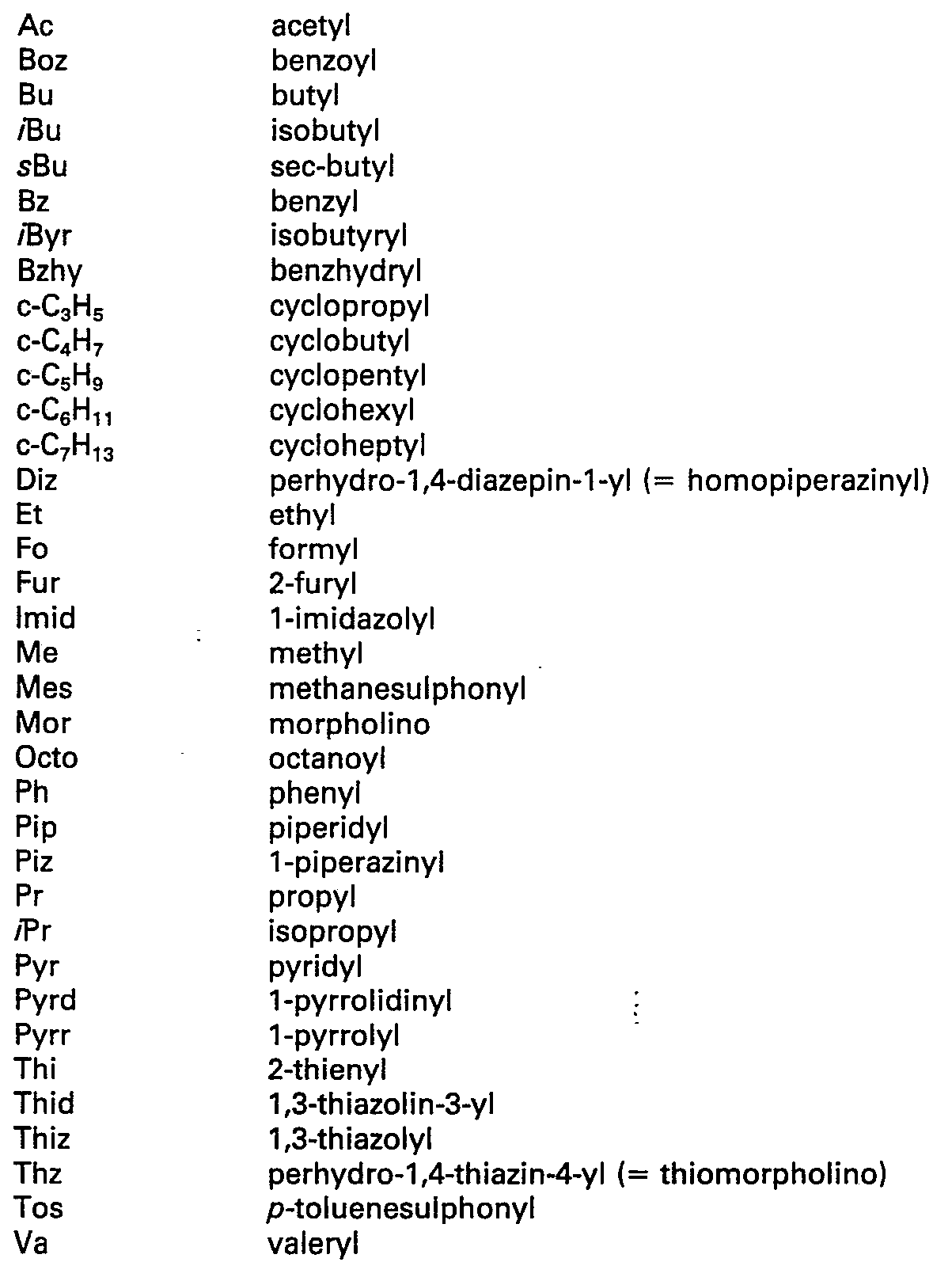
- Where a group identified by one of the above abbreviations can be attached to the remainder of the molecule through one of several of its atoms, the position of attachment is identified by the appropriate number preceding the abbreviation for that group; for example, in the case of the pyridyl group, this may be 3-Pyr, 2-Pyr etc. Also, where a group identified by one of the above abbreviations is substituted, the appropriate designation for its substituent or substituents precedes the abbreviation for the group so substituted and is itself (where appropriate) preceded by a number identifying the position of attachment of the substituent to the substituted group. For example, a 3-pyridyl group having an ethyl substituent at the 4-position would be identified as 4-Et-3-Pyr.


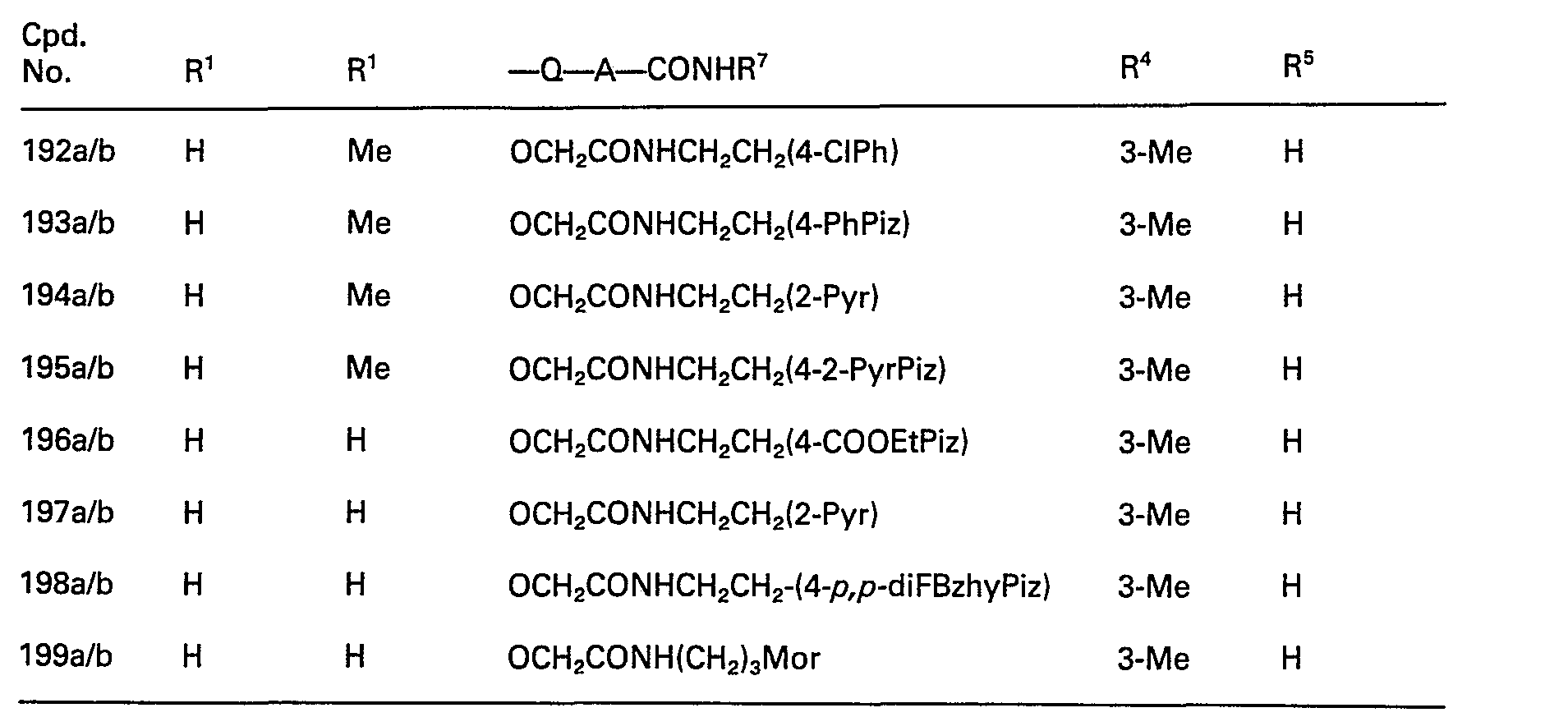
- Of the compounds listed above, preferred compounds are Compounds Nos. 34a, 38b, 48a, 51a, 53a, 58a, 69a, 71a, 83a, 83b, 84a, 88a, 91a, 97a, 118a, 122a, 140a, and 152a, as well as pharmaceutically acceptable acid addition salts of these compounds.
- The compounds of the invention may be prepared by a variety of methods, for example as illustrated below.
- The compounds of the invention may be prepared from the corresponding 6-(4-hydroxy- or mercaptophenyl) pyridazinone compounds as illustrated in the following reaction scheme:

- In the above formulae, R', R2, R4, R5, R7, Q, A and the dotted line are as defined above. R10 and R" are the same or different and each represents a hydrogen atom, a C1―C6 alkyl group, a C1―C6 alkyl group having at least one halogen substituent, a halogen atom, a C1―C6 alkoxy group a Cl-C7 aliphatic carboxylic acyloxy group, a protected amino group, a protected monoalkylamino group where the alkyl group is C1―C6 alkyl, a dialkylamino group where each alkyl group is C1―C6 alkyl, a C1―C7 aliphatic carboxylic acylamino group, a Cl-C7 aliphatic acyl group, a carboxy group, a carbamoyl group, a carbamoyl group having 1 or 2 C1―C6 alkyl substituents, a ureido group, an alkylureido group wherein the alkyl group is C1―C6 alkyl, a thioureido group, an alkylthioureido group wherein the alkyl group is C1―C6 alkyl, a cyano group or a nitro group.
- R'2 represents a hydroxy group, a C1―C6 alkoxy group, an aryloxy group, an aralkyloxy group in which the alkyl part has from 1 to 6 carbon atoms, or―NHR7, but, in this case, any active groups or atoms therein may be protected. Also, in the case of certain groups which may be represented by ―NHR7, it may be convenient (albeit not essential) to prepare first a compound containing a different group and then convert it to another group by one of the optional reactions of step A2.
- Examples of the groups which may be represented by R", R" and R'2 are given above.
- In step A1 of Method A, a compound of formula (II) is converted to an alkali metal salt thereof and then reacted with a halo compound of formula (V):

- The reaction is preferably effected in the presence of a solvent, the nature of which is not critical, provided that it has no adverse effect upon the reaction. Suitable solvents include, for example: amides, such as dimethylformamide, dimethylacetamide or hexamethylphosphoric triamide; sulphoxides, such as dimethyl sulphoxide; and nitriles, such as acetonitrile.
- The alkali metal salt to which the compound of formula (II) is converted is preferably a sodium, potassium or lithium salt. Conversion to this salt may be effected by treating the compound of formula (II) with an alkali metal compound, for example: an alkali metal hydride, such as sodium hydride or potassium hydride; or an organic lithium compound, such as lithium isobutyl cyclohexylamide or lithium dicyclohexylamide. This reaction may be effected over a wide range of temperatures, but suitably at a relatively low temperautre, for example from -20°C to about ambient temperature. The reaction to produce the alkali metal salt will normally require a period of from 30 minutes to 2 hours.
- Reaction of the alkali metal salt of the compound of formula (II) with the compound of formula (V) is preferably effected in one of the above solvents at a temperature of from 0°C to 120°C. The time required for the reaction will vary widely, depending upon many factors, primarily the reaction temperautre, but a period of from 30 minutes to 5 hours will normally suffice.
- The relative proportions of the alkali metal salt of the compound of formula (II) and the compound of formula (V) may vary widely, although approximately stoichiometric amounts are preferred. Although the reaction may be accelerated by employing an excess of the compound of formula (V), this can result in the introduction of a group of formula ―A―COR12 as a substituent on the nitrogen atom at the 2-position of the pyridazinone system, and although such compounds have some activity, they do not form part of the present invention.
- After completion of the reaction, the resulting compound of formula (la) may be recovered from the reaction mixture by conventional means. For example, one suitable recovery technique comprises: distilling the solvent from the reaction mixture; mixing the residue with ice-water; extracting the mixture with a water-immiscible organic solvent; washing with water and then drying the extract; and finally distilling the solvent from the extract to give the desired product. If desired, this may be further purified by conventional techniques, for example recrystallization or the various chromatography techniques, particularly column chromatography.
- The compounds of formula (II) employed as starting materials in this process are either already known or may be prepared by known methods, for example as described in the Journal of Medicinal Chemistry, 17, 273 (1974) or by a method similar to that described in steps B1 and B2 of Method B (that is, by employing a compound of Formula III in which the groupe -A-COR'2 is replaced by -H).
- The reactions represented by step A2 in the above reaction scheme are optional and include the following series of reactions, which, where two or more are to be employed, may be selected and combined in any appropriate order:
- hydrolysis of any ester group (e.g. an aliphatic acyloxy group, an alkoxycarbonyl group, an aryloxycarbonyl group or an aralkyloxycarbonyl group);
- conversion of a carboxy group, an alkoxycarbonyl group, an aryloxycarbonyl group or an aralkyloxycarbonyl group to an optionally substituted hydrazinocarbonyl or carbamoyl group;
- conversion of a nitro group into an amino group and optionally conversion of such an amino group into a mono- or di- alkylamino group;
- elimination of protecting groups on an amino group;
- conversion of a carboxy group to an alkoxycarbonyl group;
- conversion of a single bond represented by the dotted line to a double bond;
- acylation of appropriate heterocycles;
- salification.
- Hydrolysis of an ester may be carried out by conventional means. For example, a suitable reaction comprises treating the compound of formula (la) with an alkali metal hydroxide (such as sodium hydroxide or potassium hydroxide) in an inert solvent (such as aqueous ethanol) at a suitable temperature, e.g. from 0°C to 100°C, for a period of from 10 minutes to 2 hours.
- Conversion of an alkoxycarbonyl group, an aryloxycarbonyl group, an aralkyloxycarbonyl group or a carboxy group to a carbamoyl group may be carried out by reacting the compound of formula (la) (before or after one or more other optional reactions of step A2) with an amine derivative of formula (Vl):

- The nature of the solvent employed is not critical to the reaction, provided that it has no adverse effect on the reaction. Suitable solvents include those exemplified in relation to step A1 above, as well as alcohols, such as methanol or ethanol. The reaction will take place over a wide temperature range, but we normally prefer to carry it out at a temperature within the range from 0 to 150°C. The time required for the reaction will vary depending upon many factors, particularly the reaction temperature and the nature of the reagents, but a period of from 30 minutes to 24 hours will normally suffice.
- Conversion of a carboxylic acid into an amide may be carried out by reacting the corresponding compound of formula (la) (before or after one or more of the other optional reactions of step A2) with a compound of formula (VI), defined above, in the presence of a dehydrating agent and of an inert solvent. Suitable dehydrating agents include, for example: carbodiimides, such as dicyclohexylcarbodiimide; and cyanophosphoric acid esters, such as diethyl cyanophosphonate or dimethyl cyanophosphonate; of these, the cyanophosphoric acid esters are preferred. Suitable solvents include those illustrated in relation to step A1.
- This reaction is preferably effected in the presence of a base, more preferably an organic amine, such as triethylamine, pyridine or 4-dimethylaminopyridine. The reaction will take place over a wide temperature range, but we generally prefer a temperature within the range from 0 to 50°C. The time required for the reaction will vary, depending upon many factors, notably the reaction temperature and the nature of the reagents, but a period of from 2 to 24 hours will normally suffice.
- Alternatively, the same reaction may be effected by first converting the carboxylic acid into a reactive derivative thereof and then reacting this reactive derivative with the amine compound of formula (VI).
- Suitable reactive derivatives of the carboxylic acid include: acid halides, such as the acid chloride; mixed acid anhydrides of the carboxylic acid with another organic carboxylic acid, such as acetic acid, propionic acid or pivalic acid; and active esters of the carboxylic acid, such as the isobutoxycarbonyl ester. These reactive derivatives can be prepared by treating the corresponding carboxylic acid with a suitable halogen compound, such as thionyl chloride, acetyl chloride, pivaloyl chloride or isobutoxycarbonyl chloride.
- Where a reactive derivative of the carboxylic acid is employed, the reaction between the reactive derivative and the amine of formula (VI) is preferably effected in the presence of an inert solvent, the nature of which is not critical, provided that is has no adverse effect upon the reaction. Suitable solvents for this reaction include: hydrocarbons, which may be aliphatic, cycloaliphatic or aromatic, particularly benzene or hexane; and ethers, such as diethyl ether or tetrahydrofuran. Although the reaction can be carried out over a wide range of temperatures, we generally find it most convenient to effect the reaction at about ambient temperature. At such a temperature, the time required for the reaction will normally be within the range from 30 minutes to 3 hours.
- Conversion of a nitro group into an amino group may be carried out by treating the compound of formula (la) (before or after one or more other optional reactions of step A2) with a reducing agent or by catalytic hydrogenation.
- Suitable reducing agents include: a combination of an organic carboxylic acid (such as acetic acid or propionic acid) with a metal (such as zinc, iron, nickel or tin); and combinations of stannous chloride with a dilute mineral acid (such as dilute hydrochloric acid or dilute sulphuric acid). Of these, we prefer zinc/acetic acid or stannous chloride/dilute hydrochloric acid. This reaction is preferably effected in the presence of a solvent, the nature of which is not critical, provided that it has no adverse effect upon (although it may participate in) the reaction. Suitable solvents include: water; alcohols, such as methanol or ethanol; aqueous alcohols, such as aqueous methanol or aqueous ethanol; organic carboxylic acids, such as those mentioned above as part of the reducing agent system; and aqueous organic carboxylic acids, again such as those forming part of the reducing agent system.
- In the case of catalytic hydrogenation, preferred catalysts include, for example, platinum oxide, palladium black, palladium-on-activated carbon and Raney nickel. Palladium-on-activated carbon is preferably used. The reaction is preferably effected under a hydrogen atmosphere, for example at a hydrogen pressure of from 1 to 10 atmospheres (about 1 to 10 bars). The reaction is preferably effected in the presence of a solvent, the nature of which is not critical, provided that it has no adverse effect on the reaction. Suitable solvents include, for example: alcohols, such as methanol or ethanol; ethers, such as tetrahydrofuran or dioxane; organic carboxylic acids, such as acetic acid or propionic acid; and mixtures of one or more of these organic solvents with water.
- The reaction will take place over a wide range of temperatures, but we generally find it convenient to carry out the reaction at a temperature within the range from 0 to 50°C. The time required for the reaction will vary, depending upon many factors, notably the reaction temperature and the nature of the reagents, but a period of from 30 minutes to 2 hours will normally suffice.
- Conversion of a free amino group into a mono- or di-alkylamino group may be effected by reacting the corresponding amino compound with an alkyl halide (preferably a chloride, bromide or iodide), the nature of the alkyl group depending upon which alkyl group it is desired to introduce. The reaction is preferably effected in the presence of a base. Examples of suitable bases which may be employed include carbonates and bicarbonates, such as sodium carbonate, potassium carbonate, sodium bicarbonate or potassium bicarbonate. The reaction is preferably effected in the presence of an inert solvent, the nature of which is not critical, provided that it has no adverse effect upon the reaction. Suitable solvents include, for example: amides, such as dimethylformamide or dimethylacetamide; sulphoxides, such as dimethyl sulphoxide; alcohols, such as methanol or ethanol; water; and mixtures of one or more of these organic solvents with water.
- The reaction will take place over a wide range of temperatures, but we generally find it convenient to carry out the reaction at a temperature of from 0°C to 100°C. The time required for the reaction will vary, depending upon many factors, but a period of from 30 minutes to 5 hours will normally suffice.
- In this reaction, the product will normally be a mixture of the monoalkylamino compound and the dialkylamino compound; use of approximately equimolar amounts of the alkyl halide and of the amino compound will result in the predominant production of the monoalkylamino compound; on the other hand, use of an excess of the alkyl halide will normally favour predominant production of the dialkylamino compound.
- Elimination of a protecting group from the amino group may be effected by catalytic hydrogenation, details of the reaction being similar to those discussed above in relation to the catalytic hydrogenation of a nitro group into an amino group.
- Conversion of a carboxy group to an alkoxycarbonyl group is a conventional esterification reaction. It may, for example, be carried out by reacting the corresponding carboxy compound with a diazoalkane corresponding to the alkoxy group of the alkoxycarbonyl group which it is desired to prepare, for example diazomethane, diazoethane or diazopropane. The reaction is preferably effected in the presence of an inert solvent, the nature of which is not critical, provided that it has no adverse effect on the reaction; suitable solvents include ethers, such as diethyl ether. The reaction temperature is likewise not critical, and we generally find it convenient to carry out the reaction at about ambient temperature.
- Alternatively, this esterification may be carried out by reacting the corresponding carboxy compound with an alkanol, such as methanol, ethanol or butanol, in the presence of a dehydrating agent. Reagents and reaction conditions to be employed in this reaction are similar to those discussed above in relation to the reaction of a carboxylic acid with an amine.
- Where the resulting compound of formula (la) (before or after any of the other optional reactions of step A2) has a single bond between the 4- and 5-positions of the pyridazinone system, this may be converted to the corresponding compound having a double bond in that position by one of two processes. One process comprises halogenating the single bond compound and then dehydrohalogenating the resulting halogenated compound. These two reactions may be carried out simultaneously in the same reaction medium, for example by treating the starting material with a halogen or with a suitable halogen compound (particularly chlorine or bromine) at a temperature of from 50 to 150°C for a period of from 5 minutes to 1 hour in a carboxylic acid, such as acetic acid or propionic acid.
- Alternatively, the single bond compound may be converted to the corresponding double bond compound by reaction with an alkali metal salt of a sulphonic acid (which may be an arylsulphonic acid) such as sodium m-nitrobenzenesulphonate, potassium m-nitrobenzenesulphonate or sodium 5-nitronaphthalene-1-sulphonate, in an aqueous alkali solution at a temperature of from 50°C to 150°C for a period of from 30 minutes to 5 hours.
- Where the group represented by -NHR' in the compound of formula (I) or (la) is or contains a heterocyclic ring containing at least one unsubstituted nitrogen atom, for example a piperazine or homopiperazine ring, this may, if desired, be acylated. The reaction is carried out by reacting the starting material with a reactive derivative of the carboxylic, sulphonic or other acid whose acyl group it is desired to introduce. In particular, such acylation may, for example, introduce an aliphatic, aromatic, cycloaliphatic, araliphatic or heterocyclic carboxylic acyl group, an aliphatic or aromatic sulphonyl group, an alkoxycarbonyl group, an aryloxycarbonyl group or an aralkyloxycarbonyl group.
- The preferred reactive derivatives include the carboxylic acid anhydrides, carboxylic acid halides, sulphonic acid halides and halocarbonates. Preferred anhydrides are acetic anhydride, propionic anhydride, butyric anhydride, valeric anhydride, octanoic anhydride and optionally substituted benzoic anhydride. Preferred halides are chlorides and bromides, e.g. acetyl chloride, propionyl chloride, butyryl chloride, valeryl chloride, octanoyl chloride, acryloyl chloride, crotonoyl chloride, optionally substituted benzoyl chloride, optionally substituted benzoyl bromide, nicotinoyl chloride, furoyl chloride, thenoyl chloride, methanesulphonyl chloride, ethanesulphonyl chloride, hexanesulphonyl chloride, optionally substituted benzenesulphonyl chloride, methyl chlorocarbonate, ethyl chlorocarbonate, hexyl chlorocarbonate, phenyl chlorocarbonate and benzyl chlorocarbonate. The reaction is preferably effected in the presence of an inert solvent and of a base. The nature of the solvent employed is not critical, provided that it has no adverse effect upon the reaction. Examples of suitable solvents include: hydrocarbons, such as hexane, cyclohexane, benzene, toluene or xylene; ethers such as diethyl ether, tetrahydrofuran or dioxane; and halogenated hydrocarbons such as methylene chloride, chloroform or carbon tetrachloride. Where the reactive derivative is an acid anhydride, we prefer to use an excess of the base as the reaction solvent. Preferred bases are organic amines, for example pyridine, N,N-dimethylaniline or triethylamine, more preferably pyridine.
- The reaction will take place over a wide range of temperatures, but we generally find it convenient to carry out this reaction at about ambient temperature. The time required for the reaction will vary, depending upon many factors, notably the nature of the reagents and the reaction temperature, but a period of from 1 hour to 1 day will normally suffice.
- At the end of any of these reactions, the desired compound may be recovered from the reaction mixture by conventional means. For example, one suitable recovery procedure comprises: pouring the reaction mixture either directly or after distilling off the solvent into ice-water; if necessary, neutralising the resulting mixture; extracting the mixture with a water-immiscible organic solvent; washing with water and then drying the extract; and finally distilling the solvent from the extract to give the desired product. If necessary, this may be further purified by conventional means, for example recrystallization or the various chromatography techniques, particularly column chromatography.
- In this Method, the compounds of the invention are prepared by reacting a phenyl derivative with succinic or maleic anhydride, or a derivative thereof, and then reacting the product with hydrazine, as illustrated in the following reaction scheme:

- In the above formulae, R1, R2, R4, R5, R', R'2, Q, A and the dotted line are as defined above, though as with Method A, protection of groups R4 and RS can be adopted.
- Step B1 of this Method comprises reacting the phenyl derivative of formula (III) with the succinic or maleic anhydride or derivative thereof of formula (VII). The reaction is preferably effected in the presence of an acid catalyst and in an inert solvent.
- The nature of the acid catalyst employed is not critical and any acid catalyst commonly used in Friedel-Crafts reactions may be employed. Examples of such acid catalysts include: Lewis acids, such as aluminium chloride, zinc chloride, ferric chloride, titanium tetrachloride or boron trifluoride; and protonic acids, such as hydrofluoric acid or sulphuric acid. Of these, aluminium chloride is preferred.
- There is no particular limitation on the nature of the inert solvent to be employed in this reaction, provided that it does not interfere with the reaction. Examples of suitable solvents include: halogenated hydrocarbons, preferably halogenated aliphatic hydrocarbons, such as methylene chloride, chloroform or carbon tetrachloride; and amides, such as dimethylformamide and dimethylacetamide. Of these, methylene chloride is preferred.
- The reaction will take place over a wide range of temperatures, but we normally find it convenient to carry out the reaction at a temperature of from 0 to 50°C. The time required for the reaction will vary, depending upon many factors, notably the reaction temperature and the nature of the reagents, but a period of from 1 hour to 5 hours will normally suffice.
- After completion of this reaction, the resulting compound of formula (IV) may be recovered from the reaction mixture by conventional means. For example, one suitable recovery technique comprises: pouring the reaction mixture into ice-water; extracting the mixture with a water-immiscible organic solvent; washing the extract with water and then drying it; and finally distilling the solvent from the extract to give the required compound. If desired, this compound may be further purified by conventional methods, for example recrystallization or the various chromatography techniques, particularly column chromatography.
- In step B2 of this method, the compound of formula (IV), obtained in step B1, is reacted with hydrazine in an inert solvent, to give the compound of formula (lb).
- The nature of the solvent employed in this process is not critical, provided that it has no adverse effect upon the reaction. Examples of suitable solvents include: alcohols, such as methanol, ethanol and propanol; ethers, such as diethyl ether or tetrahydrofuran; water; and mixtures of one or more of the above organic solvents with water. Of these, we prefer the alcohols.
- The reaction will take place over a wide range of temperatures, but we generally find it convenient to carry out the reaction at a temperature of from 0 to 100°C. The time required for the reaction will vary, depending upon many factors, notably the reaction temperature and the nature of the reagents, but a period of from 2 to 10 hours will normally suffice.
- After completion of the reaction, the desired compound of formula (lb) may be recovered from the reaction mixture by conventional means. For example, one suitable recovery procedure comprises: pouring the reaction mixture into ice-water, optionally after distilling off the solvent; extracting the mixture with a water-immiscible organic solvent; washing the extract with water and drying it; and finally distilling the solvent from the extract. If necessary, this product may be further purified by such conventional techniques as recrystallization or the various chromatography techniques, particular column chromatography.
- If the carbonyl group (>C=O) attached to the group represented by NHR' or any carbonyl group within the groups represented by R4 or RI is converted by this reaction into a hydrazone group (>C=N-NH2), the carbonyl group may be regenerated by treating the resulting compound with an acid in an inert solvent. Suitable acids include: organic carboxylic acids, such as acetic acid or propionic acid; and dilute mineral acids, such as dilute hydrochloric acid or dilute sulphuric acid. The nature of the solvent employed is not critical, provided that it does not interfere with the reaction. Suitable solvents include, for example: water; alcohols, such as methanol or ethanol; ethers, such as diethyl ether or dioxane; and mixtures of one or more of the above organic solvents with water.
- The reaction will take place over a wide range of temperatures, but we generally find it convenient to employ a temperature within the range from 20 to 100°C. The time required for the reaction will vary, depending upon many factors, notably the reaction temperature and the nature of the reagents, but a period of from 10 minutes to 3 hours will normally suffice.
- Step B3 includes the same optional reactions as described in relation to step A2 and may be carried out in the same way.
- The compounds of the present invention have been found to possess excellent myocardial contractivity, anti-hypertensive activity and other similar activities, which appear to be better than those of the known pyridazinone compounds. Accordingly, it is anticipated that the compounds of the invention will be of considerable therapeutic use as cardiac stimulants, anti-hypertensive drugs and anti-thrombotic agents.
- The cardiac activity of the compounds of the invention is illustrated by the following tests.
- Following the method reported by Alousi et al [Circulation Research 45, 666 (1979)], a fine catheter, having a pressure sensor built in at the top was inserted into the carotid artery of an anaesthetised dog in the direction of the heart. The top part of the catheter was placed in the left ventricle and the pressure waveform obtained was recorded by its linear differential value. The value for the contraction of the left ventricle was taken as the maximum value of this pressure wave.
- Each test compound was dissolved either in 0.1 N hydrochloric acid or in dimethylformamide and administered intravenously (Table 1) or intraduodenally (Table 2) and the percentage increase in contractive power from its level immediately prior to administration, as well as the recovery time (in minutes) are shown in the following Tables. The recovery time measured was the time taken, after administration of the test compound, for the heart contractive power to return to its level immediately prior to administration. For purposes of comparison, two prior art compounds were similarly tested. Compound A is 4,5-dihydro-6-(p-methoxyphenyl)-3(2H)-pyridazinone, one of the compounds disclosed in Japanese Patent Application Kokai No. 8015/83; Compound B is amrinone, whose systematic name is 5-amino-(3,4'-bipyridin)-6(1H)-one, which is currently used as a cardiotonic.

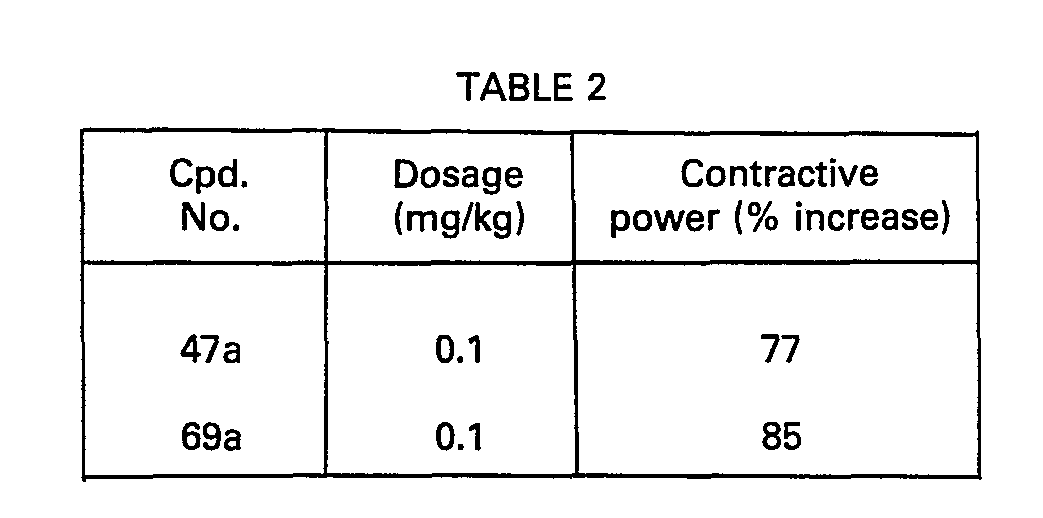
- As can be seen from the above results, particularly those in Table 1, the compounds of the invention potentiated the contractions of the heart significantly better than the two known compounds, including amrinone, which is sold commercially for this specific purpose; moreover, the effect of the compounds of the invention was more durable. As can be seen from Table 2, the compounds of the invention significantly potentiate the contractions of the heart when administered intraduodenally at doses not greater than 10 times the optimal intravenous dose; moreover, the compounds are well absorbed in the digestive tract.
- The compounds of the invention can be administered as conventional pharmaceutical formulations, depending upon the intended route of administration. For example, for oral administration, they may be formulated as powders, granules, tablets, capsules or similar orally administrable formulations which can be produced by mixing the active compound with carriers, excipients or diluting agents, such as glucose, sucrose, lactose, sorbitol, starch, polyvinylpyrrolidone, mannitol, calcium carbonate, calcium phosphate, sodium chloride or boric acid. For parenteral administration, they may be formulated as conventional injections suitable for, for example, intravenous injection. The dose will vary, depending upon the nature of the disorder, the route of administration, and the symptoms, age and body weight of the patient; however, for an adult human patient, a suitable dose would be from 0.001 mg to 50 mg per day, which could be given in a single dose or in divided doses.
- The invention is further illustrated by the following Examples, which illustrate the preparation of various of the compounds of the invention and intermediates therefor. The preparation of certain of the starting materials employed in the Examples is illustrated in the subsequent Preparations.
- 1.79 g of 6-(3-chloro-4-hydroxyphenyl)-4,5-dihydro-3(2H)-pyridazinone (prepared as in Preparation 8) was dissolved in 15 ml of anhydrous dimethylformamide. 0.35 g of a 55% w/w suspension of sodium hydride in mineral oil was added, and the solution was stirred for 1 hour. To this solution, was added, whilst ice-cooling, 1 ml of a dimethylformamide solution containing 1.34 g of ethyl bromoacetate, and the mixture was stirred for 1 hour at room temperature and then for 3 hours at 80°C. At the end of this time, the dimethylformamide was distilled off under reduced pressure and the mixture was diluted with water and then extracted with ethyl acetate. The extract was washed with water, dried and then evaporated to dryness. The addition of hexane precipitated 1.85 g of the title compound as white needles melting at 134-136°C.
- Elemental Analysis:

- 50 ml of a 50% v/v aqueous ethanol solution containing 5 g of 6-[3-chloro-4-(ethoxycarbonylmethoxy)-phenyl]-4,5-dihydro-3(2H)-pyridazinone prepared as described in Example 1) and 2.5 g of sodium hydroxide were stirred together for 40 minutes at 80°C and then cooled. The solution was acidified with hydrochloric acid and the crystals which precipitated were recrystallized from aqueous ethanol, to give 3.35 g (yield 73.79%) of the title compound as white crystals, melting at 214-216°C.
- Elemental Analysis:

- 0.7 g of 6-[3-chloro-4-(carboxymethoxy)phenyl]-4,5-dihydro-3(2H)-pyridazinone prepared as described in Example 2) and 0.35 g of N-(2-aminoethyl)morpholine were dissolved in 8 ml of dimethylformamide. To this solution were added 0.55 g of trimethylamine and 0.5 g of 90% diethyl cyanophosphonate, whilst ice cooling. The reaction mixture was then allowed to stand for one day and overnight at ambient temperature, after which it was poured into ice-water. The crystals which precipitated were collected by filtration. Recrystallization from ethanol gave 0.6 g (yield 61.2%) of the title compound as white crystals melting at 193-194°C.
- Elemental Analysis:

- 1.5 g of 6-{3-chloro-4-[N-(2-morpholinoethyl)-carbamoylmethoxy]phenyl}-4,5-dihydro-3-(2H)-pyridazinone (Compound No. 83a, prepared as described in Example 3) was dissolved in 18 ml of acetic acid, and 2 ml of acetic acid containing 0.65 g of bromine were then added dropwise at 100°C to the resulting solution. After completion of the addition, the reaction mixture was stirred for 10 minutes at the same temperature and then poured into ice-water. This solution was neutralized with sodium carbonate and then extracted with ethyl acetate. The extract was dried and then concentrated by evaporation under reduced pressure. The residue was purified by silica gel column chromatography (eluting solvent: ethyl acetate:ethanol = 9:1 by volume). Recrystallization from ethanol gave 0.4 g (yield 27.0%) of the title compound as white needles melting at 201-202°C.
- 1.91 g of 6-[3-chloro-4-(carboxymethoxy)phenyl]-4,5-dihydro-3(2H)-pyridazinone prepared as described in Example 2) was dissolved in 55 ml of a 2% w/v aqueous sodium hydroxide solution, and 1.6 g of sodium m-nitrobenzenesulphonate was added thereto. The mixture was heated, with stirring, over an oil bath at 120°C for 2 hours. The mixture was then cooled to room temperature and then acidified with 6N hydrochloric acid to a pH value of 2-3. The resulting precipitate was collected by filtration, to give 1.2 g of the title compound, melting at 227-232°C.
- Following the same procedure as described in Example 3, the title compound, melting at 201-212°C, was prepared from 6-[3-chloro-4-(carboxymethoxy)-phenyl]-3(2H)-pyridazinone prepared as described in Example 5 and N-(2-aminoethyl)morpholine.
- 5.0 g of 6-[3-chloro-4-(ethoxycarbonylmethoxy)phenyl]-4,5-dihydro-3-(2H)-pyridazinone prepared as described in Example 1) and 2.18 g of N-(2-aminoethyl)piperazine were mixed, and the mixture was heated, with stirring, over an oil bath at 130-140°C for 50 minutes. The mixture was cooled to room temperature, and then ethanol was added thereto and insoluble material was filtered off. The filtrate was concentrated by evaporation in vacuo and the residue was crystallized by the addition of isopropyl alcohol. The resulting crystals were collected by filtration to give 3.9 g of the crude title compound, which was further purified by recrystallization from ethanol to give the pure compound, melting at 176-178°C.
- 0.5 g of 6-{3-chloro-4-[N-(2-piperazin-1-ylethyl)carbamoylmethoxy]phenyl}-4,5-dihydro-3-(2H)-pyridazinone (Compound No. 136a, prepared as described in Example 7) was suspended in 6 ml of pyridine, and 0.29 g of acetic anhydride was added thereto at room temperature, with stirring. The mixture was then stirred at the same temperature for 1.5 hours and allowed to stand overnight. The solvent was then distilled off in vacuo and the residue was purified by silica gel column chromatography, eluted with 5% v/v ethanol in methylene chloride, followed by recrystallization from isopropyl alcohol to yield 0.36 g of the title compound, melting at 183-185°C.
- 6 ml of a dimethylformamide solution containing 0.8 g of 6-[3-chloro-4-(ethoxycarbonylmethoxy)-phenyl]-4,5-dihydro-3(2H)-pyridazinone prepared as described in Example 1) and 4 ml of butylamine was stirred for 7 hours at 120°C. This solution was then poured into ice-water and the crystals which precipitated were collected by filtration. Recrystallization of these from dimethylformamide gave 0.6 g (yield 62.8%) of the title compound as white crystals melting at 140-141°C.
- Elemental Analvsis:

- The following compounds were also prepared by the appropriate one of the procedures described in the preceding Examples. The compounds are identified by the numbers heretofore assigned to them.


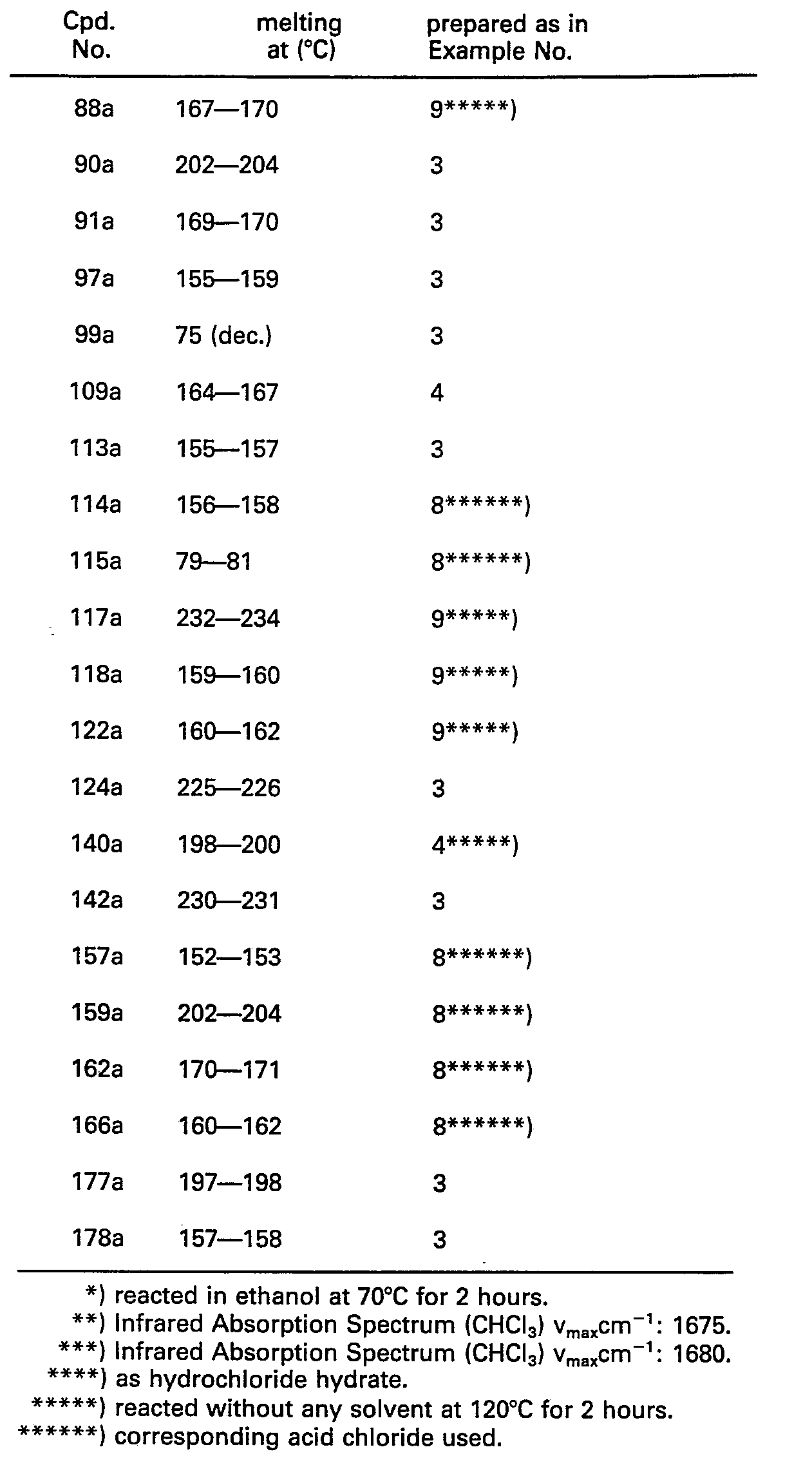
- A mixture of 51.4 g of o-chlorophenol, 58.8 g of ethyl chloroacetate, 55.3 g of potassium carbonate and 250 ml of acetone was heated under reflux for 7 hours. The mixture was then cooled to room temperature and an insoluble material was filtered off. The filtrate was concentrated in vacuo and the resulting residue was purified by silica gel column chromatography to give 69.0 g of the title compound as an oil, boiling at 134-137°C/2 mm Hg (267 Pa).
- 24.5 g of O-methylanisole and 20.0 g of succinic anhydride were dissolved in 230 ml of methylene chloride. Holding the temperature of the reaction solution below 5°C, 84 g of aluminium chloride were slowly added. After the addition was complete, the reaction mixture was stirred for 1 hour at a temperature of below 5°C and for an additional 5 hours at room temperature. It was then allowed to stand for one day and overnight at room temperature, after which the reaction mixture was poured into ice-cooled dilute hydrochloric acid and the resulting precipitate was collected by filtration. The precipitate was washed and then dissolved in ethanol. This solution was dried by azeotropic distillation and then evaporated to dryness. 4.16 g of the title compound were obtained as an oil.
- Infrared Absorption Spectrum (liquid film) Vmaxcm-1: 1715, 1690.
- 41.6 g of the compound prepared as described in step (a) were dissolved in 400 ml of ethanol. To this solution were slowly added, with ice-cooling, 8.2 g of 80% v/v aqueous hydrazine hydrate. After the addition was complete, the reaction mixture was stirred for 20 minutes and then heated under reflux, with stirring, for 3 hours. This reaction mixture was then allowed to stand for one day and overnight, after which it was cooled in ice-water. The resulting precipitate was collected by filtration and recrystallized from a mixture of ethanol and ethyl acetate, to give 22.7 g of the title compound melting at 265267°C.
- Following the same procedure as described above, the pyridazinone derivatives of formula (Ila) shown below were also obtained:
-


Claims (29)


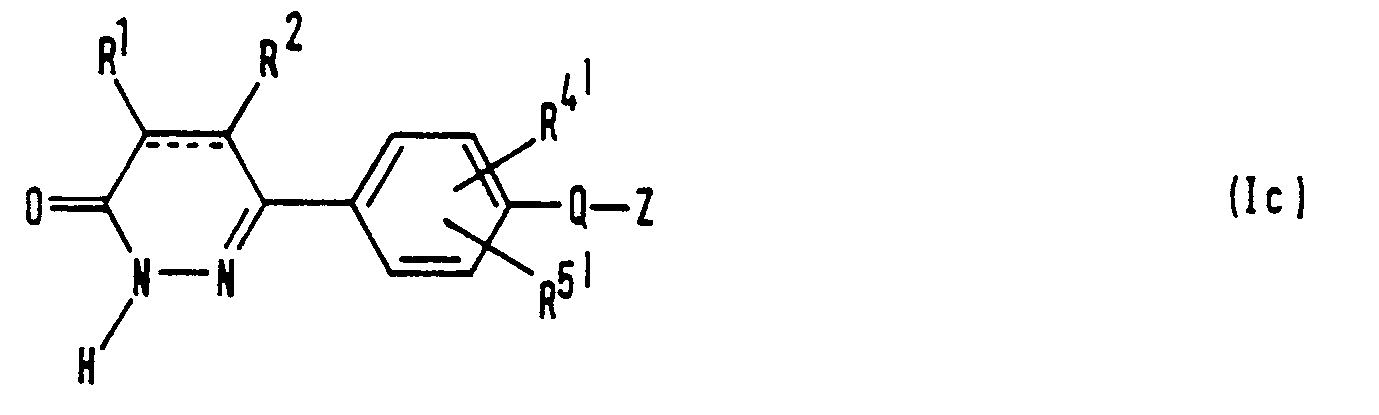
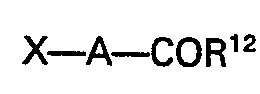
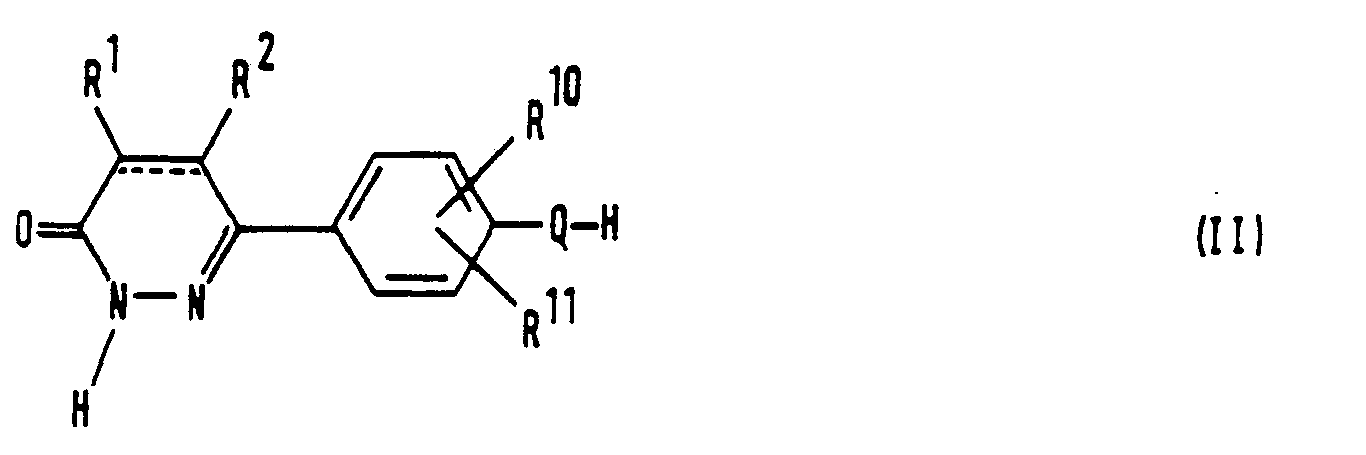
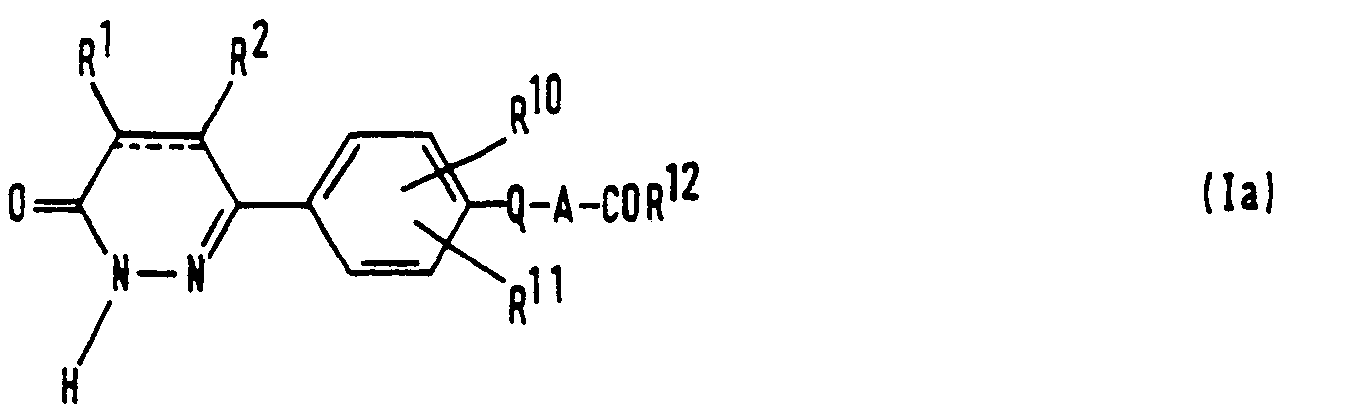

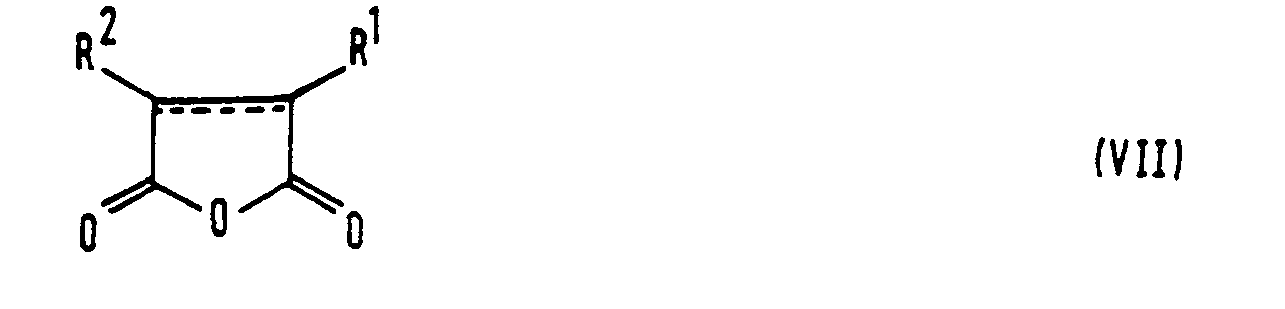


Priority Applications (1)
| Application Number | Priority Date | Filing Date | Title |
|---|---|---|---|
| AT85307364T ATE60324T1 (en) | 1984-10-12 | 1985-10-14 | PYRIDAZINONE DERIVATIVES, THEIR PREPARATION AND USE. |
Applications Claiming Priority (2)
| Application Number | Priority Date | Filing Date | Title |
|---|---|---|---|
| JP59213968A JPS6193169A (en) | 1984-10-12 | 1984-10-12 | Pyridazinone derivative and its preparation |
| JP213968/84 | 1984-10-12 |
Related Child Applications (1)
| Application Number | Title | Priority Date | Filing Date |
|---|---|---|---|
| EP89105964.4 Division-Into | 1989-04-05 |
Publications (3)
| Publication Number | Publication Date |
|---|---|
| EP0178189A2 EP0178189A2 (en) | 1986-04-16 |
| EP0178189A3 EP0178189A3 (en) | 1987-03-04 |
| EP0178189B1 true EP0178189B1 (en) | 1991-01-23 |
Family
ID=16648043
Family Applications (2)
| Application Number | Title | Priority Date | Filing Date |
|---|---|---|---|
| EP89105964A Expired - Lifetime EP0330242B1 (en) | 1984-10-12 | 1985-10-14 | Pyridazinone derivatives, their preparation and use |
| EP85307364A Expired - Lifetime EP0178189B1 (en) | 1984-10-12 | 1985-10-14 | Pyridazinone derivatives, their preparation and use |
Family Applications Before (1)
| Application Number | Title | Priority Date | Filing Date |
|---|---|---|---|
| EP89105964A Expired - Lifetime EP0330242B1 (en) | 1984-10-12 | 1985-10-14 | Pyridazinone derivatives, their preparation and use |
Country Status (7)
| Country | Link |
|---|---|
| US (1) | US4914093A (en) |
| EP (2) | EP0330242B1 (en) |
| JP (1) | JPS6193169A (en) |
| KR (1) | KR900002059B1 (en) |
| AT (2) | ATE60324T1 (en) |
| DE (2) | DE3587596T2 (en) |
| ES (1) | ES8702371A1 (en) |
Families Citing this family (22)
| Publication number | Priority date | Publication date | Assignee | Title |
|---|---|---|---|---|
| JPH0613483B2 (en) * | 1985-11-12 | 1994-02-23 | 三共株式会社 | Phenylpyridazinone derivatives |
| JPS6314774A (en) * | 1986-07-07 | 1988-01-21 | Mitsubishi Chem Ind Ltd | Pyridazinone derivative or salt thereof |
| US4888423A (en) * | 1986-10-06 | 1989-12-19 | Ciba-Geigy Corporation | 6-(4-Hydroxyphenyl)-4,5-dihydro-3(2h)-pyridazinones and stabilized compositions |
| US5019612A (en) * | 1986-10-06 | 1991-05-28 | Ciba-Geigy Corporation | 6-(4-hydroxyphenyl)-4,5-dihydro-3(2H)-pyridazinones and stabilized compositions |
| DE3728491A1 (en) * | 1987-08-26 | 1989-03-09 | Heumann Pharma Gmbh & Co | DIHYDROPYRIDAZINONE DERIVATIVES, METHOD FOR THE PRODUCTION THEREOF AND MEDICINAL PRODUCTS CONTAINING THESE COMPOUNDS |
| US5198448A (en) * | 1988-08-10 | 1993-03-30 | Otsuka Pharmaceutical Company, Limited | Cardiotonics |
| DE3902316A1 (en) * | 1989-01-26 | 1990-08-02 | Lentia Gmbh | Novel piperazinylalkyl-3(2H)-pyridazinones, process for their preparation and their use as hypotensive agents |
| US5273976A (en) * | 1989-04-06 | 1993-12-28 | Sankyo Company, Limited | Ocular hypotensive agents |
| US5175161A (en) * | 1989-04-06 | 1992-12-29 | Sankyo Company, Limited | Occular hypotensive agents |
| US5204463A (en) * | 1989-08-10 | 1993-04-20 | Glaxo Inc. | Substituted methoxyphenyl-4,5 dihydro-3(2H)-pridazinones having cardiotonic and beta blocking activities |
| JPH03141264A (en) * | 1989-08-10 | 1991-06-17 | Glaxo Inc | Pyridazinone having cardiac activity and beta blocking activity |
| US5096904A (en) * | 1989-09-01 | 1992-03-17 | Glaxo Inc. | Pyridazinones having cardiotonic and beta blocking activities |
| US5051431A (en) * | 1989-09-22 | 1991-09-24 | Glaxo Inc. | Pyridone nitriles useful in treating cardiovascular disease |
| US5153209A (en) * | 1989-09-22 | 1992-10-06 | Glaxo Inc. | Pyridone nitriles useful in treating cardiovascular disease |
| US5100892A (en) * | 1990-11-13 | 1992-03-31 | Glaxo Inc. | Dihydropyridine vasodilator agents |
| GB2251615B (en) * | 1991-01-03 | 1995-02-08 | Orion Yhtymae Oy | (-)-[[4-(1,4,5,6-tetrahydro-4-methyl-6-oxo-3-pyridazinyl)phenyl]hydrazono]pro panedinitrile |
| IL118631A (en) * | 1995-06-27 | 2002-05-23 | Tanabe Seiyaku Co | Pyridazinone derivatives and processes for their preparation |
| EP1565472A2 (en) * | 2002-11-27 | 2005-08-24 | Artesian Therapeutics, Inc. | Compounds with mixed pde-inhibitory and beta-adrenergic antagonist or partial agonist activity for treatment of heart failure |
| MXPA05006975A (en) * | 2002-12-23 | 2005-12-14 | Artesian Therapeutics Inc | CARDIOTONIC COMPOUNDS WITH INHIBITORY ACTIVITY AGAINST beta-ADRENERGIC RECEPTORS AND PHOSPHODIESTERASE. |
| WO2006060122A2 (en) * | 2004-11-30 | 2006-06-08 | Artesian Therapeutics, Inc. | Cardiotonic compounds with inhibitory activity against beta-adrenergic receptors and phosphodiesterase |
| JP2008521806A (en) * | 2004-11-30 | 2008-06-26 | アーテシアン セラピューティクス, インコーポレイテッド | Compound having mixed PDE-inhibitory activity and β-adrenergic antagonist activity or partial agonist activity for treating heart failure |
| JP2006181097A (en) * | 2004-12-27 | 2006-07-13 | Mammy's:Kk | Sales floor structure and product display method |
Citations (1)
| Publication number | Priority date | Publication date | Assignee | Title |
|---|---|---|---|---|
| JPS588015A (en) * | 1981-07-06 | 1983-01-18 | Mitsubishi Chem Ind Ltd | Cardiotonic drug |
Family Cites Families (3)
| Publication number | Priority date | Publication date | Assignee | Title |
|---|---|---|---|---|
| GB1383906A (en) * | 1971-02-22 | 1974-02-12 | Bdh Pharmaceuticals Ltd | Pyridazinones |
| GB1488330A (en) * | 1973-12-19 | 1977-10-12 | Smith Kline French Lab | Dihydropyridazinones |
| US4816454A (en) * | 1984-09-21 | 1989-03-28 | Cassella Aktiengesellschaft | 4,5-dihydro-3(2H)-pyridazinones and their pharmacological use |
-
1984
- 1984-10-12 JP JP59213968A patent/JPS6193169A/en active Granted
-
1985
- 1985-10-11 ES ES547826A patent/ES8702371A1/en not_active Expired
- 1985-10-12 KR KR1019850007521A patent/KR900002059B1/en not_active Expired
- 1985-10-14 DE DE89105964T patent/DE3587596T2/en not_active Expired - Fee Related
- 1985-10-14 DE DE8585307364T patent/DE3581465D1/en not_active Expired - Fee Related
- 1985-10-14 AT AT85307364T patent/ATE60324T1/en not_active IP Right Cessation
- 1985-10-14 EP EP89105964A patent/EP0330242B1/en not_active Expired - Lifetime
- 1985-10-14 AT AT89105964T patent/ATE94874T1/en active
- 1985-10-14 EP EP85307364A patent/EP0178189B1/en not_active Expired - Lifetime
-
1989
- 1989-03-16 US US07/325,112 patent/US4914093A/en not_active Expired - Fee Related
Patent Citations (1)
| Publication number | Priority date | Publication date | Assignee | Title |
|---|---|---|---|---|
| JPS588015A (en) * | 1981-07-06 | 1983-01-18 | Mitsubishi Chem Ind Ltd | Cardiotonic drug |
Also Published As
| Publication number | Publication date |
|---|---|
| ATE60324T1 (en) | 1991-02-15 |
| EP0330242B1 (en) | 1993-09-22 |
| EP0330242A1 (en) | 1989-08-30 |
| EP0178189A2 (en) | 1986-04-16 |
| ES8702371A1 (en) | 1986-12-16 |
| JPS6193169A (en) | 1986-05-12 |
| JPH0557983B2 (en) | 1993-08-25 |
| US4914093A (en) | 1990-04-03 |
| KR860003232A (en) | 1986-05-21 |
| ES547826A0 (en) | 1986-12-16 |
| KR900002059B1 (en) | 1990-03-31 |
| EP0178189A3 (en) | 1987-03-04 |
| ATE94874T1 (en) | 1993-10-15 |
| DE3581465D1 (en) | 1991-02-28 |
| DE3587596D1 (en) | 1993-10-28 |
| DE3587596T2 (en) | 1994-05-11 |
Similar Documents
| Publication | Publication Date | Title |
|---|---|---|
| EP0178189B1 (en) | Pyridazinone derivatives, their preparation and use | |
| CA2335104C (en) | Arylalkanoylpyridazines | |
| KR910005233B1 (en) | Pyridazinone derivatives | |
| RU2034846C1 (en) | Method of synthesis of compounds of group imidazo-[1,2-b]-pyridazine or their salt | |
| HU205922B (en) | Process for producing thiazol derivatives and pharmaceutical compositions containing them | |
| IE883823L (en) | 6-phenyldihydro-pyridazinones. | |
| WO1996020936A1 (en) | Novel thiazolidin-4-one derivatives | |
| AU715751B2 (en) | New benzimidazole, benzoxazole and benzothiazole compounds, process for preparing them and pharmaceutical compositions containing them | |
| US4247551A (en) | N-Pyrrolyl-pyridazineamines and their use as antihypertensive agents | |
| EP0228959A2 (en) | Aminostyryl compound, leukotriene antagonistic composition containing the same as effective ingredients and method of antagonizing SRS by employing the same | |
| JPH0321553B2 (en) | ||
| EP0018063A1 (en) | Pyridazin (2H)-3-ones, process for their preparation and their use in antihypertensive agents | |
| EP0316820A1 (en) | Thiazole compounds, processes for the preparation thereof and pharmaceutical composition comprising the same | |
| EP0201765A2 (en) | 3(2H)Pyridazinone, process for its preparation and anti-allergic agent containing it | |
| CA2049490A1 (en) | Pyrrolobenzimidazoles, imidazobenzoxazinones and imidazoquinolones, process for their preparation and their use and preparations containing the compounds | |
| CA1283914C (en) | Derivative of benzoquinonylphenyl alkanoic acid amide | |
| KR930003852B1 (en) | Process for preparing 1,2,4-triazinone derivatives | |
| HU197897B (en) | Process for producing pyridazinone derivatives, the salts thereof and pharmaceutical compositions containing the same | |
| WO2007039578A1 (en) | Imidazolyl-substituted azabenzophenone compounds | |
| US3478028A (en) | 4-substituted-1-hydroxylaminophthalazines | |
| US4990507A (en) | N-containing heterocyclic compounds, and composition comprising the same | |
| WO1982003861A1 (en) | Aniline derivatives,process for their preparation,and cardiotonics | |
| JPH0613483B2 (en) | Phenylpyridazinone derivatives | |
| RU2036924C1 (en) | Method of synthesis of imidazo-(1,2-b)-pyridazine or their salts and imidazo-(1,2-b)-pyridazine derivatives or their salts | |
| US5604226A (en) | Pyridazinone derivatives, processes for production thereof and use thereof |
Legal Events
| Date | Code | Title | Description |
|---|---|---|---|
| PUAI | Public reference made under article 153(3) epc to a published international application that has entered the european phase |
Free format text: ORIGINAL CODE: 0009012 |
|
| AK | Designated contracting states |
Kind code of ref document: A2 Designated state(s): AT BE CH DE FR GB IT LI LU NL SE |
|
| 17P | Request for examination filed |
Effective date: 19860721 |
|
| PUAL | Search report despatched |
Free format text: ORIGINAL CODE: 0009013 |
|
| AK | Designated contracting states |
Kind code of ref document: A3 Designated state(s): AT BE CH DE FR GB IT LI LU NL SE |
|
| 17Q | First examination report despatched |
Effective date: 19881007 |
|
| GRAA | (expected) grant |
Free format text: ORIGINAL CODE: 0009210 |
|
| AK | Designated contracting states |
Kind code of ref document: B1 Designated state(s): AT BE CH DE FR GB IT LI LU NL SE |
|
| REF | Corresponds to: |
Ref document number: 60324 Country of ref document: AT Date of ref document: 19910215 Kind code of ref document: T |
|
| XX | Miscellaneous (additional remarks) |
Free format text: TEILANMELDUNG 89105964.4 EINGEREICHT AM 14/10/85. |
|
| REF | Corresponds to: |
Ref document number: 3581465 Country of ref document: DE Date of ref document: 19910228 |
|
| ET | Fr: translation filed | ||
| ITF | It: translation for a ep patent filed | ||
| PLBE | No opposition filed within time limit |
Free format text: ORIGINAL CODE: 0009261 |
|
| STAA | Information on the status of an ep patent application or granted ep patent |
Free format text: STATUS: NO OPPOSITION FILED WITHIN TIME LIMIT |
|
| 26N | No opposition filed | ||
| EPTA | Lu: last paid annual fee | ||
| PGFP | Annual fee paid to national office [announced via postgrant information from national office to epo] |
Ref country code: LU Payment date: 19941001 Year of fee payment: 10 |
|
| PGFP | Annual fee paid to national office [announced via postgrant information from national office to epo] |
Ref country code: GB Payment date: 19941004 Year of fee payment: 10 |
|
| PGFP | Annual fee paid to national office [announced via postgrant information from national office to epo] |
Ref country code: DE Payment date: 19941010 Year of fee payment: 10 |
|
| PGFP | Annual fee paid to national office [announced via postgrant information from national office to epo] |
Ref country code: FR Payment date: 19941011 Year of fee payment: 10 |
|
| PGFP | Annual fee paid to national office [announced via postgrant information from national office to epo] |
Ref country code: AT Payment date: 19941012 Year of fee payment: 10 |
|
| PGFP | Annual fee paid to national office [announced via postgrant information from national office to epo] |
Ref country code: CH Payment date: 19941014 Year of fee payment: 10 |
|
| PGFP | Annual fee paid to national office [announced via postgrant information from national office to epo] |
Ref country code: SE Payment date: 19941017 Year of fee payment: 10 |
|
| PGFP | Annual fee paid to national office [announced via postgrant information from national office to epo] |
Ref country code: NL Payment date: 19941031 Year of fee payment: 10 |
|
| PGFP | Annual fee paid to national office [announced via postgrant information from national office to epo] |
Ref country code: BE Payment date: 19941208 Year of fee payment: 10 |
|
| EAL | Se: european patent in force in sweden |
Ref document number: 85307364.1 |
|
| PG25 | Lapsed in a contracting state [announced via postgrant information from national office to epo] |
Ref country code: LU Free format text: LAPSE BECAUSE OF NON-PAYMENT OF DUE FEES Effective date: 19951014 Ref country code: GB Effective date: 19951014 Ref country code: AT Effective date: 19951014 |
|
| PG25 | Lapsed in a contracting state [announced via postgrant information from national office to epo] |
Ref country code: SE Effective date: 19951015 |
|
| PG25 | Lapsed in a contracting state [announced via postgrant information from national office to epo] |
Ref country code: LI Effective date: 19951031 Ref country code: CH Effective date: 19951031 Ref country code: BE Effective date: 19951031 |
|
| BERE | Be: lapsed |
Owner name: SANKYO CY LTD Effective date: 19951031 |
|
| PG25 | Lapsed in a contracting state [announced via postgrant information from national office to epo] |
Ref country code: NL Effective date: 19960501 |
|
| GBPC | Gb: european patent ceased through non-payment of renewal fee |
Effective date: 19951014 |
|
| REG | Reference to a national code |
Ref country code: CH Ref legal event code: PL |
|
| PG25 | Lapsed in a contracting state [announced via postgrant information from national office to epo] |
Ref country code: FR Effective date: 19960628 |
|
| EUG | Se: european patent has lapsed |
Ref document number: 85307364.1 |
|
| PG25 | Lapsed in a contracting state [announced via postgrant information from national office to epo] |
Ref country code: DE Effective date: 19960702 |
|
| NLV4 | Nl: lapsed or anulled due to non-payment of the annual fee |
Effective date: 19960501 |
|
| REG | Reference to a national code |
Ref country code: FR Ref legal event code: ST |