EP0178176B1 - Tetrahydro-1,2,4-oxadiazine-5-thione derivatives - Google Patents
Tetrahydro-1,2,4-oxadiazine-5-thione derivatives Download PDFInfo
- Publication number
- EP0178176B1 EP0178176B1 EP85307264A EP85307264A EP0178176B1 EP 0178176 B1 EP0178176 B1 EP 0178176B1 EP 85307264 A EP85307264 A EP 85307264A EP 85307264 A EP85307264 A EP 85307264A EP 0178176 B1 EP0178176 B1 EP 0178176B1
- Authority
- EP
- European Patent Office
- Prior art keywords
- carbon atoms
- formula
- alkyl
- reaction
- oxadiazine
- Prior art date
- Legal status (The legal status is an assumption and is not a legal conclusion. Google has not performed a legal analysis and makes no representation as to the accuracy of the status listed.)
- Expired - Lifetime
Links
- DTCUADUPKRUEDH-UHFFFAOYSA-N 1,2,4-oxadiazinane-5-thione Chemical class S=C1CONCN1 DTCUADUPKRUEDH-UHFFFAOYSA-N 0.000 title claims abstract description 6
- 150000001875 compounds Chemical class 0.000 claims abstract description 37
- 238000000034 method Methods 0.000 claims abstract description 25
- 239000008194 pharmaceutical composition Substances 0.000 claims abstract description 5
- 238000002360 preparation method Methods 0.000 claims abstract 4
- 125000004432 carbon atom Chemical group C* 0.000 claims description 29
- 125000000217 alkyl group Chemical group 0.000 claims description 15
- 230000008569 process Effects 0.000 claims description 14
- UHOVQNZJYSORNB-UHFFFAOYSA-N Benzene Chemical compound C1=CC=CC=C1 UHOVQNZJYSORNB-UHFFFAOYSA-N 0.000 claims description 12
- 238000006243 chemical reaction Methods 0.000 claims description 12
- WFDIJRYMOXRFFG-UHFFFAOYSA-N acetic acid anhydride Natural products CC(=O)OC(C)=O WFDIJRYMOXRFFG-UHFFFAOYSA-N 0.000 claims description 11
- 239000000203 mixture Substances 0.000 claims description 11
- 229910052739 hydrogen Inorganic materials 0.000 claims description 8
- 239000001257 hydrogen Substances 0.000 claims description 8
- QTBSBXVTEAMEQO-UHFFFAOYSA-N Acetic acid Chemical compound CC(O)=O QTBSBXVTEAMEQO-UHFFFAOYSA-N 0.000 claims description 7
- 150000001408 amides Chemical class 0.000 claims description 7
- YXFVVABEGXRONW-UHFFFAOYSA-N Toluene Chemical compound CC1=CC=CC=C1 YXFVVABEGXRONW-UHFFFAOYSA-N 0.000 claims description 6
- 125000003545 alkoxy group Chemical group 0.000 claims description 4
- 239000000010 aprotic solvent Substances 0.000 claims description 4
- 125000001997 phenyl group Chemical group [H]C1=C([H])C([H])=C(*)C([H])=C1[H] 0.000 claims description 4
- 239000011541 reaction mixture Substances 0.000 claims description 4
- RWSOTUBLDIXVET-UHFFFAOYSA-N Dihydrogen sulfide Chemical compound S RWSOTUBLDIXVET-UHFFFAOYSA-N 0.000 claims description 3
- UFHFLCQGNIYNRP-UHFFFAOYSA-N Hydrogen Chemical compound [H][H] UFHFLCQGNIYNRP-UHFFFAOYSA-N 0.000 claims description 3
- 150000004945 aromatic hydrocarbons Chemical class 0.000 claims description 3
- 238000009835 boiling Methods 0.000 claims description 3
- 125000001589 carboacyl group Chemical group 0.000 claims description 3
- 239000003937 drug carrier Substances 0.000 claims description 3
- 125000002924 primary amino group Chemical class [H]N([H])* 0.000 claims description 3
- KZAHNMSGMVNNOR-UHFFFAOYSA-N 1,2,4-oxadiazinan-5-one Chemical class O=C1CONCN1 KZAHNMSGMVNNOR-UHFFFAOYSA-N 0.000 claims description 2
- CTQNGGLPUBDAKN-UHFFFAOYSA-N O-Xylene Chemical compound CC1=CC=CC=C1C CTQNGGLPUBDAKN-UHFFFAOYSA-N 0.000 claims description 2
- 125000005115 alkyl carbamoyl group Chemical group 0.000 claims description 2
- 125000004390 alkyl sulfonyl group Chemical group 0.000 claims description 2
- 125000003236 benzoyl group Chemical group [H]C1=C([H])C([H])=C(C([H])=C1[H])C(*)=O 0.000 claims description 2
- 125000001797 benzyl group Chemical group [H]C1=C([H])C([H])=C(C([H])=C1[H])C([H])([H])* 0.000 claims description 2
- 125000001584 benzyloxycarbonyl group Chemical group C(=O)(OCC1=CC=CC=C1)* 0.000 claims description 2
- 239000003085 diluting agent Substances 0.000 claims description 2
- 239000000546 pharmaceutical excipient Substances 0.000 claims description 2
- UYWQUFXKFGHYNT-UHFFFAOYSA-N phenylmethyl ester of formic acid Natural products O=COCC1=CC=CC=C1 UYWQUFXKFGHYNT-UHFFFAOYSA-N 0.000 claims description 2
- CYQAYERJWZKYML-UHFFFAOYSA-N phosphorus pentasulfide Chemical compound S1P(S2)(=S)SP3(=S)SP1(=S)SP2(=S)S3 CYQAYERJWZKYML-UHFFFAOYSA-N 0.000 claims description 2
- QAOWNCQODCNURD-UHFFFAOYSA-N sulfuric acid Substances OS(O)(=O)=O QAOWNCQODCNURD-UHFFFAOYSA-N 0.000 claims description 2
- 239000008096 xylene Substances 0.000 claims description 2
- 150000008064 anhydrides Chemical class 0.000 claims 1
- 125000002485 formyl group Chemical class [H]C(*)=O 0.000 claims 1
- 150000002431 hydrogen Chemical class 0.000 claims 1
- 150000007522 mineralic acids Chemical class 0.000 claims 1
- 150000007524 organic acids Chemical class 0.000 claims 1
- 230000000694 effects Effects 0.000 abstract description 6
- CXOFVDLJLONNDW-UHFFFAOYSA-N Phenytoin Chemical compound N1C(=O)NC(=O)C1(C=1C=CC=CC=1)C1=CC=CC=C1 CXOFVDLJLONNDW-UHFFFAOYSA-N 0.000 abstract description 5
- 230000002082 anti-convulsion Effects 0.000 abstract description 5
- 229960002036 phenytoin Drugs 0.000 abstract description 5
- 231100000419 toxicity Toxicity 0.000 abstract description 4
- 230000001988 toxicity Effects 0.000 abstract description 4
- 241000282414 Homo sapiens Species 0.000 abstract 1
- 241000124008 Mammalia Species 0.000 abstract 1
- 241001465754 Metazoa Species 0.000 description 11
- XEKOWRVHYACXOJ-UHFFFAOYSA-N Ethyl acetate Chemical compound CCOC(C)=O XEKOWRVHYACXOJ-UHFFFAOYSA-N 0.000 description 9
- 239000004480 active ingredient Substances 0.000 description 9
- HEDRZPFGACZZDS-UHFFFAOYSA-N Chloroform Chemical compound ClC(Cl)Cl HEDRZPFGACZZDS-UHFFFAOYSA-N 0.000 description 6
- OKKJLVBELUTLKV-UHFFFAOYSA-N Methanol Chemical compound OC OKKJLVBELUTLKV-UHFFFAOYSA-N 0.000 description 6
- 208000005392 Spasm Diseases 0.000 description 6
- 125000002496 methyl group Chemical group [H]C([H])([H])* 0.000 description 6
- QMGVPVSNSZLJIA-FVWCLLPLSA-N strychnine Chemical compound O([C@H]1CC(N([C@H]2[C@H]1[C@H]1C3)C=4C5=CC=CC=4)=O)CC=C1CN1[C@@H]3[C@]25CC1 QMGVPVSNSZLJIA-FVWCLLPLSA-N 0.000 description 6
- CWRVKFFCRWGWCS-UHFFFAOYSA-N Pentrazole Chemical compound C1CCCCC2=NN=NN21 CWRVKFFCRWGWCS-UHFFFAOYSA-N 0.000 description 5
- JUJWROOIHBZHMG-UHFFFAOYSA-N Pyridine Chemical compound C1=CC=NC=C1 JUJWROOIHBZHMG-UHFFFAOYSA-N 0.000 description 5
- 239000000047 product Substances 0.000 description 5
- YMWUJEATGCHHMB-UHFFFAOYSA-N Dichloromethane Chemical compound ClCCl YMWUJEATGCHHMB-UHFFFAOYSA-N 0.000 description 4
- LFQSCWFLJHTTHZ-UHFFFAOYSA-N Ethanol Chemical compound CCO LFQSCWFLJHTTHZ-UHFFFAOYSA-N 0.000 description 4
- XLYOFNOQVPJJNP-ZSJDYOACSA-N Heavy water Chemical compound [2H]O[2H] XLYOFNOQVPJJNP-ZSJDYOACSA-N 0.000 description 4
- 125000003118 aryl group Chemical group 0.000 description 4
- 238000000921 elemental analysis Methods 0.000 description 4
- 125000004435 hydrogen atom Chemical group [H]* 0.000 description 4
- 239000010410 layer Substances 0.000 description 4
- NLKNQRATVPKPDG-UHFFFAOYSA-M potassium iodide Substances [K+].[I-] NLKNQRATVPKPDG-UHFFFAOYSA-M 0.000 description 4
- 239000002904 solvent Substances 0.000 description 4
- XLYOFNOQVPJJNP-UHFFFAOYSA-N water Substances O XLYOFNOQVPJJNP-UHFFFAOYSA-N 0.000 description 4
- QMGVPVSNSZLJIA-UHFFFAOYSA-N Nux Vomica Natural products C1C2C3C4N(C=5C6=CC=CC=5)C(=O)CC3OCC=C2CN2C1C46CC2 QMGVPVSNSZLJIA-UHFFFAOYSA-N 0.000 description 3
- VYPSYNLAJGMNEJ-UHFFFAOYSA-N Silicium dioxide Chemical compound O=[Si]=O VYPSYNLAJGMNEJ-UHFFFAOYSA-N 0.000 description 3
- PMZURENOXWZQFD-UHFFFAOYSA-L Sodium Sulfate Chemical compound [Na+].[Na+].[O-]S([O-])(=O)=O PMZURENOXWZQFD-UHFFFAOYSA-L 0.000 description 3
- 241001279009 Strychnos toxifera Species 0.000 description 3
- HEDRZPFGACZZDS-MICDWDOJSA-N Trichloro(2H)methane Chemical compound [2H]C(Cl)(Cl)Cl HEDRZPFGACZZDS-MICDWDOJSA-N 0.000 description 3
- ZMANZCXQSJIPKH-UHFFFAOYSA-N Triethylamine Chemical compound CCN(CC)CC ZMANZCXQSJIPKH-UHFFFAOYSA-N 0.000 description 3
- 229910052799 carbon Inorganic materials 0.000 description 3
- AEOCXXJPGCBFJA-UHFFFAOYSA-N ethionamide Chemical compound CCC1=CC(C(N)=S)=CC=N1 AEOCXXJPGCBFJA-UHFFFAOYSA-N 0.000 description 3
- 210000003141 lower extremity Anatomy 0.000 description 3
- 238000002844 melting Methods 0.000 description 3
- 230000008018 melting Effects 0.000 description 3
- 230000002887 neurotoxic effect Effects 0.000 description 3
- 238000000655 nuclear magnetic resonance spectrum Methods 0.000 description 3
- 229960005453 strychnine Drugs 0.000 description 3
- 238000002560 therapeutic procedure Methods 0.000 description 3
- 238000004809 thin layer chromatography Methods 0.000 description 3
- 230000001256 tonic effect Effects 0.000 description 3
- 238000005160 1H NMR spectroscopy Methods 0.000 description 2
- CSCPPACGZOOCGX-UHFFFAOYSA-N Acetone Chemical compound CC(C)=O CSCPPACGZOOCGX-UHFFFAOYSA-N 0.000 description 2
- 0 CC(NC(*(C)C)=S)N(*)O Chemical compound CC(NC(*(C)C)=S)N(*)O 0.000 description 2
- 208000007101 Muscle Cramp Diseases 0.000 description 2
- 206010029350 Neurotoxicity Diseases 0.000 description 2
- 206010044221 Toxic encephalopathy Diseases 0.000 description 2
- 230000009471 action Effects 0.000 description 2
- 230000007059 acute toxicity Effects 0.000 description 2
- 231100000403 acute toxicity Toxicity 0.000 description 2
- HUMNYLRZRPPJDN-UHFFFAOYSA-N benzaldehyde Chemical compound O=CC1=CC=CC=C1 HUMNYLRZRPPJDN-UHFFFAOYSA-N 0.000 description 2
- 239000003610 charcoal Substances 0.000 description 2
- 238000004440 column chromatography Methods 0.000 description 2
- -1 dimethylamino phenyl Chemical group 0.000 description 2
- 239000002552 dosage form Substances 0.000 description 2
- RTZKZFJDLAIYFH-UHFFFAOYSA-N ether Substances CCOCC RTZKZFJDLAIYFH-UHFFFAOYSA-N 0.000 description 2
- 229910000037 hydrogen sulfide Inorganic materials 0.000 description 2
- 239000008297 liquid dosage form Substances 0.000 description 2
- 210000003205 muscle Anatomy 0.000 description 2
- QMNNVHVTTURLAD-UHFFFAOYSA-N n-(2-amino-2-sulfanylideneethoxy)acetamide Chemical compound CC(=O)NOCC(N)=S QMNNVHVTTURLAD-UHFFFAOYSA-N 0.000 description 2
- 231100000228 neurotoxicity Toxicity 0.000 description 2
- 230000007135 neurotoxicity Effects 0.000 description 2
- 150000002825 nitriles Chemical class 0.000 description 2
- XHXFXVLFKHQFAL-UHFFFAOYSA-N phosphoryl trichloride Chemical compound ClP(Cl)(Cl)=O XHXFXVLFKHQFAL-UHFFFAOYSA-N 0.000 description 2
- UMJSCPRVCHMLSP-UHFFFAOYSA-N pyridine Natural products COC1=CC=CN=C1 UMJSCPRVCHMLSP-UHFFFAOYSA-N 0.000 description 2
- 238000001953 recrystallisation Methods 0.000 description 2
- 239000007858 starting material Substances 0.000 description 2
- 239000000725 suspension Substances 0.000 description 2
- 208000024891 symptom Diseases 0.000 description 2
- SSISDRGJRJSBMM-UHFFFAOYSA-N 1-(3-phenyl-5-sulfanylidene-1,2,4-oxadiazinan-2-yl)ethanone Chemical compound CC(=O)N1OCC(=S)NC1C1=CC=CC=C1 SSISDRGJRJSBMM-UHFFFAOYSA-N 0.000 description 1
- XYNYXKLWEBVFEL-JOYOIKCWSA-N 1-[(3r,6s)-6-methyl-3-(2-methylphenyl)-5-sulfanylidene-1,2,4-oxadiazinan-2-yl]ethanone Chemical compound N1C(=S)[C@H](C)ON(C(C)=O)[C@@H]1C1=CC=CC=C1C XYNYXKLWEBVFEL-JOYOIKCWSA-N 0.000 description 1
- XYNYXKLWEBVFEL-UHFFFAOYSA-N 1-[6-methyl-3-(2-methylphenyl)-5-sulfanylidene-1,2,4-oxadiazinan-2-yl]ethanone Chemical compound N1C(=S)C(C)ON(C(C)=O)C1C1=CC=CC=C1C XYNYXKLWEBVFEL-UHFFFAOYSA-N 0.000 description 1
- HIXDQWDOVZUNNA-UHFFFAOYSA-N 2-(3,4-dimethoxyphenyl)-5-hydroxy-7-methoxychromen-4-one Chemical compound C=1C(OC)=CC(O)=C(C(C=2)=O)C=1OC=2C1=CC=C(OC)C(OC)=C1 HIXDQWDOVZUNNA-UHFFFAOYSA-N 0.000 description 1
- OUCPZKYUXAWVIV-UHFFFAOYSA-N 2-acetamidooxyacetamide Chemical compound CC(=O)NOCC(N)=O OUCPZKYUXAWVIV-UHFFFAOYSA-N 0.000 description 1
- QPVZVIMYUGBQMN-UHFFFAOYSA-N 3-(2-acetylphenyl)-1,2,4-oxadiazinan-5-one Chemical compound CC(=O)C1=CC=CC=C1C1NC(=O)CON1 QPVZVIMYUGBQMN-UHFFFAOYSA-N 0.000 description 1
- XVMSFILGAMDHEY-UHFFFAOYSA-N 6-(4-aminophenyl)sulfonylpyridin-3-amine Chemical compound C1=CC(N)=CC=C1S(=O)(=O)C1=CC=C(N)C=N1 XVMSFILGAMDHEY-UHFFFAOYSA-N 0.000 description 1
- ZCYVEMRRCGMTRW-UHFFFAOYSA-N 7553-56-2 Chemical compound [I] ZCYVEMRRCGMTRW-UHFFFAOYSA-N 0.000 description 1
- 206010003591 Ataxia Diseases 0.000 description 1
- KZBUYRJDOAKODT-UHFFFAOYSA-N Chlorine Chemical compound ClCl KZBUYRJDOAKODT-UHFFFAOYSA-N 0.000 description 1
- 206010009346 Clonus Diseases 0.000 description 1
- 206010010947 Coordination abnormal Diseases 0.000 description 1
- YZCKVEUIGOORGS-OUBTZVSYSA-N Deuterium Chemical compound [2H] YZCKVEUIGOORGS-OUBTZVSYSA-N 0.000 description 1
- 208000034308 Grand mal convulsion Diseases 0.000 description 1
- 241000699670 Mus sp. Species 0.000 description 1
- 229920001213 Polysorbate 20 Polymers 0.000 description 1
- VMHLLURERBWHNL-UHFFFAOYSA-M Sodium acetate Chemical compound [Na+].CC([O-])=O VMHLLURERBWHNL-UHFFFAOYSA-M 0.000 description 1
- 241001061127 Thione Species 0.000 description 1
- 125000002777 acetyl group Chemical group [H]C([H])([H])C(*)=O 0.000 description 1
- 239000002253 acid Substances 0.000 description 1
- 150000001299 aldehydes Chemical class 0.000 description 1
- 238000004458 analytical method Methods 0.000 description 1
- 230000037396 body weight Effects 0.000 description 1
- 239000002775 capsule Substances 0.000 description 1
- 230000008859 change Effects 0.000 description 1
- 239000007795 chemical reaction product Substances 0.000 description 1
- 239000003795 chemical substances by application Substances 0.000 description 1
- 238000004587 chromatography analysis Methods 0.000 description 1
- 238000009833 condensation Methods 0.000 description 1
- 230000005494 condensation Effects 0.000 description 1
- 230000008878 coupling Effects 0.000 description 1
- 238000010168 coupling process Methods 0.000 description 1
- 238000005859 coupling reaction Methods 0.000 description 1
- 238000001514 detection method Methods 0.000 description 1
- 229910052805 deuterium Inorganic materials 0.000 description 1
- 230000008034 disappearance Effects 0.000 description 1
- 238000001035 drying Methods 0.000 description 1
- 239000003480 eluent Substances 0.000 description 1
- 125000001495 ethyl group Chemical group [H]C([H])([H])C([H])([H])* 0.000 description 1
- 238000000605 extraction Methods 0.000 description 1
- 230000002349 favourable effect Effects 0.000 description 1
- 230000036541 health Effects 0.000 description 1
- BHEPBYXIRTUNPN-UHFFFAOYSA-N hydridophosphorus(.) (triplet) Chemical compound [PH] BHEPBYXIRTUNPN-UHFFFAOYSA-N 0.000 description 1
- 229930195733 hydrocarbon Natural products 0.000 description 1
- 150000002430 hydrocarbons Chemical class 0.000 description 1
- 208000016290 incoordination Diseases 0.000 description 1
- 238000002329 infrared spectrum Methods 0.000 description 1
- 229910052500 inorganic mineral Inorganic materials 0.000 description 1
- 229910052740 iodine Inorganic materials 0.000 description 1
- 239000011630 iodine Substances 0.000 description 1
- 231100000636 lethal dose Toxicity 0.000 description 1
- 230000005923 long-lasting effect Effects 0.000 description 1
- 239000011707 mineral Substances 0.000 description 1
- 125000001624 naphthyl group Chemical group 0.000 description 1
- 231100000189 neurotoxic Toxicity 0.000 description 1
- 230000007935 neutral effect Effects 0.000 description 1
- 239000012044 organic layer Substances 0.000 description 1
- QNGNSVIICDLXHT-UHFFFAOYSA-N para-ethylbenzaldehyde Natural products CCC1=CC=C(C=O)C=C1 QNGNSVIICDLXHT-UHFFFAOYSA-N 0.000 description 1
- 230000004526 pharmaceutical effect Effects 0.000 description 1
- 230000003285 pharmacodynamic effect Effects 0.000 description 1
- 235000010486 polyoxyethylene sorbitan monolaurate Nutrition 0.000 description 1
- 239000000256 polyoxyethylene sorbitan monolaurate Substances 0.000 description 1
- 235000010482 polyoxyethylene sorbitan monooleate Nutrition 0.000 description 1
- 229920000053 polysorbate 80 Polymers 0.000 description 1
- 239000000843 powder Substances 0.000 description 1
- 230000001376 precipitating effect Effects 0.000 description 1
- 230000005855 radiation Effects 0.000 description 1
- 239000012429 reaction media Substances 0.000 description 1
- 230000035939 shock Effects 0.000 description 1
- 239000000741 silica gel Substances 0.000 description 1
- 229910002027 silica gel Inorganic materials 0.000 description 1
- 239000001632 sodium acetate Substances 0.000 description 1
- 235000017281 sodium acetate Nutrition 0.000 description 1
- 229910052938 sodium sulfate Inorganic materials 0.000 description 1
- 235000011152 sodium sulphate Nutrition 0.000 description 1
- 239000007909 solid dosage form Substances 0.000 description 1
- 239000011877 solvent mixture Substances 0.000 description 1
- 238000001228 spectrum Methods 0.000 description 1
- 238000005507 spraying Methods 0.000 description 1
- 238000003756 stirring Methods 0.000 description 1
- 239000012730 sustained-release form Substances 0.000 description 1
- 235000020357 syrup Nutrition 0.000 description 1
- 239000006188 syrup Substances 0.000 description 1
- 239000003826 tablet Substances 0.000 description 1
- PXLVRFQEBVNJOH-UHFFFAOYSA-N thialbarbital Chemical compound C1CCC=CC1C1(CC=C)C(=O)NC(=S)NC1=O PXLVRFQEBVNJOH-UHFFFAOYSA-N 0.000 description 1
- 125000003944 tolyl group Chemical group 0.000 description 1
- 229940086542 triethylamine Drugs 0.000 description 1
- 230000001960 triggered effect Effects 0.000 description 1
Classifications
-
- C—CHEMISTRY; METALLURGY
- C07—ORGANIC CHEMISTRY
- C07D—HETEROCYCLIC COMPOUNDS
- C07D273/00—Heterocyclic compounds containing rings having nitrogen and oxygen atoms as the only ring hetero atoms, not provided for by groups C07D261/00 - C07D271/00
- C07D273/02—Heterocyclic compounds containing rings having nitrogen and oxygen atoms as the only ring hetero atoms, not provided for by groups C07D261/00 - C07D271/00 having two nitrogen atoms and only one oxygen atom
- C07D273/04—Six-membered rings
Definitions
- the present invention relates to optically active and racemic tetrahydro-1,2,4-oxadiazine-5-thion derivatives. More particularly it relates to compounds of the formula to processes for preparing them, to pharmaceutical compositions containing them and their use in therapy.
- Analogous oxo-compounds have been disclosed in Hungarian patent specification No. 181,586.
- the pharmaceutical activity of these compounds is similar to that of the compounds of the invention, but as an undesired side-effect, they posses a neurotoxic effect.
- the target compounds of the present invention do not show any such undesirable side-effects.
- the compounds of the formula (I) can be prepared by either,
- hydrocarbons especially aromatic hydrocarbons, e.g. benzene, toluene, xylene can preferably be used as protic medium.
- the reaction is carried out preferably at the boiling point of the solvent and is generally complete within 0.5 to 24 hours.
- the progress of the reaction can be controlled by thin-layer chromatography. As the reaction is finished, the suspension is filtered off and the solution is evaporated. The residual oil can be purified e.g. by recrystallization or column chromatography.
- reaction medium a mixture of acetic acid and acetic anhydride supplemented with some mineral acid as reaction medium.
- the condensation is carried out under similar conditions to those described by Hungarian patent specification No. 181,586.
- the reaction can be carried cut at room (15 to 22 o C) temperature within 1 to 2 hours.
- the progress of the reaction is preferably monitored by thin-layer chromatography.
- the reaction mixture is evaporated, the residue is dissolved in a water non-miscible solvent, washed to neutral with water and evaporated to dryness after drying.
- the endproduct can be purified in a manner similar to the preceding procedure e.g. by recrystallization or column chromatography.
- novel compounds of the formula (III) can be prepared from the alpha-aminooxy carboxylic amides of the formula by analogy with methods known from the prior art [J. Zabicky: "The Chemistry of Amides", Interscience Publishers, a division of Wiley and Sons, London-New-York-Sydney-Toronto (1970) and other publications cited therein] e.g.
- alpha-aminooxy-carboxylic amides of the formula (V) are known compounds [Mh. Chem., 92 , 725. (1961); Helv. Chim. Acta., 1969 , 569; II. Farm. Ed. Sci., 31(3), 169 (1976)].
- the carbon atom in position 6 is of assimetric configuration
- These compounds can therefore exist in either optically active or racemic forms.
- the present invention relates to both the racemic and optically active forms of the compounds of the formula (I) having an assymetric carbon atom in position 6.
- optically active compounds of the formula (I) can be prepared e.g. by using the optically active derivative of the compounds of the formula (II) or (III) having an assymetric carbon atom in position 6 as starting material.
- Preferred compounds within the formula (I) are those having the formulae wherein
- Particularly preferred compounds of the formula (I) are those wherein
- the most preferred compound is 2-acetyl-3-o-tolyl-6-methyl-tetrahydro-1,2,4-oxadiazine-5-thion.
- the anticonvulsive activity, neurotoxicity as well as the acute toxicity of the compounds of the invention has been examined in animal tests.
- the compound to be tested was suspended in 2 per cent aqueous Tween 80 (polyoxyethylene sorbitan monolaurate) solution and it was orally administered to the animals through a bougie in a dose of 30 mg/kg when the anticonvulsive activity was tested, and in a dose of 120 mg/kg when the neurotoxic activity was examined. The effect triggered was measured 1 hour after of the administration.
- Male CFLP (LATI) mice having a weight of 18 to 22 g were used in the tests.
- the toxicity of the compounds was examined after the administration of 1000 mg/kg of the test compound in one dose by an observation over 14 days.
- the LD50 value 50 percentile lethal dose was calculated by probite analysis on the basis of the percentile ratio of the animals which died within the 14 days.
- diphenyl hydantoin The quality of their pharmaceutical effect is the same as that of diphenyl hydantoin. They would appear therefore to be preferable for use in accessions of the grand mal type. They appear also to be more preferable for use in therapy than diphenyl hydantoin due to their lower toxicity.
- the compounds of the present invention can be administered in the form of conventional pharmaceutical formulations.
- the dosage administered will, of course, vary depending on known factors such as the pharmacodynamic characteristics of the particular agent, and its mode and route of administration; age, health and weight of the recipient; nature and extent of symptoms, kind of concurrent treatment, frequency of treatment, and the effect desired.
- a daily dosage of active ingredient would be about 5 to 15 mg/kg of body weight, and preferably 5 to 7.5 milligrams per kilogram per day, preferably given in divided doses 2 to 4 times a day or in sustained release form.
- Dosage forms (compositions) suitable for internal administration contain from about 1.0 milligram to about 500 milligrams of active ingredient per unit.
- the active ingredient will ordinarily be present in an amount of about 0.5 to 95 % by weight based on the total weight of the composition.
- the active ingredient can be administered orally in solid dosage forms, such as capsules, tablets, and powders, or in liquid dosage forms, such as elixirs, syrups, and suspensions, it can also be administered parenterally, in sterile liquid dosage forms or enterally.
- the dosage forms comprise one or more pharmaceutically acceptable carriers and/or diluents and/or excipients besides the active ingredient. Suitable pharmaceutical carriers are described in Remington's Pharmaceutical Sciences, A. Osol, a standard reference text in this field.
- the invention is illustrated by the following, non-limiting examples.
- the abbreviations used in the Examples are in accordance with the IUPAC prescriptions.
- the melting points of the compounds prepared according to the examples were determined in a dr. Tottoli-type (Büchi) equipment.
- the thin-layer chromatograms were prepared on a "Kieselgel G” (Merck) silica gel layer being sensitive to ultraviolet light prepared according to the method of Stahl.
- the following solvent mixtures were used for the development of the chromatograms:
- the structure of the compounds prepared was verified with elemental analysis and on the basis of their infra red (IR) and NMR spectras.
- IR infra red
- NMR spectras were measured in an equipment of "Varian EM-60" type, while the NMR spectras were measured in an equipment of "Varian EM-60" type.
- reaction mixtures were evaporated in vacuo in a "Rotavapor R” (Büchi) evaporator at a temperature below 50 o C.
- the spectra were also taken after an extraction with heavy water (deuterium oxide) when the signals of the protons being able to be easily exchanged with deuterium disappeared. (This is indicated in the text with the symbol "x").
Landscapes
- Chemical & Material Sciences (AREA)
- Organic Chemistry (AREA)
- Pharmaceuticals Containing Other Organic And Inorganic Compounds (AREA)
- Nitrogen- Or Sulfur-Containing Heterocyclic Ring Compounds With Rings Of Six Or More Members (AREA)
- Heterocyclic Carbon Compounds Containing A Hetero Ring Having Nitrogen And Oxygen As The Only Ring Hetero Atoms (AREA)
- Nitrogen And Oxygen Or Sulfur-Condensed Heterocyclic Ring Systems (AREA)
Abstract
Description
- The present invention relates to optically active and racemic tetrahydro-1,2,4-oxadiazine-5-thion derivatives. More particularly it relates to compounds of the formula

to processes for preparing them, to pharmaceutical compositions containing them and their use in therapy. - In the general formula (I)
- R¹
- represents benzyloxycarbonyl, alkanoyl having 1 to 5 carbon atoms, thioalkanoyl having 1 to 5 carbon atoms, benzoyl optionally substituted with one or more alkyl having 1 to 4 carbon atoms or alkoxy having 1 to 4 carbon atoms, alkylcarbamoyl having 1 to 4 carbon atoms in the alkyl moiety or alkylsulphonyl having 1 to 4 carbon atoms,
- R²
- represents phenyl or naphthyl optionally substituted with one or more alkyl having 1 to 4 carbon atoms, alkoxy having 1 to 4 carbon atoms or amino disubstituted with the same or different alkyl groups having 1 to 4 carbon atoms;
- R³
- represents hydrogen, alkyl having 1 to 8 carbon atoms or benzyl, and
- R⁴
- represents hydrogen or alkyl having 1 to 4 carbon atoms.
- The tetrahydro-1,2,4-oxadiazine-5-thion derivatives have not believed to have been described in the prior art.
- Analogous oxo-compounds have been disclosed in Hungarian patent specification No. 181,586. The pharmaceutical activity of these compounds is similar to that of the compounds of the invention, but as an undesired side-effect, they posses a neurotoxic effect. The target compounds of the present invention do not show any such undesirable side-effects.
- The compounds of the formula (I) can be prepared by either,
- a) reacting an optically active or racemic tetrahydro-1,2,4-oxadiazine-5-one derivative of the formula

- b) reacting an optically active or racemic alpha-aminooxythiocarboxyclic amide of the formula

R²- CHO (IV)
wherein R² is as defined hereinabove. - The compounds of the formula (II) are known, they can be propared according to the process of Hungarian patent specification No. 191,586.
- In process variant a) hydrocarbons, especially aromatic hydrocarbons, e.g. benzene, toluene, xylene can preferably be used as protic medium. The reaction is carried out preferably at the boiling point of the solvent and is generally complete within 0.5 to 24 hours.
- The progress of the reaction can be controlled by thin-layer chromatography. As the reaction is finished, the suspension is filtered off and the solution is evaporated. The residual oil can be purified e.g. by recrystallization or column chromatography.
- In the process according to process variant b) it is preferred to use a mixture of acetic acid and acetic anhydride supplemented with some mineral acid as reaction medium. The condensation is carried out under similar conditions to those described by Hungarian patent specification No. 181,586. The reaction can be carried cut at room (15 to 22 oC) temperature within 1 to 2 hours.
- The progress of the reaction is preferably monitored by thin-layer chromatography. When the reaction is finished, the reaction mixture is evaporated, the residue is dissolved in a water non-miscible solvent, washed to neutral with water and evaporated to dryness after drying. The endproduct can be purified in a manner similar to the preceding procedure e.g. by recrystallization or column chromatography.
- The novel compounds of the formula (III) can be prepared from the alpha-aminooxy carboxylic amides of the formula

by analogy with methods known from the prior art [J. Zabicky: "The Chemistry of Amides", Interscience Publishers, a division of Wiley and Sons, London-New-York-Sydney-Toronto (1970) and other publications cited therein] e.g. by preparing a nitrile of the formula
wherein R¹, R³, R⁴ are the same as defined hereinabove, from the corresponding acid amide in an aprotic solvent, preferably pyridine in a reaction with phosphorous oxychloride, and obtaining the thioamide of the formula (III) after coupling hydrogen sulfide in an aprotic solvent (pyridine). - The alpha-aminooxy-carboxylic amides of the formula (V) are known compounds [Mh. Chem., 92, 725. (1961); Helv. Chim. Acta., 1969, 569; II. Farm. Ed. Sci., 31(3), 169 (1976)].
- In the compounds of the formula (I) wherein R³ and R⁴ are different, the carbon atom in position 6 is of assimetric configuration These compounds can therefore exist in either optically active or racemic forms. The present invention relates to both the racemic and optically active forms of the compounds of the formula (I) having an assymetric carbon atom in position 6.
- The optically active compounds of the formula (I) can be prepared e.g. by using the optically active derivative of the compounds of the formula (II) or (III) having an assymetric carbon atom in position 6 as starting material.
- Preferred compounds within the formula (I) are those having the formulae wherein
- R¹
- is alkanoyl having 1 to 4 carbon atoms,
- R²
- is phenyl optionally substituted with alkyl having 1 to 4 carbon atoms or amino disubstituted with alkyl having 1 to 4 carbon atoms,
- R³
- is hydrogen or alkyl having 1 to 4 carbon atoms,
- R⁴
- stands for hydrogen.
- Particularly preferred compounds of the formula (I) are those wherein
- R¹
- represents acetyl,
- R²
- stands for phenyl, tolyl or dimethylamino phenyl,
- R³
- is hydrogen, methyl or ethyl and
- R⁴
- stands for hydrogen.
- The most preferred compound is 2-acetyl-3-o-tolyl-6-methyl-tetrahydro-1,2,4-oxadiazine-5-thion.
- The anticonvulsive activity, neurotoxicity as well as the acute toxicity of the compounds of the invention has been examined in animal tests.
- The compound to be tested was suspended in 2 per cent aqueous Tween 80 (polyoxyethylene sorbitan monolaurate) solution and it was orally administered to the animals through a bougie in a dose of 30 mg/kg when the anticonvulsive activity was tested, and in a dose of 120 mg/kg when the neurotoxic activity was examined. The effect triggered was measured 1 hour after of the administration. Male CFLP (LATI) mice having a weight of 18 to 22 g were used in the tests.
-
- a) Maximal electroshock (MES):
The animals were given a shock with a corneal electrode (20 mA, 0.2 sec.) (H. Schachs Elektronik, Marchs, Augstatten, Germany, "schockreizgerat" typ. 207) according to the method of E. A. Swinyard et al. (J. Pharmacol. Exp. Ther. 106, 318 (1952)]. 100 % of the control animals responded to the stimulus by the tonic extensoric spasm of the lower limbs. The lack of those occurences was attributed to the protection obtained by the treatment. - b) Spasm stimulated by Pentetrazole (PTT)
According to the method of G. M. Everett and R. K. Richard [J. Pharmacol. Exp. Ther., 81, 402, (1944)] the test animals were treated with 125 mg/kg of Pentetrazole (pentamethylene tetrazole) 1 hour after administration of the compound to be tested. The lack of the clonic spasm (KI) and the tonic extensoric spasm of the lower limbs (TE) was attributed to the protection obtained as a result of the treatment. - c) Spasm stimulated by strychnine (STr)
According to the method of T. L. Kerley et al. [J. Pharmacol. Exp. Ther. 132, 360 (1961)] the test animals were i. p. treated with 2.5 mg/kg of strychnine 1 hour after the administration of the active ingredient to be tested. Those animals were considered to be protected which, as a result of the treatment, did not suffer from spasms. - The change of the coordinated muscle motion was examined on a rotating bar according to the method of C. J. Carr [J. Pharmacol. Exp. Ther., 121, 354 (1957)] (diameter: 20 mm, number of revolutions: 12/minute). Trained control animals could stay on the bar for 120 seconds. 1 hour after administration of the test compound, the percentage of the animals which fell down from the rotating bar within 120 seconds was determined and this percentage listed in the FR column of Table I.
- In contrast, the number of animals to fall down in the same test 1 hour after administration of a control compound only was such that an ED₅₀ for each control compound could be determined. Therefore, the ED₅₀ rather than the percentage figure is given for each control compound in the FR column of Table I.
- The toxicity of the compounds was examined after the administration of 1000 mg/kg of the test compound in one dose by an observation over 14 days. The LD₅₀ value (50 percentile lethal dose) was calculated by probite analysis on the basis of the percentile ratio of the animals which died within the 14 days.
- As control compounds diphenyl hydantoin and 2-acetyl-3-phenyl-(tetrahydro-1,2,4-oxadiazine-5-one) (Hungarian patent specification No. 181,568) were used. The results are summarized in Table I.

- The symbols given in the column of the active ingredient represent the following compounds:


- It is demonstrated by the data of the above table that the compounds of the formula (I) possess significant anticonvulsive activity, their protection against the tonic extensoric spasms of the lower limbs - caused by maximal electroshock and Pentetrazole - is in the same order as that of diphenyl hydantoin. After administration of the active ingredient in one dose, the effect can be rapidly observed and the action is long-lasting; the ED₅₀ values of the active ingredients measured after 0.5 to 6 hours of the administration are practically the same. Neurotoxic symptoms cannot be observed when a dose of 120 mg/kg is administered, their toxicity is very favourable, therefore they can be much more widely used in therapy than the known compounds with similar action. The quality of their pharmaceutical effect is the same as that of diphenyl hydantoin. They would appear therefore to be preferable for use in accessions of the grand mal type. They appear also to be more preferable for use in therapy than diphenyl hydantoin due to their lower toxicity.
- The compounds of the present invention can be administered in the form of conventional pharmaceutical formulations.
- The dosage administered will, of course, vary depending on known factors such as the pharmacodynamic characteristics of the particular agent, and its mode and route of administration; age, health and weight of the recipient; nature and extent of symptoms, kind of concurrent treatment, frequency of treatment, and the effect desired. Usually a daily dosage of active ingredient would be about 5 to 15 mg/kg of body weight, and preferably 5 to 7.5 milligrams per kilogram per day, preferably given in divided doses 2 to 4 times a day or in sustained release form.
- Dosage forms (compositions) suitable for internal administration contain from about 1.0 milligram to about 500 milligrams of active ingredient per unit. In these pharmaceutical compositions the active ingredient will ordinarily be present in an amount of about 0.5 to 95 % by weight based on the total weight of the composition.
- The active ingredient can be administered orally in solid dosage forms, such as capsules, tablets, and powders, or in liquid dosage forms, such as elixirs, syrups, and suspensions, it can also be administered parenterally, in sterile liquid dosage forms or enterally. The dosage forms comprise one or more pharmaceutically acceptable carriers and/or diluents and/or excipients besides the active ingredient. Suitable pharmaceutical carriers are described in Remington's Pharmaceutical Sciences, A. Osol, a standard reference text in this field.
- The invention is illustrated by the following, non-limiting examples. The abbreviations used in the Examples are in accordance with the IUPAC prescriptions.
- The melting points of the compounds prepared according to the examples were determined in a dr. Tottoli-type (Büchi) equipment. The thin-layer chromatograms were prepared on a "Kieselgel G" (Merck) silica gel layer being sensitive to ultraviolet light prepared according to the method of Stahl. The following solvent mixtures were used for the development of the chromatograms:
- A =
- chloroform:methanol = 80 : 1 (by volume)
- B =
- chloroform
- C =
- benzene : acetone = 1 : 1 (by volume).
- In most cases the detection of the thin-layer chromatograms was carried out by applying one or more from the following methods:
- 1. Radiation with ultra violet light having a wave lenght of 254 nm
- 2. Treatment with iodine vapours
- 3. Spraying with a mixture of tolidine/ potassium iodide after treating with chlorine gas
- The structure of the compounds prepared was verified with elemental analysis and on the basis of their infra red (IR) and NMR spectras. The IR spectras were measured in an equipment of "Perkin--Elmer 257" type, while the NMR spectras were measured in an equipment of "Varian EM-60" type.
- The reaction mixtures were evaporated in vacuo in a "Rotavapor R" (Büchi) evaporator at a temperature below 50 oC.
- In the course of the measuring of the NMR spectra, if a non-miscible solvent, e.g. deuterochloroform was used, the spectra were also taken after an extraction with heavy water (deuterium oxide) when the signals of the protons being able to be easily exchanged with deuterium disappeared. (This is indicated in the text with the symbol "x").
- 4.96 g (20 millimoles) of 2-acetyl-3(2-methylphenyl)-6-methyl-tetrahydrol-1,2,4-oxadiazine-5-thion are vigorously stirred with 4.5 g (20 millimoles) of phosphorous pentasulphide in 100 ml of dry benzene under boiling until the starting material cannot be detected by thin-layer chromatographic examination. This is 50 minutes in this case. The hot reaction mixture is clarified with charcoal, filtered and evaporated. The residual oil is dissolved in 45 ml of ethanol, clarified with charcoal and filtered off, The product is crystallized at a temperature of +5 oC. The precipitating crystalls are filtered off, 2.6 g of crystalline product are obtained. Yield: 49 %. Melting point: 167-170 oC.
- The 2.6 g of thione are purified by chromatography on a column filled with 140 g of Merck Kieselgel 60 (70-230 mesh) using an eluent consisting of a 80:1 mixture of chloroform and methanol. 1.85 g of pure title product are obtained.
Elemental analysis (C₁₃H₁₆N₂O₂S) (M: 264.34) C H N S Calculated: 59.06 6.1 10.59 12.12 %; Found: 58.92 6.14 10.38 11.95 %. - IR (KBr) cm⁻¹:
- 3200 (NH) 1645 (C = 0) 1530 (thioamide) 770 (aromatic)
- The compounds of the formula I listed in Table 2 are prepared according to the method of Example 1.


- 19.82 g (150 millimoles) of alpha-(acetyl--aminooxy)-acetamide were dissolved in 100 ml of pyridine under vigorous stirring. A mixture of 24.53 g (160 millimoles) of phosphorous oxychloride and 25 ml of dichloromethane are added dropwise to this solution at a temperature of -5 oC and the solution is stirred at a temperature of 0 oC for 1.5 hours. The dichloromethan solution is dryed over anhydrous sodium sulphate and evaporated.
- The 15 g of oil thus obtained are dissolved in 15 ml of pyridine, 18.1 ml (131 millimols) of triethyl amine are added and H₂S is led into the solution for 2 hours. The end of the reaction is controlled by thin-layer chromatography. After the disappearance of the starting nitrile, the solution is evaporated, the residual oil is dissolved in 200 ml of ethyl acetate and extracted with 3x100 ml of water. The residue is crystallized from a mixture of ethyl acetate and ether at a temperature of +5 oC.
- 11 g (49.5 %) of crystalline title product are obtained. Melting point: 136-138 oC. Rf = 0.38 (C).
Elemental analysis (C₄H₈N₂O₂S) (M = 148.18) C H N S calculated 32.44 5.44 18.9 21.63 %; found: 32.35 5.58 19.06 21.47 %. - IR (KBr) cm⁻¹:
- 1650 (C=O) 1270 (C=S) 3280, 3130 (NH) 1540 (Amide II)
- 1.48 g (10 millimoles) of alpha-(acetyl-aminooxy)-thioacetamide are dissolved in a mixture of 10 ml of acetic acid and 1.3 ml of acetic anhydride, thereafter 1.3 ml (13 millimoles) of freshly distilled benzaldehyde and then 0.5 ml of concentrated sulfuric acid are added. The mixture is stirred for 3 hours at room temperature, then 2.8 g of crystalline sodium acetate are added, stirred for 10 minutes, thereafter the solvent is evaporated under vacuum. The residue is dissolved in 30 ml of ethyl acetate, the solution is extracted with 20 ml of water. The organic layer is dried over anhydrous sodium sulfate then evaporated to dryness. The residue is crystallized from ethanol at a temperature of +5 oC. 1.25 g (52.9 %) of crystalline title product are obtained. M.p.: 172-174 oC. Rf (A) = 0.43.
Elemental analysis (C₁₁H₁₂N₂O₂S) (M = 236.34) C H N S Calculated: 56.15 5.1 11.9 13.63 %; Found: 56.3 5.2 11.9 13.62 %. - IR (KBr) cm⁻¹:
- 3220 (NH) 1655 (C = O) 1525 (thioamide) 1585,740,702 (aromatic)
- Hungarian patent specification No. 181,586 referred to in the text corresponds to Belgian patent specification No 891,652.
¹H-NMR (CDCl₃) (ppm): 1.72 d (CH-CH₃) 2.12 s (-CO-CH₃) 2.64 s (Ar-CH₃), 4,68 g (CH-CH₃) 6.8 s (CH-Ar) 7.3 m (4H, aromatic) 9.2 b x (NH).
¹H-NMR(polysol) (ppm): 2.13 s (-CO-CH₃) 4.83 s (-CH₂₋) 6.61 s ( CH-Ar) 7.36 s (aromatic) 10.6 b x (-NH-)
Claims (20)
- A process for the preparation of optically active or racemic tetrahydro-1,2,4-oxadiazine-5-thione derivatives of the formula
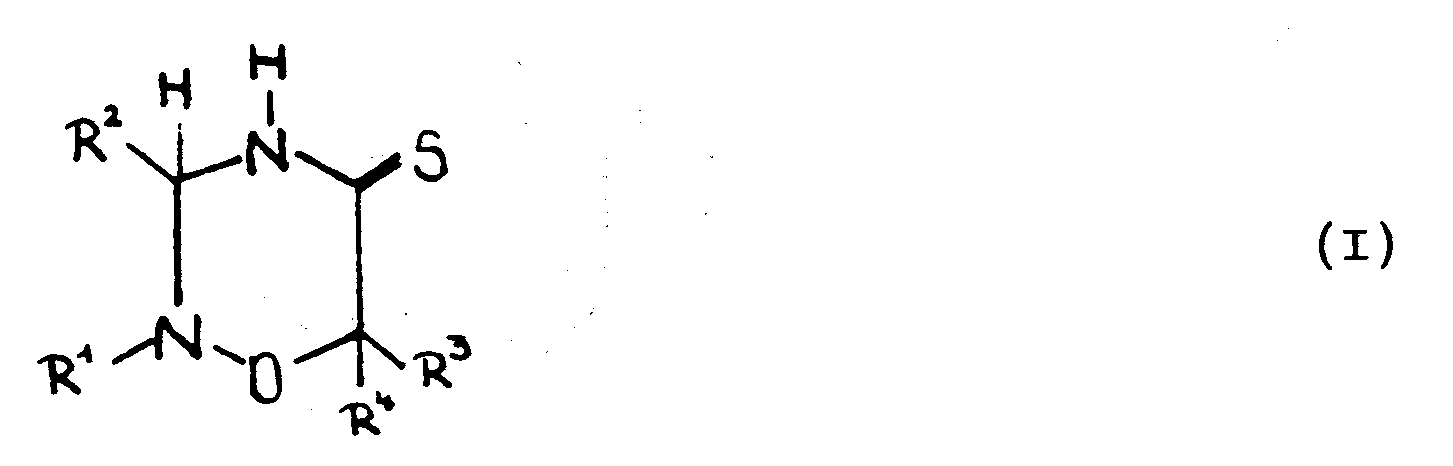 R¹ stands for benzyloxycarbonyl, alkanoyl having 1 to 5 carbon atoms, thioalkanoyl having 1 to 5 carbon atoms, benzoyl optionally substituted with one or more alkyl having 1 to 4 carbon atoms or alkoxy having 1 to 4 carbon atoms, alkylcarbamoyl having 1 to 4 carbon atoms in the alkyl moiety or alkylsulphonyl having 1 to 4 carbon atoms,R² is phenyl or napthyl optionally substituted with one or more alkyl having 1 to 4 carbon atoms, alkoxy having 1 to 4 carbon atoms or amino disubstituted with the same or different alkyl groups having 1 to 4 carbon atoms,R³ is hydrogen, alkyl having 1 to 8 carbon atoms or benzyl, andR⁴ is hydrogen or alkyl having 1 to 4 carbon atomswhich comprisesa) reacting an optically active or racemic tetrahydro-1,2,4-oxadiazine-5-one derivative of the formula
 b) reacting an optically active or racemic alpha-aminooxy-thiocarboxylic amide of the formula
R² - CHO (IV)
wherein R² is the same as defined hereinabove. - A process as claimed in claim 1 a) which comprises using an aromatic hydrocarbon as aprotic solvent.
- A proces as claimed in claim 2 which comprises using benzene, toluene or xylene as the aromatic hydrocarbon.
- The process as claimed in any of claims 1 a), 2 and 3 which comprises carrying out the reaction at the boiling point of the reaction mixture.
- The process as claimed in claim 1 b) which comprises carrying out the reaction in a mixture of an organic acid and its anhydride in the presence of an inorganic acid.
- A process as claimed in claim 5 which comprises carrying out the reaction in a mixture of acetic acid and acetic anhydride in the presence of concentrated sulfuric acid.
- A process as claimed in any of claims 1 b), 5 or 6 in process variant which comprises carrying out the reaction at room temeprature.
- A process for the preparation of a pharmaceutical composition which comprises mixing an optically active or racemic tetrahydro-1,2,4-oxadiazine-5-thione derivative of the formula (I) as defined in claim 1 with a pharmaceutically acceptable carrier, excipient and/or diluent.
- A process for the preparation of compounds of formula (III)


Priority Applications (1)
| Application Number | Priority Date | Filing Date | Title |
|---|---|---|---|
| AT85307264T ATE71091T1 (en) | 1984-10-11 | 1985-10-10 | TETRAHYDRO-1,2,4-OXADIAZINE-5-THION DERIVATIVES. |
Applications Claiming Priority (2)
| Application Number | Priority Date | Filing Date | Title |
|---|---|---|---|
| HU843809A HU193231B (en) | 1984-10-11 | 1984-10-11 | Process for producing tetrahydro-1,2,4-oxadiazine-5-thion derivatives of anticonvulsive activity |
| HU380984 | 1984-10-11 |
Publications (3)
| Publication Number | Publication Date |
|---|---|
| EP0178176A2 EP0178176A2 (en) | 1986-04-16 |
| EP0178176A3 EP0178176A3 (en) | 1988-03-23 |
| EP0178176B1 true EP0178176B1 (en) | 1992-01-02 |
Family
ID=10965616
Family Applications (1)
| Application Number | Title | Priority Date | Filing Date |
|---|---|---|---|
| EP85307264A Expired - Lifetime EP0178176B1 (en) | 1984-10-11 | 1985-10-10 | Tetrahydro-1,2,4-oxadiazine-5-thione derivatives |
Country Status (6)
| Country | Link |
|---|---|
| US (1) | US4755510A (en) |
| EP (1) | EP0178176B1 (en) |
| JP (1) | JPS61178972A (en) |
| AT (1) | ATE71091T1 (en) |
| DE (1) | DE3585070D1 (en) |
| HU (1) | HU193231B (en) |
Family Cites Families (3)
| Publication number | Priority date | Publication date | Assignee | Title |
|---|---|---|---|---|
| GB1283643A (en) * | 1970-05-01 | 1972-08-02 | Elmer Austin Fike | Oxadiazine-4-thiones and vulcanizable rubber compositions containing same |
| FR2497202A1 (en) * | 1980-12-31 | 1982-07-02 | Richter Gedeon Vegyeszet | NOVEL TETRAHYDRO-1,2,4-OXADIAZIN-5-ONE DERIVATIVES, THEIR PREPARATION AND PHARMACEUTICAL COMPOSITIONS CONTAINING SAME |
| HU181588B (en) * | 1980-12-31 | 1983-10-28 | Richter Gedeon Vegyeszet | Process for preparing n4-substituted tetrahydro-1,2,4-oxadiazin-5-one derivatives with anticonvulsive effect |
-
1984
- 1984-10-11 HU HU843809A patent/HU193231B/en not_active IP Right Cessation
-
1985
- 1985-10-10 EP EP85307264A patent/EP0178176B1/en not_active Expired - Lifetime
- 1985-10-10 DE DE8585307264T patent/DE3585070D1/en not_active Expired - Lifetime
- 1985-10-10 AT AT85307264T patent/ATE71091T1/en active
- 1985-10-10 US US06/786,203 patent/US4755510A/en not_active Expired - Fee Related
- 1985-10-11 JP JP60226656A patent/JPS61178972A/en active Granted
Also Published As
| Publication number | Publication date |
|---|---|
| DE3585070D1 (en) | 1992-02-13 |
| JPS61178972A (en) | 1986-08-11 |
| ATE71091T1 (en) | 1992-01-15 |
| HU193231B (en) | 1987-08-28 |
| US4755510A (en) | 1988-07-05 |
| HUT38920A (en) | 1986-07-28 |
| EP0178176A3 (en) | 1988-03-23 |
| EP0178176A2 (en) | 1986-04-16 |
| JPH0342272B2 (en) | 1991-06-26 |
Similar Documents
| Publication | Publication Date | Title |
|---|---|---|
| IL100449A (en) | N-acylated-1-(4-aminophenyl)-7,8-methylenedioxy-5H-2,3-benzodiazepine derivatives their preparation and pharmaceutical compositions containing them | |
| DK141511B (en) | Analogous process for the preparation of derivatives of wind blastin, leurosidine or leurocristine. | |
| AT394853B (en) | METHOD FOR PRODUCING NEW MITOSANDERIVATIVES | |
| Kohn et al. | Syntheses and spectral properties of substituted imidazolidones and imidazolines | |
| US4826850A (en) | Quinoline base compound, process for the preparation thereof and anticancer agent containing the same as pharmacologically efficacious component | |
| US3862191A (en) | Pyrido{8 2,3-d{9 pyrimidin-4(3H)-one | |
| Deutsch et al. | Synthesis of congeners and prodrugs of the benzene maleimide photoadduct, mitindomide, as potential antitumor agents. 2 | |
| US4755510A (en) | Novel anticonvulsive tetrahydro-1,2,4-oxadiazine-5-thion derivatives and use | |
| IE50059B1 (en) | 1-benzoxepin-5(2h)-one derivatives and their salts;processes and intermediate products for their preparation and pharmaceutical compositions containing these compounds | |
| US5003070A (en) | Substituted azacyclohexyl derivatives of rifamycins | |
| AU592637B2 (en) | Novel ergolene derivatives, pharmaceutical compositions containing them and process for preparing same | |
| US3758546A (en) | Methoxy amine derivatives and process for preparing them | |
| JPH0121828B2 (en) | ||
| NZ200131A (en) | Alkyl 5-amino-1,2-dihydro-3-phenyl pyrido(3,4-6)-pyrazin-7-yl carbamates | |
| GB2091728A (en) | Substituted tetrahydro-1,2,4- oxadiazin-5-one derivatives | |
| US4011340A (en) | Hypolipidemic bis(pivaloylbenzyl) ureas | |
| NO814458L (en) | PROCEDURE FOR THE PREPARATION OF TETRAHYDRO-1,2,4-OXADIAZIN-5-ON DERIVATIVES WITH ANTICONVULSIVE ACTIVITY | |
| US4929730A (en) | Bis(1,2,5)thiadiazolo(3,4-b:3',4'-E) pyrazine, a process for the preparation thereof and a method of using same | |
| US4371534A (en) | N4-Substituted tetrahydro-1,2,4-oxadiazin-5-one derivatives having anticonvulsive activity and pharmaceutical compositions containing them | |
| US4511721A (en) | Intermediate for preparing antifungal 1,2-dihydropyrido[3,4-b]-pyrazines | |
| RU2067579C1 (en) | 3-(2'-naphthoylmethylene)-piperazinone-2 and 1-n-phenyl-3-phenacylidenepiperazinone-2 showing antiinflammatory activity | |
| WO1997019934A1 (en) | Quinoxaline compounds, pharmaceutical preparations containing them and a process for the preparation thereof | |
| CN112724132B (en) | Synthetic method of 3-halogenated-5-trifluoromethyl-pyrazolo [1,5-a ] pyridine | |
| JPH0427234B2 (en) | ||
| FI84605C (en) | FOERFARANDE FOER FRAMSTAELLNING AV NYA TERAPEUTISKT ANVAENDBARA 2-HALOGENNICERGOLINDERIVAT OCH DERAS SYRAADDITIONSSALTER. |
Legal Events
| Date | Code | Title | Description |
|---|---|---|---|
| PUAI | Public reference made under article 153(3) epc to a published international application that has entered the european phase |
Free format text: ORIGINAL CODE: 0009012 |
|
| AK | Designated contracting states |
Kind code of ref document: A2 Designated state(s): AT BE CH DE FR GB IT LI NL SE |
|
| PUAL | Search report despatched |
Free format text: ORIGINAL CODE: 0009013 |
|
| AK | Designated contracting states |
Kind code of ref document: A3 Designated state(s): AT BE CH DE FR GB IT LI NL SE |
|
| 17P | Request for examination filed |
Effective date: 19880517 |
|
| 17Q | First examination report despatched |
Effective date: 19900620 |
|
| GRAA | (expected) grant |
Free format text: ORIGINAL CODE: 0009210 |
|
| RAP1 | Party data changed (applicant data changed or rights of an application transferred) |
Owner name: MAGYAR TUDOMANYOS AKADEMIA KOEZPONTI KEMIAI KUTAT Owner name: RICHTER GEDEON VEGYESZETI GYAR R.T. |
|
| AK | Designated contracting states |
Kind code of ref document: B1 Designated state(s): AT BE CH DE FR GB IT LI NL SE |
|
| REF | Corresponds to: |
Ref document number: 71091 Country of ref document: AT Date of ref document: 19920115 Kind code of ref document: T |
|
| REF | Corresponds to: |
Ref document number: 3585070 Country of ref document: DE Date of ref document: 19920213 |
|
| ET | Fr: translation filed | ||
| ITF | It: translation for a ep patent filed | ||
| PGFP | Annual fee paid to national office [announced via postgrant information from national office to epo] |
Ref country code: SE Payment date: 19920922 Year of fee payment: 8 |
|
| PGFP | Annual fee paid to national office [announced via postgrant information from national office to epo] |
Ref country code: GB Payment date: 19921002 Year of fee payment: 8 |
|
| PGFP | Annual fee paid to national office [announced via postgrant information from national office to epo] |
Ref country code: FR Payment date: 19921005 Year of fee payment: 8 |
|
| PGFP | Annual fee paid to national office [announced via postgrant information from national office to epo] |
Ref country code: BE Payment date: 19921014 Year of fee payment: 8 |
|
| PGFP | Annual fee paid to national office [announced via postgrant information from national office to epo] |
Ref country code: CH Payment date: 19921021 Year of fee payment: 8 |
|
| PGFP | Annual fee paid to national office [announced via postgrant information from national office to epo] |
Ref country code: DE Payment date: 19921023 Year of fee payment: 8 |
|
| PGFP | Annual fee paid to national office [announced via postgrant information from national office to epo] |
Ref country code: AT Payment date: 19921028 Year of fee payment: 8 |
|
| PGFP | Annual fee paid to national office [announced via postgrant information from national office to epo] |
Ref country code: NL Payment date: 19921031 Year of fee payment: 8 |
|
| PLBE | No opposition filed within time limit |
Free format text: ORIGINAL CODE: 0009261 |
|
| STAA | Information on the status of an ep patent application or granted ep patent |
Free format text: STATUS: NO OPPOSITION FILED WITHIN TIME LIMIT |
|
| 26N | No opposition filed | ||
| PG25 | Lapsed in a contracting state [announced via postgrant information from national office to epo] |
Ref country code: GB Effective date: 19931010 Ref country code: AT Effective date: 19931010 |
|
| PG25 | Lapsed in a contracting state [announced via postgrant information from national office to epo] |
Ref country code: SE Effective date: 19931011 |
|
| PG25 | Lapsed in a contracting state [announced via postgrant information from national office to epo] |
Ref country code: LI Effective date: 19931031 Ref country code: CH Effective date: 19931031 Ref country code: BE Effective date: 19931031 |
|
| BERE | Be: lapsed |
Owner name: MAGYAR TUDOMANYOS AKADEMIA KOZPONTI KEMIAI KUTATO Effective date: 19931031 Owner name: RICHTER GEDEON VEGYESZETI GYAR R.T. Effective date: 19931031 |
|
| PG25 | Lapsed in a contracting state [announced via postgrant information from national office to epo] |
Ref country code: NL Effective date: 19940501 |
|
| GBPC | Gb: european patent ceased through non-payment of renewal fee |
Effective date: 19931010 |
|
| NLV4 | Nl: lapsed or anulled due to non-payment of the annual fee | ||
| PG25 | Lapsed in a contracting state [announced via postgrant information from national office to epo] |
Ref country code: FR Effective date: 19940630 |
|
| REG | Reference to a national code |
Ref country code: CH Ref legal event code: PL |
|
| PG25 | Lapsed in a contracting state [announced via postgrant information from national office to epo] |
Ref country code: DE Effective date: 19940701 |
|
| REG | Reference to a national code |
Ref country code: FR Ref legal event code: ST |
|
| EUG | Se: european patent has lapsed |
Ref document number: 85307264.3 Effective date: 19940510 |