EP0177618A1 - Rechargeable electrochemical device and a positive electrode therefor - Google Patents
Rechargeable electrochemical device and a positive electrode therefor Download PDFInfo
- Publication number
- EP0177618A1 EP0177618A1 EP85901588A EP85901588A EP0177618A1 EP 0177618 A1 EP0177618 A1 EP 0177618A1 EP 85901588 A EP85901588 A EP 85901588A EP 85901588 A EP85901588 A EP 85901588A EP 0177618 A1 EP0177618 A1 EP 0177618A1
- Authority
- EP
- European Patent Office
- Prior art keywords
- discharge
- oxide
- positive electrode
- rechargeable
- general formula
- Prior art date
- Legal status (The legal status is an assumption and is not a legal conclusion. Google has not performed a legal analysis and makes no representation as to the accuracy of the status listed.)
- Granted
Links
Images





Classifications
-
- H—ELECTRICITY
- H01—ELECTRIC ELEMENTS
- H01M—PROCESSES OR MEANS, e.g. BATTERIES, FOR THE DIRECT CONVERSION OF CHEMICAL ENERGY INTO ELECTRICAL ENERGY
- H01M10/00—Secondary cells; Manufacture thereof
- H01M10/05—Accumulators with non-aqueous electrolyte
- H01M10/052—Li-accumulators
-
- H—ELECTRICITY
- H01—ELECTRIC ELEMENTS
- H01M—PROCESSES OR MEANS, e.g. BATTERIES, FOR THE DIRECT CONVERSION OF CHEMICAL ENERGY INTO ELECTRICAL ENERGY
- H01M4/00—Electrodes
- H01M4/02—Electrodes composed of, or comprising, active material
- H01M4/36—Selection of substances as active materials, active masses, active liquids
- H01M4/48—Selection of substances as active materials, active masses, active liquids of inorganic oxides or hydroxides
- H01M4/485—Selection of substances as active materials, active masses, active liquids of inorganic oxides or hydroxides of mixed oxides or hydroxides for inserting or intercalating light metals, e.g. LiTi2O4 or LiTi2OxFy
-
- Y—GENERAL TAGGING OF NEW TECHNOLOGICAL DEVELOPMENTS; GENERAL TAGGING OF CROSS-SECTIONAL TECHNOLOGIES SPANNING OVER SEVERAL SECTIONS OF THE IPC; TECHNICAL SUBJECTS COVERED BY FORMER USPC CROSS-REFERENCE ART COLLECTIONS [XRACs] AND DIGESTS
- Y02—TECHNOLOGIES OR APPLICATIONS FOR MITIGATION OR ADAPTATION AGAINST CLIMATE CHANGE
- Y02E—REDUCTION OF GREENHOUSE GAS [GHG] EMISSIONS, RELATED TO ENERGY GENERATION, TRANSMISSION OR DISTRIBUTION
- Y02E60/00—Enabling technologies; Technologies with a potential or indirect contribution to GHG emissions mitigation
- Y02E60/10—Energy storage using batteries
Definitions
- the present invention relates to a rechargeable electrochemical apparatus using non-aqueous electrolyte, more particularly, a secondary battery using non-aqueous electrolyte and a positive electrode of said battery.
- non-aqueous electrolytic secondary batteries using an alkali metal, for example lithium, sodium and the like, as a negative electrode, in which a positive active material is an interlayer compound, such as titanium disulfide, and an electrolyte is an organic one made by dissolving lithium perchlorate in an organic solvent such as propylene carbonate.
- a positive active material is an interlayer compound, such as titanium disulfide
- an electrolyte is an organic one made by dissolving lithium perchlorate in an organic solvent such as propylene carbonate.
- the special features of these secondary batteries are high cell voltage and high energy density caused by using the alkali metal as the negative electrode.
- the secondary batteries of this sort show short life of frequency (cycles) of charging and discharging when metallic lithium is used as the negative electrcde.
- the charge and discharge efficiency also become low in making charge and discharge. It is believed that these defects are mostly brought abcut from a decline of the negative electrode.
- the lithium negative electrode is mainly prepared by attaching a lithium plate to a screen type current collecting substrate under pressure, and the electrode dissolves in the electrolyte as the lithium ion during discharging.
- it is difficult that the dissolved lithium ion is deposited to the original lithium plate form as it was.
- the dissolved lithium ion may be actually deposited in a dendrite lithium form which easily breaks at the root and drops away from it and it may also be deposited in a small spherical lithium which leaves away from the current collecting substrate, which make the battery impossible to charge and discharge. It may frequently happen that the dendrite lithium grows through a separator for dividing between the positive and negative electrodes and connects with the positive electrode to result in short circuit which nulifies the function of battery.
- the positive electrode materials As the positive electrode materials, a number of active materials have so far been proposed, among which for example titanium disulfide(TiS 2 ), niobium selenide(NbSe2), vanadium oxides, such as V 2 O 5 , V 6 O 13 and the like, tungsten oxide(WO 3 ), molybdenum oxide(Mo0 3 ), chromium oxide(Cr 3 O 8 ), copper vanadate(Cu 2 V 2 O 7 ), etc have been studied as positive active materials having high possibility.
- the performances required for the positive active materials to be used for the lithium secondary battery are the so-called high energy density with large electric capacity for discharge and high discharge voltage, voltage flatness thereof and cycle life.
- V 6 0 13 is usually prepared by mixing V 2 O 5 and metallic vanadium and heating at 650°C.
- the report by Abraham et al also considers Cr 0.13 V 0.87 O 2.17 which is produced by using metallic chromium instead of metallic vanadium in the preparation process of V 6 O 13 .
- V and Cr is used as a reducing agent for changing V 2 O 5 to V 6 O 13 (VO 2.17 ) and the product is Cr 0.13 V 0.87 O 2.17 when Or is employed, as mentioned before.
- the discharge voltage of the oxides generally is higher in.high oxidation number than in low .oxidation number.
- V 2 O 5 the oxidation number of vanadium equals to five
- V 6 0 13 the oxidation number of vanadium equals to 4.34
- V 2 O 5 has higher discharge voltage and the difference thereof is about 0.4 volt.
- the average oxidation number per one metal ion in Cr 0.13 V 0.87 O 2.17 is 4.34 and its discharge voltage has similar value to V 6 O 13 . Accordingly, cycle life and discharge voltage are better in V 2 O 5 . However, even V 2 O 5 shows low in discharge voltage and stepwise variation of voltage in discharging.
- An object of the present invention is to provide a rechargeable positive electrode for an electrcchemical apparatus using a non-aqueous electrolyte, such as a non-aqueous electrolytic secondary battery, which can provide the so-called high energy density with high discharge voltage and high discharge electric capacity.
- Another object of the present invention is to provide a stable positive electrode resistantive to so-called overdischarge, thus the electrode does not decline the performance of charge and discharge even when it have been deeply discharged due to short circuit or overuse in time.
- the above objects are accomplished by using an oxide made from chromium(Cr) and vanadium(V) as the positive active material and maintaining its composition to wherein 0.2 ⁇ x ⁇ 0.9 and 0.1 ⁇ y ⁇ 1.0.
- the special features of the present invention are not only that the number of Z is made large but also that the number of W which determines charge and discharge capacity is made large and is maintained during repeating use of charge and discharge. Accordingly, life of charge and discharge cycles (cycle life) becomes long and the capacity becomes high.
- the oxide made from Cr and V of the present invention i.e. Cr x V 2(1-x) O 5-x(2+y)
- Cr x V 2(1-x) O 5-x(2+y) can be prepared by mixing Cr0 3 with V 2 0 5 and heating, in which the value of x is governed by mixing ratio of CrO 3 and V 2 0 5 and the value of y is governed by heating temperature. It has been found that the compound obtained by mixing and heating CrO 3 and V 2 O 5 is not a simple mixture of Cr oxide and V oxide but, in view of analysis, it is a complicated composition containing both compound oxide and solid solution and the composition also varies considerably by the values of x and y.
- the value of W which indicates actual charge and discharge capacity is also governed by the values of x and y in Cr x V 2(1-x) O 5-(2+y)x , and the other performances of battery, such as cycle life, discharge voltage, stability to overdischarge and the like are also characterized by the values of x and y.
- the process for preparing the oxide material of the present invention is very simple, in which a mixture of V 2 O 5 and Cr0 3 (the mixing ratio determines the value of x) is heated at a particular temperature (the temperature determines the value of y) in the air and the heating treatment is conducted for several hours (from 8 to 10 hours) to obtain the product.
- Cr0 3 begins to decompose at about 200°C in the air, and reduces a valence of metal nonstoichiometricly with releasing oxygen to obtain Cr 2 O 5 (a valence of five) at 280°C and Cr0 2 (a valence of four) at 370°C.
- V 2 0 5 keeps its composition up to about 700°C, and it begins to decompose at about 700°C.
- CrxV 2(1-x) O 5-(2+y)x the larger the value of x is (the content of Cr increases), the higher the discharge voltage is.
- the x values of more than 0.8 begin tc decline reversibility, that is, begins to reduce its cycle life and the x values of more than 0.9 reduce its cycle life rapidly. Accordingly, the x value of not more than 0.9 are desirable.
- the value of x is small, it shows good flatness of discharge voltage until the value equals to 0.2.
- the x values of less than 0.2 show stepwise variation of voltage as is observed by V 2 O 5 and flatness of voltage is lost. Accordingly, the x value not less than 0.2 are desirable.
- the value of x is preferably adjusted to within the range of 0.2 to 0.9 in the preparation of the positive active material of the present invention, i.e. Cr x V 2(1-x) O 5-(2+y)x ,
- the value of y is a factor only relating to the heat treatment temperature.
- the value of y becomes larger than 1.0.
- the value of y equals to 0.1.
- Values of less than 0.1 are impossible to produce the positive active material of the present invention, because no reaction of Cr0 3 with V205 is occurred at a temperature of not more than 200°C.
- the value of y has to be not less than 0.1.
- the value of y is within the range of 0.1 to 1.0 when the heat treatment temperature is within the range of 200 to 500°C.
- the temperature approaches to 500°C that is, the value of y approaches to 1.0
- the obtained positive active material shows low discharge capacity and low discharge voltage, independent to the value of x.
- the heat treatment temperature exceeds 500°C the decline of capacity and voltage is accelerated and the cycle life thereof is rapidly down.
- the temperature of heat treatment keeps from not less than 200°C to not more than 500°C, thus 0.1 y 1.0.
- the overdischarge resistance is governed by the value of x and is elevated with an increase of x. Accordingly, in the usage of safety being made much, it is desirable that the value of x is not less than 0.5, preferably not less than 0.6 from the point of durability's view.
- the negative electrode to form the rechargeable electrochemical apparatus of the present invention mentioned above includes an alkali metal, such as lithium and the like, and a combination of an alkali metal, such as lithium and the like with a metal or alloy capable of occluding and releasing said alkali metal.
- the metal and alloy capable of occluding and releasing the alkali metal are a simple metal, such as Al, Mg, Pb, Sn, Bi, Cd, Zn, In, and the like, and an allcy containing plural metals mentioned.
- non-aqueous electrolyte organic electrolytes are preferred.
- organic solvents for making the non-aqueous electrolyte are propylene carbonate, Y-butyrolactone, ethylene carbonate, 1,2-dimethoxyethane, tetrahydrofuran, 2-methyltetrahydrofuran, 1,3-dioxolan and the like.
- alkali metal salts which are a solute those well-known as the organic electrolytic battery are given, for example a lithium salt, such as LiClO 4 , LiBF 4 , LiAsF 6 , LiSO 3 CF 3 , LiPF 6 and the like; a sodium salt, such as NaCl0 4 and the like; a potassium salt, such as KPF 6 and the like.
- a lithium salt such as LiClO 4 , LiBF 4 , LiAsF 6 , LiSO 3 CF 3 , LiPF 6 and the like
- a sodium salt such as NaCl0 4 and the like
- a potassium salt such as KPF 6 and the like.
- the non-aqueous electrolyte of the present invention may include a solid electrolyte having alkali metal ion conductivity.
- the solid electrolytes are Li 3 N, Li 2 0, Li 4 SiO 4 , and Li 3 PO 4 , which show lithium ion conductivity.
- the special features as the rechargeable positive active material of the present invention will be illustrated, including its composition ratio (based on x value and y value).
- the electrochemical apparatus used for performance evaluation of the positive electrode is a button type battery comprising an electrode to be evaluated (positive electrode), a counter electrode (negative electrode), and an electrolyte made by dissolving one mol/l of lithium perchlorate (LiClO 4 ) in propylene carbonate (PC).
- the test electrode which has a doughnut shape disc is prepared by mixing the positive active material of the present invention, carbon black as an electroconductive material and a tetrafluoroethylene resin as a binder and the calendering the mixture with an expand metal of Ti.
- the electrode as is shown in Fig.
- Fig.2 is a vertical sectional view of the button type battery made by the use of said positive electrode.
- the above positive electrode 1 is fixed to the positive electrode case 2 of the battery by spot welding.
- the negative electrode is a lithium occluded Pb-Sn-Cd alloy electrode 4 which is capable of reversibly charging and discharging and it is fixed to the inside of the sealing plate 3 by spot welding.
- the electrodes are sealed together with a polypropylene separator 5 and a propylene carbonate electrolyte 6 made by dissolving one mol/i of lithium perchlorate (LiCl 4 ) through a polypropylene gasket 7 to make a complete battery.
- a polypropylene separator 5 and a propylene carbonate electrolyte 6 made by dissolving one mol/i of lithium perchlorate (LiCl 4 ) through a polypropylene gasket 7 to make a complete battery.
- the test conducted in the present invention is an charge and discharge test carried out by using the button type battery mentioned above, assuming that it is a practical battery.
- the test is carried out at the constant current of 2mA which is corresponding to the current density of 1mA/cm 2 per a unit area of the positive electrode. Discharge is carried out until the battery voltage is 2.0V and charge is carried out until the battery voltage is 3.7V, thus charge and discharge is repeated in the voltage range (3.7V-2.0V).
- the positive active material i.e. an oxide of Cr and V
- the positive active material was prepared by mixing CrO 3 and V 2 0 5 and heating for several hours in the air.
- Various products were obtained by changing the mixing ratio and the heat treatment temperature.
- Composition analysis was carried out to all of positive active materials prepared under various conditions (mixing ratio and heat treatment temperature) to confirm that they were all indicated by the formula, Cr x V 2(1-x) O 5- (2+y)x'
- the x value in the above formula was governed by the mixing ration of CrO 3 and V 2 0 5 which were starting materials and the y value was not governed by the x value at all but only governed by the heat treatment temperature.
- the value of y became 0.1 at the heat treatment temperature of 200°C, 0.2 at 230°C, 0.3 at 250°C, 0.4 at 270°C, 0.5 at 290°C to 350°C, 0.6 at 350°C, 0.9 at 400°C, 1.0 at 500°C, 1.1 at 600°C.
- the positive active materials had the composition depending on the y value, which are indicated in Table 1.
- the active material When the x value is 0 in Cr x V 2(1-x) O 5-(2+y)x' the active material was an oxide of vanadium, which maintains its composition of V 2 O 5 at any y value.
- the discharge characteristics of the positive active material showed stepwise variation of voltage and showed no flatness of voltage.
- the positive active material When the value of x was 1.0, the positive active material was a chromium oxide, of which discharge voltage characteristics vary depending on the heat treatment temperature.
- the active material which was treated at 200°C, oxidationally decomposed the electrolyte employed because of high oxidation power and a gas arose to cause an expansion of the battery.
- the positive active material was only the chromium oxide, the positive active material at any treatment temperatures indicated bad reversibility and had very short cycle life as the secondary battery.
- a diagram of charge and discharge characteristics of the battery comprising the chromium oxide (CrO 2.7 ) treated at 250°C is given in Fig.3. The bad reversibility was observed not only in the chromium oxide treated at 250°C, but in every chromium oxide of the instant example.
- the material of the present invention was Cr x V 2(1-x) O 5-2.3x .
- the capacity maintenance ratio A means the ratio of discharge electric capacity at the cycle right after overdischarge when the lower limit voltage is returned to 2.0V against discharge electric capacity up to 2.0V of the discharge when overdischarge is carried out
- Cr 0.13 V 0.87 O 2.17 is completely different from the positive active material of the present invention, because it corresponds to Cr x V 2(1-x) O 5-(2+y)x of which x equals to 0.230 and y equals to 3.047 while in the present invention y has to be within the range of 0.1 to 1.0.
- the present invention also has different object in preparation of oxide, because the object of preparation of Cr 0.13 V 0.87 O 2.17 in Abraham's report is to lower a valence of U 2.
- V 2 O 5 having a valence of 5 by reacting V 2 O 5 having a valence of 5 with chromium metal having a valence of 0 as a reducing agent, while the present invention does not react with chromium metal but with CrO 3 having a valence of 6 which is rather an oxidation agent and no object to reduce its valence is existent.
- the valence of the active material of the present invention is very different as assumed by the difference of the value of y. In order to compare, some positive active materials in which x equals co 0.23 and y exists within the range of 0.1 to 1.0 were prepared to adjust the composition ratio of the present invention.
- Fig.13 shows big gap between the positive active materials of the present invention and Cr 0.13 V 0.87 O 2.17 reported by Abraham in discharge voltage and discharge capacity. It is believed that both materials are completely different with each other. Further the cycle life becomes short in Cr 0.13 V 0.87 C 2.17 and overdischarge test was carried out to it to result in losing its performances as a battery.
- Cr x V 2 ( 1-x ) - O 5-(2+y)x can be improved in its characteristic.
- Mo has a pcssibility to enhance cycle characteristic, though it declines capacity.
- the positive active material of the present invention can reversibly react with alkali metal in a non- aquecus electrolyte containing alkali metal ions during charge and discharge. Accordingly the present invention provides an excellent rechargeable positive electrode having long cycle life, flatness of discharge voltage, high discharge voltage and large reaction amount capable of charging and discharging (charge and discharge electric capacity).
- the active material of the present invention can apply to any rechargeable electrochemical apparatus, such as a secondary battery employing alkali metal, e.g. lithium, as a negative electrode.
Landscapes
- Chemical & Material Sciences (AREA)
- Chemical Kinetics & Catalysis (AREA)
- Electrochemistry (AREA)
- General Chemical & Material Sciences (AREA)
- Engineering & Computer Science (AREA)
- Manufacturing & Machinery (AREA)
- Inorganic Chemistry (AREA)
- Battery Electrode And Active Subsutance (AREA)
- Secondary Cells (AREA)
Abstract
Description
- The present invention relates to a rechargeable electrochemical apparatus using non-aqueous electrolyte, more particularly, a secondary battery using non-aqueous electrolyte and a positive electrode of said battery.
- Hitherto, active developments have been made on non-aqueous electrolytic secondary batteries using an alkali metal, for example lithium, sodium and the like, as a negative electrode, in which a positive active material is an interlayer compound, such as titanium disulfide, and an electrolyte is an organic one made by dissolving lithium perchlorate in an organic solvent such as propylene carbonate. The special features of these secondary batteries are high cell voltage and high energy density caused by using the alkali metal as the negative electrode.
- However, the secondary batteries of this sort show short life of frequency (cycles) of charging and discharging when metallic lithium is used as the negative electrcde. The charge and discharge efficiency also become low in making charge and discharge. It is believed that these defects are mostly brought abcut from a decline of the negative electrode. In other words, the lithium negative electrode is mainly prepared by attaching a lithium plate to a screen type current collecting substrate under pressure, and the electrode dissolves in the electrolyte as the lithium ion during discharging. However, it is difficult that the dissolved lithium ion is deposited to the original lithium plate form as it was. The dissolved lithium ion may be actually deposited in a dendrite lithium form which easily breaks at the root and drops away from it and it may also be deposited in a small spherical lithium which leaves away from the current collecting substrate, which make the battery impossible to charge and discharge. It may frequently happen that the dendrite lithium grows through a separator for dividing between the positive and negative electrodes and connects with the positive electrode to result in short circuit which nulifies the function of battery.
- There have been proposed many improvements to overcome the above problems. Recently, the issue of charge and discharge efficiency of negative electrode has considerably been improved due to the appearance of excellent lithium occluded alloys. Tt, in turn, has become more important to develop the materials having the excellent performance as positive active material rather than the negative electrode. As the positive electrode materials, a number of active materials have so far been proposed, among which for example titanium disulfide(TiS2), niobium selenide(NbSe2), vanadium oxides, such as V2O5, V6O13 and the like, tungsten oxide(WO3), molybdenum oxide(Mo03), chromium oxide(Cr3O8), copper vanadate(Cu2V2O7), etc have been studied as positive active materials having high possibility. Generally, the performances required for the positive active materials to be used for the lithium secondary battery are the so-called high energy density with large electric capacity for discharge and high discharge voltage, voltage flatness thereof and cycle life. However, the above possible positive active materials do not entirely satisfy the above requirements. For example, TiS2 and NbSe2 show low discharge voltage, V2O5 shows stepwise variation of voltage in discharge which exhibits no flatness, WO3 has small electric capacity,
M 003 shows low discharge voltage, Cr308 provides a high voltage but has problems in its cycle life, and CU2V2O7 involves problem in cycle life. J. Electrochemical. Soc. vol.128 No. 12 to K.M. Abraham, J.L.Goldman, and M.D.Dempsey 2493-2501(1981) reports the result of studying oxides of Cr or V as a positive active material. The report by Abraham et al relates to V6O13. V6013 is usually prepared by mixing V2O5 and metallic vanadium and heating at 650°C. The report by Abraham et al also considers Cr0.13V0.87O2.17 which is produced by using metallic chromium instead of metallic vanadium in the preparation process of V6O13. In the above preparations, V and Cr is used as a reducing agent for changing V2O5 to V6O13(VO2.17) and the product is Cr0.13V0.87O2.17 when Or is employed, as mentioned before. It is also reported by Abraham et al that, when Cr0.13V0.87O2.17 is used as a positive active material to make a Li secondary battery, the cycle life becomes worse in comparison with V6O13(VO2.17) and the discharge voltage is also low. This is believed to arise from that the oxide is prepared from V2O5 and metallic chromium. - The discharge voltage of the oxides generally is higher in.high oxidation number than in low .oxidation number. When compared V2O5 (the oxidation number of vanadium equals to five) with V6013 (the oxidation number of vanadium equals to 4.34), V2O5 has higher discharge voltage and the difference thereof is about 0.4 volt.
- The average oxidation number per one metal ion in Cr0.13V0.87O2.17 is 4.34 and its discharge voltage has similar value to V6O13. Accordingly, cycle life and discharge voltage are better in V2O5. However, even V2O5 shows low in discharge voltage and stepwise variation of voltage in discharging.
- As mentioned above, there has been no materials of practical utility as a positive electrode material for the secondary battery using non-aqueous electrolyte. Accordingly, appearance of the positive active material having high voltage, good voltage flatness in discharging, large electric capacity and long cycle life is desired.
- An object of the present invention is to provide a rechargeable positive electrode for an electrcchemical apparatus using a non-aqueous electrolyte, such as a non-aqueous electrolytic secondary battery, which can provide the so-called high energy density with high discharge voltage and high discharge electric capacity.
- Another object of the present invention is to provide a rechargeable positive electrode not having stepwise variation of voltage in discharge but having excellent flatness of discharge voltage. Further object of the present invention is to provide a rechargeable positive electrode having long cycle life, which bears to a repeat of charge and discharge.
- Also another object of the present invention is to provide a stable positive electrode resistantive to so-called overdischarge, thus the electrode does not decline the performance of charge and discharge even when it have been deeply discharged due to short circuit or overuse in time.
- Further object of the present invention is to provide a rechargeable electrochemical apparatus resistantive to overdischarge and having high voltage and long cycle life of charge and discharge. Another object of the present invention is to provide a rechargeable electrochemical apparatus having high energy density.
- The above objects are accomplished by using an oxide made from chromium(Cr) and vanadium(V) as the positive active material and maintaining its composition to

- Suppose that discharge is carried out in an aqueous electrolyte containing the alkali metal ion such as the Li ion, using the positive active material(CrxV2(1-x)O5-(2+y)x) as the positive electrode, the Li ion is reacted as follow;


- When the battery is charged, the reaction is conducted according to the following equation;


- The special features of the present invention are not only that the number of Z is made large but also that the number of W which determines charge and discharge capacity is made large and is maintained during repeating use of charge and discharge. Accordingly, life of charge and discharge cycles (cycle life) becomes long and the capacity becomes high.
- The oxide made from Cr and V of the present invention, i.e. CrxV2(1-x)O5-x(2+y), can be prepared by mixing Cr03 with
V 205 and heating, in which the value of x is governed by mixing ratio of CrO3 andV 205 and the value of y is governed by heating temperature. It has been found that the compound obtained by mixing and heating CrO3 and V2O5 is not a simple mixture of Cr oxide and V oxide but, in view of analysis, it is a complicated composition containing both compound oxide and solid solution and the composition also varies considerably by the values of x and y. The value of W which indicates actual charge and discharge capacity is also governed by the values of x and y in CrxV2(1-x)O5-(2+y)x, and the other performances of battery, such as cycle life, discharge voltage, stability to overdischarge and the like are also characterized by the values of x and y. - The process for preparing the oxide material of the present invention is very simple, in which a mixture of V2O5 and Cr03 (the mixing ratio determines the value of x) is heated at a particular temperature (the temperature determines the value of y) in the air and the heating treatment is conducted for several hours (from 8 to 10 hours) to obtain the product. Generally, Cr03 begins to decompose at about 200°C in the air, and reduces a valence of metal nonstoichiometricly with releasing oxygen to obtain Cr2O5 (a valence of five) at 280°C and Cr02 (a valence of four) at 370°
C. V 205 keeps its composition up to about 700°C, and it begins to decompose at about 700°C. In case of CrxV2(1-x)O5-(2+y)x, the larger the value of x is (the content of Cr increases), the higher the discharge voltage is. The x values of more than 0.8 begin tc decline reversibility, that is, begins to reduce its cycle life and the x values of more than 0.9 reduce its cycle life rapidly. Accordingly, the x value of not more than 0.9 are desirable. When the value of x is small, it shows good flatness of discharge voltage until the value equals to 0.2. The x values of less than 0.2 show stepwise variation of voltage as is observed by V2O5 and flatness of voltage is lost. Accordingly, the x value not less than 0.2 are desirable. - As mentioned the above, the value of x is preferably adjusted to within the range of 0.2 to 0.9 in the preparation of the positive active material of the present invention, i.e. CrxV2(1-x)O5-(2+y)x,
- In the positive active material, CrxV2(1-x)- O5-(2+y)x, the value of y is a factor only relating to the heat treatment temperature. When the heat treatment temperature exceeds 500°C, the value of y becomes larger than 1.0. When the temperature is not more than 200°C, the value of y equals to 0.1. Values of less than 0.1 are impossible to produce the positive active material of the present invention, because no reaction of Cr03 with V205 is occurred at a temperature of not more than 200°C. In order to produce the positive active material of the present invention, the value of y has to be not less than 0.1. Accordingly, the value of y is within the range of 0.1 to 1.0 when the heat treatment temperature is within the range of 200 to 500°C. However, when the temperature approaches to 500°C, that is, the value of y approaches to 1.0, the obtained positive active material shows low discharge capacity and low discharge voltage, independent to the value of x. When the heat treatment temperature exceeds 500°C, the decline of capacity and voltage is accelerated and the cycle life thereof is rapidly down.
- Accordingly, it is desirable that the temperature of heat treatment keeps from not less than 200°C to not more than 500°C, thus 0.1 y 1.0.
- Generally speaking, it happens that, even though a secondary battery having high energy density shows good performances in usual practical conditions, once so-called overdischarge, which means deeply discharged by shcrt circuit, overtime use and the like, has experienced, the active material used in the battery remarkably declines and the battery becomes impossible to use rather than to recover. Accordingly, in view of practical points, such a declines of batteries suffered overdischarge must avoid and so-called overdischarge resistance has been desired.
- According to the positive active material of the present invention (CrxV2(1-x)O5-(2+y)x), the overdischarge resistance is governed by the value of x and is elevated with an increase of x. Accordingly, in the usage of safety being made much, it is desirable that the value of x is not less than 0.5, preferably not less than 0.6 from the point of durability's view.
- The negative electrode to form the rechargeable electrochemical apparatus of the present invention mentioned above includes an alkali metal, such as lithium and the like, and a combination of an alkali metal, such as lithium and the like with a metal or alloy capable of occluding and releasing said alkali metal. Examples of the metal and alloy capable of occluding and releasing the alkali metal are a simple metal, such as Al, Mg, Pb, Sn, Bi, Cd, Zn, In, and the like, and an allcy containing plural metals mentioned.
- As the non-aqueous electrolyte, organic electrolytes are preferred. Examples of the organic solvents for making the non-aqueous electrolyte are propylene carbonate, Y-butyrolactone, ethylene carbonate, 1,2-dimethoxyethane, tetrahydrofuran, 2-methyltetrahydrofuran, 1,3-dioxolan and the like. As an example of alkali metal salts which are a solute, those well-known as the organic electrolytic battery are given, for example a lithium salt, such as LiClO4, LiBF4, LiAsF6, LiSO3CF3, LiPF6 and the like; a sodium salt, such as NaCl04 and the like; a potassium salt, such as KPF6 and the like. These organic solvents and solutes can be used solely or in combination.
- The non-aqueous electrolyte of the present invention may include a solid electrolyte having alkali metal ion conductivity. Examples of the solid electrolytes are Li3N,
Li 20, Li4SiO4, and Li3PO4, which show lithium ion conductivity. -
- Fig.1 shews a perspective view of the positive electrode, prepared by mixing the positive active material of the present invention with carbon black and tetrafluoroethylene resin and calendering to a doughnut shape.
- Fig.2 shows a vertical sectional view of the button type battery used in the examples of the present invention.
- Fig.3 shows a diagram indicating charge and discharge voltage characteristic when Cr02.7 is used as the positive active material.
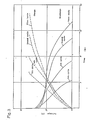
- Fig.4 shows a diagram indicating change of discharge voltage characteristic with x variation at the tenth cycle of charge and discharge cycle when y equals to 0.3 in CrxV2(1-x)O5-(2+y)x
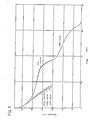
- Fig.5 shows a diagram indicating change of discharge voltage characteristics with y variation at the tenth cycle of charge and discharge cycles when x equals to 0.5 in CrxV2(1-x)O5-(2+y)x,
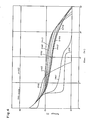
- Fig.6 shows a diagram indicating charge and discharge voltage characteristic of Cr0.5V1.0O3.75.
- Fig.7 shows a diagram indicating the relation of discharge average voltage to the value of x at the tenth cycle when y equals to 0.3 in CrxV2(1-x)O5-(2+y)x'
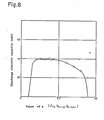
- Fig.8 shows a diagram indicating the relation of discharge capacity to the value of x when y equals to 0.3 in CrxV2(1-x)O5-(2+Y)x'
- Fig.9 shows a diagram indicating change of discharge voltage characteristics after the tenth cycle, when overdischarge is conducted at tenth cycle in Cr0.5V1.0O3.75'
- Fig.10 shows a diagram indicating change of discharge voltage characteristics after the tenth cycle, when overdischarge is conducted at the tenth cycle in Cr0.8V0.4O3.16.
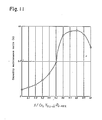
- Fig.11 shows a diagram indicating the relation of capacity maintenance ratio A against overdischarge to the value of x, when y equals to 0.3 in CrxV2(1-x)O5-(2+y)x' The capacity maintenance ratio A means a ratio of discharge electric capacity at the cycle right after overdischarge when the lower limit voltage is returned to 2.0 V to discharge electric capacity up to 2.0 V when overdischarge is carried out.
- Fig.12 shows a diagram indicating the relation of capacity maintenance ratio A against over discharge to the value of y when x equals to 0.8 in CrxV2(1-x)O5-(2+y)x'
- Fig.13 shows a diagram indicating discharge voltage characteristics at the tenth cycle with y variation when x equals to 0.23 in CrxV2(1-x)O5-(2+y)x' and discharge voltage characteristics at the tenth cycle when Cr0.13V0.87O2.17 is used as positive active material.
- The special features as the rechargeable positive active material of the present invention will be illustrated, including its composition ratio (based on x value and y value).
- The electrochemical apparatus used for performance evaluation of the positive electrode is a button type battery comprising an electrode to be evaluated (positive electrode), a counter electrode (negative electrode), and an electrolyte made by dissolving one mol/l of lithium perchlorate (LiClO4) in propylene carbonate (PC). The test electrode which has a doughnut shape disc is prepared by mixing the positive active material of the present invention, carbon black as an electroconductive material and a tetrafluoroethylene resin as a binder and the calendering the mixture with an expand metal of Ti. The electrode, as is shown in Fig. 1, is allowed to expose the expand metal of Ti in the central part of the doughnut shape disc, and the expand metal part is fixed to a positive electrode case of the button type battery by spot-welding. The amount of the positive active material of the present invention is 0.2g in all examples. Fig.2 is a vertical sectional view of the button type battery made by the use of said positive electrode. The above
positive electrode 1 is fixed to thepositive electrode case 2 of the battery by spot welding. The negative electrode is a lithium occluded Pb-Sn-Cd alloy electrode 4 which is capable of reversibly charging and discharging and it is fixed to the inside of the sealingplate 3 by spot welding. The electrodes are sealed together with apolypropylene separator 5 and apropylene carbonate electrolyte 6 made by dissolving one mol/i of lithium perchlorate (LiCl4) through apolypropylene gasket 7 to make a complete battery. - The test conducted in the present invention is an charge and discharge test carried out by using the button type battery mentioned above, assuming that it is a practical battery. The test is carried out at the constant current of 2mA which is corresponding to the current density of 1mA/cm2 per a unit area of the positive electrode. Discharge is carried out until the battery voltage is 2.0V and charge is carried out until the battery voltage is 3.7V, thus charge and discharge is repeated in the voltage range (3.7V-2.0V).
- The positive active material, i.e. an oxide of Cr and V, was prepared by mixing CrO3 and
V 205 and heating for several hours in the air. Various products were obtained by changing the mixing ratio and the heat treatment temperature. Composition analysis was carried out to all of positive active materials prepared under various conditions (mixing ratio and heat treatment temperature) to confirm that they were all indicated by the formula, CrxV2(1-x)O5- (2+y)x' - It was found from the above analysis that the x value in the above formula was governed by the mixing ration of CrO3 and
V 205 which were starting materials and the y value was not governed by the x value at all but only governed by the heat treatment temperature. The value of y became 0.1 at the heat treatment temperature of 200°C, 0.2 at 230°C, 0.3 at 250°C, 0.4 at 270°C, 0.5 at 290°C to 350°C, 0.6 at 350°C, 0.9 at 400°C, 1.0 at 500°C, 1.1 at 600°C. When the x value was 0, 0.1, 0.2, 0.3, 0.4, 0.5, 0.6, 0.7, 0.8, 0.9, and 1.0, the positive active materials had the composition depending on the y value, which are indicated in Table 1.
- The following examples are illustrating results of the charge and discharge test of the button type batteries prepared by the positive active materials indicated in Table 1.
- When the x value is 0 in CrxV2(1-x)O5-(2+y)x' the active material was an oxide of vanadium, which maintains its composition of V2O5 at any y value. The discharge characteristics of the positive active material showed stepwise variation of voltage and showed no flatness of voltage. When the value of x was 1.0, the positive active material was a chromium oxide, of which discharge voltage characteristics vary depending on the heat treatment temperature. Especially, the active material, which was treated at 200°C, oxidationally decomposed the electrolyte employed because of high oxidation power and a gas arose to cause an expansion of the battery. However, if the positive active material was only the chromium oxide, the positive active material at any treatment temperatures indicated bad reversibility and had very short cycle life as the secondary battery. As one example.of it, a diagram of charge and discharge characteristics of the battery comprising the chromium oxide (CrO2.7) treated at 250°C is given in Fig.3. The bad reversibility was observed not only in the chromium oxide treated at 250°C, but in every chromium oxide of the instant example.
- When the x value was in the range of 0 to 0.9, oxides heat-treated at various temperatures were reviewed. The result shows, as exemplified in Fig.4 when y equals to 0.3, that discharge voltage relatively increases as x is getting large at the tenth cycle and becomes improved also in flatness of voltage, while discharge capacity terminated at 2.0V lowers slowly. However, when x was 0.1, the discharge characteristic did not show good flatness of voltage, because the composition of the active material was very similar to V2O5 which showed stepwise variation of discharge voltage. Further, it was found that, when x equaled to 0.9, the voltage characteristic has excellent but the reversibility was insufficient.
- In the effect by heat treatment temperature, the discharge characteristics, as seen in Fig.5 in which discharge characteristics at the tenth cycle of charge and discharge are shown, the discharge voltage lowered rapidly and discharge voltage variation declined remarkably when y exceeded 1.0 in the positive active materials made by changing the value of y depending on variation of heat treatment temperature. This phenomena are not good in view of flatness of voltage. It is desirable that the value of y. is less than 0.5 if discharge voltage and voltage slope are taken into consideration.
- As a typical material prepared by changing the value of x and the temperature, a positive active material obtained by mixing the same amounts of CrO3 and V205 (x=0.5) and heating at 250°C in the air (y=0.3), that is Cr0.5V1.0O3.75, is employed. Voltage characteristics until 50 cycles were measured. The result is shown in Fig.5. As is evaluated in Fig.6, the charge and discharge characteristic even at the 50th cycle was the almost same as the first cycle, and the other performances, such as discharge voltage, discharge flatness and discharge electric capacity were still good.
- When the heat treatment temperature is 250°C (y equals to 0.3, the material of the present invention was CrxV2(1-x) O5-2.3x. As to this material, the relation of the value of x to discharge average voltage was plotted at the tenth cycle. The result is shown in Fig.7. As is shown in Fig.7, voltage increased as the x value increased. The relation of discharge capacity to x value is shown in Fig.8. As is shown in Fig.8, discharge capacity was good within the range of x=0.2 to x=0.8. In addition, energy (capacity times voltage) exhibits similar level within the range of x=0.2 to x=0.8, judging from the plot indicated in Figs.7 and 8.
- For evaluating overdischarge characteristics, an oxide, which obtained by mixing the same amount of Cr03 and V2O5 (x=0.5) and heating at 250°C in the air (y=o.3), that is Cr0.5V1.0O3.75, was adopted and deep discharge up to 0.5 V, which exceeded its discharge lower limit, was made at the tenth cycle. As is shown in Fig.9, discharge voltage at the tenth cycle was stepwise variation. After that, though the charge and discharge condition, i.e. the upper limit voltage 3.7 V and lower limit voltage 2.0 V, was applied up to the 20th cycle, the discharge voltage characteristics shape was changed after the eleventh cycle and had not been recovered to the initial characteristics. In other words, once overdischarge was made, charge and discharge characteristics after overdischarge were adversely affected. It is one of demerit from the point of practical views. On the other hand, Cr0.8V0.4O3.16 (CrxV2(1-x)O5-(2+y)x' wherein x=0.8 and y=0.3) was employed as a positive active material to form a button type battery and the same test, in which overdischarge was made at the tenth cycle to 0.5 V and the lower limit voltage was returned to 2.0 V after the eleventh cycle. The result is shown in Fig.10. As is shown in Fig.10, charge and discharge characteristics were not hardly changed in 50 cycles and the effect by the overdischarge at the tenth cycle was not hardly seen. When the above positive electrode was reviewed from capacity maintenance ratio against overdischarge (The capacity maintenance ratio A means the ratio of discharge electric capacity at the cycle right after overdischarge when the lower limit voltage is returned to 2.0V against discharge electric capacity up to 2.0V of the discharge when overdischarge is carried out), Cr0.5V1.0O3.75 showed A=0.48 because the ratio was the discharge electric capacity of the eleventh cycle to the capacity of up to 2.0 V of the discharge of the tenth cycle. Cr0.8V0.403.16 of Fig.10 also showed A=0.94. The same cycle test in which overdischarge was conducted on the tenth cycle was carried out to CrxV2(1-x)O5-(2+y)x of which y fixed to 0.3 (250°C heat treatment) and x value varied. Plot was made to the relation of the value of x to their capacity maintenance ratio A to obtain Fig.11. As is showed in Fig.11, capacity maintenance ratio A shows relatively high amount within the range of x=0.6 to x=0.9 and declined rapidly not more than x=0.5.
- The same cycle test in which overdischarge was conducted on the tenth cycle was carried out to CrXV2(1-x)O5-(2+y)x of which x fixed to 0.8 and y was allowed to change. Plot was made to the relation of the value of y to their capacity maintenance ratio A to obtain Fig.12. As is shown in Fig.12, capacity maintenance ratio A had no effect by y value and could be deemed to depend only on x value.
- Another button battery was made by using Cr0.13V0.87O2.17 prepared by the process and starting material as generally described in Abraham's report mentioned before and battery performances were reviewed as follow.
- Cr0.13V0.87O2.17 is completely different from the positive active material of the present invention, because it corresponds to CrxV2(1-x)O5-(2+y)x of which x equals to 0.230 and y equals to 3.047 while in the present invention y has to be within the range of 0.1 to 1.0. In comparison with the Abraham's report, the present invention also has different object in preparation of oxide, because the object of preparation of Cr0.13V0.87O2.17 in Abraham's report is to lower a valence of U2.O5 by reacting V2O5 having a valence of 5 with chromium metal having a valence of 0 as a reducing agent, while the present invention does not react with chromium metal but with CrO3 having a valence of 6 which is rather an oxidation agent and no object to reduce its valence is existent. As the matter of fact, the valence of the active material of the present invention is very different as assumed by the difference of the value of y. In order to compare, some positive active materials in which x equals co 0.23 and y exists within the range of 0.1 to 1.0 were prepared to adjust the composition ratio of the present invention. The same type button battery was constituted by using the positive active materials mentioned above in the same amount as the examples and a cycle test of charge and discharge was carried out under the same condition as the examples. Fig.13 shows both discharge voltage characteristics of the batteries of the present invention at the tenth cycle when x equals to 0.23 and y equals to 0.1, 0.3, 0.5, 0.7, 0.9, 1.0 in the positive active material of the present invention, and discharge voltage characteristic of the positive active material of Cr0.13V0.87O2.17 (x=0.23, y=3.047) at the tenth cycle. Fig.13 shows big gap between the positive active materials of the present invention and Cr0.13V0.87O2.17 reported by Abraham in discharge voltage and discharge capacity. It is believed that both materials are completely different with each other. Further the cycle life becomes short in Cr0.13V0.87C2.17 and overdischarge test was carried out to it to result in losing its performances as a battery.
- The battery characteristic of Cr0.3V0.87O2.17 as shown in Fig.13 is almost identical to the data reported by Abraham and the result of composition analysis also indicates the material is Cr0.13V0.87O2.17, thus the preparation of Cr0.13V0.87O2.17 is deemed correct. As mentioned before, both the material reported by Abraham et al and the positive active material of the present invention are quite different from each other in its characteristic as well as in starting point of thinking.
- Though characteristics as a positive electrode, which are brought about by the oxides made from Cr and V, are only illustrated by the button type battery made by particular combination of the negative electrode and the electrode, the present invention should not construe as limiting the particular combination and the type of electrochemical apparatus.
- Particularly, explanation has been made by using as a negative electrode, the combination of rechargeable Pb-Sn-Cd alloy with lithium as a negative active material, but the positive electrode of the present invention works when the other alloys, as far as charge and discharge can be reversibly conducted and lithium metal itself are employed. In the above explanation, lithium is used as a negative active material, but the other negative active materials, such as sodium and potassium, can work as a negative active material.
- Furthermore, an addition of another substance to the active material of the present invention, CrxV2(1-x)- O5-(2+y)x, can be improved in its characteristic. For example, Mo has a pcssibility to enhance cycle characteristic, though it declines capacity.
- The positive active material of the present invention can reversibly react with alkali metal in a non- aquecus electrolyte containing alkali metal ions during charge and discharge. Accordingly the present invention provides an excellent rechargeable positive electrode having long cycle life, flatness of discharge voltage, high discharge voltage and large reaction amount capable of charging and discharging (charge and discharge electric capacity). The active material of the present invention can apply to any rechargeable electrochemical apparatus, such as a secondary battery employing alkali metal, e.g. lithium, as a negative electrode.
Claims (21)




Applications Claiming Priority (2)
| Application Number | Priority Date | Filing Date | Title |
|---|---|---|---|
| JP59069386A JPS60212959A (en) | 1984-04-06 | 1984-04-06 | Nonaqueous electrolyte secondary battery |
| JP69386/84 | 1984-04-06 |
Publications (3)
| Publication Number | Publication Date |
|---|---|
| EP0177618A1 true EP0177618A1 (en) | 1986-04-16 |
| EP0177618A4 EP0177618A4 (en) | 1987-07-23 |
| EP0177618B1 EP0177618B1 (en) | 1990-07-18 |
Family
ID=13401095
Family Applications (1)
| Application Number | Title | Priority Date | Filing Date |
|---|---|---|---|
| EP85901588A Expired - Lifetime EP0177618B1 (en) | 1984-04-06 | 1985-04-03 | Rechargeable electrochemical device and a positive electrode therefor |
Country Status (5)
| Country | Link |
|---|---|
| US (1) | US4668594A (en) |
| EP (1) | EP0177618B1 (en) |
| JP (1) | JPS60212959A (en) |
| DE (1) | DE3578723D1 (en) |
| WO (1) | WO1985004763A1 (en) |
Families Citing this family (12)
| Publication number | Priority date | Publication date | Assignee | Title |
|---|---|---|---|---|
| JPH0636365B2 (en) * | 1984-04-25 | 1994-05-11 | 三洋電機株式会社 | Method for producing chromium-vanadium composite oxide for positive electrode active material of non-aqueous electrolyte secondary battery |
| JPS61200668A (en) * | 1985-03-01 | 1986-09-05 | Matsushita Electric Ind Co Ltd | Nonaqueous electrolyte secondary battery |
| USH1544H (en) * | 1990-08-06 | 1996-06-04 | The United States Of America As Represented By The Secretary Of The Navy | Thermal battery cells containing cathode materials in low-melting nitrate electrolytes |
| USH1449H (en) * | 1990-08-06 | 1995-06-06 | The United States Of America As Represented By The Secretary Of The Navy | Thermal battery cells containing novel cathode materials in an oxyanionic electrolyte |
| FR2685129B1 (en) * | 1991-12-13 | 1994-03-25 | Centre Nal Etudes Spatiales | USE OF VANADIUM OXIDE BRONZES WITH IRON AND / OR ALUMINUM AS CATHODE MATERIAL IN ELECTROCHEMICAL GENERATORS. |
| US5336572A (en) * | 1993-06-14 | 1994-08-09 | Valence Technology, Inc. | Vanadium oxide cathode active material and method of making same |
| CA2199446A1 (en) * | 1997-03-07 | 1998-09-07 | Yves Choquette | Polymer electrolyte batteries containing a potassium salt to stabilize performance and operating life |
| USRE37805E1 (en) * | 1997-03-12 | 2002-07-23 | Hydro-Quebec | Polymer electrolyte lithium battery containing a potassium salt |
| US6114069A (en) * | 1997-03-12 | 2000-09-05 | Hydro Quebec | Polymer electrolyte lithium battery containing a potassium salt |
| JP4061586B2 (en) * | 2003-04-11 | 2008-03-19 | ソニー株式会社 | Positive electrode active material for nonaqueous electrolyte secondary battery and nonaqueous electrolyte secondary battery using the same |
| CN114031115B (en) * | 2021-11-15 | 2023-08-04 | 重庆大学 | A kind of preparation method of magnesium-ion battery layered copper copper ore positive electrode material |
| CN115188918B (en) * | 2022-04-13 | 2026-02-10 | 武汉中原长江科技发展有限公司 | A chromium oxide composite material with added activator, its preparation method and application |
Family Cites Families (12)
| Publication number | Priority date | Publication date | Assignee | Title |
|---|---|---|---|---|
| DE2726380C2 (en) * | 1977-06-10 | 1984-03-08 | Varta Batterie Ag, 3000 Hannover | Electrochemical power source of high energy density |
| US4118550A (en) * | 1977-09-26 | 1978-10-03 | Eic Corporation | Aprotic solvent electrolytes and batteries using same |
| US4228226A (en) * | 1978-10-10 | 1980-10-14 | Bell Telephone Laboratories, Incorporated | Nonaqueous secondary cell using vanadium oxide positive electrode |
| US4233375A (en) * | 1979-08-02 | 1980-11-11 | Exxon Research & Engineering Co. | High energy density plural chalcogenide cathode-containing cell |
| JPS5682574A (en) * | 1979-11-06 | 1981-07-06 | South African Inventions | Method of manufacturing cathode adapted for secondary electrochemical battery |
| AU532635B2 (en) * | 1979-11-06 | 1983-10-06 | South African Inventions Development Corporation | Metal oxide cathode |
| FR2527842B1 (en) * | 1982-06-01 | 1992-02-07 | Western Electric Co | NONAQUEOUS BATTERY OR ACCUMULATOR ELEMENT USING A POSITIVE ELECTRODE OF MIXED METAL OXIDES |
| US4542083A (en) * | 1982-06-01 | 1985-09-17 | At&T Bell Laboratories | Nonaqueous cell using mixed metal oxide positive electrode |
| JPS5916272A (en) * | 1982-07-19 | 1984-01-27 | Nippon Telegr & Teleph Corp <Ntt> | Lithium battery |
| US4542009A (en) * | 1983-04-21 | 1985-09-17 | Combustion Engineering, Inc. | Synthesis of intercalatable layered stable transition metal chalcogenides and alkali metal-transition metal chalcogenides |
| US4463072A (en) * | 1983-11-30 | 1984-07-31 | Allied Corporation | Secondary batteries containing room-temperature molten 1,2,3-trialkylimidazolium halide non-aqueous electrolyte |
| US4472487A (en) * | 1983-11-30 | 1984-09-18 | Allied Corporation | Battery having polymeric anode coated with reaction product of oxirane compound |
-
1984
- 1984-04-06 JP JP59069386A patent/JPS60212959A/en active Granted
-
1985
- 1985-04-03 WO PCT/JP1985/000162 patent/WO1985004763A1/en not_active Ceased
- 1985-04-03 US US06/812,889 patent/US4668594A/en not_active Expired - Lifetime
- 1985-04-03 EP EP85901588A patent/EP0177618B1/en not_active Expired - Lifetime
- 1985-04-03 DE DE8585901588T patent/DE3578723D1/en not_active Expired - Lifetime
Also Published As
| Publication number | Publication date |
|---|---|
| JPH041994B2 (en) | 1992-01-16 |
| JPS60212959A (en) | 1985-10-25 |
| EP0177618B1 (en) | 1990-07-18 |
| US4668594A (en) | 1987-05-26 |
| WO1985004763A1 (en) | 1985-10-24 |
| EP0177618A4 (en) | 1987-07-23 |
| DE3578723D1 (en) | 1990-08-23 |
Similar Documents
| Publication | Publication Date | Title |
|---|---|---|
| US4464447A (en) | Rechargeable lithium batteries with non-metal electrodes | |
| EP0720247B1 (en) | Manufacturing processes of positive active materials for lithium secondary batteries and lithium secondary batteries comprising the same | |
| CA2345518C (en) | Sandwich cathode design for alkali metal electrochemical cell with high discharge rate capability | |
| EP1390994B1 (en) | Improved cathode compositions for lithium-ion batteries | |
| US6670076B1 (en) | Spinel-type lithium-manganese oxide containing heteroelements preparation process and use thereof | |
| JP5143852B2 (en) | Nonaqueous electrolyte secondary battery | |
| US4737424A (en) | Secondary lithium battery | |
| JPH11265722A (en) | Controlling swelling of alkali metal electrochemical cells | |
| EP1115170B1 (en) | Non-aqueous liquid electrolyte secondary cell and method for manufacturing the same | |
| DE19615686A1 (en) | Lithium manganese oxide insertion compounds, process for their preparation and their use in accumulators | |
| JPH11513181A (en) | Rechargeable lithium battery electrode | |
| US4668594A (en) | Rechargeable electrochemical apparatus and positive electrode thereof | |
| JP2000251898A (en) | Cobalt-based alloy as a positive electrode current collector in non-aqueous electrochemical cells | |
| JP2002198061A (en) | Alkaline metal electrochemical cell with short-circuit safety characteristic using double-collector cathode structure | |
| JPS59134568A (en) | Electrolyte for lithium battery | |
| CN101331642B (en) | Non-aqueous electrolytic solution and secondary battery containing same | |
| EP0810681A1 (en) | Nonaqueous electrolyte secondary battery | |
| CA1290805C (en) | Rechargeable organic electrolyte cell | |
| JP2963452B1 (en) | Positive electrode active material and non-aqueous electrolyte secondary battery using the same | |
| JP2002117898A (en) | Non-aqueous organic electrolysis liquid for electric discharge in low temperature of re-chargeable electrochemistry battery | |
| JPH0644972A (en) | Lithium secondary battery | |
| JPH0424828B2 (en) | ||
| JPH03119656A (en) | Manufacturing method of positive electrode active material for lithium secondary battery | |
| JP2770154B2 (en) | Manufacturing method of lithium secondary battery | |
| JPH04181660A (en) | Nonaqueous secondary battery |
Legal Events
| Date | Code | Title | Description |
|---|---|---|---|
| PUAI | Public reference made under article 153(3) epc to a published international application that has entered the european phase |
Free format text: ORIGINAL CODE: 0009012 |
|
| 17P | Request for examination filed |
Effective date: 19860122 |
|
| AK | Designated contracting states |
Kind code of ref document: A1 Designated state(s): DE FR GB |
|
| A4 | Supplementary search report drawn up and despatched |
Effective date: 19870723 |
|
| 17Q | First examination report despatched |
Effective date: 19880923 |
|
| GRAA | (expected) grant |
Free format text: ORIGINAL CODE: 0009210 |
|
| AK | Designated contracting states |
Kind code of ref document: B1 Designated state(s): DE FR GB |
|
| REF | Corresponds to: |
Ref document number: 3578723 Country of ref document: DE Date of ref document: 19900823 |
|
| ET | Fr: translation filed | ||
| PLBE | No opposition filed within time limit |
Free format text: ORIGINAL CODE: 0009261 |
|
| STAA | Information on the status of an ep patent application or granted ep patent |
Free format text: STATUS: NO OPPOSITION FILED WITHIN TIME LIMIT |
|
| 26N | No opposition filed | ||
| REG | Reference to a national code |
Ref country code: GB Ref legal event code: 746 Effective date: 19951123 |
|
| REG | Reference to a national code |
Ref country code: FR Ref legal event code: D6 |
|
| PGFP | Annual fee paid to national office [announced via postgrant information from national office to epo] |
Ref country code: DE Payment date: 20010326 Year of fee payment: 17 |
|
| PGFP | Annual fee paid to national office [announced via postgrant information from national office to epo] |
Ref country code: GB Payment date: 20010328 Year of fee payment: 17 |
|
| PGFP | Annual fee paid to national office [announced via postgrant information from national office to epo] |
Ref country code: FR Payment date: 20010409 Year of fee payment: 17 |
|
| REG | Reference to a national code |
Ref country code: GB Ref legal event code: IF02 |
|
| PG25 | Lapsed in a contracting state [announced via postgrant information from national office to epo] |
Ref country code: GB Free format text: LAPSE BECAUSE OF NON-PAYMENT OF DUE FEES Effective date: 20020403 |
|
| PG25 | Lapsed in a contracting state [announced via postgrant information from national office to epo] |
Ref country code: DE Free format text: LAPSE BECAUSE OF NON-PAYMENT OF DUE FEES Effective date: 20021101 |
|
| GBPC | Gb: european patent ceased through non-payment of renewal fee |
Effective date: 20020403 |
|
| PG25 | Lapsed in a contracting state [announced via postgrant information from national office to epo] |
Ref country code: FR Free format text: LAPSE BECAUSE OF NON-PAYMENT OF DUE FEES Effective date: 20021231 |
|
| REG | Reference to a national code |
Ref country code: FR Ref legal event code: ST |