EP0174844B1 - Method for production of alpha-aryl-alkanoic acid - Google Patents
Method for production of alpha-aryl-alkanoic acid Download PDFInfo
- Publication number
- EP0174844B1 EP0174844B1 EP85306454A EP85306454A EP0174844B1 EP 0174844 B1 EP0174844 B1 EP 0174844B1 EP 85306454 A EP85306454 A EP 85306454A EP 85306454 A EP85306454 A EP 85306454A EP 0174844 B1 EP0174844 B1 EP 0174844B1
- Authority
- EP
- European Patent Office
- Prior art keywords
- carbon atoms
- aryl
- stands
- diluent
- rearrangement reaction
- Prior art date
- Legal status (The legal status is an assumption and is not a legal conclusion. Google has not performed a legal analysis and makes no representation as to the accuracy of the status listed.)
- Expired
Links
- 239000002253 acid Substances 0.000 title claims description 9
- 238000004519 manufacturing process Methods 0.000 title claims description 7
- 238000000034 method Methods 0.000 claims description 44
- 125000004432 carbon atom Chemical group C* 0.000 claims description 25
- XLOMVQKBTHCTTD-UHFFFAOYSA-N Zinc monoxide Chemical compound [Zn]=O XLOMVQKBTHCTTD-UHFFFAOYSA-N 0.000 claims description 20
- 125000000217 alkyl group Chemical group 0.000 claims description 17
- 238000006462 rearrangement reaction Methods 0.000 claims description 17
- -1 cyclic acetal Chemical class 0.000 claims description 12
- 239000003085 diluting agent Substances 0.000 claims description 11
- 239000011787 zinc oxide Substances 0.000 claims description 10
- 150000003752 zinc compounds Chemical class 0.000 claims description 9
- BVKZGUZCCUSVTD-UHFFFAOYSA-L Carbonate Chemical compound [O-]C([O-])=O BVKZGUZCCUSVTD-UHFFFAOYSA-L 0.000 claims description 6
- 125000003545 alkoxy group Chemical group 0.000 claims description 6
- 125000003118 aryl group Chemical group 0.000 claims description 6
- 125000001997 phenyl group Chemical group [H]C1=C([H])C([H])=C(*)C([H])=C1[H] 0.000 claims description 6
- 125000004435 hydrogen atom Chemical group [H]* 0.000 claims description 5
- HCHKCACWOHOZIP-UHFFFAOYSA-N Zinc Chemical compound [Zn] HCHKCACWOHOZIP-UHFFFAOYSA-N 0.000 claims description 4
- 125000001931 aliphatic group Chemical group 0.000 claims description 4
- XLYOFNOQVPJJNP-UHFFFAOYSA-M hydroxide Chemical compound [OH-] XLYOFNOQVPJJNP-UHFFFAOYSA-M 0.000 claims description 4
- 229920006395 saturated elastomer Polymers 0.000 claims description 4
- 125000001424 substituent group Chemical group 0.000 claims description 4
- 239000011701 zinc Substances 0.000 claims description 4
- 229910052725 zinc Inorganic materials 0.000 claims description 4
- WKBOTKDWSSQWDR-UHFFFAOYSA-N Bromine atom Chemical group [Br] WKBOTKDWSSQWDR-UHFFFAOYSA-N 0.000 claims description 3
- UCKMPCXJQFINFW-UHFFFAOYSA-N Sulphide Chemical compound [S-2] UCKMPCXJQFINFW-UHFFFAOYSA-N 0.000 claims description 3
- DHKHKXVYLBGOIT-UHFFFAOYSA-N acetaldehyde Diethyl Acetal Natural products CCOC(C)OCC DHKHKXVYLBGOIT-UHFFFAOYSA-N 0.000 claims description 3
- 125000003302 alkenyloxy group Chemical group 0.000 claims description 3
- 125000005843 halogen group Chemical group 0.000 claims description 3
- 230000003301 hydrolyzing effect Effects 0.000 claims description 3
- 125000001624 naphthyl group Chemical group 0.000 claims description 3
- 125000000951 phenoxy group Chemical group [H]C1=C([H])C([H])=C(O*)C([H])=C1[H] 0.000 claims description 3
- 150000005846 sugar alcohols Polymers 0.000 claims description 3
- 125000002723 alicyclic group Chemical group 0.000 claims description 2
- 150000004945 aromatic hydrocarbons Chemical class 0.000 claims description 2
- QVGXLLKOCUKJST-UHFFFAOYSA-N atomic oxygen Chemical compound [O] QVGXLLKOCUKJST-UHFFFAOYSA-N 0.000 claims description 2
- 229910052801 chlorine Inorganic materials 0.000 claims description 2
- 125000001309 chloro group Chemical group Cl* 0.000 claims description 2
- 125000000753 cycloalkyl group Chemical group 0.000 claims description 2
- 125000000623 heterocyclic group Chemical group 0.000 claims description 2
- 239000001301 oxygen Substances 0.000 claims description 2
- 229910052760 oxygen Inorganic materials 0.000 claims description 2
- 125000004417 unsaturated alkyl group Chemical group 0.000 claims 1
- YXFVVABEGXRONW-UHFFFAOYSA-N Toluene Chemical compound CC1=CC=CC=C1 YXFVVABEGXRONW-UHFFFAOYSA-N 0.000 description 27
- 239000003054 catalyst Substances 0.000 description 27
- 238000006243 chemical reaction Methods 0.000 description 13
- LYCAIKOWRPUZTN-UHFFFAOYSA-N Ethylene glycol Chemical compound OCCO LYCAIKOWRPUZTN-UHFFFAOYSA-N 0.000 description 12
- HEMHJVSKTPXQMS-UHFFFAOYSA-M Sodium hydroxide Chemical compound [OH-].[Na+] HEMHJVSKTPXQMS-UHFFFAOYSA-M 0.000 description 12
- 239000000047 product Substances 0.000 description 11
- OKKJLVBELUTLKV-UHFFFAOYSA-N Methanol Chemical compound OC OKKJLVBELUTLKV-UHFFFAOYSA-N 0.000 description 9
- 239000011541 reaction mixture Substances 0.000 description 9
- HEFNNWSXXWATRW-UHFFFAOYSA-N Ibuprofen Chemical compound CC(C)CC1=CC=C(C(C)C(O)=O)C=C1 HEFNNWSXXWATRW-UHFFFAOYSA-N 0.000 description 8
- VEXZGXHMUGYJMC-UHFFFAOYSA-N Hydrochloric acid Chemical compound Cl VEXZGXHMUGYJMC-UHFFFAOYSA-N 0.000 description 7
- 239000007864 aqueous solution Substances 0.000 description 7
- 150000001875 compounds Chemical class 0.000 description 7
- DNIAPMSPPWPWGF-UHFFFAOYSA-N Propylene glycol Chemical compound CC(O)CO DNIAPMSPPWPWGF-UHFFFAOYSA-N 0.000 description 6
- MTHSVFCYNBDYFN-UHFFFAOYSA-N diethylene glycol Chemical compound OCCOCCO MTHSVFCYNBDYFN-UHFFFAOYSA-N 0.000 description 6
- QQQXFZIAUWHPSK-UHFFFAOYSA-N 2-(1-bromoethyl)-2-[4-(2-methylpropyl)phenyl]-1,3-dioxolane Chemical compound C1=CC(CC(C)C)=CC=C1C1(C(C)Br)OCCO1 QQQXFZIAUWHPSK-UHFFFAOYSA-N 0.000 description 5
- 238000002844 melting Methods 0.000 description 5
- 230000008018 melting Effects 0.000 description 5
- 125000002496 methyl group Chemical group [H]C([H])([H])* 0.000 description 5
- 230000007062 hydrolysis Effects 0.000 description 4
- 238000006460 hydrolysis reaction Methods 0.000 description 4
- 239000002904 solvent Substances 0.000 description 4
- 231100000331 toxic Toxicity 0.000 description 4
- 230000002588 toxic effect Effects 0.000 description 4
- ZWEHNKRNPOVVGH-UHFFFAOYSA-N 2-Butanone Chemical compound CCC(C)=O ZWEHNKRNPOVVGH-UHFFFAOYSA-N 0.000 description 3
- UHOVQNZJYSORNB-UHFFFAOYSA-N Benzene Chemical compound C1=CC=CC=C1 UHOVQNZJYSORNB-UHFFFAOYSA-N 0.000 description 3
- YMWUJEATGCHHMB-UHFFFAOYSA-N Dichloromethane Chemical compound ClCCl YMWUJEATGCHHMB-UHFFFAOYSA-N 0.000 description 3
- RTZKZFJDLAIYFH-UHFFFAOYSA-N Diethyl ether Chemical compound CCOCC RTZKZFJDLAIYFH-UHFFFAOYSA-N 0.000 description 3
- 239000002841 Lewis acid Substances 0.000 description 3
- MVPPADPHJFYWMZ-UHFFFAOYSA-N chlorobenzene Chemical compound ClC1=CC=CC=C1 MVPPADPHJFYWMZ-UHFFFAOYSA-N 0.000 description 3
- 238000007796 conventional method Methods 0.000 description 3
- 238000005260 corrosion Methods 0.000 description 3
- 230000007797 corrosion Effects 0.000 description 3
- 125000001495 ethyl group Chemical group [H]C([H])([H])C([H])([H])* 0.000 description 3
- 150000007517 lewis acids Chemical class 0.000 description 3
- 239000000203 mixture Substances 0.000 description 3
- VLKZOEOYAKHREP-UHFFFAOYSA-N n-Hexane Chemical compound CCCCCC VLKZOEOYAKHREP-UHFFFAOYSA-N 0.000 description 3
- 239000001294 propane Substances 0.000 description 3
- PUPZLCDOIYMWBV-UHFFFAOYSA-N (+/-)-1,3-Butanediol Chemical compound CC(O)CCO PUPZLCDOIYMWBV-UHFFFAOYSA-N 0.000 description 2
- UBWMJDOJXJEORL-UHFFFAOYSA-N 1-(2-bromo-1,1-dimethoxypropyl)-4-(2-methylpropyl)benzene Chemical compound COC(OC)(C(C)Br)C1=CC=C(CC(C)C)C=C1 UBWMJDOJXJEORL-UHFFFAOYSA-N 0.000 description 2
- CSCPPACGZOOCGX-UHFFFAOYSA-N Acetone Chemical compound CC(C)=O CSCPPACGZOOCGX-UHFFFAOYSA-N 0.000 description 2
- HEDRZPFGACZZDS-UHFFFAOYSA-N Chloroform Chemical compound ClC(Cl)Cl HEDRZPFGACZZDS-UHFFFAOYSA-N 0.000 description 2
- PEDCQBHIVMGVHV-UHFFFAOYSA-N Glycerine Chemical compound OCC(O)CO PEDCQBHIVMGVHV-UHFFFAOYSA-N 0.000 description 2
- 229910052784 alkaline earth metal Inorganic materials 0.000 description 2
- 150000007514 bases Chemical class 0.000 description 2
- 230000015572 biosynthetic process Effects 0.000 description 2
- GZUXJHMPEANEGY-UHFFFAOYSA-N bromomethane Chemical compound BrC GZUXJHMPEANEGY-UHFFFAOYSA-N 0.000 description 2
- WERYXYBDKMZEQL-UHFFFAOYSA-N butane-1,4-diol Chemical compound OCCCCO WERYXYBDKMZEQL-UHFFFAOYSA-N 0.000 description 2
- 239000003814 drug Substances 0.000 description 2
- 150000002148 esters Chemical class 0.000 description 2
- 238000001914 filtration Methods 0.000 description 2
- WGCNASOHLSPBMP-UHFFFAOYSA-N hydroxyacetaldehyde Natural products OCC=O WGCNASOHLSPBMP-UHFFFAOYSA-N 0.000 description 2
- 150000002576 ketones Chemical class 0.000 description 2
- 229910052751 metal Inorganic materials 0.000 description 2
- 239000002184 metal Substances 0.000 description 2
- YPFDHNVEDLHUCE-UHFFFAOYSA-N propane-1,3-diol Chemical compound OCCCO YPFDHNVEDLHUCE-UHFFFAOYSA-N 0.000 description 2
- 239000002994 raw material Substances 0.000 description 2
- 230000035484 reaction time Effects 0.000 description 2
- 239000000126 substance Substances 0.000 description 2
- 238000003786 synthesis reaction Methods 0.000 description 2
- VZGDMQKNWNREIO-UHFFFAOYSA-N tetrachloromethane Chemical compound ClC(Cl)(Cl)Cl VZGDMQKNWNREIO-UHFFFAOYSA-N 0.000 description 2
- 229910052716 thallium Inorganic materials 0.000 description 2
- BKVIYDNLLOSFOA-UHFFFAOYSA-N thallium Chemical compound [Tl] BKVIYDNLLOSFOA-UHFFFAOYSA-N 0.000 description 2
- XWVKTOHUMPLABF-UHFFFAOYSA-N thallium(3+) Chemical class [Tl+3] XWVKTOHUMPLABF-UHFFFAOYSA-N 0.000 description 2
- XLYOFNOQVPJJNP-UHFFFAOYSA-N water Substances O XLYOFNOQVPJJNP-UHFFFAOYSA-N 0.000 description 2
- UOCLXMDMGBRAIB-UHFFFAOYSA-N 1,1,1-trichloroethane Chemical compound CC(Cl)(Cl)Cl UOCLXMDMGBRAIB-UHFFFAOYSA-N 0.000 description 1
- SCYULBFZEHDVBN-UHFFFAOYSA-N 1,1-Dichloroethane Chemical compound CC(Cl)Cl SCYULBFZEHDVBN-UHFFFAOYSA-N 0.000 description 1
- RYHBNJHYFVUHQT-UHFFFAOYSA-N 1,4-Dioxane Chemical compound C1COCCO1 RYHBNJHYFVUHQT-UHFFFAOYSA-N 0.000 description 1
- OCJBOOLMMGQPQU-UHFFFAOYSA-N 1,4-dichlorobenzene Chemical compound ClC1=CC=C(Cl)C=C1 OCJBOOLMMGQPQU-UHFFFAOYSA-N 0.000 description 1
- 229940043375 1,5-pentanediol Drugs 0.000 description 1
- ALVZNPYWJMLXKV-UHFFFAOYSA-N 1,9-Nonanediol Chemical compound OCCCCCCCCCO ALVZNPYWJMLXKV-UHFFFAOYSA-N 0.000 description 1
- NVOQBSNQIACXMB-UHFFFAOYSA-N 2-(1-chloroethyl)-2-[4-(2-methylpropyl)phenyl]-1,3-dioxolane Chemical compound C1=CC(CC(C)C)=CC=C1C1(C(C)Cl)OCCO1 NVOQBSNQIACXMB-UHFFFAOYSA-N 0.000 description 1
- LCZVSXRMYJUNFX-UHFFFAOYSA-N 2-[2-(2-hydroxypropoxy)propoxy]propan-1-ol Chemical compound CC(O)COC(C)COC(C)CO LCZVSXRMYJUNFX-UHFFFAOYSA-N 0.000 description 1
- XDTMQSROBMDMFD-UHFFFAOYSA-N Cyclohexane Chemical compound C1CCCCC1 XDTMQSROBMDMFD-UHFFFAOYSA-N 0.000 description 1
- LFQSCWFLJHTTHZ-UHFFFAOYSA-N Ethanol Chemical compound CCO LFQSCWFLJHTTHZ-UHFFFAOYSA-N 0.000 description 1
- RLAHWVDQYNDAGG-UHFFFAOYSA-N Methanetriol Chemical compound OC(O)O RLAHWVDQYNDAGG-UHFFFAOYSA-N 0.000 description 1
- CTQNGGLPUBDAKN-UHFFFAOYSA-N O-Xylene Chemical compound CC1=CC=CC=C1C CTQNGGLPUBDAKN-UHFFFAOYSA-N 0.000 description 1
- ALQSHHUCVQOPAS-UHFFFAOYSA-N Pentane-1,5-diol Chemical compound OCCCCCO ALQSHHUCVQOPAS-UHFFFAOYSA-N 0.000 description 1
- CYTYCFOTNPOANT-UHFFFAOYSA-N Perchloroethylene Chemical group ClC(Cl)=C(Cl)Cl CYTYCFOTNPOANT-UHFFFAOYSA-N 0.000 description 1
- XBDQKXXYIPTUBI-UHFFFAOYSA-N Propionic acid Substances CCC(O)=O XBDQKXXYIPTUBI-UHFFFAOYSA-N 0.000 description 1
- QAOWNCQODCNURD-UHFFFAOYSA-L Sulfate Chemical compound [O-]S([O-])(=O)=O QAOWNCQODCNURD-UHFFFAOYSA-L 0.000 description 1
- UWHCKJMYHZGTIT-UHFFFAOYSA-N Tetraethylene glycol, Natural products OCCOCCOCCOCCO UWHCKJMYHZGTIT-UHFFFAOYSA-N 0.000 description 1
- 150000001241 acetals Chemical group 0.000 description 1
- QTBSBXVTEAMEQO-UHFFFAOYSA-N acetic acid Substances CC(O)=O QTBSBXVTEAMEQO-UHFFFAOYSA-N 0.000 description 1
- 229960000583 acetic acid Drugs 0.000 description 1
- 150000001242 acetic acid derivatives Chemical class 0.000 description 1
- 150000001298 alcohols Chemical class 0.000 description 1
- 239000003513 alkali Substances 0.000 description 1
- 125000002947 alkylene group Chemical group 0.000 description 1
- 150000001412 amines Chemical class 0.000 description 1
- 230000000202 analgesic effect Effects 0.000 description 1
- 230000001741 anti-phlogistic effect Effects 0.000 description 1
- 230000001754 anti-pyretic effect Effects 0.000 description 1
- 239000002221 antipyretic Substances 0.000 description 1
- 229940125716 antipyretic agent Drugs 0.000 description 1
- 235000019437 butane-1,3-diol Nutrition 0.000 description 1
- OWBTYPJTUOEWEK-UHFFFAOYSA-N butane-2,3-diol Chemical compound CC(O)C(C)O OWBTYPJTUOEWEK-UHFFFAOYSA-N 0.000 description 1
- 125000003178 carboxy group Chemical group [H]OC(*)=O 0.000 description 1
- FOTKYAAJKYLFFN-UHFFFAOYSA-N decane-1,10-diol Chemical compound OCCCCCCCCCCO FOTKYAAJKYLFFN-UHFFFAOYSA-N 0.000 description 1
- 229940117389 dichlorobenzene Drugs 0.000 description 1
- SZXQTJUDPRGNJN-UHFFFAOYSA-N dipropylene glycol Chemical compound OCCCOCCCO SZXQTJUDPRGNJN-UHFFFAOYSA-N 0.000 description 1
- 150000002170 ethers Chemical class 0.000 description 1
- 238000004880 explosion Methods 0.000 description 1
- 239000000706 filtrate Substances 0.000 description 1
- 235000011187 glycerol Nutrition 0.000 description 1
- SXCBDZAEHILGLM-UHFFFAOYSA-N heptane-1,7-diol Chemical compound OCCCCCCCO SXCBDZAEHILGLM-UHFFFAOYSA-N 0.000 description 1
- XYXCXCJKZRDVPU-UHFFFAOYSA-N hexane-1,2,3-triol Chemical compound CCCC(O)C(O)CO XYXCXCJKZRDVPU-UHFFFAOYSA-N 0.000 description 1
- XXMIOPMDWAUFGU-UHFFFAOYSA-N hexane-1,6-diol Chemical compound OCCCCCCO XXMIOPMDWAUFGU-UHFFFAOYSA-N 0.000 description 1
- OHMBHFSEKCCCBW-UHFFFAOYSA-N hexane-2,5-diol Chemical compound CC(O)CCC(C)O OHMBHFSEKCCCBW-UHFFFAOYSA-N 0.000 description 1
- 229960001680 ibuprofen Drugs 0.000 description 1
- 239000000463 material Substances 0.000 description 1
- 229910001507 metal halide Inorganic materials 0.000 description 1
- 150000005309 metal halides Chemical class 0.000 description 1
- 229940102396 methyl bromide Drugs 0.000 description 1
- 238000002156 mixing Methods 0.000 description 1
- 125000000896 monocarboxylic acid group Chemical group 0.000 description 1
- SLCVBVWXLSEKPL-UHFFFAOYSA-N neopentyl glycol Chemical compound OCC(C)(C)CO SLCVBVWXLSEKPL-UHFFFAOYSA-N 0.000 description 1
- TVMXDCGIABBOFY-UHFFFAOYSA-N octane Chemical compound CCCCCCCC TVMXDCGIABBOFY-UHFFFAOYSA-N 0.000 description 1
- OEIJHBUUFURJLI-UHFFFAOYSA-N octane-1,8-diol Chemical compound OCCCCCCCCO OEIJHBUUFURJLI-UHFFFAOYSA-N 0.000 description 1
- WXZMFSXDPGVJKK-UHFFFAOYSA-N pentaerythritol Chemical compound OCC(CO)(CO)CO WXZMFSXDPGVJKK-UHFFFAOYSA-N 0.000 description 1
- GLOBUAZSRIOKLN-UHFFFAOYSA-N pentane-1,4-diol Chemical compound CC(O)CCCO GLOBUAZSRIOKLN-UHFFFAOYSA-N 0.000 description 1
- GTCCGKPBSJZVRZ-UHFFFAOYSA-N pentane-2,4-diol Chemical compound CC(O)CC(C)O GTCCGKPBSJZVRZ-UHFFFAOYSA-N 0.000 description 1
- 230000000144 pharmacologic effect Effects 0.000 description 1
- 239000000376 reactant Substances 0.000 description 1
- 239000011369 resultant mixture Substances 0.000 description 1
- 150000003839 salts Chemical class 0.000 description 1
- 239000007787 solid Substances 0.000 description 1
- 239000000243 solution Substances 0.000 description 1
- 229910052950 sphalerite Inorganic materials 0.000 description 1
- 239000007858 starting material Substances 0.000 description 1
- 229910021653 sulphate ion Inorganic materials 0.000 description 1
- 229950011008 tetrachloroethylene Drugs 0.000 description 1
- ZIBGPFATKBEMQZ-UHFFFAOYSA-N triethylene glycol Chemical compound OCCOCCOCCO ZIBGPFATKBEMQZ-UHFFFAOYSA-N 0.000 description 1
- 239000008096 xylene Substances 0.000 description 1
- 229910000010 zinc carbonate Inorganic materials 0.000 description 1
- 229910021511 zinc hydroxide Inorganic materials 0.000 description 1
- 229910052984 zinc sulfide Inorganic materials 0.000 description 1
Classifications
-
- C—CHEMISTRY; METALLURGY
- C07—ORGANIC CHEMISTRY
- C07C—ACYCLIC OR CARBOCYCLIC COMPOUNDS
- C07C51/00—Preparation of carboxylic acids or their salts, halides or anhydrides
Definitions
- the present invention relates to a method for the production of an a-aryl-alkanoic acid represented by the general formula II: Ar-CH(R 3 )COOH, where Ar is an aromatic residue and R 3 is a hydrogen atom or an Alkyl group.
- a-(p-isobutylphenyl)-propionic acid the species having a p-isobutyl phenyl group as Ar and a methyl group as R 3
- Ibuprofen a compound useful as an analgesic
- antiphlogistics and antipyretics a compound useful as an analgesic
- Typical examples are as follows.
- This method uses an expensive and highly toxic thallium (III) salt and, therefore, requires meticulous care to be directed to preventing thallium from mingling into the product intended as a medicine, thus inevitably increasing the number of steps involved in the production.
- the method further uses an expensive raw material, i.e. acetiminoether hydrochloride, and proves disadvantageous from the economic point of view.
- This method also uses a highly toxic thallium (III) salt and therefore requires meticulous care to be directed to preventing thallium from mingling into the product intended as a medicine. It further uses an expensive trialkyl ester of ortho-formic acid and proves expensive.
- This method is uneconomical and expensive because it involves a complicated and highly roundabout procedure consisting of many steps.
- this method uses a halogenide or a metal sulphate as the Lewis Acid, it is required to carry out the reaction mainly in a nonpolar medium under anhydrous conditions.
- the catalysts effective at all in the reaction those which are particularly effective turn out to be harmful metal salts. Since the reactants are highly corrosive, this method entails an expensive operation. This method also has the disadvantage that the refinement of the product requires meticulous care.
- This method carries out the reaction mainly in the prsence of a weakly basic compound such as an organic amine or an alkali or alkaline earth metal salt and, consequently, limits the medium for the reaction to a polar protonic solvent such as an aqueous alcohol or glycol.
- the catalyst is required to be used at least in an equimolar amount relative to the acetal.
- Ar in the aforementioned general formulae I and II represents an aromatic residue.
- this aromatic residue is phenyl substituted by one or two substituents selected from the class consisting of alkyl of 1 to 6 carbon atoms, alkoxy of 1 to 4 carbon atoms, and alkenyloxy, phenyl, and phenoxy of 2 to 4 carbon atoms or naphthyl substituted by one or two alkoxys of 1 to 4 carbon atoms.
- the aromatic residue is phenyl substituted by one or two substituents selected from the class consisting of alkyl of 1 to 4 carbon atoms, alkoxy of 1 or 2 carbon atoms, and alkenyloxy, phenyl, and phenoxy of 2 to 4 carbon atoms or naphthyl substituted by one or two alkoxy of 1 to 2 carbon atoms.
- R' and R 2 independently stand for a saturated or unsaturated straight or branched alkyl of 1 to 12, preferably 1 to 4, carbon atoms or jointly form a saturated or unsaturated straight or branched alkyl of 2 to 12, preferably 2 to 4, carbon atoms.
- R' and R 2 when joined to each other, form a 5-to 7-member oxygen-containing heterocycle in a preferred form.
- X stands for a halogen atom, preferably a chlorine atom or bromine atom, and particularly desirably a bromine atom.
- R 3 stands for a hydrogen atom, an alkyl of 1 to 6, preferably 1 or 2, carbon atoms, or a cycloalkyl of 3 to 7, preferably 5 or 6 carbon atoms.
- a-haloalkyl-aryl-ketals are compounds which are easily obtained by acetalizing a-haloalkyl-aryl ketones by the method described as in J. Org. Chem., 21, 1366 (1956), J. Org. Chem., 22, 662 (1957), Synthesis 23 (1974), E.P. Patent No. 34,871A and U.S. Patent No. 4,414,405, for example.
- the zinc compound to be used as the catalyst in this invention is selected from the group consisting of oxide, hydroxide, sulfide, carbonate, and basic carbonate of zinc. Just one zinc compound or a mixture of two or more zinc compounds selected from this group can be used. Among these, the oxide and hydroxide of zinc are desirable, the oxide being particularly desirable. Typical examples of the aforementioned zinc compounds are ZnO, Zn(OH) 2 , ZnS, ZnC0 3 , and 2ZnCO 3 ⁇ 3Zn(OH) 2 .
- the amount of the catalyst to be used is not specifically defined, it is desired to fall in the range of 0.001 to 5 mols, more desirably 0.01 to 2 mol, most desirably 0.1 to 1 mol, per mol of a-haloalkyl-aryl ketal represented by the aforementioned general formula I.
- diluents suitable for the rearrangement reaction are aliphatic and aromatic halogenated hydrocarbons such as chloroform, methylene chloride, carbon tetrachloride, methyl bromide, dichloroethane, trichloroethane, tetrachloroethylene, monochlorobenzene, and dichlorobenzene; aliphatic, alicyclic, and aromatic hydrocarbons such as hexane, octane, cyclohexane, benzene, toluene, and xylene; dioxane; ethers such as alkylene glycol monoalkyl ethers (such as alkylenes of 2 to 4 carbon atoms and alkyls of 1 to 4 carbon atoms) and diethyl ether; esters such as alkyl (such as, for example, methyl and
- divalent alcohols e.g. those having 2 to 4 carbon atoms are preferred and ethylene glycol, propylene glycol and diethylene glycol are particularly desirable.
- ethylene glycol, propylene glycol and diethylene glycol are particularly desirable.
- ethylene glycol, propylene glycol and diethylene glycol are particularly desirable.
- the amount of the diluent to be used is not specifically defined, it is generally desired to fall in the range of 0.01 to 100 parts by weight, preferably 0.1 to 100 parts by weight, the most preferably 0.1 to 1 or 10 parts by weight per one part by weight of the compound of the aforementioned general formula I.
- the rearrangement reaction of the compound of the aforementioned general formula 1 may proceed at a high speed and the catalyst may cause virtually no discernible corrosion of the equipment and, after completion of the reaction, the catalyst can be recovered in a solid state and put to use repetitively.
- the fact that the otherwise inevitable disposal of spent catalyst may be avoided renders the method highly advantageous from the economic point of view.
- the rearrangement reaction of the compound of the general formula 1 by the method of this invention proceeds advantageously at a temperature in the range of 0° to 250°C, preferably 100° to 200°C.
- the reaction time is in the range of 1 to 48 hours, preferably 3 to 16 hours.
- the method of this invention essentially comprises first mixing an a-haloalkyl-aryl ketal with one catalyst or a mixture of two or more catalysts selected from the aforementioned group and the aforementioned diluent, keeping the resultant mixture at a temperature in the aforementioned range for the aforementioned reaction time thereby completing the rearrangement reaction of the a-haloalkyl-aryl ketal, then removing the catalyst from the reaction mixture by filtration, distilling the reaction mixture thereby expelling the diluent, and hydrolyzing the residue by the conventional method thereby producing an a-aryl-alkanoic acid.
- the aqueous solution consequently obtained was acidified with concentrated hydrochloric acid and then extracted twice, each from 40 ml of toluene. Then, the extract was distilled to expel the toluene. Consequently, there was 1.7 g (0.008 mol) of 2-(4'-isobutylphenyl)-propionic acid. This product represented a yield of 83% and had a melting point of 76° to 77°C.
- Example 1 The reaction procedure of Example 1 was repeated by using as the catalyst the zinc oxide recovered by filtration from the reaction mixture obtained by following the procedure of Example 1. Consequently, 2-(4'-isobutylphenyl)-propionic acid was obtained in a yield of 90%. This acid showed a melting point of 76° to 77°.
- the aqueous solution so produced was acidified with concentrated hydrochloric acid and then extracted twice, each from 40 ml of toluene: Then, the extract was distilled to expel the toluene. Consequently, there was obtained 1.86 g (0.0875 mol) of 2-(4'-isobutylphenyl)-propionic acid. This product represented a yield of 88% and showed a melting point of 76°C to 77°C.
- Example 18 The reaction procedure of Example 18 was repeated by using as the catalyst the zinc oxide recovered from the reaction solution obtained by the procedure of Example 18. Consequently, 2-(4'-isobutylphenyl)-propionic acid was obtained in a yield of 92%. This product showed a melting point of 76° to 77°C.
- the method of this invention uses the aforementioned zinc compound as the catalyst for the rearrangement reaction of an a-haloalkyl-aryl ketal.
- it is capable of producing an a-aryl-alkanoic acid by a very simple procedure using safe and inexpensive catalyst instead of either using any of the expensive catalysts and reaw materials necessary for the conventional methods or using any toxic catalyst or a chemical susceptible of explosion.
- the fact that the zinc compound normally recognized neither as Lewis acid nor as weakly basic compound is highly effective in the aforementioned rearrangement reaction has surpassed all expectations. It is widely known that Lewis acids, particularly metal halides, cause serious corrosion of equipment.
- the specific catalyst used in the method of this invention is found to cause virtually no discernible corrosion of the equipment.
Landscapes
- Chemical & Material Sciences (AREA)
- Organic Chemistry (AREA)
- Engineering & Computer Science (AREA)
- Oil, Petroleum & Natural Gas (AREA)
- Organic Low-Molecular-Weight Compounds And Preparation Thereof (AREA)
Description
- The present invention relates to a method for the production of an a-aryl-alkanoic acid represented by the general formula II: Ar-CH(R3)COOH, where Ar is an aromatic residue and R3 is a hydrogen atom or an Alkyl group.
- Many of the compounds represented by the general formula II show pharmacological effects. For example, a-(p-isobutylphenyl)-propionic acid, the species having a p-isobutyl phenyl group as Ar and a methyl group as R3, is known as Ibuprofen, a compound useful as an analgesic, and in antiphlogistics and antipyretics.
- Numerous attempts have been made to date to obtain a-aryl-ethanoic acid represented by the general formular IV, Ar-CH(CH3)-COOH, from an arylethyl ketone represented by the general formula III, Ar-CO-CHZCH3.
- Typical examples are as follows.
-

- To be used cyclically as TI(III).
- This method uses an expensive and highly toxic thallium (III) salt and, therefore, requires meticulous care to be directed to preventing thallium from mingling into the product intended as a medicine, thus inevitably increasing the number of steps involved in the production. The method further uses an expensive raw material, i.e. acetiminoether hydrochloride, and proves disadvantageous from the economic point of view.
-

- This method also uses a highly toxic thallium (III) salt and therefore requires meticulous care to be directed to preventing thallium from mingling into the product intended as a medicine. It further uses an expensive trialkyl ester of ortho-formic acid and proves expensive.
-

- This method turns out to be an expensive approach because it is required to use as much as 4 mols of expensive ICI on an alkyl-aryl dioxolane which is obtained as an intermediate.
-

- This method is uneconomical and expensive because it involves a complicated and highly roundabout procedure consisting of many steps.
-


- Although this method uses a halogenide or a metal sulphate as the Lewis Acid, it is required to carry out the reaction mainly in a nonpolar medium under anhydrous conditions. Among the catalysts effective at all in the reaction, those which are particularly effective turn out to be harmful metal salts. Since the reactants are highly corrosive, this method entails an expensive operation. This method also has the disadvantage that the refinement of the product requires meticulous care.
-

- This method carries out the reaction mainly in the prsence of a weakly basic compound such as an organic amine or an alkali or alkaline earth metal salt and, consequently, limits the medium for the reaction to a polar protonic solvent such as an aqueous alcohol or glycol. The catalyst is required to be used at least in an equimolar amount relative to the acetal. The method, as evaluated by repeating the procedures of working examples cited in the specification, is found to have the disadvantage that the reaction rate and yield are both low.
- It is an object of the present invention to provide a method for producing an a-aryl-alkanoic acid with a high yield by using a safe and inexpensive catalyst rather than the expensive catalysts and raw materials of the conventional methods and or without using toxic catalysts or chemicals liable to explode.
- It is a further object of this invention to provide a method for the production of an a-aryl-alkanoic acid by a very simple procedure.
- The objects described above are accomplished by a method for the production of an a-aryl-alkanoic acid represented by the general formula II:


- The symbol Ar in the aforementioned general formulae I and II represents an aromatic residue. Desirably, this aromatic residue is phenyl substituted by one or two substituents selected from the class consisting of alkyl of 1 to 6 carbon atoms, alkoxy of 1 to 4 carbon atoms, and alkenyloxy, phenyl, and phenoxy of 2 to 4 carbon atoms or naphthyl substituted by one or two alkoxys of 1 to 4 carbon atoms. Particularly desirably the aromatic residue is phenyl substituted by one or two substituents selected from the class consisting of alkyl of 1 to 4 carbon atoms, alkoxy of 1 or 2 carbon atoms, and alkenyloxy, phenyl, and phenoxy of 2 to 4 carbon atoms or naphthyl substituted by one or two alkoxy of 1 to 2 carbon atoms.
- In the general formula I, R' and R2 independently stand for a saturated or unsaturated straight or branched alkyl of 1 to 12, preferably 1 to 4, carbon atoms or jointly form a saturated or unsaturated straight or branched alkyl of 2 to 12, preferably 2 to 4, carbon atoms. R' and R2, when joined to each other, form a 5-to 7-member oxygen-containing heterocycle in a preferred form.
- In the general formula I, X stands for a halogen atom, preferably a chlorine atom or bromine atom, and particularly desirably a bromine atom.
- In the general formulae I and II, R3 stands for a hydrogen atom, an alkyl of 1 to 6, preferably 1 or 2, carbon atoms, or a cycloalkyl of 3 to 7, preferably 5 or 6 carbon atoms.
- As typical examples of the a-haloalkyl-aryl ketal of the general formula I to be used as the starting material, the following compounds disclosed in E.P. Patent No. 34,871A and U.S. Patent No. 4,414,405, for instance, may be cited.
- 2-Bromo-1,1-dimethoxy-1-(4'-isobutylphenyl)-propane,
- 2-bromo-1,1-dimethoxy-1-(6'-methoxy-2'-naphthy))-propane,
- 2-chloro-1,1-dimethoxy-1-(6'-methoxy-2'-naphthyl)-propane,
- 2-bromo-1,1-diethoxy-1-(6'-methoxy-2'-naphthy))-propane,
- 2-(1'-bromoethyl)-2-(6'-methoxy-2'-napthyl)-1,3-dioxolane,
- 2-(1'-bromoethyl)-2-16'-methoxy-2'-napthyl)-4,5-dimethyl-1,3-dioxolane,
- 2-(1'-bromoethyl)-2-(5'-bromo-6'-methoxy-2'-napthyl)-1,3-dioxolane,
- 2-( 1'-bromoethyl)-2-14'-isobutylphenyl)-1,3-dioxolane,
- 2-(1'-chloroethyl)-2-(4'-isobutylphenyl)-1,3-dioxolane,
- 2-(1'-bromoethyl)-2-(4'-isobutylphenyl)-1,3-dioxolane, and
- 2-bromo-1-(4'-isobutylphenyl)-1,1-dimethoxypropane.
- These a-haloalkyl-aryl-ketals are compounds which are easily obtained by acetalizing a-haloalkyl-aryl ketones by the method described as in J. Org. Chem., 21, 1366 (1956), J. Org. Chem., 22, 662 (1957), Synthesis 23 (1974), E.P. Patent No. 34,871A and U.S. Patent No. 4,414,405, for example.
- The zinc compound to be used as the catalyst in this invention is selected from the group consisting of oxide, hydroxide, sulfide, carbonate, and basic carbonate of zinc. Just one zinc compound or a mixture of two or more zinc compounds selected from this group can be used. Among these, the oxide and hydroxide of zinc are desirable, the oxide being particularly desirable. Typical examples of the aforementioned zinc compounds are ZnO, Zn(OH)2, ZnS, ZnC03, and 2ZnCO3·3Zn(OH)2. Although the amount of the catalyst to be used is not specifically defined, it is desired to fall in the range of 0.001 to 5 mols, more desirably 0.01 to 2 mol, most desirably 0.1 to 1 mol, per mol of a-haloalkyl-aryl ketal represented by the aforementioned general formula I.
- In this invention, it is desirable to carry out the arrangement reaction in the presence of a diluent. Examples of diluents suitable for the rearrangement reaction are aliphatic and aromatic halogenated hydrocarbons such as chloroform, methylene chloride, carbon tetrachloride, methyl bromide, dichloroethane, trichloroethane, tetrachloroethylene, monochlorobenzene, and dichlorobenzene; aliphatic, alicyclic, and aromatic hydrocarbons such as hexane, octane, cyclohexane, benzene, toluene, and xylene; dioxane; ethers such as alkylene glycol monoalkyl ethers (such as alkylenes of 2 to 4 carbon atoms and alkyls of 1 to 4 carbon atoms) and diethyl ether; esters such as alkyl (such as, for example, methyl and ethyl) acetates, alkyl (such as, for example, methyl and ethyl) ortho-formates and alkyl (such as, for example, methyl and ethyl) ortho-acetates; ketones such as acetone and methylethyl ketone: and polyhydric alcohols (e.g having 2 to 12 carbon atoms) such as ethylene glycol, diethylene glycol, triethylene glycol, tetraethylene glycol, propylene glycol, trimethylene glycol, dipropylene glycol, tripropylene glycol, 1,2,-butane diol, 1,3-butane diol, 1,4-butane diol, 1,5,-hexane diol, 2,3-butane diol, 1,4-pentane diol, 1,5-pentane diol, 2,4-pentane diol, 1,6-hexane diol, 2,5-hexane diol, 1,7-heptane diol, 1,8-octane diol, 1,9- nonane diol, 1,10-decane diol, neopentyl glycol, glycerin, 1,2,3-hexane triol, and pentaerythritol, for example. Among the polyhydric alcohols divalent alcohols e.g. those having 2 to 4 carbon atoms are preferred and ethylene glycol, propylene glycol and diethylene glycol are particularly desirable. When required just one diluent or a mixture of two diluents selected from the group enumerated above can be used. Although the amount of the diluent to be used is not specifically defined, it is generally desired to fall in the range of 0.01 to 100 parts by weight, preferably 0.1 to 100 parts by weight, the most preferably 0.1 to 1 or 10 parts by weight per one part by weight of the compound of the aforementioned general formula I.
- In accordance with this invention, the rearrangement reaction of the compound of the aforementioned general formula 1 may proceed at a high speed and the catalyst may cause virtually no discernible corrosion of the equipment and, after completion of the reaction, the catalyst can be recovered in a solid state and put to use repetitively. The fact that the otherwise inevitable disposal of spent catalyst may be avoided renders the method highly advantageous from the economic point of view.
- The rearrangement reaction of the compound of the general formula 1 by the method of this invention proceeds advantageously at a temperature in the range of 0° to 250°C, preferably 100° to 200°C. The reaction time is in the range of 1 to 48 hours, preferably 3 to 16 hours.
- Preferably, therefore, the method of this invention essentially comprises first mixing an a-haloalkyl-aryl ketal with one catalyst or a mixture of two or more catalysts selected from the aforementioned group and the aforementioned diluent, keeping the resultant mixture at a temperature in the aforementioned range for the aforementioned reaction time thereby completing the rearrangement reaction of the a-haloalkyl-aryl ketal, then removing the catalyst from the reaction mixture by filtration, distilling the reaction mixture thereby expelling the diluent, and hydrolyzing the residue by the conventional method thereby producing an a-aryl-alkanoic acid.
- Now, the present invention will be described more specifically with reference to the following examples. It should be noted that this invention is not limited to the examples.
- In a reactor, 3.2 g (0.01 mol) of 2-(1'-bromoethyl)-2-(4'-isobutylphenyl)-1,3-dioxolane,0.405 g (0.005 mol) of zinc oxide, and 15 ml of toluene were refluxed under application of heat for eight hours. The reaction mixture was filtered to remove the catalyst and then distilled to expel the toluene. The resultant residue, with 15 ml of methanol and 30 ml of an aqueous solution containing sodium hydroxide in a concentration of 50% by weight added thereto were refluxed for four hours. The reaction mixture which resulted was poured into 50 ml of water. The aqueous solution consequently obtained was acidified with concentrated hydrochloric acid and then extracted twice, each from 40 ml of toluene. Then, the extract was distilled to expel the toluene. Consequently, there was 1.7 g (0.008 mol) of 2-(4'-isobutylphenyl)-propionic acid. This product represented a yield of 83% and had a melting point of 76° to 77°C.
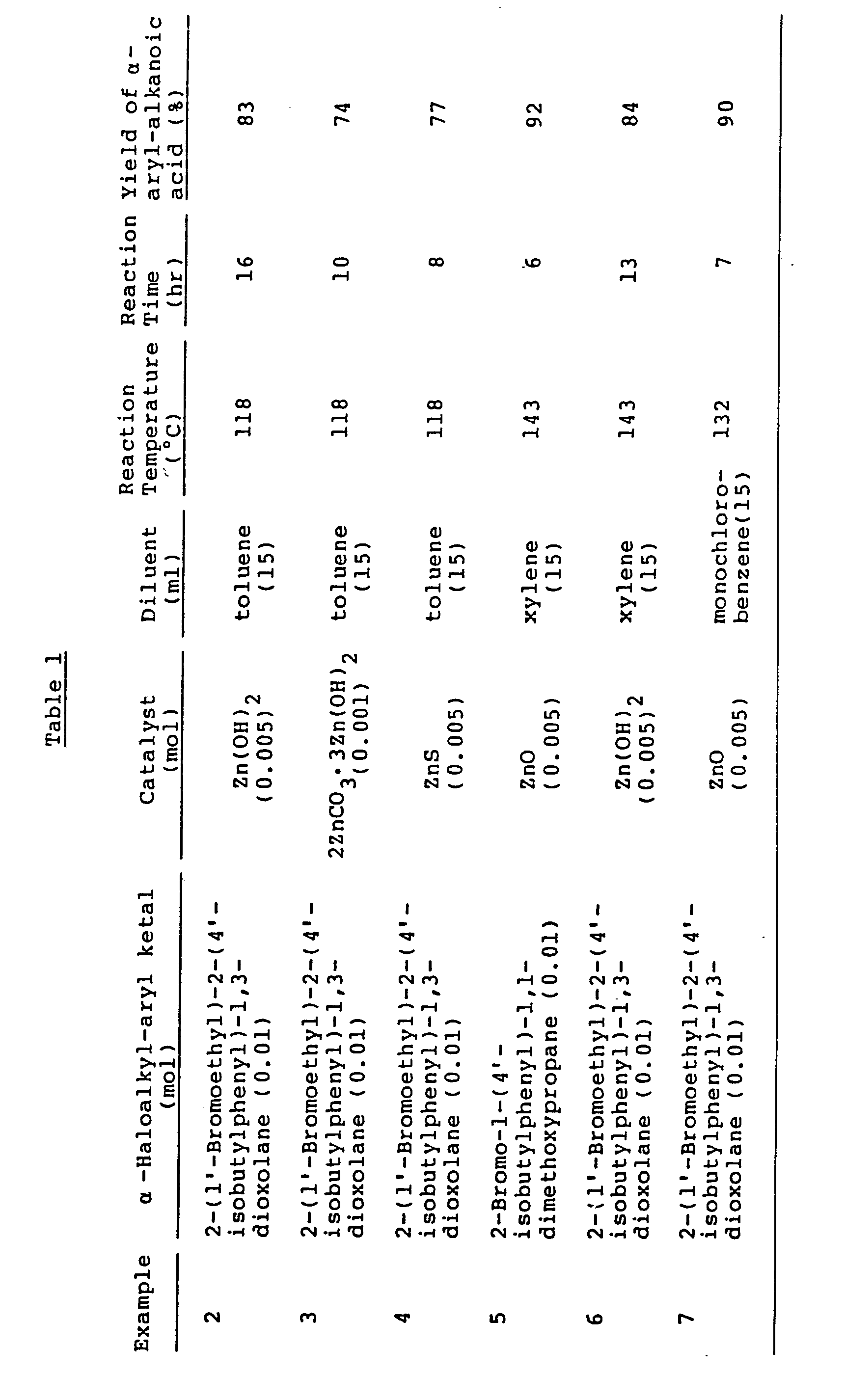
- Various a-haloalkyl-aryl ketals were subjected to a rearrangement reaction by following the procedure of Example 1, except that the various solvents and catalysts shown in Table 1 were used and the various conditions indicated in that table were adopted. The products of the rearrangement reaction were subjected to hydrolysis by following the procedure of Example 1. The results are shown in Table 1.
- The reaction procedure of Example 1 was repeated by using as the catalyst the zinc oxide recovered by filtration from the reaction mixture obtained by following the procedure of Example 1. Consequently, 2-(4'-isobutylphenyl)-propionic acid was obtained in a yield of 90%. This acid showed a melting point of 76° to 77°.
- In a reactor, 3.2 g (0.01 mol) of 2-(1'-bromoethyl)-2-(4'-isobutylphenyl)-1,3-dioxolane and 0.081 g (0.001 mol) of zinc oxide were heated for reaction at 140° for two hours. The resultant reaction mixture was filtered to remove the catalyst. The filtrate with 15 ml of methanol and 40 ml of an aqueous solution containing sodium hydroxide in a concentration of 50% by weight added thereto were refluxed under application of heat for four hours. The resultant reaction mixture was poured into 50 ml of water. The aqueous solution so produced was acidified with concentrated hydrochloric acid and then extracted twice, each from 40 ml of toluene: Then, the extract was distilled to expel the toluene. Consequently, there was obtained 1.86 g (0.0875 mol) of 2-(4'-isobutylphenyl)-propionic acid. This product represented a yield of 88% and showed a melting point of 76°C to 77°C.
- Various a-haloalkyl-aryl ketals were subjected to a rearrangement reaction by following the procedure of Example 9, except that the various solvents and catalysts shown in Table 2 were used and the various conditions indicated in the same table were adopted. The products of the rearrangement reaction were subjected to hydrolysis again by following the procedure of Example 9. The results are shown in Table 2.

- In a reactor, 32 g (0.10 mol) of 2-(1'-bromoethyl)-2-(4'-isobutylphenyl)-1,3-dioxolane, 0.81 g (0.01 mol) of zinc oxide, and 40 ml of monochlorobenzene were heated at 140°C for two hours. The resultant reaction mixture was filtered to recover the catalyst (93%) and then distilled to expel the monochlorobenzene. Then, the residue was subjected to hydrolysis by following the procedure of Example 9 (150 ml of methanol and 400 ml of 50% NaOH aqueous solution).Consequently, there was obtained 2-(4'-isobutylphenyl)-propionic acid in a yield of 99%. When the same reaction was repeated by using the recovered zinc oxide as the catalyst, there was obtained 2-(4'-isobutylphenyl)-propionic acid in a yield of 95%.
- In a reactor, 3.2 g (0.01 mol) of 2-(1'-bromoethyl)-2-(4'-isobutylphenyl)-1,3-dioxolane, 0.081 g (0.001 mol) of zinc oxide, and 15 ml of ethylene glycol were refluxed under application of heat for four hours. The resultant reaction mixture and 30 ml of an aqueous solution containing sodium hydroxide in a concentration of 50% by weight added thereto were refluxed under application of heat for four hours. The resultant aqueous solution was acidified with concentrated hydrochloric acid and then extracted twice, each from 40 ml of toluene. Then, the extract was distilled to expel the toluene. Consequently, there was obtained 1.7 g (0.008 mol) of 2-(4'-isobutylphenyl)-propionic acid. This product represented a yield of 83% and showed a melting point of 76° to 77°C.
- Various a-haloalkyl-aryl ketals were subjected to rearrangement reaction by following the procedure of Example 18, except that the various solvents and catalysts shown in Table 3 were used and the various conditions indicated in the same table were adopted. The products of this reaction were subjected to hydrolysis again by following the procedure of Example 18. The results are shown in Table 3.

- The reaction procedure of Example 18 was repeated by using as the catalyst the zinc oxide recovered from the reaction solution obtained by the procedure of Example 18. Consequently, 2-(4'-isobutylphenyl)-propionic acid was obtained in a yield of 92%. This product showed a melting point of 76° to 77°C.
- As described above, the method of this invention uses the aforementioned zinc compound as the catalyst for the rearrangement reaction of an a-haloalkyl-aryl ketal. Thus, it is capable of producing an a-aryl-alkanoic acid by a very simple procedure using safe and inexpensive catalyst instead of either using any of the expensive catalysts and reaw materials necessary for the conventional methods or using any toxic catalyst or a chemical susceptible of explosion. The fact that the zinc compound normally recognized neither as Lewis acid nor as weakly basic compound is highly effective in the aforementioned rearrangement reaction has surpassed all expectations. It is widely known that Lewis acids, particularly metal halides, cause serious corrosion of equipment. The specific catalyst used in the method of this invention is found to cause virtually no discernible corrosion of the equipment.
Claims (10)


Applications Claiming Priority (4)
| Application Number | Priority Date | Filing Date | Title |
|---|---|---|---|
| JP59189636A JPS6168443A (en) | 1984-09-12 | 1984-09-12 | Production of alpha-arylalkanoic acid |
| JP59189637A JPS6168442A (en) | 1984-09-12 | 1984-09-12 | Production of alpha-arylalkanoic acid |
| JP189636/84 | 1984-09-12 | ||
| JP189637/84 | 1984-09-12 |
Publications (3)
| Publication Number | Publication Date |
|---|---|
| EP0174844A2 EP0174844A2 (en) | 1986-03-19 |
| EP0174844A3 EP0174844A3 (en) | 1987-05-27 |
| EP0174844B1 true EP0174844B1 (en) | 1990-06-27 |
Family
ID=26505581
Family Applications (1)
| Application Number | Title | Priority Date | Filing Date |
|---|---|---|---|
| EP85306454A Expired EP0174844B1 (en) | 1984-09-12 | 1985-09-11 | Method for production of alpha-aryl-alkanoic acid |
Country Status (3)
| Country | Link |
|---|---|
| US (1) | US4670586A (en) |
| EP (1) | EP0174844B1 (en) |
| DE (1) | DE3578417D1 (en) |
Families Citing this family (6)
| Publication number | Priority date | Publication date | Assignee | Title |
|---|---|---|---|---|
| IT1198234B (en) * | 1986-12-23 | 1988-12-21 | Zambon Spa | STEREOCONVERGENT PROCESS FOR THE PREPARATION OF OPTICALLY ACTIVE CARBOXYLIC ACIDS |
| EP0380316A3 (en) * | 1989-01-25 | 1990-11-28 | Syntex Pharmaceuticals International Limited | Preparation of alpha-methylareneacetic acids |
| US6436990B1 (en) | 1999-10-27 | 2002-08-20 | Nobex Corporation | 6-methoxy-2-naphthylacetic acid prodrugs |
| US6552078B2 (en) | 1999-10-27 | 2003-04-22 | Nobex Corp | 6-methoxy-2-naphthylacetic acid prodrugs |
| TWI262791B (en) | 1999-10-27 | 2006-10-01 | Nobex Corp | 6-methoxy-2-naphthylacetic acid prodrugs |
| CN114644554A (en) * | 2020-12-21 | 2022-06-21 | 上海医药工业研究院 | Preparation method of (S) -flurbiprofen and intermediate thereof |
Family Cites Families (6)
| Publication number | Priority date | Publication date | Assignee | Title |
|---|---|---|---|---|
| US4107439A (en) * | 1976-06-16 | 1978-08-15 | The Upjohn Company | Process for preparing arylalkanoic acid derivatives |
| US4142054A (en) * | 1977-06-16 | 1979-02-27 | The Upjohn Company | Process for preparing arylalkanoic acid derivatives |
| FR2457852A1 (en) * | 1979-06-01 | 1980-12-26 | Rhone Poulenc Ind | Rearranging carboxylate gps. in alkali aromatic carboxylate salts - by heating under carbon di:oxide pressure in presence of specified metal catalysts |
| IE50897B1 (en) * | 1980-02-26 | 1986-08-06 | Blaschim Spa | Process for preparing esters of alkanoic acids via rearrangement of alpha-haloketals |
| IT1167476B (en) * | 1981-07-23 | 1987-05-13 | Blasinachim Spa | PROCEDURE FOR PREPARING ALCANOIC ACIDS OR THEIR ESTERS BY ALTERNATION OF ALPHA-HALOGEN-KETONES IN A PROTIC MEANS AND IN THE PRESENCE OF A SALT OF A NON-NOBLE METAL |
| FI82680C (en) * | 1981-12-11 | 1991-04-10 | Syntex Pharma Int | FRAMSTAELLNING AV - ARYLALKANSYROR. |
-
1985
- 1985-09-10 US US06/774,352 patent/US4670586A/en not_active Expired - Lifetime
- 1985-09-11 EP EP85306454A patent/EP0174844B1/en not_active Expired
- 1985-09-11 DE DE8585306454T patent/DE3578417D1/en not_active Expired - Lifetime
Also Published As
| Publication number | Publication date |
|---|---|
| EP0174844A2 (en) | 1986-03-19 |
| US4670586A (en) | 1987-06-02 |
| DE3578417D1 (en) | 1990-08-02 |
| EP0174844A3 (en) | 1987-05-27 |
Similar Documents
| Publication | Publication Date | Title |
|---|---|---|
| EP0035305B2 (en) | Process for preparing esters of 2-(6'-methoxy-2'-naphtyl)-propionic acid via rearrangement of new ketals of 2-halo-1-(6'-methoxy-2'-naphtyl)-propan-1-one | |
| US4440937A (en) | Cyclic carbonic acid derivatives | |
| US5059723A (en) | Hydroxyalkylation of phenols or thiophenols with cyclic organic carbonates using triorganophosphine catalysts | |
| CN103209951B (en) | Keto-carboxylic acid, keto-carboxylic acid ester, its method of manufacture and use thereof | |
| US4670586A (en) | Method for the production of α-aryl-alkanoic acid | |
| JPH0234339B2 (en) | ||
| CA1200817A (en) | Process for the alkylation of phenolic compounds | |
| EP0071299B1 (en) | Process for preparing alkanoic acids or esters thereof by rearrangement of alpha-halo-ketones in protic medium and in the presence of a non-noble metal salt | |
| US3953518A (en) | Process for preparing γ, δ-unsaturated carbonyl compounds | |
| US4189610A (en) | Preparation of 4,4-dioxy-substituted stilbenes | |
| JPH08295646A (en) | Method for producing bis (hydroxyethoxyphenyl) compound | |
| US3127450A (en) | Process for the preparation of ketals | |
| EP0112679B1 (en) | Process for the preparation of esters or salts of aromatic or etheroaromatic acids | |
| US5118859A (en) | Preparation and purification of 2-hydroxy-4-(2'-hydroxyethoxy)phenyl aryl ketones | |
| US4709081A (en) | Process for the preparation of diphenyl ether derivatives | |
| US4316046A (en) | Process for the preparation of aryl carboxylates | |
| US3029252A (en) | Omega-hydropolyfluoroperhalo-alkanones and ketals thereof | |
| JPS6014013B2 (en) | Method for producing 2-(6'-methoxy-2'-naphthyl)-propionic acid ester | |
| EP0031909B1 (en) | 3-hydroxy-4-cyclopentenones and process for their production | |
| EP0124819B1 (en) | 2-alkylcarbonatoethanephosphonic-acid dialkyl esters and their use in preparing vinylphoshonic-acid dialkyl esters | |
| US3676484A (en) | Synthesis of hydroxyalkyl esters of carboxylic acids | |
| CA1298852C (en) | Method for producing 2,6-diacetoxynaphthalene | |
| JPS6168443A (en) | Production of alpha-arylalkanoic acid | |
| US4766236A (en) | Purification of diphenyl phthalates | |
| US3752846A (en) | Process for preparation of bis(beta-hydroxylthyl) terephthalate |
Legal Events
| Date | Code | Title | Description |
|---|---|---|---|
| PUAI | Public reference made under article 153(3) epc to a published international application that has entered the european phase |
Free format text: ORIGINAL CODE: 0009012 |
|
| AK | Designated contracting states |
Kind code of ref document: A2 Designated state(s): BE DE FR GB |
|
| PUAL | Search report despatched |
Free format text: ORIGINAL CODE: 0009013 |
|
| AK | Designated contracting states |
Kind code of ref document: A3 Designated state(s): BE DE FR GB |
|
| 17P | Request for examination filed |
Effective date: 19870904 |
|
| 17Q | First examination report despatched |
Effective date: 19890203 |
|
| GRAA | (expected) grant |
Free format text: ORIGINAL CODE: 0009210 |
|
| AK | Designated contracting states |
Kind code of ref document: B1 Designated state(s): BE DE FR GB |
|
| REF | Corresponds to: |
Ref document number: 3578417 Country of ref document: DE Date of ref document: 19900802 |
|
| ET | Fr: translation filed | ||
| PLBE | No opposition filed within time limit |
Free format text: ORIGINAL CODE: 0009261 |
|
| STAA | Information on the status of an ep patent application or granted ep patent |
Free format text: STATUS: NO OPPOSITION FILED WITHIN TIME LIMIT |
|
| 26N | No opposition filed | ||
| PGFP | Annual fee paid to national office [announced via postgrant information from national office to epo] |
Ref country code: GB Payment date: 19950904 Year of fee payment: 11 |
|
| PGFP | Annual fee paid to national office [announced via postgrant information from national office to epo] |
Ref country code: FR Payment date: 19950911 Year of fee payment: 11 |
|
| PGFP | Annual fee paid to national office [announced via postgrant information from national office to epo] |
Ref country code: DE Payment date: 19950918 Year of fee payment: 11 |
|
| PGFP | Annual fee paid to national office [announced via postgrant information from national office to epo] |
Ref country code: BE Payment date: 19951031 Year of fee payment: 11 |
|
| PG25 | Lapsed in a contracting state [announced via postgrant information from national office to epo] |
Ref country code: GB Effective date: 19960911 |
|
| PG25 | Lapsed in a contracting state [announced via postgrant information from national office to epo] |
Ref country code: FR Effective date: 19960930 Ref country code: BE Effective date: 19960930 |
|
| BERE | Be: lapsed |
Owner name: NIPPOH CHEMICALS CO. LTD Effective date: 19960930 |
|
| GBPC | Gb: european patent ceased through non-payment of renewal fee |
Effective date: 19960911 |
|
| PG25 | Lapsed in a contracting state [announced via postgrant information from national office to epo] |
Ref country code: DE Effective date: 19970603 |
|
| REG | Reference to a national code |
Ref country code: FR Ref legal event code: ST |
|
| REG | Reference to a national code |
Ref country code: FR Ref legal event code: ST |