EP0174713B1 - Low modulus thermoplastic elastomers - Google Patents
Low modulus thermoplastic elastomers Download PDFInfo
- Publication number
- EP0174713B1 EP0174713B1 EP85304001A EP85304001A EP0174713B1 EP 0174713 B1 EP0174713 B1 EP 0174713B1 EP 85304001 A EP85304001 A EP 85304001A EP 85304001 A EP85304001 A EP 85304001A EP 0174713 B1 EP0174713 B1 EP 0174713B1
- Authority
- EP
- European Patent Office
- Prior art keywords
- polycaprolactone
- diol
- compound
- thermoplastic elastomers
- compounds
- Prior art date
- Legal status (The legal status is an assumption and is not a legal conclusion. Google has not performed a legal analysis and makes no representation as to the accuracy of the status listed.)
- Expired - Lifetime
Links
- 229920002725 thermoplastic elastomer Polymers 0.000 title description 8
- 150000001875 compounds Chemical class 0.000 claims description 37
- 229920001610 polycaprolactone Polymers 0.000 claims description 22
- 239000004632 polycaprolactone Substances 0.000 claims description 22
- 150000002009 diols Chemical class 0.000 claims description 19
- 239000000463 material Substances 0.000 claims description 13
- 229920001400 block copolymer Polymers 0.000 claims description 12
- PAPBSGBWRJIAAV-UHFFFAOYSA-N ε-Caprolactone Chemical compound O=C1CCCCCO1 PAPBSGBWRJIAAV-UHFFFAOYSA-N 0.000 claims description 10
- 125000002887 hydroxy group Chemical group [H]O* 0.000 claims description 9
- 229920001296 polysiloxane Polymers 0.000 claims description 8
- 239000002978 dental impression material Substances 0.000 claims description 6
- 239000003505 polymerization initiator Substances 0.000 claims description 6
- 239000003566 sealing material Substances 0.000 claims description 6
- 239000001257 hydrogen Substances 0.000 claims description 3
- 229910052739 hydrogen Inorganic materials 0.000 claims description 3
- UFHFLCQGNIYNRP-UHFFFAOYSA-N Hydrogen Chemical compound [H][H] UFHFLCQGNIYNRP-UHFFFAOYSA-N 0.000 claims description 2
- -1 poly(dimethylsiloxane) Polymers 0.000 description 32
- 229920001971 elastomer Polymers 0.000 description 19
- UHOVQNZJYSORNB-UHFFFAOYSA-N Benzene Chemical compound C1=CC=CC=C1 UHOVQNZJYSORNB-UHFFFAOYSA-N 0.000 description 18
- 239000005060 rubber Substances 0.000 description 17
- 238000006243 chemical reaction Methods 0.000 description 14
- 239000002904 solvent Substances 0.000 description 9
- LYCAIKOWRPUZTN-UHFFFAOYSA-N Ethylene glycol Chemical compound OCCO LYCAIKOWRPUZTN-UHFFFAOYSA-N 0.000 description 8
- 229920000435 poly(dimethylsiloxane) Polymers 0.000 description 8
- 238000002329 infrared spectrum Methods 0.000 description 7
- OKKJLVBELUTLKV-UHFFFAOYSA-N Methanol Chemical compound OC OKKJLVBELUTLKV-UHFFFAOYSA-N 0.000 description 6
- NRTJGTSOTDBPDE-UHFFFAOYSA-N [dimethyl(methylsilyloxy)silyl]oxy-dimethyl-trimethylsilyloxysilane Chemical compound C[SiH2]O[Si](C)(C)O[Si](C)(C)O[Si](C)(C)C NRTJGTSOTDBPDE-UHFFFAOYSA-N 0.000 description 6
- 125000002147 dimethylamino group Chemical group [H]C([H])([H])N(*)C([H])([H])[H] 0.000 description 6
- 239000003999 initiator Substances 0.000 description 6
- LRHPLDYGYMQRHN-UHFFFAOYSA-N N-Butanol Chemical compound CCCCO LRHPLDYGYMQRHN-UHFFFAOYSA-N 0.000 description 5
- 229920001577 copolymer Polymers 0.000 description 5
- 235000019441 ethanol Nutrition 0.000 description 5
- 238000010586 diagram Methods 0.000 description 4
- 238000010438 heat treatment Methods 0.000 description 4
- 238000007151 ring opening polymerisation reaction Methods 0.000 description 4
- WVDDGKGOMKODPV-UHFFFAOYSA-N Benzyl alcohol Chemical compound OCC1=CC=CC=C1 WVDDGKGOMKODPV-UHFFFAOYSA-N 0.000 description 3
- LFQSCWFLJHTTHZ-UHFFFAOYSA-N Ethanol Chemical compound CCO LFQSCWFLJHTTHZ-UHFFFAOYSA-N 0.000 description 3
- KFZMGEQAYNKOFK-UHFFFAOYSA-N Isopropanol Chemical compound CC(C)O KFZMGEQAYNKOFK-UHFFFAOYSA-N 0.000 description 3
- ZMXDDKWLCZADIW-UHFFFAOYSA-N N,N-Dimethylformamide Chemical compound CN(C)C=O ZMXDDKWLCZADIW-UHFFFAOYSA-N 0.000 description 3
- YXFVVABEGXRONW-UHFFFAOYSA-N Toluene Chemical compound CC1=CC=CC=C1 YXFVVABEGXRONW-UHFFFAOYSA-N 0.000 description 3
- MTHSVFCYNBDYFN-UHFFFAOYSA-N diethylene glycol Chemical compound OCCOCCO MTHSVFCYNBDYFN-UHFFFAOYSA-N 0.000 description 3
- 238000004455 differential thermal analysis Methods 0.000 description 3
- 230000004927 fusion Effects 0.000 description 3
- 239000007788 liquid Substances 0.000 description 3
- 239000000203 mixture Substances 0.000 description 3
- 229920006030 multiblock copolymer Polymers 0.000 description 3
- 239000000047 product Substances 0.000 description 3
- 239000011541 reaction mixture Substances 0.000 description 3
- 229920003051 synthetic elastomer Polymers 0.000 description 3
- 239000005061 synthetic rubber Substances 0.000 description 3
- PUPZLCDOIYMWBV-UHFFFAOYSA-N (+/-)-1,3-Butanediol Chemical compound CC(O)CCO PUPZLCDOIYMWBV-UHFFFAOYSA-N 0.000 description 2
- 239000004698 Polyethylene Substances 0.000 description 2
- 239000004721 Polyphenylene oxide Substances 0.000 description 2
- DNIAPMSPPWPWGF-UHFFFAOYSA-N Propylene glycol Chemical compound CC(O)CO DNIAPMSPPWPWGF-UHFFFAOYSA-N 0.000 description 2
- 125000001931 aliphatic group Chemical group 0.000 description 2
- 125000005233 alkylalcohol group Chemical group 0.000 description 2
- 125000003277 amino group Chemical group 0.000 description 2
- 150000004945 aromatic hydrocarbons Chemical class 0.000 description 2
- 125000003118 aryl group Chemical group 0.000 description 2
- WERYXYBDKMZEQL-UHFFFAOYSA-N butane-1,4-diol Chemical compound OCCCCO WERYXYBDKMZEQL-UHFFFAOYSA-N 0.000 description 2
- 239000000806 elastomer Substances 0.000 description 2
- ZXEKIIBDNHEJCQ-UHFFFAOYSA-N isobutanol Chemical compound CC(C)CO ZXEKIIBDNHEJCQ-UHFFFAOYSA-N 0.000 description 2
- 238000002844 melting Methods 0.000 description 2
- 230000008018 melting Effects 0.000 description 2
- 229920000570 polyether Polymers 0.000 description 2
- 229920000573 polyethylene Polymers 0.000 description 2
- 229920000642 polymer Polymers 0.000 description 2
- 238000001556 precipitation Methods 0.000 description 2
- BDERNNFJNOPAEC-UHFFFAOYSA-N propan-1-ol Chemical compound CCCO BDERNNFJNOPAEC-UHFFFAOYSA-N 0.000 description 2
- YPFDHNVEDLHUCE-UHFFFAOYSA-N propane-1,3-diol Chemical compound OCCCO YPFDHNVEDLHUCE-UHFFFAOYSA-N 0.000 description 2
- 239000007787 solid Substances 0.000 description 2
- XLYOFNOQVPJJNP-UHFFFAOYSA-N water Chemical group O XLYOFNOQVPJJNP-UHFFFAOYSA-N 0.000 description 2
- KBPLFHHGFOOTCA-UHFFFAOYSA-N 1-Octanol Chemical compound CCCCCCCCO KBPLFHHGFOOTCA-UHFFFAOYSA-N 0.000 description 1
- JSGVZVOGOQILFM-UHFFFAOYSA-N 3-methoxy-1-butanol Chemical compound COC(C)CCO JSGVZVOGOQILFM-UHFFFAOYSA-N 0.000 description 1
- CTQNGGLPUBDAKN-UHFFFAOYSA-N O-Xylene Chemical compound CC1=CC=CC=C1C CTQNGGLPUBDAKN-UHFFFAOYSA-N 0.000 description 1
- ALQSHHUCVQOPAS-UHFFFAOYSA-N Pentane-1,5-diol Chemical compound OCCCCCO ALQSHHUCVQOPAS-UHFFFAOYSA-N 0.000 description 1
- 229930182556 Polyacetal Natural products 0.000 description 1
- 239000005062 Polybutadiene Substances 0.000 description 1
- 239000004743 Polypropylene Substances 0.000 description 1
- YIMQCDZDWXUDCA-UHFFFAOYSA-N [4-(hydroxymethyl)cyclohexyl]methanol Chemical compound OCC1CCC(CO)CC1 YIMQCDZDWXUDCA-UHFFFAOYSA-N 0.000 description 1
- BWVAOONFBYYRHY-UHFFFAOYSA-N [4-(hydroxymethyl)phenyl]methanol Chemical compound OCC1=CC=C(CO)C=C1 BWVAOONFBYYRHY-UHFFFAOYSA-N 0.000 description 1
- 238000010521 absorption reaction Methods 0.000 description 1
- 239000000853 adhesive Substances 0.000 description 1
- 230000001070 adhesive effect Effects 0.000 description 1
- 125000002723 alicyclic group Chemical group 0.000 description 1
- 235000019445 benzyl alcohol Nutrition 0.000 description 1
- OWBTYPJTUOEWEK-UHFFFAOYSA-N butane-2,3-diol Chemical compound CC(O)C(C)O OWBTYPJTUOEWEK-UHFFFAOYSA-N 0.000 description 1
- 239000007795 chemical reaction product Substances 0.000 description 1
- 238000001816 cooling Methods 0.000 description 1
- 238000004132 cross linking Methods 0.000 description 1
- 239000013078 crystal Substances 0.000 description 1
- VKONPUDBRVKQLM-UHFFFAOYSA-N cyclohexane-1,4-diol Chemical compound OC1CCC(O)CC1 VKONPUDBRVKQLM-UHFFFAOYSA-N 0.000 description 1
- 230000007423 decrease Effects 0.000 description 1
- QKIUAMUSENSFQQ-UHFFFAOYSA-N dimethylazanide Chemical compound C[N-]C QKIUAMUSENSFQQ-UHFFFAOYSA-N 0.000 description 1
- 230000000694 effects Effects 0.000 description 1
- RTZKZFJDLAIYFH-UHFFFAOYSA-N ether Substances CCOCC RTZKZFJDLAIYFH-UHFFFAOYSA-N 0.000 description 1
- 239000012530 fluid Substances 0.000 description 1
- XXMIOPMDWAUFGU-UHFFFAOYSA-N hexane-1,6-diol Chemical compound OCCCCCCO XXMIOPMDWAUFGU-UHFFFAOYSA-N 0.000 description 1
- WGCNASOHLSPBMP-UHFFFAOYSA-N hydroxyacetaldehyde Natural products OCC=O WGCNASOHLSPBMP-UHFFFAOYSA-N 0.000 description 1
- 230000002427 irreversible effect Effects 0.000 description 1
- 229940035429 isobutyl alcohol Drugs 0.000 description 1
- QQVIHTHCMHWDBS-UHFFFAOYSA-L isophthalate(2-) Chemical compound [O-]C(=O)C1=CC=CC(C([O-])=O)=C1 QQVIHTHCMHWDBS-UHFFFAOYSA-L 0.000 description 1
- 238000004519 manufacturing process Methods 0.000 description 1
- 239000000155 melt Substances 0.000 description 1
- 238000000034 method Methods 0.000 description 1
- 238000002156 mixing Methods 0.000 description 1
- 239000012299 nitrogen atmosphere Substances 0.000 description 1
- 238000005191 phase separation Methods 0.000 description 1
- 229920003023 plastic Polymers 0.000 description 1
- 239000004033 plastic Substances 0.000 description 1
- 229920002857 polybutadiene Polymers 0.000 description 1
- 238000006068 polycondensation reaction Methods 0.000 description 1
- 229920000728 polyester Polymers 0.000 description 1
- 229920006149 polyester-amide block copolymer Polymers 0.000 description 1
- 229920000921 polyethylene adipate Polymers 0.000 description 1
- 229920001223 polyethylene glycol Polymers 0.000 description 1
- 229920006324 polyoxymethylene Polymers 0.000 description 1
- 229920001155 polypropylene Polymers 0.000 description 1
- 229920001451 polypropylene glycol Polymers 0.000 description 1
- 239000005077 polysulfide Substances 0.000 description 1
- 229920001021 polysulfide Polymers 0.000 description 1
- 150000008117 polysulfides Polymers 0.000 description 1
- 238000003908 quality control method Methods 0.000 description 1
- 238000007086 side reaction Methods 0.000 description 1
- 229920002379 silicone rubber Polymers 0.000 description 1
- 239000004945 silicone rubber Substances 0.000 description 1
- 238000003756 stirring Methods 0.000 description 1
- 239000000126 substance Substances 0.000 description 1
- ZIBGPFATKBEMQZ-UHFFFAOYSA-N triethylene glycol Chemical compound OCCOCCOCCO ZIBGPFATKBEMQZ-UHFFFAOYSA-N 0.000 description 1
- 239000008096 xylene Substances 0.000 description 1
Images

Classifications
-
- C—CHEMISTRY; METALLURGY
- C08—ORGANIC MACROMOLECULAR COMPOUNDS; THEIR PREPARATION OR CHEMICAL WORKING-UP; COMPOSITIONS BASED THEREON
- C08G—MACROMOLECULAR COMPOUNDS OBTAINED OTHERWISE THAN BY REACTIONS ONLY INVOLVING UNSATURATED CARBON-TO-CARBON BONDS
- C08G77/00—Macromolecular compounds obtained by reactions forming a linkage containing silicon with or without sulfur, nitrogen, oxygen or carbon in the main chain of the macromolecule
- C08G77/42—Block-or graft-polymers containing polysiloxane sequences
- C08G77/445—Block-or graft-polymers containing polysiloxane sequences containing polyester sequences
-
- A—HUMAN NECESSITIES
- A61—MEDICAL OR VETERINARY SCIENCE; HYGIENE
- A61K—PREPARATIONS FOR MEDICAL, DENTAL OR TOILETRY PURPOSES
- A61K6/00—Preparations for dentistry
- A61K6/90—Compositions for taking dental impressions
Definitions
- the present invention relates to low modulus thermoplastic elastomers which are used as dental impression materials, mold materials for general uses and various sealing materials.
- Silicone, polysulfide and polyether synthetic rubbers vulcanizable at room temperature are used as dental impression materials, mold materials for general uses and sealing materials.
- any of these synthetic rubbers however, have relatively high production costs and are obtained by complex reactions, there are problems of operation and quality control. Further, since these synthetic rubbers are obtained by use of irreversible reactions, if once these are used, these can not be reused and must be wasted. Namely, there are problems in the aspects of costs and effective uses of resources.
- thermoplastic elastomers As materials for solving these problems, the so-called thermoplastic elastomers have been noticed.
- the thermoplastic elastomers have a general term of high-molecular weight materials which show rubber elasticity at room temperature and easily give plasticity and moldability at high temperature.
- the elastomers are copolymers in which hard segments and soft segments combine.
- Thermoplastic elastomers by combinations of various hard segments and soft segments including polystyrene-polybutadiene copolymer have already existed as known compounds. However, any of them has relatively high modulus or high softening temperature so that it is unable to use as mold materials for general uses and sealing materials including dental impression materials.
- Thermoplastic elastomers which are suitable for uses of dental impression materials, mold materials for general uses and sealing materials should have good rubber elasticity at room temperature, furthermore softening temperature of about 50°C and Young's modulus of about 2 MPa and under.
- the present invention provides compounds satisfying the above conditions which are polyester-polysiloxane block copolymers represented by the general formula wherein R1 is a residue of a diol acting as a polymerization initiator for ⁇ -caprolactone and producing a polycaprolactone having two terminal hydroxyl groups, R2 is a residue of a compound containing one active hydrogen acting as a polymerization initiator for ⁇ -caprolactone and producing a polycaprolactone having one terminal hydroxyl group, n1 is from 20 to 200, n2 + n3 is from 20 to 400, n4 is from 60 to 800 and m is 0 to 20.
- polyester-polysiloxane block copolymers of the present invention are new thermoplastic elastomers comprising residues (A) of a polycaprolactone having one terminal hydroxide group, residues (B) of a polycaprolactone having hydroxide groups at both terminals and poly(dimethylsiloxane) ⁇ , ⁇ -diol residues (C), and represented by the following formula (A)(CB)m(C)(A) wherein these residues are linked by ether bonds, respectively.
- R1 in the above general formula (I) is a residue of a diol acting as a polymerisation initiator for ⁇ -caprolactone and may be an aliphatic, aromatic or alicyclic diol.
- the following compounds may be used as diols; as aliphatic diols such alkylene glycols as ethylene glycol, 1,2-propylene glycol, 1,3-propylene glycol, 1,3-butanediol, 1,4-butanediol, 2,3-butylene glycol, pentamethylene glycol and hexamethylene glycol, as aromatic diols such compounds as isophthalyl alcohol, terephthalyl alcohol, ⁇ ' ⁇ -bishydroxyethyl terephthalate and ⁇ ', ⁇ -bishydroxyethyl isophthalate; and as alicyclic diols such compounds as cyclohexane-1,4-diol and cyclohexane-1,4-dimethanol.
- alkylene glycols such alkylene glycols as ethylene glycol, 1,2-propylene glycol, 1,3-propylene glycol, 1,3-butanediol, 1,4-butane
- diols polymers which contain aligomers of polyether diol, polyester diol, polyacetal diol, polyesteramide diol, polyesterether diol and polyhydrocarbon diol, namely oligomers of polyethylene glycols such as diethylene glycol and triethylene glycol, polypropylene glycol, polytetramethylene glycol, polyethylene adipate diol, polypropylene adipate diol, polybutylene adipate diol, polyethylene sebacate diol, polyethylene propylene diol, polyethylene butylene diol, polyethylene diol and polypropylene diol.
- polyethylene glycols such as diethylene glycol and triethylene glycol, polypropylene glycol, polytetramethylene glycol, polyethylene adipate diol, polypropylene adipate diol, polybutylene adipate diol, polyethylene sebacate diol, polyethylene propylene diol, poly
- the diol may contain, for example, amine groups.
- R2 in the general formula (I) is a residue of a compound containing one active hydrogen compound acting as a polymerisation initiator for ⁇ -caprolactone and may be represented by the formula R2H.
- the initiator R2H is preferably a monoalcohol and may be an aliphatic, aromatic or alicyclic monoalcohol.
- aliphatic alcohols there may be used alkyl alcohols such as methyl alcohol, ethyl alcohol, propyl alcohol, isopropyl alcohol, butyl alcohol, isobutyl alcohol and octyl alcohol, and monoalcohols other than alkyl alcohols such as methoxy butanol.
- the aromatic alcohols there may be used benzyl alcohol and as alicyclic alcohols there may be used cyclohexinyl methanol.
- the initiator compound R2H may contain, for example, an amine group.
- the above reaction of the compounds (II) and (III) with ⁇ , ⁇ -bis(dimethylamino) octamethyl tetrasiloxane advantageously proceeds at room temperature or by heating in the presence of a solvent in a dehumidifying system.
- a solvent aromatic hydrocarbons such as benzene, toluene or xylene and N,N-dimethyl formamide, etc. can be used. If moisture in the reaction system decreases, it will be able to depress side reactions of polycondensation reaction and the like.
- the reaction temperature which does not always keep constant in kinds of materials and solvents and other conditions is selected in the range of room temperature to 50°C.
- a solvent in a similar manner as the preceding reaction, aromatic hydrocarbons, N,N-dimethyl amide, etc. can be used.
- the reaction temperature is usually selected in the range of 40-60°C.
- the solvent is allowed to evaporate slowly from the reaction mixture solution, so that the desired rubberlike compound is obtained.
- the desired rubberlike compound is obtained as unreacted polycaprolactone and polysiloxane separate into phases macroscopically, they are removed. Further, this rubberlike compound is again dissolved into a solvent, and a pure product are obtained by fractional precipitation.
- the desired material isolated in this manner exhibits the property of plasticity by heating, and exhibits the property of its original rubber elastomer by cooling again to room temperature.
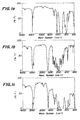
- the compound of the present invention Upon removing the solvent from the solution, the compound of the present invention does not show macroscopic phase separation, but show characteristic absorption derived from ester bonding and siloxane bonding at near 1,700 cm ⁇ 1 and 1,100 cm ⁇ 1, respectively, as shown in the infrared spectrum of Fig. 1(c), so that the compound can be identified as a single copolymer.
- the compound of the present invention is a block copolymer which has polycaprolactone chains as hard segments and polysiloxane chains as soft segments. Since the crystalline hard segments act as a physical cross linking point of the soft segments at ordinary temperature, the compound shows almost the same dynamic characteristic as that of conventional vulcanized silicone rubber.
- the compound Upon a little heating (50-60°C), the compound becomes its plastic state like unvulcanized liquid rubber for the sake of sharp fusion of the crystal of the hard segments. Namely, rubber and liquid states are obtained reversibly by different temperatures.
- the infrared spectrum of polysiloxane which is the soft segment of the block copolymer shows in Fig. 1(a), the infrared spectrum of polycaprolactone which is the hard segment of the block copolymer in Fig. 1(b), and the infrared spectrum of the obtained rubber phase in Fig. 1(c).
- the dynamic elastic modulus of this rubber phase is 0.3-0.5 MPa at the frequency in the range of 20-70 Hz at room temperature, as shown in the result of differential thermal analysis exhibited by Fig. 2, the rubber phase is melted on the basis of melting of the hard segment at temperature near to 55°C.
- Fig. 2 shows thermal characteristics in the result of differential thermal analysis of poly(dimethylsiloxane) (line 1), polycaprolactone (line 2) and the compound of example 1 (line 3). Further, the flow properties of the melt are different by temperatures, so that the rubber phase was a fluid having a yield point of about 103 Pa at 80°C and an apparent viscosity of 6 ⁇ 102 Pa ⁇ S and below at a shear rate of 2 sec ⁇ 1 and over.
- the dynamic elastic modulus of the obtained rubber phase was about 0.2-0.5 MPa at the frequency in the range of 20-70 Hz at room temperature as well as the multiblock copolymer of Example 1.
- the melting temperature was also about 55°C as well as the copolymer of Example 1, but the apparent viscosity at the shear rate of 2 sec 1 and over was 102 Pa ⁇ S and below at 80°C.
- the low modulus thermoplastic elastomers of the present invention are block copolymers comprised of polycaprolactone chains as hard segments and polysiloxane chains as soft segments.
- conventional silicones of vulcanized type can not return to the shapable state if once the compounds have vulcanized, these cannot be used repeatedly as materials.
- the compounds of the present invention can be used repeatedly, especially, these are effective against reduction of expenses as dental impression materials and mold materials for general uses, and these can be applied in a wide range of uses as various sealing materials and toy materials made of rubber. Further, in handling them, differing from the rubber of vulcanized type, it is easy to handle because there is no necessity for considering conditions of chemical reaction such as mixing of reaction components. Further, as the compounds of the present invention are widely changeable their chain length of hard segments, soft segments and the combination of both segments, the effect of the present invention is to provide the compounds having a necessary dynamic property and a physico-chemical property according to the object of use.
Landscapes
- Health & Medical Sciences (AREA)
- Oral & Maxillofacial Surgery (AREA)
- Chemical & Material Sciences (AREA)
- Animal Behavior & Ethology (AREA)
- Medicinal Chemistry (AREA)
- General Health & Medical Sciences (AREA)
- Public Health (AREA)
- Veterinary Medicine (AREA)
- Epidemiology (AREA)
- Chemical Kinetics & Catalysis (AREA)
- Life Sciences & Earth Sciences (AREA)
- Polymers & Plastics (AREA)
- Organic Chemistry (AREA)
- Silicon Polymers (AREA)
- Dental Preparations (AREA)
- Sealing Material Composition (AREA)
- Polyesters Or Polycarbonates (AREA)
Description
- The present invention relates to low modulus thermoplastic elastomers which are used as dental impression materials, mold materials for general uses and various sealing materials.
- Silicone, polysulfide and polyether synthetic rubbers vulcanizable at room temperature are used as dental impression materials, mold materials for general uses and sealing materials. As any of these synthetic rubbers, however, have relatively high production costs and are obtained by complex reactions, there are problems of operation and quality control. Further, since these synthetic rubbers are obtained by use of irreversible reactions, if once these are used, these can not be reused and must be wasted. Namely, there are problems in the aspects of costs and effective uses of resources.
- As materials for solving these problems, the so-called thermoplastic elastomers have been noticed. The thermoplastic elastomers have a general term of high-molecular weight materials which show rubber elasticity at room temperature and easily give plasticity and moldability at high temperature. In the molecular structures, the elastomers are copolymers in which hard segments and soft segments combine. Thermoplastic elastomers by combinations of various hard segments and soft segments including polystyrene-polybutadiene copolymer have already existed as known compounds. However, any of them has relatively high modulus or high softening temperature so that it is unable to use as mold materials for general uses and sealing materials including dental impression materials.
- Thermoplastic elastomers which are suitable for uses of dental impression materials, mold materials for general uses and sealing materials should have good rubber elasticity at room temperature, furthermore softening temperature of about 50°C and Young's modulus of about 2 MPa and under.
- Accordingly, for developing new materials which are repeatedly usable in the above application and have good rubber elasticity, it is an object of the present invention to provide new compounds satisfying the following conditions;
- (a) The compounds are teleblock or multiblock copolymers which consist of hard segments and soft segments.
- (b) The hard segments have crystallizability and sharp softening temperature of about 50°C.
- (c) The soft segments have excellent properties as rubber polymers, which are small cohesive energy and great fusion entropy.
- (d) The Young's modulus of the block copolymers is about 2 MPa and under and viscosity at the time of fusion is 10³Pa·S and under.
- The present invention provides compounds satisfying the above conditions which are polyester-polysiloxane block copolymers represented by the general formula

wherein R₁ is a residue of a diol acting as a polymerization initiator for ε-caprolactone and producing a polycaprolactone having two terminal hydroxyl groups, R₂ is a residue of a compound containing one active hydrogen acting as a polymerization initiator for ε-caprolactone and producing a polycaprolactone having one terminal hydroxyl group, n₁ is from 20 to 200, n₂ + n₃ is from 20 to 400, n₄ is from 60 to 800 and m is 0 to 20. - The polyester-polysiloxane block copolymers of the present invention are new thermoplastic elastomers comprising residues (A) of a polycaprolactone having one terminal hydroxide group, residues (B) of a polycaprolactone having hydroxide groups at both terminals and poly(dimethylsiloxane) α,ω-diol residues (C), and represented by the following formula
(A)(CB)m(C)(A)
wherein these residues are linked by ether bonds, respectively. - R₁ in the above general formula (I) is a residue of a diol acting as a polymerisation initiator for ε-caprolactone and may be an aliphatic, aromatic or alicyclic diol.
- The following compounds may be used as diols; as aliphatic diols such alkylene glycols as ethylene glycol, 1,2-propylene glycol, 1,3-propylene glycol, 1,3-butanediol, 1,4-butanediol, 2,3-butylene glycol, pentamethylene glycol and hexamethylene glycol, as aromatic diols such compounds as isophthalyl alcohol, terephthalyl alcohol, β'β-bishydroxyethyl terephthalate and β',β-bishydroxyethyl isophthalate; and as alicyclic diols such compounds as cyclohexane-1,4-diol and cyclohexane-1,4-dimethanol. There may also be used as diols polymers which contain aligomers of polyether diol, polyester diol, polyacetal diol, polyesteramide diol, polyesterether diol and polyhydrocarbon diol, namely oligomers of polyethylene glycols such as diethylene glycol and triethylene glycol, polypropylene glycol, polytetramethylene glycol, polyethylene adipate diol, polypropylene adipate diol, polybutylene adipate diol, polyethylene sebacate diol, polyethylene propylene diol, polyethylene butylene diol, polyethylene diol and polypropylene diol.
- In addition the diol may contain, for example, amine groups.
- R₂ in the general formula (I) is a residue of a compound containing one active hydrogen compound acting as a polymerisation initiator for ε-caprolactone and may be represented by the formula R₂H.
- The initiator R₂H is preferably a monoalcohol and may be an aliphatic, aromatic or alicyclic monoalcohol. As aliphatic alcohols there may be used alkyl alcohols such as methyl alcohol, ethyl alcohol, propyl alcohol, isopropyl alcohol, butyl alcohol, isobutyl alcohol and octyl alcohol, and monoalcohols other than alkyl alcohols such as methoxy butanol. As the aromatic alcohols there may be used benzyl alcohol and as alicyclic alcohols there may be used cyclohexinyl methanol.
- In addition, the initiator compound R₂H may contain, for example, an amine group.
- Compounds of formula (I) are new compounds which are undisclosed in literatures and can be prepared by the following chemical reaction.
- For example, a polycaprolactone having one terminal hydroxyl group and obtained by ring-opening polymerisation of ε-caprolactone with initiator R₂H and represented by general formula

wherein R₂ and n₁ are as defined above, or a mixture, in a mole ratio of 1 to 10 ∼ 2 to 1, of the polycaprolactone (II) and a polycaprolactone having two terminal hydroxyl groups and obtained by ring-opening polymerisation of ε-caprolactone with a diol-initiator and represented by general formula
wherein R₁, n₂ and n₃ are as defined above, is reacted with stoichiometrically excess α,ω-bis(dimethyl amino) octamethyl tetrasiloxane to produce a derivative of the compound (II), namely a compound (IV) represented by the following general formula
or a derivative of the compound (III), namely a compound (V) represented by the following general formula
- Then, the obtained compound (IV) alone or a mixture of the compounds (IV) and (V) is reacted with much the same mole of poly (dimethylsiloxane) α,ω-diol represented by the following general formula

wherein n'₄ is a number of structure units and corresponds to n₄-8, to produce the compounds of the present invention. - In general, the above reaction of the compounds (II) and (III) with α,ω-bis(dimethylamino) octamethyl tetrasiloxane advantageously proceeds at room temperature or by heating in the presence of a solvent in a dehumidifying system. For the solvent, aromatic hydrocarbons such as benzene, toluene or xylene and N,N-dimethyl formamide, etc. can be used. If moisture in the reaction system decreases, it will be able to depress side reactions of polycondensation reaction and the like.
- The reaction temperature which does not always keep constant in kinds of materials and solvents and other conditions is selected in the range of room temperature to 50°C.
- The unreacted α,ω-bis(dimethylamino) octamethyl tetrasiloxane which is still present in the reaction system are distilled under reduced pressure together with the solvent to remove outside of the system, prior to reaction of the product with the compound (VI).
- The reaction of the above reaction product (IV) alone after removal of unreacted α,ω-bis(dimethylamino) octamethyl tetrasiloxane, or a mixture of products (IV) and (V) with the compound (VI), in a similar manner as the preceding reaction, in general, proceeds advantageously by heating in the presence of a solvent in a dehumidifying system. For the solvent, in a similar manner as the preceding reaction, aromatic hydrocarbons, N,N-dimethyl amide, etc. can be used. The reaction temperature is usually selected in the range of 40-60°C.
- The solvent is allowed to evaporate slowly from the reaction mixture solution, so that the desired rubberlike compound is obtained. In this case, as unreacted polycaprolactone and polysiloxane separate into phases macroscopically, they are removed. Further, this rubberlike compound is again dissolved into a solvent, and a pure product are obtained by fractional precipitation.
- The desired material isolated in this manner exhibits the property of plasticity by heating, and exhibits the property of its original rubber elastomer by cooling again to room temperature.
- Upon removing the solvent from the solution, the compound of the present invention does not show macroscopic phase separation, but show characteristic absorption derived from ester bonding and siloxane bonding at near 1,700 cm⁻¹ and 1,100 cm⁻¹, respectively, as shown in the infrared spectrum of Fig. 1(c), so that the compound can be identified as a single copolymer.
- The compound of the present invention is a block copolymer which has polycaprolactone chains as hard segments and polysiloxane chains as soft segments. Since the crystalline hard segments act as a physical cross linking point of the soft segments at ordinary temperature, the compound shows almost the same dynamic characteristic as that of conventional vulcanized silicone rubber.
- Upon a little heating (50-60°C), the compound becomes its plastic state like unvulcanized liquid rubber for the sake of sharp fusion of the crystal of the hard segments. Namely, rubber and liquid states are obtained reversibly by different temperatures.
- The invention will now be described in greater detail with reference to the accompanying drawings, wherein:
- Fig. 1(a) is a diagram of an infrared spectrum of polysiloxane which is soft segments of a block copolymer;
- Fig. 1(b) is a diagram of an infrared spectrum of polycaprolactone which is hard segments of a block copolymer;
- Fig. 1(c) is a diagram of an infrared spectrum of the compound obtained by example 1; and
- Fig. 2 is a diagram which shows the result of differential thermal analysis of the compound obtained by example 1, poly(dimethylsiloxane) and polycaprolactone.
- The following non-limiting examples illustrate the embodiments of the present invention.
- 0.4 g of polycaprolactone having a hydroxyl group at one end of the chain (molecular weight: 5,000, n₁=44) which is obtained by ring opening polymerization at 150-200°C for a few hours after adding n-butanol as a polymerization initiator into ε-caprolactone monomer, and 0.64 g of polycaprolactone having hydroxyl groups at the both ends of the chain (molecular weight: 4,000, n₂+n₃=35) which is obtained by ring opening polymerization in the same manner described above after adding ethylene glycol into ε-caprolactone monomer, were dissolved in 50 mℓ of benzene. This solution was successively added to great excess α,ω-bis(dimethylamino) octamethyl tetrasiloxane over three hours under dry nitrogen atmosphere with stirring. The solution was then heated to 50-55°C and continuously stirred further for three hours.
- Unreacted α,ω-bis(dimethylamino) octamethyl tetrasiloxane was distilled away from the reaction mixture under reduced pressure (below 0.2 mmHg) over 5-6 hours. After 50 mℓ of benzene was added to the solid residue to dissolve, 8 g of poly(dimethylsiloxane) α,ω-diol(molecular weight; 40,000, n'₄=540) was added to the obtained solution and stirred at temperature below 45°C for 5 hours and then at 60°C for 6 hours.
- Benzene was allowed to evaporate slowly from the obtained reaction mixture over 48 hours. Further, benzene was removed under reduced pressure for 24 hours and a rubber-like multiblock copolymer corresponding to m=3 was obtained. In this case, as unreacted polycaprolactone and poly(dimethylsiloxane) were slightly separated into phases, its solid polycaprolactone phase and adhesive liquid poly(dimethylsiloxane) phase were removed. After the rubber phase was again dissolved in benzene, the desired rubber phase was isolated and purified by fractional precipitation.
- The infrared spectrum of polysiloxane which is the soft segment of the block copolymer shows in Fig. 1(a), the infrared spectrum of polycaprolactone which is the hard segment of the block copolymer in Fig. 1(b), and the infrared spectrum of the obtained rubber phase in Fig. 1(c).
- The dynamic elastic modulus of this rubber phase is 0.3-0.5 MPa at the frequency in the range of 20-70 Hz at room temperature, as shown in the result of differential thermal analysis exhibited by Fig. 2, the rubber phase is melted on the basis of melting of the hard segment at temperature near to 55°C. Moreover, Fig. 2 shows thermal characteristics in the result of differential thermal analysis of poly(dimethylsiloxane) (line 1), polycaprolactone (line 2) and the compound of example 1 (line 3). Further, the flow properties of the melt are different by temperatures, so that the rubber phase was a fluid having a yield point of about 10³ Pa at 80°C and an apparent viscosity of 6×10² Pa·S and below at a shear rate of 2 sec⁻¹ and over.
- Using 2.5 g of polycaprolactone (molecular weight: 5,000, n₁=44) which has an n-butanol residue of the polymerization initiator at the one end and its hydroxyl group at the other end and 8 g of poly(dimethylsiloxane) α,ω-diol (molecular weight: 40,000, n'₄=540), a copolymer in the same procedure as in Example 1 was synthesized, and the obtained rubber phase was isolated to purify.
- Namely, in this example, a teleblock copolymer (m=0) was synthesized by using the monofunctional polycaprolactone as the hard segment of the block copolymer.
- The dynamic elastic modulus of the obtained rubber phase was about 0.2-0.5 MPa at the frequency in the range of 20-70 Hz at room temperature as well as the multiblock copolymer of Example 1. The melting temperature was also about 55°C as well as the copolymer of Example 1, but the apparent viscosity at the shear rate of 2
sec ¹ and over was 10² Pa·S and below at 80°C. - As mentioned above, the low modulus thermoplastic elastomers of the present invention are block copolymers comprised of polycaprolactone chains as hard segments and polysiloxane chains as soft segments. As conventional silicones of vulcanized type can not return to the shapable state if once the compounds have vulcanized, these cannot be used repeatedly as materials. Contrarily, the compounds of the present invention can be used repeatedly, especially, these are effective against reduction of expenses as dental impression materials and mold materials for general uses, and these can be applied in a wide range of uses as various sealing materials and toy materials made of rubber. Further, in handling them, differing from the rubber of vulcanized type, it is easy to handle because there is no necessity for considering conditions of chemical reaction such as mixing of reaction components. Further, as the compounds of the present invention are widely changeable their chain length of hard segments, soft segments and the combination of both segments, the effect of the present invention is to provide the compounds having a necessary dynamic property and a physico-chemical property according to the object of use.
Claims (2)
- A polyester-polysiloxane block copolymer represented by the general formula

- Use of a block copolymer as claimed in claim 1 as a dental impression material, mold material or sealing material.
Applications Claiming Priority (2)
| Application Number | Priority Date | Filing Date | Title |
|---|---|---|---|
| JP188911/84 | 1984-09-11 | ||
| JP59188911A JPS6166722A (en) | 1984-09-11 | 1984-09-11 | Thermoplastic elastomer having low modulus |
Publications (3)
| Publication Number | Publication Date |
|---|---|
| EP0174713A2 EP0174713A2 (en) | 1986-03-19 |
| EP0174713A3 EP0174713A3 (en) | 1987-04-01 |
| EP0174713B1 true EP0174713B1 (en) | 1992-10-07 |
Family
ID=16232045
Family Applications (1)
| Application Number | Title | Priority Date | Filing Date |
|---|---|---|---|
| EP85304001A Expired - Lifetime EP0174713B1 (en) | 1984-09-11 | 1985-06-05 | Low modulus thermoplastic elastomers |
Country Status (4)
| Country | Link |
|---|---|
| US (1) | US4659786A (en) |
| EP (1) | EP0174713B1 (en) |
| JP (1) | JPS6166722A (en) |
| DE (1) | DE3586734T2 (en) |
Families Citing this family (19)
| Publication number | Priority date | Publication date | Assignee | Title |
|---|---|---|---|---|
| CA1271588A (en) * | 1984-07-31 | 1990-07-10 | Emery W. Dougherty | Dental image formation and organosiloxane |
| US5137448A (en) * | 1984-07-31 | 1992-08-11 | Dentsply Research & Development Corp. | Dental impression method with photocuring of impression material in light transmissive tray |
| JPS63125528A (en) * | 1986-11-17 | 1988-05-28 | Polyplastics Co | Silicon-containing copolyester and its production |
| US4985511A (en) * | 1988-08-26 | 1991-01-15 | University Of Florida | Siloxane-polypivalolactone thermoplastic elastomers |
| JPH02228323A (en) * | 1989-03-02 | 1990-09-11 | Dainichiseika Color & Chem Mfg Co Ltd | Siloxane-modified polyester resin and preparation thereof |
| FR2650287B1 (en) * | 1989-07-28 | 1991-10-11 | Rhone Poulenc Chimie | |
| US5709548A (en) * | 1990-02-23 | 1998-01-20 | Minnesota Mining And Manufacturing Company | Dental crown liner composition and methods of preparing provisional applications |
| US5066231A (en) * | 1990-02-23 | 1991-11-19 | Minnesota Mining And Manufacturing Company | Dental impression process using polycaprolactone molding composition |
| DE69004245T2 (en) * | 1990-02-23 | 1994-05-11 | Minnesota Mining & Mfg | Semi-thermoplastic molding compound with thermostable shape memory. |
| WO1995035071A1 (en) * | 1994-06-22 | 1995-12-28 | Minnesota Mining And Manufacturing Company | Dental crown liner compostion and methods of preparing provisional restorations |
| AU7360696A (en) * | 1995-09-18 | 1997-04-09 | Minnesota Mining And Manufacturing Company | Thermoplastic lens blocking material |
| US5763075A (en) * | 1996-09-13 | 1998-06-09 | Minnesota Mining And Manufacturing Company | Polycaprolactone lens blocking material |
| US6126528A (en) * | 1995-09-18 | 2000-10-03 | 3M Innovative Properties Company | Preformed ophthalmic lens base block with textured surface |
| US5885700A (en) * | 1995-09-18 | 1999-03-23 | Minnesota Mining And Manufacturing Company | Thermoplastic lens blocking material |
| US6774183B1 (en) | 2000-04-27 | 2004-08-10 | Bostik, Inc. | Copolyesters having improved retained adhesion |
| KR101131163B1 (en) * | 2008-12-29 | 2012-03-28 | 제일모직주식회사 | Anisotropic conductive film composition for improvement of adhesion and anisotropic conductive film using it |
| CN107163237A (en) * | 2017-05-27 | 2017-09-15 | 大连大学 | The method that hydrogen chloride/diethyl ether solution catalysis prepares PCL PDMS PCL stabilizers |
| WO2019222586A1 (en) * | 2018-05-18 | 2019-11-21 | Dentsply Sirona Inc. | Macromonomer based light-curable dental impression material |
| CN116157449B (en) * | 2020-07-21 | 2025-06-10 | 信越化学工业株式会社 | Rubber particles, composite particles and method for producing the same |
Family Cites Families (5)
| Publication number | Priority date | Publication date | Assignee | Title |
|---|---|---|---|---|
| NL130784C (en) * | 1963-08-07 | |||
| BR6908301D0 (en) * | 1968-05-03 | 1973-02-15 | Union Carbide Corp | LACTON-SILICONE COMPOSITES |
| CA964781A (en) * | 1970-08-27 | 1975-03-18 | John S. Fry | Silicone-polylactone-organic resin coating compositions |
| DE2730744A1 (en) * | 1977-07-07 | 1979-05-03 | Bayer Ag | ORGANOPOLYSILOXANE COMPOSITIONS MODIFIED WITH POLYURETHANE |
| US4539379A (en) * | 1984-05-25 | 1985-09-03 | General Electric Company | Method for making silicone-polyester copolymers |
-
1984
- 1984-09-11 JP JP59188911A patent/JPS6166722A/en active Granted
-
1985
- 1985-06-03 US US06/740,259 patent/US4659786A/en not_active Expired - Lifetime
- 1985-06-05 EP EP85304001A patent/EP0174713B1/en not_active Expired - Lifetime
- 1985-06-05 DE DE8585304001T patent/DE3586734T2/en not_active Expired - Fee Related
Also Published As
| Publication number | Publication date |
|---|---|
| US4659786A (en) | 1987-04-21 |
| EP0174713A2 (en) | 1986-03-19 |
| EP0174713A3 (en) | 1987-04-01 |
| JPS6216213B2 (en) | 1987-04-11 |
| JPS6166722A (en) | 1986-04-05 |
| DE3586734D1 (en) | 1992-11-12 |
| DE3586734T2 (en) | 1993-02-18 |
Similar Documents
| Publication | Publication Date | Title |
|---|---|---|
| US4659786A (en) | Low modulus thermoplastic elastomeric polyester-polysiloxane block copolymers | |
| EP0684961B1 (en) | ALTERNATING (ABA) n? POLYLACTIDE BLOCK COPOLYMERS | |
| US4826946A (en) | New polysiloxane block copolymers | |
| JP3917181B2 (en) | Polydiorganosiloxane polyurea segment copolymer and method for producing the same | |
| JP3999739B2 (en) | Composition comprising an organopolysiloxane / polyurea / polyurethane block copolymer | |
| KR910003560B1 (en) | Thermoplastic Polyetherester Block Copolymer | |
| Woo et al. | Structure‐property relationships in thermoplastic elastomers: I. Segmented polyether‐polyurethanes | |
| JPH0420013B2 (en) | ||
| CN101270183A (en) | Poly(thioesters), their applications and derivatives | |
| WO1999013015A1 (en) | Siloxane block copolymers for printable release coating | |
| KR100205695B1 (en) | Method for preparing thermoplastic water-swellable polymer elastomers soluble in non-toxic volatile solvents | |
| JPH0316329B2 (en) | ||
| JP3683347B2 (en) | Photocrosslinkable liquid crystal elastomer | |
| Signori et al. | Multifunctional polyesters as new candidate materials for biomedical applications. Synthesis and structural characterization | |
| JP2551663B2 (en) | Method for producing aliphatic polyester | |
| JPH0757801B2 (en) | New Polyester Ester Amide Block Copolymer | |
| JP2551664B2 (en) | Method for producing polyester | |
| Chien et al. | Synthesis and Characterization of Block Copolymers. | |
| Bruma et al. | Poly (ester-amide) s containing hexafluoroisopropylidene groups | |
| DE2966308D1 (en) | Compositions curable to rubbery solids, elastomeric reaction products thereof and articles comprising such reaction products | |
| 王尚尔 et al. | Synthesis and Characterization of Thermotropic Copolyesters and Copoly (Ester-Amide) s Containing Oxyethylene-ether as the Spacer | |
| JPH03115326A (en) | Method for condensing imides and alcohols or amines | |
| Sangen et al. | A new synthetic pathway of segmented tri‐block copolyether | |
| EP0641832A1 (en) | Diorganopolysiloxane-Rigid aromatic polymer compositions and preparation thereof | |
| JPH0826132B2 (en) | polyester |
Legal Events
| Date | Code | Title | Description |
|---|---|---|---|
| PUAI | Public reference made under article 153(3) epc to a published international application that has entered the european phase |
Free format text: ORIGINAL CODE: 0009012 |
|
| AK | Designated contracting states |
Kind code of ref document: A2 Designated state(s): DE FR GB |
|
| PUAL | Search report despatched |
Free format text: ORIGINAL CODE: 0009013 |
|
| AK | Designated contracting states |
Kind code of ref document: A3 Designated state(s): DE FR GB |
|
| 17P | Request for examination filed |
Effective date: 19870609 |
|
| 17Q | First examination report despatched |
Effective date: 19880928 |
|
| GRAA | (expected) grant |
Free format text: ORIGINAL CODE: 0009210 |
|
| AK | Designated contracting states |
Kind code of ref document: B1 Designated state(s): DE FR GB |
|
| REF | Corresponds to: |
Ref document number: 3586734 Country of ref document: DE Date of ref document: 19921112 |
|
| ET | Fr: translation filed | ||
| PLBE | No opposition filed within time limit |
Free format text: ORIGINAL CODE: 0009261 |
|
| STAA | Information on the status of an ep patent application or granted ep patent |
Free format text: STATUS: NO OPPOSITION FILED WITHIN TIME LIMIT |
|
| 26N | No opposition filed | ||
| REG | Reference to a national code |
Ref country code: GB Ref legal event code: IF02 |
|
| PGFP | Annual fee paid to national office [announced via postgrant information from national office to epo] |
Ref country code: GB Payment date: 20030604 Year of fee payment: 19 |
|
| PGFP | Annual fee paid to national office [announced via postgrant information from national office to epo] |
Ref country code: FR Payment date: 20030610 Year of fee payment: 19 |
|
| PGFP | Annual fee paid to national office [announced via postgrant information from national office to epo] |
Ref country code: DE Payment date: 20030612 Year of fee payment: 19 |
|
| PG25 | Lapsed in a contracting state [announced via postgrant information from national office to epo] |
Ref country code: GB Free format text: LAPSE BECAUSE OF NON-PAYMENT OF DUE FEES Effective date: 20040605 |
|
| PG25 | Lapsed in a contracting state [announced via postgrant information from national office to epo] |
Ref country code: DE Free format text: LAPSE BECAUSE OF NON-PAYMENT OF DUE FEES Effective date: 20050101 |
|
| GBPC | Gb: european patent ceased through non-payment of renewal fee |
Effective date: 20040605 |
|
| PG25 | Lapsed in a contracting state [announced via postgrant information from national office to epo] |
Ref country code: FR Free format text: LAPSE BECAUSE OF NON-PAYMENT OF DUE FEES Effective date: 20050228 |
|
| REG | Reference to a national code |
Ref country code: FR Ref legal event code: ST |