EP0172987B1 - Nerve regeneration - Google Patents
Nerve regeneration Download PDFInfo
- Publication number
- EP0172987B1 EP0172987B1 EP85104011A EP85104011A EP0172987B1 EP 0172987 B1 EP0172987 B1 EP 0172987B1 EP 85104011 A EP85104011 A EP 85104011A EP 85104011 A EP85104011 A EP 85104011A EP 0172987 B1 EP0172987 B1 EP 0172987B1
- Authority
- EP
- European Patent Office
- Prior art keywords
- cns
- nerve
- nerves
- neonatal
- fish
- Prior art date
- Legal status (The legal status is an assumption and is not a legal conclusion. Google has not performed a legal analysis and makes no representation as to the accuracy of the status listed.)
- Expired - Lifetime
Links
- 210000005036 nerve Anatomy 0.000 title claims abstract description 36
- 238000011069 regeneration method Methods 0.000 title claims abstract description 20
- 230000008929 regeneration Effects 0.000 title claims abstract description 19
- 241000251468 Actinopterygii Species 0.000 claims abstract description 22
- 239000000126 substance Substances 0.000 claims abstract description 15
- 241000124008 Mammalia Species 0.000 claims abstract description 7
- 230000001939 inductive effect Effects 0.000 claims abstract description 5
- 239000013543 active substance Substances 0.000 claims abstract 6
- 210000003169 central nervous system Anatomy 0.000 claims description 39
- 230000001172 regenerating effect Effects 0.000 claims description 24
- 241000251539 Vertebrata <Metazoa> Species 0.000 claims description 14
- 239000003814 drug Substances 0.000 claims 1
- 238000001914 filtration Methods 0.000 claims 1
- 239000012530 fluid Substances 0.000 claims 1
- 238000002360 preparation method Methods 0.000 claims 1
- 239000000203 mixture Substances 0.000 abstract description 4
- 238000000034 method Methods 0.000 abstract description 2
- 241000894007 species Species 0.000 abstract 3
- 210000001328 optic nerve Anatomy 0.000 description 24
- 241000283973 Oryctolagus cuniculus Species 0.000 description 20
- 102000004169 proteins and genes Human genes 0.000 description 12
- 108090000623 proteins and genes Proteins 0.000 description 12
- 210000002569 neuron Anatomy 0.000 description 10
- 230000000694 effects Effects 0.000 description 9
- 210000001525 retina Anatomy 0.000 description 8
- 210000004556 brain Anatomy 0.000 description 7
- 230000006378 damage Effects 0.000 description 7
- 208000014674 injury Diseases 0.000 description 7
- 208000027418 Wounds and injury Diseases 0.000 description 6
- 230000002207 retinal effect Effects 0.000 description 6
- FFEARJCKVFRZRR-BYPYZUCNSA-N L-methionine Chemical compound CSCC[C@H](N)C(O)=O FFEARJCKVFRZRR-BYPYZUCNSA-N 0.000 description 5
- 230000001143 conditioned effect Effects 0.000 description 5
- 238000010348 incorporation Methods 0.000 description 5
- 229920001296 polysiloxane Polymers 0.000 description 5
- 238000004458 analytical method Methods 0.000 description 4
- 239000003636 conditioned culture medium Substances 0.000 description 4
- 239000002609 medium Substances 0.000 description 4
- 239000012736 aqueous medium Substances 0.000 description 3
- 230000006698 induction Effects 0.000 description 3
- 230000004044 response Effects 0.000 description 3
- 241000252229 Carassius auratus Species 0.000 description 2
- 208000028389 Nerve injury Diseases 0.000 description 2
- 208000030768 Optic nerve injury Diseases 0.000 description 2
- 238000002474 experimental method Methods 0.000 description 2
- 239000000835 fiber Substances 0.000 description 2
- 238000002513 implantation Methods 0.000 description 2
- 238000000338 in vitro Methods 0.000 description 2
- 238000011065 in-situ storage Methods 0.000 description 2
- 238000002372 labelling Methods 0.000 description 2
- 238000001243 protein synthesis Methods 0.000 description 2
- 230000009719 regenerative response Effects 0.000 description 2
- 210000000278 spinal cord Anatomy 0.000 description 2
- 230000014616 translation Effects 0.000 description 2
- 238000002054 transplantation Methods 0.000 description 2
- 201000004569 Blindness Diseases 0.000 description 1
- 108091003079 Bovine Serum Albumin Proteins 0.000 description 1
- 108010009685 Cholinergic Receptors Proteins 0.000 description 1
- 102000008186 Collagen Human genes 0.000 description 1
- 108010035532 Collagen Proteins 0.000 description 1
- 208000025962 Crush injury Diseases 0.000 description 1
- 239000006144 Dulbecco’s modified Eagle's medium Substances 0.000 description 1
- 208000003098 Ganglion Cysts Diseases 0.000 description 1
- 108010001336 Horseradish Peroxidase Proteins 0.000 description 1
- 208000034693 Laceration Diseases 0.000 description 1
- HRNLUBSXIHFDHP-UHFFFAOYSA-N N-(2-aminophenyl)-4-[[[4-(3-pyridinyl)-2-pyrimidinyl]amino]methyl]benzamide Chemical compound NC1=CC=CC=C1NC(=O)C(C=C1)=CC=C1CNC1=NC=CC(C=2C=NC=CC=2)=N1 HRNLUBSXIHFDHP-UHFFFAOYSA-N 0.000 description 1
- 206010033799 Paralysis Diseases 0.000 description 1
- 208000005400 Synovial Cyst Diseases 0.000 description 1
- 102000034337 acetylcholine receptors Human genes 0.000 description 1
- 230000002776 aggregation Effects 0.000 description 1
- 238000004220 aggregation Methods 0.000 description 1
- 229940098773 bovine serum albumin Drugs 0.000 description 1
- 210000004027 cell Anatomy 0.000 description 1
- 210000005056 cell body Anatomy 0.000 description 1
- 208000015114 central nervous system disease Diseases 0.000 description 1
- 238000006243 chemical reaction Methods 0.000 description 1
- 229920001436 collagen Polymers 0.000 description 1
- 230000002950 deficient Effects 0.000 description 1
- 239000000706 filtrate Substances 0.000 description 1
- 238000001641 gel filtration chromatography Methods 0.000 description 1
- 210000000020 growth cone Anatomy 0.000 description 1
- 239000007943 implant Substances 0.000 description 1
- 210000005014 lower spinal cord Anatomy 0.000 description 1
- 239000000463 material Substances 0.000 description 1
- 210000002418 meninge Anatomy 0.000 description 1
- 229930182817 methionine Natural products 0.000 description 1
- 230000008764 nerve damage Effects 0.000 description 1
- 210000004126 nerve fiber Anatomy 0.000 description 1
- 210000003061 neural cell Anatomy 0.000 description 1
- 230000001537 neural effect Effects 0.000 description 1
- 210000002241 neurite Anatomy 0.000 description 1
- 210000004498 neuroglial cell Anatomy 0.000 description 1
- 230000003287 optical effect Effects 0.000 description 1
- 210000000578 peripheral nerve Anatomy 0.000 description 1
- 239000002831 pharmacologic agent Substances 0.000 description 1
- 229920001184 polypeptide Polymers 0.000 description 1
- 102000004196 processed proteins & peptides Human genes 0.000 description 1
- 108090000765 processed proteins & peptides Proteins 0.000 description 1
- 238000000746 purification Methods 0.000 description 1
- 230000008439 repair process Effects 0.000 description 1
- 210000003994 retinal ganglion cell Anatomy 0.000 description 1
- 238000004007 reversed phase HPLC Methods 0.000 description 1
- 210000004116 schwann cell Anatomy 0.000 description 1
- 210000003497 sciatic nerve Anatomy 0.000 description 1
- 210000000697 sensory organ Anatomy 0.000 description 1
- 239000012679 serum free medium Substances 0.000 description 1
- 230000008733 trauma Effects 0.000 description 1
- 230000000472 traumatic effect Effects 0.000 description 1
- 230000000007 visual effect Effects 0.000 description 1
Images

Classifications
-
- A—HUMAN NECESSITIES
- A61—MEDICAL OR VETERINARY SCIENCE; HYGIENE
- A61K—PREPARATIONS FOR MEDICAL, DENTAL OR TOILETRY PURPOSES
- A61K35/00—Medicinal preparations containing materials or reaction products thereof with undetermined constitution
- A61K35/56—Materials from animals other than mammals
- A61K35/60—Fish, e.g. seahorses; Fish eggs
-
- A—HUMAN NECESSITIES
- A61—MEDICAL OR VETERINARY SCIENCE; HYGIENE
- A61K—PREPARATIONS FOR MEDICAL, DENTAL OR TOILETRY PURPOSES
- A61K35/00—Medicinal preparations containing materials or reaction products thereof with undetermined constitution
- A61K35/12—Materials from mammals; Compositions comprising non-specified tissues or cells; Compositions comprising non-embryonic stem cells; Genetically modified cells
- A61K35/30—Nerves; Brain; Eyes; Corneal cells; Cerebrospinal fluid; Neuronal stem cells; Neuronal precursor cells; Glial cells; Oligodendrocytes; Schwann cells; Astroglia; Astrocytes; Choroid plexus; Spinal cord tissue
-
- A—HUMAN NECESSITIES
- A61—MEDICAL OR VETERINARY SCIENCE; HYGIENE
- A61P—SPECIFIC THERAPEUTIC ACTIVITY OF CHEMICAL COMPOUNDS OR MEDICINAL PREPARATIONS
- A61P25/00—Drugs for disorders of the nervous system
-
- A—HUMAN NECESSITIES
- A61—MEDICAL OR VETERINARY SCIENCE; HYGIENE
- A61P—SPECIFIC THERAPEUTIC ACTIVITY OF CHEMICAL COMPOUNDS OR MEDICINAL PREPARATIONS
- A61P27/00—Drugs for disorders of the senses
- A61P27/02—Ophthalmic agents
-
- A—HUMAN NECESSITIES
- A61—MEDICAL OR VETERINARY SCIENCE; HYGIENE
- A61P—SPECIFIC THERAPEUTIC ACTIVITY OF CHEMICAL COMPOUNDS OR MEDICINAL PREPARATIONS
- A61P43/00—Drugs for specific purposes, not provided for in groups A61P1/00-A61P41/00
Definitions
- the invention relates to compositions for use in the induction of regeneration of mammalian CNS.
- Central nervous system (CNS) injuries comprise a considerable proportion of traumatic casualties and are the most common cause of severe permanent disability. These injuries, which include brain, spinal cord and major sense organ trauma, cause permanent disability because the adult mammalian central nervous system is incapable of functional regeneration. This is the reason why an injury in the lower spinal cord often results in the permanent confinement of the casualty to a wheel chair, why laceration in the upper spinal cord leads to paralysis of the four limbs and why a cut in the optic nerve leads to complete incurable blindness. This is also the main reason why neural transplantation operations which are technically feasible cannot be performed. Furthermore, central nervous system diseases often lead to permanent disability since the areas which were functionally affected do not regenerate.
- C.A., Vol. 97, 18132g discloses the induction and support of neuritic outgrowth from the regenerating retina by an extract from adult goldfish brain.
- C.A., Vol 96, 65970t describes the induction of aggregation of acetylcholine receptors on cultured myotubes by goldfish brain extract.
- the present invention provides compositions for inducing a regenerative process of damages to mammalian CNS neurons. It has been found that it is possible to induce the early events of regeneration of CNS nerve cells upon contact of same with a modified environment such as that created by regenerating or neonatal CNS of lower vertebrate species or of neonatal CNS of mammals. It is also possible to induce such regeneration by a certain factor which is released from regenerating CNS of lower vertebrate species or neonatal nerves and which can be applied as such, or in concentrated form to the environment of the neuron which is to be regenerated.
- the environment of the neuron to be regenerated is modified by transplanting to its vicinity a regenerating CNS nerve of a lower vertebrate species or neonatal CNS nerve of a mammal or a lower vertebrate species.
- the regenerating or neonatal CNS nerves secretes a substance capable of inducing regenerative response in adult CNS neurons.
- the filtrate was contacted with a cut optic nerve of the rabbit by surrounding it with a silicone tube in which this solution was provided.
- the results obtained were practically identical with those obtained by contact with the regenerating fish nerve.
- the retinal proteins in the contralateral side were used as a control .
- proteins of a retina of an injured nerve that had not been implanted displayed a pattern identical to that of the uninjured side.
- the altered protein pattern of the rabbit retina which was induced by the grafts of the regenerating fish optic nerve (introduced into the injured rabbit optic nerve) resembles that observed in regenerating CNS of lower vertebrates and mammalian CNS (Fig.1).
- the optic nerves of the anesthesized rabbits were exposed distally from the globe for about 1 cm. Unilateral (left side) crush or cut injuries were then performed at a distance of 4-5 mm from the optic disc.
- a regenerating fish optic nerve (5 to 6 days after crush injury of the fish nerve) was transplanted, it was sutured by 3 absorbable sutures through the respective meninges.
- implantation was performed the rabbit optic nerve was crushed and a sleeve of a silicone tube (2 mm internal diameter) was placed around the injured site. The silicone tube was coated prior to the implantation with collagen, onto which medium conditioned by regenerating fish nerves was applied.
- This conditioned medium was prepared by incubating segments of a fish nerve in a serum-free medium (2 segments/250 ⁇ l, DMEM, Gibco) for 1.5 h at room temperature.
- CM conditioned medium
Landscapes
- Health & Medical Sciences (AREA)
- Life Sciences & Earth Sciences (AREA)
- Veterinary Medicine (AREA)
- Chemical & Material Sciences (AREA)
- Public Health (AREA)
- General Health & Medical Sciences (AREA)
- Medicinal Chemistry (AREA)
- Engineering & Computer Science (AREA)
- Animal Behavior & Ethology (AREA)
- Pharmacology & Pharmacy (AREA)
- Nuclear Medicine, Radiotherapy & Molecular Imaging (AREA)
- General Chemical & Material Sciences (AREA)
- Chemical Kinetics & Catalysis (AREA)
- Bioinformatics & Cheminformatics (AREA)
- Organic Chemistry (AREA)
- Biomedical Technology (AREA)
- Neurosurgery (AREA)
- Ophthalmology & Optometry (AREA)
- Epidemiology (AREA)
- Cell Biology (AREA)
- Developmental Biology & Embryology (AREA)
- Neurology (AREA)
- Marine Sciences & Fisheries (AREA)
- Biotechnology (AREA)
- Immunology (AREA)
- Virology (AREA)
- Zoology (AREA)
- Medicines Containing Material From Animals Or Micro-Organisms (AREA)
- Compounds Of Unknown Constitution (AREA)
- Materials For Medical Uses (AREA)
- Preparation Of Compounds By Using Micro-Organisms (AREA)
Abstract
Description
- The invention relates to compositions for use in the induction of regeneration of mammalian CNS.
- Central nervous system (CNS) injuries comprise a considerable proportion of traumatic casualties and are the most common cause of severe permanent disability. These injuries, which include brain, spinal cord and major sense organ trauma, cause permanent disability because the adult mammalian central nervous system is incapable of functional regeneration. This is the reason why an injury in the lower spinal cord often results in the permanent confinement of the casualty to a wheel chair, why laceration in the upper spinal cord leads to paralysis of the four limbs and why a cut in the optic nerve leads to complete incurable blindness. This is also the main reason why neural transplantation operations which are technically feasible cannot be performed. Furthermore, central nervous system diseases often lead to permanent disability since the areas which were functionally affected do not regenerate. In order to be able to regenerate, the synthetic machinery in the adult mammalian neural cells has to revert to embryonal/growth synthetic pattern. Such a post-traumatic conversion takes place in the central nervous system of lower vertebrates such as fish, which are capable of full regeneration.
- C.A., Vol. 94, 76616s describes the influence of pharmacological agents on the regeneration of nervous tissue in vitro.
- C.A., Vol. 97, 18132g discloses the induction and support of neuritic outgrowth from the regenerating retina by an extract from adult goldfish brain.
- C.A., Vol 96, 65970t describes the induction of aggregation of acetylcholine receptors on cultured myotubes by goldfish brain extract.
- The present invention provides compositions for inducing a regenerative process of damages to mammalian CNS neurons. It has been found that it is possible to induce the early events of regeneration of CNS nerve cells upon contact of same with a modified environment such as that created by regenerating or neonatal CNS of lower vertebrate species or of neonatal CNS of mammals. It is also possible to induce such regeneration by a certain factor which is released from regenerating CNS of lower vertebrate species or neonatal nerves and which can be applied as such, or in concentrated form to the environment of the neuron which is to be regenerated.
- According to one embodiment of the invention, the environment of the neuron to be regenerated is modified by transplanting to its vicinity a regenerating CNS nerve of a lower vertebrate species or neonatal CNS nerve of a mammal or a lower vertebrate species. The regenerating or neonatal CNS nerves secretes a substance capable of inducing regenerative response in adult CNS neurons.
- Regenerative response is manifested by the following characteristics:
- (1) General changes in incorporation of (³⁵S) methionine into retinal proteins; (2) changes in the pattern of the radiolabeled proteins; (3) ability to send out nerve fibers in culture; (4) growth and elongation of fibers, in situ.
- Incorporation of (³⁵S) methionine revealed the results summarized in Table 1.
- Both the crush and the cut injuries resulted in a general decrease in methionine incorporation by the corresponding retinal proteins, as compared to the contralateral side (L/R=0.76±0.07).
- When an optic nerve of a rabbit was cut and there was transplanted in the gap a piece of a fish or neonatal rabbit optic nerve which was transformed to a regeneration state by mechanical crushing, a few days previous to its transplantation, it was found that the procedure induced regeneration of the cut optical nerve (Table 1.).
- Further experiments were carried out with material released by developing or regenerating CNS into an aqueous medium. A regenerating fish nerve or a developing mammalian nerve or brain were maintained in an aqueous medium and the medium was filtered off.
- The filtrate was contacted with a cut optic nerve of the rabbit by surrounding it with a silicone tube in which this solution was provided. The results obtained were practically identical with those obtained by contact with the regenerating fish nerve.
- It is evident that, when an injured rabbit optic nerve was implanted with substances originating from the regenerating fish optic nerve, a significant increase in incorporation of (³⁵S) methionine into the retinal proteins was observed (L/R=1.5±0.2). Implants of silicone tubes, containing medium conditioned by injured or intact sciatic nerves, did not cause any significant effect. An irrelevant protein such as bovine serum albumin, when applied in the silicone tube to a crushed nerve, did not exhibit any effect. The incorporation was slightly increased by a medium conditioned with an intact optic nerve of fish (4R=0.93±0.2). This may suggest the existence of trigger substances within the intact optic nerve of fish, albeit at a significantly lower level.
- Substances originating from neonatal optic nerves of rabbit or brain caused a general increase in protein synthesis (L/R=1.0±0.2) whereas media conditioned by intact nerves of adult rabbits caused only a moderate increase (L/R=1.2±0.2). Unlike the fish where substances originating from injured optic nerve (naturally regenerating nerves) caused an increased protein synthesis, substances originating from injured rabbit optic nerve (naturally nonregenerating) were unable to cause such an increase. Similar results were obtained by using conditioned media obtained from rabbit neonatal brains
- It has been found that regenerating CNS of lower vertebrate species or developing CNS of mammals secrete a substance into an aqueous medium which is highly active in inducing nerve regeneration. Such substance can be applied to the injured CNS and it stimulates CNS regeneration. The purification of the factor was effected by means of gel-filtration and reverse phase high performance liquid chromatography. Thus there was obtained a purified factor having a molecular weight in excess of about 1,000 and below about 10,000.
- It is thus clear that adult mammalian CNS neurons can be activated by contact with appropiate factors present in regenerating lower vertebrates CNS or in neonatal mammalian CNS.
- These phenomena have not been previously detected in the CNS of adult mammals following injury.
- Gel analysis of the radiolabeled retinal proteins show that increased labeling, induced by substances originating from the regenerating fish optic nerve, was manifested selectively in a few polypeptides. These can be considered as putative growth associated proteins having the following molecular weights: 130K, 110K, 74K, 64K, 26K.
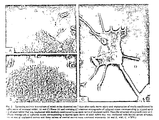
- The retinal proteins in the contralateral side were used as a control . Under the same experimental conditions, proteins of a retina of an injured nerve that had not been implanted, displayed a pattern identical to that of the uninjured side. The altered protein pattern of the rabbit retina which was induced by the grafts of the regenerating fish optic nerve (introduced into the injured rabbit optic nerve) resembles that observed in regenerating CNS of lower vertebrates and mammalian CNS (Fig.1).
- In order to determine if the induced biochemical changes are associated with regeneration activity, we measured the ability of the retina to sprout in culture. Adult mammalian CNS neurons of intact or injured nerves do not send out neurites in culture. However,lower vertebrates CNS neurons express high sprouting ability in culture following nerve injury. Retinae of injured rabbit optic nerves, into which segments of regenerating fish optic nerve were transplanted, did display sprouting activity in culture. To verify the nature of the fibers emerging from the retinae of the transplanted nerve, we used a scanning electron microscope which showed the typical structure of a growth cone at the growing tip (Fig. 2).
- Preliminary results have also pointed out the effect of the implanted substances on growth, in situ, as was revealed by electron microscopical analysis.
- Light microscopical analysis using horse-radish peroxidase for retrograde labeling of the retina revealed the higher frequency of new sprouts and surviving ganglion cells in retina of injured and implanted nerve. This effect was so far noticed up to one month after the surgical manipulation.
- The study demonstrates that the visual system of an adult rabbit (an example of mammalian CNS) can express regeneration characteristics if appropriate external signals are provided. Such signals are supplied in this work by diffusible substances that originate from non-neuronal cells of regenerating fish optic nerve, mammalian neonatal optic nerves and brains.
- It appears that the state of the non-neuronal cells which provide the signals is crucial. Thus, conditioned medium of regenerating fish optic nerve was effective whereas media conditioned by an intact fish optic nerve has a small effect. Furthermore, these signals seem to have a certain degree of specificity. Thus, a xenogeneic regenerating CNS was able to produce such signals, while intact or injured nerves of syngenic peripheral nerve failed to trigger regeneration response. These observations imply that adult rabbit retinal ganglion cells can be induced to regenerate by diffusible external signals produced by glial cells of regenerating systems rather than Schwann cells. Furthermore, the results indicate that the regeneration response machinery within the adult rabbit retina, responsible for receiving the triggering signals, is intact and evolutionary conserved. It therefore seems that the microenvironment of the adult rabbit optic nerve, unlike that of the fish is either insufficient by itself, or defective with respect to generation of signals necessary for triggering cell body response.
- The optic nerves of the anesthesized rabbits were exposed distally from the globe for about 1 cm. Unilateral (left side) crush or cut injuries were then performed at a distance of 4-5 mm from the optic disc.
- When a regenerating fish optic nerve, (5 to 6 days after crush injury of the fish nerve) was transplanted, it was sutured by 3 absorbable sutures through the respective meninges. When implantation was performed the rabbit optic nerve was crushed and a sleeve of a silicone tube (2 mm internal diameter) was placed around the injured site. The silicone tube was coated prior to the implantation with collagen, onto which medium conditioned by regenerating fish nerves was applied. This conditioned medium was prepared by incubating segments of a fish nerve in a serum-free medium (2 segments/250µl, DMEM, Gibco) for 1.5 h at room temperature.
- The invention is further illustrated with reference to the enclosed Figures, in which:
- Fig. 1
- illustrates gel analysis results of rabbit retinal protein;
- Fig. 2
- Illustrates the sprouting activity in a culture of rabbit retina after optic nerve injury.
- One week following the rabbit optic nerve injury and the surgical manipulations, the retinae of the various experimental groups were dissected out and pulse labeled in vitro, with [³⁵S]methionine. The ratio between specific activities of the labeled proteins in the left (operated) versus the right (unoperated contralateral) sides was used as a test parameter (defined as L/R).
CM = conditioned medium.

Claims (7)
- Use of a central nervous system (CNS) nerve-regeneration triggering substance derived from neonatal or injured nerves of CNS of a lower vertebrate species or of neonatal nerves of mammals for the preparation of a medicament for inducing regeneration of nerves of the mammalian CNS.
- Use according to claim 1 whereby an adequate quantity of the CNS-nerve regeneration triggering substance wherein the active substance is derived from an injured nerve of CNS of a lower vertebrate species, such as fish, is used.
- Use according to claim 1, whereby the active substance is derived from neonatal nerves of CNS of fish or other lower vertebrate species.
- Use according to claim 1, whereby the active substance is a crushed regenerating nerve of CNS of a lower vertebrate species.
- Use according to claim 1, whereby the active substance is contained in a fluid obtained by filtering off a comminuted regenerating nerve of CNS of a lower vertebrate species, of embryonic nerves of CNS or of neonatal nerves of CNS.
- Use according to any of claims 1 to 5, whereby the active substance has a M.W. between 1,000 and 10,000.
Priority Applications (1)
| Application Number | Priority Date | Filing Date | Title |
|---|---|---|---|
| AT85104011T ATE65184T1 (en) | 1984-04-04 | 1985-04-03 | NERVE REGENERATION. |
Applications Claiming Priority (2)
| Application Number | Priority Date | Filing Date | Title |
|---|---|---|---|
| IL71440 | 1984-04-04 | ||
| IL71440A IL71440A0 (en) | 1984-04-04 | 1984-04-04 | Composition for nerve regeneration |
Publications (3)
| Publication Number | Publication Date |
|---|---|
| EP0172987A2 EP0172987A2 (en) | 1986-03-05 |
| EP0172987A3 EP0172987A3 (en) | 1988-03-09 |
| EP0172987B1 true EP0172987B1 (en) | 1991-07-17 |
Family
ID=11054958
Family Applications (1)
| Application Number | Title | Priority Date | Filing Date |
|---|---|---|---|
| EP85104011A Expired - Lifetime EP0172987B1 (en) | 1984-04-04 | 1985-04-03 | Nerve regeneration |
Country Status (5)
| Country | Link |
|---|---|
| EP (1) | EP0172987B1 (en) |
| JP (1) | JPH0717513B2 (en) |
| AT (1) | ATE65184T1 (en) |
| DE (1) | DE3583467D1 (en) |
| IL (1) | IL71440A0 (en) |
Families Citing this family (5)
| Publication number | Priority date | Publication date | Assignee | Title |
|---|---|---|---|---|
| IL87349A (en) * | 1988-08-04 | 1994-06-24 | Michal Schwartz | Water-soluble factor that activates glial cells, its preparation and pharmaceutical compositions comprising it |
| IL91459A0 (en) * | 1989-08-28 | 1990-04-29 | Yeda Res & Dev | Oligodendrocyte inhibitory factor |
| DE69126563T2 (en) * | 1990-04-12 | 1998-02-05 | Ebewe Arzneimittel | Use of a mixture of peptides and amino acids for the prophylaxis or treatment of dementia |
| US5800812A (en) * | 1995-09-15 | 1998-09-01 | Yeda Research And Development Co. Ltd. | Methods of use of mononuclear phagocytes to promote axonal regeneration |
| US6267955B1 (en) | 1995-09-15 | 2001-07-31 | Yeda Research And Development Co. Ltd. | Mononuclear phagocytes and their use to promote axonal regeneration |
-
1984
- 1984-04-04 IL IL71440A patent/IL71440A0/en unknown
-
1985
- 1985-04-03 AT AT85104011T patent/ATE65184T1/en not_active IP Right Cessation
- 1985-04-03 DE DE8585104011T patent/DE3583467D1/en not_active Expired - Lifetime
- 1985-04-03 EP EP85104011A patent/EP0172987B1/en not_active Expired - Lifetime
- 1985-04-04 JP JP60071858A patent/JPH0717513B2/en not_active Expired - Lifetime
Also Published As
| Publication number | Publication date |
|---|---|
| EP0172987A2 (en) | 1986-03-05 |
| EP0172987A3 (en) | 1988-03-09 |
| IL71440A0 (en) | 1984-07-31 |
| DE3583467D1 (en) | 1991-08-22 |
| ATE65184T1 (en) | 1991-08-15 |
| JPS615021A (en) | 1986-01-10 |
| JPH0717513B2 (en) | 1995-03-01 |
Similar Documents
| Publication | Publication Date | Title |
|---|---|---|
| Verstraeten et al. | Pharmacologic induction of posterior vitreous detachment in the rabbit | |
| Glaser | Extracellular modulating factors and the control of intraocular neovascularization: an overview | |
| Barbin et al. | Purification of the chick eye ciliary neuronotrophic factor | |
| Lander | Understanding the molecules of neural cell contacts: emerging patterns of structure and function | |
| Aguayo | Axonal regeneration from injured neurons in the adult mammalian central nervous system | |
| Kirchhof et al. | Pathogenesis of proliferative vitreoretinopathy | |
| Lange et al. | Corneal endothelial cell transplantation using Descemet's membrane as a carrier | |
| Cameron et al. | Evidence that reserve cells are a source of regenerated adult newt muscle in vitro | |
| Carey et al. | Factors influencing the release of proteins by cultured Schwann cells | |
| KR20040021697A (en) | Materials and methods to promote repair of nerve tissue | |
| Miller et al. | Experimental epiretinal proliferation induced by intravitreal red blood cells | |
| KR900700073A (en) | Binding Induction Composition | |
| Hall et al. | Electron microscopic study of the interaction of axons and glia at the site of anastomosis between the optic nerve and cellular or acellular sciatic nerve grafts | |
| Baehr et al. | Functional status influences the ability of Schwann cells to support adult rat retinal ganglion cell survival and axonal regrowth | |
| Pollard et al. | Fresh and predegenerate nerve allografts and isografts in trembler mice | |
| Cheng et al. | The effect of glial cell line-derived neurotrophic factor in fibrin glue on developing dopamine neurons | |
| Nathaniel et al. | Regeneration of dorsal root fibers into the adult rat spinal cord | |
| EP0172987A2 (en) | Nerve regeneration | |
| Pollack et al. | Repair of retinal pigment epithelium and its relationship with capillary endothelium after krypton laser photocoagulation. | |
| Gage et al. | Human amnion membrane matrix as a substratum for axonal regeneration in the central nervous system | |
| WO1992003536A1 (en) | Autotransplantation of schwann cells to promote nervous system repair | |
| Kalderon | Differentiating astroglia in nervous tissue histogenesis/regeneration: studies in a model system of regenerating peripheral nerve | |
| Packer et al. | An in vitro model of fibroblast activity and adhesion formation during flexor tendon healing | |
| Bird | Microsurgical transection of small nerve fibre bundles in vitro: Effects on axons, growth cones and glial cells | |
| EP0415321B1 (en) | Oligodendrocyte cytotoxic factor |
Legal Events
| Date | Code | Title | Description |
|---|---|---|---|
| PUAI | Public reference made under article 153(3) epc to a published international application that has entered the european phase |
Free format text: ORIGINAL CODE: 0009012 |
|
| AK | Designated contracting states |
Kind code of ref document: A2 Designated state(s): AT BE CH DE FR GB IT LI LU NL SE |
|
| PUAL | Search report despatched |
Free format text: ORIGINAL CODE: 0009013 |
|
| AK | Designated contracting states |
Kind code of ref document: A3 Designated state(s): AT BE CH DE FR GB IT LI LU NL SE |
|
| 17P | Request for examination filed |
Effective date: 19880905 |
|
| 17Q | First examination report despatched |
Effective date: 19890620 |
|
| RAP1 | Party data changed (applicant data changed or rights of an application transferred) |
Owner name: YEDA RESEARCH AND DEVELOPMENT COMPANY, LTD. |
|
| RAP1 | Party data changed (applicant data changed or rights of an application transferred) |
Owner name: YEDA RESEARCH AND DEVELOPMENT COMPANY, LTD. |
|
| GRAA | (expected) grant |
Free format text: ORIGINAL CODE: 0009210 |
|
| AK | Designated contracting states |
Kind code of ref document: B1 Designated state(s): AT BE CH DE FR GB IT LI LU NL SE |
|
| PG25 | Lapsed in a contracting state [announced via postgrant information from national office to epo] |
Ref country code: AT Effective date: 19910717 |
|
| REF | Corresponds to: |
Ref document number: 65184 Country of ref document: AT Date of ref document: 19910815 Kind code of ref document: T |
|
| REF | Corresponds to: |
Ref document number: 3583467 Country of ref document: DE Date of ref document: 19910822 |
|
| ITF | It: translation for a ep patent filed | ||
| ET | Fr: translation filed | ||
| PLBE | No opposition filed within time limit |
Free format text: ORIGINAL CODE: 0009261 |
|
| STAA | Information on the status of an ep patent application or granted ep patent |
Free format text: STATUS: NO OPPOSITION FILED WITHIN TIME LIMIT |
|
| 26N | No opposition filed | ||
| EPTA | Lu: last paid annual fee | ||
| EAL | Se: european patent in force in sweden |
Ref document number: 85104011.3 |
|
| PGFP | Annual fee paid to national office [announced via postgrant information from national office to epo] |
Ref country code: LU Payment date: 19950401 Year of fee payment: 11 |
|
| PGFP | Annual fee paid to national office [announced via postgrant information from national office to epo] |
Ref country code: NL Payment date: 19950430 Year of fee payment: 11 |
|
| PGFP | Annual fee paid to national office [announced via postgrant information from national office to epo] |
Ref country code: BE Payment date: 19950510 Year of fee payment: 11 |
|
| PGFP | Annual fee paid to national office [announced via postgrant information from national office to epo] |
Ref country code: GB Payment date: 19960315 Year of fee payment: 12 |
|
| PG25 | Lapsed in a contracting state [announced via postgrant information from national office to epo] |
Ref country code: LU Free format text: LAPSE BECAUSE OF NON-PAYMENT OF DUE FEES Effective date: 19960403 |
|
| PGFP | Annual fee paid to national office [announced via postgrant information from national office to epo] |
Ref country code: FR Payment date: 19960416 Year of fee payment: 12 |
|
| PGFP | Annual fee paid to national office [announced via postgrant information from national office to epo] |
Ref country code: SE Payment date: 19960419 Year of fee payment: 12 |
|
| PGFP | Annual fee paid to national office [announced via postgrant information from national office to epo] |
Ref country code: CH Payment date: 19960426 Year of fee payment: 12 |
|
| PG25 | Lapsed in a contracting state [announced via postgrant information from national office to epo] |
Ref country code: BE Effective date: 19960430 |
|
| PGFP | Annual fee paid to national office [announced via postgrant information from national office to epo] |
Ref country code: DE Payment date: 19960627 Year of fee payment: 12 |
|
| BERE | Be: lapsed |
Owner name: YEDA RESEARCH AND DEVELOPMENT CY LTD Effective date: 19960430 |
|
| PG25 | Lapsed in a contracting state [announced via postgrant information from national office to epo] |
Ref country code: NL Effective date: 19961101 |
|
| NLV4 | Nl: lapsed or anulled due to non-payment of the annual fee |
Effective date: 19961101 |
|
| PG25 | Lapsed in a contracting state [announced via postgrant information from national office to epo] |
Ref country code: GB Effective date: 19970403 |
|
| PG25 | Lapsed in a contracting state [announced via postgrant information from national office to epo] |
Ref country code: SE Effective date: 19970404 |
|
| PG25 | Lapsed in a contracting state [announced via postgrant information from national office to epo] |
Ref country code: LI Free format text: LAPSE BECAUSE OF NON-PAYMENT OF DUE FEES Effective date: 19970430 Ref country code: CH Free format text: LAPSE BECAUSE OF NON-PAYMENT OF DUE FEES Effective date: 19970430 |
|
| GBPC | Gb: european patent ceased through non-payment of renewal fee |
Effective date: 19970403 |
|
| REG | Reference to a national code |
Ref country code: CH Ref legal event code: PL |
|
| PG25 | Lapsed in a contracting state [announced via postgrant information from national office to epo] |
Ref country code: FR Free format text: LAPSE BECAUSE OF NON-PAYMENT OF DUE FEES Effective date: 19971231 |
|
| PG25 | Lapsed in a contracting state [announced via postgrant information from national office to epo] |
Ref country code: DE Free format text: LAPSE BECAUSE OF NON-PAYMENT OF DUE FEES Effective date: 19980101 |
|
| EUG | Se: european patent has lapsed |
Ref document number: 85104011.3 |
|
| REG | Reference to a national code |
Ref country code: FR Ref legal event code: ST |