EP0172738B1 - Stabilized zirconia bodies of improved toughness and production thereof - Google Patents
Stabilized zirconia bodies of improved toughness and production thereof Download PDFInfo
- Publication number
- EP0172738B1 EP0172738B1 EP85305849A EP85305849A EP0172738B1 EP 0172738 B1 EP0172738 B1 EP 0172738B1 EP 85305849 A EP85305849 A EP 85305849A EP 85305849 A EP85305849 A EP 85305849A EP 0172738 B1 EP0172738 B1 EP 0172738B1
- Authority
- EP
- European Patent Office
- Prior art keywords
- mgo
- tetragonal
- temperature
- cubic
- stabilizing oxide
- Prior art date
- Legal status (The legal status is an assumption and is not a legal conclusion. Google has not performed a legal analysis and makes no representation as to the accuracy of the status listed.)
- Expired
Links
- 238000004519 manufacturing process Methods 0.000 title description 7
- 229910002076 stabilized zirconia Inorganic materials 0.000 title 1
- MCMNRKCIXSYSNV-UHFFFAOYSA-N Zirconium dioxide Chemical compound O=[Zr]=O MCMNRKCIXSYSNV-UHFFFAOYSA-N 0.000 claims abstract description 103
- RKTYLMNFRDHKIL-UHFFFAOYSA-N copper;5,10,15,20-tetraphenylporphyrin-22,24-diide Chemical compound [Cu+2].C1=CC(C(=C2C=CC([N-]2)=C(C=2C=CC=CC=2)C=2C=CC(N=2)=C(C=2C=CC=CC=2)C2=CC=C3[N-]2)C=2C=CC=CC=2)=NC1=C3C1=CC=CC=C1 RKTYLMNFRDHKIL-UHFFFAOYSA-N 0.000 claims abstract description 28
- 238000001816 cooling Methods 0.000 claims abstract description 19
- 238000000034 method Methods 0.000 claims abstract description 19
- 229910000422 cerium(IV) oxide Inorganic materials 0.000 claims abstract description 12
- 238000001556 precipitation Methods 0.000 claims abstract description 10
- 230000000087 stabilizing effect Effects 0.000 claims description 19
- 238000010304 firing Methods 0.000 claims description 10
- 239000000919 ceramic Substances 0.000 claims description 6
- 230000001747 exhibiting effect Effects 0.000 claims description 4
- 238000007493 shaping process Methods 0.000 claims 1
- 239000003381 stabilizer Substances 0.000 abstract description 28
- 238000005245 sintering Methods 0.000 abstract description 7
- 239000012467 final product Substances 0.000 abstract description 6
- CETPSERCERDGAM-UHFFFAOYSA-N ceric oxide Chemical compound O=[Ce]=O CETPSERCERDGAM-UHFFFAOYSA-N 0.000 abstract 1
- 238000002360 preparation method Methods 0.000 abstract 1
- 230000032683 aging Effects 0.000 description 36
- 239000002244 precipitate Substances 0.000 description 21
- 239000000203 mixture Substances 0.000 description 19
- 239000000463 material Substances 0.000 description 12
- 238000006243 chemical reaction Methods 0.000 description 10
- 239000013078 crystal Substances 0.000 description 8
- 239000006104 solid solution Substances 0.000 description 8
- 230000009466 transformation Effects 0.000 description 7
- 150000001768 cations Chemical class 0.000 description 5
- 239000000047 product Substances 0.000 description 5
- 230000035939 shock Effects 0.000 description 5
- 238000009792 diffusion process Methods 0.000 description 4
- 238000010438 heat treatment Methods 0.000 description 4
- 230000007246 mechanism Effects 0.000 description 4
- 239000002245 particle Substances 0.000 description 4
- 238000013459 approach Methods 0.000 description 3
- 239000006105 batch ingredient Substances 0.000 description 3
- 239000011230 binding agent Substances 0.000 description 3
- 230000015572 biosynthetic process Effects 0.000 description 3
- 230000000694 effects Effects 0.000 description 3
- 230000004048 modification Effects 0.000 description 3
- 238000012986 modification Methods 0.000 description 3
- 230000000704 physical effect Effects 0.000 description 3
- 239000007787 solid Substances 0.000 description 3
- 230000035882 stress Effects 0.000 description 3
- 238000005299 abrasion Methods 0.000 description 2
- 238000000137 annealing Methods 0.000 description 2
- 239000007900 aqueous suspension Substances 0.000 description 2
- 230000001687 destabilization Effects 0.000 description 2
- 239000002270 dispersing agent Substances 0.000 description 2
- 238000011835 investigation Methods 0.000 description 2
- 238000005259 measurement Methods 0.000 description 2
- 229910044991 metal oxide Inorganic materials 0.000 description 2
- 150000004706 metal oxides Chemical class 0.000 description 2
- 230000006911 nucleation Effects 0.000 description 2
- 238000010899 nucleation Methods 0.000 description 2
- 230000008569 process Effects 0.000 description 2
- 229910001404 rare earth metal oxide Inorganic materials 0.000 description 2
- 230000001105 regulatory effect Effects 0.000 description 2
- 238000011160 research Methods 0.000 description 2
- 238000001694 spray drying Methods 0.000 description 2
- 230000006641 stabilisation Effects 0.000 description 2
- 238000011105 stabilization Methods 0.000 description 2
- 238000001238 wet grinding Methods 0.000 description 2
- FYYHWMGAXLPEAU-UHFFFAOYSA-N Magnesium Chemical compound [Mg] FYYHWMGAXLPEAU-UHFFFAOYSA-N 0.000 description 1
- 238000002441 X-ray diffraction Methods 0.000 description 1
- 230000009471 action Effects 0.000 description 1
- 230000002411 adverse Effects 0.000 description 1
- 229910045601 alloy Inorganic materials 0.000 description 1
- 239000000956 alloy Substances 0.000 description 1
- 238000005275 alloying Methods 0.000 description 1
- 238000004458 analytical method Methods 0.000 description 1
- 230000008901 benefit Effects 0.000 description 1
- 238000001354 calcination Methods 0.000 description 1
- WUKWITHWXAAZEY-UHFFFAOYSA-L calcium difluoride Chemical group [F-].[F-].[Ca+2] WUKWITHWXAAZEY-UHFFFAOYSA-L 0.000 description 1
- 230000008859 change Effects 0.000 description 1
- 239000000470 constituent Substances 0.000 description 1
- 238000005336 cracking Methods 0.000 description 1
- 239000010987 cubic zirconia Substances 0.000 description 1
- 238000000354 decomposition reaction Methods 0.000 description 1
- 230000003247 decreasing effect Effects 0.000 description 1
- 238000011161 development Methods 0.000 description 1
- 230000018109 developmental process Effects 0.000 description 1
- 238000010494 dissociation reaction Methods 0.000 description 1
- 230000005593 dissociations Effects 0.000 description 1
- NLQFUUYNQFMIJW-UHFFFAOYSA-N dysprosium(III) oxide Inorganic materials O=[Dy]O[Dy]=O NLQFUUYNQFMIJW-UHFFFAOYSA-N 0.000 description 1
- 230000002401 inhibitory effect Effects 0.000 description 1
- 230000003993 interaction Effects 0.000 description 1
- 150000002500 ions Chemical class 0.000 description 1
- 229910003443 lutetium oxide Inorganic materials 0.000 description 1
- 229910052749 magnesium Inorganic materials 0.000 description 1
- 239000011777 magnesium Substances 0.000 description 1
- 239000011159 matrix material Substances 0.000 description 1
- 238000002844 melting Methods 0.000 description 1
- 230000008018 melting Effects 0.000 description 1
- 230000005012 migration Effects 0.000 description 1
- 238000013508 migration Methods 0.000 description 1
- 238000002156 mixing Methods 0.000 description 1
- 238000000465 moulding Methods 0.000 description 1
- 230000036961 partial effect Effects 0.000 description 1
- 229910002077 partially stabilized zirconia Inorganic materials 0.000 description 1
- 239000000843 powder Substances 0.000 description 1
- 239000012254 powdered material Substances 0.000 description 1
- 238000003825 pressing Methods 0.000 description 1
- 238000003908 quality control method Methods 0.000 description 1
- 230000009467 reduction Effects 0.000 description 1
- 238000003303 reheating Methods 0.000 description 1
- 230000000717 retained effect Effects 0.000 description 1
- 230000002441 reversible effect Effects 0.000 description 1
- 238000012552 review Methods 0.000 description 1
- 230000035945 sensitivity Effects 0.000 description 1
- 238000010583 slow cooling Methods 0.000 description 1
- 239000000126 substance Substances 0.000 description 1
- 238000005382 thermal cycling Methods 0.000 description 1
- ZIKATJAYWZUJPY-UHFFFAOYSA-N thulium (III) oxide Inorganic materials [O-2].[O-2].[O-2].[Tm+3].[Tm+3] ZIKATJAYWZUJPY-UHFFFAOYSA-N 0.000 description 1
- XLYOFNOQVPJJNP-UHFFFAOYSA-N water Substances O XLYOFNOQVPJJNP-UHFFFAOYSA-N 0.000 description 1
- 229910052727 yttrium Inorganic materials 0.000 description 1
- VWQVUPCCIRVNHF-UHFFFAOYSA-N yttrium atom Chemical compound [Y] VWQVUPCCIRVNHF-UHFFFAOYSA-N 0.000 description 1
Classifications
-
- C—CHEMISTRY; METALLURGY
- C04—CEMENTS; CONCRETE; ARTIFICIAL STONE; CERAMICS; REFRACTORIES
- C04B—LIME, MAGNESIA; SLAG; CEMENTS; COMPOSITIONS THEREOF, e.g. MORTARS, CONCRETE OR LIKE BUILDING MATERIALS; ARTIFICIAL STONE; CERAMICS; REFRACTORIES; TREATMENT OF NATURAL STONE
- C04B35/00—Shaped ceramic products characterised by their composition; Ceramics compositions; Processing powders of inorganic compounds preparatory to the manufacturing of ceramic products
- C04B35/01—Shaped ceramic products characterised by their composition; Ceramics compositions; Processing powders of inorganic compounds preparatory to the manufacturing of ceramic products based on oxide ceramics
- C04B35/48—Shaped ceramic products characterised by their composition; Ceramics compositions; Processing powders of inorganic compounds preparatory to the manufacturing of ceramic products based on oxide ceramics based on zirconium or hafnium oxides, zirconates, zircon or hafnates
- C04B35/486—Fine ceramics
-
- Y—GENERAL TAGGING OF NEW TECHNOLOGICAL DEVELOPMENTS; GENERAL TAGGING OF CROSS-SECTIONAL TECHNOLOGIES SPANNING OVER SEVERAL SECTIONS OF THE IPC; TECHNICAL SUBJECTS COVERED BY FORMER USPC CROSS-REFERENCE ART COLLECTIONS [XRACs] AND DIGESTS
- Y10—TECHNICAL SUBJECTS COVERED BY FORMER USPC
- Y10T—TECHNICAL SUBJECTS COVERED BY FORMER US CLASSIFICATION
- Y10T428/00—Stock material or miscellaneous articles
- Y10T428/29—Coated or structually defined flake, particle, cell, strand, strand portion, rod, filament, macroscopic fiber or mass thereof
- Y10T428/2982—Particulate matter [e.g., sphere, flake, etc.]
- Y10T428/2991—Coated
- Y10T428/2993—Silicic or refractory material containing [e.g., tungsten oxide, glass, cement, etc.]
Definitions
- Zirconia demonstrates very high refractoriness but its use in bodies of any substantial bulk has been severely limited because of an extremely disruptive, reversible phase transformation which takes place in the vicinity of 1000° ⁇ 1100°C; viz., the polymorphic conversion of the tetragonal crystal form to the monoclinic form.
- thermal cycling of Zr0 2 bodies through the transformation range, about 900°-1200°C commonly results in cracking and, not infrequently, the total disintegration thereof, because of the relatively large volume change which accompanies that conversion of crystal forms. Consequently, extensive investigations have been conducted to develop "alloys" of Zr0 2 with another metal oxide, the most notable of such being CaO, MgO, and Y 3 O 3 ⁇
- U.S. Patent No. 3,365,317 was directed to the production of Zr0 2 bodies illustrating the properties of lubricity, toughness, abrasion resistance, and chemical inertness, thereby recommending their utility as drawing die materials.
- the bodies consisted essentially, in weight percent, of 96.5-97.2% Zr0 2 and 2.8-3.5% MgO, and exhibited coefficients of thermal expansion [room temperature (R.T.) to 1400°C] not greater than 73x10 -7 /°C, compressive strengths of at least 250,000 psi, and moduli of rupture of at least 27,000 psi.
- the bodies were sintered at temperatures of 2500°-3500°F (-1371°-1927°C) and the fired product contained tetragonal Zr0 2 and cubic and/or monoclinic Zr0 2 .
- No quantitative measurement of the proportion of each crystal phase of Zr0 2 present was provided, but the objective was to optimize the amounts of tetragonal and monoclinic Zr0 2 in the bodies. It was emphasized that impact strength and abrasion resistance decreased with MgO levels greater than 3.5%.
- U.S. Patent No. 3,620,781 was concerned with a method for producing bodies of ZrO 2 which were partially stabilized through the inclusion of 2-5% by weight CaO.
- the bodies were characterized by high moduli of rupture and high Young's moduli.
- the microstructure of the bodies consisted essentially of cubic Zr0 2 grains as the major phase by volume, intergranular primary monoclinic Zr0 2 grains of substantially smaller average grain size than that of the cubic grains, and an extremely fine-grained precipitate of monoclinic Zr0 2 dispersed intragranularly throughout the cubic grains.
- the precipitate had an average grain size much smaller (at least one order of magnitude) than the average grain size of the primary monoclinic Zr0 2 grains, viz., about 0.1-2 microns in comparison to 10-20 microns.
- the inventive method comprised firing the bodies at a temperature of at least 1800°C and up to the melting temperature of the body, annealing the sintered body by holding it within the range of 900° ⁇ 1700°C for a substantial period of time (desirably for at least one day), and then cooling to ambient temperature.
- the annealing period produces the required precipitate which, in turn, imparts the enhanced strength and elastic modulus to the bodies.
- U.S. Patent No. 3,634,113 described the production of cubic Zr0 2 bodies stabilized with 6-20 mole percent of a type C mixed rare earth oxide solid solution containing Yb 2 0 3 , Er 2 0 3 , Dy 2 O 3 , Ho 2 0 3 , Tb 2 0 3 , Tm 2 O 3 , and Lu 2 O 3 . It was asserted that the final bodies were totally free from monoclinic Zr0 2 and might consist solely of cubic Zr0 2 or might contain a small quantity of tetragonal Zr0 2 with the cubic polymorph.
- U.S. Patent No. 3,887,387 claimed a method for preparing ZrO 2 bodies by sintering a mixture of 30-90% pulverulent monoclinic Zr0 2 , 7.8 ⁇ 69.5% pulverulent Zr0 2 stabilized with at least one stabilizing oxide selected from the group of MgO, CaO, CdO, Mn0 2 , CoO, Ti0 2 , and rare earth oxides, and 0.5-2.2% of at least one pulverulent stabilizing oxide of the group recited above.
- the total amount of stabilizing oxide ranged between 2.5-3.5%.
- the final product was asserted to consist of 75-95% cubic crystals.
- U.S. Patent No. 4,035,191 disclosed means for producing articles of stabilized Zr0 2 having microstructures containing less than 10% cubic Zr0 2 and at least 5% tetragonal Zr0 2 which do not destabilize at temperatures between 1650°-2250°F ( ⁇ 899°-1232°C).
- the bodies consisted essentially, in weight percent, of 0.1-5.0% ZnO, at least 0.5% of a primary stabilizer selected from the group of 0.25 ⁇ 4% MgO, 0.25-4% Y 2 0 3 , and mixtures thereof, and the balance Zr0 2 .
- the bodies are sintered between about 2550° ⁇ 2950°F (-1399°-1621°C).
- U.S. Patent No. 4,067,745 was drawn to a process for forming a partially stabilized Zr0 2 body which consisted of firing, between 1700° ⁇ 1950°C, a body consisting essentially of 3.3-4.7% by weight CaO and the remainder Zr0 2 , cooling the body at an average rate of at least 175°C/hour to a temperature between 1200°-1450°C, and aging the body for a period of time (typically about 64 hours) within that latter temperature range.
- the microstructure of the fired body was stated to be composed of metastable tetragonal domains of critical size within cubic matrix grains. It was asserted that the same controlled microstructure could be developed in MgO-stabilized Zr0 2 bodies, but those products are stated to be subject to two problems:
- U.S. Patent No. 4,279,655 was directed to a method for preparing bodies of Zr0 2 which are partially stabilized with MgO.
- the method claimed comprised the steps of:
- the microstructure of the final body was described as being composed predominantly of relatively large cubic grains within which grains are elliptically-shaped precipitates of tetragonal Zr0 2 having a long dimension of about 1500A.
- the precipitate comprised 2-10% of the material.
- a grain boundary phase of monoclinic Zr0 2 was also present constituting 8-15% of the material.
- a monoclinic phase formed via the transformation of some of the tetragonal precipitate, was dispersed within each cubic Zr0 2 grain; that monoclinic phase comprising about 0.5-20% of the material.
- the monoclinic grains were asserted to be untwinned, in contrast to the twinning conventionally observed in those precipitates when they are transformed from the tetragonal state.
- the aging step was posited as producing the untwinned monoclinic crystals.
- the principal objective of the present invention is to provide means for producing partially stabilized Zr0 2 which can be so controlled that bodies exhibiting very high strength, excellent toughness, and good thermal shock resistance can be readily reproduced.
- the basic concept underlying the present invention is the use of MgO and/or CaO and/or Ce0 2 and/or CuO and/or ZnO with Y 2 0 3 as stabilizers in the thermal toughening process.
- the use of such mixed stabilizers permits control of the kinetics of the precipitation reaction, thereby enabling tailoring of the properties of the final product.
- the precipitates of tetragonal Zr0 2 form small islands within the cubic Zr0 2 grains, those islands having dimensions of about 0.25-0.75 micron, with the preferred size being about 0.4 micron. Such very small-dimensioned precipitates are demanded to inhibit the transformation of the tetragonal Zr0 2 to the monoclinic polymorph.
- the size of the precipitates permits the size of the precipitates to be regulated such that under the influence of relatively minor tensile stress they can readily transform to the monoclinic polymorph, thereby inhibiting the formation of areas of highly localized tensile stress and, as a result, imparting exceptional toughness to the bodies.
- the precipitates can have dimensions slightly larger than that required for maximum toughness such that a small portion thereof will transform to monoclinic Zr0 2 upon cooling. Those precipitates can then be readily converted back to the tetragonal phase when subjected to relatively small compressive stresses caused by either mechanical or thermal forces.
- the inventive method comprises the following six general steps:
- At least 0.5% Y 2 0 3 by weight and, preferably, at least 1% Y 2 0 3 (or an amount of a yttrium-containing batch component required to yield the predetermined Y 2 0 3 content) must be present as the primary stabilizer.
- At least 1% by weight and, preferably, at least 2% total of secondary stabilizer oxide (or an amount of a secondary stabilizer batch component needed to yield the prescribed content thereof) will be present.
- up to as much as 10% Y 2 0 3 and up to 10% total of secondary stabilizer oxide may be utilized, such quantities are in excess of those required to induce the necessary precipitation and achieve the desired partial stabilization of Zr0 2 .
- about 6% by weight each of primary and secondary stabilizer oxides has been deemed a practical maximum with less than 3% of each frequently proving to be very satisfactory.
- sintering of the batch will be conducted at a temperature and for only a period of time sufficient to insure the formation of solid, integral bodies. Temperatures between about 1600°-1800°C have proven to be quite satisfactory. Extended firing periods at high temperatures hazard unwanted grain growth. That factor, coupled with economic reality, dictates that the sintering times be restricted to periods actually demanded to achieve an integral body. In general, firing periods of about 0.5 ⁇ 4 hours at a particular temperature have been used.
- Cooling of the hot sintered body to the aging temperature region is performed quickly to restrain the rapid diffusion of the secondary stabilizers and to inhibit grain growth.
- the aging temperature zone (about 1000°-1475°C) comprises the region wherein the secondary stabilizing oxides will diffuse, but not migrate so rapidly that control thereof is rendered difficult. It will be appreciated that the several oxides will diffuse at different rates depending, at least in part, upon the size of the cation and the temperature employed. Consequently, as would be expected, small cations commonly migrate more rapidly than large ions, and the speed with which diffusion takes place typically increases as the temperature is raised. However, care must be exercised to avoid excessive crystal growth of the precipitated tetragonal Zr0 2 . Likewise, care must be taken to avoid forming excessive monoclinic Zr0 2 at the grain boundaries of 1-10 micron dimensions by holding within the aging temperature range too long. Accordingly, a practical compromise must be struck between the desire to complete the aging process as soon as possible by utilizing relatively high temperatures, and the better control of the precipitation reaction inherent with lower temperatures and consequent longer aging periods.
- an aging period of no more than about one hour at 1475°C may provide the desired precipitated tetragonal polymorph of Zr0 2 where MgO constitutes the secondary stabilizer
- a short time exposure is difficult to control and longer periods at lower temperatures are advantageously employed.
- Longer periods of aging at like temperatures will be demanded for cations larger than magnesium since the rate of migration of large cations is generally slower than that of smaller cations. Accordingly, a minimum of about one hour in the aging temperature regime may be sufficient, whereas under certain conditions much longer periods, e.g., up to 24 hours and even longer, may be required and/or advantageous to yield the desired degree of precipitation.
- the rate of cooling from the cooler extreme of the aging temperature zone to room temperature does not appear to exert any substantive effect upon the properties of the final product.
- the bodies may simply be cooled in air or permitted to cool in whatever manner is conventional to the art for the product being formed.
- Patent No. 4,279,655 teaches a method for preparing Zr0 2 bodies which are partially stabilized through the inclusion of MgO, the method including an aging process as one step.
- a green shape is sintered at 1550°-1800°C, the sintered shape cooled below 800°C, to induce nucleation, and then the shape is reheated to between 1000°-1400°C.
- the final product contains a substantial proportion of monoclinic Zr0 2 .
- the present inventive method permits the production of material wherein the amount of monoclinic phase can be carefully controlled for varying application. For a combination of high toughness and high mechanical strength, the final product will have very little monoclinic Zr0 2 therein.
- Table I records batch compositions, expressed in terms of weight percent on the oxide basis, illustrating the parameters of the invention.
- oxides of very high purity were utilized as the batch ingredients. Nevertheless, it will be appreciated that other materials, capable of conversion to the desired oxide in the proper proportions upon firing, may be employed.
- the batch ingredients were milled together (using Zr0 2 balls in a urethane-lined container) in a water suspension also containing conventional organic binders and dispersants to yield a homogeneous batch wherein the particles were substantially all finer than 2 microns in size.
- the batches were then dried and granulated, conveniently via spray drying, to a moisture content of about 2% by weight.
- the granulated batches having particles passing a No. 50 United States Standard Sieve (297 microns) where spray drying is utilized, and passing a No.
- Cooling at furnace rate indicates the gas was simply cut off and the furnace allowed to cool down with the discs retained therein. Such cooling does not follow a strictly linear temperature path, being more rapid at higher temperatures than at lower temperatures, but averages somewhat above 200°C/hour.
- Table III records measurements of density (g/cm 3 ), modulus of rupture (psi), toughness (MPa ⁇ m), and coefficient of thermal expansion over the range of 0° ⁇ 1200°C ( ⁇ 10 -7 /°C) determined on the compositions of Table I after being exposed to the temperature schedules of Table II. Density was measured in the conventional manner utilizing a modification of the Westphal balance. Modulus of rupture and coefficient of thermal expansion were determined in the conventional manner employing bars cut from the discs having dimensions of about 0.75"x0.25"x0.125". Toughness was measured in the conventional manner using the short, chevron-notched beam technique with bars about 0.5" in length cut from the discs.
- Example 6 which exhibited the highest toughness values
- Table IV reports those schedules and Table V records the individual compositions accompanied with values of density, modulus of rupture, and toughness measured on each after exposure to a particular aging schedule.
- Table V the remainder of each composition consisted of Zr0 2 .
- Example 11 (2.6% MgO, 0.8% Y 2 0 3 )
- Example 12 (2.7% MgO, 0.8% Y 2 0 3 )
- Example 13 (2.3% MgO, 1.0% Y 2 0 3 )
- Example 14 (2.4% MgO, 1.0% Y 2 0 3 )
- Example 15 (2.5% MgO, 1.0% Y 2 0 3 )
- Example 16 (2.6% MgO, 1.0% Y 2 0 3 )
- Example 17 (2.7% MgO, 1.0% Y 2 0 3 )
- Example 20 (2.5% MgO, 1.2% Y 2 0 3 )
- Example 21 (2.6% MgO, 1.2% Y 2 0 3 )
- discs of Example 24 were prepared and fired for two hours at 1725°C in like manner to Example 10-23, and thereafter subjected to the aging schedules reported in Table IV. Also, like manner to Table V, Table VI records the composition of Example 24 along with values of density, modulus of rupture, and toughness measured after exposure to a particular aging sequence.
- Table VI again illustrates the great variation in physical properties that can be produced via changes in heat treating schedules, thereby permitting, for example, the tailoring of toughness and modulus of rupture levels depending upon the particular application for which the product is designed.
- Ce0 2 As the secondary stabilizer. Ce0 2 also acts as a sintering aid which has a practical benefit in permitting lower firing temperatures to be employed. Furthermore, Ce0 2 goes into solid solution with Zr0 2 more readily at lower temperatures than MgO and CaO.
- Table VI records batch compositions, expressed in terms of weight percent on the oxide basis, illustrating the utility of Ce0 2 as a secondary stabilizer oxide.
- oxides of very high purity were employed as the batch constituents in the following laboratory work, although other materials, capable of conversion to the desired oxide in the proper proportions upon firing, may be used.
- Samples were prepared following the general description provided above for the previous examples. Thus, the batch ingredients were milled together in a water suspension containing conventional organic binders and dispersants, the batches dried and granulated, samples pressed therefrom, and fired at 1600°C for about 2 hours to sinter into solid, integral bodies.
- MgO constitutes the preferred secondary stabilizing oxide.
Landscapes
- Chemical & Material Sciences (AREA)
- Engineering & Computer Science (AREA)
- Ceramic Engineering (AREA)
- Composite Materials (AREA)
- Manufacturing & Machinery (AREA)
- Materials Engineering (AREA)
- Structural Engineering (AREA)
- Organic Chemistry (AREA)
- Compositions Of Oxide Ceramics (AREA)
- Inorganic Insulating Materials (AREA)
- Cylinder Crankcases Of Internal Combustion Engines (AREA)
- Inorganic Compounds Of Heavy Metals (AREA)
Abstract
Description
- Zirconia demonstrates very high refractoriness but its use in bodies of any substantial bulk has been severely limited because of an extremely disruptive, reversible phase transformation which takes place in the vicinity of 1000°―1100°C; viz., the polymorphic conversion of the tetragonal crystal form to the monoclinic form. Hence, thermal cycling of Zr02 bodies through the transformation range, about 900°-1200°C, commonly results in cracking and, not infrequently, the total disintegration thereof, because of the relatively large volume change which accompanies that conversion of crystal forms. Consequently, extensive investigations have been conducted to develop "alloys" of Zr02 with another metal oxide, the most notable of such being CaO, MgO, and Y3O3·
- The initial research efforts sought to produce a stabilized cubic zirconia (the high temperature Zr02 structure) and the recited "alloying" oxides are especially effective in forming stable solid solutions with Zr02 having the cubic fluorite structure. It was soon observed, however, that fully stabilized cubic Zr02 bodies are not particularly strong or resistant to thermal shock. Continued investigations have demonstrated that partially stabilized ZrO2 bodies can be both stronger and more thermal shock resistant than either unstabilized or completely stabilized Zr02 articles. The following patents are illustrative of the considerable effort that has been expended in devising Zr02 bodies manifesting high refractoriness coupled with high strength and good resistance to thermal shock.
- U.S. Patent No. 3,365,317 was directed to the production of Zr02 bodies illustrating the properties of lubricity, toughness, abrasion resistance, and chemical inertness, thereby recommending their utility as drawing die materials. The bodies consisted essentially, in weight percent, of 96.5-97.2% Zr02 and 2.8-3.5% MgO, and exhibited coefficients of thermal expansion [room temperature (R.T.) to 1400°C] not greater than 73x10-7/°C, compressive strengths of at least 250,000 psi, and moduli of rupture of at least 27,000 psi. The bodies were sintered at temperatures of 2500°-3500°F (-1371°-1927°C) and the fired product contained tetragonal Zr02 and cubic and/or monoclinic Zr02. No quantitative measurement of the proportion of each crystal phase of Zr02 present was provided, but the objective was to optimize the amounts of tetragonal and monoclinic Zr02 in the bodies. It was emphasized that impact strength and abrasion resistance decreased with MgO levels greater than 3.5%.
- U.S. Patent No. 3,620,781 was concerned with a method for producing bodies of ZrO2 which were partially stabilized through the inclusion of 2-5% by weight CaO. The bodies were characterized by high moduli of rupture and high Young's moduli. The microstructure of the bodies consisted essentially of cubic Zr02 grains as the major phase by volume, intergranular primary monoclinic Zr02 grains of substantially smaller average grain size than that of the cubic grains, and an extremely fine-grained precipitate of monoclinic Zr02 dispersed intragranularly throughout the cubic grains. The precipitate had an average grain size much smaller (at least one order of magnitude) than the average grain size of the primary monoclinic Zr02 grains, viz., about 0.1-2 microns in comparison to 10-20 microns.
- The inventive method comprised firing the bodies at a temperature of at least 1800°C and up to the melting temperature of the body, annealing the sintered body by holding it within the range of 900°―1700°C for a substantial period of time (desirably for at least one day), and then cooling to ambient temperature. The annealing period produces the required precipitate which, in turn, imparts the enhanced strength and elastic modulus to the bodies.
- U.S. Patent No. 3,634,113 described the production of cubic Zr02 bodies stabilized with 6-20 mole percent of a type C mixed rare earth oxide solid solution containing Yb203, Er203, Dy2O3, Ho203, Tb203, Tm2O3, and Lu2O3. It was asserted that the final bodies were totally free from monoclinic Zr02 and might consist solely of cubic Zr02 or might contain a small quantity of tetragonal Zr02 with the cubic polymorph.
- U.S. Patent No. 3,887,387 claimed a method for preparing ZrO2 bodies by sintering a mixture of 30-90% pulverulent monoclinic Zr02, 7.8―69.5% pulverulent Zr02 stabilized with at least one stabilizing oxide selected from the group of MgO, CaO, CdO, Mn02, CoO, Ti02, and rare earth oxides, and 0.5-2.2% of at least one pulverulent stabilizing oxide of the group recited above. The total amount of stabilizing oxide ranged between 2.5-3.5%. The final product was asserted to consist of 75-95% cubic crystals.
- U.S. Patent No. 4,035,191 disclosed means for producing articles of stabilized Zr02 having microstructures containing less than 10% cubic Zr02 and at least 5% tetragonal Zr02 which do not destabilize at temperatures between 1650°-2250°F (~899°-1232°C). The bodies consisted essentially, in weight percent, of 0.1-5.0% ZnO, at least 0.5% of a primary stabilizer selected from the group of 0.25―4% MgO, 0.25-4% Y203, and mixtures thereof, and the balance Zr02. The bodies are sintered between about 2550°―2950°F (-1399°-1621°C).
- U.S. Patent No. 4,067,745 was drawn to a process for forming a partially stabilized Zr02 body which consisted of firing, between 1700°―1950°C, a body consisting essentially of 3.3-4.7% by weight CaO and the remainder Zr02, cooling the body at an average rate of at least 175°C/hour to a temperature between 1200°-1450°C, and aging the body for a period of time (typically about 64 hours) within that latter temperature range. The microstructure of the fired body was stated to be composed of metastable tetragonal domains of critical size within cubic matrix grains. It was asserted that the same controlled microstructure could be developed in MgO-stabilized Zr02 bodies, but those products are stated to be subject to two problems:
- (a) the reaction kinetics are so rapid that it is difficult to introduce quality control procedures into the manufacturing process; and
- (b) the MgO-Zr02 compositions are subject to a eutectoid decomposition reaction below 1400°C.
- U.S. Patent No. 4,279,655 was directed to a method for preparing bodies of Zr02 which are partially stabilized with MgO. The method claimed comprised the steps of:
- (1) mixing and wet milling 2.8-4.0% by weight MgO, balance Zr02, to a mean particle size of 0.7 micron, the Zr02 containing no more than 0.03% Si02;
- (2) calcining the powdered material at 800°-1450°C for about 24 hours;
- (3) wet milling the mixture to a mean particle size of 0.7 micron;
- (4) molding the wet mixture into a desired shape;
- (5) firing the shape at 1550°-1800°C;
- (6) cooling the shape to a temperature between 800°C and ambient temperature to induce nucleation, the rate of cooling being controlled so that a tetragonal Zr02 precipitate phase forms in the sintered material and coarsens to an elliptical precipitate having a major axis of about 1500A;
- (7) heating the body to an aging/transformation range of 1000o-1400°C;
- (8) holding the body within that temperature range until 2-30% of the tetragonal Zr02 precipitate is transformed into monoclinic Zr02 material; and
- (9) cooling to room temperature.
- The microstructure of the final body was described as being composed predominantly of relatively large cubic grains within which grains are elliptically-shaped precipitates of tetragonal Zr02 having a long dimension of about 1500A. The precipitate comprised 2-10% of the material. A grain boundary phase of monoclinic Zr02 was also present constituting 8-15% of the material. Finally, a monoclinic phase, formed via the transformation of some of the tetragonal precipitate, was dispersed within each cubic Zr02 grain; that monoclinic phase comprising about 0.5-20% of the material. The monoclinic grains were asserted to be untwinned, in contrast to the twinning conventionally observed in those precipitates when they are transformed from the tetragonal state. The aging step was posited as producing the untwinned monoclinic crystals.
- As can be observed from the above review of patent literature, recent research in the field of Zr02 stabilization has been directed to the formation of partially stabilized Zr02, the means for accomplishing that goal generally involving two mechanisms. The first was utilized compositional variations; e.g., the use of two or more stabilizing oxides rather than a single stabilizer. To illustrate, when a mixture of CaO+MgO was employed as the stabilizer, it was discovered that the rate of destabilization of Zr02 above 1000°C is slower than for either stabilizer alone. The second mechanism has commonly employed a single stabilizer, accompanied with a special heat treatment schedule.
- This latter mechanism, which has been termed transformation toughening, has been studied extensively utilizing either CaO or MgO as the stabilizer. MgO has appeared to constitute the preferred stabilizer when using the fine intragranular precipitate approach to toughening. Nevertheless, as has been observed above, that method is very difficult to control. The aging time and the temperature in the cooling and reheating steps must be regulated with extreme care to induce the proper amount of stabilizer movement necessary to produce the desired precipitate of tetragonal Zr02 of the correct size within the grains of cubic Zr02. That phenomenon takes place within a range of temperatures wherein the MgO tends to exsolve from the solid solution given sufficient time, leaving a two-phase structure of MgO and monoclinic Zr02 at room temperature.
- The principal objective of the present invention is to provide means for producing partially stabilized Zr02 which can be so controlled that bodies exhibiting very high strength, excellent toughness, and good thermal shock resistance can be readily reproduced. The basic concept underlying the present invention is the use of MgO and/or CaO and/or Ce02 and/or CuO and/or ZnO with Y203 as stabilizers in the thermal toughening process. The use of such mixed stabilizers permits control of the kinetics of the precipitation reaction, thereby enabling tailoring of the properties of the final product.
- Although the mechanism making possible the modification of the kinetics of the precipitation reaction has not been fully elucidated, two actions are believed to play important roles. Thus, Y203 is very stable in solid solution such that during the aging process it will remain substantially evenly distributed. At the same time, however, the secondary stabilizers diffuse to create understabilized regions or zones which then become the precipitates of tetragonal Zr02. Nevertheless, when the secondary stabilizers comprise only a portion of the total stabilizer present, a higher fraction thereof must migrate in order to achieve the necessary extent of understabilization needed to form the precipitate. This circumstance requires the body to be exposed for a longer period of time within the aging temperature range and, hence, reduces the sensitivity thereof to minor shifts in composition and to the time and temperature parameters of the aging step. In essence, the precipitates of tetragonal Zr02 form small islands within the cubic Zr02 grains, those islands having dimensions of about 0.25-0.75 micron, with the preferred size being about 0.4 micron. Such very small-dimensioned precipitates are demanded to inhibit the transformation of the tetragonal Zr02 to the monoclinic polymorph.
- This approach permits the size of the precipitates to be regulated such that under the influence of relatively minor tensile stress they can readily transform to the monoclinic polymorph, thereby inhibiting the formation of areas of highly localized tensile stress and, as a result, imparting exceptional toughness to the bodies. Also, the precipitates can have dimensions slightly larger than that required for maximum toughness such that a small portion thereof will transform to monoclinic Zr02 upon cooling. Those precipitates can then be readily converted back to the tetragonal phase when subjected to relatively small compressive stresses caused by either mechanical or thermal forces.
- An apparent application for this approach is to form articles which will be used in the temperature range of about 1000°-1400°C where the typical partially stabilized zirconia material utilizing a single stabilizing oxide, e.g., MgO or CaO, would continued to destabilize. In the present invention, the secondary stabilizing oxide, i.e., MgO and/or CaO and/or Ce02 and/or CuO and/or ZnO, left in solid solution after the aging step will exert only a minor effect upon dissociation, whereas the Y203 will remain and forestall the rapid destabilization experienced in partially stabilized Zr02 utilizing a single metal oxide stabilizer.
- The inventive method comprises the following six general steps:
- (1) a powdered batch is prepared containing Zr02, Y203, and at least one secondary stabilizer selected from the group of MgO, CaO, Ce02, CuO, and ZnO (or materials which, when fired together, will yield the desired oxides in the proper proportions);
- (2) the batch is shaped by pressing, extruding, or other conventional means into a body of a predetermined configuration;
- (3) the body is fired at a temperature between about 1600°-1800°C for a period of time sufficient to sinter the powder into an integral body and allow the solid solution of the stabilizing oxides into the zirconia (where desired, the body can be hot pressed, isostatically hot pressed, or otherwise shaped into a different geometry);
- (4) the sintered body is cooled relatively quickly (>100°C/hour) to a temperature between about 1000°-1475°C;
- (5) the body is held within that temperature range for a period of time sufficient to induce the desired precipitation of tetragonal Zr02, but not so long as to cause excessive grain growth which, upon further cooling, would allow conversion of a substantial proportion of the tetragonal Zr02 crystals to the monoclinic polymorph; such precipitation being achieved either by a controlled continuous cooling curve or by holding at a fixed temperature for a prescribed time; and then
- (6) the body is cooled to room temperature.
- At least 0.5% Y203 by weight and, preferably, at least 1% Y203 (or an amount of a yttrium-containing batch component required to yield the predetermined Y203 content) must be present as the primary stabilizer. At least 1% by weight and, preferably, at least 2% total of secondary stabilizer oxide (or an amount of a secondary stabilizer batch component needed to yield the prescribed content thereof) will be present. Whereas up to as much as 10% Y203 and up to 10% total of secondary stabilizer oxide may be utilized, such quantities are in excess of those required to induce the necessary precipitation and achieve the desired partial stabilization of Zr02. Thus, about 6% by weight each of primary and secondary stabilizer oxides has been deemed a practical maximum with less than 3% of each frequently proving to be very satisfactory.
- In general, sintering of the batch will be conducted at a temperature and for only a period of time sufficient to insure the formation of solid, integral bodies. Temperatures between about 1600°-1800°C have proven to be quite satisfactory. Extended firing periods at high temperatures hazard unwanted grain growth. That factor, coupled with economic reality, dictates that the sintering times be restricted to periods actually demanded to achieve an integral body. In general, firing periods of about 0.5―4 hours at a particular temperature have been used.
- Cooling of the hot sintered body to the aging temperature region is performed quickly to restrain the rapid diffusion of the secondary stabilizers and to inhibit grain growth. Thus, as has been explained above, it is only through the careful observance of time and temperature parameters within the aging temperature zone that the kinetics of the precipitation reaction can be controlled. Inasmuch as thermal shock is not a problem at these high temperatures, an essentially simultaneous reduction in temperature from the sintering range to the aging temperature region would be quite operable.
- The aging temperature zone (about 1000°-1475°C) comprises the region wherein the secondary stabilizing oxides will diffuse, but not migrate so rapidly that control thereof is rendered difficult. It will be appreciated that the several oxides will diffuse at different rates depending, at least in part, upon the size of the cation and the temperature employed. Consequently, as would be expected, small cations commonly migrate more rapidly than large ions, and the speed with which diffusion takes place typically increases as the temperature is raised. However, care must be exercised to avoid excessive crystal growth of the precipitated tetragonal Zr02. Likewise, care must be taken to avoid forming excessive monoclinic Zr02 at the grain boundaries of 1-10 micron dimensions by holding within the aging temperature range too long. Accordingly, a practical compromise must be struck between the desire to complete the aging process as soon as possible by utilizing relatively high temperatures, and the better control of the precipitation reaction inherent with lower temperatures and consequent longer aging periods.
- Laboratory experience has indicated that bodies manifesting the greatest toughness, coupled with high strength and high density, contain in excess of 20% by volume and, preferably, in excess of 25% by volume tetragonal Zr02 with a maximum in the vicinity of 50% by volume. Scanning electron microscope examinations have indicated that the average crystal size of the tetragonal Zr02 is smaller than 0.5 micron. The near total absence of monoclinic Zr02 would be preferred to maximize toughness. However, scanning electron microscope and x-ray diffraction analyses have determined the monoclinic polymorph to be present in an amount less than 10% volume, with the preferred products having less than 5% by volume, in order to yield bodies exhibiting the best combination of toughness, density, and mechanical strength. Finally, the content of cubic Zr02 will range between about 50-70% by volume.
- In summary then, whereas an aging period of no more than about one hour at 1475°C may provide the desired precipitated tetragonal polymorph of Zr02 where MgO constitutes the secondary stabilizer, such a short time exposure is difficult to control and longer periods at lower temperatures are advantageously employed. Longer periods of aging at like temperatures will be demanded for cations larger than magnesium since the rate of migration of large cations is generally slower than that of smaller cations. Accordingly, a minimum of about one hour in the aging temperature regime may be sufficient, whereas under certain conditions much longer periods, e.g., up to 24 hours and even longer, may be required and/or advantageous to yield the desired degree of precipitation.
- Whereas the above description implies the use of a specific dwell period within the aging region, it is frequently more economically attractive to utilize a slow cooling rate through the regime of temperatures to accomplish the same purpose. Accordingly, instead of maintaining the temperature constant at a defined level for a predetermined length of time, comparable aging may be achieved by cooling at a relatively slow and controlled rate, e.g., 25°-50°C/hour, such that the body is exposed to the temperatures within the aging range for an equivalent period of time. In essence then, it is only necessary that the body be subjected to temperatures within the aging region for a sufficient period of time to permit the necessary diffusion of the secondary stabilizing oxide(s) with the consequent production of tetragonal ZrO3.
- The rate of cooling from the cooler extreme of the aging temperature zone to room temperature does not appear to exert any substantive effect upon the properties of the final product. Hence, the bodies may simply be cooled in air or permitted to cool in whatever manner is conventional to the art for the product being formed.
- As was noted above, Patent No. 4,279,655 teaches a method for preparing Zr02 bodies which are partially stabilized through the inclusion of MgO, the method including an aging process as one step. Thus, a green shape is sintered at 1550°-1800°C, the sintered shape cooled below 800°C, to induce nucleation, and then the shape is reheated to between 1000°-1400°C. The final product contains a substantial proportion of monoclinic Zr02. In contrast, the present inventive method permits the production of material wherein the amount of monoclinic phase can be carefully controlled for varying application. For a combination of high toughness and high mechanical strength, the final product will have very little monoclinic Zr02 therein.
- Table I records batch compositions, expressed in terms of weight percent on the oxide basis, illustrating the parameters of the invention. In the following laboratory work, oxides of very high purity were utilized as the batch ingredients. Nevertheless, it will be appreciated that other materials, capable of conversion to the desired oxide in the proper proportions upon firing, may be employed.
- The batch ingredients were milled together (using Zr02 balls in a urethane-lined container) in a water suspension also containing conventional organic binders and dispersants to yield a homogeneous batch wherein the particles were substantially all finer than 2 microns in size. The batches were then dried and granulated, conveniently via spray drying, to a moisture content of about 2% by weight. The granulated batches, having particles passing a No. 50 United States Standard Sieve (297 microns) where spray drying is utilized, and passing a No. 30 United States Standard Sieve (595 microns) where manual granulating is employed, were pressed into discs having diameters of about 1.5" and thicknesses of about 0.33", and those discs were fired at 1675°C, 1725°C, or 1750°C for two hours in a gas-fired furnace. As is conventional in the ceramic art, low temperature portions of the heating schedule will be designed to permit the removal of water and organic binder in a manner such that the integrity of the body will not be adversely affected. A two-hour firing period at 1675°C, 1725°C, or 1750°C insures sintering into a solid, integral body with the stabilizers in solid solution with the Zr02 without the development of excessive grain growth.


- Cooling at furnace rate indicates the gas was simply cut off and the furnace allowed to cool down with the discs retained therein. Such cooling does not follow a strictly linear temperature path, being more rapid at higher temperatures than at lower temperatures, but averages somewhat above 200°C/hour.
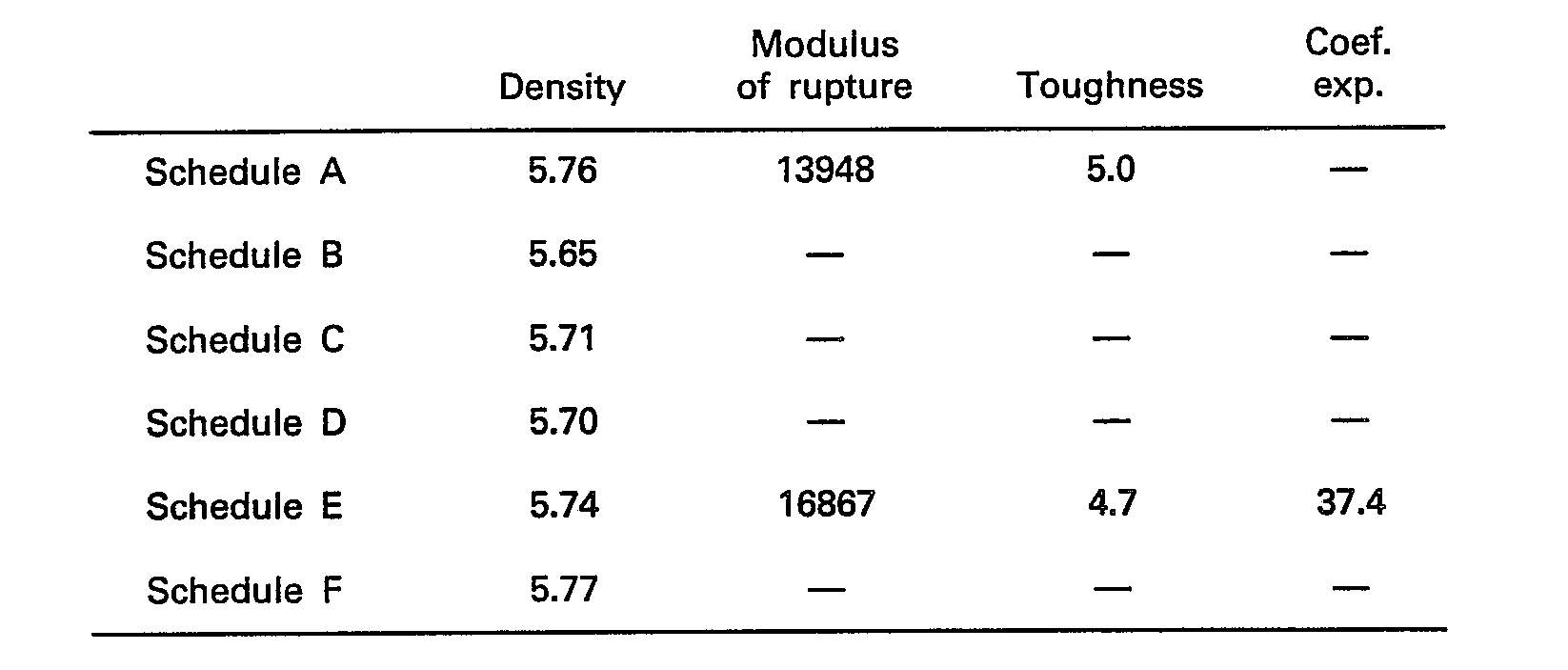
- Table III records measurements of density (g/cm3), modulus of rupture (psi), toughness (MPa√m), and coefficient of thermal expansion over the range of 0°―1200°C (×10-7/°C) determined on the compositions of Table I after being exposed to the temperature schedules of Table II. Density was measured in the conventional manner utilizing a modification of the Westphal balance. Modulus of rupture and coefficient of thermal expansion were determined in the conventional manner employing bars cut from the discs having dimensions of about 0.75"x0.25"x0.125". Toughness was measured in the conventional manner using the short, chevron-notched beam technique with bars about 0.5" in length cut from the discs.

-

-

-

-
-

-

-

-

- As can be seen from the above, a wide variation in physical properties is possible not only with minor changes in composition, but also with variations in the aging process. This latter circumstance is of great practical significance since it permits careful tailoring of a broad range of those properties with relative ease without reliance on critical composition control.
- As can be observed from a study of Tables I and II, not all of the compositions demonstrated optimum physical properties utilizing the same aging schedule. To illustrate, the highest toughness value for Example 6 was registered with Schedule B, whereas Schedule C was best for Example 7 and Schedule D for Example 8. That circumstance clearly demonstrates the interaction of chemistry, especially the level of Y2O3 and the ratio of Y203 with respect to the secondary stabilizers, with the aging cycle employed. Hence, for each level of Y203 and secondary stabilizer, there is a specific aging schedule which will yield the optimum amount and size of precipitate. The precipitates must not be too small or transformation toughening will not be produced, but they must not be too large such that they are transformed into the monoclinic phase.
- To further illustrate that feature, the following several compositions (minor modifications of Example 6 which exhibited the highest toughness values) were prepared in like manner to the description above, fired at 1725°C for 2 hours, and thereafter exposed to the recited aging schedules. Table IV reports those schedules and Table V records the individual compositions accompanied with values of density, modulus of rupture, and toughness measured on each after exposure to a particular aging schedule. In Table V the remainder of each composition consisted of Zr02.


-

-

-

-

-

-

-

-

-

-

-

-

-

- It is readily apparent from the above Table V that not infrequently the aging heat treatment schedule yielding bodies of the highest mechanical strength will not result in imparting the highest toughness values. Nevertheless, as can readily be observed, there is considerable flexibility in the aging process which enables a wide range of properties to be produced, and wherein the character of those properties can be reproduced in a controlled manner.
- To illustrate the utility of employing more than one secondary stabilizing oxide, discs of Example 24, expressed below in terms of weight percent on the oxide basis, were prepared and fired for two hours at 1725°C in like manner to Example 10-23, and thereafter subjected to the aging schedules reported in Table IV. Also, like manner to Table V, Table VI records the composition of Example 24 along with values of density, modulus of rupture, and toughness measured after exposure to a particular aging sequence.

- Table VI again illustrates the great variation in physical properties that can be produced via changes in heat treating schedules, thereby permitting, for example, the tailoring of toughness and modulus of rupture levels depending upon the particular application for which the product is designed.
- Another series of materials was produced utilizing Ce02 as the secondary stabilizer. Ce02 also acts as a sintering aid which has a practical benefit in permitting lower firing temperatures to be employed. Furthermore, Ce02 goes into solid solution with Zr02 more readily at lower temperatures than MgO and CaO.
- Table VI records batch compositions, expressed in terms of weight percent on the oxide basis, illustrating the utility of Ce02 as a secondary stabilizer oxide. In like manner to the exemplary compositions discussed above, oxides of very high purity were employed as the batch constituents in the following laboratory work, although other materials, capable of conversion to the desired oxide in the proper proportions upon firing, may be used.
- Samples were prepared following the general description provided above for the previous examples. Thus, the batch ingredients were milled together in a water suspension containing conventional organic binders and dispersants, the batches dried and granulated, samples pressed therefrom, and fired at 1600°C for about 2 hours to sinter into solid, integral bodies.

- Each of the sintered samples was then exposed to the following aging temperature schedule:
- Cool at 100°C/hour to 1000°C.
- Cool at furnace rate to R.T.
- Specimens of the proper geometry for measuring density, modulus of rupture, and coefficient of thermal expansion over the range of OO-1200°C were cut from the samples as described above. Table VII reports such values determined on Examples 25-28.

- No attempt was made to optimize toughness values by varying the aging schedule. The effect of Ce02 and Y203 levels upon modulus of rupture is observedly significant, however.
- Laboratory experience has shown that the diffusion of MgO can best be controlled. Therefore, MgO constitutes the preferred secondary stabilizing oxide.
Claims (10)
Priority Applications (1)
| Application Number | Priority Date | Filing Date | Title |
|---|---|---|---|
| AT85305849T ATE48127T1 (en) | 1984-08-20 | 1985-08-16 | STABILIZED ZIRCONIA BODY WITH IMPROVED STRENGTH AND THEIR PRODUCTION. |
Applications Claiming Priority (2)
| Application Number | Priority Date | Filing Date | Title |
|---|---|---|---|
| US06/642,091 US4659680A (en) | 1984-08-20 | 1984-08-20 | Stabilized zirconia bodies of improved toughness |
| US642091 | 1984-08-20 |
Publications (3)
| Publication Number | Publication Date |
|---|---|
| EP0172738A2 EP0172738A2 (en) | 1986-02-26 |
| EP0172738A3 EP0172738A3 (en) | 1987-04-01 |
| EP0172738B1 true EP0172738B1 (en) | 1989-11-23 |
Family
ID=24575166
Family Applications (1)
| Application Number | Title | Priority Date | Filing Date |
|---|---|---|---|
| EP85305849A Expired EP0172738B1 (en) | 1984-08-20 | 1985-08-16 | Stabilized zirconia bodies of improved toughness and production thereof |
Country Status (8)
| Country | Link |
|---|---|
| US (1) | US4659680A (en) |
| EP (1) | EP0172738B1 (en) |
| JP (1) | JPS6177666A (en) |
| AT (1) | ATE48127T1 (en) |
| AU (1) | AU569633B2 (en) |
| CA (1) | CA1236855A (en) |
| DE (1) | DE3574368D1 (en) |
| IL (1) | IL75880A (en) |
Families Citing this family (35)
| Publication number | Priority date | Publication date | Assignee | Title |
|---|---|---|---|---|
| JP2523487B2 (en) * | 1985-04-13 | 1996-08-07 | シユトーラ フエルトミユーレ アクチエンゲゼルシヤフト | Sintered compact and manufacturing method thereof |
| DE3634588A1 (en) * | 1986-10-10 | 1988-04-21 | Feldmuehle Ag | SINTER MOLDED BODY |
| US4975397A (en) * | 1985-04-13 | 1990-12-04 | Feldmuehle Aktiengesellschaft | Sintered molding, a method for producing it and its use |
| JPS627667A (en) * | 1985-07-03 | 1987-01-14 | 第一稀元素化学工業株式会社 | Alumina-containing partially stabilized zirconia sintered body and manufacture |
| US4835123A (en) * | 1986-02-03 | 1989-05-30 | Didier-Werke Ag | Magnesia partially-stabilized zirconia |
| WO1987006574A1 (en) * | 1986-04-29 | 1987-11-05 | Ceramatec, Inc. | Toughening of ceramic bodies |
| US4939996A (en) * | 1986-09-03 | 1990-07-10 | Coors Porcelain Company | Ceramic munitions projectile |
| US4820665A (en) * | 1986-12-16 | 1989-04-11 | Ngk Insulators, Ltd. | Ceramic sintered bodies and a process for manufacturing the same |
| US5183610A (en) * | 1987-07-22 | 1993-02-02 | Cooper Indusries, Inc. | Alumina-zirconia ceramic |
| AU1542388A (en) * | 1987-08-31 | 1989-03-31 | Coors Porcelain Company | Magnesia partially-stabilized zirconia ceramics and process for making the same |
| US5004711A (en) * | 1987-12-09 | 1991-04-02 | Harshaw/Filtrol Partnership | Process of producing colloidal zirconia sols and powders using an ion exchange resin |
| US4891343A (en) * | 1988-08-10 | 1990-01-02 | W. R. Grace & Co.-Conn. | Stabilized zirconia |
| US5047373A (en) * | 1989-03-24 | 1991-09-10 | Corning Incorporated | Ceramic materials exhibiting pseudo-plasticity at room temperature |
| US5334462A (en) * | 1989-09-08 | 1994-08-02 | United Technologies Corporation | Ceramic material and insulating coating made thereof |
| US5665262A (en) * | 1991-03-11 | 1997-09-09 | Philip Morris Incorporated | Tubular heater for use in an electrical smoking article |
| AU3323193A (en) * | 1991-12-24 | 1993-07-28 | Detroit Diesel Corporation | Thermal barrier coating and method of depositing the same on combustion chamber component surfaces |
| US5290332A (en) * | 1992-03-05 | 1994-03-01 | Eastman Kodak Company | Ceramic articles and methods for preparing ceramic articles and for sintering |
| EP0615258B1 (en) * | 1992-09-25 | 1998-12-02 | Ngk Insulators, Ltd. | Solid insulator and method of manufacturing the same |
| EP0603818B1 (en) * | 1992-12-22 | 1996-07-31 | Eastman Kodak Company | Method of preparation of zirconia articles having tetragonal cores and monoclinic cases |
| AU683050B2 (en) * | 1993-06-24 | 1997-10-30 | Dentsply Gmbh | Dental prosthesis |
| US5439580A (en) * | 1993-11-05 | 1995-08-08 | The Ohio State University | Solid-state gas sensor for carbon monoxide and hydrogen |
| WO1996009263A1 (en) * | 1994-09-23 | 1996-03-28 | Alsimag Technical Ceramics, Inc. | Improved stabilized zirconia |
| US6422008B2 (en) | 1996-04-19 | 2002-07-23 | Engelhard Corporation | System for reduction of harmful exhaust emissions from diesel engines |
| US5987882A (en) * | 1996-04-19 | 1999-11-23 | Engelhard Corporation | System for reduction of harmful exhaust emissions from diesel engines |
| DE19714708A1 (en) * | 1997-04-09 | 1998-10-15 | Bayer Ag | Sintered silicon nitride, components made therefrom, in particular valves, processes for their production and their use |
| KR100321293B1 (en) | 1999-05-07 | 2002-03-18 | 박호군 | Tetragonal zirconia-alumina ceramic powders |
| US6669871B2 (en) * | 2000-11-21 | 2003-12-30 | Saint-Gobain Ceramics & Plastics, Inc. | ESD dissipative ceramics |
| RU2194028C2 (en) * | 2001-02-26 | 2002-12-10 | ФГУП Обнинское научно-производственное предприятие "Технология" | Method of manufacturing zirconium dioxide-based ceramics |
| US6655369B2 (en) | 2001-08-01 | 2003-12-02 | Diesel Engine Transformations Llc | Catalytic combustion surfaces and method for creating catalytic combustion surfaces |
| US6749653B2 (en) | 2002-02-21 | 2004-06-15 | 3M Innovative Properties Company | Abrasive particles containing sintered, polycrystalline zirconia |
| KR100449633B1 (en) * | 2002-04-03 | 2004-09-22 | 주식회사 휘닉스피디이 | A process for producing colored cubic zirconia by a skull melting method of high frequency induction heating |
| US20040102308A1 (en) * | 2002-11-06 | 2004-05-27 | Simpson Robert E. | Crucible material and crucible |
| DE102012101741A1 (en) * | 2012-03-01 | 2013-09-05 | Fraunhofer-Gesellschaft zur Förderung der angewandten Forschung e.V. | Ceramic sintered body of Y2O3-stabilized zirconium oxide and method for producing a ceramic sintered body of Y2O3-stabilized zirconium oxide |
| DK201600605A1 (en) | 2016-10-07 | 2018-04-16 | Haldor Topsoe As | Combustion Chamber Hot Face Refractory Lining |
| CN116986897B (en) * | 2023-07-25 | 2025-04-11 | 郑州方铭高温陶瓷新材料有限公司 | Sintered high-zirconium brick and preparation method thereof |
Family Cites Families (11)
| Publication number | Priority date | Publication date | Assignee | Title |
|---|---|---|---|---|
| US3365317A (en) * | 1967-04-12 | 1968-01-23 | Zirconium Corp Of America | Zirconia-magnesia composition and method of making and using the same |
| US3541193A (en) * | 1967-08-21 | 1970-11-17 | Corhart Refractories Co | Cooling a sintered refractory containing unstabilized zirconia through a disruptive crystal phase inversion |
| US3620781A (en) * | 1969-08-06 | 1971-11-16 | Corning Glass Works | Partially stabilized zirconia refractory |
| DE2307666C3 (en) * | 1973-02-16 | 1980-02-28 | Feldmuehle Ag, 4000 Duesseldorf | Shaped body made of zirconium oxide |
| US4035191A (en) * | 1974-05-09 | 1977-07-12 | Corning Glass Works | Tetragonally stabilized zirconia ceramic |
| GB1519314A (en) * | 1974-10-24 | 1978-07-26 | Commw Scient Ind Res Org | Partially stabilized zirconia |
| DK155827C (en) * | 1979-01-04 | 1989-10-09 | Commw Scient Ind Res Org | CERAMIC MATERIAL BASED ON ZIRCONIUM OXIDE IN PART STABILIZED WITH MAGNESIUM OXIDE, ITS MANUFACTURING AND ARTICLES MANUFACTURED BY THE MATERIAL |
| JPS5642909A (en) * | 1979-09-18 | 1981-04-21 | Ngk Insulators Ltd | Solid electrolyte |
| JPS591232B2 (en) * | 1979-09-28 | 1984-01-11 | 住友アルミニウム製錬株式会社 | Manufacturing method of zirconia sintered body |
| WO1983004247A1 (en) * | 1982-06-01 | 1983-12-08 | Commonwealth Scientific And Industrial Research Or | Zirconia ceramic materials and method of making same |
| DE3301912A1 (en) * | 1983-01-21 | 1984-07-26 | Feldmühle AG, 4000 Düsseldorf | VALVE GUIDE FOR A COMBUSTION ENGINE |
-
1984
- 1984-08-20 US US06/642,091 patent/US4659680A/en not_active Expired - Fee Related
-
1985
- 1985-07-08 CA CA000486472A patent/CA1236855A/en not_active Expired
- 1985-07-22 IL IL75880A patent/IL75880A/en not_active IP Right Cessation
- 1985-08-13 AU AU46148/85A patent/AU569633B2/en not_active Ceased
- 1985-08-16 EP EP85305849A patent/EP0172738B1/en not_active Expired
- 1985-08-16 DE DE8585305849T patent/DE3574368D1/en not_active Expired
- 1985-08-16 AT AT85305849T patent/ATE48127T1/en not_active IP Right Cessation
- 1985-08-19 JP JP60181584A patent/JPS6177666A/en active Pending
Also Published As
| Publication number | Publication date |
|---|---|
| AU569633B2 (en) | 1988-02-11 |
| DE3574368D1 (en) | 1989-12-28 |
| EP0172738A2 (en) | 1986-02-26 |
| CA1236855A (en) | 1988-05-17 |
| AU4614885A (en) | 1986-02-27 |
| JPS6177666A (en) | 1986-04-21 |
| ATE48127T1 (en) | 1989-12-15 |
| EP0172738A3 (en) | 1987-04-01 |
| IL75880A (en) | 1988-11-15 |
| US4659680A (en) | 1987-04-21 |
| IL75880A0 (en) | 1985-11-29 |
Similar Documents
| Publication | Publication Date | Title |
|---|---|---|
| US4659680A (en) | Stabilized zirconia bodies of improved toughness | |
| US4344904A (en) | Sintering method of zirconia | |
| CA1053709A (en) | Ceramic materials | |
| EP0278456B1 (en) | Low thermal expansion zrtio4-al2tio5-zro2 compositions | |
| Bansal et al. | Crystallization and properties of Sr‐Ba aluminosilicate glass‐ceramic matrices | |
| EP0015421A1 (en) | Method of producing sintered body of ceramics | |
| Leng-Ward et al. | Crystallization in Y Si Al O N glasses | |
| EP1514856B1 (en) | Alumina/zirconia ceramics and method of producing the same | |
| JPS63139050A (en) | Zirconia base ceramics | |
| US4885266A (en) | Zirconia ceramic materials and method for making same | |
| JPH0545554B2 (en) | ||
| US3620781A (en) | Partially stabilized zirconia refractory | |
| US4835123A (en) | Magnesia partially-stabilized zirconia | |
| US4830991A (en) | Silicon nitride sintered bodies | |
| US4975397A (en) | Sintered molding, a method for producing it and its use | |
| AU758013B2 (en) | High-strength magnesia partially stabilized zirconia | |
| EP0131774B1 (en) | Process for the preparation of partially stabilized zirconia bodies | |
| EP0497156A1 (en) | Method of making a silicon nitride based material, materials made thereby and their use | |
| Narwankar et al. | Microstructure evolution of ZrO2‐(Fe2O3, Al2O3) materials synthesized with solution precursors | |
| JPS63201060A (en) | Low expansion zrtio4-al2tio5-zro2 base composition | |
| US5759933A (en) | Gas pressure sintered silicon nitride having high strength and stress rupture resistance | |
| JP4220013B2 (en) | Composite glass ceramics and method for producing the same | |
| EP0438300B1 (en) | Sintered body of zircon and process for its production | |
| US4971933A (en) | Ternary ceramic alloys of ZR-CE-HF oxides | |
| JP3145597B2 (en) | Alumina sintered body and method for producing the same |
Legal Events
| Date | Code | Title | Description |
|---|---|---|---|
| PUAI | Public reference made under article 153(3) epc to a published international application that has entered the european phase |
Free format text: ORIGINAL CODE: 0009012 |
|
| AK | Designated contracting states |
Designated state(s): AT BE CH DE FR GB LI NL SE |
|
| PUAL | Search report despatched |
Free format text: ORIGINAL CODE: 0009013 |
|
| AK | Designated contracting states |
Kind code of ref document: A3 Designated state(s): AT BE CH DE FR GB LI NL SE |
|
| 17P | Request for examination filed |
Effective date: 19870908 |
|
| RAP1 | Party data changed (applicant data changed or rights of an application transferred) |
Owner name: DIDIER-WERKE AG |
|
| 17Q | First examination report despatched |
Effective date: 19890404 |
|
| GRAA | (expected) grant |
Free format text: ORIGINAL CODE: 0009210 |
|
| AK | Designated contracting states |
Kind code of ref document: B1 Designated state(s): AT BE CH DE FR GB LI NL SE |
|
| REF | Corresponds to: |
Ref document number: 48127 Country of ref document: AT Date of ref document: 19891215 Kind code of ref document: T |
|
| REF | Corresponds to: |
Ref document number: 3574368 Country of ref document: DE Date of ref document: 19891228 |
|
| ET | Fr: translation filed | ||
| PGFP | Annual fee paid to national office [announced via postgrant information from national office to epo] |
Ref country code: GB Payment date: 19900803 Year of fee payment: 6 |
|
| PGFP | Annual fee paid to national office [announced via postgrant information from national office to epo] |
Ref country code: SE Payment date: 19900807 Year of fee payment: 6 Ref country code: FR Payment date: 19900807 Year of fee payment: 6 |
|
| PGFP | Annual fee paid to national office [announced via postgrant information from national office to epo] |
Ref country code: AT Payment date: 19900809 Year of fee payment: 6 |
|
| PGFP | Annual fee paid to national office [announced via postgrant information from national office to epo] |
Ref country code: DE Payment date: 19900811 Year of fee payment: 6 |
|
| PLBI | Opposition filed |
Free format text: ORIGINAL CODE: 0009260 |
|
| PGFP | Annual fee paid to national office [announced via postgrant information from national office to epo] |
Ref country code: NL Payment date: 19900831 Year of fee payment: 6 |
|
| PGFP | Annual fee paid to national office [announced via postgrant information from national office to epo] |
Ref country code: CH Payment date: 19900925 Year of fee payment: 6 |
|
| PGFP | Annual fee paid to national office [announced via postgrant information from national office to epo] |
Ref country code: BE Payment date: 19901005 Year of fee payment: 6 |
|
| 26 | Opposition filed |
Opponent name: RADEX- HERAKLITH INDUSTRIEBETEILIGUNGS AG Effective date: 19900822 |
|
| NLR1 | Nl: opposition has been filed with the epo |
Opponent name: RADEX-HERAKLITH INDUSTRIEBETEILIGUNGS AG |
|
| RDAG | Patent revoked |
Free format text: ORIGINAL CODE: 0009271 |
|
| STAA | Information on the status of an ep patent application or granted ep patent |
Free format text: STATUS: PATENT REVOKED |
|
| REG | Reference to a national code |
Ref country code: CH Ref legal event code: PL |
|
| 27W | Patent revoked |
Effective date: 19910425 |
|
| GBPR | Gb: patent revoked under art. 102 of the ep convention designating the uk as contracting state | ||
| NLR2 | Nl: decision of opposition | ||
| BERE | Be: lapsed |
Owner name: DIDIER-WERKE A.G. Effective date: 19910831 |
|
| EUG | Se: european patent has lapsed |
Ref document number: 85305849.3 Effective date: 19911002 |