EP0172668B1 - Fuser member for electrostatographic copiers - Google Patents
Fuser member for electrostatographic copiers Download PDFInfo
- Publication number
- EP0172668B1 EP0172668B1 EP19850305265 EP85305265A EP0172668B1 EP 0172668 B1 EP0172668 B1 EP 0172668B1 EP 19850305265 EP19850305265 EP 19850305265 EP 85305265 A EP85305265 A EP 85305265A EP 0172668 B1 EP0172668 B1 EP 0172668B1
- Authority
- EP
- European Patent Office
- Prior art keywords
- parts
- roll
- weight
- fuser
- fuser member
- Prior art date
- Legal status (The legal status is an assumption and is not a legal conclusion. Google has not performed a legal analysis and makes no representation as to the accuracy of the status listed.)
- Expired
Links
- PNEYBMLMFCGWSK-UHFFFAOYSA-N aluminium oxide Inorganic materials [O-2].[O-2].[O-2].[Al+3].[Al+3] PNEYBMLMFCGWSK-UHFFFAOYSA-N 0.000 claims description 48
- 239000000203 mixture Substances 0.000 claims description 40
- UQSXHKLRYXJYBZ-UHFFFAOYSA-N Iron oxide Chemical compound [Fe]=O UQSXHKLRYXJYBZ-UHFFFAOYSA-N 0.000 claims description 36
- 239000003054 catalyst Substances 0.000 claims description 21
- 239000003431 cross linking reagent Substances 0.000 claims description 19
- 239000002245 particle Substances 0.000 claims description 14
- 238000004132 cross linking Methods 0.000 claims description 11
- BOTDANWDWHJENH-UHFFFAOYSA-N Tetraethyl orthosilicate Chemical compound CCO[Si](OCC)(OCC)OCC BOTDANWDWHJENH-UHFFFAOYSA-N 0.000 claims description 6
- UKLDJPRMSDWDSL-UHFFFAOYSA-L [dibutyl(dodecanoyloxy)stannyl] dodecanoate Chemical group CCCCCCCCCCCC(=O)O[Sn](CCCC)(CCCC)OC(=O)CCCCCCCCCCC UKLDJPRMSDWDSL-UHFFFAOYSA-L 0.000 claims description 4
- MWFOVBOCPFXQMF-UHFFFAOYSA-L dibutyl-chloro-[dibutyl(chloro)stannyl]oxystannane Chemical compound CCCC[Sn](Cl)(CCCC)O[Sn](Cl)(CCCC)CCCC MWFOVBOCPFXQMF-UHFFFAOYSA-L 0.000 claims description 4
- 239000012975 dibutyltin dilaurate Substances 0.000 claims description 4
- 229910052782 aluminium Inorganic materials 0.000 claims description 3
- XAGFODPZIPBFFR-UHFFFAOYSA-N aluminium Chemical compound [Al] XAGFODPZIPBFFR-UHFFFAOYSA-N 0.000 claims description 3
- KPUWHANPEXNPJT-UHFFFAOYSA-N disiloxane Chemical class [SiH3]O[SiH3] KPUWHANPEXNPJT-UHFFFAOYSA-N 0.000 claims 1
- 239000000463 material Substances 0.000 description 35
- GKOZKEKDBJADSV-UHFFFAOYSA-N disilanol Chemical compound O[SiH2][SiH3] GKOZKEKDBJADSV-UHFFFAOYSA-N 0.000 description 23
- 238000012360 testing method Methods 0.000 description 15
- 229920001971 elastomer Polymers 0.000 description 14
- 229920000642 polymer Polymers 0.000 description 11
- 239000010410 layer Substances 0.000 description 8
- 238000009472 formulation Methods 0.000 description 7
- 239000003795 chemical substances by application Substances 0.000 description 6
- 238000010438 heat treatment Methods 0.000 description 6
- 238000000034 method Methods 0.000 description 5
- -1 polytetrafluoroethylene Polymers 0.000 description 5
- XEEYBQQBJWHFJM-UHFFFAOYSA-N Iron Chemical compound [Fe] XEEYBQQBJWHFJM-UHFFFAOYSA-N 0.000 description 4
- 239000000470 constituent Substances 0.000 description 4
- 125000004122 cyclic group Chemical group 0.000 description 4
- 235000013870 dimethyl polysiloxane Nutrition 0.000 description 4
- 239000004205 dimethyl polysiloxane Substances 0.000 description 4
- 229910052751 metal Inorganic materials 0.000 description 4
- 239000002184 metal Substances 0.000 description 4
- 229920000435 poly(dimethylsiloxane) Polymers 0.000 description 4
- 229920002379 silicone rubber Polymers 0.000 description 4
- 239000004945 silicone rubber Substances 0.000 description 4
- 239000011248 coating agent Substances 0.000 description 3
- 238000000576 coating method Methods 0.000 description 3
- 239000000945 filler Substances 0.000 description 3
- 230000006872 improvement Effects 0.000 description 3
- 239000003921 oil Substances 0.000 description 3
- 230000008569 process Effects 0.000 description 3
- 235000012239 silicon dioxide Nutrition 0.000 description 3
- 230000000930 thermomechanical effect Effects 0.000 description 3
- VTYYLEPIZMXCLO-UHFFFAOYSA-L Calcium carbonate Chemical compound [Ca+2].[O-]C([O-])=O VTYYLEPIZMXCLO-UHFFFAOYSA-L 0.000 description 2
- PXHVJJICTQNCMI-UHFFFAOYSA-N Nickel Chemical compound [Ni] PXHVJJICTQNCMI-UHFFFAOYSA-N 0.000 description 2
- ATJFFYVFTNAWJD-UHFFFAOYSA-N Tin Chemical compound [Sn] ATJFFYVFTNAWJD-UHFFFAOYSA-N 0.000 description 2
- GWEVSGVZZGPLCZ-UHFFFAOYSA-N Titan oxide Chemical compound O=[Ti]=O GWEVSGVZZGPLCZ-UHFFFAOYSA-N 0.000 description 2
- 230000009471 action Effects 0.000 description 2
- 230000002411 adverse Effects 0.000 description 2
- 238000013459 approach Methods 0.000 description 2
- 230000008901 benefit Effects 0.000 description 2
- 230000015572 biosynthetic process Effects 0.000 description 2
- 238000004140 cleaning Methods 0.000 description 2
- 150000001875 compounds Chemical class 0.000 description 2
- 229920005645 diorganopolysiloxane polymer Polymers 0.000 description 2
- 230000000694 effects Effects 0.000 description 2
- 150000002148 esters Chemical class 0.000 description 2
- 125000002887 hydroxy group Chemical group [H]O* 0.000 description 2
- 230000003993 interaction Effects 0.000 description 2
- 229910052742 iron Inorganic materials 0.000 description 2
- 150000002739 metals Chemical class 0.000 description 2
- 230000000704 physical effect Effects 0.000 description 2
- 239000010453 quartz Substances 0.000 description 2
- 150000003839 salts Chemical class 0.000 description 2
- 229910000077 silane Inorganic materials 0.000 description 2
- RMAQACBXLXPBSY-UHFFFAOYSA-N silicic acid Chemical compound O[Si](O)(O)O RMAQACBXLXPBSY-UHFFFAOYSA-N 0.000 description 2
- VYPSYNLAJGMNEJ-UHFFFAOYSA-N silicon dioxide Inorganic materials O=[Si]=O VYPSYNLAJGMNEJ-UHFFFAOYSA-N 0.000 description 2
- 229920002545 silicone oil Polymers 0.000 description 2
- 230000035882 stress Effects 0.000 description 2
- 239000000126 substance Substances 0.000 description 2
- 239000000758 substrate Substances 0.000 description 2
- 229910052718 tin Inorganic materials 0.000 description 2
- 238000012546 transfer Methods 0.000 description 2
- KETQAJRQOHHATG-UHFFFAOYSA-N 1,2-naphthoquinone Chemical group C1=CC=C2C(=O)C(=O)C=CC2=C1 KETQAJRQOHHATG-UHFFFAOYSA-N 0.000 description 1
- 235000007319 Avena orientalis Nutrition 0.000 description 1
- 241000209763 Avena sativa Species 0.000 description 1
- 235000007558 Avena sp Nutrition 0.000 description 1
- OYPRJOBELJOOCE-UHFFFAOYSA-N Calcium Chemical compound [Ca] OYPRJOBELJOOCE-UHFFFAOYSA-N 0.000 description 1
- PWHULOQIROXLJO-UHFFFAOYSA-N Manganese Chemical compound [Mn] PWHULOQIROXLJO-UHFFFAOYSA-N 0.000 description 1
- BLRPTPMANUNPDV-UHFFFAOYSA-N Silane Chemical compound [SiH4] BLRPTPMANUNPDV-UHFFFAOYSA-N 0.000 description 1
- HCHKCACWOHOZIP-UHFFFAOYSA-N Zinc Chemical compound [Zn] HCHKCACWOHOZIP-UHFFFAOYSA-N 0.000 description 1
- QCWXUUIWCKQGHC-UHFFFAOYSA-N Zirconium Chemical compound [Zr] QCWXUUIWCKQGHC-UHFFFAOYSA-N 0.000 description 1
- ISKQADXMHQSTHK-UHFFFAOYSA-N [4-(aminomethyl)phenyl]methanamine Chemical compound NCC1=CC=C(CN)C=C1 ISKQADXMHQSTHK-UHFFFAOYSA-N 0.000 description 1
- RTSDIJDRLOTGRD-UHFFFAOYSA-L [dibutyl(hexanoyloxy)stannyl] hexanoate Chemical compound CCCCCC(=O)O[Sn](CCCC)(CCCC)OC(=O)CCCCC RTSDIJDRLOTGRD-UHFFFAOYSA-L 0.000 description 1
- 150000001242 acetic acid derivatives Chemical class 0.000 description 1
- 125000003545 alkoxy group Chemical group 0.000 description 1
- 150000001412 amines Chemical class 0.000 description 1
- 229910052787 antimony Inorganic materials 0.000 description 1
- WATWJIUSRGPENY-UHFFFAOYSA-N antimony atom Chemical compound [Sb] WATWJIUSRGPENY-UHFFFAOYSA-N 0.000 description 1
- 229910052788 barium Inorganic materials 0.000 description 1
- DSAJWYNOEDNPEQ-UHFFFAOYSA-N barium atom Chemical compound [Ba] DSAJWYNOEDNPEQ-UHFFFAOYSA-N 0.000 description 1
- 239000011230 binding agent Substances 0.000 description 1
- 229910052793 cadmium Inorganic materials 0.000 description 1
- BDOSMKKIYDKNTQ-UHFFFAOYSA-N cadmium atom Chemical compound [Cd] BDOSMKKIYDKNTQ-UHFFFAOYSA-N 0.000 description 1
- 229910052791 calcium Inorganic materials 0.000 description 1
- 239000011575 calcium Substances 0.000 description 1
- 229910000019 calcium carbonate Inorganic materials 0.000 description 1
- 230000015556 catabolic process Effects 0.000 description 1
- 239000008199 coating composition Substances 0.000 description 1
- 230000000052 comparative effect Effects 0.000 description 1
- 238000013329 compounding Methods 0.000 description 1
- 239000004020 conductor Substances 0.000 description 1
- 229920006037 cross link polymer Polymers 0.000 description 1
- 239000013078 crystal Substances 0.000 description 1
- 230000001351 cycling effect Effects 0.000 description 1
- 238000011161 development Methods 0.000 description 1
- 230000018109 developmental process Effects 0.000 description 1
- POULHZVOKOAJMA-UHFFFAOYSA-N dodecanoic acid Chemical class CCCCCCCCCCCC(O)=O POULHZVOKOAJMA-UHFFFAOYSA-N 0.000 description 1
- 239000000806 elastomer Substances 0.000 description 1
- 239000000835 fiber Substances 0.000 description 1
- 239000012530 fluid Substances 0.000 description 1
- NBVXSUQYWXRMNV-UHFFFAOYSA-N fluoromethane Chemical compound FC NBVXSUQYWXRMNV-UHFFFAOYSA-N 0.000 description 1
- 230000004927 fusion Effects 0.000 description 1
- 239000003779 heat-resistant material Substances 0.000 description 1
- 230000002452 interceptive effect Effects 0.000 description 1
- 239000007788 liquid Substances 0.000 description 1
- 229910052748 manganese Inorganic materials 0.000 description 1
- 239000011572 manganese Substances 0.000 description 1
- 238000005259 measurement Methods 0.000 description 1
- 238000012986 modification Methods 0.000 description 1
- 230000004048 modification Effects 0.000 description 1
- 125000005609 naphthenate group Chemical group 0.000 description 1
- 229910052759 nickel Inorganic materials 0.000 description 1
- 125000005474 octanoate group Chemical group 0.000 description 1
- 150000007524 organic acids Chemical class 0.000 description 1
- TWNQGVIAIRXVLR-UHFFFAOYSA-N oxo(oxoalumanyloxy)alumane Chemical compound O=[Al]O[Al]=O TWNQGVIAIRXVLR-UHFFFAOYSA-N 0.000 description 1
- 229920001343 polytetrafluoroethylene Polymers 0.000 description 1
- 239000004810 polytetrafluoroethylene Substances 0.000 description 1
- 239000011148 porous material Substances 0.000 description 1
- 239000012744 reinforcing agent Substances 0.000 description 1
- 229920002631 room-temperature vulcanizate silicone Polymers 0.000 description 1
- 150000004756 silanes Chemical class 0.000 description 1
- 125000005372 silanol group Chemical group 0.000 description 1
- 239000000344 soap Substances 0.000 description 1
- 238000007711 solidification Methods 0.000 description 1
- 230000008023 solidification Effects 0.000 description 1
- 229910001220 stainless steel Inorganic materials 0.000 description 1
- 239000010935 stainless steel Substances 0.000 description 1
- 239000002344 surface layer Substances 0.000 description 1
- 229920003002 synthetic resin Polymers 0.000 description 1
- 239000000057 synthetic resin Substances 0.000 description 1
- LFQCEHFDDXELDD-UHFFFAOYSA-N tetramethyl orthosilicate Chemical compound CO[Si](OC)(OC)OC LFQCEHFDDXELDD-UHFFFAOYSA-N 0.000 description 1
- 238000003878 thermal aging Methods 0.000 description 1
- KSBAEPSJVUENNK-UHFFFAOYSA-L tin(ii) 2-ethylhexanoate Chemical compound [Sn+2].CCCCC(CC)C([O-])=O.CCCCC(CC)C([O-])=O KSBAEPSJVUENNK-UHFFFAOYSA-L 0.000 description 1
- 239000004408 titanium dioxide Substances 0.000 description 1
- 125000004665 trialkylsilyl group Chemical group 0.000 description 1
- ZEOPCIFVJGABLT-UHFFFAOYSA-N trihydroxy(2-methoxyethoxy)silane Chemical compound COCCO[Si](O)(O)O ZEOPCIFVJGABLT-UHFFFAOYSA-N 0.000 description 1
- WFKWXMTUELFFGS-UHFFFAOYSA-N tungsten Chemical compound [W] WFKWXMTUELFFGS-UHFFFAOYSA-N 0.000 description 1
- 229910052721 tungsten Inorganic materials 0.000 description 1
- 239000010937 tungsten Substances 0.000 description 1
- 238000012800 visualization Methods 0.000 description 1
- 229910052725 zinc Inorganic materials 0.000 description 1
- 239000011701 zinc Substances 0.000 description 1
- 229910052726 zirconium Inorganic materials 0.000 description 1
Images



Classifications
-
- G—PHYSICS
- G03—PHOTOGRAPHY; CINEMATOGRAPHY; ANALOGOUS TECHNIQUES USING WAVES OTHER THAN OPTICAL WAVES; ELECTROGRAPHY; HOLOGRAPHY
- G03G—ELECTROGRAPHY; ELECTROPHOTOGRAPHY; MAGNETOGRAPHY
- G03G15/00—Apparatus for electrographic processes using a charge pattern
- G03G15/20—Apparatus for electrographic processes using a charge pattern for fixing, e.g. by using heat
- G03G15/2003—Apparatus for electrographic processes using a charge pattern for fixing, e.g. by using heat using heat
- G03G15/2014—Apparatus for electrographic processes using a charge pattern for fixing, e.g. by using heat using heat using contact heat
- G03G15/2053—Structural details of heat elements, e.g. structure of roller or belt, eddy current, induction heating
- G03G15/2057—Structural details of heat elements, e.g. structure of roller or belt, eddy current, induction heating relating to the chemical composition of the heat element and layers thereof
Definitions
- This invention relates to a novel fuser or fixing member for electrostatographic copiers.
- a light image of an original to be copied is recorded in the form of an electrostatic latent image upon a photosensitive member, and the latent image is subsequently rendered visible by the application of electroscopic particles, which are commonly referred to as toner.
- the visible toner image is then in a loose powdered form and it can be easily disturbed or destroyed.
- the toner image is usually fixed or fused upon a support which may be the photosensitive member itself or another support such a sheet of plain paper.
- the present invention relates to the fusing of the toner image upon a support.
- thermal energy for fixing toner images onto a support member
- thermal fusing of electroscopic toner images have been described in the prior art. These methods include providing the application of heat and pressure substantially concurrently by various means: a roll pair maintained in pressure contact; a flat or curved plate member in pressure contact with a roll; a belt member in pressure contact with a roll; and the like. Heat may be applied by heating one or both of the rolls, plate members or belt members. The fusing of the toner particles takes place when the proper combination of heat, pressure and contact time are provided. The balancing of these parameters to bring about the fusing of the toner particles is well known in the art, and they can be adjusted to suit particular machines or process conditions.
- both the toner image and the support are passed through a nip formed between the roll pair, or plate or belt members.
- the concurrent transfer of heat and the application of pressure in the nip effects the fusing of the toner image onto the support. It is important in the fusing process that no offset of the toner particles from the support to the fuser member takes place during normal operations. Toner particles offset onto the fuser member may subsequently transfer to other parts of the machine or onto the support in subsequent copying cycles, thus increasing the background or interfering with the materials being copied there.
- Hot offset occurs when the temperature of the toner is raised to a point where the toner particles liquify and a splitting of the molten toner takes place during the fusing operation.
- Cold offset may be caused, even at the temperatures below the molten point of the toner, by such factors as imperfections in the surface of the fusing members; by the toner particles being insufficiently adhering to the support; by electrostatic forces which may be present; etc.
- the substrate e.g. a sheet of paper
- the substrate may curl and/or adhere to the heated fuser.
- adhering paper will tend to wrap itself around the fuser and thus prevent the fuser from performing its intended operations in subsequent copying cycles.
- adhering paper must be generally removed by hand, resulting in much manual labor and machine downtime.
- the heated member in a fusing system with a covering of a heat-resistant, release material 'on its outer surface. Coupled to such a heated member is a backup or pressure member covered with a heat-resistant, flexible material. The nip is formed by the flexible material under pressure contact with the heated member.
- the heat resistant release materials for the fuser members include polytetrafluoroethylene, silicone rubber, fluorocarbon elastomers and the like.
- a suitable offset preventing liquid may be used on the fuser member to minimize or avoid "offsetting”. Silicone oils are widely used as the offset preventing or release agent.
- the pressure member may be made of such materials as silicone rubber and polytetrafluoroethylenepropylene.
- a fixing roll for electrophotography having a surface layer made of a diorganopolysiloxane having silanol groups at the molecular terminals, a diorganopolysiloxane having trialkylsilyl groups at the molecular terminals, an alkoxy-containing silane, a metal salt of an organic acid as the crosslinking catalyst, a powdery calcium carbonate, iron oxide, and titanium dioxide.
- U.S. Patent 4,373,239 describes a fuser with a thermally conductive and resiliently compressible material having high thermomechanical strength and good release properties which is made from a composition comprising 100 parts by weight of alpha omega-hydroxypolydimethylsiloxane (PDMS) having a number average molecular weight of about 5,000 to 20,000, about 128 to 250 parts by weight of finely divided tabular alumina, about 13 to 60 parts by weight of finely divided iron oxide, about 6 to 9 parts by weight of a crosslinking agent, and about 0.25 to 1.8 parts by weight of a crosslinking catalyst.
- PDMS alpha omega-hydroxypolydimethylsiloxane
- the composition may be cured and coated onto a fuser member at a thickness about 10 to 100 mils.
- the pitting is caused by the fact that paper is more abrasive than the surface of the pressure roll used in the initial roll to roll testing.
- a theoretical analysis has indicated that in the fusing operation the paper initially slips relative to the fuser roll in one direction at the entrance of the paper to the nip formed between the fuser roll and the pressure roll then becomes locked in speed with the speed of the fuser roll because it is driven through the nip and then further slips in a direction opposite atthe exit of the nip. It is believed that the pitting is caused by a fretting (the action of wearing away) fatigue type of failure arising from micro-slip between the surface of the rubber-covered roll and the paper.
- a thermally conductive fuser member for use in an electrostatographic reproducing machine is as claimed in claim 1 is provided.
- the fusing surface of the fusing member comprises a resiliently compressible material which has dramatically improved pitting resistance and fusing life.
- the fusing surface comprises the crosslinked product of a composition comprising 100 parts by weight of alpha, omega-hydroxypolydimethylsiloxane, about 266 parts by weight tabular alumina, about 13 to 60 parts by weight of finely divided iron oxide particles together with effective amounts of a crosslinking agent and a crosslinking catalyst.
- the alpha, omega-hydroxypolydimethylsiloxane has a number average molecular weight of from about 5,000 to about 20,000.
- the composition is cured and coated onto a fuser member at a thickness of from about 0.254 to 2.54 mm (10 to 100 mils).
- the tabular alumina is about 325 mesh in size.
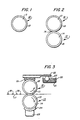
- Figure 1 shows a fuser roll 10 made with an outer layer of the composition of the present invention.
- the fuser member shown in Figure 1 is in the form of a roll, it is to be understood that the present invention is applicable to fuser members of other shapes, such as plates or belts.
- the fuser roll 10 is composed of a core 11 having coated thereon a thin layer 12 of the composition of the present invention.
- the core 11 may be made of various metals such as iron, aluminum, nickel, stainless steel, etc., and various synthetic resins. We prefer to use aluminum as the material for the core 11, although this is not critical.
- the core 11 is hollow and a heating element (not shown) is generally positioned inside the hollow core to supply the heat for the fusing operation.
- Heating elements suitable for this purpose are known in the prior art and may comprise a quartz heater made of a quartz envelope having a tungsten resistance heating element disposed internally thereof.
- the method of providing the necessary heat is not critical to the present invention, and the fusing member can be heated by internal means, external means or a combination of both. All heating means are well known in the art for providing sufficient heat to fuse the toner to the support.
- the composition of layer 12 will be described in detail below.
- the fuser roll 10 is shown in a pressure contact arrangement with a backup or pressure roll 13.
- the pressure roll 13 comprises a metal core 14 with a layer 15 of a heat-resistant material.
- both the fuser roll 10 and the pressure roll 13 are mounted on shafts (not shown) which are biased so that the fuser roll 10 and the pressure roll 13 are pressed against each other under sufficient pressure to form a nip 16. It is in this nip that the fusing or fixing action takes place.
- One of the ways of obtaining high quality copies produced by the fuser assembly is when a nip is formed by a relatively hard and unyielding layer 15 with a relatively flexible layer 12. In this manner, the nip is formed by a slight deformation in the layer 12 due to the biasing of fuser roll 10 and the pressure roll 13.
- the layer 15 may be made of any of the well known materials such as polyfluoroethylenepropylene or silicone rubber.
- Figure 3 shows a pressure contact heated fuser assembly having a sheet of a support material 17, such as a sheet of paper, bearing thereon toner image 18 passing the fuser roll 10 and pressure roll 13.
- a support material 17 such as a sheet of paper
- toner image 18 passing the fuser roll 10 and pressure roll 13.
- an intermediate oil-feeding member 19 from which an offset preventing fluid or release agent 20 is applied to the fuser roll 10.
- release agents are known to the art and may be, for example, a silicone oil.
- the intermediate oil feeding member 19 also performs the function of cleaning the fuser roll 10.
- the release agent 20 in sump 21 is fed to the oil feeding member 19 through another intermediate oil feeding member 22 and a feeding roll 23.
- the pressure roll 13 is in contact with a cleaning member 24 mounted on a supporting member 25.
- a novel fuser member which is particularly suited for use in the heat fixing of toner images in an electrostatographic copying machine.
- the coating on the fuser member of the present invention has improved resistance to pitting and dramatically improved useful life over prior art devices.
- it has high thermomechanical strength, is flexible and conformable so that it can form a nip with a relative hard pressure roll, and possesses outstanding release properties.
- We have found that the extent of slippage in the nip region and the intensity of a shear are a function of the input strain energy per cycle (due to loading between the fuser roll and the pressure roll) in the fuser roll rubber.
- the input strain energy per cycle in the fuser roll is a function of the hardness of the fuser roll rubber. With increase in hardness of the fuser roll rubber, the input strain energy per cycle becomes less because the nip formed between the fuser roll and the pressure roll is smaller resulting in a reduced interaction between the two rolls causing the strain to be reduced. We have also found that if you minimize the ratio of the input strain energy per cycle to total strain energy to rupture, that the fuser roll resistance to pitting and thereby failure will be increased.
- the coating composition comprises:
- alpha, omega-hydroxypolydimethylsiloxane is a particularly suitable material for overcoating a thermally conductive comformable fuser roll.
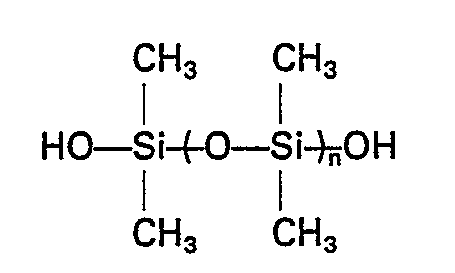
- the alpha, omega-hydroxypolydimethylsiloxane which is a disilanol, is believed to have the structural formula: wherein n is an integer whose magnitude depends on the number average molecular weight of the disilanol.
- n is an integer whose magnitude depends on the number average molecular weight of the disilanol.
- cSt centistokes
- the material is of relatively short chains and therefore contains more active sites at the end of the chains for crosslinking during the curing step. This yields a material which contains too high a crosslinking density, and which is relatively hard and brittle and not suited for the purposes of the present invention.
- the cured composition does not have sufficient crosslinking density to attain maximum strength and fatigue resistance, and therefore does not have sufficiently long operational life.
- the tabular alumina is incorporated in the composition to both improve the thermal conductivity of the composition as well as to provide mechanical strength to the fuser member.
- Tabular alumina is a sintered alumina that has been heated to a temperature slightly below 3700°F (2038°C), the fusion point of aluminum oxide.
- the name “tabular” comes from the fact that the material is composed predominantly of table-like crystals. As previously indicated, the material is characterized by good thermal conductivity and chemical inertness.
- the size of the tabular alumina used is important, it being finely divided and not being larger than about 100 mesh in size. At the present time the finest size tabular alumina commercially available is 325 mesh corresponding to a maximum size of about 44 micrometers. We have found this tabular alumina to be very suitable for the purposes of the present invention.
- iron oxide which has a particle size in the range of submicron up to about 1 micrometer in its number average particle size.
- iron oxide is commercially available in a 0.4 micrometer size, and we have found this to be satisfactory.
- the amount of the iron oxide employed is an important factor. It is believed that the iron oxide serves the function of a reinforcing agent in the composition. We have found between about 13 to 60 parts by weight iron oxide per 100 parts by weight of the disilanol polymer to be suitable. Using insufficient amounts of iron oxide will result in a composition which is relatively low in mechanical strength and has poor swell characteristics under mechanical stress and in the presence of typical release agents.
- crosslinking agent used in the composition for coating the fuser member of the present invention is for the purpose of obtaining a material with sufficient crosslink density to attain maximum strength and fatigue resistance.
- crosslinking agents which are suitable for the purposes of the present invention include: esters of orthosilicic acid; esters of poly- silicic acid; and alkyltrialkoxy silanes.
- suitable crosslinking agents include: tetramethylorthosilicate; tetraethylorthosilicate; 2-methoxyethylsilicate; tetrahydrofurfurylsili- cate; ethylpolysilicate; butylpolysilicate; etc.
- Other suitable crosslinking agents are known to the art.
- the amount of the crosslinking agent employed is not critical, as long as sufficient amount is used to completely crosslink the active end groups on the disilanol polymers used. In this respect, the amount of crosslinking agent required depends on the number average molecular weight of the disilanol polymer employed. With the higher average molecular weight polymer, there are fewer active end groups present and thus a lesser amount of the crosslinking agent is required, and vice versa. When excess amounts of a crosslinking agent are used, the excess is easily removed from the cured composition.
- disilanol polymer of a number average molecular weight of between about 5,000 to 20,000
- the amount to be used should be adjusted stoichiometrically to provide a sufficient amount of the crosslinking agent for the reactive end groups in the disilanol polymer.
- Such catalysts are well known in the art and they include: the amines and carboxylic salts of many metals, such as lead, zinc, zirconium, antimony, iron, cadmium, tin, barium, calcium, and manganese; particularly the naphthenates, octoates, hex- oates, laurates and acetates.
- suitable catalysts include: stannous octoate; dibutyltin dilaurate; dibutyltin diacetate; and dibutyltin dicaproate.
- Bis(dibutylchlorotin) oxide and similar compounds can be also used.
- fuser roll pitting occurs as the paper slips relative to the fuser roll in one direction at the entrance of the nip between the fuser roll and the pressure roll, then locks up in speed because it is being driven through the nip and finally, slips in an opposite direction at the exit of the nip.
- the extent of slippage region and intensity of the shear are a function of the input strain energy per cycle (loading between the two rolls in the fuser roll coating).
- the input strain energy per cycle is a function of hardness. Therefore by increasing the hardness the input strain energy per cycle becomes lower because the nip is smaller and therefore the interaction causing strain is reduced.
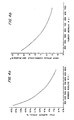
- the effect of changing rubber hardness in the fuser roll on peak surface strain (elongation) and input strain energy per cycle is indicated at Figure 4a and 4b. Both peak surface strain (elongation of the rubber) and input strain energy per cycle go down as rubber modulus is increased. Both peak surface strain and input strain energy per cycle also decrease as rubber thickness is increased. However the peak surface strain exhibits a relatively weak dependence on rubber thickness. On this basis by increasing the rubber overcoat hardness, it is possible to reduce the input strain energy per cycle and the peak surface strain effectively.
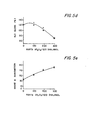
- FIGS. 5a, 5b, 5c, 5d and 5e indicate representative physical property measurements of fuser roll materials as a function of alumina content.
- the data was compiled from a pad of material comprised of the crosslinked product of a mixture of about 70 parts by weight of Rhodorsil 48V3500 which is believed to be an alpha, omega hydroxy polydimethyl siloxane having an average viscosity of 3500 centistokes available from Rhone-Paulenc Company and 30 parts by weight of Rhodorsil 48V750 which is also believed to be an alpha, omega hydroxy polydimethyl siloxane having an average viscosity of 750 centistokes available from Rhone-Paulenc Company to which was added 37.8 parts by weight of finely divided iron oxide (R2899R availabel from Pfizer), 15 parts by weight of tetraethyl ortho silicate and 1 part by weight of dibutyltin
- Tabular alumina (T61-325) available from Alcoa was added in amounts of 100, 200 and 300 parts per 100 parts by weight of the disilanol mixture.
- the plot of stress versus strain for these materials closely approximates a linear variation, therefore the product of one half the tensile strength times the maximum elongation is appropriate to use as a measure of the total strain energy to rupture of the material.
- the variation in total strain energy to rupture with respect to alumina is illustrated in Figure 6. It may be observed that the total strain energy to rupture increases initially as filler content increases reaching a peak at around 200 parts of alumina per 100 parts of disilanol and thereafter falls.
- hot offset temperature is the temperature at which the toner particles liquify and splitting of the molten toner takes place during the fusing operation.
- Minimum temperature is the lowest temperature at which the toner can be raised and still have a satisfactory fix of the toner to the-copy substrate. Also as may be observed, with continued reference to Figure 6 with ratios of tabular alumina lower than about 230 parts per 100 parts of disilanol the ratio of strain energy per cycle to total strain energy to rupture tends to increase thereby reducing the number of cycles that the fuser roll may be used prior to pitting failure.
- the EC4952DXL is believed to contain 100 parts of an alpha, omega-hydroxy polydimethyl siloxane having a number average molecular weight between 5000 to 20,000 plus crosslinking agent which is believed to be a trialkoxy or tetra-alkoxy or condensed tetra-alkoxy silane believed to be present in a 5 to 10 parts/100 disilanol crosslinking agent; 188 parts of a tabular alumina believed to be in the 100 to 325 mesh size range, and 25 parts of a finely divided iron oxide believed to be in the size range of 0.4 micrometers to 1.0 micrometers.
- the resultant mixed material is believed to have the following final composition: 100 parts of alpha, omega-hydroxy polydimethyl siloxane of 5000 to 20,000 number average molecular weight plus 5 to 10 parts per 100 concentration of the crosslinking agent, 266 parts of the tabular alumina in the 100 to 325 mesh size range, and 25 parts of a finely divided iron oxide in the range of 0.4 to 1.0 micrometers.
- a tin soap catalyst believed to be bis(dibutylchlorotin) oxide in the amount of 0.2 parts catalyst to 100 parts of the mixture.
- the mixture and catalyst were brought together in a continuous mixing device which metered the two streams of compound and catalyst in the above ratio before being pumped into moulds for curing in pads and onto fuser rolls.
- Test pads so prepared provided the following physical property average results for ten samples.
- fuser rolls so obtained were placed in 15 Xerox 1075 duplicators to be tested for pitting failure. All rolls worked satisfactorily fusing toner images on cut copy sheets and did not exhibit pitting failure until 500,000 copies or in excess thereof had been fused.
- fuser rolls prepared with the same formulation and in the same manner except that only 188 parts of tabular alumina were present in the formulation were tested in Xerox 1075 duplicators and exhibited a pitting failure at an average of about 250,000 copies. This result was achieved as an average failure rate for about 10,000 rolls.
- the load on the fuser roll had to be increased correspondingly resulting in a higher input strain energy per cycle which in turn increased the ratio of input strain energy per cycle to total strain energy to rupture and therefore earlier catastrophic failure.
- the load on the fuser roll may be maintained constant without altering fusing fix.
Landscapes
- Physics & Mathematics (AREA)
- General Physics & Mathematics (AREA)
- Fixing For Electrophotography (AREA)
- Laminated Bodies (AREA)
- Compositions Of Macromolecular Compounds (AREA)
- Rolls And Other Rotary Bodies (AREA)
Description
- This invention relates to a novel fuser or fixing member for electrostatographic copiers.
- As indicated in U.S. Patent 4,078,286, in a typical process for electrophotographic duplication, a light image of an original to be copied is recorded in the form of an electrostatic latent image upon a photosensitive member, and the latent image is subsequently rendered visible by the application of electroscopic particles, which are commonly referred to as toner. The visible toner image is then in a loose powdered form and it can be easily disturbed or destroyed. The toner image is usually fixed or fused upon a support which may be the photosensitive member itself or another support such a sheet of plain paper. The present invention relates to the fusing of the toner image upon a support.
- In order to fuse electroscopic toner material onto a support surface permanently by heat, it is necessary to elevate the temperature of the toner material to a point at which the constituents of the toner material coalesce and become tacky. This heating causes the toner to flow to some extent into the fibers or pores of the support member. Thereafter, as the toner material cools, solidification of the toner material causes the toner material to be firmly bonded to the support.
- The use of thermal energy for fixing toner images onto a support member is well known. Several approaches to thermal fusing of electroscopic toner images have been described in the prior art. These methods include providing the application of heat and pressure substantially concurrently by various means: a roll pair maintained in pressure contact; a flat or curved plate member in pressure contact with a roll; a belt member in pressure contact with a roll; and the like. Heat may be applied by heating one or both of the rolls, plate members or belt members. The fusing of the toner particles takes place when the proper combination of heat, pressure and contact time are provided. The balancing of these parameters to bring about the fusing of the toner particles is well known in the art, and they can be adjusted to suit particular machines or process conditions.
- During operation of a fusing system in which heat is applied to cause thermal fusing of the toner particles onto a support, both the toner image and the support are passed through a nip formed between the roll pair, or plate or belt members. The concurrent transfer of heat and the application of pressure in the nip effects the fusing of the toner image onto the support. It is important in the fusing process that no offset of the toner particles from the support to the fuser member takes place during normal operations. Toner particles offset onto the fuser member may subsequently transfer to other parts of the machine or onto the support in subsequent copying cycles, thus increasing the background or interfering with the materials being copied there. The so called "hot offset" occurs when the temperature of the toner is raised to a point where the toner particles liquify and a splitting of the molten toner takes place during the fusing operation. "Cold offset" may be caused, even at the temperatures below the molten point of the toner, by such factors as imperfections in the surface of the fusing members; by the toner particles being insufficiently adhering to the support; by electrostatic forces which may be present; etc.
- Another problem frequently encountered in fusing with a heated member is that the substrate, e.g. a sheet of paper, on which the toner image is fused may curl and/or adhere to the heated fuser. Such adhering paper will tend to wrap itself around the fuser and thus prevent the fuser from performing its intended operations in subsequent copying cycles. Such adhering paper must be generally removed by hand, resulting in much manual labor and machine downtime.
- As indicated in said U.S. Patent No. 4,078,286, it is known in the prior art to provide the heated member in a fusing system with a covering of a heat-resistant, release material 'on its outer surface. Coupled to such a heated member is a backup or pressure member covered with a heat-resistant, flexible material. The nip is formed by the flexible material under pressure contact with the heated member. Examples of the heat resistant release materials for the fuser members include polytetrafluoroethylene, silicone rubber, fluorocarbon elastomers and the like. A suitable offset preventing liquid may be used on the fuser member to minimize or avoid "offsetting". Silicone oils are widely used as the offset preventing or release agent. The pressure member may be made of such materials as silicone rubber and polytetrafluoroethylenepropylene.
- In U.S. Patent 4,074,001, there is disclosed a fixing roll for electrophotography having a surface layer made of a diorganopolysiloxane having silanol groups at the molecular terminals, a diorganopolysiloxane having trialkylsilyl groups at the molecular terminals, an alkoxy-containing silane, a metal salt of an organic acid as the crosslinking catalyst, a powdery calcium carbonate, iron oxide, and titanium dioxide.
- In a more recent development U.S. Patent 4,373,239 describes a fuser with a thermally conductive and resiliently compressible material having high thermomechanical strength and good release properties which is made from a composition comprising 100 parts by weight of alpha omega-hydroxypolydimethylsiloxane (PDMS) having a number average molecular weight of about 5,000 to 20,000, about 128 to 250 parts by weight of finely divided tabular alumina, about 13 to 60 parts by weight of finely divided iron oxide, about 6 to 9 parts by weight of a crosslinking agent, and about 0.25 to 1.8 parts by weight of a crosslinking catalyst. The composition may be cured and coated onto a fuser member at a thickness about 10 to 100 mils.
- In optimizing the invention described in U.S. Patent 4,373,239 tests were conducted by varying the amount of tabular alumina incorporated in the formulation all other constituents being maintained constant. Based on the testing of various compositions, by cycling the fuser roll against pressure roll with no paper in between, it was discovered that optimum roll cyclic capability was obtained at about 188 parts of tabular alumina per 100 parts of PDMS. At 188 parts oftabular alumina the best resistance to cyclic fatigue, the formation of small cuts in the roll surface which rapidly become large cuts in the roll surface with material being shed from the roll in wholesale lots is achieved. In such a test, a formulation containing 188 parts of tabular alumina per 100 parts PDMS was tested on a cyclic fixture wherein the fuser roll was against a pressure roll under a normal load of 400 pounds which is approximately that which would be used in a commercial machine environment and was cammed into contact with the
pressure roll 10% of the time and out ofcontact 90% of the time. Catastrophic failure with wholesale amounts of fuser roll surface rubber coming off the core was achieved at about 3,000 hours. The same test was conducted for the same compositions wherein the amount of alumina was 246 parts by weight all other constituents remaining constant. Failure occurred with this roll at 2,165 hours. The same test was conducted with another fuser roll containing 259 parts of tabular alumina all other constituents being the same and this roll failed at 1,258 hours. It should be noted that amounts of tabular alumina less than 188 parts per 100 parts PDMS tend to reduce the thermal conductivity of the composition. - In none of the above mentioned roll to roll tests was paper transported between the pressure roll and the fuser roll with or without unfused toner image thereon. It has now been discovered that after extensive use of such a fuser roll containing about 188 parts tabular alumina per 100 parts PDMS that a failure of the fuser roll takes place at about 250,000 copies due to pitting in the fuser roll. Pitting occurs by the formation initially of small microscopic holes in the fuser roll surface which initially do not cause any problem, but as use of the fuser roll continues the holes tend to grow in size to slightly larger than the head of a straight pin. Failure is experienced when these holes become sufficiently large that toner, in contact with the holes on the fuser roll surface, is not fused because there is no pressure between the fuser roll and the unfused image on the copy paper. Furthermore toner can get trapped in the holes and can offset in non-image areas in subsequent copies. While the holes start off very small, they rapidly get larger and even tend to overlap and blend into larger, greater voids, therefore compounding the problem. While the above described difficulty with pitting was not observed in the initial roll to roll testing between thefuser roll and the pressure roll, it was experienced when the fuser roll was used in a fuser environment fusing a toner image onto a copy sheet. It is believed that the pitting is caused by the fact that paper is more abrasive than the surface of the pressure roll used in the initial roll to roll testing. A theoretical analysis has indicated that in the fusing operation the paper initially slips relative to the fuser roll in one direction at the entrance of the paper to the nip formed between the fuser roll and the pressure roll then becomes locked in speed with the speed of the fuser roll because it is driven through the nip and then further slips in a direction opposite atthe exit of the nip. It is believed that the pitting is caused by a fretting (the action of wearing away) fatigue type of failure arising from micro-slip between the surface of the rubber-covered roll and the paper.
- We have now surprisingly found that if the amount of tabular alumina present in the fuser roll surface composition is about 266 parts by weight, per 100 parts by weight PDMS that a dramatic increase in resistance to the pitting described above and fuser life is achieved. As pointed out above, prior art fuser rolls exhibited a life of about 250,000 copies. With the composition according to the present invention, a fuser life of the order of 500,000 copies and excess thereof may be achieved.
- In accordance with the present invention, a thermally conductive fuser member for use in an electrostatographic reproducing machine is as claimed in claim 1 is provided.
- In particular, the fusing surface of the fusing member comprises a resiliently compressible material which has dramatically improved pitting resistance and fusing life. The fusing surface comprises the crosslinked product of a composition comprising 100 parts by weight of alpha, omega-hydroxypolydimethylsiloxane, about 266 parts by weight tabular alumina, about 13 to 60 parts by weight of finely divided iron oxide particles together with effective amounts of a crosslinking agent and a crosslinking catalyst.
- In a further aspect of the present invention the alpha, omega-hydroxypolydimethylsiloxane has a number average molecular weight of from about 5,000 to about 20,000.
- In a further aspect of the present invention, the composition is cured and coated onto a fuser member at a thickness of from about 0.254 to 2.54 mm (10 to 100 mils).
- In a further aspect of the present invention, the tabular alumina is about 325 mesh in size.
- Embodiments of the invention will now be described, by way of example, with reference to the accompanying drawings, in which:-
- Figure 1 shows a cross-sectional view of a fuser roll of the present invention;
- Figure 2 represents a cross-sectional view of the fuser roll of Figure 1 as a part of a roll pair, and maintained in pressure contact with a backup or pressure roll;
- Figure 3 is a schematic view of a pressure contact fuser assembly which employs the fuser member of the present invention;
- Figures 4a and 4b are graphical representations of peak surface strain and input strain energy per cycle with respect to rubber modules (1 psi=6,9 ' 10-3 N/mm2; 1 in=25,4 mm; 1 Ib=0,45 kg);
- Figures 5a, 5b, 5c, 5d and 5e are graphical representations of mechanical properties of pads prepared from formulations where 100, 200 and 300 parts by weight of tabular alumina per 100 parts PDMS are present (1 psi=6,9 10-3 N/mm2; 1 in=25,4 mm; 1 Ib=0,45 kg);
- Figure 6 is a graphical representation of total strain energy to rupture based on tabular alumina content; and
- Figure 7 is a graphical representation of the ratio of input strain energy per cycle to total strain energy to rupture based on tabular alumina content.
- Figure 1 shows a
fuser roll 10 made with an outer layer of the composition of the present invention. Although the fuser member shown in Figure 1 is in the form of a roll, it is to be understood that the present invention is applicable to fuser members of other shapes, such as plates or belts. In Figure 1, thefuser roll 10 is composed of a core 11 having coated thereon athin layer 12 of the composition of the present invention. The core 11 may be made of various metals such as iron, aluminum, nickel, stainless steel, etc., and various synthetic resins. We prefer to use aluminum as the material for the core 11, although this is not critical. Thecore 11 is hollow and a heating element (not shown) is generally positioned inside the hollow core to supply the heat for the fusing operation. Heating elements suitable for this purpose are known in the prior art and may comprise a quartz heater made of a quartz envelope having a tungsten resistance heating element disposed internally thereof. The method of providing the necessary heat is not critical to the present invention, and the fusing member can be heated by internal means, external means or a combination of both. All heating means are well known in the art for providing sufficient heat to fuse the toner to the support. The composition oflayer 12 will be described in detail below. - Referring to Figure 2, the
fuser roll 10 is shown in a pressure contact arrangement with a backup orpressure roll 13. Thepressure roll 13 comprises ametal core 14 with alayer 15 of a heat-resistant material. In this assembly, both thefuser roll 10 and thepressure roll 13 are mounted on shafts (not shown) which are biased so that thefuser roll 10 and thepressure roll 13 are pressed against each other under sufficient pressure to form anip 16. It is in this nip that the fusing or fixing action takes place. One of the ways of obtaining high quality copies produced by the fuser assembly is when a nip is formed by a relatively hard andunyielding layer 15 with a relativelyflexible layer 12. In this manner, the nip is formed by a slight deformation in thelayer 12 due to the biasing offuser roll 10 and thepressure roll 13. Thelayer 15 may be made of any of the well known materials such as polyfluoroethylenepropylene or silicone rubber. - Figure 3 shows a pressure contact heated fuser assembly having a sheet of a
support material 17, such as a sheet of paper, bearing thereontoner image 18 passing thefuser roll 10 andpressure roll 13. Onfuser roll 10 is mounted an intermediate oil-feedingmember 19 from which an offset preventing fluid orrelease agent 20 is applied to thefuser roll 10. Such release agents are known to the art and may be, for example, a silicone oil. The intermediateoil feeding member 19 also performs the function of cleaning thefuser roll 10. Therelease agent 20 insump 21 is fed to theoil feeding member 19 through another intermediateoil feeding member 22 and a feedingroll 23. Thepressure roll 13 is in contact with a cleaningmember 24 mounted on a supportingmember 25. - While the novel fuser member of the present invention has been described with reference to heat fixing or fusing of toner images, it is to be understood that the invention may be also used in cold pressure fixing since the excellent release properties and conformability of the fuser member make it suited for the latter application as well.
- In accordance with the present invention, a novel fuser member is provided which is particularly suited for use in the heat fixing of toner images in an electrostatographic copying machine. The coating on the fuser member of the present invention has improved resistance to pitting and dramatically improved useful life over prior art devices. In addition it has high thermomechanical strength, is flexible and conformable so that it can form a nip with a relative hard pressure roll, and possesses outstanding release properties. We have found that the extent of slippage in the nip region and the intensity of a shear are a function of the input strain energy per cycle (due to loading between the fuser roll and the pressure roll) in the fuser roll rubber. We have also discovered that the input strain energy per cycle in the fuser roll is a function of the hardness of the fuser roll rubber. With increase in hardness of the fuser roll rubber, the input strain energy per cycle becomes less because the nip formed between the fuser roll and the pressure roll is smaller resulting in a reduced interaction between the two rolls causing the strain to be reduced. We have also found that if you minimize the ratio of the input strain energy per cycle to total strain energy to rupture, that the fuser roll resistance to pitting and thereby failure will be increased. We have also found that this increase in hardness in the fuser roll may be achieved with the addition of substantial quantities of additional tabular alumina to the fuser roll composition and at the same contributes to an increase in the mechanical integrity of the rubber strength in terms of total strain energy to rupture (ultimate elon- gationxmaximum tensile strength)-2 and tear strength.
- In its broadest aspect, the coating composition comprises:
- (a) 100 parts of an alpha, omega hydroxypolydimethylsiloxane having a number average molecular weight of between about 5,000 to about 20,000;
- (b) about 266 parts by weight of tabular alumina;
- (c) about 12 to 60 parts by weight of a finely divided iron oxide;
- (d) about 6 to 20 parts by weight of a crdss- linking agent; and
- (e) about 0.25 to about 1.8 parts by weight of a crosslinking catalyst.
- We have found the alpha, omega-hydroxypolydimethylsiloxane to be a particularly suitable material for overcoating a thermally conductive comformable fuser roll. The alpha, omega-hydroxypolydimethylsiloxane, which is a disilanol, is believed to have the structural formula:
- With the disilanol havign a number average molecular weight in excess of about 20,000, which roughly corresponds to an average viscosity of about above 3,500 cSt, the cured composition does not have sufficient crosslinking density to attain maximum strength and fatigue resistance, and therefore does not have sufficiently long operational life. The siloxane functions as a binder to hold the thermally conducting material providing overall structural integrity and elastomeric conformability. Furthermore, it preferably has a surface tension of from about 20 to 22 dynes (1 dyn=10-' N) per square centimeter to provide adequate release properties and is thermally stable up to a temperature of about 400°F (204°C) with good thermal aging at elevated temperatures.
- The tabular alumina is incorporated in the composition to both improve the thermal conductivity of the composition as well as to provide mechanical strength to the fuser member.
- Tabular alumina is a sintered alumina that has been heated to a temperature slightly below 3700°F (2038°C), the fusion point of aluminum oxide. The name "tabular" comes from the fact that the material is composed predominantly of table-like crystals. As previously indicated, the material is characterized by good thermal conductivity and chemical inertness. For the purposes of the present invention the size of the tabular alumina used is important, it being finely divided and not being larger than about 100 mesh in size. At the present time the finest size tabular alumina commercially available is 325 mesh corresponding to a maximum size of about 44 micrometers. We have found this tabular alumina to be very suitable for the purposes of the present invention.
- Another important aspect of the present invention resides in finely divided iron oxide. We prefer to use iron oxide which has a particle size in the range of submicron up to about 1 micrometer in its number average particle size. In particular, iron oxide is commercially available in a 0.4 micrometer size, and we have found this to be satisfactory. The amount of the iron oxide employed is an important factor. It is believed that the iron oxide serves the function of a reinforcing agent in the composition. We have found between about 13 to 60 parts by weight iron oxide per 100 parts by weight of the disilanol polymer to be suitable. Using insufficient amounts of iron oxide will result in a composition which is relatively low in mechanical strength and has poor swell characteristics under mechanical stress and in the presence of typical release agents. Excessive amounts of iron oxide in the composition yields a material which becomes relatively hard and thus requires more mechanical energy to obtain the desired constant nip size on a fuser roll, which also leads to shorter fatigue life of the fuser roll. Within this range, we particularly prefer to use about 13 to 28 parts iron oxide per 100 parts by weight of the disilanol polymer.
- The crosslinking agent used in the composition for coating the fuser member of the present invention is for the purpose of obtaining a material with sufficient crosslink density to attain maximum strength and fatigue resistance. Examples of crosslinking agents which are suitable for the purposes of the present invention include: esters of orthosilicic acid; esters of poly- silicic acid; and alkyltrialkoxy silanes. Specific examples of suitable crosslinking agents include: tetramethylorthosilicate; tetraethylorthosilicate; 2-methoxyethylsilicate; tetrahydrofurfurylsili- cate; ethylpolysilicate; butylpolysilicate; etc. Other suitable crosslinking agents are known to the art. We particularly prefer to use condensed tetraethylorthosilicate as the crosslinking agent in the composition of the invention. The amount of the crosslinking agent employed is not critical, as long as sufficient amount is used to completely crosslink the active end groups on the disilanol polymers used. In this respect, the amount of crosslinking agent required depends on the number average molecular weight of the disilanol polymer employed. With the higher average molecular weight polymer, there are fewer active end groups present and thus a lesser amount of the crosslinking agent is required, and vice versa. When excess amounts of a crosslinking agent are used, the excess is easily removed from the cured composition. Generally, for the preferred disilanol polymer of a number average molecular weight of between about 5,000 to 20,000, we have found that between about 6 to 20 parts by weight of condensed tetraethylorthosilicate per 100 parts by weight of the disilanol polymer to be suitable. Within this range, we prefer to use about 6.6 to 8 parts by weight condensed tetraethylorthosilicate per 100 parts by weight of the disilanol polymer. Of course, if other crosslinking agents are used, the amount to be used should be adjusted stoichiometrically to provide a sufficient amount of the crosslinking agent for the reactive end groups in the disilanol polymer.
- Finally, with respect to the crosslinking catalyst used in the composition of the present invention, such catalysts are well known in the art and they include: the amines and carboxylic salts of many metals, such as lead, zinc, zirconium, antimony, iron, cadmium, tin, barium, calcium, and manganese; particularly the naphthenates, octoates, hex- oates, laurates and acetates. Examples of suitable catalysts include: stannous octoate; dibutyltin dilaurate; dibutyltin diacetate; and dibutyltin dicaproate. Bis(dibutylchlorotin) oxide and similar compounds can be also used. Other suitable catalysts are disclosed in U.S. Patent No. 3,664,997. The amount of the catalyst employed is not critical. However, too small an amount of catalyst used leads to a very slow reaction which is impractical. On the other hand, excessive amounts of catalyst may cause a breakdown of the crosslinked polymer network at high temperatures, to yield a less crosslinked and weaker material, thus adversely affecting the thermomechanical strength of the cured material. In general, we have found that between about 0.25 to about 1.8 parts by weight of catalyst per 100 parts of the disilanol polymer to be preferred. More particularly, we prefer to use between 0.25 to 0.75 parts by weight of catalyst per 100 parts of the polymer. The specific catalysts preferred are dibutyltin dilaurate and bis(dibutylchlorotin) oxide.
- We have found that if the amount of tabular alumina present in the composition is about 266 parts by weight that a dramatic improvement in the fuser roll resistance to pitting is achieved and thereby the useful life is extended. This was discovered initially by a theoretical analysis of the nature of the problem, solved in a theoretical approach and confirmed with actual comparative machine test data. As indicated above fuser roll pitting occurs as the paper slips relative to the fuser roll in one direction at the entrance of the nip between the fuser roll and the pressure roll, then locks up in speed because it is being driven through the nip and finally, slips in an opposite direction at the exit of the nip. The extent of slippage region and intensity of the shear are a function of the input strain energy per cycle (loading between the two rolls in the fuser roll coating). The input strain energy per cycle is a function of hardness. Therefore by increasing the hardness the input strain energy per cycle becomes lower because the nip is smaller and therefore the interaction causing strain is reduced. The effect of changing rubber hardness in the fuser roll on peak surface strain (elongation) and input strain energy per cycle is indicated at Figure 4a and 4b. Both peak surface strain (elongation of the rubber) and input strain energy per cycle go down as rubber modulus is increased. Both peak surface strain and input strain energy per cycle also decrease as rubber thickness is increased. However the peak surface strain exhibits a relatively weak dependence on rubber thickness. On this basis by increasing the rubber overcoat hardness, it is possible to reduce the input strain energy per cycle and the peak surface strain effectively.
- Another quantity of interest is the variation in the total strain energy to rupture of silicone rubber as the filler content is altered. Figures 5a, 5b, 5c, 5d and 5e indicate representative physical property measurements of fuser roll materials as a function of alumina content. The data was compiled from a pad of material comprised of the crosslinked product of a mixture of about 70 parts by weight of Rhodorsil 48V3500 which is believed to be an alpha, omega hydroxy polydimethyl siloxane having an average viscosity of 3500 centistokes available from Rhone-Paulenc Company and 30 parts by weight of Rhodorsil 48V750 which is also believed to be an alpha, omega hydroxy polydimethyl siloxane having an average viscosity of 750 centistokes available from Rhone-Paulenc Company to which was added 37.8 parts by weight of finely divided iron oxide (R2899R availabel from Pfizer), 15 parts by weight of tetraethyl ortho silicate and 1 part by weight of dibutyltin dilaurate. Tabular alumina (T61-325) available from Alcoa was added in amounts of 100, 200 and 300 parts per 100 parts by weight of the disilanol mixture. The plot of stress versus strain for these materials closely approximates a linear variation, therefore the product of one half the tensile strength times the maximum elongation is appropriate to use as a measure of the total strain energy to rupture of the material. The variation in total strain energy to rupture with respect to alumina is illustrated in Figure 6. It may be observed that the total strain energy to rupture increases initially as filler content increases reaching a peak at around 200 parts of alumina per 100 parts of disilanol and thereafter falls. Since at each filler level the modulus is also known, we can calculate the input strain energy per cycle and with the help of Figure 6, the ratio of input strain energy/cycle to total strain energy to rupture as alumina level is changed. This is illustrated in Figure 7 for both room temperature and fusing temperature. From Figure 7 it may be observed that the ratio of strain energies drops rapidly initially, beyond about 100 parts alumina per 100 parts disilanol it falls much slower, and between about 230 to 300 parts alumina the ratio is relatively constant. This ratio of input strain energy per cycle to total strain energy to rupture is significant because it gives an immediate visualization of the level of strain energy being imposed per cycle in relation to the total quantity of strain energy the material can absorb before breaking in any one cycle. Thus the smaller the ratio the greater number of cycles the fuser roll will experience prior to pitting failure. Beyond a tabular alumina concentration greater than about 300 parts per 100 parts disilanol the rubber becomes very hard and brittle and the ratio will tend to increase resulting in early failure. In addition, the release properties of the fuser roll with respect to the toner may be seriously adversely affected. Furthermore with inceasing alumina content in excess of 300 parts per 100 parts of disilanol the fusing latitude may be seriously reduced to the point where there is substantially no difference between the hot offset temperature and the minimum fixed temperature. As described above, hot offset temperature is the temperature at which the toner particles liquify and splitting of the molten toner takes place during the fusing operation. Minimum temperature is the lowest temperature at which the toner can be raised and still have a satisfactory fix of the toner to the-copy substrate. Also as may be observed, with continued reference to Figure 6 with ratios of tabular alumina lower than about 230 parts per 100 parts of disilanol the ratio of strain energy per cycle to total strain energy to rupture tends to increase thereby reducing the number of cycles that the fuser roll may be used prior to pitting failure.
- Unless otherwise indicated all parts and percentages referred to in this specification are by weight. To confirm the above analysis test pads and fuser rolls were made as follows:
- To 100 parts of a thermally conductive RTV silicone supplied by Emerson & Cuming, a Dewey and Almy Chemical Division of W. R. Grace & Company, under the number EC-
4952DXL 25 parts of tabular alumina, believed to be in the range of 100 to 325 mesh in size was added. The EC4952DXL is believed to contain 100 parts of an alpha, omega-hydroxy polydimethyl siloxane having a number average molecular weight between 5000 to 20,000 plus crosslinking agent which is believed to be a trialkoxy or tetra-alkoxy or condensed tetra-alkoxy silane believed to be present in a 5 to 10 parts/100 disilanol crosslinking agent; 188 parts of a tabular alumina believed to be in the 100 to 325 mesh size range, and 25 parts of a finely divided iron oxide believed to be in the size range of 0.4 micrometers to 1.0 micrometers. The resultant mixed material is believed to have the following final composition: 100 parts of alpha, omega-hydroxy polydimethyl siloxane of 5000 to 20,000 number average molecular weight plus 5 to 10 parts per 100 concentration of the crosslinking agent, 266 parts of the tabular alumina in the 100 to 325 mesh size range, and 25 parts of a finely divided iron oxide in the range of 0.4 to 1.0 micrometers. In order to make test pads and coated rolls the above formulation with extra alumina was catalyzed with a tin soap catalyst believed to be bis(dibutylchlorotin) oxide in the amount of 0.2 parts catalyst to 100 parts of the mixture. The mixture and catalyst were brought together in a continuous mixing device which metered the two streams of compound and catalyst in the above ratio before being pumped into moulds for curing in pads and onto fuser rolls. - Test pads so prepared provided the following physical property average results for ten samples.

- These results compare favourably with the results illustrated in Figures 5a-5d.
- Fifteen of the fuser rolls so obtained were placed in 15 Xerox 1075 duplicators to be tested for pitting failure. All rolls worked satisfactorily fusing toner images on cut copy sheets and did not exhibit pitting failure until 500,000 copies or in excess thereof had been fused. By contrast fuser rolls prepared with the same formulation and in the same manner except that only 188 parts of tabular alumina were present in the formulation were tested in Xerox 1075 duplicators and exhibited a pitting failure at an average of about 250,000 copies. This result was achieved as an average failure rate for about 10,000 rolls.
- It is therefore believed that a dramatic improvement in fuser roll life due to pitting failure has been demonstrated according to the specific embodiment of the present invention. In addition to the advantages achieved with long life, it should be noted that the present invention as a result of the increased alumina content requires a reduced power input, lower surface temperature and lower temperature gradient between the surface and the core of the fuser roll. Being capable of operating at a lower core temperature provides another advantage in extending the useful fuser roll life. As indicated previously based on initial roll to roll test data with 246 parts alumina and 259 parts alumina per 100 parts disilanol, a cyclic fatigue failure was obtained substantially earlier than with rolls made containing 188 parts of alumina per 100 parts of disilanol. Accordingly the results obtained here are unexpected. It should be noted that for the roll to roll tests reviously referred for 246 and 259 parts of alumina that as a result of maintaining the nip constant in those tests that with the increased hardness of the rolls as a result of increased alumina content, the load on the fuser roll had to be increased correspondingly resulting in a higher input strain energy per cycle which in turn increased the ratio of input strain energy per cycle to total strain energy to rupture and therefore earlier catastrophic failure. With the present invention the load on the fuser roll may be maintained constant without altering fusing fix. Accordingly with increased fuser roll hardness a smaller nip between the fuser roll and the pressure roll may be used resulting in reduced input strain energy per cycle and thereby reducing the ratio of the input strain energy per cycle to the total strain energy to rupture. Therefore, not only is the specific amount of tabular alumina in the present formulation is beyond the range described in US-A-4 373 239 said patent but also a dramatic improvement in fuser roll resistance to pitting failure is achieved.
- While the invention has been described in detail with reference to specific and preferred embodiments, it will be appreciated that various modifications and variations will be apparent to the artisan within the scope of the appended claims.
Claims (7)
Applications Claiming Priority (2)
| Application Number | Priority Date | Filing Date | Title |
|---|---|---|---|
| US63687684A | 1984-08-01 | 1984-08-01 | |
| US636876 | 1984-08-01 |
Publications (2)
| Publication Number | Publication Date |
|---|---|
| EP0172668A1 EP0172668A1 (en) | 1986-02-26 |
| EP0172668B1 true EP0172668B1 (en) | 1989-06-07 |
Family
ID=24553708
Family Applications (1)
| Application Number | Title | Priority Date | Filing Date |
|---|---|---|---|
| EP19850305265 Expired EP0172668B1 (en) | 1984-08-01 | 1985-07-24 | Fuser member for electrostatographic copiers |
Country Status (3)
| Country | Link |
|---|---|
| EP (1) | EP0172668B1 (en) |
| JP (1) | JPS6141163A (en) |
| DE (1) | DE3570934D1 (en) |
Families Citing this family (2)
| Publication number | Priority date | Publication date | Assignee | Title |
|---|---|---|---|---|
| JPS63104072A (en) * | 1986-10-21 | 1988-05-09 | I S T:Kk | Fixing roll |
| US5036131A (en) * | 1990-05-16 | 1991-07-30 | Dow Corning Corporation | Protective coating for electrical components |
Family Cites Families (3)
| Publication number | Priority date | Publication date | Assignee | Title |
|---|---|---|---|---|
| US3848305A (en) * | 1972-12-26 | 1974-11-19 | Ibm | Roll for contact fusing thermoplastic particles to substrates |
| US4373239A (en) * | 1980-02-27 | 1983-02-15 | Xerox Corporation | Fusing member for electrostatographic copiers |
| US4372246A (en) * | 1981-05-04 | 1983-02-08 | Xerox Corporation | Externally heated fusing member for electrostatographic copiers |
-
1985
- 1985-07-24 DE DE8585305265T patent/DE3570934D1/en not_active Expired
- 1985-07-24 JP JP16377585A patent/JPS6141163A/en active Pending
- 1985-07-24 EP EP19850305265 patent/EP0172668B1/en not_active Expired
Also Published As
| Publication number | Publication date |
|---|---|
| JPS6141163A (en) | 1986-02-27 |
| DE3570934D1 (en) | 1989-07-13 |
| EP0172668A1 (en) | 1986-02-26 |
Similar Documents
| Publication | Publication Date | Title |
|---|---|---|
| EP0035362B1 (en) | A thermally conductive fuser member | |
| US4515884A (en) | Fusing system with unblended silicone oil | |
| US4518655A (en) | Fusing member for electrostatographic copiers | |
| US4763158A (en) | Boron nitride filled fuser rolls | |
| US4659621A (en) | Release agent donor member and fusing assembly containing same | |
| US4711818A (en) | Fusing member for electrostatographic reproducing apparatus | |
| US5531813A (en) | Fusing system with monoamino functional silicone release agent | |
| US5401570A (en) | Coated fuser members | |
| EP0662645B1 (en) | Fusing system and fluid release agent | |
| US5364697A (en) | Silicon composition, elastic revolution body and fixing device using the composition | |
| US3795033A (en) | Fixing process | |
| US6190771B1 (en) | Fuser assembly with donor roller having reduced release agent swell | |
| CN1221591C (en) | Method for making siloxanes copolymers | |
| EP0204526A2 (en) | Silicone elastomers | |
| US5643973A (en) | Silicone composition, elastic revolution body and fixing device using the same | |
| CA1068766A (en) | Fusing surface with water-producing filler | |
| CN1190710C (en) | Sealant materials for toner cartridges | |
| JP6881988B2 (en) | Manufacturing method of electrophotographic members | |
| US5747212A (en) | Fusing system with amino functional groups in siloxane release agent for use with toners and fusing members reactive with amine groups | |
| JP2914678B2 (en) | Apparatus for transferring and fixing powder containing thermoplastic resin on receiving material | |
| EP0172668A1 (en) | Fuser member for electrostatographic copiers | |
| CA2280308C (en) | Release agent doner member with fluorosilicone interpenetrating network | |
| GB2067471A (en) | Fuser roll and method of manufacture thereof | |
| EP0657789B1 (en) | Fusing system, method of fusing and release agent for the fusing system in an electrostatographic printing apparatus | |
| JPH08110719A (en) | Method and system for fusion and fixation by using hydrofluoric acid elastomer fixing-device member used together with amino functional silicone oil |
Legal Events
| Date | Code | Title | Description |
|---|---|---|---|
| PUAI | Public reference made under article 153(3) epc to a published international application that has entered the european phase |
Free format text: ORIGINAL CODE: 0009012 |
|
| AK | Designated contracting states |
Designated state(s): DE FR GB |
|
| 17P | Request for examination filed |
Effective date: 19860809 |
|
| 17Q | First examination report despatched |
Effective date: 19880119 |
|
| GRAA | (expected) grant |
Free format text: ORIGINAL CODE: 0009210 |
|
| AK | Designated contracting states |
Kind code of ref document: B1 Designated state(s): DE FR GB |
|
| REF | Corresponds to: |
Ref document number: 3570934 Country of ref document: DE Date of ref document: 19890713 |
|
| ET | Fr: translation filed | ||
| PLBE | No opposition filed within time limit |
Free format text: ORIGINAL CODE: 0009261 |
|
| STAA | Information on the status of an ep patent application or granted ep patent |
Free format text: STATUS: NO OPPOSITION FILED WITHIN TIME LIMIT |
|
| 26N | No opposition filed | ||
| PGFP | Annual fee paid to national office [announced via postgrant information from national office to epo] |
Ref country code: FR Payment date: 20010712 Year of fee payment: 17 |
|
| PGFP | Annual fee paid to national office [announced via postgrant information from national office to epo] |
Ref country code: DE Payment date: 20010716 Year of fee payment: 17 |
|
| PGFP | Annual fee paid to national office [announced via postgrant information from national office to epo] |
Ref country code: GB Payment date: 20010718 Year of fee payment: 17 |
|
| REG | Reference to a national code |
Ref country code: GB Ref legal event code: IF02 |
|
| PG25 | Lapsed in a contracting state [announced via postgrant information from national office to epo] |
Ref country code: GB Free format text: LAPSE BECAUSE OF NON-PAYMENT OF DUE FEES Effective date: 20020724 |
|
| PG25 | Lapsed in a contracting state [announced via postgrant information from national office to epo] |
Ref country code: DE Free format text: LAPSE BECAUSE OF NON-PAYMENT OF DUE FEES Effective date: 20030201 |
|
| GBPC | Gb: european patent ceased through non-payment of renewal fee |
Effective date: 20020724 |
|
| PG25 | Lapsed in a contracting state [announced via postgrant information from national office to epo] |
Ref country code: FR Free format text: LAPSE BECAUSE OF NON-PAYMENT OF DUE FEES Effective date: 20030331 |
|
| REG | Reference to a national code |
Ref country code: FR Ref legal event code: ST |