EP0171799B1 - Sealant compositions for anodized aluminum - Google Patents
Sealant compositions for anodized aluminum Download PDFInfo
- Publication number
- EP0171799B1 EP0171799B1 EP85110180A EP85110180A EP0171799B1 EP 0171799 B1 EP0171799 B1 EP 0171799B1 EP 85110180 A EP85110180 A EP 85110180A EP 85110180 A EP85110180 A EP 85110180A EP 0171799 B1 EP0171799 B1 EP 0171799B1
- Authority
- EP
- European Patent Office
- Prior art keywords
- bath
- accordance
- aqueous
- sealant bath
- sealant
- Prior art date
- Legal status (The legal status is an assumption and is not a legal conclusion. Google has not performed a legal analysis and makes no representation as to the accuracy of the status listed.)
- Expired - Lifetime
Links
- 239000000565 sealant Substances 0.000 title claims description 44
- XAGFODPZIPBFFR-UHFFFAOYSA-N aluminium Chemical compound [Al] XAGFODPZIPBFFR-UHFFFAOYSA-N 0.000 title claims description 24
- 229910052782 aluminium Inorganic materials 0.000 title claims description 23
- 239000000203 mixture Substances 0.000 title description 18
- XLYOFNOQVPJJNP-UHFFFAOYSA-N water Substances O XLYOFNOQVPJJNP-UHFFFAOYSA-N 0.000 claims description 15
- 238000000034 method Methods 0.000 claims description 13
- 239000012141 concentrate Substances 0.000 claims description 10
- 238000007789 sealing Methods 0.000 claims description 10
- PXHVJJICTQNCMI-UHFFFAOYSA-N Nickel Chemical compound [Ni] PXHVJJICTQNCMI-UHFFFAOYSA-N 0.000 claims description 8
- MQRWBMAEBQOWAF-UHFFFAOYSA-N acetic acid;nickel Chemical compound [Ni].CC(O)=O.CC(O)=O MQRWBMAEBQOWAF-UHFFFAOYSA-N 0.000 claims description 6
- 229940078494 nickel acetate Drugs 0.000 claims description 6
- 229910001453 nickel ion Inorganic materials 0.000 claims description 6
- NROKBHXJSPEDAR-UHFFFAOYSA-M potassium fluoride Chemical compound [F-].[K+] NROKBHXJSPEDAR-UHFFFAOYSA-M 0.000 claims description 6
- KRHYYFGTRYWZRS-UHFFFAOYSA-M Fluoride anion Chemical compound [F-] KRHYYFGTRYWZRS-UHFFFAOYSA-M 0.000 claims description 5
- 239000000975 dye Substances 0.000 claims description 4
- 150000002815 nickel Chemical class 0.000 claims description 4
- MIMUSZHMZBJBPO-UHFFFAOYSA-N 6-methoxy-8-nitroquinoline Chemical compound N1=CC=CC2=CC(OC)=CC([N+]([O-])=O)=C21 MIMUSZHMZBJBPO-UHFFFAOYSA-N 0.000 claims description 3
- LGQLOGILCSXPEA-UHFFFAOYSA-L nickel sulfate Chemical group [Ni+2].[O-]S([O-])(=O)=O LGQLOGILCSXPEA-UHFFFAOYSA-L 0.000 claims description 3
- 229910000363 nickel(II) sulfate Inorganic materials 0.000 claims description 3
- 235000003270 potassium fluoride Nutrition 0.000 claims description 3
- 239000011698 potassium fluoride Substances 0.000 claims description 3
- 239000000758 substrate Substances 0.000 claims description 3
- QTBSBXVTEAMEQO-UHFFFAOYSA-M Acetate Chemical compound CC([O-])=O QTBSBXVTEAMEQO-UHFFFAOYSA-M 0.000 claims description 2
- -1 and F- ammonium ion Chemical compound 0.000 claims description 2
- 238000007654 immersion Methods 0.000 claims description 2
- 239000003495 polar organic solvent Substances 0.000 claims description 2
- BFXAWOHHDUIALU-UHFFFAOYSA-M sodium;hydron;difluoride Chemical compound F.[F-].[Na+] BFXAWOHHDUIALU-UHFFFAOYSA-M 0.000 claims description 2
- 229910045601 alloy Inorganic materials 0.000 claims 2
- 239000000956 alloy Substances 0.000 claims 2
- 238000010790 dilution Methods 0.000 claims 1
- 239000012895 dilution Substances 0.000 claims 1
- 230000015572 biosynthetic process Effects 0.000 description 9
- 229910000838 Al alloy Inorganic materials 0.000 description 7
- 239000004615 ingredient Substances 0.000 description 7
- 239000002798 polar solvent Substances 0.000 description 6
- 239000008367 deionised water Substances 0.000 description 5
- 229910021641 deionized water Inorganic materials 0.000 description 5
- 239000007864 aqueous solution Substances 0.000 description 4
- 150000002500 ions Chemical class 0.000 description 4
- 150000003839 salts Chemical class 0.000 description 4
- 239000000243 solution Substances 0.000 description 4
- QTBSBXVTEAMEQO-UHFFFAOYSA-N Acetic acid Chemical compound CC(O)=O QTBSBXVTEAMEQO-UHFFFAOYSA-N 0.000 description 3
- VHUUQVKOLVNVRT-UHFFFAOYSA-N Ammonium hydroxide Chemical compound [NH4+].[OH-] VHUUQVKOLVNVRT-UHFFFAOYSA-N 0.000 description 3
- 239000000654 additive Substances 0.000 description 3
- QGZKDVFQNNGYKY-UHFFFAOYSA-N ammonia Natural products N QGZKDVFQNNGYKY-UHFFFAOYSA-N 0.000 description 3
- 238000000576 coating method Methods 0.000 description 3
- 239000011148 porous material Substances 0.000 description 3
- 239000008399 tap water Substances 0.000 description 3
- 235000020679 tap water Nutrition 0.000 description 3
- QGZKDVFQNNGYKY-UHFFFAOYSA-O Ammonium Chemical compound [NH4+] QGZKDVFQNNGYKY-UHFFFAOYSA-O 0.000 description 2
- USFZMSVCRYTOJT-UHFFFAOYSA-N Ammonium acetate Chemical compound N.CC(O)=O USFZMSVCRYTOJT-UHFFFAOYSA-N 0.000 description 2
- 239000005695 Ammonium acetate Substances 0.000 description 2
- QAOWNCQODCNURD-UHFFFAOYSA-L Sulfate Chemical compound [O-]S([O-])(=O)=O QAOWNCQODCNURD-UHFFFAOYSA-L 0.000 description 2
- 230000032683 aging Effects 0.000 description 2
- AZDRQVAHHNSJOQ-UHFFFAOYSA-N alumane Chemical group [AlH3] AZDRQVAHHNSJOQ-UHFFFAOYSA-N 0.000 description 2
- 229940043376 ammonium acetate Drugs 0.000 description 2
- 235000019257 ammonium acetate Nutrition 0.000 description 2
- 238000007743 anodising Methods 0.000 description 2
- 238000009835 boiling Methods 0.000 description 2
- 239000011248 coating agent Substances 0.000 description 2
- 230000007797 corrosion Effects 0.000 description 2
- 238000005260 corrosion Methods 0.000 description 2
- ZXEKIIBDNHEJCQ-UHFFFAOYSA-N isobutanol Chemical compound CC(C)CO ZXEKIIBDNHEJCQ-UHFFFAOYSA-N 0.000 description 2
- 229910052751 metal Inorganic materials 0.000 description 2
- 239000002184 metal Substances 0.000 description 2
- 239000000843 powder Substances 0.000 description 2
- 150000003871 sulfonates Chemical class 0.000 description 2
- 239000011800 void material Substances 0.000 description 2
- OYPRJOBELJOOCE-UHFFFAOYSA-N Calcium Chemical compound [Ca] OYPRJOBELJOOCE-UHFFFAOYSA-N 0.000 description 1
- VEXZGXHMUGYJMC-UHFFFAOYSA-M Chloride anion Chemical compound [Cl-] VEXZGXHMUGYJMC-UHFFFAOYSA-M 0.000 description 1
- VYZAMTAEIAYCRO-UHFFFAOYSA-N Chromium Chemical compound [Cr] VYZAMTAEIAYCRO-UHFFFAOYSA-N 0.000 description 1
- RYGMFSIKBFXOCR-UHFFFAOYSA-N Copper Chemical compound [Cu] RYGMFSIKBFXOCR-UHFFFAOYSA-N 0.000 description 1
- 239000004166 Lanolin Substances 0.000 description 1
- 229910002651 NO3 Inorganic materials 0.000 description 1
- NHNBFGGVMKEFGY-UHFFFAOYSA-N Nitrate Chemical compound [O-][N+]([O-])=O NHNBFGGVMKEFGY-UHFFFAOYSA-N 0.000 description 1
- GRYLNZFGIOXLOG-UHFFFAOYSA-N Nitric acid Chemical compound O[N+]([O-])=O GRYLNZFGIOXLOG-UHFFFAOYSA-N 0.000 description 1
- 229910019142 PO4 Inorganic materials 0.000 description 1
- NPYPAHLBTDXSSS-UHFFFAOYSA-N Potassium ion Chemical compound [K+] NPYPAHLBTDXSSS-UHFFFAOYSA-N 0.000 description 1
- YSMRWXYRXBRSND-UHFFFAOYSA-N TOTP Chemical compound CC1=CC=CC=C1OP(=O)(OC=1C(=CC=CC=1)C)OC1=CC=CC=C1C YSMRWXYRXBRSND-UHFFFAOYSA-N 0.000 description 1
- HCHKCACWOHOZIP-UHFFFAOYSA-N Zinc Chemical compound [Zn] HCHKCACWOHOZIP-UHFFFAOYSA-N 0.000 description 1
- 238000009825 accumulation Methods 0.000 description 1
- 150000001242 acetic acid derivatives Chemical class 0.000 description 1
- 239000002253 acid Substances 0.000 description 1
- 230000001476 alcoholic effect Effects 0.000 description 1
- 150000001298 alcohols Chemical class 0.000 description 1
- 229910001515 alkali metal fluoride Inorganic materials 0.000 description 1
- 239000010407 anodic oxide Substances 0.000 description 1
- 239000003125 aqueous solvent Substances 0.000 description 1
- 229910001593 boehmite Inorganic materials 0.000 description 1
- 229910052793 cadmium Inorganic materials 0.000 description 1
- BDOSMKKIYDKNTQ-UHFFFAOYSA-N cadmium atom Chemical compound [Cd] BDOSMKKIYDKNTQ-UHFFFAOYSA-N 0.000 description 1
- 239000011575 calcium Substances 0.000 description 1
- 229910052791 calcium Inorganic materials 0.000 description 1
- 150000001735 carboxylic acids Chemical class 0.000 description 1
- 150000001805 chlorine compounds Chemical class 0.000 description 1
- ZCDOYSPFYFSLEW-UHFFFAOYSA-N chromate(2-) Chemical class [O-][Cr]([O-])(=O)=O ZCDOYSPFYFSLEW-UHFFFAOYSA-N 0.000 description 1
- 229910052804 chromium Inorganic materials 0.000 description 1
- 239000011651 chromium Substances 0.000 description 1
- 150000001860 citric acid derivatives Chemical class 0.000 description 1
- 229910017052 cobalt Inorganic materials 0.000 description 1
- 239000010941 cobalt Substances 0.000 description 1
- GUTLYIVDDKVIGB-UHFFFAOYSA-N cobalt atom Chemical compound [Co] GUTLYIVDDKVIGB-UHFFFAOYSA-N 0.000 description 1
- 229910052802 copper Inorganic materials 0.000 description 1
- 239000010949 copper Substances 0.000 description 1
- 230000006378 damage Effects 0.000 description 1
- 150000004985 diamines Chemical class 0.000 description 1
- 229940042400 direct acting antivirals phosphonic acid derivative Drugs 0.000 description 1
- 239000012153 distilled water Substances 0.000 description 1
- 238000005516 engineering process Methods 0.000 description 1
- 150000002222 fluorine compounds Chemical class 0.000 description 1
- 150000002334 glycols Chemical class 0.000 description 1
- 150000002576 ketones Chemical class 0.000 description 1
- 229940039717 lanolin Drugs 0.000 description 1
- 235000019388 lanolin Nutrition 0.000 description 1
- 239000007788 liquid Substances 0.000 description 1
- 238000012423 maintenance Methods 0.000 description 1
- 239000000463 material Substances 0.000 description 1
- 229910001512 metal fluoride Inorganic materials 0.000 description 1
- 150000002739 metals Chemical class 0.000 description 1
- 229910052759 nickel Inorganic materials 0.000 description 1
- DBJLJFTWODWSOF-UHFFFAOYSA-L nickel(ii) fluoride Chemical compound F[Ni]F DBJLJFTWODWSOF-UHFFFAOYSA-L 0.000 description 1
- 150000002823 nitrates Chemical class 0.000 description 1
- 229910017604 nitric acid Inorganic materials 0.000 description 1
- 150000003891 oxalate salts Chemical class 0.000 description 1
- 230000001590 oxidative effect Effects 0.000 description 1
- 235000021317 phosphate Nutrition 0.000 description 1
- 150000003007 phosphonic acid derivatives Chemical class 0.000 description 1
- 150000003013 phosphoric acid derivatives Chemical class 0.000 description 1
- 229910001414 potassium ion Inorganic materials 0.000 description 1
- 238000002360 preparation method Methods 0.000 description 1
- 230000002265 prevention Effects 0.000 description 1
- 239000008262 pumice Substances 0.000 description 1
- 150000004760 silicates Chemical class 0.000 description 1
- 239000000126 substance Substances 0.000 description 1
- IIACRCGMVDHOTQ-UHFFFAOYSA-M sulfamate Chemical compound NS([O-])(=O)=O IIACRCGMVDHOTQ-UHFFFAOYSA-M 0.000 description 1
- 150000003467 sulfuric acid derivatives Chemical class 0.000 description 1
- 150000003892 tartrate salts Chemical class 0.000 description 1
- 230000001988 toxicity Effects 0.000 description 1
- 231100000419 toxicity Toxicity 0.000 description 1
- 229910052725 zinc Inorganic materials 0.000 description 1
- 239000011701 zinc Substances 0.000 description 1
Classifications
-
- C—CHEMISTRY; METALLURGY
- C25—ELECTROLYTIC OR ELECTROPHORETIC PROCESSES; APPARATUS THEREFOR
- C25D—PROCESSES FOR THE ELECTROLYTIC OR ELECTROPHORETIC PRODUCTION OF COATINGS; ELECTROFORMING; APPARATUS THEREFOR
- C25D11/00—Electrolytic coating by surface reaction, i.e. forming conversion layers
- C25D11/02—Anodisation
- C25D11/04—Anodisation of aluminium or alloys based thereon
- C25D11/18—After-treatment, e.g. pore-sealing
- C25D11/24—Chemical after-treatment
- C25D11/246—Chemical after-treatment for sealing layers
Definitions
- This invention relates to sealant compositions for use on anodized aluminum and aluminum alloys. It particularly relates to liquid sealant compositions which are effective both in sealing and in preventing or reducing the formation of smut which frequently occurs when sealants are applied; to concentrates for preparing the sealant compositions, and to processes for using the sealants.
- the films which forms an electrically oxidizing (anodizing) aluminum and aluminum alloys have very poor resistance to corrosion.
- a major cause of this problem is the presence of void spaces in the anodized surface which serve as foci for the onset of corrosion and as areas for the accumulation of dirt.
- anodized aluminum and hereinafter anodized aluminum is meant also to include anodized aluminum alloys
- the principal approach has been the sealing of these void spaces (also referred to as pores), and numerous methods and sealant compositions for this purpose have been described.
- the sealing processes and compositions heretofore or now in use include hot water rinses, steam sealing, aqueous solutions of metallic salts, and non-aqueous sealants such as solutions of long chain carboxylic acids in non-aqueous solvents.
- non-aqueous sealants such as solutions of long chain carboxylic acids in non-aqueous solvents.
- the formation of smut is apparently a normal occurrence in the sealing operation, and it has been shown that smut is largely bohmite, a hydrated aluminum.
- the formation of smut affects the appearance of the treated anodized aluminum, and the smut must frequently be removed before the product is acceptable to the purchaser.
- metal salts such as the acetates of nickel, cobalt, cadmium, chromium, zinc, copper, aluminum and lead as well as the sulfates, fluorides, chlorides, nitrates, oxalates, citrates, tartrates and sulfonates of these metals.
- the use of these additives is shown in many patents which have been extensively reviewed by Kape, Finishing Industries, 1977, 1, 13 ⁇ 20,38 ⁇ 43,49. Probably, the most widely used salt is nickel acetate.
- Other materials which have been included in aqueous sealant compositions include chromates, molybdates, silicates, phosphates, and phosphonic acid derivatives.
- German patent No. 2,211,553 describes the use of 2-phosphonobutane-1,2,4-tricarboxylic acid but the process must be carried out at a temperature between 90 to 100°C.
- Japanese patent No. 75,117,648 shows the use of nickel fluoride in an aqueous solution which also contains a polar solvent such as water-soluble alcohols, ketones, glycols, and diamines.
- compositions are claimed to be effective at a temperature range of about 30 to 60°C, it is preferred not to use polar solvents in these aqueous compositions, and the patent indicates that the presence of a polar solvent is necessary for effectiveness.
- Other polar solvents such as isobutanol are volatile with all the known disadvantage of such volatility.
- the compositions disclosed in the Japanese patent do not prevent the formation of smut since the patent mentions the formation of a powder coating and states that sulfonates have to be added to remove the coating, so while the compositions of the patent may be effective as sealants at a lower temperature range, they have not been effective in the prevention of smut formation.
- Anoseal 1000 a product of Specialty Chemicals & Services, Inc. is now being marketed as a sealant for anodized aluminum which can be used at lower temperatures-in the range of 71.1 to 76.6°C (160-170°F).
- the product does not contain fluoride.
- Special precautions must be taken both prior to and after the sealing operation to insure a seal of good quality, and despite this the sealed product often has a deposit of smut.
- Japanese Patent Application No. Sho-54-15856 relates to a method for sealing the pores of anodically oxidized films of aluminum and aluminum alloys using an organic polar solvent and a metal fluoride.
- Organic polar solvents present several significant disadvantages, e.g. additional cost, vapor problems leading to toxicity and/or flammability hazards, problems in maintaining proper solution levels, etc.
- German Patent Application No. 3,301,507A1 relates to a method for sealing pores of anodized aluminum and aluminum alloy surfaces using an aqueous solution containing fluoride ion and optionally other ions such as nickel ion and ammonium ion.
- An aqueous sealant bath (arbitrarily designated Sealant Bath) designed for use at a temperature in the range of from about 25° to about 32°C contains the following ingredients:
- the nickel ion can be provided by use of nickel acetate alone or in combination with any other water-soluble nickel salt.
- Suitable other water-soluble nickel salts include the sulfate, nitrate, chloride and sulfamate.
- a combination of nickel acetate and nickel sulfate is used.
- the fluoride ion is preferably provided by use of an alkali metal fluoride such as potassium fluoride, sodium bifluoride, or ammonium bifluoride for the sealant bath.
- an alkali metal fluoride such as potassium fluoride, sodium bifluoride, or ammonium bifluoride for the sealant bath.
- ammonium ion present in the above sealant bath is obtained from ammonium acetate, and, if used as the source of fluoride ion, from ammonium bifluoride.
- the acetate ion present in the above sealant bath is obtained from ammonium acetate and nickel acetate.
- the optional potassium ion is obtained from potassium fluoride.
- the optional sulfate ion is obtained from nickel sulfate, when this salt is selected in combination with nickel acetate as the source is nickel ion.
- the Aluminum Red and Aluminum Violet dyes that can optionally be added to the sealant bath serve to partially mask the green color which may occur on clear anodized aluminum when the sealant bath is applied thereto.
- distilled or deionized water to avoid any interference from undesirable ions (e.g. calcium) which may be present in ordinary tap water.
- the sealant bath is operated by contacting the anodized aluminum metal substrate to be sealed with the bath solution, preferably by immersion, at a temperature of from 25° to 32°C for a period of from 3 to 15 minutes, preferably from 5 to 10 minutes.
- the sealant bath has a bath pH of from 5.5 to 8.7, preferably from 6.2 to 8.0, and is adjusted as necessary using acetic acid or aqueous ammonia.
- the sealant bath is also preferably made up by adding a concentrated aqueous solution of the ingredients used therein to sufficient water to result in the desired concentration of ingredients in the bath.
- Concentrates useful herein are those having a nickel ion concentration of more than 5 g/L and preferably above 10 g/L, i.e. having at least about 35 g/L, wherein the parts by weight of the ingredients are in the same ratios as those present in the sealant bath.
- a concentrate was prepared by dissolving the following ingredients in deionized water.
- a sealant bath was prepared by adding 40 g/L of the concentrate of Example 1 to deionized water.
- the bath so prepared contained in g/L:
- the bath was heated to 30°C and the pH adjusted to 8.0 using aqueous ammonia.
- Anodized aluminum parts (5.08 cm x 12.7 cm) (2" x-5" panels) were immersed in the bath for 10 minutes. The parts were rinsed in tap water and allowed to air dry. Upon examination they were completely free of smut and passed all standard quality tests after aging for 18 hours.
- a concentrate was prepared by dissolving the following ingredients in deionized water.
- a sealant bath was prepared by adding 40 g/L of the concentrate of Example 3 to deionized water.
- the bath so prepared contained in g/L:
- the bath was heated to 30°C and the pH adjusted to 8.0 using aqueous ammonia.
- Anodized aluminum parts (5.08 cm x 12.7 cm) (2" x 5" panels) were immersed in the bath for 10 minutes. The parts were rinsed in tap water and allowed to air dry. Upon examination they were completely free of smut and passed all standard quality tests after aging for 18 hours.
Landscapes
- Chemical & Material Sciences (AREA)
- General Chemical & Material Sciences (AREA)
- Engineering & Computer Science (AREA)
- Chemical Kinetics & Catalysis (AREA)
- Electrochemistry (AREA)
- Materials Engineering (AREA)
- Metallurgy (AREA)
- Organic Chemistry (AREA)
- Chemical Treatment Of Metals (AREA)
- Sealing Material Composition (AREA)
- Gasket Seals (AREA)
- Preventing Corrosion Or Incrustation Of Metals (AREA)
Description
- This invention relates to sealant compositions for use on anodized aluminum and aluminum alloys. It particularly relates to liquid sealant compositions which are effective both in sealing and in preventing or reducing the formation of smut which frequently occurs when sealants are applied; to concentrates for preparing the sealant compositions, and to processes for using the sealants.
- The films which forms an electrically oxidizing (anodizing) aluminum and aluminum alloys have very poor resistance to corrosion. A major cause of this problem is the presence of void spaces in the anodized surface which serve as foci for the onset of corrosion and as areas for the accumulation of dirt. These problems with anodized aluminum (and hereinafter anodized aluminum is meant also to include anodized aluminum alloys) have long been recognized, and many attempts have been made to correct them. The principal approach has been the sealing of these void spaces (also referred to as pores), and numerous methods and sealant compositions for this purpose have been described.
- The sealing processes and compositions heretofore or now in use, include hot water rinses, steam sealing, aqueous solutions of metallic salts, and non-aqueous sealants such as solutions of long chain carboxylic acids in non-aqueous solvents. The history, advantages and disadvantages of these sealant methods and compositions are described in Brace and Sheasby. The Technology of Anodizing Aluminum, Chapter 16 (Sealing Anodic Oxide Coatings), Second Edition, 1979, Technicopy Ltd., Stonehouse, Gloucestershire, England.
- A major problem which occurs with the use of aqueous sealant compositions or water per se as either steam or hot water, is the formation of an uneven chalky or powdery deposit, commonly referred to as smut, on the surface of the anodized aluminum. The formation of smut is apparently a normal occurrence in the sealing operation, and it has been shown that smut is largely bohmite, a hydrated aluminum. The formation of smut affects the appearance of the treated anodized aluminum, and the smut must frequently be removed before the product is acceptable to the purchaser.
- Various methods have been used for the removal of smut. These include hand wiping with an alcoholic lanolin solution or fine pumice powder in water (a time consuming operation), treatment with acid (e.g. nitric acid) which may also result in some destruction of the sealant film, and the inclusion of additives in the aqueous sealant composition which inhibit the formation of smut.
- Included among these additives are metal salts such as the acetates of nickel, cobalt, cadmium, chromium, zinc, copper, aluminum and lead as well as the sulfates, fluorides, chlorides, nitrates, oxalates, citrates, tartrates and sulfonates of these metals. The use of these additives is shown in many patents which have been extensively reviewed by Kape, Finishing Industries, 1977, 1, 13―20,38―43,49. Probably, the most widely used salt is nickel acetate. Other materials which have been included in aqueous sealant compositions include chromates, molybdates, silicates, phosphates, and phosphonic acid derivatives.
- The aqueous compositions containing such ingredients have to be used at high temperatures-close to the boiling point of water, a severe economic disadvantage. For example, German patent No. 2,211,553 describes the use of 2-phosphonobutane-1,2,4-tricarboxylic acid but the process must be carried out at a temperature between 90 to 100°C. Japanese patent No. 75,117,648 shows the use of nickel fluoride in an aqueous solution which also contains a polar solvent such as water-soluble alcohols, ketones, glycols, and diamines. Although these compositions are claimed to be effective at a temperature range of about 30 to 60°C, it is preferred not to use polar solvents in these aqueous compositions, and the patent indicates that the presence of a polar solvent is necessary for effectiveness. Other polar solvents such as isobutanol are volatile with all the known disadvantage of such volatility. Furthermore, it appears that the compositions disclosed in the Japanese patent do not prevent the formation of smut since the patent mentions the formation of a powder coating and states that sulfonates have to be added to remove the coating, so while the compositions of the patent may be effective as sealants at a lower temperature range, they have not been effective in the prevention of smut formation.
- Anoseal 1000, a product of Specialty Chemicals & Services, Inc. is now being marketed as a sealant for anodized aluminum which can be used at lower temperatures-in the range of 71.1 to 76.6°C (160-170°F). The product does not contain fluoride. Special precautions must be taken both prior to and after the sealing operation to insure a seal of good quality, and despite this the sealed product often has a deposit of smut.
- Japanese Patent Application No. Sho-54-15856 relates to a method for sealing the pores of anodically oxidized films of aluminum and aluminum alloys using an organic polar solvent and a metal fluoride. Organic polar solvents present several significant disadvantages, e.g. additional cost, vapor problems leading to toxicity and/or flammability hazards, problems in maintaining proper solution levels, etc.
- German Patent Application No. 3,301,507A1 relates to a method for sealing pores of anodized aluminum and aluminum alloy surfaces using an aqueous solution containing fluoride ion and optionally other ions such as nickel ion and ammonium ion.
- It is an object of this invention to provide sealant compositions free of polar organic solvents for anodized aluminum and anodized aluminum alloys which will minimize or prevent the formation of smut.
- It is another object of this invention to provide a sealant composition for anodized aluminum and aluminum alloys which can be used at temperatures below the boiling point of water.
- It is still another object of this invention to provide a process which is simple to carry out and requires few precautions.
- Other objects will appear in the description which follows.
- The essential feature of the invention are the subject-matter of present independent claims 1, 10, 11, preferred features are the subject-matter of dependant claims 2-9, 12, 13.
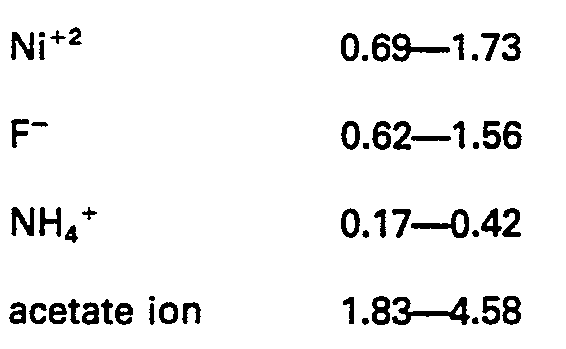
- An aqueous sealant bath (arbitrarily designated Sealant Bath) designed for use at a temperature in the range of from about 25° to about 32°C contains the following ingredients:

- In the above sealant bath compositions, the nickel ion can be provided by use of nickel acetate alone or in combination with any other water-soluble nickel salt. Suitable other water-soluble nickel salts include the sulfate, nitrate, chloride and sulfamate. Preferably, a combination of nickel acetate and nickel sulfate is used.
- The fluoride ion is preferably provided by use of an alkali metal fluoride such as potassium fluoride, sodium bifluoride, or ammonium bifluoride for the sealant bath.
- The ammonium ion present in the above sealant bath is obtained from ammonium acetate, and, if used as the source of fluoride ion, from ammonium bifluoride.
- The acetate ion present in the above sealant bath is obtained from ammonium acetate and nickel acetate.
- The optional potassium ion is obtained from potassium fluoride.
- The optional sulfate ion is obtained from nickel sulfate, when this salt is selected in combination with nickel acetate as the source is nickel ion.
- . The Aluminum Red and Aluminum Violet dyes that can optionally be added to the sealant bath serve to partially mask the green color which may occur on clear anodized aluminum when the sealant bath is applied thereto.
- For the above sealant bath, and in concentrates and replenishers used in their preparation or maintenance, which will be discussed hereinafter, it is preferred to use distilled or deionized water to avoid any interference from undesirable ions (e.g. calcium) which may be present in ordinary tap water.
- The sealant bath is operated by contacting the anodized aluminum metal substrate to be sealed with the bath solution, preferably by immersion, at a temperature of from 25° to 32°C for a period of from 3 to 15 minutes, preferably from 5 to 10 minutes.
- The sealant bath has a bath pH of from 5.5 to 8.7, preferably from 6.2 to 8.0, and is adjusted as necessary using acetic acid or aqueous ammonia.
- The sealant bath is also preferably made up by adding a concentrated aqueous solution of the ingredients used therein to sufficient water to result in the desired concentration of ingredients in the bath. Concentrates useful herein are those having a nickel ion concentration of more than 5 g/L and preferably above 10 g/L, i.e. having at least about 35 g/L, wherein the parts by weight of the ingredients are in the same ratios as those present in the sealant bath.
- A concentrate was prepared by dissolving the following ingredients in deionized water.

- The above concentrated contains the following quantities of ions:

- A sealant bath was prepared by adding 40 g/L of the concentrate of Example 1 to deionized water. The bath so prepared contained in g/L:

- The bath was heated to 30°C and the pH adjusted to 8.0 using aqueous ammonia. Anodized aluminum parts (5.08 cm x 12.7 cm) (2" x-5" panels) were immersed in the bath for 10 minutes. The parts were rinsed in tap water and allowed to air dry. Upon examination they were completely free of smut and passed all standard quality tests after aging for 18 hours.
- A concentrate was prepared by dissolving the following ingredients in deionized water.

- The above concentrate contains the following quantities of ions:

- A sealant bath was prepared by adding 40 g/L of the concentrate of Example 3 to deionized water. The bath so prepared contained in g/L:

- The bath was heated to 30°C and the pH adjusted to 8.0 using aqueous ammonia. Anodized aluminum parts (5.08 cm x 12.7 cm) (2" x 5" panels) were immersed in the bath for 10 minutes. The parts were rinsed in tap water and allowed to air dry. Upon examination they were completely free of smut and passed all standard quality tests after aging for 18 hours.
- As can be seen from the above examples, the processes of this invention are easy to carry out and require no special precautions to be take prior to, during or after the operations.
Claims (13)



Priority Applications (1)
| Application Number | Priority Date | Filing Date | Title |
|---|---|---|---|
| AT85110180T ATE54960T1 (en) | 1984-08-16 | 1985-08-14 | COMPOSITION FOR ANODIZED ALUMINUM. |
Applications Claiming Priority (4)
| Application Number | Priority Date | Filing Date | Title |
|---|---|---|---|
| US64122484A | 1984-08-16 | 1984-08-16 | |
| US641224 | 1985-07-12 | ||
| US06/753,701 US4647347A (en) | 1984-08-16 | 1985-07-12 | Process and sealant compositions for sealing anodized aluminum |
| US753701 | 1985-07-12 |
Publications (3)
| Publication Number | Publication Date |
|---|---|
| EP0171799A2 EP0171799A2 (en) | 1986-02-19 |
| EP0171799A3 EP0171799A3 (en) | 1986-08-13 |
| EP0171799B1 true EP0171799B1 (en) | 1990-07-25 |
Family
ID=27093715
Family Applications (1)
| Application Number | Title | Priority Date | Filing Date |
|---|---|---|---|
| EP85110180A Expired - Lifetime EP0171799B1 (en) | 1984-08-16 | 1985-08-14 | Sealant compositions for anodized aluminum |
Country Status (6)
| Country | Link |
|---|---|
| US (1) | US4647347A (en) |
| EP (1) | EP0171799B1 (en) |
| JP (1) | JPH0633503B2 (en) |
| AU (1) | AU568061B2 (en) |
| CA (1) | CA1257055A (en) |
| DE (1) | DE3578840D1 (en) |
Families Citing this family (25)
| Publication number | Priority date | Publication date | Assignee | Title |
|---|---|---|---|---|
| IT1234708B (en) * | 1989-02-17 | 1992-05-26 | Giuseppe Garuti | SYSTEM FOR FIXING THE ANODIZED ALUMINUM |
| US5225068A (en) * | 1989-05-26 | 1993-07-06 | Gebr. Happich Gmbh | Method of compacting an anodically produced layer of oxide on parts of aluminum or aluminum alloy |
| DE3917188A1 (en) * | 1989-05-26 | 1990-11-29 | Happich Gmbh Gebr | PROCESS FOR PRODUCING COLORED SURFACES ON PARTS OF ALUMINUM OR ALUMINUM ALLOYS |
| US5551994A (en) * | 1990-05-17 | 1996-09-03 | The Boeing Company | Non-chromated oxide coating for aluminum substrates |
| US5411606A (en) * | 1990-05-17 | 1995-05-02 | The Boeing Company | Non-chromated oxide coating for aluminum substrates |
| US5298092A (en) * | 1990-05-17 | 1994-03-29 | The Boeing Company | Non-chromated oxide coating for aluminum substrates |
| US5468307A (en) * | 1990-05-17 | 1995-11-21 | Schriever; Matthias P. | Non-chromated oxide coating for aluminum substrates |
| US5472524A (en) * | 1990-05-17 | 1995-12-05 | The Boeing Company | Non-chromated cobalt conversion coating method and coated articles |
| US5192610A (en) * | 1990-06-07 | 1993-03-09 | Applied Materials, Inc. | Corrosion-resistant protective coating on aluminum substrate and method of forming same |
| US5069938A (en) * | 1990-06-07 | 1991-12-03 | Applied Materials, Inc. | Method of forming a corrosion-resistant protective coating on aluminum substrate |
| DE19524828A1 (en) * | 1995-07-07 | 1997-01-09 | Henkel Kgaa | Process for the heavy metal free compression of anodized metals with solutions containing lithium and fluoride |
| ES2142619T3 (en) * | 1995-10-18 | 2000-04-16 | Henkel Kgaa | HOT SEALING OF SHORT DURATION OF ANODIZED METALLIC SURFACES. |
| US5948542A (en) * | 1996-03-18 | 1999-09-07 | Mcdonnell Douglas Corporation | High-absorptance high-emittance anodic coating |
| US6544397B2 (en) * | 1996-03-22 | 2003-04-08 | Ronald Redline | Method for enhancing the solderability of a surface |
| DE19621818A1 (en) * | 1996-05-31 | 1997-12-04 | Henkel Kgaa | Short-term hot compression of anodized metal surfaces with solutions containing surfactants |
| US5873953A (en) * | 1996-12-26 | 1999-02-23 | The Boeing Company | Non-chromated oxide coating for aluminum substrates |
| JP3408405B2 (en) * | 1997-07-16 | 2003-05-19 | 富士電機株式会社 | Electrophotographic photoreceptor substrate and electrophotographic photoreceptor |
| US6432225B1 (en) | 1999-11-02 | 2002-08-13 | The Boeing Company | Non-chromated oxide coating for aluminum substrates |
| DE202004010821U1 (en) * | 2003-07-23 | 2004-12-23 | The Boc Group Plc, Windlesham | vacuum component |
| JP4974986B2 (en) * | 2007-09-28 | 2012-07-11 | 富士フイルム株式会社 | Solar cell substrate and solar cell |
| DE102007057777B4 (en) * | 2007-11-30 | 2012-03-15 | Erbslöh Ag | Method for producing a component from aluminum and / or an aluminum alloy and use of the method |
| CN101812713A (en) * | 2010-05-07 | 2010-08-25 | 李继光 | Method for preparing aluminum alloy anodic oxide film sealant |
| JP6557984B2 (en) * | 2015-02-06 | 2019-08-14 | 栗田工業株式会社 | Aluminum or aluminum alloy sealing method and sealing device |
| US10138566B2 (en) * | 2017-01-13 | 2018-11-27 | Macdermid Acumen, Inc. | Sealing anodized aluminum using a low-temperature nickel-free process |
| CN108950642B (en) * | 2018-07-20 | 2019-06-11 | 广东传祺照明有限公司 | Without nickel hole sealing agent |
Citations (1)
| Publication number | Priority date | Publication date | Assignee | Title |
|---|---|---|---|---|
| DE3301507A1 (en) * | 1982-01-18 | 1983-07-28 | Tec.A. Systems s.a.s. di Portioli Guido & C., 20092 Cinisello Balsamo, Milano | Composition for cold-fixing anodised surfaces of workpieces made of aluminium and its alloys |
Family Cites Families (3)
| Publication number | Priority date | Publication date | Assignee | Title |
|---|---|---|---|---|
| JPS5415856B2 (en) * | 1974-02-28 | 1979-06-18 | ||
| JPS5415856A (en) * | 1978-05-18 | 1979-02-06 | Iseki Agricult Mach | Separating and chaff disposing device grain |
| DE3374791D1 (en) * | 1982-09-03 | 1988-01-14 | Ffa Flug Fahrzeugwerke Ag | Recompression process |
-
1985
- 1985-07-12 US US06/753,701 patent/US4647347A/en not_active Expired - Fee Related
- 1985-08-12 JP JP60178462A patent/JPH0633503B2/en not_active Expired - Lifetime
- 1985-08-14 EP EP85110180A patent/EP0171799B1/en not_active Expired - Lifetime
- 1985-08-14 DE DE8585110180T patent/DE3578840D1/en not_active Expired - Fee Related
- 1985-08-14 CA CA000488700A patent/CA1257055A/en not_active Expired
- 1985-08-15 AU AU46241/85A patent/AU568061B2/en not_active Ceased
Patent Citations (1)
| Publication number | Priority date | Publication date | Assignee | Title |
|---|---|---|---|---|
| DE3301507A1 (en) * | 1982-01-18 | 1983-07-28 | Tec.A. Systems s.a.s. di Portioli Guido & C., 20092 Cinisello Balsamo, Milano | Composition for cold-fixing anodised surfaces of workpieces made of aluminium and its alloys |
Also Published As
| Publication number | Publication date |
|---|---|
| AU568061B2 (en) | 1987-12-10 |
| EP0171799A2 (en) | 1986-02-19 |
| DE3578840D1 (en) | 1990-08-30 |
| US4647347A (en) | 1987-03-03 |
| EP0171799A3 (en) | 1986-08-13 |
| AU4624185A (en) | 1986-02-20 |
| CA1257055A (en) | 1989-07-11 |
| JPS6184397A (en) | 1986-04-28 |
| JPH0633503B2 (en) | 1994-05-02 |
Similar Documents
| Publication | Publication Date | Title |
|---|---|---|
| US4647347A (en) | Process and sealant compositions for sealing anodized aluminum | |
| US3098018A (en) | Sealing anodized aluminum | |
| SE457642B (en) | ACID WATER SOLUTION FOR BETWEEN METAL SURFACES | |
| US5437740A (en) | Corrosion resistant aluminum and aluminum coating | |
| US20210262107A1 (en) | Process for treating the surface of a part made of aluminium or aluminium alloy or of magnesium or magnesium alloy | |
| JP3894950B2 (en) | Treatment of aluminum or aluminum alloy | |
| US5362317A (en) | Sealant compositions and process for sealing aluminum oxide films | |
| US20030127338A1 (en) | Process for brightening aluminum, and use of same | |
| US3838023A (en) | Sealing anodized aluminum | |
| US5601663A (en) | Process for forming a black oxide on aluminum alloys and a solution therefor | |
| US2213263A (en) | Process of coating metals | |
| US4648911A (en) | Sealing process | |
| US3257244A (en) | Sealing and inhibiting corrosion of anodized aluminum | |
| CA1338442C (en) | Process for sealing anodized aluminum | |
| JPH03277797A (en) | Sealing treatment of aluminum anodically oxidized film | |
| US7156905B2 (en) | Composition and method for treating magnesium alloys | |
| US4956022A (en) | Chemical polishing of aluminum alloys | |
| US3171797A (en) | Method of sealing anodic aluminum oxide coatings | |
| US2620265A (en) | Composition for treating aluminum and aluminum alloys | |
| US4070193A (en) | Corrosion resistant metal sealing formulation | |
| GB1590597A (en) | Treating a1 or a1 alloy surfaces | |
| US5259937A (en) | Process for forming colorless chromate coating film on bright aluminum wheel | |
| JPS6256579A (en) | Acidic aqueous solution and method for passivating surface of zinc or zinc/aluminum alloy | |
| US3822156A (en) | Sealing and desmudging anodized aluminum | |
| US2206028A (en) | Anodic treatment of magnesium |
Legal Events
| Date | Code | Title | Description |
|---|---|---|---|
| PUAI | Public reference made under article 153(3) epc to a published international application that has entered the european phase |
Free format text: ORIGINAL CODE: 0009012 |
|
| AK | Designated contracting states |
Designated state(s): AT BE CH DE FR GB IT LI NL SE |
|
| PUAL | Search report despatched |
Free format text: ORIGINAL CODE: 0009013 |
|
| AK | Designated contracting states |
Kind code of ref document: A3 Designated state(s): AT BE CH DE FR GB IT LI NL SE |
|
| 17P | Request for examination filed |
Effective date: 19870120 |
|
| 17Q | First examination report despatched |
Effective date: 19870915 |
|
| RAP1 | Party data changed (applicant data changed or rights of an application transferred) |
Owner name: HENKEL CORPORATION |
|
| GRAA | (expected) grant |
Free format text: ORIGINAL CODE: 0009210 |
|
| AK | Designated contracting states |
Kind code of ref document: B1 Designated state(s): AT BE CH DE FR GB IT LI NL SE |
|
| REF | Corresponds to: |
Ref document number: 54960 Country of ref document: AT Date of ref document: 19900815 Kind code of ref document: T |
|
| ITF | It: translation for a ep patent filed | ||
| REF | Corresponds to: |
Ref document number: 3578840 Country of ref document: DE Date of ref document: 19900830 |
|
| ET | Fr: translation filed | ||
| PLBE | No opposition filed within time limit |
Free format text: ORIGINAL CODE: 0009261 |
|
| STAA | Information on the status of an ep patent application or granted ep patent |
Free format text: STATUS: NO OPPOSITION FILED WITHIN TIME LIMIT |
|
| PGFP | Annual fee paid to national office [announced via postgrant information from national office to epo] |
Ref country code: SE Payment date: 19910716 Year of fee payment: 7 |
|
| 26N | No opposition filed | ||
| PGFP | Annual fee paid to national office [announced via postgrant information from national office to epo] |
Ref country code: GB Payment date: 19910718 Year of fee payment: 7 |
|
| PGFP | Annual fee paid to national office [announced via postgrant information from national office to epo] |
Ref country code: BE Payment date: 19910731 Year of fee payment: 7 |
|
| PGFP | Annual fee paid to national office [announced via postgrant information from national office to epo] |
Ref country code: NL Payment date: 19910831 Year of fee payment: 7 |
|
| PGFP | Annual fee paid to national office [announced via postgrant information from national office to epo] |
Ref country code: CH Payment date: 19920722 Year of fee payment: 8 |
|
| PGFP | Annual fee paid to national office [announced via postgrant information from national office to epo] |
Ref country code: AT Payment date: 19920729 Year of fee payment: 8 |
|
| PGFP | Annual fee paid to national office [announced via postgrant information from national office to epo] |
Ref country code: DE Payment date: 19920801 Year of fee payment: 8 |
|
| PG25 | Lapsed in a contracting state [announced via postgrant information from national office to epo] |
Ref country code: GB Effective date: 19920814 |
|
| PG25 | Lapsed in a contracting state [announced via postgrant information from national office to epo] |
Ref country code: SE Effective date: 19920815 |
|
| PG25 | Lapsed in a contracting state [announced via postgrant information from national office to epo] |
Ref country code: BE Effective date: 19920831 |
|
| BERE | Be: lapsed |
Owner name: HENKEL CORP. (A DELAWARE CORP.) Effective date: 19920831 |
|
| PG25 | Lapsed in a contracting state [announced via postgrant information from national office to epo] |
Ref country code: NL Effective date: 19930301 |
|
| GBPC | Gb: european patent ceased through non-payment of renewal fee |
Effective date: 19920814 |
|
| NLV4 | Nl: lapsed or anulled due to non-payment of the annual fee | ||
| PGFP | Annual fee paid to national office [announced via postgrant information from national office to epo] |
Ref country code: FR Payment date: 19930713 Year of fee payment: 9 |
|
| PG25 | Lapsed in a contracting state [announced via postgrant information from national office to epo] |
Ref country code: AT Effective date: 19930814 |
|
| ITTA | It: last paid annual fee | ||
| PG25 | Lapsed in a contracting state [announced via postgrant information from national office to epo] |
Ref country code: LI Effective date: 19930831 Ref country code: CH Effective date: 19930831 |
|
| REG | Reference to a national code |
Ref country code: CH Ref legal event code: PL |
|
| PG25 | Lapsed in a contracting state [announced via postgrant information from national office to epo] |
Ref country code: DE Effective date: 19940503 |
|
| EUG | Se: european patent has lapsed |
Ref document number: 85110180.8 Effective date: 19930307 |
|
| PG25 | Lapsed in a contracting state [announced via postgrant information from national office to epo] |
Ref country code: FR Effective date: 19950428 |
|
| REG | Reference to a national code |
Ref country code: FR Ref legal event code: ST |