EP0171708B1 - Triazine derivatives and herbicides - Google Patents
Triazine derivatives and herbicides Download PDFInfo
- Publication number
- EP0171708B1 EP0171708B1 EP85109642A EP85109642A EP0171708B1 EP 0171708 B1 EP0171708 B1 EP 0171708B1 EP 85109642 A EP85109642 A EP 85109642A EP 85109642 A EP85109642 A EP 85109642A EP 0171708 B1 EP0171708 B1 EP 0171708B1
- Authority
- EP
- European Patent Office
- Prior art keywords
- alkyl
- compound
- compounds
- triazine
- herbicides
- Prior art date
- Legal status (The legal status is an assumption and is not a legal conclusion. Google has not performed a legal analysis and makes no representation as to the accuracy of the status listed.)
- Expired
Links
- 0 C*(C)c1nc(S)nc(N*)n1 Chemical compound C*(C)c1nc(S)nc(N*)n1 0.000 description 1
Classifications
-
- C—CHEMISTRY; METALLURGY
- C07—ORGANIC CHEMISTRY
- C07D—HETEROCYCLIC COMPOUNDS
- C07D251/00—Heterocyclic compounds containing 1,3,5-triazine rings
- C07D251/02—Heterocyclic compounds containing 1,3,5-triazine rings not condensed with other rings
- C07D251/12—Heterocyclic compounds containing 1,3,5-triazine rings not condensed with other rings having three double bonds between ring members or between ring members and non-ring members
- C07D251/26—Heterocyclic compounds containing 1,3,5-triazine rings not condensed with other rings having three double bonds between ring members or between ring members and non-ring members with only hetero atoms directly attached to ring carbon atoms
-
- C—CHEMISTRY; METALLURGY
- C07—ORGANIC CHEMISTRY
- C07D—HETEROCYCLIC COMPOUNDS
- C07D251/00—Heterocyclic compounds containing 1,3,5-triazine rings
- C07D251/02—Heterocyclic compounds containing 1,3,5-triazine rings not condensed with other rings
- C07D251/12—Heterocyclic compounds containing 1,3,5-triazine rings not condensed with other rings having three double bonds between ring members or between ring members and non-ring members
- C07D251/26—Heterocyclic compounds containing 1,3,5-triazine rings not condensed with other rings having three double bonds between ring members or between ring members and non-ring members with only hetero atoms directly attached to ring carbon atoms
- C07D251/40—Nitrogen atoms
- C07D251/48—Two nitrogen atoms
- C07D251/52—Two nitrogen atoms with an oxygen or sulfur atom attached to the third ring carbon atom
-
- A—HUMAN NECESSITIES
- A01—AGRICULTURE; FORESTRY; ANIMAL HUSBANDRY; HUNTING; TRAPPING; FISHING
- A01N—PRESERVATION OF BODIES OF HUMANS OR ANIMALS OR PLANTS OR PARTS THEREOF; BIOCIDES, e.g. AS DISINFECTANTS, AS PESTICIDES OR AS HERBICIDES; PEST REPELLANTS OR ATTRACTANTS; PLANT GROWTH REGULATORS
- A01N43/00—Biocides, pest repellants or attractants, or plant growth regulators containing heterocyclic compounds
- A01N43/64—Biocides, pest repellants or attractants, or plant growth regulators containing heterocyclic compounds having rings with three nitrogen atoms as the only ring hetero atoms
- A01N43/66—1,3,5-Triazines, not hydrogenated and not substituted at the ring nitrogen atoms
- A01N43/68—1,3,5-Triazines, not hydrogenated and not substituted at the ring nitrogen atoms with two or three nitrogen atoms directly attached to ring carbon atoms
- A01N43/70—Diamino—1,3,5—triazines with only one oxygen, sulfur or halogen atom or only one cyano, thiocyano (—SCN), cyanato (—OCN) or azido (—N3) group directly attached to a ring carbon atom
Definitions
- the present invention relates to novel triazine derivatives and herbicides containing the triazine derivatives as an effective ingredient.
- 2,4-diamino-1,3,5-triazine type herbicides 2,4-bis(isopropylamino)-6-methylthio-1,3,5-triazine (generic name: prometryn, see U.S. Pat. No. 2,909,420), 2,4-bis(isopropylamino)-6-chloro-1,3,5-triazine (generic name: propazine, see Swiss Pat. Nos. 342,784 and 342,785), and synthetic intermediates 2,4- bis(substituted amino)-6-mercapto-1,3,5-triazine (see Swiss Pat. No. 393,344 and JPN Pat. Publn. No. 40-23025) are known.
- R 1 is hydrogen
- R 2 is C 1 ⁇ C 5 alkyl, C 2 ⁇ C 6 alkenyl, C 2 ⁇ C 6 alkynyl, C 3 ⁇ C 7 cycloalkyl, (C 1 ⁇ C 5 )alkoxy(C 1 ⁇ C 6 )alkyl, cyano(C 1 ⁇ C 5 )alkyl or (C 5 ⁇ C 12 aryl(C 1 ⁇ 5 )alkyl;
- R 3 is hydrogen, C 1 ⁇ C 5 alkyl, C 2 ⁇ C 6 alkenyl, C 2 ⁇ C 6 alkynyl or C 3 ⁇ C 7 cycloalkyl, and
- R 4 is hydrogen, C 1 ⁇ C 5 alkyl, C 2 ⁇ C 6 alkenyl, C 2 ⁇ C 6 alkynyl, C 3 ⁇ C 7 cycloalkyl, (C 1 ⁇ C 5 )alkoxy(C 1 ⁇ C 5 )alkyl, cyano(C 1 ⁇ C 5 )alkyl or (C 6 ⁇ C 12 )aryl(C 1 ⁇ C 5 )alkyl, or (R' and R 2 ) or (R 3 and R 4 ) taken together form C 2 ⁇ C 6 alkylene) and it also relates to a herbicidal composition comprising one or more of said compounds and one or more of carriers.
- the compound (I) can be prepared by reacting a mercaptotriazine with a difluoromethane derivative such as chlorodifluoromethane.
- the present inventors have investigated compounds having herbicidal activities and they found that novel 2,4-diamino-6-difluoromethylthio-1,3,5-triazine derivatives have potent herbicidal activities and show no or slight adverse reactions against agricultural crops or human beings. This invention is based on these findings.
- the compounds (I) can be prepared according to the following reaction scheme. (wherein R 1 , R 2 , R 3 , and R 4 each has the same meaning as defined above; X is a leaving group.)
- alkyl in the above formulae examples include methyl, ethyl, propyl, isopropyl, butyl, isobutyl, sec- butyl, tert-butyl, pentyl, isopentyl, tert-pentyl, neo-pentyl, 1-methylbutyl, 1,2-dimethylpropyl, hexyl, heptyl, 1,3-dimethylbutyl, octyl, nonyl or decyl.
- alkenyl are vinyl, allyl, isopropenyl, 2-butenyl, 1,3-butadienyl, 4-pentenyl, 5- hexenyl, and the like.
- the alkynyl is exemplified by ethynyl, 2-propynyl, 1-methyl-2-propynyl, 4-pentynyl and 5-hexynyl.
- Cg-C 7 cycloalkyl are cyclopropyl, cyclobutyl, cyclopentyl, cyclohexyl and cycloheptyl.
- Examples of the (C 1 -C S ) alkoxy-(C l -C 5 ) alkyl are methoxymethyl, ethoxyethyl, methoxypropyl, isopropoxybutyl and butoxypentyl.
- Examples of the cyano-(C 1 -C S ) alkyl are cyanomethyl, 2-cyanoethyl, 3-cyanopropyl, 1-methyl-4-cyanobutyl or 1-cyano-methylethyl.
- the (C 6 ⁇ C 12 ) aryl-(C 1 -C s ) alkyl means (C 1 -C S ) alkyl substituted by aryl, preferably by mono-cyclic aryl, the (C 1 ⁇ C 5 ) alkyl has the same meaning as defined above.
- the (C 6 ⁇ C 12 ) aryl (C 1 ⁇ C 5 ) alkyl is exemplified by benzyl, phenethyl, 3-tolylpropyl or 1-methyl-4-tolylbutyl.
- the C 3 ⁇ C 5 alkylene means straight or branched chain bivalent saturated hydrocarbon residue, more preferably, C 4 ⁇ C 5 alkylene, for example tetramethylene, pentamethylene or 1-methylpentamethylene.
- the leaving group means a group which is eliminated easily when the compound containing it undergoes reaction.
- Examples of the leaving group are acid residues such as chlorine, bromine, iodine, sulfonyloxy, p-tosyloxy, and the like.
- the present invention includes acid addition salts of the compounds (I).
- the acid addition salt can be prepared by treating the compound (I) with an acid in a conventional manner.
- the acid includes inorganic acids (e.g., hydrochloric acid, sulfuric acid, phosphoric acid, nitric acid, etc.) and organic acids (e.g., acetic acid, benzoic acid, toluenesulfonic acid, picric acid, etc.).
- the compound (I) can be prepared by the reaction of the compound (II) with the compound (III) as described in the above reaction scheme.
- the reaction may be carried out in a solvent.
- a solvent water, high-polar organic solvents such as alkanols (e.g., methanol, ethanol, isopropanol, n-butanol, isobutanol, tert-butanol, n-pentanol, isopentanol, neopentanol, tert-pentanol, etc.) tetrahydrofuran, dioxane, N,N-dimethylformamide, dimethyl sulfoxide, etc., or a mixture thereof.
- alkanols e.g., methanol, ethanol, isopropanol, n-butanol, isobutanol, tert-butanol, n-pentanol, isopentanol, neopentanol, tert-pentanol, etc.
- tetrahydrofuran di
- the reaction is preferably conducted in the presence of a base (an acid-acceptor).
- a base an acid-acceptor
- sodium hydroxide, potassium hydroxide, sodium carbonate, potassium carbonate, an organic amine, etc. can be employed.
- the reaction may be carried out at a temperature of 02 ⁇ 100°C, preferably at a temperature from room temperature to the boiling point of the solvent used.
- starting materials (II) are known (for instance, JPN Pat. Publn. No. 40-23025), while unknown starting materials (II) can be prepared in the same manner as the known compounds, or by the reaction of a corresponding 6-chloro compound with thiourea.
- the compounds (I) of the present invention have excellent herbicidal activities against monocotyledonous or dicotyledonous general weeds in upland fields e.g.,
- the compounds (I) are nontoxic to common field crops such as corn, sugar cane, sorghum, rice, wheat, barley, soybean, peanut, and cotton; or a phytoxicity in the crops, if any, is so slight that they could easily recover from the damage.
- the compounds (I) can be applied as selective or non-selective herbicides to crop lands, e.g., upland fields, paddy fields, orchards, tea plantations, mulberry fields, fallow lands, and pastures; or non-crop lands, e.g., railbeds, roads, lawns, factory sites, dry riverbeds, residential quarters, park green districts, forest lands, prepared lands, and vacant lands.
- crop lands e.g., upland fields, paddy fields, orchards, tea plantations, mulberry fields, fallow lands, and pastures
- non-crop lands e.g., railbeds, roads, lawns, factory sites, dry riverbeds, residential quarters, park green districts, forest lands, prepared lands, and vacant lands.
- the compounds (I) are harmless to human beings, domestic animals, and birds or poultry, and show an extremely low toxicity to fish. Consequently, the herbicides comprising the compounds (I) are safe and have no problems about the residual toxicity.
- the application concentration should also be decided in consideration of the application purpose, objective plants, and application time, generally the concentration is about 1-5000 ppm.
- the compounds (I) can be mixed with various carriers and formulated as powder, granules, wettable powder, emulsion, and the like.
- the carriers may be solid or liquid carriers, or a mixture of both.
- the solid carriers include clay, talc, diatomaceous earth, bentonite, etc.
- the liquid carriers are exemplified by water, alkanols, acetone, benzene, toluene, xylene, solvent naphtha, cyclohexane, etc.
- the formulatively acceptable emulsifiers, stabilizers, dispersants, suspending agents, spreaders, penetrants, wetting agents may be added to the herbicidal composition comprising the compounds (I).
- the compounds (1) may be used in combination with other herbicides, for example diuron, MCP, CNP, IPC, asulum, alachlor, trifluralin, and the like and they can be used together with insecticides, fungicides, fertilizers, pesticides for soil treatment in order to extend the herbicidal spectrum and to get additive or potentiative herbicidal actions.
- other herbicides for example diuron, MCP, CNP, IPC, asulum, alachlor, trifluralin, and the like and they can be used together with insecticides, fungicides, fertilizers, pesticides for soil treatment in order to extend the herbicidal spectrum and to get additive or potentiative herbicidal actions.
- the herbicides of this invention can be applied over clay loam as well as the ordinary soil such as sandy loam soil, loam soil, and the like. They can be applied even to the soil (e.g., sandy loam soil) which tends to have an influence on the occurrence of the herbicidal activity.
- a mixture of 1.5 g of thiourea and 4 g of 2,4-bis(ethylamino)-6-chloro-1,3,5-triazine in a mixture of 20 ml of dioxane and 20 ml of water is refluxed with stirring for 2 hours in 100 ml flask. After cooling, the mixture is mixed with 1.6 g of 50% sodium hydroxide and stirred for 10 minutes. The resulting mixture is neutralized with hydrochoric acid and extracted with ethyl acetate. The extract is concentrated under reduced pressure to give 4 g of 2,4-bis(ethylamino)-6-mercapto-1,3,5-triazine.
- the product can be used for preparation of the objective compound without isolation.
- Example 4 The above components are mixed to give a wettable powder.
- Example 5 The above components are mixed uniformly to give a powder.
- Example 4 The above components are mixed to give a wettable powder.
- Example 5 The above components are mixed to give a wettable powder.
- the above components are uniformly mixed, kneaded with water, and extruded by an extrusion granulator to give granules.
- a solution of the effective ingredient and Emalgen in solvent naphtha is coated over grain bentonite to give granules.
- Seeds of each test plant (20 seeds of weeds: Digitaria ciliaris, Echinochloa crus-galli, Polygonum lapathifolium, and Amaranthus viridis; 5 to 10 seeds of crops: corn, wheat, soybean, and cotton) were sowed on the loam charged in a square pot (7.1 x 7.1 cm, 10 cm in depth) made of vinyl chloride. After being sowed, the seeds of the weeds were covered with the loam 5 mm in height and the seeds of the crops were covered with loam 1 cm in height.
- the predetermined amount of the compound of the present invention was diluted with water at a rate of 10Uare and applied uniformly over the surface of the loam with an automatic hand sprayer.
- Tween 20 was used at a concentration of 100 ppm as a spreader.
- the seeds were grown for 10 days in a greenhouse and the compound of the present invention was applied over the foliage of the plants in the same manner as in pre-emergence test at 2 leaf stage of Digitaria ciliaris (at 1 leaf stage of Echinochloa crus-galli and broad-leaved weeds), and at 3 leaf stage of corn (at 1 to 2 leaf stage of other crops).
- the pots were kept at 25°C in a greenhouse.
- the herbicidal activity against each weed and the damage to the crops were evaluated 4 weeks after the application in the pre-emergence test and 3 weeks after the application in the post-emergence test.
Landscapes
- Organic Chemistry (AREA)
- Chemical & Material Sciences (AREA)
- Life Sciences & Earth Sciences (AREA)
- Health & Medical Sciences (AREA)
- Environmental Sciences (AREA)
- Engineering & Computer Science (AREA)
- Dentistry (AREA)
- General Health & Medical Sciences (AREA)
- Wood Science & Technology (AREA)
- Zoology (AREA)
- Plant Pathology (AREA)
- Pest Control & Pesticides (AREA)
- Agronomy & Crop Science (AREA)
- Agricultural Chemicals And Associated Chemicals (AREA)
- Plural Heterocyclic Compounds (AREA)
- Organic Low-Molecular-Weight Compounds And Preparation Thereof (AREA)
- Pharmaceuticals Containing Other Organic And Inorganic Compounds (AREA)
Description
- The present invention relates to novel triazine derivatives and herbicides containing the triazine derivatives as an effective ingredient.
- As 2,4-diamino-1,3,5-triazine type herbicides, 2,4-bis(isopropylamino)-6-methylthio-1,3,5-triazine (generic name: prometryn, see U.S. Pat. No. 2,909,420), 2,4-bis(isopropylamino)-6-chloro-1,3,5-triazine (generic name: propazine, see Swiss Pat. Nos. 342,784 and 342,785), and synthetic intermediates 2,4- bis(substituted amino)-6-mercapto-1,3,5-triazine (see Swiss Pat. No. 393,344 and JPN Pat. Publn. No. 40-23025) are known. As 6-difluoromethyl-1,3,.5-triazine compounds, 2-amino-4-methoxy-6-difluoromethylthio-1,3,5-triazine (JPN Unexamd. Pat. Publn. No. 58-38264) has been known; this compound is described there as an intermediate to afford 2-benzenesulfonylurea, but herbicidal activities of the intermediate have not been known yet.
- 2-methylthio-4,6-bis(ethylamino)-S-triazine (name: simetryne) is mentioned in chem. Abstracts, vol.96/ 11/3.15.1982, abstract No. 81343w as a wide-spectrum herbicide for rice paddy. This present invention relates to the compound of the formula (I):

- R1 is hydrogen; R2 is C1―C5 alkyl, C2―C6 alkenyl, C2―C6 alkynyl, C3―C7 cycloalkyl, (C1―C5)alkoxy(C1―C6)alkyl, cyano(C1―C5)alkyl or (C5―C12aryl(C1―5)alkyl;
- R3 is hydrogen, C1―C5 alkyl, C2―C6 alkenyl, C2―C6 alkynyl or C3―C7 cycloalkyl, and
- R4 is hydrogen, C1―C5 alkyl, C2―C6 alkenyl, C2―C6 alkynyl, C3―C7 cycloalkyl, (C1―C5)alkoxy(C1―C5)alkyl, cyano(C1―C5)alkyl or (C6―C12)aryl(C1―C5)alkyl, or (R' and R2) or (R3 and R4) taken together form C2―C6 alkylene) and it also relates to a herbicidal composition comprising one or more of said compounds and one or more of carriers.
- The compound (I) can be prepared by reacting a mercaptotriazine with a difluoromethane derivative such as chlorodifluoromethane.
- The present inventors have investigated compounds having herbicidal activities and they found that novel 2,4-diamino-6-difluoromethylthio-1,3,5-triazine derivatives have potent herbicidal activities and show no or slight adverse reactions against agricultural crops or human beings. This invention is based on these findings.
- The compounds of the present invention are represented by the following formula (I):

- R1 is hydrogen;
- R2 is C1―C5 alkyl, C2―C6 alkenyl, C2―C6 alkynyl, C3―C7 cycloalkyl, (C1―C5)alkoxy(C1―C5)alkyl, cyano(C1―C5)alkyl or (C5―C12)aryl(C1―C5)alkyl;
- R3 is hydrogen, C1―C5 alkyl, C2―C6 alkenyl, C2-C6 alkynyl or C3―C7 cycloalkyl, and
- R4 is hydrogen, C1―C5 alkyl, C2―C6 alkenyl, C2-C6 alkynyl, C3―C7 cycloalkyl, (C1―C5)alkoxy(C1―C5)alkyl, cyano(C1―C5)alkyl or (C6―C12)aryl(C1―C5)alkyl, or (R1 and R2) or (R3 and R4) taken together form C2―C6 alkylene)
- The compounds (I) can be prepared according to the following reaction scheme.

- Examples of the alkyl in the above formulae are methyl, ethyl, propyl, isopropyl, butyl, isobutyl, sec- butyl, tert-butyl, pentyl, isopentyl, tert-pentyl, neo-pentyl, 1-methylbutyl, 1,2-dimethylpropyl, hexyl, heptyl, 1,3-dimethylbutyl, octyl, nonyl or decyl.
- Representatives of the alkenyl are vinyl, allyl, isopropenyl, 2-butenyl, 1,3-butadienyl, 4-pentenyl, 5- hexenyl, and the like. The alkynyl is exemplified by ethynyl, 2-propynyl, 1-methyl-2-propynyl, 4-pentynyl and 5-hexynyl.
- Representative of the Cg-C7 cycloalkyl are cyclopropyl, cyclobutyl, cyclopentyl, cyclohexyl and cycloheptyl.
- Examples of the (C1-CS) alkoxy-(Cl-C5) alkyl are methoxymethyl, ethoxyethyl, methoxypropyl, isopropoxybutyl and butoxypentyl.
- Examples of the cyano-(C1-CS) alkyl are cyanomethyl, 2-cyanoethyl, 3-cyanopropyl, 1-methyl-4-cyanobutyl or 1-cyano-methylethyl.
- "The (C6―C12) aryl-(C1-Cs) alkyl" means (C1-CS) alkyl substituted by aryl, preferably by mono-cyclic aryl, the (C1―C5) alkyl has the same meaning as defined above. The (C6―C12) aryl (C1―C5) alkyl is exemplified by benzyl, phenethyl, 3-tolylpropyl or 1-methyl-4-tolylbutyl.
- The C3―C5 alkylene means straight or branched chain bivalent saturated hydrocarbon residue, more preferably, C4―C5 alkylene, for example tetramethylene, pentamethylene or 1-methylpentamethylene.
- "The leaving group" means a group which is eliminated easily when the compound containing it undergoes reaction. Examples of the leaving group are acid residues such as chlorine, bromine, iodine, sulfonyloxy, p-tosyloxy, and the like.
- The present invention includes acid addition salts of the compounds (I). The acid addition salt can be prepared by treating the compound (I) with an acid in a conventional manner. The acid includes inorganic acids (e.g., hydrochloric acid, sulfuric acid, phosphoric acid, nitric acid, etc.) and organic acids (e.g., acetic acid, benzoic acid, toluenesulfonic acid, picric acid, etc.).
- The compound (I) can be prepared by the reaction of the compound (II) with the compound (III) as described in the above reaction scheme.
- The reaction may be carried out in a solvent. As the solvent, water, high-polar organic solvents such as alkanols (e.g., methanol, ethanol, isopropanol, n-butanol, isobutanol, tert-butanol, n-pentanol, isopentanol, neopentanol, tert-pentanol, etc.) tetrahydrofuran, dioxane, N,N-dimethylformamide, dimethyl sulfoxide, etc., or a mixture thereof. Particularly a mixture of water with a nonaqueous solvent is employed.
- The reaction is preferably conducted in the presence of a base (an acid-acceptor). As the base, sodium hydroxide, potassium hydroxide, sodium carbonate, potassium carbonate, an organic amine, etc. can be employed. The reaction may be carried out at a temperature of 02~100°C, preferably at a temperature from room temperature to the boiling point of the solvent used.
- Some of the starting materials (II) are known (for instance, JPN Pat. Publn. No. 40-23025), while unknown starting materials (II) can be prepared in the same manner as the known compounds, or by the reaction of a corresponding 6-chloro compound with thiourea.
- The compounds (I) of the present invention have excellent herbicidal activities against monocotyledonous or dicotyledonous general weeds in upland fields e.g.,
- Digitaria ciliaris (large crabgrass),
- Setaria viridis (green foxtail),
- Echinochloa crus-galli (barnyard grass),
- Amaranthus viridis (green amaranth),
- Chenopodium album (smooth pigweed),
- Cyperus micro-iria (flat-sedge),
- Mollugo stricta (carpet-weed),
- Stellaria media (common chickweed),
- Segina japonica (pearlwort),
- Stellaria Alsine (bog-stichwort),
- Capsella Bursa-pastoris (Shepherd's purse),
- Alopecurus aequalis (water foxtail),
- Poa annua (annual bluegrass),
- Polygonum longisetum (smartweed), Polygonum lapathifolium (smartweed),
- Trigonotis pedunclaris (-), and
- Gnaphalium affine (cottonweed);
- and against general weeds in paddy fields e.g.,
- Echinochloa oryzicola (barnyard grass),
- Monchoria vaginalis (monochoria),
- Cyperus difformis (umbrella plant),
- Rotala indica (tooth cup), and
- Dopatrium junceum (-).
- At an application rate of 1-40 glare, the compounds (I) are nontoxic to common field crops such as corn, sugar cane, sorghum, rice, wheat, barley, soybean, peanut, and cotton; or a phytoxicity in the crops, if any, is so slight that they could easily recover from the damage. Therefore, the compounds (I) can be applied as selective or non-selective herbicides to crop lands, e.g., upland fields, paddy fields, orchards, tea plantations, mulberry fields, fallow lands, and pastures; or non-crop lands, e.g., railbeds, roads, lawns, factory sites, dry riverbeds, residential quarters, park green districts, forest lands, prepared lands, and vacant lands.
- Furthermore, the compounds (I) are harmless to human beings, domestic animals, and birds or poultry, and show an extremely low toxicity to fish. Consequently, the herbicides comprising the compounds (I) are safe and have no problems about the residual toxicity.
- How to apply the compounds (I) as herbicides should be decided in consideration of the application purpose, objective plants, and application time; in general the compounds (I) can be applied in soil or over leaves.
- The application concentration should also be decided in consideration of the application purpose, objective plants, and application time, generally the concentration is about 1-5000 ppm.
- The compounds (I) can be mixed with various carriers and formulated as powder, granules, wettable powder, emulsion, and the like. The carriers may be solid or liquid carriers, or a mixture of both.
- The solid carriers include clay, talc, diatomaceous earth, bentonite, etc. The liquid carriers are exemplified by water, alkanols, acetone, benzene, toluene, xylene, solvent naphtha, cyclohexane, etc.
- The formulatively acceptable emulsifiers, stabilizers, dispersants, suspending agents, spreaders, penetrants, wetting agents may be added to the herbicidal composition comprising the compounds (I).
- The compounds (1) may be used in combination with other herbicides, for example diuron, MCP, CNP, IPC, asulum, alachlor, trifluralin, and the like and they can be used together with insecticides, fungicides, fertilizers, pesticides for soil treatment in order to extend the herbicidal spectrum and to get additive or potentiative herbicidal actions.
- The herbicides of this invention can be applied over clay loam as well as the ordinary soil such as sandy loam soil, loam soil, and the like. They can be applied even to the soil (e.g., sandy loam soil) which tends to have an influence on the occurrence of the herbicidal activity.
- The present invention will be explained in more detail by the following examples; and the effect of this invention will be confirmed by the following experiments.
- A mixture of 1.5 g of thiourea and 4 g of 2,4-bis(ethylamino)-6-chloro-1,3,5-triazine in a mixture of 20 ml of dioxane and 20 ml of water is refluxed with stirring for 2 hours in 100 ml flask. After cooling, the mixture is mixed with 1.6 g of 50% sodium hydroxide and stirred for 10 minutes. The resulting mixture is neutralized with hydrochoric acid and extracted with ethyl acetate. The extract is concentrated under reduced pressure to give 4 g of 2,4-bis(ethylamino)-6-mercapto-1,3,5-triazine. The product can be used for preparation of the objective compound without isolation.
- To a mixture of 4 g of 2,4-bis(ethylamino)-6-mercapto-1,3,5-triazine, 20 ml of dioxane, and 20 ml of water is added 4 g of 50% sodium hydroxide at a temperature of 010°C in 200 ml three necked flask.
- The mixture is stirred for 30 minutes, heated up to 55-65°c, stirred for another 30 minutes, and chlorodifluoromethane gas is aspirated thereto for 4 hours. The resulting mixture is cooled, neutralized with hydrochloric acid, and extracted with chloroform. The extract is evaporated, and the resulting residue is purified by silica-gel chromatography to give 1.5 g of 2,5-bis(ethylamino)-6-difluoromethylthio-1,3,5-triazine.
- To a mixture of 2.8 g of 2,4-diamino-6-mercapto-1,3,5-triazine, 5.5 g of potassium carbonate, and 20 ml of N,N-dimethylformamide is aspirated chlorodifluoromethane gas at a temperature of 55-65°C for 2 hours in 100 ml three-necked flask. After cooling, the mixture is mixed with water and extracted with ethyl acetate. The extract is evaporated, and the resulting residue is purified by silica-gel chromatography to give 0.8 g of 2,4-diamino-6-difluoromethylthio-1,3,5-triazine.
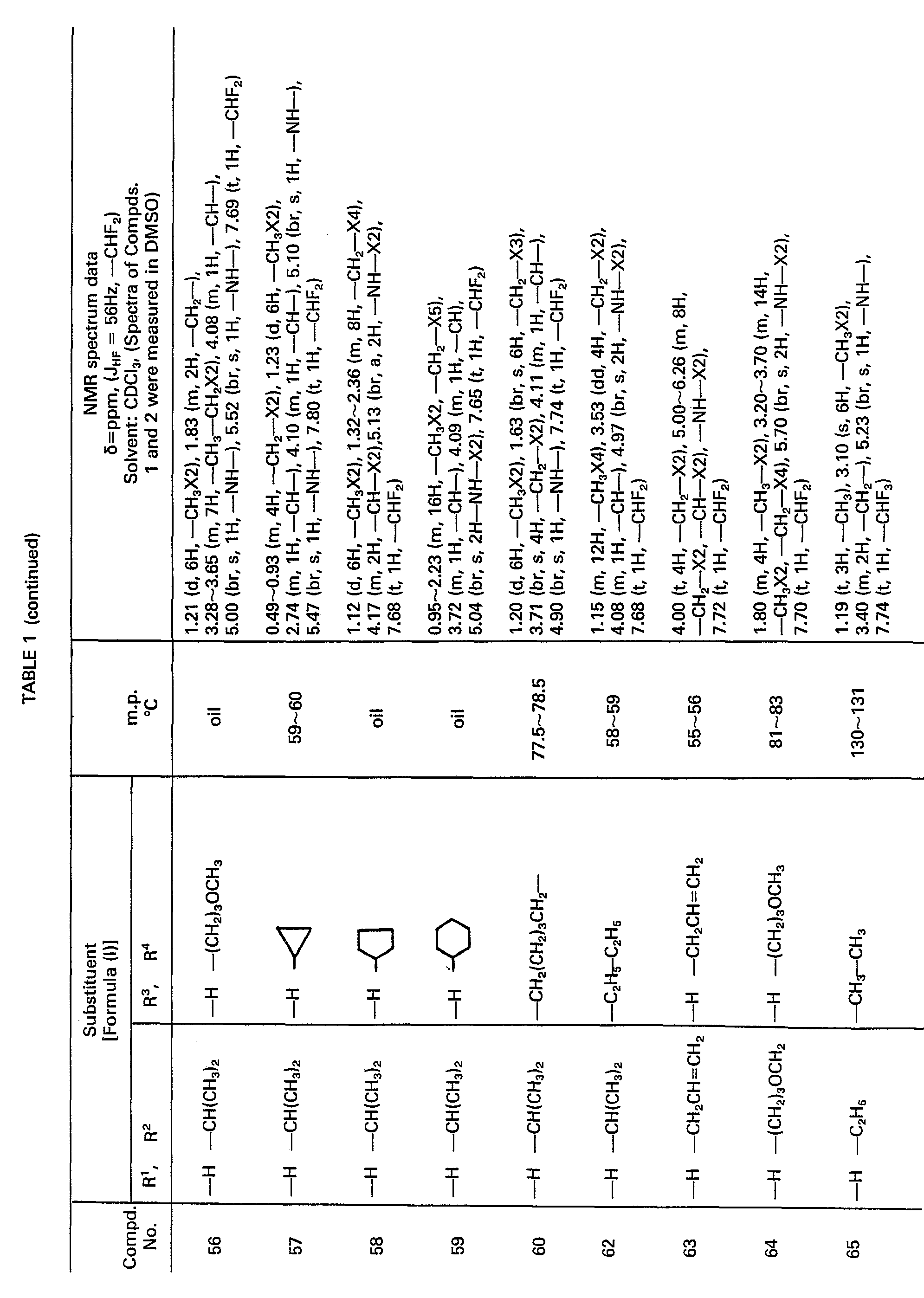
- The physical properties of the compounds provided in Examples 1 and 2, and those of the compounds prepared in the same manner as described in Examples 1 and 2 are shown in the following Table 1.




-


-

-

- The above components are uniformly mixed, kneaded with water, and extruded by an extrusion granulator to give granules.
-

- A solution of the effective ingredient and Emalgen in solvent naphtha is coated over grain bentonite to give granules.
- (1) Herbicidal activity in upland fields
- (i) Pre-emergence test
- Twenty seeds of test plants (Digitaria ciliaris, Echinochloa crus-galli, Polygonum lapathifolium, and Amaranthus viridis) were sowed on the loam charged in a square pot (7.1 x 7.1 cm, 8 cm depth) made of vinyl chloride. After being sowed, the seeds were covered with the loam 5 mm in height and an aqueous suspension (Tween 20 is used at a concentration of 100 ppm as a spreader) of the test compound was applied over the surface of the loam with an automatic metal sprayer.
- The suspension of the test compound was prepared by dilution with water at a concentration of 40 g/ 10L and applied at a rate of 10Uare.
- (ii) Post-emergence test
- Twenty seeds of test plants (Digitaria ciliaris, Echinochloa crus-galli, Polygonum lapathifolium, and Amaranthus viridis) were sowed on the loam charged in a square pot (7.1 x 7.1 cm, 8 cm in depth) made of vinyl chloride. After being sowed, the seeds were covered with the loam and then grown for 7 days at 28°C in a chamber under lighting. The aqueous suspension of the test compound was applied over the foliage of the plants at 2 leaf stage of Digitaria ciliaris and Echinochloa crus-galli; at 1 leaf stage of Polygonum lapathifolium and Amaranthus viridis. The predetermined amount of the test compound was diluted with water and applied at a rate of 10Uare. Tween 20 was used at a concentration of 100 ppm as a spreader.
- (2) Herbicidal activity in paddy fields
- The paddy field soil (sandy clay loam) was charged in a square pot (7.1 x 7.1 cm) and furnished with water 2 cm in depth. Fifteen seeds of test plants in a paddy field i.e., Echinochloa oryzicola and Monchoria vaginalis were sowed respectively. The successive treatment was carried out in the same manner as described in test (1): Herbicidal activity in upland fields.
- In pre-emergence test, after being sowed the mixture of the test compound 40 glare and water 1OUare was immediately applied over the surface of water at a rate of 10L/are.
- In post-emergence test, on the 7th day after being sowed (at 2 leaf stage of Echinochloa oryzicola and Monchoria vaginalis) the mixture of the test compound was applied in the same manner as in pre-emergence test. In all of the tests, the pots were kept at 25°C in a greenhouse. The herbicidal activity was evaluated 3 weeks after the application. [Method of Evaluation]
- The damage of plants was observed by the following evaluation standards.Results in the tests are summarized in Table 2.


- Seeds of each test plant (20 seeds of weeds: Digitaria ciliaris, Echinochloa crus-galli, Polygonum lapathifolium, and Amaranthus viridis; 5 to 10 seeds of crops: corn, wheat, soybean, and cotton) were sowed on the loam charged in a square pot (7.1 x 7.1 cm, 10 cm in depth) made of vinyl chloride. After being sowed, the seeds of the weeds were covered with the loam 5 mm in height and the seeds of the crops were covered with loam 1 cm in height. In pre-emergence test, after being sowed the predetermined amount of the compound of the present invention was diluted with water at a rate of 10Uare and applied uniformly over the surface of the loam with an automatic hand sprayer. Tween 20 was used at a concentration of 100 ppm as a spreader.
- In post-emergence test, the seeds were grown for 10 days in a greenhouse and the compound of the present invention was applied over the foliage of the plants in the same manner as in pre-emergence test at 2 leaf stage of Digitaria ciliaris (at 1 leaf stage of Echinochloa crus-galli and broad-leaved weeds), and at 3 leaf stage of corn (at 1 to 2 leaf stage of other crops).
- In all of the tests, the pots were kept at 25°C in a greenhouse. The herbicidal activity against each weed and the damage to the crops were evaluated 4 weeks after the application in the pre-emergence test and 3 weeks after the application in the post-emergence test.
- Results are shown in Table 3.
- The method of evaluation is the same as in Experiment 1.

Claims (3)


Applications Claiming Priority (2)
| Application Number | Priority Date | Filing Date | Title |
|---|---|---|---|
| JP59170131A JPS6147471A (en) | 1984-08-15 | 1984-08-15 | Triazine derivative and herbicide |
| JP170131/84 | 1984-08-15 |
Publications (2)
| Publication Number | Publication Date |
|---|---|
| EP0171708A1 EP0171708A1 (en) | 1986-02-19 |
| EP0171708B1 true EP0171708B1 (en) | 1988-10-12 |
Family
ID=15899225
Family Applications (1)
| Application Number | Title | Priority Date | Filing Date |
|---|---|---|---|
| EP85109642A Expired EP0171708B1 (en) | 1984-08-15 | 1985-07-31 | Triazine derivatives and herbicides |
Country Status (11)
| Country | Link |
|---|---|
| US (1) | US4648898A (en) |
| EP (1) | EP0171708B1 (en) |
| JP (1) | JPS6147471A (en) |
| KR (1) | KR870000788B1 (en) |
| AR (1) | AR242786A1 (en) |
| AU (1) | AU577140B2 (en) |
| BR (1) | BR8503860A (en) |
| CA (1) | CA1246073A (en) |
| DE (1) | DE3565537D1 (en) |
| GB (1) | GB2163161B (en) |
| ZA (1) | ZA855785B (en) |
Cited By (2)
| Publication number | Priority date | Publication date | Assignee | Title |
|---|---|---|---|---|
| WO2015150541A1 (en) * | 2014-04-03 | 2015-10-08 | Basf Se | Diaminotriazine compound useful as herbicide |
| US10029992B2 (en) | 2014-04-23 | 2018-07-24 | Basf Se | Diaminotriazine compounds and their use as herbicides |
Families Citing this family (6)
| Publication number | Priority date | Publication date | Assignee | Title |
|---|---|---|---|---|
| JPS62126178A (en) * | 1985-11-26 | 1987-06-08 | Mitsubishi Petrochem Co Ltd | New triazine derivatives and herbicides containing them |
| DE3801113A1 (en) * | 1987-07-23 | 1989-02-02 | Bayer Ag | SUBSTITUTED TRIAZINE |
| JPS6454506U (en) * | 1987-09-30 | 1989-04-04 | ||
| JPH01307196A (en) * | 1988-06-02 | 1989-12-12 | Toshiba Corp | X-ray television apparatus |
| US10479777B2 (en) | 2013-07-16 | 2019-11-19 | Basf Se | Herbicidal azines |
| US10941122B2 (en) | 2014-04-11 | 2021-03-09 | Basf Se | Diaminotriazine derivatives as herbicides |
Family Cites Families (1)
| Publication number | Priority date | Publication date | Assignee | Title |
|---|---|---|---|---|
| DE1669954A1 (en) * | 1951-01-28 | 1970-08-20 | Degussa | Process for improving the properties of vulcanizates |
-
1984
- 1984-08-15 JP JP59170131A patent/JPS6147471A/en active Granted
-
1985
- 1985-07-24 CA CA000487430A patent/CA1246073A/en not_active Expired
- 1985-07-31 ZA ZA855785A patent/ZA855785B/en unknown
- 1985-07-31 EP EP85109642A patent/EP0171708B1/en not_active Expired
- 1985-07-31 AU AU45630/85A patent/AU577140B2/en not_active Ceased
- 1985-07-31 DE DE8585109642T patent/DE3565537D1/en not_active Expired
- 1985-08-09 US US06/764,252 patent/US4648898A/en not_active Expired - Fee Related
- 1985-08-12 BR BR8503860A patent/BR8503860A/en not_active IP Right Cessation
- 1985-08-14 KR KR1019850005865A patent/KR870000788B1/en not_active Expired
- 1985-08-14 GB GB08520404A patent/GB2163161B/en not_active Expired
- 1985-08-15 AR AR85301292A patent/AR242786A1/en active
Non-Patent Citations (3)
| Title |
|---|
| CHEMICAL ABSTRACTS, vol. 90, no. 25, June 18, 1979, Columbus, Ohio, USA, M.S. PETROSYAN, "Metabolism of Mesoranil in warm-blooded animals", p. 134, abstract no. 198 545f * |
| CHEMICAL ABSTRACTS, vol. 96, no. 11, March 15, 1982, Columbus, Ohio, USA, MITSUI TOATSU CHEMICALS, INC., "Wide-spectrum rice paddy herbicides", p. 215, abstract no. 81343w * |
| CHEMICAL ABSTRACTS, vol. 96, no. 15, April 12, 1982, Columbus, Ohio, USA, NIHON TOKUSHU NOYAKU SEIZO K.K., "Synergistic herbicide compositions", p. 238, abstract no. 117591s * |
Cited By (2)
| Publication number | Priority date | Publication date | Assignee | Title |
|---|---|---|---|---|
| WO2015150541A1 (en) * | 2014-04-03 | 2015-10-08 | Basf Se | Diaminotriazine compound useful as herbicide |
| US10029992B2 (en) | 2014-04-23 | 2018-07-24 | Basf Se | Diaminotriazine compounds and their use as herbicides |
Also Published As
| Publication number | Publication date |
|---|---|
| BR8503860A (en) | 1986-05-27 |
| AR242786A1 (en) | 1993-05-31 |
| US4648898A (en) | 1987-03-10 |
| GB2163161B (en) | 1988-03-23 |
| GB8520404D0 (en) | 1985-09-18 |
| GB2163161A (en) | 1986-02-19 |
| ZA855785B (en) | 1986-03-26 |
| JPH0368024B2 (en) | 1991-10-25 |
| KR870000788B1 (en) | 1987-04-18 |
| AU4563085A (en) | 1986-02-20 |
| CA1246073A (en) | 1988-12-06 |
| AU577140B2 (en) | 1988-09-15 |
| EP0171708A1 (en) | 1986-02-19 |
| KR860001795A (en) | 1986-03-22 |
| JPS6147471A (en) | 1986-03-07 |
| DE3565537D1 (en) | 1988-11-17 |
Similar Documents
| Publication | Publication Date | Title |
|---|---|---|
| JP2567235B2 (en) | Substituted pyridine sulfonamide compounds, herbicides containing them and method for producing them | |
| EP0184385B1 (en) | N-[(4,6-Dimethoxypyrimidin-2-YL)Aminocarbonyl]-3-trifluoromethylpyridine-2-sulfonamide or salts thereof, herbicidal composition containing the same, and processs for the production of the compound | |
| US4816064A (en) | Triazine derivatives, herbicidal composition containing them, and method of controlling growth of undesired vegetation by using same | |
| NL8000888A (en) | HETEROCYCLIC ESSENTIAL PHENOXY FATTY DERIVATIVES, THE USE AS HERBICIDE AND A PROCESS FOR THE PREPARATION OF THE FENOXY FATTY DERIVATIVES. | |
| EP0739341B1 (en) | Herbicidal aryl and heteroaryl pyrimidines | |
| US4927451A (en) | 3-aryldihydrouracils | |
| CA1307275C (en) | Quinoxaline derivatives and herbicidal composition | |
| SK92995A3 (en) | 4-phenoxycoumarins, method of their preparation and their use as herbicidal agents | |
| US4648898A (en) | Triazine derivatives and herbicides | |
| CS209533B2 (en) | Herbicide means | |
| US4695312A (en) | 4,5,6,7-tetrahydro-2H-indazole derivatives and herbicides containing them | |
| US3141885A (en) | 2-alkylmercaptoamino-4-alkylamino-1, 3, 5-triazines | |
| JPH03173855A (en) | Herbicidal glutaramide acid and its derivative | |
| US4220770A (en) | Triazine compounds | |
| CA1127155A (en) | 3-dimethylamino-4-methyl-1,2,4-triazin-5(4h)-ones compounds and herbicidal compositions | |
| US3451802A (en) | Triazine herbicides | |
| US3503971A (en) | Triazine herbicides | |
| DD142280A5 (en) | HERBICIDE | |
| JP2603557B2 (en) | Pyrimidine or triazine derivatives and herbicides | |
| CA1242720A (en) | 1-(2-oxyaminosulphonylphenylsulphonyl)-3-triazinyl- ureas | |
| US4551168A (en) | Herbicidal 2-(1,3,5-1H-triazin-2-one)-tetrahydrobenzothiazole derivatives, and compositions therefor | |
| KR820001214B1 (en) | Process for the preparation of n-phenyl-n-methyl ureas | |
| PL169374B1 (en) | Herbicide PL | |
| JPS611605A (en) | Selective herbicide containing one or more of acyl-s-triazine | |
| WO2000069853A1 (en) | Azole compounds and herbicide compositions |
Legal Events
| Date | Code | Title | Description |
|---|---|---|---|
| PUAI | Public reference made under article 153(3) epc to a published international application that has entered the european phase |
Free format text: ORIGINAL CODE: 0009012 |
|
| AK | Designated contracting states |
Designated state(s): CH DE FR IT LI NL SE |
|
| 17P | Request for examination filed |
Effective date: 19860410 |
|
| 17Q | First examination report despatched |
Effective date: 19870521 |
|
| ITF | It: translation for a ep patent filed | ||
| GRAA | (expected) grant |
Free format text: ORIGINAL CODE: 0009210 |
|
| AK | Designated contracting states |
Kind code of ref document: B1 Designated state(s): CH DE FR IT LI NL SE |
|
| REF | Corresponds to: |
Ref document number: 3565537 Country of ref document: DE Date of ref document: 19881117 |
|
| ET | Fr: translation filed | ||
| RAP4 | Party data changed (patent owner data changed or rights of a patent transferred) |
Owner name: SHIONOGI & CO., LTD. |
|
| PLBE | No opposition filed within time limit |
Free format text: ORIGINAL CODE: 0009261 |
|
| STAA | Information on the status of an ep patent application or granted ep patent |
Free format text: STATUS: NO OPPOSITION FILED WITHIN TIME LIMIT |
|
| 26N | No opposition filed | ||
| ITTA | It: last paid annual fee | ||
| EAL | Se: european patent in force in sweden |
Ref document number: 85109642.0 |
|
| PGFP | Annual fee paid to national office [announced via postgrant information from national office to epo] |
Ref country code: CH Payment date: 19950629 Year of fee payment: 11 |
|
| PGFP | Annual fee paid to national office [announced via postgrant information from national office to epo] |
Ref country code: DE Payment date: 19950711 Year of fee payment: 11 |
|
| PGFP | Annual fee paid to national office [announced via postgrant information from national office to epo] |
Ref country code: FR Payment date: 19950719 Year of fee payment: 11 |
|
| PGFP | Annual fee paid to national office [announced via postgrant information from national office to epo] |
Ref country code: SE Payment date: 19950720 Year of fee payment: 11 |
|
| PGFP | Annual fee paid to national office [announced via postgrant information from national office to epo] |
Ref country code: NL Payment date: 19950731 Year of fee payment: 11 |
|
| PG25 | Lapsed in a contracting state [announced via postgrant information from national office to epo] |
Ref country code: LI Effective date: 19960731 Ref country code: CH Effective date: 19960731 |
|
| PG25 | Lapsed in a contracting state [announced via postgrant information from national office to epo] |
Ref country code: SE Effective date: 19960801 |
|
| PG25 | Lapsed in a contracting state [announced via postgrant information from national office to epo] |
Ref country code: NL Effective date: 19970201 |
|
| REG | Reference to a national code |
Ref country code: CH Ref legal event code: PL |
|
| PG25 | Lapsed in a contracting state [announced via postgrant information from national office to epo] |
Ref country code: FR Effective date: 19970328 |
|
| NLV4 | Nl: lapsed or anulled due to non-payment of the annual fee |
Effective date: 19970201 |
|
| PG25 | Lapsed in a contracting state [announced via postgrant information from national office to epo] |
Ref country code: DE Effective date: 19970402 |
|
| EUG | Se: european patent has lapsed |
Ref document number: 85109642.0 |
|
| REG | Reference to a national code |
Ref country code: FR Ref legal event code: ST |