EP0171005B1 - Xanthinylmethylthiazolidines, process for their preparation and pharmaceutical compositions containing them - Google Patents
Xanthinylmethylthiazolidines, process for their preparation and pharmaceutical compositions containing them Download PDFInfo
- Publication number
- EP0171005B1 EP0171005B1 EP19850109446 EP85109446A EP0171005B1 EP 0171005 B1 EP0171005 B1 EP 0171005B1 EP 19850109446 EP19850109446 EP 19850109446 EP 85109446 A EP85109446 A EP 85109446A EP 0171005 B1 EP0171005 B1 EP 0171005B1
- Authority
- EP
- European Patent Office
- Prior art keywords
- group
- formula
- methyl
- dimethylxanthin
- thiazolidine
- Prior art date
- Legal status (The legal status is an assumption and is not a legal conclusion. Google has not performed a legal analysis and makes no representation as to the accuracy of the status listed.)
- Expired
Links
- 238000000034 method Methods 0.000 title claims description 27
- 230000008569 process Effects 0.000 title claims description 6
- 238000002360 preparation method Methods 0.000 title claims description 5
- 239000008194 pharmaceutical composition Substances 0.000 title description 4
- UHVDMZDTAFXHAH-UHFFFAOYSA-N 8-(1,3-thiazolidin-2-ylmethyl)-3,7-dihydropurine-2,6-dione Chemical class N1C=2C(=O)NC(=O)NC=2N=C1CC1NCCS1 UHVDMZDTAFXHAH-UHFFFAOYSA-N 0.000 title description 3
- 125000002496 methyl group Chemical group [H]C([H])([H])* 0.000 claims description 141
- 150000001875 compounds Chemical class 0.000 claims description 76
- -1 1,3-dimethylxanthin-7-yl Chemical group 0.000 claims description 42
- 229910052739 hydrogen Inorganic materials 0.000 claims description 30
- 239000001257 hydrogen Substances 0.000 claims description 27
- RTZKZFJDLAIYFH-UHFFFAOYSA-N Diethyl ether Chemical compound CCOCC RTZKZFJDLAIYFH-UHFFFAOYSA-N 0.000 claims description 22
- 125000001997 phenyl group Chemical group [H]C1=C([H])C([H])=C(*)C([H])=C1[H] 0.000 claims description 19
- 125000003178 carboxy group Chemical group [H]OC(*)=O 0.000 claims description 14
- 150000002431 hydrogen Chemical group 0.000 claims description 13
- UFHFLCQGNIYNRP-UHFFFAOYSA-N Hydrogen Chemical compound [H][H] UFHFLCQGNIYNRP-UHFFFAOYSA-N 0.000 claims description 11
- 125000003277 amino group Chemical group 0.000 claims description 11
- 125000000217 alkyl group Chemical group 0.000 claims description 9
- QGZKDVFQNNGYKY-UHFFFAOYSA-N Ammonia Chemical compound N QGZKDVFQNNGYKY-UHFFFAOYSA-N 0.000 claims description 8
- 150000001412 amines Chemical class 0.000 claims description 6
- 150000002148 esters Chemical class 0.000 claims description 6
- 125000005843 halogen group Chemical group 0.000 claims description 6
- 125000001424 substituent group Chemical group 0.000 claims description 6
- 125000000951 phenoxy group Chemical group [H]C1=C([H])C([H])=C(O*)C([H])=C1[H] 0.000 claims description 5
- FALRKNHUBBKYCC-UHFFFAOYSA-N 2-(chloromethyl)pyridine-3-carbonitrile Chemical compound ClCC1=NC=CC=C1C#N FALRKNHUBBKYCC-UHFFFAOYSA-N 0.000 claims description 3
- 125000003349 3-pyridyl group Chemical group N1=C([H])C([*])=C([H])C([H])=C1[H] 0.000 claims description 3
- 125000004195 4-methylpiperazin-1-yl group Chemical group [H]C([H])([H])N1C([H])([H])C([H])([H])N(*)C([H])([H])C1([H])[H] 0.000 claims description 3
- 125000000339 4-pyridyl group Chemical group N1=C([H])C([H])=C([*])C([H])=C1[H] 0.000 claims description 3
- 125000002252 acyl group Chemical class 0.000 claims description 3
- 125000003545 alkoxy group Chemical group 0.000 claims description 3
- 150000001350 alkyl halides Chemical class 0.000 claims description 3
- 229910021529 ammonia Inorganic materials 0.000 claims description 3
- 150000008064 anhydrides Chemical class 0.000 claims description 3
- 125000001495 ethyl group Chemical group [H]C([H])([H])C([H])([H])* 0.000 claims description 3
- 125000004435 hydrogen atom Chemical group [H]* 0.000 claims description 3
- 125000002962 imidazol-1-yl group Chemical group [*]N1C([H])=NC([H])=C1[H] 0.000 claims description 3
- 125000000956 methoxy group Chemical group [H]C([H])([H])O* 0.000 claims description 3
- 125000005322 morpholin-1-yl group Chemical group 0.000 claims description 3
- 125000003356 phenylsulfanyl group Chemical group [*]SC1=C([H])C([H])=C([H])C([H])=C1[H] 0.000 claims description 3
- 125000000587 piperidin-1-yl group Chemical group [H]C1([H])N(*)C([H])([H])C([H])([H])C([H])([H])C1([H])[H] 0.000 claims description 3
- 125000004178 (C1-C4) alkyl group Chemical group 0.000 claims description 2
- 125000005913 (C3-C6) cycloalkyl group Chemical group 0.000 claims description 2
- 125000004214 1-pyrrolidinyl group Chemical group [H]C1([H])N(*)C([H])([H])C([H])([H])C1([H])[H] 0.000 claims description 2
- 230000003213 activating effect Effects 0.000 claims description 2
- 125000004442 acylamino group Chemical group 0.000 claims description 2
- 229910052784 alkaline earth metal Inorganic materials 0.000 claims description 2
- 125000003342 alkenyl group Chemical group 0.000 claims description 2
- 125000004390 alkyl sulfonyl group Chemical group 0.000 claims description 2
- 125000005012 alkyl thioether group Chemical group 0.000 claims description 2
- 125000004202 aminomethyl group Chemical group [H]N([H])C([H])([H])* 0.000 claims description 2
- 150000001540 azides Chemical class 0.000 claims description 2
- 125000002915 carbonyl group Chemical group [*:2]C([*:1])=O 0.000 claims description 2
- 125000001309 chloro group Chemical group Cl* 0.000 claims description 2
- 125000000753 cycloalkyl group Chemical group 0.000 claims description 2
- 229910052731 fluorine Inorganic materials 0.000 claims description 2
- 125000001153 fluoro group Chemical group F* 0.000 claims description 2
- VANNPISTIUFMLH-UHFFFAOYSA-N glutaric anhydride Chemical compound O=C1CCCC(=O)O1 VANNPISTIUFMLH-UHFFFAOYSA-N 0.000 claims description 2
- QJGQUHMNIGDVPM-UHFFFAOYSA-N nitrogen group Chemical group [N] QJGQUHMNIGDVPM-UHFFFAOYSA-N 0.000 claims description 2
- 125000002924 primary amino group Chemical group [H]N([H])* 0.000 claims description 2
- LMBFAGIMSUYTBN-MPZNNTNKSA-N teixobactin Chemical compound C([C@H](C(=O)N[C@@H]([C@@H](C)CC)C(=O)N[C@@H](CO)C(=O)N[C@H](CCC(N)=O)C(=O)N[C@H]([C@@H](C)CC)C(=O)N[C@@H]([C@@H](C)CC)C(=O)N[C@@H](CO)C(=O)N[C@H]1C(N[C@@H](C)C(=O)N[C@@H](C[C@@H]2NC(=N)NC2)C(=O)N[C@H](C(=O)O[C@H]1C)[C@@H](C)CC)=O)NC)C1=CC=CC=C1 LMBFAGIMSUYTBN-MPZNNTNKSA-N 0.000 claims description 2
- 150000003573 thiols Chemical class 0.000 claims description 2
- 125000005208 trialkylammonium group Chemical group 0.000 claims description 2
- 125000004169 (C1-C6) alkyl group Chemical group 0.000 claims 1
- 238000006957 Michael reaction Methods 0.000 claims 1
- 150000001342 alkaline earth metals Chemical class 0.000 claims 1
- 125000002485 formyl group Chemical class [H]C(*)=O 0.000 claims 1
- 229910052736 halogen Inorganic materials 0.000 claims 1
- 150000002367 halogens Chemical class 0.000 claims 1
- 230000000269 nucleophilic effect Effects 0.000 claims 1
- OGYGFUAIIOPWQD-UHFFFAOYSA-N 1,3-thiazolidine Chemical compound C1CSCN1 OGYGFUAIIOPWQD-UHFFFAOYSA-N 0.000 description 64
- LFQSCWFLJHTTHZ-UHFFFAOYSA-N Ethanol Chemical compound CCO LFQSCWFLJHTTHZ-UHFFFAOYSA-N 0.000 description 57
- 239000000243 solution Substances 0.000 description 44
- XLYOFNOQVPJJNP-UHFFFAOYSA-N water Substances O XLYOFNOQVPJJNP-UHFFFAOYSA-N 0.000 description 34
- YMWUJEATGCHHMB-UHFFFAOYSA-N Dichloromethane Chemical compound ClCCl YMWUJEATGCHHMB-UHFFFAOYSA-N 0.000 description 30
- 206010011224 Cough Diseases 0.000 description 27
- 239000002904 solvent Substances 0.000 description 26
- OKKJLVBELUTLKV-UHFFFAOYSA-N Methanol Chemical compound OC OKKJLVBELUTLKV-UHFFFAOYSA-N 0.000 description 24
- 239000000203 mixture Substances 0.000 description 23
- 210000003097 mucus Anatomy 0.000 description 23
- 238000006243 chemical reaction Methods 0.000 description 22
- ZMANZCXQSJIPKH-UHFFFAOYSA-N Triethylamine Chemical compound CCN(CC)CC ZMANZCXQSJIPKH-UHFFFAOYSA-N 0.000 description 21
- HEDRZPFGACZZDS-UHFFFAOYSA-N Chloroform Chemical compound ClC(Cl)Cl HEDRZPFGACZZDS-UHFFFAOYSA-N 0.000 description 16
- 238000011282 treatment Methods 0.000 description 16
- 239000012074 organic phase Substances 0.000 description 14
- WEVYAHXRMPXWCK-UHFFFAOYSA-N Acetonitrile Chemical compound CC#N WEVYAHXRMPXWCK-UHFFFAOYSA-N 0.000 description 12
- UHOVQNZJYSORNB-UHFFFAOYSA-N Benzene Chemical compound C1=CC=CC=C1 UHOVQNZJYSORNB-UHFFFAOYSA-N 0.000 description 12
- IAZDPXIOMUYVGZ-UHFFFAOYSA-N Dimethylsulphoxide Chemical compound CS(C)=O IAZDPXIOMUYVGZ-UHFFFAOYSA-N 0.000 description 12
- XEKOWRVHYACXOJ-UHFFFAOYSA-N Ethyl acetate Chemical compound CCOC(C)=O XEKOWRVHYACXOJ-UHFFFAOYSA-N 0.000 description 12
- PMZURENOXWZQFD-UHFFFAOYSA-L Sodium Sulfate Chemical compound [Na+].[Na+].[O-]S([O-])(=O)=O PMZURENOXWZQFD-UHFFFAOYSA-L 0.000 description 12
- 239000003795 chemical substances by application Substances 0.000 description 12
- 230000001105 regulatory effect Effects 0.000 description 11
- 239000000725 suspension Substances 0.000 description 11
- KFZMGEQAYNKOFK-UHFFFAOYSA-N Isopropanol Chemical compound CC(C)O KFZMGEQAYNKOFK-UHFFFAOYSA-N 0.000 description 9
- ZMXDDKWLCZADIW-UHFFFAOYSA-N N,N-Dimethylformamide Chemical compound CN(C)C=O ZMXDDKWLCZADIW-UHFFFAOYSA-N 0.000 description 9
- YXFVVABEGXRONW-UHFFFAOYSA-N Toluene Chemical compound CC1=CC=CC=C1 YXFVVABEGXRONW-UHFFFAOYSA-N 0.000 description 9
- 229940124584 antitussives Drugs 0.000 description 9
- 239000002585 base Substances 0.000 description 9
- VLKZOEOYAKHREP-UHFFFAOYSA-N n-Hexane Chemical compound CCCCCC VLKZOEOYAKHREP-UHFFFAOYSA-N 0.000 description 9
- 238000012360 testing method Methods 0.000 description 9
- WYURNTSHIVDZCO-UHFFFAOYSA-N Tetrahydrofuran Chemical compound C1CCOC1 WYURNTSHIVDZCO-UHFFFAOYSA-N 0.000 description 8
- 239000002253 acid Substances 0.000 description 8
- 229940035423 ethyl ether Drugs 0.000 description 8
- BWHMMNNQKKPAPP-UHFFFAOYSA-L potassium carbonate Chemical compound [K+].[K+].[O-]C([O-])=O BWHMMNNQKKPAPP-UHFFFAOYSA-L 0.000 description 8
- 125000001501 propionyl group Chemical group O=C([*])C([H])([H])C([H])([H])[H] 0.000 description 8
- 238000010992 reflux Methods 0.000 description 8
- 241000282472 Canis lupus familiaris Species 0.000 description 7
- 206010036790 Productive cough Diseases 0.000 description 7
- 238000005917 acylation reaction Methods 0.000 description 7
- 229910000030 sodium bicarbonate Inorganic materials 0.000 description 7
- 229910052938 sodium sulfate Inorganic materials 0.000 description 7
- 208000024794 sputum Diseases 0.000 description 7
- 210000003802 sputum Anatomy 0.000 description 7
- DZLNHFMRPBPULJ-UHFFFAOYSA-N thioproline Chemical compound OC(=O)C1CSCN1 DZLNHFMRPBPULJ-UHFFFAOYSA-N 0.000 description 7
- IKHGUXGNUITLKF-UHFFFAOYSA-N Acetaldehyde Chemical compound CC=O IKHGUXGNUITLKF-UHFFFAOYSA-N 0.000 description 6
- CSCPPACGZOOCGX-UHFFFAOYSA-N Acetone Chemical compound CC(C)=O CSCPPACGZOOCGX-UHFFFAOYSA-N 0.000 description 6
- 150000001298 alcohols Chemical class 0.000 description 6
- 230000000954 anitussive effect Effects 0.000 description 6
- OROGSEYTTFOCAN-DNJOTXNNSA-N codeine Chemical compound C([C@H]1[C@H](N(CC[C@@]112)C)C3)=C[C@H](O)[C@@H]1OC1=C2C3=CC=C1OC OROGSEYTTFOCAN-DNJOTXNNSA-N 0.000 description 6
- 239000011734 sodium Substances 0.000 description 6
- 235000011152 sodium sulphate Nutrition 0.000 description 6
- GETQZCLCWQTVFV-UHFFFAOYSA-N trimethylamine Chemical compound CN(C)C GETQZCLCWQTVFV-UHFFFAOYSA-N 0.000 description 6
- 238000010626 work up procedure Methods 0.000 description 6
- SCYULBFZEHDVBN-UHFFFAOYSA-N 1,1-Dichloroethane Chemical compound CC(Cl)Cl SCYULBFZEHDVBN-UHFFFAOYSA-N 0.000 description 5
- ZWEHNKRNPOVVGH-UHFFFAOYSA-N 2-Butanone Chemical compound CCC(C)=O ZWEHNKRNPOVVGH-UHFFFAOYSA-N 0.000 description 5
- 241000700199 Cavia porcellus Species 0.000 description 5
- 241001465754 Metazoa Species 0.000 description 5
- 239000000443 aerosol Substances 0.000 description 5
- 239000003434 antitussive agent Substances 0.000 description 5
- 239000012298 atmosphere Substances 0.000 description 5
- 238000002425 crystallisation Methods 0.000 description 5
- RAXXELZNTBOGNW-UHFFFAOYSA-N imidazole Natural products C1=CNC=N1 RAXXELZNTBOGNW-UHFFFAOYSA-N 0.000 description 5
- 239000012442 inert solvent Substances 0.000 description 5
- 230000005764 inhibitory process Effects 0.000 description 5
- 238000007912 intraperitoneal administration Methods 0.000 description 5
- 230000004044 response Effects 0.000 description 5
- 150000003839 salts Chemical class 0.000 description 5
- DKSZLDSPXIWGFO-BLOJGBSASA-N (4r,4ar,7s,7ar,12bs)-9-methoxy-3-methyl-2,4,4a,7,7a,13-hexahydro-1h-4,12-methanobenzofuro[3,2-e]isoquinoline-7-ol;phosphoric acid;hydrate Chemical compound O.OP(O)(O)=O.OP(O)(O)=O.C([C@H]1[C@H](N(CC[C@@]112)C)C3)=C[C@H](O)[C@@H]1OC1=C2C3=CC=C1OC.C([C@H]1[C@H](N(CC[C@@]112)C)C3)=C[C@H](O)[C@@H]1OC1=C2C3=CC=C1OC DKSZLDSPXIWGFO-BLOJGBSASA-N 0.000 description 4
- 241000700198 Cavia Species 0.000 description 4
- XDTMQSROBMDMFD-UHFFFAOYSA-N Cyclohexane Chemical compound C1CCCCC1 XDTMQSROBMDMFD-UHFFFAOYSA-N 0.000 description 4
- SHZGCJCMOBCMKK-UHFFFAOYSA-N D-mannomethylose Natural products CC1OC(O)C(O)C(O)C1O SHZGCJCMOBCMKK-UHFFFAOYSA-N 0.000 description 4
- PNNNRSAQSRJVSB-SLPGGIOYSA-N Fucose Natural products C[C@H](O)[C@@H](O)[C@H](O)[C@H](O)C=O PNNNRSAQSRJVSB-SLPGGIOYSA-N 0.000 description 4
- SHZGCJCMOBCMKK-DHVFOXMCSA-N L-fucopyranose Chemical compound C[C@@H]1OC(O)[C@@H](O)[C@H](O)[C@@H]1O SHZGCJCMOBCMKK-DHVFOXMCSA-N 0.000 description 4
- GLUUGHFHXGJENI-UHFFFAOYSA-N Piperazine Chemical compound C1CNCCN1 GLUUGHFHXGJENI-UHFFFAOYSA-N 0.000 description 4
- UIIMBOGNXHQVGW-UHFFFAOYSA-M Sodium bicarbonate Chemical compound [Na+].OC([O-])=O UIIMBOGNXHQVGW-UHFFFAOYSA-M 0.000 description 4
- 125000002777 acetyl group Chemical group [H]C([H])([H])C(*)=O 0.000 description 4
- 229960004415 codeine phosphate Drugs 0.000 description 4
- 230000008025 crystallization Effects 0.000 description 4
- ZZVUWRFHKOJYTH-UHFFFAOYSA-N diphenhydramine Chemical compound C=1C=CC=CC=1C(OCCN(C)C)C1=CC=CC=C1 ZZVUWRFHKOJYTH-UHFFFAOYSA-N 0.000 description 4
- 230000000694 effects Effects 0.000 description 4
- 229940093499 ethyl acetate Drugs 0.000 description 4
- 235000019439 ethyl acetate Nutrition 0.000 description 4
- 238000002474 experimental method Methods 0.000 description 4
- 239000011261 inert gas Substances 0.000 description 4
- 230000001575 pathological effect Effects 0.000 description 4
- SCVFZCLFOSHCOH-UHFFFAOYSA-M potassium acetate Chemical compound [K+].CC([O-])=O SCVFZCLFOSHCOH-UHFFFAOYSA-M 0.000 description 4
- 229910000027 potassium carbonate Inorganic materials 0.000 description 4
- 125000003396 thiol group Chemical group [H]S* 0.000 description 4
- RIOQSEWOXXDEQQ-UHFFFAOYSA-N triphenylphosphine Chemical compound C1=CC=CC=C1P(C=1C=CC=CC=1)C1=CC=CC=C1 RIOQSEWOXXDEQQ-UHFFFAOYSA-N 0.000 description 4
- 230000000294 tussive effect Effects 0.000 description 4
- WSLDOOZREJYCGB-UHFFFAOYSA-N 1,2-Dichloroethane Chemical compound ClCCCl WSLDOOZREJYCGB-UHFFFAOYSA-N 0.000 description 3
- VHYFNPMBLIVWCW-UHFFFAOYSA-N 4-Dimethylaminopyridine Chemical compound CN(C)C1=CC=NC=C1 VHYFNPMBLIVWCW-UHFFFAOYSA-N 0.000 description 3
- QTBSBXVTEAMEQO-UHFFFAOYSA-N Acetic acid Chemical compound CC(O)=O QTBSBXVTEAMEQO-UHFFFAOYSA-N 0.000 description 3
- QOSSAOTZNIDXMA-UHFFFAOYSA-N Dicylcohexylcarbodiimide Chemical compound C1CCCCC1N=C=NC1CCCCC1 QOSSAOTZNIDXMA-UHFFFAOYSA-N 0.000 description 3
- XTHFKEDIFFGKHM-UHFFFAOYSA-N Dimethoxyethane Chemical compound COCCOC XTHFKEDIFFGKHM-UHFFFAOYSA-N 0.000 description 3
- DGAQECJNVWCQMB-PUAWFVPOSA-M Ilexoside XXIX Chemical compound C[C@@H]1CC[C@@]2(CC[C@@]3(C(=CC[C@H]4[C@]3(CC[C@@H]5[C@@]4(CC[C@@H](C5(C)C)OS(=O)(=O)[O-])C)C)[C@@H]2[C@]1(C)O)C)C(=O)O[C@H]6[C@@H]([C@H]([C@@H]([C@H](O6)CO)O)O)O.[Na+] DGAQECJNVWCQMB-PUAWFVPOSA-M 0.000 description 3
- 241000283973 Oryctolagus cuniculus Species 0.000 description 3
- ZLMJMSJWJFRBEC-UHFFFAOYSA-N Potassium Chemical compound [K] ZLMJMSJWJFRBEC-UHFFFAOYSA-N 0.000 description 3
- GBFLZEXEOZUWRN-VKHMYHEASA-N S-carboxymethyl-L-cysteine Chemical compound OC(=O)[C@@H](N)CSCC(O)=O GBFLZEXEOZUWRN-VKHMYHEASA-N 0.000 description 3
- 150000007513 acids Chemical class 0.000 description 3
- 230000009471 action Effects 0.000 description 3
- 230000010933 acylation Effects 0.000 description 3
- 150000001299 aldehydes Chemical class 0.000 description 3
- SQVRNKJHWKZAKO-UHFFFAOYSA-N beta-N-Acetyl-D-neuraminic acid Natural products CC(=O)NC1C(O)CC(O)(C(O)=O)OC1C(O)C(O)CO SQVRNKJHWKZAKO-UHFFFAOYSA-N 0.000 description 3
- 229910052794 bromium Inorganic materials 0.000 description 3
- 230000003182 bronchodilatating effect Effects 0.000 description 3
- 239000003153 chemical reaction reagent Substances 0.000 description 3
- 239000000460 chlorine Substances 0.000 description 3
- 229910052801 chlorine Inorganic materials 0.000 description 3
- KRKNYBCHXYNGOX-UHFFFAOYSA-N citric acid Chemical compound OC(=O)CC(O)(C(O)=O)CC(O)=O KRKNYBCHXYNGOX-UHFFFAOYSA-N 0.000 description 3
- 229960004126 codeine Drugs 0.000 description 3
- 229960001760 dimethyl sulfoxide Drugs 0.000 description 3
- 150000002170 ethers Chemical class 0.000 description 3
- OROGSEYTTFOCAN-UHFFFAOYSA-N hydrocodone Natural products C1C(N(CCC234)C)C2C=CC(O)C3OC2=C4C1=CC=C2OC OROGSEYTTFOCAN-UHFFFAOYSA-N 0.000 description 3
- 238000004519 manufacturing process Methods 0.000 description 3
- 230000004048 modification Effects 0.000 description 3
- 238000012986 modification Methods 0.000 description 3
- 230000003287 optical effect Effects 0.000 description 3
- 150000007530 organic bases Chemical class 0.000 description 3
- 229910052700 potassium Inorganic materials 0.000 description 3
- 239000011591 potassium Substances 0.000 description 3
- 235000007686 potassium Nutrition 0.000 description 3
- 239000002244 precipitate Substances 0.000 description 3
- 239000000047 product Substances 0.000 description 3
- BDERNNFJNOPAEC-UHFFFAOYSA-N propan-1-ol Chemical compound CCCO BDERNNFJNOPAEC-UHFFFAOYSA-N 0.000 description 3
- 235000018102 proteins Nutrition 0.000 description 3
- 102000004169 proteins and genes Human genes 0.000 description 3
- 108090000623 proteins and genes Proteins 0.000 description 3
- 230000035484 reaction time Effects 0.000 description 3
- SQVRNKJHWKZAKO-OQPLDHBCSA-N sialic acid Chemical compound CC(=O)N[C@@H]1[C@@H](O)C[C@@](O)(C(O)=O)OC1[C@H](O)[C@H](O)CO SQVRNKJHWKZAKO-OQPLDHBCSA-N 0.000 description 3
- 229910052708 sodium Inorganic materials 0.000 description 3
- 235000015424 sodium Nutrition 0.000 description 3
- FVAUCKIRQBBSSJ-UHFFFAOYSA-M sodium iodide Chemical compound [Na+].[I-] FVAUCKIRQBBSSJ-UHFFFAOYSA-M 0.000 description 3
- 239000007787 solid Substances 0.000 description 3
- 241000894007 species Species 0.000 description 3
- 238000003756 stirring Methods 0.000 description 3
- 239000000126 substance Substances 0.000 description 3
- 150000003548 thiazolidines Chemical class 0.000 description 3
- 210000003437 trachea Anatomy 0.000 description 3
- KWGRBVOPPLSCSI-WPRPVWTQSA-N (-)-ephedrine Chemical compound CN[C@@H](C)[C@H](O)C1=CC=CC=C1 KWGRBVOPPLSCSI-WPRPVWTQSA-N 0.000 description 2
- QIJRTFXNRTXDIP-UHFFFAOYSA-N (1-carboxy-2-sulfanylethyl)azanium;chloride;hydrate Chemical compound O.Cl.SCC(N)C(O)=O QIJRTFXNRTXDIP-UHFFFAOYSA-N 0.000 description 2
- ADFXKUOMJKEIND-UHFFFAOYSA-N 1,3-dicyclohexylurea Chemical compound C1CCCCC1NC(=O)NC1CCCCC1 ADFXKUOMJKEIND-UHFFFAOYSA-N 0.000 description 2
- MPGQQQKGAXDBDN-UHFFFAOYSA-N 1,3-thiazolidin-3-ium;chloride Chemical compound Cl.C1CSCN1 MPGQQQKGAXDBDN-UHFFFAOYSA-N 0.000 description 2
- RYHBNJHYFVUHQT-UHFFFAOYSA-N 1,4-Dioxane Chemical compound C1COCCO1 RYHBNJHYFVUHQT-UHFFFAOYSA-N 0.000 description 2
- YNCPXBIZAPNQIJ-UHFFFAOYSA-N 1h-imidazole;sodium Chemical compound [Na].C1=CNC=N1 YNCPXBIZAPNQIJ-UHFFFAOYSA-N 0.000 description 2
- JYWKEVKEKOTYEX-UHFFFAOYSA-N 2,6-dibromo-4-chloroiminocyclohexa-2,5-dien-1-one Chemical compound ClN=C1C=C(Br)C(=O)C(Br)=C1 JYWKEVKEKOTYEX-UHFFFAOYSA-N 0.000 description 2
- OGMADIBCHLQMIP-UHFFFAOYSA-N 2-aminoethanethiol;hydron;chloride Chemical compound Cl.NCCS OGMADIBCHLQMIP-UHFFFAOYSA-N 0.000 description 2
- BFSVOASYOCHEOV-UHFFFAOYSA-N 2-diethylaminoethanol Chemical compound CCN(CC)CCO BFSVOASYOCHEOV-UHFFFAOYSA-N 0.000 description 2
- VHUUQVKOLVNVRT-UHFFFAOYSA-N Ammonium hydroxide Chemical compound [NH4+].[OH-] VHUUQVKOLVNVRT-UHFFFAOYSA-N 0.000 description 2
- WKBOTKDWSSQWDR-UHFFFAOYSA-N Bromine atom Chemical compound [Br] WKBOTKDWSSQWDR-UHFFFAOYSA-N 0.000 description 2
- 0 CC(C)C(C)(*)SC(*)N Chemical compound CC(C)C(C)(*)SC(*)N 0.000 description 2
- OYPRJOBELJOOCE-UHFFFAOYSA-N Calcium Chemical compound [Ca] OYPRJOBELJOOCE-UHFFFAOYSA-N 0.000 description 2
- ODINCKMPIJJUCX-UHFFFAOYSA-N Calcium oxide Chemical compound [Ca]=O ODINCKMPIJJUCX-UHFFFAOYSA-N 0.000 description 2
- VEXZGXHMUGYJMC-UHFFFAOYSA-M Chloride anion Chemical compound [Cl-] VEXZGXHMUGYJMC-UHFFFAOYSA-M 0.000 description 2
- ZAMOUSCENKQFHK-UHFFFAOYSA-N Chlorine atom Chemical compound [Cl] ZAMOUSCENKQFHK-UHFFFAOYSA-N 0.000 description 2
- VGCXGMAHQTYDJK-UHFFFAOYSA-N Chloroacetyl chloride Chemical compound ClCC(Cl)=O VGCXGMAHQTYDJK-UHFFFAOYSA-N 0.000 description 2
- ROSDSFDQCJNGOL-UHFFFAOYSA-N Dimethylamine Chemical compound CNC ROSDSFDQCJNGOL-UHFFFAOYSA-N 0.000 description 2
- LYCAIKOWRPUZTN-UHFFFAOYSA-N Ethylene glycol Chemical compound OCCO LYCAIKOWRPUZTN-UHFFFAOYSA-N 0.000 description 2
- VEXZGXHMUGYJMC-UHFFFAOYSA-N Hydrochloric acid Chemical compound Cl VEXZGXHMUGYJMC-UHFFFAOYSA-N 0.000 description 2
- PWKSKIMOESPYIA-BYPYZUCNSA-N L-N-acetyl-Cysteine Chemical compound CC(=O)N[C@@H](CS)C(O)=O PWKSKIMOESPYIA-BYPYZUCNSA-N 0.000 description 2
- BAVYZALUXZFZLV-UHFFFAOYSA-N Methylamine Chemical compound NC BAVYZALUXZFZLV-UHFFFAOYSA-N 0.000 description 2
- YNAVUWVOSKDBBP-UHFFFAOYSA-N Morpholine Chemical compound C1COCCN1 YNAVUWVOSKDBBP-UHFFFAOYSA-N 0.000 description 2
- 241000699670 Mus sp. Species 0.000 description 2
- 239000007832 Na2SO4 Substances 0.000 description 2
- KFSLWBXXFJQRDL-UHFFFAOYSA-N Peracetic acid Chemical compound CC(=O)OO KFSLWBXXFJQRDL-UHFFFAOYSA-N 0.000 description 2
- BHHGXPLMPWCGHP-UHFFFAOYSA-N Phenethylamine Chemical compound NCCC1=CC=CC=C1 BHHGXPLMPWCGHP-UHFFFAOYSA-N 0.000 description 2
- NQRYJNQNLNOLGT-UHFFFAOYSA-N Piperidine Chemical compound C1CCNCC1 NQRYJNQNLNOLGT-UHFFFAOYSA-N 0.000 description 2
- JUJWROOIHBZHMG-UHFFFAOYSA-N Pyridine Chemical compound C1=CC=NC=C1 JUJWROOIHBZHMG-UHFFFAOYSA-N 0.000 description 2
- 208000027790 Rib fracture Diseases 0.000 description 2
- CDBYLPFSWZWCQE-UHFFFAOYSA-L Sodium Carbonate Chemical compound [Na+].[Na+].[O-]C([O-])=O CDBYLPFSWZWCQE-UHFFFAOYSA-L 0.000 description 2
- HEMHJVSKTPXQMS-UHFFFAOYSA-M Sodium hydroxide Chemical compound [OH-].[Na+] HEMHJVSKTPXQMS-UHFFFAOYSA-M 0.000 description 2
- WQDUMFSSJAZKTM-UHFFFAOYSA-N Sodium methoxide Chemical compound [Na+].[O-]C WQDUMFSSJAZKTM-UHFFFAOYSA-N 0.000 description 2
- 230000002159 abnormal effect Effects 0.000 description 2
- MDMVJFHANIPEPR-UHFFFAOYSA-N acetaldehyde;3,7-dimethylpurine-2,6-dione Chemical compound CC=O.CN1C(=O)NC(=O)C2=C1N=CN2C MDMVJFHANIPEPR-UHFFFAOYSA-N 0.000 description 2
- 229960004308 acetylcysteine Drugs 0.000 description 2
- 230000001154 acute effect Effects 0.000 description 2
- 239000003513 alkali Substances 0.000 description 2
- WQZGKKKJIJFFOK-PHYPRBDBSA-N alpha-D-galactose Chemical compound OC[C@H]1O[C@H](O)[C@H](O)[C@@H](O)[C@H]1O WQZGKKKJIJFFOK-PHYPRBDBSA-N 0.000 description 2
- 235000011114 ammonium hydroxide Nutrition 0.000 description 2
- 239000007864 aqueous solution Substances 0.000 description 2
- 230000037396 body weight Effects 0.000 description 2
- GDTBXPJZTBHREO-UHFFFAOYSA-N bromine Substances BrBr GDTBXPJZTBHREO-UHFFFAOYSA-N 0.000 description 2
- 206010006451 bronchitis Diseases 0.000 description 2
- 229910052791 calcium Inorganic materials 0.000 description 2
- 239000002775 capsule Substances 0.000 description 2
- 150000001718 carbodiimides Chemical class 0.000 description 2
- 150000001732 carboxylic acid derivatives Chemical class 0.000 description 2
- 230000003197 catalytic effect Effects 0.000 description 2
- 239000012050 conventional carrier Substances 0.000 description 2
- 238000001816 cooling Methods 0.000 description 2
- 239000013058 crude material Substances 0.000 description 2
- PAFZNILMFXTMIY-UHFFFAOYSA-N cyclohexylamine Chemical compound NC1CCCCC1 PAFZNILMFXTMIY-UHFFFAOYSA-N 0.000 description 2
- 229940097265 cysteamine hydrochloride Drugs 0.000 description 2
- 229960001305 cysteine hydrochloride Drugs 0.000 description 2
- 239000003085 diluting agent Substances 0.000 description 2
- RIFGWPKJUGCATF-UHFFFAOYSA-N ethyl chloroformate Chemical compound CCOC(Cl)=O RIFGWPKJUGCATF-UHFFFAOYSA-N 0.000 description 2
- 238000001704 evaporation Methods 0.000 description 2
- 230000008020 evaporation Effects 0.000 description 2
- 229930182830 galactose Natural products 0.000 description 2
- 150000008282 halocarbons Chemical class 0.000 description 2
- 229930195733 hydrocarbon Natural products 0.000 description 2
- 150000002430 hydrocarbons Chemical class 0.000 description 2
- 150000002460 imidazoles Chemical class 0.000 description 2
- 239000007943 implant Substances 0.000 description 2
- 150000007529 inorganic bases Chemical class 0.000 description 2
- 238000001990 intravenous administration Methods 0.000 description 2
- 229910052740 iodine Inorganic materials 0.000 description 2
- 150000002576 ketones Chemical class 0.000 description 2
- HQKMJHAJHXVSDF-UHFFFAOYSA-L magnesium stearate Chemical compound [Mg+2].CCCCCCCCCCCCCCCCCC([O-])=O.CCCCCCCCCCCCCCCCCC([O-])=O HQKMJHAJHXVSDF-UHFFFAOYSA-L 0.000 description 2
- 238000002156 mixing Methods 0.000 description 2
- 230000007935 neutral effect Effects 0.000 description 2
- 239000012299 nitrogen atmosphere Substances 0.000 description 2
- 231100000252 nontoxic Toxicity 0.000 description 2
- 230000003000 nontoxic effect Effects 0.000 description 2
- 239000012038 nucleophile Substances 0.000 description 2
- 238000007254 oxidation reaction Methods 0.000 description 2
- 238000011458 pharmacological treatment Methods 0.000 description 2
- 235000011056 potassium acetate Nutrition 0.000 description 2
- 239000003380 propellant Substances 0.000 description 2
- 230000009467 reduction Effects 0.000 description 2
- 229920006395 saturated elastomer Polymers 0.000 description 2
- 229910000162 sodium phosphate Inorganic materials 0.000 description 2
- 159000000000 sodium salts Chemical class 0.000 description 2
- 230000000638 stimulation Effects 0.000 description 2
- 239000003826 tablet Substances 0.000 description 2
- 125000000999 tert-butyl group Chemical group [H]C([H])([H])C(*)(C([H])([H])[H])C([H])([H])[H] 0.000 description 2
- YLQBMQCUIZJEEH-UHFFFAOYSA-N tetrahydrofuran Natural products C=1C=COC=1 YLQBMQCUIZJEEH-UHFFFAOYSA-N 0.000 description 2
- YAPQBXQYLJRXSA-UHFFFAOYSA-N theobromine Chemical compound CN1C(=O)NC(=O)C2=C1N=CN2C YAPQBXQYLJRXSA-UHFFFAOYSA-N 0.000 description 2
- 150000003566 thiocarboxylic acids Chemical class 0.000 description 2
- IMFACGCPASFAPR-UHFFFAOYSA-N tributylamine Chemical compound CCCCN(CCCC)CCCC IMFACGCPASFAPR-UHFFFAOYSA-N 0.000 description 2
- 238000005406 washing Methods 0.000 description 2
- ZDIYGBWFISUTHI-GQCTYLIASA-N (e)-3-(3,4-diacetyloxyphenyl)prop-2-enoic acid Chemical compound CC(=O)OC1=CC=C(\C=C\C(O)=O)C=C1OC(C)=O ZDIYGBWFISUTHI-GQCTYLIASA-N 0.000 description 1
- NWUYHJFMYQTDRP-UHFFFAOYSA-N 1,2-bis(ethenyl)benzene;1-ethenyl-2-ethylbenzene;styrene Chemical compound C=CC1=CC=CC=C1.CCC1=CC=CC=C1C=C.C=CC1=CC=CC=C1C=C NWUYHJFMYQTDRP-UHFFFAOYSA-N 0.000 description 1
- DDMOUSALMHHKOS-UHFFFAOYSA-N 1,2-dichloro-1,1,2,2-tetrafluoroethane Chemical compound FC(F)(Cl)C(F)(F)Cl DDMOUSALMHHKOS-UHFFFAOYSA-N 0.000 description 1
- PVOAHINGSUIXLS-UHFFFAOYSA-N 1-Methylpiperazine Chemical compound CN1CCNCC1 PVOAHINGSUIXLS-UHFFFAOYSA-N 0.000 description 1
- IIZPXYDJLKNOIY-JXPKJXOSSA-N 1-palmitoyl-2-arachidonoyl-sn-glycero-3-phosphocholine Chemical compound CCCCCCCCCCCCCCCC(=O)OC[C@H](COP([O-])(=O)OCC[N+](C)(C)C)OC(=O)CCC\C=C/C\C=C/C\C=C/C\C=C/CCCCC IIZPXYDJLKNOIY-JXPKJXOSSA-N 0.000 description 1
- RQEUFEKYXDPUSK-UHFFFAOYSA-N 1-phenylethylamine Chemical compound CC(N)C1=CC=CC=C1 RQEUFEKYXDPUSK-UHFFFAOYSA-N 0.000 description 1
- JCXZKUZXVQKENT-UHFFFAOYSA-N 2-(4-methylpiperazin-1-ium-1-yl)acetate Chemical compound CN1CCN(CC(O)=O)CC1 JCXZKUZXVQKENT-UHFFFAOYSA-N 0.000 description 1
- YOETUEMZNOLGDB-UHFFFAOYSA-N 2-methylpropyl carbonochloridate Chemical compound CC(C)COC(Cl)=O YOETUEMZNOLGDB-UHFFFAOYSA-N 0.000 description 1
- GUGQQGROXHPINL-UHFFFAOYSA-N 2-oxobutanoyl chloride Chemical compound CCC(=O)C(Cl)=O GUGQQGROXHPINL-UHFFFAOYSA-N 0.000 description 1
- WFCSWCVEJLETKA-UHFFFAOYSA-N 2-piperazin-1-ylethanol Chemical compound OCCN1CCNCC1 WFCSWCVEJLETKA-UHFFFAOYSA-N 0.000 description 1
- JHZOXYGFQMROFJ-UHFFFAOYSA-N 3,5-dibromo-2-hydroxybenzaldehyde Chemical compound OC1=C(Br)C=C(Br)C=C1C=O JHZOXYGFQMROFJ-UHFFFAOYSA-N 0.000 description 1
- LJGHYPLBDBRCRZ-UHFFFAOYSA-N 3-(3-aminophenyl)sulfonylaniline Chemical compound NC1=CC=CC(S(=O)(=O)C=2C=C(N)C=CC=2)=C1 LJGHYPLBDBRCRZ-UHFFFAOYSA-N 0.000 description 1
- YNJSNEKCXVFDKW-UHFFFAOYSA-N 3-(5-amino-1h-indol-3-yl)-2-azaniumylpropanoate Chemical compound C1=C(N)C=C2C(CC(N)C(O)=O)=CNC2=C1 YNJSNEKCXVFDKW-UHFFFAOYSA-N 0.000 description 1
- BMYNFMYTOJXKLE-UHFFFAOYSA-N 3-azaniumyl-2-hydroxypropanoate Chemical compound NCC(O)C(O)=O BMYNFMYTOJXKLE-UHFFFAOYSA-N 0.000 description 1
- SZQVEGOXJYTLLB-UHFFFAOYSA-N 3-cyclopentylpropanoyl chloride Chemical compound ClC(=O)CCC1CCCC1 SZQVEGOXJYTLLB-UHFFFAOYSA-N 0.000 description 1
- QPLPMPAMOJIAMN-UHFFFAOYSA-N 3-oxobutanethioic s-acid Chemical compound CC(=O)CC(O)=S QPLPMPAMOJIAMN-UHFFFAOYSA-N 0.000 description 1
- UOQXIWFBQSVDPP-UHFFFAOYSA-N 4-fluorobenzaldehyde Chemical compound FC1=CC=C(C=O)C=C1 UOQXIWFBQSVDPP-UHFFFAOYSA-N 0.000 description 1
- YZIMZQYSHWEDED-UHFFFAOYSA-N 4-hydroxy-3-methoxy-5-(morpholin-4-ylmethyl)benzaldehyde Chemical compound COC1=CC(C=O)=CC(CN2CCOCC2)=C1O YZIMZQYSHWEDED-UHFFFAOYSA-N 0.000 description 1
- YYROPELSRYBVMQ-UHFFFAOYSA-N 4-toluenesulfonyl chloride Chemical compound CC1=CC=C(S(Cl)(=O)=O)C=C1 YYROPELSRYBVMQ-UHFFFAOYSA-N 0.000 description 1
- ZCYVEMRRCGMTRW-UHFFFAOYSA-N 7553-56-2 Chemical compound [I] ZCYVEMRRCGMTRW-UHFFFAOYSA-N 0.000 description 1
- FTXXYELYZZXUBN-UHFFFAOYSA-N 8-(1-methylsulfanylpyrrolidin-2-yl)-2,6-dioxo-3H-purine-4-carboxylic acid Chemical class C(=O)(O)C12NC(NC(C2=NC(=N1)C1N(CCC1)SC)=O)=O FTXXYELYZZXUBN-UHFFFAOYSA-N 0.000 description 1
- HBAQYPYDRFILMT-UHFFFAOYSA-N 8-[3-(1-cyclopropylpyrazol-4-yl)-1H-pyrazolo[4,3-d]pyrimidin-5-yl]-3-methyl-3,8-diazabicyclo[3.2.1]octan-2-one Chemical class C1(CC1)N1N=CC(=C1)C1=NNC2=C1N=C(N=C2)N1C2C(N(CC1CC2)C)=O HBAQYPYDRFILMT-UHFFFAOYSA-N 0.000 description 1
- QTBSBXVTEAMEQO-UHFFFAOYSA-M Acetate Chemical compound CC([O-])=O QTBSBXVTEAMEQO-UHFFFAOYSA-M 0.000 description 1
- GUBGYTABKSRVRQ-XLOQQCSPSA-N Alpha-Lactose Chemical compound O[C@@H]1[C@@H](O)[C@@H](O)[C@@H](CO)O[C@H]1O[C@@H]1[C@@H](CO)O[C@H](O)[C@H](O)[C@H]1O GUBGYTABKSRVRQ-XLOQQCSPSA-N 0.000 description 1
- QGZKDVFQNNGYKY-UHFFFAOYSA-O Ammonium Chemical compound [NH4+] QGZKDVFQNNGYKY-UHFFFAOYSA-O 0.000 description 1
- NLXLAEXVIDQMFP-UHFFFAOYSA-N Ammonium chloride Substances [NH4+].[Cl-] NLXLAEXVIDQMFP-UHFFFAOYSA-N 0.000 description 1
- 239000004475 Arginine Substances 0.000 description 1
- BVKZGUZCCUSVTD-UHFFFAOYSA-M Bicarbonate Chemical compound OC([O-])=O BVKZGUZCCUSVTD-UHFFFAOYSA-M 0.000 description 1
- 206010006458 Bronchitis chronic Diseases 0.000 description 1
- BVKZGUZCCUSVTD-UHFFFAOYSA-L Carbonate Chemical compound [O-]C([O-])=O BVKZGUZCCUSVTD-UHFFFAOYSA-L 0.000 description 1
- FBPFZTCFMRRESA-FSIIMWSLSA-N D-Glucitol Natural products OC[C@H](O)[C@H](O)[C@@H](O)[C@H](O)CO FBPFZTCFMRRESA-FSIIMWSLSA-N 0.000 description 1
- FBPFZTCFMRRESA-KVTDHHQDSA-N D-Mannitol Chemical compound OC[C@@H](O)[C@@H](O)[C@H](O)[C@H](O)CO FBPFZTCFMRRESA-KVTDHHQDSA-N 0.000 description 1
- FBPFZTCFMRRESA-JGWLITMVSA-N D-glucitol Chemical compound OC[C@H](O)[C@@H](O)[C@H](O)[C@H](O)CO FBPFZTCFMRRESA-JGWLITMVSA-N 0.000 description 1
- 239000004338 Dichlorodifluoromethane Substances 0.000 description 1
- ZAFNJMIOTHYJRJ-UHFFFAOYSA-N Diisopropyl ether Chemical compound CC(C)OC(C)C ZAFNJMIOTHYJRJ-UHFFFAOYSA-N 0.000 description 1
- PIICEJLVQHRZGT-UHFFFAOYSA-N Ethylenediamine Chemical compound NCCN PIICEJLVQHRZGT-UHFFFAOYSA-N 0.000 description 1
- BDAGIHXWWSANSR-UHFFFAOYSA-M Formate Chemical compound [O-]C=O BDAGIHXWWSANSR-UHFFFAOYSA-M 0.000 description 1
- 239000001828 Gelatine Substances 0.000 description 1
- WQZGKKKJIJFFOK-GASJEMHNSA-N Glucose Natural products OC[C@H]1OC(O)[C@H](O)[C@@H](O)[C@@H]1O WQZGKKKJIJFFOK-GASJEMHNSA-N 0.000 description 1
- ODKSFYDXXFIFQN-BYPYZUCNSA-P L-argininium(2+) Chemical compound NC(=[NH2+])NCCC[C@H]([NH3+])C(O)=O ODKSFYDXXFIFQN-BYPYZUCNSA-P 0.000 description 1
- LEVWYRKDKASIDU-IMJSIDKUSA-N L-cystine Chemical compound [O-]C(=O)[C@@H]([NH3+])CSSC[C@H]([NH3+])C([O-])=O LEVWYRKDKASIDU-IMJSIDKUSA-N 0.000 description 1
- KDXKERNSBIXSRK-YFKPBYRVSA-N L-lysine Chemical compound NCCCC[C@H](N)C(O)=O KDXKERNSBIXSRK-YFKPBYRVSA-N 0.000 description 1
- GUBGYTABKSRVRQ-QKKXKWKRSA-N Lactose Natural products OC[C@H]1O[C@@H](O[C@H]2[C@H](O)[C@@H](O)C(O)O[C@@H]2CO)[C@H](O)[C@@H](O)[C@H]1O GUBGYTABKSRVRQ-QKKXKWKRSA-N 0.000 description 1
- WHXSMMKQMYFTQS-UHFFFAOYSA-N Lithium Chemical compound [Li] WHXSMMKQMYFTQS-UHFFFAOYSA-N 0.000 description 1
- KDXKERNSBIXSRK-UHFFFAOYSA-N Lysine Natural products NCCCCC(N)C(O)=O KDXKERNSBIXSRK-UHFFFAOYSA-N 0.000 description 1
- 239000004472 Lysine Substances 0.000 description 1
- FYYHWMGAXLPEAU-UHFFFAOYSA-N Magnesium Chemical compound [Mg] FYYHWMGAXLPEAU-UHFFFAOYSA-N 0.000 description 1
- 229930195725 Mannitol Natural products 0.000 description 1
- 206010027476 Metastases Diseases 0.000 description 1
- 238000006845 Michael addition reaction Methods 0.000 description 1
- 102000001621 Mucoproteins Human genes 0.000 description 1
- 108010093825 Mucoproteins Proteins 0.000 description 1
- 208000034578 Multiple myelomas Diseases 0.000 description 1
- AFCARXCZXQIEQB-UHFFFAOYSA-N N-[3-oxo-3-(2,4,6,7-tetrahydrotriazolo[4,5-c]pyridin-5-yl)propyl]-2-[[3-(trifluoromethoxy)phenyl]methylamino]pyrimidine-5-carboxamide Chemical compound O=C(CCNC(=O)C=1C=NC(=NC=1)NCC1=CC(=CC=C1)OC(F)(F)F)N1CC2=C(CC1)NN=N2 AFCARXCZXQIEQB-UHFFFAOYSA-N 0.000 description 1
- UEEJHVSXFDXPFK-UHFFFAOYSA-N N-dimethylaminoethanol Chemical compound CN(C)CCO UEEJHVSXFDXPFK-UHFFFAOYSA-N 0.000 description 1
- UGJBHEZMOKVTIM-UHFFFAOYSA-N N-formylglycine Chemical compound OC(=O)CNC=O UGJBHEZMOKVTIM-UHFFFAOYSA-N 0.000 description 1
- XTUVJUMINZSXGF-UHFFFAOYSA-N N-methylcyclohexylamine Chemical compound CNC1CCCCC1 XTUVJUMINZSXGF-UHFFFAOYSA-N 0.000 description 1
- MBBZMMPHUWSWHV-BDVNFPICSA-N N-methylglucamine Chemical compound CNC[C@H](O)[C@@H](O)[C@H](O)[C@H](O)CO MBBZMMPHUWSWHV-BDVNFPICSA-N 0.000 description 1
- 229910002651 NO3 Inorganic materials 0.000 description 1
- 208000001132 Osteoporosis Diseases 0.000 description 1
- 229920005439 Perspex® Polymers 0.000 description 1
- ATTZFSUZZUNHBP-UHFFFAOYSA-N Piperonyl sulfoxide Chemical compound CCCCCCCCS(=O)C(C)CC1=CC=C2OCOC2=C1 ATTZFSUZZUNHBP-UHFFFAOYSA-N 0.000 description 1
- 206010035226 Plasma cell myeloma Diseases 0.000 description 1
- 241000700159 Rattus Species 0.000 description 1
- 239000004133 Sodium thiosulphate Substances 0.000 description 1
- 208000005250 Spontaneous Fractures Diseases 0.000 description 1
- 229920002472 Starch Polymers 0.000 description 1
- 235000021355 Stearic acid Nutrition 0.000 description 1
- 229930006000 Sucrose Natural products 0.000 description 1
- CZMRCDWAGMRECN-UGDNZRGBSA-N Sucrose Chemical compound O[C@H]1[C@H](O)[C@@H](CO)O[C@@]1(CO)O[C@@H]1[C@H](O)[C@@H](O)[C@H](O)[C@@H](CO)O1 CZMRCDWAGMRECN-UGDNZRGBSA-N 0.000 description 1
- QAOWNCQODCNURD-UHFFFAOYSA-N Sulfuric acid Chemical compound OS(O)(=O)=O QAOWNCQODCNURD-UHFFFAOYSA-N 0.000 description 1
- LSNNMFCWUKXFEE-UHFFFAOYSA-N Sulfurous acid Chemical compound OS(O)=O LSNNMFCWUKXFEE-UHFFFAOYSA-N 0.000 description 1
- 241000906446 Theraps Species 0.000 description 1
- 229920001615 Tragacanth Polymers 0.000 description 1
- 238000007239 Wittig reaction Methods 0.000 description 1
- 235000010489 acacia gum Nutrition 0.000 description 1
- 239000001785 acacia senegal l. willd gum Substances 0.000 description 1
- WDLUEZJSSHTKAP-UHFFFAOYSA-N acetaldehyde;1,1-diethoxyethane Chemical class CC=O.CCOC(C)OCC WDLUEZJSSHTKAP-UHFFFAOYSA-N 0.000 description 1
- 150000003926 acrylamides Chemical class 0.000 description 1
- HFBMWMNUJJDEQZ-UHFFFAOYSA-N acryloyl chloride Chemical compound ClC(=O)C=C HFBMWMNUJJDEQZ-UHFFFAOYSA-N 0.000 description 1
- 239000013543 active substance Substances 0.000 description 1
- 239000000853 adhesive Substances 0.000 description 1
- 230000001070 adhesive effect Effects 0.000 description 1
- 238000005273 aeration Methods 0.000 description 1
- 230000001476 alcoholic effect Effects 0.000 description 1
- 235000010443 alginic acid Nutrition 0.000 description 1
- 229920000615 alginic acid Polymers 0.000 description 1
- 229910052783 alkali metal Inorganic materials 0.000 description 1
- 150000001447 alkali salts Chemical class 0.000 description 1
- 229910000287 alkaline earth metal oxide Inorganic materials 0.000 description 1
- 230000029936 alkylation Effects 0.000 description 1
- 238000005804 alkylation reaction Methods 0.000 description 1
- PNEYBMLMFCGWSK-UHFFFAOYSA-N aluminium oxide Inorganic materials [O-2].[O-2].[O-2].[Al+3].[Al+3] PNEYBMLMFCGWSK-UHFFFAOYSA-N 0.000 description 1
- 150000001408 amides Chemical class 0.000 description 1
- LHIJANUOQQMGNT-UHFFFAOYSA-N aminoethylethanolamine Chemical compound NCCNCCO LHIJANUOQQMGNT-UHFFFAOYSA-N 0.000 description 1
- PECIYKGSSMCNHN-UHFFFAOYSA-N aminophylline Chemical compound NCCN.O=C1N(C)C(=O)N(C)C2=NC=N[C]21.O=C1N(C)C(=O)N(C)C2=NC=N[C]21 PECIYKGSSMCNHN-UHFFFAOYSA-N 0.000 description 1
- 229960003556 aminophylline Drugs 0.000 description 1
- 150000003863 ammonium salts Chemical class 0.000 description 1
- 125000000129 anionic group Chemical group 0.000 description 1
- 239000011260 aqueous acid Substances 0.000 description 1
- 239000008346 aqueous phase Substances 0.000 description 1
- 239000003125 aqueous solvent Substances 0.000 description 1
- ODKSFYDXXFIFQN-UHFFFAOYSA-N arginine Natural products OC(=O)C(N)CCCNC(N)=N ODKSFYDXXFIFQN-UHFFFAOYSA-N 0.000 description 1
- 125000003118 aryl group Chemical group 0.000 description 1
- 239000000305 astragalus gummifer gum Substances 0.000 description 1
- UIJGNTRUPZPVNG-UHFFFAOYSA-N benzenecarbothioic s-acid Chemical compound SC(=O)C1=CC=CC=C1 UIJGNTRUPZPVNG-UHFFFAOYSA-N 0.000 description 1
- CSKNSYBAZOQPLR-UHFFFAOYSA-N benzenesulfonyl chloride Chemical compound ClS(=O)(=O)C1=CC=CC=C1 CSKNSYBAZOQPLR-UHFFFAOYSA-N 0.000 description 1
- WPYMKLBDIGXBTP-UHFFFAOYSA-N benzoic acid group Chemical group C(C1=CC=CC=C1)(=O)O WPYMKLBDIGXBTP-UHFFFAOYSA-N 0.000 description 1
- 125000003236 benzoyl group Chemical group [H]C1=C([H])C([H])=C(C([H])=C1[H])C(*)=O 0.000 description 1
- 125000000051 benzyloxy group Chemical group [H]C1=C([H])C([H])=C(C([H])=C1[H])C([H])([H])O* 0.000 description 1
- WQZGKKKJIJFFOK-VFUOTHLCSA-N beta-D-glucose Chemical compound OC[C@H]1O[C@@H](O)[C@H](O)[C@@H](O)[C@@H]1O WQZGKKKJIJFFOK-VFUOTHLCSA-N 0.000 description 1
- 238000012742 biochemical analysis Methods 0.000 description 1
- 229940124630 bronchodilator Drugs 0.000 description 1
- 239000000168 bronchodilator agent Substances 0.000 description 1
- 235000001465 calcium Nutrition 0.000 description 1
- 239000011575 calcium Substances 0.000 description 1
- 229910000019 calcium carbonate Inorganic materials 0.000 description 1
- 235000013539 calcium stearate Nutrition 0.000 description 1
- 239000008116 calcium stearate Substances 0.000 description 1
- MIOPJNTWMNEORI-UHFFFAOYSA-N camphorsulfonic acid Chemical compound C1CC2(CS(O)(=O)=O)C(=O)CC1C2(C)C MIOPJNTWMNEORI-UHFFFAOYSA-N 0.000 description 1
- 239000003054 catalyst Substances 0.000 description 1
- 239000001913 cellulose Substances 0.000 description 1
- 235000010980 cellulose Nutrition 0.000 description 1
- 229920002678 cellulose Polymers 0.000 description 1
- 208000007451 chronic bronchitis Diseases 0.000 description 1
- 230000001684 chronic effect Effects 0.000 description 1
- 231100000085 chronic toxic effect Toxicity 0.000 description 1
- 239000006184 cosolvent Substances 0.000 description 1
- 230000001186 cumulative effect Effects 0.000 description 1
- ZOOSILUVXHVRJE-UHFFFAOYSA-N cyclopropanecarbonyl chloride Chemical compound ClC(=O)C1CC1 ZOOSILUVXHVRJE-UHFFFAOYSA-N 0.000 description 1
- XUJNEKJLAYXESH-UHFFFAOYSA-N cysteine Natural products SCC(N)C(O)=O XUJNEKJLAYXESH-UHFFFAOYSA-N 0.000 description 1
- KWGRBVOPPLSCSI-UHFFFAOYSA-N d-ephedrine Natural products CNC(C)C(O)C1=CC=CC=C1 KWGRBVOPPLSCSI-UHFFFAOYSA-N 0.000 description 1
- 239000008121 dextrose Substances 0.000 description 1
- PXBRQCKWGAHEHS-UHFFFAOYSA-N dichlorodifluoromethane Chemical compound FC(F)(Cl)Cl PXBRQCKWGAHEHS-UHFFFAOYSA-N 0.000 description 1
- 229940042935 dichlorodifluoromethane Drugs 0.000 description 1
- 235000019404 dichlorodifluoromethane Nutrition 0.000 description 1
- 229940087091 dichlorotetrafluoroethane Drugs 0.000 description 1
- 235000013681 dietary sucrose Nutrition 0.000 description 1
- SZXQTJUDPRGNJN-UHFFFAOYSA-N dipropylene glycol Chemical compound OCCCOCCCO SZXQTJUDPRGNJN-UHFFFAOYSA-N 0.000 description 1
- CFKSEKHSMXKQPO-UCQVOLLVSA-L disodium (2R)-2-acetamido-3-sulfanylpropanoate Chemical compound [Na+].[Na+].CC(=O)N[C@@H](CS)C([O-])=O.CC(=O)N[C@@H](CS)C([O-])=O CFKSEKHSMXKQPO-UCQVOLLVSA-L 0.000 description 1
- 238000009826 distribution Methods 0.000 description 1
- 238000001035 drying Methods 0.000 description 1
- KSCFJBIXMNOVSH-UHFFFAOYSA-N dyphylline Chemical compound O=C1N(C)C(=O)N(C)C2=C1N(CC(O)CO)C=N2 KSCFJBIXMNOVSH-UHFFFAOYSA-N 0.000 description 1
- 230000008030 elimination Effects 0.000 description 1
- 238000003379 elimination reaction Methods 0.000 description 1
- 229960002179 ephedrine Drugs 0.000 description 1
- LCDDLDZIAMWUIO-UHFFFAOYSA-N ethanamine;n-propan-2-ylpropan-2-amine Chemical compound CCN.CC(C)NC(C)C LCDDLDZIAMWUIO-UHFFFAOYSA-N 0.000 description 1
- FRYHCSODNHYDPU-UHFFFAOYSA-N ethanesulfonyl chloride Chemical compound CCS(Cl)(=O)=O FRYHCSODNHYDPU-UHFFFAOYSA-N 0.000 description 1
- 125000001301 ethoxy group Chemical group [H]C([H])([H])C([H])([H])O* 0.000 description 1
- YVKSGVDJQXLXDV-BYPYZUCNSA-N ethyl (2r)-2-amino-3-sulfanylpropanoate Chemical compound CCOC(=O)[C@@H](N)CS YVKSGVDJQXLXDV-BYPYZUCNSA-N 0.000 description 1
- 230000001747 exhibiting effect Effects 0.000 description 1
- 230000002349 favourable effect Effects 0.000 description 1
- 238000001914 filtration Methods 0.000 description 1
- WBJINCZRORDGAQ-UHFFFAOYSA-N formic acid ethyl ester Natural products CCOC=O WBJINCZRORDGAQ-UHFFFAOYSA-N 0.000 description 1
- 229920000159 gelatin Polymers 0.000 description 1
- 235000019322 gelatine Nutrition 0.000 description 1
- 238000002695 general anesthesia Methods 0.000 description 1
- 239000011521 glass Substances 0.000 description 1
- 150000002334 glycols Chemical class 0.000 description 1
- 238000010438 heat treatment Methods 0.000 description 1
- 125000005842 heteroatom Chemical group 0.000 description 1
- 125000003104 hexanoyl group Chemical group O=C([*])C([H])([H])C([H])([H])C([H])([H])C([H])([H])C([H])([H])[H] 0.000 description 1
- 125000002887 hydroxy group Chemical group [H]O* 0.000 description 1
- WGCNASOHLSPBMP-UHFFFAOYSA-N hydroxyacetaldehyde Natural products OCC=O WGCNASOHLSPBMP-UHFFFAOYSA-N 0.000 description 1
- 238000000338 in vitro Methods 0.000 description 1
- 238000001727 in vivo Methods 0.000 description 1
- 238000011065 in-situ storage Methods 0.000 description 1
- 208000015181 infectious disease Diseases 0.000 description 1
- 208000027866 inflammatory disease Diseases 0.000 description 1
- 238000001802 infusion Methods 0.000 description 1
- 238000002347 injection Methods 0.000 description 1
- 239000007924 injection Substances 0.000 description 1
- 229940079865 intestinal antiinfectives imidazole derivative Drugs 0.000 description 1
- 238000007918 intramuscular administration Methods 0.000 description 1
- 238000010255 intramuscular injection Methods 0.000 description 1
- 239000007927 intramuscular injection Substances 0.000 description 1
- 238000010253 intravenous injection Methods 0.000 description 1
- 238000011835 investigation Methods 0.000 description 1
- 239000011630 iodine Substances 0.000 description 1
- 239000003456 ion exchange resin Substances 0.000 description 1
- 229920003303 ion-exchange polymer Polymers 0.000 description 1
- 239000000644 isotonic solution Substances 0.000 description 1
- 239000008101 lactose Substances 0.000 description 1
- 235000010445 lecithin Nutrition 0.000 description 1
- 239000000787 lecithin Substances 0.000 description 1
- 229940067606 lecithin Drugs 0.000 description 1
- 239000007788 liquid Substances 0.000 description 1
- 229910052744 lithium Inorganic materials 0.000 description 1
- 210000004072 lung Anatomy 0.000 description 1
- 229920002521 macromolecule Polymers 0.000 description 1
- 229910052749 magnesium Inorganic materials 0.000 description 1
- 239000011777 magnesium Substances 0.000 description 1
- 235000001055 magnesium Nutrition 0.000 description 1
- 235000019359 magnesium stearate Nutrition 0.000 description 1
- 230000014759 maintenance of location Effects 0.000 description 1
- 229960002510 mandelic acid Drugs 0.000 description 1
- 239000000594 mannitol Substances 0.000 description 1
- 235000010355 mannitol Nutrition 0.000 description 1
- QARBMVPHQWIHKH-UHFFFAOYSA-N methanesulfonyl chloride Chemical compound CS(Cl)(=O)=O QARBMVPHQWIHKH-UHFFFAOYSA-N 0.000 description 1
- 150000007522 mineralic acids Chemical class 0.000 description 1
- PSHKMPUSSFXUIA-UHFFFAOYSA-N n,n-dimethylpyridin-2-amine Chemical compound CN(C)C1=CC=CC=N1 PSHKMPUSSFXUIA-UHFFFAOYSA-N 0.000 description 1
- XJINZNWPEQMMBV-UHFFFAOYSA-N n-methylhexan-1-amine Chemical compound CCCCCCNC XJINZNWPEQMMBV-UHFFFAOYSA-N 0.000 description 1
- 239000006199 nebulizer Substances 0.000 description 1
- 238000011587 new zealand white rabbit Methods 0.000 description 1
- 229910001120 nichrome Inorganic materials 0.000 description 1
- 229910052757 nitrogen Inorganic materials 0.000 description 1
- 239000012457 nonaqueous media Substances 0.000 description 1
- QIQXTHQIDYTFRH-UHFFFAOYSA-N octadecanoic acid Chemical compound CCCCCCCCCCCCCCCCCC(O)=O QIQXTHQIDYTFRH-UHFFFAOYSA-N 0.000 description 1
- OQCDKBAXFALNLD-UHFFFAOYSA-N octadecanoic acid Natural products CCCCCCCC(C)CCCCCCCCC(O)=O OQCDKBAXFALNLD-UHFFFAOYSA-N 0.000 description 1
- 239000003921 oil Substances 0.000 description 1
- 235000019198 oils Nutrition 0.000 description 1
- 150000007524 organic acids Chemical class 0.000 description 1
- 235000005985 organic acids Nutrition 0.000 description 1
- 150000004967 organic peroxy acids Chemical class 0.000 description 1
- 230000000010 osteolytic effect Effects 0.000 description 1
- 230000003647 oxidation Effects 0.000 description 1
- 230000001590 oxidative effect Effects 0.000 description 1
- 230000036407 pain Effects 0.000 description 1
- 230000009057 passive transport Effects 0.000 description 1
- 229960001639 penicillamine Drugs 0.000 description 1
- 229940021222 peritoneal dialysis isotonic solution Drugs 0.000 description 1
- 239000000825 pharmaceutical preparation Substances 0.000 description 1
- 150000003904 phospholipids Chemical class 0.000 description 1
- 150000004714 phosphonium salts Chemical class 0.000 description 1
- 239000004926 polymethyl methacrylate Substances 0.000 description 1
- 229950008882 polysorbate Drugs 0.000 description 1
- 229920000136 polysorbate Polymers 0.000 description 1
- 239000013641 positive control Substances 0.000 description 1
- XAEFZNCEHLXOMS-UHFFFAOYSA-M potassium benzoate Chemical compound [K+].[O-]C(=O)C1=CC=CC=C1 XAEFZNCEHLXOMS-UHFFFAOYSA-M 0.000 description 1
- LKFCPWBGBPJDRC-UHFFFAOYSA-M potassium;thiobenzate Chemical compound [K+].[O-]C(=S)C1=CC=CC=C1 LKFCPWBGBPJDRC-UHFFFAOYSA-M 0.000 description 1
- 230000002265 prevention Effects 0.000 description 1
- 230000002035 prolonged effect Effects 0.000 description 1
- CIBMHJPPKCXONB-UHFFFAOYSA-N propane-2,2-diol Chemical compound CC(C)(O)O CIBMHJPPKCXONB-UHFFFAOYSA-N 0.000 description 1
- 125000006239 protecting group Chemical group 0.000 description 1
- KOUKXHPPRFNWPP-UHFFFAOYSA-N pyrazine-2,5-dicarboxylic acid;hydrate Chemical compound O.OC(=O)C1=CN=C(C(O)=O)C=N1 KOUKXHPPRFNWPP-UHFFFAOYSA-N 0.000 description 1
- UMJSCPRVCHMLSP-UHFFFAOYSA-N pyridine Natural products COC1=CC=CN=C1 UMJSCPRVCHMLSP-UHFFFAOYSA-N 0.000 description 1
- 239000011541 reaction mixture Substances 0.000 description 1
- 238000011084 recovery Methods 0.000 description 1
- 230000000241 respiratory effect Effects 0.000 description 1
- 238000007363 ring formation reaction Methods 0.000 description 1
- 229920002379 silicone rubber Polymers 0.000 description 1
- 239000004945 silicone rubber Substances 0.000 description 1
- 210000002460 smooth muscle Anatomy 0.000 description 1
- 235000017557 sodium bicarbonate Nutrition 0.000 description 1
- 239000012279 sodium borohydride Substances 0.000 description 1
- 229910000033 sodium borohydride Inorganic materials 0.000 description 1
- 229910000029 sodium carbonate Inorganic materials 0.000 description 1
- AJPJDKMHJJGVTQ-UHFFFAOYSA-M sodium dihydrogen phosphate Chemical compound [Na+].OP(O)([O-])=O AJPJDKMHJJGVTQ-UHFFFAOYSA-M 0.000 description 1
- 235000009518 sodium iodide Nutrition 0.000 description 1
- AKHNMLFCWUSKQB-UHFFFAOYSA-L sodium thiosulfate Chemical compound [Na+].[Na+].[O-]S([O-])(=O)=S AKHNMLFCWUSKQB-UHFFFAOYSA-L 0.000 description 1
- 235000019345 sodium thiosulphate Nutrition 0.000 description 1
- 238000000935 solvent evaporation Methods 0.000 description 1
- 239000000600 sorbitol Substances 0.000 description 1
- 235000010356 sorbitol Nutrition 0.000 description 1
- 230000002048 spasmolytic effect Effects 0.000 description 1
- 238000011272 standard treatment Methods 0.000 description 1
- 235000019698 starch Nutrition 0.000 description 1
- 239000008107 starch Substances 0.000 description 1
- 239000007858 starting material Substances 0.000 description 1
- 239000008117 stearic acid Substances 0.000 description 1
- 239000008174 sterile solution Substances 0.000 description 1
- 230000004936 stimulating effect Effects 0.000 description 1
- 239000012258 stirred mixture Substances 0.000 description 1
- 238000007920 subcutaneous administration Methods 0.000 description 1
- 238000010254 subcutaneous injection Methods 0.000 description 1
- 239000007929 subcutaneous injection Substances 0.000 description 1
- 229940014800 succinic anhydride Drugs 0.000 description 1
- 229960004793 sucrose Drugs 0.000 description 1
- 239000000829 suppository Substances 0.000 description 1
- 230000001629 suppression Effects 0.000 description 1
- 239000004094 surface-active agent Substances 0.000 description 1
- 206010042772 syncope Diseases 0.000 description 1
- 229940066771 systemic antihistamines piperazine derivative Drugs 0.000 description 1
- 239000000454 talc Substances 0.000 description 1
- 235000012222 talc Nutrition 0.000 description 1
- 229910052623 talc Inorganic materials 0.000 description 1
- 210000004876 tela submucosa Anatomy 0.000 description 1
- 150000003512 tertiary amines Chemical class 0.000 description 1
- JRMUNVKIHCOMHV-UHFFFAOYSA-M tetrabutylammonium bromide Chemical compound [Br-].CCCC[N+](CCCC)(CCCC)CCCC JRMUNVKIHCOMHV-UHFFFAOYSA-M 0.000 description 1
- 229960004559 theobromine Drugs 0.000 description 1
- ZFXYFBGIUFBOJW-UHFFFAOYSA-N theophylline Chemical compound O=C1N(C)C(=O)N(C)C2=C1NC=N2 ZFXYFBGIUFBOJW-UHFFFAOYSA-N 0.000 description 1
- 229960000278 theophylline Drugs 0.000 description 1
- 238000006177 thiolation reaction Methods 0.000 description 1
- 210000001519 tissue Anatomy 0.000 description 1
- 231100000331 toxic Toxicity 0.000 description 1
- 230000002588 toxic effect Effects 0.000 description 1
- 210000005090 tracheal smooth muscle Anatomy 0.000 description 1
- LENZDBCJOHFCAS-UHFFFAOYSA-N tris Chemical compound OCC(N)(CO)CO LENZDBCJOHFCAS-UHFFFAOYSA-N 0.000 description 1
- 229960000281 trometamol Drugs 0.000 description 1
- 235000015112 vegetable and seed oil Nutrition 0.000 description 1
- 239000008158 vegetable oil Substances 0.000 description 1
Classifications
-
- C—CHEMISTRY; METALLURGY
- C07—ORGANIC CHEMISTRY
- C07D—HETEROCYCLIC COMPOUNDS
- C07D473/00—Heterocyclic compounds containing purine ring systems
- C07D473/02—Heterocyclic compounds containing purine ring systems with oxygen, sulphur, or nitrogen atoms directly attached in positions 2 and 6
- C07D473/04—Heterocyclic compounds containing purine ring systems with oxygen, sulphur, or nitrogen atoms directly attached in positions 2 and 6 two oxygen atoms
- C07D473/06—Heterocyclic compounds containing purine ring systems with oxygen, sulphur, or nitrogen atoms directly attached in positions 2 and 6 two oxygen atoms with radicals containing only hydrogen and carbon atoms, attached in position 1 or 3
- C07D473/08—Heterocyclic compounds containing purine ring systems with oxygen, sulphur, or nitrogen atoms directly attached in positions 2 and 6 two oxygen atoms with radicals containing only hydrogen and carbon atoms, attached in position 1 or 3 with methyl radicals in positions 1 and 3, e.g. theophylline
-
- C—CHEMISTRY; METALLURGY
- C07—ORGANIC CHEMISTRY
- C07D—HETEROCYCLIC COMPOUNDS
- C07D473/00—Heterocyclic compounds containing purine ring systems
- C07D473/02—Heterocyclic compounds containing purine ring systems with oxygen, sulphur, or nitrogen atoms directly attached in positions 2 and 6
- C07D473/04—Heterocyclic compounds containing purine ring systems with oxygen, sulphur, or nitrogen atoms directly attached in positions 2 and 6 two oxygen atoms
- C07D473/06—Heterocyclic compounds containing purine ring systems with oxygen, sulphur, or nitrogen atoms directly attached in positions 2 and 6 two oxygen atoms with radicals containing only hydrogen and carbon atoms, attached in position 1 or 3
- C07D473/10—Heterocyclic compounds containing purine ring systems with oxygen, sulphur, or nitrogen atoms directly attached in positions 2 and 6 two oxygen atoms with radicals containing only hydrogen and carbon atoms, attached in position 1 or 3 with methyl radicals in positions 3 and 7, e.g. theobromine
Definitions
- the present invention relates to antitussive, mucus regulating, and bronchodilators xanthinylmethyl-thiazolidines, to a process for their preparation and to pharmaceutical compositions containing them.
- the compounds of the invention are xanthinylmethyl-thiazolidines of formula I wherein
- mono substituted amino group comprises within the meanings thereof, an amino group substituted by a C 1 ⁇ C 6 , linear or branched alkyl group or by groups having formula
- the substitutents of a disubstituted amino group according to the invention may be linear or branched C l -C 6 alkyl groups or, taken together, they represent an unsaturated or saturated nitrogen ring such as morpholin-1-yl, pyrrolidin-1-yl, piperidin-1-yl, 4-methyl-piperazin-1-yl, thiomorpholin-1-yl, 4-ethyl- piperazin-1-yl, 4-(2'-fluorophenyl)piperazin-1-yl; imidazol-1-yl, 3-pyridyl, 4-pyridyl.
- phenyl means phenyl groups which are substituted by a fluorine atom in the para position, by chlorine atoms in the meta and/or para positions or by a CF 3 in the meta positions, or a phenyl group of formula wherein Z 1 is H or COCH 3 and Z 2 is H, CH 3 or COCH 3 and P 4 is selected in the group consisting of hydrogen, aminomethyl, C 1 -C 2 -acylaminomethyl or mono- or di-substituted aminomethyl group, as above defined.
- Typical examples of a saturated or unsaturated heterocylic ring containing one or more heteroatoms such as 0, S, N are: morpholin-1-yl, pyrrolid-1-yl, piperidin-1-yl, 4-methylpiperazin-1-yl, thiomorpholin-1-yl, 4-ethyl-piperazin-1-yl, 4-(2'-hydroxyethyl)piperazin-1-yl, 4-(4'-fluorophenyl)piperazin-1-yl, imidazol-1-yl, 3-pyridyl, 4-pyridyl.
- Typical examples of pharmacologically acceptable non-toxic bases are organic bases e.g. organic amines such as methylamine, dimethylamine, trimethylamine, ethylamine diisopropylamine, N-methyl-N-hexylamine, tromethamine, cyclohexylamine, N-methyl-N-cyclohexylamine, a-phenylethylamine, ⁇ -phenylethylamine, N,N-dimethylethanolamine, N,N-diethylethanolamine, ethylenediamine, piperidine, morpholine, piperazine, galactamine, N-methylglucamine, ephedrine, lysine, arginine; and inorganic bases such as alkali and alkali-earth metal hydroxydes.
- organic bases e.g. organic amines such as methylamine, dimethylamine, trimethylamine, ethylamine diisopropylamine, N-methyl-N-
- Typical examples of pharmacologically acceptable, non-toxic acids are organic acids such as acetic, formic, propionic, fumaric, maleic, malic, malonic, benzoic, salicyclic, 3,4,5-trimethoxybenzoic, methanesulphonic, benzenesulphonic, canfosulphonic, lactic, aspartic, glutamic, L- and D-2-phenyl-thiazolidin-5-carboxylic acid, cystin and cystein; and inorganic acids such as nitric, phosphoric, sulphoric, hydrochloric, hydrobromic acid.
- organic acids such as acetic, formic, propionic, fumaric, maleic, malic, malonic, benzoic, salicyclic, 3,4,5-trimethoxybenzoic, methanesulphonic, benzenesulphonic, canfosulphonic, lactic, aspartic, glutamic, L- and D-2-phenyl-thiazolidin
- Preferred salts of the invention comprise compounds of formula I wherein R 2 is a carboxy group salified with one of the above cited bases. Salts of piperazine and imidazole derivatives are even more preferred.
- the wavy line bond indicates that the substituents has not a definite stereochemical identity, i.e., that the substituent may be both of (R) and (S) configuration; the broke line indicates that a substituent is of (S) absolute stereochemistry; the heavy solid line indicates that a substituent is of (R) absolute configuration.
- the compounds of the invention are prepared by reacting compounds of formula II wherein R is as above defined and both Y and Y' are lower C 1 ⁇ C 2 alkoxy or, taken together, form a carbonyl group, with an amine alkanethiol of formula III wherein R 2 , R 3 and R 4 are as above defined, to give a compound of formula (la) wherein R, R 2 , R 3 , R 4 are as above defined.
- Thiazolidines of formula la and enantiomers or diastereoisomers thereof can be optionally subjected to subsequent acylation by reaction with an acylating agent selected in the group consisting of: a cyclic anhydride such as succinic and glutaric anhydride; an activated species of a carboxylic acid of the formula IVa and IVb; and a sulphonyl halide of the formula IVc: wherein:
- Z is a recognized species able to activate a carboxy group such as chlorine, bromine, azide, -0-CO-D where D is a C 1 ⁇ C 5 lower alkoxy or benzyloxy, a C 1 ⁇ C 5 lower alkyl (mixed anhydride and anhydride) and activated esters.
- acylated thiazolidines have the formula Ib wherein R, R 3 , R 4 and R 2 have the above mentioned meanings and R' 1 is a group of formula SO 2 ⁇ P 5 or CO-R 5 wherein P 5 and R 5 are as above defined.
- the acylation reaction can be optionally performed by reaction of a thiazolidine of formula I with an acid of the formulae IVa, IVb wherein Z is hydroxy.
- the cyclization of a compound of formula II with an aminoalkanethiol of formula III to give a 2- substituted thiazolidine ring may be performed by reaction with either a stoichiometric amount of a small excess of the amino alkanethiol in an aqueous solvent, either in the presence or absence of a catalytic amount of its ammonium salt such as acetate, formiate, camphorsulfonate, hydrochloride.
- Suitable solvents are, for example, water, methanol, ethanol, acetic acid and mixtures thereof.
- the reaction is preferably carried out at temperatures ranging from about -20°C to the solvent's reflux temperature; preferably the reaction is performed at room temperature.
- reaction times range from few minutes to several days, but usually they do not exceed two hours and often a few minutes are sufficient to complete the reaction.
- optical resolution of the compounds of formula la may be optionally carried out by salification with an optically active acid such as for example d- and 1-camphor sulfonic acid, d- and I-mandelic acid, d- and 1-6-exo-chloro-7-syncarboxy-bicyclo(2,2,1]heptan-3-one-3,3-ethylendioxy followed by crystallization till constant rotatory power and recovery of the optically active 2-subsituted-thiazolidine.
- an optically active acid such as for example d- and 1-camphor sulfonic acid, d- and I-mandelic acid, d- and 1-6-exo-chloro-7-syncarboxy-bicyclo(2,2,1]heptan-3-one-3,3-ethylendioxy
- Suitable solvents are, for example, alcohols such as methanol, ethanol, 1-propanol, 2-propanol, ethers such as ethylether, isopropylether, dioxane, tetrahydrofuran, ester such as ethylformiate and ethylacetate, and hydrocarbons such as benzene, toluene, cyclohexane, hexane and mixtures thereof.
- alcohols such as methanol, ethanol, 1-propanol, 2-propanol
- ethers such as ethylether, isopropylether, dioxane, tetrahydrofuran, ester such as ethylformiate and ethylacetate
- hydrocarbons such as benzene, toluene, cyclohexane, hexane and mixtures thereof.
- the optical resolution is preferably carried out at room temperature and few crystallisations are generally necessary to obtain a constant rotatory power.
- acylation of the compounds of formula la with an acylating agent of formula IV may be performed by reaction with either a stoichiometric amount or a small excess of acylating agent in an inert solvent in the presence of either a stoichiometric amount or of an excess of a base.
- Suitable solvents are, for example, halogenated hydrocarbons, such as CH 2 CI 2 , CHCI 3 , Cl-CH 2 CH 2 CI; ketones such as acetone and butan-2- one; hydrocarbons such as hexane, cyclohexane, benzene, toluene, piridine and mixtures thereof.
- Such a base may be an inorganic base e.g. an alkali or an alkali-earth metal oxide, carbonate or bicarbonate e.g. CaO, CaC0 3 , K 2 CO 3 , Na 2 CO 3 , NaHC0 3 ; an organic base such as a tertiary amine, e.g. trimethylamine, tributylamine; or an aromatic base, e.g. pirdine, an alkyl substituted piridine, a N,N-dialkylaniline, or an anionic ion exchange resin.
- an inorganic base e.g. an alkali or an alkali-earth metal oxide, carbonate or bicarbonate e.g. CaO, CaC0 3 , K 2 CO 3 , Na 2 CO 3 , NaHC0 3
- an organic base such as a tertiary amine, e.g. trimethylamine, tributylamine
- an aromatic base e.g. pir
- the acylation reaction is preferably carried out at temperature ranging from about -40°C to about the solvent's reflux temperature; preferably the reaction is carried out at room temperature.
- the reaction is performed in presence of an excess of a condensing agent, such as a carbodiimide solvent, at room temperature, optionally in the presence of 4-dimethylamino piridine as a catalyst.
- a condensing agent such as a carbodiimide solvent
- the oxidation of the compounds of formula Ib to obtain a thiazolidine sulphoxide of formula Ic may be performed by reaction with either a stoichiometric amount or small excess or organic peracid such as monoperphatlic acid, m-chloroperbenzoic, peracetic acid, performic acid and perbenzoic acid in an inert solvent either in presence or in the absence of a base.
- a stoichiometric amount or small excess or organic peracid such as monoperphatlic acid, m-chloroperbenzoic, peracetic acid, performic acid and perbenzoic acid in an inert solvent either in presence or in the absence of a base.
- Preferred oxidizing agenty is a stoichiometric amount of monoperphtalic aicd
- the preferred solvent is ethyl acetate and the reaction is preferably performed in presence of an excess of NaHC0 3 .
- the oxidation reaction is preferably carried out at temperatures ranging from about -25°C to room temperature; preferably the reaction is performed at 0°C.
- the thiolation of a compound of formula ld, wherein Q' is a halogen atom may be carried out by treatment with either a stoichiometric amount or an excess of a salt of a thiocarboxylic acid such as for example, sodium, potassium salt and/or "in situ" formed salt of the thiocarboxylic acid with an organic base such as trimethylamine, triethylamine, tributylamine, in an inert solvent.
- a salt of a thiocarboxylic acid such as for example, sodium, potassium salt and/or "in situ" formed salt of the thiocarboxylic acid with an organic base such as trimethylamine, triethylamine, tributylamine, in an inert solvent.
- Suitable solvents are, for example, halogenated hydrocarbons, ketones, esters, ethers, alcohols and the mixtures thereof.
- the reaction is preferably carried out at room temperature and the reaction times range from few minutes to several hours but, usually, the reaction times do not exceed two hours at room temperature.
- a free thiol group may be obtained by reaction of the thioaycl compounds with an excess of aqueous ammonia solution in inert gas atmosphere.
- suitable solvents are alcohols such as methanol, ethanol, glycols and ethers miscible with aqueous ammonia solutions such as dimethoxyethane, dioxane, tetrahydrofuran and mixtures thereof.
- the acylation of the free thiol group may be performed as above described.
- the alkylation of the free thiol group may be performed by treatment of the potassium and/or sodium salt of the thiol compound with an alkyl halide.
- the reaction between the stabilized ylides of the formula le and the aldehydes of formula V is the well-known Wittig reaction whose experimental procedure is also well-known to the people skilled in the art; generally it is performed by mixing the reagents in equimolecular ratio in an inert solvent such as an halogenated solvent, an ether solvent (THF, dimethoxyethane), acetonitrile, cyclohexane, benzene, toluene, hexane, dimethylsulphoxide or using a mixture thereof, preferably at room temperature.
- an inert solvent such as an halogenated solvent, an ether solvent (THF, dimethoxyethane), acetonitrile, cyclohexane, benzene, toluene, hexane, dimethylsulphoxide or using a mixture thereof, preferably at room temperature.
- the Michael addition of the above defined nucleophiles to the acrylamides of the formula is also a well-known reaction.
- Preferred solvents are alcohols and the reaction is made mixing the reagents and heating at the reflux temperature.
- the compounds of formula II are known compounds or may be prepared by known methods (De Martiss et al., "II Farmaco", Ed. Sc., 9, 526, 1956).
- the compounds of formula II wherein Y and Y' are methoxy or ethoxy are prepared by reacting an appropriate a-halogenated acetaldehyde-acetal with an alkali salt (such as lithium, sodium or potassium) of 1,3-dimethylxanthine or 3,7-dimethylxanthine in a suitable solvent such as dimethylformamide, dimethylsulphoxide or water and mixures thereof.
- an alkali salt such as lithium, sodium or potassium
- the compounds of the invention are therapeutically active substances, devoid of acute, subacute or chronic toxic effects, suitable for use as antitussive agents, mucus regulating agents or bronchodilatatory agents.
- the compounds of the invention never exhibit acute toxic effects in mice and rats.
- LD 50 values above 1 g/kg are generally determined both after oral and intraperitoneal administration of the compounds of the invention.
- the compound of the invention 2-[(1',3'-dimethylxanthin-7'-yl)methyl]thiazolidine differs from the other ones because it shows in mice a LD 50 of 0.6 g/kg (ops) and 0.48 g/kg (i.p.).
- Guinea pigs are exposed to a citric acid aerosol (7.5%) and cough is recorded 60 minutes after the antitussive treatment by i.p. route.
- Male animals of 300-400 g body weight are used in all the experiments.
- Guinea pigs are placed in a perspex box (20 x 30 x 30 cm) connected to an aerosol compressor; the animals are subjected to a critic acid saturated atmosphere, 60 minutes after the i.p. injection of a compound of the invention (0.1 and 0.3 M solutions; 1 ml/kg).
- the total number of cough strokes and the delay of the first cough are recorded during the first five minutes.
- guinea pigs Five guinea pigs are used for each dose level and the results are compared with controls (vehicle treatment) and codeine phosphate 0.07 M solution (standard treatment).
- two insulated nichrome wires (0.4 mm diameter) are surgically implanted into the submucosa of the trachea.
- the dogs are placed in a sling and the exteriorized electrodes are connected to an electric stimulating device (such as Grass S 48 Mod.).
- an electric stimulating device such as Grass S 48 Mod.
- the stimulation parameters such as : delay 0.01 msec, duration 1 msec, frequency 30 Hz, are used.
- An electrical stimulus of 1 sec is applied 10 times at 5 sec intervals in order to determine the minimum voltage necessary for eliciting reproducible cough responses. Then, tussive responses to the electrical stimuli are registered at 15, 30, 60, 90,120,150,180, 240, 300 and 360 minutes after oral administration of the compounds of the invention.
- the tussive responses are scored as follows:
- codeine phosphate when tested at 8 mg/kg shows a 52% inhibition of the cough stimulus for a long time (about 2-4 hours).
- the mucus regulating properties of the compounds of the invention are investigated "in vivo" by means of experiments carried out on male New Zealand white rabbits.
- the animals are submitted to inhalation of a 5% H 2 S0 3 aqueous solution by aerosol (exposition of 3 hours a day for 3 alternate days), to induce a chronic bronchial inflammatory disease which causes a production of pathological sputum in the bronchial tree.
- Aim of the experiments is to evaluate modifications of selective parameters such as dry weight of the sputum, viscosity, content in proteins, phospholipids, galactose, sialic acid and fucose, induced in this pathological sputum by pharmacological treatment with the compounds of the invention.
- the sputum produced in the bronchial tree is collected daily, through a "T" shaped glass cannula, inserted in the trachea, before and after oral twice a day (9.00 a.m. and 4.00 p.m.) treatment with one of the compounds of the invention.
- the sputum samples are stored in the freezer (-20°C) until the investigation of biological and rheological parameters is carried out.
- the samples are investigated for relative viscosity, measured at 37°C with a Brookfield viscometer (model LT VD) equipped with a 1,565° cone-plate, and aliquoted for biochemical analysis and fucose contents. Dry weight of the mucus is also determined.
- cumulative data are referred to a seven day period after the beginning of the treatment and they are extrapolated using the AUC method (area under curve) calculated by the trapezoidal rule.
- the data are compared with data obtained from controls (vehicle treatment), non bronchitic rabbits (vehicle treatment) and positive controls bronchitis rabbits treated with 0.153 m 2-carboxymethyl cysteine.
- An ideal mucoregulating agent should reduce the viscosity and the protein content of the mucus.
- the high protein content of the mucus could be related to an abnormal production of the mucus macromolecules and also to an abnormal passive transport of seric proteins through the capillary vessels.
- the reduction of the mucoprotein content should be associated with a reduction of the contents of galactose and sialic acid in the sputum, so indicating a lower tendency to produce mucines which contribute to the viscosity of the mucus.
- Fucose content is related to the production of neutral mucines.
- the increase in the mucus volume is connected to a reparative local process for which a liquefation of the mucus is obtained. This event is particularly desirable when, as in some pathological conditions, the mucus of the patients appears to be adhesive of the respiratory ways.
- the 2-[(1,3-dimethylxanthin-7'-yl)methyl]thiazolidine-4-carboxylic acid is a typical compound of the invention, having mucus regulating properties as well as good antitussive activity; in fact the compound shows and DE 50 of 62 mg/kg (213% delay) in the guinea pig cough test, exhibiting also a more favourable duration of action in comparison to codeine. At does of 20 mg/kg the compound shows a 32% inhibition of the cough stimulus in dogs and favourably compares with codeine for its duration of action.
- the 4-carboxy- xanthinyl-methylthioazolidines having the carboxy group free or esterified are also effective as antitussive agents with ED 50 's ranging from 50 to 65 mg/kg in the Guinea pig cough test and are also able to induce inhibition from 38% and 50% in the dog cough stimulus test.
- This activity as antitussive agents is also combined with mucus regulating activity which is at least equipotent with S-carboxymethyl-cysteine.
- the guinea pig cough test and the dog cough test are effective and reliable testing prodecures for the screning of substances in the treatment of cough of different axes and in the relief of the pain induced by tussive attacks.
- the compounds of the invention may be useful in the treatment of patients in order to reduce and to prevent tussive attacks. Therefore the compounds of the invention are also useful to inhibit cough paroxysm which could develop syncope.
- cough induced rib fractures may occur in otherwise normal patients, their occurrence should at least raise the possibility of pathologic fractures, which are seen in multiple myeloma, osteoporosis and osteolytic metastase.
- Particularly preferred compounds of the invention as antitussive agents are: 2-[(1',3'-dimethylxanthin-7'-yl)methyl]thiazolidine-4-carboxylic acid, and their esters with C 1 -C s alcohols;
- a moderate activity as antitussive agent combined with a very high mucus regulating activity is highly desirable in some pahtological conditions such as chronic bronchitis, when it is not always desirable to suppress a cough productive of significant quantities of sputum.
- an early suppression of the cough could involve retention of the mucus in the tracheobronchial tree, negative interference with the distribution of the alveolar aeration and with the ability of the lung to resist infections.
- the changes induced in the mucus by the treatment with selective mucus regulators may reduce the number of cough attacks.
- mucus regulating agents are the amides of the 2-[(1',3'-dimethylxanthin-7'-yl)-methyl]thiazolidine with the acids: imidazol-1'-yl-alkanoic, caffeic, ferulic, (3-morpholinylmethyl-4-hydroxy-3-methoxy)cinnamic and (3-pyrrolidinylmethyl-4-hydroxy-3-methoxy)cinnamic.
- Said compounds induce modifications of the evaluated rheologic parameters (protein, phospholipides, fucose, sialic acid, and viscosity) similar to those obtained with the starting thiazolidines but using lower dosage.
- these latter compounds of the invention are also characterized by pronounced ability to induce relaxation of the bronchial and tracheal smooth muscle.
- the compound 2-[(1',3'-dimethylxanthin-7'-yl)methyl]-3-[3'-morpholinylmethyl-4'-hydroxy-5'-methoxycinnamoyl]thiazolidine is able to relax "in vitro" trachea smooth muscle strips of Guinea pig contracted by methacoline, with an ED 50 of 1,9.10-4 M.
- the spasmolytic activity of the new substance favourably compared with that of dihydroxy- propyltheophylline (ED 50 0.76-10- 4 ).
- the compound After intrajugular administration, the compound appears at least four times more active than aminophylline in the resolution of broncospasm induced in anhaestetized guinea pigs by i.v. hystamine (Konzett-Ressler test).
- Compounds I are then effective antitussive, bronchodilatory and mucus regulating agents. They may be administered by oral, sublingual, intravenous, subcutaneous, intramuscular, rectal or inhalatory route.
- the inhalatory route is particularly preferred when a mucus regulating action is required.
- the preferred dose of the compounds of the invention will vary from 0.05 to about 5 mg/kg/day, depending on patient's conditions, weight and age, and administration route.
- the preferred dose by inhalatory route will vary between 0.05 and 1 mg/kg/day.
- the compounds of the invention can be administered either to humans or animals in a variety of forms, e.g., orally in the form of tablets, capsules or liquids; rectally in the form of suppositories; parenterally, subcutaneously or intramuscularly, the intravenous administration being preferred in emergency situations; by inhalation in the form of aerosols or solutions for nebulizers; in the form of sterile implants for prolonged action.
- the pharmaceutical compositions containing the compounds of the invention may be prepared in conventional ways and contain conventional carriers and/or diluents.
- sterile aqueous isotonic solutions are preferred.
- sterile solutions or suspensions or non-aqueous media may be used; for tissue implants, a sterile tablet and silicone rubber capsule containing or impregnated with the compound is used.
- Conventional carriers or diluents are, for example, water, gelatine, lactose, dextrose, saccharose, mannitol, sorbitol, cellulose, talc, stearic acid, calcium or magnesium stearate, glycol, starch, arabic gum, tragacanth gum, aliginic acid or alginates, lecithin, polysorbate, vegetable oils, etc.
- a suspension or a solution of the compound of the invention preferably in the form of a salt, such as the sodium salt in water (and/or the nitrate salt) can be used.
- the pharmaceutical preparation can be in the form of a suspension or of a solution of the compound of the invention in one of the usual liquified propellants, such as dichlorodifluoro-methane and dichlorotetrafluoroethane, administered from a pressurized container such as an aerosol bomb.
- a co-solvent such as ethanol, dipropylene glycol and/or a surfactant to the pharmaceutical formulation.
- Methanesulphonyl chloride (0.15 ml) is added, dropwise, to a stirred solution of 2-[ ⁇ 1',3'-dimethylxanthin-7'-yl)methyl]thiazolidine (0.25 g) in pyridine (3.5 ml), cooled at 0°C; after 30 minutes the mixture is heated at room tempeature and after one hour it is diluted with aqueous H 2 SO 4 and extracted with CHCI 3 .
- Succinic anhydride (0.48 g) is added to a solution of 2-[(3',7'-dimethylxanthin-1'-yl)methyl]thiazolidine (1.9 g) and dimethylaminopiridine (63 mg) in anhydrous piridine. After a night the solution is diluted with water and acidified with H 2 S0 4 2N. The aqueous phase is extracted with chlorofrom and the collected organic phases are washed with water.
- Finely ground potassium carbonate (0.32 g) is added to a solution of 2-[(1',3'-dimethylxanthin-7'-yl)-methyl]-3-(3',4'-diacetoxy-cinnamoyl)thiazolidine (0.5 g) in 5 ml of ethanol and the suspension is stirred for 2 hours. After solvent evaporation under vacuum, the residue is partitioned between aqueous NaH 2 P0 4 and chloroform. After washing with water to neutrality, the organic phase is dried on sodium sulphate and concentrated to dryness under vacuum.
- 2-(2-Aminoethylamino)ethanol (0.21 ml) is added to a solution of 2-[(1',3'-dimethylxanthin-7'-yl)-methyl]-3-(propenoyl)thiazolidine (0.67 g) in ethanol (10 ml) and the solution is refluxed for 2 hours.
- the solvent is then evaporated to dryness under vacuum and the crude material is dissolved with methylene chloride (20 ml); the solution is washed with water (2 x 10 ml), dried on Na2SO4 and the solvent is evaporated to dryness under vacuum.
- N,N'-dicyclohexylcarbodiimide (2.26 g) is added to a stirred solution of 2-[(3',7'-dimethylxanthin-1'-yl)-methyl]thiazolidine (2.81 g), 3-(2'-morpholinoethyl)thioacetic acid (2.19 g) and 4-dimethylaminopiridine (0.12 g) in DMF (30 ml) cooled at 0°C.
- cysteamine hydrochloride (1.13 g) is treated with 2-[(l',3'-dimethylxanthin-7'-yl)methyl]-3-propenoyl-thiazolidine (2.6 g) in methanol (100 ml) for 8 hours at the reflux temperature.
Landscapes
- Chemical & Material Sciences (AREA)
- Organic Chemistry (AREA)
- Pharmaceuticals Containing Other Organic And Inorganic Compounds (AREA)
Description
- The present invention relates to antitussive, mucus regulating, and bronchodilators xanthinylmethyl-thiazolidines, to a process for their preparation and to pharmaceutical compositions containing them.
- The compounds of the invention are xanthinylmethyl-thiazolidines of formula I

- R is 1,3-dimethylxanthin-7-yl or 3,7-dimethylxanthin-1-yl;
- R2 is hydrogen, a carboxy group or, when p = 0 and R1 = R3 = R4 = H, a carboxy group esterified with C1―C5 alkohols;
- both R3 and R4 are hydrogen or methyl;
- p is zero or 1;
- R1 is: hydrogen, a C1-C2 alkyl sulphonyl group, an unsubstituted or mono or poly-substituted phenyl sulphonyl group, or an acyl group of formula


- a group of formula ―(CH2)m―SCO―(CH2)nP3 wherein m and n have the above defined meanings and P3 is a lower C1-C7, linear or branched alkyl chain, a C3―C6-cycloalkyl, a disubstituted amino group, a phenyl or phenoxy ring, optionally mono- or polysubstituted in the o, m and p-positions; an alkenyl chain of formula

- The term "mono substituted amino group" comprises within the meanings thereof, an amino group substituted by a C1―C6, linear or branched alkyl group or by groups having formula


- or
- The substitutents of a disubstituted amino group according to the invention may be linear or branched Cl-C6 alkyl groups or, taken together, they represent an unsaturated or saturated nitrogen ring such as morpholin-1-yl, pyrrolidin-1-yl, piperidin-1-yl, 4-methyl-piperazin-1-yl, thiomorpholin-1-yl, 4-ethyl- piperazin-1-yl, 4-(2'-fluorophenyl)piperazin-1-yl; imidazol-1-yl, 3-pyridyl, 4-pyridyl.
- Finally, the term "mono- or polysubstituted phenyl", according to the invention, means phenyl groups which are substituted by a fluorine atom in the para position, by chlorine atoms in the meta and/or para positions or by a CF3 in the meta positions, or a phenyl group of formula

- Typical examples of a saturated or unsaturated heterocylic ring containing one or more heteroatoms such as 0, S, N, are: morpholin-1-yl, pyrrolid-1-yl, piperidin-1-yl, 4-methylpiperazin-1-yl, thiomorpholin-1-yl, 4-ethyl-piperazin-1-yl, 4-(2'-hydroxyethyl)piperazin-1-yl, 4-(4'-fluorophenyl)piperazin-1-yl, imidazol-1-yl, 3-pyridyl, 4-pyridyl.
- Typical examples of pharmacologically acceptable non-toxic bases are organic bases e.g. organic amines such as methylamine, dimethylamine, trimethylamine, ethylamine diisopropylamine, N-methyl-N-hexylamine, tromethamine, cyclohexylamine, N-methyl-N-cyclohexylamine, a-phenylethylamine, β-phenylethylamine, N,N-dimethylethanolamine, N,N-diethylethanolamine, ethylenediamine, piperidine, morpholine, piperazine, galactamine, N-methylglucamine, ephedrine, lysine, arginine; and inorganic bases such as alkali and alkali-earth metal hydroxydes.
- Typical examples of pharmacologically acceptable, non-toxic acids are organic acids such as acetic, formic, propionic, fumaric, maleic, malic, malonic, benzoic, salicyclic, 3,4,5-trimethoxybenzoic, methanesulphonic, benzenesulphonic, canfosulphonic, lactic, aspartic, glutamic, L- and D-2-phenyl-thiazolidin-5-carboxylic acid, cystin and cystein; and inorganic acids such as nitric, phosphoric, sulphoric, hydrochloric, hydrobromic acid.
- Preferred salts of the invention comprise compounds of formula I wherein R2 is a carboxy group salified with one of the above cited bases. Salts of piperazine and imidazole derivatives are even more preferred.
- In the formula of this specification the wavy line bondindicates that the substituents has not a definite stereochemical identity, i.e., that the substituent may be both of (R) and (S) configuration; the broke line
 indicates that a substituent is of (S) absolute stereochemistry; the heavy solid line
 indicates that a substituent is of (R) absolute configuration.
- The compounds of the invention of formula I, wherein R2, R3 and R4 are hydrogen and R1 is an acyl group, are particularly preferred as mucus regulating agents.
- The compound of formula I, wherein R2, R3 and R4 are hydrogen and R1 is a substituted or unsubstituted cinnamoyl group, are particularly preferred as bronchodilatory agents.
- Specific examples of the preferred compounds of the invention are the following: 2-[(1',3'-dimethylxanthin-7'-yl)methyl]thiazolidin-4-carboxylic acid and their methyl and tert-butyl esters;
- 2-[(3',7'-dimethylxanthin-1'-yl)methyl]thiazolidin-4-carboxylic acid and their methyl, ethyl and tert-butyl esters;
- 2-((1',3'-dimethylxanthin-7'-yl)methyl]thiazolidine;
- 2-[(3',7'-dimethylxanthin-1'-yl)methyl]thiazolidine;
- 2-((1',3'-dimethylxanthin-7'-yl)methyl]-3-(imidazol-1'-yl)acetyl/thiazolidine;
- 2-[(3',7'-dimethylxanthin-1'-yl)methyl]-3-(imidazol-1'-yl)acetyl/thiazolidine;
- 2-[(1',3'-dimethylxanthin-7'-yl)methyl]-3-[3',4'-hydroxy)cinnamoyl]thiazolidine;
- 2-((3',7'-dimethylxanthin-1'-yl)methyl]-3-[3',4'-dihydroxy)cinnamoyl]thiazolidine;
- 2-[(1',3'-dimethylxanthin-7'-yl)methyl]-3-(3'-methoxy-4'-hydroxy)cinnamoyl]thiazolidine;
- 2-[(3',7'-dimethylxanthin-1'-yl)methyl]-3-(3'-methoxy-4'-hydroxy)cinnamoyl]thiazolidine;
- 2-[(3',7'-dimethylxanthin-1'-yl)methyl]-3-(3'-[3'-(4"-hydroxy)cinnamoyl]thiazolidine;
- 2-[(1',3'-dimethylxanthin-7'-yl)methyl]-3-(3'-morpholino-methyl-4'-hydroxy-3'-methoxy-cinnamoyll- thiazolidine;
- 2-[(1',3'-dimethylxanthin-7'-yl)methyl]-3-(3'-pyrrolidyl-methyl-4'-hydroxy-3'-methoxy-cinnamoyl]-thiazolidine;
- 2-[(3',7'-dimethylxanthin-1'-yl)methyl]-3-(3'-pyrrolidinylmethyl-4'-hydroxy-3'-methoxy-cinnamoyl)-thiazolidine;
- 2-[(1',3'-dimethylxanthin-7'-yl)methyl]-3-(3'-thia-5'-carboxy-5'-acetylamino-pentanoyl]thiazolidine;
- 2-[(1',3'-dimethylxanthin-7'-yl)methyl]-3-(4'-thia-6'-carboxy-6'-acetyl-amino-hexanoyl]thiazolidine;
- 2-[(1',3'-di methylxanthin-7'-yl)methyl]-3-[3'-(2"-ethoxyethyloxy)acetyl]thiazolidine;
- 2-[(1',3'-dimethylxanthin-7'-yl)methyl]-3-[3'-(imidazol-1'-yl)propionyl]thiazolidine;
- 2-[(1',3'-dimethylxanthin-7'-yl)methyl]-3-glycinyl-thiazolidine;
- 2-[(3',7'-dimethylxanthin-1'-yl)methyl]-3-glycinyl-thiazolidine;
- 2-[(1',3'-dimethylxanthin-7'-yl)methyl]-3-(n-acetyl)glycinyl-thiazolidine;
- 2-[(1',3'-dimethylxanthin-7'-yl)methyl]-3-[3'-(2"-hydroxyethylamino)ethnylamino-propionyl]-thiazolidine;
- 2-[(1',3'-dimethylxanthin-7'-yl)methyl]-3-[3'-(2"-hydroxyethylamino)ethylamino-propionyl]-thiazolidine;
- 2-[(1',3'-dimethylxanthin-7'-yl)methyl]-3-[3'-(4"-hydroxyethylpiperazin-1'yl)proionyl]thiazolidine;
- The compounds of the invention are prepared by reacting compounds of formula II



- Compounds of formula I wherein R2 is hydrogen may be optionally subjected to optical resolution; in the case where R2 is a free or an esterified carboxy group the single diasteroisomers and/or racemic mixtures of the diastereoisomers can be optionally obtained.
- Thiazolidines of formula la and enantiomers or diastereoisomers thereof can be optionally subjected to subsequent acylation by reaction with an acylating agent selected in the group consisting of: a cyclic anhydride such as succinic and glutaric anhydride; an activated species of a carboxylic acid of the formula IVa and IVb; and a sulphonyl halide of the formula IVc:

- Q, P1, P2 and n are as above defined;
- P5 is a C1-C2-alkyl group or an unsubstituted or mono or polysubstituted phenyl ring;
- Hal is chlorine, bromine and iodine;
- Z is a recognized species able to activate a carboxy group such as chlorine, bromine, azide, -0-CO-D where D is a C1―C5 lower alkoxy or benzyloxy, a C1―C5 lower alkyl (mixed anhydride and anhydride) and activated esters.
- The obtained acylated thiazolidines have the formula Ib

- Using in the acylation reaction a carbodiimide as activating species of the carboxy group, the acylation reaction can be optionally performed by reaction of a thiazolidine of formula I with an acid of the formulae IVa, IVb wherein Z is hydroxy.
- Compounds Ib can be optionally oxidized by a suitable reagent to compounds of formula Ic

- Compounds of the general formula Id


- Finally the compounds of formula Id wherein n is zero, P1 and P2 are hydrogen and Q' is Cl, Br or I may be reacted with triphenylphosphine in an inert solvent (benzene, acetonitrile, THF, etc.), to give the corresponding phosphonium salts of formula Id, where Q is


- The cyclization of a compound of formula II with an aminoalkanethiol of formula III to give a 2- substituted thiazolidine ring may be performed by reaction with either a stoichiometric amount of a small excess of the amino alkanethiol in an aqueous solvent, either in the presence or absence of a catalytic amount of its ammonium salt such as acetate, formiate, camphorsulfonate, hydrochloride.
- Suitable solvents are, for example, water, methanol, ethanol, acetic acid and mixtures thereof.
- The reaction is preferably carried out at temperatures ranging from about -20°C to the solvent's reflux temperature; preferably the reaction is performed at room temperature.
- The reaction times range from few minutes to several days, but usually they do not exceed two hours and often a few minutes are sufficient to complete the reaction.
- The optical resolution of the compounds of formula la may be optionally carried out by salification with an optically active acid such as for example d- and 1-camphor sulfonic acid, d- and I-mandelic acid, d- and 1-6-exo-chloro-7-syncarboxy-bicyclo(2,2,1]heptan-3-one-3,3-ethylendioxy followed by crystallization till constant rotatory power and recovery of the optically active 2-subsituted-thiazolidine.
- Suitable solvents are, for example, alcohols such as methanol, ethanol, 1-propanol, 2-propanol, ethers such as ethylether, isopropylether, dioxane, tetrahydrofuran, ester such as ethylformiate and ethylacetate, and hydrocarbons such as benzene, toluene, cyclohexane, hexane and mixtures thereof.
- The optical resolution is preferably carried out at room temperature and few crystallisations are generally necessary to obtain a constant rotatory power.
- The acylation of the compounds of formula la with an acylating agent of formula IV may be performed by reaction with either a stoichiometric amount or a small excess of acylating agent in an inert solvent in the presence of either a stoichiometric amount or of an excess of a base. Suitable solvents are, for example, halogenated hydrocarbons, such as CH2CI2, CHCI3, Cl-CH2CH2CI; ketones such as acetone and butan-2- one; hydrocarbons such as hexane, cyclohexane, benzene, toluene, piridine and mixtures thereof.
- A nearly stoichiometric amount of the base for any molecule of the acylating agent is useful. Such a base may be an inorganic base e.g. an alkali or an alkali-earth metal oxide, carbonate or bicarbonate e.g. CaO, CaC03, K2CO3, Na2CO3, NaHC03; an organic base such as a tertiary amine, e.g. trimethylamine, tributylamine; or an aromatic base, e.g. pirdine, an alkyl substituted piridine, a N,N-dialkylaniline, or an anionic ion exchange resin.
- The acylation reaction is preferably carried out at temperature ranging from about -40°C to about the solvent's reflux temperature; preferably the reaction is carried out at room temperature.
- Using in the acylation reaction a carboxylic acid of formula IVa and IVb (Z = OH), the reaction is performed in presence of an excess of a condensing agent, such as a carbodiimide solvent, at room temperature, optionally in the presence of 4-dimethylamino piridine as a catalyst.
- The oxidation of the compounds of formula Ib to obtain a thiazolidine sulphoxide of formula Ic may be performed by reaction with either a stoichiometric amount or small excess or organic peracid such as monoperphatlic acid, m-chloroperbenzoic, peracetic acid, performic acid and perbenzoic acid in an inert solvent either in presence or in the absence of a base.
- Preferred oxidizing agenty is a stoichiometric amount of monoperphtalic aicd, the preferred solvent is ethyl acetate and the reaction is preferably performed in presence of an excess of NaHC03.
- The oxidation reaction is preferably carried out at temperatures ranging from about -25°C to room temperature; preferably the reaction is performed at 0°C.
- The thiolation of a compound of formula ld, wherein Q' is a halogen atom, may be carried out by treatment with either a stoichiometric amount or an excess of a salt of a thiocarboxylic acid such as for example, sodium, potassium salt and/or "in situ" formed salt of the thiocarboxylic acid with an organic base such as trimethylamine, triethylamine, tributylamine, in an inert solvent.
- Suitable solvents are, for example, halogenated hydrocarbons, ketones, esters, ethers, alcohols and the mixtures thereof.
- The reaction is preferably carried out at room temperature and the reaction times range from few minutes to several hours but, usually, the reaction times do not exceed two hours at room temperature.
- A free thiol group may be obtained by reaction of the thioaycl compounds with an excess of aqueous ammonia solution in inert gas atmosphere.
- The reaction is performed at room temperature, suitable solvents are alcohols such as methanol, ethanol, glycols and ethers miscible with aqueous ammonia solutions such as dimethoxyethane, dioxane, tetrahydrofuran and mixtures thereof.
- The acylation of the free thiol group may be performed as above described.
- The alkylation of the free thiol group may be performed by treatment of the potassium and/or sodium salt of the thiol compound with an alkyl halide.
- The reaction between the stabilized ylides of the formula le and the aldehydes of formula V is the well-known Wittig reaction whose experimental procedure is also well-known to the people skilled in the art; generally it is performed by mixing the reagents in equimolecular ratio in an inert solvent such as an halogenated solvent, an ether solvent (THF, dimethoxyethane), acetonitrile, cyclohexane, benzene, toluene, hexane, dimethylsulphoxide or using a mixture thereof, preferably at room temperature.
- The Michael addition of the above defined nucleophiles to the acrylamides of the formula If is also a well-known reaction. Preferred solvents are alcohols and the reaction is made mixing the reagents and heating at the reflux temperature.
- The compounds of formula II are known compounds or may be prepared by known methods (De Martiss et al., "II Farmaco", Ed. Sc., 9, 526, 1956).
- Particularly, the compounds of formula II wherein Y and Y' are methoxy or ethoxy are prepared by reacting an appropriate a-halogenated acetaldehyde-acetal with an alkali salt (such as lithium, sodium or potassium) of 1,3-dimethylxanthine or 3,7-dimethylxanthine in a suitable solvent such as dimethylformamide, dimethylsulphoxide or water and mixures thereof.
- The compounds of the invention are therapeutically active substances, devoid of acute, subacute or chronic toxic effects, suitable for use as antitussive agents, mucus regulating agents or bronchodilatatory agents.
- In fact, for example, the compounds of the invention never exhibit acute toxic effects in mice and rats.
- LD50 values above 1 g/kg are generally determined both after oral and intraperitoneal administration of the compounds of the invention.
- The compound of the invention: 2-[(1',3'-dimethylxanthin-7'-yl)methyl]thiazolidine differs from the other ones because it shows in mice a LD50 of 0.6 g/kg (ops) and 0.48 g/kg (i.p.).
- The techniques described by Charlier et al (Arch. Int. Pharmacodyn. 134, 306,1961) and by Stefko et al. (J. Pharm. Exp. Therap., 108, 217, 1953), adapted with minor modifications, are used to investigate the antitussive properties of the compounds of the invention. Codeine phosphate is used as positive reference compound.
- According to the Charlier procedure, Guinea pigs are exposed to a citric acid aerosol (7.5%) and cough is recorded 60 minutes after the antitussive treatment by i.p. route. Male animals of 300-400 g body weight are used in all the experiments. Guinea pigs are placed in a perspex box (20 x 30 x 30 cm) connected to an aerosol compressor; the animals are subjected to a critic acid saturated atmosphere, 60 minutes after the i.p. injection of a compound of the invention (0.1 and 0.3 M solutions; 1 ml/kg).
- The total number of cough strokes and the delay of the first cough are recorded during the first five minutes.
- Five guinea pigs are used for each dose level and the results are compared with controls (vehicle treatment) and codeine phosphate 0.07 M solution (standard treatment).
- EDso and the corresponding delay of first cough stroke are calculated.
- The data obtained by i.p. administration are confirmed by oral administration.
- In the Stefko procedure, conscious mongrel dogs (15 ± 3 kg body weight) are used; the compounds of tl invention are tested for their-ability to inhibit cough induced by electric stimulation.
- Under general anesthesia, two insulated nichrome wires (0.4 mm diameter) are surgically implanted into the submucosa of the trachea.
- About two days later, the dogs are placed in a sling and the exteriorized electrodes are connected to an electric stimulating device (such as Grass S 48 Mod.).
- The stimulation parameters such as : delay 0.01 msec, duration 1 msec, frequency 30 Hz, are used.
- An electrical stimulus of 1 sec is applied 10 times at 5 sec intervals in order to determine the minimum voltage necessary for eliciting reproducible cough responses. Then, tussive responses to the electrical stimuli are registered at 15, 30, 60, 90,120,150,180, 240, 300 and 360 minutes after oral administration of the compounds of the invention.
- The tussive responses are scored as follows:
- 1: no response;
- 2: sigh or exaggerated expiration;
- 3: marked cough
- 4: one marked cough and one exaggerated expiration;
- 5: two marked coughs.
- Six dogs are employed for each determination and the man activity is calculated.
- The inhibition percent of the cough response and the duration of activity are compared with codeine.
- In the guinea pig cough test, codeine phosphate shows and ED50 = 23 mg/kg with a 170% delay.
- In the dog cough test, codeine phosphate when tested at 8 mg/kg shows a 52% inhibition of the cough stimulus for a long time (about 2-4 hours).
- The mucus regulating properties of the compounds of the invention are investigated "in vivo" by means of experiments carried out on male New Zealand white rabbits. The animals are submitted to inhalation of a 5% H2S03 aqueous solution by aerosol (exposition of 3 hours a day for 3 alternate days), to induce a chronic bronchial inflammatory disease which causes a production of pathological sputum in the bronchial tree.
- Aim of the experiments is to evaluate modifications of selective parameters such as dry weight of the sputum, viscosity, content in proteins, phospholipids, galactose, sialic acid and fucose, induced in this pathological sputum by pharmacological treatment with the compounds of the invention.
- To this purpose, the sputum produced in the bronchial tree is collected daily, through a "T" shaped glass cannula, inserted in the trachea, before and after oral twice a day (9.00 a.m. and 4.00 p.m.) treatment with one of the compounds of the invention.
- The schedule treatment procedure is shown in. the following Scheme 1:Scheme I where 0 indicates the day of implication of the tracheal cannula; -7-5-3 indicate the days of H2SO3 treatment (H); 1,2,3,4 indicate the days of oral aministration of the compounds of the invention (T) indicates the day of the animal sacrifice after such mucus collection.

- The sputum samples are stored in the freezer (-20°C) until the investigation of biological and rheological parameters is carried out.
- The samples are investigated for relative viscosity, measured at 37°C with a Brookfield viscometer (model LT VD) equipped with a 1,565° cone-plate, and aliquoted for biochemical analysis and fucose contents. Dry weight of the mucus is also determined. For each parameter, cumulative data are referred to a seven day period after the beginning of the treatment and they are extrapolated using the AUC method (area under curve) calculated by the trapezoidal rule. Finally, the data are compared with data obtained from controls (vehicle treatment), non bronchitic rabbits (vehicle treatment) and positive controls bronchitis rabbits treated with 0.153 m 2-carboxymethyl cysteine.
- In Table 1 the AUC values, determined for the various parameters, after the treatment of bronchitic rabbits with 2-carboxymethyl cysteine are reported.

- As it is evident, all the parameters are influenced by the pharmacological treatment with S-carboxymethyl cysteine.
- An ideal mucoregulating agent should reduce the viscosity and the protein content of the mucus.
- In pathological cases, the high protein content of the mucus could be related to an abnormal production of the mucus macromolecules and also to an abnormal passive transport of seric proteins through the capillary vessels.
- At the same time, the reduction of the mucoprotein content should be associated with a reduction of the contents of galactose and sialic acid in the sputum, so indicating a lower tendency to produce mucines which contribute to the viscosity of the mucus.
- Fucose content is related to the production of neutral mucines.
- The increase in the mucus volume is connected to a reparative local process for which a liquefation of the mucus is obtained. This event is particularly desirable when, as in some pathological conditions, the mucus of the patients appears to be adhesive of the respiratory ways.
- The results obtained in two compounds of the invention, administered orally in equimolecular amounts in comparison with the standard S-carboxymethyl cysteine, are shown in Table 2.

- The 2-[(1,3-dimethylxanthin-7'-yl)methyl]thiazolidine-4-carboxylic acid is a typical compound of the invention, having mucus regulating properties as well as good antitussive activity; in fact the compound shows and DE50 of 62 mg/kg (213% delay) in the guinea pig cough test, exhibiting also a more favourable duration of action in comparison to codeine. At does of 20 mg/kg the compound shows a 32% inhibition of the cough stimulus in dogs and favourably compares with codeine for its duration of action. The 4-carboxy- xanthinyl-methylthioazolidines having the carboxy group free or esterified are also effective as antitussive agents with ED50's ranging from 50 to 65 mg/kg in the Guinea pig cough test and are also able to induce inhibition from 38% and 50% in the dog cough stimulus test.
- This activity as antitussive agents is also combined with mucus regulating activity which is at least equipotent with S-carboxymethyl-cysteine.
- The guinea pig cough test and the dog cough test are effective and reliable testing prodecures for the screning of substances in the treatment of cough of different origines and in the relief of the pain induced by tussive attacks.
- Accordingly, the compounds of the invention may be useful in the treatment of patients in order to reduce and to prevent tussive attacks. Therefore the compounds of the invention are also useful to inhibit cough paroxysm which could develop syncope.
- Prevention and inhibition of strenuous coughing is also highly useful because cough may produce rupture of an emphysematous bled and rib fractures.
- Although cough induced rib fractures may occur in otherwise normal patients, their occurrence should at least raise the possibility of pathologic fractures, which are seen in multiple myeloma, osteoporosis and osteolytic metastase.
- Particularly preferred compounds of the invention as antitussive agents are: 2-[(1',3'-dimethylxanthin-7'-yl)methyl]thiazolidine-4-carboxylic acid, and their esters with C1-Cs alcohols;
- 2-[(3',7'-dimethylxanthin-1'-yl)methyl]thiazolidine-4-carboxylic acid and their esters with C1-Cs alcohols;
- 2-['(1',3'-dimethylxanthin-7'-yl)methyl]-3-[3'-(2"-hydroxyethyl-aminoethylamino)propionyl]-thiazolidine;
- 2-[(1',3'-dimethylxanthin-7'-yl)methyl]-3-[3'-(4"-hydroxyethyl-piperazin-1"-yl)propionyl]thiazolidine.
- A moderate activity as antitussive agent combined with a very high mucus regulating activity is highly desirable in some pahtological conditions such as chronic bronchitis, when it is not always desirable to suppress a cough productive of significant quantities of sputum. In some cases, an early suppression of the cough could involve retention of the mucus in the tracheobronchial tree, negative interference with the distribution of the alveolar aeration and with the ability of the lung to resist infections.
- As a consequence the changes induced in the mucus by the treatment with selective mucus regulators may reduce the number of cough attacks.
- In accordance with this aim, particularly useful and preferred substances which exhibit a high mucus regulating activity together with a reduced antitussive potency are:
- 2-[(1',3'-dimethylxanthin-7'-yl)methyl]thiazolidine;
- 2-[(3',7'-dimethylxanthin-1'-yl)methyl]thiazolidine and their 3-acetylthioacetyl derivatives;
- 2-[(1',3'-dimethylxanthin-7'-yl)methyl]-3-[3'-thia-5'-carboxy-5-acetylamino-hexanoyl]thiazolidine;
- 2-[(1',3'-dimethylxanthin-7'-yl)methyl]-3-[3'-(imidazol-1 "-yl)propionyl]thiazolidine.
- Particularly preferred mucus regulating agents are the amides of the 2-[(1',3'-dimethylxanthin-7'-yl)-methyl]thiazolidine with the acids: imidazol-1'-yl-alkanoic, caffeic, ferulic, (3-morpholinylmethyl-4-hydroxy-3-methoxy)cinnamic and (3-pyrrolidinylmethyl-4-hydroxy-3-methoxy)cinnamic.
- Said compounds induce modifications of the evaluated rheologic parameters (protein, phospholipides, fucose, sialic acid, and viscosity) similar to those obtained with the starting thiazolidines but using lower dosage.
- In particular these latter compounds of the invention are also characterized by pronounced ability to induce relaxation of the bronchial and tracheal smooth muscle. For instance the compound 2-[(1',3'-dimethylxanthin-7'-yl)methyl]-3-[3'-morpholinylmethyl-4'-hydroxy-5'-methoxycinnamoyl]thiazolidine is able to relax "in vitro" trachea smooth muscle strips of Guinea pig contracted by methacoline, with an ED50 of 1,9.10-4 M. The spasmolytic activity of the new substance favourably compared with that of dihydroxy- propyltheophylline (ED50 0.76-10-4).
- After intrajugular administration, the compound appears at least four times more active than aminophylline in the resolution of broncospasm induced in anhaestetized guinea pigs by i.v. hystamine (Konzett-Ressler test).
- Compounds I are then effective antitussive, bronchodilatory and mucus regulating agents. They may be administered by oral, sublingual, intravenous, subcutaneous, intramuscular, rectal or inhalatory route.
- The inhalatory route is particularly preferred when a mucus regulating action is required.
- The preferred dose of the compounds of the invention will vary from 0.05 to about 5 mg/kg/day, depending on patient's conditions, weight and age, and administration route.
- The preferred dose by inhalatory route will vary between 0.05 and 1 mg/kg/day.
- As previously stated, the compounds of the invention can be administered either to humans or animals in a variety of forms, e.g., orally in the form of tablets, capsules or liquids; rectally in the form of suppositories; parenterally, subcutaneously or intramuscularly, the intravenous administration being preferred in emergency situations; by inhalation in the form of aerosols or solutions for nebulizers; in the form of sterile implants for prolonged action. The pharmaceutical compositions containing the compounds of the invention may be prepared in conventional ways and contain conventional carriers and/or diluents.
- For example, for intravenous injection or infusion, sterile aqueous isotonic solutions are preferred. For subcutaneous or intramuscular injection, sterile solutions or suspensions or non-aqueous media may be used; for tissue implants, a sterile tablet and silicone rubber capsule containing or impregnated with the compound is used.
- Conventional carriers or diluents are, for example, water, gelatine, lactose, dextrose, saccharose, mannitol, sorbitol, cellulose, talc, stearic acid, calcium or magnesium stearate, glycol, starch, arabic gum, tragacanth gum, aliginic acid or alginates, lecithin, polysorbate, vegetable oils, etc.
- For administration by nebulizer, a suspension or a solution of the compound of the invention, preferably in the form of a salt, such as the sodium salt in water (and/or the nitrate salt) can be used. Alternatively, the pharmaceutical preparation can be in the form of a suspension or of a solution of the compound of the invention in one of the usual liquified propellants, such as dichlorodifluoro-methane and dichlorotetrafluoroethane, administered from a pressurized container such as an aerosol bomb. When the compound is not soluble in the propellant it may be necessary to add a co-solvent, such as ethanol, dipropylene glycol and/or a surfactant to the pharmaceutical formulation.
- The following examples illustrate but do not limit the present invention.
- An aqueous solution of cysteamine hydrochloride (1.65 g) and potassium acetate (1.47 g) in 10 ml of 70% aqueous acid is added to theophilline acetaldehyde dimethylacetale (2.4 g) and the mixture is heated for 3 hours at reflux temperature. The suspension is diluted with water, the precipitate is filtered, washed with water to give 2-[(1',3'-dimethylxanthin-7'-yl)methyl]thiazolidine (2.4 g), m.p. 141-143°C (from ethanol).
- A solution of theobromine acetaldehyde (2.4 g) in 70 ml of ethanol is added to a solution of cysteine hydrochloride (2.12 g) and potassium acetate (1.4 g) in 10 ml of water. The suspension is stirred overnight at room temperature, diluted with water and filtered. After crysallization from ethanol, 2.3 g of 2-[(3',7'-dimethylxanthin-1'-yl)methyl]thiazolidine-4-carboxylic acid, m.p. 157-160°C, are obtained.
- Using in the procedure of Example 1-2 cysteine ethylester hydrochloride, cysteine hydrochloride, d-and I-penicillamine and by reaction with theophilline acetaldehyde and theobromine acetaldehyde and with the corresponding dialkylacetals, the following compounds are prepared:
- 2-[(3',7'-dimethylxanthin-1'-yl)methyl]thiazolidine, m.p.166―167°C;
- 2-[(1',3'-dimethylxanthin-7'-yl)methyl]thiazolidine-4-carboxylic acid, m.p. 147-150°C;
- 2-[(1',3'-dimethylxanthin-7'-yl)methyl]-4-carboethoxythiazolidine, m.p. 111-113°C;
- 2-[(3',7'-dimethylxanthin-1'-yl)methyl]-4-carboethoxythiazolidine, m.p.129―130°C;
- 2-[(3',7'-dimethylxanthin-1'-yl)methyl]-5,5-dimethylthiazolidine-4-carboxylic acid, m.p. 132-135°C;
- 2-[(1',3'-dimethylxanthin-7'-yl)methyl]-5,5-dimethylthiazolidine-4-carboxylic acid, m.p.125-130°C.
- Methanesulphonyl chloride (0.15 ml) is added, dropwise, to a stirred solution of 2-[{1',3'-dimethylxanthin-7'-yl)methyl]thiazolidine (0.25 g) in pyridine (3.5 ml), cooled at 0°C; after 30 minutes the mixture is heated at room tempeature and after one hour it is diluted with aqueous H2SO4 and extracted with CHCI3.
- After the usual work-up the residue is crystallized from ethanol to give 2-[(1',3'-dimethylxanthin-7'-yl)-methyl]-3-methanesulphonyl-thiazolidine (0.24 g), m.p. 206°C.
- Using in the procedure of example 4 ethanesulphonylchloride, benzenesulphonylchloride and p-toluensulphonylchloride, the following compounds are obtained:
- 2-[(1',3'-dimethylxanthin-7'-yl)methyl]-3-ethanesulphonylthiazolidine, m.p. 208°C;
- 2-[(1',3'-dimethylxanthin-7'-yl)methyl]-3-phenylsulphonylthiazolidine, m.p. 215-220°C;
- 2-[(1',3'-dimethylxanthin-7'-yl)methyl]-3-p-toluenesulphonylthiazolidine, m.p. 215-218°C;
- 2-[(3',7'-dimethylxanthin-1'-yl)methyl]-3-methanesulphonylthiazolidine, m.p. 210-213°C;
- 2-[(3',7'-dimethylxanthin-1'-yl)methyl]-3-ethanesulphonylthiazolidine, m.p. 210-258°C;
- 2-[(3',7'-dimethylxanthin-1'-yl)methyl]-3-methanesulphonylthiazolidine, m.p. 220-222°C;
- 2-[(3',7'-dimethylxanthin-1'-yl)methyl]-3-p-toluenesulphonylthiazolidine, m.p. 220-222°C;
- A solution of a-chloroacetyl chloride (0.31 ml) in 2 ml of dichloroethane, cooled at 0°C, is added dropwise to a stirred suspension of 2-[(1',3'-dimethyixanthin-7'-yl)methyl]thiazolidine (1 g) and 0.54 ml) of triethylamine in 10 ml of dichloroethane.
- After 30 minutes at 0°C and 2 hours at room temperature, the mixture is partitioned between 50 ml of water and 50 ml of dichloroethane. The organic phase is washed with 5% aqueous NaHC03 and water, dried on sodium sulphate, and the solvent is evaporated under vacuum. The residue is crystallized from ethanol to give 1 g of 2-[(1',3'-dimethylxanthin-7'-yl)methyl]thiazolidine, m.p. 205-207°C.
- According to the procedure of Example 6, and using 2-[(3',7'-dimethylxanthin-1'-yl)methyl]-thiazolidine, 2-((1',3'-dimethylxanthin-7'-yl)methyl]thiazolidine, a-chloroacetyl chloride, a-bromopropionyl chloride, cyclopropylcarbonyl chloride, cycloexylpropionyl chloride, cyclopentylpropionyl chloride and ethyloxalyl chloride, the following compounds are obtained:
- 2-[(3' ,7'-dimethylxanthin-1' -yl)methyl]-3-chloroacetylthiazolidine, m.p. 208―210°C;
- 2-[(3',7'-dimethylxanthin-1'-yl)methyl]-3-cyclopropylcarbonyl-thiazolidine, m.p. 210―212°C;
- 2-[(3',7'-dimethylxanthin-1'-yl)methyl]-3-(2'-bromo)propionyl-thiazolidine, m.p. 215-218°C;
- 2-[(3',7'-dimethylxanthin-1'-yl)methyl]-3-(3'-cycloexyl)propionyl-thiazolidine, m.p. 170―172°C;
- 2-[(3',7'-dimethylxanthin-1'-yl)methyl]-3-(3'-cyclopentyl)propionyl-thiazolidine, m.p. 175-177°C;
- 2-[(3',7'-d)methylxanthin-1'-yl)methyl]-3-ethyloxalylthiazolidine, m.p. 142―144°C):
- 2-[(1',3'-dimethylxanthin-7'-yl)methyl]-3-cyclopropylcarbonyl-thiazolidine, m.p. 210―212°C;
- 2-[(1',3'-dimethylxanthin-7'-yl)methyl]-3-(2'-bromo)propionyl-thiazolidine, m.p. 220-222°C;
- 2-[(1',3'-dimethylxanthin-7'-yl)methyl]-3-(3'-cycloexyl)propionyl-thiazolidine, m.p. 165-166°C;
- 2-[(1',3'-dimethylxanthin-7'-yl)methyl]-3-(3'-cyclopentyl)propionyl-thiazolidine, m.p.168-170°C;
- 2-[(1',3'-dimethylxanthin-7'-yl)methyl]-3-ethyloxalyl-thiazolidine, m.p. 150-152°C.
- Under nitrogen atmosphere a solution of ethyl chlorocarbonate (1.14 ml) in anhydrous sym-dichloroethane (5 ml) is added dropwise to a stirred solution of acetylthioacetic acid (1.6 g) and triethylamine (1.7 ml) in anhydrous sym-dichloroethane cooled at -20°C.
- After one hour the mixture is treated with a solution of 2-[{1',3'-dimethylxanthin-7'-yl)methyl]-thiazolidine (2.8 g) in anhydrous sym-dichloroethane (10 ml) and then heated to room temperature. After three hours, water and ice are added. The organic phase is washed with 5% NaHC03 and water until neutral, dried on sodium sulphate and evaporated under vacuum. By crystallization from ethanol 2.4 g of 2-[(1',3'-dimethylxanthin-7'-yl)methyl]-3-acetylthioacetyl-thiazolidine, m.p. 202-204°C, are obtained.
- 2.4 Grams of potassium thioacetate are added to a stirred suspension (3.5 g) of 2-[(3',7'-dimethylxanthin-1'-yl)methyl]-3-chloroacetyl-thiazolidine in anhydrous acetone (100 ml). After 3 hours the solvent is evaporated and the residue is partitioned between water (100 ml) and chloroform (150 ml). The organic phase is washed with 5% aqueous NaHCO3 and water until netural, and then evaporated to dryness. The residue is crystallized from ethanol to give 3.2 g of 2-[(3',7'-dimethylxanthin-1'-yl)methyl]-3-acetylthioacetyl-thiazolidine, m.p. 116-120°C.
- Under nitrogen atmosphere a solution of 0.9 g of 2-[(2',4'-dimethylxanthin-7'-yl)methyl]-3-a-chloroacetyl-thiazolidine in 50 ml of dichloroethane is treated with 0.55 g of thiobenzoic acid, 0.15 g of tetrabutylammonium bromide and a solution of 0.53 g of potassium carbonate in 25 ml of water. The mixture is stirred overnight. The organic phase is washed with 2 x 25 ml of water, dried on sodium sulphate, and the solvent is evaporated in vacuum, to give 0.85 g of 2-[(1',3'-dimethylxanthin-7'-yl)methyl]-3-benzoylthioacetyl-thiazolidine, m.p. 210―213°C (from ethanol).
- Using in the procedure of the Example 10 the benzoyl, the cyclohexylpropionyl, the cyclopentylpropionyl and the 3,4-diacetoxy-cinnamoyl esters of the a-mercaptoacetic acid and by reaction with the 2-[(1',3'-dimethylxanthin-7'-yl)methyl]thiazolidine and 2-[(3',7'-dimethylxanthin-1'-yl)methyl]thiazolidine, the following compounds are prepared:
- 2-[(3',7'-dimethylxanthin-1'-yl)methyl]-3-benzoyl-thioacetyl-thiazolidine, m.p. 220-223°C;
- 2-[(3',7'-dimethylxanthin-1'-yl)methyl]-3-(3'-cyclopentylpropionyl-thio)acetyl-thiazolidine, m.p. 210-213°C;
- 2-[(3',7'-dimethylxanthin-1'-yl)methyl]-3-(3'-cyclopentylpropionyl-thio)acetyl-thiazolidine, m.p. 215-217°C;
- 2-[(1',3'-dimethylxanthin-7'-yl)methyl]-3-{3'-cycloexylpropionyl-thio)acetyl-thiazolidine, m.p. 200―203°C;
- 2-[(1',3'-dimethylxanthin-7'-yl)methyl]-3-(3,4-diacetoxy-cinnamoyl-thio)acetyl-thiazolidine, m.p. 200-2050C.
- A stirred suspension of 2-[(1',3'-dimethylxanthin-7'-yl)methyl]-3-α-chloroacetyl-thiazolidine (3.5 g) and sodium iodide (2.1 g) in 50 mi of methylethylketone is refluxed for 12 hours. After removal of the solvent the residue is partitioned between chloroform and water. The organic phase is washed with aqueous sodium bicarbonate and sodium thiosulphate, and once more with water. The residue obtained after evaporation of the solvent is crystallized from ethanol, to give 3.4 g of 2-[(1',3'-dimethylxanthin-7'-yl)-methyl]-3-a-iodoacetyl-thiazolidine, m.p. 210-212°C.
- In inert gas atmosphere, aqueous 30% ammonium hydroxyle (1.5 ml) is added to a stirred solution of 2-((1',3'-dimethylxanthin-7'-yl)methyl]-3-acetylthioacetyl-thiazolidine (0.5 g) in dimethoxyethane. After 2 hours the mixture is diluted with water, the ammonia excess is removed under vacuum and the solid obtained is filtered. After washing with ethanol 0.25 g of 2-[(1',3'-dimethylxanthin-7'-yl)methyl]-3-a-mercapto-acetyl-thiazolidine, m.p. 276-278°C are obtained.
- In a similar way the 2-[(3',7'-dimethylxanthin-1'-yl)methyl]-3-α-mercaptoacetyl-thiazolidine, m.p. 271-273°C, is prepared.
- A solution of isobutylchlorocarbonate (1.44 ml) in methylene chloride (6 ml) is dropwise added to a solution of (4-methyl-piperazine-1-yl)acetic acid (1.73 g) and triethylamine (1.52 ml) in methylene chloride (50 ml), cooled at -20°C. The mixture is kept at the temperature of -20°C for 45 minutes, then a solution of 2-[(1',3'-dimethylxanthin-7'-yl)methyl]-3-mercaptoacetyl-thiazolidine (4.6 g) in methylene chloride is added. The mixture is kept at -20°C for 45 minutes and then it is heated at room temperature. After the usual work-up the 2-[(1',3'-dimethylxanthin-7'-yl)methyl]-3-(4'-methylpiperazin-1'-yl)acetyl-thioacetyl)-thiazolidine, m.p. 212-214°C, is obtained.
- In similar way the 2-[(3',7'-dimethylxanthin-1'-yl)methyl]-3-(4'-methylpiperazin-1'-yl)acetyl-thioacetyl- thiazolidine, m.p. 208-210°C, is obtained.
- A solution of 2-[(1',3'-dimethylxanthin-7'-yl)methyl]-3-chloroacetyl)thiazolidine (1 g) in DMSO (10 ml) is treated with 0.5 g of sodium imidazole. After overnight stirring at room temperature, the mixture is diluted with water and extracted with chloroform. After the usual work-up and crystallization from ethylether, 0.6 g of 2-[(1',3'-dimethylxanthin-7'-yl)methyl]-3-(imidazol-1-yl)acetyl-thiazolidine, m.p. 235-238°C, are obtained.
- With the same procedure, the 2-[(3',7'-dimethylxanthin-1'-yl)methyl]-3-(imidazole-1'-yl)acetyl- thiazolidine, m.p. 231-234°C, is prepared.
- Succinic anhydride (0.48 g) is added to a solution of 2-[(3',7'-dimethylxanthin-1'-yl)methyl]thiazolidine (1.9 g) and dimethylaminopiridine (63 mg) in anhydrous piridine. After a night the solution is diluted with water and acidified with H2S042N. The aqueous phase is extracted with chlorofrom and the collected organic phases are washed with water. After evaporation of the solvent, the residue is crystallized from methanol/ethyl ether, to give 0.4 g of 2-[(3',7'-dimethylxanthin-1'-yl)methyl]-3-(3'-carboxypropionyl)-thiazolidine, m.p. 200-2020C.
- In a similar way, the 2-[(1',3'-dimethylxanthin-7'-yl)methyl]-3-(3'-carboxypropionyl)thiazolidine, m.p. 208-210°C, is prepared.
- By using potassium thioacetate in the procedure of Example 15 instead of soidum imidazole, the 2-[(3',7'-dimethylxanthin-1'-yl)methyl]-3-acetylthioacetyl-thiazolidine, m.p. 116-120°C, is obtained.
- By using the potassium thiobenzoate in the procedure of Example 15, instead of sodium imidazole, the 2-[(1',3'-dimethylxanthin-7'-yl)methyl]-3-benzoylthioacetylthiazolidine, m.p. 210-213°C, is obtained.
- 1.38 Grams of potassium carbonate and 1.275 ml of N-methylpiperazine are added to a solution of 2-[(1',3'-dimethylxanthin-7'-yl)methyl]-3-α-chloroacetyl-thiazolidine (3.57 g) in 50m) of anhydrous acetonitrile. The suspension is refluxed for one hour under stirring. After removal of the solvent the residue is partitioned between water and chloroform, the organic phase is washed with water, dried on sodium sulphate and concentrated under vacuum. The residue is crystallized from ethyl ether to give 2.85 g of 2-[(1',3'-dimethylxanthin-7'-yl)methyl]-3-(4'-methylpiperazin-1'-yl)acetyl-thiazolidine, m.p. 222-225°C.
- By using in the procedure of Example 19 the 2-[(3',7'-dimethylxanthin-1'-yl)methyl]-3-α-chloroacetyl- thiazolidine as starting material, the 2-[(3',7'-dimethylxanthin-1'-yl)methyl]-3-α-(4'-methylpiperazin-1'-yl)-acetyl-thiazolidine, m.p. 175-180°C, is prepared.
- 1.23 Grams of triphenylphosphine are added to a solution of 2-[(1',3'-dimethylxanthin-7'-yl)methyl]-3-a-chloroacetyl-thiazolidine (1.3 g) in anhydrous acetonitrile (15 ml). The mixture is heated to reflux for 4 hours and diluted after cooling with 15 ml of ethyl ether. The crystalline precipitate is filtered and washed with ethyl ether, to give 2 g of 2-[(1',3'-dimethylxanthin-7'-yl)methyl]-3-a-triphenylphosphonium-acetyl- thiazolidine chloride, m.p. 238-240°C. 30 MI of methylene chloride and some drops of a phenolphatleine alcoholic solution are added to a solution of this product in 30 ml of water. Then an aqueous 0.1 N sodium hydroxyde is added, until a persistant pink colour is obtained. The organic phase is separated, washed with water and evaporated to dryness to give 1.6 g of 2-[(1',3'-dimethylxanthin-7'-yl)methyl]-3-triphenyl- phospilidenemethylcarbonyl-thiazolidine, m.p. 122-126°C. A solution of 0.9 g of this compound in 6 ml of dimethylsulphoxide is treated with 0.3 g of 4-acetoxy-3-methoxybenzaidehyde. After two hours at room temperature the solution is diluted with 100 ml of water and extracted with methylene chloride. By elimination of the solvent, the residue is crystallized from ethyl acetate, to give 0.7 g of 2-[(1',3'-dimethylxanthin-7'-yl)methyl]-3-(4'-acetoxy-3'-methoxy)cinnamoyl-thiazolidine, m.p. 208-210°C.
- Under inert gas atmosphere, ethyl chlorocarbonate (0.44 ml) in methylene chloride (2 ml) is added to a stirred solution of 3,4-diacetoxycinnamic acid (1 g) and triethylamine (0.55 ml) in methylene chloride (15 mi). The resulting mixture is stirred at -20°C for one hour. A solution of 2-[(1',3'-dimethylxanthin-7'-yl)-methyl]thiazolidine (1..02 g) in 10 ml of methylene chloride is then added dropwise and the mixture stirred overnight at room temperature. After the usual work-up the residue is crystallized from ethyl ether, to give 0.9 g of 2-[(1',3'-dimethylxanthin-7'-yl)methyl]-3-(3',4'-diacetoxy)cinnamoylthiazolidine, m.p. 190-1950C
- Finely ground potassium carbonate (0.32 g) is added to a solution of 2-[(1',3'-dimethylxanthin-7'-yl)-methyl]-3-(3',4'-diacetoxy-cinnamoyl)thiazolidine (0.5 g) in 5 ml of ethanol and the suspension is stirred for 2 hours. After solvent evaporation under vacuum, the residue is partitioned between aqueous NaH2P04 and chloroform. After washing with water to neutrality, the organic phase is dried on sodium sulphate and concentrated to dryness under vacuum. The obtained residue is crystallized from ethyl ether, to give 0.2 g of 2-[(1',3'-dimethylxanthin-7'-yl)-methyl]-3-(3',4'-dihydroxy)cinnamoyl-thiazolidine, m.p. 195-199°C.
- Using the same procedure described in Examples 22 and 23,.from 2-[(3',7'-dimethylxanthin-1'-yl)-methyl]thiazolidine, the 2-[(3',7'-dimethylxanthin-1'-yl)methyl]-3-(3',4'-dihydroxy)cinnamoyl-thiazolidine, m.p. 205-207°C, is obtained.
- A solution of dicyclohexylcarbodiimide (2.26 g) in DMF (10 ml) is added to a stirred suspension of 2-[(1',3'-dimethylxanthin-7'-yl)methyl]thiazolidine (2.81 g), N-acetylcysteine (1.28 g) and 4-dimethylaminopiridine in DMF (25 ml), cooling at 0°C. After 12 hours, the dicyclohexylurea is filtered out and the solvent concentrated under vacuum. The residue after the usual work-up is crystallized with isopropanol to give 2-[(l',3'-dimethylxanthin-7'-yl)methyll-3-(N-acetylglycinyl)thiazolidine (3.5 g), m.p. 204―205°C.
- Using the same procedure with 2-[(3',7'-dimethylxanthin-1'-yl)methyl]thiazolidine, the 2-[(3',7'-dimethylxanthin-1'-yl)methyl]-3-(N-acetylglycinyl)thiazolidine is obtained.
- Using in the procedure of Example 25, 25 g of N-formyl-glycine, by reaction with the appropriate thiazolidine, the following products are obtained:
- 2-[(1',3'-dimethylxanthin-7'-yl)methyl]-3-(N-formylglycinyl)thiazolidine; and
- 2-[(3',7'-dimethylxanthin-1'-yl)methyl]-3-(N-formylglycinyl)thiazolidine.
- By treatment of a solution of the first N-formyl-glycinyl derivative in methanol with 8N HCI solution in isopropanol for 8 hours at room temperature, followed by concentration of the mixture at one third of the initial volume, the 2-[(1',3'-dimethylxanthin-7'-yl)methyl]-3-(glycinyl)thiazolidine hydrochloride is obtained.
- A stirred solution of 3,5-dibromo-salicylaldehyde (2.79 g), 2-[(1',3'-dimethyixanthin-7'-yl)methil]-3-(glycinyl)thiazolidine (3.6 g) and triethylamine (1.38 ml) in methanol (250 ml) is heated at the reflux temperature for 3 hours and then cooled at room temperature. The stirring is continued for 8 hours in order to precipitate 2-[(1',3'-dimethylxanthin-7'-yl)methyl]-3-[2'-(3",5"-dibromo-2"-hydroxy-benzylidene- amino)acetyl/thiazolidine. 10% NaBH4 supported on alumina (8 g) is added to a stirred solution of this compound (5.3 g) in dichloroethane (250 ml). After 6 hours the organic phase is filtered, washed with water and dried on Na2S04.
- Subsequent treatment with 8N HCI in isopropanol (4.8 ml) gives: 2-[(1',3'-dimethylxanthin-7'-yl)-methyl]-3-[(3',5'-dibromo-6'-hydroxyphenyl)methyl-aminoacetyl]thiazolidine HCI, m.p. 251-252°C (4.7 g).
- Acryloyl chloride (0.88 ml) is added dropwise to a stirred mixture of 2-[(1',3'-dimethylxanthin-7'-yl)-methyl]thiazolidine (2.8 g), triethylamine (1.52 ml) and anhydrous methylene chloride (50 ml), cooled at 0°C. The mixture is warmed at room temperature, then heated to reflux for 1 hour. The organic phase is washed with water, 5% sodium hydroxyde and then with water. After drying on NazS04, the solvent is evaporated to dryness under vacuum and the crude material is crystallized from isopropanol alcohol to give 2-[(1',3'-dimethylxanthin-7'-yl)methyl]-3-(propenoyl)thiazolidine (2.7 g), m.p. 190-192°C.
- 2-(2-Aminoethylamino)ethanol (0.21 ml) is added to a solution of 2-[(1',3'-dimethylxanthin-7'-yl)-methyl]-3-(propenoyl)thiazolidine (0.67 g) in ethanol (10 ml) and the solution is refluxed for 2 hours. The solvent is then evaporated to dryness under vacuum and the crude material is dissolved with methylene chloride (20 ml); the solution is washed with water (2 x 10 ml), dried on Na2SO4 and the solvent is evaporated to dryness under vacuum.
- The crude solid is crystallized from ethanol to give 2-[(1',3'-dimethylxanthin-7'-yl)methyl]-3-[3'-(2"- hydroxyethyl-aminoethyl-amino)propionyl]thiazolidine, m.p. 140-142°C.
- Using in this procedure N-(2'-hydroxyethyl)piperazine and imidazole, the 2-[(1',3'-dimethylxanthin-7'-yl)methyl]-3-[3'-(2"-hydroxyethyl)piperazin-1 "-yl)propionyl]thiazolidine, and 2-[(1',3'-dimethylxanthin-7'-yl)methyl]-3-[3'-(imidazol-1"-yl)propionyl]thiazolidine, are prepared.
- N,N'-dicyclohexylcarbodiimide (2.26 g) is added to a stirred solution of 2-[(3',7'-dimethylxanthin-1'-yl)-methyl]thiazolidine (2.81 g), 3-(2'-morpholinoethyl)thioacetic acid (2.19 g) and 4-dimethylaminopiridine (0.12 g) in DMF (30 ml) cooled at 0°C. After 12 hours, the dicyclohexylurea is removed by filtration, and the organic phase concentrated under vacuum and the residue dissolved in chloroform (150 ml), is washed with 5% aqueous NaHC03, water and then dried on Na2S04. After removal of the solvent in vacuum, the residual oil is crystallized from ethanol to give 2-[(1',3'-dimethylxanthin-7'-yl)methyl]-3-[3'-(2"-morpholinoethyl)thioacetyl]thiazolidine (3.5 g).
- In a similar manner the 2-[(1',3'-dimethylxanthin-7'-yl)methyl]-3-[2'-(4"-methyl-piperazinoethyl)thioacetyl]thiazolidine is prepared.
- A stirred solution of 2-[(1',3'-dimethylxanthin-7'-yl)methyl]-3-(triphenylphosphilydene-methyl-carbonyl)thiazolidine (0.9 g) in anhydrous DMSO (6 ml) is treated with 3-morpholinylmethyl-4-hydroxy-5-methoxy-benzaldehyde (0.38 g) at room temperature. After 24 hours the mixture is diluted with chloroform (50 ml) and washed with water. The organic phase is dried on Na2SO4 and concentrated under vacuum. After several crystallizations from ethyl acetate and then from ethanol, pure 2-[(1',3'-dimethylxanthin-7'-yl)methyl]-3-[(3-morpholinylmethyl-4'-hydroxy-5'-methoxy)cinnamoyl]thiazolidine (0.7 g) m.p. 182-184°C is obtained.
- In similar way the following compounds are prepared:
- 2-[(1',3'-dimethylxanthin-7'-yl)methyl]-3-[(3'-pyrrolidinylmethyl-4'-hydroxy-5'-methoxy)cinnamoyl]-thiazolidine;
- 2-[(1',3'-dimethylxanthin-7'-yl)methyl]-3-[(3'-dimethylxamino-methyl-4'-hydroxy-5'-methoxy)-cinnamoyl]thiazolidine.
- Using in the procedure of the Example 31 the aldehydes:
- 2-(4'-methylpiperazin-1'-yl)ethanal, 2-(morpholin-1'-yl)-ethanal and p-fluorobenzaldehyde, the following compounds are obtained:
- 2-[(l',3'-dimethylxanthin-7'-yl)methyll-3-(5-morpholinyl)-2-butenoyl-thiazolidine;
- 2-[(1',3'-dimethylxanthin-7'-yl)methyl]-3-[(4'-methylpiperazin-1'-yl)-2-butenoyl]thiazolidine;
- 2-[(1',3'-dimethylxanthin-7'-yl)methyl]-3-(4'-fluoro)-cinamoyl-thiazolidine.
- Using in the procedures of Examples 25 and 26 the following acids: phenoxy acetic, (2'-ethoxy- ethyloxy)acetic and (2'-diethylamino-ethyloxy)acetic, the following products are prepared:
- 2-[(1',3'-dimethylxanthin-7'-yl)methyl]-3-phenoxyacetyl-thiazolidine;
- 2-[(1',3'-dimethylxanthin-7'-yl)methyl]-3-[(2'-ethoxy)ethyloxyacetyl]thiazolidine;
- 2-[(1',3'-dimethylxanthin-7'-yl)methyl]-3-[2-diethylamino)ethyloxy-acetyl]thiazolidine.
- In inert gas atmosphere, cysteamine hydrochloride (1.13 g) is treated with 2-[(l',3'-dimethylxanthin-7'-yl)methyl]-3-propenoyl-thiazolidine (2.6 g) in methanol (100 ml) for 8 hours at the reflux temperature.
- The reaction mixture is cooled and after two days the crystalline precipitate is filtered to give 3.5 g of 2-[(1',3'-dimethylxanthin-7'-yl)methyl]-3-[3'-(2"-amino-ethylthio)propionyl]thiazolidine hydrochloride.
- Using in the same procedure N-acetyl-cysteine, in the presence of catalytic amount of sodium methylate, the 2-[(1',3'-dimethylxanthin-7'-yl)methyl]-3-[(4'-thia-5'-carboxy-5-acetylamino)hexanoyl]-thiazolidine, m.p. 240-242°C, is prepared.
- A solution of N-acetylcysteine disodium salt (2.5 g) in MeOH (20 ml) is treated with a solution of 2-[(1',3'-dimethylxanthin-7'-yl)methyl]-3-chloroacetyl-thiazolidine (3 g) in DMSO (10 ml). After 3 hours at room temperature, the mixture is evaporated to small volume and the residue is partitioned between chloroform and aqueous 20% NaH2PO4 solution. The organic phase after the usual work-up gives 2 g of 2-[(1',3'-dimethylxanthin-7'-yl)methyl]-3-(3'-thia-5'-carboxy-5'-acetylamino-pentanoyl)thiazolidine.
Claims (8)
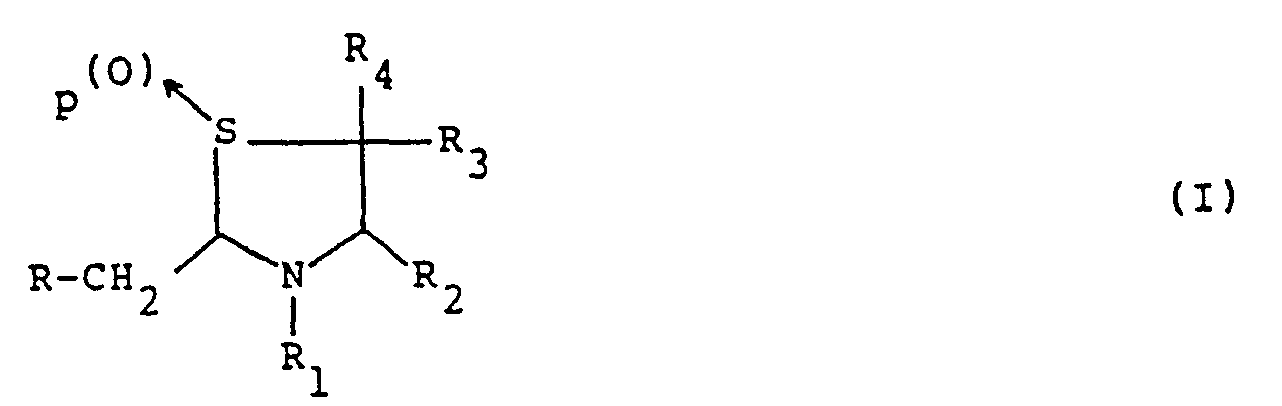


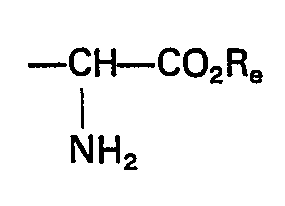





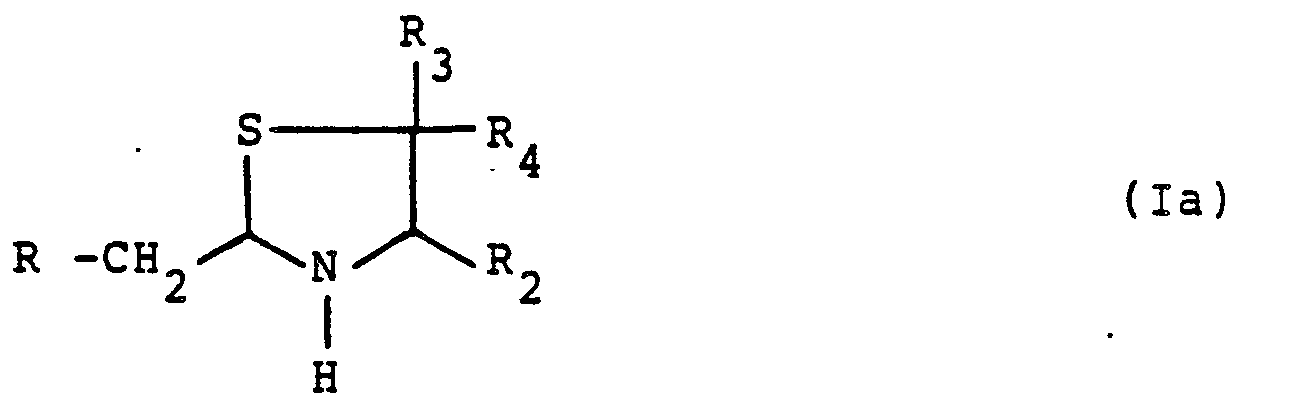





Priority Applications (1)
| Application Number | Priority Date | Filing Date | Title |
|---|---|---|---|
| AT85109446T ATE48135T1 (en) | 1984-07-27 | 1985-07-26 | XANTHINYLMETHYLTHIANOLIDINES, PROCESS FOR THEIR PRODUCTION AND PHARMACEUTICAL PREPARATIONS CONTAINING THEM. |
Applications Claiming Priority (4)
| Application Number | Priority Date | Filing Date | Title |
|---|---|---|---|
| IT8422088A IT1213197B (en) | 1984-07-27 | 1984-07-27 | XANTYLMETHYL-THIAZOLIDINE AND PHARMACEUTICAL COMPOSITIONS CONTAINING THEM. |
| IT2208884 | 1984-07-27 | ||
| IT8521323A IT1214619B (en) | 1985-06-27 | 1985-06-27 | New xanthinyl-methyl-thiazolidine derivs. |
| IT2132385 | 1985-06-27 |
Publications (3)
| Publication Number | Publication Date |
|---|---|
| EP0171005A2 EP0171005A2 (en) | 1986-02-12 |
| EP0171005A3 EP0171005A3 (en) | 1987-04-15 |
| EP0171005B1 true EP0171005B1 (en) | 1989-11-23 |
Family
ID=26327864
Family Applications (1)
| Application Number | Title | Priority Date | Filing Date |
|---|---|---|---|
| EP19850109446 Expired EP0171005B1 (en) | 1984-07-27 | 1985-07-26 | Xanthinylmethylthiazolidines, process for their preparation and pharmaceutical compositions containing them |
Country Status (2)
| Country | Link |
|---|---|
| EP (1) | EP0171005B1 (en) |
| DE (1) | DE3574381D1 (en) |
Families Citing this family (3)
| Publication number | Priority date | Publication date | Assignee | Title |
|---|---|---|---|---|
| IT1197516B (en) * | 1986-12-24 | 1988-11-30 | Abc Ist Biolog Chem Spa | THEOFILLINMETYLANIC AND THEOFILLINMETYLDITIAN DERIVATIVES PROCEDURE FOR THEIR PREPARATION AND PHARMACEUTICAL COMPOSITIONS THAT INCLUDE THEM |
| HU206884B (en) * | 1990-11-22 | 1993-01-28 | Chinoin Gyogyszer Es Vegyeszet | Process for producing purin derivatives and pharmaceutical compositions containing them |
| JP5438034B2 (en) | 2008-02-21 | 2014-03-12 | オールテック・アソシエイツ・インコーポレーテッド | Column packing apparatus and method of manufacturing and using the same |
Family Cites Families (3)
| Publication number | Priority date | Publication date | Assignee | Title |
|---|---|---|---|---|
| FR1523273A (en) * | 1967-03-13 | 1968-05-03 | Soc Ind Fab Antibiotiques Sifa | Novel theophylline derivatives and method of preparation |
| GB1509409A (en) * | 1976-09-30 | 1978-05-04 | Creat | Pharmaceutically active thiozolidine derivatives |
| IT1195267B (en) * | 1980-04-15 | 1988-10-12 | Abc Ist Biolog Chem Spa | THEOFILLINMETHYLSOXANANIC DERIVATIVES, PROCEDURE FOR THEIR PREPARATION AND RELATED PHARMACEUTICAL COMPOSITIONS |
-
1985
- 1985-07-26 DE DE8585109446T patent/DE3574381D1/en not_active Expired
- 1985-07-26 EP EP19850109446 patent/EP0171005B1/en not_active Expired
Also Published As
| Publication number | Publication date |
|---|---|
| EP0171005A2 (en) | 1986-02-12 |
| EP0171005A3 (en) | 1987-04-15 |
| DE3574381D1 (en) | 1989-12-28 |
Similar Documents
| Publication | Publication Date | Title |
|---|---|---|
| CS227015B2 (en) | Method of preparing 2,4-di-substituted thiazol derivatives | |
| EP0169581B1 (en) | Antitussive and mucus regulating 2-substituted thiazolidines | |
| US4578481A (en) | Pyrrolacetic amides having antiinflammatory activity | |
| EP0067429A1 (en) | Inhibitors of mammalian collagenase | |
| IE52079B1 (en) | N-substituted omega-(2-oxo-4-imidazolin-1-yl)alkanoic acids,salts and esters thereof,process for producing the same and pharmaceutical preparations containing the same | |
| US5543419A (en) | Quinuclidine esters process and intermediate for their preparation and pharmaceutical compositions containing them | |
| EP0171005A2 (en) | Xanthinylmethylthiazolidines, process for their preparation and pharmaceutical compositions containing them | |
| US4798898A (en) | Antitussive and mucus regulating 2-substituted thiazolidines | |
| PT98004A (en) | A process for the preparation of novel N-BENZYL-N1-PHENYL-E-PHENYLALQUIL-THIOUREIAS | |
| JPS6326748B2 (en) | ||
| CA1182818A (en) | N-substituted mercaptoacyl propionamides | |
| US4988701A (en) | Cyclic amino-thioacetal amides, a process for the preparation thereof and pharmaceutical compositions | |
| KR890000486B1 (en) | Method for preparing 2-methoxyphenyl ester of N-substituted amino acid | |
| US4292305A (en) | Antiallergic imidodisulfamides | |
| JPH0335320B2 (en) | ||
| EP0069527B1 (en) | Cystine derivatives | |
| BRPI0613423A2 (en) | pharmaceutical composition, compound or a pharmaceutically acceptable salt thereof, and use of a compound or a pharmaceutically acceptable salt thereof | |
| IE47618B1 (en) | 2-(quinolin-4-ylamino)-5-fluorobenzoic acid derivatives | |
| PT85820B (en) | Process for the preparation of n-(omega-cyanoalkyl) aminophenols | |
| SK278791B6 (en) | ISOCHINOLINE DERIVATIVES, THE MANUFACTURE OF ITS AND FARM | |
| EP0223124A1 (en) | Substituted aminosulfonyl 6-nitrobenzoic-esters or amides, processes for their preparation and pharmaceutical compositions containing them | |
| GB2177690A (en) | Antitussive and mucus regulating 2-substituted thiazolidines | |
| HK1013777B (en) | Arginine analogues having nitric oxide synthase inhibitor activity | |
| CS217262B1 (en) | (s-1-pyridinedacen-4-yl) alkylamines and their salts | |
| CS211335B1 (en) | 2- (4-Phenoxyacetylpiperazin-1-yl) -4-amino-6,7-dimethoxyquinazoline, its salts and processes for its preparation |
Legal Events
| Date | Code | Title | Description |
|---|---|---|---|
| PUAI | Public reference made under article 153(3) epc to a published international application that has entered the european phase |
Free format text: ORIGINAL CODE: 0009012 |
|
| AK | Designated contracting states |
Designated state(s): AT BE CH DE FR GB IT LI LU NL SE |
|
| PUAL | Search report despatched |
Free format text: ORIGINAL CODE: 0009013 |
|
| AK | Designated contracting states |
Kind code of ref document: A3 Designated state(s): AT BE CH DE FR GB IT LI LU NL SE |
|
| 17P | Request for examination filed |
Effective date: 19870522 |
|
| 17Q | First examination report despatched |
Effective date: 19880801 |
|
| GRAA | (expected) grant |
Free format text: ORIGINAL CODE: 0009210 |
|
| AK | Designated contracting states |
Kind code of ref document: B1 Designated state(s): AT BE CH DE FR GB IT LI LU NL SE |
|
| REF | Corresponds to: |
Ref document number: 48135 Country of ref document: AT Date of ref document: 19891215 Kind code of ref document: T |
|
| REF | Corresponds to: |
Ref document number: 3574381 Country of ref document: DE Date of ref document: 19891228 |
|
| ET | Fr: translation filed | ||
| ITF | It: translation for a ep patent filed | ||
| PLBE | No opposition filed within time limit |
Free format text: ORIGINAL CODE: 0009261 |
|
| STAA | Information on the status of an ep patent application or granted ep patent |
Free format text: STATUS: NO OPPOSITION FILED WITHIN TIME LIMIT |
|
| 26N | No opposition filed | ||
| ITTA | It: last paid annual fee | ||
| PGFP | Annual fee paid to national office [announced via postgrant information from national office to epo] |
Ref country code: SE Payment date: 19920721 Year of fee payment: 8 |
|
| PGFP | Annual fee paid to national office [announced via postgrant information from national office to epo] |
Ref country code: FR Payment date: 19920722 Year of fee payment: 8 |
|
| PGFP | Annual fee paid to national office [announced via postgrant information from national office to epo] |
Ref country code: GB Payment date: 19920724 Year of fee payment: 8 |
|
| PGFP | Annual fee paid to national office [announced via postgrant information from national office to epo] |
Ref country code: LU Payment date: 19920729 Year of fee payment: 8 |
|
| PGFP | Annual fee paid to national office [announced via postgrant information from national office to epo] |
Ref country code: NL Payment date: 19920731 Year of fee payment: 8 Ref country code: AT Payment date: 19920731 Year of fee payment: 8 |
|
| PGFP | Annual fee paid to national office [announced via postgrant information from national office to epo] |
Ref country code: BE Payment date: 19920828 Year of fee payment: 8 |
|
| PGFP | Annual fee paid to national office [announced via postgrant information from national office to epo] |
Ref country code: CH Payment date: 19920922 Year of fee payment: 8 |
|
| PGFP | Annual fee paid to national office [announced via postgrant information from national office to epo] |
Ref country code: DE Payment date: 19920929 Year of fee payment: 8 |
|
| EPTA | Lu: last paid annual fee | ||
| PG25 | Lapsed in a contracting state [announced via postgrant information from national office to epo] |
Ref country code: LU Free format text: LAPSE BECAUSE OF NON-PAYMENT OF DUE FEES Effective date: 19930726 Ref country code: GB Effective date: 19930726 Ref country code: AT Effective date: 19930726 |
|
| PG25 | Lapsed in a contracting state [announced via postgrant information from national office to epo] |
Ref country code: SE Effective date: 19930727 |
|
| PG25 | Lapsed in a contracting state [announced via postgrant information from national office to epo] |
Ref country code: LI Effective date: 19930731 Ref country code: CH Effective date: 19930731 Ref country code: BE Effective date: 19930731 |
|
| BERE | Be: lapsed |
Owner name: BOEHRINGER BIOCHEMIA ROBIN S.P.A. Effective date: 19930731 |
|
| PG25 | Lapsed in a contracting state [announced via postgrant information from national office to epo] |
Ref country code: NL Effective date: 19940201 |
|
| NLV4 | Nl: lapsed or anulled due to non-payment of the annual fee | ||
| GBPC | Gb: european patent ceased through non-payment of renewal fee |
Effective date: 19930726 |
|
| PG25 | Lapsed in a contracting state [announced via postgrant information from national office to epo] |
Ref country code: FR Effective date: 19940331 |
|
| REG | Reference to a national code |
Ref country code: CH Ref legal event code: PL |
|
| PG25 | Lapsed in a contracting state [announced via postgrant information from national office to epo] |
Ref country code: DE Effective date: 19940401 |
|
| REG | Reference to a national code |
Ref country code: FR Ref legal event code: ST |
|
| EUG | Se: european patent has lapsed |
Ref document number: 85109446.6 Effective date: 19940210 |