EP0170967A1 - Substituted benzophenoxazines, method for preparing same and use thereof in electrochromic recording systems - Google Patents
Substituted benzophenoxazines, method for preparing same and use thereof in electrochromic recording systems Download PDFInfo
- Publication number
- EP0170967A1 EP0170967A1 EP85109167A EP85109167A EP0170967A1 EP 0170967 A1 EP0170967 A1 EP 0170967A1 EP 85109167 A EP85109167 A EP 85109167A EP 85109167 A EP85109167 A EP 85109167A EP 0170967 A1 EP0170967 A1 EP 0170967A1
- Authority
- EP
- European Patent Office
- Prior art keywords
- chloride
- tertiary
- amino
- benzo
- formula
- Prior art date
- Legal status (The legal status is an assumption and is not a legal conclusion. Google has not performed a legal analysis and makes no representation as to the accuracy of the status listed.)
- Withdrawn
Links
- 238000000034 method Methods 0.000 title description 17
- YOSZEPWSVKKQOV-UHFFFAOYSA-N 12h-benzo[a]phenoxazine Chemical class C1=CC=CC2=C3NC4=CC=CC=C4OC3=CC=C21 YOSZEPWSVKKQOV-UHFFFAOYSA-N 0.000 title description 4
- 150000001875 compounds Chemical class 0.000 claims abstract description 58
- 239000003795 chemical substances by application Substances 0.000 claims abstract description 17
- 239000003638 chemical reducing agent Substances 0.000 claims abstract description 12
- 125000005843 halogen group Chemical group 0.000 claims description 15
- 239000000126 substance Substances 0.000 claims description 15
- 125000001997 phenyl group Chemical group [H]C1=C([H])C([H])=C(*)C([H])=C1[H] 0.000 claims description 13
- 125000000217 alkyl group Chemical group 0.000 claims description 9
- 125000001797 benzyl group Chemical group [H]C1=C([H])C([H])=C(C([H])=C1[H])C([H])([H])* 0.000 claims description 9
- 239000000758 substrate Substances 0.000 claims description 9
- 125000003545 alkoxy group Chemical group 0.000 claims description 7
- 125000000449 nitro group Chemical group [O-][N+](*)=O 0.000 claims description 6
- 125000006539 C12 alkyl group Chemical group [H]C([H])([H])C([H])([H])C([H])([H])C([H])([H])C([H])([H])C([H])([H])C([H])([H])C([H])([H])C([H])([H])C([H])([H])C([H])([H])C([H])([H])* 0.000 claims description 5
- 229910052736 halogen Inorganic materials 0.000 claims description 5
- 125000000753 cycloalkyl group Chemical group 0.000 claims description 3
- 125000002924 primary amino group Chemical group [H]N([H])* 0.000 claims description 3
- KWGRACQDIPRBEJ-UHFFFAOYSA-N [12-acetyl-9-(diethylamino)benzo[a]phenoxazin-5-yl] acetate Chemical compound C1=C(OC(C)=O)C2=CC=CC=C2C2=C1OC1=CC(N(CC)CC)=CC=C1N2C(C)=O KWGRACQDIPRBEJ-UHFFFAOYSA-N 0.000 claims description 2
- 125000004093 cyano group Chemical group *C#N 0.000 claims description 2
- MVUFQFQZWWDZRS-UHFFFAOYSA-N n-[12-acetyl-9-(diethylamino)benzo[a]phenoxazin-5-yl]-n-benzylacetamide Chemical compound O1C2=CC(N(CC)CC)=CC=C2N(C(C)=O)C(C2=CC=CC=C22)=C1C=C2N(C(C)=O)CC1=CC=CC=C1 MVUFQFQZWWDZRS-UHFFFAOYSA-N 0.000 claims description 2
- 125000004953 trihalomethyl group Chemical group 0.000 claims description 2
- 238000004519 manufacturing process Methods 0.000 claims 1
- HWCYLKZWUQCZQJ-UHFFFAOYSA-N n-benzyl-n-[9-(dimethylamino)-12-(4-methylbenzoyl)benzo[a]phenoxazin-5-yl]-4-methylbenzamide Chemical compound C1=C(N(CC=2C=CC=CC=2)C(=O)C=2C=CC(C)=CC=2)C2=CC=CC=C2C2=C1OC1=CC(N(C)C)=CC=C1N2C(=O)C1=CC=C(C)C=C1 HWCYLKZWUQCZQJ-UHFFFAOYSA-N 0.000 claims 1
- 150000002991 phenoxazines Chemical class 0.000 abstract description 7
- LXARMRGJFVAFPR-UHFFFAOYSA-N benzo[a]phenoxazin-5-one Chemical compound C12=CC=CC=C2C(=O)C=C2C1=NC1=CC=CC=C1O2 LXARMRGJFVAFPR-UHFFFAOYSA-N 0.000 abstract description 6
- 125000005605 benzo group Chemical group 0.000 abstract description 4
- 150000004820 halides Chemical class 0.000 abstract description 3
- 230000003993 interaction Effects 0.000 abstract 1
- YXFVVABEGXRONW-UHFFFAOYSA-N Toluene Chemical compound CC1=CC=CC=C1 YXFVVABEGXRONW-UHFFFAOYSA-N 0.000 description 57
- 239000000203 mixture Substances 0.000 description 34
- XLYOFNOQVPJJNP-UHFFFAOYSA-N water Substances O XLYOFNOQVPJJNP-UHFFFAOYSA-N 0.000 description 32
- -1 Malachite green lactone Chemical class 0.000 description 31
- 239000000047 product Substances 0.000 description 26
- 239000000243 solution Substances 0.000 description 17
- 238000006243 chemical reaction Methods 0.000 description 16
- 239000007788 liquid Substances 0.000 description 15
- WFDIJRYMOXRFFG-UHFFFAOYSA-N Acetic anhydride Chemical compound CC(=O)OC(C)=O WFDIJRYMOXRFFG-UHFFFAOYSA-N 0.000 description 9
- 238000010992 reflux Methods 0.000 description 9
- JUJWROOIHBZHMG-UHFFFAOYSA-N Pyridine Chemical compound C1=CC=NC=C1 JUJWROOIHBZHMG-UHFFFAOYSA-N 0.000 description 8
- CDBYLPFSWZWCQE-UHFFFAOYSA-L Sodium Carbonate Chemical compound [Na+].[Na+].[O-]C([O-])=O CDBYLPFSWZWCQE-UHFFFAOYSA-L 0.000 description 8
- BNIILDVGGAEEIG-UHFFFAOYSA-L disodium hydrogen phosphate Chemical compound [Na+].[Na+].OP([O-])([O-])=O BNIILDVGGAEEIG-UHFFFAOYSA-L 0.000 description 8
- 229910000397 disodium phosphate Inorganic materials 0.000 description 8
- 235000019800 disodium phosphate Nutrition 0.000 description 8
- 239000006193 liquid solution Substances 0.000 description 8
- 239000011541 reaction mixture Substances 0.000 description 8
- 239000001488 sodium phosphate Substances 0.000 description 8
- 238000009472 formulation Methods 0.000 description 7
- 125000002496 methyl group Chemical group [H]C([H])([H])* 0.000 description 7
- 238000000746 purification Methods 0.000 description 7
- JVBXVOWTABLYPX-UHFFFAOYSA-L sodium dithionite Chemical compound [Na+].[Na+].[O-]S(=O)S([O-])=O JVBXVOWTABLYPX-UHFFFAOYSA-L 0.000 description 7
- CSCPPACGZOOCGX-UHFFFAOYSA-N Acetone Chemical compound CC(C)=O CSCPPACGZOOCGX-UHFFFAOYSA-N 0.000 description 6
- IJGRMHOSHXDMSA-UHFFFAOYSA-N Atomic nitrogen Chemical compound N#N IJGRMHOSHXDMSA-UHFFFAOYSA-N 0.000 description 6
- XEKOWRVHYACXOJ-UHFFFAOYSA-N Ethyl acetate Chemical compound CCOC(C)=O XEKOWRVHYACXOJ-UHFFFAOYSA-N 0.000 description 6
- 239000003513 alkali Substances 0.000 description 6
- 238000004440 column chromatography Methods 0.000 description 6
- GRWZHXKQBITJKP-UHFFFAOYSA-L dithionite(2-) Chemical compound [O-]S(=O)S([O-])=O GRWZHXKQBITJKP-UHFFFAOYSA-L 0.000 description 6
- VLKZOEOYAKHREP-UHFFFAOYSA-N n-Hexane Chemical compound CCCCCC VLKZOEOYAKHREP-UHFFFAOYSA-N 0.000 description 6
- 238000002360 preparation method Methods 0.000 description 6
- OKTJSMMVPCPJKN-UHFFFAOYSA-N Carbon Chemical compound [C] OKTJSMMVPCPJKN-UHFFFAOYSA-N 0.000 description 5
- FAPWRFPIFSIZLT-UHFFFAOYSA-M Sodium chloride Chemical compound [Na+].[Cl-] FAPWRFPIFSIZLT-UHFFFAOYSA-M 0.000 description 5
- HCHKCACWOHOZIP-UHFFFAOYSA-N Zinc Chemical compound [Zn] HCHKCACWOHOZIP-UHFFFAOYSA-N 0.000 description 5
- 238000001704 evaporation Methods 0.000 description 5
- 230000008020 evaporation Effects 0.000 description 5
- VYPSYNLAJGMNEJ-UHFFFAOYSA-N Silicium dioxide Chemical compound O=[Si]=O VYPSYNLAJGMNEJ-UHFFFAOYSA-N 0.000 description 4
- 150000001266 acyl halides Chemical class 0.000 description 4
- 150000008064 anhydrides Chemical class 0.000 description 4
- 125000001309 chloro group Chemical group Cl* 0.000 description 4
- 238000004821 distillation Methods 0.000 description 4
- 239000000843 powder Substances 0.000 description 4
- UMJSCPRVCHMLSP-UHFFFAOYSA-N pyridine Natural products COC1=CC=CN=C1 UMJSCPRVCHMLSP-UHFFFAOYSA-N 0.000 description 4
- 239000012429 reaction media Substances 0.000 description 4
- 239000002824 redox indicator Substances 0.000 description 4
- 150000003839 salts Chemical class 0.000 description 4
- 229920006395 saturated elastomer Polymers 0.000 description 4
- 239000000741 silica gel Substances 0.000 description 4
- 229910002027 silica gel Inorganic materials 0.000 description 4
- 229910000029 sodium carbonate Inorganic materials 0.000 description 4
- VEXZGXHMUGYJMC-UHFFFAOYSA-M Chloride anion Chemical compound [Cl-] VEXZGXHMUGYJMC-UHFFFAOYSA-M 0.000 description 3
- 239000011230 binding agent Substances 0.000 description 3
- 238000004587 chromatography analysis Methods 0.000 description 3
- 238000001816 cooling Methods 0.000 description 3
- 238000001914 filtration Methods 0.000 description 3
- 150000002367 halogens Chemical group 0.000 description 3
- 238000001819 mass spectrum Methods 0.000 description 3
- 229910052751 metal Inorganic materials 0.000 description 3
- 239000002184 metal Substances 0.000 description 3
- 229910052757 nitrogen Inorganic materials 0.000 description 3
- 238000001953 recrystallisation Methods 0.000 description 3
- LIZLYZVAYZQVPG-UHFFFAOYSA-N (3-bromo-2-fluorophenyl)methanol Chemical compound OCC1=CC=CC(Br)=C1F LIZLYZVAYZQVPG-UHFFFAOYSA-N 0.000 description 2
- ONIKNECPXCLUHT-UHFFFAOYSA-N 2-chlorobenzoyl chloride Chemical compound ClC(=O)C1=CC=CC=C1Cl ONIKNECPXCLUHT-UHFFFAOYSA-N 0.000 description 2
- NQUVCRCCRXRJCK-UHFFFAOYSA-N 4-methylbenzoyl chloride Chemical compound CC1=CC=C(C(Cl)=O)C=C1 NQUVCRCCRXRJCK-UHFFFAOYSA-N 0.000 description 2
- KFZMGEQAYNKOFK-UHFFFAOYSA-N Isopropanol Chemical compound CC(C)O KFZMGEQAYNKOFK-UHFFFAOYSA-N 0.000 description 2
- 206010028980 Neoplasm Diseases 0.000 description 2
- CTQNGGLPUBDAKN-UHFFFAOYSA-N O-Xylene Chemical compound CC1=CC=CC=C1C CTQNGGLPUBDAKN-UHFFFAOYSA-N 0.000 description 2
- WCUXLLCKKVVCTQ-UHFFFAOYSA-M Potassium chloride Chemical compound [Cl-].[K+] WCUXLLCKKVVCTQ-UHFFFAOYSA-M 0.000 description 2
- ZKURGBYDCVNWKH-UHFFFAOYSA-N [3,7-bis(dimethylamino)phenothiazin-10-yl]-phenylmethanone Chemical compound C12=CC=C(N(C)C)C=C2SC2=CC(N(C)C)=CC=C2N1C(=O)C1=CC=CC=C1 ZKURGBYDCVNWKH-UHFFFAOYSA-N 0.000 description 2
- 239000002253 acid Substances 0.000 description 2
- PNEYBMLMFCGWSK-UHFFFAOYSA-N aluminium oxide Inorganic materials [O-2].[O-2].[O-2].[Al+3].[Al+3] PNEYBMLMFCGWSK-UHFFFAOYSA-N 0.000 description 2
- MXMOTZIXVICDSD-UHFFFAOYSA-N anisoyl chloride Chemical compound COC1=CC=C(C(Cl)=O)C=C1 MXMOTZIXVICDSD-UHFFFAOYSA-N 0.000 description 2
- 239000012298 atmosphere Substances 0.000 description 2
- PASDCCFISLVPSO-UHFFFAOYSA-N benzoyl chloride Chemical compound ClC(=O)C1=CC=CC=C1 PASDCCFISLVPSO-UHFFFAOYSA-N 0.000 description 2
- 230000015572 biosynthetic process Effects 0.000 description 2
- 201000011510 cancer Diseases 0.000 description 2
- 239000003054 catalyst Substances 0.000 description 2
- 239000001913 cellulose Substances 0.000 description 2
- 229920002678 cellulose Polymers 0.000 description 2
- 239000003610 charcoal Substances 0.000 description 2
- 238000000576 coating method Methods 0.000 description 2
- 239000000706 filtrate Substances 0.000 description 2
- PKHMTIRCAFTBDS-UHFFFAOYSA-N hexanoyl hexanoate Chemical compound CCCCCC(=O)OC(=O)CCCCC PKHMTIRCAFTBDS-UHFFFAOYSA-N 0.000 description 2
- 239000005457 ice water Substances 0.000 description 2
- 239000000463 material Substances 0.000 description 2
- 238000000655 nuclear magnetic resonance spectrum Methods 0.000 description 2
- 150000007530 organic bases Chemical class 0.000 description 2
- 150000002990 phenothiazines Chemical class 0.000 description 2
- 125000005506 phthalide group Chemical group 0.000 description 2
- IOLCXVTUBQKXJR-UHFFFAOYSA-M potassium bromide Chemical compound [K+].[Br-] IOLCXVTUBQKXJR-UHFFFAOYSA-M 0.000 description 2
- FGIUAXJPYTZDNR-UHFFFAOYSA-N potassium nitrate Chemical compound [K+].[O-][N+]([O-])=O FGIUAXJPYTZDNR-UHFFFAOYSA-N 0.000 description 2
- 239000002243 precursor Substances 0.000 description 2
- 239000000376 reactant Substances 0.000 description 2
- JHJLBTNAGRQEKS-UHFFFAOYSA-M sodium bromide Chemical compound [Na+].[Br-] JHJLBTNAGRQEKS-UHFFFAOYSA-M 0.000 description 2
- 239000011780 sodium chloride Substances 0.000 description 2
- 239000007787 solid Substances 0.000 description 2
- 239000007858 starting material Substances 0.000 description 2
- 238000003786 synthesis reaction Methods 0.000 description 2
- QAEDZJGFFMLHHQ-UHFFFAOYSA-N trifluoroacetic anhydride Chemical compound FC(F)(F)C(=O)OC(=O)C(F)(F)F QAEDZJGFFMLHHQ-UHFFFAOYSA-N 0.000 description 2
- 239000008096 xylene Substances 0.000 description 2
- RQHMQURGSQBBJY-UHFFFAOYSA-N (2,2-dichloroacetyl) 2,2-dichloroacetate Chemical compound ClC(Cl)C(=O)OC(=O)C(Cl)Cl RQHMQURGSQBBJY-UHFFFAOYSA-N 0.000 description 1
- PNVPNXKRAUBJGW-UHFFFAOYSA-N (2-chloroacetyl) 2-chloroacetate Chemical compound ClCC(=O)OC(=O)CCl PNVPNXKRAUBJGW-UHFFFAOYSA-N 0.000 description 1
- JEQDSBVHLKBEIZ-REOHCLBHSA-N (2s)-2-chloropropanoyl chloride Chemical compound C[C@H](Cl)C(Cl)=O JEQDSBVHLKBEIZ-REOHCLBHSA-N 0.000 description 1
- BEZVERWEWCFZBK-UHFFFAOYSA-N 1-benzo[a]phenoxazin-12-ylethanone Chemical compound C1=CC=CC2=C3N(C(=O)C)C4=CC=CC=C4OC3=CC=C21 BEZVERWEWCFZBK-UHFFFAOYSA-N 0.000 description 1
- WJFKNYWRSNBZNX-UHFFFAOYSA-N 10H-phenothiazine Chemical compound C1=CC=C2NC3=CC=CC=C3SC2=C1 WJFKNYWRSNBZNX-UHFFFAOYSA-N 0.000 description 1
- TZMSYXZUNZXBOL-UHFFFAOYSA-N 10H-phenoxazine Chemical compound C1=CC=C2NC3=CC=CC=C3OC2=C1 TZMSYXZUNZXBOL-UHFFFAOYSA-N 0.000 description 1
- CEOCVKWBUWKBKA-UHFFFAOYSA-N 2,4-dichlorobenzoyl chloride Chemical compound ClC(=O)C1=CC=C(Cl)C=C1Cl CEOCVKWBUWKBKA-UHFFFAOYSA-N 0.000 description 1
- JBLIDPPHFGWTKU-UHFFFAOYSA-N 2,6-dichlorobenzoyl chloride Chemical compound ClC(=O)C1=C(Cl)C=CC=C1Cl JBLIDPPHFGWTKU-UHFFFAOYSA-N 0.000 description 1
- LSTRKXWIZZZYAS-UHFFFAOYSA-N 2-bromoacetyl bromide Chemical compound BrCC(Br)=O LSTRKXWIZZZYAS-UHFFFAOYSA-N 0.000 description 1
- SYZRZLUNWVNNNV-UHFFFAOYSA-N 2-bromoacetyl chloride Chemical compound ClC(=O)CBr SYZRZLUNWVNNNV-UHFFFAOYSA-N 0.000 description 1
- NZCKTGCKFJDGFD-UHFFFAOYSA-N 2-bromobenzoyl chloride Chemical compound ClC(=O)C1=CC=CC=C1Br NZCKTGCKFJDGFD-UHFFFAOYSA-N 0.000 description 1
- OZGMODDEIHYPRY-UHFFFAOYSA-N 2-bromopropanoyl chloride Chemical compound CC(Br)C(Cl)=O OZGMODDEIHYPRY-UHFFFAOYSA-N 0.000 description 1
- SMUKODJVMQOSAB-UHFFFAOYSA-N 2-ethylbutanoyl chloride Chemical compound CCC(CC)C(Cl)=O SMUKODJVMQOSAB-UHFFFAOYSA-N 0.000 description 1
- RAAGZOYMEQDCTD-UHFFFAOYSA-N 2-fluorobenzoyl chloride Chemical compound FC1=CC=CC=C1C(Cl)=O RAAGZOYMEQDCTD-UHFFFAOYSA-N 0.000 description 1
- MVIVDSWUOGNODP-UHFFFAOYSA-N 2-iodobenzoyl chloride Chemical compound ClC(=O)C1=CC=CC=C1I MVIVDSWUOGNODP-UHFFFAOYSA-N 0.000 description 1
- JJKWHOSQTYYFAE-UHFFFAOYSA-N 2-methoxyacetyl chloride Chemical compound COCC(Cl)=O JJKWHOSQTYYFAE-UHFFFAOYSA-N 0.000 description 1
- RZNHSEZOLFEFGB-UHFFFAOYSA-N 2-methoxybenzoyl chloride Chemical compound COC1=CC=CC=C1C(Cl)=O RZNHSEZOLFEFGB-UHFFFAOYSA-N 0.000 description 1
- 125000003229 2-methylhexyl group Chemical group [H]C([H])([H])C([H])([H])C([H])([H])C([H])([H])C([H])(C([H])([H])[H])C([H])([H])* 0.000 description 1
- DGMOBVGABMBZSB-UHFFFAOYSA-N 2-methylpropanoyl chloride Chemical compound CC(C)C(Cl)=O DGMOBVGABMBZSB-UHFFFAOYSA-N 0.000 description 1
- VTXNOVCTHUBABW-UHFFFAOYSA-N 3,4-dichlorobenzoyl chloride Chemical compound ClC(=O)C1=CC=C(Cl)C(Cl)=C1 VTXNOVCTHUBABW-UHFFFAOYSA-N 0.000 description 1
- VIOBGCWEHLRBEP-UHFFFAOYSA-N 3,4-dimethoxybenzoyl chloride Chemical compound COC1=CC=C(C(Cl)=O)C=C1OC VIOBGCWEHLRBEP-UHFFFAOYSA-N 0.000 description 1
- FTHPLWDYWAKYCY-UHFFFAOYSA-N 3,5-dimethoxybenzoyl chloride Chemical compound COC1=CC(OC)=CC(C(Cl)=O)=C1 FTHPLWDYWAKYCY-UHFFFAOYSA-N 0.000 description 1
- NNOHXABAQAGKRZ-UHFFFAOYSA-N 3,5-dinitrobenzoyl chloride Chemical compound [O-][N+](=O)C1=CC(C(Cl)=O)=CC([N+]([O-])=O)=C1 NNOHXABAQAGKRZ-UHFFFAOYSA-N 0.000 description 1
- UNSAJINGUOTTRA-UHFFFAOYSA-N 3-(3-bromophenyl)prop-2-yn-1-ol Chemical compound OCC#CC1=CC=CC(Br)=C1 UNSAJINGUOTTRA-UHFFFAOYSA-N 0.000 description 1
- IHBVNSPHKMCPST-UHFFFAOYSA-N 3-bromopropanoyl chloride Chemical compound ClC(=O)CCBr IHBVNSPHKMCPST-UHFFFAOYSA-N 0.000 description 1
- WHIHIKVIWVIIER-UHFFFAOYSA-N 3-chlorobenzoyl chloride Chemical compound ClC(=O)C1=CC=CC(Cl)=C1 WHIHIKVIWVIIER-UHFFFAOYSA-N 0.000 description 1
- INUNLMUAPJVRME-UHFFFAOYSA-N 3-chloropropanoyl chloride Chemical compound ClCCC(Cl)=O INUNLMUAPJVRME-UHFFFAOYSA-N 0.000 description 1
- SYVNVEGIRVXRQH-UHFFFAOYSA-N 3-fluorobenzoyl chloride Chemical compound FC1=CC=CC(C(Cl)=O)=C1 SYVNVEGIRVXRQH-UHFFFAOYSA-N 0.000 description 1
- RUQIUASLAXJZIE-UHFFFAOYSA-N 3-methoxybenzoyl chloride Chemical compound COC1=CC=CC(C(Cl)=O)=C1 RUQIUASLAXJZIE-UHFFFAOYSA-N 0.000 description 1
- YHOYYHYBFSYOSQ-UHFFFAOYSA-N 3-methylbenzoyl chloride Chemical compound CC1=CC=CC(C(Cl)=O)=C1 YHOYYHYBFSYOSQ-UHFFFAOYSA-N 0.000 description 1
- ISULZYQDGYXDFW-UHFFFAOYSA-N 3-methylbutanoyl chloride Chemical compound CC(C)CC(Cl)=O ISULZYQDGYXDFW-UHFFFAOYSA-N 0.000 description 1
- NXTNASSYJUXJDV-UHFFFAOYSA-N 3-nitrobenzoyl chloride Chemical compound [O-][N+](=O)C1=CC=CC(C(Cl)=O)=C1 NXTNASSYJUXJDV-UHFFFAOYSA-N 0.000 description 1
- OXZYBOLWRXENKT-UHFFFAOYSA-N 4-(trifluoromethyl)benzoyl chloride Chemical compound FC(F)(F)C1=CC=C(C(Cl)=O)C=C1 OXZYBOLWRXENKT-UHFFFAOYSA-N 0.000 description 1
- DENKGPBHLYFNGK-UHFFFAOYSA-N 4-bromobenzoyl chloride Chemical compound ClC(=O)C1=CC=C(Br)C=C1 DENKGPBHLYFNGK-UHFFFAOYSA-N 0.000 description 1
- KMGCTFHTBKBITO-UHFFFAOYSA-N 4-butoxybenzoyl chloride Chemical compound CCCCOC1=CC=C(C(Cl)=O)C=C1 KMGCTFHTBKBITO-UHFFFAOYSA-N 0.000 description 1
- OUOWCSJYDCPVDM-UHFFFAOYSA-N 4-butylbenzoyl chloride Chemical compound CCCCC1=CC=C(C(Cl)=O)C=C1 OUOWCSJYDCPVDM-UHFFFAOYSA-N 0.000 description 1
- RKIDDEGICSMIJA-UHFFFAOYSA-N 4-chlorobenzoyl chloride Chemical compound ClC(=O)C1=CC=C(Cl)C=C1 RKIDDEGICSMIJA-UHFFFAOYSA-N 0.000 description 1
- CDIIZULDSLKBKV-UHFFFAOYSA-N 4-chlorobutanoyl chloride Chemical compound ClCCCC(Cl)=O CDIIZULDSLKBKV-UHFFFAOYSA-N 0.000 description 1
- USEDMAWWQDFMFY-UHFFFAOYSA-N 4-cyanobenzoyl chloride Chemical compound ClC(=O)C1=CC=C(C#N)C=C1 USEDMAWWQDFMFY-UHFFFAOYSA-N 0.000 description 1
- CZKLEJHVLCMVQR-UHFFFAOYSA-N 4-fluorobenzoyl chloride Chemical compound FC1=CC=C(C(Cl)=O)C=C1 CZKLEJHVLCMVQR-UHFFFAOYSA-N 0.000 description 1
- NJAKCIUOTIPYED-UHFFFAOYSA-N 4-iodobenzoyl chloride Chemical compound ClC(=O)C1=CC=C(I)C=C1 NJAKCIUOTIPYED-UHFFFAOYSA-N 0.000 description 1
- SVWCVXFHTHCJJB-UHFFFAOYSA-N 4-methylpentanoyl chloride Chemical compound CC(C)CCC(Cl)=O SVWCVXFHTHCJJB-UHFFFAOYSA-N 0.000 description 1
- SKDHHIUENRGTHK-UHFFFAOYSA-N 4-nitrobenzoyl chloride Chemical compound [O-][N+](=O)C1=CC=C(C(Cl)=O)C=C1 SKDHHIUENRGTHK-UHFFFAOYSA-N 0.000 description 1
- JPVUWCPKMYXOKW-UHFFFAOYSA-N 4-phenylbenzoyl chloride Chemical compound C1=CC(C(=O)Cl)=CC=C1C1=CC=CC=C1 JPVUWCPKMYXOKW-UHFFFAOYSA-N 0.000 description 1
- SVNNWKWHLOJLOK-UHFFFAOYSA-N 5-chloropentanoyl chloride Chemical compound ClCCCCC(Cl)=O SVNNWKWHLOJLOK-UHFFFAOYSA-N 0.000 description 1
- HBPVGJGBRWIVSX-UHFFFAOYSA-N 6-bromohexanoyl chloride Chemical compound ClC(=O)CCCCCBr HBPVGJGBRWIVSX-UHFFFAOYSA-N 0.000 description 1
- 0 C*(NC(*)=O)=* Chemical compound C*(NC(*)=O)=* 0.000 description 1
- XGLRIPFFJFATRH-UHFFFAOYSA-N CN(C1=CC2=[O+]C3=CC(=C4C(=C3N=C2C=C1)C=CC=C4)NCC1=CC=CC=C1)C Chemical compound CN(C1=CC2=[O+]C3=CC(=C4C(=C3N=C2C=C1)C=CC=C4)NCC1=CC=CC=C1)C XGLRIPFFJFATRH-UHFFFAOYSA-N 0.000 description 1
- UXVMQQNJUSDDNG-UHFFFAOYSA-L Calcium chloride Chemical compound [Cl-].[Cl-].[Ca+2] UXVMQQNJUSDDNG-UHFFFAOYSA-L 0.000 description 1
- VGCXGMAHQTYDJK-UHFFFAOYSA-N Chloroacetyl chloride Chemical compound ClCC(Cl)=O VGCXGMAHQTYDJK-UHFFFAOYSA-N 0.000 description 1
- PMZURENOXWZQFD-UHFFFAOYSA-L Sodium Sulfate Chemical compound [Na+].[Na+].[O-]S([O-])(=O)=O PMZURENOXWZQFD-UHFFFAOYSA-L 0.000 description 1
- 241001422033 Thestylus Species 0.000 description 1
- FXXACINHVKSMDR-UHFFFAOYSA-N acetyl bromide Chemical compound CC(Br)=O FXXACINHVKSMDR-UHFFFAOYSA-N 0.000 description 1
- WETWJCDKMRHUPV-UHFFFAOYSA-N acetyl chloride Chemical compound CC(Cl)=O WETWJCDKMRHUPV-UHFFFAOYSA-N 0.000 description 1
- 239000012346 acetyl chloride Substances 0.000 description 1
- 150000008065 acid anhydrides Chemical class 0.000 description 1
- 125000002015 acyclic group Chemical group 0.000 description 1
- 229910052783 alkali metal Inorganic materials 0.000 description 1
- 150000001340 alkali metals Chemical class 0.000 description 1
- 229910052784 alkaline earth metal Inorganic materials 0.000 description 1
- 150000001450 anions Chemical class 0.000 description 1
- 239000002246 antineoplastic agent Substances 0.000 description 1
- AQIHMSVIAGNIDM-UHFFFAOYSA-N benzoyl bromide Chemical compound BrC(=O)C1=CC=CC=C1 AQIHMSVIAGNIDM-UHFFFAOYSA-N 0.000 description 1
- HPMLGNIUXVXALD-UHFFFAOYSA-N benzoyl fluoride Chemical compound FC(=O)C1=CC=CC=C1 HPMLGNIUXVXALD-UHFFFAOYSA-N 0.000 description 1
- FAJDWNKDRFAWLS-UHFFFAOYSA-N benzyl-[9-(diethylamino)benzo[a]phenoxazin-5-ylidene]azanium;chloride Chemical compound [Cl-].O1C2=CC(N(CC)CC)=CC=C2N=C(C2=CC=CC=C22)C1=CC2=[NH+]CC1=CC=CC=C1 FAJDWNKDRFAWLS-UHFFFAOYSA-N 0.000 description 1
- 125000001246 bromo group Chemical group Br* 0.000 description 1
- YHASWHZGWUONAO-UHFFFAOYSA-N butanoyl butanoate Chemical compound CCCC(=O)OC(=O)CCC YHASWHZGWUONAO-UHFFFAOYSA-N 0.000 description 1
- 125000000484 butyl group Chemical group [H]C([*])([H])C([H])([H])C([H])([H])C([H])([H])[H] 0.000 description 1
- DVECBJCOGJRVPX-UHFFFAOYSA-N butyryl chloride Chemical compound CCCC(Cl)=O DVECBJCOGJRVPX-UHFFFAOYSA-N 0.000 description 1
- 239000001110 calcium chloride Substances 0.000 description 1
- 229910001628 calcium chloride Inorganic materials 0.000 description 1
- 230000005907 cancer growth Effects 0.000 description 1
- 229910052799 carbon Inorganic materials 0.000 description 1
- 125000002668 chloroacetyl group Chemical group ClCC(=O)* 0.000 description 1
- 239000011248 coating agent Substances 0.000 description 1
- 239000008199 coating composition Substances 0.000 description 1
- 229920001940 conductive polymer Polymers 0.000 description 1
- 239000004020 conductor Substances 0.000 description 1
- JFWMYCVMQSLLOO-UHFFFAOYSA-N cyclobutanecarbonyl chloride Chemical compound ClC(=O)C1CCC1 JFWMYCVMQSLLOO-UHFFFAOYSA-N 0.000 description 1
- 125000001995 cyclobutyl group Chemical group [H]C1([H])C([H])([H])C([H])(*)C1([H])[H] 0.000 description 1
- 125000000582 cycloheptyl group Chemical group [H]C1([H])C([H])([H])C([H])([H])C([H])([H])C([H])(*)C([H])([H])C1([H])[H] 0.000 description 1
- RVOJTCZRIKWHDX-UHFFFAOYSA-N cyclohexanecarbonyl chloride Chemical compound ClC(=O)C1CCCCC1 RVOJTCZRIKWHDX-UHFFFAOYSA-N 0.000 description 1
- 125000000113 cyclohexyl group Chemical group [H]C1([H])C([H])([H])C([H])([H])C([H])(*)C([H])([H])C1([H])[H] 0.000 description 1
- 125000000640 cyclooctyl group Chemical group [H]C1([H])C([H])([H])C([H])([H])C([H])([H])C([H])(*)C([H])([H])C([H])([H])C1([H])[H] 0.000 description 1
- 125000001511 cyclopentyl group Chemical group [H]C1([H])C([H])([H])C([H])([H])C([H])(*)C1([H])[H] 0.000 description 1
- ZOOSILUVXHVRJE-UHFFFAOYSA-N cyclopropanecarbonyl chloride Chemical compound ClC(=O)C1CC1 ZOOSILUVXHVRJE-UHFFFAOYSA-N 0.000 description 1
- 229940127089 cytotoxic agent Drugs 0.000 description 1
- IPIVAXLHTVNRBS-UHFFFAOYSA-N decanoyl chloride Chemical compound CCCCCCCCCC(Cl)=O IPIVAXLHTVNRBS-UHFFFAOYSA-N 0.000 description 1
- 239000000032 diagnostic agent Substances 0.000 description 1
- 229940039227 diagnostic agent Drugs 0.000 description 1
- NQGIJDNPUZEBRU-UHFFFAOYSA-N dodecanoyl chloride Chemical compound CCCCCCCCCCCC(Cl)=O NQGIJDNPUZEBRU-UHFFFAOYSA-N 0.000 description 1
- AOMUALOCHQKUCD-UHFFFAOYSA-N dodecyl 4-chloro-3-[[3-(4-methoxyphenyl)-3-oxopropanoyl]amino]benzoate Chemical compound CCCCCCCCCCCCOC(=O)C1=CC=C(Cl)C(NC(=O)CC(=O)C=2C=CC(OC)=CC=2)=C1 AOMUALOCHQKUCD-UHFFFAOYSA-N 0.000 description 1
- 239000003814 drug Substances 0.000 description 1
- 125000001495 ethyl group Chemical group [H]C([H])([H])C([H])([H])* 0.000 description 1
- 239000000284 extract Substances 0.000 description 1
- 239000012065 filter cake Substances 0.000 description 1
- 125000001153 fluoro group Chemical group F* 0.000 description 1
- UCVODTZQZHMTPN-UHFFFAOYSA-N heptanoyl chloride Chemical compound CCCCCCC(Cl)=O UCVODTZQZHMTPN-UHFFFAOYSA-N 0.000 description 1
- 125000003187 heptyl group Chemical group [H]C([*])([H])C([H])([H])C([H])([H])C([H])([H])C([H])([H])C([H])([H])C([H])([H])[H] 0.000 description 1
- ARBOVOVUTSQWSS-UHFFFAOYSA-N hexadecanoyl chloride Chemical compound CCCCCCCCCCCCCCCC(Cl)=O ARBOVOVUTSQWSS-UHFFFAOYSA-N 0.000 description 1
- YWGHUJQYGPDNKT-UHFFFAOYSA-N hexanoyl chloride Chemical compound CCCCCC(Cl)=O YWGHUJQYGPDNKT-UHFFFAOYSA-N 0.000 description 1
- 125000004051 hexyl group Chemical group [H]C([H])([H])C([H])([H])C([H])([H])C([H])([H])C([H])([H])C([H])([H])* 0.000 description 1
- 229910052739 hydrogen Inorganic materials 0.000 description 1
- 239000001257 hydrogen Substances 0.000 description 1
- 125000004435 hydrogen atom Chemical group [H]* 0.000 description 1
- 238000011065 in-situ storage Methods 0.000 description 1
- 238000002329 infrared spectrum Methods 0.000 description 1
- 229910017053 inorganic salt Inorganic materials 0.000 description 1
- 239000000543 intermediate Substances 0.000 description 1
- 125000002346 iodo group Chemical group I* 0.000 description 1
- 125000002510 isobutoxy group Chemical group [H]C([H])([H])C([H])(C([H])([H])[H])C([H])([H])O* 0.000 description 1
- 125000000959 isobutyl group Chemical group [H]C([H])([H])C([H])(C([H])([H])[H])C([H])([H])* 0.000 description 1
- LSACYLWPPQLVSM-UHFFFAOYSA-N isobutyric acid anhydride Chemical compound CC(C)C(=O)OC(=O)C(C)C LSACYLWPPQLVSM-UHFFFAOYSA-N 0.000 description 1
- 125000004491 isohexyl group Chemical group C(CCC(C)C)* 0.000 description 1
- 125000001972 isopentyl group Chemical group [H]C([H])([H])C([H])(C([H])([H])[H])C([H])([H])C([H])([H])* 0.000 description 1
- 125000001449 isopropyl group Chemical group [H]C([H])([H])C([H])(*)C([H])([H])[H] 0.000 description 1
- QTWZICCBKBYHDM-UHFFFAOYSA-N leucomethylene blue Chemical compound C1=C(N(C)C)C=C2SC3=CC(N(C)C)=CC=C3NC2=C1 QTWZICCBKBYHDM-UHFFFAOYSA-N 0.000 description 1
- 229940107698 malachite green Drugs 0.000 description 1
- SHXOKQKTZJXHHR-UHFFFAOYSA-N n,n-diethyl-5-iminobenzo[a]phenoxazin-9-amine;hydrochloride Chemical compound [Cl-].C1=CC=C2C3=NC4=CC=C(N(CC)CC)C=C4OC3=CC(=[NH2+])C2=C1 SHXOKQKTZJXHHR-UHFFFAOYSA-N 0.000 description 1
- LGMYCEVPJFNPRX-UHFFFAOYSA-N n-[12-benzoyl-9-(diethylamino)-8h-benzo[a]phenoxazin-9-yl]-n-benzylbenzamide Chemical compound C1=CC(N(CC)CC)(N(CC=2C=CC=CC=2)C(=O)C=2C=CC=CC=2)CC(OC2=C3C4=CC=CC=C4C=C2)=C1N3C(=O)C1=CC=CC=C1 LGMYCEVPJFNPRX-UHFFFAOYSA-N 0.000 description 1
- JIQSMHFQKXWCHW-UHFFFAOYSA-N n-benzyl-2-chloro-n-[12-(2-chlorobenzoyl)-9-(dimethylamino)benzo[a]phenoxazin-5-yl]benzamide Chemical compound C1=C(N(CC=2C=CC=CC=2)C(=O)C=2C(=CC=CC=2)Cl)C2=CC=CC=C2C2=C1OC1=CC(N(C)C)=CC=C1N2C(=O)C1=CC=CC=C1Cl JIQSMHFQKXWCHW-UHFFFAOYSA-N 0.000 description 1
- WEPUIZZIMNOWPR-UHFFFAOYSA-N n-benzyl-n-[9-(diethylamino)-12-(4-methoxybenzoyl)benzo[a]phenoxazin-5-yl]-4-methoxybenzamide Chemical compound C1=C(N(CC=2C=CC=CC=2)C(=O)C=2C=CC(OC)=CC=2)C2=CC=CC=C2C2=C1OC1=CC(N(CC)CC)=CC=C1N2C(=O)C1=CC=C(OC)C=C1 WEPUIZZIMNOWPR-UHFFFAOYSA-N 0.000 description 1
- 125000000740 n-pentyl group Chemical group [H]C([H])([H])C([H])([H])C([H])([H])C([H])([H])C([H])([H])* 0.000 description 1
- VOFUROIFQGPCGE-UHFFFAOYSA-N nile red Chemical compound C1=CC=C2C3=NC4=CC=C(N(CC)CC)C=C4OC3=CC(=O)C2=C1 VOFUROIFQGPCGE-UHFFFAOYSA-N 0.000 description 1
- 239000012299 nitrogen atmosphere Substances 0.000 description 1
- NTQYXUJLILNTFH-UHFFFAOYSA-N nonanoyl chloride Chemical compound CCCCCCCCC(Cl)=O NTQYXUJLILNTFH-UHFFFAOYSA-N 0.000 description 1
- 125000001400 nonyl group Chemical group [H]C([*])([H])C([H])([H])C([H])([H])C([H])([H])C([H])([H])C([H])([H])C([H])([H])C([H])([H])C([H])([H])[H] 0.000 description 1
- REEZZSHJLXOIHL-UHFFFAOYSA-N octanoyl chloride Chemical compound CCCCCCCC(Cl)=O REEZZSHJLXOIHL-UHFFFAOYSA-N 0.000 description 1
- 125000002347 octyl group Chemical group [H]C([*])([H])C([H])([H])C([H])([H])C([H])([H])C([H])([H])C([H])([H])C([H])([H])C([H])([H])[H] 0.000 description 1
- 150000002894 organic compounds Chemical class 0.000 description 1
- 239000003960 organic solvent Substances 0.000 description 1
- 239000002245 particle Substances 0.000 description 1
- XGISHOFUAFNYQF-UHFFFAOYSA-N pentanoyl chloride Chemical compound CCCCC(Cl)=O XGISHOFUAFNYQF-UHFFFAOYSA-N 0.000 description 1
- DUCKXCGALKOSJF-UHFFFAOYSA-N pentanoyl pentanoate Chemical compound CCCCC(=O)OC(=O)CCCC DUCKXCGALKOSJF-UHFFFAOYSA-N 0.000 description 1
- 229950000688 phenothiazine Drugs 0.000 description 1
- 239000001103 potassium chloride Substances 0.000 description 1
- 235000011164 potassium chloride Nutrition 0.000 description 1
- 235000010333 potassium nitrate Nutrition 0.000 description 1
- 239000004323 potassium nitrate Substances 0.000 description 1
- RZWZRACFZGVKFM-UHFFFAOYSA-N propanoyl chloride Chemical compound CCC(Cl)=O RZWZRACFZGVKFM-UHFFFAOYSA-N 0.000 description 1
- WYVAMUWZEOHJOQ-UHFFFAOYSA-N propionic anhydride Chemical compound CCC(=O)OC(=O)CC WYVAMUWZEOHJOQ-UHFFFAOYSA-N 0.000 description 1
- 125000001436 propyl group Chemical group [H]C([*])([H])C([H])([H])C([H])([H])[H] 0.000 description 1
- 239000012266 salt solution Substances 0.000 description 1
- 125000003548 sec-pentyl group Chemical group [H]C([H])([H])C([H])([H])C([H])([H])C([H])(*)C([H])([H])[H] 0.000 description 1
- 229910052938 sodium sulfate Inorganic materials 0.000 description 1
- 235000011152 sodium sulphate Nutrition 0.000 description 1
- 238000003756 stirring Methods 0.000 description 1
- 239000004094 surface-active agent Substances 0.000 description 1
- LMBFAGIMSUYTBN-MPZNNTNKSA-N teixobactin Chemical compound C([C@H](C(=O)N[C@@H]([C@@H](C)CC)C(=O)N[C@@H](CO)C(=O)N[C@H](CCC(N)=O)C(=O)N[C@H]([C@@H](C)CC)C(=O)N[C@@H]([C@@H](C)CC)C(=O)N[C@@H](CO)C(=O)N[C@H]1C(N[C@@H](C)C(=O)N[C@@H](C[C@@H]2NC(=N)NC2)C(=O)N[C@H](C(=O)O[C@H]1C)[C@@H](C)CC)=O)NC)C1=CC=CC=C1 LMBFAGIMSUYTBN-MPZNNTNKSA-N 0.000 description 1
- 229940124597 therapeutic agent Drugs 0.000 description 1
- 238000004809 thin layer chromatography Methods 0.000 description 1
Classifications
-
- B—PERFORMING OPERATIONS; TRANSPORTING
- B41—PRINTING; LINING MACHINES; TYPEWRITERS; STAMPS
- B41M—PRINTING, DUPLICATING, MARKING, OR COPYING PROCESSES; COLOUR PRINTING
- B41M5/00—Duplicating or marking methods; Sheet materials for use therein
- B41M5/20—Duplicating or marking methods; Sheet materials for use therein using electric current
-
- C—CHEMISTRY; METALLURGY
- C07—ORGANIC CHEMISTRY
- C07D—HETEROCYCLIC COMPOUNDS
- C07D265/00—Heterocyclic compounds containing six-membered rings having one nitrogen atom and one oxygen atom as the only ring hetero atoms
- C07D265/28—1,4-Oxazines; Hydrogenated 1,4-oxazines
- C07D265/34—1,4-Oxazines; Hydrogenated 1,4-oxazines condensed with carbocyclic rings
Definitions
- This invention relates to novel compounds classified in the field of organic chemistry as benzo[a]phenoxa- zines, useful as color-forming substances, particularly in the art of electrochromic recording; to electrochromic recording systems containing said compounds; and to processes for preparing said compounds.
- leuco-type dyestuffs such as: phthalides, for example, crystal violet lactone, Malachite green lactone; fluorans, for example, 3-diethyl- amino-5,7-dimethylfluoran; and indolinobenzospiropyrans, for example, 1,3,3-trimethyl-6'-chloro-8'-methoxyindolino- benzospiropyrans.
- redox indicators are substances known as redox indicators.
- the redox indicator which becomes colored in situ in the electrochromic recording process also is generally a leuco compound.
- redox indicators include phenothiazines, for example, leuco methylene blue and benzoyl leuco methylene blue.
- Other specific indicators are Leucoethyl Nile Blue, Leucomethyl Capyrl Blue and Leucosafranine T.
- Typical of the many such electrochromic recording systems taught in the prior art are those described in U.S. Patents 3,726,769, 3,871,972, 3,864,684, 4,017,366, 4,133,933, and Reissue Patent Re.
- a sheet of paper is coated or treated on one or both sides with a coating formulation containing at least one colorless color-forming (leuco) compound.
- Electrical current is then selectively applied to the coated side of the paper by some means, for example, a stylus or a printing head to which an electrical potential can be applied.
- the application of the current causes an electrochromic reaction involving the leuco compound to produce a visible image corresponding to the design traced by the stylus or that of the printing head.
- R represents benzyl or ring substituted benzyl and X represents an anion of a salt.
- X represents an anion of a salt.
- this invention resides in the novel 5-Q-9-(N-R 2- N-R 3- amino)-12-(COR)-benzo[a]phenoxazines having the structural formula wherein Q represents [N-R 1 -N-(RCO)amino] or (RCOO); R represents non-tertiary C 1 to C 12 alkyl, C 4 to C 8 cycloalkyl, non-tertiary C 1 to C 12 alkyl substituted by halogen, phenyl or phenyl substituted by one to three of non-tertiary C 1 to C 4 alkyl, non-tertiary C 1 to C 4 alkoxy, nitro, halo, phenyl, cyano or trihalomethyl; and Rl, R2 and R 3 independently represent non-tertiary C l to C 4 alkyl, phenyl, phenyl substituted by one or two of halo, nitro, non-tertiary C 1 to C 4 alkyl or
- a first particular embodiment of the invention resides in the novel 5-[N-R 1 -N-(COR)-arnino]-9-(N-R 2 -N-R 3- amino-12-(COR)-benzo[a]phenoxazines wherein Q represents [N-R l- N-(COR)-amino] having the structural formula
- Preferred compounds within the ambit of the first particular embodiment of the composition of matter aspect are the novel 5-[N-benzyl-N-(COR)-amino]-9-(N-R2-N-R 3- amino)-12-(COR)-benzo[a]phenoxazines of Formula I wherein R 1 is benzyl.
- a second particular embodiment of the invention resides in the novel S-(RCOO)-9-(N-R 2 -N-R 3 -amino)-12-(RCO)-benzo[a]phenoxazines wherein Q represents (RCOO) having the structural formula
- a substrate for use in electrochromic recording comprising a support sheet containing as a color-forming substance a 5-Q-9-( N -R 2- N-R 3- amino)-12-(COR)-benzo[a]-phenoxazine having the structure of Formula I is also provided according to this invention.
- the substrate comprises a support sheet containing as a color-forming substance a 5-[N-R 1 -N-(COR)-amino]-9-(N-R 2 -N-R 3 -amino)-12-(COR)-benzo[a]phenoxazine having the structure of Formula II.
- a preferred embodiment is the substrate containing as a color-forming substance a compound of Formula II wherein R 1 is benzyl.
- a second particular embodiment is the novel substrate for use in electrochromic recording comprising a support sheet containing as a color-forming substance a 5-(RCOO)-9-(N-R 2- N-R 3- amino)-12-(RCO)-benzo[a]phenoxazine having the structure of Formula III.
- non-tertiary C 1 to C 4 alkyl and “non-tertiary C l to C 12 alkyl” denote saturated monovalent straight or branched aliphatic hydrocarbon radicals including methyl, ethyl, propyl, isopropyl, butyl, isobutyl, amyl, 1-methylbutyl, 3-methylbutyl, hexyl, isohexyl, heptyl, isoheptyl, octyl, isooctyl, 2-ethylhexyl, nonyl, 3-ethylheptyl, n-decyl, n-undecyl, n-dodecyl and the like.
- non-tertiary C 1 to C 4 alkoxy includes saturated acyclic, straight or branched-chained groups such as methoxy, ethoxy, propoxy, isopropoxy, butoxy, sec-butoxy and isobutoxy.
- C 4 to C 8 cycloalkyl denotes saturated monovalent cyclic aliphatic hydrocarbon radicals including cyclobutyl, cyclopentyl, cyclohexyl, cycloheptyl, cyclooctyl and the like.
- benzo[a]phenoxazinium halides of Formula I V which are used as starting materials for the compounds of Formula II are generally known compounds readily prepared by procedures well known in the art.
- References for the preparation of benzo[a]phenoxazinium halides are: British Patent 10,619; French Patent 189,359; German Patent 60,922; Journal of the Chemical Society 91 p. 324 (1907); Beilstein Handbuch der Organischen Chemie; Journal of the American Chemical Society 74, pages 573-586 (1952); and Journal of the American Chemical Society 71, pages 3360-3362 (1949).
- the benzo[a]phenoxazin-5-ones of Formula VII which are used as starting materials for the compounds of Formula III are generally known compounds readily prepared by procedures well known in the art. References for the preparation of benzo[a]phenoxazin-5-ones are: Helvetica Chimica Acta 9, pages 868 and 880; and Chemische Berichte 50, page 881.
- the following list exemplifies aliphatic acid anhydrides and acid halides useful in carrying out the processes of this invention.
- the compounds of Formula I hereinabove are essentially colorless in the depicted form.
- the compounds of Formula I When contacted with an electric current from an applied voltage stylus of the type ordinarily employed in electrochromic recording systems, the compounds of Formula I develop red-purple, purple, violet and blue-violet-colored images. These developed images are very insensitive to light, that is, once the color is developed, it remains unchanged when subjected to light exposure. The developed images also possess excellent xerographic reproducibility.
- the compounds of this invention may be incorporated in any of the commercially-accepted systems known in the electrochromic recording art.
- Typical techniques for the application of the color formers to paper are well known and are described in numerous patents, for example, U.S. Patents Re. 29,427; 3,726,769; ' 3,864,684; 3,871,972; 3,951,-757; 4,017,366; and 4,133,933.
- the usual paper coatings consist of the color-forming component, an organic metal salt, a binder and some type of conductor, either an inorganic salt or a conductive polymer. This mixture is milled together optionally in the presence of a non-ionic surface active agent until the desired particle size is obtained and then the mixture is coated on paper and dried.
- the color-forming substance can be milled in the presence of a binder and the remaining ;components milled also in the presence of a binder and the two mixtures combined together prior to coating on paper.
- a conductive solution containing an inorganic alkali metal or alkaline earth metal salt for example, potassium chloride, calcium chloride, sodium chloride, sodium bromide, potassium bromide, potassium nitrate or sodium sulfate immediately prior to the printing with the applied voltage stylus.
- an inorganic alkali metal or alkaline earth metal salt for example, potassium chloride, calcium chloride, sodium chloride, sodium bromide, potassium bromide, potassium nitrate or sodium sulfate immediately prior to the printing with the applied voltage stylus.
- the color-forming component can be dissolved in a suitable volatile organic solvent, coated on paper and the coated paper dried to obtain a paper sheet coated with the color-forming component. This coated sheet can then be wet with a conductive salt solution and an image traced with an applied
- the compounds of Formula I can be used alone as color-forming components in electrochromic recording paper or can be used in admixture with one or more other color-forming compounds from the classes consisting of phthalides, for example, Crystal Violet Lactone; fluorans, for example, 3-diethylamino-5,7-dimethylfluoran; redox indicators, for example, phenothiazines such as benzoyl leuco methylene blue and various other types of color-forming components currently employed in commercially-accepted electrochromic recording systems.
- phthalides for example, Crystal Violet Lactone
- fluorans for example, 3-diethylamino-5,7-dimethylfluoran
- redox indicators for example, phenothiazines such as benzoyl leuco methylene blue and various other types of color-forming components currently employed in commercially-accepted electrochromic recording systems.
- the compounds of Formula II are obtained by reacting approximately one molecular proportion of a leuco compound of Formula V with about two molecular proportions of an acylating agent of Formula VI.
- an acylating agent of Formula VI.
- the reaction is conveniently carried out in an excess of the acylating agent which is utilized as both the reaction medium and as the reactant.
- a small amount of an organic base for example, pyridine may be used as a catalyst.
- the reaction is conveniently carried out at a temperature in the range of 90 0 C to reflux of the mixture for periods of approximately thirty minutes to approximately four hours.
- the compounds of Formula II thus obtained are isolated by pouring the reaction mixture into ice water and extracting the desired products into a suitable water immiscible organic liquid, for example, toluene.
- a suitable water immiscible organic liquid for example, toluene.
- the organic liquid layer containing the product is subsequently washed with water to remove inorganic salts and water-soluble organics and then treated with decolorizing charcoal, if desired.
- the resulting organic liquid solution of the product is then concentrated by conventional means such as evaporation or distillation.
- a solution of the leuco compound dissolved in an organic liquid is heated to a temperature in the range of 60 to 80 0 C and disodium phosphate and acyl halide, dissolved in the same organic liquid, is added.
- the reaction is conveniently carried out at the reflux temperature of the mixture for periods of approximately fifteen minutes to approximately nineteen hours.
- Water and additional disodium phosphate are added to the reaction mixture and the resulting mixture is heated at reflux temperature for a period of approximately thirty minutes to approximately one hour.
- the organic liquid solution containing the desired product is separated from the water layer, washed with water and concentrated by conventional means such as evaporation or distillation. The product of the concentration process is impure and further purification is desirable.
- the isolated product can be purified by conventional means such as recrystallization or reslurrying with a suitable organic liquid and then collected by filtration. Purification can also be effected by column chromatography.
- the material to be purified is dissolved in a suitable organic liquid and the solution is passed through a chromatography column which has been packed with a suitable substrate, for example, silica gel, cellulose or alumina. Numerous fractions are collected and analyzed to determine fraction(s) containing the desired product. The fraction(s) which contain the desired product are then combined (if more than one) and concentrated to obtain the product.
- the leuco compound of Formula V is conveniently prepared by reducing the corresponding benzo[a]phenoxazinium halide of Formula IV with a reducing agent, for example, an alkali hydrosulfite.
- a reducing agent for example, an alkali hydrosulfite.
- the reaction in which the leuco compound is prepared is conveniently carried out in a mixture of water and a suitable water immiscible organic liquid, for example, toluene or xylene in an inert atmosphere, for example, nitrogen.
- the reaction is carried out in the presence of an alkaline substance, for example, sodium carbonate or disodium phosphate using, as the reducing agent, an alkali hydrosulfite, for example, sodium hydrosulfite.
- the reaction is conveniently carried out at ambient temperature for a period of approximately fifteen minutes to approximately two hours.
- the organic liquid solution which contains the leuco compound is separated from the water layer. Additional alkali hydrosulfite is added to the organic liquid solution and the resulting mixture is azeotroped to remove the remaining traces of water. This dried soluition of the leuco can then be interacted directly with an acylating agent in the manner described hereinabove.
- an acylating agent for example, zinc dust may be used to reduce the benzo[a]phenoxazinium halide. This reaction is conveniently carried out in an excess of the alkanoic anhydride acylating agent thus resulting in no need for an inert reaction medium.
- the compounds of Formula III are obtained by reacting approximately one molecular proportion of a leuco compound of Formula VIII with about two molecular proportions of an acylating agent of Formula VI.
- an anhydride as the acylating agent
- the reaction is conveniently carried out in an excess of the acylating agent which is utilized as both the reaction medium and as the reactant.
- a small amount of an organic base for example, pyridine may be used as a catalyst.
- the reaction is conveniently carried out at a temperature in the range of 90 0 C to reflux of the mixture for periods of approximately thirty minutes to approximately four hours.
- the compounds of Formula III thus obtained are isolated by pouring the reaction mixture into ice water and extracting the desired products into a suitable water immiscible organic liquid, for example, toluene.
- a suitable water immiscible organic liquid for example, toluene.
- the organic liquid layer containing the product is subsequently washed with water to remove inorganic salts and water-soluble organics and then treated with decolorizing charcoal, if desired.
- the resulting organic liquid solution of the product is then concentrated by conventional means such as evaporation or distillation.
- a solution of the leuco compound dissolved in an organic liquid is cooled to a temperature in the range of 60 to 80 0 C and disodium phosphate and acyl halide, dissolved in the same organic liquid, is added.
- the reaction is conveniently carried out at the reflux temperature of the mixture for periods of approximately fifteen minutes to approximately nineteen hours.
- Water and additional disodium phosphate are added to the reaction mixture and the resulting mixture is heated at reflux temperature for a period of approximately thirty minutes to approximately one hour.
- the organic liquid solution containing the desired product is separated from the water layer, washed with water and concentrated by conventional means such as evaporation or distillation. The product of the concentration process is impure and further purification is desirable.
- the isolated product can be purified by conventional means such as recrystallization or reslurrying with a suitable organic liquid and then collected by filtration. Purification can also be effected by column chromatography.
- the material to be purified is dissolved in a suitable organic liquid and the solution is passed through a chromatography column which has been packed with a suitable substrate, for example, silica gel, cellulose or alumina. Numerous fractions are collected and analyzed to determine fraction(s) containing the desired product. The fraction(s) which contain the desired product are then combined (if more than one) and concentrated to obtain the product.
- the leuco compound of Formula VIII is conveniently prepared by reducing the corresponding benzo[a]phenoxazin-5-one of Formula VII with a reducing agent, for example, an alkali hydrosulfite.
- a reducing agent for example, an alkali hydrosulfite.
- the reaction in which the leuco compound is prepared is conveniently carried out in a mixture of water and a suitable water immiscible organic liquid, for example, toluene or xylene in an inert atmosphere, for example, nitrogen.
- the reaction is carried out in the presence of an alkaline substance, for example, sodium carbonate or disodium phosphate using, as the reducing agent, an alkali hydrosulfite, for example, sodium hydrosulfite.
- the reaction is conveniently carried out at ambient temperature for a period of approximately fifteen minutes to approximately two hours.
- the organic liquid solution which contains the leuco compound is separated from the water layer. Additional alkali hydrosulfite is added to the organic liquid solution and the resulting mixture is azeotroped to remove the remaining traces of water.
- This dried solution of the leuco can then be interacted directly with an acylating agent in the manner described hereinabove.
- a metal reducing agent for example, zinc dust may be used to reduce the benzo[a]-phenoxazin-5-one. This reaction is conveniently carried out in an excess of the alkanoic acid anhydride acylating agent thus resulting in no need for an inert reaction medium.
- the molecular structures of the compounds were assigned on the basis of the modes of synthesis and a study of their infrared, nuclear magnetic resonance and mass spectra.
- the reaction vessel was purged of residual air with nitrogen and, while maintaining a nitrogen atmosphere, a mixture of 12.0 g of 9-dimethylamino-5-(N-benzylamino)benzo- phenbxazin-7-ium chloride, 500.0 ml of water, 500.0 ml of toluene, 12.0 g of sodium carbonate, and 15.0 g of sodium hydrosulfite was stirred for approximately fifteen minutes at room temperature. The layers were separated, the water layer was discarded and 200.0 ml of fresh toluene and 10.0 g of sodium hydrosulfite was added to the toluene solution.
- the resulting toluene mixture was azeotroped dry, cooled and 10.0 g of disodium phosphate and 25.0 ml of para-toluoyl chloride were added.
- the resulting reaction mixture was maintained at reflux for approximately three hours.
- 500.0 ml of water and 17.0 g of disodium phosphate was added to the reaction mixture and the resulting mixture was maintained at reflux for approximately ninety minutes.
- the layers were separated and the water layer was discarded.
- the organic solution was washed six times as follows: three washes with 800.0 ml water; one wash with 800.0 ml of saturated aqueous sodium carbonate solution; one wash with 800.0 ml water; and one wash with saturated aqueous sodium chloride solution.
- the toluene solution was treated with activated charcoal, filtered and evaporated under reduced pressure obtaining a dark gummy residue. This residue was dissolved in a 2:23 (V:V) mixture of ethyl acetate and toluene.
- the resulting solution was separated into various components by subjecting it to column chromatography using silica gel as the substrate.
Landscapes
- Chemical & Material Sciences (AREA)
- Organic Chemistry (AREA)
- Heterocyclic Carbon Compounds Containing A Hetero Ring Having Nitrogen And Oxygen As The Only Ring Hetero Atoms (AREA)
- Heat Sensitive Colour Forming Recording (AREA)
Abstract
5-[N-(RCO)-N-R1-amino] or (RCOO)-9-(N-R2-N-R3-amino)-12-(RCO)benzo[a]phenoxazines useful as color formers, particularly in electrochromic recording systems, are prepared by the interaction of the corresponding 5-(N-R1-amino)-9-(N-R2-N-R3-amino)benzo[a]phenoxazinium halide or 9-(N-R2-N-R3-amino)benzo[a]phenoxazin-5-one with a reducing agent to obtain the corresponding leuco compound and subsequently interacting the leuco compound with at least two molecular proportions of an acylating agent.
Description
- This invention relates to novel compounds classified in the field of organic chemistry as benzo[a]phenoxa- zines, useful as color-forming substances, particularly in the art of electrochromic recording; to electrochromic recording systems containing said compounds; and to processes for preparing said compounds.
- Several classes of organic compounds of widely diverse structural types are known to be useful as colorless precursors for electrochromic recording. Among the more important classes, there may be named leuco-type dyestuffs such as: phthalides, for example, crystal violet lactone, Malachite green lactone; fluorans, for example, 3-diethyl- amino-5,7-dimethylfluoran; and indolinobenzospiropyrans, for example, 1,3,3-trimethyl-6'-chloro-8'-methoxyindolino- benzospiropyrans. Also utilized as colorless precursors for electrochromic recording, either alone or in admixture with the leuco compounds indicated above, are substances known as redox indicators. The redox indicator which becomes colored in situ in the electrochromic recording process also is generally a leuco compound. Among the types of compounds which are applicable as redox indicators are phenothiazines, for example, leuco methylene blue and benzoyl leuco methylene blue. Other specific indicators are Leucoethyl Nile Blue, Leucomethyl Capyrl Blue and Leucosafranine T. Typical of the many such electrochromic recording systems taught in the prior art are those described in U.S. Patents 3,726,769, 3,871,972, 3,864,684, 4,017,366, 4,133,933, and Reissue Patent Re. 29,427 which issued April 10, 1973, March 18, 1975, February 4, 1975, April 12, 1977, January 9, 1979, and October 4, 1977, respectively. The methods for electrochromic recording taught in the prior art have many variations. Basically, a sheet of paper is coated or treated on one or both sides with a coating formulation containing at least one colorless color-forming (leuco) compound. Electrical current is then selectively applied to the coated side of the paper by some means, for example, a stylus or a printing head to which an electrical potential can be applied. The application of the current causes an electrochromic reaction involving the leuco compound to produce a visible image corresponding to the design traced by the stylus or that of the printing head.
- The following items to date appear to constitute the most relevant prior art with regard to the instant invention.
- Sloviter in Journal of the American Chemical Society 71 3360-3362 (1949) describes the preparation and properties of a series of halogenated benzo[a]phenoxazines having the structural formula

wherein X represents a hydrogen or a halogen. These compounds were prepared and studied for their ability to inhibit the growth of cancer cells. - Crossley et al. in Journal of the American Chemical Society 74 573-586 (1952) describe the preparation and properties of a series of 5-aralkylamino49-dialkylaminobenzo-[a]phenoxazines having the structural formula
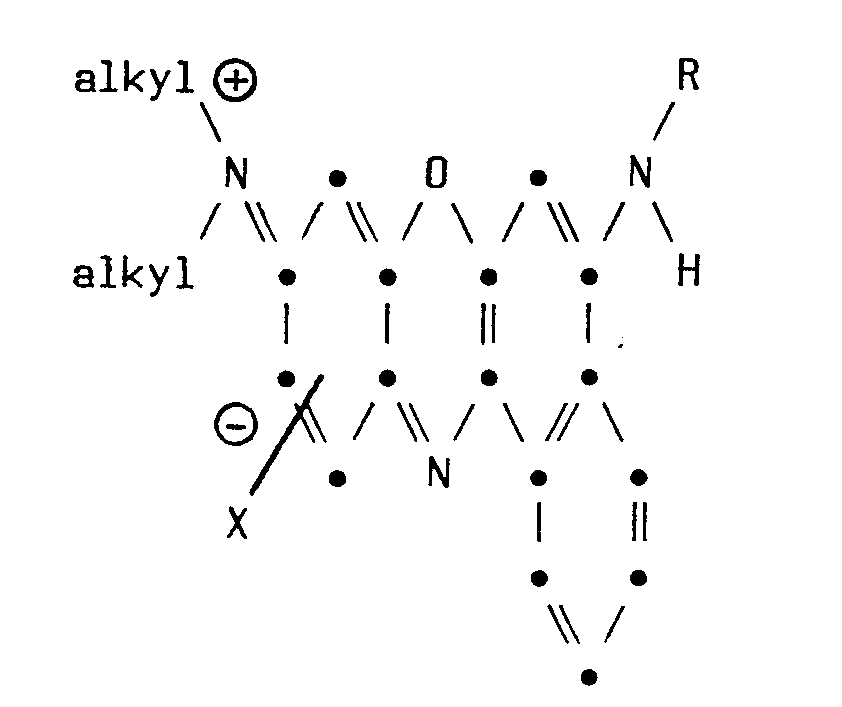
- wherein R represents benzyl or ring substituted benzyl and X represents an anion of a salt. The compounds were prepared and studied as diagnostic and therapeutic agents in the study of cancer.
- Sen and Shirley in Journal of Organic Chemistry 26 3861-3863 (1961) describe the preparation and properties of 12-acetylbenzo[a]phenoxazine and the corresponding chloroacetyl derivatives. These compounds were prepared to study chemotherapeutic agents against cancer cells.
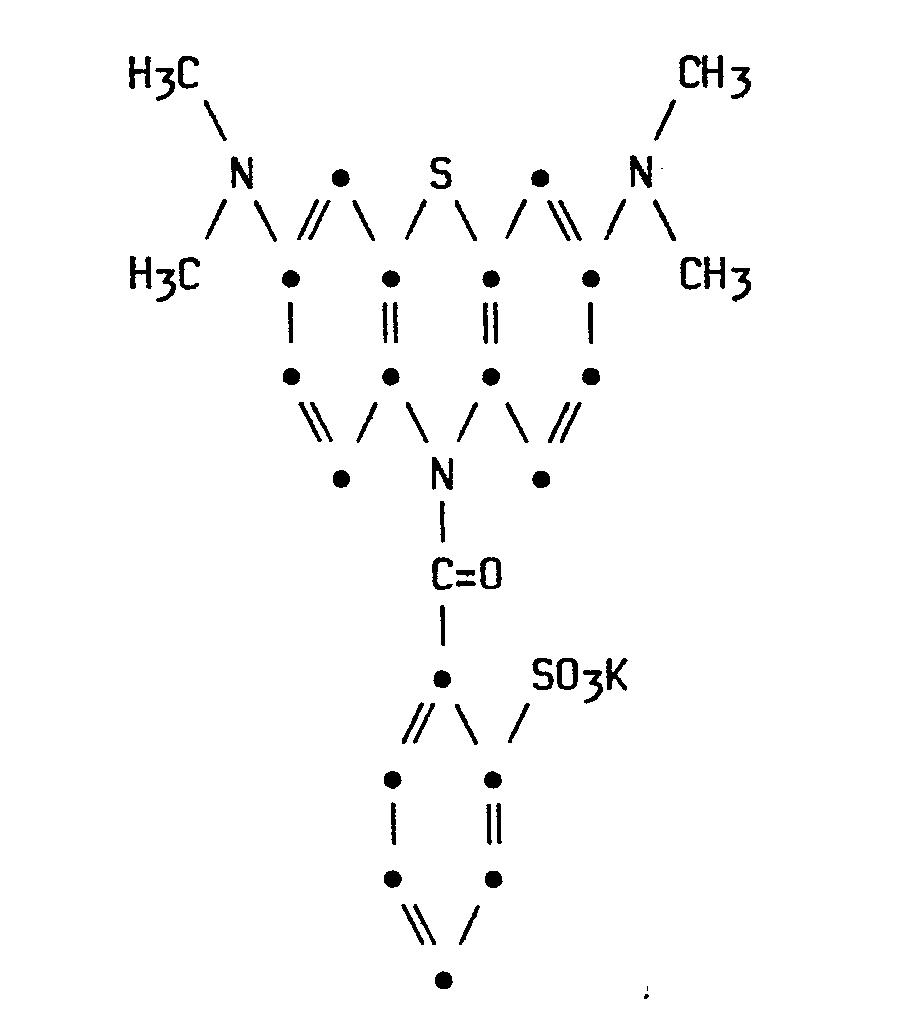
- U.S. Patent 4,309,255, issued January 5, 1982, discloses and claims a phenothiazine having the structural formula
which is disclosed as being useful as a blue color former in electrochromic recording paper. - More specifically, this invention resides in the novel 5-Q-9-(N-R2-N-R3-amino)-12-(COR)-benzo[a]phenoxazines having the structural formula

wherein Q represents [N-R1-N-(RCO)amino] or (RCOO); R represents non-tertiary C1 to C12 alkyl, C4 to C8 cycloalkyl, non-tertiary C1 to C12 alkyl substituted by halogen, phenyl or phenyl substituted by one to three of non-tertiary C1 to C4 alkyl, non-tertiary C1 to C4 alkoxy, nitro, halo, phenyl, cyano or trihalomethyl; and Rl, R2 and R3 independently represent non-tertiary Cl to C4 alkyl, phenyl, phenyl substituted by one or two of halo, nitro, non-tertiary C1 to C4 alkyl or non-tertiary C1 to C4 alkoxy, benzyl or benzyl substituted in the benzene ring by one or two of halo, nitro, non-tertiary C1 to C4 alkyl or non-tertiary C1 to C4 alkoxy. - A first particular embodiment of the invention resides in the novel 5-[N-R1-N-(COR)-arnino]-9-(N-R2-N-R3-amino-12-(COR)-benzo[a]phenoxazines wherein Q represents [N-Rl-N-(COR)-amino] having the structural formula

- Preferred compounds within the ambit of the first particular embodiment of the composition of matter aspect are the novel 5-[N-benzyl-N-(COR)-amino]-9-(N-R2-N-R3-amino)-12-(COR)-benzo[a]phenoxazines of Formula I wherein R1 is benzyl.
- A second particular embodiment of the invention resides in the novel S-(RCOO)-9-(N-R2-N-R3-amino)-12-(RCO)-benzo[a]phenoxazines wherein Q represents (RCOO) having the structural formula

- One can prepare a 5-[N-R1-N-(COR)-amino]-9-(N-R2-N-R3-amino)-12-(CQR)-benzo[a]phenoxazine according to Formula II by a process which comprises in the first step, interacting 5-(N-Rl-amino)-9-(N-R2-N-R3-amino)benzo[a]-phenoxazin-7-ium halide having the structural formula

with a reducing agent to obtain the corresponding leuco compound having the structural formula
and in a second step, interacting the leuco compound with at least two molecular proportions of an acylating agent having the structural formula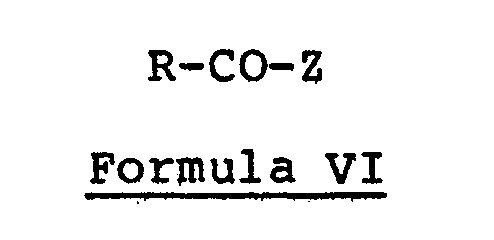
in which Z represents halo or RCOO and R, R1, R2 and R3 have the same respective meanings given in Formula II. - One can prepare a 5-(RGOO)-9-(N-R2-N-R3-amino)-12-(COR)-benzo[a]phenoxazine according to Formula III by a process which comprises in a first step, interacting a 9-(N-R 2- N-R3-amino)benzo[a]phenoxazin-5-one having the structural formula
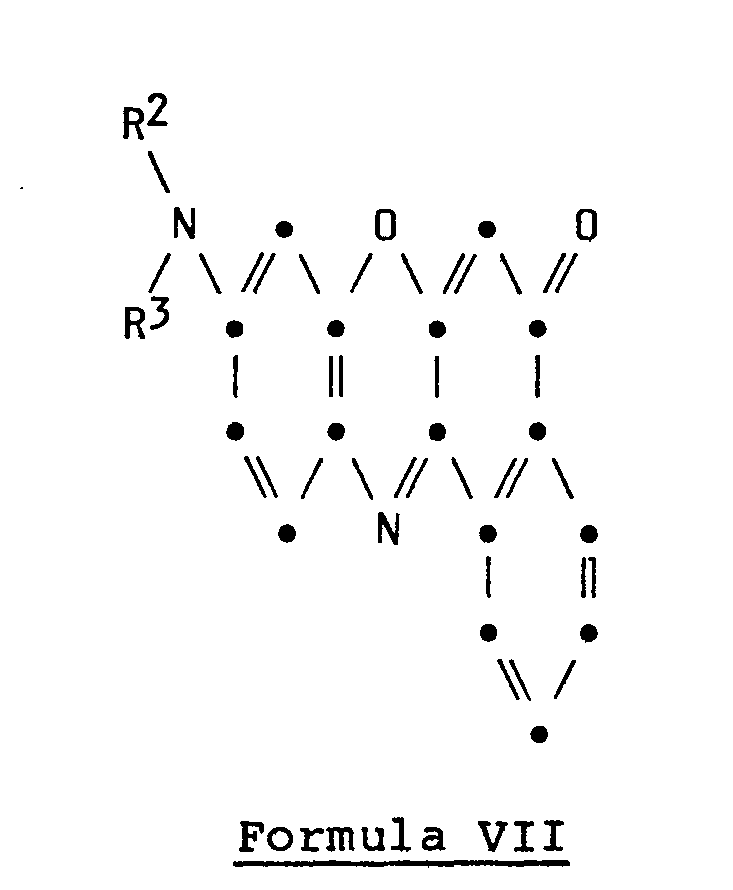
with a reducing agent to obtain the corresponding leuco compound having the structural formula
and in a second step, interacting the leuco compound with at least two molecular proportions of an acylating agent having the structural formula
- in which Z represents halo or RCOO and R, R l, R 2 and R 3 have the same respective meanings given in Formula III.
- A substrate for use in electrochromic recording comprising a support sheet containing as a color-forming substance a 5-Q-9-(N-R2-N-R3-amino)-12-(COR)-benzo[a]-phenoxazine having the structure of Formula I is also provided according to this invention.
- In one embodiment of the novel substrate for use in electrochromic recording the substrate comprises a support sheet containing as a color-forming substance a 5-[N-R1-N-(COR)-amino]-9-(N-R2-N-R3-amino)-12-(COR)-benzo[a]phenoxazine having the structure of Formula II. A preferred embodiment is the substrate containing as a color-forming substance a compound of Formula II wherein R1 is benzyl. A second particular embodiment is the novel substrate for use in electrochromic recording comprising a support sheet containing as a color-forming substance a 5-(RCOO)-9-(N-R2-N-R3-amino)-12-(RCO)-benzo[a]phenoxazine having the structure of Formula III.
- As used herein the terms "non-tertiary C1 to C4 alkyl" and "non-tertiary Cl to C12 alkyl" denote saturated monovalent straight or branched aliphatic hydrocarbon radicals including methyl, ethyl, propyl, isopropyl, butyl, isobutyl, amyl, 1-methylbutyl, 3-methylbutyl, hexyl, isohexyl, heptyl, isoheptyl, octyl, isooctyl, 2-ethylhexyl, nonyl, 3-ethylheptyl, n-decyl, n-undecyl, n-dodecyl and the like.
- The term "non-tertiary C1 to C4 alkoxy" includes saturated acyclic, straight or branched-chained groups such as methoxy, ethoxy, propoxy, isopropoxy, butoxy, sec-butoxy and isobutoxy.
- As used herein the terms "halo" and "halogen" include chloro, fluoro, bromo and iodo. Chloro is the preferred halo substituent because of the relatively low cost and ease of preparation of the required chloro-substituted intermediates and because the other halogens offer no particular advantages over chloro. However, the other above-named halo substituents are also satisfactory.
- As used herein the term "C4 to C8 cycloalkyl" denotes saturated monovalent cyclic aliphatic hydrocarbon radicals including cyclobutyl, cyclopentyl, cyclohexyl, cycloheptyl, cyclooctyl and the like.
- The benzo[a]phenoxazinium halides of Formula IV which are used as starting materials for the compounds of Formula II are generally known compounds readily prepared by procedures well known in the art. References for the preparation of benzo[a]phenoxazinium halides are: British Patent 10,619; French Patent 189,359; German Patent 60,922; Journal of the Chemical Society 91 p. 324 (1907); Beilstein Handbuch der Organischen Chemie; Journal of the American Chemical Society 74, pages 573-586 (1952); and Journal of the American Chemical Society 71, pages 3360-3362 (1949).
- The benzo[a]phenoxazin-5-ones of Formula VII which are used as starting materials for the compounds of Formula III are generally known compounds readily prepared by procedures well known in the art. References for the preparation of benzo[a]phenoxazin-5-ones are: Helvetica Chimica Acta 9, pages 868 and 880; and Chemische Berichte 50, page 881.
- The acylating agents of Formula VI may be either aliphatic acid anhydrides or the acid halides (Z = halo, preferably chloro) both of which constitute well known classes of compounds many of which are commercially-available or are readily obtained by conventional synthesis well known in the art. The following list exemplifies aliphatic acid anhydrides and acid halides useful in carrying out the processes of this invention. Acetic anhydride, chloroacetic anhydride, dichloroacetic anhydride, trifluoroacetic anhydride, propionic anhydride, butyric anhydride, isobutyric anhydride, valeric anhydride, hexanoic anhydride, hepanoic anhydride, acetyl bromide, acetyl chloride, acetyl fluoride, bromoacetyl bromide, bromoacetyl chloride, chloroacetyl chloride, methoxyacetyl chloride, propionyl chloride, 2-bromopropionyl chloride, 3-bromopropionyl chloride, 2-chloropropionyl chloride, 3-chloropropionyl chloride, butyryl chloride, 4-chlorobutyryl chloride, 2-ethylbutyryl chloride, isobutyryl chloride, valeryl chloride, 5-chlorovaleryl chloride, isovaleryl chloride, 4-methylvaleryl chloride, hexanoyl chloride, 6-bromohexanoyl chloride, heptanoyl chloride, octanoyl chloride, nonanoyl chloride, decanoyl chloride, 10-undecanoyl chloride, palmitoyl chloride, myristoyl chloride, lauroyl chloride, cyclopropyl carboxylic acid chloride, cyclobutane carboxylic acid chloride, cyclohexyl carboxylic acid chloride, m-anisoyl chloride, p-anisoyl chloride, benzoyl bromide, benzoyl chloride, benzoyl fluoride, 4-biphenylcarbonyl chloride, 2-bromobenzoyl chloride, 4-bromobenzoyl chloride, 4-butoxybenzoyl chloride, 4-butylbenzoyl chloride, 2-chlorobenzoyl chloride, 3-chlorobenzoyl chloride, 4-chlorobenzoyl chloride, 4-cyanobenzoyl chloride, 2,4-dichlorobenzoyl chloride, 2,6-dichlorobenzoyl chloride, 3,4-dichlorobenzoyl chloride, 3,5-dimethoxybenzoyl chloride, 3,4-dimethoxybenzoyl chloride, 3,5-dinitrobenzoyl chloride, 2-fluorobenzoyl chloride, 3-fluorobenzoyl chloride, 4-fluorobenzoyl chloride, 3-nitrobenzoyl chloride, 4-nitrobenzoyl chloride, 2-methoxybenzoyl chloride, 3-methylbenzoyl chloride, 4-methylbenzoyl chloride, 2-iodobenzoyl chloride, 4-iodobenzoyl chloride and 4-trifluoromethylbenzoyl chloride.
- The compounds of Formula I hereinabove are essentially colorless in the depicted form. When contacted with an electric current from an applied voltage stylus of the type ordinarily employed in electrochromic recording systems, the compounds of Formula I develop red-purple, purple, violet and blue-violet-colored images. These developed images are very insensitive to light, that is, once the color is developed, it remains unchanged when subjected to light exposure. The developed images also possess excellent xerographic reproducibility.
- The compounds of this invention may be incorporated in any of the commercially-accepted systems known in the electrochromic recording art. Typical techniques for the application of the color formers to paper are well known and are described in numerous patents, for example, U.S. Patents Re. 29,427; 3,726,769;'3,864,684; 3,871,972; 3,951,-757; 4,017,366; and 4,133,933. The usual paper coatings consist of the color-forming component, an organic metal salt, a binder and some type of conductor, either an inorganic salt or a conductive polymer. This mixture is milled together optionally in the presence of a non-ionic surface active agent until the desired particle size is obtained and then the mixture is coated on paper and dried. Optionally, the color-forming substance can be milled in the presence of a binder and the remaining ;components milled also in the presence of a binder and the two mixtures combined together prior to coating on paper. Normally the surface of the coated paper is wet with a conductive solution containing an inorganic alkali metal or alkaline earth metal salt, for example, potassium chloride, calcium chloride, sodium chloride, sodium bromide, potassium bromide, potassium nitrate or sodium sulfate immediately prior to the printing with the applied voltage stylus. For a quick qualitative test, it has been determined that the color-forming component can be dissolved in a suitable volatile organic solvent, coated on paper and the coated paper dried to obtain a paper sheet coated with the color-forming component. This coated sheet can then be wet with a conductive salt solution and an image traced with an applied voltage stylus to develop the colored image.
- The compounds of Formula I can be used alone as color-forming components in electrochromic recording paper or can be used in admixture with one or more other color-forming compounds from the classes consisting of phthalides, for example, Crystal Violet Lactone; fluorans, for example, 3-diethylamino-5,7-dimethylfluoran; redox indicators, for example, phenothiazines such as benzoyl leuco methylene blue and various other types of color-forming components currently employed in commercially-accepted electrochromic recording systems.
- In accordance with one of the aforementioned process aspects of this invention, the compounds of Formula II are obtained by reacting approximately one molecular proportion of a leuco compound of Formula V with about two molecular proportions of an acylating agent of Formula VI. When using an anhydride as the acylating agent, the reaction is conveniently carried out in an excess of the acylating agent which is utilized as both the reaction medium and as the reactant. Optionally, a small amount of an organic base, for example, pyridine may be used as a catalyst. The reaction is conveniently carried out at a temperature in the range of 900C to reflux of the mixture for periods of approximately thirty minutes to approximately four hours. The compounds of Formula II thus obtained are isolated by pouring the reaction mixture into ice water and extracting the desired products into a suitable water immiscible organic liquid, for example, toluene. The organic liquid layer containing the product is subsequently washed with water to remove inorganic salts and water-soluble organics and then treated with decolorizing charcoal, if desired. The resulting organic liquid solution of the product is then concentrated by conventional means such as evaporation or distillation. Alternatively, the compounds of Formula II can be obtained also by reacting approximately one molecular proportion of a leuco compound of Formula V with about two molecular proportions of an acyl halide (Formula VI; Z = halo). A solution of the leuco compound dissolved in an organic liquid is heated to a temperature in the range of 60 to 800C and disodium phosphate and acyl halide, dissolved in the same organic liquid, is added. The reaction is conveniently carried out at the reflux temperature of the mixture for periods of approximately fifteen minutes to approximately nineteen hours. Water and additional disodium phosphate are added to the reaction mixture and the resulting mixture is heated at reflux temperature for a period of approximately thirty minutes to approximately one hour. The organic liquid solution containing the desired product is separated from the water layer, washed with water and concentrated by conventional means such as evaporation or distillation. The product of the concentration process is impure and further purification is desirable. The isolated product can be purified by conventional means such as recrystallization or reslurrying with a suitable organic liquid and then collected by filtration. Purification can also be effected by column chromatography. The material to be purified is dissolved in a suitable organic liquid and the solution is passed through a chromatography column which has been packed with a suitable substrate, for example, silica gel, cellulose or alumina. Numerous fractions are collected and analyzed to determine fraction(s) containing the desired product. The fraction(s) which contain the desired product are then combined (if more than one) and concentrated to obtain the product. The leuco compound of Formula V is conveniently prepared by reducing the corresponding benzo[a]phenoxazinium halide of Formula IV with a reducing agent, for example, an alkali hydrosulfite. The reaction in which the leuco compound is prepared is conveniently carried out in a mixture of water and a suitable water immiscible organic liquid, for example, toluene or xylene in an inert atmosphere, for example, nitrogen. The reaction is carried out in the presence of an alkaline substance, for example, sodium carbonate or disodium phosphate using, as the reducing agent, an alkali hydrosulfite, for example, sodium hydrosulfite. The reaction is conveniently carried out at ambient temperature for a period of approximately fifteen minutes to approximately two hours. The organic liquid solution which contains the leuco compound is separated from the water layer. Additional alkali hydrosulfite is added to the organic liquid solution and the resulting mixture is azeotroped to remove the remaining traces of water. This dried soluition of the leuco can then be interacted directly with an acylating agent in the manner described hereinabove. Alternatively, a metal reducing agent, for example, zinc dust may be used to reduce the benzo[a]phenoxazinium halide. This reaction is conveniently carried out in an excess of the alkanoic anhydride acylating agent thus resulting in no need for an inert reaction medium.
- In accordance with the second of the aforementioned process aspects of this invention, the compounds of Formula III are obtained by reacting approximately one molecular proportion of a leuco compound of Formula VIII with about two molecular proportions of an acylating agent of Formula VI. When using an anhydride as the acylating agent, the reaction is conveniently carried out in an excess of the acylating agent which is utilized as both the reaction medium and as the reactant. Optionally, a small amount of an organic base, for example, pyridine may be used as a catalyst. The reaction is conveniently carried out at a temperature in the range of 900C to reflux of the mixture for periods of approximately thirty minutes to approximately four hours. The compounds of Formula III thus obtained are isolated by pouring the reaction mixture into ice water and extracting the desired products into a suitable water immiscible organic liquid, for example, toluene. The organic liquid layer containing the product is subsequently washed with water to remove inorganic salts and water-soluble organics and then treated with decolorizing charcoal, if desired. The resulting organic liquid solution of the product is then concentrated by conventional means such as evaporation or distillation. Alternatively, the compounds of Formula III can be obtained also by reacting approximately one molecular proportion of a leuco compound of Formula VIII with about two molecular proportions of an acyl halide (Formula VI; Z = halo). A solution of the leuco compound dissolved in an organic liquid is cooled to a temperature in the range of 60 to 800C and disodium phosphate and acyl halide, dissolved in the same organic liquid, is added. The reaction is conveniently carried out at the reflux temperature of the mixture for periods of approximately fifteen minutes to approximately nineteen hours. Water and additional disodium phosphate are added to the reaction mixture and the resulting mixture is heated at reflux temperature for a period of approximately thirty minutes to approximately one hour. The organic liquid solution containing the desired product is separated from the water layer, washed with water and concentrated by conventional means such as evaporation or distillation. The product of the concentration process is impure and further purification is desirable. The isolated product can be purified by conventional means such as recrystallization or reslurrying with a suitable organic liquid and then collected by filtration. Purification can also be effected by column chromatography. The material to be purified is dissolved in a suitable organic liquid and the solution is passed through a chromatography column which has been packed with a suitable substrate, for example, silica gel, cellulose or alumina. Numerous fractions are collected and analyzed to determine fraction(s) containing the desired product. The fraction(s) which contain the desired product are then combined (if more than one) and concentrated to obtain the product. The leuco compound of Formula VIII is conveniently prepared by reducing the corresponding benzo[a]phenoxazin-5-one of Formula VII with a reducing agent, for example, an alkali hydrosulfite. The reaction in which the leuco compound is prepared is conveniently carried out in a mixture of water and a suitable water immiscible organic liquid, for example, toluene or xylene in an inert atmosphere, for example, nitrogen. The reaction is carried out in the presence of an alkaline substance, for example, sodium carbonate or disodium phosphate using, as the reducing agent, an alkali hydrosulfite, for example, sodium hydrosulfite. The reaction is conveniently carried out at ambient temperature for a period of approximately fifteen minutes to approximately two hours. The organic liquid solution which contains the leuco compound is separated from the water layer. Additional alkali hydrosulfite is added to the organic liquid solution and the resulting mixture is azeotroped to remove the remaining traces of water. This dried solution of the leuco can then be interacted directly with an acylating agent in the manner described hereinabove. Alternatively, a metal reducing agent, for example, zinc dust may be used to reduce the benzo[a]-phenoxazin-5-one. This reaction is conveniently carried out in an excess of the alkanoic acid anhydride acylating agent thus resulting in no need for an inert reaction medium.
- The molecular structures of the compounds were assigned on the basis of the modes of synthesis and a study of their infrared, nuclear magnetic resonance and mass spectra.
- A mixture of 14.0 g of 9-diethylamino-5-(N-benzylamino)benzophenoxazin-7-ium chloride, 75.0 ml of acetic anhydride, 5.0 ml of pyridine and 7.0 g of zinc dust was maintained at reflux temperature for approximately two hours. After cooling to room temperature, the reaction mixture was filtered to remove insolubles and the filter cake was washed twice, each time with 50.0 ml of acetone. The filtrate and the washes were combined and slowly poured into a mixture of water and toluene. After stirring the mixture for approximately thirty minutes, the organic extracts were separated, treated with decolorizing carbon, filtered, and the resulting clarified toluene solution was evaporated under reduced pressure to afford 15.17 g of 9-diethylamino-5-(N-acetyl-N-benzylamino)-12-acetylbenzo[a]phenoxazine (Formula II: R=CH3; R1=C6H5CH2; R2=R3=C2H5), a pale brown powder which melted over the range of 86 to 9loC. A significant infrared maximum appeared 1670 cm-1 (C=O;s). Significant maximum appeared in the mass spectrum at 493 (M+) and was consistent with the assigned structure. The nuclear magnetic resonance spectrum was consistent with the assigned structure. A paper treated with an ink formulation of the product produced a strong blue-violet-colored image when traced with an applied voltage stylus.
- The reaction vessel was purged of residual air with nitrogen and, while maintaining a nitrogen atmosphere, a mixture of 12.0 g of 9-dimethylamino-5-(N-benzylamino)benzo- phenbxazin-7-ium chloride, 500.0 ml of water, 500.0 ml of toluene, 12.0 g of sodium carbonate, and 15.0 g of sodium hydrosulfite was stirred for approximately fifteen minutes at room temperature. The layers were separated, the water layer was discarded and 200.0 ml of fresh toluene and 10.0 g of sodium hydrosulfite was added to the toluene solution. The resulting toluene mixture was azeotroped dry, cooled and 10.0 g of disodium phosphate and 25.0 ml of para-toluoyl chloride were added. The resulting reaction mixture was maintained at reflux for approximately three hours. After cooling to room temperature, 500.0 ml of water and 17.0 g of disodium phosphate was added to the reaction mixture and the resulting mixture was maintained at reflux for approximately ninety minutes. After cooling to room temperature, the layers were separated and the water layer was discarded. The organic solution was washed six times as follows: three washes with 800.0 ml water; one wash with 800.0 ml of saturated aqueous sodium carbonate solution; one wash with 800.0 ml water; and one wash with saturated aqueous sodium chloride solution. The toluene solution was treated with activated charcoal, filtered and evaporated under reduced pressure obtaining a dark gummy residue. This residue was dissolved in a 2:23 (V:V) mixture of ethyl acetate and toluene. The resulting solution was separated into various components by subjecting it to column chromatography using silica gel as the substrate. A total of forty-four fractions, each containing approximately twenty milliliters, were collected and each fraction was analyzed by thin layer chromatography. Fractions 1 to 14 and 32 to 44 were discarded. Fractions 15 to 27 were combined and concentrated by evaporation at reduced pressure to obtain 2.3 g of 5-[N-benzyl-N-(4-methylphenylcarbonyl)]amino-9-dimethyl- amino-12-(4-methylphenylcarbonyl) benzo[a]phenoxazine (Formula II: R=4-CH3C6H4; R1=C6H5CH2; R2=R3=CH3), a tan-colored powder which melted at 202 to 204oC. A significant infrared maximum appeared at 1650 cm-1 (C=O;m). A significant maximum appeared in the mass spectrum at 617 (M+) and was consistent with the assigned structure. Fractions 28 to 31 were combined and concentrated to obtain 0.19 g of the product. Paper treated with an ink formulation of the product produced a violet-colored image when traced with an applied voltage stylus.
- Proceeding in a manner similar to that described in Example 2 above, 12.0 g of 9-dimethylamino-5-benzylamino- benzo[a]phenoxazin-7-ium chloride,was reacted in a mixture of 500.0 ml of water and 500.0 ml of toluene with 18.0 g of sodium hydrosulfite to obtain the corresponding leuco compound of the benzo[a]phenoxazine which in turn was reacted with 25.0 ml of ortho-chlorobenzoyl chloride to afford after recrystallization from a mixture of hexane and isopropanol, 1.77 g of 5-[N-benzyl-N-(2-chlorophenylcarbonyl)amino]-9-di- methylamino-12-(2-chlorophenylcarbonyl)benzo[a]phenoxazine (Formula II: R=ClC6H4; Rl=C6H5CH2; R2=R3=CH3), a tan-colored powder which melted at 229 to 232oC. A significant infrared maximum appeared at 1660 cm-1 (C=O;m). Paper treated with an ink formulation of the product produces a violet-colored image when traced with an applied voltage stylus.
- Following the procedure described in Example 2 above, 10.0 g of 9-diethylamino-5-benzylaminobenzo[a]phenoxa- zin-7-ium chloride was reacted in a mixture of 500.0 ml of water and 500.0 ml of toluene with 10.0 g of sodium hydrosulfite to obtain the leuco benzo[a]phenoxazine which was then reacted with 15.0 ml of benzoyl chloride to obtain after purification by column chromatography, 0.69 g of 9-(N-benzyl-N-benzoylamino)-9-diethylamino-12-benzoylbenzo[a]phenoxazine (Formula II: R=C6H5; R1=C6H5CH2; R2=R3=C2H5), a tan powder which melted at 180 to 182°C. A significant infrared maximum appeared at 1655 cm-1 (C=O;s). Paper treated with an ink formulation of the product produced a violet-colored image when traced with an applied voltage stylus.
- In a manner similar to that described in Example 2 above, 10.0 g of 9-diethylamino-5-benzylaminobenzo[a]phen- oxazin-7-ium chloride was reacted with 10.0 g of sodium hydrosulfite in a mixture of 500.0 ml of water and 500.0 ml of toluene to obtain the leuco benzo[a]phenoxazine compound which was further reacted with 13.5 ml of para-anisoyl chloride to obtain after purification utilizing column chromatography, 0.5 g of 5-[N-benzyl-N-(4-methoxyphenyl- carbonyl)amino]-9-diethylamino-12-(4-methoxyphenylcarbonyl)-benzo[a]phenoxazine (Formula II: R=4-CH30C6H4; R1=C6H5CH2; R2=R3 =C2H5), a pink-colored gum. A significant infrared maximum appeared at 1650 cm-1 (C=O;m). Paper treated with an ink formulation of the product produced a violet-colored image.
- Proceeding in a manner similar to that described in Example 1 hereinabove, 12.0 g of 5-benzylamino-9-dimethyl- aminobenzo[a]phenoxazin-7-ium chloride was interacted with 60.0 ml of hexanoic anhydride and 5.0 g of zinc dust in the presence of 5.0 ml of pyridine to obtain after purification using column chromatography, 5-(N-benzyl-N-pentylcarbonyl- amino)-9-dimethylamino-12-pentylcarbonylbenzo[a]phenoxa- zine (Formula II: R=CH3(CH2)4; Rl=C6H5CH2; R2=R3=CH3), a pale brown-colored gum. A significant infrared maximum appeared at 1670 cm-1 (C=O;m). Paper treated with an ink formulation of the product produced a purple-colored image when traced with an applied voltage stylus.
- It is contemplated that by following the procedure described in the foregoing examples, but employing the appropriate 5-(N-Rl-amino)-9-(N-R2-N-R3-amino)benzo[a]phen- oxazinium halide of Formula IV with a reducing agent and the appropriate acylating agent of Formula VI, there will be obtained 5-(N-Rl-N-COR-amino)-9-(N-R2-N-R3-amino)-12-(R-CO)-benzo[a]phenoxazine of Formula II, presented in Examples 7 to 25 in Table A hereinbelow.


- A mixture of 10.0 g of 9-diethylaminobenzo[a]-phenoxazin-5-one, 75.0 ml of acetic anhydride and 10.0 g of zinc dust was maintained at approximately 80°C for approximately thirty minutes. After the reaction mixture was cooled to room temperature, the solid present was collected by filtration and it was washed twice, each time with 25.0 ml of acetone. The filtrate and the acetone washes were combined and added slowly to approximately 400.0 ml of water. An oily liquid separated from the water and was extracted from the water with toluene. Subsequently, the toluene solution was washed with water and saturated sodium chloride solution, treated with activated carbon and clarified. The resulting toluene solution was evaporated to dryness. The residue obtained was dissolved in a mixture of ethyl acetate:toluene (2:23::V:V) and purified by passing the solution through a chromatography column packed with silica gel. Fractions 7 through 11 were combined, evaporated to dryness and the residue triturated with hexane to obtain 0.26 g of 5-methyl- carbonyloxy-9-diethylamino-12-acetylbenzo[a]phenoxazine (Formula III: R=CH3; R2=R3=C2H5), a pale brown-colored solid which melted at 64 to 72oC. Significant infrared maxima appeared at 1772 cm-1 (C=O;m) and 1680 cm-1 (C=0;s). Paper treated with an ink formulation of the product produced a strong purple-colored image when traced with an applied voltage stylus.
- It is contemplated that by following the procedure described in the foregoing example, but employing the appropriate 9-(N-R2-N-R3-amino)-benzo[a]phenoxazin-5-one of Formula VII with a reducing agent and the appropriate acylating agent of Formula VI, there will be obtained the corresponding 5-(RCOO)-9-(N-R2-N-R3-amino)-12-(RCO)-benzo[a]-phenoxazine of Formula III, presented in Examples 27 to 45 in Table B hereinbelow.


Claims (10)
1. A compound having the structural formula

wherein:
wherein:
Q represents [N-R1-N-(RCO)amino] or (RCOO);
R represents non-tertiary C1 to C12 alkyl, C4 to C8 cycloalkyl, non-tertiary C1 to C12 alkyl substituted with halogen, phenyl or phenyl substituted by one to three of non-tertiary C1 to C4 alkyl, non-tertiary C1 to C4 alkoxy, nitro, halo, phenyl, cyano, or trihalomethyl; and
R 1, R2 and R independently represent C1 to C4 alkyl, phenyl, phenyl substituted by one or two of halo, nitro, non-tertiary C1 to C4 alkyl or non-tertiary C1 to C4 alkoxy, benzyl or benzyl substituted in the benzene ring by one or two of halo, nitro, non-tertiary C1 to C4 alkyl or non-tertiary C1 to C4 alkoxy.
2. A compound according to claim 1, in which Q represents N-R1-N-(RCO)amino having the structural formula

3. A compound according to claim 2, wherein R1 is benzyl.
4. 5-(N-Acetyl-N-benzylamino)-9-diethylamino-12- acetylbenzo[a]phenoxazine according to claim 2.
5. 5-[N-Benzyl-N-(4-methylphenylcarbonyl)amino]-9-di- methylamino-12-(4-methylphenylcarbonyl)benzo[a]phenoxazine according to claim 2.
6. A compound according to claim 1, in which Q represents RCOO having the structural formula
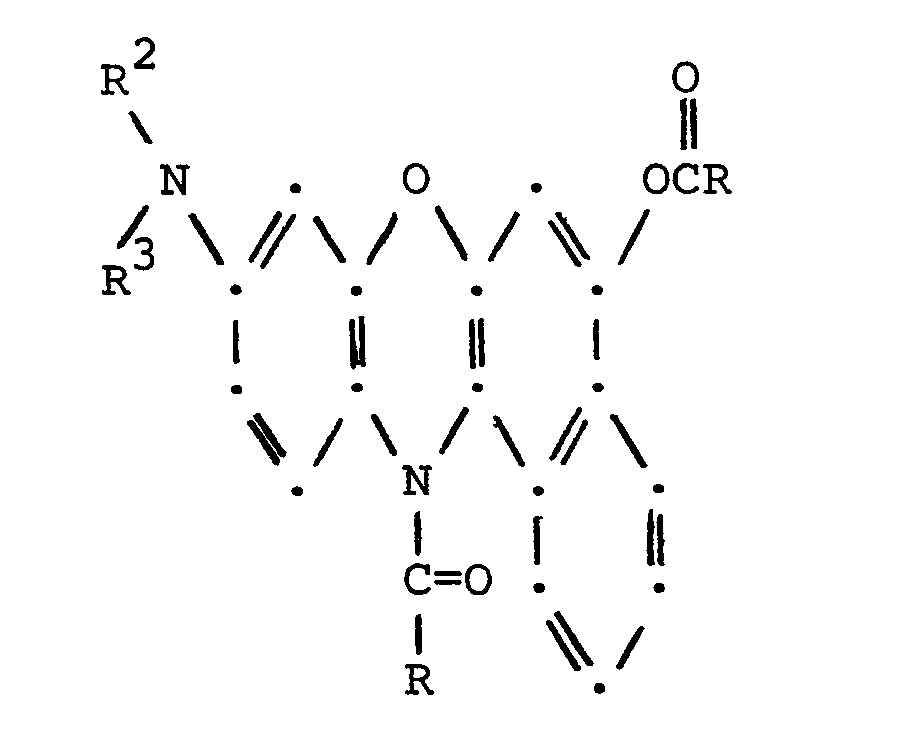
7. A compound according to claim 6, wherein R is non-tertiary C1 to C 12.
8. 5-Methylcarbonyloxy-9-diethylamino-12-acetylbenzo-[a]phenoxazine according to claim 7.
9. A substrate for use in electrochromic recording comprising a support sheet containing as a color-forming substance a compound according to any one of claims 1 to 8.
10. A process for preparing a compound according to claim 1, which comprises in a first step, treating a compound having the structural formula
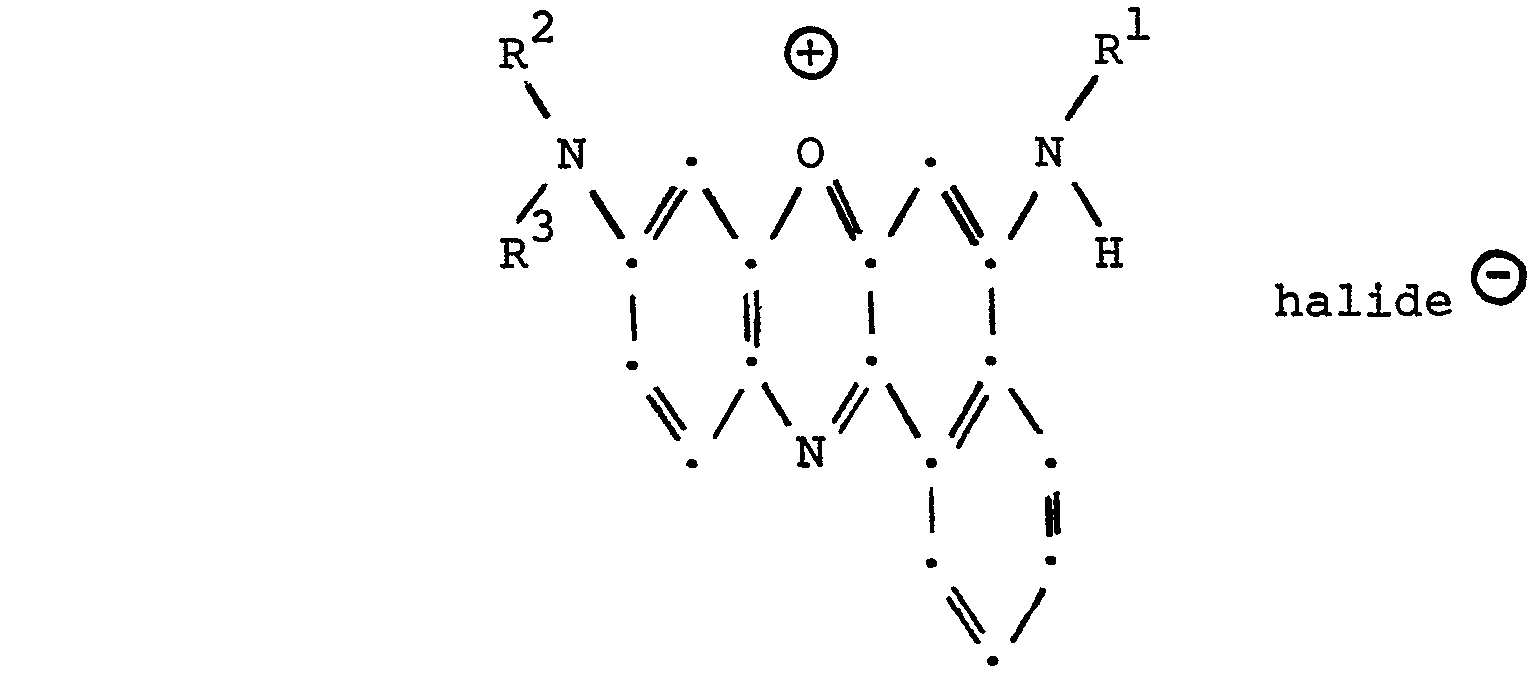
or 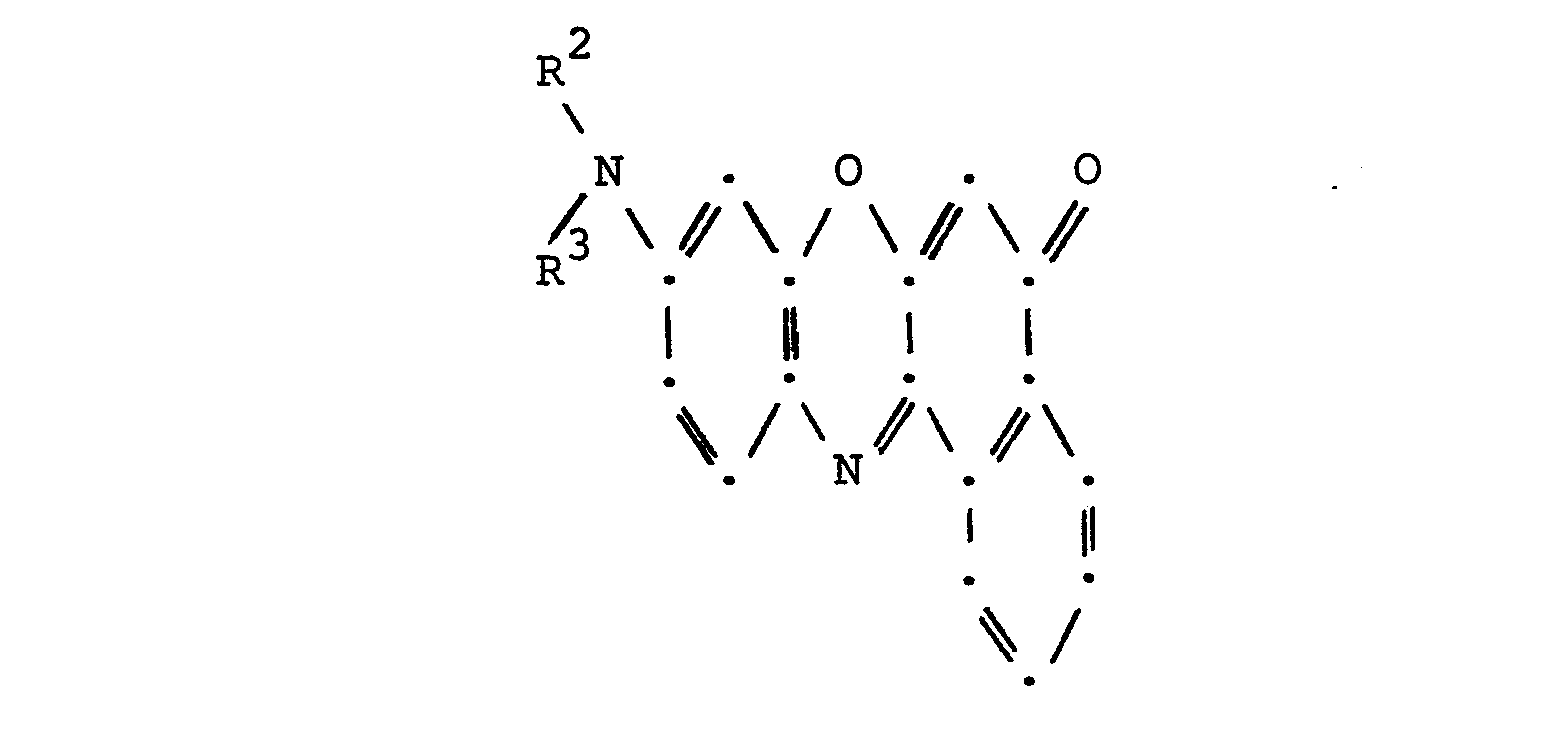
with a reducing agent to obtain the corresponding leuco compound having the structural formula 
or 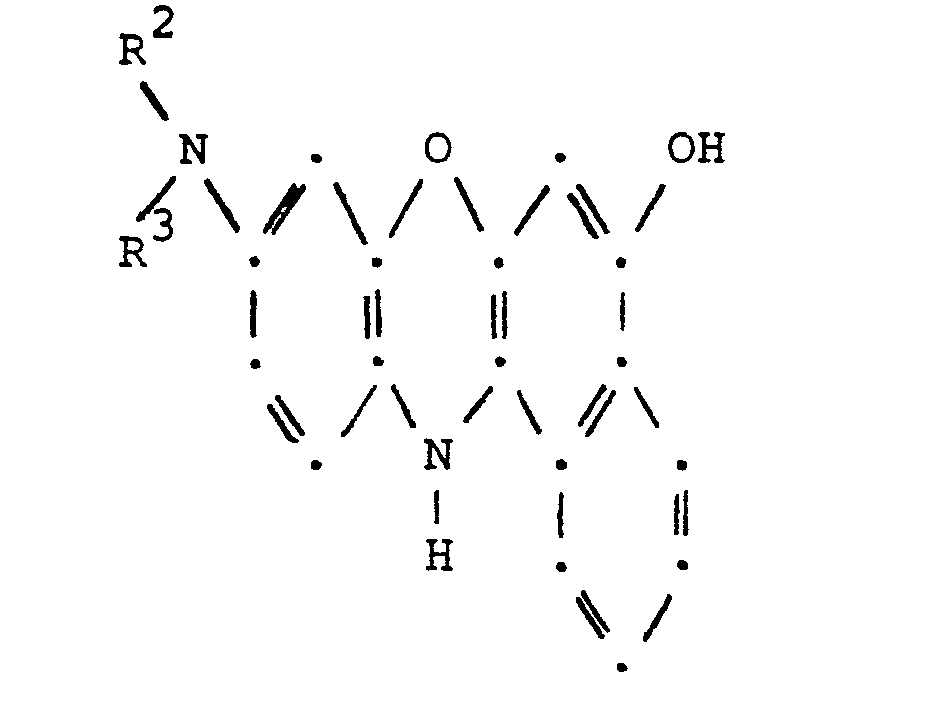
and, in a second step, reacting the leuco compound with at least two molecular equivalents of an acylating agent having the structural formula R-CO-Z in which Z represents halo or RCOO and R, R1, R2 and R 3 have the same respective meaninqs given in claim 1.
or
with a reducing agent to obtain the corresponding leuco compound having the structural formula
or
and, in a second step, reacting the leuco compound with at least two molecular equivalents of an acylating agent having the structural formula R-CO-Z in which Z represents halo or RCOO and R, R1, R2 and R 3 have the same respective meaninqs given in claim 1.
Applications Claiming Priority (2)
| Application Number | Priority Date | Filing Date | Title |
|---|---|---|---|
| US06/636,461 US4570171A (en) | 1984-07-31 | 1984-07-31 | Electrochromic marking systems |
| US636461 | 1984-07-31 |
Publications (1)
| Publication Number | Publication Date |
|---|---|
| EP0170967A1 true EP0170967A1 (en) | 1986-02-12 |
Family
ID=24552010
Family Applications (1)
| Application Number | Title | Priority Date | Filing Date |
|---|---|---|---|
| EP85109167A Withdrawn EP0170967A1 (en) | 1984-07-31 | 1985-07-22 | Substituted benzophenoxazines, method for preparing same and use thereof in electrochromic recording systems |
Country Status (3)
| Country | Link |
|---|---|
| US (1) | US4570171A (en) |
| EP (1) | EP0170967A1 (en) |
| JP (1) | JPS6147472A (en) |
Families Citing this family (5)
| Publication number | Priority date | Publication date | Assignee | Title |
|---|---|---|---|---|
| JPH02136484U (en) * | 1989-04-18 | 1990-11-14 | ||
| JPH08510563A (en) * | 1993-03-15 | 1996-11-05 | ミネソタ・マイニング・アンド・マニュファクチュアリング・カンパニー | Ballasted leuco dyes and photothermographic elements containing same |
| US5432041A (en) * | 1993-03-18 | 1995-07-11 | Minnesota Mining And Manufacturing Company | Yellow and magenta chromogenic leuco dyes for photothermographic elements |
| JP3616130B2 (en) * | 1993-06-04 | 2005-02-02 | イーストマン コダック カンパニー | Infrared-sensitive photothermographic silver halide element and image-forming medium exposure method |
| US5583255A (en) * | 1993-12-03 | 1996-12-10 | Imation Corp. | Yellow and magenta chromogenic leuco dyes for photothermographic elements |
Citations (1)
| Publication number | Priority date | Publication date | Assignee | Title |
|---|---|---|---|---|
| EP0058338A2 (en) * | 1981-02-05 | 1982-08-25 | International Business Machines Corporation | Electrochromic printing media |
Family Cites Families (5)
| Publication number | Priority date | Publication date | Assignee | Title |
|---|---|---|---|---|
| CA944150A (en) * | 1970-06-13 | 1974-03-26 | Fuji Photo Film Co. | Pressure-sensitive copying paper |
| US3873340A (en) * | 1972-07-27 | 1975-03-25 | Hodogaya Chemical Co Ltd | Pressure-sensitive copying paper containing phenoxazine compounds |
| JPS5181629A (en) * | 1975-01-14 | 1976-07-17 | Sumitomo Chemical Co | |
| US4309255A (en) * | 1980-09-10 | 1982-01-05 | International Business Machines Corporation | Electrochromic recording paper |
| JPS614094A (en) * | 1984-06-18 | 1986-01-09 | 松下電器産業株式会社 | Electro-optic function element and manufacture thereof |
-
1984
- 1984-07-31 US US06/636,461 patent/US4570171A/en not_active Expired - Fee Related
-
1985
- 1985-07-22 EP EP85109167A patent/EP0170967A1/en not_active Withdrawn
- 1985-07-26 JP JP60165621A patent/JPS6147472A/en active Pending
Patent Citations (1)
| Publication number | Priority date | Publication date | Assignee | Title |
|---|---|---|---|---|
| EP0058338A2 (en) * | 1981-02-05 | 1982-08-25 | International Business Machines Corporation | Electrochromic printing media |
Non-Patent Citations (2)
| Title |
|---|
| JOURNAL OF THE AMERICAN CHEMICAL SOCIETY, vol. 71, no. 10, 20th October 1949, pages 3360-3362, The American Chemical Society, New York, US; H.A. SLOVITER: "Halogenated benzophenoxazine dyes" * |
| JOURNAL OF THE AMERICAN CHEMICAL SOCIETY, vol. 74, no. 3, 5th February 1952, pages 573-586, The American Chemical Society, New York, US; M.L. CROSSLEY et al.: "Chemotherapeutic dyes. I. 5-Aralkylamino-9-alkylaminobenzo[a]phenoxazines" * |
Also Published As
| Publication number | Publication date |
|---|---|
| US4570171A (en) | 1986-02-11 |
| JPS6147472A (en) | 1986-03-07 |
Similar Documents
| Publication | Publication Date | Title |
|---|---|---|
| EP0170188B1 (en) | Novel phenothiazines, preparation thereof and use thereof in electrochromic recording systems | |
| DE60123933T2 (en) | FLUORESCENT SAMPLES FOR THE QUANTITATIVE DETERMINATION OF ZINC | |
| DE2265233A1 (en) | NEW DYE PRODUCTS AND THEIR USES | |
| DE2323803B2 (en) | Spirodipyrans and their use as color formers for copying processes | |
| DE2412640C3 (en) | Pressure sensitive copier paper | |
| US4439280A (en) | Phenothiazine leucodyes for electrochromic recording | |
| US4570171A (en) | Electrochromic marking systems | |
| US4551740A (en) | Electrochromic and marking systems | |
| US4604458A (en) | 3-substituted carbonyloxy-7-disubstituted amino-10-substituted carbonylphenothiazines | |
| SU566524A3 (en) | Method of obtaining derivatives of pyrido-(1,2-alpha)-pyrimidine and their salts | |
| US4604461A (en) | 5-substituted-9-disubstituted amino-12-substituted carbonylbenzo[a]phenoxazines | |
| JPS59124886A (en) | Printing medium | |
| US4549192A (en) | Electrochromic marking systems | |
| US4652643A (en) | 3-amido-7-disubstituted amino-10-carbonylphenothiazines | |
| CH657367A5 (en) | 4-AZAPHTHALID, METHOD FOR THE PRODUCTION THEREOF, AND RECORDING MATERIAL CONTAINING THIS COLOR-GENERATING MATERIAL. | |
| US4604462A (en) | 4-substituted amido-8-disubstituted aminoimidazophenoxazines | |
| DE2806909C2 (en) | ||
| DE2430568C3 (en) | Spirodipyrans and their use as color formers for pressure-sensitive recording materials | |
| EP0000900B1 (en) | Spirobipyranes, their use and pressure-sensitive copying materials containing them | |
| US3896128A (en) | Lactones of the diazaxanthene series and dye precursors for copying processes | |
| DE2847690A1 (en) | COLOR IMAGE FOR COPYING PROCESS | |
| DE2611600A1 (en) | COLOR PICTURES FOR COPYING | |
| GB2103234A (en) | Chromogenic azaphthalide compounds | |
| EP0005475B1 (en) | Process for the preparation of 4,4'-diaminobenzhydrol and its substitution products | |
| OKABAYASHI et al. | Dimethylthioxanthones formed by condensation of 2-mercaptobenzoic acid with o-, or m-xylene in sulfuric acid |
Legal Events
| Date | Code | Title | Description |
|---|---|---|---|
| PUAI | Public reference made under article 153(3) epc to a published international application that has entered the european phase |
Free format text: ORIGINAL CODE: 0009012 |
|
| AK | Designated contracting states |
Kind code of ref document: A1 Designated state(s): CH DE FR GB LI |
|
| 17P | Request for examination filed |
Effective date: 19860613 |
|
| STAA | Information on the status of an ep patent application or granted ep patent |
Free format text: STATUS: THE APPLICATION IS DEEMED TO BE WITHDRAWN |
|
| 18D | Application deemed to be withdrawn |
Effective date: 19880202 |
|
| RIN1 | Information on inventor provided before grant (corrected) |
Inventor name: MO-WEI HUNG, WILLIAM |