EP0169987B1 - Communications cables - Google Patents
Communications cables Download PDFInfo
- Publication number
- EP0169987B1 EP0169987B1 EP85105690A EP85105690A EP0169987B1 EP 0169987 B1 EP0169987 B1 EP 0169987B1 EP 85105690 A EP85105690 A EP 85105690A EP 85105690 A EP85105690 A EP 85105690A EP 0169987 B1 EP0169987 B1 EP 0169987B1
- Authority
- EP
- European Patent Office
- Prior art keywords
- cable
- anhydride
- copolymer
- ethylene
- acid
- Prior art date
- Legal status (The legal status is an assumption and is not a legal conclusion. Google has not performed a legal analysis and makes no representation as to the accuracy of the status listed.)
- Expired
Links
- 238000004891 communication Methods 0.000 title description 4
- 229920001577 copolymer Polymers 0.000 claims description 38
- 239000000203 mixture Substances 0.000 claims description 29
- 239000000853 adhesive Substances 0.000 claims description 26
- 230000001070 adhesive effect Effects 0.000 claims description 26
- -1 methyl Himic anhydride Chemical compound 0.000 claims description 19
- VGGSQFUCUMXWEO-UHFFFAOYSA-N Ethene Chemical compound C=C VGGSQFUCUMXWEO-UHFFFAOYSA-N 0.000 claims description 17
- 239000005977 Ethylene Substances 0.000 claims description 17
- 229920000578 graft copolymer Polymers 0.000 claims description 16
- 229920000642 polymer Polymers 0.000 claims description 15
- 229910052782 aluminium Inorganic materials 0.000 claims description 14
- XAGFODPZIPBFFR-UHFFFAOYSA-N aluminium Chemical compound [Al] XAGFODPZIPBFFR-UHFFFAOYSA-N 0.000 claims description 14
- 229920001519 homopolymer Polymers 0.000 claims description 12
- 239000000178 monomer Substances 0.000 claims description 11
- 229920000572 Nylon 6/12 Polymers 0.000 claims description 9
- 150000001993 dienes Chemical class 0.000 claims description 9
- ZMUCVNSKULGPQG-UHFFFAOYSA-N dodecanedioic acid;hexane-1,6-diamine Chemical group NCCCCCCN.OC(=O)CCCCCCCCCCC(O)=O ZMUCVNSKULGPQG-UHFFFAOYSA-N 0.000 claims description 9
- 239000010410 layer Substances 0.000 claims description 9
- 229910052751 metal Inorganic materials 0.000 claims description 9
- 239000002184 metal Substances 0.000 claims description 9
- 229920000098 polyolefin Polymers 0.000 claims description 9
- VZCYOOQTPOCHFL-OWOJBTEDSA-N Fumaric acid Chemical compound OC(=O)\C=C\C(O)=O VZCYOOQTPOCHFL-OWOJBTEDSA-N 0.000 claims description 8
- 229920001400 block copolymer Polymers 0.000 claims description 8
- 229920001634 Copolyester Polymers 0.000 claims description 7
- 229920002292 Nylon 6 Polymers 0.000 claims description 7
- 229910000831 Steel Inorganic materials 0.000 claims description 7
- 229920001903 high density polyethylene Polymers 0.000 claims description 7
- 239000010959 steel Substances 0.000 claims description 7
- VZCYOOQTPOCHFL-UHFFFAOYSA-N trans-butenedioic acid Natural products OC(=O)C=CC(O)=O VZCYOOQTPOCHFL-UHFFFAOYSA-N 0.000 claims description 7
- 239000002253 acid Substances 0.000 claims description 6
- 150000008065 acid anhydrides Chemical class 0.000 claims description 6
- 239000012790 adhesive layer Substances 0.000 claims description 6
- 125000000217 alkyl group Chemical group 0.000 claims description 6
- 150000008064 anhydrides Chemical class 0.000 claims description 6
- DHZBEENLJMYSHQ-XCVPVQRUSA-N cantharidin Chemical compound C([C@@H]1O2)C[C@@H]2[C@]2(C)[C@@]1(C)C(=O)OC2=O DHZBEENLJMYSHQ-XCVPVQRUSA-N 0.000 claims description 6
- KRKNYBCHXYNGOX-UHFFFAOYSA-N citric acid Chemical compound OC(=O)CC(O)(C(O)=O)CC(O)=O KRKNYBCHXYNGOX-UHFFFAOYSA-N 0.000 claims description 6
- 239000004700 high-density polyethylene Substances 0.000 claims description 6
- 229920002554 vinyl polymer Polymers 0.000 claims description 6
- KNDQHSIWLOJIGP-UHFFFAOYSA-N 826-62-0 Chemical compound C1C2C3C(=O)OC(=O)C3C1C=C2 KNDQHSIWLOJIGP-UHFFFAOYSA-N 0.000 claims description 5
- 150000001336 alkenes Chemical class 0.000 claims description 5
- FPYJFEHAWHCUMM-UHFFFAOYSA-N maleic anhydride Chemical compound O=C1OC(=O)C=C1 FPYJFEHAWHCUMM-UHFFFAOYSA-N 0.000 claims description 5
- KAKZBPTYRLMSJV-UHFFFAOYSA-N Butadiene Chemical compound C=CC=C KAKZBPTYRLMSJV-UHFFFAOYSA-N 0.000 claims description 4
- VQTUBCCKSQIDNK-UHFFFAOYSA-N Isobutene Chemical group CC(C)=C VQTUBCCKSQIDNK-UHFFFAOYSA-N 0.000 claims description 4
- 239000004952 Polyamide Substances 0.000 claims description 4
- 150000007513 acids Chemical class 0.000 claims description 4
- 150000001732 carboxylic acid derivatives Chemical class 0.000 claims description 4
- 229920001971 elastomer Polymers 0.000 claims description 4
- 239000000806 elastomer Substances 0.000 claims description 4
- 239000001530 fumaric acid Substances 0.000 claims description 4
- 229920000092 linear low density polyethylene Polymers 0.000 claims description 4
- 239000004707 linear low-density polyethylene Substances 0.000 claims description 4
- 150000002688 maleic acid derivatives Chemical class 0.000 claims description 4
- 238000002844 melting Methods 0.000 claims description 4
- 230000008018 melting Effects 0.000 claims description 4
- JRZJOMJEPLMPRA-UHFFFAOYSA-N olefin Natural products CCCCCCCC=C JRZJOMJEPLMPRA-UHFFFAOYSA-N 0.000 claims description 4
- 229920002647 polyamide Polymers 0.000 claims description 4
- 229920005604 random copolymer Polymers 0.000 claims description 4
- VYZAMTAEIAYCRO-UHFFFAOYSA-N Chromium Chemical compound [Cr] VYZAMTAEIAYCRO-UHFFFAOYSA-N 0.000 claims description 3
- JHWNWJKBPDFINM-UHFFFAOYSA-N Laurolactam Chemical compound O=C1CCCCCCCCCCCN1 JHWNWJKBPDFINM-UHFFFAOYSA-N 0.000 claims description 3
- 229920000571 Nylon 11 Polymers 0.000 claims description 3
- 229920000299 Nylon 12 Polymers 0.000 claims description 3
- 229920002367 Polyisobutene Polymers 0.000 claims description 3
- OFOBLEOULBTSOW-UHFFFAOYSA-N Propanedioic acid Natural products OC(=O)CC(O)=O OFOBLEOULBTSOW-UHFFFAOYSA-N 0.000 claims description 3
- 125000004432 carbon atom Chemical group C* 0.000 claims description 3
- 239000011248 coating agent Substances 0.000 claims description 3
- 238000000576 coating method Methods 0.000 claims description 3
- VZCYOOQTPOCHFL-UPHRSURJSA-N maleic acid Chemical compound OC(=O)\C=C/C(O)=O VZCYOOQTPOCHFL-UPHRSURJSA-N 0.000 claims description 3
- 239000011976 maleic acid Substances 0.000 claims description 3
- LVHBHZANLOWSRM-UHFFFAOYSA-N methylenebutanedioic acid Natural products OC(=O)CC(=C)C(O)=O LVHBHZANLOWSRM-UHFFFAOYSA-N 0.000 claims description 3
- 229920001200 poly(ethylene-vinyl acetate) Polymers 0.000 claims description 3
- 229910001220 stainless steel Inorganic materials 0.000 claims description 3
- 239000010935 stainless steel Substances 0.000 claims description 3
- SMZOUWXMTYCWNB-UHFFFAOYSA-N 2-(2-methoxy-5-methylphenyl)ethanamine Chemical compound COC1=CC=C(C)C=C1CCN SMZOUWXMTYCWNB-UHFFFAOYSA-N 0.000 claims description 2
- NIXOWILDQLNWCW-UHFFFAOYSA-N 2-Propenoic acid Natural products OC(=O)C=C NIXOWILDQLNWCW-UHFFFAOYSA-N 0.000 claims description 2
- DKWZAJKBAUFZCH-UHFFFAOYSA-N 2-oxaspiro[4.4]non-7-ene-1,3-dione Chemical compound O=C1OC(=O)CC11CC=CC1 DKWZAJKBAUFZCH-UHFFFAOYSA-N 0.000 claims description 2
- OFNISBHGPNMTMS-UHFFFAOYSA-N 3-methylideneoxolane-2,5-dione Chemical compound C=C1CC(=O)OC1=O OFNISBHGPNMTMS-UHFFFAOYSA-N 0.000 claims description 2
- RSAUOQFEFINEDM-UHFFFAOYSA-N 4-(4-cyanophenoxy)benzonitrile Chemical compound C1=CC(C#N)=CC=C1OC1=CC=C(C#N)C=C1 RSAUOQFEFINEDM-UHFFFAOYSA-N 0.000 claims description 2
- YZPUIHVHPSUCHD-UHFFFAOYSA-N 4-methylcyclohex-4-ene-1,2-dicarboxylic acid Chemical compound CC1=CCC(C(O)=O)C(C(O)=O)C1 YZPUIHVHPSUCHD-UHFFFAOYSA-N 0.000 claims description 2
- YIHKILSPWGDWPR-UHFFFAOYSA-N 6708-37-8 Chemical compound C1CC2C3C(=O)OC(=O)C3C1C=C2 YIHKILSPWGDWPR-UHFFFAOYSA-N 0.000 claims description 2
- RYGMFSIKBFXOCR-UHFFFAOYSA-N Copper Chemical compound [Cu] RYGMFSIKBFXOCR-UHFFFAOYSA-N 0.000 claims description 2
- CERQOIWHTDAKMF-UHFFFAOYSA-N Methacrylic acid Chemical compound CC(=C)C(O)=O CERQOIWHTDAKMF-UHFFFAOYSA-N 0.000 claims description 2
- 125000001931 aliphatic group Chemical group 0.000 claims description 2
- 150000001338 aliphatic hydrocarbons Chemical class 0.000 claims description 2
- 125000005250 alkyl acrylate group Chemical group 0.000 claims description 2
- FUBZERMWPMTSEB-UHFFFAOYSA-N bicyclo[2.2.2]oct-5-ene-2,3-dicarboxylic acid Chemical compound C1CC2C=CC1C(C(=O)O)C2C(O)=O FUBZERMWPMTSEB-UHFFFAOYSA-N 0.000 claims description 2
- YACLQRRMGMJLJV-UHFFFAOYSA-N chloroprene Chemical compound ClC(=C)C=C YACLQRRMGMJLJV-UHFFFAOYSA-N 0.000 claims description 2
- HNEGQIOMVPPMNR-IHWYPQMZSA-N citraconic acid Chemical compound OC(=O)C(/C)=C\C(O)=O HNEGQIOMVPPMNR-IHWYPQMZSA-N 0.000 claims description 2
- 229940018557 citraconic acid Drugs 0.000 claims description 2
- 229910052802 copper Inorganic materials 0.000 claims description 2
- 239000010949 copper Substances 0.000 claims description 2
- 229920001198 elastomeric copolymer Polymers 0.000 claims description 2
- 229920013728 elastomeric terpolymer Polymers 0.000 claims description 2
- VZCYOOQTPOCHFL-OWOJBTEDSA-L fumarate(2-) Chemical class [O-]C(=O)\C=C\C([O-])=O VZCYOOQTPOCHFL-OWOJBTEDSA-L 0.000 claims description 2
- 150000002825 nitriles Chemical class 0.000 claims description 2
- 229920002587 poly(1,3-butadiene) polymer Polymers 0.000 claims description 2
- 230000003685 thermal hair damage Effects 0.000 claims description 2
- KNDQHSIWLOJIGP-UMRXKNAASA-N (3ar,4s,7r,7as)-rel-3a,4,7,7a-tetrahydro-4,7-methanoisobenzofuran-1,3-dione Chemical compound O=C1OC(=O)[C@@H]2[C@H]1[C@]1([H])C=C[C@@]2([H])C1 KNDQHSIWLOJIGP-UMRXKNAASA-N 0.000 claims 2
- NIDNOXCRFUCAKQ-UHFFFAOYSA-N bicyclo[2.2.1]hept-5-ene-2,3-dicarboxylic acid Chemical compound C1C2C=CC1C(C(=O)O)C2C(O)=O NIDNOXCRFUCAKQ-UHFFFAOYSA-N 0.000 claims 2
- LTVUCOSIZFEASK-MPXCPUAZSA-N (3ar,4s,7r,7as)-3a-methyl-3a,4,7,7a-tetrahydro-4,7-methano-2-benzofuran-1,3-dione Chemical compound C([C@H]1C=C2)[C@H]2[C@H]2[C@]1(C)C(=O)OC2=O LTVUCOSIZFEASK-MPXCPUAZSA-N 0.000 claims 1
- JAHNSTQSQJOJLO-UHFFFAOYSA-N 2-(3-fluorophenyl)-1h-imidazole Chemical compound FC1=CC=CC(C=2NC=CN=2)=C1 JAHNSTQSQJOJLO-UHFFFAOYSA-N 0.000 claims 1
- XDRAKJQFCQVBMP-UHFFFAOYSA-N 2-but-2-enyl-3-methylbutanedioic acid Chemical compound CC=CCC(C(O)=O)C(C)C(O)=O XDRAKJQFCQVBMP-UHFFFAOYSA-N 0.000 claims 1
- IFDVQVHZEKPUSC-UHFFFAOYSA-N cyclohex-3-ene-1,2-dicarboxylic acid Chemical compound OC(=O)C1CCC=CC1C(O)=O IFDVQVHZEKPUSC-UHFFFAOYSA-N 0.000 claims 1
- QDOXWKRWXJOMAK-UHFFFAOYSA-N dichromium trioxide Chemical compound O=[Cr]O[Cr]=O QDOXWKRWXJOMAK-UHFFFAOYSA-N 0.000 claims 1
- 229920006244 ethylene-ethyl acrylate Polymers 0.000 claims 1
- 229920006225 ethylene-methyl acrylate Polymers 0.000 claims 1
- 229920005680 ethylene-methyl methacrylate copolymer Polymers 0.000 claims 1
- 239000011253 protective coating Substances 0.000 claims 1
- UFDHBDMSHIXOKF-UHFFFAOYSA-N tetrahydrophthalic acid Natural products OC(=O)C1=C(C(O)=O)CCCC1 UFDHBDMSHIXOKF-UHFFFAOYSA-N 0.000 claims 1
- 239000004020 conductor Substances 0.000 description 6
- 239000000463 material Substances 0.000 description 6
- 239000004743 Polypropylene Substances 0.000 description 4
- 239000004840 adhesive resin Substances 0.000 description 4
- 229920006223 adhesive resin Polymers 0.000 description 4
- 238000010438 heat treatment Methods 0.000 description 4
- 229920001155 polypropylene Polymers 0.000 description 4
- 150000001735 carboxylic acids Chemical class 0.000 description 3
- 238000010276 construction Methods 0.000 description 3
- 150000002148 esters Chemical class 0.000 description 3
- 229920001684 low density polyethylene Polymers 0.000 description 3
- 239000004702 low-density polyethylene Substances 0.000 description 3
- 229920003023 plastic Polymers 0.000 description 3
- 239000004033 plastic Substances 0.000 description 3
- 239000004698 Polyethylene Substances 0.000 description 2
- 239000005038 ethylene vinyl acetate Substances 0.000 description 2
- 239000000945 filler Substances 0.000 description 2
- 230000006698 induction Effects 0.000 description 2
- 238000004519 manufacturing process Methods 0.000 description 2
- 239000000155 melt Substances 0.000 description 2
- 229920000573 polyethylene Polymers 0.000 description 2
- 229920005644 polyethylene terephthalate glycol copolymer Polymers 0.000 description 2
- 230000001681 protective effect Effects 0.000 description 2
- 239000002904 solvent Substances 0.000 description 2
- 239000000126 substance Substances 0.000 description 2
- VXNZUUAINFGPBY-UHFFFAOYSA-N 1-Butene Chemical compound CCC=C VXNZUUAINFGPBY-UHFFFAOYSA-N 0.000 description 1
- SDQGRJKYBWFIDP-UHFFFAOYSA-N 3-but-2-enyl-4-methyloxolane-2,5-dione Chemical compound CC=CCC1C(C)C(=O)OC1=O SDQGRJKYBWFIDP-UHFFFAOYSA-N 0.000 description 1
- 229910000838 Al alloy Inorganic materials 0.000 description 1
- 229910000680 Aluminized steel Inorganic materials 0.000 description 1
- 229910000906 Bronze Inorganic materials 0.000 description 1
- 229920000089 Cyclic olefin copolymer Polymers 0.000 description 1
- 229910001335 Galvanized steel Inorganic materials 0.000 description 1
- 229920003620 Grilon® Polymers 0.000 description 1
- 229910001209 Low-carbon steel Inorganic materials 0.000 description 1
- FYYHWMGAXLPEAU-UHFFFAOYSA-N Magnesium Chemical compound [Mg] FYYHWMGAXLPEAU-UHFFFAOYSA-N 0.000 description 1
- ATJFFYVFTNAWJD-UHFFFAOYSA-N Tin Chemical compound [Sn] ATJFFYVFTNAWJD-UHFFFAOYSA-N 0.000 description 1
- XTXRWKRVRITETP-UHFFFAOYSA-N Vinyl acetate Chemical compound CC(=O)OC=C XTXRWKRVRITETP-UHFFFAOYSA-N 0.000 description 1
- 235000010724 Wisteria floribunda Nutrition 0.000 description 1
- 125000002947 alkylene group Chemical group 0.000 description 1
- 150000001408 amides Chemical class 0.000 description 1
- 125000003118 aryl group Chemical group 0.000 description 1
- 230000005540 biological transmission Effects 0.000 description 1
- 239000010974 bronze Substances 0.000 description 1
- IAQRGUVFOMOMEM-UHFFFAOYSA-N butene Natural products CC=CC IAQRGUVFOMOMEM-UHFFFAOYSA-N 0.000 description 1
- 230000015556 catabolic process Effects 0.000 description 1
- 150000001875 compounds Chemical class 0.000 description 1
- 238000007739 conversion coating Methods 0.000 description 1
- 150000001879 copper Chemical class 0.000 description 1
- KUNSUQLRTQLHQQ-UHFFFAOYSA-N copper tin Chemical compound [Cu].[Sn] KUNSUQLRTQLHQQ-UHFFFAOYSA-N 0.000 description 1
- 230000006378 damage Effects 0.000 description 1
- JBSLOWBPDRZSMB-FPLPWBNLSA-N dibutyl (z)-but-2-enedioate Chemical compound CCCCOC(=O)\C=C/C(=O)OCCCC JBSLOWBPDRZSMB-FPLPWBNLSA-N 0.000 description 1
- IEPRKVQEAMIZSS-AATRIKPKSA-N diethyl fumarate Chemical class CCOC(=O)\C=C\C(=O)OCC IEPRKVQEAMIZSS-AATRIKPKSA-N 0.000 description 1
- ZWWQRMFIZFPUAA-UHFFFAOYSA-N dimethyl 2-methylidenebutanedioate Chemical compound COC(=O)CC(=C)C(=O)OC ZWWQRMFIZFPUAA-UHFFFAOYSA-N 0.000 description 1
- 230000009977 dual effect Effects 0.000 description 1
- JBKVHLHDHHXQEQ-UHFFFAOYSA-N epsilon-caprolactam Chemical compound O=C1CCCCCN1 JBKVHLHDHHXQEQ-UHFFFAOYSA-N 0.000 description 1
- 229920001038 ethylene copolymer Polymers 0.000 description 1
- 230000009969 flowable effect Effects 0.000 description 1
- 239000011953 free-radical catalyst Substances 0.000 description 1
- 239000008397 galvanized steel Substances 0.000 description 1
- 125000000623 heterocyclic group Chemical group 0.000 description 1
- 150000002432 hydroperoxides Chemical class 0.000 description 1
- 150000003949 imides Chemical class 0.000 description 1
- 239000004615 ingredient Substances 0.000 description 1
- 239000011229 interlayer Substances 0.000 description 1
- 238000002955 isolation Methods 0.000 description 1
- 238000003475 lamination Methods 0.000 description 1
- 239000011133 lead Substances 0.000 description 1
- 239000011777 magnesium Substances 0.000 description 1
- 229910052749 magnesium Inorganic materials 0.000 description 1
- 239000007769 metal material Substances 0.000 description 1
- 150000002739 metals Chemical class 0.000 description 1
- 125000002496 methyl group Chemical group [H]C([H])([H])* 0.000 description 1
- 238000002156 mixing Methods 0.000 description 1
- 238000012986 modification Methods 0.000 description 1
- 230000004048 modification Effects 0.000 description 1
- 229920001778 nylon Polymers 0.000 description 1
- 238000013021 overheating Methods 0.000 description 1
- 230000000704 physical effect Effects 0.000 description 1
- 229920001748 polybutylene Polymers 0.000 description 1
- 229920000728 polyester Polymers 0.000 description 1
- 229920001225 polyester resin Polymers 0.000 description 1
- 239000004645 polyester resin Substances 0.000 description 1
- 229920005672 polyolefin resin Polymers 0.000 description 1
- QQONPFPTGQHPMA-UHFFFAOYSA-N propylene Natural products CC=C QQONPFPTGQHPMA-UHFFFAOYSA-N 0.000 description 1
- 125000004805 propylene group Chemical group [H]C([H])([H])C([H])([*:1])C([H])([H])[*:2] 0.000 description 1
- 229920005989 resin Polymers 0.000 description 1
- 239000011347 resin Substances 0.000 description 1
- 238000007789 sealing Methods 0.000 description 1
- 239000011135 tin Substances 0.000 description 1
- 239000005029 tin-free steel Substances 0.000 description 1
- 239000005028 tinplate Substances 0.000 description 1
- XLYOFNOQVPJJNP-UHFFFAOYSA-N water Substances O XLYOFNOQVPJJNP-UHFFFAOYSA-N 0.000 description 1
Images
Classifications
-
- H—ELECTRICITY
- H01—ELECTRIC ELEMENTS
- H01B—CABLES; CONDUCTORS; INSULATORS; SELECTION OF MATERIALS FOR THEIR CONDUCTIVE, INSULATING OR DIELECTRIC PROPERTIES
- H01B11/00—Communication cables or conductors
- H01B11/02—Cables with twisted pairs or quads
- H01B11/06—Cables with twisted pairs or quads with means for reducing effects of electromagnetic or electrostatic disturbances, e.g. screens
-
- Y—GENERAL TAGGING OF NEW TECHNOLOGICAL DEVELOPMENTS; GENERAL TAGGING OF CROSS-SECTIONAL TECHNOLOGIES SPANNING OVER SEVERAL SECTIONS OF THE IPC; TECHNICAL SUBJECTS COVERED BY FORMER USPC CROSS-REFERENCE ART COLLECTIONS [XRACs] AND DIGESTS
- Y10—TECHNICAL SUBJECTS COVERED BY FORMER USPC
- Y10T—TECHNICAL SUBJECTS COVERED BY FORMER US CLASSIFICATION
- Y10T428/00—Stock material or miscellaneous articles
- Y10T428/28—Web or sheet containing structurally defined element or component and having an adhesive outermost layer
- Y10T428/2848—Three or more layers
-
- Y—GENERAL TAGGING OF NEW TECHNOLOGICAL DEVELOPMENTS; GENERAL TAGGING OF CROSS-SECTIONAL TECHNOLOGIES SPANNING OVER SEVERAL SECTIONS OF THE IPC; TECHNICAL SUBJECTS COVERED BY FORMER USPC CROSS-REFERENCE ART COLLECTIONS [XRACs] AND DIGESTS
- Y10—TECHNICAL SUBJECTS COVERED BY FORMER USPC
- Y10T—TECHNICAL SUBJECTS COVERED BY FORMER US CLASSIFICATION
- Y10T428/00—Stock material or miscellaneous articles
- Y10T428/28—Web or sheet containing structurally defined element or component and having an adhesive outermost layer
- Y10T428/2852—Adhesive compositions
-
- Y—GENERAL TAGGING OF NEW TECHNOLOGICAL DEVELOPMENTS; GENERAL TAGGING OF CROSS-SECTIONAL TECHNOLOGIES SPANNING OVER SEVERAL SECTIONS OF THE IPC; TECHNICAL SUBJECTS COVERED BY FORMER USPC CROSS-REFERENCE ART COLLECTIONS [XRACs] AND DIGESTS
- Y10—TECHNICAL SUBJECTS COVERED BY FORMER USPC
- Y10T—TECHNICAL SUBJECTS COVERED BY FORMER US CLASSIFICATION
- Y10T428/00—Stock material or miscellaneous articles
- Y10T428/28—Web or sheet containing structurally defined element or component and having an adhesive outermost layer
- Y10T428/2852—Adhesive compositions
- Y10T428/2857—Adhesive compositions including metal or compound thereof or natural rubber
-
- Y—GENERAL TAGGING OF NEW TECHNOLOGICAL DEVELOPMENTS; GENERAL TAGGING OF CROSS-SECTIONAL TECHNOLOGIES SPANNING OVER SEVERAL SECTIONS OF THE IPC; TECHNICAL SUBJECTS COVERED BY FORMER USPC CROSS-REFERENCE ART COLLECTIONS [XRACs] AND DIGESTS
- Y10—TECHNICAL SUBJECTS COVERED BY FORMER USPC
- Y10T—TECHNICAL SUBJECTS COVERED BY FORMER US CLASSIFICATION
- Y10T428/00—Stock material or miscellaneous articles
- Y10T428/28—Web or sheet containing structurally defined element or component and having an adhesive outermost layer
- Y10T428/2852—Adhesive compositions
- Y10T428/2878—Adhesive compositions including addition polymer from unsaturated monomer
- Y10T428/2883—Adhesive compositions including addition polymer from unsaturated monomer including addition polymer of diene monomer [e.g., SBR, SIS, etc.]
-
- Y—GENERAL TAGGING OF NEW TECHNOLOGICAL DEVELOPMENTS; GENERAL TAGGING OF CROSS-SECTIONAL TECHNOLOGIES SPANNING OVER SEVERAL SECTIONS OF THE IPC; TECHNICAL SUBJECTS COVERED BY FORMER USPC CROSS-REFERENCE ART COLLECTIONS [XRACs] AND DIGESTS
- Y10—TECHNICAL SUBJECTS COVERED BY FORMER USPC
- Y10T—TECHNICAL SUBJECTS COVERED BY FORMER US CLASSIFICATION
- Y10T428/00—Stock material or miscellaneous articles
- Y10T428/31504—Composite [nonstructural laminate]
- Y10T428/31725—Of polyamide
- Y10T428/31736—Next to polyester
-
- Y—GENERAL TAGGING OF NEW TECHNOLOGICAL DEVELOPMENTS; GENERAL TAGGING OF CROSS-SECTIONAL TECHNOLOGIES SPANNING OVER SEVERAL SECTIONS OF THE IPC; TECHNICAL SUBJECTS COVERED BY FORMER USPC CROSS-REFERENCE ART COLLECTIONS [XRACs] AND DIGESTS
- Y10—TECHNICAL SUBJECTS COVERED BY FORMER USPC
- Y10T—TECHNICAL SUBJECTS COVERED BY FORMER US CLASSIFICATION
- Y10T428/00—Stock material or miscellaneous articles
- Y10T428/31504—Composite [nonstructural laminate]
- Y10T428/31725—Of polyamide
- Y10T428/31739—Nylon type
- Y10T428/31743—Next to addition polymer from unsaturated monomer[s]
- Y10T428/31746—Polymer of monoethylenically unsaturated hydrocarbon
-
- Y—GENERAL TAGGING OF NEW TECHNOLOGICAL DEVELOPMENTS; GENERAL TAGGING OF CROSS-SECTIONAL TECHNOLOGIES SPANNING OVER SEVERAL SECTIONS OF THE IPC; TECHNICAL SUBJECTS COVERED BY FORMER USPC CROSS-REFERENCE ART COLLECTIONS [XRACs] AND DIGESTS
- Y10—TECHNICAL SUBJECTS COVERED BY FORMER USPC
- Y10T—TECHNICAL SUBJECTS COVERED BY FORMER US CLASSIFICATION
- Y10T428/00—Stock material or miscellaneous articles
- Y10T428/31504—Composite [nonstructural laminate]
- Y10T428/31725—Of polyamide
- Y10T428/3175—Next to addition polymer from unsaturated monomer[s]
-
- Y—GENERAL TAGGING OF NEW TECHNOLOGICAL DEVELOPMENTS; GENERAL TAGGING OF CROSS-SECTIONAL TECHNOLOGIES SPANNING OVER SEVERAL SECTIONS OF THE IPC; TECHNICAL SUBJECTS COVERED BY FORMER USPC CROSS-REFERENCE ART COLLECTIONS [XRACs] AND DIGESTS
- Y10—TECHNICAL SUBJECTS COVERED BY FORMER USPC
- Y10T—TECHNICAL SUBJECTS COVERED BY FORMER US CLASSIFICATION
- Y10T428/00—Stock material or miscellaneous articles
- Y10T428/31504—Composite [nonstructural laminate]
- Y10T428/31725—Of polyamide
- Y10T428/3175—Next to addition polymer from unsaturated monomer[s]
- Y10T428/31757—Polymer of monoethylenically unsaturated hydrocarbon
-
- Y—GENERAL TAGGING OF NEW TECHNOLOGICAL DEVELOPMENTS; GENERAL TAGGING OF CROSS-SECTIONAL TECHNOLOGIES SPANNING OVER SEVERAL SECTIONS OF THE IPC; TECHNICAL SUBJECTS COVERED BY FORMER USPC CROSS-REFERENCE ART COLLECTIONS [XRACs] AND DIGESTS
- Y10—TECHNICAL SUBJECTS COVERED BY FORMER USPC
- Y10T—TECHNICAL SUBJECTS COVERED BY FORMER US CLASSIFICATION
- Y10T428/00—Stock material or miscellaneous articles
- Y10T428/31504—Composite [nonstructural laminate]
- Y10T428/31786—Of polyester [e.g., alkyd, etc.]
- Y10T428/31797—Next to addition polymer from unsaturated monomers
Definitions
- This invention relates to electrical cable constructions and, more particularly, this invention relates to an electrical cable with an improved metallic screen for use in communicaiton cable constructions.
- conductors are generally assembled in a core which is surrounded by an outer shield (such as a sheath) and a jacket.
- the shield is generally metallic, and the protective jacket is typically a polyolefin, such as polyethylene.
- a screen usually comprising a ribbon of metal such as aluminum, for example, extends through the multiconductor core.
- the screen is intended to prevent cross talk between cable pairs of the core, and can be in the shape of an S, Z, D, or T, or any other appropriate configuration.
- the screen extended through the core has typically been prepared with a film of polypropylene or an oriented polyester resin laminated thereto. These constructions are stiff, resulting in buckling during the cable making operation, leading to an unusable cable.
- the cable core is filled with a cable filler material designed to prevent moisture from entering the cable.
- the filler is heated to make it flowable. Such heating is accomplished by induction heating. If the screen becomes buckled or folded, the induction heating causes localized overheating in the screen, resulting in a temperature high enough to melt the polymeric coating of the screen, thus tendering the cable inoperative.
- a metallic screen is coated with a coextruded film comprising a layer of a polymer having selected properties of low flexural modulus, high tensile strength and high melting point, and a layer of adhesive.
- the polymer layer is a polyamide, a copolyamide, or a copolyester.
- the adhesive is a copolymer of an olefin and at least one comonomer which is a polymerizable, ethylenically unsaturated carboxylic acid or acid anhydride or derivative thereof or, alternatively, the adhesive comprises an adhesive blend of the copolymer and a polyolefin.
- the copolymer can be a random, block or graft copolymer.
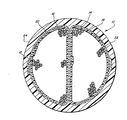
- the sole Figure is a cross-sectional view of a communications cable illustrating one embodiment of the present invention.
- the invention comprehends the provision of a metallic screen which extends through at least a portion of the conductive core of a cable, such as a communications cable.
- the metallic screen material is coated with a protective coextruded film of two layers.
- the first layer is a polyamide, copolyamide or copolyester polymer having properties of low flexural modulus, high tensile strength and high melting point selected to render the film resistant to buckling, thermal damage, or other mechanical damage.
- the second layer of the film is an adhesive which comprises a copolymer of an olefin and at least one polymerizable ethylenically unsaturated carboxylic acid, acid anhydride or other derivative.
- the adhesive layer may be a blend of the copolymer and a polyolefin, if desired.
- the copolymer is a block, random or graft copolymer.
- the film has good interlayer adhesion, exhibits high bond strength when laminated to the metal of the screen, and has good electrical properties to prevent high voltage breakdown and electrical leaks.
- the screen of this invention has the high strength and low stiffness required for processing during cable manufacture, high temperature resistance to withstand the filling operation and good electrical properties required to prevent cross talk.
- the Figure illustrates a telephone cable 10 which comprises an embodiment of the invention.
- the cable 10 comprises a plurality of conductors 12 for transmitting messages in one direction, and a second plurality of conductors 14 for transmitting signals in another direction.
- the illustrated groups of conductors 12 and 14 are each of generally semicircular cross-section, and the conductors of each group are bound together by plastic core wrap 16 and 18, respectively.
- the core wraps 16 and 18 comprise a plastic tape.
- Metal screens 20 and 22, respectively, are disposed outwardly of the core wraps 16 and 18, and are preferably corrugated and in contact with the core wraps 16 and 18.
- Both screens 20 and 22 serve the dual purpose of improving isolation between the opposite directions of transmission, as well as protecting against lightning and water.
- Both screens 20 and 22 may be of aluminum, or another metal, and may, if desired, be coated on both sides with a film of the invention, so as to adhere to each other along the portions thereof which extend across the diameter of the cable in contact with each other.
- a plastic jacket 24 surrounds the shields 20, 22 about the entire circumferential surfaces thereof, and is adhered to the outside surfaces thereof by a suitable adhesive such as described in copending, commonly assigned U.S. Patent Application Ser. No. 521,041 filed August 8, 1983 in the name of Zeitlin et al.
- the metallic screen of the present invention can be of any of a wide variety of metallic materials such as, for example, aluminum, aluminum alloys, alloy-clad aluminum, copper, surface modified copper, bronze, steel, tin-free steel, tin plate steel, aluminized steel, aluminum-clad steel, stainless steel, copper-clad stainless steel, copper-clad low carbon steel, terne-plate steel, galvanized steel, chrome plated or chrome treated steel, lead, magnesium, tin and the like.
- Such metals can, of course, be surface treated or have conversion coatings on the surface thereof if desired.
- a particularly preferred metallic screen material is aluminum.
- the adhesive layer is a copolymer of an olefin such as ethylene, propylene, etc. and at least one comonomer which is an ethylenically unsaturated carboxylic acid, acid anhydride or derivative.
- the copolymer is a block, random or graft copolymer.
- the adhesive may be an adhesive blend of the copolymer and a polyolefin.
- copolymers used in this invention are prepared by reacting unsaturated carboxylic acids or acid anhydrides, or derivatives thereof, with one or more olefins.
- Carboxylic acids or anhydrides useful as comonomers include compounds such as maleic anhydride, itaconic acid anhydride, 4-methyl cyclohex-4-ene-1,2-dicarboxylic acid or anhydride, bicyclo(2.2.2)oct-5- ene-2,3-dicarboxylic acid or anhydride, 1,2,3,4,5,8,9,10-octahydronaphthalene-2,3-dicarboxylic acid or anhydride, 2-oxa-1,3-diketospiro(4.4)non-7-ene, bicycio(2.2.1)hept-5-ene-2,3-dicarboxyiic acid or anhydride, x-methylnorborn-5-ene-2,3-dicarboxylic acid or anhydride, norborn-5-ene-2,3-dicarboxylic acid or anhydride, Nadic"' anhydride, Nadic° methyl anhydride, Himic° anhydride, methyl
- Monomers which-ring close to form anhydrides or imides when subjected to heat e.g., maleic acid, fumaric acid, citric acid, citraconic acid and monoalkyl maleates and maleamic acids, may also be used in this invention.
- Maleamic acids useful in this invention are substituted maleamic or fumaramic acids of the formulas: where R' is a straight or branched alkylene radical of 1-18 carbon atoms, a cycloaliphatic or aromatic ring, and R" and R'" are H or a straight or branched alkylene cycloaliphatic, heterocyclic or aromatic radical; and, where n is either zero or one and R' and R" are as described above.
- carboxylic acids and acid anhydrides particularly useful in the copolymers of this invention are maleic anhydride, fumaric acid, x-methylbicyclo(2.2.1)hept-5-ene-2,3-dicarboxylic acid anhydride and bicyclo(2.2.1)hept-5-ene-2,3-dicarboxylic acid anhydride.
- graft copolymers may be cografted to the copolymer backbone, in the case of graft copolymer.
- conjugated unsaturated esters and amides can be used as cograft monomers.
- conjugated unsaturated esters suitable for cografting are dialkyl maleates, dialkyl fumarates, dialkyl itaconates, dialkyl mesaconates, dialkyl citraconates, alkyl acrylates, alkyl crotonates, alkyl tiglates and alkyl methacrylates where alkyl represent aliphatic, aryl-aliphatic and cycloaliphatic groups containing 1-12 carbon atoms.
- Esters particularly useful in the cografted copolymers of this invention are dibutyl maleate, diethyl fumarates and dimethyl itaconate.
- grafting is accomplished, in general, by heating a mixture of the polyolefin backbone material and the monomer or monomers with or without a solvent.
- the mixture can be heated to above the melting point of the polyolefin with or without a catalytst.
- the grafting occurs in the presence of air, hydroperoxides, or other free radical catalysts or, preferably, in the essential absence of those materials where the mixture is maintained at elevated temperatures and (if no solvent is used) preferably under high shear.
- polyethylene used herein in reference to the graft copolymer backbone includes ethylene homopolymers, and copolymers of ethylene with propylene, butene and other unsaturated aliphatic hydrocarbons containing at least 50 mole percent ethylene. It is preferable sometimes to use mixtures of two or more of the above homopolyers or copolymers.
- Especially preferred for the grafting backbone are high density polyethylenes with a density of 0.94 to 0.96+ and ethylene/olefin copolymers with a density of 0.915 to 0.939 (known as linear low density polyethylene, LLDPE).
- the adhesive of the invention may additionally contain one or more elastomers.
- elastomer denotes homopolyers of isobutylene, copolymers of isobutylene, elastomeric copolymers of ethylene and 1-olefins, elastomeric terpolymers of ethylene, 1-olefins and a diene, homopolymers of chloroprene, copolymers of a diene and a vinyl aromatic compound, block copolymers of a diene vinyl aromatic compound, hydrogenated block copolymers of a diene and vinyl aromatic compound, homopolymers of butadiene, and copolymers of an ethylenically unsaturated nitrile and diene.
- X-methyl bicyclo(2.2.1) hept-5-ene-2,3-dicarboxylic anhydride (XMNA) was reacted with a high density polyethylene homopolymer whose melt index under high load is 3.0 g/10 minutes and whose density is 0.961 g/cc to give a graft copolymer containing 1.5 wt.% XMNA and a melt index of 1.5 g/10 minutes.
- This graft copolymer was blended with an ethylene vinyl acetate copolymer (EVA) containing 8 wt.% vinyl acetate and whose melt index is 3.0 at a ratio of 1.9:18.1.
- EVA ethylene vinyl acetate copolymer
- the resultant adhesive resin was coextruded with nylon 6/12 copolymer (Emser Industries Grilon CR-9).
- the resulting coextruded film was tested for adhesion between nylon 6/12 and the adhesive blend of this Example.
- the coextruded film was laminated to aluminum through the adhesive resin in a heat sealer.
- the resulting lamination was tested for adhesion to aluminum. The results are shown in Table I.
- An adhesive blend of the graft copolymer described in Example 1 and a linear low density polymer (LLDPE) having a melt index of 2 and a density of 0.919 in a ratio of 1:9 was prepared.
- the adhesive blend was coextruded with nylon 6/12.
- the adhesion of the coextruded film was tested.
- the coextruded film was laminated to aluminum through the adhesive resin.
- the results of the adhesion to nylon 6/12 and to aluminum are shown in Table I.
- An adhesive blend of the graft copolymer described in Example 1 with a low density polyethylene (LDPE) whose density is 0.932 and whose melt index is 3.0, and a linear low density polymer (LLDPE) in the ratio 1:7:2 was prepared.
- the adhesive blend was coextruded with nylon 6/12.
- the adhesion of the coextruded film was tested.
- the coextruded film was laminated to aluminum through the adhesive resin.
- Table I The results of adhesion to nylon 6/12 and to aluminum are shown in Table I.
- Example 1 The adhesive blend of Example 1 was coextruded with a copolyester (Eastman Chemical Products, Inc. Kodar PETG Copolyester 6763). The adhesion of the blend of Example 1 to the polyester in the coextruded film was 0.9 lbs. per inch.
- the adhesive blend was coextruded with nylon 6.
- the adhesion of the coextruded film to aluminum was tested after heat sealing at 475°F and 1 sec and found to be 11 ibs/in.
- the adhesion between the nylon 6 and the blend of this Example in the coextruded film was found to be inseparable.
- the lower flexural moduli of several polymers useful in the invention are shown in Table II. This table compares with flexural modulus of copolymers useful in this invention with those presently used in the art. It can be seen that when the nylon 6, nylon 6/12, nylon 11 or nylon 12 is compared with polypropylene or a PET the flexural modulus is much lower than the polymers presently being used to coat screens. This is also true of the polyolefin resins used to prepare the adhesive blend required to adhere the coextruded coating to metal.
- the LLDPE used in Example 2 is shown in Table II.
- the PETG has a much lower modulus than PET as shown in Table II.
Landscapes
- Physics & Mathematics (AREA)
- Electromagnetism (AREA)
- Laminated Bodies (AREA)
- Organic Insulating Materials (AREA)
- Insulating Bodies (AREA)
Description
- This invention relates to electrical cable constructions and, more particularly, this invention relates to an electrical cable with an improved metallic screen for use in communicaiton cable constructions.
- In the art of designing electrical cables, especially communication cables, conductors are generally assembled in a core which is surrounded by an outer shield (such as a sheath) and a jacket.
- The shield is generally metallic, and the protective jacket is typically a polyolefin, such as polyethylene. In some cables, especially where the number of conductors in the core is very large or the cable very long, a screen, usually comprising a ribbon of metal such as aluminum, for example, extends through the multiconductor core. The screen is intended to prevent cross talk between cable pairs of the core, and can be in the shape of an S, Z, D, or T, or any other appropriate configuration.
- Heretofore, the screen extended through the core has typically been prepared with a film of polypropylene or an oriented polyester resin laminated thereto. These constructions are stiff, resulting in buckling during the cable making operation, leading to an unusable cable.
- In some cables, the cable core is filled with a cable filler material designed to prevent moisture from entering the cable. During the manufacture of the cable, the filler is heated to make it flowable. Such heating is accomplished by induction heating. If the screen becomes buckled or folded, the induction heating causes localized overheating in the screen, resulting in a temperature high enough to melt the polymeric coating of the screen, thus tendering the cable inoperative.
- It is an object of the invention to overcome one or more of the problems described above.
- According to the invention, a metallic screen is coated with a coextruded film comprising a layer of a polymer having selected properties of low flexural modulus, high tensile strength and high melting point, and a layer of adhesive.
- The polymer layer is a polyamide, a copolyamide, or a copolyester. The adhesive is a copolymer of an olefin and at least one comonomer which is a polymerizable, ethylenically unsaturated carboxylic acid or acid anhydride or derivative thereof or, alternatively, the adhesive comprises an adhesive blend of the copolymer and a polyolefin.
- The copolymer can be a random, block or graft copolymer.
- Other objects and advantages of the invention will be apparent to those skilled in the art from the following detailed description taken in conjunction with the drawing and the appended claims.
- The sole Figure is a cross-sectional view of a communications cable illustrating one embodiment of the present invention.
- As stated above, the invention comprehends the provision of a metallic screen which extends through at least a portion of the conductive core of a cable, such as a communications cable. The metallic screen material is coated with a protective coextruded film of two layers. The first layer is a polyamide, copolyamide or copolyester polymer having properties of low flexural modulus, high tensile strength and high melting point selected to render the film resistant to buckling, thermal damage, or other mechanical damage.
- Examples of such polymers useful in this invention are nylon 6, copolymers of nylon 6, such as nylon 6/ 12, for example, nylon 11,
nylon 12 and copolyesters. - The second layer of the film is an adhesive which comprises a copolymer of an olefin and at least one polymerizable ethylenically unsaturated carboxylic acid, acid anhydride or other derivative. The adhesive layer may be a blend of the copolymer and a polyolefin, if desired. The copolymer is a block, random or graft copolymer.
- The film has good interlayer adhesion, exhibits high bond strength when laminated to the metal of the screen, and has good electrical properties to prevent high voltage breakdown and electrical leaks. The screen of this invention has the high strength and low stiffness required for processing during cable manufacture, high temperature resistance to withstand the filling operation and good electrical properties required to prevent cross talk.
- The Figure illustrates a
telephone cable 10 which comprises an embodiment of the invention. Thecable 10 comprises a plurality ofconductors 12 for transmitting messages in one direction, and a second plurality ofconductors 14 for transmitting signals in another direction. The illustrated groups ofconductors plastic core wrap core wraps -
Metal screens core wraps core wraps - The
metal screens screens - A
plastic jacket 24 surrounds theshields - The metallic screen of the present invention can be of any of a wide variety of metallic materials such as, for example, aluminum, aluminum alloys, alloy-clad aluminum, copper, surface modified copper, bronze, steel, tin-free steel, tin plate steel, aluminized steel, aluminum-clad steel, stainless steel, copper-clad stainless steel, copper-clad low carbon steel, terne-plate steel, galvanized steel, chrome plated or chrome treated steel, lead, magnesium, tin and the like. Such metals can, of course, be surface treated or have conversion coatings on the surface thereof if desired.
- A particularly preferred metallic screen material is aluminum.
- The adhesive layer is a copolymer of an olefin such as ethylene, propylene, etc. and at least one comonomer which is an ethylenically unsaturated carboxylic acid, acid anhydride or derivative. The copolymer is a block, random or graft copolymer.
- Optionally, the adhesive may be an adhesive blend of the copolymer and a polyolefin.
- The copolymers used in this invention are prepared by reacting unsaturated carboxylic acids or acid anhydrides, or derivatives thereof, with one or more olefins.
- Carboxylic acids or anhydrides useful as comonomers include compounds such as maleic anhydride, itaconic acid anhydride, 4-methyl cyclohex-4-ene-1,2-dicarboxylic acid or anhydride, bicyclo(2.2.2)oct-5- ene-2,3-dicarboxylic acid or anhydride, 1,2,3,4,5,8,9,10-octahydronaphthalene-2,3-dicarboxylic acid or anhydride, 2-oxa-1,3-diketospiro(4.4)non-7-ene, bicycio(2.2.1)hept-5-ene-2,3-dicarboxyiic acid or anhydride, x-methylnorborn-5-ene-2,3-dicarboxylic acid or anhydride, norborn-5-ene-2,3-dicarboxylic acid or anhydride, Nadic"' anhydride, Nadic° methyl anhydride, Himic° anhydride, methyl Himic@ anhydride, acrylic acid, methacrylic acid and derivatives thereof.
- Monomers which-ring close to form anhydrides or imides when subjected to heat, e.g., maleic acid, fumaric acid, citric acid, citraconic acid and monoalkyl maleates and maleamic acids, may also be used in this invention.
- Maleamic acids useful in this invention are substituted maleamic or fumaramic acids of the formulas:


- Among the carboxylic acids and acid anhydrides particularly useful in the copolymers of this invention are maleic anhydride, fumaric acid, x-methylbicyclo(2.2.1)hept-5-ene-2,3-dicarboxylic acid anhydride and bicyclo(2.2.1)hept-5-ene-2,3-dicarboxylic acid anhydride.
- Other monomers which modify the physical and chemical properties of the graft copolymers may be cografted to the copolymer backbone, in the case of graft copolymer.
- For example, conjugated unsaturated esters and amides can be used as cograft monomers. Included among the conjugated unsaturated esters suitable for cografting are dialkyl maleates, dialkyl fumarates, dialkyl itaconates, dialkyl mesaconates, dialkyl citraconates, alkyl acrylates, alkyl crotonates, alkyl tiglates and alkyl methacrylates where alkyl represent aliphatic, aryl-aliphatic and cycloaliphatic groups containing 1-12 carbon atoms. Esters particularly useful in the cografted copolymers of this invention are dibutyl maleate, diethyl fumarates and dimethyl itaconate.
- It is often desirable to use more than one grafting monomer in either or both classes of monomers in order to control the physical properties of the final products.
- In the case of graft copolymers, grafting is accomplished, in general, by heating a mixture of the polyolefin backbone material and the monomer or monomers with or without a solvent. The mixture can be heated to above the melting point of the polyolefin with or without a catalytst. Thus, the grafting occurs in the presence of air, hydroperoxides, or other free radical catalysts or, preferably, in the essential absence of those materials where the mixture is maintained at elevated temperatures and (if no solvent is used) preferably under high shear.
- The term "polyethylene" used herein in reference to the graft copolymer backbone includes ethylene homopolymers, and copolymers of ethylene with propylene, butene and other unsaturated aliphatic hydrocarbons containing at least 50 mole percent ethylene. It is preferable sometimes to use mixtures of two or more of the above homopolyers or copolymers. Especially preferred for the grafting backbone are high density polyethylenes with a density of 0.94 to 0.96+ and ethylene/olefin copolymers with a density of 0.915 to 0.939 (known as linear low density polyethylene, LLDPE).
- If desired, the adhesive of the invention may additionally contain one or more elastomers. The term "elastomer" as used herein denotes homopolyers of isobutylene, copolymers of isobutylene, elastomeric copolymers of ethylene and 1-olefins, elastomeric terpolymers of ethylene, 1-olefins and a diene, homopolymers of chloroprene, copolymers of a diene and a vinyl aromatic compound, block copolymers of a diene vinyl aromatic compound, hydrogenated block copolymers of a diene and vinyl aromatic compound, homopolymers of butadiene, and copolymers of an ethylenically unsaturated nitrile and diene.
- A number of adhesive blends which are believed to be useful in the invention are described in U.S. Patent Nos. 4,087,587 (Shida et al), 4,087,588 (Shida et al), 4,298,712 (Machonis et al), 4,452,942 (Shida et al), 4,460,745 (Adur et al), and 4,487,885 (Adur et al) all assigned to the assignee hereof. Another patent which discloses blends which are believed to be useful in this invention is U.S. Patent No. 4,230,830 (Tanny et al).
- Other U.S. patents which disclose blends which are believed to be useful in the invention include 3,342,771 (Cheritate); 3,658,148 (McConnell); 3,856,889 (McConnell); 3,953,541 (Fuji); 4,058,647 (Inoue); 4,111,898 (Inayoshi et al); 4,134,927 (Tomoshize); 4,198,327 (Matsumoto et al); 4,198,369 (Yosikawa et at); 4,284,541 (Takeda et al); 4,350,740 (Coran et al); 4,350,797 (Marzola et al); and 4,370,388 (Mito).
- The respective disclosures of the above-identified U.S. patents are hereby incorporated herein by reference.
- The invention is illustrated by means of the following specific Examples. However, no unnecessary limitations are to be understood therefrom.
- X-methyl bicyclo(2.2.1) hept-5-ene-2,3-dicarboxylic anhydride (XMNA) was reacted with a high density polyethylene homopolymer whose melt index under high load is 3.0 g/10 minutes and whose density is 0.961 g/cc to give a graft copolymer containing 1.5 wt.% XMNA and a melt index of 1.5 g/10 minutes. This graft copolymer was blended with an ethylene vinyl acetate copolymer (EVA) containing 8 wt.% vinyl acetate and whose melt index is 3.0 at a ratio of 1.9:18.1. The resultant adhesive resin was coextruded with nylon 6/12 copolymer (Emser Industries Grilon CR-9).
- The resulting coextruded film was tested for adhesion between nylon 6/12 and the adhesive blend of this Example. The coextruded film was laminated to aluminum through the adhesive resin in a heat sealer. The resulting lamination was tested for adhesion to aluminum. The results are shown in Table I.
- An adhesive blend of the graft copolymer described in Example 1 and a linear low density polymer (LLDPE) having a melt index of 2 and a density of 0.919 in a ratio of 1:9 was prepared. The adhesive blend was coextruded with nylon 6/12. The adhesion of the coextruded film was tested. The coextruded film was laminated to aluminum through the adhesive resin. The results of the adhesion to nylon 6/12 and to aluminum are shown in Table I.
- An adhesive blend of the graft copolymer described in Example 1 with a low density polyethylene (LDPE) whose density is 0.932 and whose melt index is 3.0, and a linear low density polymer (LLDPE) in the ratio 1:7:2 was prepared. The adhesive blend was coextruded with nylon 6/12. The adhesion of the coextruded film was tested. The coextruded film was laminated to aluminum through the adhesive resin. The results of adhesion to nylon 6/12 and to aluminum are shown in Table I.
- An adhesive blend comprising the graft copolymer of Example 1 a LDPE of density 0.922, melt index of 1.8 and polybutene-1 whose density is 0.908 and whose melt index is 2 in the ratio of 1:8:1 was coextruded and tested according to Example 1. The results are shown in Table I.

- The adhesive blend of Example 1 was coextruded with a copolyester (Eastman Chemical Products, Inc. Kodar PETG Copolyester 6763). The adhesion of the blend of Example 1 to the polyester in the coextruded film was 0.9 lbs. per inch.
- An adhesive blend of the graft copolymer described in Example 1 with a high density polyethylene (density = 0.955 g/cc, melt index = 18) and polyisobutylene in the ratio of 1:7:2 was prepared. The adhesive blend was coextruded with nylon 6. The adhesion of the coextruded film to aluminum was tested after heat sealing at 475°F and 1 sec and found to be 11 ibs/in. The adhesion between the nylon 6 and the blend of this Example in the coextruded film was found to be inseparable.
- The lower flexural moduli of several polymers useful in the invention are shown in Table II. This table compares with flexural modulus of copolymers useful in this invention with those presently used in the art. It can be seen that when the nylon 6, nylon 6/12, nylon 11 or
nylon 12 is compared with polypropylene or a PET the flexural modulus is much lower than the polymers presently being used to coat screens. This is also true of the polyolefin resins used to prepare the adhesive blend required to adhere the coextruded coating to metal. One example, the LLDPE used in Example 2, is shown in Table II. Similarly the PETG has a much lower modulus than PET as shown in Table II. - Furthermore, the requirement of high tensile strength is met as shown in Table II where the values of tensile strength at break are given. The nylons are considerably higher than the polypropylene presently being used and are equivalent to PET. Similarly the LLDPE used as the blending resin for the adhesive blend in Example 2 has essentially the same tensile strength as polypropylene. Therefore, the requirements of low modulus and high tensile strength are met by the polymers of this invention.

- The foregoing detailed description is given for clearness of understanding only, and no unnecessary limitations should be inferred therefrom as modifications within the scope of the invention will be obvious to those skilled in the art.
Claims (25)
Applications Claiming Priority (2)
| Application Number | Priority Date | Filing Date | Title |
|---|---|---|---|
| US635661 | 1984-07-30 | ||
| US06/635,661 US4675471A (en) | 1984-07-30 | 1984-07-30 | Electrical cables |
Publications (2)
| Publication Number | Publication Date |
|---|---|
| EP0169987A1 EP0169987A1 (en) | 1986-02-05 |
| EP0169987B1 true EP0169987B1 (en) | 1989-03-22 |
Family
ID=24548634
Family Applications (1)
| Application Number | Title | Priority Date | Filing Date |
|---|---|---|---|
| EP85105690A Expired EP0169987B1 (en) | 1984-07-30 | 1985-05-09 | Communications cables |
Country Status (5)
| Country | Link |
|---|---|
| US (1) | US4675471A (en) |
| EP (1) | EP0169987B1 (en) |
| JP (1) | JPS6158106A (en) |
| CA (1) | CA1259464A (en) |
| DE (1) | DE3569058D1 (en) |
Families Citing this family (10)
| Publication number | Priority date | Publication date | Assignee | Title |
|---|---|---|---|---|
| US5104733A (en) * | 1990-02-23 | 1992-04-14 | Shell Oil Company | Adhesive for adhering polybutylene to metal |
| US5319061A (en) * | 1992-08-07 | 1994-06-07 | The Humphrey Chemical Co., Inc. | Imparting moisture resistance to epoxies |
| US5367123A (en) * | 1993-03-15 | 1994-11-22 | The Zippertubing Co. | Electrically conductive sheath for ribbon cable |
| US6004024A (en) | 1997-11-14 | 1999-12-21 | Calgon Corporation | Emulsion feed assembly |
| US6093893A (en) * | 1998-03-13 | 2000-07-25 | The United States Of America As Represented By The Secretary Of The Navy | Radiation-hardened electrical cable having trapped-electron reducers |
| US6184298B1 (en) | 1998-06-19 | 2001-02-06 | E. I. Du Pont De Nemours And Company | Adhesive compositions based on blends of grafted polyethylenes and non-grafted polyethylenes and styrene container rubber |
| US6777056B1 (en) * | 1999-10-13 | 2004-08-17 | Kimberly-Clark Worldwide, Inc. | Regionally distinct nonwoven webs |
| EP1756841B1 (en) * | 2004-04-27 | 2017-03-08 | Prysmian S.p.A. | Process for manufacturing a cable resistant to external chemical agents |
| US20060217490A1 (en) * | 2005-03-22 | 2006-09-28 | Lee Chun D | Polyethylene compositions having improved printability |
| CN120040962B (en) * | 2025-04-25 | 2025-09-19 | 南洋电缆(天津)有限公司 | Nylon sheath material for wire and cable and preparation method thereof |
Family Cites Families (22)
| Publication number | Priority date | Publication date | Assignee | Title |
|---|---|---|---|---|
| US4049904A (en) * | 1969-11-28 | 1977-09-20 | Nitto Electric Industrial Co., Ltd. | Plastic laminated metallic foil and method for preparing the same |
| US4092452A (en) * | 1969-11-28 | 1978-05-30 | Nitto Electric Industrial Co., Ltd. | Plastic laminated metallic foil and method for preparing the same |
| US4132857A (en) * | 1971-08-12 | 1979-01-02 | Union Carbide Corporation | Electrical cable |
| US3803340A (en) * | 1972-02-23 | 1974-04-09 | Gen Cable Corp | "d."internal shield in telephone cables |
| US3911200A (en) * | 1973-01-15 | 1975-10-07 | Sun Chemical Corp | Electrical cable housing assemblies |
| US4087587A (en) * | 1975-09-19 | 1978-05-02 | Chemplex Company | Adhesive blends |
| US4125739A (en) * | 1976-12-02 | 1978-11-14 | The Dow Chemical Company | Cable shielding tape and cable |
| BR7702126A (en) * | 1976-04-05 | 1978-01-17 | Dow Chemical Co | CABLES AND CABLE SHIELD TAPE |
| US4088588A (en) * | 1976-06-30 | 1978-05-09 | E. I. Du Pont De Nemours And Company | Polyisobutylcarboxylic acid amides |
| US4085284A (en) * | 1976-08-10 | 1978-04-18 | General Cable Corporation | D-shield telephone cables |
| CA1096453A (en) * | 1977-07-22 | 1981-02-24 | Canada Wire And Cable Limited | Multiscreen communication cable |
| US4298712A (en) * | 1977-08-01 | 1981-11-03 | Chemplex Company | Adhesive blends of elastomer, polyolefin, and graft of polyethylene with unsaturated fused ring anhydrides |
| US4165442A (en) * | 1978-06-12 | 1979-08-21 | General Cable Corporation | Telephone cable with improved shield combination |
| US4230830A (en) * | 1979-03-30 | 1980-10-28 | E. I. Du Pont De Nemours And Company | Adhesive blends containing thermally grafted ethylene polymer |
| US4323721A (en) * | 1980-02-08 | 1982-04-06 | Belden Corporation | Electric cables with improved shielding member |
| US4327248A (en) * | 1980-10-06 | 1982-04-27 | Eaton Corporation | Shielded electrical cable |
| US4449014A (en) * | 1981-01-19 | 1984-05-15 | The Dow Chemical Company | Plastic/metal laminates, cable shielding or armoring tapes, and electrical cables made therewith |
| US4487885A (en) * | 1982-01-18 | 1984-12-11 | Chemplex Company | Adhesive blends |
| US4452942A (en) * | 1982-02-19 | 1984-06-05 | Chemplex Company | Adhesive blends containing anacid or anhydride grafted LLDPE |
| US4460745A (en) * | 1982-04-26 | 1984-07-17 | Chemplex Company | Adhesive three-component blends containing grafted HDPE |
| US4453031A (en) * | 1982-11-15 | 1984-06-05 | Gk Technologies, Inc. | Multi-compartment screened telephone cables |
| CA1216908A (en) * | 1983-08-08 | 1987-01-20 | Mitsuzo Shida | Electrical cable construction |
-
1984
- 1984-07-30 US US06/635,661 patent/US4675471A/en not_active Expired - Lifetime
-
1985
- 1985-05-02 CA CA000480642A patent/CA1259464A/en not_active Expired
- 1985-05-09 EP EP85105690A patent/EP0169987B1/en not_active Expired
- 1985-05-09 DE DE8585105690T patent/DE3569058D1/en not_active Expired
- 1985-07-26 JP JP60164239A patent/JPS6158106A/en active Pending
Also Published As
| Publication number | Publication date |
|---|---|
| EP0169987A1 (en) | 1986-02-05 |
| JPS6158106A (en) | 1986-03-25 |
| CA1259464A (en) | 1989-09-19 |
| US4675471A (en) | 1987-06-23 |
| DE3569058D1 (en) | 1989-04-27 |
Similar Documents
| Publication | Publication Date | Title |
|---|---|---|
| US4487885A (en) | Adhesive blends | |
| US6302153B1 (en) | Antistatic tube based on polyamides for transporting petrol | |
| EP0035392B1 (en) | Laminated multilayer material and its use as a packaging or building material | |
| US4481262A (en) | Composite structures | |
| CA1206312A (en) | Composite structures and method of making same | |
| CA1200041A (en) | Adhesive blends and composite structures | |
| US4537836A (en) | Composite structures | |
| US4675471A (en) | Electrical cables | |
| EP3099758B1 (en) | Polyolefin-based compositions, adhesives, and related multi-layered structures prepared therefrom | |
| EP0027375A2 (en) | Modified elastomer and laminate thereof | |
| GB2111511A (en) | Adhesive olefin polymer blends | |
| JPH0464352B2 (en) | ||
| JPH0551496A (en) | Adhesive or coating composition and use thereof | |
| EP1522501A3 (en) | Oriented cook-in film with good interply adhesion | |
| CN102725370A (en) | Adhesive blends containing butene copolymers | |
| JPH0473706B2 (en) | ||
| JPS6214176B2 (en) | ||
| EP0700338A1 (en) | Flexible multilayered composite | |
| CA1216908A (en) | Electrical cable construction | |
| US5336721A (en) | Adhesive blends of ethylene-alkyl acrylate copolymers and modified propylene-ethylene copolymers | |
| EP0791640B1 (en) | Extrudable resin for polystyrene and laminate | |
| JPH03239744A (en) | Adhesive resin composition | |
| JP2783779B2 (en) | Packaging material having silicon oxide layer and polyolefin layer | |
| JP2761547B2 (en) | Adhesive resin composition and coated steel pipe using the same | |
| JPH0939176A (en) | Multi-layer laminated structure |
Legal Events
| Date | Code | Title | Description |
|---|---|---|---|
| PUAI | Public reference made under article 153(3) epc to a published international application that has entered the european phase |
Free format text: ORIGINAL CODE: 0009012 |
|
| 17P | Request for examination filed |
Effective date: 19850509 |
|
| AK | Designated contracting states |
Designated state(s): BE DE FR GB NL |
|
| RAP1 | Party data changed (applicant data changed or rights of an application transferred) |
Owner name: NATIONAL DISTILLERS AND CHEMICAL CORPORATION |
|
| RAP1 | Party data changed (applicant data changed or rights of an application transferred) |
Owner name: QUANTUM CHEMICAL CORPORATION |
|
| 17Q | First examination report despatched |
Effective date: 19880803 |
|
| GRAA | (expected) grant |
Free format text: ORIGINAL CODE: 0009210 |
|
| AK | Designated contracting states |
Kind code of ref document: B1 Designated state(s): BE DE FR GB NL |
|
| REF | Corresponds to: |
Ref document number: 3569058 Country of ref document: DE Date of ref document: 19890427 |
|
| ET | Fr: translation filed | ||
| BECN | Be: change of holder's name |
Effective date: 19890322 |
|
| PLBE | No opposition filed within time limit |
Free format text: ORIGINAL CODE: 0009261 |
|
| STAA | Information on the status of an ep patent application or granted ep patent |
Free format text: STATUS: NO OPPOSITION FILED WITHIN TIME LIMIT |
|
| 26N | No opposition filed | ||
| PGFP | Annual fee paid to national office [announced via postgrant information from national office to epo] |
Ref country code: FR Payment date: 19940413 Year of fee payment: 10 |
|
| PGFP | Annual fee paid to national office [announced via postgrant information from national office to epo] |
Ref country code: DE Payment date: 19940414 Year of fee payment: 10 |
|
| PGFP | Annual fee paid to national office [announced via postgrant information from national office to epo] |
Ref country code: BE Payment date: 19940426 Year of fee payment: 10 |
|
| PGFP | Annual fee paid to national office [announced via postgrant information from national office to epo] |
Ref country code: GB Payment date: 19940429 Year of fee payment: 10 |
|
| PGFP | Annual fee paid to national office [announced via postgrant information from national office to epo] |
Ref country code: NL Payment date: 19940531 Year of fee payment: 10 |
|
| PG25 | Lapsed in a contracting state [announced via postgrant information from national office to epo] |
Ref country code: GB Effective date: 19950509 |
|
| PG25 | Lapsed in a contracting state [announced via postgrant information from national office to epo] |
Ref country code: BE Effective date: 19950531 |
|
| BERE | Be: lapsed |
Owner name: QUANTUM CHEMICAL CORP. Effective date: 19950531 |
|
| PG25 | Lapsed in a contracting state [announced via postgrant information from national office to epo] |
Ref country code: NL Effective date: 19951201 |
|
| GBPC | Gb: european patent ceased through non-payment of renewal fee |
Effective date: 19950509 |
|
| NLV4 | Nl: lapsed or anulled due to non-payment of the annual fee |
Effective date: 19951201 |
|
| PG25 | Lapsed in a contracting state [announced via postgrant information from national office to epo] |
Ref country code: DE Effective date: 19960201 |
|
| PG25 | Lapsed in a contracting state [announced via postgrant information from national office to epo] |
Ref country code: FR Effective date: 19960229 |
|
| REG | Reference to a national code |
Ref country code: FR Ref legal event code: ST |
|
| REG | Reference to a national code |
Ref country code: FR Ref legal event code: ST |