EP0168819B1 - Thermosensitive recording sheet - Google Patents
Thermosensitive recording sheet Download PDFInfo
- Publication number
- EP0168819B1 EP0168819B1 EP85108913A EP85108913A EP0168819B1 EP 0168819 B1 EP0168819 B1 EP 0168819B1 EP 85108913 A EP85108913 A EP 85108913A EP 85108913 A EP85108913 A EP 85108913A EP 0168819 B1 EP0168819 B1 EP 0168819B1
- Authority
- EP
- European Patent Office
- Prior art keywords
- group
- thermosensitive recording
- recording sheet
- groups
- ester compound
- Prior art date
- Legal status (The legal status is an assumption and is not a legal conclusion. Google has not performed a legal analysis and makes no representation as to the accuracy of the status listed.)
- Expired
Links
Classifications
-
- B—PERFORMING OPERATIONS; TRANSPORTING
- B41—PRINTING; LINING MACHINES; TYPEWRITERS; STAMPS
- B41M—PRINTING, DUPLICATING, MARKING, OR COPYING PROCESSES; COLOUR PRINTING
- B41M5/00—Duplicating or marking methods; Sheet materials for use therein
- B41M5/26—Thermography ; Marking by high energetic means, e.g. laser otherwise than by burning, and characterised by the material used
- B41M5/30—Thermography ; Marking by high energetic means, e.g. laser otherwise than by burning, and characterised by the material used using chemical colour formers
- B41M5/337—Additives; Binders
- B41M5/3375—Non-macromolecular compounds
Definitions
- thermosensitive recording sheet relates to a thermosensitive recording sheet, and more specifically, to a thermosensitive recording sheet which has excellent resistance to soiling by oily substances such as hair-dressing agents or oils and fats and excellent image stability.
- thermosensitive recording sheets are obtained by grinding a colorless to light-colored basic leuco dye and an organic color developer such as a phenolic substance into fine particles, mixing the particles of both, adding a binder, a filler, a sensitivity increasing agent, a lubricant and other auxiliary agents to form a coating composition, and applying the coating composition in a thin layer to a support such as paper or a plastic film.
- the thermosensitive color developing layer forms a color imagewise by an instantaneous chemical reaction induced by heating and thereby permits recording of the image. Images of various colors can be obtained by properly selecting the type of the leuco dye.
- thermosensitive recording sheets cannot avoid contact with human hands in view of their function as information recording media. Frequently, therefore, the fingers of persons who handle the sheet have adhering thereto oily substances such as hair-dressing agents used in everyday lives or oils and fats contained in the sweat from the skin, and there are many occasions on which the thermosensitive recording sheets undergo soiling or contamination by these oily substances. Generally, the thermosensitive recording sheets do not have sufficient stability to these soiling substances, and the density of the color image may be reduced or lost at a part soiled by such substances. Furthermore, soiling of the background portion often results in discoloration.
- thermosensitive recording sheet including a p-hydroxybenzoic acid ester as a color developer used in combination with a fluoran-type dye, and makes it clear that higher sensitivity with excellent dynamic color developability can be easily achieved by this thermosensitive recording sheet.
- thermosensitive recording sheet containing the p-hydroxybenzoic acid ester as a color developing agent has the defect that the density of an image formed by application of heat decreases with time, the so-called "crystallization" phenomenon occurs whereby crystals precipitate onto the surface of the image, and that the image area does not have sufficient stability to oily substances.
- the recorded images may discolor or fade under external influences such as light, humidity and heat, and the background portion undergoes "backgrounding" whereby it is colored undesirably.
- Japanese Laid-Open Patent Publications Nos. 45747/1974, 18752/1979 and 83495/1982 describe that phenolic antioxidants effectively act as stabilizers for improving the preservability of recorded images.
- the use of a large amount of such a stabilizer tends to reduce the color developing sensitivity of the recording sheets because of its diluting effect.
- Japanese Patent Publication No. 34310/1983 and Japanese Laid-Open Patent Publication No. 116690/ 1982 disclose the use of terephthalates or phthalates, such as diphenyl phthalate, di-(2-chlorophenyl) phthalate, di-(4-chlorophenyl) phthalate, di-(p-tolyl) phthalate, di-(4-nitrobenzyl) phthalate, di-(2,4,5-trimethylphenyl) phthalate, di-(5-methyl-2-isopropylphenyl) phthalate and diphenyl terephthalate, as additives for improving the heat resistance, water resistance, thermosensitive properties (sensitivity) and head matching of thermosensitive color developing layer of thermosensitive recording sheets.
- sensitivity thermosensitive properties
- thermosensitive color developing layer of thermosensitive recording sheets do not prove to be sufficiently effective for storage stability and soiling resistance the improvement of which is contemplated by the present invention (see Comparative Examples given hereinafter).
- DE-A-3 237 247 describes a thermosensitive recording sheet obtained by coating a carrier with a normally colorless or tinctured dye precursor and p-hydroxybenzoic acid benzyl ester as a color developer (reacting with the dye precursor to develop a color upon heating) together with p-benzyloxybenzoic acid benzyl ester.
- thermosensitive recording sheet capable of giving a clear and stable color image having a sufficiently high dynamic image density and excellent resistance to soiling substances such as hair-dressing agents or oils and fats.
- thermosensitive recording sheet should form a clear and stable dye image having a sufficiently high dynamic image density and excellent long-term preservability and undergoing little discoloration and fading by moisture, heat, etc., and which is free from backgrounding and has excellent resistance to soiling substances such as hairdressing agents or oils and fats.
- thermosensitive recording sheet having a thermosensitive color developing layer containing a basic leuco dye and an organic color developer, said layer containing a polyphenyl ester compound of the general formula wherein R 1 and R 2 , independently from each other, represent an alkyl group; a cycloalkyl group; or an aryl, aralkyl or aryloxyalkyl group in which the aryl moiety may have at least one substituent selected from the class consisting of halogen atoms, nitro groups, hydroxyl groups, lower alkyl groups and lower alkoxy groups.
- lower means that the group or compound so qualified has not more than 5 carbon atoms.
- alkyl group in general formula (I) may be linear or branched, and includes, for example, methyl, ethyl, n-propyl, isopropyl, n-butyl, isobutyl, sec-butyl, tert-butyl, n-pentyl, isopentyl, n-hexyl, n-octyl, 2-ethylhexyl, isooctyl, nonyl and dodecyl groups.
- cycloalkyl groups may have an alkyl group on the cycloaliphatic ring, and includes, for example, cyclopentyl, cyclohexyl, cycloheptyl, o-ethylcyclohexyl, and p-tert-butylcyclohexyl groups.
- aryl group examples are phenyl and alpha- or beta-naphthyl groups.
- aralkyl group means an aryl-alkyl group, and particularly includes phenyl-lower alkyl groups such as benzyl, phenethyl, phenylpropyl and phenylbutyl groups.
- aryloxyalkyl group includes phenyl-O-lower alkyl groups such as phenoxymethyl, phenoxyethyl, phenoxypropyl and phenoxybutyl groups.
- aromatic ring (aryl moiety) in the "aryl group”, “aralkyl group” and “aryloxyalkyl group” is unsubstituted, or may be substituted by at least one (preferably 1 to 3) substituent selected from halogen atoms such as fluorine, chlorine and bromine atoms, hydroxyl groups, lower alkyl groups such as methyl, ethyl, n-propyl, isopropyl, n-butyl, sec-butyl and tert-butyl groups, and lower alkoxy groups such as methoxy, ethoxy n-propoxy, isopropoxy, n-butoxy, sec-butoxy and tert-butoxy groups.
- substituent selected from halogen atoms such as fluorine, chlorine and bromine atoms, hydroxyl groups, lower alkyl groups such as methyl, ethyl, n-propyl, isopropyl, n-butyl, sec-butyl
- Examples of preferred groups R 1 and R 2 in general formula (I) include alkyl groups having 1 to 12 carbon atoms, cycloalkyl groups having 3 to 10, particularly 5 to 6 carbon atoms, and groups of the following formulae wherein A and B, independently from each other, represent a halogen atom, a nitro group, a hydroxyl group, a lower alkyl group or a lower alkoxy group, I is an integer of 1 to 5, and m and n are 0 or an integer of 1 to 3, provided that when m and n are 2 or 3, two or three groups A or B may be identical or different.
- R, and R 2 are alkyl groups having 1 to 12 carbon atoms, especially lower alkyl groups, a cyclohexyl group, a benzyl group, a phenethyl group, or a phenoxymethyl group.
- polyphenyl ester compounds of formula (I) above have a unique function as stabilizers for the thermosensitive color developing layer of thermosensitive recording sheets, and the thermosensitive recording sheets containing such compounds exhibit the following advantages.
- polyphenyl ester compounds of general formula (I) are those of the following wherein R 1 and R 2 are as defined above.
- More preferred compounds are those of general formula (1-1) in which R is an alkyl group having 1 to 12 carbon atoms, preferably 1 to 5 carbon atoms, a cyclohexyl group, a benzyl group, a phenethyl group or a phenoxymethyl group in view of their melting range, sublimability and molecular weight and the sensitivity (thermal response) and oil resistance of a thermosensitive recording sheet containing such a compound.
- the compounds of formula (I) may be used singly or in combination with each other.
- the effects of the present invention are most remarkable when benzyl 4-hydroxybenzoate is used as a color developing agent and the compound of formula (1-2) or (1-3) is used as a stabilizer.
- the compound of formula (1-2) or (1-3) has four ester groups and five benzene rings, and three benzene rings and four ester groups are linked to each other alternately.
- the in the molecule has a similar structure to in the benzyl 4-hydroxybenzoate molecule. Presumably, some specific intermolecular action occurs between them and contributes to the marked advantage of the invention.
- organic color developers examples include bisphenol A compounds, 4-hydroxybenzoic acid esters, 4-hydroxyphthalic acid diesters, phthalic acid monoesters, bis(hydroxyphenyl) sulfides, 4-hydroxyphenylarylsulfones, 4-hydroxyphenylarylsulfonates, 1,3-di[2-(hydroxyphenyl)-2-propyl] benzenes, and other color developers. Specific examples are given below:
- color developers may be used singly or in combination.
- organic color developers which can be used, include benzyl 4-hydroxybenzoate, 4-hydroxyphenyl 2'-naphthalenesulfonate, 1,3-di[2-(4-hydroxyphenyl)-2-propyl]benzene, 1,3-dihydroxy-6(alpha,alpha-dimethylbenzyl) benzene and 4-hydroxy-4'-isopropoxydiphenylsulfone.
- thermosensitive recording sheet of high sensitivity and excellent dynamic color developability when combined with a fluolane-type dye.
- a thermosensitive recording sheet containing this color developer has the defect that the density of an image formed by application of heat is reduced with time or undergoes the "crystallization" phenomenon, and the image area does not have sufficient stability to oily substances. It has been found, however, that by using the polyphenyl ester compound of formula (I) together, the stability of the image is greatly increased.
- the "basic leuco dye” used in the thermosensitive recording sheet of this invention is a basic dye having the property of being normally colorless or light-colored but upon contact with the aforesaid color developers under heat, forming a color.
- the basic leuco dye used in this invention and any basic leuco dyes heretofore used in thermosensitive recording sheets can equally be used.
- leuco dyes of the triphenylmethane, fluoran and azaphthalide types are preferred. Specific examples are shown below:
- thermosensitive recording sheet having a markedly high dynamic color developing density can be obtained by using 3-diethylamino-6-methyl-7-anilinofluoran, 3-(N-cyclohexyl-N-methylamino)-6-methyl-7-anilinofluoran, 3-(N-ethyl-N-isoamyl)amino-6-methyl-7-anilinofluoran and 3-(4-diethylamino-2-ethoxyphenyl)-3-(1-ethyl-2-methylindol-3-yl)-4-azaphthalide singly as the basic leuco dye.
- thermosensitive recording sheet having excellent oil resistance and storage stability and a high dynamic image density can be obtained when a mixture of 3-diethylamino-6-methyl-7-anilinofluoran and 3-(N-cyclohexyl-N-methylamino)-6-methyl-7-anilinoftuoran is used as the basic leuco dye.
- the amounts and proportions of the polyphenyl ester compound of formula (I), the organic color developer and the basic leuco due are not critical, and can be varied over wide ranges depending upon the performance or recording adaptability of the resulting product.
- the polyphenyl ester compound of formula (I) is used in an amount of 0.1 to 10 parts by weight, preferably 0.5 to 5 parts by weight, per part by weight of the basic leuco dye.
- the organic color developer is used in an amount of 1 to 6 parts by weight, preferably 2 to 5 parts by weight, per part by weight of the basic leuco dye.
- the polyphenyl ester compound of formula (I), the color developer and the basic leuco dye are reduced to fine particles having a particle diameter of less than several microns by a grinding machine such as a ball mill, an attriter or a sand grinder, or a suitable emulsifying device, and according to the purpose for which the final product is used, various additives are added.
- the resulting coating composition is coated on a substrate such as paper or a plastic film, and dried to form a thermosensitive recording layer whose amount of coating may be 4to 10 g/m z (in a dry condition).
- the thermosensitive recording sheet of this invention can be obtained.
- the additives which can be blended with the polyphenyl ester compound, the color developer and the basic leuco dye may be those which are used in conventional thermosensitive recording sheets.
- binders such as polyvinyl alcohol, modified polyvinyl alcohol, hydroxyethyl cellulose, methyl cellulose, starches, a styrene/maleic anhydride copolymer, a vinyl acetate/maleic anhydride copolymer and a styrene/butadiene copolymer; inorganic or organic fillers such as kaolin, calcined kaolin, diatomaceous earth, talc, titanium oxide and aluminum hydroxide; mold releasing agents such as fatty acid metal salts; lubricants such as waxes; ultraviolet absorbers such as benzophenone compounds and triazole compounds; waterproofing agents such as glyoxal; dispersing agents such as sodium hexametaphosphate and sodium polycarboxylates; defoamers such as ace
- additives are determined depending upon the properties required of the product, its recording suitability, etc., and are not particularly restricted. As tentative standards, they are, for example, 10 to 25% by weight based on the total solids for the binders, and 1 to 20 parts by weight per part by weight of the leuco dye for the fillers.
- the other components may be used in amounts normally used.
- thermosensitive recording sheet of this invention The characteristics and advantages of the thermosensitive recording sheet of this invention are as follows:-
- At least some of the compounds of formula (I) are novel, and may be prepared in accordance with a known esterification method, for example, by reacting a compound of the formula wherein X is halogen, e.g., chlorine or bromine, with at least one compound of the formula wherein R is the same as R, or R 2 , in a suitable solvent such as toluene, benzene, oxylene, in the presence of an amine such as triethylamine, pyridine, or dimethylaniline.
- a suitable solvent such as toluene, benzene, oxylene
- a 500 ml four-necked flask equipped with a condenser tube and a thermometer are charged with 56 g of benzyl p-hydroxybenzoate, 25 g of triethylamine and 60 ml of toluene.
- a suspension of 25 g of terephthalic dichloride in 100 ml of toluene is added dropwise over 3 hours with stirring while maintaining the mixture at 0-5°C. After the addition, the mixture is further allowed to react at 0-5°C for hour. Therefore the reaction product is collected by filtration to obtain while crystals.
- the crystals are washed twice with 1500 ml of water and then twice with 1000 ml of methanol and subsequently, recrystallized from chloroform to give di(p-benzyloxycarbonylphenyl)terephthalate melting at 186-187°C as white crystals.
- the dispersions A, B and C of the above compositions were each ground to a particle diameter of 3 microns in a ball mill.
- dispersion A leuco dye dispersion
- dispersion B color developer dispersion
- dispersion C stabilizer dispersion
- 20 parts of a 50% dispersion of kaolin clay were mixed to form a coating dispersion.
- the dispersion was coated on one surface of a substrate paper (basis weight 50 g/m 2 ) at a rate of 6.0 g/m 2 , and dried.
- the sheet was then treated with a supercalender so that its degree of smoothness became 200 to 600 seconds.
- the resulting thermosensitive recording sheet adapted for developing a black color was tested for properties, and the results are shown in Table 1.
- Dispersion C was not used in Comparative Example 1.
- a droplet (0.8 mg) of castor oil dropped onto a glass plate by an injection syringe was spread to an area of 40 cm 2 . Then, by using a rubber stamp (1 cm x 1.5 cm), the oil was transferred to that surface of the recording sheet which developed a color in accordance with the procedure described in ( * 7) above. After standing at 40°C and 90% RH for 24 hours, the density of the color in the transferred portion was measured by the Macbeth densitometer.
- thermosensitive recording sheet dynamically colored by the method described in ( * 7) was stored in a file for one month at room temperature.
- the degree of formation of crystals on the colored image surface was determined by visual observation.
- thermosensitive recording sheets of this invention containing the polyphenyl ester compound of formula (I) (Examples 1 and 2) have much better heat resistance and moisture resistance in the background, better moisture resistance and heat resistance in the record sheets, and much better oil resistance than recording sheets containing no such compound (Comparative Example 1) or containing the known phthalate or terephthalate derivatives (Comparative Examples 2 to 7).
Landscapes
- Chemical & Material Sciences (AREA)
- Chemical Kinetics & Catalysis (AREA)
- General Chemical & Material Sciences (AREA)
- Physics & Mathematics (AREA)
- Optics & Photonics (AREA)
- Heat Sensitive Colour Forming Recording (AREA)
Description
- This invention relates to a thermosensitive recording sheet, and more specifically, to a thermosensitive recording sheet which has excellent resistance to soiling by oily substances such as hair-dressing agents or oils and fats and excellent image stability.
- Generally, thermosensitive recording sheets are obtained by grinding a colorless to light-colored basic leuco dye and an organic color developer such as a phenolic substance into fine particles, mixing the particles of both, adding a binder, a filler, a sensitivity increasing agent, a lubricant and other auxiliary agents to form a coating composition, and applying the coating composition in a thin layer to a support such as paper or a plastic film. The thermosensitive color developing layer forms a color imagewise by an instantaneous chemical reaction induced by heating and thereby permits recording of the image. Images of various colors can be obtained by properly selecting the type of the leuco dye.
- The thermosensitive recording sheets cannot avoid contact with human hands in view of their function as information recording media. Frequently, therefore, the fingers of persons who handle the sheet have adhering thereto oily substances such as hair-dressing agents used in everyday lives or oils and fats contained in the sweat from the skin, and there are many occasions on which the thermosensitive recording sheets undergo soiling or contamination by these oily substances. Generally, the thermosensitive recording sheets do not have sufficient stability to these soiling substances, and the density of the color image may be reduced or lost at a part soiled by such substances. Furthermore, soiling of the background portion often results in discoloration.
- Many substances are described in various literature references including Japanese Patent Publication No. 14039/1970 as color developers for thermosensitive recording sheets, but 4,4'-isopropylidene diphenol (bisphenol A) is now used most widely because of its stable quality, cost and availability. However, since bisphenol A has a high heat color-developing temperature, it cannot fully adapt to recording by a small amount of thermal energy, and troubles such as sticking tend to occur.
- In an attempt to meet the recent requirements for higher recording speeds and higher image quality, Japanese Laid-Open Patent Publication No. 144193/1981 proposes a thermosensitive recording sheet including a p-hydroxybenzoic acid ester as a color developer used in combination with a fluoran-type dye, and makes it clear that higher sensitivity with excellent dynamic color developability can be easily achieved by this thermosensitive recording sheet. But the thermosensitive recording sheet containing the p-hydroxybenzoic acid ester as a color developing agent has the defect that the density of an image formed by application of heat decreases with time, the so-called "crystallization" phenomenon occurs whereby crystals precipitate onto the surface of the image, and that the image area does not have sufficient stability to oily substances.
- Furthermore, on long-term storage, the recorded images may discolor or fade under external influences such as light, humidity and heat, and the background portion undergoes "backgrounding" whereby it is colored undesirably.
- Japanese Laid-Open Patent Publications Nos. 45747/1974, 18752/1979 and 83495/1982 describe that phenolic antioxidants effectively act as stabilizers for improving the preservability of recorded images. The use of a large amount of such a stabilizer, however, tends to reduce the color developing sensitivity of the recording sheets because of its diluting effect.
- Japanese Patent Publication No. 34310/1983 and Japanese Laid-Open Patent Publication No. 116690/ 1982 disclose the use of terephthalates or phthalates, such as diphenyl phthalate, di-(2-chlorophenyl) phthalate, di-(4-chlorophenyl) phthalate, di-(p-tolyl) phthalate, di-(4-nitrobenzyl) phthalate, di-(2,4,5-trimethylphenyl) phthalate, di-(5-methyl-2-isopropylphenyl) phthalate and diphenyl terephthalate, as additives for improving the heat resistance, water resistance, thermosensitive properties (sensitivity) and head matching of thermosensitive color developing layer of thermosensitive recording sheets. These compounds, however, do not prove to be sufficiently effective for storage stability and soiling resistance the improvement of which is contemplated by the present invention (see Comparative Examples given hereinafter).
- DE-A-3 237 247 describes a thermosensitive recording sheet obtained by coating a carrier with a normally colorless or tinctured dye precursor and p-hydroxybenzoic acid benzyl ester as a color developer (reacting with the dye precursor to develop a color upon heating) together with p-benzyloxybenzoic acid benzyl ester. By the combined use of p-hydroxybenzoic acid benzyl ester and p-benzyloxybenzoic acid benzyl ester the image stability is increased, blooming is prevented and the sensitizing action is improved.
- It is the object of this invention to provide a thermosensitive recording sheet capable of giving a clear and stable color image having a sufficiently high dynamic image density and excellent resistance to soiling substances such as hair-dressing agents or oils and fats.
- The thermosensitive recording sheet should form a clear and stable dye image having a sufficiently high dynamic image density and excellent long-term preservability and undergoing little discoloration and fading by moisture, heat, etc., and which is free from backgrounding and has excellent resistance to soiling substances such as hairdressing agents or oils and fats.
- According to this invention, there is provided a thermosensitive recording sheet having a thermosensitive color developing layer containing a basic leuco dye and an organic color developer, said layer containing a polyphenyl ester compound of the general formula

- The term "lower", as used herein to qualify a group or compound, means that the group or compound so qualified has not more than 5 carbon atoms.
- The "alkyl group" in general formula (I) may be linear or branched, and includes, for example, methyl, ethyl, n-propyl, isopropyl, n-butyl, isobutyl, sec-butyl, tert-butyl, n-pentyl, isopentyl, n-hexyl, n-octyl, 2-ethylhexyl, isooctyl, nonyl and dodecyl groups. The "cycloalkyl groups" may have an alkyl group on the cycloaliphatic ring, and includes, for example, cyclopentyl, cyclohexyl, cycloheptyl, o-ethylcyclohexyl, and p-tert-butylcyclohexyl groups.
- Examples of the "aryl group" are phenyl and alpha- or beta-naphthyl groups. The "aralkyl group" means an aryl-alkyl group, and particularly includes phenyl-lower alkyl groups such as benzyl, phenethyl, phenylpropyl and phenylbutyl groups. The "aryloxyalkyl group" includes phenyl-O-lower alkyl groups such as phenoxymethyl, phenoxyethyl, phenoxypropyl and phenoxybutyl groups. The aromatic ring (aryl moiety) in the "aryl group", "aralkyl group" and "aryloxyalkyl group" is unsubstituted, or may be substituted by at least one (preferably 1 to 3) substituent selected from halogen atoms such as fluorine, chlorine and bromine atoms, hydroxyl groups, lower alkyl groups such as methyl, ethyl, n-propyl, isopropyl, n-butyl, sec-butyl and tert-butyl groups, and lower alkoxy groups such as methoxy, ethoxy n-propoxy, isopropoxy, n-butoxy, sec-butoxy and tert-butoxy groups.
- Examples of preferred groups R1 and R2 in general formula (I) include alkyl groups having 1 to 12 carbon atoms, cycloalkyl groups having 3 to 10, particularly 5 to 6 carbon atoms, and groups of the following formulae


- Especially preferred groups R, and R2 are alkyl groups having 1 to 12 carbon atoms, especially lower alkyl groups, a cyclohexyl group, a benzyl group, a phenethyl group, or a phenoxymethyl group.
- The polyphenyl ester compounds of formula (I) above have a unique function as stabilizers for the thermosensitive color developing layer of thermosensitive recording sheets, and the thermosensitive recording sheets containing such compounds exhibit the following advantages.
- (1) The color images developed are stable even when hair-dressing agents or oils and fats adhere to them.
- (2) As can be clearly seen from the results of a heat resistance test (60°C, dry, 24 hours) and a moisture resistance test (40°C, 90% RH, 24 hours) given in Examples hereinafter, they have excellent heat resistance and moisture resistance, and the recorded images and background color have good long-term storage stability.
- (3) When used in combination with benzyl 4-hydroxybenzoate as a color developing agent, these polyphenyl ester compounds can prevent the crystallization phenomenon inherent to this color developing agent.
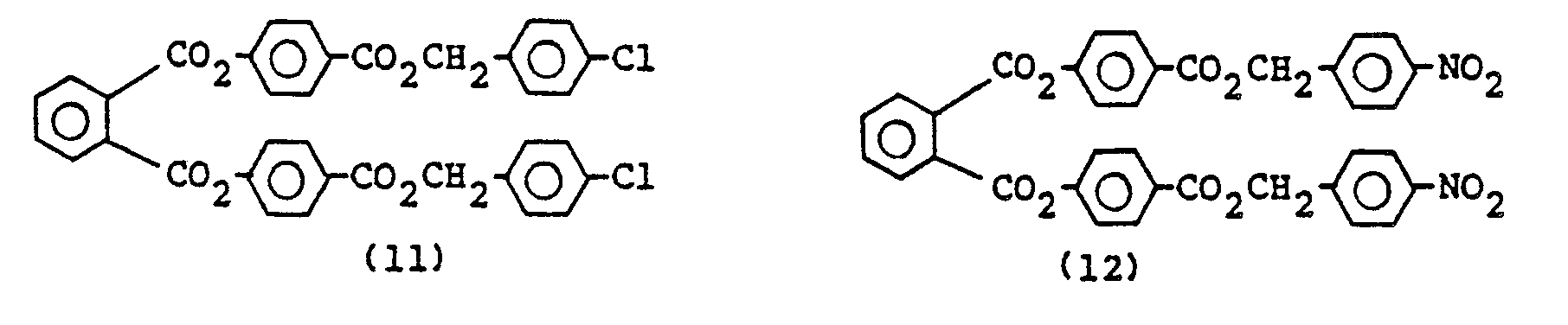
- In view of stabilizing ability, the availability of materials for synthesis, the ease of synthesis, and cost, preferred species of the polyphenyl ester compounds of general formula (I) are those of the following

- More preferred compounds are those of general formula (1-1) in which R is an alkyl group having 1 to 12 carbon atoms, preferably 1 to 5 carbon atoms, a cyclohexyl group, a benzyl group, a phenethyl group or a phenoxymethyl group in view of their melting range, sublimability and molecular weight and the sensitivity (thermal response) and oil resistance of a thermosensitive recording sheet containing such a compound.
- Typical examples of the polyphenyl ester compounds of formula (I) or (1-1) used in this invention are shown below without any intention of limiting the invention thereto.
-




- The compounds of formula (I) may be used singly or in combination with each other.
- When the melting point range, sublimability, molecular weight and oil resistance of these polyphenyl ester compounds are comprehensively considered from a viewpoint of using them as stabilizers, compounds of the following formula (1-2) and (1-3) are most preferred.


- The effects of the present invention are most remarkable when benzyl 4-hydroxybenzoate is used as a color developing agent and the compound of formula (1-2) or (1-3) is used as a stabilizer. The compound of formula (1-2) or (1-3) has four ester groups and five benzene rings, and three benzene rings and four ester groups are linked to each other alternately. Thus, the


- Examples of the organic color developers that can be used in the thermosensitive color developing layer in accordance with this invention include bisphenol A compounds, 4-hydroxybenzoic acid esters, 4-hydroxyphthalic acid diesters, phthalic acid monoesters, bis(hydroxyphenyl) sulfides, 4-hydroxyphenylarylsulfones, 4-hydroxyphenylarylsulfonates, 1,3-di[2-(hydroxyphenyl)-2-propyl] benzenes, and other color developers. Specific examples are given below:
-
- 4,4'-isopropylidene diphenol (also called bisphenol A),
- 4,4'-cyclohexylidene diphenol, and
- p,p'-(l-methyl-n-hexylidene)diphenol.
-
- Benzyl 4-hydroxybenzoate,
- ethyl 4-hydroxybenzoate,
- propyl 4-hydroxybenzoate,
- isopropyl 4-hydroxybenzoate,
- butyl 4-hydroxybenzoate,
- isobutyl 4-hydroxybenzoate, and
- methylbenzyl 4-hydroxybenzoate.
-
- Dimethyl 4-hydroxyphthalate,
- diisopropyl 4-hydroxyphthalate,
- dibenzyl 4-hydroxyphthalate, and
- dihexyl 4-hydroxyphthalate.
-
- Monobenzyl phthalate,
- monocyclohexyl phthalate,
- monophenyl phthalate,
- monomethylphenyl phthalate,
- monoethylphenyl phthalate,
- monoalkylbenzyl phthalates,
- monohalobenzyl phthalates, and
- monoalkoxybenzyl phthalates.
-
- bis-(4-Hydroxy-3-tert-butyl-6-methylphenyl)sulfide,
- bis-(4-hydroxy-2,5-dimethylphenyl)sulfide,
- bis-(4-hydroxy-2-methyl-5-ethylphenyl)sulfide,
- bis-(4-hydroxy-2-methyl-5-isopropylphenyl)sulfide,
- bis-(4-hydroxy-2,3-dimethylphenyllsulfide,
- bis-(4-hydroxy-2,5-diethylphenyl)sulfide,
- bis-(4-hydroxy-2,5-diisopropylphenyl)sulfide,
- bis-(4-hydroxy-2,3,6-trimethylphenyl)sulfide,
- bis-(2,4,5-trihydroxyphenyl)sulfide,
- bis-(4-hydroxy-2-cyclohexyl-5-methylphenyl)sulfide,
- bis-(2,3,4-trihydroxyphenyl)sulfide,
- bis-(4,5-dihydroxy-2-tert-butylphenyl)sulfide,
- bis-(4-hydroxy-2,5-diphenylphenyl)sulfide, and
- bis(4-hydroxy-2-tert-octyl-5-methylphenyl)sulfide.
-
- 4-Hydroxy-4'-isopropoxydiphenylsulfone,
- 4-hydroxy-4'-methyldiphenylsulfone, and
- 4-hydroxy-4'-n-butyloxydiphenylsulfone.
-
- 4-Hydroxyphenyl benzenesulfonate,
- 4-hydroxyphenyl p-tolyllsulfonate,
- 4-hydroxyphenyl mesitylenesulfonate,
- 4-hydroxyphenyl p-chlorobenzenesulfonate,
- 4-hydroxyphenyl p-tert-butylbenzenesulfonate,
- 4-hydroxyphenyl p-isopropoxybenzenesulfonate,
- 4-hydroxyphenyl l'-naphthalenesulfonate, and
- 4-hydroxyphenyl 2'-naphthalenesulfonate.
-
- 1,3-Di[2-(4-hydroxyphenyl)-2-propyl]benzene,
- 1,3-di[2-(4-hydroxy-3-aIkylphenyl)-2-propyl]benzene,
- 1,3-di[2-(2,4-dihydroxyphenyl)-2-propyl]benzene, and
- 1,3-di[2-(2-hydroxy-5-methylphenyl)-2-propyl]benzene.
-
- 1,3-Dihydroxy-6(alpha,alpha-dimethylbenzyl)benzene.
-
- p-tert-Butylphenol,
- 2,4-dihydroxybenzophenone,
- novolak-type phenolic resins,
- 4-hydroxyacetophenone,
- p-phenylphenol,
- benzyl-4-hydroxyphenylacetate, and
- p-benzylphenol.
- These color developers may be used singly or in combination.
- Other organic color developers which can be used, include benzyl 4-hydroxybenzoate, 4-hydroxyphenyl 2'-naphthalenesulfonate, 1,3-di[2-(4-hydroxyphenyl)-2-propyl]benzene, 1,3-dihydroxy-6(alpha,alpha-dimethylbenzyl) benzene and 4-hydroxy-4'-isopropoxydiphenylsulfone.
- As suggested in the above-cited Japanese Laid-Open Patent Publication No. 144193/1981, benzyl 4-hydroxybenzoate can give a thermosensitive recording sheet of high sensitivity and excellent dynamic color developability when combined with a fluolane-type dye. But a thermosensitive recording sheet containing this color developer has the defect that the density of an image formed by application of heat is reduced with time or undergoes the "crystallization" phenomenon, and the image area does not have sufficient stability to oily substances. It has been found, however, that by using the polyphenyl ester compound of formula (I) together, the stability of the image is greatly increased.
- The "basic leuco dye" used in the thermosensitive recording sheet of this invention is a basic dye having the property of being normally colorless or light-colored but upon contact with the aforesaid color developers under heat, forming a color. There is no particular restriction on the basic leuco dye used in this invention and any basic leuco dyes heretofore used in thermosensitive recording sheets can equally be used. Generally, leuco dyes of the triphenylmethane, fluoran and azaphthalide types are preferred. Specific examples are shown below:
-
- 3,3-bis(p-Dimethylaminophenyl)-6-dimethylaminophthalide (also called Crystal Violet Lactone).
-
- 3-Diethylamino-6-methyl-7-anilinofluoran,
- 3-(N-ethyl-p-toluidino)-6-methyl-7-anilinofluoran,
- 3-(N-ethyl-N-isoamyl)amino-6-methyl-7-anilinofluoran,
- 3-diethylamino-6-methyl-7-(o,p-dimethylanilino)fluoran,
- 3-pyrrolidino-6-methyl-7-anilinofluoran,
- 3-piperidino-6-methyl-7-anilinofluoran,
- 3-(N-cyclohexyl-N-methylamino)-6-methy1-7-anilinofluoran,
- 3-diethylamino-7-(m-trifluoromethylanilino)fluoran,
- 3-dibutylamino-7-(o-chloroanilino)fluoran,
- 3-diethylamino-6-methyl-chlorofluoran,
- 3-diethylamino-6-methyl-fluoran,
- 3-cyclohexylamino-6-chlorofluoran,
- 3-diethylamino-7-(o-chloroanilino)fluoran, and
- 3-diethylamino-benzo[a]-fluoran.
-
- 3-(4-Diethylamino-2-ethoxyphenyl-3-(1-ethyl-2-methylindol-3-yl)-4-azaphthalide,
- 3-(4-diethylamino-2-ethoxyphenyl)-3-(1-ethyl-2-methylindol-3-yl)-7-azaphthalide,
- 3-(4-diethylamino-2-ethoxyphenyl)-3-(1-octyl-2-methylindol-3-yl)-4-azaphthalide, and
- 3-(4-N-cyclohexyl-N-methylamino-2-methoxyphenyl)-3-(1-ethyl-2-methylindol-3-yl)-4-azaphthalide.
- These dyes may also be used singly or in combination. In the present invention, a thermosensitive recording sheet having a markedly high dynamic color developing density can be obtained by using 3-diethylamino-6-methyl-7-anilinofluoran, 3-(N-cyclohexyl-N-methylamino)-6-methyl-7-anilinofluoran, 3-(N-ethyl-N-isoamyl)amino-6-methyl-7-anilinofluoran and 3-(4-diethylamino-2-ethoxyphenyl)-3-(1-ethyl-2-methylindol-3-yl)-4-azaphthalide singly as the basic leuco dye.
- A thermosensitive recording sheet having excellent oil resistance and storage stability and a high dynamic image density can be obtained when a mixture of 3-diethylamino-6-methyl-7-anilinofluoran and 3-(N-cyclohexyl-N-methylamino)-6-methyl-7-anilinoftuoran is used as the basic leuco dye.
- The amounts and proportions of the polyphenyl ester compound of formula (I), the organic color developer and the basic leuco due are not critical, and can be varied over wide ranges depending upon the performance or recording adaptability of the resulting product. Generally, the polyphenyl ester compound of formula (I) is used in an amount of 0.1 to 10 parts by weight, preferably 0.5 to 5 parts by weight, per part by weight of the basic leuco dye. Conveniently, the organic color developer is used in an amount of 1 to 6 parts by weight, preferably 2 to 5 parts by weight, per part by weight of the basic leuco dye.
- The polyphenyl ester compound of formula (I), the color developer and the basic leuco dye are reduced to fine particles having a particle diameter of less than several microns by a grinding machine such as a ball mill, an attriter or a sand grinder, or a suitable emulsifying device, and according to the purpose for which the final product is used, various additives are added. The resulting coating composition is coated on a substrate such as paper or a plastic film, and dried to form a thermosensitive recording layer whose amount of coating may be 4to 10 g/mz (in a dry condition). As a result, the thermosensitive recording sheet of this invention can be obtained.
- The additives which can be blended with the polyphenyl ester compound, the color developer and the basic leuco dye may be those which are used in conventional thermosensitive recording sheets. Examples include binders such as polyvinyl alcohol, modified polyvinyl alcohol, hydroxyethyl cellulose, methyl cellulose, starches, a styrene/maleic anhydride copolymer, a vinyl acetate/maleic anhydride copolymer and a styrene/butadiene copolymer; inorganic or organic fillers such as kaolin, calcined kaolin, diatomaceous earth, talc, titanium oxide and aluminum hydroxide; mold releasing agents such as fatty acid metal salts; lubricants such as waxes; ultraviolet absorbers such as benzophenone compounds and triazole compounds; waterproofing agents such as glyoxal; dispersing agents such as sodium hexametaphosphate and sodium polycarboxylates; defoamers such as acetylene glycol; pressure for preventing agents such as fatty acid amides, ethylenebisamide, montan wax and polyethylene wax; sensitizers such as dibenzyl terephthalate, benzyl p-benzyloxybenzoate, di-p-tolyl carbonate and p-benzylbipenyl; and stabilizers such as phthalic acid monoester metal salts, p-tertiary butylbenzoic acid metal salts and nitrobenzoic acid metal salts. The amounts of these additives are determined depending upon the properties required of the product, its recording suitability, etc., and are not particularly restricted. As tentative standards, they are, for example, 10 to 25% by weight based on the total solids for the binders, and 1 to 20 parts by weight per part by weight of the leuco dye for the fillers. The other components may be used in amounts normally used.
- The characteristics and advantages of the thermosensitive recording sheet of this invention are as follows:-
- (1) It has resistance to the adhesion of soiling substances such as hair-dressing agents and oils and fats, and therefore gives images of good stability (good soiling resistance).
- (2) Images recorded on it have excellent storage stability. Particularly, the recorded images do not fade under moisture and heat, and do not undergo backgrounding.
- (3) The compound of formula (I) markedly increases the storage stability of images formed by thermosensitive recording, and does not cause coloration of the coating composition nor backgrounding of the thermosensitively colored layer.
- (4) Even when benzyl 4-hydroxybenzoate is used as the color developing agent, the crystallization phenomenon inherent to it can be prevented.
- At least some of the compounds of formula (I) are novel, and may be prepared in accordance with a known esterification method, for example, by reacting a compound of the formula


- A 500 ml four-necked flask equipped with a condenser tube and a thermometer are charged with 56 g of benzyl p-hydroxybenzoate, 25 g of triethylamine and 60 ml of toluene. A suspension of 25 g of terephthalic dichloride in 100 ml of toluene is added dropwise over 3 hours with stirring while maintaining the mixture at 0-5°C. After the addition, the mixture is further allowed to react at 0-5°C for hour. Therefore the reaction product is collected by filtration to obtain while crystals. The crystals are washed twice with 1500 ml of water and then twice with 1000 ml of methanol and subsequently, recrystallized from chloroform to give di(p-benzyloxycarbonylphenyl)terephthalate melting at 186-187°C as white crystals.
- The following compounds can be prepared in a manner similar to that shown in the above Reference Example:
- Di(p-benzyloxycarbonylphenyl)isophthalate, m.p. 105-1070C
- Di(p-benzyloxycarbonylphenyl)phthalate, m.p. 100-103°C
- Di(p-methoxycarbonylphenyl)phthalate, m.p. 123-125°C
- Di(p-methoxycarbonylphenyl)isophthalate, m.p. 215-217°C
- Di(p-methoxycarbonylphenyl)terephthalate, m.p. 243-245°C
- Di(p-ethoxycarbonylphenyl)isophthalate, m.p. 123-125°C
- Di(p-ethoxycarbonylphenyl)terephthalate, m.p. 187-189°C
- Di(p-propoxycarbonylphenyl)phthalate, m.p. 87-89°C
- Di(p-propoxycarbonylphenyl)terephthalate, m.p. 136-139°C
- Di(p-butoxycarbonylphenyl)terephthalate, m.p. 128-131°C
- Di(p-octyloxycarbonylphenyl)terephthalate, m.p. 108-110°C
- The following Examples and Comparative Examples typically illustrate the present invention more specifically.
- All parts and percentages in these examples are by weight.
-

- In each run, the dispersions A, B and C of the above compositions were each ground to a particle diameter of 3 microns in a ball mill.
- Thereafter, 9.1 parts of dispersion A (leuco dye dispersion), 41.0 parts of dispersion B (color developer dispersion), 10 parts of dispersion C (stabilizer dispersion), and 20 parts of a 50% dispersion of kaolin clay were mixed to form a coating dispersion. The dispersion was coated on one surface of a substrate paper (basis weight 50 g/m2) at a rate of 6.0 g/m2, and dried. The sheet was then treated with a supercalender so that its degree of smoothness became 200 to 600 seconds. The resulting thermosensitive recording sheet adapted for developing a black color was tested for properties, and the results are shown in Table 1.
- Dispersion C was not used in Comparative Example 1.


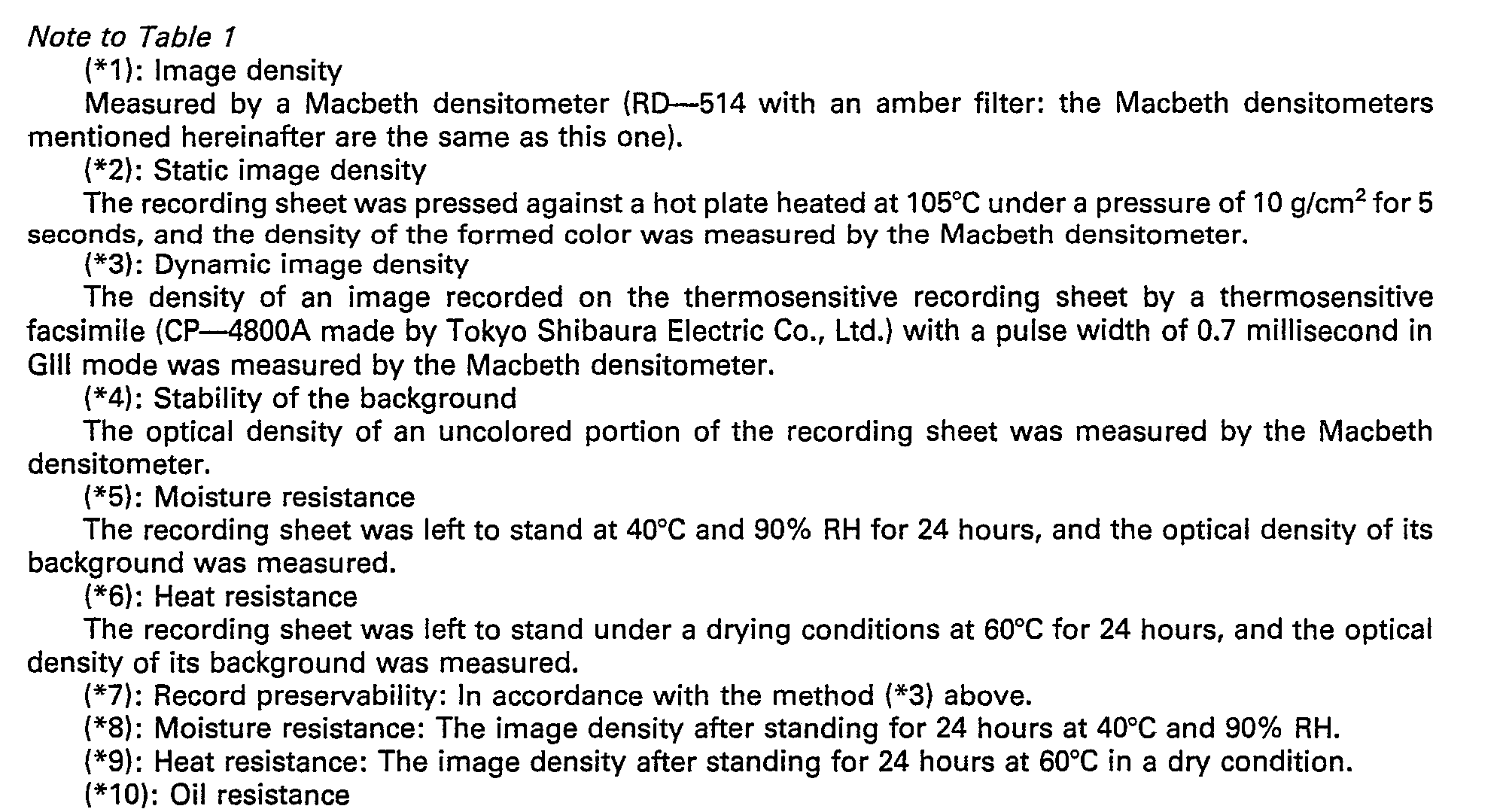
- A droplet (0.8 mg) of castor oil dropped onto a glass plate by an injection syringe was spread to an area of 40 cm2. Then, by using a rubber stamp (1 cm x 1.5 cm), the oil was transferred to that surface of the recording sheet which developed a color in accordance with the procedure described in (*7) above. After standing at 40°C and 90% RH for 24 hours, the density of the color in the transferred portion was measured by the Macbeth densitometer.
- Calculated in accordance with the following equation.

- The thermosensitive recording sheet dynamically colored by the method described in (*7) was stored in a file for one month at room temperature. The degree of formation of crystals on the colored image surface was determined by visual observation.
- The results given in Table 1 demonstrate that the thermosensitive recording sheets of this invention containing the polyphenyl ester compound of formula (I) (Examples 1 and 2) have much better heat resistance and moisture resistance in the background, better moisture resistance and heat resistance in the record sheets, and much better oil resistance than recording sheets containing no such compound (Comparative Example 1) or containing the known phthalate or terephthalate derivatives (Comparative Examples 2 to 7).
Claims (7)


Applications Claiming Priority (2)
| Application Number | Priority Date | Filing Date | Title |
|---|---|---|---|
| JP14768484A JPS6127284A (en) | 1984-07-18 | 1984-07-18 | thermal recording paper |
| JP147684/84 | 1984-07-18 |
Publications (3)
| Publication Number | Publication Date |
|---|---|
| EP0168819A2 EP0168819A2 (en) | 1986-01-22 |
| EP0168819A3 EP0168819A3 (en) | 1986-06-18 |
| EP0168819B1 true EP0168819B1 (en) | 1989-05-03 |
Family
ID=15435942
Family Applications (1)
| Application Number | Title | Priority Date | Filing Date |
|---|---|---|---|
| EP85108913A Expired EP0168819B1 (en) | 1984-07-18 | 1985-07-16 | Thermosensitive recording sheet |
Country Status (4)
| Country | Link |
|---|---|
| US (1) | US4628336A (en) |
| EP (1) | EP0168819B1 (en) |
| JP (1) | JPS6127284A (en) |
| DE (1) | DE3569908D1 (en) |
Families Citing this family (5)
| Publication number | Priority date | Publication date | Assignee | Title |
|---|---|---|---|---|
| US4855482A (en) * | 1986-07-02 | 1989-08-08 | Kabushiki Kaisha Ueno Seiyaku Oyo Kenkyujo | New compounds and their application |
| JPH0764120B2 (en) * | 1988-09-19 | 1995-07-12 | 日本化薬株式会社 | Thermal recording material |
| GB8911419D0 (en) * | 1989-05-18 | 1989-07-05 | Smith & Mclaurin Limited | Heat-sensitive record material |
| US5742325A (en) * | 1993-10-28 | 1998-04-21 | Xerox Corporation | Micro segmentation in a hyperacuity printer |
| KR20180018473A (en) * | 2015-06-11 | 2018-02-21 | 후지 덴키 가부시키가이샤 | Electrophotographic photosensitive body, method for producing same and electrophotographic apparatus |
Family Cites Families (4)
| Publication number | Priority date | Publication date | Assignee | Title |
|---|---|---|---|---|
| JPS57182483A (en) * | 1981-05-06 | 1982-11-10 | Ricoh Co Ltd | Heat-sensitive recording material |
| JPS57182494A (en) * | 1981-05-07 | 1982-11-10 | Nippon Paint Co Ltd | Flat plate |
| DE3237247C2 (en) * | 1981-12-04 | 1983-12-29 | Mitsubishi Paper Mills, Ltd., Tokyo | Thermosensitive recording sheet |
| US4575734A (en) * | 1982-08-19 | 1986-03-11 | Ricoh Company, Ltd. | Thermosensitive image transfer medium |
-
1984
- 1984-07-18 JP JP14768484A patent/JPS6127284A/en active Granted
-
1985
- 1985-07-11 US US06/753,905 patent/US4628336A/en not_active Expired - Fee Related
- 1985-07-16 EP EP85108913A patent/EP0168819B1/en not_active Expired
- 1985-07-16 DE DE8585108913T patent/DE3569908D1/en not_active Expired
Also Published As
| Publication number | Publication date |
|---|---|
| US4628336A (en) | 1986-12-09 |
| EP0168819A3 (en) | 1986-06-18 |
| DE3569908D1 (en) | 1989-06-08 |
| EP0168819A2 (en) | 1986-01-22 |
| JPH0339476B2 (en) | 1991-06-13 |
| JPS6127284A (en) | 1986-02-06 |
Similar Documents
| Publication | Publication Date | Title |
|---|---|---|
| JP4464301B2 (en) | Thermal recording material | |
| US4644375A (en) | Heat-sensitive recording sheet | |
| US4630080A (en) | Heat-sensitive recording sheet | |
| US4721701A (en) | Thermosensitive recording sheet | |
| EP0618082B1 (en) | A heat-sensitive recording material | |
| US4628336A (en) | Thermosensitive recording sheet | |
| US5175138A (en) | Heat-sensitive recording material | |
| EP0154336B1 (en) | Thermosensitive recording sheet | |
| US4688058A (en) | Thermal recording materials | |
| EP0289041B1 (en) | Thermosensitive recording sheet | |
| US4644374A (en) | Heat-sensitive recording material | |
| US5110786A (en) | Heat-sensitive recording material | |
| JP2694219B2 (en) | Thermal recording medium | |
| JP2696794B2 (en) | Thermal recording medium | |
| JP2982462B2 (en) | Thermal recording medium | |
| EP0798127A1 (en) | Heat sensitive recording material and method of using it | |
| JPH0369319B2 (en) | ||
| JPH02117889A (en) | Thermal recording material | |
| JPH0664335A (en) | Thermal recording | |
| JPH03221488A (en) | Thermal recording body | |
| JPH0342593B2 (en) | ||
| JPH0369317B2 (en) | ||
| JPH0417159B2 (en) | ||
| JPS63272583A (en) | Thermal recording paper | |
| JPH04112080A (en) | Thermal recording material and sensitizer therefor |
Legal Events
| Date | Code | Title | Description |
|---|---|---|---|
| PUAI | Public reference made under article 153(3) epc to a published international application that has entered the european phase |
Free format text: ORIGINAL CODE: 0009012 |
|
| AK | Designated contracting states |
Designated state(s): BE DE FR GB IT SE |
|
| PUAL | Search report despatched |
Free format text: ORIGINAL CODE: 0009013 |
|
| AK | Designated contracting states |
Kind code of ref document: A3 Designated state(s): BE DE FR GB IT SE |
|
| 17P | Request for examination filed |
Effective date: 19860805 |
|
| 17Q | First examination report despatched |
Effective date: 19871202 |
|
| GRAA | (expected) grant |
Free format text: ORIGINAL CODE: 0009210 |
|
| AK | Designated contracting states |
Kind code of ref document: B1 Designated state(s): BE DE FR GB IT SE |
|
| ITF | It: translation for a ep patent filed | ||
| REF | Corresponds to: |
Ref document number: 3569908 Country of ref document: DE Date of ref document: 19890608 |
|
| ET | Fr: translation filed | ||
| PLBE | No opposition filed within time limit |
Free format text: ORIGINAL CODE: 0009261 |
|
| STAA | Information on the status of an ep patent application or granted ep patent |
Free format text: STATUS: NO OPPOSITION FILED WITHIN TIME LIMIT |
|
| 26N | No opposition filed | ||
| ITTA | It: last paid annual fee | ||
| PGFP | Annual fee paid to national office [announced via postgrant information from national office to epo] |
Ref country code: GB Payment date: 19940706 Year of fee payment: 10 |
|
| PGFP | Annual fee paid to national office [announced via postgrant information from national office to epo] |
Ref country code: DE Payment date: 19940708 Year of fee payment: 10 |
|
| PGFP | Annual fee paid to national office [announced via postgrant information from national office to epo] |
Ref country code: FR Payment date: 19940711 Year of fee payment: 10 |
|
| PGFP | Annual fee paid to national office [announced via postgrant information from national office to epo] |
Ref country code: SE Payment date: 19940731 Year of fee payment: 10 |
|
| PGFP | Annual fee paid to national office [announced via postgrant information from national office to epo] |
Ref country code: BE Payment date: 19940912 Year of fee payment: 10 |
|
| EAL | Se: european patent in force in sweden |
Ref document number: 85108913.6 |
|
| PG25 | Lapsed in a contracting state [announced via postgrant information from national office to epo] |
Ref country code: GB Effective date: 19950716 |
|
| PG25 | Lapsed in a contracting state [announced via postgrant information from national office to epo] |
Ref country code: SE Effective date: 19950717 |
|
| PG25 | Lapsed in a contracting state [announced via postgrant information from national office to epo] |
Ref country code: BE Effective date: 19950731 |
|
| BERE | Be: lapsed |
Owner name: YOSHITOMI PHARMACEUTICAL INDUSTRIES LTD Effective date: 19950731 Owner name: JUJO PAPER CO. LTD Effective date: 19950731 |
|
| GBPC | Gb: european patent ceased through non-payment of renewal fee |
Effective date: 19950716 |
|
| PG25 | Lapsed in a contracting state [announced via postgrant information from national office to epo] |
Ref country code: DE Effective date: 19960402 |
|
| EUG | Se: european patent has lapsed |
Ref document number: 85108913.6 |
|
| PG25 | Lapsed in a contracting state [announced via postgrant information from national office to epo] |
Ref country code: FR Effective date: 19960430 |
|
| REG | Reference to a national code |
Ref country code: FR Ref legal event code: ST |
|
| REG | Reference to a national code |
Ref country code: FR Ref legal event code: ST |
|
| REG | Reference to a national code |
Ref country code: FR Ref legal event code: ST |