EP0168229B1 - Pharmaceutical antifungal composition - Google Patents
Pharmaceutical antifungal composition Download PDFInfo
- Publication number
- EP0168229B1 EP0168229B1 EP85304830A EP85304830A EP0168229B1 EP 0168229 B1 EP0168229 B1 EP 0168229B1 EP 85304830 A EP85304830 A EP 85304830A EP 85304830 A EP85304830 A EP 85304830A EP 0168229 B1 EP0168229 B1 EP 0168229B1
- Authority
- EP
- European Patent Office
- Prior art keywords
- acid
- sodium
- bile
- bile acid
- candida
- Prior art date
- Legal status (The legal status is an assumption and is not a legal conclusion. Google has not performed a legal analysis and makes no representation as to the accuracy of the status listed.)
- Expired - Lifetime
Links
Images


Classifications
-
- A—HUMAN NECESSITIES
- A61—MEDICAL OR VETERINARY SCIENCE; HYGIENE
- A61K—PREPARATIONS FOR MEDICAL, DENTAL OR TOILETRY PURPOSES
- A61K31/00—Medicinal preparations containing organic active ingredients
- A61K31/56—Compounds containing cyclopenta[a]hydrophenanthrene ring systems; Derivatives thereof, e.g. steroids
- A61K31/575—Compounds containing cyclopenta[a]hydrophenanthrene ring systems; Derivatives thereof, e.g. steroids substituted in position 17 beta by a chain of three or more carbon atoms, e.g. cholane, cholestane, ergosterol, sitosterol
-
- A—HUMAN NECESSITIES
- A61—MEDICAL OR VETERINARY SCIENCE; HYGIENE
- A61K—PREPARATIONS FOR MEDICAL, DENTAL OR TOILETRY PURPOSES
- A61K47/00—Medicinal preparations characterised by the non-active ingredients used, e.g. carriers or inert additives; Targeting or modifying agents chemically bound to the active ingredient
- A61K47/06—Organic compounds, e.g. natural or synthetic hydrocarbons, polyolefins, mineral oil, petrolatum or ozokerite
- A61K47/28—Steroids, e.g. cholesterol, bile acids or glycyrrhetinic acid
-
- A—HUMAN NECESSITIES
- A61—MEDICAL OR VETERINARY SCIENCE; HYGIENE
- A61K—PREPARATIONS FOR MEDICAL, DENTAL OR TOILETRY PURPOSES
- A61K9/00—Medicinal preparations characterised by special physical form
- A61K9/0012—Galenical forms characterised by the site of application
- A61K9/0014—Skin, i.e. galenical aspects of topical compositions
-
- A—HUMAN NECESSITIES
- A61—MEDICAL OR VETERINARY SCIENCE; HYGIENE
- A61K—PREPARATIONS FOR MEDICAL, DENTAL OR TOILETRY PURPOSES
- A61K9/00—Medicinal preparations characterised by special physical form
- A61K9/20—Pills, tablets, discs, rods
- A61K9/28—Dragees; Coated pills or tablets, e.g. with film or compression coating
- A61K9/2806—Coating materials
- A61K9/282—Organic compounds, e.g. fats
-
- A—HUMAN NECESSITIES
- A61—MEDICAL OR VETERINARY SCIENCE; HYGIENE
- A61P—SPECIFIC THERAPEUTIC ACTIVITY OF CHEMICAL COMPOUNDS OR MEDICINAL PREPARATIONS
- A61P31/00—Antiinfectives, i.e. antibiotics, antiseptics, chemotherapeutics
- A61P31/04—Antibacterial agents
-
- A—HUMAN NECESSITIES
- A61—MEDICAL OR VETERINARY SCIENCE; HYGIENE
- A61P—SPECIFIC THERAPEUTIC ACTIVITY OF CHEMICAL COMPOUNDS OR MEDICINAL PREPARATIONS
- A61P31/00—Antiinfectives, i.e. antibiotics, antiseptics, chemotherapeutics
- A61P31/10—Antimycotics
Definitions
- This invention relates to a pharmaceutical composition for antifungal use, especially anti-Candida use (for treatment of the infection known as candidiasis).
- the antibiotics most commonly used for treatment of candidiasis, especially vaginal candidiasis, are polyenes, especially nystatin. Such polyenes are not always effective if applied topically and their systemic administration is suspected of giving rise to kidney failure in some patients.
- ketoconazole Another imidazole, ketoconazole, has been used as a systemic fungicide, but recently there have been reports of hepatitis or liver damage occurring in some patients treated with ketoconazole, see Committee for Safety of Medicines Data Sheet, April 1983, and the article "New antifungal and antiviral chemotherapy" by J.C.M. Stewart et al ., British Medical Journal, 286 , 1802-1804 (1983).
- An important feature of the invention consists in a pharmaceutical composition in a form suitable for topical application, comprising (1) a bile acid component in the form of at least one bile acid or a derivative thereof which is a conjugate thereof formed between the carboxylic acid of the bile acid and the NH2 group of the amino acid glycine or taurine, or a salt of such an acid or conjugate, and (2) a pharmaceutically acceptable excipient for topical application.
- the above feature of the invention can be formulated as the use of the bile acid component for the manufacture of a medicament for the therapeutic application of treating topical fungal infections, preferably candidiasis, and especially vaginal candidiasis.
- the bile acids referred to above are compounds of the general formula where Me represents a methyl group, X represents a hydrogen atom or a hydroxyl group (in the 7 ⁇ -position), Y represents a hydrogen atom or hydroxyl group (in the 12 ⁇ -position) and Z represents a hydrogen atom or hydroxyl group (in the 6 ⁇ -position). These compounds are:
- the bile acids are produced in various mammals, including man, and are excreted in large quantities. This origin is a prima facie indication that they are unlikely to be toxic to man.
- bile acid derivatives have been administered intravenously or orally to increase the flow of bile, i.e. as choleretics.
- Dehydrocholic acid (3,7,12-trioxo-5 ⁇ -cholan-24-oic acid) is the most active.
- Others are ox bile extract, cholic acid, sodium glycocholate and sodium taurocholate. See "The Pharmaceutical Basis of Therapeutics" by L.S. Goodman and A. Gilman, 3rd edition, The MacMillan Company, New York 1965, pages 1003 to 1007 and The Merck Index, 10th edition, 1983, entries 2183 and 8951.
- amino acid-conjugated cholic acid has an inhibitory effect on the growth of the bacteria Bacillus subtilis and Saccharomyces cerevisiae and carlsbergensis , see S. Aonuma et al ., Yakugaku Kenkyu 38 , 381-392 (1967).
- the compounds tested were however ineffective against Escherichia coli bacteria and against the fungus Asperillus niger .
- the anti- Candida preparation "Fungizone” (Registered Trade Mark) is administered intravenously and is sold in the form of 20ml vials each containing amphotericin B together with 41mg of sodium deoxycholate as a dispersant to "solubilize” the amphotericin and sodium phosphate buffer. Toxicity tests were carried out on "Fungizone” and separately on sodium deoxycholate by K. Saito, Odontology (Journal of Nippon Dental University) 6 (5), 650-671 (1979). The paper nowhere suggests that sodium deoxycholate has any fungicidal activity. Other papers relating to "Fungizone” are H.H. Gadebusth et al ., The Journal of Infectious Diseases 134 , 423-427 (1976) and Paul B. Fisher et al ., In vitro, 12 , 133-139 (1976).
- a bile acid or derivative thereof such as sodium deoxycholate, sodium cholate, or the like has at least a fungistatic effect on strains of Candida .
- the bile acid component can be formulated in any conventional way suitable for topical application, for example as a capsule, suppository or pessary for intracavital application (to the vagina, urethra or rectum) or a gel, ointment, cream or the like, dusting powder or aerosol spray.
- a suppository or pessary may contain theobroma oil, glycerinated gelatin or polyethylene glycol, for example, as a carrier which melts at body temperature or dissolves in body fluids.
- the bile acid component can be formulated as an ointment or cream with an oleaginous or waxy binder. An aqueous phase may be present, to provide a cream.
- Other forms of formulation include gelatin capsules containing the ingredient in a liquid diluent, mixtures with talc or the like to provide dusting powder and aerosol bombs which comprise the ingredient and an inert propellant.
- a preferred formulation is an ointment or cream containing say, from 1 to 5 percent by weight of the bile acid component depending on its effectiveness.
- Tablets for oral administration of cholic acid containing merely a choleretic or gallstone-dissolving amount of a bile acid component for such a use, are not within the scope of the invention.
- pessaries can be formulated as controlled release compositions using as excipient a polymeric carrier comprising residues which are cross-linked through urethane groups and which comprise polyethylene oxide, as described in UK Patent Specification 2047093A (National Research Development Corporation).
- a particularly preferred aspect of the invention comprises the bile acid component in association with an anti-inflammatory agent, especially of the steroidal type, most especially a corticosteroid, e.g. betamethasone, fluocinolone acetonide, beclomethasone dipropionate, hydrocortisone, cortisone or cortisol.
- an anti-inflammatory agent especially of the steroidal type, most especially a corticosteroid, e.g. betamethasone, fluocinolone acetonide, beclomethasone dipropionate, hydrocortisone, cortisone or cortisol.
- bile acids and derivatives could also be formulated as an aerosol for application to the orapharynx or upper respiratory tract, orally or intranasally.
- Proportions expressed as weight/volume are metric, i.e. g/100 ml.
- Candida albicans used were A39 (a clinical isolate provided by Boots PLC, Nottingham, England) and CMI 45348 (available as an ordinary scientific deposit from the Commonwealth Mycological Institute, Ferry Lane, Kew, Surrey TW9 3AF, England).
- Starter cultures were made by growing the Candida albicans in an aqueous medium in shake culture at 140 rpm in an orbital incubator for 18 hours at 30 o C.
- the medium used consisted of Tris, 1.2 g; NaCl, 0.1 g; Ammonium tartrate, 5.0 g; Ammonium nitrate, 1.0 g; KH2PO4, 1.0 g; MgSO4.7H2O, 0.5 g; CaCl2, 0.1 g; glucose, 100 g; and biotin 1 x 10 ⁇ 5 g, all per litre, to which was added 1.0 ml per litre of a mineral salts solution which contained H3BO3, 6 mg; (NH4)6 MoO24.4H2O, 26 mg; FeCl3.6H2O, 100 mg; CuSO45H2O, 40 mg; MnCl2.4H2O, 8 mg; and ZnCl2, 200 mg, all per 100 ml of mineral salts solution.
- the concentrations of the sodium salt of cholic acid (reckoned as the salt) used and the responses were as follows: Control no response 0.001% w/v no response 0.01% w/v no response 0.1% w/v no significant response 0.2% w/v 0.3% w/v response as shown in Figure 1 of the drawings. 0.4% w/v 0.5% w/v no growth after 3 hours 1.0% w/v no growth after 3 hours
- Figure 2 of the drawings shows normal control cells of Candida albicans (A39 strain) and Figure 3 cells of the same strain grown in the presence of 0.4% w/v sodium cholate for 6 hours at 30 o C.
- the principal differences between the cells of Figure 3 and normal cells of Candida albicans are (a) that in Figure 3 the lemon-shaped yeast-form cells are not dividing properly but are joined together by a relatively thick "neck" portion and (b) that in Figure 3 the cell walls are cracked (whereas in normal Candida cells they are not).
- the Figure 3 cellular morphology is similar to that observed by S. De Nollin and M. Borgers, Antimicrobial Agents and Chemotherapy, 7 , 704-711 (1975), in Candida albicans treated with the antifungal agent miconazole, see especially Figure 2 thereof.
- Example 1 The procedure of Example 1 was repeated using sodium salts of chenodeoxycholic acid, lithocholic acid and deoxycholic acid. All these salts are less soluble in water than sodium cholate. Because of the solubility problem, meaningful quantitative data at different concentrations of additive could not be obtained. Nevertheless, the experiments showed that each of these salts affected the cellular structure of the organism in a broadly similar way to the necking effect seen in Figure 3. Since this effect was also observed in miconazole treatment, it can reasonably be concluded that these other bile acid salts also have an anti- Candida effect.
- the chenodeoxycholate treatment (1% w/v, sodium salt) caused the yeast cells to become incompletely separated after 6 hours growth at 30 o C and the amount of the elongated mycelial structure to increase, see Figure 4.
- the necking effect is clearly visible.
- a lithocholate treatment (1% w/v, sodium salt) after 6 hours growth at 30 o C ( Figure 5) showed similar effects.
- deoxycholate 0.05% w/v, sodium salt was used instead, cell elongation, "necking", and incomplete separation were again observed ( Figure 6).
- the effectiveness of various bile acids and derivatives of the invention to inhibit Candida albicans A39 on agar was demonstrated in spread and seeded plate tests.
- the plates had a diameter of 9 cm.
- a culture of 107-108 cells/ml of the Candida organism was used.
- 1 ml of the culture was dispersed in agar to a total volume of 20 ml and the agar allowed to solidify.
- the spread plate test 0.1 ml of the culture was spread on the surface of the solidified agar. 1% w/v solutions of the bile acids and derivatives were made in distilled water of if necessary in ethanol and sterilised by membrane filtration.
- Sterile 5 mm discs (Whatman AA) were dipped in these solutions and allowed to dry in sterile petri dishes. They were then placed on the surfaces of the plates to provide approximately 0.2 mg of bile acid or derivative per disc. The plates were then incubated for 24 hours at 30 o C. The zones of inhibition, represented by cleared areas were then recorded. In nearly all cases they extended beyond the area of the disc, the Candida albicans having grown outwardly from the original 5 mm diameter area during the incubation and the bile acid or derivative being sufficiently potent an agent to inhibit it.
Landscapes
- Health & Medical Sciences (AREA)
- Chemical & Material Sciences (AREA)
- Animal Behavior & Ethology (AREA)
- Pharmacology & Pharmacy (AREA)
- Life Sciences & Earth Sciences (AREA)
- General Health & Medical Sciences (AREA)
- Public Health (AREA)
- Veterinary Medicine (AREA)
- Medicinal Chemistry (AREA)
- Epidemiology (AREA)
- Chemical Kinetics & Catalysis (AREA)
- Engineering & Computer Science (AREA)
- General Chemical & Material Sciences (AREA)
- Dermatology (AREA)
- Bioinformatics & Cheminformatics (AREA)
- Oil, Petroleum & Natural Gas (AREA)
- Communicable Diseases (AREA)
- Oncology (AREA)
- Nuclear Medicine, Radiotherapy & Molecular Imaging (AREA)
- Organic Chemistry (AREA)
- Pharmaceuticals Containing Other Organic And Inorganic Compounds (AREA)
- Steroid Compounds (AREA)
- Medicinal Preparation (AREA)
Description
- This invention relates to a pharmaceutical composition for antifungal use, especially anti-Candida use (for treatment of the infection known as candidiasis).
- The antibiotics most commonly used for treatment of candidiasis, especially vaginal candidiasis, are polyenes, especially nystatin. Such polyenes are not always effective if applied topically and their systemic administration is suspected of giving rise to kidney failure in some patients.
- An antifungal cream and dusting powder based on miconazole is available under the Trade Mark "Daktarin" from Janssen Pharmaceutical Ltd. Since occasional irritation has been reported when using this product, it would be advantageous to have an alternative product for topical application.
- Another imidazole, ketoconazole, has been used as a systemic fungicide, but recently there have been reports of hepatitis or liver damage occurring in some patients treated with ketoconazole, see Committee for Safety of Medicines Data Sheet, April 1983, and the article "New antifungal and antiviral chemotherapy" by J.C.M. Stewart et al., British Medical Journal, 286, 1802-1804 (1983).
- There has therefore been a need to develop new antibiotics for the treatment of candidiasis.
- Additional prior art is described below after the "Summary of the invention", without which its context would not be clear.
- It has now been found, very surprisingly, that bile acids and their simple derivatives have anti-Candida activity.
- An important feature of the invention consists in a pharmaceutical composition in a form suitable for topical application, comprising (1) a bile acid component in the form of at least one bile acid or a derivative thereof which is a conjugate thereof formed between the carboxylic acid of the bile acid and the NH₂ group of the amino acid glycine or taurine, or a salt of such an acid or conjugate, and (2) a pharmaceutically acceptable excipient for topical application.
- The above feature of the invention can be formulated as the use of the bile acid component for the manufacture of a medicament for the therapeutic application of treating topical fungal infections, preferably candidiasis, and especially vaginal candidiasis.
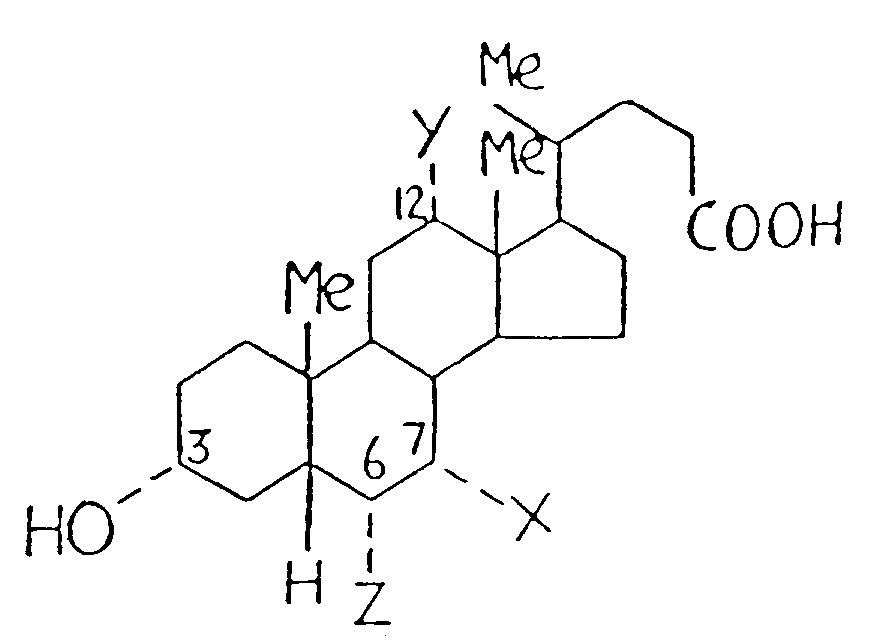
- The bile acids referred to above are compounds of the general formula
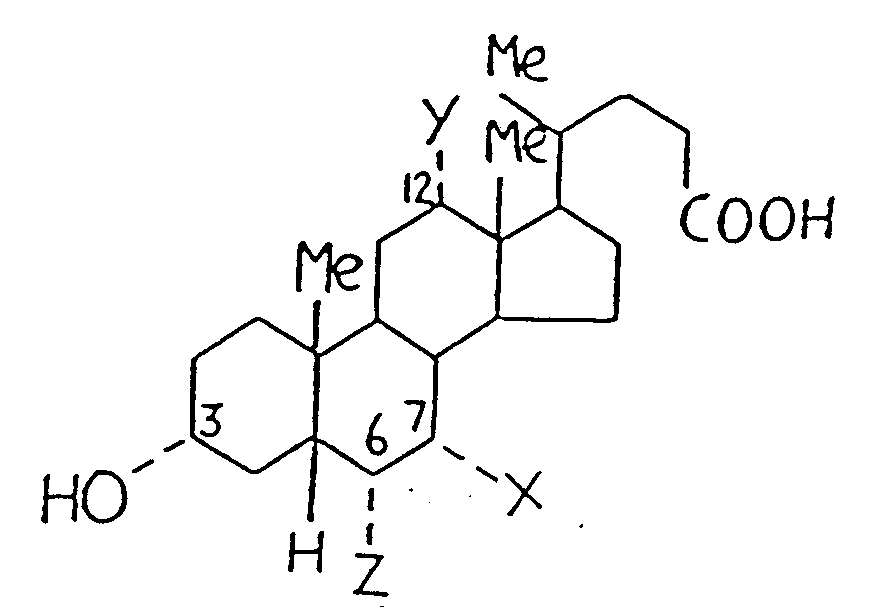
where Me represents a methyl group, X represents a hydrogen atom or a hydroxyl group (in the 7α-position), Y represents a hydrogen atom or hydroxyl group (in the 12α-position) and Z represents a hydrogen atom or hydroxyl group (in the 6α-position).
These compounds are: - Cholic acid:
- 3α, 7α, 12α-trihydroxy-5β-cholan-24-oic acid
- Deoxycholic acid:
- 3α, 12α-dihydroxy-5β-cholan-24-oic acid
- Lithocholic acid:
- 3α-hydroxy-5β-cholan-24-oic acid
- Chenodeoxycholic acid:
- 3α, 7α-dihydroxy-5β-cholan-24-oic acid
- Hyodecholic acid
- 6α, 7α-dihydroxy-5β-cholan-24-oic acid
- Hyodeoxycholic acid
- 6α-hydroxy-5β-cholan-24-oic acid
- The bile acids are produced in various mammals, including man, and are excreted in large quantities. This origin is a prima facie indication that they are unlikely to be toxic to man.
- Various bile acid derivatives have been administered intravenously or orally to increase the flow of bile, i.e. as choleretics. Dehydrocholic acid (3,7,12-trioxo-5β-cholan-24-oic acid) is the most active. Others are ox bile extract, cholic acid, sodium glycocholate and sodium taurocholate. See "The Pharmaceutical Basis of Therapeutics" by L.S. Goodman and A. Gilman, 3rd edition, The MacMillan Company, New York 1965, pages 1003 to 1007 and The Merck Index, 10th edition, 1983, entries 2183 and 8951.
- Chenodeoxycholic and ursodeoxycholic acids have been administered orally for the prevention and dissolution of gallstones, see Oxford Textbook of Medicine, Ed. D.J. Weatherall, J.G.G. Ledlingham and D.A. Warrell, Oxford University Press, Vol. 1, Section 12-171 (1983), G.D. Bell et al., The Lancet December 9, 1972, pages 1213-1217 and R.G. Danzinger et al., The New England Journal of Medicine, 286, 1-8, (1972).
- It is known that amino acid-conjugated cholic acid has an inhibitory effect on the growth of the bacteria Bacillus subtilis and Saccharomyces cerevisiae and carlsbergensis, see S. Aonuma et al., Yakugaku Kenkyu 38, 381-392 (1967). The compounds tested were however ineffective against Escherichia coli bacteria and against the fungus Asperillus niger.
- The anti-Candida preparation "Fungizone" (Registered Trade Mark) is administered intravenously and is sold in the form of 20ml vials each containing amphotericin B together with 41mg of sodium deoxycholate as a dispersant to "solubilize" the amphotericin and sodium phosphate buffer. Toxicity tests were carried out on "Fungizone" and separately on sodium deoxycholate by K. Saito, Odontology (Journal of Nippon Dental University) 6 (5), 650-671 (1979). The paper nowhere suggests that sodium deoxycholate has any fungicidal activity. Other papers relating to "Fungizone" are H.H. Gadebusth et al., The Journal of Infectious Diseases 134, 423-427 (1976) and Paul B. Fisher et al., In vitro, 12, 133-139 (1976).
- M.E. Macintosh and R.H. Pritchard, Genet, Res. Camb. 4, 320-322 (1963) investigated the effect of the surface active agents sodium dodecyl sulphate and sodium deoxycholate on growth of Aspergillus nidulans, in the hope that they might promote growth. It was concluded that sodium deoxycholate had a growth-enhancing effect and the authors mention that after making this finding they learned that sodium deoxycholate was known to promote the growth of Neurospora and Syncephalastrum.
- In the light of these prior disclosures, it was surprising to find by the present invention, that a bile acid or derivative thereof such as sodium deoxycholate, sodium cholate, or the like has at least a fungistatic effect on strains of Candida.
- In the Examples hereinafter reference is made to the accompanying drawings, in which:-
- Figure 1 is a plot shoring growth of Candida albicans in the presence of various amounts of sodium cholate;
- Figure 2 is a photograph of untreated cells of Candida albicans; and
- Figures 3 to 6 are photographs of cells of Candida albicans treated with various amounts of various bile acid components, namely sodium salts of cholic, chenodeoxycholic, lithocholic or deoxycholic acids.
- The bile acid component can be formulated in any conventional way suitable for topical application, for example as a capsule, suppository or pessary for intracavital application (to the vagina, urethra or rectum) or a gel, ointment, cream or the like, dusting powder or aerosol spray. A suppository or pessary may contain theobroma oil, glycerinated gelatin or polyethylene glycol, for example, as a carrier which melts at body temperature or dissolves in body fluids. The bile acid component can be formulated as an ointment or cream with an oleaginous or waxy binder. An aqueous phase may be present, to provide a cream. Other forms of formulation include gelatin capsules containing the ingredient in a liquid diluent, mixtures with talc or the like to provide dusting powder and aerosol bombs which comprise the ingredient and an inert propellant.
- A preferred formulation is an ointment or cream containing say, from 1 to 5 percent by weight of the bile acid component depending on its effectiveness.
- Tablets for oral administration of cholic acid, containing merely a choleretic or gallstone-dissolving amount of a bile acid component for such a use, are not within the scope of the invention. Other tablets and pills, for intravaginal use for example, are within the scope of the invention. They may contain conventional inert excipients for the intended purpose. Such pessaries can be formulated as controlled release compositions using as excipient a polymeric carrier comprising residues which are cross-linked through urethane groups and which comprise polyethylene oxide, as described in UK Patent Specification 2047093A (National Research Development Corporation).
- A particularly preferred aspect of the invention comprises the bile acid component in association with an anti-inflammatory agent, especially of the steroidal type, most especially a corticosteroid, e.g. betamethasone, fluocinolone acetonide, beclomethasone dipropionate, hydrocortisone, cortisone or cortisol. These compositions are useful for the treatment of fungal infections of the skin.
- A reasonable prediction from the information available is that the invention would be useful in treating the same kinds of topical fungal infections as miconazole.
- It is contemplated that the bile acids and derivatives could also be formulated as an aerosol for application to the orapharynx or upper respiratory tract, orally or intranasally.
- The following Examples illustrate the invention. Proportions expressed as weight/volume are metric, i.e. g/100 ml.
- The strains of Candida albicans used were A39 (a clinical isolate provided by Boots PLC, Nottingham, England) and CMI 45348 (available as an ordinary scientific deposit from the Commonwealth Mycological Institute, Ferry Lane, Kew, Surrey TW9 3AF, England).
- Starter cultures were made by growing the Candida albicans in an aqueous medium in shake culture at 140 rpm in an orbital incubator for 18 hours at 30oC. The medium used consisted of Tris, 1.2 g; NaCl, 0.1 g; Ammonium tartrate, 5.0 g; Ammonium nitrate, 1.0 g; KH₂PO₄, 1.0 g; MgSO₄.7H₂O, 0.5 g; CaCl₂, 0.1 g; glucose, 100 g; and biotin 1 x 10⁻⁵ g, all per litre, to which was added 1.0 ml per litre of a mineral salts solution which contained H₃BO₃, 6 mg; (NH₄)₆ MoO₂₄.4H₂O, 26 mg; FeCl₃.6H₂O, 100 mg; CuSO₄5H₂O, 40 mg; MnCl₂.4H₂O, 8 mg; and ZnCl₂, 200 mg, all per 100 ml of mineral salts solution. 5 ml aliquots of this starter culture were then transferred to 100 ml volumes of fresh medium of the same composition, to which aqueous sodium cholate solution has been added to give the required test concentration. In a control experiment, no sodium cholate was added. These cultures were incubated at 140 rpm at 30oC and the optical density measured at 420 nm at definite time intervals.
- The concentrations of the sodium salt of cholic acid (reckoned as the salt) used and the responses were as follows:
Control no response 0.001% w/v no response 0.01% w/v no response 0.1% w/v no significant response 0.2% w/v 0.3% w/v response as shown in Figure 1 of the drawings. 0.4% w/v 0.5% w/v no growth after 3 hours 1.0% w/v no growth after 3 hours - Figure 2 of the drawings shows normal control cells of Candida albicans (A39 strain) and Figure 3 cells of the same strain grown in the presence of 0.4% w/v sodium cholate for 6 hours at 30oC. The principal differences between the cells of Figure 3 and normal cells of Candida albicans are (a) that in Figure 3 the lemon-shaped yeast-form cells are not dividing properly but are joined together by a relatively thick "neck" portion and (b) that in Figure 3 the cell walls are cracked (whereas in normal Candida cells they are not). The Figure 3 cellular morphology is similar to that observed by S. De Nollin and M. Borgers, Antimicrobial Agents and Chemotherapy, 7, 704-711 (1975), in Candida albicans treated with the antifungal agent miconazole, see especially Figure 2 thereof.
- The procedure of Example 1 was repeated using sodium salts of chenodeoxycholic acid, lithocholic acid and deoxycholic acid. All these salts are less soluble in water than sodium cholate. Because of the solubility problem, meaningful quantitative data at different concentrations of additive could not be obtained. Nevertheless, the experiments showed that each of these salts affected the cellular structure of the organism in a broadly similar way to the necking effect seen in Figure 3. Since this effect was also observed in miconazole treatment, it can reasonably be concluded that these other bile acid salts also have an anti-Candida effect.
- In more detail, the chenodeoxycholate treatment (1% w/v, sodium salt) caused the yeast cells to become incompletely separated after 6 hours growth at 30oC and the amount of the elongated mycelial structure to increase, see Figure 4. The necking effect is clearly visible. A lithocholate treatment (1% w/v, sodium salt) after 6 hours growth at 30oC (Figure 5) showed similar effects. When deoxycholate 0.05% w/v, sodium salt) was used instead, cell elongation, "necking", and incomplete separation were again observed (Figure 6).
- The effectiveness of various bile acids and derivatives of the invention to inhibit Candida albicans A39 on agar was demonstrated in spread and seeded plate tests. The plates had a diameter of 9 cm. In both tests a culture of 10⁷-10⁸ cells/ml of the Candida organism was used. In the seeded plate test 1 ml of the culture was dispersed in agar to a total volume of 20 ml and the agar allowed to solidify. In the spread plate test 0.1 ml of the culture was spread on the surface of the solidified agar. 1% w/v solutions of the bile acids and derivatives were made in distilled water of if necessary in ethanol and sterilised by membrane filtration. Sterile 5 mm discs (Whatman AA) were dipped in these solutions and allowed to dry in sterile petri dishes. They were then placed on the surfaces of the plates to provide approximately 0.2 mg of bile acid or derivative per disc. The plates were then incubated for 24 hours at 30oC. The zones of inhibition, represented by cleared areas were then recorded. In nearly all cases they extended beyond the area of the disc, the Candida albicans having grown outwardly from the original 5 mm diameter area during the incubation and the bile acid or derivative being sufficiently potent an agent to inhibit it.
- The results are shown in the Table below. It will be seen that most of the bile acids or deratives gave good inhibition in both tests. Although two of them were effective only in the seeded plate test their performance in that test does indicate some anti-Candida activity.
TABLE Zones of inhibition of growth of Candida albicans by bile acid Compound number Compound Zone of inhibition (cm) Spread plate Seeded plate 19 Sodium cholate 0.51 1.2 20 Sodium deoxycholate 0.73 0.81 21 Chenodeoxycholic acid 0.63 1.38 22 Hyocholic acid 0.69 0.55 23 Hyodeoxycholic acid 0.66 0.85 24 Sodium lithocholate 0 0.55 25 Sodium glycocholate 0 0.64 26 Sodium glycodeoxycholate 0.62 1.16
Claims (2)
- Use of a bile acid component in the form of at least one bile acid of the general formula:
- Use according to Claim 1 for treating candidiasis.
Applications Claiming Priority (2)
| Application Number | Priority Date | Filing Date | Title |
|---|---|---|---|
| GB848417895A GB8417895D0 (en) | 1984-07-13 | 1984-07-13 | Pharmaceutical anti-fungal composition |
| GB8417895 | 1984-07-13 |
Publications (3)
| Publication Number | Publication Date |
|---|---|
| EP0168229A2 EP0168229A2 (en) | 1986-01-15 |
| EP0168229A3 EP0168229A3 (en) | 1990-07-18 |
| EP0168229B1 true EP0168229B1 (en) | 1993-09-15 |
Family
ID=10563846
Family Applications (1)
| Application Number | Title | Priority Date | Filing Date |
|---|---|---|---|
| EP85304830A Expired - Lifetime EP0168229B1 (en) | 1984-07-13 | 1985-07-05 | Pharmaceutical antifungal composition |
Country Status (5)
| Country | Link |
|---|---|
| US (1) | US4681876A (en) |
| EP (1) | EP0168229B1 (en) |
| JP (1) | JPS61106511A (en) |
| DE (1) | DE3587577T2 (en) |
| GB (2) | GB8417895D0 (en) |
Families Citing this family (47)
| Publication number | Priority date | Publication date | Assignee | Title |
|---|---|---|---|---|
| US4565586A (en) * | 1984-06-22 | 1986-01-21 | Brush Wellman Inc. | Processing of copper alloys |
| US4892868A (en) * | 1984-08-17 | 1990-01-09 | Gipharmex, S.P.A. | Derivatives of biliary acids, process for the production thereof and corresponding pharmaceutical compositions |
| US4866044A (en) * | 1985-07-09 | 1989-09-12 | Takeda Chemical Industries, Ltd. | Solubilized composition of poorly-soluble pharmaceutical product |
| DE3704907A1 (en) * | 1987-02-17 | 1988-08-25 | Bayer Ag | TOPICALLY APPLICABLE PREPARATIONS OF GYRASE INHIBITORS IN COMBINATION WITH CORTICOSTEROIDS |
| GB8706313D0 (en) * | 1987-03-17 | 1987-04-23 | Health Lab Service Board | Treatment & prevention of viral infections |
| US4921838A (en) * | 1987-06-16 | 1990-05-01 | Trustees Of Boston University | Angiogenic and blood perfusion inducing properties of amphiphilic compounds |
| WO1990003172A2 (en) * | 1988-09-20 | 1990-04-05 | Fisons Plc | Bile acids for treatment of viral infections |
| GB8910364D0 (en) * | 1989-05-05 | 1989-06-21 | Nat Res Dev | Anti-fungal compounds |
| CA2033725C (en) * | 1990-01-24 | 2001-05-29 | Folker Pittrof | Pharmaceutical and cosmetic compositions containing a salt of cholanic acid |
| US5079240A (en) * | 1990-03-15 | 1992-01-07 | The Regents Of The University Of California | Synthetic conjugated bile acid and method of use thereof |
| GB9010087D0 (en) * | 1990-05-04 | 1990-06-27 | Nat Res Dev | Anti-fungal compounds |
| ES2027527A6 (en) * | 1990-12-17 | 1992-06-01 | Andromaco Lab | PROCEDURE FOR OBTAINING POLYMERS WITH ANTIVIRAL ACTIVITY. |
| CH680704A5 (en) * | 1991-05-15 | 1992-10-30 | Medichemie Ag | |
| IT1255450B (en) * | 1992-06-30 | 1995-10-31 | Montefarmaco Spa | USE OF BILE ACIDS AS ANTI-VIRAL AGENTS |
| US5646316A (en) * | 1994-04-08 | 1997-07-08 | Osteoarthritis Sciences, Inc. | Bile acid inhibitors of metalloproteinase enzymes |
| EP0720854A1 (en) * | 1995-01-04 | 1996-07-10 | Medichemie Ag | Use of bile acids for the preparation of a medicament for the treatment of skin disorders |
| FR2760362B1 (en) | 1997-03-10 | 2000-08-11 | Vitasterol | COSMETIC OR DERMATOLOGICAL USE OF 7-HYDROXYL STEROIDS |
| US6767904B2 (en) | 1998-03-06 | 2004-07-27 | Bringham Young University | Steroid derived antibiotics |
| US6350738B1 (en) | 1998-03-06 | 2002-02-26 | Brigham Young University | Steroid derived antibiotics |
| RU2224523C2 (en) | 1998-07-24 | 2004-02-27 | Сео Хонг Ю | Bile acid-containing aqueous solution and method for its preparing |
| US7303768B2 (en) | 1998-07-24 | 2007-12-04 | Seo Hong Yoo | Preparation of aqueous clear solution dosage forms with bile acids |
| US7772220B2 (en) * | 2004-10-15 | 2010-08-10 | Seo Hong Yoo | Methods and compositions for reducing toxicity of a pharmaceutical compound |
| US20050158408A1 (en) * | 1998-07-24 | 2005-07-21 | Yoo Seo H. | Dried forms of aqueous solubilized bile acid dosage formulation: preparation and uses thereof |
| CN100558407C (en) * | 2000-02-04 | 2009-11-11 | 柳署弘 | Preparation of clear aqueous dosage forms containing bile acids |
| KR20030003952A (en) * | 2001-07-04 | 2003-01-14 | 주식회사 엘지생활건강 | Compositions for the prevention and treatment of inflammatory skin diseases |
| US7145125B2 (en) | 2003-06-23 | 2006-12-05 | Advanced Optical Technologies, Llc | Integrating chamber cone light using LED sources |
| US20060127468A1 (en) | 2004-05-19 | 2006-06-15 | Kolodney Michael S | Methods and related compositions for reduction of fat and skin tightening |
| ES2372499T3 (en) | 2004-05-19 | 2012-01-20 | Los Angeles Biomedical Research Institute At Harbor-Ucla Medical Center | USE OF A DETERGENT FOR NON-SURGICAL FAT DISPOSAL. |
| US7754230B2 (en) * | 2004-05-19 | 2010-07-13 | The Regents Of The University Of California | Methods and related compositions for reduction of fat |
| KR101414810B1 (en) * | 2004-08-30 | 2014-07-18 | 주식회사 유스팜인터내셔널 | Neuroprotective effect of solubilized UDCA in focal ischemic model |
| US20060074057A1 (en) * | 2004-10-04 | 2006-04-06 | Eric Marchewitz | Use of chenodeoxycholic acid for reducing adipose tissue |
| ATE506955T1 (en) * | 2004-10-15 | 2011-05-15 | Seo Hong Yoo | COMPOSITIONS FOR REDUCING THE TOXICITY OF CISPLATIN, CARBOPLATIN AND OXALIPLATIN |
| CA2585471A1 (en) * | 2004-11-01 | 2006-05-11 | Seo Hong Yoo | Methods and compositions for reducing neurodegeneration in amyotrophic lateral sclerosis |
| US20070071706A1 (en) * | 2005-09-28 | 2007-03-29 | Filiberto Zadini | Lipodissolving dermatological topical preparation |
| JOP20180077A1 (en) | 2007-06-19 | 2019-01-30 | Kythera Biopharmaceuticals Inc | Synthetic bile acid compositions and methods |
| US8242294B2 (en) | 2007-06-19 | 2012-08-14 | Kythera Biopharmaceuticals, Inc. | Synthetic bile acid compositions and methods |
| US20080318870A1 (en) | 2007-06-19 | 2008-12-25 | Kythera Biopharmaceuticals, Inc. | Synthetic bile acid compositions and methods |
| US8101593B2 (en) | 2009-03-03 | 2012-01-24 | Kythera Biopharmaceuticals, Inc. | Formulations of deoxycholic acid and salts thereof |
| US9127036B2 (en) | 2010-08-12 | 2015-09-08 | Kythera Biopharmaceuticals, Inc. | Synthetic bile acid compositions and methods |
| US20130261317A1 (en) * | 2010-09-27 | 2013-10-03 | Kythera Biopharmaceuticals, Inc. | Methods for preparing synthetic bile acids and compositions comprising the same |
| CA2827643C (en) | 2011-02-18 | 2019-05-07 | Kythera Biopharmaceuticals, Inc. | Treatment of submental fat |
| US8653058B2 (en) | 2011-04-05 | 2014-02-18 | Kythera Biopharmaceuticals, Inc. | Compositions comprising deoxycholic acid and salts thereof suitable for use in treating fat deposits |
| KR101548955B1 (en) * | 2013-08-26 | 2015-09-02 | (주)샤페론 | Composition for preventing or treating atopic dermatitis comprising GPCR19 agonist as an active ingredient |
| US20210369675A1 (en) * | 2016-08-20 | 2021-12-02 | John Malcolm Hall Gregg | Antimicrobial drug methods of use & therapeutic compositions |
| US20200038323A1 (en) * | 2017-03-31 | 2020-02-06 | Rowan University | Optically clear, in-situ forming biodegradable nano-carriers for ocular therapy, and methods using same |
| WO2020063632A1 (en) * | 2018-09-25 | 2020-04-02 | Yichang Humanwell Pharmaceutical Co., Ltd | Regulator of TGR5 Signaling as Immunomodulatory Agent |
| DE102020006049A1 (en) | 2020-10-02 | 2022-04-07 | Radim Vlcek | deoxycholic acid and its compounds for use in the treatment of diseases |
Family Cites Families (10)
| Publication number | Priority date | Publication date | Assignee | Title |
|---|---|---|---|---|
| NL160509B (en) * | 1950-04-14 | Placements Jean Paul Tanguay L | MOVABLE SAW MACHINE FOR TRUNK CUTTING. | |
| GB848333A (en) * | 1956-11-27 | 1960-09-14 | Matthew Hoare | Healing ointment |
| US3860712A (en) * | 1973-04-16 | 1975-01-14 | Sterling Drug Inc | Composition and method for treatment of acne or seborrhea |
| US4164573A (en) * | 1975-06-13 | 1979-08-14 | Galinsky Alvin M | Composition and method for making a suppository for introducing a hypoglycemic agent into a mammal |
| GB1563311A (en) * | 1975-09-26 | 1980-03-26 | Yamanouchi Pharma Co Ltd | Pharmaceutical composition of insulin for rectal use |
| JPS53107408A (en) * | 1977-02-28 | 1978-09-19 | Yamanouchi Pharmaceut Co Ltd | Micellar preparation for rectal infusion |
| DE3171774D1 (en) * | 1980-03-31 | 1985-09-19 | Teijin Ltd | Pharmaceutical composition for intrarectal administration, and suppository prepared therefrom |
| IT1167478B (en) * | 1981-07-24 | 1987-05-13 | Carlo Scolastico | URSODESOXICOLIC ACID DERIVATIVES |
| AU548341B2 (en) * | 1982-02-02 | 1985-12-05 | Unilever Plc | Acne treatment composition |
| IL68769A (en) * | 1983-05-23 | 1986-02-28 | Hadassah Med Org | Pharmaceutical compositions containing insulin for oral administration |
-
1984
- 1984-07-13 GB GB848417895A patent/GB8417895D0/en active Pending
-
1985
- 1985-07-05 DE DE85304830T patent/DE3587577T2/en not_active Expired - Fee Related
- 1985-07-05 GB GB08517065A patent/GB2161380B/en not_active Expired
- 1985-07-05 EP EP85304830A patent/EP0168229B1/en not_active Expired - Lifetime
- 1985-07-13 JP JP60155011A patent/JPS61106511A/en active Granted
- 1985-07-15 US US06/755,016 patent/US4681876A/en not_active Expired - Fee Related
Also Published As
| Publication number | Publication date |
|---|---|
| US4681876A (en) | 1987-07-21 |
| DE3587577T2 (en) | 1994-01-13 |
| GB2161380A (en) | 1986-01-15 |
| GB2161380B (en) | 1987-10-07 |
| GB8517065D0 (en) | 1985-08-14 |
| JPS61106511A (en) | 1986-05-24 |
| EP0168229A3 (en) | 1990-07-18 |
| EP0168229A2 (en) | 1986-01-15 |
| DE3587577D1 (en) | 1993-10-21 |
| JPH0478616B2 (en) | 1992-12-11 |
| GB8417895D0 (en) | 1984-08-15 |
Similar Documents
| Publication | Publication Date | Title |
|---|---|---|
| US4681876A (en) | Antifungal utility of bile acids | |
| JP2515788B2 (en) | Remedies for eye inflammation | |
| US20030232086A1 (en) | Gel composition for the topical treatment of rashes, dermatoses and lesions | |
| CA2019974C (en) | Treatment of inflammation | |
| EP2266626B1 (en) | Composition for external application comprising transcription factor decoy as active ingredient | |
| JP2004529935A (en) | Composition comprising an antifungal agent for treating vulvar vaginitis and vaginosis | |
| CA2315594A1 (en) | Process for the preparation of aqueous formulations for ophthalmic use | |
| AU2023285791A1 (en) | Antimicrobial compounds, compositions, and uses thereof | |
| US20090306128A1 (en) | Pharmaceutical compositions containing a fluoroquinolone antibiotic drug | |
| PT88248B (en) | Process for the preparation of pharmaceutical compositions containing double chain ribs with topical activity | |
| JP2997202B2 (en) | Combination of tobramycin and steroids for topical ophthalmic use | |
| LT4441B (en) | Antiglucocorticoid drug | |
| ES2896680T3 (en) | Glucono delta lactone for the treatment of vaginal fungal infections | |
| EP0470995B1 (en) | Use of steroidal compounds as anti-fungal agents | |
| EP0113998A2 (en) | Composition and treatment for herpes simplex viral infections | |
| EP4099986B1 (en) | Xanthan-based ophthalmic topical formulations with a reduced dosage regimen | |
| AU2006219903A1 (en) | Antifungal compositions comprising sertaconazol and hydrocortisone and/or an antibacterial quinolone compound | |
| CN101272765A (en) | Photostable pharmaceutical composition comprising brivudine for the treatment of herpetic keratitis | |
| US7704976B2 (en) | Use of N-acetyl-D-glucosamine for preparing medicines for urogenital tract infection's treatment and prevention | |
| JPH09176014A (en) | Antifungal topical composition | |
| US3322627A (en) | Method of treating herpes simplex infections with 5-methylamino-2'-deoxyuridine, and compositions therefor | |
| US4897404A (en) | Anti-infective methods and compositions | |
| US4895859A (en) | Anti-infective methods and compositions | |
| US4895857A (en) | Anti-infective methods and compositions | |
| CN112972516B (en) | A disinfectant product for treating otitis externa |
Legal Events
| Date | Code | Title | Description |
|---|---|---|---|
| PUAI | Public reference made under article 153(3) epc to a published international application that has entered the european phase |
Free format text: ORIGINAL CODE: 0009012 |
|
| AK | Designated contracting states |
Designated state(s): CH DE FR GB IT LI NL SE |
|
| 17P | Request for examination filed |
Effective date: 19860703 |
|
| PUAL | Search report despatched |
Free format text: ORIGINAL CODE: 0009013 |
|
| AK | Designated contracting states |
Kind code of ref document: A3 Designated state(s): CH DE FR GB IT LI NL SE |
|
| 17Q | First examination report despatched |
Effective date: 19911112 |
|
| RAP1 | Party data changed (applicant data changed or rights of an application transferred) |
Owner name: BRITISH TECHNOLOGY GROUP LTD |
|
| GRAA | (expected) grant |
Free format text: ORIGINAL CODE: 0009210 |
|
| AK | Designated contracting states |
Kind code of ref document: B1 Designated state(s): CH DE FR GB IT LI NL SE |
|
| ET | Fr: translation filed | ||
| REF | Corresponds to: |
Ref document number: 3587577 Country of ref document: DE Date of ref document: 19931021 |
|
| ITF | It: translation for a ep patent filed | ||
| PGFP | Annual fee paid to national office [announced via postgrant information from national office to epo] |
Ref country code: GB Payment date: 19940628 Year of fee payment: 10 |
|
| PLBE | No opposition filed within time limit |
Free format text: ORIGINAL CODE: 0009261 |
|
| STAA | Information on the status of an ep patent application or granted ep patent |
Free format text: STATUS: NO OPPOSITION FILED WITHIN TIME LIMIT |
|
| 26N | No opposition filed | ||
| EAL | Se: european patent in force in sweden |
Ref document number: 85304830.4 |
|
| ITPR | It: changes in ownership of a european patent |
Owner name: CESSIONE;LOUGHBOROUGH UNIVERSITY OF TECHNOLOGY |
|
| PGFP | Annual fee paid to national office [announced via postgrant information from national office to epo] |
Ref country code: FR Payment date: 19950612 Year of fee payment: 11 |
|
| REG | Reference to a national code |
Ref country code: CH Ref legal event code: PUE Owner name: LOUGHBOROUGH UNIVERSITY OF TECHNOLOGY |
|
| PGFP | Annual fee paid to national office [announced via postgrant information from national office to epo] |
Ref country code: SE Payment date: 19950619 Year of fee payment: 11 |
|
| PGFP | Annual fee paid to national office [announced via postgrant information from national office to epo] |
Ref country code: DE Payment date: 19950620 Year of fee payment: 11 |
|
| PGFP | Annual fee paid to national office [announced via postgrant information from national office to epo] |
Ref country code: CH Payment date: 19950622 Year of fee payment: 11 |
|
| PGFP | Annual fee paid to national office [announced via postgrant information from national office to epo] |
Ref country code: NL Payment date: 19950628 Year of fee payment: 11 |
|
| PG25 | Lapsed in a contracting state [announced via postgrant information from national office to epo] |
Ref country code: GB Effective date: 19950705 |
|
| NLS | Nl: assignments of ep-patents |
Owner name: LOUGHBOROUGH UNIVERSITY OF TECHNOLOGY |
|
| REG | Reference to a national code |
Ref country code: FR Ref legal event code: TP |
|
| GBPC | Gb: european patent ceased through non-payment of renewal fee |
Effective date: 19950705 |
|
| PG25 | Lapsed in a contracting state [announced via postgrant information from national office to epo] |
Ref country code: SE Effective date: 19960706 |
|
| PG25 | Lapsed in a contracting state [announced via postgrant information from national office to epo] |
Ref country code: LI Effective date: 19960731 Ref country code: CH Effective date: 19960731 |
|
| PG25 | Lapsed in a contracting state [announced via postgrant information from national office to epo] |
Ref country code: NL Effective date: 19970201 |
|
| REG | Reference to a national code |
Ref country code: CH Ref legal event code: PL |
|
| PG25 | Lapsed in a contracting state [announced via postgrant information from national office to epo] |
Ref country code: FR Effective date: 19970328 |
|
| NLV4 | Nl: lapsed or anulled due to non-payment of the annual fee |
Effective date: 19970201 |
|
| PG25 | Lapsed in a contracting state [announced via postgrant information from national office to epo] |
Ref country code: DE Effective date: 19970402 |
|
| EUG | Se: european patent has lapsed |
Ref document number: 85304830.4 |
|
| REG | Reference to a national code |
Ref country code: FR Ref legal event code: ST |