EP0168204B1 - Alkyl monoperoxysuccinic acid bleaching compositions and synthesis and use thereof - Google Patents
Alkyl monoperoxysuccinic acid bleaching compositions and synthesis and use thereof Download PDFInfo
- Publication number
- EP0168204B1 EP0168204B1 EP85304673A EP85304673A EP0168204B1 EP 0168204 B1 EP0168204 B1 EP 0168204B1 EP 85304673 A EP85304673 A EP 85304673A EP 85304673 A EP85304673 A EP 85304673A EP 0168204 B1 EP0168204 B1 EP 0168204B1
- Authority
- EP
- European Patent Office
- Prior art keywords
- carbon atoms
- substituted
- acid
- alkyl
- straight chain
- Prior art date
- Legal status (The legal status is an assumption and is not a legal conclusion. Google has not performed a legal analysis and makes no representation as to the accuracy of the status listed.)
- Expired
Links
- -1 Alkyl monoperoxysuccinic acid Chemical compound 0.000 title claims description 39
- 239000000203 mixture Substances 0.000 title claims description 30
- 238000004061 bleaching Methods 0.000 title claims description 16
- 230000015572 biosynthetic process Effects 0.000 title description 6
- 238000003786 synthesis reaction Methods 0.000 title description 6
- 238000000034 method Methods 0.000 claims description 38
- 239000002253 acid Substances 0.000 claims description 33
- 150000004965 peroxy acids Chemical class 0.000 claims description 31
- 125000000217 alkyl group Chemical group 0.000 claims description 30
- 125000004432 carbon atom Chemical group C* 0.000 claims description 29
- YMWUJEATGCHHMB-UHFFFAOYSA-N Dichloromethane Chemical group ClCCl YMWUJEATGCHHMB-UHFFFAOYSA-N 0.000 claims description 24
- MHAJPDPJQMAIIY-UHFFFAOYSA-N Hydrogen peroxide Chemical compound OO MHAJPDPJQMAIIY-UHFFFAOYSA-N 0.000 claims description 24
- XLYOFNOQVPJJNP-UHFFFAOYSA-N water Substances O XLYOFNOQVPJJNP-UHFFFAOYSA-N 0.000 claims description 19
- 239000002904 solvent Substances 0.000 claims description 18
- 229910052783 alkali metal Inorganic materials 0.000 claims description 13
- 150000008064 anhydrides Chemical class 0.000 claims description 10
- LFQSCWFLJHTTHZ-UHFFFAOYSA-N Ethanol Chemical compound CCO LFQSCWFLJHTTHZ-UHFFFAOYSA-N 0.000 claims description 9
- ZMXDDKWLCZADIW-UHFFFAOYSA-N N,N-Dimethylformamide Chemical compound CN(C)C=O ZMXDDKWLCZADIW-UHFFFAOYSA-N 0.000 claims description 9
- 150000001340 alkali metals Chemical class 0.000 claims description 7
- 239000003960 organic solvent Substances 0.000 claims description 7
- 238000010992 reflux Methods 0.000 claims description 7
- 239000003021 water soluble solvent Substances 0.000 claims description 7
- WEVYAHXRMPXWCK-UHFFFAOYSA-N Acetonitrile Chemical compound CC#N WEVYAHXRMPXWCK-UHFFFAOYSA-N 0.000 claims description 6
- WYURNTSHIVDZCO-UHFFFAOYSA-N Tetrahydrofuran Chemical compound C1CCOC1 WYURNTSHIVDZCO-UHFFFAOYSA-N 0.000 claims description 6
- 238000006243 chemical reaction Methods 0.000 claims description 6
- 239000003381 stabilizer Substances 0.000 claims description 6
- 239000003945 anionic surfactant Substances 0.000 claims description 5
- KGBXLFKZBHKPEV-UHFFFAOYSA-N boric acid Chemical compound OB(O)O KGBXLFKZBHKPEV-UHFFFAOYSA-N 0.000 claims description 5
- 239000004327 boric acid Substances 0.000 claims description 5
- 239000002736 nonionic surfactant Substances 0.000 claims description 5
- 150000001298 alcohols Chemical class 0.000 claims description 4
- 150000003863 ammonium salts Chemical class 0.000 claims description 4
- 239000002280 amphoteric surfactant Substances 0.000 claims description 4
- 150000004649 carbonic acid derivatives Chemical class 0.000 claims description 4
- 125000002091 cationic group Chemical group 0.000 claims description 4
- 239000003093 cationic surfactant Substances 0.000 claims description 4
- 239000000945 filler Substances 0.000 claims description 4
- 150000004760 silicates Chemical class 0.000 claims description 4
- 239000004094 surface-active agent Substances 0.000 claims description 4
- 239000002888 zwitterionic surfactant Substances 0.000 claims description 4
- QGZKDVFQNNGYKY-UHFFFAOYSA-O Ammonium Chemical compound [NH4+] QGZKDVFQNNGYKY-UHFFFAOYSA-O 0.000 claims description 3
- 125000000129 anionic group Chemical group 0.000 claims description 3
- 150000004945 aromatic hydrocarbons Chemical class 0.000 claims description 3
- 150000001735 carboxylic acids Chemical class 0.000 claims description 3
- LYCAIKOWRPUZTN-UHFFFAOYSA-N ethylene glycol Natural products OCCO LYCAIKOWRPUZTN-UHFFFAOYSA-N 0.000 claims description 3
- 150000002334 glycols Chemical class 0.000 claims description 3
- 125000001997 phenyl group Chemical group [H]C1=C([H])C([H])=C(*)C([H])=C1[H] 0.000 claims description 3
- 150000003467 sulfuric acid derivatives Chemical class 0.000 claims description 3
- YLQBMQCUIZJEEH-UHFFFAOYSA-N tetrahydrofuran Natural products C=1C=COC=1 YLQBMQCUIZJEEH-UHFFFAOYSA-N 0.000 claims description 3
- RYHBNJHYFVUHQT-UHFFFAOYSA-N 1,4-Dioxane Chemical compound C1COCCO1 RYHBNJHYFVUHQT-UHFFFAOYSA-N 0.000 claims description 2
- BVKZGUZCCUSVTD-UHFFFAOYSA-M Bicarbonate Chemical class OC([O-])=O BVKZGUZCCUSVTD-UHFFFAOYSA-M 0.000 claims description 2
- KCXVZYZYPLLWCC-UHFFFAOYSA-N EDTA Chemical class OC(=O)CN(CC(O)=O)CCN(CC(O)=O)CC(O)=O KCXVZYZYPLLWCC-UHFFFAOYSA-N 0.000 claims description 2
- 229910019142 PO4 Inorganic materials 0.000 claims description 2
- 229920000388 Polyphosphate Chemical class 0.000 claims description 2
- 150000001242 acetic acid derivatives Chemical class 0.000 claims description 2
- AZDRQVAHHNSJOQ-UHFFFAOYSA-N alumane Chemical class [AlH3] AZDRQVAHHNSJOQ-UHFFFAOYSA-N 0.000 claims description 2
- 150000001642 boronic acid derivatives Chemical class 0.000 claims description 2
- 229960001484 edetic acid Drugs 0.000 claims description 2
- WGCNASOHLSPBMP-UHFFFAOYSA-N hydroxyacetaldehyde Natural products OCC=O WGCNASOHLSPBMP-UHFFFAOYSA-N 0.000 claims description 2
- 150000002576 ketones Chemical class 0.000 claims description 2
- 159000000003 magnesium salts Chemical class 0.000 claims description 2
- 235000021317 phosphate Nutrition 0.000 claims description 2
- 150000003013 phosphoric acid derivatives Chemical class 0.000 claims description 2
- 239000001205 polyphosphate Chemical class 0.000 claims description 2
- 235000011176 polyphosphates Nutrition 0.000 claims description 2
- 230000002194 synthesizing effect Effects 0.000 claims description 2
- 239000010457 zeolite Chemical class 0.000 claims description 2
- 241000237519 Bivalvia Species 0.000 claims 1
- OKTJSMMVPCPJKN-UHFFFAOYSA-N Carbon Chemical compound [C] OKTJSMMVPCPJKN-UHFFFAOYSA-N 0.000 claims 1
- 125000004429 atom Chemical group 0.000 claims 1
- 229910052799 carbon Inorganic materials 0.000 claims 1
- HJMZMZRCABDKKV-UHFFFAOYSA-N carbonocyanidic acid Chemical class OC(=O)C#N HJMZMZRCABDKKV-UHFFFAOYSA-N 0.000 claims 1
- 235000020639 clam Nutrition 0.000 claims 1
- 150000002170 ethers Chemical class 0.000 claims 1
- 150000007513 acids Chemical class 0.000 description 20
- 235000019441 ethanol Nutrition 0.000 description 7
- 150000001412 amines Chemical class 0.000 description 6
- QVGXLLKOCUKJST-UHFFFAOYSA-N atomic oxygen Chemical compound [O] QVGXLLKOCUKJST-UHFFFAOYSA-N 0.000 description 6
- 230000003647 oxidation Effects 0.000 description 6
- 238000007254 oxidation reaction Methods 0.000 description 6
- 239000001301 oxygen Substances 0.000 description 6
- 229910052760 oxygen Inorganic materials 0.000 description 6
- 239000000047 product Substances 0.000 description 6
- 150000002148 esters Chemical class 0.000 description 5
- 229940073584 methylene chloride Drugs 0.000 description 5
- 229920003171 Poly (ethylene oxide) Polymers 0.000 description 4
- QAOWNCQODCNURD-UHFFFAOYSA-N Sulfuric acid Chemical compound OS(O)(=O)=O QAOWNCQODCNURD-UHFFFAOYSA-N 0.000 description 4
- 239000001273 butane Substances 0.000 description 4
- 150000001875 compounds Chemical class 0.000 description 4
- OFBQJSOFQDEBGM-UHFFFAOYSA-N n-pentane Natural products CCCCC OFBQJSOFQDEBGM-UHFFFAOYSA-N 0.000 description 4
- AUCKFZNJKYDIKL-UHFFFAOYSA-N 3-carbonoperoxoylpentadecanoic acid Chemical compound CCCCCCCCCCCCC(CC(O)=O)C(=O)OO AUCKFZNJKYDIKL-UHFFFAOYSA-N 0.000 description 3
- YAXXOCZAXKLLCV-UHFFFAOYSA-N 3-dodecyloxolane-2,5-dione Chemical compound CCCCCCCCCCCCC1CC(=O)OC1=O YAXXOCZAXKLLCV-UHFFFAOYSA-N 0.000 description 3
- WBOQHFMXKCEWSQ-UHFFFAOYSA-N 4-hydroperoxy-4-oxobutanoic acid Chemical compound OOC(=O)CCC(O)=O WBOQHFMXKCEWSQ-UHFFFAOYSA-N 0.000 description 3
- 0 C[C@](C1)*2(C)C1CCC2 Chemical compound C[C@](C1)*2(C)C1CCC2 0.000 description 3
- YXFVVABEGXRONW-UHFFFAOYSA-N Toluene Chemical compound CC1=CC=CC=C1 YXFVVABEGXRONW-UHFFFAOYSA-N 0.000 description 3
- 150000004996 alkyl benzenes Chemical class 0.000 description 3
- 230000008901 benefit Effects 0.000 description 3
- 229920001400 block copolymer Polymers 0.000 description 3
- 239000003599 detergent Substances 0.000 description 3
- 235000014113 dietary fatty acids Nutrition 0.000 description 3
- SNRUBQQJIBEYMU-UHFFFAOYSA-N dodecane Chemical compound CCCCCCCCCCCC SNRUBQQJIBEYMU-UHFFFAOYSA-N 0.000 description 3
- 239000000194 fatty acid Substances 0.000 description 3
- 229930195729 fatty acid Natural products 0.000 description 3
- 150000004665 fatty acids Chemical class 0.000 description 3
- VLKZOEOYAKHREP-UHFFFAOYSA-N n-Hexane Chemical compound CCCCCC VLKZOEOYAKHREP-UHFFFAOYSA-N 0.000 description 3
- 239000003921 oil Substances 0.000 description 3
- 150000002978 peroxides Chemical class 0.000 description 3
- 239000011734 sodium Substances 0.000 description 3
- 229910052708 sodium Inorganic materials 0.000 description 3
- 239000000243 solution Substances 0.000 description 3
- VZGDMQKNWNREIO-UHFFFAOYSA-N tetrachloromethane Chemical compound ClC(Cl)(Cl)Cl VZGDMQKNWNREIO-UHFFFAOYSA-N 0.000 description 3
- HZAXFHJVJLSVMW-UHFFFAOYSA-N 2-Aminoethan-1-ol Chemical compound NCCO HZAXFHJVJLSVMW-UHFFFAOYSA-N 0.000 description 2
- GNSKZCHHQSPRNM-UHFFFAOYSA-N 3-carbonoperoxoyltridecanoic acid Chemical compound CCCCCCCCCCC(CC(O)=O)C(=O)OO GNSKZCHHQSPRNM-UHFFFAOYSA-N 0.000 description 2
- NRDZWFRPMAZRDX-UHFFFAOYSA-N 3-carbonoperoxoylundecanoic acid Chemical compound CCCCCCCCC(CC(O)=O)C(=O)OO NRDZWFRPMAZRDX-UHFFFAOYSA-N 0.000 description 2
- KXDHJXZQYSOELW-UHFFFAOYSA-N Carbamic acid Chemical class NC(O)=O KXDHJXZQYSOELW-UHFFFAOYSA-N 0.000 description 2
- CDBYLPFSWZWCQE-UHFFFAOYSA-L Sodium Carbonate Chemical compound [Na+].[Na+].[O-]C([O-])=O CDBYLPFSWZWCQE-UHFFFAOYSA-L 0.000 description 2
- BSPYGJCPWXNZLC-UHFFFAOYSA-M [K+].[I-].OS(O)(=O)=S Chemical compound [K+].[I-].OS(O)(=O)=S BSPYGJCPWXNZLC-UHFFFAOYSA-M 0.000 description 2
- 238000013019 agitation Methods 0.000 description 2
- 150000007933 aliphatic carboxylic acids Chemical class 0.000 description 2
- 125000001931 aliphatic group Chemical group 0.000 description 2
- 150000001408 amides Chemical class 0.000 description 2
- 239000007864 aqueous solution Substances 0.000 description 2
- 229940077388 benzenesulfonate Drugs 0.000 description 2
- 239000007844 bleaching agent Substances 0.000 description 2
- 229950005499 carbon tetrachloride Drugs 0.000 description 2
- 239000007795 chemical reaction product Substances 0.000 description 2
- 238000010924 continuous production Methods 0.000 description 2
- 238000000354 decomposition reaction Methods 0.000 description 2
- 239000003925 fat Substances 0.000 description 2
- 229940083124 ganglion-blocking antiadrenergic secondary and tertiary amines Drugs 0.000 description 2
- DCAYPVUWAIABOU-UHFFFAOYSA-N hexadecane Chemical compound CCCCCCCCCCCCCCCC DCAYPVUWAIABOU-UHFFFAOYSA-N 0.000 description 2
- 239000000463 material Substances 0.000 description 2
- MGFYIUFZLHCRTH-UHFFFAOYSA-N nitrilotriacetic acid Chemical class OC(=O)CN(CC(O)=O)CC(O)=O MGFYIUFZLHCRTH-UHFFFAOYSA-N 0.000 description 2
- BDJRBEYXGGNYIS-UHFFFAOYSA-N nonanedioic acid Chemical compound OC(=O)CCCCCCCC(O)=O BDJRBEYXGGNYIS-UHFFFAOYSA-N 0.000 description 2
- 239000002798 polar solvent Substances 0.000 description 2
- 229920001451 polypropylene glycol Polymers 0.000 description 2
- 239000007858 starting material Substances 0.000 description 2
- 239000003760 tallow Substances 0.000 description 2
- 238000004448 titration Methods 0.000 description 2
- 238000001291 vacuum drying Methods 0.000 description 2
- OCJBOOLMMGQPQU-UHFFFAOYSA-N 1,4-dichlorobenzene Chemical compound ClC1=CC=C(Cl)C=C1 OCJBOOLMMGQPQU-UHFFFAOYSA-N 0.000 description 1
- HXKKHQJGJAFBHI-UHFFFAOYSA-N 1-aminopropan-2-ol Chemical compound CC(O)CN HXKKHQJGJAFBHI-UHFFFAOYSA-N 0.000 description 1
- QFGCFKJIPBRJGM-UHFFFAOYSA-N 12-[(2-methylpropan-2-yl)oxy]-12-oxododecanoic acid Chemical compound CC(C)(C)OC(=O)CCCCCCCCCCC(O)=O QFGCFKJIPBRJGM-UHFFFAOYSA-N 0.000 description 1
- 238000001644 13C nuclear magnetic resonance spectroscopy Methods 0.000 description 1
- YOWKKGPNCDIFFB-UHFFFAOYSA-N 3-decyloxolane-2,5-dione Chemical group CCCCCCCCCCC1CC(=O)OC1=O YOWKKGPNCDIFFB-UHFFFAOYSA-N 0.000 description 1
- OAJCSERLBQROJC-UHFFFAOYSA-N 3-octyloxolane-2,5-dione Chemical compound CCCCCCCCC1CC(=O)OC1=O OAJCSERLBQROJC-UHFFFAOYSA-N 0.000 description 1
- 244000025254 Cannabis sativa Species 0.000 description 1
- 244000060011 Cocos nucifera Species 0.000 description 1
- 235000013162 Cocos nucifera Nutrition 0.000 description 1
- VGGSQFUCUMXWEO-UHFFFAOYSA-N Ethene Chemical compound C=C VGGSQFUCUMXWEO-UHFFFAOYSA-N 0.000 description 1
- 239000005977 Ethylene Substances 0.000 description 1
- HSUAVLCWXMBCNL-UHFFFAOYSA-M O.O.O.O.O.O.O.O.O.O.O.O.S(=O)(=O)([O-])[O-].[NH4+].[Mg+] Chemical compound O.O.O.O.O.O.O.O.O.O.O.O.S(=O)(=O)([O-])[O-].[NH4+].[Mg+] HSUAVLCWXMBCNL-UHFFFAOYSA-M 0.000 description 1
- YDFGNYADMVZAPO-UHFFFAOYSA-M O.O.O.O.O.O.S(=O)(=O)([O-])[O-].[NH4+].[Mg+] Chemical compound O.O.O.O.O.O.S(=O)(=O)([O-])[O-].[NH4+].[Mg+] YDFGNYADMVZAPO-UHFFFAOYSA-M 0.000 description 1
- 239000002202 Polyethylene glycol Substances 0.000 description 1
- OFOBLEOULBTSOW-UHFFFAOYSA-N Propanedioic acid Natural products OC(=O)CC(O)=O OFOBLEOULBTSOW-UHFFFAOYSA-N 0.000 description 1
- 235000004443 Ricinus communis Nutrition 0.000 description 1
- PMZURENOXWZQFD-UHFFFAOYSA-L Sodium Sulfate Chemical compound [Na+].[Na+].[O-]S([O-])(=O)=O PMZURENOXWZQFD-UHFFFAOYSA-L 0.000 description 1
- KDYFGRWQOYBRFD-UHFFFAOYSA-N Succinic acid Natural products OC(=O)CCC(O)=O KDYFGRWQOYBRFD-UHFFFAOYSA-N 0.000 description 1
- 230000002378 acidificating effect Effects 0.000 description 1
- 239000000654 additive Substances 0.000 description 1
- 238000007605 air drying Methods 0.000 description 1
- 125000003158 alcohol group Chemical group 0.000 description 1
- 239000012670 alkaline solution Substances 0.000 description 1
- 125000002877 alkyl aryl group Chemical group 0.000 description 1
- 150000008051 alkyl sulfates Chemical class 0.000 description 1
- 229940045714 alkyl sulfonate alkylating agent Drugs 0.000 description 1
- 150000008052 alkyl sulfonates Chemical class 0.000 description 1
- ZEMWIYASLJTEHQ-UHFFFAOYSA-J aluminum;sodium;disulfate;dodecahydrate Chemical compound O.O.O.O.O.O.O.O.O.O.O.O.[Na+].[Al+3].[O-]S([O-])(=O)=O.[O-]S([O-])(=O)=O ZEMWIYASLJTEHQ-UHFFFAOYSA-J 0.000 description 1
- BFNBIHQBYMNNAN-UHFFFAOYSA-N ammonium sulfate Chemical compound N.N.OS(O)(=O)=O BFNBIHQBYMNNAN-UHFFFAOYSA-N 0.000 description 1
- 229910052921 ammonium sulfate Inorganic materials 0.000 description 1
- 235000011130 ammonium sulphate Nutrition 0.000 description 1
- 125000003118 aryl group Chemical group 0.000 description 1
- 229940092714 benzenesulfonic acid Drugs 0.000 description 1
- 239000008366 buffered solution Substances 0.000 description 1
- 150000001733 carboxylic acid esters Chemical class 0.000 description 1
- 238000004140 cleaning Methods 0.000 description 1
- QYQADNCHXSEGJT-UHFFFAOYSA-N cyclohexane-1,1-dicarboxylate;hydron Chemical compound OC(=O)C1(C(O)=O)CCCCC1 QYQADNCHXSEGJT-UHFFFAOYSA-N 0.000 description 1
- 230000003247 decreasing effect Effects 0.000 description 1
- 125000002704 decyl group Chemical group [H]C([H])([H])C([H])([H])C([H])([H])C([H])([H])C([H])([H])C([H])([H])C([H])([H])C([H])([H])C([H])([H])C([H])([H])* 0.000 description 1
- 229940117389 dichlorobenzene Drugs 0.000 description 1
- ZBCBWPMODOFKDW-UHFFFAOYSA-N diethanolamine Chemical compound OCCNCCO ZBCBWPMODOFKDW-UHFFFAOYSA-N 0.000 description 1
- 230000000694 effects Effects 0.000 description 1
- 239000003995 emulsifying agent Substances 0.000 description 1
- 238000005516 engineering process Methods 0.000 description 1
- 238000001704 evaporation Methods 0.000 description 1
- 238000002474 experimental method Methods 0.000 description 1
- 239000004744 fabric Substances 0.000 description 1
- 230000002349 favourable effect Effects 0.000 description 1
- 150000002314 glycerols Chemical class 0.000 description 1
- 238000010438 heat treatment Methods 0.000 description 1
- 125000000623 heterocyclic group Chemical group 0.000 description 1
- 150000002462 imidazolines Chemical class 0.000 description 1
- 238000011065 in-situ storage Methods 0.000 description 1
- 229940102253 isopropanolamine Drugs 0.000 description 1
- WRUGWIBCXHJTDG-UHFFFAOYSA-L magnesium sulfate heptahydrate Chemical compound O.O.O.O.O.O.O.[Mg+2].[O-]S([O-])(=O)=O WRUGWIBCXHJTDG-UHFFFAOYSA-L 0.000 description 1
- 229940061634 magnesium sulfate heptahydrate Drugs 0.000 description 1
- VZCYOOQTPOCHFL-UPHRSURJSA-N maleic acid Chemical compound OC(=O)\C=C/C(O)=O VZCYOOQTPOCHFL-UPHRSURJSA-N 0.000 description 1
- 239000011976 maleic acid Substances 0.000 description 1
- CKFGINPQOCXMAZ-UHFFFAOYSA-N methanediol Chemical class OCO CKFGINPQOCXMAZ-UHFFFAOYSA-N 0.000 description 1
- 230000007935 neutral effect Effects 0.000 description 1
- 125000002347 octyl group Chemical group [H]C([*])([H])C([H])([H])C([H])([H])C([H])([H])C([H])([H])C([H])([H])C([H])([H])C([H])([H])[H] 0.000 description 1
- 229920000768 polyamine Polymers 0.000 description 1
- 229920001223 polyethylene glycol Polymers 0.000 description 1
- GNHOJBNSNUXZQA-UHFFFAOYSA-J potassium aluminium sulfate dodecahydrate Chemical compound O.O.O.O.O.O.O.O.O.O.O.O.[Al+3].[K+].[O-]S([O-])(=O)=O.[O-]S([O-])(=O)=O GNHOJBNSNUXZQA-UHFFFAOYSA-J 0.000 description 1
- OTYBMLCTZGSZBG-UHFFFAOYSA-L potassium sulfate Chemical compound [K+].[K+].[O-]S([O-])(=O)=O OTYBMLCTZGSZBG-UHFFFAOYSA-L 0.000 description 1
- 229910052939 potassium sulfate Inorganic materials 0.000 description 1
- 235000011151 potassium sulphates Nutrition 0.000 description 1
- 238000002360 preparation method Methods 0.000 description 1
- ULWHHBHJGPPBCO-UHFFFAOYSA-N propane-1,1-diol Chemical class CCC(O)O ULWHHBHJGPPBCO-UHFFFAOYSA-N 0.000 description 1
- 150000003856 quaternary ammonium compounds Chemical class 0.000 description 1
- 150000003242 quaternary ammonium salts Chemical class 0.000 description 1
- 150000004023 quaternary phosphonium compounds Chemical class 0.000 description 1
- 239000012429 reaction media Substances 0.000 description 1
- 239000011541 reaction mixture Substances 0.000 description 1
- 238000001953 recrystallisation Methods 0.000 description 1
- 229920005989 resin Polymers 0.000 description 1
- 239000011347 resin Substances 0.000 description 1
- 150000003839 salts Chemical class 0.000 description 1
- 229910000029 sodium carbonate Inorganic materials 0.000 description 1
- 159000000000 sodium salts Chemical class 0.000 description 1
- 229910052938 sodium sulfate Inorganic materials 0.000 description 1
- 235000011152 sodium sulphate Nutrition 0.000 description 1
- 235000019832 sodium triphosphate Nutrition 0.000 description 1
- 230000003381 solubilizing effect Effects 0.000 description 1
- 239000011877 solvent mixture Substances 0.000 description 1
- 230000003595 spectral effect Effects 0.000 description 1
- 238000003756 stirring Methods 0.000 description 1
- 239000000126 substance Substances 0.000 description 1
- 125000000547 substituted alkyl group Chemical group 0.000 description 1
- 229940014800 succinic anhydride Drugs 0.000 description 1
- 150000003871 sulfonates Chemical class 0.000 description 1
- 150000004026 tertiary sulfonium compounds Chemical class 0.000 description 1
- BGHCVCJVXZWKCC-UHFFFAOYSA-N tetradecane Chemical compound CCCCCCCCCCCCCC BGHCVCJVXZWKCC-UHFFFAOYSA-N 0.000 description 1
- DCQJDRNKCUQEMA-UHFFFAOYSA-N tetradecanediperoxoic acid Chemical compound OOC(=O)CCCCCCCCCCCCC(=O)OO DCQJDRNKCUQEMA-UHFFFAOYSA-N 0.000 description 1
- 239000004753 textile Substances 0.000 description 1
- VZCYOOQTPOCHFL-UHFFFAOYSA-N trans-butenedioic acid Natural products OC(=O)C=CC(O)=O VZCYOOQTPOCHFL-UHFFFAOYSA-N 0.000 description 1
- 238000005406 washing Methods 0.000 description 1
- 239000004711 α-olefin Substances 0.000 description 1
Images
Classifications
-
- C—CHEMISTRY; METALLURGY
- C07—ORGANIC CHEMISTRY
- C07C—ACYCLIC OR CARBOCYCLIC COMPOUNDS
- C07C409/00—Peroxy compounds
- C07C409/24—Peroxy compounds the —O—O— group being bound between a >C=O group and hydrogen, i.e. peroxy acids
-
- C—CHEMISTRY; METALLURGY
- C11—ANIMAL OR VEGETABLE OILS, FATS, FATTY SUBSTANCES OR WAXES; FATTY ACIDS THEREFROM; DETERGENTS; CANDLES
- C11D—DETERGENT COMPOSITIONS; USE OF SINGLE SUBSTANCES AS DETERGENTS; SOAP OR SOAP-MAKING; RESIN SOAPS; RECOVERY OF GLYCEROL
- C11D3/00—Other compounding ingredients of detergent compositions covered in group C11D1/00
- C11D3/39—Organic or inorganic per-compounds
- C11D3/3945—Organic per-compounds
Definitions
- Substituted, non-surface active peroxyacids have been synthesized by combining a source of hydrogen peroxide with an anhydride in the presence of an organic, polar solvent, such as methylene chloride. See, S. N. Lewis, "Peracid and Peroxide Oxidations", Oxidation, Volume 1, p. 217 (1969). These systems do not experience the problems that are encountered when one tries to make surface active peracids.
- R is an unsubstituted or substituted straight chain alkyl of 6 to 16 carbon atoms, unsubstituted or substituted branched chain alkyl of 6 to 20 carbon atoms, or a phenyl group substituted with one or more of alkyl of 1 to 14 carbon atoms, F, Cl, N0 3 , OS0 3 M, S0 3 M, or COOM, and M is further defined as H, an alkali metal or ammonium cation, the process comprising:
- the agitation may be accomplished by refluxing.
- the solvents are removed after reaction.
- Substituted, non-surface active peroxyacids have been synthesized by combining a source of hydrogen peroxide with an anhydride in the presence of an organic, polar solvent, such as methylene chloride. See, S. N. Lewis, "Peracid and Peroxide Oxidations", Oxidation, Volume 1, p. 217 (1969). These systems do not experience the problems that are encountered when one tries to make surface active peracids.
- the surface active monoperoxysuccinic acids of this invention are believed to be advantageous over other peroxy acids, as described later herein for instance, the alkyl butane diperoxoic acids, which are somewhat similar compounds, but which have two peroxo moieties.
- alkyl succinic anhydride starting materials of the process of the invention have the general structure: wherein R is an alkyl group of 6 to 20 carbon atoms.
- R group on these anhydrides may be appropriately substituted, as defined above, to include branched chain alkyls, water solubilizing groups, e.g., S0 3 H, so as to form the peroxyacids discussed and depicted herein above.
- the water immiscible solvents used herein include halogenated, i.e., chlorinated, fluorinated or chlorofluorinated alkyls of 1 to 6 carbon atoms and unsubstituted and halogenated aromatic hydrocarbons of 6 to 12 carbon atoms.
- Representative halogenated alkyls include methlene chloride (dichloromethane) and carbon tetrachloride (tetrachloromethane).
- Representative aromatic hydrocarbons include toluene, dichlorobenzene. Methylene chloride is especially preferred as the water immiscible solvent.
- the preferred volume ratios of the water immiscible solvent to water soluble solvent is at least 2:1, more preferably 5:1 to 10:1.
- the end product a or (3 alkyl monoperoxysuccinic acid is obtained by removing all solvent, e.g., by air drying, vacuum drying under reduced pressure.
- recrystallization techniques could be used, such as shown in A. Ault, Techniques and Experiments for Organic Chemistry, 2d Ed., pages 19-28, 1976, which are incorporated herein by reference.
- a or ⁇ -octyl monoperoxysuccinic acid may be prepared according to the procedure of Example I, above.
- octyl succinic anhydride 5 m moles
- the yield for the reaction product, as calculated from the available oxygen, is 50%, using a standard potassium iodide-thiosulfate titration as in Example I, above.
- a or ⁇ -decyl monoperoxysuccinic acid may be prepared according to the procedure in Example I, above, by substituting decyl succinic anhydride (5 m moles) for the dodecyl succinic anhydride (5 m moles). Utilizing this procedure, the yield was 52% as calculated from the available oxygen, as shown in Examples I and II.
- the above procedure comprises a safe, rapid and efficient process in which good yields of the desired a or ⁇ alkyl monoperoxysuccinic acids are obtained.
- Advantages of the present invention are that the reaction is performed in a rapid, safe and easily controlled operation. The high heats of reaction, and expensive materials which were utilized in previous methods are avoided. As shown in the next section of the instant application, these alkyl monoperoxysuccinic acids are suitable for use as bleaching compositions.
- At least 1 part per million active oxygen (p.p.m. A.O.) in the wash water or 1 % by weight of the surface active peroxyacid itself in the composition should be present.
- the range of the amount of peroxyacid in solution should be about 1 to 30 p.p.m. A.O., or 1 to 30% by weight of the composition.
- the amount of peroxyacid is about 5 to 20% by weight of the composition.
- the surface active peroxyacids of the invention can be combined with various cleaning adjuncts, to form bleaching compositions.
- a bleaching composition comprising:
- Examples of these particular stabilizers can include potassium aluminum sulfate dodecahydrate, magnesium sulfate heptahydrate, sodium aluminum sulfate dodecahydrate, magnesium ammonium sulfate hexahydrate.
- Particular acid stabilizers besides boric acid include maleic acid, succinic acid, substituted-succinic acids, azelaic acid, dodecanedioic acid, cyclohexane dicarboxylic acid.
- boric acid is particularly preferred as a stabilizer to prevent violent exothermic decomposition of this particular composition.
- These particular bleaching compositions may also comprise a filler selected from alkali metal and ammonium salts of sulfates, for example, sodium sulfate, ammonium sulfate and potassium sulfate.
- a filler selected from alkali metal and ammonium salts of sulfates, for example, sodium sulfate, ammonium sulfate and potassium sulfate.
- Other fillers are the alkali metal and ammonium salts of carbonates, bicarbonates, acetates and silicates. These fillers have the purposes of "bulking" the product to provide a composition which is easily measured by the consumer.
- a builder may be added which can be selected from the alkali metal salts of carbonates, borates, polyphosphates, phosphates, zeolites, silicates; nitrilotriacetic acid and its alkali metal salts; and ethylene diamine tetraacetic acid and its alkali metal salts.
- Particularly preferred as builders are such compounds as sodium carbonate, sodium tripolyphosphate, and nitrilotriacetic acid (NTA).
- particular laundry bleaching composition additives include surfactants selected from anionic, nonionic, amphoteric, cationic, and zwitterionic surfactants.
- Anionic surfactants suitable for use in this invention include the alkali metal and ammonium salts of fatty acids, having about 8-20 carbon atoms in their chain lengths; substituted and unsubstituted alkyl sulfates; substituted and unsubstituted alkyl sulfonates; substituted and unsubstituted alkyl benzene sulfonates (examples of which include both "HLAS", for alkyl benzene sulfonic acid, and "LAS", for linear alkyl benzene sulfonate, sodium salt).
- anionic surfactants include anionic aminocarboxylates, such as N-acyl-sarcosinates, alkyl, aryl, and alkylaryl sarcosinates; alpha-olefin sulfonates; sulfates of natural fats and oils (e.g., castor, coconut, tallow oils); sulfated esters; ethoxylated and sulfated alkylphenols; ethoxylated and sulfated alcohols (also known as alkyl ether sulfates) and phosphated esters which are generally phosphorylated nonionics such as ethoxylated alcohols, ethoxylated alkylphenols, and polyoxythylene-polyoxypropylene block co-polymers.
- anionic aminocarboxylates such as N-acyl-sarcosinates, alkyl, aryl, and alkylaryl sarcosinates
- Suitable cationic surfactants include a wide range of classes of compounds, including non-oxygen-containing alkyl mono-, di- and polyamines, and resin derived amines; substituted alkyl, alkylol imidazolines, such as 2-alkyl-1-(hydroxyethyl)-2-imidazolines; amide linked amines, and quaternary ammonium salts ("quats").
- suitable amphoteric surfactants containing both acidic and basic hydrophilic moieties in their structure include oxygen-containing amines, such as amine oxides (which appear to act as cationics in acid solutions, and as nonionics in neutral or alkaline solutions); polyoxyethylene alkyl and alicyclic amines; alkyl betaines, amino-carboxylic acids and salts thereof, amino-carboxylic acid esters, and others.
- oxygen-containing amines such as amine oxides (which appear to act as cationics in acid solutions, and as nonionics in neutral or alkaline solutions); polyoxyethylene alkyl and alicyclic amines; alkyl betaines, amino-carboxylic acids and salts thereof, amino-carboxylic acid esters, and others.
- anionic, nonionic, cationic and amphoteric surfactants which may be suitable for use in this invention are depicted in Kirk-Othmer, Encyclopedia of Chemical Technology, Third Edition, Vol. 22, pages 347-387, and McCutcheon's Detergents and Emulsifiers, North American Edition, 1983, which are incorporated herein by reference.
- Zwitterionic surfactants which may be suitable for use in the compositions of this invention may be broadly described as derivatives of secondary and tertiary amines, derivatives of heterocyclic secondary and tertiary amines, or derivatives of quaternary ammonium, quaternary phosphonium or tertiary sulfonium compounds. Suitable examples of these zwitterionic surfactants can be found described in Jones, U.S. 4,005,029, Columns 11-15, which are incorporated herein by reference.
- EP-A-83560 there is disclosed a bleaching composition which comprises a peroxy acid product and a peroxyacid stabilizer which may include hydrated materials, such as sodium aluminum dodecahydrate, magnesium ammonium sulfate dodecahydrate and acids such as boric acid and carboxylic acids.
- the peroxyacid product is a substituted - butanediperoxoic acid.
- alkyl monoperoxysuccinic acids have increased stability in aqueous solution at the optimal pH's.
- Alkyl monoperoxysuccinic acids were dissolved in water, compared against somewhat similar compositions, namely, alkyl butane diperoxoic acids disclosed in EP-A-83560 and found to have greater stability than these alkyl butane diperoxoic acids. These are shown in the three illustrations, Figs. 1-3.
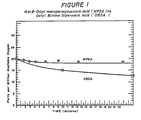
- Fig. 1 compares the octyl monoperoxysuccinic acids vs. the octyl butane diperoxoic acid.
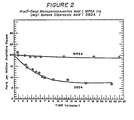
- Fig. 2 compares the decyl monoperoxysuccinic acid vs.
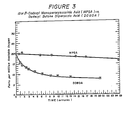
- Fig. 3 compares the dodecyl monoperoxysuccinic acid vs. dodecyl butane diperoxoic acid. All of these trials were run in a buffered solution at a pH range of 8.3-9.0 at about 100°F (37.7°C), without additional water hardness, and with a surfactant, or a mixture of surfactants such as is found in Tide® laundry detergent (registered trademark of Procter & Gamble) which includes a mixture of sodium alkyl sulfate, sodium alkyl ether sulfate, and sodium alkyl benzene sulfonate. Comparison of these figures shows that the alkyl monoperoxysuccinic acids have much greater stability and longer half lives than the corresponding alkyl butane diperoxoic acids.
Landscapes
- Chemical & Material Sciences (AREA)
- Organic Chemistry (AREA)
- Inorganic Chemistry (AREA)
- Life Sciences & Earth Sciences (AREA)
- Engineering & Computer Science (AREA)
- Chemical Kinetics & Catalysis (AREA)
- Oil, Petroleum & Natural Gas (AREA)
- Wood Science & Technology (AREA)
- Detergent Compositions (AREA)
- Organic Low-Molecular-Weight Compounds And Preparation Thereof (AREA)
Description
- The invention relates to a process for synthesizing surface active peroxyacids which are useful as bleaching compositions, together with the synthesis and utilisation thereof.
- Substituted, non-surface active peroxyacids (also denoted as peracids) have been synthesized by combining a source of hydrogen peroxide with an anhydride in the presence of an organic, polar solvent, such as methylene chloride. See, S. N. Lewis, "Peracid and Peroxide Oxidations", Oxidation, Volume 1, p. 217 (1969). These systems do not experience the problems that are encountered when one tries to make surface active peracids.
- Other systems at present which vary the standard process include, for example, Camden et al, U.S. Patent 4,233,235, which discloses a continuous process for making aliphatic diperoxyacids in which a strong acid, sulfuric acid is added to an aliphatic carboxylic acid mixture. Unfortunately, this particular system appears to generate large amounts of heat, and to require relatively expensive processing equipment.
- Still other references have proposed other types of solvents. However, none of the references appeared to have disclosed how to synthesize surface active monoperoxysuccinic acids. Further, nothing in the prior art discloses a process for making relatively pure surface active monoperoxysuccinic acids.
- This invention provides a process for the preparation of a monoperoxy acid having the general structure
-

- (a) combining:
- (i) an alkylsuccinic anhydride of the general structure:

- (ii) a water immiscible organic solvent;
- (iii) a water soluble organic solvent; and
- (iv) hydrogen peroxide; and
- (i) an alkylsuccinic anhydride of the general structure:
- (b) agitating under heat and/or refluxing the combination.
- In the definition of the above compounds R is preferably a straight chain alkyl group of 6 to 16 carbon atoms.
- These particular monoperoxyacid bleaching agents prepared according to the invention may be referred to as a- or P-alkyl monoperoxysuccinic acids.
- The agitation may be accomplished by refluxing. Suitably, the solvents are removed after reaction.
- The process according to the invention is a relatively inexpensive, high yielding, safe process for producing these a- or P-alkyl monoperoxysuccinic acids.
- The invention will now be further explained, and embodiments thereof set forth and exemplified. Reference will be made to the drawings in which:-
- Fig. 1 is a graphical depiction of the decay kinetics of octyl monoperoxysuccinic acid and octyl butane diperoxic acid;
- Fig. 2 is a graphical depiction of the decay kinetics of decyl monoperoxysuccinic acid and decyl butane diperoxic acid;
- Fig. 3 is a graphical depiction of the decay kinetics of dodecyl monoperoxysuccinic acid and dodecyl butane diperoxic acid.
- It has been surprisingly discovered that the a or a-alkyl monoperoxysuccinic acids and their derivatives which are prepared according to the invention are effective bleaching agents.
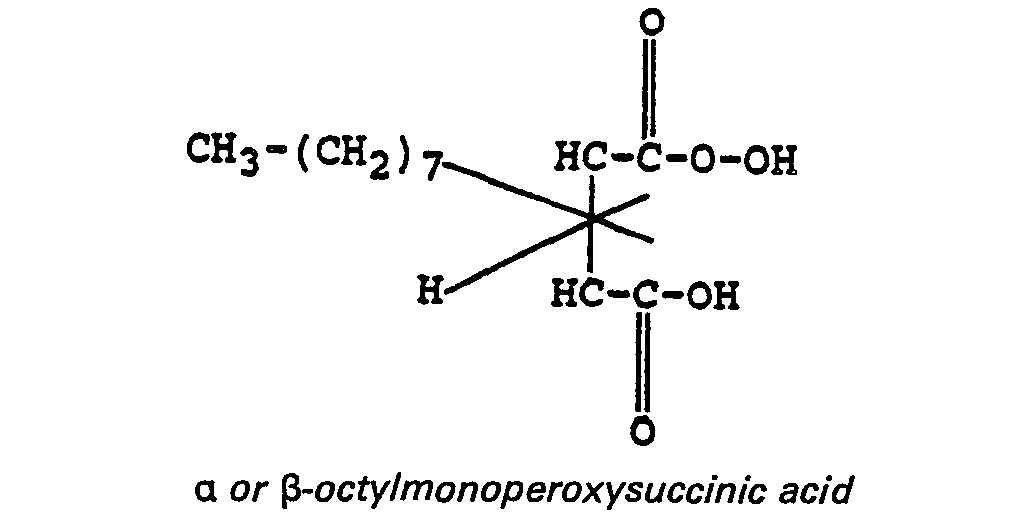
- Particular examples of the straight chain a or β alkyl monoperoxysuccinic acids which have been synthesized according to the invention include the octyl, decyl, and dodecyl monoperoxysuccinic acids, whose structures are set forth below:


- Substituted, non-surface active peroxyacids (also denoted as peracids) have been synthesized by combining a source of hydrogen peroxide with an anhydride in the presence of an organic, polar solvent, such as methylene chloride. See, S. N. Lewis, "Peracid and Peroxide Oxidations", Oxidation, Volume 1, p. 217 (1969). These systems do not experience the problems that are encountered when one tries to make surface active peracids.
- Other systems at present which vary the standard process include, for example, Camden et al, U.S. Patent 4,233,235, which discloses a continuous process for making aliphatic diperoxyacids in which a strong acid, sulfuric acid is added to an aliphatic carboxylic acid mixture. Unfortunately, this particular system appears to generate large amounts of heat, and to require relatively expensive processing equipment.
- Still other references have proposed other types of solvents. However, none of the references appeared to have disclosed how to synthesize surface active monoperoxysuccinic acids. Further, nothing in the prior art discloses a process for making relatively pure surface active monoperoxysuccinic acids.
- The surface active monoperoxysuccinic acids of this invention are believed to be advantageous over other peroxy acids, as described later herein for instance, the alkyl butane diperoxoic acids, which are somewhat similar compounds, but which have two peroxo moieties.
- The alkyl succinic anhydride starting materials of the process of the invention have the general structure:

- The R group on these anhydrides may be appropriately substituted, as defined above, to include branched chain alkyls, water solubilizing groups, e.g., S03H, so as to form the peroxyacids discussed and depicted herein above.
- The water immiscible solvents used herein include halogenated, i.e., chlorinated, fluorinated or chlorofluorinated alkyls of 1 to 6 carbon atoms and unsubstituted and halogenated aromatic hydrocarbons of 6 to 12 carbon atoms.
- Representative halogenated alkyls include methlene chloride (dichloromethane) and carbon tetrachloride (tetrachloromethane). Representative aromatic hydrocarbons include toluene, dichlorobenzene. Methylene chloride is especially preferred as the water immiscible solvent.
- The water soluble solvent used herein includes straight chain, branched chain, and substituted alcohols of 1 to 6 carbon atoms; straight chain, branched chain and substituted glycols of 1 to 6 carbon atoms, and straight chain, branched chain, and substituted glycol ethers of 1 to 6 carbon atoms. Still other candidates include esters of 1 to 10 carbon atoms and ketones of 1 to 6 carbon atoms. Yet other possible solvents include such diverse solvents as dioxane, acetonitrile, dimethylformamide (DMF) and tetrahydrofuran (THF).
- Synthesis of the desired monoperoxysuccinic acids require water soluble solvents. In practice, it has been discovered that these solvents carry the hydrogen peroxide into the nonaqueous phase of the alkylsuccinic anhydride/immiscible solvent mixture. The preferred water soluble solvent is an alcohol of 1 to 6 carbon atoms. One particularly preferred alcohol is ethyl alcohol or ethanol.
- It is preferable that neither the water immiscible solvent nor the water soluble solvent react with either the peroxyacid or H202 in situ. The apparent preference for such selectively non-reactive solvents is based on preventing an early decomposition of the peroxy compound formed in the reaction medium.
- Further, the preferred volume ratios of the water immiscible solvent to water soluble solvent is at least 2:1, more preferably 5:1 to 10:1.
- The hydrogen peroxide used can vary in purity from 50-99.9%. The amount of hydrogen peroxide used must be in excess of the anhydride. Preferably, the molar ratio of hydrogen peroxide to anhydride will be at least 2:1, and, most preferably, 4:1.
- The reaction conditions under which the process takes place include agitation of the mixture and heating. An example of this is a refluxing reaction, wherein temperatures of preferably about 35° to 45°C, most preferably 42°C, for 3 to 4 hours, are used, if methylene chloride is the immiscible solvent.
- The end product, a or (3 alkyl monoperoxysuccinic acid is obtained by removing all solvent, e.g., by air drying, vacuum drying under reduced pressure. Alternatively, recrystallization techniques could be used, such as shown in A. Ault, Techniques and Experiments for Organic Chemistry, 2d Ed., pages 19-28, 1976, which are incorporated herein by reference.
- For purposes of further exemplification the method of the invention of this invention are illustrated below in EXPERIMENTAL.
-

- 0.480 ml 70% hydrogen peroxide (10 m moles) and 4 ml anhydrous ethanol is placed in a 3-necked 100 ml round bottomed flask fitted with a reflux condenser, a mechanical stirrer, and a 50 ml dropping funnel. The flask is surrounded by a water bath. The bath temperature is maintained at around 60°C. After the mixture has been vigorously stirred for 2 minutes, a solution of 1.34 g (5.0 m moles) of dodecyl succinic anhydride (Humphrey Chemical Co., recrystallized from hexane, m.p. 73-74°C) in 20 ml methylenechloride is added from the dropping funnel at such a rate that a moderate reflux is maintained. After the addition has been completed, an additional 0.480 ml 70% hydrogen peroxide is added in one portion and the mixture is refluxed with continuous vigorous stirring for an additional 3.5 hours. The reaction mixture is then transferred to a 70 x 5 mm crystallizing dish. The solvents are removed by evaporating in a hood. After being air-dried overnight, a yield of 1.5 g of product, which is about 99% with respect to starting materials, is obtained. Alternatively, product may be obtained by removing solvent under reduced pressure and vacuum drying. A standard potassium iodide-thiosulfate titration, performed as shown in S. N. Lewis, "Peracid and Peroxide Oxidations," in Oxidation, Vol. 1, pp 221-22 (1969), which pages are incorporated herein by reference, showed 3.42% (5.03% theoretical) active oxygen. The structure of this product was assigned as a mixture of a and β-octyl monoperoxysuccinic acid on the basis of the following spectral data: IR (Nujol mull) 1750 cm-1, 1710 cm-1, 13C―NMR (CD2O2, 90 MHZ), a-isomer, PPM, 176.0,177.3,14-41 (C-aliphatic); P-isomer, PPM, 172.9, 180.3, 14-41 (C-aliphatic).
-

- a or β-octyl monoperoxysuccinic acid may be prepared according to the procedure of Example I, above. In place of the dodecyl succinic anhydride (5 m moles), octyl succinic anhydride (5 m moles) is used. The yield for the reaction product, as calculated from the available oxygen, is 50%, using a standard potassium iodide-thiosulfate titration as in Example I, above.
-

- a or β-decyl monoperoxysuccinic acid may be prepared according to the procedure in Example I, above, by substituting decyl succinic anhydride (5 m moles) for the dodecyl succinic anhydride (5 m moles). Utilizing this procedure, the yield was 52% as calculated from the available oxygen, as shown in Examples I and II.
- The preceding procedures have been successfully scaled up using larger amounts of the selected anhydride.
- The applicants believe the procedures utilized are responsible for the high yields of peroxyacids produced.
- The above procedure comprises a safe, rapid and efficient process in which good yields of the desired a or β alkyl monoperoxysuccinic acids are obtained. Advantages of the present invention are that the reaction is performed in a rapid, safe and easily controlled operation. The high heats of reaction, and expensive materials which were utilized in previous methods are avoided. As shown in the next section of the instant application, these alkyl monoperoxysuccinic acids are suitable for use as bleaching compositions.
- For fabric, textile or even hard surface bleaching purposes, at least 1 part per million active oxygen (p.p.m. A.O.) in the wash water or 1 % by weight of the surface active peroxyacid itself in the composition should be present. The range of the amount of peroxyacid in solution should be about 1 to 30 p.p.m. A.O., or 1 to 30% by weight of the composition. Preferably, the amount of peroxyacid is about 5 to 20% by weight of the composition.
- Additionally, however, the surface active peroxyacids of the invention can be combined with various cleaning adjuncts, to form bleaching compositions. One particular example is a bleaching composition comprising:
- (a) A peroxyacid of the general structure

- (b) a stabilizer selected from:
- hydrated aluminum salts, hydrated magnesium salts, carboxylic acids and boric acid.
- Examples of these particular stabilizers can include potassium aluminum sulfate dodecahydrate, magnesium sulfate heptahydrate, sodium aluminum sulfate dodecahydrate, magnesium ammonium sulfate hexahydrate. Particular acid stabilizers besides boric acid include maleic acid, succinic acid, substituted-succinic acids, azelaic acid, dodecanedioic acid, cyclohexane dicarboxylic acid. However, boric acid is particularly preferred as a stabilizer to prevent violent exothermic decomposition of this particular composition.
- These particular bleaching compositions may also comprise a filler selected from alkali metal and ammonium salts of sulfates, for example, sodium sulfate, ammonium sulfate and potassium sulfate. Other fillers are the alkali metal and ammonium salts of carbonates, bicarbonates, acetates and silicates. These fillers have the purposes of "bulking" the product to provide a composition which is easily measured by the consumer.
- Further, a builder may be added which can be selected from the alkali metal salts of carbonates, borates, polyphosphates, phosphates, zeolites, silicates; nitrilotriacetic acid and its alkali metal salts; and ethylene diamine tetraacetic acid and its alkali metal salts. Particularly preferred as builders are such compounds as sodium carbonate, sodium tripolyphosphate, and nitrilotriacetic acid (NTA).
- Also, particular laundry bleaching composition additives include surfactants selected from anionic, nonionic, amphoteric, cationic, and zwitterionic surfactants.
- Anionic surfactants suitable for use in this invention include the alkali metal and ammonium salts of fatty acids, having about 8-20 carbon atoms in their chain lengths; substituted and unsubstituted alkyl sulfates; substituted and unsubstituted alkyl sulfonates; substituted and unsubstituted alkyl benzene sulfonates (examples of which include both "HLAS", for alkyl benzene sulfonic acid, and "LAS", for linear alkyl benzene sulfonate, sodium salt).
- Still other suitable anionic surfactants include anionic aminocarboxylates, such as N-acyl-sarcosinates, alkyl, aryl, and alkylaryl sarcosinates; alpha-olefin sulfonates; sulfates of natural fats and oils (e.g., castor, coconut, tallow oils); sulfated esters; ethoxylated and sulfated alkylphenols; ethoxylated and sulfated alcohols (also known as alkyl ether sulfates) and phosphated esters which are generally phosphorylated nonionics such as ethoxylated alcohols, ethoxylated alkylphenols, and polyoxythylene-polyoxypropylene block co-polymers.
- Suitable nonionic surfactants include polyoxyethylenes, polyoxypropylenes; alkylpolyoxyethylenes; alkylarylpolyoxyethylenes, ethoxylated alkylphenols; carboxylic acid esters such as glycerol esters of fatty acids, certain polyethylene glycol esters, anhydrosorbitol esters, ethoxylated anhydrosorbital esters, ethylene and methylene glycol esters, propanediol esters, and ethoxylated natural fats and oils (e.g., tallow oils, coco oils, etc.); carboxylic amides such as 1:1 amine acid diethanolamine condensates, 2:1 amine/acid diethanolamide condensates, and monoalkanolamine condensates such as ethanolamine condensates, and isopropanol-amine condensates, polyoxyethylene fatty acid amides; certain polyalkylkene oxide block co-polymers such as polyoxypropylene-polyoxyethylene block co-polymers; and other miscellaneous nonionic surfactants such as organosilicones.
- Suitable cationic surfactants include a wide range of classes of compounds, including non-oxygen-containing alkyl mono-, di- and polyamines, and resin derived amines; substituted alkyl, alkylol imidazolines, such as 2-alkyl-1-(hydroxyethyl)-2-imidazolines; amide linked amines, and quaternary ammonium salts ("quats").
- Further, suitable amphoteric surfactants containing both acidic and basic hydrophilic moieties in their structure, include oxygen-containing amines, such as amine oxides (which appear to act as cationics in acid solutions, and as nonionics in neutral or alkaline solutions); polyoxyethylene alkyl and alicyclic amines; alkyl betaines, amino-carboxylic acids and salts thereof, amino-carboxylic acid esters, and others.
- Further examples of anionic, nonionic, cationic and amphoteric surfactants which may be suitable for use in this invention are depicted in Kirk-Othmer, Encyclopedia of Chemical Technology, Third Edition, Vol. 22, pages 347-387, and McCutcheon's Detergents and Emulsifiers, North American Edition, 1983, which are incorporated herein by reference.
- Zwitterionic surfactants which may be suitable for use in the compositions of this invention may be broadly described as derivatives of secondary and tertiary amines, derivatives of heterocyclic secondary and tertiary amines, or derivatives of quaternary ammonium, quaternary phosphonium or tertiary sulfonium compounds. Suitable examples of these zwitterionic surfactants can be found described in Jones, U.S. 4,005,029, Columns 11-15, which are incorporated herein by reference.
- In EP-A-83560 there is disclosed a bleaching composition which comprises a peroxy acid product and a peroxyacid stabilizer which may include hydrated materials, such as sodium aluminum dodecahydrate, magnesium ammonium sulfate dodecahydrate and acids such as boric acid and carboxylic acids. The peroxyacid product is a substituted - butanediperoxoic acid.
- The particular surface active peroxyacid bleaches prepared by the process of the invention have been found to be particularly effective against various stains. For example, comparison of TABLE I below shows the following:

- 1. %SRE Grass: this is the percent stain removal of grass stains as measured spectrophotometrically. Higher values indicate better performance.
- 2. Tide@: is a registered trademark of Procter-& Gamble Co. for laundry detergent. 1.5 grams/1 was present in all examples shown in this Table.
- 3. Octyl MPSA: this is an or monoperoxysuccinic acid having 8 carbons in the alkyl chain.
- 4. Decyl MPSA: this is an a or a monoperoxysuccinic acid having 10 carbons in the alkyl chain.
- 5. Dodecyl MPSA: this is an a or β monoperoxysuccinic acid having T2 carbons in the alkyl chain.
- Further advantages of these peroxyacids are their relative stability in aqueous solution near their pKa's. It is generally agreed that for peroxyacids, pKa's are around 8.5-9.5. Within this range, optimal bleaching is obtained. Since most American washing machines and laundries operate at pH's of around 8-10 this is also the particular range for favorable peroxyacid usage. However, the benefit of obtaining the optimal activity of surface active peroxyacids at these particular pH's also has the disadvantages of decreasing their stability.
- Surprisingly, however, the alkyl monoperoxysuccinic acids have increased stability in aqueous solution at the optimal pH's. Alkyl monoperoxysuccinic acids were dissolved in water, compared against somewhat similar compositions, namely, alkyl butane diperoxoic acids disclosed in EP-A-83560 and found to have greater stability than these alkyl butane diperoxoic acids. These are shown in the three illustrations, Figs. 1-3. Fig. 1 compares the octyl monoperoxysuccinic acids vs. the octyl butane diperoxoic acid. Fig. 2 compares the decyl monoperoxysuccinic acid vs. the decyl butane diperoxoic acid. Fig. 3 compares the dodecyl monoperoxysuccinic acid vs. dodecyl butane diperoxoic acid. All of these trials were run in a buffered solution at a pH range of 8.3-9.0 at about 100°F (37.7°C), without additional water hardness, and with a surfactant, or a mixture of surfactants such as is found in Tide® laundry detergent (registered trademark of Procter & Gamble) which includes a mixture of sodium alkyl sulfate, sodium alkyl ether sulfate, and sodium alkyl benzene sulfonate. Comparison of these figures shows that the alkyl monoperoxysuccinic acids have much greater stability and longer half lives than the corresponding alkyl butane diperoxoic acids.
Claims (18)


Applications Claiming Priority (2)
| Application Number | Priority Date | Filing Date | Title |
|---|---|---|---|
| US06/626,826 US4659519A (en) | 1984-07-02 | 1984-07-02 | Process for synthesizing alkyl monoperoxysuccinic acid bleaching compositions |
| US626826 | 1984-07-02 |
Publications (3)
| Publication Number | Publication Date |
|---|---|
| EP0168204A2 EP0168204A2 (en) | 1986-01-15 |
| EP0168204A3 EP0168204A3 (en) | 1986-08-27 |
| EP0168204B1 true EP0168204B1 (en) | 1989-06-07 |
Family
ID=24512025
Family Applications (1)
| Application Number | Title | Priority Date | Filing Date |
|---|---|---|---|
| EP85304673A Expired EP0168204B1 (en) | 1984-07-02 | 1985-07-01 | Alkyl monoperoxysuccinic acid bleaching compositions and synthesis and use thereof |
Country Status (9)
| Country | Link |
|---|---|
| US (1) | US4659519A (en) |
| EP (1) | EP0168204B1 (en) |
| AU (1) | AU592758B2 (en) |
| CA (1) | CA1245669A (en) |
| DE (1) | DE3570871D1 (en) |
| EG (1) | EG17195A (en) |
| ES (2) | ES8703416A1 (en) |
| MX (1) | MX165386B (en) |
| TR (1) | TR24959A (en) |
Families Citing this family (12)
| Publication number | Priority date | Publication date | Assignee | Title |
|---|---|---|---|---|
| EP0206740A1 (en) * | 1985-06-21 | 1986-12-30 | The Procter & Gamble Company | Preparation of peroxycarboxylic acids and magnesium peroxycarboxylates |
| US4790952A (en) * | 1986-08-14 | 1988-12-13 | The Clorox Company | Alkyl monoperoxysuccinic acid precursors and method of synthesis |
| DE3823172C2 (en) * | 1988-07-08 | 1998-01-22 | Hoechst Ag | Omega-phthalimidoperoxihexanoic acid, process for its preparation and its use |
| MX9207050A (en) * | 1991-12-19 | 1993-06-01 | Ciba Geigy Ag | STABLE BLEACH DISPERSION DURING STORAGE |
| US5518581A (en) * | 1993-06-04 | 1996-05-21 | Nicca Chemical Co., Ltd. | Deinking agent for regeneration of waste paper |
| US5397501A (en) * | 1993-07-26 | 1995-03-14 | Lever Brothers Company, Division Of Conopco, Inc. | Amido peroxycarboxylic acids for bleaching |
| US5672295A (en) * | 1993-07-26 | 1997-09-30 | Lever Brothers Company, Division Of Conopco, Inc. | Amido peroxycarboxylic acids for bleaching |
| WO1995014760A1 (en) * | 1993-11-25 | 1995-06-01 | Warwick International Group Limited | Bleach activators |
| US5879584A (en) * | 1994-09-10 | 1999-03-09 | The Procter & Gamble Company | Process for manufacturing aqueous compositions comprising peracids |
| US10626350B2 (en) | 2015-12-08 | 2020-04-21 | Ecolab Usa Inc. | Pressed manual dish detergent |
| CN110790692B (en) * | 2019-10-30 | 2021-06-22 | 陕西铭锐石油科技有限公司 | Temperature-triggered oxygen release type oil film stripping surfactant and preparation method and application thereof |
| US20250092334A1 (en) * | 2023-09-19 | 2025-03-20 | The Clorox Company | Neutral ph cleaning formulation |
Family Cites Families (45)
| Publication number | Priority date | Publication date | Assignee | Title |
|---|---|---|---|---|
| CA635620A (en) * | 1962-01-30 | The Procter And Gamble Company Of Canada | Bleaching compositions | |
| US2287064A (en) * | 1940-05-01 | 1942-06-23 | Du Pont | Stable dry compositions useful as bleaching and oxidizing agents |
| NL248201A (en) * | 1959-02-11 | 1900-01-01 | ||
| US3143562A (en) * | 1961-03-27 | 1964-08-04 | Leonard S Silbert | Preparation of aromatic peroxy acids |
| GB1018624A (en) * | 1963-01-31 | 1966-01-26 | Procter & Gamble Ltd | Manufacture of aromatic percarboxylic acids |
| US3494787A (en) * | 1966-12-19 | 1970-02-10 | Ppg Industries Inc | Encapsulated perphthalic acid compositions and method of making same |
| NL137346C (en) * | 1966-12-19 | |||
| US3770816A (en) * | 1969-07-23 | 1973-11-06 | Ppg Industries Inc | Diperisophthalic acid compositions |
| US3639285A (en) * | 1969-07-23 | 1972-02-01 | Ppg Industries Inc | Novel bleaching compositions and use thereof |
| US3880914A (en) * | 1969-10-31 | 1975-04-29 | Ppg Industries Inc | Diperisophthalic acids |
| US3655738A (en) * | 1969-10-31 | 1972-04-11 | Ppg Industries Inc | Preparation of diperphthalic acids |
| NL7109629A (en) * | 1970-07-21 | 1972-01-25 | Substd succinic anhydrides - as activators for peroxide bleaches in w compsns | |
| US3819688A (en) * | 1970-11-10 | 1974-06-25 | Secretary | Process for the preparation of peroxy acids |
| DE2413561A1 (en) * | 1974-03-21 | 1975-10-02 | Henkel & Cie Gmbh | STORAGE-RESISTANT, EASILY-RELEASE DETERGENT ADDITIVE AND METHOD FOR MANUFACTURING IT |
| US4006029A (en) * | 1974-06-17 | 1977-02-01 | Corning Glass Works | Hydration resistant fused dolomitic grain and production method therefor |
| US3956159A (en) * | 1974-11-25 | 1976-05-11 | The Procter & Gamble Company | Stable concentrated liquid peroxygen bleach composition |
| NL7604538A (en) * | 1975-04-30 | 1976-11-02 | Bayer Ag | PROCESS FOR PREPARING ORGANIC SOLUTIONS OF PERCARBONIC ACID. |
| US4013575A (en) * | 1975-11-28 | 1977-03-22 | Fmc Corporation | Dry cleaning with peracids |
| US4119660A (en) * | 1976-08-27 | 1978-10-10 | The Procter & Gamble Company | Method for making diperoxyacids |
| US4100095A (en) * | 1976-08-27 | 1978-07-11 | The Procter & Gamble Company | Peroxyacid bleach composition having improved exotherm control |
| US4126573A (en) * | 1976-08-27 | 1978-11-21 | The Procter & Gamble Company | Peroxyacid bleach compositions having increased solubility |
| US4085133A (en) * | 1976-11-24 | 1978-04-18 | Ppg Industries, Inc. | Preparation of monoperoxyphthalic acid |
| US4091544A (en) * | 1977-02-11 | 1978-05-30 | The Procter & Gamble Company | Drying process |
| US4172086A (en) * | 1977-03-28 | 1979-10-23 | Fmc Corporation | Process for the manufacture of peroxycarboxylic acids |
| US4170453A (en) * | 1977-06-03 | 1979-10-09 | The Procter & Gamble Company | Peroxyacid bleach composition |
| US4287135A (en) * | 1978-10-25 | 1981-09-01 | Reinhard Stober | Stabilized diperoxyalkanedioic acids and aromatic peroxycarboxylic acids |
| US4233235A (en) * | 1979-02-26 | 1980-11-11 | The Procter & Gamble Company | Method for making diperoxyacids |
| US4244884A (en) * | 1979-07-12 | 1981-01-13 | The Procter & Gamble Company | Continuous process for making peroxycarboxylic acids |
| EP0027693B2 (en) * | 1979-10-18 | 1988-05-11 | Interox Chemicals Limited | Magnesium salts of peroxycarboxylic acids, processes for their preparation and their use as bleaching agents in washing compositions, and processes |
| US4259201A (en) * | 1979-11-09 | 1981-03-31 | The Procter & Gamble Company | Detergent composition containing organic peracids buffered for optimum performance |
| US4314949A (en) * | 1980-07-23 | 1982-02-09 | The Procter & Gamble Company | Process for making peroxycarboxylic acids |
| US4370251A (en) * | 1980-07-25 | 1983-01-25 | Fmc Corporation | Continuous process for the production of peroxycarboxylic acid compositions |
| US4337213A (en) * | 1981-01-19 | 1982-06-29 | The Clorox Company | Controlled crystallization diperoxyacid process |
| DE3266352D1 (en) * | 1981-06-22 | 1985-10-24 | Procter & Gamble | Mixed peroxyacid bleaches having improved bleaching power |
| US4391723A (en) * | 1981-07-13 | 1983-07-05 | The Procter & Gamble Company | Controlled release laundry bleach product |
| US4374035A (en) * | 1981-07-13 | 1983-02-15 | The Procter & Gamble Company | Accelerated release laundry bleach product |
| DE3276581D1 (en) * | 1981-08-31 | 1987-07-23 | Procter & Gamble | Laundry bleach product |
| EP0075419A3 (en) * | 1981-09-15 | 1983-11-02 | THE PROCTER & GAMBLE COMPANY | Laundry bleach product |
| US4391725A (en) * | 1981-10-21 | 1983-07-05 | The Procter & Gamble Company | Controlled release laundry bleach product |
| US4391724A (en) * | 1981-10-21 | 1983-07-05 | The Procter & Gamble Company | Controlled release laundry bleach product |
| US4487723A (en) * | 1982-01-04 | 1984-12-11 | Monsanto Company | Substituted-butanediperoxoic acids and process for bleaching |
| US4443352A (en) * | 1982-03-04 | 1984-04-17 | Colgate-Palmolive Company | Silicate-free bleaching and laundering composition |
| EP0136280A3 (en) * | 1983-09-12 | 1985-08-07 | Monsanto Company | Production of substituted-butanediperoxoic acids |
| DE3418450A1 (en) * | 1984-05-18 | 1985-11-28 | Degussa Ag, 6000 Frankfurt | METHOD FOR PRODUCING WATER-INSOLUBLE PEROXYCARBONIC ACIDS |
| US5703902A (en) * | 1995-06-16 | 1997-12-30 | Qualcomm Incorporated | Method and apparatus for determining signal strength in a variable data rate system |
-
1984
- 1984-07-02 US US06/626,826 patent/US4659519A/en not_active Expired - Lifetime
-
1985
- 1985-06-26 AU AU44217/85A patent/AU592758B2/en not_active Ceased
- 1985-06-27 CA CA000485558A patent/CA1245669A/en not_active Expired
- 1985-07-01 EP EP85304673A patent/EP0168204B1/en not_active Expired
- 1985-07-01 DE DE8585304673T patent/DE3570871D1/en not_active Expired
- 1985-07-01 TR TR85/30733A patent/TR24959A/en unknown
- 1985-07-02 EG EG394/85A patent/EG17195A/en active
- 1985-07-02 MX MX205866A patent/MX165386B/en unknown
- 1985-07-02 ES ES545226A patent/ES8703416A1/en not_active Expired
-
1986
- 1986-02-28 ES ES552817A patent/ES8802073A1/en not_active Expired
Also Published As
| Publication number | Publication date |
|---|---|
| AU4421785A (en) | 1986-01-09 |
| ES552817A0 (en) | 1988-03-16 |
| EP0168204A2 (en) | 1986-01-15 |
| ES8802073A1 (en) | 1988-03-16 |
| EP0168204A3 (en) | 1986-08-27 |
| US4659519A (en) | 1987-04-21 |
| EG17195A (en) | 1992-06-30 |
| CA1245669A (en) | 1988-11-29 |
| AU592758B2 (en) | 1990-01-25 |
| ES8703416A1 (en) | 1987-02-16 |
| ES545226A0 (en) | 1987-02-16 |
| MX165386B (en) | 1992-11-06 |
| TR24959A (en) | 1992-07-29 |
| DE3570871D1 (en) | 1989-07-13 |
Similar Documents
| Publication | Publication Date | Title |
|---|---|---|
| EP0484324B1 (en) | Cleaning compositions containing bleach activator compounds | |
| US5399746A (en) | Diquaternary bleach activators and compositions containing them | |
| KR930007843B1 (en) | Quaternary ammonium-substituted peroxycarboxylic acid | |
| US4397757A (en) | Bleaching compositions having quarternary ammonium activators | |
| KR950002601B1 (en) | Bleaching Composition | |
| US4659519A (en) | Process for synthesizing alkyl monoperoxysuccinic acid bleaching compositions | |
| US4233235A (en) | Method for making diperoxyacids | |
| CA2042981A1 (en) | Bleaching composition | |
| JPS63152696A (en) | Glycolate ester peracid precursor | |
| US5220051A (en) | Polycationic compound and bleach composition containing the same | |
| CA1207955A (en) | Bleaching compositions | |
| EP0364027A2 (en) | Bleaching and detergent composition | |
| US4317779A (en) | Alpha-sulfoxide and alpha-sulfone carboxyl compounds | |
| AU667120B2 (en) | Peroxyacids | |
| JP2525562B2 (en) | bleaching compound | |
| US4790952A (en) | Alkyl monoperoxysuccinic acid precursors and method of synthesis | |
| US5047577A (en) | Quaternary ammonium compounds | |
| JP2756032B2 (en) | New nitrogen-containing compound and bleaching composition containing the same | |
| US7030075B2 (en) | Organic activator | |
| CA1264327A (en) | Bleach activator compounds and use thereof in cleaning compositions | |
| US4680145A (en) | Process for producing diperoxoic acids | |
| JPH04234498A (en) | Bleaching detergent composition | |
| EP0195597A1 (en) | Bleach activator compounds and bleaching compositions containing them | |
| US4960925A (en) | Alkyl monoperoxysuccinic acid precursors and method of synthesis | |
| JP2007530668A (en) | Method for producing ester bleach activator compound |
Legal Events
| Date | Code | Title | Description |
|---|---|---|---|
| PUAI | Public reference made under article 153(3) epc to a published international application that has entered the european phase |
Free format text: ORIGINAL CODE: 0009012 |
|
| AK | Designated contracting states |
Designated state(s): BE CH DE FR GB IT LI LU NL SE |
|
| PUAL | Search report despatched |
Free format text: ORIGINAL CODE: 0009013 |
|
| AK | Designated contracting states |
Kind code of ref document: A3 Designated state(s): BE CH DE FR GB IT LI LU NL SE |
|
| 17P | Request for examination filed |
Effective date: 19861030 |
|
| 17Q | First examination report despatched |
Effective date: 19871130 |
|
| GRAA | (expected) grant |
Free format text: ORIGINAL CODE: 0009210 |
|
| AK | Designated contracting states |
Kind code of ref document: B1 Designated state(s): BE CH DE FR GB IT LI LU NL SE |
|
| REF | Corresponds to: |
Ref document number: 3570871 Country of ref document: DE Date of ref document: 19890713 |
|
| PG25 | Lapsed in a contracting state [announced via postgrant information from national office to epo] |
Ref country code: LU Free format text: LAPSE BECAUSE OF NON-PAYMENT OF DUE FEES Effective date: 19890731 |
|
| ITF | It: translation for a ep patent filed | ||
| ET | Fr: translation filed | ||
| PLBE | No opposition filed within time limit |
Free format text: ORIGINAL CODE: 0009261 |
|
| STAA | Information on the status of an ep patent application or granted ep patent |
Free format text: STATUS: NO OPPOSITION FILED WITHIN TIME LIMIT |
|
| 26N | No opposition filed | ||
| PGFP | Annual fee paid to national office [announced via postgrant information from national office to epo] |
Ref country code: LU Payment date: 19900621 Year of fee payment: 6 |
|
| ITTA | It: last paid annual fee | ||
| PGFP | Annual fee paid to national office [announced via postgrant information from national office to epo] |
Ref country code: FR Payment date: 19920610 Year of fee payment: 8 |
|
| PGFP | Annual fee paid to national office [announced via postgrant information from national office to epo] |
Ref country code: DE Payment date: 19920611 Year of fee payment: 8 |
|
| PGFP | Annual fee paid to national office [announced via postgrant information from national office to epo] |
Ref country code: SE Payment date: 19920615 Year of fee payment: 8 Ref country code: CH Payment date: 19920615 Year of fee payment: 8 |
|
| PGFP | Annual fee paid to national office [announced via postgrant information from national office to epo] |
Ref country code: BE Payment date: 19920617 Year of fee payment: 8 |
|
| PGFP | Annual fee paid to national office [announced via postgrant information from national office to epo] |
Ref country code: GB Payment date: 19920626 Year of fee payment: 8 |
|
| PGFP | Annual fee paid to national office [announced via postgrant information from national office to epo] |
Ref country code: NL Payment date: 19920731 Year of fee payment: 8 |
|
| PG25 | Lapsed in a contracting state [announced via postgrant information from national office to epo] |
Ref country code: GB Effective date: 19930701 |
|
| PG25 | Lapsed in a contracting state [announced via postgrant information from national office to epo] |
Ref country code: SE Effective date: 19930702 |
|
| PG25 | Lapsed in a contracting state [announced via postgrant information from national office to epo] |
Ref country code: LI Effective date: 19930731 Ref country code: CH Effective date: 19930731 Ref country code: BE Effective date: 19930731 |
|
| BERE | Be: lapsed |
Owner name: THE CLOROX CY Effective date: 19930731 |
|
| PG25 | Lapsed in a contracting state [announced via postgrant information from national office to epo] |
Ref country code: NL Effective date: 19940201 |
|
| GBPC | Gb: european patent ceased through non-payment of renewal fee |
Effective date: 19930701 |
|
| NLV4 | Nl: lapsed or anulled due to non-payment of the annual fee | ||
| PG25 | Lapsed in a contracting state [announced via postgrant information from national office to epo] |
Ref country code: FR Effective date: 19940331 |
|
| REG | Reference to a national code |
Ref country code: CH Ref legal event code: PL |
|
| PG25 | Lapsed in a contracting state [announced via postgrant information from national office to epo] |
Ref country code: DE Effective date: 19940401 |
|
| REG | Reference to a national code |
Ref country code: FR Ref legal event code: ST |
|
| EUG | Se: european patent has lapsed |
Ref document number: 85304673.8 Effective date: 19940210 |