EP0167026B1 - Plant growth regulator - Google Patents
Plant growth regulator Download PDFInfo
- Publication number
- EP0167026B1 EP0167026B1 EP85107143A EP85107143A EP0167026B1 EP 0167026 B1 EP0167026 B1 EP 0167026B1 EP 85107143 A EP85107143 A EP 85107143A EP 85107143 A EP85107143 A EP 85107143A EP 0167026 B1 EP0167026 B1 EP 0167026B1
- Authority
- EP
- European Patent Office
- Prior art keywords
- acid
- hexylitaconic
- rooting
- plant growth
- growth regulator
- Prior art date
- Legal status (The legal status is an assumption and is not a legal conclusion. Google has not performed a legal analysis and makes no representation as to the accuracy of the status listed.)
- Expired
Links
Images


Classifications
-
- A—HUMAN NECESSITIES
- A01—AGRICULTURE; FORESTRY; ANIMAL HUSBANDRY; HUNTING; TRAPPING; FISHING
- A01N—PRESERVATION OF BODIES OF HUMANS OR ANIMALS OR PLANTS OR PARTS THEREOF; BIOCIDES, e.g. AS DISINFECTANTS, AS PESTICIDES OR AS HERBICIDES; PEST REPELLANTS OR ATTRACTANTS; PLANT GROWTH REGULATORS
- A01N37/00—Biocides, pest repellants or attractants, or plant growth regulators containing organic compounds containing a carbon atom having three bonds to hetero atoms with at the most two bonds to halogen, e.g. carboxylic acids
- A01N37/02—Saturated carboxylic acids or thio analogues thereof; Derivatives thereof
- A01N37/04—Saturated carboxylic acids or thio analogues thereof; Derivatives thereof polybasic
-
- A—HUMAN NECESSITIES
- A01—AGRICULTURE; FORESTRY; ANIMAL HUSBANDRY; HUNTING; TRAPPING; FISHING
- A01N—PRESERVATION OF BODIES OF HUMANS OR ANIMALS OR PLANTS OR PARTS THEREOF; BIOCIDES, e.g. AS DISINFECTANTS, AS PESTICIDES OR AS HERBICIDES; PEST REPELLANTS OR ATTRACTANTS; PLANT GROWTH REGULATORS
- A01N37/00—Biocides, pest repellants or attractants, or plant growth regulators containing organic compounds containing a carbon atom having three bonds to hetero atoms with at the most two bonds to halogen, e.g. carboxylic acids
- A01N37/06—Unsaturated carboxylic acids or thio analogues thereof; Derivatives thereof
-
- Y—GENERAL TAGGING OF NEW TECHNOLOGICAL DEVELOPMENTS; GENERAL TAGGING OF CROSS-SECTIONAL TECHNOLOGIES SPANNING OVER SEVERAL SECTIONS OF THE IPC; TECHNICAL SUBJECTS COVERED BY FORMER USPC CROSS-REFERENCE ART COLLECTIONS [XRACs] AND DIGESTS
- Y10—TECHNICAL SUBJECTS COVERED BY FORMER USPC
- Y10S—TECHNICAL SUBJECTS COVERED BY FORMER USPC CROSS-REFERENCE ART COLLECTIONS [XRACs] AND DIGESTS
- Y10S435/00—Chemistry: molecular biology and microbiology
- Y10S435/8215—Microorganisms
- Y10S435/911—Microorganisms using fungi
- Y10S435/913—Aspergillus
- Y10S435/917—Aspergillus niger
Definitions
- the present invention relates to a novel plant growth regulator. More particularly, it relates to a plant growth regulator comprising, as its active component, one or more compounds selected from [+]-hexylitaconic acid, the dihydro derivative and lower alkyl monoesters thereof.
- the inventors also found that the dihydro derivative and lower alkyl monoesters thereof have an excellent accelerating action on rooting.
- the Aspergillus niger K-88 strain separated from the soil of Ninomiya-cho, Kanagawa Prefecture was subjected to shaking culture in a Czapek-Dox culture medium at a temperature 26.5°C, for ten days, then 5.2 I culture filtrate (pH 2) was extracted with ethyl acetate, and the organic layer was extracted with sodium bicarbonate solution. The aqueous solution was adjusted to pH 3. After extraction with ethyl acetate, the organic layer was dried over sodium sulfate and evaporated under reduced pressure. 740 mg of oily acid material was obtained.
- the oil fraction was treated in a Wakogel C-100 column ( ⁇ 3.1 x 43 cm) and rendered in hexane-ethyl acetate. The concentration of the ethyl acetate was gradually increased. The rendered solution having a hexane-ethyl acetate ratio 6:4 was successively divided into four equal divisions. From the crude active material of the second division, 74 mg of the pure product was obtained by thin layer chromatography of Kiesel gel F 254 (hexane-ethyl acetate-acetic acid 4:6:0.1). The characteristic data were as follows:
- Said [+]-hexylitaconic acid and the dihydro derivative thereof at concentrations of 1 to 20 ppm remarkably accelerate rooting of rice plants, lettuce, etc., and promote growth of foliar parts.
- Fig. 1 shows the rooting acceleration effects on lettuce exerted by various concentrations of said [+]-hexylitaconic acid, the dihydro and monomethyl ester derivatives thereof.
- Fig. 2 shows the growth- and rooting-accelerating effects on paddy rice plants exerted by various concentrations of said [+]-hexylitaconic acid.
- a sheet of filter paper having a diameter 5.5 cm was laid on a petri dish and a definite amount of test substance dissolved in acetone was added thereon. After the acetone had been evaporated, 2 ml of a Hoagland solution was added to the petri dish, and seven germinating lettuce seeds were placed on each dish. The treated dishes were irradiated at 3000 lux for three days, and kept at a temperature of 25 ⁇ 2°C.
- Fig. 1 shows the rooting rates obtained by treatment with the [+]-hexylitaconic acid, the dihydro derivative and the monomethyl ester derivative thereof at the respective concentrations. As clearly shown in Fig. 1, all the respective substances exhibited rooting-acceleration effects at concentrations of about 1 to 20 ppm, while higher concentrations of 50 to 100 ppm, checked growth.
- Fig. 2 shows the activity of [+]-hexylitaconic acid on growth- and rooting-acceleration.
- [+]-hexylitaconic acid remarkably accelerated the rooting of the paddy rice plants at concentrations of 2 ppm to 20 ppm.
- the whole length of the overground parts of the plants was increased by about 20% at a concentration of 20 ppm.
- the seedlings After spraying a 50 ppm or 25 ppm concentration of [+]-hexylitaconic acid over the foliar parts of 10 seedlings per block of rice plant grown to the 2.5 leaf stage and cutting the root length to 2 cm, the seedlings were hydroponically cultured. Two weeks later, the number of rootings were determined. Alternatively, after cutting the root length of 10 seedlings of rice plant per block to 2 cm, the seedlings were hydroponically cultured in a 50 ppm or 25 ppm solution of [+]-hexylitaconic acid. Two weeks later, the number of rootings were determined.
Landscapes
- Life Sciences & Earth Sciences (AREA)
- Dentistry (AREA)
- Wood Science & Technology (AREA)
- Plant Pathology (AREA)
- Health & Medical Sciences (AREA)
- Engineering & Computer Science (AREA)
- Agronomy & Crop Science (AREA)
- General Health & Medical Sciences (AREA)
- Pest Control & Pesticides (AREA)
- Zoology (AREA)
- Environmental Sciences (AREA)
- Agricultural Chemicals And Associated Chemicals (AREA)
- Preparation Of Compounds By Using Micro-Organisms (AREA)
- Organic Low-Molecular-Weight Compounds And Preparation Thereof (AREA)
- Cultivation Of Plants (AREA)
Description
- The present invention relates to a novel plant growth regulator. More particularly, it relates to a plant growth regulator comprising, as its active component, one or more compounds selected from [+]-hexylitaconic acid, the dihydro derivative and lower alkyl monoesters thereof.
- There have been few physiologically active substances for plants that are naturally produced and actually being used at present. Among the few exceptions are gibberellic acids produced from Gibberella fujikuroi germs; cytokinin extracted from yeasts, coconut milk, fish sperms, etc. plant auxines and ethylene gas. Almost no physiologically active substances for plants produced from fungal metabolites are known and in particular no physiologically active substances which are as effective in plants as the useful gibberellic acids have yet been discovered.
- Especially in the field of acceleration of rooting, which is the main characteristic of the present invention, no substance produced from fungi has been discovered at all. Although some synthetic compounds are known such as IBA (2-indolebutyric acid), 2,4,5-T (2,4,5-trichlorophenoxy acetic acid), NAD (naphthalene acetamide), 2,4-D (2,4-dichlorophenoxy acetic acid), NAA (naphthalene acetic acid) and abscisic acid. However these compounds, when used for acceleration of rooting, have deficiencies as set out below, and satisfactory uses are quite limited.
- (1) The use of these compounds is limited to acceleration of rooting by soaking the rooting parts in the chemicals. This is because these compounds lack movement within the plant, particularly basipetal movement. This can be said for all the aforementioned substances, IBA, 2,4,5-T, NAD, 2,4-D, NAA and abscisic acid.
- (2) Since the effective concentration and the critical concentration causing chemical damage are very close, some compounds cannot be used safely. The above 2,4,5-T, 2,4-D, NAD, NAA and abscisic acid are examples thereof.
- (3) Some of the compounds are problematic because of their mammalian toxicity. The above 2,4,5-T and 2,4-D are examples of such cases.
- While the conventional chemicals have unsolved problems as pointed out above, the naturally produced substances of the present invention have the following advantages:
- (1) Their movement within the plant is considerable. Particularly, through foliar treatment they translocate into the lower parts of the plant and accelerate rooting. Thus they are quite convenient to use and very suitable for such purposes as growth promotion by acceleration of rooting and recovery of growth checked by environmental drawbacks.
- (2) By treating cuttings of the plant with the substances, acceleration of rooting can also be effected.
- (3) Since safety to plants is quite high, they can be used safely from early stages through the respective stages of growth.
- (4) Safety for mammals is very high.
- Since the substances of the present invention overcome the problems of the conventional chemicals, their agricultural and horticultural usefulness is remarkable.
- In a series of studies on useful plant-activating substances produced from fungal metabolites, the inventors of the present invention discovered that substances from Aspergillus niger K-88 strain notably accelerate rooting of plants and confirmed that the active substance thereof was [+]-hexylitaconic acid whose structure is represented by the molecular formula C11H18O4 or by the structural formula;
-

- The inventors also found that the dihydro derivative and lower alkyl monoesters thereof have an excellent accelerating action on rooting.
- As stated above, in a series of studies on useful physiologically active substance for plants produced from fungal metabolites, the inventors of the present invention discovered substances from Aspergillus niger K-88 strain that notably accelerate plant root length, particularly, in rice plant and lettuce. Analysis of the active substance from the purified substance from assay medium confirmed that the substance was [+]-hexylitaconic acid whose structure is represented by the molecular formula C11 H1304 or by the structural formula;
-

- Though some publications on the syntheses of said [+]-hexylitaconic acid itself exist (N. S. McCorkindale, W. P. Backstock, G. A. Johnstone, T. R. Roy and J. A. Toke; referto the 11th lupac Int. Sump. Chem. Nat. Pro. 1, 151 (1978)), none of the reports describes the circumstances under which the synthesis was attempted and the purposes thereof. The separation of said [+]-hexylitaconic acid from natural products seems to have been made for the first time by the inventors of the present invention. Moreover, it is a novel discovery made by the inventors of the present invention that said [+]-hexylitaconic acid, the dihydro derivative and the lower alkyl monoesters thereof remarkably accelerate rooting, which suggests their useful application in farm product-growing.
- Next, the separation and purification of said [+]-hexylitaconic acid and the synthesis of the dihydro derivative and lower alkyl monoesters thereof is explained.
-

- The Aspergillus niger K-88 strain separated from the soil of Ninomiya-cho, Kanagawa Prefecture was subjected to shaking culture in a Czapek-Dox culture medium at a temperature 26.5°C, for ten days, then 5.2 I culture filtrate (pH 2) was extracted with ethyl acetate, and the organic layer was extracted with sodium bicarbonate solution. The aqueous solution was adjusted to pH 3. After extraction with ethyl acetate, the organic layer was dried over sodium sulfate and evaporated under reduced pressure. 740 mg of oily acid material was obtained. The oil fraction was treated in a Wakogel C-100 column (ϕ3.1 x 43 cm) and rendered in hexane-ethyl acetate. The concentration of the ethyl acetate was gradually increased. The rendered solution having a hexane-ethyl acetate ratio 6:4 was successively divided into four equal divisions. From the crude active material of the second division, 74 mg of the pure product was obtained by thin layer chromatography of Kiesel gel F254 (hexane-ethyl acetate-acetic acid 4:6:0.1). The characteristic data were as follows:
- mp 46-47°C; (a)o + 15.3 (c = 2.0, methanol), MS m/z:
- 214.1225 (M+, 5%; Calculated value as C11H18O4, 214.1195),
- 196.1074 (M―H2O, 5%; Calculated value as C11H16O3, 196.1034),
- 178.1010 (M―2H2O, 5%; Calculated value as C11H14O2, 178.0994),
- 196.1246 (M-COCH, 43%; Calculated value as C10H17O2, 169.1229),
- 129.0117 (M―C6H13, 55%; Calculated value as C5H5O4, 129.0188),
- 112 (M―C6H12―H2O, 100%);
- IRv(cm-1): 3300 - 2400, 1775, 1705, 1625.

- 13 C―NMRδ C (CDCl3); 179.6 (s, C―1), 171.7 (s, C―4), 137.5 (s, C―3), 129.6 (t, C―11), 47.0 (d, C―2), 31.7 (t, C-8), 29.9 (t, C-5), 29.0 (t, C-7), 27.4 (t, C-6), 22.6 (t, C-9), 14.1 (q, C-10);
- δ C (CD30D): 169.4 (s, C-4), 176.9 (s, C―1).
- 1H―NMRδ H (CDCl3): 0.83 (3H, t, J=6Hz, H-10), 1.25 (8H, br s, H―6·H―9), 1.80 (2H, m, H-5), 3.35 (1H, t, J=7Hz, H-2), 5.80 (1H, s, H-11a), 6.40 (1H, s, H-11b), 9.6 (2H, br s, 2 x COOH).
-

- By reducing 20 mg of [+]-hexylitaconic acid in methanol using a platinum oxide catalyst, 20 mg of a dihydro derivative was obtained. The characteristic data thereof were as follows:
- mp 109-112°C (Acetone - H20).
- IRv(cm-1): 3400 - 2400, 1690.
- 13C―NMRδ C (CD3OD): 178.5 (s, C-4 or C―1), 177.8 (s, C-1 or C―4), 50.0 (d, C-2), 43.3 (d, C-3), 32.5 (t, C-8), 31.8 (t, C-5), 29.9 (t, C-7), 28.3 (t, C-6), 23.4 (t, C-9), 15.8 (q, C―11), 14.2 (q, C-10),
- 1H―NMRδ H (CDCl3): 0.83 (3H, t, J=6Hz, H―10), 1.2―1.8 (13H, m, H―5·H―9, H―11), 2.7 (2H, m, H-2, H-3), 8.8 (2H, br s, 2 x COOH).
-

- 20 mg of [+]-hexylitaconic acid in methanol containing 5% HCI was refluxed for one hour, and the reaction mixture was poured to water and then extracted with ethyl acetate. The ethyl acetate layer was extracted with aqueous sodium bicarbonate solution. After adjusting the water layer to pH 3, it was reextracted with ethyl acetate. The extract was dried over anhydrous sodium sulfate and concentrated under reduced pressure. The concentrated residue was separated and purified by thin layer chromatography; thereby 10 mg of a monomethyl ester derivative was obtained. The characteristic data were as follows:
- MS m/z: 228 (M+, C12H20O4), 197 (M-OCH3), 183 (M-COOH), 143 (M-C6Hl3), 112 (M―C6H12― CH30H).
- IRv(cm-1): 3400 - 2400, 1775, 1740, 1700, 1625.
- 13C―NMRδ C (CDCI3): 173.8 (s, C-1), 171.5 (s, C-4), 138.1 (s, C-3), 129.1 (t, C-11), 52.1 (q, OCH3), 46.5 (d, C-2), 31.6 (t, C-8), 31.4 (t, C-5), 29.0 (t, C-7), 27.5 (t, C-6), 22.6 (t, C-9), 14.1 (q, C-10).
- 1H―NMRδ H (CDCI3): 0.82 (3H, t, J-6Hz), 1.2 (8H, br s), 1.8 (2H, m), 3.35 (1H, t, J=7Hz), 3.55 (3H, s, OCH3), 5.80 (1 H, s), 6.40 (1 H, s).
- Said [+]-hexylitaconic acid and the dihydro derivative thereof at concentrations of 1 to 20 ppm remarkably accelerate rooting of rice plants, lettuce, etc., and promote growth of foliar parts.
- Fig. 1 shows the rooting acceleration effects on lettuce exerted by various concentrations of said [+]-hexylitaconic acid, the dihydro and monomethyl ester derivatives thereof. Fig. 2 shows the growth- and rooting-accelerating effects on paddy rice plants exerted by various concentrations of said [+]-hexylitaconic acid.
- The present invention is described in detail by concrete examples. The present invention is, of course, not limited to these Examples.
- A sheet of filter paper having a diameter 5.5 cm was laid on a petri dish and a definite amount of test substance dissolved in acetone was added thereon. After the acetone had been evaporated, 2 ml of a Hoagland solution was added to the petri dish, and seven germinating lettuce seeds were placed on each dish. The treated dishes were irradiated at 3000 lux for three days, and kept at a temperature of 25 ± 2°C.
- Test Results:
- Fig. 1 shows the rooting rates obtained by treatment with the [+]-hexylitaconic acid, the dihydro derivative and the monomethyl ester derivative thereof at the respective concentrations. As clearly shown in Fig. 1, all the respective substances exhibited rooting-acceleration effects at concentrations of about 1 to 20 ppm, while higher concentrations of 50 to 100 ppm, checked growth.
- In a test tube of a diameter 2.5 cm, a definite amount of [+]-hexylitaconic acid dissolved in acetone was added, whereafter the acetone was evaporated. 2 ml of eight-times diluted solution of Kimura's B Liquid [The composition of the liquid was as follows:

- Refer to "Methods for Testing Farm Products, by Baba and Takahashi (under the supervision ofTokari), published by Nogyo Gijutsu Kyokai, 1959] was added to the tube. Five grains of germinating paddy rice plants were placed in each tube. The test tubes were covered with plastic films, irradiated at 3000 lux for seven days and kept at a temperature of 30 ± 2°C.
- Test Results:
- Fig. 2 shows the activity of [+]-hexylitaconic acid on growth- and rooting-acceleration. As clearly shown in Fig. 2, [+]-hexylitaconic acid remarkably accelerated the rooting of the paddy rice plants at concentrations of 2 ppm to 20 ppm. And, the whole length of the overground parts of the plants (the length of the foliar parts) was increased by about 20% at a concentration of 20 ppm.
- After spraying a 50 ppm or 25 ppm concentration of [+]-hexylitaconic acid over the foliar parts of 10 seedlings per block of rice plant grown to the 2.5 leaf stage and cutting the root length to 2 cm, the seedlings were hydroponically cultured. Two weeks later, the number of rootings were determined. Alternatively, after cutting the root length of 10 seedlings of rice plant per block to 2 cm, the seedlings were hydroponically cultured in a 50 ppm or 25 ppm solution of [+]-hexylitaconic acid. Two weeks later, the number of rootings were determined.
- Test Results:
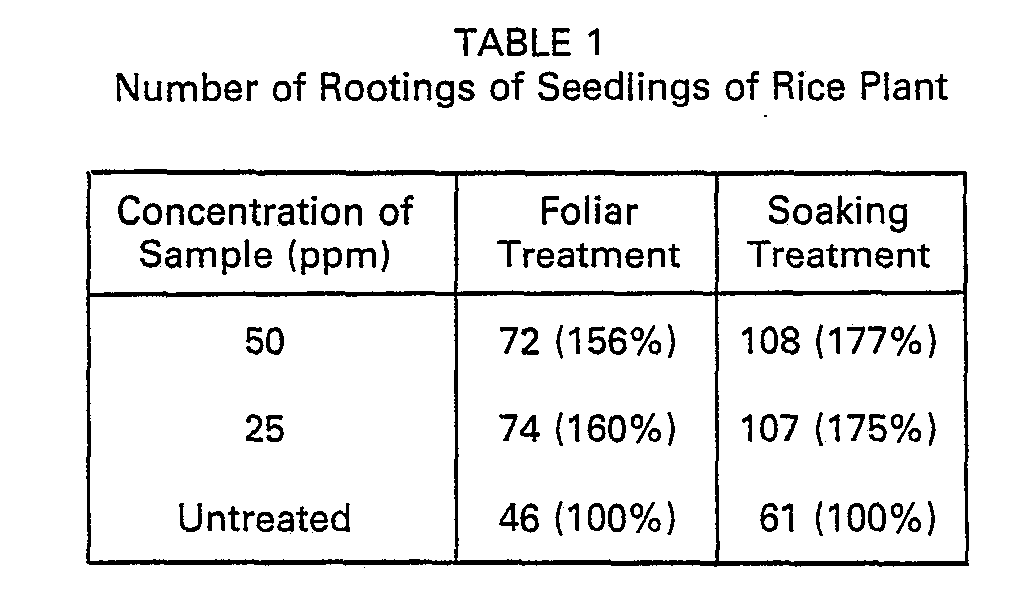
- As clearly shown in Table 1, a very remarkable increase in the number of rootings was noted in seedlings subjected to both foliar treatment as well as soaking treatment.
Claims (4)
Applications Claiming Priority (2)
| Application Number | Priority Date | Filing Date | Title |
|---|---|---|---|
| JP120550/84 | 1984-06-12 | ||
| JP59120550A JPS611602A (en) | 1984-06-12 | 1984-06-12 | Plant growth regulator |
Publications (2)
| Publication Number | Publication Date |
|---|---|
| EP0167026A1 EP0167026A1 (en) | 1986-01-08 |
| EP0167026B1 true EP0167026B1 (en) | 1988-11-23 |
Family
ID=14789077
Family Applications (1)
| Application Number | Title | Priority Date | Filing Date |
|---|---|---|---|
| EP85107143A Expired EP0167026B1 (en) | 1984-06-12 | 1985-06-11 | Plant growth regulator |
Country Status (4)
| Country | Link |
|---|---|
| US (1) | US4626277A (en) |
| EP (1) | EP0167026B1 (en) |
| JP (1) | JPS611602A (en) |
| DE (2) | DE167026T1 (en) |
Families Citing this family (7)
| Publication number | Priority date | Publication date | Assignee | Title |
|---|---|---|---|---|
| US4813997B1 (en) * | 1987-04-06 | 1995-07-18 | Cpc International Inc | Method for regulating plant growth |
| JPH0446104A (en) * | 1990-06-12 | 1992-02-17 | Kankyo Riyokuka Shigen Kaihatsu Center:Kk | Plant growth promoter |
| EP1151667B1 (en) * | 2000-04-28 | 2005-06-29 | Kao Corporation | Plant-activating agent |
| JP3768380B2 (en) * | 2000-04-28 | 2006-04-19 | 花王株式会社 | Plant vitality agent |
| JP2001316204A (en) * | 2000-04-28 | 2001-11-13 | Kao Corp | Plant vitalizer |
| US20040142822A1 (en) * | 2001-03-09 | 2004-07-22 | Tadayuki Suzuki | Method of improving crop |
| US8025709B2 (en) * | 2009-01-09 | 2011-09-27 | Specialty Feritlizer Products, LLC | Quick drying polymeric coating |
Family Cites Families (3)
| Publication number | Priority date | Publication date | Assignee | Title |
|---|---|---|---|---|
| US3558434A (en) * | 1966-04-13 | 1971-01-26 | Crown Zellerbach Corp | Stimulation of the growth of microorganisms |
| GB1433647A (en) * | 1972-06-29 | 1976-04-28 | Allied Chem | Plant growth regulators |
| US4071348A (en) * | 1973-04-05 | 1978-01-31 | Akzona Incorporated | Plant growth control |
-
1984
- 1984-06-12 JP JP59120550A patent/JPS611602A/en active Granted
-
1985
- 1985-06-06 US US06/741,807 patent/US4626277A/en not_active Expired - Lifetime
- 1985-06-11 DE DE198585107143T patent/DE167026T1/en active Pending
- 1985-06-11 EP EP85107143A patent/EP0167026B1/en not_active Expired
- 1985-06-11 DE DE8585107143T patent/DE3566348D1/en not_active Expired
Also Published As
| Publication number | Publication date |
|---|---|
| US4626277A (en) | 1986-12-02 |
| DE167026T1 (en) | 1986-07-24 |
| EP0167026A1 (en) | 1986-01-08 |
| JPS611602A (en) | 1986-01-07 |
| JPH0380122B2 (en) | 1991-12-24 |
| DE3566348D1 (en) | 1988-12-29 |
Similar Documents
| Publication | Publication Date | Title |
|---|---|---|
| Stodola et al. | The microbiological production of gibberellins A and X | |
| EP0553780B1 (en) | A process for the extraction of taxol and derivatives thereof from plants of the genus taxus | |
| Gohbara et al. | Isolation, structures and biological activities of colletotrichins, phytotoxic substances from Colletotrichum nicotianae | |
| Pena-Rodriguez et al. | Toxins from weed pathogens, I. Phytotoxins from a Bipolaris pathogen of Johnson grass | |
| Isogai et al. | Isolation and identification of (+)-hexylitaconic acid as a plant growth regulator | |
| US4626277A (en) | Plant growth regulator | |
| JPH032102A (en) | Absidic acid derivative | |
| Goren et al. | Effects of seselin and coumarin on growth, indoleacetic acid oxidase, and peroxidase, with special reference to cucumber (Cucumis sativa L.) radicles | |
| EP0048585A1 (en) | Antibiotics TM-531 B and TM-531 C | |
| EP0063194B1 (en) | Plant growth regulation | |
| JP4724661B2 (en) | Plant rooting inducer | |
| Kawada et al. | Isolation of aphidicolin as a root growth inhibitor from Harziella entomophilla | |
| KR840000846B1 (en) | Process for the preparation of n-(1'-hydrocarbyloxycarbonylethyl)-n-alkoxyacetylanilines | |
| JP3026155B2 (en) | Esters of 4-chloroindole-3-acetic acid | |
| US5100456A (en) | Herbicidal metabolites of phomopsis convoluvulus for the effective control of field bindweed | |
| Watanabe et al. | Growth and germination inhibitors in hog-weed | |
| Sijpesteijn et al. | Metabolism of fungicides by plants and micro-organisms | |
| AU658982B2 (en) | Physiologically active substances of plant, process for the preparation thereof, and utilities thereof | |
| CN107778243B (en) | Preparation and use of 8-position long-chain fatty acyloxy-substituted diterpene alkaloids | |
| Scragg et al. | Picrasma quassioides Bennet (Japanese quassia tree): in vitro culture and production of quassin | |
| JPS59163379A (en) | Alpha-pyrone derivative and plant growth regulator | |
| ASAI et al. | MICROBIOLOGICAL HYDROXYLATION OF STEROIDS III. HYDROXYLATION OF PROGESTERONE BY SYNCEPHALASTRUM SP.(1) | |
| KR970002811B1 (en) | Physiologically active substances of plants, their preparation and uses | |
| CN109748890B (en) | Acetylene compound separated and extracted from curvularia secondary metabolite, preparation method and application thereof | |
| Sen et al. | Search for organic fungicides: Chemical constitution and fungicidal activity |
Legal Events
| Date | Code | Title | Description |
|---|---|---|---|
| PUAI | Public reference made under article 153(3) epc to a published international application that has entered the european phase |
Free format text: ORIGINAL CODE: 0009012 |
|
| AK | Designated contracting states |
Designated state(s): BE CH DE FR GB IT LI NL SE |
|
| ITCL | It: translation for ep claims filed |
Representative=s name: BARZANO' E ZANARDO ROMA S.P.A. |
|
| 17P | Request for examination filed |
Effective date: 19860303 |
|
| TCNL | Nl: translation of patent claims filed | ||
| EL | Fr: translation of claims filed | ||
| DET | De: translation of patent claims | ||
| 17Q | First examination report despatched |
Effective date: 19871201 |
|
| ITF | It: translation for a ep patent filed | ||
| GRAA | (expected) grant |
Free format text: ORIGINAL CODE: 0009210 |
|
| AK | Designated contracting states |
Kind code of ref document: B1 Designated state(s): BE CH DE FR GB IT LI NL SE |
|
| REF | Corresponds to: |
Ref document number: 3566348 Country of ref document: DE Date of ref document: 19881229 |
|
| ET | Fr: translation filed | ||
| PLBE | No opposition filed within time limit |
Free format text: ORIGINAL CODE: 0009261 |
|
| STAA | Information on the status of an ep patent application or granted ep patent |
Free format text: STATUS: NO OPPOSITION FILED WITHIN TIME LIMIT |
|
| 26N | No opposition filed | ||
| ITTA | It: last paid annual fee | ||
| PGFP | Annual fee paid to national office [announced via postgrant information from national office to epo] |
Ref country code: SE Payment date: 19930526 Year of fee payment: 9 |
|
| PGFP | Annual fee paid to national office [announced via postgrant information from national office to epo] |
Ref country code: BE Payment date: 19930601 Year of fee payment: 9 |
|
| PG25 | Lapsed in a contracting state [announced via postgrant information from national office to epo] |
Ref country code: SE Effective date: 19940612 |
|
| PGFP | Annual fee paid to national office [announced via postgrant information from national office to epo] |
Ref country code: CH Payment date: 19940627 Year of fee payment: 10 |
|
| PG25 | Lapsed in a contracting state [announced via postgrant information from national office to epo] |
Ref country code: BE Effective date: 19940630 |
|
| PGFP | Annual fee paid to national office [announced via postgrant information from national office to epo] |
Ref country code: NL Payment date: 19940630 Year of fee payment: 10 |
|
| PGFP | Annual fee paid to national office [announced via postgrant information from national office to epo] |
Ref country code: DE Payment date: 19940830 Year of fee payment: 10 |
|
| BERE | Be: lapsed |
Owner name: AGRO-KANESHO CO. LTD Effective date: 19940630 |
|
| EUG | Se: european patent has lapsed |
Ref document number: 85107143.1 Effective date: 19950110 |
|
| EUG | Se: european patent has lapsed |
Ref document number: 85107143.1 |
|
| PGFP | Annual fee paid to national office [announced via postgrant information from national office to epo] |
Ref country code: GB Payment date: 19950523 Year of fee payment: 11 |
|
| PGFP | Annual fee paid to national office [announced via postgrant information from national office to epo] |
Ref country code: FR Payment date: 19950529 Year of fee payment: 11 |
|
| PG25 | Lapsed in a contracting state [announced via postgrant information from national office to epo] |
Ref country code: LI Effective date: 19950630 Ref country code: CH Effective date: 19950630 |
|
| PG25 | Lapsed in a contracting state [announced via postgrant information from national office to epo] |
Ref country code: NL Effective date: 19960101 |
|
| PG25 | Lapsed in a contracting state [announced via postgrant information from national office to epo] |
Ref country code: FR Effective date: 19960229 |
|
| REG | Reference to a national code |
Ref country code: CH Ref legal event code: PL |
|
| NLV4 | Nl: lapsed or anulled due to non-payment of the annual fee |
Effective date: 19960101 |
|
| PG25 | Lapsed in a contracting state [announced via postgrant information from national office to epo] |
Ref country code: DE Effective date: 19960301 |
|
| REG | Reference to a national code |
Ref country code: FR Ref legal event code: ST |
|
| PG25 | Lapsed in a contracting state [announced via postgrant information from national office to epo] |
Ref country code: GB Effective date: 19960611 |
|
| GBPC | Gb: european patent ceased through non-payment of renewal fee |
Effective date: 19960611 |