EP0166781A1 - Crosslinked polyethylene cable - Google Patents
Crosslinked polyethylene cable Download PDFInfo
- Publication number
- EP0166781A1 EP0166781A1 EP84900299A EP84900299A EP0166781A1 EP 0166781 A1 EP0166781 A1 EP 0166781A1 EP 84900299 A EP84900299 A EP 84900299A EP 84900299 A EP84900299 A EP 84900299A EP 0166781 A1 EP0166781 A1 EP 0166781A1
- Authority
- EP
- European Patent Office
- Prior art keywords
- vinyl acetate
- polyethylene
- cross
- cable
- less
- Prior art date
- Legal status (The legal status is an assumption and is not a legal conclusion. Google has not performed a legal analysis and makes no representation as to the accuracy of the status listed.)
- Granted
Links
Images
Classifications
-
- H—ELECTRICITY
- H01—ELECTRIC ELEMENTS
- H01B—CABLES; CONDUCTORS; INSULATORS; SELECTION OF MATERIALS FOR THEIR CONDUCTIVE, INSULATING OR DIELECTRIC PROPERTIES
- H01B9/00—Power cables
- H01B9/02—Power cables with screens or conductive layers, e.g. for avoiding large potential gradients
- H01B9/027—Power cables with screens or conductive layers, e.g. for avoiding large potential gradients composed of semi-conducting layers
-
- C—CHEMISTRY; METALLURGY
- C08—ORGANIC MACROMOLECULAR COMPOUNDS; THEIR PREPARATION OR CHEMICAL WORKING-UP; COMPOSITIONS BASED THEREON
- C08L—COMPOSITIONS OF MACROMOLECULAR COMPOUNDS
- C08L23/00—Compositions of homopolymers or copolymers of unsaturated aliphatic hydrocarbons having only one carbon-to-carbon double bond; Compositions of derivatives of such polymers
- C08L23/02—Compositions of homopolymers or copolymers of unsaturated aliphatic hydrocarbons having only one carbon-to-carbon double bond; Compositions of derivatives of such polymers not modified by chemical after-treatment
- C08L23/04—Homopolymers or copolymers of ethene
- C08L23/06—Polyethylene
-
- H—ELECTRICITY
- H01—ELECTRIC ELEMENTS
- H01B—CABLES; CONDUCTORS; INSULATORS; SELECTION OF MATERIALS FOR THEIR CONDUCTIVE, INSULATING OR DIELECTRIC PROPERTIES
- H01B3/00—Insulators or insulating bodies characterised by the insulating materials; Selection of materials for their insulating or dielectric properties
- H01B3/18—Insulators or insulating bodies characterised by the insulating materials; Selection of materials for their insulating or dielectric properties mainly consisting of organic substances
- H01B3/30—Insulators or insulating bodies characterised by the insulating materials; Selection of materials for their insulating or dielectric properties mainly consisting of organic substances plastics; resins; waxes
- H01B3/44—Insulators or insulating bodies characterised by the insulating materials; Selection of materials for their insulating or dielectric properties mainly consisting of organic substances plastics; resins; waxes vinyl resins; acrylic resins
- H01B3/441—Insulators or insulating bodies characterised by the insulating materials; Selection of materials for their insulating or dielectric properties mainly consisting of organic substances plastics; resins; waxes vinyl resins; acrylic resins from alkenes
-
- C—CHEMISTRY; METALLURGY
- C08—ORGANIC MACROMOLECULAR COMPOUNDS; THEIR PREPARATION OR CHEMICAL WORKING-UP; COMPOSITIONS BASED THEREON
- C08L—COMPOSITIONS OF MACROMOLECULAR COMPOUNDS
- C08L23/00—Compositions of homopolymers or copolymers of unsaturated aliphatic hydrocarbons having only one carbon-to-carbon double bond; Compositions of derivatives of such polymers
- C08L23/02—Compositions of homopolymers or copolymers of unsaturated aliphatic hydrocarbons having only one carbon-to-carbon double bond; Compositions of derivatives of such polymers not modified by chemical after-treatment
- C08L23/04—Homopolymers or copolymers of ethene
- C08L23/08—Copolymers of ethene
- C08L23/0846—Copolymers of ethene with unsaturated hydrocarbons containing atoms other than carbon or hydrogen
- C08L23/0853—Ethylene vinyl acetate copolymers
-
- C—CHEMISTRY; METALLURGY
- C08—ORGANIC MACROMOLECULAR COMPOUNDS; THEIR PREPARATION OR CHEMICAL WORKING-UP; COMPOSITIONS BASED THEREON
- C08L—COMPOSITIONS OF MACROMOLECULAR COMPOUNDS
- C08L2312/00—Crosslinking
Definitions
- This invention relates to cross-linked polyethylene cables having excellent characteristics against degradation, particularly degradation at high temperatures.
- cross-linked polyethylene cables when they are placed under an applied voltage for a long time in a water environment, cause so-called “penetrated water degradation” resulting in breakdown of an insulation. This degradation is believed to take place because the water which has penetrated into a cross-linked polyethylene insulation acts as a nuclei to form so-called “water trees” in the insulation.
- the present inventors conducted various experiments and analysis to clarify the reasons for the above degradation. As a result, it has been found that the cross-linked polyethylene cable of the present invention which is described later causes no degradation as mentioned above.
- the present invention is intended to provide a cross- linked polyethylene cable having excellent characteristics against degradation at high temperatures.
- the gist of the present invention resides in a cross-linked polyethylene cable characterized by extrusion coating a polyethylene composition on a conductor, the polyethylene composition comprising polyethylene, more than 10% to less than 30% by weight of an ethylene-vinyl acetate copolymer having a vinyl acetate content of more than 25% to less than 35% by weight and an organic peroxide and thereafter cross-linking the thus coated polyethylene composition.
- the vinyl acetate (VA) content of the ethylene-vinyl acetate copolymer used in the present invention is preferably in an amount of 28 to 33% on weight basis.
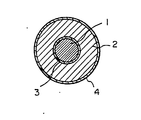
- the Figure is a cross-sectional view of a cross- liked polyethylene cable.
- Cross-linked polyethylene cables (150 mm 2 , 66 kV class) were produced using thecompositions shown in Table 1.
- the Figure shows a cross-sectional view of each cross-linked polyethylene cable comprising a conductor 1, an insulating material 2, an inner semiconductive layer 3 and an outer semiconductive layer 4.
- Semiconductive layers 3 and 4 were each made of NUC 0580 (trade name, produced by Nippon Unicar Co., Ltd.).
- a current was circulated bringing the temperature of the conductor to 90°C and the voltage of 160 kV was applied.
- the time taken before breakdown occurred in the cable under application of voltage was measured to evaluate degradation of the cable at high temperatures. These times are hereinafter referred to as the "breakdown time”, and are shown in Table 1 with the breakdown time (334 hours) of Comparative Example 1 as a base (1).
- Example 1 when EVA having a VA cntent of more than 25% was used (Example 1), degradation at high temperature was greatly improved. In particular, when the VA content was 30% (Example 2), the cable showed a very high resistance to degradation. Also, at a VA content of 33%, excellent characteristics were obtained.
- the amount of EVA having a VA content falling within the above-described range which is specified by the amount of the polyethylene to be compounded is specified by the amount of the polyethylene to be compounded.
- the resistance to degradation is slightly superior to that of Comparative Example 1, but the same is not improved satisfactorily.
- Comparative Example 7 Conversely, when the same EVA as was used in Example 3 is used, but the amount of the EVA compounded is 10% or less, as can be seen from Comparative Example 6, the resistance to degradation is not satisfactory.
- cables produced using compositions in which EVA having a VA content falling within the above-described range, i.e., EVA having a VA content of 15% (Example 4) and EVA having a VA content of 25% (Example 5), is compounded with polyethylene show excellent resistance to degradation.
- the cross-linked polyethylene cables of the present invention are useful for transmission of current in high voltages, and for factory wiring and house wiring of current in low voltages.
- the cables show greatly improved resistance to degradation under continuously applied voltages at high temperatures for extended periods of time.
- the cables have a long service life even when used under conditions of high temperature for extended periods of time.
Landscapes
- Chemical & Material Sciences (AREA)
- Physics & Mathematics (AREA)
- Spectroscopy & Molecular Physics (AREA)
- Health & Medical Sciences (AREA)
- Chemical Kinetics & Catalysis (AREA)
- Medicinal Chemistry (AREA)
- Polymers & Plastics (AREA)
- Organic Chemistry (AREA)
- Organic Insulating Materials (AREA)
- Compositions Of Macromolecular Compounds (AREA)
Abstract
Description
- This invention relates to cross-linked polyethylene cables having excellent characteristics against degradation, particularly degradation at high temperatures.
- It is well known that cross-linked polyethylene cables, when they are placed under an applied voltage for a long time in a water environment, cause so-called "penetrated water degradation" resulting in breakdown of an insulation. This degradation is believed to take place because the water which has penetrated into a cross-linked polyethylene insulation acts as a nuclei to form so-called "water trees" in the insulation.
- Many approaches have been tried for improving the penetrated water degradation of cross-linked polyethylene cables. For example, improved cables or cable joints are described in Japanese Patent Publication No. 89322/1974, Japanese Utility Model Publication No. 29008/1974 and Japanese Patent Publication No. 51180/1981. In these cables or joints, a polyethylene composition with an ethylene-vinyl acetate copolymer (hereinafter referred to as EVA) compounded therein is used as an insulating material, whereby resistance against the penetrated water degradation have been improved to a certain extent.
- Recently, however, it has been discovered that when cross-linked polyethylene cables, particularly those cables having a thick insulation are placed under an applied voltage for a long time at high temperatures such as 90°C, they are degraded seriously.
- The present inventors conducted various experiments and analysis to clarify the reasons for the above degradation. As a result, it has been found that the cross-linked polyethylene cable of the present invention which is described later causes no degradation as mentioned above.
- The present invention is intended to provide a cross- linked polyethylene cable having excellent characteristics against degradation at high temperatures. The gist of the present invention resides in a cross-linked polyethylene cable characterized by extrusion coating a polyethylene composition on a conductor, the polyethylene composition comprising polyethylene, more than 10% to less than 30% by weight of an ethylene-vinyl acetate copolymer having a vinyl acetate content of more than 25% to less than 35% by weight and an organic peroxide and thereafter cross-linking the thus coated polyethylene composition.
- The vinyl acetate (VA) content of the ethylene-vinyl acetate copolymer used in the present invention is preferably in an amount of 28 to 33% on weight basis.
- The Figure is a cross-sectional view of a cross- liked polyethylene cable.
- The present invention will hereinafter be explained in detail by reference to the following examples and comparative examples.
- Cross-linked polyethylene cables (150 mm2, 66 kV class) were produced using thecompositions shown in Table 1. The Figure shows a cross-sectional view of each cross-linked polyethylene cable comprising a
conductor 1, aninsulating material 2, an innersemiconductive layer 3 and an outersemiconductive layer 4.Semiconductive layers - A current was circulated bringing the temperature of the conductor to 90°C and the voltage of 160 kV was applied.
- The time taken before breakdown occurred in the cable under application of voltage was measured to evaluate degradation of the cable at high temperatures. These times are hereinafter referred to as the "breakdown time", and are shown in Table 1 with the breakdown time (334 hours) of Comparative Example 1 as a base (1).
- The following can be seen from Table 1.
- With cables produced using compositions in which 20% EVA having a VA content of 15% or 25%, respectively, was compounded with polyethylene (Comparative Examples 2 and 3), the resistance to degradation at high temperatures was slightly improved as compared with the cable of Comparative Example 1, but it was not satisfactorily improved to the extent that a long service life (e.g., 30 years) could be guaranteed.
- On the other hand, when EVA having a VA cntent of more than 25% was used (Example 1), degradation at high temperature was greatly improved. In particular, when the VA content was 30% (Example 2), the cable showed a very high resistance to degradation. Also, at a VA content of 33%, excellent characteristics were obtained.
- However, when the VA content was further increased, e.g., when EVA having a VA content of 35% was used (Comparative Examples 4 and 5), the characteristics of the resulting cables were slightly improved as compared with the cable of Comparative Example 1, but they were not satisfactory.

- The amount of EVA having a VA content falling within the above-described range which is specified by the amount of the polyethylene to be compounded. With a cable produced using a composition in which the same EVA as was used in Example 3 is used, but the amount of the EVA compounded is 40% or higher as in Comparative Example 5, the resistance to degradation is slightly superior to that of Comparative Example 1, but the same is not improved satisfactorily. The same is the case with Comparative Example 7. Conversely, when the same EVA as was used in Example 3 is used, but the amount of the EVA compounded is 10% or less, as can be seen from Comparative Example 6, the resistance to degradation is not satisfactory.
- On the other hand, cables produced using compositions in which EVA having a VA content falling within the above-described range, i.e., EVA having a VA content of 15% (Example 4) and EVA having a VA content of 25% (Example 5), is compounded with polyethylene show excellent resistance to degradation.
- As can be seen from the results shown in Table 1, only when the compositions of the invention comprising polyethylene and EVA are used as insulating materials, are there obtained cables having excellent characteristics. The reasons for the effect are not clear; however, the effect was not shown in any of Japanese Patent Publication No. 89322/1974, Japanese Utility Model Publication No. 29008/1974 and Japanese Patent Publication No. 51180/1981.
- The cross-linked polyethylene cables of the present invention are useful for transmission of current in high voltages, and for factory wiring and house wiring of current in low voltages. The cables show greatly improved resistance to degradation under continuously applied voltages at high temperatures for extended periods of time. Thus, the cables have a long service life even when used under conditions of high temperature for extended periods of time.
Claims (7)
Applications Claiming Priority (1)
| Application Number | Priority Date | Filing Date | Title |
|---|---|---|---|
| PCT/JP1983/000456 WO1985002936A1 (en) | 1983-12-27 | 1983-12-27 | Crosslinked polyethylene cable |
Publications (3)
| Publication Number | Publication Date |
|---|---|
| EP0166781A1 true EP0166781A1 (en) | 1986-01-08 |
| EP0166781A4 EP0166781A4 (en) | 1987-07-09 |
| EP0166781B1 EP0166781B1 (en) | 1989-09-20 |
Family
ID=13790102
Family Applications (1)
| Application Number | Title | Priority Date | Filing Date |
|---|---|---|---|
| EP19840900299 Expired EP0166781B1 (en) | 1983-12-27 | 1983-12-27 | Crosslinked polyethylene cable |
Country Status (4)
| Country | Link |
|---|---|
| EP (1) | EP0166781B1 (en) |
| DK (1) | DK161174C (en) |
| FI (1) | FI85430C (en) |
| WO (1) | WO1985002936A1 (en) |
Cited By (6)
| Publication number | Priority date | Publication date | Assignee | Title |
|---|---|---|---|---|
| US5719218A (en) * | 1995-06-01 | 1998-02-17 | At Plastics Inc. | Water resistant electrical insulation compositions |
| EP1059331A1 (en) * | 1999-06-11 | 2000-12-13 | Judd Wire, Inc. | Melt-processable, crosslinkable coating compositions |
| EP1132428A3 (en) * | 2000-03-07 | 2001-10-10 | Union Carbide Chemicals & Plastics Technology Corporation | A polyethylene crosslinkable composition |
| US8283391B2 (en) | 2007-08-06 | 2012-10-09 | General Cable Technologies Corporation | Tree resistant insulation compositions |
| CN107805333A (en) * | 2017-10-21 | 2018-03-16 | 浙江南大电缆有限公司 | Anti- folding electric wire and preparation method thereof |
| CN120399341A (en) * | 2025-04-10 | 2025-08-01 | 国网辽宁省电力有限公司电力科学研究院 | A multi-component composite stable extruded insulating material and its preparation method |
Families Citing this family (1)
| Publication number | Priority date | Publication date | Assignee | Title |
|---|---|---|---|---|
| US4715044A (en) * | 1986-07-03 | 1987-12-22 | American Telephone & Telegraph Company | Automatic synchronous/asynchronous modem |
Family Cites Families (7)
| Publication number | Priority date | Publication date | Assignee | Title |
|---|---|---|---|---|
| JPS4929008B1 (en) * | 1969-12-01 | 1974-07-31 | ||
| JPS4923297B1 (en) * | 1970-04-08 | 1974-06-14 | ||
| JPS4961643A (en) * | 1972-10-31 | 1974-06-14 | ||
| JPS5651180B2 (en) * | 1974-04-16 | 1981-12-03 | ||
| JPS5117588A (en) * | 1974-08-03 | 1976-02-12 | Sumitomo Electric Industries | Densen keeburu |
| JPS5578409A (en) * | 1978-12-06 | 1980-06-13 | Hitachi Cable | Polyolefin insulating cable |
| DE2930521A1 (en) * | 1978-08-24 | 1980-03-06 | Leuna Werke Veb | POLYAETHYLENE MOLDS FOR THE INSULATION OF METAL LADDERS |
-
1983
- 1983-12-27 EP EP19840900299 patent/EP0166781B1/en not_active Expired
- 1983-12-27 WO PCT/JP1983/000456 patent/WO1985002936A1/en not_active Ceased
-
1985
- 1985-08-23 DK DK383585A patent/DK161174C/en not_active IP Right Cessation
- 1985-08-26 FI FI853263A patent/FI85430C/en not_active IP Right Cessation
Cited By (8)
| Publication number | Priority date | Publication date | Assignee | Title |
|---|---|---|---|---|
| US5719218A (en) * | 1995-06-01 | 1998-02-17 | At Plastics Inc. | Water resistant electrical insulation compositions |
| EP1059331A1 (en) * | 1999-06-11 | 2000-12-13 | Judd Wire, Inc. | Melt-processable, crosslinkable coating compositions |
| US6287692B1 (en) | 1999-06-11 | 2001-09-11 | Judd Wire, Inc. | Melt-processable, crosslinkable coating compositions |
| EP1132428A3 (en) * | 2000-03-07 | 2001-10-10 | Union Carbide Chemicals & Plastics Technology Corporation | A polyethylene crosslinkable composition |
| US8283391B2 (en) | 2007-08-06 | 2012-10-09 | General Cable Technologies Corporation | Tree resistant insulation compositions |
| EP2527396A2 (en) | 2007-08-06 | 2012-11-28 | General Cable Technologies Corporation | Tree resistant insulation compositions |
| CN107805333A (en) * | 2017-10-21 | 2018-03-16 | 浙江南大电缆有限公司 | Anti- folding electric wire and preparation method thereof |
| CN120399341A (en) * | 2025-04-10 | 2025-08-01 | 国网辽宁省电力有限公司电力科学研究院 | A multi-component composite stable extruded insulating material and its preparation method |
Also Published As
| Publication number | Publication date |
|---|---|
| FI85430B (en) | 1991-12-31 |
| WO1985002936A1 (en) | 1985-07-04 |
| FI853263A0 (en) | 1985-08-26 |
| DK161174C (en) | 1991-11-18 |
| DK161174B (en) | 1991-06-03 |
| FI853263L (en) | 1985-08-26 |
| EP0166781B1 (en) | 1989-09-20 |
| EP0166781A4 (en) | 1987-07-09 |
| DK383585D0 (en) | 1985-08-23 |
| DK383585A (en) | 1985-08-23 |
| FI85430C (en) | 1992-04-10 |
Similar Documents
| Publication | Publication Date | Title |
|---|---|---|
| US4933107A (en) | Easily peelable semiconductive resin composition | |
| US4382112A (en) | Flexible insulation with improved discoloration and heat age resistance | |
| EP0166781B1 (en) | Crosslinked polyethylene cable | |
| US5773145A (en) | Power cable | |
| EP0099640B1 (en) | Cross-linked polyethylene insulated cables | |
| EP0152911B1 (en) | Insulated electric cable | |
| CA1266956A (en) | Cross-linked polyethylene cables | |
| US4780576A (en) | Insulated electrical cable | |
| IL80269A (en) | Conductors having dual wall cross-linked insulation | |
| JP2675144B2 (en) | Power cable | |
| KR100450184B1 (en) | Semiconductive water blocking pellet compound for power cable | |
| JPS60260637A (en) | Semiconducting plastic mixture | |
| JPS63146302A (en) | Rubber resin insulated power cable | |
| JPH079770B2 (en) | Cross-linked polyethylene insulation high voltage cable | |
| JP3341593B2 (en) | Electrical insulating composition and electric wires and cables | |
| JPH07107806B2 (en) | Power cable | |
| JPS5986109A (en) | Plastic power cable | |
| WO1983001415A1 (en) | Flame retardant wire with high insulation resistance | |
| JPH011746A (en) | resin composition | |
| JPS61171003A (en) | Power cable | |
| JPS60206855A (en) | Electrically semiconductive composition | |
| JPS61235444A (en) | Semiconductive resin composition | |
| JPH0126128B2 (en) | ||
| JPH085997B2 (en) | Resin composition for wire coating | |
| JPS61203508A (en) | Manufacture of insulating material |
Legal Events
| Date | Code | Title | Description |
|---|---|---|---|
| PUAI | Public reference made under article 153(3) epc to a published international application that has entered the european phase |
Free format text: ORIGINAL CODE: 0009012 |
|
| 17P | Request for examination filed |
Effective date: 19850916 |
|
| AK | Designated contracting states |
Designated state(s): BE |
|
| A4 | Supplementary search report drawn up and despatched |
Effective date: 19870709 |
|
| 17Q | First examination report despatched |
Effective date: 19880115 |
|
| GRAA | (expected) grant |
Free format text: ORIGINAL CODE: 0009210 |
|
| AK | Designated contracting states |
Kind code of ref document: B1 Designated state(s): BE |
|
| PLBE | No opposition filed within time limit |
Free format text: ORIGINAL CODE: 0009261 |
|
| STAA | Information on the status of an ep patent application or granted ep patent |
Free format text: STATUS: NO OPPOSITION FILED WITHIN TIME LIMIT |
|
| 26N | No opposition filed | ||
| PGFP | Annual fee paid to national office [announced via postgrant information from national office to epo] |
Ref country code: BE Payment date: 20020213 Year of fee payment: 19 |
|
| PG25 | Lapsed in a contracting state [announced via postgrant information from national office to epo] |
Ref country code: BE Free format text: LAPSE BECAUSE OF NON-PAYMENT OF DUE FEES Effective date: 20021231 |
|
| BERE | Be: lapsed |
Owner name: *SUMITOMO ELECTRIC INDUSTRIES LTD Effective date: 20021231 |