EP0166157A2 - Silicon and/or fluorine treated alumina - Google Patents
Silicon and/or fluorine treated alumina Download PDFInfo
- Publication number
- EP0166157A2 EP0166157A2 EP85105910A EP85105910A EP0166157A2 EP 0166157 A2 EP0166157 A2 EP 0166157A2 EP 85105910 A EP85105910 A EP 85105910A EP 85105910 A EP85105910 A EP 85105910A EP 0166157 A2 EP0166157 A2 EP 0166157A2
- Authority
- EP
- European Patent Office
- Prior art keywords
- chromium
- alumina
- catalyst
- compound
- composition
- Prior art date
- Legal status (The legal status is an assumption and is not a legal conclusion. Google has not performed a legal analysis and makes no representation as to the accuracy of the status listed.)
- Granted
Links
Images


Classifications
-
- C—CHEMISTRY; METALLURGY
- C01—INORGANIC CHEMISTRY
- C01B—NON-METALLIC ELEMENTS; COMPOUNDS THEREOF; METALLOIDS OR COMPOUNDS THEREOF NOT COVERED BY SUBCLASS C01C
- C01B13/00—Oxygen; Ozone; Oxides or hydroxides in general
- C01B13/14—Methods for preparing oxides or hydroxides in general
-
- C—CHEMISTRY; METALLURGY
- C08—ORGANIC MACROMOLECULAR COMPOUNDS; THEIR PREPARATION OR CHEMICAL WORKING-UP; COMPOSITIONS BASED THEREON
- C08F—MACROMOLECULAR COMPOUNDS OBTAINED BY REACTIONS ONLY INVOLVING CARBON-TO-CARBON UNSATURATED BONDS
- C08F10/00—Homopolymers and copolymers of unsaturated aliphatic hydrocarbons having only one carbon-to-carbon double bond
Definitions
- This invention relates to treated alumina.
- chromium oxide catalysts have long been used to prepare olefin polymers in hydrocarbon solution or slurry to give products having excellent characteristics from many standpoints.
- a number of supports have long been broadly disclosed in the art for chromium oxide catalysts including silica, alumina, thoria, zirconia, silica alumina, and other refractory materials.
- silica which is almost always included in the prior art in the list of suitable supports, while operable, invariably causes productivity to be extremely low.
- the preferred prior art support, silica also suffers from disadvantages among which is the inability to produce ultra high molecular weight polymer using hexavalent chromium.
- a silicated alumina is provided, which alumina can also be fluorided and/or phosphated.
- a fluorided and/or silicated alumina support is used for a chromium olefin polymerization catalyst.
- aluminum phosphate is formed in the pores of alumina.
- the alumina selected for surface treatment according to this invention can also contain minor amounts of other ingredients which do not adversely affect the quality of the final catalyst but it is generally essentially pure alumina.
- the alumina can be made as is well known in the art, for instance, by reacting sodium aluminate, which is basic, with aluminum sulfate, which is acidic, or by neutralizing an aluminum salt with a base such as ammonia or ammonia hydroxide, or by flame hydrolysis. If desired, the alumina can be calcined prior to treatment for instance by heating in air at a temperature of 300-900°C, preferably 500-800°C but this is not essential.
- the amount of combined fluorine is generally in the range of 0.1 to 5, preferably 0.5 to 3 weight percent fluorine, based on the weight of the alumina.
- the surface silicated alumina is prepared by contacting the alumina with a silicating agent, generally by forming a slurry of the alumina in a solution of a silicating agent.
- a silicating agent generally by forming a slurry of the alumina in a solution of a silicating agent.
- a lower alcohol such as a one to 6 carbon atom alcohol is used as the solvent.
- the alumina can be subjected to a vapor of the silicating agent.
- the silicating agent is used in an amount to give 0.2 to 20, preferably 0.5 to 10 weight percent silica, based on the weight of the alumina.
- the resulting product is alumina with a surface coating of silica which is different than conventional silica-alumina.
- the resulting novel product is suitable as a catalyst support but is also suitable for use broadly where alumina is utilized.
- siliconating agent is meant to encompass silicon alkoxides and aryloxides and their hydrolysis products, e.g. alkoxysiloxanes, which upon calcining in the activation of the support or catalyst yield high purity, refractory silica.
- examples of such compounds include tetramethoxysilane, tetraethoxysilane (tetraethyl orthosilicate), tetra(2-ethylbutoxy)silane, tetrakis(2-methoxyethoxy)silane, tetraphenoxysilane, and phenyltriethoxysilane and their hydrolysis products and mixtures thereof.
- a presently preferred silicating agent comprises a polymeric siloxane form of tetraethoxysilane containing the equivalent of 40 weight per cent silica.
- a composition is commercially sold as Silbond @ 40 by Stauffer Chemical Co., Westport, Connecticut.
- the silicating agent can be converted to surface silica after the treatment by calcining as described above or the treated alumina can be allowed to stand until hydrolysis converts the treating agent to silica.
- the alumina is treated with a fluoriding agent so as to incorporate fluorine onto the alumina to produce a support for a hexavalent chromium catalyst which is used with a cocatalyst or as a support for an organochromium catalyst.
- a fluoriding agent is ammonium bifluoride, NH 4 HF 2 .
- ammonium silicofluoride, (NH 4 ) 2 SiF 6 is also suitable.
- ammonium silicofluoride contains both silicon and fluorine, and while as will be discussed hereinafter, a combination of silicating and fluoriding is within the scope of the invention, ammonium silicofluoride probably does not incorporate anything except the fluorine since the silicon is lost during heating.
- the fluoriding agent can be combined with the alumina in any suitable manner but it is generally done by forming a slurry of the alumina in a solution of the fluoriding agent and a suitable solvent such as alcohol or water. Particularly suitable are one to three carbon atom alcohols because of their volatility and low surface tension. A suitable amount of the solution is utilized to provide the desired concentration of fluorine in the composite after drying. Drying can be effected in a conventional manner, such as suction filtration followed by evaporation or drying under vacuum. In view of the use of a relatively volatile solvent such as methanol, relatively mild conditions such as 100°C or less can be utilized.
- a combination of fluoriding and silicating to give F-Si/A1 2 0 3 can also be utilized.
- the fluorided alumina, silicated alumina or fluorided and silicated alumina can be further treated with a phosphating or phosphiting agent to give a system containing up to five components on adding chromium, i.e. P-F-Si-Cr/A1 2 0 3 .
- the phosphated or phosphited support can be P-F-Si/A1 2 0 3 , P-F/A1 2 0 3 or P-Si/Al 2 0 3 .
- the phosphorus treatment is carried out first.
- the phosphating or phosphiting agent may be incorporated in an organic water-miscible liquid such as an alcohol and used to treat either a hydrogel or a xerogel.
- an organic water-miscible liquid such as an alcohol
- the organic liquid/phosphating agent composition effects both the conversion of the hydrogel to a xerogel and provides the phosphating or phosphiting level desired.
- the hydrogel may be washed with water, then with an organic liquid such as isoamyl alcohol or methanol containing the phosphating or phosphiting agent such as phosphoric acid, or phosphorous acid then filtered and the solvent allowed to evaporate.
- the alumina gel can be treated with a vapor of the phosphating or phosphiting agent.
- the phosphating or phosphiting agent is preferably used in an amount to react with the alumina to give a P/Al atom ratio of the reaction product on the surface of 0.01:1 to 0.3:1, preferably 0.05:1 to 0.2:1. In practice, however, it is possible to use as much phosphating or phosphiting agent as desired with the excess simply being washed off after the phosphating or phosphiting treatment is complete.
- the phosphating or phosphiting treatment is generally carried out on alumina which has been previously calcined in air at 300°-700°C.
- the phosphating or phosphiting treatment is generally carried out at a temperature of 15°C to 500°C, preferably room temperature to the boiling point of the solvent if a phosphate or phosphite solution is used or about 200°C if a vapor is used and a time of 1 minute to 2 hours, preferably 2 minutes to 30 minutes. Generally a methanolic solution of H 3 P0 4 is used.
- the phosphorus component is added in an amount to give 1 to 30, preferably 5 to 20 mole percent of the phosphorus compound incorporated based on the total moles of aluminum.
- the ratio of atoms of phosphorus per atom of chromium will be in the range of 100-3000, preferably 500 to 2000.
- the phosphorus compound from the phosphating agent is preferably present in an amount sufficient to give about 0.005 to 1, preferably about 0.01 to 0.5 mg P/m 2 of alumina surface as measured by BET nitrogen sorption.
- the chromium compound can be any compound in or convertible to the hexavalent state and can be introduced anytime prior to activation.
- the catalyst contains chromium in an amount generally within the range of about 0.001 to 10, preferably 0.1 to 5, more preferably about 1 weight percent based on the weight of the dried treated alumina support, or since the amount of incorporated treating agent is relatively small, 0.001 to 10, preferably 0.1 to 5, more preferably about 1 weight percent based on the alumina.
- the chromium compound can be incorporated as known in the art.
- a hydrocarbon solution of a material such as tertiary butyl chromate can be used to impregnate the xerogel or an aqueous solution of a chromium compound such as Cr0 3 (chromium trioxide), chromium acetate or chromium nitrate can be added to the hydrogel before drying or chromium can be coprecipitated along with the alumina.
- a chromium compound such as Cr0 3 (chromium trioxide)
- Cr0 3 chromium trioxide
- chromium acetate or chromium nitrate can be added to the hydrogel before drying or chromium can be coprecipitated along with the alumina.
- the chromium is added after any fluoride treatment and after any phosphorus treatment.
- the activation of the chromium-containing catalyst can be carried out at a lower temperature than is generally required for activating silica-based chromium catalysts. Temperatures of 300-900°C, preferably 500-800°C, are suitable.
- the activating ambient can be any oxidizing ambient but for reasons of convenience is generally air. Times of 1 minute to 48 hours, preferably 0.5 to 10 hours are suitable. If desired, the alumina can also be precalcined prior to treatment using the same conditions used later for activation.
- an organochromium compound wherein the chromium has less than its maximum valence can be used.
- an organochromium of the type described herein can also be used in the first aspect as the chromium source for conversion on calcination to hexavalent chromium.
- organochromium is introduced after high temperature activation of the support rather than before.
- the same temperature and ambient used for activating the catalyst in the first aspect can be utilized for activating the support in the second aspect, although greater leeway is possible with temperatures as low as 150°C and as high as 1000°C being operable for activating the support prior to the introduction of the chromium.
- the organochromium compounds can include zerovalent compounds such as pi bonded chromium complexes such as dicumene chromium or dibenzene chromium. These pi bonded zerovalent chromium compounds are disclosed in more detail in Delap, U.S. 3,976,632 which issued August 24, 1976, the disclosure of which is hereby incorporated by reference. Also suitable are divalent organochromium compounds such as chromocene, bis-(cyclopentadienyl)chromium (II), and substituted derivatives thereof in which the cyclopentadienyl rings contain one or more substituents.
- divalent organochromium compounds such as chromocene, bis-(cyclopentadienyl)chromium (II), and substituted derivatives thereof in which the cyclopentadienyl rings contain one or more substituents.
- Chromocene offers the advantage of giving high density, ultra high molecular weight polymer.
- the organochromium compounds on the treated alumina also tend to have exceptional sensitivity to the effects of hydrogen, thus allowing great leeway in the control of molecular weights since the catalyst inherently gives ultra high molecular weight and yet with the sensitivity to hydrogen it is possible to produce polymers with a broad spectrum of molecular weights with a single catalyst.
- the currently preferred organochromium compounds are those of either the formula (I) or (II) below: wherein n is 3 or 4; x is 3 or more; R is -CH 2 MR'R"R"'; wherein M is a Group IVA element, i.e. C, Si, Ge, Sn or Pb; and wherein in a given compound the R groups are identical and R', R", and R"' are the same or different (preferably the same) hydrocarbyl groups selected from aliphatic and aromatic radicals containing up to about 10 carbon atoms per radical, preferably alkyl radicals containing up to 4 carbor atoms per radical. Also included are combination radicals such as alkaryl.
- the preferred compound of Formula I is the one wherein M is Si, R', R" and R'" are methyl (-CH 3 ), and n is 4, Cr[-CH 2 Si(CH 3 ) 3 ] 4 , i.e. tetrakis-(trimethylsilylmethyl)chromium (IV).
- Examples of other suitable compounds of Formula (II) include octakis(benzyldimethyl-silylmethyl) tetrachromium and octakis(allyldi- formation of the phosphate serving to treat and thus "activate" the normally inactive alumina.
- a base such as concentrated ammonium hydroxide, ammonia gas, or ammonia dissolved in alcohol or other nonaqueous solvents is preferred. Also ammonium carbonate, ethylene oxide and propylene oxide can be used.
- the neutralization agent is added in an amount to give gelation essentially instantaneously down to a lesser amount wherein gelation will occur on standing for up to 1 hour.
- the final pore cogel can be finished by washing with water and/or alcohol or such washing can be omitted.
- this pore cogel is used as a support for a catalyst component such as a chromium compound it provides an intimately formed two component catalyst as contrasted with a mixture or a unitary composition.
- the hexavalent Cr catalysts of this invention are generally used in conjunction with a cocatalyst.
- Suitable cocatalysts include organoaluminum and organoboron compounds.
- the most preferred boron compounds are trihydrocarbyl boron compounds, particularly tri-n-butylborane, tripropylborane, and triethylborane (TEB).
- Suitable boron compounds include trialkyl boron compounds broadly, particularly those having alkyl groups of 1 to 12 carbon atoms, preferably 2 to 5 carbon atoms, triaryl boron compounds such as triphenylborane, alkyl boron alkoxides such as B(C 2 H s ) 2 0C 2 H s and halogenated alkyl boron compounds such as BC Z H 5 C1 2 .
- Suitable aluminum alkyls include R 3 4 Al, RlAlX and R 4 AlX 2 compounds where R 4 is a 1 to 12 carbon atom hydrocarbyl radical and X is a halogen, preferably chlorine. Triethylaluminum and diethylaluminum chloride are particularly suitable.
- the cocatalyst is used in an amount within the range of about 0.2 to 25, preferably 0.2 to 10 parts per million based on the solvent or diluent in systems employing a solvent or diluent. If no solvent or diluent is used the cocatalyst is impregnated onto the catalyst in an amount to give a mole ratio of cocatalyst:chromium (atoms) within the range of 0.5:1 to 5:1. Based on the chromium in the catalyst in systems employing a solvent or diluent the cocatalyst is used in an amount so as to give from 0.01 to 3, preferably 0.1 to 2 times as much boron or aluminum by weight as chromium by weight.
- the amount of cocatalyst used will give about 0.05 to about 14, preferably about 0.5 to about 10 atoms of boron or aluminum per atom of chromium.
- the cocatalyst can be either premixed with the catalyst or introduced into the reactor as a separate stream, the latter being the preferred procedure.
- the final catalyst can be used with, or contain, other ingredients which do not adversely affect its performance, as, for example, other cocatalysts, antistatic aids in the polymerization zone and other conventional ingredients.
- the catalyst of this invention can be used to polymerize at least one mono-1-olefin containing 2 to 8 carbon atoms per molecule, preferably ethylene, propylene, 1-butene, 1-pentene, 1-hexene and 1-octene.
- the invention is of particular applicability in producing ethylene homopolymers and copolymers from mixtures of ethylene and 0.5 to 20 mole percent of one or more comonomers selected from 1-olefins containing 3 to 8 carbon atoms per molecule.
- Exemplary comonomers include aliphatic 1-olefins, such as propylene, 1-butene, 1-pentene, 1-hexene, 1-octene and other higher olefins and conjugated or non-conjugated diolefins such as 1,3-butadiene, isoprene, piperylene, 2,3-dimethyl-1,3-butadiene, 1,4-pentadiene, 1,7-hexadiene, and other such diolefins and mixtures thereof.
- Ethylene copolymers preferably constitute at least about 90, preferably 97 to 99.6 weight percent polymerized ethylene units.
- Propylene, 1-butene, 1-pentene and 1-hexene are especially preferred comonomers for use with ethylene.
- the polymers can be prepared from the catalyst of this invention by solution polymerization, slurry polymerization, and gas phase polymerization techniques using conventional equipment and contacting processes. Contacting of the monomer or monomers with the catalyst can be effected by any manner known in the art of solid catalysts. One convenient method is to suspend the catalyst in the organic medium and to agitate the mixture to maintain the catalyst in suspension throughout the polymerization process. Other known contacting methods such as fluidized bed, gravitating bed, and fixed bed can also be employed.
- the catalyst of this invention can be used to produce ethylene polymers in a particle form process as disclosed in U.S. 3,624,063 which issued November 30, 1971 to Witt, the disclosure of which is hereby incorporated by reference.
- the catalyst of this invention is particularly suitable for use in slurry polymerizations.
- the slurry process is generally carried out in an inert diluent (medium) such as a paraffin, cycloparaffin or aromatic hydrocarbon.
- a temperature of about 66-110°C is employed.
- Pressures in the particle form process can vary from about 110 to about 700 psia (0.76-4.8 MPa) or higher.
- the catalyst is kept in suspension and is contacted with the monomer or monomers at sufficient pressure to maintain the medium and at least a portion of the monomer or monomers in the liquid phase.
- the medium and temperature are thus selected such that the polymer is produced as solid particles and is recovered in that form.
- the feasible temperature range is 150-230°F (66-110-C).
- the chromium compound and the support can be added separately to the reactor.
- Catalyst (chromium compound + support) concentrations can be such that the catalyst content ranges from 0.001 to about 1 weight percent based on the weight of the reactor contents.
- hydrogen When hydrogen is used in the prior art, it is generally used at pressures up to 120 psia (0.8 MPa), preferably within the range of 20 to 70 psia (0.01 to 0.48 MPa). Similar amounts can be used in accordance with this invention although smaller amounts are sometimes preferred with the organochromium because of the sensitivity of this catalyst system to the effects of hydrogen. Stated in terms of mole percent hydrogen based on moles of diluent the hydrogen concentration can be from about 0.1 to 10, preferably about 0.2 to 1.25 mole percent, most preferably about 1 mole percent.
- Supports employed in the Examples include for the control runs Davison 952 silica and AlP0 4 made according to U.S. 4,364,841.
- runs Davison HPV (high pore volume) A1 2 0 3 and Ketjen B A1 2 0 3 were used.
- a series of supports was made from a commercially available, particulate grade alumina, from Davison described as high pore volume (HPV) alumina having a surface area of about 530 m 2 /g and a pore volume of about 2.7 cc/g (B.E.T.) After treatment each portion of alumina used was calcined for 3 hours in dry air at 600°C.
- HPV high pore volume
- Control catalyst A consisted of the calcined, unmodified alumina used in conjunction with 0.1 mmole of tetrakis-( ⁇ -trimethylsilylmethyl)tetrachromium(II), abbreviated Cr 4 (TMS) 3 , per gram of support.
- the Cr 4 (TMS) 3 a novel compound was made as disclosed in Example 13.
- Invention catalyst B consisted of a silicated alumina and the same level of Cr 4 (TMS) $ as in catalyst A.
- the alumina was silicated using a methanolic solution of Silbond 40® to give 3.2 weight percent Si0 2 as described hereinbelow with catalyst D.
- Invention catalyst C consisted of a fluorided alumina and the same level of Cr 4 (TMS) 8 per gram support as for catalyst A.
- the fluorided support was prepared by impregnating the alumina with a sufficient amount of NH 4 HF 2 in excess methanol to provide 1.5 weight percent combined fluorine, calculated as F, in the dry composite. Following impregnation, the mixture was dried in a vacuum oven at 80°C for 12 hours. The product was sieved through a 35 mesh screen and a portion was calcined at 600°C as before to obtain the modified support.
- Invention catalyst D consisted of a fluorided, silicated alumina used in conjunction with Cr 4 (TMS) 8 at the same level as for catalysts A and B.
- the modified support was prepared by admixing the alumina with a methanolic solution of NH 4 HF 2 and with Silbond 40 @ sufficient to provide 1.5 weight percent F and 3.2 weight percent Si0 2 based on the dry composite. After drying as before the product was sieved and calcined in the manner described above.
- Ethylene was polymerized in a 2 liter stirred stainless steel reactor at 95°C using a 30 mg portion of each support and the proper amount of Cr 4 (TMS) 3 as noted earlier.
- the Cr 4 (TMS)g was injected separately into the reactor already charged with the support.
- the reactor contained 1.25 lbs. (567 g) of isobutane as diluent.
- Each run was conducted for 1 hour for catalysts A and B and 30 minutes each for catalysts C and D at a total reactor pressure (diluent plus ethylene) of about 565 psia. This pressure was maintained by supplying ethylene as needed from a pressurized reservoir.
- control catalyst A produced polyethylene at a calculated rate of 270 g polymer per g support per hour. Polymer properties were not determined.
- Invention catalyst B produced polymer at a rate 800 g/g/hr.
- Invention catalyst C in contrast, produced polyethylene at a calculated rate of 12,000 g polymer per g support per hour.
- the polymer had a high load melt index (HLMI) of 1.4 g/10 minutes as determined in accordance with ASTM D 1238, condition F.
- HLMI high load melt index
- Invention catalyst D produced polyethylene at a calculated rate of 13,500 g polymer per g support per hour, having a HLMI of 0.4 g/10 minutes.
- a pair of catalysts was made by impregnating the specified dry, calcined support with a solution of bis(cyclopentadienyl)chromium (II) dissolved in a paraffin, e.g. n-heptane, sufficient to add 2 weight percent chromium, based on the dry composite.
- the supports employed included high pore volume alumina and the same alumina impregnated with 3.0 weight percent Si0 2 and 1.5 weight percent F, both dried and calcined for 3 hours at 700°C in dry air.
- a series of catalysts containing high pore volume alumina with a surface coating of Si0 2 was prepared by impregnating the A1 2 0 3 in methanol with sufficient Silbond 40 @ organosilicate solution and with sufficient hydrated chromium salt (Cr(N0 3 ) 3 .9H 2 0 or Cr(C 2 H 3 O 2 ) 3 ⁇ H 2 O) to provide compositions each containing 2.0 weight percent hexavalent Cr (as the oxide) and with varying amounts of Si0 2 , all calculated amounts based on the vacuum dried and calcined products. Each composition was activated by calcining in dry air for 3 hours at 700°C.
- Ethylene polymerization was carried out in the manner previously described in the presence of 1.0 cc triethylborane (TEB), 0.5 weight percent in n-hexane, equivalent to about 8 ppm TEB, based on the weight of isobutane diluent, as cocatalyst and a weighed amount of the activated catalyst.
- catalyst weights ranged from about 0.05 to about 0.15 g.
- control catalyst in run 8 of Table III produced about 250 g per 30 minutes, a typical result obtained with hexavalent Cr on unmodified alumina.
- Melt viscosity data are obtained by means of a Rheometrics Dynamic Spectrometer at 230°C using parallel plate geometry. Strain amplitude is 5 percent, nitrogen is used in the sample chamber and the oscillatory frequency is varied from 0.1 to 500 radians/second. The data obtained give storage modulus and loss modulus as a function of oscillatory frequency. From these data in turn can be calculated dynamic complex viscosity / n * / as described in Chapter 1 of the "Viscoelastic Properties of Polymers", by Ferry, published in 1961 by Wiley. The values obtained are directly related to polymer molecular weight, with the higher the value the higher the molecular weight. It has been shown for a commercially available ultra high molecular weight polyethylene (UHMWPE) that / ⁇ */ when determined at 0.1 radian/second and 190°C has a value of about 30 MPoise.
- UHMWPE ultra high molecular weight polyethylene
- the polymer produced in invention run 1 can be classed as UHMWPE since it has a melt viscosity of 38 MPoise.
- a series of catalysts containing combined fluorine and high pore volume alumina was prepared by impregnating the alumina with a methanolic solution of Cr(N0 3 ) 3 ⁇ 9H 2 0 sufficient to provide a calculated 1.5 weight percent Cr based on the dry catalyst, drying the mixture and impregnating same with a methanolic solution of NH 4 HF 2 sufficient to give the specified amount of combined fluorine as weight percent based on the dry catalyst.
- Each catalyst was activated for polymerization by calcining in dry air at the specified time and temperature.
- Control run 8 Table III, is repeated as a control in this example.
- Ethylene was polymerized with portions of each catalyst and with 8 ppm TEB as cocatalyst in the same manner as in Example 3 at 85°C.
- Run 1 further shows that very small amounts of F are effective.
- Run 5 shows that above 3 weight percent F there is a dramatic deterioration in catalyst activity. Depending on other factors such as surface area, it is believed that 5 percent is the most that would possibly be beneficial, with 3 percent generally being the upper limit.
- a series of catalysts containing combined fluorine, silica and high pore volume alumina was prepared by impregnating the alumina with Silbond 40® as the silica source (NH 4 ) 2 SiF 6 or NH 4 HF 2 as the fluoride source and Cr(C 2 H 3 0 2 ) 3' H 2 0 or Cr(NO 3 ) 3 ⁇ 9H 2 O as the Cr source in the manner described before. Each mixture was then dried and activated (calcined) for polymerization by heating in dry air for the specified time.
- Ethylene was polymerized, as before, with portions of each catalyst and with 8.3 ppm TEB or TEA (triethylaluminum, one instance) as cocatalyst, and in one run, in the presence of 5 cc of 1-hexene and hydrogen.
- silicated, fluorided high pore volume alumina-hexavalent Cr catalysts were prepared in the manner outlined before.
- the alumina was treated with Silbond 40 @ and Cr(N0 3 ) 3 .9H 2 0 in the presence of isopropanol and the mixture dried overnight in a vacuum oven at 80°C.
- the solid product was mixed with NH 4 HF 2 and methanol and that product dried in a vacuum oven as before.
- the dry product was activated (calcined) in dry air for 3 hours at 700°C to give invention catalyst L.
- Each catalyst on a dry basis (calcined) was calculated to contain about 4 weight percent silica, about 2.1 weight percent each of chromium and fluorine, the balance being alumina.
- each catalyst was mixed with another conventional catalyst consisting of 1 weight percent hexavalent chromium on aluminum phosphate, P/Al atom ratio of 0.9, the catalyst being activated for 3 hours at 700°C in dry air. This catalyst is called 0, for convenience.
- Ethylene alone and in some instances ethylene admixed with 1-hexene was polymerized in a 23 gal (87 liter) loop reactor in a continuous process at the specified temperatures employing isobutane as diluent, triethylborane (TEB) as cocatalyst and the indicated amount of hydrogen as adjuvant.
- catalyst was intermittently charged as a slurry in n-hexane at a rate sufficient to maintain the desired production of polymer.
- the product in slurry form was intermittently removed from the reactor through a settling leg, flashed to remove diluent and volatile gases and stored.
- the resulting "fluff" was stabilized with a conventional multicomponent system sufficient to provide about a total of 0.2 weight percent stabilizers, e.g. 2,6-di-t-butyl-4-methylphenol, dilauryl thiodipropionate, zinc stearate, prior to evaluating it for various physical properties.
- stabilizers e.g. 2,6-di-t-butyl-4-methylphenol, dilauryl thiodipropionate, zinc stearate, prior to evaluating it for various physical properties.
- Table VIA shows the results of ethylene homopolymers and ethylene/1-hexene copolymers prepared with catalyst mixtures containing the invention catalysts. These bimodal homopolymers prepared in runs 10-13 have a higher density than those listed in Table V, reflecting the influence of the AIP0 4 -containing catalyst. As TEB level increases in these runs, productivity also increases as before. All polymers show pellet (pelletized fluff) HLMI values ranging from about 7 to 43, and outstanding ESCR for the high stiffness, indicating that good film could be produced from at least some of them, e.g. those having a HLMI of about 20 or less. As expected, with decreasing density, the flexural moduli of the polymer samples also decrease.
- a series of catalysts was prepared by impregnating high pore volume alumina slurried in methanol with a methanolic solution of 85% H 3 P0 4 sufficient to provide the desired calculated quantity of phosphorus. Additionally, in the invention catalysts sufficient NH 4 HF 2 dissolved in methanol, sufficient Silbond 40, and sufficient Cr(NO 3 ) 3 ⁇ 9H 2 O were also added to provide the desired calculated amounts of combined fluorine, Si0 2 and chromium, all based on the dry composites. Each mixture was dried in a vacuum oven at 80°C and activated in (calcined) dry air at 700°C, unless specified otherwise, for 3 hours.
- HLMI HLMI of about 1, than the UHMWPE of runs 2, 3.
- the remaining invention runs 6-15 show, when hydrogen is absent, that Cr +6 on a phosphated, fluorided, silicated alumina give catalysts that can be more active than the comparison catalysts, e.g. invention run 11, having a productivity of about 3500 g polymer per g catalyst per 30 minutes, and the polymers have HLMI values generally intermediate those of polymers made with the fluorided, silicated aluminas, e.g. zero HLMI and polymers made with just phosphated alumina, e.g. HLMI of about 1.
- lower HLMI polymers are made, e.g. invention runs 9, 12, 15, which have values ranging from about 1.5 to 3.5.
- a series of catalysts was prepared by contacting the previously described high pore volume alumina, modified (as described in the previous examples) by the addition of ammonium bifluoride, silica, and orthophosphoric acid (when employed) with a conventionally prepared AlP0 4 syrup.
- the contacting can be done by gelling the AlP0 4 in the pores of the modified alumina.
- a concentrated solution containing the desired amounts of Al(NO 3 ) 3 ⁇ 9H 2 O, NH 4 H 2 P0 4 and Cr(NO 3 ) 3 -9H 2 O dissolved in water was prepared. It was then added with mixing to the modified alumina and adsorbed into its pores leaving a seemingly dry powder.
- the amount of syrup must be equal to or less than the pore volume of the modified alumina.
- Ammonium hydroxide was then added, causing the syrup to set up into a gel within the pores of the alumina base catalyst.
- the syrup can also be gelled by adding ammonium carbonate solution to form AlP0 4 gel.
- the resultant composite (or pore cogel) be washed with water, then alcohol and isolated by filtration.
- the product is then dried in a vacuum oven and activated for polymerization by calcining in dry air at elevated temperature.
- the modified alumina can be sprayed with the syrup containing the AlP0 4 gel.
- the mixed catalysts after isolation and drying, were calcined for 3 hours in dry air at 700°C, cooled, and stored in a nitrogen atmosphere as before.
- Ethylene was polymerized with a portion of each catalyst in the manner employed in Example 4 at 96°C, 8:3 ppm TEB as cocatalyst and 50 psi hydrogen as adjuvant, unless specified otherwise.
- the silica employed was Davison 952 grade having a surface area of about 300 m 2 /g and a pore volume of about 1.6 cc/g.
- the silica-alumina was Davison grade MS 13-11D consisting of 87 weight percent silica and 13 weight percent A1 2 0 3 . It has a surface area of about 300 m 2 /g and a pore volume of about 1.1 cc/g.
- Each support was impregnated with sufficient aqueous solution of Cr(N0 3 ) 3 to provide a calculated 1 weight chromium as chromium oxide based on the finished, activated composite.
- each silica support like previous alumina supports was treated with sufficient NH 4 F 2 , Silbond @ 40 and Cr(N0 3 ) 3 in the manner previously described to provide finished, activated composites, each containing a calculated 1 weight percent chromium as chromium oxide, 2 weight percent F and 3.7 weight percent added Si0 2 .
- Each catalyst was employed in ethylene polymerization in a batch reactor at a total reactor pressure of 656 psia and in the presence of 8 ppm TEB in the manner previously described.
- the catalyst activating temperatures used and the results obtained are set forth in Table X.
- the results in runs 1-3, 5, 6 show that a measurable polymer HLMI was obtained in the presence of the silica-based catalysts unlike the UHMWPE made with similarly treated alumina-based catalysts.
- the fluoriding, silicating treatment given the silica-based catalysts resulted in decreased catalytic behavior unlike the behavior shown in Table V with the fluorided, silicated treatment of the alumina-based catalysts.
- a fluorided and silicated alumina was impregnated with dicumene chromium (0 valent) and chromocene (divalent). Polymerization was with hydrogen to control molecular weight. The following results were obtained. Runs 7 and 8 show the invention treated alumina with mixed 0 valent and divalent chromium gives ultra high molecular weight polymer with unusually high density. Runs 5 and 6 show the invention alumina with mixed 0 valent and divalent chromium (and H 2 to give lower molecular weight) gives very high density and stiffness, better than that obtained with an AlP0 4 base, i.e. better than runs 3 and 4.
- novel polymers having a melt viscosity (M Poise) of 35 or greater, more specifically about 40-60 or in some instances 50 or greater and a density of 0.940 g/cc or greater, more specifically about 0.940 to 0.950, preferably greater than 0.945 g/cc.
- melt viscosity M Poise
- novel polymers are provided having an intrinsic viscosity of greater than 13 g/dL, more specifically 13 to 17 or in some instances 15 to 20 at a density of greater than 0.940, more specifically at a density of 0.940 to 0.950, more preferably at a density at greater than 0.941 g/cc.
Landscapes
- Chemical & Material Sciences (AREA)
- Organic Chemistry (AREA)
- Chemical Kinetics & Catalysis (AREA)
- Medicinal Chemistry (AREA)
- Polymers & Plastics (AREA)
- Health & Medical Sciences (AREA)
- Inorganic Chemistry (AREA)
- Transition And Organic Metals Composition Catalysts For Addition Polymerization (AREA)
- Addition Polymer Or Copolymer, Post-Treatments, Or Chemical Modifications (AREA)
- Catalysts (AREA)
- Silicon Compounds (AREA)
- Compounds Of Alkaline-Earth Elements, Aluminum Or Rare-Earth Metals (AREA)
- Silicates, Zeolites, And Molecular Sieves (AREA)
- Aftertreatments Of Artificial And Natural Stones (AREA)
- Glass Compositions (AREA)
- Organic Low-Molecular-Weight Compounds And Preparation Thereof (AREA)
Abstract
Description
- This invention relates to treated alumina.
- Supported chromium oxide catalysts have long been used to prepare olefin polymers in hydrocarbon solution or slurry to give products having excellent characteristics from many standpoints. A number of supports have long been broadly disclosed in the art for chromium oxide catalysts including silica, alumina, thoria, zirconia, silica alumina, and other refractory materials. However, as a practical matter only predominately silica supports have achieved substantial commercial success. Alumina which is almost always included in the prior art in the list of suitable supports, while operable, invariably causes productivity to be extremely low. The preferred prior art support, silica, also suffers from disadvantages among which is the inability to produce ultra high molecular weight polymer using hexavalent chromium.
- It is an object of this invention to provide an improved alumina.
- It is a further object of this invention to provide a chromium catalyst capable of giving high productivity.
- It is a further object of this invention to provide a chromium catalyst capable of producing ultra high molecular weight polymer.
- It is a further object of this invention to provide a catalyst suitable for use in slurry polymerization systems.
- It is still a further object of this invention to produce a catalyst capable of making branched polyethylene in the 0.960-0.930 density range from ethylene alone.
- It is still a further object of this invention to provide catalysts having a wide sensitivity to H2 as a MW regulating agent, from almost no sensitivity to highly sensitive.
- It is still a further object of this invention to prepare intimate bimodal mixtures of high and low MW polymers for use in film and blow molding.
- It is still yet a further object of this invention to overcome the difficulties traditionally associated with both alumina and silica as supports for chromium-catalyzed olefin polymerization.
- In accordance with one aspect of this invention a silicated alumina is provided, which alumina can also be fluorided and/or phosphated.
- In accordance with another aspect of this invention, a fluorided and/or silicated alumina support is used for a chromium olefin polymerization catalyst.
- In accordance with still another aspect of the invention aluminum phosphate is formed in the pores of alumina.
-
- FIGURE 1 shows the relationship between density and melt viscosity for UHMWPE polymers made with a variety of catalyst systems.
- FIGURE 2 shows the relationship between polymer density and intrinsic viscosity.
- The alumina selected for surface treatment according to this invention can also contain minor amounts of other ingredients which do not adversely affect the quality of the final catalyst but it is generally essentially pure alumina. The alumina can be made as is well known in the art, for instance, by reacting sodium aluminate, which is basic, with aluminum sulfate, which is acidic, or by neutralizing an aluminum salt with a base such as ammonia or ammonia hydroxide, or by flame hydrolysis. If desired, the alumina can be calcined prior to treatment for instance by heating in air at a temperature of 300-900°C, preferably 500-800°C but this is not essential.
- The amount of combined fluorine is generally in the range of 0.1 to 5, preferably 0.5 to 3 weight percent fluorine, based on the weight of the alumina.
- The surface silicated alumina is prepared by contacting the alumina with a silicating agent, generally by forming a slurry of the alumina in a solution of a silicating agent. Generally a lower alcohol such as a one to 6 carbon atom alcohol is used as the solvent. After the solution and alumina are mixed the composite is dried. Alternatively the alumina can be subjected to a vapor of the silicating agent. The silicating agent is used in an amount to give 0.2 to 20, preferably 0.5 to 10 weight percent silica, based on the weight of the alumina. The resulting product is alumina with a surface coating of silica which is different than conventional silica-alumina.
- The resulting novel product is suitable as a catalyst support but is also suitable for use broadly where alumina is utilized.
- The term "silicating agent" is meant to encompass silicon alkoxides and aryloxides and their hydrolysis products, e.g. alkoxysiloxanes, which upon calcining in the activation of the support or catalyst yield high purity, refractory silica. Examples of such compounds include tetramethoxysilane, tetraethoxysilane (tetraethyl orthosilicate), tetra(2-ethylbutoxy)silane, tetrakis(2-methoxyethoxy)silane, tetraphenoxysilane, and phenyltriethoxysilane and their hydrolysis products and mixtures thereof. A presently preferred silicating agent comprises a polymeric siloxane form of tetraethoxysilane containing the equivalent of 40 weight per cent silica. Such a composition is commercially sold as Silbond @ 40 by Stauffer Chemical Co., Westport, Connecticut.
- The silicating agent can be converted to surface silica after the treatment by calcining as described above or the treated alumina can be allowed to stand until hydrolysis converts the treating agent to silica.
- In accordance with another embodiment the alumina is treated with a fluoriding agent so as to incorporate fluorine onto the alumina to produce a support for a hexavalent chromium catalyst which is used with a cocatalyst or as a support for an organochromium catalyst. A preferred fluoriding agent is ammonium bifluoride, NH4HF2. Also suitable is ammonium silicofluoride, (NH4)2SiF6. While ammonium silicofluoride contains both silicon and fluorine, and while as will be discussed hereinafter, a combination of silicating and fluoriding is within the scope of the invention, ammonium silicofluoride probably does not incorporate anything except the fluorine since the silicon is lost during heating. The fluoriding agent can be combined with the alumina in any suitable manner but it is generally done by forming a slurry of the alumina in a solution of the fluoriding agent and a suitable solvent such as alcohol or water. Particularly suitable are one to three carbon atom alcohols because of their volatility and low surface tension. A suitable amount of the solution is utilized to provide the desired concentration of fluorine in the composite after drying. Drying can be effected in a conventional manner, such as suction filtration followed by evaporation or drying under vacuum. In view of the use of a relatively volatile solvent such as methanol, relatively mild conditions such as 100°C or less can be utilized.
- A combination of fluoriding and silicating to give F-Si/A1203 can also be utilized. In such instances, it is preferred to add the fluoriding agent first and most preferred to dry after adding the fluoriding agent before adding the silicating agent. This is because in some instances adding the fluoriding agent after the silicating agent and/or after the chromium can cause an undesirable precipitate. It is possible, however, to add the ingredients in any order.
- If desired, the fluorided alumina, silicated alumina or fluorided and silicated alumina can be further treated with a phosphating or phosphiting agent to give a system containing up to five components on adding chromium, i.e. P-F-Si-Cr/A1203. Thus the phosphated or phosphited support can be P-F-Si/A1203, P-F/A1203 or P-Si/Al203. Generally when a phosphating or phosphiting agent is to be used in conjunction with the fluoriding or silicating, the phosphorus treatment is carried out first.
- The phosphating or phosphiting agent may be incorporated in an organic water-miscible liquid such as an alcohol and used to treat either a hydrogel or a xerogel. If the starting material is a hydrogel, then the organic liquid/phosphating agent composition effects both the conversion of the hydrogel to a xerogel and provides the phosphating or phosphiting level desired. More specifically if a hydrogel is used, the hydrogel may be washed with water, then with an organic liquid such as isoamyl alcohol or methanol containing the phosphating or phosphiting agent such as phosphoric acid, or phosphorous acid then filtered and the solvent allowed to evaporate. Alternatively the alumina gel can be treated with a vapor of the phosphating or phosphiting agent.
- The phosphating or phosphiting agent is preferably used in an amount to react with the alumina to give a P/Al atom ratio of the reaction product on the surface of 0.01:1 to 0.3:1, preferably 0.05:1 to 0.2:1. In practice, however, it is possible to use as much phosphating or phosphiting agent as desired with the excess simply being washed off after the phosphating or phosphiting treatment is complete. The phosphating or phosphiting treatment is generally carried out on alumina which has been previously calcined in air at 300°-700°C. The phosphating or phosphiting treatment is generally carried out at a temperature of 15°C to 500°C, preferably room temperature to the boiling point of the solvent if a phosphate or phosphite solution is used or about 200°C if a vapor is used and a time of 1 minute to 2 hours, preferably 2 minutes to 30 minutes. Generally a methanolic solution of H3P04 is used.
- Stated in other terms, the phosphorus component is added in an amount to give 1 to 30, preferably 5 to 20 mole percent of the phosphorus compound incorporated based on the total moles of aluminum. Generally, the ratio of atoms of phosphorus per atom of chromium will be in the range of 100-3000, preferably 500 to 2000. Based on the surface area, the phosphorus compound from the phosphating agent is preferably present in an amount sufficient to give about 0.005 to 1, preferably about 0.01 to 0.5 mg P/m2 of alumina surface as measured by BET nitrogen sorption.
- There are two aspects to the invention as far as the type of chromium compound is concerned. In the first aspect, the chromium compound can be any compound in or convertible to the hexavalent state and can be introduced anytime prior to activation. The catalyst contains chromium in an amount generally within the range of about 0.001 to 10, preferably 0.1 to 5, more preferably about 1 weight percent based on the weight of the dried treated alumina support, or since the amount of incorporated treating agent is relatively small, 0.001 to 10, preferably 0.1 to 5, more preferably about 1 weight percent based on the alumina. The chromium compound can be incorporated as known in the art. For instance, a hydrocarbon solution of a material such as tertiary butyl chromate can be used to impregnate the xerogel or an aqueous solution of a chromium compound such as Cr03 (chromium trioxide), chromium acetate or chromium nitrate can be added to the hydrogel before drying or chromium can be coprecipitated along with the alumina. Preferably the chromium is added after any fluoride treatment and after any phosphorus treatment.
- The activation of the chromium-containing catalyst can be carried out at a lower temperature than is generally required for activating silica-based chromium catalysts. Temperatures of 300-900°C, preferably 500-800°C, are suitable. The activating ambient can be any oxidizing ambient but for reasons of convenience is generally air. Times of 1 minute to 48 hours, preferably 0.5 to 10 hours are suitable. If desired, the alumina can also be precalcined prior to treatment using the same conditions used later for activation.
- In the second aspect of this invention so far as the type of chromium is concerned, an organochromium compound wherein the chromium has less than its maximum valence can be used. Of course an organochromium of the type described herein can also be used in the first aspect as the chromium source for conversion on calcination to hexavalent chromium. In this aspect, however, organochromium is introduced after high temperature activation of the support rather than before. The same temperature and ambient used for activating the catalyst in the first aspect can be utilized for activating the support in the second aspect, although greater leeway is possible with temperatures as low as 150°C and as high as 1000°C being operable for activating the support prior to the introduction of the chromium. The organochromium compounds can include zerovalent compounds such as pi bonded chromium complexes such as dicumene chromium or dibenzene chromium. These pi bonded zerovalent chromium compounds are disclosed in more detail in Delap, U.S. 3,976,632 which issued August 24, 1976, the disclosure of which is hereby incorporated by reference. Also suitable are divalent organochromium compounds such as chromocene, bis-(cyclopentadienyl)chromium (II), and substituted derivatives thereof in which the cyclopentadienyl rings contain one or more substituents.
- Chromocene offers the advantage of giving high density, ultra high molecular weight polymer. The organochromium compounds on the treated alumina also tend to have exceptional sensitivity to the effects of hydrogen, thus allowing great leeway in the control of molecular weights since the catalyst inherently gives ultra high molecular weight and yet with the sensitivity to hydrogen it is possible to produce polymers with a broad spectrum of molecular weights with a single catalyst.
- The currently preferred organochromium compounds, however, are those of either the formula (I) or (II) below:


- Examples of other suitable compounds of Formula (II) include octakis(benzyldimethyl-silylmethyl) tetrachromium and octakis(allyldi- formation of the phosphate serving to treat and thus "activate" the normally inactive alumina.
- While any agent which neutralizes acid can be used, a base such as concentrated ammonium hydroxide, ammonia gas, or ammonia dissolved in alcohol or other nonaqueous solvents is preferred. Also ammonium carbonate, ethylene oxide and propylene oxide can be used. The neutralization agent is added in an amount to give gelation essentially instantaneously down to a lesser amount wherein gelation will occur on standing for up to 1 hour.
- The final pore cogel can be finished by washing with water and/or alcohol or such washing can be omitted. When this pore cogel is used as a support for a catalyst component such as a chromium compound it provides an intimately formed two component catalyst as contrasted with a mixture or a unitary composition.
- The hexavalent Cr catalysts of this invention are generally used in conjunction with a cocatalyst. Suitable cocatalysts include organoaluminum and organoboron compounds. The most preferred boron compounds are trihydrocarbyl boron compounds, particularly tri-n-butylborane, tripropylborane, and triethylborane (TEB). Other suitable boron compounds include trialkyl boron compounds broadly, particularly those having alkyl groups of 1 to 12 carbon atoms, preferably 2 to 5 carbon atoms, triaryl boron compounds such as triphenylborane, alkyl boron alkoxides such as B(C2Hs)20C2Hs and halogenated alkyl boron compounds such as BCZH5C12. Suitable aluminum alkyls include R3 4Al, RlAlX and R4AlX2 compounds where R4 is a 1 to 12 carbon atom hydrocarbyl radical and X is a halogen, preferably chlorine. Triethylaluminum and diethylaluminum chloride are particularly suitable.
- The cocatalyst is used in an amount within the range of about 0.2 to 25, preferably 0.2 to 10 parts per million based on the solvent or diluent in systems employing a solvent or diluent. If no solvent or diluent is used the cocatalyst is impregnated onto the catalyst in an amount to give a mole ratio of cocatalyst:chromium (atoms) within the range of 0.5:1 to 5:1. Based on the chromium in the catalyst in systems employing a solvent or diluent the cocatalyst is used in an amount so as to give from 0.01 to 3, preferably 0.1 to 2 times as much boron or aluminum by weight as chromium by weight. Based on atoms of boron or aluminum per atom of chromium, the amount of cocatalyst used will give about 0.05 to about 14, preferably about 0.5 to about 10 atoms of boron or aluminum per atom of chromium.
- The cocatalyst can be either premixed with the catalyst or introduced into the reactor as a separate stream, the latter being the preferred procedure.
- Of course, the final catalyst can be used with, or contain, other ingredients which do not adversely affect its performance, as, for example, other cocatalysts, antistatic aids in the polymerization zone and other conventional ingredients.
- The catalyst of this invention can be used to polymerize at least one mono-1-olefin containing 2 to 8 carbon atoms per molecule, preferably ethylene, propylene, 1-butene, 1-pentene, 1-hexene and 1-octene. The invention is of particular applicability in producing ethylene homopolymers and copolymers from mixtures of ethylene and 0.5 to 20 mole percent of one or more comonomers selected from 1-olefins containing 3 to 8 carbon atoms per molecule. Exemplary comonomers include aliphatic 1-olefins, such as propylene, 1-butene, 1-pentene, 1-hexene, 1-octene and other higher olefins and conjugated or non-conjugated diolefins such as 1,3-butadiene, isoprene, piperylene, 2,3-dimethyl-1,3-butadiene, 1,4-pentadiene, 1,7-hexadiene, and other such diolefins and mixtures thereof. Ethylene copolymers preferably constitute at least about 90, preferably 97 to 99.6 weight percent polymerized ethylene units. Propylene, 1-butene, 1-pentene and 1-hexene are especially preferred comonomers for use with ethylene.
- The polymers can be prepared from the catalyst of this invention by solution polymerization, slurry polymerization, and gas phase polymerization techniques using conventional equipment and contacting processes. Contacting of the monomer or monomers with the catalyst can be effected by any manner known in the art of solid catalysts. One convenient method is to suspend the catalyst in the organic medium and to agitate the mixture to maintain the catalyst in suspension throughout the polymerization process. Other known contacting methods such as fluidized bed, gravitating bed, and fixed bed can also be employed. The catalyst of this invention can be used to produce ethylene polymers in a particle form process as disclosed in U.S. 3,624,063 which issued November 30, 1971 to Witt, the disclosure of which is hereby incorporated by reference.
- The catalyst of this invention is particularly suitable for use in slurry polymerizations. The slurry process is generally carried out in an inert diluent (medium) such as a paraffin, cycloparaffin or aromatic hydrocarbon. For predominantly ethylene polymers, a temperature of about 66-110°C is employed. Pressures in the particle form process can vary from about 110 to about 700 psia (0.76-4.8 MPa) or higher. The catalyst is kept in suspension and is contacted with the monomer or monomers at sufficient pressure to maintain the medium and at least a portion of the monomer or monomers in the liquid phase. The medium and temperature are thus selected such that the polymer is produced as solid particles and is recovered in that form. Generally in slurry polymerization of ethylene homopolymer or predominantly ethylene copolymer systems, the feasible temperature range is 150-230°F (66-110-C).
- In polymerizations using a catalyst according to the second aspect of this invention, the chromium compound and the support can be added separately to the reactor. Alternatively, in some instances, particularly in large, continuously run reactors, it may be desirable to briefly premix support and chromium compound in inert diluent such as n-hexane and charge the mixture intermittently as required to sustain the polymerization reaction at the desired rate.
- Catalyst (chromium compound + support) concentrations can be such that the catalyst content ranges from 0.001 to about 1 weight percent based on the weight of the reactor contents.
- When hydrogen is used in the prior art, it is generally used at pressures up to 120 psia (0.8 MPa), preferably within the range of 20 to 70 psia (0.01 to 0.48 MPa). Similar amounts can be used in accordance with this invention although smaller amounts are sometimes preferred with the organochromium because of the sensitivity of this catalyst system to the effects of hydrogen. Stated in terms of mole percent hydrogen based on moles of diluent the hydrogen concentration can be from about 0.1 to 10, preferably about 0.2 to 1.25 mole percent, most preferably about 1 mole percent.
- Supports employed in the Examples include for the control runs Davison 952 silica and AlP04 made according to U.S. 4,364,841. For the invention runs Davison HPV (high pore volume) A1203 and Ketjen B A1203 were used.
- A series of supports was made from a commercially available, particulate grade alumina, from Davison described as high pore volume (HPV) alumina having a surface area of about 530 m2/g and a pore volume of about 2.7 cc/g (B.E.T.) After treatment each portion of alumina used was calcined for 3 hours in dry air at 600°C.
- Control catalyst A consisted of the calcined, unmodified alumina used in conjunction with 0.1 mmole of tetrakis-(µ-trimethylsilylmethyl)tetrachromium(II), abbreviated Cr4(TMS)3, per gram of support. The Cr4(TMS)3, a novel compound was made as disclosed in Example 13.
- Invention catalyst B consisted of a silicated alumina and the same level of Cr4(TMS)$ as in catalyst A. The alumina was silicated using a methanolic solution of
Silbond 40® to give 3.2 weight percent Si02 as described hereinbelow with catalyst D. - Invention catalyst C consisted of a fluorided alumina and the same level of Cr4(TMS)8 per gram support as for catalyst A. The fluorided support was prepared by impregnating the alumina with a sufficient amount of NH4HF2 in excess methanol to provide 1.5 weight percent combined fluorine, calculated as F, in the dry composite. Following impregnation, the mixture was dried in a vacuum oven at 80°C for 12 hours. The product was sieved through a 35 mesh screen and a portion was calcined at 600°C as before to obtain the modified support.
- Invention catalyst D consisted of a fluorided, silicated alumina used in conjunction with Cr4(TMS)8 at the same level as for catalysts A and B. The modified support was prepared by admixing the alumina with a methanolic solution of NH4HF2 and with
Silbond 40@ sufficient to provide 1.5 weight percent F and 3.2 weight percent Si02 based on the dry composite. After drying as before the product was sieved and calcined in the manner described above. - Ethylene was polymerized in a 2 liter stirred stainless steel reactor at 95°C using a 30 mg portion of each support and the proper amount of Cr4(TMS)3 as noted earlier. The Cr4(TMS)g was injected separately into the reactor already charged with the support. The reactor contained 1.25 lbs. (567 g) of isobutane as diluent. Each run was conducted for 1 hour for catalysts A and B and 30 minutes each for catalysts C and D at a total reactor pressure (diluent plus ethylene) of about 565 psia. This pressure was maintained by supplying ethylene as needed from a pressurized reservoir.
- It was found that control catalyst A produced polyethylene at a calculated rate of 270 g polymer per g support per hour. Polymer properties were not determined.
- Invention catalyst B produced polymer at a rate 800 g/g/hr.
- Invention catalyst C, in contrast, produced polyethylene at a calculated rate of 12,000 g polymer per g support per hour. The polymer had a high load melt index (HLMI) of 1.4 g/10 minutes as determined in accordance with ASTM D 1238, condition F.
- Invention catalyst D, produced polyethylene at a calculated rate of 13,500 g polymer per g support per hour, having a HLMI of 0.4 g/10 minutes.
- It is clearly the modifying of the alumina by the fluorine and fluorine plus silica that is responsible for the pronounced increase in catalyst activity although just the silicating treatment results in some improvement. The results are summarized in Table I.

- A pair of catalysts was made by impregnating the specified dry, calcined support with a solution of bis(cyclopentadienyl)chromium (II) dissolved in a paraffin, e.g. n-heptane, sufficient to add 2 weight percent chromium, based on the dry composite. The supports employed included high pore volume alumina and the same alumina impregnated with 3.0 weight percent Si02 and 1.5 weight percent F, both dried and calcined for 3 hours at 700°C in dry air.
- A portion of each catalyst was employed in ethylene polymerization as before. The results are presented in Table II.
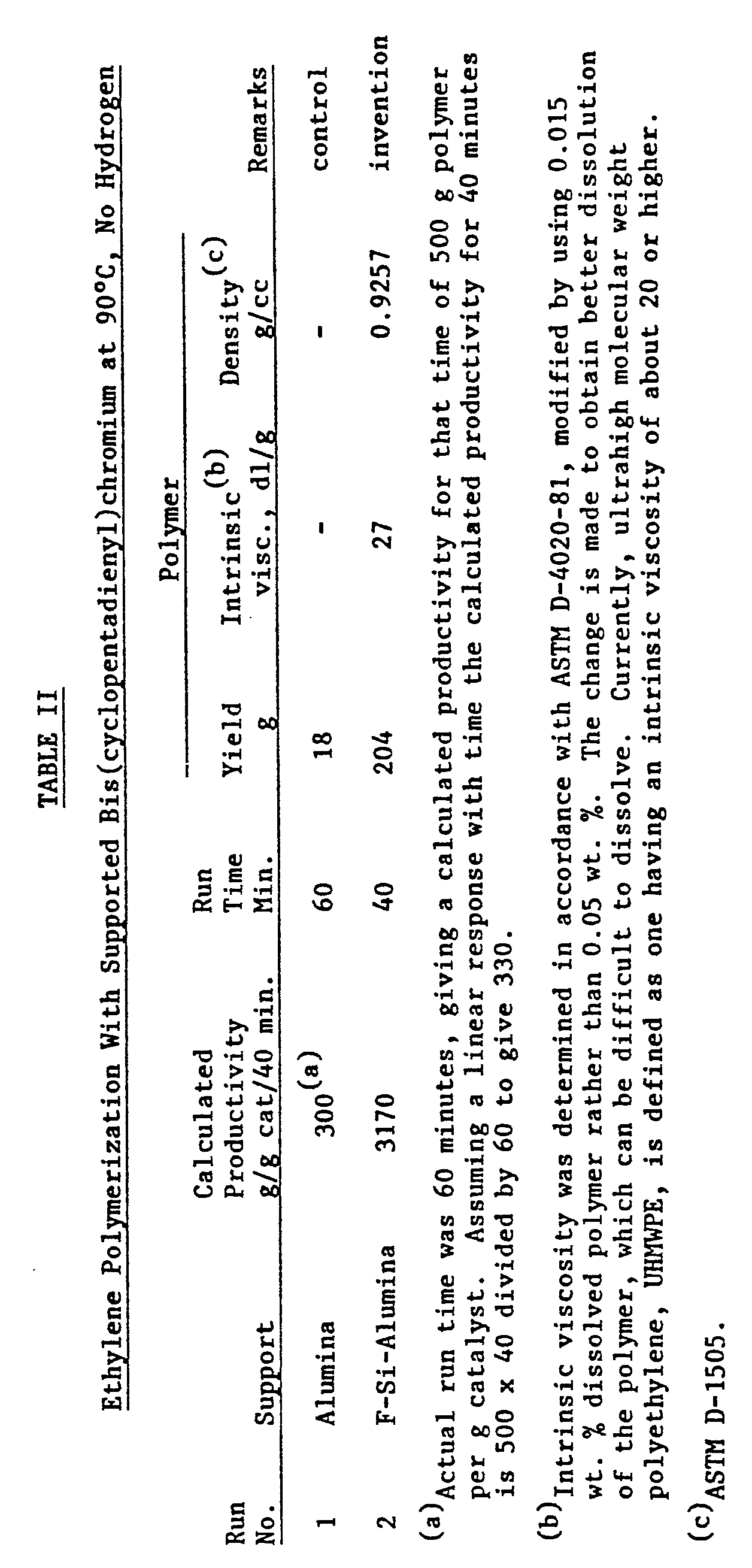
- The low productivity results in Table II,
run 1 show that bis(cyclopentadienyl)chromium on unmodified alumina, controlrun 1, gives a relatively inactive catalyst. Invention catalyst run 2 is much more active, and ultrahigh molecular weight polyethylene was made. - A series of catalysts containing high pore volume alumina with a surface coating of Si02 was prepared by impregnating the A1203 in methanol with
sufficient Silbond 40@ organosilicate solution and with sufficient hydrated chromium salt (Cr(N03)3.9H20 or Cr(C2H3O2)3·H2O) to provide compositions each containing 2.0 weight percent hexavalent Cr (as the oxide) and with varying amounts of Si02, all calculated amounts based on the vacuum dried and calcined products. Each composition was activated by calcining in dry air for 3 hours at 700°C. - Ethylene polymerization was carried out in the manner previously described in the presence of 1.0 cc triethylborane (TEB), 0.5 weight percent in n-hexane, equivalent to about 8 ppm TEB, based on the weight of isobutane diluent, as cocatalyst and a weighed amount of the activated catalyst. In this series, catalyst weights ranged from about 0.05 to about 0.15 g.
- The conditions used and results obtained are given in Table III.

- The control catalyst in run 8 of Table III produced about 250 g per 30 minutes, a typical result obtained with hexavalent Cr on unmodified alumina.
- Inspection of the data in invention runs 1-7 of Table III show that active catalysts were made in each instance. Catalysts containing about 8 weight percent silica, runs 4, 5, were the most active.
- In comparing productivity results in runs 3 and 7, each catalyst containing about 5.4 weight percent silica, it is apparent that precalcining the alumina before admixing the silica (run 7) gives a more active catalyst, e.g. productivity is about double that in run 3, than adding the silica to alumina containing volatiles (wet).
- Melt viscosity data are obtained by means of a Rheometrics Dynamic Spectrometer at 230°C using parallel plate geometry. Strain amplitude is 5 percent, nitrogen is used in the sample chamber and the oscillatory frequency is varied from 0.1 to 500 radians/second. The data obtained give storage modulus and loss modulus as a function of oscillatory frequency. From these data in turn can be calculated dynamic complex viscosity /n */ as described in
Chapter 1 of the "Viscoelastic Properties of Polymers", by Ferry, published in 1961 by Wiley. The values obtained are directly related to polymer molecular weight, with the higher the value the higher the molecular weight. It has been shown for a commercially available ultra high molecular weight polyethylene (UHMWPE) that /η*/ when determined at 0.1 radian/second and 190°C has a value of about 30 MPoise. - The polymer produced in
invention run 1 can be classed as UHMWPE since it has a melt viscosity of 38 MPoise. - A series of catalysts containing combined fluorine and high pore volume alumina was prepared by impregnating the alumina with a methanolic solution of Cr(N03)3·9H20 sufficient to provide a calculated 1.5 weight percent Cr based on the dry catalyst, drying the mixture and impregnating same with a methanolic solution of NH4HF2 sufficient to give the specified amount of combined fluorine as weight percent based on the dry catalyst. Each catalyst was activated for polymerization by calcining in dry air at the specified time and temperature.
- Control run 8, Table III, is repeated as a control in this example.
- Ethylene was polymerized with portions of each catalyst and with 8 ppm TEB as cocatalyst in the same manner as in Example 3 at 85°C.
- The conditions used and results obtained are set forth in Table IV.

- The results for invention runs 1-4, of Table IV all show that fluoriding alumina gives more active catalysts based on productivity results compared to the results obtained in the control run 8. That is, productivity is increased from about 3.8 to 8.7-fold by the fluoriding treatment, with the catalyst containing about 2.7 weight percent combined fluorine being the most active. Ultra high molecular weight polymer, having a melt viscosity of 40 to 50 was obtained.
-
Run 1 further shows that very small amounts of F are effective. Run 5 shows that above 3 weight percent F there is a dramatic deterioration in catalyst activity. Depending on other factors such as surface area, it is believed that 5 percent is the most that would possibly be beneficial, with 3 percent generally being the upper limit. - A series of catalysts containing combined fluorine, silica and high pore volume alumina was prepared by impregnating the alumina with
Silbond 40® as the silica source (NH4)2SiF6 or NH4HF2 as the fluoride source and Cr(C2H302)3'H20 or Cr(NO3)3·9H2O as the Cr source in the manner described before. Each mixture was then dried and activated (calcined) for polymerization by heating in dry air for the specified time. - Ethylene was polymerized, as before, with portions of each catalyst and with 8.3 ppm TEB or TEA (triethylaluminum, one instance) as cocatalyst, and in one run, in the presence of 5 cc of 1-hexene and hydrogen.
- The conditions used and results obtained are presented in Table V.

- Inspection of the results set forth in Table IV shows that the invention catalysts in runs 2-11 are active in polymerizing ethylene to very high molecular weight homopolymers in the absence of hydrogen based on the zero HLMI results. The melt viscosity values of 43, 54, 55 and 39 megapoise shown in
runs 2, 3, 6, and 7 are considered to be indicative of ultrahigh molecular weight polyethylene. The catalyst is also rather insensitive to hydrogen as shown in run 4 since the HLMI of the ethylene/1-hexene copolymer made is 0.8. This value is indicative of a high molecular weight polymer. The low productivity of 120 g polymer per g catalyst per 30 minutes is believed to be an anomalous result. The catalyst was apparently deactivated, perhaps inadvertently contacting a poison during its production or in the polymerization process. - Several silicated, fluorided high pore volume alumina-hexavalent Cr catalysts were prepared in the manner outlined before. In one instance, the alumina was treated with
Silbond 40 @ and Cr(N03)3.9H20 in the presence of isopropanol and the mixture dried overnight in a vacuum oven at 80°C. The next day the solid product was mixed with NH4HF2 and methanol and that product dried in a vacuum oven as before. The dry product was activated (calcined) in dry air for 3 hours at 700°C to give invention catalyst L. - In the second instance, all the catalytic components employed in invention catalyst L were mixed together in the presence of methanol, dried in a vacuum oven and calcined as above to form invention catalyst M.
- Each catalyst, on a dry basis (calcined) was calculated to contain about 4 weight percent silica, about 2.1 weight percent each of chromium and fluorine, the balance being alumina.
- A portion of each catalyst was mixed with another conventional catalyst consisting of 1 weight percent hexavalent chromium on aluminum phosphate, P/Al atom ratio of 0.9, the catalyst being activated for 3 hours at 700°C in dry air. This catalyst is called 0, for convenience.
- Ethylene alone and in some instances ethylene admixed with 1-hexene was polymerized in a 23 gal (87 liter) loop reactor in a continuous process at the specified temperatures employing isobutane as diluent, triethylborane (TEB) as cocatalyst and the indicated amount of hydrogen as adjuvant. In this process, catalyst was intermittently charged as a slurry in n-hexane at a rate sufficient to maintain the desired production of polymer. The product in slurry form was intermittently removed from the reactor through a settling leg, flashed to remove diluent and volatile gases and stored. The resulting "fluff" was stabilized with a conventional multicomponent system sufficient to provide about a total of 0.2 weight percent stabilizers, e.g. 2,6-di-t-butyl-4-methylphenol, dilauryl thiodipropionate, zinc stearate, prior to evaluating it for various physical properties.
- The catalyst systems, reaction conditions and results obtained are set forth in Table VI and VIA.


- The results presented in Table VI show in runs 1-3, at a constant reactor temperature that productivity increases with increasing TEB level, bulk density decreases, molded density remains about the same and polymer molecular weight is decreasing based on intrinsic viscosity data. Although, the intrinsic viscosity results are less than 20, except for runs 6-8 where the polymer was too high molecular weight to dissolve, the melt viscosity results suggest that UHMWPE is made in all the runs, thus all are considered to be invention runs. At a constant TEB level of 4 ppm the results in runs 5-8 indicate that as reactor temperatures increase, productivity also increases and polymer bulk density decreases although little change in molded density is seen. The productivity results obtained are sufficiently high to be of commercial interest.
- Table VIA shows the results of ethylene homopolymers and ethylene/1-hexene copolymers prepared with catalyst mixtures containing the invention catalysts. These bimodal homopolymers prepared in runs 10-13 have a higher density than those listed in Table V, reflecting the influence of the AIP04-containing catalyst. As TEB level increases in these runs, productivity also increases as before. All polymers show pellet (pelletized fluff) HLMI values ranging from about 7 to 43, and outstanding ESCR for the high stiffness, indicating that good film could be produced from at least some of them, e.g. those having a HLMI of about 20 or less. As expected, with decreasing density, the flexural moduli of the polymer samples also decrease.
- A series of catalysts was prepared by impregnating high pore volume alumina slurried in methanol with a methanolic solution of 85% H3P04 sufficient to provide the desired calculated quantity of phosphorus. Additionally, in the invention catalysts sufficient NH4HF2 dissolved in methanol,
sufficient Silbond 40, and sufficient Cr(NO3)3·9H2O were also added to provide the desired calculated amounts of combined fluorine, Si02 and chromium, all based on the dry composites. Each mixture was dried in a vacuum oven at 80°C and activated in (calcined) dry air at 700°C, unless specified otherwise, for 3 hours. - A portion of each activated catalyst was then tested in ethylehe polymerization with 8 ppm TEB as cocatalyst as described in Example 2.
- The conditions used and the results obtained are set forth in Table VII.

- Inspection of the results given in Table VII reveal that the alumina-supported hexavalent Cr catalysts can be fine-tuned to produce polymer in the desired high load melt index range, ranging from zero (UHMW) to about 4, or higher, by treating the support with one or more of the chemical agents described before. Without any chemical treatment, Cr on alumina is seen in
control run 1 to be a low activity ethylene polymerization catalyst. Comparison runs 2, 3 show that Cr+6 on a fluorided, silicated alumina give active catalysts capable of producing UHMWPE, e.g. HLMI is zero. Comparison runs 4, 5 show that Cr+6 on phosphated alumina yield active catalysts that are capable of producing lower molecular weight polymer, e.g. HLMI of about 1, than the UHMWPE of runs 2, 3. The remaining invention runs 6-15 show, when hydrogen is absent, that Cr+6 on a phosphated, fluorided, silicated alumina give catalysts that can be more active than the comparison catalysts, e.g. invention run 11, having a productivity of about 3500 g polymer per g catalyst per 30 minutes, and the polymers have HLMI values generally intermediate those of polymers made with the fluorided, silicated aluminas, e.g. zero HLMI and polymers made with just phosphated alumina, e.g. HLMI of about 1. - When hydrogen is employed in the reactor as a molecular weight modifier, lower HLMI polymers are made, e.g. invention runs 9, 12, 15, which have values ranging from about 1.5 to 3.5.
- Thus while the prior art run 5 is as good or better than some of the "comparison" invention runs so far as productivity is concerned, the inventive phosphated catalysts gives further flexibility in molecular weight control and overall best results as shown by run 11.
- A series of catalysts was prepared by contacting the previously described high pore volume alumina, modified (as described in the previous examples) by the addition of ammonium bifluoride, silica, and orthophosphoric acid (when employed) with a conventionally prepared AlP04 syrup. The contacting can be done by gelling the AlP04 in the pores of the modified alumina. For example, a concentrated solution containing the desired amounts of Al(NO3)3·9H2O, NH4H2P04 and Cr(NO3)3-9H2O dissolved in water was prepared. It was then added with mixing to the modified alumina and adsorbed into its pores leaving a seemingly dry powder. The amount of syrup must be equal to or less than the pore volume of the modified alumina. Ammonium hydroxide was then added, causing the syrup to set up into a gel within the pores of the alumina base catalyst. The syrup can also be gelled by adding ammonium carbonate solution to form AlP04 gel. The resultant composite (or pore cogel) be washed with water, then alcohol and isolated by filtration. The product is then dried in a vacuum oven and activated for polymerization by calcining in dry air at elevated temperature. In an alternate procedure, the modified alumina can be sprayed with the syrup containing the AlP04 gel.
- In all instances, the mixed catalysts, after isolation and drying, were calcined for 3 hours in dry air at 700°C, cooled, and stored in a nitrogen atmosphere as before.
- A description of the modified alumina, the calcining temperature employed after the modification, the calculated atom ratios of A1:P in the AlP04 employed, the calculated weight ratios (dry basis) of modified alumina base to AlP04 base, and the calculated total chromium (dry basis) of the mixed catalyst systems are set forth in Table VIII.

- Ethylene was polymerized with a portion of each catalyst in the manner employed in Example 4 at 96°C, 8:3 ppm TEB as cocatalyst and 50 psi hydrogen as adjuvant, unless specified otherwise.
- The results are presented in Table IX.
- With these dual function "pore cogel" catalyst composites one obtains an intimate bimodal mixture of high and low MW polymer without expensive blending of polymers later. Such polymers are valuable in film and blow molding applications.

- The results obtained in Table IX show that high density homopolymers can be prepared with the mixed or "pore cogel" catalysts, over a relatively wide range of molecular weight as evidenced by HLMI. As the amount of AlP04-based catalyst decreases the density of the polymers increases in this series. The depressing effect of hydrogen on productivity can be seen by comparing the high productivity results obtained in
run 1 with the lower results obtained in run 2. In the presence of hydrogen, lower molecular weight polymers are obtained as can be noted in runs 2P-6P where HLMI values are obtained ranging from about 3 to 63 whereas in run 1P a value less than 0.1 is shown. All samples had an excellent combination of ESCR and stiffness. - To illustrate the difference in the nature of ethylene polymers made with catalysts comprising hexavalent chromium on treated alumina and hexavalent chromium on similarly-treated silica and silica-alumina a series of catalysts was made with the silica supports.
- The silica employed was Davison 952 grade having a surface area of about 300 m2/g and a pore volume of about 1.6 cc/g. The silica-alumina was Davison grade MS 13-11D consisting of 87 weight percent silica and 13 weight percent A1203. It has a surface area of about 300 m2/g and a pore volume of about 1.1 cc/g. Each support was impregnated with sufficient aqueous solution of Cr(N03)3 to provide a calculated 1 weight chromium as chromium oxide based on the finished, activated composite.
- In addition, each silica support like previous alumina supports, was treated with sufficient NH4F2,
Silbond @ 40 and Cr(N03)3 in the manner previously described to provide finished, activated composites, each containing a calculated 1 weight percent chromium as chromium oxide, 2 weight percent F and 3.7 weight percent added Si02. - Each catalyst was employed in ethylene polymerization in a batch reactor at a total reactor pressure of 656 psia and in the presence of 8 ppm TEB in the manner previously described.
- The catalyst activating temperatures used and the results obtained are set forth in Table X.

- In addition, the fluoriding, silicating treatment given the silica-based catalysts resulted in decreased catalytic behavior unlike the behavior shown in Table V with the fluorided, silicated treatment of the alumina-based catalysts.
- A fluorided and silicated alumina was impregnated with dicumene chromium (0 valent) and chromocene (divalent). Polymerization was with hydrogen to control molecular weight. The following results were obtained.

Runs 5 and 6 show the invention alumina with mixed 0 valent and divalent chromium (and H2 to give lower molecular weight) gives very high density and stiffness, better than that obtained with an AlP04 base, i.e. better than runs 3 and 4. - The following data is presented to illustrate what is believed to be an unusual characteristic of polymers made with the Cr(6+)/F-A1203 catalyst system. As disclosed in the body of this application, this catalyst produces ultrahigh molecular weight polyethylene, UHMWPE. Generally speaking, density is found to decrease with molecular weight in this type of polymer in the prior art. The hexavalent chromium system mentioned above is unusual in that the UHMWPE polymer produced has the highest density yet observed for polymers of similar molecular weight. Molecular weight is usually correlated to the viscosity of a standardized decalin solution of the polymer according to ASTM procedures D-4020-81, D-2857-70 and D-1601-78. Another, less conventional measure of molecular weight is obtained from the melt viscosity of the polymer using a Rheometrics Dynamic Spectrometer operating at 230°C and .1 radians per second oscillation frequency. The data in Figures 1 and 2 illustrate the above mentioned relationships. For both measures of molecular weight, namely melt and intrinsic viscosity, the Cr(6+)/F-A1203 catalyst is shown to produce polymer with higher densities than any of the numerous control catalysts within a similar range of molecular weights.
- Specifically novel polymers are provided having a melt viscosity (M Poise) of 35 or greater, more specifically about 40-60 or in some instances 50 or greater and a density of 0.940 g/cc or greater, more specifically about 0.940 to 0.950, preferably greater than 0.945 g/cc. Based on intrinsic viscosity, novel polymers are provided having an intrinsic viscosity of greater than 13 g/dL, more specifically 13 to 17 or in some instances 15 to 20 at a density of greater than 0.940, more specifically at a density of 0.940 to 0.950, more preferably at a density at greater than 0.941 g/cc.
- Chromium(II) chloride and the grignard reagent, trimethylsilylmethylmagnesium chloride, were purchased from Alfa Chemical Company. All solvents used were reagent grade and were distilled from the appropriate drying agent (usually calcium hydride) and stored under argon prior to use. Unless indicated otherwise, all manipulations were carried out in an inert atmosphere of either argon or nitrogen.
- Five grams of CrC12 (40.7 mmol) were suspended in 100 ml of THF under argon. The suspension was cooled to -30°C and stirred while a solution of 50 ml of the grignard solution CIMgCH2Si(CH3)3 (1.6m in ether) diluted with 50 ml of THF was slowly added. After complete addition, the reaction solution was allowed to warm to room temperature and was stirred for another hour at that temperature. The volatiles were then removed under vacuum and the residue extracted with three 100 ml portions of pentane. The combined extracts were filtered through glass wool and the total volume of the solution reduced to 50 ml. After 24 hours at 78°C, brownish-black micro-crystals were separated from the mother liquor and washed once with cold (-78°C) pentane and dried at -78°C under. vacuum (10-4 torr) for 20 hours. Yield: 5.18 g (5.73 mmol, 56%) of the product, Cr4(TMS)g. An additional 1.20 g of product were recovered from the mother liquor by evaporating to dryness. Total yield: 6.38 g (7.05 mmol, 69%). Analysis: for Cr4(TMS)g, C32HggSigCr4, M.W. = 905.728.


- The same fluorided, silicated alumina base of catalyst D of Example 1 was calcined and impregnated with a solution of tetrakis(trimethylsilylmethyl)chromium(IV) to give a 1 weight percent chromium level. Polymerization runs at 95°C and 550 psig reactor pressure revealed very high productivity.
- The results are as follows:

- While this invention has been described in detail for the purpose of illustration it is not to be construed as limited thereby but is intended to cover all changes and modifications within the spirit and scope thereof.
- The following part of the description are preferred
embodiments 1 to 117 presented in the format of claims.
Claims (133)


Priority Applications (1)
| Application Number | Priority Date | Filing Date | Title |
|---|---|---|---|
| AT85105910T ATE94151T1 (en) | 1984-05-29 | 1985-05-14 | SILICATED AND/OR FLUORIDATED ALUMINUM OXIDE. |
Applications Claiming Priority (2)
| Application Number | Priority Date | Filing Date | Title |
|---|---|---|---|
| US615001 | 1984-05-29 | ||
| US06/615,001 US4806513A (en) | 1984-05-29 | 1984-05-29 | Silicon and fluorine-treated alumina containing a chromium catalyst and method of producing same |
Publications (3)
| Publication Number | Publication Date |
|---|---|
| EP0166157A2 true EP0166157A2 (en) | 1986-01-02 |
| EP0166157A3 EP0166157A3 (en) | 1988-12-28 |
| EP0166157B1 EP0166157B1 (en) | 1993-09-08 |
Family
ID=24463590
Family Applications (1)
| Application Number | Title | Priority Date | Filing Date |
|---|---|---|---|
| EP85105910A Expired - Lifetime EP0166157B1 (en) | 1984-05-29 | 1985-05-14 | Silicon and/or fluorine treated alumina |
Country Status (11)
| Country | Link |
|---|---|
| US (3) | US4806513A (en) |
| EP (1) | EP0166157B1 (en) |
| JP (1) | JPH085934B2 (en) |
| KR (1) | KR930002229B1 (en) |
| CN (1) | CN1013200B (en) |
| AT (1) | ATE94151T1 (en) |
| CA (1) | CA1251894A (en) |
| DE (1) | DE3587567T2 (en) |
| ES (2) | ES8609177A1 (en) |
| HU (1) | HU200953B (en) |
| NO (1) | NO166717C (en) |
Cited By (15)
| Publication number | Priority date | Publication date | Assignee | Title |
|---|---|---|---|---|
| US4999329A (en) * | 1989-10-06 | 1991-03-12 | The Dow Chemical Company | Catalyst for the production of polyalkylenepolyamines |
| US5231229A (en) * | 1989-10-06 | 1993-07-27 | The Dow Chemical Company | Catalytic process for the production of ethyleneamines |
| EP0712868A1 (en) | 1994-11-16 | 1996-05-22 | SOLVAY (Société Anonyme) | Catalyst system for the polymerization of olefins and process for the polymerization of at least one olefin in the presence of this catalyst system |
| EP0906920A1 (en) * | 1997-10-02 | 1999-04-07 | Elf Atochem S.A. | Activator solid support for metallocene catalysts in the polymerisation of olefins, its corresponding preparation process, catalytical system and polymerisation process |
| WO2000012565A1 (en) * | 1998-08-26 | 2000-03-09 | Exxon Chemical Patents Inc. | Highly active supported catalyst compositions |
| EP1041089A1 (en) * | 1999-03-29 | 2000-10-04 | Fina Research S.A. | Production of polyethylene |
| US6147171A (en) * | 1995-11-21 | 2000-11-14 | Basf Aktiengesellschaft | Philips catalysts reduced with organic compounds and possessing short induction times |
| US6180731B1 (en) | 1995-08-22 | 2001-01-30 | Basf Aktiengesellschaft | Polymerisates of ethylene with a high degree of resistance to stress crack, and a catalyst system for the production thereof |
| RU2164231C2 (en) * | 1995-04-28 | 2001-03-20 | Солвей Полиолефинс Юроп - Бельгия | Ethylene homo-or copolymers and methods or preparation thereof |
| WO2005123793A1 (en) | 2004-06-16 | 2005-12-29 | Basell Polyolefine Gmbh | Catalyst comprising chromium and zirconium for the polymerization and/or copolymerization of olefins |
| US7019089B2 (en) | 2000-07-05 | 2006-03-28 | Basell Polyolefine Gmbh | Suspended chrome catalyst containing titanium and the use thereof for producing ethylene homopolymers and copolymers |
| US7407591B2 (en) | 2004-04-30 | 2008-08-05 | Basell Polyolefine Gmbh | Process for the reduction of activated chromium oxide catalyst |
| US7705097B2 (en) | 2004-06-16 | 2010-04-27 | Basell Polyolefine Gmbh | Process for preparing a chromium-based catalyst for the polymerization and/or copolymerization of olefins |
| US7803736B2 (en) | 2002-12-10 | 2010-09-28 | Basell Polyolefine Gmbh | Supported chromium catalyst and its use for preparing homopolymers and copolymers of ethylene |
| US8039569B2 (en) | 2005-04-25 | 2011-10-18 | Basell Polyolefine Gmbh | Polyethylene molding compositions for injection molding applications |
Families Citing this family (105)
| Publication number | Priority date | Publication date | Assignee | Title |
|---|---|---|---|---|
| US5310834A (en) * | 1987-05-20 | 1994-05-10 | Quantum Chemical Corporation | Mixed chromium catalysts and polymerizations utilizing same |
| US5080778A (en) * | 1988-12-27 | 1992-01-14 | Uop | Hydrocarbon conversion process using novel silica-substituted aluminas |
| US5198563A (en) * | 1989-08-10 | 1993-03-30 | Phillips Petroleum Company | Chromium compounds and uses thereof |
| US5376612A (en) * | 1989-08-10 | 1994-12-27 | Phillips Petroleum Company | Chromium catalysts and process for making chromium catalysts |
| ZA906189B (en) * | 1989-08-10 | 1991-06-26 | Phillips Petroleum Co | Chromium compounds useful as catalysts for polymerization of olefin |
| US5135642A (en) * | 1989-09-07 | 1992-08-04 | Uop | Hydrocarbon conversion processes using novel crystalline silicon enhanced aluminas |
| US5008233A (en) * | 1989-09-07 | 1991-04-16 | Uop | Novel crystalline silicon enhanced aluminas |
| US5032651A (en) * | 1990-05-29 | 1991-07-16 | Phillips Petroleum Company | Method for producing olefin polymer blends utilizing a chromium-zirconium dual catalyst system |
| US5219817A (en) * | 1991-01-02 | 1993-06-15 | Phillips Petroleum Company | Fluorided aluminas, catalysts, and polymerization processes |
| US5221720A (en) * | 1991-01-02 | 1993-06-22 | Phillips Petroleum Company | Fluorided aluminas, catalysts, and polymerization processes |
| US5221655A (en) * | 1991-01-02 | 1993-06-22 | Phillips Petroleum Company | Florided aluminas, catalysts, and polymerization processes |
| US5221654A (en) * | 1991-01-02 | 1993-06-22 | Phillips Petroleum Company | Fluorided aluminas, catalysts, and polymerization processes |
| US5219962A (en) * | 1991-01-02 | 1993-06-15 | Phillips Petroleum Company | Fluorided aluminas, catalysts, and polymerization processes |
| US5171798A (en) * | 1991-01-02 | 1992-12-15 | Phillips Petroleum Company | Fluorided aluminas, catalysts, and polymerization processes |
| ATE148472T1 (en) * | 1991-03-01 | 1997-02-15 | Bp Chem Int Ltd | CATALYST FOR POLYMERIZATION AND PROCESS |
| US5160493A (en) * | 1991-04-29 | 1992-11-03 | Uop | Silicon enhanced amorphous silica-alumina |
| US5259948A (en) * | 1991-04-29 | 1993-11-09 | Uop | Hydrocarbon conversion process using a novel silicon enhanced amorphous silica-alumina |
| DE4121355A1 (en) * | 1991-06-28 | 1993-01-07 | Basf Ag | PHILLIPS CATALYST AND ITS USE FOR THE PRODUCTION OF ETHYLENE HOMOPOLYMERS AND COPOLYMERS |
| DE4132894A1 (en) * | 1991-10-04 | 1993-04-08 | Basf Ag | METHOD FOR PRODUCING A CARRIER CATALYST FOR THE POLYMERIZATION OF (ALPHA) OLEFINES |
| EP0548805B1 (en) * | 1991-12-18 | 1997-03-05 | Phillips Petroleum Company | Process for the preparation of polymerisation catalysts |
| US5338812A (en) * | 1991-12-24 | 1994-08-16 | Phillips Petroleum Company | Olefin polymerization |
| DE4204259A1 (en) * | 1992-02-13 | 1993-08-19 | Basf Ag | PHILLIPS CATALYST AND ITS USE FOR THE PRODUCTION OF ETHYLENE HOMOPOLYMERS AND COPOLYMERS |
| US5284926A (en) * | 1992-09-25 | 1994-02-08 | Phillips Petroleum Company | Catalyst system and process |
| US5364915A (en) * | 1992-09-25 | 1994-11-15 | Phillips Petroleum Company | Ethylene polymerization process |
| US5486584A (en) * | 1992-10-08 | 1996-01-23 | Phillips Petroleum Company | Chromium catalyst compositions |
| US5240895A (en) * | 1992-11-06 | 1993-08-31 | Chevron Research And Technology Company | Dimeric and tetrameric cyclopentadienyl group 6B metal alpha-olefin polymerization catalysts and process for polymerizing alpha-olefins |
| US5331070A (en) * | 1992-11-13 | 1994-07-19 | Phillips Petroleum Company | Process for olefin polymerization |
| BR9301438A (en) * | 1993-04-05 | 1994-11-15 | Petroleo Brasileiro Sa | Process of preparation of spherical ziegler catalyst for polymerization of alpha-olefins, spherical catalyst, process of obtaining spherical polyethylene of very high molecular weight and spherical polyethylene of very high by molecular |
| BE1007148A3 (en) * | 1993-05-17 | 1995-04-11 | Solvay | Support for catalyst, method for producing gel precursor media for catalyst, method for preparing a catalyst support, catalyst for olefin polymerization and method for olefin polymerization using the catalyst . |
| US5508362A (en) * | 1993-10-08 | 1996-04-16 | Phillips Petroleum Company | Chromium catalyst compositions and polymerization processes therewith |
| US5543376A (en) * | 1994-02-25 | 1996-08-06 | Phillips Petroleum Company | Process for producing polyolefins |
| US5624877A (en) * | 1994-02-25 | 1997-04-29 | Phillips Petroleum Company | Process for producing polyolefins |
| EP0799841A3 (en) * | 1996-04-05 | 1998-01-07 | SOLVAY POLYOLEFINS EUROPE - BELGIUM (Société Anonyme) | Ethylene polymer and hollow product obtainable therefrom |
| BE1010715A3 (en) * | 1996-10-25 | 1998-12-01 | Solvay | Ethylene copolymer and at least one alpha-olefin and method for obtaining. |
| CN1089032C (en) * | 1996-12-10 | 2002-08-14 | 中国石油化工集团公司 | Porous and silicon contg. alumina carrier beads, and method for making same |
| US6034186A (en) * | 1997-05-16 | 2000-03-07 | Phillips Petroleum Company | Olefin polymerization processes and products thereof |
| US6329476B1 (en) | 1997-10-14 | 2001-12-11 | Phillips Petroleum Company | Olefin polymerization processes and products thereof |
| US6255413B1 (en) | 1997-12-16 | 2001-07-03 | Phillips Petroleum Company | Process to produce branched polymers from ethylene feedstock |
| US6300271B1 (en) | 1998-05-18 | 2001-10-09 | Phillips Petroleum Company | Compositions that can produce polymers |
| US6165929A (en) | 1998-05-18 | 2000-12-26 | Phillips Petroleum Company | Compositions that can produce polymers |
| JP4630458B2 (en) * | 1998-05-18 | 2011-02-09 | コノコフィリップス カンパニー | Monomer polymerization catalyst composition |
| US6107230A (en) * | 1998-05-18 | 2000-08-22 | Phillips Petroleum Company | Compositions that can produce polymers |
| US6495638B2 (en) * | 1998-12-30 | 2002-12-17 | Phillips Petroleum Company | Process to produce polymers |
| EP1041085B1 (en) * | 1999-04-01 | 2002-08-14 | Japan Polyolefins Co., Ltd. | Catalyst for the production of ethylene polymer and process for producing ethylene polymer |
| DE19943167A1 (en) * | 1999-09-09 | 2001-03-15 | Elenac Gmbh | Process for the production of supported chromium catalysts |
| US6613712B1 (en) * | 1999-11-24 | 2003-09-02 | Phillips Petroleum Company | Organometal catalyst compositions with solid oxide supports treated with fluorine and boron |
| US6750302B1 (en) * | 1999-12-16 | 2004-06-15 | Phillips Petroleum Company | Organometal catalyst compositions |
| US6524987B1 (en) * | 1999-12-22 | 2003-02-25 | Phillips Petroleum Company | Organometal catalyst compositions |
| US6388017B1 (en) * | 2000-05-24 | 2002-05-14 | Phillips Petroleum Company | Process for producing a polymer composition |
| US6525148B1 (en) * | 2000-08-18 | 2003-02-25 | Phillips Petroleum Company | Polymerization catalyst systems and processes therefor and therewith |
| US7829646B2 (en) * | 2000-08-18 | 2010-11-09 | Chevron Phillips Chemical Company Lp | Olefin polymers, method of making, and use thereof |
| CN101067035B (en) * | 2003-02-24 | 2012-12-05 | 切弗朗菲利浦化学公司 | Olefin polymer, producing method and application thereof |
| US20050154159A1 (en) * | 2004-01-09 | 2005-07-14 | Deslauriers Paul J. | Olefin polymers, method of making, and use thereof |
| US7112643B2 (en) * | 2004-04-22 | 2006-09-26 | Chevron Phillips Chemical Company Lp | Polymers having low levels of long chain branching and methods of making the same |
| BRPI0510174B1 (en) | 2004-04-22 | 2016-04-26 | Chevron Phillips Chemical Co | method for preparing a polymerization catalyst, catalyst, catalyst composition for olefin polymerization, method of using the catalyst and for producing a polymer, polymer and resin |
| US7214642B2 (en) * | 2004-04-22 | 2007-05-08 | Chevron Phillips Chemical Company Lp | Methods of preparing active chromium/alumina catalysts via treatment with sulfate |
| EP1807456B1 (en) * | 2004-11-04 | 2012-07-11 | Chevron Phillips Chemical Company Lp | Organochromium/metallocene combination catalyst for producing bimodal resins |
| JP5066308B2 (en) * | 2004-12-28 | 2012-11-07 | 日本ポリエチレン株式会社 | Organoboron-treated fluorinated chromium polymerization catalyst, method for producing ethylene polymer, and ethylene polymer |
| WO2006070886A1 (en) * | 2004-12-28 | 2006-07-06 | Asahi Kasei Chemicals Corporation | Ultra high molecular weight ethylene copolymer powder |
| US20060155082A1 (en) * | 2005-01-10 | 2006-07-13 | Mcdaniel Max P | Process for producing polymers |
| CN100388973C (en) * | 2005-04-29 | 2008-05-21 | 中国石油化工股份有限公司 | Modified alumina composition and preparation thereof |
| DE102006004705A1 (en) * | 2006-01-31 | 2007-08-02 | Basell Polyolefine Gmbh | Production of (co)polyethylene for blown film uses chromium catalyst on silicate support heat-activated under oxidative conditions and melt mixing with sterically-hindered phenol and phosphite antioxidants at sufficient energy input |
| US7897539B2 (en) * | 2007-05-16 | 2011-03-01 | Chevron Phillips Chemical Company Lp | Methods of preparing a polymerization catalyst |
| EP2190574B1 (en) * | 2007-08-29 | 2019-08-28 | Pacific Industrial Development Corporation | Rare earth alumina particulate manufacturing method and application |
| US11208514B2 (en) | 2008-03-20 | 2021-12-28 | Chevron Phillips Chemical Company Lp | Silica-coated alumina activator-supports for metallocene catalyst compositions |
| US7884163B2 (en) | 2008-03-20 | 2011-02-08 | Chevron Phillips Chemical Company Lp | Silica-coated alumina activator-supports for metallocene catalyst compositions |
| US8513154B2 (en) * | 2008-04-30 | 2013-08-20 | Dow Technology Investments, Llc | Porous body precursors, shaped porous bodies, processes for making them, and end-use products based upon the same |
| CN102196862A (en) * | 2008-10-31 | 2011-09-21 | 切弗朗菲利浦化学公司 | Composition and catalyst system of metal precursor and olefinic diluent |
| US8471085B2 (en) | 2008-10-31 | 2013-06-25 | Chevron Phillips Chemical Company Lp | Oligomerization catalyst system and process for oligomerizing olefins |
| US8202952B2 (en) * | 2008-11-21 | 2012-06-19 | Equistar Chemicals, Lp | Process for making ethylene homopolymers |
| US9365664B2 (en) | 2009-01-29 | 2016-06-14 | W. R. Grace & Co. -Conn. | Catalyst on silica clad alumina support |
| WO2010088013A1 (en) | 2009-01-29 | 2010-08-05 | W. R. Grace & Co.-Conn. | Catalyst on silica clad alumina support |
| US8399580B2 (en) | 2010-08-11 | 2013-03-19 | Chevron Philips Chemical Company Lp | Additives to chromium catalyst mix tank |
| US9012359B2 (en) * | 2011-01-20 | 2015-04-21 | Ineos Sales (Uk) Limited | Activating supports |
| US8440772B2 (en) | 2011-04-28 | 2013-05-14 | Chevron Phillips Chemical Company Lp | Methods for terminating olefin polymerizations |
| US8487053B2 (en) | 2011-11-30 | 2013-07-16 | Chevron Phillips Chemical Company Lp | Methods for removing polymer skins from reactor walls |
| US8501882B2 (en) | 2011-12-19 | 2013-08-06 | Chevron Phillips Chemical Company Lp | Use of hydrogen and an organozinc compound for polymerization and polymer property control |
| US8703883B2 (en) | 2012-02-20 | 2014-04-22 | Chevron Phillips Chemical Company Lp | Systems and methods for real-time catalyst particle size control in a polymerization reactor |
| US10273315B2 (en) | 2012-06-20 | 2019-04-30 | Chevron Phillips Chemical Company Lp | Methods for terminating olefin polymerizations |
| US8916494B2 (en) | 2012-08-27 | 2014-12-23 | Chevron Phillips Chemical Company Lp | Vapor phase preparation of fluorided solid oxides |
| US8940842B2 (en) | 2012-09-24 | 2015-01-27 | Chevron Phillips Chemical Company Lp | Methods for controlling dual catalyst olefin polymerizations |
| US8895679B2 (en) | 2012-10-25 | 2014-11-25 | Chevron Phillips Chemical Company Lp | Catalyst compositions and methods of making and using same |
| US8937139B2 (en) | 2012-10-25 | 2015-01-20 | Chevron Phillips Chemical Company Lp | Catalyst compositions and methods of making and using same |
| US8877672B2 (en) | 2013-01-29 | 2014-11-04 | Chevron Phillips Chemical Company Lp | Catalyst compositions and methods of making and using same |
| US9034991B2 (en) | 2013-01-29 | 2015-05-19 | Chevron Phillips Chemical Company Lp | Polymer compositions and methods of making and using same |
| US9353196B2 (en) | 2013-11-20 | 2016-05-31 | Equistar Chemicals, Lp | Bimodal polymerization process utilizing chromium/silica catalysts |
| US10246528B2 (en) | 2014-01-09 | 2019-04-02 | Chevron Phillips Chemical Company Lp | Chromium (III) catalyst systems with activator-supports |
| WO2016141020A1 (en) | 2015-03-02 | 2016-09-09 | Equistar Chemicals, Lp | Catalysts and methods of controlling long chain branching in polyolefins |
| KR20160134464A (en) | 2015-05-15 | 2016-11-23 | 주식회사 엘지화학 | Supported hybrid catalyst system and method for olefin polymerization using the same |
| US9708426B2 (en) | 2015-06-01 | 2017-07-18 | Chevron Phillips Chemical Company Lp | Liquid-solid sampling system for a loop slurry reactor |
| US9505856B1 (en) | 2016-01-13 | 2016-11-29 | Chevron Phillips Chemical Company Lp | Methods for making fluorided chromium (VI) catalysts, and polymerization processes using the same |
| US9611188B1 (en) | 2016-02-17 | 2017-04-04 | Chevron Phillips Chemical Company Lp | Aromatic alkylation using chemically-treated solid oxides |
| US10005861B2 (en) | 2016-06-09 | 2018-06-26 | Chevron Phillips Chemical Company Lp | Methods for increasing polymer production rates with halogenated hydrocarbon compounds |
| WO2018093421A1 (en) * | 2016-11-18 | 2018-05-24 | Exxonmobil Chemical Patents Inc. | Polymerization processes utilizing chromium-containing catalysts |
| KR102353146B1 (en) | 2018-03-13 | 2022-01-18 | 주식회사 엘지화학 | Method for preparing ferrite-based coating catalysts and method for butadiene using the same |
| CN112673032B (en) | 2018-09-24 | 2024-03-15 | 切弗朗菲利浦化学公司 | Method for preparing supported chromium catalysts with enhanced polymerization activity |
| CA3112325A1 (en) | 2018-09-27 | 2020-04-02 | Chevron Phillips Chemical Company Lp | Processes for producing fluorided solid oxides and uses thereof in metallocene-based catalyst systems |
| US10774161B2 (en) | 2019-01-31 | 2020-09-15 | Chevron Phillips Chemical Company Lp | Systems and methods for polyethylene recovery with low volatile content |
| CN112316975A (en) * | 2020-09-14 | 2021-02-05 | 昆明理工大学 | High-water-resistance supported ammonia oxidation catalyst and preparation method and application thereof |
| US12077616B2 (en) | 2021-12-15 | 2024-09-03 | Chevron Phillips Chemical Company Lp | Production of polyethylene and ethylene oligomers from ethanol and the use of biomass and waste streams as feedstocks to produce the ethanol |
| US11845814B2 (en) | 2022-02-01 | 2023-12-19 | Chevron Phillips Chemical Company Lp | Ethylene polymerization processes and reactor systems for the production of multimodal polymers using combinations of a loop reactor and a fluidized bed reactor |
| US12466900B2 (en) | 2022-04-19 | 2025-11-11 | Chevron Phillips Chemical Company Lp | Loop slurry periodogram control to prevent reactor fouling and reactor shutdowns |
| CN115073819B (en) * | 2022-06-15 | 2024-05-03 | 兰州瑞朴科技有限公司 | Growth-nucleus-based aluminum phosphate flame retardant, and preparation method and application thereof |
| US12606648B2 (en) | 2023-07-13 | 2026-04-21 | Chevron Phillips Chemical Company Lp | Centralized hydrocarbon treatment in a polymer production process |
| US20250066274A1 (en) | 2023-08-22 | 2025-02-27 | Chevron Phillips Chemical Company Lp | Integrated processes utilizing water electrolysis and oxidative dehydrogenation of ethane |
Family Cites Families (46)
| Publication number | Priority date | Publication date | Assignee | Title |
|---|---|---|---|---|
| NL101269C (en) * | 1955-12-16 | 1900-01-01 | ||
| US2941958A (en) * | 1957-02-04 | 1960-06-21 | Atlantic Refining Co | Use of colloidal silica in catalyst manufacture |
| GB830424A (en) * | 1957-02-27 | 1960-03-16 | Ici Ltd | Polymerisation catalysts |
| US3130188A (en) * | 1960-10-07 | 1964-04-21 | Phillips Petroleum Co | Catalyst and process for producing olefin polymers |
| US3211801A (en) * | 1961-12-08 | 1965-10-12 | Phillips Petroleum Co | Supported olefin conversion catalysts |
| US3231516A (en) * | 1962-07-12 | 1966-01-25 | Minerals & Chem Philipp Corp | Catalyst containing activated bauxite |
| NL135065C (en) * | 1965-05-14 | |||
| US3929415A (en) * | 1967-10-26 | 1975-12-30 | Daikin Ind Ltd | {68 -Aluminum fluoride by evaporating aqueous MF solution of AlF{HD 3 {B under vacuum to dryness and heating |
| GB1265564A (en) * | 1969-07-17 | 1972-03-01 | ||
| GB1314828A (en) * | 1969-08-13 | 1973-04-26 | Ici Ltd | Transition metal compositions and polymerisation process catalysed thereby |
| US4018707A (en) * | 1969-08-13 | 1977-04-19 | Imperial Chemical Industries Limited | Transition metal compositions |
| LU61838A1 (en) * | 1970-10-08 | 1972-06-28 | ||
| US3948676A (en) * | 1970-11-24 | 1976-04-06 | Deutsche Gold- Und Silber-Scheideanstalt Vormals Roessler | Process for preparing hydrophobic particles |
| NL174953C (en) * | 1970-11-24 | 1984-09-03 | Degussa | METHOD FOR HYDROPHOBICIZING METAL OR SILICON OXIDES |
| GB1400453A (en) * | 1971-07-21 | 1975-07-16 | Ici Ltd | Copolymerisation of olefins |
| GB1353540A (en) * | 1971-12-08 | 1974-05-22 | Ici Ltd | Organo-metallic compounds |
| US3840511A (en) * | 1972-02-18 | 1974-10-08 | Ici Ltd | Diene polymerisation |
| US3979215A (en) * | 1972-05-25 | 1976-09-07 | Zirconal Processes Limited | Refractory articles and methods of producing same |
| GB1430073A (en) * | 1972-07-13 | 1976-03-31 | Ici Ltd | Polymerisation proces |
| US3847888A (en) * | 1972-12-01 | 1974-11-12 | Allied Chem | Ultra-high molecular weight polyethylene molding powder and molding process |
| US3944536A (en) * | 1973-06-18 | 1976-03-16 | E. I. Du Pont De Nemours & Company | Exceptionally rigid and tough ultrahigh molecular weight linear polyethylene |
| US4086408A (en) * | 1973-12-20 | 1978-04-25 | Union Carbide Corporation | Ethylene polymerization with silane modified catalyst |
| AR204423A1 (en) * | 1974-09-19 | 1976-02-06 | Snam Progetti | PROCEDURE FOR PREPARING ALUMINA WITH IMPROVED MECHANICAL PROPERTIES AND ALUMIN OBTAINED THUS |
| US4130505A (en) * | 1974-09-26 | 1978-12-19 | Phillips Petroleum Company | Two stage activation of fluorided chromium-containing catalyst |
| IT1025882B (en) * | 1974-11-21 | 1978-08-30 | Snam Progetti | PROCESS FOR THE PREPARATION OF DIETERS |
| US3976632A (en) * | 1974-12-04 | 1976-08-24 | Phillips Petroleum Company | Reactivation of organochromium olefin polymerization catalyst in presence of oxygen |
| US3992322A (en) * | 1975-04-11 | 1976-11-16 | Universal Oil Products Company | Preparation of polymerization catalyst systems |
| JPS5821900B2 (en) * | 1975-06-24 | 1983-05-04 | ダイキン工業株式会社 | Hexafluoropropanone-2 |
| JPS5835170B2 (en) * | 1975-10-15 | 1983-08-01 | トウアネンリヨウコウギヨウ カブシキガイシヤ | Methyl ethyl ketone |
| US4080311A (en) * | 1976-08-31 | 1978-03-21 | Gulf Research & Development Company | Thermally stable phosphate containing alumina precipitates and their method of preparation |
| JPS5334705A (en) * | 1976-09-13 | 1978-03-31 | Central Glass Co Ltd | Preparation of bromotrifluoromethane |
| US4234453A (en) * | 1976-09-20 | 1980-11-18 | National Petro Chemicals Corporation | Olefin polymerization catalyst |
| US4101445A (en) * | 1976-09-22 | 1978-07-18 | Union Carbide Corporation | Preparation of modified and activated chromocene catalysts for ethylene polymerization |
| US4290914A (en) * | 1977-01-13 | 1981-09-22 | National Petro Chemicals Corp. | Catalytic materials as for olefin polymerization |
| US4247410A (en) * | 1978-06-19 | 1981-01-27 | Humatec Resources, Inc. | Composition for dispensing in manner of aerosol, pressurizing catalyst useful therein, precursors thereof, and their preparation |
| US4233184A (en) * | 1979-01-18 | 1980-11-11 | Exxon Research & Engineering Co. | Aluminum phosphate-alumina compositions and catalysts comprising the same |
| US4325839A (en) * | 1979-12-21 | 1982-04-20 | Phillips Petroleum Company | Impregnated second valence chromium compound in supported catalyst |
| EP0032543A1 (en) * | 1980-01-10 | 1981-07-29 | Chemische Werke Hüls Ag | Process for the isomerization of n-alkenes |
| DE3030916A1 (en) * | 1980-08-16 | 1982-04-08 | Basf Ag, 6700 Ludwigshafen | Ethylene (co)polymerisation carrier catalyst prepn. - by coating porous finely-divided silica-alumina support with chromium hydrocarbon complex cpd. |
| US4378308A (en) * | 1980-11-26 | 1983-03-29 | Mobil Oil Corporation | Poison-resistant hydrodesulfurization catalyst |
| US4364841A (en) * | 1980-12-31 | 1982-12-21 | Phillips Petroleum Company | Phosphate containing support with zerovalent chromium |
| US4364839A (en) * | 1980-12-31 | 1982-12-21 | Phillips Petroleum Company | Catalyst comprising chromium on silica/phosphate support |
| US4397765A (en) * | 1980-12-31 | 1983-08-09 | Phillips Petroleum Company | Phosphated alumina or aluminum phosphate chromium catalyst |
| US4392988A (en) * | 1981-05-11 | 1983-07-12 | Ga Technologies Inc. | Method of producing stable alumina |
| US4478988A (en) * | 1981-07-29 | 1984-10-23 | Chemplex Company | Polymerization method |
| DE3132674C2 (en) * | 1981-08-19 | 1983-12-08 | Degussa Ag, 6000 Frankfurt | Process for the production of compacts |
-
1984
- 1984-05-29 US US06/615,001 patent/US4806513A/en not_active Expired - Fee Related
-
1985
- 1985-04-01 CN CN85101209A patent/CN1013200B/en not_active Expired
- 1985-05-02 JP JP60095297A patent/JPH085934B2/en not_active Expired - Lifetime
- 1985-05-14 EP EP85105910A patent/EP0166157B1/en not_active Expired - Lifetime
- 1985-05-14 AT AT85105910T patent/ATE94151T1/en not_active IP Right Cessation
- 1985-05-14 DE DE85105910T patent/DE3587567T2/en not_active Expired - Lifetime
- 1985-05-16 KR KR1019850003361A patent/KR930002229B1/en not_active Expired - Fee Related
- 1985-05-17 CA CA000481828A patent/CA1251894A/en not_active Expired
- 1985-05-28 ES ES543553A patent/ES8609177A1/en not_active Expired
- 1985-05-28 HU HU852041A patent/HU200953B/en unknown
- 1985-05-29 NO NO852138A patent/NO166717C/en unknown
-
1986
- 1986-02-17 ES ES552105A patent/ES8707978A1/en not_active Expired
-
1988
- 1988-11-17 US US07/272,565 patent/US5037911A/en not_active Expired - Lifetime
-
1992
- 1992-12-18 US US07/993,488 patent/US5401820A/en not_active Expired - Lifetime
Cited By (31)
| Publication number | Priority date | Publication date | Assignee | Title |
|---|---|---|---|---|
| US5231229A (en) * | 1989-10-06 | 1993-07-27 | The Dow Chemical Company | Catalytic process for the production of ethyleneamines |
| US4999329A (en) * | 1989-10-06 | 1991-03-12 | The Dow Chemical Company | Catalyst for the production of polyalkylenepolyamines |
| EP0712868A1 (en) | 1994-11-16 | 1996-05-22 | SOLVAY (Société Anonyme) | Catalyst system for the polymerization of olefins and process for the polymerization of at least one olefin in the presence of this catalyst system |
| BE1008916A3 (en) * | 1994-11-16 | 1996-10-01 | Solvay | Polymerization catalyst system for olefin polymerization process and at least one olefin in the presence of this system catalyst. |
| US5863854A (en) * | 1994-11-16 | 1999-01-26 | Solvay Polyolefins Europe-Belgium (Societe Anonyme) | Catalyst system for olefin polymerization and process for the polymerization of at least one olefin in the presence of this catalyst system |
| RU2154069C2 (en) * | 1994-11-16 | 2000-08-10 | Солвей Полиолефинс Юроп - Бельгия | Catalyst system for polymerization of olefins and method of preparing polyolefins |
| RU2164231C2 (en) * | 1995-04-28 | 2001-03-20 | Солвей Полиолефинс Юроп - Бельгия | Ethylene homo-or copolymers and methods or preparation thereof |
| US6180731B1 (en) | 1995-08-22 | 2001-01-30 | Basf Aktiengesellschaft | Polymerisates of ethylene with a high degree of resistance to stress crack, and a catalyst system for the production thereof |
| US6147171A (en) * | 1995-11-21 | 2000-11-14 | Basf Aktiengesellschaft | Philips catalysts reduced with organic compounds and possessing short induction times |
| US6780946B2 (en) | 1997-10-02 | 2004-08-24 | Elf Atochem S.A. | Activator solid support for metallocene catalysts in the polymerization of olefins, a process for preparing such a support, and the corresponding catalytic system and polymerization process |
| US6239059B1 (en) | 1997-10-02 | 2001-05-29 | Elf Atochem, S.A. | Activator solid support for metallocene catalysts in the polymerization of olefins, a process for preparing such a support, and the corresponding catalytic system and polymerization process |
| EP0906920A1 (en) * | 1997-10-02 | 1999-04-07 | Elf Atochem S.A. | Activator solid support for metallocene catalysts in the polymerisation of olefins, its corresponding preparation process, catalytical system and polymerisation process |
| US6605561B1 (en) | 1997-10-02 | 2003-08-12 | Elf Atochem, S.A. | Activator solid support for metallocene catalysts in the polymerization of olefins, a process for preparing such a support, and the corresponding catalytic system and polymerization process |
| FR2769245A1 (en) * | 1997-10-02 | 1999-04-09 | Atochem Elf Sa | SOLID SUPPORT ACTIVATOR OF METALLOCENE CATALYZERS IN OLEFINS POLYMERIZATION, ITS PREPARATION PROCESS, CATALYTIC SYSTEM AND CORRESPONDING POLYMERIZATION PROCESS |
| US6667272B2 (en) | 1998-08-26 | 2003-12-23 | Exxonmobil Chemical Patents Inc. | Highly active supported catalyst compositions |
| US6524988B2 (en) | 1998-08-26 | 2003-02-25 | Exxonmobil Chemical Patents Inc. | Highly active supported catalyst compositions |
| WO2000012565A1 (en) * | 1998-08-26 | 2000-03-09 | Exxon Chemical Patents Inc. | Highly active supported catalyst compositions |
| US6664348B2 (en) | 1998-08-26 | 2003-12-16 | Exxonmobil Chemical Patents Inc. | Highly active supported catalyst compositions |
| US6846770B2 (en) | 1998-08-26 | 2005-01-25 | Exxonmobil Chemical Patents Inc. | Highly active supported catalyst compositions |
| US6368999B1 (en) | 1998-08-26 | 2002-04-09 | Exxon Mobil Chemical Patents Inc. | Highly active supported catalyst compositions |
| US6423792B1 (en) | 1999-03-29 | 2002-07-23 | Fina Research, S.A. | Production of polyethylene |
| WO2000058375A1 (en) * | 1999-03-29 | 2000-10-05 | Atofina Research | Production of polyethylene |
| EP1041089A1 (en) * | 1999-03-29 | 2000-10-04 | Fina Research S.A. | Production of polyethylene |
| US7019089B2 (en) | 2000-07-05 | 2006-03-28 | Basell Polyolefine Gmbh | Suspended chrome catalyst containing titanium and the use thereof for producing ethylene homopolymers and copolymers |
| US7348384B2 (en) | 2000-07-05 | 2008-03-25 | Basell Polyolefine Gmbh | Supported, titanized chromium catalyst and its use for preparing homopolymers and copolymers of ethylene |
| US7803736B2 (en) | 2002-12-10 | 2010-09-28 | Basell Polyolefine Gmbh | Supported chromium catalyst and its use for preparing homopolymers and copolymers of ethylene |
| US7407591B2 (en) | 2004-04-30 | 2008-08-05 | Basell Polyolefine Gmbh | Process for the reduction of activated chromium oxide catalyst |
| WO2005123793A1 (en) | 2004-06-16 | 2005-12-29 | Basell Polyolefine Gmbh | Catalyst comprising chromium and zirconium for the polymerization and/or copolymerization of olefins |
| US7714091B2 (en) | 2004-06-16 | 2010-05-11 | Basell Polyolefine Gmbh | Catalyst comprising chromium and zirconium for the polymerization and/or copolymerization of olefins |
| US7705097B2 (en) | 2004-06-16 | 2010-04-27 | Basell Polyolefine Gmbh | Process for preparing a chromium-based catalyst for the polymerization and/or copolymerization of olefins |
| US8039569B2 (en) | 2005-04-25 | 2011-10-18 | Basell Polyolefine Gmbh | Polyethylene molding compositions for injection molding applications |
Also Published As
| Publication number | Publication date |
|---|---|
| JPH085934B2 (en) | 1996-01-24 |
| DE3587567D1 (en) | 1993-10-14 |
| ES8707978A1 (en) | 1987-09-01 |
| ES543553A0 (en) | 1986-07-16 |
| NO166717B (en) | 1991-05-21 |
| US5037911A (en) | 1991-08-06 |
| KR850008175A (en) | 1985-12-13 |
| US4806513A (en) | 1989-02-21 |
| ES552105A0 (en) | 1987-09-01 |
| ES8609177A1 (en) | 1986-07-16 |
| DE3587567T2 (en) | 1994-01-05 |
| NO852138L (en) | 1985-12-02 |
| HU200953B (en) | 1990-09-28 |
| CN85101209A (en) | 1987-01-24 |
| ATE94151T1 (en) | 1993-09-15 |
| EP0166157A3 (en) | 1988-12-28 |
| JPS60258210A (en) | 1985-12-20 |
| US5401820A (en) | 1995-03-28 |
| KR930002229B1 (en) | 1993-03-27 |
| EP0166157B1 (en) | 1993-09-08 |
| HUT38559A (en) | 1986-06-30 |
| NO166717C (en) | 1991-08-28 |
| CA1251894A (en) | 1989-03-28 |
| CN1013200B (en) | 1991-07-17 |
Similar Documents
| Publication | Publication Date | Title |
|---|---|---|
| US4806513A (en) | Silicon and fluorine-treated alumina containing a chromium catalyst and method of producing same | |
| US4424139A (en) | Catalyst comprising a phosphate and with a bis-(cyclopentadienyl)chromium(II) compound | |
| US4364842A (en) | Phosphate supported chromium catalyst | |
| US4444964A (en) | Polymerization process using phosphate supported chromium catalyst | |
| US4504638A (en) | Ethylene polymers made from phosphate supported chromium catalyst | |
| US4364841A (en) | Phosphate containing support with zerovalent chromium | |
| US4803253A (en) | Ethylene polymer produced using a catalyst comprising a phosphate and with a bis-(cyclopentadienyl)chromium(II) compound | |
| EP0055864B2 (en) | Catalyst and use of same for polymerizing olefins | |
| US4444965A (en) | Olefin polymerization using chromium on an aluminum phosphate produced from a concentrated mass | |
| US4364855A (en) | Production of aluminum phosphate from concentrated mass | |
| US4397765A (en) | Phosphated alumina or aluminum phosphate chromium catalyst | |
| US4788171A (en) | Phosphated calcined alumina | |
| US4444966A (en) | Polymerization using phosphated alumina or aluminum phosphate chromium catalyst | |
| US5001204A (en) | Alumina phosphated with partial ester | |
| US4444968A (en) | Olefin polymerization with phosphate supported zerovalent chromium | |
| US4717701A (en) | Olefin polymerization | |
| US4364840A (en) | Phosphated silica-chromium catalyst with boron-containing cocatalyst | |
| US4690990A (en) | Polymerization process using a catalyst comprising a phosphate and with a bis-(cyclopentadienyl)chromium(II) compound | |
| US4444963A (en) | Polymerization process using catalysts comprising chromium on silica/phosphate support | |
| CA1231798A (en) | Ethylene polymers and chromium catalysts | |
| EP0055866B1 (en) | A method for making a catalyst system, catalyst system and use of same | |
| US4960748A (en) | Alumina phosphated with partial ester | |
| US4540757A (en) | Polymerization and catalyst | |
| US4398004A (en) | Olefin polymerization with phosphated silica-chromium catalyst with boron-containing cocatalyst | |
| US5204304A (en) | Vanadium-containing polymerization catalyst |
Legal Events
| Date | Code | Title | Description |
|---|---|---|---|
| PUAI | Public reference made under article 153(3) epc to a published international application that has entered the european phase |
Free format text: ORIGINAL CODE: 0009012 |
|
| AK | Designated contracting states |
Designated state(s): AT BE CH DE FR GB IT LI LU NL SE |
|
| PUAL | Search report despatched |
Free format text: ORIGINAL CODE: 0009013 |
|
| AK | Designated contracting states |
Kind code of ref document: A3 Designated state(s): AT BE CH DE FR GB IT LI LU NL SE |
|
| 17P | Request for examination filed |
Effective date: 19890524 |
|
| 17Q | First examination report despatched |
Effective date: 19910102 |
|
| RBV | Designated contracting states (corrected) |
Designated state(s): AT BE DE FR GB IT LU NL SE |
|
| GRAA | (expected) grant |
Free format text: ORIGINAL CODE: 0009210 |
|
| AK | Designated contracting states |
Kind code of ref document: B1 Designated state(s): AT BE DE FR GB IT LU NL SE |
|
| REF | Corresponds to: |
Ref document number: 94151 Country of ref document: AT Date of ref document: 19930915 Kind code of ref document: T |
|
| ITF | It: translation for a ep patent filed | ||
| REF | Corresponds to: |
Ref document number: 3587567 Country of ref document: DE Date of ref document: 19931014 |
|
| ET | Fr: translation filed | ||
| PLBE | No opposition filed within time limit |
Free format text: ORIGINAL CODE: 0009261 |
|
| STAA | Information on the status of an ep patent application or granted ep patent |
Free format text: STATUS: NO OPPOSITION FILED WITHIN TIME LIMIT |
|
| EPTA | Lu: last paid annual fee | ||
| 26N | No opposition filed | ||
| EAL | Se: european patent in force in sweden |
Ref document number: 85105910.5 |
|
| PGFP | Annual fee paid to national office [announced via postgrant information from national office to epo] |
Ref country code: LU Payment date: 19960401 Year of fee payment: 12 |
|
| PGFP | Annual fee paid to national office [announced via postgrant information from national office to epo] |
Ref country code: AT Payment date: 19960411 Year of fee payment: 12 |
|
| PGFP | Annual fee paid to national office [announced via postgrant information from national office to epo] |
Ref country code: SE Payment date: 19960416 Year of fee payment: 12 |
|
| PGFP | Annual fee paid to national office [announced via postgrant information from national office to epo] |
Ref country code: NL Payment date: 19960417 Year of fee payment: 12 |
|
| PG25 | Lapsed in a contracting state [announced via postgrant information from national office to epo] |
Ref country code: LU Free format text: LAPSE BECAUSE OF NON-PAYMENT OF DUE FEES Effective date: 19970514 Ref country code: AT Effective date: 19970514 |
|
| PG25 | Lapsed in a contracting state [announced via postgrant information from national office to epo] |
Ref country code: SE Effective date: 19970515 |
|
| PG25 | Lapsed in a contracting state [announced via postgrant information from national office to epo] |
Ref country code: NL Effective date: 19971201 |
|
| EUG | Se: european patent has lapsed |
Ref document number: 85105910.5 |
|
| NLV4 | Nl: lapsed or anulled due to non-payment of the annual fee |
Effective date: 19971201 |
|
| REG | Reference to a national code |
Ref country code: GB Ref legal event code: IF02 |
|
| PGFP | Annual fee paid to national office [announced via postgrant information from national office to epo] |
Ref country code: GB Payment date: 20040406 Year of fee payment: 20 |
|
| PGFP | Annual fee paid to national office [announced via postgrant information from national office to epo] |
Ref country code: FR Payment date: 20040503 Year of fee payment: 20 |
|
| PGFP | Annual fee paid to national office [announced via postgrant information from national office to epo] |
Ref country code: DE Payment date: 20040528 Year of fee payment: 20 |
|
| PGFP | Annual fee paid to national office [announced via postgrant information from national office to epo] |
Ref country code: BE Payment date: 20040722 Year of fee payment: 20 |
|
| PG25 | Lapsed in a contracting state [announced via postgrant information from national office to epo] |
Ref country code: GB Free format text: LAPSE BECAUSE OF EXPIRATION OF PROTECTION Effective date: 20050513 |
|
| BE20 | Be: patent expired |
Owner name: *PHILLIPS PETROLEUM CY Effective date: 20050514 |
|
| REG | Reference to a national code |
Ref country code: GB Ref legal event code: PE20 |
|
| BE20 | Be: patent expired |
Owner name: *PHILLIPS PETROLEUM CY Effective date: 20050514 |