EP0165728B1 - Nmr contrast agents - Google Patents
Nmr contrast agents Download PDFInfo
- Publication number
- EP0165728B1 EP0165728B1 EP85303757A EP85303757A EP0165728B1 EP 0165728 B1 EP0165728 B1 EP 0165728B1 EP 85303757 A EP85303757 A EP 85303757A EP 85303757 A EP85303757 A EP 85303757A EP 0165728 B1 EP0165728 B1 EP 0165728B1
- Authority
- EP
- European Patent Office
- Prior art keywords
- chelate
- iminodiacetic acid
- iii
- physiologically acceptable
- chromium
- Prior art date
- Legal status (The legal status is an assumption and is not a legal conclusion. Google has not performed a legal analysis and makes no representation as to the accuracy of the status listed.)
- Expired
Links
- 239000002872 contrast media Substances 0.000 title claims abstract description 36
- 230000005298 paramagnetic effect Effects 0.000 claims abstract description 42
- BFGKITSFLPAWGI-UHFFFAOYSA-N chromium(3+) Chemical compound [Cr+3] BFGKITSFLPAWGI-UHFFFAOYSA-N 0.000 claims abstract description 25
- 150000001875 compounds Chemical class 0.000 claims abstract description 23
- 229910052751 metal Inorganic materials 0.000 claims abstract description 19
- 239000002184 metal Substances 0.000 claims abstract description 19
- VTLYFUHAOXGGBS-UHFFFAOYSA-N Fe3+ Chemical compound [Fe+3] VTLYFUHAOXGGBS-UHFFFAOYSA-N 0.000 claims abstract description 17
- 238000003384 imaging method Methods 0.000 claims abstract description 16
- 125000000217 alkyl group Chemical group 0.000 claims abstract description 7
- 229910052739 hydrogen Inorganic materials 0.000 claims abstract description 6
- 239000001257 hydrogen Substances 0.000 claims abstract description 6
- UFHFLCQGNIYNRP-UHFFFAOYSA-N Hydrogen Chemical compound [H][H] UFHFLCQGNIYNRP-UHFFFAOYSA-N 0.000 claims abstract description 5
- 125000003178 carboxy group Chemical group [H]OC(*)=O 0.000 claims abstract description 4
- 125000005843 halogen group Chemical group 0.000 claims abstract description 3
- 239000013522 chelant Substances 0.000 claims description 121
- 150000003839 salts Chemical class 0.000 claims description 25
- WNIDXAKKFOKNEF-UHFFFAOYSA-N 2-[carboxymethyl-[2-(2,6-diethylanilino)-2-oxoethyl]amino]acetic acid Chemical compound CCC1=CC=CC(CC)=C1NC(=O)CN(CC(O)=O)CC(O)=O WNIDXAKKFOKNEF-UHFFFAOYSA-N 0.000 claims description 19
- 239000002738 chelating agent Substances 0.000 claims description 17
- XFQYOFLFNKCHLG-UHFFFAOYSA-N 3-acetyl-6-bromochromen-2-one Chemical compound BrC1=CC=C2OC(=O)C(C(=O)C)=CC2=C1 XFQYOFLFNKCHLG-UHFFFAOYSA-N 0.000 claims description 15
- MBBZMMPHUWSWHV-BDVNFPICSA-N N-methylglucamine Chemical class CNC[C@H](O)[C@@H](O)[C@H](O)[C@H](O)CO MBBZMMPHUWSWHV-BDVNFPICSA-N 0.000 claims description 14
- 238000002360 preparation method Methods 0.000 claims description 14
- XLYOFNOQVPJJNP-UHFFFAOYSA-N water Substances O XLYOFNOQVPJJNP-UHFFFAOYSA-N 0.000 claims description 14
- NBZBKCUXIYYUSX-UHFFFAOYSA-N iminodiacetic acid Chemical compound OC(=O)CNCC(O)=O NBZBKCUXIYYUSX-UHFFFAOYSA-N 0.000 claims description 13
- 238000000034 method Methods 0.000 claims description 13
- 230000002285 radioactive effect Effects 0.000 claims description 13
- ZGXLCJXTSSBXPZ-UHFFFAOYSA-N 2-[carboxymethyl-[2-oxo-2-(2,4,6-trimethylanilino)ethyl]amino]acetic acid Chemical compound CC1=CC(C)=C(NC(=O)CN(CC(O)=O)CC(O)=O)C(C)=C1 ZGXLCJXTSSBXPZ-UHFFFAOYSA-N 0.000 claims description 11
- 239000007864 aqueous solution Substances 0.000 claims description 8
- 125000002023 trifluoromethyl group Chemical group FC(F)(F)* 0.000 claims description 6
- 241001465754 Metazoa Species 0.000 claims description 5
- 150000002736 metal compounds Chemical class 0.000 claims description 5
- 125000003545 alkoxy group Chemical group 0.000 claims description 3
- 238000003745 diagnosis Methods 0.000 claims description 3
- 239000000032 diagnostic agent Substances 0.000 claims description 2
- 229940039227 diagnostic agent Drugs 0.000 claims description 2
- 238000004519 manufacturing process Methods 0.000 claims description 2
- 239000000546 pharmaceutical excipient Substances 0.000 claims description 2
- 229910021645 metal ion Inorganic materials 0.000 claims 5
- 125000004435 hydrogen atom Chemical group [H]* 0.000 claims 4
- 125000004178 (C1-C4) alkyl group Chemical group 0.000 claims 2
- 125000001153 fluoro group Chemical group F* 0.000 claims 2
- 239000003795 chemical substances by application Substances 0.000 abstract description 4
- 150000003931 anilides Chemical group 0.000 abstract description 3
- 239000000243 solution Substances 0.000 description 56
- 238000005481 NMR spectroscopy Methods 0.000 description 30
- 239000000843 powder Substances 0.000 description 23
- WAEMQWOKJMHJLA-UHFFFAOYSA-N Manganese(2+) Chemical compound [Mn+2] WAEMQWOKJMHJLA-UHFFFAOYSA-N 0.000 description 11
- RJOJUSXNYCILHH-UHFFFAOYSA-N gadolinium(3+) Chemical compound [Gd+3] RJOJUSXNYCILHH-UHFFFAOYSA-N 0.000 description 11
- VEQPNABPJHWNSG-UHFFFAOYSA-N Nickel(2+) Chemical compound [Ni+2] VEQPNABPJHWNSG-UHFFFAOYSA-N 0.000 description 9
- 239000000543 intermediate Substances 0.000 description 9
- XLJKHNWPARRRJB-UHFFFAOYSA-N cobalt(2+) Chemical compound [Co+2] XLJKHNWPARRRJB-UHFFFAOYSA-N 0.000 description 8
- 210000004185 liver Anatomy 0.000 description 8
- JPVYNHNXODAKFH-UHFFFAOYSA-N Cu2+ Chemical compound [Cu+2] JPVYNHNXODAKFH-UHFFFAOYSA-N 0.000 description 7
- 238000004458 analytical method Methods 0.000 description 7
- 239000013078 crystal Substances 0.000 description 7
- OKKJLVBELUTLKV-UHFFFAOYSA-N Methanol Chemical compound OC OKKJLVBELUTLKV-UHFFFAOYSA-N 0.000 description 6
- YXFVVABEGXRONW-UHFFFAOYSA-N Toluene Chemical compound CC1=CC=CC=C1 YXFVVABEGXRONW-UHFFFAOYSA-N 0.000 description 6
- 159000000000 sodium salts Chemical class 0.000 description 6
- RTZKZFJDLAIYFH-UHFFFAOYSA-N Diethyl ether Chemical compound CCOCC RTZKZFJDLAIYFH-UHFFFAOYSA-N 0.000 description 5
- 229910052688 Gadolinium Inorganic materials 0.000 description 5
- 239000002775 capsule Substances 0.000 description 5
- 238000001914 filtration Methods 0.000 description 5
- UIWYJDYFSGRHKR-UHFFFAOYSA-N gadolinium atom Chemical compound [Gd] UIWYJDYFSGRHKR-UHFFFAOYSA-N 0.000 description 5
- 239000011572 manganese Substances 0.000 description 5
- RSDFWCHHBUYDJA-UHFFFAOYSA-N 2-[carboxymethyl-[2-oxo-2-(2,3,4,5,6-pentafluoroanilino)ethyl]amino]acetic acid Chemical compound OC(=O)CN(CC(O)=O)CC(=O)NC1=C(F)C(F)=C(F)C(F)=C1F RSDFWCHHBUYDJA-UHFFFAOYSA-N 0.000 description 4
- QXNVGIXVLWOKEQ-UHFFFAOYSA-N Disodium Chemical class [Na][Na] QXNVGIXVLWOKEQ-UHFFFAOYSA-N 0.000 description 4
- LFQSCWFLJHTTHZ-UHFFFAOYSA-N Ethanol Chemical compound CCO LFQSCWFLJHTTHZ-UHFFFAOYSA-N 0.000 description 4
- -1 Nitroxides Chemical class 0.000 description 4
- 230000015572 biosynthetic process Effects 0.000 description 4
- 238000009835 boiling Methods 0.000 description 4
- 239000011651 chromium Substances 0.000 description 4
- 150000002500 ions Chemical class 0.000 description 4
- 239000000203 mixture Substances 0.000 description 4
- PEDCQBHIVMGVHV-UHFFFAOYSA-N Glycerine Chemical compound OCC(O)CO PEDCQBHIVMGVHV-UHFFFAOYSA-N 0.000 description 3
- PWHULOQIROXLJO-UHFFFAOYSA-N Manganese Chemical compound [Mn] PWHULOQIROXLJO-UHFFFAOYSA-N 0.000 description 3
- 229910021380 Manganese Chloride Inorganic materials 0.000 description 3
- GLFNIEUTAYBVOC-UHFFFAOYSA-L Manganese chloride Chemical compound Cl[Mn]Cl GLFNIEUTAYBVOC-UHFFFAOYSA-L 0.000 description 3
- ZMANZCXQSJIPKH-UHFFFAOYSA-N Triethylamine Chemical compound CCN(CC)CC ZMANZCXQSJIPKH-UHFFFAOYSA-N 0.000 description 3
- HCHKCACWOHOZIP-UHFFFAOYSA-N Zinc Chemical compound [Zn] HCHKCACWOHOZIP-UHFFFAOYSA-N 0.000 description 3
- GUTLYIVDDKVIGB-UHFFFAOYSA-N cobalt atom Chemical compound [Co] GUTLYIVDDKVIGB-UHFFFAOYSA-N 0.000 description 3
- 238000004821 distillation Methods 0.000 description 3
- 238000010253 intravenous injection Methods 0.000 description 3
- 229910052748 manganese Inorganic materials 0.000 description 3
- 239000011565 manganese chloride Substances 0.000 description 3
- 238000002156 mixing Methods 0.000 description 3
- 239000000725 suspension Substances 0.000 description 3
- CLZHLAZNAFPJGE-UHFFFAOYSA-N 2-(carboxymethylamino)acetic acid;sodium Chemical compound [Na].[Na].OC(=O)CNCC(O)=O CLZHLAZNAFPJGE-UHFFFAOYSA-N 0.000 description 2
- BSIIDLNRJDAGAQ-UHFFFAOYSA-N 2-[[2-[3,5-bis(trifluoromethyl)anilino]-2-oxoethyl]-(carboxymethyl)amino]acetic acid Chemical compound OC(=O)CN(CC(O)=O)CC(=O)NC1=CC(C(F)(F)F)=CC(C(F)(F)F)=C1 BSIIDLNRJDAGAQ-UHFFFAOYSA-N 0.000 description 2
- BVKZGUZCCUSVTD-UHFFFAOYSA-L Carbonate Chemical compound [O-]C([O-])=O BVKZGUZCCUSVTD-UHFFFAOYSA-L 0.000 description 2
- VEXZGXHMUGYJMC-UHFFFAOYSA-M Chloride anion Chemical compound [Cl-] VEXZGXHMUGYJMC-UHFFFAOYSA-M 0.000 description 2
- VYZAMTAEIAYCRO-UHFFFAOYSA-N Chromium Chemical compound [Cr] VYZAMTAEIAYCRO-UHFFFAOYSA-N 0.000 description 2
- IAZDPXIOMUYVGZ-WFGJKAKNSA-N Dimethyl sulfoxide Chemical compound [2H]C([2H])([2H])S(=O)C([2H])([2H])[2H] IAZDPXIOMUYVGZ-WFGJKAKNSA-N 0.000 description 2
- PXGOKWXKJXAPGV-UHFFFAOYSA-N Fluorine Chemical compound FF PXGOKWXKJXAPGV-UHFFFAOYSA-N 0.000 description 2
- 241000283973 Oryctolagus cuniculus Species 0.000 description 2
- 210000000941 bile Anatomy 0.000 description 2
- 230000037396 body weight Effects 0.000 description 2
- 229910052804 chromium Inorganic materials 0.000 description 2
- 238000001816 cooling Methods 0.000 description 2
- 230000000694 effects Effects 0.000 description 2
- 238000002474 experimental method Methods 0.000 description 2
- 229910052731 fluorine Inorganic materials 0.000 description 2
- 239000011737 fluorine Substances 0.000 description 2
- 238000000338 in vitro Methods 0.000 description 2
- 238000001727 in vivo Methods 0.000 description 2
- 238000002347 injection Methods 0.000 description 2
- 239000007924 injection Substances 0.000 description 2
- 210000003734 kidney Anatomy 0.000 description 2
- 229940099607 manganese chloride Drugs 0.000 description 2
- 235000002867 manganese chloride Nutrition 0.000 description 2
- 150000002739 metals Chemical class 0.000 description 2
- VLKZOEOYAKHREP-UHFFFAOYSA-N n-Hexane Chemical compound CCCCCC VLKZOEOYAKHREP-UHFFFAOYSA-N 0.000 description 2
- 210000000056 organ Anatomy 0.000 description 2
- 239000002907 paramagnetic material Substances 0.000 description 2
- 239000002244 precipitate Substances 0.000 description 2
- 239000000047 product Substances 0.000 description 2
- 239000011541 reaction mixture Substances 0.000 description 2
- 239000002904 solvent Substances 0.000 description 2
- 238000003756 stirring Methods 0.000 description 2
- 231100000331 toxic Toxicity 0.000 description 2
- 230000002588 toxic effect Effects 0.000 description 2
- 239000008215 water for injection Substances 0.000 description 2
- 238000001644 13C nuclear magnetic resonance spectroscopy Methods 0.000 description 1
- CDIDGWDGQGVCIB-UHFFFAOYSA-N 3,5-bis(trifluoromethyl)aniline Chemical compound NC1=CC(C(F)(F)F)=CC(C(F)(F)F)=C1 CDIDGWDGQGVCIB-UHFFFAOYSA-N 0.000 description 1
- FGQRDMMENBUCKP-UHFFFAOYSA-L CCC(C=CC=C1CC)=C1NC(CN(CC([O-])=O)CC([O-])=O)=O.[Cr+3] Chemical compound CCC(C=CC=C1CC)=C1NC(CN(CC([O-])=O)CC([O-])=O)=O.[Cr+3] FGQRDMMENBUCKP-UHFFFAOYSA-L 0.000 description 1
- VGCXGMAHQTYDJK-UHFFFAOYSA-N Chloroacetyl chloride Chemical compound ClCC(Cl)=O VGCXGMAHQTYDJK-UHFFFAOYSA-N 0.000 description 1
- MYMOFIZGZYHOMD-UHFFFAOYSA-N Dioxygen Chemical compound O=O MYMOFIZGZYHOMD-UHFFFAOYSA-N 0.000 description 1
- KCXVZYZYPLLWCC-UHFFFAOYSA-N EDTA Chemical compound OC(=O)CN(CC(O)=O)CCN(CC(O)=O)CC(O)=O KCXVZYZYPLLWCC-UHFFFAOYSA-N 0.000 description 1
- 101001132499 Homo sapiens RPA-related protein RADX Proteins 0.000 description 1
- DGAQECJNVWCQMB-PUAWFVPOSA-M Ilexoside XXIX Chemical compound C[C@@H]1CC[C@@]2(CC[C@@]3(C(=CC[C@H]4[C@]3(CC[C@@H]5[C@@]4(CC[C@@H](C5(C)C)OS(=O)(=O)[O-])C)C)[C@@H]2[C@]1(C)O)C)C(=O)O[C@H]6[C@@H]([C@H]([C@@H]([C@H](O6)CO)O)O)O.[Na+] DGAQECJNVWCQMB-PUAWFVPOSA-M 0.000 description 1
- IMQLKJBTEOYOSI-GPIVLXJGSA-N Inositol-hexakisphosphate Chemical compound OP(O)(=O)O[C@H]1[C@H](OP(O)(O)=O)[C@@H](OP(O)(O)=O)[C@H](OP(O)(O)=O)[C@H](OP(O)(O)=O)[C@@H]1OP(O)(O)=O IMQLKJBTEOYOSI-GPIVLXJGSA-N 0.000 description 1
- QPCDCPDFJACHGM-UHFFFAOYSA-N N,N-bis{2-[bis(carboxymethyl)amino]ethyl}glycine Chemical compound OC(=O)CN(CC(O)=O)CCN(CC(=O)O)CCN(CC(O)=O)CC(O)=O QPCDCPDFJACHGM-UHFFFAOYSA-N 0.000 description 1
- UBQYURCVBFRUQT-UHFFFAOYSA-N N-benzoyl-Ferrioxamine B Chemical compound CC(=O)N(O)CCCCCNC(=O)CCC(=O)N(O)CCCCCNC(=O)CCC(=O)N(O)CCCCCN UBQYURCVBFRUQT-UHFFFAOYSA-N 0.000 description 1
- 238000012565 NMR experiment Methods 0.000 description 1
- IMQLKJBTEOYOSI-UHFFFAOYSA-N Phytic acid Natural products OP(O)(=O)OC1C(OP(O)(O)=O)C(OP(O)(O)=O)C(OP(O)(O)=O)C(OP(O)(O)=O)C1OP(O)(O)=O IMQLKJBTEOYOSI-UHFFFAOYSA-N 0.000 description 1
- 102100033967 RPA-related protein RADX Human genes 0.000 description 1
- WDLRUFUQRNWCPK-UHFFFAOYSA-N Tetraxetan Chemical compound OC(=O)CN1CCN(CC(O)=O)CCN(CC(O)=O)CCN(CC(O)=O)CC1 WDLRUFUQRNWCPK-UHFFFAOYSA-N 0.000 description 1
- 239000002253 acid Substances 0.000 description 1
- 229910001413 alkali metal ion Inorganic materials 0.000 description 1
- 239000002585 base Substances 0.000 description 1
- 210000003445 biliary tract Anatomy 0.000 description 1
- 150000001768 cations Chemical class 0.000 description 1
- 229940068911 chloride hexahydrate Drugs 0.000 description 1
- SUPGSAIRVGFOQD-UHFFFAOYSA-N chromium(3+) iron(3+) Chemical compound [Cr+3].[Fe+3] SUPGSAIRVGFOQD-UHFFFAOYSA-N 0.000 description 1
- 229910017052 cobalt Inorganic materials 0.000 description 1
- 239000010941 cobalt Substances 0.000 description 1
- 230000001419 dependent effect Effects 0.000 description 1
- 229960004132 diethyl ether Drugs 0.000 description 1
- 238000010790 dilution Methods 0.000 description 1
- 239000012895 dilution Substances 0.000 description 1
- 229910001882 dioxygen Inorganic materials 0.000 description 1
- IDGUHHHQCWSQLU-UHFFFAOYSA-N ethanol;hydrate Chemical compound O.CCO IDGUHHHQCWSQLU-UHFFFAOYSA-N 0.000 description 1
- MEANOSLIBWSCIT-UHFFFAOYSA-K gadolinium trichloride Chemical compound Cl[Gd](Cl)Cl MEANOSLIBWSCIT-UHFFFAOYSA-K 0.000 description 1
- 150000004820 halides Chemical class 0.000 description 1
- VOAPTKOANCCNFV-UHFFFAOYSA-N hexahydrate;hydrochloride Chemical compound O.O.O.O.O.O.Cl VOAPTKOANCCNFV-UHFFFAOYSA-N 0.000 description 1
- 150000002431 hydrogen Chemical class 0.000 description 1
- 238000011065 in-situ storage Methods 0.000 description 1
- 210000000936 intestine Anatomy 0.000 description 1
- XEEYBQQBJWHFJM-UHFFFAOYSA-N iron Substances [Fe] XEEYBQQBJWHFJM-UHFFFAOYSA-N 0.000 description 1
- 239000000644 isotonic solution Substances 0.000 description 1
- 229910052747 lanthanoid Inorganic materials 0.000 description 1
- 150000002602 lanthanoids Chemical class 0.000 description 1
- 239000000463 material Substances 0.000 description 1
- 229960003194 meglumine Drugs 0.000 description 1
- 210000000865 mononuclear phagocyte system Anatomy 0.000 description 1
- 210000004165 myocardium Anatomy 0.000 description 1
- 239000011236 particulate material Substances 0.000 description 1
- 125000001997 phenyl group Chemical group [H]C1=C([H])C([H])=C(*)C([H])=C1[H] 0.000 description 1
- WSHYKIAQCMIPTB-UHFFFAOYSA-M potassium;2-oxo-3-(3-oxo-1-phenylbutyl)chromen-4-olate Chemical compound [K+].[O-]C=1C2=CC=CC=C2OC(=O)C=1C(CC(=O)C)C1=CC=CC=C1 WSHYKIAQCMIPTB-UHFFFAOYSA-M 0.000 description 1
- 238000010992 reflux Methods 0.000 description 1
- 230000003307 reticuloendothelial effect Effects 0.000 description 1
- 230000028327 secretion Effects 0.000 description 1
- 229910052708 sodium Inorganic materials 0.000 description 1
- 239000011734 sodium Substances 0.000 description 1
- 239000003826 tablet Substances 0.000 description 1
- 229910052713 technetium Inorganic materials 0.000 description 1
- GKLVYJBZJHMRIY-UHFFFAOYSA-N technetium atom Chemical compound [Tc] GKLVYJBZJHMRIY-UHFFFAOYSA-N 0.000 description 1
- 229910052723 transition metal Inorganic materials 0.000 description 1
- 150000003624 transition metals Chemical class 0.000 description 1
- 210000002700 urine Anatomy 0.000 description 1
- 230000002792 vascular Effects 0.000 description 1
Classifications
-
- A—HUMAN NECESSITIES
- A61—MEDICAL OR VETERINARY SCIENCE; HYGIENE
- A61K—PREPARATIONS FOR MEDICAL, DENTAL OR TOILETRY PURPOSES
- A61K49/00—Preparations for testing in vivo
- A61K49/06—Nuclear magnetic resonance [NMR] contrast preparations; Magnetic resonance imaging [MRI] contrast preparations
Definitions
- the present invention relates to certain paramagnetic anilide-based chelates and their use as contrast agents in NMR imaging.
- paramagnetic materials can be used to reduce the spin relaxation times in NMR spectroscopy.
- NMR imaging an imaging technique particularly suitable for diagnostic application, the use of paramagnetic materials as NMR contrast agents has been proposed.
- a material such as a paramagnetic compound into a localised portion of the sample being imaged, e.g. into a particular body organ, will increase the contrast between that portion and the sample as a whole in the NMR image generated.
- Compounds that exhibit paramagnetic compounds are compounds which have unpaired electrons.
- the Table below shows some examples of paramagnetic compounds.
- Manganese chloride (MnCl 2 ) has been used as an NMR contrast agent in animal studies, but the salt is probably too toxic for use in in vivo human experiments.
- Other paramagnetic ions such as Gd 3+ , Dy 3+ , Ho 3+ , Fe 3+ and Cr 3+ have also been used in in vitro or in in vivo NMR experiments.
- Paramagnetic chelates with desferrioxamine B, glucoheptonic acid and inositol hexaphosphoric acid have also been used as renal contrast agents in NMR imaging.
- a selective decrease in relaxation times of infarcted myocardium with the use of manganese-labelled monoclonal antibody has been shown.
- the certain soluble anilide-based paramagnetic chelates can be administered orally or parenterally, e.g. by intravenous injection, to achieve a contrast effect in NMR imaging, e.g. of the liver and the bile.
- the invention thus provides an NMR contrast agent comprising at least one water-soluble, non-radioactive paramagnetic metal chelate together with at least one physiologically acceptable carrier or excipient, characterised in that said chelate is a chelate with a chelating agent of formula I (wherein R 1 to R 5 , which may be the same or different, each represent hydrogen or halogen atoms, optionally halogenated alkyl or alkoxy groups or carboxyl groups) or a physiologically acceptable salt thereof.
- R 1 to R 5 which may be the same or different, each represent hydrogen or halogen atoms, optionally halogenated alkyl or alkoxy groups or carboxyl groups
- the chelates in the contrast agent of the invention preferably have high lipophilicity and particularly preferably are complexes or a paramagnetic lanthanide or transition metal.
- R 1 to R 5 are conveniently optionally halogenated lower (C l - 4 ) alkyl or alkoxy groups but preferably are hydrogen, fluorine, lower (i.e. C 1 - 4 ) alkyl, or fluorinated lower alkyl (e.g. CF 3 ). Particularly preferably R 1 to R 5 are fluorine, or R 1 , R 3 and R 5 are hydrogen and R 2 and R 4 are ⁇ CF 3 , or R 1 and R 5 are lower alkyl and R 2 to R 4 are hydrogen.
- contrast agents of the invention are particularly effective as hepatobiliary contrast agents when the paramagnetic metal in the chelate is a trivalent cation, especially preferably Cr 3+ , Fe 3+ or G d 3+ .
- the chelates of the non-radioactive paramagnetic metals with compounds of formula I or salts thereof are novel and thus in a further aspect the invention provides a water-soluble, non-radioactive paramagnetic chelate, for example of chromium or gadolinium, characterised in that the chelating entity thereof is a compound of formula I or a physiologically acceptable salt thereof.
- the chromium (III) chelate of N-(2,6-diethylphenylcarbamoylmethyl)iminodiacetic acid and its salts are particularly preferred.
- Certain chelating agents of formula I are known and their chelates with 99m Tc have been used as cholescintigraphic agents. These "technetium chelates" are described for example by Nunn et al in J. Nucl. Med 24 (1983) 423, by Loberg et a/ in J. Nucl. Med. 17 (1976) 633, by E. R. Squibb & Sons Inc in GB-A-2090252 and by Hoescht AG in EP-A-12967 and are found to possess low renal secretion, high hepatobiliary specificity and rapid hepatocellular transit times.
- Certain of the chelating agents of formula I are novel and thus in another aspect the invention provides N-[3,5-bis(trifluoromethyl)phenylcarbamoylmethyl]iminodiacetic acid and the physiologically acceptable salts thereof.
- This novel compound may be prepared by reacting disodium iminodiacetic acid with w-chloro-3,5-bis(trifluoromethyl)acetanilide, and its salts may be prepared in conventional ways from the free acid and a physiologically acceptable base.
- the invention provides a process for the preparation of an NMR contrast agent according to the invention, which process comprises admixing in aqueous solution a chelating agent in formula I or a physiologically acceptable non-radioactive salt thereof and an at least sparingly soluble paramagnetic metal compound, e.g. a water-soluble paramagnetic metal salt the counterion whereof is physiologically acceptable or an at least sparingly soluble oxide or carbonate, optionally in suspension.
- a chelating agent in formula I or a physiologically acceptable non-radioactive salt thereof thereof
- an at least sparingly soluble paramagnetic metal compound e.g. a water-soluble paramagnetic metal salt the counterion whereof is physiologically acceptable or an at least sparingly soluble oxide or carbonate, optionally in suspension.
- the invention provides a process for the preparation of a water-soluble non-radioactive paramagnetic chelate according to the invention, which process comprises admixing in aqueous solution a chelating agent of formula I or a physiologically acceptable salt thereof and an at least sparingly water soluble non-radioactive paramagnetic metal compound, e.g. a water-soluble paramagnetic metal salt the counterion whereof is physiologically acceptable or an at least sparingly soluble oxide or carbonate, optionally in suspension.
- a chelating agent of formula I or a physiologically acceptable salt thereof an at least sparingly water soluble non-radioactive paramagnetic metal compound, e.g. a water-soluble paramagnetic metal salt the counterion whereof is physiologically acceptable or an at least sparingly soluble oxide or carbonate, optionally in suspension.
- chelate formation is by reaction of a compound of formula I with a trivalent paramagnetic ion, this is preferably achieved by reaction of one equivalent of the paramagnetic metal with two equivalents of the chelating entity.
- the contrast agents of the invention may be pre-formed or may alternatively be prepared directly before administration by mixing in aqueous solution the chelating agent and a soluble compound containing the paramagnetic metal e.g. in salt form with a physiologically acceptable counter ion, for example a halide, such as chloride. Where the chelating entity is itself in salt form the counter ion should also be physiologically acceptable and may for example be meglumine or an alkali metal ion such as sodium. With the chelating agents of formula I, chelate formation appears to happen within a few seconds at from ambient temperature to the boiling temperature of the solution.
- the invention provides a kit comprising a water-soluble non-radioactive paramagnetic metal compound, e.g. a Gd 3+ , Cr 3+ or Fe 3+ compound, and chelating agent of formula I or a physiologically acceptable salt thereof; either or both being optionally in solution in a physiologically acceptable carrier solvent, e.g. water for injections.
- a physiologically acceptable carrier solvent e.g. water for injections.
- the contrast agent of the invention is supplied in the form of a solution of the paramagnetic chelate in a physiologically acceptable carrier solvent, e.g. water for injections
- a physiologically acceptable carrier solvent e.g. water for injections
- the solution may be in concentrated form for dilution before administration.
- the contrast agent of the invention be at physiological pH, it may also contain a buffer.
- Contra agents of the invention is preferably by intravenous injection of solutions containing the paramagnetic chleate in sufficient concentration to provide the desired hepatobiliary NMR-contrast effect.
- solutions containing the paramagnetic metal in concentrations of from 0.1 to 200 mM are suitable.
- the contrast agents are formulated in forms suitable for oral administration, e.g. solutions, tablets or capsules.
- the contrast agents may conveniently be administered in amounts of from 10 -4 to 10 -1 mmol paramagnetic metal/kg bodyweight.
- An NMR image suitable for use in diagnosis may be generated by a method which comprises administering an NMR contrast agent of the invention to a human or animal subject and generating an NMR image of at least a part of said subject in which said contrast agent is present.
- a preferred embodiment of this method comprises NMR imaging wherein hepatobiliary contrast enhancement is achieved by administering an effective amount of at least one chelate of a paramagnetic metal (preferably Cr 3+ , Fe 3+ , Gd 3+ ) with a chelating agent of formula I or a salt thereof intravenously to a human or animal subject and generating an NMR image of the liver and/or biliary system of said subject.
- a paramagnetic metal preferably Cr 3+ , Fe 3+ , Gd 3+
- the invention thus provides the use of a water-soluble non-radioactive paramagnetic metal chelate wherein the chelating entity is a compound of formula I or a physiologically acceptable salt thereof for the manufacture of a diagnostic agent for use in diagnosis of the human or animal body using NMR imaging.
- the rabbit was killed 1 hour after the injection, and the relaxation times in the liver and the kidneys were measured. The relaxation times in these organs were normal, which shows that all of the chelates had leftthe liver during the first hour. The quality of the NMR picture obtained with this chelate was much better than the general standard of NMR pictures published in the literature.
- the title compound was prepared from w-chloro-2,6-diethylacetanilide and iminodiacetic acid in a manner analogous to the preparation of Intermediate 1.
- the mixture was refluxed for 5 hours; yield 75%; m.p. 187-188°C.
- the title compound was prepared from w-chloro-2,4,6-trimethylacetanilide and iminodiacetic acid in a manner analogous to the preparation of Intermediate 1.
- the mixture was refluxed for 41 ⁇ 2 hours; yield 79%; m.p. 220 ⁇ 221°C.
- the title compound was prepared from w-chloro-2,3,4,5,6-pentafluoroacetanilide and iminodiacetic acid in a manner analogous to the preparation of Intermediate 1.
- the mixture was refluxed for 1 hour; yield 78%; m.p. 182-183°C.
- the gadolinium (III) chelate was isolated from a 0.15 M solution as white crystals. Yield: 72.2%, M.p. >350°C. Solubility as sodium salt in water: >0.02 M.
- SRRE Specific relaxation rate enhancement
- the gadolinium (III) chelate was isolated from a 0.15 M solution as white crystals. Yield: 63%. M.p.: >350°C. Solubility as sodium salt in water: >0.1 M.
- the gadolinium (III) chelate was isolated from a 0.15 M solution as white crystals. Yield: 66%. M.p.: >350°C. Solubility as sodium salt in water: >0.1 M.
- the gadolinium (III) chelate was isolated from a 0.15 M solution as white crystals. Yield: 43%. M.p.: >350°C. Solubility as sodium salt in water: >0.1 M.
- the gadolinium (III) chelate was isolated from a 0.15 M solution as white crystals. Yield: 79%. M.p.: >350°C. Solubility as sodium salt in water: >0.1 M.
- the iron (III) chelate was isolated as light yellow powder. Yield: 85%. M.p.: 220°C (decomp).
- the iron (III) chelate was isolated from a 0.14 M solution as a light yellow powder. Yield: 63%. M.p.: 250°C (decomp).
- the iron (III) chelate was isolated from a 0.04 M solution as a light yellow powder. Yield: 88%. M.p.: 200°C (decomp).
- the iron (III) chelate was isolated from a 0.04 M solution as a light yellow powder. Yield: 78%. M.p.: 200°C (decomp).
- the chromium (III) chelate was isolated from a 0.03 M solution as grey powder. Yield: 68%. M.p.: >320°C.
- the meglumine salt of the complex was prepared in the same way as described in Example 12 (A).
- the meglumine salt of chromium (III) - N-(2,6-diethylphenylcarbamoylmethyl) iminodiacetic acid was isolated in 98% yield as pink powder.
- the chromium (III) chelate was isolated from a 0.28 M solution as grey powder. Yield: 63%. M.p.: >320°C.
- the cobalt (II) chelate was isolated from a 0.2 M solution as a pink powder. Yield: 59%, M.p.: >300°C. T, (10 mM; H 2 0): 698 msec.
- the cobalt (II) chelate was isolated from a 0.27 M solution as a pink powder. Yield: 90%. M.p.: >300°C.
- the cobalt (II) chelate was isolated from a 0.11 M solution as a pink powder. Yield: 86%. M.p.: >300°C.
- Cobalt (11) chelate of N-[3,5-bis(trifluoromethyl)phenylcarbamoylmethyl)] iminodiacetic acid
- the cobalt (II) chelate was isolated from a 0.18 M solution as a pink powder. Yield: 87%. M.p.: >300°C.
- the copper (II) chelate was isolated as a light blue powder. Yield: 76%. M.p.: 270°C dcomp).
- the copper (II) chelate was isolated from a 0.27 M solution as a light blue powder. Yield: 63%. M.p.: 250°C (decomp).
- the copper (II) chelate was isolated from a 0.11 M solution as a light blue powder. Yield: 62%. M.p.: 250°C (decomp).
- the manganese (II) chelate was isolated from a 0.27 M solution as a white powder. Yield: 57%. M.p.: >350°C.
- the manganese (II) chelate was isolated from a 0.32 M solution as a white powder. Yield: 80%. M.p.: >350°C.
- the manganese (II) chelate was isolated from a 0.36 M solution as a white powder. Yield: 62%. M.p.: >350°C.
- the manganese (II) chelate was isolated from a 0.24 M solution as a white powder. Yield: 47%. M.p.: >350°C.
- the manganese (II) chelate was isolated from a 0.18 M solution as a white powder. Yield: 82%. M.p.: >350°C.
- the nickel (II) chelate was isolated as a light green powder. Yield: 30%. M.p.: >300°C. T 1 (10 mM; H 2 0): 311 msec.
- the nickel (II) chelate was isolated from a 0.27 M solution as a light green powder. Yield: 42%. M.p.: >300°C.
- the nickel (II) chelate was isolated from a 0.11 M solution as a light green powder. Yield: 38%. M.p.: >300°C.
- the nickel (II) chelate was isolated from a 0.09 M solution as a light green powder. Yield: 87%. M.p.: >300°C.
- Each capsule contained 25 mg chromium.
- the chelate was prepared by adding solution B to solution A. After mixing, the solution is ready for use.
- the chelate was prepared by adding solution B to solution A. After mixing, the solution is ready for use.
Landscapes
- Health & Medical Sciences (AREA)
- Veterinary Medicine (AREA)
- Epidemiology (AREA)
- Life Sciences & Earth Sciences (AREA)
- Animal Behavior & Ethology (AREA)
- General Health & Medical Sciences (AREA)
- Public Health (AREA)
- Nuclear Medicine, Radiotherapy & Molecular Imaging (AREA)
- Radiology & Medical Imaging (AREA)
- Medicines Containing Antibodies Or Antigens For Use As Internal Diagnostic Agents (AREA)
- Organic Low-Molecular-Weight Compounds And Preparation Thereof (AREA)
- Steroid Compounds (AREA)
- Gyroscopes (AREA)
- Magnetic Resonance Imaging Apparatus (AREA)
- Electrochromic Elements, Electrophoresis, Or Variable Reflection Or Absorption Elements (AREA)
- Medicines Containing Material From Animals Or Micro-Organisms (AREA)
- Dental Preparations (AREA)
- Pharmaceuticals Containing Other Organic And Inorganic Compounds (AREA)
Abstract
Description
- The present invention relates to certain paramagnetic anilide-based chelates and their use as contrast agents in NMR imaging.
- It has long been known that paramagnetic materials can be used to reduce the spin relaxation times in NMR spectroscopy. Recently, with the development of NMR imaging, an imaging technique particularly suitable for diagnostic application, the use of paramagnetic materials as NMR contrast agents has been proposed. Thus since the contrast in the NMR image is dependent strongly on the variation in relaxation times across the sample being imaged, the introduction of a material, such as a paramagnetic compound into a localised portion of the sample being imaged, e.g. into a particular body organ, will increase the contrast between that portion and the sample as a whole in the NMR image generated.
- Paramagnetic compounds have been used in experimental NMR imaging for some years. Both soluble and insoluble paramagnetic compounds have been described in the literature although here we will only review the use of water-soluble compounds.
- Compounds that exhibit paramagnetic compounds, are compounds which have unpaired electrons. The Table below shows some examples of paramagnetic compounds.

- Molecular oxygen has been used as a vascular paramagnetic contrast agent, but molecules such as NO and N02 are too toxic to be used in NMR imaging. Nitroxides however have been proposed as renal NMR contrast agents by Brasch et a/ in Radiology 147 (1983) 773.
- Paramagnetic metals and chelates are now the most frequently used contrast agents in experimental NMR imaging. Manganese chloride (MnCl2) has been used as an NMR contrast agent in animal studies, but the salt is probably too toxic for use in in vivo human experiments. Other paramagnetic ions such as Gd3+, Dy3+, Ho3+, Fe3+ and Cr3+ have also been used in in vitro or in in vivo NMR experiments.
- Schering AG in EP-A-71564 and EP-A-130934 describe the preparation and use in NMR imaging of salts of paramagnetic chelates such as MnEDTA, DyEDTA, HoEDTA, GdDTPA, and GdDOTA (DOTA = 1,4,7,10-tetraazacyclododecane-N,N',N",N"'-tetraacetic acid). Stable EDTA and DTPA chelates are excreted in the urine and thus are potential parenteral NMR contrast agents for the enhancement of renal structures.
- Paramagnetic chelates with desferrioxamine B, glucoheptonic acid and inositol hexaphosphoric acid have also been used as renal contrast agents in NMR imaging. A selective decrease in relaxation times of infarcted myocardium with the use of manganese-labelled monoclonal antibody has been shown.
- Various particulate paramagnetic compounds have been studied for reticuloendothelial enhancement in NMR imaging of the liver, the particulate material being trapped in the reticuloendothelial system. We are unaware however that as yet any soluble paramagnetic chelates have been described as a parenterally administrable NMR contrast agent concentrating in the liver or the bile.
- We have now found the certain soluble anilide-based paramagnetic chelates can be administered orally or parenterally, e.g. by intravenous injection, to achieve a contrast effect in NMR imaging, e.g. of the liver and the bile.
- In one aspect, the invention thus provides an NMR contrast agent comprising at least one water-soluble, non-radioactive paramagnetic metal chelate together with at least one physiologically acceptable carrier or excipient, characterised in that said chelate is a chelate with a chelating agent of formula I

- The chelates in the contrast agent of the invention preferably have high lipophilicity and particularly preferably are complexes or a paramagnetic lanthanide or transition metal.
- In the chelating entity, R1 to R5 are conveniently optionally halogenated lower (Cl-4) alkyl or alkoxy groups but preferably are hydrogen, fluorine, lower (i.e. C1-4) alkyl, or fluorinated lower alkyl (e.g. CF3). Particularly preferably R1 to R5 are fluorine, or R1, R3 and R5 are hydrogen and R2 and R4 are―CF3, or R1 and R5 are lower alkyl and R2 to R4 are hydrogen.
- We have found that the contrast agents of the invention are particularly effective as hepatobiliary contrast agents when the paramagnetic metal in the chelate is a trivalent cation, especially preferably Cr3+, Fe3+ or Gd 3+.
- The chelates of the non-radioactive paramagnetic metals with compounds of formula I or salts thereof are novel and thus in a further aspect the invention provides a water-soluble, non-radioactive paramagnetic chelate, for example of chromium or gadolinium, characterised in that the chelating entity thereof is a compound of formula I or a physiologically acceptable salt thereof.
- The chromium (III) chelate of N-(2,6-diethylphenylcarbamoylmethyl)iminodiacetic acid and its salts are particularly preferred.
- Certain chelating agents of formula I are known and their chelates with 99mTc have been used as cholescintigraphic agents. These "technetium chelates" are described for example by Nunn et al in J. Nucl. Med 24 (1983) 423, by Loberg et a/ in J. Nucl. Med. 17 (1976) 633, by E. R. Squibb & Sons Inc in GB-A-2090252 and by Hoescht AG in EP-A-12967 and are found to possess low renal secretion, high hepatobiliary specificity and rapid hepatocellular transit times.
- Certain of the chelating agents of formula I however are novel and thus in another aspect the invention provides N-[3,5-bis(trifluoromethyl)phenylcarbamoylmethyl]iminodiacetic acid and the physiologically acceptable salts thereof. This novel compound may be prepared by reacting disodium iminodiacetic acid with w-chloro-3,5-bis(trifluoromethyl)acetanilide, and its salts may be prepared in conventional ways from the free acid and a physiologically acceptable base.
- In a still further aspect, the invention provides a process for the preparation of an NMR contrast agent according to the invention, which process comprises admixing in aqueous solution a chelating agent in formula I or a physiologically acceptable non-radioactive salt thereof and an at least sparingly soluble paramagnetic metal compound, e.g. a water-soluble paramagnetic metal salt the counterion whereof is physiologically acceptable or an at least sparingly soluble oxide or carbonate, optionally in suspension.
- In a yet further aspect the invention provides a process for the preparation of a water-soluble non-radioactive paramagnetic chelate according to the invention, which process comprises admixing in aqueous solution a chelating agent of formula I or a physiologically acceptable salt thereof and an at least sparingly water soluble non-radioactive paramagnetic metal compound, e.g. a water-soluble paramagnetic metal salt the counterion whereof is physiologically acceptable or an at least sparingly soluble oxide or carbonate, optionally in suspension.
- Where chelate formation is by reaction of a compound of formula I with a trivalent paramagnetic ion, this is preferably achieved by reaction of one equivalent of the paramagnetic metal with two equivalents of the chelating entity.
- The contrast agents of the invention may be pre-formed or may alternatively be prepared directly before administration by mixing in aqueous solution the chelating agent and a soluble compound containing the paramagnetic metal e.g. in salt form with a physiologically acceptable counter ion, for example a halide, such as chloride. Where the chelating entity is itself in salt form the counter ion should also be physiologically acceptable and may for example be meglumine or an alkali metal ion such as sodium. With the chelating agents of formula I, chelate formation appears to happen within a few seconds at from ambient temperature to the boiling temperature of the solution.
- Thus in another aspect the invention provides a kit comprising a water-soluble non-radioactive paramagnetic metal compound, e.g. a Gd3+, Cr3+ or Fe3+ compound, and chelating agent of formula I or a physiologically acceptable salt thereof; either or both being optionally in solution in a physiologically acceptable carrier solvent, e.g. water for injections.
- Where the contrast agent of the invention is supplied in the form of a solution of the paramagnetic chelate in a physiologically acceptable carrier solvent, e.g. water for injections, the solution may be in concentrated form for dilution before administration.
- As it is preferred that the contrast agent of the invention be at physiological pH, it may also contain a buffer.
- Administration of the contrast agents of the invention is preferably by intravenous injection of solutions containing the paramagnetic chleate in sufficient concentration to provide the desired hepatobiliary NMR-contrast effect. In this respect solutions containing the paramagnetic metal in concentrations of from 0.1 to 200 mM are suitable. Alternatively the contrast agents are formulated in forms suitable for oral administration, e.g. solutions, tablets or capsules.
- The contrast agents may conveniently be administered in amounts of from 10-4 to 10-1 mmol paramagnetic metal/kg bodyweight.
- An NMR image suitable for use in diagnosis may be generated by a method which comprises administering an NMR contrast agent of the invention to a human or animal subject and generating an NMR image of at least a part of said subject in which said contrast agent is present.
- A preferred embodiment of this method comprises NMR imaging wherein hepatobiliary contrast enhancement is achieved by administering an effective amount of at least one chelate of a paramagnetic metal (preferably Cr3+, Fe3+, Gd3+) with a chelating agent of formula I or a salt thereof intravenously to a human or animal subject and generating an NMR image of the liver and/or biliary system of said subject.
- In a yet further aspect, the invention thus provides the use of a water-soluble non-radioactive paramagnetic metal chelate wherein the chelating entity is a compound of formula I or a physiologically acceptable salt thereof for the manufacture of a diagnostic agent for use in diagnosis of the human or animal body using NMR imaging.
- Our experiments have shown chelates according to the invention to be efficient relaxation agents in vitro and to have high hepatobiliary specificity and rapid hepatocellular transit times. Thus in a rabbit, after intravenous injection of 0.0075 mmol gadolinium/kg bodyweight in the form of a chelate with a compound of formula I in which the phenyl moiety is a 2,6-dimethyl-phenyl group, the contrast enhancement of the liver and the intestine 15 minutes after injection was very good. At this time the contrast agent had started to excrete from the liver. The chelate did not, however, show any contrast enhancement of the kidneys.
- The rabbit was killed 1 hour after the injection, and the relaxation times in the liver and the kidneys were measured. The relaxation times in these organs were normal, which shows that all of the chelates had leftthe liver during the first hour. The quality of the NMR picture obtained with this chelate was much better than the general standard of NMR pictures published in the literature.
- The contrast agents and chelates of the invention will now be illustrated further by the following nonlimiting Examples:
- The title compound was prepared from w-chloro-2,6-dimethylacetanilide and iminodiacetic acid by the procedure described by Callery et al. in J. Med. Chem. 19 (1976) 962. The product was isolated in 75% yield following reflux of the mixture for 3 hours; m.p. 216-217°C
- The title compound was prepared from w-chloro-2,6-diethylacetanilide and iminodiacetic acid in a manner analogous to the preparation of Intermediate 1. The mixture was refluxed for 5 hours; yield 75%; m.p. 187-188°C.
- The title compound was prepared from w-chloro-2,4,6-trimethylacetanilide and iminodiacetic acid in a manner analogous to the preparation of Intermediate 1. The mixture was refluxed for 4½ hours; yield 79%; m.p. 220―221°C.
- The title compound was prepared from w-chloro-2,3,4,5,6-pentafluoroacetanilide and iminodiacetic acid in a manner analogous to the preparation of Intermediate 1. The mixture was refluxed for 1 hour; yield 78%; m.p. 182-183°C.
- Chloroacetyl chloride (17.8 g = 157.5 mmol) was added dropwise to a solution of 3,5-bis(trifluoromethyl)aniline (34.4 g = 150 mmol) and triethylamine (15.2 g = 150 mmol) in toluene (300 ml) under cooling on ice. The temperature was slowly adjusted to ambient temperature and the reaction mixture was stirred for 1½ hours. Toluene was removed by distillation and the oily residue was washed with H20 (300 ml). The oily residue was suspended in H20 (300 ml) and placed in the refrigerator overnight. The precipitate was isolated by filtration and dissolved in boiling n-hexane (400 ml). The solution was filtered and cooled to ambient temperature. The crystals of w-chloro-3,5-bis(trifluoromethyl)acetanilide were isolated by filtration. Yield 80%; m.p. 87-88°C.
- Disodium iminodiacetic acid (37.2 g = 210 mmol) and ω-chloro-3,5-bis(trifluoromethyl)acetanilide (30.6 g = 100 mmol) were dissolved in a solution of ethanol-water (50:50) at 80°C. After 5 hours the ethanol was removed by distillation and the residue was extracted with diethylether (3 x 60 ml). The ether was removed by distillation and the pH was adjusted to 2. The precipitate was filtered off and washed with dilute HCI (200 ml), dissolved in boiling ethanol (400 ml) and precipitated with H20 (750 ml). The title compound was isolated by filtration. Yield 22.2 g (55%); m.p. 201°C. 1H―NMROMSO-d6): 6 3.77 (s; ―CH2―), 7.27 and 8.37 (Ph), 11.20 (s; COOH), 11.54 (broad s, ―NH―). 13C―NMR (DMSO-d6): 6 56.0 (―CH2―), 59.1 (-CH2-), 105.3―141.6 (Ph and -CF3),

- An aqueous solution of the disodium salt of the chelating agent (1 equivalent) and the metal (III) chloride hexahydrate (2 equivalents) was stirred and refluxed for one hour. The stirring was continued for one hour at ambient temperature. The pH was adjusted to 1.5 with dilute HCI and the metal chelate was isolated by filtration. General procedure for formation of a manganese (II)-, copper (II), cobalt (II)-, and nickel (II) chelate with Intermediates 1 to 4 and Example 1
- An aqueous solution of the disodium salt of the chelating agent (1 equivalent) and the hydrated metal (II) chloride (1 equivalent) was stirred and heated to boiling. After cooling to ambient temperature the stirring was continued for one hour. The metal chelate was isolated by filtration.
- The gadolinium (III) chelate was isolated from a 0.15 M solution as white crystals. Yield: 72.2%, M.p. >350°C. Solubility as sodium salt in water: >0.02 M.
- Analysis: C28H32N4O10GdNa.

- Specific relaxation rate enhancement (SRRE) was measured in a NMR proton spin analyzer (RADX Corp., Houston, Texas, USA) at 10 MHz in glycerol:water 1:2 (v:v) at 37°C: 5.22 s-1 mM-1:
- The gadolinium (III) chelate was isolated from a 0.15 M solution as white crystals. Yield: 63%. M.p.: >350°C. Solubility as sodium salt in water: >0.1 M.
- The gadolinium (III) chelate was isolated from a 0.15 M solution as white crystals. Yield: 66%. M.p.: >350°C. Solubility as sodium salt in water: >0.1 M.
- The gadolinium (III) chelate was isolated from a 0.15 M solution as white crystals. Yield: 43%. M.p.: >350°C. Solubility as sodium salt in water: >0.1 M.
- The gadolinium (III) chelate was isolated from a 0.15 M solution as white crystals. Yield: 79%. M.p.: >350°C. Solubility as sodium salt in water: >0.1 M.
- Analysis: C28H33N4O10Fe

- The iron (III) chelate of N-(2,6-dimethylphenylcarbamoylmethyl)iminodiacetic acid (160 mg = 0.25 mmol) was dissolved in methanol (20 ml) and N-methylglucamine (49 mg = 0.25 mmol) was added over a period of 15 minutes. The solution was evaporated to dryness and the meglumine salt of the iron (III) chelate of N-(2,6-dimethylphenylcarbamoylmethyl)iminodiacetic acid was isolated as yellow crystals in a quantitative yield.
- The iron (III) chelate was isolated from a 0.14 M solution as a light yellow powder. Yield: 63%. M.p.: 250°C (decomp).
- The iron (III) chelate was isolated from a 0.04 M solution as a light yellow powder. Yield: 88%. M.p.: 200°C (decomp).
- The iron (III) chelate was isolated from a 0.04 M solution as a light yellow powder. Yield: 78%. M.p.: 200°C (decomp).
- The chromium (III) chelate was isolated from a 0.03 M solution as grey powder. Yield: 68%. M.p.: >320°C.
- The meglumine salt of the complex was prepared in the same way as described in Example 12 (A).
- Analysis: C35H50N5O15Cr
-

- The chromium (III) chelate was isolated from 0.14 M solution as grey powder. Yield: 71%. M.p.: >320°C. (A) Preparation of the meglumine salt of the chromium (III) chelate of N-(2,6-diethylphenylcarbamoylmethyl)iminodiacetic acid
- To a solution of the chromium (III) chelate of N-(2,6-diethylphenylcarbamoylmethyl) iminodiacetic acid (140 mg = 0.2 mmol) in methanol (38 ml) was added N-methylglucamine (39 mg = 0.2 mmol) over a period of 15 minutes. The solution was evaporated to dryness and the meglumine salt of the complex was isolated as a pink powder in a quantitative yield. M.p.: >320°C. Relaxation time (T1) of a 10 mM solution of the product in water was 158 msec. T1 (pure water): 3300 msec.
- N-(2,6-diethylphenylcarbamoylmethyl) iminodiacetic acid (1.29 g = 4 mmol) and freshly prepared Cr(OH)3 (206 mg = 2 mmol) was suspended in H20 (250 ml). N-methylglucamine (390 mg = 2 mmol) was added in small portions while the suspension was stirred and heated at 95°C for 48 hours. The pink reaction mixture was filtered and evaporated to dryness. The meglumine salt of chromium (III) - N-(2,6-diethylphenylcarbamoylmethyl) iminodiacetic acid was isolated in 98% yield as pink powder.
- The chromium (III) chelate was isolated from a 0.28 M solution as grey powder. Yield: 63%. M.p.: >320°C.
- The cobalt (II) chelate was isolated from a 0.2 M solution as a pink powder. Yield: 59%, M.p.: >300°C. T, (10 mM; H20): 698 msec.
- The cobalt (II) chelate was isolated from a 0.27 M solution as a pink powder. Yield: 90%. M.p.: >300°C.
- Analysis: C16H20N2O5Co
-

- The cobalt (II) chelate was isolated from a 0.11 M solution as a pink powder. Yield: 86%. M.p.: >300°C.
- The cobalt (II) chelate was isolated from a 0.18 M solution as a pink powder. Yield: 87%. M.p.: >300°C.
- The copper (II) chelate was isolated as a light blue powder. Yield: 76%. M.p.: 270°C dcomp).
- Analysis: C14H16N2O5CU
-

- The copper (II) chelate was isolated from a 0.27 M solution as a light blue powder. Yield: 63%. M.p.: 250°C (decomp).
- The copper (II) chelate was isolated from a 0.11 M solution as a light blue powder. Yield: 62%. M.p.: 250°C (decomp).
- The manganese (II) chelate was isolated from a 0.27 M solution as a white powder. Yield: 57%. M.p.: >350°C.
- The manganese (II) chelate was isolated from a 0.32 M solution as a white powder. Yield: 80%. M.p.: >350°C.
- Analysis: C16H20N2O5Mn
-

- The manganese (II) chelate was isolated from a 0.36 M solution as a white powder. Yield: 62%. M.p.: >350°C.
- The manganese (II) chelate was isolated from a 0.24 M solution as a white powder. Yield: 47%. M.p.: >350°C.
- Analysis: C12H7F5N2O5Mn
-

- The manganese (II) chelate was isolated from a 0.18 M solution as a white powder. Yield: 82%. M.p.: >350°C.
- The nickel (II) chelate was isolated as a light green powder. Yield: 30%. M.p.: >300°C. T1 (10 mM; H20): 311 msec.
- The nickel (II) chelate was isolated from a 0.27 M solution as a light green powder. Yield: 42%. M.p.: >300°C.
- The nickel (II) chelate was isolated from a 0.11 M solution as a light green powder. Yield: 38%. M.p.: >300°C.
- The nickel (II) chelate was isolated from a 0.09 M solution as a light green powder. Yield: 87%. M.p.: >300°C.
- An autoclaved isotonic 30 mM solution of the manganese chelate of N-(2,6-dimethylcarbamoylmethyl)iminodiacetic acid in a 10 ml vial was prepared from:

- An autoclaved isotonic 13 mM solution of the sodium salt of the gadolinium chelate of N-(2,6-dimethylcarbamoylmethyl) iminodiacetic acid in a 10 ml vial was prepared from:

-
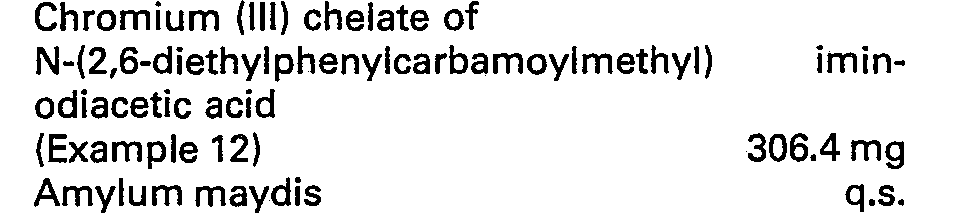
- The powder was mixed and filled in capsules. (Capsule size 0.) Each capsule contained 25 mg chromium.
- An autoclaved isotonic 28 mM solution of the disodium salt of N-(2,3,4,5,6-pentafluorophenylcar- bamoylmethyl)iminodiacetic acid in a 20 ml vial was prepared from:

- An autoclaved isotonic 25 mM solution of manganese chloride in a 10 ml vial was prepared from:

- The chelate was prepared by adding solution B to solution A. After mixing, the solution is ready for use.
- An autoclaved 60 mM isotonic solution of the disodium salt of N-(2,4,6-trimethylphenylcarbamoyl- methvl) iminodiacetic acid in a 20 ml vial was prepared from:

- An autoclaved isotonic 25 mM solution of gadolinium chloride in a 10 ml vial was prepared from:

- The chelate was prepared by adding solution B to solution A. After mixing, the solution is ready for use.
Claims (21)

Priority Applications (1)
| Application Number | Priority Date | Filing Date | Title |
|---|---|---|---|
| AT85303757T ATE39246T1 (en) | 1984-05-30 | 1985-05-29 | NMR CONTRAST AGENT. |
Applications Claiming Priority (2)
| Application Number | Priority Date | Filing Date | Title |
|---|---|---|---|
| GB848413772A GB8413772D0 (en) | 1984-05-30 | 1984-05-30 | Chemical compounds |
| GB8413772 | 1984-05-30 |
Publications (2)
| Publication Number | Publication Date |
|---|---|
| EP0165728A1 EP0165728A1 (en) | 1985-12-27 |
| EP0165728B1 true EP0165728B1 (en) | 1988-12-14 |
Family
ID=10561687
Family Applications (1)
| Application Number | Title | Priority Date | Filing Date |
|---|---|---|---|
| EP85303757A Expired EP0165728B1 (en) | 1984-05-30 | 1985-05-29 | Nmr contrast agents |
Country Status (16)
| Country | Link |
|---|---|
| US (2) | US4714607A (en) |
| EP (1) | EP0165728B1 (en) |
| JP (1) | JPS6133155A (en) |
| AT (1) | ATE39246T1 (en) |
| AU (1) | AU561599B2 (en) |
| CA (1) | CA1253799A (en) |
| DE (1) | DE3566801D1 (en) |
| DK (1) | DK165170C (en) |
| FI (1) | FI82683C (en) |
| GB (1) | GB8413772D0 (en) |
| IE (1) | IE58395B1 (en) |
| MX (1) | MX174636B (en) |
| NO (1) | NO168927C (en) |
| NZ (1) | NZ212242A (en) |
| PH (1) | PH22440A (en) |
| ZA (1) | ZA854132B (en) |
Cited By (1)
| Publication number | Priority date | Publication date | Assignee | Title |
|---|---|---|---|---|
| US7169410B1 (en) | 1998-05-19 | 2007-01-30 | Sdg, Inc. | Targeted liposomal drug delivery system |
Families Citing this family (37)
| Publication number | Priority date | Publication date | Assignee | Title |
|---|---|---|---|---|
| US5422096A (en) * | 1985-05-08 | 1995-06-06 | The General Hospital Corporation | Hydroxy-aryl metal chelates for diagnostic NMR imaging |
| US5250285A (en) * | 1985-05-08 | 1993-10-05 | The General Hospital Corporation | Hydroxy-aryl metal chelates for diagnostic NMR imaging |
| JPH07100666B2 (en) * | 1986-04-07 | 1995-11-01 | フランスワ ディエトラン | Contrast agent for density tomography |
| DE3640708C2 (en) * | 1986-11-28 | 1995-05-18 | Schering Ag | Improved pharmaceuticals containing metals |
| DE3709851A1 (en) * | 1987-03-24 | 1988-10-06 | Silica Gel Gmbh Adsorptions Te | NMR DIAGNOSTIC LIQUID COMPOSITIONS |
| DE3855239T2 (en) * | 1987-07-16 | 1996-10-31 | Nycomed Imaging As | Aminocarboxylic acid and derivatives |
| US5531978A (en) * | 1987-07-16 | 1996-07-02 | Nycomed Imaging As | Aminopolycarboxylic acids and derivatives thereof |
| US5399340A (en) * | 1987-09-24 | 1995-03-21 | Schering Aktiengesellschaft | Use of amide complex compounds |
| EP0325559B1 (en) * | 1988-01-20 | 1993-12-15 | Ciba-Geigy Ag | Process for the preparation of complex compounds |
| GB8801646D0 (en) * | 1988-01-26 | 1988-02-24 | Nycomed As | Chemical compounds |
| GB8808305D0 (en) * | 1988-04-08 | 1988-05-11 | Nycomed As | Compositions |
| US5045304A (en) * | 1988-08-31 | 1991-09-03 | Wayne State University | Contras agent having an imaging agent coupled to viable granulocytes for use in magnetic resonance imaging of abscess and a method of preparing and using same |
| US5145661A (en) * | 1988-08-31 | 1992-09-08 | Wayne State University | Method and contrast agent for use in magnetic resonance imaging of abscess |
| US5696239A (en) * | 1988-10-31 | 1997-12-09 | The Dow Chemical Company | Conjugates possessing ortho ligating functionality and complexes thereof |
| GB8900719D0 (en) * | 1989-01-13 | 1989-03-08 | Nycomed As | Compounds |
| GB8916781D0 (en) * | 1989-07-21 | 1989-09-06 | Nycomed As | Compositions |
| US5087440A (en) * | 1989-07-31 | 1992-02-11 | Salutar, Inc. | Heterocyclic derivatives of DTPA used for magnetic resonance imaging |
| GB9006606D0 (en) * | 1990-03-23 | 1990-05-23 | Allied Colloids Ltd | Chelate compositions and their production |
| US5342925A (en) * | 1991-01-30 | 1994-08-30 | The Dow Chemical Company | Radioactive compositions for soft tissue tumors |
| WO1993003045A1 (en) * | 1991-08-09 | 1993-02-18 | The Regents Of The University Of California | Process for purer organic metal ion chelate complexes |
| US5318770A (en) * | 1991-10-25 | 1994-06-07 | Mallinckrodt Medical, Inc. | Trifluoromethyl analogs of X-ray contrast media for magnetic resonance imaging |
| US5324503A (en) * | 1992-02-06 | 1994-06-28 | Mallinckrodt Medical, Inc. | Iodo-phenylated chelates for x-ray contrast |
| JPH06181890A (en) * | 1992-10-06 | 1994-07-05 | Terumo Corp | Mri opaque substance |
| US5730130A (en) * | 1993-02-12 | 1998-03-24 | Johnson & Johnson Professional, Inc. | Localization cap for fiducial markers |
| US5401493A (en) * | 1993-03-26 | 1995-03-28 | Molecular Biosystems, Inc. | Perfluoro-1H,-1H-neopentyl containing contrast agents and method to use same |
| JPH0797340A (en) * | 1993-06-03 | 1995-04-11 | Terumo Corp | Mri contrast medium composition |
| JP3075657B2 (en) * | 1993-10-15 | 2000-08-14 | 富士写真フイルム株式会社 | Photographic processing composition and processing method |
| US5582814A (en) * | 1994-04-15 | 1996-12-10 | Metasyn, Inc. | 1-(p-n-butylbenzyl) DTPA for magnetic resonance imaging |
| TW319763B (en) | 1995-02-01 | 1997-11-11 | Epix Medical Inc | |
| DE19507820A1 (en) * | 1995-02-21 | 1996-08-22 | Schering Ag | Novel substituted DTPA derivatives, their metal complexes, pharmaceutical compositions containing these complexes, their use in diagnostics, and methods for producing the complexes and compositions |
| DE19507819A1 (en) * | 1995-02-21 | 1996-08-22 | Schering Ag | New di:ethylene-tri:amine penta:acetic acid amide complexes |
| US6333971B2 (en) | 1995-06-07 | 2001-12-25 | George S. Allen | Fiducial marker |
| IT1297035B1 (en) | 1997-12-30 | 1999-08-03 | Bracco Spa | 1,4,7,10-TETRAAZACICLODODECAN-1,4-DIACETIC ACID DERIVATIVES |
| PL359249A1 (en) * | 2003-03-20 | 2004-10-04 | Uniwersytet Medyczny | New complexes of gadolinium ions Gd + 3 with derivatives of 2,2 '- (2- (R1, R2, R3, R4, R5-phenyl) amino) -2-oxoethyl)) diacetic acid and the method of obtaining new complexes of gadolinium ions Gd + 3 with 2,2 '- (2- (R1, R2, R3, R4, R5-phenyl) amino) -2-oxoethyl)) diacetic acid derivatives |
| US8669236B2 (en) | 2005-05-12 | 2014-03-11 | The General Hospital Corporation | Biotinylated compositions |
| DE102005059751A1 (en) * | 2005-12-09 | 2007-06-14 | Ferropharm Gmbh Forschungslabor | Aqueous dispersion of superparamagnetic single-domain particles, their preparation and use for diagnosis and therapy |
| CA2883130A1 (en) | 2012-08-31 | 2014-03-06 | The General Hospital Corporation | Biotin complexes for treatment and diagnosis of alzheimer's disease |
Family Cites Families (15)
| Publication number | Priority date | Publication date | Assignee | Title |
|---|---|---|---|---|
| US3158635A (en) * | 1959-03-18 | 1964-11-24 | Stauffer Chemical Co | Bis-adduction products and methods of preparing same |
| NL270278A (en) * | 1960-10-17 | |||
| US3687992A (en) * | 1969-09-29 | 1972-08-29 | Monsanto Co | Solid nitrilotriacetate-metal complexes |
| US4046793A (en) * | 1971-10-01 | 1977-09-06 | Ciba-Geigy Corporation | Chelates for the regulation of metal-deficiency phenomena in plants |
| US4017596A (en) * | 1975-03-03 | 1977-04-12 | Research Corporation | Radiopharmaceutical chelates and method of external imaging |
| CA1070695A (en) * | 1975-09-02 | 1980-01-29 | Michael D. Loberg | Iminodiacetic acid pharmaceutical |
| CH607920A5 (en) * | 1976-05-31 | 1978-12-15 | Solco Basel Ag | |
| DE2855334A1 (en) * | 1978-12-21 | 1980-07-10 | Hoechst Ag | TECHNETIUM-99M MARKED (2,4,5-TRIMETHYLACETANILIDO) IMINODIACETATE FOR LIVER FUNCTION DIAGNOSTICS AND METHOD FOR THE PRODUCTION THEREOF |
| US4308249A (en) * | 1979-12-13 | 1981-12-29 | G. D. Searle & Co. | Radiopharmaceutical complexes of N-(tri-substituted alkyl)-iminodiacetic acids |
| CA1187897A (en) * | 1980-12-29 | 1985-05-28 | Adrian D. Nunn | N-substituted iminodiacetic acids |
| US4418208A (en) * | 1980-12-29 | 1983-11-29 | E. R. Squibb & Sons, Inc. | N-Substituted iminodiacetic acids |
| DE3129906C3 (en) * | 1981-07-24 | 1996-12-19 | Schering Ag | Paramagnetic complex salts, their preparation and agents for use in NMR diagnostics |
| US4472509A (en) * | 1982-06-07 | 1984-09-18 | Gansow Otto A | Metal chelate conjugated monoclonal antibodies |
| DE3324235A1 (en) * | 1983-07-01 | 1985-01-10 | Schering AG, 1000 Berlin und 4709 Bergkamen | NEW COMPLEX ILLUMINATORS, COMPLEX AND COMPLEX SALTS |
| US4612185A (en) * | 1984-10-15 | 1986-09-16 | Mallinckrodt, Inc. | Methods and compositions for enhancing magnetic resonance imaging |
-
1984
- 1984-05-30 GB GB848413772A patent/GB8413772D0/en active Pending
-
1985
- 1985-05-29 PH PH32331A patent/PH22440A/en unknown
- 1985-05-29 NZ NZ212242A patent/NZ212242A/en unknown
- 1985-05-29 DE DE8585303757T patent/DE3566801D1/en not_active Expired
- 1985-05-29 CA CA000482659A patent/CA1253799A/en not_active Expired
- 1985-05-29 IE IE132985A patent/IE58395B1/en not_active IP Right Cessation
- 1985-05-29 FI FI852138A patent/FI82683C/en not_active IP Right Cessation
- 1985-05-29 EP EP85303757A patent/EP0165728B1/en not_active Expired
- 1985-05-29 AT AT85303757T patent/ATE39246T1/en not_active IP Right Cessation
- 1985-05-29 NO NO852137A patent/NO168927C/en unknown
- 1985-05-29 DK DK238785A patent/DK165170C/en not_active IP Right Cessation
- 1985-05-30 AU AU43171/85A patent/AU561599B2/en not_active Ceased
- 1985-05-30 US US06/739,228 patent/US4714607A/en not_active Expired - Lifetime
- 1985-05-30 MX MX205459A patent/MX174636B/en unknown
- 1985-05-30 JP JP11553385A patent/JPS6133155A/en active Granted
- 1985-05-30 ZA ZA854132A patent/ZA854132B/en unknown
-
1987
- 1987-09-29 US US07/102,533 patent/US4760173A/en not_active Expired - Fee Related
Non-Patent Citations (1)
| Title |
|---|
| Weinmann, AJR 142:619-624 (1984) * |
Cited By (1)
| Publication number | Priority date | Publication date | Assignee | Title |
|---|---|---|---|---|
| US7169410B1 (en) | 1998-05-19 | 2007-01-30 | Sdg, Inc. | Targeted liposomal drug delivery system |
Also Published As
| Publication number | Publication date |
|---|---|
| FI852138L (en) | 1985-12-01 |
| AU561599B2 (en) | 1987-05-14 |
| DK238785A (en) | 1985-12-01 |
| NZ212242A (en) | 1989-07-27 |
| NO852137L (en) | 1985-12-02 |
| GB8413772D0 (en) | 1984-07-04 |
| DK238785D0 (en) | 1985-05-29 |
| EP0165728A1 (en) | 1985-12-27 |
| ZA854132B (en) | 1986-07-30 |
| MX174636B (en) | 1994-05-30 |
| PH22440A (en) | 1988-09-12 |
| NO168927B (en) | 1992-01-13 |
| FI82683C (en) | 1991-04-10 |
| IE851329L (en) | 1985-11-30 |
| DE3566801D1 (en) | 1989-01-19 |
| US4714607A (en) | 1987-12-22 |
| DK165170B (en) | 1992-10-19 |
| ATE39246T1 (en) | 1988-12-15 |
| DK165170C (en) | 1993-03-01 |
| IE58395B1 (en) | 1993-09-08 |
| MX205459A (en) | 1993-10-01 |
| FI852138A0 (en) | 1985-05-29 |
| JPS6133155A (en) | 1986-02-17 |
| JPH0469625B2 (en) | 1992-11-06 |
| NO168927C (en) | 1992-04-22 |
| AU4317185A (en) | 1985-12-05 |
| CA1253799A (en) | 1989-05-09 |
| FI82683B (en) | 1990-12-31 |
| US4760173A (en) | 1988-07-26 |
Similar Documents
| Publication | Publication Date | Title |
|---|---|---|
| US4760173A (en) | NMR contrast agents | |
| US5362475A (en) | Gadolinium chelates for magnetic resonance imaging | |
| US5846515A (en) | Calixarene conjugate diagnostic agents for computerized tomography and method for using same | |
| US5746995A (en) | DTPA derivatives substituted in a novel way, their metal complexes, and their use in diagnosis and therapy | |
| US7074387B2 (en) | DTPA monoamides, pharmaceutical agents containing these compounds, their use and process for their production | |
| EP0436579B1 (en) | Chelate compositions | |
| US5348954A (en) | Heterocyclic chelating agents | |
| US5138039A (en) | Chelating compounds and their use | |
| US5409689A (en) | MRI image enhancement using complexes of paramagnetic cations and amine ligands containing a mixture of phosphonate and non-phosphonate pendant arms | |
| IE67551B1 (en) | Macrocyclic chelating agents and chelates thereof | |
| US5648063A (en) | Sterile composition comprising a chelate complex for magnetic resonance imaging | |
| US5010191A (en) | Imaging agents for in vivo magnetic resonance and scintigraphic imaging | |
| EP0739337A4 (en) | Functionalized macrocyclic ligands for imaging applications | |
| EP0565930A1 (en) | Tetraazacyclododecane tetraacetic acid derivatives and the use thereof as diagnostic agents | |
| EP0755385A1 (en) | Chelant compounds | |
| US5695737A (en) | Dimeric DTPA derivatives, their metal complexes and pharmaceutical agents containing these complexes | |
| EP0563145A1 (en) | Chelating agents | |
| US5919431A (en) | 1,4,7,10-tetraazacyclododecane derivatives, their use, pharmaceutical agents containing these compounds and process for their production | |
| US5344639A (en) | Contrast agent for NMR imaging comprising peptide structures | |
| US5858329A (en) | MRI diagnostic procedures using tripodal pyridinyl metal complexes | |
| US20250064993A1 (en) | Novel bispidine-based metal chelating ligands displaying good relaxivity | |
| US5820851A (en) | Tripodal pyridine ligands as MRI contrast agents | |
| US5843399A (en) | DTPA monoamides for MRI | |
| US5824288A (en) | Thio-substituted pyridines as MRI ligand precursors | |
| CA1335819C (en) | Metal chelate containing diagnostic imaging contrast media |
Legal Events
| Date | Code | Title | Description |
|---|---|---|---|
| PUAI | Public reference made under article 153(3) epc to a published international application that has entered the european phase |
Free format text: ORIGINAL CODE: 0009012 |
|
| AK | Designated contracting states |
Designated state(s): AT BE CH DE FR GB IT LI LU NL SE |
|
| 17P | Request for examination filed |
Effective date: 19860205 |
|
| RAP1 | Party data changed (applicant data changed or rights of an application transferred) |
Owner name: NYCOMED AS |
|
| 17Q | First examination report despatched |
Effective date: 19870629 |
|
| GRAA | (expected) grant |
Free format text: ORIGINAL CODE: 0009210 |
|
| AK | Designated contracting states |
Kind code of ref document: B1 Designated state(s): AT BE CH DE FR GB IT LI LU NL SE |
|
| REF | Corresponds to: |
Ref document number: 39246 Country of ref document: AT Date of ref document: 19881215 Kind code of ref document: T |
|
| REF | Corresponds to: |
Ref document number: 3566801 Country of ref document: DE Date of ref document: 19890119 |
|
| ITF | It: translation for a ep patent filed | ||
| ET | Fr: translation filed | ||
| PLBE | No opposition filed within time limit |
Free format text: ORIGINAL CODE: 0009261 |
|
| STAA | Information on the status of an ep patent application or granted ep patent |
Free format text: STATUS: NO OPPOSITION FILED WITHIN TIME LIMIT |
|
| 26N | No opposition filed | ||
| ITTA | It: last paid annual fee | ||
| EPTA | Lu: last paid annual fee | ||
| EAL | Se: european patent in force in sweden |
Ref document number: 85303757.0 |
|
| PGFP | Annual fee paid to national office [announced via postgrant information from national office to epo] |
Ref country code: LU Payment date: 19950501 Year of fee payment: 11 |
|
| PGFP | Annual fee paid to national office [announced via postgrant information from national office to epo] |
Ref country code: SE Payment date: 19950515 Year of fee payment: 11 |
|
| PGFP | Annual fee paid to national office [announced via postgrant information from national office to epo] |
Ref country code: AT Payment date: 19950530 Year of fee payment: 11 |
|
| PGFP | Annual fee paid to national office [announced via postgrant information from national office to epo] |
Ref country code: NL Payment date: 19950531 Year of fee payment: 11 |
|
| PGFP | Annual fee paid to national office [announced via postgrant information from national office to epo] |
Ref country code: BE Payment date: 19950607 Year of fee payment: 11 |
|
| PGFP | Annual fee paid to national office [announced via postgrant information from national office to epo] |
Ref country code: CH Payment date: 19950627 Year of fee payment: 11 |
|
| PG25 | Lapsed in a contracting state [announced via postgrant information from national office to epo] |
Ref country code: LU Free format text: LAPSE BECAUSE OF NON-PAYMENT OF DUE FEES Effective date: 19960529 Ref country code: AT Effective date: 19960529 |
|
| PG25 | Lapsed in a contracting state [announced via postgrant information from national office to epo] |
Ref country code: SE Effective date: 19960530 |
|
| PG25 | Lapsed in a contracting state [announced via postgrant information from national office to epo] |
Ref country code: LI Effective date: 19960531 Ref country code: CH Effective date: 19960531 Ref country code: BE Effective date: 19960531 |
|
| BERE | Be: lapsed |
Owner name: NYCOMED A/S Effective date: 19960531 |
|
| PG25 | Lapsed in a contracting state [announced via postgrant information from national office to epo] |
Ref country code: NL Effective date: 19961201 |
|
| REG | Reference to a national code |
Ref country code: CH Ref legal event code: PL |
|
| EUG | Se: european patent has lapsed |
Ref document number: 85303757.0 |
|
| NLV4 | Nl: lapsed or anulled due to non-payment of the annual fee |
Effective date: 19961201 |
|
| PGFP | Annual fee paid to national office [announced via postgrant information from national office to epo] |
Ref country code: FR Payment date: 19990512 Year of fee payment: 15 |
|
| PGFP | Annual fee paid to national office [announced via postgrant information from national office to epo] |
Ref country code: GB Payment date: 19990527 Year of fee payment: 15 |
|
| PGFP | Annual fee paid to national office [announced via postgrant information from national office to epo] |
Ref country code: DE Payment date: 19990531 Year of fee payment: 15 |
|
| PG25 | Lapsed in a contracting state [announced via postgrant information from national office to epo] |
Ref country code: GB Free format text: LAPSE BECAUSE OF NON-PAYMENT OF DUE FEES Effective date: 20000529 |
|
| GBPC | Gb: european patent ceased through non-payment of renewal fee |
Effective date: 20000529 |
|
| PG25 | Lapsed in a contracting state [announced via postgrant information from national office to epo] |
Ref country code: FR Free format text: LAPSE BECAUSE OF NON-PAYMENT OF DUE FEES Effective date: 20010131 |
|
| PG25 | Lapsed in a contracting state [announced via postgrant information from national office to epo] |
Ref country code: DE Free format text: LAPSE BECAUSE OF NON-PAYMENT OF DUE FEES Effective date: 20010301 |
|
| REG | Reference to a national code |
Ref country code: FR Ref legal event code: ST |