EP0165059A2 - Low-surface energy material - Google Patents
Low-surface energy material Download PDFInfo
- Publication number
- EP0165059A2 EP0165059A2 EP85304180A EP85304180A EP0165059A2 EP 0165059 A2 EP0165059 A2 EP 0165059A2 EP 85304180 A EP85304180 A EP 85304180A EP 85304180 A EP85304180 A EP 85304180A EP 0165059 A2 EP0165059 A2 EP 0165059A2
- Authority
- EP
- European Patent Office
- Prior art keywords
- ethylenically
- unsaturated
- perfluoropolyether
- groups
- composition
- Prior art date
- Legal status (The legal status is an assumption and is not a legal conclusion. Google has not performed a legal analysis and makes no representation as to the accuracy of the status listed.)
- Granted
Links
- 239000000463 material Substances 0.000 title claims abstract description 18
- 239000010702 perfluoropolyether Substances 0.000 claims abstract description 58
- 238000000576 coating method Methods 0.000 claims abstract description 54
- 239000011248 coating agent Substances 0.000 claims abstract description 36
- 239000000758 substrate Substances 0.000 claims abstract description 27
- 238000006459 hydrosilylation reaction Methods 0.000 claims abstract description 19
- 239000001257 hydrogen Substances 0.000 claims abstract description 14
- 229910052739 hydrogen Inorganic materials 0.000 claims abstract description 14
- -1 perfluoroethyleneoxy Chemical group 0.000 claims description 57
- 239000000203 mixture Substances 0.000 claims description 36
- 239000000853 adhesive Substances 0.000 claims description 30
- 230000001070 adhesive effect Effects 0.000 claims description 30
- 239000000178 monomer Substances 0.000 claims description 27
- 239000003054 catalyst Substances 0.000 claims description 23
- 238000000034 method Methods 0.000 claims description 17
- 125000000217 alkyl group Chemical group 0.000 claims description 14
- 239000004820 Pressure-sensitive adhesive Substances 0.000 claims description 12
- 125000004432 carbon atom Chemical group C* 0.000 claims description 11
- 125000004435 hydrogen atom Chemical group [H]* 0.000 claims description 11
- XUIMIQQOPSSXEZ-UHFFFAOYSA-N Silicon Chemical group [Si] XUIMIQQOPSSXEZ-UHFFFAOYSA-N 0.000 claims description 9
- 125000004122 cyclic group Chemical group 0.000 claims description 7
- 230000005855 radiation Effects 0.000 claims description 7
- 125000000962 organic group Chemical group 0.000 claims description 6
- 230000008569 process Effects 0.000 claims description 6
- 238000012546 transfer Methods 0.000 claims description 6
- 125000001997 phenyl group Chemical group [H]C1=C([H])C([H])=C(*)C([H])=C1[H] 0.000 claims description 5
- 229910052736 halogen Inorganic materials 0.000 claims description 4
- 150000002367 halogens Chemical class 0.000 claims description 4
- 125000005647 linker group Chemical group 0.000 claims description 4
- 229910052710 silicon Inorganic materials 0.000 claims description 4
- 125000003545 alkoxy group Chemical group 0.000 claims description 3
- 125000000753 cycloalkyl group Chemical group 0.000 claims description 3
- 125000004183 alkoxy alkyl group Chemical group 0.000 claims description 2
- 125000005037 alkyl phenyl group Chemical group 0.000 claims description 2
- 238000009833 condensation Methods 0.000 claims description 2
- 230000005494 condensation Effects 0.000 claims description 2
- 239000003960 organic solvent Substances 0.000 claims description 2
- 125000003884 phenylalkyl group Chemical group 0.000 claims description 2
- 125000004950 trifluoroalkyl group Chemical group 0.000 claims description 2
- 150000001875 compounds Chemical class 0.000 abstract description 13
- UFHFLCQGNIYNRP-UHFFFAOYSA-N Hydrogen Chemical compound [H][H] UFHFLCQGNIYNRP-UHFFFAOYSA-N 0.000 abstract description 6
- 239000007795 chemical reaction product Substances 0.000 abstract description 3
- 238000010411 cooking Methods 0.000 abstract description 2
- 239000002390 adhesive tape Substances 0.000 abstract 1
- BASFCYQUMIYNBI-UHFFFAOYSA-N platinum Chemical compound [Pt] BASFCYQUMIYNBI-UHFFFAOYSA-N 0.000 description 41
- 229910052697 platinum Inorganic materials 0.000 description 21
- 238000006243 chemical reaction Methods 0.000 description 12
- 229920000139 polyethylene terephthalate Polymers 0.000 description 12
- 239000005020 polyethylene terephthalate Substances 0.000 description 12
- AJDIZQLSFPQPEY-UHFFFAOYSA-N 1,1,2-Trichlorotrifluoroethane Chemical compound FC(F)(Cl)C(F)(Cl)Cl AJDIZQLSFPQPEY-UHFFFAOYSA-N 0.000 description 11
- 239000013464 silicone adhesive Substances 0.000 description 10
- 238000012360 testing method Methods 0.000 description 10
- GWEVSGVZZGPLCZ-UHFFFAOYSA-N Titan oxide Chemical compound O=[Ti]=O GWEVSGVZZGPLCZ-UHFFFAOYSA-N 0.000 description 9
- 229920001843 polymethylhydrosiloxane Polymers 0.000 description 8
- 239000011521 glass Substances 0.000 description 7
- 239000004408 titanium dioxide Substances 0.000 description 7
- 125000003903 2-propenyl group Chemical group [H]C([*])([H])C([H])=C([H])[H] 0.000 description 6
- 229920001971 elastomer Polymers 0.000 description 6
- 239000005060 rubber Substances 0.000 description 6
- 230000032683 aging Effects 0.000 description 5
- 235000013870 dimethyl polysiloxane Nutrition 0.000 description 5
- 239000012530 fluid Substances 0.000 description 5
- 229920000435 poly(dimethylsiloxane) Polymers 0.000 description 5
- 238000002360 preparation method Methods 0.000 description 5
- 0 CC(C)(C1)CC(C)(*)CC1*(C)=O Chemical compound CC(C)(C1)CC(C)(*)CC1*(C)=O 0.000 description 4
- YCKRFDGAMUMZLT-UHFFFAOYSA-N Fluorine atom Chemical compound [F] YCKRFDGAMUMZLT-UHFFFAOYSA-N 0.000 description 4
- 239000004205 dimethyl polysiloxane Substances 0.000 description 4
- 229910052731 fluorine Inorganic materials 0.000 description 4
- 239000011737 fluorine Substances 0.000 description 4
- VXUYXOFXAQZZMF-UHFFFAOYSA-N titanium(IV) isopropoxide Chemical compound CC(C)O[Ti](OC(C)C)(OC(C)C)OC(C)C VXUYXOFXAQZZMF-UHFFFAOYSA-N 0.000 description 4
- LFQSCWFLJHTTHZ-UHFFFAOYSA-N Ethanol Chemical compound CCO LFQSCWFLJHTTHZ-UHFFFAOYSA-N 0.000 description 3
- KWYUFKZDYYNOTN-UHFFFAOYSA-M Potassium hydroxide Chemical compound [OH-].[K+] KWYUFKZDYYNOTN-UHFFFAOYSA-M 0.000 description 3
- VYPSYNLAJGMNEJ-UHFFFAOYSA-N Silicium dioxide Chemical compound O=[Si]=O VYPSYNLAJGMNEJ-UHFFFAOYSA-N 0.000 description 3
- YXFVVABEGXRONW-UHFFFAOYSA-N Toluene Chemical compound CC1=CC=CC=C1 YXFVVABEGXRONW-UHFFFAOYSA-N 0.000 description 3
- 150000002148 esters Chemical class 0.000 description 3
- 229910052751 metal Inorganic materials 0.000 description 3
- 239000002184 metal Substances 0.000 description 3
- 229920001296 polysiloxane Polymers 0.000 description 3
- 239000000047 product Substances 0.000 description 3
- 229920005989 resin Polymers 0.000 description 3
- 239000011347 resin Substances 0.000 description 3
- 239000002904 solvent Substances 0.000 description 3
- QTBSBXVTEAMEQO-UHFFFAOYSA-N Acetic acid Chemical compound CC(O)=O QTBSBXVTEAMEQO-UHFFFAOYSA-N 0.000 description 2
- NIXOWILDQLNWCW-UHFFFAOYSA-M Acrylate Chemical compound [O-]C(=O)C=C NIXOWILDQLNWCW-UHFFFAOYSA-M 0.000 description 2
- VVJKKWFAADXIJK-UHFFFAOYSA-N Allylamine Chemical compound NCC=C VVJKKWFAADXIJK-UHFFFAOYSA-N 0.000 description 2
- IJGRMHOSHXDMSA-UHFFFAOYSA-N Atomic nitrogen Chemical compound N#N IJGRMHOSHXDMSA-UHFFFAOYSA-N 0.000 description 2
- BPQQTUXANYXVAA-UHFFFAOYSA-N Orthosilicate Chemical compound [O-][Si]([O-])([O-])[O-] BPQQTUXANYXVAA-UHFFFAOYSA-N 0.000 description 2
- KDLHZDBZIXYQEI-UHFFFAOYSA-N Palladium Chemical compound [Pd] KDLHZDBZIXYQEI-UHFFFAOYSA-N 0.000 description 2
- 229920001328 Polyvinylidene chloride Polymers 0.000 description 2
- 150000001298 alcohols Chemical class 0.000 description 2
- 125000005907 alkyl ester group Chemical group 0.000 description 2
- 150000001408 amides Chemical class 0.000 description 2
- QVGXLLKOCUKJST-UHFFFAOYSA-N atomic oxygen Chemical compound [O] QVGXLLKOCUKJST-UHFFFAOYSA-N 0.000 description 2
- 229910052799 carbon Inorganic materials 0.000 description 2
- 239000008199 coating composition Substances 0.000 description 2
- 239000008119 colloidal silica Substances 0.000 description 2
- 238000010276 construction Methods 0.000 description 2
- 150000004820 halides Chemical class 0.000 description 2
- 150000002431 hydrogen Chemical class 0.000 description 2
- 125000002496 methyl group Chemical group [H]C([H])([H])* 0.000 description 2
- 230000004048 modification Effects 0.000 description 2
- 238000012986 modification Methods 0.000 description 2
- 239000003607 modifier Substances 0.000 description 2
- 229920000620 organic polymer Polymers 0.000 description 2
- 229910052760 oxygen Inorganic materials 0.000 description 2
- 239000001301 oxygen Substances 0.000 description 2
- 125000004430 oxygen atom Chemical group O* 0.000 description 2
- 229920000728 polyester Polymers 0.000 description 2
- 229920000642 polymer Polymers 0.000 description 2
- 150000003254 radicals Chemical class 0.000 description 2
- 238000010998 test method Methods 0.000 description 2
- KWEKXPWNFQBJAY-UHFFFAOYSA-N (dimethyl-$l^{3}-silanyl)oxy-dimethylsilicon Chemical compound C[Si](C)O[Si](C)C KWEKXPWNFQBJAY-UHFFFAOYSA-N 0.000 description 1
- WZJUBBHODHNQPW-UHFFFAOYSA-N 2,4,6,8-tetramethyl-1,3,5,7,2$l^{3},4$l^{3},6$l^{3},8$l^{3}-tetraoxatetrasilocane Chemical compound C[Si]1O[Si](C)O[Si](C)O[Si](C)O1 WZJUBBHODHNQPW-UHFFFAOYSA-N 0.000 description 1
- SMZOUWXMTYCWNB-UHFFFAOYSA-N 2-(2-methoxy-5-methylphenyl)ethanamine Chemical compound COC1=CC=C(C)C=C1CCN SMZOUWXMTYCWNB-UHFFFAOYSA-N 0.000 description 1
- ATVJXMYDOSMEPO-UHFFFAOYSA-N 3-prop-2-enoxyprop-1-ene Chemical compound C=CCOCC=C ATVJXMYDOSMEPO-UHFFFAOYSA-N 0.000 description 1
- WKBOTKDWSSQWDR-UHFFFAOYSA-N Bromine atom Chemical compound [Br] WKBOTKDWSSQWDR-UHFFFAOYSA-N 0.000 description 1
- OKTJSMMVPCPJKN-UHFFFAOYSA-N Carbon Chemical compound [C] OKTJSMMVPCPJKN-UHFFFAOYSA-N 0.000 description 1
- 239000004215 Carbon black (E152) Substances 0.000 description 1
- ZAMOUSCENKQFHK-UHFFFAOYSA-N Chlorine atom Chemical compound [Cl] ZAMOUSCENKQFHK-UHFFFAOYSA-N 0.000 description 1
- SNRUBQQJIBEYMU-UHFFFAOYSA-N Dodecane Natural products CCCCCCCCCCCC SNRUBQQJIBEYMU-UHFFFAOYSA-N 0.000 description 1
- JOYRKODLDBILNP-UHFFFAOYSA-N Ethyl urethane Chemical compound CCOC(N)=O JOYRKODLDBILNP-UHFFFAOYSA-N 0.000 description 1
- 229910004723 HSiO1.5 Inorganic materials 0.000 description 1
- CERQOIWHTDAKMF-UHFFFAOYSA-M Methacrylate Chemical compound CC(=C)C([O-])=O CERQOIWHTDAKMF-UHFFFAOYSA-M 0.000 description 1
- CERQOIWHTDAKMF-UHFFFAOYSA-N Methacrylic acid Chemical compound CC(=C)C(O)=O CERQOIWHTDAKMF-UHFFFAOYSA-N 0.000 description 1
- 239000004952 Polyamide Substances 0.000 description 1
- 239000004721 Polyphenylene oxide Substances 0.000 description 1
- KEAYESYHFKHZAL-UHFFFAOYSA-N Sodium Chemical compound [Na] KEAYESYHFKHZAL-UHFFFAOYSA-N 0.000 description 1
- NINIDFKCEFEMDL-UHFFFAOYSA-N Sulfur Chemical compound [S] NINIDFKCEFEMDL-UHFFFAOYSA-N 0.000 description 1
- RTAQQCXQSZGOHL-UHFFFAOYSA-N Titanium Chemical compound [Ti] RTAQQCXQSZGOHL-UHFFFAOYSA-N 0.000 description 1
- 229960000583 acetic acid Drugs 0.000 description 1
- 239000003377 acid catalyst Substances 0.000 description 1
- NIXOWILDQLNWCW-UHFFFAOYSA-N acrylic acid group Chemical group C(C=C)(=O)O NIXOWILDQLNWCW-UHFFFAOYSA-N 0.000 description 1
- 150000001266 acyl halides Chemical class 0.000 description 1
- 239000000654 additive Substances 0.000 description 1
- 230000001476 alcoholic effect Effects 0.000 description 1
- 125000001931 aliphatic group Chemical group 0.000 description 1
- BHELZAPQIKSEDF-UHFFFAOYSA-N allyl bromide Chemical compound BrCC=C BHELZAPQIKSEDF-UHFFFAOYSA-N 0.000 description 1
- HXBPYFMVGFDZFT-UHFFFAOYSA-N allyl isocyanate Chemical compound C=CCN=C=O HXBPYFMVGFDZFT-UHFFFAOYSA-N 0.000 description 1
- 230000004075 alteration Effects 0.000 description 1
- PNEYBMLMFCGWSK-UHFFFAOYSA-N aluminium oxide Inorganic materials [O-2].[O-2].[O-2].[Al+3].[Al+3] PNEYBMLMFCGWSK-UHFFFAOYSA-N 0.000 description 1
- 230000009435 amidation Effects 0.000 description 1
- 238000007112 amidation reaction Methods 0.000 description 1
- 150000008064 anhydrides Chemical class 0.000 description 1
- 229940045985 antineoplastic platinum compound Drugs 0.000 description 1
- 125000003710 aryl alkyl group Chemical group 0.000 description 1
- 125000003118 aryl group Chemical group 0.000 description 1
- 125000004429 atom Chemical group 0.000 description 1
- 125000001797 benzyl group Chemical group [H]C1=C([H])C([H])=C(C([H])=C1[H])C([H])([H])* 0.000 description 1
- 239000011230 binding agent Substances 0.000 description 1
- FSIJKGMIQTVTNP-UHFFFAOYSA-N bis(ethenyl)-methyl-trimethylsilyloxysilane Chemical compound C[Si](C)(C)O[Si](C)(C=C)C=C FSIJKGMIQTVTNP-UHFFFAOYSA-N 0.000 description 1
- GDTBXPJZTBHREO-UHFFFAOYSA-N bromine Substances BrBr GDTBXPJZTBHREO-UHFFFAOYSA-N 0.000 description 1
- 229910052794 bromium Inorganic materials 0.000 description 1
- 230000001680 brushing effect Effects 0.000 description 1
- ABBZJHFBQXYTLU-UHFFFAOYSA-N but-3-enamide Chemical compound NC(=O)CC=C ABBZJHFBQXYTLU-UHFFFAOYSA-N 0.000 description 1
- 125000000484 butyl group Chemical group [H]C([*])([H])C([H])([H])C([H])([H])C([H])([H])[H] 0.000 description 1
- 150000001721 carbon Chemical group 0.000 description 1
- 239000006229 carbon black Substances 0.000 description 1
- 238000005266 casting Methods 0.000 description 1
- 239000000919 ceramic Substances 0.000 description 1
- 239000003795 chemical substances by application Substances 0.000 description 1
- 239000000460 chlorine Substances 0.000 description 1
- 229910052801 chlorine Inorganic materials 0.000 description 1
- 125000004218 chloromethyl group Chemical group [H]C([H])(Cl)* 0.000 description 1
- 125000000068 chlorophenyl group Chemical group 0.000 description 1
- 238000007766 curtain coating Methods 0.000 description 1
- 125000004966 cyanoalkyl group Chemical group 0.000 description 1
- 150000001923 cyclic compounds Chemical class 0.000 description 1
- 125000000582 cycloheptyl group Chemical group [H]C1([H])C([H])([H])C([H])([H])C([H])([H])C([H])(*)C([H])([H])C1([H])[H] 0.000 description 1
- 125000000113 cyclohexyl group Chemical group [H]C1([H])C([H])([H])C([H])([H])C([H])(*)C([H])([H])C1([H])[H] 0.000 description 1
- 125000000058 cyclopentadienyl group Chemical group C1(=CC=CC1)* 0.000 description 1
- 125000001511 cyclopentyl group Chemical group [H]C1([H])C([H])([H])C([H])([H])C([H])(*)C1([H])[H] 0.000 description 1
- 230000001419 dependent effect Effects 0.000 description 1
- 125000004386 diacrylate group Chemical group 0.000 description 1
- 125000004212 difluorophenyl group Chemical group 0.000 description 1
- 125000005442 diisocyanate group Chemical group 0.000 description 1
- 125000000118 dimethyl group Chemical group [H]C([H])([H])* 0.000 description 1
- UOUILILVWRHZSH-UHFFFAOYSA-N dimethyl-tris[(dimethyl-$l^{3}-silanyl)oxy]silyloxysilicon Chemical compound C[Si](C)O[Si](O[Si](C)C)(O[Si](C)C)O[Si](C)C UOUILILVWRHZSH-UHFFFAOYSA-N 0.000 description 1
- 150000002009 diols Chemical class 0.000 description 1
- 229920005645 diorganopolysiloxane polymer Polymers 0.000 description 1
- LRCFXGAMWKDGLA-UHFFFAOYSA-N dioxosilane;hydrate Chemical compound O.O=[Si]=O LRCFXGAMWKDGLA-UHFFFAOYSA-N 0.000 description 1
- KPUWHANPEXNPJT-UHFFFAOYSA-N disiloxane Chemical class [SiH3]O[SiH3] KPUWHANPEXNPJT-UHFFFAOYSA-N 0.000 description 1
- 125000003438 dodecyl group Chemical group [H]C([H])([H])C([H])([H])C([H])([H])C([H])([H])C([H])([H])C([H])([H])C([H])([H])C([H])([H])C([H])([H])C([H])([H])C([H])([H])C([H])([H])* 0.000 description 1
- 239000000975 dye Substances 0.000 description 1
- 230000000694 effects Effects 0.000 description 1
- 238000010894 electron beam technology Methods 0.000 description 1
- 238000005516 engineering process Methods 0.000 description 1
- 230000032050 esterification Effects 0.000 description 1
- 238000005886 esterification reaction Methods 0.000 description 1
- 238000006266 etherification reaction Methods 0.000 description 1
- 150000002170 ethers Chemical class 0.000 description 1
- 125000001495 ethyl group Chemical group [H]C([H])([H])C([H])([H])* 0.000 description 1
- 238000002474 experimental method Methods 0.000 description 1
- 239000000835 fiber Substances 0.000 description 1
- 239000012467 final product Substances 0.000 description 1
- 229910021485 fumed silica Inorganic materials 0.000 description 1
- 125000000524 functional group Chemical group 0.000 description 1
- 239000012362 glacial acetic acid Substances 0.000 description 1
- 229920000578 graft copolymer Polymers 0.000 description 1
- 238000007756 gravure coating Methods 0.000 description 1
- 229930195733 hydrocarbon Natural products 0.000 description 1
- CBOIHMRHGLHBPB-UHFFFAOYSA-N hydroxymethyl Chemical compound O[CH2] CBOIHMRHGLHBPB-UHFFFAOYSA-N 0.000 description 1
- 239000004615 ingredient Substances 0.000 description 1
- 239000003112 inhibitor Substances 0.000 description 1
- 239000000543 intermediate Substances 0.000 description 1
- 229910052741 iridium Inorganic materials 0.000 description 1
- GKOZUEZYRPOHIO-UHFFFAOYSA-N iridium atom Chemical compound [Ir] GKOZUEZYRPOHIO-UHFFFAOYSA-N 0.000 description 1
- UQSXHKLRYXJYBZ-UHFFFAOYSA-N iron oxide Inorganic materials [Fe]=O UQSXHKLRYXJYBZ-UHFFFAOYSA-N 0.000 description 1
- 239000012948 isocyanate Substances 0.000 description 1
- 150000002513 isocyanates Chemical class 0.000 description 1
- 125000001449 isopropyl group Chemical group [H]C([H])([H])C([H])(*)C([H])([H])[H] 0.000 description 1
- 239000012280 lithium aluminium hydride Substances 0.000 description 1
- 239000000314 lubricant Substances 0.000 description 1
- 150000002739 metals Chemical class 0.000 description 1
- RBQRWNWVPQDTJJ-UHFFFAOYSA-N methacryloyloxyethyl isocyanate Chemical compound CC(=C)C(=O)OCCN=C=O RBQRWNWVPQDTJJ-UHFFFAOYSA-N 0.000 description 1
- OFLMWACNYIOTNX-UHFFFAOYSA-N methyl(methylsilyloxy)silane Chemical compound C[SiH2]O[SiH2]C OFLMWACNYIOTNX-UHFFFAOYSA-N 0.000 description 1
- DYUWTXWIYMHBQS-UHFFFAOYSA-N n-prop-2-enylprop-2-en-1-amine Chemical compound C=CCNCC=C DYUWTXWIYMHBQS-UHFFFAOYSA-N 0.000 description 1
- 125000001624 naphthyl group Chemical group 0.000 description 1
- 229910052757 nitrogen Inorganic materials 0.000 description 1
- QGLKJKCYBOYXKC-UHFFFAOYSA-N nonaoxidotritungsten Chemical compound O=[W]1(=O)O[W](=O)(=O)O[W](=O)(=O)O1 QGLKJKCYBOYXKC-UHFFFAOYSA-N 0.000 description 1
- 125000002347 octyl group Chemical group [H]C([*])([H])C([H])([H])C([H])([H])C([H])([H])C([H])([H])C([H])([H])C([H])([H])C([H])([H])[H] 0.000 description 1
- 150000001282 organosilanes Chemical class 0.000 description 1
- NDLPOXTZKUMGOV-UHFFFAOYSA-N oxo(oxoferriooxy)iron hydrate Chemical compound O.O=[Fe]O[Fe]=O NDLPOXTZKUMGOV-UHFFFAOYSA-N 0.000 description 1
- 229910052763 palladium Inorganic materials 0.000 description 1
- 239000002245 particle Substances 0.000 description 1
- YVBBRRALBYAZBM-UHFFFAOYSA-N perfluorooctane Chemical compound FC(F)(F)C(F)(F)C(F)(F)C(F)(F)C(F)(F)C(F)(F)C(F)(F)C(F)(F)F YVBBRRALBYAZBM-UHFFFAOYSA-N 0.000 description 1
- 125000000286 phenylethyl group Chemical group [H]C1=C([H])C([H])=C(C([H])=C1[H])C([H])([H])C([H])([H])* 0.000 description 1
- 125000004344 phenylpropyl group Chemical group 0.000 description 1
- 239000000049 pigment Substances 0.000 description 1
- 150000003057 platinum Chemical class 0.000 description 1
- 150000003058 platinum compounds Chemical class 0.000 description 1
- 239000002574 poison Substances 0.000 description 1
- 231100000614 poison Toxicity 0.000 description 1
- 229920002647 polyamide Polymers 0.000 description 1
- 229920006289 polycarbonate film Polymers 0.000 description 1
- 229920006267 polyester film Polymers 0.000 description 1
- 229920000570 polyether Polymers 0.000 description 1
- 229920000098 polyolefin Polymers 0.000 description 1
- 229920001343 polytetrafluoroethylene Polymers 0.000 description 1
- 239000004810 polytetrafluoroethylene Substances 0.000 description 1
- 229920002635 polyurethane Polymers 0.000 description 1
- 239000004814 polyurethane Substances 0.000 description 1
- 238000003825 pressing Methods 0.000 description 1
- 150000003141 primary amines Chemical class 0.000 description 1
- 230000002035 prolonged effect Effects 0.000 description 1
- 125000001436 propyl group Chemical group [H]C([*])([H])C([H])([H])C([H])([H])[H] 0.000 description 1
- 230000009467 reduction Effects 0.000 description 1
- 239000012763 reinforcing filler Substances 0.000 description 1
- 238000007763 reverse roll coating Methods 0.000 description 1
- 229910052703 rhodium Inorganic materials 0.000 description 1
- 239000010948 rhodium Substances 0.000 description 1
- MHOVAHRLVXNVSD-UHFFFAOYSA-N rhodium atom Chemical compound [Rh] MHOVAHRLVXNVSD-UHFFFAOYSA-N 0.000 description 1
- 150000003335 secondary amines Chemical class 0.000 description 1
- 150000004760 silicates Chemical class 0.000 description 1
- 229960004029 silicic acid Drugs 0.000 description 1
- 239000002210 silicon-based material Substances 0.000 description 1
- 239000012279 sodium borohydride Substances 0.000 description 1
- 229910000033 sodium borohydride Inorganic materials 0.000 description 1
- 239000012312 sodium hydride Substances 0.000 description 1
- 229910000104 sodium hydride Inorganic materials 0.000 description 1
- 238000005507 spraying Methods 0.000 description 1
- 238000003860 storage Methods 0.000 description 1
- 239000000126 substance Substances 0.000 description 1
- 229910052717 sulfur Inorganic materials 0.000 description 1
- 239000011593 sulfur Substances 0.000 description 1
- 239000000725 suspension Substances 0.000 description 1
- 238000010345 tape casting Methods 0.000 description 1
- 150000003609 titanium compounds Chemical class 0.000 description 1
- OGIDPMRJRNCKJF-UHFFFAOYSA-N titanium oxide Inorganic materials [Ti]=O OGIDPMRJRNCKJF-UHFFFAOYSA-N 0.000 description 1
- 125000003944 tolyl group Chemical group 0.000 description 1
- 125000002023 trifluoromethyl group Chemical group FC(F)(F)* 0.000 description 1
- 229910001930 tungsten oxide Inorganic materials 0.000 description 1
- 125000000391 vinyl group Chemical group [H]C([*])=C([H])[H] 0.000 description 1
- 229920002554 vinyl polymer Polymers 0.000 description 1
- 239000001993 wax Substances 0.000 description 1
- 125000005023 xylyl group Chemical group 0.000 description 1
Classifications
-
- C—CHEMISTRY; METALLURGY
- C08—ORGANIC MACROMOLECULAR COMPOUNDS; THEIR PREPARATION OR CHEMICAL WORKING-UP; COMPOSITIONS BASED THEREON
- C08L—COMPOSITIONS OF MACROMOLECULAR COMPOUNDS
- C08L83/00—Compositions of macromolecular compounds obtained by reactions forming in the main chain of the macromolecule a linkage containing silicon with or without sulfur, nitrogen, oxygen or carbon only; Compositions of derivatives of such polymers
- C08L83/04—Polysiloxanes
-
- C—CHEMISTRY; METALLURGY
- C09—DYES; PAINTS; POLISHES; NATURAL RESINS; ADHESIVES; COMPOSITIONS NOT OTHERWISE PROVIDED FOR; APPLICATIONS OF MATERIALS NOT OTHERWISE PROVIDED FOR
- C09D—COATING COMPOSITIONS, e.g. PAINTS, VARNISHES OR LACQUERS; FILLING PASTES; CHEMICAL PAINT OR INK REMOVERS; INKS; CORRECTING FLUIDS; WOODSTAINS; PASTES OR SOLIDS FOR COLOURING OR PRINTING; USE OF MATERIALS THEREFOR
- C09D183/00—Coating compositions based on macromolecular compounds obtained by reactions forming in the main chain of the macromolecule a linkage containing silicon, with or without sulfur, nitrogen, oxygen, or carbon only; Coating compositions based on derivatives of such polymers
- C09D183/10—Block or graft copolymers containing polysiloxane sequences
- C09D183/12—Block or graft copolymers containing polysiloxane sequences containing polyether sequences
-
- C—CHEMISTRY; METALLURGY
- C08—ORGANIC MACROMOLECULAR COMPOUNDS; THEIR PREPARATION OR CHEMICAL WORKING-UP; COMPOSITIONS BASED THEREON
- C08G—MACROMOLECULAR COMPOUNDS OBTAINED OTHERWISE THAN BY REACTIONS ONLY INVOLVING UNSATURATED CARBON-TO-CARBON BONDS
- C08G77/00—Macromolecular compounds obtained by reactions forming a linkage containing silicon with or without sulfur, nitrogen, oxygen or carbon in the main chain of the macromolecule
- C08G77/42—Block-or graft-polymers containing polysiloxane sequences
- C08G77/46—Block-or graft-polymers containing polysiloxane sequences containing polyether sequences
-
- C—CHEMISTRY; METALLURGY
- C08—ORGANIC MACROMOLECULAR COMPOUNDS; THEIR PREPARATION OR CHEMICAL WORKING-UP; COMPOSITIONS BASED THEREON
- C08G—MACROMOLECULAR COMPOUNDS OBTAINED OTHERWISE THAN BY REACTIONS ONLY INVOLVING UNSATURATED CARBON-TO-CARBON BONDS
- C08G77/00—Macromolecular compounds obtained by reactions forming a linkage containing silicon with or without sulfur, nitrogen, oxygen or carbon in the main chain of the macromolecule
- C08G77/48—Macromolecular compounds obtained by reactions forming a linkage containing silicon with or without sulfur, nitrogen, oxygen or carbon in the main chain of the macromolecule in which at least two but not all the silicon atoms are connected by linkages other than oxygen atoms
-
- C—CHEMISTRY; METALLURGY
- C08—ORGANIC MACROMOLECULAR COMPOUNDS; THEIR PREPARATION OR CHEMICAL WORKING-UP; COMPOSITIONS BASED THEREON
- C08L—COMPOSITIONS OF MACROMOLECULAR COMPOUNDS
- C08L71/00—Compositions of polyethers obtained by reactions forming an ether link in the main chain; Compositions of derivatives of such polymers
- C08L71/02—Polyalkylene oxides
-
- C—CHEMISTRY; METALLURGY
- C09—DYES; PAINTS; POLISHES; NATURAL RESINS; ADHESIVES; COMPOSITIONS NOT OTHERWISE PROVIDED FOR; APPLICATIONS OF MATERIALS NOT OTHERWISE PROVIDED FOR
- C09D—COATING COMPOSITIONS, e.g. PAINTS, VARNISHES OR LACQUERS; FILLING PASTES; CHEMICAL PAINT OR INK REMOVERS; INKS; CORRECTING FLUIDS; WOODSTAINS; PASTES OR SOLIDS FOR COLOURING OR PRINTING; USE OF MATERIALS THEREFOR
- C09D183/00—Coating compositions based on macromolecular compounds obtained by reactions forming in the main chain of the macromolecule a linkage containing silicon, with or without sulfur, nitrogen, oxygen, or carbon only; Coating compositions based on derivatives of such polymers
- C09D183/04—Polysiloxanes
-
- Y—GENERAL TAGGING OF NEW TECHNOLOGICAL DEVELOPMENTS; GENERAL TAGGING OF CROSS-SECTIONAL TECHNOLOGIES SPANNING OVER SEVERAL SECTIONS OF THE IPC; TECHNICAL SUBJECTS COVERED BY FORMER USPC CROSS-REFERENCE ART COLLECTIONS [XRACs] AND DIGESTS
- Y10—TECHNICAL SUBJECTS COVERED BY FORMER USPC
- Y10T—TECHNICAL SUBJECTS COVERED BY FORMER US CLASSIFICATION
- Y10T428/00—Stock material or miscellaneous articles
- Y10T428/31504—Composite [nonstructural laminate]
- Y10T428/31652—Of asbestos
- Y10T428/31663—As siloxane, silicone or silane
Definitions
- This invention relates to a low surface energy material that is a hydrosilation reaction product of a compound containing fluorine and aliphatic unsaturation with a compound containing silicon-bonded hydrogen.
- the invention relates to a substrate bearing a low surface energy coating of the hydrosilation reaction product.
- Pressure-sensitive adhesive tape which is wound upon itself in roll form generally has a low-adhesion backsize coating to permit the tape to be unwound without delaminating.
- the force required to separate such a tape from the low-adhesion backsize coating typically ranges from 150 to 900 grams per 2.5 cm of width.
- a disposable web which likewise has a low-adhesion coating to which normally tacky and pressure-sensitive adhesives adhere very weakly, e.g., a peel force of about 5 to 150 grams per 2.5 cm width and preferably 5 to 50 grams.
- This construction is useful for products such as adhesive coated labels or large adhesive coated sheets or in adhesive transfer tape construction.
- Patent Nos. 3,230,289, 3,565,750 and 3,729,444 are illustrative of such products. Any such low-adhesion coating must both adhere strongly to its underlying substrate and be sufficiently cured or rendered incompatible with the adhesive so that it does not contaminate the adhesive, i.e., does not transfer into the adhesive and interfere unduly with its adhesiveness. Low-adhesion backsize coatings are disclosed, for example, in U.S. Patent Nos. 3,318,852; 3,536,749; 4,057,596 and 4,216,252.
- Certain pressure-sensitive adhesives are so aggressively tacky that tapes containing them require undesirably high peel forces to remove them from known low-adhesion coatings, especially after prolonged storage.
- the adhesives of such tapes may carry away and thus be contaminated by appreciable amounts of the low-adhesion material.
- Known low-adhesion coatings e.g., polyurethane, polytetrafluoroethylene, and polydimethylsiloxanes, are especially ineffective for providing a peel force in the range of 5 to 50 grams per 2.5 cm width with polydimethylsiloxane adhesives.
- Low-adhesion coatings have other uses, e.g., nonstick coatings for cooking utensils, ice-releasing coatings for aircraft, and lubricative coatings for magnetic recording media. Such low-adhesion coatings are sometimes called "release coatings", a term which also encompasses release agents for molds, which generally are effective only by failing cohesively. Lubricants that are uncurred fluids or waxes usually function by cohesive failure.
- the release coatings of this invention are cured compositions which are designed to resist cohesive failure. To distinguish release coatings which are designed to fail cohesively from those which are designed to resist cohesive failure, the latter are herein called “liners” and, more specifically, “low surface energy liners” because low surface energy is important to their effectiveness.
- Polyorganohydrosiloxanes useful for preparing the low surface energy coatings of the present invention are known in the art and are disclosed in U.S. Patent Nos. 3,159,662; 3,220,972, and 3,410,886.
- Ethylenically-unsaturated perfluoropolyether monomers useful in undergoing hydrosilation in the process of the present invention are disclosed in U.S. Patent Nos. 3,810,874 and 4,321,404.
- the present invention provides a composition that can be cured to a low surface energy material that in coating form is effective as a release surface for use with the most aggressive class of adhesives known in the art or for other applications requiring low adhesion.
- composition of the invention that can be cured to a low surface energy material comprises
- the invention provides a process for providing a substrate with a low surface energy coating, i.e., a low surface energy liner, comprising the steps of (1) coating the substrate with the composition as defined above and (2) exposing the coated substrate to suitable energy, such as heat or actinic radiation, to effect hydrosilation of the polyorganohydrosiloxane with the ethylenically-unsaturated perfluoropolyether monomer.
- suitable energy such as heat or actinic radiation
- the invention provides a low surface energy liner prepared by the above-described process. Release performance of the liner toward adhesives using a 180° peel test (described below) are in the range of about 5 to 900 grams per 2.5 cm of width.
- the polyorganohydrosiloxane useful in the hydrosilation reaction of the present invention comprises at least two hydrogen atoms attached to silicon atoms, with no more than 2 hydrogen atoms being on any one silicon atom, the polyorganohydrosiloxane preferably having a molecular weight in the range of 106 to 50,000.
- the organic group is a straight chain group and has one to twelve carbon atoms or is branched or cyclic and has 3 to 12 carbon atoms and optionally up to 3 catenary oxygen atoms (no two of which are attached together).
- the smallest such compound has the formula: and a molecular weight of 106.
- Polyorganohydrosiloxanes that can be used in the composition of the invention include cyclopolyorganohydro-I siloxanes having the empirical formula and the preferred linear and branched polyorganohydrosiloxanes having the general formula wherein each R can be independently hydrogen or a substi- ) tuted or unsubstituted organic group selected from linear alkyl groups having 1 to 12 carbon atoms, branched alkyl or cycloalkyl groups having 3 to 7 carbon atoms, alkoxyalkyl groups having 1 to 3 carbons in the alkoxy group, and phenyl 5 groups, the substituting group(s) being selected from one or more halogen (i.e., chlorine, fluorine, bromine), C 1 to C 4 alkyl groups, trifluoroalkyl, alkyl- and fluoroalkylcarbonyl- amido and -sulfonamido groups in which the alkyl group is linear, branched, or cyclic (preferably
- the polyorganohydrosiloxane compounds or polymers having structural units represented by formulas II or III above are normally fluid organopolysiloxanes which are preferably, but not necessarily, free of olefinic unsaturation in group R, but which contain silanic hydrogen.
- organic group which R represents are alkyl, such as methyl, ethyl, propyl, isopropyl, butyl, octyl, and dodecyl; cycloalkyl, such as cyclopentyl, cyclohexyl, and cycloheptyl; aryl, such as phenyl, naphthyl, tolyl, and xylyl; aralkyl, such as benzyl, phenylethyl, and phenylpropyl; halogenated derivatives of the aforesaid radicals such as chloromethyl, trifluoromethyl, 3,3,3-trifluoropropyl, chloropropyl, chlorophenyl, dibromophenyl, tetrachlorophenyl, and difluorophenyl; sulfonamidoalkyl compounds such as 3-(N-ethylperfluorooctanesulfon
- R is preferably methyl.
- Formula II and III are intended to include those substances wherein R is a combination of the aforesaid organic groups to provide a variety of structural units.
- Other polyorganohydrosiloxanes useful in this invention are listed in Walter Noll,
- cyclic materials such as cyclic compounds of methyl hydrogen siloxane having the formula (CH 3 SiHO) z , wherein subscript z is an integer from 3 to 10. Particularly included is tetramethylcyclotetrasiloxane.
- hydrogen siloxane units (HSiO 1.5 ), methyl hydrogen siloxane units (HSiCH 3 0), dimethyl hydrogen siloxane units [HSi(CH 3 ) 2 O 0.5 ], and dihydrogen siloxane units (H 2 8iO).
- Preferred polyorganohydrosiloxanes because of their availability are the linear polymethylhydrosiloxanes having the structure: wherein e is an integer having a value of about 5 to 300.
- Preferred ethylenically-unsaturated perfluoropolyether monomers of use in the composition of the invention have the formula wherein Q is an ethylenically-unsaturated group having the formula in which R 1 and R 2 are independently hydrogen, alkyl, phenyl, phenylalkyl, or alkylphenyl in which alkyl has 1 to 4 carbon atoms and is linear, branched, or cyclic, and preferably R 1 and R 2 are hydrogen;
- linking groups X generally have a molecular weight of less than 500, preferably less than 200 and can be composed of atoms selected from carbon, hydrogen, oxygen, and nitrogen. Examples of linking groups are:
- More preferred ethylenically-unsaturated perfluoropolyether monomers of use in the composition of the invention are compounds of formula IV in which the connecting group, X, is selected from and
- Illustrative of the more preferred of the ethylenically-unsaturated perfluoropolyether monomers of formula IV are the monomers having the formulae and wherein a, R 2 , and f are as defined above.
- ethylenically-unsaturated perfluoropolyether monomers of the formula wherein m and n are numbers designating the number of randomly distributed perfluoroethyleneoxy and perfluoromethyleneoxy repeating units, respectively, m and n independently have values from 1 to 300 and the ratio m/n is 0.2/1 to 5/1.
- perfluoropolyether monomers of formula IV useful for making the low-energy coating of the invention are listed in TABLE I below, where, as elsewhere, the perfluoroalkylene oxide units are randomly distributed, the given numbers of which are average values.
- the compounds of formula IV are ethylenically-unsaturated compounds, preferably esters, amides, or ethers or they have a combination of these groups. They can be prepared from perfluoropolyetheralkanoles, -alkylamines, -carboxylic acids, halides, or esters or -carboxamidols by esterification, amidation, or etherification reactions that are well known to the skilled chemist. Thus, the ethylenically-unsaturated perfluoropolyether monomers of formula IV are conveniently prepared from corresponding alkyl esters, e.g., where a and f are defined above by various reactions known in the art.
- reaction of the above dimethyl esters with ethylenically-unsaturated primary or secondary amines, such as allylamine or diallylamine provide ethylenically-unsaturated amides such as represented by formulae VI and VII.
- Methylol-terminated perfluoropolyethers e.g., HOCH 2 (C a F 2a O) f (C a F 2a )CH 2 OH, are useful intermediates to other monomers of formula IV and are prepared by reduction of the above esters, e.g., by reaction with lithium aluminum hydride or sodium borohydride.
- the perfluoropolyether alcohols can also be reacted with the acyl halide, anhydride or lower alkyl esters of acrylic or methacrylic acid or an isocyanatoalkyl acrylate or methacrylate, e.g., 2-isocyanatoethyl methacrylate, or an unsaturated isocyanate, e.g., allyl isocyanate, to provide ethylenically-unsaturated perfluoropolyethers.
- JAnother useful method for preparation of compounds of formula IV is the reaction of two moles of an organic diisocyanate and two moles of a hydroxyalkyl acrylate with a perfluoropolyether diol such as a methylol-terminated perfluoropolyether having the formula described above.
- the curable compositions contain from 2 to 35 weight percent of the polyorganohydrosiloxanes of formulae II or III with from 65 to 98 weight percent of the ethylenically-unsaturated perfluoropolyethers of formula IV, the weight percent being based on the weight of the total composition.
- the force required to separate an adhesive from the release coating can be varied from a value of less than about lOg/2.5 cm of width to a higher value of about 20 to 400g/2.5 cm or more by changing the weight ratio of the above components.
- the use of the higher weight percent of the perfluoropolyether component generally provides the lower peel force value with pressure-sensitive adhesives.
- the weight percent of the above components used to provide effective, cured coatings is also dependent on the equivalent weight of each of the components, i.e., the mole ratio of the SiH to the ethylenically-unsaturated functional group.
- a mole ratio of about 0.5 to 1.3 generally provides effective coatings.
- the hydrosilation catalysts employed in the compositions of the present invention include all of the well-known metal-containing catalysts which are effective for catalyzing a hydrosilation reaction between silicon-bonded hydrogen groups and ethylenically-unsaturated groups.
- These materials include, for example, the finely divided platinum catalysts, such as those described in U.S. Patent No. 2,970,150, the chloroplatinic acid catalysts described in U.S. Patent No. 2,823,218, the platinum hydrocarbon complexes taught in U.S. Patent Nos. 3,159,601, 3,159,662, as well as the platinum alcoholate catalysts described in U.S. Patent No.
- a platinum catalyst When a platinum catalyst is employed, it is generally present in an amount related to the amount of the ethylenically-unsaturated radicals in the perfluoropolyether monomer and in an amount sufficient to cause the co-reaction of the ethylenically-unsaturated perfluoropolyether monomer and the polyorganohydrosiloxane. Satisfactory results may be obtained when the platinum catalyst is present in amounts sufficient to provide as little as one part by weight of platinum per million parts by weight of perfluoropolyether monomer. On the other hand, amounts of the platinum catalyst sufficient to provide as high as one to ten parts by weight of platinum per 1,000 parts of perfluoropolyether monomer may also be used.
- the platinum catalyst in an amount sufficient to provide one to two hundred parts by weight of platinum per one million parts by weight of perfluoropolyether monomer.
- metals such as rhodium, iridium, and palladium, and their compounds, are known to catalyze these hydrosilation reactions and their use is intended to be within the scope of the present invention. Platinum compounds are the preferred catalysts.
- the composition of the invention can also contain other ingredients such as hydrosilation inhibitors, dyes, pigments, and reinforcing fillers, e.g., carbon black, fumed silica, titanium dioxide, etc.
- the release character of the cured composition can be modified, i.e., the value of the force required to separate an adhesive from the surface of the cured composition can be increased by any method known in the art, e.g., by the method described previously, by the addition to the composition of 0.1 to 10 parts of a release modifier per 100 parts of the composition, or by use of different primers.
- the release modification provides a differential release of at least 10 percent.
- Such modifiers include, for example, tetraalkoxyalkyl silicates such as Si(OC 2 H 4 OC 2 H 5 ) 4 , such as are described in U.S. Patent No. 3,518,325; graft polymers having a polyorganosiloxane segment and an organic polymer segment as are described in U.S. Patent No. 4,366,286; vinyl terminated diorganopolysiloxanes in which 3 to 39 mole percent of the diorgano units are nonterminal diphenylsiloxane units; and the three-dimensional toluene soluble silicate resins, known in the silicate art as MQ resin which are described in U.S. Patent Nos. 2,676,182 and 2,857,356.
- MQ resin three-dimensional toluene soluble silicate resins
- the low surface energy material of the invention can be applied to a substrate by the steps of
- Preferred solvents that can be used in the such as 1,1,2-trichlorotrifluoroethane and perfluorooctane are preferred solvents that can be used in the such as 1,1,2-trichlorotrifluoroethane and perfluorooctane.
- Suitable substrates onto which the composition can be coated and cured include sheets, fibers, and materials of other shapes.
- Preferred substrates are flexible sheet materials that are used for pressure-sensitive adhesive products including polyester, polyamide, polyolefin, and polycarbonate films.
- Other substrates onto which the composition can be coated and cured include glass, ceramic, metal, and rubber.
- the coating techniques useful in the process of the invention include brushing, wire or knife coating, spraying, curtain coating, and gravure coating having, for example, 80 lines per centimeter.
- a primer or an adhesion-promoting coating or treatment as is well known in the art.
- the primers are a coating of a suspension of colloidal particles in the form of a sol and optionally contain a binder resin.
- coatings combine hydrated oxides of one or more elements such as hydrated silica, alumina, tungsten oxide, ferric oxide, or titanium oxide as is taught in U.S. Patent No. 2,366,516, and combinations thereof; polymeric organosilicone compositions as taught in U.S. Patent No. 2,721,855; a mixture of tetraalkoxysilane, or a partial hydrolyzate thereof, and a tetraalkyl titanate as is taught in U.S. Patent No. 3,794,556; and an organosilane and a hydrolyzable titanium compound as is taught in U.S. Patent No. 3,321,350.
- a coating of the cured composition of the invention can then be coated with any of the adhesives known in the art including the acrylic adhesives, the rubber based adhesives and the silicone adhesives.
- the adhesive-coated substrate can then be rolled upon itself, if desired.
- Pressure-sensitive, flexible, adhesive-coated sheet materials are well known in the art.
- U.S. Pat. Re. No. 24,906 (acrylate), U.S. Pat. Nos. 2,857,356, 2,814,601, and 2,736,721 (siloxane), and U.S. Pat. No. 3,925,283 (urethane) disclose adhesive-coated materials which use particularly desirable pressure-sensitive adhesives.
- the release performance of the coating toward adhesives can be measured by various methods known in the art depending upon whether the final product is in sheet or rolled form such as a tape.
- Various test methods for pressure-sensitive tapes are reported by the Pressure-Sensitive Tape Council (PSTC), "Test Methods for Pressure-Sensitive Tapes” (several editions).
- PSTC Pressure-Sensitive Tape Council
- the peel values shown in the Examples were obtained by using a peel rate of 230 cm/min and a peel angle of 180°.
- the readhesion values of the pressure-sensitive tape is determined by the following procedure:
- the side of the film, containing the cured coating, was laminated with a test tape having a polydimethylsiloxane pressure-sensitive adhesive.
- the initial peel force was 10-15 g/2.5 cm.
- the peel force was 30-40 g/2.5 cm and the readhesion value (glass), which measured the adhesion of the silicone adhesive after contact with the release coating, was 1120-1180 g/2.5 cm.
- the adhesion of the test tape prior to contact with the release coating was 1100-1120 g/2.5 cm.
- the silica-titanium dioxide primed poly(ethylene terephthalate) film was prepared by reverse roll coating a 62.5 micrometer thick poly(ethylene terephthalate) film with a solution of 94 parts by weight of anhydrous ethanol, 3 parts of glacial acetic acid, and 3 parts of tetraisopropyl titanate. The coated film was then dried at about 90°C for 1.5 to 2 minutes and overcoated with a 50% by volume aqueous ethanol solution containing about 0.5% by weight of LudoxTM LF (DuPont), i.e., colloidal silica. The coating was then dried at about 95°C for 1.5 to 2 minutes. Similar results were obtained using substrates that had been primed using alcoholic solutions that were 1 to 10% by weight in both tetraisopropyl titanate and colloidal silica.
- LudoxTM LF DuPont
- an unprimed poly(ethylene- terephthalate) film was coated and heated at 95°C for 5 min.
- the peel force and readhesion value, after heat aging of the laminate was 100-110 g/2.5 cm and 1090-1120 g/2.5 cm, respectively.
- This example demonstrates the release performance of an allyl ether-terminated perfluoropolyether of the general structure shown in EXAMPLE 1, but having a higher average molecular weight of about 3800 and m/n ratio of 0.5.
- a solution containing 1.10 g of the allyl ether, 0.0015 g of the platinum catalyst solution described in EXAMPLE 1, 0.03 g of DC-1107, and 12 ml of 1,1,2-trichlorotrifluoroethane was coated on a silica-titanium dioxide - primed poly(ethylene terephthalate) film using a No. 3 RDS rod. The coated film was heated at 100°C for 3 min. After heat aging (70°C for 3 days) of a laminate of the silicone adhesive test tape described in EXAMPLE 1, the peel force was 10-20 g/2.5 cm and the readhesion value was 1010-1060 g/2.5 cm.
- This example demonstrates the performance of a coating obtained by use of a fluorine-containing polymethylhydrosiloxane.
- the release coatings (0.5 micrometer thickness) were obtained by casting solutions of the above components (6 wt%) in 1,1,2-trichlorotrifluoroethane on silica-titanium dioxide primed poly(ethylene terephthalate) films followed by curing of the coatings at 95°C for 5 min.
- the peel force of laminates prepared from the silicone adhesive test tape described in EXAMPLE 1, and the readhesion values are given in Table 1.
- a release liner composed of the cured release coating of the allyl ether-terminated perfluoropolyether, described in EXAMPLE 1, on a silica-titanium dioxide primed poly(ethylene terephthalate) film was prepared using the procedures described in EXAMPLE 1.
- the side of the liner containing the release coating was coated (200 micrometers thick) with a solution of 18 weight percent of a silicone adhesive (DC-355, Dow Corning) in 1,1,2-trichlorotrifluoroethane using a knife coater.
- the adhesive-coated liner was allowed to dry at 25°C for 20 hr. and then the adhesive side was laminated with an unprimed poly(ethylene terephthalate) film by pressing between two rubber rollers.
- the initial peel force required to separate the unprimed polyester film, containing the adhesive, from the release liner was 5-15 g/2.5 cm. After heat aging of a laminate at 70°C (7 days), the peel force was 20-30 g/2.5 cm and the readhesion value (glass) was 1400-1460 g/2.5 cm. For comparison, the adhesion of the silicone adhesive prior to contact with the release coating was determined to be 1680-1800 g/2.5 cm.
- This example shows the preparation of a silicone adhesive transfer tape containing perfluoropolyether release coatings.
- the allyl ether-terminated perfluoropolyether, polymethylhydrosiloxane fluid (DC-1107) and platinum catalyst, described in EXAMPLE 1 are used in the release coating formulation.
- the coating solution contains 145 g of allyl ether-terminated perfluoropolyether, 5.3 g of DC-l107, 0.2 g of the platinum catalyst solution, and 1.5 liter of 1,1,2-trichlorotrifluoroethane.
- a 15 cm x 200 meter roll of a silica-titanium dioxide primed poly-(ethylene terephthalate) film (primed on only one side) is coated on one side with the above solution using a 200 line rotogravure coater and cured by passing the coated film through an oven at 120°C for 10 minutes.
- the article then is coated on the other side with the same solution and cured under similar conditions giving a release liner having a cured perfluoropolyether release coating having a thickness of about one micrometer on both sides of the substrate.
Landscapes
- Chemical & Material Sciences (AREA)
- Chemical Kinetics & Catalysis (AREA)
- Organic Chemistry (AREA)
- Health & Medical Sciences (AREA)
- Medicinal Chemistry (AREA)
- Polymers & Plastics (AREA)
- Materials Engineering (AREA)
- Engineering & Computer Science (AREA)
- Life Sciences & Earth Sciences (AREA)
- Wood Science & Technology (AREA)
- Paints Or Removers (AREA)
- Silicon Polymers (AREA)
- Adhesive Tapes (AREA)
- Compositions Of Macromolecular Compounds (AREA)
- Polyethers (AREA)
- Other Resins Obtained By Reactions Not Involving Carbon-To-Carbon Unsaturated Bonds (AREA)
Abstract
Description
- This invention relates to a low surface energy material that is a hydrosilation reaction product of a compound containing fluorine and aliphatic unsaturation with a compound containing silicon-bonded hydrogen. In another aspect, the invention relates to a substrate bearing a low surface energy coating of the hydrosilation reaction product.
- Pressure-sensitive adhesive tape which is wound upon itself in roll form generally has a low-adhesion backsize coating to permit the tape to be unwound without delaminating. The force required to separate such a tape from the low-adhesion backsize coating typically ranges from 150 to 900 grams per 2.5 cm of width. If the tape is not wound upon itself or is an adhesive transfer tape in roll form, its adhesive coating is customarily protected by a disposable web which likewise has a low-adhesion coating to which normally tacky and pressure-sensitive adhesives adhere very weakly, e.g., a peel force of about 5 to 150 grams per 2.5 cm width and preferably 5 to 50 grams. This construction is useful for products such as adhesive coated labels or large adhesive coated sheets or in adhesive transfer tape construction. U.S. Patent Nos. 3,230,289, 3,565,750 and 3,729,444 are illustrative of such products. Any such low-adhesion coating must both adhere strongly to its underlying substrate and be sufficiently cured or rendered incompatible with the adhesive so that it does not contaminate the adhesive, i.e., does not transfer into the adhesive and interfere unduly with its adhesiveness. Low-adhesion backsize coatings are disclosed, for example, in U.S. Patent Nos. 3,318,852; 3,536,749; 4,057,596 and 4,216,252.
- Certain pressure-sensitive adhesives, particularly those prepared from polydimethylsiloxane, are so aggressively tacky that tapes containing them require undesirably high peel forces to remove them from known low-adhesion coatings, especially after prolonged storage. The adhesives of such tapes may carry away and thus be contaminated by appreciable amounts of the low-adhesion material. Known low-adhesion coatings, e.g., polyurethane, polytetrafluoroethylene, and polydimethylsiloxanes, are especially ineffective for providing a peel force in the range of 5 to 50 grams per 2.5 cm width with polydimethylsiloxane adhesives.
- Low-adhesion coatings have other uses, e.g., nonstick coatings for cooking utensils, ice-releasing coatings for aircraft, and lubricative coatings for magnetic recording media. Such low-adhesion coatings are sometimes called "release coatings", a term which also encompasses release agents for molds, which generally are effective only by failing cohesively. Lubricants that are uncurred fluids or waxes usually function by cohesive failure. The release coatings of this invention are cured compositions which are designed to resist cohesive failure. To distinguish release coatings which are designed to fail cohesively from those which are designed to resist cohesive failure, the latter are herein called "liners" and, more specifically, "low surface energy liners" because low surface energy is important to their effectiveness.
- Polyorganohydrosiloxanes useful for preparing the low surface energy coatings of the present invention are known in the art and are disclosed in U.S. Patent Nos. 3,159,662; 3,220,972, and 3,410,886.
- Ethylenically-unsaturated perfluoropolyether monomers useful in undergoing hydrosilation in the process of the present invention are disclosed in U.S. Patent Nos. 3,810,874 and 4,321,404.
- The present invention provides a composition that can be cured to a low surface energy material that in coating form is effective as a release surface for use with the most aggressive class of adhesives known in the art or for other applications requiring low adhesion.
- Briefly, the composition of the invention that can be cured to a low surface energy material comprises
- (1) a polyorganohydrosiloxane comprising at least two hydrogen atoms attached to silicon atom(s), with no more than two hydrogen atoms being on any one silicon atom and a number average molecular weight of from 106 to about 50,000;
- (2) an ethylenically-unsaturated perfluoropolyether monomer having segments comprising a plurality of repeating units of the formula -CaF2aO-, in which "a" in each unit is independently an integer of 1 to 4, and at least one ethylenically-unsaturated group, the monomer preferably having a number average molecular weight of at least 500, most preferably 500 to 20,000; and
- (3) an effective amount of a hydrosilation catalyst for bringing about the condensation of the polyorganohydrosiloxane and the ethylenically-unsaturated perfluoropolyether monomer.
- In another aspect, the invention provides a process for providing a substrate with a low surface energy coating, i.e., a low surface energy liner, comprising the steps of (1) coating the substrate with the composition as defined above and (2) exposing the coated substrate to suitable energy, such as heat or actinic radiation, to effect hydrosilation of the polyorganohydrosiloxane with the ethylenically-unsaturated perfluoropolyether monomer.
- In a further aspect, the invention provides a low surface energy liner prepared by the above-described process. Release performance of the liner toward adhesives using a 180° peel test (described below) are in the range of about 5 to 900 grams per 2.5 cm of width.
- In the present invention:
- "hydrosilation" means a reaction involving the addition of a silicon-hydrogen group across a pair of aliphatic unsaturated carbon atoms, i.e., carbon atoms joined by double bonds; the reaction can be illustrated by the following general equation:

- "polyorganohydrosiloxane" means a silicon-containing compound having a molecular weight in the range of 106 to 50,000 that has at least two silicon atoms that are joined together through an oxygen atom and incorporated into a linear or branched chain or a cyclic structure in which at least two of the bonds to silicon atoms, not attached to oxygen, are attached to hydrogen and each remaining bond is attached to a carbon atom of an organic group;
- "perfluoropolyether" means a polyether, i.e., a compound having a chain of at least two alkoxy groups, the alkyl groups, which can be branched or straight chain, of which are completely fluorinated and contain 1 to 4 carbon atoms;
- "actinic radiation" means any effective radiation and, as used in this application, includes UV and visible radiation and also electron beam radiation;
- "catenary" means in the backbone and not a pendant or terminal group; and
- "low surface energy" means a material, such as perfluoropolyether, where the molecular attraction forces for other materials, e.g., known adhesives and other organic polymers, are low.
- "flexible" means capable of being bent through an angle of 90° without fracture.
- The polyorganohydrosiloxane useful in the hydrosilation reaction of the present invention comprises at least two hydrogen atoms attached to silicon atoms, with no more than 2 hydrogen atoms being on any one silicon atom, the polyorganohydrosiloxane preferably having a molecular weight in the range of 106 to 50,000. Preferably, the organic group is a straight chain group and has one to twelve carbon atoms or is branched or cyclic and has 3 to 12 carbon atoms and optionally up to 3 catenary oxygen atoms (no two of which are attached together). The smallest such compound has the formula:

- Polyorganohydrosiloxanes that can be used in the composition of the invention include cyclopolyorganohydro-I siloxanes having the empirical formula


- b is an integer having a value of 3 to 18;
- c has a value of 0, 1, 2, or 3; and
- d is an integer having a value of 1 to about 300.
- As mentioned above, the polyorganohydrosiloxanes and their preparation are well known in the art and are disclosed, for example, in Ashley, U.S. Patent No. 3,159,662; Lamoreaux, U.S. Patent No. 3,220,9?2; and Joy, U.S. Patent No. 3,410,886.
- The polyorganohydrosiloxane compounds or polymers having structural units represented by formulas II or III above are normally fluid organopolysiloxanes which are preferably, but not necessarily, free of olefinic unsaturation in group R, but which contain silanic hydrogen. Among the organic group which R represents are alkyl, such as methyl, ethyl, propyl, isopropyl, butyl, octyl, and dodecyl; cycloalkyl, such as cyclopentyl, cyclohexyl, and cycloheptyl; aryl, such as phenyl, naphthyl, tolyl, and xylyl; aralkyl, such as benzyl, phenylethyl, and phenylpropyl; halogenated derivatives of the aforesaid radicals such as chloromethyl, trifluoromethyl, 3,3,3-trifluoropropyl, chloropropyl, chlorophenyl, dibromophenyl, tetrachlorophenyl, and difluorophenyl; sulfonamidoalkyl compounds such as 3-(N-ethylperfluorooctanesulfonamido)propyl; cyanoalkyl, such as beta-cyano ethyl, gamma-cyanopropyl, and beta-cyanopropyl. R is preferably methyl. Formula II and III are intended to include those substances wherein R is a combination of the aforesaid organic groups to provide a variety of structural units. Other polyorganohydrosiloxanes useful in this invention are listed in Walter Noll,
- "Chemistry and Technology of Silicones", pp. 262, 270, and 279, Academic Press, NY (1968).
- Materials specifically encompassed within formulas II and III above include 1,3-dimethyldisiloxane, 1,1,3,3-tetramethyldisiloxane, tetrakis(dimethylsiloxy)-silane, and the like as well as linear and branched polymers containing up to 1,000 or more silicon atoms per molecule. Also included within the scope of formula II above are cyclic materials, such as cyclic compounds of methyl hydrogen siloxane having the formula (CH3SiHO)z, wherein subscript z is an integer from 3 to 10. Particularly included is tetramethylcyclotetrasiloxane. Within the scope of formulas II and III are hydrogen siloxane units (HSiO1.5), methyl hydrogen siloxane units (HSiCH30), dimethyl hydrogen siloxane units [HSi(CH3)2O0.5], and dihydrogen siloxane units (H28iO). Preferred polyorganohydrosiloxanes, because of their availability are the linear polymethylhydrosiloxanes having the structure:

- Preferred ethylenically-unsaturated perfluoropolyether monomers of use in the composition of the invention have the formula


- g is an integer having a value of 1 or 2;
- X is a polyvalent linking group linking one or two Q groups to a perfluoropolyether segment; X is divalent when g is one and trivalent when g is two;
- (CaF2aO)fCaF2a is a perfluoropolyether segment comprising a chain of f units, (CaF2aO), in which "a" in each unit is independently an integer of 1 to 4 and f is a number having a value of at least one, preferably an average of about 3 to 500; and
- Z is -OCaF2a+1 or -XQg and Z is preferably -XQg in which a, X, Q and g are as defined above.
- In the above definition of the ethylenically-unsaturated perfluoropolyether monomers, any known connecting groups can be used so long as they do not interfere with the hydrosilation process, i.e., sulfur-containing compounds can poison the catalyst. These linking groups X generally have a molecular weight of less than 500, preferably less than 200 and can be composed of atoms selected from carbon, hydrogen, oxygen, and nitrogen. Examples of linking groups are:
-


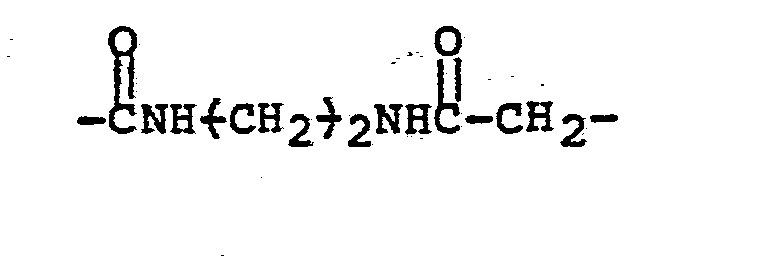


- Other examples of connecting groups and the preparation of ethylenically-unsaturated perfluoro- polyethers containing them are disclosed in U.S. Patent No. 3,810,874 and in Assignee's copending application S.N. 340,473, both of which are incorporated herein by reference for this disclosure of perfluoropolyethers.
- More preferred ethylenically-unsaturated perfluoropolyether monomers of use in the composition of the invention are compounds of formula IV in which the connecting group, X, is selected from


- Illustrative of the more preferred of the ethylenically-unsaturated perfluoropolyether monomers of formula IV are the monomers having the formulae


- Particularly preferred are the ethylenically-unsaturated perfluoropolyether monomers of the formula

- Examples of perfluoropolyether monomers of formula IV useful for making the low-energy coating of the invention are listed in TABLE I below, where, as elsewhere, the perfluoroalkylene oxide units are randomly distributed, the given numbers of which are average values.


- The compounds of formula IV are ethylenically-unsaturated compounds, preferably esters, amides, or ethers or they have a combination of these groups. They can be prepared from perfluoropolyetheralkanoles, -alkylamines, -carboxylic acids, halides, or esters or -carboxamidols by esterification, amidation, or etherification reactions that are well known to the skilled chemist. Thus, the ethylenically-unsaturated perfluoropolyether monomers of formula IV are conveniently prepared from corresponding alkyl esters, e.g.,

- Further description of the preparation of the ethylenically-unsaturated perfluoropolyether monomers useful in hydrosilation reaction of the present invention is to be found in the disclosure of U.S. Patent Nos. 3,810,874 and 4,321,404.
- In general, the curable compositions contain from 2 to 35 weight percent of the polyorganohydrosiloxanes of formulae II or III with from 65 to 98 weight percent of the ethylenically-unsaturated perfluoropolyethers of formula IV, the weight percent being based on the weight of the total composition. For each composition, the force required to separate an adhesive from the release coating, can be varied from a value of less than about lOg/2.5 cm of width to a higher value of about 20 to 400g/2.5 cm or more by changing the weight ratio of the above components. For ) example, the use of the higher weight percent of the perfluoropolyether component generally provides the lower peel force value with pressure-sensitive adhesives. The weight percent of the above components used to provide effective, cured coatings is also dependent on the equivalent weight of each of the components, i.e., the mole ratio of the SiH to the ethylenically-unsaturated
functional group. A mole ratio of about 0.5 to 1.3 generally provides effective coatings. - The hydrosilation catalysts employed in the compositions of the present invention include all of the well-known metal-containing catalysts which are effective for catalyzing a hydrosilation reaction between silicon-bonded hydrogen groups and ethylenically-unsaturated groups. These materials include, for example, the finely divided platinum catalysts, such as those described in U.S. Patent No. 2,970,150, the chloroplatinic acid catalysts described in U.S. Patent No. 2,823,218, the platinum hydrocarbon complexes taught in U.S. Patent Nos. 3,159,601, 3,159,662, as well as the platinum alcoholate catalysts described in U.S. Patent No. 3,220,972, and platinum complexes having an ultraviolet displaceable group such as are disclosed in Assignee's copending patent application Serial No. 472,158 filed March 4, 1983 and the (cyclopentadienyl)(trialiphatic)platinum complexes such as are disclosed in U.S. Patent No. 4,510,094. In addition, the platinum chloride-olefin complexes described in U.S. Patent No. 3,416,946 are useful herein.
- When a platinum catalyst is employed, it is generally present in an amount related to the amount of the ethylenically-unsaturated radicals in the perfluoropolyether monomer and in an amount sufficient to cause the co-reaction of the ethylenically-unsaturated perfluoropolyether monomer and the polyorganohydrosiloxane. Satisfactory results may be obtained when the platinum catalyst is present in amounts sufficient to provide as little as one part by weight of platinum per million parts by weight of perfluoropolyether monomer. On the other hand, amounts of the platinum catalyst sufficient to provide as high as one to ten parts by weight of platinum per 1,000 parts of perfluoropolyether monomer may also be used. In general, however, it is preferred to employ the platinum catalyst in an amount sufficient to provide one to two hundred parts by weight of platinum per one million parts by weight of perfluoropolyether monomer. Also, metals such as rhodium, iridium, and palladium, and their compounds, are known to catalyze these hydrosilation reactions and their use is intended to be within the scope of the present invention. Platinum compounds are the preferred catalysts.
- The composition of the invention can also contain other ingredients such as hydrosilation inhibitors, dyes, pigments, and reinforcing fillers, e.g., carbon black, fumed silica, titanium dioxide, etc. Furthermore, the release character of the cured composition can be modified, i.e., the value of the force required to separate an adhesive from the surface of the cured composition can be increased by any method known in the art, e.g., by the method described previously, by the addition to the composition of 0.1 to 10 parts of a release modifier per 100 parts of the composition, or by use of different primers. Preferably the release modification provides a differential release of at least 10 percent. Such modifiers are known and include, for example, tetraalkoxyalkyl silicates such as Si(OC2H4OC2H5)4, such as are described in U.S. Patent No. 3,518,325; graft polymers having a polyorganosiloxane segment and an organic polymer segment as are described in U.S. Patent No. 4,366,286; vinyl terminated diorganopolysiloxanes in which 3 to 39 mole percent of the diorgano units are nonterminal diphenylsiloxane units; and the three-dimensional toluene soluble silicate resins, known in the silicate art as MQ resin which are described in U.S. Patent Nos. 2,676,182 and 2,857,356.
- The low surface energy material of the invention can be applied to a substrate by the steps of
- a) providing a composition of the polyorganohydrosiloxane, the ethylenically-unsaturated perfluoropolyether monomer, the hydrosilation catalyst, and optionally other additives either with or without solvents, such as at least one halogen-containing organic solvent,
- b) coating the composition onto a substrate,
- c) removing the solvent when used, and
- d) curing the composition by application of heat at 25 to l5µ°C or actinic radiation depending on the hydrosilation catalyst in the mixture, for a suitable period of time from a fraction of a second to five minutes or more.
- Preferred solvents that can be used in the such as 1,1,2-trichlorotrifluoroethane and perfluorooctane.
- Suitable substrates onto which the composition can be coated and cured include sheets, fibers, and materials of other shapes. Preferred substrates are flexible sheet materials that are used for pressure-sensitive adhesive products including polyester, polyamide, polyolefin, and polycarbonate films. Other substrates onto which the composition can be coated and cured include glass, ceramic, metal, and rubber.
- The coating techniques useful in the process of the invention include brushing, wire or knife coating, spraying, curtain coating, and gravure coating having, for example, 80 lines per centimeter.
- Where the cured coating does not adhere readily to the substrate, it may be desirable to apply to the substrate first a primer or an adhesion-promoting coating or treatment as is well known in the art.
- Preferably, the primers are a coating of a suspension of colloidal particles in the form of a sol and optionally contain a binder resin. Examples of such coatings combine hydrated oxides of one or more elements such as hydrated silica, alumina, tungsten oxide, ferric oxide, or titanium oxide as is taught in U.S. Patent No. 2,366,516, and combinations thereof; polymeric organosilicone compositions as taught in U.S. Patent No. 2,721,855; a mixture of tetraalkoxysilane, or a partial hydrolyzate thereof, and a tetraalkyl titanate as is taught in U.S. Patent No. 3,794,556; and an organosilane and a hydrolyzable titanium compound as is taught in U.S. Patent No. 3,321,350.
- The substrate bearing on one or both surfaces a coating of the cured composition of the invention can then be coated with any of the adhesives known in the art including the acrylic adhesives, the rubber based adhesives and the silicone adhesives. The adhesive-coated substrate can then be rolled upon itself, if desired. Pressure-sensitive, flexible, adhesive-coated sheet materials are well known in the art. For example, U.S. Pat. Re. No. 24,906 (acrylate), U.S. Pat. Nos. 2,857,356, 2,814,601, and 2,736,721 (siloxane), and U.S. Pat. No. 3,925,283 (urethane) disclose adhesive-coated materials which use particularly desirable pressure-sensitive adhesives.
- The release performance of the coating toward adhesives can be measured by various methods known in the art depending upon whether the final product is in sheet or rolled form such as a tape. Various test methods for pressure-sensitive tapes are reported by the Pressure-Sensitive Tape Council (PSTC), "Test Methods for Pressure-Sensitive Tapes" (several editions). The peel values shown in the Examples were obtained by using a peel rate of 230 cm/min and a peel angle of 180°.
- The release value of the cured perfluoropolyether-coated substrates prepared in the following Examples was determined by the following procedure:
- A test pressure-sensitive adhesive tape having a polydimethylsiloxane pressure-sensitive adhesive is pressed against the surface of the perfluoropolyether coating using a 1.5 kg rubber roller to produce a laminate consisting of a pressure-sensitive adhesive tape and the cured perfluoropolyether coated substrate. The laminate is cut into 2.5 x 25 cm strips. The "release value" is the force (peel force) required to pull the test tape with adhesive adhered thereto away from the perfluoropolyether-coated substrate at an angle of 180° and a pulling speed of 230 cm/min.
- The readhesion values of the pressure-sensitive tape is determined by the following procedure:
- The pressure-sensitive tape, as removed from the perfluoropolyether-coated substrate is applied to the surface of a clean glass plate using a 2 kg rubber roller. The readhesion value is measured by pulling the tape from the glass surface at an angle of 180° and a stripping speed of 230 cm/min.
- Objects and advantages of this invention are further illustrated by the following Examples, but the particular materials and amounts thereof recited in these examples, as well as other conditions and details, should not be construed to unduly limit this invention.
- A solution containing 2.05 g of an allyl ether-terminated perfluoropolyether, CH2=CHCH2OCH2CF2O(C2F4O)m(CF2O)nCF2CH2OCH2CH=CH2, having a number average molecular weight (Mn) of about 2000 and m/n ratio of 0.5, 0.002 g of a platinum complex in divinyltetramethyldisiloxane (added as a solution containing 15 weight percent platinum), such as is described in U.S. Patent No. 3,775,452 (EXAMPLE 1), and 15 ml of 1,1,2-trichlorotrifluoroethane was stirred in a closed vial at 25°C for 15 hr. A solution of 0.075 g of a trimethylsilyloxy-terminated polymethylhydrosiloxane (DC-1107 from Dow Corning) and 8 ml of 1,1,2-trichlorotrifluoroethane was added. A silica-titanium dioxide primed poly(ethylene terephthalate) film was coated with the above solution using a No. 3 RDS rod (R. D. Specialties Inc.). The film was then heated in an oven at 95°C for 5 min. The side of the film, containing the cured coating, was laminated with a test tape having a polydimethylsiloxane pressure-sensitive adhesive. The initial peel force was 10-15 g/2.5 cm. After heat aging of the laminate at 70°C (24 hr), the peel force was 30-40 g/2.5 cm and the readhesion value (glass), which measured the adhesion of the silicone adhesive after contact with the release coating, was 1120-1180 g/2.5 cm. For comparison, the adhesion of the test tape prior to contact with the release coating was 1100-1120 g/2.5 cm.
- The silica-titanium dioxide primed poly(ethylene terephthalate) film was prepared by reverse roll coating a 62.5 micrometer thick poly(ethylene terephthalate) film with a solution of 94 parts by weight of anhydrous ethanol, 3 parts of glacial acetic acid, and 3 parts of tetraisopropyl titanate. The coated film was then dried at about 90°C for 1.5 to 2 minutes and overcoated with a 50% by volume aqueous ethanol solution containing about 0.5% by weight of Ludox™ LF (DuPont), i.e., colloidal silica. The coating was then dried at about 95°C for 1.5 to 2 minutes. Similar results were obtained using substrates that had been primed using alcoholic solutions that were 1 to 10% by weight in both tetraisopropyl titanate and colloidal silica.
- Using the coating solution and procedures described in EXAMPLE 1, an unprimed poly(ethylene- terephthalate) film was coated and heated at 95°C for 5 min. The peel force and readhesion value, after heat aging of the laminate was 100-110 g/2.5 cm and 1090-1120 g/2.5 cm, respectively.
- Using procedures described in EXAMPLE l, a solution containing 1.15 g of the ethylenically-unsaturated perfluoropolyether

- A solution containing 2.0 g of the perfluoropolvether diacrylate,
-

- This example demonstrates the release performance of an allyl ether-terminated perfluoropolyether of the general structure shown in EXAMPLE 1, but having a higher average molecular weight of about 3800 and m/n ratio of 0.5. A solution containing 1.10 g of the allyl ether, 0.0015 g of the platinum catalyst solution described in EXAMPLE 1, 0.03 g of DC-1107, and 12 ml of 1,1,2-trichlorotrifluoroethane was coated on a silica-titanium dioxide - primed poly(ethylene terephthalate) film using a No. 3 RDS rod. The coated film was heated at 100°C for 3 min. After heat aging (70°C for 3 days) of a laminate of the silicone adhesive test tape described in EXAMPLE 1, the peel force was 10-20 g/2.5 cm and the readhesion value was 1010-1060 g/2.5 cm.
- This example demonstrates the performance of a coating obtained by use of a fluorine-containing polymethylhydrosiloxane. A solution containing 0.25 g of a trimethylsilyloxy end-capped linear fluorosilicone containing 46.9% fluorine and an average of eighteen C8F17SO2N(C2H5)(CH2)3Si(CH3)O-, and seventeen CH3SiHO- siloxane units and having the general formula
-

- These Examples (Table 1) demonstrate that the properties of the cured release coating can be varied by changing the ethylenically-unsaturated perfluoropolyether/ polyorganohydrosiloxane weight ratio used in the coating formulation. Weight ratios of 93/7 to 97/3 were examined. In these experiments, the allyl ether-terminated perfluoropolyether, the polymethylhydrosiloxane fluid and the platinum catalyst (200 ppm platinum) described in EXAMPLE 1 were used. The release coatings (0.5 micrometer thickness) were obtained by casting solutions of the above components (6 wt%) in 1,1,2-trichlorotrifluoroethane on silica-titanium dioxide primed poly(ethylene terephthalate) films followed by curing of the coatings at 95°C for 5 min. The peel force of laminates prepared from the silicone adhesive test tape described in EXAMPLE 1, and the readhesion values are given in Table 1.

- A release liner composed of the cured release coating of the allyl ether-terminated perfluoropolyether, described in EXAMPLE 1, on a silica-titanium dioxide primed poly(ethylene terephthalate) film was prepared using the procedures described in EXAMPLE 1. The side of the liner containing the release coating was coated (200 micrometers thick) with a solution of 18 weight percent of a silicone adhesive (DC-355, Dow Corning) in 1,1,2-trichlorotrifluoroethane using a knife coater. The adhesive-coated liner was allowed to dry at 25°C for 20 hr. and then the adhesive side was laminated with an unprimed poly(ethylene terephthalate) film by pressing between two rubber rollers. The initial peel force required to separate the unprimed polyester film, containing the adhesive, from the release liner was 5-15 g/2.5 cm. After heat aging of a laminate at 70°C (7 days), the peel force was 20-30 g/2.5 cm and the readhesion value (glass) was 1400-1460 g/2.5 cm. For comparison, the adhesion of the silicone adhesive prior to contact with the release coating was determined to be 1680-1800 g/2.5 cm.
- This example shows the preparation of a silicone adhesive transfer tape containing perfluoropolyether release coatings. The allyl ether-terminated perfluoropolyether, polymethylhydrosiloxane fluid (DC-1107) and platinum catalyst, described in EXAMPLE 1, are used in the release coating formulation. The coating solution contains 145 g of allyl ether-terminated perfluoropolyether, 5.3 g of DC-l107, 0.2 g of the platinum catalyst solution, and 1.5 liter of 1,1,2-trichlorotrifluoroethane. A 15 cm x 200 meter roll of a silica-titanium dioxide primed poly-(ethylene terephthalate) film (primed on only one side) is coated on one side with the above solution using a 200 line rotogravure coater and cured by passing the coated film through an oven at 120°C for 10 minutes. The article then is coated on the other side with the same solution and cured under similar conditions giving a release liner having a cured perfluoropolyether release coating having a thickness of about one micrometer on both sides of the substrate. An 18 percent by weight solution of a silicone pressure sensitive adhesive (DC-355, Dow Corning) in 1,1,2-trichloro-2,2,1-trifluoroethane is knife-coated onto the release coating on the unprimed surface. The adhesive-coated liner is allowed to air-dry after which time it can be rolled upon itself to form a jumbo which can be slit into smaller rolled tapes as desired. On unrolling the tape, the adhesive adheres to the release coating that had been coated on the unprimed surface of the polyester substrate. After contact of the adhesive side of a portion of the unwound tape to a clean glass surface using a rubber roller, the release of the liner containing the perfluoropolyether release coating is easily achieved resulting in the complete transfer of the silicone adhesive to the glass surface.
- Various modifications and alterations of this invention will become apparent to those skilled in the art without departing from the scope and spirit of this invention, and it should be understood that this invention is not to be unduly limited to the illustrative embodiments set forth herein.
Claims (11)


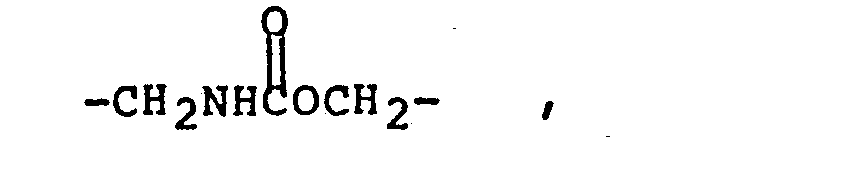
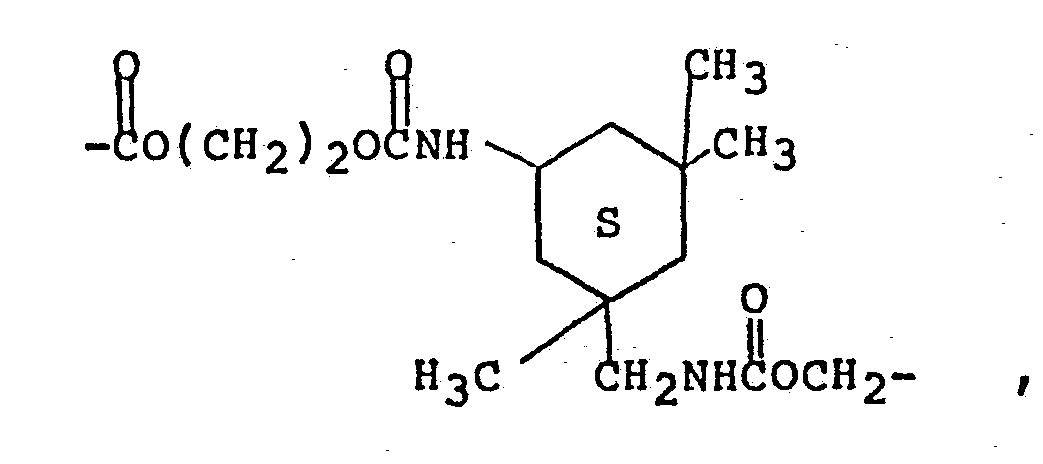


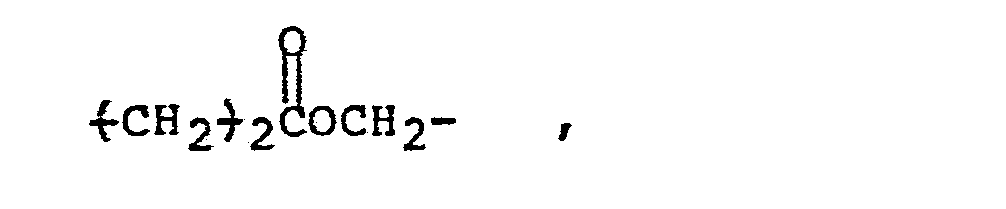


Applications Claiming Priority (2)
| Application Number | Priority Date | Filing Date | Title |
|---|---|---|---|
| US620438 | 1984-06-14 | ||
| US06620438 US4565714B1 (en) | 1984-06-14 | 1984-06-14 | Low surface energy material |
Publications (3)
| Publication Number | Publication Date |
|---|---|
| EP0165059A2 true EP0165059A2 (en) | 1985-12-18 |
| EP0165059A3 EP0165059A3 (en) | 1988-01-13 |
| EP0165059B1 EP0165059B1 (en) | 1990-10-24 |
Family
ID=24485941
Family Applications (1)
| Application Number | Title | Priority Date | Filing Date |
|---|---|---|---|
| EP85304180A Expired - Lifetime EP0165059B1 (en) | 1984-06-14 | 1985-06-12 | Low-surface energy material |
Country Status (8)
| Country | Link |
|---|---|
| US (1) | US4565714B1 (en) |
| EP (1) | EP0165059B1 (en) |
| JP (1) | JPH0784561B2 (en) |
| KR (1) | KR930000778B1 (en) |
| AU (1) | AU572662B2 (en) |
| BR (1) | BR8502615A (en) |
| CA (1) | CA1242834A (en) |
| DE (1) | DE3580194D1 (en) |
Cited By (9)
| Publication number | Priority date | Publication date | Assignee | Title |
|---|---|---|---|---|
| EP0467852A3 (en) * | 1990-07-20 | 1992-05-27 | Ciba-Geigy Ag | Perfluoroalkylpolyoxyalkylpolysiloxane surfactants |
| WO1992015627A1 (en) * | 1991-03-06 | 1992-09-17 | Minnesota Mining And Manufacturing Company | Polyfluoropolyether graft copolymers |
| EP0499051A3 (en) * | 1991-02-13 | 1993-04-28 | Th. Goldschmidt Ag | Organopolysiloxanes comprising polyether and ester groups attached to the same spacer group |
| EP0520287A3 (en) * | 1991-06-27 | 1993-07-07 | Shin-Etsu Chemical Co., Ltd. | Fluorine-containing organosilicon compound |
| US8552124B2 (en) | 2009-12-30 | 2013-10-08 | 3M Innovative Properties Company | Copolymers with perfluoropolyether segment and polydiorganosiloxane segment |
| WO2017108852A1 (en) * | 2015-12-22 | 2017-06-29 | Solvay Specialty Polymers Italy S.P.A. | Functionalized (poly)alkoxylated (per)fluoropolyether polymers |
| DE202019102925U1 (en) | 2018-04-13 | 2019-07-17 | Fraunhofer-Gesellschaft zur Förderung der angewandten Forschung e.V. | Surface modified silicone as well as this containing composite material |
| WO2021001448A1 (en) | 2019-07-04 | 2021-01-07 | Fraunhofer-Gesellschaft zur Förderung der angewandten Forschung eingetragener Verein | Surface-modified silicone, use thereof in nonstick coatings and composite material containing same |
| EP3705532A4 (en) * | 2017-10-31 | 2021-09-01 | Daikin Industries, Ltd. | HARDENABLE COMPOSITION |
Families Citing this family (57)
| Publication number | Priority date | Publication date | Assignee | Title |
|---|---|---|---|---|
| US4842902A (en) * | 1986-06-04 | 1989-06-27 | Dow Corning Corporation | Pressure sensitive adhesive release liner |
| US4889753A (en) * | 1986-06-04 | 1989-12-26 | Dow Corning Corporation | Pressure sensitive adhesive release liner and fluorosilicone compounds, compositions and method therefor |
| US5026606A (en) * | 1986-08-04 | 1991-06-25 | Minnesota Mining And Manufacturing Company | Film for thermal imaging |
| JPH0689777B2 (en) * | 1987-01-28 | 1994-11-14 | 東レ・ダウコーニング・シリコーン株式会社 | Silicone rubber coated roll |
| US4988743A (en) * | 1988-03-21 | 1991-01-29 | General Electric Company | Radiation self-sensitized silicone polymers |
| US4927668A (en) * | 1988-08-01 | 1990-05-22 | Joseph M. Senckowski | Treatment for automobile windshields |
| JPH0260980A (en) * | 1988-08-26 | 1990-03-01 | Nitto Denko Corp | Releasing agent and separator |
| JPH0672084B2 (en) * | 1989-03-31 | 1994-09-14 | 信越化学工業株式会社 | Impression material composition |
| US5314959A (en) * | 1991-03-06 | 1994-05-24 | Minnesota Mining And Manufacturing Company | Graft copolymers containing fluoroaliphatic groups |
| EP0573283B1 (en) * | 1992-06-02 | 1997-10-08 | Shin-Etsu Chemical Co., Ltd. | Fluorine-containing organopolysiloxane composition |
| JP2938303B2 (en) * | 1993-03-02 | 1999-08-23 | 信越化学工業株式会社 | Fluorine-containing organosilicon compound |
| US5639845A (en) * | 1993-06-10 | 1997-06-17 | Shin-Etsu Chemical Co., Ltd. | Method for the preparation of a fluorine-containing organopolysiloxane |
| DE4331608A1 (en) * | 1993-09-17 | 1995-03-23 | Goldschmidt Ag Th | Organopolysiloxanes modified with acrylate groups |
| DE4433139A1 (en) * | 1994-09-16 | 1996-03-21 | Thera Ges Fuer Patente | Hydrophilized dental impression materials |
| JP3017657B2 (en) * | 1995-02-03 | 2000-03-13 | 信越化学工業株式会社 | Curable fluoropolyether rubber composition |
| US5671967A (en) * | 1995-04-28 | 1997-09-30 | Gencorp Inc. | Coextruded vehicle sill cover article |
| US5834564A (en) * | 1996-04-30 | 1998-11-10 | Hewlett-Packard Company | Photoconductor coating having perfluoro copolymer and composition for making same |
| DE29718388U1 (en) * | 1996-10-25 | 1997-12-18 | Koenig & Bauer-Albert Aktiengesellschaft, 97080 Würzburg | Paint box |
| JP3646775B2 (en) * | 1999-03-02 | 2005-05-11 | 信越化学工業株式会社 | Curable fluoropolyether rubber composition |
| US20030183224A1 (en) * | 2000-03-01 | 2003-10-02 | Hailey Mark Andrew | Metered dose inhaler |
| WO2001064274A2 (en) * | 2000-03-01 | 2001-09-07 | Glaxo Group Limited | Metered dose inhaler |
| DE60119416T2 (en) * | 2000-03-23 | 2007-05-03 | Shin-Etsu Chemical Co., Ltd. | Primer composition for pressure-sensitive adhesives based on silicones |
| JP2002003595A (en) * | 2000-06-22 | 2002-01-09 | Shin Etsu Chem Co Ltd | Fluorine-containing cured product |
| US6623825B2 (en) * | 2001-03-14 | 2003-09-23 | 3M Innovative Properties Company | Method of detackifying an edge face of a roll of tape |
| US6806306B2 (en) * | 2001-05-22 | 2004-10-19 | Freduenberg-Nok General Partnership | Low temperature, highly chemically resistant thermoplastic vulcanizates based on perfluroether elastomers |
| US6894137B2 (en) * | 2002-06-05 | 2005-05-17 | Easman Kodak Company | Block polyorganosiloxane block organomer polymers and release agents |
| EP1384742B1 (en) * | 2002-07-26 | 2010-01-13 | Océ-Technologies B.V. | Cross-linkable compounds comprising a perfluoropolyether moiety |
| JP4406543B2 (en) * | 2002-07-26 | 2010-01-27 | オセ−テクノロジーズ ビーブイ | Crosslinkable compound composed of perfluoropolyether residue, synthesis method, and apparatus using the same |
| JP4098699B2 (en) * | 2003-10-23 | 2008-06-11 | 信越化学工業株式会社 | Curable perfluoropolyether composition |
| JP2005200481A (en) * | 2004-01-13 | 2005-07-28 | Shin Etsu Chem Co Ltd | Fluoropolyether rubber composition for injection molding |
| JP5043317B2 (en) * | 2005-08-05 | 2012-10-10 | 東レ・ダウコーニング株式会社 | Cyclic dihydrogen polysiloxane, hydrogen polysiloxane, production method thereof, silica-based glass molded body and production method thereof, optical element and production method thereof |
| JP4783117B2 (en) * | 2005-10-21 | 2011-09-28 | 東レ・ダウコーニング株式会社 | INORGANIC SUBSTRATE WITH SILICA GLASS THIN LAYER, ITS MANUFACTURING METHOD, COATING AGENT, AND SEMICONDUCTOR DEVICE |
| JP5008192B2 (en) * | 2006-09-08 | 2012-08-22 | 信越化学工業株式会社 | Perfluoropolyether-polyorganosiloxane copolymer and surface treatment agent containing the same |
| US20080286473A1 (en) * | 2007-05-18 | 2008-11-20 | United States Of America As Represented By The Administrator Of The National Aeronautics | Ice Adhesion Mitigation |
| US8262975B2 (en) * | 2008-11-11 | 2012-09-11 | HGST Netherlands B.V | Self-releasing resist material for nano-imprint processes |
| JP4900853B2 (en) * | 2009-06-18 | 2012-03-21 | 信越化学工業株式会社 | Perfluoropolyether-modified polysiloxane and method for producing the same |
| JP4900854B2 (en) * | 2009-07-17 | 2012-03-21 | 信越化学工業株式会社 | Perfluoropolyether-modified polysiloxane and method for producing the same |
| JP5304698B2 (en) * | 2010-03-24 | 2013-10-02 | 信越化学工業株式会社 | Fluorine-modified amino group-containing organopolysiloxane and method for producing the same |
| US8784968B2 (en) | 2010-06-24 | 2014-07-22 | Cubic Tech Corporation | Waterproof breathable composite materials for fabrication of flexible membranes and other articles |
| US8802189B1 (en) | 2010-08-03 | 2014-08-12 | Cubic Tech Corporation | System and method for the transfer of color and other physical properties to laminate composite materials and other articles |
| KR101297368B1 (en) * | 2011-03-04 | 2013-08-19 | 부산대학교 산학협력단 | Hyhobic polymetylhydrosiloxane based hybrid for coating applications |
| US9154593B1 (en) | 2012-06-20 | 2015-10-06 | Cubic Tech Corporation | Flotation and related integrations to extend the use of electronic systems |
| KR102214206B1 (en) * | 2012-09-18 | 2021-02-09 | 디에스엠 아이피 어셋츠 비.브이. | Flexible composite systems |
| BR112015010690B1 (en) | 2012-11-09 | 2021-05-11 | Dsm Ip Assets B.V | flexible composite parts in three-dimensional format and method of production of these parts |
| KR20220021018A (en) | 2013-03-13 | 2022-02-21 | 디에스엠 아이피 어셋츠 비.브이. | Flexible composite systems and methods |
| KR102239041B1 (en) | 2013-03-13 | 2021-04-12 | 디에스엠 아이피 어셋츠 비.브이. | Systems and method for producing three-dimensional articles from flexible composite materials |
| US9789662B2 (en) | 2013-03-13 | 2017-10-17 | Cubic Tech Corporation | Engineered composite systems |
| JP6241801B2 (en) * | 2013-07-03 | 2017-12-06 | ヘンケル アイピー アンド ホールディング ゲゼルシャフト ミット ベシュレンクテル ハフツング | High temperature peelable adhesive |
| CN107075349B (en) * | 2014-08-07 | 2020-08-21 | 大金工业株式会社 | Antifouling treatment composition, treatment device, treatment method and treatment article |
| KR102672116B1 (en) | 2015-01-09 | 2024-06-03 | 아비엔트 프로텍티브 머티리얼스 비.브이. | Lightweight laminates and plate-carrier vests and other articles of manufacture therefrom |
| JP6565723B2 (en) * | 2015-02-04 | 2019-08-28 | 信越化学工業株式会社 | Photocurable fluoropolyether rubber composition, cured product thereof, and curing method thereof |
| JP6950697B2 (en) * | 2016-08-30 | 2021-10-13 | Agc株式会社 | Method for Producing Fluorine-Containing Ether Compound |
| WO2019088133A1 (en) * | 2017-10-31 | 2019-05-09 | ダイキン工業株式会社 | Curable composition |
| CN118715285A (en) * | 2022-01-24 | 2024-09-27 | 信越化学工业株式会社 | Curable perfluoropolyether gel composition, perfluoropolyether gel cured product, and electrical and electronic components sealed with the cured product |
| CN116217916B (en) * | 2023-02-07 | 2023-09-05 | 湖南天氟新材料有限公司 | Y-type perfluoropolyether modified acrylic ester, antifouling paint, preparation method and application |
| CN116590933B (en) * | 2023-04-13 | 2025-08-12 | 江西三越高新材料有限公司 | A stripping agent composition and its application in stripping velvet release paper for polyurethane dry synthetic leather |
| CN119409885B (en) * | 2025-01-03 | 2025-06-06 | 恒河材料科技股份有限公司 | Dicyclopentadiene hydrogenated petroleum resin, BOPP film and preparation method thereof |
Family Cites Families (23)
| Publication number | Priority date | Publication date | Assignee | Title |
|---|---|---|---|---|
| BE619437A (en) * | 1961-06-28 | 1900-01-01 | ||
| US3159662A (en) * | 1962-07-02 | 1964-12-01 | Gen Electric | Addition reaction |
| US3220972A (en) * | 1962-07-02 | 1965-11-30 | Gen Electric | Organosilicon process using a chloroplatinic acid reaction product as the catalyst |
| US3318852A (en) * | 1965-04-05 | 1967-05-09 | Minnesota Mining & Mfg | Fluorine-containing polymers |
| US3410886A (en) * | 1965-10-23 | 1968-11-12 | Union Carbide Corp | Si-h to c=c or c=c addition in the presence of a nitrile-platinum (ii) halide complex |
| US3536749A (en) * | 1966-06-08 | 1970-10-27 | Minnesota Mining & Mfg | Fluorocarbon-acrylate products |
| US4085137A (en) * | 1969-03-10 | 1978-04-18 | Minnesota Mining And Manufacturing Company | Poly(perfluoroalkylene oxide) derivatives |
| US3810874A (en) * | 1969-03-10 | 1974-05-14 | Minnesota Mining & Mfg | Polymers prepared from poly(perfluoro-alkylene oxide) compounds |
| US3565750A (en) * | 1969-05-19 | 1971-02-23 | Minnesota Mining & Mfg | Pressure-sensitive adhesive article with dry-strippable liner |
| BE754332A (en) * | 1969-08-05 | 1971-02-03 | Dow Corning | CARBOXYL-FUNCTIONAL SILOXANE COPOLYMERS USEFUL AS SIZING AGENT AND SIZE PAPER USING THESE COPOLYMERS |
| US3639156A (en) * | 1970-05-19 | 1972-02-01 | Us Agriculture | Siloxane polymers for soil-repellent and soil-release textile finishes |
| US4057596A (en) * | 1973-06-11 | 1977-11-08 | Shinetsu Chemical Company | Anti-sticking silicone compositions of non-solvent type |
| JPS5015838A (en) * | 1973-06-11 | 1975-02-19 | ||
| US4216252A (en) * | 1974-12-18 | 1980-08-05 | General Electric Company | Solventless release coating |
| US3975362A (en) * | 1975-04-28 | 1976-08-17 | Dow Corning Corporation | Low temperature reversion resistant organosilicon polymers |
| US4057566A (en) * | 1976-01-08 | 1977-11-08 | Dow Corning Corporation | Fluorocarbon siloxane compositions |
| US4171397A (en) * | 1978-04-17 | 1979-10-16 | Minnesota Mining And Manufacturing Company | Sheet material having composite fluorochemical-silicone release coatings |
| US4321404A (en) * | 1980-05-20 | 1982-03-23 | Minnesota Mining And Manufacturing Company | Compositions for providing abherent coatings |
| US4472480A (en) * | 1982-07-02 | 1984-09-18 | Minnesota Mining And Manufacturing Company | Low surface energy liner of perfluoropolyether |
| US4504645A (en) * | 1983-09-23 | 1985-03-12 | Minnesota Mining And Manufacturing Company | Latently-curable organosilicone release coating composition |
| DE3410646A1 (en) * | 1984-03-23 | 1985-10-03 | Bayer Ag, 5090 Leverkusen | DIMENSIONAL STABLE IMPRESSIONS |
| JPS60228516A (en) * | 1984-04-26 | 1985-11-13 | Kanegafuchi Chem Ind Co Ltd | Novel polymer and its production |
| JPS60228517A (en) * | 1984-04-26 | 1985-11-13 | Kanegafuchi Chem Ind Co Ltd | Novel polymer and its production |
-
1984
- 1984-06-14 US US06620438 patent/US4565714B1/en not_active Expired - Lifetime
-
1985
- 1985-05-07 CA CA000480892A patent/CA1242834A/en not_active Expired
- 1985-05-24 AU AU42851/85A patent/AU572662B2/en not_active Ceased
- 1985-05-31 BR BR8502615A patent/BR8502615A/en not_active IP Right Cessation
- 1985-06-12 EP EP85304180A patent/EP0165059B1/en not_active Expired - Lifetime
- 1985-06-12 DE DE8585304180T patent/DE3580194D1/en not_active Expired - Lifetime
- 1985-06-13 JP JP60129116A patent/JPH0784561B2/en not_active Expired - Fee Related
- 1985-06-14 KR KR1019850004204A patent/KR930000778B1/en not_active Expired - Fee Related
Cited By (12)
| Publication number | Priority date | Publication date | Assignee | Title |
|---|---|---|---|---|
| EP0467852A3 (en) * | 1990-07-20 | 1992-05-27 | Ciba-Geigy Ag | Perfluoroalkylpolyoxyalkylpolysiloxane surfactants |
| EP0499051A3 (en) * | 1991-02-13 | 1993-04-28 | Th. Goldschmidt Ag | Organopolysiloxanes comprising polyether and ester groups attached to the same spacer group |
| WO1992015627A1 (en) * | 1991-03-06 | 1992-09-17 | Minnesota Mining And Manufacturing Company | Polyfluoropolyether graft copolymers |
| EP0520287A3 (en) * | 1991-06-27 | 1993-07-07 | Shin-Etsu Chemical Co., Ltd. | Fluorine-containing organosilicon compound |
| US8552124B2 (en) | 2009-12-30 | 2013-10-08 | 3M Innovative Properties Company | Copolymers with perfluoropolyether segment and polydiorganosiloxane segment |
| EP2519564B1 (en) * | 2009-12-30 | 2014-10-22 | 3M Innovative Properties Company | Copolymers with perfluorpolyether segment and polydiorganosiloxane segment |
| WO2017108852A1 (en) * | 2015-12-22 | 2017-06-29 | Solvay Specialty Polymers Italy S.P.A. | Functionalized (poly)alkoxylated (per)fluoropolyether polymers |
| EP3705532A4 (en) * | 2017-10-31 | 2021-09-01 | Daikin Industries, Ltd. | HARDENABLE COMPOSITION |
| DE202019102925U1 (en) | 2018-04-13 | 2019-07-17 | Fraunhofer-Gesellschaft zur Förderung der angewandten Forschung e.V. | Surface modified silicone as well as this containing composite material |
| WO2019197492A1 (en) | 2018-04-13 | 2019-10-17 | Fraunhofer-Gesellschaft zur Förderung der angewandten Forschung eingetragener Verein | Surface-modified silicone, use thereof in nonstick coatings and also composite material containing same |
| DE102018108881A1 (en) * | 2018-04-13 | 2019-10-17 | Fraunhofer-Gesellschaft zur Förderung der angewandten Forschung eingetragener Verein | Surface-modified silicone, its use in non-stick coatings and composite material containing the same |
| WO2021001448A1 (en) | 2019-07-04 | 2021-01-07 | Fraunhofer-Gesellschaft zur Förderung der angewandten Forschung eingetragener Verein | Surface-modified silicone, use thereof in nonstick coatings and composite material containing same |
Also Published As
| Publication number | Publication date |
|---|---|
| EP0165059B1 (en) | 1990-10-24 |
| BR8502615A (en) | 1986-02-04 |
| US4565714B1 (en) | 1999-06-29 |
| JPS6112751A (en) | 1986-01-21 |
| CA1242834A (en) | 1988-10-04 |
| DE3580194D1 (en) | 1990-11-29 |
| KR860000344A (en) | 1986-01-28 |
| AU4285185A (en) | 1985-12-19 |
| JPH0784561B2 (en) | 1995-09-13 |
| US4565714A (en) | 1986-01-21 |
| KR930000778B1 (en) | 1993-02-04 |
| EP0165059A3 (en) | 1988-01-13 |
| AU572662B2 (en) | 1988-05-12 |
Similar Documents
| Publication | Publication Date | Title |
|---|---|---|
| EP0165059B1 (en) | Low-surface energy material | |
| CA1282895C (en) | Pressure sensitive adhesive release liner and fluorosilicone compounds, compositions and method therefor | |
| AU665998B2 (en) | Silicone release compositions | |
| US4313988A (en) | Epoxypolysiloxane release coatings for adhesive materials | |
| EP0739384B1 (en) | Low coefficient of friction silicone release formulations incorporating higher alkenyl-functional silicone gums | |
| EP0329279B1 (en) | Silicone release compositions | |
| RU2539296C2 (en) | Antiadhesion materials of fluorosilicon mixture | |
| US4889753A (en) | Pressure sensitive adhesive release liner and fluorosilicone compounds, compositions and method therefor | |
| EP0644246B1 (en) | Silicone compositions for the formation of cured release coatings | |
| EP0446030A2 (en) | Solventless silicone release coating | |
| US4842902A (en) | Pressure sensitive adhesive release liner | |
| EP0375363B1 (en) | Solventless silicon compositions for release paper | |
| CN110198987B (en) | Solvent-free silicone composition, release paper, and release film | |
| JP2009132826A (en) | Perfluoropolyether-polyorganosiloxane block copolymer and surface treatment agent containing the same | |
| JP3024445B2 (en) | Silicone composition for release agent and release paper | |
| JP2915778B2 (en) | Silicone composition for release paper | |
| US5372890A (en) | Organopolysiloxane composition for the production of release paper | |
| JPS61264052A (en) | Silicone composition for release paper | |
| JPH07103204B2 (en) | Radiation curable composition | |
| AU542909B2 (en) | Epoxypolysiloxane release coatings for adhesive materials | |
| JPH09176491A (en) | Peelable silicone composition | |
| JP2021046467A (en) | Releasable silicone resin composition and release film coated therewith | |
| JPH1060376A (en) | Coating composition | |
| WO2026004812A1 (en) | Silicone adhesive composition, adhesive tape, and adhesive film |
Legal Events
| Date | Code | Title | Description |
|---|---|---|---|
| PUAI | Public reference made under article 153(3) epc to a published international application that has entered the european phase |
Free format text: ORIGINAL CODE: 0009012 |
|
| AK | Designated contracting states |
Designated state(s): BE DE FR GB IT NL |
|
| PUAL | Search report despatched |
Free format text: ORIGINAL CODE: 0009013 |
|
| RHK1 | Main classification (correction) |
Ipc: C09D 3/82 |
|
| AK | Designated contracting states |
Kind code of ref document: A3 Designated state(s): BE DE FR GB IT NL |
|
| 17P | Request for examination filed |
Effective date: 19880331 |
|
| 17Q | First examination report despatched |
Effective date: 19890714 |
|
| ITF | It: translation for a ep patent filed | ||
| GRAA | (expected) grant |
Free format text: ORIGINAL CODE: 0009210 |
|
| AK | Designated contracting states |
Kind code of ref document: B1 Designated state(s): BE DE FR GB IT NL |
|
| REF | Corresponds to: |
Ref document number: 3580194 Country of ref document: DE Date of ref document: 19901129 |
|
| ET | Fr: translation filed | ||
| PLBE | No opposition filed within time limit |
Free format text: ORIGINAL CODE: 0009261 |
|
| STAA | Information on the status of an ep patent application or granted ep patent |
Free format text: STATUS: NO OPPOSITION FILED WITHIN TIME LIMIT |
|
| 26N | No opposition filed | ||
| ITTA | It: last paid annual fee | ||
| PGFP | Annual fee paid to national office [announced via postgrant information from national office to epo] |
Ref country code: BE Payment date: 20010606 Year of fee payment: 17 |
|
| REG | Reference to a national code |
Ref country code: GB Ref legal event code: IF02 |
|
| PGFP | Annual fee paid to national office [announced via postgrant information from national office to epo] |
Ref country code: FR Payment date: 20020517 Year of fee payment: 18 |
|
| PGFP | Annual fee paid to national office [announced via postgrant information from national office to epo] |
Ref country code: NL Payment date: 20020522 Year of fee payment: 18 |
|
| PGFP | Annual fee paid to national office [announced via postgrant information from national office to epo] |
Ref country code: DE Payment date: 20020620 Year of fee payment: 18 |
|
| PG25 | Lapsed in a contracting state [announced via postgrant information from national office to epo] |
Ref country code: BE Free format text: LAPSE BECAUSE OF NON-PAYMENT OF DUE FEES Effective date: 20020630 |
|
| BERE | Be: lapsed |
Owner name: *MINNESOTA MINING AND MFG CY Effective date: 20020630 |
|
| PGFP | Annual fee paid to national office [announced via postgrant information from national office to epo] |
Ref country code: GB Payment date: 20030604 Year of fee payment: 19 |
|
| PG25 | Lapsed in a contracting state [announced via postgrant information from national office to epo] |
Ref country code: NL Free format text: LAPSE BECAUSE OF NON-PAYMENT OF DUE FEES Effective date: 20040101 Ref country code: DE Free format text: LAPSE BECAUSE OF NON-PAYMENT OF DUE FEES Effective date: 20040101 |
|
| PG25 | Lapsed in a contracting state [announced via postgrant information from national office to epo] |
Ref country code: FR Free format text: LAPSE BECAUSE OF NON-PAYMENT OF DUE FEES Effective date: 20040227 |
|
| NLV4 | Nl: lapsed or anulled due to non-payment of the annual fee |
Effective date: 20040101 |
|
| REG | Reference to a national code |
Ref country code: FR Ref legal event code: ST |
|
| PG25 | Lapsed in a contracting state [announced via postgrant information from national office to epo] |
Ref country code: GB Free format text: LAPSE BECAUSE OF NON-PAYMENT OF DUE FEES Effective date: 20040612 |
|
| GBPC | Gb: european patent ceased through non-payment of renewal fee |
Effective date: 20040612 |