EP0163506B1 - Process for the preparation of a pyridil-propanoic acid - Google Patents
Process for the preparation of a pyridil-propanoic acid Download PDFInfo
- Publication number
- EP0163506B1 EP0163506B1 EP85303709A EP85303709A EP0163506B1 EP 0163506 B1 EP0163506 B1 EP 0163506B1 EP 85303709 A EP85303709 A EP 85303709A EP 85303709 A EP85303709 A EP 85303709A EP 0163506 B1 EP0163506 B1 EP 0163506B1
- Authority
- EP
- European Patent Office
- Prior art keywords
- formula
- compound
- added
- anion
- iii
- Prior art date
- Legal status (The legal status is an assumption and is not a legal conclusion. Google has not performed a legal analysis and makes no representation as to the accuracy of the status listed.)
- Expired
Links
- 0 *c1ccnc(*)c1 Chemical compound *c1ccnc(*)c1 0.000 description 4
Classifications
-
- C—CHEMISTRY; METALLURGY
- C07—ORGANIC CHEMISTRY
- C07D—HETEROCYCLIC COMPOUNDS
- C07D213/00—Heterocyclic compounds containing six-membered rings, not condensed with other rings, with one nitrogen atom as the only ring hetero atom and three or more double bonds between ring members or between ring members and non-ring members
- C07D213/02—Heterocyclic compounds containing six-membered rings, not condensed with other rings, with one nitrogen atom as the only ring hetero atom and three or more double bonds between ring members or between ring members and non-ring members having three double bonds between ring members or between ring members and non-ring members
- C07D213/04—Heterocyclic compounds containing six-membered rings, not condensed with other rings, with one nitrogen atom as the only ring hetero atom and three or more double bonds between ring members or between ring members and non-ring members having three double bonds between ring members or between ring members and non-ring members having no bond between the ring nitrogen atom and a non-ring member or having only hydrogen or carbon atoms directly attached to the ring nitrogen atom
- C07D213/60—Heterocyclic compounds containing six-membered rings, not condensed with other rings, with one nitrogen atom as the only ring hetero atom and three or more double bonds between ring members or between ring members and non-ring members having three double bonds between ring members or between ring members and non-ring members having no bond between the ring nitrogen atom and a non-ring member or having only hydrogen or carbon atoms directly attached to the ring nitrogen atom with hetero atoms or with carbon atoms having three bonds to hetero atoms with at the most one bond to halogen, e.g. ester or nitrile radicals, directly attached to ring carbon atoms
- C07D213/62—Oxygen or sulfur atoms
- C07D213/63—One oxygen atom
- C07D213/64—One oxygen atom attached in position 2 or 6
Definitions
- the present invention relates to a process for preparing 3-(pyrid-4-yl)propanoic acids and salts thereof.
- EP-A-3677, 4793, 13071, 15138, 17679 and 17680 disclose inter alia compounds of the general formula: wherein R represents various optionally substituted heteroaryl groups or optionally substituted phenyl; ⁇ (CH 2 ) m Y(CH 2 )n ⁇ represents a range of linking chains known in the histamine antagonist art; and R° is optionally substituted pyridyl. These compounds are useful histamine atagonists.
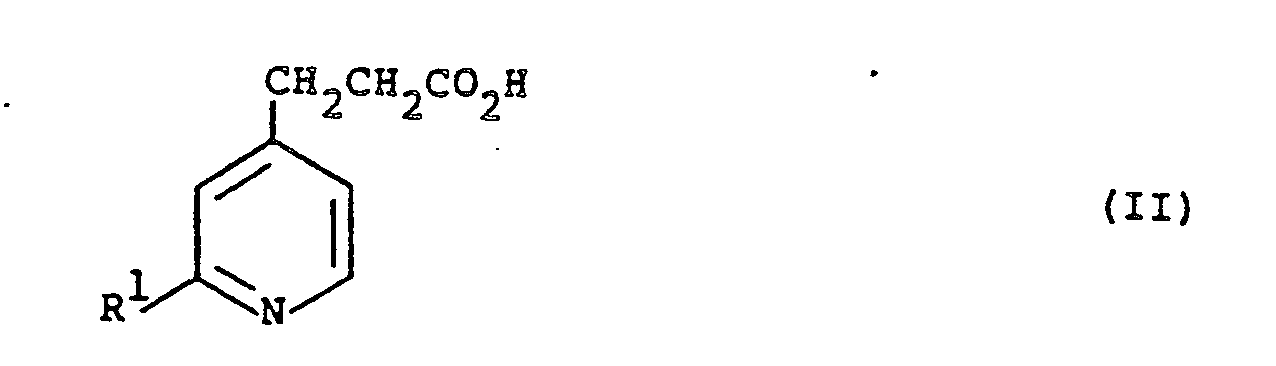
- the present invention provides a process for preparing a compound of the formula (II): or a salt thereof, wherein R 1 is C 1-6 alkoxy, benzyloxy or p-nitrobenzyloxy, which comprises reacting an anion of the formula (III): wherein R 1 is as defined in relation to formula (II), with a compound of the formula (IV): wherein X is a leaving group and M + is a counter-ion, and if desired interconverting an acid of the formula (II) with a salt thereof.
- R 1 examples are methoxy, ethoxy, n-propoxy and n-butoxy; benzyloxy and p-nitrobenzyloxy.
- R 1 is methoxy or benzyloxy.
- suitable anions of the formula (III) for use in this invention are those formed from 2-methoxy-4-methylpyridine, 2-ethoxy-4-methylpyridine and 2-benzyloxy-4-methylpyridine.
- X is halo, for example chloro, bromo or iodo; preferably X is chloro or bromo.
- the counter-ion M + may be any convenient counter-ion, for example an alkali metal ion such as lithium, sodium or potassium.
- the anion of the compound of the formula (III) has a counter-ion which can be, for example, lithium, sodium or potassium, preferably sodium or potassium.
- the reaction between an anion of the formula (III) and a compound of the formula (IV) is performed in the presence of a solvent which is substantially inert to the reagents and products.
- the anion of the compound of the formula (III) can be prepared in situ by reacting a 4-methylpyridine precursor compound with an alkali metal amide, for example sodamide.
- the solvent is liquid ammonia, which optionally may be in admixture with a co-solvent, such as tetrahydrofuran or dioxan.
- the reaction can also be performed in the presence of a phase transfer catalyst.
- the anion can be prepared in situ with an alkyl alkali, for example butyl lithium.
- the anion can be prepared with lithium di-isopropylamide.
- the solvent is an ether for example diethyl ether or tetrahydrofuran.
- the anion of the formula (III) is prepared in situ and to this is added the compound of the formula (IV).
- the reaction preferably is performed at a moderate to low temperature.
- the anion of the formula (III) is generated in situ using an alkali metal amide in liquid ammonia
- the reaction is carried out at or below the boiling point of liquid ammonia.
- the anion of the formula (III) is generated in situ from an alkyl alkali the reaction is carried out between room temperature and -78°C, preferably under an inert atmosphere.
- the compound of the formula (II) may be isolated either in acid or salt form, or converted from one form to the other, in conventional manner.
- the compounds of the formula (II) are useful as they can be esterified and formylated in conventional manner to give valuable intermediates (V) for the preparation of compounds within the formula (I): wherein R' is as hereinbefore defined and R 2 is C 1 - e alkyl. Formylation can be performed for example as described in EP-A-3677. The use of the compounds of the formula (V) is described in the aforementioned European Patent Applications.
- a suspension of sodamide (14.8 g) in liquid ammonia (1.5 L) was prepared. To this was slowly added over 20 minutes 2-benzyloxy-4-methylpyridine (75.0 g) under nitrogen with a n-propanol-solid C02 condenser. The mixture was stirred for a further 40 minutes and sodium chloroacetate (44.1 g) was cautiously added over 8 minutes. The mixture was stirred for a further 90 minutes, quenched with ammonium chloride (20.3 g) and left to stir for 16 hours. The mixture was slowly quenched with water (1.2 L) and then washed with dichloromethane (600 ml).
- the aqueous layer was acidified to pH 4.5-5.0 with concentrated hydrochloric acid (approximately 50 ml) and on stirring at 0°C for 2 hours the title compound (60.4 g), m.p. 118-920°C (uncorrected), crystallised out.
- Sodamide (4.74 g) was added with stirring, under an isopropanol-solid C0 2 condenser, to liquid ammonia (250 ml). To this mixture was added 2-methoxy-4-methylpyridine (10.02 g). After 30 minutes the characteristic colour of the carbanion appeared and sodium bromoacetate (19.56 g) was added slowly. The reaction mixture was stirred for 2 hours, quenched with ammonium chloride (15.0 g) and left to stand to allow the ammonia to evaporate. Water (150 ml) was added to the residue and the solution was washed with dichloromethane (3 x 50 ml).
- the aqueous layer was taken to about pH 1 with concentrated hydrochloric acid, washed with ethyl acetate (3 x 50 ml), and taken to pH 4.5-5.0 with aqueous sodium hydroxide. A white solid precipitated, after one hour this was collected by filtration to give the title compound (10.2 g), m.p. 115-115.5°C (uncorrected). A further amount of title compound (0.91 g) was obtained from the mother liquors.
- Sodamide (1.9 kg) was charged to a vessel containing liquid ammonia (104 L). 2-Methoxy-4-methylpyridine (4.1 kg) was then added and the mixture was stirred for one hour. A sample was taken and found to be yellow, indicating that the carbanion had been formed.
- Sodium chloroacetate (7.56 kg) was added in 2 portions over 2 hours. The volume of ammonia in the vessel was periodically adjusted to about 100 L.
- Ammonium chloride (6.2 kg) was added in portions over 11 minutes. The mixture was left to evaporate overnight. The following day the remaining ammonia was evaporated off.
- Dichloromethane 40 L was added followed by water (60 L). The organic layer was separated off. The extraction was repeated twice with dichloromethane (2 x 10 L).
- the aqueous layer was acidified to pH 1 with concentrated hydrochloric acid (16 L).
- the mixture was extracted with ethyl acetate (3 x 20 L) and then filtered to remove the ammonium chloride that had precipitated.
- the mixture was basified with 50% w/w aqueous sodium hydroxide solution to pH 4.5.
- the product precipitated was filtered at -3°C, washed with water and dried at 50°C for 6 hours to give the title compound (3.47 kg).
- Sodamide (6.3 g) was added to liquid ammonia (330 ml) in a flask fitted with an isopropanol-solid C0 2 condenser. The mixture was stirred, 2-methoxy-4-methylpyridine (13.5 g) was added and the mixture was stirred for one hour, during which time the deep yellow colour associated with the carbanion developed.
- the phase transfer catalyst tris(dioxa 3,6 heptyl)amine, (36 g) was added, followed by sodium chloroacetate (12.45 g). After stirring for one hour further sodium chloroacetate (12.45 g) was added.
- Sodamide (4.77 g) was added to liquid ammonia (200 ml) and tetrahydrofuran (50 ml) in a flask fitted with an isopropanol-solid CO 2 condenser.
- the resulting mixture was treated with 2-methoxy-4-methylpyridine (10.0 g).
- the reaction mixture was stirred for 40 minutes, during which time the characteristic colour of the carbanion developed.
- the reaction mixture was then treated with sodium chloroacetate (9.47 g). After stirring for two hours the reaction mixture was quenched with ammonium chloride (13.05 g) and the ammonia was allowed to evaporate overnight. Water (150 ml) was added, and the title compound (8.86 g) was isolated as described in Example 2.
- This compound is formylated with methyl formate and sodium hydride, according to the methods of EP-A-3677, to give methyl 2-formyl-3-(2-methoxypyrid-4-yl)propionate.
Landscapes
- Chemical & Material Sciences (AREA)
- Organic Chemistry (AREA)
- Pyridine Compounds (AREA)
- Organic Low-Molecular-Weight Compounds And Preparation Thereof (AREA)
- Pharmaceuticals Containing Other Organic And Inorganic Compounds (AREA)
- Physical Or Chemical Processes And Apparatus (AREA)
- Nitrogen Condensed Heterocyclic Rings (AREA)
Abstract
Description
- The present invention relates to a process for preparing 3-(pyrid-4-yl)propanoic acids and salts thereof.
- EP-A-3677, 4793, 13071, 15138, 17679 and 17680 disclose inter alia compounds of the general formula:

- The 3-(pyrid-4-yl)propanoic acids which can be prepared by the process of the present invention can be used as intermediates in preparing certain compounds of the formula (I).
- Accordingly the present invention provides a process for preparing a compound of the formula (II):


- We have surprisingly found that an anion of the formula (III) wherein R1 is methoxy and a compound: X―CH2CO2C2H5 wherein X is chloro or bromo did not react. Furthermore when reacting a compound of the formula (IV) wherein X is chloro with an anion corresponding to formula (III), wherein R1 is replaced by chloro, no desired product resulted. Therefore it is unexpected and advantageous that the reaction of the present invention is successful in good yields and purity.
- Examples of R1 are methoxy, ethoxy, n-propoxy and n-butoxy; benzyloxy and p-nitrobenzyloxy.
- Preferably R1 is methoxy or benzyloxy.
- Therefore suitable anions of the formula (III) for use in this invention are those formed from 2-methoxy-4-methylpyridine, 2-ethoxy-4-methylpyridine and 2-benzyloxy-4-methylpyridine.
- In the compounds of the formula (IV) favourably X is halo, for example chloro, bromo or iodo; preferably X is chloro or bromo.
- The counter-ion M+ may be any convenient counter-ion, for example an alkali metal ion such as lithium, sodium or potassium.
- The anion of the compound of the formula (III) has a counter-ion which can be, for example, lithium, sodium or potassium, preferably sodium or potassium.
- The reaction between an anion of the formula (III) and a compound of the formula (IV) is performed in the presence of a solvent which is substantially inert to the reagents and products. The anion of the compound of the formula (III) can be prepared in situ by reacting a 4-methylpyridine precursor compound with an alkali metal amide, for example sodamide. Preferably in such a case the solvent is liquid ammonia, which optionally may be in admixture with a co-solvent, such as tetrahydrofuran or dioxan. The reaction can also be performed in the presence of a phase transfer catalyst. Alternatively the anion can be prepared in situ with an alkyl alkali, for example butyl lithium. In a further alternative the anion can be prepared with lithium di-isopropylamide. Preferably in such cases the solvent is an ether for example diethyl ether or tetrahydrofuran.
- Preferably the anion of the formula (III) is prepared in situ and to this is added the compound of the formula (IV).
- The reaction preferably is performed at a moderate to low temperature. For example when the anion of the formula (III) is generated in situ using an alkali metal amide in liquid ammonia, the reaction is carried out at or below the boiling point of liquid ammonia. When the anion of the formula (III) is generated in situ from an alkyl alkali the reaction is carried out between room temperature and -78°C, preferably under an inert atmosphere.
- The compound of the formula (II) may be isolated either in acid or salt form, or converted from one form to the other, in conventional manner.
- The compounds of the formula (II) are useful as they can be esterified and formylated in conventional manner to give valuable intermediates (V) for the preparation of compounds within the formula (I):

- The following Examples illustrate this invention.
- A suspension of sodamide (14.8 g) in liquid ammonia (1.5 L) was prepared. To this was slowly added over 20 minutes 2-benzyloxy-4-methylpyridine (75.0 g) under nitrogen with a n-propanol-solid C02 condenser. The mixture was stirred for a further 40 minutes and sodium chloroacetate (44.1 g) was cautiously added over 8 minutes. The mixture was stirred for a further 90 minutes, quenched with ammonium chloride (20.3 g) and left to stir for 16 hours. The mixture was slowly quenched with water (1.2 L) and then washed with dichloromethane (600 ml). The aqueous layer was acidified to pH 4.5-5.0 with concentrated hydrochloric acid (approximately 50 ml) and on stirring at 0°C for 2 hours the title compound (60.4 g), m.p. 118-920°C (uncorrected), crystallised out.
- Sodamide (4.74 g) was added with stirring, under an isopropanol-solid C02 condenser, to liquid ammonia (250 ml). To this mixture was added 2-methoxy-4-methylpyridine (10.02 g). After 30 minutes the characteristic colour of the carbanion appeared and sodium bromoacetate (19.56 g) was added slowly. The reaction mixture was stirred for 2 hours, quenched with ammonium chloride (15.0 g) and left to stand to allow the ammonia to evaporate. Water (150 ml) was added to the residue and the solution was washed with dichloromethane (3 x 50 ml). The aqueous layer was taken to about pH 1 with concentrated hydrochloric acid, washed with ethyl acetate (3 x 50 ml), and taken to pH 4.5-5.0 with aqueous sodium hydroxide. A white solid precipitated, after one hour this was collected by filtration to give the title compound (10.2 g), m.p. 115-115.5°C (uncorrected). A further amount of title compound (0.91 g) was obtained from the mother liquors.
- Potassium (4.87 g) was added slowly with great care to liquid ammonia (250 ml) in a flask fitted with an isopropanol-solid C02 condenser. A few crystals of ferric nitrate were added to the flask after the addition of the first piece of potassium. The mixture was stirred for 15 minutes and 2-methoxy-4-methylpyridine (10.02 g) was added dropwise. The resultant mixture was stirred for 20 minutes and sodium bromoacetate (19.57 g) was added with stirring. Stirring was continued for 2 hours, ammonium chloride (15 g) was added and the mixture was left to stand for 16 hours to allow the ammonia to evaporate. Water (150 ml) was added and the title compound (10.45 g) was isolated as in Example 2. A further amount of-product (1.03 g) was obtained from the mother liquors.
- Sodamide (1.9 kg) was charged to a vessel containing liquid ammonia (104 L). 2-Methoxy-4-methylpyridine (4.1 kg) was then added and the mixture was stirred for one hour. A sample was taken and found to be yellow, indicating that the carbanion had been formed. Sodium chloroacetate (7.56 kg) was added in 2 portions over 2 hours. The volume of ammonia in the vessel was periodically adjusted to about 100 L. Ammonium chloride (6.2 kg) was added in portions over 11 minutes. The mixture was left to evaporate overnight. The following day the remaining ammonia was evaporated off. Dichloromethane (40 L) was added followed by water (60 L). The organic layer was separated off. The extraction was repeated twice with dichloromethane (2 x 10 L). The aqueous layer was acidified to pH 1 with concentrated hydrochloric acid (16 L). The mixture was extracted with ethyl acetate (3 x 20 L) and then filtered to remove the ammonium chloride that had precipitated. The mixture was basified with 50% w/w aqueous sodium hydroxide solution to pH 4.5. The product precipitated, was filtered at -3°C, washed with water and dried at 50°C for 6 hours to give the title compound (3.47 kg).
- Sodamide (6.3 g) was added to liquid ammonia (330 ml) in a flask fitted with an isopropanol-solid C02 condenser. The mixture was stirred, 2-methoxy-4-methylpyridine (13.5 g) was added and the mixture was stirred for one hour, during which time the deep yellow colour associated with the carbanion developed. The phase transfer catalyst tris(dioxa 3,6 heptyl)amine, (36 g) was added, followed by sodium chloroacetate (12.45 g). After stirring for one hour further sodium chloroacetate (12.45 g) was added. After stirring for a further 1s hours the reaction mixture was quenched with ammonium chloride (20.6 g), and the mixture was stirred whilst the ammonia evaporated. Water (200 ml) was added to the residue and the title compound (8.9 g) was isolated as in Example 2.
- Sodamide (4.77 g) was added to liquid ammonia (200 ml) and tetrahydrofuran (50 ml) in a flask fitted with an isopropanol-solid CO2 condenser. The resulting mixture was treated with 2-methoxy-4-methylpyridine (10.0 g). The reaction mixture was stirred for 40 minutes, during which time the characteristic colour of the carbanion developed. The reaction mixture was then treated with sodium chloroacetate (9.47 g). After stirring for two hours the reaction mixture was quenched with ammonium chloride (13.05 g) and the ammonia was allowed to evaporate overnight. Water (150 ml) was added, and the title compound (8.86 g) was isolated as described in Example 2.
- In a similar reaction, using liquid ammonia (315 ml) and dioxan (105 ml) as solvent, 2-methoxy-4-methylpyridine (10.0 g) afforded the title compound (8.0 g).
- 3-(2-Methoxypyrid-4-yl)propanoic acid (4.44 kg) was added to methanol (36.0 L) containing concentrated sulphuric acid (2.23 L). The resulting solution was stirred and refluxed for 2) hours. After this time methanol (27.0 L) was distilled out and the residue was quenched in water (41.0 L). The pH of the aqueous mixture was adjusted to pH=10.0 using 0.880 ammonia (approximately 3.8 L). The aqueous layer was extracted with dichloromethane (4 x 12.0 L). The combined dichloromethane layers were distilled to remove the solvent, giving the title compound as an oil (4.08 kg). This compound is formylated with methyl formate and sodium hydride, according to the methods of EP-A-3677, to give methyl 2-formyl-3-(2-methoxypyrid-4-yl)propionate. Treatment of this with nitroguanidine and sodium methoxide, according to the methods of EP-A-3677, gives 2-nitroamino-5-(2-methoxypyrid-4-ylmethyl)pyrimidin-4-one.
Claims (8)


Priority Applications (1)
| Application Number | Priority Date | Filing Date | Title |
|---|---|---|---|
| AT85303709T ATE47712T1 (en) | 1984-05-31 | 1985-05-28 | PROCESS FOR THE PREPARATION OF A PYRIDYLPROPANIC ACID. |
Applications Claiming Priority (2)
| Application Number | Priority Date | Filing Date | Title |
|---|---|---|---|
| GB848413925A GB8413925D0 (en) | 1984-05-31 | 1984-05-31 | Chemical process |
| GB8413925 | 1984-05-31 |
Publications (3)
| Publication Number | Publication Date |
|---|---|
| EP0163506A2 EP0163506A2 (en) | 1985-12-04 |
| EP0163506A3 EP0163506A3 (en) | 1986-07-30 |
| EP0163506B1 true EP0163506B1 (en) | 1989-11-02 |
Family
ID=10561754
Family Applications (1)
| Application Number | Title | Priority Date | Filing Date |
|---|---|---|---|
| EP85303709A Expired EP0163506B1 (en) | 1984-05-31 | 1985-05-28 | Process for the preparation of a pyridil-propanoic acid |
Country Status (12)
| Country | Link |
|---|---|
| EP (1) | EP0163506B1 (en) |
| JP (1) | JPS611663A (en) |
| AT (1) | ATE47712T1 (en) |
| AU (1) | AU4320285A (en) |
| CA (1) | CA1265143A (en) |
| DE (1) | DE3574015D1 (en) |
| DK (1) | DK240785A (en) |
| ES (1) | ES543671A0 (en) |
| GB (1) | GB8413925D0 (en) |
| GR (1) | GR851320B (en) |
| PT (1) | PT80563B (en) |
| ZA (1) | ZA854079B (en) |
-
1984
- 1984-05-31 GB GB848413925A patent/GB8413925D0/en active Pending
-
1985
- 1985-05-24 CA CA000482295A patent/CA1265143A/en not_active Expired - Lifetime
- 1985-05-28 DE DE8585303709T patent/DE3574015D1/en not_active Expired
- 1985-05-28 AT AT85303709T patent/ATE47712T1/en not_active IP Right Cessation
- 1985-05-28 EP EP85303709A patent/EP0163506B1/en not_active Expired
- 1985-05-29 ZA ZA854079A patent/ZA854079B/en unknown
- 1985-05-29 GR GR851320A patent/GR851320B/el unknown
- 1985-05-29 DK DK240785A patent/DK240785A/en not_active Application Discontinuation
- 1985-05-30 PT PT80563A patent/PT80563B/en unknown
- 1985-05-30 JP JP60118653A patent/JPS611663A/en active Pending
- 1985-05-30 ES ES543671A patent/ES543671A0/en active Granted
- 1985-05-31 AU AU43202/85A patent/AU4320285A/en not_active Abandoned
Non-Patent Citations (1)
| Title |
|---|
| None * |
Also Published As
| Publication number | Publication date |
|---|---|
| ES8604391A1 (en) | 1986-01-01 |
| AU4320285A (en) | 1985-12-05 |
| DK240785A (en) | 1985-12-01 |
| ES543671A0 (en) | 1986-01-01 |
| DK240785D0 (en) | 1985-05-29 |
| ATE47712T1 (en) | 1989-11-15 |
| JPS611663A (en) | 1986-01-07 |
| EP0163506A3 (en) | 1986-07-30 |
| CA1265143A (en) | 1990-01-30 |
| PT80563A (en) | 1985-06-01 |
| GB8413925D0 (en) | 1984-07-04 |
| ZA854079B (en) | 1986-04-30 |
| GR851320B (en) | 1985-11-25 |
| PT80563B (en) | 1987-04-09 |
| EP0163506A2 (en) | 1985-12-04 |
| DE3574015D1 (en) | 1989-12-07 |
Similar Documents
| Publication | Publication Date | Title |
|---|---|---|
| US4868322A (en) | Process for preparing trithiocarbonic acid diesters | |
| JPH0245442A (en) | Production of alpha, beta-unsaturated ketone | |
| EP0108547B1 (en) | Process for the preparation of the 1'-ethoxycarbonyloxyethyl ester of benzylpenicillin | |
| JPH07116116B2 (en) | Process for producing 3-aminoacrylic acid ester | |
| CA1265143A (en) | Process for preparing 3-(pyrid-4-yl)propanoic acid derivatives | |
| AU637287B2 (en) | Ammonium salt of methyl 4,4,4-trifluoro-3-oxo-butanethioate | |
| US2824120A (en) | Production of phenylglutaric acid | |
| US4284782A (en) | Process for the manufacture of 6-hydroxypyrid-2-ones | |
| US4521616A (en) | Method for the preparation of fluoroanthranilic acids | |
| HU207718B (en) | Process for producing 3,5,6-trichloropyridin-2-ol | |
| US3308132A (en) | 6, 8-dithiooctanoyl amides and intermediates | |
| JPH06199798A (en) | Preparation of 2,3-pyridine-dicarboxylic acid from 3-(2-imidazolin-2-yl)-picolinic acid | |
| JP3569428B2 (en) | Method for producing homoallylamines | |
| HU205075B (en) | Process for producing substituted vinyl pyridines | |
| JP3526606B2 (en) | Method for producing N-substituted pyrazinecarboxamides | |
| KR100193368B1 (en) | Method for preparing riboflavin 5'-phosphate salt | |
| JP2708617B2 (en) | Method for producing 4,4-dialkyl-substituted thiazolidinethione | |
| JPS5840939B2 (en) | Method for producing cyclohexanedione derivatives | |
| JPH11292869A (en) | Manufacturing method of ipriflavone | |
| JPH0243735B2 (en) | KOGAKUKATSUSEIMERUKAPUTOKARUBOSANNOSEIHO | |
| EP0163948B1 (en) | Process for producing an indoline | |
| JPH0236178A (en) | Method for producing 4-hydroxycoumarin | |
| JPH06199809A (en) | Preparation of 2,5-dibromopyrimidine | |
| JPH08208586A (en) | Process for producing 4'-cyanobiphenyl-4-ol | |
| EP0053408A1 (en) | Process for the preparation of substituted glyoxylic acid derivatives |
Legal Events
| Date | Code | Title | Description |
|---|---|---|---|
| PUAI | Public reference made under article 153(3) epc to a published international application that has entered the european phase |
Free format text: ORIGINAL CODE: 0009012 |
|
| 17P | Request for examination filed |
Effective date: 19850604 |
|
| AK | Designated contracting states |
Designated state(s): AT BE CH DE FR GB IT LI LU NL SE |
|
| PUAL | Search report despatched |
Free format text: ORIGINAL CODE: 0009013 |
|
| AK | Designated contracting states |
Kind code of ref document: A3 Designated state(s): AT BE CH DE FR GB IT LI LU NL SE |
|
| 17Q | First examination report despatched |
Effective date: 19881109 |
|
| GRAA | (expected) grant |
Free format text: ORIGINAL CODE: 0009210 |
|
| AK | Designated contracting states |
Kind code of ref document: B1 Designated state(s): AT BE CH DE FR GB IT LI LU NL SE |
|
| REF | Corresponds to: |
Ref document number: 47712 Country of ref document: AT Date of ref document: 19891115 Kind code of ref document: T |
|
| ITF | It: translation for a ep patent filed | ||
| REF | Corresponds to: |
Ref document number: 3574015 Country of ref document: DE Date of ref document: 19891207 |
|
| ET | Fr: translation filed | ||
| PG25 | Lapsed in a contracting state [announced via postgrant information from national office to epo] |
Ref country code: GB Effective date: 19900528 Ref country code: AT Effective date: 19900528 |
|
| PG25 | Lapsed in a contracting state [announced via postgrant information from national office to epo] |
Ref country code: SE Effective date: 19900529 |
|
| PG25 | Lapsed in a contracting state [announced via postgrant information from national office to epo] |
Ref country code: LU Free format text: LAPSE BECAUSE OF NON-PAYMENT OF DUE FEES Effective date: 19900531 Ref country code: LI Effective date: 19900531 Ref country code: CH Effective date: 19900531 Ref country code: BE Effective date: 19900531 |
|
| PLBE | No opposition filed within time limit |
Free format text: ORIGINAL CODE: 0009261 |
|
| STAA | Information on the status of an ep patent application or granted ep patent |
Free format text: STATUS: NO OPPOSITION FILED WITHIN TIME LIMIT |
|
| 26N | No opposition filed | ||
| BERE | Be: lapsed |
Owner name: SMITH KLINE & FRENCH LABORATORIES LTD Effective date: 19900531 |
|
| PG25 | Lapsed in a contracting state [announced via postgrant information from national office to epo] |
Ref country code: NL Effective date: 19901201 |
|
| NLV4 | Nl: lapsed or anulled due to non-payment of the annual fee | ||
| GBPC | Gb: european patent ceased through non-payment of renewal fee | ||
| PG25 | Lapsed in a contracting state [announced via postgrant information from national office to epo] |
Ref country code: FR Effective date: 19910131 |
|
| REG | Reference to a national code |
Ref country code: CH Ref legal event code: PL |
|
| REG | Reference to a national code |
Ref country code: FR Ref legal event code: ST |
|
| PGFP | Annual fee paid to national office [announced via postgrant information from national office to epo] |
Ref country code: DE Payment date: 19911104 Year of fee payment: 7 |
|
| PG25 | Lapsed in a contracting state [announced via postgrant information from national office to epo] |
Ref country code: DE Effective date: 19930202 |
|
| EUG | Se: european patent has lapsed |
Ref document number: 85303709.1 Effective date: 19910115 |