EP0163416B1 - Phenol derivatives - Google Patents
Phenol derivatives Download PDFInfo
- Publication number
- EP0163416B1 EP0163416B1 EP85302881A EP85302881A EP0163416B1 EP 0163416 B1 EP0163416 B1 EP 0163416B1 EP 85302881 A EP85302881 A EP 85302881A EP 85302881 A EP85302881 A EP 85302881A EP 0163416 B1 EP0163416 B1 EP 0163416B1
- Authority
- EP
- European Patent Office
- Prior art keywords
- hydrogen
- formula
- carbon atoms
- alkyl
- group
- Prior art date
- Legal status (The legal status is an assumption and is not a legal conclusion. Google has not performed a legal analysis and makes no representation as to the accuracy of the status listed.)
- Expired
Links
- 0 C*(C(C=C(*)C(C)=C1)C1=*)*(C)(*)c1c(*)c(C*)cc(*)c1 Chemical compound C*(C(C=C(*)C(C)=C1)C1=*)*(C)(*)c1c(*)c(C*)cc(*)c1 0.000 description 1
Classifications
-
- C—CHEMISTRY; METALLURGY
- C07—ORGANIC CHEMISTRY
- C07C—ACYCLIC OR CARBOCYCLIC COMPOUNDS
- C07C323/00—Thiols, sulfides, hydropolysulfides or polysulfides substituted by halogen, oxygen or nitrogen atoms, or by sulfur atoms not being part of thio groups
- C07C323/10—Thiols, sulfides, hydropolysulfides or polysulfides substituted by halogen, oxygen or nitrogen atoms, or by sulfur atoms not being part of thio groups containing thio groups and singly-bound oxygen atoms bound to the same carbon skeleton
- C07C323/11—Thiols, sulfides, hydropolysulfides or polysulfides substituted by halogen, oxygen or nitrogen atoms, or by sulfur atoms not being part of thio groups containing thio groups and singly-bound oxygen atoms bound to the same carbon skeleton having the sulfur atoms of the thio groups bound to acyclic carbon atoms of the carbon skeleton
- C07C323/16—Thiols, sulfides, hydropolysulfides or polysulfides substituted by halogen, oxygen or nitrogen atoms, or by sulfur atoms not being part of thio groups containing thio groups and singly-bound oxygen atoms bound to the same carbon skeleton having the sulfur atoms of the thio groups bound to acyclic carbon atoms of the carbon skeleton the carbon skeleton containing six-membered aromatic rings
-
- A—HUMAN NECESSITIES
- A61—MEDICAL OR VETERINARY SCIENCE; HYGIENE
- A61P—SPECIFIC THERAPEUTIC ACTIVITY OF CHEMICAL COMPOUNDS OR MEDICINAL PREPARATIONS
- A61P35/00—Antineoplastic agents
-
- C—CHEMISTRY; METALLURGY
- C07—ORGANIC CHEMISTRY
- C07C—ACYCLIC OR CARBOCYCLIC COMPOUNDS
- C07C317/00—Sulfones; Sulfoxides
- C07C317/16—Sulfones; Sulfoxides having sulfone or sulfoxide groups and singly-bound oxygen atoms bound to the same carbon skeleton
- C07C317/18—Sulfones; Sulfoxides having sulfone or sulfoxide groups and singly-bound oxygen atoms bound to the same carbon skeleton with sulfone or sulfoxide groups bound to acyclic carbon atoms of the carbon skeleton
-
- C—CHEMISTRY; METALLURGY
- C07—ORGANIC CHEMISTRY
- C07C—ACYCLIC OR CARBOCYCLIC COMPOUNDS
- C07C45/00—Preparation of compounds having >C = O groups bound only to carbon or hydrogen atoms; Preparation of chelates of such compounds
- C07C45/45—Preparation of compounds having >C = O groups bound only to carbon or hydrogen atoms; Preparation of chelates of such compounds by condensation
- C07C45/46—Friedel-Crafts reactions
-
- C—CHEMISTRY; METALLURGY
- C07—ORGANIC CHEMISTRY
- C07C—ACYCLIC OR CARBOCYCLIC COMPOUNDS
- C07C45/00—Preparation of compounds having >C = O groups bound only to carbon or hydrogen atoms; Preparation of chelates of such compounds
- C07C45/51—Preparation of compounds having >C = O groups bound only to carbon or hydrogen atoms; Preparation of chelates of such compounds by pyrolysis, rearrangement or decomposition
- C07C45/511—Preparation of compounds having >C = O groups bound only to carbon or hydrogen atoms; Preparation of chelates of such compounds by pyrolysis, rearrangement or decomposition involving transformation of singly bound oxygen functional groups to >C = O groups
- C07C45/515—Preparation of compounds having >C = O groups bound only to carbon or hydrogen atoms; Preparation of chelates of such compounds by pyrolysis, rearrangement or decomposition involving transformation of singly bound oxygen functional groups to >C = O groups the singly bound functional group being an acetalised, ketalised hemi-acetalised, or hemi-ketalised hydroxyl group
-
- C—CHEMISTRY; METALLURGY
- C07—ORGANIC CHEMISTRY
- C07C—ACYCLIC OR CARBOCYCLIC COMPOUNDS
- C07C45/00—Preparation of compounds having >C = O groups bound only to carbon or hydrogen atoms; Preparation of chelates of such compounds
- C07C45/61—Preparation of compounds having >C = O groups bound only to carbon or hydrogen atoms; Preparation of chelates of such compounds by reactions not involving the formation of >C = O groups
- C07C45/67—Preparation of compounds having >C = O groups bound only to carbon or hydrogen atoms; Preparation of chelates of such compounds by reactions not involving the formation of >C = O groups by isomerisation; by change of size of the carbon skeleton
- C07C45/68—Preparation of compounds having >C = O groups bound only to carbon or hydrogen atoms; Preparation of chelates of such compounds by reactions not involving the formation of >C = O groups by isomerisation; by change of size of the carbon skeleton by increase in the number of carbon atoms
-
- C—CHEMISTRY; METALLURGY
- C07—ORGANIC CHEMISTRY
- C07C—ACYCLIC OR CARBOCYCLIC COMPOUNDS
- C07C49/00—Ketones; Ketenes; Dimeric ketenes; Ketonic chelates
- C07C49/587—Unsaturated compounds containing a keto groups being part of a ring
- C07C49/753—Unsaturated compounds containing a keto groups being part of a ring containing ether groups, groups, groups, or groups
- C07C49/755—Unsaturated compounds containing a keto groups being part of a ring containing ether groups, groups, groups, or groups a keto group being part of a condensed ring system with two or three rings, at least one ring being a six-membered aromatic ring
-
- C—CHEMISTRY; METALLURGY
- C07—ORGANIC CHEMISTRY
- C07C—ACYCLIC OR CARBOCYCLIC COMPOUNDS
- C07C49/00—Ketones; Ketenes; Dimeric ketenes; Ketonic chelates
- C07C49/587—Unsaturated compounds containing a keto groups being part of a ring
- C07C49/757—Unsaturated compounds containing a keto groups being part of a ring containing —CHO groups
-
- C—CHEMISTRY; METALLURGY
- C07—ORGANIC CHEMISTRY
- C07C—ACYCLIC OR CARBOCYCLIC COMPOUNDS
- C07C65/00—Compounds having carboxyl groups bound to carbon atoms of six—membered aromatic rings and containing any of the groups OH, O—metal, —CHO, keto, ether, groups, groups, or groups
- C07C65/32—Compounds having carboxyl groups bound to carbon atoms of six—membered aromatic rings and containing any of the groups OH, O—metal, —CHO, keto, ether, groups, groups, or groups containing keto groups
- C07C65/40—Compounds having carboxyl groups bound to carbon atoms of six—membered aromatic rings and containing any of the groups OH, O—metal, —CHO, keto, ether, groups, groups, or groups containing keto groups containing singly bound oxygen-containing groups
-
- C—CHEMISTRY; METALLURGY
- C07—ORGANIC CHEMISTRY
- C07F—ACYCLIC, CARBOCYCLIC OR HETEROCYCLIC COMPOUNDS CONTAINING ELEMENTS OTHER THAN CARBON, HYDROGEN, HALOGEN, OXYGEN, NITROGEN, SULFUR, SELENIUM OR TELLURIUM
- C07F7/00—Compounds containing elements of Groups 4 or 14 of the Periodic Table
- C07F7/02—Silicon compounds
- C07F7/08—Compounds having one or more C—Si linkages
- C07F7/18—Compounds having one or more C—Si linkages as well as one or more C—O—Si linkages
- C07F7/1804—Compounds having Si-O-C linkages
-
- C—CHEMISTRY; METALLURGY
- C07—ORGANIC CHEMISTRY
- C07F—ACYCLIC, CARBOCYCLIC OR HETEROCYCLIC COMPOUNDS CONTAINING ELEMENTS OTHER THAN CARBON, HYDROGEN, HALOGEN, OXYGEN, NITROGEN, SULFUR, SELENIUM OR TELLURIUM
- C07F9/00—Compounds containing elements of Groups 5 or 15 of the Periodic Table
- C07F9/02—Phosphorus compounds
- C07F9/28—Phosphorus compounds with one or more P—C bonds
- C07F9/50—Organo-phosphines
- C07F9/5031—Arylalkane phosphines
-
- C—CHEMISTRY; METALLURGY
- C07—ORGANIC CHEMISTRY
- C07C—ACYCLIC OR CARBOCYCLIC COMPOUNDS
- C07C2602/00—Systems containing two condensed rings
- C07C2602/02—Systems containing two condensed rings the rings having only two atoms in common
- C07C2602/04—One of the condensed rings being a six-membered aromatic ring
- C07C2602/10—One of the condensed rings being a six-membered aromatic ring the other ring being six-membered, e.g. tetraline
Definitions
- This invention relates to new chemical derivatives which possess antioestrogenic activity.
- oestrogens Two such compounds, tamoxifen and clomiphene, are commercially available, and others, for example nafoxidine, trioxifene and a number of compounds with code-numbers such as CI 628 and LY 117018, have been the subject of clinical trials.
- Many oestrogenic compounds are also known, and in particular oestrogens based on hexoestrol bearing an amidic function, of the general formula:- wherein n is 0 or 1 and R is hydrogen or alkyl, are described in the Journal of Medicinal Chemistry, 1982,25, 1300-1307.
- this invention encompasses any racemic form of the chemical derivative, and any optically active form thereof, which possess antioestrogenic activity, it being a matter of common general knowledge how a racemic compound may be separated into its optically-active forms, and how the antioestrogenic properties of any such form may be determined.
- a suitable value for R 13 , R 23 , R 33 or R 43 when it is halogen or alkyl, or for the one or more optional halogen or alkyl substituents in ring B or C, or in the phenylene, naphthylene or heterocyclene group ⁇ Y 3 ⁇ is, for example, fluoro, chloro, bromo, iodo, methyl, ethyl, isopropyl or isobutyl.
- a suitable value for the optional alkoxy substituent in the heterocyclene group ⁇ Y 3 ⁇ is, for example, methoxy or ethoxy.
- a suitable value for R 13 , R 23 , R 33 or R 43 when it is hydroxyalkyl, hydroxyfluoroalkyl, alkylamino, dialkylamino, alkanoylamino, alkanoyl, alkoxycarbonyl, alkylcarbamoyl, dialkylcarbamoyl, alkylsulphamoyl or dialkylsulphamoyl is, for example, hydroxymethyl, 1-hydroxyethyl, 2,2,2-trifluoro-1-hydroxy-1-trifluoroethyl, ethylamino, dimethylamino, acetamido, formyl, acetyl, propionyl, ethoxycarbonyl, methylcarbamoyl, diethylcarbamoyl, methylsulphamoyl, dimethylsulphamoyl or diethylsulphamoyl.
- R 23 and R 43 are hydrogen
- R 13 has the formula R 3 0- and R 33 is hydrogen or any of the other values stated above other than R 3 0-.
- a suitable value for R 3 when it is cycloalkyl, alkanoyl, alkoxycarbonyl, carboxyalkanoyl or aroyl is, for example, cyclopentyl, formyl, acetyl, propionyl, butyryl, pivaloyl, decanoyl, isopropoxycarbonyl, succinyl, glutaryl or benzoyl.
- R 3 is preferably hydrogen or alkanoyl or alkoxycarbonyl each of up to 5 carbon atoms, especially hydrogen.
- R, R 3 , R 4 or R 14 when it is alkyl is, for example, methyl or ethyl.
- R and R 4 are preferably hydrogen and R 14 is preferably hydrogen or methyl, or R is hydrogen and R 4 and R 14 are joined together.
- a suitable value for R 6 when it is alkyl is, for example, methyl, ethyl or n-propyl.
- a suitable value for the heterocyclene group ⁇ Y 3 ⁇ is, for example, a mono- or bi-cyclic divalent heterocyclic group which contains 1, 2 or 3 heteroatoms selected from nitrogen, oxygen and sulphur atoms, which may be fully saturated, partially saturated or unsaturated, which may be fused to a benzene ring, and which may bear one or more halogen, alkyl, alkoxy or oxo substituents. The free bonds may be attached to carbon atoms or nitrogen atoms.
- heterocyclene groups are, for example, thien-2,5- ylene, thien-2,4-ylene, pyrazol-1,4-ylene, thiazol-2,5-ylene, 1,3,4-thiadiazol-2,5-ylene, 1,3,4-oxoadiazol-2,5- ylene, piperidine-1,4-diyl and 1,4-piperazine-1,4-diyl.
- group -A- is a straight-chain alkylene group of the formula wherein n is an integer of from 4 to 12, especially from 5 to 11.
- a second preferred value for the group A is a group of the formula wherein A 1 is straight-chain alkylene or alkenylene each of 2 to 9 carbon atoms, especially alkylene of 3 to 6 carbon atoms, ⁇ Y 3 ⁇ is phenylene (ortho, meta- or, especially, para-) and A 21 is a direct link, methylene, ethylene, trimethylene or vinylene, especially ethylene.
- a suitable value for R 1 when it is alkyl, alkenyl, alkynyl, cycloalkyl or alkoxyalkyl is, for example, methyl, ethyl, n-propyl, isopropyl, n-butyl, isobutyl, t-butyl, n-pentyl, isopentyl, t-pentyl, 2,2-dimethylpropyl, 1-methylbutyl, 2-methylbutyl, n-hexyl, 1,1-dimethylbutyl, 1,3-dimethylbutyl, n-heptyl, n-decyl, allyl, pent-3- ynyl, hex-3-ynyl, cyclopentyl, cyclohexyl or 3-ethoxypropyl.
- a suitable value for R 1 when it is aryl or aralkyl is, for example, phenyl, o-ethylphenyl, p-chlorophenyl, m-chlorophenyl, p-cyanophenyl, p-hydroxyphenyl, p-methoxyphenyl, benzyl, alpha-methylbenzyl, p-chlorobenzyl, p-methylbenzyl, 3,4-dichlorobenzyl, p-cyanobenzyl, p-methylthiobenzyl, p-trifluoromethylbenzyl, phenethyl, p-fluorophenethyl or p-chlorophenethyl.
- a suitable value for R 1 when it is halogenoalkyl or halogenoalkoxyalkyl is, for example, 2-chloro-2,2-difluoroethyl, 2,2,2-trifluoroethyl, 4,4,4-trifluorobutyl, 1H,1H-heptafluorobutyl, 5,5,5-trifluoropentyl, 4,4,,5,5,5-pentafluoropentyl, 1 H,1 N,2H,2H-heptafluoropentyl, 6,6,6-trifluorohexyl, 5,5,6,6,6-pentafluorohexyl, 4,4,5,5,6,6,6-heptafluorohexyl, 1 H,1 H,2H,2H-nonafluorohexyl, 5,5,6,6,7,7,7-heptafluoroheptyl or 3-(1,1,2,2-tetrafluoroethoxy)propyl.
- a suitable value for the heterocyclic ring ⁇ NR 1 R 2 is, for example, pyrrolidino, piperidino, 4-methylpiperidino, 3-methylpiperidino, morpholino or 4-methylpiperazino.
- a suitable value for R 2 or R 12 when it is alkyl is, for example, methyl, ethyl or n-butyl.
- a suitable acid-addition salt is, for example, a hydrochloride, hydrobromide, acetate, citrate, oxalate or tartrate.
- Another appropriate salt is a base-addition salt of a chemical derivative which possesses a carboxy function, for example a compound wherein R 3 is carboxyalkanoyl.
- a suitable base-addition salt is, for example, a sodium, potasssium, ammonium or cyclohexylamine salt.
- R 1 is alkyl or fluoroalkyl each of 4 to 10 carbon atoms, especially of 4 to 7 carbon atoms, or phenyl or chlorophenyl, or alkyl of 1 to 3 carbon atoms which bears a phenyl, tolyl, halogenophenyl or trifluoromethylphenyl substituent, or is linked to R 2 as stated below;
- X is ⁇ CONR 2 ⁇ , ⁇ S ⁇ , ⁇ SO ⁇ , or ⁇ SO 2 ⁇ , wherein R 2 is hydrogen or alkyl of up to 3 carbon atoms or together with R 1 forms alkylene of 5 or 6 carbon atoms;
- ring C may optionally bear one or two methyl substituents.
- a particularly preferred chemical derivative of the invention has the formula stated above wherein the number of carbon atoms in the two groups A and R 1 adds up to between 11 and 21, especially 14 to 16 if neither R 1 nor A contains a phenyl or phenylene group, 17 to 19 if there is either a phenylene group in ⁇ A ⁇ or a phenyl group in R 1 , and 19 to 21 if there are both a phenylene group in ⁇ A ⁇ and a phenyl group in R 1 .
- An especially preferred chemical derivative of the invention has the formula stated above wherein the number of carbon atoms in the two groups A and R 1 adds up to between 11 and 21, especially 14 to 16 if neither R 1 nor A contains a phenyl or phenylene group, 17 to 19 if there is either a phenylene group in ⁇ A ⁇ or a phenyl group in R 1 , and 19 to 21 if there are both a phenylene group in ⁇ A ⁇ and a phenyl
- NU 6-hydroxy-2-phenylnaphth-1-yl, 1,2,3,4-tetrahydro-6-hydroxy-2-phenylnaphth-1-yl or 1,2,3,4-tetrahydro-6-hydroxy-2-methyl-2-phenylnaphth-1-yl wherein the 2-phenyl group is unsubstituted or bears one methyl, ethyl, fluoro, chloro or dimethylsulphamoyl substituent, especially one 4-methyl substituent;
- A is ⁇ (CH 2 ) n ⁇ wherein n is 8, 9 or 10; wherein X is ⁇ S ⁇ , ⁇ SO ⁇ or ⁇ SO 2 ⁇ ; and wherein R 1 is straight-chain alkyl or fluoroalkyl of 4, 5, 6 or 7 carbon atoms.
- a preferred process for the manufacture of a chemical derivative of the invention wherein X has the formula -CONR 2- , -CSNR2- or ⁇ SO 2 NR 2 ⁇ comprises the reaction of a compound of the formula NU 1 -A-Z 1 , wherein A has the meaning stated above, wherein NU 1 has the same meaning as stated above for NU except that the hydroxy group if present is protected and wherein Z 1 is an activated group derived from a carboxylic, thiocarboxylic or sulphonic acid, with an amine of the formula HNR 1 R 2 , wherein R 1 and R 2 have the meanings stated above, whereafter the protecting groups in NU 1 are removed by conventional means.
- a suitable activated group Z 1 is, for example, a mixed anhydride, for example an anhydride formed by reaction of the acid with a chloroformate such as isobutyl chloroformate.
- a suitable protecting group in NU 1 is, for example, an alkyl or aralkyl ether, for example the methyl or benzyl ether, or a tetrahydropyranyl ether, of both of the hydroxy functions.
- the methyl ether is preferred, and the methyl group is preferably removed with boron tribromide.
- a preferred process for the manufacture of a chemical derivative of the invention wherein X has the formula -CO- comprises the reaction of an acid of the formula NU 1 ⁇ A ⁇ COOH, wherein NU 1 and A have the meanings stated above, with an organometallic compound of the formula RE 1 ⁇ M, wherein R 1 has the meaning stated above and M is a metal group, for example the lithium group, whereafter the protecting groups in NU 1 are removed by conventional means.
- a suitable value for Z 2 is, for example a halogen atom, for example the bromine atom, or a sulphonyloxy group, for example the methanesulphonyloxy or toluene-p-sulphonyloxy group.
- a preferred process for the manufacture of a chemical derivative of the invention wherein X has the formula ⁇ NR 12 CO ⁇ , ⁇ NR 12 CS ⁇ , ⁇ NR 12 CONR 2 ⁇ comprises the reaction of a compound of the formula NU 1 ⁇ A ⁇ NHR 12 , wherein NU 1 , A and R 12 have the meanings stated above, with an acylating agent derived from an acid of the formula R 1 COOH, R 1 CSOH or R 1 OCOOH, or, for the manufacture of a urea, with an isocyanate of the formula R 1 NCO; or, for the manufacture of a guanidine, with a cyanamide of the formula R 1 NR 2 ⁇ CN, whereafter the protecting groups in NU 1 are removed by conventional means.
- a suitable acylating agent is, for example, an acyl chloride or acyl anhydride.
- the starting materials for use in all the abovementioned processes may be obtained by elaborating the side-chain -A-COOH or ⁇ A 2 ⁇ CH 2 OH onto the nucleus NU 1 by conventional means.
- Detailed methods for carrying out such an elaboration are hereinafter provided in the Examples, but in general terms a compound of the formula:- or HC ⁇ C ⁇ A 22 ⁇ CH 2 OSi(CH 3 ) 2 C(CH 3 ) 3 , wherein A and Z 2 have the meanings stated above, wherein A 2 is such that-A 2 CH 2 - has the same meaning as A, wherein A 22 is such that ⁇ CH 2 CH 2 A 22 CH 2 ⁇ has the same meaning as A, and wherein R 7 is hydrogen or alkyl of up to 6 carbon atoms, may be reacted with a suitable compound which is, or which may be converted into, NU 1 H, or a compound of the formula:- wherein NU 1 has the meaning stated above and wherein A 3 is a direct link or alkylene, may
- the starting material for the fourth process of the invention described above may be obtained by using the third process of the invention described above except that an amine of the formula R 12 NH 2 is used in place of a thiol of the formula R'SH.
- the reaction may be carried out in solution in dimethyl sulphoxide in the presence of dimsyl sodium.
- the phosphonium starting material may be obtained by reaction of triphenylphosphine with a bromide of the formula
- a phenol derivative of the invention wherein the substituent R 3 is other than hydrogen may be obtained from the corresponding compound wherein the substituent R 3 is hydrogen by conventional etherification or esterification processes, and these may also be used in reverse to prepare the corresponding hydroxy compounds.
- a chemical derivative of the invention wherein A is alkenylene may be hydrogenated to provide the corresponding compound wherein A is alkylene.
- a chemical derivative of the invention wherein -X- is -CSNH- or -NHCS- may be obtained by the reaction of the corresponding compound wherein X is -CONH- or -NHCO- with 2,4-bis-(4-methoxyphenyl)-1,3-dithia-2,4-diphosphetane-2,4-disulphide.
- a chemical derivative of the invention wherein X is -SO- or -S0 2 - may be obtained by the oxidation of the corresponding compound wherein X is -S-.
- the conditions for the oxidation will be chosen to provide the desired product; for example aqueous sodium metaperiodate solution will oxidize the sulphur group to sulphinyl, and m-chloroperbenzoic acid in chloroform solution will oxidise the sulphur group to sulphonyl.
- a chemical derivative of the invention possesses antioesterogenic activity. This may be demonstrated by its effect in antagonising the increase in weight of the uterus of an immature female rat produced by administering oestradiol benzoate to said rat.
- a chemical derivative of the invention and oestradiol benzoate are co-administered for 3 days to such a rat, a smaller increase in uterine weight is produced than the substantial increase which would be produced by the administration of oestradiol benzoate without the chemical derivative of the invention.
- a preferred chemical derivative of the invention produces an antioestrogenic effect at a dose which produces no partial agonist effect, unlike the known antioestrogens tamoxifen and clomiphene.
- a preferred chemical is coadministered with oestradiol benzoate to a rat as described above, no increase in uterine weigh whatsoever is observed at a suitable dose.
- a compound with the above pharmacological properties is of value in the treatment of the same conditions in which tamoxifen is beneficial, in particular, in the treatment of anovolutory infertility and in the treatment of breast tumours. It is also of value in the treatment of menstrual disorders.
- a typical daily dose is from 0.1 to 25 mg/kg. administered orally or by injection. In man this is equivalent to an oral dose of from 5 to 1250 mg./day.
- a chemical derivative of the invention is most conveniently administered to man in the form of a pharmaceutical composition.
- a pharmaceutical composition comprising a chemical derivative of the invention together with a pharmaceutically acceptable diluent or carrier.
- the composition may be in a form suitable for oral or parenteral administration.
- a tablet or capsule is a particularly convenient form for oral administration and such a composition may be made by conventional methods and contain conventional excipients.
- a tablet could contain diluents, for example mannitol or maize starch, disintegrating agents, for example alginic acid, binding agents, for example methylcellulose, and lubricating agents, for example magnesium stearate.
- composition may contain, in addition to the chemical derivative of the invention, one or more other agents which antagonise or inhibit hormonal action, for example antiandrogenic agents, for example flutamide, antiprogestational agents, or aromatase inhibitors, for example aminoglutethimide.
- agents which antagonise or inhibit hormonal action for example antiandrogenic agents, for example flutamide, antiprogestational agents, or aromatase inhibitors, for example aminoglutethimide.
- a composition for oral administration may conveniently contain from 5 to 500 mg. of a phenol derivative of the invention.
- the (1RS,2RS)-2-p-fluorophenyl-1,2,3,4-tetrahydro-1-(10-mesyloxydecyl)-6-methoxynaphthalene used as starting material was obtained as follows:-A solution of p-fluorophenylacetic acid (3.9 g.) in tetrahydrofuran (30 mi.) was added to a stirred solution of lithium diisopropylamide [prepared from diisopropylamine (5.55 g.) in n-butyllithium (37 ml.
- Oxalyl chloride (3.3 ml.) was added to a stirred solution of the 2-p-fluorophenyl-4-m-methoxyphenyl- butyric acid thus obtained (6.7 g.) and dimethylformamide (0.05 ml.) in toluene (50 ml.) and the mixture was stirred at laboratory temperature for 2 hours and then evaporated to dryness. The residue was dissolved in methylene chloride (100 ml.), the solution was stirred and cooled to -20°C. and stannic chloride (3.2 ml.) was added. The mixture was stirred for 2 hours and then poured into ice-water (250 ml.) and the mixture was extracted three times with methylene chloride (100 ml.
- Methanesulphonyl chloride (0.10 ml.) was added to a stirred solution of the above decanol (0.42 g.) and triethylamine (0.21 ml.) in methylene chloride (10 ml.) which was maintained at -10°C. and the mixture was stirred at that temperature for 30 minutes and then poured into saturated aqueous sodium bicarbonate solution (5 ml.). The mixture was extracted three times with methylene chloride (10 ml. each time) and the combined extracts were dried and evaporated to dryness. The residue was purified by chromatography on a silica gel column using toluene as eluent. There was thus obtained (1RS,2RS)-2-p-fluorophenyl-1,2,3,4-tetrahydro-1-(10-mesyloxydecyl)-6-methoxynaphthalene.
- Example 2 The process described in Example 1 was repeated except that the appropriate (1RS,2RS)-1,2,3,4-tetrahydro-1-(10-mesyloxydecyl)-2-phenyl-6-methoxynaphthalene and hexanethiol were used as starting materials. There were thus obtained as oils the compounds described in the following table, the structures of all of which were confirmed by proton magnetic resonance and mass spectroscopy:-
- the starting materials were obtained by a similar process to that described in Example 1 using the appropriate phenylacetic acid in place of p-fluorophenylacetic acid as initial starting material.
- the corresponding 4-acetyl compound (as the final hexylthio derivative) was reduced to the corresponding 4-(1-hydroxyethyl) compound with sodium borohydride in ethanol.
- ** The starting material was obtained by a Friedel-Kraft reaction of 1,2,3,4-tetrahydro-6-methoxy-2-phenylnaphth-1-one with acetyl chloride or hexafluoroacetone respectively and aluminium chloride in methylene chloride.
- Example 2 The process described in Example 1 was repeated using the appropriate (1RS,2RS)-1,2,3,4-tetrahydro-1-(omega-mesyloxyalkyl)-6-methoxy-2-(substituted phenyl)naphthalene and the appropriate thiol as starting materials. There were thus obtained as oils the compounds described in the following table, the structures of all of which were confirmed by proton magnetic resonance and mass spectroscopy:-
- the starting materials were obtained by a similar process to that described in Example 1, using the appropriately substituted phenylacetic acid and 2-m-methoxyphenylethyl methanesulphonate as initial starting materials, and either 10-(dimethyl-t-butylksilyloxy)dec-1-yne, 9-(dimethyl-t-butylsilyloxy)non-1- yne or 8-(dimethyl-t-butylsilyloxy)oct-1-yne (the last two compounds being (prepared from 7-bromoheptanol or 6-bromohexanol respectively by a similar process to that described in the last paragraph of Example 1) as later intermediates.
- Example 3 The process described in Example 3 was repeated using the appropriate 6-methoxytetrahydro- naphthalene (the penultimate product in the preparation of the compounds described in Example 5) as starting material. There were thus obtained the compounds described in the following table, the structures of all of which were confirmed by proton magnetic resonance and mass spectroscopy:-
- Aqueous 10N-sodium hydroxide solution (0.08 ml.) was added to a solution of p-[(1RS,2RS)-1-(10- mesyloxydecyl)-6-methoxy-1,2,3,4-tetrahydronaphth-2-yl]-N,N-dimethylbenzamide (0.107 g.) and S-n-hexylisothiourea hydrobromide (0.097 g.) in dimethylformamide (5 ml.) and the mixture was stirred at laboratory temperature for 2 hours and then evaporated to dryness. Water (5 ml.) was added to the residue and the mixture was extracted three times with diethyl ether (10 ml. each time).
- the starting material was obtained as follows:- n-Butyl-lithium (59 ml. of a 1.6 molar solution in hexane) was added to a stirred solution of p-bromophenyl- dimethoxymethane (21.8 g.) in tetrahydrofuran (200 ml.) which was maintained at -78°C., and the mixture was stirred at that temperature for 2 hours.
- 8N-Aqueous chromic acid solution (Jones' reagent, 1 ml.) was added dropwise to a stirred solution of the above naphthalone (0.664 g.) in acetone (20 ml.) which was cooled to -20°C. and the mixture was allowed to warm up to laboratory temperature and stirred at that temperature for 1 hour. Isopropanol (0.1 ml.) was added and the mixture was evaporated to dryness. Water (15 ml.) was added and the mixture was extracted three times with ethyl acetate (10 ml. each time).
- Oxalyl chloride (1.6 ml.) was added to a stirred solution of the above acid (3.6 g.) and dimethylformamide (0.05 ml.) in methylene chloride (100 ml.) and the mixture was stirred at laboratory temperature for 16 hours and then evaporated to dryness.
- a solution of the residue in methylene chloride (50 ml.) was added dropwise to 25% w/v solution of dimethylamine in tetrahydrofuran (10 ml.) which was maintained at 0°C., and the mixture was allowed to warm up to laboratory temperature, stirred at that temperature for 2 hours and then evaporated to dryness.
- Water (20 ml) was added and the mixture was extracted three times with ethyl acetate (50 ml. each time). The combined extracts were washed with water, dried and evaporated to dryness and the residue was purified by chromatography on a silica gel column using ethyl acetate as eluent.
- Aqueous 2N-sodium hydroxide solution (10 ml.) was added to a solution of p-[(1RS,2RS)-1-(10- mesyloxydecyl)-6-hydroxy-1,2,3,4-tetrahydronaphth-2-yl]-N,N-dimethylbenzamide (Example 7; 0.24 g.) in ethanol (10 ml.) and the mixture was heated under reflux for 16 hours. The ethanol was removed by evaporation and the residue was acidified to pH 1 with aqueous 2N-hydrochloric acid and extracted three times with ethyl acetate (15 ml. each time).
- the benzamide used as starting material was obtained by reacting p-[(1RS,2RS)-1-l10-mesyloxy- decyl)-6-methoxy-1,2,3,4-tetrahydronaphth-2-yl]-N,N-dimethylbenzamide (Example 7) with S-(4,4,5,5,5-pentafluoropentyl)isothiourea hydrobromide by a similar process to that described in Example 7, hydrolysing the dimethylamide to the carboxylic acid by a similar process to that described in Example 8, and reacting the acid with oxalyl chloride and ammonia by a similar process to that described in the penultimate paragraph of Example 7 using a solution of ammonia in tetrahydrofuran in place of dimethylamine.
- Example 4 The process described in Example 4 was repeated using the appropriate thio compound described in any of Examples 5 to 10 as starting materials and there were thus obtained the compounds described in the following tables:-
- m-Chloroperbenzoic acid (0.035 g.) was added to a stirred solution of 1-[10-(4,4,5,5,5-pentafluoropentyl)thiodecyl]-2-p-tolylnaphth-6-ol (Example 6; 0.044 g.) in methylene chloride (5 ml.) and the mixture was stirred at laboratory temperature for 1 hour, diluted with methylene chloride (5 ml.), washed with saturated aqueous sodium bicarbonate solution and then with water (10 mi. each), dried and evaporated to dryness.
- Aqueous 2N-sodium hydroxide solution (2 ml.) was added to a solution of a mixture of the (1 RS,2RS)-and (1RS,2SR)-isomers of 1,2,3,4-tetrahydro-1-(10-mesyloxydecyl)-2-p-methoxyphenyl-2,6-dimethyl- naphthalene (0.52 g.) and 5-(4,4,5,5,5-pentafluoropentyl)-isothiouronium tosylate (0.82 g.) in dimethylformamide (10 ml.) and the mixture was stirred at laboratory temperature for 2 hours.
- Example 2 The process described in the third and fourth paragraphs of Example 1 was repeated using p-methoxyphenylacetic acid and 2-m-tolylethyl methanesulphonate as starting materials.
- the 3,4-dihydro-2-p-methoxyphenyl-6-methylnaphthalen-1(2H)-one thus obtained (1.33 g., m.p. 125-126°C after crystallisation from methanol) was added to a stirred solution of lithium diisopropylamide in tetrahydrofuran [prepared from n-butyllithium (5 ml.
- Example 4 The process described in Example 4 was repeated using the compounds described in Example 13 as starting materials. There were thus obtained as oils the compounds described in the following table, the structures of all fo which were confirmed by proton magnetic resonance and mass spectroscopy:-
- Example 12 The process described in Example 12 was repeated using some of the compounds described in Example 13 as starting materials. There were thus obtained as oils the compounds described in the following table, the structures of all of which were confirmed by proton magnetic resonance and mass spectroscopy:-
- Aqueous 10N-sodium hydroxide solution (0.15 ml.) was added to a stirred solution of 1-(10-bromodecyl)-2-phenylnaphth-6-ol (0.09 g.) and S-(4,4,5,5,5-pentafluoropentyl)isothiouronium tosylate (0.25 g.) in dimethylformamide (3 ml.) which was maintained under an atmosphere of argon, and the mixture was stirred at laboratory temperature for 18 hours, acidified with aqueous N-hydrochloric acid (20 ml.) and extracted twice with diethyl ether (20 ml. each time).
- the naphthol starting material was obtained as follows:-
- Example 1 The processes described in the third, fourth and fifth paragraphs of Example 1 were repeated using phenylacetic acid in place of p-fluorophenylacetic acid as starting material.
- the tetrahydronaphthyl group was aromatised to a naphthyl group with 2,3-dichloro-5,6-dicyano-1,4-benzoquinone by a similar process to that described in Example 3, and the silyloxy group was removed by hydrolysis, the acetylene group was hydrogenated and the decanol was mesylated, in that order, by similar processes to those described respectively in the sixth (second part), sixth (first part) and seventh paragraphs of Example 1.
- the product obtained was demethylated with boron tribromide by a similar process to that described in the second paragraph of Example 1, and the final product was purified by chromatography on a silica gel column using a 24:1 v/v mixture of methylene chloride and methanol as eluent. There was thus obtained as an oil (1RS,2RS)-1-(10-butylmethylphosphinyldecyl)-1,2,3,4-tetrahydro-2-p-tolylnaphth-6-ol, the structure of which was confirmed by proton magnetic resonance and mass spectroscopy.
Landscapes
- Chemical & Material Sciences (AREA)
- Organic Chemistry (AREA)
- Chemical Kinetics & Catalysis (AREA)
- Health & Medical Sciences (AREA)
- Life Sciences & Earth Sciences (AREA)
- General Health & Medical Sciences (AREA)
- Molecular Biology (AREA)
- Biochemistry (AREA)
- Nuclear Medicine, Radiotherapy & Molecular Imaging (AREA)
- Animal Behavior & Ethology (AREA)
- Pharmacology & Pharmacy (AREA)
- Public Health (AREA)
- Veterinary Medicine (AREA)
- Medicinal Chemistry (AREA)
- General Chemical & Material Sciences (AREA)
- Organic Low-Molecular-Weight Compounds And Preparation Thereof (AREA)
- Acyclic And Carbocyclic Compounds In Medicinal Compositions (AREA)
- Pharmaceuticals Containing Other Organic And Inorganic Compounds (AREA)
- Furan Compounds (AREA)
- Pyrane Compounds (AREA)
- Medicines That Contain Protein Lipid Enzymes And Other Medicines (AREA)
Description
- This invention relates to new chemical derivatives which possess antioestrogenic activity.
- Various antioestrogens are now known. Two such compounds, tamoxifen and clomiphene, are commercially available, and others, for example nafoxidine, trioxifene and a number of compounds with code-numbers such as CI 628 and LY 117018, have been the subject of clinical trials. Many oestrogenic compounds are also known, and in particular oestrogens based on hexoestrol bearing an amidic function, of the general formula:-

- We have now found that certain chemical derivatives which are based on the hexoestrol nucleus but which bear an amidic or other function separated from the nucleus by an extended alkylene chain possess potent antioestrogenic activity.
- According to the invention there is provided a chemical derivative of the formula:-


- wherein one of R13 and R23, or one of R33 and R43, has the formula R3O―, wherein R3 is hydrogen or alkyl, cycloalkyl, alkanoyl, alkoxycarbonyl, carboxyalkanoyl or aroyl each of up to 10 carbon atoms;
- wherein one of R13 and R23, or one or R33 and R43, which is in the other aromatic ring B or C from that which contains the R3O― substituent, is hydrogen, halogen, amino, trifluoromethyl, cyano, carboxy or carbamoyl, or alkyl, hydroxyalkyl, hydroxyfluoroalkyl, alkylamino, dialkylamino, alkanoylamino, alkanoyl, alkoxycarbonyl, alkylcarbamoyl, dialkylcarbamoyl, alkylsulphamoyl or dialkylsulphamoyl each of up to 6 carbon atoms, and wherein the other two of R13, R23, R33 and R43 are hydrogen;
- or wherein one of R13 and R23, and one of R33 and R43, is hydrogen, halogen, amino, trifluoromethyl, cyano, carboxy or carbamoyl, or alkyl, hydroxyalkyl, hydroxyfluoroalkyl, alkylamino, dialkylamino, alkanoylamino, alkanoyl, alkoxycarbonyl, alkylcarbamoyl, dialkylcarbamoyl, alkylsulphamoyl or dialkylsulphamoyl each of up to 6 carbon atoms;
- and wherein the other of R13 and R22, and the other of R33 and R43, is hydrogen;
- wherein R4 and R14, which may be the same or different, each is hydrogen or alkyl of up to 5 carbon atoms, or R4 and R14 are joined together so that CR4―CR14 is an olefinic double bond;
- wherein either R5 and R15 are both hydrogen and R6 is alkyl of up to 5 carbon atoms;
- or R5 and R6 together form a direct link or ―CH2―, ―CH(CH3)―, ―CH2CH2―, ―(CH2)3― ―CH=CH―, ―S―, -0-, ―O―CR2―, ―O―CO―, ―NR―GH2― or ―N=CH― wherein R, the two values of which may be the same or different in ―OCR2―, is hydrogen or alkyl of up to 3 carbon atoms and R15 is hydrogen;
- or R15 and R6 together form ―CH2― and R5 is hydrogen;
- and wherein the aromatic rings B and C each may optionally bear one or more halogen or alkyl substituents;
- wherein A is straight- or branched-chain alkylene, alkenylene or alkynylene each of from 4 to 12 carbon atoms;
- or A has the formula:-
-

- wherein R1 is hydrogen, or alkyl, alkenyl, alkynyl, cycloalkyl, halogenoalkyl, alkoxyalkyl, halogenoalkoxyalkyl, aryl or arylalkyl each of up to 10 carbon atoms, or R1 is joined to R2 as defined below;
- and wherein X is ―CONR2―, ―CSNR2―, ―NR12CO―, ―NR12CS―, ―NR12CONR2―,

- wherein R12 is hydrogen or alkyl of up to 6 carbon atoms;
- and wherein R22 is hydrogen, cyano or nitro;
- or a salt thereof when appropriate.
- It will be observed that except when R4 and R14 are joined together so that CR4―CR14 is an olefinic double bond, the chemical derivative of the invention possesses at least two asymmetric carbon atoms, namely those which bear the substituents R4 and R14, and it can therefore exist in racemic and optically-active forms.
- It is to be understood that this invention encompasses any racemic form of the chemical derivative, and any optically active form thereof, which possess antioestrogenic activity, it being a matter of common general knowledge how a racemic compound may be separated into its optically-active forms, and how the antioestrogenic properties of any such form may be determined.
- A suitable value for R13, R23, R33 or R43 when it is halogen or alkyl, or for the one or more optional halogen or alkyl substituents in ring B or C, or in the phenylene, naphthylene or heterocyclene group ―Y3― is, for example, fluoro, chloro, bromo, iodo, methyl, ethyl, isopropyl or isobutyl.
- A suitable value for the optional alkoxy substituent in the heterocyclene group ―Y3― is, for example, methoxy or ethoxy.
- A suitable value for R13, R23, R33 or R43 when it is hydroxyalkyl, hydroxyfluoroalkyl, alkylamino, dialkylamino, alkanoylamino, alkanoyl, alkoxycarbonyl, alkylcarbamoyl, dialkylcarbamoyl, alkylsulphamoyl or dialkylsulphamoyl is, for example, hydroxymethyl, 1-hydroxyethyl, 2,2,2-trifluoro-1-hydroxy-1-trifluoroethyl, ethylamino, dimethylamino, acetamido, formyl, acetyl, propionyl, ethoxycarbonyl, methylcarbamoyl, diethylcarbamoyl, methylsulphamoyl, dimethylsulphamoyl or diethylsulphamoyl.
- Preferably R23 and R43 are hydrogen, R13 has the formula R30- and R33 is hydrogen or any of the other values stated above other than R30-.
- A suitable value for R3 when it is cycloalkyl, alkanoyl, alkoxycarbonyl, carboxyalkanoyl or aroyl is, for example, cyclopentyl, formyl, acetyl, propionyl, butyryl, pivaloyl, decanoyl, isopropoxycarbonyl, succinyl, glutaryl or benzoyl. R3 is preferably hydrogen or alkanoyl or alkoxycarbonyl each of up to 5 carbon atoms, especially hydrogen.
- A suitable value for R, R3, R4 or R14 when it is alkyl is, for example, methyl or ethyl. R and R4 are preferably hydrogen and R14 is preferably hydrogen or methyl, or R is hydrogen and R4 and R14 are joined together.
- A suitable value for R6 when it is alkyl is, for example, methyl, ethyl or n-propyl.
- A suitable value for the heterocyclene group ―Y3― is, for example, a mono- or bi-cyclic divalent heterocyclic group which contains 1, 2 or 3 heteroatoms selected from nitrogen, oxygen and sulphur atoms, which may be fully saturated, partially saturated or unsaturated, which may be fused to a benzene ring, and which may bear one or more halogen, alkyl, alkoxy or oxo substituents. The free bonds may be attached to carbon atoms or nitrogen atoms. Particular heterocyclene groups are, for example, thien-2,5- ylene, thien-2,4-ylene, pyrazol-1,4-ylene, thiazol-2,5-ylene, 1,3,4-thiadiazol-2,5-ylene, 1,3,4-oxoadiazol-2,5- ylene, piperidine-1,4-diyl and 1,4-piperazine-1,4-diyl.
- One preferred value for the group -A- is a straight-chain alkylene group of the formula

- A second preferred value for the group A is a group of the formula

- A suitable value for R1 when it is alkyl, alkenyl, alkynyl, cycloalkyl or alkoxyalkyl is, for example, methyl, ethyl, n-propyl, isopropyl, n-butyl, isobutyl, t-butyl, n-pentyl, isopentyl, t-pentyl, 2,2-dimethylpropyl, 1-methylbutyl, 2-methylbutyl, n-hexyl, 1,1-dimethylbutyl, 1,3-dimethylbutyl, n-heptyl, n-decyl, allyl, pent-3- ynyl, hex-3-ynyl, cyclopentyl, cyclohexyl or 3-ethoxypropyl.
- A suitable value for R1 when it is aryl or aralkyl is, for example, phenyl, o-ethylphenyl, p-chlorophenyl, m-chlorophenyl, p-cyanophenyl, p-hydroxyphenyl, p-methoxyphenyl, benzyl, alpha-methylbenzyl, p-chlorobenzyl, p-methylbenzyl, 3,4-dichlorobenzyl, p-cyanobenzyl, p-methylthiobenzyl, p-trifluoromethylbenzyl, phenethyl, p-fluorophenethyl or p-chlorophenethyl.
- A suitable value for R1 when it is halogenoalkyl or halogenoalkoxyalkyl, is, for example, 2-chloro-2,2-difluoroethyl, 2,2,2-trifluoroethyl, 4,4,4-trifluorobutyl, 1H,1H-heptafluorobutyl, 5,5,5-trifluoropentyl, 4,4,,5,5,5-pentafluoropentyl, 1 H,1 N,2H,2H-heptafluoropentyl, 6,6,6-trifluorohexyl, 5,5,6,6,6-pentafluorohexyl, 4,4,5,5,6,6,6-heptafluorohexyl, 1 H,1 H,2H,2H-nonafluorohexyl, 5,5,6,6,7,7,7-heptafluoroheptyl or 3-(1,1,2,2-tetrafluoroethoxy)propyl.
- A suitable value for the heterocyclic ring ―NR1R2 is, for example, pyrrolidino, piperidino, 4-methylpiperidino, 3-methylpiperidino, morpholino or 4-methylpiperazino.
- A suitable value for R2 or R12 when it is alkyl is, for example, methyl, ethyl or n-butyl.
- One appropriate salt is an acid-addition salt of a chemical derivative which possesses a basic function, for example a compound wherein R5 and R6 together form -NR-CH2- or -N=CH-. A suitable acid-addition salt is, for example, a hydrochloride, hydrobromide, acetate, citrate, oxalate or tartrate.
- Another appropriate salt is a base-addition salt of a chemical derivative which possesses a carboxy function, for example a compound wherein R3 is carboxyalkanoyl. A suitable base-addition salt is, for example, a sodium, potasssium, ammonium or cyclohexylamine salt.
- A preferred chemical derivative of the invention has the formula stated above wherein R3, R15, R23 and R43 are all hydrogen, wherein R33 has any of the meanings stated above, wherein either R4 is hydrogen and R14 is hydrogen, methyl or ethyl, or R4 and R14 are joined together, wherein either R5 is hydrogen and R6 is methyl, ethyl or n-propyl, or R5 and R6 together form -CH2-, -CH2CH2-, -CH(CH3)-, -CH=CH- or -S-, wherein -A- is―(CH2)n―, wherein n is an integer from 4 to 12, especially from 5 to 11, or―A― is
-

- wherein X is ―CONR2―, ―S―, ―SO―, or ―SO2―, wherein R2 is hydrogen or alkyl of up to 3 carbon atoms or together with R1 forms alkylene of 5 or 6 carbon atoms;
- and wherein ring C may optionally bear one or two methyl substituents.
- A particularly preferred chemical derivative of the invention has the formula stated above wherein the number of carbon atoms in the two groups A and R1 adds up to between 11 and 21, especially 14 to 16 if neither R1 nor A contains a phenyl or phenylene group, 17 to 19 if there is either a phenylene group in ―A― or a phenyl group in R1, and 19 to 21 if there are both a phenylene group in―A―and a phenyl group in R1. An especially preferred chemical derivative of the invention has the formula
-

- wherein A is―(CH2)n― wherein n is 8, 9 or 10; wherein X is―S―,―SO―or―SO2―; and wherein R1 is straight-chain alkyl or fluoroalkyl of 4, 5, 6 or 7 carbon atoms.
- Specific chemical derivatives of the invention are hereinafter described in the Examples. Of these, particularly preferred compounds are:
- (IRS,2RS)-1-(10-hexylsulphinyldecyl)-2-p-tolyl-1,2,3,4-tetrahydronaphth-6-ol and the corresponding 2-p-ethylphenyl and 2-p-fluorophenyl derivatives;
- (IRS,2RS)-1,2,3,4-tetrahydro-2-methyl-2-phenyl-1-[9-(4,4,5,5,5-pentafluoropentylsulphinyl)nonyl]-naphthalene;
- and 2-p-tolyl-1-[9-(5,5,5-trifluoropentylsulphinyl)nonyl]naphth-6-ol and the corresponding 9-(4,4,5,5,5-pentafluoropentylsulphinyl)-, (1H, 1H,2H,2H-heptafluoropentylsulphinyl)- and [3-(1,1,2,2-tetrafluoro- ethoxy)propyl]sulphinyl-nonyl derivatives.
- A preferred process for the manufacture of a chemical derivative of the invention wherein X has the formula -CONR2-, -CSNR2- or ―SO2NR2― comprises the reaction of a compound of the formula NU1-A-Z1, wherein A has the meaning stated above, wherein NU1 has the same meaning as stated above for NU except that the hydroxy group if present is protected and wherein Z1 is an activated group derived from a carboxylic, thiocarboxylic or sulphonic acid, with an amine of the formula HNR1R2, wherein R1 and R2 have the meanings stated above, whereafter the protecting groups in NU1 are removed by conventional means.
- A suitable activated group Z1 is, for example, a mixed anhydride, for example an anhydride formed by reaction of the acid with a chloroformate such as isobutyl chloroformate.
- A suitable protecting group in NU1 is, for example, an alkyl or aralkyl ether, for example the methyl or benzyl ether, or a tetrahydropyranyl ether, of both of the hydroxy functions. The methyl ether is preferred, and the methyl group is preferably removed with boron tribromide.
- A preferred process for the manufacture of a chemical derivative of the invention wherein X has the formula -CO- comprises the reaction of an acid of the formula NU1―A―COOH, wherein NU1 and A have the meanings stated above, with an organometallic compound of the formula RE1―M, wherein R1 has the meaning stated above and M is a metal group, for example the lithium group, whereafter the protecting groups in NU1 are removed by conventional means.
- A preferred process for the manufacture of a chemical derivative of the invention wherein X has the formula -S- or ―(PO)R2― comprises the reaction of a compound of the formula NU1-A-Z2, wherein NU1 and A have the meanings stated above and wherein Z2 is a displaceable group, with a compound of the formula R1SH, R1S―C(=NH)NH2 or R1R2P-C6H5, wherein R1 and R2 have the meanings stated above, whereafter the protecting groups in NU1 are removed by conventional means, and whereafter a phosphonium salt is hydrolysed to the phosphinyl compound.
- A suitable value for Z2 is, for example a halogen atom, for example the bromine atom, or a sulphonyloxy group, for example the methanesulphonyloxy or toluene-p-sulphonyloxy group.
- A preferred process for the manufacture of a chemical derivative of the invention wherein X has the formula ―NR12CO―, ―NR12CS―, ―NR12CONR2―,

- A suitable acylating agent is, for example, an acyl chloride or acyl anhydride.
- The starting materials for use in all the abovementioned processes may be obtained by elaborating the side-chain -A-COOH or―A2―CH2OH onto the nucleus NU1 by conventional means. Detailed methods for carrying out such an elaboration are hereinafter provided in the Examples, but in general terms a compound of the formula:-



- The intermediate of the formula

- or it may be converted into a compound of the formula NU1―A2―CH2Z2 by reaction with a halogenating agent or a sulphonylating agent to provide the starting material for the third process of the invention described above.
- The starting material for the fourth process of the invention described above may be obtained by using the third process of the invention described above except that an amine of the formula R12NH2 is used in place of a thiol of the formula R'SH.
- An alternative process for the manufacture of a chemical derivative of the invention wherein -A- is alkenylene of the formula ―A3―CH=CH―A4― comprises the reaction of a compound of the formula:-


- The reaction may be carried out in solution in dimethyl sulphoxide in the presence of dimsyl sodium.
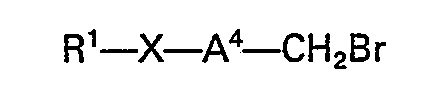
- The phosphonium starting material may be obtained by reaction of triphenylphosphine with a bromide of the formula
-
- A phenol derivative of the invention wherein the substituent R3 is other than hydrogen may be obtained from the corresponding compound wherein the substituent R3 is hydrogen by conventional etherification or esterification processes, and these may also be used in reverse to prepare the corresponding hydroxy compounds.
- A chemical derivative of the invention wherein A is alkenylene may be hydrogenated to provide the corresponding compound wherein A is alkylene.
- A chemical derivative of the invention wherein -X- is -CSNH- or -NHCS- may be obtained by the reaction of the corresponding compound wherein X is -CONH- or -NHCO- with 2,4-bis-(4-methoxyphenyl)-1,3-dithia-2,4-diphosphetane-2,4-disulphide.
- A chemical derivative of the invention wherein X is -SO- or -S02- may be obtained by the oxidation of the corresponding compound wherein X is -S-. The conditions for the oxidation will be chosen to provide the desired product; for example aqueous sodium metaperiodate solution will oxidize the sulphur group to sulphinyl, and m-chloroperbenzoic acid in chloroform solution will oxidise the sulphur group to sulphonyl.
- A chemical derivative of the invention wherein R5 and R6 form -CH2CH2- and either R4 and R14 are both hydrogen, or R4 and R14 are joined together so that CR4―CR14 is an olefinic double bond, may be converted into a chemical derivative of the invention wherein both ―CR4―CR14― and ―R5―R6― are -CH=CH- (that is, a naphthalene derivative) by aromatisation by conventional means, for example with 2,3-dichloro-5,6-dicyano-1,4-benzoquinone.
- As stated above, a chemical derivative of the invention possesses antioesterogenic activity. This may be demonstrated by its effect in antagonising the increase in weight of the uterus of an immature female rat produced by administering oestradiol benzoate to said rat. Thus, when a chemical derivative of the invention and oestradiol benzoate are co-administered for 3 days to such a rat, a smaller increase in uterine weight is produced than the substantial increase which would be produced by the administration of oestradiol benzoate without the chemical derivative of the invention.
- In particular, a preferred chemical derivative of the invention produces an antioestrogenic effect at a dose which produces no partial agonist effect, unlike the known antioestrogens tamoxifen and clomiphene. When a preferred chemical is coadministered with oestradiol benzoate to a rat as described above, no increase in uterine weigh whatsoever is observed at a suitable dose.
- A compound with the above pharmacological properties is of value in the treatment of the same conditions in which tamoxifen is beneficial, in particular, in the treatment of anovolutory infertility and in the treatment of breast tumours. It is also of value in the treatment of menstrual disorders.
- When used to produce an anti-oestrogenic effect in warm-blooded animals, a typical daily dose is from 0.1 to 25 mg/kg. administered orally or by injection. In man this is equivalent to an oral dose of from 5 to 1250 mg./day. A chemical derivative of the invention is most conveniently administered to man in the form of a pharmaceutical composition.
- According to a further feature of the invention, there is provided a pharmaceutical composition comprising a chemical derivative of the invention together with a pharmaceutically acceptable diluent or carrier.
- The composition may be in a form suitable for oral or parenteral administration. A tablet or capsule is a particularly convenient form for oral administration and such a composition may be made by conventional methods and contain conventional excipients. Thus a tablet could contain diluents, for example mannitol or maize starch, disintegrating agents, for example alginic acid, binding agents, for example methylcellulose, and lubricating agents, for example magnesium stearate.
- The composition may contain, in addition to the chemical derivative of the invention, one or more other agents which antagonise or inhibit hormonal action, for example antiandrogenic agents, for example flutamide, antiprogestational agents, or aromatase inhibitors, for example aminoglutethimide.
- A composition for oral administration may conveniently contain from 5 to 500 mg. of a phenol derivative of the invention.
- The invention is illustrated by the following Examples:-
- A solution of (1RS,2RS)-2-p-f)uorophenyi-1,2,3,4-tetrahydro-1-(10-mesyioxydecyi)-6-methoxynaphthalene (0.4 g.) in dimethylformamide (2 ml.) was added to a stirred suspension of sodium hydride (0.16 g. of a 50% dispersion in mineral oil) and hexanethiol (0.404 pl.) in dimethylformamide (10 ml.) which had previously been stirred at laboratory temperature for 2 hours and the mixture was stirred at that temperature for 1 hour and then evaporated to dryness. Water (10 ml.) was added and the mixture was extracted three times with ethyl acetate (10 ml. each time). The combined extracts were dried and evaporated to dryness and the residue was purified by chromatography on a silica gel column using toluene as eluent.
- Boron tribromide (0.66 ml. of a molar solution in methylene chloride) was added to a stirred solution of the (1RS,2RS)-2-p-fluorophenyl-1-(10-hexylthiodecyl)-1,2,3,4-tetrahydro-6-methoxynaphthalene thus obtained (0.11 g.) in methylene chloride (4 mi.) which was cooled to -70°C., and the mixture was allowed to warm up to laboratory temperature, stirred at that temperature for 16 hours and then poured onto ice (20 g.). The mixture was extracted three times with methylene chloride (10 ml. each time) and the combined extracts were washed with saturated aqueous sodium bicarbonate solution (5 ml.) and then with water, dried and evaporated to dryness. The residue was purified by chromatography on a silica gel column using toluene as eluent. There was thus obtained as an oil (1RS,2RS)-2-p-fluorophenyl-1-(10-hexylthiodecyl)-1,2,3,4-tetrahydronaphth-6-ol, the structure of which was confirmed by proton magnetic resonance and mass spectroscopy.
- The (1RS,2RS)-2-p-fluorophenyl-1,2,3,4-tetrahydro-1-(10-mesyloxydecyl)-6-methoxynaphthalene used as starting material was obtained as follows:-A solution of p-fluorophenylacetic acid (3.9 g.) in tetrahydrofuran (30 mi.) was added to a stirred solution of lithium diisopropylamide [prepared from diisopropylamine (5.55 g.) in n-butyllithium (37 ml. of a 1.5 molar solution in hexane)] at -78°C., and the mixture was allowed to warm up to laboratory temperature, stirred at that temperature for 1 hour and then recooled to -70°C. A solution of 2-m-methoxyphenylethyl methanesulphonate (12.7 g.) in tetrahydrofuran (20 ml.) was added, the mixture was allowed to warm up to laboratory temperature and was stirred at that temperature for 16 hours and then evaporated to dryness. Water (70 ml.) was added to the residue and the mixture was washed three times with diethyl ether (70 ml. each time), acidified to pH 1 with aqueous 2N-hydrochloric acid and extracted three times with diethyl ether (70 ml. each time). The combined extracts were washed with water, dried and evaporated to dryness.
- Oxalyl chloride (3.3 ml.) was added to a stirred solution of the 2-p-fluorophenyl-4-m-methoxyphenyl- butyric acid thus obtained (6.7 g.) and dimethylformamide (0.05 ml.) in toluene (50 ml.) and the mixture was stirred at laboratory temperature for 2 hours and then evaporated to dryness. The residue was dissolved in methylene chloride (100 ml.), the solution was stirred and cooled to -20°C. and stannic chloride (3.2 ml.) was added. The mixture was stirred for 2 hours and then poured into ice-water (250 ml.) and the mixture was extracted three times with methylene chloride (100 ml. each time). The combined extracts were washed with saturated aqueous sodium bicarbonate solution and then with water, dried and evaporated to dryness and the residue was stirred with methanol. The mixture was filtered and there was thus obtained as solid residue 2-p-fluorophenyl-3,4-dihydro-6-methoxynaphthalene-1(2H)-one, m.p. 124―127°C.
- A solution of the above compound (0.54 g.) in tetrahydrofuran (5 ml.) was added to a boiling mixture of 10-(dimethyl-t-butylsilyloxy)dec-1-yne (1.6 g., prepared as described below) in tetrahydrofuran (20 ml.) and methyl magnesium chloride (1.38 ml. of a 2.9 molar solution in tetrahydrofuran) which had previously been heated under reflux for 1 hour under an atmosphere of argon, and the mixture was heated under reflux for 30 minutes, cooled and poured into ice-cold saturated aqueous ammonium chloride solution (10 ml.). The mixture was extracted three times with ethyl acetate (30 ml. each time) and the combined extracts were washed with water, dried and evaporated to dryness. There was thus obtained as residueal oil 1-(10-dimethyl-t-butylsilyloxydec-1-ynyl)-2-p-fluorophenyl-6-methoxy-1,2,3,4-tetrahydronaphth-1-ol.
- A solution of the above compound (0.5 g.) in ethyl acetate (10 ml.) was stirred with a 10% palladium-on charcoal catalyst (0.1 g.) under an atmosphere of hydrogen for 18 hours, filtered and the filtrate was evaporated to dryness. A mixture of the residue (0.5 g.), acetic acid (6.7 ml.), water (3.3 ml.) and tetrahydrofuran (3 ml.) was stirred at laboratory temperature for 18 hours and then evaporated to dryness and the residue was purified by chromatography on a silica gel column using a 4:1 v/v mixture of toluene and ethyl acetate as eluent. There was thus obtained 10-[1RS,2RS)-2-p-fluorophenyl-6-methoxy-1,2,3,4-tetrahydronaphth-1-yl]decanol.
- Methanesulphonyl chloride (0.10 ml.) was added to a stirred solution of the above decanol (0.42 g.) and triethylamine (0.21 ml.) in methylene chloride (10 ml.) which was maintained at -10°C. and the mixture was stirred at that temperature for 30 minutes and then poured into saturated aqueous sodium bicarbonate solution (5 ml.). The mixture was extracted three times with methylene chloride (10 ml. each time) and the combined extracts were dried and evaporated to dryness. The residue was purified by chromatography on a silica gel column using toluene as eluent. There was thus obtained (1RS,2RS)-2-p-fluorophenyl-1,2,3,4-tetrahydro-1-(10-mesyloxydecyl)-6-methoxynaphthalene.
- The 10-(dimethyl-t-butylsilyloxy)dec-1-yne was obtained as follows:-
- A solution of dimethyl-t-butylsilyl chloride (18 g.) in tetrahydrofuran (50 ml.) was added dropwise to a stirred solution of 8-bromooctanol (20 g.) and imidazole (14.2 g.) in tetrahydrofuran (100 ml.) and the mixture was stirred at laboratory temperature for 3 hours, diluted with diethyl ether (200 mi.) and filtered. The filtrate was evaporated to dryness and the residue was purified by chromatography on a silica gel column using petroleum ether (b.p. 60-80°C.) as eluent. A solution of the 8-(dimethyl-t-butylsilyloxy)octyl bromide thus obtained (6.46 g.) in dimethyl sulphoxide (2 ml.) was added to a stirred suspension of lithium acetylide-ethylenediamine complex (2.02 g.) in dimethylsulphoxide (30 ml.) which was cooled to 10°C., and the mixture was stirred for 18 hours and then poured into ice-water (150 ml.). The mixture was extracted three times with petroleum ether (b.p. 60-80°C.; 30 ml. each time) and the combined extracts were washed with water (10 ml.), dried and evaporated to dryness. The residue was purified by chromatography on a silica gel column using a 5:1 v/v mixture of cyclohexane and diethyl ether as eluent. There was thus obtained 10-(dimethyl-t-butylsilyloxy)dec-1-yne.
- The process described in Example 1 was repeated except that the appropriate (1RS,2RS)-1,2,3,4-tetrahydro-1-(10-mesyloxydecyl)-2-phenyl-6-methoxynaphthalene and hexanethiol were used as starting materials. There were thus obtained as oils the compounds described in the following table, the structures of all of which were confirmed by proton magnetic resonance and mass spectroscopy:-
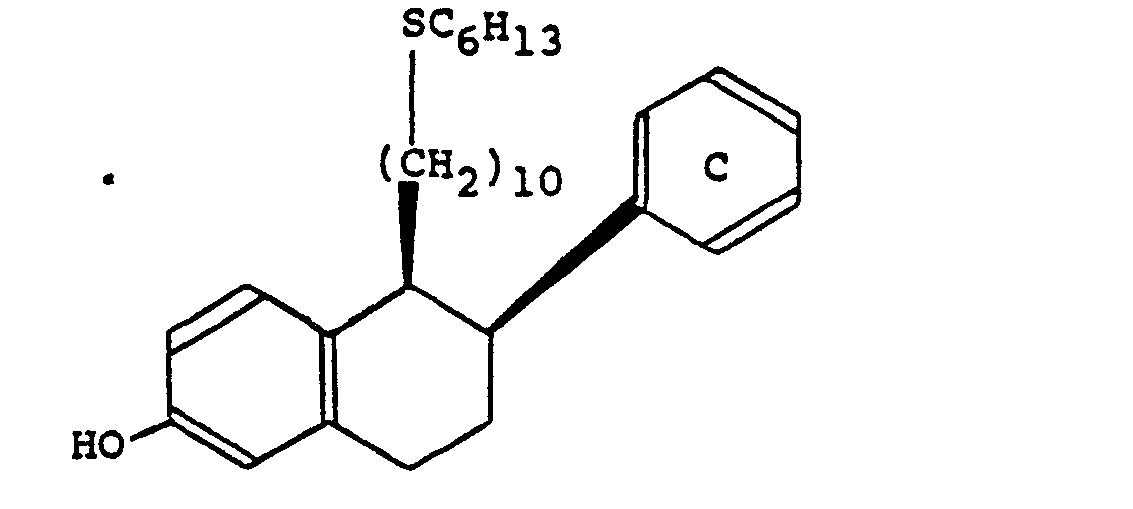

- Except as stated, the starting materials were obtained by a similar process to that described in Example 1 using the appropriate phenylacetic acid in place of p-fluorophenylacetic acid as initial starting material. *The corresponding 4-acetyl compound (as the final hexylthio derivative) was reduced to the corresponding 4-(1-hydroxyethyl) compound with sodium borohydride in ethanol. **The starting material was obtained by a Friedel-Kraft reaction of 1,2,3,4-tetrahydro-6-methoxy-2-phenylnaphth-1-one with acetyl chloride or hexafluoroacetone respectively and aluminium chloride in methylene chloride.
- 2,3-Dichloro-5,6-dicyano-1,4-benzoquinone (0.12 g.) was added to a stirred solution of (1RS,2RS)-2-p-fluorophenyl-1-(10-hexylthiodecyl)-1,2,3,4-tetrahydro-6-methoxynaphthalene (Example 1; 0.11 g.) in toluene (10 mi.) and the mixture was stirred and heated under reflux for 1 hour and then evaporated to dryness. The residue was purified by chromatography on a silica gel column using toluene as eluant and there was thus obtained 2-p-fluorophenyl-1-(10-hexylthiodecyl)-6-methoxynaphthalene.
- The above compound was treated with boron tribromide by a similar process to that described in the second paragraph of Example 1, and there was thus obtained as an oil 2-p-fluorophenyl-1-(10-hexylthiodecyl)naphth-6-ol, the structure of which was confirmed by proton magnetic resonance and mass spectroscopy.
- A solution of sodium metaperiodate (0.03 g.) in water (1 ml.) was added to a stirred solution of (IRS,2RS)-2-p-fluorophenyl-1-(10-hexylthiodecyl)-1,2,3,4-tetrahydronaphth-6-ol (Example 1; 0.06 g.) in methanol (5 ml.) and the mixture was stirred at laboratory temperature for 16 hours. The methanol was removed by evaporation and the residue was extracted three times with ethyl acetate (10 ml. each time). The combined extracts were washed with water, dried and evaporated to dryness and the residue was purified by chromatography on a silica gel column using a 4:1 v/v mixture of toluene and ethyl acetate as eluent. There was thus obtained (1RS,2RS)-2-p-fluorophenyl-1-(10-hexylsulphinyldecyl)-1,2,3,4-tetrahydronaphth-6-ol, the structure of which was confirmed by proton magnetic resonance and mass spectroscopy.
- The process described above was repeated using the appropriate hexylthiodecyl compound described in Example 2, and there were thus obtained the compounds described in the following table:-
-


- The process described in Example 1 was repeated using the appropriate (1RS,2RS)-1,2,3,4-tetrahydro-1-(omega-mesyloxyalkyl)-6-methoxy-2-(substituted phenyl)naphthalene and the appropriate thiol as starting materials. There were thus obtained as oils the compounds described in the following table, the structures of all of which were confirmed by proton magnetic resonance and mass spectroscopy:-


- The starting materials were obtained by a similar process to that described in Example 1, using the appropriately substituted phenylacetic acid and 2-m-methoxyphenylethyl methanesulphonate as initial starting materials, and either 10-(dimethyl-t-butylksilyloxy)dec-1-yne, 9-(dimethyl-t-butylsilyloxy)non-1- yne or 8-(dimethyl-t-butylsilyloxy)oct-1-yne (the last two compounds being (prepared from 7-bromoheptanol or 6-bromohexanol respectively by a similar process to that described in the last paragraph of Example 1) as later intermediates.
- The process described in Example 3 was repeated using the appropriate 6-methoxytetrahydro- naphthalene (the penultimate product in the preparation of the compounds described in Example 5) as starting material. There were thus obtained the compounds described in the following table, the structures of all of which were confirmed by proton magnetic resonance and mass spectroscopy:-


- Aqueous 10N-sodium hydroxide solution (0.08 ml.) was added to a solution of p-[(1RS,2RS)-1-(10- mesyloxydecyl)-6-methoxy-1,2,3,4-tetrahydronaphth-2-yl]-N,N-dimethylbenzamide (0.107 g.) and S-n-hexylisothiourea hydrobromide (0.097 g.) in dimethylformamide (5 ml.) and the mixture was stirred at laboratory temperature for 2 hours and then evaporated to dryness. Water (5 ml.) was added to the residue and the mixture was extracted three times with diethyl ether (10 ml. each time). The combined extracts were dried and evaporated to dryness and the residue was purified by chromatography on a silica gel column using initially cyclohexane and then toiuene as eluent. The product thus obtained was demethylated with boron tribromide by a similar process to that described in the second paragraph of Example 1, and the product was purified by chromatography on a silica gel column using a 4:1 v/v mixture of toluene and ethyl acetate as eluent. There was thus obtained as an oil p-[(1RS,2RS)-1-(10-hexylthiodecyl)-6-hydroxy-1 ,2,3,4-tetrahydronaphth-2-yl]-N,N-dimethylbenzamide, the structure of which was confirmed by proton magnetic resonance and mass spectroscopy.
- The starting material was obtained as follows:- n-Butyl-lithium (59 ml. of a 1.6 molar solution in hexane) was added to a stirred solution of p-bromophenyl- dimethoxymethane (21.8 g.) in tetrahydrofuran (200 ml.) which was maintained at -78°C., and the mixture was stirred at that temperature for 2 hours. A solution of 2-chloro-1,2,3,4-tetrahydro-6-methoxynaphthalen-1-one (12.8 g.) in tetrahydrofuran (100 ml.) was added and the mixture was allowed to warm up to laboratory temperature and was stirred at that temperature for 2 hours and then evaporated to dryness. Water (100 ml.) was added and the mixture was extracted three times with ethyl acetate (100 ml. each time). The combined extracts were washed with saturated aqueous ammonium chloride solution and then with water, dried and evaporated to dryness and the residue was purified by chromatography on a silica gel column using a 19:1 v/v mixture of toluene and ethyl acetate as eluent.
- A solution of phenyl magnesium chloride (21.5 ml. of a 2-molar solution in tetrahydrofuran) was added to a stirred solution of the 2-chloro-1-(p-dimethoxymethylphenyl)-1,2,3,4-tetrahydro-6-methoxynaphth-1-ol thus obtained (11.9 g.) in tetrahydrofuran (150 ml.) and the mixture was stirred and heated at 50°C. for 16 hours. Saturated aqueous ammonium chloride solution (200 ml.) was added and the mixture was extracted three times with ethyl acetate (50 ml each time). The combined extracts were washed with water, dried and evaporated to dryness and the residue was purified by chromatography on a silica gel column using a 19:1 v/v mixture of methylene chloride and ethyl acetate as eluent.
- A mixture of the 2-(p-dimethoxymethylphenyl)-1,2,3,4-tetrahydro-6-methoxynaphthalen-1-one thus obtained (2.5 g.), tetrahydrofuran (25 ml.), acetic acid (50 ml.) and water (25 mi.) was kept at 50°C for 3 hours and then evaporated to dryness. There was thus obtained 2-(p-formylphenyl)-1,2,3,4-tetrahydro-6-methoxynaphthaien-1-one.
- 8N-Aqueous chromic acid solution (Jones' reagent, 1 ml.) was added dropwise to a stirred solution of the above naphthalone (0.664 g.) in acetone (20 ml.) which was cooled to -20°C. and the mixture was allowed to warm up to laboratory temperature and stirred at that temperature for 1 hour. Isopropanol (0.1 ml.) was added and the mixture was evaporated to dryness. Water (15 ml.) was added and the mixture was extracted three times with ethyl acetate (10 ml. each time). The combined extracts were washed with water, dried and evaporated to dryness and there was thus obtained as residue p-(6-methoxy-1-oxo-1,2,3,4-tetrahydronaphth-2-yl)benzoic acid.
- Oxalyl chloride (1.6 ml.) was added to a stirred solution of the above acid (3.6 g.) and dimethylformamide (0.05 ml.) in methylene chloride (100 ml.) and the mixture was stirred at laboratory temperature for 16 hours and then evaporated to dryness. A solution of the residue in methylene chloride (50 ml.) was added dropwise to 25% w/v solution of dimethylamine in tetrahydrofuran (10 ml.) which was maintained at 0°C., and the mixture was allowed to warm up to laboratory temperature, stirred at that temperature for 2 hours and then evaporated to dryness. Water (20 ml) was added and the mixture was extracted three times with ethyl acetate (50 ml. each time). The combined extracts were washed with water, dried and evaporated to dryness and the residue was purified by chromatography on a silica gel column using ethyl acetate as eluent.
- The p-(6-methoxy-1-oxo-1,2,3,4-tetrahydronaphth-2-yl)-N,N-dimethylbenzamide thus obtained was successively reacted with 10-(dimethyl-t-butylsilyloxy)dec-1-yne, hydrogenated, hydrolysed and reacted with methanesulphonyl chloride by similar processes to those described in the penultimate three paragraphs of Example 1, and there was thus obtained p-[(1RS,2RS)-1-(10-mesyloxydecyl)-6-methoxy-1,2,3,4-tetrahydronaphth-2-yl]-N,N-dimethylbenzamide.
- Aqueous 2N-sodium hydroxide solution (10 ml.) was added to a solution of p-[(1RS,2RS)-1-(10- mesyloxydecyl)-6-hydroxy-1,2,3,4-tetrahydronaphth-2-yl]-N,N-dimethylbenzamide (Example 7; 0.24 g.) in ethanol (10 ml.) and the mixture was heated under reflux for 16 hours. The ethanol was removed by evaporation and the residue was acidified to pH 1 with aqueous 2N-hydrochloric acid and extracted three times with ethyl acetate (15 ml. each time). The combined extracts were washed with water, dried and evaporated to dryness and the residue was purified by chromatography on a silica gel column using a 4:1 v/v mixture of toluene and ethyl acetate as eluent. There was thus obtained as an oil p-[(1RS,2RS)-1-(10-hexylthiodecyl)-6-hydroxy-1,2,3,4-tetrahydronaphth-2-yl]-benzoic acid, the structure of which was confirmed by proton magnetic resonance and mass spectroscopy.
- Borane (0.4 ml. of molar solution in tetrahydrofuran) was added to a stirred solution of p-[(1RS,2RS)-1-(10-hexylthiodecyl)-6-hydroxy-1,2,3,4-tetrahydronaphth-2-yl]-benzoic acid (Example 8; 0.063 g.); in tetrahydrofuran (3 ml.) and the mixture was stirred at laboratory temperature for 16 hours. Water (10 ml.) was added and the mixture was acified to pH 1 with aqueous 2N-hydrochloric acid and extracted three times with ethyl acetate (10 ml. each time). The combined extracts were washed with water, dried and evaporated to dryness and the residue was purified by chromatography on a silica gel column using a 7:1 v/v mixture of toluene and ethyl acetate as eluent. There was thus obtained (1RS,2RS)-1-(10-hexylthiodecyl)-2-p-hydroxymethylphenyl-1,2,3,4-tetrahydronaphth-6-ol, the structure of which was confirmed by proton magnetic resonance and mass spectrocopy.
- A mixture of trifluoroacetic anhydride (0.1 ml.), p-[(1RS,2RS)-6-methoxy-1-(10-{4,4,5,5,5-pentafluoropentyl}thiodecyl)-1,2,3,4-tetrahydronaphth-2-yl]benzamide (0.083 g.), pyridine (0.1 mi.) and dioxan (5 ml.) was stirred at laboratory temperature for 2 hours and then evaporated to dryness. Water (5 mi.) was added and the mixture was extracted three times with methylene chloride (10 ml. each time). The combined extracts were washed with water. dried and evaporated to dryness and the residue was purified by chromatography on a silica gel column using a 3:1 v/v mixture of toluene and petroleum ether (b.p. 40-60°C.) as eluent. The product thus obtained was demethylated with boron tribromide by a similar process to that described in the second paragraph of Example 1, and there was thus obtained p-[(1 RS,2RS)-6-hydroxy-1-(10-{4,4,5,5,5-pentafluoropentyl}thiodecyl)-1,2,3,4-tetrahydronaphth-2-yl]benzonitrile, the structure of which was confirmed by proton magnetic resonance and mass spectroscopy.
- The benzamide used as starting material was obtained by reacting p-[(1RS,2RS)-1-l10-mesyloxy- decyl)-6-methoxy-1,2,3,4-tetrahydronaphth-2-yl]-N,N-dimethylbenzamide (Example 7) with S-(4,4,5,5,5-pentafluoropentyl)isothiourea hydrobromide by a similar process to that described in Example 7, hydrolysing the dimethylamide to the carboxylic acid by a similar process to that described in Example 8, and reacting the acid with oxalyl chloride and ammonia by a similar process to that described in the penultimate paragraph of Example 7 using a solution of ammonia in tetrahydrofuran in place of dimethylamine.
- The process described in Example 4 was repeated using the appropriate thio compound described in any of Examples 5 to 10 as starting materials and there were thus obtained the compounds described in the following tables:-


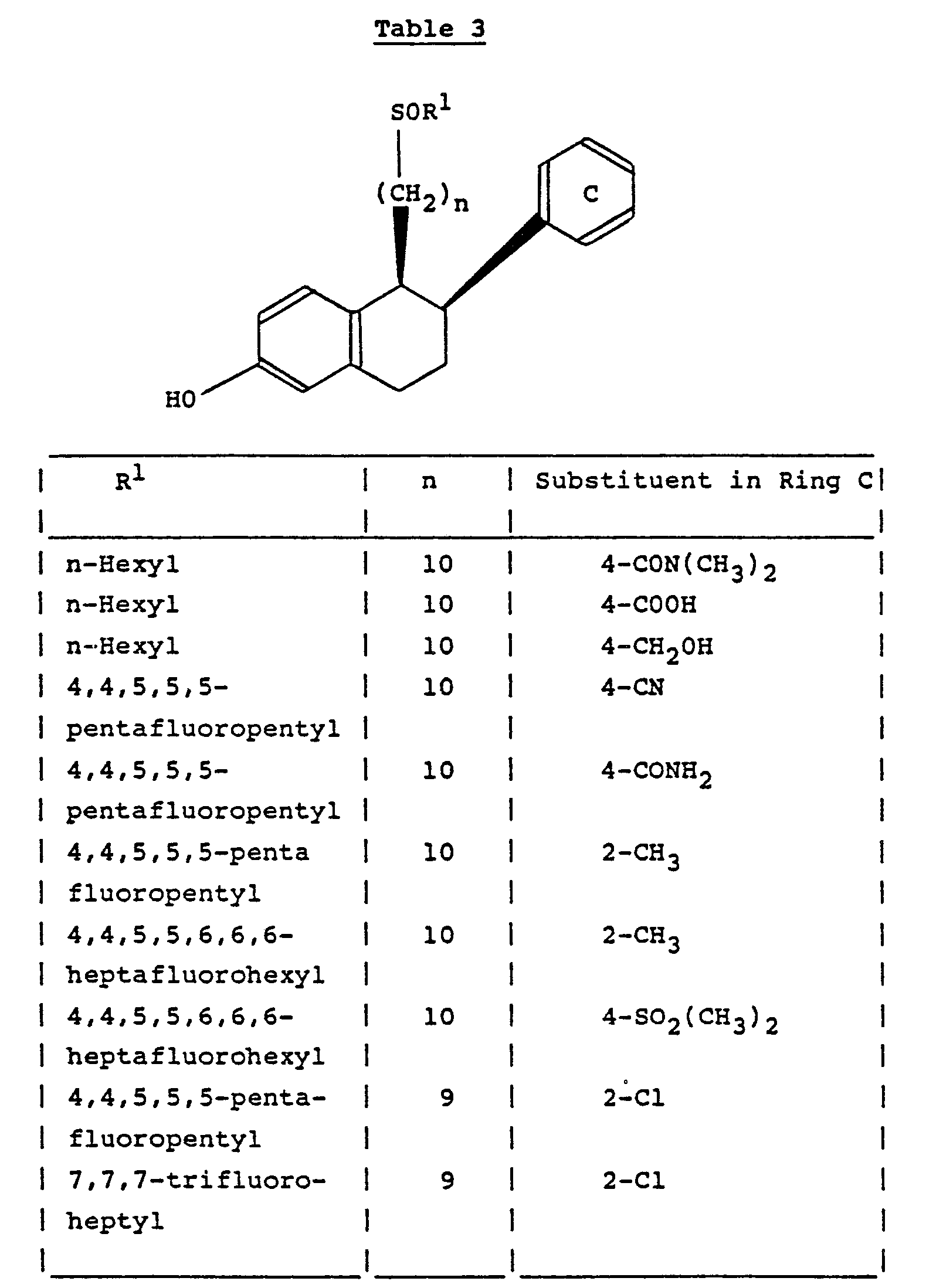
- m-Chloroperbenzoic acid (0.035 g.) was added to a stirred solution of 1-[10-(4,4,5,5,5-pentafluoropentyl)thiodecyl]-2-p-tolylnaphth-6-ol (Example 6; 0.044 g.) in methylene chloride (5 ml.) and the mixture was stirred at laboratory temperature for 1 hour, diluted with methylene chloride (5 ml.), washed with saturated aqueous sodium bicarbonate solution and then with water (10 mi. each), dried and evaporated to dryness. The residue was purified by chromatography on a silica gel column using a 3:1 v/v mixture of toluene and ethyl acetate as eluent, and there was thus obtained 1-[10-(4,4,5,5,5-pentafluoropentyl)sulphonyldecyl]-2-p-tolylnaphth-6-ol, the structure of which was confirmed by proton magnetic resonance and mass spectroscopy.
- Aqueous 2N-sodium hydroxide solution (2 ml.) was added to a solution of a mixture of the (1 RS,2RS)-and (1RS,2SR)-isomers of 1,2,3,4-tetrahydro-1-(10-mesyloxydecyl)-2-p-methoxyphenyl-2,6-dimethyl- naphthalene (0.52 g.) and 5-(4,4,5,5,5-pentafluoropentyl)-isothiouronium tosylate (0.82 g.) in dimethylformamide (10 ml.) and the mixture was stirred at laboratory temperature for 2 hours. Water (50 ml.) was added and the mixture was extracted three times with ethyl acetate (50 mi. each time). The combined extracts were dried and evaporated to dryness, and the residue was demethylated with boron tribromide by a similar process to that described in the second paragraph of Example 1. The final product was purified by chromatography on a silica gel column using a 99:1 v/v mixture of toluene and ethyl acetate as eluent. There were thus separately obtained as oils the (1 RS,2RS)- and (1 RS,2SR)-isomers of 4-[2,6-dimethy)-1 -{10-(4,4,5,5,5-pentafluoropentylthio)decyl}-1,2,3,4-tetrahydronaphth-2-yl]phenol, the structures of both of which isomers were confirmed by proton magnetic resonance and mass spectroscopy.
- The mixture of isomers used as starting material was obtained as follows:
- The process described in the third and fourth paragraphs of Example 1 was repeated using p-methoxyphenylacetic acid and 2-m-tolylethyl methanesulphonate as starting materials. The 3,4-dihydro-2-p-methoxyphenyl-6-methylnaphthalen-1(2H)-one thus obtained (1.33 g., m.p. 125-126°C after crystallisation from methanol) was added to a stirred solution of lithium diisopropylamide in tetrahydrofuran [prepared from n-butyllithium (5 ml. of a 1.5 molar solution in hexane) and a solution of diisopropylamine (0.8 g; freshly distilled from potassium hydroxide) in tetrahydrofuran (20 ml.)] which was cooled to -20°C. under an atmosphere of argon. The mixture was stirred at -20°C. for 1 hour, methyl iodide (1.27 g.) was added and the mixture was stirred at laboratory temperature for 18 hours. Aqueous N-hydrochloric acid (50 ml.) was added and the mixture was extracted twice with diethyl ether (50 ml. each time). The combined extracts were dried and evaporated to dryness and the residue was purified by medium pressure chromatography on a silica gel column using a 12.5:1 v/v mixture of petroleum ether (b.p. 60-80°C.) and ethyl acetate as eluent. The product was crystallised from petroleum ether (b.p. 60-80°C.) and there was thus obtained 3,4-dihydro-2-p-methoxyphenyl-2,6-dimethylnaphthalen-1(2H)-one, m.p. 80-82°C.
- This product was then successively reacted with 10-(dimethyl-t-butylsilyloxy)dec-1-yne, hydrogenated over a palladium-on-charcoal catalyst, hydrolysed and reacted with methanesulphonyl chloride by similar processes to those described in the fifth, sixth and seventh paragraphs of Example 1. There was thus obtained the desired mixture of (1RS,2RS)- and (1RS,2SR)-isomers of 1,2,3,4-tetrahydro-1-(10-mesyloxy- decyl)-2-p-methoxyphenyl-2,6-dimethylnaphthalene.
- The process described above was repeated using the appropriate phenylacetic acid, the appropriate phenethyl mesylate and the appropriate silyloxyalk-1-yne as intermediates, and there were thus obtained as oils the compounds described in the following table, the structures of all of which were confirmed by proton magnetic resonance and mass spectroscopy:-


- The process described in Example 4 was repeated using the compounds described in Example 13 as starting materials. There were thus obtained as oils the compounds described in the following table, the structures of all fo which were confirmed by proton magnetic resonance and mass spectroscopy:-
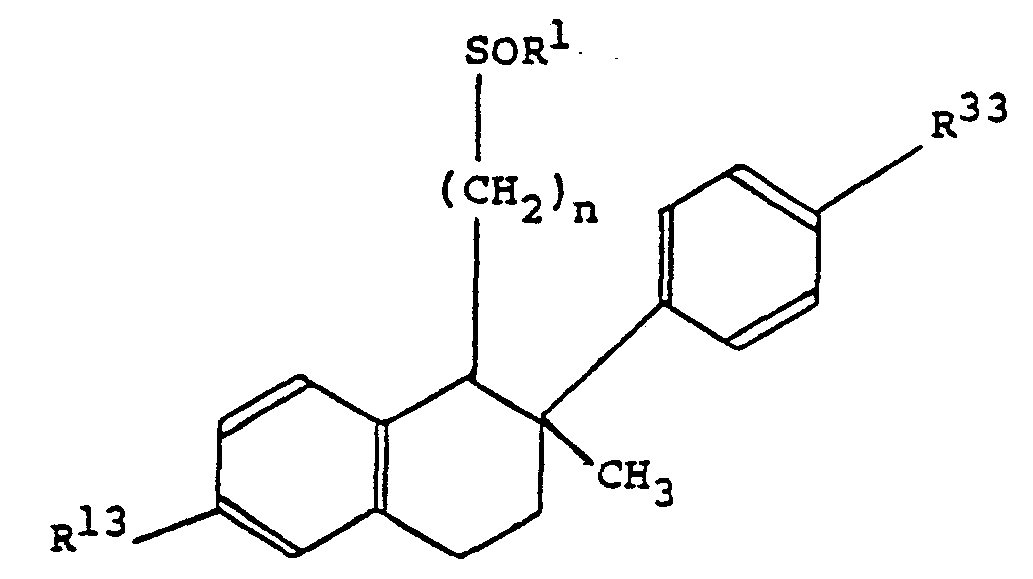

- The process described in Example 12 was repeated using some of the compounds described in Example 13 as starting materials. There were thus obtained as oils the compounds described in the following table, the structures of all of which were confirmed by proton magnetic resonance and mass spectroscopy:-

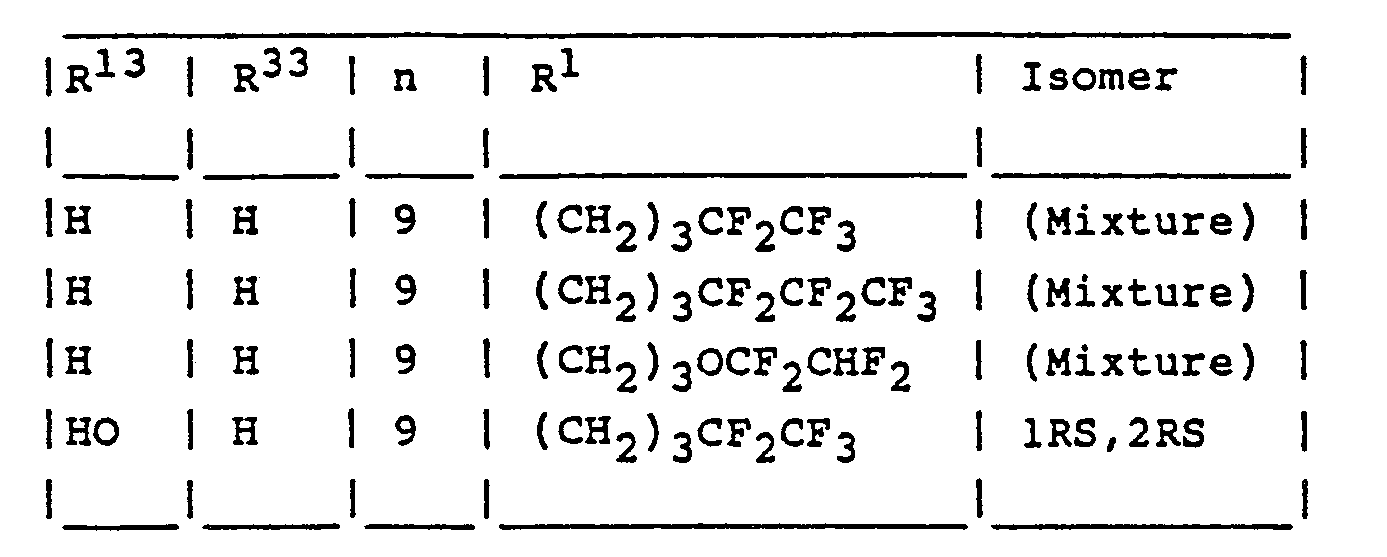
- Aqueous 10N-sodium hydroxide solution (0.15 ml.) was added to a stirred solution of 1-(10-bromodecyl)-2-phenylnaphth-6-ol (0.09 g.) and S-(4,4,5,5,5-pentafluoropentyl)isothiouronium tosylate (0.25 g.) in dimethylformamide (3 ml.) which was maintained under an atmosphere of argon, and the mixture was stirred at laboratory temperature for 18 hours, acidified with aqueous N-hydrochloric acid (20 ml.) and extracted twice with diethyl ether (20 ml. each time). The combined extracts were dried and evaporated to dryness and the product obtained was oxidised with sodium metaperiodate by a similar process to that described in Example 4. There was thus obtained as an oil 1-[10-(4,4,5,5,5-pentafluoro- pentylthio)decyl]-2-phenylnaphth-6-ol, the structure of which was confirmed by proton magnetic resonance and mass spectroscopy.
- The naphthol starting material was obtained as follows:-
- The processes described in the third, fourth and fifth paragraphs of Example 1 were repeated using phenylacetic acid in place of p-fluorophenylacetic acid as starting material. The tetrahydronaphthyl group was aromatised to a naphthyl group with 2,3-dichloro-5,6-dicyano-1,4-benzoquinone by a similar process to that described in Example 3, and the silyloxy group was removed by hydrolysis, the acetylene group was hydrogenated and the decanol was mesylated, in that order, by similar processes to those described respectively in the sixth (second part), sixth (first part) and seventh paragraphs of Example 1.
- Boron tribromide (3.6 ml of a molar solution in methylene chloride) was added to a stirred solution of the 1-(10-mesyloxydecyl)-6-methoxy-2-phenylnaphthalene thus obtained (0.4 g.) in methylene chloride (10 ml.) which was maintained at -70°C. under an atmosphere of argon, and the mixture was allowed to warm up to laboratory temperature, kept at that temperature for 2 hours, and saturated aqueous sodium bicarbonate solution (10 mI.) was then added. The mixture was extracted twice with diethyl ether (20 ml. each time) and the combined extracts were dried and evaporated to dryness. There was thus obtained 1-(10-bromodecyl)-2-phenylnaphth-6-ol which was used without further purification.
- A mixture of (IRS,2RS)-1,2,3,4-tetrahydro-1-(10-mesyloxydecyl)-6-methoxy-2-p-tolyInaphthalene (0.055 g.), butylmethylphenylphosphine (0.225 ml.), sodium iodide (0.172 g.) and acetonitrile (25 ml.) was heated under reflux for 16 hours and then evaporated to dryness. The residue was purified by chromatography on a silica gel column using a 4:1 v/v mixture of cyclohexane and methylene chloride as eluent. A mixture of a solution of the butyl{[(1RS,2RS)-6-methoxy-1,2,3,4-tetrahydro-2-p-tolylnaphth-1-yl]decyl}methylphenylphosphonium iodide thus obtained (0.45 g.) in tetrahydrofuran (30 ml.), aqueous 30% sodium hydroxide solution (10 mi.) and tetrabutylammonium bromide (0.02 g.) was stirred at laboratory temperature for 2 days, diluted with water (50 ml.) and extracted three times with ethyl acetate (20 ml. each time). The combined extracts were washed with water, dried and evaporated to dryness and the residue was purified by chromatography on a silica gel column using a 24:1 v/v mixture of methylene chloride and methanol as eluent.
- The product obtained was demethylated with boron tribromide by a similar process to that described in the second paragraph of Example 1, and the final product was purified by chromatography on a silica gel column using a 24:1 v/v mixture of methylene chloride and methanol as eluent. There was thus obtained as an oil (1RS,2RS)-1-(10-butylmethylphosphinyldecyl)-1,2,3,4-tetrahydro-2-p-tolylnaphth-6-ol, the structure of which was confirmed by proton magnetic resonance and mass spectroscopy.
Claims (10)

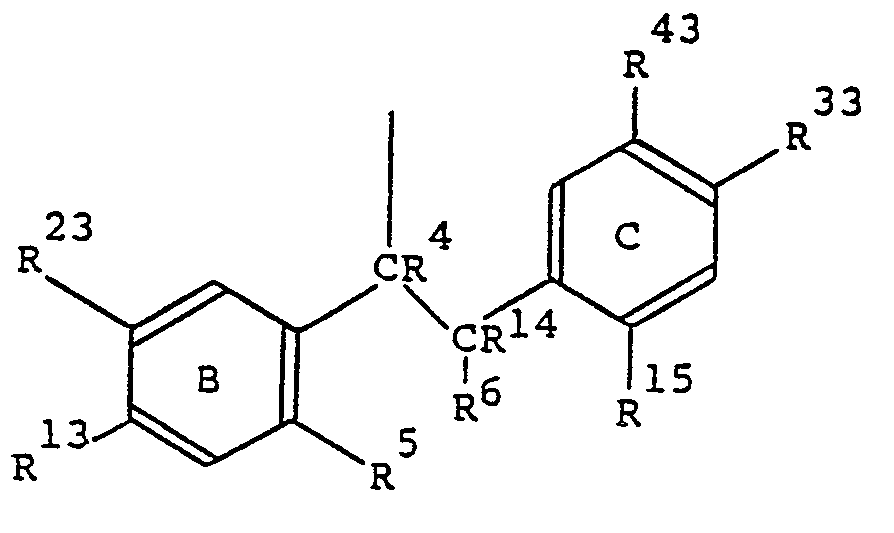






Priority Applications (1)
| Application Number | Priority Date | Filing Date | Title |
|---|---|---|---|
| AT85302881T ATE43579T1 (en) | 1984-04-27 | 1985-04-24 | PHENOL DERIVATIVES. |
Applications Claiming Priority (4)
| Application Number | Priority Date | Filing Date | Title |
|---|---|---|---|
| GB848410900A GB8410900D0 (en) | 1984-04-27 | 1984-04-27 | Phenol derivatives |
| GB8410900 | 1984-04-27 | ||
| GB8426753 | 1984-10-23 | ||
| GB848426753A GB8426753D0 (en) | 1984-10-23 | 1984-10-23 | Phenol derivatives |
Publications (3)
| Publication Number | Publication Date |
|---|---|
| EP0163416A2 EP0163416A2 (en) | 1985-12-04 |
| EP0163416A3 EP0163416A3 (en) | 1986-10-08 |
| EP0163416B1 true EP0163416B1 (en) | 1989-05-31 |
Family
ID=26287664
Family Applications (1)
| Application Number | Title | Priority Date | Filing Date |
|---|---|---|---|
| EP85302881A Expired EP0163416B1 (en) | 1984-04-27 | 1985-04-24 | Phenol derivatives |
Country Status (15)
| Country | Link |
|---|---|
| US (1) | US4751240A (en) |
| EP (1) | EP0163416B1 (en) |
| JP (1) | JPH0717595B2 (en) |
| AU (1) | AU566987B2 (en) |
| CA (1) | CA1291991C (en) |
| DE (1) | DE3570656D1 (en) |
| DK (1) | DK185085A (en) |
| FI (1) | FI851602L (en) |
| GR (1) | GR851025B (en) |
| HU (1) | HUT37594A (en) |
| IE (1) | IE58417B1 (en) |
| IL (1) | IL75030A (en) |
| NO (1) | NO851679L (en) |
| NZ (1) | NZ211905A (en) |
| PT (1) | PT80363B (en) |
Families Citing this family (19)
| Publication number | Priority date | Publication date | Assignee | Title |
|---|---|---|---|---|
| GB8410901D0 (en) * | 1984-04-27 | 1984-06-06 | Ici Plc | Phenol derivatives |
| GB8705174D0 (en) * | 1987-03-05 | 1987-04-08 | Ici Plc | Heterocyclic compounds |
| CH675480A5 (en) * | 1988-07-26 | 1990-09-28 | Mettler Toledo Ag | |
| US5395842A (en) * | 1988-10-31 | 1995-03-07 | Endorecherche Inc. | Anti-estrogenic compounds and compositions |
| US5393785A (en) * | 1988-10-31 | 1995-02-28 | Endorecherche, Inc. | Therapeutic antiestrogens |
| US5204337A (en) * | 1988-10-31 | 1993-04-20 | Endorecherche Inc. | Estrogen nucleus derivatives for use in inhibition of sex steroid activity |
| US5686465A (en) * | 1988-10-31 | 1997-11-11 | Endorecherche Inc. | Sex steroid activity inhibitors |
| ES2077675T3 (en) * | 1989-03-10 | 1995-12-01 | Endorecherche Inc | COMBINED THERAPY FOR THE TREATMENT OF ESTROGEN SENSITIVE DISEASES. |
| US5364847A (en) * | 1989-03-10 | 1994-11-15 | Endorecherche | Inhibitors of sex steroid biosynthesis and methods for their production and use |
| WO1991000732A1 (en) * | 1989-07-07 | 1991-01-24 | Endorecherche Inc. | Androgen derivatives for use in the inhibition of sex steroid activity |
| HUT60139A (en) * | 1989-07-07 | 1992-08-28 | Endorecherche Inc | Process for producing pharmaceutical composition suitable for treating prostate cancer connected with androgen |
| ZA924811B (en) * | 1991-06-28 | 1993-12-29 | Endorecherche Inc | Controlled release systems and low dose androgens |
| US6060503A (en) * | 1991-12-02 | 2000-05-09 | Endorecherche, Inc. | Benzopyran-containing compounds and method for their use |
| JPH07506575A (en) * | 1992-05-21 | 1995-07-20 | アンドルシェルシュ・インコーポレイテッド | Inhibitor of testosterone 5α-reductase activity |
| AU8998398A (en) * | 1997-09-09 | 1999-03-29 | Shionogi & Co., Ltd. | 4-substituted benzoic acid derivatives and carcinostatics containing the same asthe active ingredient |
| TWI306450B (en) | 2001-12-13 | 2009-02-21 | Wyeth Corp | Substituted phenyl naphthalenes as estrogenic agents |
| SG185311A1 (en) | 2007-10-16 | 2012-11-29 | Repros Therapeutics Inc | Trans-clomiphene for metabolic syndrome |
| JP2015508825A (en) | 2012-02-29 | 2015-03-23 | レプロス セラピューティクス インコーポレイティド | Combination therapy to treat androgen deficiency |
| US11633382B2 (en) | 2015-11-10 | 2023-04-25 | Paracrine Therapeutics Ab | Treatment of ER-negative breast cancer with an PDGF-CC inhibitor and anti-estrogen |
Family Cites Families (13)
| Publication number | Priority date | Publication date | Assignee | Title |
|---|---|---|---|---|
| US3296304A (en) * | 1963-12-19 | 1967-01-03 | Upjohn Co | Process for the preparation of 2, 2-diaryl-nu, nu-disubstituted acetamides |
| CH476775A (en) * | 1966-02-08 | 1969-08-15 | Geigy Ag J R | Process for the protection of oxidation-sensitive organic material |
| US3539642A (en) * | 1967-07-19 | 1970-11-10 | Geigy Chem Corp | 2-phenyl-2-(1-naphthyl)acetamides |
| GB1262367A (en) * | 1969-09-09 | 1972-02-02 | Pfizer Ltd | Naphthoic acid derivatives |
| AT336589B (en) * | 1974-05-20 | 1977-05-10 | Thomae Gmbh Dr K | METHOD FOR PRODUCING NEW BIPHENYL DERIVATIVES |
| US4055539A (en) * | 1974-09-16 | 1977-10-25 | Ciba-Geigy Corporation | Alkylidene-bisphenols containing sulphur, and their use as stabilizers |
| DE2629752A1 (en) * | 1976-07-02 | 1978-01-05 | Boehringer Mannheim Gmbh | NEW CARBONIC ACID DERIVATIVES AND THE PROCESS FOR THEIR PRODUCTION |
| DE2936803A1 (en) * | 1979-09-12 | 1981-04-02 | Bayer Ag, 5090 Leverkusen | METHOD FOR PRODUCING 2-ALKYL OR 2-ARYLTHIOMETHYLPHENOL |
| GR74992B (en) * | 1980-08-13 | 1984-07-12 | Ciba Geigy Ag | |
| CA1162200A (en) * | 1981-02-13 | 1984-02-14 | Michael Klaus | Process for the manufacture of indanyl (or tetrahydronaphthyl)propenyl phenyl derivatives |
| FR2536747A1 (en) * | 1982-11-29 | 1984-06-01 | Synthelabo | SULFURED BENZYLIDENIC DERIVATIVES, THEIR PREPARATION AND THEIR THERAPEUTIC APPLICATION |
| GB8311678D0 (en) * | 1983-04-28 | 1983-06-02 | Ici Plc | Phenol derivatives |
| DE3334207A1 (en) * | 1983-09-22 | 1985-04-04 | Hoechst Ag, 6230 Frankfurt | NEW N- (THIO) CARBAMYLARYLCARBOXIMIDO (THIO) ESTERS, METHOD FOR THE PRODUCTION THEREOF, CONTAINERS THEREOF AND THEIR USE AS A PEST CONTROL |
-
1985
- 1985-04-19 IE IE101085A patent/IE58417B1/en not_active IP Right Cessation
- 1985-04-23 FI FI851602A patent/FI851602L/en not_active Application Discontinuation
- 1985-04-24 EP EP85302881A patent/EP0163416B1/en not_active Expired
- 1985-04-24 AU AU41656/85A patent/AU566987B2/en not_active Ceased
- 1985-04-24 HU HU851568A patent/HUT37594A/en unknown
- 1985-04-24 DE DE8585302881T patent/DE3570656D1/en not_active Expired
- 1985-04-24 US US06/726,824 patent/US4751240A/en not_active Expired - Lifetime
- 1985-04-25 DK DK185085A patent/DK185085A/en not_active Application Discontinuation
- 1985-04-26 NZ NZ211905A patent/NZ211905A/en unknown
- 1985-04-26 NO NO851679A patent/NO851679L/en unknown
- 1985-04-26 IL IL75030A patent/IL75030A/en not_active IP Right Cessation
- 1985-04-26 CA CA000480145A patent/CA1291991C/en not_active Expired - Lifetime
- 1985-04-26 GR GR851025A patent/GR851025B/el unknown
- 1985-04-26 PT PT80363A patent/PT80363B/en not_active IP Right Cessation
- 1985-04-27 JP JP60089959A patent/JPH0717595B2/en not_active Expired - Lifetime
Also Published As
| Publication number | Publication date |
|---|---|
| FI851602A7 (en) | 1985-10-28 |
| IE851010L (en) | 1985-10-27 |
| EP0163416A3 (en) | 1986-10-08 |
| AU4165685A (en) | 1985-10-31 |
| NZ211905A (en) | 1988-08-30 |
| CA1291991C (en) | 1991-11-12 |
| JPS6110528A (en) | 1986-01-18 |
| IL75030A0 (en) | 1985-08-30 |
| PT80363B (en) | 1987-10-20 |
| US4751240A (en) | 1988-06-14 |
| DK185085A (en) | 1985-10-28 |
| DE3570656D1 (en) | 1989-07-06 |
| EP0163416A2 (en) | 1985-12-04 |
| GR851025B (en) | 1985-07-18 |
| JPH0717595B2 (en) | 1995-03-01 |
| FI851602A0 (en) | 1985-04-23 |
| NO851679L (en) | 1985-10-28 |
| FI851602L (en) | 1985-10-28 |
| IL75030A (en) | 1989-09-28 |
| AU566987B2 (en) | 1987-11-05 |
| IE58417B1 (en) | 1993-09-22 |
| DK185085D0 (en) | 1985-04-25 |
| PT80363A (en) | 1985-05-01 |
| HUT37594A (en) | 1986-01-23 |
Similar Documents
| Publication | Publication Date | Title |
|---|---|---|
| EP0163416B1 (en) | Phenol derivatives | |
| EP0124369B1 (en) | Phenol derivatives | |
| EP0040932B1 (en) | Amide derivatives, process for their manufacture and pharmaceutical or veterinary compositions containing them | |
| US5776951A (en) | Anti-atherosclerotic diaryl compounds | |
| EP0132366B1 (en) | Leukotriene antagonists | |
| EP0160508B1 (en) | Phenol derivatives | |
| US20040254222A1 (en) | Diaryl sulfide derivative, addition salt thereof, and immunosuppressant | |
| US4833135A (en) | Antioestrogenic phenol derivatives | |
| NZ204995A (en) | Acylanilide derivatives and pharmaceutical compositions | |
| AU658023B2 (en) | Substituted phenyl phenol leukotriene antagonists | |
| EP2595977A1 (en) | Process for preparing benzofuran derivatives substituted at position 5 | |
| NZ205559A (en) | Leukotriene antagonists, pharmaceutical compositions, and intermediates | |
| EP0081321A1 (en) | 2-Aminophenol derivatives | |
| EP0157603B1 (en) | 1, 3-benzoxathiole derivatives, their use and their preparation | |
| US4730005A (en) | Leukotriene antagonist | |
| CA2147495A1 (en) | N-t-butylaniline analog and lipid level depressant containing the same | |
| IE58359B1 (en) | New phenol derivatives, pharmaceutical compositions containing these compounds and processes for the preparation of these compounds and compositions | |
| GB2120663A (en) | Allylamine derivatives, processes for their preparation and their use | |
| FI79698C (en) | Process for the preparation of pharmacologically active dithiaalkandic acid | |
| CA1044697A (en) | Novel disubstituted azabicycloalcanes | |
| MXPA97009986A (en) | N-hydroxyurees, their use and anti-inflammatory composition that contains them | |
| EP0155079A1 (en) | Acetylene amines and their use as vasodilators and antihypertensives |
Legal Events
| Date | Code | Title | Description |
|---|---|---|---|
| PUAI | Public reference made under article 153(3) epc to a published international application that has entered the european phase |
Free format text: ORIGINAL CODE: 0009012 |
|
| AK | Designated contracting states |
Designated state(s): AT BE CH DE FR GB IT LI LU NL SE |
|
| PUAL | Search report despatched |
Free format text: ORIGINAL CODE: 0009013 |
|
| RHK1 | Main classification (correction) |
Ipc: C07C103/34 |
|
| AK | Designated contracting states |
Kind code of ref document: A3 Designated state(s): AT BE CH DE FR GB IT LI LU NL SE |
|
| 17P | Request for examination filed |
Effective date: 19870317 |
|
| 17Q | First examination report despatched |
Effective date: 19871222 |
|
| GRAA | (expected) grant |
Free format text: ORIGINAL CODE: 0009210 |
|
| AK | Designated contracting states |
Kind code of ref document: B1 Designated state(s): AT BE CH DE FR GB IT LI LU NL SE |
|
| REF | Corresponds to: |
Ref document number: 43579 Country of ref document: AT Date of ref document: 19890615 Kind code of ref document: T |
|
| ITF | It: translation for a ep patent filed | ||
| REF | Corresponds to: |
Ref document number: 3570656 Country of ref document: DE Date of ref document: 19890706 |
|
| ET | Fr: translation filed | ||
| PLBE | No opposition filed within time limit |
Free format text: ORIGINAL CODE: 0009261 |
|
| STAA | Information on the status of an ep patent application or granted ep patent |
Free format text: STATUS: NO OPPOSITION FILED WITHIN TIME LIMIT |
|
| 26N | No opposition filed | ||
| ITTA | It: last paid annual fee | ||
| REG | Reference to a national code |
Ref country code: GB Ref legal event code: 732E |
|
| EPTA | Lu: last paid annual fee | ||
| EAL | Se: european patent in force in sweden |
Ref document number: 85302881.9 |
|
| PGFP | Annual fee paid to national office [announced via postgrant information from national office to epo] |
Ref country code: AT Payment date: 19950412 Year of fee payment: 11 |
|
| PGFP | Annual fee paid to national office [announced via postgrant information from national office to epo] |
Ref country code: SE Payment date: 19950419 Year of fee payment: 11 |
|
| PGFP | Annual fee paid to national office [announced via postgrant information from national office to epo] |
Ref country code: NL Payment date: 19950430 Year of fee payment: 11 |
|
| PGFP | Annual fee paid to national office [announced via postgrant information from national office to epo] |
Ref country code: LU Payment date: 19950601 Year of fee payment: 11 |
|
| PGFP | Annual fee paid to national office [announced via postgrant information from national office to epo] |
Ref country code: BE Payment date: 19950602 Year of fee payment: 11 |
|
| PG25 | Lapsed in a contracting state [announced via postgrant information from national office to epo] |
Ref country code: LU Free format text: LAPSE BECAUSE OF NON-PAYMENT OF DUE FEES Effective date: 19960424 Ref country code: AT Effective date: 19960424 |
|
| PG25 | Lapsed in a contracting state [announced via postgrant information from national office to epo] |
Ref country code: SE Effective date: 19960425 |
|
| PG25 | Lapsed in a contracting state [announced via postgrant information from national office to epo] |
Ref country code: BE Effective date: 19960430 |
|
| BERE | Be: lapsed |
Owner name: IMPERIAL CHEMICAL INDUSTRIES P.L.C. Effective date: 19960430 |
|
| PG25 | Lapsed in a contracting state [announced via postgrant information from national office to epo] |
Ref country code: NL Effective date: 19961101 |
|
| NLV4 | Nl: lapsed or anulled due to non-payment of the annual fee |
Effective date: 19961101 |
|
| EUG | Se: european patent has lapsed |
Ref document number: 85302881.9 |
|
| REG | Reference to a national code |
Ref country code: GB Ref legal event code: 732E |
|
| REG | Reference to a national code |
Ref country code: GB Ref legal event code: IF02 |
|
| PGFP | Annual fee paid to national office [announced via postgrant information from national office to epo] |
Ref country code: GB Payment date: 20040312 Year of fee payment: 20 |
|
| PGFP | Annual fee paid to national office [announced via postgrant information from national office to epo] |
Ref country code: FR Payment date: 20040402 Year of fee payment: 20 |
|
| PGFP | Annual fee paid to national office [announced via postgrant information from national office to epo] |
Ref country code: DE Payment date: 20040430 Year of fee payment: 20 |
|
| PGFP | Annual fee paid to national office [announced via postgrant information from national office to epo] |
Ref country code: CH Payment date: 20040608 Year of fee payment: 20 |
|
| PG25 | Lapsed in a contracting state [announced via postgrant information from national office to epo] |
Ref country code: GB Free format text: LAPSE BECAUSE OF EXPIRATION OF PROTECTION Effective date: 20050423 |
|
| REG | Reference to a national code |
Ref country code: GB Ref legal event code: PE20 |
|
| REG | Reference to a national code |
Ref country code: CH Ref legal event code: PL |