EP0162716B1 - A process for preparing polymer particles - Google Patents
A process for preparing polymer particles Download PDFInfo
- Publication number
- EP0162716B1 EP0162716B1 EP85303629A EP85303629A EP0162716B1 EP 0162716 B1 EP0162716 B1 EP 0162716B1 EP 85303629 A EP85303629 A EP 85303629A EP 85303629 A EP85303629 A EP 85303629A EP 0162716 B1 EP0162716 B1 EP 0162716B1
- Authority
- EP
- European Patent Office
- Prior art keywords
- liquid
- process according
- particles
- solution
- polymerizable substance
- Prior art date
- Legal status (The legal status is an assumption and is not a legal conclusion. Google has not performed a legal analysis and makes no representation as to the accuracy of the status listed.)
- Expired - Lifetime
Links
- 239000002245 particle Substances 0.000 title claims description 102
- 238000004519 manufacturing process Methods 0.000 title claims description 6
- 229920000642 polymer Polymers 0.000 title description 9
- 239000007788 liquid Substances 0.000 claims description 67
- 239000000126 substance Substances 0.000 claims description 45
- 238000000034 method Methods 0.000 claims description 34
- 239000000839 emulsion Substances 0.000 claims description 25
- 239000000243 solution Substances 0.000 claims description 24
- VYPSYNLAJGMNEJ-UHFFFAOYSA-N Silicium dioxide Chemical compound O=[Si]=O VYPSYNLAJGMNEJ-UHFFFAOYSA-N 0.000 claims description 19
- 238000006116 polymerization reaction Methods 0.000 claims description 18
- NTHWMYGWWRZVTN-UHFFFAOYSA-N sodium silicate Chemical compound [Na+].[Na+].[O-][Si]([O-])=O NTHWMYGWWRZVTN-UHFFFAOYSA-N 0.000 claims description 18
- 239000004115 Sodium Silicate Substances 0.000 claims description 16
- 239000003995 emulsifying agent Substances 0.000 claims description 16
- 229910052911 sodium silicate Inorganic materials 0.000 claims description 16
- 239000000376 reactant Substances 0.000 claims description 14
- 239000007864 aqueous solution Substances 0.000 claims description 11
- 239000000203 mixture Substances 0.000 claims description 11
- XLYOFNOQVPJJNP-UHFFFAOYSA-N water Substances O XLYOFNOQVPJJNP-UHFFFAOYSA-N 0.000 claims description 10
- VEXZGXHMUGYJMC-UHFFFAOYSA-N Hydrochloric acid Chemical compound Cl VEXZGXHMUGYJMC-UHFFFAOYSA-N 0.000 claims description 9
- 239000007787 solid Substances 0.000 claims description 8
- 229910052910 alkali metal silicate Inorganic materials 0.000 claims description 7
- 239000002253 acid Substances 0.000 claims description 6
- 229960004029 silicic acid Drugs 0.000 claims description 5
- 239000002904 solvent Substances 0.000 claims description 5
- 239000008351 acetate buffer Substances 0.000 claims description 4
- 238000010306 acid treatment Methods 0.000 claims description 4
- LRCFXGAMWKDGLA-UHFFFAOYSA-N dioxosilane;hydrate Chemical compound O.O=[Si]=O LRCFXGAMWKDGLA-UHFFFAOYSA-N 0.000 claims description 4
- RMAQACBXLXPBSY-UHFFFAOYSA-N silicic acid Chemical compound O[Si](O)(O)O RMAQACBXLXPBSY-UHFFFAOYSA-N 0.000 claims description 4
- 239000000377 silicon dioxide Substances 0.000 claims description 4
- 235000012239 silicon dioxide Nutrition 0.000 claims description 4
- KKCBUQHMOMHUOY-UHFFFAOYSA-N Na2O Inorganic materials [O-2].[Na+].[Na+] KKCBUQHMOMHUOY-UHFFFAOYSA-N 0.000 claims description 3
- 239000012062 aqueous buffer Substances 0.000 claims description 3
- 238000009835 boiling Methods 0.000 claims description 3
- 239000000872 buffer Substances 0.000 claims description 3
- 239000007853 buffer solution Substances 0.000 claims description 3
- 229910052681 coesite Inorganic materials 0.000 claims description 3
- 229910052906 cristobalite Inorganic materials 0.000 claims description 3
- 229910052682 stishovite Inorganic materials 0.000 claims description 3
- 229910052905 tridymite Inorganic materials 0.000 claims description 3
- 229930195733 hydrocarbon Natural products 0.000 claims description 2
- 150000002430 hydrocarbons Chemical class 0.000 claims description 2
- 229910052500 inorganic mineral Inorganic materials 0.000 claims description 2
- 239000011707 mineral Substances 0.000 claims description 2
- 239000004215 Carbon black (E152) Substances 0.000 claims 1
- 239000011148 porous material Substances 0.000 description 27
- 238000004587 chromatography analysis Methods 0.000 description 13
- 238000009826 distribution Methods 0.000 description 12
- 239000012071 phase Substances 0.000 description 9
- 238000010438 heat treatment Methods 0.000 description 7
- 238000000926 separation method Methods 0.000 description 7
- 238000003756 stirring Methods 0.000 description 7
- 238000001354 calcination Methods 0.000 description 5
- 239000000047 product Substances 0.000 description 5
- RZRNAYUHWVFMIP-KTKRTIGZSA-N 1-oleoylglycerol Chemical compound CCCCCCCC\C=C/CCCCCCCC(=O)OCC(O)CO RZRNAYUHWVFMIP-KTKRTIGZSA-N 0.000 description 4
- -1 C8-11 Chemical class 0.000 description 4
- BPQQTUXANYXVAA-UHFFFAOYSA-N Orthosilicate Chemical compound [O-][Si]([O-])([O-])[O-] BPQQTUXANYXVAA-UHFFFAOYSA-N 0.000 description 4
- 239000000969 carrier Substances 0.000 description 4
- 238000010908 decantation Methods 0.000 description 4
- RZRNAYUHWVFMIP-HXUWFJFHSA-N glycerol monolinoleate Natural products CCCCCCCCC=CCCCCCCCC(=O)OC[C@H](O)CO RZRNAYUHWVFMIP-HXUWFJFHSA-N 0.000 description 4
- 235000013336 milk Nutrition 0.000 description 4
- 239000008267 milk Substances 0.000 description 4
- 210000004080 milk Anatomy 0.000 description 4
- 239000012798 spherical particle Substances 0.000 description 4
- UHOVQNZJYSORNB-UHFFFAOYSA-N Benzene Chemical compound C1=CC=CC=C1 UHOVQNZJYSORNB-UHFFFAOYSA-N 0.000 description 3
- YMWUJEATGCHHMB-UHFFFAOYSA-N Dichloromethane Chemical compound ClCCl YMWUJEATGCHHMB-UHFFFAOYSA-N 0.000 description 3
- PEDCQBHIVMGVHV-UHFFFAOYSA-N Glycerine Chemical compound OCC(O)CO PEDCQBHIVMGVHV-UHFFFAOYSA-N 0.000 description 3
- YXFVVABEGXRONW-UHFFFAOYSA-N Toluene Chemical compound CC1=CC=CC=C1 YXFVVABEGXRONW-UHFFFAOYSA-N 0.000 description 3
- 230000032683 aging Effects 0.000 description 3
- 230000007423 decrease Effects 0.000 description 3
- 230000003247 decreasing effect Effects 0.000 description 3
- 235000019197 fats Nutrition 0.000 description 3
- 238000000265 homogenisation Methods 0.000 description 3
- 239000000463 material Substances 0.000 description 3
- 238000012856 packing Methods 0.000 description 3
- 238000002360 preparation method Methods 0.000 description 3
- 239000000741 silica gel Substances 0.000 description 3
- 229910002027 silica gel Inorganic materials 0.000 description 3
- 229960001866 silicon dioxide Drugs 0.000 description 3
- 239000000725 suspension Substances 0.000 description 3
- VBICKXHEKHSIBG-UHFFFAOYSA-N 1-monostearoylglycerol Chemical compound CCCCCCCCCCCCCCCCCC(=O)OCC(O)CO VBICKXHEKHSIBG-UHFFFAOYSA-N 0.000 description 2
- XEEYBQQBJWHFJM-UHFFFAOYSA-N Iron Chemical compound [Fe] XEEYBQQBJWHFJM-UHFFFAOYSA-N 0.000 description 2
- IMNFDUFMRHMDMM-UHFFFAOYSA-N N-Heptane Chemical class CCCCCCC IMNFDUFMRHMDMM-UHFFFAOYSA-N 0.000 description 2
- 230000001154 acute effect Effects 0.000 description 2
- 238000013019 agitation Methods 0.000 description 2
- 125000001931 aliphatic group Chemical group 0.000 description 2
- 229910052783 alkali metal Inorganic materials 0.000 description 2
- 239000012736 aqueous medium Substances 0.000 description 2
- 239000008346 aqueous phase Substances 0.000 description 2
- 239000003054 catalyst Substances 0.000 description 2
- 238000013375 chromatographic separation Methods 0.000 description 2
- 239000008367 deionised water Substances 0.000 description 2
- 229910021641 deionized water Inorganic materials 0.000 description 2
- 230000001419 dependent effect Effects 0.000 description 2
- 235000014113 dietary fatty acids Nutrition 0.000 description 2
- 239000006185 dispersion Substances 0.000 description 2
- 238000001035 drying Methods 0.000 description 2
- 230000000694 effects Effects 0.000 description 2
- 230000001804 emulsifying effect Effects 0.000 description 2
- 239000000194 fatty acid Substances 0.000 description 2
- 229930195729 fatty acid Natural products 0.000 description 2
- 150000004665 fatty acids Chemical class 0.000 description 2
- 239000012467 final product Substances 0.000 description 2
- 238000005227 gel permeation chromatography Methods 0.000 description 2
- 238000004128 high performance liquid chromatography Methods 0.000 description 2
- 239000012535 impurity Substances 0.000 description 2
- 150000002500 ions Chemical class 0.000 description 2
- 239000011159 matrix material Substances 0.000 description 2
- AOHAPDDBNAPPIN-UHFFFAOYSA-N myristicinic acid Natural products COC1=CC(C(O)=O)=CC2=C1OCO2 AOHAPDDBNAPPIN-UHFFFAOYSA-N 0.000 description 2
- VLKZOEOYAKHREP-UHFFFAOYSA-N n-Hexane Chemical class CCCCCC VLKZOEOYAKHREP-UHFFFAOYSA-N 0.000 description 2
- IPCSVZSSVZVIGE-UHFFFAOYSA-N n-hexadecanoic acid Natural products CCCCCCCCCCCCCCCC(O)=O IPCSVZSSVZVIGE-UHFFFAOYSA-N 0.000 description 2
- 238000005191 phase separation Methods 0.000 description 2
- 229910052700 potassium Inorganic materials 0.000 description 2
- 235000019353 potassium silicate Nutrition 0.000 description 2
- 229920006395 saturated elastomer Polymers 0.000 description 2
- 238000004062 sedimentation Methods 0.000 description 2
- 125000006850 spacer group Chemical group 0.000 description 2
- WRIDQFICGBMAFQ-UHFFFAOYSA-N (E)-8-Octadecenoic acid Natural products CCCCCCCCCC=CCCCCCCC(O)=O WRIDQFICGBMAFQ-UHFFFAOYSA-N 0.000 description 1
- ARIWANIATODDMH-AWEZNQCLSA-N 1-lauroyl-sn-glycerol Chemical compound CCCCCCCCCCCC(=O)OC[C@@H](O)CO ARIWANIATODDMH-AWEZNQCLSA-N 0.000 description 1
- LQJBNNIYVWPHFW-UHFFFAOYSA-N 20:1omega9c fatty acid Natural products CCCCCCCCCCC=CCCCCCCCC(O)=O LQJBNNIYVWPHFW-UHFFFAOYSA-N 0.000 description 1
- QSBYPNXLFMSGKH-UHFFFAOYSA-N 9-Heptadecensaeure Natural products CCCCCCCC=CCCCCCCCC(O)=O QSBYPNXLFMSGKH-UHFFFAOYSA-N 0.000 description 1
- NLXLAEXVIDQMFP-UHFFFAOYSA-N Ammonium chloride Substances [NH4+].[Cl-] NLXLAEXVIDQMFP-UHFFFAOYSA-N 0.000 description 1
- VHUUQVKOLVNVRT-UHFFFAOYSA-N Ammonium hydroxide Chemical compound [NH4+].[OH-] VHUUQVKOLVNVRT-UHFFFAOYSA-N 0.000 description 1
- 241000819038 Chichester Species 0.000 description 1
- VYZAMTAEIAYCRO-UHFFFAOYSA-N Chromium Chemical compound [Cr] VYZAMTAEIAYCRO-UHFFFAOYSA-N 0.000 description 1
- FBPFZTCFMRRESA-FSIIMWSLSA-N D-Glucitol Natural products OC[C@H](O)[C@H](O)[C@@H](O)[C@H](O)CO FBPFZTCFMRRESA-FSIIMWSLSA-N 0.000 description 1
- FBPFZTCFMRRESA-JGWLITMVSA-N D-glucitol Chemical compound OC[C@H](O)[C@@H](O)[C@H](O)[C@H](O)CO FBPFZTCFMRRESA-JGWLITMVSA-N 0.000 description 1
- 102000004190 Enzymes Human genes 0.000 description 1
- 108090000790 Enzymes Proteins 0.000 description 1
- DGAQECJNVWCQMB-PUAWFVPOSA-M Ilexoside XXIX Chemical compound C[C@@H]1CC[C@@]2(CC[C@@]3(C(=CC[C@H]4[C@]3(CC[C@@H]5[C@@]4(CC[C@@H](C5(C)C)OS(=O)(=O)[O-])C)C)[C@@H]2[C@]1(C)O)C)C(=O)O[C@H]6[C@@H]([C@H]([C@@H]([C@H](O6)CO)O)O)O.[Na+] DGAQECJNVWCQMB-PUAWFVPOSA-M 0.000 description 1
- ARIWANIATODDMH-UHFFFAOYSA-N Lauric acid monoglyceride Natural products CCCCCCCCCCCC(=O)OCC(O)CO ARIWANIATODDMH-UHFFFAOYSA-N 0.000 description 1
- OYHQOLUKZRVURQ-HZJYTTRNSA-N Linoleic acid Chemical compound CCCCC\C=C/C\C=C/CCCCCCCC(O)=O OYHQOLUKZRVURQ-HZJYTTRNSA-N 0.000 description 1
- WHXSMMKQMYFTQS-UHFFFAOYSA-N Lithium Chemical compound [Li] WHXSMMKQMYFTQS-UHFFFAOYSA-N 0.000 description 1
- GRYLNZFGIOXLOG-UHFFFAOYSA-N Nitric acid Chemical compound O[N+]([O-])=O GRYLNZFGIOXLOG-UHFFFAOYSA-N 0.000 description 1
- CTQNGGLPUBDAKN-UHFFFAOYSA-N O-Xylene Chemical compound CC1=CC=CC=C1C CTQNGGLPUBDAKN-UHFFFAOYSA-N 0.000 description 1
- ZQPPMHVWECSIRJ-UHFFFAOYSA-N Oleic acid Natural products CCCCCCCCC=CCCCCCCCC(O)=O ZQPPMHVWECSIRJ-UHFFFAOYSA-N 0.000 description 1
- 229910019142 PO4 Inorganic materials 0.000 description 1
- 235000021314 Palmitic acid Nutrition 0.000 description 1
- ZLMJMSJWJFRBEC-UHFFFAOYSA-N Potassium Chemical compound [K] ZLMJMSJWJFRBEC-UHFFFAOYSA-N 0.000 description 1
- QAOWNCQODCNURD-UHFFFAOYSA-N Sulfuric acid Chemical compound OS(O)(=O)=O QAOWNCQODCNURD-UHFFFAOYSA-N 0.000 description 1
- WERKSKAQRVDLDW-ANOHMWSOSA-N [(2s,3r,4r,5r)-2,3,4,5,6-pentahydroxyhexyl] (z)-octadec-9-enoate Chemical compound CCCCCCCC\C=C/CCCCCCCC(=O)OC[C@H](O)[C@@H](O)[C@H](O)[C@H](O)CO WERKSKAQRVDLDW-ANOHMWSOSA-N 0.000 description 1
- 238000005377 adsorption chromatography Methods 0.000 description 1
- 238000001042 affinity chromatography Methods 0.000 description 1
- 150000001298 alcohols Chemical class 0.000 description 1
- 150000001340 alkali metals Chemical class 0.000 description 1
- DTOSIQBPPRVQHS-PDBXOOCHSA-N alpha-linolenic acid Chemical compound CC\C=C/C\C=C/C\C=C/CCCCCCCC(O)=O DTOSIQBPPRVQHS-PDBXOOCHSA-N 0.000 description 1
- 235000020661 alpha-linolenic acid Nutrition 0.000 description 1
- 150000004645 aluminates Chemical class 0.000 description 1
- 239000004411 aluminium Substances 0.000 description 1
- 229910052782 aluminium Inorganic materials 0.000 description 1
- XAGFODPZIPBFFR-UHFFFAOYSA-N aluminium Chemical compound [Al] XAGFODPZIPBFFR-UHFFFAOYSA-N 0.000 description 1
- 235000011114 ammonium hydroxide Nutrition 0.000 description 1
- 238000004458 analytical method Methods 0.000 description 1
- 239000010775 animal oil Substances 0.000 description 1
- 150000004945 aromatic hydrocarbons Chemical class 0.000 description 1
- 239000002585 base Substances 0.000 description 1
- 230000009286 beneficial effect Effects 0.000 description 1
- 239000011230 binding agent Substances 0.000 description 1
- 230000015572 biosynthetic process Effects 0.000 description 1
- 229910052793 cadmium Inorganic materials 0.000 description 1
- BDOSMKKIYDKNTQ-UHFFFAOYSA-N cadmium atom Chemical compound [Cd] BDOSMKKIYDKNTQ-UHFFFAOYSA-N 0.000 description 1
- 239000007795 chemical reaction product Substances 0.000 description 1
- 239000007979 citrate buffer Substances 0.000 description 1
- 239000000084 colloidal system Substances 0.000 description 1
- 238000010924 continuous production Methods 0.000 description 1
- 230000001276 controlling effect Effects 0.000 description 1
- 125000004122 cyclic group Chemical group 0.000 description 1
- 235000013365 dairy product Nutrition 0.000 description 1
- 239000013013 elastic material Substances 0.000 description 1
- 229920001971 elastomer Polymers 0.000 description 1
- 238000005516 engineering process Methods 0.000 description 1
- 150000002148 esters Chemical class 0.000 description 1
- 150000002191 fatty alcohols Chemical class 0.000 description 1
- 150000002194 fatty esters Chemical class 0.000 description 1
- 239000000945 filler Substances 0.000 description 1
- 239000012065 filter cake Substances 0.000 description 1
- 238000001914 filtration Methods 0.000 description 1
- 235000013305 food Nutrition 0.000 description 1
- 239000000499 gel Substances 0.000 description 1
- YQEMORVAKMFKLG-UHFFFAOYSA-N glycerine monostearate Natural products CCCCCCCCCCCCCCCCCC(=O)OC(CO)CO YQEMORVAKMFKLG-UHFFFAOYSA-N 0.000 description 1
- SVUQHVRAGMNPLW-UHFFFAOYSA-N glycerol monostearate Natural products CCCCCCCCCCCCCCCCC(=O)OCC(O)CO SVUQHVRAGMNPLW-UHFFFAOYSA-N 0.000 description 1
- 150000008282 halocarbons Chemical class 0.000 description 1
- 231100000206 health hazard Toxicity 0.000 description 1
- 229920000592 inorganic polymer Polymers 0.000 description 1
- 238000004255 ion exchange chromatography Methods 0.000 description 1
- 229910052742 iron Inorganic materials 0.000 description 1
- QXJSBBXBKPUZAA-UHFFFAOYSA-N isooleic acid Natural products CCCCCCCC=CCCCCCCCCC(O)=O QXJSBBXBKPUZAA-UHFFFAOYSA-N 0.000 description 1
- 238000011031 large-scale manufacturing process Methods 0.000 description 1
- 235000020778 linoleic acid Nutrition 0.000 description 1
- OYHQOLUKZRVURQ-IXWMQOLASA-N linoleic acid Natural products CCCCC\C=C/C\C=C\CCCCCCCC(O)=O OYHQOLUKZRVURQ-IXWMQOLASA-N 0.000 description 1
- 229960004488 linolenic acid Drugs 0.000 description 1
- KQQKGWQCNNTQJW-UHFFFAOYSA-N linolenic acid Natural products CC=CCCC=CCC=CCCCCCCCC(O)=O KQQKGWQCNNTQJW-UHFFFAOYSA-N 0.000 description 1
- 238000004811 liquid chromatography Methods 0.000 description 1
- 229910052744 lithium Inorganic materials 0.000 description 1
- 238000010327 methods by industry Methods 0.000 description 1
- 108010071421 milk fat globule Proteins 0.000 description 1
- 235000010755 mineral Nutrition 0.000 description 1
- WQEPLUUGTLDZJY-UHFFFAOYSA-N n-Pentadecanoic acid Natural products CCCCCCCCCCCCCCC(O)=O WQEPLUUGTLDZJY-UHFFFAOYSA-N 0.000 description 1
- 229910017604 nitric acid Inorganic materials 0.000 description 1
- QIQXTHQIDYTFRH-UHFFFAOYSA-N octadecanoic acid Chemical compound CCCCCCCCCCCCCCCCCC(O)=O QIQXTHQIDYTFRH-UHFFFAOYSA-N 0.000 description 1
- OQCDKBAXFALNLD-UHFFFAOYSA-N octadecanoic acid Natural products CCCCCCCC(C)CCCCCCCCC(O)=O OQCDKBAXFALNLD-UHFFFAOYSA-N 0.000 description 1
- 239000003921 oil Substances 0.000 description 1
- 150000002888 oleic acid derivatives Chemical class 0.000 description 1
- 230000003287 optical effect Effects 0.000 description 1
- 238000005192 partition Methods 0.000 description 1
- 238000010647 peptide synthesis reaction Methods 0.000 description 1
- 239000012466 permeate Substances 0.000 description 1
- NBIIXXVUZAFLBC-UHFFFAOYSA-K phosphate Chemical compound [O-]P([O-])([O-])=O NBIIXXVUZAFLBC-UHFFFAOYSA-K 0.000 description 1
- 239000008363 phosphate buffer Substances 0.000 description 1
- 230000000379 polymerizing effect Effects 0.000 description 1
- 239000011591 potassium Substances 0.000 description 1
- 238000003825 pressing Methods 0.000 description 1
- 239000002994 raw material Substances 0.000 description 1
- 230000001105 regulatory effect Effects 0.000 description 1
- 102220042174 rs141655687 Human genes 0.000 description 1
- 229910052708 sodium Inorganic materials 0.000 description 1
- 239000011734 sodium Substances 0.000 description 1
- 239000000600 sorbitol Substances 0.000 description 1
- 239000007858 starting material Substances 0.000 description 1
- 150000005846 sugar alcohols Polymers 0.000 description 1
- 239000001117 sulphuric acid Substances 0.000 description 1
- 235000011149 sulphuric acid Nutrition 0.000 description 1
- 239000010409 thin film Substances 0.000 description 1
- 239000011573 trace mineral Substances 0.000 description 1
- 235000013619 trace mineral Nutrition 0.000 description 1
- 150000003626 triacylglycerols Chemical class 0.000 description 1
- 239000008158 vegetable oil Substances 0.000 description 1
- 235000013311 vegetables Nutrition 0.000 description 1
- 239000008096 xylene Substances 0.000 description 1
Images
Classifications
-
- C—CHEMISTRY; METALLURGY
- C01—INORGANIC CHEMISTRY
- C01G—COMPOUNDS CONTAINING METALS NOT COVERED BY SUBCLASSES C01D OR C01F
- C01G25/00—Compounds of zirconium
-
- C—CHEMISTRY; METALLURGY
- C01—INORGANIC CHEMISTRY
- C01B—NON-METALLIC ELEMENTS; COMPOUNDS THEREOF; METALLOIDS OR COMPOUNDS THEREOF NOT COVERED BY SUBCLASS C01C
- C01B33/00—Silicon; Compounds thereof
- C01B33/113—Silicon oxides; Hydrates thereof
- C01B33/12—Silica; Hydrates thereof, e.g. lepidoic silicic acid
- C01B33/14—Colloidal silica, e.g. dispersions, gels, sols
- C01B33/152—Preparation of hydrogels
-
- C—CHEMISTRY; METALLURGY
- C01—INORGANIC CHEMISTRY
- C01B—NON-METALLIC ELEMENTS; COMPOUNDS THEREOF; METALLOIDS OR COMPOUNDS THEREOF NOT COVERED BY SUBCLASS C01C
- C01B33/00—Silicon; Compounds thereof
- C01B33/113—Silicon oxides; Hydrates thereof
- C01B33/12—Silica; Hydrates thereof, e.g. lepidoic silicic acid
- C01B33/16—Preparation of silica xerogels
-
- C—CHEMISTRY; METALLURGY
- C01—INORGANIC CHEMISTRY
- C01B—NON-METALLIC ELEMENTS; COMPOUNDS THEREOF; METALLOIDS OR COMPOUNDS THEREOF NOT COVERED BY SUBCLASS C01C
- C01B33/00—Silicon; Compounds thereof
- C01B33/113—Silicon oxides; Hydrates thereof
- C01B33/12—Silica; Hydrates thereof, e.g. lepidoic silicic acid
- C01B33/16—Preparation of silica xerogels
- C01B33/166—Preparation of silica xerogels by acidification of silicate in the presence of an inert organic phase
-
- C—CHEMISTRY; METALLURGY
- C01—INORGANIC CHEMISTRY
- C01F—COMPOUNDS OF THE METALS BERYLLIUM, MAGNESIUM, ALUMINIUM, CALCIUM, STRONTIUM, BARIUM, RADIUM, THORIUM, OR OF THE RARE-EARTH METALS
- C01F7/00—Compounds of aluminium
- C01F7/02—Aluminium oxide; Aluminium hydroxide; Aluminates
-
- C—CHEMISTRY; METALLURGY
- C01—INORGANIC CHEMISTRY
- C01G—COMPOUNDS CONTAINING METALS NOT COVERED BY SUBCLASSES C01D OR C01F
- C01G25/00—Compounds of zirconium
- C01G25/02—Oxides
-
- C—CHEMISTRY; METALLURGY
- C12—BIOCHEMISTRY; BEER; SPIRITS; WINE; VINEGAR; MICROBIOLOGY; ENZYMOLOGY; MUTATION OR GENETIC ENGINEERING
- C12N—MICROORGANISMS OR ENZYMES; COMPOSITIONS THEREOF; PROPAGATING, PRESERVING, OR MAINTAINING MICROORGANISMS; MUTATION OR GENETIC ENGINEERING; CULTURE MEDIA
- C12N11/00—Carrier-bound or immobilised enzymes; Carrier-bound or immobilised microbial cells; Preparation thereof
- C12N11/14—Enzymes or microbial cells immobilised on or in an inorganic carrier
-
- C—CHEMISTRY; METALLURGY
- C01—INORGANIC CHEMISTRY
- C01P—INDEXING SCHEME RELATING TO STRUCTURAL AND PHYSICAL ASPECTS OF SOLID INORGANIC COMPOUNDS
- C01P2004/00—Particle morphology
- C01P2004/30—Particle morphology extending in three dimensions
- C01P2004/32—Spheres
-
- C—CHEMISTRY; METALLURGY
- C01—INORGANIC CHEMISTRY
- C01P—INDEXING SCHEME RELATING TO STRUCTURAL AND PHYSICAL ASPECTS OF SOLID INORGANIC COMPOUNDS
- C01P2004/00—Particle morphology
- C01P2004/51—Particles with a specific particle size distribution
- C01P2004/52—Particles with a specific particle size distribution highly monodisperse size distribution
Definitions
- the present invention relates to a process for preparing substantially spherical polymer particles, in particular polymer particles of substantially uniform particle size.
- Polymer particles of a substantially uniform particle size in particular particles of an inorganic polymer such as amorphous silica, are used for various applications, e.g., as carriers for chromatography, such as high performance liquid chromatography.
- Chromatographic separation methods have become increasingly important in recent years, not only for the purpose of chemical analysis, but also in industrial (preparative) separation processes, e.g., in the pharmaceutical industry as outlined in, e.g., Process Engineering , February 1984, pp. 26-31.
- the polymer particle material used for such chromatographic separations should meet various requirements which are mentioned, e.g., in J. Chromatography 83 , 1973, pp. 5-9.
- the material should be composed of small spherical particles of a uniform particle size. With a narrow particle size distribution, a smaller flow resistance in the chromatographic column is obtained, and the smaller the particle size, the greater the separation efficiency. However, a lower limit of about 5 ⁇ m in particle size is determined by the difficulty in packing the chromatography columns with any degree of reproducibility.
- pore structure which depends on the type of chromatography to be employed.
- the desired pore diameter also depends on the substances to be separated.
- macropores which should be ten times smaller than the particle diameter
- micropores which should be about two and a half times the diameter of the molecule of the substance which is to be absorbed in the chromatography separation process.
- the pore volume should be as large as possible; however, with increasing pore volume, the stability with regard to the pressure used in packing the column (up to 500 bars) decreases and it has been found that the pore volume should not exceed about 1.7 cm3/g.
- the present invention provides a simple and inexpensive way of producing polymer particles having the desired characteristics and having a narrow particle size distribution which ensures that the particles prepared may be used directly without any fractioning.
- the present invention provides a process for preparing substantially spherical solid particles of a substantially uniform particle size, said method comprising dispersing a solution of an inorganic, gel-forming polymerizable substance in a first liquid with which said solution is immiscible by means of a suitable emulsifier to form an emulsion having droplets of the solution of the polymerizable substance of a substantially uniform particle size as the dispersed phase, pouring the emulsion into a second liquid which is miscible with the solvent forming the basis of the solution but with which the first liquid is immiscible and which contains a sufficient amount of a reactant to polymerize the polymerizable substance to form said substantially spherical solid particles, separating a phase containing the first liquid from a phase containing the second liquid and the solid particles, and recovering the solid particles from the second liquid.
- Such particles are known, e.g. from US Patent No. 2,921,839.
- This patent describes a different production method, namely by polymerizing the substance by adding the polymerization reactant to the emulsion under vigorous agitation so that the polymerization takes place in the emulsion.
- US Patent No. 4,089,932 describes a process for the preparation of spherical silica gel in which water glass is emulsified when dispersed in a solvent to form a silica gel sol which is gelled in emulsified state.
- EP 58441 describes the preparation of a sol within a capillary tube, which is vibrated. The sol is formed when the drops leave the tube.
- the size of the drops is of the same order of magnitude as the diameter of the tube, i.e. much larger than the size of drops to be used in the formation of an emulsion.
- polymerizable substance designates any substance which is able to form a polymer or a polymer-like structure, either by itself or by chemical combination with another substance.
- polymer or polymer-like structure designates any structure built up from a multiplicity of individual subunits which may or may not be identical such as monomeric or oligomeric molecules or ions.
- Preferred inorganic, gel-forming polymerizable substances include alkali metal silicates, aluminates or zirconates, in which the alkali metal may be lithium, sodium or potassium. A favoured alkali metal silicate is sodium silicate.
- the inorganic gel-forming substance may also be a silica sol (colloidal solution) such as the one disclosed in US Patent No. 2,757,073.
- first liquid is understood to mean any liquid which is substantially immiscible with the solution of the polymerizable substance emulsified therein. It is also understood that the first liquid includes a suitable emulsifier.
- the first liquid preferably has a density which differs significantly from that of the second liquid in order to facilitate a separation of the phases; preferably, the first liquid has a lower density than the second liquid.
- the first liquid may be an organic liquid such as
- the organic liquid combines the qualities of not being a health hazard and of being inexpensive; an example of one such substance is a coparaffinate such as ISOPAR, available from Esso (cf. the Merck Index , 10th Edition, item 2490) (ISOPAR is a registered trademark).
- ISOPAR coparaffinate
- Esso cf. the Merck Index , 10th Edition, item 2490
- ISOPAR is a registered trademark
- the nature of the second liquid is less essential, provided that it is substantially immiscible with the first liquid and contains a polymerization reactant for the polymerizable substance.
- the second liquid should also preferably be suitable for being readily separated from the first liquid, e.g. by phase separation and decantation.
- polymerization reactant is intended to include both substances which, in the polymerization reaction, combine with the polymerizable substance to form the final polymer and catalysts which initiate polymerization, but do not form part of the final product.
- the second liquid may be a liquid which is identical to the solvent for the inorganic, gel-forming polymerizable substance, or it may simply be miscible with this solvent.
- the second liquid may advantageously be water or an aqueous solution and the emulsion may be a water-in-oil type emulsion, and the polymerization reactant may be an acid or acid buffer.
- the polymerization reactant may also be a weak base such as an ammonia solution.
- water may be used as the second liquid, as it would be expected that the droplets of the polymerizable substance in the emulsion, when added to the water containing the polymerization reactant, would disintegrate and form a continuous gel. It is assumed that the droplets retain their shape because the first liquid which is substantially immiscible with water, together with the emulsifier forms a thin film around each droplet of the polymerizable substance which allows the polymerization reactant (such as H+ ions) to pass through to initiate gelling faster than it allows the aqueous solution of the polymerizable substance to permeate through it into the water.
- the polymerization reactant such as H+ ions
- Dx is the diameter in ⁇ m which x percent by volume of the particles are equal to or smaller than in size.
- D50 is an expression of the mean particle diameter defined as the diameter which 50% by volume of the particles are equal to or smaller than in size; correspondingly, D10 and D90 designate the diameter which 10% and 90% by volume, respectively, of the particles are equal to or smaller than in size.
- the particle diameter (as a measure for particle size) may be determined e.g. by passing a monochromatic laserbeam through an optical cuvette containing a dispersion of the particles. The particle diameter may then be calculated from the angle at which the light is scattered.
- a suitable apparatus for this purpose is, e.g., a Microtrack apparatus (manufactured by Leeds and Northrop).
- an aqueous solution of an alkali metal silicate, especially sodium silicate is dispersed in a coparaffinate by means of a suitable emulsifier, and the emulsion is poured into an aqueous solution of the polymerization reactant to form gelled, substantially spherical hydrated silica particles.
- concentration of sodium silicate in the aqueous solution is about 8-20%, and the sodium silicate employed preferably has the formula Na2O(SiO2) x , wherein x is in the range of 3-4.
- the silicate concentration is a decisive parameter for pore volume and pore diameter in the resulting silica particles in that a higher silicate concentration tends to result in a smaller pore volume and pore diameter.
- the concentration of sodium silicate in the starting material employed should therefore be selected in accordance with the desired pore volume and pore diameter of the final product.
- the emulsifier is suitably an emulsifier with an HLB value of less than 6, preferably an HLB value between 2 and 5 such as an HLB value of about 3-4.
- Emulsifiers useful for this purpose are selected from monoesters of C 14-20 fatty acids, especially monoesters of C 16-18 fatty acids, such as stearic, oleic, palmitic, myristic, linoleic, or linolenic acid with a polyhydric alcohol such as sorbitol or glycerol.
- Specific esters of this type are, e.g., sorbitol monooleate, glycerol monolaurate, glycerol monooleate, and glycerol monostearate.
- the aqueous solution of sodium silicate emulsified in coparaffinate is polymerized by being poured into a second liquid which is an aqueous buffer.
- the buffer is preferably of a pH in the range of 4-7 and is preferably present in a volume which is sufficient to maintain a final pH in the mixture of the emulsion and the aqueous buffer of below about 7.
- the buffer may be any suitable acid buffer such as a phosphate or citrate buffer, but is preferably an acetate buffer, and the acetate buffer is present in a volume sufficient to maintain a pH in the mixture of about 5.3.
- trace element impurities such as iron, cadmium, aluminium, etc., which originate, e.g., from the commercial water glass used.
- This removal may be performed by treatment with acid, preferably by boiling the particles in an acid such as a mineral acid, e.g. hydrochloric acid or nitric acid.
- a suitable acid treatment is, e.g., boiling for two hours in half-concentrated hydrochloric acid such as 16% HCl w/w.
- this acid treatment for removing impurities is important (video: M. Verzele and M. De Potter, Journal of High Resolution Chromatography & Chromatography Communications , March 1979, pp. 151-153).
- the polymerized, substantially spherical hydrated silica particles may be subjected to ageing by heat treatment and/or acid treatment in an aqueous medium to adjust the pore diameter and pore volume of the particles, e.g., a treatment in an aqueous medium of a pH of less than 8, such as, e.g., dilute hydrochloric or sulphuric acid, preferably at a temperature above about 80°C.
- This ageing is another important parameter for adjusting the pore diameter and pore volume of the particles. It is known (e.g. from Iler, Ralph K. "The Chemistry of Silica.
- silica gel particles polymerize further when subjected to heat treatment so that they shrink less on drying. Consequently, the pore volume and pore diameter does not decrease as much as in unaged silica particles.
- a convenient way to perform the heat treatment is simply to boil the newly formed particles in the second liquid before they are separated off and dried. It has been found possible to adjust the pore volume and pore diameter almost at will (though dependent on the silicate concentration as mentioned above) by specifying the time and temperature at which the heat treatment is carried out.
- the separation of the particles from the second liquid may suitably be performed by decantation and filtration, suitably after the first liquid has been removed by phase separation and decantation.
- the particles are suitably washed with deionized water.
- a further narrowing of the particle size distribution may be obtained by decantation 1-2 times after standing for about 12 hours.
- the drying of the particles may be performed by heating, e.g., in an oven, e.g. at a temperature of above 100°C, such as a temperature in the range of 100-150°C, typically 120-140°C.
- An increase of the compressive strength of the silica particles may be obtained by calcination, e.g. at 300-600°C, such as 400-500°C, typically about 450°C, for e.g. about 2-5 hours such as about 3 hours.
- the counter-pressure in the chromatography column will be reduced as fewer particles will collapse under the high pressure used in packing the column.
- the calcination could, in principle, be performed at higher temperatures such as temperatures of the order of about 900°C with increasing beneficial effect with respect to reducing the counterpressure, this is normally not preferred, as it might tend to impede the chromatographic properties of the particles.
- the polymerized, substantially spherical particles prepared by the process described above are primarily intended for use as carriers for various types of liquid chromatography, such as partition (reverse phase), adsorption, ion exchange or gel permeation chromatography, especially high performance liquid chromatography, or other types of chromatography such as affinity chromatography.
- liquid chromatography such as partition (reverse phase), adsorption, ion exchange or gel permeation chromatography, especially high performance liquid chromatography, or other types of chromatography such as affinity chromatography.
- such particles - depending on their composition - are useful for any purpose requiring substantially spherical particles of a uniform particle size, such as carriers for catalysts, carriers for the immobilisation of enzymes or for peptide synthesis, etc.
- the dispersion of the solution of the polymerizable substance in the first liquid may, for example, be performed by suitable agitation, such as by vigorous stirring or by vibration.
- suitable agitation such as by vigorous stirring or by vibration.
- ultrasonic vibration will tend to result in a very small particle size which is hardly useful for chromatography, but which may, of course, be interesting for other purposes, e.g., where the particles are to be used as ultrafine fillers in matrix-bound materials with an organic or inorganic binder matrix.
- vibration at a frequency in the range of 30-1000 Hz, in particular 40-150 Hz will result in particle sizes useful for chromatographic purposes.
- the vibration may typically be performed at an amplitude in the order of millimeters or centimeters.
- the mixture may be subjected to the stirring or vibration batchwise, or the stirring or vibration may be performed in a continuous process.
- the polymerizable substance may be dispersed in the first liquid by simultaneously and continuously feeding the solution of the polymerizable substance and the first liquid, which contains a suitable emulsifier, into a substantially cylindrical, elongated passage defined in a body member at such a flow rate that the passage is not filled up by the liquids to be emulsified, and by vibrating the body member.
- the vibration is preferably performed at a frequency in the range of 30-1000 Hz, especially 40-150 Hz, and the body member is preferably vibrated at an amplitude ranging from about 1 mm to about 3 cm to obtain particles of a size in the range of 1-100 ⁇ m.
- the passage is arranged at an acute angle to the horizontal plane, such as an angle of 10-30°.
- the passage should have an inner cross-section the transverse minimum width of which is 10-30, especially 15-25, in particular 18-20 mm and a length between 0.5 and 3 m, especially between 1 and 3 m.
- the body member may suitably be vibrated by means of, e.g., a ball vibrator (a vibrator which produces vibrations by means of a ball made to rotate in a circular track defined in a housing) operated by means of compressed air.
- a ball vibrator a vibrator which produces vibrations by means of a ball made to rotate in a circular track defined in a housing
- the body member subjected to the vibration is suitably suspended by means of resilient suspension means such as springs or suspensions of an elastic material.
- the body member is suitably a substantially circularly cylindrical tube having in inner diameter of 10-30 mm, especially 15-25 mm, in particular 18-20 mm and a length between 0.5 and 3.0 m, especially between 1 and 3 m.
- the presently preferred method of carrying out the emulsifying step of the process comprises pressing the polymerizable substance and the first liquid together with the emulsifier through one or more nozzles. This method is particularly suitable for large scale production.
- homogenizing milk products is to break down the fat globules into smaller globules in order to effectively prevent sedimentation of fat.
- the aim is to obtain droplets of the polymerizable substance of a substantially uniform particle size.
- homogenization of milk reduces the mean diameter of the fat globules from 3-4 ⁇ m by a factor of about 10 and yields a broad particle size distribution, whereas the desired mean diameter in the process of the invention is typically 5-30 ⁇ m.
- the polymerizable substance is emulsified in the first liquid by simultaneously and continuously forcing a solution of the polymerizable substance and the first liquid, which contains a suitable emulsifier, through an orifice or a plurality of orifices placed in series.
- the orifice is a circular hole with a diameter of 0.5-5 mm.
- one orifice may be sufficient. Usually, however, several orifices are used. Since the emulsifying effect of any additional orifice decreases with the total number of orifices, more than 20 are seldom used. A number of 5-10 is optimal for most purposes. When several orifices are used the diameter of each one is normally but not necessarily the same.
- n and K can be determined experimentally.
- n is approximately 1.2. In the present process a typical value of n has been found to be approximately 1, slightly decreasing with decreasing flow rate.
- the flow rate may vary from 5 ml/min. to 5 l/min. dependent on the orifice diameter and the desired particle diameter.
- D50 in the above formula represents the mean particle diameter of the particles as emulsified and since the emulsified particles are subsequently washed and dried some controlled shrinking takes place whereby the final particle diameter is reduced.
- a container 10 for a solution of a polymerizable substance and a container 11 for a first liquid are provided with stirrers 12 and outlet conduits 13 which are fitted with manually operatable valves 14, pumps 15 and flow meters 16 for controlling the flow rate of the solution of the polymerizable substance and the first liquid.
- the solution and the first liquid are simultaneously and continuously fed into an inlet end of a tube 17 which is elastically suspended at an acute angle to the horizontal plane by means of rubber bands 18 and which is vibrated by means of a ball vibrator 19 operated by means of compressed air supplied from a suitable source through a flexible conduit 20.
- the resulting emulsion of the solution of the polymerizable substance and the first liquid flows from an outlet end of the tube 17 around which a hood 21 is arranged to catch and direct the flow of the emulsion into a receptacle 22 which contains a second liquid.
- the second liquid is fed into the receptacle 22 from a container 23 which is similarly provided with a stirrer 12, outlet conduit 13, valve 14, pump 15 and flow meter 16.
- the receptacle 22 is equipped with a stirrer 24 and an outlet conduit 25 fitted with a manually operated valve 26. Close to the top of the receptacle 22 another conduit 27 feeds the overflow from the receptacle 22 into a similar, and similarly equipped, receptacle 28.
- the conduit 25 feeds the contents of the receptacles 22 and 28 into a container 29 for the separation of the phases and sedimentation of the polymerized, substantially spherical particles of the polymerizable substance.
- a funnel 30 for drawing off the sedimented polymerized particles is arranged at the bottom of the container 29.
- the funnel 30 is fitted with a valve 31 operated by means of a level transducer 32 which opens the valve 31 when the level of the second liquid rises and closes the valve 31 when the level of the second liquid sinks to a predetermined level.
- a conduit 33 for the overflow of the first liquid (which forms a separate phase on top of the second liquid due to its lower density) is provided close to the top of the container 29.
- the emulsion is produced in a nozzle unit 34 having a tubular housing 38 in which a number of axially spaced orifice discs 35 is placed in series.
- the distance between the discs is determined by annular spacer members 36.
- Each disc has a central circular bore 37 formed therein with a diameter which is usually the same for all of the discs and which is preferably within the range of 0.5-5 mm.
- Figs. 2 and 3 The other parts of the apparatus shown in Figs. 2 and 3 are quite similar to those described in Fig. 1.
- the solution of a polymerizable substance and the first liquid are fed to the nozzle unit through a pair of separate conduits 39 and 40, respectively.
- These conduits are connected to a fitting 41 in which the flow passages of the conduits are united to a common bore 42, which communicates with an entrance chamber 43 defined within a cylindrical spacer member 44.
- the emulsion leaves the nozzle unit through an outlet nozzle 45 as a jet directed down into the receptacle 22, which contains a second liquid.
- aqueous sodium silicate solution 36% w/w; Na2O(SiO2) 3.3
- aqueous sodium silicate solution 36% w/w; Na2O(SiO2) 3.3
- 0.6 g of glycerol monooleate was added to 120 ml of ISOPAR G (available from Esso), and the mixture was poured into a beaker provided with a stirrer (HomoRex, voltage regulated, optimal stirring at 110-150 V).
- the aqueous solution of sodium silicate was added and emulsified in the ISOPAR by stirring for 30 seconds.
- the emulsion was then poured into 550 ml of an acetate buffer (pH 4.8) with vigorous stirring after which the mixture was left to stand for 15 minutes resulting in a separation of the phases.
- the gelled particles of silicic acid were partially precipitated in the aqueous phase in which the pH had increased to 5.3.
- the ISOPAR phase was decanted off, the aqueous phase was filtered and the filter cake was washed with water and dried at 120°C for 24 hours.
- the resulting particles had a mean diameter D50 (cf. the definition given above) of 21.4 ⁇ m, and a slope (cf. the definition given above) of 6.17.
- the particle diameter was determined from the angle of scattered light, as explained above, in a Microtrack apparatus (manufactured by Leeds and Northrop).
- the sodium silicate solution and the ISOPAR G/glycerol monooleate mixture of Example 1 were simultaneously and continuously fed into a tube with an inner diameter of 18 mm and a length of 1 m at a flow rate of 40 g/min. and 25 g/min., respectively, while vibrating the tube at a frequency of 100 Hz and with an amplitude of 5 mm at the middle of the tube and 2.5 cm at either end of the tube by means of a ball vibrator located at the middle of the tube, substantially as shown in the drawing.
- the sodium silicate droplets were gelled, filtered and dried as described in Example 1.
- the resulting particles had a mean diameter D50 of 9.95 ⁇ m and a slope of 2.46 when determined as described in Example 1.
- silica particles were obtained which had a mean diameter D50 of 11.36 ⁇ m and a slope of 2.63 when determined as described in Example 1.
- a suspension in 18% HCl of silica particles prepared substantially as described in Example 2 with the exception that the concentration of sodium silicate was 11.86% were subjected to ageing by heat treatment at various temperatures and for varying periods of time.
- the particles in sample A were treated at 25°C for 30 minutes, the particles in sample B were treated at 110°C for 30 minutes, and the particles in sample C were treated for 4 hours at 110°C.
- the particles in each sample were then rinsed with deionized water and dried in an oven at 140°C.
- Silica particles prepared as described in Example 5 were calcinated at 450°C for 3 hours to obtain a greater compressive strength of the particles. In this way, the column pressure drop in a chromatographic column is decreased because fewer particles collapse under the pressure used to pack a chromatographic column.
Landscapes
- Chemical & Material Sciences (AREA)
- Organic Chemistry (AREA)
- Inorganic Chemistry (AREA)
- Dispersion Chemistry (AREA)
- Life Sciences & Earth Sciences (AREA)
- Genetics & Genomics (AREA)
- Zoology (AREA)
- Health & Medical Sciences (AREA)
- Engineering & Computer Science (AREA)
- Bioinformatics & Cheminformatics (AREA)
- Wood Science & Technology (AREA)
- Biotechnology (AREA)
- Microbiology (AREA)
- Biomedical Technology (AREA)
- Geology (AREA)
- Biochemistry (AREA)
- General Engineering & Computer Science (AREA)
- General Health & Medical Sciences (AREA)
- Silicon Compounds (AREA)
- Colloid Chemistry (AREA)
- Polymerisation Methods In General (AREA)
- Other Resins Obtained By Reactions Not Involving Carbon-To-Carbon Unsaturated Bonds (AREA)
Description
- The present invention relates to a process for preparing substantially spherical polymer particles, in particular polymer particles of substantially uniform particle size.
- Polymer particles of a substantially uniform particle size, in particular particles of an inorganic polymer such as amorphous silica, are used for various applications, e.g., as carriers for chromatography, such as high performance liquid chromatography. Chromatographic separation methods have become increasingly important in recent years, not only for the purpose of chemical analysis, but also in industrial (preparative) separation processes, e.g., in the pharmaceutical industry as outlined in, e.g., Process Engineering, February 1984, pp. 26-31.
- The polymer particle material used for such chromatographic separations should meet various requirements which are mentioned, e.g., in J. Chromatography 83, 1973, pp. 5-9. For instance the material should be composed of small spherical particles of a uniform particle size. With a narrow particle size distribution, a smaller flow resistance in the chromatographic column is obtained, and the smaller the particle size, the greater the separation efficiency. However, a lower limit of about 5 µm in particle size is determined by the difficulty in packing the chromatography columns with any degree of reproducibility.
- Another important parameter is the pore structure which depends on the type of chromatography to be employed. The desired pore diameter also depends on the substances to be separated. In the above-mentioned article from J. Chromatography a distinction is made between macropores which should be ten times smaller than the particle diameter, and micropores which should be about two and a half times the diameter of the molecule of the substance which is to be absorbed in the chromatography separation process. The pore volume should be as large as possible; however, with increasing pore volume, the stability with regard to the pressure used in packing the column (up to 500 bars) decreases and it has been found that the pore volume should not exceed about 1.7 cm³/g.
- In the methods of preparing such particles known to the present inventor, a large particle size distribution is obtained so that it is necessary to fractionate the resulting product which consequently increases the production costs.
- The present invention provides a simple and inexpensive way of producing polymer particles having the desired characteristics and having a narrow particle size distribution which ensures that the particles prepared may be used directly without any fractioning.
- Accordingly, the present invention provides a process for preparing substantially spherical solid particles of a substantially uniform particle size, said method comprising dispersing a solution of an inorganic, gel-forming polymerizable substance in a first liquid with which said solution is immiscible by means of a suitable emulsifier to form an emulsion having droplets of the solution of the polymerizable substance of a substantially uniform particle size as the dispersed phase, pouring the emulsion into a second liquid which is miscible with the solvent forming the basis of the solution but with which the first liquid is immiscible and which contains a sufficient amount of a reactant to polymerize the polymerizable substance to form said substantially spherical solid particles, separating a phase containing the first liquid from a phase containing the second liquid and the solid particles, and recovering the solid particles from the second liquid.
- Such particles are known, e.g. from US Patent No. 2,921,839. This patent, however, describes a different production method, namely by polymerizing the substance by adding the polymerization reactant to the emulsion under vigorous agitation so that the polymerization takes place in the emulsion. US Patent No. 4,089,932 describes a process for the preparation of spherical silica gel in which water glass is emulsified when dispersed in a solvent to form a silica gel sol which is gelled in emulsified state. EP 58441 describes the preparation of a sol within a capillary tube, which is vibrated. The sol is formed when the drops leave the tube. However, the size of the drops is of the same order of magnitude as the diameter of the tube, i.e. much larger than the size of drops to be used in the formation of an emulsion.
- In accordance with the principles of the present invention it has surprisingly been found more advantageous to prepare an emulsion in order to obtain a uniform size distribution and thereafter add the emulsion to the second liquid containing the polymerization reactant instead as this ensures that the polymerizable substance is more readily accessible to the polymerization reactant and that, consequently, a more uniform polymerization takes place, resulting in a more even shape of the polymerized particles.
- In the present context the term "polymerizable substance" designates any substance which is able to form a polymer or a polymer-like structure, either by itself or by chemical combination with another substance. The term "polymer or polymer-like structure" designates any structure built up from a multiplicity of individual subunits which may or may not be identical such as monomeric or oligomeric molecules or ions. Preferred inorganic, gel-forming polymerizable substances include alkali metal silicates, aluminates or zirconates, in which the alkali metal may be lithium, sodium or potassium. A favoured alkali metal silicate is sodium silicate. The inorganic gel-forming substance may also be a silica sol (colloidal solution) such as the one disclosed in US Patent No. 2,757,073.
- In the present context, the term "first liquid" is understood to mean any liquid which is substantially immiscible with the solution of the polymerizable substance emulsified therein. It is also understood that the first liquid includes a suitable emulsifier.
- Apart from being substantially immiscible with the second liquid, the first liquid preferably has a density which differs significantly from that of the second liquid in order to facilitate a separation of the phases; preferably, the first liquid has a lower density than the second liquid. Thus, the first liquid may be an organic liquid such as
- 1. aliphatic straight-chain, branched chain or cyclic, saturated or unsaturated, optionally halogenated hydrocarbons, in particular C5-10 hydrocarbons, in particular hexanes, heptanes, octanes, nonanes, dichloromethane etc.,
- 2. aromatic hydrocarbons which are optionally substituted with aliphatic side chains, such as benzene, toluene, and xylene,
- 3. higher alcohols such as C8-11, saturated or unsaturated aliphatic alcohols, in particular fatty alcohols,
- 4. coparaffinates,
- 5. fatty esters such as triglycerides, e.g. vegetable or animal oils.
- It is preferred that the organic liquid combines the qualities of not being a health hazard and of being inexpensive; an example of one such substance is a coparaffinate such as ISOPAR, available from Esso (cf. the Merck Index, 10th Edition, item 2490) (ISOPAR is a registered trademark).
- The nature of the second liquid is less essential, provided that it is substantially immiscible with the first liquid and contains a polymerization reactant for the polymerizable substance. The second liquid should also preferably be suitable for being readily separated from the first liquid, e.g. by phase separation and decantation. The term "polymerization reactant" is intended to include both substances which, in the polymerization reaction, combine with the polymerizable substance to form the final polymer and catalysts which initiate polymerization, but do not form part of the final product.
- The second liquid may be a liquid which is identical to the solvent for the inorganic, gel-forming polymerizable substance, or it may simply be miscible with this solvent. The second liquid may advantageously be water or an aqueous solution and the emulsion may be a water-in-oil type emulsion, and the polymerization reactant may be an acid or acid buffer. In some cases, such as when the polymerizable substance is a silica sol, the polymerization reactant may also be a weak base such as an ammonia solution.
- When dealing with water-soluble substances, such as gel-forming alkali metal salts, it is surprising that water may be used as the second liquid, as it would be expected that the droplets of the polymerizable substance in the emulsion, when added to the water containing the polymerization reactant, would disintegrate and form a continuous gel. It is assumed that the droplets retain their shape because the first liquid which is substantially immiscible with water, together with the emulsifier forms a thin film around each droplet of the polymerizable substance which allows the polymerization reactant (such as H⁺ ions) to pass through to initiate gelling faster than it allows the aqueous solution of the polymerizable substance to permeate through it into the water.
- Depending on the intended use of the particles, it is possible to produce particles of any size in the size range of 1-100 µm which show a narrow size distribution. The particle size distribution is suitably expressed by referring to a figure Dx in which D is the diameter in µm which x percent by volume of the particles are equal to or smaller than in size. Thus, for instance, D50 is an expression of the mean particle diameter defined as the diameter which 50% by volume of the particles are equal to or smaller than in size; correspondingly, D10 and D90 designate the diameter which 10% and 90% by volume, respectively, of the particles are equal to or smaller than in size. The term "slope" is used to indicate the narrowness of the particle size distribution expressed as D90 divided by D10; roughly, the figure for slope expresses how many times the size of the larger particles exceeds that of the smaller particles. If D90=D10, slope equals 1 which means that the particles are all of the same size; therefore, the more closely the figure for slope approximates 1, the more uniform is the particle size. To obtain particles with the desired characteristics, slope should not exceed 7, preferably not 4, in particular not 3.
- The particle diameter (as a measure for particle size) may be determined e.g. by passing a monochromatic laserbeam through an optical cuvette containing a dispersion of the particles. The particle diameter may then be calculated from the angle at which the light is scattered. A suitable apparatus for this purpose is, e.g., a Microtrack apparatus (manufactured by Leeds and Northrop).
- In a preferred embodiment of the process of the invention, an aqueous solution of an alkali metal silicate, especially sodium silicate, is dispersed in a coparaffinate by means of a suitable emulsifier, and the emulsion is poured into an aqueous solution of the polymerization reactant to form gelled, substantially spherical hydrated silica particles. The concentration of sodium silicate in the aqueous solution is about 8-20%, and the sodium silicate employed preferably has the formula Na₂O(SiO₂)x, wherein x is in the range of 3-4. According to the invention, it has been found that the silicate concentration is a decisive parameter for pore volume and pore diameter in the resulting silica particles in that a higher silicate concentration tends to result in a smaller pore volume and pore diameter. The concentration of sodium silicate in the starting material employed should therefore be selected in accordance with the desired pore volume and pore diameter of the final product.
- In this system, the emulsifier is suitably an emulsifier with an HLB value of less than 6, preferably an HLB value between 2 and 5 such as an HLB value of about 3-4. Emulsifiers useful for this purpose are selected from monoesters of C14-20 fatty acids, especially monoesters of C16-18 fatty acids, such as stearic, oleic, palmitic, myristic, linoleic, or linolenic acid with a polyhydric alcohol such as sorbitol or glycerol. Specific esters of this type are, e.g., sorbitol monooleate, glycerol monolaurate, glycerol monooleate, and glycerol monostearate.
- In this preferred embodiment, the aqueous solution of sodium silicate emulsified in coparaffinate is polymerized by being poured into a second liquid which is an aqueous buffer. The buffer is preferably of a pH in the range of 4-7 and is preferably present in a volume which is sufficient to maintain a final pH in the mixture of the emulsion and the aqueous buffer of below about 7. The buffer may be any suitable acid buffer such as a phosphate or citrate buffer, but is preferably an acetate buffer, and the acetate buffer is present in a volume sufficient to maintain a pH in the mixture of about 5.3. In this embodiment of the invention it will normally be necessary to remove trace element impurities such as iron, cadmium, aluminium, etc., which originate, e.g., from the commercial water glass used. This removal may be performed by treatment with acid, preferably by boiling the particles in an acid such as a mineral acid, e.g. hydrochloric acid or nitric acid. A suitable acid treatment is, e.g., boiling for two hours in half-concentrated hydrochloric acid such as 16% HCl w/w. Especially when the end product particles are to be silylated before use this acid treatment for removing impurities is important (video: M. Verzele and M. De Potter, Journal of High Resolution Chromatography & Chromatography Communications, March 1979, pp. 151-153).
- After the polymerization, the polymerized, substantially spherical hydrated silica particles may be subjected to ageing by heat treatment and/or acid treatment in an aqueous medium to adjust the pore diameter and pore volume of the particles, e.g., a treatment in an aqueous medium of a pH of less than 8, such as, e.g., dilute hydrochloric or sulphuric acid, preferably at a temperature above about 80°C. This ageing is another important parameter for adjusting the pore diameter and pore volume of the particles. It is known (e.g. from Iler, Ralph K. "The Chemistry of Silica. Solubility, Polymerization, Colloid and Surface Properties, and Biochemistry", a Wiley-Interscience Publication, John Wiley & Sons, New York - Chichester - Brisbane - Toronto, 1979) that silica gel particles polymerize further when subjected to heat treatment so that they shrink less on drying. Consequently, the pore volume and pore diameter does not decrease as much as in unaged silica particles. A convenient way to perform the heat treatment is simply to boil the newly formed particles in the second liquid before they are separated off and dried. It has been found possible to adjust the pore volume and pore diameter almost at will (though dependent on the silicate concentration as mentioned above) by specifying the time and temperature at which the heat treatment is carried out.
- The separation of the particles from the second liquid may suitably be performed by decantation and filtration, suitably after the first liquid has been removed by phase separation and decantation. The particles are suitably washed with deionized water. A further narrowing of the particle size distribution may be obtained by decantation 1-2 times after standing for about 12 hours.
- The drying of the particles may be performed by heating, e.g., in an oven, e.g. at a temperature of above 100°C, such as a temperature in the range of 100-150°C, typically 120-140°C.
- An increase of the compressive strength of the silica particles may be obtained by calcination, e.g. at 300-600°C, such as 400-500°C, typically about 450°C, for e.g. about 2-5 hours such as about 3 hours. In this way, the counter-pressure in the chromatography column will be reduced as fewer particles will collapse under the high pressure used in packing the column. Although the calcination could, in principle, be performed at higher temperatures such as temperatures of the order of about 900°C with increasing beneficial effect with respect to reducing the counterpressure, this is normally not preferred, as it might tend to impede the chromatographic properties of the particles.
- The polymerized, substantially spherical particles prepared by the process described above are primarily intended for use as carriers for various types of liquid chromatography, such as partition (reverse phase), adsorption, ion exchange or gel permeation chromatography, especially high performance liquid chromatography, or other types of chromatography such as affinity chromatography. However, such particles - depending on their composition - are useful for any purpose requiring substantially spherical particles of a uniform particle size, such as carriers for catalysts, carriers for the immobilisation of enzymes or for peptide synthesis, etc.
- The dispersion of the solution of the polymerizable substance in the first liquid may, for example, be performed by suitable agitation, such as by vigorous stirring or by vibration. The effect supplied to the mixture by the stirring, or by the parameters of the vibration, including the frequency and amplitude, influences the particle size. Thus, it has been found that ultrasonic vibration will tend to result in a very small particle size which is hardly useful for chromatography, but which may, of course, be interesting for other purposes, e.g., where the particles are to be used as ultrafine fillers in matrix-bound materials with an organic or inorganic binder matrix. On the other hand, vibration at a frequency in the range of 30-1000 Hz, in particular 40-150 Hz, will result in particle sizes useful for chromatographic purposes. The vibration may typically be performed at an amplitude in the order of millimeters or centimeters. Generally speaking, the desired particle size may be expressed according to the formula: particle diametern = constant x frequency² x amplitude; the higher the frequency and amplitude, the smaller the particle diameter. The mixture may be subjected to the stirring or vibration batchwise, or the stirring or vibration may be performed in a continuous process.
- The polymerizable substance may be dispersed in the first liquid by simultaneously and continuously feeding the solution of the polymerizable substance and the first liquid, which contains a suitable emulsifier, into a substantially cylindrical, elongated passage defined in a body member at such a flow rate that the passage is not filled up by the liquids to be emulsified, and by vibrating the body member.
- The vibration is preferably performed at a frequency in the range of 30-1000 Hz, especially 40-150 Hz, and the body member is preferably vibrated at an amplitude ranging from about 1 mm to about 3 cm to obtain particles of a size in the range of 1-100 µm.
- In practice, it has been found suitable that the passage is arranged at an acute angle to the horizontal plane, such as an angle of 10-30°.
- For the preparation of particles in a size range useful for chromatography, the passage should have an inner cross-section the transverse minimum width of which is 10-30, especially 15-25, in particular 18-20 mm and a length between 0.5 and 3 m, especially between 1 and 3 m.
- The body member may suitably be vibrated by means of, e.g., a ball vibrator (a vibrator which produces vibrations by means of a ball made to rotate in a circular track defined in a housing) operated by means of compressed air.
- The body member subjected to the vibration is suitably suspended by means of resilient suspension means such as springs or suspensions of an elastic material.
- The body member is suitably a substantially circularly cylindrical tube having in inner diameter of 10-30 mm, especially 15-25 mm, in particular 18-20 mm and a length between 0.5 and 3.0 m, especially between 1 and 3 m.
- However, the presently preferred method of carrying out the emulsifying step of the process comprises pressing the polymerizable substance and the first liquid together with the emulsifier through one or more nozzles. This method is particularly suitable for large scale production.
- The method is similar to the homogenization technique used in the dairy industry. A description of that technology is given in Mulder H. & P. Walstra, The milk fat globule, Emulsion science as applied to milk products and comparable foods, Commonwealth Agricultural Bureaux, Farnham Royal, Bucks., England, and Centre for Agricultural Publishing and Documentation, the Netherlands (1974).
- It should be noted, however, that the purpose of homogenizing milk products is to break down the fat globules into smaller globules in order to effectively prevent sedimentation of fat.
- In the process of the present invention the aim is to obtain droplets of the polymerizable substance of a substantially uniform particle size.
- Homogenization of milk reduces the mean diameter of the fat globules from 3-4 µm by a factor of about 10 and yields a broad particle size distribution, whereas the desired mean diameter in the process of the invention is typically 5-30 µm.
- In this preferred embodiment of the process according to the invention the polymerizable substance is emulsified in the first liquid by simultaneously and continuously forcing a solution of the polymerizable substance and the first liquid, which contains a suitable emulsifier, through an orifice or a plurality of orifices placed in series.
- In its simplest form the orifice is a circular hole with a diameter of 0.5-5 mm.
- If the requirements to a narrow particle size distribution are not critical one orifice may be sufficient. Usually, however, several orifices are used. Since the emulsifying effect of any additional orifice decreases with the total number of orifices, more than 20 are seldom used. A number of 5-10 is optimal for most purposes. When several orifices are used the diameter of each one is normally but not necessarily the same.
- The particle diameter obtained depends on a number of variables. From the above cited literature reference it is possible to derive the following relationship.
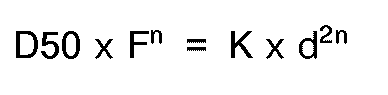
in which - D50
- = the mean particle diameter
- F
- = total flow rate
- n
- = a product variable
- K
- = a constant for a given system and product
- d
- = orifice diameter
- The values of n and K can be determined experimentally.
- In known processes for milk homogenization the value of n is approximately 1.2. In the present process a typical value of n has been found to be approximately 1, slightly decreasing with decreasing flow rate.
- The flow rate may vary from 5 ml/min. to 5 l/min. dependent on the orifice diameter and the desired particle diameter.
- It should be borne in mind that D50 in the above formula represents the mean particle diameter of the particles as emulsified and since the emulsified particles are subsequently washed and dried some controlled shrinking takes place whereby the final particle diameter is reduced.
- The invention is further described with reference to the drawings, wherein
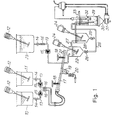
- Fig. 1 diagrammatically shows a first embodiment of an apparatus for carrying out the method according to the invention,
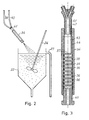
- Fig. 2 is a diagrammatic illustration of a second, more preferred apparatus for carrying out the method according to the invention,
- Fig. 3 is a sectional view in an enlarged scale of a nozzle unit of the apparatus shown in Fig. 2, and
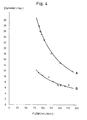
- Fig. 4 is a graphic representation in which the mean particle diameter is plotted versus flow rate through the nozzle unit shown in Fig. 3.
- A
container 10 for a solution of a polymerizable substance and acontainer 11 for a first liquid are provided withstirrers 12 andoutlet conduits 13 which are fitted with manuallyoperatable valves 14, pumps 15 and flowmeters 16 for controlling the flow rate of the solution of the polymerizable substance and the first liquid. - The solution and the first liquid are simultaneously and continuously fed into an inlet end of a
tube 17 which is elastically suspended at an acute angle to the horizontal plane by means ofrubber bands 18 and which is vibrated by means of aball vibrator 19 operated by means of compressed air supplied from a suitable source through aflexible conduit 20. - The resulting emulsion of the solution of the polymerizable substance and the first liquid flows from an outlet end of the
tube 17 around which a hood 21 is arranged to catch and direct the flow of the emulsion into areceptacle 22 which contains a second liquid. The second liquid is fed into thereceptacle 22 from acontainer 23 which is similarly provided with astirrer 12,outlet conduit 13,valve 14, pump 15 and flowmeter 16. Thereceptacle 22 is equipped with astirrer 24 and anoutlet conduit 25 fitted with a manually operatedvalve 26. Close to the top of thereceptacle 22 anotherconduit 27 feeds the overflow from thereceptacle 22 into a similar, and similarly equipped,receptacle 28. Theconduit 25 feeds the contents of thereceptacles container 29 for the separation of the phases and sedimentation of the polymerized, substantially spherical particles of the polymerizable substance. - A
funnel 30 for drawing off the sedimented polymerized particles is arranged at the bottom of thecontainer 29. Thefunnel 30 is fitted with avalve 31 operated by means of alevel transducer 32 which opens thevalve 31 when the level of the second liquid rises and closes thevalve 31 when the level of the second liquid sinks to a predetermined level. Aconduit 33 for the overflow of the first liquid (which forms a separate phase on top of the second liquid due to its lower density) is provided close to the top of thecontainer 29. - In the apparatus shown in Figs. 2 and 3 the emulsion is produced in a
nozzle unit 34 having atubular housing 38 in which a number of axially spacedorifice discs 35 is placed in series. The distance between the discs is determined byannular spacer members 36. Each disc has a central circular bore 37 formed therein with a diameter which is usually the same for all of the discs and which is preferably within the range of 0.5-5 mm. - The other parts of the apparatus shown in Figs. 2 and 3 are quite similar to those described in Fig. 1. The solution of a polymerizable substance and the first liquid are fed to the nozzle unit through a pair of separate conduits 39 and 40, respectively. These conduits are connected to a fitting 41 in which the flow passages of the conduits are united to a common bore 42, which communicates with an
entrance chamber 43 defined within acylindrical spacer member 44. The emulsion leaves the nozzle unit through anoutlet nozzle 45 as a jet directed down into thereceptacle 22, which contains a second liquid. - The invention is further described in the following examples.
- 50 ml of a commercially available aqueous sodium silicate solution (36% w/w; Na₂O(SiO₂)3.3) was diluted with 75 ml of water. 0.6 g of glycerol monooleate was added to 120 ml of ISOPAR G (available from Esso), and the mixture was poured into a beaker provided with a stirrer (HomoRex, voltage regulated, optimal stirring at 110-150 V). The aqueous solution of sodium silicate was added and emulsified in the ISOPAR by stirring for 30 seconds.
- The emulsion was then poured into 550 ml of an acetate buffer (pH 4.8) with vigorous stirring after which the mixture was left to stand for 15 minutes resulting in a separation of the phases. The gelled particles of silicic acid were partially precipitated in the aqueous phase in which the pH had increased to 5.3.
- The ISOPAR phase was decanted off, the aqueous phase was filtered and the filter cake was washed with water and dried at 120°C for 24 hours.
- The resulting particles had a mean diameter D50 (cf. the definition given above) of 21.4 µm, and a slope (cf. the definition given above) of 6.17. The particle diameter was determined from the angle of scattered light, as explained above, in a Microtrack apparatus (manufactured by Leeds and Northrop).
- The sodium silicate solution and the ISOPAR G/glycerol monooleate mixture of Example 1 were simultaneously and continuously fed into a tube with an inner diameter of 18 mm and a length of 1 m at a flow rate of 40 g/min. and 25 g/min., respectively, while vibrating the tube at a frequency of 100 Hz and with an amplitude of 5 mm at the middle of the tube and 2.5 cm at either end of the tube by means of a ball vibrator located at the middle of the tube, substantially as shown in the drawing.
- The sodium silicate droplets were gelled, filtered and dried as described in Example 1.
- The resulting particles had a mean diameter D50 of 9.95 µm and a slope of 2.46 when determined as described in Example 1.
- By proceeding substantially as described in Example 2 with the exception that the flow rate through the tube was doubled, silica particles were obtained which had a mean diameter D50 of 11.36 µm and a slope of 2.63 when determined as described in Example 1.
- By proceeding substantially as described in Example 1 with the exception that no emulsifier was added to the ISOPAR, substantially spherical silica particles were obtained which had a mean diameter D50 of 28.36 µm and a slope of 13.46 when determined as described in Example 1. From this figure, it appears that the particle size distribution is larger than is satisfactory when no emulsifier is included in the ISOPAR.
- A suspension in 18% HCl of silica particles prepared substantially as described in Example 2 with the exception that the concentration of sodium silicate was 11.86% were subjected to ageing by heat treatment at various temperatures and for varying periods of time. The particles in sample A were treated at 25°C for 30 minutes, the particles in sample B were treated at 110°C for 30 minutes, and the particles in sample C were treated for 4 hours at 110°C. The particles in each sample were then rinsed with deionized water and dried in an oven at 140°C.
- The pore diameter and pore volume (measured chromatographically substantially as described in Journal of Chromatography, 83 (1973) 111-124, Elsevier Scientific Publishing Company, Amsterdam, CHROM 6803, Krefeld, van, M.E. and Hoed, van den, N. "Mechanism of Gel Permeation Chromatography; Distribution Coefficient" ) of the particles in each sample are shown in Table 1.
Table 1 Pore volume (cm³/g) Pore diameter (Å) A 0.59 53 B 1.2 95 C 1.6 150 - It appears from the table that it is possible to obtain a desired pore diameter and pore volume by adjusting the temperature and period for the heat treatment.
- Silica particles prepared as described in Example 5 were calcinated at 450°C for 3 hours to obtain a greater compressive strength of the particles. In this way, the column pressure drop in a chromatographic column is decreased because fewer particles collapse under the pressure used to pack a chromatographic column.
- The effect of the calcination appears from Table 2.
Table 2 Before calcination After calcination Pore diameter (Å) 116 108.2 Pore volume (cm³/g) 1.21 1.145 Column pressure drop (bars) 110 65 - Two series of tests were made with the same raw materials as described in Example 1 but instead of producing the emulsion in a vibrating tube it was made by conducting the silicate solution and the ISOPAR G/glycerol monooleate mixture through a nozzle arrangement as shown in Figs. 2 and 3. Nine orifice discs were arranged in series.
- In a first test series (graph A in Fig. 4) an orifice diameter of 0.8 mm was used. In a second test series (graph B in Fig. 4) the orifice diameter was 0.6 mm.
- The test results are illustrated graphically in Fig. 4 in which the abscissa represents the flow rate in ml/min. and the ordinate D50 in µm.
- Approximate relations between D50 and flow rate F are as follows:
For the A series: D50 x F1.12 = 4152
For the B series: D50 x F0.85 = 509.
Claims (16)
- A process for preparing substantially spherical solid particles of a substantially uniform particle size, said method comprising:(a) dispersing a solution of an inorganic, gel-forming polymerizable substance in a first liquid with which said solution is immiscible by means of a suitable emulsifier to form an emulsion having droplets of the solution of the polymerizable substance of a substantially uniform particle size as the dispersed phase,(b) pouring the emulsion into a second liquid which is miscible with the solvent forming the basis of said solution but immiscible with said first liquid and which contains a sufficient amount of a reactant to polymerize the polymerizable substance to form said substantially spherical solid particles,(c) separating a phase containing said first liquid from a phase containing said second liquid and said solid particles, and(d) recovering said solid particles from said second liquid.
- A process according to claim 1, in which the emulsion is a water-in-oil type emulsion.
- A process according to claim 1, in which the polymerizable substance is a substance selected from the group consisting of silica sol and alkali metal silicates, preferably an alkali metal silicate such as sodium silicate.
- A process according to claim 1, in which the first liquid is an organic liquid the density of which differs significantly from that of the second liquid.
- A process according to claim 4, in which the organic liquid is a hydrocarbon, preferably a coparaffinate.
- A process according to claim 1, in which the second liquid is water.
- A process according to claim 1, in which the polymerization reactant is an acid or an acid buffer.
- A process according to claim 1, in which the average particle size of the polymerized particles is in the range of about 1-100 µm.
- A process according to claim 1, in which an aqueous solution of an alkali metal silicate such as sodium silicate is dispersed in a coparaffinate by means of the emulsifier, the emulsion formed being poured into an aqueous solution of the polymerization reactant to form gelled, substantially spherical hydrated silica particles.
- A process according to claim 9, in which the aqueous solution of the alkali metal silicate is an aqueous solution of sodium silicate in a concentration of 8-20%.
- A process according to claim 9, in which the sodium silicate is sodium silicate of the formula Na₂O(SiO₂)x, wherein x is 3-4.
- A process according to claim 9, in which the second liquid is an aqueous buffer of a pH in the range of 4-7, which is present in a volume sufficient to maintain a final pH in the mixture of the emulsion and the second liquid of below 7.
- A process according to claim 12, in which the buffer is an acetate buffer, and the final pH of the mixture is about 5.3.
- A process according to claim 9, in which the polymerized, substantially spherical hydrated silica particles are subjected to an acid treatment by boiling in a mineral acid such as hydrochloric acid.
- A process according to claim 1, in which the solution of the polymerizable substance is dispersed in the first liquid by simultaneously and continuously feeding the solution of the polymerizable substance and the first liquid, which contains the emulsifier, into a substantially cylindrical, elongated passage defined in a body member at such a flow rate that the passage is only partly filled up by the liquids to be emulsified, and by vibrating the body member.
- A process according to claim 1, in which the solution of the polymerizable substance and the first liquid, which contains the emulsifier, is simultaneously driven through at least one orifice.
Applications Claiming Priority (2)
| Application Number | Priority Date | Filing Date | Title |
|---|---|---|---|
| DK2519/84A DK251984D0 (en) | 1984-05-22 | 1984-05-22 | PROCEDURE FOR THE PREPARATION OF POLYMER PARTICLES |
| DK2519/84 | 1984-05-22 |
Publications (3)
| Publication Number | Publication Date |
|---|---|
| EP0162716A2 EP0162716A2 (en) | 1985-11-27 |
| EP0162716A3 EP0162716A3 (en) | 1988-08-10 |
| EP0162716B1 true EP0162716B1 (en) | 1992-03-18 |
Family
ID=8112941
Family Applications (1)
| Application Number | Title | Priority Date | Filing Date |
|---|---|---|---|
| EP85303629A Expired - Lifetime EP0162716B1 (en) | 1984-05-22 | 1985-05-22 | A process for preparing polymer particles |
Country Status (5)
| Country | Link |
|---|---|
| US (1) | US4621068A (en) |
| EP (1) | EP0162716B1 (en) |
| JP (1) | JPS6128436A (en) |
| DE (1) | DE3585637D1 (en) |
| DK (1) | DK251984D0 (en) |
Families Citing this family (16)
| Publication number | Priority date | Publication date | Assignee | Title |
|---|---|---|---|---|
| IT1197794B (en) * | 1986-07-31 | 1988-12-06 | Montedison Spa | PROCEDURE FOR THE PREPARATION OF FINE METALLIC OXIDE TROUSERS |
| JPS63165011A (en) * | 1986-12-25 | 1988-07-08 | Kawasaki Steel Corp | Patterned steel sheet and its manufacture |
| US5205929A (en) * | 1988-02-03 | 1993-04-27 | Regents Of The University Of Minnesota | High stability porous zirconium oxide spherules |
| US5015373A (en) * | 1988-02-03 | 1991-05-14 | Regents Of The University Of Minnesota | High stability porous zirconium oxide spherules |
| EP0331283B1 (en) * | 1988-02-03 | 1993-04-28 | The Regents Of The University Of Minnesota | High stability porous zirconium oxide spherules |
| US5141634A (en) * | 1988-02-03 | 1992-08-25 | Regents Of The University Of Minnesota | High stability porous zirconium oxide spherules |
| US5271833A (en) * | 1990-03-22 | 1993-12-21 | Regents Of The University Of Minnesota | Polymer-coated carbon-clad inorganic oxide particles |
| US5108597A (en) * | 1990-03-22 | 1992-04-28 | Regents Of The University Of Minnesota | Carbon-clad zirconium oxide particles |
| US5254262A (en) * | 1990-03-22 | 1993-10-19 | Regents Of The University Of Minnesota | Carbon-clad zirconium oxide particles |
| US5182016A (en) * | 1990-03-22 | 1993-01-26 | Regents Of The University Of Minnesota | Polymer-coated carbon-clad inorganic oxide particles |
| US5540834A (en) * | 1994-08-23 | 1996-07-30 | Regents Of The University Of Minnesota | Synthesis of porous inorganic particles by polymerization-induced colloid aggregation (PICA) |
| US5837826A (en) * | 1995-02-27 | 1998-11-17 | Regents Of The University Of Minnesota | Protein adsorption by very dense porous zirconium oxide particles in expanded beds |
| US6648958B2 (en) | 1998-09-14 | 2003-11-18 | Merck Patent Gesellschaft | Highly light-scattering pigment mixture |
| US7030066B1 (en) | 2001-11-12 | 2006-04-18 | Charles Piskoti | Wetting composition for high temperature metal surfaces, and method of making the same |
| EP1908512A1 (en) * | 2002-07-15 | 2008-04-09 | Asahi Glass Company, Limited | Process for producing inorganic spheres |
| WO2015179476A1 (en) * | 2014-05-20 | 2015-11-26 | Pq Corporation | Lightweight spackling paste composition containing hydrated silica |
Family Cites Families (9)
| Publication number | Priority date | Publication date | Assignee | Title |
|---|---|---|---|---|
| US2757073A (en) * | 1953-03-31 | 1956-07-31 | Du Pont | Process for making pulverulent silica powder |
| US2921839A (en) * | 1955-12-23 | 1960-01-19 | Columbia Southern Chem Corp | Silica precipitation method |
| US3656901A (en) * | 1967-08-30 | 1972-04-18 | Owens Illinois Inc | Method of making silica particles |
| JPS51115298A (en) * | 1975-04-03 | 1976-10-09 | Agency Of Ind Science & Technol | Process for production of spherical silica gel |
| US4011096A (en) * | 1975-06-10 | 1977-03-08 | E. I. Du Pont De Nemours And Company | Vesiculated silica microspheres |
| CS179184B1 (en) * | 1975-07-25 | 1977-10-31 | Stanislav Vozka | Method for preparation of precisely spherical particles of silica gel with controlled size and controled size pores. |
| JPS5243639A (en) * | 1975-10-04 | 1977-04-05 | Kunihiko Murai | Cooling and heating device in house for farming and gardening |
| JPS5755454A (en) * | 1980-09-19 | 1982-04-02 | Hitachi Ltd | Failure recovery system |
| CA1171617A (en) * | 1981-02-13 | 1984-07-31 | Cornelis Buurman | Apparatus for the preparation of globular particles of uniform shape |
-
1984
- 1984-05-22 DK DK2519/84A patent/DK251984D0/en not_active Application Discontinuation
-
1985
- 1985-05-16 US US06/734,670 patent/US4621068A/en not_active Expired - Fee Related
- 1985-05-21 JP JP10707185A patent/JPS6128436A/en active Pending
- 1985-05-22 DE DE8585303629T patent/DE3585637D1/en not_active Expired - Lifetime
- 1985-05-22 EP EP85303629A patent/EP0162716B1/en not_active Expired - Lifetime
Non-Patent Citations (1)
| Title |
|---|
| The Merck Index, p. 393 * |
Also Published As
| Publication number | Publication date |
|---|---|
| DK251984D0 (en) | 1984-05-22 |
| JPS6128436A (en) | 1986-02-08 |
| DE3585637D1 (en) | 1992-04-23 |
| US4621068A (en) | 1986-11-04 |
| EP0162716A2 (en) | 1985-11-27 |
| EP0162716A3 (en) | 1988-08-10 |
Similar Documents
| Publication | Publication Date | Title |
|---|---|---|
| US4621068A (en) | Process for preparing polymer particles | |
| Kirkland | Performance of Zipax® controlled surface porosity support in high-speed liquid chromatography | |
| JP2715029B2 (en) | Polymer beads | |
| US6197073B1 (en) | Process for producing aluminum oxide beads | |
| EP0746408B1 (en) | Shaping of microparticles in electric-field cages | |
| JP3719687B2 (en) | Method for producing silica gel | |
| DE69506707D1 (en) | METHOD AND DEVICE FOR PRODUCING PARTICLES | |
| US6375853B1 (en) | Methods of using modified natural products as dewatering aids for fine particles | |
| DE19718740A1 (en) | Process for the granulation of aerogels | |
| KR910005122B1 (en) | Method for preparing uniform size porous silica spheres | |
| EP0298062B1 (en) | Silica particles, a method for preparation of silica particles and use of the particles | |
| DE2132389C3 (en) | Device for producing monodisperse aerosols | |
| Kobayashi et al. | Effect of emulsifiers on the preparation of food‐grade oil‐in‐water emulsions using a straight‐through extrusion filter | |
| DE2725849B2 (en) | Apparatus for the production of spherical particles | |
| US3960772A (en) | Agglomerated alumina-based spherical grains | |
| DE69519334T2 (en) | Pearl-shaped vanillin or ethyl vanillin and process for their preparation | |
| US2455445A (en) | Gel catalyst | |
| US5225084A (en) | Process for the separation of two liquid immiscible organic components using a fibre bed as a coalescence aid | |
| CA1116558A (en) | Divergent stratifier for sand-botanical-fines separation | |
| EP0402662A3 (en) | Process and apparatus for suspension polymerization | |
| Dollimore et al. | The optimum flocculant concentration for effective flocculation of china clay in aqueous suspension | |
| US2448439A (en) | Process of preparing an inorganic hydrogel | |
| GB2444035A (en) | An apparatus and method for generating emulsions | |
| EP0058441B1 (en) | Apparatus for the preparation of globular particles of uniform shape | |
| Biay et al. | Illustration of process scale-up in heterogeneous catalyst preparation |
Legal Events
| Date | Code | Title | Description |
|---|---|---|---|
| PUAI | Public reference made under article 153(3) epc to a published international application that has entered the european phase |
Free format text: ORIGINAL CODE: 0009012 |
|
| AK | Designated contracting states |
Designated state(s): CH DE FR GB IT LI SE |
|
| 17P | Request for examination filed |
Effective date: 19870204 |
|
| PUAL | Search report despatched |
Free format text: ORIGINAL CODE: 0009013 |
|
| AK | Designated contracting states |
Kind code of ref document: A3 Designated state(s): CH DE FR GB IT LI SE |
|
| RHK1 | Main classification (correction) |
Ipc: C01B 33/16 |
|
| 17Q | First examination report despatched |
Effective date: 19900626 |
|
| RAP1 | Party data changed (applicant data changed or rights of an application transferred) |
Owner name: NIRO A/S |
|
| GRAA | (expected) grant |
Free format text: ORIGINAL CODE: 0009210 |
|
| AK | Designated contracting states |
Kind code of ref document: B1 Designated state(s): CH DE FR GB IT LI SE |
|
| REF | Corresponds to: |
Ref document number: 3585637 Country of ref document: DE Date of ref document: 19920423 |
|
| ITF | It: translation for a ep patent filed | ||
| ET | Fr: translation filed | ||
| PLBE | No opposition filed within time limit |
Free format text: ORIGINAL CODE: 0009261 |
|
| STAA | Information on the status of an ep patent application or granted ep patent |
Free format text: STATUS: NO OPPOSITION FILED WITHIN TIME LIMIT |
|
| 26N | No opposition filed | ||
| ITTA | It: last paid annual fee | ||
| EAL | Se: european patent in force in sweden |
Ref document number: 85303629.1 |
|
| PGFP | Annual fee paid to national office [announced via postgrant information from national office to epo] |
Ref country code: GB Payment date: 19960514 Year of fee payment: 12 |
|
| PGFP | Annual fee paid to national office [announced via postgrant information from national office to epo] |
Ref country code: SE Payment date: 19960515 Year of fee payment: 12 |
|
| PGFP | Annual fee paid to national office [announced via postgrant information from national office to epo] |
Ref country code: FR Payment date: 19960523 Year of fee payment: 12 |
|
| PGFP | Annual fee paid to national office [announced via postgrant information from national office to epo] |
Ref country code: CH Payment date: 19960529 Year of fee payment: 12 |
|
| PGFP | Annual fee paid to national office [announced via postgrant information from national office to epo] |
Ref country code: DE Payment date: 19960628 Year of fee payment: 12 |
|
| PG25 | Lapsed in a contracting state [announced via postgrant information from national office to epo] |
Ref country code: GB Effective date: 19970522 |
|
| PG25 | Lapsed in a contracting state [announced via postgrant information from national office to epo] |
Ref country code: SE Effective date: 19970523 |
|
| PG25 | Lapsed in a contracting state [announced via postgrant information from national office to epo] |
Ref country code: LI Free format text: LAPSE BECAUSE OF NON-PAYMENT OF DUE FEES Effective date: 19970531 Ref country code: CH Free format text: LAPSE BECAUSE OF NON-PAYMENT OF DUE FEES Effective date: 19970531 |
|
| GBPC | Gb: european patent ceased through non-payment of renewal fee |
Effective date: 19970522 |
|
| REG | Reference to a national code |
Ref country code: CH Ref legal event code: PL |
|
| PG25 | Lapsed in a contracting state [announced via postgrant information from national office to epo] |
Ref country code: FR Free format text: LAPSE BECAUSE OF NON-PAYMENT OF DUE FEES Effective date: 19980130 |
|
| EUG | Se: european patent has lapsed |
Ref document number: 85303629.1 |
|
| PG25 | Lapsed in a contracting state [announced via postgrant information from national office to epo] |
Ref country code: DE Free format text: LAPSE BECAUSE OF NON-PAYMENT OF DUE FEES Effective date: 19980203 |
|
| REG | Reference to a national code |
Ref country code: FR Ref legal event code: ST |