EP0161841A1 - 2-(N-substituteguanidino)-4-hetero-arylthiazole antiulcer agents - Google Patents
2-(N-substituteguanidino)-4-hetero-arylthiazole antiulcer agents Download PDFInfo
- Publication number
- EP0161841A1 EP0161841A1 EP85302844A EP85302844A EP0161841A1 EP 0161841 A1 EP0161841 A1 EP 0161841A1 EP 85302844 A EP85302844 A EP 85302844A EP 85302844 A EP85302844 A EP 85302844A EP 0161841 A1 EP0161841 A1 EP 0161841A1
- Authority
- EP
- European Patent Office
- Prior art keywords
- sub
- sup
- formula
- mixture
- reaction
- Prior art date
- Legal status (The legal status is an assumption and is not a legal conclusion. Google has not performed a legal analysis and makes no representation as to the accuracy of the status listed.)
- Granted
Links
Classifications
-
- C—CHEMISTRY; METALLURGY
- C07—ORGANIC CHEMISTRY
- C07D—HETEROCYCLIC COMPOUNDS
- C07D285/00—Heterocyclic compounds containing rings having nitrogen and sulfur atoms as the only ring hetero atoms, not provided for by groups C07D275/00 - C07D283/00
-
- C—CHEMISTRY; METALLURGY
- C07—ORGANIC CHEMISTRY
- C07D—HETEROCYCLIC COMPOUNDS
- C07D213/00—Heterocyclic compounds containing six-membered rings, not condensed with other rings, with one nitrogen atom as the only ring hetero atom and three or more double bonds between ring members or between ring members and non-ring members
- C07D213/02—Heterocyclic compounds containing six-membered rings, not condensed with other rings, with one nitrogen atom as the only ring hetero atom and three or more double bonds between ring members or between ring members and non-ring members having three double bonds between ring members or between ring members and non-ring members
- C07D213/04—Heterocyclic compounds containing six-membered rings, not condensed with other rings, with one nitrogen atom as the only ring hetero atom and three or more double bonds between ring members or between ring members and non-ring members having three double bonds between ring members or between ring members and non-ring members having no bond between the ring nitrogen atom and a non-ring member or having only hydrogen or carbon atoms directly attached to the ring nitrogen atom
- C07D213/60—Heterocyclic compounds containing six-membered rings, not condensed with other rings, with one nitrogen atom as the only ring hetero atom and three or more double bonds between ring members or between ring members and non-ring members having three double bonds between ring members or between ring members and non-ring members having no bond between the ring nitrogen atom and a non-ring member or having only hydrogen or carbon atoms directly attached to the ring nitrogen atom with hetero atoms or with carbon atoms having three bonds to hetero atoms with at the most one bond to halogen, e.g. ester or nitrile radicals, directly attached to ring carbon atoms
- C07D213/72—Nitrogen atoms
- C07D213/75—Amino or imino radicals, acylated by carboxylic or carbonic acids, or by sulfur or nitrogen analogues thereof, e.g. carbamates
-
- A—HUMAN NECESSITIES
- A61—MEDICAL OR VETERINARY SCIENCE; HYGIENE
- A61P—SPECIFIC THERAPEUTIC ACTIVITY OF CHEMICAL COMPOUNDS OR MEDICINAL PREPARATIONS
- A61P1/00—Drugs for disorders of the alimentary tract or the digestive system
- A61P1/04—Drugs for disorders of the alimentary tract or the digestive system for ulcers, gastritis or reflux esophagitis, e.g. antacids, inhibitors of acid secretion, mucosal protectants
-
- A—HUMAN NECESSITIES
- A61—MEDICAL OR VETERINARY SCIENCE; HYGIENE
- A61P—SPECIFIC THERAPEUTIC ACTIVITY OF CHEMICAL COMPOUNDS OR MEDICINAL PREPARATIONS
- A61P43/00—Drugs for specific purposes, not provided for in groups A61P1/00-A61P41/00
-
- C—CHEMISTRY; METALLURGY
- C07—ORGANIC CHEMISTRY
- C07C—ACYCLIC OR CARBOCYCLIC COMPOUNDS
- C07C277/00—Preparation of guanidine or its derivatives, i.e. compounds containing the group, the singly-bound nitrogen atoms not being part of nitro or nitroso groups
- C07C277/08—Preparation of guanidine or its derivatives, i.e. compounds containing the group, the singly-bound nitrogen atoms not being part of nitro or nitroso groups of substituted guanidines
-
- C—CHEMISTRY; METALLURGY
- C07—ORGANIC CHEMISTRY
- C07C—ACYCLIC OR CARBOCYCLIC COMPOUNDS
- C07C279/00—Derivatives of guanidine, i.e. compounds containing the group, the singly-bound nitrogen atoms not being part of nitro or nitroso groups
- C07C279/28—Derivatives of guanidine, i.e. compounds containing the group, the singly-bound nitrogen atoms not being part of nitro or nitroso groups having nitrogen atoms of guanidine groups bound to cyano groups, e.g. cyanoguanidines, dicyandiamides
-
- C—CHEMISTRY; METALLURGY
- C07—ORGANIC CHEMISTRY
- C07C—ACYCLIC OR CARBOCYCLIC COMPOUNDS
- C07C45/00—Preparation of compounds having >C = O groups bound only to carbon or hydrogen atoms; Preparation of chelates of such compounds
- C07C45/45—Preparation of compounds having >C = O groups bound only to carbon or hydrogen atoms; Preparation of chelates of such compounds by condensation
- C07C45/46—Friedel-Crafts reactions
-
- C—CHEMISTRY; METALLURGY
- C07—ORGANIC CHEMISTRY
- C07C—ACYCLIC OR CARBOCYCLIC COMPOUNDS
- C07C45/00—Preparation of compounds having >C = O groups bound only to carbon or hydrogen atoms; Preparation of chelates of such compounds
- C07C45/61—Preparation of compounds having >C = O groups bound only to carbon or hydrogen atoms; Preparation of chelates of such compounds by reactions not involving the formation of >C = O groups
- C07C45/67—Preparation of compounds having >C = O groups bound only to carbon or hydrogen atoms; Preparation of chelates of such compounds by reactions not involving the formation of >C = O groups by isomerisation; by change of size of the carbon skeleton
- C07C45/68—Preparation of compounds having >C = O groups bound only to carbon or hydrogen atoms; Preparation of chelates of such compounds by reactions not involving the formation of >C = O groups by isomerisation; by change of size of the carbon skeleton by increase in the number of carbon atoms
- C07C45/70—Preparation of compounds having >C = O groups bound only to carbon or hydrogen atoms; Preparation of chelates of such compounds by reactions not involving the formation of >C = O groups by isomerisation; by change of size of the carbon skeleton by increase in the number of carbon atoms by reaction with functional groups containing oxygen only in singly bound form
-
- C—CHEMISTRY; METALLURGY
- C07—ORGANIC CHEMISTRY
- C07C—ACYCLIC OR CARBOCYCLIC COMPOUNDS
- C07C45/00—Preparation of compounds having >C = O groups bound only to carbon or hydrogen atoms; Preparation of chelates of such compounds
- C07C45/61—Preparation of compounds having >C = O groups bound only to carbon or hydrogen atoms; Preparation of chelates of such compounds by reactions not involving the formation of >C = O groups
- C07C45/67—Preparation of compounds having >C = O groups bound only to carbon or hydrogen atoms; Preparation of chelates of such compounds by reactions not involving the formation of >C = O groups by isomerisation; by change of size of the carbon skeleton
- C07C45/68—Preparation of compounds having >C = O groups bound only to carbon or hydrogen atoms; Preparation of chelates of such compounds by reactions not involving the formation of >C = O groups by isomerisation; by change of size of the carbon skeleton by increase in the number of carbon atoms
- C07C45/70—Preparation of compounds having >C = O groups bound only to carbon or hydrogen atoms; Preparation of chelates of such compounds by reactions not involving the formation of >C = O groups by isomerisation; by change of size of the carbon skeleton by increase in the number of carbon atoms by reaction with functional groups containing oxygen only in singly bound form
- C07C45/71—Preparation of compounds having >C = O groups bound only to carbon or hydrogen atoms; Preparation of chelates of such compounds by reactions not involving the formation of >C = O groups by isomerisation; by change of size of the carbon skeleton by increase in the number of carbon atoms by reaction with functional groups containing oxygen only in singly bound form being hydroxy groups
-
- C—CHEMISTRY; METALLURGY
- C07—ORGANIC CHEMISTRY
- C07C—ACYCLIC OR CARBOCYCLIC COMPOUNDS
- C07C49/00—Ketones; Ketenes; Dimeric ketenes; Ketonic chelates
- C07C49/04—Saturated compounds containing keto groups bound to acyclic carbon atoms
- C07C49/175—Saturated compounds containing keto groups bound to acyclic carbon atoms containing ether groups, groups, groups, or groups
-
- C—CHEMISTRY; METALLURGY
- C07—ORGANIC CHEMISTRY
- C07C—ACYCLIC OR CARBOCYCLIC COMPOUNDS
- C07C49/00—Ketones; Ketenes; Dimeric ketenes; Ketonic chelates
- C07C49/20—Unsaturated compounds containing keto groups bound to acyclic carbon atoms
- C07C49/227—Unsaturated compounds containing keto groups bound to acyclic carbon atoms containing halogen
-
- C—CHEMISTRY; METALLURGY
- C07—ORGANIC CHEMISTRY
- C07C—ACYCLIC OR CARBOCYCLIC COMPOUNDS
- C07C49/00—Ketones; Ketenes; Dimeric ketenes; Ketonic chelates
- C07C49/20—Unsaturated compounds containing keto groups bound to acyclic carbon atoms
- C07C49/255—Unsaturated compounds containing keto groups bound to acyclic carbon atoms containing ether groups, groups, groups, or groups
-
- C—CHEMISTRY; METALLURGY
- C07—ORGANIC CHEMISTRY
- C07C—ACYCLIC OR CARBOCYCLIC COMPOUNDS
- C07C57/00—Unsaturated compounds having carboxyl groups bound to acyclic carbon atoms
- C07C57/52—Unsaturated compounds having carboxyl groups bound to acyclic carbon atoms containing halogen
- C07C57/58—Unsaturated compounds having carboxyl groups bound to acyclic carbon atoms containing halogen containing six-membered aromatic rings
-
- C—CHEMISTRY; METALLURGY
- C07—ORGANIC CHEMISTRY
- C07C—ACYCLIC OR CARBOCYCLIC COMPOUNDS
- C07C57/00—Unsaturated compounds having carboxyl groups bound to acyclic carbon atoms
- C07C57/52—Unsaturated compounds having carboxyl groups bound to acyclic carbon atoms containing halogen
- C07C57/58—Unsaturated compounds having carboxyl groups bound to acyclic carbon atoms containing halogen containing six-membered aromatic rings
- C07C57/60—Unsaturated compounds having carboxyl groups bound to acyclic carbon atoms containing halogen containing six-membered aromatic rings having unsaturation outside the rings
-
- C—CHEMISTRY; METALLURGY
- C07—ORGANIC CHEMISTRY
- C07D—HETEROCYCLIC COMPOUNDS
- C07D231/00—Heterocyclic compounds containing 1,2-diazole or hydrogenated 1,2-diazole rings
- C07D231/02—Heterocyclic compounds containing 1,2-diazole or hydrogenated 1,2-diazole rings not condensed with other rings
- C07D231/10—Heterocyclic compounds containing 1,2-diazole or hydrogenated 1,2-diazole rings not condensed with other rings having two or three double bonds between ring members or between ring members and non-ring members
- C07D231/12—Heterocyclic compounds containing 1,2-diazole or hydrogenated 1,2-diazole rings not condensed with other rings having two or three double bonds between ring members or between ring members and non-ring members with only hydrogen atoms, hydrocarbon or substituted hydrocarbon radicals, directly attached to ring carbon atoms
-
- C—CHEMISTRY; METALLURGY
- C07—ORGANIC CHEMISTRY
- C07D—HETEROCYCLIC COMPOUNDS
- C07D233/00—Heterocyclic compounds containing 1,3-diazole or hydrogenated 1,3-diazole rings, not condensed with other rings
- C07D233/54—Heterocyclic compounds containing 1,3-diazole or hydrogenated 1,3-diazole rings, not condensed with other rings having two double bonds between ring members or between ring members and non-ring members
- C07D233/56—Heterocyclic compounds containing 1,3-diazole or hydrogenated 1,3-diazole rings, not condensed with other rings having two double bonds between ring members or between ring members and non-ring members with only hydrogen atoms or radicals containing only hydrogen and carbon atoms, attached to ring carbon atoms
-
- C—CHEMISTRY; METALLURGY
- C07—ORGANIC CHEMISTRY
- C07D—HETEROCYCLIC COMPOUNDS
- C07D233/00—Heterocyclic compounds containing 1,3-diazole or hydrogenated 1,3-diazole rings, not condensed with other rings
- C07D233/54—Heterocyclic compounds containing 1,3-diazole or hydrogenated 1,3-diazole rings, not condensed with other rings having two double bonds between ring members or between ring members and non-ring members
- C07D233/64—Heterocyclic compounds containing 1,3-diazole or hydrogenated 1,3-diazole rings, not condensed with other rings having two double bonds between ring members or between ring members and non-ring members with substituted hydrocarbon radicals attached to ring carbon atoms, e.g. histidine
-
- C—CHEMISTRY; METALLURGY
- C07—ORGANIC CHEMISTRY
- C07D—HETEROCYCLIC COMPOUNDS
- C07D249/00—Heterocyclic compounds containing five-membered rings having three nitrogen atoms as the only ring hetero atoms
- C07D249/02—Heterocyclic compounds containing five-membered rings having three nitrogen atoms as the only ring hetero atoms not condensed with other rings
- C07D249/08—1,2,4-Triazoles; Hydrogenated 1,2,4-triazoles
-
- C—CHEMISTRY; METALLURGY
- C07—ORGANIC CHEMISTRY
- C07D—HETEROCYCLIC COMPOUNDS
- C07D277/00—Heterocyclic compounds containing 1,3-thiazole or hydrogenated 1,3-thiazole rings
- C07D277/02—Heterocyclic compounds containing 1,3-thiazole or hydrogenated 1,3-thiazole rings not condensed with other rings
- C07D277/20—Heterocyclic compounds containing 1,3-thiazole or hydrogenated 1,3-thiazole rings not condensed with other rings having two or three double bonds between ring members or between ring members and non-ring members
- C07D277/22—Heterocyclic compounds containing 1,3-thiazole or hydrogenated 1,3-thiazole rings not condensed with other rings having two or three double bonds between ring members or between ring members and non-ring members with only hydrogen atoms, hydrocarbon or substituted hydrocarbon radicals, directly attached to ring carbon atoms
- C07D277/24—Radicals substituted by oxygen atoms
-
- C—CHEMISTRY; METALLURGY
- C07—ORGANIC CHEMISTRY
- C07D—HETEROCYCLIC COMPOUNDS
- C07D277/00—Heterocyclic compounds containing 1,3-thiazole or hydrogenated 1,3-thiazole rings
- C07D277/02—Heterocyclic compounds containing 1,3-thiazole or hydrogenated 1,3-thiazole rings not condensed with other rings
- C07D277/20—Heterocyclic compounds containing 1,3-thiazole or hydrogenated 1,3-thiazole rings not condensed with other rings having two or three double bonds between ring members or between ring members and non-ring members
- C07D277/32—Heterocyclic compounds containing 1,3-thiazole or hydrogenated 1,3-thiazole rings not condensed with other rings having two or three double bonds between ring members or between ring members and non-ring members with hetero atoms or with carbon atoms having three bonds to hetero atoms with at the most one bond to halogen, e.g. ester or nitrile radicals, directly attached to ring carbon atoms
- C07D277/38—Nitrogen atoms
- C07D277/40—Unsubstituted amino or imino radicals
-
- C—CHEMISTRY; METALLURGY
- C07—ORGANIC CHEMISTRY
- C07D—HETEROCYCLIC COMPOUNDS
- C07D277/00—Heterocyclic compounds containing 1,3-thiazole or hydrogenated 1,3-thiazole rings
- C07D277/02—Heterocyclic compounds containing 1,3-thiazole or hydrogenated 1,3-thiazole rings not condensed with other rings
- C07D277/20—Heterocyclic compounds containing 1,3-thiazole or hydrogenated 1,3-thiazole rings not condensed with other rings having two or three double bonds between ring members or between ring members and non-ring members
- C07D277/32—Heterocyclic compounds containing 1,3-thiazole or hydrogenated 1,3-thiazole rings not condensed with other rings having two or three double bonds between ring members or between ring members and non-ring members with hetero atoms or with carbon atoms having three bonds to hetero atoms with at the most one bond to halogen, e.g. ester or nitrile radicals, directly attached to ring carbon atoms
- C07D277/38—Nitrogen atoms
- C07D277/44—Acylated amino or imino radicals
- C07D277/48—Acylated amino or imino radicals by radicals derived from carbonic acid, or sulfur or nitrogen analogues thereof, e.g. carbonylguanidines
-
- C—CHEMISTRY; METALLURGY
- C07—ORGANIC CHEMISTRY
- C07D—HETEROCYCLIC COMPOUNDS
- C07D277/00—Heterocyclic compounds containing 1,3-thiazole or hydrogenated 1,3-thiazole rings
- C07D277/02—Heterocyclic compounds containing 1,3-thiazole or hydrogenated 1,3-thiazole rings not condensed with other rings
- C07D277/20—Heterocyclic compounds containing 1,3-thiazole or hydrogenated 1,3-thiazole rings not condensed with other rings having two or three double bonds between ring members or between ring members and non-ring members
- C07D277/32—Heterocyclic compounds containing 1,3-thiazole or hydrogenated 1,3-thiazole rings not condensed with other rings having two or three double bonds between ring members or between ring members and non-ring members with hetero atoms or with carbon atoms having three bonds to hetero atoms with at the most one bond to halogen, e.g. ester or nitrile radicals, directly attached to ring carbon atoms
- C07D277/56—Carbon atoms having three bonds to hetero atoms with at the most one bond to halogen
-
- C—CHEMISTRY; METALLURGY
- C07—ORGANIC CHEMISTRY
- C07D—HETEROCYCLIC COMPOUNDS
- C07D307/00—Heterocyclic compounds containing five-membered rings having one oxygen atom as the only ring hetero atom
- C07D307/02—Heterocyclic compounds containing five-membered rings having one oxygen atom as the only ring hetero atom not condensed with other rings
- C07D307/34—Heterocyclic compounds containing five-membered rings having one oxygen atom as the only ring hetero atom not condensed with other rings having two or three double bonds between ring members or between ring members and non-ring members
- C07D307/38—Heterocyclic compounds containing five-membered rings having one oxygen atom as the only ring hetero atom not condensed with other rings having two or three double bonds between ring members or between ring members and non-ring members with substituted hydrocarbon radicals attached to ring carbon atoms
- C07D307/52—Radicals substituted by nitrogen atoms not forming part of a nitro radical
-
- C—CHEMISTRY; METALLURGY
- C07—ORGANIC CHEMISTRY
- C07D—HETEROCYCLIC COMPOUNDS
- C07D333/00—Heterocyclic compounds containing five-membered rings having one sulfur atom as the only ring hetero atom
- C07D333/02—Heterocyclic compounds containing five-membered rings having one sulfur atom as the only ring hetero atom not condensed with other rings
- C07D333/04—Heterocyclic compounds containing five-membered rings having one sulfur atom as the only ring hetero atom not condensed with other rings not substituted on the ring sulphur atom
- C07D333/06—Heterocyclic compounds containing five-membered rings having one sulfur atom as the only ring hetero atom not condensed with other rings not substituted on the ring sulphur atom with only hydrogen atoms, hydrocarbon or substituted hydrocarbon radicals, directly attached to the ring carbon atoms
- C07D333/14—Radicals substituted by singly bound hetero atoms other than halogen
- C07D333/20—Radicals substituted by singly bound hetero atoms other than halogen by nitrogen atoms
-
- C—CHEMISTRY; METALLURGY
- C07—ORGANIC CHEMISTRY
- C07D—HETEROCYCLIC COMPOUNDS
- C07D417/00—Heterocyclic compounds containing two or more hetero rings, at least one ring having nitrogen and sulfur atoms as the only ring hetero atoms, not provided for by group C07D415/00
- C07D417/02—Heterocyclic compounds containing two or more hetero rings, at least one ring having nitrogen and sulfur atoms as the only ring hetero atoms, not provided for by group C07D415/00 containing two hetero rings
- C07D417/04—Heterocyclic compounds containing two or more hetero rings, at least one ring having nitrogen and sulfur atoms as the only ring hetero atoms, not provided for by group C07D415/00 containing two hetero rings directly linked by a ring-member-to-ring-member bond
-
- C—CHEMISTRY; METALLURGY
- C07—ORGANIC CHEMISTRY
- C07D—HETEROCYCLIC COMPOUNDS
- C07D417/00—Heterocyclic compounds containing two or more hetero rings, at least one ring having nitrogen and sulfur atoms as the only ring hetero atoms, not provided for by group C07D415/00
- C07D417/14—Heterocyclic compounds containing two or more hetero rings, at least one ring having nitrogen and sulfur atoms as the only ring hetero atoms, not provided for by group C07D415/00 containing three or more hetero rings
Definitions
- the present invention relates to novel 2-(N-sub- stitutedguanidinol-4-heteroarylthiazoles wherein said guanidino group is mono-, di- or trisubstituted and said heteroaryl substituent is an imidazol-4-yl, thiazol-4-yl or l,2,4-triazol-5-yl group.
- These compounds have activity as antisecretory agents, histamine-H 2 receptor antagonists and/or as inhibitors of ethanol-induced gastric ulceration, useful in inhibiting (i.e. preventing and treating) peptic ulcers in mammals, including humans.
- Chronic gastric and duodenal ulcers are a common ailment for which a variety of treatments, including dietary measures, drug therapy and surgery, may be employed, depending on the severity of the condition.
- Particularly valuable therapeutic agents useful for the treatment of gastric hyperacidity and peptic ulcers are the histamine-H 2 receptor antagonists, which act to block the action of the physiologically active compound histamine at the H 2 -receptor sites in the animal body and to thereby inhibit the secretion of gastric acid.
- the determination that many of the present compounds will also inhibit ethanol-induced ulcers in rats, further reflects the clinical value of the present compounds in the inhibition of gastric ulcers.
- the present invention relates to novel 2-(N-sub- stitutedguanidino)-4-heteroarylthiazoles of the formula or a pharmaceutically acceptable acid addition salt thereof, wherein either X is NH and Y is CH or N, or X is S and Y is CH;
- bracketed range of carbon atoms refers to the total number of carbon atoms in the group.
- the carbon chain can be straight or branched.
- Pharmaceutically acceptable acid addition salts are those with from one to three equivalents of the acid, and especially with one or two equivalents.
- Suitable acids include, but are not limited to, HCl, HBr, H 2 SO 4 , H 3 PO 4 . CH 3 SO 3 H, p-toluenesulfonic acid, maleic acid, fumaric acid, succinic acid and citric acid.
- HCl, HBr, H 2 SO 4 , H 3 PO 4 . CH 3 SO 3 H p-toluenesulfonic acid
- maleic acid fumaric acid
- succinic acid succinic acid
- citric acid e.g. Berge et al., J. Pharm. Sci., 66, 1-19 (1977).
- the present invention further relates to a pharmaceutical composition for inhibiting gastric ulcers in a mammal, including a human, which comprises a pharmaceutically acceptable diluent or carrier and a gastric ulcer inhibiting amount of a compound of formula (I). Additionally, the invention relates to a method of inhibiting gastric ulcers in a mammalian subject in need of such treatment which comprises administering to the subject a gastric ulcer inhibiting amount of a compound of formula (I).
- the most particularly preferred invention compounds are:
- the 2-(N-substitutedguanidino)-4-(imidazol-4-yl)-thiazole and the 2-(N-substitutedguanidino)-4-(thiazol-4-yl)thiazole compounds of the invention of formula (VI) are prepared, for example, by the following reaction scheme:
- the 2-(N-substitutedguanidino)-4-(1,2,4-triazol-5-yl)-thiazole compounds of the invention of formula (VII) are prepared, e.g., by the method shown below:
- N-cyanoguanidine compounds (V) are prepared by reaction of the appropriate amine and dicyanimide in approximately equimolar amounts by methods previously described by Curd et al., J. Chem. Soc., 1630 (1948) and by Redmon and Nagy in U.S. 2,455,807.
- the reactants are heated in the presence of a polar organic solvent, e.g. a (Cl-C4)alkanol, water or mixtures thereof, preferably n-butanol, at a temperature of from 40 to 120° C., preferably at the reflux temperature of the solvent.
- the N-cyanoguanidine product is then isolated, e.g. by cooling, filtering to remove precipitated salts and evaporation of the filtrate.
- the guanylthiourea intermediates (IV) are obtained by reaction of the appropriate N-cyanoguanidine with hydrogen sulfide.
- This reaction is ordinarily carried out in the presence of a polar organic solvent such as a (C 1 -C 4 )alkanol, acetone, ethyl acetate or dimethylsulfoxide, a preferred solvent is methanol.
- a polar organic solvent such as a (C 1 -C 4 )alkanol, acetone, ethyl acetate or dimethylsulfoxide
- a preferred solvent is methanol.
- the reaction is carried out in the presence of a catalytic amount of a secondary amine, preferably diethylamine.
- the reaction can be carried out at atmospheric pressure or a higher pressure, e.g. at 3 to 10 atmospheres, and at a temperature of from about 10 to 100° C., preferably from 25 to 80° C.
- reaction time when the reaction is run at a higher temperature within the preferred range, the reaction time will be shorter. Conversely, at a lower temperature the reaction time required will be longer.
- the product is ordinarily isolated simply by evaporation of solvent. In many cases the crude product, thusly obtained, is of sufficient purity for use in the next reaction step. Alternatively, the crude product can be purified, e.g. by column chromatography.
- an N-substituted- guanylthiourea compound (IV) is reacted with a molar equivalent of a 2-(R 4 -substituted)-4-haloacetylimidazole or 2-(R4_substitutedl-4-haloacetylthiazole intermediate of formula (XI. While the halogen atom in the above compounds can be chloro or bromo, the latter is ordinarily preferred.
- reaction-inert organic solvent such as tetrahydrofuran, a lower alkanol such as methanol, ethanol or isopropanol; a lower alkyl ketone such as acetone or methylethyl ketone, dimethylsulfoxide or dimethylformamide.
- a reaction-inert organic solvent such as tetrahydrofuran, a lower alkanol such as methanol, ethanol or isopropanol
- lower alkyl ketone such as acetone or methylethyl ketone, dimethylsulfoxide or dimethylformamide.
- Preferred solvents are acetone and dimethylformamide.
- a preferred temperature for preparation of the invention compounds (VI) by the above reaction is from about 20 to 120° C., and especially from about 50 to 60° C.
- the compound (VI) is then isolated by methods well known in the art, e.g.
- hydrobromide salt is readily converted to the free base by standard neutralization/extraction methods.
- the free base is taken up in an organic solvent and either one equivalent or at least two equivalents of the acid corresponding to the desired salt is added.
- the salt is then recovered by filtration, concentration or addition of a nonsolvent, or by a combination of these steps.
- the triazolylthiazole compounds of formula (VII) are obtained in three steps starting from the (N-substitutedguanyl)thiourea * intermediate of formula (IV).
- the appropriate compound (IV) is condensed with an equimolar amount of an alkyl ; halopyruvate ester, preferably the readily available ethyl bromopyruvate, in the presence of a reaction inert organic solvent to form the corresponding 2-(substituted- guanidino)thiazole-4-carboxylate ester of formula (III).
- This reaction is carried out at a temperature of from about 40 to 120° C. and preferably at 60-80° C.
- reaction inert solvents are the (C l -C 4 )-alkanols, acetone, ethyl acetate, acetonitrile, benzene or toluene and preferred solvents are said alkanols, especially ethanol in which the reaction is conveniently carried out at the reflux temperature.
- the product of formula (III) is isolated by standard methods such as evaporation/extraction and is purified, if desired, also by standard methods such as recrystallization or column chromatography on silica gel.
- the compound of formula (III) is reacted with hydrazine or a salt or hydrate thereof.
- the latter reagent is ordinarily employed in a molar excess, e.g. a 10 to 40 mole excess.
- the resulting product is the corresponding acid hydrazide of formula (II).
- This step is also carried out in the presence of a reaction inert solvent such as, for example, those mentioned above for the previous reaction step.
- a preferred such solvent is ethanol for reasons of economy and efficiency.
- a preferred temperature for carrying out this step is from about 40 to 120° C. and especially 60-80°C. When the preferred solvent, ethanol, is employed, the reaction is most conveniently carried out at the reflux temperature of the mixture.
- the isolation of the acid hydrazide intermediate is by standard evaporation/extraction techniques.
- the acid hydrazide is contacted with a thioamide of the formula R 4 CSNH 2 , where R 4 is as previously defined.
- This step is carried out in the presence of a reaction inert organic solvent, e.g. those disclosed above for the first step of this Scheme, and at a temperature in the range of from about 50 to 150° C. In a preferred such method this step is carried out in the presence of a molar excess, up to a 10 fold excess, of the thioamide, in n-butanol at the reflux temperature.
- reaction is ordinarily complete in from 1 to 4 days, after which the 2-(N-substituted-guanidino)-4-(l,2,4-triazol-5-yl)thiazole compound of formula (VII) is isolated by standard techniques, such as evaporation of solvent and purification of the crude product, if desired, e.g. by crystallization or by column chromatographic methods.
- the 2-(R 4- substituted)-4-bromoacetylimidazole and corresponding 4-bromoacetylthiazole intermediates of formula (X) are prepared by reaction of the corresponding 4-acetyl compound with elemental bromine in the presence of hydrogen bromide by well known procedures for halogenation of methyl ketones.
- approximately equimolar amounts of the ketone (XI), dissolved in aqueous 48% hydrogen bromide, and bromine are contacted at or about room temperature, then heated at 60-80° C. for from two to six hours to complete the reaction.
- the bromoacetyl compound (X) is then isolated by standard methods, e.g. evaporation of the reaction mixture and purification of the crude product is carried out by standard extraction and crystallization techniques.
- the starting acetylthiazole compounds of formula (XI) where X is S are obtained, for example, by reaction of l-bromo-2,3-butanedione with thiourea or a thioamide of the formula R 4 CSNE 2 in equimolar amounts. Typically, the reaction is carried out in a reaction inert solvent, e.g. ethanol or isopropanol at a temperature of from 20 to 80° C., preferably at room temperature.
- a reaction inert solvent e.g. ethanol or isopropanol
- the starting acetylimidazoles of formula (XI) where X is NH are prepared, for example, by methods disclosed by LaMattina and Lipinski in U.S. 4,374,843 and methods disclosed in U.S. Patent Application Serial No. 445,787 filed December 1, 1982 and U.S. Patent Application Serial No. 483,787 filed April 11, 1983, both of which are assigned to the same assignee as the instant application.
- the starting alkylamines of formula R 1 R 2 NH are commercially available.
- the requisite starting aniline compounds, (R 3 2 )C 6 H 3 NH 2 and aralkylamines, (R 3 ) 2 Ar(CH 2 )NH 2 are either commercially available or are prepared by methods well known to those of skill in the art.
- the aralkylamines wherein n is 1 are prepared, for example, by reduction of the corresponding nitrile with hydrogen and a noble, metal catalyst or by reduction with an alkali metal hydride such as lithium aluminum hydride by well known methods.
- the corresponding aralkylamines, (R31 2 ArCH 2 CH 2 NH 2 can be prepared by a number of known methods, for example, by reaction of the corresponding halomethyl compound, (R 3 ) 2 ArCH 2 Cl(Br) with sodium cyanide to provide an arylacetonitrile intermediate which is then hydrogenated to the desired 2-arylethylamine by the methods described above.
- the 4-arylbutylamines are prepared, for example, from the appropriate aldehyde, (R3)2ArCHO, by reaction with Wittig reagent prepared from 3-bromopropionic acid to afford the corresponding 4-aryl-3-butenoic acid which is reduced to the corresponding 4-arylbutyric acid. This is then converted to the amide which is hydrogenated, e.g. by a metal hydride to form the desired 4-arylbutylamine.
- the pharmaceutically acceptable acid addition salts of the novel compounds of formula I are also embraced by the present invention.
- the salts are readily prepared by contacting the free base with an appropriate mineral or organic acid in either aqueous solution or in a suitable organic solvent.
- the solid salt may then be obtained by precipitation or by evaporation of the solvent.
- Especially preferred salts are the hydrochloride and dihydrochloride.
- the antiulcer utility of the compounds of the formula (I) in mammals, including man, is reflected in their antisecretory, histamine-H 2 antagonist and/or inhibition of ethanol-induced ulcers in rats, as detailed in the Examples below.
- the products of the present invention are administered by a variety of conventional routes of administration including orally and parenterally.
- the compounds are administered orally.
- these compounds will be administered orally at doses between about 0.1 and 20 mg/kg body weight of the subject to be treated per day, preferably from about 0.2 to 2.5 mg/kg per day, in single or divided doses.
- parenteral administration is desired, then these compounds can be given at total daily doses between about 0.1 and 1.0 mg/kg body weight of the subject to be treated. However, at the discretion of the attending physician, some variation in dosage will necessarily occur, depending upon the condition of the subject being treated and the particular compound employed.
- the compound is administered alone or in combination with pharmaceutically acceptable carriers or diluents, in either single or multiple doses.
- suitable pharmaceutical carriers include inert diluents or fillers, sterile aqueous solutions and various organic solvents.
- the pharmaceutical compositions formed by combining the novel compounds of formula (I) or salts thereof and pharmaceutically acceptable carriers are readily administered in a variety of dosage forms such as tablets, powders, capsules, lozenges, syrups and the like. These pharmaceutical compositions can, if desired, contain additional ingredients such as flavorings, binders, excipients and the like.
- tablets containing various excipients such as sodium citrate
- various disintegrants such as starch, alginic acid and certain complex silicates
- binding agents such as polyvinylpyrrolidone, sucrose, gelatin and acacia.
- lubricating agents such as magnesium stearate, sodium lauryl sulfate and talc are often useful for tableting purposes.
- Solid compositions of a similar type may also be employed as fillers in soft and hard filled gelatin capsules. Preferred materials therefor include lactose or milk sugar and high molecular weight polyethylene glycols.
- the essential active ingredient therein may be combined with various sweetening or flavoring agents, coloring matters or dyes and, if desired, emulsifying agents or suspending agents, together with diluents such as water, ethanol, propylene glycol,.glycerin, or combinations thereof.
- the products of this invention are administered orally in unit dosage form, i.e. as a single physically discrete dosage unit containing an appropriate amount of the active compound in combination with a pharmaceutically acceptable carrier or diluent.
- unit dosage forms are tablets or capsules containing from about 5 to 1,000 mg of the active ingredient, the compound of formula (I) comprising from about 10% to 90% of the total weight of the dosage unit.
- solutions or suspensions of the compound of formula (I) in sterile aqueous solutions for example aqueous propylene glycol, sodium chloride, dextrose or sodium bicarbonate solutions are employed.
- sterile aqueous solutions for example aqueous propylene glycol, sodium chloride, dextrose or sodium bicarbonate solutions are employed.
- dosage forms are suitably buffered if desired.
- suitable sterile liquid media for parenteral administration will be well known to those skilled in the art.
- the gastric acid antisecretory activity of compounds of the present invention was determined in overnight fasted, conscious Heidenhain pouch dogs.
- Pentagastrin Pentavolon-Ayerst
- Pentagastrin was used to stimulate acid output by continuous infusion into a superficial leg vein at doses earlier determined to stimulate near maximal acid output from the gastric pouch.
- Gastric juice was collected at 30 minute intervals following the start of a pentagastrin infusion and measured to the nearest 0.1 ml. Ten collections were taken for each dog during an experiment. Acid concentration was determined by tritrating 1.0 ml of gastric juice to pH 7.4 with O.lN sodium hydroxide using an Autoburette and a glass electrode pH meter (Radiometer).
- Drug or vehicle was given intravenously or orally 90 minutes following the start of the pentagastrin infusion, at a dose of 2 mg/kg or less.
- Gastric acid antisecretory effects were calculated by comparing the lowest acid output after drug administration with the mean acid output immediately before drug.
- Example 6 products f, g; n and o at an oral dose of 2 mg/kg, inhibited gastric secretion at least 24%.
- Preferred products of Example 5 * and Example 6a * b * , c, j, 1 and m inhibited gastric secretion at least 64% at the same or a lower dose.
- the compound of Example 5 * gave 58% inhibition.
- histamine-H 2 antagonist activity of compounds of the present invention was determined by the following procedure:
- the antiulcer activity of the products of this invention was also determined by an ethanol-induced rat ulcer assay.
- overnight fasted male rats are given drug (at 30 or 3 mg/kgl or water orally fifteen minutes prior to an orally administered dose of absolute ethanol (1.0 mll.
- absolute ethanol 1.0 mll.
- One hour after the ethanol challenge the animals (8/group) are killed and the stomachs examined for the presence of lesions.
- Six ml of a 4% solution of formaldehyde was injected into the stomach with a gastric feeding tube and a second locking hemostat was used to seal the esophagus.
- the stomach was removed, opened along the greater curvature and examined for ulceration.
- the scoring system used to quantitate the ethanol-induced lesions is given below.
- Ulceration Index - the sum of the scores of the group
- x the sum of the number of ulcers in the groupl x (the fraction of the group having any incidence of ulceration).
- Example 5 and Example 6 products a to c, f, j, 1, m and o showed at least 77% inhibition of ethanol-induced ulceration.
- Example 6 compounds c, f and o demonstrated 90% or better cytoprotection.
- the compound of Example 5 * and Example 6 products a * , b * , f, j and 1 showed at least 40% inhibition and those of Example 5 * and 6 f gave at least 48% inhibition.
- the compounds (IV) may be prepared by the method of Cutler and Shalit, U.S. 4,009,163 (Example 17) as illustrated below for 1 - (benzylguanyl)-thiourea.
- the cooled reaction mixture is poured onto ice, the organic layer separated and the aqueous layer is extracted with 3 x 500 ml methylene chloride.
- the combined organic layers are stirred vigorously, 450 g sodium chloride added and the small amount of water which separates is removed.
- the organic layer is filtered through diatomaceous earth (Celite) to remove the inorganic salts, then added to a solution of 748 g (6 mole) sodium carbonate monohydrate in sufficient water to make 2.5 liters of solution.
- the resulting mixture is stirred for 1.5 hours, the precipitated solid removed by filtration and washed with methylene chloride.
- a mixture of 8.5 g (0.05 mole) of l-benzyl-2-methylimidazole monohydrate, 50 ml of 36% formaldehyde, 6 ml of acetic acid and 8.0 g (0.098 mole) of sodium acetate is stirred and heated at reflux for 26 hours. It was then stirred over a weekend (about 65 hoursl at room temperature and neutralized with solid sodium carbonate. The neutral solution was extracted with ethyl acetate, the extract dried (MgS0 4 ) and evaporated under reduced pressure to an oil. Water (10 ml) and isopropanol (50 ml) were added to the oil, the solution stirred overnight then evaporated under reduced pressure.
- the product can be crystallized by adding enough tetrahydrofuran to dissolve the oil and stirring the solution at ambient temperature for two hours.
- the white crystalline solid was collected by filtration and air dried; m.p. 107-111° C.
Landscapes
- Chemical & Material Sciences (AREA)
- Organic Chemistry (AREA)
- Chemical Kinetics & Catalysis (AREA)
- Health & Medical Sciences (AREA)
- Animal Behavior & Ethology (AREA)
- Veterinary Medicine (AREA)
- Medicinal Chemistry (AREA)
- Nuclear Medicine, Radiotherapy & Molecular Imaging (AREA)
- Bioinformatics & Cheminformatics (AREA)
- Pharmacology & Pharmacy (AREA)
- General Chemical & Material Sciences (AREA)
- General Health & Medical Sciences (AREA)
- Life Sciences & Earth Sciences (AREA)
- Public Health (AREA)
- Engineering & Computer Science (AREA)
- Pharmaceuticals Containing Other Organic And Inorganic Compounds (AREA)
- Thiazole And Isothizaole Compounds (AREA)
- Plural Heterocyclic Compounds (AREA)
- Pyridine Compounds (AREA)
Abstract
Description
- The present invention relates to novel 2-(N-sub- stitutedguanidinol-4-heteroarylthiazoles wherein said guanidino group is mono-, di- or trisubstituted and said heteroaryl substituent is an imidazol-4-yl, thiazol-4-yl or l,2,4-triazol-5-yl group. These compounds have activity as antisecretory agents, histamine-H2 receptor antagonists and/or as inhibitors of ethanol-induced gastric ulceration, useful in inhibiting (i.e. preventing and treating) peptic ulcers in mammals, including humans.
- Chronic gastric and duodenal ulcers, together known as peptic ulcers, are a common ailment for which a variety of treatments, including dietary measures, drug therapy and surgery, may be employed, depending on the severity of the condition. Particularly valuable therapeutic agents useful for the treatment of gastric hyperacidity and peptic ulcers are the histamine-H2 receptor antagonists, which act to block the action of the physiologically active compound histamine at the H2-receptor sites in the animal body and to thereby inhibit the secretion of gastric acid. The determination that many of the present compounds will also inhibit ethanol-induced ulcers in rats, further reflects the clinical value of the present compounds in the inhibition of gastric ulcers.
- LaMattina and Lipinski in U.S. 4,374,843 issued February 22, 1983 have disclosed a class of 2-guanidino-4-heteroarylthiazole compounds useful for treatment of gastric hyperacidity and peptic ulcers, said compounds having the formula

- In U.S. 4,435,396 issued March 6, 1984 to the above inventors, 2-guanidino-4-(2-substituted-amino-4-imidazolyl)thiazoles are disclosed which are of the formula (XII) wherein X is N, Y is CH and R is NH2, optionally monosubstituted or disubstituted by certain alkyl or phenylalkyl groups, useful in treatment of peptic ulcers.
- The present invention relates to novel 2-(N-sub- stitutedguanidino)-4-heteroarylthiazoles of the formula

- R1 is (C4-C1)alkyl which can be a straight or branched chain group, or R1 is (R3) 2C6H3 or (R3)2 Ar(CH2)n, where n is an integer from 1 to 4, the R3 groups are the same or different and are H, F, Cl, Br, I, CH3, CH30, N02, NH2, OH, CN, COOR5 or OCOR5 and R5 is (C1-C3)alkyl; and Ar is the residue of a phenyl, naphthyl, furyl, thienyl, pyridyl, pyrimidinyl, thiazolyl or imidazolyl group;
- R2 is H or (C1-C4)alkyl; or when R1 and R2 are taken together with the nitrogen atom to which they are attached, they form a pyrrolidino, piperidino, morpholino or 4-methylpiperazino group; and R4 is H, (C1-C5)alkyl, NH2 or CH20H.
- In each case, above, the bracketed range of carbon atoms refers to the total number of carbon atoms in the group. The carbon chain can be straight or branched.
- Pharmaceutically acceptable acid addition salts are those with from one to three equivalents of the acid, and especially with one or two equivalents. Suitable acids include, but are not limited to, HCl, HBr, H2SO4, H3PO4. CH3SO3H, p-toluenesulfonic acid, maleic acid, fumaric acid, succinic acid and citric acid. For a current list of such salts see, e.g. Berge et al., J. Pharm. Sci., 66, 1-19 (1977).
- Because of their facile preparation and high level of antisecretory activity, histamine-H2 antagonist activity and/or cytoprotective activity as evidenced in tests for inhibition of ethanol-induced ulcers, preferred compounds of formula (I) are:
- (1) of the formula

- (2) of the formula

- (3) of the formula

- The present invention further relates to a pharmaceutical composition for inhibiting gastric ulcers in a mammal, including a human, which comprises a pharmaceutically acceptable diluent or carrier and a gastric ulcer inhibiting amount of a compound of formula (I). Additionally, the invention relates to a method of inhibiting gastric ulcers in a mammalian subject in need of such treatment which comprises administering to the subject a gastric ulcer inhibiting amount of a compound of formula (I).
- The most particularly preferred invention compounds are:
- N-[4-(2-methylimidazol-4-yl)thiazol-2-yl]-N'-n-hexylguanidine;
- N-[4-(2-methylimidazol-4-yl)thiazol-2-yl]-N'-2-octylguanidine;
- N-[4- (2-methylimidazol-4-yl )thiazol-2-yl] -N' - benzylguanidine;
- N-[4-(2-methylimidazol-4-yl)thiazol-2-yl]-N'-(2-furylmethyl) guanidine;
- N-[4- (2-methylimidazol-4-yl) thiazol-2-yl] -N' - (2-thienylmethyl)guanidine; or an acid addition salt of any of the above compounds.
- The 2-(N-substitutedguanidino)-4-(imidazol-4-yl)-thiazole and the 2-(N-substitutedguanidino)-4-(thiazol-4-yl)thiazole compounds of the invention of formula (VI) are prepared, for example, by the following reaction scheme:


- In the first step of Scheme 1, the preparation of the N-cyanoguanidine compounds (V) are prepared by reaction of the appropriate amine and dicyanimide in approximately equimolar amounts by methods previously described by Curd et al., J. Chem. Soc., 1630 (1948) and by Redmon and Nagy in U.S. 2,455,807. Typically, the reactants are heated in the presence of a polar organic solvent, e.g. a (Cl-C4)alkanol, water or mixtures thereof, preferably n-butanol, at a temperature of from 40 to 120° C., preferably at the reflux temperature of the solvent. The N-cyanoguanidine product is then isolated, e.g. by cooling, filtering to remove precipitated salts and evaporation of the filtrate.
- The guanylthiourea intermediates (IV) are obtained by reaction of the appropriate N-cyanoguanidine with hydrogen sulfide. This reaction is ordinarily carried out in the presence of a polar organic solvent such as a (C1-C4)alkanol, acetone, ethyl acetate or dimethylsulfoxide, a preferred solvent is methanol. Typically, the reaction is carried out in the presence of a catalytic amount of a secondary amine, preferably diethylamine. The reaction can be carried out at atmospheric pressure or a higher pressure, e.g. at 3 to 10 atmospheres, and at a temperature of from about 10 to 100° C., preferably from 25 to 80° C. Of course, when the reaction is run at a higher temperature within the preferred range, the reaction time will be shorter. Conversely, at a lower temperature the reaction time required will be longer. The product is ordinarily isolated simply by evaporation of solvent. In many cases the crude product, thusly obtained, is of sufficient purity for use in the next reaction step. Alternatively, the crude product can be purified, e.g. by column chromatography.
- In the third step of Scheme 1 an N-substituted- guanylthiourea compound (IV) is reacted with a molar equivalent of a 2-(R4-substituted)-4-haloacetylimidazole or 2-(R4_substitutedl-4-haloacetylthiazole intermediate of formula (XI. While the halogen atom in the above compounds can be chloro or bromo, the latter is ordinarily preferred. The reaction is carried out in the presence of a reaction-inert organic solvent such as tetrahydrofuran, a lower alkanol such as methanol, ethanol or isopropanol; a lower alkyl ketone such as acetone or methylethyl ketone, dimethylsulfoxide or dimethylformamide. Preferred solvents are acetone and dimethylformamide. A preferred temperature for preparation of the invention compounds (VI) by the above reaction is from about 20 to 120° C., and especially from about 50 to 60° C. The compound (VI) is then isolated by methods well known in the art, e.g. by cooling to form a precipitate, evaporation of solvent or by addition of a nonsolvent such as ethyl ether, to obtain the product as the hydrobromide salt. The hydrobromide salt is readily converted to the free base by standard neutralization/extraction methods. To obtain other pharmaceutically acceptable acid addition salts, the free base is taken up in an organic solvent and either one equivalent or at least two equivalents of the acid corresponding to the desired salt is added. The salt is then recovered by filtration, concentration or addition of a nonsolvent, or by a combination of these steps.
- As shown in Scheme 2, above, the triazolylthiazole compounds of formula (VII) are obtained in three steps starting from the (N-substitutedguanyl)thiourea*intermediate of formula (IV). The appropriate compound (IV) is condensed with an equimolar amount of an alkyl ; halopyruvate ester, preferably the readily available ethyl bromopyruvate, in the presence of a reaction inert organic solvent to form the corresponding 2-(substituted- guanidino)thiazole-4-carboxylate ester of formula (III). This reaction is carried out at a temperature of from about 40 to 120° C. and preferably at 60-80° C. Examples of reaction inert solvents are the (Cl-C4)-alkanols, acetone, ethyl acetate, acetonitrile, benzene or toluene and preferred solvents are said alkanols, especially ethanol in which the reaction is conveniently carried out at the reflux temperature. The product of formula (III) is isolated by standard methods such as evaporation/extraction and is purified, if desired, also by standard methods such as recrystallization or column chromatography on silica gel.
- In the next step of Scheme 2 the compound of formula (III) is reacted with hydrazine or a salt or hydrate thereof. The latter reagent is ordinarily employed in a molar excess, e.g. a 10 to 40 mole excess. The resulting product is the corresponding acid hydrazide of formula (II). This step is also carried out in the presence of a reaction inert solvent such as, for example, those mentioned above for the previous reaction step. A preferred such solvent is ethanol for reasons of economy and efficiency. A preferred temperature for carrying out this step is from about 40 to 120° C. and especially 60-80°C. When the preferred solvent, ethanol, is employed, the reaction is most conveniently carried out at the reflux temperature of the mixture. As in the previous step, the isolation of the acid hydrazide intermediate is by standard evaporation/extraction techniques.
- In the final step of Scheme 2 the acid hydrazide is contacted with a thioamide of the formula R4CSNH2, where R4 is as previously defined. This step is carried out in the presence of a reaction inert organic solvent, e.g. those disclosed above for the first step of this Scheme, and at a temperature in the range of from about 50 to 150° C. In a preferred such method this step is carried out in the presence of a molar excess, up to a 10 fold excess, of the thioamide, in n-butanol at the reflux temperature. Under these conditions the reaction is ordinarily complete in from 1 to 4 days, after which the 2-(N-substituted-guanidino)-4-(l,2,4-triazol-5-yl)thiazole compound of formula (VII) is isolated by standard techniques, such as evaporation of solvent and purification of the crude product, if desired, e.g. by crystallization or by column chromatographic methods.
- The 2-(R4-substituted)-4-bromoacetylimidazole and corresponding 4-bromoacetylthiazole intermediates of formula (X) are prepared by reaction of the corresponding 4-acetyl compound

- The corresponding 4-chloroacetylimidazole and 4-chloroacetylthiazole intermediates of formula (X) where Hal is chloro are also prepared from the appropriate compound of formula (XI), typically by reaction with sulfuryl chloride. The compound (XI) is dissolved in methylene chloride, dry hydrogen chloride added optionally followed by methanol to dissolve the precipitated hydrochloride salt. An equimolar amount of sulfuryl chloride is then added at room temperature and the chloroketone isolated by standard methods.
- The starting acetylthiazole compounds of formula (XI) where X is S are obtained, for example, by reaction of l-bromo-2,3-butanedione with thiourea or a thioamide of the formula R4CSNE2 in equimolar amounts. Typically, the reaction is carried out in a reaction inert solvent, e.g. ethanol or isopropanol at a temperature of from 20 to 80° C., preferably at room temperature. The product of formula (XI) is isolated by standard methods known in the art.
- The starting acetylimidazoles of formula (XI) where X is NH are prepared, for example, by methods disclosed by LaMattina and Lipinski in U.S. 4,374,843 and methods disclosed in U.S. Patent Application Serial No. 445,787 filed December 1, 1982 and U.S. Patent Application Serial No. 483,787 filed April 11, 1983, both of which are assigned to the same assignee as the instant application.
- The starting alkylamines of formula R 1 R 2NH are commercially available. The requisite starting aniline compounds, (R3 2)C6H3NH2 and aralkylamines, (R3)2Ar(CH2)NH2 are either commercially available or are prepared by methods well known to those of skill in the art. The aralkylamines wherein n is 1 are prepared, for example, by reduction of the corresponding nitrile with hydrogen and a noble, metal catalyst or by reduction with an alkali metal hydride such as lithium aluminum hydride by well known methods. The corresponding aralkylamines, (R312ArCH2CH2NH2 can be prepared by a number of known methods, for example, by reaction of the corresponding halomethyl compound, (R3)2ArCH2Cl(Br) with sodium cyanide to provide an arylacetonitrile intermediate which is then hydrogenated to the desired 2-arylethylamine by the methods described above.
- Reaction of the appropriate aldehyde, (R3)2ArCHO or its acetal with a 2-cyanoacetate ester followed by hydrolysis and decarboxylation provides a 3-arylacrylo- nitrile intermediate which can be reduced stepwise to give the corresponding amine, (R3)2Ar (CH2)3NH2.
- The 4-arylbutylamines are prepared, for example, from the appropriate aldehyde, (R3)2ArCHO, by reaction with Wittig reagent prepared from 3-bromopropionic acid to afford the corresponding 4-aryl-3-butenoic acid which is reduced to the corresponding 4-arylbutyric acid. This is then converted to the amide which is hydrogenated, e.g. by a metal hydride to form the desired 4-arylbutylamine.
- The secondary amines of formula (R3)2Ar(CH2)nNHR2 where R2 is (Cl-C4)alkyl are prepared by alkylation of the corresponding primary amine by well known methods, e.g., by reaction with (Cl-C4)alkyl halides or alkyl sulfates or catalytic hydrogenation of the appropriate Schiff base, e.g. (R3)2Ar(CH2)nNH=CH(CH)2CH3.
- The pharmaceutically acceptable acid addition salts of the novel compounds of formula I are also embraced by the present invention. The salts are readily prepared by contacting the free base with an appropriate mineral or organic acid in either aqueous solution or in a suitable organic solvent. The solid salt may then be obtained by precipitation or by evaporation of the solvent. Especially preferred salts are the hydrochloride and dihydrochloride.
- The antiulcer utility of the compounds of the formula (I) in mammals, including man, is reflected in their antisecretory, histamine-H2 antagonist and/or inhibition of ethanol-induced ulcers in rats, as detailed in the Examples below. To inhibit (prevent or treat) gastric ulcers in a mammalian subject, the products of the present invention are administered by a variety of conventional routes of administration including orally and parenterally. Preferably, the compounds are administered orally. In general, these compounds will be administered orally at doses between about 0.1 and 20 mg/kg body weight of the subject to be treated per day, preferably from about 0.2 to 2.5 mg/kg per day, in single or divided doses. If parenteral administration is desired, then these compounds can be given at total daily doses between about 0.1 and 1.0 mg/kg body weight of the subject to be treated. However, at the discretion of the attending physician, some variation in dosage will necessarily occur, depending upon the condition of the subject being treated and the particular compound employed.
- The compound is administered alone or in combination with pharmaceutically acceptable carriers or diluents, in either single or multiple doses. Suitable pharmaceutical carriers include inert diluents or fillers, sterile aqueous solutions and various organic solvents. The pharmaceutical compositions formed by combining the novel compounds of formula (I) or salts thereof and pharmaceutically acceptable carriers are readily administered in a variety of dosage forms such as tablets, powders, capsules, lozenges, syrups and the like. These pharmaceutical compositions can, if desired, contain additional ingredients such as flavorings, binders, excipients and the like. Thus, for oral administration, tablets containing various excipients, such as sodium citrate, are employed, together with various disintegrants such as starch, alginic acid and certain complex silicates, together with binding agents such as polyvinylpyrrolidone, sucrose, gelatin and acacia. Additionally, lubricating agents such as magnesium stearate, sodium lauryl sulfate and talc are often useful for tableting purposes. Solid compositions of a similar type may also be employed as fillers in soft and hard filled gelatin capsules. Preferred materials therefor include lactose or milk sugar and high molecular weight polyethylene glycols. When aqueous suspensions or elixirs are desired for oral administration, the essential active ingredient therein may be combined with various sweetening or flavoring agents, coloring matters or dyes and, if desired, emulsifying agents or suspending agents, together with diluents such as water, ethanol, propylene glycol,.glycerin, or combinations thereof.
- Preferably, the products of this invention are administered orally in unit dosage form, i.e. as a single physically discrete dosage unit containing an appropriate amount of the active compound in combination with a pharmaceutically acceptable carrier or diluent. Examples of such unit dosage forms are tablets or capsules containing from about 5 to 1,000 mg of the active ingredient, the compound of formula (I) comprising from about 10% to 90% of the total weight of the dosage unit.
- For parenteral administration, solutions or suspensions of the compound of formula (I) in sterile aqueous solutions, for example aqueous propylene glycol, sodium chloride, dextrose or sodium bicarbonate solutions are employed. Such dosage forms are suitably buffered if desired. The preparation of suitable sterile liquid media for parenteral administration will be well known to those skilled in the art.
- The present invention is illustrated by the following examples. However, it should be understood that the invention is not limited to the specific details of these examples. All temperatures are in degrees centigrade. Nuclear magnetic resonance spectra (NMR) were measured for solutions in deuterated chloroform (CDC13) deuterated methanol (CD30D) or deuterated dimethyl sulfoxide (DMSO-d6), and peak positions are reported in parts per million downfield from tetramethylsilane. The following abbreviations for peak shapes are used: bs, broad singlet; s, singlet; d, doublet; t, triplet; q, quartet, m, multiplet.
- A mixture of l-(n-hexylguanyl)thiourea (4.05 g, 20 mmole) ethyl bromopyruvate (4.09 g, 21 mmolel and 200 ml ethanol was heated at reflux for 4 hours and cooled. The mixture was concentrated in vacuo to a yellow solid which was treated with saturated sodium bicarbonate solution and extracted with chloroform. The dried extracts were concentrated in vacuo to an orange oil which solidified upon trituration with hexane. After recrystallization from hexane/ethyl acetate 3.72 g (62%) of yellow crystals was obtained. Workup of the mother liquors gave an additional 1.20 g (20%) of product. An analytical sample was obtained by recrystallization from hexane ethyl/acetate, m.p. 118-119° C. Mass spectrum (m/e): 298 (M+); 1H-NMR (CDCl3 )ppm (delta) : 0.6-1.8 (m, 14H), 3.2 (m, 2H), 4.3 (q, J=7H2, 2H), 7.03 (s, br., 3H), 7.41 (s, 1H). Analysis Calculated for C13H22N4O2S:
- C, 52.32; H, 7.43; N, 18.78%. Found: C, 52.41; H, 7.55; N, 18.36%.
- A mixture of 3.36 g (11.3 mmole) ethyl 2-(l-n-hexyl-3-guanidino)thiazole-4-carboxylate and 6.5 ml (110 mmolel 85% hydrazine hydrate in 110 ml ethanol was heated at reflux for 24 hours. An additional 6.5 ml hydrazine hydrate was added and heating continued for another 24 hours. The resulting mixture was cooled, solvent evaporated in vacuo, the residual colorless solid was triturated with isopropanol and filtered to yield 2.52 g (78%) of colorless powder. An analytical sample was obtained upon recrystallization from isopropanol, m.p. 136-137° C. Mass spectrum (m/e): 284 (M+); 1H-NMR(DMSO-d6/CD3OD)ppm(delta): 0.7-1.7 (m, 11H), 3.2 (m, 2H), 7.31 (s, 1H).
- Analysis Calculated for C11H20N6OS:
- C, 46.45; H, 7.09; N, 29.55%. Found: C, 46.16; H, 7.18; N, 29.93%.
- A mixture of 568 mg (2.0 mmolel 2-(l-n-hexyl-3- guanidino)thiazole-4-carboxylic acid hydrazide, 751 mg (10 mmole) thioacetamide in 20 ml n-butanol was heated at reflux for 48 hours. The cooled reaction mixture was concentrated in vacuo and the residue chromatographed on a silica gel column to give 241 mg (39%) of the pure triazole as a yellow foam, m.p. 207-209° C. Mass spectrum (m/e): 307 (M+); 1H-NMR (CD3OD)ppm(delta): 0.7-1.8 (m, 11H), 2.43 (s, 3H), 3.3 (m, 2H), 7.22 (s, 1H).
- Analysis calculated for C13H21N7S·0.5H2O:
- C, 49.34; H, 7.01; N, 30.99%. Found: C, 49.42; H, 6.73; N, 30.82%.
- A mixture of 852 mg (3.0 mmole) 2- (1-n-hexyl-3- guanidino)thrazole-4-carboxylic acid hydrazide, 835 mg (3.0 mmolel S-methylisothiouronium sulfate and 492 mg (6.0 mmole) sodium acetate in 30 ml n-butanol was heated at reflux for four hours and cooled. The resulting mixture was filtered, the filtrate concentrated in vacuo and the residue chromatographed twice on silica gel columns, first eluting with 85:15 chloroform/methanol, then with acetone, to afford 491 mg (53%) of title compound as a yellow solid, m.p. 210-211° C. Mass spectrum (m/e): 308 (M+); 1H-NMR (CD3OD) ppm (delta): 0.7-1.9 (m, 11H) , 3.2 (m, 2H), 7.13 (s, 1H).
- Analysis calculated for C12 H 20 N 8 S:
- C, 46.73; H, 6.54; N, 36.34%. Found: C, 46.63; H, 6.42; N, 36.03%.
- A. To a solution of 13.08 g (46.05 mmolel 2-bromo-l-(2-methylimidazol-4-yllethanone hydrobromide in 150 ml acetone was added a solution of 10.25 g (50.66 mmole) 1-(n-hexylguanyl)thiourea in 50 ml acetone, the mixture refluxed for six hours and allowed to stand at room temperature for 16 hours. The mixture was heated at reflux for an additional hour, cooled and the product collected to give 19.44 g (90%) of yellow solid (dihydrobromide salt). This was dissolved in 300 ml water and added to a solution of 20.59 g (166 mmole) sodium carbonate monohydrate in 200 ml water. After standing for 15 minutes the solid was filtered and washed with water. The damp solid was dissolved in 400 ml acetone, filtered to remove insoluble material, and the filtrate treated with 8 ml 37% (w/v) concentrated hydrochloric acid. The acidified mixture was stirred for 1.5 hours, filtered and the collected solid dried to yield 16.31 g of light yellow solid. This was dissolved in 50 ml methanol, carbon treated and filtered through diatomaceous earth. The filtrate was diluted with isopropyl ether and the solid precipitate collected by filtration
- and dried to afford 11.50 g (66%) of the desired product as a light yellow powder, m.p. 303-305° C. Mass spectrum (m/e): 306 (M+); 1H-NMR(DMSO-d6)ppm (delta): 0.7-1.8 (m, 11H), 2.70 (s, 3H), 3.25 (m, 2H), 7.83 (s, 1H), 8.03 s, 1H) , 8.6 (m, 3H).
- Analysis calculated for C14H22N6S·2HCl:
- C, 44.32; H, 6.38; N, 22.15%. Found: C, 43.83; H, 6.29; N, 21.89%.
- B. When the above procedure was repeated, but with 114 mg (0.71 mmole) of 4-chloroacetyl-2-methylimidazole, 144 mg (0.71 mmole) 1-(n-hexylguanyl) thiourea and 8 mmole hydrogen chloride in 7 ml acetone and heating at reflux for 65 hours, a 36% yield of the desired product was obtained as a tan powder.
-


- A solution of 511 mg (4.64 mmolel 4-acetylimidazole in 6 ml acetic acid was treated with 1 ml (9 mmole) 48% hydrobromic acid and then with 741 mg (4.64 mmole) bromine in 4 ml acetic acid. The mixture was stirred at 50° C. for four hours, 938 mg (4.64 mmolel 1-(n-hexylguanyllthiourea was added and stirring continued for 20 hours at 50° C. The cooled reaction mixture was diluted with acetone and filtered to obtain 735 mg (35%) of title compound as a white powder, m.p. 254-255° C. Mass spectrum (m/e): 292 (M+); 1H-NMR (DMSO-d6) ppm(delta): 0.7-1.9 (m, 11H), 3.5 (m, 2H), 7.87 (s, 1H), 8.25 (s, 1H), 8.6 (s, br, 3H), 9.28 (s, 1H). Analysis calculated for C13H20N6S·2HBr:
- C, 34.37; H, 4.88; N, 18.50%. Found: C, 34.24; H, 5.01; N, 18.48%.
- The procedure of the preceding Example was repeated but starting with 1.45 g (10.5 mmole) 4-acetyl-2-ethyl- imidazole, stirring 6 hours at 50° C. before adding an equimolar amount of 1-(n-hexylguanyl)thiourea and 20 hours at 50° C. after its addition. The reaction mixture was then concentrated in vacuo to a syrup, taken up in acetone and cooled to yield 1.58 g (31%) of pink solid. This was treated with saturated sodium bicarbonate solution, extracted with ethyl acetate, the extracts dried, concentrated and the residue purified by silica gel column chromatography. Product fractions were combined, concentrated to an oil, dissolved in 100 ml ethanol and treated with 2 ml 37% hydrochloric acid. Upon evaporation in vacuo a yellow solid was obtained which was triturated with acetone, filtered to afford 776 mg (19%) tan powder, m.p. 285-287° C. Mass spectrum (m/e): 320 (M+); 1H-NMR (DMSO-d6) ppm (delta): 0.7-2.0 (m, 14H), 3.05 (q, J=7Hz, 2H), 3.5 (m, 2H), 7.88 (s, 1H) , 8.02 (s, 1H), 8.7 (m, 3H).
- Analysis calculated for C15H24N6S·2HCl:
- C, 45.80; H, 6.66; N, 21.37%. Found: C, 45.42; H, 6.61; N, 21.10%.
- To a slurry of 1.11 g (5.0 mmolel 2-amino-4-acetylthiazole hydrobromide, prepared from 1-bromo-2,3-butane- dione and thiourea by the method of Masaki et al., Bull. Chem. Soc. Japan, 39, 2745 (1966), in 50 ml acetic acid, was added 5 drops of 48% hydrobromic acid and 799 mg (5.0 mmole) bromine and the mixture warmed at 60° C. for one hour. The precipitated product was collected by filtration, washed with acetic acid and acetone to afford 1.32 g (88%) of light tan powder, m.p. 198° C. (dec. without melting). Mass spectrum (m/e): 220 (M+), 222 (M+ +2); 1H-NMR(DMSO-d6)ppm(delta): 4.83 (s, 2H), 8.27 (s, 1H).
- Analysis calculated for C5H5N2OSBr·HBr:
- C, 19.88; H, 2.00; N, 9.28%. Found: C, 20.33; H, 2.04; N, 9.28%.
- B. A mixture of 1.316 g (4.35 mmole) 2-amino-4-bromoacetylthiazole hydrobromide and 880 mg (4.35 mmole) l-(n-hexylguanyl)thiourea in 44 ml dimethylformamide was heated at 60° C. for four hours. The cooled reaction mixture was concentrated in vacuo to an oil which was made alkaline by addition of 10% sodium carbonate solution and extracted with ethyl acetate. The dried extract was filtered, concentrated in vacuo and the residue twice chromatographed on silica gel columns, eluting with 9:1 chloroform/methanol. The purified product was recovered by evaporation of solvent, taken up in ethyl acetate and treated with excess hydrogen chloride gas. The resulting solid was collected and- washed with ethyl acetate to yield 640 mg (37%) of the desired product as a colorless powder, m.p. 205-207° C. (dec.). Mass spectrum (m/e): 324 (M+); 1H-MM (DMSO-d6) ppm(delta): 0.89 (m, 3H), 1.32 (m, 6H), 1.60 [m, 2H), 3.44 (m, 2H), 7.36 [s, 1H), 7.80 [s, 1H), 8.63 (s, br, 2H), 8.92 (s, br, 1H)..
- Analysis calculated for C13H20N6S2·2HCl:
- C, 39.29; H, 5.58; N, 21.15%. Found: C, 38.89; H, 5.56; N, 21.09%.
- An isopropanol solution of 1.13 g (15.0 mmole) thioacetamide and 2.47 g (15.0 mmole) 1-bromo-2,3-butanedione was stirred at room temperature for 10 days. The precipitated product was collected by filtration and washed with isopropanol to give 0.619 g (18%) of colorless powder. Evaporation of the filtrate and trituration of the residual solid with acetone afforded 2.329 g (70%) of yellowish powder, m.p. 200° C. (sublimes). Mass spectrum (m/e): 141 (M+); 1H-NMR (DMSO-d6)ppm(delta): 2.60 (s, 3H), 2.78 (s, 3H), 8.42 (s, 1H) .
- Analysis calculated for C6H7NOS·HBr:
- C, 32.44; H, 3.63; N, 6.31%. Found: C, 32.41; H, 3.71; N, 6.29%.
- A slurry of 828 mg (3.73 mmole) 4-acetyl-2-methylthiazole hydrobromide in 37 ml acetic acid was treated with four drops of 48% hydrobromic acid and 596 mg (3.73 mmolel bromine and the mixture warmed to 60° C. After three hours at this temperature the mixture was allowed to cool to room temperature, a seed crystal added and allowed to stand overnight. The precipitated product was collected, washed with acetic acid and dried to afford 1.01 g (90%) of brown crystals, m.p. 187-189° C. Mass spectrum (m/e): 219 (M+), 221 (M+ +2); 1H-NMR (DMSO-d6)ppm(delta): 2.77 (s, 3H); 4.82 (s, 2H); 8.30 (s, 1H).
- Analysis calculated for C6H6NOSBr·HBr:
- C, 23.94; H, 2.34; N, 4.65%. Found: C, 23.71; H, 2.30; N, 4.51%.
- C. A mixture of 960 mg (3.19 mmole) 4-bromo-acetyl-2-methylthiazole hydrobromide, 645 mg (3.19 mmole) l-(n-hexylguanyl)thiourea and 32 ml dimethylformamide was heated at 60° C. for four hours. The cooled mixture was diluted with ethyl ether and the precipitate collected to give. 801 mg (52%) of off-white powder. Recrystallization gave 332 mg (21%), m.p. 160-162° C. Mass spectrum (m/e): 323 (M+); 1H-NMR(DMSO-d6)ppm (delta): 0.7-2.0 (m, 11H), 2.75 (s, 3H), 3.43 (m, 2H), 7.60 (s, 1H), 7.98 (s, 1H), 8.55 (s, br, 2H), 8.90 (s, br, 1H).
- Analysis calculated for C14H21N5S2·2HBr:
- C, 34.64; H, 4.78; N, 14.43%. Found: C, 34.26; H, 4.68; N, 14.28%.
- The gastric acid antisecretory activity of compounds of the present invention was determined in overnight fasted, conscious Heidenhain pouch dogs. Pentagastrin (Pentavolon-Ayerst) was used to stimulate acid output by continuous infusion into a superficial leg vein at doses earlier determined to stimulate near maximal acid output from the gastric pouch. Gastric juice was collected at 30 minute intervals following the start of a pentagastrin infusion and measured to the nearest 0.1 ml. Ten collections were taken for each dog during an experiment. Acid concentration was determined by tritrating 1.0 ml of gastric juice to pH 7.4 with O.lN sodium hydroxide using an Autoburette and a glass electrode pH meter (Radiometer).
- Drug or vehicle was given intravenously or orally 90 minutes following the start of the pentagastrin infusion, at a dose of 2 mg/kg or less. Gastric acid antisecretory effects were calculated by comparing the lowest acid output after drug administration with the mean acid output immediately before drug.
- The Example 6 products f, g; n and o at an oral dose of 2 mg/kg, inhibited gastric secretion at least 24%. Preferred products of Example 5* and Example 6a* b*, c, j, 1 and m inhibited gastric secretion at least 64% at the same or a lower dose. At a dose of 0.1 mg/kg (i.v.), the compound of Example 5* gave 58% inhibition.
- Tested as the dihydrobromide salt.
- The histamine-H2 antagonist activity of compounds of the present invention was determined by the following procedure:
- Guinea pigs are killed rapidly with a blow to the head, the heart removed and the right atria dissected free. Atria are suspended, isometrically, in a temperature-controlled (32°±2° C.) tissue bath (10 ml) containing oxygenated (95% 02; 5% C02) Krebs-Henseleit buffer (pH 7.4) and are allowed to stabilize approximately one hour during which time the tissue bath is flushed several times. Individual atrial contractions are followed with a force-displacement transducer connected to a cardiotachometer and Grass polygraph recorder. After obtaining a dose-response curve to histamine, the bath containing each atrium is flushed several times with fresh buffer and the atria reequilibrated to basal rates. Following the return to basal rate, test compounds are added at selected final concentrations and the histamine dose-response curve is again determined in the presence of antagonist. Results are expressed as dose-ratios, the ratio of histamine concentrations required to produce one-half of maximal stimulation in the presence and absence of antagonist, and the apparent dissociation constant of the H2-receptor antagonist pA2, is determined.
- The compound of Example 5* and Example 6 products a*, b*, c, f, g, j and l-o all gave pA2 values of at least 6.9. Preferred compounds of Example 5 and Example 6 products a*, b*, f, j, 1, m and n gave pA2 values of at least 7.2. *
- Tested as the dihydrobromide salt.
- The antiulcer activity of the products of this invention was also determined by an ethanol-induced rat ulcer assay. In this test, overnight fasted male rats are given drug (at 30 or 3 mg/kgl or water orally fifteen minutes prior to an orally administered dose of absolute ethanol (1.0 mll. One hour after the ethanol challenge the animals (8/group) are killed and the stomachs examined for the presence of lesions. After sacrifice the abdomen is opened and a locking hemostat placed at the pylorus. Six ml of a 4% solution of formaldehyde was injected into the stomach with a gastric feeding tube and a second locking hemostat was used to seal the esophagus. The stomach was removed, opened along the greater curvature and examined for ulceration.
- The scoring system used to quantitate the ethanol-induced lesions is given below.

- For each group of animals an ulcer index is calculated as follows:
- Ulceration Index - (the sum of the scores of the group) x (the sum of the number of ulcers in the groupl x (the fraction of the group having any incidence of ulceration).
- The percentage inhibition of ulcers is calculated as follows:
- % Inhibition = 100 x [(ulcer index controls) - (ulcer index drug-treated)] ÷ (ulcer index controls).
- At an oral dose of 30 mg/kg, the compound of Example 5 and Example 6 products a to c, f, j, 1, m and o showed at least 77% inhibition of ethanol-induced ulceration. At the same dosage, Example 6 compounds c, f and o demonstrated 90% or better cytoprotection. At an oral dose of 3 mg/kg the compound of Example 5* and Example 6 products a*, b*, f, j and 1 showed at least 40% inhibition and those of Example 5* and 6 f gave at least 48% inhibition. *
- Tested as the dihydrobromide salt.
- General method for preparation of N-substituted-3-cyanoguanidines (V).

- (i) 1-n-Hexyl-3-cyanoguanidine, (V, R1=n-C6H13, R2=H )
- A mixture of 13.8 g (0.10 mole) n-hexylamine hydrochloride, 8.9 g (0.125 mole) dicyanimide and 75 ml n-butanol were stirred while heating at reflux for three hours. The mixture was then cooled; filtered to remove precipitated salt and the filtrate evaporated to a syrup and crystallized from dioxan. Mass spectrum (m/e): 169 molecular ion.
- (ii) The following N-substituted-3-cyanoguanidines of the formula below are prepared from the appropriate amine, R 1 R 2 NH, by the above procedure.
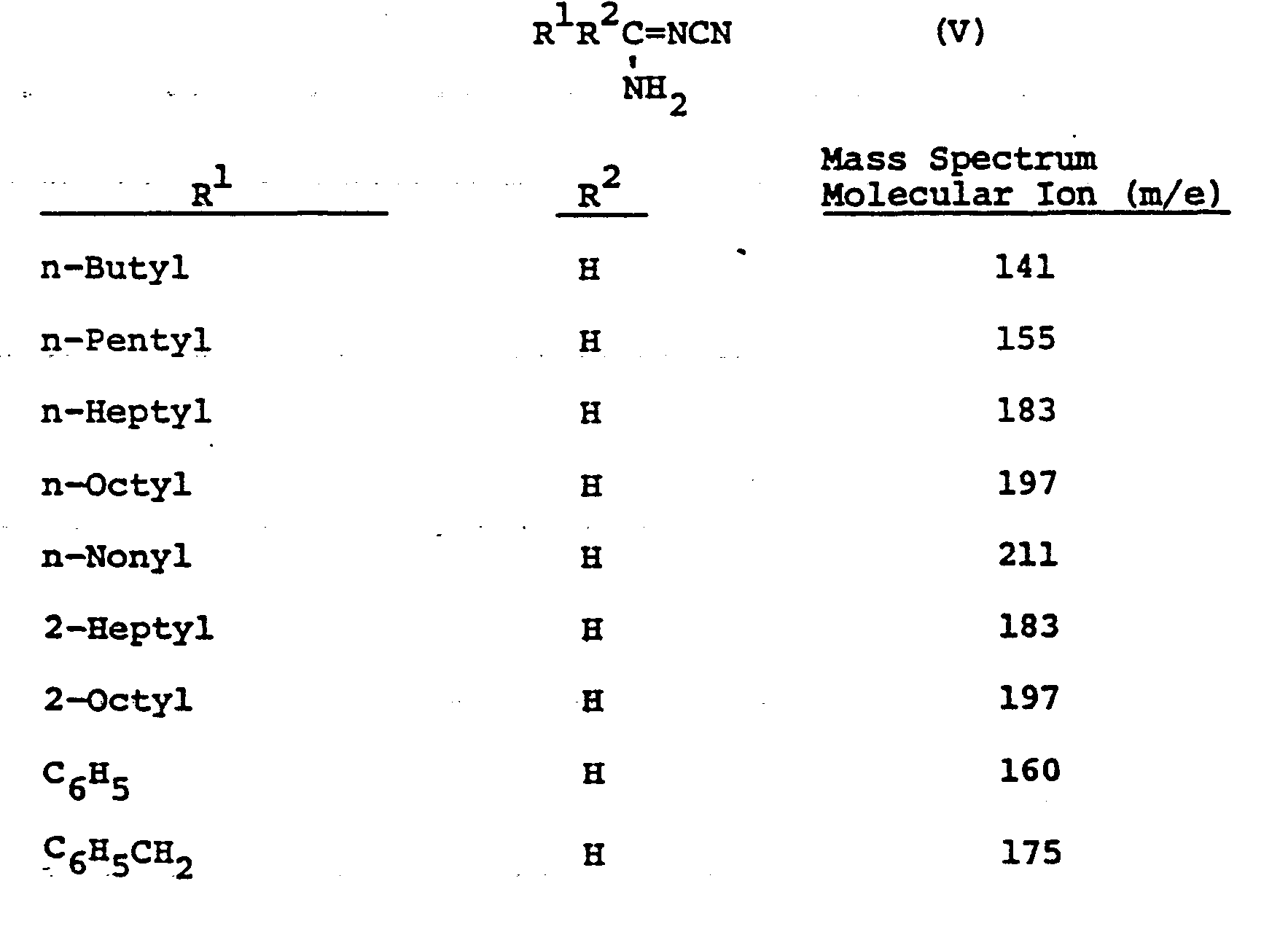
-

- (iii) By employing the appropriate amine, R1R2NH and dicyanimide, HN(CN)2 in the above procedure yields the corresponding compounds 1

-

- General methods for preparation of N-substituted guanylthioureas (IV).

- The procedure is a modification of that of Kurzer, Org. Syn. Coll. Vol. IV, p. 502 for the parent compound (R1=R2=H).
- To a mixture of 4.5 g (0.027 mole) 1-n-hexyl-3-cyanoguanidine, 75 ml methanol and 0.5 ml diethylamine, hydrogen sulfide gas is introduced and bubbled through the mixture for eight hours. The mixture is stirred overnight at room temperature, then H2S passed through again for six hours and again stirred overnight. At this point thin-layer chromatography of the reaction mixture indicated the presence of starting material. The mixture was heated at reflux while bubbling H2S through for another six hours and reflux continued overnight. The solvent was evaporated in vacuo and the residue purified by flash silica gel chromatography eluting with 9:1 chloroform/methanol to afford 4.49 g product. Mass spectrum (m/e): 202 (M+).
- (ii) Alternatively the compounds (IV) may be prepared by the method of Cutler and Shalit, U.S. 4,009,163 (Example 17) as illustrated below for 1-(benzylguanyl)-thiourea.
- To a solution of 6.73 g (38.6 mmole) 1-benzyl-3-cyanoguanidine in 100 ml methanol is added 2 ml diethylamine, the mixture cooled to 0° C. and saturated with hydrogen sulfide gas. The cold solution was transferred to a stainless steel bomb, sealed and the bomb heated
- at 80° C. for 48 hours. The mixture was then transferred to a flask, flushed with nitrogen to expel the excess hydrogen sulfide and the solvent evaporated in vacuo. The resulting residual oil was purified by flash chromatography (silica gell eluting with 20:1 chloroform/methanol to obtain 3.06 g of product as a light yellow oil. Mass spectrum (m/e): 209 (M+). (iii) The remaining l-substituted-3-cyanoguanidines provided in Preparation A, Part (ii), are converted to N-substituted-guanylthioureas of formula (IV) by the above methods.

-

- A mixture of 400 ml absolute ethanol and 60 ml toluene was heated to reflux and 20 ml of azeotrope was removed via a Dean Stark trap. To the ethanol-toluene solution was added 33.0 g (0.2 mole) of 3-bromo-4-hydroxy-3-buten-2-one and reflux was continued for 2 hours during which period three aliquots of 20 ml of ethanol-toluene were removed via the trap. The solution was concentrated in vacuo to give 38.6 g (100%) of 3-bromo-4-ethoxy-3-buten-2-one as a mobile oil. 1H-NMR(DMSO-d6)ppm(delta): 8.21 (s, 1H), 4.23 (q, 2H), 2.33 (s, 3H), 1.31 (s, 3H).
- 9.7 g (0.05 mole) of 3-bromo-4-ethoxy-3-buten-2-one was combined with 5.53 (0.05 mole) of hydroxyacetamidine hydrochloride in 100 ml acetone to form a slurry. To the slurry at 25° C. was added 11.5 g (0.1 mole) of 1,1,3,3-tetramethylguanidine over a period of 5 minutes. After stirring for 48 hours the slurry was filtered and the mother liquors were concentrated in vacuo to an oil which was chromatographed on silica gel 60 (E. Merck) using chloroform as eluent to give 1.48 g (21%) of 2-hydroxymethyl-4-acetylimidazole, m.p. 147-148° C. 1H-NMR(DMSO-d6)ppm(delta): 7.73 (s, lH), 5.46 (very broad s, lH), 4.5 (broad s, 2H), 2.4 (s, 3H).
- (iii) 1.826 g (0.013 mole) of 2-hydroxymethyl-4-acetylimidazole was dissolved in 40 ml of 48% hydrobromic acid and 2.1 g (0.013 mole) of bromine was added. The reaction was warmed at 80° C. for 2 hours and then concentrated in vacuo to a solid. This material was triturated with isopropyl ether and the resultant solid was collected by filtration and was washed with ether and dried to give 2.2 g (56%) of 2-hydroxymethyl-4-bromo- acetylimidazole hydrobromide, m.p. 183° C. with decomposition. 1H-NMR(DMSO-d6)ppm(delta): 8.8 (s, 1H), 4.8 (s, 2 x 2H).
-

- A mixture of 392 g (5.0 molel acetyl chloride and 1817 g (18.75 molel cis,trans-1,2-dichloroethylene under anhydrous conditions is cooled to 0° C. (acetone- dry ice bath). To this was added in portions 734 g (5.5 mole) anhydrous aluminum chloride while maintaining the mixture below 25° C., the aluminum chloride being rinsed in with an additional 606 g (6.25 mole) 1,2-dichloroethylene. After the addition is completed, the cooling bath is removed and the mixture is heated at reflux (50-60° C.) overnight. The cooled reaction mixture is poured onto ice, the organic layer separated and the aqueous layer is extracted with 3 x 500 ml methylene chloride. The combined organic layers are stirred vigorously, 450 g sodium chloride added and the small amount of water which separates is removed. The organic layer is filtered through diatomaceous earth (Celite) to remove the inorganic salts, then added to a solution of 748 g (6 mole) sodium carbonate monohydrate in sufficient water to make 2.5 liters of solution. The resulting mixture is stirred for 1.5 hours, the precipitated solid removed by filtration and washed with methylene chloride. The organic layer is separated, the aqueous portion extracted with 2 x 200 ml methylene chloride and the combined organic layers are dried (Na2SO4). The solvent is removed by evaporation in vacuo and the residual oil distilled to afford 517.5 g (74.5%) of product as a pale yellow liquid, b.p. 40-52° C. at 8 mm. 1H-NMR(CDCl3)ppm (delta): 2.50 (s, 3H), 7.55 (s, 1H).
-

- To a solution of 297 g (5.5 molel sodium methoxide in 5 liters of methanol at 0° C. is added in a slow stream 695 g t5.0 molel 1,2-dichloro-1-buten-3-one. After the addition is complete, the mixture is stirred at 0° C. for one hour, an additional 54 g (1.0 mole) sodium methoxide is added, and stirring continued at 0° C. for one hour. The mixture is allowed to stir at room temperature overnight, another g mole of sodium methoxide added and stirring continued for an hour. The mixture is filtered (filter aid) to remove salts, washing with fresh methanol. The filtrate is concentrated in vacuo to a slurry which is taken up in isopropyl ether and washed in turn with water, saturated sodium bicarbonate solution and brine, then dried over anhydrous magnesium sulfate. The extract is concentrated in vacuo to provide a residual oil which is distilled in vacuo to afford a main fraction of 628 g (75%) of product, b.p. 66-75° C. at 8 mm. 1H-NMR(CDCl3)ppm(delta): 2.33 (s, 3H), 3.43 (s, 3H), 3.47 (s, 3H), 4.23 (d, 1H) , 4.63 (d, lH).
- (iiia) In 500 ml of dioxane are added 83.5 g (0.50 mole) 2-chloro-1,1-dimethoxy-3-butanone, 94.5 g (1.0 mole) acetamidine hydrochloride and 123 g (1.5 mole) sodium acetate and the mixture is heated at reflux overnight. The cooled reaction mixture is filtered through a silica gel pad on a sintered glass filter funnel, washing with 3500 ml of dioxane. The filtrate and washings are combined and evaporated in vacuo to provide a residual oil which is purified by chromatography on a
- silica gel column (600 g), eluting with ethyl acetate. Fractions of 200 ml each are collected. After 16 fractions the elution is with 95:5 ethyl acetate/methanol. Fractions 18-35 are combined and the solvent evaporated in vacuo to afford 28.82 g (46.4%) of the desired product. Recrystallization from 1:1 ethyl acetate/ isopropyl ether yields 19.27 g (31%) of crystals, m.p. 132-133° C. Another 4.24 g (6.8%) was obtained by reworking the mother liquor. 1H-NMR(CD3OD)ppm (delta) 2.40 (s, 3H), 2.43 (s, 3H), 7.68 (s, 1H).
- (iiib) A mixture of 1.66 g (10 mmole) 2-chloro-1,1-dimethoxy-3-butanone, 1.43 g (15 mmole) acetamidine hydrochloride and 2.05 g (25 mmole) sodium acetate in 50 ml dioxane is heated at reflux for 24 hours. The dioxane is evaporated in vacuo and the residual oil is flash chromatographed on silica gel (40:60 ethyl acetate/hexane, 40 mm) to obtain three fractions. The third fraction, a white solid (1.121 g) was rechromatographed (40 mm, acetone) to afford 933 mg (75.1%) of product as white solid which is pure as judged by its NMR spectrum in CDC13 and by TLC on silica gel (one spot, 1:9 methanol/chloroform).
- To a slurry of 2.4 g (0.1 molel of sodium hydride in 50 ml of dimethylformamide under a nitrogen atmosphere was added, with stirring, 8.2 g (0.1 molel of 2-methylimidazole. A slow exothermic reaction occurred, the temperature reaching 43° C. When the exotherm subsided, the reaction was warmed on a steam bath to 70°-75° C. for a half-hour and then at 95° C. for 15 minutes to complete the reaction as evidenced by cessation of gas evolution. It was then cooled to 68° C. and 12.7 g (0.1 mole) of benzyl chloride added dropwise. An exothermic reaction occurred, the temperature reaching 95° C. After stirring for a half-hour following completion of addition, the reaction was poured into 600 ml of water and the product extracted with ethyl acetate (2 x 200 ml). The combined extracts were washed successively with water (1 x 400 ml), saturated aqueous sodium chloride solution (1 x 100 ml), then with 6N HC1 (1 x 50 ml). The HC1 wash was extracted with ether (1 x 25 ml) and then made basic by addition of sodium hydroxide. The yellow oil which separated was extracted into ether, the extract dried (MgS04) and evaporated under reduced pressure to give a pale yellow oil. Yield, 11.5 g (60.5%). NMR indicates the compound was obtained as the monohydrate. It was used as is in the hydroxymethylation reaction.
- A mixture of 8.5 g (0.05 mole) of l-benzyl-2-methylimidazole monohydrate, 50 ml of 36% formaldehyde, 6 ml of acetic acid and 8.0 g (0.098 mole) of sodium acetate is stirred and heated at reflux for 26 hours. It was then stirred over a weekend (about 65 hoursl at room temperature and neutralized with solid sodium carbonate. The neutral solution was extracted with ethyl acetate, the extract dried (MgS04) and evaporated under reduced pressure to an oil. Water (10 ml) and isopropanol (50 ml) were added to the oil, the solution stirred overnight then evaporated under reduced pressure. The oily residue obtained was taken up in water and the solution made strongly basic by addition of solid sodium hydroxide. It was chilled, layered with diethyl ether, and the white solid which formed removed by filtration and air dried. Yield = 1.8 g (18%); m.p. 140-146° C. It was purified by dissolution in 30 ml of hot (50° C.) ethyl acetate and filtration. Concentration of the filtrate to about two-thirds volume, and chilling, afforded 1.3 g of white solid; m.p. 147-151° C. Thin layer chromatography in the system ethyl acetate: methanol:diethylamine (80:10:10) gave a single spot. (iii) 1-Benzyl-2-methylimidazole-4-carboxaldehyde
- A slurry of 9.0 g (0.446 mole) of 1-benzyl-4-hydroxymethyl-2-methylimidazole, 750 ml of methylene chloride and 50.0 g (0.575 mole) of manganese dioxide was stirred at room temperature for two hours. It was then filtered, the filter cake washed with methylene chloride and the combined filtrate and wash solutions evaporated under reduced pressure to give an oil. The oil was taken up in 100 ml of diethyl ether, 100 ml of hexane added and the solution seeded with a few crystals of the title compound. Concentration of the solution
- under a nitrogen sweep with periodic replacement of hexane afforded a crystalline product which was isolated by filtration: 7.2 g, 81% yield; m.p. 57-60° C.
- A second crop (0.75 gl was obtained by concentration of the filtrate; m.p. 57-59.5° C. Total yield = 89.4%.
- To a solution of 7.2 g (0.306 mole) of 1-benzyl-2-methylimidazol-4-carboxaldehyde in 100 ml of tetrahydrofuran was added 15 ml of 2.9M methyl magnesium chloride (0.044 mole) in tetrahydrofuran. A white precipitate formed immediately. The mixture was stirred at room temperature for 30 minutes and then heated with 50 ml of 25% aqueous ammonium chloride solution. The precipitate was filtered off, washed with tetrahydrofuran and air dried. The combined filtrate and wash solutions were dried (Na2S04) and concentrated in vacuo to a solid residue. The residue was dissolved in 300 ml of boiling ethyl acetate, dried-(Na2SO4) and concentrated to half volume under reduced pressure. The solid which separated upon cooling was filtered off and air dried. Total yield = 7.1 g (90%); m.p. 162.5-167.5° C.
- A Parr shaker was charged with 10.0 g (46.23 mmole) of I-benzyl-4-(1-hydroxyethyl)-2-methylimidazole, 60 ml of methanol and 2.0 g of 5% palladium-on-carbon (50% water). Hydrogen gas was introduced to 30 psi (2.04 atmospheres), the mixture heated to 50° C. and shaken for 16 hours. It was cooled to 30° C., filtered through diatomaceous earth and the filter cake washed with 10 ml of methanol. Evaporation of the combined filtrate and wash under reduced pressure gave 6.44 g (97% yield) of the title product as an oil.
- The product can be crystallized by adding enough tetrahydrofuran to dissolve the oil and stirring the solution at ambient temperature for two hours. The white crystalline solid was collected by filtration and air dried; m.p. 107-111° C.
- (vi) To a refluxing mixture of 1240 g (.9.989 molel of 4(5)-(l-hydroxyethyl).-2-methylimidazole in 10 liters of tetrahydrofuran was added 2200 g (25.293 mole) of manganese dioxide over a period of ten minutes. The mixture was refluxed overnight (18 hours), then filtered hot through diatomaceous earth. The filter cake was washed with 4 liters of tetrahydrofuran.
- The combined filtrates and washings from two such reactions were stirred and concentrated at atmospheric pressure to about 6 liter volume at which point the mixture became solid. Ethyl acetate (2 liters) was added, the mixture heated to form a solution and to permit further removal of tetrahydrofuran. When the mixture became solid, an additional 2 liters of ethyl acetate was added and the heating repeated. When the mixture became solid, heating and stirring were discontinued and the mixture cooled overnight. Ethyl acetate (3.8 liters) was added and the solid mass broken up with the aid of a spatula. When it became stirrable, the slurry was heated at 50° C. for 3 hours, then cooled at 5° C. for one hour and filtered with suction. The yellow filter cake was washed with 1.5 liters of ethyl acetate at 5° C. then air dried. Yield = 1887 g (76.08%); m.p. 128-130° C.
- Into a solution of 248 mg (2.0 mmolel 4-acetyl-2-methylimidazole in 20 ml methylene chloride was passed dry hydrogen chloride gas for five minutes, then 192 mg (6 mmole) dry methanol was added. To the resulting solution was added 297 mg (2.2 mmolel sulfuryl chloride and the mixture stirred for one hour at room temperature. Two additional portions of 155 mg each of sulfuryl chloride was then added at ten minute intervals to assure completion of the reaction. A few milliliters of methanol was added and the mixture was concentrated to dryness in vacuo. The resulting colorless oil was basified with solid sodium bicarbonate. The precipitated solid was collected, washed with water and dried under high vacuum to give 167 mg (53%) of fine white solid. 1H-NMR(DMSO-d6)ppm(delta): 2.25 (s, 3H), 4.75 (s, 2H), 7.8 (s, 1H). Mass spectrum (m/e): 158 (M+), 109 (M-CH2Cl).
- When the above procedure was repeated on the same scale, but without methanol and subsequent additions of sulfuryl chloride, and stirring for two hours at room temperature, 395 mg (100%) of the hydrochloride salt was obtained, m.p. 159-166° C., dec.
- A mixture of 10.0 g (65.3 mmolel 2-cyanonaphthalene, 2.0 g Raney Nickel, 100 ml ethanol and 9 ml concentrated ammonium hydroxide was hydrogenated at 36 psi (2.53 kg/cm2 for 4.5 days. The mixture was filtered and the filtrate concentrated in vacuo to an oil. The oil was distilled in vacuo to obtain the desired amine as a colorless liquid which solidified on standing. Yield 2.02 g. TLC on silica gel plates showed one spot at Rf 0.1 upon development with 19:1 chloroform/methanol.
- A mixture of 12.0 g (61.5 mmolel m-trifluoromethylbenzyl chloride, 9.56 g (195 mmole) sodium cyanide and 60 ml dimethylsulfoxide was heated at 50 to 80° C. for four hours and poured into water. The aqueous mixture was extracted with methylene chloride, the extracts dried over sodium sulfate and the solvent evaporated in vacuo to give 12.2 g of yellow oil which was used in the next step. 1H-NMR(CDC13)ppm(delta): 3.80 (s, 2H), 7.60 (s, 4H).
- (ii) A mixture of 7.20 g (38.9 mmole) 2-(3-trifluoromethylphenyl)acetonitrile, 0.75 g Raney Nickel, 30 ml ethanol and 4.0 ml concentrated ammonium hydroxide was flushed with nitrogen, then hydrogenated at 3.5 kg/cm2 for 18 hours. The catalyst was removed by filtration under nitrogen and the filtrate evaporated in vacuo to afford 6.86 g (93%) of the title amine as a red oil. 1H-NMR(CDC13)ppm(delta): 0.65-1.40 (bs, 2H), 2.65-3.40 (m, 4H), 7.30-7.60 (m, 4H).
- A general method for preparation of 3-arylpropyl- amines of the formula (R3)2Ar(CH2)3NH2 isillustrated below.
- A mixture of 20.0 g (90 mmole) 4-n-propylbenz- aldehyde diethylacetal, 20.4 g (180 mmole) ethyl cyanoacetate, 7.2 g (93.4 mmole) ammonium acetate and 60 ml toluene are heated at reflux for six hours, cooled and poured into water. The resulting mixture was extracted with ethyl ether, dried (MgS04) and the volatiles evaporated in vacuo to afford 23.0 g crude yellow oil which was purified by chromatography on a silica gel column, eluting with 2:1 methylene chloride/hexane to give 20.58 g (94%) of the desired product. 1H-NMR(CDCl3)-ppm(delta): 0.85-1.95 (m, 8H), 2.45-2.70 (t, 2H), 4.15-4.60 (q, 2H), 7.15-8.05 (q, 4H), 8.25 (s, 1H).
- A mixture of 20.50 g (84.3 mmole) of the product of Part (i), 8.75 g magnesium turnings and 200 ml methanol was stirred under a nitrogen atmosphere for six hours with periodic cooling to maintain a temperature of about 30° C. The mixture was acidified with hydrochloric acid, extracted with ethyl ether, the extracts washed with sodium bicarbonate solution, water, brine and dried over MgS04. Evaporation of solvent gave 23.8 g of crude product which was purified by column chromatography on silica gel, eluting with methylene chloride to provide 11.55 g (59%) of purified methyl 2-cyano-3-(4-n-propylphenyl)propionate. This was combined with 4.17 g sodium chloride, 175 ml dimethylsulfoxide and 5 ml water under nitrogen and the mixture heated at 150° C. for five hours. The reaction mixture was cooled, poured into
- 700 ml water and extracted with 2 x 500 ml ethyl acetate. The combined extracts were washed with brine (300 ml) dried over anhydrous sodium sulfate and concentrated in vacuo to give 12.5 g of the desired nitrile which was purified by distillation, b.p. 124-128° C. 1.0 mm). 1H-NMR(CDCl3)ppm(deltal):0.75-1.15 (t, 3H), 1.30-2.00 (m, 2H), 2.40-3.10 (m, 6H), 7.15 (s, 4H). (iii) A mixture of 14.13 g (81.6 mmole) of the above nitrile (distilled), 1.5 g Raney Nickel, 60 ml ethanol and 8 ml concentrated ammonium hydroxide was hydrogenated at 3.5 kg/cm2 for 18 hours. The mixture was flushed with nitrogen, the catalyst was removed by filtration and the filtrate concentrated in vacuo to give 12.3 g (.84.8%) of clear oil. The oil was distilled to provide 8.60 g (59%) of pure amine as a colorless oil. 1H-NMR(CDCl3)-ppm(delta): 0.75-1.05 (t, 3H), 1.05 (s, 3H), 1.15-1.75 (m, 4H), 2.30-2.85 (m, 6H), 6.95-7.10 (m, 4H).
- A general method for preparation of 4-arylbutylamines of the formula (R3) 2Ar (CH2)4NH2 is illustrated below.
- A mixture of 4-chlorobenzaldehyde (10.Q g, 68.2 mmole), 34.0 g (81.9 mmole) 3-[triphenylphosphonium)propionic acid bromide (prepared by reacting triphenylphosphine and 3-bromopropionic acid in xylene), 12.5 g sodium hydride (50% in mineral oil) and 200 ml dimethylsulfoxide were heated at 120° C. for five hours, cooled and poured into ice water. The mixture was made alkaline with sodium carbonate, extracted with ethyl ether and the extracts discarded. The aqueous phase was acidified, extracted again with ethyl ether, dried (Mg8O4) and the ether evaporated in vacuo to afford 6.9 g (51%) of the desired acid. 1H-NMR(CDCl3)ppm(delta): 3.10-3.30 (d, 2H), 6.10-6.35 (m, 2H), 7.20 (s, 4H), 11.55-11.75 (bs, 1H).
- A mixture of 19.5 g (98.2 mmole) of the unsaturated acid from Part (i), above, 1.95 g palladium-on-carbon catalyst and 200 ml ethyl acetate was hydrogenated at 3.5 kg/cm2 and worked up in the usual manner to give the desired saturated acid in 91% yield. 1H-NMR(CDCl3)-ppm(delta): 1.75-2.80 (m, 6H), 6.95-7.40 (q, 4H), 9.15-10.25 (bs, 1H).
- A mixture of 8.8 g (44.3 mmolel of the saturated acid from Part (ii) and 45 ml thionyl chloride was heated at reflux for three hours. The mixture was cooled and excess thionyl chloride removed by evaporation in vacuo. The crude acid chloride was dissolved in 20 ml ethyl ether and the solution added dropwise to 67 ml concentrated ammonium hydroxide at 0° C. over 20 minutes. A tan solid formed immediately. The mixture was stirred one hour at 0° C., 80 ml water added and the mixture extracted with 3 x 100 ml ethyl ether. The combined ether layers were washed with brine, dried (MgSO4) and concentrated in vacuo to give 8.70 g (97%) of amide. 1H-NMR(CDCl3)ppm-(delta): 1.60-2.40 (m, 4H), 2.45-2.85 (t, 2H), 5.25-6.10 (bs, 2H), 6.90-7.30 (q, 4H).
- Part (iii), above, and 71 ml 1.OM boron hydride/tetra- hydrofuran in 60 ml tetrahydrofuran was stirred four hours and the reaction quenched with 6N hydrochloric acid (36 ml). The mixture was extracted with ethyl ether, the extracts dried (Na2SO4) and concentrated in vacuo. The residual oil was stirred with isopropyl ether, filtered and the filtrate evaporated in vacuo to give 2.08 g. An additional 2.4 g was obtained by extraction of the liquors with ethyl acetate. 1H-NMR-(CDC13)ppm(delta): 1.15 (s, 2H), 1.30-1.90 (m, 4H), 2.40-2.90 (q, 4H), 6.90-7.35 (q, 4H).
Claims (10)


Priority Applications (3)
| Application Number | Priority Date | Filing Date | Title |
|---|---|---|---|
| AT85302844T ATE44741T1 (en) | 1984-04-30 | 1985-04-24 | 2-(N-SUBSTITUTED GUANIDINO)-4HETEROARYLTHIAZOLE AS ANTI-ULCER AGENTS. |
| MYPI87001448A MY101827A (en) | 1984-04-30 | 1987-08-25 | 2-[n-substitutedguanidino]-4-heteroarylthiazole antiulcer agents |
| MX9203542A MX174158B (en) | 1984-04-30 | 1992-06-26 | ANTI-ULCERA AGENTS OF 2- (GUANIDINO N-SUBSTITUTED) -4-HETEROARILTIAZOL |
Applications Claiming Priority (2)
| Application Number | Priority Date | Filing Date | Title |
|---|---|---|---|
| US06/605,510 US4560690A (en) | 1984-04-30 | 1984-04-30 | 2-(N-substituted guanidino)-4-hetero-arylthiazole antiulcer agents |
| US605510 | 1984-04-30 |
Publications (2)
| Publication Number | Publication Date |
|---|---|
| EP0161841A1 true EP0161841A1 (en) | 1985-11-21 |
| EP0161841B1 EP0161841B1 (en) | 1989-07-19 |
Family
ID=24423963
Family Applications (1)
| Application Number | Title | Priority Date | Filing Date |
|---|---|---|---|
| EP85302844A Expired EP0161841B1 (en) | 1984-04-30 | 1985-04-24 | 2-(n-substituteguanidino)-4-hetero-arylthiazole antiulcer agents |
Country Status (26)
| Country | Link |
|---|---|
| US (1) | US4560690A (en) |
| EP (1) | EP0161841B1 (en) |
| JP (1) | JPS60239474A (en) |
| KR (1) | KR870000925B1 (en) |
| AR (1) | AR241784A1 (en) |
| AU (1) | AU554271B2 (en) |
| CA (1) | CA1262352A (en) |
| CS (2) | CS248750B2 (en) |
| DD (1) | DD233374A5 (en) |
| DE (1) | DE3571618D1 (en) |
| DK (1) | DK165693C (en) |
| EG (1) | EG17391A (en) |
| ES (2) | ES8605511A1 (en) |
| FI (1) | FI81096C (en) |
| GR (1) | GR851020B (en) |
| HU (1) | HU198300B (en) |
| IL (1) | IL75038A (en) |
| IN (1) | IN165501B (en) |
| NO (1) | NO164097C (en) |
| NZ (1) | NZ211909A (en) |
| PH (1) | PH21824A (en) |
| PL (2) | PL146070B1 (en) |
| PT (1) | PT80361B (en) |
| SU (2) | SU1380614A3 (en) |
| YU (2) | YU43977B (en) |
| ZA (1) | ZA853161B (en) |
Cited By (12)
| Publication number | Priority date | Publication date | Assignee | Title |
|---|---|---|---|---|
| EP0290903A3 (en) * | 1987-05-12 | 1989-06-14 | Bayer Ag | Beta-fluoracyl-beta-halogen vinyl alkyl ethers |
| EP0269239A3 (en) * | 1986-10-29 | 1990-03-28 | Pfizer Inc. | Processes for 2-(1-pentyl-3-guanidino)-4-(2-methyl-4-imidazolyl)thiazole and the crystalline dihydrochloride trihydrate thereof |
| EP0357315A3 (en) * | 1988-08-30 | 1990-08-16 | Pfizer Inc. | Hemiphosphate hemihydrate of 2-(1-pentyl-3-guanidino-4-imidazolyl)thiazole |
| EP0355612A3 (en) * | 1988-08-15 | 1990-08-22 | Fujisawa Pharmaceutical Co., Ltd. | New furylthiazole derivatives, processes for the preparation thereof and pharmaceutical composition comprising the same |
| EP0417751A3 (en) * | 1989-09-15 | 1991-09-11 | Fujisawa Pharmaceutical Co., Ltd. | New thiazole derivatives, processes for the preparation thereof and pharmaceutical compositon comprising the same |
| WO1992011258A1 (en) * | 1990-12-24 | 1992-07-09 | Gesellschaft für Biotechnologische Forschung mbH | Thiangazole, its preparation, compositions and use thereof |
| WO1992016526A1 (en) * | 1991-03-13 | 1992-10-01 | Fujisawa Pharmaceutical Co., Ltd. | Thiazole derivatives |
| WO1994028898A1 (en) * | 1993-06-15 | 1994-12-22 | Pfizer Inc. | H2-antagonists as immune stimulants in bacterial infections of cattle or swine |
| WO1995006034A1 (en) * | 1993-08-24 | 1995-03-02 | Medivir Ab | Compounds and methods for inhibition of hiv and related viruses |
| WO1997001537A1 (en) * | 1995-06-29 | 1997-01-16 | Bayer Aktiengesellschaft | Substituted n-methylenethioureas as pesticides |
| US5604249A (en) * | 1990-12-24 | 1997-02-18 | Ciba-Geigy Corporation | Thiangazole, its preparation, compositions and use thereof |
| EP0928793A1 (en) * | 1998-01-02 | 1999-07-14 | F. Hoffmann-La Roche Ag | Thiazole derivatives |
Families Citing this family (15)
| Publication number | Priority date | Publication date | Assignee | Title |
|---|---|---|---|---|
| WO1986003203A1 (en) * | 1984-11-22 | 1986-06-05 | Yoshitomi Pharmaceutical Industries, Ltd. | Thienylthiazole derivatives |
| EP0192060B1 (en) * | 1985-02-04 | 1991-09-18 | Nihon Bayer Agrochem K.K. | Heterocyclic compounds |
| US5001138B1 (en) * | 1985-02-04 | 1998-01-20 | Bayer Agrochem Kk | Heterocyclic compounds |
| ATE66477T1 (en) * | 1986-08-29 | 1991-09-15 | Pfizer | 2-GUANIDINO-4-ARYL-THIAZOLE FOR THE TREATMENT OF PEPTIC ULCERS. |
| WO1988003140A1 (en) * | 1986-10-29 | 1988-05-05 | Pfizer Inc. | Crystalline 2-(1-pentyl-3-guanidino)-4-(2-methyl-4-imidazolyl)thiazole dihydrochloride trihydrate |
| FI892035A7 (en) * | 1986-10-29 | 1989-04-28 | Pfizer | Methods for 2-(1-pentyl-3-guanidino)-4-(2-methyl-4-imidazolyl)thiazole and analogues |
| EP0357192B1 (en) * | 1988-07-21 | 1992-05-06 | Pfizer Inc. | Process for preparing substituted guanylthioureas |
| GB8903592D0 (en) * | 1989-02-16 | 1989-04-05 | Boots Co Plc | Therapeutic agents |
| US4985402A (en) * | 1990-04-25 | 1991-01-15 | International Flavors & Fragrances Inc. | 2-Methyl-1-nitrilo-2-methyl -1-hydroxylamino-3-(methoxyphenyl) propane, organoleptic uses thereof and processes for preparing same |
| US5387656A (en) * | 1990-07-23 | 1995-02-07 | Alliedsignal Inc. | Substituted cyanoguanidines as curing agents for epoxy resins |
| US5387597A (en) * | 1991-02-25 | 1995-02-07 | Pfizer Inc. | Hemiphosphate hemihydrate of 2-(1-pentyl-3-guanidino)-4-(2-methyl-4-imidazolyl)thiazole |
| CN100475810C (en) * | 2002-08-30 | 2009-04-08 | 霍夫曼-拉罗奇有限公司 | Novel 2-arylthiazole compounds as pparalpha and ppargamma agonists |
| DE102004008141A1 (en) * | 2004-02-19 | 2005-09-01 | Abbott Gmbh & Co. Kg | Guanidine compounds and their use as binding partners for 5-HT5 receptors |
| EP2647630B1 (en) | 2010-12-02 | 2015-05-06 | Nihon University | Biguanide derivative compound |
| EP4196793A1 (en) | 2020-08-11 | 2023-06-21 | Université de Strasbourg | H2 blockers targeting liver macrophages for the prevention and treatment of liver disease and cancer |
Citations (3)
| Publication number | Priority date | Publication date | Assignee | Title |
|---|---|---|---|---|
| EP0003640A2 (en) * | 1978-01-18 | 1979-08-22 | Imperial Chemical Industries Plc | Antisecretory guanidine derivatives, processes for their manufacture and pharmaceutical compositions containing them |
| EP0050458A2 (en) * | 1980-10-14 | 1982-04-28 | Pfizer Inc. | 2-Guanidino-4-heteroarylthiazoles and pharmaceutical compositions containing them |
| EP0094191A1 (en) * | 1982-05-10 | 1983-11-16 | Pfizer Inc. | Antiulcer 2-guanidino-4-(2-substituted-amino-4-imidazolyl)-thiazoles and process therefor |
Family Cites Families (4)
| Publication number | Priority date | Publication date | Assignee | Title |
|---|---|---|---|---|
| US2455807A (en) * | 1945-09-11 | 1948-12-07 | American Cyanamid Co | Preparation of substituted cyanoguanidine |
| IL49528A (en) * | 1975-05-21 | 1980-11-30 | Smith Kline French Lab | Imidazolyl(or thiazolyl)methylthio(or butyl)guanidine or thiourea derivatives,their preparation and pharmaceutical compositions comprising them |
| JPS6056143B2 (en) * | 1979-08-02 | 1985-12-09 | 山之内製薬株式会社 | Amidine derivatives and their production method |
| GR71929B (en) * | 1979-11-13 | 1983-08-19 | Ici Ltd |
-
1984
- 1984-04-30 US US06/605,510 patent/US4560690A/en not_active Expired - Lifetime
-
1985
- 1985-03-22 IN IN244/DEL/85A patent/IN165501B/en unknown
- 1985-04-24 EP EP85302844A patent/EP0161841B1/en not_active Expired
- 1985-04-24 DE DE8585302844T patent/DE3571618D1/en not_active Expired
- 1985-04-25 CS CS857163A patent/CS248750B2/en not_active IP Right Cessation
- 1985-04-25 CS CS853042A patent/CS248741B2/en not_active IP Right Cessation
- 1985-04-26 PL PL1985257845A patent/PL146070B1/en unknown
- 1985-04-26 PL PL1985253107A patent/PL145213B1/en unknown
- 1985-04-26 GR GR851020A patent/GR851020B/el unknown
- 1985-04-26 NZ NZ211909A patent/NZ211909A/en unknown
- 1985-04-26 PT PT80361A patent/PT80361B/en not_active IP Right Cessation
- 1985-04-26 CA CA000480150A patent/CA1262352A/en not_active Expired
- 1985-04-26 DD DD85275638A patent/DD233374A5/en not_active IP Right Cessation
- 1985-04-28 EG EG268/85A patent/EG17391A/en active
- 1985-04-29 NO NO851695A patent/NO164097C/en unknown
- 1985-04-29 PH PH32200A patent/PH21824A/en unknown
- 1985-04-29 AR AR85300218A patent/AR241784A1/en active
- 1985-04-29 YU YU723/85A patent/YU43977B/en unknown
- 1985-04-29 KR KR1019850002872A patent/KR870000925B1/en not_active Expired
- 1985-04-29 ZA ZA853161A patent/ZA853161B/en unknown
- 1985-04-29 SU SU853884505A patent/SU1380614A3/en active
- 1985-04-29 HU HU851646A patent/HU198300B/en not_active IP Right Cessation
- 1985-04-29 DK DK190885A patent/DK165693C/en not_active IP Right Cessation
- 1985-04-29 ES ES542703A patent/ES8605511A1/en not_active Expired
- 1985-04-29 AU AU41790/85A patent/AU554271B2/en not_active Ceased
- 1985-04-29 IL IL75038A patent/IL75038A/en not_active IP Right Cessation
- 1985-04-29 FI FI851683A patent/FI81096C/en not_active IP Right Cessation
- 1985-04-30 JP JP60093524A patent/JPS60239474A/en active Granted
- 1985-10-21 ES ES548073A patent/ES8606336A1/en not_active Expired
-
1986
- 1986-04-02 SU SU864027210A patent/SU1400508A3/en active
-
1987
- 1987-06-18 YU YU1145/87A patent/YU44632B/en unknown
Patent Citations (3)
| Publication number | Priority date | Publication date | Assignee | Title |
|---|---|---|---|---|
| EP0003640A2 (en) * | 1978-01-18 | 1979-08-22 | Imperial Chemical Industries Plc | Antisecretory guanidine derivatives, processes for their manufacture and pharmaceutical compositions containing them |
| EP0050458A2 (en) * | 1980-10-14 | 1982-04-28 | Pfizer Inc. | 2-Guanidino-4-heteroarylthiazoles and pharmaceutical compositions containing them |
| EP0094191A1 (en) * | 1982-05-10 | 1983-11-16 | Pfizer Inc. | Antiulcer 2-guanidino-4-(2-substituted-amino-4-imidazolyl)-thiazoles and process therefor |
Cited By (17)
| Publication number | Priority date | Publication date | Assignee | Title |
|---|---|---|---|---|
| EP0269239A3 (en) * | 1986-10-29 | 1990-03-28 | Pfizer Inc. | Processes for 2-(1-pentyl-3-guanidino)-4-(2-methyl-4-imidazolyl)thiazole and the crystalline dihydrochloride trihydrate thereof |
| EP0290903A3 (en) * | 1987-05-12 | 1989-06-14 | Bayer Ag | Beta-fluoracyl-beta-halogen vinyl alkyl ethers |
| EP0355612A3 (en) * | 1988-08-15 | 1990-08-22 | Fujisawa Pharmaceutical Co., Ltd. | New furylthiazole derivatives, processes for the preparation thereof and pharmaceutical composition comprising the same |
| EP0357315A3 (en) * | 1988-08-30 | 1990-08-16 | Pfizer Inc. | Hemiphosphate hemihydrate of 2-(1-pentyl-3-guanidino-4-imidazolyl)thiazole |
| US5371097A (en) * | 1989-09-15 | 1994-12-06 | Fujisawa Pharmaceutical Co., Ltd. | Thiazole derivatives, processes for the preparation thereof and pharmaceutical composition comprising the same |
| EP0417751A3 (en) * | 1989-09-15 | 1991-09-11 | Fujisawa Pharmaceutical Co., Ltd. | New thiazole derivatives, processes for the preparation thereof and pharmaceutical compositon comprising the same |
| US5610038A (en) * | 1990-12-24 | 1997-03-11 | Ciba-Geigy Corporation | Thiangazole, its preparation, compositions and use thereof |
| US5604249A (en) * | 1990-12-24 | 1997-02-18 | Ciba-Geigy Corporation | Thiangazole, its preparation, compositions and use thereof |
| WO1992011258A1 (en) * | 1990-12-24 | 1992-07-09 | Gesellschaft für Biotechnologische Forschung mbH | Thiangazole, its preparation, compositions and use thereof |
| WO1992016526A1 (en) * | 1991-03-13 | 1992-10-01 | Fujisawa Pharmaceutical Co., Ltd. | Thiazole derivatives |
| WO1994028898A1 (en) * | 1993-06-15 | 1994-12-22 | Pfizer Inc. | H2-antagonists as immune stimulants in bacterial infections of cattle or swine |
| WO1995006034A1 (en) * | 1993-08-24 | 1995-03-02 | Medivir Ab | Compounds and methods for inhibition of hiv and related viruses |
| AU687440B2 (en) * | 1993-08-24 | 1998-02-26 | Medivir Ab | Compounds and methods for inhibition of HIV and related viruses |
| WO1997001537A1 (en) * | 1995-06-29 | 1997-01-16 | Bayer Aktiengesellschaft | Substituted n-methylenethioureas as pesticides |
| AU705428B2 (en) * | 1995-06-29 | 1999-05-20 | Bayer Aktiengesellschaft | Substituted N-methylenethioureas as pesticides |
| KR100475292B1 (en) * | 1995-06-29 | 2006-01-12 | 바이엘 악티엔게젤샤프트 | Pesticide Inch Ring N-Methylenethiourea |
| EP0928793A1 (en) * | 1998-01-02 | 1999-07-14 | F. Hoffmann-La Roche Ag | Thiazole derivatives |
Also Published As
Similar Documents
| Publication | Publication Date | Title |
|---|---|---|
| EP0161841B1 (en) | 2-(n-substituteguanidino)-4-hetero-arylthiazole antiulcer agents | |
| KR860001818B1 (en) | Method for preparing 2-amino-5-hydroxy-4-methyl pyrimidine derivative | |
| FI66000C (en) | FREQUENCY REQUIREMENT FOR THERAPEUTIC ACTIVATION ACTIVE 2-AMINO-4-PYRIMIDONDERIVAT | |
| EP0149884B1 (en) | 5-pyridyl-1,3-thiazole derivatives, their production and use | |
| KR850001795B1 (en) | Method for preparing 2,4-disubstituted thiazole derivatives | |
| JP2006522125A (en) | Thiazoles useful as protein kinase inhibitors | |
| EP0050458B1 (en) | 2-guanidino-4-heteroarylthiazoles and pharmaceutical compositions containing them | |
| HU184259B (en) | Process for producing 2-imidazoline derivatives | |
| AU6452100A (en) | Aminothiazole derivatives and their use as crf receptor ligands | |
| EP0094191B1 (en) | Antiulcer 2-guanidino-4-(2-substituted-amino-4-imidazolyl)-thiazoles and process therefor | |
| US4814341A (en) | 2-guanidino-4-(2-furyl) thiazoles as antiulcer agents | |
| US4673677A (en) | Method for treatment of gastrointestinal disorders | |
| EP0039989A1 (en) | Pyrimidone derivatives, processes for their preparation and pharmaceutical compositions containing them | |
| EP0083186A2 (en) | Thiazole derivatives as H2-receptor antagonists | |
| KR870000924B1 (en) | Method for preparing 2- (N-substituted guanidino) -4-heteroarylthiazole | |
| US4468399A (en) | 2-[2-(2-Aminoalkyl-4-thiazolylmethylthio)alkyl]-amino-5-substituted-4-pyrimidones | |
| US4738960A (en) | 1,3,4-Thiadiazole derivatives and pharmaceutical preparations useful as inhibitors for histamine-H2 receptors | |
| US4590299A (en) | 2-guanidino-4-heteroarylthiazoles | |
| DE3874027T2 (en) | 1,3-DITHIOL-2-YLIDEN DERIVATIVES. | |
| US4452987A (en) | Haloacetyl imidazoles | |
| JPS5936674A (en) | N-substituted guanidinothiazole derivative and its preparation | |
| US4510313A (en) | 2-Guanidino-4-heteroarylthiazoles | |
| FR2476081A1 (en) | 1,2,5-Thiadiazole 1-oxide and 1,1-di:oxide derivs. - useful as anti-ulcer agents | |
| NZ207258A (en) | Substituted imidazoles |
Legal Events
| Date | Code | Title | Description |
|---|---|---|---|
| PUAI | Public reference made under article 153(3) epc to a published international application that has entered the european phase |
Free format text: ORIGINAL CODE: 0009012 |
|
| 17P | Request for examination filed |
Effective date: 19850502 |
|
| AK | Designated contracting states |
Designated state(s): AT BE CH DE FR GB IT LI LU NL SE |
|
| 17Q | First examination report despatched |
Effective date: 19870114 |
|
| R17C | First examination report despatched (corrected) |
Effective date: 19870612 |
|
| GRAA | (expected) grant |
Free format text: ORIGINAL CODE: 0009210 |
|
| AK | Designated contracting states |
Kind code of ref document: B1 Designated state(s): AT BE CH DE FR GB IT LI LU NL SE |
|
| REF | Corresponds to: |
Ref document number: 44741 Country of ref document: AT Date of ref document: 19890815 Kind code of ref document: T |
|
| REF | Corresponds to: |
Ref document number: 3571618 Country of ref document: DE Date of ref document: 19890824 |
|
| ITF | It: translation for a ep patent filed | ||
| ET | Fr: translation filed | ||
| PLBE | No opposition filed within time limit |
Free format text: ORIGINAL CODE: 0009261 |
|
| STAA | Information on the status of an ep patent application or granted ep patent |
Free format text: STATUS: NO OPPOSITION FILED WITHIN TIME LIMIT |
|
| 26N | No opposition filed | ||
| ITTA | It: last paid annual fee | ||
| EPTA | Lu: last paid annual fee | ||
| EAL | Se: european patent in force in sweden |
Ref document number: 85302844.7 |
|
| PGFP | Annual fee paid to national office [announced via postgrant information from national office to epo] |
Ref country code: SE Payment date: 19990319 Year of fee payment: 15 Ref country code: DE Payment date: 19990319 Year of fee payment: 15 |
|
| PGFP | Annual fee paid to national office [announced via postgrant information from national office to epo] |
Ref country code: NL Payment date: 19990325 Year of fee payment: 15 |
|
| PGFP | Annual fee paid to national office [announced via postgrant information from national office to epo] |
Ref country code: FR Payment date: 19990329 Year of fee payment: 15 |
|
| PGFP | Annual fee paid to national office [announced via postgrant information from national office to epo] |
Ref country code: LU Payment date: 19990331 Year of fee payment: 15 Ref country code: GB Payment date: 19990331 Year of fee payment: 15 |
|
| PGFP | Annual fee paid to national office [announced via postgrant information from national office to epo] |
Ref country code: BE Payment date: 19990409 Year of fee payment: 15 |
|
| PGFP | Annual fee paid to national office [announced via postgrant information from national office to epo] |
Ref country code: AT Payment date: 19990415 Year of fee payment: 15 |
|
| PGFP | Annual fee paid to national office [announced via postgrant information from national office to epo] |
Ref country code: CH Payment date: 19990607 Year of fee payment: 15 |
|
| PG25 | Lapsed in a contracting state [announced via postgrant information from national office to epo] |
Ref country code: LU Free format text: LAPSE BECAUSE OF NON-PAYMENT OF DUE FEES Effective date: 20000424 Ref country code: GB Free format text: LAPSE BECAUSE OF NON-PAYMENT OF DUE FEES Effective date: 20000424 Ref country code: AT Free format text: LAPSE BECAUSE OF NON-PAYMENT OF DUE FEES Effective date: 20000424 |
|
| PG25 | Lapsed in a contracting state [announced via postgrant information from national office to epo] |
Ref country code: SE Free format text: LAPSE BECAUSE OF NON-PAYMENT OF DUE FEES Effective date: 20000425 |
|
| PG25 | Lapsed in a contracting state [announced via postgrant information from national office to epo] |
Ref country code: LI Free format text: LAPSE BECAUSE OF NON-PAYMENT OF DUE FEES Effective date: 20000430 Ref country code: CH Free format text: LAPSE BECAUSE OF NON-PAYMENT OF DUE FEES Effective date: 20000430 Ref country code: BE Free format text: LAPSE BECAUSE OF NON-PAYMENT OF DUE FEES Effective date: 20000430 |
|
| BERE | Be: lapsed |
Owner name: PFIZER INC. Effective date: 20000430 |
|
| PG25 | Lapsed in a contracting state [announced via postgrant information from national office to epo] |
Ref country code: NL Free format text: LAPSE BECAUSE OF NON-PAYMENT OF DUE FEES Effective date: 20001101 |
|
| EUG | Se: european patent has lapsed |
Ref document number: 85302844.7 |
|
| GBPC | Gb: european patent ceased through non-payment of renewal fee |
Effective date: 20000424 |
|
| REG | Reference to a national code |
Ref country code: CH Ref legal event code: PL |
|
| PG25 | Lapsed in a contracting state [announced via postgrant information from national office to epo] |
Ref country code: FR Free format text: LAPSE BECAUSE OF NON-PAYMENT OF DUE FEES Effective date: 20001229 |
|
| NLV4 | Nl: lapsed or anulled due to non-payment of the annual fee |
Effective date: 20001101 |
|
| PG25 | Lapsed in a contracting state [announced via postgrant information from national office to epo] |
Ref country code: DE Free format text: LAPSE BECAUSE OF NON-PAYMENT OF DUE FEES Effective date: 20010201 |
|
| REG | Reference to a national code |
Ref country code: FR Ref legal event code: ST |