EP0160642B1 - Polymeric light stabilizers containing polyalkylpiperidine groups - Google Patents
Polymeric light stabilizers containing polyalkylpiperidine groups Download PDFInfo
- Publication number
- EP0160642B1 EP0160642B1 EP83903671A EP83903671A EP0160642B1 EP 0160642 B1 EP0160642 B1 EP 0160642B1 EP 83903671 A EP83903671 A EP 83903671A EP 83903671 A EP83903671 A EP 83903671A EP 0160642 B1 EP0160642 B1 EP 0160642B1
- Authority
- EP
- European Patent Office
- Prior art keywords
- epoxide
- epoxy resin
- groups
- polymeric
- light stabilizer
- Prior art date
- Legal status (The legal status is an assumption and is not a legal conclusion. Google has not performed a legal analysis and makes no representation as to the accuracy of the status listed.)
- Expired
Links
- 239000004611 light stabiliser Substances 0.000 title claims abstract description 25
- 125000002887 hydroxy group Chemical group [H]O* 0.000 claims abstract description 44
- 239000003381 stabilizer Substances 0.000 claims abstract description 38
- 229920000647 polyepoxide Polymers 0.000 claims abstract description 30
- 239000003822 epoxy resin Substances 0.000 claims abstract description 28
- 239000000178 monomer Substances 0.000 claims abstract description 25
- 229920001002 functional polymer Polymers 0.000 claims abstract description 20
- 150000001875 compounds Chemical class 0.000 claims abstract description 6
- 150000002118 epoxides Chemical group 0.000 claims description 43
- 239000000126 substance Substances 0.000 claims description 10
- 150000001412 amines Chemical class 0.000 claims description 8
- 150000003335 secondary amines Chemical class 0.000 claims description 6
- 125000004432 carbon atom Chemical group C* 0.000 claims description 4
- 239000007795 chemical reaction product Substances 0.000 claims description 4
- 125000004169 (C1-C6) alkyl group Chemical group 0.000 claims description 3
- 125000002947 alkylene group Chemical group 0.000 claims description 3
- 125000002496 methyl group Chemical group [H]C([H])([H])* 0.000 claims description 3
- 150000001735 carboxylic acids Chemical class 0.000 claims description 2
- 229920006395 saturated elastomer Polymers 0.000 claims description 2
- 125000000217 alkyl group Chemical group 0.000 claims 1
- 229920000642 polymer Polymers 0.000 abstract description 14
- 238000000576 coating method Methods 0.000 abstract description 10
- 239000004033 plastic Substances 0.000 abstract description 5
- 229920003023 plastic Polymers 0.000 abstract description 5
- 239000000203 mixture Substances 0.000 description 34
- 238000006243 chemical reaction Methods 0.000 description 17
- 239000000758 substrate Substances 0.000 description 14
- 239000002253 acid Substances 0.000 description 10
- CATSNJVOTSVZJV-UHFFFAOYSA-N heptan-2-one Chemical compound CCCCCC(C)=O CATSNJVOTSVZJV-UHFFFAOYSA-N 0.000 description 10
- 239000008199 coating composition Substances 0.000 description 8
- 239000011248 coating agent Substances 0.000 description 7
- PTBDIHRZYDMNKB-UHFFFAOYSA-N 2,2-Bis(hydroxymethyl)propionic acid Chemical compound OCC(C)(CO)C(O)=O PTBDIHRZYDMNKB-UHFFFAOYSA-N 0.000 description 6
- CTQNGGLPUBDAKN-UHFFFAOYSA-N O-Xylene Chemical compound CC1=CC=CC=C1C CTQNGGLPUBDAKN-UHFFFAOYSA-N 0.000 description 6
- 229920001059 synthetic polymer Polymers 0.000 description 6
- 239000008096 xylene Substances 0.000 description 6
- 125000001931 aliphatic group Chemical group 0.000 description 5
- 150000001261 hydroxy acids Chemical class 0.000 description 5
- 239000000463 material Substances 0.000 description 5
- 229920005989 resin Polymers 0.000 description 5
- 239000011347 resin Substances 0.000 description 5
- 239000004593 Epoxy Substances 0.000 description 4
- 239000000654 additive Substances 0.000 description 4
- 230000015572 biosynthetic process Effects 0.000 description 4
- XITRBUPOXXBIJN-UHFFFAOYSA-N bis(2,2,6,6-tetramethylpiperidin-4-yl) decanedioate Chemical compound C1C(C)(C)NC(C)(C)CC1OC(=O)CCCCCCCCC(=O)OC1CC(C)(C)NC(C)(C)C1 XITRBUPOXXBIJN-UHFFFAOYSA-N 0.000 description 4
- IISBACLAFKSPIT-UHFFFAOYSA-N bisphenol A Chemical compound C=1C=C(O)C=CC=1C(C)(C)C1=CC=C(O)C=C1 IISBACLAFKSPIT-UHFFFAOYSA-N 0.000 description 4
- 239000003054 catalyst Substances 0.000 description 4
- LNEPOXFFQSENCJ-UHFFFAOYSA-N haloperidol Chemical compound C1CC(O)(C=2C=CC(Cl)=CC=2)CCN1CCCC(=O)C1=CC=C(F)C=C1 LNEPOXFFQSENCJ-UHFFFAOYSA-N 0.000 description 4
- XLYOFNOQVPJJNP-UHFFFAOYSA-N water Substances O XLYOFNOQVPJJNP-UHFFFAOYSA-N 0.000 description 4
- 229920003319 Araldite® Polymers 0.000 description 3
- RTZKZFJDLAIYFH-UHFFFAOYSA-N Diethyl ether Chemical compound CCOCC RTZKZFJDLAIYFH-UHFFFAOYSA-N 0.000 description 3
- LYCAIKOWRPUZTN-UHFFFAOYSA-N Ethylene glycol Chemical compound OCCO LYCAIKOWRPUZTN-UHFFFAOYSA-N 0.000 description 3
- UFHFLCQGNIYNRP-UHFFFAOYSA-N Hydrogen Chemical compound [H][H] UFHFLCQGNIYNRP-UHFFFAOYSA-N 0.000 description 3
- NQRYJNQNLNOLGT-UHFFFAOYSA-N Piperidine Chemical compound C1CCNCC1 NQRYJNQNLNOLGT-UHFFFAOYSA-N 0.000 description 3
- 229910000831 Steel Inorganic materials 0.000 description 3
- YXFVVABEGXRONW-UHFFFAOYSA-N Toluene Chemical compound CC1=CC=CC=C1 YXFVVABEGXRONW-UHFFFAOYSA-N 0.000 description 3
- ZMANZCXQSJIPKH-UHFFFAOYSA-N Triethylamine Chemical compound CCN(CC)CC ZMANZCXQSJIPKH-UHFFFAOYSA-N 0.000 description 3
- 125000003118 aryl group Chemical group 0.000 description 3
- 125000003178 carboxy group Chemical group [H]OC(*)=O 0.000 description 3
- 230000001419 dependent effect Effects 0.000 description 3
- 150000002148 esters Chemical class 0.000 description 3
- 239000012467 final product Substances 0.000 description 3
- 229910052739 hydrogen Inorganic materials 0.000 description 3
- 239000001257 hydrogen Substances 0.000 description 3
- 230000002452 interceptive effect Effects 0.000 description 3
- 125000000325 methylidene group Chemical group [H]C([H])=* 0.000 description 3
- 230000005012 migration Effects 0.000 description 3
- 238000013508 migration Methods 0.000 description 3
- 239000000376 reactant Substances 0.000 description 3
- 239000007787 solid Substances 0.000 description 3
- 239000002904 solvent Substances 0.000 description 3
- 239000010959 steel Substances 0.000 description 3
- KUBDPQJOLOUJRM-UHFFFAOYSA-N 2-(chloromethyl)oxirane;4-[2-(4-hydroxyphenyl)propan-2-yl]phenol Chemical compound ClCC1CO1.C=1C=C(O)C=CC=1C(C)(C)C1=CC=C(O)C=C1 KUBDPQJOLOUJRM-UHFFFAOYSA-N 0.000 description 2
- IJGRMHOSHXDMSA-UHFFFAOYSA-N Atomic nitrogen Chemical compound N#N IJGRMHOSHXDMSA-UHFFFAOYSA-N 0.000 description 2
- 239000004971 Cross linker Substances 0.000 description 2
- VGGSQFUCUMXWEO-UHFFFAOYSA-N Ethene Chemical compound C=C VGGSQFUCUMXWEO-UHFFFAOYSA-N 0.000 description 2
- 239000005977 Ethylene Substances 0.000 description 2
- JUJWROOIHBZHMG-UHFFFAOYSA-N Pyridine Chemical compound C1=CC=NC=C1 JUJWROOIHBZHMG-UHFFFAOYSA-N 0.000 description 2
- SMWDFEZZVXVKRB-UHFFFAOYSA-N Quinoline Chemical compound N1=CC=CC2=CC=CC=C21 SMWDFEZZVXVKRB-UHFFFAOYSA-N 0.000 description 2
- 150000007513 acids Chemical class 0.000 description 2
- WNLRTRBMVRJNCN-UHFFFAOYSA-N adipic acid Chemical compound OC(=O)CCCCC(O)=O WNLRTRBMVRJNCN-UHFFFAOYSA-N 0.000 description 2
- QVGXLLKOCUKJST-UHFFFAOYSA-N atomic oxygen Chemical compound [O] QVGXLLKOCUKJST-UHFFFAOYSA-N 0.000 description 2
- 229940106691 bisphenol a Drugs 0.000 description 2
- 238000005336 cracking Methods 0.000 description 2
- 238000004132 cross linking Methods 0.000 description 2
- ZBCBWPMODOFKDW-UHFFFAOYSA-N diethanolamine Chemical compound OCCNCCO ZBCBWPMODOFKDW-UHFFFAOYSA-N 0.000 description 2
- GYZLOYUZLJXAJU-UHFFFAOYSA-N diglycidyl ether Chemical compound C1OC1COCC1CO1 GYZLOYUZLJXAJU-UHFFFAOYSA-N 0.000 description 2
- 238000002845 discoloration Methods 0.000 description 2
- 125000003700 epoxy group Chemical group 0.000 description 2
- 238000009472 formulation Methods 0.000 description 2
- 229910052751 metal Inorganic materials 0.000 description 2
- 239000002184 metal Substances 0.000 description 2
- 238000000034 method Methods 0.000 description 2
- 238000002156 mixing Methods 0.000 description 2
- 229910052760 oxygen Inorganic materials 0.000 description 2
- 239000001301 oxygen Substances 0.000 description 2
- 239000000049 pigment Substances 0.000 description 2
- 239000000843 powder Substances 0.000 description 2
- 238000002360 preparation method Methods 0.000 description 2
- 239000007921 spray Substances 0.000 description 2
- 238000005507 spraying Methods 0.000 description 2
- 230000006641 stabilisation Effects 0.000 description 2
- 238000011105 stabilization Methods 0.000 description 2
- SZCWBURCISJFEZ-UHFFFAOYSA-N (3-hydroxy-2,2-dimethylpropyl) 3-hydroxy-2,2-dimethylpropanoate Chemical compound OCC(C)(C)COC(=O)C(C)(C)CO SZCWBURCISJFEZ-UHFFFAOYSA-N 0.000 description 1
- 0 *CCC(CC(*)(*)NC*)OC(*C(OC1CC(*)(*)NC(*)(*)C1)=O)=O Chemical compound *CCC(CC(*)(*)NC*)OC(*C(OC1CC(*)(*)NC(*)(*)C1)=O)=O 0.000 description 1
- ZNQRLDKFCUXTLH-UHFFFAOYSA-N 2-(2,3-dimethylphenyl)propan-2-ylazanium;chloride Chemical compound [Cl-].CC1=CC=CC(C(C)(C)[NH3+])=C1C ZNQRLDKFCUXTLH-UHFFFAOYSA-N 0.000 description 1
- FJGQBLRYBUAASW-UHFFFAOYSA-N 2-(benzotriazol-2-yl)phenol Chemical compound OC1=CC=CC=C1N1N=C2C=CC=CC2=N1 FJGQBLRYBUAASW-UHFFFAOYSA-N 0.000 description 1
- HDPLHDGYGLENEI-UHFFFAOYSA-N 2-[1-(oxiran-2-ylmethoxy)propan-2-yloxymethyl]oxirane Chemical compound C1OC1COC(C)COCC1CO1 HDPLHDGYGLENEI-UHFFFAOYSA-N 0.000 description 1
- SHKUUQIDMUMQQK-UHFFFAOYSA-N 2-[4-(oxiran-2-ylmethoxy)butoxymethyl]oxirane Chemical compound C1OC1COCCCCOCC1CO1 SHKUUQIDMUMQQK-UHFFFAOYSA-N 0.000 description 1
- ZNQVEEAIQZEUHB-UHFFFAOYSA-N 2-ethoxyethanol Chemical compound CCOCCO ZNQVEEAIQZEUHB-UHFFFAOYSA-N 0.000 description 1
- BSKHPKMHTQYZBB-UHFFFAOYSA-N 2-methylpyridine Chemical compound CC1=CC=CC=N1 BSKHPKMHTQYZBB-UHFFFAOYSA-N 0.000 description 1
- KRGXWTOLFOPIKV-UHFFFAOYSA-N 3-(methylamino)propan-1-ol Chemical compound CNCCCO KRGXWTOLFOPIKV-UHFFFAOYSA-N 0.000 description 1
- ITQTTZVARXURQS-UHFFFAOYSA-N 3-methylpyridine Chemical compound CC1=CC=CN=C1 ITQTTZVARXURQS-UHFFFAOYSA-N 0.000 description 1
- DNFUJUFGVPNZMP-UHFFFAOYSA-N 4-hydroxy-2-(2-hydroxyethyl)-2-methylbutanoic acid Chemical compound OCCC(C)(CCO)C(O)=O DNFUJUFGVPNZMP-UHFFFAOYSA-N 0.000 description 1
- WTNFILZMBZUFDX-UHFFFAOYSA-N 4-phenyl-1,2-dihydrotriazol-5-one Chemical class N1N=NC(C=2C=CC=CC=2)=C1O WTNFILZMBZUFDX-UHFFFAOYSA-N 0.000 description 1
- IDIMQYQWJLCKLC-UHFFFAOYSA-N 5-hydroxy-2-(3-hydroxypropyl)-2-methylpentanoic acid Chemical compound OCCCC(C)(CCCO)C(O)=O IDIMQYQWJLCKLC-UHFFFAOYSA-N 0.000 description 1
- QTBSBXVTEAMEQO-UHFFFAOYSA-M Acetate Chemical compound CC([O-])=O QTBSBXVTEAMEQO-UHFFFAOYSA-M 0.000 description 1
- OKTJSMMVPCPJKN-UHFFFAOYSA-N Carbon Chemical group [C] OKTJSMMVPCPJKN-UHFFFAOYSA-N 0.000 description 1
- 229910021556 Chromium(III) chloride Inorganic materials 0.000 description 1
- RWSOTUBLDIXVET-UHFFFAOYSA-N Dihydrogen sulfide Chemical class S RWSOTUBLDIXVET-UHFFFAOYSA-N 0.000 description 1
- BRLQWZUYTZBJKN-UHFFFAOYSA-N Epichlorohydrin Chemical compound ClCC1CO1 BRLQWZUYTZBJKN-UHFFFAOYSA-N 0.000 description 1
- 235000010469 Glycine max Nutrition 0.000 description 1
- 244000068988 Glycine max Species 0.000 description 1
- OKIZCWYLBDKLSU-UHFFFAOYSA-M N,N,N-Trimethylmethanaminium chloride Chemical compound [Cl-].C[N+](C)(C)C OKIZCWYLBDKLSU-UHFFFAOYSA-M 0.000 description 1
- JLTDJTHDQAWBAV-UHFFFAOYSA-N N,N-dimethylaniline Chemical compound CN(C)C1=CC=CC=C1 JLTDJTHDQAWBAV-UHFFFAOYSA-N 0.000 description 1
- OPKOKAMJFNKNAS-UHFFFAOYSA-N N-methylethanolamine Chemical compound CNCCO OPKOKAMJFNKNAS-UHFFFAOYSA-N 0.000 description 1
- JUBDOHQXHBEWSL-UHFFFAOYSA-N SC(C#CO)S Chemical compound SC(C#CO)S JUBDOHQXHBEWSL-UHFFFAOYSA-N 0.000 description 1
- NINIDFKCEFEMDL-UHFFFAOYSA-N Sulfur Chemical compound [S] NINIDFKCEFEMDL-UHFFFAOYSA-N 0.000 description 1
- XSTXAVWGXDQKEL-UHFFFAOYSA-N Trichloroethylene Chemical compound ClC=C(Cl)Cl XSTXAVWGXDQKEL-UHFFFAOYSA-N 0.000 description 1
- 229920006397 acrylic thermoplastic Polymers 0.000 description 1
- 230000000996 additive effect Effects 0.000 description 1
- 239000001361 adipic acid Substances 0.000 description 1
- 235000011037 adipic acid Nutrition 0.000 description 1
- VSCWAEJMTAWNJL-UHFFFAOYSA-K aluminium trichloride Chemical compound Cl[Al](Cl)Cl VSCWAEJMTAWNJL-UHFFFAOYSA-K 0.000 description 1
- 150000001408 amides Chemical class 0.000 description 1
- 229920003180 amino resin Polymers 0.000 description 1
- 239000003963 antioxidant agent Substances 0.000 description 1
- 150000001565 benzotriazoles Chemical class 0.000 description 1
- 125000003236 benzoyl group Chemical group [H]C1=C([H])C([H])=C(C([H])=C1[H])C(*)=O 0.000 description 1
- KBWLNCUTNDKMPN-UHFFFAOYSA-N bis(oxiran-2-ylmethyl) hexanedioate Chemical compound C1OC1COC(=O)CCCCC(=O)OCC1CO1 KBWLNCUTNDKMPN-UHFFFAOYSA-N 0.000 description 1
- BXBGKJAQBJBRAJ-UHFFFAOYSA-N bis(oxiran-2-ylmethyl) pentanedioate Chemical compound C1OC1COC(=O)CCCC(=O)OCC1CO1 BXBGKJAQBJBRAJ-UHFFFAOYSA-N 0.000 description 1
- 150000004657 carbamic acid derivatives Chemical class 0.000 description 1
- 238000005266 casting Methods 0.000 description 1
- 230000015556 catabolic process Effects 0.000 description 1
- 229960000359 chromic chloride Drugs 0.000 description 1
- QSWDMMVNRMROPK-UHFFFAOYSA-K chromium(3+) trichloride Chemical compound [Cl-].[Cl-].[Cl-].[Cr+3] QSWDMMVNRMROPK-UHFFFAOYSA-K 0.000 description 1
- 239000007859 condensation product Substances 0.000 description 1
- 230000007423 decrease Effects 0.000 description 1
- 230000007812 deficiency Effects 0.000 description 1
- 238000006731 degradation reaction Methods 0.000 description 1
- JGFBRKRYDCGYKD-UHFFFAOYSA-N dibutyl(oxo)tin Chemical compound CCCC[Sn](=O)CCCC JGFBRKRYDCGYKD-UHFFFAOYSA-N 0.000 description 1
- 235000014113 dietary fatty acids Nutrition 0.000 description 1
- 239000000539 dimer Substances 0.000 description 1
- 239000002270 dispersing agent Substances 0.000 description 1
- MCPKSFINULVDNX-UHFFFAOYSA-N drometrizole Chemical compound CC1=CC=C(O)C(N2N=C3C=CC=CC3=N2)=C1 MCPKSFINULVDNX-UHFFFAOYSA-N 0.000 description 1
- 239000000975 dye Substances 0.000 description 1
- 229910001651 emery Inorganic materials 0.000 description 1
- 125000004185 ester group Chemical group 0.000 description 1
- LDLDYFCCDKENPD-UHFFFAOYSA-N ethenylcyclohexane Chemical compound C=CC1CCCCC1 LDLDYFCCDKENPD-UHFFFAOYSA-N 0.000 description 1
- 150000002170 ethers Chemical class 0.000 description 1
- 239000000194 fatty acid Substances 0.000 description 1
- 229930195729 fatty acid Natural products 0.000 description 1
- 150000004665 fatty acids Chemical class 0.000 description 1
- 239000000945 filler Substances 0.000 description 1
- -1 for example Chemical class 0.000 description 1
- 238000000227 grinding Methods 0.000 description 1
- 229910052736 halogen Inorganic materials 0.000 description 1
- 150000002367 halogens Chemical class 0.000 description 1
- 239000012760 heat stabilizer Substances 0.000 description 1
- 239000012442 inert solvent Substances 0.000 description 1
- 238000002329 infrared spectrum Methods 0.000 description 1
- RBTARNINKXHZNM-UHFFFAOYSA-K iron trichloride Chemical compound Cl[Fe](Cl)Cl RBTARNINKXHZNM-UHFFFAOYSA-K 0.000 description 1
- 239000012948 isocyanate Substances 0.000 description 1
- 150000002513 isocyanates Chemical class 0.000 description 1
- 239000004816 latex Substances 0.000 description 1
- 229920000126 latex Polymers 0.000 description 1
- 239000007788 liquid Substances 0.000 description 1
- GSZRRTSGQIIDKS-UHFFFAOYSA-M lithium;7,7-dimethyloctanoate Chemical compound [Li+].CC(C)(C)CCCCCC([O-])=O GSZRRTSGQIIDKS-UHFFFAOYSA-M 0.000 description 1
- 230000014759 maintenance of location Effects 0.000 description 1
- 238000004519 manufacturing process Methods 0.000 description 1
- 229910001507 metal halide Inorganic materials 0.000 description 1
- 150000005309 metal halides Chemical class 0.000 description 1
- 238000003801 milling Methods 0.000 description 1
- 238000000465 moulding Methods 0.000 description 1
- 150000002825 nitriles Chemical class 0.000 description 1
- 229910052757 nitrogen Inorganic materials 0.000 description 1
- 239000003960 organic solvent Substances 0.000 description 1
- 125000005702 oxyalkylene group Chemical group 0.000 description 1
- BCIIMDOZSUCSEN-UHFFFAOYSA-N piperidin-4-amine Polymers NC1CCNCC1 BCIIMDOZSUCSEN-UHFFFAOYSA-N 0.000 description 1
- 150000003053 piperidines Chemical class 0.000 description 1
- 239000004014 plasticizer Substances 0.000 description 1
- 229920003229 poly(methyl methacrylate) Polymers 0.000 description 1
- 229920001610 polycaprolactone Polymers 0.000 description 1
- 239000004632 polycaprolactone Substances 0.000 description 1
- 229920000728 polyester Polymers 0.000 description 1
- 239000002861 polymer material Substances 0.000 description 1
- 229920002635 polyurethane Polymers 0.000 description 1
- 239000004814 polyurethane Substances 0.000 description 1
- 229920000915 polyvinyl chloride Polymers 0.000 description 1
- 239000004800 polyvinyl chloride Substances 0.000 description 1
- ZUFQCVZBBNZMKD-UHFFFAOYSA-M potassium 2-ethylhexanoate Chemical compound [K+].CCCCC(CC)C([O-])=O ZUFQCVZBBNZMKD-UHFFFAOYSA-M 0.000 description 1
- UMJSCPRVCHMLSP-UHFFFAOYSA-N pyridine Natural products COC1=CC=CN=C1 UMJSCPRVCHMLSP-UHFFFAOYSA-N 0.000 description 1
- 239000011541 reaction mixture Substances 0.000 description 1
- 230000009257 reactivity Effects 0.000 description 1
- 238000010992 reflux Methods 0.000 description 1
- 150000003839 salts Chemical class 0.000 description 1
- 239000002002 slurry Substances 0.000 description 1
- 229910052717 sulfur Inorganic materials 0.000 description 1
- 239000011593 sulfur Substances 0.000 description 1
- 230000008961 swelling Effects 0.000 description 1
- ISXSCDLOGDJUNJ-UHFFFAOYSA-N tert-butyl prop-2-enoate Chemical compound CC(C)(C)OC(=O)C=C ISXSCDLOGDJUNJ-UHFFFAOYSA-N 0.000 description 1
- 150000003512 tertiary amines Chemical class 0.000 description 1
- 150000005621 tetraalkylammonium salts Chemical class 0.000 description 1
- HWCKGOZZJDHMNC-UHFFFAOYSA-M tetraethylammonium bromide Chemical compound [Br-].CC[N+](CC)(CC)CC HWCKGOZZJDHMNC-UHFFFAOYSA-M 0.000 description 1
- 150000003568 thioethers Chemical class 0.000 description 1
Classifications
-
- C—CHEMISTRY; METALLURGY
- C08—ORGANIC MACROMOLECULAR COMPOUNDS; THEIR PREPARATION OR CHEMICAL WORKING-UP; COMPOSITIONS BASED THEREON
- C08K—Use of inorganic or non-macromolecular organic substances as compounding ingredients
- C08K5/00—Use of organic ingredients
- C08K5/16—Nitrogen-containing compounds
- C08K5/34—Heterocyclic compounds having nitrogen in the ring
- C08K5/3412—Heterocyclic compounds having nitrogen in the ring having one nitrogen atom in the ring
- C08K5/3432—Six-membered rings
- C08K5/3435—Piperidines
-
- C—CHEMISTRY; METALLURGY
- C08—ORGANIC MACROMOLECULAR COMPOUNDS; THEIR PREPARATION OR CHEMICAL WORKING-UP; COMPOSITIONS BASED THEREON
- C08G—MACROMOLECULAR COMPOUNDS OBTAINED OTHERWISE THAN BY REACTIONS ONLY INVOLVING UNSATURATED CARBON-TO-CARBON BONDS
- C08G59/00—Polycondensates containing more than one epoxy group per molecule; Macromolecules obtained by polymerising compounds containing more than one epoxy group per molecule using curing agents or catalysts which react with the epoxy groups
- C08G59/02—Polycondensates containing more than one epoxy group per molecule
- C08G59/10—Polycondensates containing more than one epoxy group per molecule of polyamines with epihalohydrins or precursors thereof
-
- C—CHEMISTRY; METALLURGY
- C08—ORGANIC MACROMOLECULAR COMPOUNDS; THEIR PREPARATION OR CHEMICAL WORKING-UP; COMPOSITIONS BASED THEREON
- C08G—MACROMOLECULAR COMPOUNDS OBTAINED OTHERWISE THAN BY REACTIONS ONLY INVOLVING UNSATURATED CARBON-TO-CARBON BONDS
- C08G59/00—Polycondensates containing more than one epoxy group per molecule; Macromolecules obtained by polymerising compounds containing more than one epoxy group per molecule using curing agents or catalysts which react with the epoxy groups
- C08G59/18—Macromolecules obtained by polymerising compounds containing more than one epoxy group per molecule using curing agents or catalysts which react with the epoxy groups ; e.g. general methods of curing
- C08G59/40—Macromolecules obtained by polymerising compounds containing more than one epoxy group per molecule using curing agents or catalysts which react with the epoxy groups ; e.g. general methods of curing characterised by the curing agents used
- C08G59/50—Amines
- C08G59/56—Amines together with other curing agents
-
- C—CHEMISTRY; METALLURGY
- C09—DYES; PAINTS; POLISHES; NATURAL RESINS; ADHESIVES; COMPOSITIONS NOT OTHERWISE PROVIDED FOR; APPLICATIONS OF MATERIALS NOT OTHERWISE PROVIDED FOR
- C09D—COATING COMPOSITIONS, e.g. PAINTS, VARNISHES OR LACQUERS; FILLING PASTES; CHEMICAL PAINT OR INK REMOVERS; INKS; CORRECTING FLUIDS; WOODSTAINS; PASTES OR SOLIDS FOR COLOURING OR PRINTING; USE OF MATERIALS THEREFOR
- C09D163/00—Coating compositions based on epoxy resins; Coating compositions based on derivatives of epoxy resins
Definitions
- This invention relates to polymeric compounds which can be used as light stabilizers for various polymeric substrates, particularly for coating compositions. These compounds contain the sterically hindered polyalkylpiperidine radical and at least two primary hydroxyl groups which are available for crosslinking with, e.g., the coating materials.
- Still other types of light stabilizers containing the polyalkylpiperidine radical have a variety of 4-substituents as disclosed in U.S. Patents Nos. 4,265,803; 4,299,926; 4,312,804 and 4,319,030.
- the capacity for migration and the extractability of the stabilizer do indeed fall as molecular weight increases but, on the other hand, the compatibility of the stabilizer, particularly polymeric stabilizers, with the synthetic polymer to be protected also decreases. This compatibility is, however, dependent not only on the molecular weight of the stabilizer but also on its chemical structure and the nature of the synthetic polymeric substrate to be protected.
- This invention provides a crosslinkable polymeric hindered amine light stabilizer particularly suitable for use in coating compositions.
- This stabilizer is characterized in that it has a number average molecular weight (M n ) of between of about 500 and about 2000 and contains at least two, on average, primary hydroxyl groups.
- the stabilizer is the reaction product of:
- the polymeric light stabilizers of this invention contain the polyalkylpiperidine radical and overcome the deficiencies of prior art stabilizers in that they have increased solubility in coating systems.
- polymeric light stabilizers as compared with monomeric light stabilizers of comparable structure, is that they exhibit increased resistance to migration and volatilization out of the coating composition.
- Still another advantage of these polymeric light stabilizers is their ability to react with conventional crosslinkers in the coatings, such as amino resins and isocyanates, whereby the stabilizers are chemically incorporated into the coating.
- the present invention is directed to a new class of polymeric ultraviolet light stabilizers having a number average molecular weight (M n ) of between about 500 and about 2000, preferably between about 700 and about 1500, and which contain the polyalkylpiperidine radical and at least two, on the average, primary hydroxyl groups.
- M n number average molecular weight
- the stabilizer is the reaction product of materials which include an epoxy resin (A), which contains, on average, two epoxide groups per molecule.
- A an epoxy resin
- this epoxy resin has a molecular weight of between about 150 and about 600.
- Epoxy resins suitable for use in this invention include low molecular weight diepoxide resins which can be liquid or solid and either a single epoxy resin or a mixture of suitable epoxies.
- Suitable epoxy resins which may be used in this invention include those which are the condensation products of bisphenol-A with epichlorohydrin, example of which are commercially available of Epon 828, 829,1001,1004,1007 and 1009 (Marketed by and a trademark of Shell Chemical Company, Houston, Texas), Araldite 6001, 8001, RD-4, CY-178 and CY-179, (Marketed by and a trademark of Ciba-Geigy Corp., Ardley, New York); ester type diepoxides such as diglycidyl adipate and diglycidyl glutarate; cycloaliphatic diepoxides such as dicyclo- pentenediene and vinyl cyclohexane dioxide; and aliphatic ether type diepoxides such as ethylene glycol, diglycidyl ether, 1,2-propylene glycol diglycidyl ether and 1,4-butanediol diglycidyl ether (Araldite RD-2, available
- epoxy resins may be any of the wide variety of diepoxide resins which are aliphatic, cycloaliphatic, or may contain aromatic or ethylenic unsaturation. Epoxies may also may be substituted by non-interfering functionality such as hydroxyl or the carbon chain may be interrupted, for example, by oxygen.
- the epoxy resin be a saturated epoxy resin and also that the epoxy resin contain terminal epoxide groups. Selection of other suitable epoxy resins useful in this invention will be apparent to one skilled in the art in view of the present disclosure.
- Polyalkylpiperidines (B) useful in forming the stabilizer of this invention are selected from compounds represented by the chemical formula: wherein each R is selected from any C 1 -C 6 alkyl group, preferably each R is a methyl group.
- X is a group containing between 2 and 36 carbon atoms and may be, for example, selected from aliphatic, aromatic, etc., groups which may be interrupted, for example, by sulfur, or oxygen.
- X represents an alkylene group having from 2 to 10, preferably 2 to 8 carbon atoms.
- polyalkylpiperdines of this type include Tinuvin-770 (available and a trademark of Ciba-Geigy, Corp., Ardsley, N.Y.), wherein each R is a methyl group and X is (CH2) 8 .
- the epoxy resin and the polyalkylpiperidine are reacted in a molar ratio of between about 6:5 and about 2:1 so as to form an epoxide functional polymer.
- excess epoxide equivalents relative the polyalkyl piperidine equivalents
- the particular preferred ratios to be employed would be dependent on the molecular weights of the epoxy resin and the polyalkylpiperidine reactants employed, keeping in mind the particular embodiment and molecular weight of stabilizer desired.
- this epoxide functional polymer will generally contain, on average, about two epoxide groups per molecule, that is, one located in proximity to each end of the polymer molecule. It is these unreacted epoxide groups on this polymer which are then available for reaction with monomer (C).
- the monomer (C) employed in this invention contains at least one primary hydroxyl group and a reactive functionality capable of reacting with the epoxide groups of the epoxide functional polymer.
- This monomer caps the epoxide functional polymer while adding at least one primary hydroxyl group near each end of the stabilizer polymer.
- the monomer is employed in amounts sufficient to react essentially all of the epoxide groups present on the epoxide functional polymer, that is, in amounts sufficient to allow the reaction of about one equivalent of epoxide reactive functionality (of monomer (C)) per each equivalent of epoxide groups of the epoxide functional polymer.
- this monomer contains at least one primary hydroxyl group, it may contain more than one primary hydroxyl group, or a mixture of at least one primary hydroxyl group and other hydroxyl groups such as secondary hydroxyl groups.
- These hydroxyl groups, as well as the hydroxyl groups generated on the light stabilizer as a result of e.g., the epoxy resin and polyalkylpiperidine reaction, are available for reaction with the crosslinkers of the substrate composition being stabilized. It is believed, that the primary hydroxyl groups, which are a necessary part of the stabilizer, will be most readily reacted into the substrate composition with the crosslinking material.
- the monomers which are reacted in chain terminating reaction with the epoxide functional polymer may be selected from a broad class of aliphatic, cycloaliphatic and aromatic (primary) hydroxy functional monomers which contain an epoxide reactive functionality.
- exemplary of monomer which may be so employed in this invention include hydroxy functional carboxylic acids and hydroxy functional secondary amines.
- Suitable hydroxy functional acids which may be employed as the monomer (C) in this invention include C 3 C Z6 hydroxy acids, wherein the acid contains one carboxyl group and one or more hydroxyl groups and no otherfunctional groups that would interfere with the chain termination reaction between the epoxide functional and the hydroxy acid monomer.
- the hydroxy functional acids which are preferably employed correspond to the general chemical formula: wherein R i , R 2 , R 3 and R 4 are preferably methylene and ethylene and X, Y correspond to hydrogen or hydroxyl or any other non-interfering functionality as nitrile, ester group, halogens, amides, etc.
- Suitable hydroxy acids which may be employed in the chain terminating reaction with the epoxide functional polymer include, but are not limited to, dimethylol propionic acid, bis(hydroxy ethyl) propionic acid and bis(hydroxy propyl)propionic acid.
- the hydroxy acid contains two or more hydroxyl groups, i.e., at least one of X and Y contains a hydroxyl group.
- the preferred acid for capping the epoxide functional polymer is dimethylol propionic acid.
- hydroxy functional secondary amines which may be employed as the monomer (C) in this invention are those which bear mono or dihydroxy functionality, such as those having the chemical formula: wherein R and R' are selected from the group consisting of aliphatic, cycloaliphatic and aromatic radicals which will not interfere with the chain termination reaction between the epoxide functional polymer and the hydroxy functional secondary amine.
- R and R' of the above formula for the secondary amine may be the same or different, but preferably they should be of the same nature.
- R and R' are methylene or ethylene but they may be any other non-interfering radical including those, for example, such as benzoyl, alkylene or oxyalkylene; Y may be selected from the hydrogen and the hydroxy radical. At least one of the hydroxyl groups on R and/or R' must be a primary hydroxyl. However, while other hydroxy groups, if present, may be secondary or tertiary hydroxyls, it is preferred that all such hydroxyl groups be primary hydroxyl groups.
- Particular preferred primary hydroxyl bearing amines for use in preparing the hydroxy functional polymeric high stabilizer are diethanolamine, methylethanolamine, dipropanolamine and methyl- propanolamine.
- the epoxy resin (A) and polyalkylpiperidine (B) are combined and reacted under conditions and for a time necessary to form the epoxide functional polymer. These conditions may include the presence of a catalyst and/or elevated temperatures. This epoxide functional polymer is subsequently reacted with the chain terminating monomer (C) under suitable conditions so as to form the polymeric light stabilizer.
- all three of the materials necessary for the formation of the polymeric light stabilizer that is the epoxy resin (A), the polyalkylpiperidine (B) and reactive monomer (C) are combined and reacted together, i.e., insitu, to form the stabilizer.
- hydroxy functional secondary amine is employed as the hydroxy functional monomer (C) it would be appropriate to follow the first reaction sequence described, i.e., wherein the polyalkylpiperidine and epoxy resin are first combined and reacted (to form the epoxide functional polymer) after which the amine monomer is added to terminate the reaction product chain.
- Catalysts may be employed in this invention as may be necessary in the formation of the stabilizer.
- catalysts commonly used to catalyze the epoxide/carboxyl reaction include tetraalkylammonium salts such as tetramethylammonium chloride, tetraethylammonium bromide and tetramethylbenzyl- ammonium chloride as well as metal salts of a carboxyl acid, such as potassium octoate, chromium (III) octoate, other useful catalysts include metal halide such as chromium trichloride, ferric trichloride and aluminum trichloride; mercaptans and thioethers such as dimercapto propynol and dimercapto diethyl ethers, tertiary amines such as triethylamine, pyridine, dimethylaniline, quinoline, Beta-picoline and methyl pyridine.
- Polymeric substrates that can be stabilized with these polymeric hindered amines include, but are not limited to, acrylics, polyesters, and polyurethanes.
- the amount of the polymeric hindered amines needed to stabilize these synthetic polymers will depend upon various factors, including the type of synthetic polymer, its intended use, and the presence of other additives or stabilizers, if any. Generally however, effective stabilization of this substrate is achieved by employing the polymeric hindered amine in the substrate composition in an amount of between about 0.5 percent to about 5 percent by weight based on the weight of the polymeric substrate, e.g., based on the weight of the coating system.
- the stabilizer of this invention can be employed as a sole stabilizer or, preferably in combination with other conventional heat and light stabilizers for the particular polymer.
- Preferred co-stabilizers are several substituted benzotriazoles such as, for example, hydroxy-phenyltriazoles such as 2-(2'hydroxy-5'-methylphenyl)benzotriazole, 2-(2'-hydroxy-phenyl)benzotriazole, 2-(2'hydroxy-5'-octylphenyl)naphthiotriazole.
- composition may contain other additives useful in such compositions such as antioxidants, plasticizers, fillers and dyes. Such materials are well known in the art.
- the polymeric stabilizer may be incorporated into the polymeric substrate by any of the known techniques for compo.unding additives with a polymer.
- the polymer and the additive may be compounded by dry blending with the substrate in powder or grandular form, followed by milling, Banbury mixing, molding, casting, extruding and swelling.
- the polymer may be added, as a solution or slurry in a suitable inert solvent, or dispersant, to the polymeric substrate in powder or granular form, the whole mixed intimately in a mixer, and the solvent subsequently removed.
- the polymer may be added to the polymeric substrate during the preparation of the latter, for instance at the latex stage of polymer production, to provide prestabilized polymer material.
- Eponex 151 (trademark of Shell Chemical Co.), 192 gms of Tinuvin-770, (trademark of Ciba-Geigy), 57 gms of DMPA (dimethylol propionic acid), 2 gms of lithium neodecanoate, 114 gms of methyl amyl ketone, and 114 gms of xylene were charged.
- the mixture was heated up to 149°C in a period of 30 minutes. The temperature was raised to 177°C by distilling solvent and was kept at this temperature for 1 hour. At this point the acid number was measured to be 1.8.
- the mixture was thinned to 70% NV with methyl amyl ketone and had a viscosity of Z 3 .
- a suitable reactor 222 gms of Tinuvin-770 (trademark of Ciba-Geigy), 186 gms of Araldite RD-2 (available from and trademark of Ciba-Geigy), 66 gms of DMPA (dimethylol propionic acid), 101.5 gms of methyl amyl ketone, and 101.5 parts of xylene were added. The mixture was heated up to 149°C and kept at this temperature for 2) hours. The final product had an Si viscosity, 72% NV and 0 acid number.
- a resin for use with the stabiliser of the invention is prepared by placing in a suitable reactor 562 gms of Esterdiol-204 (trademark of Union Carbide) and 360 gms of xylene. The mixture was brought to reflux (149°C) and any water present was stripped out. The temperature was lowered to 93°C and 360 gms of Desmondur W (trademark of Mobay Chemical Co.) was added dropwise in a period of 1 hour. After the end of the addition, the mixture was postreacted at 93°C until no NCO group was observed in an IR spectrum.
- PCP-0301 polycaprolactone triol, trademark of Union Carbide
- 263 gms of adipic acid, 3 gms of dibutyl tin oxide, and 215 gms of xylene were added.
- the mixture was heated up to 204°C and water was distilled off until the acid number dropped below 10.
- the batch was then thinned with 480 parts of methyl amyl ketone.
- the final product had Z 3 viscosity at 70.8% NV and acid number 1.2.
- compositions were reduced to 30 sec. #4 Ford Cup viscosity with methyl amyl ketone.
- a control clearcoat was also prepared without any polymeric stabilizer.
- Example V The above clearcoat were sprayed over the basecoat of Example V using metal and plastic substrates and were cured at 121°C for 30 minutes. The panels were exposed to ultraviolet light and humidity in a QUV machine for 1500 hours. The stabilized compositions at the end of the test showed far superior gloss retention than the control compositions which showed significant phase degradation and cracking.
- the above coating composition was spray applied over primed panels and cured for 20 minutes at 127°C.
- a control coating (without the stabilizer of Example I) was also applied and cured under the same conditions. Panels containing both the stabilized and the control compositions were exposed to ultraviolet light and humidity in a QUV machine for 500 hours. At the end of this test, the stabilized composition showed significantly less discoloration and loss of gloss as compared to the control composition.
- This Example illustrates the preparation of an epoxy ester resin for use in the present invention.
- Epon 829 (trademark of Shell Chemical Company), (diglycidyl ether of bisphenol-A), 564 parts of Empol 1014 * and 728 parts of Soya fatty acid.
- the temperature of the mixture was brought up to about 177°C at which point an exothermic reaction took place that raised the temperature up to about 193°C. After two hours at this temperature, the acid number was found to be 5.2.
- the reaction mixture was then cooled down to about 149°C and 275 parts of methyl amyl ketone and 275 parts of Cellosolve (Trade Mark) acetate were added.
- the resulting resin had a viscosity of W + at 80% solids.
- a millbase that is, a composition pigment paste for use in the present invention was prepared by grinding in a ballmill the following mixture:
- a coating composition was prepared, which was adapted for use as a high solids, sprayable, pigmented primer for application over bare, unpolished steel automotive vehicle body panels in an automotive vehicle assembly operation.
- the coating composition components are shown below.
- the composition was reduced with methyl amyl ketone to about 18-25 sec. #4 Ford Cup, 27°C to provide a preferred spraying viscosity.
- the above coating composition was spray applied over unpolished Bonderite steel and cured for 30 minutes at 163°C.
- a control coating (without the stabilizer of Example I) was also applied and cured under the same conditions. Panel containing both the stabilized and the control compositions were exposed to ultraviolet light and humidity in a QUV machine for 300 hours. The stabilized composition at the end of this showed significantly less signs of phase degration and cracking.
- a polyvinyl chloride composition was prepared having the following formulation:
- This formulation was mixed and sheeted off on a two roll mill to form sheets 1 mm thick.
- the light resistance of these sheets was determined by placing them in a QUV machine for 1500 hrs.
- a control composition without the stabilizer of Example I was also tested. After the test was completed the control sheets showed significantly worse embrittlement and discoloration than the stabilized sheet.
Landscapes
- Chemical & Material Sciences (AREA)
- Organic Chemistry (AREA)
- Polymers & Plastics (AREA)
- Health & Medical Sciences (AREA)
- Chemical Kinetics & Catalysis (AREA)
- Medicinal Chemistry (AREA)
- Materials Engineering (AREA)
- Wood Science & Technology (AREA)
- Engineering & Computer Science (AREA)
- Life Sciences & Earth Sciences (AREA)
- Epoxy Resins (AREA)
- Compositions Of Macromolecular Compounds (AREA)
- Paints Or Removers (AREA)
Abstract
Description
- This invention relates to polymeric compounds which can be used as light stabilizers for various polymeric substrates, particularly for coating compositions. These compounds contain the sterically hindered polyalkylpiperidine radical and at least two primary hydroxyl groups which are available for crosslinking with, e.g., the coating materials.
- It is known that derivatives of polyalkylpiperidines, and specifically those that are substituted in the 4- position, are very effective light stabilizers for coatings and plastics. Examples of such compounds are the ethers, esters and carbamates of 2,2,6,6-tetraalkylpiperidine-4-ols, such as described in U.S. Patents Nos. 4,056,507; 4,089,842; 4,219,464; 4,226,999; 4,234,734 and 4,311,820. Some types of polyalkylated 4-amino piperidine derivatives are disclosed in U.S. Patents Nos. 3,684,765; 4,166,813 and 4,316,837. Still other types of light stabilizers containing the polyalkylpiperidine radical have a variety of 4-substituents as disclosed in U.S. Patents Nos. 4,265,803; 4,299,926; 4,312,804 and 4,319,030.
- It is well known in the art that while the polyalkylpiperidine radical is effective as a light stabilizer for synthetic polymers, low molecular weight piperidine derivatives are relatively volatile and are thus subject to migration out of the coating or plastic, particularly during processing. In some instances these stabilizers can be easily extracted from the synthetic polymers with water or with organic solvents making them of little practical use for the stabilization of synthetic polymers. Most of the patents cited above represent attempts to overcome these problems by making higher molecular weight and especially polymeric derivatives of polyalkylpiperidines. In general, the capacity for migration and the extractability of the stabilizer do indeed fall as molecular weight increases but, on the other hand, the compatibility of the stabilizer, particularly polymeric stabilizers, with the synthetic polymer to be protected also decreases. This compatibility is, however, dependent not only on the molecular weight of the stabilizer but also on its chemical structure and the nature of the synthetic polymeric substrate to be protected.
- This invention provides a crosslinkable polymeric hindered amine light stabilizer particularly suitable for use in coating compositions. This stabilizer is characterized in that it has a number average molecular weight (Mn) of between of about 500 and about 2000 and contains at least two, on average, primary hydroxyl groups. The stabilizer is the reaction product of:
- (A) epoxy resin containing, on average, two epoxide groups per molecule; and
- (B) polyalkylpiperidine being selected from compounds represented by the chemical formula:
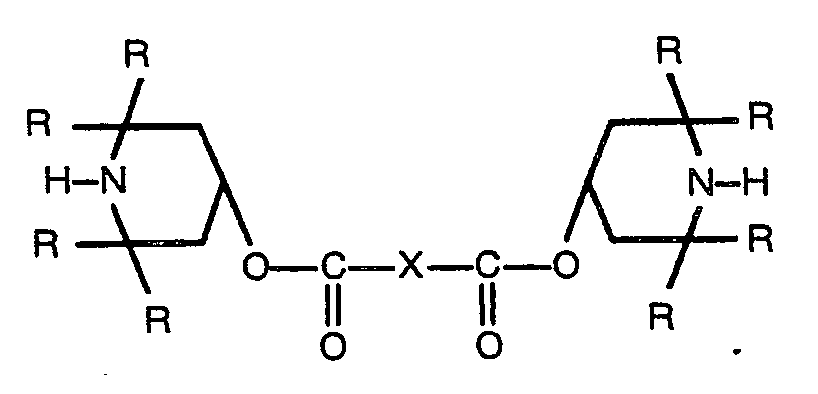
- (C) monomer containing at least one primary hydroxyl group and a reactive functionality capable of reacting with the epoxide groups of the epoxide functional polymer, wherein the monomer is employed in amounts which are sufficient to react essentially all of the epoxide groups present on the epoxide functional polymer.
- Advantageously, the polymeric light stabilizers of this invention contain the polyalkylpiperidine radical and overcome the deficiencies of prior art stabilizers in that they have increased solubility in coating systems.
- Another advantage of these polymeric light stabilizers, as compared with monomeric light stabilizers of comparable structure, is that they exhibit increased resistance to migration and volatilization out of the coating composition.
- Still another advantage of these polymeric light stabilizers is their ability to react with conventional crosslinkers in the coatings, such as amino resins and isocyanates, whereby the stabilizers are chemically incorporated into the coating.
- The present invention is directed to a new class of polymeric ultraviolet light stabilizers having a number average molecular weight (Mn) of between about 500 and about 2000, preferably between about 700 and about 1500, and which contain the polyalkylpiperidine radical and at least two, on the average, primary hydroxyl groups.
- As has been disclosed in the brief description of the invention above, the stabilizer is the reaction product of materials which include an epoxy resin (A), which contains, on average, two epoxide groups per molecule. Preferably this epoxy resin has a molecular weight of between about 150 and about 600. Epoxy resins suitable for use in this invention include low molecular weight diepoxide resins which can be liquid or solid and either a single epoxy resin or a mixture of suitable epoxies. Suitable epoxy resins which may be used in this invention include those which are the condensation products of bisphenol-A with epichlorohydrin, example of which are commercially available of Epon 828, 829,1001,1004,1007 and 1009 (Marketed by and a trademark of Shell Chemical Company, Houston, Texas), Araldite 6001, 8001, RD-4, CY-178 and CY-179, (Marketed by and a trademark of Ciba-Geigy Corp., Ardley, New York); ester type diepoxides such as diglycidyl adipate and diglycidyl glutarate; cycloaliphatic diepoxides such as dicyclo- pentenediene and vinyl cyclohexane dioxide; and aliphatic ether type diepoxides such as ethylene glycol, diglycidyl ether, 1,2-propylene glycol diglycidyl ether and 1,4-butanediol diglycidyl ether (Araldite RD-2, available from and a trademark of Ciba-Geigy). Thus these epoxy resins may be any of the wide variety of diepoxide resins which are aliphatic, cycloaliphatic, or may contain aromatic or ethylenic unsaturation. Epoxies may also may be substituted by non-interfering functionality such as hydroxyl or the carbon chain may be interrupted, for example, by oxygen. In forming the stabilizer of this invention, it is preferred that the epoxy resin be a saturated epoxy resin and also that the epoxy resin contain terminal epoxide groups. Selection of other suitable epoxy resins useful in this invention will be apparent to one skilled in the art in view of the present disclosure.
- Polyalkylpiperidines (B) useful in forming the stabilizer of this invention are selected from compounds represented by the chemical formula:

- The epoxy resin and the polyalkylpiperidine are reacted in a molar ratio of between about 6:5 and about 2:1 so as to form an epoxide functional polymer. As can be seen from the ratio of these reactants, excess epoxide equivalents (relative the polyalkyl piperidine equivalents) are always employed so as to generate an epoxy resin-polyalkylpiperidine addition polymer which contains on average, two epoxide groups per molecule. The particular preferred ratios to be employed would be dependent on the molecular weights of the epoxy resin and the polyalkylpiperidine reactants employed, keeping in mind the particular embodiment and molecular weight of stabilizer desired. The reaction of the epoxy resin and polyalkylpiperidine comprises reaction of the active hydrogen of the sterically hindered amine of the piperidine radical with the epoxide group of the epoxy resin, wherein an addition polymer is generally formed which comprises alternating epoxy resin and polyalkylpiperidine moieties of the type A-B-(-A-B tnA wherein n = 0-4. Thus, it can be seen that this epoxide functional polymer will generally contain, on average, about two epoxide groups per molecule, that is, one located in proximity to each end of the polymer molecule. It is these unreacted epoxide groups on this polymer which are then available for reaction with monomer (C).
- The monomer (C) employed in this invention contains at least one primary hydroxyl group and a reactive functionality capable of reacting with the epoxide groups of the epoxide functional polymer. This monomer caps the epoxide functional polymer while adding at least one primary hydroxyl group near each end of the stabilizer polymer. In forming the stabilizer, the monomer is employed in amounts sufficient to react essentially all of the epoxide groups present on the epoxide functional polymer, that is, in amounts sufficient to allow the reaction of about one equivalent of epoxide reactive functionality (of monomer (C)) per each equivalent of epoxide groups of the epoxide functional polymer. While this monomer contains at least one primary hydroxyl group, it may contain more than one primary hydroxyl group, or a mixture of at least one primary hydroxyl group and other hydroxyl groups such as secondary hydroxyl groups. These hydroxyl groups, as well as the hydroxyl groups generated on the light stabilizer as a result of e.g., the epoxy resin and polyalkylpiperidine reaction, are available for reaction with the crosslinkers of the substrate composition being stabilized. It is believed, that the primary hydroxyl groups, which are a necessary part of the stabilizer, will be most readily reacted into the substrate composition with the crosslinking material.
- The monomers which are reacted in chain terminating reaction with the epoxide functional polymer may be selected from a broad class of aliphatic, cycloaliphatic and aromatic (primary) hydroxy functional monomers which contain an epoxide reactive functionality. Exemplary of monomer which may be so employed in this invention include hydroxy functional carboxylic acids and hydroxy functional secondary amines.
- Suitable hydroxy functional acids which may be employed as the monomer (C) in this invention include C3 CZ6 hydroxy acids, wherein the acid contains one carboxyl group and one or more hydroxyl groups and no otherfunctional groups that would interfere with the chain termination reaction between the epoxide functional and the hydroxy acid monomer. The hydroxy functional acids which are preferably employed correspond to the general chemical formula:

- Exemplary of such hydroxy functional secondary amines which may be employed as the monomer (C) in this invention are those which bear mono or dihydroxy functionality, such as those having the chemical formula:

- Particular preferred primary hydroxyl bearing amines for use in preparing the hydroxy functional polymeric high stabilizer are diethanolamine, methylethanolamine, dipropanolamine and methyl- propanolamine.
- In one embodiment of the polymeric stabilizer of this invention, the epoxy resin (A) and polyalkylpiperidine (B) are combined and reacted under conditions and for a time necessary to form the epoxide functional polymer. These conditions may include the presence of a catalyst and/or elevated temperatures. This epoxide functional polymer is subsequently reacted with the chain terminating monomer (C) under suitable conditions so as to form the polymeric light stabilizer. In another embodiment of the stabilizer, all three of the materials necessary for the formation of the polymeric light stabilizer, that is the epoxy resin (A), the polyalkylpiperidine (B) and reactive monomer (C) are combined and reacted together, i.e., insitu, to form the stabilizer. Selection of the process for stabilizer formation would be dependent on the chemical reactivity of the particular monomer (C) employed to terminate the chain, as is apparent to one skilled in the art. For example, if the hydroxy functional monomer (C) employed in making the stabilizer is a hydroxy acid, all three of the reactants could be combined and reacted insitu as described in the second reaction sequence. However, the first reaction sequence (two step) could also be followed if desired. On the other hand, if a hydroxy functional secondary amine is employed as the hydroxy functional monomer (C) it would be appropriate to follow the first reaction sequence described, i.e., wherein the polyalkylpiperidine and epoxy resin are first combined and reacted (to form the epoxide functional polymer) after which the amine monomer is added to terminate the reaction product chain.
- Catalysts may be employed in this invention as may be necessary in the formation of the stabilizer. For example, catalysts commonly used to catalyze the epoxide/carboxyl reaction include tetraalkylammonium salts such as tetramethylammonium chloride, tetraethylammonium bromide and tetramethylbenzyl- ammonium chloride as well as metal salts of a carboxyl acid, such as potassium octoate, chromium (III) octoate, other useful catalysts include metal halide such as chromium trichloride, ferric trichloride and aluminum trichloride; mercaptans and thioethers such as dimercapto propynol and dimercapto diethyl ethers, tertiary amines such as triethylamine, pyridine, dimethylaniline, quinoline, Beta-picoline and methyl pyridine. Generally the above reactions would be carried out in the presence of a suitable solvent such as toluene, xylene, methyl amyl ketone, etc. Selection of suitable reaction conditions for carrying out the formation of this polymeric stabilizer would be within the skill of one in the art in view of the disclosure of this application.
- Polymeric substrates that can be stabilized with these polymeric hindered amines include, but are not limited to, acrylics, polyesters, and polyurethanes. The amount of the polymeric hindered amines needed to stabilize these synthetic polymers will depend upon various factors, including the type of synthetic polymer, its intended use, and the presence of other additives or stabilizers, if any. Generally however, effective stabilization of this substrate is achieved by employing the polymeric hindered amine in the substrate composition in an amount of between about 0.5 percent to about 5 percent by weight based on the weight of the polymeric substrate, e.g., based on the weight of the coating system.
- The stabilizer of this invention can be employed as a sole stabilizer or, preferably in combination with other conventional heat and light stabilizers for the particular polymer. Preferred co-stabilizers are several substituted benzotriazoles such as, for example, hydroxy-phenyltriazoles such as 2-(2'hydroxy-5'-methylphenyl)benzotriazole, 2-(2'-hydroxy-phenyl)benzotriazole, 2-(2'hydroxy-5'-octylphenyl)naphthiotriazole.
- The composition may contain other additives useful in such compositions such as antioxidants, plasticizers, fillers and dyes. Such materials are well known in the art.
- The polymeric stabilizer may be incorporated into the polymeric substrate by any of the known techniques for compo.unding additives with a polymer. For example, the polymer and the additive may be compounded by dry blending with the substrate in powder or grandular form, followed by milling, Banbury mixing, molding, casting, extruding and swelling. Alternatively, the polymer may be added, as a solution or slurry in a suitable inert solvent, or dispersant, to the polymeric substrate in powder or granular form, the whole mixed intimately in a mixer, and the solvent subsequently removed. As a further possibility, the polymer may be added to the polymeric substrate during the preparation of the latter, for instance at the latex stage of polymer production, to provide prestabilized polymer material.
- It will be apparent from the foregoing that this invention has industrial applicability to plastics and coating compositions and provides polymeric compounds useful as light stabilizers for these substrates.
- The invention will be further understood by referring to the following detailed examples. It should be understood that the specific examples are presented by way of illustration and not by way of limitation. Unless otherwise specified, all references to "part" is intended to means parts by weight.
- In a suitable reactor 282 gms of Eponex 151 (trademark of Shell Chemical Co.), 192 gms of Tinuvin-770, (trademark of Ciba-Geigy), 57 gms of DMPA (dimethylol propionic acid), 2 gms of lithium neodecanoate, 114 gms of methyl amyl ketone, and 114 gms of xylene were charged. The mixture was heated up to 149°C in a period of 30 minutes. The temperature was raised to 177°C by distilling solvent and was kept at this temperature for 1 hour. At this point the acid number was measured to be 1.8. The mixture was thinned to 70% NV with methyl amyl ketone and had a viscosity of Z3.
- In a suitable reactor 222 gms of Tinuvin-770 (trademark of Ciba-Geigy), 186 gms of Araldite RD-2 (available from and trademark of Ciba-Geigy), 66 gms of DMPA (dimethylol propionic acid), 101.5 gms of methyl amyl ketone, and 101.5 parts of xylene were added. The mixture was heated up to 149°C and kept at this temperature for 2) hours. The final product had an Si viscosity, 72% NV and 0 acid number.
- In a suitable reactor 282 gms of Eponex 151, 192 gms of Tinuvin-770 (trademark of Ciba-Geigy) and 30 gms of xylene were charged. The mixture was heated up to 182°C and stirred at this temperature under nitrogen for 2 hours. Then it was cooled at 93°C and 420 gms of diethanolamine and 30 gms of methyl amyl ketone were added. The temperature was raised to 160°C and kept there for 1 hour. The final product had a viscosity of U at 71.9% NV.
- A resin for use with the stabiliser of the invention is prepared by placing in a suitable reactor 562 gms of Esterdiol-204 (trademark of Union Carbide) and 360 gms of xylene. The mixture was brought to reflux (149°C) and any water present was stripped out. The temperature was lowered to 93°C and 360 gms of Desmondur W (trademark of Mobay Chemical Co.) was added dropwise in a period of 1 hour. After the end of the addition, the mixture was postreacted at 93°C until no NCO group was observed in an IR spectrum. At this point, 240 gms of PCP-0301 (polycaprolactone triol, trademark of Union Carbide) 263 gms of adipic acid, 3 gms of dibutyl tin oxide, and 215 gms of xylene were added. The mixture was heated up to 204°C and water was distilled off until the acid number dropped below 10. The batch was then thinned with 480 parts of methyl amyl ketone. The final product had Z3 viscosity at 70.8% NV and acid number 1.2.
- Flexible basecoat composition was formulated with the following components:

- The above composition was reduced to 20 sec. at #4 Ford Cup with methyl amyl ketone before spraying. A control composition (without the stabilizer of Example was also prepared in a similar manner.
- Flexible clearcoat compositions were formulated with the following components:


- The above compositions were reduced to 30 sec. #4 Ford Cup viscosity with methyl amyl ketone. A control clearcoat was also prepared without any polymeric stabilizer.
- The above clearcoat were sprayed over the basecoat of Example V using metal and plastic substrates and were cured at 121°C for 30 minutes. The panels were exposed to ultraviolet light and humidity in a QUV machine for 1500 hours. The stabilized compositions at the end of the test showed far superior gloss retention than the control compositions which showed significant phase degradation and cracking.
- Into a steel ball mill the following pigment pastes were ground.


- The above coating composition was spray applied over primed panels and cured for 20 minutes at 127°C. A control coating (without the stabilizer of Example I) was also applied and cured under the same conditions. Panels containing both the stabilized and the control compositions were exposed to ultraviolet light and humidity in a QUV machine for 500 hours. At the end of this test, the stabilized composition showed significantly less discoloration and loss of gloss as compared to the control composition.
- This Example illustrates the preparation of an epoxy ester resin for use in the present invention. In a suitable reactor were charged 911 parts of Epon 829 (trademark of Shell Chemical Company), (diglycidyl ether of bisphenol-A), 564 parts of Empol 1014* and 728 parts of Soya fatty acid. The temperature of the mixture was brought up to about 177°C at which point an exothermic reaction took place that raised the temperature up to about 193°C. After two hours at this temperature, the acid number was found to be 5.2. The reaction mixture was then cooled down to about 149°C and 275 parts of methyl amyl ketone and 275 parts of Cellosolve (Trade Mark) acetate were added. The resulting resin had a viscosity of W+ at 80% solids.
- * Dimer and trademark of Emery Industries Inc.
- A millbase, that is, a composition pigment paste for use in the present invention was prepared by grinding in a ballmill the following mixture:

- A coating composition was prepared, which was adapted for use as a high solids, sprayable, pigmented primer for application over bare, unpolished steel automotive vehicle body panels in an automotive vehicle assembly operation. The coating composition components are shown below. The composition was reduced with methyl amyl ketone to about 18-25 sec. #4 Ford Cup, 27°C to provide a preferred spraying viscosity.

- The above coating composition was spray applied over unpolished Bonderite steel and cured for 30 minutes at 163°C. A control coating (without the stabilizer of Example I) was also applied and cured under the same conditions. Panel containing both the stabilized and the control compositions were exposed to ultraviolet light and humidity in a QUV machine for 300 hours. The stabilized composition at the end of this showed significantly less signs of phase degration and cracking.
- A polyvinyl chloride composition was prepared having the following formulation:

- This formulation was mixed and sheeted off on a two roll mill to form sheets 1 mm thick. The light resistance of these sheets was determined by placing them in a QUV machine for 1500 hrs. A control composition without the stabilizer of Example I was also tested. After the test was completed the control sheets showed significantly worse embrittlement and discoloration than the stabilized sheet.
Claims (8)

Applications Claiming Priority (2)
| Application Number | Priority Date | Filing Date | Title |
|---|---|---|---|
| US06/553,321 US4480084A (en) | 1983-10-13 | 1983-10-13 | Polymeric light stabilizers |
| PCT/US1983/001597 WO1985001734A1 (en) | 1983-10-13 | 1983-10-13 | Polymeric light stabilizers containing polyalkylpiperidine groups |
Publications (3)
| Publication Number | Publication Date |
|---|---|
| EP0160642A1 EP0160642A1 (en) | 1985-11-13 |
| EP0160642A4 EP0160642A4 (en) | 1986-03-04 |
| EP0160642B1 true EP0160642B1 (en) | 1989-02-08 |
Family
ID=26768653
Family Applications (1)
| Application Number | Title | Priority Date | Filing Date |
|---|---|---|---|
| EP83903671A Expired EP0160642B1 (en) | 1983-10-13 | 1983-10-13 | Polymeric light stabilizers containing polyalkylpiperidine groups |
Country Status (6)
| Country | Link |
|---|---|
| US (1) | US4480084A (en) |
| EP (1) | EP0160642B1 (en) |
| JP (1) | JPS61500172A (en) |
| CA (1) | CA1244437A (en) |
| DE (1) | DE3379171D1 (en) |
| WO (1) | WO1985001734A1 (en) |
Families Citing this family (4)
| Publication number | Priority date | Publication date | Assignee | Title |
|---|---|---|---|---|
| US5213897A (en) * | 1991-04-03 | 1993-05-25 | Elf Atochem North America, Inc. | Epoxy resins containing bound light stabilizing groups |
| JPWO2012133749A1 (en) * | 2011-03-30 | 2014-07-28 | Hoya株式会社 | Photochromic lens |
| CN102977367A (en) * | 2012-11-29 | 2013-03-20 | 保定市乐凯化学有限公司 | Preparation method of hindered amine light stabilizer (HALS) |
| WO2014184792A1 (en) * | 2013-05-14 | 2014-11-20 | Eco Sports Llc. | Controllably degradable thermoplastic polyurethane and overgrips made therefrom |
Family Cites Families (20)
| Publication number | Priority date | Publication date | Assignee | Title |
|---|---|---|---|---|
| US3684765A (en) * | 1970-01-08 | 1972-08-15 | Sankyo Co | Stabilization of synthetic polymers |
| US3920661A (en) * | 1973-12-28 | 1975-11-18 | Ciba Geigy Corp | Hindered piperidine carboxylic acids, metal salts thereof and stabilized compositions |
| US4056507A (en) * | 1973-12-28 | 1977-11-01 | Ciba-Geigy Corporation | Hindered piperidine carboxylic acids, metal salts thereof and stabilized compositions |
| IT1061551B (en) * | 1975-11-18 | 1983-04-30 | Chimosa Chimica Organica Spa | POLYUREIC COMPOSITES USED FOR THE STABILIZATION OF SYNTHETIC POLYMERS AND PROCEDURE FOR THEIR PREPARATION |
| DE2656769A1 (en) * | 1975-12-29 | 1977-07-14 | Ciba Geigy Ag | NEW PHENOL STABILIZERS |
| CH626109A5 (en) * | 1976-05-11 | 1981-10-30 | Ciba Geigy Ag | |
| JPS53101380A (en) * | 1977-01-14 | 1978-09-04 | Sankyo Co Ltd | Piperidine derivatives |
| DE2805838A1 (en) * | 1977-02-24 | 1978-08-31 | Ciba Geigy Ag | NEW 4-ACYLOXYPIPERIDINE |
| JPS53144579A (en) * | 1977-05-18 | 1978-12-15 | Sankyo Co Ltd | 4-aminopolyalkylpiperidine derivatives |
| JPS5429400A (en) * | 1977-08-08 | 1979-03-05 | Sankyo Co Ltd | Polymer comprising polyalkylpiperidine and its use as stabilizers |
| US4219464A (en) * | 1978-05-30 | 1980-08-26 | Ciba-Geigy Corporation | Hindered piperidine carboxylic acids, metal salts thereof and stabilized compositions |
| JPS559064A (en) * | 1978-07-03 | 1980-01-22 | Sankyo Co Ltd | Novel stabilizer |
| EP0007533B1 (en) * | 1978-07-21 | 1982-09-22 | Ciba-Geigy Ag | Piperidine derivatives, process for their preparation and their use as stabilizers for synthetic polymers |
| US4311820A (en) * | 1979-02-14 | 1982-01-19 | Ciba-Geigy Corporation | Homopolymers and copolymers of vinyl ethers of polyalkylpiperidinols and their use as stabilizers for plastics |
| JPS5616534A (en) * | 1979-07-23 | 1981-02-17 | Adeka Argus Chem Co Ltd | Stabilized polymer composition |
| DE2933732A1 (en) * | 1979-08-21 | 1981-03-26 | Hoechst Ag, 65929 Frankfurt | ALKYLATED DIAZASPIRODECANE, THEIR PRODUCTION AND USE AS A LIGHT PROTECTION AGENT |
| US4316387A (en) * | 1979-09-24 | 1982-02-23 | Hughes Peter S | Transducer and method for passively measuring thermal radiation fluence |
| US4377651A (en) * | 1979-10-05 | 1983-03-22 | Phillips Petroleum Company | Polyolefin stabilization |
| US4316837A (en) * | 1980-09-10 | 1982-02-23 | Carstab Corporation | Polyalkylated 4-aminopiperidine derivatives as stabilizers for synthetic polymers |
| US4465815A (en) * | 1981-12-28 | 1984-08-14 | Ford Motor Company | Polyhydroxy oligomers for high solids coatings II |
-
1983
- 1983-10-13 JP JP58503628A patent/JPS61500172A/en active Pending
- 1983-10-13 EP EP83903671A patent/EP0160642B1/en not_active Expired
- 1983-10-13 WO PCT/US1983/001597 patent/WO1985001734A1/en not_active Ceased
- 1983-10-13 US US06/553,321 patent/US4480084A/en not_active Expired - Fee Related
- 1983-10-13 DE DE8383903671T patent/DE3379171D1/en not_active Expired
-
1984
- 1984-10-10 CA CA000465107A patent/CA1244437A/en not_active Expired
Also Published As
| Publication number | Publication date |
|---|---|
| US4480084A (en) | 1984-10-30 |
| EP0160642A1 (en) | 1985-11-13 |
| CA1244437A (en) | 1988-11-08 |
| WO1985001734A1 (en) | 1985-04-25 |
| DE3379171D1 (en) | 1989-03-16 |
| JPS61500172A (en) | 1986-01-30 |
| EP0160642A4 (en) | 1986-03-04 |
Similar Documents
| Publication | Publication Date | Title |
|---|---|---|
| US4331782A (en) | Hydroxybenzoic acid-epoxy adduct capping agents for polyester resins | |
| US4335228A (en) | Isocyanate blocked imidazoles and imidazolines for epoxy powder coating | |
| US4824927A (en) | Products of diepoxide polyaddition with monofunctional initiators, which contain pendant epoxy groups in the backbone of the polymer | |
| EP0004090B2 (en) | Water-dispersed coating composition suitable for electrocoating processes | |
| US4758632A (en) | Self-cross-linkable acrylic polymer containing hydroxyalkyl carbamate groups and coating compositions containing the same | |
| EP0199889B1 (en) | High performance two-component epoxy structural adhesives with chemical thixotropy | |
| EP0572522B1 (en) | Ambient temperature curing compositions containing a hydroxy component and an anhydride component and an onium salt | |
| KR100333114B1 (en) | Cyclic carbonate-curable coating composition | |
| US4025578A (en) | Elastomeric liquid polymer vulcanizates from epoxy resin, liquid carboxy terminated polymer, dihydric phenol, and an amine | |
| EP0120305A1 (en) | Method of making mixed aliphatic/aromatic polycarbodiimides | |
| JPH01254732A (en) | Improvement in epoxy resin using urethane polyol | |
| US4588783A (en) | Amide-containing polyhydroxyethyl carbamates | |
| CA1197344A (en) | Curable epoxy-containing compositions | |
| EP0081713B1 (en) | One-pack type thermosetting polyurethane coating composition | |
| US4683282A (en) | Novel boron trifluoride-poly (alkylene oxide) amine catalysts for curing epoxy resins | |
| AU643327B2 (en) | Liquid coating agent | |
| JPH06313028A (en) | Flexible polyepoxy resin | |
| US4373072A (en) | Self-cross-linking, thermosetting, aqueous lacquer coating material, and its utilization for the cathodic deposition upon electrically conducting surfaces | |
| US5618893A (en) | Process for the preparation of cationic binders for coatings, the binders produced, and their use | |
| EP0317184B1 (en) | Coating compositions based on polyepoxides and polyacid curing agents | |
| US4480084A (en) | Polymeric light stabilizers | |
| EP0081712B1 (en) | One-pack type thermosetting polyurethane coating composition | |
| US4980399A (en) | Water dilutable binders containing latent primary amino groups for cationic electrocoating and a process for their preparation | |
| EP0317185B1 (en) | Coating compositions based on polyepoxides and urethane-containing polyacid curing agents | |
| AU567702B2 (en) | Polymeric light stabilizers containing polyalkylpiperidine group. |
Legal Events
| Date | Code | Title | Description |
|---|---|---|---|
| PUAI | Public reference made under article 153(3) epc to a published international application that has entered the european phase |
Free format text: ORIGINAL CODE: 0009012 |
|
| 17P | Request for examination filed |
Effective date: 19850621 |
|
| AK | Designated contracting states |
Kind code of ref document: A1 Designated state(s): DE FR GB NL Designated state(s): DE FR GB NL |
|
| A4 | Supplementary search report drawn up and despatched |
Effective date: 19860304 |
|
| 17Q | First examination report despatched |
Effective date: 19870521 |
|
| RAP1 | Party data changed (applicant data changed or rights of an application transferred) |
Owner name: E.I. DU PONT DE NEMOURS AND COMPANY |
|
| GRAA | (expected) grant |
Free format text: ORIGINAL CODE: 0009210 |
|
| AK | Designated contracting states |
Kind code of ref document: B1 Designated state(s): DE FR GB NL |
|
| REF | Corresponds to: |
Ref document number: 3379171 Country of ref document: DE Date of ref document: 19890316 |
|
| ET | Fr: translation filed | ||
| PLBE | No opposition filed within time limit |
Free format text: ORIGINAL CODE: 0009261 |
|
| STAA | Information on the status of an ep patent application or granted ep patent |
Free format text: STATUS: NO OPPOSITION FILED WITHIN TIME LIMIT |
|
| 26N | No opposition filed | ||
| PGFP | Annual fee paid to national office [announced via postgrant information from national office to epo] |
Ref country code: FR Payment date: 19900822 Year of fee payment: 8 |
|
| PGFP | Annual fee paid to national office [announced via postgrant information from national office to epo] |
Ref country code: DE Payment date: 19900824 Year of fee payment: 8 |
|
| PGFP | Annual fee paid to national office [announced via postgrant information from national office to epo] |
Ref country code: GB Payment date: 19900928 Year of fee payment: 8 |
|
| PGFP | Annual fee paid to national office [announced via postgrant information from national office to epo] |
Ref country code: NL Payment date: 19901031 Year of fee payment: 8 |
|
| PG25 | Lapsed in a contracting state [announced via postgrant information from national office to epo] |
Ref country code: GB Effective date: 19911013 |
|
| PG25 | Lapsed in a contracting state [announced via postgrant information from national office to epo] |
Ref country code: NL Effective date: 19920501 |
|
| GBPC | Gb: european patent ceased through non-payment of renewal fee | ||
| NLV4 | Nl: lapsed or anulled due to non-payment of the annual fee | ||
| PG25 | Lapsed in a contracting state [announced via postgrant information from national office to epo] |
Ref country code: FR Effective date: 19920630 |
|
| PG25 | Lapsed in a contracting state [announced via postgrant information from national office to epo] |
Ref country code: DE Effective date: 19920701 |
|
| REG | Reference to a national code |
Ref country code: FR Ref legal event code: ST |