EP0159026B1 - Pentaerythritol derivatives and a process for preparing the same - Google Patents
Pentaerythritol derivatives and a process for preparing the same Download PDFInfo
- Publication number
- EP0159026B1 EP0159026B1 EP85104635A EP85104635A EP0159026B1 EP 0159026 B1 EP0159026 B1 EP 0159026B1 EP 85104635 A EP85104635 A EP 85104635A EP 85104635 A EP85104635 A EP 85104635A EP 0159026 B1 EP0159026 B1 EP 0159026B1
- Authority
- EP
- European Patent Office
- Prior art keywords
- complex
- sulfuric acid
- acid ester
- dipentaerythritol
- polyaluminium
- Prior art date
- Legal status (The legal status is an assumption and is not a legal conclusion. Google has not performed a legal analysis and makes no representation as to the accuracy of the status listed.)
- Expired
Links
Images

Classifications
-
- C—CHEMISTRY; METALLURGY
- C07—ORGANIC CHEMISTRY
- C07F—ACYCLIC, CARBOCYCLIC OR HETEROCYCLIC COMPOUNDS CONTAINING ELEMENTS OTHER THAN CARBON, HYDROGEN, HALOGEN, OXYGEN, NITROGEN, SULFUR, SELENIUM OR TELLURIUM
- C07F5/00—Compounds containing elements of Groups 3 or 13 of the Periodic Table
- C07F5/06—Aluminium compounds
- C07F5/069—Aluminium compounds without C-aluminium linkages
-
- A—HUMAN NECESSITIES
- A61—MEDICAL OR VETERINARY SCIENCE; HYGIENE
- A61P—SPECIFIC THERAPEUTIC ACTIVITY OF CHEMICAL COMPOUNDS OR MEDICINAL PREPARATIONS
- A61P1/00—Drugs for disorders of the alimentary tract or the digestive system
- A61P1/04—Drugs for disorders of the alimentary tract or the digestive system for ulcers, gastritis or reflux esophagitis, e.g. antacids, inhibitors of acid secretion, mucosal protectants
-
- C—CHEMISTRY; METALLURGY
- C07—ORGANIC CHEMISTRY
- C07C—ACYCLIC OR CARBOCYCLIC COMPOUNDS
- C07C303/00—Preparation of esters or amides of sulfuric acids; Preparation of sulfonic acids or of their esters, halides, anhydrides or amides
- C07C303/24—Preparation of esters or amides of sulfuric acids; Preparation of sulfonic acids or of their esters, halides, anhydrides or amides of esters of sulfuric acids
Definitions
- This invention relates to a complex of pentaerythritol derivatives such as sulfuric acid ester of pentaerythritol or dipentaerythritol with a polyaluminium chloride.
- the complexes of this invention are novel and have good anti-pepsin activity and therefore are useful as antiulcer agents.
- the complex is prepared by reacting pentaerythritol or dipentaerythritol with a sulfating agent such as sulfuric acid, sulfuric anhydride, chlorosulfonic acid, pyridine-sulfuric anhydride complex or the like, and then reacting the resulting sulfuric acid ester with a basic polyaluminium chloride.
- a sulfating agent such as sulfuric acid, sulfuric anhydride, chlorosulfonic acid, pyridine-sulfuric anhydride complex or the like
- the sulfaton reaction is conducted in the presence of a base such as pyridine, N,N-dimethylformamide and the like usually at 20-160°C, preferably 70-100°C, for 1-3 hours.
- the reaction of the sulfuric acid ester with a basic polyaluminum chloride is conducted in an aqueous medium using usually 1-5 moles, preferably 2-3.5 moles, of the basic polyaluminium chloride per one mole of the sulfate radical.
- the basic polyaluminium chloride which can be used in this invention involves polymers having a basicity of from 0.67 to 0.83 and being prepared by reacting metallic aluminium with aluminium chloride in an aqueous medium.
- the complex prepared as described above contains 4-11 % of sulfur, 9-22% of aluminium and has a molar ratio of sulfur to aluminium (S/Al) in the range from 2.0 to 3.5.
- the molecular weights of dipentaerythritol sulfuric acid ester/polyaluminium hydroxide complex and pentaerythritol sulfuric acid ester/polyaluminium hydroxide complex are 1500-3000 and 1000-1900, respectively.
- the complex of this invention essentially consists of sulfuric acid esters of primary hydroxy radicals and does not contain the esters of secondary hydroxy radicals. It is therefore so stable that desulfation reaction by hydrolysis is hardly caused at all even when suspended in water.
- the complex easily provides a soft oily slurry by the addition of water and therefore it can uniformly cover the ulcer-affected part of a gastric wall even in the absence of an acid or gastric juice so that these parts are protected from the attack of pepsin.
- the complex of this invention when administered to a patient, is used as it is orformulated into an oily slurry or a suspension in water with the aid of a surfactant. If the complex is administered in a suspension, it is desirably dispersed in the stomach so that the therapeutic effects on the ulcer or inflammation of the lower part of the esophagus or cardiac part of the stomach can be improved.
- Fig. 1 is a graph showing the test results of Experiment 2 below.
- protein binding ratios of the compounds of this invention and Sucralfate (control) at various pH are plotted.
- a test complex was added in an amount of 2 mg or 10 mg to 5 ml of a solution of bovine serum albumin in a Clarke-Lubs buffer (pH 1.6) at a concentration of 1 mg of albumin per 5 ml of the buffer. After incubation of the mixture at 37°C for 20 minutes under shaking, the mixture was centrifuged at 3,000 r.p.m. for 10 minutes. Aliquots of the supernatant were analyzed colorimetrically for protein using the method of Lowry.
- test complex (5 mg) was added to 5 ml of a solution which had been prepared by dissolving 1 mg of bovine serum albumin per 5 ml of a buffer having a different pH as shown in Fig. 1. After incubation at 37°C for 20 minutes while shaking, the mixture was centrifuged at 3,000 r.p.m. for 10 minutes and the supernatant (0.5 ml) was analyzed for protein using the method of Lowry described in Experiment 1.
- the binding ratio in each of the test complexes was calculated on the basis of the control wherein the protein quantity of a sample containing no test complex is deemed as 100.
- bovine serum albumin was dissolved in a Clark-Lubs buffer (pH 1.6) at a concentration of 12, 24, 48 or 96 mM.
- a test complex was dissolved in 1 N HCI at a concentration of 500 or 1500 IlM and the pH was adjusted to 1.6.
- the substrate solution (2 ml) was mixed with the test solution (2 ml) and the mixture was subjected to preincubation at 37°C for 10 minutes, and to the preincubated mixture was added 1 ml of a pepsin solution in the Clark-Lubs buffer at a concentration of 25 ⁇ g/ml. The mixture was then incubated at 37°C for 20 minutes while shaking.
- the Anson method was conducted by adding to 0.5 ml of the supernatant, 2.5 ml of 0.3 N aqueous NaOH and 0.5 ml of the phenol reagent diluted to three times the original volume with distilled water, and then the mixture was allowed to stand at room temperature for 30 minutes. The optical absorption thereof was determined at 640 nm.
- the solution was then concentrated under reduced pressure into a volume of about 50 ml, neutralized again with a 10% NaOH aqueous solution to pH 8, and concentrated under reduced pressure into about 30 ml in volume. After adding 100 ml of ethanol, the mixture was stirred vigorously and the resulting white precipitates were recovered by filtration to give a crude complex of sodium salt of dipentaerythritol hexasulfuric acid ester.
- the crude product was purified by dissolving it in distilled water in an amount ten times the volume of the product and adding to the solution ethanol of 30 times the volume of the solution.
Landscapes
- Chemical & Material Sciences (AREA)
- Organic Chemistry (AREA)
- Health & Medical Sciences (AREA)
- Life Sciences & Earth Sciences (AREA)
- General Health & Medical Sciences (AREA)
- General Chemical & Material Sciences (AREA)
- Medicinal Chemistry (AREA)
- Nuclear Medicine, Radiotherapy & Molecular Imaging (AREA)
- Bioinformatics & Cheminformatics (AREA)
- Pharmacology & Pharmacy (AREA)
- Engineering & Computer Science (AREA)
- Animal Behavior & Ethology (AREA)
- Chemical Kinetics & Catalysis (AREA)
- Public Health (AREA)
- Veterinary Medicine (AREA)
- Organic Low-Molecular-Weight Compounds And Preparation Thereof (AREA)
- Pharmaceuticals Containing Other Organic And Inorganic Compounds (AREA)
- Compounds Of Alkaline-Earth Elements, Aluminum Or Rare-Earth Metals (AREA)
- Polysaccharides And Polysaccharide Derivatives (AREA)
- Acyclic And Carbocyclic Compounds In Medicinal Compositions (AREA)
Abstract
Description
- This invention relates to a complex of pentaerythritol derivatives such as sulfuric acid ester of pentaerythritol or dipentaerythritol with a polyaluminium chloride.
- The complexes of this invention are novel and have good anti-pepsin activity and therefore are useful as antiulcer agents.
- According to this invention, the complex is prepared by reacting pentaerythritol or dipentaerythritol with a sulfating agent such as sulfuric acid, sulfuric anhydride, chlorosulfonic acid, pyridine-sulfuric anhydride complex or the like, and then reacting the resulting sulfuric acid ester with a basic polyaluminium chloride. The sulfaton reaction is conducted in the presence of a base such as pyridine, N,N-dimethylformamide and the like usually at 20-160°C, preferably 70-100°C, for 1-3 hours. The reaction of the sulfuric acid ester with a basic polyaluminum chloride is conducted in an aqueous medium using usually 1-5 moles, preferably 2-3.5 moles, of the basic polyaluminium chloride per one mole of the sulfate radical. The basic polyaluminium chloride which can be used in this invention involves polymers having a basicity of from 0.67 to 0.83 and being prepared by reacting metallic aluminium with aluminium chloride in an aqueous medium.
- The complex prepared as described above contains 4-11 % of sulfur, 9-22% of aluminium and has a molar ratio of sulfur to aluminium (S/Al) in the range from 2.0 to 3.5. The molecular weights of dipentaerythritol sulfuric acid ester/polyaluminium hydroxide complex and pentaerythritol sulfuric acid ester/polyaluminium hydroxide complex are 1500-3000 and 1000-1900, respectively. The complex of this invention essentially consists of sulfuric acid esters of primary hydroxy radicals and does not contain the esters of secondary hydroxy radicals. It is therefore so stable that desulfation reaction by hydrolysis is hardly caused at all even when suspended in water. In addition, the complex easily provides a soft oily slurry by the addition of water and therefore it can uniformly cover the ulcer-affected part of a gastric wall even in the absence of an acid or gastric juice so that these parts are protected from the attack of pepsin.
- Accordingly, when administered to a patient, the complex of this invention is used as it is orformulated into an oily slurry or a suspension in water with the aid of a surfactant. If the complex is administered in a suspension, it is desirably dispersed in the stomach so that the therapeutic effects on the ulcer or inflammation of the lower part of the esophagus or cardiac part of the stomach can be improved.
- Fig. 1 is a graph showing the test results of Experiment 2 below. In the Fig. 1, protein binding ratios of the compounds of this invention and Sucralfate (control) at various pH are plotted.
- Determination of binding ratio of the complexes to protein:
- A test complex was added in an amount of 2 mg or 10 mg to 5 ml of a solution of bovine serum albumin in a Clarke-Lubs buffer (pH 1.6) at a concentration of 1 mg of albumin per 5 ml of the buffer. After incubation of the mixture at 37°C for 20 minutes under shaking, the mixture was centrifuged at 3,000 r.p.m. for 10 minutes. Aliquots of the supernatant were analyzed colorimetrically for protein using the method of Lowry. That is, to 0.5 ml of the supernatant was added 2 ml of the mixed solution which had been prepared by mixing 50 ml of a 0.1 N NaOH solution containing 2% Na2C03 with 1 ml of a solution of copper sulfate (0.5 g) and sodium tartarate (1 g) in distilled water (100 mll, and then 0.2 ml of the phenol test reagent diluted to twice the original volume. Ths mixture was then allowed to stand for 30 minutes and the extinction of the blue-colored solution was determined at 750 nm.
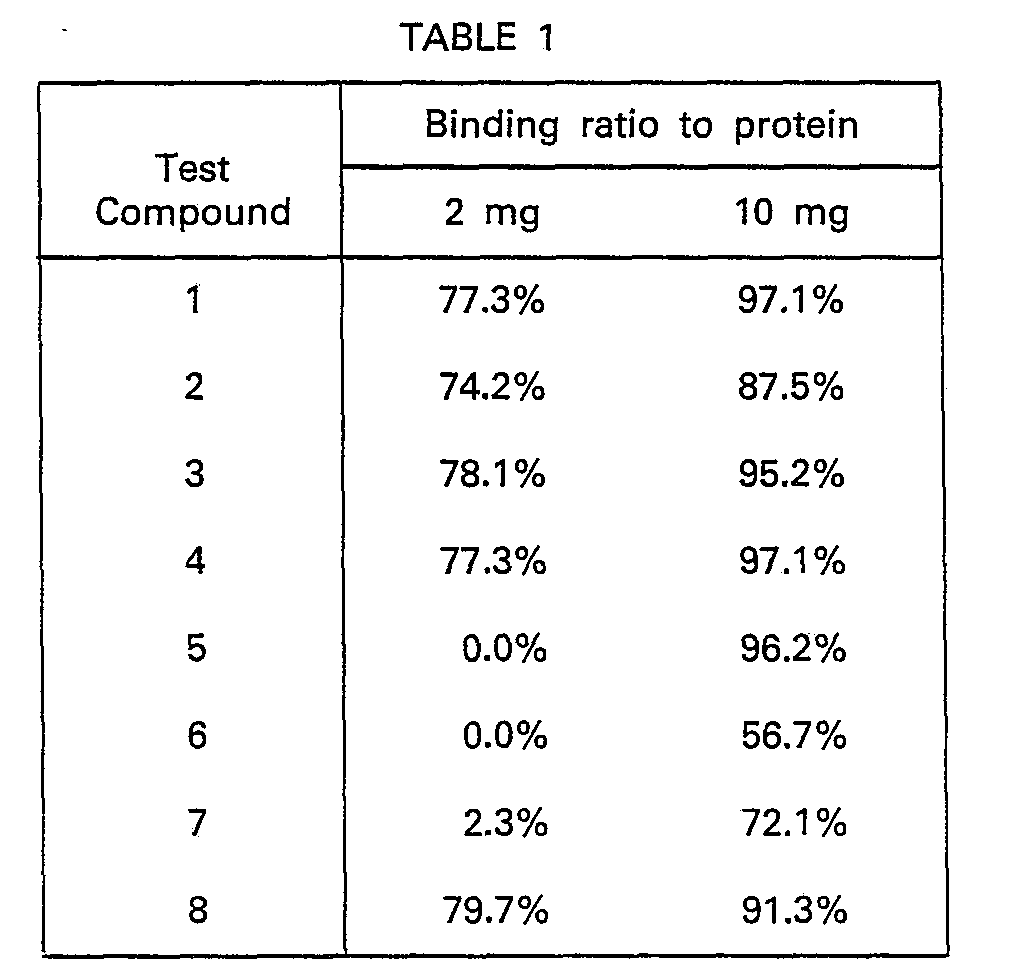
- The results are shown in Table 1. The numbers given to the test compounds correspond to those of the Example described hereunder.
- Determination of binding ratio to protein at various pH:
- The test complex (5 mg) was added to 5 ml of a solution which had been prepared by dissolving 1 mg of bovine serum albumin per 5 ml of a buffer having a different pH as shown in Fig. 1. After incubation at 37°C for 20 minutes while shaking, the mixture was centrifuged at 3,000 r.p.m. for 10 minutes and the supernatant (0.5 ml) was analyzed for protein using the method of Lowry described in Experiment 1.
- The binding ratio in each of the test complexes was calculated on the basis of the control wherein the protein quantity of a sample containing no test complex is deemed as 100.
- The results are shown in Fig. 1. The numbers difining the test compounds correspond to those of the Examples described hereunder.
- Determination of anti-pepsin activity:
- As a substrate, bovine serum albumin was dissolved in a Clark-Lubs buffer (pH 1.6) at a concentration of 12, 24, 48 or 96 mM. Separately, a test complex was dissolved in 1 N HCI at a concentration of 500 or 1500 IlM and the pH was adjusted to 1.6. The substrate solution (2 ml) was mixed with the test solution (2 ml) and the mixture was subjected to preincubation at 37°C for 10 minutes, and to the preincubated mixture was added 1 ml of a pepsin solution in the Clark-Lubs buffer at a concentration of 25 µg/ml. The mixture was then incubated at 37°C for 20 minutes while shaking.
- After centrifugation, 5 ml of 10% TCA was added to the supernatant (0.5 ml) and the mixture was allowed to stand at room temperature for 10 minutes. After centrifugation, the tyrosine quantity in the superatant was determined by the Anson method. The Anson method was conducted by adding to 0.5 ml of the supernatant, 2.5 ml of 0.3 N aqueous NaOH and 0.5 ml of the phenol reagent diluted to three times the original volume with distilled water, and then the mixture was allowed to stand at room temperature for 30 minutes. The optical absorption thereof was determined at 640 nm.
- The results are shown in Table 2 below.

- Anti-ulcer activity on Shay rats:
- Male SD rats (180-200 g) were deprived of food for 48 hours and had free access to water. Under ether anesthesia the abdomen of each rat was incised and the pylorus ligated. Concurrently the test complex was orally administered and the abdomen was closed. The animals were killed 16 hours later by an overdose, and the stomach of each rat removed. The stomach was incised along the greater curvature and examined for gastric ulcers developed in the forestomach. The damaged mucosa in shay ulcers was measured under a dissecting microscope (x10) with a square grid, summed, and arbitrarily classified into 5 degrees by an erosion index.
- The results are shown in Table 3.

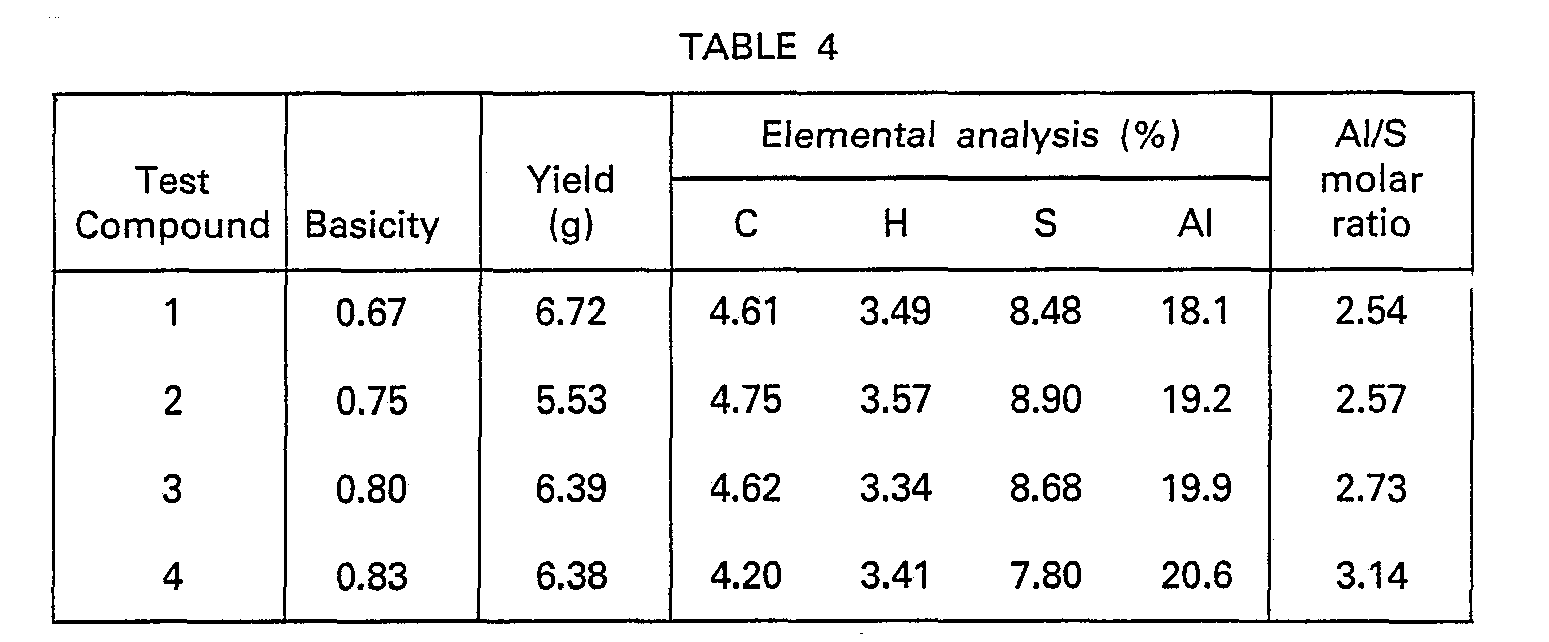
- Metallic aluminium particles (3.35 g) were added to a solution of aluminium chloride hexahydrate (10 g) in distilled water (45 ml) charged in a vessel equipped with a condenser, and the mixture was heated on a steam bath whereby the reaction proceeded while vigorously generating hydrogen gas. After completion of dissolving the metallic aluminium, the reaction mixture was cooled, and filtered to remove all of a small amount of the resulting precipitates to give 49 ml of a colorless, clear aqueous solution of polyaluminium chloride. The product had a basicity of 0.75.
- b) A suspension of dipentaerythritol (10 g) in dried pyridine (200 ml) was heated at 80 to 90°C. To the suspension was added the sulfuric anhydride-pyridine complex (50 g) which had been prepared from sulfuric anhydride and pyridine, and the reaction was continued at that temperature for 2.5 hours. After cooling, the resulting oily pyridinium salt of surfuric acid ester was separated from the pyridine layer. The oily product (100 ml) was dissolved in 100 ml of distilled water and-neutralized with a 10% NaOH aqueous solution to adjust a pH to 8, while cooling with ice. The solution was then concentrated under reduced pressure into a volume of about 50 ml, neutralized again with a 10% NaOH aqueous solution to pH 8, and concentrated under reduced pressure into about 30 ml in volume. After adding 100 ml of ethanol, the mixture was stirred vigorously and the resulting white precipitates were recovered by filtration to give a crude complex of sodium salt of dipentaerythritol hexasulfuric acid ester. The crude product was purified by dissolving it in distilled water in an amount ten times the volume of the product and adding to the solution ethanol of 30 times the volume of the solution.
- Calculated for C10H16O7(SO3Na)6· 4H20: S=20.51%;
- Found: S=20.33%.
- c) Sodium salt of dipentaerythritol hexasulfuric acid water (3 g) of dissolved in distilled water while vigorously stirring, and to the resulting solution was added basic polyaluminium chloride obtained in above a) in such an amount as 3-3.5 moles in terms of aluminium per one mole of the sulfate radical. The resulting oily product was recovered by decantation and washed several times with water. Methanol (50 ml) was added to the oily product and the mixture was vigorously agitated to give white powdery solid which was recovered by filtration, washed with methanol and dried at room temperature under reduced pressure for several hours to give the aluminium complex (Compound 2).
- By the similar method, various polyaluminium chlorides shown in Table 4 below each of which had a different basicity, were prepared.
- A suspension of pentaerythritol (5 g) of pyridine (100 ml) was heated at 80 to 90°C and a sulfuric anhydride-pyridine complex (30 g) was added to the suspension. The mixture was then treated as in Example 1 to give 23.6 g of sodium salt of pentaerythriol tetrasulfuric acid ester.
- Calculated for C5H8O4(SO3Na)4 · 3H20: S=21.44%;
- Found: S=21.64%.
- The product obtained above (3 g) was dissolved in 30 ml of distilled water and basic polyaluminium chloride was added to the solution as in Example 1 while vigorously stirring. The reaction mixture was treated as in Example 1 to give compounds as shown in Table 5 below.

Claims (8)
Priority Applications (1)
| Application Number | Priority Date | Filing Date | Title |
|---|---|---|---|
| AT85104635T ATE36703T1 (en) | 1984-04-18 | 1985-04-17 | PENTAERYTHRITOLAB DERGENTS AND PROCESSES FOR THEIR PRODUCTION. |
Applications Claiming Priority (2)
| Application Number | Priority Date | Filing Date | Title |
|---|---|---|---|
| JP76711/84 | 1984-04-18 | ||
| JP59076711A JPS60222491A (en) | 1984-04-18 | 1984-04-18 | Pentaerythritol derivative |
Publications (3)
| Publication Number | Publication Date |
|---|---|
| EP0159026A2 EP0159026A2 (en) | 1985-10-23 |
| EP0159026A3 EP0159026A3 (en) | 1986-02-05 |
| EP0159026B1 true EP0159026B1 (en) | 1988-08-24 |
Family
ID=13613123
Family Applications (1)
| Application Number | Title | Priority Date | Filing Date |
|---|---|---|---|
| EP85104635A Expired EP0159026B1 (en) | 1984-04-18 | 1985-04-17 | Pentaerythritol derivatives and a process for preparing the same |
Country Status (8)
| Country | Link |
|---|---|
| US (1) | US4650888A (en) |
| EP (1) | EP0159026B1 (en) |
| JP (1) | JPS60222491A (en) |
| AT (1) | ATE36703T1 (en) |
| AU (1) | AU577846B2 (en) |
| DE (1) | DE3564568D1 (en) |
| ES (1) | ES8700654A1 (en) |
| ZA (1) | ZA852913B (en) |
Families Citing this family (3)
| Publication number | Priority date | Publication date | Assignee | Title |
|---|---|---|---|---|
| US3923111A (en) * | 1974-02-01 | 1975-12-02 | Caterpillar Tractor Co | Multidirectional resilient suspension for vehicles |
| ATE209498T1 (en) * | 1990-08-31 | 2001-12-15 | Chugai Pharmaceutical Co Ltd | PREPARATION OF A STOCK SOLUTION OF SUCRALFATE SUSPENDED IN WATER |
| CN116143672B (en) * | 2023-02-28 | 2024-03-29 | 卫星化学股份有限公司 | Water-soluble antioxidant and preparation method and application thereof |
Family Cites Families (11)
| Publication number | Priority date | Publication date | Assignee | Title |
|---|---|---|---|---|
| FR767736A (en) * | 1933-01-30 | 1934-07-23 | ||
| US2155961A (en) * | 1938-01-19 | 1939-04-25 | Hercules Powder Co Ltd | Metal salts of sulphonated terpenephenol condensates and method of preparation thereof |
| US2760970A (en) * | 1953-04-06 | 1956-08-28 | Lubrizol Corp | Process for the preparation of substantially pure metal salts of organic sulfonic acids |
| NL258585A (en) * | 1959-12-01 | |||
| US3155577A (en) * | 1962-05-08 | 1964-11-03 | Mead Johnson & Co | Tasteless dioctylsulfosuccinate composition and method of making same |
| US3432489A (en) * | 1965-11-05 | 1969-03-11 | Chugai Pharmaceutical Co Ltd | Disaccharide polysulfate aluminium compound and method |
| US3475175A (en) * | 1966-08-19 | 1969-10-28 | Eastman Kodak Co | Polysulfated aliphatic or cycloaliphatic alcohols as antifoggants |
| US3634480A (en) * | 1969-10-10 | 1972-01-11 | Summit Research Lab Inc | Complexes containing aluminum chlorhydroxide |
| US3686249A (en) * | 1970-04-24 | 1972-08-22 | Atlas Chem Ind | Method of preparing aluminum complexes of polyhydroxy compounds |
| US3888918A (en) * | 1972-12-07 | 1975-06-10 | Ethyl Corp | Process for reacting a sultone with a non-basic alkali metal, alkaline earth metal or ammonium halide salt in an anhydrous system |
| US4217296A (en) * | 1978-07-24 | 1980-08-12 | Fmc Corporation | Alkyl glyceryl ether sulfate salts and process for their preparation |
-
1984
- 1984-04-18 JP JP59076711A patent/JPS60222491A/en active Pending
-
1985
- 1985-04-10 US US06/721,850 patent/US4650888A/en not_active Expired - Lifetime
- 1985-04-15 AU AU41244/85A patent/AU577846B2/en not_active Ceased
- 1985-04-17 ES ES542367A patent/ES8700654A1/en not_active Expired
- 1985-04-17 EP EP85104635A patent/EP0159026B1/en not_active Expired
- 1985-04-17 DE DE8585104635T patent/DE3564568D1/en not_active Expired
- 1985-04-17 AT AT85104635T patent/ATE36703T1/en not_active IP Right Cessation
- 1985-04-18 ZA ZA852913A patent/ZA852913B/en unknown
Also Published As
| Publication number | Publication date |
|---|---|
| ATE36703T1 (en) | 1988-09-15 |
| AU577846B2 (en) | 1988-10-06 |
| ES542367A0 (en) | 1986-10-16 |
| ZA852913B (en) | 1985-12-24 |
| US4650888A (en) | 1987-03-17 |
| EP0159026A2 (en) | 1985-10-23 |
| AU4124485A (en) | 1985-10-24 |
| ES8700654A1 (en) | 1986-10-16 |
| EP0159026A3 (en) | 1986-02-05 |
| JPS60222491A (en) | 1985-11-07 |
| DE3564568D1 (en) | 1988-09-29 |
Similar Documents
| Publication | Publication Date | Title |
|---|---|---|
| US4529602A (en) | Method for treatment or prophylaxis of gastro-intestinal disease | |
| US4412992A (en) | 2-Hydroxy-5-phenylazobenzoic acid derivatives and method of treating ulcerative colitis therewith | |
| JP4104662B2 (en) | Process for producing mercaptoalkanesulfonates, phosphonates and derivatives thereof | |
| EP0159026A2 (en) | Pentaerythritol derivatives and a process for preparing the same | |
| US2970165A (en) | Sulfate compounds | |
| WO1996017844B1 (en) | Novel porphyrins and porphyrin synthesis techniques | |
| EP0323723A3 (en) | Process for producing poly (para-phenylene-sulfide) | |
| AU541114B2 (en) | Mgaich antacid | |
| ES519532A0 (en) | IMIDAZOLIDINE DERIVATIVES PREPARATION PROCEDURE. | |
| KR890005228A (en) | Reduction of Ion Productive Heavy Metal Content in Metal Complex Dye Preparation | |
| US4013699A (en) | Aluminium and/or magnesium salts of amino-acids | |
| EP0391254A3 (en) | Novel thiouracil derivatives pharmaceutical compositions containing them and process for preparing same | |
| US4076745A (en) | Process for calcium salts α-ketocarboxylic acids | |
| CA2057252A1 (en) | Process for the preparation of water-soluble diphosphines | |
| EP0226635B1 (en) | Method for neutralization of organophilic acidic compounds | |
| JPS6058746B2 (en) | Higher fatty acid ester | |
| Hanker et al. | The Coupling of 4-Methoxy-2-naphthylamine with Diazotized Aminodiazo Thioethers*, 1 | |
| GB2080796A (en) | 2-Hydroxy-5-phenylazobenzoic acid derivatives | |
| Aloisi et al. | Glycerylphosphorylcholine and choline glycerophosphate | |
| CA1216306A (en) | Process for the preparation of 2,3-dimercaptosuccinic acid | |
| Kurnick | Lack of Inhibition of Desoxyribonuclease by Heat Depolymerized Desoxyribonucleic Acid1 | |
| CA2052696A1 (en) | 5-//4-/(4',6'-dimethyl 1-2-pyrimidinyl) sulfamoyl / phenyl/ azo/acetylsalicyclic acid | |
| KR830004159A (en) | Method for preparing titanium compound | |
| GB2028310A (en) | Acetylsalicylic acid derivative | |
| EP0507348A2 (en) | Superoxide dismutase derivatives |
Legal Events
| Date | Code | Title | Description |
|---|---|---|---|
| PUAI | Public reference made under article 153(3) epc to a published international application that has entered the european phase |
Free format text: ORIGINAL CODE: 0009012 |
|
| AK | Designated contracting states |
Designated state(s): AT BE CH DE FR GB IT LI NL SE |
|
| PUAL | Search report despatched |
Free format text: ORIGINAL CODE: 0009013 |
|
| RIN1 | Information on inventor provided before grant (corrected) |
Inventor name: MATSUNAGA, ISAO Inventor name: HINOHARA, YOSHIKAZU Inventor name: OCHI, KIYOSHIGE |
|
| AK | Designated contracting states |
Designated state(s): AT BE CH DE FR GB IT LI NL SE |
|
| 17P | Request for examination filed |
Effective date: 19860327 |
|
| 17Q | First examination report despatched |
Effective date: 19861218 |
|
| ITF | It: translation for a ep patent filed | ||
| GRAA | (expected) grant |
Free format text: ORIGINAL CODE: 0009210 |
|
| AK | Designated contracting states |
Kind code of ref document: B1 Designated state(s): AT BE CH DE FR GB IT LI NL SE |
|
| REF | Corresponds to: |
Ref document number: 36703 Country of ref document: AT Date of ref document: 19880915 Kind code of ref document: T |
|
| REF | Corresponds to: |
Ref document number: 3564568 Country of ref document: DE Date of ref document: 19880929 |
|
| ET | Fr: translation filed | ||
| PLBE | No opposition filed within time limit |
Free format text: ORIGINAL CODE: 0009261 |
|
| STAA | Information on the status of an ep patent application or granted ep patent |
Free format text: STATUS: NO OPPOSITION FILED WITHIN TIME LIMIT |
|
| 26N | No opposition filed | ||
| ITTA | It: last paid annual fee | ||
| EAL | Se: european patent in force in sweden |
Ref document number: 85104635.9 |
|
| PGFP | Annual fee paid to national office [announced via postgrant information from national office to epo] |
Ref country code: GB Payment date: 19990223 Year of fee payment: 15 |
|
| PGFP | Annual fee paid to national office [announced via postgrant information from national office to epo] |
Ref country code: SE Payment date: 19990322 Year of fee payment: 15 |
|
| PGFP | Annual fee paid to national office [announced via postgrant information from national office to epo] |
Ref country code: CH Payment date: 19990325 Year of fee payment: 15 |
|
| PGFP | Annual fee paid to national office [announced via postgrant information from national office to epo] |
Ref country code: AT Payment date: 19990419 Year of fee payment: 15 |
|
| PGFP | Annual fee paid to national office [announced via postgrant information from national office to epo] |
Ref country code: FR Payment date: 19990422 Year of fee payment: 15 |
|
| PGFP | Annual fee paid to national office [announced via postgrant information from national office to epo] |
Ref country code: NL Payment date: 19990429 Year of fee payment: 15 |
|
| PGFP | Annual fee paid to national office [announced via postgrant information from national office to epo] |
Ref country code: BE Payment date: 19990503 Year of fee payment: 15 |
|
| PGFP | Annual fee paid to national office [announced via postgrant information from national office to epo] |
Ref country code: DE Payment date: 19990629 Year of fee payment: 15 |
|
| PG25 | Lapsed in a contracting state [announced via postgrant information from national office to epo] |
Ref country code: GB Free format text: LAPSE BECAUSE OF NON-PAYMENT OF DUE FEES Effective date: 20000417 Ref country code: AT Free format text: LAPSE BECAUSE OF NON-PAYMENT OF DUE FEES Effective date: 20000417 |
|
| PG25 | Lapsed in a contracting state [announced via postgrant information from national office to epo] |
Ref country code: SE Free format text: LAPSE BECAUSE OF NON-PAYMENT OF DUE FEES Effective date: 20000418 |
|
| PG25 | Lapsed in a contracting state [announced via postgrant information from national office to epo] |
Ref country code: LI Free format text: LAPSE BECAUSE OF NON-PAYMENT OF DUE FEES Effective date: 20000430 Ref country code: CH Free format text: LAPSE BECAUSE OF NON-PAYMENT OF DUE FEES Effective date: 20000430 Ref country code: BE Free format text: LAPSE BECAUSE OF NON-PAYMENT OF DUE FEES Effective date: 20000430 |
|
| BERE | Be: lapsed |
Owner name: CHUGAI SEIYAKU K.K. Effective date: 20000430 |
|
| PG25 | Lapsed in a contracting state [announced via postgrant information from national office to epo] |
Ref country code: NL Free format text: LAPSE BECAUSE OF NON-PAYMENT OF DUE FEES Effective date: 20001101 |
|
| GBPC | Gb: european patent ceased through non-payment of renewal fee |
Effective date: 20000417 |
|
| EUG | Se: european patent has lapsed |
Ref document number: 85104635.9 |
|
| REG | Reference to a national code |
Ref country code: CH Ref legal event code: PL |
|
| PG25 | Lapsed in a contracting state [announced via postgrant information from national office to epo] |
Ref country code: FR Free format text: LAPSE BECAUSE OF NON-PAYMENT OF DUE FEES Effective date: 20001229 |
|
| NLV4 | Nl: lapsed or anulled due to non-payment of the annual fee |
Effective date: 20001101 |
|
| PG25 | Lapsed in a contracting state [announced via postgrant information from national office to epo] |
Ref country code: DE Free format text: LAPSE BECAUSE OF NON-PAYMENT OF DUE FEES Effective date: 20010201 |
|
| REG | Reference to a national code |
Ref country code: FR Ref legal event code: ST |