EP0155604B1 - Resin composition and plated article thereof - Google Patents
Resin composition and plated article thereof Download PDFInfo
- Publication number
- EP0155604B1 EP0155604B1 EP19850102657 EP85102657A EP0155604B1 EP 0155604 B1 EP0155604 B1 EP 0155604B1 EP 19850102657 EP19850102657 EP 19850102657 EP 85102657 A EP85102657 A EP 85102657A EP 0155604 B1 EP0155604 B1 EP 0155604B1
- Authority
- EP
- European Patent Office
- Prior art keywords
- weight
- resin
- plated
- acrylonitrile
- parts
- Prior art date
- Legal status (The legal status is an assumption and is not a legal conclusion. Google has not performed a legal analysis and makes no representation as to the accuracy of the status listed.)
- Expired - Lifetime
Links
- 239000011342 resin composition Substances 0.000 title claims description 11
- 229920000122 acrylonitrile butadiene styrene Polymers 0.000 claims description 55
- 238000007747 plating Methods 0.000 claims description 50
- 239000011347 resin Substances 0.000 claims description 43
- 229920005989 resin Polymers 0.000 claims description 43
- 239000000203 mixture Substances 0.000 claims description 36
- 239000002245 particle Substances 0.000 claims description 30
- 150000001875 compounds Chemical class 0.000 claims description 25
- 229920001971 elastomer Polymers 0.000 claims description 25
- 239000005060 rubber Substances 0.000 claims description 25
- 150000001993 dienes Chemical class 0.000 claims description 23
- -1 aromatic vinyl compound Chemical class 0.000 claims description 22
- NLHHRLWOUZZQLW-UHFFFAOYSA-N Acrylonitrile Chemical compound C=CC#N NLHHRLWOUZZQLW-UHFFFAOYSA-N 0.000 claims description 18
- 239000004676 acrylonitrile butadiene styrene Substances 0.000 claims description 10
- XECAHXYUAAWDEL-UHFFFAOYSA-N acrylonitrile butadiene styrene Chemical compound C=CC=C.C=CC#N.C=CC1=CC=CC=C1 XECAHXYUAAWDEL-UHFFFAOYSA-N 0.000 claims description 9
- 125000000217 alkyl group Chemical group 0.000 claims description 8
- 229920002554 vinyl polymer Polymers 0.000 claims description 7
- 229920001577 copolymer Polymers 0.000 claims description 6
- 125000004435 hydrogen atom Chemical group [H]* 0.000 claims description 4
- 125000004051 hexyl group Chemical group [H]C([H])([H])C([H])([H])C([H])([H])C([H])([H])C([H])([H])C([H])([H])* 0.000 claims description 3
- 125000002496 methyl group Chemical group [H]C([H])([H])* 0.000 claims description 3
- PPBRXRYQALVLMV-UHFFFAOYSA-N Styrene Natural products C=CC1=CC=CC=C1 PPBRXRYQALVLMV-UHFFFAOYSA-N 0.000 description 23
- 238000000034 method Methods 0.000 description 23
- 229920000126 latex Polymers 0.000 description 18
- 239000004816 latex Substances 0.000 description 12
- 239000007787 solid Substances 0.000 description 10
- VEXZGXHMUGYJMC-UHFFFAOYSA-N Hydrochloric acid Chemical compound Cl VEXZGXHMUGYJMC-UHFFFAOYSA-N 0.000 description 8
- QAOWNCQODCNURD-UHFFFAOYSA-N Sulfuric acid Chemical compound OS(O)(=O)=O QAOWNCQODCNURD-UHFFFAOYSA-N 0.000 description 8
- 229920000578 graft copolymer Polymers 0.000 description 8
- SPTHWAJJMLCAQF-UHFFFAOYSA-M ctk4f8481 Chemical compound [O-]O.CC(C)C1=CC=CC=C1C(C)C SPTHWAJJMLCAQF-UHFFFAOYSA-M 0.000 description 7
- KFZMGEQAYNKOFK-UHFFFAOYSA-N Isopropanol Chemical compound CC(C)O KFZMGEQAYNKOFK-UHFFFAOYSA-N 0.000 description 6
- 239000007864 aqueous solution Substances 0.000 description 6
- 230000000052 comparative effect Effects 0.000 description 6
- 239000007788 liquid Substances 0.000 description 6
- 239000000178 monomer Substances 0.000 description 5
- 238000000465 moulding Methods 0.000 description 5
- 229920000642 polymer Polymers 0.000 description 5
- 238000006116 polymerization reaction Methods 0.000 description 5
- 238000002360 preparation method Methods 0.000 description 5
- NLXLAEXVIDQMFP-UHFFFAOYSA-N Ammonia chloride Chemical compound [NH4+].[Cl-] NLXLAEXVIDQMFP-UHFFFAOYSA-N 0.000 description 4
- KAKZBPTYRLMSJV-UHFFFAOYSA-N Butadiene Chemical compound C=CC=C KAKZBPTYRLMSJV-UHFFFAOYSA-N 0.000 description 4
- WGLPBDUCMAPZCE-UHFFFAOYSA-N Trioxochromium Chemical compound O=[Cr](=O)=O WGLPBDUCMAPZCE-UHFFFAOYSA-N 0.000 description 4
- 239000000839 emulsion Substances 0.000 description 4
- 239000011790 ferrous sulphate Substances 0.000 description 4
- 235000003891 ferrous sulphate Nutrition 0.000 description 4
- 238000010559 graft polymerization reaction Methods 0.000 description 4
- BAUYGSIQEAFULO-UHFFFAOYSA-L iron(2+) sulfate (anhydrous) Chemical compound [Fe+2].[O-]S([O-])(=O)=O BAUYGSIQEAFULO-UHFFFAOYSA-L 0.000 description 4
- 229910000359 iron(II) sulfate Inorganic materials 0.000 description 4
- 230000000873 masking effect Effects 0.000 description 4
- 229940114930 potassium stearate Drugs 0.000 description 4
- ANBFRLKBEIFNQU-UHFFFAOYSA-M potassium;octadecanoate Chemical compound [K+].CCCCCCCCCCCCCCCCCC([O-])=O ANBFRLKBEIFNQU-UHFFFAOYSA-M 0.000 description 4
- XWGJFPHUCFXLBL-UHFFFAOYSA-M rongalite Chemical compound [Na+].OCS([O-])=O XWGJFPHUCFXLBL-UHFFFAOYSA-M 0.000 description 4
- 239000000243 solution Substances 0.000 description 4
- 238000003756 stirring Methods 0.000 description 4
- XLYOFNOQVPJJNP-UHFFFAOYSA-N water Substances O XLYOFNOQVPJJNP-UHFFFAOYSA-N 0.000 description 4
- YAJYJWXEWKRTPO-UHFFFAOYSA-N 2,3,3,4,4,5-hexamethylhexane-2-thiol Chemical compound CC(C)C(C)(C)C(C)(C)C(C)(C)S YAJYJWXEWKRTPO-UHFFFAOYSA-N 0.000 description 3
- UXVMQQNJUSDDNG-UHFFFAOYSA-L Calcium chloride Chemical compound [Cl-].[Cl-].[Ca+2] UXVMQQNJUSDDNG-UHFFFAOYSA-L 0.000 description 3
- 238000002835 absorbance Methods 0.000 description 3
- XYLMUPLGERFSHI-UHFFFAOYSA-N alpha-Methylstyrene Chemical compound CC(=C)C1=CC=CC=C1 XYLMUPLGERFSHI-UHFFFAOYSA-N 0.000 description 3
- 239000001110 calcium chloride Substances 0.000 description 3
- 229910001628 calcium chloride Inorganic materials 0.000 description 3
- 230000000694 effects Effects 0.000 description 3
- 238000005530 etching Methods 0.000 description 3
- 238000001746 injection moulding Methods 0.000 description 3
- 229910052751 metal Inorganic materials 0.000 description 3
- 239000002184 metal Substances 0.000 description 3
- 239000000725 suspension Substances 0.000 description 3
- UEUXEKPTXMALOB-UHFFFAOYSA-J tetrasodium;2-[2-[bis(carboxylatomethyl)amino]ethyl-(carboxylatomethyl)amino]acetate Chemical compound [Na+].[Na+].[Na+].[Na+].[O-]C(=O)CN(CC([O-])=O)CCN(CC([O-])=O)CC([O-])=O UEUXEKPTXMALOB-UHFFFAOYSA-J 0.000 description 3
- TXUICONDJPYNPY-UHFFFAOYSA-N (1,10,13-trimethyl-3-oxo-4,5,6,7,8,9,11,12,14,15,16,17-dodecahydrocyclopenta[a]phenanthren-17-yl) heptanoate Chemical compound C1CC2CC(=O)C=C(C)C2(C)C2C1C1CCC(OC(=O)CCCCCC)C1(C)CC2 TXUICONDJPYNPY-UHFFFAOYSA-N 0.000 description 2
- DXIJHCSGLOHNES-UHFFFAOYSA-N 3,3-dimethylbut-1-enylbenzene Chemical compound CC(C)(C)C=CC1=CC=CC=C1 DXIJHCSGLOHNES-UHFFFAOYSA-N 0.000 description 2
- KWSLGOVYXMQPPX-UHFFFAOYSA-N 5-[3-(trifluoromethyl)phenyl]-2h-tetrazole Chemical compound FC(F)(F)C1=CC=CC(C2=NNN=N2)=C1 KWSLGOVYXMQPPX-UHFFFAOYSA-N 0.000 description 2
- VVQNEPGJFQJSBK-UHFFFAOYSA-N Methyl methacrylate Chemical compound COC(=O)C(C)=C VVQNEPGJFQJSBK-UHFFFAOYSA-N 0.000 description 2
- GYCMBHHDWRMZGG-UHFFFAOYSA-N Methylacrylonitrile Chemical compound CC(=C)C#N GYCMBHHDWRMZGG-UHFFFAOYSA-N 0.000 description 2
- PXHVJJICTQNCMI-UHFFFAOYSA-N Nickel Chemical compound [Ni] PXHVJJICTQNCMI-UHFFFAOYSA-N 0.000 description 2
- 239000005062 Polybutadiene Substances 0.000 description 2
- BQCADISMDOOEFD-UHFFFAOYSA-N Silver Chemical compound [Ag] BQCADISMDOOEFD-UHFFFAOYSA-N 0.000 description 2
- VMHLLURERBWHNL-UHFFFAOYSA-M Sodium acetate Chemical compound [Na+].CC([O-])=O VMHLLURERBWHNL-UHFFFAOYSA-M 0.000 description 2
- 229910021626 Tin(II) chloride Inorganic materials 0.000 description 2
- 150000003973 alkyl amines Chemical class 0.000 description 2
- 235000019270 ammonium chloride Nutrition 0.000 description 2
- 230000005540 biological transmission Effects 0.000 description 2
- 238000009835 boiling Methods 0.000 description 2
- 238000011088 calibration curve Methods 0.000 description 2
- 238000005238 degreasing Methods 0.000 description 2
- 229920003244 diene elastomer Polymers 0.000 description 2
- 239000000155 melt Substances 0.000 description 2
- 238000006386 neutralization reaction Methods 0.000 description 2
- LGQLOGILCSXPEA-UHFFFAOYSA-L nickel sulfate Chemical compound [Ni+2].[O-]S([O-])(=O)=O LGQLOGILCSXPEA-UHFFFAOYSA-L 0.000 description 2
- 229910000363 nickel(II) sulfate Inorganic materials 0.000 description 2
- PIBWKRNGBLPSSY-UHFFFAOYSA-L palladium(II) chloride Chemical compound Cl[Pd]Cl PIBWKRNGBLPSSY-UHFFFAOYSA-L 0.000 description 2
- 229920002857 polybutadiene Polymers 0.000 description 2
- 239000000843 powder Substances 0.000 description 2
- HJWLCRVIBGQPNF-UHFFFAOYSA-N prop-2-enylbenzene Chemical compound C=CCC1=CC=CC=C1 HJWLCRVIBGQPNF-UHFFFAOYSA-N 0.000 description 2
- 150000003377 silicon compounds Chemical class 0.000 description 2
- 229910052709 silver Inorganic materials 0.000 description 2
- 239000004332 silver Substances 0.000 description 2
- 239000001632 sodium acetate Substances 0.000 description 2
- 235000017281 sodium acetate Nutrition 0.000 description 2
- 239000001509 sodium citrate Substances 0.000 description 2
- NLJMYIDDQXHKNR-UHFFFAOYSA-K sodium citrate Chemical compound O.O.[Na+].[Na+].[Na+].[O-]C(=O)CC(O)(CC([O-])=O)C([O-])=O NLJMYIDDQXHKNR-UHFFFAOYSA-K 0.000 description 2
- 229910001379 sodium hypophosphite Inorganic materials 0.000 description 2
- 239000001119 stannous chloride Substances 0.000 description 2
- 235000011150 stannous chloride Nutrition 0.000 description 2
- 239000000126 substance Substances 0.000 description 2
- OKIRBHVFJGXOIS-UHFFFAOYSA-N 1,2-di(propan-2-yl)benzene Chemical compound CC(C)C1=CC=CC=C1C(C)C OKIRBHVFJGXOIS-UHFFFAOYSA-N 0.000 description 1
- OMIGHNLMNHATMP-UHFFFAOYSA-N 2-hydroxyethyl prop-2-enoate Chemical compound OCCOC(=O)C=C OMIGHNLMNHATMP-UHFFFAOYSA-N 0.000 description 1
- HFCUBKYHMMPGBY-UHFFFAOYSA-N 2-methoxyethyl prop-2-enoate Chemical compound COCCOC(=O)C=C HFCUBKYHMMPGBY-UHFFFAOYSA-N 0.000 description 1
- OKTJSMMVPCPJKN-UHFFFAOYSA-N Carbon Chemical group [C] OKTJSMMVPCPJKN-UHFFFAOYSA-N 0.000 description 1
- VYZAMTAEIAYCRO-UHFFFAOYSA-N Chromium Chemical compound [Cr] VYZAMTAEIAYCRO-UHFFFAOYSA-N 0.000 description 1
- RYGMFSIKBFXOCR-UHFFFAOYSA-N Copper Chemical compound [Cu] RYGMFSIKBFXOCR-UHFFFAOYSA-N 0.000 description 1
- JIGUQPWFLRLWPJ-UHFFFAOYSA-N Ethyl acrylate Chemical compound CCOC(=O)C=C JIGUQPWFLRLWPJ-UHFFFAOYSA-N 0.000 description 1
- MHAJPDPJQMAIIY-UHFFFAOYSA-N Hydrogen peroxide Chemical compound OO MHAJPDPJQMAIIY-UHFFFAOYSA-N 0.000 description 1
- 239000002202 Polyethylene glycol Substances 0.000 description 1
- 239000004743 Polypropylene Substances 0.000 description 1
- 239000004793 Polystyrene Substances 0.000 description 1
- BZHJMEDXRYGGRV-UHFFFAOYSA-N Vinyl chloride Chemical compound ClC=C BZHJMEDXRYGGRV-UHFFFAOYSA-N 0.000 description 1
- QILXPCHTWXAUHE-UHFFFAOYSA-N [Na].NCCN Chemical compound [Na].NCCN QILXPCHTWXAUHE-UHFFFAOYSA-N 0.000 description 1
- 238000005299 abrasion Methods 0.000 description 1
- 229920001893 acrylonitrile styrene Polymers 0.000 description 1
- 239000000654 additive Substances 0.000 description 1
- 230000000996 additive effect Effects 0.000 description 1
- 150000001412 amines Chemical class 0.000 description 1
- 125000001204 arachidyl group Chemical group [H]C([*])([H])C([H])([H])C([H])([H])C([H])([H])C([H])([H])C([H])([H])C([H])([H])C([H])([H])C([H])([H])C([H])([H])C([H])([H])C([H])([H])C([H])([H])C([H])([H])C([H])([H])C([H])([H])C([H])([H])C([H])([H])C([H])([H])C([H])([H])[H] 0.000 description 1
- CQEYYJKEWSMYFG-UHFFFAOYSA-N butyl acrylate Chemical compound CCCCOC(=O)C=C CQEYYJKEWSMYFG-UHFFFAOYSA-N 0.000 description 1
- 125000000484 butyl group Chemical group [H]C([*])([H])C([H])([H])C([H])([H])C([H])([H])[H] 0.000 description 1
- 229910052804 chromium Inorganic materials 0.000 description 1
- 239000011651 chromium Substances 0.000 description 1
- 239000011248 coating agent Substances 0.000 description 1
- 238000000576 coating method Methods 0.000 description 1
- 238000006482 condensation reaction Methods 0.000 description 1
- 238000001816 cooling Methods 0.000 description 1
- 229910052802 copper Inorganic materials 0.000 description 1
- 239000010949 copper Substances 0.000 description 1
- 229910000365 copper sulfate Inorganic materials 0.000 description 1
- ARUVKPQLZAKDPS-UHFFFAOYSA-L copper(II) sulfate Chemical compound [Cu+2].[O-][S+2]([O-])([O-])[O-] ARUVKPQLZAKDPS-UHFFFAOYSA-L 0.000 description 1
- 125000002704 decyl group Chemical group [H]C([H])([H])C([H])([H])C([H])([H])C([H])([H])C([H])([H])C([H])([H])C([H])([H])C([H])([H])C([H])([H])C([H])([H])* 0.000 description 1
- 230000007547 defect Effects 0.000 description 1
- WNAHIZMDSQCWRP-UHFFFAOYSA-N dodecane-1-thiol Chemical compound CCCCCCCCCCCCS WNAHIZMDSQCWRP-UHFFFAOYSA-N 0.000 description 1
- 125000003438 dodecyl group Chemical group [H]C([H])([H])C([H])([H])C([H])([H])C([H])([H])C([H])([H])C([H])([H])C([H])([H])C([H])([H])C([H])([H])C([H])([H])C([H])([H])C([H])([H])* 0.000 description 1
- 238000007772 electroless plating Methods 0.000 description 1
- 238000009713 electroplating Methods 0.000 description 1
- 125000001495 ethyl group Chemical group [H]C([H])([H])C([H])([H])* 0.000 description 1
- 238000010438 heat treatment Methods 0.000 description 1
- LNMQRPPRQDGUDR-UHFFFAOYSA-N hexyl prop-2-enoate Chemical compound CCCCCCOC(=O)C=C LNMQRPPRQDGUDR-UHFFFAOYSA-N 0.000 description 1
- 238000010348 incorporation Methods 0.000 description 1
- 238000004519 manufacturing process Methods 0.000 description 1
- 239000000463 material Substances 0.000 description 1
- 238000002156 mixing Methods 0.000 description 1
- 125000001421 myristyl group Chemical group [H]C([*])([H])C([H])([H])C([H])([H])C([H])([H])C([H])([H])C([H])([H])C([H])([H])C([H])([H])C([H])([H])C([H])([H])C([H])([H])C([H])([H])C([H])([H])C([H])([H])[H] 0.000 description 1
- 229910052759 nickel Inorganic materials 0.000 description 1
- 229940065472 octyl acrylate Drugs 0.000 description 1
- 125000002347 octyl group Chemical group [H]C([*])([H])C([H])([H])C([H])([H])C([H])([H])C([H])([H])C([H])([H])C([H])([H])C([H])([H])[H] 0.000 description 1
- ANISOHQJBAQUQP-UHFFFAOYSA-N octyl prop-2-enoate Chemical compound CCCCCCCCOC(=O)C=C ANISOHQJBAQUQP-UHFFFAOYSA-N 0.000 description 1
- 125000000913 palmityl group Chemical group [H]C([*])([H])C([H])([H])C([H])([H])C([H])([H])C([H])([H])C([H])([H])C([H])([H])C([H])([H])C([H])([H])C([H])([H])C([H])([H])C([H])([H])C([H])([H])C([H])([H])C([H])([H])C([H])([H])[H] 0.000 description 1
- 239000008188 pellet Substances 0.000 description 1
- 238000005453 pelletization Methods 0.000 description 1
- PNJWIWWMYCMZRO-UHFFFAOYSA-N pent‐4‐en‐2‐one Natural products CC(=O)CC=C PNJWIWWMYCMZRO-UHFFFAOYSA-N 0.000 description 1
- 230000000704 physical effect Effects 0.000 description 1
- 229920001084 poly(chloroprene) Polymers 0.000 description 1
- 229920001223 polyethylene glycol Polymers 0.000 description 1
- 229920001155 polypropylene Polymers 0.000 description 1
- 229920002223 polystyrene Polymers 0.000 description 1
- SCUZVMOVTVSBLE-UHFFFAOYSA-N prop-2-enenitrile;styrene Chemical compound C=CC#N.C=CC1=CC=CC=C1 SCUZVMOVTVSBLE-UHFFFAOYSA-N 0.000 description 1
- 125000001436 propyl group Chemical group [H]C([*])([H])C([H])([H])C([H])([H])[H] 0.000 description 1
- 125000004079 stearyl group Chemical group [H]C([*])([H])C([H])([H])C([H])([H])C([H])([H])C([H])([H])C([H])([H])C([H])([H])C([H])([H])C([H])([H])C([H])([H])C([H])([H])C([H])([H])C([H])([H])C([H])([H])C([H])([H])C([H])([H])C([H])([H])C([H])([H])[H] 0.000 description 1
Classifications
-
- C—CHEMISTRY; METALLURGY
- C08—ORGANIC MACROMOLECULAR COMPOUNDS; THEIR PREPARATION OR CHEMICAL WORKING-UP; COMPOSITIONS BASED THEREON
- C08L—COMPOSITIONS OF MACROMOLECULAR COMPOUNDS
- C08L55/00—Compositions of homopolymers or copolymers, obtained by polymerisation reactions only involving carbon-to-carbon unsaturated bonds, not provided for in groups C08L23/00 - C08L53/00
- C08L55/02—ABS [Acrylonitrile-Butadiene-Styrene] polymers
-
- C—CHEMISTRY; METALLURGY
- C08—ORGANIC MACROMOLECULAR COMPOUNDS; THEIR PREPARATION OR CHEMICAL WORKING-UP; COMPOSITIONS BASED THEREON
- C08K—Use of inorganic or non-macromolecular organic substances as compounding ingredients
- C08K5/00—Use of organic ingredients
- C08K5/16—Nitrogen-containing compounds
- C08K5/17—Amines; Quaternary ammonium compounds
-
- Y—GENERAL TAGGING OF NEW TECHNOLOGICAL DEVELOPMENTS; GENERAL TAGGING OF CROSS-SECTIONAL TECHNOLOGIES SPANNING OVER SEVERAL SECTIONS OF THE IPC; TECHNICAL SUBJECTS COVERED BY FORMER USPC CROSS-REFERENCE ART COLLECTIONS [XRACs] AND DIGESTS
- Y10—TECHNICAL SUBJECTS COVERED BY FORMER USPC
- Y10T—TECHNICAL SUBJECTS COVERED BY FORMER US CLASSIFICATION
- Y10T428/00—Stock material or miscellaneous articles
- Y10T428/31504—Composite [nonstructural laminate]
- Y10T428/31678—Of metal
- Y10T428/31692—Next to addition polymer from unsaturated monomers
- Y10T428/31696—Including polyene monomers [e.g., butadiene, etc.]
-
- Y—GENERAL TAGGING OF NEW TECHNOLOGICAL DEVELOPMENTS; GENERAL TAGGING OF CROSS-SECTIONAL TECHNOLOGIES SPANNING OVER SEVERAL SECTIONS OF THE IPC; TECHNICAL SUBJECTS COVERED BY FORMER USPC CROSS-REFERENCE ART COLLECTIONS [XRACs] AND DIGESTS
- Y10—TECHNICAL SUBJECTS COVERED BY FORMER USPC
- Y10T—TECHNICAL SUBJECTS COVERED BY FORMER US CLASSIFICATION
- Y10T428/00—Stock material or miscellaneous articles
- Y10T428/31504—Composite [nonstructural laminate]
- Y10T428/31855—Of addition polymer from unsaturated monomers
- Y10T428/31931—Polyene monomer-containing
Definitions
- the present invention relates to an acrylonitrile-butadiene-styrene resin (hereinafter referred to as "ABS resin") composition. More particularly, the present invention relates to a wet-platable ABS resin composition and a plated article thereof.
- ABS resin acrylonitrile-butadiene-styrene resin
- Plating of a resin is ordinarily carried out for imparting a metallic decorative effect, abrasion resistance and weatherability to the resin.
- ABS resins are especially used in this field because excellent plated articles can be easily obtained (e.g. "A Study of the Etching Effect on the Metal-to-ABS Surface Adhesion in Electroless Plating", S. P. Poa, C. C. Wan & C. J. Wu, Metal Finishing, August 13-16 (1977); "A Study of Factors Affecting Peel Adhesion of Electroplated Coating; on ABS and Polypropylene", J. K. Dennis and P. Tipping, Electroplating and Metal Finishing, November 9-16 (1974): Japanese Pat. Kokai Koho 54-103456).
- the plating layer is easily peeled from the resin surface according to changes of the ambient temperature because the difference of the linear expansion coefficient between the metal phase and the resin phase is very great, and even in ABS resins, it has been desired to improve the adhesion strength of the plating layer.
- plated resin articles are especially used in large quantities so as to attain a light weight. In this field, a high adhesion strength enough to cope with severe application conditions is required for plating layers.
- a plated resin article obtained by plating a light-transmitting ABS resin, especially a partially plated resin article, has an information display function utilizing as a signal the change of the intensity of transmitted light and/or the colour of transmitted light, because the unplated portion (non-plated portion) has a light-transmitting property.
- the shape of the non-plated portion is utilized as a symbol indicating a function state to be discriminated by this symbol.
- switches and push buttons of light electric appliances and if a shape of a letter is given to the non-plated portion, the on-off state of a switch or push button indicated by this shape can be displayed.
- polystyrene and styrene copolymers may be provided with anti-static properties by incorporating an additive selected from the group of oxyalkylated amines (DE-B-1 258 083) or ethoyxlated alkyl amines (DE-A-1 544 712). These references do not however mention the possibility to use the obtained anti-static composition for preparing wet plated articles.
- a plated resin article formed by wet-plating a molded article composed of a resin composition comprising 100 parts by weight of an acrylonitrile-butadiene-styrene resin containing a conjugated diene type rubber, wherein the acrylonitrile-butadiene-styrene resin comprises 5 to 30% by weight of a conjugated diene type rubber, 40 to 80% by weight of an aromatic vinyl compound, 10 to 40% by weight of a vinyl cyanide compound and 0.1 to 10 parts by weight of a compound represented by the following general formula (I): wherein R 1 stands for an alkyl group, R 2 and R 3 each stand for a hydrogen atom or a methyl group, R 4 and R 5 each stand for a hydrogen atom or a group -C(0)R 6 in which R 6 is an alkyl group, and m and n are integers of from 1 to 20.
- R 1 stands for an alkyl group
- R 2 and R 3 each stand for a hydrogen atom or
- the ABS resin used in the present invention preferably comprises 5 to 30% by weight of a conjugated diene type rubber, 40 to 80% by weight of an aromatic vinyl compound and 10 to 40% by weight of a vinyl cyanide compound.
- conjugated diene type rubber there can be mentioned poly(butadiene), poly(isoprene), poly(chloroprene), poly(butadiene-styrene), poly(butadiene-methyl methacrylate) and poly(butadiene- acrylonitrile).
- aromatic vinyl compound there can be mentioned styrene, a-methylstyrene, t-butylstyrene and vinyltoluene
- vinyl cyanide compound there can be mentioned, for example, acrylonitrile and methacrylonitrile.
- the content of the conjugated diene rubber is lower than 5% by weight, the adhesion strength of a plating layer is insufficient in a plated resin article, and if the content of the conjugated diene type rubber exceeds 30% by weight, the moldability of the ABS resin is degraded and no good results can be obtained. If the content of the vinyl cyanide content is lower than 10% by weight, the impact resistance and rigidity of the ABS resin are insufficient and the adhesion strength of a plating layer is poor in a plated resin article. If the content of the vinyl cyanide compound exceeds 40% by weight, the moldability of the ABS resin is insufficient and therefore, the adhesion strength of a plating layer is reduced because of the residual strain generated by molding.
- the ABS resin used in the present invention may contain up to 20% by weight of an acrylic compound.
- an acrylic compound there can be mentioned methyl methacrylate, ethyl acrylate, butyl acrylate, hexyl acrylate, octyl acrylate, hydroxyethyl acrylate and methoxyethyl acrylate. If the content of the acrylic compound exceeds 20% by weight, the adhesion strength of a plating layer is reduced in a plated resin article and no good results can be obtained.
- the light-transmitting property of the ABS resin is influenced by the weight-average particle size of the diene type rubber. If the weight-average particle size is smaller than 150 nm, preferably smaller than 100 nm, a light-transmitting ABS resin is obtained.
- a large-particle diene type rubber having a weight-average particle size not smaller than 150 nm, preferably not smaller than 200 nm, especially preferably not smaller than 250 nm, may be incorporated in the ABS resin used in the present invention.
- This incorporation of a large-particle diene type rubber often results in improvement of the adhesion strength of a plating layer.
- the amount of the large-particle diene type rubber to be incorporated is not particularly limited and if a weight average particle size of the mixture of the large-particle and small-particle diene rubbers is smaller than 150 nm, ABS resins obtained have a light-transmitting property.
- a small-particle diene type rubber latex is mixed with a large-particle diene type rubber latex in advance and the mixture is then subjected to emulsion graft polymerization
- a method in which during or after emulsion graft polymerization of one rubber latex, the other rubber latex is added to the polymerization mixture and emulsion graft polymerization is continued and a method in which a small-particle diene type rubber latex and a large-particle diene type rubber latex are separately subjected to emulsion graft polymerization and the products are mixed. Any of these methods can be adopted in the present invention.
- the ABS resin may be a mixture comprising 8 to 100% by weight of an ABS resin containing 5 to 62.5% by weight of a diene type rubber and 0 to 92% by weight of an AS resin.
- an ABS resin having a diene type rubber content lower than 5% by weight is incorporated, the adhesion strength of a plating layer is poor, and if an ABS resin having a diene type rubber content exceeding 62.5% by weight is incorporated, silver streaks are formed on the surface of a molded article and no good results can be obtained.
- the AS resin referred to herein means a copolymer of a vinyl cyanide monomer with an aromatic vinyl monomer.
- vinyl cyanide monomer there can be mentioned acrylonitrile and methacrylonitrile
- aromatic vinyl monomer there can be mentioned styrene, a-methylstyrene, t-butylstyrene and vinyltoluene.
- the ABS resin composition of the present invention comprises a compound represented by the above-mentioned general formula [I] in an amount of 0.1 to 10 parts by weight, preferably 0.5 to 8 parts by weight, per 100 parts by weight of the ABS resin.
- alkyl group as R, and R 6 in the general formula [I] there can be mentioned a methyl group, an ethyl group, a propyl group, a butyl group, a hexyl group, an octyl group, a decyl group, a dodecyl group, a tetradecyl group, a hexadecyl group, an octadecyl group and an eicosyl group, and the alkyl group may contain an unsaturated bond in the carbon chain. If m and n are integers larger than 20, the compatibility of the compound of the formula [I] with the ABS resin is degraded and no good results can be obtained.
- a compound of the general formula [I] where R, stands for a hexyl group or a higher alkyl group and m and n are integers of from 1 to 10 is especially preferred.
- the compound of the general formula [I] can be prepared, for example, by a dehydration-condensation reaction between a primary alkyl amine and a polyethyleneglycol.
- the compound represented by the general formula [I] should have a boiling point higher than 200°C under atmospheric pressure. If the boiling point is lower than 200°C, molding defects such as silver streaks are often observed when preparing the ABS resin composition containing this compound.
- the content of the compound represented by the general formula [I] is lower than 0.1 part by weight per 100 parts by weight of the ABS resin, the effect of improving the adhesion strength of a plating layer is insufficient, and if the content of the compound of the general formula [I] is higher than 10 parts by weight per 100 parts by weight of the ABS resin, the adhesion strength of a plating layer is reduced and the rigidity and heat resistance of the ABS resin are degraded.
- Known plating techniques customarily applied to ordinary ABS resins can be utilized from wet plating a molded article consisting of the ABS resin composition of the present invention. Wet plating may be applied to the molded article entirely or partially. For partial plating, the molded article is covered with a masking material in the portions not to be plated.
- This partial plating technique is disclosed in Japanese Patent Publication No. 16987/73 or Japanese Patent Application Laid-Open Specification No. 124432/77. Of course, applicable techniques are not limited to such known techniques but other techniques may be adopted.
- the weight average particle size (dw) referred to in the examples and comparative examples is represented by the following formula: wherein fi stands for the fractional ratio of the particle size di.
- the absorbance of a latex having a known value of dw was measured under certain given conditions of the wavelength of incident light and the concentration of the latex, andd a calibration curve indicating the relation between the value of dw and the absorbance was prepared.
- the absorbance of a latex having an unknown value of dw was measured under the same conditions and the value of dw was determined from the calibration curve.
- An autoclave was charged with 280 parts of pure water and 100 parts, in terms of solids, of a polybutadiene latex (having a solid content of 35%) having a weight average particle size of 60 nm, and 1,0 part of potassium stearate, 0.0075 part of ferrous sulfate, 0.015 part of sodium ethylene-diaminetetraacetate and 0.45 part of sodium formaldehyde sulfoxylate were added and the mixture was heated at 50°C with stirring.
- this graft polymer 45 parts was mixed with 55 parts of an acrylonitrile/styrene suspension copolymer (AS resin having an acrylonitrile content of 25%), and the mixture was fed to an extruder and pelletized.
- AS resin acrylonitrile/styrene suspension copolymer
- ABS-1 The obtained light-transmitting ABS resin is designated as "ABS-1".
- An autoclave was charged with 560 parts of pure water and 100 parts, in terms of solids, of a polybutadiene latex (having a solid content of 35%) having a weight average particle size of 60 nm, and 1.0 part of potassium stearate, 0.015 part of ferrous sulfate, 0.03 part of sodium ethylene-diaminetetraacetate and 0.9 part of sodium formaldehyde sulfoxylate were added and the mixture was heated at 50°C with stirring.
- ABS-2 The obtained light-transmitting ABS resin is designated as "ABS-2".
- An autoclave was charged with 560 parts of pure water, 100 parts, in terms of solids, of a small-particle poly(butadiene) latex having a weight-average particle size of 60 nm (having a solid content of 35%), 10 parts of potassium stearate, 0.015 part of ferrous sulfate, 0.03 part of sodium ethylenediamine tetraacteate, and 0.9 parts of sodium formaldehyde-sulfoxylate, and the mixture was heated at 50°C with stirring.
- a liquid mixture comprising 75 parts of acrylonitrile, 225 parts of styrene, 1.8 parts of t-dodecylmercaptan and 0.6 part of diisopropylbenzene hydroperoxide was continuously added to the mixture over a period of 5 hours. After completion of the addition, 0.3 part of diisopropylbenzene hydroperoxide was further added and the mixture was stirred at 70°C for 2 hours to complete polymerization. The yield was 98%.
- An autoclave was charged with 270 parts of pure water, 100 parts, in terms of solids, of a large-particle poly(butadiene-styrene) latex having a weight average particle size of 550 nm (having a solid content of 50% and a styrene content of 25%), 2.0 parts of potassium stearate, 0.005 part of ferrous sulfate, 0.1 part of sodium ethylene-diaminetetraacetate and 0.3 part of sodium formaldehyde-sulfoxylate, and the mixture was heated at 50°C with stirring.
- a liquid mixture comprising 25 parts of acrylonitrile, 75 parts of styrene, 0.6 part of t-dodecylmercaptan and 0.2 part of diisopropylbenzene hydroperoxide was-continuously added- to the mixture over a period of 3 hours. After completion of the addition, 0.1 part of diisopropylbenzene: hydroperoxide was further added, and the mixture was stirred at 70°C for 2 hours to complete polymerization. The yield was 96%.
- an acrylonitrile-styrene suspension copolymer (AS resin having an acrylonitrile content of 25%) was incorporated in 70 parts of the mixed graft polymer, and the mixture was supplied to an extruder and pelletized.
- the obtained light-transmitting resin is designated as "ABS-3'.
- melt flow indexes of ABS-1, ABS-2 and ABS-3 were measured according to the method of JIS K-6870 (at 250°C under a load of 5 kg), it was found that the melt flow indexes were 18.0 g/10 min, 19.2 g/10 min and 19.4 g/10 min, respectively.
- ABS-1, ABS-2 or ABS-3 was mixed at a ratio shown in Table 1 with a compound represented by the following formula [II]: and the mixture was supplied to an extruder and pelletized.
- the pelletized resin composition was injection-molded at a molding temperature of 240°C with an injection molding machine (Model IS80CN-V supplied by Toshiba Kikai Kabushiki Kaisha) to obtain a plate-like molded article having a size of 80 mm x 50 mm x 3 mm.
- the total light transmission of the molded article was measured to obtain results shown in Table 1.
- a letter "PLAY" was screen-printed on the central portion of one surface of the molded article with' a vinyl chloride resin masking ink, and the corresponding portion of the back surface was broadly covered with the same masking ink.
- the molded article was subjected to wet plating according to procedures described below.
- the letter "PLAY” could be clearly read by transmitted light in the obtained plate article.
- the above-mentioned plate-like molded article was directly subjected to wet plating without masking, and the plated resin article was allowed to stand still for 2 hours in an environment maintained at 85°C and immediately placed in an atmosphere maintained at -30°C for 2 hours.
- a transparent plate having 160 of the total number of 5 mm squares written thereon was placed on the plated resin plate (80 mm x 50 mm x 3 mm), and the number of squares deprived of the plating layer was counted. This counting was performed on the front and back surfaces of the plated resin plate, and the sum of squares deprived of the plating layer on the front and back surfaces was designated as "the number of peels".
- Table 1 The obtained results are shown in Table 1.
- Example 2 Procedures of Example 1 were repeated in the same manner except that a compound represented by the following formula [III]: was used in an amount shown in Table 2 instead of the compound of the formula [II], and the number of peels was counted. The obtained results are shown in Table 2.
- Example 1 Procedures of Example 1 were repeated in the same manner except that the rubber content in ABS-1 (mixture of the graft polymer and AS resin) was changed as indicated in Table 3. The physical properties were tested. The obtained results are shown in Table 3.
- the pelletized resin composition was injection-molded at a molding temperature of 240°C with an injection molding machine (Model lS80CN-V supplied by Toshiba Kikai Kabushiki Kaisha) to obtain a plate-like molded article having a size of 80 mm x 50 mm x 3 mm.
- the molded article was wet-plated in the following manner.
- the average thickness of the plating layer of the plated resin article was 40 urn.
- the pelletized composition was molded and plated in the same manner as described in Example 4. When the plating adhesion strength was measured, it was found that the plating adhesion strength was 16.2 N/cm (1.62 Kg/cm).
- the pelletized composition was molded and plated in the same manner as described in Example 4, and the plating adhesion strength was measured. The obtained results are shown in Table 5.
- the pelletized composition was molded and plated in the same manner as described in Example 4, and the plating adhesion strength was measured. The obtained results are shown in Table 6.
- ABS resins used in Examples 4 and 5 were molded and plated in the same manner as described in Example 4 except that the compound of the formula [II] was not added, and the plating adhesion strength were measured. It was found that the plating adhesion strengths were 4.4 N/cm (0.44 Kg/cm) and 3.7 N/cm (0.37 Kg/cm), respectively.
Landscapes
- Chemical & Material Sciences (AREA)
- Health & Medical Sciences (AREA)
- Chemical Kinetics & Catalysis (AREA)
- Medicinal Chemistry (AREA)
- Polymers & Plastics (AREA)
- Organic Chemistry (AREA)
- Compositions Of Macromolecular Compounds (AREA)
- Chemically Coating (AREA)
Description
- The present invention relates to an acrylonitrile-butadiene-styrene resin (hereinafter referred to as "ABS resin") composition. More particularly, the present invention relates to a wet-platable ABS resin composition and a plated article thereof.
- Plating of a resin is ordinarily carried out for imparting a metallic decorative effect, abrasion resistance and weatherability to the resin. ABS resins are especially used in this field because excellent plated articles can be easily obtained (e.g. "A Study of the Etching Effect on the Metal-to-ABS Surface Adhesion in Electroless Plating", S. P. Poa, C. C. Wan & C. J. Wu, Metal Finishing, August 13-16 (1977); "A Study of Factors Affecting Peel Adhesion of Electroplated Coating; on ABS and Polypropylene", J. K. Dennis and P. Tipping, Electroplating and Metal Finishing, November 9-16 (1974): Japanese Pat. Kokai Koho 54-103456).
- In plated resin articles, however, the plating layer is easily peeled from the resin surface according to changes of the ambient temperature because the difference of the linear expansion coefficient between the metal phase and the resin phase is very great, and even in ABS resins, it has been desired to improve the adhesion strength of the plating layer. In the field of vehicles, plated resin articles are especially used in large quantities so as to attain a light weight. In this field, a high adhesion strength enough to cope with severe application conditions is required for plating layers.
- As means for improving the adhesion strength of a plating layer in ABS resins, there are known a method of increasing the content of the rubber component, a method of increasing the diameter of rubber particles and a method of increasing the acrylonitrile content. However, according to these methods, no practically sufficient adhesion strength can be obtained. Japanese Patent Application Laid-Open Specification No. 103456/79 teaches a technique of adding an organic silicon compound to an ABS resin. However, the degree of improvement of the adhesion strength of a plating layer attained according to this technique is insufficient, and since the organic silicon compound is expensive, this technique is disadvantageous from the economical viewpoint.
- A plated resin article obtained by plating a light-transmitting ABS resin, especially a partially plated resin article, has an information display function utilizing as a signal the change of the intensity of transmitted light and/or the colour of transmitted light, because the unplated portion (non-plated portion) has a light-transmitting property. For example, the shape of the non-plated portion is utilized as a symbol indicating a function state to be discriminated by this symbol. As specific embodiments, there can be mentioned applications to switches and push buttons of light electric appliances, and if a shape of a letter is given to the non-plated portion, the on-off state of a switch or push button indicated by this shape can be displayed.
- Although a plated resin article obtained by plating of a light-transmitting ABS resin is industrially valuable, only very few products of this type are practically utilized. This is because it is difficult to form a tight wet-plating layer on a light-transmitting ABS resin.
- In the production of a light-transmitting ABS resin, it is generally necessary to accord the refractive index of the dispersed rubber phase with that of the continuous resin phase, and for this purpose, methyl methyacrylate is ordinarily added to monomers constituting the continuous resin phase. However, we found that when a compound having an ester bond is contained in the continuous resin phase, the adhesion of the plating layer in the final plated ABS resin article is extremely poor. In view of this fact, in order to obtain a plated article of a light-transmitting ABS resin having a plating layer excellent in the adhesion, it is considered necessary to subject a light-transmitting ABS resin, which does not contain a compound having an ester bond, that is, methyl methacrylate, in the continuous resin phase, to wet plating.
- It was already known that polystyrene and styrene copolymers may be provided with anti-static properties by incorporating an additive selected from the group of oxyalkylated amines (DE-B-1 258 083) or ethoyxlated alkyl amines (DE-A-1 544 712). These references do not however mention the possibility to use the obtained anti-static composition for preparing wet plated articles.
- It is the object of the present invention to provide a plated article formed by wet-plating a molded article of an ABS resin which has a good adhesion strength of a plating layer, especially a plated article on basis of a wet-platable light-transmitting ABS resin composition having a good adhesion strength of the plating layer.
- In accordance with the present invention, there is provided a plated resin article formed by wet-plating a molded article composed of a resin composition comprising 100 parts by weight of an acrylonitrile-butadiene-styrene resin containing a conjugated diene type rubber, wherein the acrylonitrile-butadiene-styrene resin comprises 5 to 30% by weight of a conjugated diene type rubber, 40 to 80% by weight of an aromatic vinyl compound, 10 to 40% by weight of a vinyl cyanide compound and 0.1 to 10 parts by weight of a compound represented by the following general formula (I):

- The ABS resin used in the present invention preferably comprises 5 to 30% by weight of a conjugated diene type rubber, 40 to 80% by weight of an aromatic vinyl compound and 10 to 40% by weight of a vinyl cyanide compound.
- As the conjugated diene type rubber, there can be mentioned poly(butadiene), poly(isoprene), poly(chloroprene), poly(butadiene-styrene), poly(butadiene-methyl methacrylate) and poly(butadiene- acrylonitrile).
- As the aromatic vinyl compound, there can be mentioned styrene, a-methylstyrene, t-butylstyrene and vinyltoluene, and as the vinyl cyanide compound, there can be mentioned, for example, acrylonitrile and methacrylonitrile.
- If the content of the conjugated diene rubber is lower than 5% by weight, the adhesion strength of a plating layer is insufficient in a plated resin article, and if the content of the conjugated diene type rubber exceeds 30% by weight, the moldability of the ABS resin is degraded and no good results can be obtained. If the content of the vinyl cyanide content is lower than 10% by weight, the impact resistance and rigidity of the ABS resin are insufficient and the adhesion strength of a plating layer is poor in a plated resin article. If the content of the vinyl cyanide compound exceeds 40% by weight, the moldability of the ABS resin is insufficient and therefore, the adhesion strength of a plating layer is reduced because of the residual strain generated by molding.
- The ABS resin used in the present invention may contain up to 20% by weight of an acrylic compound. As the acrylic compound, there can be mentioned methyl methacrylate, ethyl acrylate, butyl acrylate, hexyl acrylate, octyl acrylate, hydroxyethyl acrylate and methoxyethyl acrylate. If the content of the acrylic compound exceeds 20% by weight, the adhesion strength of a plating layer is reduced in a plated resin article and no good results can be obtained.
- The light-transmitting property of the ABS resin is influenced by the weight-average particle size of the diene type rubber. If the weight-average particle size is smaller than 150 nm, preferably smaller than 100 nm, a light-transmitting ABS resin is obtained.
- A large-particle diene type rubber having a weight-average particle size not smaller than 150 nm, preferably not smaller than 200 nm, especially preferably not smaller than 250 nm, may be incorporated in the ABS resin used in the present invention. This incorporation of a large-particle diene type rubber often results in improvement of the adhesion strength of a plating layer. The amount of the large-particle diene type rubber to be incorporated is not particularly limited and if a weight average particle size of the mixture of the large-particle and small-particle diene rubbers is smaller than 150 nm, ABS resins obtained have a light-transmitting property.
- As means for incorporating the large-particle diene type rubber in the ABS resin, there can be mentioned, for example, a method in which a small-particle diene type rubber latex is mixed with a large-particle diene type rubber latex in advance and the mixture is then subjected to emulsion graft polymerization, a method in which during or after emulsion graft polymerization of one rubber latex, the other rubber latex is added to the polymerization mixture and emulsion graft polymerization is continued, and a method in which a small-particle diene type rubber latex and a large-particle diene type rubber latex are separately subjected to emulsion graft polymerization and the products are mixed. Any of these methods can be adopted in the present invention.
- In the present invention, the ABS resin may be a mixture comprising 8 to 100% by weight of an ABS resin containing 5 to 62.5% by weight of a diene type rubber and 0 to 92% by weight of an AS resin. When an ABS resin having a diene type rubber content lower than 5% by weight is incorporated, the adhesion strength of a plating layer is poor, and if an ABS resin having a diene type rubber content exceeding 62.5% by weight is incorporated, silver streaks are formed on the surface of a molded article and no good results can be obtained. The AS resin referred to herein means a copolymer of a vinyl cyanide monomer with an aromatic vinyl monomer. As the vinyl cyanide monomer, there can be mentioned acrylonitrile and methacrylonitrile, and as the aromatic vinyl monomer, there can be mentioned styrene, a-methylstyrene, t-butylstyrene and vinyltoluene.
- The ABS resin composition of the present invention comprises a compound represented by the above-mentioned general formula [I] in an amount of 0.1 to 10 parts by weight, preferably 0.5 to 8 parts by weight, per 100 parts by weight of the ABS resin.
- As the alkyl group as R, and R6 in the general formula [I], there can be mentioned a methyl group, an ethyl group, a propyl group, a butyl group, a hexyl group, an octyl group, a decyl group, a dodecyl group, a tetradecyl group, a hexadecyl group, an octadecyl group and an eicosyl group, and the alkyl group may contain an unsaturated bond in the carbon chain. If m and n are integers larger than 20, the compatibility of the compound of the formula [I] with the ABS resin is degraded and no good results can be obtained. A compound of the general formula [I] where R, stands for a hexyl group or a higher alkyl group and m and n are integers of from 1 to 10 is especially preferred.
- As specific examples of the compound of the general formula [I], there can be mentioned
-


- The compound of the general formula [I] can be prepared, for example, by a dehydration-condensation reaction between a primary alkyl amine and a polyethyleneglycol.
- In the case where the compound of the general formula [I] is prepared on an industrial scale, it is difficult to obtain a pure compound in which R,, R2, R3, R4, R5, m and n is strictly defined as one structure or numerical value, and a mixture of compounds differing in the structure and/or the numerical value is ordinarily prepared. In the present invention, no disadvantage is brought about by using a mixture of compounds represented by the general formula [I].
- It is preferred that the compound represented by the general formula [I] should have a boiling point higher than 200°C under atmospheric pressure. If the boiling point is lower than 200°C, molding defects such as silver streaks are often observed when preparing the ABS resin composition containing this compound.
- If the content of the compound represented by the general formula [I] is lower than 0.1 part by weight per 100 parts by weight of the ABS resin, the effect of improving the adhesion strength of a plating layer is insufficient, and if the content of the compound of the general formula [I] is higher than 10 parts by weight per 100 parts by weight of the ABS resin, the adhesion strength of a plating layer is reduced and the rigidity and heat resistance of the ABS resin are degraded.
- Known plating techniques customarily applied to ordinary ABS resins can be utilized from wet plating a molded article consisting of the ABS resin composition of the present invention. Wet plating may be applied to the molded article entirely or partially. For partial plating, the molded article is covered with a masking material in the portions not to be plated. This partial plating technique is disclosed in Japanese Patent Publication No. 16987/73 or Japanese Patent Application Laid-Open Specification No. 124432/77. Of course, applicable techniques are not limited to such known techniques but other techniques may be adopted.
- The present invention will now be described in detail with reference to the following examples. Incidentally, in the examples and comparative examples, all "parts" and "%" are by weight.
- The weight average particle size (dw) referred to in the examples and comparative examples is represented by the following formula:

- The absorbance of a latex having a known value of dw was measured under certain given conditions of the wavelength of incident light and the concentration of the latex, andd a calibration curve indicating the relation between the value of dw and the absorbance was prepared. The absorbance of a latex having an unknown value of dw was measured under the same conditions and the value of dw was determined from the calibration curve.
- An autoclave was charged with 280 parts of pure water and 100 parts, in terms of solids, of a polybutadiene latex (having a solid content of 35%) having a weight average particle size of 60 nm, and 1,0 part of potassium stearate, 0.0075 part of ferrous sulfate, 0.015 part of sodium ethylene-diaminetetraacetate and 0.45 part of sodium formaldehyde sulfoxylate were added and the mixture was heated at 50°C with stirring. Then, a liquid mixture comprising 45 parts of acrylonitrile, 105 parts of styrene, 0.9 part of t-<dodecylmercaptan, and 0.3 part of diisopropylbenzene hydroperoxide was continuously added to the above mixture over a period of 5 hours. After completion of the addition, 0.15 part of diisopropylbenzene hydroperoxide was further added, and the mixture was stirred at 70°C for 2 hours to complete the polymerization. The yield was 98%.
- An aqueous solution of calcium chloride was added to the obtained polymer latex, and the graft polymer was recovered.
- 45 parts of this graft polymer was mixed with 55 parts of an acrylonitrile/styrene suspension copolymer (AS resin having an acrylonitrile content of 25%), and the mixture was fed to an extruder and pelletized.
- The obtained light-transmitting ABS resin is designated as "ABS-1".
- An autoclave was charged with 560 parts of pure water and 100 parts, in terms of solids, of a polybutadiene latex (having a solid content of 35%) having a weight average particle size of 60 nm, and 1.0 part of potassium stearate, 0.015 part of ferrous sulfate, 0.03 part of sodium ethylene-diaminetetraacetate and 0.9 part of sodium formaldehyde sulfoxylate were added and the mixture was heated at 50°C with stirring. Then, a liquid mixture comprising 75 parts of acrylonitrile, 225 parts of styrene, 1.8 parts of t-dodecylmercaptan and 0.6 part of diisopropylbenzene hydroperoxide was continuously added to the above mixture over a period of 5 hours. After completion of the addition, 0.3 part of diisopropylbenzene hydroperoxide was further added and the mixture was stirred at 70°C for 2 hours to complete the polymerization. The yield was 98%.
- An aqueous solution of calcium chloride was added to the polymer latex, and the polymer was recovered.
- To 72 parts of the obtained polymer was added 28 parts of an acrylonitrile/styrene suspension copolymer (AS resin having an acrylonitrile content of 25%), and the resin composition was supplied to an extruder and pelletized.
- The obtained light-transmitting ABS resin is designated as "ABS-2".
- An autoclave was charged with 560 parts of pure water, 100 parts, in terms of solids, of a small-particle poly(butadiene) latex having a weight-average particle size of 60 nm (having a solid content of 35%), 10 parts of potassium stearate, 0.015 part of ferrous sulfate, 0.03 part of sodium ethylenediamine tetraacteate, and 0.9 parts of sodium formaldehyde-sulfoxylate, and the mixture was heated at 50°C with stirring. A liquid mixture comprising 75 parts of acrylonitrile, 225 parts of styrene, 1.8 parts of t-dodecylmercaptan and 0.6 part of diisopropylbenzene hydroperoxide was continuously added to the mixture over a period of 5 hours. After completion of the addition, 0.3 part of diisopropylbenzene hydroperoxide was further added and the mixture was stirred at 70°C for 2 hours to complete polymerization. The yield was 98%.
- An autoclave was charged with 270 parts of pure water, 100 parts, in terms of solids, of a large-particle poly(butadiene-styrene) latex having a weight average particle size of 550 nm (having a solid content of 50% and a styrene content of 25%), 2.0 parts of potassium stearate, 0.005 part of ferrous sulfate, 0.1 part of sodium ethylene-diaminetetraacetate and 0.3 part of sodium formaldehyde-sulfoxylate, and the mixture was heated at 50°C with stirring. A liquid mixture comprising 25 parts of acrylonitrile, 75 parts of styrene, 0.6 part of t-dodecylmercaptan and 0.2 part of diisopropylbenzene hydroperoxide was-continuously added- to the mixture over a period of 3 hours. After completion of the addition, 0.1 part of diisopropylbenzene: hydroperoxide was further added, and the mixture was stirred at 70°C for 2 hours to complete polymerization. The yield was 96%.
- 28 parts, in terms of solids, of the latex of the graft polymer A1 was mixed with 1 part, in terms of solids, of the latex of the graft polymer B1 in the latex state, and an aqueous solution of calcium chloride was added to the mixture and the mixed polymer was recovered.
- 30 parts of an acrylonitrile-styrene suspension copolymer (AS resin having an acrylonitrile content of 25%) was incorporated in 70 parts of the mixed graft polymer, and the mixture was supplied to an extruder and pelletized.
- The obtained light-transmitting resin is designated as "ABS-3'.
- Pellets of ABS-1, ABS-2 and ABS-3 were injection-molded at a molding temperature of 240°C with an injection molding machine (Model IS80CN-V supplied by Toshiba Kikai Kabushiki Kaisha) to obtain plate-like molded articles having a size of 80 mm x 50 mm x 3 mm. The total light transmissions of the molded articles were 64.5%, 60.6% and 61.9%, respectively, as measured according to the method of ASTM D-1003.
- When the melt flow indexes of ABS-1, ABS-2 and ABS-3 were measured according to the method of JIS K-6870 (at 250°C under a load of 5 kg), it was found that the melt flow indexes were 18.0 g/10 min, 19.2 g/10 min and 19.4 g/10 min, respectively.
- ABS-1, ABS-2 or ABS-3 was mixed at a ratio shown in Table 1 with a compound represented by the following formula [II]:

- The pelletized resin composition was injection-molded at a molding temperature of 240°C with an injection molding machine (Model IS80CN-V supplied by Toshiba Kikai Kabushiki Kaisha) to obtain a plate-like molded article having a size of 80 mm x 50 mm x 3 mm. The total light transmission of the molded article was measured to obtain results shown in Table 1. A letter "PLAY" was screen-printed on the central portion of one surface of the molded article with' a vinyl chloride resin masking ink, and the corresponding portion of the back surface was broadly covered with the same masking ink.
- The molded article was subjected to wet plating according to procedures described below. The letter "PLAY" could be clearly read by transmitted light in the obtained plate article.
-
- (1) Degreasing (isopropyl alcohol): at room temperature for 5 seconds
- (2) Etching (chromic anhydride/sulfuric acid liquid mixture): at 70°C for 15 minutes
- (3) Neutralization (hydrochloric acid): at room temperature for 2 minutes
- (4) Catalyzing (palladium chloride/stannous chloride/aqueous hydrochloric acid solution): at room temperature for 2 minutes
- (5) Accelerating (aqueous solution of sulfuric acid): at 55°C for 2 minutes
- (6) Chemical Plating (nickel sulfate/sodium citrate/sodium hypophosphite/sodium acetate/aqueous ammonium chloride solution): at 32°C for 5 minutes
- (7) Electric Copper Plating: 20 µm in thickness
- (8) Electric Nickel Plating: 7 µm in thickness
- (9) Chromium Plating: 0.3 Ilm in thickness.
- The above-mentioned plate-like molded article was directly subjected to wet plating without masking, and the plated resin article was allowed to stand still for 2 hours in an environment maintained at 85°C and immediately placed in an atmosphere maintained at -30°C for 2 hours. After this heating/cooling cycle, a transparent plate having 160 of the total number of 5 mm squares written thereon was placed on the plated resin plate (80 mm x 50 mm x 3 mm), and the number of squares deprived of the plating layer was counted. This counting was performed on the front and back surfaces of the plated resin plate, and the sum of squares deprived of the plating layer on the front and back surfaces was designated as "the number of peels". The obtained results are shown in Table 1.

- Procedures of Example 1 were repeated in the same manner except that a compound represented by the following formula [III]:


- Procedures of Example 1 were repeated in the same manner except that the rubber content in ABS-1 (mixture of the graft polymer and AS resin) was changed as indicated in Table 3. The physical properties were tested. The obtained results are shown in Table 3.

- 100 parts of a powder of an ABS resin (having a weight-average rubber particle size of 350 nm comprising 24% of acrylonitrile, 61% of styrene and 15% of butadiene was mixed with a compound represented by the following formula [II]:

- The pelletized resin composition was injection-molded at a molding temperature of 240°C with an injection molding machine (Model lS80CN-V supplied by Toshiba Kikai Kabushiki Kaisha) to obtain a plate-like molded article having a size of 80 mm x 50 mm x 3 mm. The molded article was wet-plated in the following manner.
-
- (1) Degreasing (isopropyl alcohol): at room temperature for 5 seconds
- (2) Etching (chromic anhydride/sulfuric acid liquid mixture): at 70°C for 15 minutes
- (3) Neutralization (hydrochloric acid): at room temperature for 2 minutes
- (4) Catalyzing (palladium chloride/stannous chloride/aqueous hydrochloric acid solution): at room temperature for 2 minutes
- (5) Accelerating (aqueous solution of sulfuric acid): at 55°C for 2 minutes
- (6) Chemical Plating (nickel sulfate/sodium citrate/sodium hypophosphite/sodium acetate/aqueous ammonium chloride solution): at 32°C for 5 minutes
- (7) Electric Coppper Plating (aqueous solution of copper sulfate): at 20°C for 90 minutes.
- The average thickness of the plating layer of the plated resin article was 40 urn.
- Two cut lines were formed on the plated resin article in the longitudinal direction with a distance of 1.0 cm therebetween, and a strip between the two cut lines was peeled in a direction of 180° and the plating adhesion strength was measured. The obtained results are shown in Table 4.

- 100 parts of a powder of an ABS resin (having a weight-average rubber particle size of 350 nm) comprising 19% of acrylonitrile, 17% of butadiene, 45% of a-methylstyrene and 19% of styrene and 2.0 parts of the compound of the formula [II] were supplied to an extruder and pelletized.
- The pelletized composition was molded and plated in the same manner as described in Example 4. When the plating adhesion strength was measured, it was found that the plating adhesion strength was 16.2 N/cm (1.62 Kg/cm).
- 100 parts of the same ABS resin as used in Example 4 and a compound represented by the following formula [III]:

- The pelletized composition was molded and plated in the same manner as described in Example 4, and the plating adhesion strength was measured. The obtained results are shown in Table 5.
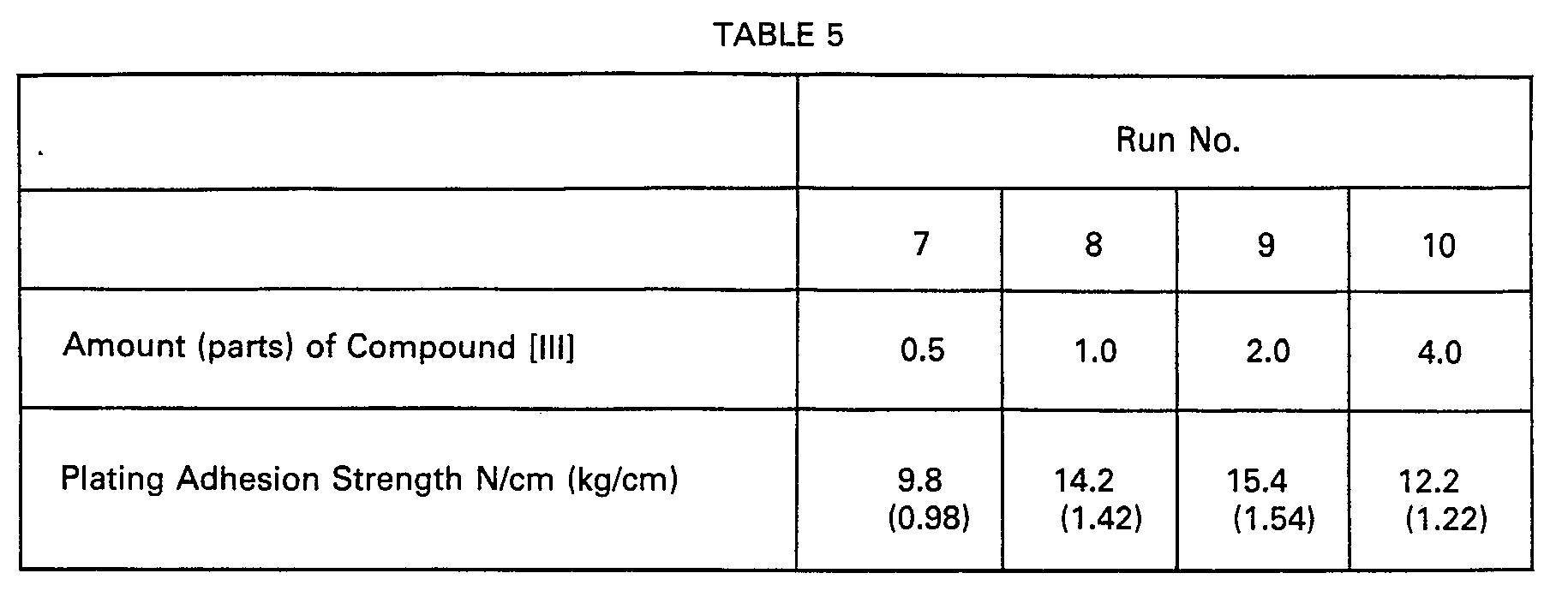
- 100 parts of the same powdery ABS resin as used in Example 4 and the compound of the formula [II] in an amount shown in Table 6 were supplied to an extruder and pelletized.
- The pelletized composition was molded and plated in the same manner as described in Example 4, and the plating adhesion strength was measured. The obtained results are shown in Table 6.

- The ABS resins used in Examples 4 and 5 were molded and plated in the same manner as described in Example 4 except that the compound of the formula [II] was not added, and the plating adhesion strength were measured. It was found that the plating adhesion strengths were 4.4 N/cm (0.44 Kg/cm) and 3.7 N/cm (0.37 Kg/cm), respectively.
Claims (5)

Applications Claiming Priority (4)
| Application Number | Priority Date | Filing Date | Title |
|---|---|---|---|
| JP50090/84 | 1984-03-15 | ||
| JP59050090A JPS60192757A (en) | 1984-03-15 | 1984-03-15 | Platable transparent abs resin composition |
| JP5485984A JPH0240261B2 (en) | 1984-03-22 | 1984-03-22 | JUSHIMETSUKISEIHIN |
| JP54859/84 | 1984-03-22 |
Publications (3)
| Publication Number | Publication Date |
|---|---|
| EP0155604A2 EP0155604A2 (en) | 1985-09-25 |
| EP0155604A3 EP0155604A3 (en) | 1987-07-01 |
| EP0155604B1 true EP0155604B1 (en) | 1990-05-30 |
Family
ID=26390527
Family Applications (1)
| Application Number | Title | Priority Date | Filing Date |
|---|---|---|---|
| EP19850102657 Expired - Lifetime EP0155604B1 (en) | 1984-03-15 | 1985-03-08 | Resin composition and plated article thereof |
Country Status (4)
| Country | Link |
|---|---|
| US (1) | US4612253A (en) |
| EP (1) | EP0155604B1 (en) |
| KR (1) | KR870001885B1 (en) |
| DE (1) | DE3577989D1 (en) |
Families Citing this family (1)
| Publication number | Priority date | Publication date | Assignee | Title |
|---|---|---|---|---|
| JP7299399B1 (en) * | 2022-10-24 | 2023-06-27 | テクノUmg株式会社 | Graft copolymers, resin compositions for plating, molded products and plated products |
Family Cites Families (6)
| Publication number | Priority date | Publication date | Assignee | Title |
|---|---|---|---|---|
| DE1544712A1 (en) * | 1965-07-29 | 1969-02-13 | Huels Chemische Werke Ag | Antistatic molding compounds made of polystyrene |
| DE1258083B (en) * | 1965-10-09 | 1968-01-04 | Huels Chemische Werke Ag | Antistatic molding compounds made from styrene polymers |
| JPS5110885A (en) * | 1974-07-04 | 1976-01-28 | Bridgestone Tire Co Ltd | Gomusoseibutsuto kinzokuzairyotokaranarufukugotai oyobi sonoseizohoho |
| US4337279A (en) * | 1981-01-23 | 1982-06-29 | Uop Inc. | Method for increasing the peel strength of metal-clad polymers |
| JPS57170946A (en) * | 1981-04-15 | 1982-10-21 | Mitsui Toatsu Chem Inc | Modified polypropylene composition |
| JPS58210944A (en) * | 1982-06-02 | 1983-12-08 | Mitsui Toatsu Chem Inc | Resin composition for laminating metal |
-
1985
- 1985-03-08 DE DE8585102657T patent/DE3577989D1/en not_active Expired - Lifetime
- 1985-03-08 EP EP19850102657 patent/EP0155604B1/en not_active Expired - Lifetime
- 1985-03-14 KR KR1019850001618A patent/KR870001885B1/en not_active Expired
- 1985-03-15 US US06/712,066 patent/US4612253A/en not_active Expired - Lifetime
Also Published As
| Publication number | Publication date |
|---|---|
| US4612253A (en) | 1986-09-16 |
| EP0155604A2 (en) | 1985-09-25 |
| EP0155604A3 (en) | 1987-07-01 |
| KR870001885B1 (en) | 1987-10-20 |
| DE3577989D1 (en) | 1990-07-05 |
| KR850006695A (en) | 1985-10-16 |
Similar Documents
| Publication | Publication Date | Title |
|---|---|---|
| EP2027207B1 (en) | Resin composition having good scratch resistance | |
| EP0022979B1 (en) | Thermoplastic resin composition having good heat cycle property | |
| CN102153848A (en) | Polycarbonate resin composition and molded product using the same | |
| KR20110056080A (en) | Thermoplastic resin composition excellent in scratch resistance and black feeling, and molded article formed by the composition | |
| US4228051A (en) | Thermoplastic resin composition having good heat cycle property | |
| EP0160974B2 (en) | Modified impact-resistant vinyl-aromatic polymers | |
| US4876145A (en) | Plated resin article | |
| US4732807A (en) | Plated resin article | |
| US4612253A (en) | Resin composition and plated article thereof | |
| KR860001371B1 (en) | Manufacturing method of thermoplastic resin | |
| CA2430687A1 (en) | Thermoplastic moulded materials | |
| CA1090035A (en) | Polyblend comprising monovinylidene aromatic, an unsaturated nitrile and acrylate monomers and a graft copolymer | |
| EP4269457A1 (en) | Resin composition for plating | |
| EP0201099B1 (en) | Process for producing a low gloss thermoplastic resin | |
| JPH0367112B2 (en) | ||
| US4312962A (en) | Adhesion in metal plating | |
| EP3926012B1 (en) | Thermoplastic resin composition, method of preparing thermoplastic resin composition, molded article including thermoplastic resin composition, and method of manufacturing molded article | |
| KR100292878B1 (en) | A composition of thermoplastic resin | |
| EP0378410B1 (en) | Rubber-modified styrene-based copolymer | |
| DE4429982A1 (en) | Laser-inscribable ABS-type mouldings | |
| JPS60192757A (en) | Platable transparent abs resin composition | |
| JP2603282B2 (en) | Thermoplastic molding composition | |
| US3766134A (en) | Abs compositions for electroplating which contain asbestos | |
| JPS6089577A (en) | Platable transparent abs resin | |
| KR100519116B1 (en) | Thermoplastic Resin Composition With Excellent Whitening-Resistance, Transparency and Impact Strength |
Legal Events
| Date | Code | Title | Description |
|---|---|---|---|
| PUAI | Public reference made under article 153(3) epc to a published international application that has entered the european phase |
Free format text: ORIGINAL CODE: 0009012 |
|
| AK | Designated contracting states |
Designated state(s): DE FR GB |
|
| PUAL | Search report despatched |
Free format text: ORIGINAL CODE: 0009013 |
|
| AK | Designated contracting states |
Kind code of ref document: A3 Designated state(s): DE FR GB |
|
| 17P | Request for examination filed |
Effective date: 19870922 |
|
| 17Q | First examination report despatched |
Effective date: 19880831 |
|
| GRAA | (expected) grant |
Free format text: ORIGINAL CODE: 0009210 |
|
| AK | Designated contracting states |
Kind code of ref document: B1 Designated state(s): DE FR GB |
|
| REF | Corresponds to: |
Ref document number: 3577989 Country of ref document: DE Date of ref document: 19900705 |
|
| ET | Fr: translation filed | ||
| PLBE | No opposition filed within time limit |
Free format text: ORIGINAL CODE: 0009261 |
|
| STAA | Information on the status of an ep patent application or granted ep patent |
Free format text: STATUS: NO OPPOSITION FILED WITHIN TIME LIMIT |
|
| 26N | No opposition filed | ||
| PGFP | Annual fee paid to national office [announced via postgrant information from national office to epo] |
Ref country code: GB Payment date: 19950227 Year of fee payment: 11 |
|
| PGFP | Annual fee paid to national office [announced via postgrant information from national office to epo] |
Ref country code: FR Payment date: 19950309 Year of fee payment: 11 Ref country code: DE Payment date: 19950309 Year of fee payment: 11 |
|
| PG25 | Lapsed in a contracting state [announced via postgrant information from national office to epo] |
Ref country code: GB Effective date: 19960308 |
|
| GBPC | Gb: european patent ceased through non-payment of renewal fee |
Effective date: 19960308 |
|
| PG25 | Lapsed in a contracting state [announced via postgrant information from national office to epo] |
Ref country code: FR Effective date: 19961129 |
|
| PG25 | Lapsed in a contracting state [announced via postgrant information from national office to epo] |
Ref country code: DE Effective date: 19961203 |
|
| REG | Reference to a national code |
Ref country code: FR Ref legal event code: ST |