EP0155116B1 - Polyol compositions containing mould release agent - Google Patents
Polyol compositions containing mould release agent Download PDFInfo
- Publication number
- EP0155116B1 EP0155116B1 EP85301324A EP85301324A EP0155116B1 EP 0155116 B1 EP0155116 B1 EP 0155116B1 EP 85301324 A EP85301324 A EP 85301324A EP 85301324 A EP85301324 A EP 85301324A EP 0155116 B1 EP0155116 B1 EP 0155116B1
- Authority
- EP
- European Patent Office
- Prior art keywords
- polyol
- radicals
- mould release
- polysiloxane
- release agent
- Prior art date
- Legal status (The legal status is an assumption and is not a legal conclusion. Google has not performed a legal analysis and makes no representation as to the accuracy of the status listed.)
- Expired
Links
Classifications
-
- C—CHEMISTRY; METALLURGY
- C08—ORGANIC MACROMOLECULAR COMPOUNDS; THEIR PREPARATION OR CHEMICAL WORKING-UP; COMPOSITIONS BASED THEREON
- C08L—COMPOSITIONS OF MACROMOLECULAR COMPOUNDS
- C08L71/00—Compositions of polyethers obtained by reactions forming an ether link in the main chain; Compositions of derivatives of such polymers
- C08L71/02—Polyalkylene oxides
-
- B—PERFORMING OPERATIONS; TRANSPORTING
- B29—WORKING OF PLASTICS; WORKING OF SUBSTANCES IN A PLASTIC STATE IN GENERAL
- B29C—SHAPING OR JOINING OF PLASTICS; SHAPING OF MATERIAL IN A PLASTIC STATE, NOT OTHERWISE PROVIDED FOR; AFTER-TREATMENT OF THE SHAPED PRODUCTS, e.g. REPAIRING
- B29C33/00—Moulds or cores; Details thereof or accessories therefor
- B29C33/56—Coatings, e.g. enameled or galvanised; Releasing, lubricating or separating agents
- B29C33/60—Releasing, lubricating or separating agents
-
- C—CHEMISTRY; METALLURGY
- C08—ORGANIC MACROMOLECULAR COMPOUNDS; THEIR PREPARATION OR CHEMICAL WORKING-UP; COMPOSITIONS BASED THEREON
- C08L—COMPOSITIONS OF MACROMOLECULAR COMPOUNDS
- C08L75/00—Compositions of polyureas or polyurethanes; Compositions of derivatives of such polymers
- C08L75/04—Polyurethanes
-
- B—PERFORMING OPERATIONS; TRANSPORTING
- B29—WORKING OF PLASTICS; WORKING OF SUBSTANCES IN A PLASTIC STATE IN GENERAL
- B29C—SHAPING OR JOINING OF PLASTICS; SHAPING OF MATERIAL IN A PLASTIC STATE, NOT OTHERWISE PROVIDED FOR; AFTER-TREATMENT OF THE SHAPED PRODUCTS, e.g. REPAIRING
- B29C67/00—Shaping techniques not covered by groups B29C39/00 - B29C65/00, B29C70/00 or B29C73/00
- B29C67/24—Shaping techniques not covered by groups B29C39/00 - B29C65/00, B29C70/00 or B29C73/00 characterised by the choice of material
- B29C67/246—Moulding high reactive monomers or prepolymers, e.g. by reaction injection moulding [RIM], liquid injection moulding [LIM]
-
- B—PERFORMING OPERATIONS; TRANSPORTING
- B29—WORKING OF PLASTICS; WORKING OF SUBSTANCES IN A PLASTIC STATE IN GENERAL
- B29K—INDEXING SCHEME ASSOCIATED WITH SUBCLASSES B29B, B29C OR B29D, RELATING TO MOULDING MATERIALS OR TO MATERIALS FOR MOULDS, REINFORCEMENTS, FILLERS OR PREFORMED PARTS, e.g. INSERTS
- B29K2075/00—Use of PU, i.e. polyureas or polyurethanes or derivatives thereof, as moulding material
Definitions
- This invention relates to polyol compositions and more particularly to polyol compositions containing mould release agents and to their use in the manufacture of polyurethanes.
- reaction injection moulding (RIM) process is one such method of making moulded polyurethanes.
- RIM reaction injection moulding
- a mould release agent may either be applied to the mould surface external mould release agents or be incorporated in one of the components of the reaction mixture (internal mould release agents) or both.
- US 4 396 729 discloses a RIM process for preparing polyurethane elastomers using amine ended polyethers of Mw>1500, amine ended low Mw chain extenders and polyisocyanates, together with a dimethylsiloxane with organic acid groups as an internal mold release agent, and siloxane oxyalkylene compounds as foam stabilisers.
- Internal mould release agents that have been proposed for use in polyurethane formulations include polysiloxanes.
- polysiloxanes In order to incorporate the polysiloxane in the reaction mixture, it is convenient to include it in one of the major components, especially the polymeric polyol.
- polysiloxanes are insufficiently soluble in the polymeric polyols and do not form stable dispersions therein. Accordingly, polyol compositions containing polysiloxane release agents quickly separate into two layers and need to be homogenised before being used in the moulding process.
- the invention provides a stable polyol composition
- the description of the polyol compositions as stable means that after preparation they remain substantially homogeneous for at least four weeks.
- Polymeric polyols which may be present in the polyol compositions of the invention include those which have been used or proposed for use in polyurethane manufacture, especially the relatively high molecular weight, low hydroxyl number polyols suitable for flexible foam and foamed or unfoamed elastomer manufacture.
- polyether polyols especially polyoxypropylene and poly(oxypropylene - oxyethylene) diols and triols having hydroxyl equivalent weights of from 750 to 3000 and mixtures thereof.
- Polysiloxane mould release agents which may be used include those described in the prior art which may or may not contain isocyanate-reactive groups.
- Suitable polysiloxanes containing isocyanate-reactive groups include polymers which consist essentially of 0.5-20 mol % of R a R' b SiO[4-a+b)]/2 units and from 99.5-80 mol % of R",SiO (4 -, )/2 units where
- the hydroxy, mercapto, or amino organic R radicals having preferably a molecular weight in the range of 100-400, can be attached to the silicon atom directly to carbon or through oxygen, nitrogen or sulfur carbon bonds.
- Particularly preferred R radicals are those of the formula HO-R"'-, H 2 N-R"'-, HNR 2 "', HS-R"'-, wherein R'" is a divalent linking group composed of carbon and hydrogen; carbon, hydrogen and oxygen; carbon, hydrogen and sulfur; carbon, hydrogen and nitrogen; or carbon, hydrogen, oxygen and nitrogen.
- the R' radical can be any hydrocarbon or substituted organic radical.
- Illustrative of the R' radicals that can be present are alkyl radicals such as the methyl, ethyl, propyl, butyl, amyl, hexyl, octyl, decyl, dodecyl, and octadecyl, and myristyl radicals, alkenyl radicals such as the vinyl, allyl, and hexenyl radicals; cycloalkyl radicals such as the cyclobutyl and cyclohexyl radicals; aryl radicals such as the phenyl, xenyl and naphthyl radicals; aralkyl radicals such as the benzyl and 2-phenylethyl radicals; alkaryl radicals such as the tolyl, xylyl and mesityl radicals; the corresponding halohydrocarbon radicals such as 3-chloroprop
- R' radical be an organic radical containing from 1 to 10 atoms. In the most preferred embodiment of this invention at least 90 percent of all the R' radicals are methyl radicals. There can be an average of from 0 to 2 R' radicals attached to the silicon atom, i.e., b has an average of from 0 to 2 in the above formula.
- the R" radical in the functional isocyanate reactive siloxanes of this invention can also be any hydrocarbon or substituted hydrocarbon radical.
- the illustrative examples given with respect to R' above are equally applicable here and are not repeated for the sake of brevity.
- the preferences set forth for R' above also apply to the R" radical.
- polysiloxane mould release agents are made by well known techniques and are usually formed by grafting an olefin containing organic modifying group or polyoxyalkylene oxide into a "methylhydrogen siloxane" modified polydimethylsiloxane using a platinum catalyzed hydrolisation reaction.
- the functional siloxanes of the mould release agent can be either solid or liquid in form. In order to use a solid functional siloxane it would be necessary to dissolve, disperse or suspend the siloxane in one or more silicone surfactants. Hence it is much preferred that the functional siloxane employed be in liquid form. While the viscosity of the liquid siloxane can vary over a wide range, for example from 1 to 100,000 mm' - s -1 , it is generally preferred that the viscosity be in the range of from 50 to 1000 mm 2 s -1 . Molecular weight can vary from 1000 to 30,000, preferably 2000-20,000 and most preferred 4000-8000.
- compositions of the invention include a polysiloxane such as those included in the above described definition and specifically but not limited to those in the following list having R a R' b SiO[4-5(a+b)]/2 - units and R" c SiO[4-c]/2 units and wherein the value listed for (d) is the equivalent weight, (e) are the combined formula weights or reactive radicals R expressed as percent of the molecular weight, (f) is the combined formula weights of non-isocyanate reactive groups R'+R" expressed as percent of the molecular weight:
- Polysiloxane II is a hydroxy functional thioether copolymer internal mould release agent having the speculative formula: having a hydroxy equivalent weight (d) of 2750, a molecular weight of 5500, a value for (e) of 4.7%, (f) is 37% and a viscosity of about 55 mm 2 s -1 .
- Polysiloxane III has a general formula as follows: having a molecular weight of 13,136, (d) equivalent weight of 411, (e) is 16% and (f) is 33%.
- Polysiloxane IV has the general formula as follows: having a molecular weight of 6154, (d) equivalent weight 440, (e) is 15%, and (f) is 34%.
- Polysiloxane V has a general formula: having a molecular weight of 6068, (d) equivalent weight 607, (e) is 11%, and (f) is 35%.
- Polysiloxane VI has a general formula: having a molecular weight of 6980, (d) equivalent weight 249, (e) is 26%, and (f) is 28%.
- Polysiloxane Vll has a general formula: having a molecular weight of 6982, (d) an equivalent weight of 3481, (e) is 3.7%, and (f) is 39%.
- Polysiloxane IX has a general formula: having a molecular weight of 7550, an equivalent weight (d) of 108, (e) is 33% and (f) is 26%.
- Polysiloxane X has a general formula: having a molecular weight of 6390, an equivalent weight (d) of 355, (e) is 19% and (f) is 32%.
- Polysiloxane XI has a general formula:
- ethylene oxide based surfactants present in the compositions of the invention are well known in the art and are generally compounds in which a polyoxyethylene chain is attached to a hydrophobic residue which may be, for example, a hydrocarbon residue.
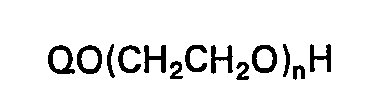
- suitable surfactants include polyoxyethylene derivatives of the formula: wherein Q represents a hydrophobic residue, for example an alkyl, alkylphenyl or alkanoyl residue, containing from 8 to 30 carbon atoms and n has an average value of from 20 to 150. The most suitable value for n depends to some extent on the nature of the hydrophobic residue Q, a suitable balance between the hydrophilic and hydrophobic moieties of the surfactant molecule being necessary as in other surfactant applications.
- the surfactants may be obtained in known manner by reacting ethylene oxide (and optionally propylene oxide) with, for example, aliphatic alcohols, aliphatic carboxylic acids and alkylphenols.
- suitable surfactants there may be mentioned oxyethylated alkanols obtained by reaction from 40 to 110 moles of ethylene oxide with an alkanol containing from ' 14 to 20 carbon atoms.
- suitable materials include the reaction product of stearyl alcohol with 100 moles of ethylene oxide and the reaction product of tetramethylene glycol butyl ether with 38 moles of propylene oxide and 45 moles of ethylene oxide.
- reaction products of alkylphenols for example nonylphenols, with at least 20 moles of ethylene oxide.
- compositions of the invention contain a stabilising amount of the surfactant, a stabilising amount being sufficient to provide a stable composition as defined above.
- the polyol compositions may be prepared by mixing the polymeric polyol, the polysiloxane mould release agent and the surfactant in a conventional manner. It is often convenient to prepare master batches containing a high concentration of the mould release agent in the polyol and subsequently to blend this master batch with a further amount of polyol and optionally other materials, before polyurethane manufacture. Such master batches typically contain: the parts being expressed on a weight basis. After dilution with polyol, compositions for use in polyurethane manufacture typically contain:
- the polyol compositions of the invention may contain other conventional components of polyurethane-forming reaction mixtures except organic polyisocyanates.
- the compositions may contain catalysts, for example tertiary amines and tin compounds, fillers, fire retardants, chain extenders, blowing agents, for example water and trichlorofluoromethane, and foam stabilisers.
- the polyol compositions of the invention which are stable for periods of up to four weeks, may be reacted with organic polyisocyanates in known manner and using conventional equipment to form moulded polyurethanes.
- Suitable polyisocyanates include aromatic polyisocyanates such as diphenylmethane diisocyanate and tolylene diisocyanate, each of which may be used in the various pure, crude and modified forms which have been fully described in the prior art.
- the compositions of the invention are particularly suitable for use in reaction injection moulding (RIM) processes to form polyurethanes having densities of from 100 to 1200 kg/m 3 .
- the polyurethanes have excellent mould release properties.
- Surfactant A stearyl alcohol ethoxylated with 100 moles ethylene oxide (BRIJ * 700 from ICI Speciality Chemicals).
- Surfactant B tetramethylene glycol butyl ether alkoxylated with 38 moles propylene oxide and 45 moles ethylene oxide (ATLAS * G5000 from ICI Speciality Chemicals).
- Surfactant C Nonylphenol alkoxylated with 16 moles propylene oxide and 13 moles ethylene oxide. (ATLAS * EL 1019 from ICI Speciality Chemicals).
- the mould release agent used was "Polysiloxane I" described above.
- the polyol used in tests was a propoxylated diethylene glycol (70%), glycerol (30%) having ethylene oxide (20%) tipping, with the properties:-
- the isocyanate used was a blend of SUPRASEC * VM021 (65%) and SUPRASEC * DNR (35%) isocyanates from ICI Polyurethanes.
- SUPRASEC * VM021 is a glycol modified diphenyldimethanediisocyanate (MDI) and SUPRASEC * DNR is a polymeric MDI.
- MDI diphenyldimethanediisocyanate
- Surfactants A-G are blended with the above polyol and siloxane in the following ratio:-
- Surfactants A, B and C were made up with polyol and siloxane 1 as masterbatch compositions suitable for dilution with more of the same polyol for use. The stability of the masterbatches at room temperature was assessed. Results are reported in Table 2.
- a fully formulated polyol composition for use in RIM processing including catalysts and blowing agent was prepared. To one sample Surfactant A was added, but to another sample no surfactant was added. Compositions are given in Table 4. Stability is noted.
- Polyols of the type described in Examples 1 to 10 were reacted with isocyanate (MDI as described above at two levels of isocyanate index) in a RIM machine to assess processability, self release properties and mechanical properties. Compositions and results are repeated in Table 5.
- isocyanate MDI as described above at two levels of isocyanate index
- Compositions and results are repeated in Table 5.
- a vehicle bumper mould was used.
- a plate mould for producing test pieces was used.
- Moulds were treated with standard external mould release agents XMR 136 and XMR 149 marketed by Chem-Trend A/S.
Landscapes
- Chemical & Material Sciences (AREA)
- Health & Medical Sciences (AREA)
- Chemical Kinetics & Catalysis (AREA)
- Medicinal Chemistry (AREA)
- Polymers & Plastics (AREA)
- Organic Chemistry (AREA)
- Engineering & Computer Science (AREA)
- Mechanical Engineering (AREA)
- Polyurethanes Or Polyureas (AREA)
- Compositions Of Macromolecular Compounds (AREA)
- Agricultural Chemicals And Associated Chemicals (AREA)
- Pharmaceuticals Containing Other Organic And Inorganic Compounds (AREA)
- Lubricants (AREA)
- Silicon Polymers (AREA)
- Polyethers (AREA)
- Epoxy Compounds (AREA)
- Addition Polymer Or Copolymer, Post-Treatments, Or Chemical Modifications (AREA)
- Moulds For Moulding Plastics Or The Like (AREA)
Abstract
Description
- This invention relates to polyol compositions and more particularly to polyol compositions containing mould release agents and to their use in the manufacture of polyurethanes.
- It is known to make moulded polyurethane articles by introducing into a mould a reaction mixture containing an organic polyisocyanate, a polymeric polyol and other ingredients which may include blowing agents, catalysts, foam stabilisers, fillers, chain extenders and fire-retardants. The reaction injection moulding (RIM) process is one such method of making moulded polyurethanes. Because of the highly adherent nature of polyurethane reaction mixtures, it is necessary to employ a mould release agent to facilitate removal of the polyurethane product from the mould. Such an agent may either be applied to the mould surface external mould release agents or be incorporated in one of the components of the reaction mixture (internal mould release agents) or both.
- Thus US 4 396 729 discloses a RIM process for preparing polyurethane elastomers using amine ended polyethers of Mw>1500, amine ended low Mw chain extenders and polyisocyanates, together with a dimethylsiloxane with organic acid groups as an internal mold release agent, and siloxane oxyalkylene compounds as foam stabilisers.
- Internal mould release agents that have been proposed for use in polyurethane formulations include polysiloxanes. In order to incorporate the polysiloxane in the reaction mixture, it is convenient to include it in one of the major components, especially the polymeric polyol. In general, however, polysiloxanes are insufficiently soluble in the polymeric polyols and do not form stable dispersions therein. Accordingly, polyol compositions containing polysiloxane release agents quickly separate into two layers and need to be homogenised before being used in the moulding process.
- It has now been found that substantially stable dispersions of polysiloxanes in polyols can be prepared with the aid of certain non-ionic surfactants.
- Accordingly, the invention provides a stable polyol composition comprising a polymeric polyol having a molecular weight of 400 to 10000, 1-70 parts/100 parts of polyol of a polysiloxane mould release agent, and 1-30 parts/100 parts of polyol of an alkylene oxide based surfactant, comprising from-20 to 150 molar units of alkoxy residue per mole of surfactant.
- For the purpose of the invention, the description of the polyol compositions as stable means that after preparation they remain substantially homogeneous for at least four weeks.
- Polymeric polyols which may be present in the polyol compositions of the invention include those which have been used or proposed for use in polyurethane manufacture, especially the relatively high molecular weight, low hydroxyl number polyols suitable for flexible foam and foamed or unfoamed elastomer manufacture. In particular, there may be mentioned polyether polyols, especially polyoxypropylene and poly(oxypropylene - oxyethylene) diols and triols having hydroxyl equivalent weights of from 750 to 3000 and mixtures thereof.
- Polysiloxane mould release agents which may be used include those described in the prior art which may or may not contain isocyanate-reactive groups. Suitable polysiloxanes containing isocyanate-reactive groups include polymers which consist essentially of 0.5-20 mol % of RaR'bSiO[4-a+b)]/2 units and from 99.5-80 mol % of R",SiO(4-,)/2 units where
- R is an isocyanate reactive organic radical,
- . a has an average value of from 1-3,
- R' and R" are hydrocarbon radical or a substituted organic radical,
- b has an average value of 0-2,
- a+b is from 1-3,
- c has an average value from 1 to 3.
- In the above formula, the following features are also desirable separately or in combination:-
- (a) the ratio of the total molecular weight to the total number of isocyanate reactive functional groups in the polysiloxane molecule (equivalent weight) ranges from 100-3500;
- (b) the combined formula weights of all isocyanate reactive organic radicals, R do not exceed 40% of the total molecular weight of the polysiloxane mould release agent;
- (c) the combined formula weights of all non-isocyanate reactive radicals, R'+R" together do not exceed 40% of the total molecular weight of the polysiloxane mould release additive;
- (d) the combined formula weights of all the organic radicals R+R'+R" in the molecule together do not exceed 55―60% of the total molecular weight of the molecule;
- (e) the polysiloxane mould release agent(s) each contain an average of at least two isocyanate reactive functional groups per molecule;
- (f) at least two of the isocyanate reactive functional groups in each molecule are located on separate organic radicals, R, attached independently to different silicon atoms in the polysiloxane molecule;
- (g) the isocyanate reactive functional groups which may be employed in the polysiloxane molecule(s) are preferably of the following types:
- 1. alcohols,
- 2. phenols,
- 3. thiols,
- 4. primary or secondary aromatic amines, which contain no oxygen, and have not more than one nitrogen atom attached directly to, in conjugation with, or incorporated within, the aromatic ring nucleus,
- 5. secondary aliphatic amines wherein at least one the alkyl carbon atoms, bonded directly to the nitrogen atom, is not a primary carbon atom,
- 6. carboxylic acids. (h) the molecular weight of the polysiloxane mould release agent is between 1000 and 30,000, preferably 2000-15,000 and most preferred 4000-8000.
- In these mould release agents the hydroxy, mercapto, or amino organic R radicals, having preferably a molecular weight in the range of 100-400, can be attached to the silicon atom directly to carbon or through oxygen, nitrogen or sulfur carbon bonds. Particularly preferred R radicals are those of the formula HO-R"'-, H2N-R"'-, HNR2"', HS-R"'-, wherein R'" is a divalent linking group composed of carbon and hydrogen; carbon, hydrogen and oxygen; carbon, hydrogen and sulfur; carbon, hydrogen and nitrogen; or carbon, hydrogen, oxygen and nitrogen. Specific examples of R'" include the methylene, ethylene propylene, hexamethylene, decamethylene, -CH2CH(CH3)-CH2-, phenylene, butyl phenylene, naphthylene,


- As indicated above, the R' radical can be any hydrocarbon or substituted organic radical. Illustrative of the R' radicals that can be present are alkyl radicals such as the methyl, ethyl, propyl, butyl, amyl, hexyl, octyl, decyl, dodecyl, and octadecyl, and myristyl radicals, alkenyl radicals such as the vinyl, allyl, and hexenyl radicals; cycloalkyl radicals such as the cyclobutyl and cyclohexyl radicals; aryl radicals such as the phenyl, xenyl and naphthyl radicals; aralkyl radicals such as the benzyl and 2-phenylethyl radicals; alkaryl radicals such as the tolyl, xylyl and mesityl radicals; the corresponding halohydrocarbon radicals such as 3-chloropropyl, 4-bromobutyl, 3,3,3-trifluoropropyl, chlorocyclohexyl, bromophenyl, chlorophenyl, alpha, alphatrifluorotolyl and the dichloroxenyl radicals; the corresponding cyanohydrocarbon radicals such as 2-cyanoethyl, 3-cyanopropyl and cyanophenyl radicals; the corresponding radicals such as ether and ester hydrocarbon radical such as―(CH2)3OC2H5―(CH2)3OCH3―(CH2)3COOC2H,, and (CH2)3COOCH3, the corresponding thioether and thioester hydrocarbon radicals such as ―(CH2)3SC2H5 and -(CH2)3COSCH3 and nitrohydrocarbon radical such as the nitrophenyl and 3-nitro-propyl radicals. It is preferred that the R' radical be an organic radical containing from 1 to 10 atoms. In the most preferred embodiment of this invention at least 90 percent of all the R' radicals are methyl radicals. There can be an average of from 0 to 2 R' radicals attached to the silicon atom, i.e., b has an average of from 0 to 2 in the above formula.
- The R" radical in the functional isocyanate reactive siloxanes of this invention can also be any hydrocarbon or substituted hydrocarbon radical. The illustrative examples given with respect to R' above are equally applicable here and are not repeated for the sake of brevity. Likewise, the preferences set forth for R' above also apply to the R" radical. There can be from 0 to 3 R" radicals, on the average, per silicon atom, i.e., c has an average value of from 1 to 3 in the above formula.
- These polysiloxane mould release agents are made by well known techniques and are usually formed by grafting an olefin containing organic modifying group or polyoxyalkylene oxide into a "methylhydrogen siloxane" modified polydimethylsiloxane using a platinum catalyzed hydrolisation reaction.
- The functional siloxanes of the mould release agent can be either solid or liquid in form. In order to use a solid functional siloxane it would be necessary to dissolve, disperse or suspend the siloxane in one or more silicone surfactants. Hence it is much preferred that the functional siloxane employed be in liquid form. While the viscosity of the liquid siloxane can vary over a wide range, for example from 1 to 100,000 mm' - s-1, it is generally preferred that the viscosity be in the range of from 50 to 1000 mm2 s-1. Molecular weight can vary from 1000 to 30,000, preferably 2000-20,000 and most preferred 4000-8000.
- The compositions of the invention include a polysiloxane such as those included in the above described definition and specifically but not limited to those in the following list having RaR'bSiO[4-5(a+b)]/2 - units and R"cSiO[4-c]/2 units and wherein the value listed for (d) is the equivalent weight, (e) are the combined formula weights or reactive radicals R expressed as percent of the molecular weight, (f) is the combined formula weights of non-isocyanate reactive groups R'+R" expressed as percent of the molecular weight:
-
- "Polysiloxane I" is a hydroxy functional polysiloxane polyether copolymer internal mould release agent having the approximate formula

- "Polysiloxane II" is a hydroxy functional thioether copolymer internal mould release agent having the speculative formula:

- "Polysiloxane III" has a general formula as follows:

- "Polysiloxane IV" has the general formula as follows:

- "Polysiloxane V" has a general formula:

- "Polysiloxane VI" has a general formula:

- "Polysiloxane Vll" has a general formula:

- "Polysiloxane VIII" has a general formula:

- "Polysiloxane IX" has a general formula:

- "Polysiloxane X" has a general formula:

- "Polysiloxane XI" has a general formula:

- The ethylene oxide based surfactants present in the compositions of the invention are well known in the art and are generally compounds in which a polyoxyethylene chain is attached to a hydrophobic residue which may be, for example, a hydrocarbon residue. Thus, suitable surfactants include polyoxyethylene derivatives of the formula:

- The surfactants may be obtained in known manner by reacting ethylene oxide (and optionally propylene oxide) with, for example, aliphatic alcohols, aliphatic carboxylic acids and alkylphenols.
- As more specific examples of suitable surfactants, there may be mentioned oxyethylated alkanols obtained by reaction from 40 to 110 moles of ethylene oxide with an alkanol containing from '14 to 20 carbon atoms. Thus, suitable materials include the reaction product of stearyl alcohol with 100 moles of ethylene oxide and the reaction product of tetramethylene glycol butyl ether with 38 moles of propylene oxide and 45 moles of ethylene oxide. There may also be mentioned reaction products of alkylphenols, for example nonylphenols, with at least 20 moles of ethylene oxide.
- The compositions of the invention contain a stabilising amount of the surfactant, a stabilising amount being sufficient to provide a stable composition as defined above.
- The polyol compositions may be prepared by mixing the polymeric polyol, the polysiloxane mould release agent and the surfactant in a conventional manner. It is often convenient to prepare master batches containing a high concentration of the mould release agent in the polyol and subsequently to blend this master batch with a further amount of polyol and optionally other materials, before polyurethane manufacture. Such master batches typically contain:


- In addition to the materials already mentioned, the polyol compositions of the invention may contain other conventional components of polyurethane-forming reaction mixtures except organic polyisocyanates. Thus, the compositions may contain catalysts, for example tertiary amines and tin compounds, fillers, fire retardants, chain extenders, blowing agents, for example water and trichlorofluoromethane, and foam stabilisers.
- The polyol compositions of the invention, which are stable for periods of up to four weeks, may be reacted with organic polyisocyanates in known manner and using conventional equipment to form moulded polyurethanes. Suitable polyisocyanates include aromatic polyisocyanates such as diphenylmethane diisocyanate and tolylene diisocyanate, each of which may be used in the various pure, crude and modified forms which have been fully described in the prior art. The compositions of the invention are particularly suitable for use in reaction injection moulding (RIM) processes to form polyurethanes having densities of from 100 to 1200 kg/m3. The polyurethanes have excellent mould release properties.
- The invention is illustrated but not limited by the following Examples in which all parts and percentages are by weight.
- The Examples illustrated the following aspects of the invention:-
- Example 1: the identification of stabilising surfactants.
- Examples 2-5: the preparation of stable masterbatches containing siloxane mould release agents.
- Examples 6-10: the preparation of working polyol compositions containing siloxane mould release agents.
- Examples 11-14: the use of polyols with siloxanes in RIM processes.
- The following surfactants were used in the Examples:
- Surfactant A: stearyl alcohol ethoxylated with 100 moles ethylene oxide (BRIJ* 700 from ICI Speciality Chemicals).
- Surfactant B: tetramethylene glycol butyl ether alkoxylated with 38 moles propylene oxide and 45 moles ethylene oxide (ATLAS* G5000 from ICI Speciality Chemicals).
- Surfactant C: Nonylphenol alkoxylated with 16 moles propylene oxide and 13 moles ethylene oxide. (ATLAS* EL 1019 from ICI Speciality Chemicals).
- The following surfactants were tried and found to give inadequate stabilisation:-
- Surfactant D: stearyl alcohol reacted with 15 moles propylene oxide.
- Surfactant E: stearyl alcohol reacted with 2 moles ethylene oxide.
- Surfactant F: stearyl alcohol reacted with 10 moles ethylene oxide.
- Surfactant G: sorbitan tristearate.
- The mould release agent used was "Polysiloxane I" described above.
- The polyol used in tests was a propoxylated diethylene glycol (70%), glycerol (30%) having ethylene oxide (20%) tipping, with the properties:-

- The isocyanate used was a blend of SUPRASEC* VM021 (65%) and SUPRASEC* DNR (35%) isocyanates from ICI Polyurethanes.
- SUPRASEC* VM021 is a glycol modified diphenyldimethanediisocyanate (MDI) and SUPRASEC* DNR is a polymeric MDI.
- BRIJ*, ATLAS* and SUPRASEC* are registered trademarks of Imperial Chemical Industries PLC.
- Surfactants A-G are blended with the above polyol and siloxane in the following ratio:-

- Mixing was by hand with sufficient heat required to melt and mix the components. The resultant mixture was stored at room temperature and examined at intervals. The results are reported in Table 1.
- O=homogeneous blend
- A=small drops of siloxane separate
- B=coalescence of drops
- C=partial separation of siloxane to form layer
- D=complete separation of siloxane, observation discontinued.
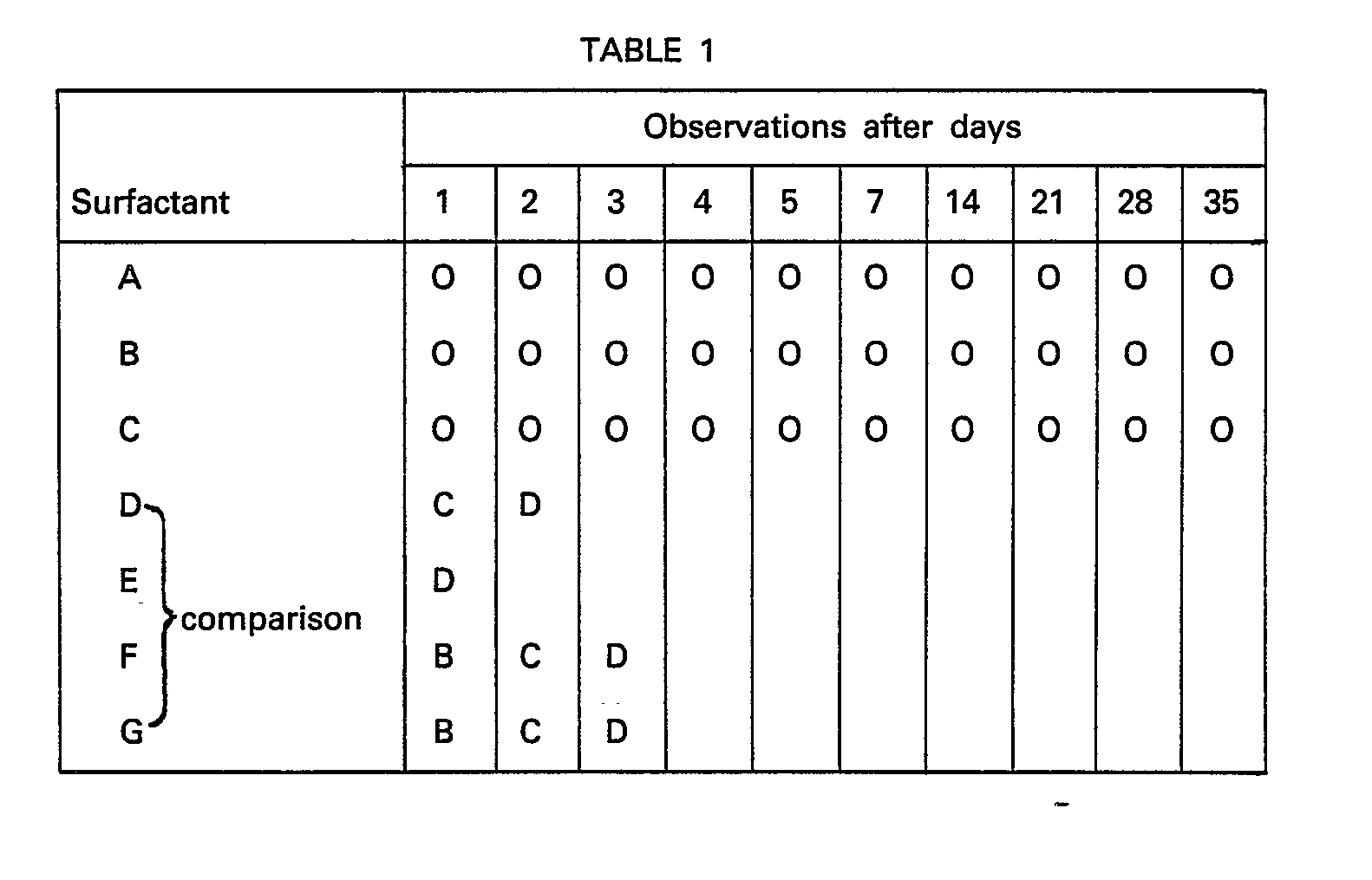
- Surfactants A, B and C were made up with polyol and siloxane 1 as masterbatch compositions suitable for dilution with more of the same polyol for use. The stability of the masterbatches at room temperature was assessed. Results are reported in Table 2.

- Working polyol compositions were prepared from the same range of components with lower levels of siloxane and surfactants and stability was similarly assessed. Results are given in Table 3.
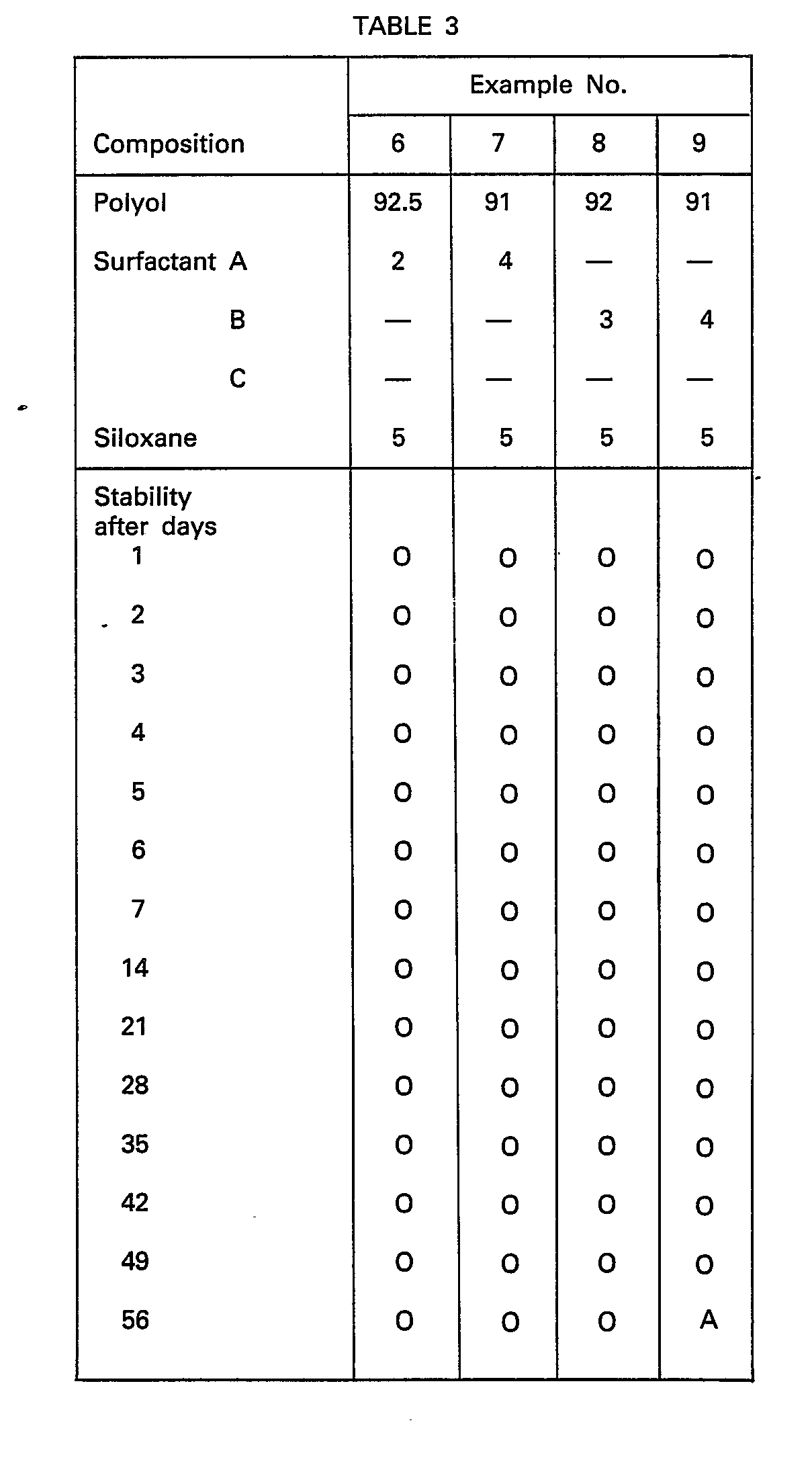
- A fully formulated polyol composition for use in RIM processing including catalysts and blowing agent was prepared. To one sample Surfactant A was added, but to another sample no surfactant was added. Compositions are given in Table 4. Stability is noted.

- Polyols of the type described in Examples 1 to 10 were reacted with isocyanate (MDI as described above at two levels of isocyanate index) in a RIM machine to assess processability, self release properties and mechanical properties. Compositions and results are repeated in Table 5. For self release properties, a vehicle bumper mould was used. For other mechanical properties a plate mould for producing test pieces was used. Moulds were treated with standard external mould release agents XMR 136 and XMR 149 marketed by Chem-Trend A/S.
- Generally, it is seen that the introduction of the polysiloxane gives a useful increase in the number of mouldings which can be made and the inclusion of surfactant enhances this property as well as stabilising the system. No serious degradation of product properties occurs.

Claims (5)


Priority Applications (1)
| Application Number | Priority Date | Filing Date | Title |
|---|---|---|---|
| AT85301324T ATE40708T1 (en) | 1984-03-14 | 1985-02-27 | POLYOL COMPOSITIONS CONTAINING RELEASE AGENTS. |
Applications Claiming Priority (2)
| Application Number | Priority Date | Filing Date | Title |
|---|---|---|---|
| GB848406677A GB8406677D0 (en) | 1984-03-14 | 1984-03-14 | Polyol compositions |
| GB8406677 | 1984-03-14 |
Publications (3)
| Publication Number | Publication Date |
|---|---|
| EP0155116A2 EP0155116A2 (en) | 1985-09-18 |
| EP0155116A3 EP0155116A3 (en) | 1986-03-19 |
| EP0155116B1 true EP0155116B1 (en) | 1989-02-08 |
Family
ID=10558081
Family Applications (1)
| Application Number | Title | Priority Date | Filing Date |
|---|---|---|---|
| EP85301324A Expired EP0155116B1 (en) | 1984-03-14 | 1985-02-27 | Polyol compositions containing mould release agent |
Country Status (16)
| Country | Link |
|---|---|
| US (1) | US4678513A (en) |
| EP (1) | EP0155116B1 (en) |
| JP (1) | JPS60217259A (en) |
| AT (1) | ATE40708T1 (en) |
| AU (1) | AU574138B2 (en) |
| CA (1) | CA1240433A (en) |
| DE (1) | DE3568175D1 (en) |
| DK (1) | DK116685A (en) |
| ES (1) | ES8700288A1 (en) |
| FI (1) | FI85155C (en) |
| GB (1) | GB8406677D0 (en) |
| IN (1) | IN163233B (en) |
| NO (1) | NO162291C (en) |
| NZ (1) | NZ211295A (en) |
| SU (1) | SU1748649A3 (en) |
| ZA (1) | ZA851665B (en) |
Families Citing this family (10)
| Publication number | Priority date | Publication date | Assignee | Title |
|---|---|---|---|---|
| JPH0777733B2 (en) * | 1986-12-15 | 1995-08-23 | 三井東圧化学株式会社 | Cast polymerization method for lenses made of sulfur-containing urethane resin |
| US4766194A (en) * | 1987-03-03 | 1988-08-23 | Ici Americas Inc. | Bowling ball having improved surface slip |
| JP2590107B2 (en) * | 1987-06-26 | 1997-03-12 | 大日本印刷株式会社 | Thermal release agent |
| DE3922079C2 (en) * | 1989-07-05 | 1996-06-13 | Hanse Chemie Gmbh | Polysiloxane dispersion, process for its preparation and its use |
| EP0605962B1 (en) * | 1992-12-14 | 1999-06-16 | General Electric Company | Copolymers of isocyanato silicones |
| US5358985A (en) * | 1992-12-16 | 1994-10-25 | Air Products And Chemicals, Inc. | Ionic siloxane as internal mold release agent for polyurethane, polyurethaneurea and polyurea elastomers |
| JP2002521539A (en) * | 1998-07-29 | 2002-07-16 | ハンツマン・インターナショナル・エルエルシー | Compatibility of internal release agent |
| CA2658112C (en) | 2006-07-26 | 2013-12-31 | Hercules Incorporated | Hydrophobically modified poly[ethylene glycol] for use in pitch and stickies control in pulp and papermaking processes |
| KR20090102731A (en) * | 2006-12-19 | 2009-09-30 | 아사히 가라스 가부시키가이샤 | Method for producing soft polyurethane foam |
| KR102836537B1 (en) | 2019-05-24 | 2025-07-22 | 신에쓰 가가꾸 고교 가부시끼가이샤 | Release agent for plastics |
Family Cites Families (13)
| Publication number | Priority date | Publication date | Assignee | Title |
|---|---|---|---|---|
| US3585230A (en) * | 1968-07-17 | 1971-06-15 | Kaiser Aluminium Chem Corp | Stable liquid polyisocyanate compositions |
| US3883628A (en) * | 1973-05-14 | 1975-05-13 | Stauffer Chemical Co | Silicone release agent |
| DE2356692C2 (en) * | 1973-11-13 | 1984-01-19 | Bayer Ag, 5090 Leverkusen | Process for the production of foams |
| DE2363452C2 (en) * | 1973-12-20 | 1983-10-06 | Bayer Ag, 5090 Leverkusen | Process for the production of foams |
| US4052495A (en) * | 1975-05-19 | 1977-10-04 | Dow Corning Corporation | Method of obtaining release of polyurethane polymers and compositions therefor |
| US4133780A (en) * | 1975-09-04 | 1979-01-09 | Basf Wyandotte Corporation | Polyurethane foams prepared from condensation products of amines, epihalohydrins and alkylene oxides |
| DE2638859A1 (en) * | 1976-08-28 | 1978-03-02 | Basf Ag | HARD, STIFF, NON-ELASTOMER POLYURETHANE OBJECTS AND MOLDING COMPOUNDS |
| DE2641699C3 (en) * | 1976-09-16 | 1981-02-12 | Wacker-Chemie Gmbh, 8000 Muenchen | Aqueous release agent diorganopolysiloxane emulsions |
| US4076695A (en) * | 1977-02-07 | 1978-02-28 | Dow Corning Corporation | Silicone containing reaction injection molded polyurethanes |
| US4379100A (en) * | 1981-02-02 | 1983-04-05 | Ex-Cell-O Corporation | Polyurethane molding process with siloxane internal release agent |
| BR8104047A (en) * | 1981-06-26 | 1983-02-01 | Dow Corning | COMPOSITION TO BE USED TO AVOID OR RESTRICT UNDESIRABLE SPARKLING AND PROCESS TO OBTAIN ALCOHOL FROM CANADE-SUGAR APPLYING THE SAME |
| US4396729A (en) * | 1982-04-23 | 1983-08-02 | Texaco Inc. | Reaction injection molded elastomer containing an internal mold release made by a two-stream system |
| US4420570A (en) * | 1982-09-13 | 1983-12-13 | Texaco Inc. | Reaction injection molded elastomer containing an internal mold release made by a two-stream system |
-
1984
- 1984-03-14 GB GB848406677A patent/GB8406677D0/en active Pending
-
1985
- 1985-02-27 AT AT85301324T patent/ATE40708T1/en not_active IP Right Cessation
- 1985-02-27 DE DE8585301324T patent/DE3568175D1/en not_active Expired
- 1985-02-27 EP EP85301324A patent/EP0155116B1/en not_active Expired
- 1985-03-04 NZ NZ211295A patent/NZ211295A/en unknown
- 1985-03-05 ZA ZA851665A patent/ZA851665B/en unknown
- 1985-03-05 IN IN181/DEL/85A patent/IN163233B/en unknown
- 1985-03-06 AU AU39578/85A patent/AU574138B2/en not_active Ceased
- 1985-03-13 FI FI851005A patent/FI85155C/en not_active IP Right Cessation
- 1985-03-13 SU SU853869299A patent/SU1748649A3/en active
- 1985-03-13 NO NO850993A patent/NO162291C/en unknown
- 1985-03-14 DK DK116685A patent/DK116685A/en not_active Application Discontinuation
- 1985-03-14 CA CA000476514A patent/CA1240433A/en not_active Expired
- 1985-03-14 ES ES541253A patent/ES8700288A1/en not_active Expired
- 1985-03-14 JP JP60051539A patent/JPS60217259A/en active Pending
-
1986
- 1986-08-25 US US06/902,030 patent/US4678513A/en not_active Expired - Fee Related
Also Published As
| Publication number | Publication date |
|---|---|
| NZ211295A (en) | 1987-06-30 |
| CA1240433A (en) | 1988-08-09 |
| AU574138B2 (en) | 1988-06-30 |
| DE3568175D1 (en) | 1989-03-16 |
| EP0155116A3 (en) | 1986-03-19 |
| SU1748649A3 (en) | 1992-07-15 |
| ZA851665B (en) | 1985-12-24 |
| ES541253A0 (en) | 1986-10-01 |
| FI851005A0 (en) | 1985-03-13 |
| FI85155C (en) | 1992-03-10 |
| ES8700288A1 (en) | 1986-10-01 |
| IN163233B (en) | 1988-08-27 |
| DK116685D0 (en) | 1985-03-14 |
| NO162291B (en) | 1989-08-28 |
| AU3957885A (en) | 1985-09-19 |
| DK116685A (en) | 1985-09-15 |
| NO850993L (en) | 1985-09-16 |
| EP0155116A2 (en) | 1985-09-18 |
| JPS60217259A (en) | 1985-10-30 |
| NO162291C (en) | 1989-12-06 |
| GB8406677D0 (en) | 1984-04-18 |
| ATE40708T1 (en) | 1989-02-15 |
| FI85155B (en) | 1991-11-29 |
| FI851005L (en) | 1985-09-15 |
| US4678513A (en) | 1987-07-07 |
Similar Documents
| Publication | Publication Date | Title |
|---|---|---|
| EP0241010B1 (en) | Reduced reactivity polyols as foam controllers in producing polyurethanes foams | |
| KR100223377B1 (en) | Method for preparing flexible polyurethane foams | |
| CN1954009B (en) | Process for producing polyurethane foam with reduced VOC emissions | |
| KR100279492B1 (en) | Low emission, cell opening surfactants for polyurethane flexible and rigid foams | |
| US5981613A (en) | Silicone polyether surfactants | |
| EP1770117A2 (en) | Silanol-Functionalized compounds for the preparation of polyurethane foams | |
| EP1095968A1 (en) | Silicone surfactants for the production of open cell polyurethane flexible foams | |
| US4477366A (en) | Silicone surfactant/organofunctional polysiloxane internal mold release agents | |
| US6245824B1 (en) | Silicone surfactants for making polyurethane flexible molded foams | |
| US4678513A (en) | Polyol compositions containing mould release agent | |
| US5908871A (en) | Polyester polyurethane flexible slabstock foam made using reduced emission surfactant | |
| EP0148576A1 (en) | High resiliency molded urethane foams containing high levels of graft copolymer polyols | |
| KR100412529B1 (en) | Silicone surfactants for making polyurethane flexible molded foams | |
| US3264231A (en) | Hydroxy (polyalkylenoxy) alkyl hydrazine based polyurethanes | |
| KR20010057579A (en) | Silicone polyether copolymers useful for making polyurethane flexible molded foams | |
| JP2001106789A (en) | Silicone polyether copolymer and use thereof in polyurethane flexible molded foam | |
| MXPA00008510A (en) | Silicone surfactants for making polyurethane flexible molded foams | |
| MXPA00010394A (en) | Silicone surfactants for the production of open cell polyurethane flexible foams | |
| HK1106257B (en) | Process for preparing polyurethane foams having reduced voc emissions |
Legal Events
| Date | Code | Title | Description |
|---|---|---|---|
| PUAI | Public reference made under article 153(3) epc to a published international application that has entered the european phase |
Free format text: ORIGINAL CODE: 0009012 |
|
| AK | Designated contracting states |
Designated state(s): AT BE CH DE FR GB IT LI LU NL SE |
|
| PUAL | Search report despatched |
Free format text: ORIGINAL CODE: 0009013 |
|
| AK | Designated contracting states |
Kind code of ref document: A3 Designated state(s): AT BE CH DE FR GB IT LI LU NL SE |
|
| 17P | Request for examination filed |
Effective date: 19860820 |
|
| 17Q | First examination report despatched |
Effective date: 19870714 |
|
| GRAA | (expected) grant |
Free format text: ORIGINAL CODE: 0009210 |
|
| AK | Designated contracting states |
Kind code of ref document: B1 Designated state(s): AT BE CH DE FR GB IT LI LU NL SE |
|
| ITF | It: translation for a ep patent filed | ||
| REF | Corresponds to: |
Ref document number: 40708 Country of ref document: AT Date of ref document: 19890215 Kind code of ref document: T |
|
| REF | Corresponds to: |
Ref document number: 3568175 Country of ref document: DE Date of ref document: 19890316 |
|
| ET | Fr: translation filed | ||
| PLBE | No opposition filed within time limit |
Free format text: ORIGINAL CODE: 0009261 |
|
| STAA | Information on the status of an ep patent application or granted ep patent |
Free format text: STATUS: NO OPPOSITION FILED WITHIN TIME LIMIT |
|
| 26N | No opposition filed | ||
| PGFP | Annual fee paid to national office [announced via postgrant information from national office to epo] |
Ref country code: FR Payment date: 19920110 Year of fee payment: 8 |
|
| PGFP | Annual fee paid to national office [announced via postgrant information from national office to epo] |
Ref country code: AT Payment date: 19920115 Year of fee payment: 8 |
|
| PGFP | Annual fee paid to national office [announced via postgrant information from national office to epo] |
Ref country code: SE Payment date: 19920120 Year of fee payment: 8 Ref country code: DE Payment date: 19920120 Year of fee payment: 8 |
|
| PGFP | Annual fee paid to national office [announced via postgrant information from national office to epo] |
Ref country code: CH Payment date: 19920121 Year of fee payment: 8 |
|
| PGFP | Annual fee paid to national office [announced via postgrant information from national office to epo] |
Ref country code: GB Payment date: 19920123 Year of fee payment: 8 |
|
| PGFP | Annual fee paid to national office [announced via postgrant information from national office to epo] |
Ref country code: BE Payment date: 19920128 Year of fee payment: 8 |
|
| PGFP | Annual fee paid to national office [announced via postgrant information from national office to epo] |
Ref country code: LU Payment date: 19920204 Year of fee payment: 8 |
|
| ITTA | It: last paid annual fee | ||
| PGFP | Annual fee paid to national office [announced via postgrant information from national office to epo] |
Ref country code: NL Payment date: 19920229 Year of fee payment: 8 |
|
| EPTA | Lu: last paid annual fee | ||
| PG25 | Lapsed in a contracting state [announced via postgrant information from national office to epo] |
Ref country code: LU Free format text: LAPSE BECAUSE OF NON-PAYMENT OF DUE FEES Effective date: 19930227 Ref country code: GB Effective date: 19930227 Ref country code: AT Effective date: 19930227 |
|
| PG25 | Lapsed in a contracting state [announced via postgrant information from national office to epo] |
Ref country code: SE Effective date: 19930228 Ref country code: LI Effective date: 19930228 Ref country code: CH Effective date: 19930228 Ref country code: BE Effective date: 19930228 |
|
| BERE | Be: lapsed |
Owner name: IMPERIAL CHEMICAL INDUSTRIES P.L.C. Effective date: 19930228 |
|
| PG25 | Lapsed in a contracting state [announced via postgrant information from national office to epo] |
Ref country code: NL Effective date: 19930901 |
|
| NLV4 | Nl: lapsed or anulled due to non-payment of the annual fee | ||
| GBPC | Gb: european patent ceased through non-payment of renewal fee |
Effective date: 19930227 |
|
| PG25 | Lapsed in a contracting state [announced via postgrant information from national office to epo] |
Ref country code: FR Effective date: 19931029 |
|
| REG | Reference to a national code |
Ref country code: CH Ref legal event code: PL |
|
| PG25 | Lapsed in a contracting state [announced via postgrant information from national office to epo] |
Ref country code: DE Effective date: 19931103 |
|
| REG | Reference to a national code |
Ref country code: FR Ref legal event code: ST |
|
| EUG | Se: european patent has lapsed |
Ref document number: 85301324.1 Effective date: 19930912 |