EP0154853B1 - Process for the preparation of optically active alpha-arylalkanoic acids - Google Patents
Process for the preparation of optically active alpha-arylalkanoic acids Download PDFInfo
- Publication number
- EP0154853B1 EP0154853B1 EP85101878A EP85101878A EP0154853B1 EP 0154853 B1 EP0154853 B1 EP 0154853B1 EP 85101878 A EP85101878 A EP 85101878A EP 85101878 A EP85101878 A EP 85101878A EP 0154853 B1 EP0154853 B1 EP 0154853B1
- Authority
- EP
- European Patent Office
- Prior art keywords
- optically active
- preparation
- alpha
- arylalkanoic acids
- rearrangement
- Prior art date
- Legal status (The legal status is an assumption and is not a legal conclusion. Google has not performed a legal analysis and makes no representation as to the accuracy of the status listed.)
- Expired
Links
- 238000000034 method Methods 0.000 title claims abstract description 37
- 239000002253 acid Substances 0.000 title claims abstract description 25
- 150000007513 acids Chemical class 0.000 title claims abstract description 22
- 238000002360 preparation method Methods 0.000 title claims abstract description 15
- 230000008707 rearrangement Effects 0.000 claims abstract description 21
- 230000007062 hydrolysis Effects 0.000 claims abstract description 9
- 238000006460 hydrolysis reaction Methods 0.000 claims abstract description 9
- 230000007935 neutral effect Effects 0.000 claims abstract description 9
- 238000006462 rearrangement reaction Methods 0.000 claims abstract description 6
- 239000000203 mixture Substances 0.000 claims description 10
- CMWTZPSULFXXJA-VIFPVBQESA-N naproxen Chemical compound C1=C([C@H](C)C(O)=O)C=CC2=CC(OC)=CC=C21 CMWTZPSULFXXJA-VIFPVBQESA-N 0.000 claims description 10
- CMWTZPSULFXXJA-UHFFFAOYSA-N Naproxen Natural products C1=C(C(C)C(O)=O)C=CC2=CC(OC)=CC=C21 CMWTZPSULFXXJA-UHFFFAOYSA-N 0.000 claims description 9
- -1 aromatic tertiary amine Chemical class 0.000 claims description 8
- XLYOFNOQVPJJNP-UHFFFAOYSA-N water Substances O XLYOFNOQVPJJNP-UHFFFAOYSA-N 0.000 claims description 7
- GDTBXPJZTBHREO-UHFFFAOYSA-N bromine Chemical group BrBr GDTBXPJZTBHREO-UHFFFAOYSA-N 0.000 claims description 5
- 229910052799 carbon Inorganic materials 0.000 claims description 4
- 125000004432 carbon atom Chemical group C* 0.000 claims description 4
- 239000000460 chlorine Substances 0.000 claims description 4
- 229910052801 chlorine Inorganic materials 0.000 claims description 4
- 229960002009 naproxen Drugs 0.000 claims description 4
- 150000003839 salts Chemical class 0.000 claims description 4
- 230000015572 biosynthetic process Effects 0.000 claims description 3
- 229910052794 bromium Inorganic materials 0.000 claims description 3
- 239000000872 buffer Substances 0.000 claims description 3
- 125000001309 chloro group Chemical group Cl* 0.000 claims description 3
- 125000001495 ethyl group Chemical group [H]C([H])([H])C([H])([H])* 0.000 claims description 3
- 125000002496 methyl group Chemical group [H]C([H])([H])* 0.000 claims description 3
- 229920006395 saturated elastomer Polymers 0.000 claims description 3
- 125000006710 (C2-C12) alkenyl group Chemical group 0.000 claims description 2
- ZCYVEMRRCGMTRW-UHFFFAOYSA-N 7553-56-2 Chemical group [I] ZCYVEMRRCGMTRW-UHFFFAOYSA-N 0.000 claims description 2
- WKBOTKDWSSQWDR-UHFFFAOYSA-N Bromine atom Chemical group [Br] WKBOTKDWSSQWDR-UHFFFAOYSA-N 0.000 claims description 2
- XBDQKXXYIPTUBI-UHFFFAOYSA-N Propionic acid Substances CCC(O)=O XBDQKXXYIPTUBI-UHFFFAOYSA-N 0.000 claims description 2
- 125000001931 aliphatic group Chemical group 0.000 claims description 2
- 125000004429 atom Chemical group 0.000 claims description 2
- 229910052740 iodine Chemical group 0.000 claims description 2
- 125000004430 oxygen atom Chemical group O* 0.000 claims description 2
- 239000012429 reaction media Substances 0.000 claims description 2
- 238000003786 synthesis reaction Methods 0.000 claims description 2
- 150000002148 esters Chemical class 0.000 abstract description 5
- 125000001188 haloalkyl group Chemical group 0.000 abstract 1
- 238000006243 chemical reaction Methods 0.000 description 12
- LYCAIKOWRPUZTN-UHFFFAOYSA-N Ethylene glycol Chemical compound OCCO LYCAIKOWRPUZTN-UHFFFAOYSA-N 0.000 description 11
- 150000002576 ketones Chemical class 0.000 description 10
- RTZKZFJDLAIYFH-UHFFFAOYSA-N Diethyl ether Chemical compound CCOCC RTZKZFJDLAIYFH-UHFFFAOYSA-N 0.000 description 6
- SCVFZCLFOSHCOH-UHFFFAOYSA-M potassium acetate Chemical compound [K+].CC([O-])=O SCVFZCLFOSHCOH-UHFFFAOYSA-M 0.000 description 6
- 125000000217 alkyl group Chemical group 0.000 description 5
- 238000007796 conventional method Methods 0.000 description 5
- 239000000047 product Substances 0.000 description 5
- 125000001424 substituent group Chemical group 0.000 description 5
- LFQSCWFLJHTTHZ-UHFFFAOYSA-N Ethanol Chemical compound CCO LFQSCWFLJHTTHZ-UHFFFAOYSA-N 0.000 description 4
- PMZURENOXWZQFD-UHFFFAOYSA-L Sodium Sulfate Chemical compound [Na+].[Na+].[O-]S([O-])(=O)=O PMZURENOXWZQFD-UHFFFAOYSA-L 0.000 description 4
- 125000003118 aryl group Chemical group 0.000 description 4
- 150000001875 compounds Chemical class 0.000 description 4
- 229910001385 heavy metal Inorganic materials 0.000 description 4
- OKKJLVBELUTLKV-UHFFFAOYSA-N Methanol Chemical compound OC OKKJLVBELUTLKV-UHFFFAOYSA-N 0.000 description 3
- ZMXDDKWLCZADIW-UHFFFAOYSA-N N,N-Dimethylformamide Chemical compound CN(C)C=O ZMXDDKWLCZADIW-UHFFFAOYSA-N 0.000 description 3
- YXFVVABEGXRONW-UHFFFAOYSA-N Toluene Chemical compound CC1=CC=CC=C1 YXFVVABEGXRONW-UHFFFAOYSA-N 0.000 description 3
- 150000001298 alcohols Chemical class 0.000 description 3
- 239000003054 catalyst Substances 0.000 description 3
- 125000000753 cycloalkyl group Chemical group 0.000 description 3
- 229940093476 ethylene glycol Drugs 0.000 description 3
- 125000005843 halogen group Chemical group 0.000 description 3
- 230000003287 optical effect Effects 0.000 description 3
- 125000001997 phenyl group Chemical group [H]C1=C([H])C([H])=C(*)C([H])=C1[H] 0.000 description 3
- 235000011056 potassium acetate Nutrition 0.000 description 3
- 239000011541 reaction mixture Substances 0.000 description 3
- DNIAPMSPPWPWGF-VKHMYHEASA-N (+)-propylene glycol Chemical compound C[C@H](O)CO DNIAPMSPPWPWGF-VKHMYHEASA-N 0.000 description 2
- YPFDHNVEDLHUCE-UHFFFAOYSA-N 1,3-propanediol Substances OCCCO YPFDHNVEDLHUCE-UHFFFAOYSA-N 0.000 description 2
- 229940035437 1,3-propanediol Drugs 0.000 description 2
- DLFVBJFMPXGRIB-UHFFFAOYSA-N Acetamide Chemical compound CC(N)=O DLFVBJFMPXGRIB-UHFFFAOYSA-N 0.000 description 2
- CSCPPACGZOOCGX-UHFFFAOYSA-N Acetone Chemical compound CC(C)=O CSCPPACGZOOCGX-UHFFFAOYSA-N 0.000 description 2
- VTYYLEPIZMXCLO-UHFFFAOYSA-L Calcium carbonate Chemical compound [Ca+2].[O-]C([O-])=O VTYYLEPIZMXCLO-UHFFFAOYSA-L 0.000 description 2
- ZHNUHDYFZUAESO-UHFFFAOYSA-N Formamide Chemical compound NC=O ZHNUHDYFZUAESO-UHFFFAOYSA-N 0.000 description 2
- VEXZGXHMUGYJMC-UHFFFAOYSA-N Hydrochloric acid Chemical compound Cl VEXZGXHMUGYJMC-UHFFFAOYSA-N 0.000 description 2
- HEFNNWSXXWATRW-UHFFFAOYSA-N Ibuprofen Chemical compound CC(C)CC1=CC=C(C(C)C(O)=O)C=C1 HEFNNWSXXWATRW-UHFFFAOYSA-N 0.000 description 2
- 239000002841 Lewis acid Substances 0.000 description 2
- LRHPLDYGYMQRHN-UHFFFAOYSA-N N-Butanol Chemical compound CCCCO LRHPLDYGYMQRHN-UHFFFAOYSA-N 0.000 description 2
- 230000002378 acidificating effect Effects 0.000 description 2
- 125000003342 alkenyl group Chemical group 0.000 description 2
- 125000003545 alkoxy group Chemical group 0.000 description 2
- 125000002947 alkylene group Chemical group 0.000 description 2
- XXROGKLTLUQVRX-UHFFFAOYSA-N allyl alcohol Chemical compound OCC=C XXROGKLTLUQVRX-UHFFFAOYSA-N 0.000 description 2
- 125000003710 aryl alkyl group Chemical group 0.000 description 2
- 125000003178 carboxy group Chemical group [H]OC(*)=O 0.000 description 2
- 238000006555 catalytic reaction Methods 0.000 description 2
- 238000001704 evaporation Methods 0.000 description 2
- 230000008020 evaporation Effects 0.000 description 2
- SYTBZMRGLBWNTM-UHFFFAOYSA-N flurbiprofen Chemical compound FC1=CC(C(C(O)=O)C)=CC=C1C1=CC=CC=C1 SYTBZMRGLBWNTM-UHFFFAOYSA-N 0.000 description 2
- 150000002334 glycols Chemical class 0.000 description 2
- 229910052736 halogen Inorganic materials 0.000 description 2
- 150000002367 halogens Chemical class 0.000 description 2
- ZXEKIIBDNHEJCQ-UHFFFAOYSA-N isobutanol Chemical compound CC(C)CO ZXEKIIBDNHEJCQ-UHFFFAOYSA-N 0.000 description 2
- 238000005907 ketalization reaction Methods 0.000 description 2
- 150000007517 lewis acids Chemical class 0.000 description 2
- 238000004519 manufacturing process Methods 0.000 description 2
- 229920000166 polytrimethylene carbonate Polymers 0.000 description 2
- 229910052938 sodium sulfate Inorganic materials 0.000 description 2
- 235000011152 sodium sulphate Nutrition 0.000 description 2
- 239000002904 solvent Substances 0.000 description 2
- 230000000707 stereoselective effect Effects 0.000 description 2
- RDJGLLICXDHJDY-NSHDSACASA-N (2s)-2-(3-phenoxyphenyl)propanoic acid Chemical compound OC(=O)[C@@H](C)C1=CC=CC(OC=2C=CC=CC=2)=C1 RDJGLLICXDHJDY-NSHDSACASA-N 0.000 description 1
- MDKGKXOCJGEUJW-VIFPVBQESA-N (2s)-2-[4-(thiophene-2-carbonyl)phenyl]propanoic acid Chemical compound C1=CC([C@@H](C(O)=O)C)=CC=C1C(=O)C1=CC=CS1 MDKGKXOCJGEUJW-VIFPVBQESA-N 0.000 description 1
- 125000004400 (C1-C12) alkyl group Chemical group 0.000 description 1
- 125000004178 (C1-C4) alkyl group Chemical group 0.000 description 1
- DNIAPMSPPWPWGF-GSVOUGTGSA-N (R)-(-)-Propylene glycol Chemical compound C[C@@H](O)CO DNIAPMSPPWPWGF-GSVOUGTGSA-N 0.000 description 1
- ORTVZLZNOYNASJ-UPHRSURJSA-N (z)-but-2-ene-1,4-diol Chemical compound OC\C=C/CO ORTVZLZNOYNASJ-UPHRSURJSA-N 0.000 description 1
- VTJMSIIXXKNIDJ-UHFFFAOYSA-N 2-(4-chlorophenyl)-3-methylbutyric acid Chemical compound CC(C)C(C(O)=O)C1=CC=C(Cl)C=C1 VTJMSIIXXKNIDJ-UHFFFAOYSA-N 0.000 description 1
- ACUZDYFTRHEKOS-SNVBAGLBSA-N 2-Decanol Natural products CCCCCCCC[C@@H](C)O ACUZDYFTRHEKOS-SNVBAGLBSA-N 0.000 description 1
- ZRYXMBWYACLLRH-UHFFFAOYSA-N 2-[4-(difluoromethoxy)phenyl]-3-methylbutanoic acid Chemical compound CC(C)C(C(O)=O)C1=CC=C(OC(F)F)C=C1 ZRYXMBWYACLLRH-UHFFFAOYSA-N 0.000 description 1
- ZAMOUSCENKQFHK-UHFFFAOYSA-N Chlorine atom Chemical compound [Cl] ZAMOUSCENKQFHK-UHFFFAOYSA-N 0.000 description 1
- XTHFKEDIFFGKHM-UHFFFAOYSA-N Dimethoxyethane Chemical compound COCCOC XTHFKEDIFFGKHM-UHFFFAOYSA-N 0.000 description 1
- IAZDPXIOMUYVGZ-UHFFFAOYSA-N Dimethylsulphoxide Chemical compound CS(C)=O IAZDPXIOMUYVGZ-UHFFFAOYSA-N 0.000 description 1
- 238000004566 IR spectroscopy Methods 0.000 description 1
- UIIMBOGNXHQVGW-DEQYMQKBSA-M Sodium bicarbonate-14C Chemical compound [Na+].O[14C]([O-])=O UIIMBOGNXHQVGW-DEQYMQKBSA-M 0.000 description 1
- 150000001266 acyl halides Chemical class 0.000 description 1
- 125000003302 alkenyloxy group Chemical group 0.000 description 1
- 125000005037 alkyl phenyl group Chemical group 0.000 description 1
- 125000000304 alkynyl group Chemical group 0.000 description 1
- 150000001408 amides Chemical class 0.000 description 1
- 229940035676 analgesics Drugs 0.000 description 1
- 239000000730 antalgic agent Substances 0.000 description 1
- 229940121363 anti-inflammatory agent Drugs 0.000 description 1
- 239000002260 anti-inflammatory agent Substances 0.000 description 1
- 150000004792 aryl magnesium halides Chemical class 0.000 description 1
- 230000004071 biological effect Effects 0.000 description 1
- BTANRVKWQNVYAZ-UHFFFAOYSA-N butan-2-ol Chemical compound CCC(C)O BTANRVKWQNVYAZ-UHFFFAOYSA-N 0.000 description 1
- 229910000019 calcium carbonate Inorganic materials 0.000 description 1
- 235000010216 calcium carbonate Nutrition 0.000 description 1
- 239000007795 chemical reaction product Substances 0.000 description 1
- 125000000068 chlorophenyl group Chemical group 0.000 description 1
- 238000001816 cooling Methods 0.000 description 1
- ACUZDYFTRHEKOS-UHFFFAOYSA-N decan-2-ol Chemical compound CCCCCCCCC(C)O ACUZDYFTRHEKOS-UHFFFAOYSA-N 0.000 description 1
- FOTKYAAJKYLFFN-UHFFFAOYSA-N decane-1,10-diol Chemical compound OCCCCCCCCCCO FOTKYAAJKYLFFN-UHFFFAOYSA-N 0.000 description 1
- 125000005054 dihydropyrrolyl group Chemical group [H]C1=C([H])C([H])([H])C([H])([H])N1* 0.000 description 1
- 229960001760 dimethyl sulfoxide Drugs 0.000 description 1
- 150000002009 diols Chemical class 0.000 description 1
- BNIILDVGGAEEIG-UHFFFAOYSA-L disodium hydrogen phosphate Chemical compound [Na+].[Na+].OP([O-])([O-])=O BNIILDVGGAEEIG-UHFFFAOYSA-L 0.000 description 1
- 229910000397 disodium phosphate Inorganic materials 0.000 description 1
- 235000019800 disodium phosphate Nutrition 0.000 description 1
- 125000004185 ester group Chemical group 0.000 description 1
- RDJGLLICXDHJDY-UHFFFAOYSA-N fenoprofen Chemical compound OC(=O)C(C)C1=CC=CC(OC=2C=CC=CC=2)=C1 RDJGLLICXDHJDY-UHFFFAOYSA-N 0.000 description 1
- 229960001419 fenoprofen Drugs 0.000 description 1
- 229960002390 flurbiprofen Drugs 0.000 description 1
- 229960001680 ibuprofen Drugs 0.000 description 1
- 125000001041 indolyl group Chemical group 0.000 description 1
- 239000003701 inert diluent Substances 0.000 description 1
- 229910052500 inorganic mineral Inorganic materials 0.000 description 1
- 239000002917 insecticide Substances 0.000 description 1
- 239000000543 intermediate Substances 0.000 description 1
- 125000001449 isopropyl group Chemical group [H]C([H])([H])C([H])(*)C([H])([H])[H] 0.000 description 1
- BWHLPLXXIDYSNW-UHFFFAOYSA-N ketorolac tromethamine Chemical compound OCC(N)(CO)CO.OC(=O)C1CCN2C1=CC=C2C(=O)C1=CC=CC=C1 BWHLPLXXIDYSNW-UHFFFAOYSA-N 0.000 description 1
- 150000005309 metal halides Chemical class 0.000 description 1
- 239000011707 mineral Substances 0.000 description 1
- 235000010755 mineral Nutrition 0.000 description 1
- 229910000402 monopotassium phosphate Inorganic materials 0.000 description 1
- 235000019796 monopotassium phosphate Nutrition 0.000 description 1
- DNIAPMSPPWPWGF-UHFFFAOYSA-N monopropylene glycol Natural products CC(O)CO DNIAPMSPPWPWGF-UHFFFAOYSA-N 0.000 description 1
- 125000004123 n-propyl group Chemical group [H]C([H])([H])C([H])([H])C([H])([H])* 0.000 description 1
- 125000001624 naphthyl group Chemical group 0.000 description 1
- SLCVBVWXLSEKPL-UHFFFAOYSA-N neopentyl glycol Chemical compound OCC(C)(C)CO SLCVBVWXLSEKPL-UHFFFAOYSA-N 0.000 description 1
- 239000012074 organic phase Substances 0.000 description 1
- 239000003960 organic solvent Substances 0.000 description 1
- 150000002902 organometallic compounds Chemical class 0.000 description 1
- 150000002905 orthoesters Chemical class 0.000 description 1
- 125000003854 p-chlorophenyl group Chemical group [H]C1=C([H])C(*)=C([H])C([H])=C1Cl 0.000 description 1
- 230000000144 pharmacologic effect Effects 0.000 description 1
- 229910000028 potassium bicarbonate Inorganic materials 0.000 description 1
- 235000015497 potassium bicarbonate Nutrition 0.000 description 1
- 239000011736 potassium bicarbonate Substances 0.000 description 1
- GNSKLFRGEWLPPA-UHFFFAOYSA-M potassium dihydrogen phosphate Chemical compound [K+].OP(O)([O-])=O GNSKLFRGEWLPPA-UHFFFAOYSA-M 0.000 description 1
- TYJJADVDDVDEDZ-UHFFFAOYSA-M potassium hydrogencarbonate Chemical compound [K+].OC([O-])=O TYJJADVDDVDEDZ-UHFFFAOYSA-M 0.000 description 1
- LWIHDJKSTIGBAC-UHFFFAOYSA-K potassium phosphate Substances [K+].[K+].[K+].[O-]P([O-])([O-])=O LWIHDJKSTIGBAC-UHFFFAOYSA-K 0.000 description 1
- 238000004321 preservation Methods 0.000 description 1
- 239000001294 propane Substances 0.000 description 1
- 235000013772 propylene glycol Nutrition 0.000 description 1
- 229960004063 propylene glycol Drugs 0.000 description 1
- 239000002728 pyrethroid Substances 0.000 description 1
- 125000000168 pyrrolyl group Chemical group 0.000 description 1
- 230000035484 reaction time Effects 0.000 description 1
- 230000009257 reactivity Effects 0.000 description 1
- 239000001488 sodium phosphate Substances 0.000 description 1
- 238000003756 stirring Methods 0.000 description 1
- 239000000126 substance Substances 0.000 description 1
- 125000000547 substituted alkyl group Chemical group 0.000 description 1
- MDKGKXOCJGEUJW-UHFFFAOYSA-N suprofen Chemical compound C1=CC(C(C(O)=O)C)=CC=C1C(=O)C1=CC=CS1 MDKGKXOCJGEUJW-UHFFFAOYSA-N 0.000 description 1
- 229960004492 suprofen Drugs 0.000 description 1
- 125000000335 thiazolyl group Chemical group 0.000 description 1
- 125000001544 thienyl group Chemical group 0.000 description 1
Classifications
-
- C—CHEMISTRY; METALLURGY
- C07—ORGANIC CHEMISTRY
- C07C—ACYCLIC OR CARBOCYCLIC COMPOUNDS
- C07C51/00—Preparation of carboxylic acids or their salts, halides or anhydrides
Definitions
- the present invention relates to a process for the synthesis of optically activa alpha-arylalkanoic acids, and more particularly it relates to a process for preparing such acids by means of the rearrangement of suitable ketals under neutral or slightly alkaline conditions in a polar protic medium, then submitting to hydrolysis the ester obtained by rearrangement.
- alpha-arylalkanoic acids are known due to their pharmaceutical properties (anti-inflammatory agents, analgesics).
- 2-(4-isobutylphenyl)-propionic acid known as Ibuprofen 2-(3-phenoxyphenyl)-propionic acid known as Fenoprofen, 2-(2-fluoro-4-biphenylyl)-propionic acid known as Flurbiprofen, 2-[4-(2-thienylcarbonyl)-phenyl]-propionic acid known as Suprofen, 2-(6-methoxy-2-naphthyl)-propionic acid, whose d-isomer is known as Naproxen, and still others, may be mentioned.
- alpha-arylalkanoic acids are useful as intermediates for the preparation of pyrethroid insecticides, among these are 2-(4-chlorophenyl)-3-methyl-butyric acid, and 2-(4-difluoromethoxyphenyl)-3-methyl-butyric acid.
- alpha-arylalkanoic acids have at least one asymmetry centre, in this case the carbon atom in the alpha position with respect to the carboxyl group, and exist therefore in the form of two stereoisomers. Often, to one of the two isomers a decidedly higher biological activity is associated.
- ketones of formula (A) is carried out by reacting an organometallic compound, such as an aryl-magnesium halide with an optically active acyl halide, or by similar methods.
- organometallic compound such as an aryl-magnesium halide
- optically active acyl halide or by similar methods.
- optically active ketones of formula (A) are then transformed into the optically active ketals of formula wherein Ar, R 1 and Z have the meanings indicated above, R 5 and R 6 are alkyl, aryl or arylalkyl, or together are a Cg-C 8 alkylene.
- optically active ketals of formula (B) are subsequently transformed by rearrangement into the optically active alpha-arylalkanoic acids (or into the ester, orthoester or amide derivatives thereof) of formula wherein Ar and R, have the meanings mentioned above.
- reaction may be carried out in the presence of an inert diluent such as dimethylformamide, dimethylsulphoxide, toluene, acetone, and so on.
- an inert diluent such as dimethylformamide, dimethylsulphoxide, toluene, acetone, and so on.
- the process according to the present invention shows the advantage of not requiring the use of heavy-metal salts as rearrangement catalysts, and in this case the use of heavy metals is an even worse factor, in that the process of European Patent Appl. N° 81993 directly provides optically active alpha-arylalkanoic acids for direct pharmaceutical use.
- the process being the object of the present invention provides alpha-arylalkanoic acids of greater optical purity than those obtained by rearranging the same starting products according to what disclosed in European Patent Appl. N° 81993, and precisely by operating under the conditions disclosed by European Patent Appl. N° 34871.
- the -CO-Y group represents an ester group of formula -CO-OY', wherein Y' in general is an alkyl when R' and R" are alkyls, or is a substituted alkyl or alkenyl when R' and R" together form a saturated or unsaturated alkylene; the particular substituent of Y' will depend on the reaction medium.
- the invention comprises the preparation of d isomer of 2-(6-methoxy-2-naphthyl)-propionic acid known as Naproxen, according to the reactions 1 and 2 reported above, starting from a compound of formula wherein R', R" and X have the previously mentioned meanings, and in particular the specific meanings reported above.
- the starting products of the process being the object of the present invention, and precisely the optically active ketals of formula (I), are prepared according to methods per se known, and in particular by means of conventional techniques of ketalization of optically active ketones.
- optically active ketones necessary for the preparation of ketals of formula (I) can be prepared by means of the Friedal-Crafts reaction, as disclosed in European Patent Appl. N° 67698, or following the Grignard, and similar reactions, as disclosed in European Patent Appl. N° 81993.
- the present invention is not to be intended as being limited to the case wherein the optically active ketals are prepared as previously briefly mentioned, but it comprises the rearrangement of optically active (alpha-haloalkyl)-aryl-ketals independently from the methods by which these latter are prepared.
- the process being the object of the present invention is formed by a rearrangement step, and a subsequent hydrolysis step.
- optically active (alpha-haloalkyl)-aryl-ketals is carried out under neutral or slightly alkaline conditions, in the presence of a polar protic medium.
- the neutral or slightly alkaline conditions are obtained by using organic or inorganic weak bases or buffers.
- weak bases useful are aliphatic or aromatic tertiary amines, alkaline or alkaline-earth salts of weak acids such as sodium bicarbonate, calcium carbonate, potassium acetate, etc.
- the polar protic medium wherein the reaction occurs comprises water, alcohols and glycols or their mixtures.
- alcohols methanol, ethanol, butanol, isobutanol, sec.butanol, 2-decanol, allyl alcohol, and more generally primary, secondary or tertiary C l -C l2 alcohols, may be mentioned.
- glycols comprise ethylene glycol, 1,2-propanediol, 1,3-propanediol, 2,2-dimethyl-1,3-propane-diol, 1,10-decanediol, cis-2-butene-1,4-diol, and in general straight or branched C 2 ⁇ C 12 diols.
- a more lipophilic medium (long-chain alcohol or diol) is selected to the purpose of dissolving lower-polarity ketals.
- the reaction is normally effected at temperatures comprised within the range of from 80° to 200°C.
- the reaction time depends on several factors, such as the reactivity of the starting ketal, the polarity of the medium, and the reaction temperature, and may vary from a few minutes, to about 12 hours.
- reaction mixture is treated according to conventional techniques for isolating the thus-obtained compound of formula (11).
- the hydrolysis step is then carried out, it too being effected following conventional techniques, mainly with acidic catalysis, thus obtaining the optically active alpha-aryl-alkanoic acid, with a high purity.
- the process according to the present invention is carried out by introducing into the reaction vessel the optically active ketal, an amount of weak base or of buffer as to assure a neutral or slightly alkaline pH value, and such an amount of polar protic substance sufficient for at least partially dissolving the ketal.
- reaction mixture is then heated under stirring to a temperature of from 80° to 200°C, and the course of the reaction is followed by means of conventional techniques (GLC, TLC or IR spectroscopy).
- GLC liquid crystal CLC
- TLC liquid crystal CLC
- IR spectroscopy IR spectroscopy
- the hydrolysis of the ester may be effected without isolating it, by adding an aqueous mineral acid to the mixture resulting from the rearrangement reaction.
- the solvent is eliminated by evaporation under reduced pressure, and the residue is diluted with dimethoxyethane (30 ml) and 10N hydrochloric acid (30 ml).
- the mixture is maintained at 50°C for 24 hours, and is then diluted with water and extracted with diethyl ether.
Landscapes
- Chemical & Material Sciences (AREA)
- Organic Chemistry (AREA)
- Engineering & Computer Science (AREA)
- Oil, Petroleum & Natural Gas (AREA)
- Organic Low-Molecular-Weight Compounds And Preparation Thereof (AREA)
- Acyclic And Carbocyclic Compounds In Medicinal Compositions (AREA)
- Preparation Of Compounds By Using Micro-Organisms (AREA)
Abstract
Description
- The present invention relates to a process for the synthesis of optically activa alpha-arylalkanoic acids, and more particularly it relates to a process for preparing such acids by means of the rearrangement of suitable ketals under neutral or slightly alkaline conditions in a polar protic medium, then submitting to hydrolysis the ester obtained by rearrangement.
- Many alpha-arylalkanoic acids are known due to their pharmaceutical properties (anti-inflammatory agents, analgesics).
- Among these, 2-(4-isobutylphenyl)-propionic acid known as Ibuprofen, 2-(3-phenoxyphenyl)-propionic acid known as Fenoprofen, 2-(2-fluoro-4-biphenylyl)-propionic acid known as Flurbiprofen, 2-[4-(2-thienylcarbonyl)-phenyl]-propionic acid known as Suprofen, 2-(6-methoxy-2-naphthyl)-propionic acid, whose d-isomer is known as Naproxen, and still others, may be mentioned.
- Another group of alpha-arylalkanoic acids are useful as intermediates for the preparation of pyrethroid insecticides, among these are 2-(4-chlorophenyl)-3-methyl-butyric acid, and 2-(4-difluoromethoxyphenyl)-3-methyl-butyric acid.
- Many alpha-arylalkanoic acids have at least one asymmetry centre, in this case the carbon atom in the alpha position with respect to the carboxyl group, and exist therefore in the form of two stereoisomers. Often, to one of the two isomers a decidedly higher biological activity is associated.
- A particularly evident example is given by 2-(6-methoxy-2-naphthyi)-propionic acid, whose d-isomer (Naproxen) shows pharmacological properties definitely higher than those of the /-isomer and of the racemic mixture.
- Due to this reason, it is useful that a stereoselective process be available, leading to the formation of desired optical isomer in a substantially pure form.
- In European Patent Application N° 81993 to Syntex, claiming the priority of U.S. Pat. Appl. N° 329.672 filed on December 11, 1981, a stereoselective process is disclosed for preparing optically active ketones of formula

- The preferred leaving groups are: halogen atoms, or a group of formula

- The preparation of ketones of formula (A) is carried out by reacting an organometallic compound, such as an aryl-magnesium halide with an optically active acyl halide, or by similar methods.
- According to what reported in European Patent Appl. N° 81993, the optically active ketones of formula (A) are then transformed into the optically active ketals of formula

- From what reported in European Patent Appl. N° 81993, it is drawn that the preparation of ketals (B) from the ketones (A) is carried out by means of traditional methods for preparing ketals from ketones (see e.g. the disclosure from page 28, line 4 to page 29, line 20).
- The optically active ketals of formula (B) are subsequently transformed by rearrangement into the optically active alpha-arylalkanoic acids (or into the ester, orthoester or amide derivatives thereof) of formula

- As it results clearly from the specification of the above mentioned European Patent Application, the rearrangement step is carried out according to one of the methods known to the date of filing of the priority application in the U.S.A. (December 11, 1981).
- In fact, at page 29, line 24―foll., it is reported that when in the optically active ketals Z is a halogen, the rearrangement is carried out accordingly to what disclosed in European Patent Appl. N° 34871 published on September 2, 1981.
- An alternative process, when Z is halogen, is the one disclosed in U.K. Patent Appl. N° 2042543 published on September 24, 1980 (see European Patent Appl. N° 81993, page 30, lines 28 - foll).).
- When Z is a leaving group of formula R-S02-O-, the rearrangement is carried out under conditions similar or analogous to those described in the paper Tetrahedron Letters 22 (43),4305-8, (1981 quoted at page 3, lines 30-34 of European Patent Appl. N° 81993.
- The above mentioned known methods for the rearrangement of ketals into alpha-arylalkanoic acids, even if not specifically referring to the rearrangement of optically active ketals, describe the reaction starting from ketals of not specified isomerism.
- From the specification of European Patent Appl. N° 81993, it is drawn that the known methods described in the above mentioned references can be transferred, without changes, to the rearrangement of optically active ketals of formula (B) (or of the other analogous ketals described in European Patent Appl. N° 81993).
- European Patent Appl. N° 67698 to Sagami Chemical Research Center published on December 22,1982 discloses and claims a process for the preparation of optically active ketones of formula practically analogous to the above reported formula (A), and shows how such ketones can be transformed into ketals of formula analogous to the formula (B) reported above (wherein however Z is only a sulphonyloxy group) and then rearranged into alpha-arylalkanoic acids.
- In our preceding Italian Patent Appl. N° 22760 A/82 filed on August 6, 1982 corresponding to EP-A-101124, a process has been disclosed for preparing alpha-arylalkanoic acids by means of the rearrangement of (alpha-haloalkyl)-aryl-ketals in a neutral or slightly alkaline medium, and in the presence of a polar protic medium (e.g., water, alcohols, formamide, acetamide, and so on).
- Optionally, the reaction may be carried out in the presence of an inert diluent such as dimethylformamide, dimethylsulphoxide, toluene, acetone, and so on.
- In another Italian Patent Appl. of ours, N° 19930 A/83 filed on March 7, 1983, we have disclosed novel ketals useful to give alpha-arylalkanoic acids by rearrangement.
- The process disclosed in Italian Patent Appl. N° 22760 A/82 shows important advantages over the other rearrangement processes above mentioned. The main ones among such advantages may be summarized in the fact that the reaction does not require the presence of Lewis acids as catalysts (according to the European Patent Appl. N° 34871), in fact the main Lewis acids are heavy metal halides, and these are not compatible with products intended for pharmaceutical use, and in the fact that the starting products are haloketals, and hence it is not necessary to prepare the sulphonyloxy-ketals (according to the work published in Tetrahedron Letters or according to European Patent Appl. N° 67698).
- We have now found and is the object of the present invention, a process for preparing optically active alpha-arylalkanoic acids, consisting in rearranging (alpha-haloalkyl)-aryl-ketals in neutral or slightly alkaline conditions in the presence of a polar protic medium, and in submitting to hydrolysis the esters obtained from the rearrangement reaction.
- The process being the object of the present invention, when compared to the process disclosed in European Patent Appl. N° 34871 shows the same advantages of Italian Patent Appt. N° 22760 A/82, the main one among them consisting in the fact that the use of heavy-metal salts as rearrangement catalysts is avoided.
- When compared to the process disclosed in European Patent Appl. N° 81993 (using for the rearrangement the conditions as disclosed in European Patent Appl. N° 34871), the process according to the present invention shows the advantage of not requiring the use of heavy-metal salts as rearrangement catalysts, and in this case the use of heavy metals is an even worse factor, in that the process of European Patent Appl. N° 81993 directly provides optically active alpha-arylalkanoic acids for direct pharmaceutical use.
- Moreover, surprisingly, the process being the object of the present invention provides alpha-arylalkanoic acids of greater optical purity than those obtained by rearranging the same starting products according to what disclosed in European Patent Appl. N° 81993, and precisely by operating under the conditions disclosed by European Patent Appl. N° 34871.
- A scheme representing an aspect of the process being the object of the present invention is shown by the following reactions:


- Ar' represents an aromatic group comprising (a) a phenyl substituted with one or two substituents selected from halogen atoms, Cl-C6 alkyl, C,-C4 alkoxy, C2-C4 alkenyloxy, phenyl, phenoxy, dichloro- phenoxy, dichloroanilino, difluoromethoxy, benzoyl, indolyl, dihydropyrrolyl, thienoyl; (b) a naphthyl substituted with one or two substituents selected among halogen atoms and Cl-C4 alkoxy; (c) a pyrrolyl substituted with one or two substituents selected among C1―C4 alkyl and Cl-C4 alkylphenyl; (d) chloro- carboazolyl; (e) chlorophenyl-benzoxazolyl; (f) thiazolyl substituted with phenyl or chlorophenyl, and (g) thienyl.
- R' and R", equal to or different from each other, represent a straight or branched C1―C12 alkyl, or a straight or branched C2―C12 alkenyl; or
- R' and R" together represent a saturated or unsaturated, straight or branched C2―C12 alkylene, so as to form with the oxygen atoms and the carbon atom to which they are bonded, a ring of from 5 to 7 atoms;
- R represents a straight or branched C,-C6 alkyl, or a C3-C7 cycloalkyl;
- X represents a chlorine, bromine or iodine atom;
- the asterisk (*) marks the asymmetric carbon atom;
- the -CO-Y group represents a group supplying a carboxyl group by hydrolysis.
- Preferably, the -CO-Y group represents an ester group of formula -CO-OY', wherein Y' in general is an alkyl when R' and R" are alkyls, or is a substituted alkyl or alkenyl when R' and R" together form a saturated or unsaturated alkylene; the particular substituent of Y' will depend on the reaction medium.
- Specific meanings for the above shown substituents comprise for
- Ar' 4-isobutylphenyl, 4-chlorophenyl, 4-difluoromethoxy-phenyl, 6-methoxy-2-naphthyl;
- for R' and R" separately methyl or ethyl;
- for R' and R" jointly the groups

- for X chlorine and bromine;
- for R methyl, ethyl, n-propyl, isopropyl.
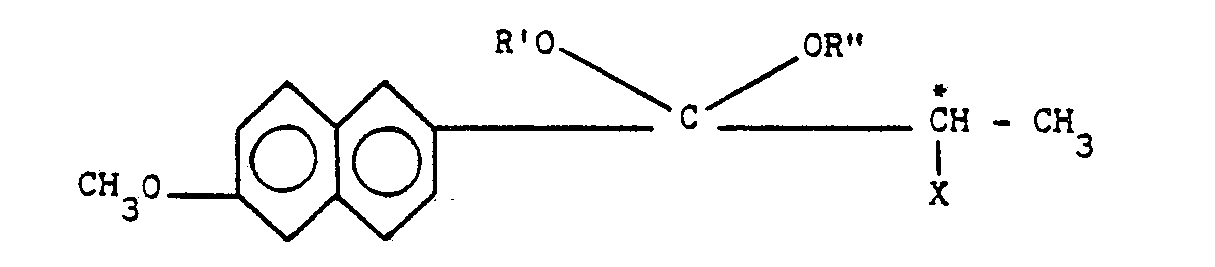
- In a specific embodiment thereof, the invention comprises the preparation of d isomer of 2-(6-methoxy-2-naphthyl)-propionic acid known as Naproxen, according to the reactions 1 and 2 reported above, starting from a compound of formula

- The starting products of the process being the object of the present invention, and precisely the optically active ketals of formula (I), are prepared according to methods per se known, and in particular by means of conventional techniques of ketalization of optically active ketones.
- Depending on the selected type of ketalization, it will be possible to have the preservation of the configuration, with respect to the initial optically active ketone, or the inversion of the configuration.
- The optically active ketones necessary for the preparation of ketals of formula (I) can be prepared by means of the Friedal-Crafts reaction, as disclosed in European Patent Appl. N° 67698, or following the Grignard, and similar reactions, as disclosed in European Patent Appl. N° 81993. Of course, the present invention is not to be intended as being limited to the case wherein the optically active ketals are prepared as previously briefly mentioned, but it comprises the rearrangement of optically active (alpha-haloalkyl)-aryl-ketals independently from the methods by which these latter are prepared.
- As previously mentioned, the process being the object of the present invention is formed by a rearrangement step, and a subsequent hydrolysis step.
- The rearrangement of optically active (alpha-haloalkyl)-aryl-ketals is carried out under neutral or slightly alkaline conditions, in the presence of a polar protic medium.
- The neutral or slightly alkaline conditions are obtained by using organic or inorganic weak bases or buffers.
- Examples of weak bases useful are aliphatic or aromatic tertiary amines, alkaline or alkaline-earth salts of weak acids such as sodium bicarbonate, calcium carbonate, potassium acetate, etc.
- The polar protic medium wherein the reaction occurs comprises water, alcohols and glycols or their mixtures.
- As specific examples of alcohols, methanol, ethanol, butanol, isobutanol, sec.butanol, 2-decanol, allyl alcohol, and more generally primary, secondary or tertiary Cl-Cl2 alcohols, may be mentioned.
- Similarly, specific examples of glycols comprise ethylene glycol, 1,2-propanediol, 1,3-propanediol, 2,2-dimethyl-1,3-propane-diol, 1,10-decanediol, cis-2-butene-1,4-diol, and in general straight or branched C2―C12 diols.
- In general, a more lipophilic medium (long-chain alcohol or diol) is selected to the purpose of dissolving lower-polarity ketals. The reaction is normally effected at temperatures comprised within the range of from 80° to 200°C.
- The reaction time depends on several factors, such as the reactivity of the starting ketal, the polarity of the medium, and the reaction temperature, and may vary from a few minutes, to about 12 hours.
- At the end of the rearrangement step, the reaction mixture is treated according to conventional techniques for isolating the thus-obtained compound of formula (11).
- The hydrolysis step is then carried out, it too being effected following conventional techniques, mainly with acidic catalysis, thus obtaining the optically active alpha-aryl-alkanoic acid, with a high purity.
- In a practical embodiment thereof, the process according to the present invention is carried out by introducing into the reaction vessel the optically active ketal, an amount of weak base or of buffer as to assure a neutral or slightly alkaline pH value, and such an amount of polar protic substance sufficient for at least partially dissolving the ketal.
- The reaction mixture is then heated under stirring to a temperature of from 80° to 200°C, and the course of the reaction is followed by means of conventional techniques (GLC, TLC or IR spectroscopy). At the end of the rearrangement reaction, the reaction mixture is poured into water or diluted, the reaction product (compound of formula [II]) is extracted with a suitable organic solvent, and isolated.
- Then, the hydrolysis of the compound of formula (II) is carried out according to conventional techniques, but preferably by acidic catalysis.
- Alternatively, the hydrolysis of the ester may be effected without isolating it, by adding an aqueous mineral acid to the mixture resulting from the rearrangement reaction.
- To the purpose of better illustrating the invention, the following Examples are now given.
- A mixture of (S) 2-bromo-I,I-dimethoxy-1-(6-methoxy-2-naphthyl)-propane (3.39 g; 10 mmol) (prepared as described in Example 22, page 57, of European Patent Appl. N° 81993), potassium acetate (1.2 g; 12 mmol), 1,2-ethyleneglycol (40 ml) is stirred at the temperature of 125°C for 8 hours.
- After cooling to 25°C, the mixture is diluted with diethyl ether, and filtered. The organic solution is then washed with water and dried on anhydrous sodium sulphate.
- The solvent is eliminated by evaporation under reduced pressure, and the residue is diluted with dimethoxyethane (30 ml) and 10N hydrochloric acid (30 ml).
- The mixture is maintained at 50°C for 24 hours, and is then diluted with water and extracted with diethyl ether.
- The combined organic phases are washed with water, and dried on anhydrous sodium sulphate.
- After evaporation of the solvent under reduced pressure, (S)-2-(6-methoxy-2-naphthyl)-propionic acid (d isomer) is obtained, having an optical purity reflecting the purity of the starting product. Yield 82%; m.p. 155-156°C.
- A mixture of (+) (S) 2-(1'-bromoethyl)-2-(6'-methoxy-2'-naphthyl)-1,3-dioxolane (2.68 g; 0.008 mol), disodium phosphate (1.36 g; 0.0095 mol), monopotassium phosphate (1.44 g; 0.01 mol) and ethylene glycol (40 ml) is heated to 125°C for 16 hours.
- By following the procedure of Example 1, there is obtained (+) (S) 2-(6-methoxy-2-naphthyl)-propionic acid (1.25 g; 0.005 mol). Yield, 62.5%; m.p. 155-156°C.
- A mixture of (+) (S) 2-(1'-bromoethyl)-2-(6'-methoxy-2'-naphthyl)-1,3-dioxolane (13.48 g; 0.042 mol), potassium bicarbonate (6 g; 0.06 mol) and ethylene glycol (200 ml) is heated to 125°C for 18 hours.
- By following the procedure of Example 1, there is obtained (+) (S) 2-(6-methoxy-2-naphthyl)-propionic acid (6.91 g; 0.03 mol). Yield, 71.5%; m.p. 155-156°C.
- A mixture of (+) (S) 2-(1'-bromoethyl)-2-(6'-methoxy-2'-naphthyl)-1,3-dioxane (3.51 g; 0.01 mol), potassium acetate (1.2 g; 0.012 mol) and 1,3-propanediol (50 ml) is heated to 125°C for 8 hours.
- By following the procedure of Example 1, there is obtained (+) (S)-2-(6-methoxy-2-naphthyl)-propionic acid (2.25 g; 0.0098 mol). Yield, 98%; m.p. 155-1560C.
Claims (7)

Priority Applications (1)
| Application Number | Priority Date | Filing Date | Title |
|---|---|---|---|
| AT85101878T ATE32058T1 (en) | 1984-02-24 | 1985-02-21 | PROCESSES FOR THE PREPARATION OF OPTICALLY ACTIVE ALPHA-ARYL CANOCEAN ACIDS. |
Applications Claiming Priority (2)
| Application Number | Priority Date | Filing Date | Title |
|---|---|---|---|
| IT8419783A IT1173369B (en) | 1984-02-24 | 1984-02-24 | PROCESS FOR THE PREPARATION OF OPTICALLY ACTIVE ALFA-ARILALCANOIC ACIDS |
| IT1978384 | 1984-02-24 |
Publications (2)
| Publication Number | Publication Date |
|---|---|
| EP0154853A1 EP0154853A1 (en) | 1985-09-18 |
| EP0154853B1 true EP0154853B1 (en) | 1988-01-20 |
Family
ID=11161179
Family Applications (1)
| Application Number | Title | Priority Date | Filing Date |
|---|---|---|---|
| EP85101878A Expired EP0154853B1 (en) | 1984-02-24 | 1985-02-21 | Process for the preparation of optically active alpha-arylalkanoic acids |
Country Status (6)
| Country | Link |
|---|---|
| US (1) | US4582930A (en) |
| EP (1) | EP0154853B1 (en) |
| JP (1) | JPS60208942A (en) |
| AT (1) | ATE32058T1 (en) |
| DE (1) | DE3561455D1 (en) |
| IT (1) | IT1173369B (en) |
Families Citing this family (6)
| Publication number | Priority date | Publication date | Assignee | Title |
|---|---|---|---|---|
| IT1174084B (en) * | 1984-05-10 | 1987-07-01 | Blaschim Spa | PROCEDURE TO PREPARE NAPROXEN |
| ES8700649A1 (en) * | 1984-07-11 | 1986-11-16 | Blaschim Spa | Process for the preparation of arylalkanoic acids by oxidative rearrangement of arylalkanones |
| IT1188181B (en) * | 1985-07-31 | 1988-01-07 | Zambon Spa | PROCESS FOR THE PREPARATION OF OPTICALLY ACTIVE AND INTERMEDIATE CARBOXYLIC ACIDS |
| IT1201443B (en) * | 1985-07-31 | 1989-02-02 | Zambon Spa | INTERMEDIATES FOR THE SYNTHESIS OF CARBOXYLIC ACIDS |
| IT1198237B (en) * | 1986-12-23 | 1988-12-21 | Zambon Spa | INTERMEDIATES FOR THE SYNTHESIS OF ORGANIC COMPOUNDS |
| US4761497A (en) * | 1987-10-13 | 1988-08-02 | Eastman Kodak Company | Process for preparing 2-naphthanoic acids and esters thereof |
Family Cites Families (3)
| Publication number | Priority date | Publication date | Assignee | Title |
|---|---|---|---|---|
| FR2416214A1 (en) * | 1978-02-02 | 1979-08-31 | Inst Rech Scient Irs | DERIVATIVES OF NAPHTHYL-1 ACETIC ACID, THEIR METHOD OF PREPARATION AND THEIR THERAPEUTIC APPLICATION |
| DE3362024D1 (en) * | 1982-08-06 | 1986-03-13 | Zambon Spa | Process for preparing alpha arylalkanoic acids |
| IT1210947B (en) * | 1982-11-03 | 1989-09-29 | Zambon Spa | PROCEDURE FOR PREPARING ARILALCANOIC ACID ESTERS |
-
1984
- 1984-02-24 IT IT8419783A patent/IT1173369B/en active
-
1985
- 1985-02-21 EP EP85101878A patent/EP0154853B1/en not_active Expired
- 1985-02-21 DE DE8585101878T patent/DE3561455D1/en not_active Expired
- 1985-02-21 AT AT85101878T patent/ATE32058T1/en not_active IP Right Cessation
- 1985-02-22 US US06/704,407 patent/US4582930A/en not_active Expired - Lifetime
- 1985-02-25 JP JP60036260A patent/JPS60208942A/en active Pending
Also Published As
| Publication number | Publication date |
|---|---|
| ATE32058T1 (en) | 1988-02-15 |
| JPS60208942A (en) | 1985-10-21 |
| IT8419783A0 (en) | 1984-02-24 |
| US4582930A (en) | 1986-04-15 |
| IT1173369B (en) | 1987-06-24 |
| EP0154853A1 (en) | 1985-09-18 |
| DE3561455D1 (en) | 1988-02-25 |
Similar Documents
| Publication | Publication Date | Title |
|---|---|---|
| EP0158255B1 (en) | Optically active ketals, processes for their preparation and their use in the synthesis of apha-arylakanoic acids | |
| EP0081993B1 (en) | Optically active alpha-substituted aryl ketones, their preparation and their use in preparing alpha-arylalkanoic acids | |
| Hertel et al. | Preparation and storage of (R)-2, 3-O-isopropylideneglyceraldehyde (D-glyceraldehyde acetonide) | |
| US4605758A (en) | Preparation of α-arylalkanoic acids | |
| US4582930A (en) | Process for the preparation of optically active alpha-arylalkanoic acids | |
| US4542237A (en) | Manufacture of alpha-arylalkanoic acids and precursors | |
| JP3357127B2 (en) | Insecticidal N'-substituted-N, N'-diacylhydrazine | |
| EP0153701B1 (en) | Process for the preparation of optically active alpha-arylalkanoic acids | |
| EP0151702B1 (en) | Alpha-hydroxyketone acetals | |
| EP0273528A1 (en) | Benzophenones and their preparation | |
| US4501913A (en) | Process for preparing esters of aryl alkanoic acids | |
| US4851588A (en) | Novel process for the preparation of bronopol | |
| EP0007652B1 (en) | Derivatives of 3-azabicyclo(3.1.0)hexane and a process for their preparation | |
| US4663465A (en) | Preparation of 2,2-dimethyl-3-aryl-cyclopropanecarboxylic acid and esters and new intermediates therefor | |
| EP0178580B1 (en) | Intermediates for the synthesis of carboxylic acids | |
| US4709081A (en) | Process for the preparation of diphenyl ether derivatives | |
| JPS5989638A (en) | Method for producing aryloxyalkyl compound | |
| EP0040478A1 (en) | Process for preparing pyridine derivatives and intermediates useful in the process | |
| US4398043A (en) | Process for preparing cyclopentenolones | |
| JP2710837B2 (en) | Method for producing optically active β-hydroxythioester | |
| JP4643842B2 (en) | Method for producing 3,5-bisalkylphenol | |
| US4389527A (en) | Process for the preparation of dihydrocinnamaldehyde derivatives | |
| HU192451B (en) | Process for preparing alpha-sulphonyl-oxy- ketone-acetal derivatives | |
| SU883007A1 (en) | Method of preparing diester derivatives of p-oxybenzoic acid | |
| EP0380316A2 (en) | Preparation of alpha-methylareneacetic acids |
Legal Events
| Date | Code | Title | Description |
|---|---|---|---|
| PUAI | Public reference made under article 153(3) epc to a published international application that has entered the european phase |
Free format text: ORIGINAL CODE: 0009012 |
|
| AK | Designated contracting states |
Designated state(s): AT BE CH DE FR GB IT LI LU NL SE |
|
| 17P | Request for examination filed |
Effective date: 19851220 |
|
| 17Q | First examination report despatched |
Effective date: 19860718 |
|
| GRAA | (expected) grant |
Free format text: ORIGINAL CODE: 0009210 |
|
| ITF | It: translation for a ep patent filed | ||
| AK | Designated contracting states |
Kind code of ref document: B1 Designated state(s): AT BE CH DE FR GB IT LI LU NL SE |
|
| REF | Corresponds to: |
Ref document number: 32058 Country of ref document: AT Date of ref document: 19880215 Kind code of ref document: T |
|
| REF | Corresponds to: |
Ref document number: 3561455 Country of ref document: DE Date of ref document: 19880225 |
|
| ET | Fr: translation filed | ||
| PLBI | Opposition filed |
Free format text: ORIGINAL CODE: 0009260 |
|
| 26 | Opposition filed |
Opponent name: SYNTEX PHARMACEUTICALS INTERNATIONAL LIMITED Effective date: 19881020 Opponent name: BLASCHIM S.P.A. Effective date: 19881020 |
|
| NLR1 | Nl: opposition has been filed with the epo |
Opponent name: SYNTEX PHARMACEUTICALS INTERNATIONAL LIMITED Opponent name: BLASCHIM S.P.A. |
|
| ITTA | It: last paid annual fee | ||
| PLBN | Opposition rejected |
Free format text: ORIGINAL CODE: 0009273 |
|
| STAA | Information on the status of an ep patent application or granted ep patent |
Free format text: STATUS: OPPOSITION REJECTED |
|
| 27O | Opposition rejected |
Effective date: 19910325 |
|
| NLR2 | Nl: decision of opposition | ||
| PGFP | Annual fee paid to national office [announced via postgrant information from national office to epo] |
Ref country code: LU Payment date: 19940731 Year of fee payment: 10 |
|
| EPTA | Lu: last paid annual fee | ||
| EAL | Se: european patent in force in sweden |
Ref document number: 85101878.8 |
|
| PG25 | Lapsed in a contracting state [announced via postgrant information from national office to epo] |
Ref country code: LU Free format text: LAPSE BECAUSE OF NON-PAYMENT OF DUE FEES Effective date: 19950221 |
|
| PGFP | Annual fee paid to national office [announced via postgrant information from national office to epo] |
Ref country code: BE Payment date: 20000203 Year of fee payment: 16 |
|
| PGFP | Annual fee paid to national office [announced via postgrant information from national office to epo] |
Ref country code: CH Payment date: 20000209 Year of fee payment: 16 |
|
| PGFP | Annual fee paid to national office [announced via postgrant information from national office to epo] |
Ref country code: GB Payment date: 20000216 Year of fee payment: 16 |
|
| PGFP | Annual fee paid to national office [announced via postgrant information from national office to epo] |
Ref country code: SE Payment date: 20000218 Year of fee payment: 16 |
|
| PGFP | Annual fee paid to national office [announced via postgrant information from national office to epo] |
Ref country code: FR Payment date: 20000224 Year of fee payment: 16 |
|
| PGFP | Annual fee paid to national office [announced via postgrant information from national office to epo] |
Ref country code: AT Payment date: 20000225 Year of fee payment: 16 |
|
| PGFP | Annual fee paid to national office [announced via postgrant information from national office to epo] |
Ref country code: NL Payment date: 20000229 Year of fee payment: 16 |
|
| PGFP | Annual fee paid to national office [announced via postgrant information from national office to epo] |
Ref country code: DE Payment date: 20000427 Year of fee payment: 16 |
|
| PG25 | Lapsed in a contracting state [announced via postgrant information from national office to epo] |
Ref country code: GB Free format text: LAPSE BECAUSE OF NON-PAYMENT OF DUE FEES Effective date: 20010221 Ref country code: AT Free format text: LAPSE BECAUSE OF NON-PAYMENT OF DUE FEES Effective date: 20010221 |
|
| PG25 | Lapsed in a contracting state [announced via postgrant information from national office to epo] |
Ref country code: SE Free format text: LAPSE BECAUSE OF NON-PAYMENT OF DUE FEES Effective date: 20010222 |
|
| PG25 | Lapsed in a contracting state [announced via postgrant information from national office to epo] |
Ref country code: LI Free format text: LAPSE BECAUSE OF NON-PAYMENT OF DUE FEES Effective date: 20010228 Ref country code: CH Free format text: LAPSE BECAUSE OF NON-PAYMENT OF DUE FEES Effective date: 20010228 Ref country code: BE Free format text: LAPSE BECAUSE OF NON-PAYMENT OF DUE FEES Effective date: 20010228 |
|
| BERE | Be: lapsed |
Owner name: ZAMBON S.P.A. Effective date: 20010228 |
|
| PG25 | Lapsed in a contracting state [announced via postgrant information from national office to epo] |
Ref country code: NL Free format text: LAPSE BECAUSE OF NON-PAYMENT OF DUE FEES Effective date: 20010901 |
|
| REG | Reference to a national code |
Ref country code: CH Ref legal event code: PL |
|
| EUG | Se: european patent has lapsed |
Ref document number: 85101878.8 |
|
| GBPC | Gb: european patent ceased through non-payment of renewal fee |
Effective date: 20010221 |
|
| PG25 | Lapsed in a contracting state [announced via postgrant information from national office to epo] |
Ref country code: FR Free format text: LAPSE BECAUSE OF NON-PAYMENT OF DUE FEES Effective date: 20011031 |
|
| NLV4 | Nl: lapsed or anulled due to non-payment of the annual fee |
Effective date: 20010901 |
|
| REG | Reference to a national code |
Ref country code: FR Ref legal event code: ST |
|
| PG25 | Lapsed in a contracting state [announced via postgrant information from national office to epo] |
Ref country code: DE Free format text: LAPSE BECAUSE OF NON-PAYMENT OF DUE FEES Effective date: 20011201 |