EP0148883B1 - Allopurinol prodrugs - Google Patents
Allopurinol prodrugs Download PDFInfo
- Publication number
- EP0148883B1 EP0148883B1 EP84902508A EP84902508A EP0148883B1 EP 0148883 B1 EP0148883 B1 EP 0148883B1 EP 84902508 A EP84902508 A EP 84902508A EP 84902508 A EP84902508 A EP 84902508A EP 0148883 B1 EP0148883 B1 EP 0148883B1
- Authority
- EP
- European Patent Office
- Prior art keywords
- formula
- group
- allopurinol
- compound
- salts
- Prior art date
- Legal status (The legal status is an assumption and is not a legal conclusion. Google has not performed a legal analysis and makes no representation as to the accuracy of the status listed.)
- Expired - Lifetime
Links
- OFCNXPDARWKPPY-UHFFFAOYSA-N allopurinol Chemical compound OC1=NC=NC2=C1C=NN2 OFCNXPDARWKPPY-UHFFFAOYSA-N 0.000 title claims abstract description 226
- 229960003459 allopurinol Drugs 0.000 title claims abstract description 216
- 229940002612 prodrug Drugs 0.000 title abstract description 36
- 239000000651 prodrug Substances 0.000 title abstract description 36
- 150000001875 compounds Chemical class 0.000 claims abstract description 207
- 150000003839 salts Chemical class 0.000 claims abstract description 51
- 229910052739 hydrogen Inorganic materials 0.000 claims abstract description 41
- 239000001257 hydrogen Substances 0.000 claims abstract description 41
- 125000004435 hydrogen atom Chemical group [H]* 0.000 claims abstract description 28
- 125000001997 phenyl group Chemical group [H]C1=C([H])C([H])=C(*)C([H])=C1[H] 0.000 claims abstract description 19
- IJGRMHOSHXDMSA-UHFFFAOYSA-N nitrogen Substances N#N IJGRMHOSHXDMSA-UHFFFAOYSA-N 0.000 claims abstract description 18
- 125000002887 hydroxy group Chemical group [H]O* 0.000 claims abstract description 17
- 229910052757 nitrogen Inorganic materials 0.000 claims abstract description 15
- UFHFLCQGNIYNRP-UHFFFAOYSA-N Hydrogen Chemical compound [H][H] UFHFLCQGNIYNRP-UHFFFAOYSA-N 0.000 claims abstract description 13
- 125000001495 ethyl group Chemical group [H]C([H])([H])C([H])([H])* 0.000 claims abstract description 12
- QJGQUHMNIGDVPM-UHFFFAOYSA-N nitrogen group Chemical group [N] QJGQUHMNIGDVPM-UHFFFAOYSA-N 0.000 claims abstract description 9
- 125000004070 6 membered heterocyclic group Chemical group 0.000 claims abstract description 8
- NINIDFKCEFEMDL-UHFFFAOYSA-N Sulfur Chemical group [S] NINIDFKCEFEMDL-UHFFFAOYSA-N 0.000 claims abstract description 8
- QVGXLLKOCUKJST-UHFFFAOYSA-N atomic oxygen Chemical group [O] QVGXLLKOCUKJST-UHFFFAOYSA-N 0.000 claims abstract description 8
- 125000005842 heteroatom Chemical group 0.000 claims abstract description 8
- 229910052760 oxygen Inorganic materials 0.000 claims abstract description 8
- 239000001301 oxygen Chemical group 0.000 claims abstract description 8
- 229910052717 sulfur Chemical group 0.000 claims abstract description 6
- 239000011593 sulfur Chemical group 0.000 claims abstract description 6
- 125000002373 5 membered heterocyclic group Chemical group 0.000 claims abstract description 4
- 125000004432 carbon atom Chemical group C* 0.000 claims abstract description 4
- 125000004122 cyclic group Chemical group 0.000 claims abstract description 4
- 125000004433 nitrogen atom Chemical group N* 0.000 claims abstract description 4
- 229910052799 carbon Inorganic materials 0.000 claims abstract description 3
- -1 N,N-dimethylglycyloxymethyl Chemical group 0.000 claims description 291
- 238000000034 method Methods 0.000 claims description 52
- 239000000203 mixture Substances 0.000 claims description 30
- 125000006239 protecting group Chemical group 0.000 claims description 28
- 125000004178 (C1-C4) alkyl group Chemical group 0.000 claims description 23
- 238000006243 chemical reaction Methods 0.000 claims description 20
- 125000002924 primary amino group Chemical group [H]N([H])* 0.000 claims description 16
- 125000000229 (C1-C4)alkoxy group Chemical group 0.000 claims description 13
- 229910052736 halogen Inorganic materials 0.000 claims description 12
- 125000003668 acetyloxy group Chemical group [H]C([H])([H])C(=O)O[*] 0.000 claims description 11
- 125000000951 phenoxy group Chemical group [H]C1=C([H])C([H])=C(O*)C([H])=C1[H] 0.000 claims description 11
- 238000011282 treatment Methods 0.000 claims description 7
- 125000005843 halogen group Chemical group 0.000 claims description 6
- 125000004209 (C1-C8) alkyl group Chemical group 0.000 claims description 5
- 201000005569 Gout Diseases 0.000 claims description 4
- 125000003342 alkenyl group Chemical group 0.000 claims description 4
- 239000003937 drug carrier Substances 0.000 claims description 4
- 239000008194 pharmaceutical composition Substances 0.000 claims description 4
- 239000000546 pharmaceutical excipient Substances 0.000 claims description 4
- 230000002265 prevention Effects 0.000 claims description 4
- XLYOFNOQVPJJNP-UHFFFAOYSA-N water Substances O XLYOFNOQVPJJNP-UHFFFAOYSA-N 0.000 abstract description 29
- 125000000217 alkyl group Chemical group 0.000 abstract description 5
- LFQSCWFLJHTTHZ-UHFFFAOYSA-N Ethanol Chemical compound CCO LFQSCWFLJHTTHZ-UHFFFAOYSA-N 0.000 description 43
- YMWUJEATGCHHMB-UHFFFAOYSA-N Dichloromethane Chemical compound ClCCl YMWUJEATGCHHMB-UHFFFAOYSA-N 0.000 description 33
- XEKOWRVHYACXOJ-UHFFFAOYSA-N Ethyl acetate Chemical compound CCOC(C)=O XEKOWRVHYACXOJ-UHFFFAOYSA-N 0.000 description 33
- JUJWROOIHBZHMG-UHFFFAOYSA-N Pyridine Chemical compound C1=CC=NC=C1 JUJWROOIHBZHMG-UHFFFAOYSA-N 0.000 description 26
- 239000000243 solution Substances 0.000 description 26
- ZMXDDKWLCZADIW-UHFFFAOYSA-N N,N-Dimethylformamide Chemical compound CN(C)C=O ZMXDDKWLCZADIW-UHFFFAOYSA-N 0.000 description 24
- OKKJLVBELUTLKV-UHFFFAOYSA-N Methanol Chemical compound OC OKKJLVBELUTLKV-UHFFFAOYSA-N 0.000 description 18
- VEXZGXHMUGYJMC-UHFFFAOYSA-N Hydrochloric acid Chemical compound Cl VEXZGXHMUGYJMC-UHFFFAOYSA-N 0.000 description 15
- 238000002360 preparation method Methods 0.000 description 15
- UMJSCPRVCHMLSP-UHFFFAOYSA-N pyridine Natural products COC1=CC=CN=C1 UMJSCPRVCHMLSP-UHFFFAOYSA-N 0.000 description 13
- 229950002752 oxipurinol Drugs 0.000 description 12
- HXNFUBHNUDHIGC-UHFFFAOYSA-N oxypurinol Chemical compound O=C1NC(=O)N=C2NNC=C21 HXNFUBHNUDHIGC-UHFFFAOYSA-N 0.000 description 12
- 229940093499 ethyl acetate Drugs 0.000 description 11
- 235000019439 ethyl acetate Nutrition 0.000 description 11
- 239000002244 precipitate Substances 0.000 description 11
- 238000001953 recrystallisation Methods 0.000 description 11
- 239000000829 suppository Substances 0.000 description 11
- QOSSAOTZNIDXMA-UHFFFAOYSA-N Dicylcohexylcarbodiimide Chemical compound C1CCCCC1N=C=NC1CCCCC1 QOSSAOTZNIDXMA-UHFFFAOYSA-N 0.000 description 10
- IAZDPXIOMUYVGZ-UHFFFAOYSA-N Dimethylsulphoxide Chemical compound CS(C)=O IAZDPXIOMUYVGZ-UHFFFAOYSA-N 0.000 description 10
- 229940079593 drug Drugs 0.000 description 10
- 239000003814 drug Substances 0.000 description 10
- CSCPPACGZOOCGX-UHFFFAOYSA-N Acetone Chemical compound CC(C)=O CSCPPACGZOOCGX-UHFFFAOYSA-N 0.000 description 9
- 241000282414 Homo sapiens Species 0.000 description 9
- 241001465754 Metazoa Species 0.000 description 8
- 239000007920 enema Substances 0.000 description 8
- SSOLNOMRVKKSON-UHFFFAOYSA-N proguanil Chemical compound CC(C)\N=C(/N)N=C(N)NC1=CC=C(Cl)C=C1 SSOLNOMRVKKSON-UHFFFAOYSA-N 0.000 description 8
- 238000010521 absorption reaction Methods 0.000 description 7
- 229940079360 enema for constipation Drugs 0.000 description 7
- 150000002367 halogens Chemical group 0.000 description 7
- 239000002904 solvent Substances 0.000 description 7
- 239000000725 suspension Substances 0.000 description 7
- WFDIJRYMOXRFFG-UHFFFAOYSA-N Acetic anhydride Chemical compound CC(=O)OC(C)=O WFDIJRYMOXRFFG-UHFFFAOYSA-N 0.000 description 6
- 241000282412 Homo Species 0.000 description 6
- 241000283973 Oryctolagus cuniculus Species 0.000 description 6
- 230000036470 plasma concentration Effects 0.000 description 6
- 238000009835 boiling Methods 0.000 description 5
- 239000000706 filtrate Substances 0.000 description 5
- 238000004128 high performance liquid chromatography Methods 0.000 description 5
- 231100000252 nontoxic Toxicity 0.000 description 5
- 230000003000 nontoxic effect Effects 0.000 description 5
- 239000000047 product Substances 0.000 description 5
- LRFVTYWOQMYALW-UHFFFAOYSA-N 9H-xanthine Chemical compound O=C1NC(=O)NC2=C1NC=N2 LRFVTYWOQMYALW-UHFFFAOYSA-N 0.000 description 4
- 0 CN(C1)CNc2c1cn[n]2* Chemical compound CN(C1)CNc2c1cn[n]2* 0.000 description 4
- CPELXLSAUQHCOX-UHFFFAOYSA-N Hydrogen bromide Chemical compound Br CPELXLSAUQHCOX-UHFFFAOYSA-N 0.000 description 4
- FFDGPVCHZBVARC-UHFFFAOYSA-N N,N-dimethylglycine Chemical compound CN(C)CC(O)=O FFDGPVCHZBVARC-UHFFFAOYSA-N 0.000 description 4
- 239000007864 aqueous solution Substances 0.000 description 4
- 239000002585 base Substances 0.000 description 4
- 230000015572 biosynthetic process Effects 0.000 description 4
- 125000000484 butyl group Chemical group [H]C([*])([H])C([H])([H])C([H])([H])C([H])([H])[H] 0.000 description 4
- 239000003795 chemical substances by application Substances 0.000 description 4
- 238000009472 formulation Methods 0.000 description 4
- 125000004029 hydroxymethyl group Chemical group [H]OC([H])([H])* 0.000 description 4
- 239000003208 petroleum Substances 0.000 description 4
- BWHMMNNQKKPAPP-UHFFFAOYSA-L potassium carbonate Chemical compound [K+].[K+].[O-]C([O-])=O BWHMMNNQKKPAPP-UHFFFAOYSA-L 0.000 description 4
- 239000007787 solid Substances 0.000 description 4
- 125000001424 substituent group Chemical group 0.000 description 4
- JOXIMZWYDAKGHI-UHFFFAOYSA-N toluene-4-sulfonic acid Chemical compound CC1=CC=C(S(O)(=O)=O)C=C1 JOXIMZWYDAKGHI-UHFFFAOYSA-N 0.000 description 4
- 230000001052 transient effect Effects 0.000 description 4
- QTBSBXVTEAMEQO-UHFFFAOYSA-N Acetic acid Chemical compound CC(O)=O QTBSBXVTEAMEQO-UHFFFAOYSA-N 0.000 description 3
- 241000792859 Enema Species 0.000 description 3
- HEMHJVSKTPXQMS-UHFFFAOYSA-M Sodium hydroxide Chemical compound [OH-].[Na+] HEMHJVSKTPXQMS-UHFFFAOYSA-M 0.000 description 3
- YXFVVABEGXRONW-UHFFFAOYSA-N Toluene Chemical compound CC1=CC=CC=C1 YXFVVABEGXRONW-UHFFFAOYSA-N 0.000 description 3
- ZMANZCXQSJIPKH-UHFFFAOYSA-N Triethylamine Chemical compound CCN(CC)CC ZMANZCXQSJIPKH-UHFFFAOYSA-N 0.000 description 3
- LEHOTFFKMJEONL-UHFFFAOYSA-N Uric Acid Chemical compound N1C(=O)NC(=O)C2=C1NC(=O)N2 LEHOTFFKMJEONL-UHFFFAOYSA-N 0.000 description 3
- TVWHNULVHGKJHS-UHFFFAOYSA-N Uric acid Natural products N1C(=O)NC(=O)C2NC(=O)NC21 TVWHNULVHGKJHS-UHFFFAOYSA-N 0.000 description 3
- 125000002777 acetyl group Chemical group [H]C([H])([H])C(*)=O 0.000 description 3
- 229910052794 bromium Inorganic materials 0.000 description 3
- 125000004063 butyryl group Chemical group O=C([*])C([H])([H])C([H])([H])C([H])([H])[H] 0.000 description 3
- 239000000460 chlorine Substances 0.000 description 3
- 229910052801 chlorine Inorganic materials 0.000 description 3
- 238000004440 column chromatography Methods 0.000 description 3
- 238000012377 drug delivery Methods 0.000 description 3
- MDKXBBPLEGPIRI-UHFFFAOYSA-N ethoxyethane;methanol Chemical compound OC.CCOCC MDKXBBPLEGPIRI-UHFFFAOYSA-N 0.000 description 3
- 238000002474 experimental method Methods 0.000 description 3
- 238000002347 injection Methods 0.000 description 3
- 239000007924 injection Substances 0.000 description 3
- 125000001449 isopropyl group Chemical group [H]C([H])([H])C([H])(*)C([H])([H])[H] 0.000 description 3
- 150000002632 lipids Chemical class 0.000 description 3
- 229920000609 methyl cellulose Polymers 0.000 description 3
- 125000002496 methyl group Chemical group [H]C([H])([H])* 0.000 description 3
- 239000001923 methylcellulose Substances 0.000 description 3
- QAXZWHGWYSJAEI-UHFFFAOYSA-N n,n-dimethylformamide;ethanol Chemical compound CCO.CN(C)C=O QAXZWHGWYSJAEI-UHFFFAOYSA-N 0.000 description 3
- UYWQUFXKFGHYNT-UHFFFAOYSA-N phenylmethyl ester of formic acid Natural products O=COCC1=CC=CC=C1 UYWQUFXKFGHYNT-UHFFFAOYSA-N 0.000 description 3
- 230000035484 reaction time Effects 0.000 description 3
- 239000002511 suppository base Substances 0.000 description 3
- 150000003512 tertiary amines Chemical class 0.000 description 3
- 229940116269 uric acid Drugs 0.000 description 3
- 210000002700 urine Anatomy 0.000 description 3
- PNVPNXKRAUBJGW-UHFFFAOYSA-N (2-chloroacetyl) 2-chloroacetate Chemical compound ClCC(=O)OC(=O)CCl PNVPNXKRAUBJGW-UHFFFAOYSA-N 0.000 description 2
- TYRGLVWXHJRKMT-UHFFFAOYSA-N 2-(phenylmethoxycarbonylamino)propanoic acid Chemical compound OC(=O)C(C)NC(=O)OCC1=CC=CC=C1 TYRGLVWXHJRKMT-UHFFFAOYSA-N 0.000 description 2
- 125000003816 2-hydroxybenzoyl group Chemical group OC1=C(C(=O)*)C=CC=C1 0.000 description 2
- 125000004080 3-carboxypropanoyl group Chemical group O=C([*])C([H])([H])C([H])([H])C(O[H])=O 0.000 description 2
- 125000001999 4-Methoxybenzoyl group Chemical group [H]C1=C([H])C(=C([H])C([H])=C1OC([H])([H])[H])C(*)=O 0.000 description 2
- QCQCHGYLTSGIGX-GHXANHINSA-N 4-[[(3ar,5ar,5br,7ar,9s,11ar,11br,13as)-5a,5b,8,8,11a-pentamethyl-3a-[(5-methylpyridine-3-carbonyl)amino]-2-oxo-1-propan-2-yl-4,5,6,7,7a,9,10,11,11b,12,13,13a-dodecahydro-3h-cyclopenta[a]chrysen-9-yl]oxy]-2,2-dimethyl-4-oxobutanoic acid Chemical compound N([C@@]12CC[C@@]3(C)[C@]4(C)CC[C@H]5C(C)(C)[C@@H](OC(=O)CC(C)(C)C(O)=O)CC[C@]5(C)[C@H]4CC[C@@H]3C1=C(C(C2)=O)C(C)C)C(=O)C1=CN=CC(C)=C1 QCQCHGYLTSGIGX-GHXANHINSA-N 0.000 description 2
- 125000000242 4-chlorobenzoyl group Chemical group ClC1=CC=C(C(=O)*)C=C1 0.000 description 2
- 125000002391 4-chlorocinnamoyl group Chemical group 0.000 description 2
- ZCYVEMRRCGMTRW-UHFFFAOYSA-N 7553-56-2 Chemical compound [I] ZCYVEMRRCGMTRW-UHFFFAOYSA-N 0.000 description 2
- WKBOTKDWSSQWDR-UHFFFAOYSA-N Bromine atom Chemical compound [Br] WKBOTKDWSSQWDR-UHFFFAOYSA-N 0.000 description 2
- ZAMOUSCENKQFHK-UHFFFAOYSA-N Chlorine atom Chemical compound [Cl] ZAMOUSCENKQFHK-UHFFFAOYSA-N 0.000 description 2
- HEDRZPFGACZZDS-UHFFFAOYSA-N Chloroform Chemical compound ClC(Cl)Cl HEDRZPFGACZZDS-UHFFFAOYSA-N 0.000 description 2
- RTZKZFJDLAIYFH-UHFFFAOYSA-N Diethyl ether Chemical compound CCOCC RTZKZFJDLAIYFH-UHFFFAOYSA-N 0.000 description 2
- 108010010803 Gelatin Proteins 0.000 description 2
- 206010028980 Neoplasm Diseases 0.000 description 2
- UIIMBOGNXHQVGW-UHFFFAOYSA-M Sodium bicarbonate Chemical compound [Na+].OC([O-])=O UIIMBOGNXHQVGW-UHFFFAOYSA-M 0.000 description 2
- FAPWRFPIFSIZLT-UHFFFAOYSA-M Sodium chloride Chemical compound [Na+].[Cl-] FAPWRFPIFSIZLT-UHFFFAOYSA-M 0.000 description 2
- 229920002472 Starch Polymers 0.000 description 2
- 239000005864 Sulphur Substances 0.000 description 2
- 239000002253 acid Substances 0.000 description 2
- 125000001980 alanyl group Chemical group 0.000 description 2
- 238000004458 analytical method Methods 0.000 description 2
- 150000008064 anhydrides Chemical class 0.000 description 2
- 239000012062 aqueous buffer Substances 0.000 description 2
- 125000003236 benzoyl group Chemical group [H]C1=C([H])C([H])=C(C([H])=C1[H])C(*)=O 0.000 description 2
- 125000001584 benzyloxycarbonyl group Chemical group C(=O)(OCC1=CC=CC=C1)* 0.000 description 2
- 239000008280 blood Substances 0.000 description 2
- 210000004369 blood Anatomy 0.000 description 2
- 238000010241 blood sampling Methods 0.000 description 2
- GDTBXPJZTBHREO-UHFFFAOYSA-N bromine Substances BrBr GDTBXPJZTBHREO-UHFFFAOYSA-N 0.000 description 2
- YHASWHZGWUONAO-UHFFFAOYSA-N butanoyl butanoate Chemical compound CCCC(=O)OC(=O)CCC YHASWHZGWUONAO-UHFFFAOYSA-N 0.000 description 2
- 125000004744 butyloxycarbonyl group Chemical group 0.000 description 2
- DVECBJCOGJRVPX-UHFFFAOYSA-N butyryl chloride Chemical compound CCCC(Cl)=O DVECBJCOGJRVPX-UHFFFAOYSA-N 0.000 description 2
- 239000002775 capsule Substances 0.000 description 2
- 230000015556 catabolic process Effects 0.000 description 2
- 239000001913 cellulose Substances 0.000 description 2
- 229920002678 cellulose Polymers 0.000 description 2
- 238000003776 cleavage reaction Methods 0.000 description 2
- 238000001816 cooling Methods 0.000 description 2
- 238000006731 degradation reaction Methods 0.000 description 2
- 238000011161 development Methods 0.000 description 2
- 235000014113 dietary fatty acids Nutrition 0.000 description 2
- 108700003601 dimethylglycine Proteins 0.000 description 2
- 239000002552 dosage form Substances 0.000 description 2
- 238000001647 drug administration Methods 0.000 description 2
- 239000000839 emulsion Substances 0.000 description 2
- 239000000284 extract Substances 0.000 description 2
- 239000000194 fatty acid Substances 0.000 description 2
- 229930195729 fatty acid Natural products 0.000 description 2
- 239000008273 gelatin Substances 0.000 description 2
- 229920000159 gelatin Polymers 0.000 description 2
- 235000019322 gelatine Nutrition 0.000 description 2
- 235000011852 gelatine desserts Nutrition 0.000 description 2
- 125000003630 glycyl group Chemical group [H]N([H])C([H])([H])C(*)=O 0.000 description 2
- 230000007062 hydrolysis Effects 0.000 description 2
- 238000006460 hydrolysis reaction Methods 0.000 description 2
- FDGQSTZJBFJUBT-UHFFFAOYSA-N hypoxanthine Chemical compound O=C1NC=NC2=C1NC=N2 FDGQSTZJBFJUBT-UHFFFAOYSA-N 0.000 description 2
- 238000001727 in vivo Methods 0.000 description 2
- 238000001990 intravenous administration Methods 0.000 description 2
- 229910052740 iodine Inorganic materials 0.000 description 2
- 239000011630 iodine Substances 0.000 description 2
- 229950003188 isovaleryl diethylamide Drugs 0.000 description 2
- 125000001998 leucyl group Chemical group 0.000 description 2
- HQKMJHAJHXVSDF-UHFFFAOYSA-L magnesium stearate Chemical compound [Mg+2].CCCCCCCCCCCCCCCCCC([O-])=O.CCCCCCCCCCCCCCCCCC([O-])=O HQKMJHAJHXVSDF-UHFFFAOYSA-L 0.000 description 2
- 239000000463 material Substances 0.000 description 2
- 239000002207 metabolite Substances 0.000 description 2
- 150000007522 mineralic acids Chemical class 0.000 description 2
- 229940078490 n,n-dimethylglycine Drugs 0.000 description 2
- 150000007524 organic acids Chemical class 0.000 description 2
- 235000005985 organic acids Nutrition 0.000 description 2
- 230000003204 osmotic effect Effects 0.000 description 2
- 125000000405 phenylalanyl group Chemical group 0.000 description 2
- 229910000027 potassium carbonate Inorganic materials 0.000 description 2
- 125000001501 propionyl group Chemical group O=C([*])C([H])([H])C([H])([H])[H] 0.000 description 2
- 125000001436 propyl group Chemical group [H]C([*])([H])C([H])([H])C([H])([H])[H] 0.000 description 2
- 230000005855 radiation Effects 0.000 description 2
- 230000007017 scission Effects 0.000 description 2
- 159000000000 sodium salts Chemical class 0.000 description 2
- 230000003595 spectral effect Effects 0.000 description 2
- 239000008107 starch Substances 0.000 description 2
- 235000019698 starch Nutrition 0.000 description 2
- 238000003786 synthesis reaction Methods 0.000 description 2
- 230000036325 urinary excretion Effects 0.000 description 2
- 125000003774 valeryl group Chemical group O=C([*])C([H])([H])C([H])([H])C([H])([H])C([H])([H])[H] 0.000 description 2
- 125000002114 valyl group Chemical group 0.000 description 2
- LZXYBDOUWSRDOU-UHFFFAOYSA-N 1-(hydroxymethyl)-5H-pyrazolo[3,4-d]pyrimidin-4-one Chemical compound N1=CNC(=O)C2=C1N(CO)N=C2 LZXYBDOUWSRDOU-UHFFFAOYSA-N 0.000 description 1
- 125000004343 1-phenylethyl group Chemical group [H]C1=C([H])C([H])=C(C([H])=C1[H])C([H])(*)C([H])([H])[H] 0.000 description 1
- BGWSMDYVVVJGBB-UHFFFAOYSA-N 2-(diethylamino)acetic acid;hydrochloride Chemical compound Cl.CCN(CC)CC(O)=O BGWSMDYVVVJGBB-UHFFFAOYSA-N 0.000 description 1
- KZDCMKVLEYCGQX-UDPGNSCCSA-N 2-(diethylamino)ethyl 4-aminobenzoate;(2s,5r,6r)-3,3-dimethyl-7-oxo-6-[(2-phenylacetyl)amino]-4-thia-1-azabicyclo[3.2.0]heptane-2-carboxylic acid;hydrate Chemical class O.CCN(CC)CCOC(=O)C1=CC=C(N)C=C1.N([C@H]1[C@H]2SC([C@@H](N2C1=O)C(O)=O)(C)C)C(=O)CC1=CC=CC=C1 KZDCMKVLEYCGQX-UDPGNSCCSA-N 0.000 description 1
- YHZCTZGJKHNVQY-UHFFFAOYSA-N 2-(diethylazaniumyl)propanoate Chemical compound CCN(CC)C(C)C(O)=O YHZCTZGJKHNVQY-UHFFFAOYSA-N 0.000 description 1
- MVAXDKDOPWPFML-UHFFFAOYSA-N 2-(dimethylamino)acetyl chloride;hydrochloride Chemical compound [Cl-].C[NH+](C)CC(Cl)=O MVAXDKDOPWPFML-UHFFFAOYSA-N 0.000 description 1
- KSRBEBKFXYLKHC-UHFFFAOYSA-N 2-(dipropylazaniumyl)acetate Chemical compound CCCN(CCC)CC(O)=O KSRBEBKFXYLKHC-UHFFFAOYSA-N 0.000 description 1
- VRPJIFMKZZEXLR-UHFFFAOYSA-N 2-[(2-methylpropan-2-yl)oxycarbonylamino]acetic acid Chemical compound CC(C)(C)OC(=O)NCC(O)=O VRPJIFMKZZEXLR-UHFFFAOYSA-N 0.000 description 1
- 125000002941 2-furyl group Chemical group O1C([*])=C([H])C([H])=C1[H] 0.000 description 1
- RLDJWBVOZVJJOS-UHFFFAOYSA-N 2-phenyl-2-(phenylmethoxycarbonylamino)acetic acid Chemical compound C=1C=CC=CC=1C(C(=O)O)NC(=O)OCC1=CC=CC=C1 RLDJWBVOZVJJOS-UHFFFAOYSA-N 0.000 description 1
- 125000000094 2-phenylethyl group Chemical group [H]C1=C([H])C([H])=C(C([H])=C1[H])C([H])([H])C([H])([H])* 0.000 description 1
- 125000000175 2-thienyl group Chemical group S1C([*])=C([H])C([H])=C1[H] 0.000 description 1
- QBWKPGNFQQJGFY-QLFBSQMISA-N 3-[(1r)-1-[(2r,6s)-2,6-dimethylmorpholin-4-yl]ethyl]-n-[6-methyl-3-(1h-pyrazol-4-yl)imidazo[1,2-a]pyrazin-8-yl]-1,2-thiazol-5-amine Chemical compound N1([C@H](C)C2=NSC(NC=3C4=NC=C(N4C=C(C)N=3)C3=CNN=C3)=C2)C[C@H](C)O[C@H](C)C1 QBWKPGNFQQJGFY-QLFBSQMISA-N 0.000 description 1
- BMYNFMYTOJXKLE-UHFFFAOYSA-N 3-azaniumyl-2-hydroxypropanoate Chemical compound NCC(O)C(O)=O BMYNFMYTOJXKLE-UHFFFAOYSA-N 0.000 description 1
- WSGYTJNNHPZFKR-UHFFFAOYSA-N 3-hydroxypropanenitrile Chemical compound OCCC#N WSGYTJNNHPZFKR-UHFFFAOYSA-N 0.000 description 1
- RRONHWAVOYADJL-UHFFFAOYSA-N 3-phenyl-2-(phenylmethoxycarbonylamino)propanoic acid Chemical compound C=1C=CC=CC=1COC(=O)NC(C(=O)O)CC1=CC=CC=C1 RRONHWAVOYADJL-UHFFFAOYSA-N 0.000 description 1
- 125000006201 3-phenylpropyl group Chemical group [H]C1=C([H])C([H])=C(C([H])=C1[H])C([H])([H])C([H])([H])C([H])([H])* 0.000 description 1
- 125000001541 3-thienyl group Chemical group S1C([H])=C([*])C([H])=C1[H] 0.000 description 1
- XILORGWKMLOGKF-UHFFFAOYSA-N 4-(diethylamino)-4-oxobutanoic acid Chemical compound CCN(CC)C(=O)CCC(O)=O XILORGWKMLOGKF-UHFFFAOYSA-N 0.000 description 1
- OXOWTLDONRGYOT-UHFFFAOYSA-N 4-(dimethylamino)butanoic acid Chemical compound CN(C)CCCC(O)=O OXOWTLDONRGYOT-UHFFFAOYSA-N 0.000 description 1
- KDDQRKBRJSGMQE-UHFFFAOYSA-N 4-thiazolyl Chemical compound [C]1=CSC=N1 KDDQRKBRJSGMQE-UHFFFAOYSA-N 0.000 description 1
- CWDWFSXUQODZGW-UHFFFAOYSA-N 5-thiazolyl Chemical group [C]1=CN=CS1 CWDWFSXUQODZGW-UHFFFAOYSA-N 0.000 description 1
- XVMSFILGAMDHEY-UHFFFAOYSA-N 6-(4-aminophenyl)sulfonylpyridin-3-amine Chemical compound C1=CC(N)=CC=C1S(=O)(=O)C1=CC=C(N)C=N1 XVMSFILGAMDHEY-UHFFFAOYSA-N 0.000 description 1
- HBAQYPYDRFILMT-UHFFFAOYSA-N 8-[3-(1-cyclopropylpyrazol-4-yl)-1H-pyrazolo[4,3-d]pyrimidin-5-yl]-3-methyl-3,8-diazabicyclo[3.2.1]octan-2-one Chemical class C1(CC1)N1N=CC(=C1)C1=NNC2=C1N=C(N=C2)N1C2C(N(CC1CC2)C)=O HBAQYPYDRFILMT-UHFFFAOYSA-N 0.000 description 1
- LSNNMFCWUKXFEE-UHFFFAOYSA-M Bisulfite Chemical compound OS([O-])=O LSNNMFCWUKXFEE-UHFFFAOYSA-M 0.000 description 1
- BVKZGUZCCUSVTD-UHFFFAOYSA-L Carbonate Chemical compound [O-]C([O-])=O BVKZGUZCCUSVTD-UHFFFAOYSA-L 0.000 description 1
- 102000004190 Enzymes Human genes 0.000 description 1
- 108090000790 Enzymes Proteins 0.000 description 1
- 238000010268 HPLC based assay Methods 0.000 description 1
- 201000001431 Hyperuricemia Diseases 0.000 description 1
- 206010051364 Hyperuricosuria Diseases 0.000 description 1
- UGQMRVRMYYASKQ-UHFFFAOYSA-N Hypoxanthine nucleoside Natural products OC1C(O)C(CO)OC1N1C(NC=NC2=O)=C2N=C1 UGQMRVRMYYASKQ-UHFFFAOYSA-N 0.000 description 1
- 206010061218 Inflammation Diseases 0.000 description 1
- GUBGYTABKSRVRQ-QKKXKWKRSA-N Lactose Natural products OC[C@H]1O[C@@H](O[C@H]2[C@H](O)[C@@H](O)C(O)O[C@@H]2CO)[C@H](O)[C@@H](O)[C@H]1O GUBGYTABKSRVRQ-QKKXKWKRSA-N 0.000 description 1
- 229920001214 Polysorbate 60 Polymers 0.000 description 1
- 241000288906 Primates Species 0.000 description 1
- VYPSYNLAJGMNEJ-UHFFFAOYSA-N Silicium dioxide Chemical compound O=[Si]=O VYPSYNLAJGMNEJ-UHFFFAOYSA-N 0.000 description 1
- 206010047700 Vomiting Diseases 0.000 description 1
- 108010093894 Xanthine oxidase Proteins 0.000 description 1
- 102100033220 Xanthine oxidase Human genes 0.000 description 1
- 239000008351 acetate buffer Substances 0.000 description 1
- 125000004423 acyloxy group Chemical group 0.000 description 1
- 239000000654 additive Substances 0.000 description 1
- 125000001931 aliphatic group Chemical group 0.000 description 1
- 229910000288 alkali metal carbonate Inorganic materials 0.000 description 1
- 150000008041 alkali metal carbonates Chemical class 0.000 description 1
- 239000012670 alkaline solution Substances 0.000 description 1
- 238000013459 approach Methods 0.000 description 1
- WPYMKLBDIGXBTP-UHFFFAOYSA-N benzoic acid group Chemical group C(C1=CC=CC=C1)(=O)O WPYMKLBDIGXBTP-UHFFFAOYSA-N 0.000 description 1
- CHIHQLCVLOXUJW-UHFFFAOYSA-N benzoic anhydride Chemical compound C=1C=CC=CC=1C(=O)OC(=O)C1=CC=CC=C1 CHIHQLCVLOXUJW-UHFFFAOYSA-N 0.000 description 1
- PASDCCFISLVPSO-UHFFFAOYSA-N benzoyl chloride Chemical compound ClC(=O)C1=CC=CC=C1 PASDCCFISLVPSO-UHFFFAOYSA-N 0.000 description 1
- 125000001797 benzyl group Chemical group [H]C1=C([H])C([H])=C(C([H])=C1[H])C([H])([H])* 0.000 description 1
- 239000011230 binding agent Substances 0.000 description 1
- 239000000872 buffer Substances 0.000 description 1
- 125000004369 butenyl group Chemical group C(=CCC)* 0.000 description 1
- 239000006227 byproduct Substances 0.000 description 1
- 201000011510 cancer Diseases 0.000 description 1
- 125000003917 carbamoyl group Chemical group [H]N([H])C(*)=O 0.000 description 1
- 150000001718 carbodiimides Chemical class 0.000 description 1
- 238000005119 centrifugation Methods 0.000 description 1
- 239000003153 chemical reaction reagent Substances 0.000 description 1
- 238000002512 chemotherapy Methods 0.000 description 1
- 125000002668 chloroacetyl group Chemical group ClCC(=O)* 0.000 description 1
- GGRHYQCXXYLUTL-UHFFFAOYSA-N chloromethyl 2,2-dimethylpropanoate Chemical compound CC(C)(C)C(=O)OCCl GGRHYQCXXYLUTL-UHFFFAOYSA-N 0.000 description 1
- BDPZFQLKFUONAG-UHFFFAOYSA-N chloromethyl butanoate Chemical compound CCCC(=O)OCCl BDPZFQLKFUONAG-UHFFFAOYSA-N 0.000 description 1
- 230000001684 chronic effect Effects 0.000 description 1
- 229940110456 cocoa butter Drugs 0.000 description 1
- 235000019868 cocoa butter Nutrition 0.000 description 1
- 230000000052 comparative effect Effects 0.000 description 1
- 229940125846 compound 25 Drugs 0.000 description 1
- 239000012043 crude product Substances 0.000 description 1
- 238000002425 crystallisation Methods 0.000 description 1
- 230000008025 crystallization Effects 0.000 description 1
- 230000009089 cytolysis Effects 0.000 description 1
- 231100000433 cytotoxic Toxicity 0.000 description 1
- 230000001472 cytotoxic effect Effects 0.000 description 1
- 239000012024 dehydrating agents Substances 0.000 description 1
- 230000001419 dependent effect Effects 0.000 description 1
- IJKVHSBPTUYDLN-UHFFFAOYSA-N dihydroxy(oxo)silane Chemical compound O[Si](O)=O IJKVHSBPTUYDLN-UHFFFAOYSA-N 0.000 description 1
- 201000010099 disease Diseases 0.000 description 1
- 208000037265 diseases, disorders, signs and symptoms Diseases 0.000 description 1
- 239000003480 eluent Substances 0.000 description 1
- 229940095399 enema Drugs 0.000 description 1
- LJQKCYFTNDAAPC-UHFFFAOYSA-N ethanol;ethyl acetate Chemical compound CCO.CCOC(C)=O LJQKCYFTNDAAPC-UHFFFAOYSA-N 0.000 description 1
- 150000002170 ethers Chemical class 0.000 description 1
- 125000001301 ethoxy group Chemical group [H]C([H])([H])C([H])([H])O* 0.000 description 1
- 125000003754 ethoxycarbonyl group Chemical group C(=O)(OCC)* 0.000 description 1
- LJWKFGGDMBPPAZ-UHFFFAOYSA-N ethoxyethane;toluene Chemical compound CCOCC.CC1=CC=CC=C1 LJWKFGGDMBPPAZ-UHFFFAOYSA-N 0.000 description 1
- RIFGWPKJUGCATF-UHFFFAOYSA-N ethyl chloroformate Chemical compound CCOC(Cl)=O RIFGWPKJUGCATF-UHFFFAOYSA-N 0.000 description 1
- 150000004665 fatty acids Chemical class 0.000 description 1
- 238000001914 filtration Methods 0.000 description 1
- 229910052731 fluorine Inorganic materials 0.000 description 1
- 125000002485 formyl group Chemical group [H]C(*)=O 0.000 description 1
- 239000004083 gastrointestinal agent Substances 0.000 description 1
- 229940127227 gastrointestinal drug Drugs 0.000 description 1
- 239000007903 gelatin capsule Substances 0.000 description 1
- 125000003187 heptyl group Chemical group [H]C([*])([H])C([H])([H])C([H])([H])C([H])([H])C([H])([H])C([H])([H])C([H])([H])[H] 0.000 description 1
- 125000004051 hexyl group Chemical group [H]C([H])([H])C([H])([H])C([H])([H])C([H])([H])C([H])([H])C([H])([H])* 0.000 description 1
- 125000005935 hexyloxycarbonyl group Chemical group 0.000 description 1
- 238000005984 hydrogenation reaction Methods 0.000 description 1
- 238000000338 in vitro Methods 0.000 description 1
- 230000004054 inflammatory process Effects 0.000 description 1
- 238000001802 infusion Methods 0.000 description 1
- 239000003978 infusion fluid Substances 0.000 description 1
- 230000002401 inhibitory effect Effects 0.000 description 1
- 238000007918 intramuscular administration Methods 0.000 description 1
- 238000010255 intramuscular injection Methods 0.000 description 1
- 239000007927 intramuscular injection Substances 0.000 description 1
- 239000008101 lactose Substances 0.000 description 1
- 239000000314 lubricant Substances 0.000 description 1
- 235000019359 magnesium stearate Nutrition 0.000 description 1
- 230000014759 maintenance of location Effects 0.000 description 1
- 230000036210 malignancy Effects 0.000 description 1
- 238000005259 measurement Methods 0.000 description 1
- 238000005374 membrane filtration Methods 0.000 description 1
- 230000002503 metabolic effect Effects 0.000 description 1
- 229910052751 metal Inorganic materials 0.000 description 1
- 239000002184 metal Substances 0.000 description 1
- 125000000956 methoxy group Chemical group [H]C([H])([H])O* 0.000 description 1
- 125000001160 methoxycarbonyl group Chemical group [H]C([H])([H])OC(*)=O 0.000 description 1
- 125000002757 morpholinyl group Chemical group 0.000 description 1
- SYSQUGFVNFXIIT-UHFFFAOYSA-N n-[4-(1,3-benzoxazol-2-yl)phenyl]-4-nitrobenzenesulfonamide Chemical class C1=CC([N+](=O)[O-])=CC=C1S(=O)(=O)NC1=CC=C(C=2OC3=CC=CC=C3N=2)C=C1 SYSQUGFVNFXIIT-UHFFFAOYSA-N 0.000 description 1
- 125000004123 n-propyl group Chemical group [H]C([H])([H])C([H])([H])C([H])([H])* 0.000 description 1
- 230000001613 neoplastic effect Effects 0.000 description 1
- 238000000655 nuclear magnetic resonance spectrum Methods 0.000 description 1
- HGASFNYMVGEKTF-UHFFFAOYSA-N octan-1-ol;hydrate Chemical compound O.CCCCCCCCO HGASFNYMVGEKTF-UHFFFAOYSA-N 0.000 description 1
- 125000002347 octyl group Chemical group [H]C([*])([H])C([H])([H])C([H])([H])C([H])([H])C([H])([H])C([H])([H])C([H])([H])C([H])([H])[H] 0.000 description 1
- 239000006186 oral dosage form Substances 0.000 description 1
- 229940126701 oral medication Drugs 0.000 description 1
- 230000003647 oxidation Effects 0.000 description 1
- 238000007254 oxidation reaction Methods 0.000 description 1
- 230000020477 pH reduction Effects 0.000 description 1
- 238000007911 parenteral administration Methods 0.000 description 1
- 239000006201 parenteral dosage form Substances 0.000 description 1
- 239000002245 particle Substances 0.000 description 1
- 238000005192 partition Methods 0.000 description 1
- 125000002255 pentenyl group Chemical group C(=CCCC)* 0.000 description 1
- 125000001147 pentyl group Chemical group C(CCCC)* 0.000 description 1
- 230000000144 pharmacologic effect Effects 0.000 description 1
- 125000006678 phenoxycarbonyl group Chemical group 0.000 description 1
- WLJVXDMOQOGPHL-UHFFFAOYSA-N phenylacetic acid Chemical compound OC(=O)CC1=CC=CC=C1 WLJVXDMOQOGPHL-UHFFFAOYSA-N 0.000 description 1
- 239000008363 phosphate buffer Substances 0.000 description 1
- 230000004962 physiological condition Effects 0.000 description 1
- 230000001766 physiological effect Effects 0.000 description 1
- 125000000587 piperidin-1-yl group Chemical group [H]C1([H])N(*)C([H])([H])C([H])([H])C([H])([H])C1([H])[H] 0.000 description 1
- 239000002798 polar solvent Substances 0.000 description 1
- 229920001223 polyethylene glycol Polymers 0.000 description 1
- 239000003755 preservative agent Substances 0.000 description 1
- 230000002335 preservative effect Effects 0.000 description 1
- 125000004368 propenyl group Chemical group C(=CC)* 0.000 description 1
- 238000011321 prophylaxis Methods 0.000 description 1
- WYVAMUWZEOHJOQ-UHFFFAOYSA-N propionic anhydride Chemical compound CCC(=O)OC(=O)CC WYVAMUWZEOHJOQ-UHFFFAOYSA-N 0.000 description 1
- ATBIAJXSKNPHEI-UHFFFAOYSA-N pyridine-3-carbonyl chloride Chemical compound ClC(=O)C1=CC=CN=C1 ATBIAJXSKNPHEI-UHFFFAOYSA-N 0.000 description 1
- 125000000246 pyrimidin-2-yl group Chemical group [H]C1=NC(*)=NC([H])=C1[H] 0.000 description 1
- 125000004528 pyrimidin-5-yl group Chemical group N1=CN=CC(=C1)* 0.000 description 1
- 239000000376 reactant Substances 0.000 description 1
- 239000011541 reaction mixture Substances 0.000 description 1
- 150000003873 salicylate salts Chemical class 0.000 description 1
- 210000002966 serum Anatomy 0.000 description 1
- 238000007086 side reaction Methods 0.000 description 1
- 238000007873 sieving Methods 0.000 description 1
- 239000000741 silica gel Substances 0.000 description 1
- 229910002027 silica gel Inorganic materials 0.000 description 1
- 229910000030 sodium bicarbonate Inorganic materials 0.000 description 1
- 235000017557 sodium bicarbonate Nutrition 0.000 description 1
- 239000011780 sodium chloride Substances 0.000 description 1
- 239000008223 sterile water Substances 0.000 description 1
- 238000003756 stirring Methods 0.000 description 1
- 238000007920 subcutaneous administration Methods 0.000 description 1
- 239000000126 substance Substances 0.000 description 1
- RINCXYDBBGOEEQ-UHFFFAOYSA-N succinic anhydride Chemical compound O=C1CCC(=O)O1 RINCXYDBBGOEEQ-UHFFFAOYSA-N 0.000 description 1
- 239000006228 supernatant Substances 0.000 description 1
- 239000004094 surface-active agent Substances 0.000 description 1
- 230000009885 systemic effect Effects 0.000 description 1
- 239000003826 tablet Substances 0.000 description 1
- 239000000454 talc Substances 0.000 description 1
- 229910052623 talc Inorganic materials 0.000 description 1
- MLGCXEBRWGEOQX-UHFFFAOYSA-N tetradifon Chemical compound C1=CC(Cl)=CC=C1S(=O)(=O)C1=CC(Cl)=C(Cl)C=C1Cl MLGCXEBRWGEOQX-UHFFFAOYSA-N 0.000 description 1
- 230000001225 therapeutic effect Effects 0.000 description 1
- 238000002560 therapeutic procedure Methods 0.000 description 1
- 125000004568 thiomorpholinyl group Chemical group 0.000 description 1
- 201000005060 thrombophlebitis Diseases 0.000 description 1
- YNJBWRMUSHSURL-UHFFFAOYSA-N trichloroacetic acid Chemical compound OC(=O)C(Cl)(Cl)Cl YNJBWRMUSHSURL-UHFFFAOYSA-N 0.000 description 1
- 125000002221 trityl group Chemical group [H]C1=C([H])C([H])=C([H])C([H])=C1C([*])(C1=C(C(=C(C(=C1[H])[H])[H])[H])[H])C1=C([H])C([H])=C([H])C([H])=C1[H] 0.000 description 1
- 238000002211 ultraviolet spectrum Methods 0.000 description 1
- 239000008215 water for injection Substances 0.000 description 1
- 238000005303 weighing Methods 0.000 description 1
- 229940075420 xanthine Drugs 0.000 description 1
Images

Classifications
-
- C—CHEMISTRY; METALLURGY
- C07—ORGANIC CHEMISTRY
- C07D—HETEROCYCLIC COMPOUNDS
- C07D487/00—Heterocyclic compounds containing nitrogen atoms as the only ring hetero atoms in the condensed system, not provided for by groups C07D451/00 - C07D477/00
- C07D487/02—Heterocyclic compounds containing nitrogen atoms as the only ring hetero atoms in the condensed system, not provided for by groups C07D451/00 - C07D477/00 in which the condensed system contains two hetero rings
- C07D487/04—Ortho-condensed systems
-
- A—HUMAN NECESSITIES
- A61—MEDICAL OR VETERINARY SCIENCE; HYGIENE
- A61P—SPECIFIC THERAPEUTIC ACTIVITY OF CHEMICAL COMPOUNDS OR MEDICINAL PREPARATIONS
- A61P19/00—Drugs for skeletal disorders
- A61P19/06—Antigout agents, e.g. antihyperuricemic or uricosuric agents
-
- A—HUMAN NECESSITIES
- A61—MEDICAL OR VETERINARY SCIENCE; HYGIENE
- A61P—SPECIFIC THERAPEUTIC ACTIVITY OF CHEMICAL COMPOUNDS OR MEDICINAL PREPARATIONS
- A61P43/00—Drugs for specific purposes, not provided for in groups A61P1/00-A61P41/00
Definitions
- the present invention relates to novel transient prodrug forms of allopurinol useful in the prevention and treatment of hyperuricemia, to methods for preparing the prodrug forms, to pharmaceutical compositions containing such prodrug forms, and to methods for using the prodrug forms.
- prodrug denotes a derivative of allopurinol which derivative, when administered to warm-blooded animals, e.g. humans, is converted into the proven drug, i.e. allopurinol.
- transient indicates that the conversion of the prodrug forms proceeds in such a manner that the proven drug form (parent allopurinol) is released, and the remaining moieties split off remain nontoxic or are metabolized so that nontoxic metabolic products are produced.
- novel prodrug forms of allopurinol are certain derivatives of allopurinol which possess a desirable high lipophilicity and/or improved aqueous solubility in comparison to the parent compound, allopurinol.
- Allopurinol is a widely used agent for the treatment and prevention of hyperuricemic states such as gout. Allopurinol and its main metabolite oxipurinol lower the level of uric acid in plasma and urine by inhibiting xanthine oxidase, the enzyme catalyzing the oxidation of hypoxanthine to xanthine and xanthin to uric acid (cf. e.g. Spector, 1977; Elion, 1978).
- allopurinol is commonly used to prevent the development of hyperuricosuria that often results from the rapid lysis of cells in patients with malignancies who are undergoing treatment with cytotoxic drugs or radiation (cf. e.g. Elion, 1978).
- Allopurinol is conventionally administered orally in the form of tablets.
- the development of nausea and vomiting among patients undergoing cancer chemotherapy frequently precludes the use of oral preparations in these patients. Consequently, a pharmaceutical and medical need exists for allopurinol preparations useful for the control of hyperurecemia in patients with neoplastic disease as well as in other individuals who are unable to take or retain oral medications.
- allopurinol is only slightly soluble in water (about 0.5 mg/ml at 25°C) acceptable injection preparations such as for intramuscular injection, are not available.
- the infusion fluids used contain the sodium salt of allopurinol at a concentration of 0.5-z-l% and are strongly alkaline (pH about 10.5-11.5); consequently, their administration may cause thrombophlebitis or perivascular inflammation.
- One object of the present invention is to provide novel prodrug forms of allopurinol, useful for the prevention and treatment of hyperuricemic states such as gout.
- Another object of this invention is to provide novel prodrug forms of allopurinol which prodrugs, or transient derivatives, owing to their improved lipid and/or water solubility, exhibit superior bioavailability over allopurinol per se, when administered rectally or orally.
- a further object of the present invention is to provide novel transient prodrug forms of allopurinol which are characterized as being highly soluble in water and hence are extremely useful as parenteral delivery forms of allopurinol.
- the invention relates to compounds of the formulas (la) or (Ib) wherein R 1 is
- C 1-8 alkyl may be straight or branched, such as methyl, ethyl, propyl, isopropyl, butyl, tert.butyl, pentyl, hexyl, heptyl, or octyl.
- alkyl groups lower alkyl groups are preferred.
- C 1-4 Alkyl may be straight or branched, such as methyl, ethyl, propyl, isopropyl, butyl, or tert.butyl.
- phenyl-C 1-4 alkyl designates a C 1-4 alkyl group (as herein defined) which, in turn, is substituted with a phenyl group.
- Preferred phenyl-C 1-4 alkyl are benzyl, 1- and 2-phenylethyl, 1-, 2-, and 3-phenylpropyl, and 1-methyl-1-phenylethyl.
- C 1-4 alkoxy designates oxy to which a C l - 4 alkyl group is attached as defined above; preferred C 1-4 alkoxy groups are methoxy or ethoxy.
- halogen designates F, Cl, Br, or I; CI is preferred.
- phenyl-C 2-5 alkenyl designates a C 2-5 -monounsaturated aliphatic hydrocarbon group which may be straight or branched, such as propenyl, butenyl or pentenyl, and which in turn is substituted with a phenyl group.
- Preferred phenyl-C2-s alkenyl groups are phenyl-substituted pro- pen(2)-yl optionally substituted with methyl or ethyl, such as 3-phenylpropen(2)-yl (both E and Z forms), 2-methyl-3-phenylpropen(2)-yl (both E and Z forms), and 3-phenylbuten(2)-yl (both E and Z forms).
- phenyl groups are substituted with e.g. halogen, C 1-4 alkyl, hydroxy, C 1-4 alkoxy, acetoxy or phenoxy, they may be mono-, di-, or tri-substituted, and when they are di-, or tri-substituted, the substituents may be the same or different.
- halogenated C 1-4 alkyl designates C 1-4 alkyl (as defined above) substituted with a halogen atom.
- R 3 is an aromatic 5- or 6-membered heterocyclic ring containing 1 or 2 hetero atoms selected from the group consisting of nitrogen, oxygen, and sulphur
- this may, for instance, be 2-, 3-, or 4-pyridinyl, 2-, or 3-thienyl, 2-, 4-, or 5-thiazolyl, 2-, 4-, or 5-oxazolyl, 2-imidazolyl, 5-isoxazolyl, 5-isothiazolyl, 2-furanyl, 2-, or 5-pyrimidinyl, 5-[1,3]-oxazinyl, or 5-[1,3]-thiazinyl.
- R 8 and Rg together with the adjacent nitrogen atom form a 5- or 6-membered heterocyclic ring which in addition to the nitrogen may contain 1 or 2 further hetero atoms selected from the group consisting of nitrogen, oxygen, and sulphur, it may, for instance, be 1-piperidinyl, 1-imidazolyl, 1-pyrazolyl, morpholinyl, 1-piperazinyl, and thiomorpholinyl.
- the salts of the compounds of the formulas (la) or (lb) include any pharmaceutically acceptable acid addition salt.
- This term as used herein generally includes the non-toxic acid addition salts of compounds of the formulas la or Ib, formed with non-toxic inorganic or organic acids.
- the salts include salts with inorganic acids, such as hydrochloric, hydrobromic, sulphuric, sulphamic, nitric, phosphoric and the like; and the salts with organic acids such as acetic, propionic, succinic, fumaric, maleic, tartaric, citric, glycolic, stearic, lactic, malic, pamoic, ascorbic, phenylacetic, glutamic, benzoic, salicylic, sulphonic or sulphanilic.
- inorganic acids such as hydrochloric, hydrobromic, sulphuric, sulphamic, nitric, phosphoric and the like
- organic acids such as acetic, propionic, succinic, fumaric, maleic, tartaric, citric, glycolic, stearic, lactic, malic, pamoic, ascorbic, phenylacetic, glutamic, benzoic, salicylic, sulphonic or sulphani
- the present invention also encompasses all diastereomers or enantiomers, or mixtures thereof.
- isomers are D-, L-, and DL-forms.
- compositions comprising a pharmaceutically acceptable carrier or excipient and a compound of the formulas (la) or (Ib) wherein R 1 , R 2 and R 5 are as defined above with the proviso that R 4 in the group (IV) can be ethyl if A is a bond, and salts thereof.
- the present invention also concerns a method for preparing the above mentioned compositions comprising combining a pharmaceutically acceptable carrier or excipient with a compound of the formulas (la) or (lb).
- the invention also concerns a method for preparing compounds of the formulas (la) or (lb).
- the compounds of formulas (la) and (lb) are useful for treating and preventing hyperuricemic states comprising administering an amount effective in lowering the level of uric acid to warm-blooded animals including humans.
- preferred compounds of the formula (la) are compounds in which R 1 and R 5 are the same, since such compounds are generally easier to prepare.
- R 1 and R 5 are the same
- R 1 and R 5 are groups of the formulas (11) or (III) as defined above, wherein A is a group of formula (Ila); and salts thereof.
- R 5 is hydrogen and R 1 is a group of the formulas (II), (III), (IV), or (V); and salts thereof.
- Examples of such compounds are compounds wherein R 5 is hydrogen and R 1 is a group selected from the groups a specified above.
- R 5 is hydrogen
- still more preferred compounds are compounds wherein R, is a group of the formulas (II), (III) or (V).
- Still more preferred compounds of the formula (la) are compounds wherein R 5 is hydrogen and R, is a group of the formulas (II), (III) or (V), wherein A in all the formulas mentioned is a group of formula (Ila).
- Examples of such compounds are compounds wherein R 5 is hydrogen and R 1 is one of the groups b specified above.
- Particularly preferred compounds of the formula (la) are compounds in which R 5 is hydrogen and R 1 is N,N-dimethylglycyloxymethyl, N,N-diethylglycyloxymethyl, N,N-dipropylglycyloxymethyl, N,N-dimethyl- alanyloxymethyl, N,N-diethylalanyloxymethyl, phenylalanyloxymethyl, phenylglycyloxymethyl, or leucyloxymethyl; and salts thereof.
- preferred compounds are compounds in which R 2 and R 5 are the same.
- examples of such compounds are compounds, in which R z and R 5 are groups selected from the groups b specified above.
- Examples of such compounds are compounds wherein R 5 , and R 2 are the same and are selected from the groups d specified above; and salts thereof.
- the compounds of the present invention are conveniently administered to warm-blooded animals, e.g. humans, via rectal, oral or parenteral dosage forms.
- the dose of the compounds of the present invention administered to warm-blooded animals, e.g. humans, (either as a single dose, a daily dose, or other time- presented doses) will, of course, depend on the requirements of the individual under treatment.
- the dosage administered is, therefore, not subject to specific limits.
- the dose of any compound of the formulas (ta) or (lb) will usually be an amount, which - on a molar basis - is equivalent to the amount of allopurinol necessary to achieve the desired pharmacological or physiological effect.
- the single medical dose for warm-blooded animals which include humans and primates, will be in the range of approximately 25-1000 mg allopurinol equivalents.
- the daily dose is generally in the range of 300-600 mg allopurinol equivalents regardless of administration form.
- the daily dose may be administered in 1-3 single doses.
- the compounds of the formulas (la) or (lb) may be administered in the form of tablets, capsules, suspensions, emulsions, solutions, injectables, suppositories, enemas, various drug delivery devices and in other suitable form.
- the route of administration may be orally, parenterally or rectally.
- the formulation and preparation of any of this broad spectrum of dosage forms into which the subject prodrugs can be dispensed is well-known to those skilled in the art of pharmaceutical formulation. Specific information can, however, be found in the text entitled "Remington's Pharmaceutical Sciences", Sixteenth Edition, 1980.
- any one of the compounds of the present invention in a pharmacologically effective amount is combined with any oral nontoxic pharmaceutically acceptable inert carrier such as lactose, starch and microcyrstalline cellulose.
- suitable binders e.g. gelatin
- lubricants e.g. talc or magnesium stearate
- disintegrating agents e.g. starch or various cellulose derivatives
- any of the highly water-soluble compounds of the present invention such as 1-(N,N-dimethyl- glycyloxymethyl)allopurinol hydrochloride is dissolved in sterile water in a given concentration and sterilized by e.g. membrane filtration, or radiation.
- the pH of the solution may, if necessary, be adjusted with e.g. hydrochloric acid, sodium hydroxide or a suitable buffer, and a suitable preservative may optionally be added.
- agents like sodium chloride may be added in order to adjust the tonicity of the solution.
- a suitable parenteral preparation may also consist of the compound formulated as a sterile, solid substance distributed in injection vials. Before dispensing, water for injection is added to dissolve the compound.
- typical dosage forms include suppositories (emulsion and suspension types), rectal gelatin capsules (solutions and suspensions), and enemas or micro-enemas (solutions and suspensions).
- any one of the compounds of this invention is combined with any pharmaceutically acceptable suppository base such as cocoa butter, esterified fatty acids (C 10 ⁇ C 18 ), glycerinated gelatin, and various water-soluble or dispersible bases like polyethylene glycols and polyoxyethylene sorbitan fatty acid esters.
- Various additives like salicylates or surfactant materials may be incorporated.
- Enemas or micro-enemas of the solution type may simply be prepared by dissolving the water-soluble prodrugs of this invention in water or in water containing e.g. 0.5% of methylcellulose or another viscosity-increasing agent.
- novel and useful allopurinol prodrugs of the invention are also adaptable for administration to warm-blooded animals from various novel drug delivery systems such as gastrointestinal drug delivery devices and rectally applied osmotic delivery devices, wherein the delivery device is manufactured from naturally occurring or synthetic polymeric materials.
- novel drug delivery systems such as gastrointestinal drug delivery devices and rectally applied osmotic delivery devices, wherein the delivery device is manufactured from naturally occurring or synthetic polymeric materials.
- the compounds of the present invention may be prepared by various methods.
- One method (a) for preparing compounds of the formula (la) wherein R 5 is hydrogen and A is a bond comprises reacting allopurinol with a compound of the formula (VI) wherein R" has the same meaning as R 3 as defined above; R 11 is a group of the formula (III') wherein n, R 6 and R 7 are as defined above, and R o ' and R 9 ' have the same meaning as R 8 and R 9 as defined above; or R 8 ' or Rg' are an amino protecting group;
- Another method (b) for preparing compounds of the formula (la) wherein R 5 is hydrogen or compounds of formula (lb) wherein R 2 and R 5 are the same, and wherein A is ⁇ O ⁇ CH 2 ⁇ comprises reacting 1-hydroxymethylallopurinol or 2,5-dihydroxymethylallopurinol with a compound of the formula (VI) as shown above and wherein R 11 is as defined above; and then, if an amino protecting group has been used, removing the protecting group.
- Method (d) comprises reacting a compound of the formula (VIII) wherein R 1 is as defined above in connection with formula (la), with a compound of the formula (VII), wherein R 6 , R 7 , R 11 and Z are as defined; and then, if an amino protecting group has been used, removing the protecting group.
- Method (e) comprises reacting a compound of the formula (IX) wherein R 1 is as defined above in connection with formula (la) with a compound of the formula (VI) as shown above, wherein R 11 and Z are as defined above; and then, if an amino protecting group has been used, removing the protecting group.
- a method (f) for preparing compounds of the formula (lb) wherein R 5 is different from hydrogen is contemplated.
- Method (f) comprises reacting a compound of the formula (X) wherein R 2 is as defined above, with a compound of the formula (VII), wherein R 6 , R 7 , R 11 and Z are as defined above; and then, if an amino protecting group has been used, removing the protecting group.
- Still another method (g) for preparing compounds of the formula (la) wherein R s is hydrogen or compounds of formula (lb) wherein R 2 and R 5 are the same comprises reacting allopurinol, 1-hydroxymethylallopurinol, or 2,5-dihydroxymethylallopurinol with a compound of the formula (V") wherein n is as defined above.
- a method (h) for preparing compounds of the formula (la) wherein R 5 is hydrogen or compounds of formula (lb) wherein R 2 and R s are the same and R 1 , R 2 and R s are groups of the formula III wherein R 6 and R 7 are H, and A is a bond or is ⁇ O ⁇ CH 2 ⁇ , comprises reacting a compound of the formula XI wherein R 8 and R 9 are as defined above, with a compound of formula XII or with a compound of formula (XIII) or with a compound of formula (XIV) wherein n and Z are as defined above.
- All the methods (a)-(h) may optionally be followed by conversion of the formed compound into a salt thereof.
- 1-hydroxymethylallopurinol designates the compound 1-(hydroxymethyl)-1,5-dihydro-4H-pyrazolo[3,4-d]pyrimidin-4-one and tautomeric forms hereof
- 2,5-dihydroxymethylallopurinol designates 2,5-[bis[hydroxymethyl]-1,5-dihydro-4H-pyrazolo[3,4-d]pyrimidin-4-one and tautomeric forms hereof.
- the synthesis of both compounds have been described (Bansal et al, J. Pharm. Sci. 70, (1987), pp. 855-857.
- the compound which in the present context is designated 2,5-[bis(hydroxymethyl)]-1,5-dihydro-4H-pyrazolo[3,4-d]pyrimidin-4-one in the cited reference is designated as the corresponding 1,5-[bis(hydroxymethyl)]-1,5-dihydro-4H-pyrazolo[3,4-d]-pyrimidin-4-one.
- the compound prepared according to the teaching of the reference is believed in fact to be the 2,5-compound, for which reason the compound has been designated as the 2,5-compound above.
- the above designation should be understood as covering alternatively the 1,5-compound provided the synthesis described in the reference is in fact conclusively found to result in the 1,5-compound.
- leaving groups Z may be mentioned chlorine, bromine and iodine.
- Group Z may also be an acyloxy group, i.e. the reacting compound of e.g. formula (VI) may be an anhydride or a mixed anhydride.
- a dehydrating agent e.g. a carbodiimide
- a sulfonic acid is added to suppress side-reactions.
- amino protecting group designates groups readily removable by hydrolysis or hydrogenation.
- amino protecting groups may be mentioned methyloxycarbonyl, ethyloxycarbonyl, tert.butyloxycarbonyl, benzyloxycarbonyl, formyl, acetyl or trityl.
- Methods (a), (b) and (e) are performed under essentially the same conditions.
- the reaction is carried out without a solvent or in a solvent (e.g. pyridine, N,N-dimethylformamide, dimethyl sulfoxide or methylene chloride).
- a solvent e.g. pyridine, N,N-dimethylformamide, dimethyl sulfoxide or methylene chloride.
- a base e.g. a tertiary amine, pyridine or potassium carbonate
- the temperature during the reaction is usually between 0°C and the boiling point of either the solvent or the boiling point of one of the reactants.
- the reaction time is normally from 1 to 96 hours.
- Methods (c), (d) and (f) are performed under the same conditions.
- the leaving group Z will often be chlorine, bromine or iodine.
- the reaction is carried out preferably in a polar solvent (e.g. acetone, N,N-dimethylformamide or dimethylsulfoxide) and in the presence of a base (a metal carbonate or a tertiary amine).
- a polar solvent e.g. acetone, N,N-dimethylformamide or dimethylsulfoxide
- a base a metal carbonate or a tertiary amine
- R s is hydrogen
- compounds in which R 2 and R 5 are the same are obtained.
- compounds with a substituent R 1 alone and compounds in which R, and R s are the same are also obtained.
- the mixture of compounds can be separated by manners known per se, i.e. crystallization or column chromatography.
- Method (g) is normally performed in a solvent (e.g. pyridine or N,N-dimethylformamide).
- a solvent e.g. pyridine or N,N-dimethylformamide.
- the reaction temperature is preferably from 0°C to 150°C and the reaction time from 1 hour to 96 hours.
- Method (h) is normally performed in a solvent such as an alcohol (e.g. methanol or ethanol), acetone, dimethylsulfoxide, N,N-dimethylformamide or pyridine in the presence of a base (e.g. an alkali metal carbonate or a tertiary amine) or in an excess of the compound of formula (XI) at a temperature from -20°C to the boiling point of the solvent.
- a solvent such as an alcohol (e.g. methanol or ethanol), acetone, dimethylsulfoxide, N,N-dimethylformamide or pyridine
- a base e.g. an alkali metal carbonate or a tertiary amine
- the compound was prepared from allopurinol and propionic acid anhydride by the procedure described in Example 1. The yield was 60%. Recrystallization from ethanol-N,N-dimethylformamide gave an analytically pure product, m.p. 259-263°C.
- the compound was prepared from allopurinol and butyric acid anhydride by the procedure described in Example 1. The yield was 52%. Recrystallization from ethanol gave an analytically pure product, m.p. 222-225°C.
- the compound was prepared from 1-hydroxymethylallopurinol and nicotinoylchloride by essentially the same procedure as described in Example 7. After recrystallization from ethanol, the yield was 30% m.p. 242-243°C.
- the compound was prepared from 1-hydroxymethylallopurinol and DL-N,N-diethylalanine by the procedure described in Example 11. The yield was 24%, m.p. 165-170°C (dec.).
- the compound was prepared from 1-hydroxymethylallopurinol and N,N-dipropylglycine by the procedure described in Example 11.
- the compound crystallized from ethanol 195-198°C (dec.).
- the compound was prepared from 1-hydroxymethylallopurinol and ethyl chloroformate by the same procedure as described in Example 7. After recrystallization from ethanol the yield was 38%, m.p. 228°C.
- the compound was prepared from 1-hydroxymethylallopurinol and N-(benzyloxycarbonyl)-DL-phenylglycine by the procedure described in Example 16.
- the analytically pure title compound crystallized from methanol-ether, m.p. 192-195°C (dec.).
- the compound was prepared from 2,5-dihydroxymethylallopurinol and acetic acid anhydride by the procedure described in Example 23. Recrystallization from ethanol gave an analytically pure product in a yield of 68%, m.p. 153-154°C.
- the compound was prepared from 2,5-dihydroxymethylallopurinol and the double amounts of N-(benzyloxycarbonyl)-D,L-alanine, N,N'-dicyclohexylcarbodiimide, and pyridine by essentially the same procedure as described in Example 16. Recrystallization from methanol-ethyl acetate-ether yielded 16% of the title compound, m.p. 190-192°C (dec.). The compound crystallized with 0.5 mole of methanol.
- the compound was prepared from allopurinol and 4-(N,N-dimethyl)butyryl chloride hydrochloride by the same procedure as described in Example 20.
- the compound crystallized with 1/3 mole of water and did not melt below 270°C.
- the compound was prepared from 1-hydroxymethylallopurinol and N-(benzyloxycarbonyl)-DL-phenylalanine by the procedure described in Example 16.
- the analytically pure title compound crystallized with 1/ 4 mole of water from methanol, m.p. 204-205 0 C (dec.).
- the compound was prepared from 1-hydroxymethylallopurinol and N-(benzyloxycarbonyl)-L-Ieucine by essentially the same procedure as described in Example 16.
- the analytically pure title compound crystallized from methanol-acetonitrile with 1 mole of water, m.p. 215-217°C (dec.).
- the compound was prepared from 1-hydroxymethylallopurinol and N-(tert.butyloxycarbonyl)glycine by the same procedure as described in Example 16.
- the tert.butyloxycarbonyl-protecting group was removed with 1 N hydrochloric acid.
- the title compound melted at 192-195°C (dec.).
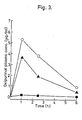
- Suppositories were prepared of allopurinol and some derivatives of the present invention using Adeps solidus (Ph. Nord. 63) as the suppository base. Each suppository contained an amount of the appropriate compound (brought to the same particle size by sieving) equivalent to 25 mg of allopurinol. Some water-soluble derivatives were also formulated as micro-enemas, the solvent being a 0.5% aqueous solution of methylcellulose. The suppositories or micro-enemas were administered to rabbits. After drug administration, blood samples were taken at various times and the plasma fraction assayed for allopurinol and its major metabolite oxipurinol using the HPLC method described above.
- Fig. 3 shows some representative plots of plasma oxipurinol concentrations versus time following rectal administration to rabbits.
- the results clearly demonstrate that the allopurinol derivatives exhibit a greatly enhanced bioavailability as compared with allopurinol which showed only a very low degree of absorption ( ⁇ 2% of the dose given).
- the plasma samples were also analyzed for intact allopurinol prodrugs but in all cases no measurable concentrations ( ⁇ 0.1 pg/ml) were observed.
- allopurinol prodrug forms of the present invention provide an efficient absorption of allopurinol after rectal administration in sharp contrast to the behaviour of allopurinol per se.
- the above studies demonstrate that the prodrugs are converted back to allopurinol in vivo in accordance with the "prodrug" definition provided at the outset of this application.
- a micro-enema preparation of the hydrochloride salt of 1-(N,N-diethylglycyloxymethyl)allopurinol was administered to a healthy human volunteer.
- the dose given (2 ml of a 0.5% methylcellulose solution containing 118 mg/ml of the prodrug) corresponded to 100 mg of allopurinol.
- Urine was collected over 5 days and aliquots were assayed for allopurinol and oxipurinol by a specific HPLC assay. The total urinary excretion of allopurinol and oxipurinol was found to be 11 and 78 mg, respectively.
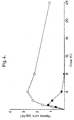
- suppositories containing the hydrochloride salt of 1-(N,N-diethylglycyloxymethyl)-allopurinol in an amount equivalent to 350 mg of allopurinol and made using Adeps solidus as the suppository base were administered rectally to five healthy human volunteers. After drug administration, blood samples were taken at various times and the plasma fraction assayed for allopurinol and oxipurinol by means of HPLC. Fig. 4 shows the average plasma data obtained. The same volunteers were also given a table preparation of allopurinol and from the plasma data obtained, the bioavailability of the suppository preparation containing the allopurinol prodrug was estimated to be 42% of that of the oral preparation.
- Fig. 5 shows the mean plasma oxipurinol concentration vs. time curve obtained along with the plasma concentration vs. time data observed after similar administration of 25 mg of allopurinol in the form of a 1% alkaline solution of its sodium salt. The results of the experiment indicates an almost complete bioavailability of the parent drug from the prodrug derivative given intravenously.
Landscapes
- Chemical & Material Sciences (AREA)
- Organic Chemistry (AREA)
- Health & Medical Sciences (AREA)
- Life Sciences & Earth Sciences (AREA)
- General Health & Medical Sciences (AREA)
- General Chemical & Material Sciences (AREA)
- Medicinal Chemistry (AREA)
- Nuclear Medicine, Radiotherapy & Molecular Imaging (AREA)
- Bioinformatics & Cheminformatics (AREA)
- Pharmacology & Pharmacy (AREA)
- Engineering & Computer Science (AREA)
- Animal Behavior & Ethology (AREA)
- Chemical Kinetics & Catalysis (AREA)
- Public Health (AREA)
- Veterinary Medicine (AREA)
- Pain & Pain Management (AREA)
- Rheumatology (AREA)
- Physical Education & Sports Medicine (AREA)
- Pharmaceuticals Containing Other Organic And Inorganic Compounds (AREA)
- Nitrogen Condensed Heterocyclic Rings (AREA)
- Acyclic And Carbocyclic Compounds In Medicinal Compositions (AREA)
- Medicines That Contain Protein Lipid Enzymes And Other Medicines (AREA)
Abstract
Description
- The present invention relates to novel transient prodrug forms of allopurinol useful in the prevention and treatment of hyperuricemia, to methods for preparing the prodrug forms, to pharmaceutical compositions containing such prodrug forms, and to methods for using the prodrug forms.
- As employed in this application, the term "prodrug" denotes a derivative of allopurinol which derivative, when administered to warm-blooded animals, e.g. humans, is converted into the proven drug, i.e. allopurinol.
- The term "transient" indicates that the conversion of the prodrug forms proceeds in such a manner that the proven drug form (parent allopurinol) is released, and the remaining moieties split off remain nontoxic or are metabolized so that nontoxic metabolic products are produced.
- These novel prodrug forms of allopurinol are certain derivatives of allopurinol which possess a desirable high lipophilicity and/or improved aqueous solubility in comparison to the parent compound, allopurinol.
- Allopurinol is a widely used agent for the treatment and prevention of hyperuricemic states such as gout. Allopurinol and its main metabolite oxipurinol lower the level of uric acid in plasma and urine by inhibiting xanthine oxidase, the enzyme catalyzing the oxidation of hypoxanthine to xanthine and xanthin to uric acid (cf. e.g. Spector, 1977; Elion, 1978). In addition to its use as prophylaxis against and treatment of gout and other chronic hyperuricemic states allopurinol is commonly used to prevent the development of hyperuricosuria that often results from the rapid lysis of cells in patients with malignancies who are undergoing treatment with cytotoxic drugs or radiation (cf. e.g. Elion, 1978).
- Allopurinol is conventionally administered orally in the form of tablets. However, the development of nausea and vomiting among patients undergoing cancer chemotherapy frequently precludes the use of oral preparations in these patients. Consequently, a pharmaceutical and medical need exists for allopurinol preparations useful for the control of hyperurecemia in patients with neoplastic disease as well as in other individuals who are unable to take or retain oral medications.
- Alternative means of administering allopurinol may be provided by the use of injectable and rectal preparations.
- However, since allopurinol is only slightly soluble in water (about 0.5 mg/ml at 25°C) acceptable injection preparations such as for intramuscular injection, are not available. Presently, it is only possible to deliver sufficient amounts of allopurinol parenterally by infusion. The infusion fluids used contain the sodium salt of allopurinol at a concentration of 0.5-z-l% and are strongly alkaline (pH about 10.5-11.5); consequently, their administration may cause thrombophlebitis or perivascular inflammation.
- With respect to the rectal route of administering allopurinol recent studies have demonstrated that this approach using allopurinol per se is not a suitable and reliable mode of therapy (Chang et al., 1981; Appelbaum et al., 1980, 1982). It was shown in these studies that virtually no allopurinol or only very minute amounts (<5%) is absorbed from various suppository preparations administered rectally to man. This very poor ability of allopurinol to be absorbed rectally can be attributed to the low lipophilicity of the drug combined with its poor water solubility.
- Although oral administration of allopurinol provides the attainment of effective serum concentrations the absorption of the compound is not complete. Thus, it has been reported that the absolute systemic bioavailability of oral allopurinol tablets in man are about 70% (Appelbaum et al., 1982) while another study (Elion et al., 1966) reported that about 20-25% of an oral dose is excreted in the stool unchanged. The incomplete and variable absorption behaviour of allopurinol can, like noted above for the rectal absorption, be attributed to the low water and lipid solubility of the drug.
- Thus, it is quite obvious that a serious need exists for improved forms of allopurinol, which would be devoid of those disadvantages and drawbacks that to date have characterized the parent drug, allopurinol. From the foregoing, it also appears that successful allopurinol prodrugs for the preparation of pharmaceutically acceptable injection preparations should exhibit a high water-solubility at a physiologically acceptable pH. Furthermore, to provide an efficient, reliable and rapid absorption upon rectal administration it also appears that successful allopurinol prodrugs should possess both a desirable high water-solubility and lipophilicity. In addition to these properties, successful prodrug derivatives should be capable of reverting to the active allopurinol when absorbed into the bloodstream of a warm-blooded animal or when reaching the site of therapeutic activity of the parent drug.
- The only previously described prodrug types for allopurinol are some ether derivatives (Hussain & Rytting, 1974), N-Mannich bases (Bundgaard & Johansen, 1981) and N-hydroxymethyl derivatives (Bansal et al., J. Pharm. Sci. 70, (1981), pp. 855-857). These compounds differ considerably from the compounds of the present invention. They are extremely unstable in aqueous solutions, are relatively insoluble in water and lipid and apparently offer no advantage over allopurinol with respect to bioavailability following rectal or parenteral administration.
- One object of the present invention is to provide novel prodrug forms of allopurinol, useful for the prevention and treatment of hyperuricemic states such as gout.
- Another object of this invention is to provide novel prodrug forms of allopurinol which prodrugs, or transient derivatives, owing to their improved lipid and/or water solubility, exhibit superior bioavailability over allopurinol per se, when administered rectally or orally.
- A further object of the present invention is to provide novel transient prodrug forms of allopurinol which are characterized as being highly soluble in water and hence are extremely useful as parenteral delivery forms of allopurinol.
- The ring structure named "allopurinol" exists in different tautomeric forms:
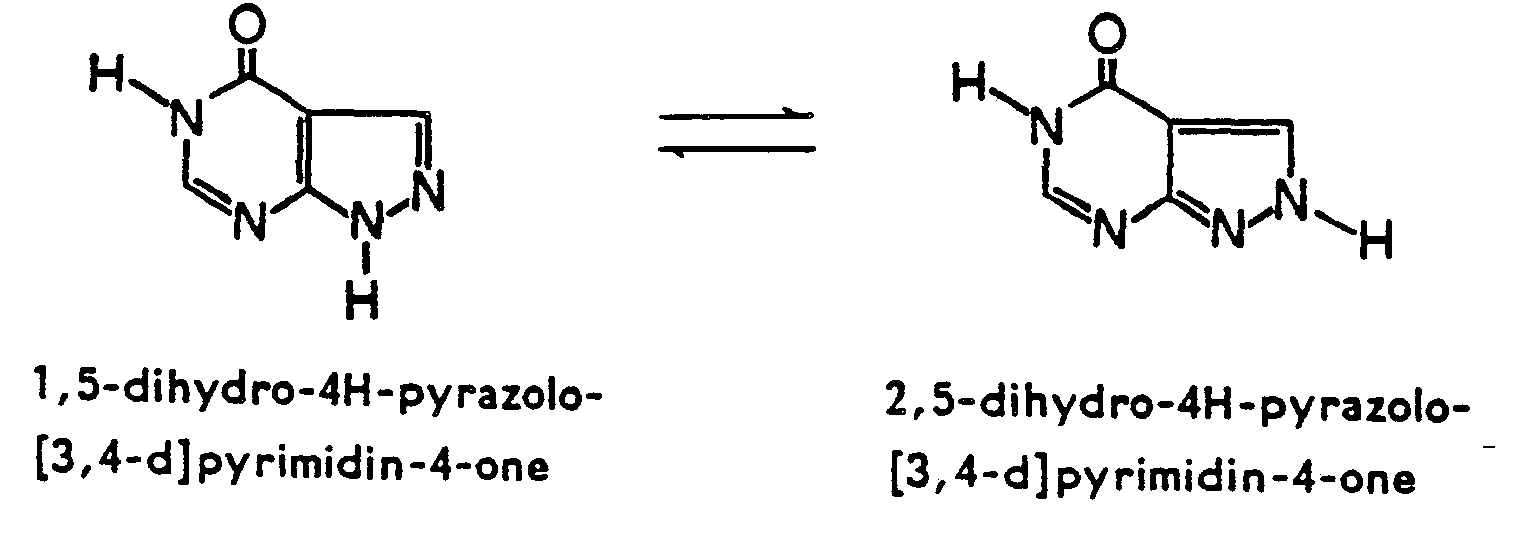
- Two of the tautomeric forms are drawn above and their systematic names are given, but in the present context, the term "allopurinol" encompasses all tautomeric forms of the ring system.
- The invention relates to compounds of the formulas (la) or (Ib)

- a) a group of the formula (II)


- b) R1 is a group of the formula (III)

- c) R1 is a group of the formula (IV)

- d) R1 is a group of the formula (V)

- R2 is any of the groups of formulae (II), (III), (IV), or (V) as defined above with the proviso that A solely is the group (Ila) as defined above; and
- R5 is hydrogen or has the same meaning as R2 as defined above, and salts thereof.
- In the present context, C1-8 alkyl may be straight or branched, such as methyl, ethyl, propyl, isopropyl, butyl, tert.butyl, pentyl, hexyl, heptyl, or octyl. Among the alkyl groups, lower alkyl groups are preferred. C1-4 Alkyl may be straight or branched, such as methyl, ethyl, propyl, isopropyl, butyl, or tert.butyl. The term "phenyl-C1-4 alkyl" designates a C1-4 alkyl group (as herein defined) which, in turn, is substituted with a phenyl group. Preferred phenyl-C1-4 alkyl are benzyl, 1- and 2-phenylethyl, 1-, 2-, and 3-phenylpropyl, and 1-methyl-1-phenylethyl. The term "C1-4 alkoxy" designates oxy to which a Cl-4 alkyl group is attached as defined above; preferred C1-4 alkoxy groups are methoxy or ethoxy. The term "halogen" designates F, Cl, Br, or I; CI is preferred. The term "phenyl-C2-5 alkenyl" designates a C2-5-monounsaturated aliphatic hydrocarbon group which may be straight or branched, such as propenyl, butenyl or pentenyl, and which in turn is substituted with a phenyl group. Preferred phenyl-C2-s alkenyl groups are phenyl-substituted pro- pen(2)-yl optionally substituted with methyl or ethyl, such as 3-phenylpropen(2)-yl (both E and Z forms), 2-methyl-3-phenylpropen(2)-yl (both E and Z forms), and 3-phenylbuten(2)-yl (both E and Z forms). Where phenyl groups are substituted with e.g. halogen, C1-4 alkyl, hydroxy, C1-4 alkoxy, acetoxy or phenoxy, they may be mono-, di-, or tri-substituted, and when they are di-, or tri-substituted, the substituents may be the same or different. The term "monohalogenated C1-4 alkyl" designates C1-4 alkyl (as defined above) substituted with a halogen atom. When, in the formula (II), R3 is an aromatic 5- or 6-membered heterocyclic ring containing 1 or 2 hetero atoms selected from the group consisting of nitrogen, oxygen, and sulphur, this may, for instance, be 2-, 3-, or 4-pyridinyl, 2-, or 3-thienyl, 2-, 4-, or 5-thiazolyl, 2-, 4-, or 5-oxazolyl, 2-imidazolyl, 5-isoxazolyl, 5-isothiazolyl, 2-furanyl, 2-, or 5-pyrimidinyl, 5-[1,3]-oxazinyl, or 5-[1,3]-thiazinyl. When, in the formula (III), R8 and Rg together with the adjacent nitrogen atom form a 5- or 6-membered heterocyclic ring which in addition to the nitrogen may contain 1 or 2 further hetero atoms selected from the group consisting of nitrogen, oxygen, and sulphur, it may, for instance, be 1-piperidinyl, 1-imidazolyl, 1-pyrazolyl, morpholinyl, 1-piperazinyl, and thiomorpholinyl.
- The salts of the compounds of the formulas (la) or (lb) include any pharmaceutically acceptable acid addition salt. This term as used herein generally includes the non-toxic acid addition salts of compounds of the formulas la or Ib, formed with non-toxic inorganic or organic acids. For example, the salts include salts with inorganic acids, such as hydrochloric, hydrobromic, sulphuric, sulphamic, nitric, phosphoric and the like; and the salts with organic acids such as acetic, propionic, succinic, fumaric, maleic, tartaric, citric, glycolic, stearic, lactic, malic, pamoic, ascorbic, phenylacetic, glutamic, benzoic, salicylic, sulphonic or sulphanilic.
- When one or more asymmetric carbon atoms are present in the side chains, it is understood that the present invention also encompasses all diastereomers or enantiomers, or mixtures thereof. Examples of isomers are D-, L-, and DL-forms.
- The compound of formula (la) wherein R, is ethyloxycarbonyl (R1 is a group of formula (IV) wherein A is a bond and R4 is ethyl) and R5 is hydrogen is described in the literature (Bergmann et al, 1979). However, this reference merely teaches a method for preparing this compound and does not disclose or indicate any utility of the compound, nor any properties of the compound that might indicate its utility as a prodrug.
- In another aspect the invention relates to pharmaceutical compositions comprising a pharmaceutically acceptable carrier or excipient and a compound of the formulas (la) or (Ib)

- In another aspect the present invention also concerns a method for preparing the above mentioned compositions comprising combining a pharmaceutically acceptable carrier or excipient with a compound of the formulas (la) or (lb).
- In a further aspect the invention also concerns a method for preparing compounds of the formulas (la) or (lb).
- The compounds of formulas (la) and (lb) are useful for treating and preventing hyperuricemic states comprising administering an amount effective in lowering the level of uric acid to warm-blooded animals including humans.
- As examples of compounds of formula (la) may be mentioned compounds in which R5 is as defined above, and R1 is one of the following groups ("groups a"):
- Acetyl
- Propionyl
- Butyryl
- Isobutyryl
- Valeryl
- Benzoyl
- 4-Methyl benzoyl
- 2,4-Dimethylbenzoyl
- 4-Chlorobenzoyl
- 4-Methoxybenzoyl
- 3,4-Dimethoxybenzoyl
- 4-Hydroxybenzoyl
- 2-Hydroxybenzoyl
- 4-Acetoxybenzoyl
- 2-Acetoxybenzoyl
- 4-Phenoxybenzoyl
- Phenylacetyl
- 4-Chlorophenylacetyl
- 3-Phenylpropionyl
- Nicotinoyl
- Isonicotinoyl
- Picolyl
- 2-Thienoyl
- Cinnamoyl
- 4-Methylcinnamoyl
- 4-Chlorocinnamoyl
- Glycyl
- N,N-Dimethylglycyl
- N,N-Diethylglycyl
- N,N-Dipropylglycyl
- N-Methylglycyl
- N-Ethylglycyl
- N-Propylglycyl
- Alanyl
- N,N-Dimethylalanyl
- N,N-Diethylalanyl
- Leucyl
- Norleucyl
- Norvalyl
- Valyl
- Phenylalanyl
- 3-(N,N-Dimethylamino)propionyl
- 4-(N,N-Dimethylamino)butyryl
- 4-(N,N-Diethylamino)butyryl
- 5-(N,N-Dimethylamino)valeryl
- N,N-Dimethylphenylalanyl
- Methoxycarbonyl
- Ethoxycarbonyl
- Butoxycarbonyl
- Hexyloxycarbonyl
- Phenoxycarbonyl
- 4-Chlorophenoxycarbonyl
- 4-Methoxyphenoxycarbonyl
- Benzyloxycarbonyl
- Carbamoyl
- N-Methylcarbamoyl
- N-Ethylcarbamoyl
- N-Butylcarbamoyl
- N-Phenylcarbamoyl
- N,N-Dimethylcarbamoyl
- Chloroacetyl
- Bromoacetyl
- 2-Chloropropionyl
- 2-Bromopropionyl
- Succinyl
- Formyloxymethyl
- Acetyloxymethyl
- Propionyloxymethyl
- Butyryloxymethyl
- Isobutyryloxymethyl
- Pivaloyloxymethyl
- Valeryloxymethyl
- Benzoyloxymethyl
- 4-Chlorobenzoyloxymethyl
- 4-Methylbenzoyloxymethyl
- 2,4-Dimethylbenzoyloxymethyl
- 4-Methoxybenzoyloxymethyl
- 3,4-Dimethoxybenzoyloxymethyl
- 4-Hydroxybenzoyloxymethyl
- 2-Hydroxybenzoyloxymethyl
- 4-Acetoxybenzoyloxymethyl
- 2-Acetoxybenzoyloxymethyl
- 4-Phenoxybenzoyloxymethyl
- Phenylacetyloxymethyl
- 3-Phenylpropionyloxymethyl
- Nicotinoyloxymethyl
- Isonicotinoyloxymethyl
- Picolyloxymethyl
- 1-(Acetyloxy)ethyl
- 1-(Acetyloxy)propyl
- 1-(Butyryloxy)ethyl
- 1-(Butyryloxy)propyl
- (Acetyloxy)(phenyl)methyl
- Glycyloxymethyl
- N,N-Dimethylglycyloxymethyl
- 1-(N,N-Dimethylglycyloxy)ethyl
- N,N-Diethylglycyloxymethyl
- 1-(N,N-Diethylglycyloxy)ethyl
- N,N-Dipropylglycyloxymethyl
- 1-(N,N-Dipropylglycyloxy)ethyl
- N-Methylglycyloxymethyl
- N-Ethylglycyloxymethyl
- N-Propylglycyloxymethyl
- Alanyloxymethyl
- N,N-Dimethylalanyloxymethyl
- 1-(N,N-Dimethylalanyloxy)ethyl
- N,N-Diethylalanyloxymethyl
- 1-(N,N-Diethylalanyloxy)ethyl
- Leucyloxymethyl
- N,N-Dimethylleucyloxymethyl
- Norleucyloxymethyl
- Valyloxymethyl
- Norvalyloxymethyl
- Phenylglycyloxymethyl
- Phenylalanyloxymethyl
- N,N-Dimethylphenylalanyloxymethyl
- N,N-Diethylphenylalanyloxymethyl
- Methoxycarbonyloxymethyl
- Ethoxycarbonyloxymethyl
- Phenoxycarbonyloxymethyl
- Benzyloxycarbonyloxymethyl
- Chloroacetyloxymethyl
- Succinyloxymethyl
- 3-(N,N-Diethylcarbamoyl)propionyloxymethyl
- Phosphonooxymethyl
- Of the compounds in which R5 is different from hydrogen, preferred compounds of the formula (la) are compounds in which R1 and R5 are the same, since such compounds are generally easier to prepare.
- Among these compounds (i.e. R1 and R5 are the same) more preferred compounds are compounds wherein R1 and R5 are groups of the formulas (11) or (III) as defined above, wherein A is a group of formula (Ila); and salts thereof.
- Examples of such compounds are compounds in which R1 and R5 are one of the following groups ("groups b"):
- Formyloxymethyl
- Acetyloxymethyl
- Propionyloxymethyl
- Butyryloxymethyl
- Isobutyryloxymethyl
- Pivaloyloxymethyl
- Valeryloxymethyl
- Benzoyloxymethyl
- 4-Chlorobenzoyloxymethyl
- 2,4-Dimethylbenzoyloxymethyl
- 4-Methoxybenzoyloxymethyl
- 3,4-Dimethoxybenzoyloxymethyl
- 4-Hydroxybenzoyloxymethyl
- 2-Hydroxybenzoyloxymethyl
- 4-Acetoxybenzoyloxymethyl
- 2-Acetyloxybenzoyloxymethyl
- 4-Phenoxybenzoyloxymethyl
- Phenylacetyloxymethyl
- 3-Phenylpropionyloxymethyl
- Nicotinoyloxymethyl
- Isonicotinoyloxymethyl
- Picolyloxymethyl
- 1-(Acetyloxy)ethyl
- 1-(Acetyloxy)propyl
- 1-(Butyryloxy)ethyl
- 1-(Butyryloxy)propyl
- (Acetyloxy)(phenyl)methyl
- Glycyloxymethyl
- 1-(N,N-Dimethylglycyloxy)ethyl
- N,N-Diethylglycyloxymethyl
- 1-(N,N-Diethylglycyloxy)ethyl
- N,N-Dipropylglycyloxymethyl
- 1-(N,N-Dipropylglycyloxy)ethyl
- N-Methylglycyloxymethyl
- N-Ethylglycyloxymethyl
- N-Propylglycyloxymethyl
- Alanyloxymethyl
- N,N-Dimethylalanyloxymethyl
- 1-(N,N-Dimethylalanyloxy)ethyl
- N,N-Diethylalanyloxymethyl
- 1-(N,N-Diethylalanyloxy)ethyl
- Leucyloxymethyl
- N,N-Dimethylleucyloxymethyl
- Norleucyloxymethyl
- Valyloxymethyl
- Norvalyloxymethyl
- Phenylglycyloxymethyl
- Phenylalanyloxymethyl
- N,N-Dimethylphenylalanyloxymethyl
- N,N-Diethylphenylalanyloxymethyl
- Other more preferred compounds of the formula (Ia) are compounds wherein R5 is hydrogen and R1 is a group of the formulas (II), (III), (IV), or (V); and salts thereof.
- Examples of such compounds are compounds wherein R5 is hydrogen and R1 is a group selected from the groups a specified above.
- Among these compounds (i.e. R5 is hydrogen) still more preferred compounds are compounds wherein R, is a group of the formulas (II), (III) or (V).
- Examples of such compounds are compounds wherein R5 is hydrogen and R, is one of the following groups ("groups c"):
- Acetyl
- Propionyl
- Butyryl
- Isobutyryl
- Valeryl
- Benzoyl
- 4-Methylbenzoyl
- 2,4-Dimethylbenzoyl
- 4-Chlorobenzoyl
- 4-Methoxybenzoyl
- 3,4-Dimethoxybenzoyl
- 4-Hydroxybenzoyl
- 2-Hydroxybenzoyl
- 4-Acetoxybenzoyl
- 2-Acetoxybenzoyl
- 4-Phenoxybenzoyl
- Phenylacetyl
- 4-Chlorophenylacetyl
- 3-Phenylpropionyl
- Nicotinoyl
- Isonicotinoyl
- Picolyl
- 2-Thienoyl
- Cinnamoyl
- 4-Methylcinnamoyl
- 4-Chlorocinnamoyl
- Glycyl
- N,N-Dimethylglycyl
- N,N-Diethylglycyl
- N,N-Dipropylglycyl
- N-Methylglycyl
- N-Ethylglycyl
- N-Propylglycyl
- Alanyl
- N,N-Dimethylalanyl
- N,N-Diethylalanyl
- Leucyl
- Norleucyl
- Norvalyl
- Valyl
- Phenylalanyl
- 3-(N,N-Dimethylamino)propionyl
- 4-(N,N-Dimethylamino)butyryl
- 4-(N,N-Diethylamino)butyryl
- 5-(N,N-Dimethylamino)valeryl
- N,N-Dimethylphenylalanyl
- Succinyl
- Formyloxymethyl
- Acetyloxymethyl
- Propionyloxymethyl
- Butyryloxymethyl
- Isobutyryloxymethyl
- Pivaloyloxymethyl
- Valeryloxymethyl
- Benzoyloxymethyl
- 4-Chlorobenzoyloxymethyl
- 4-Methylbenzoyloxymethyl
- 2,4-Dimethylbenzoyloxymethyl
- 4-Methoxybenzoyloxymethyl
- 3,4-Dimethoxybenzoyloxymethyl
- 4-Hydroxybenzoyloxymethyl
- 2-Hydroxybenzoyloxymethyl
- 4-Acetoxybenzoyloxymethyl
- 2-Acetoxybenzoyloxymethyl
- 4-Phenoxybenzoyloxymethyl
- Phenylacetyloxymethyl
- 3-Phenylpropionyloxymethyl
- Nicotinoyloxymethyl
- Isonicotinoyloxymethyl
- Picolyloxymethyl
- 1-(Acetyloxy)ethyl
- 1-(Acetyloxy)propyl
- 1-(Butyryloxy)ethyl
- 1-(Butyryloxy)propyl
- (Acetyloxy)(phenyl)methyl
- Glycyloxymethyl
- N,N-Dimethylglycyloxymethyl
- 1-(N,N-Dimethylglycyloxy)ethyl
- N,N-Diethylglycyloxymethyl
- 1-(N,N-Diethylglycyloxy)ethyl
- N,N-Dipropylglycyloxymethyl
- 1-(N,N-Dipropylglycyloxy)ethyl
- N-Methylglycyloxymethyl
- N-Ethylglycyloxymethyl
- N-Propylglycyloxymethyl
- Alanyloxymethyl
- N,N-Dimethylalanyloxymethyl
- 1-(N,N-Dimethylalanyloxy)ethyl
- N,N-Diethylalanyloxymethyl
- 1-(N,N-Diethylalanyloxy)ethyl
- Leucyloxymethyl
- N,N-Dimethylleucyloxymethyl
- Norleucyloxymethyl
- Valyloxymethyl
- Norvalyloxymethyl
- Phenylglycyloxymethyl
- Phenylalanyloxymethyl
- N,N-Dimethylphenylalanyloxymethyl
- N,N-Diethylphenylalanyloxymethyl
- Succinyloxymethyl
- 3-(N,N-Diethylcarbamoyl)propionyloxymethyl
- Still more preferred compounds of the formula (la) are compounds wherein R5 is hydrogen and R, is a group of the formulas (II), (III) or (V), wherein A in all the formulas mentioned is a group of formula (Ila).
- Examples of such compounds are compounds wherein R5 is hydrogen and R1 is one of the groups b specified above.
- Even more preferred compounds of the formula (la) are compounds wherein R5 is hydrogen and R1 is a group of the formula (III) wherein A is a group of formula (Ila).
- Examples of such compounds are compounds wherein Rs is hydrogen and R, is one of the following groups ("groups d"):
- Glycyloxymethyl
- N,N-Dimethylglycyloxymethyl
- 1-(N,N-Dimethylglycyloxy)ethyl
- N,N-Diethylglycyloxymethyl
- 1-(N,N-Diethylglycyloxy)ethyl
- N,N-Dipropylglycyloxymethyl
- 1-(N,N-Dipropylglycyloxy)ethyl
- N-Methylglycyloxymethyl
- N-Ethylglycyloxymethyl
- N-Propylglycyloxymethyl
- Alanyloxymethyl
- N,N-Dimethylalanyloxymethyl
- 1-(N,N-Dimethylalanyloxy)ethyl
- N,N-Diethylalanyloxymethyl
- 1-(N,N-Diethylalanyloxy)ethyl
- Leucyloxymethyl
- N,N-Dimethylleucyloxymethyl
- Norleucyloxymethyl
- Valyloxymethyl
- Norvalyloxymethyl
- Phenylglycyloxymethyl
- Phenylalanyloxymethyl
- N,N-Dimethylphenylalanyloxymethyl
- N,N-Diethylphenylalanyloxymethyl
- Particularly preferred compounds of the formula (la) are compounds in which R5 is hydrogen and R1 is N,N-dimethylglycyloxymethyl, N,N-diethylglycyloxymethyl, N,N-dipropylglycyloxymethyl, N,N-dimethyl- alanyloxymethyl, N,N-diethylalanyloxymethyl, phenylalanyloxymethyl, phenylglycyloxymethyl, or leucyloxymethyl; and salts thereof.
- Among the compounds of the formula (Ib) preferred compounds are compounds in which R2 and R5 are the same. Examples of such compounds are compounds, in which Rz and R5 are groups selected from the groups b specified above.
- Even more preferred compounds of the formula (Ib) are compounds in which R2 and R5 are the same and R2 and R5 are groups of the formula (III) as defined above wherein A is a group of formula (Ila).
- Examples of such compounds are compounds wherein R5, and R2 are the same and are selected from the groups d specified above; and salts thereof.
- Other very preferred compounds of the formula (Ib) are compounds wherein R5 is hydrogen and R2 is a group of the formula (II) wherein A is a group of formula (Ila).
- Examples of such compounds are compounds where R5 is hydrogen and R2 is one of the following groups ("groups e"):
- Formyloxymethyl
- Acetyloxymethyl
- Propionyloxymethyl
- Butyryloxymethyl
- Isobutyryloxymethyl
- Pivaloyloxymethyl
- Valeryloxymethyl
- Benzoyloxymethyl
- 4-Chlorobenzoyloxymethyl
- 4-Methylbenzoyloxymethyl
- 2,4-Dimethylbenzoyloxymethyl
- 4-Methoxybenzoyloxymethyl
- 3,4-Dimethoxybenzoyloxymethyl
- 4-Hydroxybenzoyloxymethyl
- 4-Acetoxybenzoyloxymethyl
- 4-Phenoxybenzoyloxymethyl
- Phenylacetyloxymethyl
- 3-Phenylpropionyloxymethyl
- Nicotinoyloxymethyl
- Isonicotinoyloxymethyl
- Picolyloxymethyl
- 1-(Acetyloxy)ethyl
- 1-(Acetyloxy)propyl
- 1-(Butyryloxy)ethyl
- 1-(Butyryloxy)propyl
- (Acetyloxy)(phenyl)methyl
- Specific examples of preferred compounds of formula (la) are:
- 1-(Acetyloxymethyl)allopurinol
- 1-(Propionyloxymethyl)allopurinol
- 1-(Butyryloxymethyl)allopurinol
- 1-(Glycyloxymethyl)allopurinol
- 1-(DL-Alanyloxymethyl)allopurinol
- 1-(L-Alanyloxymethyl)allopurinol
- 1-(N,N-Dimethylglycyloxymethyl)allopurinol
- 1-(N,N-Diethylglycyloxymethyl)allopurinol
- 1-(N,N-Dipropylglycyloxymethyl)allopurinol
- 1-(DL-N,N-Dimethylalanyloxymethyl)allopurinol
- 1-(L-N,N-Dimethylalanyloxymethyl)allopurinol
- 1-(DL-N,N-Diethylalanyloxymethyl)allopurinol
- 1-(L-N,N-Diethylalanyloxymethyl)allopurinol
- 1-(DL-Phenylalanyloxymethyl)allopurinol
- 1-(L-Phenylalanyloxymethyl)allopurinol
- 1-(DL-Phenylglycyloxymethyl)allopurinol
- 1-(L-Phenylglycyloxymethyl)allopurinol
- 1-(DL-Leucyloxymethyl)allopurinol
- 1-(L-Leucyloxymethyl)allopurinol
- 1-(DL-Norleucyloxymethyl)allopurinol
- 1-(L-Norieucyloxymethyl)allopurinol
- 1-(DL-Norvalyloxymethyl)allopurinol
- 1-(L-Norvalyloxymethyl)allopurinol
- 1-(DL-Valyloxymethyl)allopurinol
- 1-(L-Valyloxymethyl)allopurinol
- 1-(DL-N,N-Dimethylphenylalanyloxymethyl)allopurinol
- 1-(DL-N,N-Diethylphenylalanyloxymethyl)allopurinol
- Specific examples of preferred compounds of formula (Ib) are:
- 2-(Acetyloxymethyl)allopurinol
- 2-(Propionyloxymethyl)allopurinol
- 2-(Butyryloxymethyl)allopurinol
- 2-(Benzoyloxymethyl)allopurinol
- 2,5-bis(Acetyloxymethyl)allopurinol
- 2,5-bis(Propionyloxymethyl)allopurinol
- 2,5-bis(Butyryloxymethyl)allopurinol
- 2,5-bis(Benzoyloxymethyl)allopurinol
- 2,5-bis(N,N-Dimethylglycyloxymethyl)allopurinol
- 2,5-bis(N,N-Diethylglycyloxymethyl)allopurinol
- 2,5-bis(N,N-Dipropylglycyloxymethyl)allopurinol
- 2,5-bis(DL-N,N-Dimethylalanyloxymethyl)allopurinol
- 2,5-bis(DL-N,N-Diethylalanyloxymethyl)allopurinol
- 2,5-bis(DL-Phenylalanyloxymethyl)allopurinol
- 2,5-bis(L-Phenylalanyloxymethyl)allopurinol
- 2,5-bis(L-Leucyloxymethyl)allopurinol
- Specific examples of especially preferred compounds are:
- 1-(Butyryloxymethyl)allopurinol,
- 1-(N,N-dimethylglycyloxymethyl)allopurinol,
- 1-(N,N-diethylglycyloxymethyl)allopurinol,
- 1-(N,N-dipropylglycyloxymethyl)allopurinol,
- 1-(DL-N,N-dimethylalanyloxymethyl)allopurinol,
- 1-(DL-N,N-diethylalanyloxymethyl)allopurinol,
- 1-(L-phenylalanyloxymethyl)allopurinol,
- 1-(L-leucyloxymethyl)allopurinol,
- 1-(L-valyloxymethyl)allopurinol, and
- 1-(DL-N,N-dimethylphenylalanyloxymethyl)allopurinol,
- The compounds of the present invention are conveniently administered to warm-blooded animals, e.g. humans, via rectal, oral or parenteral dosage forms. The dose of the compounds of the present invention administered to warm-blooded animals, e.g. humans, (either as a single dose, a daily dose, or other time- presented doses) will, of course, depend on the requirements of the individual under treatment. The dosage administered is, therefore, not subject to specific limits. However, the dose of any compound of the formulas (ta) or (lb) will usually be an amount, which - on a molar basis - is equivalent to the amount of allopurinol necessary to achieve the desired pharmacological or physiological effect. Generally, the single medical dose for warm-blooded animals, which include humans and primates, will be in the range of approximately 25-1000 mg allopurinol equivalents. For humans the daily dose is generally in the range of 300-600 mg allopurinol equivalents regardless of administration form. The daily dose may be administered in 1-3 single doses.
- The compounds of the formulas (la) or (lb) may be administered in the form of tablets, capsules, suspensions, emulsions, solutions, injectables, suppositories, enemas, various drug delivery devices and in other suitable form. The route of administration may be orally, parenterally or rectally. The formulation and preparation of any of this broad spectrum of dosage forms into which the subject prodrugs can be dispensed is well-known to those skilled in the art of pharmaceutical formulation. Specific information can, however, be found in the text entitled "Remington's Pharmaceutical Sciences", Sixteenth Edition, 1980.
- In a typical preparation for oral administration, e.g. tablet or capsule, any one of the compounds of the present invention in a pharmacologically effective amount is combined with any oral nontoxic pharmaceutically acceptable inert carrier such as lactose, starch and microcyrstalline cellulose. Additionally, when required, suitable binders (e.g. gelatin), lubricants (e.g. talc or magnesium stearate) and disintegrating agents (e.g. starch or various cellulose derivatives) are included.
- Similarly, in a typical formulation for parenteral application (intravenous, intramuscular, subcutaneous or the like, any of the highly water-soluble compounds of the present invention, such as 1-(N,N-dimethyl- glycyloxymethyl)allopurinol hydrochloride is dissolved in sterile water in a given concentration and sterilized by e.g. membrane filtration, or radiation. The pH of the solution may, if necessary, be adjusted with e.g. hydrochloric acid, sodium hydroxide or a suitable buffer, and a suitable preservative may optionally be added. Similarly, agents like sodium chloride may be added in order to adjust the tonicity of the solution. A suitable parenteral preparation may also consist of the compound formulated as a sterile, solid substance distributed in injection vials. Before dispensing, water for injection is added to dissolve the compound.
- For the rectal application of the allopurinol prodrugs of this invention, typical dosage forms include suppositories (emulsion and suspension types), rectal gelatin capsules (solutions and suspensions), and enemas or micro-enemas (solutions and suspensions). Thus, in a typical suppository formulation, any one of the compounds of this invention is combined with any pharmaceutically acceptable suppository base such as cocoa butter, esterified fatty acids (C10―C18), glycerinated gelatin, and various water-soluble or dispersible bases like polyethylene glycols and polyoxyethylene sorbitan fatty acid esters. Various additives like salicylates or surfactant materials may be incorporated. Enemas or micro-enemas of the solution type may simply be prepared by dissolving the water-soluble prodrugs of this invention in water or in water containing e.g. 0.5% of methylcellulose or another viscosity-increasing agent.
- The novel and useful allopurinol prodrugs of the invention are also adaptable for administration to warm-blooded animals from various novel drug delivery systems such as gastrointestinal drug delivery devices and rectally applied osmotic delivery devices, wherein the delivery device is manufactured from naturally occurring or synthetic polymeric materials. Specific information about osmotic delivery systems for rectal application can be found in De Leede & De Boer (1981) and De Leede et al. (1982).
- From the foregoing description, it is obvious that due to the much improved water-solubility of . selected members of the claimed prodrugs over allopurinol per se and derivatives of the prior art, superior parenteral formulation and administration is achieved. Similarly, an exceptionally improved rectal bioavailability is achieved owing to the increased water-solubility and/or lipophilicity of the subject compounds.
- The compounds of the present invention may be prepared by various methods.
- One method (a) for preparing compounds of the formula (la) wherein R5 is hydrogen and A is a bond comprises reacting allopurinol with a compound of the formula (VI)


- R11 is a group of the formula (IV')

or R11 is a group of the formula (V')
- Another method (b) for preparing compounds of the formula (la) wherein R5 is hydrogen or compounds of formula (lb) wherein R2 and R5 are the same, and wherein A is ―O―CH2―, comprises reacting 1-hydroxymethylallopurinol or 2,5-dihydroxymethylallopurinol with a compound of the formula (VI) as shown above and wherein R11 is as defined above; and then, if an amino protecting group has been used, removing the protecting group.
- A method (c) for preparing compounds of formulas (Ia) or (Ib) wherein either R5 is hydrogen or R1 and Rs are the same or R2 and R5 are the same, and A is a group of formula (Ila) comprising reacting allopurinol with a compound of the formula (VII)

- Other methods (d) and (e) for preparing compounds of the formula (la) wherein R5 is different from hydrogen are contemplated.
- Method (d) comprises reacting a compound of the formula (VIII)

- Method (e) comprises reacting a compound of the formula (IX)

- A method (f) for preparing compounds of the formula (lb) wherein R5 is different from hydrogen is contemplated.
- Method (f) comprises reacting a compound of the formula (X)

- Still another method (g) for preparing compounds of the formula (la) wherein Rs is hydrogen or compounds of formula (lb) wherein R2 and R5 are the same comprises reacting allopurinol, 1-hydroxymethylallopurinol, or 2,5-dihydroxymethylallopurinol with a compound of the formula (V")

- A method (h) for preparing compounds of the formula (la) wherein R5 is hydrogen or compounds of formula (lb) wherein R2 and Rs are the same and R1, R2 and Rs are groups of the formula III wherein R6 and R7 are H, and A is a bond or is ―O―CH2―, comprises reacting a compound of the formula XI


- All the methods (a)-(h) may optionally be followed by conversion of the formed compound into a salt thereof.
- In the present context the name 1-hydroxymethylallopurinol designates the compound 1-(hydroxymethyl)-1,5-dihydro-4H-pyrazolo[3,4-d]pyrimidin-4-one and tautomeric forms hereof, and the
name 2,5-dihydroxymethylallopurinol designates 2,5-[bis[hydroxymethyl]-1,5-dihydro-4H-pyrazolo[3,4-d]pyrimidin-4-one and tautomeric forms hereof. The synthesis of both compounds have been described (Bansal et al, J. Pharm. Sci. 70, (1987), pp. 855-857. It is noted that in this reference, the compound which in the present context is designated 2,5-[bis(hydroxymethyl)]-1,5-dihydro-4H-pyrazolo[3,4-d]pyrimidin-4-one in the cited reference is designated as the corresponding 1,5-[bis(hydroxymethyl)]-1,5-dihydro-4H-pyrazolo[3,4-d]-pyrimidin-4-one. However, according to analyses performed by the present applicants, the compound prepared according to the teaching of the reference is believed in fact to be the 2,5-compound, for which reason the compound has been designated as the 2,5-compound above. However, as it can still not be concluded with certainty that the compound is indeed the 2,5-compound, the above designation should be understood as covering alternatively the 1,5-compound provided the synthesis described in the reference is in fact conclusively found to result in the 1,5-compound. - The assignment of the actual positions of the substituents is based on the UV and NMR spectra according to the principles set forth in Bergman et al (1979).
- As examples of leaving groups Z may be mentioned chlorine, bromine and iodine. Group Z may also be an acyloxy group, i.e. the reacting compound of e.g. formula (VI) may be an anhydride or a mixed anhydride. When Z is hydroxy a dehydrating agent (e.g. a carbodiimide) has to be present and normally, a sulfonic acid is added to suppress side-reactions.
- The term "amino protecting group" designates groups readily removable by hydrolysis or hydrogenation. As examples of such amino protecting groups may be mentioned methyloxycarbonyl, ethyloxycarbonyl, tert.butyloxycarbonyl, benzyloxycarbonyl, formyl, acetyl or trityl.
- Methods (a), (b) and (e) are performed under essentially the same conditions. The reaction is carried out without a solvent or in a solvent (e.g. pyridine, N,N-dimethylformamide, dimethyl sulfoxide or methylene chloride). Usually a base (e.g. a tertiary amine, pyridine or potassium carbonate) has to be present. The temperature during the reaction is usually between 0°C and the boiling point of either the solvent or the boiling point of one of the reactants. The reaction time is normally from 1 to 96 hours.
- Methods (c), (d) and (f) are performed under the same conditions. The leaving group Z will often be chlorine, bromine or iodine. The reaction is carried out preferably in a polar solvent (e.g. acetone, N,N-dimethylformamide or dimethylsulfoxide) and in the presence of a base (a metal carbonate or a tertiary amine). The reaction temperature will normally be between 0°C and 100°C and the reaction time from 1 to 96 hours. In method (c) a mixture of compounds are normally obtained. Dependent on the reaction conditions and on the number of equivalents of the compound of the formula (VII) used as reagent, compounds with a substituent R2 alone (i.e. Rs is hydrogen) and compounds in which R2 and R5 are the same, are obtained. As by-products, compounds with a substituent R1 alone and compounds in which R, and Rs are the same are also obtained. The mixture of compounds can be separated by manners known per se, i.e. crystallization or column chromatography.
- Method (g) is normally performed in a solvent (e.g. pyridine or N,N-dimethylformamide). The reaction temperature is preferably from 0°C to 150°C and the reaction time from 1 hour to 96 hours.
- Method (h) is normally performed in a solvent such as an alcohol (e.g. methanol or ethanol), acetone, dimethylsulfoxide, N,N-dimethylformamide or pyridine in the presence of a base (e.g. an alkali metal carbonate or a tertiary amine) or in an excess of the compound of formula (XI) at a temperature from -20°C to the boiling point of the solvent.
-
- Fig. 1 shows the time-course of degradation of 1-(N,N-dimethylglycyloxymethyl)allopurinol (o) and the concomitant formation of allopurinol (0) in a 80% human plasma solution (pH 7.4) at 37°C.
- Fig. 2 shows plots of the logarithm of the observed pseudo-first-order rate constants against pH for the conversion of various allopurinol prodrugs to allopurinol in aqueous solution at 37°C.
- Key: (A), 2,5-bis(Butyryloxymethyl)allopurinol) (o), 1-(N,N-diethylglycyloxymethyl)allopurinol; and (e), 1-(acetyl)allopurinol.
- Fig. 3 shows mean plasma levels of oxipurinol versus time plots obtained after rectal administration of suppositories of allopurinol (e), 1-(butyryloxymethyl)allopurinol (A) and 1-(N,N-diethylglycyloxymethyl)-allopurinol hydrochloride (o) to rabbits at a dose of 25 mg allopurinol equivalents (cross-over study involving rabbits each weighing 2.7 kg). The plasma levels of allopurinol were below 1 pg/ml at all of the three blood sampling times.
- Fig. 4 shows mean plasma levels of oxipurinol (o) and allopurinol (0) versus time plots obtained after rectal administration of suppositories of 1-(N,N-diethylglycyloxymethyl)allopurinol hydrochloride to five human volunteers at a dose of 350 mg allopurinol equivalents.
- Fig. 5 shows mean plasma levels of oxipurinol versus time plots after intravenous administration of allopurinol (o) and 1-(N,N-diethylglycyloxymethyl)allopurinol hydrochloride (0) to four rabbits at a dose of 25 mg allopurinol equivalents. The plasma levels of allopurinol were below 1 pg/ml at all blood sampling times.
- The present invention is further illustrated by the following examples which, however, are not to be construed as limiting. The examples especially illustrate the preferred embodiments of the invention.
- Spectral and chromatographical data of the prepared compounds are given in Table 1.
-

- A suspension of allopurinol (500 mg, 3.67 mmole) in acetic acid anhydride (8 ml) was heated in an oil bath at 130°C for five hours. After cooling, water (10 ml) was added and the mixture was stirred at room temperature for three hours. The precipitate was collected and washed with water and dried, yielding 375 mg (57%). Recrystallization from ethanol-N,N-dimethylformamide gave an analytically pure compound, m.p. 251-254°C (dec.).
-

- The compound was prepared from allopurinol and propionic acid anhydride by the procedure described in Example 1. The yield was 60%. Recrystallization from ethanol-N,N-dimethylformamide gave an analytically pure product, m.p. 259-263°C.
-

- The compound was prepared from allopurinol and butyric acid anhydride by the procedure described in Example 1. The yield was 52%. Recrystallization from ethanol gave an analytically pure product, m.p. 222-225°C.
-

- A mixture of allopurinol (2.7 g; 20 mmole) and chloroacetic acid anhydride (6.8 g; 40 mmole) in N,N-dimethylformamide (20 ml) was heated to 80°C and a clear solution was obtained. After 1 hour, the solution was cooled and the precipitate was collected and washed with acetone. Yield: 2.6 g (61 %), m.p. 233-236°C (dec.).
-

- The compound was prepared from allopurinol and benzoic acid anhydride by the procedure described in Example 4. The yield was 50%. Recrystallization from N,N-dimethylformamide gave an analytically pure compound, m.p. 270-273°C (dec.).
-

- A mixture of 1-hydroxymethylallopurinol (1.6 g; 10 mmole) and acetic acid anhydride (2.5 ml) in pyridine (10 ml) was stirred at room temperature for 20 hours. The precipitate was collected, washed with ethanol, and dried. Yield: 780 mg (47%), m.p. 257°C.
-

- A mixture of 1-hydroxymethylallopurinol (0.8 g; 5 mmole) and benzoyl chloride (0.75 ml; 6.5 mmole) in pyridine (10 ml) was stirred at room temperature for 3 hours. Water (30 ml) was added and after standing for 20 hours at 5°C, the precipitate was collected and recrystallized from ethanol. Yield: 900 mg (67%), m.p. 217―219°C.
-

- The compound was prepared from 1-hydroxymethylallopurinol and nicotinoylchloride by essentially the same procedure as described in Example 7. After recrystallization from ethanol, the yield was 30% m.p. 242-243°C.
-

- A mixture of 1-hydroxymethylallopurinol (0.83 g; 5 mmole) and chloroacetic acid anhydride (1.03 g; 6 mmole) in pyridine (20 ml) was stirred at room temperature for 18 hours. Ethanol (20 mi) was added and the precipitate collected, and recrystallized from ethanol. M.p. 203-205°C (dec.).
-

- To a suspension of 1-hydroxymethylallopurinol (1.44 g; 8.7 mmole) in methylene chloride (100 ml) was added triethylamine (2.64 g; 26 mmole) and butyrylchloride (2.20 g; 20.8 mmole). The mixture was stirred at room temperature for twenty hours. The resulting clear solution was washed with water (50 ml), aqueous sodium hydrogen-carbonate (2.5%, 50 ml), and water (2 x 50 ml). The solution was dried and evaporated. The residue was triturated with ethyl acetate yielding 567 mg (28%) of crude product. Recrystallization from ethanol yielded an analytically pure compound, m.p. 224-226°C.
-

- A mixture of 1-hydroxymethylallopurinol (2.0 g; 12 mmole), N,N-dimethylglycine (1.25 g; 12 mmole), N,N'-dicyclohexylcarbodiimide (2.5 g; 12 mmole), and 4-toluenesulfonic acid (150 mg) in pyridine (40 ml) was stirred at room temperature for 48 hours. Methylene chloride (80 ml) was added. The mixture was filtered and the filtrate was evaporated in vacuo. The residue was extracted with two 50 ml portions of boiling methylene chloride, and the extracts were evaporated. The residue was recrystallized from ethyl acetate. The crude compound obtained was suspended in ethanol (20 ml) and a 2N solution of hydrochloric acid in ethyl acetate (8 ml) was added followed by ethylacetate (20 ml). The precipitate was collected (1.32 g) and recrystallized from methanol-ether yielding an analytically pure product, m.p. 203-206°C (dec.).
-

- Using the same procedure as described in Example 11, but using N,N-dimethyl-4-aminobutyric acid instead of N,N-dimethylglycine yielded the title compound, m.p. 150-155°C (dec.).
-

- The compound was prepared from 1-hydroxymethylallopurinol and DL-N,N-diethylalanine by the procedure described in Example 11. The yield was 24%, m.p. 165-170°C (dec.).
-

- The compound was prepared from 1-hydroxymethylallopurinol and N,N-dipropylglycine by the procedure described in Example 11. The compound crystallized from ethanol 195-198°C (dec.).
-

- A mixture of 1-hydroxymethylallopurinol (3.8 g; 16.8 mmole), N,N-diethylglycine hydrochloride (2.88 g; 17 mmole), N,N'-dicyclohexylcarbodiimide (3.6 g; 17.5 mmole), and 4-toluenesulfonic acid (270 mg) in pyridine (60 ml) was stirred at room temperature for 24 hours. Methylene chloride (50 ml) was added to the reaction mixture. The precipitate was collected and stirred with water (15 ml). The insoluble compound was filtered off and washed with water and the combined filtrates were evaporated in vacuo. The residue was recrystallized twice from methanol-ether yielding an analytically pure compound (1.3 g; 25%), m.p. 196-198°C (dec.).
-

- A mixture of 1-hydroxymethylallopurinol (1.6 g; 10 mmole), N-benzyloxycarbonyl-D,L-alanine (2.23 g; 10 mmole), N,N'-dicyclohexylcarbodiimide (2.06 g; 10 mmole), and 4-toluenesulfonic acid (150 mg) in pyridine (60 ml) was stirred at room temperature for 20 hours. Methylene chloride (100 ml) was added and the mixture was filtered. The filtrate was evaporated in vacuo and the residue was extracted with boiling methylene chloride (3 x 50 ml). The methylene chloride was evaporated and the residue was recrystallized from ethyl acetateethanol. To the crude N-protected compound was added a 33% solution of hydrobromic acid in acetic acid (8 ml). The mixture was stirred at room temperature for seven minutes and ethyl acetate (50 ml) was added. The precipitate (520 mg, 16%) was collected and recrystallized from methanol. The title compound was crystallized with 2/3 mole of water, m.p. 195-198°C (dec.).
-

- A mixture of 1-hydroxymethylallopurinol (1.6 g; 10 mmole) and succinic acid anhydride in pyridine (20 ml) was stirred at room temperature for 96 hours. Hydrochloric acid 4N (50 ml) was added and the precipitate was collected. From ethanol - N,N-dimethylformamide the title compound crystallized with 0.25 equivalent of water. M.p. 217-219°C (dec.).
-
- 1) R, = R5 = tert.butyloxymethyl [Method (c)]
- 2) R2 = R5 = tert.butyloxymethyl
- 3) R1 = tert.butyloxymethyl; Rs = hydrogen
- 4) R2 = tert.butyloxymethyl) R5 = hydrogen
- To a solution of allopurinol (2.04 g; 15 mmole) in dimethyl sulfoxide (45 ml) kept at 40°C were added potassium carbonate (2.07 g; 15 mmole) and then dropwise during one hour a solution of chloromethyl pivalate (2.2 g; 15 mmole) in dimethyl sulfoxide (15 ml). The mixture was stirred at 40°C for four hours and poured on ice (75 g). After acidification, the mixture was extracted with chloroform (3 x 70 ml). The extracts were washed.with water, dried, and evaporated. Toluene (5 ml) was added to the residue, and the solid compound formed was collected by filtration and washed on the filter with ether (2 x 5 ml). Recrystallization of the solid from ethyl acetate gave analytically pure 2-(pivaloyloxymethyl)allopurinol (813 mg; m.p. 180-181°C).
- The toluene-ether filtrate from the crude solid was evaporated in vacuo. Column chromatography (CC) (silica gel, eluents toluene-ethyl acetate-methanol) was performed on the residue, and the compounds were collected in the following order:
- 1) 1,5-bis(Pivaloyloxymethyl)allopurinol (90 mg; m.p. 136-137°C, recrystallized from ether-light petroleum).
- 2) 2,5-bis(Pivaloyloxymethyl)allopurinol (402 mg; m.p. 145-146°C, recrystallized from ethyl acetate-ether-light petroleum).
- 3) 1-(Pivaloyloxymethyl)allopurinol (151 mg; m.p. 185-187°C, recrystallized from ethyl acetate).
-
- 1) R, = Rs = butyloxymethyl Example 19 [Method (c)]
- 2) R2 = R5 = butyloxymethyl
- 3) R1 = butyloxymethyl) R5 = hydrogen
- 4) R2 = butyloxymethyl; R5 = hydrogen
- By using the same procedure as described in Example 18 and equivalent amounts of allopurinol and chloromethyl butyrate, the following compounds were obtained:
- 1) 1,5-bis(Butyryloxymethyl)allopurinol, m.p. 122-123°C (from ethyl acetate-ether-light petroleum).
- 2) 2,5-bis(Butyryloxymethyl)allopurinol, m.p. 133-135°C (from ethyl acetate-ether-light petroleum).
- 3) 1-(Butyryloxymethyl)allopurinol, m.p. 220-225°C (from ethyl acetate).
- 4) 2-(Butyryloxymethyl)allopurinol, m.p. 182-183°C (from ethyl acetate).
-

- To a suspension of allopurinol (778 mg, 5.7 mmole) in 5 ml of N,N-dimethylformamide was added a solution of N,N-dimethylglycinyl chloride hydrochloride (5.7 mmole) in 10 ml of N,N-dimethylformamide. The mixture was heated to 80°C for 1 hour. After cooling the precipitate was collected and washed with ethanol. Yield: 209 mg, m.p. 192-196°C (dec.).
-

- The compound was prepared from 1-hydroxymethylallopurinol and ethyl chloroformate by the same procedure as described in Example 7. After recrystallization from ethanol the yield was 38%, m.p. 228°C.
-

- The compound was prepared from 1-hydroxymethylallopurinol and N-(benzyloxycarbonyl)-DL-phenylglycine by the procedure described in Example 16. The analytically pure title compound crystallized from methanol-ether, m.p. 192-195°C (dec.).
-

- A mixture of 400 mg of 2,5-dihydroxymethylailopurinol (prepared as described by Bansal et al. (1981), where the compound is designated 1,5-[bis(hydroxymethyl)]-1,5-dihydro-4H-pyrazolo[3,4-d]pyrimidin-4- one), butyric acid anhydride (1 ml), and pyridine (5 ml) was stirred at room temperature for 24 hours. Water (20 ml) was added to the solution and after stirring for 2 hours the precipitate was collected. Recrystallization from ethyl acetate afforded 268 mg of the title compound, which had the same m.p. and spectral data as the compound synthesized according to Example 19.
-

- The compound was prepared from 2,5-dihydroxymethylallopurinol and acetic acid anhydride by the procedure described in Example 23. Recrystallization from ethanol gave an analytically pure product in a yield of 68%, m.p. 153-154°C.
-

- The compound was prepared from 2,5-dihydroxymethylallopurinol and the double amounts of N-(benzyloxycarbonyl)-D,L-alanine, N,N'-dicyclohexylcarbodiimide, and pyridine by essentially the same procedure as described in Example 16. Recrystallization from methanol-ethyl acetate-ether yielded 16% of the title compound, m.p. 190-192°C (dec.). The compound crystallized with 0.5 mole of methanol.
-

- The compound was prepared from allopurinol and 4-(N,N-dimethyl)butyryl chloride hydrochloride by the same procedure as described in Example 20. The compound crystallized with 1/3 mole of water and did not melt below 270°C.
-

- The compound was prepared from 1-hydroxymethylallopurinol and N-(benzyloxycarbonyl)-DL-phenylalanine by the procedure described in Example 16. The analytically pure title compound crystallized with 1/ 4 mole of water from methanol, m.p. 204-2050C (dec.).
-

- The compound was prepared from 1-hydroxymethylallopurinol and N-(benzyloxycarbonyl)-L-Ieucine by essentially the same procedure as described in Example 16. The analytically pure title compound crystallized from methanol-acetonitrile with 1 mole of water, m.p. 215-217°C (dec.).
-

-

- The compound was prepared from 1-hydroxymethylallopurinol and N-(tert.butyloxycarbonyl)glycine by the same procedure as described in Example 16. The tert.butyloxycarbonyl-protecting group was removed with 1 N hydrochloric acid. The title compound melted at 192-195°C (dec.).


- Reaction conditions. Solutions of various derivatives of allopurinol in aqueous buffer solutions or 80% human plasma solutions (pH 7.4) were kept at 37°C. The initial concentration of the derivatives was in the range 0.01-0.1 mg/ml. At various times an aliquot of the solutions was withdrawn and analyzed by HPLC for remaining derivative as well as for allopurinol. For the plasma solutions the aliquot withdrawn was deproteinized with ethanol or trichloroacetic acid and after centrifugation, the clear supernatant was injected on HPLC.
- Analytical method. An HPLC method was used for the determination of allopurinol and its derivatives. In this method a reversed-phase LiChrosorb RP-8 column (250 x 4 mm) was eluated at ambient temperature with mixtures of methanol and 0.01 M acetate buffer pH 4.5 or methanol and 0.03 M phosphate buffer pH 7.0. The composition of the eluant was adjusted for each compound in order to provide an appropriate retention time. The flow rate was 1.2 ml/min and the column effluent was monitored spectrophotometrically at 252 nm or 274 nm. Quantitation of the compounds was done by measurement of peak heights.
- A complete conversion of the derivatives to allopurinol was found to take place and in all cases, the cleavage of the derivatives displayed strict first-order kinetics. An example is shown in Fig. 1. The rate of hydrolysis varied greatly with pH of the solutions as illustrated in Fig. 2, showing the pH-rate profiles for some of the derivatives.
- The half-times of allopurinol formation from various derivatives at physiological conditions of pH and temperature are given in Table 2.
- It can be seen that in the presence of human plasma the rate of degradation is strongly accelerated, thus showing the susceptibility of the derivatives to undergo conversion into the parent active compound at conditions similar to those prevailing in vivo.
- The apparent partition coefficients (P) for some allopurinol derivatives and allopurinol were measured using the widely used 1-octanol-water system. Similarly, the solubility of the derivatives in water or aqueous buffer solutions was determined. The values found for log P and the water-solubilities are listed in Table 3. The results obtained show clearly that by varying the pro-moieties of the derivatives of the type of derivative it is feasible to obtain prodrugs of allopurinol with varying and any desirable lipophilicity or water solubility. Thus, as demonstrated with the compound 2-(N,N-diethylglycyloxymethyl)allopurinol hydrochloride it is possible to obtain a prodrug form which at the same time possesses both a much higher aqueous solubility (i.e. a factor 5,000) and a higher lipophilicity than the parent compound.
- Suppositories were prepared of allopurinol and some derivatives of the present invention using Adeps solidus (Ph. Nord. 63) as the suppository base. Each suppository contained an amount of the appropriate compound (brought to the same particle size by sieving) equivalent to 25 mg of allopurinol. Some water-soluble derivatives were also formulated as micro-enemas, the solvent being a 0.5% aqueous solution of methylcellulose. The suppositories or micro-enemas were administered to rabbits. After drug administration, blood samples were taken at various times and the plasma fraction assayed for allopurinol and its major metabolite oxipurinol using the HPLC method described above.
- Fig. 3 shows some representative plots of plasma oxipurinol concentrations versus time following rectal administration to rabbits. The results clearly demonstrate that the allopurinol derivatives exhibit a greatly enhanced bioavailability as compared with allopurinol which showed only a very low degree of absorption (<2% of the dose given). The plasma samples were also analyzed for intact allopurinol prodrugs but in all cases no measurable concentrations (<0.1 pg/ml) were observed. Thus, it is evident from the results that allopurinol prodrug forms of the present invention provide an efficient absorption of allopurinol after rectal administration in sharp contrast to the behaviour of allopurinol per se. Moreover, the above studies demonstrate that the prodrugs are converted back to allopurinol in vivo in accordance with the "prodrug" definition provided at the outset of this application.
- In addition to these animal experiments, a micro-enema preparation of the hydrochloride salt of 1-(N,N-diethylglycyloxymethyl)allopurinol was administered to a healthy human volunteer. The dose given (2 ml of a 0.5% methylcellulose solution containing 118 mg/ml of the prodrug) corresponded to 100 mg of allopurinol. Urine was collected over 5 days and aliquots were assayed for allopurinol and oxipurinol by a specific HPLC assay. The total urinary excretion of allopurinol and oxipurinol was found to be 11 and 78 mg, respectively. Since it is known (Breithaupt & Tittel, 1982) that about 88% of a dose of allopurinol administered intravenously are recovered in the urine in the form of intact allopurinol (12%) and oxipurinol (76%) the result of the experiment indicates a virtually complete bioavailability of the parent drug from the prodrug derivative given rectally.
- Furthermore, suppositories containing the hydrochloride salt of 1-(N,N-diethylglycyloxymethyl)-allopurinol in an amount equivalent to 350 mg of allopurinol and made using Adeps solidus as the suppository base were administered rectally to five healthy human volunteers. After drug administration, blood samples were taken at various times and the plasma fraction assayed for allopurinol and oxipurinol by means of HPLC. Fig. 4 shows the average plasma data obtained. The same volunteers were also given a table preparation of allopurinol and from the plasma data obtained, the bioavailability of the suppository preparation containing the allopurinol prodrug was estimated to be 42% of that of the oral preparation.
- An aqueous solution of 1-(N,N-diethylglycyloxymethyl)allopurinol hydrochloride (1 ml containing 59 mg of the compound -25 mg of allopurinol) was given intravenously to four rabbits. Fig. 5 shows the mean plasma oxipurinol concentration vs. time curve obtained along with the plasma concentration vs. time data observed after similar administration of 25 mg of allopurinol in the form of a 1% alkaline solution of its sodium salt. The results of the experiment indicates an almost complete bioavailability of the parent drug from the prodrug derivative given intravenously.
- A comparative absorption study was also made of allopurinol and the above mentioned prodrug followed peroral administration. Each compound was given to a healthy human volunteer in a dose corresponding to 100 mg allopurinol, allopurinol in the form of a commercially available tablet and 1-(N,N-diethylglycyloxymethyl)allopurinol hydrochloride as a solution in water (236 mg in 10 mI). The total urinary excretion of allopurinol and oxipurinol was measured and found to correspond to 67% of the dose given for the allopurinol tablet and 92% for the preparation containing the prodrug derivative.


-
- Appelbaum, S. J., M. Mayersohn, D. Perrier and R. T. Dorr: Drug lntell. Clin. Pharm. 14, (1980), p. 789.
- Appelbaum, S.J. Mayersohn, R. T. Dorr and D. Perrier: CancerChemother. Pharmacol. 8, (1982), p. 93.
- Bansal, P. C., I. H. Pitman and T. Higuchi: J. Pharm. Sci. 70, (1981), p. 855.
- Bergmann, F., Frank, A. and Neimann, Z.: J. Chem. Soc.
Perkin Trans 1, (1979), p. 2795. - Breithaupt, H. and M. Tittel: Eur. J. Clin. Pharmacol. 22, (1982), p. 77.
- Bundgaard, H. and M. Johansen: Acta Pharm. Suec 18, (1981), p. 129.
- Chang, S. L., W. G. Kramer, S. Feldman, R. Ballentine and L. S. Frankel: Am. J. Hosp. Pharm. 38, (1981), p. 365.
- Elion, G. B., A. Kovinsky, G. H. Hitchings, E. Metz and R. W. Rundles: Biochem. Pharmacol. 15, (1966), p. 863.
- Elion, G. B.: Handbook Exp. Pharmacol. 51, (1978), p. 485.
- Hussain, A. and J. H. Rytting: J. Pharm. Sci. 63, (1974), p. 798.
- De Leede, L. G. J. and A. G. De Boer: Biopharm. Drug Disp. 2, (1981), p. 131.
- De Leede, L. G. J., A. G. De Boer, S. L. van Velzen and D. D. Breimer: J. Pharmacokin. Biopharm. 10, (1982), p. 525.
- "Remington's Pharmaceutical Sciences", Sixteenth Edition (1980), Mack Publishing Company, Easton.
- Spector, T.: Biochem. Pharmacol. 26, (1977), p. 355.
Claims (22)


reacting allopurinol with a compound of the formula (VI)


or R11 is a group of the formula (IV')


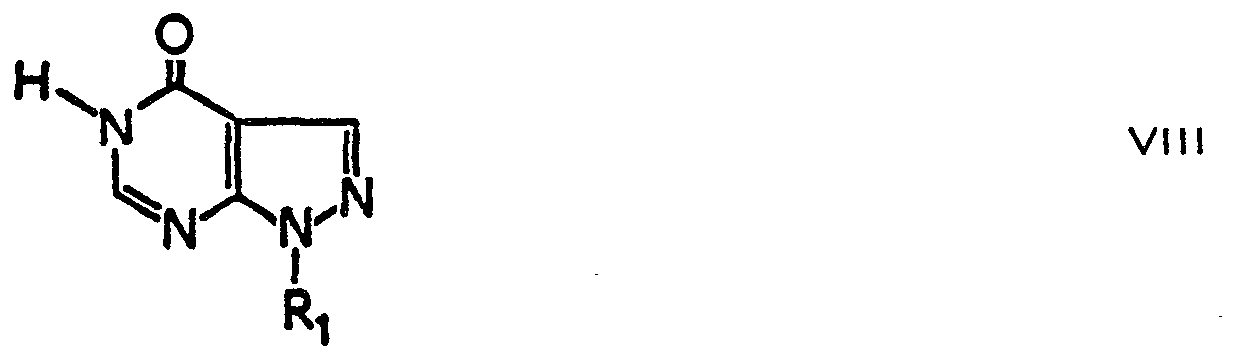


Priority Applications (1)
| Application Number | Priority Date | Filing Date | Title |
|---|---|---|---|
| AT84902508T ATE50408T1 (en) | 1983-06-30 | 1984-06-19 | ALLOPURINOL PROCURE. |
Applications Claiming Priority (2)
| Application Number | Priority Date | Filing Date | Title |
|---|---|---|---|
| DK3028/83 | 1983-06-30 | ||
| DK3028/83A DK302883D0 (en) | 1983-06-30 | 1983-06-30 | ALLOPURINOL PRODUCTS |
Publications (2)
| Publication Number | Publication Date |
|---|---|
| EP0148883A1 EP0148883A1 (en) | 1985-07-24 |
| EP0148883B1 true EP0148883B1 (en) | 1990-02-14 |
Family
ID=8118314
Family Applications (1)
| Application Number | Title | Priority Date | Filing Date |
|---|---|---|---|
| EP84902508A Expired - Lifetime EP0148883B1 (en) | 1983-06-30 | 1984-06-19 | Allopurinol prodrugs |
Country Status (10)
| Country | Link |
|---|---|
| US (1) | US4694006A (en) |
| EP (1) | EP0148883B1 (en) |
| JP (1) | JPS60501708A (en) |
| DE (1) | DE3481369D1 (en) |
| DK (1) | DK302883D0 (en) |
| ES (1) | ES533873A0 (en) |
| FI (1) | FI83221C (en) |
| IE (1) | IE57696B1 (en) |
| IT (1) | IT1214854B (en) |
| WO (1) | WO1985000368A1 (en) |
Cited By (1)
| Publication number | Priority date | Publication date | Assignee | Title |
|---|---|---|---|---|
| WO2004043396A3 (en) * | 2002-11-09 | 2004-08-12 | Nobex Corp | Modified carbamate-containing prodrugs and methods of synthesizing same |
Families Citing this family (19)
| Publication number | Priority date | Publication date | Assignee | Title |
|---|---|---|---|---|
| US4943579A (en) * | 1987-10-06 | 1990-07-24 | The United States Of America As Represented By The Secretary Of The Department Of Health And Human Services | Water soluble prodrugs of camptothecin |
| IT1244501B (en) * | 1991-03-22 | 1994-07-15 | Sigma Tau Ind Farmaceuti | AMINO ACYL AND OLIGOPEPTIDIC DERIVATIVES OF ALLOPURINOL EQUIPPED WITH IMMUNOSTIMULANT ACTIVITY AND PHARMACEUTICAL COMPOSITIONS CONTAINING THEM |
| US6110923A (en) * | 1994-06-22 | 2000-08-29 | Biochem Pharma Inc. | Method for treating cancer using novel substituted purinyl derivatives with immunomodulating activity |
| US7671029B2 (en) * | 1999-08-06 | 2010-03-02 | Immupharma Sa | Compositions and methods for enhanced pharmacological activity of compositions comprising peptide drug substances |
| US20030060413A1 (en) * | 2001-09-06 | 2003-03-27 | Zimmer Robert H. | Derivatives of pseudo-peptides, their preparation and their biological uses |
| US6908900B2 (en) * | 2001-01-17 | 2005-06-21 | Zimmer & Associates Ag | Compositions and methods for enhanced pharmacological activity through oral and parenteral administration of compositions comprising polypeptide drug substances and other poorly absorbed active ingredients |
| JP5732453B2 (en) | 2009-06-25 | 2015-06-10 | アルカーメス ファーマ アイルランド リミテッド | Prodrugs of NH acidic compounds |
| NZ604423A (en) * | 2010-06-24 | 2015-01-30 | Alkermes Pharma Ireland Ltd | Prodrugs of nh-acidic compounds: ester, carbonate, carbamate and phosphonate derivatives |
| ES2972387T3 (en) | 2011-03-18 | 2024-06-12 | Alkermes Pharma Ireland Ltd | Pharmaceutical compositions comprising sorbitan esters |
| WO2013088255A1 (en) | 2011-12-15 | 2013-06-20 | Alkermes Pharma Ireland Limited | Prodrugs of secondary amine compounds |
| WO2013142202A1 (en) | 2012-03-19 | 2013-09-26 | Alkermes Pharma Ireland Limited | Pharmaceutical compositions comprising glycerol esters |
| CA2867121C (en) | 2012-03-19 | 2021-05-25 | Alkermes Pharma Ireland Limited | Pharmaceutical compositions comprising fatty acid esters |
| US9999670B2 (en) | 2012-03-19 | 2018-06-19 | Alkermes Pharma Ireland Limited | Pharmaceutical compositions comprising benzyl alcohol |
| JP6654042B2 (en) | 2012-09-19 | 2020-02-26 | アルカームス ファーマ アイルランド リミテッド | Pharmaceutical composition with improved storage stability |
| US8883857B2 (en) * | 2012-12-07 | 2014-11-11 | Baylor College Of Medicine | Small molecule xanthine oxidase inhibitors and methods of use |
| AU2015231278B2 (en) | 2014-03-20 | 2020-01-23 | Alkermes Pharma Ireland Limited | Aripiprazole formulations having increased injection speeds |
| WO2016015177A1 (en) * | 2014-06-23 | 2016-02-04 | 北京新天宇科技开发有限公司 | Pyrazolo[3,4-d]pyrimidine-4-ketone derivative, preparation method therefor, and uses thereof |
| CN105272984B (en) * | 2014-06-23 | 2019-06-14 | 湘北威尔曼制药股份有限公司 | Pyrazolo[3,4-d]pyrimidin-4-one derivatives, their preparation method and application |
| AU2019230014B2 (en) | 2018-03-05 | 2024-11-28 | Alkermes Pharma Ireland Limited | Aripiprazole dosing strategy |
Family Cites Families (7)
| Publication number | Priority date | Publication date | Assignee | Title |
|---|---|---|---|---|
| US2868803A (en) * | 1956-02-10 | 1959-01-13 | Ciba Pharm Prod Inc | New pyrazoles and method of preparing same |
| US3474098A (en) * | 1968-08-22 | 1969-10-21 | Burroughs Wellcome Co | Pyrazolo-(3,4-d) pyrimidines |
| GB1339748A (en) * | 1970-07-02 | 1973-12-05 | Ici Ltd | Pyrimidine derivatives |
| GR75219B (en) * | 1980-04-21 | 1984-07-13 | Merck & Co Inc | |
| DE3131365A1 (en) * | 1981-08-07 | 1983-02-24 | Henkel KGaA, 4000 Düsseldorf | NEW DIGLYCIDYL-SUBSTITUTED HETEROCYCLIC COMPOUNDS, METHOD FOR THE PRODUCTION THEREOF AND THEIR USE IN PHARMACEUTICAL PREPARATIONS WITH CYTOSTATIC EFFECTIVENESS |
| US4565868A (en) * | 1983-02-07 | 1986-01-21 | Syntex (U.S.A.) Inc. | Process for preparing guanine derivatives |
| US4555579A (en) * | 1983-03-24 | 1985-11-26 | E. R. Squibb & Sons, Inc. | Dioxolenylmethyl ester prodrugs of phosphinic acid ace inhibitors |
-
1983
- 1983-06-30 DK DK3028/83A patent/DK302883D0/en not_active Application Discontinuation
-
1984
- 1984-06-19 EP EP84902508A patent/EP0148883B1/en not_active Expired - Lifetime
- 1984-06-19 DE DE8484902508T patent/DE3481369D1/en not_active Expired - Lifetime
- 1984-06-19 US US06/711,583 patent/US4694006A/en not_active Expired - Fee Related
- 1984-06-19 JP JP84502551A patent/JPS60501708A/en active Pending
- 1984-06-19 WO PCT/DK1984/000057 patent/WO1985000368A1/en not_active Ceased
- 1984-06-29 IE IE1659/84A patent/IE57696B1/en not_active IP Right Cessation
- 1984-06-29 ES ES533873A patent/ES533873A0/en active Granted
- 1984-06-29 IT IT8467669A patent/IT1214854B/en active
-
1985
- 1985-02-28 FI FI850829A patent/FI83221C/en not_active IP Right Cessation
Cited By (1)
| Publication number | Priority date | Publication date | Assignee | Title |
|---|---|---|---|---|
| WO2004043396A3 (en) * | 2002-11-09 | 2004-08-12 | Nobex Corp | Modified carbamate-containing prodrugs and methods of synthesizing same |
Also Published As
| Publication number | Publication date |
|---|---|
| US4694006A (en) | 1987-09-15 |
| JPS60501708A (en) | 1985-10-11 |
| IT1214854B (en) | 1990-01-18 |
| IT8467669A0 (en) | 1984-06-29 |
| IE57696B1 (en) | 1993-03-10 |
| ES8600293A1 (en) | 1985-10-01 |
| DK302883D0 (en) | 1983-06-30 |
| FI850829L (en) | 1985-02-28 |
| FI850829A0 (en) | 1985-02-28 |
| FI83221C (en) | 1991-06-10 |
| EP0148883A1 (en) | 1985-07-24 |
| WO1985000368A1 (en) | 1985-01-31 |
| ES533873A0 (en) | 1985-10-01 |
| FI83221B (en) | 1991-02-28 |
| IE841659L (en) | 1984-12-30 |
| DE3481369D1 (en) | 1990-03-22 |
Similar Documents
| Publication | Publication Date | Title |
|---|---|---|
| US4694006A (en) | Acyl- or acyloxymethyl-allopurinol prodrugs | |
| EP0288973B1 (en) | Benzothiazolinone derivatives, their production and pharmaceutical composition | |
| PL188076B1 (en) | Benzopyrane containing compounds and method of applying them | |
| JP2000511559A (en) | N-substituted 2-cyanopyrrolidine | |
| WO1998018765A1 (en) | 1-phenylpyrazole compounds and medicinal application thereof | |
| IL192023A (en) | Heterocyclic compounds, compositions comprising them and uses thereof | |
| FR2510115A1 (en) | ERGOLINE DERIVATIVES, PROCESS FOR PREPARING THEM AND THEIR USE AS A MEDICINAL PRODUCT | |
| CA2060616C (en) | Use of 4-(3-trifluoromethylphenyl)-1,2,3,6-tetrahydropyridine derivatives as free radical scavengers | |
| JPH0253795A (en) | new ester | |
| WO1989003682A1 (en) | Benzothiazine dioxide derivatives | |
| KR19990008184A (en) | Water-soluble novel fluoroethyl camptothecin derivatives and preparation method thereof | |
| AU774981B2 (en) | Thiazolopyrimidines useful as TNFalpha inhibitors | |
| US4100289A (en) | Amidic derivatives of nicotinic acid as therapeutics | |
| DK162051B (en) | Allopurinol prodrugs | |
| US6949656B2 (en) | Cyclic amine derivatives and use thereof | |
| JPH05331063A (en) | Antagonist for endothelin receptor | |
| NO164028B (en) | ANALOGUE PROCEDURE FOR THE PREPARATION OF THERAPEUTIC ACTIVE ALLOPURINOL DERIVATIVES. | |
| US4010161A (en) | Piperazinoethyl-N-(2,3-dimethyl-5-oxo-1-phenyl-3Δ-pyrazolin-4-yl)carbamates | |
| IL29772A (en) | Benzodiazepine derivatives and process for the manufacture thereof | |
| GR1010438B (en) | Farmaceutical compounds based on the association of an histamine antagonist and a hydrogen sulfide donor for the use in the treatment of pruritus | |
| JPH111479A (en) | Isoxazole derivatives having an amide bond, and chymase inhibitors and angiotensin II production inhibitors containing them | |
| JPH10316673A (en) | New anti-inflammatory drugs | |
| HK1119704B (en) | Compounds and methods for inhibiting the interaction of bcl proteins with binding partners | |
| JPH05279255A (en) | Uric acid excretion enhancer | |
| JPH0352888A (en) | New compound, preparation thereof, and drug composition containing same |
Legal Events
| Date | Code | Title | Description |
|---|---|---|---|
| PUAI | Public reference made under article 153(3) epc to a published international application that has entered the european phase |
Free format text: ORIGINAL CODE: 0009012 |
|
| 17P | Request for examination filed |
Effective date: 19850226 |
|
| AK | Designated contracting states |
Designated state(s): AT BE CH DE FR GB LI LU NL SE |
|
| 17Q | First examination report despatched |
Effective date: 19860624 |
|
| GRAA | (expected) grant |
Free format text: ORIGINAL CODE: 0009210 |
|
| RAP1 | Party data changed (applicant data changed or rights of an application transferred) |
Owner name: A/S GEA FARMACEUTISK FABRIK |
|
| AK | Designated contracting states |
Kind code of ref document: B1 Designated state(s): AT BE CH DE FR GB LI LU NL SE |
|
| REF | Corresponds to: |
Ref document number: 50408 Country of ref document: AT Date of ref document: 19900215 Kind code of ref document: T |
|
| REF | Corresponds to: |
Ref document number: 3481369 Country of ref document: DE Date of ref document: 19900322 |
|
| ET | Fr: translation filed | ||
| PLBE | No opposition filed within time limit |
Free format text: ORIGINAL CODE: 0009261 |
|
| STAA | Information on the status of an ep patent application or granted ep patent |
Free format text: STATUS: NO OPPOSITION FILED WITHIN TIME LIMIT |
|
| 26N | No opposition filed | ||
| PGFP | Annual fee paid to national office [announced via postgrant information from national office to epo] |
Ref country code: GB Payment date: 19940615 Year of fee payment: 11 Ref country code: CH Payment date: 19940615 Year of fee payment: 11 |
|
| PGFP | Annual fee paid to national office [announced via postgrant information from national office to epo] |
Ref country code: SE Payment date: 19940617 Year of fee payment: 11 |
|
| PGFP | Annual fee paid to national office [announced via postgrant information from national office to epo] |
Ref country code: FR Payment date: 19940627 Year of fee payment: 11 |
|
| PGFP | Annual fee paid to national office [announced via postgrant information from national office to epo] |
Ref country code: NL Payment date: 19940630 Year of fee payment: 11 Ref country code: LU Payment date: 19940630 Year of fee payment: 11 Ref country code: AT Payment date: 19940630 Year of fee payment: 11 |
|
| PGFP | Annual fee paid to national office [announced via postgrant information from national office to epo] |
Ref country code: BE Payment date: 19940705 Year of fee payment: 11 |
|
| EPTA | Lu: last paid annual fee | ||
| PGFP | Annual fee paid to national office [announced via postgrant information from national office to epo] |
Ref country code: DE Payment date: 19940729 Year of fee payment: 11 |
|
| EAL | Se: european patent in force in sweden |
Ref document number: 84902508.5 |
|
| PG25 | Lapsed in a contracting state [announced via postgrant information from national office to epo] |
Ref country code: LU Free format text: LAPSE BECAUSE OF NON-PAYMENT OF DUE FEES Effective date: 19950619 Ref country code: GB Effective date: 19950619 Ref country code: AT Effective date: 19950619 |
|
| PG25 | Lapsed in a contracting state [announced via postgrant information from national office to epo] |
Ref country code: SE Effective date: 19950620 |
|
| PG25 | Lapsed in a contracting state [announced via postgrant information from national office to epo] |
Ref country code: LI Effective date: 19950630 Ref country code: CH Effective date: 19950630 Ref country code: BE Effective date: 19950630 |
|
| BERE | Be: lapsed |
Owner name: GEA FARMACEUTISK FABRIK A/S Effective date: 19950630 |
|
| PG25 | Lapsed in a contracting state [announced via postgrant information from national office to epo] |
Ref country code: NL Effective date: 19960101 |
|
| GBPC | Gb: european patent ceased through non-payment of renewal fee |
Effective date: 19950619 |
|
| PG25 | Lapsed in a contracting state [announced via postgrant information from national office to epo] |
Ref country code: FR Effective date: 19960229 |
|
| REG | Reference to a national code |
Ref country code: CH Ref legal event code: PL |
|
| NLV4 | Nl: lapsed or anulled due to non-payment of the annual fee |
Effective date: 19960101 |
|
| PG25 | Lapsed in a contracting state [announced via postgrant information from national office to epo] |
Ref country code: DE Effective date: 19960301 |
|
| EUG | Se: european patent has lapsed |
Ref document number: 84902508.5 |
|
| REG | Reference to a national code |
Ref country code: FR Ref legal event code: ST |