EP0147666A2 - Method of converting a precursor ceramic solid into a solid ceramic hydronium conductor - Google Patents
Method of converting a precursor ceramic solid into a solid ceramic hydronium conductor Download PDFInfo
- Publication number
- EP0147666A2 EP0147666A2 EP84114556A EP84114556A EP0147666A2 EP 0147666 A2 EP0147666 A2 EP 0147666A2 EP 84114556 A EP84114556 A EP 84114556A EP 84114556 A EP84114556 A EP 84114556A EP 0147666 A2 EP0147666 A2 EP 0147666A2
- Authority
- EP
- European Patent Office
- Prior art keywords
- ceramic
- solid
- ionic
- acid
- polycrystalline
- Prior art date
- Legal status (The legal status is an assumption and is not a legal conclusion. Google has not performed a legal analysis and makes no representation as to the accuracy of the status listed.)
- Withdrawn
Links
Images

Classifications
-
- G—PHYSICS
- G01—MEASURING; TESTING
- G01N—INVESTIGATING OR ANALYSING MATERIALS BY DETERMINING THEIR CHEMICAL OR PHYSICAL PROPERTIES
- G01N27/00—Investigating or analysing materials by the use of electric, electrochemical, or magnetic means
- G01N27/26—Investigating or analysing materials by the use of electric, electrochemical, or magnetic means by investigating electrochemical variables; by using electrolysis or electrophoresis
- G01N27/403—Cells and electrode assemblies
- G01N27/406—Cells and probes with solid electrolytes
- G01N27/407—Cells and probes with solid electrolytes for investigating or analysing gases
- G01N27/4073—Composition or fabrication of the solid electrolyte
-
- C—CHEMISTRY; METALLURGY
- C01—INORGANIC CHEMISTRY
- C01F—COMPOUNDS OF THE METALS BERYLLIUM, MAGNESIUM, ALUMINIUM, CALCIUM, STRONTIUM, BARIUM, RADIUM, THORIUM, OR OF THE RARE-EARTH METALS
- C01F7/00—Compounds of aluminium
- C01F7/02—Aluminium oxide; Aluminium hydroxide; Aluminates
- C01F7/028—Beta-aluminas
-
- C—CHEMISTRY; METALLURGY
- C04—CEMENTS; CONCRETE; ARTIFICIAL STONE; CERAMICS; REFRACTORIES
- C04B—LIME, MAGNESIA; SLAG; CEMENTS; COMPOSITIONS THEREOF, e.g. MORTARS, CONCRETE OR LIKE BUILDING MATERIALS; ARTIFICIAL STONE; CERAMICS; REFRACTORIES; TREATMENT OF NATURAL STONE
- C04B35/00—Shaped ceramic products characterised by their composition; Ceramics compositions; Processing powders of inorganic compounds preparatory to the manufacturing of ceramic products
- C04B35/01—Shaped ceramic products characterised by their composition; Ceramics compositions; Processing powders of inorganic compounds preparatory to the manufacturing of ceramic products based on oxide ceramics
- C04B35/10—Shaped ceramic products characterised by their composition; Ceramics compositions; Processing powders of inorganic compounds preparatory to the manufacturing of ceramic products based on oxide ceramics based on aluminium oxide
- C04B35/111—Fine ceramics
- C04B35/113—Fine ceramics based on beta-aluminium oxide
-
- C—CHEMISTRY; METALLURGY
- C04—CEMENTS; CONCRETE; ARTIFICIAL STONE; CERAMICS; REFRACTORIES
- C04B—LIME, MAGNESIA; SLAG; CEMENTS; COMPOSITIONS THEREOF, e.g. MORTARS, CONCRETE OR LIKE BUILDING MATERIALS; ARTIFICIAL STONE; CERAMICS; REFRACTORIES; TREATMENT OF NATURAL STONE
- C04B41/00—After-treatment of mortars, concrete, artificial stone or ceramics; Treatment of natural stone
-
- G—PHYSICS
- G02—OPTICS
- G02F—OPTICAL DEVICES OR ARRANGEMENTS FOR THE CONTROL OF LIGHT BY MODIFICATION OF THE OPTICAL PROPERTIES OF THE MEDIA OF THE ELEMENTS INVOLVED THEREIN; NON-LINEAR OPTICS; FREQUENCY-CHANGING OF LIGHT; OPTICAL LOGIC ELEMENTS; OPTICAL ANALOGUE/DIGITAL CONVERTERS
- G02F1/00—Devices or arrangements for the control of the intensity, colour, phase, polarisation or direction of light arriving from an independent light source, e.g. switching, gating or modulating; Non-linear optics
- G02F1/01—Devices or arrangements for the control of the intensity, colour, phase, polarisation or direction of light arriving from an independent light source, e.g. switching, gating or modulating; Non-linear optics for the control of the intensity, phase, polarisation or colour
- G02F1/15—Devices or arrangements for the control of the intensity, colour, phase, polarisation or direction of light arriving from an independent light source, e.g. switching, gating or modulating; Non-linear optics for the control of the intensity, phase, polarisation or colour based on an electrochromic effect
- G02F1/1514—Devices or arrangements for the control of the intensity, colour, phase, polarisation or direction of light arriving from an independent light source, e.g. switching, gating or modulating; Non-linear optics for the control of the intensity, phase, polarisation or colour based on an electrochromic effect characterised by the electrochromic material, e.g. by the electrodeposited material
- G02F1/1523—Devices or arrangements for the control of the intensity, colour, phase, polarisation or direction of light arriving from an independent light source, e.g. switching, gating or modulating; Non-linear optics for the control of the intensity, phase, polarisation or colour based on an electrochromic effect characterised by the electrochromic material, e.g. by the electrodeposited material comprising inorganic material
- G02F1/1525—Devices or arrangements for the control of the intensity, colour, phase, polarisation or direction of light arriving from an independent light source, e.g. switching, gating or modulating; Non-linear optics for the control of the intensity, phase, polarisation or colour based on an electrochromic effect characterised by the electrochromic material, e.g. by the electrodeposited material comprising inorganic material characterised by a particular ion transporting layer, e.g. electrolyte
-
- H—ELECTRICITY
- H01—ELECTRIC ELEMENTS
- H01B—CABLES; CONDUCTORS; INSULATORS; SELECTION OF MATERIALS FOR THEIR CONDUCTIVE, INSULATING OR DIELECTRIC PROPERTIES
- H01B1/00—Conductors or conductive bodies characterised by the conductive materials; Selection of materials as conductors
- H01B1/06—Conductors or conductive bodies characterised by the conductive materials; Selection of materials as conductors mainly consisting of other non-metallic substances
- H01B1/08—Conductors or conductive bodies characterised by the conductive materials; Selection of materials as conductors mainly consisting of other non-metallic substances oxides
-
- H—ELECTRICITY
- H01—ELECTRIC ELEMENTS
- H01M—PROCESSES OR MEANS, e.g. BATTERIES, FOR THE DIRECT CONVERSION OF CHEMICAL ENERGY INTO ELECTRICAL ENERGY
- H01M10/00—Secondary cells; Manufacture thereof
- H01M10/34—Gastight accumulators
- H01M10/345—Gastight metal hydride accumulators
- H01M10/347—Gastight metal hydride accumulators with solid electrolyte
-
- H—ELECTRICITY
- H01—ELECTRIC ELEMENTS
- H01M—PROCESSES OR MEANS, e.g. BATTERIES, FOR THE DIRECT CONVERSION OF CHEMICAL ENERGY INTO ELECTRICAL ENERGY
- H01M6/00—Primary cells; Manufacture thereof
- H01M6/14—Cells with non-aqueous electrolyte
- H01M6/18—Cells with non-aqueous electrolyte with solid electrolyte
- H01M6/185—Cells with non-aqueous electrolyte with solid electrolyte with oxides, hydroxides or oxysalts as solid electrolytes
-
- C—CHEMISTRY; METALLURGY
- C01—INORGANIC CHEMISTRY
- C01P—INDEXING SCHEME RELATING TO STRUCTURAL AND PHYSICAL ASPECTS OF SOLID INORGANIC COMPOUNDS
- C01P2002/00—Crystal-structural characteristics
- C01P2002/70—Crystal-structural characteristics defined by measured X-ray, neutron or electron diffraction data
- C01P2002/77—Crystal-structural characteristics defined by measured X-ray, neutron or electron diffraction data by unit-cell parameters, atom positions or structure diagrams
-
- Y—GENERAL TAGGING OF NEW TECHNOLOGICAL DEVELOPMENTS; GENERAL TAGGING OF CROSS-SECTIONAL TECHNOLOGIES SPANNING OVER SEVERAL SECTIONS OF THE IPC; TECHNICAL SUBJECTS COVERED BY FORMER USPC CROSS-REFERENCE ART COLLECTIONS [XRACs] AND DIGESTS
- Y02—TECHNOLOGIES OR APPLICATIONS FOR MITIGATION OR ADAPTATION AGAINST CLIMATE CHANGE
- Y02E—REDUCTION OF GREENHOUSE GAS [GHG] EMISSIONS, RELATED TO ENERGY GENERATION, TRANSMISSION OR DISTRIBUTION
- Y02E60/00—Enabling technologies; Technologies with a potential or indirect contribution to GHG emissions mitigation
- Y02E60/10—Energy storage using batteries
Definitions
- This invention relates to a novel ceramic conductor of the hydrogen specifically a solid polycrystalline ⁇ alumina ceramic, and to a method for preparation of the same by transforming a precursor solid polycrystalline ⁇ alumina ceramic.
- Solid ionic conductors have been the subject of intensive research with respect to their use as separators in batteries, ion detectors, gas sensors, electrochromic displays and other electrochemical devices where their properties of high ionic conductivity with negligible electronic conductivity can be used to advantage.
- a familiar group of compounds is based on the property of ⁇ alumina to act as an ion exchanger.
- derivatives such as the lithium, potassium, silver and hydronium analogues have been prepared by immersing single crystals of sodium ⁇ alumina in appropriate ionic melts.
- polycrystalline ceramics which would be formed into desired environmental shapes tend to degrade mechanically on ion exchange due to the stresses caused by lattice expansion (or contraction) on incorporation of ions of dissimilar size.
- the dimensional size of 2 relevant ions is given below;
- MAP Mixed Alkali ion Percolation
- the invention contemplates a solid ceramic conductor, of the hydrogen ion, being a solid polycrystalline, with the general formula; where Z may be occupied by a stabilizer of ⁇ "
- the invention further contemplates an active electrochemical element comprising a solid polycrystalline ceramic of the general formula; whose conductivity to the H 3 0 + ion is in the range of 10 -1 to 10 -3 ⁇ - 1 cm -1 at 30 0 °C and its f( ⁇ ) is in the range of 0 ⁇ 0.55 wherein and, Z is a predetermined stabilizer of the ⁇ " phase.
- Z is a compound of magnesium more specifically MgO and preferably the aforesaid general formula reduces to the preferred general formula
- the invention further contemplates a method of producing a solid polycrystalline ⁇ alumina ceramic that is conductive to H 3 0 + comprising the steps of;
- the acid may be a dilute acid at a temperature of about 90°C or concentrated sulfuric acid at 300°C. There are other suitable acids and concentrations as will become apparent.
- the predetermined the quantity of charge is determined only by the weight of the sample and the degree of ion exchange desired for the hydronium ion to replace Na + or K + , or both.
- the degree of exchange is 100% of both Na + and K + .
- step (b) further includes the sub steps;
- the ionic species of the ionic melt or solution are preferably selected from the group of ions Na + ,K + , Li + , H 3 0 + ; with mixtures with appropriate anions preferably Cl-, NO-, SO 4 2- and COOH-.
- the polycrystalline ceramic has one or more cations selected from the group Na + , K + , Li + and preferably of the aforesaid chemical formula where the atom fraction of sodium is 0.6; that of potassium 0.4; that of the ⁇ phase 0.4; and, that of the ⁇ " phase 0.6.
- selected solid polycrystalline ⁇ alumina ceramics can, when made according to our co-pending applications aforesaid, behave in rather complex ways during ion exchange with the known field assisted technique.
- the field effect ion exchange is accomplished as follows.
- a sample ceramic 10 is used to separate two symmetrical compartments 12 and 14 of a glass cell 15. Each of these compartments contained a platinum sheet electrode 13 and 16 immersed in an aqueous mineral or organic acid 18.
- Reservoir 20 supplies hydrogen gas. Hydrogen gas 21 was bubbled over one electrode 16 throughout the experiment.
- Ion exchange was carried out by application of a voltage ranging between 1 and 40 volts between these electrodes 13 and 16 and the course of the experiment was followed by measuring the current through the sample and monitoring the pH change in the cathodic compartment.
- the current initially decreases rapidly to approximately 1 ⁇ A. However, after around 50 hours, it begins to increase, slowly at first and then very rapidly. A maximum of around 0.2 mA occurs after 100 hours.
- the conductivity change during the course of this experiment shows remarkable similarity to that caused by the mixed alkali effect.
- this problem will be alleviated by introducing a pre-exchange step to alter the ion distribution and to tailor the lattice size to that of the hydronium ion.
- the stress induced in this step must be less than the critical strain limit of the ceramic.
- this aim is achieved by equilibrating suitably prepared polycrystalline material containing one or more cation such as Na + , K + or Li + with an ionic melt or solution containing two or more ionic species of differing ionic radii.
- the composition of the melt or solution can be written as: Ml, M2, (M 3 ...) X where M l and M 2 (and M 3 etc.) are ions of dissimilar size, examples of which are sodium, potassium, lithium and hydronium ions.
- concentration of these can be chosen on the basis of literature data of the prior art on the equilibration of ⁇ alumina with ionic melts or may be determined by experiment. It is noted that the concentration chosen does not depend on the proportion of ⁇ phase but is calculated on the basis of the desired lattice expansion so as to accommodate the H 3 0 + ion size and the fracture strength of the ceramic.
- X is a suitable anion which does not chemically attack ⁇ alumina and does not take part in the ion exchange process.
- Examples for X are Cl-, N0 3 -, S0 4 2 -, COOH- or mixtures of these.
- the mixture of salts employed may be used to control the temperature at which exchange is carried out.
- the melt or solution may or may not contain the desired incoming ion. After this treatment, the ceramic may be converted to the desired ionic conductor by ion exchange techniques known.
- the solid ceramic feed stock 10 is selected 50, then immersed in an ionic solution 60 as aforesaid, washed 70 in glycerin, and then subjected to field effect exchange 80 using the apparatus of figure 2.
- the ceramic 10 was converted to the hydronium form by field assisted ion exchange with dilute sulfuric acid (o.lM) at room temperature. It was found that, in contrast to the behavior without the aforesaid pre-exchange substitution step, the current decreased only slowly after an initial rapid decrease and the rate of exchange to the hydronium analogue was a thousand times faster without any evidence of mechanical degradation.
- o.lM dilute sulfuric acid
Landscapes
- Chemical & Material Sciences (AREA)
- Engineering & Computer Science (AREA)
- Chemical Kinetics & Catalysis (AREA)
- Electrochemistry (AREA)
- Physics & Mathematics (AREA)
- Organic Chemistry (AREA)
- Ceramic Engineering (AREA)
- Manufacturing & Machinery (AREA)
- Life Sciences & Earth Sciences (AREA)
- Materials Engineering (AREA)
- Inorganic Chemistry (AREA)
- General Chemical & Material Sciences (AREA)
- General Physics & Mathematics (AREA)
- Structural Engineering (AREA)
- Nonlinear Science (AREA)
- Health & Medical Sciences (AREA)
- Analytical Chemistry (AREA)
- Molecular Biology (AREA)
- Optics & Photonics (AREA)
- Biochemistry (AREA)
- General Health & Medical Sciences (AREA)
- Immunology (AREA)
- Pathology (AREA)
- Geology (AREA)
- Compositions Of Oxide Ceramics (AREA)
- Conductive Materials (AREA)
Abstract



Description
- This invention relates to a novel ceramic conductor of the hydrogen specifically a solid polycrystalline β alumina ceramic, and to a method for preparation of the same by transforming a precursor solid polycrystalline β alumina ceramic.
- Solid ionic conductors have been the subject of intensive research with respect to their use as separators in batteries, ion detectors, gas sensors, electrochromic displays and other electrochemical devices where their properties of high ionic conductivity with negligible electronic conductivity can be used to advantage.
- A familiar group of compounds is based on the property of β alumina to act as an ion exchanger. Thus a large number of derivatives such as the lithium, potassium, silver and hydronium analogues have been prepared by immersing single crystals of sodium β alumina in appropriate ionic melts. However polycrystalline ceramics which would be formed into desired environmental shapes tend to degrade mechanically on ion exchange due to the stresses caused by lattice expansion (or contraction) on incorporation of ions of dissimilar size. The dimensional size of 2 relevant ions is given below;


- Some of the inventors herein have earlier disclosed in co-pending patent applications a mixed sodium/potassium compound, a method of preparing the same as a polycrystalline powder and subsequently a method of generating from the powder rigid polycrystalline ceramics. These applications are now entitled THE PREPARATION OF A PRECURSOR POWDER FOR THE MANUFACTURE OF A CERAMIC HYDROGEN ION CONDUCTOR [l], filed in Canada, 28 April, 1981 and THE PREPARATION OF A PRECURSOR SOLID FOR THE MANUFACTURE OF A CERAMIC HYDROGEN ION CONDUCTOR, filed in Canada, 23 June, 1983. The resulting ceramics have a high density and a low proportion of phase. For convenience and for understanding, it is appropriate to define the following function for the proportion of β phase; wherein

- It was the object of the previous inventions to achieve a high density, mechanically strong ceramic possessing β alumina and β" alumina phases where f(β) is preferably 0.37+0.03. The,preferred compound is of chemical formula;

- In order to explain the properties of such compounds, a theory known as Mixed Alkali ion Percolation (MAP) theory has been developed [2] and it was shown from x-ray diffraction and conductivity measurements that, at this f(β), the potassium ions reside primarily in the β phase and the sodium ions occupying sites in the s" phase.
- The invention contemplates a solid ceramic conductor, of the hydrogen ion, being a solid polycrystalline, with the general formula;

- and where a = 0→1
- b = 0→1
- c = 0→1; and
- a + b + c = 1
- The invention further contemplates an active electrochemical element comprising a solid polycrystalline ceramic of the general formula;

H 30+ ion is in the range of 10-1 to 10-3 Ω-1cm-1 at 300°C and its f(β) is in the range of 0→0.55 wherein
- Preferably Z is a compound of magnesium more specifically MgO and preferably the aforesaid general formula reduces to the preferred general formula;

- wherein f(s) = 0.37+0.03
- a = 0→1
- b = 0→1
- c = 0→1
- a + b + c = 1
- The invention further contemplates a method of producing a solid polycrystalline β alumina ceramic that is conductive to
H 30+ comprising the steps of; - (a) selecting a sintered solid polycrystalline a alumina ceramic with f(β) = 0→0.55;
- (b) altering the ion distribution of the ceramic by tailoring the lattice size thereof to approximate
34.18+0.05Å; and, - (c) immersing the resultant ceramic of step (b) in an acid; while,
- (d) passing an electrical charge of predetermined quantity through the ceramic whereby to displace certain ions within the ceramic with
H 30+. - The acid may be a dilute acid at a temperature of about 90°C or concentrated sulfuric acid at 300°C. There are other suitable acids and concentrations as will become apparent.
- The predetermined the quantity of charge is determined only by the weight of the sample and the degree of ion exchange desired for the hydronium ion to replace Na+ or K+, or both. Preferably the degree of exchange is 100% of both Na+ and K+.
- Preferably the method is supplemented by pre-ionic substitution wherein step (b) further includes the sub steps;
- (i) selecting an ionic melt or solution containing two or more ionic species of different ionic radii;
- (ii) immersing the selected alumina ceramic of step (a) into the ionic melt until a predetermined amount of cations in the ceramic are displaced by ions of dissimilar size from the ionic solution.
- These pre-ionic substitution are preferred to enhance the
ultimate H 30+ conductivity. They in fact increase the crystallographic size of the lattice of the feed ceramic so it is more readily accommodating to thelarger H 30+ ion that in fact replaces, the Na+ and K+ during step (c). - Specifically the ionic species of the ionic melt or solution are preferably selected from the group of ions Na+,K+, Li+,
H 30+; with mixtures with appropriate anions preferably Cl-, NO-, SO4 2- and COOH-. Specifically the polycrystalline ceramic has one or more cations selected from the group Na+, K+, Li+ and preferably of the aforesaid chemical formula where the atom fraction of sodium is 0.6; that of potassium 0.4; that of the β phase 0.4; and, that of the β" phase 0.6. - The invention will now be described by way of example with reference to the accompanying drawings in which;
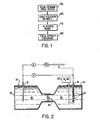
- Figure 1 is a flow chart of the preferred method steps;
- Figure 2 is an arrangment whereby the method of the invention is performed;
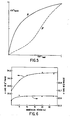
- Figure 3 is a current-time behavior of β alumina samples during field assisted ion exchange;
- Figure 4 plots dependence of conductivity (I/V) on charge passed (I.t);
- Figure 5 plots equilibria between 0 and s" aluminas and KN03/NaN03 melts at 300°C;
- Figure 6 plots the variation of the c lattice parameter on immersion in a KC1/NaCl melt at 800°C.
- Referring to figures 1 and 2, selected solid polycrystalline β alumina ceramics can, when made according to our co-pending applications aforesaid, behave in rather complex ways during ion exchange with the known field assisted technique. The field effect ion exchange is accomplished as follows. A sample ceramic 10 is used to separate two
symmetrical compartments platinum sheet electrode 13 and 16 immersed in an aqueous mineral ororganic acid 18.Reservoir 20 supplies hydrogen gas.Hydrogen gas 21 was bubbled over oneelectrode 16 throughout the experiment. Ion exchange was carried out by application of a voltage ranging between 1 and 40 volts between theseelectrodes 13 and 16 and the course of the experiment was followed by measuring the current through the sample and monitoring the pH change in the cathodic compartment. On application of a voltage, the current initially decreases rapidly to approximately 1 µA. However, after around 50 hours, it begins to increase, slowly at first and then very rapidly. A maximum of around 0.2 mA occurs after 100 hours. The conductivity change during the course of this experiment (figure 4) shows remarkable similarity to that caused by the mixed alkali effect. (In figure 4, the conductivity (I/V) is plotted against the charge passed (I.t) which is proportional to the mole fraction of hydronium ions,H 30+, in thesample 10.) As the hydronium ion is a univalent ion similar in size to the potassium ion, it is believed that it is behaving like the alkali ion causing a decrease in conductivity due to a preferential occupancy of certain crystallographic sites formerly occupied by Na+. - On the basis of the MAP theory disclosed in the co-pending application filed 23 June, 1983, it can be predicted that this problem will be alleviated by introducing a pre-exchange step to alter the ion distribution and to tailor the lattice size to that of the hydronium ion. The stress induced in this step must be less than the critical strain limit of the ceramic. According to this invention, this aim is achieved by equilibrating suitably prepared polycrystalline material containing one or more cation such as Na+, K+ or Li+ with an ionic melt or solution containing two or more ionic species of differing ionic radii. The composition of the melt or solution can be written as:
Ml, M2, (M3...) X
where Ml and M2 (and M3 etc.) are ions of dissimilar size, examples of which are sodium, potassium, lithium and hydronium ions. The concentration of these can be chosen on the basis of literature data of the prior art on the equilibration of β alumina with ionic melts or may be determined by experiment. It is noted that the concentration chosen does not depend on the proportion of β phase but is calculated on the basis of the desired lattice expansion so as to accommodate theH 30+ ion size and the fracture strength of the ceramic. In the above formula, X is a suitable anion which does not chemically attack β alumina and does not take part in the ion exchange process. Examples for X are Cl-, N03-, S04 2-, COOH- or mixtures of these. The mixture of salts employed may be used to control the temperature at which exchange is carried out. The melt or solution may or may not contain the desired incoming ion. After this treatment, the ceramic may be converted to the desired ionic conductor by ion exchange techniques known. - Thus in the preferred method and referring to figure 1, the solid
ceramic feed stock 10 according to our co-pending applications is selected 50, then immersed in anionic solution 60 as aforesaid, washed 70 in glycerin, and then subjected to field effect exchange 80 using the apparatus of figure 2. - The following examples further explain the present invention.
- A disc-shaped sample of mixed alkali ion (Na, K) β/βN alumina prepared according to the previous disclosure and being a polycrystalline of the chemical formula;
(Na0.6K0·4)2O (3 W/O MgO) β/βN Al2O3
were found to have the following parameters: - atom fraction of sodium = 0.6
- atom fraction of potassium = 0.4
- fraction of β phase = 0.4
- fracton of βN phase = 0.6
- As noted earlier, at this fraction of β phase, all of the sodium ions (within experimental error) reside in the βN phase and thus the lattice parameter of this phase is too small to accommodate the larger hydronium ion. Assuming a linear increase in lattice parameter on going from the sodium to the potassium analogue, calculation suggests that an atom fraction of potassium of 0.59 is required in this phase to accommodate the hydronium ion. Following the work of Kummer [3] (figure 4), this can be achieved by immersion in a
NaN 30/KN03 melt with a potassium mole fraction of 0.64. During this step, a small amount of sodium ions also replace potassium ions in the B phase. However the lattice parameter remains sufficiently large to accommodate the hydronium ion. - After the aforesaid ionic procedure, and referring to figure 2, the ceramic 10 was converted to the hydronium form by field assisted ion exchange with dilute sulfuric acid (o.lM) at room temperature. It was found that, in contrast to the behavior without the aforesaid pre-exchange substitution step, the current decreased only slowly after an initial rapid decrease and the rate of exchange to the hydronium analogue was a thousand times faster without any evidence of mechanical degradation.
- A similar disc with f(β)=0.56 was immersed in a NaCl/KCl melt (XK=0.64) at 800°C. After each immersion, the sample was subjected to x-ray diffraction analysis. Calculation of the c lattice parameter showed that the equilibration was essentially complete after 24 hours (figure 6). It was also noted that, in agreement with the MAP theory, the major lattice expansion occurred in the ε" phase. After this immersion, the sample was converted to the hydronium form with the field assisted ion exchange technique using dilute acetic acid at 80°C. It was noted that the higher temperature of the exchange step further enhanced the rate of ion exchange.
-
- [1] Also correspondingly filed as European Patent Application SN. 82103395.8 filed 22 April, 1982, Published 10 November, 1982, Bulletin 82/45, as Publication No. Al - 0, 064, 226; sub nom Ceramic Hydrogen Ion Conductor and its Preparation.
- [2] Bell et al, A Percolation Model for the Conductivity of Mixed Phase, Mixed Ion Alumina, to be published in Solid State Ionics, 1983, disclosed in co-pending Canadian Patent Applications SN. 431,067-5 filed 23 June, 1983 entitled THE PREPARATION OF A PRECURSOR SOLID FOR THE MANUFACTURE OF A CERAMIC HYDROGEN ION CONDUCTOR.
- [2] J.T. Kummer, Prog. Solid State Chem., 7, 141 (1972).
and possessing mobile hydrogen ions in its crystallographic structure that are adapted to move through the ceramic when influenced by an electrical gradient, or by chemically different solutions on opposite boundary surfaces of the ceramic.
Claims (21)
- The embodiments of the invention in which an exclusive property or privilege is claimed are defined as follows:
- 1. A method of producing a solid polycrystalline a alumina ceramic that is conductive to H30+ comprising the steps of;(a) selecting a sintered solid polycrystalline β alumina ceramic with f(β) = 0--0.55;(b) altering the ion distribution of the ceramic by tailoring the lattice size thereof to approximate 34.18+0.05Å; and,(c) immersing the resultant ceramic of step (b) in an acid; while,(d) passing an electrical charge of predetermined quantity through the ceramic whereby to displace certain ions within the ceramic with H3O+.
wherein
- 2. The method as claimed in claim 1, wherein the polycrystalline alumina ceramic selected in step (a) has the chemical formula;
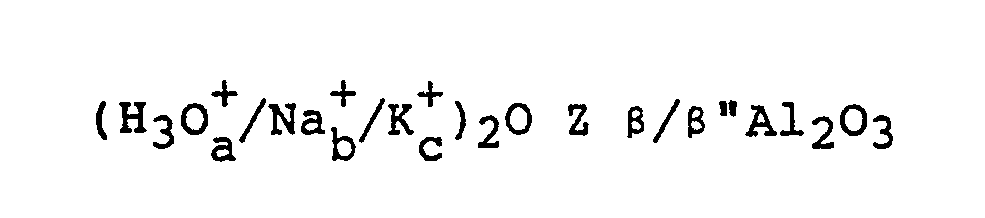 and where a = 0→1b = 0→1c = 0→1; anda + b + c = 1
 - 3. The method as claimed in claim 1, wherein the polycrystaline β alumina ceramic selected in step (a) has the chemical formula;
(Na0.6K0.4)2O (3 w/o MgO) β/βM A1203 - 4. The method as claimed in claim 1, 2 or 3, wherein a voltage greater than 0.1 volts, is employed in step (d).
- 5. The method as claimed in claim 1, wherein the acid of step (c) is selected from the group of mineral and organic acids.
- 6. The method as claimed in claim 1, wherein the acid of step (c) is dilute sulfuric, or acetic.
- 7. The method as claimed in claim 5, wherein the acid is dilute sulfuric with molar concentration 0.1 at room temperature.
- 8. The method as claimed in claim 5, 6 or 7, wherein the dilute acid is held in the temperature range of between room temperature and approximately 80°C.
- 9. The method a claimed in claim 5, wherein the acid is concentrated sulfuric acid at 300°C.
- 10. The method as claimed in claim 1, wherein step (b) includes;(i) selecting an ionic melt or solution containing two or more ionic species of different ionic radii;ii) immersing the selected alumina ceramic of step (a) into the ionic melt until a predetermined amount of cations in the ceramic are displaced by ions of dissimilar size from the ionic solution.
- 11. The method as claimed in claim 10, wherein the ionic species of the ionic melt are selected from the group Na+, K+, Li+ and H30+.
- 12. The method as claimed in claim 10, wherein the polycrystalline ceramic selected has one or more cations selected from the group of Na+, K+, Li+.
- 13. The method as claimed in claim 11, wherein the ionic species are in solution with an anion which does not chemically attack β alumina and does not take part in the ion exchange process of step (b).
- 14. The method as claimed in claim 12, wherein anions are selected from the group of Cl-, NO3 -, SO42- and COOH- or mixtures thereof.
- 15. A solid ceramic conductor, of the hydrogen ion, being a solid polycrystalline, with the general formula;
 where Z may be occupied by a stabilizer of the β" phase and where a = 0→1b = 0→1c = 0→1; anda + b + c = 1
and possessing mobile hydrogen ions in its crystallographic structure that are adapted to move through the ceramic when influenced by an electrical gradient, or by chemically different solutions on opposite boundary surfaces of the ceramic. - 16. An active electrochemical element comprising a solid polycrystalline ceramic of the general formula;
(H3O+/Na+ b/K+ c)2O Z β/β"Al2O3
whose conductivity to the H30+ ion is in the range of 10-1 to 10-3Ω-1cm-1 at 300°C and its f(β) = 0→0.55 wherein Z is a predetermined stabilizer of the B" phase; and and where a = 0→1b = 0→1c = 0→1; anda + b + c = 1.
 - 17. The ceramic hydronium conductor as claimed in claim 15 or 16, wherein Z is a compound of magnesium.
- 18. The compound as claimed in claim 15 or 16, wherein Z is magnesium oxide.
- 19. A solid ceramic conductor, of the hydrogen ion, being a solid polycrystalline, with the general formula;
 where a = 0→1b = 0→1c = 0→1; anda + b + c = 1
and possessing mobile hydrogen ions in its crystallographic structure that are adapted to move through the ceramic when influenced by an electrical gradient, or by chemically different solutions on opposite boundary surfaces of the ceramic. - 20. The compound as claimed in claim 19, wherein f(s) = 0.37+0.03 and

Applications Claiming Priority (2)
| Application Number | Priority Date | Filing Date | Title |
|---|---|---|---|
| CA000443793A CA1222616A (en) | 1983-12-20 | 1983-12-20 | Method of converting a precursor ceramic solid into a solid ceramic hydronium conductor |
| CA443793 | 1983-12-20 |
Publications (2)
| Publication Number | Publication Date |
|---|---|
| EP0147666A2 true EP0147666A2 (en) | 1985-07-10 |
| EP0147666A3 EP0147666A3 (en) | 1987-05-27 |
Family
ID=4126792
Family Applications (1)
| Application Number | Title | Priority Date | Filing Date |
|---|---|---|---|
| EP84114556A Withdrawn EP0147666A3 (en) | 1983-12-20 | 1984-11-30 | Method of converting a precursor ceramic solid into a solid ceramic hydronium conductor |
Country Status (4)
| Country | Link |
|---|---|
| US (1) | US4689126A (en) |
| EP (1) | EP0147666A3 (en) |
| JP (1) | JPS60200858A (en) |
| CA (1) | CA1222616A (en) |
Cited By (1)
| Publication number | Priority date | Publication date | Assignee | Title |
|---|---|---|---|---|
| US4724191A (en) * | 1985-06-28 | 1988-02-09 | Minister of Energy Mines & Resources | Bonded hydrogen conducting solid electrolytes |
Family Cites Families (2)
| Publication number | Priority date | Publication date | Assignee | Title |
|---|---|---|---|---|
| CA1180881A (en) * | 1981-04-28 | 1985-01-15 | Canadian Patents And Development Limited | Preparation of a precursor powder for the manufacture of a ceramic hydrogen ion conductor |
| US4381216A (en) * | 1981-08-03 | 1983-04-26 | General Electric Company | Method of etching to form cationically-conductive ceramic body |
-
1983
- 1983-12-20 CA CA000443793A patent/CA1222616A/en not_active Expired
-
1984
- 1984-11-21 US US06/673,937 patent/US4689126A/en not_active Expired - Fee Related
- 1984-11-26 JP JP59250365A patent/JPS60200858A/en active Pending
- 1984-11-30 EP EP84114556A patent/EP0147666A3/en not_active Withdrawn
Cited By (1)
| Publication number | Priority date | Publication date | Assignee | Title |
|---|---|---|---|---|
| US4724191A (en) * | 1985-06-28 | 1988-02-09 | Minister of Energy Mines & Resources | Bonded hydrogen conducting solid electrolytes |
Also Published As
| Publication number | Publication date |
|---|---|
| CA1222616A (en) | 1987-06-09 |
| EP0147666A3 (en) | 1987-05-27 |
| US4689126A (en) | 1987-08-25 |
| JPS60200858A (en) | 1985-10-11 |
Similar Documents
| Publication | Publication Date | Title |
|---|---|---|
| Farrington et al. | Divalent beta ″-aluminas: high conductivity solid electrolytes for divalent cations | |
| Dunn et al. | Fast divalent ion conduction in Ba++, Cd++ and Sr++ beta ″aluminas | |
| Bach et al. | Electrochemical sodium intercalation in Na0. 33V2O5 bronze synthesized by a sol-gel process | |
| Judeinstein et al. | Role of the water content on the electrochromic properties of WO3, nH2O thin films | |
| De Jonghe et al. | Chemical colouration of sodium beta-aluminas | |
| Archer et al. | Ionic conductivity studies of heavily rare earth doped fluorites | |
| EP0147666A2 (en) | Method of converting a precursor ceramic solid into a solid ceramic hydronium conductor | |
| Esaka et al. | Ionic conduction in sintered fluorocomplexes LimMF6, M Al, Ti | |
| Guo et al. | Tungsten oxides and bronzes: Synthesis, diffusion and reactivity | |
| Weppner et al. | Consideration of lithium nitride halides as solid electrolytes in practical galvanic cell applications | |
| US4182667A (en) | Ion-sensitive electrodes | |
| US4381968A (en) | Etched beta"-alumina ceramic electrolyte | |
| Skarstad et al. | Conductivity enhancement in lithium iodide monohydrate by dispersed oxide phases | |
| Zanini et al. | The Behavior of Na‐TiS2 and Na‐TiS3 as Solid Solution Electrodes | |
| Vlasov et al. | Sodium ion-selective chalcogenide glass electrodes | |
| Kumar et al. | Mixed fluoride ion conductors prepared by a mechanical milling technique: effect of grain size and strain on the ionic conductivity | |
| Khaldeev | Physical and corrosion-electrochemical properties of the niobium–hydrogen system | |
| Tani et al. | Alkali metal ion-selective electrodes based on relevant alkali metal ion doped manganese oxides | |
| Ingram | The impact of recent developments on the theory of and prospects for ionic conduction in glass | |
| Róg et al. | Zinc sodium and nickel sodium beta′′-polyaluminates. Preparation, properties and application to the solid oxide galvanic cells | |
| Wikby | The surface resistance of glass electrodes in alkaline solutions | |
| Shalaby et al. | Corrosion of aluminium in chloride solutions containing some anions—I. In 0.01 M NaCl solutions | |
| Anji Reddy et al. | Fluoride-ion conductors | |
| Riley et al. | The creep of NaCl-doped ice monocrystals | |
| Nagai et al. | Na K exchange of the NASICON-type structural compounds |
Legal Events
| Date | Code | Title | Description |
|---|---|---|---|
| PUAI | Public reference made under article 153(3) epc to a published international application that has entered the european phase |
Free format text: ORIGINAL CODE: 0009012 |
|
| AK | Designated contracting states |
Designated state(s): BE CH DE FR GB IT LI NL |
|
| PUAL | Search report despatched |
Free format text: ORIGINAL CODE: 0009013 |
|
| AK | Designated contracting states |
Kind code of ref document: A3 Designated state(s): BE CH DE FR GB IT LI NL |
|
| 17P | Request for examination filed |
Effective date: 19871030 |
|
| STAA | Information on the status of an ep patent application or granted ep patent |
Free format text: STATUS: THE APPLICATION IS DEEMED TO BE WITHDRAWN |
|
| 18D | Application deemed to be withdrawn |
Effective date: 19880531 |
|
| RIN1 | Information on inventor provided before grant (corrected) |
Inventor name: NICHOLSON, PATRICK STEPHEN Inventor name: YAMASHITA, KIMIHIRO Inventor name: BELL, MICHAEL FRANCIS Inventor name: SAYER, MICHAEL |