EP0146138B1 - Melt molding material - Google Patents
Melt molding material Download PDFInfo
- Publication number
- EP0146138B1 EP0146138B1 EP84115677A EP84115677A EP0146138B1 EP 0146138 B1 EP0146138 B1 EP 0146138B1 EP 84115677 A EP84115677 A EP 84115677A EP 84115677 A EP84115677 A EP 84115677A EP 0146138 B1 EP0146138 B1 EP 0146138B1
- Authority
- EP
- European Patent Office
- Prior art keywords
- carbon atoms
- lower alkyl
- evoh
- aryl
- molar
- Prior art date
- Legal status (The legal status is an assumption and is not a legal conclusion. Google has not performed a legal analysis and makes no representation as to the accuracy of the status listed.)
- Expired
Links
- 0 C*1(C=CCC1)O Chemical compound C*1(C=CCC1)O 0.000 description 1
Classifications
-
- C—CHEMISTRY; METALLURGY
- C08—ORGANIC MACROMOLECULAR COMPOUNDS; THEIR PREPARATION OR CHEMICAL WORKING-UP; COMPOSITIONS BASED THEREON
- C08F—MACROMOLECULAR COMPOUNDS OBTAINED BY REACTIONS ONLY INVOLVING CARBON-TO-CARBON UNSATURATED BONDS
- C08F8/00—Chemical modification by after-treatment
- C08F8/12—Hydrolysis
-
- B—PERFORMING OPERATIONS; TRANSPORTING
- B29—WORKING OF PLASTICS; WORKING OF SUBSTANCES IN A PLASTIC STATE IN GENERAL
- B29C—SHAPING OR JOINING OF PLASTICS; SHAPING OF MATERIAL IN A PLASTIC STATE, NOT OTHERWISE PROVIDED FOR; AFTER-TREATMENT OF THE SHAPED PRODUCTS, e.g. REPAIRING
- B29C48/00—Extrusion moulding, i.e. expressing the moulding material through a die or nozzle which imparts the desired form; Apparatus therefor
-
- C—CHEMISTRY; METALLURGY
- C08—ORGANIC MACROMOLECULAR COMPOUNDS; THEIR PREPARATION OR CHEMICAL WORKING-UP; COMPOSITIONS BASED THEREON
- C08J—WORKING-UP; GENERAL PROCESSES OF COMPOUNDING; AFTER-TREATMENT NOT COVERED BY SUBCLASSES C08B, C08C, C08F, C08G or C08H
- C08J5/00—Manufacture of articles or shaped materials containing macromolecular substances
- C08J5/18—Manufacture of films or sheets
-
- C—CHEMISTRY; METALLURGY
- C08—ORGANIC MACROMOLECULAR COMPOUNDS; THEIR PREPARATION OR CHEMICAL WORKING-UP; COMPOSITIONS BASED THEREON
- C08F—MACROMOLECULAR COMPOUNDS OBTAINED BY REACTIONS ONLY INVOLVING CARBON-TO-CARBON UNSATURATED BONDS
- C08F218/00—Copolymers of compounds having one or more unsaturated aliphatic radicals, each having only one carbon-to-carbon double bond, and at least one being terminated by an acyloxy radical of a saturated carboxylic acid, of carbonic acid or of a haloformic acid
- C08F218/02—Esters of monocarboxylic acids
- C08F218/04—Vinyl esters
- C08F218/08—Vinyl acetate
-
- C—CHEMISTRY; METALLURGY
- C08—ORGANIC MACROMOLECULAR COMPOUNDS; THEIR PREPARATION OR CHEMICAL WORKING-UP; COMPOSITIONS BASED THEREON
- C08F—MACROMOLECULAR COMPOUNDS OBTAINED BY REACTIONS ONLY INVOLVING CARBON-TO-CARBON UNSATURATED BONDS
- C08F2800/00—Copolymer characterised by the proportions of the comonomers expressed
- C08F2800/10—Copolymer characterised by the proportions of the comonomers expressed as molar percentages
-
- Y—GENERAL TAGGING OF NEW TECHNOLOGICAL DEVELOPMENTS; GENERAL TAGGING OF CROSS-SECTIONAL TECHNOLOGIES SPANNING OVER SEVERAL SECTIONS OF THE IPC; TECHNICAL SUBJECTS COVERED BY FORMER USPC CROSS-REFERENCE ART COLLECTIONS [XRACs] AND DIGESTS
- Y10—TECHNICAL SUBJECTS COVERED BY FORMER USPC
- Y10T—TECHNICAL SUBJECTS COVERED BY FORMER US CLASSIFICATION
- Y10T428/00—Stock material or miscellaneous articles
- Y10T428/31504—Composite [nonstructural laminate]
- Y10T428/31652—Of asbestos
- Y10T428/31663—As siloxane, silicone or silane
Definitions
- This invention relates to a melt molding material having excellent stress cracking resistance, polar solvent resistance and water resistance, also good gas barrier properties against, for example, oxygen and excellent moldability, in particular, extensibility, which comprises a saponified product of a silicon-containing ethylene-vinyl acetate copolymer (hereinafter referred to as EVOH) with a wide range of properties suitable for various processing modes.
- EVOH silicon-containing ethylene-vinyl acetate copolymer
- EVOH is a useful polymer material having high gas barrier properties and high transparency and also excellent oil resistance and aroma-retaining properties, and is suitably and widely used in, e.g. films, sheets and containers.
- EVOH lacks flexibility, although having great stiffness, and hence has disadvantages as to mechanical characteristics, for example, the impact resistance being low.
- EVOH is susceptible to polar solvents, for example, alcohols, such as methanol or ethanol and also has high hygroscopicity, there are disadvantages, for example as to physical properties, such as flexibility and Young's modulus, of the molded product, which greatly fluctuate with the change of, e.g.
- the molded products such as films, sheets or containers, are unsatisfactory due to the generation of localized spots or due to a fluctuation in characteristics from product to product, and therefore, an improved EVOH having higher uniformity has been strongly desired.
- Japanese Patent Application Laid-open No. 123189/1975 discloses that vinyl acetate and a vinylalkoxysilane are copolymerized and saponified to obtain a polyvinyl alcohol containing silicon, and that on that occasion, it is possible to replace a part (30-40 wt%) of the vinyl acetate by other components (e.g. ethylene); but there is neither a description regarding the silicon-containing EVOH having an ethylene content of 25-55 molar %, nor a description that it may be used as a melt molding material.
- other components e.g. ethylene
- the present inventors have been intensively studying silicon-containing EVOH obtained by saponifying a copolymer of vinyl acetate, ethylene and a specific silicon-containing olefinically unsaturated monomer, and have surprisingly discovered a melt molding material which comprises an improved silicon-containing EVOH having an extremely high degree of uniformity, which has eliminated the above-described disadvantages, which is free from spots both from product to product and in molded products that is, any products are free from spots and are uniform and hence free from a fluctuation in the above-described characteristics.
- the melt molding material which comprises the EVOH according to this invention retains its excellent gas barrier properties, oil resistance, aroma-retaining properties and transparency, whereas its disadvantages, i.e. stress cracking resistance, moisture dependency of gas barrier properties, polar solvent resistance and water resistance have been alleviated. It has also excellent properties, such as film and sheet moldability, extensibility, blow properties and deep-forming properties, and may be used for forming a composite with other thermoplastic resins for packaging containers for various foods, chemical or petrochemical products, or can be used alone.
- This invention provides a melt molding material which comprises EVOH obtained by saponifying a copolymer of vinyl acetate, ethylene and a specific olefinically unsaturated monomer containing silicon in the molecule. More specifically, this invention refers to a melt molding material which comprises a saponified product of a silicon-containing ethylene-vinyl acetate copolymer, having a degree of saponification of the vinyl acetate component of 95 molar % or more, an ethylene content of 25-55 molar % and a silicon content of 0.0005-0.2 molar %, which has been obtained by saponifying a copolymer of vinyl acetate, ethylene and one or more selected from silicon-containing olefinically unsaturated monomers of the general formula (I), (11) and (III) given hereinbelow.
- the melt molding material which comprises said EVOH in this invention is suitably having an ethylene content of 25-55 molar %, preferably 25-50 molar %, and a degree of saponification of the vinyl acetate component in said copolymer of 95 molar % or more. If the ethylene content is less than 25 molar %, it is difficult to improve considerably the stress cracking resistance and moisture dependency of gas barrier properties against for, for example, oxygen, while retaining good melt moldability. Whereas, if the content exceeds 55 molar %, the barrier properties against, for example, oxygen and aroma-retaining properties characteristic to the EVOH are lowered. Further, if the degree of saponification is less than 95 molar %, said barrier properties and oil ressitance are lowered and therefore not only the inherent characteristics of the EVOH cannot be retained, but also the effects of this invention cannot easily be achieved.
- n is 0-1, m is 0-2, R 1 is lower alkyl, aryl or lower alkyl having aryl, R 2 is a saturated branched or unbranched alkoxy of 1-40 carbon atoms, said alkoxy optionally having a substituent containing oxygen, R 3 is hydrogen or methyl, R 4 is hydrogen or lower alkyl, R 5 is alkylene or a modified alkylene in which carbon atoms in the chain are connected with each other via oxygen or nitrogen, R 6 is hydrogen, halogen, lower alkyl, aryl or lower alkyl having aryl, R 7 is alkoxy or acyloxy wherein said alkoxy or acyloxy may optionally have a substituent containing oxygen or nitrogen, R 8 is hydrogen, halogen, lower alkyl, aryl or
- R 1 represents lower alkyl of 1-5 carbon atoms, aryl of 6-18 carbon atoms or lower alkyl of 1-5 carbon atoms having aryl of 6-18 carbon atoms
- R 4 represents hydrogen or lower alkyl of 1-5 carbon atoms
- R 5 represents alkylene of 1-5 carbon atoms or a modified alkylene in which carbon atoms in the chain are connected with each other via oxygen or nitrogen
- R 6 represents hydrogen, halogen, lower alkyl of 1-5 carbon atoms, aryl of 6-18 carbon atoms or lower alkyl of 1-5 carbon atoms having aryl of 6-18 carbon atoms
- R represents alkoxy or acyloxy of 1-40 carbon atoms wherein said alkoxy or acyloxy may optionally have a substituent containing oxygen or nitrogen
- R 8 represents hydrogen, halogen, lower alkyl of 1-5 carbon atoms, aryl of 6-18 carbon atoms or lower alkyl of 1-5 carbon atoms having aryl
- Examples of the silicon-containing olefinically unsaturated monomer of the general formula (1) include vinyltrimethoxysilane, vinylmethyldimethoxysilane, vinyldimethylmethoxysilane, vinyltriethoxysilane, vinylmethyldiethoxysilane, vinyldimethylethoxysilane, aryltrimethoxysilane, arylmethyldimethoxysilane, aryldimethylmethoxysilane, aryltriethoxysilane, aryldimethylethoxysilane, vinyltris( ⁇ - methoxyethoxy)-silane, vinylisobutyldimethoxysilane, vinylethyldimethoxysilane, vinylmethoxydibutoxysilane, vinyl- dimethoxybutoxysilane, vinyltributoxysilane, vinylmethoxydihexyloxysilane, vinyldimethoxyhexyloxy- silane, vinyltrihexy
- Vinyltrimethoxysilane is preferred from an economical viewpoint.
- silicon-containing olefinically unsaturated monomer of the general formula (II) examples include:
- 3-(meth)acrylamido-propyltrimethoxysilane and 3-(meth)acrylamido-propyltriacetoxysilane are preferably employed as their industrial production is relatively easy and inexpensive, and 2 - (meth)acrylamido - 2 - methylpropyltrimethoxysilane and 2 - (meth)acrylamido - 2-methylpropyltriacetoxysilane are preferred because the amido bond is remarkably stable against acid and alkali.
- the modified silicon-containing EVOH obtained by copolymerizing a silicon-containing polymeric monomer of the general formula (11) with vinyl acetate and ethylene and then saponifying the obtained copolymer contains a copolymerization unit of the following general formula (IV): wherein R 3 , R 4 , R 5 , R 6 and m are as defined above, and R 10 represents hydroxyl or a salt of hydroxyl of the general formula OM wherein M is an alkali metal or NH 4 .
- Examples of the silicon-containing olefinically unsaturated monomer of the general formula (III) include:
- the copolymerization of the above-described silicon-containing olefinically unsaturated monomer with vinyl acetate and ethylene is preferably conducted by solution polymerization in the presence of an alcohol.
- an alcohol in general, a lower alcohol, such as methanol or ethanol is preferred from an industrial point of view.
- the copolymerization may be conducted either batchwise or in a continuous mode.
- the ethylene content of EVOH is determined mainly by the amount of the vinyl acetate present in the copolymerization system and the ethylene present in solution in said system, and the latter depends mainly on the polymerization ethylene pressure and temperature.
- the silicon content in the modified EVOH is dominated by the balance in amount between the vinyl acetate and the silicon-containing olefinically unsaturated monomer present in said system.
- a semi-batch mode i.e., to add either or both monomers so as to keep the monomer composition constant, in order to obtain a copolymer having a uniform copolymerization composition.
- polymerization initiator examples include known radical initiators, for example, nitriles such as 2,2' - azobis(4 - methoxy - 2,4 - dimethylvaleronitrile), 2,4,4 - trimethylvaleronitrile or 2,2' - azobisisobutyronitrile, carbonates such as di - n - propyl peroxycarbonate, bis - 4 - t - butylcyclohexyl peroxydicarbonate or bis - 2 - ethylhexyl peroxydicarbonate, peroxides such as acetylcyclohexane- sulfonyl peroxide, benzoyl peroxide or lauroyl peroxide.
- radical initiators for example, nitriles such as 2,2' - azobis(4 - methoxy - 2,4 - dimethylvaleronitrile), 2,4,4 - trimethylvaleronitrile or 2,2' -
- the copolymer obtained by the copolymerization is then subjected to a saponification reaction.
- the saponification reaction is advantageously conducted in the conventional manner using an alkaline catalyst, that is, generally, by conducting said copolymerization in an alcohol solvent by alcoholysis, and, in particular, a method of conducting the saponification while removing by-produced methyl acetate during the saponification from the column top by blowing an alcohol vapor into the column bottom using a column reactor disclosed in Japanese Patent Nos. 575,889 and 611,557 may be most suitably employed.
- alkaline catalyst used in the saponification reaction examples include hydroxides of alkali metals, such as sodium hydroxide and potassium hydroxide or alcoholates, such as sodium methylate and potassium methylate.
- alkali metals such as sodium hydroxide and potassium hydroxide or alcoholates, such as sodium methylate and potassium methylate.
- sodium hydroxide is industrially advantageous from an economical viewpoint.
- a temperature of 100°C or higher is suitable taking into consideration, for example the cut in reaction time and the solubility of said silicon-containing EVOH in alcohol, which also depends on the composition of said copolymer.
- the vinylalkoxysilane unit is also saponified to a high extent and converted into a vinylsilanol unit, an alkali salt thereof or a mutual condensate thereof.
- said copolymer containing the monomer of the above-mentioned general formula (11) is stably retained without the decomposition of the amide bond in the silicon-containing polymeric monomer unit in the saponification using an alkaline catalyst.
- the alkoxy group, carboxyl group, hydrogen and halogen connected to the silicon in the silicon-containing monomer unit of the general formula (II) are simultaneously saponified either partially or to a great extent and thus are converted into hydroxyl groups or alkali salts of the hydroxyl groups. Further, a part of these hydroxyl groups may form siloxane bonds by connecting these reactive groups under appropriate drying conditions when the modifed EVOH molding material obtained after the saponification reaction is dried.
- said modified EVOH molding material in which siloxane bonds have been formed to a considerable extent sometimes exhibits deterioration in heat melt properties in such a case, it is preferred to control the content of the silicon-containing monomer or to make a modified EVOH molding material having a (meth)acrylamido-branched-chain alkylsilane unit remarkably stabler against alkali than the silicon-containing polymeric monomer unit.
- the modified EVOH molding material is isolated, while any conventional method may be used.
- a method disclosed in Japanese Patent No. 725,520 is suitably employed, which comprises causing deposition in a strand form and separating said polymer.
- Said deposited and isolated EVOH molding material is washed with water in the conventional manner, subjected to known heat stabilizing treatment, such as acid treatment, and dried.
- heat stabilizing treatment such as acid treatment
- the alkali salts of the hydroxyl groups converted from the alkoxy group, carboxyl group, hydrogen and halogen connected to the silicon at the time of saponification reaction are now hydrolyzed to hydroxyl groups.
- Another object of this invention is to provide a wide range of characteristics suitable for various processing modes.
- EVOH is widely used, for example in food packaging containers, as a thermoplastic resin having excellent gas barrier properties, but it is more often used in practice by making a composite with other hydrophobic resins rather than used as a single resin.
- As the method of making a composite coextrusion, lamination or blending may be employed.
- various processing modes are conducted depending on the combination with various resins, but it was difficult with the conventional EVOH resins to obtain a wide range of characteristics suitable for various processing modes.
- the modified silicon-containing EVOH molding material according to this invention is quite satisfactory in such aspects as the improvement of the characteristics inherent to the EVOH resin, the impartation of characteristics suitable for other various resins and various processing modes, and it is possible to obtain said modified EVOH melt molding material suitable for each purpose by changing the content of the silicon-containing monomer in said copolymer.
- the melt index of EVOH increases with the increase of the ethylene content
- another resin having a low melt index is to be used to make a composite with EVOH
- a phenomenon of melt viscosity incompatibility is frequently encountered due to the difference in the melt viscosity.
- the utility of the modified EVOH molding material of this invention is extremely high coupled with the uniformity of modification. If the content of said silicon-containing monomer is low, the effect of the modification is not remarkably manifested, whereas if too high, the degree of crosslinking is too increased and heat unmeltability is manifested. While said content is selected depending on each purpose, a range of 0.0005-0.2 molar % is suitably used, preferably 0.001-0.1 molar %.
- the silicon content as herein used means the amount (molar %) of the silicon-containing monomer in the silicon-containing monomer-vinyl acetate-ethylene copolymer.
- the modified silicon-containing EVOH resin of this invention may be more satisfactorily used for the entire range of the conventional use purposes, newly obtained characteristics due to the inclusion of silicon, for example, the improvement of the adhesion with e.g. aluminum foil or other resins may be advantageously used.
- the melt index as measured by ASTM D-1238-T of the modified EVOH melt molding material of this invention is suitably 0.05-10 g/10 minutes at 190°C under a load of 2,160 g, and in particular, a melt index of 0.1-10 g/10 min is preferable for various uses, such as for films, sheets, containers, either as such without orientation or after at least monoaxial orientation.
- melt molding material which comprises a silicon-containing EVOH of this invention comprises an EVOH having specific ethylene content and silicon content obtained by saponifying a copolymer of vinyl acetate, ethylene and the above-described specific silicon-containing olefinically unsaturated monomer
- said copolymer may contain a third substance as a copolymerizable component as long as the characteristics of said melt molding material are not adversely influenced.
- said third substance include a-olefins of 3 or more carbon atoms, such as acrylic acid, methacrylic acid and esters of these acids.
- the melt molding material of this invention may be used either alone or by making a composite with other resins, but it is more preferably used as a two or more layered, i.e., multi-layered laminated structure by combining it with other various resins in order to satisfy the demand for the expansion in variety and the upgrading to better quality of the characteristics required especially in the recent years.
- a method such as coextrusion or biaxial orientation blow molding is employed, and in this case, it is possible to select the silicon content in the melt molding material of this invention to obtain a desired EVOH having the desired ethylene content which does not cause melt viscosity incompatibility with other thermoplastic resins.
- Examples of the layer constitution of said laminate include polyethylene/adhesive layer/EVOH of this invention (hereinafter referred to as Si-EVOH), polyethylene/adhesive layer/SiEVOH/adhesive layer/polyethylene (hereinafter referred to as PE), polypropylene (hereinafter referred to as PP)/adhesive layer/Si-EVOH, PP/adhesive layer/Si-EVOH/adhesive layer/PP, PP/adhesive layer/Si-EVOH/adhesive layer/Pe, thermoplastic polyester (hereinafter referred to as PET)/adhesive layer/Si-EVOH, PET/adhesive layer/Si-EVOH/adhesive layer/PET, PET/adhesive layer/Si- EVOH/adhesive layer/PP, PET/adhesive iayer/Si-EVOH/adhesive layer/
- the adhesive resin used in the adhesive layer although varying depending on the kind of resin to be laminated adjacent to Si-EVOH, may be selected from, for example, maleic anhydride graft modified PE, maleic anhydride graft modified PP, maleic anhydride graft modified ethylene-ethyl acrylate, ethylene-vinyl acetate copolymers, maleic anhydride graft modified ethylene-vinyl acetate copolymers, mixtures of two or more thereof and blends of those with Si-EVOH.
- the effect of this invention may be made clear by conducting a cracking resistance test as described in the examples by impregnating the products with an agricultural chemical liquid preparation, or the like, which causes stress cracking.
- the modifying effect of this invention becomes evident.
- the effect to improve the decrease in barrier properties against oxygen due to moisture absorption will be evident by measuring e.g. oxygen permeability constant, which is more or less comparable to said permeability constant of the unmodified EVOH under low moisture conditions, but the decrease of which under higher moisture conditions is apparent.
- oxygen permeability constant which is more or less comparable to said permeability constant of the unmodified EVOH under low moisture conditions, but the decrease of which under higher moisture conditions is apparent.
- the degree of polymerization of the vinyl acetate was about 50%.
- Said copolymerization reaction mixture was fed to an expelling column, the unreacted vinyl acetate was removed from the column top by introducing a methanol vapor from the column lower part, thereby a 45% methanol solution of said copolymer was obtained.
- Said copolymer was confirmed by NMR analysis to contain 0.027 molar % of the vinyltrimethoxysilane unit, 59.5 molar % of the vinyl acetate unit and about 40.5 ⁇ molar % of the ethylene unit.
- the methanol solution of said copolymer was introduced into a column type saponification reactor, and the saponification reaction was conducted by further feeding sodium hydroxide to said reactor so that the molar ratio thereof to the vinyl acetate component contained in said copolymer be 0.05, while blowing a methanol vapor from the column lower part and removing by-produced methyl acetate from the column top, thereby a methanol solution of a modified EVOH was obtained from the column bottom.
- Said EVOH was fed to an extruder, melted and formed into a film at a die temperature of 210°C to obtain a film of 20 u in thickness.
- the oxygen permeability constant was measured and set forth in Table 1 together with other characteristics values of said EVOH.
- Example 1 The procedures of Example 1 were repeated except that the vinyltrimethoxysilane was not used to obtain an EVOH having an ethylene content of 40.7 molar % and a degree of saponification of 99.4 molar %. This was melted and formed into a film in a manner similar to that in Example 1 to obtain a film of 20 ⁇ in thickness, and the oxygen permeability constant was measured. The results are shown in Table 1.
- the degree of polymerization of the vinyl acetate was about 55%. Said copolymer was confirmed by NMR analysis to contain 0.013 molar % of the 3 - acrylamido - propyltrimethoxysilane unit, 65 molar % of the vinyl acetate unit and about 35 molar % of the ethylene unit.
- Example 2 In a manner similar to that in Example 1, this was saponified and isolated, then post-treated and dried to obtain a modified EVOH.
- the degree of saponification was 99.2 molar %, and the Ml 190 was 0.7 g/10 min.
- a high density polyethylene (Ml 190 : 0.3 g/10 min) was fed to an outer layer, said modified EVOH resin to an inner layer, and a modified polyolefin (trade name: Modic produced by Mitsubishi Petro-Chemical Co., Ltd.) to an intermediate layer.
- the respective extruders were set at temperatures of 160-200°C for the outer and intermediate layers and 180-210°C for the inner layer, and their top ends were connected to a three-layered head.
- the die extrusion was conducted at 220°C.
- the respective resins were firmly bonded in the die, extruded as a three-layered concentric parison, and subjected to biaxial orientation blow molding.
- the capacity of each container was about 550 ml, and each layer thickness was about 0.81 mm for the outer layer, 10 ⁇ for the inner layer and 50-350 ⁇ for the inner layer.
- Said container was tested for the cracking resistance as follows:
- Containers filled with 450 ml of the agricultural chemical liquid preparation to be tested were subjected to 3 cycles, each cycle consisting of warming at 40°C for 30 days, standing at normal temperature for a day and further standing at -20°C for 3 days, and thereafter they were examined for the presence of cracking generated during that time.
- the cracking resistance was expressed as the number of samples which showed no generation of cracking when 20 samples were tested. The results are shown in Table 2.
- the degree of saponification of this EVOH was 99.3 molar %, and the Ml 190 was 2.1 g/10 min.
- Example 2 The procedures of Example 2 were repeated except that the amount of the 3 - acrylamido - propyltrimethoxysilane used as the silicon-containing monomer in Example 2 was changed to 290 mg/hr to obtain hollow containers of a capacity of about 500 ml, having an outer layer of a high density polyethylene (Ml 190 : 0.3 g/10 min), an intermediate layer of the aforesaid modified polyethylene and an inner layer of said modified EVOH and having a thickness of 0.8 mm for the outer layer and 11 ⁇ m for the intermediate layer.
- Ml 190 high density polyethylene
- Example 2 The procedures of Example 2 were repeated except that the polymerization vessel ethylene pressure was changed to 35 kg/cm 2 G and vinyltriethoxysilane was used as the silicon-containing olefinically unsaturated monomer at a feeding rate of 100 mg/hr.
- the obtained copolymer was found to have 0.008 molar % of the vinyltriethoxysilane unit, 72 molar % of the vinyl acetate unit and about 28 molar % of the ethylene unit.
- a modified EVOH was then obtained according to the procedures of Example 2.
- the degree of saponification was 99.4 molar %, and the melt index M1 210 measured at 210°C under a load of 2,160 g was 0.80 g/10 min.
- Said modified EVOH was used by biaxial orientation blow molding to obtain a hollow container of 300 ml in capacity, 30 g in weight and 1 mm in average body thickness.
- This container was filled with benzyl alcohol in an amount of 75% in filling rate, tightly stoppered, and the permeability of said solvent was measured at 20°C and 50°C by the weight method. The results are shown in Table 5.
- Example 9 The procedures of Example 9 were repeated except that the vinyltriethoxysilane in Example 9 was not used, to obtain an EVOH having an ethylene content of 28.2 molar %, a degree of saponification of 99.5 molar % and an Ml 210 of 2.3 g/10 min, from which a hollow container having the same shape and size as that in Example 9 was produced. This was then measured for the permeability to benzyl alcohol under the same conditions as in Example 9, and the results are shown in Table 5.
- the degree of polymerization of the vinyl acetate was 31%. Said copolymer was confirmed by NMR analysis to contain 0.02 molar % of the vinyltrimethoxysilane unit, 68 molar % of the vinyl acetate unit and 32 molar % of the ethylene unit. This was saponified, isolated, then post-treated and dried in a manner similar to that in Example 1 to obtain a modified EVOH. The degree of saponification was 99.5 molar %, and the Ml 190 was 0.55 g/10 min.
- the obtained modified EVOH and unmodified EVOH were measured for the oxygen permeability constant under the conditions of 0% RH, 35°C and 100% RH, 20°C. The results are shown in Table 6.
- the degree of polymerization of the vinyl acetate was about 45%. Said copolymer was confirmed by NMR analysis to contain 0.023 molar % of the vinyltrimethoxysilane unit, 61 molar % of the vinyl acetate unit and about 39 molar % of the ethylene unit.
- Example 2 This was then saponified, isolated, post-treated and subsequently dried in a manner similar to that in Example 1 to obtain a modified EVOH.
- the degree of saponification was 99.4 molar %, and the Ml 190 was 1.5 g/10 min.
- a five-layered sheet was produced by coextrusion using said EVOH as an intermediate layer, an isotactic polypropylene (density: 0.912) as inner and outer layers, and a maleic anhydride-modified ethylene-vinyl acetate copolymer (vinyl acetate content: 12% by weight; degree of modification with. maleic anhydride: 0.5% by weight) as adhesive layers.
- the coextrusion conditions were as follows:
- the thickness of the extruded five-layered sheet was about 600 ⁇ for the inner and outer layers, 80 ⁇ for the adhesive layers and 140 p for the intermediate layer.
- Said sheet was molded by vacuum forming to obtain cups of 77 mm in diameter and 94 mm in height and having a round bottom.
- the cup molding temperature was 190°C, and the obtained cups had good appearance, showed no unevenly extended part and were free from crack generation.
- Example 1 Using the same polymerization vessel as in Example 1, the polymerization was conducted by the conventional continuous polymerization method in a manner similar to that in Example 11 except that the vinyltrimethoxysilane was not used and the amount of the methanol was reduced, to prepare an EVOH containing 39 molar % of ethylene and having an Ml 190 of 1.5. Thereafter, a five-layered sheet was coextruded in the same manner as in Example 11 and the cups were prepared by the same vacuum forming as in Example 11. As a result, not only unevenness in thickness was found in the bottom of the cup but also scoreline like cracks were generated on the cup.
Landscapes
- Chemical & Material Sciences (AREA)
- Engineering & Computer Science (AREA)
- Health & Medical Sciences (AREA)
- Chemical Kinetics & Catalysis (AREA)
- Medicinal Chemistry (AREA)
- Polymers & Plastics (AREA)
- Organic Chemistry (AREA)
- Manufacturing & Machinery (AREA)
- General Chemical & Material Sciences (AREA)
- Materials Engineering (AREA)
- Mechanical Engineering (AREA)
- Addition Polymer Or Copolymer, Post-Treatments, Or Chemical Modifications (AREA)
- Laminated Bodies (AREA)
- Blow-Moulding Or Thermoforming Of Plastics Or The Like (AREA)
Description
- This invention relates to a melt molding material having excellent stress cracking resistance, polar solvent resistance and water resistance, also good gas barrier properties against, for example, oxygen and excellent moldability, in particular, extensibility, which comprises a saponified product of a silicon-containing ethylene-vinyl acetate copolymer (hereinafter referred to as EVOH) with a wide range of properties suitable for various processing modes.
- EVOH is a useful polymer material having high gas barrier properties and high transparency and also excellent oil resistance and aroma-retaining properties, and is suitably and widely used in, e.g. films, sheets and containers. However, EVOH lacks flexibility, although having great stiffness, and hence has disadvantages as to mechanical characteristics, for example, the impact resistance being low. On the other hand, since EVOH is susceptible to polar solvents, for example, alcohols, such as methanol or ethanol and also has high hygroscopicity, there are disadvantages, for example as to physical properties, such as flexibility and Young's modulus, of the molded product, which greatly fluctuate with the change of, e.g. atmospheric moisture or temperature; the moisture dependency of the gas barrier properties is considerable, and thus the gas barrier properties are reduced under high moisture conditions; further, where a molded product is directly contacted with any of the above-mentioned polar solvents, the molded product is swollen with the solvent, and in an extreme case, for example, when sterilized with hot water, films, containers and the like undergo deformation, mutual adhesion and so forth. Further, where EVOH molded bottles are contacted with certain types of surface active agents, polar solvents or agricultural chemical liquids, there is also the disadvantage that coupled with residual stress generated on molding, stress cracking is often caused.
- It is an extremely important subject in practice to improve on these various disadvantages. In order to offset said disadvantages, post-modification by a method of conducting a crosslinking operation on a molded product is employed. For example, as a method of crosslinking plastic films, there is an electron radiating method applied to the crosslinking of polyethylene films; but this method requires an expensive device and moreover, requires strict control of the production conditions and therefore, with resins, such as EVOH, which are more easily decomposable and have a narrower molding temperature range as compared with the polyethylene films, there will be considerable difficulty in the materialization of this technique. Further, although various attempts have been made for modifying EVOH resins for the purpose of improving said various disadvantages, no EVOH which has been uniformly modified without any spots and is free from these various disadvantages has yet been discovered. In other words, main attempts which have hitherto been made were aimed to impart a crosslinked structure to a part of EVOH by a post-modification method, and examples thereof include (1) the treating of EVOH with a boron compound (Japanese Patent Publication No. 20615/1974 Official Gazette), and (2) the reacting of EVOH with an organosilicon compound, such as an organosilane compound or an organosiloxane compound in the presence or absence of a peroxide and in the presence of water or a silanol condensation catalyst (Japanese Patent Application Laid-open No. 20946/1976 Official Gazette, Japanese Patent Application Laid-open No. 53541/1976 Official Gazette, Japanese Patent Application Laid-open No. 20058/1979 Official Gazette). These prior art techniques are still unsatisfactory as the uniformity of the degree of modification of EVOH is to be obtained, more specifically, for example, the localization of the crosslinked structure is to be avoided. This is apparently due to the fact that a boron compound or an organosilicon compound is added to EVOH to impart a crosslinked structure to a part of said resin, that is, the amount of said crosslinking agent added is very small; said prior art techniques are also unsatisfactory since the addition, mixing and kneading and the further reaction with the EVOH are conducted by a post-modification method in the conventional manner using various mixers, rolls, extruders, and the like. Although some improvement is observed in various characteristics, such as hot water resistance, moisture dependency of gas barrier properties, stress cracking resistance or polar solvent resistance, the molded products, such as films, sheets or containers, are unsatisfactory due to the generation of localized spots or due to a fluctuation in characteristics from product to product, and therefore, an improved EVOH having higher uniformity has been strongly desired.
- Furthermore, Japanese Patent Application Laid-open No. 123189/1975 (corresponding to U.S. Patent 4097436) discloses that vinyl acetate and a vinylalkoxysilane are copolymerized and saponified to obtain a polyvinyl alcohol containing silicon, and that on that occasion, it is possible to replace a part (30-40 wt%) of the vinyl acetate by other components (e.g. ethylene); but there is neither a description regarding the silicon-containing EVOH having an ethylene content of 25-55 molar %, nor a description that it may be used as a melt molding material.
- The present inventors have been intensively studying silicon-containing EVOH obtained by saponifying a copolymer of vinyl acetate, ethylene and a specific silicon-containing olefinically unsaturated monomer, and have surprisingly discovered a melt molding material which comprises an improved silicon-containing EVOH having an extremely high degree of uniformity, which has eliminated the above-described disadvantages, which is free from spots both from product to product and in molded products that is, any products are free from spots and are uniform and hence free from a fluctuation in the above-described characteristics.
- There has also been discovered a feature that where a material of this invention is coextruded with other thermoplastic resins or where it is molded or deep-formed into a sheet, as compared with the conventional EVOH resins, the product of this invention does not easily gel, has better sheet moldability and is free from streak or stripe patterns, and when oriented by, for example, deep-forming, no cracking or stripe patterns are generated.
- The melt molding material which comprises the EVOH according to this invention retains its excellent gas barrier properties, oil resistance, aroma-retaining properties and transparency, whereas its disadvantages, i.e. stress cracking resistance, moisture dependency of gas barrier properties, polar solvent resistance and water resistance have been alleviated. It has also excellent properties, such as film and sheet moldability, extensibility, blow properties and deep-forming properties, and may be used for forming a composite with other thermoplastic resins for packaging containers for various foods, chemical or petrochemical products, or can be used alone.
- This invention provides a melt molding material which comprises EVOH obtained by saponifying a copolymer of vinyl acetate, ethylene and a specific olefinically unsaturated monomer containing silicon in the molecule. More specifically, this invention refers to a melt molding material which comprises a saponified product of a silicon-containing ethylene-vinyl acetate copolymer, having a degree of saponification of the vinyl acetate component of 95 molar % or more, an ethylene content of 25-55 molar % and a silicon content of 0.0005-0.2 molar %, which has been obtained by saponifying a copolymer of vinyl acetate, ethylene and one or more selected from silicon-containing olefinically unsaturated monomers of the general formula (I), (11) and (III) given hereinbelow.
- The melt molding material which comprises said EVOH in this invention is suitably having an ethylene content of 25-55 molar %, preferably 25-50 molar %, and a degree of saponification of the vinyl acetate component in said copolymer of 95 molar % or more. If the ethylene content is less than 25 molar %, it is difficult to improve considerably the stress cracking resistance and moisture dependency of gas barrier properties against for, for example, oxygen, while retaining good melt moldability. Whereas, if the content exceeds 55 molar %, the barrier properties against, for example, oxygen and aroma-retaining properties characteristic to the EVOH are lowered. Further, if the degree of saponification is less than 95 molar %, said barrier properties and oil ressitance are lowered and therefore not only the inherent characteristics of the EVOH cannot be retained, but also the effects of this invention cannot easily be achieved.
- As the olefinically unsaturated monomer containing silicon used in this invention, one or more of the compounds having the following general formulae (I), (II) and (III) may be suitably employed:


- More specifically, R1 represents lower alkyl of 1-5 carbon atoms, aryl of 6-18 carbon atoms or lower alkyl of 1-5 carbon atoms having aryl of 6-18 carbon atoms, R4 represents hydrogen or lower alkyl of 1-5 carbon atoms, R5 represents alkylene of 1-5 carbon atoms or a modified alkylene in which carbon atoms in the chain are connected with each other via oxygen or nitrogen, R6 represents hydrogen, halogen, lower alkyl of 1-5 carbon atoms, aryl of 6-18 carbon atoms or lower alkyl of 1-5 carbon atoms having aryl of 6-18 carbon atoms, R represents alkoxy or acyloxy of 1-40 carbon atoms wherein said alkoxy or acyloxy may optionally have a substituent containing oxygen or nitrogen, R8 represents hydrogen, halogen, lower alkyl of 1-5 carbon atoms, aryl of 6-18 carbon atoms or lower alkyl of 1-5 carbon atoms having aryl of 6-18 carbon atoms, and R9 represents lower alkyl of 1-5 carbon atoms.
- Examples of the silicon-containing olefinically unsaturated monomer of the general formula (1) include vinyltrimethoxysilane, vinylmethyldimethoxysilane, vinyldimethylmethoxysilane, vinyltriethoxysilane, vinylmethyldiethoxysilane, vinyldimethylethoxysilane, aryltrimethoxysilane, arylmethyldimethoxysilane, aryldimethylmethoxysilane, aryltriethoxysilane, aryldimethylethoxysilane, vinyltris(β - methoxyethoxy)-silane, vinylisobutyldimethoxysilane, vinylethyldimethoxysilane, vinylmethoxydibutoxysilane, vinyl- dimethoxybutoxysilane, vinyltributoxysilane, vinylmethoxydihexyloxysilane, vinyldimethoxyhexyloxy- silane, vinyltrihexyloxysilane, vinylmethoxydioctyloxysilane, vinyldimethoxyoctyloxysilane, vinyl- trioctyloxysilane, vinylmethoxydilauryloxysilane, vinyldimethoxylauryloxysilane, vinylmethoxydioleyloxy- silane, vinyldimethoxyoleyloxysilane, polyethylene glycol derivatives of vinylmethoxysilanes of the general formula:

- Vinyltrimethoxysilane is preferred from an economical viewpoint.
- Examples of the silicon-containing olefinically unsaturated monomer of the general formula (II) include:
- (meth)acylamido-straight-chain or branched-chain alkyltrialkoxysilanes, such as
- 3-(meth)acrylamido-propyltrimethoxysilane

- 3-(meth)acrylamido-propyltriethoxysilane
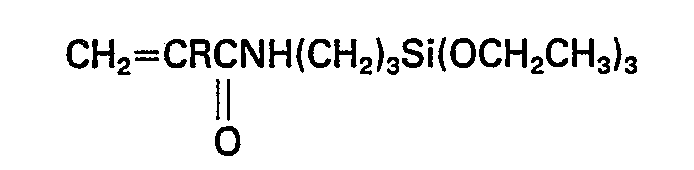
- 3-(meth)acrylamido-propyltri(β-methoxyethoxy)silane

- 3-(meth)acrylamido-propyltri(N-methylaminoethoxy)silane

- 2-(meth)acrylamido-ethyltrimethoxysilane

- 1-(meth)acrylamido-methyltrimethoxysilane

- 2-(meth)acrylamido-2-methylpropyltrimethoxysilane

- 2-(meth)acrylamido-isopropyltrimethoxysilane

- 3-(meth)acrylamido-propyltrimethoxysilane
- (meth)acrylamido-nitrogen-containing or oxygen-containing alkyltrialkoxysilanes such as
- N-(2-(meth)acrylamido-ethyl)-aminopropyltrimethoxysilane

- (3-(meth)acrylamido-propyl)-oxypropyltrimethoxysilane

- N-(2-(meth)acrylamido-ethyl)-aminopropyltrimethoxysilane
- (meth)acrylamido-alkyltriacyloxysilanes such as
- 3-(meth)acrylamido-propyltriacetoxysilane

- 2-(meth)acrylamido-ethyltriacetoxysilane

- 4-(meth)acrylamido-butyltriacetoxysilane

- 3-(meth)acrylamido-propyltripropionyloxysilane

- 2-(meth)acrylamido-2-methylpropyltriacetoxysilane

- N-(2-(meth)acrylamido-ethyl)aminopropyltriacetoxysilane

- 3-(meth)acrylamido-propyltriacetoxysilane
- (meth)acrylamido-alkyldi- or monoalkoxy- or di- or monoacyloxysilanes, such as
- 3-(meth)acrylamido-propylisobutyldimethoxysilane

- 2-(meth)acrylamido-ethyldimethylmethoxysilane

- 3-(meth)acrylamido-propyloctyldiacetoxysilane

- 1-(meth)acrylamido-methylphenyldiacetoxysilane

- 3-(meth)acrylamido-propylbenzyldiethoxysilane

- 2-(meth)acrylamido-2-methylpropylmonochlorodimethoxysilane

- 2-(meth)acrylamido-2-methylpropylhydrogenmethoxysilane

- 3-(meth)acrylamido-propylisobutyldimethoxysilane
- (N-alkyl-(meth)acrylamido)-alkyltrialkoxy- or triacetoxysilanes, such as
- 3-(N-methyl-(meth)acrylamido)-propyltrimethoxysilane

- 2-(N-ethyl-(meth)acrylamido)-ethyltriacetoxysilane

- 3-(N-methyl-(meth)acrylamido)-propyltrimethoxysilane
- 3-(meth)acrylamido-propyltrimethoxysilane and 3-(meth)acrylamido-propyltriacetoxysilane are preferably employed as their industrial production is relatively easy and inexpensive, and 2 - (meth)acrylamido - 2 - methylpropyltrimethoxysilane and 2 - (meth)acrylamido - 2-methylpropyltriacetoxysilane are preferred because the amido bond is remarkably stable against acid and alkali. In this case, the modified silicon-containing EVOH obtained by copolymerizing a silicon-containing polymeric monomer of the general formula (11) with vinyl acetate and ethylene and then saponifying the obtained copolymer contains a copolymerization unit of the following general formula (IV):

- Examples of the silicon-containing olefinically unsaturated monomer of the general formula (III) include:
- vinyltriacetoxysilane

- vinyltripropionyloxysilane

- isopropenyltriacetoxysilane

- vinylisobutyldiacetoxysilane

- vinylmethyldiacetoxysilane

- vinyldimethylacetoxysilane

- vinylphenyldiacetoxysilane

- vinylmonochlorodiacetoxysilane

- vinylmonohydrogendiacetoxysilane

- The copolymerization of the above-described silicon-containing olefinically unsaturated monomer with vinyl acetate and ethylene is preferably conducted by solution polymerization in the presence of an alcohol. As the alcohol, in general, a lower alcohol, such as methanol or ethanol is preferred from an industrial point of view. The copolymerization may be conducted either batchwise or in a continuous mode. The ethylene content of EVOH is determined mainly by the amount of the vinyl acetate present in the copolymerization system and the ethylene present in solution in said system, and the latter depends mainly on the polymerization ethylene pressure and temperature. Therefore, where the ethylene content is the same, the silicon content in the modified EVOH is dominated by the balance in amount between the vinyl acetate and the silicon-containing olefinically unsaturated monomer present in said system. In the batchwise case, while it is well known that the degree of polymerization as well as the composition of the copolymer undergo changes with the ratio of the copolymerization reactivity, it is more desired to employ a semi-batch mode, i.e., to add either or both monomers so as to keep the monomer composition constant, in order to obtain a copolymer having a uniform copolymerization composition. As an example for the calculation of the amounts to be added in such a case, the equation presented by R. J. Hanna in Industrial and Enginerring Chemistry Vol. 49, No. 2, 208-209 (1957) may be quoted. In the continuous mode, a complete mixing type one-stage fluid system reaction mode in which a stirring mixing vessel is used as a copolymerization reactor is most suitable, and in the case of said fluid system reaction mode but using two or more stages, i.e. multi-stage reaction mode, it is more preferred to conduct the reaction while adding the monomer or monomers to said reactor in the second or later stage for the same reason as described above. Examples of the polymerization initiator which may be used include known radical initiators, for example, nitriles such as 2,2' - azobis(4 - methoxy - 2,4 - dimethylvaleronitrile), 2,4,4 - trimethylvaleronitrile or 2,2' - azobisisobutyronitrile, carbonates such as di - n - propyl peroxycarbonate, bis - 4 - t - butylcyclohexyl peroxydicarbonate or bis - 2 - ethylhexyl peroxydicarbonate, peroxides such as acetylcyclohexane- sulfonyl peroxide, benzoyl peroxide or lauroyl peroxide. Of those, polymerization initiators having a shorter half-life are suitably used for long-term continuous operations since they can almost completely or largely inhibit the generation of gels insoluble in the polymerization system otherwise observed with time in the course of copolymerization.
- The copolymer obtained by the copolymerization is then subjected to a saponification reaction. The saponification reaction is advantageously conducted in the conventional manner using an alkaline catalyst, that is, generally, by conducting said copolymerization in an alcohol solvent by alcoholysis, and, in particular, a method of conducting the saponification while removing by-produced methyl acetate during the saponification from the column top by blowing an alcohol vapor into the column bottom using a column reactor disclosed in Japanese Patent Nos. 575,889 and 611,557 may be most suitably employed.
- Examples of the alkaline catalyst used in the saponification reaction include hydroxides of alkali metals, such as sodium hydroxide and potassium hydroxide or alcoholates, such as sodium methylate and potassium methylate. Of those, sodium hydroxide is industrially advantageous from an economical viewpoint. Especially, where the aforesaid column reactor is used, a temperature of 100°C or higher is suitable taking into consideration, for example the cut in reaction time and the solubility of said silicon-containing EVOH in alcohol, which also depends on the composition of said copolymer.
- In the saponification reaction, the vinylalkoxysilane unit is also saponified to a high extent and converted into a vinylsilanol unit, an alkali salt thereof or a mutual condensate thereof. However, said copolymer containing the monomer of the above-mentioned general formula (11) is stably retained without the decomposition of the amide bond in the silicon-containing polymeric monomer unit in the saponification using an alkaline catalyst. However, on the saponification reaction, the alkoxy group, carboxyl group, hydrogen and halogen connected to the silicon in the silicon-containing monomer unit of the general formula (II) are simultaneously saponified either partially or to a great extent and thus are converted into hydroxyl groups or alkali salts of the hydroxyl groups. Further, a part of these hydroxyl groups may form siloxane bonds by connecting these reactive groups under appropriate drying conditions when the modifed EVOH molding material obtained after the saponification reaction is dried. Since said modified EVOH molding material in which siloxane bonds have been formed to a considerable extent sometimes exhibits deterioration in heat melt properties, in such a case, it is preferred to control the content of the silicon-containing monomer or to make a modified EVOH molding material having a (meth)acrylamido-branched-chain alkylsilane unit remarkably stabler against alkali than the silicon-containing polymeric monomer unit.
- After the saponification reaction the modified EVOH molding material is isolated, while any conventional method may be used. In particular, a method disclosed in Japanese Patent No. 725,520 is suitably employed, which comprises causing deposition in a strand form and separating said polymer. Said deposited and isolated EVOH molding material is washed with water in the conventional manner, subjected to known heat stabilizing treatment, such as acid treatment, and dried. On said acid treatment, the alkali salts of the hydroxyl groups converted from the alkoxy group, carboxyl group, hydrogen and halogen connected to the silicon at the time of saponification reaction are now hydrolyzed to hydroxyl groups.
- Another object of this invention is to provide a wide range of characteristics suitable for various processing modes. As described above, EVOH is widely used, for example in food packaging containers, as a thermoplastic resin having excellent gas barrier properties, but it is more often used in practice by making a composite with other hydrophobic resins rather than used as a single resin. As the method of making a composite, coextrusion, lamination or blending may be employed. On that occasion, various processing modes are conducted depending on the combination with various resins, but it was difficult with the conventional EVOH resins to obtain a wide range of characteristics suitable for various processing modes. For example, taking the melt viscosity characteristics as an example, a resin having a high zero shear viscosity, a resin having high shear rate dependency of viscosity or, a resin having high temperature dependency of viscosity, have hitherto not been obtained satisfactorily and for that reason, there has been the problem that coextrusion molding is difficult because the flow characterstics of the resin are not compatible with those of extrusion grade resins, such as high density polyethylene, polyvinyl chloride, thermoplastic polyesters or polystyrene. As a solution for said problem, a post-modification method which comprises subsequently adding a crosslinking agent, such as those described above, has hitherto been attempted. Even in such a case, however, the approach was unsatisfactory regarding the uniformity of modification of the EVOH resin.
- The modified silicon-containing EVOH molding material according to this invention is quite satisfactory in such aspects as the improvement of the characteristics inherent to the EVOH resin, the impartation of characteristics suitable for other various resins and various processing modes, and it is possible to obtain said modified EVOH melt molding material suitable for each purpose by changing the content of the silicon-containing monomer in said copolymer. For example, the melt index of EVOH increases with the increase of the ethylene content, and where another resin having a low melt index is to be used to make a composite with EVOH, a phenomenon of melt viscosity incompatibility is frequently encountered due to the difference in the melt viscosity. But even in such a case, by using said modified EVOH resin molding material in which the melt index of the EVOH resin has been lowered by the modification provided by this invention while said composition is retained, said melt viscosity incompatibility can be avoided. Thus, the utility of the modified EVOH molding material of this invention is extremely high coupled with the uniformity of modification. If the content of said silicon-containing monomer is low, the effect of the modification is not remarkably manifested, whereas if too high, the degree of crosslinking is too increased and heat unmeltability is manifested. While said content is selected depending on each purpose, a range of 0.0005-0.2 molar % is suitably used, preferably 0.001-0.1 molar %. The silicon content as herein used means the amount (molar %) of the silicon-containing monomer in the silicon-containing monomer-vinyl acetate-ethylene copolymer.
- While, as described above, the modified silicon-containing EVOH resin of this invention may be more satisfactorily used for the entire range of the conventional use purposes, newly obtained characteristics due to the inclusion of silicon, for example, the improvement of the adhesion with e.g. aluminum foil or other resins may be advantageously used.
- The melt index as measured by ASTM D-1238-T of the modified EVOH melt molding material of this invention is suitably 0.05-10 g/10 minutes at 190°C under a load of 2,160 g, and in particular, a melt index of 0.1-10 g/10 min is preferable for various uses, such as for films, sheets, containers, either as such without orientation or after at least monoaxial orientation.
- While the melt molding material which comprises a silicon-containing EVOH of this invention comprises an EVOH having specific ethylene content and silicon content obtained by saponifying a copolymer of vinyl acetate, ethylene and the above-described specific silicon-containing olefinically unsaturated monomer, said copolymer may contain a third substance as a copolymerizable component as long as the characteristics of said melt molding material are not adversely influenced. Examples of said third substance include a-olefins of 3 or more carbon atoms, such as acrylic acid, methacrylic acid and esters of these acids.
- As described above, the melt molding material of this invention may be used either alone or by making a composite with other resins, but it is more preferably used as a two or more layered, i.e., multi-layered laminated structure by combining it with other various resins in order to satisfy the demand for the expansion in variety and the upgrading to better quality of the characteristics required especially in the recent years. When making a composite, a method, such as coextrusion or biaxial orientation blow molding is employed, and in this case, it is possible to select the silicon content in the melt molding material of this invention to obtain a desired EVOH having the desired ethylene content which does not cause melt viscosity incompatibility with other thermoplastic resins. Examples of the layer constitution of said laminate include polyethylene/adhesive layer/EVOH of this invention (hereinafter referred to as Si-EVOH), polyethylene/adhesive layer/SiEVOH/adhesive layer/polyethylene (hereinafter referred to as PE), polypropylene (hereinafter referred to as PP)/adhesive layer/Si-EVOH, PP/adhesive layer/Si-EVOH/adhesive layer/PP, PP/adhesive layer/Si-EVOH/adhesive layer/Pe, thermoplastic polyester (hereinafter referred to as PET)/adhesive layer/Si-EVOH, PET/adhesive layer/Si-EVOH/adhesive layer/PET, PET/adhesive layer/Si- EVOH/adhesive layer/PP, PET/adhesive iayer/Si-EVOH/adhesive layer/PE, polystyrene (hereinafter referred to as PS)/adhesive layer/Si-EVOH, PS/adhesive layer/Si-EVOH/adhesive layer/PS. Further, the use of Si-EVOH coated with vinylidene chloride and the use of a laminate obtained from said coated composite by further laminating other resins are also preferred embodiments of this invention. The adhesive resin used in the adhesive layer, although varying depending on the kind of resin to be laminated adjacent to Si-EVOH, may be selected from, for example, maleic anhydride graft modified PE, maleic anhydride graft modified PP, maleic anhydride graft modified ethylene-ethyl acrylate, ethylene-vinyl acetate copolymers, maleic anhydride graft modified ethylene-vinyl acetate copolymers, mixtures of two or more thereof and blends of those with Si-EVOH.
- On commercializing said laminated structure into e.g. containers, it is economically important to reuse scrap and rejected products of said laminate generated by molding, and it is possible to use a blend of Si-EVOH with other resins to be laminated and/or an adhesive either alone or by laminating with Si-EVOH or other thermoplastic resins.
- The effect of this invention, more specifically, for example, the effect to enhance the stress cracking resistance, may be made clear by conducting a cracking resistance test as described in the examples by impregnating the products with an agricultural chemical liquid preparation, or the like, which causes stress cracking. Thus the modifying effect of this invention becomes evident. Further, the effect to improve the decrease in barrier properties against oxygen due to moisture absorption will be evident by measuring e.g. oxygen permeability constant, which is more or less comparable to said permeability constant of the unmodified EVOH under low moisture conditions, but the decrease of which under higher moisture conditions is apparent. Thus the effect of this invention to improve said barrier properties is remarkable.
- This invention is more particularly described by the following examples, but it will be understood that this invention is not restricted to these examples. In the examples, all the parts and % are parts by weight and % by weight respectively unless otherwise specified.
- Using a 10-liter polymerization vessel with a stirrer and equipped with a built-in cooling coil, continuous polymerization was conducted under the following conditions in order to obtain a silicon-containing ethylene―vinyl acetate copolymer.

- The degree of polymerization of the vinyl acetate was about 50%. Said copolymerization reaction mixture was fed to an expelling column, the unreacted vinyl acetate was removed from the column top by introducing a methanol vapor from the column lower part, thereby a 45% methanol solution of said copolymer was obtained. Said copolymer was confirmed by NMR analysis to contain 0.027 molar % of the vinyltrimethoxysilane unit, 59.5 molar % of the vinyl acetate unit and about 40.5`molar % of the ethylene unit. The methanol solution of said copolymer was introduced into a column type saponification reactor, and the saponification reaction was conducted by further feeding sodium hydroxide to said reactor so that the molar ratio thereof to the vinyl acetate component contained in said copolymer be 0.05, while blowing a methanol vapor from the column lower part and removing by-produced methyl acetate from the column top, thereby a methanol solution of a modified EVOH was obtained from the column bottom. A mixed vapor of methanol/water=7/3 in weight ratio was blown into said methanol solution to change the solvent composition in said solution into a mixed system of water/methanol, after which the solution was ejected into a 10% methanol aqueous solution at 5°C in a strand form to solidify and deposit, then cut, and said EVOH was isolated as pellets. This was then washed thoroughly with water, dipped in diluted aqueous acetic acid, and dried at 65-110°C. The degree of saponification was 99.3 molar %.
- Said EVOH was fed to an extruder, melted and formed into a film at a die temperature of 210°C to obtain a film of 20 u in thickness. The oxygen permeability constant was measured and set forth in Table 1 together with other characteristics values of said EVOH.

- The procedures of Example 1 were repeated except that the vinyltrimethoxysilane was not used to obtain an EVOH having an ethylene content of 40.7 molar % and a degree of saponification of 99.4 molar %. This was melted and formed into a film in a manner similar to that in Example 1 to obtain a film of 20 µ in thickness, and the oxygen permeability constant was measured. The results are shown in Table 1.
- Using the same polymerization vessel as in Example 1 continuous polymerization was conducted by the following conditions:

- The degree of polymerization of the vinyl acetate was about 55%. Said copolymer was confirmed by NMR analysis to contain 0.013 molar % of the 3 - acrylamido - propyltrimethoxysilane unit, 65 molar % of the vinyl acetate unit and about 35 molar % of the ethylene unit.
- In a manner similar to that in Example 1, this was saponified and isolated, then post-treated and dried to obtain a modified EVOH. The degree of saponification was 99.2 molar %, and the Ml190 was 0.7 g/10 min.
- A high density polyethylene (Ml190: 0.3 g/10 min) was fed to an outer layer, said modified EVOH resin to an inner layer, and a modified polyolefin (trade name: Modic produced by Mitsubishi Petro-Chemical Co., Ltd.) to an intermediate layer. The respective extruders were set at temperatures of 160-200°C for the outer and intermediate layers and 180-210°C for the inner layer, and their top ends were connected to a three-layered head. The die extrusion was conducted at 220°C. The respective resins were firmly bonded in the die, extruded as a three-layered concentric parison, and subjected to biaxial orientation blow molding. The capacity of each container was about 550 ml, and each layer thickness was about 0.81 mm for the outer layer, 10 µ for the inner layer and 50-350 µ for the inner layer. Said container was tested for the cracking resistance as follows:
- Containers filled with 450 ml of the agricultural chemical liquid preparation to be tested were subjected to 3 cycles, each cycle consisting of warming at 40°C for 30 days, standing at normal temperature for a day and further standing at -20°C for 3 days, and thereafter they were examined for the presence of cracking generated during that time. The cracking resistance was expressed as the number of samples which showed no generation of cracking when 20 samples were tested. The results are shown in Table 2.
- Further, similar containers obtained in a manner similar to that in Example 2, except that the 3 - acrylamido - propyltrimethoxysilane was not used, were also tested for the cracking resistance, and the results are also shown in Table 2.
- The degree of saponification of this EVOH was 99.3 molar %, and the Ml190 was 2.1 g/10 min.

- The procedures of Example 2 were repeated except that the amount of the 3 - acrylamido - propyltrimethoxysilane used as the silicon-containing monomer in Example 2 was changed to 290 mg/hr to obtain hollow containers of a capacity of about 500 ml, having an outer layer of a high density polyethylene (Ml190: 0.3 g/10 min), an intermediate layer of the aforesaid modified polyethylene and an inner layer of said modified EVOH and having a thickness of 0.8 mm for the outer layer and 11 µm for the intermediate layer. It was confirmed by NMR analysis that said copolymer contained 0.02 molar % of the 3 - acrylamido - propyltriacetoxysilane unit and its vinyl acetate and ethylene contents were comparable to those in Example 2. Said hollow containers were tested similarly for the cracking resistance. The results are shown in Table 3. The degree of saponification of said EVOH was 99.5 molar %, and the Ml190 was 0.3 g/10 min.
- Further, said modified EVOH was fed to the extruder and a film of 20 p in thickness was obtained as in Example 1. Its oxygen permeability constant was measured. The results are shown in Table 4.
- Furthermore, hollow containers obtained similarly but excluding said silicon-containing monomer were tested for the cracking resistance, and the results are shown in Table 3. The oxygen permeability constant of the film was shown in Table 4. In this case, the degree of saponification of the EVOH was 99.4 molar %, and the Ml190 was 2.15 g/10 min.


- The procedures of Example 2 were repeated except that the polymerization vessel ethylene pressure was changed to 35 kg/cm2G and vinyltriethoxysilane was used as the silicon-containing olefinically unsaturated monomer at a feeding rate of 100 mg/hr. The obtained copolymer was found to have 0.008 molar % of the vinyltriethoxysilane unit, 72 molar % of the vinyl acetate unit and about 28 molar % of the ethylene unit. A modified EVOH was then obtained according to the procedures of Example 2. The degree of saponification was 99.4 molar %, and the melt index M1210 measured at 210°C under a load of 2,160 g was 0.80 g/10 min.
- Said modified EVOH was used by biaxial orientation blow molding to obtain a hollow container of 300 ml in capacity, 30 g in weight and 1 mm in average body thickness. This container was filled with benzyl alcohol in an amount of 75% in filling rate, tightly stoppered, and the permeability of said solvent was measured at 20°C and 50°C by the weight method. The results are shown in Table 5.
- The procedures of Example 9 were repeated except that the vinyltriethoxysilane in Example 9 was not used, to obtain an EVOH having an ethylene content of 28.2 molar %, a degree of saponification of 99.5 molar % and an Ml210 of 2.3 g/10 min, from which a hollow container having the same shape and size as that in Example 9 was produced. This was then measured for the permeability to benzyl alcohol under the same conditions as in Example 9, and the results are shown in Table 5.

- In a 50-liter polymerization vessel having a stirrer and being equipped with a built-in cooling coil, batchwise polymerization was conducted under the following conditions in order to obtain a silicon-containing ethylene-vinyl acetate copolymer.
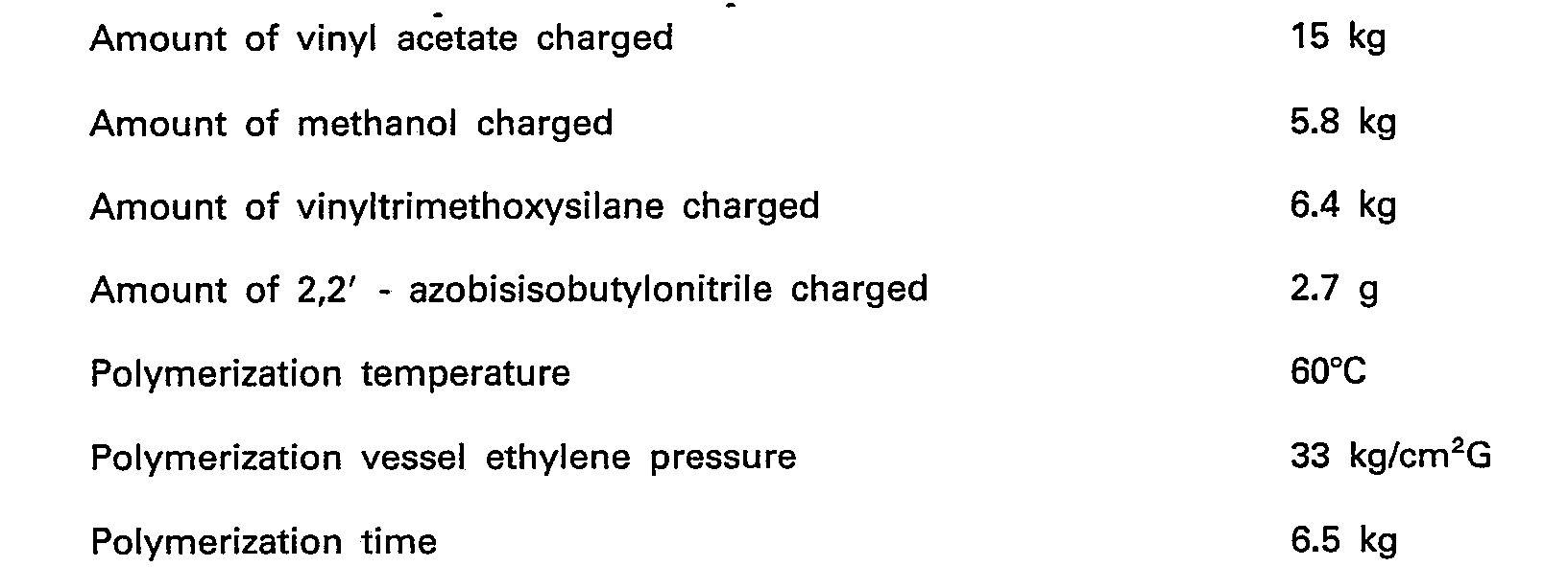
- The degree of polymerization of the vinyl acetate was 31%. Said copolymer was confirmed by NMR analysis to contain 0.02 molar % of the vinyltrimethoxysilane unit, 68 molar % of the vinyl acetate unit and 32 molar % of the ethylene unit. This was saponified, isolated, then post-treated and dried in a manner similar to that in Example 1 to obtain a modified EVOH. The degree of saponification was 99.5 molar %, and the Ml190 was 0.55 g/10 min.
- By similar procedures but excluding the vinyltrimethoxysilane, an EVOH having an ethylene content of 31.8 molar %, a degree of saponification of 99.6 molar % and an Ml190 of 5.1 g/10 min was obtained.
- The obtained modified EVOH and unmodified EVOH were measured for the oxygen permeability constant under the conditions of 0% RH, 35°C and 100% RH, 20°C. The results are shown in Table 6.

- Using the same polymerization as in Example 1, continuous polymerization was conducted by the following conditions:

- The degree of polymerization of the vinyl acetate was about 45%. Said copolymer was confirmed by NMR analysis to contain 0.023 molar % of the vinyltrimethoxysilane unit, 61 molar % of the vinyl acetate unit and about 39 molar % of the ethylene unit.
- This was then saponified, isolated, post-treated and subsequently dried in a manner similar to that in Example 1 to obtain a modified EVOH. The degree of saponification was 99.4 molar %, and the Ml190 was 1.5 g/10 min.
- A five-layered sheet was produced by coextrusion using said EVOH as an intermediate layer, an isotactic polypropylene (density: 0.912) as inner and outer layers, and a maleic anhydride-modified ethylene-vinyl acetate copolymer (vinyl acetate content: 12% by weight; degree of modification with. maleic anhydride: 0.5% by weight) as adhesive layers. The coextrusion conditions were as follows:

- The thickness of the extruded five-layered sheet was about 600 µ for the inner and outer layers, 80 µ for the adhesive layers and 140 p for the intermediate layer. Said sheet was molded by vacuum forming to obtain cups of 77 mm in diameter and 94 mm in height and having a round bottom. The cup molding temperature was 190°C, and the obtained cups had good appearance, showed no unevenly extended part and were free from crack generation.
- Using the same polymerization vessel as in Example 1, the polymerization was conducted by the conventional continuous polymerization method in a manner similar to that in Example 11 except that the vinyltrimethoxysilane was not used and the amount of the methanol was reduced, to prepare an EVOH containing 39 molar % of ethylene and having an Ml190 of 1.5. Thereafter, a five-layered sheet was coextruded in the same manner as in Example 11 and the cups were prepared by the same vacuum forming as in Example 11. As a result, not only unevenness in thickness was found in the bottom of the cup but also scoreline like cracks were generated on the cup.
Claims (4)


Applications Claiming Priority (2)
| Application Number | Priority Date | Filing Date | Title |
|---|---|---|---|
| JP58240759A JPH068327B2 (en) | 1983-12-19 | 1983-12-19 | Melt molding material |
| JP240759/83 | 1983-12-19 |
Publications (3)
| Publication Number | Publication Date |
|---|---|
| EP0146138A2 EP0146138A2 (en) | 1985-06-26 |
| EP0146138A3 EP0146138A3 (en) | 1985-08-07 |
| EP0146138B1 true EP0146138B1 (en) | 1988-12-28 |
Family
ID=17064289
Family Applications (1)
| Application Number | Title | Priority Date | Filing Date |
|---|---|---|---|
| EP84115677A Expired EP0146138B1 (en) | 1983-12-19 | 1984-12-18 | Melt molding material |
Country Status (4)
| Country | Link |
|---|---|
| US (1) | US4576988A (en) |
| EP (1) | EP0146138B1 (en) |
| JP (1) | JPH068327B2 (en) |
| DE (1) | DE3475787D1 (en) |
Families Citing this family (25)
| Publication number | Priority date | Publication date | Assignee | Title |
|---|---|---|---|---|
| US4684573A (en) * | 1985-03-07 | 1987-08-04 | W. R. Grace & Co., Cryovac Div. | High oxygen barrier composite film |
| DE3679269D1 (en) * | 1985-10-09 | 1991-06-20 | Kuraray Co | CONTAINER PRODUCED BY THE SPRAY BLOWING PROCESS. |
| CA1296852C (en) * | 1985-10-11 | 1992-03-10 | Henry George Schirmer | High oxygen barrier coextruded film |
| EP0239092B1 (en) * | 1986-03-26 | 1994-06-08 | Kuraray Co., Ltd. | Multilayered structure using ethylene-vinyl alcohol copolymer |
| US4824904A (en) * | 1986-03-31 | 1989-04-25 | Kuraray Co., Ltd. | Resin compositions, laminates and block copolymers |
| US4792484A (en) * | 1986-05-15 | 1988-12-20 | Kuraray Co., Ltd. | Composition, process for producing the same and multi-layer structure |
| US4729926A (en) * | 1986-05-16 | 1988-03-08 | W. R. Grace & Co., Cryovac Div. | Packaging material for long-term storage of shelf stable food products and method of making same |
| US4788105A (en) * | 1986-09-09 | 1988-11-29 | W. R. Grace & Co. | Oxygen barrier laminates |
| US5035851A (en) * | 1986-11-25 | 1991-07-30 | W. R. Grace & Co.-Conn. | Method of making very high barrier film |
| US4855181A (en) * | 1986-12-12 | 1989-08-08 | Kuraray Co., Ltd. | Laminate with a blend layer of polyesteramide and ethylene-vinyl acetate copolymer |
| JPH0717806B2 (en) * | 1986-12-30 | 1995-03-01 | 株式会社クラレ | Resin composition |
| JP2667830B2 (en) * | 1987-09-07 | 1997-10-27 | 株式会社クラレ | Ethylene-vinyl alcohol copolymer composition |
| CA1335424C (en) * | 1987-12-29 | 1995-05-02 | Tohei Moritani | Multilayered packaging materials having high gas barrier property |
| EP0363813B1 (en) * | 1988-10-06 | 1994-02-16 | Showa Denko Kabushiki Kaisha | Terpolymer and transparent laminate having excellent optical properties |
| JPH0624820B2 (en) * | 1989-06-23 | 1994-04-06 | 株式会社クラレ | Multilayer packaging |
| EP0452840B1 (en) * | 1990-04-18 | 1998-10-28 | Mitsui Chemicals, Inc. | Syndiotactic propylene copolymer, preparation of the same, and resin composition containing the same |
| US5221566A (en) * | 1991-03-29 | 1993-06-22 | Kuraray Co., Ltd. | Multilayered container and package utilizing the same |
| EP0937557B1 (en) * | 1997-09-08 | 2004-06-02 | Nippon Gohsei Kagaku Kogyo Kabushiki Kaisha | Process for preparing pellets of saponified ethylene/vinyl acetate copolymer |
| JP4330253B2 (en) * | 2000-06-29 | 2009-09-16 | 株式会社クラレ | Process for producing ethylene-vinyl acetate copolymer and saponified product thereof |
| EP1403289B8 (en) | 2001-05-14 | 2010-05-12 | Kuraray Co., Ltd. | Modified ethylene -vinyl alcohol copolymer and method for the production thereof |
| DE60301645T2 (en) * | 2002-07-11 | 2006-06-14 | Kuraray Co | Polyvinyl alcohol and process for producing polyvinyl alcohol |
| EP1380599B1 (en) * | 2002-07-11 | 2005-09-21 | Kuraray Co., Ltd. | Polyvinyl alcohol and method for producing polyvinyl alcohol |
| TW550285B (en) * | 2002-10-24 | 2003-09-01 | Chang Chun Petrochemical Co | Water resistant polyvinyl acetate emulsion for applying to wood material |
| TWI226335B (en) * | 2002-10-24 | 2005-01-11 | Chang Chun Petrochemical Co | One-pot water-resistant polyvinyl acetate emulsion and its preparation |
| US7683106B2 (en) | 2003-03-07 | 2010-03-23 | Nippon Synthetic Chemical Industry Co., Ltd. | Primer for dental materials and pulp capping agent for dentin regeneration |
Family Cites Families (8)
| Publication number | Priority date | Publication date | Assignee | Title |
|---|---|---|---|---|
| US3764589A (en) * | 1970-12-30 | 1973-10-09 | Copolymer Rubber & Chem Corp | Alpha-olefin interpolymers formed with unsaturated organo silanes |
| US4097436A (en) * | 1974-03-14 | 1978-06-27 | Dynamit Nobel Aktiengesellschaft | Hydrolyzed vinyl acetate-vinyl alkoxy silane polymers |
| GB1456164A (en) * | 1974-06-03 | 1976-11-17 | Nippon Synthetic Chem Ind | Process for preparing granular ethylene-vinyl alcohol copolymer photogtaphic camera |
| JPS56163135A (en) * | 1980-05-21 | 1981-12-15 | Kuraray Co Ltd | Saponified product of ethylene-vinyl acetate copolymer having good melt property |
| JPS57179210A (en) * | 1981-04-28 | 1982-11-04 | Sunstar Giken Kk | Room temperature curing elastic composition |
| DE3268978D1 (en) * | 1981-10-05 | 1986-03-20 | Kuraray Co | Paper coating agent |
| JPS5879003A (en) * | 1981-11-04 | 1983-05-12 | Kuraray Co Ltd | Preparation of silicon-containing modified polyvinyl alcohol |
| JPS58164604A (en) * | 1982-03-25 | 1983-09-29 | Kuraray Co Ltd | Production of silicon-containing modified polyvinyl alcohol |
-
1983
- 1983-12-19 JP JP58240759A patent/JPH068327B2/en not_active Expired - Lifetime
-
1984
- 1984-12-03 US US06/677,200 patent/US4576988A/en not_active Expired - Lifetime
- 1984-12-18 EP EP84115677A patent/EP0146138B1/en not_active Expired
- 1984-12-18 DE DE8484115677T patent/DE3475787D1/en not_active Expired
Also Published As
| Publication number | Publication date |
|---|---|
| JPH068327B2 (en) | 1994-02-02 |
| US4576988A (en) | 1986-03-18 |
| EP0146138A3 (en) | 1985-08-07 |
| EP0146138A2 (en) | 1985-06-26 |
| JPS60144304A (en) | 1985-07-30 |
| DE3475787D1 (en) | 1989-02-02 |
Similar Documents
| Publication | Publication Date | Title |
|---|---|---|
| US4576988A (en) | Saponified products of silicon-containing ethylene-vinyl acetate copolymer as melt molding materials | |
| US9663592B2 (en) | Modified ethylene-vinyl alcohol copolymer, method for producing same, and use of same | |
| EP3564307B1 (en) | Resin composition and use of same | |
| KR102271511B1 (en) | Ethylene-vinyl alcohol copolymer resin composition and method for producing same | |
| US4321337A (en) | Ionic hydrocarbon polymers having improved adhesion to nylon | |
| EP0008891B1 (en) | Polyamide laminates | |
| EP0457262B1 (en) | Ethylene-vinyl alcohol copolymers, moldings and laminates | |
| WO2019063836A1 (en) | IMPROVED ADHERENCE OF POLYOLEFINS TO POLYESTERS | |
| JP2721542B2 (en) | Ethylene-vinyl alcohol random copolymer, molded product and laminate | |
| JP5188006B2 (en) | Resin composition and multilayer structure using the same | |
| JP2836934B2 (en) | Resin composition and multilayer structure using the same | |
| US5372881A (en) | Thermoformable polyolefin sheet | |
| WO2022131320A1 (en) | Resin pellet group and layer structure using same | |
| JP2836938B2 (en) | Resin composition and laminate | |
| JPS6159992B2 (en) | ||
| JP2509768B2 (en) | Multilayer stack | |
| JP4832783B2 (en) | Gas barrier material composed of a novel ethylene-vinyl alcohol copolymer | |
| WO2026018882A1 (en) | Resin composition and molded article using same | |
| JP3059239B2 (en) | Ethylene-vinyl alcohol copolymer, molded article and laminate | |
| WO2026029107A1 (en) | Modified ethylene-vinyl alcohol copolymer, and resin composition and molded article each using same | |
| JPS61290046A (en) | Laminated structure | |
| JPH07717B2 (en) | Ethylene-vinyl alcohol copolymer composition | |
| JPH0924591A (en) | Laminate and container for packaging liquid food | |
| JPH0569519A (en) | Multilayer laminated body | |
| JPH0740516A (en) | Multi-layer structure |
Legal Events
| Date | Code | Title | Description |
|---|---|---|---|
| PUAI | Public reference made under article 153(3) epc to a published international application that has entered the european phase |
Free format text: ORIGINAL CODE: 0009012 |
|
| PUAL | Search report despatched |
Free format text: ORIGINAL CODE: 0009013 |
|
| AK | Designated contracting states |
Designated state(s): DE FR GB IT |
|
| AK | Designated contracting states |
Designated state(s): DE FR GB IT |
|
| 17P | Request for examination filed |
Effective date: 19860205 |
|
| 17Q | First examination report despatched |
Effective date: 19870701 |
|
| GRAA | (expected) grant |
Free format text: ORIGINAL CODE: 0009210 |
|
| AK | Designated contracting states |
Kind code of ref document: B1 Designated state(s): DE FR GB IT |
|
| REF | Corresponds to: |
Ref document number: 3475787 Country of ref document: DE Date of ref document: 19890202 |
|
| ITF | It: translation for a ep patent filed | ||
| ET | Fr: translation filed | ||
| PLBE | No opposition filed within time limit |
Free format text: ORIGINAL CODE: 0009261 |
|
| STAA | Information on the status of an ep patent application or granted ep patent |
Free format text: STATUS: NO OPPOSITION FILED WITHIN TIME LIMIT |
|
| 26N | No opposition filed | ||
| ITTA | It: last paid annual fee | ||
| REG | Reference to a national code |
Ref country code: GB Ref legal event code: IF02 |
|
| PGFP | Annual fee paid to national office [announced via postgrant information from national office to epo] |
Ref country code: FR Payment date: 20031210 Year of fee payment: 20 |
|
| PGFP | Annual fee paid to national office [announced via postgrant information from national office to epo] |
Ref country code: GB Payment date: 20031217 Year of fee payment: 20 |
|
| PGFP | Annual fee paid to national office [announced via postgrant information from national office to epo] |
Ref country code: DE Payment date: 20031229 Year of fee payment: 20 |
|
| PG25 | Lapsed in a contracting state [announced via postgrant information from national office to epo] |
Ref country code: GB Free format text: LAPSE BECAUSE OF EXPIRATION OF PROTECTION Effective date: 20041217 |
|
| REG | Reference to a national code |
Ref country code: GB Ref legal event code: PE20 |