EP0144098A1 - Cyclic ureas of isoxazole - Google Patents
Cyclic ureas of isoxazole Download PDFInfo
- Publication number
- EP0144098A1 EP0144098A1 EP84201498A EP84201498A EP0144098A1 EP 0144098 A1 EP0144098 A1 EP 0144098A1 EP 84201498 A EP84201498 A EP 84201498A EP 84201498 A EP84201498 A EP 84201498A EP 0144098 A1 EP0144098 A1 EP 0144098A1
- Authority
- EP
- European Patent Office
- Prior art keywords
- isoxazolyl
- mixture
- give
- methyl
- butyl
- Prior art date
- Legal status (The legal status is an assumption and is not a legal conclusion. Google has not performed a legal analysis and makes no representation as to the accuracy of the status listed.)
- Withdrawn
Links
- -1 Cyclic ureas Chemical class 0.000 title abstract description 20
- 235000013877 carbamide Nutrition 0.000 title abstract description 14
- CTAPFRYPJLPFDF-UHFFFAOYSA-N isoxazole Chemical compound C=1C=NOC=1 CTAPFRYPJLPFDF-UHFFFAOYSA-N 0.000 title abstract description 6
- 229910052739 hydrogen Inorganic materials 0.000 claims abstract description 18
- 239000001257 hydrogen Substances 0.000 claims abstract description 18
- 125000006527 (C1-C5) alkyl group Chemical group 0.000 claims abstract description 16
- 125000004453 alkoxycarbonyl group Chemical group 0.000 claims abstract description 13
- 125000004435 hydrogen atom Chemical group [H]* 0.000 claims abstract description 13
- 229910052736 halogen Chemical group 0.000 claims abstract description 12
- 150000002367 halogens Chemical group 0.000 claims abstract description 12
- 125000006729 (C2-C5) alkenyl group Chemical group 0.000 claims abstract description 10
- 125000001589 carboacyl group Chemical group 0.000 claims abstract description 10
- 125000003917 carbamoyl group Chemical group [H]N([H])C(*)=O 0.000 claims abstract description 8
- 125000003236 benzoyl group Chemical group [H]C1=C([H])C([H])=C(C([H])=C1[H])C(*)=O 0.000 claims abstract description 7
- 125000000217 alkyl group Chemical group 0.000 claims abstract 6
- 150000002431 hydrogen Chemical group 0.000 claims abstract 4
- 239000000203 mixture Substances 0.000 claims description 104
- 150000001875 compounds Chemical class 0.000 claims description 76
- 239000000969 carrier Substances 0.000 claims description 5
- MCYFRXOBXWQVDB-UHFFFAOYSA-N 1-(3-tert-butyl-1,2-oxazol-5-yl)-3-methylimidazolidin-2-one Chemical compound O=C1N(C)CCN1C1=CC(C(C)(C)C)=NO1 MCYFRXOBXWQVDB-UHFFFAOYSA-N 0.000 claims description 3
- 239000004615 ingredient Substances 0.000 claims description 2
- BORJPVBOLBQGBP-UHFFFAOYSA-N methyl [1-methyl-2-oxo-3-(5-propan-2-yl-1,2-oxazol-3-yl)imidazolidin-4-yl] carbonate Chemical compound COC(=O)OC1CN(C)C(=O)N1C1=NOC(C(C)C)=C1 BORJPVBOLBQGBP-UHFFFAOYSA-N 0.000 claims description 2
- GDOQBNSNDSBBFF-UHFFFAOYSA-N 1-(5-tert-butyl-4-chloro-1,2-oxazol-3-yl)-3-methylimidazolidin-2-one Chemical compound O=C1N(C)CCN1C1=NOC(C(C)(C)C)=C1Cl GDOQBNSNDSBBFF-UHFFFAOYSA-N 0.000 claims 1
- HHVFXETWHQLGMR-UHFFFAOYSA-N [1-(5-tert-butyl-1,2-oxazol-3-yl)-3-methyl-2,5-dioxoimidazolidin-4-yl] methyl carbonate Chemical compound C(C)(C)(C)C1=CC(=NO1)N1C(N(C(C1=O)OC(=O)OC)C)=O HHVFXETWHQLGMR-UHFFFAOYSA-N 0.000 claims 1
- YUIJBGOVHQMBSN-UHFFFAOYSA-N [1-methyl-2-oxo-3-(5-propan-2-yl-1,2-oxazol-3-yl)imidazolidin-4-yl] n-methylcarbamate Chemical compound CNC(=O)OC1CN(C)C(=O)N1C1=NOC(C(C)C)=C1 YUIJBGOVHQMBSN-UHFFFAOYSA-N 0.000 claims 1
- GEABTRQQFWRCEU-UHFFFAOYSA-N [3-(3-tert-butyl-1,2-oxazol-5-yl)-1-methyl-2-oxoimidazolidin-4-yl] methyl carbonate Chemical compound COC(=O)OC1CN(C)C(=O)N1C1=CC(C(C)(C)C)=NO1 GEABTRQQFWRCEU-UHFFFAOYSA-N 0.000 claims 1
- NXZULAZVZBNBOU-UHFFFAOYSA-N [3-(5-tert-butyl-1,2-oxazol-3-yl)-1-methyl-2-oxoimidazolidin-4-yl] n-methylcarbamate Chemical compound CNC(=O)OC1CN(C)C(=O)N1C1=NOC(C(C)(C)C)=C1 NXZULAZVZBNBOU-UHFFFAOYSA-N 0.000 claims 1
- 125000003342 alkenyl group Chemical group 0.000 claims 1
- 239000003085 diluting agent Substances 0.000 claims 1
- 239000000546 pharmaceutical excipient Substances 0.000 claims 1
- 230000002363 herbicidal effect Effects 0.000 abstract description 13
- 125000006273 (C1-C3) alkyl group Chemical group 0.000 abstract description 7
- 230000003389 potentiating effect Effects 0.000 abstract description 3
- YMWUJEATGCHHMB-UHFFFAOYSA-N Dichloromethane Chemical compound ClCCl YMWUJEATGCHHMB-UHFFFAOYSA-N 0.000 description 150
- UHOVQNZJYSORNB-UHFFFAOYSA-N Benzene Chemical compound C1=CC=CC=C1 UHOVQNZJYSORNB-UHFFFAOYSA-N 0.000 description 105
- 239000000047 product Substances 0.000 description 75
- 239000013078 crystal Substances 0.000 description 56
- 238000004519 manufacturing process Methods 0.000 description 44
- VEXZGXHMUGYJMC-UHFFFAOYSA-N Hydrochloric acid Chemical compound Cl VEXZGXHMUGYJMC-UHFFFAOYSA-N 0.000 description 41
- VYPSYNLAJGMNEJ-UHFFFAOYSA-N Silicium dioxide Chemical compound O=[Si]=O VYPSYNLAJGMNEJ-UHFFFAOYSA-N 0.000 description 41
- 238000004587 chromatography analysis Methods 0.000 description 40
- 239000000741 silica gel Substances 0.000 description 40
- 229910002027 silica gel Inorganic materials 0.000 description 40
- ZMXDDKWLCZADIW-UHFFFAOYSA-N N,N-Dimethylformamide Chemical compound CN(C)C=O ZMXDDKWLCZADIW-UHFFFAOYSA-N 0.000 description 39
- 239000011541 reaction mixture Substances 0.000 description 32
- ZMANZCXQSJIPKH-UHFFFAOYSA-N Triethylamine Chemical compound CCN(CC)CC ZMANZCXQSJIPKH-UHFFFAOYSA-N 0.000 description 27
- XLYOFNOQVPJJNP-UHFFFAOYSA-N water Substances O XLYOFNOQVPJJNP-UHFFFAOYSA-N 0.000 description 27
- HEDRZPFGACZZDS-UHFFFAOYSA-N Chloroform Chemical compound ClC(Cl)Cl HEDRZPFGACZZDS-UHFFFAOYSA-N 0.000 description 24
- XEKOWRVHYACXOJ-UHFFFAOYSA-N Ethyl acetate Chemical compound CCOC(C)=O XEKOWRVHYACXOJ-UHFFFAOYSA-N 0.000 description 24
- KWYUFKZDYYNOTN-UHFFFAOYSA-M Potassium hydroxide Chemical compound [OH-].[K+] KWYUFKZDYYNOTN-UHFFFAOYSA-M 0.000 description 24
- JUJWROOIHBZHMG-UHFFFAOYSA-N Pyridine Chemical compound C1=CC=NC=C1 JUJWROOIHBZHMG-UHFFFAOYSA-N 0.000 description 24
- PMZURENOXWZQFD-UHFFFAOYSA-L Sodium Sulfate Chemical compound [Na+].[Na+].[O-]S([O-])(=O)=O PMZURENOXWZQFD-UHFFFAOYSA-L 0.000 description 23
- VLKZOEOYAKHREP-UHFFFAOYSA-N n-Hexane Chemical compound CCCCCC VLKZOEOYAKHREP-UHFFFAOYSA-N 0.000 description 22
- 239000000243 solution Substances 0.000 description 20
- 239000007858 starting material Substances 0.000 description 20
- OKKJLVBELUTLKV-UHFFFAOYSA-N Methanol Chemical compound OC OKKJLVBELUTLKV-UHFFFAOYSA-N 0.000 description 18
- WYURNTSHIVDZCO-UHFFFAOYSA-N Tetrahydrofuran Chemical compound C1CCOC1 WYURNTSHIVDZCO-UHFFFAOYSA-N 0.000 description 18
- 239000010410 layer Substances 0.000 description 18
- HEMHJVSKTPXQMS-UHFFFAOYSA-M Sodium hydroxide Chemical compound [OH-].[Na+] HEMHJVSKTPXQMS-UHFFFAOYSA-M 0.000 description 15
- 238000006243 chemical reaction Methods 0.000 description 15
- FYSNRJHAOHDILO-UHFFFAOYSA-N thionyl chloride Chemical compound ClS(Cl)=O FYSNRJHAOHDILO-UHFFFAOYSA-N 0.000 description 14
- 239000002904 solvent Substances 0.000 description 13
- 239000004009 herbicide Substances 0.000 description 12
- UMJSCPRVCHMLSP-UHFFFAOYSA-N pyridine Natural products COC1=CC=CN=C1 UMJSCPRVCHMLSP-UHFFFAOYSA-N 0.000 description 12
- XDTMQSROBMDMFD-UHFFFAOYSA-N Cyclohexane Chemical compound C1CCCCC1 XDTMQSROBMDMFD-UHFFFAOYSA-N 0.000 description 11
- 239000003795 chemical substances by application Substances 0.000 description 10
- 239000012044 organic layer Substances 0.000 description 10
- 239000002689 soil Substances 0.000 description 10
- VZGDMQKNWNREIO-UHFFFAOYSA-N tetrachloromethane Chemical compound ClC(Cl)(Cl)Cl VZGDMQKNWNREIO-UHFFFAOYSA-N 0.000 description 10
- 241000196324 Embryophyta Species 0.000 description 9
- YXFVVABEGXRONW-UHFFFAOYSA-N Toluene Chemical compound CC1=CC=CC=C1 YXFVVABEGXRONW-UHFFFAOYSA-N 0.000 description 9
- 238000001816 cooling Methods 0.000 description 9
- YLQBMQCUIZJEEH-UHFFFAOYSA-N tetrahydrofuran Natural products C=1C=COC=1 YLQBMQCUIZJEEH-UHFFFAOYSA-N 0.000 description 9
- QTBSBXVTEAMEQO-UHFFFAOYSA-N Acetic acid Chemical compound CC(O)=O QTBSBXVTEAMEQO-UHFFFAOYSA-N 0.000 description 8
- 239000004202 carbamide Substances 0.000 description 8
- 229940093499 ethyl acetate Drugs 0.000 description 8
- 235000019439 ethyl acetate Nutrition 0.000 description 8
- FGUDMROYDQCCNY-UHFFFAOYSA-N phenyl n-(5-tert-butyl-1,2-oxazol-3-yl)carbamate Chemical compound O1C(C(C)(C)C)=CC(NC(=O)OC=2C=CC=CC=2)=N1 FGUDMROYDQCCNY-UHFFFAOYSA-N 0.000 description 8
- XSQUKJJJFZCRTK-UHFFFAOYSA-N Urea Chemical compound NC(N)=O XSQUKJJJFZCRTK-UHFFFAOYSA-N 0.000 description 7
- 239000000460 chlorine Substances 0.000 description 7
- 238000000034 method Methods 0.000 description 7
- WFDIJRYMOXRFFG-UHFFFAOYSA-N Acetic anhydride Chemical compound CC(=O)OC(C)=O WFDIJRYMOXRFFG-UHFFFAOYSA-N 0.000 description 6
- KEAYESYHFKHZAL-UHFFFAOYSA-N Sodium Chemical compound [Na] KEAYESYHFKHZAL-UHFFFAOYSA-N 0.000 description 6
- UIIMBOGNXHQVGW-UHFFFAOYSA-M Sodium bicarbonate Chemical compound [Na+].OC([O-])=O UIIMBOGNXHQVGW-UHFFFAOYSA-M 0.000 description 6
- 125000004423 acyloxy group Chemical group 0.000 description 6
- 239000012230 colorless oil Substances 0.000 description 6
- 238000009472 formulation Methods 0.000 description 6
- INQOMBQAUSQDDS-UHFFFAOYSA-N iodomethane Chemical compound IC INQOMBQAUSQDDS-UHFFFAOYSA-N 0.000 description 6
- LPNYRYFBWFDTMA-UHFFFAOYSA-N potassium tert-butoxide Chemical compound [K+].CC(C)(C)[O-] LPNYRYFBWFDTMA-UHFFFAOYSA-N 0.000 description 6
- 239000012312 sodium hydride Substances 0.000 description 6
- 229910000104 sodium hydride Inorganic materials 0.000 description 6
- 238000003756 stirring Methods 0.000 description 6
- 125000000229 (C1-C4)alkoxy group Chemical group 0.000 description 5
- LFQSCWFLJHTTHZ-UHFFFAOYSA-N Ethanol Chemical compound CCO LFQSCWFLJHTTHZ-UHFFFAOYSA-N 0.000 description 5
- 238000001914 filtration Methods 0.000 description 5
- HZAXFHJVJLSVMW-UHFFFAOYSA-N 2-Aminoethan-1-ol Chemical compound NCCO HZAXFHJVJLSVMW-UHFFFAOYSA-N 0.000 description 4
- RTZKZFJDLAIYFH-UHFFFAOYSA-N Diethyl ether Chemical compound CCOCC RTZKZFJDLAIYFH-UHFFFAOYSA-N 0.000 description 4
- 244000058871 Echinochloa crus-galli Species 0.000 description 4
- KFZMGEQAYNKOFK-UHFFFAOYSA-N Isopropanol Chemical compound CC(C)O KFZMGEQAYNKOFK-UHFFFAOYSA-N 0.000 description 4
- WQDUMFSSJAZKTM-UHFFFAOYSA-N Sodium methoxide Chemical compound [Na+].[O-]C WQDUMFSSJAZKTM-UHFFFAOYSA-N 0.000 description 4
- 125000003545 alkoxy group Chemical group 0.000 description 4
- WIRUZQNBHNAMAB-UHFFFAOYSA-N benzene;cyclohexane Chemical compound C1CCCCC1.C1=CC=CC=C1 WIRUZQNBHNAMAB-UHFFFAOYSA-N 0.000 description 4
- 239000004927 clay Substances 0.000 description 4
- 238000011156 evaluation Methods 0.000 description 4
- HHLFWLYXYJOTON-UHFFFAOYSA-N glyoxylic acid Chemical compound OC(=O)C=O HHLFWLYXYJOTON-UHFFFAOYSA-N 0.000 description 4
- 125000001449 isopropyl group Chemical group [H]C([H])([H])C([H])(*)C([H])([H])[H] 0.000 description 4
- HAMGRBXTJNITHG-UHFFFAOYSA-N methyl isocyanate Chemical compound CN=C=O HAMGRBXTJNITHG-UHFFFAOYSA-N 0.000 description 4
- 239000003921 oil Substances 0.000 description 4
- CTSLXHKWHWQRSH-UHFFFAOYSA-N oxalyl chloride Chemical compound ClC(=O)C(Cl)=O CTSLXHKWHWQRSH-UHFFFAOYSA-N 0.000 description 4
- 230000004083 survival effect Effects 0.000 description 4
- 239000000725 suspension Substances 0.000 description 4
- WSLDOOZREJYCGB-UHFFFAOYSA-N 1,2-Dichloroethane Chemical compound ClCCCl WSLDOOZREJYCGB-UHFFFAOYSA-N 0.000 description 3
- XMTQQYYKAHVGBJ-UHFFFAOYSA-N 3-(3,4-DICHLOROPHENYL)-1,1-DIMETHYLUREA Chemical compound CN(C)C(=O)NC1=CC=C(Cl)C(Cl)=C1 XMTQQYYKAHVGBJ-UHFFFAOYSA-N 0.000 description 3
- CSCPPACGZOOCGX-UHFFFAOYSA-N Acetone Chemical compound CC(C)=O CSCPPACGZOOCGX-UHFFFAOYSA-N 0.000 description 3
- WKBOTKDWSSQWDR-UHFFFAOYSA-N Bromine atom Chemical compound [Br] WKBOTKDWSSQWDR-UHFFFAOYSA-N 0.000 description 3
- KZBUYRJDOAKODT-UHFFFAOYSA-N Chlorine Chemical compound ClCl KZBUYRJDOAKODT-UHFFFAOYSA-N 0.000 description 3
- YXHKONLOYHBTNS-UHFFFAOYSA-N Diazomethane Chemical compound C=[N+]=[N-] YXHKONLOYHBTNS-UHFFFAOYSA-N 0.000 description 3
- QOSSAOTZNIDXMA-UHFFFAOYSA-N Dicylcohexylcarbodiimide Chemical compound C1CCCCC1N=C=NC1CCCCC1 QOSSAOTZNIDXMA-UHFFFAOYSA-N 0.000 description 3
- WMFOQBRAJBCJND-UHFFFAOYSA-M Lithium hydroxide Chemical compound [Li+].[OH-] WMFOQBRAJBCJND-UHFFFAOYSA-M 0.000 description 3
- 229920001213 Polysorbate 20 Polymers 0.000 description 3
- 229960000583 acetic acid Drugs 0.000 description 3
- 239000007900 aqueous suspension Substances 0.000 description 3
- SLUNEGLMXGHOLY-UHFFFAOYSA-N benzene;hexane Chemical compound CCCCCC.C1=CC=CC=C1 SLUNEGLMXGHOLY-UHFFFAOYSA-N 0.000 description 3
- GDTBXPJZTBHREO-UHFFFAOYSA-N bromine Substances BrBr GDTBXPJZTBHREO-UHFFFAOYSA-N 0.000 description 3
- 229910052794 bromium Inorganic materials 0.000 description 3
- 238000010790 dilution Methods 0.000 description 3
- 239000012895 dilution Substances 0.000 description 3
- 238000002474 experimental method Methods 0.000 description 3
- 125000002887 hydroxy group Chemical group [H]O* 0.000 description 3
- 239000000543 intermediate Substances 0.000 description 3
- 229910052751 metal Inorganic materials 0.000 description 3
- 239000002184 metal Substances 0.000 description 3
- XMJHPCRAQCTCFT-UHFFFAOYSA-N methyl chloroformate Chemical compound COC(Cl)=O XMJHPCRAQCTCFT-UHFFFAOYSA-N 0.000 description 3
- 125000002496 methyl group Chemical group [H]C([H])([H])* 0.000 description 3
- 239000000256 polyoxyethylene sorbitan monolaurate Substances 0.000 description 3
- 235000010486 polyoxyethylene sorbitan monolaurate Nutrition 0.000 description 3
- 229910000030 sodium bicarbonate Inorganic materials 0.000 description 3
- 235000017557 sodium bicarbonate Nutrition 0.000 description 3
- 239000007787 solid Substances 0.000 description 3
- 239000000126 substance Substances 0.000 description 3
- 239000000454 talc Substances 0.000 description 3
- 229910052623 talc Inorganic materials 0.000 description 3
- 125000000999 tert-butyl group Chemical group [H]C([H])([H])C(*)(C([H])([H])[H])C([H])([H])[H] 0.000 description 3
- DYLIWHYUXAJDOJ-OWOJBTEDSA-N (e)-4-(6-aminopurin-9-yl)but-2-en-1-ol Chemical compound NC1=NC=NC2=C1N=CN2C\C=C\CO DYLIWHYUXAJDOJ-OWOJBTEDSA-N 0.000 description 2
- QHBQJFKLVCKTPG-UHFFFAOYSA-N 1-(5-tert-butyl-1,2-oxazol-3-yl)imidazolidin-2-one Chemical compound O1C(C(C)(C)C)=CC(N2C(NCC2)=O)=N1 QHBQJFKLVCKTPG-UHFFFAOYSA-N 0.000 description 2
- 125000003903 2-propenyl group Chemical group [H]C([*])([H])C([H])=C([H])[H] 0.000 description 2
- XKJMBINCVNINCA-UHFFFAOYSA-N Alfalone Chemical compound CON(C)C(=O)NC1=CC=C(Cl)C(Cl)=C1 XKJMBINCVNINCA-UHFFFAOYSA-N 0.000 description 2
- 244000300297 Amaranthus hybridus Species 0.000 description 2
- 235000004135 Amaranthus viridis Nutrition 0.000 description 2
- 235000011305 Capsella bursa pastoris Nutrition 0.000 description 2
- 240000008867 Capsella bursa-pastoris Species 0.000 description 2
- ZAMOUSCENKQFHK-UHFFFAOYSA-N Chlorine atom Chemical compound [Cl] ZAMOUSCENKQFHK-UHFFFAOYSA-N 0.000 description 2
- 229920000742 Cotton Polymers 0.000 description 2
- 235000002848 Cyperus flabelliformis Nutrition 0.000 description 2
- 244000152970 Digitaria sanguinalis Species 0.000 description 2
- 235000010823 Digitaria sanguinalis Nutrition 0.000 description 2
- IAZDPXIOMUYVGZ-UHFFFAOYSA-N Dimethylsulphoxide Chemical compound CS(C)=O IAZDPXIOMUYVGZ-UHFFFAOYSA-N 0.000 description 2
- 239000005510 Diuron Substances 0.000 description 2
- DHMQDGOQFOQNFH-UHFFFAOYSA-N Glycine Chemical compound NCC(O)=O DHMQDGOQFOQNFH-UHFFFAOYSA-N 0.000 description 2
- 235000010469 Glycine max Nutrition 0.000 description 2
- 244000068988 Glycine max Species 0.000 description 2
- 244000299507 Gossypium hirsutum Species 0.000 description 2
- 235000007688 Lycopersicon esculentum Nutrition 0.000 description 2
- 235000012629 Mentha aquatica Nutrition 0.000 description 2
- 240000000275 Persicaria hydropiper Species 0.000 description 2
- 235000017337 Persicaria hydropiper Nutrition 0.000 description 2
- 235000004442 Polygonum persicaria Nutrition 0.000 description 2
- 240000003461 Setaria viridis Species 0.000 description 2
- 235000002248 Setaria viridis Nutrition 0.000 description 2
- CDBYLPFSWZWCQE-UHFFFAOYSA-L Sodium Carbonate Chemical compound [Na+].[Na+].[O-]C([O-])=O CDBYLPFSWZWCQE-UHFFFAOYSA-L 0.000 description 2
- 240000003768 Solanum lycopersicum Species 0.000 description 2
- 240000006694 Stellaria media Species 0.000 description 2
- 235000021307 Triticum Nutrition 0.000 description 2
- 244000098338 Triticum aestivum Species 0.000 description 2
- BZHJMEDXRYGGRV-UHFFFAOYSA-N Vinyl chloride Chemical compound ClC=C BZHJMEDXRYGGRV-UHFFFAOYSA-N 0.000 description 2
- 240000008042 Zea mays Species 0.000 description 2
- 235000005824 Zea mays ssp. parviglumis Nutrition 0.000 description 2
- 235000002017 Zea mays subsp mays Nutrition 0.000 description 2
- WETWJCDKMRHUPV-UHFFFAOYSA-N acetyl chloride Chemical compound CC(Cl)=O WETWJCDKMRHUPV-UHFFFAOYSA-N 0.000 description 2
- 239000012346 acetyl chloride Substances 0.000 description 2
- 125000002777 acetyl group Chemical group [H]C([H])([H])C(*)=O 0.000 description 2
- 230000010933 acylation Effects 0.000 description 2
- 238000005917 acylation reaction Methods 0.000 description 2
- 150000001350 alkyl halides Chemical class 0.000 description 2
- 239000007864 aqueous solution Substances 0.000 description 2
- 239000002585 base Substances 0.000 description 2
- GZUXJHMPEANEGY-UHFFFAOYSA-N bromomethane Chemical compound BrC GZUXJHMPEANEGY-UHFFFAOYSA-N 0.000 description 2
- PFKFTWBEEFSNDU-UHFFFAOYSA-N carbonyldiimidazole Chemical compound C1=CN=CN1C(=O)N1C=CN=C1 PFKFTWBEEFSNDU-UHFFFAOYSA-N 0.000 description 2
- 229910052801 chlorine Inorganic materials 0.000 description 2
- 235000005822 corn Nutrition 0.000 description 2
- 244000038559 crop plants Species 0.000 description 2
- WACQKHWOTAEEFS-UHFFFAOYSA-N cyclohexane;ethyl acetate Chemical compound CCOC(C)=O.C1CCCCC1 WACQKHWOTAEEFS-UHFFFAOYSA-N 0.000 description 2
- 239000000428 dust Substances 0.000 description 2
- 239000000839 emulsion Substances 0.000 description 2
- 238000006266 etherification reaction Methods 0.000 description 2
- 238000001704 evaporation Methods 0.000 description 2
- 230000008020 evaporation Effects 0.000 description 2
- 239000000706 filtrate Substances 0.000 description 2
- 238000010438 heat treatment Methods 0.000 description 2
- 150000007529 inorganic bases Chemical class 0.000 description 2
- 239000012948 isocyanate Substances 0.000 description 2
- 239000007788 liquid Substances 0.000 description 2
- 238000002844 melting Methods 0.000 description 2
- 230000008018 melting Effects 0.000 description 2
- VXGABWCSZZWXPC-UHFFFAOYSA-N methyl 2-(methylamino)acetate Chemical compound CNCC(=O)OC VXGABWCSZZWXPC-UHFFFAOYSA-N 0.000 description 2
- 229910052757 nitrogen Inorganic materials 0.000 description 2
- 125000004433 nitrogen atom Chemical group N* 0.000 description 2
- 150000007530 organic bases Chemical class 0.000 description 2
- 125000001997 phenyl group Chemical group [H]C1=C([H])C([H])=C(*)C([H])=C1[H] 0.000 description 2
- BNYGLSATMXIEGL-UHFFFAOYSA-N phenyl n-(3-tert-butyl-1,2-oxazol-5-yl)carbamate Chemical compound O1N=C(C(C)(C)C)C=C1NC(=O)OC1=CC=CC=C1 BNYGLSATMXIEGL-UHFFFAOYSA-N 0.000 description 2
- BWHMMNNQKKPAPP-UHFFFAOYSA-L potassium carbonate Chemical compound [K+].[K+].[O-]C([O-])=O BWHMMNNQKKPAPP-UHFFFAOYSA-L 0.000 description 2
- 239000011369 resultant mixture Substances 0.000 description 2
- FSYKKLYZXJSNPZ-UHFFFAOYSA-N sarcosine Chemical compound C[NH2+]CC([O-])=O FSYKKLYZXJSNPZ-UHFFFAOYSA-N 0.000 description 2
- 229910000033 sodium borohydride Inorganic materials 0.000 description 2
- 239000012279 sodium borohydride Substances 0.000 description 2
- 238000009331 sowing Methods 0.000 description 2
- 125000001424 substituent group Chemical group 0.000 description 2
- YBBRCQOCSYXUOC-UHFFFAOYSA-N sulfuryl dichloride Chemical compound ClS(Cl)(=O)=O YBBRCQOCSYXUOC-UHFFFAOYSA-N 0.000 description 2
- 238000010998 test method Methods 0.000 description 2
- ZUQHMEQDEPUFJR-UHFFFAOYSA-N (5-tert-butyl-1,2-oxazol-3-yl) cyanate Chemical compound CC(C)(C)C1=CC(OC#N)=NO1 ZUQHMEQDEPUFJR-UHFFFAOYSA-N 0.000 description 1
- QDAIYONGIKTEJS-UHFFFAOYSA-N 1-(1,2-oxazol-3-yl)imidazolidin-2-one Chemical compound O=C1NCCN1C1=NOC=C1 QDAIYONGIKTEJS-UHFFFAOYSA-N 0.000 description 1
- PWGSXEHKRIMAFB-UHFFFAOYSA-N 1-(3-tert-butyl-1,2-oxazol-5-yl)imidazolidin-2-one Chemical compound O1N=C(C(C)(C)C)C=C1N1C(=O)NCC1 PWGSXEHKRIMAFB-UHFFFAOYSA-N 0.000 description 1
- LFJUYSXBNRVNTP-UHFFFAOYSA-N 1-(3-tert-butyl-2h-1,2-oxazol-3-yl)-3-(2-hydroxyethyl)urea Chemical compound OCCNC(=O)NC1(C(C)(C)C)NOC=C1 LFJUYSXBNRVNTP-UHFFFAOYSA-N 0.000 description 1
- PIGDQNDBZXGRJS-UHFFFAOYSA-N 1-(5-tert-butyl-1,2-oxazol-3-yl)-1,3-diazinan-2-one Chemical compound O1C(C(C)(C)C)=CC(N2C(NCCC2)=O)=N1 PIGDQNDBZXGRJS-UHFFFAOYSA-N 0.000 description 1
- PPQJDTRKULMOGA-UHFFFAOYSA-N 1-(5-tert-butyl-1,2-oxazol-3-yl)-3,4-dimethylimidazolidin-2-one Chemical compound O=C1N(C)C(C)CN1C1=NOC(C(C)(C)C)=C1 PPQJDTRKULMOGA-UHFFFAOYSA-N 0.000 description 1
- IEUMKJFKEPXDCK-UHFFFAOYSA-N 1-(5-tert-butyl-1,2-oxazol-3-yl)-3-(1-chloropropan-2-yl)urea Chemical compound ClCC(C)NC(=O)NC=1C=C(C(C)(C)C)ON=1 IEUMKJFKEPXDCK-UHFFFAOYSA-N 0.000 description 1
- GUGIHASDNTVOMG-UHFFFAOYSA-N 1-(5-tert-butyl-1,2-oxazol-3-yl)-3-(1-hydroxypropan-2-yl)urea Chemical compound OCC(C)NC(=O)NC=1C=C(C(C)(C)C)ON=1 GUGIHASDNTVOMG-UHFFFAOYSA-N 0.000 description 1
- GHNQFQDRQUPYBV-UHFFFAOYSA-N 1-(5-tert-butyl-1,2-oxazol-3-yl)-3-(2-chloroethyl)urea Chemical compound CC(C)(C)C1=CC(NC(=O)NCCCl)=NO1 GHNQFQDRQUPYBV-UHFFFAOYSA-N 0.000 description 1
- DKNLLTXAWIZBDS-UHFFFAOYSA-N 1-(5-tert-butyl-1,2-oxazol-3-yl)-3-methylimidazolidin-2-one Chemical compound O=C1N(C)CCN1C1=NOC(C(C)(C)C)=C1 DKNLLTXAWIZBDS-UHFFFAOYSA-N 0.000 description 1
- GUGLRTKPJBGNAF-UHFFFAOYSA-N 1-(5-tert-butyl-1,2-oxazol-3-yl)-3-methylurea Chemical compound CNC(=O)NC=1C=C(C(C)(C)C)ON=1 GUGLRTKPJBGNAF-UHFFFAOYSA-N 0.000 description 1
- XAEAEFQXDBCTPL-UHFFFAOYSA-N 1-(5-tert-butyl-1,2-oxazol-3-yl)-4,5-dihydroxy-3-methylimidazolidin-2-one Chemical compound O=C1N(C)C(O)C(O)N1C1=NOC(C(C)(C)C)=C1 XAEAEFQXDBCTPL-UHFFFAOYSA-N 0.000 description 1
- WWCBKBIYMKSOKW-UHFFFAOYSA-N 1-(5-tert-butyl-1,2-oxazol-3-yl)-4-methylimidazolidin-2-one Chemical compound O=C1NC(C)CN1C1=NOC(C(C)(C)C)=C1 WWCBKBIYMKSOKW-UHFFFAOYSA-N 0.000 description 1
- RDURRBIZELFFJB-UHFFFAOYSA-N 1-(5-tert-butyl-1,2-oxazol-3-yl)-5-hydroxy-3-methylimidazolidine-2,4-dione Chemical compound O=C1N(C)C(=O)C(O)N1C1=NOC(C(C)(C)C)=C1 RDURRBIZELFFJB-UHFFFAOYSA-N 0.000 description 1
- VHPLXPRPPSHEEU-UHFFFAOYSA-N 1-(5-tert-butyl-1,2-oxazol-3-yl)-5-hydroxyimidazolidin-2-one Chemical compound O1C(C(C)(C)C)=CC(N2C(NCC2O)=O)=N1 VHPLXPRPPSHEEU-UHFFFAOYSA-N 0.000 description 1
- DHOBEORQKCAVPP-UHFFFAOYSA-N 1-(5-tert-butyl-4-chloro-1,2-oxazol-3-yl)-3-methylurea Chemical compound CNC(=O)NC1=NOC(C(C)(C)C)=C1Cl DHOBEORQKCAVPP-UHFFFAOYSA-N 0.000 description 1
- AEKHFLDILSDXBL-UHFFFAOYSA-N 1-(methylamino)propan-2-ol Chemical compound CNCC(C)O AEKHFLDILSDXBL-UHFFFAOYSA-N 0.000 description 1
- MPPPKRYCTPRNTB-UHFFFAOYSA-N 1-bromobutane Chemical compound CCCCBr MPPPKRYCTPRNTB-UHFFFAOYSA-N 0.000 description 1
- NDIQTFJMMVWIML-UHFFFAOYSA-N 1-methyl-3-(5-propan-2-yl-1,2-oxazol-3-yl)urea Chemical compound CNC(=O)NC=1C=C(C(C)C)ON=1 NDIQTFJMMVWIML-UHFFFAOYSA-N 0.000 description 1
- 125000006017 1-propenyl group Chemical group 0.000 description 1
- YQTCQNIPQMJNTI-UHFFFAOYSA-N 2,2-dimethylpropan-1-one Chemical group CC(C)(C)[C]=O YQTCQNIPQMJNTI-UHFFFAOYSA-N 0.000 description 1
- OBTZDIRUQWFRFZ-UHFFFAOYSA-N 2-(5-methylfuran-2-yl)-n-(4-methylphenyl)quinoline-4-carboxamide Chemical compound O1C(C)=CC=C1C1=CC(C(=O)NC=2C=CC(C)=CC=2)=C(C=CC=C2)C2=N1 OBTZDIRUQWFRFZ-UHFFFAOYSA-N 0.000 description 1
- LBLYYCQCTBFVLH-UHFFFAOYSA-N 2-Methylbenzenesulfonic acid Chemical compound CC1=CC=CC=C1S(O)(=O)=O LBLYYCQCTBFVLH-UHFFFAOYSA-N 0.000 description 1
- BAFSWMYDMWSBMU-UHFFFAOYSA-N 2-[(3-tert-butyl-1,2-oxazol-5-yl)carbamoylamino]acetic acid Chemical compound CC(C)(C)C=1C=C(NC(=O)NCC(O)=O)ON=1 BAFSWMYDMWSBMU-UHFFFAOYSA-N 0.000 description 1
- WVPQGQKUJYPMSO-UHFFFAOYSA-N 2-[(5-tert-butyl-1,2-oxazol-3-yl)carbamoylamino]acetic acid Chemical compound CC(C)(C)C1=CC(NC(=O)NCC(O)=O)=NO1 WVPQGQKUJYPMSO-UHFFFAOYSA-N 0.000 description 1
- BKMMTJMQCTUHRP-UHFFFAOYSA-N 2-aminopropan-1-ol Chemical compound CC(N)CO BKMMTJMQCTUHRP-UHFFFAOYSA-N 0.000 description 1
- ONRREFWJTRBDRA-UHFFFAOYSA-N 2-chloroethanamine;hydron;chloride Chemical compound [Cl-].[NH3+]CCCl ONRREFWJTRBDRA-UHFFFAOYSA-N 0.000 description 1
- IHODQYKJRKUBLZ-UHFFFAOYSA-N 3-(3-tert-butyl-2h-1,2-oxazol-3-yl)-1-(3-hydroxypropyl)-1-methylurea Chemical compound OCCCN(C)C(=O)NC1(C(C)(C)C)NOC=C1 IHODQYKJRKUBLZ-UHFFFAOYSA-N 0.000 description 1
- USWNPSVKUDKPER-UHFFFAOYSA-N 3-(5-tert-butyl-1,2-oxazol-3-yl)-1,4-dimethylimidazolidin-2-one Chemical compound CC1CN(C)C(=O)N1C1=NOC(C(C)(C)C)=C1 USWNPSVKUDKPER-UHFFFAOYSA-N 0.000 description 1
- LGXDIRBGRQIPRJ-UHFFFAOYSA-N 3-(5-tert-butyl-1,2-oxazol-3-yl)-1-(2-hydroxypropyl)-1-methylurea Chemical compound CC(O)CN(C)C(=O)NC=1C=C(C(C)(C)C)ON=1 LGXDIRBGRQIPRJ-UHFFFAOYSA-N 0.000 description 1
- RYHZIOBCNZTFAZ-UHFFFAOYSA-N 3-(5-tert-butyl-1,2-oxazol-3-yl)-1-(3-chloropropyl)-1-methylurea Chemical compound ClCCCN(C)C(=O)NC=1C=C(C(C)(C)C)ON=1 RYHZIOBCNZTFAZ-UHFFFAOYSA-N 0.000 description 1
- BLKDSQFMVSGHOZ-UHFFFAOYSA-N 3-(5-tert-butyl-1,2-oxazol-3-yl)-4-methoxy-1-methylimidazolidin-2-one Chemical compound COC1CN(C)C(=O)N1C1=NOC(C(C)(C)C)=C1 BLKDSQFMVSGHOZ-UHFFFAOYSA-N 0.000 description 1
- XVWOAYFIODGPRC-UHFFFAOYSA-N 3-(5-tert-butyl-1,2-oxazol-3-yl)imidazolidine-2,4-dione Chemical compound O1C(C(C)(C)C)=CC(N2C(NCC2=O)=O)=N1 XVWOAYFIODGPRC-UHFFFAOYSA-N 0.000 description 1
- SVUXRMADZWVVCT-UHFFFAOYSA-N 3-isocyanato-1,2-oxazole Chemical compound O=C=NC=1C=CON=1 SVUXRMADZWVVCT-UHFFFAOYSA-N 0.000 description 1
- BTOJSYRZQZOMOK-UHFFFAOYSA-N 4-chloro-7-(4-methylphenyl)sulfonylpyrrolo[2,3-d]pyrimidine Chemical compound C1=CC(C)=CC=C1S(=O)(=O)N1C2=NC=NC(Cl)=C2C=C1 BTOJSYRZQZOMOK-UHFFFAOYSA-N 0.000 description 1
- MZYSERSAMDTLFJ-UHFFFAOYSA-N 4-hydroxy-1-methyl-3-(5-propan-2-yl-1,2-oxazol-3-yl)imidazolidin-2-one Chemical compound O1C(C(C)C)=CC(N2C(N(C)CC2O)=O)=N1 MZYSERSAMDTLFJ-UHFFFAOYSA-N 0.000 description 1
- VUSYNHBKPCGGCI-UHFFFAOYSA-N 4-iodobut-1-ene Chemical compound ICCC=C VUSYNHBKPCGGCI-UHFFFAOYSA-N 0.000 description 1
- IQMVRIMSTBTDLV-UHFFFAOYSA-N 5-tert-butyl-3-isocyanato-1,2-oxazole Chemical compound CC(C)(C)C1=CC(N=C=O)=NO1 IQMVRIMSTBTDLV-UHFFFAOYSA-N 0.000 description 1
- SJVGFKBLUYAEOK-SFHVURJKSA-N 6-[4-[(3S)-3-(3,5-difluorophenyl)-3,4-dihydropyrazole-2-carbonyl]piperidin-1-yl]pyrimidine-4-carbonitrile Chemical compound FC=1C=C(C=C(C=1)F)[C@@H]1CC=NN1C(=O)C1CCN(CC1)C1=CC(=NC=N1)C#N SJVGFKBLUYAEOK-SFHVURJKSA-N 0.000 description 1
- ZCYVEMRRCGMTRW-UHFFFAOYSA-N 7553-56-2 Chemical compound [I] ZCYVEMRRCGMTRW-UHFFFAOYSA-N 0.000 description 1
- QTBSBXVTEAMEQO-UHFFFAOYSA-M Acetate Chemical compound CC([O-])=O QTBSBXVTEAMEQO-UHFFFAOYSA-M 0.000 description 1
- 241000189415 Alopecurus aequalis Species 0.000 description 1
- 241000189413 Alopecurus geniculatus Species 0.000 description 1
- 235000011908 Amaranthus dubius Nutrition 0.000 description 1
- 240000006421 Amaranthus dubius Species 0.000 description 1
- 244000055702 Amaranthus viridis Species 0.000 description 1
- 240000008575 Ammannia baccifera Species 0.000 description 1
- 244000204909 Anoda cristata Species 0.000 description 1
- 241000271566 Aves Species 0.000 description 1
- WVDDGKGOMKODPV-UHFFFAOYSA-N Benzyl alcohol Chemical compound OCC1=CC=CC=C1 WVDDGKGOMKODPV-UHFFFAOYSA-N 0.000 description 1
- CVASLHWPRRIAAD-UHFFFAOYSA-N CC12NC3[IH]C1C3C2 Chemical compound CC12NC3[IH]C1C3C2 CVASLHWPRRIAAD-UHFFFAOYSA-N 0.000 description 1
- 240000006122 Chenopodium album Species 0.000 description 1
- 235000009344 Chenopodium album Nutrition 0.000 description 1
- 244000108484 Cyperus difformis Species 0.000 description 1
- 241000817048 Cyperus microiria Species 0.000 description 1
- 240000001505 Cyperus odoratus Species 0.000 description 1
- 235000001248 Dentaria laciniata Nutrition 0.000 description 1
- 240000003176 Digitaria ciliaris Species 0.000 description 1
- 235000017898 Digitaria ciliaris Nutrition 0.000 description 1
- 240000004472 Dopatrium junceum Species 0.000 description 1
- 241000192040 Echinochloa phyllopogon Species 0.000 description 1
- PXGOKWXKJXAPGV-UHFFFAOYSA-N Fluorine Chemical compound FF PXGOKWXKJXAPGV-UHFFFAOYSA-N 0.000 description 1
- 239000004471 Glycine Substances 0.000 description 1
- UFHFLCQGNIYNRP-UHFFFAOYSA-N Hydrogen Chemical compound [H][H] UFHFLCQGNIYNRP-UHFFFAOYSA-N 0.000 description 1
- 239000005909 Kieselgur Substances 0.000 description 1
- 239000005573 Linuron Substances 0.000 description 1
- 241001465754 Metazoa Species 0.000 description 1
- 235000009382 Mollugo verticillata Nutrition 0.000 description 1
- 235000003990 Monochoria hastata Nutrition 0.000 description 1
- 240000000178 Monochoria vaginalis Species 0.000 description 1
- 235000008708 Morus alba Nutrition 0.000 description 1
- 240000000249 Morus alba Species 0.000 description 1
- OPKOKAMJFNKNAS-UHFFFAOYSA-N N-methylethanolamine Chemical compound CNCCO OPKOKAMJFNKNAS-UHFFFAOYSA-N 0.000 description 1
- CTQNGGLPUBDAKN-UHFFFAOYSA-N O-Xylene Chemical compound CC1=CC=CC=C1C CTQNGGLPUBDAKN-UHFFFAOYSA-N 0.000 description 1
- 235000011999 Panicum crusgalli Nutrition 0.000 description 1
- 235000014968 Peltiphyllum peltatum Nutrition 0.000 description 1
- 244000104677 Peltiphyllum peltatum Species 0.000 description 1
- YGYAWVDWMABLBF-UHFFFAOYSA-N Phosgene Chemical compound ClC(Cl)=O YGYAWVDWMABLBF-UHFFFAOYSA-N 0.000 description 1
- 240000005218 Phyla nodiflora Species 0.000 description 1
- 244000089326 Polygonum longisetum Species 0.000 description 1
- WUGQZFFCHPXWKQ-UHFFFAOYSA-N Propanolamine Chemical compound NCCCO WUGQZFFCHPXWKQ-UHFFFAOYSA-N 0.000 description 1
- 240000008313 Pseudognaphalium affine Species 0.000 description 1
- 244000184734 Pyrus japonica Species 0.000 description 1
- 244000155504 Rotala indica Species 0.000 description 1
- 240000000111 Saccharum officinarum Species 0.000 description 1
- 235000007201 Saccharum officinarum Nutrition 0.000 description 1
- 241000583586 Sagina Species 0.000 description 1
- 108010077895 Sarcosine Proteins 0.000 description 1
- 235000010086 Setaria viridis var. viridis Nutrition 0.000 description 1
- VMHLLURERBWHNL-UHFFFAOYSA-M Sodium acetate Chemical compound [Na+].CC([O-])=O VMHLLURERBWHNL-UHFFFAOYSA-M 0.000 description 1
- FAPWRFPIFSIZLT-UHFFFAOYSA-M Sodium chloride Chemical class [Na+].[Cl-] FAPWRFPIFSIZLT-UHFFFAOYSA-M 0.000 description 1
- 240000003829 Sorghum propinquum Species 0.000 description 1
- 235000011684 Sorghum saccharatum Nutrition 0.000 description 1
- 240000008363 Stellaria alsine Species 0.000 description 1
- 244000269722 Thea sinensis Species 0.000 description 1
- 241001180927 Trigonotis peduncularis Species 0.000 description 1
- 238000002441 X-ray diffraction Methods 0.000 description 1
- 239000002253 acid Substances 0.000 description 1
- 239000002671 adjuvant Substances 0.000 description 1
- 239000003905 agrochemical Substances 0.000 description 1
- XCSGPAVHZFQHGE-UHFFFAOYSA-N alachlor Chemical compound CCC1=CC=CC(CC)=C1N(COC)C(=O)CCl XCSGPAVHZFQHGE-UHFFFAOYSA-N 0.000 description 1
- 230000001476 alcoholic effect Effects 0.000 description 1
- 150000001298 alcohols Chemical class 0.000 description 1
- 229910052783 alkali metal Inorganic materials 0.000 description 1
- 229910000288 alkali metal carbonate Inorganic materials 0.000 description 1
- 150000008041 alkali metal carbonates Chemical class 0.000 description 1
- 229910000102 alkali metal hydride Inorganic materials 0.000 description 1
- 150000008046 alkali metal hydrides Chemical class 0.000 description 1
- 150000008044 alkali metal hydroxides Chemical class 0.000 description 1
- 125000005194 alkoxycarbonyloxy group Chemical group 0.000 description 1
- BHELZAPQIKSEDF-UHFFFAOYSA-N allyl bromide Chemical compound BrCC=C BHELZAPQIKSEDF-UHFFFAOYSA-N 0.000 description 1
- HFEHLDPGIKPNKL-UHFFFAOYSA-N allyl iodide Chemical compound ICC=C HFEHLDPGIKPNKL-UHFFFAOYSA-N 0.000 description 1
- 230000009435 amidation Effects 0.000 description 1
- 238000007112 amidation reaction Methods 0.000 description 1
- 238000010640 amide synthesis reaction Methods 0.000 description 1
- BFNBIHQBYMNNAN-UHFFFAOYSA-N ammonium sulfate Chemical compound N.N.OS(O)(=O)=O BFNBIHQBYMNNAN-UHFFFAOYSA-N 0.000 description 1
- 229910052921 ammonium sulfate Inorganic materials 0.000 description 1
- 235000011130 ammonium sulphate Nutrition 0.000 description 1
- 229940040526 anhydrous sodium acetate Drugs 0.000 description 1
- 150000001491 aromatic compounds Chemical class 0.000 description 1
- MXWJVTOOROXGIU-UHFFFAOYSA-N atrazine Chemical compound CCNC1=NC(Cl)=NC(NC(C)C)=N1 MXWJVTOOROXGIU-UHFFFAOYSA-N 0.000 description 1
- 238000010533 azeotropic distillation Methods 0.000 description 1
- 239000000440 bentonite Substances 0.000 description 1
- 229910000278 bentonite Inorganic materials 0.000 description 1
- SVPXDRXYRYOSEX-UHFFFAOYSA-N bentoquatam Chemical compound O.O=[Si]=O.O=[Al]O[Al]=O SVPXDRXYRYOSEX-UHFFFAOYSA-N 0.000 description 1
- PASDCCFISLVPSO-UHFFFAOYSA-N benzoyl chloride Chemical compound ClC(=O)C1=CC=CC=C1 PASDCCFISLVPSO-UHFFFAOYSA-N 0.000 description 1
- 125000001231 benzoyloxy group Chemical group C(C1=CC=CC=C1)(=O)O* 0.000 description 1
- 125000004063 butyryl group Chemical group O=C([*])C([H])([H])C([H])([H])C([H])([H])[H] 0.000 description 1
- 239000006227 byproduct Substances 0.000 description 1
- 125000002915 carbonyl group Chemical group [*:2]C([*:1])=O 0.000 description 1
- 239000007795 chemical reaction product Substances 0.000 description 1
- 238000004440 column chromatography Methods 0.000 description 1
- 229940125904 compound 1 Drugs 0.000 description 1
- 229940125782 compound 2 Drugs 0.000 description 1
- 238000002425 crystallisation Methods 0.000 description 1
- 230000008025 crystallization Effects 0.000 description 1
- HASGOCLZFTZSTN-UHFFFAOYSA-N cyclohexane;hexane Chemical compound CCCCCC.C1CCCCC1 HASGOCLZFTZSTN-UHFFFAOYSA-N 0.000 description 1
- GUJOJGAPFQRJSV-UHFFFAOYSA-N dialuminum;dioxosilane;oxygen(2-);hydrate Chemical compound O.[O-2].[O-2].[O-2].[Al+3].[Al+3].O=[Si]=O.O=[Si]=O.O=[Si]=O.O=[Si]=O GUJOJGAPFQRJSV-UHFFFAOYSA-N 0.000 description 1
- 239000002270 dispersing agent Substances 0.000 description 1
- 238000004821 distillation Methods 0.000 description 1
- 230000000694 effects Effects 0.000 description 1
- 239000003995 emulsifying agent Substances 0.000 description 1
- RIFGWPKJUGCATF-UHFFFAOYSA-N ethyl chloroformate Chemical compound CCOC(Cl)=O RIFGWPKJUGCATF-UHFFFAOYSA-N 0.000 description 1
- 125000001495 ethyl group Chemical group [H]C([H])([H])C([H])([H])* 0.000 description 1
- 244000037666 field crops Species 0.000 description 1
- 229910052731 fluorine Inorganic materials 0.000 description 1
- 239000011737 fluorine Substances 0.000 description 1
- 125000002485 formyl group Chemical group [H]C(*)=O 0.000 description 1
- 239000000417 fungicide Substances 0.000 description 1
- 239000012362 glacial acetic acid Substances 0.000 description 1
- 239000008187 granular material Substances 0.000 description 1
- 230000002140 halogenating effect Effects 0.000 description 1
- 229930195733 hydrocarbon Natural products 0.000 description 1
- 150000002430 hydrocarbons Chemical class 0.000 description 1
- WVKIFIROCHIWAY-UHFFFAOYSA-N hydron;2-(methylamino)acetic acid;chloride Chemical compound Cl.CNCC(O)=O WVKIFIROCHIWAY-UHFFFAOYSA-N 0.000 description 1
- 239000005457 ice water Substances 0.000 description 1
- 239000002917 insecticide Substances 0.000 description 1
- 239000002198 insoluble material Substances 0.000 description 1
- PNDPGZBMCMUPRI-UHFFFAOYSA-N iodine Chemical compound II PNDPGZBMCMUPRI-UHFFFAOYSA-N 0.000 description 1
- 239000011630 iodine Substances 0.000 description 1
- 229910052740 iodine Inorganic materials 0.000 description 1
- HVTICUPFWKNHNG-UHFFFAOYSA-N iodoethane Chemical compound CCI HVTICUPFWKNHNG-UHFFFAOYSA-N 0.000 description 1
- 125000000959 isobutyl group Chemical group [H]C([H])([H])C([H])(C([H])([H])[H])C([H])([H])* 0.000 description 1
- 150000002513 isocyanates Chemical class 0.000 description 1
- 125000001972 isopentyl group Chemical group [H]C([H])([H])C([H])(C([H])([H])[H])C([H])([H])C([H])([H])* 0.000 description 1
- 125000000555 isopropenyl group Chemical group [H]\C([H])=C(\*)C([H])([H])[H] 0.000 description 1
- ULYZAYCEDJDHCC-UHFFFAOYSA-N isopropyl chloride Chemical compound CC(C)Cl ULYZAYCEDJDHCC-UHFFFAOYSA-N 0.000 description 1
- 125000000842 isoxazolyl group Chemical group 0.000 description 1
- 231100000053 low toxicity Toxicity 0.000 description 1
- 238000009332 manuring Methods 0.000 description 1
- 239000000463 material Substances 0.000 description 1
- INKSKYPJZHHIOA-UHFFFAOYSA-N methyl 2-[(5-tert-butyl-1,2-oxazol-3-yl)carbamoylamino]acetate Chemical compound COC(=O)CNC(=O)NC=1C=C(C(C)(C)C)ON=1 INKSKYPJZHHIOA-UHFFFAOYSA-N 0.000 description 1
- 229940102396 methyl bromide Drugs 0.000 description 1
- KQSSATDQUYCRGS-UHFFFAOYSA-N methyl glycinate Chemical compound COC(=O)CN KQSSATDQUYCRGS-UHFFFAOYSA-N 0.000 description 1
- 125000000325 methylidene group Chemical group [H]C([H])=* 0.000 description 1
- 239000002480 mineral oil Substances 0.000 description 1
- 235000010446 mineral oil Nutrition 0.000 description 1
- 229910052901 montmorillonite Inorganic materials 0.000 description 1
- 239000012452 mother liquor Substances 0.000 description 1
- 125000004108 n-butyl group Chemical group [H]C([H])([H])C([H])([H])C([H])([H])C([H])([H])* 0.000 description 1
- 125000000740 n-pentyl group Chemical group [H]C([H])([H])C([H])([H])C([H])([H])C([H])([H])C([H])([H])* 0.000 description 1
- 125000004123 n-propyl group Chemical group [H]C([H])([H])C([H])([H])C([H])([H])* 0.000 description 1
- 125000001971 neopentyl group Chemical group [H]C([*])([H])C(C([H])([H])[H])(C([H])([H])[H])C([H])([H])[H] 0.000 description 1
- 231100000252 nontoxic Toxicity 0.000 description 1
- 230000003000 nontoxic effect Effects 0.000 description 1
- 239000002420 orchard Substances 0.000 description 1
- MOOYVEVEDVVKGD-UHFFFAOYSA-N oxaldehydic acid;hydrate Chemical compound O.OC(=O)C=O MOOYVEVEDVVKGD-UHFFFAOYSA-N 0.000 description 1
- 239000008188 pellet Substances 0.000 description 1
- RUEHXONILIRIHH-UHFFFAOYSA-N phenyl n-(3-propan-2-yl-1,2-oxazol-5-yl)carbamate Chemical compound O1N=C(C(C)C)C=C1NC(=O)OC1=CC=CC=C1 RUEHXONILIRIHH-UHFFFAOYSA-N 0.000 description 1
- GRFBAQWGNIMPFF-UHFFFAOYSA-N phenyl n-(5-tert-butyl-4-chloro-1,2-oxazol-3-yl)carbamate Chemical compound ClC1=C(C(C)(C)C)ON=C1NC(=O)OC1=CC=CC=C1 GRFBAQWGNIMPFF-UHFFFAOYSA-N 0.000 description 1
- 229910000027 potassium carbonate Inorganic materials 0.000 description 1
- 244000144977 poultry Species 0.000 description 1
- 239000000843 powder Substances 0.000 description 1
- AAEVYOVXGOFMJO-UHFFFAOYSA-N prometryn Chemical compound CSC1=NC(NC(C)C)=NC(NC(C)C)=N1 AAEVYOVXGOFMJO-UHFFFAOYSA-N 0.000 description 1
- 125000001501 propionyl group Chemical group O=C([*])C([H])([H])C([H])([H])[H] 0.000 description 1
- 238000000746 purification Methods 0.000 description 1
- 238000001953 recrystallisation Methods 0.000 description 1
- 229940043230 sarcosine Drugs 0.000 description 1
- 125000002914 sec-butyl group Chemical group [H]C([H])([H])C([H])([H])C([H])(*)C([H])([H])[H] 0.000 description 1
- 125000003548 sec-pentyl group Chemical group [H]C([H])([H])C([H])([H])C([H])([H])C([H])(*)C([H])([H])[H] 0.000 description 1
- ODZPKZBBUMBTMG-UHFFFAOYSA-N sodium amide Chemical compound [NH2-].[Na+] ODZPKZBBUMBTMG-UHFFFAOYSA-N 0.000 description 1
- 229910000029 sodium carbonate Inorganic materials 0.000 description 1
- 239000002195 soluble material Substances 0.000 description 1
- 241000894007 species Species 0.000 description 1
- 238000001228 spectrum Methods 0.000 description 1
- 239000003381 stabilizer Substances 0.000 description 1
- 239000000375 suspending agent Substances 0.000 description 1
- 230000002195 synergetic effect Effects 0.000 description 1
- 125000001973 tert-pentyl group Chemical group [H]C([H])([H])C([H])([H])C(*)(C([H])([H])[H])C([H])([H])[H] 0.000 description 1
- 231100000419 toxicity Toxicity 0.000 description 1
- 230000001988 toxicity Effects 0.000 description 1
- ZSDSQXJSNMTJDA-UHFFFAOYSA-N trifluralin Chemical compound CCCN(CCC)C1=C([N+]([O-])=O)C=C(C(F)(F)F)C=C1[N+]([O-])=O ZSDSQXJSNMTJDA-UHFFFAOYSA-N 0.000 description 1
- 125000003774 valeryl group Chemical group O=C([*])C([H])([H])C([H])([H])C([H])([H])C([H])([H])[H] 0.000 description 1
- 125000000391 vinyl group Chemical group [H]C([*])=C([H])[H] 0.000 description 1
- 229920002554 vinyl polymer Polymers 0.000 description 1
- 239000004563 wettable powder Substances 0.000 description 1
- 239000000080 wetting agent Substances 0.000 description 1
- 239000008096 xylene Substances 0.000 description 1
Classifications
-
- C—CHEMISTRY; METALLURGY
- C07—ORGANIC CHEMISTRY
- C07D—HETEROCYCLIC COMPOUNDS
- C07D413/00—Heterocyclic compounds containing two or more hetero rings, at least one ring having nitrogen and oxygen atoms as the only ring hetero atoms
- C07D413/02—Heterocyclic compounds containing two or more hetero rings, at least one ring having nitrogen and oxygen atoms as the only ring hetero atoms containing two hetero rings
- C07D413/04—Heterocyclic compounds containing two or more hetero rings, at least one ring having nitrogen and oxygen atoms as the only ring hetero atoms containing two hetero rings directly linked by a ring-member-to-ring-member bond
-
- A—HUMAN NECESSITIES
- A01—AGRICULTURE; FORESTRY; ANIMAL HUSBANDRY; HUNTING; TRAPPING; FISHING
- A01N—PRESERVATION OF BODIES OF HUMANS OR ANIMALS OR PLANTS OR PARTS THEREOF; BIOCIDES, e.g. AS DISINFECTANTS, AS PESTICIDES OR AS HERBICIDES; PEST REPELLANTS OR ATTRACTANTS; PLANT GROWTH REGULATORS
- A01N43/00—Biocides, pest repellants or attractants, or plant growth regulators containing heterocyclic compounds
- A01N43/72—Biocides, pest repellants or attractants, or plant growth regulators containing heterocyclic compounds having rings with nitrogen atoms and oxygen or sulfur atoms as ring hetero atoms
- A01N43/80—Biocides, pest repellants or attractants, or plant growth regulators containing heterocyclic compounds having rings with nitrogen atoms and oxygen or sulfur atoms as ring hetero atoms five-membered rings with one nitrogen atom and either one oxygen atom or one sulfur atom in positions 1,2
-
- A—HUMAN NECESSITIES
- A01—AGRICULTURE; FORESTRY; ANIMAL HUSBANDRY; HUNTING; TRAPPING; FISHING
- A01N—PRESERVATION OF BODIES OF HUMANS OR ANIMALS OR PLANTS OR PARTS THEREOF; BIOCIDES, e.g. AS DISINFECTANTS, AS PESTICIDES OR AS HERBICIDES; PEST REPELLANTS OR ATTRACTANTS; PLANT GROWTH REGULATORS
- A01N43/00—Biocides, pest repellants or attractants, or plant growth regulators containing heterocyclic compounds
- A01N43/90—Biocides, pest repellants or attractants, or plant growth regulators containing heterocyclic compounds having two or more relevant hetero rings, condensed among themselves or with a common carbocyclic ring system
-
- A—HUMAN NECESSITIES
- A01—AGRICULTURE; FORESTRY; ANIMAL HUSBANDRY; HUNTING; TRAPPING; FISHING
- A01N—PRESERVATION OF BODIES OF HUMANS OR ANIMALS OR PLANTS OR PARTS THEREOF; BIOCIDES, e.g. AS DISINFECTANTS, AS PESTICIDES OR AS HERBICIDES; PEST REPELLANTS OR ATTRACTANTS; PLANT GROWTH REGULATORS
- A01N47/00—Biocides, pest repellants or attractants, or plant growth regulators containing organic compounds containing a carbon atom not being member of a ring and having no bond to a carbon or hydrogen atom, e.g. derivatives of carbonic acid
- A01N47/02—Biocides, pest repellants or attractants, or plant growth regulators containing organic compounds containing a carbon atom not being member of a ring and having no bond to a carbon or hydrogen atom, e.g. derivatives of carbonic acid the carbon atom having no bond to a nitrogen atom
- A01N47/06—Biocides, pest repellants or attractants, or plant growth regulators containing organic compounds containing a carbon atom not being member of a ring and having no bond to a carbon or hydrogen atom, e.g. derivatives of carbonic acid the carbon atom having no bond to a nitrogen atom containing —O—CO—O— groups; Thio analogues thereof
-
- A—HUMAN NECESSITIES
- A01—AGRICULTURE; FORESTRY; ANIMAL HUSBANDRY; HUNTING; TRAPPING; FISHING
- A01N—PRESERVATION OF BODIES OF HUMANS OR ANIMALS OR PLANTS OR PARTS THEREOF; BIOCIDES, e.g. AS DISINFECTANTS, AS PESTICIDES OR AS HERBICIDES; PEST REPELLANTS OR ATTRACTANTS; PLANT GROWTH REGULATORS
- A01N47/00—Biocides, pest repellants or attractants, or plant growth regulators containing organic compounds containing a carbon atom not being member of a ring and having no bond to a carbon or hydrogen atom, e.g. derivatives of carbonic acid
- A01N47/08—Biocides, pest repellants or attractants, or plant growth regulators containing organic compounds containing a carbon atom not being member of a ring and having no bond to a carbon or hydrogen atom, e.g. derivatives of carbonic acid the carbon atom having one or more single bonds to nitrogen atoms
- A01N47/10—Carbamic acid derivatives, i.e. containing the group —O—CO—N<; Thio analogues thereof
- A01N47/18—Carbamic acid derivatives, i.e. containing the group —O—CO—N<; Thio analogues thereof containing a —O—CO—N< group, or a thio analogue thereof, directly attached to a heterocyclic or cycloaliphatic ring
-
- C—CHEMISTRY; METALLURGY
- C07—ORGANIC CHEMISTRY
- C07D—HETEROCYCLIC COMPOUNDS
- C07D261/00—Heterocyclic compounds containing 1,2-oxazole or hydrogenated 1,2-oxazole rings
- C07D261/02—Heterocyclic compounds containing 1,2-oxazole or hydrogenated 1,2-oxazole rings not condensed with other rings
- C07D261/06—Heterocyclic compounds containing 1,2-oxazole or hydrogenated 1,2-oxazole rings not condensed with other rings having two or more double bonds between ring members or between ring members and non-ring members
- C07D261/10—Heterocyclic compounds containing 1,2-oxazole or hydrogenated 1,2-oxazole rings not condensed with other rings having two or more double bonds between ring members or between ring members and non-ring members with hetero atoms or with carbon atoms having three bonds to hetero atoms with at the most one bond to halogen, e.g. ester or nitrile radicals, directly attached to ring carbon atoms
- C07D261/14—Nitrogen atoms
-
- C—CHEMISTRY; METALLURGY
- C07—ORGANIC CHEMISTRY
- C07D—HETEROCYCLIC COMPOUNDS
- C07D413/00—Heterocyclic compounds containing two or more hetero rings, at least one ring having nitrogen and oxygen atoms as the only ring hetero atoms
- C07D413/02—Heterocyclic compounds containing two or more hetero rings, at least one ring having nitrogen and oxygen atoms as the only ring hetero atoms containing two hetero rings
- C07D413/06—Heterocyclic compounds containing two or more hetero rings, at least one ring having nitrogen and oxygen atoms as the only ring hetero atoms containing two hetero rings linked by a carbon chain containing only aliphatic carbon atoms
Definitions
- the present invention relates to cyclic ureas of isoxazole which show potent herbicidal activity.
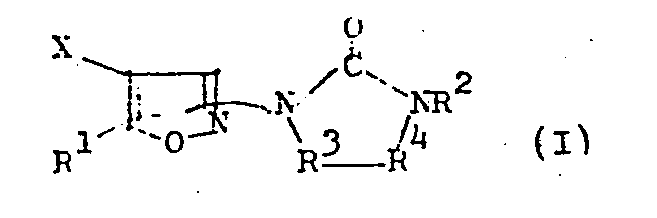
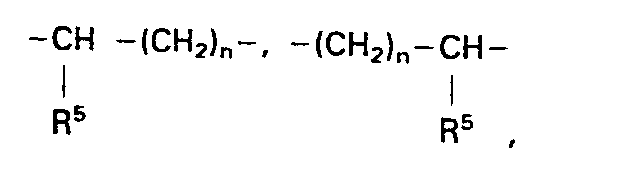
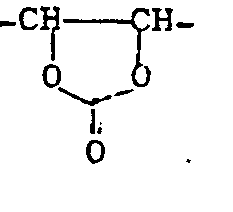
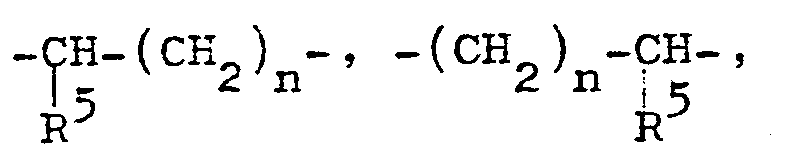
- the present invention relates to cyclic ureas of isoxazole. More particularly, it relates to the compounds of the formula (I): (wherein R1 is C 1 -C 5 alkyl; R 2 is hydrogen, C 1 -C 5 alkyl, or C 2 -C 5 alkenyl; -R 3 -R 4 - is -CO-CH 2 -, -CO-CO-, -CH(OY)-CH(OY)-, -CH(OY)-CH 2 -, -CH(OZ)-CO-, or -CO-CH(OZ)-; R 5 is hydrogen or C 1 -C 3 alkyl; n is 1 or 2; X is hydrogen or halogen; Y is C 1 -C 5 alkyl, C 2 -C 5 alkenyl, C 2 -C 5 alkoxycarbonyl, or N-(C 1 -C 3 alkyl)-carbamoyl; and Z is hydrogen, C 2
- the compounds (I) can be prepared by (A) cyclizing a compound of the formula (II): with a condensing agent to give a compound of the formula (Ia):
- the present compounds (I) are useful as herbicides.
- the present invention relates to cyclic ureas of isoxazole. More particularly, it relates to the compounds of the formula (I); (wherein R 1 is C 1 -C 5 alkyl; R 2 is hydrogen, C 1 -C 5 alkyl, or C 2 -C 5 alkenyl; -R 3 -R 4 - is -CO-CH 2 -, -CO-CO-, -CH(OY)-CH(OY)-, -CH(OY)-CH 2 -, -CH(OZ)-CO-, or -CO-CH(OZ)-; R 5 is hydrogen or C 1 -C 3 alkyl; n is 1 or 2; X is hydrogen or halogen; Y is C 1 -C 5 alkyl, C 2 -C 5 alkenyl, C 2 -C 5 alkoxycarbonyl, or N-(C 1 -C 3 alkyl)-carbamoyl; and Z is hydrogen.
- the compounds (I) may be prepared by Routes 1 to 7 according to each reaction sequence described below. (wherein R 1 , R 2 , and X each has the same meaning as defined above; 30 is above; -R 30 -R 40 - is or -CO-CH 2 -; R 5 is hydrogen or C 1 -C 3 alkyl; n is 1 or 2; and A is a reactive residue such as halogen (e.g. chlorine, bromine, iodine), hydroxy, alkoxy, or acyloxy.)
- halogen e.g. chlorine, bromine, iodine
- the reaction may be carried out at a temperature of about 0 to about 150°C, preferably 15 to 100°C in an appropriate solvent in the presence of a condensing agent.
- solvents are hydrocarbons (e.g. benzene, toluene), halogenohydrocarbons (e.g. methylene chloride, 1,2-dichloroethane, chloroform, carbon tetrachloride), dimethylformamide, dimethylsulfoxide, alkanols (e.g. methanol, ethanol, isopropanol), and the like.
- the condensing agent may be selected suitably from the group consisting of inorganic bases such as alkali metal hydroxide (e.g.
- alkali metal carbonate e.g. potassium carbonate, sodium carbonate
- alkali metal hydride e.g. sodium hydride
- organic bases e.g. pyridine, triethylamine
- DCC diclohexylcarbodiimide
- toluenesulfonic acid and the like.
- the starting materials (II) are readily prepared from the corresponding phenyl isoxazolyl carbamates (X) or isoxazolyl isocyanate (XI). (wherein R 1 , R 2 , and X each has the same meaning as defined above; and -R 31 -R 41 - is -CO-CH(OH)- or -CO-CO-.)
- This reaction may be carried out, using glyoxylic acid or an oxalyl halide (e.g. oxalyl chloride, oxalyl bromide) in a suitable solvent, if required, in the presence of an appropriate condensing agent at a temperature of about 0 to about 150°C, preferably 50 to 100°C.
- an oxalyl halide e.g. oxalyl chloride, oxalyl bromide
- the solvent and condensing agent used in this reaction may be selected suitably from those described in Route 1.
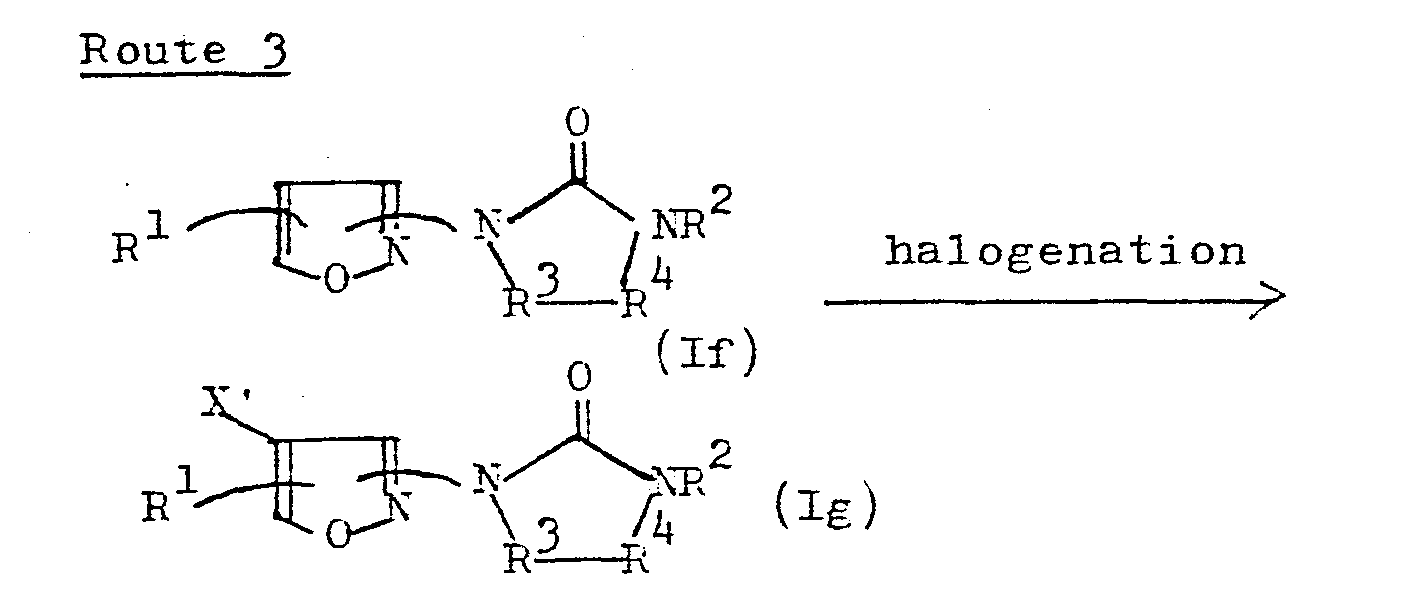
- the starting material (III) is prepared according to the procedures described in U.S. Pat. Nos. 4,028,376 and 4,062,861. (wherein R l , R 2 , and -R 3 -R 4 - each has the same significance as defined above; and X' is halogen.)
- This reaction can be conducted in a conventional manner for halogenating the benzene ring of aromatic compounds and may generally be achieved with a molecular halogen or sulfuryl chloride in a suitable solvent at a temperature of about 0 to about 100°C, preferably 10 to 60°C.
- the suitable solvent may be selected from halogenohydrocarbons (e.g.
- R 1 , -R 3 -R 4 -, and X each has the same meaning as defined above, R 2/ is C 1 -C 5 alkyl or C 2 -C 5 alkenyl; and Hal is halogen.
- the starting material (Ih) is allowed to react with alkyl halide (e.g. methyl iodide, butyl bromide, isopropyl chloride) or alkenyl halide (e.g. allyl bromide, 3-butenyl iodide).
- alkyl halide e.g. methyl iodide, butyl bromide, isopropyl chloride
- alkenyl halide e.g. allyl bromide, 3-butenyl iodide
- This reaction may be carried out at a temperature of about -30 to about 150°C, preferably 0 to 100°C in the presence of an inorganic base (e.g. sodium hydride, sodium amide. sodium hydroxide) or an alkali metal alkoxide (e.g. potassium t-butoxide, sodium methoxide) in a suitable solvent (e.g. alkanol such as methanol, ethanol. or isopropanol; dimethl-lsulfoxide).
- an inorganic base e.g. sodium hydride, sodium amide. sodium hydroxide
- an alkali metal alkoxide e.g. potassium t-butoxide, sodium methoxide
- a suitable solvent e.g. alkanol such as methanol, ethanol. or isopropanol; dimethl-lsulfoxide
- This reaction may be carried out at a temperature of about 0 to about 100°C, preferably 10 to 30°C in the presence of a carbonylating agent (e.g. 1,1'-carbonyldismidazole, phosgene) in a suitable solvent (e.g. chloroform, dimethylformamide, methylene chloride, benzene).
- a carbonylating agent e.g. 1,1'-carbonyldismidazole, phosgene
- a suitable solvent e.g. chloroform, dimethylformamide, methylene chloride, benzene
- the starting material (V) can be prepared by the procedure described in U.S. Pat. No. 4,268,679. (wherein A, R 1 , R 2 , and X each has the same meaning as defined above; -R 32 -R 42 - is -CH(OH)-CH 2 -, -CH(OH)-CH(OH)-, -CH(OH)-CO- , or -CO-CH(OH)-; -R 33 -R 43 - is -CH(OY)-CH 2 -, -CH(OY)-CH(OY)-, -CH(OZ 1 )-CO-, or -CO-CH(OZ 1 )-; Y is C 1 -C 5 alkyl, C 2 -C 5 alkenyl.
- C -C alkoxycarbonyl or N-(C 1 -C 3 - alkyl)carbamoyl
- Z 1 is C 2 -C 5 alkanoyl, C 2 -C 5 alkoxycarbonyl, N-(C 1 -C 3 alkyl)carbamoyl, or benzoyl which may be substituted (wherein the substituent is halogen. C 1 -C 5 alkyl. or C 1 -C 4 alkoxy))
- the alcoholic hydroxy group is converted into an ether,acyloxy, or carbamoylaxy, and the reactions may be carried out in a conventional manner respectively.
- the etherification is achieved in the presence of a base (e.g. sodium methoxide, potassium t-butoxide) with an etherifying agent (VII) such as alkyl halide (e.g. methyl bromide, methyl iodide, ethyl iodide) or alkenyl halide.
- a base e.g. sodium methoxide, potassium t-butoxide
- an etherifying agent (VII) such as alkyl halide (e.g. methyl bromide, methyl iodide, ethyl iodide) or alkenyl halide.
- VIII acylating agent
- acetyl chloride acetic anhydride, benzoyl chloride, ethyl chloroformate, methyl chloroformate
- organic base e.g. triethylamine, pyridine
- the amide formation is carried out on reaction with an alkyl isocyanate (IX), if required, in the presense of a base.
- IX alkyl isocyanate
- Each of these reactions may be carried out at a temperature of about -100 to about 80°C, preferably -78 to 60°C, optionally in a suitable solvent (e.g. benzene, toluene, chloroform, dimethylformamide.tetrahydrofuran).
- the starting material(IV) in which -R 32 -R 42 is -CH(OH)-CH 2 - can be prepared according to the procedure disclosed in U.S. Pat. No. 4,268,679.
- the starting material(IV) wherein -R 32 -R 42 - is -CO-CH(OH)- can be prepared in the Route 2.
- the compound IV -R 32 -R 42 -CH(OH)-CO-] may be prepared in the Route 7. (wherein R 1 , R 2 , and X each has the same meaning as defined above.)
- the reaction may be carried out with sodium borohydride at a temperature of about 0 to about 100°C, preferably 15 to 50°C in a suitable solvent (e.g. methanol, N,N-dimethylformamide, tetrahydrofuran).
- a suitable solvent e.g. methanol, N,N-dimethylformamide, tetrahydrofuran.
- the starting material (Ib 1 ) can be prepared by way of Route 2 mentioned above.
- the C 1 -C 5 alkyl includes methyl, ethyl, n-propyl, isopropyl, n-butyl, isobutyl, sec-butyl, tert-butyl, n-pentyl, isopentyl, sec-pentyl, neo-pentyl, tert- pentyl, and the like;
- the C 2 -C 5 alkenyl includes vinyl, allyl, 1-propenyl , isopropenyl, 3-buteny-1, 1,3-butadiem-1, 2-pentenz-1, and the like:
- the C 1 -C 3 alkyl means methyl, ethyl n-propyl, isopropyl, and the like; examples of halogen are fluorine.
- the C 2 -C 5 alkoxycarbonyl means carbonyl which is substituted by C 1 -C 4 alkoxy, and the C 1 -C 4 alkoxy is exemprified by methoxy, ethoxy, n-propoxy, isopropoxy, n-butoxy, isobutoxy, sec- butoxy, tert-butoxy, and the like; in the h-(C 1 -C 3 alkyl)carbamoyl, the C 1 -C 3 alkyl has the same meaning as explained above: the C 2 -C 5 alkanoyl includes acetyl, propionyl, butyryl, isobutyryl, valeryl, isovaleryl, pivaloyl, and the like; in the benzoyl which may be substituted, examples of substituents are halogen, C 1 -C 5 alkyl, C 1 -C 4 alkoxy, and the like; the C 1
- the material (X) is converted into the objective compound (Ia) through the intermediates (IIb) and (IIc) under the same reaction conditions as in each step of Example 1.
- the results are illustrated in the following Table 1.
- the objective products (Ib) are prepared from the starting material(IIIa) in the same manner as in Example 13. The results are shown in Table 2.
- Example 9 In the same manner as in Example 9 is treated 0.4744 g of the product in Example 22.
- the reaction product is washed with hexane without purification by chromatography and then dissolved in benzene to remove insoluble materials. Removal of benzene by evaporation gives 0.4783 g (Yield, 95.2 %) of the objective product as crystals.
- Example 26 In the same manner as in Example 26 is treated 1.85 g of 1-methyl-3-(5-t-butyl-4-chloro-3-isoxazolyl)urea to give 0.864 g (yield, 37.5 %) of the product as a colorless oil.
- Example 14 To 1.26 g of the product in Example 14 is added 5 ml of methanol, the mixture is cooled to -5°C, and then 48.4 mg of sodium borohydride is gradually added. The mixture is subsequently stirred at room temperature for 30 minutes and then concentrated in vacuo. 1 % Hydrochloric acid is added thereto, and the mixture is extracted with methylene chloride. The organic layer is dried over anhydrous sodium sulfate, and concentrated in vacuo. The residue is purified by chromatography on silica gel to give 1.06 g (yield, 83.4 %) of the product as crystals. The product is recrystallized from benzene and dried under heating in vacuo at 90°C for 30 minutes to remove crystalline benzene, whereby colorless powdery crystals, m.p. 142.5 - 143.5°C, are obtained.
- Example 32 In the same manner as in Example 32 except using tetrahydrofuran (20 ml) in place of methanol is treated 1.19 g of the product obtained in Example 23 to give 0.66 g (yield, 55.2 %) of the objective product as crystals.
- the product is recrystallized from methanol-benzene to give colorless plates, m.p. 227 - 228°C.
- Example 26 To 253.3 mg of the product prepared in Example 26 is added 4 ml of dry tetrahydrofuran, and then 115.7 mg of 97 % potassium t-butoxide is added to the mixture under ice-cooling. After stirring for 30 minutes at room temperature, the reaction mixture is poured into 1 % hydrochloric acid which is ice-cooled in advance. The resulting solution is concentrated in vacuo to remove the tetrahydrofuran. The residual aqueous solution is extracted with benzene, and the organic layer is dried over anhydrous sodium sulfate and then concentrated in vacuo. The residue is purified by chromatography on silica gel to give 81.9 mg (yield,32.3 %) of the product as crystals.
- Example 9 In the same manner as in Example 9, 119.6 mg of the product in Example 36 is treated to give 86.9 mg (yield, 68.6 %) of the objective product as crystals.
- Example 26 To 1.55 g of the product in Example 26 are added 12 ml of dry benzene, 1.36 g of triethylamine and 1.25 g of acetic anhydride and the mixture is refluxed for one hour and 20 minutes. The reaction mixture is mixed with water, stirred at room temperature for an hour and extracted with ethyl acetate. The ethyl acetate layer is washed with 5 % hydrochloric acid, 8 % sodium hydrogencarbonate and water in order, and then concentrated in vacuo. The residue is purified by chromatography on silica gel to give 0.42 g (yield, 25.6 %) of the product as crystals.
- Example 59 In the same manner as in Example 59 is treated 1.31 g of the product in Example 32 to give 0.54 g (yield, 32.8 %) of the objective compound as crystals.
- the crystals are recrystallized from a mixture of benzene and cyclohexane to give colorless needles, m.p. 154.7 - 156.0°C.
- Example 26 To 0.84 g of the product in Example 26 is added 0.56 g of methyl isocyanate and the mixture is heated in a sealed tube at 60°C for a week, and then the unreacted methyl isocyanate is distilled off in vacuo. The residue is recrystallized from 1,2-dichloroethane, then dried in vacuo at 95°C for 2 hours to remove the solvent of crystallization, whereby 0.63 g (yield, 61.8 %) of the objective product is obtained as colorless powdery crystals, m.p. 128.0 - 129.5°C.
- Example 88 In the same manner as in Example 88 is treated 18.26 g of 5-isopropyl-3-lsoxazolyl isocyanate to give 19.74 g (yield, 73.7 %) of the objective product as crystals. This is recrystallized from a mixture of benzene and cyclohexane to give colorless needles, m.p. 97.0 - 98.0°C.
- Example 88 To 0.95 g of the product prepared in Example 88 are added 4 ml of chloroform and chlorine gas (1 mole/l) in carbon tetrachloride (8.4 ml), then the mixture is allowed to stand at room temperature for five days, and concentrated in vacuo. The residue is purified by chromatography on silica gel to give 0.76 g (yield 70.3 %) of the product as crystals.
- Example 90 In the same manner as in Example 90 is treated 0.89 g of the product prepared in Example 89, whereby 0.86 g (yield. 83.9 %) of the objective product is obtained as a colorless oil.
- Example 9 In the same manner as in Example 9 except that the reaction temperature is altered to 0 - 5°C, is treated 0.4465 g of the product prepared in Example 92 to give 0-3959 g (yield, 84.3 %) of the objective product.
- Example 8 (3) In the same manner as in Example 8 (3) is treated 1.34 g of the product prepared in Example 92 to give 1.25 g (yield, 79.1 %) of the objective product as crystals. This is recrystallized from a mixture of hexane and ethyl acetate to give colorless plates, m.p. 102.5 - 103.5°C.
- the starting material (X) is treated in the same manner as in Example 99 to give the objective product (Ia) as well as the intermediate (IIf).
- the results are summarized in Table 11.
- Example 89 To 15.87g of the product prepared in Example 89 is added 62.56 g of 5 % aqueous sodium hydroxide, and the mixture is stirred at room temperature for an hour, adjusted to pH 1 with 36 % hydrochloric acid, and then extracted with chloroform. The chloroform layer is dried over anhydrous sodium sulfate and concentrated in vacuo. The residue is dispersed in benzene to give crystals, which are collected by filtration to give 16.91 g (yield: 98.6 %) of the objective product as crystals, m.p. 133.0 - 133.5°C (dec.).
- Example 12 (1) In the same manner as in Example 12 (1) is treated 2.95 g of phenyl 5-t-butyl-4-chloroisoxazole-3-carbamate to give 2.41 g (yield, 87.4 %) of the objective product as a pale-yellow oil.
- IR (CHCl 3 ) 1687, 1555, 1530 cm -1 .
- the isoxazole cyclic ureas (I) of the present invention show a potent herbicidal activity against a variety of weeds at a small application rate. They have an excellent herbicidal activity against general weeds, e.g.
- the compounds (I) of the present invention may be applied as a selective or non-selective herbicide for crop lands, e.g. plowed fields, orchards, tea plantations, mulberry fields, fallow lands and pastures; or non-crop lands, e.g., railbeds, roads, lawns, factory sites, dry riverbeds, residential quarters, park green districts, forest lands, prepared lands and vacant lands.
- the compounds (I) of the present invention are harmless and safe to the human, domestic animals, and birds or poultry, and show a very low toxicity to fishes, shells and the like. Consequently, the herbicides of this invention are quite safe ones and therefore there is no problem about the residual toxicity in soil.
- the present compounds (I) each may be used in combination with known herbicides such as diuron, atrazine, prometryn, alachlor and trifluralin for the purpose of extending its herbicidal spectrum and getting an additional or synergistic herbicidal effect.
- known herbicides such as diuron, atrazine, prometryn, alachlor and trifluralin
- the herbicides of the present invention may be applied over the soil such as sandy soil and clay soil as well as the ordinary soil such as sandy loam soil and loamy soil. They may be applied even to one of clay soil, i.e., montmorillonite soil which occasionally has an influence on the occurrence of the herbicidal activity.
- the herbicides of the present invention i.e. cyclic ureas of isoxazole (I) may suitably be used in combination with a customary solid or liquid carrier or carriers, if desired, together with additional adjuvants (e.g. emulsifiers, stabilizers, dispersants, suspending agents, spreaders, penetrants, wetting agents) in order to formulate more refined formulations (e.g. emulsions, wettable powders, granules, dusts, pellets).
- additional adjuvants e.g. emulsifiers, stabilizers, dispersants, suspending agents, spreaders, penetrants, wetting agents
- the carriers are solid carriers (e.g. clay, talc, diatomaceous earth, bentonite), liquid carriers (e.g. water, alcohols, acetone, benzene, toluene, xylene, solvent naphtha, cyclohexane) and the like.
- solid carriers e.g. clay, talc, diatomaceous earth, bentonite
- liquid carriers e.g. water, alcohols, acetone, benzene, toluene, xylene, solvent naphtha, cyclohexane
- the herbicide formulations of this invention may be used in combination with other agricultural chemicals (e.g. insecticides, fungicides or other herbicides), manuring ingredients (e.g. ammonium sulfate, urea) or soil treating agents.
- agricultural chemicals e.g. insecticides, fungicides or other herbicides
- manuring ingredients e.g. ammonium sulfate, urea
- test-compound Nos. correspond to the respective numbers of Examples, and additionally the following compounds (test-compound Nos. 106 - 126) were used in the test.
- Seeds of a test plant were sowed on the sandy loam charged in a square pot (7-1 x 7.1 cm) made of vinyl chloride. After being sowed, the seeds were covered with the sandy loam and an aqueous suspension (Tween 20 is used at a concentration of 100 ppm as a spreader.) of the test compound is applied over the surface of the sandy loam.
- the suspension of the test compound was prepared by dilution with water at a concentration of 10g/10L or 30g/10L and applied at a rate of lOL/are with an automatic metal sprayer.
- the pots were kept at a temperature of 25°C in a greenhouse under the natural sunlight.
- the survival rate is evaluated three weeks after the application of the chemicals.
- Seeds of a test plant were sowed on the sandy loam charged in a square pot (7.1 x 7.1 cm) of vinyl chloride. After being sowed, the seeds were covered with the sandy loam and then grew for ten days. Tween 20 was used at a concentration of 100 ppm as a spreader. The aqueous suspension of the test compound was applied over the young plants ten days after the sowing. The suspension of the test compound was prepared by dilution with water at a concentration of 10g/10L or 30g/10L and applied at a rate of lOL/are with an automatic metal sprayer. The pots were kept at a temperature of 25°C in a greenhouse under the natural sunlight. The survival rate was evaluated three weeks after the application.
- the every compound of the present invention has an excellent herbicidal activity both in the pre-emergence test and in the post-emergence test.
- Seeds of a test compound were sowed on the loam charged in a square plastic-pot (10 x 10 cm). After sowing, the seeds were covered with sandy loam and an aqueous suspension (Tween 20 was used at a concentration of 100 ppm as a spreader.) of the test compound was applied over the surface of the sandy loam.
- the suspension of the test compound was prepared by dilution with water at a concentration of 20g/10L, lOg/lOL, 5g/10L or 2.5g/10L and applied at a rate of lOL/are with an automatic metal sprayer.
- the pots were kept at a temperature of 25°C in a greenhouse under the natural sunlight.
- test-compounds each showed an excellent herbicidal activity against large crabgrass, barnyard grass, smartweed and spleen amaranth.
Landscapes
- Life Sciences & Earth Sciences (AREA)
- Organic Chemistry (AREA)
- Chemical & Material Sciences (AREA)
- Health & Medical Sciences (AREA)
- Plant Pathology (AREA)
- Engineering & Computer Science (AREA)
- Dentistry (AREA)
- General Health & Medical Sciences (AREA)
- Wood Science & Technology (AREA)
- Zoology (AREA)
- Environmental Sciences (AREA)
- Pest Control & Pesticides (AREA)
- Agronomy & Crop Science (AREA)
- Heterocyclic Carbon Compounds Containing A Hetero Ring Having Nitrogen And Oxygen As The Only Ring Hetero Atoms (AREA)
- Plural Heterocyclic Compounds (AREA)
- Agricultural Chemicals And Associated Chemicals (AREA)
Abstract
Description
- The present invention relates to cyclic ureas of isoxazole which show potent herbicidal activity.
- As compounds analogous to isoxazolyl imidazolidinone, 3-[3(5)-isoxazolyl]-4-hydroa-y-2-imidazolidinones and the like are disclosed in U.S. Pat. No. 4,268,679 and U.K.
- Pat. No. 2.079,283.
- The present invention relates to cyclic ureas of isoxazole. More particularly, it relates to the compounds of the formula (I):



- (B) reacting a compound of the formula (III):


- (C) subjecting a compound of the formula (IV):

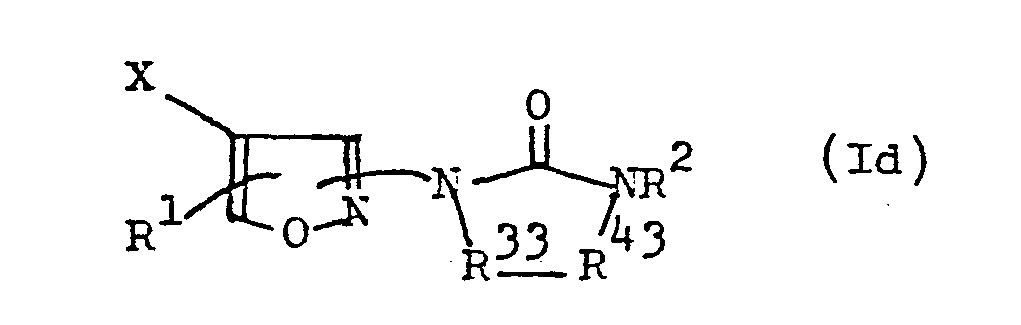


- The present compounds (I) are useful as herbicides.
- The present invention relates to cyclic ureas of isoxazole. More particularly, it relates to the compounds of the formula (I);
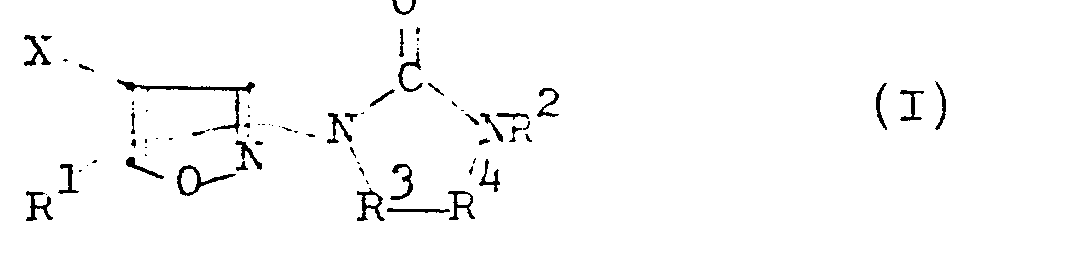
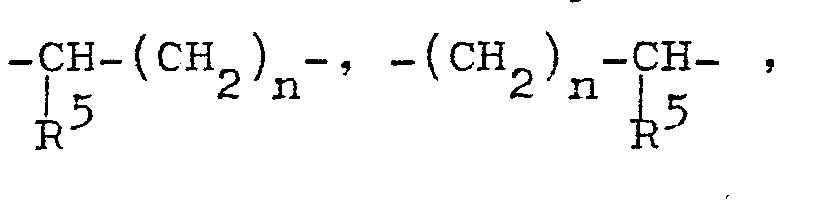

- The compounds (I) may be prepared by Routes 1 to 7 according to each reaction sequence described below.


- The reaction may be carried out at a temperature of about 0 to about 150°C, preferably 15 to 100°C in an appropriate solvent in the presence of a condensing agent. Representatives of the solvents are hydrocarbons (e.g. benzene, toluene), halogenohydrocarbons (e.g. methylene chloride, 1,2-dichloroethane, chloroform, carbon tetrachloride), dimethylformamide, dimethylsulfoxide, alkanols (e.g. methanol, ethanol, isopropanol), and the like. The condensing agent may be selected suitably from the group consisting of inorganic bases such as alkali metal hydroxide (e.g. lithium hydroxide, potassium hydroxide, sodium hydroxide), alkali metal carbonate (e.g. potassium carbonate, sodium carbonate), and alkali metal hydride (e.g. sodium hydride), organic bases (e.g. pyridine, triethylamine), DCC (dicyclohexylcarbodiimide), toluenesulfonic acid, and the like.
- The starting materials (II) are readily prepared from the corresponding phenyl isoxazolyl carbamates (X) or isoxazolyl isocyanate (XI).


- This reaction may be carried out, using glyoxylic acid or an oxalyl halide (e.g. oxalyl chloride, oxalyl bromide) in a suitable solvent, if required, in the presence of an appropriate condensing agent at a temperature of about 0 to about 150°C, preferably 50 to 100°C.
- The solvent and condensing agent used in this reaction may be selected suitably from those described in Route 1.
- The starting material (III) is prepared according to the procedures described in U.S. Pat. Nos. 4,028,376 and 4,062,861.

- In this route the starting material (Ih) is allowed to react with alkyl halide (e.g. methyl iodide, butyl bromide, isopropyl chloride) or alkenyl halide (e.g. allyl bromide, 3-butenyl iodide).
- This reaction may be carried out at a temperature of about -30 to about 150°C, preferably 0 to 100°C in the presence of an inorganic base (e.g. sodium hydride, sodium amide. sodium hydroxide) or an alkali metal alkoxide (e.g. potassium t-butoxide, sodium methoxide) in a suitable solvent (e.g. alkanol such as methanol, ethanol. or isopropanol; dimethl-lsulfoxide).
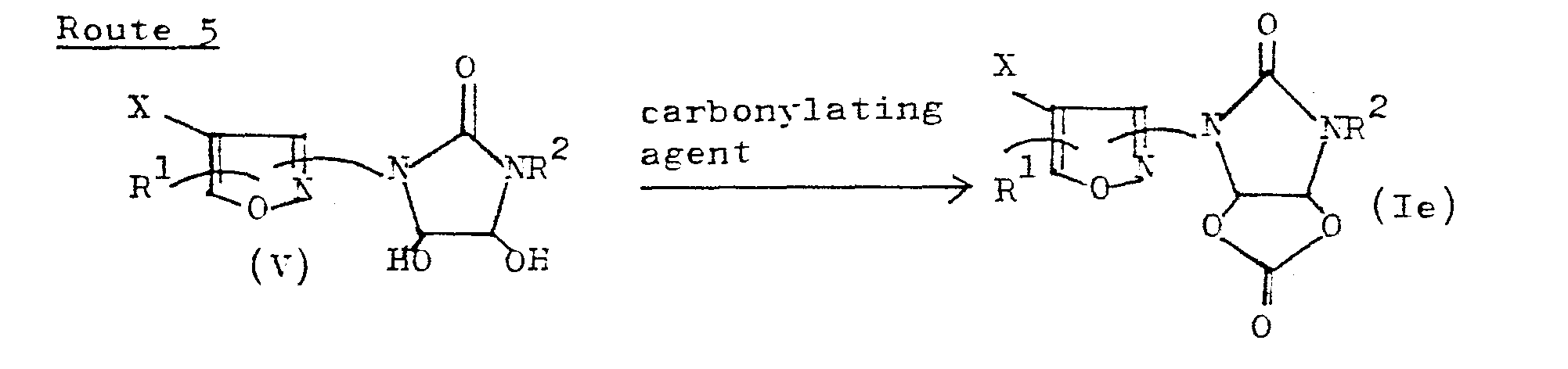
- This reaction may be carried out at a temperature of about 0 to about 100°C, preferably 10 to 30°C in the presence of a carbonylating agent (e.g. 1,1'-carbonyldismidazole, phosgene) in a suitable solvent (e.g. chloroform, dimethylformamide, methylene chloride, benzene).
- The starting material (V) can be prepared by the procedure described in U.S. Pat. No. 4,268,679.

- In this route the alcoholic hydroxy group is converted into an ether,acyloxy, or carbamoylaxy, and the reactions may be carried out in a conventional manner respectively. The etherification is achieved in the presence of a base (e.g. sodium methoxide, potassium t-butoxide) with an etherifying agent (VII) such as alkyl halide (e.g. methyl bromide, methyl iodide, ethyl iodide) or alkenyl halide. The acylation is achieved with an acylating agent (VIII) (e.g. acetyl chloride, acetic anhydride, benzoyl chloride, ethyl chloroformate, methyl chloroformate), and optionally in the presence of an organic base (e.g. triethylamine, pyridine). The amide formation is carried out on reaction with an alkyl isocyanate (IX), if required, in the presense of a base. Each of these reactions may be carried out at a temperature of about -100 to about 80°C, preferably -78 to 60°C, optionally in a suitable solvent (e.g. benzene, toluene, chloroform, dimethylformamide.tetrahydrofuran).
- The starting material(IV) in which -R32-R42is -CH(OH)-CH2- can be prepared according to the procedure disclosed in U.S. Pat. No. 4,268,679. The starting material(IV) wherein -R32-R42- is -CO-CH(OH)- can be prepared in the Route 2. The compound IV -R32-R42 = -CH(OH)-CO-] may be prepared in the Route 7.

- The reaction may be carried out with sodium borohydride at a temperature of about 0 to about 100°C, preferably 15 to 50°C in a suitable solvent (e.g. methanol, N,N-dimethylformamide, tetrahydrofuran).
- The starting material (Ib1) can be prepared by way of Route 2 mentioned above.
- The meanings of the terms used in the above definition are shown below: the C1-C5 alkyl includes methyl, ethyl, n-propyl, isopropyl, n-butyl, isobutyl, sec-butyl, tert-butyl, n-pentyl, isopentyl, sec-pentyl, neo-pentyl, tert- pentyl, and the like; the C2-C5 alkenyl includes vinyl, allyl, 1-propenyl , isopropenyl, 3-buteny-1, 1,3-butadiem-1, 2-pentenz-1, and the like: the C1-C3 alkyl means methyl, ethyl n-propyl, isopropyl, and the like; examples of halogen are fluorine. chlorine, bromine, iodine, and the like; the C2-C5 alkoxycarbonyl means carbonyl which is substituted by C1-C4 alkoxy, and the C1-C4 alkoxy is exemprified by methoxy, ethoxy, n-propoxy, isopropoxy, n-butoxy, isobutoxy, sec- butoxy, tert-butoxy, and the like; in the h-(C1-C3 alkyl)carbamoyl, the C1-C3 alkyl has the same meaning as explained above: the C2-C5 alkanoyl includes acetyl, propionyl, butyryl, isobutyryl, valeryl, isovaleryl, pivaloyl, and the like; in the benzoyl which may be substituted, examples of substituents are halogen, C1-C5 alkyl, C1-C4 alkoxy, and the like; the C1-C5 alkyl and the Cl-C4 alkoxy each has the same significance as exemplified above; the alkoxy means C1-C4 alkoxy; and the acyloxy means benzoyloxy, alkoxycarbonyloxy, and alkanoyloxy, and in the alkanoyloxy, the alkanoyl means C1-C5 alkanoyl, for example formyl and the C2-C5 alkanoyl explained above.
- Presently preferred and practical embodiments of the present invention are illustratively shown in the following examples. The abbreviations used in Examples and Referential Examples have the following meanings:
- Me (methyl), i-Pr (isopropyl), t-Bu (t-butyl),
- Ph (phenyl), Al (allyl), Ac (acetyl).
-
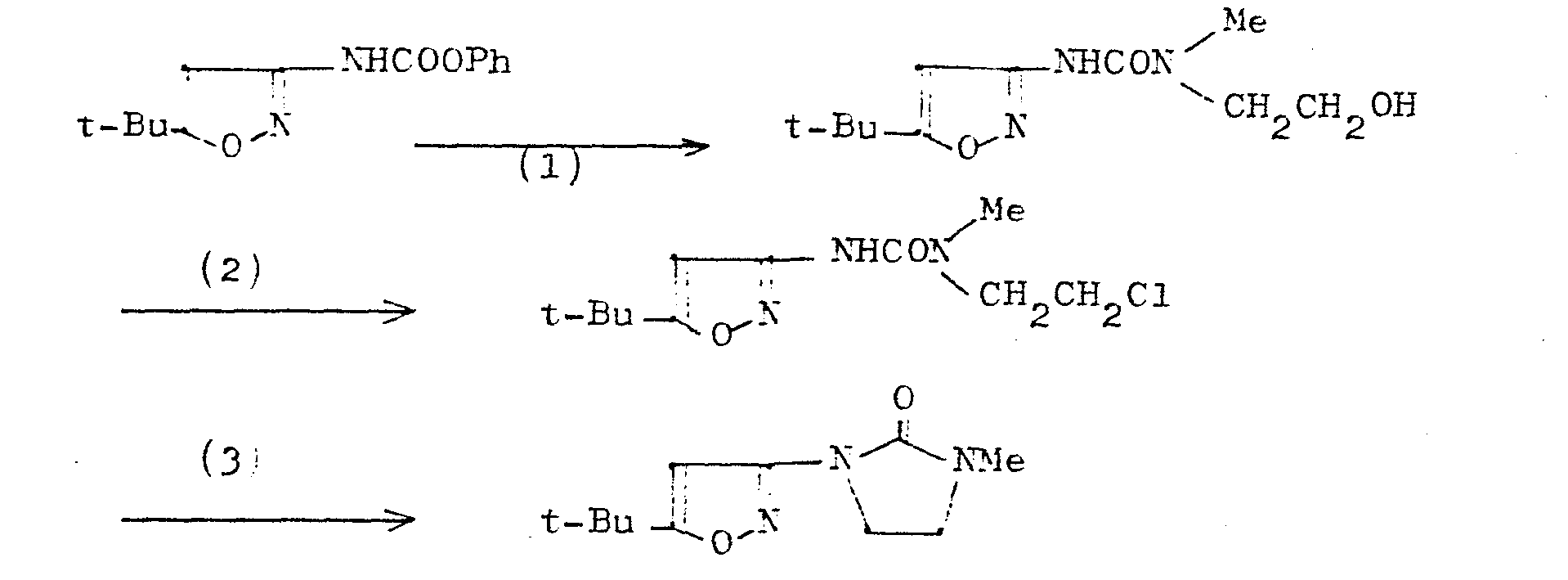
- (1) To a solution of 5.20 g of phenyl 5-t-butylisoxazole-3-carbamate in 40 ml of methylene chloride is added 4.50 g of N-methyl-2-ethanolamine and the mixture is stirred at room temperature for three hours. The solvent is removed by evaporation and the residue is purified by column chromatography on silica gel to give 4.20 g (yield: 87.0 %) of the objective compound as crystals. This is recrystallized from benzene-cyclohexane to give 1-(2-hydrox3rethyl)-1-methyl-3-(5-t-butyl-3-isoxazolyl)urea as colorless needles, m.p. 99.0 - 100°C.
- (2) To 9.65 g of the compound prepared in the above step (1) are added 70 ml of dry benzene and 5.71 g of thionyl chloride, and the mixture is refluxed for half an hour and and then concentrated under reduced pressure. The residue is purified by chromatography on silica gel to give 9.49 g (yield: 91.3%) of the compound as crystals. This is recrystallized from cyclohexane to give 1-(2-chloroethyl)-1-methz-1-3-(5-t-butyl-3-isoxazalyl)urea as colorless prisms melting at 109.5 - 111.5°C.
- (3) To 5.97 g of the compound prepared in the above step (2) is is added 25.81 g of 15 % aqueous potassium hydroxide and the mixture is stirred at room temperature for an hour. The reaction mixture is extracted with methylene chloride, and the organic layer is dried over anhydrous sodium sulfate and concentrated under reduced pressure. The residue is purified by chromatography on silica gel to give 5.06 g (yi d: 98.5 %) of the objective compound as crystals. This is recrystallized from cyclohexane to give 3-(5-t-butyl-3-isoxazolyl)-1-methyl-1-2-imidazolidinone as colorless prisms , m.p. 84.0 - 85.0°C.
-

- The material (X) is converted into the objective compound (Ia) through the intermediates (IIb) and (IIc) under the same reaction conditions as in each step of Example 1. The results are illustrated in the following Table 1.

- To 0.89 g of 3-(5-t-butyl-3-isoxazolyl)-1-methyl-2-imidazolidinone are added 4 ml of dry methylene chloride and 1.08 g of sulfuryl chloride and the mixture is refluxed for two hours. The reaction mixture is concentrated in vacuo and then purified by chromatography on silica gel to give 0.65 g (yield: 63.4 %) of the objective compound, m.p. 67.0 - 70.0°C.
- To a solution of 0.67 g of 3-(3-t-butyl-5-isoxazolyl)-1-methyl-2-imidazolidinone and 0.30 g of anhydrous sodium acetate in 6 ml of glacial acetic acid is dropwise added 0.57 g of bromine under ice-cooling, and the mixture is stirred at room temperature for 1.5 hours. The reaction mixture is quenched with ice water, adjusted to pH 5 with aqueous sodium hydroxide and extracted with methylene chloride. The organic layer is washed with water, dried and then concentrated in vacuo. The residue is purified by chromatography on silica gel to give 0.75 g (yield: 82.7 %) of the objective compound. This is recrystallized from cyclohexane-benzene to give anhydrous pillars, m.p.: 122.5 - 123.5°C.
-

- This is recrystallized from benzene to give 1-(2-hydroxyethyl)-3-(3-t-butyl-3-isoxazolyl)urea as colorless plates, m.p. 108.5 - 109.5°C.
- (2) To 22.73 g of the compound prepared in the above step (1) are added 175 ml of dry benzene and 14.28 g of thionyl chloride and the mixture is refluxed under heating for half an hour. The reaction mixture is concentrated in vacuo, and the residue is purified by chromatography on silica gel to give 23.17 g of the objective compound as crystals. Yield, 94.3%.
- This is recrystallized from benzene to give 1-(2-chloroethyl)-3-(5-t-butyl-3-isoxazolyl)urea as colorless needles, m.p. 146.5 - 147.5°C.
- (3) To 2.46 g of the compound prepared in the step (2) are added 11.22 g of 15 % aqueous potassium hydroxide and 6 ml of pyridine, and the mixture is stirred at room temperature for two hours. The reaction mixture is adjusted at pH 3 by adding hydrochloric acid and extracted with chloroform. The chloroform layer is washed with 2 % hydrochloric acid and water in order, dried over anhydrous sodium sulfate and concentrated in vacuo to give 2.02 g of the objective compound as crystals.. Yield, 96.5 %.
- This is recrystallized from hexane-benzene to give 1-(5-t-butyl-3-isoxazolyl)-2-imidazolidinone as colorless prisms. m.p.: 167 - 169°C.
- (4) To a mixture of 1.26 g of the compound prepared in (3) and 22 ml of dry dimethylformamide is added 0.25 g of 63.7 % sodium hydride (suspension in mineral oil) and the mixture is stirred at room temperature for half an hour. To the reaction mixture is added a mixture of 1.21 g of allyl iodide with 3 ml of dried dimethylformamide at a temperature of lower than 15°C, and then the reaction mixture is stirred for an hour and concentrated in vacuo. The residue is mixed with 50 ml of 1 % hydrochloric acid and then the mixture is extracted with methylene chloride. The organic layer is dried over anhydrous sodium sulfate, and then concentrated in vacuo. The residue is purified by chromatography on silica gel to give 1.52 g of the objective compound as crystals. This is recrystallized from hexane to give l-allyl-3-(5-t-butyl-3-isoxazolyl)-2-imidazolidinone as colorless needles, m.p. 55 - 56°C.
- To a mixture of 0.4185 g of 1-(5-t-butyl-3-isoxazolyl)-2-imidazolidinone prepared in Example 8 (2) with 4 ml of dry dimethylformamide is added 0.088 g of 60 % aqueous sodium hydride, and then the mixture is stirred at room temperature for an hour. To the mixture is added a mixture of 0.34 g of 93 % methyl iodide with 3 ml of dry dimethylformamide, and then the mixture is stirred at room temperature for an hour. The reaction mixture is concentrated in vacuo, and the residue is mixed with 10 ml of water and extracted with methylene chloride. The organic layer is dried over anhydrous sodium sulfate and then concentrated in vacuo. The residue is purified by chromatography on silica gel to give 0.4421 g of the objective compound as crystals. Yield, 99.0 %.
-
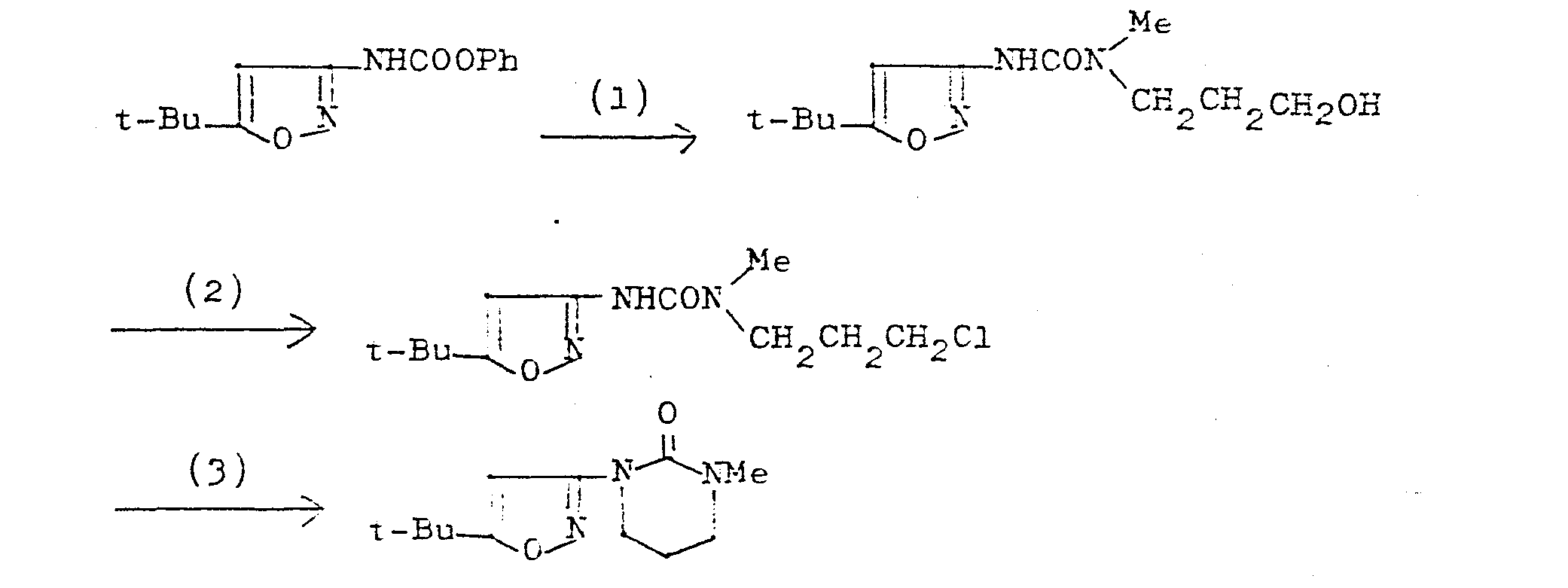
- (l) To 2.60 g of phenyl 5-t-butyl-3-isoxazolylcarbamate is added a mixture of 15 ml of methylene chloride and 1.78 g of N-methyl-3-hydrcxypropylamine, and the mixture is allowed to stand at room temperature for two days. The reaction mixture is concentrated in vacuo and the residue is purified by chromatography on silica gel to give 2.26 g of the objective compound as crystals. Yield, 88.5 %. This is recrystallized from cyclohexane-benzene to give 1-(3-hydroxypropyl)-1-methyl-3-(3-t-butyl-3-isoxazolyl)urea as colorless prisms, m.p. 106.0 - 107.0°C.
- (2) To 1.28 g of the compound prepared in the above (1) are added 5 ml of dry benzene and 0.71 g of thionyl chloride and then the mixture is refluxed for half an hour. The reaction mixture is concentrated in vacuo and the residue is purified by chromatography on silica gel to give 1.17 g of the objective compound as crystals. Yield, 85.5 %. This is recrystallized from hexane to give 1-(3-chloropropyl)-1-methyl-3-(5-t-butyl-3-isoxazolyl)urea as pale-brown plates, m.p. 94.3 - 95.3°C.
- (3) To 237.88 mg of the compound prepared in the above (2) are added 0.87 ml of pyridine and 980 mg of 15 % aqueous potassium hydroxide, and then the mixture is stirred at room temperature for an hour. The mixture is adjusted to pH 3 with 5 % hydrochloric acid and then extracted with methylene chloride. The organic layer is dried and then concentrated in vacuo. The residue is purified by chromatography on silica gel to give 184.72 mg of the objective compound as crystals. Yield, 89.6 %. This is recrystallized from hexane to give pale-yellowish crystals, m.p. 57.0 - 58.0°C.
-

- To a mixture of 0.57 g of the product in Example 10 and 2.5 ml of methylene chloride is added a solution of chlorine gas (0.00280 mol) in 2.8 ml of carbon tetrachloride and the resulting mixture is stirred at room temperature for five minutes. The reaction mixture is concentrated in vacuo to give 0.72 g of the objective compound as crude crystals.
-

- (1) To a solution of 2.60 g of phenyl 5-t-butyl-3-isoxazolylcarbamate in 15 ml of methylene chloride are added 0.90 g of 3-hydroxypropylamine and 1.01 g of triethylamine and the mixture is stirred overnight at room temperature. 2.3 % Hydrochloric acid (50 ml) is added and the mixture is extracted with methylene chloride. The organic layer is dried over anhydrous sodium sulfate and then condensed in vacuo. The residue is purified by chromatography on silica gel to give 2.41 g of the product as crystals. Yield, 99.9 %. This is recrystallized from ethyl acetate-cyclohexane to give l-(3-hydroxypropyl)-3-(5-t-butyl-3-isoxazolyl)-urea as colorless needles, m.p. 91 - 92°C.
- (2) The product prepared in the above (1) is treated with thionyl chloride in dry benzene. The reaction is carried out in the same manner as in Example 10 (2), and then the crystals obtained as the objective product are recrystallized from cyclohexane-hexane to give 1-(3-chloropropyl)-3-(5-t-buiyl-3-isoxazolyl)urea as colorless needles, m.p. 82.5 - 83.5°C. Yield. 96.0 %.
- (3) To 1.30 g of the product prepared in the above (2) are added 15 ml of water, 1.40 g of potassium hydroxide and 3.0 ml of pyridine, and the mixture is stirred at room temperature for two hours. The reaction mixture is adjusted to pH 2 with dilute hydrochloric acid and extracted with methylene chloride. The methylene chloride layer is dried over anhydrous sodium sulfate and concentrated in vacuo. The residue is recrystallized from ethyl acetate-cyclohexane to give 0.93 g of 1-(5-t-butyl-3-isoxazolyl)-1,2,3,4,5,6-hexahydropyrimidin-2-one as colorless granular crystals, m.p. 164 - 165°C. Yield, 83.3 %.
- (4) To a mixture of 2.23 g of the product prepared in the above (3) in 38 ml of dry dimethylformamide is added 0.41 g of 63.7 % sodium hydride and then the mixture is stirred at room temperature for half an hour. A mixture of 93 % methyl iodide (1.27 g) and 3 ml of dimethylformamide is added thereto and the reaction mixture is stirred at room temperature for 3 hours and evaporated in vacuo. 1 % Hydrochloric acid (100 ml) is added to the residue and the mixture is extracted with methylene chloride. The organic layer is dried and then concentrated in vacuo. The residue is purified by chromatography on silica gel to give 1.59 g of the product as crystals. Recrystallization from hexane gives colorless needles, m.p. 58 - 59°C. Yield, 67.1 %.

- To 3.00 g of 1-methyl-3-(5-isopropyl-3-isoxazolyl)-urea are added 33 ml of dry benzene and 2.50 g of oxalyl chloride, and the mixture is refluxed for an hour. The reaction mixture is concentrated in vacuo and the residue is recrystallized from a mixture of benzene and cyclohexane to give 3.58 g (Yield, 92.0 %) of colorless crystals, m.p. 140.5 - 141.0°C.
-
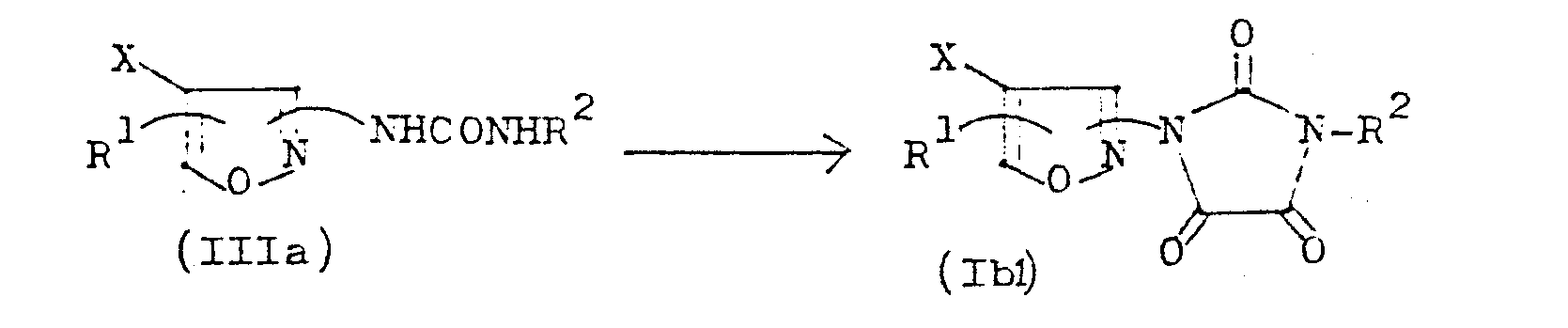

- In the same manner as in Example 9 is treated 0.4744 g of the product in Example 22. The reaction product is washed with hexane without purification by chromatography and then dissolved in benzene to remove insoluble materials. Removal of benzene by evaporation gives 0.4783 g (Yield, 95.2 %) of the objective product as crystals.

- To 17.25 g of 1-methyl-3-(5-t-butyl-3-isoxazolyl)urea are added 8.86 g of glyoxylic acid monohydrate and 105 ml of chloroform and the mixture is subjected to azeotropic distillation for three hours in order to remove the water produced. The reaction mixture is concentrated in vacuo and the residue is purified by chromatography on silica gel to give 16.62 g (Yield, 75.0 %) of the product. This is recrystallized from a mixture of cyclohexane and benzene, and then dried in vacuo at 80°C for eight hours to eliminate the crystal benzene, whereby colorless powdery crystals, m.p. 118.0 - 120.5°C, are obtained (The structural formula was confirmed by X-ray analysis on crystals of the acetate.). Additionally 4.90 g (yield, 22.1 %) of 1-methyl-3-(5-t-butyl-3-isoxazolyl)-4-hydroxy-2,5-dioxo-imidazolidine is produced as a by-product.
-


- In the same manner as in Example 26 is treated 1.85 g of 1-methyl-3-(5-t-butyl-4-chloro-3-isoxazolyl)urea to give 0.864 g (yield, 37.5 %) of the product as a colorless oil.
- IR (CHC13) 1738, 1460, 1100 cm-1

- To 1.52 g of 1-methyl-3-(5-t-but5-1-3-isoxazolyl)-5-hydroxy-2,4-dioxo-imidazolidine are added 6 ml of methylene chloride and 1.04 g of pyridine. A solution of chlorine gas (1.81 mol/l) in carbon tetrachloride (3.65 ml) is then added under ice-cooling, and is stirred at room temperature for half an hour. This procedure is repeated again. After addition of chloroform, the reaction mixture is washed with 5 % hydrochloric acid and water in order, dried over anhydrous sodium sulfate and then concentrated in vacuo. The residue is purified by chromatography on silica gel to give 0.90 g (Yield, 51.9 %) of the product as pale-yellow oil.
- IR (CHC1 ) 1750, 1449, 1408 cm-1

- To 1.26 g of the product in Example 14 is added 5 ml of methanol, the mixture is cooled to -5°C, and then 48.4 mg of sodium borohydride is gradually added. The mixture is subsequently stirred at room temperature for 30 minutes and then concentrated in vacuo. 1 % Hydrochloric acid is added thereto, and the mixture is extracted with methylene chloride. The organic layer is dried over anhydrous sodium sulfate, and concentrated in vacuo. The residue is purified by chromatography on silica gel to give 1.06 g (yield, 83.4 %) of the product as crystals. The product is recrystallized from benzene and dried under heating in vacuo at 90°C for 30 minutes to remove crystalline benzene, whereby colorless powdery crystals, m.p. 142.5 - 143.5°C, are obtained.
-

- The starting material (Ibl) is treated in the same manner as in Example 32 to give the objective product (Ic). The results are summarized in Table 4.
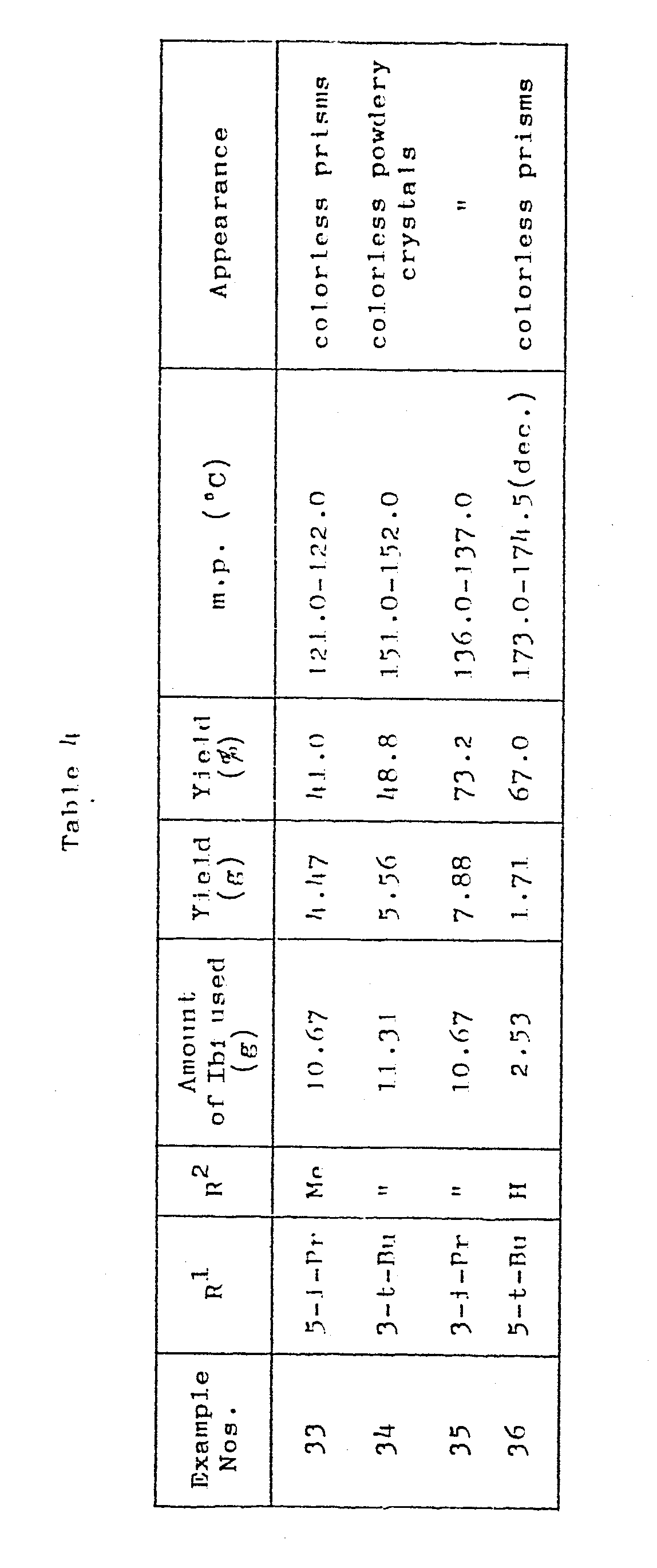
- In the same manner as in Example 32 except using tetrahydrofuran (20 ml) in place of methanol is treated 1.19 g of the product obtained in Example 23 to give 0.66 g (yield, 55.2 %) of the objective product as crystals. The product is recrystallized from methanol-benzene to give colorless plates, m.p. 227 - 228°C.
- To 253.3 mg of the product prepared in Example 26 is added 4 ml of dry tetrahydrofuran, and then 115.7 mg of 97 % potassium t-butoxide is added to the mixture under ice-cooling. After stirring for 30 minutes at room temperature, the reaction mixture is poured into 1 % hydrochloric acid which is ice-cooled in advance. The resulting solution is concentrated in vacuo to remove the tetrahydrofuran. The residual aqueous solution is extracted with benzene, and the organic layer is dried over anhydrous sodium sulfate and then concentrated in vacuo. The residue is purified by chromatography on silica gel to give 81.9 mg (yield,32.3 %) of the product as crystals.
- [Production of 1-methyl-3-(.5-t-butyl-3-isoxazolyi)-4-hydroxy-2,5-dioxo-imidazolidine] (Alternative route...2)
- In the same manner as in Example 9, 119.6 mg of the product in Example 36 is treated to give 86.9 mg (yield, 68.6 %) of the objective product as crystals.
-

- To a mixture of 1-00 g of the product in Example 27, 8.4 ml of dry benzene and 0.46 g of pyridine is added 0.43 g of acetyl chloride under ice-cooling, and the mixture is stirred under ice-cooling for 30 minutes and then at room temperature for additional 30 minutes. Water is added into the reaction mixture and the mixture is extracted with ethyl acetate. The ethyl acetate layer is washed with 5 % hydrochloric acid, 8 % aqueous sodium hydrogen-carbonate and water in order and concentrated in vacuo to give 1.12 g (yield,95.5 %) of the objective compound as a yellowish-green oil.
- IR (CHCl3) 1753, 1449, 1401 cm-1.
-

- The starting material (IVa)is treated in the same manner as in Example 39 to give the product (Id). The results are summarized in Table 5.

- To 1.55 g of the product in Example 26 are added 12 ml of dry benzene, 1.36 g of triethylamine and 1.25 g of acetic anhydride and the mixture is refluxed for one hour and 20 minutes. The reaction mixture is mixed with water, stirred at room temperature for an hour and extracted with ethyl acetate. The ethyl acetate layer is washed with 5 % hydrochloric acid, 8 % sodium hydrogencarbonate and water in order, and then concentrated in vacuo. The residue is purified by chromatography on silica gel to give 0.42 g (yield, 25.6 %) of the product as crystals.
- In the same manner as in Example 59 is treated 1.31 g of the product in Example 32 to give 0.54 g (yield, 32.8 %) of the objective compound as crystals. The crystals are recrystallized from a mixture of benzene and cyclohexane to give colorless needles, m.p. 154.7 - 156.0°C.
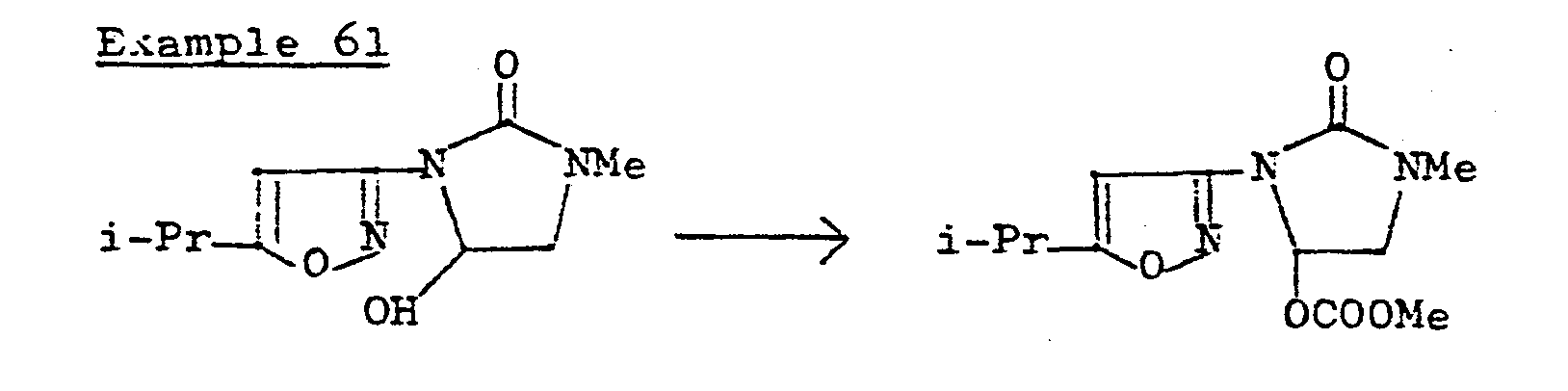
- To a mixture of 2.25 g of 1-methyl-3-(5-isopropyl-3-isoxazolyl)-4-hydroxy-2-imidazolidinone and 40 ml of dry tetrahydrofuran cooled to -78°C is added 1.16 g of 97 % potassium t-butoxide and the mixture is stirred for 30 minutes. Then 0.945 g of methyl chloroformate is added and the mixture is stirred for 30 minutes, then warmed up to room temperature, and concentrated in vacuo. The residue is combined with water and then extracted with benzene. The benzene layer is dried over anhydrous sodium sulfate and concentrated in vacuo. The residue is purified by chromatography on silica gel to give 1.37 g (yield, 48.4 %) of the objective compound as a colorless oil.
- IR (CHC1 ) 1742, 1284, 1446 cm-1
-

- The starting material (IVb) is treated in the same manner as in Example 61 to give the product (Id). The results are summarized in Table 6.
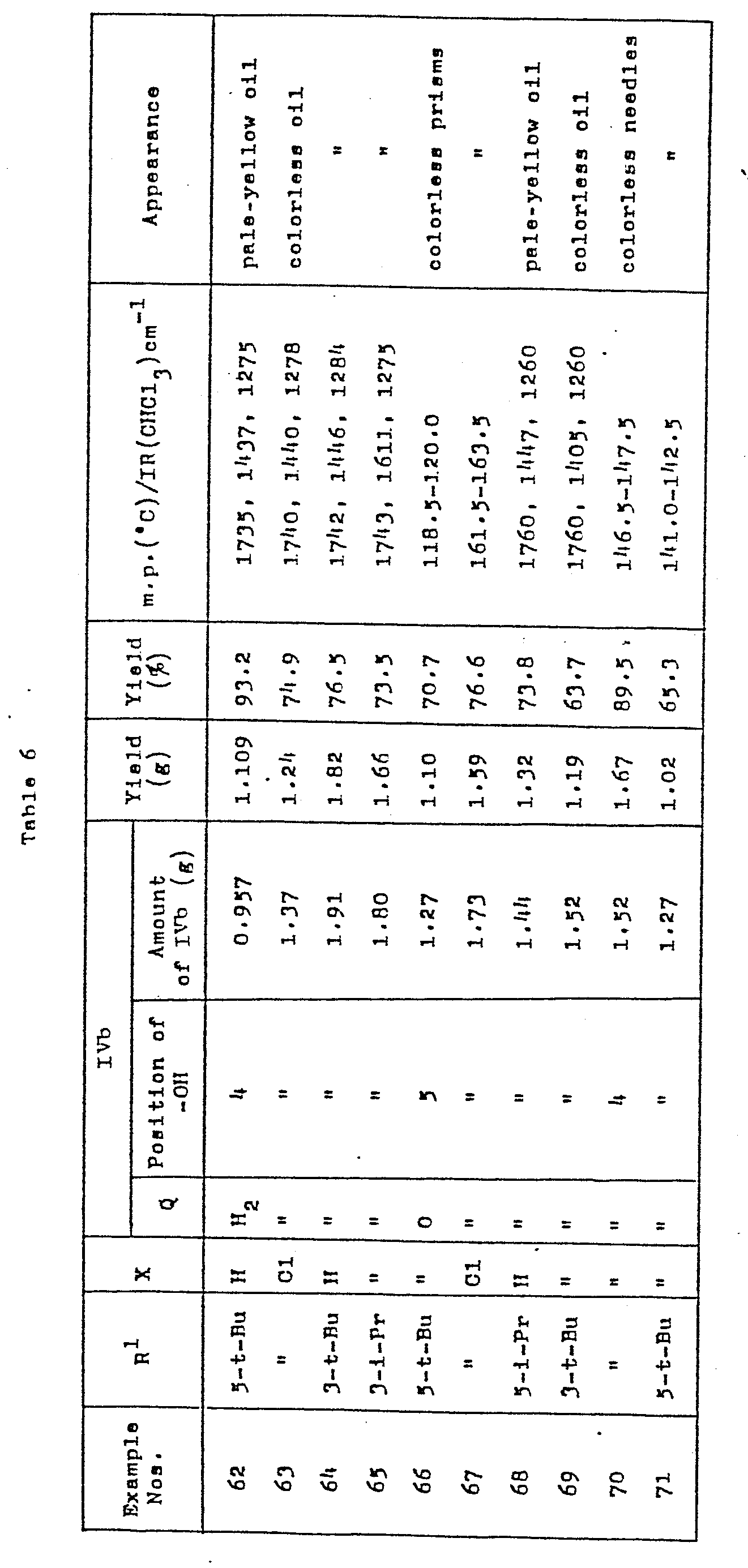
- To a mixture of 1.27 g of the product in Example 26 and 20 ml of dry tetrahydrofuran is added 0.5785 g of 97 % potassium t-butoxide under ice-cooling, and then the resultant mixture is stirred at room temperature for 30 minutes. Then 0.4725 g of methyl chloroformate is added under ice-cooling, and the mixture is stirred at room temperature for 30 minutes and then concentrated in vacuo. The residue is mixed with water and extracted with methylene chloride. The organic layer is dried over anhydrous sodium sulfate and concentrated in vacuo. The resultant residue is purified by chromatography on silica gel to give 0.75 g (yield, 47.9 %) of the objective product as crystals.

- To 1.00 g of 1-methyl-3-(5-t-buty1-3-isoxazolyl)-4- hydrdroxy-2-imidazolidinone are added 0.72 g of methyl isocyanate and three drops of thriethylamine, and the mixture is allowed to stand at room temperature for 16 hours. Then methyl isocyanate remaining unchanged is removed by distillation in vacuo. The residue is purified by chromatography on silica gel to give 1.17 g (yield, 88.3 %) of the objective product as colorless vitriform solid, m.p. 129.5 - 133.0°C·
-

- The starting material (IVc) is treated in the same manner as in Example 73 to give the objective product (Id). The results are summarized in Table 7.
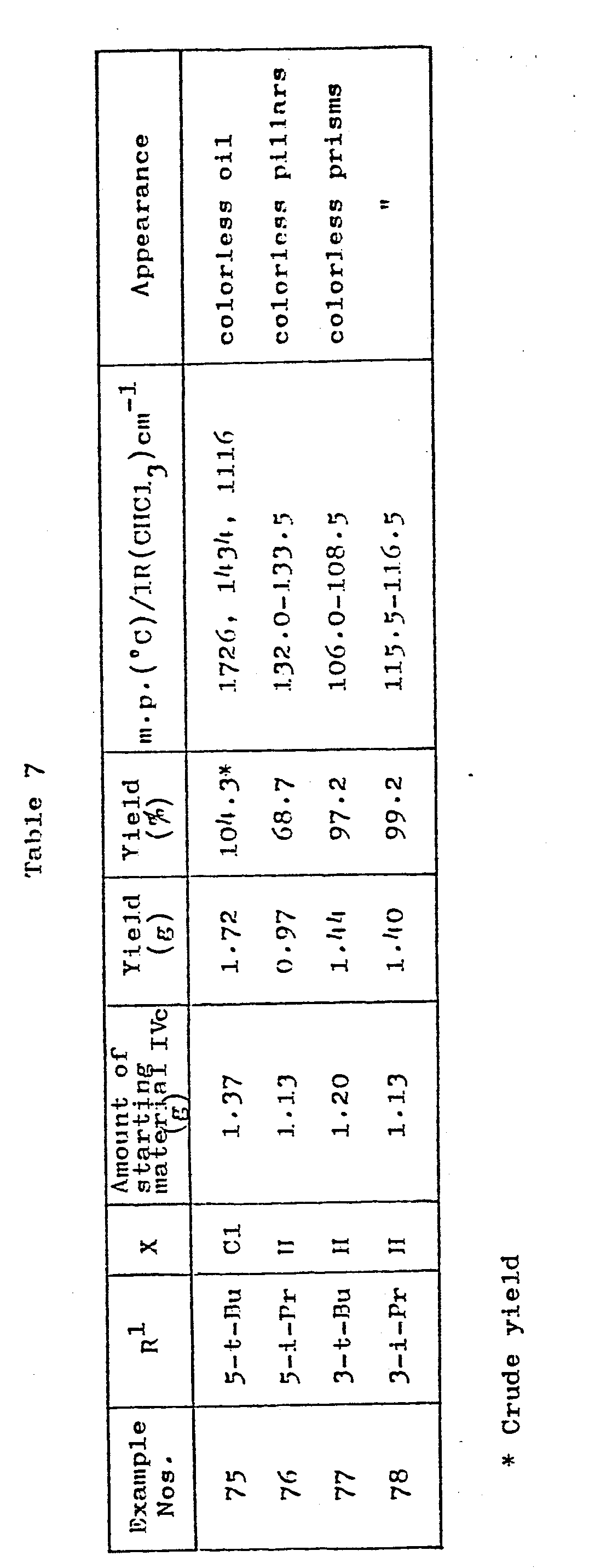
- To 0.84 g of the product in Example 26 is added 0.56 g of methyl isocyanate and the mixture is heated in a sealed tube at 60°C for a week, and then the unreacted methyl isocyanate is distilled off in vacuo. The residue is recrystallized from 1,2-dichloroethane, then dried in vacuo at 95°C for 2 hours to remove the solvent of crystallization, whereby 0.63 g (yield, 61.8 %) of the objective product is obtained as colorless powdery crystals, m.p. 128.0 - 129.5°C.
-

- The starting material (IVd) is treated in the same manner as in Example 79 to give the objective product (Id). The results are summarized in Table 8.


- To a mixture of 2.33 g of 1-methyl-3-(5-t-butyl-3-isoxazolyl)-4,5-dihydroxy-2-imidazolidinone (containing 65 % cis isomer) and 37 ml of dry chloroform is gradually added 2.96 g of 1,1'-carbonyldiimidazole over 5 hours. After termination of the addition the reaction mixture is stirred at room temperature for 30 minutes, then washed with water, dried over anhydrous sodium sulfate and then concentrated in vacuo. The residue is purified by chromatography on silica gel to give 1.48 g (yield, 57.6 %) of the objective compound as crystals. This is recrystallized from benzene to give colorless plates, m.p. 177.0 - 178.0°C (dec.).
-
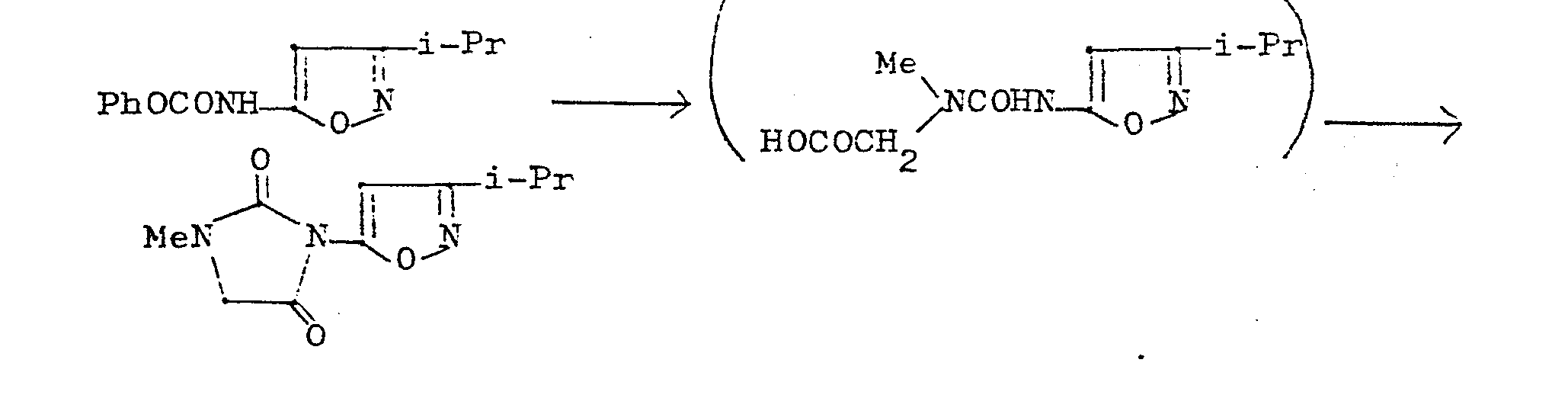
- To a solution of 12.31 g of phenyl 3-isopropylisoxazole-5-carbamate in 150 ml of methylene chloride are added 13.36 g of sarcosine and 15.18 g of triethylamine, and the mixture is stirred at room temperature for 2 hours. Then, 36 % hydrochloric acid (15.19 g) and 5 5 hydrochloric acid (72.92 g) are added and the mixture is stirred at room temperature for 42 hours. The aqueous layer is separated and extracted with methylene chloride. The combined methylene chloride layers are dried over anhydrous sodium sulfate and concentrated in vacuo. The residue is purified by chromato- graphy on silica gel to give 8.97 g (yield, 80.4 %) of the product as a pale yellow oil. IR (CHCl3) 1800, 1740, 1408 cm-1
-

- The starting material (X) is treated in the same manner as in Example 85 to give the objective product (Ia). The results are summarized in Table 9.
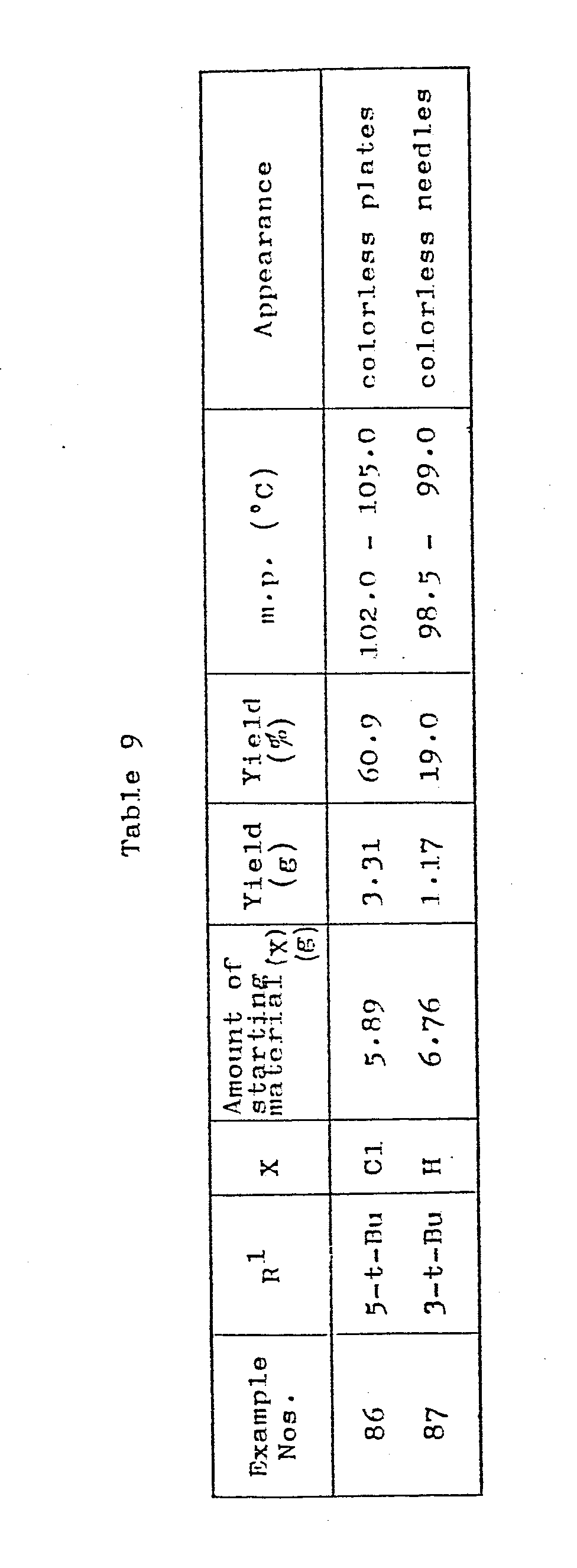
-

- To 9.97 g of 5-t-butyl-3-isoxazolyl isocyanate are added 120 ml of dry benzene and 6.11 g of methyl sarcosinate and the mixture is refluxed for 3 hours. The reaction mixture is concentrated in vacuc and the residue is purified by chromatography on silica gel to give 8.41 g (yield, 59.1 %) of the product as crystals. This is recrystallized from a mixture of benzene and cyclohexane to give colorless scales, m.p. 114.0 - 113.0°C.
- In the same manner as in Example 88 is treated 18.26 g of 5-isopropyl-3-lsoxazolyl isocyanate to give 19.74 g (yield, 73.7 %) of the objective product as crystals. This is recrystallized from a mixture of benzene and cyclohexane to give colorless needles, m.p. 97.0 - 98.0°C.
- To 0.95 g of the product prepared in Example 88 are added 4 ml of chloroform and chlorine gas (1 mole/l) in carbon tetrachloride (8.4 ml), then the mixture is allowed to stand at room temperature for five days, and concentrated in vacuo. The residue is purified by chromatography on silica gel to give 0.76 g (yield 70.3 %) of the product as crystals.
- In the same manner as in Example 90 is treated 0.89 g of the product prepared in Example 89, whereby 0.86 g (yield. 83.9 %) of the objective product is obtained as a colorless oil.
- IR (CHCl3) 1800, 1740, 1448 cm-1
-
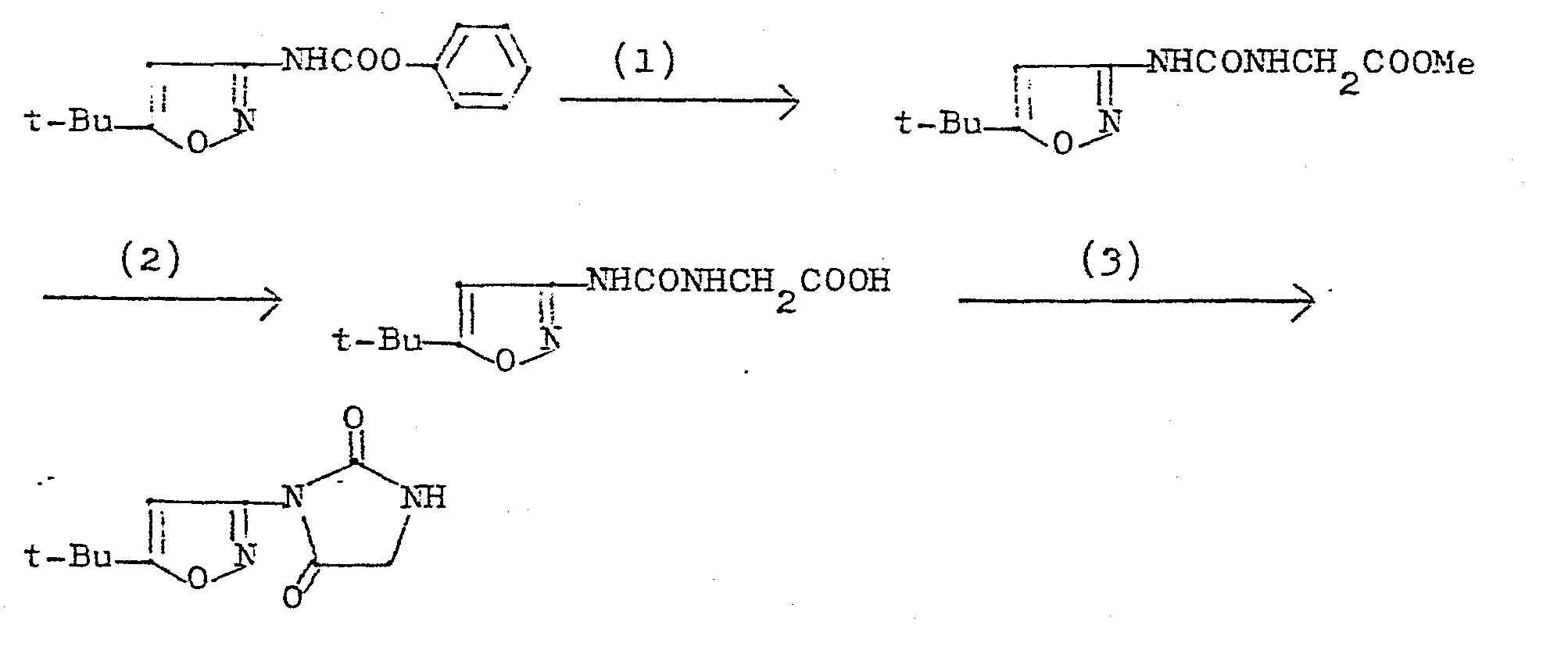
-
- (1) To a solution of 1.30 g of phenyl 5-t-butylisoxazole-3-carbamate in 20 ml of methylene chloride are added 1.26 g of methyl glycinate hydrochloride and 1.4 ml of triethylamine, and the mixture is stirred at room temperature for four days. Then water is added and the mixture is extracted with methylene chloride. The methylene chloride layer is dried over anhydrous sodium sulfate and concentrated in vacuo. The residue is purified by chromatography on silica gel to give 1.29 g of the product as crude crystals. This is recrystallized from a mixture of benzene-cyclohexane to give 1-methoxycarbonylmethyl-3-(5-t-butyl-3-isoxazolyl)urea as scales, m.p. 111 - 113°C.
- (2) To 5.11 g of the product prepared in the above (1) is added 5 % aqueous sodium hydroxide (17.60 g), then the mixture is stirred at room temperature for an hour and adjusted to pH 1 with 36 % hydrochloric acid under ice-cooling. The precipitated crystals are collected by filtration and dried in vacuo at 80°C for eight hours to give 4.82 g (yield, 99.9 %) of the objective product as crystals. This is recrystallized from methanol to give 1-carboxymethyl-3-(5-t-butyl-3-isoxazolyl)urea as colorless plates, m.p. 201.0 - 203.0°C (dec.).
- (3) To 1.45 g of the product prepared in the above (2) are added 3 ml of dry benzene, 0.86 g of thionyl chloride and 0.06 ml of pyridine, the mixture is refluxed for 3 hours. After addition of additional 0.95 g of pyridine, the resultant mixture is further refluxed for 2 hours. The reaction mixture is concentrated in vacuo. Twenty ml of 5 % hydrochloric acid is added to the residue, and the mixture is extracted with methylene chloride. The methylene chloride layer is concentrated in vacuo, and the residue is purified by chromatography on silica gel to give 0.96 g (yield, 71.7 %) of the objective product as crystals. This is recrystallized from benzene to give 1-(5-t-butyl-3-isoxazolyl)-2,5-dioxoimidazolidine as colorless needles, m.p. 175.5 - 176.5°C.
-
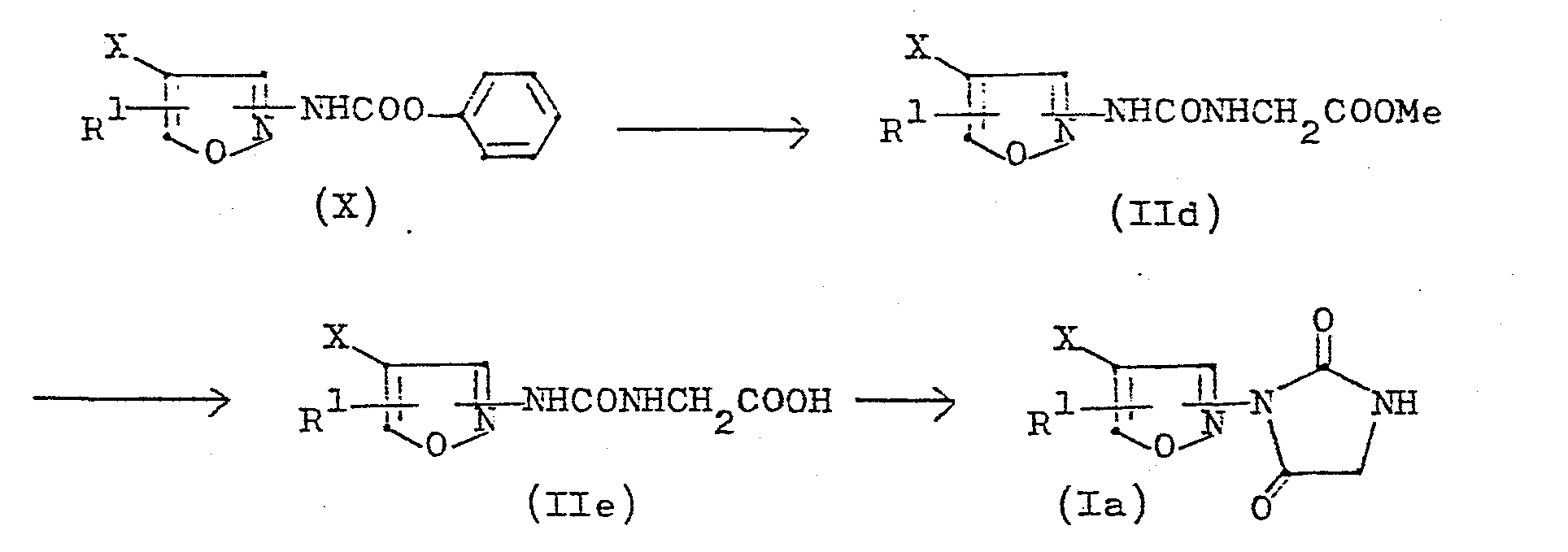
- The starting material (X) is treated in the same manner as in Example 92 to give the objective product (Ia) as well as the intermediates (IId) and (IIe). The results are summarized in Table 10.

- To 0.12g of 1-carboxymethyl-3-(3-t-butyl-5-isoxazolyl)-urea are added 5 ml of dry tetrahydrofuran and 0.12 g of dicyclohexylcarbodiimide and the mixture is stirred at room temperature for 3 days. The precipitated crystals are filtrated off and the filtrate is concentrated in vacuo. The residue is purified by chromatography on silica gel to give 0.11 g of the objective product as crystals.
- In the same manner as in Example 9 except that the reaction temperature is altered to 0 - 5°C, is treated 0.4465 g of the product prepared in Example 92 to give 0-3959 g (yield, 84.3 %) of the objective product.
- In the same manner as in Example 8 (3) is treated 1.34 g of the product prepared in Example 92 to give 1.25 g (yield, 79.1 %) of the objective product as crystals. This is recrystallized from a mixture of hexane and ethyl acetate to give colorless plates, m.p. 102.5 - 103.5°C.
-
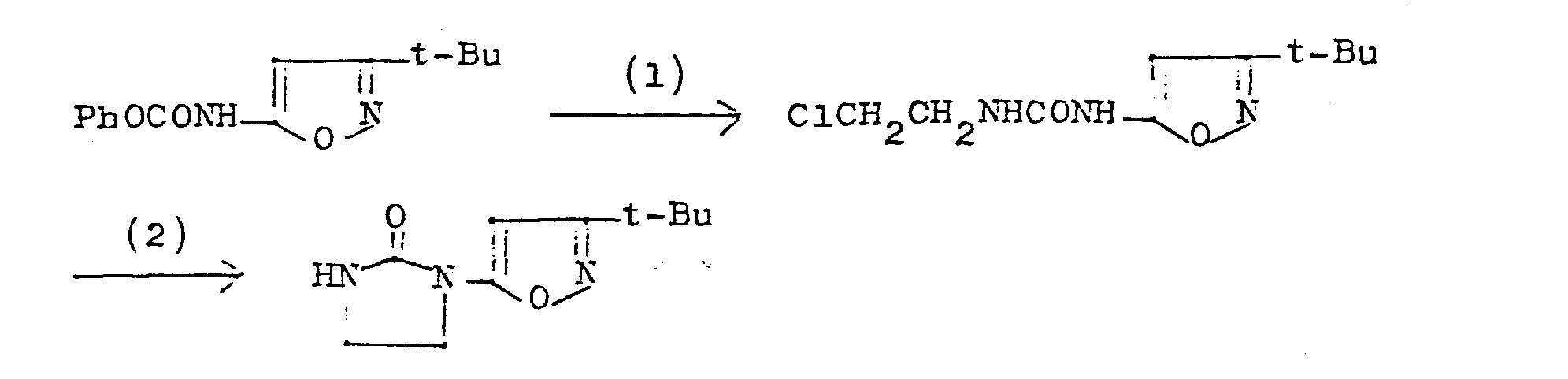
-
- (1) To a solution of 7.81 g of phenyl 3-t-butylisoxazole-5-carbamate in 60 ml of methylene chloride are added 5.22 g of 2-chloroethylamine hydrochloride and 7·59 g of triethylamine, and the mixture is stirred overnight at room temperature and then concentrated in vacuo. The residue is purified by chromatography on silica gel to give 7.37 g of the product as crude crystals. This is recrystallized from a mixture of cyclohexane and ethyl acetate to give 1-(2- chlcroethyl)-3-(3-t-butyl-3-isoxazolyl)urea as colorless needles, m.p. 126.0 - 127.0°C.
- (2) To 4.91 g of the product prepared in the above (1) are added 50 ml of water and 5.61 g of 86 % aqueous potassium hydroxide, and the mixture is stirred at room temperature for 20 minutes. To the reaction mixture is added water, and the mixture is extracted with methylene chloride, dried over anhydrous sodium sulfate, and concentrated in vacuo to give 4.20 g of the product as crude crystals. This is recrystallized from a mixture of cyclohexane and ethyl acetate to give 1-(3-t-butyl-5-isoxazolyl)-2-imidazolidinone as colorless prisms, m.p. 186.0 - 187.0°C.
-

- The starting material (X) is treated in the same manner as in Example 99 to give the objective product (Ia) as well as the intermediate (IIf). The results are summarized in Table 11.
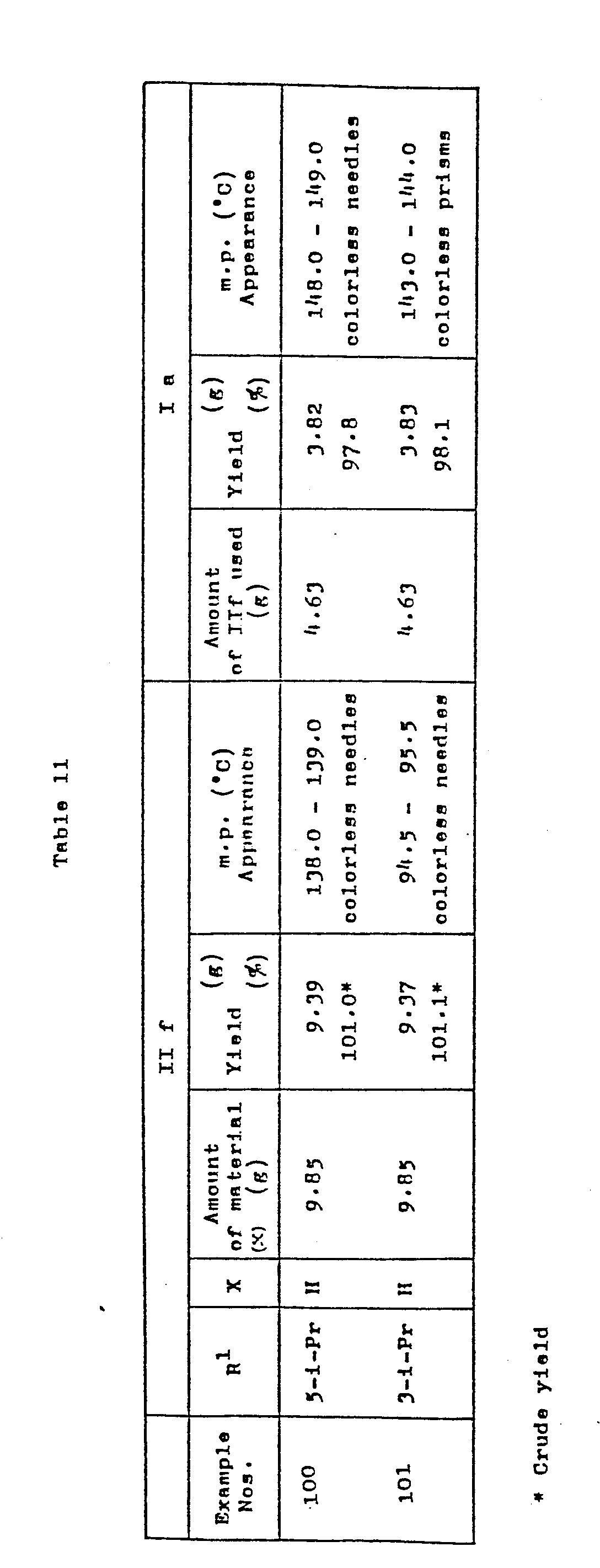
-

trans isomer
NMR, δCDCl3 : 4.60(s, 1H), 5.21(s, 1H)
cis isomer
NMR, δCDCl3 : 4.82(d, 1H, J=6Hz), 5.40(d, 1H, J=6Hz) - The following compounds are obtained in the same manner as in Example 1.


-
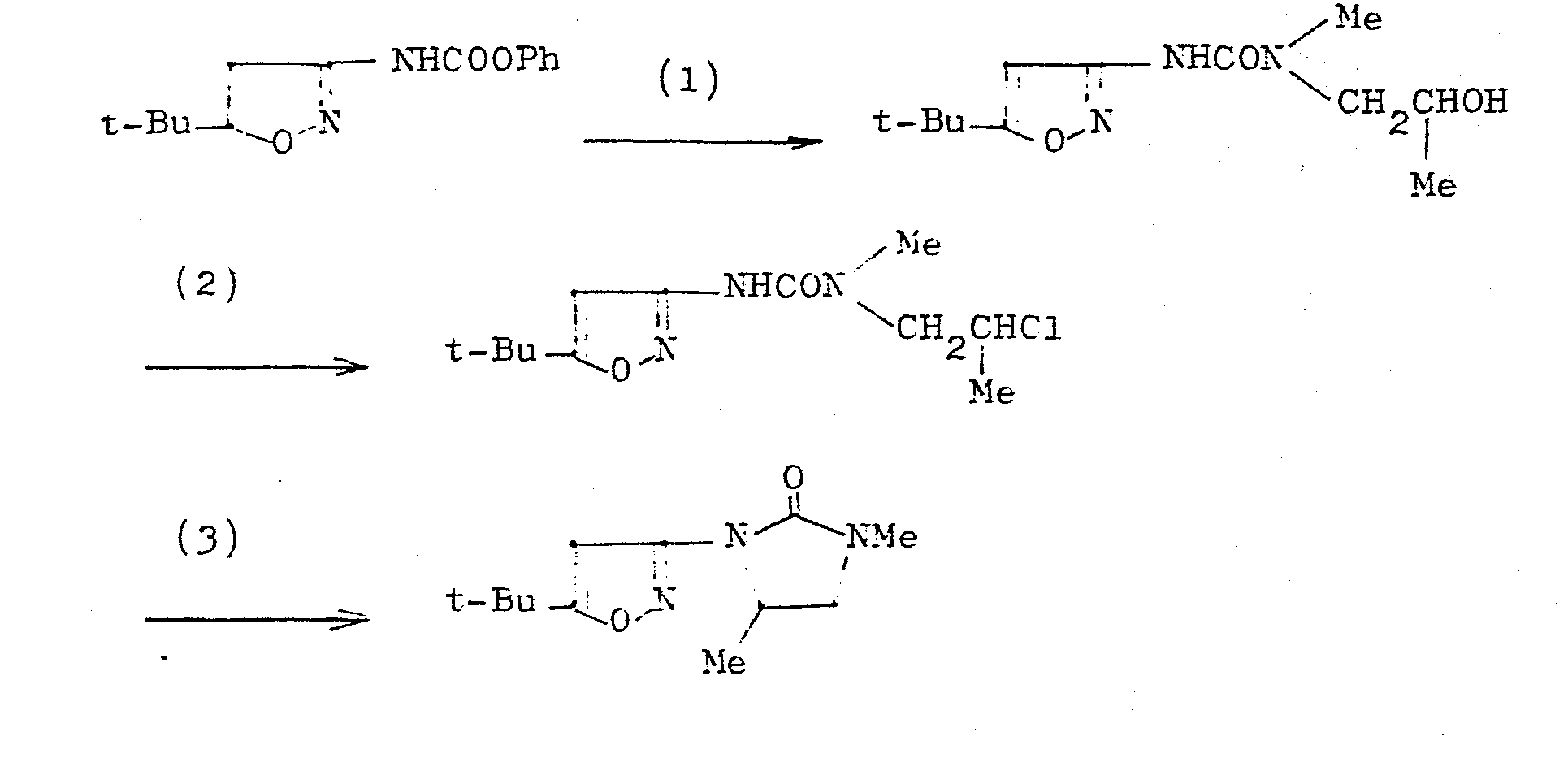
- (1) To a solution of 3.90 g (15 mmol) of phenyl 5-t-butyl- isoxazole-3-carbamate in 25 ml of methylene chloride are added 1.67 g (19.2 mmol) of 96 % 1-methyl-2-methylaminoethanol and 1.52 g (15 mmol) of triethylamine with stirring. The mixture is allowed to react overnight at room temperature and then acidified with 80 ml of 2 % hydrochrolic acid. The reaction mixture is extracted twice with 80 ml of methylene chloride. The methylene chloride layer is dried over anhydrous sodium sulfate and evaporated. The residue is purified by chromatography on silica gel to give 3.75 g (yield: 97.9 %) of 1-methyl-1-(2-hydroxypropyl)-3-(5-t-butyl-3-isoxazolyl)urea as colorless crystals. This is recrystallized from n-hexane - benzene to give the said compound as colorless prisms melting at 116 - 117°C.
- (2) A mixture of 3.06 g (12.0 mmol) of the compound prepared in the above step (1), 24 ml of benzene. and 1.72 g (14.4 mmol) of thionyl chloride is refluxed with stirring for 10 minutes. The mixture is cooled and the precipitated crystals are collected by filtration. The filtrate is evaporated to remove benzene and the residue is purified by chromatography on silica gel to give 1.66 g (yield: 50.5 %) of 1-methyl-(2-chloropropyl)-3-(5-t-butyl-3-isoxazolzolyl)urea as slightly yelowish crystals.
Anal. Calcd. (%) (for C12H20N3O2Cl):
C, 52.64; H, 7-38; N, 15.35: Cl, 12.95
Found (%): C, 52.18; H, 7.21: N, 15.28; Cl, 12.89 . - (3) To a mixture of 1.26 g (4.6 mmol) of the product prepared in the above step (2) and 1.5 ml of pyridine is added a solution of 1.29 g (23.0 mmol) of potassium hydroxide in 14 ml of water. The mixture is allowed to react for 2 hours, and 50 ml of water is added thereto. The reaction mixture is acidified with conc hydrochloric acid to adjust to lower than pH 2 and extracted twice with 80 ml of methylene chloride. The methylene chloride layer is dried over anhydrous sodium sulfate and evaporated. The resulting residue is purified by chromatography on silica gel to give 0.96 g (yield: 87.9 %) of 1,4-dimethyl-3-(5-t-butyl-3-isoxazolyl)-2-imidazolidinone. This is recrystallized from n-hexane to give the said compound as colorless prisms.
m.p.: 62 - 63°C. -

- (1) To a solution of 3.90 g (15.0 mmol) of phenyl 5-t-butylisoxazole-3-carbamate in 25 ml of methylene chloride are added 1.35 g (18.0 mmol) of 2-aminopropanol and 1.52 g (16.5 mmol) of triethylamine with stirring. The mixture is allowed to react overnight at room temperature and then acidified with 80 ml of 2 % hydrochloric acid. The reaction mixture is extracted twice with 80 ml of methylene chloride. The methylene chloride layer is dried over anhydrous sodium sulfate and evaporated. The residue is purified by chromatography on silica gel to give 3.33 g (yield: 92.0 %) of 1-(1-hydroxymethyl- ethyl)-3-(5-t-butyl-3-isoxazolyl)urea as slightly yellowish crystals.
Anal. Calcd.(%):(for C11H19N3O3):
C, 54.75; H, 7.94; N, 17.42
Found (%): C, 54.10; H. 7.85; N, 17.14. - (2) A mixture of 2.90 g (12.0 mmol) of the compound prepared in the above step (1), 24 ml of benzene, and 1.72 g (14.4 mmol) of thionyl chloride is refluxed with stirring for 10 minutes. The mixture is evaporated under reduced pressure. The residue is purified by chromatography on silica gel to give 2.88 g (yield: 92.4 %) of 1-(1-chloromethylethyl)-3-(5-t-butyl-3-isoxazolyl)urea. This is recrystallized from benzene - n-hexane to give colorless plates. m.p.: 110 - 111°C.
Anal. Calcd.(%) (for C11H18N3O2Cl):
C, 50.86: H, 7.00; N. 16.18; C1, 13.65
Found (%): C, 51.13; H, 6.93; N, 16.03; Cl, 13.66. - (3) To a mixture of 2.34 g (9.0 mmol) of the product prepared in the above step (2) and 3 ml of pyridine is added a solution of 2.52 g (45.0 mmol) of potassium hydroxide in 27 ml of water. The mixture is allowed to react for 2 hours, and 100 ml of water is added thereto. The reaction mixture is acidified with cone, hydrochloric acid to adjust to lower than pH 2 and extracted twice with 100 ml of methylene chloride. The methylene chloride layer is washed with 100 ml of saturated sodium chloride aqueous solution. dried over anhydrous sodium sulfate, and evaporated. The residue is recrystallized from ethylacetate - pyclohexane to give 1.33 g (yield: 66.2 of 3-(5-t-butyl-3-isoxazolyl)-5-methyl-2-imidazolidinone as colorless plates, and 0.37 g (yield: 18.4 %) of the said compound is recovered from the mother liquor by chromatography on silica gel.
m.p.: 138 - 139°C. - (4) To a mixture of 1.12 g (5.0 mmol) of the product provided in the above step (3) and 20 ml of dry dimethylformamide is added 0.22 g (5.5 mmol) of 60 % sodium hydride with stirring at a temperature of lower than 20°C for 30 minutes. To the mixture is added a solution of 0.92 g (6.0 mmol) of methyliodide dissolved in 3 ml of dry dimethylformamide over 5 minutes. The mixture is allowed to react for 1 hour at room temperature. The reaction mixture is evaporated under reduced pressure, mixed with 80 ml of water, and extracted twice with 80 ml of methylene chloride. The methylene chloride layer is
- In the following section of Referential Example, processes for the production of the starting materialsls are shown.
-

- To 15.87g of the product prepared in Example 89 is added 62.56 g of 5 % aqueous sodium hydroxide, and the mixture is stirred at room temperature for an hour, adjusted to pH 1 with 36 % hydrochloric acid, and then extracted with chloroform. The chloroform layer is dried over anhydrous sodium sulfate and concentrated in vacuo. The residue is dispersed in benzene to give crystals, which are collected by filtration to give 16.91 g (yield: 98.6 %) of the objective product as crystals, m.p. 133.0 - 133.5°C (dec.).
-

- The starting materials (Ia) is treated in the same manner as in Referential Example 1 to give the objective product (IIg). The results are summarized in Table 12.
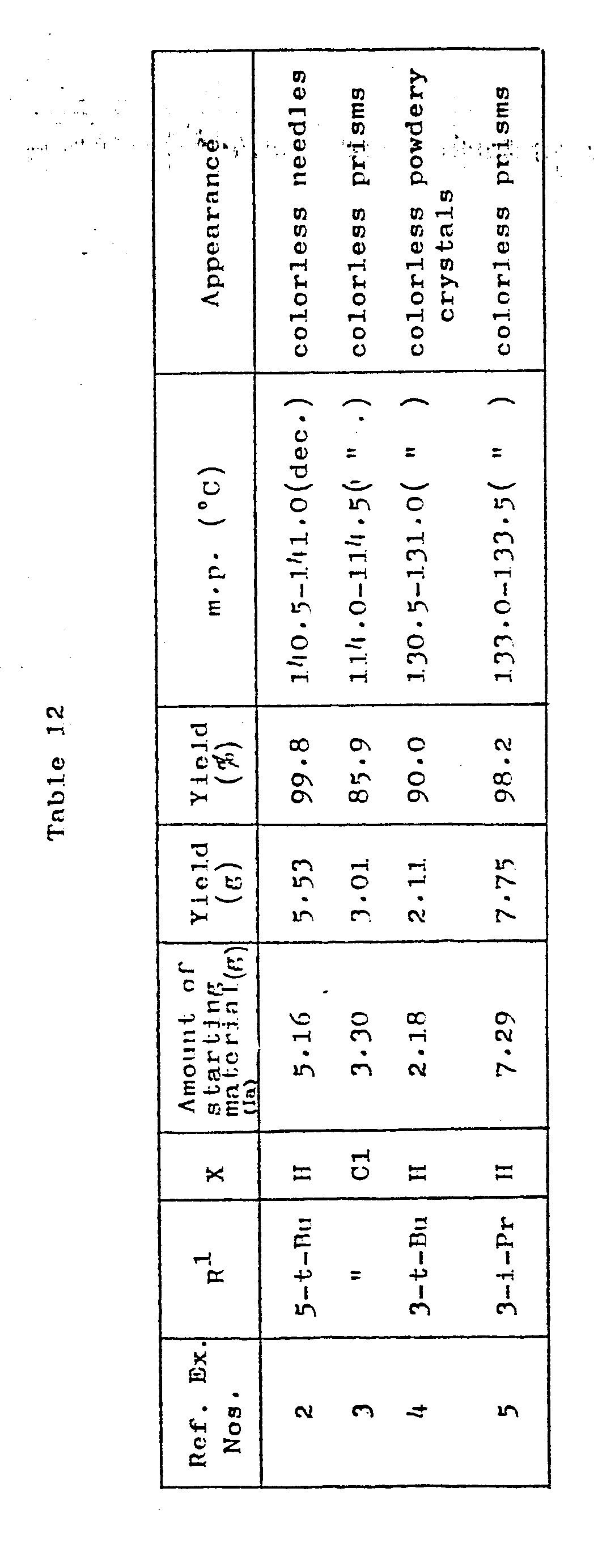
-

- To a mixture of 9 ml of ethyl ether with 2.30 g of the product prepared in Ref. Example2 is gradually added an ethereal solution of diazomethane under ice-cooling until the yellow of diazomethane remains. After completion of the addition the mixture is stirred for 15 minutes and acetic acid is then added to deactivate the diazomethane remaining unchanged. Water is added to the mixture, which is extracted with methylene chloride. The methylene chloride layer is dried over anhydrous sodium sulfate and concentrated in vacuo. To a solution of the residue in a small amount of methylene chloride is added cyclohexane, and the precipitated crystals of the product are collected by filtration. Yield, 1.65 g (yield, 68.1 %). m.p. 120.5 - 122.5°C, colorless prisms.
-


- To 6.65 g of 5-t-butyl-3-isoxazolyl cyanate are added 80 ml of dry benzene and 3.56 g of glycine methyl ester, and the mixture is refluxed for three hours and then concentrated in vacuo. The residue is purified by chromatography on silica gel to give 7.86 g (yield, 77.0 of the objective product as crystals.
- To 10.41 g of phenyl 5-t-butylisoxazole-3-carbamate are added 100 ml of dry pyridine and 6.01 g of glycine, and the mixture is stirred at 70°C for 48 hours. The reaction mixture is concentrated in vacuo, 100 ml of 8% aqueous sodium bicarbonate added to the residue, and the mixture .extracted with methylene chloride to remove methylene chloride-soluble materials. To the aqueous layer is gradually added 36 % hydrochloric acid to adjust at pH 1.
- The mixture is then ice-cooled and the precipitated crystals are collected by filtration, and dried in vacuo at 60°C for l6 hours, whereby 9.52 g (yield, 98.7 %) of the objective product is obtained as crystals.
- In the same manner as in Ref. Example 12, 14.56 g of phenyl 3-t-butylisoxazole-5-carbamate is treated to give 8.78 g (yield, 72.8 %) of the objective product as crystals.
-

- To a solution of the starting material (X) in methylene chloride is added ethanolamine (2 mol eq.), and the mixture is stirred overnight at room temperature. The reaction mixture is then concentrated in vacuo, and the residue is purified by chromatography on silica gel to give the product (IIi). The results are summarized in Table 14.
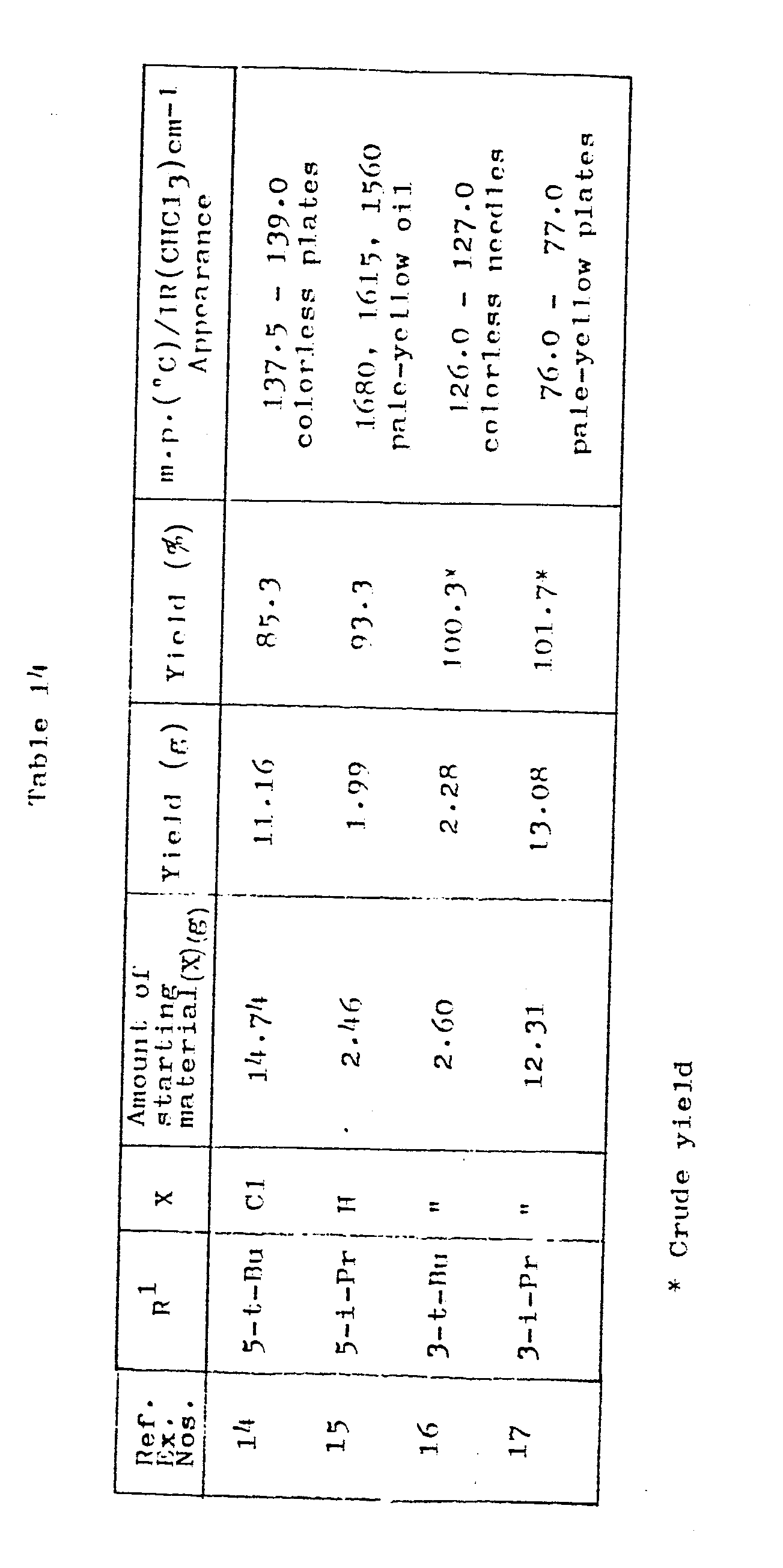
- In the same manner as in Example 12 (1) is treated 2.95 g of phenyl 5-t-butyl-4-chloroisoxazole-3-carbamate to give 2.41 g (yield, 87.4 %) of the objective product as a pale-yellow oil. IR (CHCl3) : 1687, 1555, 1530 cm-1.
-
- a) 1-(5-t-butyl-3-isoxazolyl)-5-hydroxy-2-imidazolidinone: colorless plates, m.p. 179 - 181°C (dec.).
- b) 3-(5-t-butyl-3-isoxazolyl)-4-methoxy-1-methyl-2-imidazolidinone: colorless oil, IR (CHCl3) : 1720, 1598, 1435 cm-1
- c) 4-allyloxy-3-(5-t-butyl-3-isoxazolyl)-1-methyl-2-imidazolidinone: colorless oil, IR (CHCl3) : 1722, 1599, 1440 cm-1.
- The isoxazole cyclic ureas (I) of the present invention show a potent herbicidal activity against a variety of weeds at a small application rate. They have an excellent herbicidal activity against general weeds, e.g.
- Digitaria adscendens (large crabgrass),
- Setaria viridis (green foxtail),
- Echinochloa crusgalli (barnyard grass),
- Amaranthus viridis (green amaranth),
- Chenopodium album (smooth pigweed),
- Cyperus micro-iria (flat-sedge),
- Méilugo stricta (carpet-weed),
- Stellaria media (common chickweed),
- Segina japonica (pearlwort),
- Stellaria Alsine (bog-sticbwort),
- Capsella Bursa-pastoris (Shepherd's purse),
- Alopecurus aequalis (water foxtail),
- Polygonum longisetum (smartweed),
- Trigonotis peduncularis (-),
- Gnaphalium affine (cottonweed),
- Echinochloa oryzicola (barnyard grass),
- Monchoria vaginalis (monochoria),
- Cyperus difformis (umbrella plant),
- Rotala indica (tooth cup), and
- Dopatrium junceum (-).
- In more detail, at an application rate of 1.25 - 20 g/a they are practically nontoxic to common field crops, such as corn, sugar cane, sorghum, wheat, soybean, cotton and tomato, or the harmful influence over other crop plants, if any, is so little that they could easily recover from the damage. The compounds (I) of the present invention may be applied as a selective or non-selective herbicide for crop lands, e.g. plowed fields, orchards, tea plantations, mulberry fields, fallow lands and pastures; or non-crop lands, e.g., railbeds, roads, lawns, factory sites, dry riverbeds, residential quarters, park green districts, forest lands, prepared lands and vacant lands.
- Furthermore, the compounds (I) of the present invention are harmless and safe to the human, domestic animals, and birds or poultry, and show a very low toxicity to fishes, shells and the like. Consequently, the herbicides of this invention are quite safe ones and therefore there is no problem about the residual toxicity in soil.
- The present compounds (I) each may be used in combination with known herbicides such as diuron, atrazine, prometryn, alachlor and trifluralin for the purpose of extending its herbicidal spectrum and getting an additional or synergistic herbicidal effect.
- The herbicides of the present invention may be applied over the soil such as sandy soil and clay soil as well as the ordinary soil such as sandy loam soil and loamy soil. They may be applied even to one of clay soil, i.e., montmorillonite soil which occasionally has an influence on the occurrence of the herbicidal activity.
- The herbicides of the present invention, i.e. cyclic ureas of isoxazole (I), may suitably be used in combination with a customary solid or liquid carrier or carriers, if desired, together with additional adjuvants (e.g. emulsifiers, stabilizers, dispersants, suspending agents, spreaders, penetrants, wetting agents) in order to formulate more refined formulations (e.g. emulsions, wettable powders, granules, dusts, pellets).
- Representatives of the carriers are solid carriers (e.g. clay, talc, diatomaceous earth, bentonite), liquid carriers (e.g. water, alcohols, acetone, benzene, toluene, xylene, solvent naphtha, cyclohexane) and the like.
- The herbicide formulations of this invention may be used in combination with other agricultural chemicals (e.g. insecticides, fungicides or other herbicides), manuring ingredients (e.g. ammonium sulfate, urea) or soil treating agents.
- The activities of the present herbicides are illustrated in the following Experiments.
- The test-compound Nos. correspond to the respective numbers of Examples, and additionally the following compounds (test-compound Nos. 106 - 126) were used in the test.
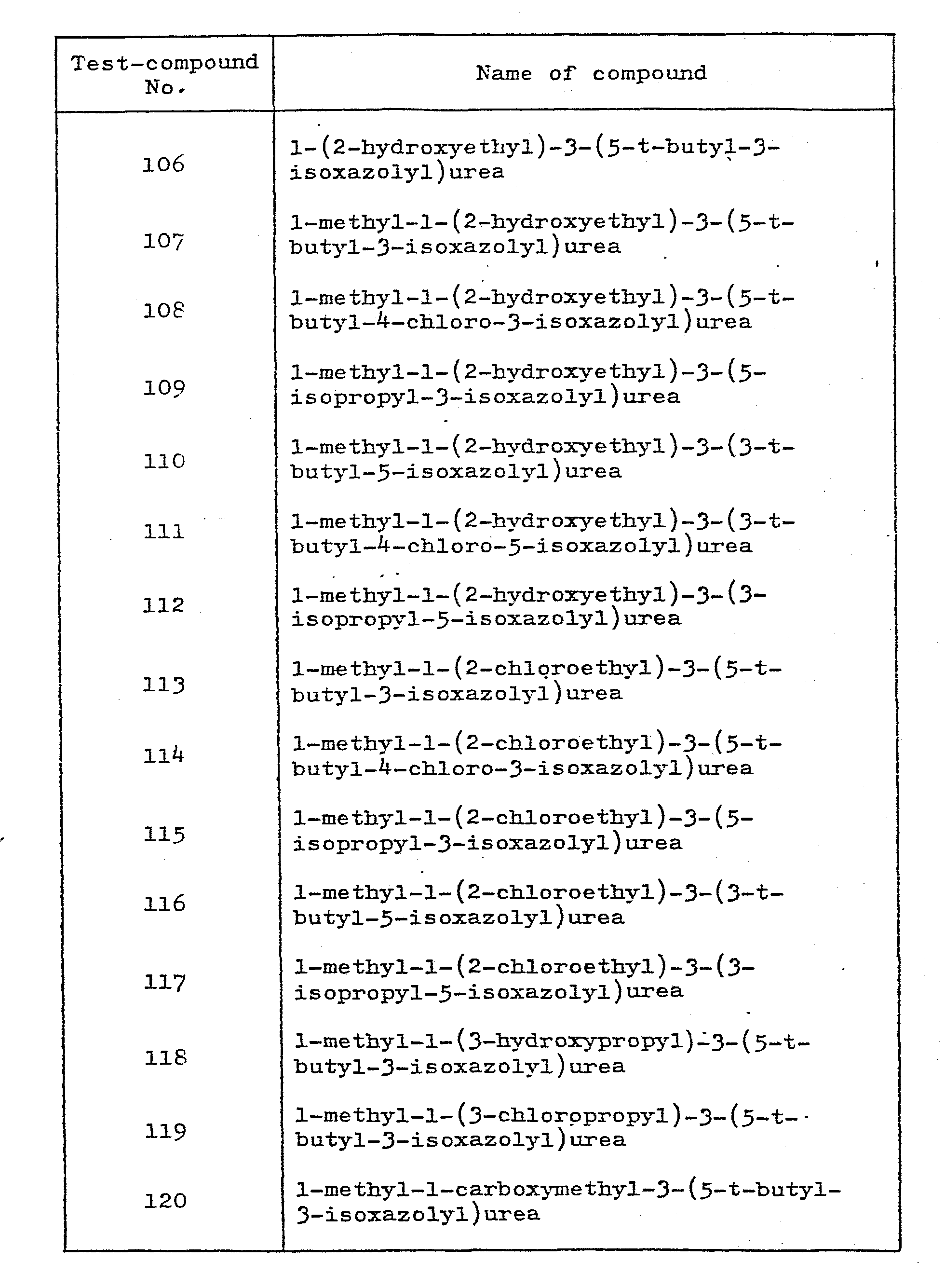

- The compounds used as a reference are as follows: Reference compound 1
- Diuron: 1,1-dimethyl-3-(3,4-dichlorophenyl)urea (U. S. Pat. No. 2,768,971)
- Linuron: 1-methoxy-1-methyl-3-(3,4-dichlorophenyl)urea (U. S. Pat. No. 2,960,534)
- Seeds of a test plant were sowed on the sandy loam charged in a square pot (7-1 x 7.1 cm) made of vinyl chloride. After being sowed, the seeds were covered with the sandy loam and an aqueous suspension (Tween 20 is used at a concentration of 100 ppm as a spreader.) of the test compound is applied over the surface of the sandy loam.
- The suspension of the test compound was prepared by dilution with water at a concentration of 10g/10L or 30g/10L and applied at a rate of lOL/are with an automatic metal sprayer.
- The pots were kept at a temperature of 25°C in a greenhouse under the natural sunlight. The survival rate is evaluated three weeks after the application of the chemicals.
- Seeds of a test plant were sowed on the sandy loam charged in a square pot (7.1 x 7.1 cm) of vinyl chloride. After being sowed, the seeds were covered with the sandy loam and then grew for ten days. Tween 20 was used at a concentration of 100 ppm as a spreader. The aqueous suspension of the test compound was applied over the young plants ten days after the sowing. The suspension of the test compound was prepared by dilution with water at a concentration of 10g/10L or 30g/10L and applied at a rate of lOL/are with an automatic metal sprayer. The pots were kept at a temperature of 25°C in a greenhouse under the natural sunlight. The survival rate was evaluated three weeks after the application.
- The outward change after the application of the chemicals was checked by eye observation at prefixed interv- als and the survival rate was calculated from the number of the survival plants after three weeks.
- The evaluation was made on the following six degree of score.
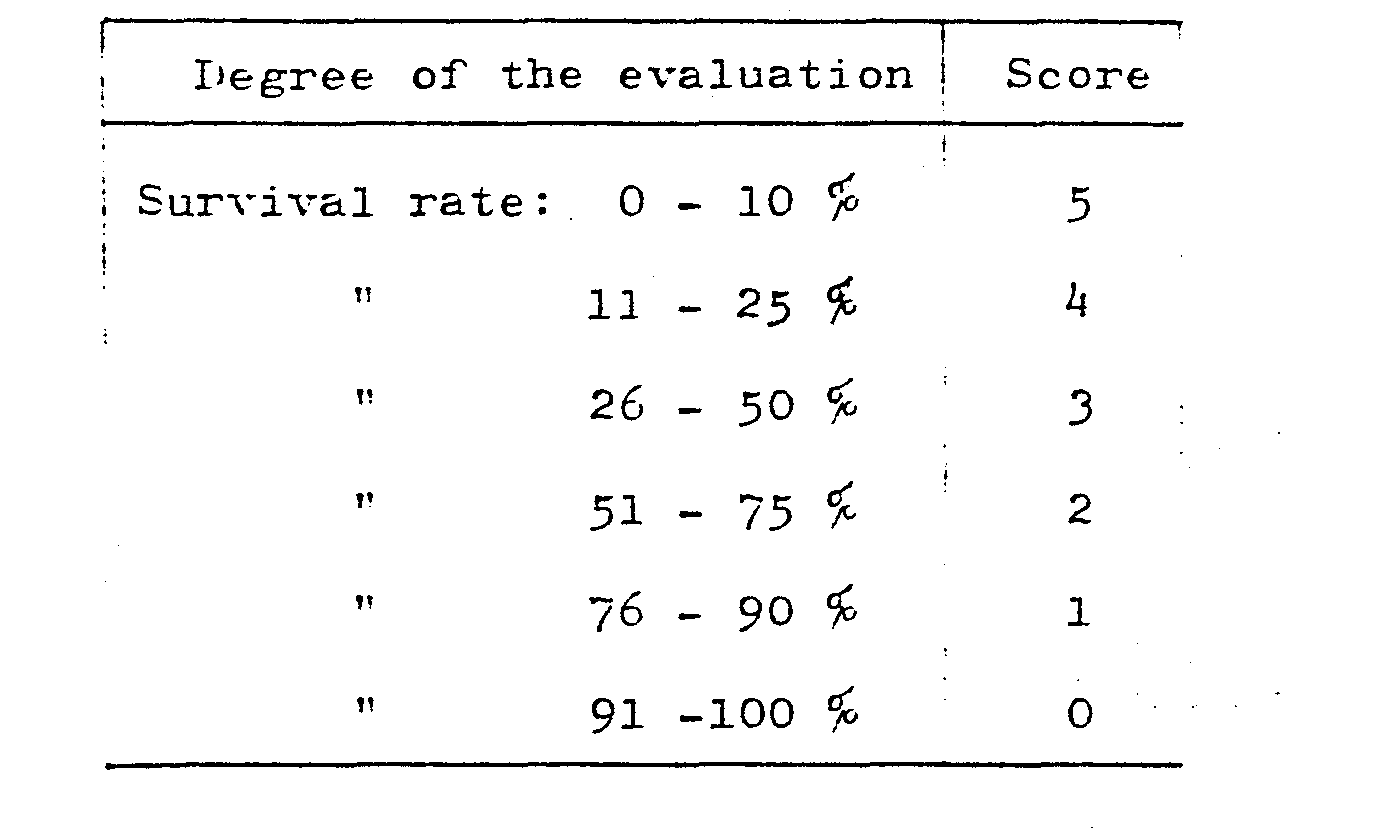
- Results in the herbicidal test are summarized in Table 15. The abbreviation used for the test plant in Table 15 has the following meaning.


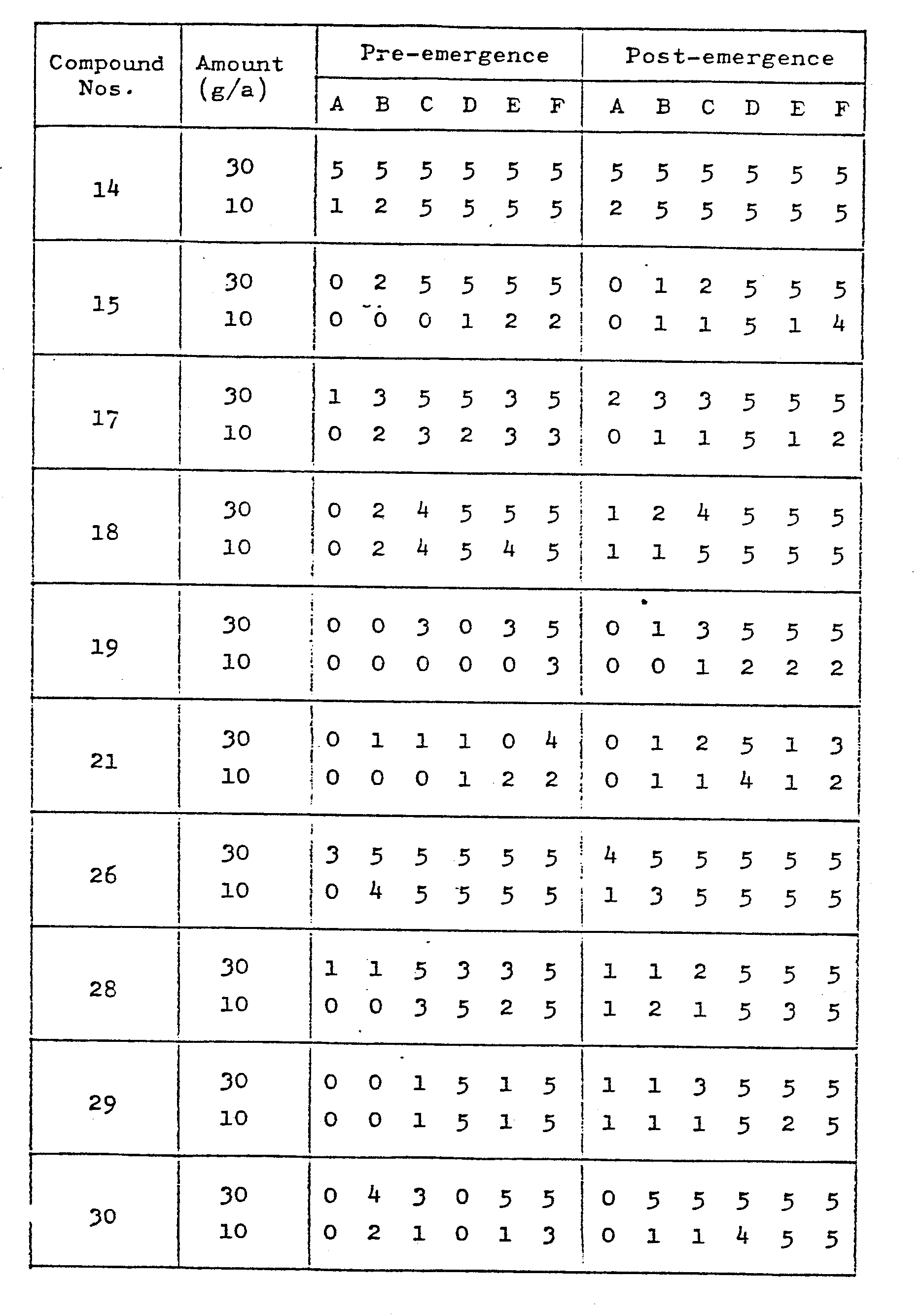

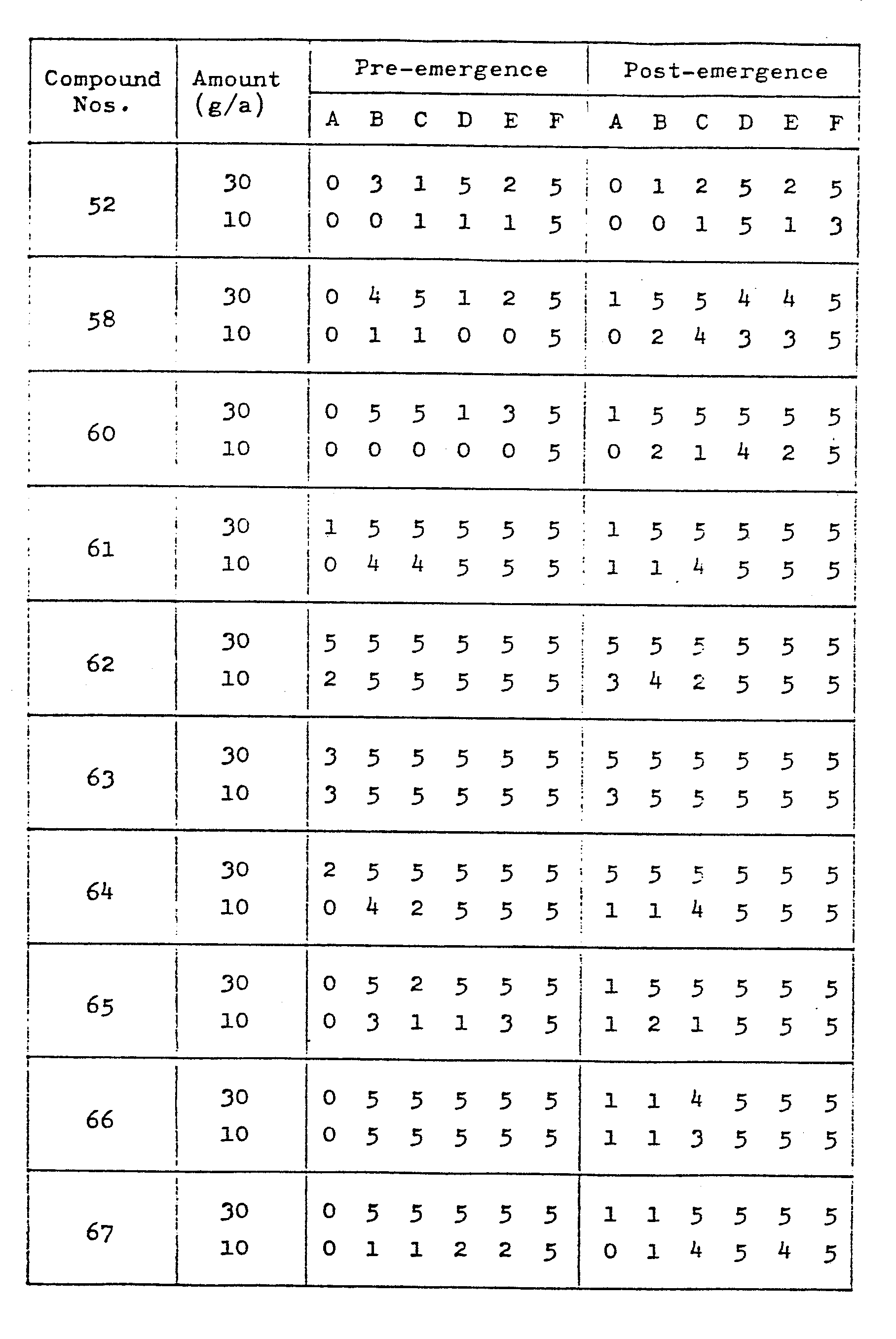


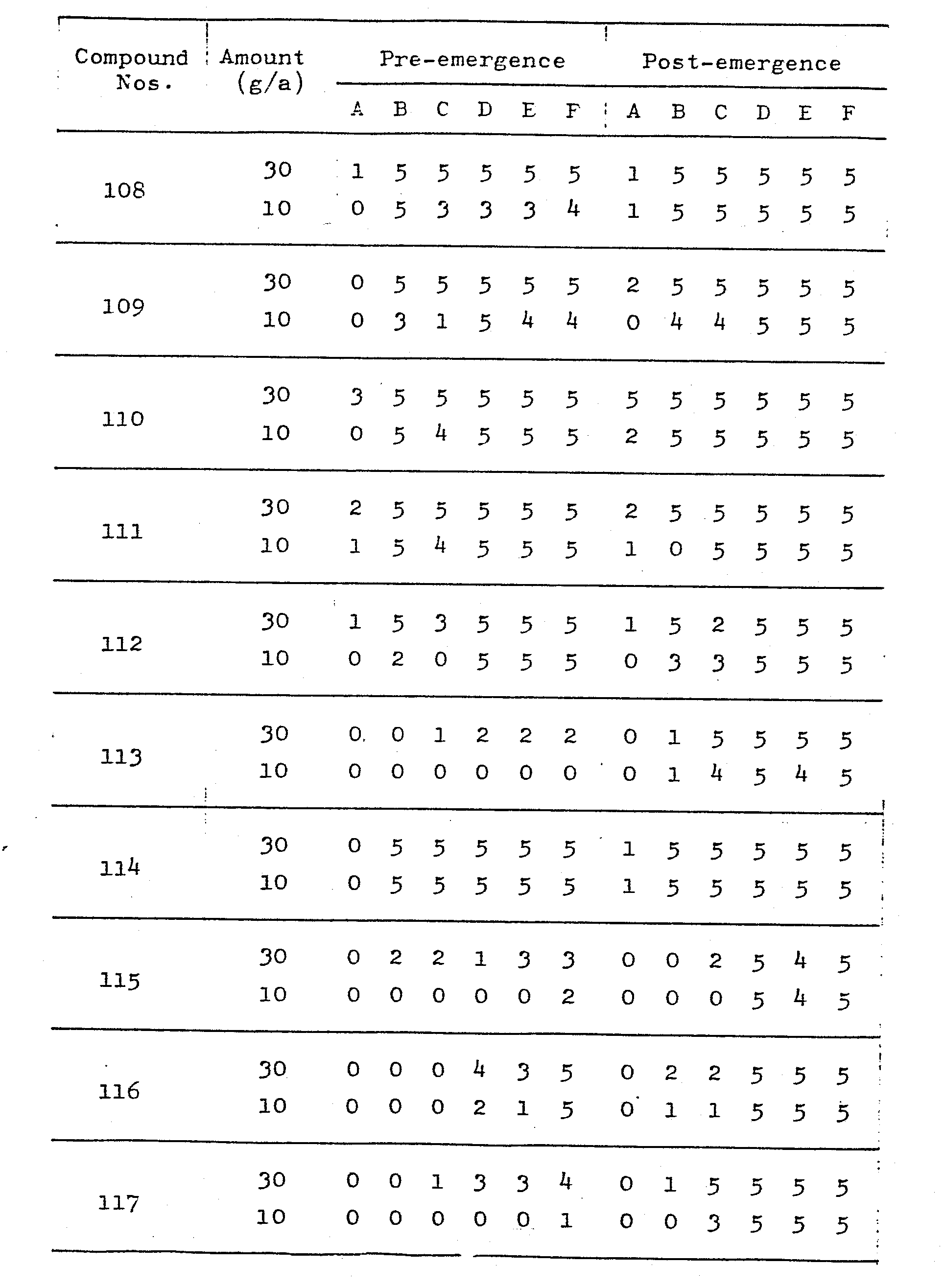

- The every compound of the present invention has an excellent herbicidal activity both in the pre-emergence test and in the post-emergence test.
- Seeds of a test compound were sowed on the loam charged in a square plastic-pot (10 x 10 cm). After sowing, the seeds were covered with sandy loam and an aqueous suspension (Tween 20 was used at a concentration of 100 ppm as a spreader.) of the test compound was applied over the surface of the sandy loam.
- The suspension of the test compound was prepared by dilution with water at a concentration of 20g/10L, lOg/lOL, 5g/10L or 2.5g/10L and applied at a rate of lOL/are with an automatic metal sprayer.
- The pots were kept at a temperature of 25°C in a greenhouse under the natural sunlight.
- The outward change of the seeds or plants was checked by eye observation at prefixed intervals , and after four weeks the evaluation was made on the following six degrees according to the degree of damages to the plant.
-

- Results in the test are summarized in Table 16-
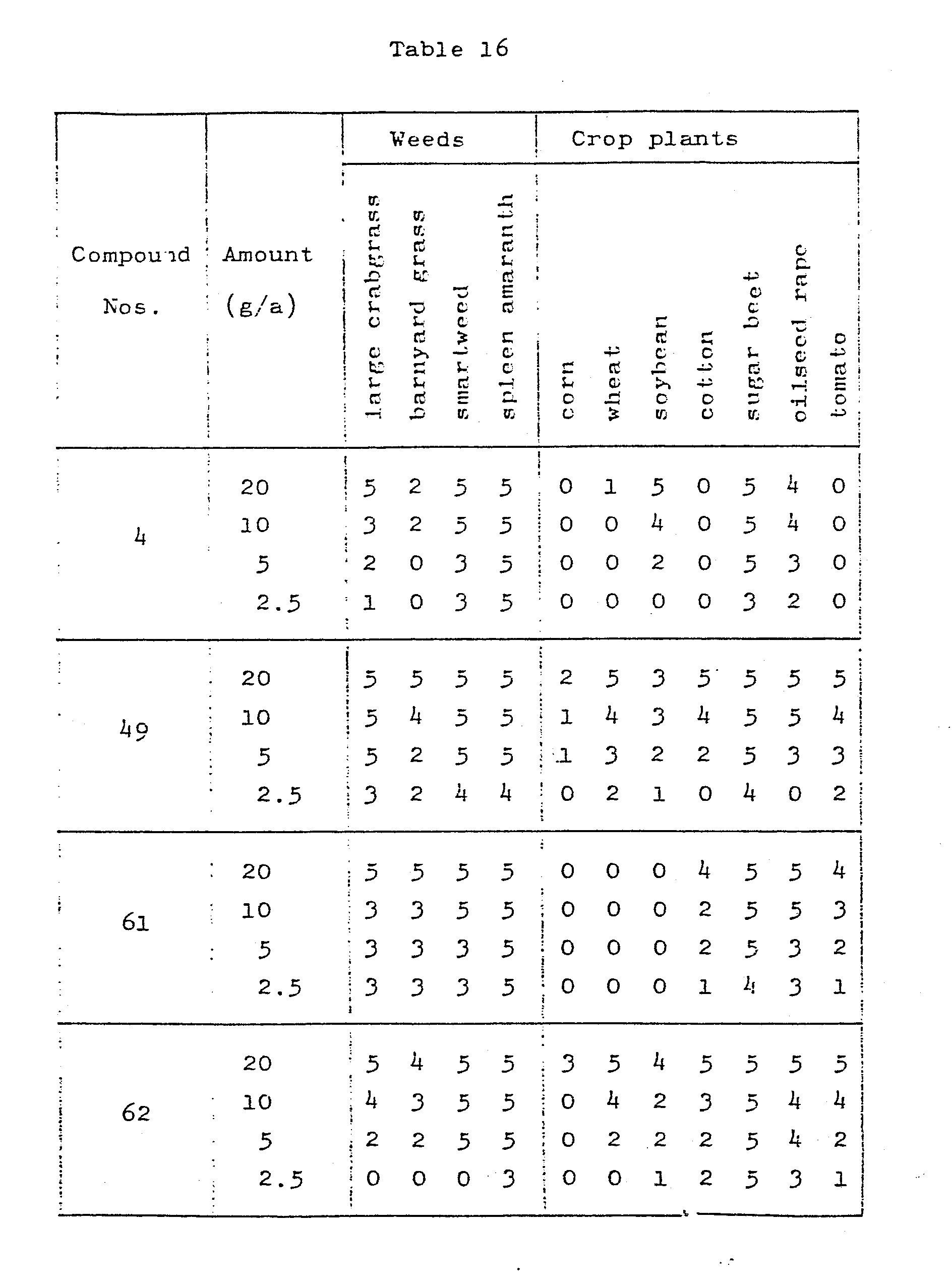


- The test-compounds each showed an excellent herbicidal activity against large crabgrass, barnyard grass, smartweed and spleen amaranth.
- Especially, no damages were observed in the tests with the compounds Nos. 4, 61 and 64 for corn, the compound No. 61 for wheat and soybean, and the compound No.4 for cotton and tomato, so they are very hopeful selective herbicides applicable to the field of the above-specified crop plants, respectively. Additionally, the compounds other than the above specified are also useful as non-selective herbicides.
- The formulations of the herbicides of the present invention are illustrated as follows.
- Ten parts by weight of 3-(3-t-butyl-5-isoxazolyl)-1-methyl-2-imidazolidinone and 90 parts by weight of dust talc are mixed up uniformly to give a dust.
- Twenty parts by weight of 1-methyl-3-(5-isopropyl-3-isoxazolyl)-4-methoxycarbonyloxy-2-imidazolidinone, 50 parts by weight of clay, 25 parts by weight of talc and 5 parts by weight of Emal (Registered trademark, Kao Soap Co.) as a spreader are mixed to give a wettable powder.
- To a solution of 20 parts by weight of 3-(3-t-butyl-5-isoxazolyl)-1-methyl-3-methoxycarbonyloxy-2-imidazolidinone in 65 parts by weight of dimethylformamide are added 15 parts by weight of Sorpol (Registered trademark, Toho Chemical Ind.) to give an emulsion.
Claims (9)


Applications Claiming Priority (2)
| Application Number | Priority Date | Filing Date | Title |
|---|---|---|---|
| JP201558/83 | 1983-10-26 | ||
| JP58201558A JPS6092285A (en) | 1983-10-26 | 1983-10-26 | Isoxazole-type cyclic urea compound |
Publications (1)
| Publication Number | Publication Date |
|---|---|
| EP0144098A1 true EP0144098A1 (en) | 1985-06-12 |
Family
ID=16443039
Family Applications (1)
| Application Number | Title | Priority Date | Filing Date |
|---|---|---|---|
| EP84201498A Withdrawn EP0144098A1 (en) | 1983-10-26 | 1984-10-16 | Cyclic ureas of isoxazole |
Country Status (5)
| Country | Link |
|---|---|
| EP (1) | EP0144098A1 (en) |
| JP (1) | JPS6092285A (en) |
| KR (1) | KR850002980A (en) |
| AU (1) | AU569759B2 (en) |
| GB (1) | GB2148893A (en) |
Cited By (17)
| Publication number | Priority date | Publication date | Assignee | Title |
|---|---|---|---|---|
| EP0205067A3 (en) * | 1985-06-14 | 1988-03-30 | Ppg Industries, Inc. | Herbicidal imidazolidinone derivatives |
| EP0297378A3 (en) * | 1987-06-29 | 1989-05-10 | Nihon Tokushu Noyaku Seizo K.K. | 2,5-dihydropyrroles |
| EP0358595B1 (en) * | 1988-07-15 | 1994-05-11 | Schering Aktiengesellschaft | N-hetaryl imidazole derivatives |
| US20080139634A2 (en) * | 2006-03-29 | 2008-06-12 | Regents Of The University Of California | Diarylthiohydantoin compounds |
| EP2004181A4 (en) * | 2006-03-27 | 2010-11-10 | Univ California | ANDROGEN RECEPTOR MODULATOR FOR THE TREATMENT OF PROSTATE CANCER AND ANDROGEN RECEPTOR RELATED DISEASES |
| US8183274B2 (en) | 2005-05-13 | 2012-05-22 | The Regents Of The University Of California | Treatment of hyperproliferative disorders with diarylhydantoin compounds |
| US8680291B2 (en) | 2007-10-26 | 2014-03-25 | The Regents Of The University Of California | Diarylhydantoin compounds |
| US9108944B2 (en) | 2010-02-16 | 2015-08-18 | Aragon Pharmaceuticals, Inc. | Androgen receptor modulators and uses thereof |
| WO2015193202A1 (en) * | 2014-06-16 | 2015-12-23 | Syngenta Participations Ag | Herbicidal compounds |
| AU2013205325B2 (en) * | 2006-03-27 | 2016-03-24 | The Regents Of The University Of California | Androgen receptor modulator for the treatment of prostate cancer and androgen receptor-associated diseases |
| US9340524B2 (en) | 2013-01-15 | 2016-05-17 | Aragon Pharmaceuticals, Inc. | Androgen receptor modulator and uses thereof |
| WO2016071361A3 (en) * | 2014-11-07 | 2016-06-23 | Syngenta Participations Ag | Herbicidal compounds |
| AU2016201061B2 (en) * | 2006-03-27 | 2017-03-02 | The Regents Of The University Of California | Androgen receptor modulator for the treatment of prostate cancer and androgen receptor-associated diseases |
| US9884054B2 (en) | 2012-09-26 | 2018-02-06 | Aragon Pharmaceuticals, Inc. | Anti-androgens for the treatment of non-metastatic castrate-resistant prostate cancer |
| US10071095B2 (en) | 2009-05-12 | 2018-09-11 | Janssen Pharmaceuticals, Inc. | 1,2,4-triazolo [4,3-A] pyridine derivatives and their use for the treatment of neurological and psychiatric disorders |
| US10501469B2 (en) | 2016-01-11 | 2019-12-10 | Janssen Pharmaceutica Nv | Substituted thiohydantoin derivatives as androgen receptor antagonists |
| US10702508B2 (en) | 2017-10-16 | 2020-07-07 | Aragon Pharmaceuticals, Inc. | Anti-androgens for the treatment of non-metastatic castration-resistant prostate cancer |
Families Citing this family (2)
| Publication number | Priority date | Publication date | Assignee | Title |
|---|---|---|---|---|
| DE3465739D1 (en) * | 1983-06-27 | 1987-10-08 | Shell Int Research | OXAZOLYL-SUBSTITUTED DIAZAHETEROCYCLES |
| EP0833817A1 (en) * | 1995-05-30 | 1998-04-08 | Bayer Ag | Substituted carbamides and their use as plant protection agents, in particular as fungicides |
Citations (2)
| Publication number | Priority date | Publication date | Assignee | Title |
|---|---|---|---|---|
| EP0044185A2 (en) * | 1980-07-07 | 1982-01-20 | Eli Lilly And Company | Imidazolidinone derivatives |
| US4354030A (en) * | 1981-12-24 | 1982-10-12 | Eli Lilly And Company | Isoxazolylimidazolidinone herbicides |
Family Cites Families (1)
| Publication number | Priority date | Publication date | Assignee | Title |
|---|---|---|---|---|
| US4507145A (en) * | 1980-02-19 | 1985-03-26 | Ppg Industries, Inc. | Herbicidal 3-[substituted 3- or 5-isoxazolyl]-1-4-, or 5-substituted-2-imidazolidinones |
-
1983
- 1983-10-26 JP JP58201558A patent/JPS6092285A/en active Pending
-
1984
- 1984-10-16 EP EP84201498A patent/EP0144098A1/en not_active Withdrawn
- 1984-10-24 KR KR1019840006616A patent/KR850002980A/en not_active Withdrawn
- 1984-10-26 AU AU34750/84A patent/AU569759B2/en not_active Ceased
- 1984-10-26 GB GB08427120A patent/GB2148893A/en not_active Withdrawn
Patent Citations (2)
| Publication number | Priority date | Publication date | Assignee | Title |
|---|---|---|---|---|
| EP0044185A2 (en) * | 1980-07-07 | 1982-01-20 | Eli Lilly And Company | Imidazolidinone derivatives |
| US4354030A (en) * | 1981-12-24 | 1982-10-12 | Eli Lilly And Company | Isoxazolylimidazolidinone herbicides |
Cited By (43)
| Publication number | Priority date | Publication date | Assignee | Title |
|---|---|---|---|---|
| EP0205067A3 (en) * | 1985-06-14 | 1988-03-30 | Ppg Industries, Inc. | Herbicidal imidazolidinone derivatives |
| EP0297378A3 (en) * | 1987-06-29 | 1989-05-10 | Nihon Tokushu Noyaku Seizo K.K. | 2,5-dihydropyrroles |
| EP0358595B1 (en) * | 1988-07-15 | 1994-05-11 | Schering Aktiengesellschaft | N-hetaryl imidazole derivatives |
| US8183274B2 (en) | 2005-05-13 | 2012-05-22 | The Regents Of The University Of California | Treatment of hyperproliferative disorders with diarylhydantoin compounds |
| US9126941B2 (en) | 2005-05-13 | 2015-09-08 | The Regents Of The University Of California | Treatment of hyperproliferative disorders with diarylhydantoin compounds |
| AU2007243651C1 (en) * | 2006-03-27 | 2013-03-14 | The Regents Of The University Of California | Androgen receptor modulator for the treatment of prostate cancer and androgen receptor-associated diseases |
| US10857139B2 (en) | 2006-03-27 | 2020-12-08 | The Regents Of The University Of California | Substituted diazaspiroalkanes as androgen receptor modulators |
| AU2007243651B2 (en) * | 2006-03-27 | 2012-08-30 | The Regents Of The University Of California | Androgen receptor modulator for the treatment of prostate cancer and androgen receptor-associated diseases |
| US9388159B2 (en) | 2006-03-27 | 2016-07-12 | The Regents Of The University Of California | Substituted diazaspiroalkanes as androgen receptor modulators |
| US8445507B2 (en) | 2006-03-27 | 2013-05-21 | The Regents Of The University Of California | Androgen receptor modulator for the treatment of prostate cancer and androgen receptor-associated diseases |
| EP2004181A4 (en) * | 2006-03-27 | 2010-11-10 | Univ California | ANDROGEN RECEPTOR MODULATOR FOR THE TREATMENT OF PROSTATE CANCER AND ANDROGEN RECEPTOR RELATED DISEASES |
| AU2017203683B2 (en) * | 2006-03-27 | 2018-07-05 | The Regents Of The University Of California | Androgen receptor modulator for the treatment of prostate cancer and androgen receptor-associated diseases |
| EP2656842A3 (en) * | 2006-03-27 | 2014-04-02 | The Regents of The University of California | Androgen receptor modulator for the treatment of prostate cancer and androgen receptor-associated diseases |
| US8802689B2 (en) | 2006-03-27 | 2014-08-12 | The Regents Of The University Of California | Androgen receptor modulator for the treatment of prostate cancer and androgen receptor-associated diseases |
| US9987261B2 (en) | 2006-03-27 | 2018-06-05 | The Regents Of The University Of California | Substituted diazaspiroalkanes as androgen receptor modulators |
| US11771687B2 (en) | 2006-03-27 | 2023-10-03 | The Regents Of The University Of California | Substituted diazaspiroalkanes as androgen receptor modulators |
| AU2016201061B2 (en) * | 2006-03-27 | 2017-03-02 | The Regents Of The University Of California | Androgen receptor modulator for the treatment of prostate cancer and androgen receptor-associated diseases |
| AU2013205325B2 (en) * | 2006-03-27 | 2016-03-24 | The Regents Of The University Of California | Androgen receptor modulator for the treatment of prostate cancer and androgen receptor-associated diseases |
| US8648105B2 (en) | 2006-03-29 | 2014-02-11 | The Regents Of The University Of California | Diarylthiohydantoin compounds |
| US20080139634A2 (en) * | 2006-03-29 | 2008-06-12 | Regents Of The University Of California | Diarylthiohydantoin compounds |
| US8110594B2 (en) * | 2006-03-29 | 2012-02-07 | The Regents Of The University Of California | Diarylthiohydantoin compounds |
| US9896437B2 (en) | 2007-10-26 | 2018-02-20 | The Regents Of The University Of California | Diarylhydantoin compounds |
| US8680291B2 (en) | 2007-10-26 | 2014-03-25 | The Regents Of The University Of California | Diarylhydantoin compounds |
| US10071095B2 (en) | 2009-05-12 | 2018-09-11 | Janssen Pharmaceuticals, Inc. | 1,2,4-triazolo [4,3-A] pyridine derivatives and their use for the treatment of neurological and psychiatric disorders |
| US10023556B2 (en) | 2010-02-16 | 2018-07-17 | Aragon Pharmaceuticals, Inc. | Androgen receptor modulators and uses thereof |
| US9481664B2 (en) | 2010-02-16 | 2016-11-01 | Aragon Pharmaceuticals, Inc. | Androgen receptor modulators and uses thereof |
| US9108944B2 (en) | 2010-02-16 | 2015-08-18 | Aragon Pharmaceuticals, Inc. | Androgen receptor modulators and uses thereof |
| US9884054B2 (en) | 2012-09-26 | 2018-02-06 | Aragon Pharmaceuticals, Inc. | Anti-androgens for the treatment of non-metastatic castrate-resistant prostate cancer |
| US10052314B2 (en) | 2012-09-26 | 2018-08-21 | Aragon Pharmaceuticals, Inc. | Anti-androgens for the treatment of non-metastatic castrate-resistant prostate cancer |
| USRE49353E1 (en) | 2012-09-26 | 2023-01-03 | Aragon Pharmaceuticals, Inc. | Anti-androgens for the treatment of non-metastatic castrate-resistant prostate cancer |
| USRE50642E1 (en) | 2012-09-26 | 2025-10-21 | Aragon Pharmaceuticals, Inc. | Anti-androgens for the treatment of non-metastatic castrate-resistant prostate cancer |
| US10799488B2 (en) | 2012-09-26 | 2020-10-13 | Aragon Pharmaceuticals, Inc. | Anti-androgens for the treatment of non-metastatic castrate-resistant prostate cancer |
| US10799489B2 (en) | 2012-09-26 | 2020-10-13 | Aragon Pharmaceuticals, Inc. | Anti-androgens for the treatment of non-metastatic castrate-resistant prostate cancer |
| US10849888B2 (en) | 2012-09-26 | 2020-12-01 | Aragon Pharmaceuticals, Inc. | Anti-androgens for the treatment of non-metastatic castrate-resistant prostate cancer |
| US9340524B2 (en) | 2013-01-15 | 2016-05-17 | Aragon Pharmaceuticals, Inc. | Androgen receptor modulator and uses thereof |
| WO2015193202A1 (en) * | 2014-06-16 | 2015-12-23 | Syngenta Participations Ag | Herbicidal compounds |
| US10499640B2 (en) | 2014-11-07 | 2019-12-10 | Syngenta Participations Ag | Herbicidal compounds |
| WO2016071361A3 (en) * | 2014-11-07 | 2016-06-23 | Syngenta Participations Ag | Herbicidal compounds |
| US10501469B2 (en) | 2016-01-11 | 2019-12-10 | Janssen Pharmaceutica Nv | Substituted thiohydantoin derivatives as androgen receptor antagonists |
| US10981926B2 (en) | 2016-01-11 | 2021-04-20 | Janssen Pharmaceutica Nv | Substituted thiohydantoin derivatives as androgen receptor antagonists |
| US11491149B2 (en) | 2017-10-16 | 2022-11-08 | Aragon Pharmaceuticals, Inc. | Anti-androgens for the treatment of non-metastatic castration-resistant prostate cancer |
| US11160796B2 (en) | 2017-10-16 | 2021-11-02 | Aragon Pharmaceuticals, Inc. | Anti-androgens for the treatment of non-metastatic castration-resistant prostate cancer |
| US10702508B2 (en) | 2017-10-16 | 2020-07-07 | Aragon Pharmaceuticals, Inc. | Anti-androgens for the treatment of non-metastatic castration-resistant prostate cancer |
Also Published As
| Publication number | Publication date |
|---|---|
| KR850002980A (en) | 1985-05-28 |
| GB2148893A (en) | 1985-06-05 |
| GB8427120D0 (en) | 1984-12-05 |
| JPS6092285A (en) | 1985-05-23 |
| AU3475084A (en) | 1985-05-02 |
| AU569759B2 (en) | 1988-02-18 |
Similar Documents
| Publication | Publication Date | Title |
|---|---|---|
| SK954482A3 (en) | Tetrahydrophtalimide compounds, manufacturing process threof and herbicidal agent on their base | |
| JPH0143751B2 (en) | ||
| JPH04226957A (en) | 1-h-3-arylpyrrolidine-2,4-dione derivatives | |
| GB2148893A (en) | Cyclic ureas of isoxazole | |
| DK156475B (en) | UREA DERIVATIVES | |
| RU2029472C1 (en) | Uracil derivatives, intermediate compounds, herbicide composition, and method of struggle against weed | |
| EP0332133B1 (en) | Novel triazole compounds, process for producing the same, and herbicidal compositions containing the same | |
| US4695312A (en) | 4,5,6,7-tetrahydro-2H-indazole derivatives and herbicides containing them | |
| BG60602B1 (en) | HERBICIDES AND WEED CONTROL METHOD | |
| HK1005028B (en) | Novel triazole compounds, process for producing the same, and herbicidal compositions containing the same | |
| KR0160307B1 (en) | Iminothiazolines, methods for their preparation and use as herbicides, and intermediates for their preparation | |
| JPS5953917B2 (en) | Tetrahydroisophthalimide derivative and method for producing the same | |
| JPH0336826B2 (en) | ||
| US4384881A (en) | Herbicidally active novel benzazol-2-yloxyacetanilides | |
| EP0196570B1 (en) | Benzoaxazine derivatives and herbicidal composition | |
| US4402731A (en) | Herbicidally active novel substituted tetrahydropyrimidinones | |
| NZ197953A (en) | 1,6-dihydro-6-oxo-3,4-diphenylpyridazin-1-yl compounds | |
| US5147445A (en) | Herbicidal triazole compounds and herbicidal compositions containing the same | |
| KR860002107B1 (en) | Method for preparing α, α-dimethylphenyl acetate anhydride derivative | |
| EP0373461A2 (en) | Benzazoles | |
| GB2126227A (en) | Acylated isoxazolylureas | |
| EP0655444A1 (en) | Oxazoline derivative, process for preparing the same and agricultural and horticultural chemical for controlling noxious organisms containing the same | |
| EP0274249A1 (en) | Oxadiazolone derivative, production process thereof, and herbicide containing same | |
| CA1105033A (en) | [n-(5-t-butyl-3-isoxazolyl)alkanamide derivatives] and herbicidal compositions containing them | |
| KR19990072001A (en) | 1,3-oxazin-4-one derivatives and herbicides containing them |
Legal Events
| Date | Code | Title | Description |
|---|---|---|---|
| PUAI | Public reference made under article 153(3) epc to a published international application that has entered the european phase |
Free format text: ORIGINAL CODE: 0009012 |
|
| AK | Designated contracting states |
Designated state(s): CH DE FR LI |
|
| 17P | Request for examination filed |
Effective date: 19850613 |
|
| 17Q | First examination report despatched |
Effective date: 19861124 |
|
| STAA | Information on the status of an ep patent application or granted ep patent |
Free format text: STATUS: THE APPLICATION IS DEEMED TO BE WITHDRAWN |
|
| 18D | Application deemed to be withdrawn |
Effective date: 19870407 |
|
| RIN1 | Information on inventor provided before grant (corrected) |
Inventor name: ISHIZUKA, ICHIRO Inventor name: SUMITOMO, SHINZABURO Inventor name: UEYAMA, YOSHITO Inventor name: IDE, KINYA |